International Chemistry Olympiad
IChO 2003
Athens, Greece · 35 theory problems with complete solutions
Problem 1: Solubility of thorium iodate
SECTION A: General Chemistry
QUESTION 1
The molar solubility \(s\) (mol dm\(^{-3}\)) of \(\ce{Th(IO3)4}\) as a function of the solubility product \(K_{sp}\) of this sparingly soluble thorium salt is given by the equation:
(a) \(\displaystyle s=(K_{sp}/128)^{1/4}\qquad\boxed{(\quad)}\)
(b) \(\displaystyle s=(K_{sp}/256)^{1/5}\qquad\boxed{(\quad)}\)
(c) \(\displaystyle s=256\,K_{sp}^{1/4}\qquad\boxed{(\quad)}\)
(d) \(\displaystyle s=(128\,K_{sp})^{1/4}\qquad\boxed{(\quad)}\)
(e) \(\displaystyle s=(256\,K_{sp})^{1/5}\qquad\boxed{(\quad)}\)
(f) \(\displaystyle s=(K_{sp}/128)^{1/5}/2\qquad\boxed{(\quad)}\)
Official English text of the problem.
Problem 2: Exact hydrogen ion concentration of hydrochloric acid
Which one of the following equations must be used for the exact calculation of \([\ce{H+}]\) of an aqueous \(\ce{HCl}\) solution at any concentration \(c_{\ce{HCl}}\)? \((K_w = 1\times10^{-14})\).
(a) \([\ce{H+}] = c_{\ce{HCl}}\) ( )
(b) \([\ce{H+}] = c_{\ce{HCl}} + K_w/[\ce{H+}]\) ( )
(c) \([\ce{H+}] = c_{\ce{HCl}} + K_w\) ( )
(d) \([\ce{H+}] = c_{\ce{HCl}} - K_w/[\ce{H+}]\) ( )
Official English text of the problem.
Problem 3: Statements about a glucose solution
The molar mass of glucose (\(\ce{C6H12O6}\)) is 180 g mol\(^{-1}\) and \(N_A\) is the Avogadro constant. Which one of the following statements is not correct?
(a) An aqueous 0.5 M solution of glucose is prepared by dissolving 90 g of glucose to give 1000 cm\(^3\) of solution. ( )
(b) 1.00 mmol amount of glucose has a mass of 180 mg. ( )
(c) 0.0100 mol of glucose comprises of \(0.0100\times24\times N_A\) atoms. ( )
(d) 90.0 g glucose contain \(3\times N_A\) atoms of carbon. ( )
(e) 100 cm\(^3\) of a 0.10 M solution contain 18 g of glucose. ( )
Official English text of the problem.
Problem 4: Number of molecules in a liquid
If the density of a liquid compound B is \(\rho\) (in \(\mathrm{g\,cm^{-3}}\)), \(M\) is the molar mass of B and \(N_A\) is the Avogadro constant, then the number of molecules of B in \(1\ \mathrm{dm^3}\) of this compound is:
(a) \((1000\times\rho)/(M\times N_A)\) ( )
(b) \((1000\times\rho\times N_A)/M\) ( )
(c) \((N_A\times\rho)/(M\times1000)\) ( )
(d) \((N_A\times\rho\times M)/1000\) ( )
Official English text of the problem.
Problem 5: Converting silver chromate into silver chloride
The equilibrium constant of the reaction:

is given by the equation:
(a) \(K = K_{sp}(\ce{Ag2CrO4}) / K_{sp}(\ce{AgCl})^{2}\qquad(\quad)\)
(b) \(K = K_{sp}(\ce{Ag2CrO4}) \times K_{sp}(\ce{AgCl})^{2}\qquad(\quad)\)
(c) \(K = K_{sp}(\ce{AgCl}) / K_{sp}(\ce{Ag2CrO4})\qquad(\quad)\)
(d) \(K = K_{sp}(\ce{AgCl})^{2} / K_{sp}(\ce{Ag2CrO4})\qquad(\quad)\)
(e) \(K = K_{sp}(\ce{Ag2CrO4}) / K_{sp}(\ce{AgCl})\qquad(\quad)\)
Official English text of the problem.
Problem 6: Preparing a phosphate buffer
How many \(\mathrm{cm^3}\) of 1.00 M \(\ce{NaOH}\) solution must be added to 100.0 \(\mathrm{cm^3}\) of 0.100 M \(\ce{H3PO4}\) solution to obtain a phosphate buffer solution with \(pH\) of about 7.2? (The \(pK\) values for \(\ce{H3PO4}\) are \(pK_1 = 2.1\), \(pK_2 = 7.2\), \(pK_3 = 12.0\))
(a) 5.0 \(\mathrm{cm^3}\) ( )
(b) 10.0 \(\mathrm{cm^3}\) ( )
(c) 15.0 mL ( )
(d) 20.0 mL ( )
Official English text of the problem.
Problem 7: Titration curves of phosphate solutions
Solutions containing \(\ce{H3PO4}\) and/or \(\ce{NaH2PO4}\) are titrated with a strong base standard solution. Associate the contents of these solutions with the titration curves (\(pH\) vs. volume of titrant) shown in the figure:
(For \(\ce{H3PO4}\): \(pK_1 = 2.1,\ pK_2 = 7.2,\ pK_3 = 12.0\))
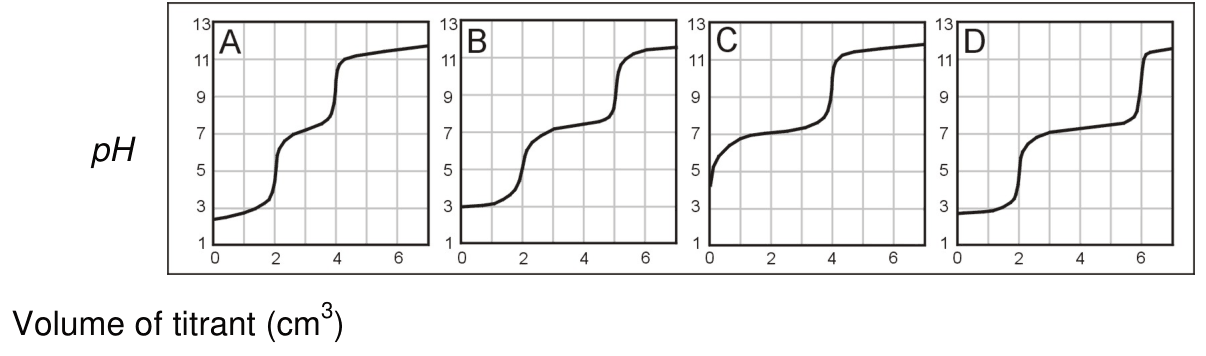
a) The sample contains \(\ce{H3PO4}\) only.
Curve A ( ), Curve B ( ), Curve C ( ), Curve D ( )
b) The sample contains both in a mole ratio \(\ce{H3PO4} : \ce{NaH2PO4} = 2 : 1\).
Curve A ( ), Curve B ( ), Curve C ( ), Curve D ( )
c) The sample contains both in a mole ratio \(\ce{H3PO4} : \ce{NaH2PO4} = 1 : 1\).
Curve A ( ), Curve B ( ), Curve C ( ), Curve D ( )
Official English text of the problem.
Problem 8: A dimethylhydrazine and dinitrogen tetroxide propellant
A fuel/oxidant system consisting of N,N-dimethylhydrazine \(\ce{(CH3)2NNH2}\) and \(\ce{N2O4}\) (both liquids) is commonly used in space vehicle propulsion. Components are mixed stoichiometrically so that \(\ce{N2}\), \(\ce{CO2}\) and \(\ce{H2O}\) are the only products (all gases under the same reaction conditions). How many moles of gases are produced from 1 mol of \(\ce{(CH3)2NNH2}\)?
(a) 8 ( )
(b) 9 ( )
(c) 10 ( )
(d) 11 ( )
(e) 12 ( )Official English text of the problem.
Problem 9: Charge needed to electrolyse water
The complete electrolysis of 1 mol of water requires the following amount of electric charge (F is the Faraday constant):
(a) F ( )
(b) (4/3) F ( )
(c) (3/2) F ( )
(d) 2 F ( )
(e) 3 F ( )
Official English text of the problem.
Problem 10: Particles emitted in nuclear reactions
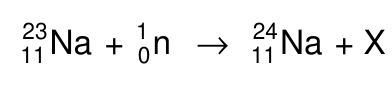
Identify particle X in each of the following nuclear reactions:
a)
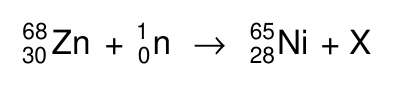
alpha ( ), beta ( ), gamma ( ), neutron ( )
b)
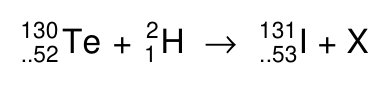
alpha ( ), beta ( ), gamma ( ), neutron ( )
c)
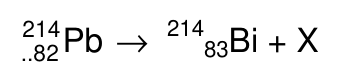
alpha ( ), beta ( ), gamma ( ), neutron ( )
d)
alpha ( ), beta ( ), gamma ( ), neutron ( )
e)
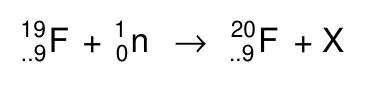
alpha ( ), beta ( ), gamma ( ), neutron ( )
Official English text of the problem.
Problem 11: Heat of neutralisation in a calorimeter
10.0 cm\(^3\) of 0.50 M \(\ce{HCl}\) and 10.0 cm\(^3\) of 0.50 M \(\ce{NaOH}\) solutions, both at the same temperature, are mixed in a calorimeter. A temperature increase of \(\Delta T\) is recorded. Estimate the temperature increase if 5.0 cm\(^3\) of 0.50 M \(\ce{NaOH}\) were used instead of 10.0 cm\(^3\). Thermal losses are negligible and the specific heats of both solutions are taken as equal.
(a) \((1/2)\,\Delta T\) ( )
(b) \((2/3)\,\Delta T\) ( )
(c) \((3/4)\,\Delta T\) ( )
(d) \(\Delta T\) ( )
Official English text of the problem.
Problem 12: Mass spectrum of the SbHCl+ ion
Natural antimony consists of the following 2 stable isotopes: \(\ce{^{121}Sb}\), \(\ce{^{123}Sb}\). Natural chlorine consists of the following 2 stable isotopes: \(\ce{^{35}Cl}\), \(\ce{^{37}Cl}\). Natural hydrogen consists of the following 2 stable isotopes: \(\ce{^{1}H}\), \(\ce{^{2}H}\). How many peaks are expected in a low resolution mass spectrum for the ionic fragment \(\ce{SbHCl+}\)?
(a) 4 ( )
(b) 5 ( )
(c) 6 ( )
(d) 7 ( )
(e) 8 ( )
(f) 9 ( )Official English text of the problem.
Problem 13: X-ray diffraction angles
The smallest diffraction angle of a monochromatic beam of X-rays in a certain experiment is 11.5°. Based on this we must expect a beam of X-rays diffracted at:
(a) 22.0 degrees ( )
(b) 22.5 degrees ( )
(c) 23.0 degrees ( )
(d) 23.5 degrees ( )
(e) 24.0 degrees ( )
(f) 24.5 degrees ( )
Official English text of the problem.
Problem 14: Extraction of a weak acid
The undissociated form of a weak organic acid \(\ce{HA}\) can be extracted from the aqueous phase by a water-immiscible organic solvent according to the scheme:
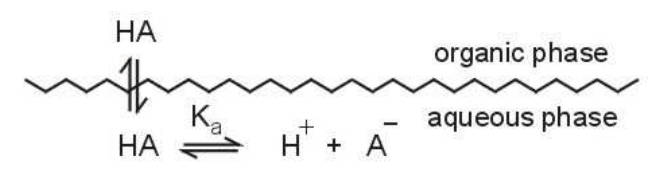
Regarding this extraction, are the following statements correct (Y) or not (N)?
(a) The distribution constant (\(K_D\)) of the acid \(\ce{HA}\) depends on the \(pH\) of the aqueous phase. (Y) (N)
(b) \(\ce{HA}\) can be efficiently extracted only from acidic aqueous solutions. (Y) (N)
(c) The distribution ratio (\(D\)) of the acid \(\ce{HA}\) depends on the pH of the aqueous phase. (Y) (N)
(d) The distribution ratio (\(D\)) of the acid \(\ce{HA}\) depends mainly on its concentration. (Y) (N)
Official English text of the problem.
Problem 15: Statements about Beer's law
Regarding Beer's law, are the following statements correct (Y) or not (N)?
(a) The absorbance is proportional to the concentration of the absorbing compound. (Y) (N)
(b) The absorbance is linearly related to the wavelength of the incident light. (Y) (N)
(c) The logarithm of transmittance is proportional to the concentration of the absorbing compound. (Y) (N)
(d) The transmittance is inversely proportional to the logarithm of absorbance. (Y) (N)
(e) The transmittance is inversely proportional to the concentration of the absorbing compound. (Y) (N)
Official English text of the problem.
Problem 16: Wavelengths of monochromatic radiation
Calculate the corresponding wavelength in nanometers (nm) for monochromatic radiation with the following numerical characteristics:
a) \(3000\ \text{Å}\) 150 nm ( ), 300 nm ( ), 600 nm ( ), 5000 nm ( ) b) \(5\times10^{14}\ \mathrm{Hz}\) 150 nm ( ), 300 nm ( ), 600 nm ( ), 5000 nm ( ) c) \(2000\ \mathrm{cm^{-1}}\) 150 nm ( ), 300 nm ( ), 600 nm ( ), 5000 nm ( ) d) \(2\times10^{6}\ \mathrm{GHz}\) 150 nm ( ), 300 nm ( ), 600 nm ( ), 5000 nm ( ) Official English text of the problem.
Problem 17: Working curves for a weak acid
The absorbance of solutions of the weak acid \(\ce{HX}\) were obtained. Associate the expected form of the resulting working curve with those shown in figure, under the following conditions:
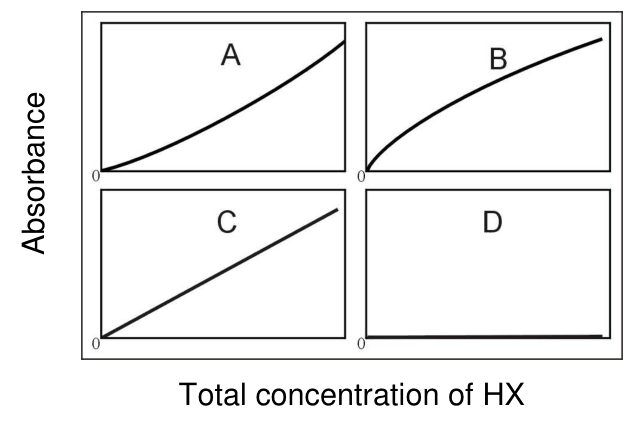
a) Pure aqueous solutions of \(\ce{HX}\) were used. Only the undissociated species \(\ce{HX}\) absorb.
Curve A ( ), Curve B ( ), Curve C ( ), Curve D ( )
b) Pure aqueous solutions of \(\ce{HX}\) were used. Only the anionic species \(\ce{X^-}\) absorb.
Curve A ( ), Curve B ( ), Curve C ( ), Curve D ( )
c) All solutions of \(\ce{HX}\) contain an excess of a strong base. Only the undissociated \(\ce{HX}\) species absorb.
Curve A ( ), Curve B ( ), Curve C ( ), Curve D ( )
d) All solutions of \(\ce{HX}\) contain an excess of a strong acid. Only the undissociated \(\ce{HX}\) species absorb.
Curve A ( ), Curve B ( ), Curve C ( ), Curve D ( )
e) Pure aqueous solutions of \(\ce{HX}\) were used. Both \(\ce{HX}\) and \(\ce{X^-}\) absorb. Measurements were obtained at a wavelength where the molar absorptivities of \(\ce{X^-}\) and \(\ce{HX}\) are equal and different than zero.
Curve A ( ), Curve B ( ), Curve C ( ), Curve D ( )
Official English text of the problem.
Problem 18: The strongest chlorine oxoacid
Which of the following acids is the strongest?
a) perchloric acid, \(\ce{HClO4}\) ( )
b) chloric acid, \(\ce{HClO3}\) ( )
c) chlorous acid, \(\ce{HClO2}\) ( )
d) hypochlorous, \(\ce{HClO}\) ( )
(e) All of them are equally strong because they all contain chlorine ( )
Official English text of the problem.
Problem 19: Crystal structure of iron
Which structure describes best the crystal system of iron in which the coordination number is 8?
a) simple cubic ( )
b) body-centered cubic ( )
c) cubic closest packed ( )
d) hexagonal closest packed ( )
e) none of the above ( )Official English text of the problem.
Problem 20: Largest third ionisation energy
Which of the following elements has the largest third ionization energy?
a) \(\ce{B}\) \(\boxed{(\;)}\)
b) \(\ce{C}\) \(\boxed{(\;)}\)
c) \(\ce{N}\) \(\boxed{(\;)}\)
d) \(\ce{Mg}\) \(\boxed{(\;)}\)
e) \(\ce{Al}\) \(\boxed{(\;)}\)Official English text of the problem.
Problem 21: A second-period element from its ionisation energies
Which second period (row) element has the first six ionization energies (\(IE\) in electron volts, eV) listed below?
\(IE_1\) \(IE_2\) \(IE_3\) \(IE_4\) \(IE_5\) \(IE_6\) 11 24 48 64 392 490 a) \(\ce{B}\) ( )
b) \(\ce{C}\) ( )
c) \(\ce{N}\) ( )
d) \(\ce{O}\) ( )
e) \(\ce{F}\) ( )Official English text of the problem.
Problem 22: Face-centred cubic silver
Silver metal exists as a face-centered cubic (fcc) packed solid.
a) Draw an fcc unit cell.
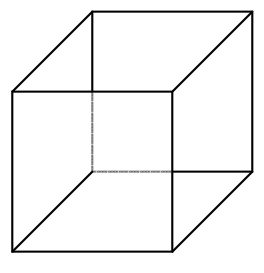
b) How many atoms are present in the fcc unit cell?
c) The density of silver has been determined to be \(10.5\ \mathrm{g\,cm^{-3}}\). What is the length of each edge of the unit cell?
d) What is the atomic radius of the silver atoms in the crystal?
Official English text of the problem.
Problem 23: Hydrogen halides, buffers and electrolysis
Are the following statements correct (Y) or not (N)?
a) \(\ce{HF}\) boils at a higher temperature than \(\ce{HCl}\). (Y) (N)
b) \(\ce{HBr}\) boils at a lower temperature than \(\ce{HI}\) (Y) (N)
c) Pure \(\ce{HI}\) can be produced by reacting concentrated sulfuric acid with \(\ce{KI}\). (Y) (N)
d) Ammonia solutions are buffer solutions because they contain the conjugate pair \(\ce{NH3}\) – \(\ce{NH4+}\). (Y) (N)
e) Pure water at 80 °C is acidic. (Y) (N)
f) During electrolysis of an aqueous \(\ce{KI}\) solution with graphite electrodes, the pH near the cathode is below 7. (Y) (N)
Official English text of the problem.
Problem 24: Zinc and nitric acid
Under certain conditions of concentration and temperature \(\ce{HNO3}\) reacts with \(\ce{Zn}\) and its reduction products are \(\ce{NO2}\) and \(\ce{NO}\) in a molar ratio 1 : 3. How many moles of \(\ce{HNO3}\) are consumed by 1 mol of \(\ce{Zn}\)?
a) 2.2 ( )
b) 2.4 ( )
c) 2.6 ( )
d) 2.8 ( )
e) 3.0 ( )
f) 3.2 ( )Official English text of the problem.
Problem 25: Muon
SECTION B: PHYSICAL CHEMISTRY
PROBLEM 25 Muon
The muon (\(\mu\)) is a subatomic particle of the lepton family which has same charge and magnetic behavior as the electron, but has a different mass and is unstable, i.e., it disintegrates into other particles within microseconds after its creation. Here you will attempt to determine the mass of the muon using two rather different approaches.
a) The most common spontaneous disintegration reaction for the muon is:
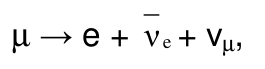
where \(\overline{\nu}_e\) is the electron antineutrino, and \(\nu_\mu\) the muon neutrino. In a given experiment using a stationary muon, \(\overline{\nu}_e+\nu_\mu\), carried away a total energy of \(2.000\times10^{-12}\ \mathrm{J}\), while the electron was moving with a kinetic energy of \(1.4846\times10^{-11}\ \mathrm{J}\). Determine the mass of the muon.
b) Many experiments have studied the spectroscopy of atoms that have captured a muon in place of an electron. These exotic atoms are formed in a variety of excited states. The transition from the third excited state to the first excited state of an atom consisting of a \(\ce{^1H}\) nucleus and a muon attached to it was observed at a wavelength of \(2.615\ \mathrm{nm}\). Determine the mass of the muon.
Official English text of the problem.
Problem 26: Spectrum of CO
PROBLEM 26 Spectrum of \(\ce{CO}\)
Rotational energy levels of diatomic molecules are well described by the formula \(E_J = B\,J(J+1)\), where \(J\) is the rotational quantum number of the molecule and \(B\) its rotational constant. Constant \(B\) is related to the reduced mass \(\mu\) and the bond length \(R\) of the molecule through the equation
\[ B=\frac{h^2}{8\pi^2\mu R^2}. \]
In general, spectroscopic transitions appear at photon energies which are equal to the energy difference between appropriate states of a molecule (\(h\nu=\Delta E\)). The observed rotational transitions occur between adjacent rotational levels, hence \(\Delta E=E_{J+1}-E_J=2B(J+1)\). Consequently, successive rotational transitions that appear on the spectrum (such as the one shown here) follow the equation \(h(\Delta\nu)=2B\).
By inspecting the spectrum provided, determine the following quantities for \(\ce{^{12}C^{16}O}\) with appropriate units:
a) \(\Delta\nu\)
b) \(B\)
c) \(R\)
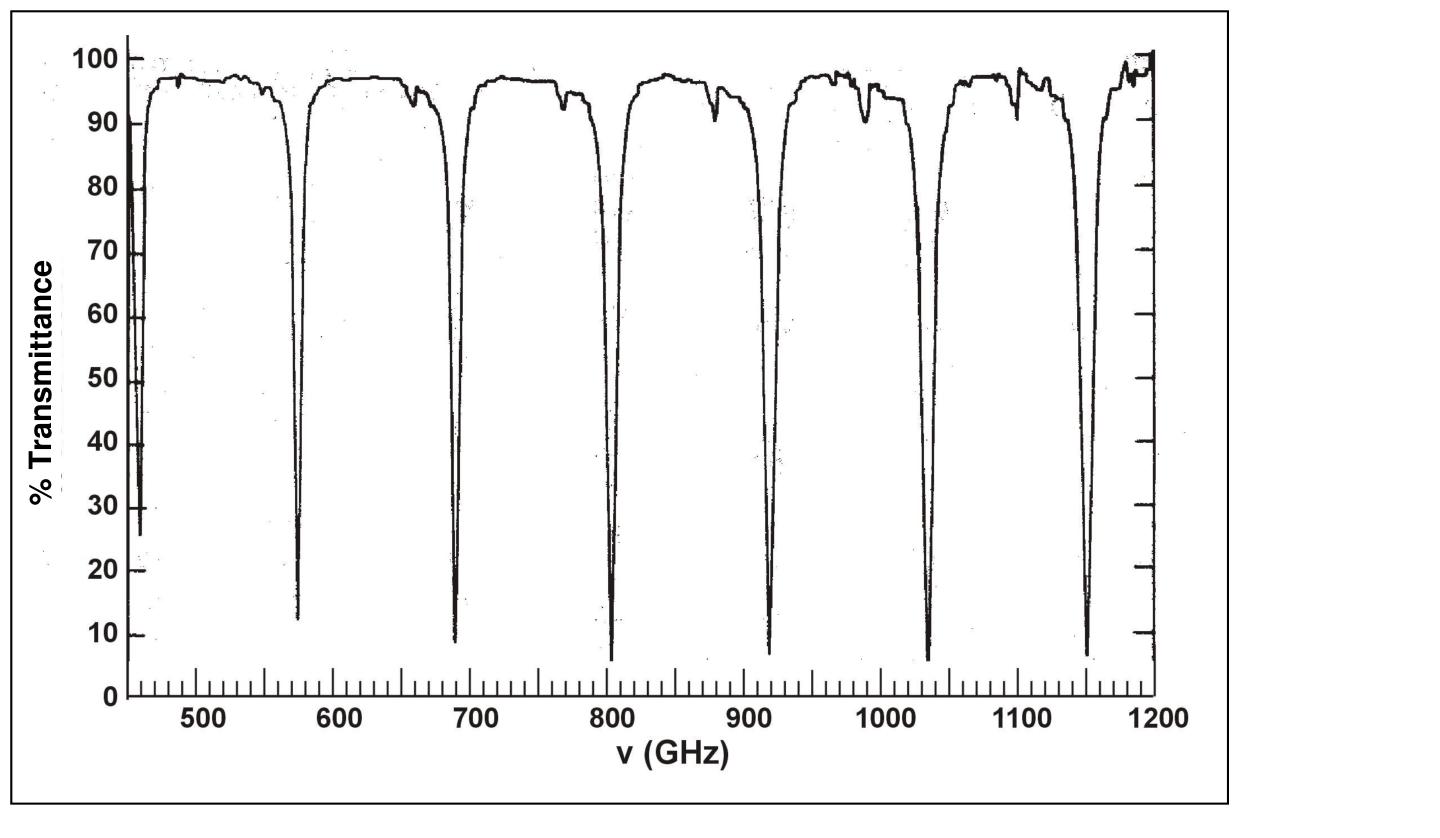
Official English text of the problem.
Problem 27: Hydrogen molecule
Using the information provided on this graph, give numerical answers with appropriate units to the following questions:
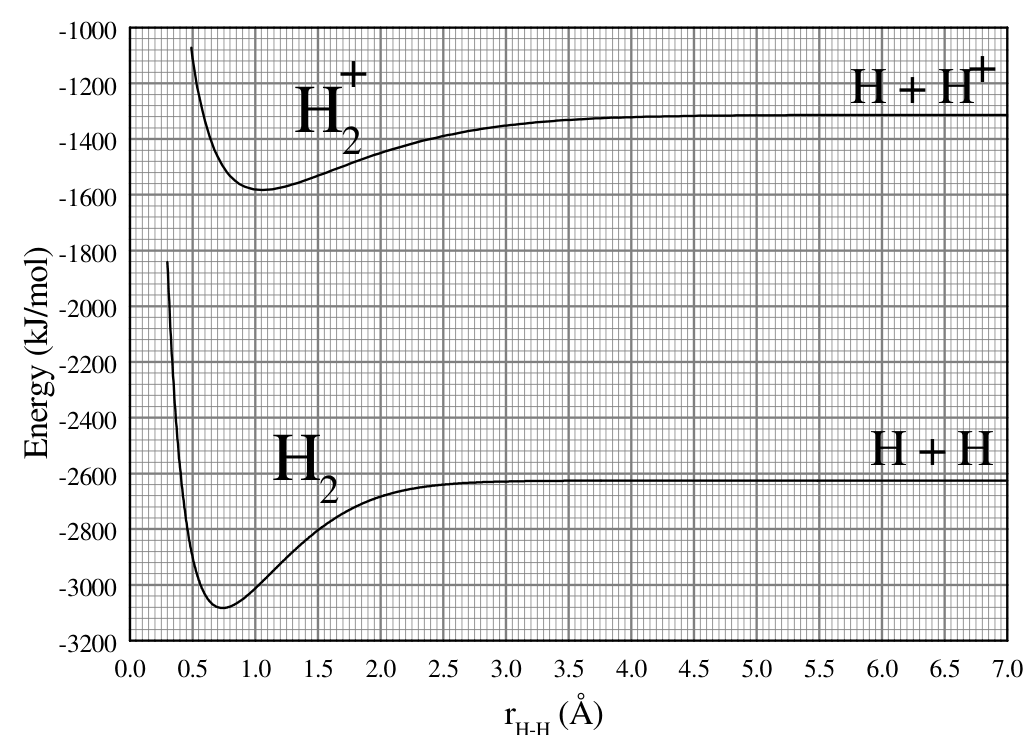
- What are the equilibrium bond lengths of \(\ce{H2}\) and \(\ce{H2+}\)?
- What are the binding energies of \(\ce{H2}\) and \(\ce{H2+}\)?
- What is the ionisation energy of the \(\ce{H2}\) molecule?
- What is the ionisation energy of the \(\ce{H}\) atom?
- If we use electromagnetic radiation of frequency \(3.9\times10^{15}\ \mathrm{Hz}\) in order to ionise \(\ce{H2}\), what will be the velocity of the extracted electrons? (Ignore molecular vibrational energy.)
Official English text of the problem.
Problem 28: Cryoscopy
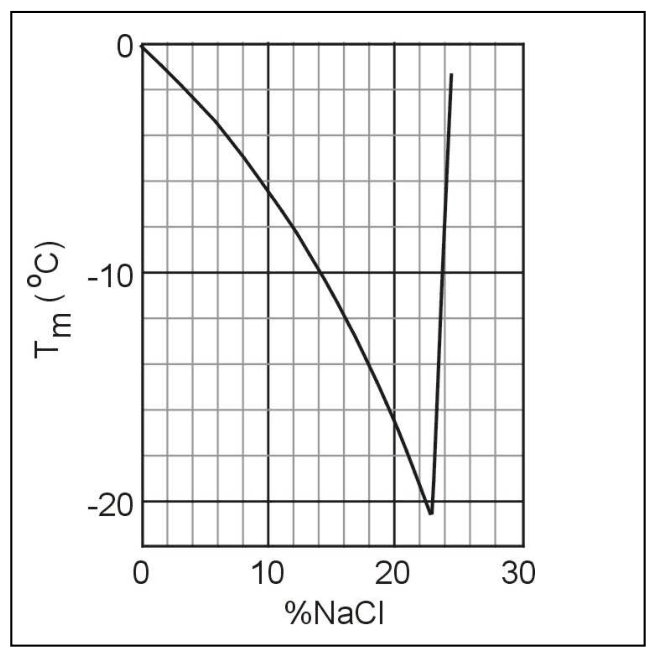
Chemists often need a bath in which to carry out a process that has a temperature below the water freezing point (\(0\,^\circ\mathrm{C}\)) and well above the \(\ce{CO2}\) sublimation point (\(-78\,^\circ\mathrm{C}\)) this case they mix water ice prepared at its melting point and \(\ce{NaCl}\). Depending on the quantities used temperatures as low as \(-20\,^\circ\mathrm{C}\) can be reached.
We prepare a cold bath mixing 1 kg of ice at \(0\,^\circ\mathrm{C}\) with 150 g of \(\ce{NaCl}\) in a thermally insulated container. Circle the letters Y or N to indicate if the following statements are correct (Y) or not (N).
a) The mixing process is spontaneous. (Y) (N)
b) The change of entropy during the mixing process is negative. (Y) (N)
c) The following diagram depicts the freezing point of aqueous solutions of \(\ce{NaCl}\) as a function of the composition of the solution (per cent by weight). What is is the freezing point of the bath based on the diagram?
d) If an equal mass of \(\ce{MgCl2}\) were used instead of \(\ce{NaCl}\), would the freezing point be higher? (Y) (N)
Official English text of the problem.
Problem 29: Pool
A very large swimming pool filled with water of temperature equal to 20 °C is heated by a resistor with a heating power of 500 W for 20 minutes. Assuming the water in the pool is not in any contact with anything besides the resistor, determine:
a) The heat delivered to the water.
b) Is the change of entropy of the resistor positive, negative, or zero?
(i) \(\Delta S_{\mathrm{res}} > 0\) ( )
(ii) \(\Delta S_{\mathrm{res}} = 0\) ( )
(iii) \(\Delta S_{\mathrm{res}} < 0\) ( )
c) Is the change of entropy of the water positive, negative, or zero?
i) \(\Delta S_{\mathrm{pool}} > 0\) ( )
(ii) \(\Delta S_{\mathrm{pool}} = 0\) ( )
(iii) \(\Delta S_{\mathrm{pool}} < 0\) ( )
d) Is the change of entropy of the system positive, negative, or zero?
(i) \(\Delta S_{\mathrm{total}} > 0\) ( )
(ii) \(\Delta S_{\mathrm{total}} = 0\) ( )
(iii) \(\Delta S_{\mathrm{total}} < 0\) ( )
e) Is the process reversible? (Y) (N)
Official English text of the problem.
Problem 30: Gas velocity
The experiment described here gives a simple way to determine the mean velocity \(u\) of the molecules in the gas phase of a volatile liquid. A wide shallow container (a Petri dish) half filled with ethanol is placed on an electronic balance with its lid next to it and the balance is zeroed at time \(t = 0\). Balance readings are recorded as shown on the diagram.
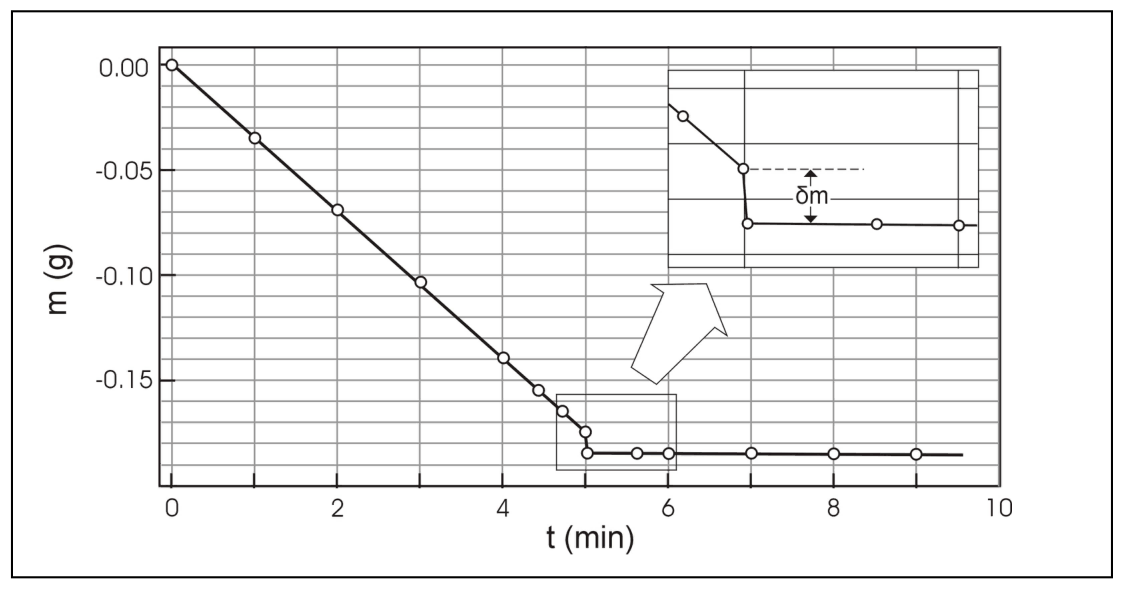
At \(t = 5\) min the lid is placed over the dish. The liquid no longer evaporates, but the trapped molecules push against the lid, hence lowering the measurement of the balance by \(\delta m\). Therefore, the force exerted on the lid is \(f = \delta m\,g\). The force is also equal to the rate of change of the momentum of the evaporating molecules, i.e., \(f = \tfrac12 u\,\mathrm{d}m/\mathrm{d}t\). Using the data provided determine the mean velocity of ethanol molecules at 290 K. Assume \(g = 9.8\ \mathrm{m\,s^{-2}}\).
Official English text of the problem.
Problem 31: Ester identification
SECTION C: Organic Chemistry
PROBLEM 31 Ester identification
2.81 g of an optically active diester A, containing only \(\ce{C}\), \(\ce{H}\) and \(\ce{O}\) were saponified with 30.00 \(\mathrm{cm^3}\) of a 1.00 M \(\ce{NaOH}\) solution. Following the saponification, the solution required 6.00 \(\mathrm{cm^3}\) of a 1.00 M \(\ce{HCl}\) solution to titrate the unused \(\ce{NaOH}\) only. The saponification products were an optically inactive dicarboxylic acid B, \(\ce{MeOH}\) and an optically active alcohol C. Alcohol C reacted with \(\ce{I2/NaOH}\) to give a yellow precipitate and \(\ce{C6H5COONa}\). The diacid B reacted with \(\ce{Br2}\) in \(\ce{CCl4}\) to give a single, optically inactive product (compound D). Ozonolysis of B gave only one product.
a) Determine the molecular mass of compound A.
b) Give the structural formulas of A, B, and C without stereochemical information.
c) Give the possible stereochemical formulas (with bold and dashed bonds) for C.
d) Give the stereochemical formula for D, using a Fischer projection.
e) Give the stereochemical formula for B.
The diester A also reacted with \(\ce{Br2}\) in \(\ce{CCl4}\) and was converted to a mixture of two compounds (E, F) both optically active.
f) Give all the possible stereochemical formulas for E and F, using Fischer projections. Name all the stereogenic centers as either \(R\) or \(S\) on all the formulas.
If we use \(\ce{Na^{18}OH}\) for the saponification of compound A, would the oxygen isotope be incorporated in (either or both of) the products B and C?
g) Mark the correct answer:
i) Only B ( )
ii) Only C ( )
iii) Both B and C ( )
Official English text of the problem.
Problem 32: NMR puzzle
An organic compound A (\(\ce{C8H10}\)) gives the following chain of reactions:
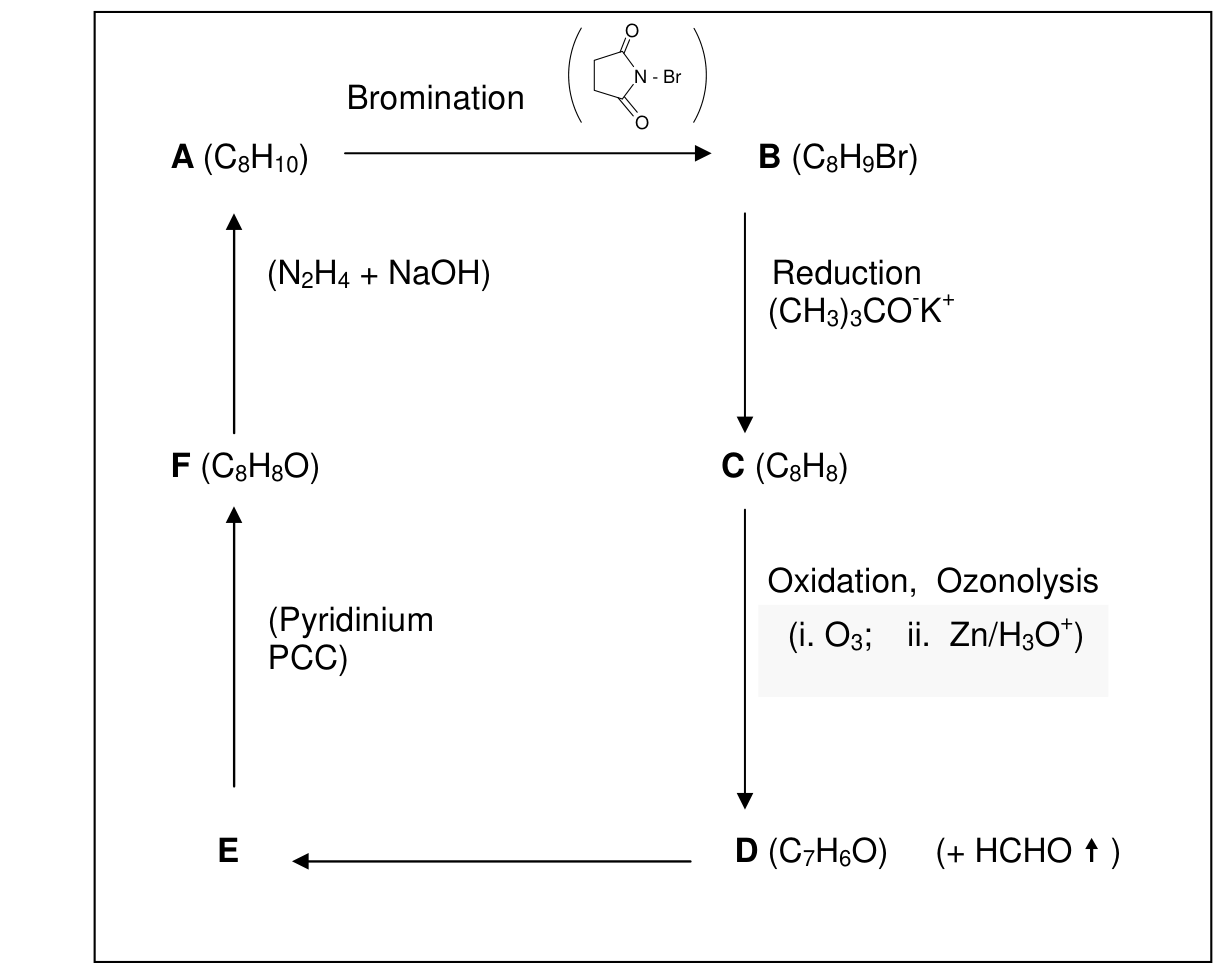
Based on the \({}^{1}\mathrm{H}\)-NMR spectra given, draw the structures of compounds A, B, C, D, E and F, and match the groups of the hydrogen atoms of each compound to the corresponding \({}^{1}\mathrm{H}\)-NMR peaks, as shown in the example.
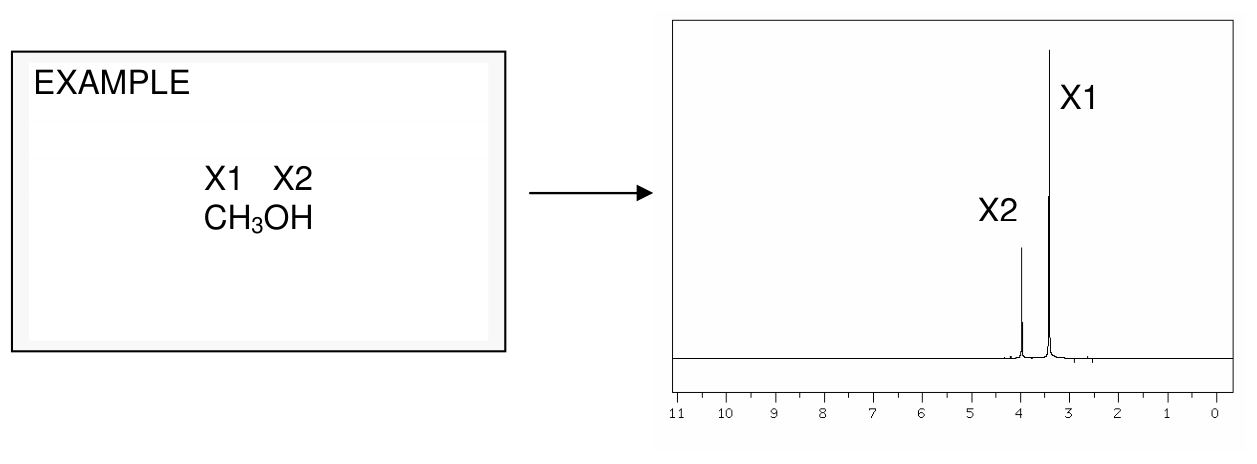
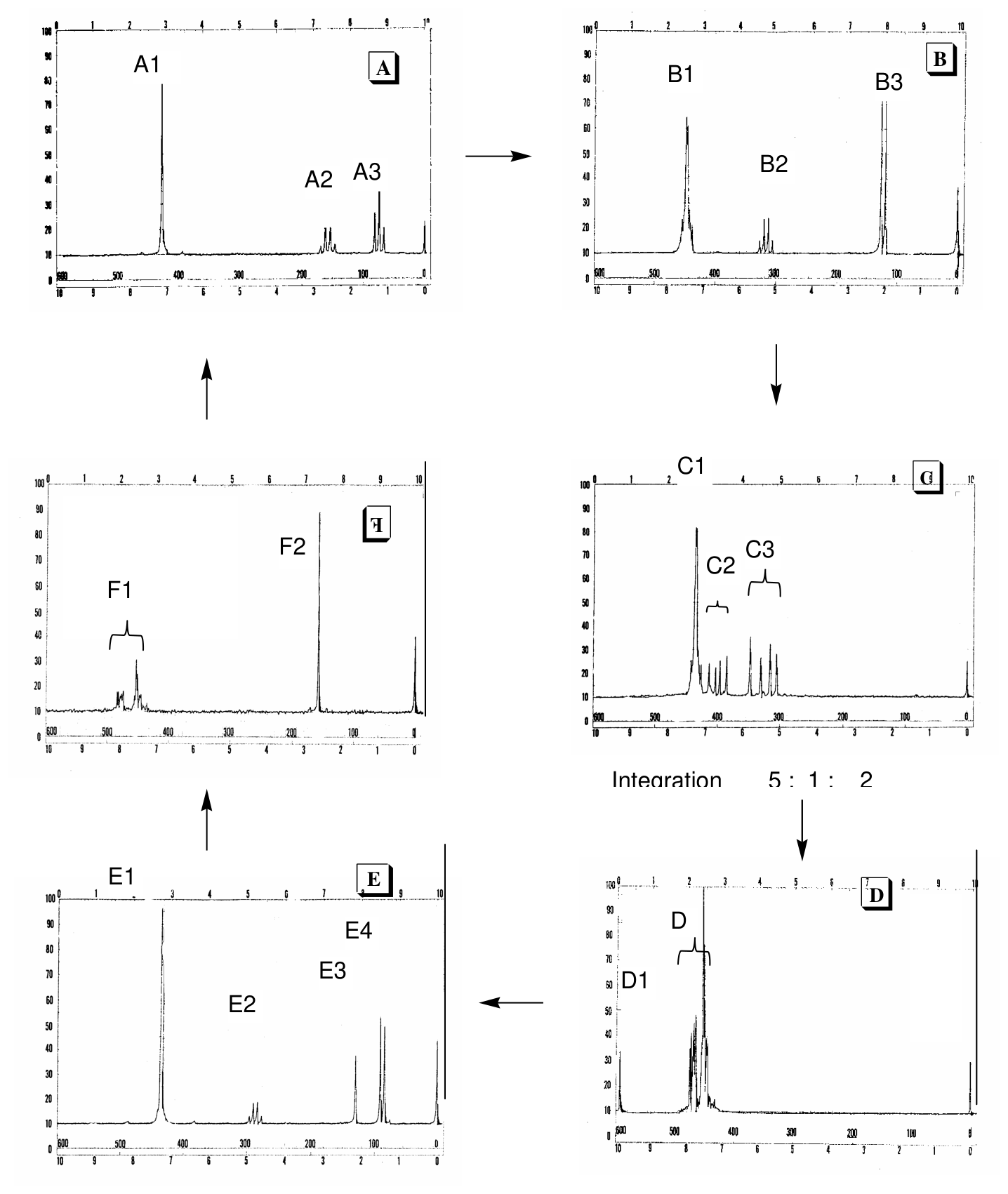
General remarks: NMR spectra were ecorded in \(\ce{CDCl3}\) on a 60 MHz Perkin Elmer Spectrometer. Under ordinary conditions (exposure to air, light and water vapour) acidic impurities may develop in \(\ce{CDCl3}\) solutions and catalyse rapid exchange of some particular protons.
Official English text of the problem.
Problem 33: Peptides
Racemization of α-aminoacids and peptides can occur by an α-enolization mechanism and both heat and the presence of strong bases greatly accelerate the process:
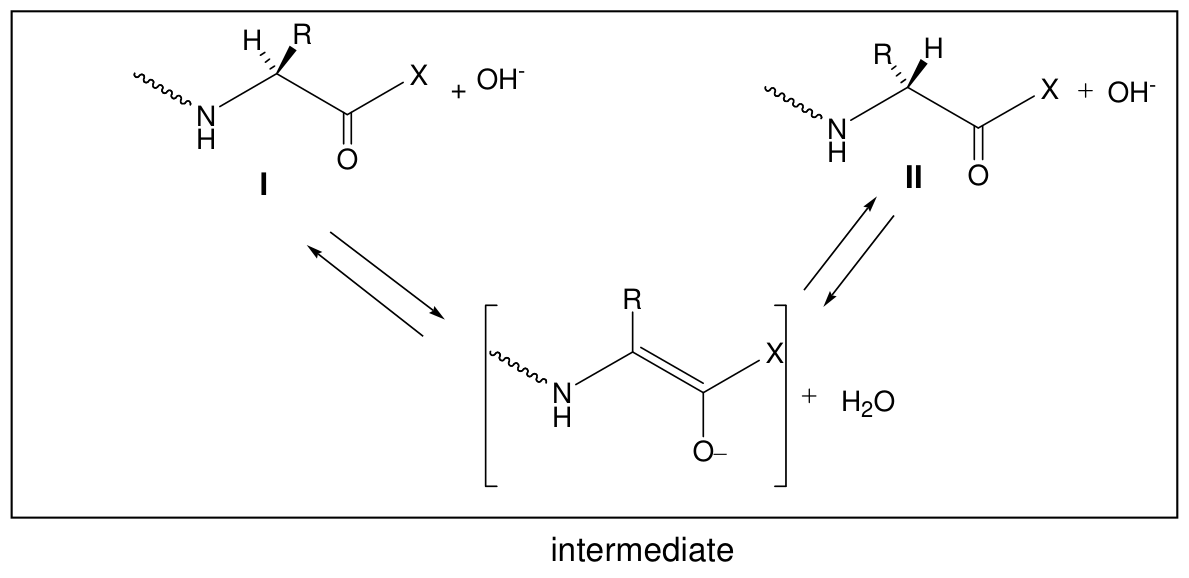
1. Draw stereochemical formulas I and II (with bold and dashed bonds) for the aminoacid components of the mixture that has reached equilibrium through the α-enolization mechanism described above operating on each of the following hydroxyaminoacids A and B:
A: serine (\(\mathrm{R}=\ce{-CH2OH}\))
B: \((2S,3R)\)-threonine (\(\mathrm{R}=\)
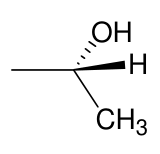
)
2. Mark the box that corresponds to the correct definition of the relationship between the structures you have drawn in each of the above cases A and B.
enantiomers diastereomers \(\mathbf{A}_{\mathrm{I,II}}\) ☐ ☐ \(\mathbf{B}_{\mathrm{I,II}}\) ☐ ☐ During peptide synthesis, in order to form a new peptide bond the carboxyl group has to be activated, that is, it must bear a good leaving group, represented in a simplified scheme below:

It is at this stage of the synthesis that a second racemization mechanism may occur; the amidic carbonyl oxygen is five atoms away from the activated carboxyl group and can intramolecularly attack the activated carboxyl forming a five membered cyclic intermediate (an azalactone) which quickly equilibrates its hydrogen at the stereogenic center, represented in a simplified scheme below:
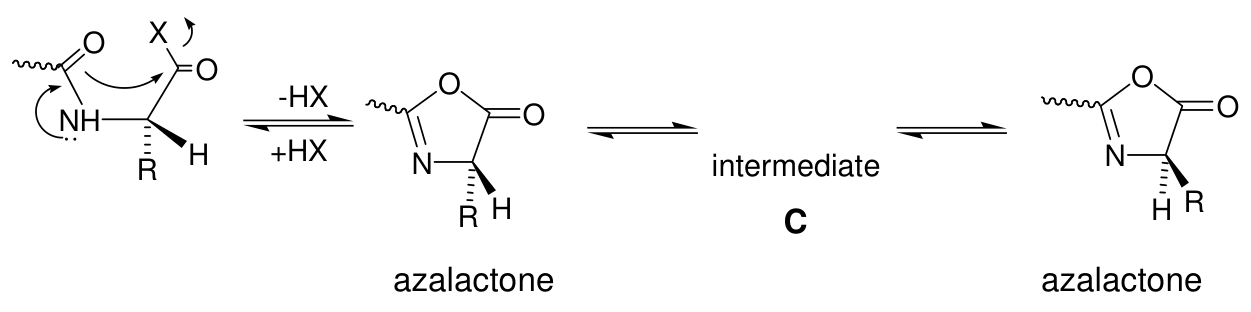
3. Write the structural formula for the intermediate C that interconverts the two azalactones and thus explains the scrambling of the stereochemistry at the stereogenic center.
Azalactones are very reactive substances that can still react with the amino group of an aminoacid. Therefore, the coupling reaction can proceed to completion albeit affording racemized or epimerized products.
4. If N-benzoyl glycine, \(\ce{C9H9NO3}\), is warmed to \(40\,^\circ\mathrm{C}\) with acetic anhydride it is converted into a highly reactive substance, \(\ce{C9H7NO2}\) (P₁).
a) Propose a structure for substance P₁.
b) Write the reaction product(s) of the substance P₁ with S-alanine ethyl ester (P₂) (the side chain R of the aminoacid alanine is a methyl group) using stereochemical formulas (with bold and dashed bonds) for both reactants and product.
Official English text of the problem.
Problem 34: Aluminium
SECTION D: Inorganic Chemistry
PROBLEM 34 Aluminium
One of the largest factories in Greece, located near the ancient city of Delphi, produces alumina (\(\ce{Al2O3}\)) and aluminium metal using the mineral bauxite mined from the Parnassus mountain. Bauxite is a mixed aluminium oxide hydroxide – \(\ce{AlO_x(OH)_{3-2x}}\) where \(0<x<1\).
Production of \(\ce{Al}\) metal follows a two-stage process:
(i) Bayer process: Extraction, purification and dehydration of bauxite (typical compositions for industrially used bauxites are \(\ce{Al2O3}\) 40 – 60 %, \(\ce{H2O}\) 12 – 30 %, \(\ce{SiO2}\) free and combined 1 – 15 %, \(\ce{Fe2O3}\) 7 – 30 %, \(\ce{TiO2}\) 3 – 4 %, \(\ce{F}\), \(\ce{P2O5}\), \(\ce{V2O5}\), etc., 0.05 – 0.2 %). This involves dissolution in aqueous \(\ce{NaOH}\), separation from insoluble impurities, partial precipitation of the aluminium hydroxide and heating at \(1200\,^\circ\mathrm{C}\).
Complete and balance the following chemical reactions:
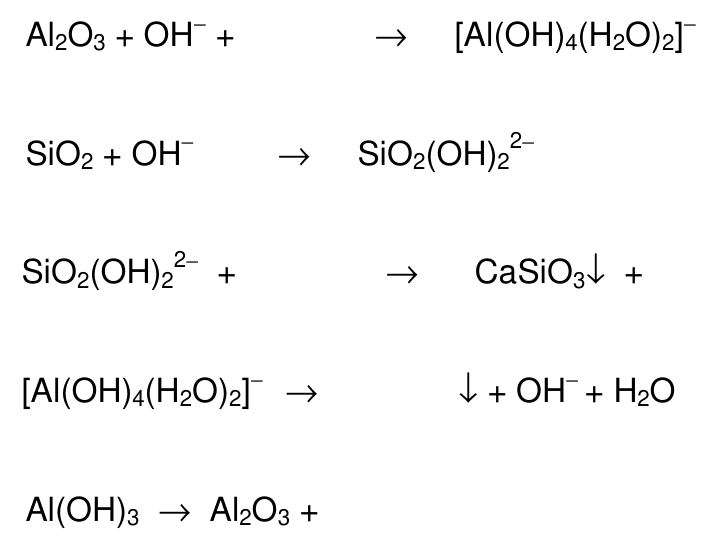
ii) Héroult-Hall process: Electrolysis of pure alumina dissolved in molten cryolite, \(\ce{Na3AlF6}\). Typical electrolyte composition ranges are \(\ce{Na3AlF6}\) (80 – 85 %), \(\ce{CaF2}\) (5 – 7 %), \(\ce{AlF3}\) (5 – 7 %), \(\ce{Al2O3}\) (2 – 8 % intermittently recharged). Electrolysis is carried out at \(940\,^\circ\mathrm{C}\), under constant pressure of 1 atm, in a carbon-lined steel cell (cathode) with carbon anodes. Balance the main reaction of the electrolysis:

Since cryolite is a rather rare mineral, it is prepared according to the following reaction.
Complete and balance this reaction:

During the electrolysis process several parallel reactions take place that degrade the graphite (\(\ce{C}\)) anodes or reduce the yield.
iii) By using the thermodynamic data given below, which are taken to be independent on temperature, determine the thermodynamic quantities \(\Delta H\), \(\Delta S\) and \(\Delta G\) at \(940\,^\circ\mathrm{C}\) for the reaction:

\(\ce{Al(s)}\) \(\ce{Al2O3(s)}\) \(\ce{C}\) (graphite) \(\ce{CO(g)}\) \(\ce{CO2(g)}\) \(\ce{O2(g)}\) \(\Delta_f H^\circ\) (\(\mathrm{kJ\,mol^{-1}}\)) 0 −1676 0 −111 −394 \(S^\circ\) (\(\mathrm{J\,K^{-1}\,mol^{-1}}\)) 28 51 6 198 214 205 \(\Delta_{\mathrm{fus}}H\) (\(\mathrm{kJ\,mol^{-1}}\)) 11 109 iv) At the same temperature and using the data from the table in part (iii) determine the quantities \(\Delta H\) and \(\Delta G\) for the reaction

given that \(\Delta S=-126\ \mathrm{J\,K^{-1}\,mol^{-1}}\). (Show your calculations)
v) Pure aluminium is a silvery-white metal with a face-centered cubic (fcc) crystal structure. Aluminium is readily soluble in hot concentrated hydrochloric acid producing the cation \(\ce{[Al(H2O)6]^3+}\), as well as in strong bases at room temperature producing hydrated tetrahydroxyaluminate anion, \(\ce{[Al(OH)4]^-(aq)}\). In both cases liberation of \(\ce{H2}\) occurs. \(\ce{AlF3}\) is made by treating \(\ce{Al2O3}\) with \(\ce{HF}\) gas at \(700\,^\circ\mathrm{C}\), while the other trihalides, \(\ce{AlX3}\), are made by the direct exothermic reaction of \(\ce{Al}\) with the corresponding dihalogen. Write all 4 chemical reactions described above.
vi) The \(\ce{AlCl3}\) is a crystalline solid having a layer lattice with 6-coordinate \(\ce{Al(III)}\), but at the melting point (\(192.4\,^\circ\mathrm{C}\)) the structure changes to a 4-coordinate molecular dimer, \(\ce{Al2Cl6}\). The covalently bonded molecular dimer, in the gas phase and at high temperature, dissociates into trigonal planar \(\ce{AlCl3}\) molecules.
For the molecular dimer \(\ce{Al2Cl6}\), in the gas phase, two different \(\ce{Al-Cl}\) distances (206 and 221 pm) were measured. Draw the stereostructure of the dimer, and write down the corresponding \(\ce{Al-Cl}\) distances.
vii) What is the hybridization of the \(\ce{Al}\) atom(s) in \(\ce{Al2Cl6}\) and \(\ce{AlCl3}\)?
Official English text of the problem.
Problem 35: Kinetics
The acid-catalyzed reaction \(\ce{CH3COCH3 + I2 -> CH3COCH2I + HI}\) was found to be of first order with respect to hydrogen ions. At constant hydrogen ion concentration the time needed for the concentration of iodine to be reduced by \(0.010\ \mathrm{mol\,dm^{-3}}\) was measured under various concentrations of the reactants.
Based on the information provided in the table, answer fulfil the following tasks:
\([\ce{CH3COCH3}]\) \([\ce{I2}]\) Time \((\mathrm{mol\,dm^{-3}})\) \((\mathrm{mol\,dm^{-3}})\) \((\mathrm{min})\) 0.25 0.050 7.2 0.50 0.050 3.6 1.00 0.050 1.8 0.50 0.100 3.6 0.25 0.100 … 1.50 … … … … 0.36 a) Derive the rate law for the reaction and calculate the rate constant.
b) Calculate the time needed for 75 % of \(\ce{CH3COCH3}\) to react in excess \(\ce{I2}\).
c) Show graphically the dependence of the rate on \([\ce{CH3COCH3}]\) and on \([\ce{I2}]\), for fixed initial concentration of the other reagents.
d) If the rate is doubled by raising the temperature by 10 °C from 298 K, calculate the activation energy for this reaction.
Official English text of the problem.
Internationale Chemie-Olympiade
IChO 2003
Athen, Griechenland · 35 Theorieaufgaben mit vollständigen Lösungen
Aufgabe 1: Löslichkeit von Thoriumiodat
ABSCHNITT A: Allgemeine Chemie
FRAGE 1
Die molare Löslichkeit \(s\) (mol dm\(^{-3}\)) von \(\ce{Th(IO3)4}\) als Funktion des Löslichkeitsprodukts \(K_{sp}\) dieses schwer löslichen Thoriumsalzes wird durch folgende Gleichung beschrieben:
(a) \(\displaystyle s=(K_{sp}/128)^{1/4}\qquad\boxed{(\quad)}\)
(b) \(\displaystyle s=(K_{sp}/256)^{1/5}\qquad\boxed{(\quad)}\)
(c) \(\displaystyle s=256\,K_{sp}^{1/4}\qquad\boxed{(\quad)}\)
(d) \(\displaystyle s=(128\,K_{sp})^{1/4}\qquad\boxed{(\quad)}\)
(e) \(\displaystyle s=(256\,K_{sp})^{1/5}\qquad\boxed{(\quad)}\)
(f) \(\displaystyle s=(K_{sp}/128)^{1/5}/2\qquad\boxed{(\quad)}\)
Aufgabentext aus dem offiziellen englischen Text übersetzt.
Aufgabe 2: Exakte Wasserstoffionenkonzentration von Salzsäure
Welche der folgenden Gleichungen muss zur exakten Berechnung von \([\ce{H+}]\) einer wässrigen \(\ce{HCl}\)-Lösung bei einer beliebigen Konzentration \(c_{\ce{HCl}}\) verwendet werden? \((K_w = 1\times10^{-14})\).
(a) \([\ce{H+}] = c_{\ce{HCl}}\) ( )
(b) \([\ce{H+}] = c_{\ce{HCl}} + K_w/[\ce{H+}]\) ( )
(c) \([\ce{H+}] = c_{\ce{HCl}} + K_w\) ( )
(d) \([\ce{H+}] = c_{\ce{HCl}} - K_w/[\ce{H+}]\) ( )
Aufgabentext aus dem offiziellen englischen Text übersetzt.
Aufgabe 3: Aussagen über eine Glucoselösung
Die molare Masse von Glucose (\(\ce{C6H12O6}\)) beträgt 180 g mol\(^{-1}\), und \(N_A\) ist die Avogadro-Konstante. Welche der folgenden Aussagen ist nicht richtig?
(a) Eine wässrige 0.5 M Glucoselösung wird hergestellt, indem 90 g Glucose gelöst werden, sodass man 1000 cm\(^3\) Lösung erhält. ( )
(b) Eine Stoffmenge von 1.00 mmol Glucose hat eine Masse von 180 mg. ( )
(c) 0.0100 mol Glucose bestehen aus \(0.0100\times24\times N_A\) Atomen. ( )
(d) 90.0 g Glucose enthalten \(3\times N_A\) Kohlenstoffatome. ( )
(e) 100 cm\(^3\) einer 0.10 M Lösung enthalten 18 g Glucose. ( )
Aufgabentext aus dem offiziellen englischen Text übersetzt.
Aufgabe 4: Anzahl der Moleküle in einer Flüssigkeit
Wenn die Dichte einer flüssigen Verbindung B \(\rho\) (in \(\mathrm{g\,cm^{-3}}\)) beträgt, \(M\) die molare Masse von B und \(N_A\) die Avogadro-Konstante ist, dann beträgt die Anzahl der Moleküle von B in \(1\ \mathrm{dm^3}\) dieser Verbindung:
(a) \((1000\times\rho)/(M\times N_A)\) ( )
(b) \((1000\times\rho\times N_A)/M\) ( )
(c) \((N_A\times\rho)/(M\times1000)\) ( )
(d) \((N_A\times\rho\times M)/1000\) ( )
Aufgabentext aus dem offiziellen englischen Text übersetzt.
Aufgabe 5: Umwandlung von Silberchromat in Silberchlorid
Die Gleichgewichtskonstante der Reaktion:
ist durch die folgende Gleichung gegeben:
(a) \(K = K_{sp}(\ce{Ag2CrO4}) / K_{sp}(\ce{AgCl})^{2}\qquad(\quad)\)
(b) \(K = K_{sp}(\ce{Ag2CrO4}) \times K_{sp}(\ce{AgCl})^{2}\qquad(\quad)\)
(c) \(K = K_{sp}(\ce{AgCl}) / K_{sp}(\ce{Ag2CrO4})\qquad(\quad)\)
(d) \(K = K_{sp}(\ce{AgCl})^{2} / K_{sp}(\ce{Ag2CrO4})\qquad(\quad)\)
(e) \(K = K_{sp}(\ce{Ag2CrO4}) / K_{sp}(\ce{AgCl})\qquad(\quad)\)
Aufgabentext aus dem offiziellen englischen Text übersetzt.
Aufgabe 6: Herstellung eines Phosphatpuffers
Wie viele \(\mathrm{cm^3}\) einer 1.00 M \(\ce{NaOH}\)-Lösung müssen zu 100.0 \(\mathrm{cm^3}\) einer 0.100 M \(\ce{H3PO4}\)-Lösung gegeben werden, um eine Phosphatpufferlösung mit einem \(pH\)-Wert von etwa 7.2 zu erhalten? (Die \(pK\)-Werte für \(\ce{H3PO4}\) sind \(pK_1 = 2.1\), \(pK_2 = 7.2\), \(pK_3 = 12.0\))
(a) 5.0 \(\mathrm{cm^3}\) ( )
(b) 10.0 \(\mathrm{cm^3}\) ( )
(c) 15.0 mL ( )
(d) 20.0 mL ( )
Aufgabentext aus dem offiziellen englischen Text übersetzt.
Aufgabe 7: Titrationskurven von Phosphatlösungen
Lösungen, die \(\ce{H3PO4}\) und/oder \(\ce{NaH2PO4}\) enthalten, werden mit der Maßlösung einer starken Base titriert. Ordnen Sie die Zusammensetzungen dieser Lösungen den in der Abbildung dargestellten Titrationskurven (\(pH\) gegen das Volumen der Maßlösung) zu:
(Für \(\ce{H3PO4}\): \(pK_1 = 2.1,\ pK_2 = 7.2,\ pK_3 = 12.0\))
a) Die Probe enthält nur \(\ce{H3PO4}\).
Kurve A ( ), Kurve B ( ), Kurve C ( ), Kurve D ( )
b) Die Probe enthält beide Stoffe im Stoffmengenverhältnis \(\ce{H3PO4} : \ce{NaH2PO4} = 2 : 1\).
Kurve A ( ), Kurve B ( ), Kurve C ( ), Kurve D ( )
c) Die Probe enthält beide Stoffe im Stoffmengenverhältnis \(\ce{H3PO4} : \ce{NaH2PO4} = 1 : 1\).
Kurve A ( ), Kurve B ( ), Kurve C ( ), Kurve D ( )
Aufgabentext aus dem offiziellen englischen Text übersetzt.
Aufgabe 8: Ein Treibstoffsystem aus Dimethylhydrazin und Distickstofftetroxid
Ein Brennstoff/Oxidationsmittel-System aus N,N-Dimethylhydrazin \(\ce{(CH3)2NNH2}\) und \(\ce{N2O4}\) (beide flüssig) wird häufig für den Antrieb von Raumfahrzeugen verwendet. Die Komponenten werden im stöchiometrischen Verhältnis gemischt, sodass \(\ce{N2}\), \(\ce{CO2}\) und \(\ce{H2O}\) die einzigen Produkte sind (unter denselben Reaktionsbedingungen alle gasförmig). Wie viele Mol Gase entstehen aus 1 mol \(\ce{(CH3)2NNH2}\)?
(a) 8 ( )
(b) 9 ( )
(c) 10 ( )
(d) 11 ( )
(e) 12 ( )Aufgabentext aus dem offiziellen englischen Text übersetzt.
Aufgabe 9: Zur Elektrolyse von Wasser benötigte Ladung
Die vollständige Elektrolyse von 1 mol Wasser erfordert die folgende elektrische Ladungsmenge (F ist die Faraday-Konstante):
(a) F ( )
(b) (4/3) F ( )
(c) (3/2) F ( )
(d) 2 F ( )
(e) 3 F ( )
Aufgabentext aus dem offiziellen englischen Text übersetzt.
Aufgabe 10: Bei Kernreaktionen emittierte Teilchen
Bestimmen Sie das Teilchen X in jeder der folgenden Kernreaktionen:
a)
Alpha ( ), Beta ( ), Gamma ( ), Neutron ( )
b)
Alpha ( ), Beta ( ), Gamma ( ), Neutron ( )
c)
Alpha ( ), Beta ( ), Gamma ( ), Neutron ( )
d)
Alpha ( ), Beta ( ), Gamma ( ), Neutron ( )
e)
Alpha ( ), Beta ( ), Gamma ( ), Neutron ( )
Aufgabentext aus dem offiziellen englischen Text übersetzt.
Aufgabe 11: Neutralisationswärme in einem Kalorimeter
10.0 cm\(^3\) einer 0.50 M \(\ce{HCl}\)-Lösung und 10.0 cm\(^3\) einer 0.50 M \(\ce{NaOH}\)-Lösung, die beide dieselbe Temperatur haben, werden in einem Kalorimeter gemischt. Ein Temperaturanstieg von \(\Delta T\) wird gemessen. Schätzen Sie den Temperaturanstieg ab, wenn statt 10.0 cm\(^3\) nur 5.0 cm\(^3\) der 0.50 M \(\ce{NaOH}\)-Lösung verwendet würden. Wärmeverluste sind vernachlässigbar, und die spezifischen Wärmekapazitäten beider Lösungen werden als gleich angenommen.
(a) \((1/2)\,\Delta T\) ( )
(b) \((2/3)\,\Delta T\) ( )
(c) \((3/4)\,\Delta T\) ( )
(d) \(\Delta T\) ( )
Aufgabentext aus dem offiziellen englischen Text übersetzt.
Aufgabe 12: Massenspektrum des SbHCl+-Ions
Natürliches Antimon besteht aus den folgenden 2 stabilen Isotopen: \(\ce{^{121}Sb}\), \(\ce{^{123}Sb}\). Natürliches Chlor besteht aus den folgenden 2 stabilen Isotopen: \(\ce{^{35}Cl}\), \(\ce{^{37}Cl}\). Natürlicher Wasserstoff besteht aus den folgenden 2 stabilen Isotopen: \(\ce{^{1}H}\), \(\ce{^{2}H}\). Wie viele Peaks sind in einem Massenspektrum mit niedriger Auflösung für das Ionenfragment \(\ce{SbHCl+}\) zu erwarten?
(a) 4 ( )
(b) 5 ( )
(c) 6 ( )
(d) 7 ( )
(e) 8 ( )
(f) 9 ( )Aufgabentext aus dem offiziellen englischen Text übersetzt.
Aufgabe 13: Röntgenbeugungswinkel
Der kleinste Beugungswinkel eines monochromatischen Röntgenstrahls beträgt in einem bestimmten Experiment 11.5°. Auf dieser Grundlage müssen wir einen Röntgenstrahl erwarten, der unter folgendem Winkel gebeugt wird:
(a) 22.0 Grad ( )
(b) 22.5 Grad ( )
(c) 23.0 Grad ( )
(d) 23.5 Grad ( )
(e) 24.0 Grad ( )
(f) 24.5 Grad ( )
Aufgabentext aus dem offiziellen englischen Text übersetzt.
Aufgabe 14: Extraktion einer schwachen Säure
Die undissoziierte Form einer schwachen organischen Säure \(\ce{HA}\) kann gemäß dem folgenden Schema mit einem nicht mit Wasser mischbaren organischen Lösungsmittel aus der wässrigen Phase extrahiert werden:
Sind die folgenden Aussagen zu dieser Extraktion richtig (Y) oder falsch (N)?
(a) Die Verteilungskonstante (\(K_D\)) der Säure \(\ce{HA}\) hängt vom \(pH\) der wässrigen Phase ab. (Y) (N)
(b) \(\ce{HA}\) kann nur aus sauren wässrigen Lösungen effizient extrahiert werden. (Y) (N)
(c) Das Verteilungsverhältnis (\(D\)) der Säure \(\ce{HA}\) hängt vom pH-Wert der wässrigen Phase ab. (Y) (N)
(d) Das Verteilungsverhältnis (\(D\)) der Säure \(\ce{HA}\) hängt hauptsächlich von ihrer Konzentration ab. (Y) (N)
Aufgabentext aus dem offiziellen englischen Text übersetzt.
Aufgabe 15: Aussagen zum Beer'schen Gesetz
Sind die folgenden Aussagen zum Beer'schen Gesetz richtig (Y) oder falsch (N)?
(a) Die Extinktion ist proportional zur Konzentration der absorbierenden Verbindung. (Y) (N)
(b) Die Extinktion steht in einem linearen Zusammenhang mit der Wellenlänge des einfallenden Lichts. (Y) (N)
(c) Der Logarithmus des Transmissionsgrades ist proportional zur Konzentration der absorbierenden Verbindung. (Y) (N)
(d) Der Transmissionsgrad ist umgekehrt proportional zum Logarithmus der Extinktion. (Y) (N)
(e) Der Transmissionsgrad ist umgekehrt proportional zur Konzentration der absorbierenden Verbindung. (Y) (N)
Aufgabentext aus dem offiziellen englischen Text übersetzt.
Aufgabe 16: Wellenlängen monochromatischer Strahlung
Berechnen Sie die entsprechende Wellenlänge in Nanometern (nm) für monochromatische Strahlung mit den folgenden Zahlenangaben:
a) \(3000\ \text{Å}\) 150 nm ( ), 300 nm ( ), 600 nm ( ), 5000 nm ( ) b) \(5\times10^{14}\ \mathrm{Hz}\) 150 nm ( ), 300 nm ( ), 600 nm ( ), 5000 nm ( ) c) \(2000\ \mathrm{cm^{-1}}\) 150 nm ( ), 300 nm ( ), 600 nm ( ), 5000 nm ( ) d) \(2\times10^{6}\ \mathrm{GHz}\) 150 nm ( ), 300 nm ( ), 600 nm ( ), 5000 nm ( ) Aufgabentext aus dem offiziellen englischen Text übersetzt.
Aufgabe 17: Kalibrierkurven für eine schwache Säure
Die Extinktion von Lösungen der schwachen Säure \(\ce{HX}\) wurde gemessen. Ordnen Sie unter den folgenden Bedingungen die erwartete Form der resultierenden Kalibrierkurve den in der Abbildung gezeigten Kurven zu:
a) Es wurden reine wässrige Lösungen von \(\ce{HX}\) verwendet. Nur die undissoziierte Spezies \(\ce{HX}\) absorbiert.
Kurve A ( ), Kurve B ( ), Kurve C ( ), Kurve D ( )
b) Es wurden reine wässrige Lösungen von \(\ce{HX}\) verwendet. Nur die anionische Spezies \(\ce{X^-}\) absorbiert.
Kurve A ( ), Kurve B ( ), Kurve C ( ), Kurve D ( )
c) Alle Lösungen von \(\ce{HX}\) enthalten einen Überschuss einer starken Base. Nur die undissoziierte Spezies \(\ce{HX}\) absorbiert.
Kurve A ( ), Kurve B ( ), Kurve C ( ), Kurve D ( )
d) Alle Lösungen von \(\ce{HX}\) enthalten einen Überschuss einer starken Säure. Nur die undissoziierte Spezies \(\ce{HX}\) absorbiert.
Kurve A ( ), Kurve B ( ), Kurve C ( ), Kurve D ( )
e) Es wurden reine wässrige Lösungen von \(\ce{HX}\) verwendet. Sowohl \(\ce{HX}\) als auch \(\ce{X^-}\) absorbieren. Die Messungen wurden bei einer Wellenlänge durchgeführt, bei der die molaren Extinktionskoeffizienten von \(\ce{X^-}\) und \(\ce{HX}\) gleich und von null verschieden sind.
Kurve A ( ), Kurve B ( ), Kurve C ( ), Kurve D ( )
Aufgabentext aus dem offiziellen englischen Text übersetzt.
Aufgabe 18: Die stärkste Sauerstoffsäure des Chlors
Welche der folgenden Säuren ist die stärkste?
a) Perchlorsäure, \(\ce{HClO4}\) ( )
b) Chlorsäure, \(\ce{HClO3}\) ( )
c) Chlorige Säure, \(\ce{HClO2}\) ( )
d) Hypochlorige Säure, \(\ce{HClO}\) ( )
(e) Alle sind gleich stark, weil sie alle Chlor enthalten ( )
Aufgabentext aus dem offiziellen englischen Text übersetzt.
Aufgabe 19: Kristallstruktur von Eisen
Welche Struktur beschreibt das Kristallsystem von Eisen, in dem die Koordinationszahl 8 beträgt, am besten?
a) kubisch primitiv ( )
b) kubisch raumzentriert ( )
c) kubisch dichteste Kugelpackung ( )
d) hexagonal dichteste Kugelpackung ( )
e) keine der oben genannten ( )Aufgabentext aus dem offiziellen englischen Text übersetzt.
Aufgabe 20: Höchste dritte Ionisierungsenergie
Welches der folgenden Elemente hat die höchste dritte Ionisierungsenergie?
a) \(\ce{B}\) \(\boxed{(\;)}\)
b) \(\ce{C}\) \(\boxed{(\;)}\)
c) \(\ce{N}\) \(\boxed{(\;)}\)
d) \(\ce{Mg}\) \(\boxed{(\;)}\)
e) \(\ce{Al}\) \(\boxed{(\;)}\)Aufgabentext aus dem offiziellen englischen Text übersetzt.
Aufgabe 21: Ein Element der zweiten Periode anhand seiner Ionisierungsenergien bestimmen
Welches Element der zweiten Periode (Zeile) besitzt die unten aufgeführten ersten sechs Ionisierungsenergien (\(IE\) in Elektronenvolt, eV)?
\(IE_1\) \(IE_2\) \(IE_3\) \(IE_4\) \(IE_5\) \(IE_6\) 11 24 48 64 392 490 a) \(\ce{B}\) ( )
b) \(\ce{C}\) ( )
c) \(\ce{N}\) ( )
d) \(\ce{O}\) ( )
e) \(\ce{F}\) ( )Aufgabentext aus dem offiziellen englischen Text übersetzt.
Aufgabe 22: Kubisch flächenzentriertes Silber
Metallisches Silber liegt als Festkörper mit kubisch flächenzentrierter (fcc) Packung vor.
a) Zeichnen Sie eine fcc-Elementarzelle.
b) Wie viele Atome sind in der fcc-Elementarzelle enthalten?
c) Die Dichte von Silber wurde zu \(10.5\ \mathrm{g\,cm^{-3}}\) bestimmt. Wie lang ist jede Kante der Elementarzelle?
d) Wie groß ist der Atomradius der Silberatome im Kristall?
Aufgabentext aus dem offiziellen englischen Text übersetzt.
Aufgabe 23: Halogenwasserstoffe, Puffer und Elektrolyse
Sind die folgenden Aussagen richtig (Y) oder falsch (N)?
a) \(\ce{HF}\) siedet bei einer höheren Temperatur als \(\ce{HCl}\). (Y) (N)
b) \(\ce{HBr}\) siedet bei einer niedrigeren Temperatur als \(\ce{HI}\) (Y) (N)
c) Reiner \(\ce{HI}\) kann durch die Reaktion von konzentrierter Schwefelsäure mit \(\ce{KI}\) hergestellt werden. (Y) (N)
d) Ammoniaklösungen sind Pufferlösungen, weil sie das konjugierte Säure-Base-Paar \(\ce{NH3}\) – \(\ce{NH4+}\) enthalten. (Y) (N)
e) Reines Wasser ist bei 80 °C sauer. (Y) (N)
f) Bei der Elektrolyse einer wässrigen \(\ce{KI}\)-Lösung mit Graphitelektroden liegt der pH-Wert in der Nähe der Kathode unter 7. (Y) (N)
Aufgabentext aus dem offiziellen englischen Text übersetzt.
Aufgabe 24: Zink und Salpetersäure
Unter bestimmten Konzentrations- und Temperaturbedingungen reagiert \(\ce{HNO3}\) mit \(\ce{Zn}\), wobei die Reduktionsprodukte \(\ce{NO2}\) und \(\ce{NO}\) im Stoffmengenverhältnis 1 : 3 entstehen. Wie viele Mol \(\ce{HNO3}\) werden von 1 mol \(\ce{Zn}\) verbraucht?
a) 2.2 ( )
b) 2.4 ( )
c) 2.6 ( )
d) 2.8 ( )
e) 3.0 ( )
f) 3.2 ( )Aufgabentext aus dem offiziellen englischen Text übersetzt.
Aufgabe 25: Myon
ABSCHNITT B: PHYSIKALISCHE CHEMIE
AUFGABE 25 Myon
Das Myon (\(\mu\)) ist ein subatomares Teilchen aus der Familie der Leptonen, das dieselbe Ladung und dasselbe magnetische Verhalten wie das Elektron aufweist, jedoch eine andere Masse besitzt und instabil ist, d. h., es zerfällt innerhalb von Mikrosekunden nach seiner Entstehung in andere Teilchen. Hier sollen Sie versuchen, die Masse des Myons mit zwei recht unterschiedlichen Ansätzen zu bestimmen.
a) Die häufigste spontane Zerfallsreaktion des Myons ist:
wobei \(\overline{\nu}_e\) das Elektron-Antineutrino und \(\nu_\mu\) das Myon-Neutrino ist. In einem Experiment mit einem ruhenden Myon führten \(\overline{\nu}_e+\nu_\mu\) eine Gesamtenergie von \(2.000\times10^{-12}\ \mathrm{J}\) ab, während sich das Elektron mit einer kinetischen Energie von \(1.4846\times10^{-11}\ \mathrm{J}\) bewegte. Bestimmen Sie die Masse des Myons.
b) In zahlreichen Experimenten wurde die Spektroskopie von Atomen untersucht, die anstelle eines Elektrons ein Myon eingefangen haben. Diese exotischen Atome entstehen in verschiedenen angeregten Zuständen. Der Übergang vom dritten angeregten Zustand zum ersten angeregten Zustand eines Atoms, das aus einem \(\ce{^1H}\)-Kern und einem daran gebundenen Myon besteht, wurde bei einer Wellenlänge von \(2.615\ \mathrm{nm}\) beobachtet. Bestimmen Sie die Masse des Myons.
Aufgabentext aus dem offiziellen englischen Text übersetzt.
Aufgabe 26: Spektrum von CO
AUFGABE 26 Spektrum von \(\ce{CO}\)
Die Rotationsenergieniveaus zweiatomiger Moleküle lassen sich gut durch die Formel \(E_J = B\,J(J+1)\) beschreiben, wobei \(J\) die Rotationsquantenzahl des Moleküls und \(B\) seine Rotationskonstante ist. Der Zusammenhang zwischen der Konstante \(B\), der reduzierten Masse \(\mu\) und der Bindungslänge \(R\) des Moleküls wird durch folgende Gleichung beschrieben:
\[ B=\frac{h^2}{8\pi^2\mu R^2}. \]
Im Allgemeinen treten spektroskopische Übergänge bei Photonenenergien auf, die der Energiedifferenz zwischen den entsprechenden Zuständen eines Moleküls entsprechen (\(h\nu=\Delta E\)). Die beobachteten Rotationsübergänge erfolgen zwischen benachbarten Rotationsniveaus, daher gilt \(\Delta E=E_{J+1}-E_J=2B(J+1)\). Folglich erfüllen aufeinanderfolgende Rotationsübergänge, die im Spektrum erscheinen (wie etwa im hier gezeigten), die Gleichung \(h(\Delta\nu)=2B\).
Bestimmen Sie anhand des vorliegenden Spektrums die folgenden Größen für \(\ce{^{12}C^{16}O}\) mit den entsprechenden Einheiten:
a) \(\Delta\nu\)
b) \(B\)
c) \(R\)
Aufgabentext aus dem offiziellen englischen Text übersetzt.
Aufgabe 27: Wasserstoffmolekül
Geben Sie anhand der Informationen in diesem Diagramm numerische Antworten mit geeigneten Einheiten auf die folgenden Fragen:
- Wie groß sind die Gleichgewichtsbindungslängen von \(\ce{H2}\) und \(\ce{H2+}\)?
- Wie groß sind die Bindungsenergien von \(\ce{H2}\) und \(\ce{H2+}\)?
- Wie groß ist die Ionisierungsenergie des \(\ce{H2}\)-Moleküls?
- Wie groß ist die Ionisierungsenergie des \(\ce{H}\)-Atoms?
- Wenn wir elektromagnetische Strahlung der Frequenz \(3.9\times10^{15}\ \mathrm{Hz}\) verwenden, um \(\ce{H2}\) zu ionisieren, welche Geschwindigkeit haben dann die herausgelösten Elektronen? (Vernachlässigen Sie die Schwingungsenergie des Moleküls.)
Aufgabentext aus dem offiziellen englischen Text übersetzt.
Aufgabe 28: Kryoskopie
Chemiker benötigen häufig ein Bad, um einen Prozess bei einer Temperatur unterhalb des Gefrierpunkts von Wasser (\(0\,^\circ\mathrm{C}\)) und deutlich oberhalb des Sublimationspunkts von \(\ce{CO2}\) (\(-78\,^\circ\mathrm{C}\)) durchzuführen. In diesem Fall mischen sie Wassereis, das bei seinem Schmelzpunkt bereitgestellt wird, mit \(\ce{NaCl}\). Je nach den verwendeten Mengen können Temperaturen von bis zu \(-20\,^\circ\mathrm{C}\) erreicht werden.
Wir stellen ein Kältebad her, indem wir 1 kg Eis bei \(0\,^\circ\mathrm{C}\) mit 150 g \(\ce{NaCl}\) in einem wärmeisolierten Gefäß mischen. Kreisen Sie die Buchstaben Y oder N ein, um anzugeben, ob die folgenden Aussagen richtig (Y) oder falsch (N) sind.
a) Der Mischvorgang läuft spontan ab. (Y) (N)
b) Die Entropieänderung während des Mischvorgangs ist negativ. (Y) (N)
c) Das folgende Diagramm zeigt den Gefrierpunkt wässriger Lösungen von \(\ce{NaCl}\) in Abhängigkeit von der Zusammensetzung der Lösung (in Massenprozent). Welchen Gefrierpunkt hat das Bad laut dem Diagramm?
d) Wäre der Gefrierpunkt höher, wenn anstelle von \(\ce{NaCl}\) die gleiche Masse an \(\ce{MgCl2}\) verwendet würde? (Y) (N)
Aufgabentext aus dem offiziellen englischen Text übersetzt.
Aufgabe 29: Schwimmbecken
Ein sehr großes, mit Wasser einer Temperatur von 20 °C gefülltes Schwimmbecken wird 20 Minuten lang durch einen Widerstand mit einer Heizleistung von 500 W beheizt. Nehmen Sie an, dass das Wasser im Becken ausschließlich mit dem Widerstand in Kontakt steht, und bestimmen Sie:
a) Die dem Wasser zugeführte Wärme.
b) Ist die Entropieänderung des Widerstands positiv, negativ oder null?
(i) \(\Delta S_{\mathrm{res}} > 0\) ( )
(ii) \(\Delta S_{\mathrm{res}} = 0\) ( )
(iii) \(\Delta S_{\mathrm{res}} < 0\) ( )
c) Ist die Entropieänderung des Wassers positiv, negativ oder null?
i) \(\Delta S_{\mathrm{pool}} > 0\) ( )
(ii) \(\Delta S_{\mathrm{pool}} = 0\) ( )
(iii) \(\Delta S_{\mathrm{pool}} < 0\) ( )
d) Ist die Entropieänderung des Systems positiv, negativ oder null?
(i) \(\Delta S_{\mathrm{total}} > 0\) ( )
(ii) \(\Delta S_{\mathrm{total}} = 0\) ( )
(iii) \(\Delta S_{\mathrm{total}} < 0\) ( )
e) Ist der Prozess reversibel? (Y) (N)
Aufgabentext aus dem offiziellen englischen Text übersetzt.
Aufgabe 30: Gasgeschwindigkeit
Das hier beschriebene Experiment bietet eine einfache Möglichkeit, die mittlere Geschwindigkeit \(u\) der Moleküle in der Gasphase einer flüchtigen Flüssigkeit zu bestimmen. Ein breites, flaches Gefäß (eine Petrischale), das zur Hälfte mit Ethanol gefüllt ist, wird zusammen mit dem danebenliegenden Deckel auf eine elektronische Waage gestellt, und die Waage wird zum Zeitpunkt \(t = 0\) auf null gestellt. Die Waagenanzeigen werden wie im Diagramm dargestellt aufgezeichnet.
Bei \(t = 5\) min wird der Deckel auf die Schale gelegt. Die Flüssigkeit verdunstet nun nicht mehr, aber die eingeschlossenen Moleküle drücken gegen den Deckel, wodurch die Waagenanzeige um \(\delta m\) verringert wird. Die auf den Deckel ausgeübte Kraft beträgt daher \(f = \delta m\,g\). Diese Kraft ist auch gleich der zeitlichen Änderungsrate des Impulses der verdunstenden Moleküle, d. h. \(f = \tfrac12 u\,\mathrm{d}m/\mathrm{d}t\). Bestimmen Sie anhand der angegebenen Daten die mittlere Geschwindigkeit der Ethanolmoleküle bei 290 K. Nehmen Sie \(g = 9.8\ \mathrm{m\,s^{-2}}\) an.
Aufgabentext aus dem offiziellen englischen Text übersetzt.
Aufgabe 31: Identifizierung eines Esters
ABSCHNITT C: Organische Chemie
AUFGABE 31 Identifizierung eines Esters
2.81 g eines optisch aktiven Diesters A, der nur \(\ce{C}\), \(\ce{H}\) und \(\ce{O}\) enthält, wurden mit 30.00 \(\mathrm{cm^3}\) einer 1.00 M \(\ce{NaOH}\)-Lösung verseift. Nach der Verseifung wurden 6.00 \(\mathrm{cm^3}\) einer 1.00 M \(\ce{HCl}\)-Lösung benötigt, um ausschließlich das nicht verbrauchte \(\ce{NaOH}\) in der Lösung zu titrieren. Die Verseifungsprodukte waren eine optisch inaktive Dicarbonsäure B, \(\ce{MeOH}\) und ein optisch aktiver Alkohol C. Alkohol C reagierte mit \(\ce{I2/NaOH}\) unter Bildung eines gelben Niederschlags und von \(\ce{C6H5COONa}\). Die Dicarbonsäure B reagierte mit \(\ce{Br2}\) in \(\ce{CCl4}\) zu einem einzigen, optisch inaktiven Produkt (Verbindung D). Die Ozonolyse von B ergab nur ein Produkt.
a) Bestimmen Sie die Molekülmasse der Verbindung A.
b) Geben Sie die Strukturformeln von A, B und C ohne stereochemische Angaben an.
c) Geben Sie die möglichen stereochemischen Formeln (mit ausgefüllten und gestrichelten Keilbindungen) für C an.
d) Geben Sie die stereochemische Formel von D als Fischer-Projektion an.
e) Geben Sie die stereochemische Formel von B an.
Der Diester A reagierte ebenfalls mit \(\ce{Br2}\) in \(\ce{CCl4}\) und wurde dabei in ein Gemisch zweier Verbindungen (E, F) umgewandelt, die beide optisch aktiv sind.
f) Geben Sie alle möglichen stereochemischen Formeln für E und F als Fischer-Projektionen an. Kennzeichnen Sie in allen Formeln sämtliche stereogenen Zentren als \(R\) oder \(S\).
Wenn wir für die Verseifung der Verbindung A \(\ce{Na^{18}OH}\) verwenden, würde das Sauerstoffisotop dann in eines oder beide der Produkte B und C eingebaut werden?
g) Kreuzen Sie die richtige Antwort an:
i) Nur B ( )
ii) Nur C ( )
iii) Sowohl B als auch C ( )
Aufgabentext aus dem offiziellen englischen Text übersetzt.
Aufgabe 32: NMR-Rätsel
Eine organische Verbindung A (\(\ce{C8H10}\)) durchläuft die folgende Reaktionsfolge:
Zeichnen Sie anhand der angegebenen \({}^{1}\mathrm{H}\)-NMR-Spektren die Strukturen der Verbindungen A, B, C, D, E und F und ordnen Sie die Gruppen der Wasserstoffatome jeder Verbindung den entsprechenden \({}^{1}\mathrm{H}\)-NMR-Signalen zu, wie im Beispiel gezeigt.
Allgemeine Anmerkungen: Die NMR-Spektren wurden in \(\ce{CDCl3}\) an einem 60-MHz-Spektrometer von Perkin Elmer aufgenommen. Unter normalen Bedingungen (Einwirkung von Luft, Licht und Wasserdampf) können in \(\ce{CDCl3}\)-Lösungen saure Verunreinigungen entstehen, die einen schnellen Austausch bestimmter Protonen katalysieren.
Aufgabentext aus dem offiziellen englischen Text übersetzt.
Aufgabe 33: Peptide
Die Racemisierung von α-Aminosäuren und Peptiden kann über einen α-Enolisierungsmechanismus erfolgen; sowohl Wärme als auch die Anwesenheit starker Basen beschleunigen den Vorgang erheblich:
1. Zeichnen Sie die stereochemischen Formeln I und II (mit ausgefüllten und gestrichelten Keilbindungen) der Aminosäurekomponenten des Gemisches, das durch den oben beschriebenen α-Enolisierungsmechanismus aus jeder der folgenden Hydroxyaminosäuren A und B im Gleichgewicht entsteht:
A: Serin (\(\mathrm{R}=\ce{-CH2OH}\))
B: \((2S,3R)\)-Threonin (\(\mathrm{R}=\)
)
2. Kreuzen Sie das Kästchen an, das die Beziehung zwischen den von Ihnen gezeichneten Strukturen für die beiden obigen Fälle A und B korrekt bezeichnet.
Enantiomere Diastereomere \(\mathbf{A}_{\mathrm{I,II}}\) ☐ ☐ \(\mathbf{B}_{\mathrm{I,II}}\) ☐ ☐ Bei der Peptidsynthese muss die Carboxylgruppe aktiviert werden, um eine neue Peptidbindung zu bilden; das heißt, sie muss eine gute Abgangsgruppe tragen, wie im folgenden vereinfachten Schema dargestellt:
In diesem Stadium der Synthese kann ein zweiter Racemisierungsmechanismus auftreten; das Carbonylsauerstoffatom der Amidgruppe ist fünf Atome von der aktivierten Carboxylgruppe entfernt und kann diese intramolekular angreifen. Dabei entsteht ein fünfgliedriges cyclisches Zwischenprodukt (ein Azlacton), dessen Wasserstoffatom am stereogenen Zentrum rasch eine Gleichgewichtseinstellung ermöglicht, wie im folgenden vereinfachten Schema dargestellt:
3. Geben Sie die Strukturformel des Zwischenprodukts C an, über das die beiden Azlactone ineinander übergehen und das somit die Aufhebung der stereochemischen Einheitlichkeit am stereogenen Zentrum erklärt.
Azlactone sind sehr reaktive Substanzen, die weiterhin mit der Aminogruppe einer Aminosäure reagieren können. Daher kann die Kupplungsreaktion vollständig ablaufen, wobei allerdings racemisierte oder epimerisierte Produkte entstehen.
4. Wird N-Benzoylglycin, \(\ce{C9H9NO3}\), mit Essigsäureanhydrid auf \(40\,^\circ\mathrm{C}\) erwärmt, so wird es in eine hochreaktive Substanz, \(\ce{C9H7NO2}\) (P₁), umgewandelt.
a) Schlagen Sie eine Struktur für die Substanz P₁ vor.
b) Geben Sie das Reaktionsprodukt bzw. die Reaktionsprodukte der Substanz P₁ mit S-Alaninethylester (P₂) an (die Seitenkette R der Aminosäure Alanin ist eine Methylgruppe). Verwenden Sie dabei stereochemische Formeln (mit ausgefüllten und gestrichelten Keilbindungen) sowohl für die Edukte als auch für das Produkt.
Aufgabentext aus dem offiziellen englischen Text übersetzt.
Aufgabe 34: Aluminium
ABSCHNITT D: Anorganische Chemie
AUFGABE 34 Aluminium
Eine der größten Fabriken Griechenlands, die in der Nähe der antiken Stadt Delphi liegt, stellt Aluminiumoxid (\(\ce{Al2O3}\)) und metallisches Aluminium aus dem Mineral Bauxit her, das im Parnassgebirge abgebaut wird. Bauxit ist ein gemischtes Aluminiumoxidhydroxid – \(\ce{AlO_x(OH)_{3-2x}}\), wobei \(0<x<1\).
Die Herstellung von metallischem \(\ce{Al}\) erfolgt in einem zweistufigen Verfahren:
(i) Bayer-Verfahren: Extraktion, Reinigung und Dehydratisierung von Bauxit (typische Zusammensetzungen industriell genutzter Bauxite sind \(\ce{Al2O3}\) 40 – 60 %, \(\ce{H2O}\) 12 – 30 %, freies und gebundenes \(\ce{SiO2}\) 1 – 15 %, \(\ce{Fe2O3}\) 7 – 30 %, \(\ce{TiO2}\) 3 – 4 %, \(\ce{F}\), \(\ce{P2O5}\), \(\ce{V2O5}\) usw. 0.05 – 0.2 %). Dazu gehören das Auflösen in wässriger \(\ce{NaOH}\), die Abtrennung unlöslicher Verunreinigungen, die teilweise Fällung des Aluminiumhydroxids und das Erhitzen auf \(1200\,^\circ\mathrm{C}\).
Vervollständigen Sie die folgenden chemischen Reaktionsgleichungen und gleichen Sie sie aus:
ii) Héroult-Hall-Verfahren: Elektrolyse von reinem Aluminiumoxid, das in geschmolzenem Kryolith, \(\ce{Na3AlF6}\), gelöst ist. Typische Zusammensetzungsbereiche des Elektrolyten sind \(\ce{Na3AlF6}\) (80 – 85 %), \(\ce{CaF2}\) (5 – 7 %), \(\ce{AlF3}\) (5 – 7 %), \(\ce{Al2O3}\) (2 – 8 %, in Abständen nachgefüllt). Die Elektrolyse wird bei \(940\,^\circ\mathrm{C}\) unter einem konstanten Druck von 1 atm in einer mit Kohlenstoff ausgekleideten Stahlzelle (Kathode) mit Kohlenstoffanoden durchgeführt. Gleichen Sie die Hauptreaktion der Elektrolyse aus:
Da Kryolith ein recht seltenes Mineral ist, wird er gemäß der folgenden Reaktion hergestellt.
Vervollständigen Sie diese Reaktionsgleichung und gleichen Sie sie aus:
Während der Elektrolyse laufen mehrere Parallelreaktionen ab, die die Graphitanoden (\(\ce{C}\)) abbauen oder die Ausbeute verringern.
iii) Bestimmen Sie mithilfe der unten angegebenen thermodynamischen Daten, die als temperaturunabhängig angenommen werden, die thermodynamischen Größen \(\Delta H\), \(\Delta S\) und \(\Delta G\) bei \(940\,^\circ\mathrm{C}\) für die Reaktion:
\(\ce{Al(s)}\) \(\ce{Al2O3(s)}\) \(\ce{C}\) (Graphit) \(\ce{CO(g)}\) \(\ce{CO2(g)}\) \(\ce{O2(g)}\) \(\Delta_f H^\circ\) (\(\mathrm{kJ\,mol^{-1}}\)) 0 −1676 0 −111 −394 \(S^\circ\) (\(\mathrm{J\,K^{-1}\,mol^{-1}}\)) 28 51 6 198 214 205 \(\Delta_{\mathrm{fus}}H\) (\(\mathrm{kJ\,mol^{-1}}\)) 11 109 iv) Bestimmen Sie bei derselben Temperatur und mithilfe der Daten aus der Tabelle in Teil (iii) die Größen \(\Delta H\) und \(\Delta G\) für die Reaktion
wobei \(\Delta S=-126\ \mathrm{J\,K^{-1}\,mol^{-1}}\) gegeben ist. (Geben Sie Ihren Rechenweg an.)
v) Reines Aluminium ist ein silberweißes Metall mit einer kubisch flächenzentrierten (fcc) Kristallstruktur. Aluminium löst sich leicht in heißer konzentrierter Salzsäure unter Bildung des Kations \(\ce{[Al(H2O)6]^3+}\) sowie in starken Basen bei Raumtemperatur unter Bildung des hydratisierten Tetrahydroxyaluminat-Anions, \(\ce{[Al(OH)4]^-(aq)}\). In beiden Fällen wird \(\ce{H2}\) freigesetzt. \(\ce{AlF3}\) wird durch Behandlung von \(\ce{Al2O3}\) mit gasförmigem \(\ce{HF}\) bei \(700\,^\circ\mathrm{C}\) hergestellt, während die anderen Trihalogenide, \(\ce{AlX3}\), durch direkte exotherme Reaktion von \(\ce{Al}\) mit dem entsprechenden Dihalogen hergestellt werden. Schreiben Sie alle 4 oben beschriebenen chemischen Reaktionsgleichungen auf.
vi) \(\ce{AlCl3}\) ist ein kristalliner Feststoff mit einem Schichtgitter, in dem \(\ce{Al(III)}\) sechsfach koordiniert ist. Am Schmelzpunkt (\(192.4\,^\circ\mathrm{C}\)) ändert sich die Struktur jedoch zu einem molekularen Dimer, \(\ce{Al2Cl6}\), mit vierfach koordiniertem Aluminium. Das kovalent gebundene molekulare Dimer dissoziiert in der Gasphase bei hoher Temperatur zu trigonal-planaren \(\ce{AlCl3}\)-Molekülen.
Für das molekulare Dimer \(\ce{Al2Cl6}\) wurden in der Gasphase zwei unterschiedliche \(\ce{Al-Cl}\)-Abstände (206 und 221 pm) gemessen. Zeichnen Sie die räumliche Struktur des Dimers und geben Sie die entsprechenden \(\ce{Al-Cl}\)-Abstände an.
vii) Welche Hybridisierung weisen die \(\ce{Al}\)-Atome in \(\ce{Al2Cl6}\) und \(\ce{AlCl3}\) auf?
Aufgabentext aus dem offiziellen englischen Text übersetzt.
Aufgabe 35: Kinetik
Für die säurekatalysierte Reaktion \(\ce{CH3COCH3 + I2 -> CH3COCH2I + HI}\) wurde festgestellt, dass sie bezüglich der Wasserstoffionen von erster Ordnung ist. Bei konstanter Wasserstoffionenkonzentration wurde für verschiedene Konzentrationen der Reaktanten die Zeit gemessen, die benötigt wird, bis die Iodkonzentration um \(0.010\ \mathrm{mol\,dm^{-3}}\) abgenommen hat.
Bearbeiten Sie anhand der Angaben in der Tabelle die folgenden Aufgaben:
\([\ce{CH3COCH3}]\) \([\ce{I2}]\) Zeit \((\mathrm{mol\,dm^{-3}})\) \((\mathrm{mol\,dm^{-3}})\) \((\mathrm{min})\) 0.25 0.050 7.2 0.50 0.050 3.6 1.00 0.050 1.8 0.50 0.100 3.6 0.25 0.100 … 1.50 … … … … 0.36 a) Leiten Sie das Geschwindigkeitsgesetz der Reaktion her und berechnen Sie die Geschwindigkeitskonstante.
b) Berechnen Sie die Zeit, die benötigt wird, bis bei einem Überschuss an \(\ce{I2}\) 75 % des \(\ce{CH3COCH3}\) reagiert haben.
c) Stellen Sie die Abhängigkeit der Reaktionsgeschwindigkeit von \([\ce{CH3COCH3}]\) und von \([\ce{I2}]\) bei jeweils konstanter Anfangskonzentration der anderen Reagenzien grafisch dar.
d) Wenn sich die Reaktionsgeschwindigkeit bei einer Temperaturerhöhung um 10 °C ausgehend von 298 K verdoppelt, berechnen Sie die Aktivierungsenergie dieser Reaktion.
Aufgabentext aus dem offiziellen englischen Text übersetzt.
Uluslararası Kimya Olimpiyatı
IChO 2003
Atina, Yunanistan · 35 teori sorusu, tam çözümleriyle
Soru 1: Toryum iyodatın çözünürlüğü
BÖLÜM A: Genel Kimya
SORU 1
Az çözünen bir toryum tuzu olan \(\ce{Th(IO3)4}\)'ün molar çözünürlüğü \(s\) (mol dm\(^{-3}\)), bu tuzun çözünürlük çarpımı \(K_{sp}\)'nin bir fonksiyonu olarak aşağıdaki bağıntıyla verilir:
(a) \(\displaystyle s=(K_{sp}/128)^{1/4}\qquad\boxed{(\quad)}\)
(b) \(\displaystyle s=(K_{sp}/256)^{1/5}\qquad\boxed{(\quad)}\)
(c) \(\displaystyle s=256\,K_{sp}^{1/4}\qquad\boxed{(\quad)}\)
(d) \(\displaystyle s=(128\,K_{sp})^{1/4}\qquad\boxed{(\quad)}\)
(e) \(\displaystyle s=(256\,K_{sp})^{1/5}\qquad\boxed{(\quad)}\)
(f) \(\displaystyle s=(K_{sp}/128)^{1/5}/2\qquad\boxed{(\quad)}\)
Soru metni resmi İngilizce metinden çevrilmiştir.
Soru 2: Hidroklorik asidin kesin hidrojen iyonu derişimi
Herhangi bir \(c_{\ce{HCl}}\) derişimindeki sulu bir \(\ce{HCl}\) çözeltisinin \([\ce{H+}]\) değerinin kesin olarak hesaplanması için aşağıdaki denklemlerden hangisi kullanılmalıdır? \((K_w = 1\times10^{-14})\).
(a) \([\ce{H+}] = c_{\ce{HCl}}\) ( )
(b) \([\ce{H+}] = c_{\ce{HCl}} + K_w/[\ce{H+}]\) ( )
(c) \([\ce{H+}] = c_{\ce{HCl}} + K_w\) ( )
(d) \([\ce{H+}] = c_{\ce{HCl}} - K_w/[\ce{H+}]\) ( )
Soru metni resmi İngilizce metinden çevrilmiştir.
Soru 3: Bir glikoz çözeltisi hakkında ifadeler
Glikozun (\(\ce{C6H12O6}\)) molar kütlesi 180 g mol\(^{-1}\)'dir ve \(N_A\) Avogadro sabitidir. Aşağıdaki ifadelerden hangisi doğru değildir?
(a) Sulu bir 0.5 M glikoz çözeltisi, 90 g glikozun çözünmesiyle 1000 cm\(^3\) çözelti elde edilecek şekilde hazırlanır. ( )
(b) 1.00 mmol glikozun kütlesi 180 mg'dır. ( )
(c) 0.0100 mol glikoz, \(0.0100\times24\times N_A\) atomdan oluşur. ( )
(d) 90.0 g glikoz, \(3\times N_A\) karbon atomu içerir. ( )
(e) 0.10 M bir çözeltinin 100 cm\(^3\)'ü 18 g glikoz içerir. ( )
Soru metni resmi İngilizce metinden çevrilmiştir.
Soru 4: Bir sıvıdaki molekül sayısı
Sıvı bir B bileşiğinin yoğunluğu \(\rho\) (\(\mathrm{g\,cm^{-3}}\) cinsinden), B'nin molar kütlesi \(M\) ve Avogadro sabiti \(N_A\) ise, bu bileşiğin \(1\ \mathrm{dm^3}\) hacmindeki B moleküllerinin sayısı aşağıdakilerden hangisidir?
(a) \((1000\times\rho)/(M\times N_A)\) ( )
(b) \((1000\times\rho\times N_A)/M\) ( )
(c) \((N_A\times\rho)/(M\times1000)\) ( )
(d) \((N_A\times\rho\times M)/1000\) ( )
Soru metni resmi İngilizce metinden çevrilmiştir.
Soru 5: Gümüş kromatın gümüş klorüre dönüştürülmesi
Aşağıdaki tepkimenin denge sabiti:
şu bağıntıyla verilir:
(a) \(K = K_{sp}(\ce{Ag2CrO4}) / K_{sp}(\ce{AgCl})^{2}\qquad(\quad)\)
(b) \(K = K_{sp}(\ce{Ag2CrO4}) \times K_{sp}(\ce{AgCl})^{2}\qquad(\quad)\)
(c) \(K = K_{sp}(\ce{AgCl}) / K_{sp}(\ce{Ag2CrO4})\qquad(\quad)\)
(d) \(K = K_{sp}(\ce{AgCl})^{2} / K_{sp}(\ce{Ag2CrO4})\qquad(\quad)\)
(e) \(K = K_{sp}(\ce{Ag2CrO4}) / K_{sp}(\ce{AgCl})\qquad(\quad)\)
Soru metni resmi İngilizce metinden çevrilmiştir.
Soru 6: Bir fosfat tamponunun hazırlanması
\(pH\) değeri yaklaşık 7.2 olan bir fosfat tampon çözeltisi elde etmek için 100.0 \(\mathrm{cm^3}\) 0.100 M \(\ce{H3PO4}\) çözeltisine kaç \(\mathrm{cm^3}\) 1.00 M \(\ce{NaOH}\) çözeltisi eklenmelidir? (\(\ce{H3PO4}\) için \(pK\) değerleri \(pK_1 = 2.1\), \(pK_2 = 7.2\), \(pK_3 = 12.0\) şeklindedir.)
(a) 5.0 \(\mathrm{cm^3}\) ( )
(b) 10.0 \(\mathrm{cm^3}\) ( )
(c) 15.0 mL ( )
(d) 20.0 mL ( )
Soru metni resmi İngilizce metinden çevrilmiştir.
Soru 7: Fosfat çözeltilerinin titrasyon eğrileri
\(\ce{H3PO4}\) ve/veya \(\ce{NaH2PO4}\) içeren çözeltiler, standart bir kuvvetli baz çözeltisiyle titre edilmektedir. Bu çözeltilerin içeriklerini şekilde gösterilen titrasyon eğrileriyle (titrant hacmine karşı \(pH\)) eşleştiriniz:
(\(\ce{H3PO4}\) için: \(pK_1 = 2.1,\ pK_2 = 7.2,\ pK_3 = 12.0\))
a) Örnek yalnızca \(\ce{H3PO4}\) içermektedir.
Eğri A ( ), Eğri B ( ), Eğri C ( ), Eğri D ( )
b) Örnek, her ikisini de \(\ce{H3PO4} : \ce{NaH2PO4} = 2 : 1\) mol oranında içermektedir.
Eğri A ( ), Eğri B ( ), Eğri C ( ), Eğri D ( )
c) Örnek, her ikisini de \(\ce{H3PO4} : \ce{NaH2PO4} = 1 : 1\) mol oranında içermektedir.
Eğri A ( ), Eğri B ( ), Eğri C ( ), Eğri D ( )
Soru metni resmi İngilizce metinden çevrilmiştir.
Soru 8: Dimetilhidrazin ve diazot tetraoksit içeren bir itici madde
N,N-dimetilhidrazin \(\ce{(CH3)2NNH2}\) ve \(\ce{N2O4}\)'ten oluşan bir yakıt/yükseltgen sistemi (her ikisi de sıvı), uzay araçlarının itkisinde yaygın olarak kullanılır. Bileşenler, yalnızca \(\ce{N2}\), \(\ce{CO2}\) ve \(\ce{H2O}\) oluşacak şekilde stokiyometrik oranlarda karıştırılır (aynı tepkime koşullarında ürünlerin tümü gazdır). 1 mol \(\ce{(CH3)2NNH2}\)'den kaç mol gaz oluşur?
(a) 8 ( )
(b) 9 ( )
(c) 10 ( )
(d) 11 ( )
(e) 12 ( )Soru metni resmi İngilizce metinden çevrilmiştir.
Soru 9: Suyun elektrolizi için gereken yük
1 mol suyun tamamen elektroliz edilmesi için gereken elektrik yükü miktarı aşağıdakilerden hangisidir (F, Faraday sabitidir)?
(a) F ( )
(b) (4/3) F ( )
(c) (3/2) F ( )
(d) 2 F ( )
(e) 3 F ( )
Soru metni resmi İngilizce metinden çevrilmiştir.
Soru 10: Nükleer tepkimelerde yayılan parçacıklar
Aşağıdaki nükleer tepkimelerin her birinde X parçacığını belirleyiniz:
a)
alfa ( ), beta ( ), gama ( ), nötron ( )
b)
alfa ( ), beta ( ), gama ( ), nötron ( )
c)
alfa ( ), beta ( ), gama ( ), nötron ( )
d)
alfa ( ), beta ( ), gama ( ), nötron ( )
e)
alfa ( ), beta ( ), gama ( ), nötron ( )
Soru metni resmi İngilizce metinden çevrilmiştir.
Soru 11: Kalorimetrede nötralleşme ısısı
Aynı sıcaklıktaki 10.0 cm\(^3\) 0.50 M \(\ce{HCl}\) ve 10.0 cm\(^3\) 0.50 M \(\ce{NaOH}\) çözeltileri bir kalorimetrede karıştırılır. \(\Delta T\) kadar bir sıcaklık artışı kaydedilir. 10.0 cm\(^3\) yerine 5.0 cm\(^3\) 0.50 M \(\ce{NaOH}\) kullanılsaydı sıcaklık artışının ne olacağını tahmin ediniz. Isı kayıpları ihmal edilebilir düzeydedir ve her iki çözeltinin özgül ısıları eşit kabul edilmektedir.
(a) \((1/2)\,\Delta T\) ( )
(b) \((2/3)\,\Delta T\) ( )
(c) \((3/4)\,\Delta T\) ( )
(d) \(\Delta T\) ( )
Soru metni resmi İngilizce metinden çevrilmiştir.
Soru 12: SbHCl+ iyonunun kütle spektrumu
Doğal antimon şu 2 kararlı izotoptan oluşur: \(\ce{^{121}Sb}\), \(\ce{^{123}Sb}\). Doğal klor şu 2 kararlı izotoptan oluşur: \(\ce{^{35}Cl}\), \(\ce{^{37}Cl}\). Doğal hidrojen şu 2 kararlı izotoptan oluşur: \(\ce{^{1}H}\), \(\ce{^{2}H}\). \(\ce{SbHCl+}\) iyonik parçacığı için düşük çözünürlüklü bir kütle spektrumunda kaç pik beklenir?
(a) 4 ( )
(b) 5 ( )
(c) 6 ( )
(d) 7 ( )
(e) 8 ( )
(f) 9 ( )Soru metni resmi İngilizce metinden çevrilmiştir.
Soru 13: X-ışını kırınım açıları
Belirli bir deneyde tek renkli bir X-ışını demetinin en küçük kırınım açısı 11.5°'dir. Buna dayanarak, aşağıdaki açılardan hangisinde kırınıma uğramış bir X-ışını demeti beklemeliyiz:
(a) 22.0 derece ( )
(b) 22.5 derece ( )
(c) 23.0 derece ( )
(d) 23.5 derece ( )
(e) 24.0 derece ( )
(f) 24.5 derece ( )
Soru metni resmi İngilizce metinden çevrilmiştir.
Soru 14: Zayıf bir asidin ekstraksiyonu
Zayıf bir organik asidin \(\ce{HA}\) iyonlaşmamış biçimi, suyla karışmayan bir organik çözücüyle aşağıdaki şemaya göre sulu fazdan ekstrakte edilebilir:
Bu ekstraksiyonla ilgili aşağıdaki ifadeler doğru mu (Y), yanlış mı (N)?
(a) \(\ce{HA}\) asidinin dağılma sabiti (\(K_D\)), sulu fazın \(pH\) değerine bağlıdır. (Y) (N)
(b) \(\ce{HA}\), yalnızca asidik sulu çözeltilerden verimli bir şekilde ekstrakte edilebilir. (Y) (N)
(c) \(\ce{HA}\) asidinin dağılma oranı (\(D\)), sulu fazın pH değerine bağlıdır. (Y) (N)
(d) \(\ce{HA}\) asidinin dağılma oranı (\(D\)), esas olarak derişimine bağlıdır. (Y) (N)
Soru metni resmi İngilizce metinden çevrilmiştir.
Soru 15: Beer yasası hakkındaki ifadeler
Beer yasasıyla ilgili aşağıdaki ifadeler doğru (Y) mu, yanlış (N) mı?
(a) Absorbans, ışığı soğuran bileşiğin derişimiyle doğru orantılıdır. (Y) (N)
(b) Absorbans, gelen ışığın dalga boyuyla doğrusal olarak ilişkilidir. (Y) (N)
(c) Geçirgenliğin logaritması, ışığı soğuran bileşiğin derişimiyle doğru orantılıdır. (Y) (N)
(d) Geçirgenlik, absorbansın logaritmasıyla ters orantılıdır. (Y) (N)
(e) Geçirgenlik, ışığı soğuran bileşiğin derişimiyle ters orantılıdır. (Y) (N)
Soru metni resmi İngilizce metinden çevrilmiştir.
Soru 16: Tek renkli ışınımın dalga boyları
Aşağıdaki sayısal özelliklere sahip tek renkli ışınımın karşılık gelen dalga boyunu nanometre (nm) cinsinden hesaplayınız:
a) \(3000\ \text{Å}\) 150 nm ( ), 300 nm ( ), 600 nm ( ), 5000 nm ( ) b) \(5\times10^{14}\ \mathrm{Hz}\) 150 nm ( ), 300 nm ( ), 600 nm ( ), 5000 nm ( ) c) \(2000\ \mathrm{cm^{-1}}\) 150 nm ( ), 300 nm ( ), 600 nm ( ), 5000 nm ( ) d) \(2\times10^{6}\ \mathrm{GHz}\) 150 nm ( ), 300 nm ( ), 600 nm ( ), 5000 nm ( ) Soru metni resmi İngilizce metinden çevrilmiştir.
Soru 17: Zayıf bir asit için kalibrasyon eğrileri
Zayıf bir asit olan \(\ce{HX}\)'in çözeltilerinin absorbansları ölçülmüştür. Aşağıdaki koşullarda elde edilen kalibrasyon eğrisinin beklenen biçimini şekilde gösterilen eğrilerle eşleştiriniz:
a) \(\ce{HX}\)'in saf sulu çözeltileri kullanılmıştır. Yalnızca ayrışmamış \(\ce{HX}\) türü ışığı soğurur.
Eğri A ( ), Eğri B ( ), Eğri C ( ), Eğri D ( )
b) \(\ce{HX}\)'in saf sulu çözeltileri kullanılmıştır. Yalnızca anyonik \(\ce{X^-}\) türü ışığı soğurur.
Eğri A ( ), Eğri B ( ), Eğri C ( ), Eğri D ( )
c) \(\ce{HX}\)'in tüm çözeltileri aşırı miktarda kuvvetli bir baz içerir. Yalnızca ayrışmamış \(\ce{HX}\) türü ışığı soğurur.
Eğri A ( ), Eğri B ( ), Eğri C ( ), Eğri D ( )
d) \(\ce{HX}\)'in tüm çözeltileri aşırı miktarda kuvvetli bir asit içerir. Yalnızca ayrışmamış \(\ce{HX}\) türü ışığı soğurur.
Eğri A ( ), Eğri B ( ), Eğri C ( ), Eğri D ( )
e) \(\ce{HX}\)'in saf sulu çözeltileri kullanılmıştır. Hem \(\ce{HX}\) hem de \(\ce{X^-}\) ışığı soğurur. Ölçümler, \(\ce{X^-}\) ve \(\ce{HX}\)'in molar soğurma katsayılarının birbirine eşit ve sıfırdan farklı olduğu bir dalga boyunda yapılmıştır.
Eğri A ( ), Eğri B ( ), Eğri C ( ), Eğri D ( )
Soru metni resmi İngilizce metinden çevrilmiştir.
Soru 18: Klorun en kuvvetli oksoasidi
Aşağıdaki asitlerden hangisi en kuvvetlidir?
a) perklorik asit, \(\ce{HClO4}\) ( )
b) klorik asit, \(\ce{HClO3}\) ( )
c) kloröz asit, \(\ce{HClO2}\) ( )
d) hipokloröz asit, \(\ce{HClO}\) ( )
(e) Hepsi klor içerdiğinden hepsi eşit kuvvettedir ( )
Soru metni resmi İngilizce metinden çevrilmiştir.
Soru 19: Demirin kristal yapısı
Koordinasyon sayısı 8 olan demirin kristal sistemini en iyi hangi yapı tanımlar?
a) basit kübik ( )
b) hacim merkezli kübik ( )
c) kübik en sıkı paketlenmiş ( )
d) hekzagonal en sıkı paketlenmiş ( )
e) yukarıdakilerin hiçbiri ( )Soru metni resmi İngilizce metinden çevrilmiştir.
Soru 20: En büyük üçüncü iyonlaşma enerjisi
Aşağıdaki elementlerden hangisinin üçüncü iyonlaşma enerjisi en büyüktür?
a) \(\ce{B}\) \(\boxed{(\;)}\)
b) \(\ce{C}\) \(\boxed{(\;)}\)
c) \(\ce{N}\) \(\boxed{(\;)}\)
d) \(\ce{Mg}\) \(\boxed{(\;)}\)
e) \(\ce{Al}\) \(\boxed{(\;)}\)Soru metni resmi İngilizce metinden çevrilmiştir.
Soru 21: İyonlaşma enerjilerinden ikinci periyottaki bir elementin belirlenmesi
İlk altı iyonlaşma enerjisi (elektron volt, eV cinsinden \(IE\)) aşağıda verilen ikinci periyot (satır) elementi hangisidir?
\(IE_1\) \(IE_2\) \(IE_3\) \(IE_4\) \(IE_5\) \(IE_6\) 11 24 48 64 392 490 a) \(\ce{B}\) ( )
b) \(\ce{C}\) ( )
c) \(\ce{N}\) ( )
d) \(\ce{O}\) ( )
e) \(\ce{F}\) ( )Soru metni resmi İngilizce metinden çevrilmiştir.
Soru 22: Yüzey merkezli kübik gümüş
Gümüş metali, yüzey merkezli kübik (fcc) istiflenmiş bir katı hâlinde bulunur.
a) Bir fcc birim hücresi çiziniz.
b) fcc birim hücresinde kaç atom bulunur?
c) Gümüşün yoğunluğu \(10.5\ \mathrm{g\,cm^{-3}}\) olarak belirlenmiştir. Birim hücrenin her bir kenarının uzunluğu nedir?
d) Kristaldeki gümüş atomlarının atom yarıçapı nedir?
Soru metni resmi İngilizce metinden çevrilmiştir.
Soru 23: Hidrojen halojenürler, tamponlar ve elektroliz
Aşağıdaki ifadeler doğru mu (Y), yanlış mı (N)?
a) \(\ce{HF}\), \(\ce{HCl}\)'den daha yüksek bir sıcaklıkta kaynar. (Y) (N)
b) \(\ce{HBr}\), \(\ce{HI}\)'den daha düşük bir sıcaklıkta kaynar (Y) (N)
c) Derişik sülfürik asidin \(\ce{KI}\) ile tepkimeye sokulmasıyla saf \(\ce{HI}\) üretilebilir. (Y) (N)
d) Amonyak çözeltileri, \(\ce{NH3}\) – \(\ce{NH4+}\) eşlenik çiftini içerdikleri için tampon çözeltilerdir. (Y) (N)
e) 80 °C'deki saf su asidiktir. (Y) (N)
f) Sulu bir \(\ce{KI}\) çözeltisinin grafit elektrotlarla elektrolizi sırasında katot yakınındaki pH 7'nin altındadır. (Y) (N)
Soru metni resmi İngilizce metinden çevrilmiştir.
Soru 24: Çinko ve nitrik asit
Belirli derişim ve sıcaklık koşullarında \(\ce{HNO3}\), \(\ce{Zn}\) ile tepkimeye girer ve indirgenme ürünleri, mol oranı 1 : 3 olan \(\ce{NO2}\) ve \(\ce{NO}\)'dur. 1 mol \(\ce{Zn}\) tarafından kaç mol \(\ce{HNO3}\) tüketilir?
a) 2.2 ( )
b) 2.4 ( )
c) 2.6 ( )
d) 2.8 ( )
e) 3.0 ( )
f) 3.2 ( )Soru metni resmi İngilizce metinden çevrilmiştir.
Soru 25: Müon
BÖLÜM B: FİZİKOKİMYA
SORU 25 Müon
Müon (\(\mu\)), lepton ailesine ait, elektronla aynı yüke ve manyetik davranışa sahip, ancak kütlesi farklı olan ve kararsız bir atom altı parçacıktır; yani oluşumundan sonraki mikrosaniyeler içinde başka parçacıklara bozunur. Burada, birbirinden oldukça farklı iki yaklaşım kullanarak müonun kütlesini belirlemeye çalışacaksınız.
a) Müonun en yaygın kendiliğinden bozunma tepkimesi şöyledir:
Burada \(\overline{\nu}_e\) elektron antinötrinosu, \(\nu_\mu\) ise müon nötrinosudur. Durgun bir müonun kullanıldığı bir deneyde, \(\overline{\nu}_e+\nu_\mu\) toplam \(2.000\times10^{-12}\ \mathrm{J}\) enerji taşırken elektron \(1.4846\times10^{-11}\ \mathrm{J}\) kinetik enerjiyle hareket ediyordu. Müonun kütlesini belirleyiniz.
b) Birçok deneyde, bir elektron yerine bir müon yakalamış atomların spektroskopisi incelenmiştir. Bu egzotik atomlar çeşitli uyarılmış hâllerde oluşur. Bir \(\ce{^1H}\) çekirdeği ve ona bağlı bir müondan oluşan bir atomun üçüncü uyarılmış hâlinden birinci uyarılmış hâline geçişi, \(2.615\ \mathrm{nm}\) dalga boyunda gözlenmiştir. Müonun kütlesini belirleyiniz.
Soru metni resmi İngilizce metinden çevrilmiştir.
Soru 26: CO Spektrumu
SORU 26 \(\ce{CO}\) Spektrumu
İki atomlu moleküllerin dönme enerji düzeyleri, \(E_J = B\,J(J+1)\) formülüyle iyi bir şekilde tanımlanır; burada \(J\) molekülün dönme kuantum sayısı, \(B\) ise dönme sabitidir. \(B\) sabiti, molekülün indirgenmiş kütlesi \(\mu\) ve bağ uzunluğu \(R\) ile şu denklem aracılığıyla ilişkilidir:
\[ B=\frac{h^2}{8\pi^2\mu R^2}. \]
Genel olarak spektroskopik geçişler, bir molekülün uygun durumları arasındaki enerji farkına eşit foton enerjilerinde gözlenir (\(h\nu=\Delta E\)). Gözlenen dönme geçişleri komşu dönme düzeyleri arasında gerçekleşir; dolayısıyla \(\Delta E=E_{J+1}-E_J=2B(J+1)\). Bu nedenle, spektrumda (burada gösterilene benzer bir spektrumda olduğu gibi) görülen ardışık dönme geçişleri \(h(\Delta\nu)=2B\) denklemine uyar.
Verilen spektrumu inceleyerek \(\ce{^{12}C^{16}O}\) için aşağıdaki büyüklükleri uygun birimleriyle belirleyiniz:
a) \(\Delta\nu\)
b) \(B\)
c) \(R\)
Soru metni resmi İngilizce metinden çevrilmiştir.
Soru 27: Hidrojen molekülü
Bu grafikte verilen bilgileri kullanarak aşağıdaki sorulara uygun birimlerle sayısal cevaplar veriniz:
- \(\ce{H2}\) ve \(\ce{H2+}\) türlerinin denge bağ uzunlukları nedir?
- \(\ce{H2}\) ve \(\ce{H2+}\) türlerinin bağlanma enerjileri nedir?
- \(\ce{H2}\) molekülünün iyonlaşma enerjisi nedir?
- \(\ce{H}\) atomunun iyonlaşma enerjisi nedir?
- \(\ce{H2}\) molekülünü iyonlaştırmak için frekansı \(3.9\times10^{15}\ \mathrm{Hz}\) olan elektromanyetik ışınım kullanırsak koparılan elektronların hızı ne olur? (Molekülün titreşim enerjisini ihmal ediniz.)
Soru metni resmi İngilizce metinden çevrilmiştir.
Soru 28: Kriyoskopi
Kimyacılar, bir işlemi gerçekleştirmek için sıklıkla sıcaklığı suyun donma noktasının (\(0\,^\circ\mathrm{C}\)) altında ve \(\ce{CO2}\)'nin süblimleşme noktasının (\(-78\,^\circ\mathrm{C}\)) oldukça üzerinde olan bir banyoya ihtiyaç duyarlar. Bu durumda, erime noktasında hazırlanmış su buzunu \(\ce{NaCl}\) ile karıştırırlar. Kullanılan miktarlara bağlı olarak \(-20\,^\circ\mathrm{C}\) kadar düşük sıcaklıklara ulaşılabilir.
Isıl olarak yalıtılmış bir kapta, \(0\,^\circ\mathrm{C}\)'deki 1 kg buzu 150 g \(\ce{NaCl}\) ile karıştırarak bir soğuk banyo hazırlıyoruz. Aşağıdaki ifadelerin doğru (Y) olup olmadığını (N) belirtmek için Y veya N harflerini daire içine alınız.
a) Karışma süreci kendiliğinden gerçekleşir. (Y) (N)
b) Karışma süreci sırasındaki entropi değişimi negatiftir. (Y) (N)
c) Aşağıdaki diyagram, sulu \(\ce{NaCl}\) çözeltilerinin donma noktasını çözelti bileşiminin (kütlece yüzde) bir fonksiyonu olarak göstermektedir. Diyagrama göre banyonun donma noktası nedir?
d) \(\ce{NaCl}\) yerine eşit kütlede \(\ce{MgCl2}\) kullanılsaydı donma noktası daha yüksek olur muydu? (Y) (N)
Soru metni resmi İngilizce metinden çevrilmiştir.
Soru 29: Havuz
Sıcaklığı 20 °C olan suyla dolu çok büyük bir yüzme havuzu, ısıtma gücü 500 W olan bir dirençle 20 dakika boyunca ısıtılmaktadır. Havuzdaki suyun direnç dışında hiçbir şeyle temas etmediğini varsayarak aşağıdakileri belirleyiniz:
a) Suya aktarılan ısı.
b) Direncin entropi değişimi pozitif mi, negatif mi, yoksa sıfır mıdır?
(i) \(\Delta S_{\mathrm{res}} > 0\) ( )
(ii) \(\Delta S_{\mathrm{res}} = 0\) ( )
(iii) \(\Delta S_{\mathrm{res}} < 0\) ( )
c) Suyun entropi değişimi pozitif mi, negatif mi, yoksa sıfır mıdır?
i) \(\Delta S_{\mathrm{pool}} > 0\) ( )
(ii) \(\Delta S_{\mathrm{pool}} = 0\) ( )
(iii) \(\Delta S_{\mathrm{pool}} < 0\) ( )
d) Sistemin entropi değişimi pozitif mi, negatif mi, yoksa sıfır mıdır?
(i) \(\Delta S_{\mathrm{total}} > 0\) ( )
(ii) \(\Delta S_{\mathrm{total}} = 0\) ( )
(iii) \(\Delta S_{\mathrm{total}} < 0\) ( )
e) Süreç tersinir midir? (Y) (N)
Soru metni resmi İngilizce metinden çevrilmiştir.
Soru 30: Gaz hızı
Burada açıklanan deney, uçucu bir sıvının gaz fazındaki moleküllerinin ortalama hızını \(u\) belirlemek için basit bir yöntem sunar. Yarısına kadar etanol doldurulmuş geniş ve sığ bir kap (Petri kabı), kapağı yanına konularak elektronik bir teraziye yerleştirilir ve terazi \(t = 0\) anında sıfırlanır. Terazinin gösterdiği değerler grafikte gösterildiği gibi kaydedilir.
\(t = 5\) min anında kapak kabın üzerine kapatılır. Sıvı artık buharlaşmaz, ancak içeride hapsolan moleküller kapağa kuvvet uygulayarak terazinin gösterdiği değeri \(\delta m\) kadar azaltır. Dolayısıyla kapağa uygulanan kuvvet \(f = \delta m\,g\) olur. Bu kuvvet aynı zamanda buharlaşan moleküllerin momentumunun değişim hızına eşittir; yani \(f = \tfrac12 u\,\mathrm{d}m/\mathrm{d}t\). Verilen verileri kullanarak etanol moleküllerinin 290 K'deki ortalama hızını belirleyiniz. \(g = 9.8\ \mathrm{m\,s^{-2}}\) olduğunu varsayınız.
Soru metni resmi İngilizce metinden çevrilmiştir.
Soru 31: Esterin belirlenmesi
BÖLÜM C: Organik Kimya
SORU 31 Esterin belirlenmesi
Yalnızca \(\ce{C}\), \(\ce{H}\) ve \(\ce{O}\) içeren, optikçe aktif bir diester olan A'nın 2.81 g'ı, 30.00 \(\mathrm{cm^3}\) 1.00 M \(\ce{NaOH}\) çözeltisiyle sabunlaştırılmıştır. Sabunlaştırmadan sonra, çözeltide yalnızca kullanılmamış \(\ce{NaOH}\)'ı titre etmek için 6.00 \(\mathrm{cm^3}\) 1.00 M \(\ce{HCl}\) çözeltisi gerekmiştir. Sabunlaşma ürünleri, optikçe aktif olmayan bir dikarboksilik asit B, \(\ce{MeOH}\) ve optikçe aktif bir alkol C'dir. C alkolü, \(\ce{I2/NaOH}\) ile tepkimeye girerek sarı bir çökelek ve \(\ce{C6H5COONa}\) vermiştir. B diasidi, \(\ce{CCl4}\) içinde \(\ce{Br2}\) ile tepkimeye girerek optikçe aktif olmayan tek bir ürün (D bileşiği) vermiştir. B'nin ozonolizi yalnızca tek bir ürün vermiştir.
a) A bileşiğinin molekül kütlesini belirleyiniz.
b) A, B ve C'nin yapı formüllerini stereokimyasal bilgi vermeden yazınız.
c) C için olası stereokimyasal formülleri (kalın ve kesikli bağlarla) çiziniz.
d) Fischer izdüşümü kullanarak D'nin stereokimyasal formülünü çiziniz.
e) B'nin stereokimyasal formülünü çiziniz.
A diesteri de \(\ce{CCl4}\) içinde \(\ce{Br2}\) ile tepkimeye girerek her ikisi de optikçe aktif olan iki bileşiğin (E, F) karışımına dönüşmüştür.
f) Fischer izdüşümlerini kullanarak E ve F için olası tüm stereokimyasal formülleri çiziniz. Tüm formüllerdeki bütün stereojenik merkezleri \(R\) veya \(S\) olarak adlandırınız.
A bileşiğinin sabunlaştırılması için \(\ce{Na^{18}OH}\) kullanırsak, oksijen izotopu B ve C ürünlerinden birinin veya her ikisinin yapısına katılır mı?
g) Doğru cevabı işaretleyiniz:
i) Yalnızca B ( )
ii) Yalnızca C ( )
iii) Hem B hem de C ( )
Soru metni resmi İngilizce metinden çevrilmiştir.
Soru 32: NMR bulmacası
Bir organik bileşik A (\(\ce{C8H10}\)) aşağıdaki tepkime zincirini verir:
Verilen \({}^{1}\mathrm{H}\)-NMR spektrumlarına dayanarak A, B, C, D, E ve F bileşiklerinin yapılarını çiziniz ve örnekte gösterildiği gibi her bileşiğin hidrojen atomu gruplarını karşılık gelen \({}^{1}\mathrm{H}\)-NMR pikleriyle eşleştiriniz.
Genel açıklamalar: NMR spektrumları, \(\ce{CDCl3}\) içinde 60 MHz Perkin Elmer spektrometresiyle kaydedilmiştir. Olağan koşullarda (hava, ışık ve su buharına maruz kalma) \(\ce{CDCl3}\) çözeltilerinde asidik safsızlıklar oluşabilir ve belirli protonların hızlı değişimini katalizleyebilir.
Soru metni resmi İngilizce metinden çevrilmiştir.
Soru 33: Peptitler
α-amino asitlerin ve peptitlerin rasemleşmesi, bir α-enolleşme mekanizmasıyla gerçekleşebilir ve hem ısı hem de kuvvetli bazların varlığı bu süreci büyük ölçüde hızlandırır:
1. Yukarıda açıklanan α-enolleşme mekanizmasının aşağıdaki hidroksiamino asitler A ve B'nin her birine uygulanmasıyla dengeye ulaşan karışımın amino asit bileşenleri için I ve II stereokimyasal formüllerini (kalın ve kesikli bağlarla) çiziniz:
A: serin (\(\mathrm{R}=\ce{-CH2OH}\))
B: \((2S,3R)\)-treonin (\(\mathrm{R}=\)
)
2. Yukarıdaki A ve B durumlarının her birinde çizdiğiniz yapılar arasındaki ilişkiyi doğru tanımlayan kutucuğu işaretleyiniz.
enantiyomerler diastereomerler \(\mathbf{A}_{\mathrm{I,II}}\) ☐ ☐ \(\mathbf{B}_{\mathrm{I,II}}\) ☐ ☐ Peptit sentezi sırasında yeni bir peptit bağı oluşturmak için karboksil grubunun etkinleştirilmesi gerekir; yani aşağıdaki basitleştirilmiş şemada gösterildiği gibi iyi bir ayrılan grup taşımalıdır:
Sentezin bu aşamasında ikinci bir rasemleşme mekanizması gerçekleşebilir; amidik karbonil oksijeni, etkinleştirilmiş karboksil grubundan beş atom uzaktadır ve etkinleştirilmiş karboksile molekül içi saldırıda bulunarak beş üyeli halkalı bir ara ürün (bir azlakton) oluşturabilir. Bu ara ürünün stereojenik merkezindeki hidrojen, aşağıdaki basitleştirilmiş şemada gösterildiği gibi hızla dengeye ulaşır:
3. İki azlaktonun birbirine dönüşmesini sağlayan ve böylece stereojenik merkezdeki stereokimyanın karışmasını açıklayan C ara ürününün yapı formülünü yazınız.
Azlaktonlar, bir amino asidin amino grubuyla hâlâ tepkimeye girebilen, çok reaktif maddelerdir. Bu nedenle kenetlenme tepkimesi, rasemleşmiş veya epimerleşmiş ürünler verse de tamamlanabilir.
4. N-benzoil glisin, \(\ce{C9H9NO3}\), asetik anhidrit ile \(40\,^\circ\mathrm{C}\)'ye ısıtılırsa oldukça reaktif bir maddeye, \(\ce{C9H7NO2}\) (P₁), dönüşür.
a) P₁ maddesi için bir yapı öneriniz.
b) P₁ maddesinin S-alanin etil esteri (P₂) ile tepkimesinin ürününü veya ürünlerini (alanin amino asidinin R yan zinciri bir metil grubudur), hem reaktanlar hem de ürün için stereokimyasal formüller (kalın ve kesikli bağlarla) kullanarak yazınız.
Soru metni resmi İngilizce metinden çevrilmiştir.
Soru 34: Alüminyum
BÖLÜM D: Anorganik Kimya
SORU 34 Alüminyum
Yunanistan'ın en büyük fabrikalarından biri, antik Delphi kenti yakınlarında bulunur ve Parnassus Dağı'ndan çıkarılan boksit mineralini kullanarak alümina (\(\ce{Al2O3}\)) ve alüminyum metali üretir. Boksit, karışık bir alüminyum oksit hidroksittir – \(\ce{AlO_x(OH)_{3-2x}}\); burada \(0<x<1\)'dir.
\(\ce{Al}\) metalinin üretimi iki aşamalı bir süreçle gerçekleştirilir:
(i) Bayer prosesi: Boksitin özütlenmesi, saflaştırılması ve dehidrasyonu (sanayide kullanılan boksitlerin tipik bileşimleri şöyledir: \(\ce{Al2O3}\) %40 – 60, \(\ce{H2O}\) %12 – 30, serbest ve bileşik hâlinde \(\ce{SiO2}\) %1 – 15, \(\ce{Fe2O3}\) %7 – 30, \(\ce{TiO2}\) %3 – 4, \(\ce{F}\), \(\ce{P2O5}\), \(\ce{V2O5}\) vb. %0.05 – 0.2). Bu işlem, sulu \(\ce{NaOH}\) içinde çözündürmeyi, çözünmeyen safsızlıklardan ayırmayı, alüminyum hidroksitin kısmen çöktürülmesini ve \(1200\,^\circ\mathrm{C}\)'de ısıtmayı içerir.
Aşağıdaki kimyasal tepkimeleri tamamlayınız ve denkleştiriniz:
ii) Héroult-Hall prosesi: Erimiş kriyolit, \(\ce{Na3AlF6}\), içinde çözündürülmüş saf alüminanın elektrolizi. Elektrolitin tipik bileşim aralıkları \(\ce{Na3AlF6}\) (%80 – 85), \(\ce{CaF2}\) (%5 – 7), \(\ce{AlF3}\) (%5 – 7), \(\ce{Al2O3}\) (%2 – 8, aralıklı olarak yeniden eklenir) şeklindedir. Elektroliz, \(940\,^\circ\mathrm{C}\)'de, 1 atm sabit basınç altında, karbonla kaplanmış çelik bir hücrede (katot), karbon anotlar kullanılarak gerçekleştirilir. Elektrolizin ana tepkimesini denkleştiriniz:
Kriyolit oldukça nadir bir mineral olduğundan aşağıdaki tepkimeye göre hazırlanır.
Bu tepkimeyi tamamlayınız ve denkleştiriniz:
Elektroliz sürecinde grafit (\(\ce{C}\)) anotları aşındıran veya verimi azaltan çeşitli paralel tepkimeler gerçekleşir.
iii) Aşağıda verilen ve sıcaklıktan bağımsız kabul edilen termodinamik verileri kullanarak aşağıdaki tepkime için \(940\,^\circ\mathrm{C}\)'deki \(\Delta H\), \(\Delta S\) ve \(\Delta G\) termodinamik niceliklerini belirleyiniz:
\(\ce{Al(s)}\) \(\ce{Al2O3(s)}\) \(\ce{C}\) (grafit) \(\ce{CO(g)}\) \(\ce{CO2(g)}\) \(\ce{O2(g)}\) \(\Delta_f H^\circ\) (\(\mathrm{kJ\,mol^{-1}}\)) 0 −1676 0 −111 −394 \(S^\circ\) (\(\mathrm{J\,K^{-1}\,mol^{-1}}\)) 28 51 6 198 214 205 \(\Delta_{\mathrm{fus}}H\) (\(\mathrm{kJ\,mol^{-1}}\)) 11 109 iv) Aynı sıcaklıkta ve (iii) kısmındaki tablonun verilerini kullanarak aşağıdaki tepkimenin \(\Delta H\) ve \(\Delta G\) niceliklerini belirleyiniz.
\(\Delta S=-126\ \mathrm{J\,K^{-1}\,mol^{-1}}\) olarak verilmiştir. (Hesaplamalarınızı gösteriniz)
v) Saf alüminyum, yüzey merkezli kübik (fcc) kristal yapıya sahip, gümüş beyazı bir metaldir. Alüminyum, sıcak derişik hidroklorik asitte \(\ce{[Al(H2O)6]^3+}\) katyonunu oluşturarak ve oda sıcaklığında kuvvetli bazlarda hidratlı tetrahidroksoalüminat anyonunu, \(\ce{[Al(OH)4]^-(aq)}\), oluşturarak kolayca çözünür. Her iki durumda da \(\ce{H2}\) açığa çıkar. \(\ce{AlF3}\), \(\ce{Al2O3}\)'ün \(700\,^\circ\mathrm{C}\)'de \(\ce{HF}\) gazıyla tepkimeye sokulmasıyla elde edilirken diğer trihalojenürler, \(\ce{AlX3}\), \(\ce{Al}\)'ün ilgili iki atomlu halojenle doğrudan ekzotermik tepkimesiyle elde edilir. Yukarıda açıklanan 4 kimyasal tepkimenin tümünü yazınız.
vi) \(\ce{AlCl3}\), 6 koordinasyonlu \(\ce{Al(III)}\) içeren tabakalı bir örgüye sahip kristal bir katıdır; ancak erime noktasında (\(192.4\,^\circ\mathrm{C}\)) yapı, 4 koordinasyonlu moleküler bir dimer olan \(\ce{Al2Cl6}\)'ya dönüşür. Kovalent bağlarla bağlı bu moleküler dimer, gaz fazında ve yüksek sıcaklıkta üçgen düzlemsel \(\ce{AlCl3}\) moleküllerine ayrışır.
Gaz fazındaki moleküler \(\ce{Al2Cl6}\) dimeri için iki farklı \(\ce{Al-Cl}\) uzaklığı (206 ve 221 pm) ölçülmüştür. Dimerin üç boyutlu yapısını çiziniz ve karşılık gelen \(\ce{Al-Cl}\) uzaklıklarını yazınız.
vii) \(\ce{Al2Cl6}\) ve \(\ce{AlCl3}\)'teki \(\ce{Al}\) atomunun (atomlarının) hibritleşmesi nedir?
Soru metni resmi İngilizce metinden çevrilmiştir.
Soru 35: Kinetik
Asit katalizli \(\ce{CH3COCH3 + I2 -> CH3COCH2I + HI}\) tepkimesinin hidrojen iyonlarına göre birinci dereceden olduğu bulunmuştur. Sabit hidrojen iyonu derişiminde, iyot derişiminin \(0.010\ \mathrm{mol\,dm^{-3}}\) azalması için gereken süre, çeşitli giren derişimlerinde ölçülmüştür.
Tabloda verilen bilgilere dayanarak aşağıdaki görevleri yerine getiriniz:
\([\ce{CH3COCH3}]\) \([\ce{I2}]\) Süre \((\mathrm{mol\,dm^{-3}})\) \((\mathrm{mol\,dm^{-3}})\) \((\mathrm{min})\) 0.25 0.050 7.2 0.50 0.050 3.6 1.00 0.050 1.8 0.50 0.100 3.6 0.25 0.100 … 1.50 … … … … 0.36 a) Tepkimenin hız yasasını türetiniz ve hız sabitini hesaplayınız.
b) Fazla miktarda \(\ce{I2}\) varlığında \(\ce{CH3COCH3}\)'ün %75'inin tepkimeye girmesi için gereken süreyi hesaplayınız.
c) Diğer reaktiflerin başlangıç derişimleri sabitken hızın \([\ce{CH3COCH3}]\) ve \([\ce{I2}]\)'ye bağımlılığını grafikle gösteriniz.
d) Sıcaklık 298 K'den 10 °C artırıldığında hız iki katına çıkıyorsa, bu tepkimenin aktivasyon enerjisini hesaplayınız.
Soru metni resmi İngilizce metinden çevrilmiştir.
Olimpiada Internacional de Química
IChO 2003
Atenas, Grecia · 35 problemas teóricos con soluciones completas
Problema 1: Solubilidad del yodato de torio
SECCIÓN A: Química general
PREGUNTA 1
La solubilidad molar \(s\) (mol dm\(^{-3}\)) de \(\ce{Th(IO3)4}\) en función del producto de solubilidad \(K_{sp}\) de esta sal de torio poco soluble viene dada por la ecuación:
(a) \(\displaystyle s=(K_{sp}/128)^{1/4}\qquad\boxed{(\quad)}\)
(b) \(\displaystyle s=(K_{sp}/256)^{1/5}\qquad\boxed{(\quad)}\)
(c) \(\displaystyle s=256\,K_{sp}^{1/4}\qquad\boxed{(\quad)}\)
(d) \(\displaystyle s=(128\,K_{sp})^{1/4}\qquad\boxed{(\quad)}\)
(e) \(\displaystyle s=(256\,K_{sp})^{1/5}\qquad\boxed{(\quad)}\)
(f) \(\displaystyle s=(K_{sp}/128)^{1/5}/2\qquad\boxed{(\quad)}\)
Enunciado traducido del texto oficial en inglés.
Problema 2: Concentración exacta de iones hidrógeno en el ácido clorhídrico
¿Cuál de las siguientes ecuaciones debe utilizarse para calcular exactamente \([\ce{H+}]\) en una disolución acuosa de \(\ce{HCl}\) a cualquier concentración \(c_{\ce{HCl}}\)? \((K_w = 1\times10^{-14})\).
(a) \([\ce{H+}] = c_{\ce{HCl}}\) ( )
(b) \([\ce{H+}] = c_{\ce{HCl}} + K_w/[\ce{H+}]\) ( )
(c) \([\ce{H+}] = c_{\ce{HCl}} + K_w\) ( )
(d) \([\ce{H+}] = c_{\ce{HCl}} - K_w/[\ce{H+}]\) ( )
Enunciado traducido del texto oficial en inglés.
Problema 3: Afirmaciones sobre una disolución de glucosa
La masa molar de la glucosa (\(\ce{C6H12O6}\)) es de 180 g mol\(^{-1}\) y \(N_A\) es la constante de Avogadro. ¿Cuál de las siguientes afirmaciones no es correcta?
(a) Una disolución acuosa de glucosa 0.5 M se prepara disolviendo 90 g de glucosa hasta obtener 1000 cm\(^3\) de disolución. ( )
(b) Una cantidad de 1.00 mmol de glucosa tiene una masa de 180 mg. ( )
(c) 0.0100 mol de glucosa contienen \(0.0100\times24\times N_A\) átomos. ( )
(d) 90.0 g de glucosa contienen \(3\times N_A\) átomos de carbono. ( )
(e) 100 cm\(^3\) de una disolución 0.10 M contienen 18 g de glucosa. ( )
Enunciado traducido del texto oficial en inglés.
Problema 4: Número de moléculas en un líquido
Si la densidad de un compuesto líquido B es \(\rho\) (en \(\mathrm{g\,cm^{-3}}\)), \(M\) es la masa molar de B y \(N_A\) es la constante de Avogadro, entonces el número de moléculas de B en \(1\ \mathrm{dm^3}\) de este compuesto es:
(a) \((1000\times\rho)/(M\times N_A)\) ( )
(b) \((1000\times\rho\times N_A)/M\) ( )
(c) \((N_A\times\rho)/(M\times1000)\) ( )
(d) \((N_A\times\rho\times M)/1000\) ( )
Enunciado traducido del texto oficial en inglés.
Problema 5: Conversión del cromato de plata en cloruro de plata
La constante de equilibrio de la reacción:
viene dada por la ecuación:
(a) \(K = K_{sp}(\ce{Ag2CrO4}) / K_{sp}(\ce{AgCl})^{2}\qquad(\quad)\)
(b) \(K = K_{sp}(\ce{Ag2CrO4}) \times K_{sp}(\ce{AgCl})^{2}\qquad(\quad)\)
(c) \(K = K_{sp}(\ce{AgCl}) / K_{sp}(\ce{Ag2CrO4})\qquad(\quad)\)
(d) \(K = K_{sp}(\ce{AgCl})^{2} / K_{sp}(\ce{Ag2CrO4})\qquad(\quad)\)
(e) \(K = K_{sp}(\ce{Ag2CrO4}) / K_{sp}(\ce{AgCl})\qquad(\quad)\)
Enunciado traducido del texto oficial en inglés.
Problema 6: Preparación de una disolución tampón de fosfato
¿Cuántos \(\mathrm{cm^3}\) de una disolución de \(\ce{NaOH}\) 1.00 M deben añadirse a 100.0 \(\mathrm{cm^3}\) de una disolución de \(\ce{H3PO4}\) 0.100 M para obtener una disolución tampón de fosfato con un \(pH\) de aproximadamente 7.2? (Los valores de \(pK\) del \(\ce{H3PO4}\) son \(pK_1 = 2.1\), \(pK_2 = 7.2\), \(pK_3 = 12.0\))
(a) 5.0 \(\mathrm{cm^3}\) ( )
(b) 10.0 \(\mathrm{cm^3}\) ( )
(c) 15.0 mL ( )
(d) 20.0 mL ( )
Enunciado traducido del texto oficial en inglés.
Problema 7: Curvas de valoración de disoluciones de fosfato
Se valoran disoluciones que contienen \(\ce{H3PO4}\) y/o \(\ce{NaH2PO4}\) con una disolución patrón de una base fuerte. Relacione el contenido de estas disoluciones con las curvas de valoración (\(pH\) frente al volumen de valorante) que se muestran en la figura:
(Para \(\ce{H3PO4}\): \(pK_1 = 2.1,\ pK_2 = 7.2,\ pK_3 = 12.0\))
a) La muestra contiene únicamente \(\ce{H3PO4}\).
Curva A ( ), Curva B ( ), Curva C ( ), Curva D ( )
b) La muestra contiene ambos en una proporción molar \(\ce{H3PO4} : \ce{NaH2PO4} = 2 : 1\).
Curva A ( ), Curva B ( ), Curva C ( ), Curva D ( )
c) La muestra contiene ambos en una proporción molar \(\ce{H3PO4} : \ce{NaH2PO4} = 1 : 1\).
Curva A ( ), Curva B ( ), Curva C ( ), Curva D ( )
Enunciado traducido del texto oficial en inglés.
Problema 8: Un propelente de dimetilhidrazina y tetróxido de dinitrógeno
Un sistema combustible/oxidante compuesto por N,N-dimetilhidrazina \(\ce{(CH3)2NNH2}\) y \(\ce{N2O4}\) (ambos líquidos) se utiliza habitualmente en la propulsión de vehículos espaciales. Los componentes se mezclan en proporciones estequiométricas de modo que \(\ce{N2}\), \(\ce{CO2}\) y \(\ce{H2O}\) sean los únicos productos (todos gaseosos en las mismas condiciones de reacción). ¿Cuántos moles de gases se producen a partir de 1 mol de \(\ce{(CH3)2NNH2}\)?
(a) 8 ( )
(b) 9 ( )
(c) 10 ( )
(d) 11 ( )
(e) 12 ( )Enunciado traducido del texto oficial en inglés.
Problema 9: Carga necesaria para electrolizar agua
La electrólisis completa de 1 mol de agua requiere la siguiente cantidad de carga eléctrica (F es la constante de Faraday):
(a) F ( )
(b) (4/3) F ( )
(c) (3/2) F ( )
(d) 2 F ( )
(e) 3 F ( )
Enunciado traducido del texto oficial en inglés.
Problema 10: Partículas emitidas en reacciones nucleares
Identifique la partícula X en cada una de las siguientes reacciones nucleares:
a)
alfa ( ), beta ( ), gamma ( ), neutrón ( )
b)
alfa ( ), beta ( ), gamma ( ), neutrón ( )
c)
alfa ( ), beta ( ), gamma ( ), neutrón ( )
d)
alfa ( ), beta ( ), gamma ( ), neutrón ( )
e)
alfa ( ), beta ( ), gamma ( ), neutrón ( )
Enunciado traducido del texto oficial en inglés.
Problema 11: Calor de neutralización en un calorímetro
Se mezclan en un calorímetro 10.0 cm\(^3\) de una disolución de \(\ce{HCl}\) 0.50 M y 10.0 cm\(^3\) de una disolución de \(\ce{NaOH}\) 0.50 M, ambas a la misma temperatura. Se registra un aumento de temperatura de \(\Delta T\). Estime el aumento de temperatura si se utilizaran 5.0 cm\(^3\) de \(\ce{NaOH}\) 0.50 M en lugar de 10.0 cm\(^3\). Las pérdidas de calor son despreciables y se consideran iguales los calores específicos de ambas disoluciones.
(a) \((1/2)\,\Delta T\) ( )
(b) \((2/3)\,\Delta T\) ( )
(c) \((3/4)\,\Delta T\) ( )
(d) \(\Delta T\) ( )
Enunciado traducido del texto oficial en inglés.
Problema 12: Espectro de masas del ion SbHCl+
El antimonio natural consta de los siguientes 2 isótopos estables: \(\ce{^{121}Sb}\), \(\ce{^{123}Sb}\). El cloro natural consta de los siguientes 2 isótopos estables: \(\ce{^{35}Cl}\), \(\ce{^{37}Cl}\). El hidrógeno natural consta de los siguientes 2 isótopos estables: \(\ce{^{1}H}\), \(\ce{^{2}H}\). ¿Cuántos picos se esperan en un espectro de masas de baja resolución para el fragmento iónico \(\ce{SbHCl+}\)?
(a) 4 ( )
(b) 5 ( )
(c) 6 ( )
(d) 7 ( )
(e) 8 ( )
(f) 9 ( )Enunciado traducido del texto oficial en inglés.
Problema 13: Ángulos de difracción de rayos X
El menor ángulo de difracción de un haz monocromático de rayos X en un determinado experimento es de 11.5°. A partir de este dato, debemos esperar un haz de rayos X difractado a:
(a) 22.0 grados ( )
(b) 22.5 grados ( )
(c) 23.0 grados ( )
(d) 23.5 grados ( )
(e) 24.0 grados ( )
(f) 24.5 grados ( )
Enunciado traducido del texto oficial en inglés.
Problema 14: Extracción de un ácido débil
La forma no disociada de un ácido orgánico débil \(\ce{HA}\) puede extraerse de la fase acuosa mediante un disolvente orgánico inmiscible con el agua según el esquema:
Con respecto a esta extracción, ¿son correctas (Y) o no (N) las siguientes afirmaciones?
(a) La constante de distribución (\(K_D\)) del ácido \(\ce{HA}\) depende del \(pH\) de la fase acuosa. (Y) (N)
(b) El ácido \(\ce{HA}\) solo puede extraerse eficazmente de disoluciones acuosas ácidas. (Y) (N)
(c) La relación de distribución (\(D\)) del ácido \(\ce{HA}\) depende del pH de la fase acuosa. (Y) (N)
(d) La relación de distribución (\(D\)) del ácido \(\ce{HA}\) depende principalmente de su concentración. (Y) (N)
Enunciado traducido del texto oficial en inglés.
Problema 15: Afirmaciones sobre la ley de Beer
En relación con la ley de Beer, ¿son correctas (Y) o no (N) las siguientes afirmaciones?
(a) La absorbancia es proporcional a la concentración del compuesto absorbente. (Y) (N)
(b) La absorbancia está relacionada linealmente con la longitud de onda de la luz incidente. (Y) (N)
(c) El logaritmo de la transmitancia es proporcional a la concentración del compuesto absorbente. (Y) (N)
(d) La transmitancia es inversamente proporcional al logaritmo de la absorbancia. (Y) (N)
(e) La transmitancia es inversamente proporcional a la concentración del compuesto absorbente. (Y) (N)
Enunciado traducido del texto oficial en inglés.
Problema 16: Longitudes de onda de la radiación monocromática
Calcule la longitud de onda correspondiente en nanómetros (nm) para una radiación monocromática con las siguientes características numéricas:
a) \(3000\ \text{Å}\) 150 nm ( ), 300 nm ( ), 600 nm ( ), 5000 nm ( ) b) \(5\times10^{14}\ \mathrm{Hz}\) 150 nm ( ), 300 nm ( ), 600 nm ( ), 5000 nm ( ) c) \(2000\ \mathrm{cm^{-1}}\) 150 nm ( ), 300 nm ( ), 600 nm ( ), 5000 nm ( ) d) \(2\times10^{6}\ \mathrm{GHz}\) 150 nm ( ), 300 nm ( ), 600 nm ( ), 5000 nm ( ) Enunciado traducido del texto oficial en inglés.
Problema 17: Curvas de calibración de un ácido débil
Se midió la absorbancia de disoluciones del ácido débil \(\ce{HX}\). Asocie la forma esperada de la curva de calibración resultante con las que se muestran en la figura, en las siguientes condiciones:
a) Se utilizaron disoluciones acuosas puras de \(\ce{HX}\). Solo absorbe la especie no disociada \(\ce{HX}\).
Curva A ( ), Curva B ( ), Curva C ( ), Curva D ( )
b) Se utilizaron disoluciones acuosas puras de \(\ce{HX}\). Solo absorbe la especie aniónica \(\ce{X^-}\).
Curva A ( ), Curva B ( ), Curva C ( ), Curva D ( )
c) Todas las disoluciones de \(\ce{HX}\) contienen un exceso de una base fuerte. Solo absorbe la especie no disociada \(\ce{HX}\).
Curva A ( ), Curva B ( ), Curva C ( ), Curva D ( )
d) Todas las disoluciones de \(\ce{HX}\) contienen un exceso de un ácido fuerte. Solo absorbe la especie no disociada \(\ce{HX}\).
Curva A ( ), Curva B ( ), Curva C ( ), Curva D ( )
e) Se utilizaron disoluciones acuosas puras de \(\ce{HX}\). Tanto \(\ce{HX}\) como \(\ce{X^-}\) absorben. Las mediciones se realizaron a una longitud de onda a la que las absortividades molares de \(\ce{X^-}\) y \(\ce{HX}\) son iguales y distintas de cero.
Curva A ( ), Curva B ( ), Curva C ( ), Curva D ( )
Enunciado traducido del texto oficial en inglés.
Problema 18: El oxoácido de cloro más fuerte
¿Cuál de los siguientes ácidos es el más fuerte?
a) ácido perclórico, \(\ce{HClO4}\) ( )
b) ácido clórico, \(\ce{HClO3}\) ( )
c) ácido cloroso, \(\ce{HClO2}\) ( )
d) ácido hipocloroso, \(\ce{HClO}\) ( )
(e) Todos son igual de fuertes porque todos contienen cloro ( )
Enunciado traducido del texto oficial en inglés.
Problema 19: Estructura cristalina del hierro
¿Qué estructura describe mejor el sistema cristalino del hierro en el que el número de coordinación es 8?
a) cúbica simple ( )
b) cúbica centrada en el cuerpo ( )
c) cúbica de empaquetamiento compacto ( )
d) hexagonal de empaquetamiento compacto ( )
e) ninguna de las anteriores ( )Enunciado traducido del texto oficial en inglés.
Problema 20: Mayor tercera energía de ionización
¿Cuál de los siguientes elementos tiene la mayor tercera energía de ionización?
a) \(\ce{B}\) \(\boxed{(\;)}\)
b) \(\ce{C}\) \(\boxed{(\;)}\)
c) \(\ce{N}\) \(\boxed{(\;)}\)
d) \(\ce{Mg}\) \(\boxed{(\;)}\)
e) \(\ce{Al}\) \(\boxed{(\;)}\)Enunciado traducido del texto oficial en inglés.
Problema 21: Un elemento del segundo período a partir de sus energías de ionización
¿Qué elemento del segundo período (fila) tiene las seis primeras energías de ionización (\(IE\) en electronvoltios, eV) que se indican a continuación?
\(IE_1\) \(IE_2\) \(IE_3\) \(IE_4\) \(IE_5\) \(IE_6\) 11 24 48 64 392 490 a) \(\ce{B}\) ( )
b) \(\ce{C}\) ( )
c) \(\ce{N}\) ( )
d) \(\ce{O}\) ( )
e) \(\ce{F}\) ( )Enunciado traducido del texto oficial en inglés.
Problema 22: Plata cúbica centrada en las caras
La plata metálica existe como un sólido con empaquetamiento cúbico centrado en las caras (fcc).
a) Dibuje una celda unidad fcc.
b) ¿Cuántos átomos hay en la celda unidad fcc?
c) Se ha determinado que la densidad de la plata es de \(10.5\ \mathrm{g\,cm^{-3}}\). ¿Cuál es la longitud de cada arista de la celda unidad?
d) ¿Cuál es el radio atómico de los átomos de plata en el cristal?
Enunciado traducido del texto oficial en inglés.
Problema 23: Haluros de hidrógeno, disoluciones tampón y electrólisis
¿Son correctas (Y) o no (N) las siguientes afirmaciones?
a) \(\ce{HF}\) hierve a una temperatura mayor que \(\ce{HCl}\). (Y) (N)
b) \(\ce{HBr}\) hierve a una temperatura menor que \(\ce{HI}\) (Y) (N)
c) Se puede obtener \(\ce{HI}\) puro haciendo reaccionar ácido sulfúrico concentrado con \(\ce{KI}\). (Y) (N)
d) Las disoluciones de amoníaco son disoluciones tampón porque contienen el par conjugado \(\ce{NH3}\) – \(\ce{NH4+}\). (Y) (N)
e) El agua pura a 80 °C es ácida. (Y) (N)
f) Durante la electrólisis de una disolución acuosa de \(\ce{KI}\) con electrodos de grafito, el pH cerca del cátodo es inferior a 7. (Y) (N)
Enunciado traducido del texto oficial en inglés.
Problema 24: Zinc y ácido nítrico
En determinadas condiciones de concentración y temperatura, el \(\ce{HNO3}\) reacciona con el \(\ce{Zn}\) y sus productos de reducción son \(\ce{NO2}\) y \(\ce{NO}\) en una proporción molar de 1 : 3. ¿Cuántos moles de \(\ce{HNO3}\) se consumen por 1 mol de \(\ce{Zn}\)?
a) 2.2 ( )
b) 2.4 ( )
c) 2.6 ( )
d) 2.8 ( )
e) 3.0 ( )
f) 3.2 ( )Enunciado traducido del texto oficial en inglés.
Problema 25: Muón
SECCIÓN B: QUÍMICA FÍSICA
PROBLEMA 25 Muón
El muón (\(\mu\)) es una partícula subatómica de la familia de los leptones que tiene la misma carga y el mismo comportamiento magnético que el electrón, pero tiene una masa diferente y es inestable, es decir, se desintegra en otras partículas en un plazo de microsegundos tras su creación. Aquí intentará determinar la masa del muón mediante dos métodos bastante diferentes.
a) La reacción de desintegración espontánea más común del muón es:
donde \(\overline{\nu}_e\) es el antineutrino electrónico y \(\nu_\mu\), el neutrino muónico. En un experimento concreto con un muón en reposo, \(\overline{\nu}_e+\nu_\mu\) se llevaron una energía total de \(2.000\times10^{-12}\ \mathrm{J}\), mientras que el electrón se movía con una energía cinética de \(1.4846\times10^{-11}\ \mathrm{J}\). Determine la masa del muón.
b) En numerosos experimentos se ha estudiado la espectroscopia de átomos que han capturado un muón en lugar de un electrón. Estos átomos exóticos se forman en diversos estados excitados. La transición del tercer estado excitado al primer estado excitado de un átomo compuesto por un núcleo de \(\ce{^1H}\) y un muón ligado a él se observó a una longitud de onda de \(2.615\ \mathrm{nm}\). Determine la masa del muón.
Enunciado traducido del texto oficial en inglés.
Problema 26: Espectro del CO
PROBLEMA 26 Espectro del \(\ce{CO}\)
Los niveles de energía rotacional de las moléculas diatómicas se describen adecuadamente mediante la fórmula \(E_J = B\,J(J+1)\), donde \(J\) es el número cuántico rotacional de la molécula y \(B\), su constante rotacional. La constante \(B\) está relacionada con la masa reducida \(\mu\) y la longitud de enlace \(R\) de la molécula mediante la ecuación
\[ B=\frac{h^2}{8\pi^2\mu R^2}. \]
En general, las transiciones espectroscópicas aparecen a energías de los fotones iguales a la diferencia de energía entre los estados correspondientes de una molécula (\(h\nu=\Delta E\)). Las transiciones rotacionales observadas se producen entre niveles rotacionales adyacentes, por lo que \(\Delta E=E_{J+1}-E_J=2B(J+1)\). En consecuencia, las transiciones rotacionales sucesivas que aparecen en el espectro (como el que se muestra aquí) cumplen la ecuación \(h(\Delta\nu)=2B\).
A partir del espectro proporcionado, determine las siguientes magnitudes para \(\ce{^{12}C^{16}O}\), con las unidades apropiadas:
a) \(\Delta\nu\)
b) \(B\)
c) \(R\)
Enunciado traducido del texto oficial en inglés.
Problema 27: Molécula de hidrógeno
Utilizando la información proporcionada en esta gráfica, dé respuestas numéricas con las unidades apropiadas a las siguientes preguntas:
- ¿Cuáles son las longitudes de enlace de equilibrio de \(\ce{H2}\) y \(\ce{H2+}\)?
- ¿Cuáles son las energías de enlace de \(\ce{H2}\) y \(\ce{H2+}\)?
- ¿Cuál es la energía de ionización de la molécula de \(\ce{H2}\)?
- ¿Cuál es la energía de ionización del átomo de \(\ce{H}\)?
- Si utilizamos radiación electromagnética de frecuencia \(3.9\times10^{15}\ \mathrm{Hz}\) para ionizar \(\ce{H2}\), ¿cuál será la velocidad de los electrones extraídos? (Ignore la energía vibracional molecular.)
Enunciado traducido del texto oficial en inglés.
Problema 28: Crioscopía
Los químicos necesitan a menudo un baño en el que llevar a cabo un proceso a una temperatura inferior al punto de congelación del agua (\(0\,^\circ\mathrm{C}\)) y muy superior al punto de sublimación del \(\ce{CO2}\) (\(-78\,^\circ\mathrm{C}\)); en ese caso, mezclan hielo de agua preparado a su punto de fusión y \(\ce{NaCl}\). Según las cantidades utilizadas, se pueden alcanzar temperaturas de hasta \(-20\,^\circ\mathrm{C}\).
Preparamos un baño frío mezclando 1 kg de hielo a \(0\,^\circ\mathrm{C}\) con 150 g de \(\ce{NaCl}\) en un recipiente térmicamente aislado. Rodee con un círculo las letras Y o N para indicar si las siguientes afirmaciones son correctas (Y) o no (N).
a) El proceso de mezcla es espontáneo. (Y) (N)
b) La variación de entropía durante el proceso de mezcla es negativa. (Y) (N)
c) El siguiente diagrama representa el punto de congelación de las disoluciones acuosas de \(\ce{NaCl}\) en función de la composición de la disolución (porcentaje en masa). ¿Cuál es el punto de congelación del baño según el diagrama?
d) Si se utilizara una masa igual de \(\ce{MgCl2}\) en lugar de \(\ce{NaCl}\), ¿sería mayor el punto de congelación? (Y) (N)
Enunciado traducido del texto oficial en inglés.
Problema 29: Piscina
Una piscina muy grande llena de agua a una temperatura de 20 °C se calienta mediante una resistencia con una potencia de calentamiento de 500 W durante 20 minutos. Suponiendo que el agua de la piscina no está en contacto con nada más que la resistencia, determine:
a) El calor suministrado al agua.
b) ¿La variación de entropía de la resistencia es positiva, negativa o nula?
(i) \(\Delta S_{\mathrm{res}} > 0\) ( )
(ii) \(\Delta S_{\mathrm{res}} = 0\) ( )
(iii) \(\Delta S_{\mathrm{res}} < 0\) ( )
c) ¿La variación de entropía del agua es positiva, negativa o nula?
i) \(\Delta S_{\mathrm{pool}} > 0\) ( )
(ii) \(\Delta S_{\mathrm{pool}} = 0\) ( )
(iii) \(\Delta S_{\mathrm{pool}} < 0\) ( )
d) ¿La variación de entropía del sistema es positiva, negativa o nula?
(i) \(\Delta S_{\mathrm{total}} > 0\) ( )
(ii) \(\Delta S_{\mathrm{total}} = 0\) ( )
(iii) \(\Delta S_{\mathrm{total}} < 0\) ( )
e) ¿Es reversible el proceso? (Y) (N)
Enunciado traducido del texto oficial en inglés.
Problema 30: Velocidad de un gas
El experimento descrito aquí proporciona una forma sencilla de determinar la velocidad media \(u\) de las moléculas en la fase gaseosa de un líquido volátil. Se coloca un recipiente ancho y poco profundo (una placa de Petri), lleno hasta la mitad con etanol, sobre una balanza electrónica, con su tapa al lado, y se pone a cero la balanza en el instante \(t = 0\). Se registran las lecturas de la balanza tal como se muestra en el diagrama.
En \(t = 5\) min se coloca la tapa sobre la placa. El líquido deja de evaporarse, pero las moléculas atrapadas ejercen presión contra la tapa, lo que reduce la lectura de la balanza en \(\delta m\). Por lo tanto, la fuerza ejercida sobre la tapa es \(f = \delta m\,g\). La fuerza también es igual a la tasa de variación de la cantidad de movimiento de las moléculas que se evaporan, es decir, \(f = \tfrac12 u\,\mathrm{d}m/\mathrm{d}t\). Utilizando los datos proporcionados, determine la velocidad media de las moléculas de etanol a 290 K. Suponga que \(g = 9.8\ \mathrm{m\,s^{-2}}\).
Enunciado traducido del texto oficial en inglés.
Problema 31: Identificación de un éster
SECCIÓN C: Química orgánica
PROBLEMA 31 Identificación de un éster
Se saponificaron 2.81 g de un diéster A, ópticamente activo y que contenía únicamente \(\ce{C}\), \(\ce{H}\) y \(\ce{O}\), con 30.00 \(\mathrm{cm^3}\) de una disolución de \(\ce{NaOH}\) 1.00 M. Tras la saponificación, se necesitaron 6.00 \(\mathrm{cm^3}\) de una disolución de \(\ce{HCl}\) 1.00 M para valorar únicamente el \(\ce{NaOH}\) no consumido de la disolución. Los productos de la saponificación fueron un ácido dicarboxílico B ópticamente inactivo, \(\ce{MeOH}\) y un alcohol C ópticamente activo. El alcohol C reaccionó con \(\ce{I2/NaOH}\) para dar un precipitado amarillo y \(\ce{C6H5COONa}\). El diácido B reaccionó con \(\ce{Br2}\) en \(\ce{CCl4}\) para dar un único producto ópticamente inactivo (compuesto D). La ozonólisis de B dio un solo producto.
a) Determine la masa molecular del compuesto A.
b) Escriba las fórmulas estructurales de A, B y C sin información estereoquímica.
c) Escriba las posibles fórmulas estereoquímicas (con enlaces en cuña sólida y discontinua) de C.
d) Escriba la fórmula estereoquímica de D utilizando una proyección de Fischer.
e) Escriba la fórmula estereoquímica de B.
El diéster A también reaccionó con \(\ce{Br2}\) en \(\ce{CCl4}\) y se convirtió en una mezcla de dos compuestos (E, F), ambos ópticamente activos.
f) Escriba todas las posibles fórmulas estereoquímicas de E y F utilizando proyecciones de Fischer. Designe todos los centros estereogénicos como \(R\) o \(S\) en todas las fórmulas.
Si utilizamos \(\ce{Na^{18}OH}\) para la saponificación del compuesto A, ¿se incorporaría el isótopo de oxígeno en alguno de los productos B y C, o en ambos?
g) Marque la respuesta correcta:
i) Solo B ( )
ii) Solo C ( )
iii) Tanto B como C ( )
Enunciado traducido del texto oficial en inglés.
Problema 32: Enigma de RMN
Un compuesto orgánico A (\(\ce{C8H10}\)) da lugar a la siguiente cadena de reacciones:
A partir de los espectros de RMN de \({}^{1}\mathrm{H}\) proporcionados, dibuje las estructuras de los compuestos A, B, C, D, E y F, y asigne los grupos de átomos de hidrógeno de cada compuesto a los picos correspondientes de RMN de \({}^{1}\mathrm{H}\), como se muestra en el ejemplo.
Observaciones generales: Los espectros de RMN se registraron en \(\ce{CDCl3}\) con un espectrómetro Perkin Elmer de 60 MHz. En condiciones normales (exposición al aire, a la luz y al vapor de agua), pueden formarse impurezas ácidas en las disoluciones de \(\ce{CDCl3}\) y catalizar el intercambio rápido de determinados protones.
Enunciado traducido del texto oficial en inglés.
Problema 33: Péptidos
La racemización de los α-aminoácidos y los péptidos puede producirse mediante un mecanismo de α-enolización, y tanto el calor como la presencia de bases fuertes aceleran considerablemente el proceso:
1. Dibuje las fórmulas estereoquímicas I y II (con enlaces en cuña sólida y discontinua) de los aminoácidos que componen la mezcla que ha alcanzado el equilibrio mediante el mecanismo de α-enolización descrito anteriormente, aplicado a cada uno de los siguientes hidroxiaminoácidos A y B:
A: serina (\(\mathrm{R}=\ce{-CH2OH}\))
B: \((2S,3R)\)-treonina (\(\mathrm{R}=\)
)
2. Marque la casilla que corresponda a la definición correcta de la relación entre las estructuras que ha dibujado en cada uno de los casos A y B anteriores.
enantiómeros diastereómeros \(\mathbf{A}_{\mathrm{I,II}}\) ☐ ☐ \(\mathbf{B}_{\mathrm{I,II}}\) ☐ ☐ Durante la síntesis de péptidos, para formar un nuevo enlace peptídico es necesario activar el grupo carboxilo, es decir, este debe poseer un buen grupo saliente, tal como se representa en el siguiente esquema simplificado:
En esta etapa de la síntesis puede producirse un segundo mecanismo de racemización; el oxígeno carbonílico de la amida se encuentra a cinco átomos de distancia del grupo carboxilo activado y puede atacar intramolecularmente al carboxilo activado, formando un intermedio cíclico de cinco miembros (una azlactona) cuyo hidrógeno en el centro estereogénico se equilibra rápidamente, tal como se representa en el siguiente esquema simplificado:
3. Escriba la fórmula estructural del intermedio C que interconvierte las dos azlactonas y explica así la pérdida de la configuración estereoquímica del centro estereogénico.
Las azlactonas son sustancias muy reactivas que aún pueden reaccionar con el grupo amino de un aminoácido. Por tanto, la reacción de acoplamiento puede llegar a completarse, aunque dé lugar a productos racemizados o epimerizados.
4. Si se calienta N-benzoilglicina, \(\ce{C9H9NO3}\), a \(40\,^\circ\mathrm{C}\) con anhídrido acético, se convierte en una sustancia muy reactiva, \(\ce{C9H7NO2}\) (P₁).
a) Proponga una estructura para la sustancia P₁.
b) Escriba el producto o los productos de la reacción de la sustancia P₁ con el éster etílico de la S-alanina (P₂) (la cadena lateral R del aminoácido alanina es un grupo metilo), utilizando fórmulas estereoquímicas (con enlaces en cuña sólida y discontinua) tanto para los reactivos como para el producto.
Enunciado traducido del texto oficial en inglés.
Problema 34: Aluminio
SECCIÓN D: Química inorgánica
PROBLEMA 34 Aluminio
Una de las mayores fábricas de Grecia, situada cerca de la antigua ciudad de Delfos, produce alúmina (\(\ce{Al2O3}\)) y aluminio metálico a partir del mineral bauxita extraído del monte Parnaso. La bauxita es un óxido hidróxido mixto de aluminio: \(\ce{AlO_x(OH)_{3-2x}}\), donde \(0<x<1\).
La producción de \(\ce{Al}\) metálico sigue un proceso de dos etapas:
(i) Proceso Bayer: extracción, purificación y deshidratación de la bauxita (las composiciones típicas de las bauxitas utilizadas industrialmente son \(\ce{Al2O3}\) 40 – 60 %, \(\ce{H2O}\) 12 – 30 %, \(\ce{SiO2}\) libre y combinada 1 – 15 %, \(\ce{Fe2O3}\) 7 – 30 %, \(\ce{TiO2}\) 3 – 4 %, \(\ce{F}\), \(\ce{P2O5}\), \(\ce{V2O5}\), etc., 0.05 – 0.2 %). Este proceso comprende la disolución en \(\ce{NaOH}\) acuoso, la separación de las impurezas insolubles, la precipitación parcial del hidróxido de aluminio y el calentamiento a \(1200\,^\circ\mathrm{C}\).
Complete y ajuste las siguientes reacciones químicas:
ii) Proceso Héroult-Hall: electrólisis de alúmina pura disuelta en criolita fundida, \(\ce{Na3AlF6}\). Los intervalos típicos de composición del electrolito son \(\ce{Na3AlF6}\) (80 – 85 %), \(\ce{CaF2}\) (5 – 7 %), \(\ce{AlF3}\) (5 – 7 %), \(\ce{Al2O3}\) (2 – 8 %, repuesta de forma intermitente). La electrólisis se realiza a \(940\,^\circ\mathrm{C}\), a una presión constante de 1 atm, en una celda de acero revestida de carbono (cátodo) con ánodos de carbono. Ajuste la reacción principal de la electrólisis:
Dado que la criolita es un mineral bastante escaso, se prepara mediante la siguiente reacción.
Complete y ajuste esta reacción:
Durante el proceso de electrólisis tienen lugar varias reacciones paralelas que degradan los ánodos de grafito (\(\ce{C}\)) o reducen el rendimiento.
iii) Utilizando los datos termodinámicos que se proporcionan a continuación, que se consideran independientes de la temperatura, determine las magnitudes termodinámicas \(\Delta H\), \(\Delta S\) y \(\Delta G\) a \(940\,^\circ\mathrm{C}\) para la reacción:
\(\ce{Al(s)}\) \(\ce{Al2O3(s)}\) \(\ce{C}\) (grafito) \(\ce{CO(g)}\) \(\ce{CO2(g)}\) \(\ce{O2(g)}\) \(\Delta_f H^\circ\) (\(\mathrm{kJ\,mol^{-1}}\)) 0 −1676 0 −111 −394 \(S^\circ\) (\(\mathrm{J\,K^{-1}\,mol^{-1}}\)) 28 51 6 198 214 205 \(\Delta_{\mathrm{fus}}H\) (\(\mathrm{kJ\,mol^{-1}}\)) 11 109 iv) A la misma temperatura y utilizando los datos de la tabla del apartado (iii), determine las magnitudes \(\Delta H\) y \(\Delta G\) para la reacción
sabiendo que \(\Delta S=-126\ \mathrm{J\,K^{-1}\,mol^{-1}}\). (Muestre sus cálculos)
v) El aluminio puro es un metal de color blanco plateado con una estructura cristalina cúbica centrada en las caras (fcc). El aluminio se disuelve fácilmente en ácido clorhídrico concentrado caliente, produciendo el catión \(\ce{[Al(H2O)6]^3+}\), así como en bases fuertes a temperatura ambiente, produciendo el anión tetrahidroxoaluminato hidratado, \(\ce{[Al(OH)4]^-(aq)}\). En ambos casos se libera \(\ce{H2}\). El \(\ce{AlF3}\) se obtiene tratando \(\ce{Al2O3}\) con \(\ce{HF}\) gaseoso a \(700\,^\circ\mathrm{C}\), mientras que los demás trihaluros, \(\ce{AlX3}\), se obtienen mediante la reacción exotérmica directa del \(\ce{Al}\) con el dihalógeno correspondiente. Escriba las 4 reacciones químicas descritas anteriormente.
vi) El \(\ce{AlCl3}\) es un sólido cristalino que presenta una red en capas con \(\ce{Al(III)}\) de número de coordinación 6, pero en el punto de fusión (\(192.4\,^\circ\mathrm{C}\)) la estructura cambia a un dímero molecular con número de coordinación 4, \(\ce{Al2Cl6}\). El dímero molecular con enlaces covalentes, en fase gaseosa y a alta temperatura, se disocia en moléculas trigonales planas de \(\ce{AlCl3}\).
Para el dímero molecular \(\ce{Al2Cl6}\), en fase gaseosa, se midieron dos distancias \(\ce{Al-Cl}\) diferentes (206 y 221 pm). Dibuje la estructura espacial del dímero e indique las distancias \(\ce{Al-Cl}\) correspondientes.
vii) ¿Cuál es la hibridación del átomo o los átomos de \(\ce{Al}\) en \(\ce{Al2Cl6}\) y \(\ce{AlCl3}\)?
Enunciado traducido del texto oficial en inglés.
Problema 35: Cinética
Se determinó que la reacción catalizada por ácido \(\ce{CH3COCH3 + I2 -> CH3COCH2I + HI}\) era de primer orden respecto a los iones hidrógeno. Manteniendo constante la concentración de iones hidrógeno, se midió el tiempo necesario para que la concentración de yodo disminuyera en \(0.010\ \mathrm{mol\,dm^{-3}}\) a distintas concentraciones de los reactivos.
A partir de la información proporcionada en la tabla, realice las siguientes tareas:
\([\ce{CH3COCH3}]\) \([\ce{I2}]\) Tiempo \((\mathrm{mol\,dm^{-3}})\) \((\mathrm{mol\,dm^{-3}})\) \((\mathrm{min})\) 0.25 0.050 7.2 0.50 0.050 3.6 1.00 0.050 1.8 0.50 0.100 3.6 0.25 0.100 … 1.50 … … … … 0.36 a) Deduzca la ley de velocidad de la reacción y calcule la constante de velocidad.
b) Calcule el tiempo necesario para que reaccione el 75 % de \(\ce{CH3COCH3}\) en presencia de un exceso de \(\ce{I2}\).
c) Represente gráficamente la dependencia de la velocidad respecto a \([\ce{CH3COCH3}]\) y a \([\ce{I2}]\), manteniendo fija la concentración inicial de los demás reactivos.
d) Si la velocidad se duplica al aumentar la temperatura en 10 °C desde 298 K, calcule la energía de activación de esta reacción.
Enunciado traducido del texto oficial en inglés.
国际化学奥林匹克
IChO 2003
希腊雅典 · 35 道理论题及完整解答
题目 1:碘酸钍的溶解度
A 部分:普通化学
第 1 题
难溶性钍盐 \(\ce{Th(IO3)4}\) 的摩尔溶解度 \(s\)(mol dm\(^{-3}\))与其溶度积 \(K_{sp}\) 的关系由下列方程给出:
(a) \(\displaystyle s=(K_{sp}/128)^{1/4}\qquad\boxed{(\quad)}\)
(b) \(\displaystyle s=(K_{sp}/256)^{1/5}\qquad\boxed{(\quad)}\)
(c) \(\displaystyle s=256\,K_{sp}^{1/4}\qquad\boxed{(\quad)}\)
(d) \(\displaystyle s=(128\,K_{sp})^{1/4}\qquad\boxed{(\quad)}\)
(e) \(\displaystyle s=(256\,K_{sp})^{1/5}\qquad\boxed{(\quad)}\)
(f) \(\displaystyle s=(K_{sp}/128)^{1/5}/2\qquad\boxed{(\quad)}\)
题目译自官方英文原文。
题目 2:盐酸中氢离子的精确浓度
对于任意浓度 \(c_{\ce{HCl}}\) 的 \(\ce{HCl}\) 水溶液,要精确计算其 \([\ce{H+}]\),必须使用下列哪一个方程?\((K_w = 1\times10^{-14})\)。
(a) \([\ce{H+}] = c_{\ce{HCl}}\) ( )
(b) \([\ce{H+}] = c_{\ce{HCl}} + K_w/[\ce{H+}]\) ( )
(c) \([\ce{H+}] = c_{\ce{HCl}} + K_w\) ( )
(d) \([\ce{H+}] = c_{\ce{HCl}} - K_w/[\ce{H+}]\) ( )
题目译自官方英文原文。
题目 3:关于葡萄糖溶液的叙述
葡萄糖(\(\ce{C6H12O6}\))的摩尔质量为 180 g mol\(^{-1}\),\(N_A\) 为阿伏伽德罗常数。下列叙述中哪一项不正确?
(a) 将 90 g 葡萄糖溶于水,配成 1000 cm\(^3\) 溶液,即可得到 0.5 M 的葡萄糖水溶液。( )
(b) 物质的量为 1.00 mmol 的葡萄糖的质量为 180 mg。( )
(c) 0.0100 mol 葡萄糖含有 \(0.0100\times24\times N_A\) 个原子。( )
(d) 90.0 g 葡萄糖含有 \(3\times N_A\) 个碳原子。( )
(e) 100 cm\(^3\) 的 0.10 M 溶液含有 18 g 葡萄糖。( )
题目译自官方英文原文。
题目 4:液体中的分子数
若液态化合物 B 的密度为 \(\rho\)(单位为 \(\mathrm{g\,cm^{-3}}\)),\(M\) 为 B 的摩尔质量,\(N_A\) 为阿伏伽德罗常数,则 \(1\ \mathrm{dm^3}\) 该化合物中 B 的分子数为:
(a) \((1000\times\rho)/(M\times N_A)\) ( )
(b) \((1000\times\rho\times N_A)/M\) ( )
(c) \((N_A\times\rho)/(M\times1000)\) ( )
(d) \((N_A\times\rho\times M)/1000\) ( )
题目译自官方英文原文。
题目 5:将铬酸银转化为氯化银
反应:
的平衡常数由下式给出:
(a) \(K = K_{sp}(\ce{Ag2CrO4}) / K_{sp}(\ce{AgCl})^{2}\qquad(\quad)\)
(b) \(K = K_{sp}(\ce{Ag2CrO4}) \times K_{sp}(\ce{AgCl})^{2}\qquad(\quad)\)
(c) \(K = K_{sp}(\ce{AgCl}) / K_{sp}(\ce{Ag2CrO4})\qquad(\quad)\)
(d) \(K = K_{sp}(\ce{AgCl})^{2} / K_{sp}(\ce{Ag2CrO4})\qquad(\quad)\)
(e) \(K = K_{sp}(\ce{Ag2CrO4}) / K_{sp}(\ce{AgCl})\qquad(\quad)\)
题目译自官方英文原文。
题目 6:配制磷酸盐缓冲溶液
向 100.0 \(\mathrm{cm^3}\) 的 0.100 M \(\ce{H3PO4}\) 溶液中加入多少 \(\mathrm{cm^3}\) 的 1.00 M \(\ce{NaOH}\) 溶液,才能得到 \(pH\) 约为 7.2 的磷酸盐缓冲溶液?(\(\ce{H3PO4}\) 的 \(pK\) 值为 \(pK_1 = 2.1\)、\(pK_2 = 7.2\)、\(pK_3 = 12.0\))
(a) 5.0 \(\mathrm{cm^3}\) ( )
(b) 10.0 \(\mathrm{cm^3}\) ( )
(c) 15.0 mL ( )
(d) 20.0 mL ( )
题目译自官方英文原文。
题目 7:磷酸盐溶液的滴定曲线
用强碱标准溶液滴定含有 \(\ce{H3PO4}\) 和/或 \(\ce{NaH2PO4}\) 的溶液。将这些溶液的组成与图中所示的滴定曲线(\(pH\) 随滴定剂体积的变化曲线)对应起来:
(对于 \(\ce{H3PO4}\):\(pK_1 = 2.1,\ pK_2 = 7.2,\ pK_3 = 12.0\))
a) 试样仅含 \(\ce{H3PO4}\)。
曲线 A ( ), 曲线 B ( ), 曲线 C ( ), 曲线 D ( )
b) 试样含有这两种物质,其物质的量之比为 \(\ce{H3PO4} : \ce{NaH2PO4} = 2 : 1\)。
曲线 A ( ), 曲线 B ( ), 曲线 C ( ), 曲线 D ( )
c) 试样含有这两种物质,其物质的量之比为 \(\ce{H3PO4} : \ce{NaH2PO4} = 1 : 1\)。
曲线 A ( ), 曲线 B ( ), 曲线 C ( ), 曲线 D ( )
题目译自官方英文原文。
题目 8:二甲肼与四氧化二氮推进剂
由 N,N-二甲肼 \(\ce{(CH3)2NNH2}\) 和 \(\ce{N2O4}\)(二者均为液体)组成的燃料/氧化剂体系常用于航天器推进。各组分按化学计量比混合,使产物仅为 \(\ce{N2}\)、\(\ce{CO2}\) 和 \(\ce{H2O}\)(在相同的反应条件下均为气体)。1 mol 的 \(\ce{(CH3)2NNH2}\) 可生成多少摩尔的气体?
(a) 8 ( )
(b) 9 ( )
(c) 10 ( )
(d) 11 ( )
(e) 12 ( )题目译自官方英文原文。
题目 9:电解水所需的电荷量
将 1 mol 水完全电解需要下列电荷量(F 为法拉第常数):
(a) F ( )
(b) (4/3) F ( )
(c) (3/2) F ( )
(d) 2 F ( )
(e) 3 F ( )
题目译自官方英文原文。
题目 10:核反应中放出的粒子
确定下列各核反应中的粒子 X:
a)
α 粒子 ( ), β 粒子 ( ), γ 光子 ( ), 中子 ( )
b)
α 粒子 ( ), β 粒子 ( ), γ 光子 ( ), 中子 ( )
c)
α 粒子 ( ), β 粒子 ( ), γ 光子 ( ), 中子 ( )
d)
α 粒子 ( ), β 粒子 ( ), γ 光子 ( ), 中子 ( )
e)
α 粒子 ( ), β 粒子 ( ), γ 光子 ( ), 中子 ( )
题目译自官方英文原文。
题目 11:量热计中的中和热
将温度相同的 10.0 cm\(^3\) 0.50 M \(\ce{HCl}\) 溶液和 10.0 cm\(^3\) 0.50 M \(\ce{NaOH}\) 溶液在量热计中混合,测得温度升高了 \(\Delta T\)。如果将所用的 10.0 cm\(^3\) 0.50 M \(\ce{NaOH}\) 溶液改为 5.0 cm\(^3\),估算温度的升高值。热量损失可忽略不计,且认为两种溶液的比热容相等。
(a) \((1/2)\,\Delta T\) ( )
(b) \((2/3)\,\Delta T\) ( )
(c) \((3/4)\,\Delta T\) ( )
(d) \(\Delta T\) ( )
题目译自官方英文原文。
题目 12:SbHCl+ 离子的质谱
天然锑由以下 2 种稳定同位素组成:\(\ce{^{121}Sb}\)、\(\ce{^{123}Sb}\)。天然氯由以下 2 种稳定同位素组成:\(\ce{^{35}Cl}\)、\(\ce{^{37}Cl}\)。天然氢由以下 2 种稳定同位素组成:\(\ce{^{1}H}\)、\(\ce{^{2}H}\)。离子碎片 \(\ce{SbHCl+}\) 的低分辨率质谱中预计会出现多少个峰?
(a) 4 ( )
(b) 5 ( )
(c) 6 ( )
(d) 7 ( )
(e) 8 ( )
(f) 9 ( )题目译自官方英文原文。
题目 13:X射线衍射角
在某实验中,单色X射线束的最小衍射角为11.5°。据此,我们必定可以预期在下列角度出现衍射X射线束:
(a) 22.0度 ( )
(b) 22.5度 ( )
(c) 23.0度 ( )
(d) 23.5度 ( )
(e) 24.0度 ( )
(f) 24.5度 ( )
题目译自官方英文原文。
题目 14:弱酸的萃取
弱有机酸 \(\ce{HA}\) 的未解离形式可由与水不互溶的有机溶剂从水相中萃取出来,过程如下图所示:
关于这一萃取过程,下列说法是否正确?正确选 (Y),错误选 (N)。
(a) 酸 \(\ce{HA}\) 的分配常数(\(K_D\))取决于水相的 \(pH\)。(Y) (N)
(b) 只有从酸性水溶液中才能高效萃取 \(\ce{HA}\)。(Y) (N)
(c) 酸 \(\ce{HA}\) 的分配比(\(D\))取决于水相的 pH。(Y) (N)
(d) 酸 \(\ce{HA}\) 的分配比(\(D\))主要取决于其浓度。(Y) (N)
题目译自官方英文原文。
题目 15:关于比尔定律的陈述
关于比尔定律,下列陈述正确(Y)还是错误(N)?
(a) 吸光度与吸光化合物的浓度成正比。(Y) (N)
(b) 吸光度与入射光的波长呈线性关系。(Y) (N)
(c) 透射比的对数与吸光化合物的浓度成正比。(Y) (N)
(d) 透射比与吸光度的对数成反比。(Y) (N)
(e) 透射比与吸光化合物的浓度成反比。(Y) (N)
题目译自官方英文原文。
题目 16:单色辐射的波长
计算具有下列数值特征的单色辐射所对应的波长,以纳米(nm)为单位:
a) \(3000\ \text{Å}\) 150 nm ( ), 300 nm ( ), 600 nm ( ), 5000 nm ( ) b) \(5\times10^{14}\ \mathrm{Hz}\) 150 nm ( ), 300 nm ( ), 600 nm ( ), 5000 nm ( ) c) \(2000\ \mathrm{cm^{-1}}\) 150 nm ( ), 300 nm ( ), 600 nm ( ), 5000 nm ( ) d) \(2\times10^{6}\ \mathrm{GHz}\) 150 nm ( ), 300 nm ( ), 600 nm ( ), 5000 nm ( ) 题目译自官方英文原文。
题目 17:弱酸的工作曲线
测定了弱酸 \(\ce{HX}\) 溶液的吸光度。在下列条件下,将所得工作曲线的预期形状与图中所示的曲线相对应:
a) 使用纯 \(\ce{HX}\) 水溶液。只有未解离的物种 \(\ce{HX}\) 吸光。
曲线 A ( ), 曲线 B ( ), 曲线 C ( ), 曲线 D ( )
b) 使用纯 \(\ce{HX}\) 水溶液。只有阴离子物种 \(\ce{X^-}\) 吸光。
曲线 A ( ), 曲线 B ( ), 曲线 C ( ), 曲线 D ( )
c) 所有 \(\ce{HX}\) 溶液均含有过量的强碱。只有未解离的 \(\ce{HX}\) 物种吸光。
曲线 A ( ), 曲线 B ( ), 曲线 C ( ), 曲线 D ( )
d) 所有 \(\ce{HX}\) 溶液均含有过量的强酸。只有未解离的 \(\ce{HX}\) 物种吸光。
曲线 A ( ), 曲线 B ( ), 曲线 C ( ), 曲线 D ( )
e) 使用纯 \(\ce{HX}\) 水溶液。\(\ce{HX}\) 和 \(\ce{X^-}\) 均吸光。测量所用的波长处,\(\ce{X^-}\) 和 \(\ce{HX}\) 的摩尔吸光系数相等且不为零。
曲线 A ( ), 曲线 B ( ), 曲线 C ( ), 曲线 D ( )
题目译自官方英文原文。
题目 18:酸性最强的氯含氧酸
下列哪种酸的酸性最强?
a) 高氯酸,\(\ce{HClO4}\) ( )
b) 氯酸,\(\ce{HClO3}\) ( )
c) 亚氯酸,\(\ce{HClO2}\) ( )
d) 次氯酸,\(\ce{HClO}\) ( )
(e) 它们的酸性都一样强,因为它们都含有氯 ( )
题目译自官方英文原文。
题目 19:铁的晶体结构
下列哪种结构最能描述配位数为 8 的铁的晶系?
a) 简单立方结构 ( )
b) 体心立方结构 ( )
c) 立方最密堆积结构 ( )
d) 六方最密堆积结构 ( )
e) 以上都不是 ( )题目译自官方英文原文。
题目 20:最大的第三电离能
下列元素中,哪一种的第三电离能最大?
a) \(\ce{B}\) \(\boxed{(\;)}\)
b) \(\ce{C}\) \(\boxed{(\;)}\)
c) \(\ce{N}\) \(\boxed{(\;)}\)
d) \(\ce{Mg}\) \(\boxed{(\;)}\)
e) \(\ce{Al}\) \(\boxed{(\;)}\)题目译自官方英文原文。
题目 21:根据电离能确定一种第二周期元素
哪一种第二周期(横行)元素的前六级电离能(\(IE\),单位为电子伏特,eV)如下表所示?
\(IE_1\) \(IE_2\) \(IE_3\) \(IE_4\) \(IE_5\) \(IE_6\) 11 24 48 64 392 490 a) \(\ce{B}\) ( )
b) \(\ce{C}\) ( )
c) \(\ce{N}\) ( )
d) \(\ce{O}\) ( )
e) \(\ce{F}\) ( )题目译自官方英文原文。
题目 22:面心立方结构的银
金属银以面心立方(fcc)堆积的固体形式存在。
a) 画出一个面心立方晶胞。
b) 一个面心立方晶胞中含有多少个原子?
c) 已测得银的密度为 \(10.5\ \mathrm{g\,cm^{-3}}\)。晶胞的各条棱长是多少?
d) 晶体中银原子的原子半径是多少?
题目译自官方英文原文。
题目 23:卤化氢、缓冲溶液与电解
下列说法是否正确?正确选 (Y),错误选 (N)。
a) \(\ce{HF}\) 的沸点高于 \(\ce{HCl}\)。(Y) (N)
b) \(\ce{HBr}\) 的沸点低于 \(\ce{HI}\) (Y) (N)
c) 浓硫酸与 \(\ce{KI}\) 反应可以制得纯净的 \(\ce{HI}\)。(Y) (N)
d) 氨水是缓冲溶液,因为其中含有共轭酸碱对 \(\ce{NH3}\) – \(\ce{NH4+}\)。(Y) (N)
e) 80 °C 时的纯水呈酸性。(Y) (N)
f) 用石墨电极电解 \(\ce{KI}\) 水溶液时,阴极附近的 pH 低于 7。(Y) (N)
题目译自官方英文原文。
题目 24:锌与硝酸
在一定的浓度和温度条件下,\(\ce{HNO3}\) 与 \(\ce{Zn}\) 反应,其还原产物为 \(\ce{NO2}\) 和 \(\ce{NO}\),二者的物质的量之比为 1 : 3。1 mol \(\ce{Zn}\) 消耗多少摩尔的 \(\ce{HNO3}\)?
a) 2.2 ( )
b) 2.4 ( )
c) 2.6 ( )
d) 2.8 ( )
e) 3.0 ( )
f) 3.2 ( )题目译自官方英文原文。
题目 25:μ子
B 部分:物理化学
题目 25 μ子
μ子(\(\mu\))是一种属于轻子家族的亚原子粒子,其电荷和磁性行为与电子相同,但质量不同,而且不稳定,即在产生后的数微秒内便会衰变成其他粒子。下面,你将尝试通过两种截然不同的方法确定μ子的质量。
a) μ子最常见的自发衰变反应为:
其中,\(\overline{\nu}_e\) 为电子反中微子,\(\nu_\mu\) 为μ子中微子。在一次以静止μ子为对象的实验中,\(\overline{\nu}_e+\nu_\mu\) 共带走了 \(2.000\times10^{-12}\ \mathrm{J}\) 的能量,而电子运动时的动能为 \(1.4846\times10^{-11}\ \mathrm{J}\)。确定μ子的质量。
b) 许多实验研究了俘获一个μ子来取代一个电子的原子的光谱。这些奇异原子形成时可处于各种激发态。对于一个由 \(\ce{^1H}\) 原子核及与之结合的μ子构成的原子,观测到其从第三激发态跃迁至第一激发态时发出的光的波长为 \(2.615\ \mathrm{nm}\)。确定μ子的质量。
题目译自官方英文原文。
题目 26:CO 的光谱
题目 26 \(\ce{CO}\) 的光谱
双原子分子的转动能级可以用公式 \(E_J = B\,J(J+1)\) 很好地描述,其中 \(J\) 为分子的转动量子数,\(B\) 为其转动常数。常数 \(B\) 与分子的约化质量 \(\mu\) 及键长 \(R\) 之间的关系为
\[ B=\frac{h^2}{8\pi^2\mu R^2}. \]
一般而言,当光子能量等于分子相应状态之间的能量差时,就会发生光谱跃迁(\(h\nu=\Delta E\))。观测到的转动跃迁发生在相邻的转动能级之间,因此 \(\Delta E=E_{J+1}-E_J=2B(J+1)\)。由此,光谱(如这里所示的光谱)中相继出现的转动跃迁满足方程 \(h(\Delta\nu)=2B\)。
观察所给光谱,确定 \(\ce{^{12}C^{16}O}\) 的下列物理量,并注明适当的单位:
a) \(\Delta\nu\)
b) \(B\)
c) \(R\)
题目译自官方英文原文。
题目 27:氢分子
利用此图提供的信息,给出下列问题的数值答案,并注明适当的单位:
- \(\ce{H2}\) 和 \(\ce{H2+}\) 的平衡键长分别是多少?
- \(\ce{H2}\) 和 \(\ce{H2+}\) 的结合能分别是多少?
- \(\ce{H2}\) 分子的电离能是多少?
- \(\ce{H}\) 原子的电离能是多少?
- 如果用频率为 \(3.9\times10^{15}\ \mathrm{Hz}\) 的电磁辐射使 \(\ce{H2}\) 电离,逸出电子的速率是多少?(忽略分子振动能。)
题目译自官方英文原文。
题目 28:凝固点降低法
化学家经常需要在温度低于水的凝固点(\(0\,^\circ\mathrm{C}\))且远高于\(\ce{CO2}\)升华点(\(-78\,^\circ\mathrm{C}\))的冷浴中进行某个过程。在这种情况下,他们将处于熔点温度的冰与\(\ce{NaCl}\)混合。根据所用的量,温度可低至\(-20\,^\circ\mathrm{C}\)。
我们在一个绝热容器中,将1 kg温度为\(0\,^\circ\mathrm{C}\)的冰与150 g的\(\ce{NaCl}\)混合,制备冷浴。圈出字母Y或N,以表示下列说法正确(Y)或不正确(N)。
a) 混合过程是自发的。 (Y) (N)
b) 混合过程中的熵变为负。 (Y) (N)
c) 下图给出了\(\ce{NaCl}\)水溶液的凝固点随溶液组成(质量百分数)的变化关系。根据该图,冷浴的凝固点是多少?
d) 如果用等质量的\(\ce{MgCl2}\)代替\(\ce{NaCl}\),凝固点是否会更高? (Y) (N)
题目译自官方英文原文。
题目 29:游泳池
一个非常大的游泳池内装满了温度为 20 °C 的水,用加热功率为 500 W 的电阻器加热 20 分钟。假设池水除与电阻器接触外,不与任何其他物体接触,确定:
a) 传递给水的热量。
b) 电阻器的熵变是正、负还是零?
(i) \(\Delta S_{\mathrm{res}} > 0\) ( )
(ii) \(\Delta S_{\mathrm{res}} = 0\) ( )
(iii) \(\Delta S_{\mathrm{res}} < 0\) ( )
c) 水的熵变是正、负还是零?
i) \(\Delta S_{\mathrm{pool}} > 0\) ( )
(ii) \(\Delta S_{\mathrm{pool}} = 0\) ( )
(iii) \(\Delta S_{\mathrm{pool}} < 0\) ( )
d) 系统的熵变是正、负还是零?
(i) \(\Delta S_{\mathrm{total}} > 0\) ( )
(ii) \(\Delta S_{\mathrm{total}} = 0\) ( )
(iii) \(\Delta S_{\mathrm{total}} < 0\) ( )
e) 该过程是否可逆? (Y) (N)
题目译自官方英文原文。
题目 30:气体速率
这里描述的实验提供了一种测定挥发性液体气相中分子平均速率 \(u\) 的简便方法。将一个盛有半皿乙醇的宽而浅的容器(培养皿)放在电子天平上,皿盖放在培养皿旁边,并在 \(t = 0\) 时将天平调零。记录天平读数,如图所示。
在 \(t = 5\) min 时,将皿盖盖在培养皿上。液体不再蒸发,但被封闭在皿内的分子对皿盖施加推力,从而使天平的测量值减小 \(\delta m\)。因此,作用在皿盖上的力为 \(f = \delta m\,g\)。该力也等于蒸发分子的动量变化率,即 \(f = \tfrac12 u\,\mathrm{d}m/\mathrm{d}t\)。利用所给数据,求 290 K 时乙醇分子的平均速率。设 \(g = 9.8\ \mathrm{m\,s^{-2}}\)。
题目译自官方英文原文。
题目 31:酯的鉴定
C 部分:有机化学
题目 31 酯的鉴定
用 30.00 \(\mathrm{cm^3}\) 的 1.00 M \(\ce{NaOH}\) 溶液将 2.81 g 仅含 \(\ce{C}\)、\(\ce{H}\) 和 \(\ce{O}\) 的旋光性二酯 A 皂化。皂化后,仅滴定溶液中未反应的 \(\ce{NaOH}\) 需要消耗 6.00 \(\mathrm{cm^3}\) 的 1.00 M \(\ce{HCl}\) 溶液。皂化产物为无旋光性的二羧酸 B、\(\ce{MeOH}\) 和有旋光性的醇 C。醇 C 与 \(\ce{I2/NaOH}\) 反应,生成黄色沉淀和 \(\ce{C6H5COONa}\)。二羧酸 B 与 \(\ce{CCl4}\) 中的 \(\ce{Br2}\) 反应,生成单一的无旋光性产物(化合物 D)。B 臭氧分解时只生成一种产物。
a) 确定化合物 A 的相对分子质量。
b) 写出 A、B 和 C 的结构式,不标示立体化学信息。
c) 写出 C 可能的立体化学结构式(用实楔形键和虚楔形键表示)。
d) 用 Fischer 投影式表示 D 的立体化学结构。
e) 写出 B 的立体化学结构式。
二酯 A 也能与 \(\ce{CCl4}\) 中的 \(\ce{Br2}\) 反应,转化为两种均有旋光性的化合物(E、F)的混合物。
f) 用 Fischer 投影式写出 E 和 F 所有可能的立体化学结构式。在每个结构式上将所有立体中心的构型标为 \(R\) 或 \(S\)。
如果用 \(\ce{Na^{18}OH}\) 皂化化合物 A,氧同位素是否会进入产物 B 和 C 中的一种或两种?
g) 标出正确答案:
i) 仅 B ( )
ii) 仅 C ( )
iii) B 和 C 两者 ( )
题目译自官方英文原文。
题目 32:核磁共振谜题
一种有机化合物 A(\(\ce{C8H10}\))发生如下系列反应:
根据所给的 \({}^{1}\mathrm{H}\)-NMR 谱,画出化合物 A、B、C、D、E 和 F 的结构,并按照示例,将各化合物中的各组氢原子与相应的 \({}^{1}\mathrm{H}\)-NMR 谱峰对应起来。
一般说明:核磁共振谱以 \(\ce{CDCl3}\) 为溶剂,使用 60 MHz Perkin Elmer 核磁共振波谱仪测得。在通常条件下(暴露于空气、光和水蒸气中),\(\ce{CDCl3}\) 溶液中可能产生酸性杂质,催化某些特定质子的快速交换。
题目译自官方英文原文。
题目 33:肽
α-氨基酸和肽可通过 α-烯醇化机理发生外消旋化,加热和强碱的存在均会大大加快这一过程:
1. 下述羟基氨基酸 A 和 B 分别通过上述 α-烯醇化机理达到平衡后,画出混合物中氨基酸组分的立体化学结构式 I 和 II(使用实楔键和虚楔键):
A:丝氨酸(\(\mathrm{R}=\ce{-CH2OH}\))
B:\((2S,3R)\)-苏氨酸(\(\mathrm{R}=\)
)
2. 对于上述 A 和 B 两种情况,在与所画结构之间关系的正确定义相对应的方框内打勾。
对映异构体 非对映异构体 \(\mathbf{A}_{\mathrm{I,II}}\) ☐ ☐ \(\mathbf{B}_{\mathrm{I,II}}\) ☐ ☐ 在肽的合成过程中,为形成新的肽键,必须将羧基活化,即使其带有一个良好的离去基团,简化示意图如下:
正是在这一合成阶段,可能发生第二种外消旋化机理;酰胺羰基氧与活化羧基之间相距五个原子,可在分子内进攻活化羧基,形成五元环中间体(吖内酯),其立体中心上的氢可迅速发生平衡交换,简化示意图如下:
3. 写出使两种吖内酯相互转化的中间体 C 的结构式,从而解释立体中心处立体构型的混杂。
吖内酯是反应活性很高的物质,仍可与氨基酸的氨基反应。因此,偶联反应可以进行完全,但会生成外消旋化或差向异构化的产物。
4. 将 N-苯甲酰甘氨酸 \(\ce{C9H9NO3}\) 与乙酸酐一起加热至 \(40\,^\circ\mathrm{C}\),它会转化为一种反应活性很高的物质 \(\ce{C9H7NO2}\)(P₁)。
a) 提出物质 P₁ 的结构。
b) 写出物质 P₁ 与 S-丙氨酸乙酯(P₂)的反应产物(氨基酸丙氨酸的侧链 R 为甲基),反应物和产物均须使用立体化学结构式(实楔键和虚楔键)表示。
题目译自官方英文原文。
题目 34:铝
D 节:无机化学
题目 34 铝
希腊最大的工厂之一位于古城德尔斐附近,利用从帕尔纳索斯山开采的铝土矿生产氧化铝(\(\ce{Al2O3}\))和金属铝。铝土矿是一种混合的氧化氢氧化铝——\(\ce{AlO_x(OH)_{3-2x}}\),其中 \(0<x<1\)。
金属 \(\ce{Al}\) 的生产分为两个阶段:
(i) 拜耳法:铝土矿的提取、提纯和脱水(工业用铝土矿的典型组成为:\(\ce{Al2O3}\) 40 – 60 %,\(\ce{H2O}\) 12 – 30 %,游离态及化合态 \(\ce{SiO2}\) 1 – 15 %,\(\ce{Fe2O3}\) 7 – 30 %,\(\ce{TiO2}\) 3 – 4 %,\(\ce{F}\)、\(\ce{P2O5}\)、\(\ce{V2O5}\) 等 0.05 – 0.2 %)。这一过程包括在 \(\ce{NaOH}\) 水溶液中溶解、分离不溶性杂质、使氢氧化铝部分沉淀,以及在 \(1200\,^\circ\mathrm{C}\) 下加热。
补全并配平下列化学反应:
ii) 埃鲁–霍尔法:将纯氧化铝溶解在熔融冰晶石 \(\ce{Na3AlF6}\) 中进行电解。电解质的典型组成范围为 \(\ce{Na3AlF6}\)(80 – 85 %)、\(\ce{CaF2}\)(5 – 7 %)、\(\ce{AlF3}\)(5 – 7 %)、\(\ce{Al2O3}\)(2 – 8 %,间歇补充)。电解在 \(940\,^\circ\mathrm{C}\)、1 atm 恒压下进行,使用内衬碳的钢制电解槽(阴极)和碳阳极。配平电解的主要反应:
由于冰晶石是一种相当稀有的矿物,因此通过以下反应制备。
补全并配平此反应:
电解过程中会发生若干平行反应,消耗石墨(\(\ce{C}\))阳极或降低产率。
iii) 利用下列热力学数据(视为与温度无关),求以下反应在 \(940\,^\circ\mathrm{C}\) 下的热力学量 \(\Delta H\)、\(\Delta S\) 和 \(\Delta G\):
\(\ce{Al(s)}\) \(\ce{Al2O3(s)}\) \(\ce{C}\)(石墨) \(\ce{CO(g)}\) \(\ce{CO2(g)}\) \(\ce{O2(g)}\) \(\Delta_f H^\circ\)(\(\mathrm{kJ\,mol^{-1}}\)) 0 −1676 0 −111 −394 \(S^\circ\)(\(\mathrm{J\,K^{-1}\,mol^{-1}}\)) 28 51 6 198 214 205 \(\Delta_{\mathrm{fus}}H\)(\(\mathrm{kJ\,mol^{-1}}\)) 11 109 iv) 在相同温度下,利用第 (iii) 部分表中的数据,求以下反应的 \(\Delta H\) 和 \(\Delta G\)
已知 \(\Delta S=-126\ \mathrm{J\,K^{-1}\,mol^{-1}}\)。(写出计算过程)
v) 纯铝是一种银白色金属,具有面心立方(fcc)晶体结构。铝易溶于热浓盐酸,生成阳离子 \(\ce{[Al(H2O)6]^3+}\);也可在室温下溶于强碱,生成水合四羟基合铝酸根阴离子 \(\ce{[Al(OH)4]^-(aq)}\)。两种情况下均有 \(\ce{H2}\) 放出。\(\ce{AlF3}\) 通过在 \(700\,^\circ\mathrm{C}\) 下用 \(\ce{HF}\) 气体处理 \(\ce{Al2O3}\) 制得,而其他三卤化物 \(\ce{AlX3}\) 则通过 \(\ce{Al}\) 与相应的双原子卤素单质直接发生放热反应制得。写出上述全部 4 个化学反应。
vi) \(\ce{AlCl3}\) 是一种具有层状晶格的晶态固体,其中 \(\ce{Al(III)}\) 为六配位;但在熔点(\(192.4\,^\circ\mathrm{C}\))处,其结构转变为四配位的分子二聚体 \(\ce{Al2Cl6}\)。这种以共价键结合的分子二聚体在气相高温下解离成平面三角形的 \(\ce{AlCl3}\) 分子。
对于气相中的分子二聚体 \(\ce{Al2Cl6}\),测得两种不同的 \(\ce{Al-Cl}\) 距离(206 和 221 pm)。画出该二聚体的立体结构,并标出相应的 \(\ce{Al-Cl}\) 距离。
vii) \(\ce{Al2Cl6}\) 和 \(\ce{AlCl3}\) 中 \(\ce{Al}\) 原子的杂化方式是什么?
题目译自官方英文原文。
题目 35:化学动力学
研究发现,酸催化反应 \(\ce{CH3COCH3 + I2 -> CH3COCH2I + HI}\) 对氢离子为一级反应。在氢离子浓度恒定的条件下,测量了不同反应物浓度下碘的浓度降低 \(0.010\ \mathrm{mol\,dm^{-3}}\) 所需的时间。
根据表中提供的信息,完成以下任务:
\([\ce{CH3COCH3}]\) \([\ce{I2}]\) 时间 \((\mathrm{mol\,dm^{-3}})\) \((\mathrm{mol\,dm^{-3}})\) \((\mathrm{min})\) 0.25 0.050 7.2 0.50 0.050 3.6 1.00 0.050 1.8 0.50 0.100 3.6 0.25 0.100 … 1.50 … … … … 0.36 a) 推导该反应的速率方程,并计算速率常数。
b) 计算在 \(\ce{I2}\) 过量的条件下,75 % 的 \(\ce{CH3COCH3}\) 发生反应所需的时间。
c) 在其他试剂的初始浓度固定的条件下,用图表示反应速率分别与 \([\ce{CH3COCH3}]\) 和 \([\ce{I2}]\) 的关系。
d) 如果温度从 298 K 升高 10 °C 后,反应速率加倍,计算该反应的活化能。
题目译自官方英文原文。
Международная химическая олимпиада
IChO 2003
Афины, Греция · 35 теоретических задач с полными решениями
Задача 1: Растворимость иодата тория
РАЗДЕЛ A: Общая химия
ВОПРОС 1
Молярная растворимость \(s\) (моль дм\(^{-3}\)) \(\ce{Th(IO3)4}\) как функция произведения растворимости \(K_{sp}\) этой малорастворимой соли тория задаётся уравнением:
(a) \(\displaystyle s=(K_{sp}/128)^{1/4}\qquad\boxed{(\quad)}\)
(b) \(\displaystyle s=(K_{sp}/256)^{1/5}\qquad\boxed{(\quad)}\)
(c) \(\displaystyle s=256\,K_{sp}^{1/4}\qquad\boxed{(\quad)}\)
(d) \(\displaystyle s=(128\,K_{sp})^{1/4}\qquad\boxed{(\quad)}\)
(e) \(\displaystyle s=(256\,K_{sp})^{1/5}\qquad\boxed{(\quad)}\)
(f) \(\displaystyle s=(K_{sp}/128)^{1/5}/2\qquad\boxed{(\quad)}\)
Условие переведено с официального английского текста.
Задача 2: Точная концентрация ионов водорода в соляной кислоте
Какое из следующих уравнений необходимо использовать для точного расчёта \([\ce{H+}]\) в водном растворе \(\ce{HCl}\) при любой концентрации \(c_{\ce{HCl}}\)? \((K_w = 1\times10^{-14})\).
(a) \([\ce{H+}] = c_{\ce{HCl}}\) ( )
(b) \([\ce{H+}] = c_{\ce{HCl}} + K_w/[\ce{H+}]\) ( )
(c) \([\ce{H+}] = c_{\ce{HCl}} + K_w\) ( )
(d) \([\ce{H+}] = c_{\ce{HCl}} - K_w/[\ce{H+}]\) ( )
Условие переведено с официального английского текста.
Задача 3: Утверждения о растворе глюкозы
Молярная масса глюкозы (\(\ce{C6H12O6}\)) равна 180 г моль\(^{-1}\), а \(N_A\) — постоянная Авогадро. Какое из следующих утверждений неверно?
(a) Водный раствор глюкозы с концентрацией 0.5 M готовят, растворяя 90 г глюкозы так, чтобы получить 1000 см\(^3\) раствора. ( )
(b) Глюкоза количеством вещества 1.00 ммоль имеет массу 180 мг. ( )
(c) 0.0100 моль глюкозы содержит \(0.0100\times24\times N_A\) атомов. ( )
(d) 90.0 г глюкозы содержит \(3\times N_A\) атомов углерода. ( )
(e) 100 см\(^3\) раствора с концентрацией 0.10 M содержит 18 г глюкозы. ( )
Условие переведено с официального английского текста.
Задача 4: Число молекул в жидкости
Если плотность жидкого соединения B равна \(\rho\) (в \(\mathrm{g\,cm^{-3}}\)), \(M\) — молярная масса B, а \(N_A\) — постоянная Авогадро, то число молекул B в \(1\ \mathrm{dm^3}\) этого соединения равно:
(a) \((1000\times\rho)/(M\times N_A)\) ( )
(b) \((1000\times\rho\times N_A)/M\) ( )
(c) \((N_A\times\rho)/(M\times1000)\) ( )
(d) \((N_A\times\rho\times M)/1000\) ( )
Условие переведено с официального английского текста.
Задача 5: Превращение хромата серебра в хлорид серебра
Константа равновесия реакции:
выражается уравнением:
(a) \(K = K_{sp}(\ce{Ag2CrO4}) / K_{sp}(\ce{AgCl})^{2}\qquad(\quad)\)
(b) \(K = K_{sp}(\ce{Ag2CrO4}) \times K_{sp}(\ce{AgCl})^{2}\qquad(\quad)\)
(c) \(K = K_{sp}(\ce{AgCl}) / K_{sp}(\ce{Ag2CrO4})\qquad(\quad)\)
(d) \(K = K_{sp}(\ce{AgCl})^{2} / K_{sp}(\ce{Ag2CrO4})\qquad(\quad)\)
(e) \(K = K_{sp}(\ce{Ag2CrO4}) / K_{sp}(\ce{AgCl})\qquad(\quad)\)
Условие переведено с официального английского текста.
Задача 6: Приготовление фосфатного буферного раствора
Сколько \(\mathrm{cm^3}\) 1.00 M раствора \(\ce{NaOH}\) необходимо добавить к 100.0 \(\mathrm{cm^3}\) 0.100 M раствора \(\ce{H3PO4}\), чтобы получить фосфатный буферный раствор с \(pH\) около 7.2? (Значения \(pK\) для \(\ce{H3PO4}\): \(pK_1 = 2.1\), \(pK_2 = 7.2\), \(pK_3 = 12.0\))
(a) 5.0 \(\mathrm{cm^3}\) ( )
(b) 10.0 \(\mathrm{cm^3}\) ( )
(c) 15.0 mL ( )
(d) 20.0 mL ( )
Условие переведено с официального английского текста.
Задача 7: Кривые титрования фосфатных растворов
Растворы, содержащие \(\ce{H3PO4}\) и/или \(\ce{NaH2PO4}\), титруют стандартным раствором сильного основания. Установите соответствие между составом этих растворов и кривыми титрования (зависимость \(pH\) от объёма титранта), приведёнными на рисунке:
(Для \(\ce{H3PO4}\): \(pK_1 = 2.1,\ pK_2 = 7.2,\ pK_3 = 12.0\))
a) Проба содержит только \(\ce{H3PO4}\).
Кривая A ( ), Кривая B ( ), Кривая C ( ), Кривая D ( )
b) Проба содержит оба вещества в мольном соотношении \(\ce{H3PO4} : \ce{NaH2PO4} = 2 : 1\).
Кривая A ( ), Кривая B ( ), Кривая C ( ), Кривая D ( )
c) Проба содержит оба вещества в мольном соотношении \(\ce{H3PO4} : \ce{NaH2PO4} = 1 : 1\).
Кривая A ( ), Кривая B ( ), Кривая C ( ), Кривая D ( )
Условие переведено с официального английского текста.
Задача 8: Ракетное топливо на основе диметилгидразина и тетраоксида диазота
Система горючее/окислитель, состоящая из N,N-диметилгидразина \(\ce{(CH3)2NNH2}\) и \(\ce{N2O4}\) (оба вещества — жидкости), широко используется в двигателях космических аппаратов. Компоненты смешивают в стехиометрическом соотношении так, чтобы единственными продуктами были \(\ce{N2}\), \(\ce{CO2}\) и \(\ce{H2O}\) (все они являются газами при одних и тех же условиях реакции). Сколько молей газов образуется из 1 моль \(\ce{(CH3)2NNH2}\)?
(a) 8 ( )
(b) 9 ( )
(c) 10 ( )
(d) 11 ( )
(e) 12 ( )Условие переведено с официального английского текста.
Задача 9: Заряд, необходимый для электролиза воды
Для полного электролиза 1 моль воды требуется следующее количество электрического заряда (F — постоянная Фарадея):
(a) F ( )
(b) (4/3) F ( )
(c) (3/2) F ( )
(d) 2 F ( )
(e) 3 F ( )
Условие переведено с официального английского текста.
Задача 10: Частицы, испускаемые в ядерных реакциях
Определите частицу X в каждой из следующих ядерных реакций:
a)
альфа ( ), бета ( ), гамма ( ), нейтрон ( )
b)
альфа ( ), бета ( ), гамма ( ), нейтрон ( )
c)
альфа ( ), бета ( ), гамма ( ), нейтрон ( )
d)
альфа ( ), бета ( ), гамма ( ), нейтрон ( )
e)
альфа ( ), бета ( ), гамма ( ), нейтрон ( )
Условие переведено с официального английского текста.
Задача 11: Теплота нейтрализации в калориметре
В калориметре смешивают 10.0 см\(^3\) 0.50 М раствора \(\ce{HCl}\) и 10.0 см\(^3\) 0.50 М раствора \(\ce{NaOH}\), имеющих одинаковую температуру. Регистрируют повышение температуры на \(\Delta T\). Оцените повышение температуры, если вместо 10.0 см\(^3\) использовать 5.0 см\(^3\) 0.50 М раствора \(\ce{NaOH}\). Тепловыми потерями можно пренебречь, а удельные теплоёмкости обоих растворов принимаются одинаковыми.
(a) \((1/2)\,\Delta T\) ( )
(b) \((2/3)\,\Delta T\) ( )
(c) \((3/4)\,\Delta T\) ( )
(d) \(\Delta T\) ( )
Условие переведено с официального английского текста.
Задача 12: Масс-спектр иона SbHCl+
Природная сурьма состоит из следующих 2 стабильных изотопов: \(\ce{^{121}Sb}\), \(\ce{^{123}Sb}\). Природный хлор состоит из следующих 2 стабильных изотопов: \(\ce{^{35}Cl}\), \(\ce{^{37}Cl}\). Природный водород состоит из следующих 2 стабильных изотопов: \(\ce{^{1}H}\), \(\ce{^{2}H}\). Сколько пиков ожидается в масс-спектре низкого разрешения для ионного фрагмента \(\ce{SbHCl+}\)?
(a) 4 ( )
(b) 5 ( )
(c) 6 ( )
(d) 7 ( )
(e) 8 ( )
(f) 9 ( )Условие переведено с официального английского текста.
Задача 13: Углы дифракции рентгеновских лучей
Наименьший угол дифракции монохроматического пучка рентгеновских лучей в некотором эксперименте составляет 11.5°. Исходя из этого, следует ожидать появления пучка рентгеновских лучей, дифрагированного под углом:
(a) 22.0 градуса ( )
(b) 22.5 градуса ( )
(c) 23.0 градуса ( )
(d) 23.5 градуса ( )
(e) 24.0 градуса ( )
(f) 24.5 градуса ( )
Условие переведено с официального английского текста.
Задача 14: Экстракция слабой кислоты
Недиссоциированная форма слабой органической кислоты \(\ce{HA}\) может быть экстрагирована из водной фазы органическим растворителем, не смешивающимся с водой, согласно схеме:
Верны (Y) или неверны (N) следующие утверждения об этой экстракции?
(a) Константа распределения (\(K_D\)) кислоты \(\ce{HA}\) зависит от \(pH\) водной фазы. (Y) (N)
(b) \(\ce{HA}\) можно эффективно экстрагировать только из кислых водных растворов. (Y) (N)
(c) Коэффициент распределения (\(D\)) кислоты \(\ce{HA}\) зависит от pH водной фазы. (Y) (N)
(d) Коэффициент распределения (\(D\)) кислоты \(\ce{HA}\) зависит главным образом от её концентрации. (Y) (N)
Условие переведено с официального английского текста.
Задача 15: Утверждения о законе Бера
Верны ли следующие утверждения о законе Бера (Y — да, N — нет)?
(a) Оптическая плотность пропорциональна концентрации поглощающего соединения. (Y) (N)
(b) Оптическая плотность линейно зависит от длины волны падающего света. (Y) (N)
(c) Логарифм коэффициента пропускания пропорционален концентрации поглощающего соединения. (Y) (N)
(d) Коэффициент пропускания обратно пропорционален логарифму оптической плотности. (Y) (N)
(e) Коэффициент пропускания обратно пропорционален концентрации поглощающего соединения. (Y) (N)
Условие переведено с официального английского текста.
Задача 16: Длины волн монохроматического излучения
Рассчитайте соответствующую длину волны в нанометрах (нм) для монохроматического излучения со следующими числовыми характеристиками:
a) \(3000\ \text{Å}\) 150 нм ( ), 300 нм ( ), 600 нм ( ), 5000 нм ( ) b) \(5\times10^{14}\ \mathrm{Hz}\) 150 нм ( ), 300 нм ( ), 600 нм ( ), 5000 нм ( ) c) \(2000\ \mathrm{cm^{-1}}\) 150 нм ( ), 300 нм ( ), 600 нм ( ), 5000 нм ( ) d) \(2\times10^{6}\ \mathrm{GHz}\) 150 нм ( ), 300 нм ( ), 600 нм ( ), 5000 нм ( ) Условие переведено с официального английского текста.
Задача 17: Градуировочные кривые для слабой кислоты
Была измерена оптическая плотность растворов слабой кислоты \(\ce{HX}\). Для приведённых ниже условий сопоставьте ожидаемый вид полученной градуировочной кривой с кривыми, изображёнными на рисунке:
a) Использовали чистые водные растворы \(\ce{HX}\). Поглощает только недиссоциированная форма \(\ce{HX}\).
Кривая A ( ), Кривая B ( ), Кривая C ( ), Кривая D ( )
b) Использовали чистые водные растворы \(\ce{HX}\). Поглощает только анионная форма \(\ce{X^-}\).
Кривая A ( ), Кривая B ( ), Кривая C ( ), Кривая D ( )
c) Все растворы \(\ce{HX}\) содержат избыток сильного основания. Поглощает только недиссоциированная форма \(\ce{HX}\).
Кривая A ( ), Кривая B ( ), Кривая C ( ), Кривая D ( )
d) Все растворы \(\ce{HX}\) содержат избыток сильной кислоты. Поглощает только недиссоциированная форма \(\ce{HX}\).
Кривая A ( ), Кривая B ( ), Кривая C ( ), Кривая D ( )
e) Использовали чистые водные растворы \(\ce{HX}\). Поглощают обе формы: \(\ce{HX}\) и \(\ce{X^-}\). Измерения проводили при длине волны, при которой молярные коэффициенты поглощения \(\ce{X^-}\) и \(\ce{HX}\) равны и отличны от нуля.
Кривая A ( ), Кривая B ( ), Кривая C ( ), Кривая D ( )
Условие переведено с официального английского текста.
Задача 18: Самая сильная кислородсодержащая кислота хлора
Какая из следующих кислот является самой сильной?
a) хлорная кислота, \(\ce{HClO4}\) ( )
b) хлорноватая кислота, \(\ce{HClO3}\) ( )
c) хлористая кислота, \(\ce{HClO2}\) ( )
d) хлорноватистая кислота, \(\ce{HClO}\) ( )
(e) Все они одинаково сильные, поскольку все содержат хлор ( )
Условие переведено с официального английского текста.
Задача 19: Кристаллическая структура железа
Какая структура лучше всего описывает кристаллическую систему железа, в которой координационное число равно 8?
a) простая кубическая ( )
b) объёмно-центрированная кубическая ( )
c) кубическая плотнейшая упаковка ( )
d) гексагональная плотнейшая упаковка ( )
e) ни одна из перечисленных ( )Условие переведено с официального английского текста.
Задача 20: Наибольшая третья энергия ионизации
Какой из следующих элементов имеет наибольшую третью энергию ионизации?
a) \(\ce{B}\) \(\boxed{(\;)}\)
b) \(\ce{C}\) \(\boxed{(\;)}\)
c) \(\ce{N}\) \(\boxed{(\;)}\)
d) \(\ce{Mg}\) \(\boxed{(\;)}\)
e) \(\ce{Al}\) \(\boxed{(\;)}\)Условие переведено с официального английского текста.
Задача 21: Определение элемента второго периода по его энергиям ионизации
Какой элемент второго периода (ряда) имеет первые шесть энергий ионизации (\(IE\) в электронвольтах, эВ), приведённые ниже?
\(IE_1\) \(IE_2\) \(IE_3\) \(IE_4\) \(IE_5\) \(IE_6\) 11 24 48 64 392 490 a) \(\ce{B}\) ( )
b) \(\ce{C}\) ( )
c) \(\ce{N}\) ( )
d) \(\ce{O}\) ( )
e) \(\ce{F}\) ( )Условие переведено с официального английского текста.
Задача 22: Гранецентрированная кубическая структура серебра
Металлическое серебро существует в виде твёрдого тела с гранецентрированной кубической (ГЦК) упаковкой.
a) Изобразите элементарную ячейку ГЦК-структуры.
b) Сколько атомов содержится в элементарной ячейке ГЦК-структуры?
c) Установлено, что плотность серебра составляет \(10.5\ \mathrm{g\,cm^{-3}}\). Какова длина каждого ребра элементарной ячейки?
d) Каков атомный радиус атомов серебра в кристалле?
Условие переведено с официального английского текста.
Задача 23: Галогеноводороды, буферные растворы и электролиз
Верны ли следующие утверждения (Y) или нет (N)?
a) \(\ce{HF}\) кипит при более высокой температуре, чем \(\ce{HCl}\). (Y) (N)
b) \(\ce{HBr}\) кипит при более низкой температуре, чем \(\ce{HI}\) (Y) (N)
c) Чистый \(\ce{HI}\) можно получить взаимодействием концентрированной серной кислоты с \(\ce{KI}\). (Y) (N)
d) Растворы аммиака являются буферными растворами, поскольку содержат сопряжённую пару \(\ce{NH3}\) – \(\ce{NH4+}\). (Y) (N)
e) Чистая вода при 80 °C имеет кислую реакцию. (Y) (N)
f) При электролизе водного раствора \(\ce{KI}\) с графитовыми электродами pH вблизи катода ниже 7. (Y) (N)
Условие переведено с официального английского текста.
Задача 24: Цинк и азотная кислота
При определённых условиях концентрации и температуры \(\ce{HNO3}\) реагирует с \(\ce{Zn}\), и продуктами её восстановления являются \(\ce{NO2}\) и \(\ce{NO}\) в молярном соотношении 1 : 3. Сколько молей \(\ce{HNO3}\) расходуется на 1 моль \(\ce{Zn}\)?
a) 2.2 ( )
b) 2.4 ( )
c) 2.6 ( )
d) 2.8 ( )
e) 3.0 ( )
f) 3.2 ( )Условие переведено с официального английского текста.
Задача 25: Мюон
РАЗДЕЛ B: ФИЗИЧЕСКАЯ ХИМИЯ
ЗАДАЧА 25 Мюон
Мюон (\(\mu\)) — субатомная частица семейства лептонов, которая имеет такой же заряд и такие же магнитные свойства, как электрон, но отличается от него массой и нестабильна, то есть распадается на другие частицы в течение нескольких микросекунд после своего возникновения. В этой задаче вам предстоит определить массу мюона двумя весьма различными способами.
a) Наиболее распространённая реакция самопроизвольного распада мюона:
где \(\overline{\nu}_e\) — электронное антинейтрино, а \(\nu_\mu\) — мюонное нейтрино. В одном из экспериментов с неподвижным мюоном частицы \(\overline{\nu}_e+\nu_\mu\) унесли суммарную энергию \(2.000\times10^{-12}\ \mathrm{J}\), а электрон двигался с кинетической энергией \(1.4846\times10^{-11}\ \mathrm{J}\). Определите массу мюона.
b) Во многих экспериментах изучались спектры атомов, захвативших мюон вместо электрона. Эти экзотические атомы образуются в различных возбуждённых состояниях. Переход из третьего возбуждённого состояния в первое возбуждённое состояние атома, состоящего из ядра \(\ce{^1H}\) и связанного с ним мюона, наблюдался на длине волны \(2.615\ \mathrm{nm}\). Определите массу мюона.
Условие переведено с официального английского текста.
Задача 26: Спектр CO
ЗАДАЧА 26 Спектр \(\ce{CO}\)
Вращательные энергетические уровни двухатомных молекул хорошо описываются формулой \(E_J = B\,J(J+1)\), где \(J\) — вращательное квантовое число молекулы, а \(B\) — её вращательная постоянная. Постоянная \(B\) связана с приведённой массой \(\mu\) и длиной связи \(R\) молекулы уравнением
\[ B=\frac{h^2}{8\pi^2\mu R^2}. \]
В общем случае спектроскопические переходы наблюдаются при энергиях фотонов, равных разности энергий соответствующих состояний молекулы (\(h\nu=\Delta E\)). Наблюдаемые вращательные переходы происходят между соседними вращательными уровнями, поэтому \(\Delta E=E_{J+1}-E_J=2B(J+1)\). Следовательно, последовательные вращательные переходы, проявляющиеся в спектре (например, в приведённом здесь), подчиняются уравнению \(h(\Delta\nu)=2B\).
По приведённому спектру определите следующие величины для \(\ce{^{12}C^{16}O}\), указав соответствующие единицы измерения:
a) \(\Delta\nu\)
b) \(B\)
c) \(R\)
Условие переведено с официального английского текста.
Задача 27: Молекула водорода
Используя информацию, представленную на этом графике, дайте численные ответы с соответствующими единицами измерения на следующие вопросы:
- Каковы равновесные длины связей в \(\ce{H2}\) и \(\ce{H2+}\)?
- Каковы энергии связи в \(\ce{H2}\) и \(\ce{H2+}\)?
- Какова энергия ионизации молекулы \(\ce{H2}\)?
- Какова энергия ионизации атома \(\ce{H}\)?
- Если для ионизации \(\ce{H2}\) используется электромагнитное излучение с частотой \(3.9\times10^{15}\ \mathrm{Hz}\), какова будет скорость выбитых электронов? (Пренебрегите колебательной энергией молекулы.)
Условие переведено с официального английского текста.
Задача 28: Криоскопия
Химикам часто требуется баня для проведения процесса при температуре ниже температуры замерзания воды (\(0\,^\circ\mathrm{C}\)) и значительно выше температуры сублимации \(\ce{CO2}\) (\(-78\,^\circ\mathrm{C}\)). В таком случае они смешивают водяной лёд, приготовленный при температуре его плавления, и \(\ce{NaCl}\). В зависимости от используемых количеств можно достичь температуры вплоть до \(-20\,^\circ\mathrm{C}\).
Приготовим охлаждающую баню, смешав 1 кг льда при \(0\,^\circ\mathrm{C}\) со 150 г \(\ce{NaCl}\) в теплоизолированном сосуде. Обведите буквы Y или N, чтобы указать, верны ли следующие утверждения (Y) или нет (N).
a) Процесс смешивания является самопроизвольным. (Y) (N)
b) Изменение энтропии в процессе смешивания отрицательно. (Y) (N)
c) На следующей диаграмме представлена зависимость температуры замерзания водных растворов \(\ce{NaCl}\) от состава раствора (в массовых процентах). Какова температура замерзания бани согласно диаграмме?
d) Если бы вместо \(\ce{NaCl}\) использовали такую же массу \(\ce{MgCl2}\), была бы температура замерзания выше? (Y) (N)
Условие переведено с официального английского текста.
Задача 29: Бассейн
Очень большой плавательный бассейн, заполненный водой при температуре 20 °C, нагревают с помощью резистора с тепловой мощностью 500 Вт в течение 20 минут. Считая, что вода в бассейне не контактирует ни с чем, кроме резистора, определите:
a) Количество теплоты, переданное воде.
b) Является ли изменение энтропии резистора положительным, отрицательным или равным нулю?
(i) \(\Delta S_{\mathrm{res}} > 0\) ( )
(ii) \(\Delta S_{\mathrm{res}} = 0\) ( )
(iii) \(\Delta S_{\mathrm{res}} < 0\) ( )
c) Является ли изменение энтропии воды положительным, отрицательным или равным нулю?
i) \(\Delta S_{\mathrm{pool}} > 0\) ( )
(ii) \(\Delta S_{\mathrm{pool}} = 0\) ( )
(iii) \(\Delta S_{\mathrm{pool}} < 0\) ( )
d) Является ли изменение энтропии системы положительным, отрицательным или равным нулю?
(i) \(\Delta S_{\mathrm{total}} > 0\) ( )
(ii) \(\Delta S_{\mathrm{total}} = 0\) ( )
(iii) \(\Delta S_{\mathrm{total}} < 0\) ( )
e) Является ли процесс обратимым? (Y) (N)
Условие переведено с официального английского текста.
Задача 30: Скорость молекул газа
Описанный здесь эксперимент позволяет простым способом определить среднюю скорость \(u\) молекул в газовой фазе летучей жидкости. Широкий неглубокий сосуд (чашку Петри), наполовину заполненный этанолом, помещают на электронные весы, рядом с ним кладут крышку и в момент времени \(t = 0\) обнуляют показания весов. Показания весов регистрируют, как показано на графике.
В момент \(t = 5\) мин чашку накрывают крышкой. Жидкость больше не испаряется, однако молекулы, оказавшиеся под крышкой, давят на неё, вследствие чего показания весов уменьшаются на \(\delta m\). Следовательно, сила, действующая на крышку, равна \(f = \delta m\,g\). Эта сила также равна скорости изменения импульса испаряющихся молекул, т. е. \(f = \tfrac12 u\,\mathrm{d}m/\mathrm{d}t\). Используя приведённые данные, определите среднюю скорость молекул этанола при 290 K. Примите \(g = 9.8\ \mathrm{m\,s^{-2}}\).
Условие переведено с официального английского текста.
Задача 31: Идентификация сложного эфира
РАЗДЕЛ C: Органическая химия
ЗАДАЧА 31 Идентификация сложного эфира
2.81 г оптически активного диэфира A, содержащего только \(\ce{C}\), \(\ce{H}\) и \(\ce{O}\), омыли 30.00 \(\mathrm{cm^3}\) 1.00 М раствора \(\ce{NaOH}\). После омыления для титрования только неизрасходованного \(\ce{NaOH}\) в растворе потребовалось 6.00 \(\mathrm{cm^3}\) 1.00 М раствора \(\ce{HCl}\). Продуктами омыления были оптически неактивная дикарбоновая кислота B, \(\ce{MeOH}\) и оптически активный спирт C. Спирт C реагировал с \(\ce{I2/NaOH}\) с образованием жёлтого осадка и \(\ce{C6H5COONa}\). Дикарбоновая кислота B реагировала с \(\ce{Br2}\) в \(\ce{CCl4}\) с образованием единственного оптически неактивного продукта (соединения D). При озонолизе B образовывался только один продукт.
a) Определите молекулярную массу соединения A.
b) Приведите структурные формулы A, B и C без указания стереохимии.
c) Приведите возможные стереохимические формулы (с жирными и штриховыми связями) для C.
d) Приведите стереохимическую формулу D, используя проекцию Фишера.
e) Приведите стереохимическую формулу B.
Диэфир A также реагировал с \(\ce{Br2}\) в \(\ce{CCl4}\) и превращался в смесь двух соединений (E, F), оба из которых были оптически активны.
f) Приведите все возможные стереохимические формулы E и F, используя проекции Фишера. На всех формулах обозначьте конфигурацию каждого стереогенного центра как \(R\) или \(S\).
Если для омыления соединения A использовать \(\ce{Na^{18}OH}\), будет ли изотоп кислорода включаться в продукты B и C (в один из них или в оба)?
g) Отметьте правильный ответ:
i) Только B ( )
ii) Только C ( )
iii) И B, и C ( )
Условие переведено с официального английского текста.
Задача 32: Головоломка по ЯМР
Органическое соединение A (\(\ce{C8H10}\)) вступает в следующую цепочку реакций:
На основании приведённых спектров \({}^{1}\mathrm{H}\)-ЯМР изобразите структуры соединений A, B, C, D, E и F и соотнесите группы атомов водорода каждого соединения с соответствующими пиками \({}^{1}\mathrm{H}\)-ЯМР, как показано в примере.
Общие замечания: Спектры ЯМР записаны в \(\ce{CDCl3}\) на спектрометре Perkin Elmer с рабочей частотой 60 МГц. В обычных условиях (при воздействии воздуха, света и водяного пара) в растворах в \(\ce{CDCl3}\) могут образовываться кислые примеси, катализирующие быстрый обмен некоторых протонов.
Условие переведено с официального английского текста.
Задача 33: Пептиды
Рацемизация α-аминокислот и пептидов может протекать по механизму α-енолизации, причём как нагревание, так и присутствие сильных оснований значительно ускоряют этот процесс:
1. Изобразите стереохимические формулы I и II (с жирными и штриховыми связями) аминокислотных компонентов смеси, достигшей равновесия в результате описанного выше механизма α-енолизации для каждой из следующих гидроксиаминокислот A и B:
A: серин (\(\mathrm{R}=\ce{-CH2OH}\))
B: \((2S,3R)\)-треонин (\(\mathrm{R}=\)
)
2. Отметьте клетку, соответствующую правильному определению отношения между изображёнными вами структурами в каждом из приведённых выше случаев A и B.
энантиомеры диастереомеры \(\mathbf{A}_{\mathrm{I,II}}\) ☐ ☐ \(\mathbf{B}_{\mathrm{I,II}}\) ☐ ☐ При синтезе пептидов для образования новой пептидной связи необходимо активировать карбоксильную группу, то есть она должна содержать хорошую уходящую группу, как показано на приведённой ниже упрощённой схеме:
Именно на этой стадии синтеза может реализоваться второй механизм рацемизации; карбонильный кислород амидной группы находится на расстоянии пяти атомов от активированной карбоксильной группы и может внутримолекулярно атаковать её с образованием пятичленного циклического промежуточного соединения (азлактона), у которого быстро устанавливается равновесие между конфигурациями водорода при стереогенном центре, как показано на приведённой ниже упрощённой схеме:
3. Напишите структурную формулу промежуточного соединения C, через которое происходит взаимопревращение двух азлактонов, объясняющее тем самым утрату определённой конфигурации стереогенного центра.
Азлактоны — весьма реакционноспособные вещества, которые сохраняют способность реагировать с аминогруппой аминокислоты. Поэтому реакция сочетания может протекать до конца, хотя при этом образуются рацемизированные или эпимеризованные продукты.
4. Если N-бензоилглицин, \(\ce{C9H9NO3}\), нагреть до \(40\,^\circ\mathrm{C}\) с уксусным ангидридом, он превращается в высокореакционноспособное вещество \(\ce{C9H7NO2}\) (P₁).
a) Предложите структуру вещества P₁.
b) Напишите продукт(ы) реакции вещества P₁ с этиловым эфиром S-аланина (P₂) (боковая цепь R аминокислоты аланина представляет собой метильную группу), используя стереохимические формулы (с жирными и штриховыми связями) для обоих реагентов и продукта.
Условие переведено с официального английского текста.
Задача 34: Алюминий
РАЗДЕЛ D: Неорганическая химия
ЗАДАЧА 34 Алюминий
Один из крупнейших заводов Греции, расположенный вблизи древнего города Дельфы, производит глинозём (\(\ce{Al2O3}\)) и металлический алюминий из минерала боксита, добываемого на горе Парнас. Боксит представляет собой смешанный оксид-гидроксид алюминия — \(\ce{AlO_x(OH)_{3-2x}}\), где \(0<x<1\).
Производство металлического \(\ce{Al}\) осуществляется в две стадии:
(i) Процесс Байера: извлечение, очистка и обезвоживание боксита (типичный состав бокситов, используемых в промышленности: \(\ce{Al2O3}\) 40 – 60 %, \(\ce{H2O}\) 12 – 30 %, \(\ce{SiO2}\) в свободном и связанном состоянии 1 – 15 %, \(\ce{Fe2O3}\) 7 – 30 %, \(\ce{TiO2}\) 3 – 4 %, \(\ce{F}\), \(\ce{P2O5}\), \(\ce{V2O5}\) и т. д. 0.05 – 0.2 %). Этот процесс включает растворение в водном растворе \(\ce{NaOH}\), отделение нерастворимых примесей, частичное осаждение гидроксида алюминия и нагревание при \(1200\,^\circ\mathrm{C}\).
Допишите и уравняйте следующие химические реакции:
ii) Процесс Эру — Холла: электролиз чистого глинозёма, растворённого в расплавленном криолите \(\ce{Na3AlF6}\). Типичные диапазоны содержания компонентов электролита: \(\ce{Na3AlF6}\) (80 – 85 %), \(\ce{CaF2}\) (5 – 7 %), \(\ce{AlF3}\) (5 – 7 %), \(\ce{Al2O3}\) (2 – 8 %, периодически добавляется). Электролиз проводят при \(940\,^\circ\mathrm{C}\) и постоянном давлении 1 атм в стальной ванне с углеродной футеровкой (катод) и углеродными анодами. Уравняйте основную реакцию электролиза:
Поскольку криолит — довольно редкий минерал, его получают по следующей реакции.
Допишите и уравняйте эту реакцию:
В процессе электролиза протекает несколько параллельных реакций, которые разрушают графитовые (\(\ce{C}\)) аноды или снижают выход продукта.
iii) Используя приведённые ниже термодинамические данные, которые следует считать не зависящими от температуры, определите термодинамические величины \(\Delta H\), \(\Delta S\) и \(\Delta G\) при \(940\,^\circ\mathrm{C}\) для реакции:
\(\ce{Al(s)}\) \(\ce{Al2O3(s)}\) \(\ce{C}\) (графит) \(\ce{CO(g)}\) \(\ce{CO2(g)}\) \(\ce{O2(g)}\) \(\Delta_f H^\circ\) (\(\mathrm{kJ\,mol^{-1}}\)) 0 −1676 0 −111 −394 \(S^\circ\) (\(\mathrm{J\,K^{-1}\,mol^{-1}}\)) 28 51 6 198 214 205 \(\Delta_{\mathrm{fus}}H\) (\(\mathrm{kJ\,mol^{-1}}\)) 11 109 iv) При той же температуре, используя данные таблицы из пункта (iii), определите величины \(\Delta H\) и \(\Delta G\) для реакции
если известно, что \(\Delta S=-126\ \mathrm{J\,K^{-1}\,mol^{-1}}\). (Приведите расчёты.)
v) Чистый алюминий — серебристо-белый металл с гранецентрированной кубической (ГЦК) кристаллической структурой. Алюминий легко растворяется в горячей концентрированной соляной кислоте с образованием катиона \(\ce{[Al(H2O)6]^3+}\), а также в сильных щелочах при комнатной температуре с образованием гидратированного тетрагидроксоалюминат-аниона \(\ce{[Al(OH)4]^-(aq)}\). В обоих случаях выделяется \(\ce{H2}\). \(\ce{AlF3}\) получают обработкой \(\ce{Al2O3}\) газообразным \(\ce{HF}\) при \(700\,^\circ\mathrm{C}\), тогда как остальные тригалогениды \(\ce{AlX3}\) получают прямой экзотермической реакцией \(\ce{Al}\) с соответствующим двухатомным галогеном. Напишите все 4 химические реакции, описанные выше.
vi) \(\ce{AlCl3}\) представляет собой кристаллическое твёрдое вещество со слоистой решёткой, в которой \(\ce{Al(III)}\) имеет координационное число 6, но при температуре плавления (\(192.4\,^\circ\mathrm{C}\)) структура превращается в молекулярный димер \(\ce{Al2Cl6}\) с координационным числом 4. В газовой фазе при высокой температуре этот молекулярный димер с ковалентными связями диссоциирует на плоские треугольные молекулы \(\ce{AlCl3}\).
Для молекулярного димера \(\ce{Al2Cl6}\) в газовой фазе были измерены два различных расстояния \(\ce{Al-Cl}\) (206 и 221 пм). Изобразите пространственное строение димера и укажите соответствующие расстояния \(\ce{Al-Cl}\).
vii) Какова гибридизация атома (атомов) \(\ce{Al}\) в \(\ce{Al2Cl6}\) и \(\ce{AlCl3}\)?
Условие переведено с официального английского текста.
Задача 35: Кинетика
Установлено, что реакция \(\ce{CH3COCH3 + I2 -> CH3COCH2I + HI}\), катализируемая кислотой, имеет первый порядок по ионам водорода. При постоянной концентрации ионов водорода измеряли время, необходимое для уменьшения концентрации иода на \(0.010\ \mathrm{mol\,dm^{-3}}\), при различных концентрациях реагентов.
На основании данных, приведённых в таблице, выполните следующие задания:
\([\ce{CH3COCH3}]\) \([\ce{I2}]\) Время \((\mathrm{mol\,dm^{-3}})\) \((\mathrm{mol\,dm^{-3}})\) \((\mathrm{min})\) 0.25 0.050 7.2 0.50 0.050 3.6 1.00 0.050 1.8 0.50 0.100 3.6 0.25 0.100 … 1.50 … … … … 0.36 a) Выведите кинетическое уравнение реакции и рассчитайте константу скорости.
b) Рассчитайте время, необходимое для того, чтобы прореагировало 75 % \(\ce{CH3COCH3}\) в избытке \(\ce{I2}\).
c) Изобразите графически зависимость скорости от \([\ce{CH3COCH3}]\) и от \([\ce{I2}]\) при фиксированных начальных концентрациях остальных реагентов.
d) Если скорость удваивается при повышении температуры на 10 °C от 298 K, рассчитайте энергию активации этой реакции.
Условие переведено с официального английского текста.
الأولمبياد الدولي للكيمياء
IChO 2003
أثينا، اليونان · 35 مسألة نظرية مع حلول كاملة
المسألة 1: ذوبانية يودات الثوريوم
القسم A: الكيمياء العامة
السؤال 1
تُعطى الذوبانية المولارية \(s\) (mol dm\(^{-3}\)) للمركب \(\ce{Th(IO3)4}\) بدلالة حاصل ضرب الذوبانية \(K_{sp}\) لملح الثوريوم الشحيح الذوبان هذا بالمعادلة:
(a) \(\displaystyle s=(K_{sp}/128)^{1/4}\qquad\boxed{(\quad)}\)
(b) \(\displaystyle s=(K_{sp}/256)^{1/5}\qquad\boxed{(\quad)}\)
(c) \(\displaystyle s=256\,K_{sp}^{1/4}\qquad\boxed{(\quad)}\)
(d) \(\displaystyle s=(128\,K_{sp})^{1/4}\qquad\boxed{(\quad)}\)
(e) \(\displaystyle s=(256\,K_{sp})^{1/5}\qquad\boxed{(\quad)}\)
(f) \(\displaystyle s=(K_{sp}/128)^{1/5}/2\qquad\boxed{(\quad)}\)
نص المسألة مترجم عن النص الإنجليزي الرسمي.
المسألة 2: التركيز الدقيق لأيونات الهيدروجين في حمض الهيدروكلوريك
أيٌّ من المعادلات الآتية يجب استخدامها لحساب \([\ce{H+}]\) بدقة في محلول مائي من \(\ce{HCl}\) عند أي تركيز \(c_{\ce{HCl}}\)؟ \((K_w = 1\times10^{-14})\).
(a) \([\ce{H+}] = c_{\ce{HCl}}\) ( )
(b) \([\ce{H+}] = c_{\ce{HCl}} + K_w/[\ce{H+}]\) ( )
(c) \([\ce{H+}] = c_{\ce{HCl}} + K_w\) ( )
(d) \([\ce{H+}] = c_{\ce{HCl}} - K_w/[\ce{H+}]\) ( )
نص المسألة مترجم عن النص الإنجليزي الرسمي.
المسألة 3: عبارات حول محلول الغلوكوز
الكتلة المولية للغلوكوز (\(\ce{C6H12O6}\)) هي 180 g mol\(^{-1}\)، و\(N_A\) هو ثابت أفوغادرو. أيّ العبارات الآتية غير صحيحة؟
(a) يُحضَّر محلول مائي من الغلوكوز بتركيز 0.5 M بإذابة 90 g من الغلوكوز للحصول على 1000 cm\(^3\) من المحلول. ( )
(b) كمية من الغلوكوز مقدارها 1.00 mmol كتلتها 180 mg. ( )
(c) تحتوي كمية من الغلوكوز مقدارها 0.0100 mol على \(0.0100\times24\times N_A\) ذرة. ( )
(d) تحتوي 90.0 g من الغلوكوز على \(3\times N_A\) ذرة كربون. ( )
(e) تحتوي 100 cm\(^3\) من محلول بتركيز 0.10 M على 18 g من الغلوكوز. ( )
نص المسألة مترجم عن النص الإنجليزي الرسمي.
المسألة 4: عدد الجزيئات في سائل
إذا كانت كثافة مركب سائل B هي \(\rho\) (بوحدة \(\mathrm{g\,cm^{-3}}\))، وكان \(M\) هو الكتلة المولية للمركب B و\(N_A\) هو ثابت أفوغادرو، فإن عدد جزيئات B في \(1\ \mathrm{dm^3}\) من هذا المركب هو:
(a) \((1000\times\rho)/(M\times N_A)\) ( )
(b) \((1000\times\rho\times N_A)/M\) ( )
(c) \((N_A\times\rho)/(M\times1000)\) ( )
(d) \((N_A\times\rho\times M)/1000\) ( )
نص المسألة مترجم عن النص الإنجليزي الرسمي.
المسألة 5: تحويل كرومات الفضة إلى كلوريد الفضة
يُعطى ثابت اتزان التفاعل:
بالمعادلة:
(a) \(K = K_{sp}(\ce{Ag2CrO4}) / K_{sp}(\ce{AgCl})^{2}\qquad(\quad)\)
(b) \(K = K_{sp}(\ce{Ag2CrO4}) \times K_{sp}(\ce{AgCl})^{2}\qquad(\quad)\)
(c) \(K = K_{sp}(\ce{AgCl}) / K_{sp}(\ce{Ag2CrO4})\qquad(\quad)\)
(d) \(K = K_{sp}(\ce{AgCl})^{2} / K_{sp}(\ce{Ag2CrO4})\qquad(\quad)\)
(e) \(K = K_{sp}(\ce{Ag2CrO4}) / K_{sp}(\ce{AgCl})\qquad(\quad)\)
نص المسألة مترجم عن النص الإنجليزي الرسمي.
المسألة 6: تحضير محلول فوسفات منظم
كم \(\mathrm{cm^3}\) من محلول \(\ce{NaOH}\) بتركيز 1.00 M يجب إضافته إلى 100.0 \(\mathrm{cm^3}\) من محلول \(\ce{H3PO4}\) بتركيز 0.100 M للحصول على محلول فوسفات منظم تبلغ قيمة \(pH\) له نحو 7.2؟ (قيم \(pK\) لحمض \(\ce{H3PO4}\) هي \(pK_1 = 2.1\)، \(pK_2 = 7.2\)، \(pK_3 = 12.0\))
(a) 5.0 \(\mathrm{cm^3}\) ( )
(b) 10.0 \(\mathrm{cm^3}\) ( )
(c) 15.0 mL ( )
(d) 20.0 mL ( )
نص المسألة مترجم عن النص الإنجليزي الرسمي.
المسألة 7: منحنيات معايرة محاليل الفوسفات
تُعايَر محاليل تحتوي على \(\ce{H3PO4}\) و/أو \(\ce{NaH2PO4}\) بمحلول قياسي لقاعدة قوية. اربط محتويات هذه المحاليل بمنحنيات المعايرة (\(pH\) بدلالة حجم محلول المعايرة) المبينة في الشكل:
(بالنسبة إلى \(\ce{H3PO4}\): \(pK_1 = 2.1,\ pK_2 = 7.2,\ pK_3 = 12.0\))
a) تحتوي العينة على \(\ce{H3PO4}\) فقط.
المنحنى A ( ), المنحنى B ( ), المنحنى C ( ), المنحنى D ( )
b) تحتوي العينة على كليهما بنسبة مولية \(\ce{H3PO4} : \ce{NaH2PO4} = 2 : 1\).
المنحنى A ( ), المنحنى B ( ), المنحنى C ( ), المنحنى D ( )
c) تحتوي العينة على كليهما بنسبة مولية \(\ce{H3PO4} : \ce{NaH2PO4} = 1 : 1\).
المنحنى A ( ), المنحنى B ( ), المنحنى C ( ), المنحنى D ( )
نص المسألة مترجم عن النص الإنجليزي الرسمي.
المسألة 8: مادة دافعة من ثنائي ميثيل الهيدرازين ورباعي أكسيد ثنائي النيتروجين
يُستخدم نظام وقود/مؤكسد يتكوّن من N,N-ثنائي ميثيل الهيدرازين \(\ce{(CH3)2NNH2}\) و\(\ce{N2O4}\) (وكلاهما سائل) على نطاق واسع في دفع المركبات الفضائية. تُخلط المكوّنات بنسب ستوكيومترية بحيث تكون \(\ce{N2}\) و\(\ce{CO2}\) و\(\ce{H2O}\) النواتج الوحيدة (وجميعها غازات تحت ظروف التفاعل نفسها). كم مولًا من الغازات ينتج من 1 mol من \(\ce{(CH3)2NNH2}\)؟
(a) 8 ( )
(b) 9 ( )
(c) 10 ( )
(d) 11 ( )
(e) 12 ( )نص المسألة مترجم عن النص الإنجليزي الرسمي.
المسألة 9: الشحنة اللازمة للتحليل الكهربائي للماء
يتطلب التحليل الكهربائي الكامل لـ 1 mol من الماء المقدار الآتي من الشحنة الكهربائية (F هو ثابت فاراداي):
(a) F ( )
(b) (4/3) F ( )
(c) (3/2) F ( )
(d) 2 F ( )
(e) 3 F ( )
نص المسألة مترجم عن النص الإنجليزي الرسمي.
المسألة 10: الجسيمات المنبعثة في التفاعلات النووية
حدِّد الجسيم X في كلٍّ من التفاعلات النووية الآتية:
a)
ألفا ( )، بيتا ( )، غاما ( )، نيوترون ( )
b)
ألفا ( )، بيتا ( )، غاما ( )، نيوترون ( )
c)
ألفا ( )، بيتا ( )، غاما ( )، نيوترون ( )
d)
ألفا ( )، بيتا ( )، غاما ( )، نيوترون ( )
e)
ألفا ( )، بيتا ( )، غاما ( )، نيوترون ( )
نص المسألة مترجم عن النص الإنجليزي الرسمي.
المسألة 11: حرارة التعادل في مسعر
يُمزج في مسعر 10.0 cm\(^3\) من محلول \(\ce{HCl}\) بتركيز 0.50 M مع 10.0 cm\(^3\) من محلول \(\ce{NaOH}\) بتركيز 0.50 M، وكلاهما عند درجة الحرارة نفسها. تُسجَّل زيادة في درجة الحرارة مقدارها \(\Delta T\). قدِّر الزيادة في درجة الحرارة إذا استُخدم 5.0 cm\(^3\) من محلول \(\ce{NaOH}\) بتركيز 0.50 M بدلًا من 10.0 cm\(^3\). الفواقد الحرارية مهملة، وتُعدّ الحرارتان النوعيتان للمحلولين متساويتين.
(a) \((1/2)\,\Delta T\) ( )
(b) \((2/3)\,\Delta T\) ( )
(c) \((3/4)\,\Delta T\) ( )
(d) \(\Delta T\) ( )
نص المسألة مترجم عن النص الإنجليزي الرسمي.
المسألة 12: طيف الكتلة لأيون SbHCl+
يتكون الأنتيمون الطبيعي من النظيرين المستقرين التاليين: \(\ce{^{121}Sb}\)، \(\ce{^{123}Sb}\). ويتكون الكلور الطبيعي من النظيرين المستقرين التاليين: \(\ce{^{35}Cl}\)، \(\ce{^{37}Cl}\). ويتكون الهيدروجين الطبيعي من النظيرين المستقرين التاليين: \(\ce{^{1}H}\)، \(\ce{^{2}H}\). كم قمة يُتوقع ظهورها في طيف كتلة منخفض الاستبانة للشظية الأيونية \(\ce{SbHCl+}\)؟
(a) 4 ( )
(b) 5 ( )
(c) 6 ( )
(d) 7 ( )
(e) 8 ( )
(f) 9 ( )نص المسألة مترجم عن النص الإنجليزي الرسمي.
المسألة 13: زوايا حيود الأشعة السينية
أصغر زاوية حيود لحزمة أحادية اللون من الأشعة السينية في تجربة معينة هي 11.5°. بناءً على ذلك، يجب أن نتوقع حزمة من الأشعة السينية تحيد بزاوية:
(a) 22.0 درجة ( )
(b) 22.5 درجة ( )
(c) 23.0 درجة ( )
(d) 23.5 درجة ( )
(e) 24.0 درجة ( )
(f) 24.5 درجة ( )
نص المسألة مترجم عن النص الإنجليزي الرسمي.
المسألة 14: استخلاص حمض ضعيف
يمكن استخلاص الصورة غير المتفككة لحمض عضوي ضعيف \(\ce{HA}\) من الطور المائي باستخدام مذيب عضوي غير ممتزج بالماء وفقًا للمخطط الآتي:
فيما يتعلق بهذا الاستخلاص، هل العبارات الآتية صحيحة (Y) أم غير صحيحة (N)؟
(a) يعتمد ثابت التوزيع (\(K_D\)) للحمض \(\ce{HA}\) على \(pH\) الطور المائي. (Y) (N)
(b) لا يمكن استخلاص \(\ce{HA}\) بكفاءة إلا من المحاليل المائية الحمضية. (Y) (N)
(c) تعتمد نسبة التوزيع (\(D\)) للحمض \(\ce{HA}\) على الأس الهيدروجيني للطور المائي. (Y) (N)
(d) تعتمد نسبة التوزيع (\(D\)) للحمض \(\ce{HA}\) أساسًا على تركيزه. (Y) (N)
نص المسألة مترجم عن النص الإنجليزي الرسمي.
المسألة 15: عبارات حول قانون بير
فيما يتعلق بقانون بير، هل العبارات التالية صحيحة (Y) أم غير صحيحة (N)؟
(a) تتناسب الامتصاصية طرديًا مع تركيز المركب الماص. (Y) (N)
(b) ترتبط الامتصاصية بعلاقة خطية مع الطول الموجي للضوء الساقط. (Y) (N)
(c) يتناسب لوغاريتم النفاذية طرديًا مع تركيز المركب الماص. (Y) (N)
(d) تتناسب النفاذية عكسيًا مع لوغاريتم الامتصاصية. (Y) (N)
(e) تتناسب النفاذية عكسيًا مع تركيز المركب الماص. (Y) (N)
نص المسألة مترجم عن النص الإنجليزي الرسمي.
المسألة 16: الأطوال الموجية للإشعاع أحادي اللون
احسب الطول الموجي المقابل بوحدة النانومتر (nm) للإشعاع أحادي اللون ذي الخصائص العددية الآتية:
a) \(3000\ \text{Å}\) 150 nm ( ), 300 nm ( ), 600 nm ( ), 5000 nm ( ) b) \(5\times10^{14}\ \mathrm{Hz}\) 150 nm ( ), 300 nm ( ), 600 nm ( ), 5000 nm ( ) c) \(2000\ \mathrm{cm^{-1}}\) 150 nm ( ), 300 nm ( ), 600 nm ( ), 5000 nm ( ) d) \(2\times10^{6}\ \mathrm{GHz}\) 150 nm ( ), 300 nm ( ), 600 nm ( ), 5000 nm ( ) نص المسألة مترجم عن النص الإنجليزي الرسمي.
المسألة 17: منحنيات المعايرة لحمض ضعيف
قِيست امتصاصية محاليل الحمض الضعيف \(\ce{HX}\). طابق الشكل المتوقع لمنحنى المعايرة الناتج مع المنحنيات الموضحة في الشكل، في الظروف الآتية:
a) استُخدمت محاليل مائية نقية من \(\ce{HX}\). وحدها الأنواع غير المتفككة \(\ce{HX}\) تمتص الضوء.
المنحنى A ( ), المنحنى B ( ), المنحنى C ( ), المنحنى D ( )
b) استُخدمت محاليل مائية نقية من \(\ce{HX}\). وحدها الأنواع الأنيونية \(\ce{X^-}\) تمتص الضوء.
المنحنى A ( ), المنحنى B ( ), المنحنى C ( ), المنحنى D ( )
c) تحتوي جميع محاليل \(\ce{HX}\) على فائض من قاعدة قوية. وحدها الأنواع غير المتفككة \(\ce{HX}\) تمتص الضوء.
المنحنى A ( ), المنحنى B ( ), المنحنى C ( ), المنحنى D ( )
d) تحتوي جميع محاليل \(\ce{HX}\) على فائض من حمض قوي. وحدها الأنواع غير المتفككة \(\ce{HX}\) تمتص الضوء.
المنحنى A ( ), المنحنى B ( ), المنحنى C ( ), المنحنى D ( )
e) استُخدمت محاليل مائية نقية من \(\ce{HX}\). يمتص كلٌّ من \(\ce{HX}\) و\(\ce{X^-}\) الضوء. أُجريت القياسات عند طول موجي تتساوى عنده معامِلات الامتصاص المولية لكلٍّ من \(\ce{X^-}\) و\(\ce{HX}\)، وتختلف عن الصفر.
المنحنى A ( ), المنحنى B ( ), المنحنى C ( ), المنحنى D ( )
نص المسألة مترجم عن النص الإنجليزي الرسمي.
المسألة 18: أقوى أحماض الكلور الأكسجينية
أي الأحماض الآتية هو الأقوى؟
a) حمض البيركلوريك، \(\ce{HClO4}\) ( )
b) حمض الكلوريك، \(\ce{HClO3}\) ( )
c) حمض الكلوروز، \(\ce{HClO2}\) ( )
d) حمض الهيبوكلوروز، \(\ce{HClO}\) ( )
(e) جميعها متساوية في القوة لأنها جميعًا تحتوي على الكلور ( )
نص المسألة مترجم عن النص الإنجليزي الرسمي.
المسألة 19: البنية البلورية للحديد
أي بنية تصف على أفضل وجه النظام البلوري للحديد الذي يكون فيه عدد التناسق 8؟
a) مكعب بسيط ( )
b) مكعب متمركز الجسم ( )
c) مكعب محكم التراص ( )
d) سداسي محكم التراص ( )
e) لا شيء مما سبق ( )نص المسألة مترجم عن النص الإنجليزي الرسمي.
المسألة 20: أكبر طاقة تأين ثالثة
أي العناصر الآتية له أكبر طاقة تأين ثالثة؟
a) \(\ce{B}\) \(\boxed{(\;)}\)
b) \(\ce{C}\) \(\boxed{(\;)}\)
c) \(\ce{N}\) \(\boxed{(\;)}\)
d) \(\ce{Mg}\) \(\boxed{(\;)}\)
e) \(\ce{Al}\) \(\boxed{(\;)}\)نص المسألة مترجم عن النص الإنجليزي الرسمي.
المسألة 21: تحديد عنصر من الدورة الثانية من طاقات تأينه
ما العنصر من الدورة (الصف) الثانية الذي تكون طاقات التأين الست الأولى له (\(IE\) بوحدة الإلكترون فولت، eV) كما هي مدرجة أدناه؟
\(IE_1\) \(IE_2\) \(IE_3\) \(IE_4\) \(IE_5\) \(IE_6\) 11 24 48 64 392 490 a) \(\ce{B}\) ( )
b) \(\ce{C}\) ( )
c) \(\ce{N}\) ( )
d) \(\ce{O}\) ( )
e) \(\ce{F}\) ( )نص المسألة مترجم عن النص الإنجليزي الرسمي.
المسألة 22: الفضة ذات البنية المكعبة متمركزة الوجوه
يوجد فلز الفضة في الحالة الصلبة بتراص مكعب متمركز الوجوه (fcc).
a) ارسم خلية وحدة مكعبة متمركزة الوجوه.
b) كم عدد الذرات الموجودة في خلية الوحدة المكعبة متمركزة الوجوه؟
c) حُدِّدت كثافة الفضة بأنها \(10.5\ \mathrm{g\,cm^{-3}}\). ما طول كل حرف من أحرف خلية الوحدة؟
d) ما نصف القطر الذري لذرات الفضة في البلورة؟
نص المسألة مترجم عن النص الإنجليزي الرسمي.
المسألة 23: هاليدات الهيدروجين والمحاليل المنظمة والتحليل الكهربائي
هل العبارات التالية صحيحة (Y) أم غير صحيحة (N)؟
a) يغلي \(\ce{HF}\) عند درجة حرارة أعلى من \(\ce{HCl}\). (Y) (N)
b) يغلي \(\ce{HBr}\) عند درجة حرارة أقل من \(\ce{HI}\) (Y) (N)
c) يمكن إنتاج \(\ce{HI}\) النقي بتفاعل حمض الكبريتيك المركز مع \(\ce{KI}\). (Y) (N)
d) محاليل الأمونيا محاليل منظمة لأنها تحتوي على الزوج المترافق \(\ce{NH3}\) – \(\ce{NH4+}\). (Y) (N)
e) الماء النقي عند 80 °C حمضي. (Y) (N)
f) أثناء التحليل الكهربائي لمحلول مائي من \(\ce{KI}\) باستخدام أقطاب من الغرافيت، يكون pH بالقرب من المهبط أقل من 7. (Y) (N)
نص المسألة مترجم عن النص الإنجليزي الرسمي.
المسألة 24: الزنك وحمض النتريك
في ظروف معينة من التركيز ودرجة الحرارة، يتفاعل \(\ce{HNO3}\) مع \(\ce{Zn}\)، وتكون نواتج اختزاله \(\ce{NO2}\) و\(\ce{NO}\) بنسبة مولية 1 : 3. كم مولًا من \(\ce{HNO3}\) يستهلكه 1 mol من \(\ce{Zn}\)؟
a) 2.2 ( )
b) 2.4 ( )
c) 2.6 ( )
d) 2.8 ( )
e) 3.0 ( )
f) 3.2 ( )نص المسألة مترجم عن النص الإنجليزي الرسمي.
المسألة 25: الميون
القسم B: الكيمياء الفيزيائية
المسألة 25 الميون
الميون (\(\mu\)) جسيم دون ذري ينتمي إلى عائلة اللبتونات، وله الشحنة نفسها والسلوك المغناطيسي نفسه اللذان للإلكترون، إلا أن كتلته مختلفة وهو غير مستقر، أي إنه يتفكك إلى جسيمات أخرى خلال ميكروثوانٍ من تكوّنه. ستحاول هنا تحديد كتلة الميون باستخدام نهجين مختلفين إلى حدٍّ كبير.
a) تفاعل التفكك التلقائي الأكثر شيوعًا للميون هو:
حيث يمثّل \(\overline{\nu}_e\) ضديد نيوترينو الإلكترون، ويمثّل \(\nu_\mu\) نيوترينو الميون. في تجربة معيّنة باستخدام ميون ساكن، حمل \(\overline{\nu}_e+\nu_\mu\) طاقة كلية مقدارها \(2.000\times10^{-12}\ \mathrm{J}\)، بينما كان الإلكترون يتحرك بطاقة حركية مقدارها \(1.4846\times10^{-11}\ \mathrm{J}\). حدّد كتلة الميون.
b) تناولت تجارب عديدة الدراسة الطيفية لذرات أسرت ميونًا بدلًا من إلكترون. تتكوّن هذه الذرات الغريبة في حالات مثارة متنوّعة. رُصد الانتقال من الحالة المثارة الثالثة إلى الحالة المثارة الأولى لذرة تتكوّن من نواة \(\ce{^1H}\) وميون مرتبط بها عند طول موجي قدره \(2.615\ \mathrm{nm}\). حدّد كتلة الميون.
نص المسألة مترجم عن النص الإنجليزي الرسمي.
المسألة 26: طيف CO
المسألة 26 طيف \(\ce{CO}\)
تُوصَف مستويات الطاقة الدورانية للجزيئات ثنائية الذرة وصفًا جيدًا بالصيغة \(E_J = B\,J(J+1)\)، حيث \(J\) هو عدد الكم الدوراني للجزيء و\(B\) هو ثابته الدوراني. يرتبط الثابت \(B\) بالكتلة المختزلة \(\mu\) وطول الرابطة \(R\) للجزيء وفق المعادلة
\[ B=\frac{h^2}{8\pi^2\mu R^2}. \]
بوجه عام، تظهر الانتقالات الطيفية عند طاقات فوتونية تساوي فرق الطاقة بين الحالات المناسبة للجزيء (\(h\nu=\Delta E\)). تحدث الانتقالات الدورانية المرصودة بين مستويات دورانية متجاورة، ومن ثم فإن \(\Delta E=E_{J+1}-E_J=2B(J+1)\). وبناءً على ذلك، تخضع الانتقالات الدورانية المتتالية التي تظهر في الطيف (مثل الطيف الموضَّح هنا) للمعادلة \(h(\Delta\nu)=2B\).
من خلال فحص الطيف المعطى، حدِّد الكميات التالية للجزيء \(\ce{^{12}C^{16}O}\) مع الوحدات المناسبة:
a) \(\Delta\nu\)
b) \(B\)
c) \(R\)
نص المسألة مترجم عن النص الإنجليزي الرسمي.
المسألة 27: جزيء الهيدروجين
باستخدام المعلومات الواردة في هذا الرسم البياني، أعطِ إجابات عددية بوحدات مناسبة عن الأسئلة التالية:
- ما طولا الرابطة عند الاتزان في كل من \(\ce{H2}\) و\(\ce{H2+}\)؟
- ما طاقتا الارتباط في كل من \(\ce{H2}\) و\(\ce{H2+}\)؟
- ما طاقة تأين جزيء \(\ce{H2}\)؟
- ما طاقة تأين ذرة \(\ce{H}\)؟
- إذا استخدمنا إشعاعًا كهرومغناطيسيًا بتردد \(3.9\times10^{15}\ \mathrm{Hz}\) لتأيين \(\ce{H2}\)، فما سرعة الإلكترونات المنتزعة؟ (أهمل الطاقة الاهتزازية للجزيء.)
نص المسألة مترجم عن النص الإنجليزي الرسمي.
المسألة 28: قياس انخفاض نقطة التجمد
كثيرًا ما يحتاج الكيميائيون إلى حمام لإجراء عملية عند درجة حرارة أدنى من نقطة تجمد الماء (\(0\,^\circ\mathrm{C}\)) وأعلى بكثير من نقطة تسامي \(\ce{CO2}\) (\(-78\,^\circ\mathrm{C}\)). وفي هذه الحالة، يخلطون جليد الماء المحضَّر عند نقطة انصهاره مع \(\ce{NaCl}\). وتبعًا للكميات المستخدمة، يمكن الوصول إلى درجات حرارة منخفضة تبلغ \(-20\,^\circ\mathrm{C}\).
نحضّر حمامًا باردًا بخلط 1 kg من الجليد عند \(0\,^\circ\mathrm{C}\) مع 150 g من \(\ce{NaCl}\) في وعاء معزول حراريًا. ضع دائرة حول الحرف Y أو N لتبيّن ما إذا كانت العبارات الآتية صحيحة (Y) أم غير صحيحة (N).
a) عملية الخلط تلقائية. (Y) (N)
b) التغير في الإنتروبيا أثناء عملية الخلط سالب. (Y) (N)
c) يوضّح المخطط الآتي نقطة تجمد المحاليل المائية لـ \(\ce{NaCl}\) بدلالة تركيب المحلول (النسبة المئوية الكتلية). ما نقطة تجمد الحمام استنادًا إلى المخطط؟
d) إذا استُخدمت كتلة مساوية من \(\ce{MgCl2}\) بدلًا من \(\ce{NaCl}\)، فهل ستكون نقطة التجمد أعلى؟ (Y) (N)
نص المسألة مترجم عن النص الإنجليزي الرسمي.
المسألة 29: حوض السباحة
يُسخَّن حوض سباحة كبير جدًا مملوء بالماء عند درجة حرارة تساوي 20 °C بواسطة مقاومة كهربائية قدرتها التسخينية 500 W لمدة 20 دقيقة. بافتراض أن ماء الحوض لا يتلامس مع أي شيء سوى المقاومة، حدِّد ما يلي:
a) الحرارة المنتقلة إلى الماء.
b) هل التغير في إنتروبيا المقاومة موجب أم سالب أم يساوي صفرًا؟
(i) \(\Delta S_{\mathrm{res}} > 0\) ( )
(ii) \(\Delta S_{\mathrm{res}} = 0\) ( )
(iii) \(\Delta S_{\mathrm{res}} < 0\) ( )
c) هل التغير في إنتروبيا الماء موجب أم سالب أم يساوي صفرًا؟
i) \(\Delta S_{\mathrm{pool}} > 0\) ( )
(ii) \(\Delta S_{\mathrm{pool}} = 0\) ( )
(iii) \(\Delta S_{\mathrm{pool}} < 0\) ( )
d) هل التغير في إنتروبيا النظام موجب أم سالب أم يساوي صفرًا؟
(i) \(\Delta S_{\mathrm{total}} > 0\) ( )
(ii) \(\Delta S_{\mathrm{total}} = 0\) ( )
(iii) \(\Delta S_{\mathrm{total}} < 0\) ( )
e) هل العملية عكوسة؟ (Y) (N)
نص المسألة مترجم عن النص الإنجليزي الرسمي.
المسألة 30: سرعة الغاز
تتيح التجربة الموصوفة هنا طريقة بسيطة لتحديد متوسط سرعة الجزيئات \(u\) في الطور الغازي لسائل متطاير. يُوضَع وعاء عريض قليل العمق (طبق بتري) مملوء إلى نصفه بالإيثانول على ميزان إلكتروني، ويُوضَع غطاؤه بجانبه، ثم يُصفَّر الميزان عند الزمن \(t = 0\). تُسجَّل قراءات الميزان كما هو موضح في الرسم البياني.
عند \(t = 5\) min يُوضَع الغطاء على الطبق. يتوقف السائل عن التبخر، لكن الجزيئات المحبوسة تضغط على الغطاء، مما يخفض قراءة الميزان بمقدار \(\delta m\). ومن ثم، فإن القوة المؤثرة في الغطاء هي \(f = \delta m\,g\). وتساوي هذه القوة أيضًا معدل تغير كمية حركة الجزيئات المتبخرة، أي \(f = \tfrac12 u\,\mathrm{d}m/\mathrm{d}t\). باستخدام البيانات المعطاة، حدِّد متوسط سرعة جزيئات الإيثانول عند 290 K. افترض أن \(g = 9.8\ \mathrm{m\,s^{-2}}\).
نص المسألة مترجم عن النص الإنجليزي الرسمي.
المسألة 31: تعيين هوية إستر
القسم C: الكيمياء العضوية
المسألة 31 تعيين هوية إستر
صُبِّن 2.81 g من ثنائي إستر A نشط ضوئيًا، لا يحتوي إلا على \(\ce{C}\) و\(\ce{H}\) و\(\ce{O}\)، باستخدام 30.00 \(\mathrm{cm^3}\) من محلول \(\ce{NaOH}\) تركيزه 1.00 M. بعد التصبن، تطلب المحلول 6.00 \(\mathrm{cm^3}\) من محلول \(\ce{HCl}\) تركيزه 1.00 M لمعايرة \(\ce{NaOH}\) غير المستهلك فقط. كانت نواتج التصبن حمضًا ثنائي الكربوكسيل B غير نشط ضوئيًا، و\(\ce{MeOH}\)، وكحولًا C نشطًا ضوئيًا. تفاعل الكحول C مع \(\ce{I2/NaOH}\) ليعطي راسبًا أصفر و\(\ce{C6H5COONa}\). وتفاعل الحمض الثنائي B مع \(\ce{Br2}\) في \(\ce{CCl4}\) ليعطي ناتجًا واحدًا غير نشط ضوئيًا (المركب D). وأعطى التحلل بالأوزون للمركب B ناتجًا واحدًا فقط.
a) عيّن الكتلة الجزيئية للمركب A.
b) أعطِ الصيغ البنائية للمركبات A وB وC دون معلومات عن الكيمياء الفراغية.
c) أعطِ الصيغ الفراغية الممكنة للمركب C (بروابط غليظة ومتقطعة).
d) أعطِ الصيغة الفراغية للمركب D باستخدام إسقاط فيشر.
e) أعطِ الصيغة الفراغية للمركب B.
تفاعل ثنائي الإستر A أيضًا مع \(\ce{Br2}\) في \(\ce{CCl4}\)، وتحول إلى مزيج من مركبين (E وF) كلاهما نشط ضوئيًا.
f) أعطِ جميع الصيغ الفراغية الممكنة للمركبين E وF باستخدام إسقاطات فيشر. عيّن جميع المراكز المولِّدة للتصاوغ الفراغي إما \(R\) أو \(S\) في جميع الصيغ.
إذا استخدمنا \(\ce{Na^{18}OH}\) لتصبن المركب A، فهل سيدخل نظير الأكسجين في الناتجين B وC (في أحدهما أو كليهما)؟
g) ضع علامة على الإجابة الصحيحة:
i) B فقط ( )
ii) C فقط ( )
iii) كل من B وC ( )
نص المسألة مترجم عن النص الإنجليزي الرسمي.
المسألة 32: لغز الرنين المغناطيسي النووي
يخضع مركب عضوي A (\(\ce{C8H10}\)) لسلسلة التفاعلات الآتية:
استنادًا إلى أطياف الرنين المغناطيسي النووي لـ \({}^{1}\mathrm{H}\) المعطاة، ارسم تراكيب المركبات A, B, C, D, E وF، وطابق مجموعات ذرات الهيدروجين في كل مركب مع قمم الرنين المغناطيسي النووي لـ \({}^{1}\mathrm{H}\) المقابلة لها، كما هو موضح في المثال.
ملاحظات عامة: سُجّلت أطياف الرنين المغناطيسي النووي في \(\ce{CDCl3}\) باستخدام مطياف Perkin Elmer بتردد 60 MHz. في الظروف العادية (التعرض للهواء والضوء وبخار الماء)، قد تتكوّن شوائب حمضية في محاليل \(\ce{CDCl3}\) وتحفّز التبادل السريع لبعض البروتونات المعينة.
نص المسألة مترجم عن النص الإنجليزي الرسمي.
المسألة 33: الببتيدات
يمكن أن تحدث الرسمنة في الأحماض الأمينية α والببتيدات بآلية تكوّن الإنول عند الموضع α، وتُسرِّع كلٌّ من الحرارة ووجود قواعد قوية هذه العملية بدرجة كبيرة:
1. ارسم الصيغ الكيميائية الفراغية I وII (بروابط غليظة ومتقطعة) لمكوّنات الأحماض الأمينية في المزيج الذي بلغ الاتزان بفعل آلية تكوّن الإنول عند الموضع α الموصوفة أعلاه، عند تطبيقها على كلٍّ من الحمضين الأمينيين الهيدروكسيليين الآتيين A وB:
A: السيرين (\(\mathrm{R}=\ce{-CH2OH}\))
B: \((2S,3R)\)-ثريونين (\(\mathrm{R}=\)
)
2. ضع علامة في المربع الموافق للتعريف الصحيح للعلاقة بين البنيتين اللتين رسمتهما في كلٍّ من الحالتين A وB أعلاه.
متماكبان مرآتيان متماكبان فراغيان غير مرآتيين \(\mathbf{A}_{\mathrm{I,II}}\) ☐ ☐ \(\mathbf{B}_{\mathrm{I,II}}\) ☐ ☐ أثناء اصطناع الببتيدات، يجب تنشيط مجموعة الكربوكسيل لتكوين رابطة ببتيدية جديدة، أي يجب أن تحمل مجموعة مغادرة جيدة، كما هو موضّح في المخطط المبسّط أدناه:
في هذه المرحلة من الاصطناع قد تحدث آلية ثانية للرسمنة؛ إذ تفصل خمس ذرات بين أكسجين الكربونيل الأميدي ومجموعة الكربوكسيل المنشَّطة، ويمكن لهذا الأكسجين أن يهاجم الكربوكسيل المنشَّط داخل الجزيء، مكوِّنًا وسيطًا حلقيًّا خماسي الأعضاء (أزلاكتونًا)، يصل الهيدروجين عند مركزه المولِّد للتصاوغ الفراغي سريعًا إلى الاتزان، كما هو موضّح في المخطط المبسّط أدناه:
3. اكتب الصيغة البنائية للوسيط C الذي يتيح التحوّل المتبادل بين الأزلاكتونين، ويفسّر بذلك اختلاط التشكيلات الفراغية عند المركز المولِّد للتصاوغ الفراغي.
الأزلاكتونات مواد شديدة التفاعلية تظل قادرة على التفاعل مع المجموعة الأمينية لحمض أميني. ولذلك، يمكن أن يستمر تفاعل الاقتران حتى الاكتمال، وإن كان يعطي نواتج خضعت للرسمنة أو التصاوغ الإبيمري.
4. إذا سُخِّن N-بنزويل غليسين، \(\ce{C9H9NO3}\)، إلى \(40\,^\circ\mathrm{C}\) مع أنهيدريد الأسيتيك، فإنه يتحوّل إلى مادة شديدة التفاعلية، \(\ce{C9H7NO2}\) (P₁).
a) اقترح بنية للمادة P₁.
b) اكتب ناتج (أو نواتج) تفاعل المادة P₁ مع إستر الإيثيل لـ S-ألانين (P₂) (السلسلة الجانبية R للحمض الأميني ألانين هي مجموعة ميثيل)، مستخدمًا صيغًا كيميائية فراغية (بروابط غليظة ومتقطعة) لكلٍّ من المتفاعلين والناتج.
نص المسألة مترجم عن النص الإنجليزي الرسمي.
المسألة 34: الألومنيوم
القسم D: الكيمياء غير العضوية
المسألة 34 الألومنيوم
ينتج أحد أكبر المصانع في اليونان، الواقع بالقرب من مدينة دلفي القديمة، الألومينا (\(\ce{Al2O3}\)) وفلز الألومنيوم باستخدام معدن البوكسيت المستخرج من جبل بارناسوس. والبوكسيت أكسيد هيدروكسيد مختلط للألومنيوم – \(\ce{AlO_x(OH)_{3-2x}}\) حيث \(0<x<1\).
يتبع إنتاج فلز \(\ce{Al}\) عملية من مرحلتين:
(i) عملية باير: استخلاص البوكسيت وتنقيته ونزع الماء منه (التراكيب النموذجية للبوكسيت المستخدم صناعيًا هي \(\ce{Al2O3}\) 40 – 60 %، و\(\ce{H2O}\) 12 – 30 %، و\(\ce{SiO2}\) الحر والمتحد 1 – 15 %، و\(\ce{Fe2O3}\) 7 – 30 %، و\(\ce{TiO2}\) 3 – 4 %، و\(\ce{F}\)، و\(\ce{P2O5}\)، و\(\ce{V2O5}\)، وغيرها، 0.05 – 0.2 %). ويتضمن ذلك الإذابة في محلول مائي من \(\ce{NaOH}\)، والفصل عن الشوائب غير القابلة للذوبان، والترسيب الجزئي لهيدروكسيد الألومنيوم، والتسخين عند \(1200\,^\circ\mathrm{C}\).
أكمل التفاعلات الكيميائية الآتية ووازنها:
ii) عملية هيرو–هول: التحليل الكهربائي للألومينا النقية المذابة في الكريوليت المنصهر، \(\ce{Na3AlF6}\). تتراوح التراكيب النموذجية للإلكتروليت بين \(\ce{Na3AlF6}\) (80 – 85 %)، و\(\ce{CaF2}\) (5 – 7 %)، و\(\ce{AlF3}\) (5 – 7 %)، و\(\ce{Al2O3}\) (2 – 8 % تُجدَّد إضافتها على فترات). يُجرى التحليل الكهربائي عند \(940\,^\circ\mathrm{C}\)، تحت ضغط ثابت مقداره 1 atm، في خلية فولاذية مبطنة بالكربون (المهبط) ذات مصاعد كربونية. وازن التفاعل الرئيسي للتحليل الكهربائي:
نظرًا إلى أن الكريوليت معدن نادر نسبيًا، فإنه يُحضَّر وفقًا للتفاعل الآتي.
أكمل هذا التفاعل ووازنه:
تحدث أثناء عملية التحليل الكهربائي عدة تفاعلات متوازية تؤدي إلى تآكل مصاعد الغرافيت (\(\ce{C}\)) أو تخفض المردود.
iii) باستخدام البيانات الديناميكية الحرارية الواردة أدناه، والتي تُعَدّ مستقلة عن درجة الحرارة، حدد الكميات الديناميكية الحرارية \(\Delta H\)، و\(\Delta S\)، و\(\Delta G\) عند \(940\,^\circ\mathrm{C}\) للتفاعل:
\(\ce{Al(s)}\) \(\ce{Al2O3(s)}\) \(\ce{C}\) (غرافيت) \(\ce{CO(g)}\) \(\ce{CO2(g)}\) \(\ce{O2(g)}\) \(\Delta_f H^\circ\) (\(\mathrm{kJ\,mol^{-1}}\)) 0 −1676 0 −111 −394 \(S^\circ\) (\(\mathrm{J\,K^{-1}\,mol^{-1}}\)) 28 51 6 198 214 205 \(\Delta_{\mathrm{fus}}H\) (\(\mathrm{kJ\,mol^{-1}}\)) 11 109 iv) عند درجة الحرارة نفسها، وباستخدام بيانات الجدول في الجزء (iii)، حدد الكميتين \(\Delta H\) و\(\Delta G\) للتفاعل
علمًا بأن \(\Delta S=-126\ \mathrm{J\,K^{-1}\,mol^{-1}}\). (بيّن حساباتك)
v) الألومنيوم النقي فلز أبيض فضي ذو بنية بلورية مكعبة متمركزة الوجوه (fcc). يذوب الألومنيوم بسهولة في حمض الهيدروكلوريك المركز الساخن منتجًا الكاتيون \(\ce{[Al(H2O)6]^3+}\)، كما يذوب في القواعد القوية عند درجة حرارة الغرفة منتجًا أنيون رباعي هيدروكسو ألومينات المميّه، \(\ce{[Al(OH)4]^-(aq)}\). وفي كلتا الحالتين ينطلق \(\ce{H2}\). يُحضَّر \(\ce{AlF3}\) بمعالجة \(\ce{Al2O3}\) بغاز \(\ce{HF}\) عند \(700\,^\circ\mathrm{C}\)، بينما تُحضَّر ثلاثيات الهاليد الأخرى، \(\ce{AlX3}\)، بالتفاعل المباشر الطارد للحرارة بين \(\ce{Al}\) والهالوجين ثنائي الذرة الموافق. اكتب التفاعلات الكيميائية الأربعة الموصوفة أعلاه جميعها.
vi) إن \(\ce{AlCl3}\) مادة صلبة بلورية ذات شبكة طبقية يكون فيها \(\ce{Al(III)}\) سداسي التناسق، ولكن عند درجة الانصهار (\(192.4\,^\circ\mathrm{C}\)) تتحول البنية إلى ثنائي وحدات جزيئي رباعي التناسق، \(\ce{Al2Cl6}\). ويتفكك ثنائي الوحدات الجزيئي المرتبط تساهميًا، في الطور الغازي وعند درجات الحرارة المرتفعة، إلى جزيئات \(\ce{AlCl3}\) ذات شكل مثلث مستوٍ.
بالنسبة إلى ثنائي الوحدات الجزيئي \(\ce{Al2Cl6}\) في الطور الغازي، قِيست مسافتان مختلفتان لـ\(\ce{Al-Cl}\) (206 و221 pm). ارسم البنية الفراغية لثنائي الوحدات، واكتب مسافات \(\ce{Al-Cl}\) الموافقة.
vii) ما تهجين ذرة (ذرات) \(\ce{Al}\) في \(\ce{Al2Cl6}\) و\(\ce{AlCl3}\)؟
نص المسألة مترجم عن النص الإنجليزي الرسمي.
المسألة 35: الحركية الكيميائية
وُجد أن التفاعل المحفَّز بالحمض \(\ce{CH3COCH3 + I2 -> CH3COCH2I + HI}\) من الرتبة الأولى بالنسبة إلى أيونات الهيدروجين. وعند تركيز ثابت لأيونات الهيدروجين، قيس الزمن اللازم لانخفاض تركيز اليود بمقدار \(0.010\ \mathrm{mol\,dm^{-3}}\) عند تراكيز مختلفة للمتفاعلات.
استنادًا إلى المعلومات الواردة في الجدول، أنجز المهام الآتية:
\([\ce{CH3COCH3}]\) \([\ce{I2}]\) الزمن \((\mathrm{mol\,dm^{-3}})\) \((\mathrm{mol\,dm^{-3}})\) \((\mathrm{min})\) 0.25 0.050 7.2 0.50 0.050 3.6 1.00 0.050 1.8 0.50 0.100 3.6 0.25 0.100 … 1.50 … … … … 0.36 a) استنتج قانون سرعة التفاعل واحسب ثابت السرعة.
b) احسب الزمن اللازم لتفاعل 75 % من \(\ce{CH3COCH3}\) في وجود فائض من \(\ce{I2}\).
c) بيّن بيانيًا اعتماد السرعة على \([\ce{CH3COCH3}]\) وعلى \([\ce{I2}]\)، عند تثبيت التركيز الابتدائي للمتفاعلات الأخرى.
d) إذا تضاعفت السرعة عند رفع درجة الحرارة بمقدار 10 °C من 298 K، فاحسب طاقة التنشيط لهذا التفاعل.
نص المسألة مترجم عن النص الإنجليزي الرسمي.