IChO 2003 · Theory problem 26
Spectrum of CO
PROBLEM 26 Spectrum of \(\ce{CO}\)
Rotational energy levels of diatomic molecules are well described by the formula \(E_J = B\,J(J+1)\), where \(J\) is the rotational quantum number of the molecule and \(B\) its rotational constant. Constant \(B\) is related to the reduced mass \(\mu\) and the bond length \(R\) of the molecule through the equation
\[ B=\frac{h^2}{8\pi^2\mu R^2}. \]
In general, spectroscopic transitions appear at photon energies which are equal to the energy difference between appropriate states of a molecule (\(h\nu=\Delta E\)). The observed rotational transitions occur between adjacent rotational levels, hence \(\Delta E=E_{J+1}-E_J=2B(J+1)\). Consequently, successive rotational transitions that appear on the spectrum (such as the one shown here) follow the equation \(h(\Delta\nu)=2B\).
By inspecting the spectrum provided, determine the following quantities for \(\ce{^{12}C^{16}O}\) with appropriate units:
a) \(\Delta\nu\)
b) \(B\)
c) \(R\)
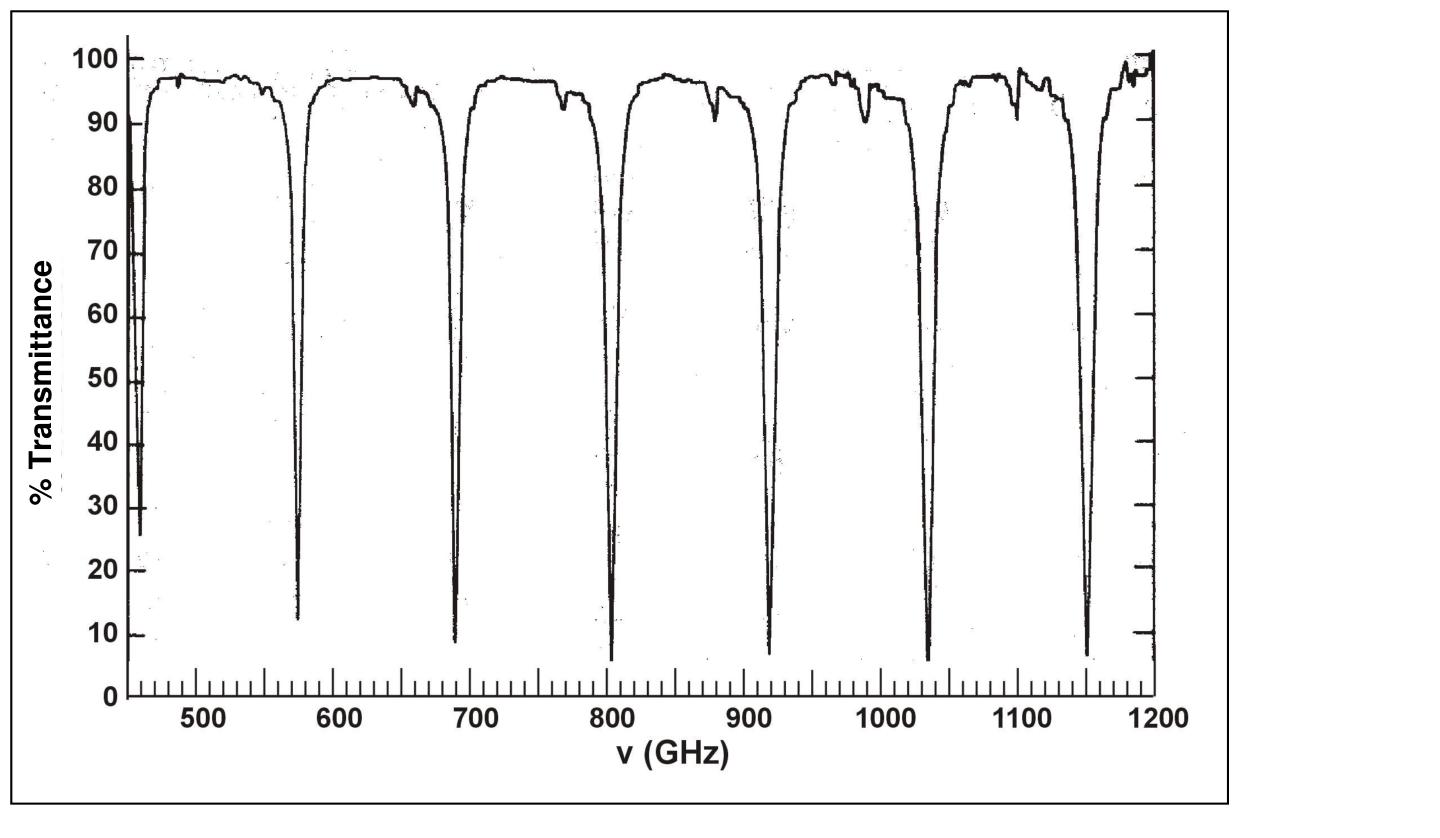
Official English text of the problem.
Answers
- a) \(\boxed{\Delta\nu\approx115\ \mathrm{GHz}=1.15\times10^{11}\ \mathrm{Hz}}\)
- b) \(\boxed{B\approx3.81\times10^{-23}\ \mathrm{J}}\)
- c) \(\boxed{R\approx1.13\times10^{-10}\ \mathrm{m}=113\ \mathrm{pm}}\)
Solution
The molecule is carbon monoxide, \(\ce{^{12}C^{16}O}\), with isotopic SMILES [12C-]#[16O+].
a) Frequency spacing, \(\Delta\nu\)
The strong absorption lines appear as minima in transmittance. From the spectrum, the minima near \(460\) and \(1150\ \mathrm{GHz}\) span six successive intervals. Thus,
\[ \Delta\nu\approx\frac{1150-460}{6}\ \mathrm{GHz} =115\ \mathrm{GHz} =1.15\times10^{11}\ \mathrm{s^{-1}}. \]
b) Rotational constant, \(B\)
For the transition \(J\rightarrow J+1\),
\[ h\nu_J =B\big[(J+1)(J+2)-J(J+1)\big] =2B(J+1). \]
Therefore, adjacent spectral lines have spacing
\[ \Delta\nu=\nu_{J+1}-\nu_J=\frac{2B}{h}. \]
Using the standard Planck constant \(h=6.62607015\times10^{-34}\ \mathrm{J\,s}\),
\[ B=\frac{h\Delta\nu}{2} =\frac{(6.62607015\times10^{-34}\ \mathrm{J\,s}) (1.15\times10^{11}\ \mathrm{s^{-1}})}{2} \approx\boxed{3.81\times10^{-23}\ \mathrm{J}}. \]
Here \(B\) has energy units, as defined in the problem.
c) Bond length, \(R\)
Approximating the isotope masses by \(12u\) and \(16u\), the reduced mass is
\[ \mu=\frac{m_{\mathrm C}m_{\mathrm O}}{m_{\mathrm C}+m_{\mathrm O}} =\frac{12\times16}{12+16}\,u =6.85714\,u. \]
Using the standard conversion \(u=1.66054\times10^{-27}\ \mathrm{kg}\),
\[ \mu\approx1.13866\times10^{-26}\ \mathrm{kg}. \]
Rearranging the given expression for \(B\),
\[ R=\sqrt{\frac{h^2}{8\pi^2\mu B}} =\sqrt{ \frac{(6.62607\times10^{-34}\ \mathrm{J\,s})^2} {8\pi^2(1.13866\times10^{-26}\ \mathrm{kg}) (3.80999\times10^{-23}\ \mathrm{J})} }. \]
Hence,
\[ \boxed{R\approx1.13\times10^{-10}\ \mathrm{m}=113\ \mathrm{pm}}. \]
The solution was checked against the official solution.
IChO 2003 · Theorieaufgabe 26
Spektrum von CO
AUFGABE 26 Spektrum von \(\ce{CO}\)
Die Rotationsenergieniveaus zweiatomiger Moleküle lassen sich gut durch die Formel \(E_J = B\,J(J+1)\) beschreiben, wobei \(J\) die Rotationsquantenzahl des Moleküls und \(B\) seine Rotationskonstante ist. Der Zusammenhang zwischen der Konstante \(B\), der reduzierten Masse \(\mu\) und der Bindungslänge \(R\) des Moleküls wird durch folgende Gleichung beschrieben:
\[ B=\frac{h^2}{8\pi^2\mu R^2}. \]
Im Allgemeinen treten spektroskopische Übergänge bei Photonenenergien auf, die der Energiedifferenz zwischen den entsprechenden Zuständen eines Moleküls entsprechen (\(h\nu=\Delta E\)). Die beobachteten Rotationsübergänge erfolgen zwischen benachbarten Rotationsniveaus, daher gilt \(\Delta E=E_{J+1}-E_J=2B(J+1)\). Folglich erfüllen aufeinanderfolgende Rotationsübergänge, die im Spektrum erscheinen (wie etwa im hier gezeigten), die Gleichung \(h(\Delta\nu)=2B\).
Bestimmen Sie anhand des vorliegenden Spektrums die folgenden Größen für \(\ce{^{12}C^{16}O}\) mit den entsprechenden Einheiten:
a) \(\Delta\nu\)
b) \(B\)
c) \(R\)
Aufgabentext aus dem offiziellen englischen Text übersetzt.
Antworten
- a) \(\boxed{\Delta\nu\approx115\ \mathrm{GHz}=1.15\times10^{11}\ \mathrm{Hz}}\)
- b) \(\boxed{B\approx3.81\times10^{-23}\ \mathrm{J}}\)
- c) \(\boxed{R\approx1.13\times10^{-10}\ \mathrm{m}=113\ \mathrm{pm}}\)
Lösung
Bei dem Molekül handelt es sich um Kohlenstoffmonoxid, \(\ce{^{12}C^{16}O}\), mit der isotopenspezifischen SMILES-Schreibweise [12C-]#[16O+].
a) Frequenzabstand, \(\Delta\nu\)
Die starken Absorptionslinien erscheinen als Minima des Transmissionsgrads. Im Spektrum liegen zwischen den Minima bei etwa \(460\) und \(1150\ \mathrm{GHz}\) sechs aufeinanderfolgende Intervalle. Somit gilt:
\[ \Delta\nu\approx\frac{1150-460}{6}\ \mathrm{GHz} =115\ \mathrm{GHz} =1.15\times10^{11}\ \mathrm{s^{-1}}. \]
b) Rotationskonstante, \(B\)
Für den Übergang \(J\rightarrow J+1\) gilt:
\[ h\nu_J =B\big[(J+1)(J+2)-J(J+1)\big] =2B(J+1). \]
Benachbarte Spektrallinien haben daher den Abstand
\[ \Delta\nu=\nu_{J+1}-\nu_J=\frac{2B}{h}. \]
Mit dem Standardwert der Planck-Konstante \(h=6.62607015\times10^{-34}\ \mathrm{J\,s}\) ergibt sich:
\[ B=\frac{h\Delta\nu}{2} =\frac{(6.62607015\times10^{-34}\ \mathrm{J\,s}) (1.15\times10^{11}\ \mathrm{s^{-1}})}{2} \approx\boxed{3.81\times10^{-23}\ \mathrm{J}}. \]
Hier hat \(B\) gemäß der Definition in der Aufgabenstellung die Einheit einer Energie.
c) Bindungslänge, \(R\)
Werden die Isotopenmassen näherungsweise mit \(12u\) und \(16u\) angesetzt, ergibt sich für die reduzierte Masse
\[ \mu=\frac{m_{\mathrm C}m_{\mathrm O}}{m_{\mathrm C}+m_{\mathrm O}} =\frac{12\times16}{12+16}\,u =6.85714\,u. \]
Mit dem üblichen Umrechnungsfaktor \(u=1.66054\times10^{-27}\ \mathrm{kg}\) folgt:
\[ \mu\approx1.13866\times10^{-26}\ \mathrm{kg}. \]
Durch Umstellen des gegebenen Ausdrucks für \(B\) erhält man:
\[ R=\sqrt{\frac{h^2}{8\pi^2\mu B}} =\sqrt{ \frac{(6.62607\times10^{-34}\ \mathrm{J\,s})^2} {8\pi^2(1.13866\times10^{-26}\ \mathrm{kg}) (3.80999\times10^{-23}\ \mathrm{J})} }. \]
Damit ergibt sich:
\[ \boxed{R\approx1.13\times10^{-10}\ \mathrm{m}=113\ \mathrm{pm}}. \]
Die Lösung wurde mit der offiziellen Lösung abgeglichen.
IChO 2003 · Teori sorusu 26
CO Spektrumu
SORU 26 \(\ce{CO}\) Spektrumu
İki atomlu moleküllerin dönme enerji düzeyleri, \(E_J = B\,J(J+1)\) formülüyle iyi bir şekilde tanımlanır; burada \(J\) molekülün dönme kuantum sayısı, \(B\) ise dönme sabitidir. \(B\) sabiti, molekülün indirgenmiş kütlesi \(\mu\) ve bağ uzunluğu \(R\) ile şu denklem aracılığıyla ilişkilidir:
\[ B=\frac{h^2}{8\pi^2\mu R^2}. \]
Genel olarak spektroskopik geçişler, bir molekülün uygun durumları arasındaki enerji farkına eşit foton enerjilerinde gözlenir (\(h\nu=\Delta E\)). Gözlenen dönme geçişleri komşu dönme düzeyleri arasında gerçekleşir; dolayısıyla \(\Delta E=E_{J+1}-E_J=2B(J+1)\). Bu nedenle, spektrumda (burada gösterilene benzer bir spektrumda olduğu gibi) görülen ardışık dönme geçişleri \(h(\Delta\nu)=2B\) denklemine uyar.
Verilen spektrumu inceleyerek \(\ce{^{12}C^{16}O}\) için aşağıdaki büyüklükleri uygun birimleriyle belirleyiniz:
a) \(\Delta\nu\)
b) \(B\)
c) \(R\)
Soru metni resmi İngilizce metinden çevrilmiştir.
Cevaplar
- a) \(\boxed{\Delta\nu\approx115\ \mathrm{GHz}=1.15\times10^{11}\ \mathrm{Hz}}\)
- b) \(\boxed{B\approx3.81\times10^{-23}\ \mathrm{J}}\)
- c) \(\boxed{R\approx1.13\times10^{-10}\ \mathrm{m}=113\ \mathrm{pm}}\)
Çözüm
Molekül, izotopik SMILES gösterimi [12C-]#[16O+] olan karbon monoksittir, \(\ce{^{12}C^{16}O}\).
a) Frekans aralığı, \(\Delta\nu\)
Şiddetli soğurma çizgileri, geçirgenlikte minimumlar olarak görülür. Spektrumda \(460\) ve \(1150\ \mathrm{GHz}\) yakınlarındaki minimumlar arasında altı ardışık aralık vardır. Dolayısıyla,
\[ \Delta\nu\approx\frac{1150-460}{6}\ \mathrm{GHz} =115\ \mathrm{GHz} =1.15\times10^{11}\ \mathrm{s^{-1}}. \]
b) Dönme sabiti, \(B\)
\(J\rightarrow J+1\) geçişi için,
\[ h\nu_J =B\big[(J+1)(J+2)-J(J+1)\big] =2B(J+1). \]
Bu nedenle, komşu spektrum çizgileri arasındaki aralık şöyledir:
\[ \Delta\nu=\nu_{J+1}-\nu_J=\frac{2B}{h}. \]
Planck sabitinin standart değeri \(h=6.62607015\times10^{-34}\ \mathrm{J\,s}\) kullanılarak,
\[ B=\frac{h\Delta\nu}{2} =\frac{(6.62607015\times10^{-34}\ \mathrm{J\,s}) (1.15\times10^{11}\ \mathrm{s^{-1}})}{2} \approx\boxed{3.81\times10^{-23}\ \mathrm{J}}. \]
Burada \(B\), soruda tanımlandığı gibi enerji birimindedir.
c) Bağ uzunluğu, \(R\)
İzotop kütleleri yaklaşık olarak \(12u\) ve \(16u\) alındığında indirgenmiş kütle şöyledir:
\[ \mu=\frac{m_{\mathrm C}m_{\mathrm O}}{m_{\mathrm C}+m_{\mathrm O}} =\frac{12\times16}{12+16}\,u =6.85714\,u. \]
Standart birim dönüşümü \(u=1.66054\times10^{-27}\ \mathrm{kg}\) kullanılarak,
\[ \mu\approx1.13866\times10^{-26}\ \mathrm{kg}. \]
\(B\) için verilen ifade yeniden düzenlendiğinde,
\[ R=\sqrt{\frac{h^2}{8\pi^2\mu B}} =\sqrt{ \frac{(6.62607\times10^{-34}\ \mathrm{J\,s})^2} {8\pi^2(1.13866\times10^{-26}\ \mathrm{kg}) (3.80999\times10^{-23}\ \mathrm{J})} }. \]
Böylece,
\[ \boxed{R\approx1.13\times10^{-10}\ \mathrm{m}=113\ \mathrm{pm}}. \]
Çözüm, resmi çözümle karşılaştırılarak kontrol edildi.
IChO 2003 · Problema teórico 26
Espectro del CO
PROBLEMA 26 Espectro del \(\ce{CO}\)
Los niveles de energía rotacional de las moléculas diatómicas se describen adecuadamente mediante la fórmula \(E_J = B\,J(J+1)\), donde \(J\) es el número cuántico rotacional de la molécula y \(B\), su constante rotacional. La constante \(B\) está relacionada con la masa reducida \(\mu\) y la longitud de enlace \(R\) de la molécula mediante la ecuación
\[ B=\frac{h^2}{8\pi^2\mu R^2}. \]
En general, las transiciones espectroscópicas aparecen a energías de los fotones iguales a la diferencia de energía entre los estados correspondientes de una molécula (\(h\nu=\Delta E\)). Las transiciones rotacionales observadas se producen entre niveles rotacionales adyacentes, por lo que \(\Delta E=E_{J+1}-E_J=2B(J+1)\). En consecuencia, las transiciones rotacionales sucesivas que aparecen en el espectro (como el que se muestra aquí) cumplen la ecuación \(h(\Delta\nu)=2B\).
A partir del espectro proporcionado, determine las siguientes magnitudes para \(\ce{^{12}C^{16}O}\), con las unidades apropiadas:
a) \(\Delta\nu\)
b) \(B\)
c) \(R\)
Enunciado traducido del texto oficial en inglés.
Respuestas
- a) \(\boxed{\Delta\nu\approx115\ \mathrm{GHz}=1.15\times10^{11}\ \mathrm{Hz}}\)
- b) \(\boxed{B\approx3.81\times10^{-23}\ \mathrm{J}}\)
- c) \(\boxed{R\approx1.13\times10^{-10}\ \mathrm{m}=113\ \mathrm{pm}}\)
Solución
La molécula es monóxido de carbono, \(\ce{^{12}C^{16}O}\), con el SMILES isotópico [12C-]#[16O+].
a) Separación en frecuencia, \(\Delta\nu\)
Las líneas de absorción intensas aparecen como mínimos de transmitancia. En el espectro, los mínimos próximos a \(460\) y \(1150\ \mathrm{GHz}\) abarcan seis intervalos sucesivos. Por tanto,
\[ \Delta\nu\approx\frac{1150-460}{6}\ \mathrm{GHz} =115\ \mathrm{GHz} =1.15\times10^{11}\ \mathrm{s^{-1}}. \]
b) Constante rotacional, \(B\)
Para la transición \(J\rightarrow J+1\),
\[ h\nu_J =B\big[(J+1)(J+2)-J(J+1)\big] =2B(J+1). \]
Por lo tanto, las líneas espectrales adyacentes tienen una separación
\[ \Delta\nu=\nu_{J+1}-\nu_J=\frac{2B}{h}. \]
Utilizando el valor estándar de la constante de Planck \(h=6.62607015\times10^{-34}\ \mathrm{J\,s}\),
\[ B=\frac{h\Delta\nu}{2} =\frac{(6.62607015\times10^{-34}\ \mathrm{J\,s}) (1.15\times10^{11}\ \mathrm{s^{-1}})}{2} \approx\boxed{3.81\times10^{-23}\ \mathrm{J}}. \]
Aquí, \(B\) tiene unidades de energía, tal como se define en el enunciado.
c) Longitud de enlace, \(R\)
Aproximando las masas de los isótopos por \(12u\) y \(16u\), la masa reducida es
\[ \mu=\frac{m_{\mathrm C}m_{\mathrm O}}{m_{\mathrm C}+m_{\mathrm O}} =\frac{12\times16}{12+16}\,u =6.85714\,u. \]
Utilizando la conversión estándar \(u=1.66054\times10^{-27}\ \mathrm{kg}\),
\[ \mu\approx1.13866\times10^{-26}\ \mathrm{kg}. \]
Despejando en la expresión dada para \(B\),
\[ R=\sqrt{\frac{h^2}{8\pi^2\mu B}} =\sqrt{ \frac{(6.62607\times10^{-34}\ \mathrm{J\,s})^2} {8\pi^2(1.13866\times10^{-26}\ \mathrm{kg}) (3.80999\times10^{-23}\ \mathrm{J})} }. \]
Por consiguiente,
\[ \boxed{R\approx1.13\times10^{-10}\ \mathrm{m}=113\ \mathrm{pm}}. \]
La solución se comprobó con la solución oficial.
IChO 2003 · 理论题 26
CO 的光谱
题目 26 \(\ce{CO}\) 的光谱
双原子分子的转动能级可以用公式 \(E_J = B\,J(J+1)\) 很好地描述,其中 \(J\) 为分子的转动量子数,\(B\) 为其转动常数。常数 \(B\) 与分子的约化质量 \(\mu\) 及键长 \(R\) 之间的关系为
\[ B=\frac{h^2}{8\pi^2\mu R^2}. \]
一般而言,当光子能量等于分子相应状态之间的能量差时,就会发生光谱跃迁(\(h\nu=\Delta E\))。观测到的转动跃迁发生在相邻的转动能级之间,因此 \(\Delta E=E_{J+1}-E_J=2B(J+1)\)。由此,光谱(如这里所示的光谱)中相继出现的转动跃迁满足方程 \(h(\Delta\nu)=2B\)。
观察所给光谱,确定 \(\ce{^{12}C^{16}O}\) 的下列物理量,并注明适当的单位:
a) \(\Delta\nu\)
b) \(B\)
c) \(R\)
题目译自官方英文原文。
答案
- a) \(\boxed{\Delta\nu\approx115\ \mathrm{GHz}=1.15\times10^{11}\ \mathrm{Hz}}\)
- b) \(\boxed{B\approx3.81\times10^{-23}\ \mathrm{J}}\)
- c) \(\boxed{R\approx1.13\times10^{-10}\ \mathrm{m}=113\ \mathrm{pm}}\)
解答
该分子为一氧化碳,\(\ce{^{12}C^{16}O}\),其含同位素标记的 SMILES 为 [12C-]#[16O+]。
a) 频率间隔,\(\Delta\nu\)
强吸收线表现为透射率的极小值。从光谱可见,\(460\) 和 \(1150\ \mathrm{GHz}\) 附近的极小值之间跨越了六个连续的间隔。因此,
\[ \Delta\nu\approx\frac{1150-460}{6}\ \mathrm{GHz} =115\ \mathrm{GHz} =1.15\times10^{11}\ \mathrm{s^{-1}}. \]
b) 转动常数,\(B\)
对于跃迁 \(J\rightarrow J+1\),
\[ h\nu_J =B\big[(J+1)(J+2)-J(J+1)\big] =2B(J+1). \]
因此,相邻谱线的间隔为
\[ \Delta\nu=\nu_{J+1}-\nu_J=\frac{2B}{h}. \]
采用普朗克常量的标准值 \(h=6.62607015\times10^{-34}\ \mathrm{J\,s}\),
\[ B=\frac{h\Delta\nu}{2} =\frac{(6.62607015\times10^{-34}\ \mathrm{J\,s}) (1.15\times10^{11}\ \mathrm{s^{-1}})}{2} \approx\boxed{3.81\times10^{-23}\ \mathrm{J}}. \]
根据题目中的定义,这里的 \(B\) 具有能量单位。
c) 键长,\(R\)
将同位素的质量近似取为 \(12u\) 和 \(16u\),则约化质量为
\[ \mu=\frac{m_{\mathrm C}m_{\mathrm O}}{m_{\mathrm C}+m_{\mathrm O}} =\frac{12\times16}{12+16}\,u =6.85714\,u. \]
采用标准换算关系 \(u=1.66054\times10^{-27}\ \mathrm{kg}\),
\[ \mu\approx1.13866\times10^{-26}\ \mathrm{kg}. \]
将所给的 \(B\) 的表达式变形,得到
\[ R=\sqrt{\frac{h^2}{8\pi^2\mu B}} =\sqrt{ \frac{(6.62607\times10^{-34}\ \mathrm{J\,s})^2} {8\pi^2(1.13866\times10^{-26}\ \mathrm{kg}) (3.80999\times10^{-23}\ \mathrm{J})} }. \]
因此,
\[ \boxed{R\approx1.13\times10^{-10}\ \mathrm{m}=113\ \mathrm{pm}}. \]
解答已与官方解答核对。
IChO 2003 · Теоретическая задача 26
Спектр CO
ЗАДАЧА 26 Спектр \(\ce{CO}\)
Вращательные энергетические уровни двухатомных молекул хорошо описываются формулой \(E_J = B\,J(J+1)\), где \(J\) — вращательное квантовое число молекулы, а \(B\) — её вращательная постоянная. Постоянная \(B\) связана с приведённой массой \(\mu\) и длиной связи \(R\) молекулы уравнением
\[ B=\frac{h^2}{8\pi^2\mu R^2}. \]
В общем случае спектроскопические переходы наблюдаются при энергиях фотонов, равных разности энергий соответствующих состояний молекулы (\(h\nu=\Delta E\)). Наблюдаемые вращательные переходы происходят между соседними вращательными уровнями, поэтому \(\Delta E=E_{J+1}-E_J=2B(J+1)\). Следовательно, последовательные вращательные переходы, проявляющиеся в спектре (например, в приведённом здесь), подчиняются уравнению \(h(\Delta\nu)=2B\).
По приведённому спектру определите следующие величины для \(\ce{^{12}C^{16}O}\), указав соответствующие единицы измерения:
a) \(\Delta\nu\)
b) \(B\)
c) \(R\)
Условие переведено с официального английского текста.
Ответы
- a) \(\boxed{\Delta\nu\approx115\ \mathrm{GHz}=1.15\times10^{11}\ \mathrm{Hz}}\)
- b) \(\boxed{B\approx3.81\times10^{-23}\ \mathrm{J}}\)
- c) \(\boxed{R\approx1.13\times10^{-10}\ \mathrm{m}=113\ \mathrm{pm}}\)
Решение
Рассматриваемая молекула — монооксид углерода, \(\ce{^{12}C^{16}O}\), с изотопной записью SMILES [12C-]#[16O+].
a) Частотный интервал, \(\Delta\nu\)
Сильные линии поглощения проявляются как минимумы коэффициента пропускания. На спектре между минимумами вблизи \(460\) и \(1150\ \mathrm{GHz}\) укладываются шесть последовательных интервалов. Таким образом,
\[ \Delta\nu\approx\frac{1150-460}{6}\ \mathrm{GHz} =115\ \mathrm{GHz} =1.15\times10^{11}\ \mathrm{s^{-1}}. \]
b) Вращательная постоянная, \(B\)
Для перехода \(J\rightarrow J+1\)
\[ h\nu_J =B\big[(J+1)(J+2)-J(J+1)\big] =2B(J+1). \]
Поэтому интервал между соседними спектральными линиями равен
\[ \Delta\nu=\nu_{J+1}-\nu_J=\frac{2B}{h}. \]
Используя стандартное значение постоянной Планка \(h=6.62607015\times10^{-34}\ \mathrm{J\,s}\), получаем
\[ B=\frac{h\Delta\nu}{2} =\frac{(6.62607015\times10^{-34}\ \mathrm{J\,s}) (1.15\times10^{11}\ \mathrm{s^{-1}})}{2} \approx\boxed{3.81\times10^{-23}\ \mathrm{J}}. \]
Здесь \(B\) выражается в единицах энергии, согласно определению в условии задачи.
c) Длина связи, \(R\)
Приближённо принимая массы изотопов равными \(12u\) и \(16u\), получаем приведённую массу
\[ \mu=\frac{m_{\mathrm C}m_{\mathrm O}}{m_{\mathrm C}+m_{\mathrm O}} =\frac{12\times16}{12+16}\,u =6.85714\,u. \]
Используя стандартное соотношение для перевода единиц \(u=1.66054\times10^{-27}\ \mathrm{kg}\), получаем
\[ \mu\approx1.13866\times10^{-26}\ \mathrm{kg}. \]
Выражая \(R\) из данного выражения для \(B\), получаем
\[ R=\sqrt{\frac{h^2}{8\pi^2\mu B}} =\sqrt{ \frac{(6.62607\times10^{-34}\ \mathrm{J\,s})^2} {8\pi^2(1.13866\times10^{-26}\ \mathrm{kg}) (3.80999\times10^{-23}\ \mathrm{J})} }. \]
Следовательно,
\[ \boxed{R\approx1.13\times10^{-10}\ \mathrm{m}=113\ \mathrm{pm}}. \]
Решение проверено по официальному решению.
IChO 2003 · مسألة نظرية 26
طيف CO
المسألة 26 طيف \(\ce{CO}\)
تُوصَف مستويات الطاقة الدورانية للجزيئات ثنائية الذرة وصفًا جيدًا بالصيغة \(E_J = B\,J(J+1)\)، حيث \(J\) هو عدد الكم الدوراني للجزيء و\(B\) هو ثابته الدوراني. يرتبط الثابت \(B\) بالكتلة المختزلة \(\mu\) وطول الرابطة \(R\) للجزيء وفق المعادلة
\[ B=\frac{h^2}{8\pi^2\mu R^2}. \]
بوجه عام، تظهر الانتقالات الطيفية عند طاقات فوتونية تساوي فرق الطاقة بين الحالات المناسبة للجزيء (\(h\nu=\Delta E\)). تحدث الانتقالات الدورانية المرصودة بين مستويات دورانية متجاورة، ومن ثم فإن \(\Delta E=E_{J+1}-E_J=2B(J+1)\). وبناءً على ذلك، تخضع الانتقالات الدورانية المتتالية التي تظهر في الطيف (مثل الطيف الموضَّح هنا) للمعادلة \(h(\Delta\nu)=2B\).
من خلال فحص الطيف المعطى، حدِّد الكميات التالية للجزيء \(\ce{^{12}C^{16}O}\) مع الوحدات المناسبة:
a) \(\Delta\nu\)
b) \(B\)
c) \(R\)
نص المسألة مترجم عن النص الإنجليزي الرسمي.
الإجابات
- a) \(\boxed{\Delta\nu\approx115\ \mathrm{GHz}=1.15\times10^{11}\ \mathrm{Hz}}\)
- b) \(\boxed{B\approx3.81\times10^{-23}\ \mathrm{J}}\)
- c) \(\boxed{R\approx1.13\times10^{-10}\ \mathrm{m}=113\ \mathrm{pm}}\)
الحل
الجزيء هو أحادي أكسيد الكربون، \(\ce{^{12}C^{16}O}\)، وتمثيله بصيغة SMILES مع تحديد النظائر هو [12C-]#[16O+].
a) الفاصل الترددي، \(\Delta\nu\)
تظهر خطوط الامتصاص القوية على هيئة قيم دنيا للنفاذية. يتبين من الطيف أن القيمتين الدنيا الواقعتين قرب \(460\) و\(1150\ \mathrm{GHz}\) تفصل بينهما ستة فواصل متتالية. ومن ثم،
\[ \Delta\nu\approx\frac{1150-460}{6}\ \mathrm{GHz} =115\ \mathrm{GHz} =1.15\times10^{11}\ \mathrm{s^{-1}}. \]
b) الثابت الدوراني، \(B\)
بالنسبة إلى الانتقال \(J\rightarrow J+1\)،
\[ h\nu_J =B\big[(J+1)(J+2)-J(J+1)\big] =2B(J+1). \]
لذلك، يكون الفاصل بين الخطوط الطيفية المتجاورة
\[ \Delta\nu=\nu_{J+1}-\nu_J=\frac{2B}{h}. \]
باستخدام القيمة القياسية لثابت بلانك \(h=6.62607015\times10^{-34}\ \mathrm{J\,s}\)،
\[ B=\frac{h\Delta\nu}{2} =\frac{(6.62607015\times10^{-34}\ \mathrm{J\,s}) (1.15\times10^{11}\ \mathrm{s^{-1}})}{2} \approx\boxed{3.81\times10^{-23}\ \mathrm{J}}. \]
هنا، يُعبَّر عن \(B\) بوحدات الطاقة، وفقًا لتعريفه في المسألة.
c) طول الرابطة، \(R\)
بتقريب كتلتي النظيرين إلى \(12u\) و\(16u\)، تكون الكتلة المختزلة
\[ \mu=\frac{m_{\mathrm C}m_{\mathrm O}}{m_{\mathrm C}+m_{\mathrm O}} =\frac{12\times16}{12+16}\,u =6.85714\,u. \]
باستخدام علاقة التحويل القياسية \(u=1.66054\times10^{-27}\ \mathrm{kg}\)،
\[ \mu\approx1.13866\times10^{-26}\ \mathrm{kg}. \]
بإعادة ترتيب التعبير المعطى للثابت \(B\)،
\[ R=\sqrt{\frac{h^2}{8\pi^2\mu B}} =\sqrt{ \frac{(6.62607\times10^{-34}\ \mathrm{J\,s})^2} {8\pi^2(1.13866\times10^{-26}\ \mathrm{kg}) (3.80999\times10^{-23}\ \mathrm{J})} }. \]
وعليه،
\[ \boxed{R\approx1.13\times10^{-10}\ \mathrm{m}=113\ \mathrm{pm}}. \]
تمت مراجعة الحل بمقارنته بالحل الرسمي.