IChO 2003 · Theory problem 25
Muon
SECTION B: PHYSICAL CHEMISTRY
PROBLEM 25 Muon
The muon (\(\mu\)) is a subatomic particle of the lepton family which has same charge and magnetic behavior as the electron, but has a different mass and is unstable, i.e., it disintegrates into other particles within microseconds after its creation. Here you will attempt to determine the mass of the muon using two rather different approaches.
a) The most common spontaneous disintegration reaction for the muon is:
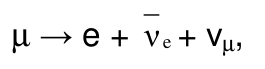
where \(\overline{\nu}_e\) is the electron antineutrino, and \(\nu_\mu\) the muon neutrino. In a given experiment using a stationary muon, \(\overline{\nu}_e+\nu_\mu\), carried away a total energy of \(2.000\times10^{-12}\ \mathrm{J}\), while the electron was moving with a kinetic energy of \(1.4846\times10^{-11}\ \mathrm{J}\). Determine the mass of the muon.
b) Many experiments have studied the spectroscopy of atoms that have captured a muon in place of an electron. These exotic atoms are formed in a variety of excited states. The transition from the third excited state to the first excited state of an atom consisting of a \(\ce{^1H}\) nucleus and a muon attached to it was observed at a wavelength of \(2.615\ \mathrm{nm}\). Determine the mass of the muon.
Official English text of the problem.
Answers
- a) From energy conservation, \(\boxed{m_\mu=1.8835\times10^{-28}\ \mathrm{kg}}\). The stated event has a momentum-conservation inconsistency: the electron's momentum, \(p_ec=1.49\times10^{-11}\ \mathrm{J}\), exceeds what the two neutrinos can carry, \(c\,|\mathbf p_{\overline{\nu}_e}+\mathbf p_{\nu_\mu}|\le2.000\times10^{-12}\ \mathrm{J}\).
- b) \(\boxed{m_\mu=1.884\times10^{-28}\ \mathrm{kg}}\), including the finite mass of the proton.
Solution
The problem gives no numerical physical constants. We use the standard values \[ \begin{aligned} c&=2.99792458\times10^8\ \mathrm{m\,s^{-1}},\\ m_e&=9.1093837\times10^{-31}\ \mathrm{kg},\\ m_p&=1.6726219\times10^{-27}\ \mathrm{kg},\\ R_\infty&=1.09737316\times10^7\ \mathrm{m^{-1}}. \end{aligned} \]
a)
The decay, with the particle charges shown explicitly, is \[ \ce{\mu^- -> e^- + \bar{\nu}_{e} + \nu_{\mu}}. \]
Because the initial muon is stationary, its total energy is its rest energy, \(m_\mu c^2\). The final electron carries both rest energy and kinetic energy. Hence \[ m_\mu c^2=m_ec^2+K_e+E_{\overline{\nu}_e}+E_{\nu_\mu}. \]
The stated neutrino energy is already their combined total energy, so \[ m_\mu=m_e+\frac{K_e+E_{\text{neutrinos}}}{c^2}. \]
Substitution gives \[ \begin{aligned} m_\mu &=9.1093837\times10^{-31}\ \mathrm{kg} +\frac{1.4846\times10^{-11}+2.000\times10^{-12}} {(2.99792458\times10^8)^2}\ \mathrm{kg}\\ &=\boxed{1.8835\times10^{-28}\ \mathrm{kg}}. \end{aligned} \]
This is approximately \(206.76\,m_e\).
b)
The \(\ce{^1H+}\) nucleus is a proton (hydrogen-1 ion; SMILES [1H+]). Together with the bound negative muon, it forms muonic hydrogen. Standard SMILES cannot represent a muon or its orbital state.
Both particles move about their common centre of mass, so the hydrogen-like energy levels depend on the reduced mass \[ m_r=\frac{m_\mu m_p}{m_\mu+m_p}, \] rather than on \(m_\mu\) alone. For nuclear charge \(Z=1\), \[ E_n=-hcR_\infty\frac{m_r}{m_e}\frac{1}{n^2}. \]
The ground state has \(n=1\); therefore the third excited state is \(n=4\), and the first excited state is \(n=2\). For the emitted photon, \[ \frac{hc}{\lambda} =E_4-E_2 =hcR_\infty\frac{m_r}{m_e} \left(\frac{1}{2^2}-\frac{1}{4^2}\right). \]
Since the bracket equals \(3/16\), \[ \frac{1}{\lambda} =\frac{3}{16}R_\infty\frac{m_r}{m_e}. \]
Thus \[ \begin{aligned} m_r &=\frac{16m_e}{3R_\infty\lambda}\\ &=\frac{16(9.1093837\times10^{-31})} {3(1.09737316\times10^7)(2.615\times10^{-9})}\ \mathrm{kg}\\ &=1.6930185\times10^{-28}\ \mathrm{kg}. \end{aligned} \]
Solving the reduced-mass relation for the muon mass, \[ \frac{1}{m_\mu}=\frac{1}{m_r}-\frac{1}{m_p}, \qquad m_\mu=\frac{m_rm_p}{m_p-m_r}. \]
Consequently, \[ m_\mu= \frac{(1.6930185\times10^{-28})(1.6726219\times10^{-27})} {1.6726219\times10^{-27}-1.6930185\times10^{-28}} =\boxed{1.884\times10^{-28}\ \mathrm{kg}}. \]
The solution was checked against the official solution.
IChO 2003 · Theorieaufgabe 25
Myon
ABSCHNITT B: PHYSIKALISCHE CHEMIE
AUFGABE 25 Myon
Das Myon (\(\mu\)) ist ein subatomares Teilchen aus der Familie der Leptonen, das dieselbe Ladung und dasselbe magnetische Verhalten wie das Elektron aufweist, jedoch eine andere Masse besitzt und instabil ist, d. h., es zerfällt innerhalb von Mikrosekunden nach seiner Entstehung in andere Teilchen. Hier sollen Sie versuchen, die Masse des Myons mit zwei recht unterschiedlichen Ansätzen zu bestimmen.
a) Die häufigste spontane Zerfallsreaktion des Myons ist:
wobei \(\overline{\nu}_e\) das Elektron-Antineutrino und \(\nu_\mu\) das Myon-Neutrino ist. In einem Experiment mit einem ruhenden Myon führten \(\overline{\nu}_e+\nu_\mu\) eine Gesamtenergie von \(2.000\times10^{-12}\ \mathrm{J}\) ab, während sich das Elektron mit einer kinetischen Energie von \(1.4846\times10^{-11}\ \mathrm{J}\) bewegte. Bestimmen Sie die Masse des Myons.
b) In zahlreichen Experimenten wurde die Spektroskopie von Atomen untersucht, die anstelle eines Elektrons ein Myon eingefangen haben. Diese exotischen Atome entstehen in verschiedenen angeregten Zuständen. Der Übergang vom dritten angeregten Zustand zum ersten angeregten Zustand eines Atoms, das aus einem \(\ce{^1H}\)-Kern und einem daran gebundenen Myon besteht, wurde bei einer Wellenlänge von \(2.615\ \mathrm{nm}\) beobachtet. Bestimmen Sie die Masse des Myons.
Aufgabentext aus dem offiziellen englischen Text übersetzt.
Antworten
- a) Aus der Energieerhaltung ergibt sich \(\boxed{m_\mu=1.8835\times10^{-28}\ \mathrm{kg}}\). Das angegebene Ereignis weist eine Unstimmigkeit hinsichtlich der Impulserhaltung auf: Der Impuls des Elektrons, \(p_ec=1.49\times10^{-11}\ \mathrm{J}\), übersteigt den Impuls, den die beiden Neutrinos tragen können, \(c\,|\mathbf p_{\overline{\nu}_e}+\mathbf p_{\nu_\mu}|\le2.000\times10^{-12}\ \mathrm{J}\).
- b) \(\boxed{m_\mu=1.884\times10^{-28}\ \mathrm{kg}}\), unter Berücksichtigung der endlichen Masse des Protons.
Lösung
In der Aufgabe sind keine Zahlenwerte für physikalische Konstanten angegeben. Wir verwenden die Standardwerte \[ \begin{aligned} c&=2.99792458\times10^8\ \mathrm{m\,s^{-1}},\\ m_e&=9.1093837\times10^{-31}\ \mathrm{kg},\\ m_p&=1.6726219\times10^{-27}\ \mathrm{kg},\\ R_\infty&=1.09737316\times10^7\ \mathrm{m^{-1}}. \end{aligned} \]
a)
Der Zerfall lautet unter expliziter Angabe der Teilchenladungen \[ \ce{\mu^- -> e^- + \bar{\nu}_{e} + \nu_{\mu}}. \]
Da das ursprüngliche Myon ruht, ist seine Gesamtenergie gleich seiner Ruheenergie \(m_\mu c^2\). Das beim Zerfall entstehende Elektron besitzt sowohl Ruheenergie als auch kinetische Energie. Daher gilt \[ m_\mu c^2=m_ec^2+K_e+E_{\overline{\nu}_e}+E_{\nu_\mu}. \]
Die angegebene Neutrinoenergie ist bereits die Gesamtenergie beider Neutrinos zusammen, sodass \[ m_\mu=m_e+\frac{K_e+E_{\text{Neutrinos}}}{c^2}. \]
Einsetzen ergibt \[ \begin{aligned} m_\mu &=9.1093837\times10^{-31}\ \mathrm{kg} +\frac{1.4846\times10^{-11}+2.000\times10^{-12}} {(2.99792458\times10^8)^2}\ \mathrm{kg}\\ &=\boxed{1.8835\times10^{-28}\ \mathrm{kg}}. \end{aligned} \]
Dies entspricht ungefähr \(206.76\,m_e\).
b)
Der \(\ce{^1H+}\)-Kern ist ein Proton (Wasserstoff-1-Ion; SMILES [1H+]). Zusammen mit dem gebundenen negativen Myon bildet er myonischen Wasserstoff. Standard-SMILES können weder ein Myon noch dessen Orbitalzustand darstellen.
Beide Teilchen bewegen sich um ihren gemeinsamen Schwerpunkt, sodass die wasserstoffähnlichen Energieniveaus von der reduzierten Masse \[ m_r=\frac{m_\mu m_p}{m_\mu+m_p}, \] und nicht allein von \(m_\mu\) abhängen. Für die Kernladungszahl \(Z=1\) gilt \[ E_n=-hcR_\infty\frac{m_r}{m_e}\frac{1}{n^2}. \]
Der Grundzustand hat \(n=1\); daher entspricht der dritte angeregte Zustand \(n=4\) und der erste angeregte Zustand \(n=2\). Für das emittierte Photon gilt \[ \frac{hc}{\lambda} =E_4-E_2 =hcR_\infty\frac{m_r}{m_e} \left(\frac{1}{2^2}-\frac{1}{4^2}\right). \]
Da der Klammerausdruck gleich \(3/16\) ist, gilt \[ \frac{1}{\lambda} =\frac{3}{16}R_\infty\frac{m_r}{m_e}. \]
Somit ergibt sich \[ \begin{aligned} m_r &=\frac{16m_e}{3R_\infty\lambda}\\ &=\frac{16(9.1093837\times10^{-31})} {3(1.09737316\times10^7)(2.615\times10^{-9})}\ \mathrm{kg}\\ &=1.6930185\times10^{-28}\ \mathrm{kg}. \end{aligned} \]
Auflösen der Beziehung für die reduzierte Masse nach der Myonmasse ergibt \[ \frac{1}{m_\mu}=\frac{1}{m_r}-\frac{1}{m_p}, \qquad m_\mu=\frac{m_rm_p}{m_p-m_r}. \]
Folglich gilt \[ m_\mu= \frac{(1.6930185\times10^{-28})(1.6726219\times10^{-27})} {1.6726219\times10^{-27}-1.6930185\times10^{-28}} =\boxed{1.884\times10^{-28}\ \mathrm{kg}}. \]
Die Lösung wurde mit der offiziellen Lösung abgeglichen.
IChO 2003 · Teori sorusu 25
Müon
BÖLÜM B: FİZİKOKİMYA
SORU 25 Müon
Müon (\(\mu\)), lepton ailesine ait, elektronla aynı yüke ve manyetik davranışa sahip, ancak kütlesi farklı olan ve kararsız bir atom altı parçacıktır; yani oluşumundan sonraki mikrosaniyeler içinde başka parçacıklara bozunur. Burada, birbirinden oldukça farklı iki yaklaşım kullanarak müonun kütlesini belirlemeye çalışacaksınız.
a) Müonun en yaygın kendiliğinden bozunma tepkimesi şöyledir:
Burada \(\overline{\nu}_e\) elektron antinötrinosu, \(\nu_\mu\) ise müon nötrinosudur. Durgun bir müonun kullanıldığı bir deneyde, \(\overline{\nu}_e+\nu_\mu\) toplam \(2.000\times10^{-12}\ \mathrm{J}\) enerji taşırken elektron \(1.4846\times10^{-11}\ \mathrm{J}\) kinetik enerjiyle hareket ediyordu. Müonun kütlesini belirleyiniz.
b) Birçok deneyde, bir elektron yerine bir müon yakalamış atomların spektroskopisi incelenmiştir. Bu egzotik atomlar çeşitli uyarılmış hâllerde oluşur. Bir \(\ce{^1H}\) çekirdeği ve ona bağlı bir müondan oluşan bir atomun üçüncü uyarılmış hâlinden birinci uyarılmış hâline geçişi, \(2.615\ \mathrm{nm}\) dalga boyunda gözlenmiştir. Müonun kütlesini belirleyiniz.
Soru metni resmi İngilizce metinden çevrilmiştir.
Cevaplar
- a) Enerjinin korunumundan, \(\boxed{m_\mu=1.8835\times10^{-28}\ \mathrm{kg}}\). Verilen olayda momentumun korunumu açısından bir tutarsızlık vardır: elektronun momentumu, \(p_ec=1.49\times10^{-11}\ \mathrm{J}\), iki nötrinonun taşıyabileceği momentumu aşar, \(c\,|\mathbf p_{\overline{\nu}_e}+\mathbf p_{\nu_\mu}|\le2.000\times10^{-12}\ \mathrm{J}\).
- b) Protonun sonlu kütlesi hesaba katıldığında, \(\boxed{m_\mu=1.884\times10^{-28}\ \mathrm{kg}}\).
Çözüm
Soruda fiziksel sabitlerin sayısal değerleri verilmemiştir. Standart değerleri kullanıyoruz: \[ \begin{aligned} c&=2.99792458\times10^8\ \mathrm{m\,s^{-1}},\\ m_e&=9.1093837\times10^{-31}\ \mathrm{kg},\\ m_p&=1.6726219\times10^{-27}\ \mathrm{kg},\\ R_\infty&=1.09737316\times10^7\ \mathrm{m^{-1}}. \end{aligned} \]
a)
Parçacık yükleri açıkça gösterildiğinde bozunma şöyledir: \[ \ce{\mu^- -> e^- + \bar{\nu}_{e} + \nu_{\mu}}. \]
Başlangıçtaki müon durgun olduğundan toplam enerjisi, durgunluk enerjisi olan \(m_\mu c^2\)'ye eşittir. Bozunma sonucunda oluşan elektron hem durgunluk enerjisi hem de kinetik enerji taşır. Dolayısıyla \[ m_\mu c^2=m_ec^2+K_e+E_{\overline{\nu}_e}+E_{\nu_\mu}. \]
Verilen nötrino enerjisi zaten iki nötrinonun toplam enerjisidir; bu nedenle \[ m_\mu=m_e+\frac{K_e+E_{\text{nötrinolar}}}{c^2}. \]
Değerler yerine konulduğunda \[ \begin{aligned} m_\mu &=9.1093837\times10^{-31}\ \mathrm{kg} +\frac{1.4846\times10^{-11}+2.000\times10^{-12}} {(2.99792458\times10^8)^2}\ \mathrm{kg}\\ &=\boxed{1.8835\times10^{-28}\ \mathrm{kg}}. \end{aligned} \]
Bu, yaklaşık \(206.76\,m_e\)'dir.
b)
\(\ce{^1H+}\) çekirdeği bir protondur (hidrojen-1 iyonu; SMILES [1H+]). Kendisine bağlı negatif müonla birlikte müonik hidrojeni oluşturur. Standart SMILES, bir müonu veya onun orbital durumunu temsil edemez.
Her iki parçacık da ortak kütle merkezleri etrafında hareket eder; bu nedenle hidrojen benzeri enerji düzeyleri indirgenmiş kütleye, \[ m_r=\frac{m_\mu m_p}{m_\mu+m_p}, \] bağlıdır; yalnızca \(m_\mu\)'ye bağlı değildir. Çekirdek yükü \(Z=1\) için, \[ E_n=-hcR_\infty\frac{m_r}{m_e}\frac{1}{n^2}. \]
Temel hâlde \(n=1\)'dir; dolayısıyla üçüncü uyarılmış hâl \(n=4\), birinci uyarılmış hâl ise \(n=2\)'dir. Yayımlanan foton için, \[ \frac{hc}{\lambda} =E_4-E_2 =hcR_\infty\frac{m_r}{m_e} \left(\frac{1}{2^2}-\frac{1}{4^2}\right). \]
Parantez içindeki ifade \(3/16\)'ya eşit olduğundan, \[ \frac{1}{\lambda} =\frac{3}{16}R_\infty\frac{m_r}{m_e}. \]
Böylece \[ \begin{aligned} m_r &=\frac{16m_e}{3R_\infty\lambda}\\ &=\frac{16(9.1093837\times10^{-31})} {3(1.09737316\times10^7)(2.615\times10^{-9})}\ \mathrm{kg}\\ &=1.6930185\times10^{-28}\ \mathrm{kg}. \end{aligned} \]
İndirgenmiş kütle bağıntısı müon kütlesi için çözüldüğünde, \[ \frac{1}{m_\mu}=\frac{1}{m_r}-\frac{1}{m_p}, \qquad m_\mu=\frac{m_rm_p}{m_p-m_r}. \]
Sonuç olarak, \[ m_\mu= \frac{(1.6930185\times10^{-28})(1.6726219\times10^{-27})} {1.6726219\times10^{-27}-1.6930185\times10^{-28}} =\boxed{1.884\times10^{-28}\ \mathrm{kg}}. \]
Çözüm, resmi çözümle karşılaştırılarak kontrol edildi.
IChO 2003 · Problema teórico 25
Muón
SECCIÓN B: QUÍMICA FÍSICA
PROBLEMA 25 Muón
El muón (\(\mu\)) es una partícula subatómica de la familia de los leptones que tiene la misma carga y el mismo comportamiento magnético que el electrón, pero tiene una masa diferente y es inestable, es decir, se desintegra en otras partículas en un plazo de microsegundos tras su creación. Aquí intentará determinar la masa del muón mediante dos métodos bastante diferentes.
a) La reacción de desintegración espontánea más común del muón es:
donde \(\overline{\nu}_e\) es el antineutrino electrónico y \(\nu_\mu\), el neutrino muónico. En un experimento concreto con un muón en reposo, \(\overline{\nu}_e+\nu_\mu\) se llevaron una energía total de \(2.000\times10^{-12}\ \mathrm{J}\), mientras que el electrón se movía con una energía cinética de \(1.4846\times10^{-11}\ \mathrm{J}\). Determine la masa del muón.
b) En numerosos experimentos se ha estudiado la espectroscopia de átomos que han capturado un muón en lugar de un electrón. Estos átomos exóticos se forman en diversos estados excitados. La transición del tercer estado excitado al primer estado excitado de un átomo compuesto por un núcleo de \(\ce{^1H}\) y un muón ligado a él se observó a una longitud de onda de \(2.615\ \mathrm{nm}\). Determine la masa del muón.
Enunciado traducido del texto oficial en inglés.
Respuestas
- a) A partir de la conservación de la energía, \(\boxed{m_\mu=1.8835\times10^{-28}\ \mathrm{kg}}\). El suceso descrito presenta una inconsistencia con la conservación de la cantidad de movimiento: la cantidad de movimiento del electrón, \(p_ec=1.49\times10^{-11}\ \mathrm{J}\), supera la que pueden llevar los dos neutrinos, \(c\,|\mathbf p_{\overline{\nu}_e}+\mathbf p_{\nu_\mu}|\le2.000\times10^{-12}\ \mathrm{J}\).
- b) \(\boxed{m_\mu=1.884\times10^{-28}\ \mathrm{kg}}\), teniendo en cuenta la masa finita del protón.
Solución
El problema no proporciona valores numéricos de las constantes físicas. Utilizamos los valores estándar \[ \begin{aligned} c&=2.99792458\times10^8\ \mathrm{m\,s^{-1}},\\ m_e&=9.1093837\times10^{-31}\ \mathrm{kg},\\ m_p&=1.6726219\times10^{-27}\ \mathrm{kg},\\ R_\infty&=1.09737316\times10^7\ \mathrm{m^{-1}}. \end{aligned} \]
a)
La desintegración, con las cargas de las partículas indicadas explícitamente, es \[ \ce{\mu^- -> e^- + \bar{\nu}_{e} + \nu_{\mu}}. \]
Como el muón inicial está en reposo, su energía total es su energía en reposo, \(m_\mu c^2\). El electrón final posee tanto energía en reposo como energía cinética. Por tanto, \[ m_\mu c^2=m_ec^2+K_e+E_{\overline{\nu}_e}+E_{\nu_\mu}. \]
La energía indicada para los neutrinos ya es la energía total de ambos, por lo que \[ m_\mu=m_e+\frac{K_e+E_{\text{neutrinos}}}{c^2}. \]
Al sustituir los valores se obtiene \[ \begin{aligned} m_\mu &=9.1093837\times10^{-31}\ \mathrm{kg} +\frac{1.4846\times10^{-11}+2.000\times10^{-12}} {(2.99792458\times10^8)^2}\ \mathrm{kg}\\ &=\boxed{1.8835\times10^{-28}\ \mathrm{kg}}. \end{aligned} \]
Esto equivale aproximadamente a \(206.76\,m_e\).
b)
El núcleo de \(\ce{^1H+}\) es un protón (ion hidrógeno-1; SMILES [1H+]). Junto con el muón negativo ligado a él, forma hidrógeno muónico. La notación SMILES estándar no puede representar un muón ni su estado orbital.
Ambas partículas se mueven alrededor de su centro de masas común, por lo que los niveles de energía hidrogenoides dependen de la masa reducida \[ m_r=\frac{m_\mu m_p}{m_\mu+m_p}, \] en lugar de depender únicamente de \(m_\mu\). Para una carga nuclear \(Z=1\), \[ E_n=-hcR_\infty\frac{m_r}{m_e}\frac{1}{n^2}. \]
El estado fundamental tiene \(n=1\); por tanto, el tercer estado excitado corresponde a \(n=4\), y el primer estado excitado, a \(n=2\). Para el fotón emitido, \[ \frac{hc}{\lambda} =E_4-E_2 =hcR_\infty\frac{m_r}{m_e} \left(\frac{1}{2^2}-\frac{1}{4^2}\right). \]
Como la expresión entre paréntesis es igual a \(3/16\), \[ \frac{1}{\lambda} =\frac{3}{16}R_\infty\frac{m_r}{m_e}. \]
Así, \[ \begin{aligned} m_r &=\frac{16m_e}{3R_\infty\lambda}\\ &=\frac{16(9.1093837\times10^{-31})} {3(1.09737316\times10^7)(2.615\times10^{-9})}\ \mathrm{kg}\\ &=1.6930185\times10^{-28}\ \mathrm{kg}. \end{aligned} \]
Despejando la masa del muón de la relación de la masa reducida, \[ \frac{1}{m_\mu}=\frac{1}{m_r}-\frac{1}{m_p}, \qquad m_\mu=\frac{m_rm_p}{m_p-m_r}. \]
En consecuencia, \[ m_\mu= \frac{(1.6930185\times10^{-28})(1.6726219\times10^{-27})} {1.6726219\times10^{-27}-1.6930185\times10^{-28}} =\boxed{1.884\times10^{-28}\ \mathrm{kg}}. \]
La solución se comprobó con la solución oficial.
IChO 2003 · 理论题 25
μ子
B 部分:物理化学
题目 25 μ子
μ子(\(\mu\))是一种属于轻子家族的亚原子粒子,其电荷和磁性行为与电子相同,但质量不同,而且不稳定,即在产生后的数微秒内便会衰变成其他粒子。下面,你将尝试通过两种截然不同的方法确定μ子的质量。
a) μ子最常见的自发衰变反应为:
其中,\(\overline{\nu}_e\) 为电子反中微子,\(\nu_\mu\) 为μ子中微子。在一次以静止μ子为对象的实验中,\(\overline{\nu}_e+\nu_\mu\) 共带走了 \(2.000\times10^{-12}\ \mathrm{J}\) 的能量,而电子运动时的动能为 \(1.4846\times10^{-11}\ \mathrm{J}\)。确定μ子的质量。
b) 许多实验研究了俘获一个μ子来取代一个电子的原子的光谱。这些奇异原子形成时可处于各种激发态。对于一个由 \(\ce{^1H}\) 原子核及与之结合的μ子构成的原子,观测到其从第三激发态跃迁至第一激发态时发出的光的波长为 \(2.615\ \mathrm{nm}\)。确定μ子的质量。
题目译自官方英文原文。
答案
- a) 由能量守恒可得,\(\boxed{m_\mu=1.8835\times10^{-28}\ \mathrm{kg}}\)。题述事件存在与动量守恒不相容之处:电子的动量,\(p_ec=1.49\times10^{-11}\ \mathrm{J}\),超过了两个中微子所能携带的动量,\(c\,|\mathbf p_{\overline{\nu}_e}+\mathbf p_{\nu_\mu}|\le2.000\times10^{-12}\ \mathrm{J}\)。
- b) \(\boxed{m_\mu=1.884\times10^{-28}\ \mathrm{kg}}\),其中考虑了质子的有限质量。
解答
题目未给出物理常量的数值。我们采用以下标准值 \[ \begin{aligned} c&=2.99792458\times10^8\ \mathrm{m\,s^{-1}},\\ m_e&=9.1093837\times10^{-31}\ \mathrm{kg},\\ m_p&=1.6726219\times10^{-27}\ \mathrm{kg},\\ R_\infty&=1.09737316\times10^7\ \mathrm{m^{-1}}. \end{aligned} \]
a)
明确标出粒子电荷后,衰变反应为 \[ \ce{\mu^- -> e^- + \bar{\nu}_{e} + \nu_{\mu}}. \]
由于初始μ子处于静止状态,其总能量就是静止能量 \(m_\mu c^2\)。末态电子既具有静止能量,也具有动能。因此 \[ m_\mu c^2=m_ec^2+K_e+E_{\overline{\nu}_e}+E_{\nu_\mu}. \]
题目给出的中微子能量已经是两者的总能量之和,因此 \[ m_\mu=m_e+\frac{K_e+E_{\text{中微子}}}{c^2}. \]
代入数值得 \[ \begin{aligned} m_\mu &=9.1093837\times10^{-31}\ \mathrm{kg} +\frac{1.4846\times10^{-11}+2.000\times10^{-12}} {(2.99792458\times10^8)^2}\ \mathrm{kg}\\ &=\boxed{1.8835\times10^{-28}\ \mathrm{kg}}. \end{aligned} \]
这约为 \(206.76\,m_e\)。
b)
\(\ce{^1H+}\) 原子核是一个质子(氢-1离子;SMILES 为 [1H+])。它与束缚的负μ子共同构成μ子氢原子。标准 SMILES 无法表示μ子或其轨道状态。
两个粒子均绕其共同质心运动,因此类氢原子的能级取决于约化质量 \[ m_r=\frac{m_\mu m_p}{m_\mu+m_p}, \] 而不是仅取决于 \(m_\mu\)。对于核电荷数 \(Z=1\), \[ E_n=-hcR_\infty\frac{m_r}{m_e}\frac{1}{n^2}. \]
基态对应 \(n=1\);因此第三激发态对应 \(n=4\),第一激发态对应 \(n=2\)。对于发射的光子, \[ \frac{hc}{\lambda} =E_4-E_2 =hcR_\infty\frac{m_r}{m_e} \left(\frac{1}{2^2}-\frac{1}{4^2}\right). \]
由于括号内的值为 \(3/16\), \[ \frac{1}{\lambda} =\frac{3}{16}R_\infty\frac{m_r}{m_e}. \]
因此 \[ \begin{aligned} m_r &=\frac{16m_e}{3R_\infty\lambda}\\ &=\frac{16(9.1093837\times10^{-31})} {3(1.09737316\times10^7)(2.615\times10^{-9})}\ \mathrm{kg}\\ &=1.6930185\times10^{-28}\ \mathrm{kg}. \end{aligned} \]
由约化质量关系式解出μ子的质量, \[ \frac{1}{m_\mu}=\frac{1}{m_r}-\frac{1}{m_p}, \qquad m_\mu=\frac{m_rm_p}{m_p-m_r}. \]
于是, \[ m_\mu= \frac{(1.6930185\times10^{-28})(1.6726219\times10^{-27})} {1.6726219\times10^{-27}-1.6930185\times10^{-28}} =\boxed{1.884\times10^{-28}\ \mathrm{kg}}. \]
解答已与官方解答核对。
IChO 2003 · Теоретическая задача 25
Мюон
РАЗДЕЛ B: ФИЗИЧЕСКАЯ ХИМИЯ
ЗАДАЧА 25 Мюон
Мюон (\(\mu\)) — субатомная частица семейства лептонов, которая имеет такой же заряд и такие же магнитные свойства, как электрон, но отличается от него массой и нестабильна, то есть распадается на другие частицы в течение нескольких микросекунд после своего возникновения. В этой задаче вам предстоит определить массу мюона двумя весьма различными способами.
a) Наиболее распространённая реакция самопроизвольного распада мюона:
где \(\overline{\nu}_e\) — электронное антинейтрино, а \(\nu_\mu\) — мюонное нейтрино. В одном из экспериментов с неподвижным мюоном частицы \(\overline{\nu}_e+\nu_\mu\) унесли суммарную энергию \(2.000\times10^{-12}\ \mathrm{J}\), а электрон двигался с кинетической энергией \(1.4846\times10^{-11}\ \mathrm{J}\). Определите массу мюона.
b) Во многих экспериментах изучались спектры атомов, захвативших мюон вместо электрона. Эти экзотические атомы образуются в различных возбуждённых состояниях. Переход из третьего возбуждённого состояния в первое возбуждённое состояние атома, состоящего из ядра \(\ce{^1H}\) и связанного с ним мюона, наблюдался на длине волны \(2.615\ \mathrm{nm}\). Определите массу мюона.
Условие переведено с официального английского текста.
Ответы
- a) Из закона сохранения энергии: \(\boxed{m_\mu=1.8835\times10^{-28}\ \mathrm{kg}}\). Описанное событие противоречит закону сохранения импульса: импульс электрона, \(p_ec=1.49\times10^{-11}\ \mathrm{J}\), превышает импульс, который могут унести два нейтрино, \(c\,|\mathbf p_{\overline{\nu}_e}+\mathbf p_{\nu_\mu}|\le2.000\times10^{-12}\ \mathrm{J}\).
- b) \(\boxed{m_\mu=1.884\times10^{-28}\ \mathrm{kg}}\) с учётом конечной массы протона.
Решение
В условии задачи не приведены численные значения физических постоянных. Используем стандартные значения \[ \begin{aligned} c&=2.99792458\times10^8\ \mathrm{m\,s^{-1}},\\ m_e&=9.1093837\times10^{-31}\ \mathrm{kg},\\ m_p&=1.6726219\times10^{-27}\ \mathrm{kg},\\ R_\infty&=1.09737316\times10^7\ \mathrm{m^{-1}}. \end{aligned} \]
a)
Распад с явно указанными зарядами частиц имеет вид \[ \ce{\mu^- -> e^- + \bar{\nu}_{e} + \nu_{\mu}}. \]
Поскольку исходный мюон неподвижен, его полная энергия равна энергии покоя \(m_\mu c^2\). Образовавшийся электрон обладает как энергией покоя, так и кинетической энергией. Поэтому \[ m_\mu c^2=m_ec^2+K_e+E_{\overline{\nu}_e}+E_{\nu_\mu}. \]
Указанная в условии энергия нейтрино уже представляет собой их суммарную полную энергию, поэтому \[ m_\mu=m_e+\frac{K_e+E_{\text{нейтрино}}}{c^2}. \]
Подстановка даёт \[ \begin{aligned} m_\mu &=9.1093837\times10^{-31}\ \mathrm{kg} +\frac{1.4846\times10^{-11}+2.000\times10^{-12}} {(2.99792458\times10^8)^2}\ \mathrm{kg}\\ &=\boxed{1.8835\times10^{-28}\ \mathrm{kg}}. \end{aligned} \]
Это составляет приблизительно \(206.76\,m_e\).
b)
Ядро \(\ce{^1H+}\) — это протон (ион водорода-1; SMILES [1H+]). Вместе со связанным отрицательным мюоном оно образует мюонный водород. Стандартная нотация SMILES не позволяет представить мюон или его орбитальное состояние.
Обе частицы движутся вокруг общего центра масс, поэтому уровни энергии водородоподобного атома зависят от приведённой массы \[ m_r=\frac{m_\mu m_p}{m_\mu+m_p}, \] а не только от \(m_\mu\). При заряде ядра \(Z=1\) \[ E_n=-hcR_\infty\frac{m_r}{m_e}\frac{1}{n^2}. \]
Основному состоянию соответствует \(n=1\); следовательно, третьему возбуждённому состоянию соответствует \(n=4\), а первому возбуждённому состоянию — \(n=2\). Для испущенного фотона \[ \frac{hc}{\lambda} =E_4-E_2 =hcR_\infty\frac{m_r}{m_e} \left(\frac{1}{2^2}-\frac{1}{4^2}\right). \]
Поскольку выражение в скобках равно \(3/16\), \[ \frac{1}{\lambda} =\frac{3}{16}R_\infty\frac{m_r}{m_e}. \]
Таким образом, \[ \begin{aligned} m_r &=\frac{16m_e}{3R_\infty\lambda}\\ &=\frac{16(9.1093837\times10^{-31})} {3(1.09737316\times10^7)(2.615\times10^{-9})}\ \mathrm{kg}\\ &=1.6930185\times10^{-28}\ \mathrm{kg}. \end{aligned} \]
Выражая массу мюона из соотношения для приведённой массы, получаем \[ \frac{1}{m_\mu}=\frac{1}{m_r}-\frac{1}{m_p}, \qquad m_\mu=\frac{m_rm_p}{m_p-m_r}. \]
Следовательно, \[ m_\mu= \frac{(1.6930185\times10^{-28})(1.6726219\times10^{-27})} {1.6726219\times10^{-27}-1.6930185\times10^{-28}} =\boxed{1.884\times10^{-28}\ \mathrm{kg}}. \]
Решение проверено по официальному решению.
IChO 2003 · مسألة نظرية 25
الميون
القسم B: الكيمياء الفيزيائية
المسألة 25 الميون
الميون (\(\mu\)) جسيم دون ذري ينتمي إلى عائلة اللبتونات، وله الشحنة نفسها والسلوك المغناطيسي نفسه اللذان للإلكترون، إلا أن كتلته مختلفة وهو غير مستقر، أي إنه يتفكك إلى جسيمات أخرى خلال ميكروثوانٍ من تكوّنه. ستحاول هنا تحديد كتلة الميون باستخدام نهجين مختلفين إلى حدٍّ كبير.
a) تفاعل التفكك التلقائي الأكثر شيوعًا للميون هو:
حيث يمثّل \(\overline{\nu}_e\) ضديد نيوترينو الإلكترون، ويمثّل \(\nu_\mu\) نيوترينو الميون. في تجربة معيّنة باستخدام ميون ساكن، حمل \(\overline{\nu}_e+\nu_\mu\) طاقة كلية مقدارها \(2.000\times10^{-12}\ \mathrm{J}\)، بينما كان الإلكترون يتحرك بطاقة حركية مقدارها \(1.4846\times10^{-11}\ \mathrm{J}\). حدّد كتلة الميون.
b) تناولت تجارب عديدة الدراسة الطيفية لذرات أسرت ميونًا بدلًا من إلكترون. تتكوّن هذه الذرات الغريبة في حالات مثارة متنوّعة. رُصد الانتقال من الحالة المثارة الثالثة إلى الحالة المثارة الأولى لذرة تتكوّن من نواة \(\ce{^1H}\) وميون مرتبط بها عند طول موجي قدره \(2.615\ \mathrm{nm}\). حدّد كتلة الميون.
نص المسألة مترجم عن النص الإنجليزي الرسمي.
الإجابات
- a) من حفظ الطاقة، \(\boxed{m_\mu=1.8835\times10^{-28}\ \mathrm{kg}}\). تتضمّن الواقعة المذكورة تعارضًا مع حفظ الزخم: فزخم الإلكترون، \(p_ec=1.49\times10^{-11}\ \mathrm{J}\)، يتجاوز ما يمكن أن يحمله النيوترينوان، \(c\,|\mathbf p_{\overline{\nu}_e}+\mathbf p_{\nu_\mu}|\le2.000\times10^{-12}\ \mathrm{J}\).
- b) \(\boxed{m_\mu=1.884\times10^{-28}\ \mathrm{kg}}\)، مع أخذ الكتلة المحدودة للبروتون في الحسبان.
الحل
لا تورد المسألة قيمًا عددية للثوابت الفيزيائية. نستخدم القيم القياسية \[ \begin{aligned} c&=2.99792458\times10^8\ \mathrm{m\,s^{-1}},\\ m_e&=9.1093837\times10^{-31}\ \mathrm{kg},\\ m_p&=1.6726219\times10^{-27}\ \mathrm{kg},\\ R_\infty&=1.09737316\times10^7\ \mathrm{m^{-1}}. \end{aligned} \]
a)
الاضمحلال، مع إظهار شحنات الجسيمات صراحةً، هو \[ \ce{\mu^- -> e^- + \bar{\nu}_{e} + \nu_{\mu}}. \]
بما أن الميون الابتدائي ساكن، فإن طاقته الكلية هي طاقة سكونه، \(m_\mu c^2\). ويحمل الإلكترون النهائي طاقة سكون وطاقة حركية معًا. ومن ثمّ \[ m_\mu c^2=m_ec^2+K_e+E_{\overline{\nu}_e}+E_{\nu_\mu}. \]
طاقة النيوترينوات المذكورة هي أصلًا طاقتها الكلية مجتمعةً، لذا \[ m_\mu=m_e+\frac{K_e+E_{\text{النيوترينوات}}}{c^2}. \]
بالتعويض نحصل على \[ \begin{aligned} m_\mu &=9.1093837\times10^{-31}\ \mathrm{kg} +\frac{1.4846\times10^{-11}+2.000\times10^{-12}} {(2.99792458\times10^8)^2}\ \mathrm{kg}\\ &=\boxed{1.8835\times10^{-28}\ \mathrm{kg}}. \end{aligned} \]
وهذا يساوي تقريبًا \(206.76\,m_e\).
b)
نواة \(\ce{^1H+}\) هي بروتون (أيون الهيدروجين-1؛ تمثيل SMILES هو [1H+]). وتشكّل مع الميون السالب المرتبط بها هيدروجينًا ميونيًا. لا يستطيع تمثيل SMILES القياسي تمثيل ميون أو حالته المدارية.
يتحرّك كلا الجسيمين حول مركز كتلتهما المشترك، لذا تعتمد مستويات الطاقة الشبيهة بمستويات طاقة الهيدروجين على الكتلة المختزلة \[ m_r=\frac{m_\mu m_p}{m_\mu+m_p}, \] بدلًا من الاعتماد على \(m_\mu\) وحدها. للشحنة النووية \(Z=1\)، \[ E_n=-hcR_\infty\frac{m_r}{m_e}\frac{1}{n^2}. \]
للحالة الأرضية \(n=1\)؛ ولذلك تكون الحالة المثارة الثالثة عند \(n=4\)، والحالة المثارة الأولى عند \(n=2\). للفوتون المنبعث، \[ \frac{hc}{\lambda} =E_4-E_2 =hcR_\infty\frac{m_r}{m_e} \left(\frac{1}{2^2}-\frac{1}{4^2}\right). \]
بما أن المقدار بين القوسين يساوي \(3/16\)، \[ \frac{1}{\lambda} =\frac{3}{16}R_\infty\frac{m_r}{m_e}. \]
إذن \[ \begin{aligned} m_r &=\frac{16m_e}{3R_\infty\lambda}\\ &=\frac{16(9.1093837\times10^{-31})} {3(1.09737316\times10^7)(2.615\times10^{-9})}\ \mathrm{kg}\\ &=1.6930185\times10^{-28}\ \mathrm{kg}. \end{aligned} \]
بحلّ علاقة الكتلة المختزلة لإيجاد كتلة الميون، \[ \frac{1}{m_\mu}=\frac{1}{m_r}-\frac{1}{m_p}, \qquad m_\mu=\frac{m_rm_p}{m_p-m_r}. \]
وعليه، \[ m_\mu= \frac{(1.6930185\times10^{-28})(1.6726219\times10^{-27})} {1.6726219\times10^{-27}-1.6930185\times10^{-28}} =\boxed{1.884\times10^{-28}\ \mathrm{kg}}. \]
تمت مراجعة الحل بمقارنته بالحل الرسمي.