IChO 2003 · Theory problem 27
Hydrogen molecule
Using the information provided on this graph, give numerical answers with appropriate units to the following questions:
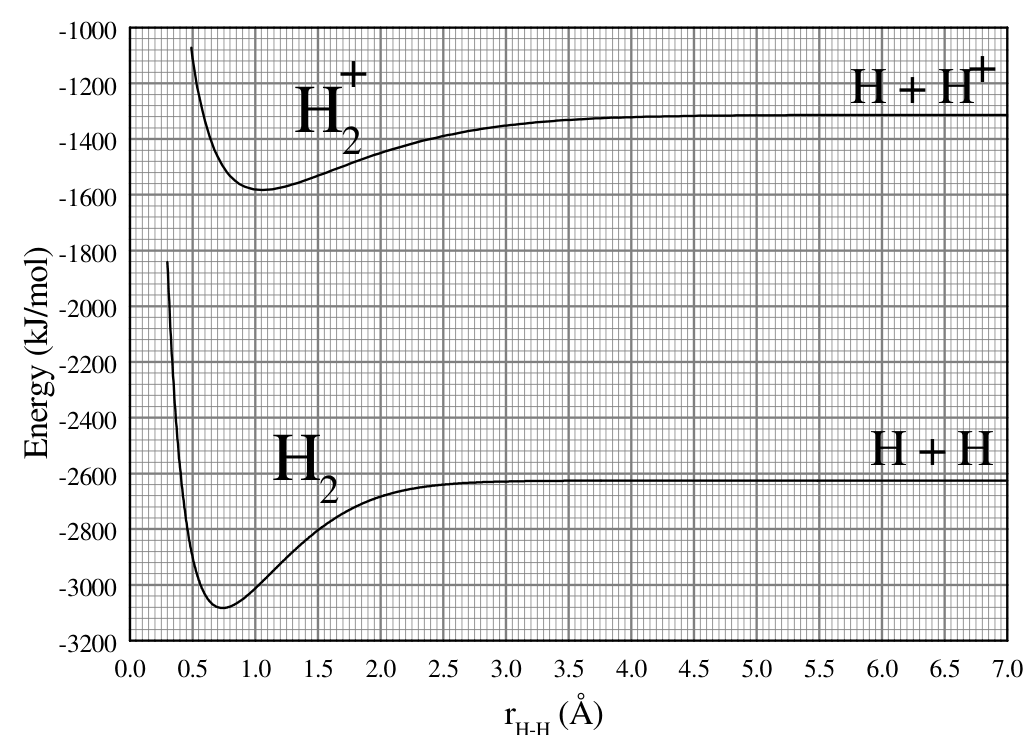
- What are the equilibrium bond lengths of \(\ce{H2}\) and \(\ce{H2+}\)?
- What are the binding energies of \(\ce{H2}\) and \(\ce{H2+}\)?
- What is the ionisation energy of the \(\ce{H2}\) molecule?
- What is the ionisation energy of the \(\ce{H}\) atom?
- If we use electromagnetic radiation of frequency \(3.9\times10^{15}\ \mathrm{Hz}\) in order to ionise \(\ce{H2}\), what will be the velocity of the extracted electrons? (Ignore molecular vibrational energy.)
Official English text of the problem.
Answers
- Molecular hydrogen, \(\ce{H2}\) (
[H][H]): \(r_e\approx0.75\ \text{Å}\). Dihydrogen cation, \(\ce{H2+}\) ([H][H+]): \(r_e\approx1.05\ \text{Å}\). - \(D_e(\ce{H2})\approx460\ \mathrm{kJ\,mol^{-1}}\); \(D_e(\ce{H2+})\approx270\ \mathrm{kJ\,mol^{-1}}\).
- \(I(\ce{H2})\approx1500\ \mathrm{kJ\,mol^{-1}}\).
- \(I(\ce{H})\approx1310\ \mathrm{kJ\,mol^{-1}}\).
- Electron speed: \(v\approx4.5\times10^5\ \mathrm{m\,s^{-1}}\).
Solution
The approximate energy readings used below are:
| Curve | Minimum energy / \(\mathrm{kJ\,mol^{-1}}\) | Energy at infinite separation / \(\mathrm{kJ\,mol^{-1}}\) |
|---|---|---|
| \(\ce{H2}\) | \(-3080\) | \(-2620\), corresponding to \(\ce{H + H}\) |
| \(\ce{H2+}\) | \(-1580\) | \(-1310\), corresponding to \(\ce{H + H+}\) |
Here, \(\ce{H}\) is a hydrogen atom ([H]), and \(\ce{H+}\) is a proton ([H+]). The SMILES given for \(\ce{H2+}\) specifies connectivity and charge; it does not express its one-electron bond, whose bond order is \(1/2\).
1. Equilibrium bond lengths
The equilibrium separation is the position of the minimum of each potential-energy curve: shortening or lengthening the bond from this position increases its energy.
Reading the horizontal coordinates of the minima gives
\[ \boxed{r_e(\ce{H2})\approx0.75\ \text{Å}}, \qquad \boxed{r_e(\ce{H2+})\approx1.05\ \text{Å}}. \]
2. Binding energies
The binding energy is the positive energy required to separate the equilibrium molecule into the fragments shown at its dissociation limit.
For molecular hydrogen,
\[ \ce{H2 -> H + H}, \]
\[ D_e(\ce{H2}) =E(\ce{H + H})-E_{\min}(\ce{H2}) \approx-2620-(-3080) =\boxed{460\ \mathrm{kJ\,mol^{-1}}}. \]
For the dihydrogen cation,
\[ \ce{H2+ -> H + H+}, \]
\[ D_e(\ce{H2+}) =E(\ce{H + H+})-E_{\min}(\ce{H2+}) \approx-1310-(-1580) =\boxed{270\ \mathrm{kJ\,mol^{-1}}}. \]
3. Ionisation energy of the hydrogen molecule
The ionisation process is
\[ \ce{H2 -> H2+ + e-}. \]
Taking the molecule and molecular ion at their respective equilibrium geometries, and the removed electron at rest at infinity, the ionisation energy is the difference between the two curve minima:
\[ I(\ce{H2}) =E_{\min}(\ce{H2+})-E_{\min}(\ce{H2}) \approx-1580-(-3080) =\boxed{1500\ \mathrm{kJ\,mol^{-1}}}. \]
4. Ionisation energy of the hydrogen atom
Atomic ionisation is
\[ \ce{H -> H+ + e-}. \]
The two dissociation limits differ by precisely this process: one hydrogen atom remains unchanged while the other is ionised. Therefore,
\[ I(\ce{H}) =E(\ce{H + H+})-E(\ce{H + H}) \approx-1310-(-2620) =\boxed{1310\ \mathrm{kJ\,mol^{-1}}}. \]
5. Velocity of the extracted electrons
Photoionisation occurs according to
\[ \ce{H2 ->[h\nu] H2+ + e-}. \]
Ignoring molecular vibrational energy and the negligible kinetic energy of ion recoil, conservation of energy gives
\[ h\nu=\frac{I(\ce{H2})}{N_{\mathrm A}}+\frac12m_ev^2. \]
Using the standard constants
\[ h=6.626\times10^{-34}\ \mathrm{J\,s},\qquad N_{\mathrm A}=6.022\times10^{23}\ \mathrm{mol^{-1}},\qquad m_e=9.109\times10^{-31}\ \mathrm{kg}, \]
the photon energy is
\[ E_\gamma =(6.626\times10^{-34})(3.9\times10^{15}) =2.584\times10^{-18}\ \mathrm J. \]
The ionisation energy per molecule is
\[ E_{\mathrm{ion}} =\frac{1500\times10^3}{6.022\times10^{23}} =2.491\times10^{-18}\ \mathrm J. \]
Thus the electron receives kinetic energy
\[ K_e=E_\gamma-E_{\mathrm{ion}} \approx9.3\times10^{-20}\ \mathrm J, \]
and its speed is
\[ v=\sqrt{\frac{2K_e}{m_e}} \approx \sqrt{\frac{2(9.3\times10^{-20})}{9.109\times10^{-31}}} =\boxed{4.5\times10^5\ \mathrm{m\,s^{-1}}}. \]
The solution was checked against the official solution. Where this solution differs from the official solution, the official solution contains an error or a misprint.
IChO 2003 · Theorieaufgabe 27
Wasserstoffmolekül
Geben Sie anhand der Informationen in diesem Diagramm numerische Antworten mit geeigneten Einheiten auf die folgenden Fragen:
- Wie groß sind die Gleichgewichtsbindungslängen von \(\ce{H2}\) und \(\ce{H2+}\)?
- Wie groß sind die Bindungsenergien von \(\ce{H2}\) und \(\ce{H2+}\)?
- Wie groß ist die Ionisierungsenergie des \(\ce{H2}\)-Moleküls?
- Wie groß ist die Ionisierungsenergie des \(\ce{H}\)-Atoms?
- Wenn wir elektromagnetische Strahlung der Frequenz \(3.9\times10^{15}\ \mathrm{Hz}\) verwenden, um \(\ce{H2}\) zu ionisieren, welche Geschwindigkeit haben dann die herausgelösten Elektronen? (Vernachlässigen Sie die Schwingungsenergie des Moleküls.)
Aufgabentext aus dem offiziellen englischen Text übersetzt.
Antworten
- Molekularer Wasserstoff, \(\ce{H2}\) (
[H][H]): \(r_e\approx0.75\ \text{Å}\). Diwasserstoff-Kation, \(\ce{H2+}\) ([H][H+]): \(r_e\approx1.05\ \text{Å}\). - \(D_e(\ce{H2})\approx460\ \mathrm{kJ\,mol^{-1}}\); \(D_e(\ce{H2+})\approx270\ \mathrm{kJ\,mol^{-1}}\).
- \(I(\ce{H2})\approx1500\ \mathrm{kJ\,mol^{-1}}\).
- \(I(\ce{H})\approx1310\ \mathrm{kJ\,mol^{-1}}\).
- Geschwindigkeit der Elektronen: \(v\approx4.5\times10^5\ \mathrm{m\,s^{-1}}\).
Lösung
Die im Folgenden verwendeten, näherungsweise abgelesenen Energiewerte sind:
| Kurve | Minimale Energie / \(\mathrm{kJ\,mol^{-1}}\) | Energie bei unendlichem Abstand / \(\mathrm{kJ\,mol^{-1}}\) |
|---|---|---|
| \(\ce{H2}\) | \(-3080\) | \(-2620\), entsprechend \(\ce{H + H}\) |
| \(\ce{H2+}\) | \(-1580\) | \(-1310\), entsprechend \(\ce{H + H+}\) |
Hier ist \(\ce{H}\) ein Wasserstoffatom ([H]) und \(\ce{H+}\) ein Proton ([H+]). Die für \(\ce{H2+}\) angegebene SMILES-Zeichenfolge beschreibt die Konnektivität und die Ladung; sie stellt nicht dessen Einelektronenbindung dar, deren Bindungsordnung \(1/2\) beträgt.
1. Gleichgewichtsbindungslängen
Der Gleichgewichtsabstand entspricht der Lage des Minimums der jeweiligen Potentialenergiekurve: Eine Verkürzung oder Verlängerung der Bindung ausgehend von dieser Lage erhöht ihre Energie.
Das Ablesen der horizontalen Koordinaten der Minima ergibt
\[ \boxed{r_e(\ce{H2})\approx0.75\ \text{Å}}, \qquad \boxed{r_e(\ce{H2+})\approx1.05\ \text{Å}}. \]
2. Bindungsenergien
Die Bindungsenergie ist die positive Energie, die erforderlich ist, um das Molekül in seiner Gleichgewichtslage in die an seiner Dissoziationsgrenze dargestellten Fragmente zu zerlegen.
Für molekularen Wasserstoff gilt
\[ \ce{H2 -> H + H}, \]
\[ D_e(\ce{H2}) =E(\ce{H + H})-E_{\min}(\ce{H2}) \approx-2620-(-3080) =\boxed{460\ \mathrm{kJ\,mol^{-1}}}. \]
Für das Diwasserstoff-Kation gilt
\[ \ce{H2+ -> H + H+}, \]
\[ D_e(\ce{H2+}) =E(\ce{H + H+})-E_{\min}(\ce{H2+}) \approx-1310-(-1580) =\boxed{270\ \mathrm{kJ\,mol^{-1}}}. \]
3. Ionisierungsenergie des Wasserstoffmoleküls
Der Ionisierungsvorgang lautet
\[ \ce{H2 -> H2+ + e-}. \]
Betrachtet man das Molekül und das Molekülion in ihren jeweiligen Gleichgewichtsgeometrien und das entfernte Elektron in Ruhe im Unendlichen, so ist die Ionisierungsenergie die Differenz zwischen den beiden Kurvenminima:
\[ I(\ce{H2}) =E_{\min}(\ce{H2+})-E_{\min}(\ce{H2}) \approx-1580-(-3080) =\boxed{1500\ \mathrm{kJ\,mol^{-1}}}. \]
4. Ionisierungsenergie des Wasserstoffatoms
Die Ionisierung des Atoms lautet
\[ \ce{H -> H+ + e-}. \]
Die beiden Dissoziationsgrenzen unterscheiden sich genau durch diesen Vorgang: Ein Wasserstoffatom bleibt unverändert, während das andere ionisiert wird. Daher gilt
\[ I(\ce{H}) =E(\ce{H + H+})-E(\ce{H + H}) \approx-1310-(-2620) =\boxed{1310\ \mathrm{kJ\,mol^{-1}}}. \]
5. Geschwindigkeit der herausgelösten Elektronen
Die Photoionisierung erfolgt gemäß
\[ \ce{H2 ->[h\nu] H2+ + e-}. \]
Vernachlässigt man die Schwingungsenergie des Moleküls und die vernachlässigbar kleine kinetische Energie des Ionenrückstoßes, so ergibt sich aus der Energieerhaltung
\[ h\nu=\frac{I(\ce{H2})}{N_{\mathrm A}}+\frac12m_ev^2. \]
Mit den üblichen Konstanten
\[ h=6.626\times10^{-34}\ \mathrm{J\,s},\qquad N_{\mathrm A}=6.022\times10^{23}\ \mathrm{mol^{-1}},\qquad m_e=9.109\times10^{-31}\ \mathrm{kg}, \]
beträgt die Photonenenergie
\[ E_\gamma =(6.626\times10^{-34})(3.9\times10^{15}) =2.584\times10^{-18}\ \mathrm J. \]
Die Ionisierungsenergie pro Molekül beträgt
\[ E_{\mathrm{ion}} =\frac{1500\times10^3}{6.022\times10^{23}} =2.491\times10^{-18}\ \mathrm J. \]
Somit erhält das Elektron die kinetische Energie
\[ K_e=E_\gamma-E_{\mathrm{ion}} \approx9.3\times10^{-20}\ \mathrm J, \]
und seine Geschwindigkeit beträgt
\[ v=\sqrt{\frac{2K_e}{m_e}} \approx \sqrt{\frac{2(9.3\times10^{-20})}{9.109\times10^{-31}}} =\boxed{4.5\times10^5\ \mathrm{m\,s^{-1}}}. \]
Die Lösung wurde mit der offiziellen Lösung abgeglichen. Wo diese Lösung von der offiziellen Lösung abweicht, enthält die offizielle Lösung einen Fehler oder Druckfehler.
IChO 2003 · Teori sorusu 27
Hidrojen molekülü
Bu grafikte verilen bilgileri kullanarak aşağıdaki sorulara uygun birimlerle sayısal cevaplar veriniz:
- \(\ce{H2}\) ve \(\ce{H2+}\) türlerinin denge bağ uzunlukları nedir?
- \(\ce{H2}\) ve \(\ce{H2+}\) türlerinin bağlanma enerjileri nedir?
- \(\ce{H2}\) molekülünün iyonlaşma enerjisi nedir?
- \(\ce{H}\) atomunun iyonlaşma enerjisi nedir?
- \(\ce{H2}\) molekülünü iyonlaştırmak için frekansı \(3.9\times10^{15}\ \mathrm{Hz}\) olan elektromanyetik ışınım kullanırsak koparılan elektronların hızı ne olur? (Molekülün titreşim enerjisini ihmal ediniz.)
Soru metni resmi İngilizce metinden çevrilmiştir.
Cevaplar
- Moleküler hidrojen, \(\ce{H2}\) (
[H][H]): \(r_e\approx0.75\ \text{Å}\). Dihidrojen katyonu, \(\ce{H2+}\) ([H][H+]): \(r_e\approx1.05\ \text{Å}\). - \(D_e(\ce{H2})\approx460\ \mathrm{kJ\,mol^{-1}}\); \(D_e(\ce{H2+})\approx270\ \mathrm{kJ\,mol^{-1}}\).
- \(I(\ce{H2})\approx1500\ \mathrm{kJ\,mol^{-1}}\).
- \(I(\ce{H})\approx1310\ \mathrm{kJ\,mol^{-1}}\).
- Elektronun sürati: \(v\approx4.5\times10^5\ \mathrm{m\,s^{-1}}\).
Çözüm
Aşağıda kullanılan yaklaşık enerji değerleri grafikten şöyle okunur:
| Eğri | Minimum enerji / \(\mathrm{kJ\,mol^{-1}}\) | Sonsuz uzaklıktaki enerji / \(\mathrm{kJ\,mol^{-1}}\) |
|---|---|---|
| \(\ce{H2}\) | \(-3080\) | \(-2620\), \(\ce{H + H}\) durumuna karşılık gelir |
| \(\ce{H2+}\) | \(-1580\) | \(-1310\), \(\ce{H + H+}\) durumuna karşılık gelir |
Burada \(\ce{H}\) bir hidrojen atomunu ([H]), \(\ce{H+}\) ise bir protonu ([H+]) gösterir. \(\ce{H2+}\) için verilen SMILES gösterimi, atomların bağlanma düzenini ve yükü belirtir; bağ mertebesi \(1/2\) olan tek elektronlu bağını ifade etmez.
1. Denge bağ uzunlukları
Denge uzaklığı, her bir potansiyel enerji eğrisinin minimumuna karşılık gelen konumdur: bağın bu konuma göre kısalması veya uzaması enerjisini artırır.
Minimumların yatay koordinatları okunduğunda şu değerler elde edilir:
\[ \boxed{r_e(\ce{H2})\approx0.75\ \text{Å}}, \qquad \boxed{r_e(\ce{H2+})\approx1.05\ \text{Å}}. \]
2. Bağlanma enerjileri
Bağlanma enerjisi, denge durumundaki molekülü ayrışma sınırında gösterilen parçalara ayırmak için gereken pozitif enerjidir.
Moleküler hidrojen için,
\[ \ce{H2 -> H + H}, \]
\[ D_e(\ce{H2}) =E(\ce{H + H})-E_{\min}(\ce{H2}) \approx-2620-(-3080) =\boxed{460\ \mathrm{kJ\,mol^{-1}}}. \]
Dihidrojen katyonu için,
\[ \ce{H2+ -> H + H+}, \]
\[ D_e(\ce{H2+}) =E(\ce{H + H+})-E_{\min}(\ce{H2+}) \approx-1310-(-1580) =\boxed{270\ \mathrm{kJ\,mol^{-1}}}. \]
3. Hidrojen molekülünün iyonlaşma enerjisi
İyonlaşma süreci şöyledir:
\[ \ce{H2 -> H2+ + e-}. \]
Molekül ve moleküler iyon kendi denge geometrilerinde, koparılan elektron ise sonsuz uzaklıkta ve durgun kabul edildiğinde iyonlaşma enerjisi, iki eğrinin minimumları arasındaki farktır:
\[ I(\ce{H2}) =E_{\min}(\ce{H2+})-E_{\min}(\ce{H2}) \approx-1580-(-3080) =\boxed{1500\ \mathrm{kJ\,mol^{-1}}}. \]
4. Hidrojen atomunun iyonlaşma enerjisi
Atomun iyonlaşması şöyledir:
\[ \ce{H -> H+ + e-}. \]
İki ayrışma sınırı arasındaki fark tam olarak bu sürece karşılık gelir: bir hidrojen atomu değişmeden kalırken diğeri iyonlaşır. Dolayısıyla,
\[ I(\ce{H}) =E(\ce{H + H+})-E(\ce{H + H}) \approx-1310-(-2620) =\boxed{1310\ \mathrm{kJ\,mol^{-1}}}. \]
5. Koparılan elektronların hızı
Fotoiyonlaşma şu şekilde gerçekleşir:
\[ \ce{H2 ->[h\nu] H2+ + e-}. \]
Molekülün titreşim enerjisi ve iyonun geri tepmesinden kaynaklanan ihmal edilebilir kinetik enerji göz ardı edildiğinde, enerjinin korunumundan şu eşitlik elde edilir:
\[ h\nu=\frac{I(\ce{H2})}{N_{\mathrm A}}+\frac12m_ev^2. \]
Standart sabitler
\[ h=6.626\times10^{-34}\ \mathrm{J\,s},\qquad N_{\mathrm A}=6.022\times10^{23}\ \mathrm{mol^{-1}},\qquad m_e=9.109\times10^{-31}\ \mathrm{kg}, \]
kullanıldığında foton enerjisi şöyledir:
\[ E_\gamma =(6.626\times10^{-34})(3.9\times10^{15}) =2.584\times10^{-18}\ \mathrm J. \]
Molekül başına iyonlaşma enerjisi şöyledir:
\[ E_{\mathrm{ion}} =\frac{1500\times10^3}{6.022\times10^{23}} =2.491\times10^{-18}\ \mathrm J. \]
Böylece elektronun kazandığı kinetik enerji
\[ K_e=E_\gamma-E_{\mathrm{ion}} \approx9.3\times10^{-20}\ \mathrm J, \]
ve sürati şöyledir:
\[ v=\sqrt{\frac{2K_e}{m_e}} \approx \sqrt{\frac{2(9.3\times10^{-20})}{9.109\times10^{-31}}} =\boxed{4.5\times10^5\ \mathrm{m\,s^{-1}}}. \]
Çözüm, resmi çözümle karşılaştırılarak kontrol edildi. Bu çözümün resmi çözümden ayrıldığı yerlerde resmi çözümde bir hata ya da baskı hatası vardır.
IChO 2003 · Problema teórico 27
Molécula de hidrógeno
Utilizando la información proporcionada en esta gráfica, dé respuestas numéricas con las unidades apropiadas a las siguientes preguntas:
- ¿Cuáles son las longitudes de enlace de equilibrio de \(\ce{H2}\) y \(\ce{H2+}\)?
- ¿Cuáles son las energías de enlace de \(\ce{H2}\) y \(\ce{H2+}\)?
- ¿Cuál es la energía de ionización de la molécula de \(\ce{H2}\)?
- ¿Cuál es la energía de ionización del átomo de \(\ce{H}\)?
- Si utilizamos radiación electromagnética de frecuencia \(3.9\times10^{15}\ \mathrm{Hz}\) para ionizar \(\ce{H2}\), ¿cuál será la velocidad de los electrones extraídos? (Ignore la energía vibracional molecular.)
Enunciado traducido del texto oficial en inglés.
Respuestas
- Hidrógeno molecular, \(\ce{H2}\) (
[H][H]): \(r_e\approx0.75\ \text{Å}\). Catión dihidrógeno, \(\ce{H2+}\) ([H][H+]): \(r_e\approx1.05\ \text{Å}\). - \(D_e(\ce{H2})\approx460\ \mathrm{kJ\,mol^{-1}}\); \(D_e(\ce{H2+})\approx270\ \mathrm{kJ\,mol^{-1}}\).
- \(I(\ce{H2})\approx1500\ \mathrm{kJ\,mol^{-1}}\).
- \(I(\ce{H})\approx1310\ \mathrm{kJ\,mol^{-1}}\).
- Rapidez del electrón: \(v\approx4.5\times10^5\ \mathrm{m\,s^{-1}}\).
Solución
Los valores aproximados de energía leídos de la gráfica que se utilizan a continuación son:
| Curva | Energía mínima / \(\mathrm{kJ\,mol^{-1}}\) | Energía a separación infinita / \(\mathrm{kJ\,mol^{-1}}\) |
|---|---|---|
| \(\ce{H2}\) | \(-3080\) | \(-2620\), correspondiente a \(\ce{H + H}\) |
| \(\ce{H2+}\) | \(-1580\) | \(-1310\), correspondiente a \(\ce{H + H+}\) |
Aquí, \(\ce{H}\) es un átomo de hidrógeno ([H]), y \(\ce{H+}\) es un protón ([H+]). La notación SMILES indicada para \(\ce{H2+}\) especifica la conectividad y la carga; no expresa su enlace de un electrón, cuyo orden de enlace es \(1/2\).
1. Longitudes de enlace de equilibrio
La separación de equilibrio es la posición del mínimo de cada curva de energía potencial: acortar o alargar el enlace desde esta posición aumenta su energía.
La lectura de las coordenadas horizontales de los mínimos da
\[ \boxed{r_e(\ce{H2})\approx0.75\ \text{Å}}, \qquad \boxed{r_e(\ce{H2+})\approx1.05\ \text{Å}}. \]
2. Energías de enlace
La energía de enlace es la energía positiva necesaria para separar la molécula en equilibrio en los fragmentos indicados en su límite de disociación.
Para el hidrógeno molecular,
\[ \ce{H2 -> H + H}, \]
\[ D_e(\ce{H2}) =E(\ce{H + H})-E_{\min}(\ce{H2}) \approx-2620-(-3080) =\boxed{460\ \mathrm{kJ\,mol^{-1}}}. \]
Para el catión dihidrógeno,
\[ \ce{H2+ -> H + H+}, \]
\[ D_e(\ce{H2+}) =E(\ce{H + H+})-E_{\min}(\ce{H2+}) \approx-1310-(-1580) =\boxed{270\ \mathrm{kJ\,mol^{-1}}}. \]
3. Energía de ionización de la molécula de hidrógeno
El proceso de ionización es
\[ \ce{H2 -> H2+ + e-}. \]
Considerando la molécula y el ion molecular en sus respectivas geometrías de equilibrio, y el electrón extraído en reposo en el infinito, la energía de ionización es la diferencia entre los mínimos de las dos curvas:
\[ I(\ce{H2}) =E_{\min}(\ce{H2+})-E_{\min}(\ce{H2}) \approx-1580-(-3080) =\boxed{1500\ \mathrm{kJ\,mol^{-1}}}. \]
4. Energía de ionización del átomo de hidrógeno
La ionización atómica es
\[ \ce{H -> H+ + e-}. \]
Los dos límites de disociación difieren precisamente en este proceso: un átomo de hidrógeno permanece inalterado mientras que el otro se ioniza. Por tanto,
\[ I(\ce{H}) =E(\ce{H + H+})-E(\ce{H + H}) \approx-1310-(-2620) =\boxed{1310\ \mathrm{kJ\,mol^{-1}}}. \]
5. Velocidad de los electrones extraídos
La fotoionización se produce según
\[ \ce{H2 ->[h\nu] H2+ + e-}. \]
Despreciando la energía vibracional molecular y la insignificante energía cinética de retroceso del ion, la conservación de la energía da
\[ h\nu=\frac{I(\ce{H2})}{N_{\mathrm A}}+\frac12m_ev^2. \]
Utilizando las constantes estándar
\[ h=6.626\times10^{-34}\ \mathrm{J\,s},\qquad N_{\mathrm A}=6.022\times10^{23}\ \mathrm{mol^{-1}},\qquad m_e=9.109\times10^{-31}\ \mathrm{kg}, \]
la energía del fotón es
\[ E_\gamma =(6.626\times10^{-34})(3.9\times10^{15}) =2.584\times10^{-18}\ \mathrm J. \]
La energía de ionización por molécula es
\[ E_{\mathrm{ion}} =\frac{1500\times10^3}{6.022\times10^{23}} =2.491\times10^{-18}\ \mathrm J. \]
Así, el electrón adquiere una energía cinética
\[ K_e=E_\gamma-E_{\mathrm{ion}} \approx9.3\times10^{-20}\ \mathrm J, \]
y su rapidez es
\[ v=\sqrt{\frac{2K_e}{m_e}} \approx \sqrt{\frac{2(9.3\times10^{-20})}{9.109\times10^{-31}}} =\boxed{4.5\times10^5\ \mathrm{m\,s^{-1}}}. \]
La solución se comprobó con la solución oficial. Donde esta solución difiere de la solución oficial, la solución oficial contiene un error o una errata.
IChO 2003 · 理论题 27
氢分子
利用此图提供的信息,给出下列问题的数值答案,并注明适当的单位:
- \(\ce{H2}\) 和 \(\ce{H2+}\) 的平衡键长分别是多少?
- \(\ce{H2}\) 和 \(\ce{H2+}\) 的结合能分别是多少?
- \(\ce{H2}\) 分子的电离能是多少?
- \(\ce{H}\) 原子的电离能是多少?
- 如果用频率为 \(3.9\times10^{15}\ \mathrm{Hz}\) 的电磁辐射使 \(\ce{H2}\) 电离,逸出电子的速率是多少?(忽略分子振动能。)
题目译自官方英文原文。
答案
- 氢分子,\(\ce{H2}\)(
[H][H]):\(r_e\approx0.75\ \text{Å}\)。氢分子阳离子,\(\ce{H2+}\)([H][H+]):\(r_e\approx1.05\ \text{Å}\)。 - \(D_e(\ce{H2})\approx460\ \mathrm{kJ\,mol^{-1}}\);\(D_e(\ce{H2+})\approx270\ \mathrm{kJ\,mol^{-1}}\)。
- \(I(\ce{H2})\approx1500\ \mathrm{kJ\,mol^{-1}}\)。
- \(I(\ce{H})\approx1310\ \mathrm{kJ\,mol^{-1}}\)。
- 电子速率:\(v\approx4.5\times10^5\ \mathrm{m\,s^{-1}}\)。
解答
下文使用的近似能量读数如下:
| 曲线 | 最低能量 / \(\mathrm{kJ\,mol^{-1}}\) | 间距趋于无穷大时的能量 / \(\mathrm{kJ\,mol^{-1}}\) |
|---|---|---|
| \(\ce{H2}\) | \(-3080\) | \(-2620\),对应于 \(\ce{H + H}\) |
| \(\ce{H2+}\) | \(-1580\) | \(-1310\),对应于 \(\ce{H + H+}\) |
这里,\(\ce{H}\) 是氢原子([H]),\(\ce{H+}\) 是质子([H+])。给出的 \(\ce{H2+}\) 的 SMILES 指定了连接关系和电荷;它并未表达其键级为 \(1/2\) 的单电子键。
1. 平衡键长
平衡核间距对应于各条势能曲线的最低点位置:在此位置的基础上缩短或伸长键,都会使其能量升高。
读取最低点的横坐标,得到
\[ \boxed{r_e(\ce{H2})\approx0.75\ \text{Å}}, \qquad \boxed{r_e(\ce{H2+})\approx1.05\ \text{Å}}. \]
2. 结合能
结合能是将处于平衡构型的分子分离成其解离极限处所示碎片所需的正值能量。
对于氢分子,
\[ \ce{H2 -> H + H}, \]
\[ D_e(\ce{H2}) =E(\ce{H + H})-E_{\min}(\ce{H2}) \approx-2620-(-3080) =\boxed{460\ \mathrm{kJ\,mol^{-1}}}. \]
对于氢分子阳离子,
\[ \ce{H2+ -> H + H+}, \]
\[ D_e(\ce{H2+}) =E(\ce{H + H+})-E_{\min}(\ce{H2+}) \approx-1310-(-1580) =\boxed{270\ \mathrm{kJ\,mol^{-1}}}. \]
3. 氢分子的电离能
电离过程为
\[ \ce{H2 -> H2+ + e-}. \]
取分子和分子离子分别处于各自的平衡构型,且移出的电子在无穷远处静止,则电离能为两条曲线最低点的能量之差:
\[ I(\ce{H2}) =E_{\min}(\ce{H2+})-E_{\min}(\ce{H2}) \approx-1580-(-3080) =\boxed{1500\ \mathrm{kJ\,mol^{-1}}}. \]
4. 氢原子的电离能
原子的电离过程为
\[ \ce{H -> H+ + e-}. \]
两个解离极限之间的差别恰好就是这一过程:一个氢原子保持不变,另一个则发生电离。因此,
\[ I(\ce{H}) =E(\ce{H + H+})-E(\ce{H + H}) \approx-1310-(-2620) =\boxed{1310\ \mathrm{kJ\,mol^{-1}}}. \]
5. 逸出电子的速率
光电离按下式发生:
\[ \ce{H2 ->[h\nu] H2+ + e-}. \]
忽略分子振动能以及微小到可忽略的离子反冲动能,根据能量守恒可得
\[ h\nu=\frac{I(\ce{H2})}{N_{\mathrm A}}+\frac12m_ev^2. \]
使用标准常数
\[ h=6.626\times10^{-34}\ \mathrm{J\,s},\qquad N_{\mathrm A}=6.022\times10^{23}\ \mathrm{mol^{-1}},\qquad m_e=9.109\times10^{-31}\ \mathrm{kg}, \]
光子能量为
\[ E_\gamma =(6.626\times10^{-34})(3.9\times10^{15}) =2.584\times10^{-18}\ \mathrm J. \]
每个分子的电离能为
\[ E_{\mathrm{ion}} =\frac{1500\times10^3}{6.022\times10^{23}} =2.491\times10^{-18}\ \mathrm J. \]
因此,电子获得的动能为
\[ K_e=E_\gamma-E_{\mathrm{ion}} \approx9.3\times10^{-20}\ \mathrm J, \]
其速率为
\[ v=\sqrt{\frac{2K_e}{m_e}} \approx \sqrt{\frac{2(9.3\times10^{-20})}{9.109\times10^{-31}}} =\boxed{4.5\times10^5\ \mathrm{m\,s^{-1}}}. \]
解答已与官方解答核对。本解答与官方解答不同之处,均为官方解答中的错误或印刷错误。
IChO 2003 · Теоретическая задача 27
Молекула водорода
Используя информацию, представленную на этом графике, дайте численные ответы с соответствующими единицами измерения на следующие вопросы:
- Каковы равновесные длины связей в \(\ce{H2}\) и \(\ce{H2+}\)?
- Каковы энергии связи в \(\ce{H2}\) и \(\ce{H2+}\)?
- Какова энергия ионизации молекулы \(\ce{H2}\)?
- Какова энергия ионизации атома \(\ce{H}\)?
- Если для ионизации \(\ce{H2}\) используется электромагнитное излучение с частотой \(3.9\times10^{15}\ \mathrm{Hz}\), какова будет скорость выбитых электронов? (Пренебрегите колебательной энергией молекулы.)
Условие переведено с официального английского текста.
Ответы
- Молекулярный водород, \(\ce{H2}\) (
[H][H]): \(r_e\approx0.75\ \text{Å}\). Молекулярный катион водорода, \(\ce{H2+}\) ([H][H+]): \(r_e\approx1.05\ \text{Å}\). - \(D_e(\ce{H2})\approx460\ \mathrm{kJ\,mol^{-1}}\); \(D_e(\ce{H2+})\approx270\ \mathrm{kJ\,mol^{-1}}\).
- \(I(\ce{H2})\approx1500\ \mathrm{kJ\,mol^{-1}}\).
- \(I(\ce{H})\approx1310\ \mathrm{kJ\,mol^{-1}}\).
- Скорость электрона: \(v\approx4.5\times10^5\ \mathrm{m\,s^{-1}}\).
Решение
Ниже используются следующие приближённые значения энергии, считанные с графика:
| Кривая | Минимальная энергия / \(\mathrm{kJ\,mol^{-1}}\) | Энергия при бесконечном расстоянии между частицами / \(\mathrm{kJ\,mol^{-1}}\) |
|---|---|---|
| \(\ce{H2}\) | \(-3080\) | \(-2620\), соответствует \(\ce{H + H}\) |
| \(\ce{H2+}\) | \(-1580\) | \(-1310\), соответствует \(\ce{H + H+}\) |
Здесь \(\ce{H}\) — атом водорода ([H]), а \(\ce{H+}\) — протон ([H+]). Приведённая для \(\ce{H2+}\) запись SMILES задаёт связность и заряд; она не отражает одноэлектронную связь, порядок которой равен \(1/2\).
1. Равновесные длины связей
Равновесное межъядерное расстояние соответствует положению минимума каждой кривой потенциальной энергии: укорочение или удлинение связи относительно этого положения приводит к увеличению её энергии.
Считывая горизонтальные координаты минимумов, получаем
\[ \boxed{r_e(\ce{H2})\approx0.75\ \text{Å}}, \qquad \boxed{r_e(\ce{H2+})\approx1.05\ \text{Å}}. \]
2. Энергии связи
Энергия связи — это положительная энергия, необходимая для разделения молекулы в равновесной конфигурации на фрагменты, указанные на её пределе диссоциации.
Для молекулярного водорода
\[ \ce{H2 -> H + H}, \]
\[ D_e(\ce{H2}) =E(\ce{H + H})-E_{\min}(\ce{H2}) \approx-2620-(-3080) =\boxed{460\ \mathrm{kJ\,mol^{-1}}}. \]
Для молекулярного катиона водорода
\[ \ce{H2+ -> H + H+}, \]
\[ D_e(\ce{H2+}) =E(\ce{H + H+})-E_{\min}(\ce{H2+}) \approx-1310-(-1580) =\boxed{270\ \mathrm{kJ\,mol^{-1}}}. \]
3. Энергия ионизации молекулы водорода
Процесс ионизации имеет вид
\[ \ce{H2 -> H2+ + e-}. \]
Если молекула и молекулярный ион находятся в своих равновесных геометрических конфигурациях, а удалённый электрон покоится на бесконечности, то энергия ионизации равна разности энергий в минимумах двух кривых:
\[ I(\ce{H2}) =E_{\min}(\ce{H2+})-E_{\min}(\ce{H2}) \approx-1580-(-3080) =\boxed{1500\ \mathrm{kJ\,mol^{-1}}}. \]
4. Энергия ионизации атома водорода
Ионизация атома имеет вид
\[ \ce{H -> H+ + e-}. \]
Два предела диссоциации различаются именно этим процессом: один атом водорода остаётся неизменным, а другой ионизируется. Поэтому
\[ I(\ce{H}) =E(\ce{H + H+})-E(\ce{H + H}) \approx-1310-(-2620) =\boxed{1310\ \mathrm{kJ\,mol^{-1}}}. \]
5. Скорость выбитых электронов
Фотоионизация происходит по схеме
\[ \ce{H2 ->[h\nu] H2+ + e-}. \]
Пренебрегая колебательной энергией молекулы и ничтожно малой кинетической энергией отдачи иона, из закона сохранения энергии получаем
\[ h\nu=\frac{I(\ce{H2})}{N_{\mathrm A}}+\frac12m_ev^2. \]
Используя стандартные значения постоянных
\[ h=6.626\times10^{-34}\ \mathrm{J\,s},\qquad N_{\mathrm A}=6.022\times10^{23}\ \mathrm{mol^{-1}},\qquad m_e=9.109\times10^{-31}\ \mathrm{kg}, \]
получаем энергию фотона
\[ E_\gamma =(6.626\times10^{-34})(3.9\times10^{15}) =2.584\times10^{-18}\ \mathrm J. \]
Энергия ионизации в расчёте на одну молекулу равна
\[ E_{\mathrm{ion}} =\frac{1500\times10^3}{6.022\times10^{23}} =2.491\times10^{-18}\ \mathrm J. \]
Таким образом, электрон приобретает кинетическую энергию
\[ K_e=E_\gamma-E_{\mathrm{ion}} \approx9.3\times10^{-20}\ \mathrm J, \]
а его скорость равна
\[ v=\sqrt{\frac{2K_e}{m_e}} \approx \sqrt{\frac{2(9.3\times10^{-20})}{9.109\times10^{-31}}} =\boxed{4.5\times10^5\ \mathrm{m\,s^{-1}}}. \]
Решение проверено по официальному решению. Там, где это решение расходится с официальным, в официальном решении есть ошибка или опечатка.
IChO 2003 · مسألة نظرية 27
جزيء الهيدروجين
باستخدام المعلومات الواردة في هذا الرسم البياني، أعطِ إجابات عددية بوحدات مناسبة عن الأسئلة التالية:
- ما طولا الرابطة عند الاتزان في كل من \(\ce{H2}\) و\(\ce{H2+}\)؟
- ما طاقتا الارتباط في كل من \(\ce{H2}\) و\(\ce{H2+}\)؟
- ما طاقة تأين جزيء \(\ce{H2}\)؟
- ما طاقة تأين ذرة \(\ce{H}\)؟
- إذا استخدمنا إشعاعًا كهرومغناطيسيًا بتردد \(3.9\times10^{15}\ \mathrm{Hz}\) لتأيين \(\ce{H2}\)، فما سرعة الإلكترونات المنتزعة؟ (أهمل الطاقة الاهتزازية للجزيء.)
نص المسألة مترجم عن النص الإنجليزي الرسمي.
الإجابات
- الهيدروجين الجزيئي، \(\ce{H2}\) (
[H][H]): \(r_e\approx0.75\ \text{Å}\). كاتيون ثنائي الهيدروجين، \(\ce{H2+}\) ([H][H+]): \(r_e\approx1.05\ \text{Å}\). - \(D_e(\ce{H2})\approx460\ \mathrm{kJ\,mol^{-1}}\)؛ \(D_e(\ce{H2+})\approx270\ \mathrm{kJ\,mol^{-1}}\).
- \(I(\ce{H2})\approx1500\ \mathrm{kJ\,mol^{-1}}\).
- \(I(\ce{H})\approx1310\ \mathrm{kJ\,mol^{-1}}\).
- سرعة الإلكترون: \(v\approx4.5\times10^5\ \mathrm{m\,s^{-1}}\).
الحل
قراءات الطاقة التقريبية المستخدمة أدناه هي:
| المنحنى | الطاقة الدنيا / \(\mathrm{kJ\,mol^{-1}}\) | الطاقة عند تباعد لا نهائي / \(\mathrm{kJ\,mol^{-1}}\) |
|---|---|---|
| \(\ce{H2}\) | \(-3080\) | \(-2620\)، وتقابل \(\ce{H + H}\) |
| \(\ce{H2+}\) | \(-1580\) | \(-1310\)، وتقابل \(\ce{H + H+}\) |
هنا، تمثل \(\ce{H}\) ذرة هيدروجين ([H])، وتمثل \(\ce{H+}\) بروتونًا ([H+]). يحدد تمثيل SMILES المعطى لـ\(\ce{H2+}\) كيفية اتصال الذرات والشحنة؛ لكنه لا يعبّر عن رابطته أحادية الإلكترون، التي تساوي رتبة رابطتها \(1/2\).
1. أطوال الروابط عند الاتزان
المسافة الفاصلة عند الاتزان هي موضع القيمة الدنيا لكل منحنى من منحنيات طاقة الوضع: فتقصير الرابطة أو إطالتها انطلاقًا من هذا الموضع يزيد طاقتها.
تعطي قراءة الإحداثيات الأفقية لمواضع القيم الدنيا
\[ \boxed{r_e(\ce{H2})\approx0.75\ \text{Å}}, \qquad \boxed{r_e(\ce{H2+})\approx1.05\ \text{Å}}. \]
2. طاقات الارتباط
طاقة الارتباط هي الطاقة الموجبة اللازمة لفصل الجزيء في حالة الاتزان إلى الأجزاء المبينة عند حد تفككه.
بالنسبة إلى الهيدروجين الجزيئي،
\[ \ce{H2 -> H + H}, \]
\[ D_e(\ce{H2}) =E(\ce{H + H})-E_{\min}(\ce{H2}) \approx-2620-(-3080) =\boxed{460\ \mathrm{kJ\,mol^{-1}}}. \]
وبالنسبة إلى كاتيون ثنائي الهيدروجين،
\[ \ce{H2+ -> H + H+}, \]
\[ D_e(\ce{H2+}) =E(\ce{H + H+})-E_{\min}(\ce{H2+}) \approx-1310-(-1580) =\boxed{270\ \mathrm{kJ\,mol^{-1}}}. \]
3. طاقة تأين جزيء الهيدروجين
عملية التأين هي
\[ \ce{H2 -> H2+ + e-}. \]
باعتبار الجزيء والأيون الجزيئي في بنيتيهما الهندسيتين عند الاتزان، والإلكترون المنتزع ساكنًا عند اللانهاية، تكون طاقة التأين هي الفرق بين القيمتين الدنيا للمنحنيين:
\[ I(\ce{H2}) =E_{\min}(\ce{H2+})-E_{\min}(\ce{H2}) \approx-1580-(-3080) =\boxed{1500\ \mathrm{kJ\,mol^{-1}}}. \]
4. طاقة تأين ذرة الهيدروجين
التأين الذري هو
\[ \ce{H -> H+ + e-}. \]
يختلف حدّا التفكك بهذه العملية تحديدًا: تبقى إحدى ذرتي الهيدروجين دون تغيير، بينما تتأين الأخرى. ومن ثم،
\[ I(\ce{H}) =E(\ce{H + H+})-E(\ce{H + H}) \approx-1310-(-2620) =\boxed{1310\ \mathrm{kJ\,mol^{-1}}}. \]
5. سرعة الإلكترونات المنتزعة
يحدث التأين الضوئي وفقًا لما يلي
\[ \ce{H2 ->[h\nu] H2+ + e-}. \]
بإهمال الطاقة الاهتزازية للجزيء وطاقة حركة ارتداد الأيون الضئيلة، يعطي قانون حفظ الطاقة
\[ h\nu=\frac{I(\ce{H2})}{N_{\mathrm A}}+\frac12m_ev^2. \]
باستخدام الثوابت القياسية
\[ h=6.626\times10^{-34}\ \mathrm{J\,s},\qquad N_{\mathrm A}=6.022\times10^{23}\ \mathrm{mol^{-1}},\qquad m_e=9.109\times10^{-31}\ \mathrm{kg}, \]
تكون طاقة الفوتون
\[ E_\gamma =(6.626\times10^{-34})(3.9\times10^{15}) =2.584\times10^{-18}\ \mathrm J. \]
طاقة التأين لكل جزيء هي
\[ E_{\mathrm{ion}} =\frac{1500\times10^3}{6.022\times10^{23}} =2.491\times10^{-18}\ \mathrm J. \]
وهكذا يكتسب الإلكترون طاقة حركية مقدارها
\[ K_e=E_\gamma-E_{\mathrm{ion}} \approx9.3\times10^{-20}\ \mathrm J, \]
وتكون سرعته
\[ v=\sqrt{\frac{2K_e}{m_e}} \approx \sqrt{\frac{2(9.3\times10^{-20})}{9.109\times10^{-31}}} =\boxed{4.5\times10^5\ \mathrm{m\,s^{-1}}}. \]
تمت مراجعة الحل بمقارنته بالحل الرسمي. حيثما يختلف هذا الحل عن الحل الرسمي، يحتوي الحل الرسمي على خطأ أو خطأ مطبعي.