IChO 2003 · Theory problem 28
Cryoscopy
Chemists often need a bath in which to carry out a process that has a temperature below the water freezing point (\(0\,^\circ\mathrm{C}\)) and well above the \(\ce{CO2}\) sublimation point (\(-78\,^\circ\mathrm{C}\)) this case they mix water ice prepared at its melting point and \(\ce{NaCl}\). Depending on the quantities used temperatures as low as \(-20\,^\circ\mathrm{C}\) can be reached.
We prepare a cold bath mixing 1 kg of ice at \(0\,^\circ\mathrm{C}\) with 150 g of \(\ce{NaCl}\) in a thermally insulated container. Circle the letters Y or N to indicate if the following statements are correct (Y) or not (N).
a) The mixing process is spontaneous. (Y) (N)
b) The change of entropy during the mixing process is negative. (Y) (N)
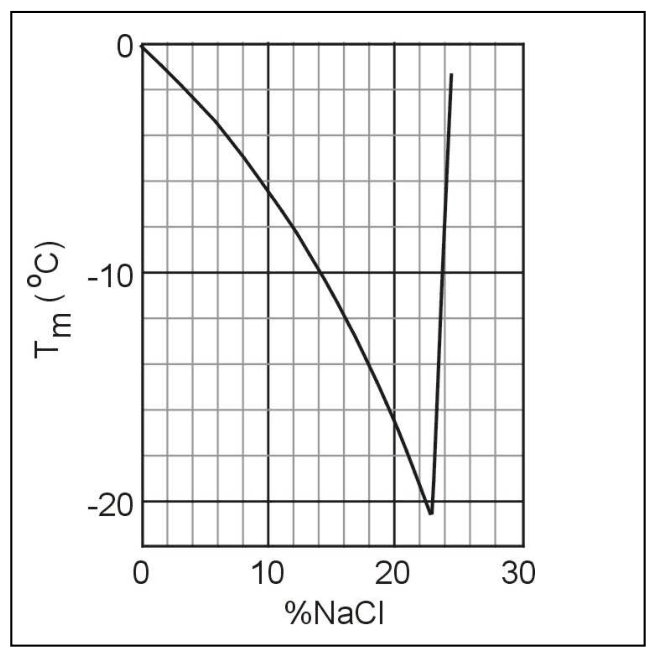
c) The following diagram depicts the freezing point of aqueous solutions of \(\ce{NaCl}\) as a function of the composition of the solution (per cent by weight). What is is the freezing point of the bath based on the diagram?
d) If an equal mass of \(\ce{MgCl2}\) were used instead of \(\ce{NaCl}\), would the freezing point be higher? (Y) (N)
Official English text of the problem.
Answers
- a) Y.
- b) N. The entropy of the insulated system increases.
- c) Approximately \(-9\,^\circ\mathrm{C}\), using the overall composition of \(13.0\%\) \(\ce{NaCl}\) by mass.
- d) Y, under the usual ideal, complete-dissociation cryoscopic model.
Solution
a) Water, \(\ce{H2O}\) (O), is initially present as solid ice at its melting point. Dissolved salt lowers the chemical potential of liquid water, making melting into the salt solution favorable. Salt dissolution and ice melting therefore proceed spontaneously.
Melting absorbs energy. Because the container is thermally insulated, this energy comes from the bath itself, causing its temperature to fall.
b) For the entire insulated system, there is no entropy transfer through heat exchange with the surroundings. Consequently,
\[ \Delta S_{\mathrm{system}}=S_{\mathrm{generated}}>0 \]
for this spontaneous, irreversible process.
The entropy gains associated with mixing and melting outweigh the entropy decrease associated with cooling. Thus the statement that the entropy change is negative is false.
c) Taking the stated quantities as the composition of the resulting solution, the mass percentage of salt is
\[ w(\ce{NaCl}) =\frac{m(\ce{NaCl})}{m(\ce{NaCl})+m(\ce{H2O})}\times100\% =\frac{150\,\mathrm{g}}{150\,\mathrm{g}+1000\,\mathrm{g}}\times100\% =13.0\%. \]
At \(13.0\%\) on the horizontal axis, the descending branch of the graph gives approximately
\[ \boxed{T_{\mathrm f}\approx-9\,^\circ\mathrm{C}}. \]
This is the freezing point associated with the stated overall solution composition.
d) Freezing-point depression depends on the number of dissolved particles per unit mass of solvent:
\[ \Delta T_{\mathrm f}=iK_{\mathrm f}b, \]
where \(i\) is the van ’t Hoff factor and \(b\) is the formula-unit molality.
The ideal dissociation equations are
\[ \ce{NaCl(s) -> Na+(aq) + Cl-(aq)}, \]
\[ \ce{MgCl2(s) -> Mg^2+(aq) + 2Cl-(aq)}. \]
Thus \(i=2\) for sodium chloride and \(i=3\) for magnesium chloride. The dissolved species are sodium ion ([Na+]), magnesium ion ([Mg+2]) and chloride ion ([Cl-]); these SMILES do not represent their hydration shells.
Using the standard approximate molar masses
\[ M(\ce{NaCl})=58.44\,\mathrm{g\,mol^{-1}}, \qquad M(\ce{MgCl2})=95.21\,\mathrm{g\,mol^{-1}}, \]
the amounts of dissolved particles produced by 150 g are
\[ n_{\mathrm{particles}}(\ce{NaCl}) =2\frac{150\,\mathrm{g}}{58.44\,\mathrm{g\,mol^{-1}}} =5.13\,\mathrm{mol}, \]
\[ n_{\mathrm{particles}}(\ce{MgCl2}) =3\frac{150\,\mathrm{g}}{95.21\,\mathrm{g\,mol^{-1}}} =4.73\,\mathrm{mol}. \]
For equal solvent masses,
\[ \frac{\Delta T_{\mathrm f}(\ce{MgCl2})} {\Delta T_{\mathrm f}(\ce{NaCl})} =\frac{4.73}{5.13} \approx0.921. \]
An equal mass of magnesium chloride therefore gives fewer dissolved particles and a smaller freezing-point depression. Its freezing point is higher, so the answer is Y.
The solution was checked against the official solution.
IChO 2003 · Theorieaufgabe 28
Kryoskopie
Chemiker benötigen häufig ein Bad, um einen Prozess bei einer Temperatur unterhalb des Gefrierpunkts von Wasser (\(0\,^\circ\mathrm{C}\)) und deutlich oberhalb des Sublimationspunkts von \(\ce{CO2}\) (\(-78\,^\circ\mathrm{C}\)) durchzuführen. In diesem Fall mischen sie Wassereis, das bei seinem Schmelzpunkt bereitgestellt wird, mit \(\ce{NaCl}\). Je nach den verwendeten Mengen können Temperaturen von bis zu \(-20\,^\circ\mathrm{C}\) erreicht werden.
Wir stellen ein Kältebad her, indem wir 1 kg Eis bei \(0\,^\circ\mathrm{C}\) mit 150 g \(\ce{NaCl}\) in einem wärmeisolierten Gefäß mischen. Kreisen Sie die Buchstaben Y oder N ein, um anzugeben, ob die folgenden Aussagen richtig (Y) oder falsch (N) sind.
a) Der Mischvorgang läuft spontan ab. (Y) (N)
b) Die Entropieänderung während des Mischvorgangs ist negativ. (Y) (N)
c) Das folgende Diagramm zeigt den Gefrierpunkt wässriger Lösungen von \(\ce{NaCl}\) in Abhängigkeit von der Zusammensetzung der Lösung (in Massenprozent). Welchen Gefrierpunkt hat das Bad laut dem Diagramm?
d) Wäre der Gefrierpunkt höher, wenn anstelle von \(\ce{NaCl}\) die gleiche Masse an \(\ce{MgCl2}\) verwendet würde? (Y) (N)
Aufgabentext aus dem offiziellen englischen Text übersetzt.
Antworten
- a) Y.
- b) N. Die Entropie des isolierten Systems nimmt zu.
- c) Ungefähr \(-9\,^\circ\mathrm{C}\), ausgehend von einer Gesamtzusammensetzung mit einem Massenanteil von \(13.0\%\) \(\ce{NaCl}\).
- d) Y, im Rahmen des üblichen idealen kryoskopischen Modells mit vollständiger Dissoziation.
Lösung
a) Wasser, \(\ce{H2O}\) (O), liegt anfangs als festes Eis bei seinem Schmelzpunkt vor. Gelöstes Salz senkt das chemische Potential des flüssigen Wassers, wodurch das Schmelzen unter Bildung der Salzlösung begünstigt wird. Das Lösen des Salzes und das Schmelzen des Eises laufen daher spontan ab.
Beim Schmelzen wird Energie aufgenommen. Da das Gefäß wärmeisoliert ist, stammt diese Energie aus dem Bad selbst, wodurch dessen Temperatur sinkt.
b) Für das gesamte isolierte System findet kein Entropietransport durch Wärmeaustausch mit der Umgebung statt. Folglich gilt
\[ \Delta S_{\mathrm{system}}=S_{\mathrm{generated}}>0 \]
für diesen spontanen, irreversiblen Prozess.
Die mit dem Mischen und Schmelzen verbundenen Entropiezunahmen überwiegen die mit der Abkühlung verbundene Entropieabnahme. Somit ist die Aussage, dass die Entropieänderung negativ ist, falsch.
c) Legt man die angegebenen Mengen als Zusammensetzung der entstehenden Lösung zugrunde, so beträgt der Massenanteil des Salzes in Prozent
\[ w(\ce{NaCl}) =\frac{m(\ce{NaCl})}{m(\ce{NaCl})+m(\ce{H2O})}\times100\% =\frac{150\,\mathrm{g}}{150\,\mathrm{g}+1000\,\mathrm{g}}\times100\% =13.0\%. \]
Bei \(13.0\%\) auf der horizontalen Achse liefert der abfallende Ast der Kurve ungefähr
\[ \boxed{T_{\mathrm f}\approx-9\,^\circ\mathrm{C}}. \]
Dies ist der Gefrierpunkt, der der angegebenen Gesamtzusammensetzung der Lösung entspricht.
d) Die Gefrierpunktserniedrigung hängt von der Anzahl der gelösten Teilchen pro Masseneinheit des Lösungsmittels ab:
\[ \Delta T_{\mathrm f}=iK_{\mathrm f}b, \]
wobei \(i\) der van-’t-Hoff-Faktor und \(b\) die Molalität bezogen auf die Formeleinheiten ist.
Die idealen Dissoziationsgleichungen lauten
\[ \ce{NaCl(s) -> Na+(aq) + Cl-(aq)}, \]
\[ \ce{MgCl2(s) -> Mg^2+(aq) + 2Cl-(aq)}. \]
Somit gilt \(i=2\) für Natriumchlorid und \(i=3\) für Magnesiumchlorid. Die gelösten Spezies sind das Natriumion ([Na+]), das Magnesiumion ([Mg+2]) und das Chloridion ([Cl-]); diese SMILES stellen ihre Hydrathüllen nicht dar.
Mit den üblichen Näherungswerten für die molaren Massen
\[ M(\ce{NaCl})=58.44\,\mathrm{g\,mol^{-1}}, \qquad M(\ce{MgCl2})=95.21\,\mathrm{g\,mol^{-1}}, \]
ergeben sich für die durch 150 g erzeugten Stoffmengen gelöster Teilchen
\[ n_{\mathrm{particles}}(\ce{NaCl}) =2\frac{150\,\mathrm{g}}{58.44\,\mathrm{g\,mol^{-1}}} =5.13\,\mathrm{mol}, \]
\[ n_{\mathrm{particles}}(\ce{MgCl2}) =3\frac{150\,\mathrm{g}}{95.21\,\mathrm{g\,mol^{-1}}} =4.73\,\mathrm{mol}. \]
Für gleiche Lösungsmittelmassen gilt
\[ \frac{\Delta T_{\mathrm f}(\ce{MgCl2})} {\Delta T_{\mathrm f}(\ce{NaCl})} =\frac{4.73}{5.13} \approx0.921. \]
Eine gleiche Masse Magnesiumchlorid liefert daher weniger gelöste Teilchen und eine geringere Gefrierpunktserniedrigung. Der Gefrierpunkt seiner Lösung ist höher, daher lautet die Antwort Y.
Die Lösung wurde mit der offiziellen Lösung abgeglichen.
IChO 2003 · Teori sorusu 28
Kriyoskopi
Kimyacılar, bir işlemi gerçekleştirmek için sıklıkla sıcaklığı suyun donma noktasının (\(0\,^\circ\mathrm{C}\)) altında ve \(\ce{CO2}\)'nin süblimleşme noktasının (\(-78\,^\circ\mathrm{C}\)) oldukça üzerinde olan bir banyoya ihtiyaç duyarlar. Bu durumda, erime noktasında hazırlanmış su buzunu \(\ce{NaCl}\) ile karıştırırlar. Kullanılan miktarlara bağlı olarak \(-20\,^\circ\mathrm{C}\) kadar düşük sıcaklıklara ulaşılabilir.
Isıl olarak yalıtılmış bir kapta, \(0\,^\circ\mathrm{C}\)'deki 1 kg buzu 150 g \(\ce{NaCl}\) ile karıştırarak bir soğuk banyo hazırlıyoruz. Aşağıdaki ifadelerin doğru (Y) olup olmadığını (N) belirtmek için Y veya N harflerini daire içine alınız.
a) Karışma süreci kendiliğinden gerçekleşir. (Y) (N)
b) Karışma süreci sırasındaki entropi değişimi negatiftir. (Y) (N)
c) Aşağıdaki diyagram, sulu \(\ce{NaCl}\) çözeltilerinin donma noktasını çözelti bileşiminin (kütlece yüzde) bir fonksiyonu olarak göstermektedir. Diyagrama göre banyonun donma noktası nedir?
d) \(\ce{NaCl}\) yerine eşit kütlede \(\ce{MgCl2}\) kullanılsaydı donma noktası daha yüksek olur muydu? (Y) (N)
Soru metni resmi İngilizce metinden çevrilmiştir.
Cevaplar
- a) Y.
- b) N. Yalıtılmış sistemin entropisi artar.
- c) Yaklaşık \(-9\,^\circ\mathrm{C}\); toplam bileşim olarak kütlece \(13.0\%\) \(\ce{NaCl}\) kullanılır.
- d) Y; ideal davranış ve tam ayrışma varsayımlarına dayanan olağan kriyoskopik modele göre.
Çözüm
a) Su, \(\ce{H2O}\) (O), başlangıçta erime noktasında katı buz hâlindedir. Çözünmüş tuz, sıvı suyun kimyasal potansiyelini düşürerek buzun eriyip tuz çözeltisine katılmasını elverişli hâle getirir. Bu nedenle tuzun çözünmesi ve buzun erimesi kendiliğinden gerçekleşir.
Erime sırasında enerji soğurulur. Kap ısıl olarak yalıtılmış olduğundan bu enerji banyonun kendisinden sağlanır ve sıcaklığının düşmesine neden olur.
b) Yalıtılmış sistemin bütünü için, çevreyle ısı alışverişi yoluyla entropi aktarımı yoktur. Dolayısıyla, kendiliğinden gerçekleşen bu tersinmez süreç için
\[ \Delta S_{\mathrm{system}}=S_{\mathrm{generated}}>0 \]
olur.
Karışma ve erimeyle ilişkili entropi artışları, soğumayla ilişkili entropi azalışından daha büyüktür. Bu nedenle entropi değişiminin negatif olduğu ifadesi yanlıştır.
c) Verilen miktarlar oluşan çözeltinin bileşimi olarak alındığında, tuzun kütlece yüzdesi
\[ w(\ce{NaCl}) =\frac{m(\ce{NaCl})}{m(\ce{NaCl})+m(\ce{H2O})}\times100\% =\frac{150\,\mathrm{g}}{150\,\mathrm{g}+1000\,\mathrm{g}}\times100\% =13.0\%. \]
Yatay eksende \(13.0\%\) değerinde, grafiğin azalan kolu yaklaşık olarak şu değeri verir:
\[ \boxed{T_{\mathrm f}\approx-9\,^\circ\mathrm{C}}. \]
Bu, belirtilen toplam çözelti bileşimine karşılık gelen donma noktasıdır.
d) Donma noktası alçalması, çözücünün birim kütlesi başına çözünmüş tanecik sayısına bağlıdır:
\[ \Delta T_{\mathrm f}=iK_{\mathrm f}b, \]
burada \(i\) van ’t Hoff faktörü, \(b\) ise formül birimi cinsinden molalitedir.
İdeal ayrışma denklemleri şöyledir:
\[ \ce{NaCl(s) -> Na+(aq) + Cl-(aq)}, \]
\[ \ce{MgCl2(s) -> Mg^2+(aq) + 2Cl-(aq)}. \]
Dolayısıyla sodyum klorür için \(i=2\), magnezyum klorür için \(i=3\) olur. Çözünmüş türler sodyum iyonu ([Na+]), magnezyum iyonu ([Mg+2]) ve klorür iyonudur ([Cl-]); bu SMILES gösterimleri iyonların hidratasyon kabuklarını temsil etmez.
Standart yaklaşık molar kütleler kullanıldığında,
\[ M(\ce{NaCl})=58.44\,\mathrm{g\,mol^{-1}}, \qquad M(\ce{MgCl2})=95.21\,\mathrm{g\,mol^{-1}}, \]
150 g tuzun oluşturduğu çözünmüş tanecik miktarları şöyledir:
\[ n_{\mathrm{particles}}(\ce{NaCl}) =2\frac{150\,\mathrm{g}}{58.44\,\mathrm{g\,mol^{-1}}} =5.13\,\mathrm{mol}, \]
\[ n_{\mathrm{particles}}(\ce{MgCl2}) =3\frac{150\,\mathrm{g}}{95.21\,\mathrm{g\,mol^{-1}}} =4.73\,\mathrm{mol}. \]
Eşit çözücü kütleleri için,
\[ \frac{\Delta T_{\mathrm f}(\ce{MgCl2})} {\Delta T_{\mathrm f}(\ce{NaCl})} =\frac{4.73}{5.13} \approx0.921. \]
Bu nedenle eşit kütlede magnezyum klorür, daha az sayıda çözünmüş tanecik ve daha küçük bir donma noktası alçalması sağlar. Donma noktası daha yüksektir, dolayısıyla cevap Y'dir.
Çözüm, resmi çözümle karşılaştırılarak kontrol edildi.
IChO 2003 · Problema teórico 28
Crioscopía
Los químicos necesitan a menudo un baño en el que llevar a cabo un proceso a una temperatura inferior al punto de congelación del agua (\(0\,^\circ\mathrm{C}\)) y muy superior al punto de sublimación del \(\ce{CO2}\) (\(-78\,^\circ\mathrm{C}\)); en ese caso, mezclan hielo de agua preparado a su punto de fusión y \(\ce{NaCl}\). Según las cantidades utilizadas, se pueden alcanzar temperaturas de hasta \(-20\,^\circ\mathrm{C}\).
Preparamos un baño frío mezclando 1 kg de hielo a \(0\,^\circ\mathrm{C}\) con 150 g de \(\ce{NaCl}\) en un recipiente térmicamente aislado. Rodee con un círculo las letras Y o N para indicar si las siguientes afirmaciones son correctas (Y) o no (N).
a) El proceso de mezcla es espontáneo. (Y) (N)
b) La variación de entropía durante el proceso de mezcla es negativa. (Y) (N)
c) El siguiente diagrama representa el punto de congelación de las disoluciones acuosas de \(\ce{NaCl}\) en función de la composición de la disolución (porcentaje en masa). ¿Cuál es el punto de congelación del baño según el diagrama?
d) Si se utilizara una masa igual de \(\ce{MgCl2}\) en lugar de \(\ce{NaCl}\), ¿sería mayor el punto de congelación? (Y) (N)
Enunciado traducido del texto oficial en inglés.
Respuestas
- a) Y.
- b) N. La entropía del sistema aislado aumenta.
- c) Aproximadamente \(-9\,^\circ\mathrm{C}\), utilizando la composición global de \(13.0\%\) de \(\ce{NaCl}\) en masa.
- d) Y, según el modelo crioscópico ideal habitual, con disociación completa.
Solución
a) El agua, \(\ce{H2O}\) (O), está presente inicialmente como hielo sólido a su punto de fusión. La sal disuelta disminuye el potencial químico del agua líquida, lo que hace favorable la fusión del hielo para incorporarse a la disolución salina. Por tanto, la disolución de la sal y la fusión del hielo tienen lugar espontáneamente.
La fusión absorbe energía. Como el recipiente está térmicamente aislado, esta energía procede del propio baño, lo que provoca que su temperatura disminuya.
b) Para el sistema aislado en su conjunto, no hay transferencia de entropía mediante intercambio de calor con el entorno. Por consiguiente,
\[ \Delta S_{\mathrm{system}}=S_{\mathrm{generated}}>0 \]
para este proceso espontáneo e irreversible.
Los aumentos de entropía asociados a la mezcla y a la fusión superan la disminución de entropía asociada al enfriamiento. Por tanto, la afirmación de que la variación de entropía es negativa es falsa.
c) Tomando las cantidades indicadas como la composición de la disolución resultante, el porcentaje en masa de sal es
\[ w(\ce{NaCl}) =\frac{m(\ce{NaCl})}{m(\ce{NaCl})+m(\ce{H2O})}\times100\% =\frac{150\,\mathrm{g}}{150\,\mathrm{g}+1000\,\mathrm{g}}\times100\% =13.0\%. \]
Para un valor de \(13.0\%\) en el eje horizontal, la rama descendente de la gráfica da aproximadamente
\[ \boxed{T_{\mathrm f}\approx-9\,^\circ\mathrm{C}}. \]
Este es el punto de congelación asociado a la composición global de la disolución indicada.
d) El descenso del punto de congelación depende del número de partículas disueltas por unidad de masa de disolvente:
\[ \Delta T_{\mathrm f}=iK_{\mathrm f}b, \]
donde \(i\) es el factor de van ’t Hoff y \(b\) es la molalidad de unidades fórmula.
Las ecuaciones de disociación ideal son
\[ \ce{NaCl(s) -> Na+(aq) + Cl-(aq)}, \]
\[ \ce{MgCl2(s) -> Mg^2+(aq) + 2Cl-(aq)}. \]
Por tanto, \(i=2\) para el cloruro de sodio e \(i=3\) para el cloruro de magnesio. Las especies disueltas son el ion sodio ([Na+]), el ion magnesio ([Mg+2]) y el ion cloruro ([Cl-]); estos SMILES no representan sus capas de hidratación.
Utilizando las masas molares aproximadas habituales
\[ M(\ce{NaCl})=58.44\,\mathrm{g\,mol^{-1}}, \qquad M(\ce{MgCl2})=95.21\,\mathrm{g\,mol^{-1}}, \]
las cantidades de partículas disueltas producidas por 150 g son
\[ n_{\mathrm{particles}}(\ce{NaCl}) =2\frac{150\,\mathrm{g}}{58.44\,\mathrm{g\,mol^{-1}}} =5.13\,\mathrm{mol}, \]
\[ n_{\mathrm{particles}}(\ce{MgCl2}) =3\frac{150\,\mathrm{g}}{95.21\,\mathrm{g\,mol^{-1}}} =4.73\,\mathrm{mol}. \]
Para masas iguales de disolvente,
\[ \frac{\Delta T_{\mathrm f}(\ce{MgCl2})} {\Delta T_{\mathrm f}(\ce{NaCl})} =\frac{4.73}{5.13} \approx0.921. \]
Por tanto, una masa igual de cloruro de magnesio da lugar a menos partículas disueltas y a un descenso del punto de congelación menor. Su punto de congelación es mayor, por lo que la respuesta es Y.
La solución se comprobó con la solución oficial.
IChO 2003 · 理论题 28
凝固点降低法
化学家经常需要在温度低于水的凝固点(\(0\,^\circ\mathrm{C}\))且远高于\(\ce{CO2}\)升华点(\(-78\,^\circ\mathrm{C}\))的冷浴中进行某个过程。在这种情况下,他们将处于熔点温度的冰与\(\ce{NaCl}\)混合。根据所用的量,温度可低至\(-20\,^\circ\mathrm{C}\)。
我们在一个绝热容器中,将1 kg温度为\(0\,^\circ\mathrm{C}\)的冰与150 g的\(\ce{NaCl}\)混合,制备冷浴。圈出字母Y或N,以表示下列说法正确(Y)或不正确(N)。
a) 混合过程是自发的。 (Y) (N)
b) 混合过程中的熵变为负。 (Y) (N)
c) 下图给出了\(\ce{NaCl}\)水溶液的凝固点随溶液组成(质量百分数)的变化关系。根据该图,冷浴的凝固点是多少?
d) 如果用等质量的\(\ce{MgCl2}\)代替\(\ce{NaCl}\),凝固点是否会更高? (Y) (N)
题目译自官方英文原文。
答案
- a) Y。
- b) N。 绝热体系的熵增加。
- c) 约为\(-9\,^\circ\mathrm{C}\),此处采用\(\ce{NaCl}\)质量分数为\(13.0\%\)的总体组成。
- d) Y,基于通常采用的理想、完全解离的凝固点降低模型。
解答
a) 水,\(\ce{H2O}\)(O),最初以处于熔点温度的固态冰的形式存在。溶解的盐降低了液态水的化学势,使冰熔化并进入盐溶液的过程在热力学上有利。因此,盐的溶解和冰的熔化均自发进行。
熔化吸收能量。由于容器是绝热的,这部分能量来自冷浴本身,从而使其温度下降。
b) 对于整个绝热体系,不存在通过与环境交换热量而发生的熵传递。因此,
\[ \Delta S_{\mathrm{system}}=S_{\mathrm{generated}}>0 \]
上述关系适用于这一自发的不可逆过程。
混合和熔化引起的熵增加超过了冷却引起的熵减少。因此,熵变为负的说法是错误的。
c) 以题目给定的用量作为所得溶液的组成,盐的质量百分数为
\[ w(\ce{NaCl}) =\frac{m(\ce{NaCl})}{m(\ce{NaCl})+m(\ce{H2O})}\times100\% =\frac{150\,\mathrm{g}}{150\,\mathrm{g}+1000\,\mathrm{g}}\times100\% =13.0\%. \]
在横坐标为\(13.0\%\)处,由图中下降的曲线分支可读出近似值
\[ \boxed{T_{\mathrm f}\approx-9\,^\circ\mathrm{C}}. \]
这是与题目给定的溶液总体组成相对应的凝固点。
d) 凝固点降低取决于单位质量溶剂中溶解粒子的数目:
\[ \Delta T_{\mathrm f}=iK_{\mathrm f}b, \]
其中,\(i\)为范特霍夫因子,\(b\)为按化学式单元计的质量摩尔浓度。
理想的解离方程式为
\[ \ce{NaCl(s) -> Na+(aq) + Cl-(aq)}, \]
\[ \ce{MgCl2(s) -> Mg^2+(aq) + 2Cl-(aq)}. \]
因此,氯化钠的\(i=2\),氯化镁的\(i=3\)。溶解的物种为钠离子([Na+])、镁离子([Mg+2])和氯离子([Cl-]);这些SMILES不表示它们的水合层。
采用标准的近似摩尔质量
\[ M(\ce{NaCl})=58.44\,\mathrm{g\,mol^{-1}}, \qquad M(\ce{MgCl2})=95.21\,\mathrm{g\,mol^{-1}}, \]
150 g盐产生的溶解粒子的物质的量分别为
\[ n_{\mathrm{particles}}(\ce{NaCl}) =2\frac{150\,\mathrm{g}}{58.44\,\mathrm{g\,mol^{-1}}} =5.13\,\mathrm{mol}, \]
\[ n_{\mathrm{particles}}(\ce{MgCl2}) =3\frac{150\,\mathrm{g}}{95.21\,\mathrm{g\,mol^{-1}}} =4.73\,\mathrm{mol}. \]
当溶剂质量相等时,
\[ \frac{\Delta T_{\mathrm f}(\ce{MgCl2})} {\Delta T_{\mathrm f}(\ce{NaCl})} =\frac{4.73}{5.13} \approx0.921. \]
因此,等质量的氯化镁产生的溶解粒子更少,凝固点降低的幅度也更小。其凝固点更高,所以答案为Y。
解答已与官方解答核对。
IChO 2003 · Теоретическая задача 28
Криоскопия
Химикам часто требуется баня для проведения процесса при температуре ниже температуры замерзания воды (\(0\,^\circ\mathrm{C}\)) и значительно выше температуры сублимации \(\ce{CO2}\) (\(-78\,^\circ\mathrm{C}\)). В таком случае они смешивают водяной лёд, приготовленный при температуре его плавления, и \(\ce{NaCl}\). В зависимости от используемых количеств можно достичь температуры вплоть до \(-20\,^\circ\mathrm{C}\).
Приготовим охлаждающую баню, смешав 1 кг льда при \(0\,^\circ\mathrm{C}\) со 150 г \(\ce{NaCl}\) в теплоизолированном сосуде. Обведите буквы Y или N, чтобы указать, верны ли следующие утверждения (Y) или нет (N).
a) Процесс смешивания является самопроизвольным. (Y) (N)
b) Изменение энтропии в процессе смешивания отрицательно. (Y) (N)
c) На следующей диаграмме представлена зависимость температуры замерзания водных растворов \(\ce{NaCl}\) от состава раствора (в массовых процентах). Какова температура замерзания бани согласно диаграмме?
d) Если бы вместо \(\ce{NaCl}\) использовали такую же массу \(\ce{MgCl2}\), была бы температура замерзания выше? (Y) (N)
Условие переведено с официального английского текста.
Ответы
- a) Y.
- b) N. Энтропия теплоизолированной системы увеличивается.
- c) Приблизительно \(-9\,^\circ\mathrm{C}\), если использовать общий состав с массовой долей \(\ce{NaCl}\), равной \(13.0\%\).
- d) Y, в рамках обычной идеальной криоскопической модели с полной диссоциацией.
Решение
a) Вода, \(\ce{H2O}\) (O), первоначально находится в виде твёрдого льда при температуре его плавления. Растворённая соль понижает химический потенциал жидкой воды, делая плавление льда с переходом воды в раствор соли термодинамически выгодным. Поэтому растворение соли и плавление льда протекают самопроизвольно.
При плавлении поглощается энергия. Поскольку сосуд теплоизолирован, эта энергия поступает из самой бани, в результате чего её температура понижается.
b) Для всей теплоизолированной системы перенос энтропии за счёт теплообмена с окружающей средой отсутствует. Следовательно,
\[ \Delta S_{\mathrm{system}}=S_{\mathrm{generated}}>0 \]
для этого самопроизвольного необратимого процесса.
Увеличение энтропии, связанное со смешиванием и плавлением, превышает уменьшение энтропии, связанное с охлаждением. Таким образом, утверждение об отрицательном изменении энтропии неверно.
c) Если принять, что указанные количества определяют состав полученного раствора, то массовая доля соли в процентах составляет
\[ w(\ce{NaCl}) =\frac{m(\ce{NaCl})}{m(\ce{NaCl})+m(\ce{H2O})}\times100\% =\frac{150\,\mathrm{g}}{150\,\mathrm{g}+1000\,\mathrm{g}}\times100\% =13.0\%. \]
При значении \(13.0\%\) на горизонтальной оси нисходящая ветвь графика даёт приблизительно
\[ \boxed{T_{\mathrm f}\approx-9\,^\circ\mathrm{C}}. \]
Это температура замерзания, соответствующая указанному общему составу раствора.
d) Понижение температуры замерзания зависит от числа растворённых частиц на единицу массы растворителя:
\[ \Delta T_{\mathrm f}=iK_{\mathrm f}b, \]
где \(i\) — изотонический коэффициент Вант-Гоффа, а \(b\) — моляльность, рассчитанная по формульным единицам.
Уравнения идеальной диссоциации имеют вид
\[ \ce{NaCl(s) -> Na+(aq) + Cl-(aq)}, \]
\[ \ce{MgCl2(s) -> Mg^2+(aq) + 2Cl-(aq)}. \]
Таким образом, \(i=2\) для хлорида натрия и \(i=3\) для хлорида магния. Растворёнными частицами являются ион натрия ([Na+]), ион магния ([Mg+2]) и хлорид-ион ([Cl-]); эти записи SMILES не отражают их гидратные оболочки.
Используя стандартные приближённые значения молярных масс
\[ M(\ce{NaCl})=58.44\,\mathrm{g\,mol^{-1}}, \qquad M(\ce{MgCl2})=95.21\,\mathrm{g\,mol^{-1}}, \]
получаем следующие количества вещества растворённых частиц, образующихся из 150 г соли:
\[ n_{\mathrm{particles}}(\ce{NaCl}) =2\frac{150\,\mathrm{g}}{58.44\,\mathrm{g\,mol^{-1}}} =5.13\,\mathrm{mol}, \]
\[ n_{\mathrm{particles}}(\ce{MgCl2}) =3\frac{150\,\mathrm{g}}{95.21\,\mathrm{g\,mol^{-1}}} =4.73\,\mathrm{mol}. \]
При одинаковых массах растворителя
\[ \frac{\Delta T_{\mathrm f}(\ce{MgCl2})} {\Delta T_{\mathrm f}(\ce{NaCl})} =\frac{4.73}{5.13} \approx0.921. \]
Следовательно, такая же масса хлорида магния даёт меньше растворённых частиц и меньшее понижение температуры замерзания. Температура замерзания его раствора выше, поэтому ответ — Y.
Решение проверено по официальному решению.
IChO 2003 · مسألة نظرية 28
قياس انخفاض نقطة التجمد
كثيرًا ما يحتاج الكيميائيون إلى حمام لإجراء عملية عند درجة حرارة أدنى من نقطة تجمد الماء (\(0\,^\circ\mathrm{C}\)) وأعلى بكثير من نقطة تسامي \(\ce{CO2}\) (\(-78\,^\circ\mathrm{C}\)). وفي هذه الحالة، يخلطون جليد الماء المحضَّر عند نقطة انصهاره مع \(\ce{NaCl}\). وتبعًا للكميات المستخدمة، يمكن الوصول إلى درجات حرارة منخفضة تبلغ \(-20\,^\circ\mathrm{C}\).
نحضّر حمامًا باردًا بخلط 1 kg من الجليد عند \(0\,^\circ\mathrm{C}\) مع 150 g من \(\ce{NaCl}\) في وعاء معزول حراريًا. ضع دائرة حول الحرف Y أو N لتبيّن ما إذا كانت العبارات الآتية صحيحة (Y) أم غير صحيحة (N).
a) عملية الخلط تلقائية. (Y) (N)
b) التغير في الإنتروبيا أثناء عملية الخلط سالب. (Y) (N)
c) يوضّح المخطط الآتي نقطة تجمد المحاليل المائية لـ \(\ce{NaCl}\) بدلالة تركيب المحلول (النسبة المئوية الكتلية). ما نقطة تجمد الحمام استنادًا إلى المخطط؟
d) إذا استُخدمت كتلة مساوية من \(\ce{MgCl2}\) بدلًا من \(\ce{NaCl}\)، فهل ستكون نقطة التجمد أعلى؟ (Y) (N)
نص المسألة مترجم عن النص الإنجليزي الرسمي.
الإجابات
- a) Y.
- b) N. تزداد إنتروبيا النظام المعزول.
- c) نحو \(-9\,^\circ\mathrm{C}\)، باستخدام التركيب الكلي البالغ \(13.0\%\) من \(\ce{NaCl}\) بالكتلة.
- d) Y، وفق النموذج المعتاد لانخفاض نقطة التجمد الذي يفترض المثالية والتفكك التام.
الحل
a) يوجد الماء، \(\ce{H2O}\) (O)، في البداية على هيئة جليد صلب عند نقطة انصهاره. يخفض الملح المذاب الكمون الكيميائي للماء السائل، مما يجعل انصهار الجليد ليصبح جزءًا من المحلول الملحي مفضّلًا ترموديناميكيًا. ولذلك يحدث ذوبان الملح وانصهار الجليد تلقائيًا.
يمتص الانصهار الطاقة. ولأن الوعاء معزول حراريًا، تأتي هذه الطاقة من الحمام نفسه، مما يؤدي إلى انخفاض درجة حرارته.
b) بالنسبة إلى النظام المعزول بأكمله، لا يحدث انتقال للإنتروبيا عن طريق التبادل الحراري مع الوسط المحيط. ومن ثم،
\[ \Delta S_{\mathrm{system}}=S_{\mathrm{generated}}>0 \]
لهذه العملية التلقائية غير العكوسة.
تفوق زيادات الإنتروبيا المرتبطة بالخلط والانصهار انخفاض الإنتروبيا المرتبط بالتبريد. لذا فإن العبارة التي تفيد بأن التغير في الإنتروبيا سالب هي عبارة خاطئة.
c) باعتبار الكميات المذكورة محدِّدةً لتركيب المحلول الناتج، تكون النسبة المئوية الكتلية للملح
\[ w(\ce{NaCl}) =\frac{m(\ce{NaCl})}{m(\ce{NaCl})+m(\ce{H2O})}\times100\% =\frac{150\,\mathrm{g}}{150\,\mathrm{g}+1000\,\mathrm{g}}\times100\% =13.0\%. \]
عند \(13.0\%\) على المحور الأفقي، يعطي الفرع الهابط من المنحنى قيمة تقريبية مقدارها
\[ \boxed{T_{\mathrm f}\approx-9\,^\circ\mathrm{C}}. \]
هذه هي نقطة التجمد المرتبطة بـ التركيب الكلي للمحلول المذكور.
d) يعتمد انخفاض نقطة التجمد على عدد الجسيمات المذابة لكل وحدة كتلة من المذيب:
\[ \Delta T_{\mathrm f}=iK_{\mathrm f}b, \]
حيث \(i\) هو معامل فان ’ت هوف و\(b\) هي مولالية الوحدات الصيغية.
معادلتا التفكك في الحالة المثالية هما
\[ \ce{NaCl(s) -> Na+(aq) + Cl-(aq)}, \]
\[ \ce{MgCl2(s) -> Mg^2+(aq) + 2Cl-(aq)}. \]
وعليه، فإن \(i=2\) لكلوريد الصوديوم و\(i=3\) لكلوريد المغنيسيوم. والأنواع الكيميائية المذابة هي أيون الصوديوم ([Na+])، وأيون المغنيسيوم ([Mg+2])، وأيون الكلوريد ([Cl-])؛ ولا تمثّل صيغ SMILES هذه أغلفة إماهة هذه الأيونات.
باستخدام الكتل المولية التقريبية القياسية
\[ M(\ce{NaCl})=58.44\,\mathrm{g\,mol^{-1}}, \qquad M(\ce{MgCl2})=95.21\,\mathrm{g\,mol^{-1}}, \]
تكون كميتا مادة الجسيمات المذابة الناتجتان عن 150 g كما يأتي
\[ n_{\mathrm{particles}}(\ce{NaCl}) =2\frac{150\,\mathrm{g}}{58.44\,\mathrm{g\,mol^{-1}}} =5.13\,\mathrm{mol}, \]
\[ n_{\mathrm{particles}}(\ce{MgCl2}) =3\frac{150\,\mathrm{g}}{95.21\,\mathrm{g\,mol^{-1}}} =4.73\,\mathrm{mol}. \]
عند تساوي كتلتي المذيب،
\[ \frac{\Delta T_{\mathrm f}(\ce{MgCl2})} {\Delta T_{\mathrm f}(\ce{NaCl})} =\frac{4.73}{5.13} \approx0.921. \]
إذن، تعطي كتلة مساوية من كلوريد المغنيسيوم عددًا أقل من الجسيمات المذابة وانخفاضًا أصغر في نقطة التجمد. وتكون نقطة تجمد محلوله أعلى، لذا فإن الإجابة هي Y.
تمت مراجعة الحل بمقارنته بالحل الرسمي.