IChO 2003 · Theory problem 34
Aluminium
SECTION D: Inorganic Chemistry
PROBLEM 34 Aluminium
One of the largest factories in Greece, located near the ancient city of Delphi, produces alumina (\(\ce{Al2O3}\)) and aluminium metal using the mineral bauxite mined from the Parnassus mountain. Bauxite is a mixed aluminium oxide hydroxide – \(\ce{AlO_x(OH)_{3-2x}}\) where \(0<x<1\).
Production of \(\ce{Al}\) metal follows a two-stage process:
(i) Bayer process: Extraction, purification and dehydration of bauxite (typical compositions for industrially used bauxites are \(\ce{Al2O3}\) 40 – 60 %, \(\ce{H2O}\) 12 – 30 %, \(\ce{SiO2}\) free and combined 1 – 15 %, \(\ce{Fe2O3}\) 7 – 30 %, \(\ce{TiO2}\) 3 – 4 %, \(\ce{F}\), \(\ce{P2O5}\), \(\ce{V2O5}\), etc., 0.05 – 0.2 %). This involves dissolution in aqueous \(\ce{NaOH}\), separation from insoluble impurities, partial precipitation of the aluminium hydroxide and heating at \(1200\,^\circ\mathrm{C}\).
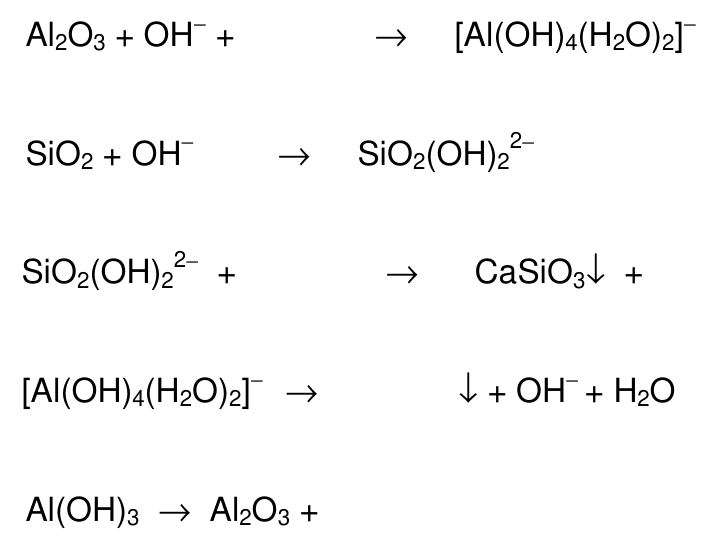
Complete and balance the following chemical reactions:
ii) Héroult-Hall process: Electrolysis of pure alumina dissolved in molten cryolite, \(\ce{Na3AlF6}\). Typical electrolyte composition ranges are \(\ce{Na3AlF6}\) (80 – 85 %), \(\ce{CaF2}\) (5 – 7 %), \(\ce{AlF3}\) (5 – 7 %), \(\ce{Al2O3}\) (2 – 8 % intermittently recharged). Electrolysis is carried out at \(940\,^\circ\mathrm{C}\), under constant pressure of 1 atm, in a carbon-lined steel cell (cathode) with carbon anodes. Balance the main reaction of the electrolysis:

Since cryolite is a rather rare mineral, it is prepared according to the following reaction.
Complete and balance this reaction:

During the electrolysis process several parallel reactions take place that degrade the graphite (\(\ce{C}\)) anodes or reduce the yield.
iii) By using the thermodynamic data given below, which are taken to be independent on temperature, determine the thermodynamic quantities \(\Delta H\), \(\Delta S\) and \(\Delta G\) at \(940\,^\circ\mathrm{C}\) for the reaction:

| \(\ce{Al(s)}\) | \(\ce{Al2O3(s)}\) | \(\ce{C}\) (graphite) | \(\ce{CO(g)}\) | \(\ce{CO2(g)}\) | \(\ce{O2(g)}\) | |
|---|---|---|---|---|---|---|
| \(\Delta_f H^\circ\) (\(\mathrm{kJ\,mol^{-1}}\)) | 0 | −1676 | 0 | −111 | −394 | |
| \(S^\circ\) (\(\mathrm{J\,K^{-1}\,mol^{-1}}\)) | 28 | 51 | 6 | 198 | 214 | 205 |
| \(\Delta_{\mathrm{fus}}H\) (\(\mathrm{kJ\,mol^{-1}}\)) | 11 | 109 |
iv) At the same temperature and using the data from the table in part (iii) determine the quantities \(\Delta H\) and \(\Delta G\) for the reaction

given that \(\Delta S=-126\ \mathrm{J\,K^{-1}\,mol^{-1}}\). (Show your calculations)
v) Pure aluminium is a silvery-white metal with a face-centered cubic (fcc) crystal structure. Aluminium is readily soluble in hot concentrated hydrochloric acid producing the cation \(\ce{[Al(H2O)6]^3+}\), as well as in strong bases at room temperature producing hydrated tetrahydroxyaluminate anion, \(\ce{[Al(OH)4]^-(aq)}\). In both cases liberation of \(\ce{H2}\) occurs. \(\ce{AlF3}\) is made by treating \(\ce{Al2O3}\) with \(\ce{HF}\) gas at \(700\,^\circ\mathrm{C}\), while the other trihalides, \(\ce{AlX3}\), are made by the direct exothermic reaction of \(\ce{Al}\) with the corresponding dihalogen. Write all 4 chemical reactions described above.
vi) The \(\ce{AlCl3}\) is a crystalline solid having a layer lattice with 6-coordinate \(\ce{Al(III)}\), but at the melting point (\(192.4\,^\circ\mathrm{C}\)) the structure changes to a 4-coordinate molecular dimer, \(\ce{Al2Cl6}\). The covalently bonded molecular dimer, in the gas phase and at high temperature, dissociates into trigonal planar \(\ce{AlCl3}\) molecules.
For the molecular dimer \(\ce{Al2Cl6}\), in the gas phase, two different \(\ce{Al-Cl}\) distances (206 and 221 pm) were measured. Draw the stereostructure of the dimer, and write down the corresponding \(\ce{Al-Cl}\) distances.
vii) What is the hybridization of the \(\ce{Al}\) atom(s) in \(\ce{Al2Cl6}\) and \(\ce{AlCl3}\)?
Official English text of the problem.
Answers
Thermodynamic quantities below are per mole of reaction as written, at \(T=1213.15\ \mathrm{K}\). Molecular and ionic names and SMILES are supplied in the corresponding solution parts.
-
(i) The balanced reactions, with calcium silicate precipitation written in net ionic form, are: \[ \ce{Al2O3 + 2OH^- + 7H2O -> 2[Al(OH)4(H2O)2]^-} \] \[ \ce{SiO2 + 2OH^- -> SiO2(OH)2^{2-}} \] \[ \ce{SiO2(OH)2^{2-} + Ca^{2+} -> CaSiO3 v + H2O} \] \[ \ce{[Al(OH)4(H2O)2]^- -> Al(OH)3 v + OH^- + 2H2O} \] \[ \ce{2Al(OH)3 -> Al2O3 + 3H2O} \]
-
(ii) Electrolysis: \[ \ce{2Al2O3(l) + 3C(s) -> 4Al(l) + 3CO2(g)} \] Cryolite preparation: \[ \ce{6HF + Al(OH)3 + 3NaOH -> Na3AlF6 + 6H2O} \]
-
(iii) \[ \boxed{\Delta H=+172\ \mathrm{kJ\,mol^{-1}},\quad \Delta S=+176\ \mathrm{J\,K^{-1}\,mol^{-1}},\quad \Delta G\approx-41.5\ \mathrm{kJ\,mol^{-1}}} \]
-
(iv) \[ \boxed{\Delta H=-740\ \mathrm{kJ\,mol^{-1}},\qquad \Delta G\approx-587\ \mathrm{kJ\,mol^{-1}}} \]
-
(v) The four reaction types are: \[ \ce{2Al(s) + 6H+(aq) + 12H2O(l) -> 2[Al(H2O)6]^3+(aq) + 3H2(g)} \] \[ \ce{2Al(s) + 2OH^-(aq) + 6H2O(l) -> 2[Al(OH)4]^-(aq) + 3H2(g)} \] \[ \ce{Al2O3(s) + 6HF(g) -> 2AlF3(s) + 3H2O(g)} \] \[ \ce{2Al + 3X2 -> 2AlX3}, \qquad X=\ce{Cl},\ce{Br},\ce{I}. \]
-
(vi) Aluminium chloride dimer, \(\ce{Al2Cl6}\), has two bridging and four terminal chlorine atoms. Each aluminium is approximately tetrahedral: \[ \boxed{d(\ce{Al-Cl_{terminal}})=206\ \mathrm{pm},\qquad d(\ce{Al-Cl_{bridging}})=221\ \mathrm{pm}.} \] Dative-bond SMILES:
Cl[Al]1(Cl)<-Cl[Al](Cl)(Cl)<-Cl1. -
(vii) In the conventional hybridization model: \[ \boxed{\ce{Al2Cl6}:\ \mathrm{sp^3}\text{ at each aluminium};\qquad \ce{AlCl3}\text{ monomer}:\ \mathrm{sp^2}.} \]
Solution
Coordination compounds below use dative-bond SMILES, with donor-to-acceptor arrows. These specify connectivity; their spatial coordination geometries are described separately. Extended solids, including alumina, silica, aluminium hydroxide, calcium silicate, solid aluminium fluoride, graphite and metallic aluminium, do not have a single molecular SMILES.
(i) Bayer process
Alumina is amphoteric: it dissolves in hydroxide solution to form the soluble aluminate complex. Two aluminium atoms require two product anions, so charge balance requires two hydroxide ions. Oxygen and hydrogen balance then require seven water molecules: \[ \ce{Al2O3 + 2OH^- + 7H2O -> 2[Al(OH)4(H2O)2]^-}. \] There are 12 oxygen atoms, 16 hydrogen atoms and total charge \(-2\) on each side.
Silica is an acidic oxide. Addition of two hydroxide ions gives the specified doubly charged silicate: \[ \ce{SiO2 + 2OH^- -> SiO2(OH)2^{2-}}. \]
Calcium ions remove this dissolved silicate by precipitation: \[ \ce{SiO2(OH)2^{2-} + Ca^{2+} -> CaSiO3 v + H2O}. \] If calcium is supplied as calcium hydroxide, the equivalent reagent equation is \[ \ce{SiO2(OH)2^{2-} + Ca(OH)2 -> CaSiO3 v + 2OH^- + H2O}. \] Thus lime addition also regenerates hydroxide.
Partial precipitation of aluminium hydroxide releases one hydroxide ion and the two coordinated water molecules: \[ \ce{[Al(OH)4(H2O)2]^- -> Al(OH)3 v + OH^- + 2H2O}. \]
Finally, heating dehydrates the hydroxide: \[ \ce{2Al(OH)3 -> Al2O3 + 3H2O}. \]
The relevant molecular and ionic identifiers are:
| Species | Name | SMILES |
|---|---|---|
| \(\ce{H2O}\) | Water | O |
| \(\ce{OH^-}\) | Hydroxide ion | [OH-] |
| \(\ce{[Al(OH)4(H2O)2]^-}\) | Diaquatetrahydroxidoaluminate(III) ion | [Al+3](<-[OH-])(<-[OH-])(<-[OH-])(<-[OH-])(<-[OH2])<-[OH2] |
| \(\ce{SiO2(OH)2^{2-}}\) | Dihydrogen orthosilicate ion | [O-][Si]([O-])(O)O |
| \(\ce{Ca^{2+}}\) | Calcium(II) ion | [Ca+2] |
The hydrated aluminate has six oxygen donors around aluminium, corresponding to octahedral coordination; the problem does not specify a cis/trans arrangement of the water ligands. The silicate has tetrahedral coordination around silicon. Calcium hydroxide has ionic formula-unit SMILES [Ca+2].[OH-].[OH-].
(ii) Electrolysis and cryolite preparation
In electrolysis, each aluminium atom changes from oxidation state \(+3\) to \(0\), accepting three electrons. Each carbon atom changes from \(0\) to \(+4\) in carbon dioxide, releasing four electrons. The smallest common electron count is twelve, requiring four aluminium atoms and three carbon atoms: \[ \ce{2Al2O3(l) + 3C(s) -> 4Al(l) + 3CO2(g)}. \] This also balances all six oxygen atoms.
One formula unit of cryolite requires one aluminium, three sodium atoms and six fluorine atoms. Therefore the reactants must include one aluminium hydroxide, three sodium hydroxides and six hydrogen fluorides. Their remaining hydrogen and oxygen form six waters: \[ \ce{6HF + Al(OH)3 + 3NaOH -> Na3AlF6 + 6H2O}. \]
Hydrogen fluoride has SMILES F; carbon dioxide has SMILES O=C=O.
Cryolite is sodium hexafluoridoaluminate(III). Its ionic constituents are three sodium ions, [Na+], and one hexafluoridoaluminate(III) ion, \(\ce{[AlF6]^3-}\), with dative-bond SMILES [Al+3](<-[F-])(<-[F-])(<-[F-])(<-[F-])(<-[F-])<-[F-]. The six fluorine donors form an octahedral coordination sphere. Sodium hydroxide has ionic formula-unit SMILES [Na+].[OH-].
(iii) Reaction of graphite with carbon dioxide
For \[ \ce{C(graphite) + CO2(g) -> 2CO(g)}, \] the reaction enthalpy is the sum of product formation enthalpies minus that of the reactants: \[ \begin{aligned} \Delta H &=2\Delta_fH^\circ(\ce{CO}) -\left[\Delta_fH^\circ(\ce{C})+\Delta_fH^\circ(\ce{CO2})\right]\\ &=2(-111)-[0+(-394)]\\ &=\boxed{+172\ \mathrm{kJ\,mol^{-1}}}. \end{aligned} \]
Similarly, \[ \begin{aligned} \Delta S &=2S^\circ(\ce{CO}) -\left[S^\circ(\ce{C})+S^\circ(\ce{CO2})\right]\\ &=2(198)-(6+214)\\ &=\boxed{+176\ \mathrm{J\,K^{-1}\,mol^{-1}}}. \end{aligned} \]
The temperature is \[ T=940+273.15=1213.15\ \mathrm{K}. \] Converting entropy to \(\mathrm{kJ\,K^{-1}\,mol^{-1}}\), \[ \begin{aligned} \Delta G&=\Delta H-T\Delta S\\ &=172-(1213.15)(0.176)\\ &=-41.5144\ \mathrm{kJ\,mol^{-1}}\\ &\approx\boxed{-41.5\ \mathrm{kJ\,mol^{-1}}}. \end{aligned} \]
The reaction is endothermic, but its positive entropy change—consistent with increasing the amount of gas from one to two moles—makes its standard Gibbs energy negative at this temperature. It therefore provides a thermodynamically favorable route for consuming the graphite anodes.
Carbon monoxide has SMILES [C-]#[O+]; carbon dioxide has SMILES O=C=O.
(iv) Oxidation of liquid aluminium by carbon dioxide
The reaction is \[ \ce{2Al(l) + 3CO2(g) -> Al2O3(l) + 3CO(g)}. \]
The formation enthalpies in the table refer to solid aluminium and solid alumina. Within the problem’s temperature-independent approximation, the required liquid-state enthalpies are \[ \Delta_fH(\ce{Al(l)})=0+11=11\ \mathrm{kJ\,mol^{-1}}, \] and \[ \Delta_fH(\ce{Al2O3(l)}) =-1676+109=-1567\ \mathrm{kJ\,mol^{-1}}. \]
Consequently, \[ \begin{aligned} \Delta H &=\left[-1567+3(-111)\right] -\left[2(11)+3(-394)\right]\\ &=-1900-(-1160)\\ &=\boxed{-740\ \mathrm{kJ\,mol^{-1}}}. \end{aligned} \]
Equivalently, the solid-state reaction enthalpy is \(-827\ \mathrm{kJ\,mol^{-1}}\), and the net fusion correction is \[ 109-2(11)=87\ \mathrm{kJ\,mol^{-1}}, \] giving \(-827+87=-740\ \mathrm{kJ\,mol^{-1}}\).
Using the supplied reaction entropy, \[ \Delta S=-126\ \mathrm{J\,K^{-1}\,mol^{-1}} =-0.126\ \mathrm{kJ\,K^{-1}\,mol^{-1}}, \] we obtain \[ \begin{aligned} \Delta G &=-740-(1213.15)(-0.126)\\ &=-587.1431\ \mathrm{kJ\,mol^{-1}}\\ &\approx\boxed{-587\ \mathrm{kJ\,mol^{-1}}}. \end{aligned} \]
This strongly favorable standard Gibbs energy explains how contact with carbon dioxide can reoxidize the aluminium product and lower its yield.
(v) Reactions of aluminium and preparation of its halides
In acid, two aluminium atoms lose six electrons in total, while six hydrogen ions are reduced to three hydrogen molecules. Twelve water molecules provide the six aqua ligands on each aluminium: \[ \ce{2Al(s) + 6H+(aq) + 12H2O(l) -> 2[Al(H2O)6]^3+(aq) + 3H2(g)}. \] Chloride is a spectator ion in this net ionic equation.
In base, aluminium is again oxidized to \(+3\), but the product is tetrahydroxidoaluminate: \[ \ce{2Al(s) + 2OH^-(aq) + 6H2O(l) -> 2[Al(OH)4]^-(aq) + 3H2(g)}. \] Both sides contain two aluminium atoms, eight oxygen atoms, fourteen hydrogen atoms and total charge \(-2\).
Treatment of alumina with hydrogen fluoride at \(700\,^\circ\mathrm{C}\) is an acid–base conversion with no change in aluminium’s oxidation state: \[ \ce{Al2O3(s) + 6HF(g) -> 2AlF3(s) + 3H2O(g)}. \] Six hydrogen fluorides supply the six fluorines for two aluminium fluorides and the six hydrogens for three waters.
For chlorine, bromine and iodine, direct combination is a redox reaction: \[ \ce{2Al + 3X2 -> 2AlX3}, \qquad X=\ce{Cl},\ce{Br},\ce{I}. \] Two aluminium atoms release six electrons, and the six halogen atoms each accept one.
Additional molecular and ionic identifiers are:
| Species | Name | SMILES |
|---|---|---|
| \(\ce{HCl}\) | Hydrogen chloride; its aqueous solution is hydrochloric acid | Cl |
| \(\ce{H+}\) | Hydrogen ion, used as the aqueous acid notation | [H+] |
| \(\ce{Cl^-}\) | Chloride ion | [Cl-] |
| \(\ce{H2}\) | Hydrogen | [H][H] |
| \(\ce{[Al(H2O)6]^3+}\) | Hexaaquaaluminium(III) ion | [Al+3](<-[OH2])(<-[OH2])(<-[OH2])(<-[OH2])(<-[OH2])<-[OH2] |
| \(\ce{[Al(OH)4]^-}\) | Tetrahydroxidoaluminate(III) ion | [Al+3](<-[OH-])(<-[OH-])(<-[OH-])<-[OH-] |
| \(\ce{Cl2}\) | Chlorine | ClCl |
| \(\ce{Br2}\) | Bromine | BrBr |
| \(\ce{I2}\) | Iodine | II |
Hexaaquaaluminium(III) is octahedral, whereas tetrahydroxidoaluminate(III) is tetrahedral. Aqueous hydrogen ions are solvated; [H+] is the conventional shorthand used in the net ionic equation.
The trihalide monomer connectivities are aluminium chloride Cl[Al](Cl)Cl, aluminium bromide Br[Al](Br)Br and aluminium iodide I[Al](I)I. These strings alone do not specify aggregation into dimers or condensed-phase structures.
(vi) Structure and bond lengths of the dimer
An isolated aluminium chloride monomer has only six electrons in aluminium’s valence shell. Dimerization allows one chlorine from each monomer to donate a lone pair to the other aluminium, forming two chlorine bridges. Each aluminium then has four chlorine neighbours: two terminal and two bridging.
The aluminium chloride dimer has dative-bond SMILES:
Cl[Al]1(Cl)<-Cl[Al](Cl)(Cl)<-Cl1.
The requested stereostructure should be drawn as follows:
- Place the two aluminium atoms at the left and right vertices of a diamond, with the two bridging chlorines at its upper and lower vertices. Join each bridging chlorine to both aluminium atoms. This gives a planar, four-membered central ring.
- Attach two terminal chlorines to each aluminium, directed outward from the ring: one on a solid wedge toward the viewer and one on a dashed wedge away from the viewer.
- Label all four terminal bonds 206 pm and all four aluminium-to-bridging-chlorine bonds 221 pm. There is no direct aluminium–aluminium bond.
This is two distorted coordination tetrahedra sharing the edge defined by the two bridging chlorines. The bridging contacts are longer than the terminal bonds because each bridging chlorine participates in bonding to two aluminium centres.
The donor arrows in the SMILES are a bonding-bookkeeping representation; they do not imply different lengths for the four symmetry-equivalent bridge contacts.
(vii) Hybridization
In the dimer, each aluminium has four approximately tetrahedrally arranged bonding directions. The conventional assignment is therefore \[ \boxed{\mathrm{sp^3}}. \]
The gaseous aluminium chloride monomer, Cl[Al](Cl)Cl, has three coplanar bonds with approximately \(120^\circ\) bond angles. Its conventional assignment is
\[
\boxed{\mathrm{sp^2}},
\]
with an empty \(p\) orbital perpendicular to the molecular plane.
These assignments concern the molecular dimer and monomer described in part (vi), rather than the six-coordinate aluminium sites in the crystalline solid.
The solution was checked against the official solution. Where this solution differs from the official solution, the official solution contains an error or a misprint.
IChO 2003 · Theorieaufgabe 34
Aluminium
ABSCHNITT D: Anorganische Chemie
AUFGABE 34 Aluminium
Eine der größten Fabriken Griechenlands, die in der Nähe der antiken Stadt Delphi liegt, stellt Aluminiumoxid (\(\ce{Al2O3}\)) und metallisches Aluminium aus dem Mineral Bauxit her, das im Parnassgebirge abgebaut wird. Bauxit ist ein gemischtes Aluminiumoxidhydroxid – \(\ce{AlO_x(OH)_{3-2x}}\), wobei \(0<x<1\).
Die Herstellung von metallischem \(\ce{Al}\) erfolgt in einem zweistufigen Verfahren:
(i) Bayer-Verfahren: Extraktion, Reinigung und Dehydratisierung von Bauxit (typische Zusammensetzungen industriell genutzter Bauxite sind \(\ce{Al2O3}\) 40 – 60 %, \(\ce{H2O}\) 12 – 30 %, freies und gebundenes \(\ce{SiO2}\) 1 – 15 %, \(\ce{Fe2O3}\) 7 – 30 %, \(\ce{TiO2}\) 3 – 4 %, \(\ce{F}\), \(\ce{P2O5}\), \(\ce{V2O5}\) usw. 0.05 – 0.2 %). Dazu gehören das Auflösen in wässriger \(\ce{NaOH}\), die Abtrennung unlöslicher Verunreinigungen, die teilweise Fällung des Aluminiumhydroxids und das Erhitzen auf \(1200\,^\circ\mathrm{C}\).
Vervollständigen Sie die folgenden chemischen Reaktionsgleichungen und gleichen Sie sie aus:
ii) Héroult-Hall-Verfahren: Elektrolyse von reinem Aluminiumoxid, das in geschmolzenem Kryolith, \(\ce{Na3AlF6}\), gelöst ist. Typische Zusammensetzungsbereiche des Elektrolyten sind \(\ce{Na3AlF6}\) (80 – 85 %), \(\ce{CaF2}\) (5 – 7 %), \(\ce{AlF3}\) (5 – 7 %), \(\ce{Al2O3}\) (2 – 8 %, in Abständen nachgefüllt). Die Elektrolyse wird bei \(940\,^\circ\mathrm{C}\) unter einem konstanten Druck von 1 atm in einer mit Kohlenstoff ausgekleideten Stahlzelle (Kathode) mit Kohlenstoffanoden durchgeführt. Gleichen Sie die Hauptreaktion der Elektrolyse aus:
Da Kryolith ein recht seltenes Mineral ist, wird er gemäß der folgenden Reaktion hergestellt.
Vervollständigen Sie diese Reaktionsgleichung und gleichen Sie sie aus:
Während der Elektrolyse laufen mehrere Parallelreaktionen ab, die die Graphitanoden (\(\ce{C}\)) abbauen oder die Ausbeute verringern.
iii) Bestimmen Sie mithilfe der unten angegebenen thermodynamischen Daten, die als temperaturunabhängig angenommen werden, die thermodynamischen Größen \(\Delta H\), \(\Delta S\) und \(\Delta G\) bei \(940\,^\circ\mathrm{C}\) für die Reaktion:
| \(\ce{Al(s)}\) | \(\ce{Al2O3(s)}\) | \(\ce{C}\) (Graphit) | \(\ce{CO(g)}\) | \(\ce{CO2(g)}\) | \(\ce{O2(g)}\) | |
|---|---|---|---|---|---|---|
| \(\Delta_f H^\circ\) (\(\mathrm{kJ\,mol^{-1}}\)) | 0 | −1676 | 0 | −111 | −394 | |
| \(S^\circ\) (\(\mathrm{J\,K^{-1}\,mol^{-1}}\)) | 28 | 51 | 6 | 198 | 214 | 205 |
| \(\Delta_{\mathrm{fus}}H\) (\(\mathrm{kJ\,mol^{-1}}\)) | 11 | 109 |
iv) Bestimmen Sie bei derselben Temperatur und mithilfe der Daten aus der Tabelle in Teil (iii) die Größen \(\Delta H\) und \(\Delta G\) für die Reaktion
wobei \(\Delta S=-126\ \mathrm{J\,K^{-1}\,mol^{-1}}\) gegeben ist. (Geben Sie Ihren Rechenweg an.)
v) Reines Aluminium ist ein silberweißes Metall mit einer kubisch flächenzentrierten (fcc) Kristallstruktur. Aluminium löst sich leicht in heißer konzentrierter Salzsäure unter Bildung des Kations \(\ce{[Al(H2O)6]^3+}\) sowie in starken Basen bei Raumtemperatur unter Bildung des hydratisierten Tetrahydroxyaluminat-Anions, \(\ce{[Al(OH)4]^-(aq)}\). In beiden Fällen wird \(\ce{H2}\) freigesetzt. \(\ce{AlF3}\) wird durch Behandlung von \(\ce{Al2O3}\) mit gasförmigem \(\ce{HF}\) bei \(700\,^\circ\mathrm{C}\) hergestellt, während die anderen Trihalogenide, \(\ce{AlX3}\), durch direkte exotherme Reaktion von \(\ce{Al}\) mit dem entsprechenden Dihalogen hergestellt werden. Schreiben Sie alle 4 oben beschriebenen chemischen Reaktionsgleichungen auf.
vi) \(\ce{AlCl3}\) ist ein kristalliner Feststoff mit einem Schichtgitter, in dem \(\ce{Al(III)}\) sechsfach koordiniert ist. Am Schmelzpunkt (\(192.4\,^\circ\mathrm{C}\)) ändert sich die Struktur jedoch zu einem molekularen Dimer, \(\ce{Al2Cl6}\), mit vierfach koordiniertem Aluminium. Das kovalent gebundene molekulare Dimer dissoziiert in der Gasphase bei hoher Temperatur zu trigonal-planaren \(\ce{AlCl3}\)-Molekülen.
Für das molekulare Dimer \(\ce{Al2Cl6}\) wurden in der Gasphase zwei unterschiedliche \(\ce{Al-Cl}\)-Abstände (206 und 221 pm) gemessen. Zeichnen Sie die räumliche Struktur des Dimers und geben Sie die entsprechenden \(\ce{Al-Cl}\)-Abstände an.
vii) Welche Hybridisierung weisen die \(\ce{Al}\)-Atome in \(\ce{Al2Cl6}\) und \(\ce{AlCl3}\) auf?
Aufgabentext aus dem offiziellen englischen Text übersetzt.
Antworten
Die nachstehenden thermodynamischen Größen beziehen sich auf ein Mol Reaktionsumsatz gemäß der jeweils angegebenen Reaktionsgleichung bei \(T=1213.15\ \mathrm{K}\). Namen und SMILES der Moleküle und Ionen sind in den entsprechenden Lösungsteilen angegeben.
-
(i) Die ausgeglichenen Reaktionsgleichungen, wobei die Fällung von Calciumsilicat als Netto-Ionengleichung geschrieben ist, lauten: \[ \ce{Al2O3 + 2OH^- + 7H2O -> 2[Al(OH)4(H2O)2]^-} \] \[ \ce{SiO2 + 2OH^- -> SiO2(OH)2^{2-}} \] \[ \ce{SiO2(OH)2^{2-} + Ca^{2+} -> CaSiO3 v + H2O} \] \[ \ce{[Al(OH)4(H2O)2]^- -> Al(OH)3 v + OH^- + 2H2O} \] \[ \ce{2Al(OH)3 -> Al2O3 + 3H2O} \]
-
(ii) Elektrolyse: \[ \ce{2Al2O3(l) + 3C(s) -> 4Al(l) + 3CO2(g)} \] Herstellung von Kryolith: \[ \ce{6HF + Al(OH)3 + 3NaOH -> Na3AlF6 + 6H2O} \]
-
(iii) \[ \boxed{\Delta H=+172\ \mathrm{kJ\,mol^{-1}},\quad \Delta S=+176\ \mathrm{J\,K^{-1}\,mol^{-1}},\quad \Delta G\approx-41.5\ \mathrm{kJ\,mol^{-1}}} \]
-
(iv) \[ \boxed{\Delta H=-740\ \mathrm{kJ\,mol^{-1}},\qquad \Delta G\approx-587\ \mathrm{kJ\,mol^{-1}}} \]
-
(v) Die vier Reaktionstypen sind: \[ \ce{2Al(s) + 6H+(aq) + 12H2O(l) -> 2[Al(H2O)6]^3+(aq) + 3H2(g)} \] \[ \ce{2Al(s) + 2OH^-(aq) + 6H2O(l) -> 2[Al(OH)4]^-(aq) + 3H2(g)} \] \[ \ce{Al2O3(s) + 6HF(g) -> 2AlF3(s) + 3H2O(g)} \] \[ \ce{2Al + 3X2 -> 2AlX3}, \qquad X=\ce{Cl},\ce{Br},\ce{I}. \]
-
(vi) Das Aluminiumchlorid-Dimer, \(\ce{Al2Cl6}\), besitzt zwei verbrückende und vier terminale Chloratome. Jedes Aluminium ist annähernd tetraedrisch koordiniert: \[ \boxed{d(\ce{Al-Cl_{terminal}})=206\ \mathrm{pm},\qquad d(\ce{Al-Cl_{bridging}})=221\ \mathrm{pm}.} \] SMILES mit koordinativen Bindungen:
Cl[Al]1(Cl)<-Cl[Al](Cl)(Cl)<-Cl1. -
(vii) Im herkömmlichen Hybridisierungsmodell: \[ \boxed{\ce{Al2Cl6}:\ \mathrm{sp^3}\text{ an jedem Aluminium};\qquad \ce{AlCl3}\text{ Monomer}:\ \mathrm{sp^2}.} \]
Lösung
Für die nachstehenden Koordinationsverbindungen werden SMILES mit koordinativen Bindungen und Pfeilen vom Donor zum Akzeptor verwendet. Diese geben die Konnektivität an; die räumlichen Koordinationsgeometrien werden gesondert beschrieben. Für ausgedehnte Festkörperstrukturen, darunter Aluminiumoxid, Siliciumdioxid, Aluminiumhydroxid, Calciumsilicat, festes Aluminiumfluorid, Graphit und metallisches Aluminium, gibt es kein einzelnes molekulares SMILES.
(i) Bayer-Verfahren
Aluminiumoxid ist amphoter: Es löst sich in Hydroxidlösung unter Bildung des löslichen Aluminatkomplexes. Zwei Aluminiumatome erfordern zwei Produktanionen, sodass der Ladungsausgleich zwei Hydroxidionen erfordert. Die Sauerstoff- und Wasserstoffbilanz erfordert dann sieben Wassermoleküle: \[ \ce{Al2O3 + 2OH^- + 7H2O -> 2[Al(OH)4(H2O)2]^-}. \] Auf jeder Seite stehen 12 Sauerstoffatome, 16 Wasserstoffatome und eine Gesamtladung von \(-2\).
Siliciumdioxid ist ein saures Oxid. Die Addition zweier Hydroxidionen ergibt das vorgegebene zweifach geladene Silicat: \[ \ce{SiO2 + 2OH^- -> SiO2(OH)2^{2-}}. \]
Calciumionen entfernen dieses gelöste Silicat durch Fällung: \[ \ce{SiO2(OH)2^{2-} + Ca^{2+} -> CaSiO3 v + H2O}. \] Wird Calcium als Calciumhydroxid zugeführt, lautet die äquivalente Reaktionsgleichung mit diesem Reagenz \[ \ce{SiO2(OH)2^{2-} + Ca(OH)2 -> CaSiO3 v + 2OH^- + H2O}. \] Somit wird durch die Kalkzugabe auch Hydroxid regeneriert.
Bei der teilweisen Fällung von Aluminiumhydroxid werden ein Hydroxidion und die beiden koordinierten Wassermoleküle freigesetzt: \[ \ce{[Al(OH)4(H2O)2]^- -> Al(OH)3 v + OH^- + 2H2O}. \]
Schließlich wird das Hydroxid durch Erhitzen dehydratisiert: \[ \ce{2Al(OH)3 -> Al2O3 + 3H2O}. \]
Die relevanten Moleküle und Ionen werden wie folgt bezeichnet und dargestellt:
| Spezies | Name | SMILES |
|---|---|---|
| \(\ce{H2O}\) | Wasser | O |
| \(\ce{OH^-}\) | Hydroxidion | [OH-] |
| \(\ce{[Al(OH)4(H2O)2]^-}\) | Diaquatetrahydroxidoaluminat(III)-Ion | [Al+3](<-[OH-])(<-[OH-])(<-[OH-])(<-[OH-])(<-[OH2])<-[OH2] |
| \(\ce{SiO2(OH)2^{2-}}\) | Dihydrogenorthosilicat-Ion | [O-][Si]([O-])(O)O |
| \(\ce{Ca^{2+}}\) | Calcium(II)-Ion | [Ca+2] |
Das hydratisierte Aluminat besitzt sechs Sauerstoffdonoren um das Aluminium, was einer oktaedrischen Koordination entspricht; die Aufgabe legt keine cis/trans-Anordnung der Wasserliganden fest. Das Silicat weist eine tetraedrische Koordination um das Silicium auf. Calciumhydroxid hat für seine ionische Formeleinheit das SMILES [Ca+2].[OH-].[OH-].
(ii) Elektrolyse und Herstellung von Kryolith
Bei der Elektrolyse geht jedes Aluminiumatom von der Oxidationsstufe \(+3\) in die Oxidationsstufe \(0\) über und nimmt dabei drei Elektronen auf. Jedes Kohlenstoffatom geht von \(0\) in die Oxidationsstufe \(+4\) im Kohlenstoffdioxid über und gibt dabei vier Elektronen ab. Die kleinste gemeinsame Elektronenzahl ist zwölf, wofür vier Aluminiumatome und drei Kohlenstoffatome erforderlich sind: \[ \ce{2Al2O3(l) + 3C(s) -> 4Al(l) + 3CO2(g)}. \] Damit sind auch alle sechs Sauerstoffatome ausgeglichen.
Eine Formeleinheit Kryolith erfordert ein Aluminiumatom, drei Natriumatome und sechs Fluoratome. Daher müssen die Edukte eine Formeleinheit Aluminiumhydroxid, drei Formeleinheiten Natriumhydroxid und sechs Moleküle Fluorwasserstoff umfassen. Der verbleibende Wasserstoff und Sauerstoff bilden sechs Wassermoleküle: \[ \ce{6HF + Al(OH)3 + 3NaOH -> Na3AlF6 + 6H2O}. \]
Fluorwasserstoff hat das SMILES F; Kohlenstoffdioxid hat das SMILES O=C=O.
Kryolith ist Natriumhexafluoridoaluminat(III). Seine ionischen Bestandteile sind drei Natriumionen, [Na+], und ein Hexafluoridoaluminat(III)-Ion, \(\ce{[AlF6]^3-}\), mit dem SMILES mit koordinativen Bindungen [Al+3](<-[F-])(<-[F-])(<-[F-])(<-[F-])(<-[F-])<-[F-]. Die sechs Fluordonoren bilden eine oktaedrische Koordinationssphäre. Natriumhydroxid hat für seine ionische Formeleinheit das SMILES [Na+].[OH-].
(iii) Reaktion von Graphit mit Kohlenstoffdioxid
Für \[ \ce{C(graphite) + CO2(g) -> 2CO(g)}, \] ist die Reaktionsenthalpie die Summe der Bildungsenthalpien der Produkte abzüglich derjenigen der Edukte: \[ \begin{aligned} \Delta H &=2\Delta_fH^\circ(\ce{CO}) -\left[\Delta_fH^\circ(\ce{C})+\Delta_fH^\circ(\ce{CO2})\right]\\ &=2(-111)-[0+(-394)]\\ &=\boxed{+172\ \mathrm{kJ\,mol^{-1}}}. \end{aligned} \]
Entsprechend gilt \[ \begin{aligned} \Delta S &=2S^\circ(\ce{CO}) -\left[S^\circ(\ce{C})+S^\circ(\ce{CO2})\right]\\ &=2(198)-(6+214)\\ &=\boxed{+176\ \mathrm{J\,K^{-1}\,mol^{-1}}}. \end{aligned} \]
Die Temperatur beträgt \[ T=940+273.15=1213.15\ \mathrm{K}. \] Nach Umrechnung der Entropie in \(\mathrm{kJ\,K^{-1}\,mol^{-1}}\) ergibt sich \[ \begin{aligned} \Delta G&=\Delta H-T\Delta S\\ &=172-(1213.15)(0.176)\\ &=-41.5144\ \mathrm{kJ\,mol^{-1}}\\ &\approx\boxed{-41.5\ \mathrm{kJ\,mol^{-1}}}. \end{aligned} \]
Die Reaktion ist endotherm, doch ihre positive Entropieänderung – im Einklang mit der Zunahme der Gasstoffmenge von einem auf zwei Mol – führt dazu, dass ihre Standard-Gibbs-Energie bei dieser Temperatur negativ ist. Sie stellt daher einen thermodynamisch begünstigten Reaktionsweg für den Verbrauch der Graphitanoden dar.
Kohlenstoffmonoxid hat das SMILES [C-]#[O+]; Kohlenstoffdioxid hat das SMILES O=C=O.
(iv) Oxidation von flüssigem Aluminium durch Kohlenstoffdioxid
Die Reaktion lautet \[ \ce{2Al(l) + 3CO2(g) -> Al2O3(l) + 3CO(g)}. \]
Die Bildungsenthalpien in der Tabelle beziehen sich auf festes Aluminium und festes Aluminiumoxid. Im Rahmen der in der Aufgabe verwendeten Näherung der Temperaturunabhängigkeit lauten die erforderlichen Enthalpien für den flüssigen Zustand \[ \Delta_fH(\ce{Al(l)})=0+11=11\ \mathrm{kJ\,mol^{-1}}, \] und \[ \Delta_fH(\ce{Al2O3(l)}) =-1676+109=-1567\ \mathrm{kJ\,mol^{-1}}. \]
Folglich gilt \[ \begin{aligned} \Delta H &=\left[-1567+3(-111)\right] -\left[2(11)+3(-394)\right]\\ &=-1900-(-1160)\\ &=\boxed{-740\ \mathrm{kJ\,mol^{-1}}}. \end{aligned} \]
Gleichwertig beträgt die Reaktionsenthalpie für die festen Zustände \(-827\ \mathrm{kJ\,mol^{-1}}\), und die Nettokorrektur für das Schmelzen ist \[ 109-2(11)=87\ \mathrm{kJ\,mol^{-1}}, \] woraus sich \(-827+87=-740\ \mathrm{kJ\,mol^{-1}}\) ergibt.
Mit der vorgegebenen Reaktionsentropie \[ \Delta S=-126\ \mathrm{J\,K^{-1}\,mol^{-1}} =-0.126\ \mathrm{kJ\,K^{-1}\,mol^{-1}}, \] erhalten wir \[ \begin{aligned} \Delta G &=-740-(1213.15)(-0.126)\\ &=-587.1431\ \mathrm{kJ\,mol^{-1}}\\ &\approx\boxed{-587\ \mathrm{kJ\,mol^{-1}}}. \end{aligned} \]
Diese stark negative Standard-Gibbs-Energie erklärt, wie der Kontakt mit Kohlenstoffdioxid das erzeugte Aluminium erneut oxidieren und seine Ausbeute verringern kann.
(v) Reaktionen von Aluminium und Herstellung seiner Halogenide
In saurer Lösung geben zwei Aluminiumatome insgesamt sechs Elektronen ab, während sechs Wasserstoffionen zu drei Wasserstoffmolekülen reduziert werden. Zwölf Wassermoleküle liefern die sechs Aqualiganden an jedem Aluminium: \[ \ce{2Al(s) + 6H+(aq) + 12H2O(l) -> 2[Al(H2O)6]^3+(aq) + 3H2(g)}. \] Chlorid ist in dieser Netto-Ionengleichung ein Zuschauerion.
In basischer Lösung wird Aluminium ebenfalls zu \(+3\) oxidiert, doch das Produkt ist Tetrahydroxidoaluminat: \[ \ce{2Al(s) + 2OH^-(aq) + 6H2O(l) -> 2[Al(OH)4]^-(aq) + 3H2(g)}. \] Beide Seiten enthalten zwei Aluminiumatome, acht Sauerstoffatome, vierzehn Wasserstoffatome und eine Gesamtladung von \(-2\).
Die Behandlung von Aluminiumoxid mit Fluorwasserstoff bei \(700\,^\circ\mathrm{C}\) ist eine Säure-Base-Umsetzung ohne Änderung der Oxidationsstufe des Aluminiums: \[ \ce{Al2O3(s) + 6HF(g) -> 2AlF3(s) + 3H2O(g)}. \] Sechs Fluorwasserstoffmoleküle liefern die sechs Fluoratome für zwei Formeleinheiten Aluminiumfluorid und die sechs Wasserstoffatome für drei Wassermoleküle.
Bei Chlor, Brom und Iod ist die direkte Vereinigung eine Redoxreaktion: \[ \ce{2Al + 3X2 -> 2AlX3}, \qquad X=\ce{Cl},\ce{Br},\ce{I}. \] Zwei Aluminiumatome geben sechs Elektronen ab, und die sechs Halogenatome nehmen jeweils eines auf.
Weitere Moleküle und Ionen werden wie folgt bezeichnet und dargestellt:
| Spezies | Name | SMILES |
|---|---|---|
| \(\ce{HCl}\) | Chlorwasserstoff; seine wässrige Lösung ist Salzsäure | Cl |
| \(\ce{H+}\) | Wasserstoffion, als Schreibweise für Säure in wässriger Lösung verwendet | [H+] |
| \(\ce{Cl^-}\) | Chloridion | [Cl-] |
| \(\ce{H2}\) | Wasserstoff | [H][H] |
| \(\ce{[Al(H2O)6]^3+}\) | Hexaaquaaluminium(III)-Ion | [Al+3](<-[OH2])(<-[OH2])(<-[OH2])(<-[OH2])(<-[OH2])<-[OH2] |
| \(\ce{[Al(OH)4]^-}\) | Tetrahydroxidoaluminat(III)-Ion | [Al+3](<-[OH-])(<-[OH-])(<-[OH-])<-[OH-] |
| \(\ce{Cl2}\) | Chlor | ClCl |
| \(\ce{Br2}\) | Brom | BrBr |
| \(\ce{I2}\) | Iod | II |
Hexaaquaaluminium(III) ist oktaedrisch, während Tetrahydroxidoaluminat(III) tetraedrisch ist. Wasserstoffionen in wässriger Lösung sind solvatisiert; [H+] ist die herkömmliche Kurzschreibweise in der Netto-Ionengleichung.
Die Konnektivitäten der Monomere der Trihalogenide sind Aluminiumchlorid Cl[Al](Cl)Cl, Aluminiumbromid Br[Al](Br)Br und Aluminiumiodid I[Al](I)I. Diese Zeichenfolgen allein beschreiben weder die Aggregation zu Dimeren noch Strukturen in kondensierten Phasen.
(vi) Struktur und Bindungslängen des Dimers
Ein isoliertes Aluminiumchlorid-Monomer besitzt nur sechs Elektronen in der Valenzschale des Aluminiums. Durch Dimerisierung kann ein Chloratom jedes Monomers dem jeweils anderen Aluminium ein freies Elektronenpaar zur Verfügung stellen, wodurch zwei Chlorbrücken entstehen. Jedes Aluminium hat dann vier Chlornachbarn: zwei terminale und zwei verbrückende.
Das Aluminiumchlorid-Dimer hat folgendes SMILES mit koordinativen Bindungen:
Cl[Al]1(Cl)<-Cl[Al](Cl)(Cl)<-Cl1.
Die geforderte räumliche Struktur sollte wie folgt gezeichnet werden:
- Platzieren Sie die beiden Aluminiumatome an den linken und rechten Eckpunkten einer Raute und die beiden verbrückenden Chloratome an deren oberen und unteren Eckpunkten. Verbinden Sie jedes verbrückende Chloratom mit beiden Aluminiumatomen. Dadurch entsteht ein ebener, viergliedriger zentraler Ring.
- Fügen Sie jedem Aluminium zwei terminale Chloratome hinzu, die vom Ring nach außen gerichtet sind: eines an einem ausgefüllten Keil zum Betrachter hin und eines an einem gestrichelten Keil vom Betrachter weg.
- Beschriften Sie alle vier terminalen Bindungen mit 206 pm und alle vier Bindungen zwischen Aluminium und verbrückendem Chlor mit 221 pm. Es gibt keine direkte Aluminium–Aluminium-Bindung.
Dies entspricht zwei verzerrten Koordinationstetraedern, die sich die durch die beiden verbrückenden Chloratome definierte Kante teilen. Die Brückenkontakte sind länger als die terminalen Bindungen, weil jedes verbrückende Chloratom an Bindungen zu zwei Aluminiumzentren beteiligt ist.
Die Donorpfeile im SMILES dienen der formalen Darstellung der Bindungsverhältnisse; sie implizieren keine unterschiedlichen Längen für die vier symmetrieäquivalenten Brückenkontakte.
(vii) Hybridisierung
Im Dimer besitzt jedes Aluminium vier annähernd tetraedrisch angeordnete Bindungsrichtungen. Die herkömmliche Zuordnung lautet daher \[ \boxed{\mathrm{sp^3}}. \]
Das gasförmige Aluminiumchlorid-Monomer, Cl[Al](Cl)Cl, besitzt drei in einer Ebene liegende Bindungen mit Bindungswinkeln von ungefähr \(120^\circ\). Seine herkömmliche Zuordnung lautet
\[
\boxed{\mathrm{sp^2}},
\]
mit einem leeren \(p\)-Orbital senkrecht zur Molekülebene.
Diese Zuordnungen beziehen sich auf das in Teil (vi) beschriebene molekulare Dimer und Monomer, nicht auf die sechsfach koordinierten Aluminiumplätze im kristallinen Feststoff.
Die Lösung wurde mit der offiziellen Lösung abgeglichen. Wo diese Lösung von der offiziellen Lösung abweicht, enthält die offizielle Lösung einen Fehler oder Druckfehler.
IChO 2003 · Teori sorusu 34
Alüminyum
BÖLÜM D: Anorganik Kimya
SORU 34 Alüminyum
Yunanistan'ın en büyük fabrikalarından biri, antik Delphi kenti yakınlarında bulunur ve Parnassus Dağı'ndan çıkarılan boksit mineralini kullanarak alümina (\(\ce{Al2O3}\)) ve alüminyum metali üretir. Boksit, karışık bir alüminyum oksit hidroksittir – \(\ce{AlO_x(OH)_{3-2x}}\); burada \(0<x<1\)'dir.
\(\ce{Al}\) metalinin üretimi iki aşamalı bir süreçle gerçekleştirilir:
(i) Bayer prosesi: Boksitin özütlenmesi, saflaştırılması ve dehidrasyonu (sanayide kullanılan boksitlerin tipik bileşimleri şöyledir: \(\ce{Al2O3}\) %40 – 60, \(\ce{H2O}\) %12 – 30, serbest ve bileşik hâlinde \(\ce{SiO2}\) %1 – 15, \(\ce{Fe2O3}\) %7 – 30, \(\ce{TiO2}\) %3 – 4, \(\ce{F}\), \(\ce{P2O5}\), \(\ce{V2O5}\) vb. %0.05 – 0.2). Bu işlem, sulu \(\ce{NaOH}\) içinde çözündürmeyi, çözünmeyen safsızlıklardan ayırmayı, alüminyum hidroksitin kısmen çöktürülmesini ve \(1200\,^\circ\mathrm{C}\)'de ısıtmayı içerir.
Aşağıdaki kimyasal tepkimeleri tamamlayınız ve denkleştiriniz:
ii) Héroult-Hall prosesi: Erimiş kriyolit, \(\ce{Na3AlF6}\), içinde çözündürülmüş saf alüminanın elektrolizi. Elektrolitin tipik bileşim aralıkları \(\ce{Na3AlF6}\) (%80 – 85), \(\ce{CaF2}\) (%5 – 7), \(\ce{AlF3}\) (%5 – 7), \(\ce{Al2O3}\) (%2 – 8, aralıklı olarak yeniden eklenir) şeklindedir. Elektroliz, \(940\,^\circ\mathrm{C}\)'de, 1 atm sabit basınç altında, karbonla kaplanmış çelik bir hücrede (katot), karbon anotlar kullanılarak gerçekleştirilir. Elektrolizin ana tepkimesini denkleştiriniz:
Kriyolit oldukça nadir bir mineral olduğundan aşağıdaki tepkimeye göre hazırlanır.
Bu tepkimeyi tamamlayınız ve denkleştiriniz:
Elektroliz sürecinde grafit (\(\ce{C}\)) anotları aşındıran veya verimi azaltan çeşitli paralel tepkimeler gerçekleşir.
iii) Aşağıda verilen ve sıcaklıktan bağımsız kabul edilen termodinamik verileri kullanarak aşağıdaki tepkime için \(940\,^\circ\mathrm{C}\)'deki \(\Delta H\), \(\Delta S\) ve \(\Delta G\) termodinamik niceliklerini belirleyiniz:
| \(\ce{Al(s)}\) | \(\ce{Al2O3(s)}\) | \(\ce{C}\) (grafit) | \(\ce{CO(g)}\) | \(\ce{CO2(g)}\) | \(\ce{O2(g)}\) | |
|---|---|---|---|---|---|---|
| \(\Delta_f H^\circ\) (\(\mathrm{kJ\,mol^{-1}}\)) | 0 | −1676 | 0 | −111 | −394 | |
| \(S^\circ\) (\(\mathrm{J\,K^{-1}\,mol^{-1}}\)) | 28 | 51 | 6 | 198 | 214 | 205 |
| \(\Delta_{\mathrm{fus}}H\) (\(\mathrm{kJ\,mol^{-1}}\)) | 11 | 109 |
iv) Aynı sıcaklıkta ve (iii) kısmındaki tablonun verilerini kullanarak aşağıdaki tepkimenin \(\Delta H\) ve \(\Delta G\) niceliklerini belirleyiniz.
\(\Delta S=-126\ \mathrm{J\,K^{-1}\,mol^{-1}}\) olarak verilmiştir. (Hesaplamalarınızı gösteriniz)
v) Saf alüminyum, yüzey merkezli kübik (fcc) kristal yapıya sahip, gümüş beyazı bir metaldir. Alüminyum, sıcak derişik hidroklorik asitte \(\ce{[Al(H2O)6]^3+}\) katyonunu oluşturarak ve oda sıcaklığında kuvvetli bazlarda hidratlı tetrahidroksoalüminat anyonunu, \(\ce{[Al(OH)4]^-(aq)}\), oluşturarak kolayca çözünür. Her iki durumda da \(\ce{H2}\) açığa çıkar. \(\ce{AlF3}\), \(\ce{Al2O3}\)'ün \(700\,^\circ\mathrm{C}\)'de \(\ce{HF}\) gazıyla tepkimeye sokulmasıyla elde edilirken diğer trihalojenürler, \(\ce{AlX3}\), \(\ce{Al}\)'ün ilgili iki atomlu halojenle doğrudan ekzotermik tepkimesiyle elde edilir. Yukarıda açıklanan 4 kimyasal tepkimenin tümünü yazınız.
vi) \(\ce{AlCl3}\), 6 koordinasyonlu \(\ce{Al(III)}\) içeren tabakalı bir örgüye sahip kristal bir katıdır; ancak erime noktasında (\(192.4\,^\circ\mathrm{C}\)) yapı, 4 koordinasyonlu moleküler bir dimer olan \(\ce{Al2Cl6}\)'ya dönüşür. Kovalent bağlarla bağlı bu moleküler dimer, gaz fazında ve yüksek sıcaklıkta üçgen düzlemsel \(\ce{AlCl3}\) moleküllerine ayrışır.
Gaz fazındaki moleküler \(\ce{Al2Cl6}\) dimeri için iki farklı \(\ce{Al-Cl}\) uzaklığı (206 ve 221 pm) ölçülmüştür. Dimerin üç boyutlu yapısını çiziniz ve karşılık gelen \(\ce{Al-Cl}\) uzaklıklarını yazınız.
vii) \(\ce{Al2Cl6}\) ve \(\ce{AlCl3}\)'teki \(\ce{Al}\) atomunun (atomlarının) hibritleşmesi nedir?
Soru metni resmi İngilizce metinden çevrilmiştir.
Cevaplar
Aşağıdaki termodinamik nicelikler, \(T=1213.15\ \mathrm{K}\)'de, yazıldığı biçimiyle tepkimenin bir molü başınadır. Molekül ve iyon adları ile SMILES gösterimleri çözümün ilgili kısımlarında verilmiştir.
-
(i) Kalsiyum silikatın çökelmesi net iyonik biçimde yazıldığında, denkleştirilmiş tepkimeler şöyledir: \[ \ce{Al2O3 + 2OH^- + 7H2O -> 2[Al(OH)4(H2O)2]^-} \] \[ \ce{SiO2 + 2OH^- -> SiO2(OH)2^{2-}} \] \[ \ce{SiO2(OH)2^{2-} + Ca^{2+} -> CaSiO3 v + H2O} \] \[ \ce{[Al(OH)4(H2O)2]^- -> Al(OH)3 v + OH^- + 2H2O} \] \[ \ce{2Al(OH)3 -> Al2O3 + 3H2O} \]
-
(ii) Elektroliz: \[ \ce{2Al2O3(l) + 3C(s) -> 4Al(l) + 3CO2(g)} \] Kriyolitin hazırlanması: \[ \ce{6HF + Al(OH)3 + 3NaOH -> Na3AlF6 + 6H2O} \]
-
(iii) \[ \boxed{\Delta H=+172\ \mathrm{kJ\,mol^{-1}},\quad \Delta S=+176\ \mathrm{J\,K^{-1}\,mol^{-1}},\quad \Delta G\approx-41.5\ \mathrm{kJ\,mol^{-1}}} \]
-
(iv) \[ \boxed{\Delta H=-740\ \mathrm{kJ\,mol^{-1}},\qquad \Delta G\approx-587\ \mathrm{kJ\,mol^{-1}}} \]
-
(v) Dört tepkime türü şöyledir: \[ \ce{2Al(s) + 6H+(aq) + 12H2O(l) -> 2[Al(H2O)6]^3+(aq) + 3H2(g)} \] \[ \ce{2Al(s) + 2OH^-(aq) + 6H2O(l) -> 2[Al(OH)4]^-(aq) + 3H2(g)} \] \[ \ce{Al2O3(s) + 6HF(g) -> 2AlF3(s) + 3H2O(g)} \] \[ \ce{2Al + 3X2 -> 2AlX3}, \qquad X=\ce{Cl},\ce{Br},\ce{I}. \]
-
(vi) Alüminyum klorür dimeri, \(\ce{Al2Cl6}\), iki köprü ve dört uç klor atomuna sahiptir. Her alüminyum yaklaşık olarak tetrahedral koordinasyona sahiptir: \[ \boxed{d(\ce{Al-Cl_{terminal}})=206\ \mathrm{pm},\qquad d(\ce{Al-Cl_{bridging}})=221\ \mathrm{pm}.} \] Koordinatif bağ içeren SMILES gösterimi:
Cl[Al]1(Cl)<-Cl[Al](Cl)(Cl)<-Cl1. -
(vii) Geleneksel hibritleşme modelinde: \[ \boxed{\ce{Al2Cl6}:\ \mathrm{sp^3}\text{ her alüminyumda};\qquad \ce{AlCl3}\text{ monomeri}:\ \mathrm{sp^2}.} \]
Çözüm
Aşağıdaki koordinasyon bileşikleri için, vericiden alıcıya yönelen oklarla koordinatif bağları gösteren SMILES gösterimleri kullanılmıştır. Bunlar atomların bağlanma düzenini belirtir; uzaysal koordinasyon geometrileri ayrıca açıklanmıştır. Alümina, silika, alüminyum hidroksit, kalsiyum silikat, katı alüminyum florür, grafit ve metalik alüminyum dâhil olmak üzere sürekli örgü yapısındaki katıların tek bir moleküler SMILES gösterimi yoktur.
(i) Bayer prosesi
Alümina amfoteriktir: hidroksit çözeltisinde çözünerek çözünür alüminat kompleksini oluşturur. İki alüminyum atomu, ürünlerde iki anyon gerektirir; dolayısıyla yük denkliği iki hidroksit iyonu gerektirir. Ardından oksijen ve hidrojen denkliği için yedi su molekülü gerekir: \[ \ce{Al2O3 + 2OH^- + 7H2O -> 2[Al(OH)4(H2O)2]^-}. \] Her iki tarafta 12 oksijen atomu, 16 hidrojen atomu ve toplam \(-2\) yük vardır.
Silika asidik bir oksittir. İki hidroksit iyonunun eklenmesi, belirtilen iki yüklü silikatı verir: \[ \ce{SiO2 + 2OH^- -> SiO2(OH)2^{2-}}. \]
Kalsiyum iyonları, çözünmüş bu silikatı çöktürerek uzaklaştırır: \[ \ce{SiO2(OH)2^{2-} + Ca^{2+} -> CaSiO3 v + H2O}. \] Kalsiyum, kalsiyum hidroksit olarak sağlanırsa eşdeğer reaktif denklemi şöyledir: \[ \ce{SiO2(OH)2^{2-} + Ca(OH)2 -> CaSiO3 v + 2OH^- + H2O}. \] Böylece kireç eklenmesi hidroksiti de yeniden oluşturur.
Alüminyum hidroksitin kısmen çöktürülmesi, bir hidroksit iyonunu ve koordine olmuş iki su molekülünü serbest bırakır: \[ \ce{[Al(OH)4(H2O)2]^- -> Al(OH)3 v + OH^- + 2H2O}. \]
Son olarak, ısıtma hidroksitin suyunu uzaklaştırır: \[ \ce{2Al(OH)3 -> Al2O3 + 3H2O}. \]
İlgili molekül ve iyonların tanımlayıcıları şöyledir:
| Tür | Adı | SMILES |
|---|---|---|
| \(\ce{H2O}\) | Su | O |
| \(\ce{OH^-}\) | Hidroksit iyonu | [OH-] |
| \(\ce{[Al(OH)4(H2O)2]^-}\) | Diakuatetrahidroksidoalüminat(III) iyonu | [Al+3](<-[OH-])(<-[OH-])(<-[OH-])(<-[OH-])(<-[OH2])<-[OH2] |
| \(\ce{SiO2(OH)2^{2-}}\) | Dihidrojen ortosilikat iyonu | [O-][Si]([O-])(O)O |
| \(\ce{Ca^{2+}}\) | Kalsiyum(II) iyonu | [Ca+2] |
Hidratlı alüminatta, alüminyumun çevresinde oktahedral koordinasyona karşılık gelen altı oksijen verici atomu bulunur; soruda su ligandlarının cis/trans düzeni belirtilmemiştir. Silikatta silisyumun çevresindeki koordinasyon tetrahedraldir. Kalsiyum hidroksitin iyonik formül biriminin SMILES gösterimi [Ca+2].[OH-].[OH-] şeklindedir.
(ii) Elektroliz ve kriyolitin hazırlanması
Elektrolizde her alüminyum atomunun yükseltgenme basamağı, üç elektron almasıyla \(+3\)'ten \(0\)'a değişir. Her karbon atomunun yükseltgenme basamağı ise dört elektron vermesiyle \(0\)'dan karbon dioksitte \(+4\)'e değişir. En küçük ortak elektron sayısı on ikidir; bu da dört alüminyum atomu ve üç karbon atomu gerektirir: \[ \ce{2Al2O3(l) + 3C(s) -> 4Al(l) + 3CO2(g)}. \] Bu denklem altı oksijen atomunun tümünü de denkleştirir.
Kriyolitin bir formül birimi, bir alüminyum, üç sodyum ve altı flor atomu gerektirir. Bu nedenle girenler bir alüminyum hidroksit, üç sodyum hidroksit ve altı hidrojen florür içermelidir. Bunlardan geriye kalan hidrojen ve oksijen, altı su molekülünü oluşturur: \[ \ce{6HF + Al(OH)3 + 3NaOH -> Na3AlF6 + 6H2O}. \]
Hidrojen florürün SMILES gösterimi F; karbon dioksitin SMILES gösterimi O=C=O şeklindedir.
Kriyolit, sodyum hekzafloridoalüminat(III) bileşiğidir. İyonik bileşenleri, üç sodyum iyonu, [Na+], ve koordinatif bağ içeren SMILES gösterimi [Al+3](<-[F-])(<-[F-])(<-[F-])(<-[F-])(<-[F-])<-[F-] olan bir hekzafloridoalüminat(III) iyonudur, \(\ce{[AlF6]^3-}\). Altı flor verici atomu, oktahedral bir koordinasyon küresi oluşturur. Sodyum hidroksitin iyonik formül biriminin SMILES gösterimi [Na+].[OH-] şeklindedir.
(iii) Grafitin karbon dioksitle tepkimesi
\[ \ce{C(graphite) + CO2(g) -> 2CO(g)}, \] tepkimesinin entalpisi, ürünlerin oluşum entalpileri toplamından girenlerin oluşum entalpileri toplamının çıkarılmasıyla bulunur: \[ \begin{aligned} \Delta H &=2\Delta_fH^\circ(\ce{CO}) -\left[\Delta_fH^\circ(\ce{C})+\Delta_fH^\circ(\ce{CO2})\right]\\ &=2(-111)-[0+(-394)]\\ &=\boxed{+172\ \mathrm{kJ\,mol^{-1}}}. \end{aligned} \]
Benzer şekilde, \[ \begin{aligned} \Delta S &=2S^\circ(\ce{CO}) -\left[S^\circ(\ce{C})+S^\circ(\ce{CO2})\right]\\ &=2(198)-(6+214)\\ &=\boxed{+176\ \mathrm{J\,K^{-1}\,mol^{-1}}}. \end{aligned} \]
Sıcaklık şöyledir: \[ T=940+273.15=1213.15\ \mathrm{K}. \] Entropi \(\mathrm{kJ\,K^{-1}\,mol^{-1}}\) birimine dönüştürülürse, \[ \begin{aligned} \Delta G&=\Delta H-T\Delta S\\ &=172-(1213.15)(0.176)\\ &=-41.5144\ \mathrm{kJ\,mol^{-1}}\\ &\approx\boxed{-41.5\ \mathrm{kJ\,mol^{-1}}}. \end{aligned} \]
Tepkime endotermiktir; ancak gaz miktarının bir molden iki mole çıkmasıyla uyumlu olan pozitif entropi değişimi, bu sıcaklıkta standart Gibbs enerjisinin negatif olmasını sağlar. Dolayısıyla grafit anotların tüketilmesi için termodinamik açıdan elverişli bir yol sunar.
Karbon monoksitin SMILES gösterimi [C-]#[O+]; karbon dioksitin SMILES gösterimi O=C=O şeklindedir.
(iv) Sıvı alüminyumun karbon dioksitle yükseltgenmesi
Tepkime şöyledir: \[ \ce{2Al(l) + 3CO2(g) -> Al2O3(l) + 3CO(g)}. \]
Tablodaki oluşum entalpileri katı alüminyuma ve katı alüminaya aittir. Sorudaki sıcaklıktan bağımsızlık yaklaşımı çerçevesinde, gerekli sıvı hâl entalpileri \[ \Delta_fH(\ce{Al(l)})=0+11=11\ \mathrm{kJ\,mol^{-1}}, \] ve \[ \Delta_fH(\ce{Al2O3(l)}) =-1676+109=-1567\ \mathrm{kJ\,mol^{-1}}. \] şeklindedir.
Dolayısıyla, \[ \begin{aligned} \Delta H &=\left[-1567+3(-111)\right] -\left[2(11)+3(-394)\right]\\ &=-1900-(-1160)\\ &=\boxed{-740\ \mathrm{kJ\,mol^{-1}}}. \end{aligned} \]
Eşdeğer olarak, katı hâl tepkime entalpisi \(-827\ \mathrm{kJ\,mol^{-1}}\) ve net erime düzeltmesi \[ 109-2(11)=87\ \mathrm{kJ\,mol^{-1}}, \] olduğundan \(-827+87=-740\ \mathrm{kJ\,mol^{-1}}\) elde edilir.
Verilen tepkime entropisi, \[ \Delta S=-126\ \mathrm{J\,K^{-1}\,mol^{-1}} =-0.126\ \mathrm{kJ\,K^{-1}\,mol^{-1}}, \] kullanılarak şu sonuç elde edilir: \[ \begin{aligned} \Delta G &=-740-(1213.15)(-0.126)\\ &=-587.1431\ \mathrm{kJ\,mol^{-1}}\\ &\approx\boxed{-587\ \mathrm{kJ\,mol^{-1}}}. \end{aligned} \]
Bu son derece elverişli standart Gibbs enerjisi, karbon dioksitle temasın alüminyum ürününü nasıl yeniden yükseltgeyebileceğini ve verimini düşürebileceğini açıklar.
(v) Alüminyumun tepkimeleri ve halojenürlerinin hazırlanması
Asidik ortamda iki alüminyum atomu toplam altı elektron verirken altı hidrojen iyonu üç hidrojen molekülüne indirgenir. On iki su molekülü, her alüminyum üzerindeki altı akua ligandını sağlar: \[ \ce{2Al(s) + 6H+(aq) + 12H2O(l) -> 2[Al(H2O)6]^3+(aq) + 3H2(g)}. \] Klorür, bu net iyonik denklemde seyirci iyondur.
Bazik ortamda alüminyum yine \(+3\)'e yükseltgenir; ancak ürün tetrahidroksidoalüminattır: \[ \ce{2Al(s) + 2OH^-(aq) + 6H2O(l) -> 2[Al(OH)4]^-(aq) + 3H2(g)}. \] Her iki taraf da iki alüminyum atomu, sekiz oksijen atomu, on dört hidrojen atomu ve toplam \(-2\) yük içerir.
Alüminanın \(700\,^\circ\mathrm{C}\)'de hidrojen florürle tepkimeye sokulması, alüminyumun yükseltgenme basamağının değişmediği bir asit–baz dönüşümüdür: \[ \ce{Al2O3(s) + 6HF(g) -> 2AlF3(s) + 3H2O(g)}. \] Altı hidrojen florür, iki alüminyum florür için altı flor atomunu ve üç su molekülü için altı hidrojen atomunu sağlar.
Klor, brom ve iyot için doğrudan birleşme bir redoks tepkimesidir: \[ \ce{2Al + 3X2 -> 2AlX3}, \qquad X=\ce{Cl},\ce{Br},\ce{I}. \] İki alüminyum atomu altı elektron verir ve altı halojen atomunun her biri bir elektron alır.
Diğer molekül ve iyonların tanımlayıcıları şöyledir:
| Tür | Adı | SMILES |
|---|---|---|
| \(\ce{HCl}\) | Hidrojen klorür; sulu çözeltisi hidroklorik asittir | Cl |
| \(\ce{H+}\) | Sulu asit gösterimi olarak kullanılan hidrojen iyonu | [H+] |
| \(\ce{Cl^-}\) | Klorür iyonu | [Cl-] |
| \(\ce{H2}\) | Hidrojen | [H][H] |
| \(\ce{[Al(H2O)6]^3+}\) | Hekzaakuaalüminyum(III) iyonu | [Al+3](<-[OH2])(<-[OH2])(<-[OH2])(<-[OH2])(<-[OH2])<-[OH2] |
| \(\ce{[Al(OH)4]^-}\) | Tetrahidroksidoalüminat(III) iyonu | [Al+3](<-[OH-])(<-[OH-])(<-[OH-])<-[OH-] |
| \(\ce{Cl2}\) | Klor | ClCl |
| \(\ce{Br2}\) | Brom | BrBr |
| \(\ce{I2}\) | İyot | II |
Hekzaakuaalüminyum(III) oktahedral, tetrahidroksidoalüminat(III) ise tetrahedral yapıdadır. Sulu ortamdaki hidrojen iyonları solvatlanmıştır; [H+], net iyonik denklemde kullanılan geleneksel kısa gösterimdir.
Trihalojenürlerin monomer bağlanma düzenleri, alüminyum klorür için Cl[Al](Cl)Cl, alüminyum bromür için Br[Al](Br)Br ve alüminyum iyodür için I[Al](I)I şeklindedir. Bu dizgeler tek başlarına dimerler hâlinde birleşmeyi veya yoğun faz yapılarını belirtmez.
(vi) Dimerin yapısı ve bağ uzunlukları
Yalıtılmış bir alüminyum klorür monomerinde, alüminyumun değerlik kabuğunda yalnızca altı elektron bulunur. Dimerleşme, her monomerden bir klorun diğer alüminyuma bir ortaklanmamış elektron çifti vermesine olanak tanıyarak iki klor köprüsü oluşturur. Böylece her alüminyumun dört klor komşusu olur: ikisi uç, ikisi köprü konumundadır.
Alüminyum klorür dimerinin koordinatif bağ içeren SMILES gösterimi şöyledir:
Cl[Al]1(Cl)<-Cl[Al](Cl)(Cl)<-Cl1.
İstenen üç boyutlu yapı aşağıdaki gibi çizilmelidir:
- İki alüminyum atomunu bir eşkenar dörtgenin sol ve sağ köşelerine, iki köprü klorunu da üst ve alt köşelerine yerleştiriniz. Her köprü klorunu her iki alüminyum atomuna bağlayınız. Böylece merkezde düzlemsel, dört üyeli bir halka oluşur.
- Her alüminyuma, halkadan dışarıya doğru yönelen iki uç klor bağlayınız: birini gözlemciye doğru yönelen dolu bir kama, diğerini gözlemciden uzağa yönelen kesikli bir kama üzerinde gösteriniz.
- Dört uç bağın tümünü 206 pm, alüminyum ile köprü kloru arasındaki dört bağın tümünü 221 pm olarak etiketleyiniz. Doğrudan bir alüminyum–alüminyum bağı yoktur.
Bu yapı, iki köprü klorunun tanımladığı kenarı paylaşan iki çarpılmış koordinasyon tetrahedronundan oluşur. Köprü bağları uç bağlardan daha uzundur; çünkü her köprü kloru iki alüminyum merkeziyle bağlanmaya katılır.
SMILES gösterimindeki verici okları, bağların biçimsel olarak izlenmesini sağlayan bir gösterimdir; simetri bakımından eşdeğer dört köprü bağının uzunluklarının farklı olduğunu ima etmez.
(vii) Hibritleşme
Dimerde her alüminyumun, yaklaşık tetrahedral biçimde düzenlenmiş dört bağlanma doğrultusu vardır. Bu nedenle geleneksel hibritleşme ataması şöyledir: \[ \boxed{\mathrm{sp^3}}. \]
Gaz hâlindeki alüminyum klorür monomeri, Cl[Al](Cl)Cl, yaklaşık \(120^\circ\) bağ açılarına sahip, aynı düzlemde üç bağ içerir. Geleneksel hibritleşme ataması
\[
\boxed{\mathrm{sp^2}},
\]
olup molekül düzlemine dik boş bir \(p\) orbitali bulunur.
Bu atamalar, kristal katıdaki altı koordinasyonlu alüminyum merkezlerinden ziyade (vi) kısmında açıklanan moleküler dimer ve monomerle ilgilidir.
Çözüm, resmi çözümle karşılaştırılarak kontrol edildi. Bu çözümün resmi çözümden ayrıldığı yerlerde resmi çözümde bir hata ya da baskı hatası vardır.
IChO 2003 · Problema teórico 34
Aluminio
SECCIÓN D: Química inorgánica
PROBLEMA 34 Aluminio
Una de las mayores fábricas de Grecia, situada cerca de la antigua ciudad de Delfos, produce alúmina (\(\ce{Al2O3}\)) y aluminio metálico a partir del mineral bauxita extraído del monte Parnaso. La bauxita es un óxido hidróxido mixto de aluminio: \(\ce{AlO_x(OH)_{3-2x}}\), donde \(0<x<1\).
La producción de \(\ce{Al}\) metálico sigue un proceso de dos etapas:
(i) Proceso Bayer: extracción, purificación y deshidratación de la bauxita (las composiciones típicas de las bauxitas utilizadas industrialmente son \(\ce{Al2O3}\) 40 – 60 %, \(\ce{H2O}\) 12 – 30 %, \(\ce{SiO2}\) libre y combinada 1 – 15 %, \(\ce{Fe2O3}\) 7 – 30 %, \(\ce{TiO2}\) 3 – 4 %, \(\ce{F}\), \(\ce{P2O5}\), \(\ce{V2O5}\), etc., 0.05 – 0.2 %). Este proceso comprende la disolución en \(\ce{NaOH}\) acuoso, la separación de las impurezas insolubles, la precipitación parcial del hidróxido de aluminio y el calentamiento a \(1200\,^\circ\mathrm{C}\).
Complete y ajuste las siguientes reacciones químicas:
ii) Proceso Héroult-Hall: electrólisis de alúmina pura disuelta en criolita fundida, \(\ce{Na3AlF6}\). Los intervalos típicos de composición del electrolito son \(\ce{Na3AlF6}\) (80 – 85 %), \(\ce{CaF2}\) (5 – 7 %), \(\ce{AlF3}\) (5 – 7 %), \(\ce{Al2O3}\) (2 – 8 %, repuesta de forma intermitente). La electrólisis se realiza a \(940\,^\circ\mathrm{C}\), a una presión constante de 1 atm, en una celda de acero revestida de carbono (cátodo) con ánodos de carbono. Ajuste la reacción principal de la electrólisis:
Dado que la criolita es un mineral bastante escaso, se prepara mediante la siguiente reacción.
Complete y ajuste esta reacción:
Durante el proceso de electrólisis tienen lugar varias reacciones paralelas que degradan los ánodos de grafito (\(\ce{C}\)) o reducen el rendimiento.
iii) Utilizando los datos termodinámicos que se proporcionan a continuación, que se consideran independientes de la temperatura, determine las magnitudes termodinámicas \(\Delta H\), \(\Delta S\) y \(\Delta G\) a \(940\,^\circ\mathrm{C}\) para la reacción:
| \(\ce{Al(s)}\) | \(\ce{Al2O3(s)}\) | \(\ce{C}\) (grafito) | \(\ce{CO(g)}\) | \(\ce{CO2(g)}\) | \(\ce{O2(g)}\) | |
|---|---|---|---|---|---|---|
| \(\Delta_f H^\circ\) (\(\mathrm{kJ\,mol^{-1}}\)) | 0 | −1676 | 0 | −111 | −394 | |
| \(S^\circ\) (\(\mathrm{J\,K^{-1}\,mol^{-1}}\)) | 28 | 51 | 6 | 198 | 214 | 205 |
| \(\Delta_{\mathrm{fus}}H\) (\(\mathrm{kJ\,mol^{-1}}\)) | 11 | 109 |
iv) A la misma temperatura y utilizando los datos de la tabla del apartado (iii), determine las magnitudes \(\Delta H\) y \(\Delta G\) para la reacción
sabiendo que \(\Delta S=-126\ \mathrm{J\,K^{-1}\,mol^{-1}}\). (Muestre sus cálculos)
v) El aluminio puro es un metal de color blanco plateado con una estructura cristalina cúbica centrada en las caras (fcc). El aluminio se disuelve fácilmente en ácido clorhídrico concentrado caliente, produciendo el catión \(\ce{[Al(H2O)6]^3+}\), así como en bases fuertes a temperatura ambiente, produciendo el anión tetrahidroxoaluminato hidratado, \(\ce{[Al(OH)4]^-(aq)}\). En ambos casos se libera \(\ce{H2}\). El \(\ce{AlF3}\) se obtiene tratando \(\ce{Al2O3}\) con \(\ce{HF}\) gaseoso a \(700\,^\circ\mathrm{C}\), mientras que los demás trihaluros, \(\ce{AlX3}\), se obtienen mediante la reacción exotérmica directa del \(\ce{Al}\) con el dihalógeno correspondiente. Escriba las 4 reacciones químicas descritas anteriormente.
vi) El \(\ce{AlCl3}\) es un sólido cristalino que presenta una red en capas con \(\ce{Al(III)}\) de número de coordinación 6, pero en el punto de fusión (\(192.4\,^\circ\mathrm{C}\)) la estructura cambia a un dímero molecular con número de coordinación 4, \(\ce{Al2Cl6}\). El dímero molecular con enlaces covalentes, en fase gaseosa y a alta temperatura, se disocia en moléculas trigonales planas de \(\ce{AlCl3}\).
Para el dímero molecular \(\ce{Al2Cl6}\), en fase gaseosa, se midieron dos distancias \(\ce{Al-Cl}\) diferentes (206 y 221 pm). Dibuje la estructura espacial del dímero e indique las distancias \(\ce{Al-Cl}\) correspondientes.
vii) ¿Cuál es la hibridación del átomo o los átomos de \(\ce{Al}\) en \(\ce{Al2Cl6}\) y \(\ce{AlCl3}\)?
Enunciado traducido del texto oficial en inglés.
Respuestas
Las magnitudes termodinámicas que se indican a continuación se expresan por mol de reacción tal como está escrita, a \(T=1213.15\ \mathrm{K}\). Los nombres moleculares e iónicos y los SMILES se proporcionan en los apartados correspondientes de la solución.
-
(i) Las reacciones ajustadas, con la precipitación del silicato de calcio escrita en forma iónica neta, son: \[ \ce{Al2O3 + 2OH^- + 7H2O -> 2[Al(OH)4(H2O)2]^-} \] \[ \ce{SiO2 + 2OH^- -> SiO2(OH)2^{2-}} \] \[ \ce{SiO2(OH)2^{2-} + Ca^{2+} -> CaSiO3 v + H2O} \] \[ \ce{[Al(OH)4(H2O)2]^- -> Al(OH)3 v + OH^- + 2H2O} \] \[ \ce{2Al(OH)3 -> Al2O3 + 3H2O} \]
-
(ii) Electrólisis: \[ \ce{2Al2O3(l) + 3C(s) -> 4Al(l) + 3CO2(g)} \] Preparación de la criolita: \[ \ce{6HF + Al(OH)3 + 3NaOH -> Na3AlF6 + 6H2O} \]
-
(iii) \[ \boxed{\Delta H=+172\ \mathrm{kJ\,mol^{-1}},\quad \Delta S=+176\ \mathrm{J\,K^{-1}\,mol^{-1}},\quad \Delta G\approx-41.5\ \mathrm{kJ\,mol^{-1}}} \]
-
(iv) \[ \boxed{\Delta H=-740\ \mathrm{kJ\,mol^{-1}},\qquad \Delta G\approx-587\ \mathrm{kJ\,mol^{-1}}} \]
-
(v) Los cuatro tipos de reacción son: \[ \ce{2Al(s) + 6H+(aq) + 12H2O(l) -> 2[Al(H2O)6]^3+(aq) + 3H2(g)} \] \[ \ce{2Al(s) + 2OH^-(aq) + 6H2O(l) -> 2[Al(OH)4]^-(aq) + 3H2(g)} \] \[ \ce{Al2O3(s) + 6HF(g) -> 2AlF3(s) + 3H2O(g)} \] \[ \ce{2Al + 3X2 -> 2AlX3}, \qquad X=\ce{Cl},\ce{Br},\ce{I}. \]
-
(vi) El dímero de cloruro de aluminio, \(\ce{Al2Cl6}\), tiene dos átomos de cloro puente y cuatro terminales. Cada aluminio presenta una geometría aproximadamente tetraédrica: \[ \boxed{d(\ce{Al-Cl_{terminal}})=206\ \mathrm{pm},\qquad d(\ce{Al-Cl_{bridging}})=221\ \mathrm{pm}.} \] SMILES con enlaces dativos:
Cl[Al]1(Cl)<-Cl[Al](Cl)(Cl)<-Cl1. -
(vii) En el modelo convencional de hibridación: \[ \boxed{\ce{Al2Cl6}:\ \mathrm{sp^3}\text{ en cada aluminio};\qquad \ce{AlCl3}\text{ monómero}:\ \mathrm{sp^2}.} \]
Solución
Para los compuestos de coordinación que aparecen a continuación se utilizan SMILES con enlaces dativos, con flechas del donador al aceptor. Estos especifican la conectividad; sus geometrías espaciales de coordinación se describen por separado. Los sólidos de estructura extendida, entre ellos la alúmina, la sílice, el hidróxido de aluminio, el silicato de calcio, el fluoruro de aluminio sólido, el grafito y el aluminio metálico, no tienen un único SMILES molecular.
(i) Proceso Bayer
La alúmina es anfótera: se disuelve en una disolución de hidróxido para formar el complejo aluminato soluble. Dos átomos de aluminio requieren dos aniones como productos, por lo que el balance de carga exige dos iones hidróxido. El balance de oxígeno e hidrógeno requiere entonces siete moléculas de agua: \[ \ce{Al2O3 + 2OH^- + 7H2O -> 2[Al(OH)4(H2O)2]^-}. \] Hay 12 átomos de oxígeno, 16 átomos de hidrógeno y una carga total de \(-2\) a cada lado.
La sílice es un óxido ácido. La adición de dos iones hidróxido da el silicato especificado con carga doble: \[ \ce{SiO2 + 2OH^- -> SiO2(OH)2^{2-}}. \]
Los iones calcio eliminan este silicato disuelto por precipitación: \[ \ce{SiO2(OH)2^{2-} + Ca^{2+} -> CaSiO3 v + H2O}. \] Si el calcio se aporta como hidróxido de calcio, la ecuación equivalente con este reactivo es \[ \ce{SiO2(OH)2^{2-} + Ca(OH)2 -> CaSiO3 v + 2OH^- + H2O}. \] Por tanto, la adición de cal también regenera hidróxido.
La precipitación parcial del hidróxido de aluminio libera un ion hidróxido y las dos moléculas de agua coordinadas: \[ \ce{[Al(OH)4(H2O)2]^- -> Al(OH)3 v + OH^- + 2H2O}. \]
Por último, el calentamiento deshidrata el hidróxido: \[ \ce{2Al(OH)3 -> Al2O3 + 3H2O}. \]
Los identificadores moleculares e iónicos pertinentes son:
| Especie | Nombre | SMILES |
|---|---|---|
| \(\ce{H2O}\) | Agua | O |
| \(\ce{OH^-}\) | Ion hidróxido | [OH-] |
| \(\ce{[Al(OH)4(H2O)2]^-}\) | Ion diaquatetrahidroxidoaluminato(III) | [Al+3](<-[OH-])(<-[OH-])(<-[OH-])(<-[OH-])(<-[OH2])<-[OH2] |
| \(\ce{SiO2(OH)2^{2-}}\) | Ion dihidrogenoortosilicato | [O-][Si]([O-])(O)O |
| \(\ce{Ca^{2+}}\) | Ion calcio(II) | [Ca+2] |
El aluminato hidratado tiene seis átomos donadores de oxígeno alrededor del aluminio, lo que corresponde a una coordinación octaédrica; el problema no especifica una disposición cis/trans de los ligandos agua. El silicato presenta coordinación tetraédrica alrededor del silicio. El hidróxido de calcio tiene el SMILES de unidad fórmula iónica [Ca+2].[OH-].[OH-].
(ii) Electrólisis y preparación de la criolita
En la electrólisis, cada átomo de aluminio pasa del estado de oxidación \(+3\) al \(0\), aceptando tres electrones. Cada átomo de carbono pasa de \(0\) a \(+4\) en el dióxido de carbono, liberando cuatro electrones. El menor número común de electrones es doce, lo que requiere cuatro átomos de aluminio y tres átomos de carbono: \[ \ce{2Al2O3(l) + 3C(s) -> 4Al(l) + 3CO2(g)}. \] Esto también ajusta los seis átomos de oxígeno.
Una unidad fórmula de criolita requiere un átomo de aluminio, tres átomos de sodio y seis átomos de flúor. Por tanto, los reactivos deben incluir una unidad de hidróxido de aluminio, tres de hidróxido de sodio y seis moléculas de fluoruro de hidrógeno. El hidrógeno y el oxígeno restantes forman seis moléculas de agua: \[ \ce{6HF + Al(OH)3 + 3NaOH -> Na3AlF6 + 6H2O}. \]
El fluoruro de hidrógeno tiene el SMILES F; el dióxido de carbono tiene el SMILES O=C=O.
La criolita es hexafluoridoaluminato(III) de sodio. Sus constituyentes iónicos son tres iones sodio, [Na+], y un ion hexafluoridoaluminato(III), \(\ce{[AlF6]^3-}\), con el SMILES de enlaces dativos [Al+3](<-[F-])(<-[F-])(<-[F-])(<-[F-])(<-[F-])<-[F-]. Los seis átomos donadores de flúor forman una esfera de coordinación octaédrica. El hidróxido de sodio tiene el SMILES de unidad fórmula iónica [Na+].[OH-].
(iii) Reacción del grafito con dióxido de carbono
Para \[ \ce{C(graphite) + CO2(g) -> 2CO(g)}, \] la entalpía de reacción es la suma de las entalpías de formación de los productos menos la de los reactivos: \[ \begin{aligned} \Delta H &=2\Delta_fH^\circ(\ce{CO}) -\left[\Delta_fH^\circ(\ce{C})+\Delta_fH^\circ(\ce{CO2})\right]\\ &=2(-111)-[0+(-394)]\\ &=\boxed{+172\ \mathrm{kJ\,mol^{-1}}}. \end{aligned} \]
Análogamente, \[ \begin{aligned} \Delta S &=2S^\circ(\ce{CO}) -\left[S^\circ(\ce{C})+S^\circ(\ce{CO2})\right]\\ &=2(198)-(6+214)\\ &=\boxed{+176\ \mathrm{J\,K^{-1}\,mol^{-1}}}. \end{aligned} \]
La temperatura es \[ T=940+273.15=1213.15\ \mathrm{K}. \] Al convertir la entropía a \(\mathrm{kJ\,K^{-1}\,mol^{-1}}\), \[ \begin{aligned} \Delta G&=\Delta H-T\Delta S\\ &=172-(1213.15)(0.176)\\ &=-41.5144\ \mathrm{kJ\,mol^{-1}}\\ &\approx\boxed{-41.5\ \mathrm{kJ\,mol^{-1}}}. \end{aligned} \]
La reacción es endotérmica, pero su variación positiva de entropía —coherente con el aumento de la cantidad de gas de uno a dos moles— hace que su energía de Gibbs estándar sea negativa a esta temperatura. Por tanto, proporciona una vía termodinámicamente favorable para el consumo de los ánodos de grafito.
El monóxido de carbono tiene el SMILES [C-]#[O+]; el dióxido de carbono tiene el SMILES O=C=O.
(iv) Oxidación del aluminio líquido por dióxido de carbono
La reacción es \[ \ce{2Al(l) + 3CO2(g) -> Al2O3(l) + 3CO(g)}. \]
Las entalpías de formación de la tabla se refieren al aluminio sólido y a la alúmina sólida. Dentro de la aproximación del problema que las considera independientes de la temperatura, las entalpías necesarias en estado líquido son \[ \Delta_fH(\ce{Al(l)})=0+11=11\ \mathrm{kJ\,mol^{-1}}, \] y \[ \Delta_fH(\ce{Al2O3(l)}) =-1676+109=-1567\ \mathrm{kJ\,mol^{-1}}. \]
En consecuencia, \[ \begin{aligned} \Delta H &=\left[-1567+3(-111)\right] -\left[2(11)+3(-394)\right]\\ &=-1900-(-1160)\\ &=\boxed{-740\ \mathrm{kJ\,mol^{-1}}}. \end{aligned} \]
De forma equivalente, la entalpía de reacción en estado sólido es \(-827\ \mathrm{kJ\,mol^{-1}}\), y la corrección neta por fusión es \[ 109-2(11)=87\ \mathrm{kJ\,mol^{-1}}, \] lo que da \(-827+87=-740\ \mathrm{kJ\,mol^{-1}}\).
Utilizando la entropía de reacción proporcionada, \[ \Delta S=-126\ \mathrm{J\,K^{-1}\,mol^{-1}} =-0.126\ \mathrm{kJ\,K^{-1}\,mol^{-1}}, \] obtenemos \[ \begin{aligned} \Delta G &=-740-(1213.15)(-0.126)\\ &=-587.1431\ \mathrm{kJ\,mol^{-1}}\\ &\approx\boxed{-587\ \mathrm{kJ\,mol^{-1}}}. \end{aligned} \]
Esta energía de Gibbs estándar muy favorable explica cómo el contacto con dióxido de carbono puede reoxidar el aluminio producido y disminuir su rendimiento.
(v) Reacciones del aluminio y preparación de sus haluros
En medio ácido, dos átomos de aluminio pierden seis electrones en total, mientras que seis iones hidrógeno se reducen a tres moléculas de hidrógeno. Doce moléculas de agua aportan los seis ligandos aqua de cada aluminio: \[ \ce{2Al(s) + 6H+(aq) + 12H2O(l) -> 2[Al(H2O)6]^3+(aq) + 3H2(g)}. \] El cloruro es un ion espectador en esta ecuación iónica neta.
En medio básico, el aluminio vuelve a oxidarse a \(+3\), pero el producto es tetrahidroxidoaluminato: \[ \ce{2Al(s) + 2OH^-(aq) + 6H2O(l) -> 2[Al(OH)4]^-(aq) + 3H2(g)}. \] Ambos lados contienen dos átomos de aluminio, ocho átomos de oxígeno, catorce átomos de hidrógeno y una carga total de \(-2\).
El tratamiento de la alúmina con fluoruro de hidrógeno a \(700\,^\circ\mathrm{C}\) es una conversión ácido-base sin cambio en el estado de oxidación del aluminio: \[ \ce{Al2O3(s) + 6HF(g) -> 2AlF3(s) + 3H2O(g)}. \] Seis moléculas de fluoruro de hidrógeno aportan los seis átomos de flúor para dos unidades de fluoruro de aluminio y los seis átomos de hidrógeno para tres moléculas de agua.
Para el cloro, el bromo y el yodo, la combinación directa es una reacción redox: \[ \ce{2Al + 3X2 -> 2AlX3}, \qquad X=\ce{Cl},\ce{Br},\ce{I}. \] Dos átomos de aluminio liberan seis electrones, y cada uno de los seis átomos de halógeno acepta uno.
Otros identificadores moleculares e iónicos son:
| Especie | Nombre | SMILES |
|---|---|---|
| \(\ce{HCl}\) | Cloruro de hidrógeno; su disolución acuosa es el ácido clorhídrico | Cl |
| \(\ce{H+}\) | Ion hidrógeno, utilizado como notación del ácido en medio acuoso | [H+] |
| \(\ce{Cl^-}\) | Ion cloruro | [Cl-] |
| \(\ce{H2}\) | Hidrógeno | [H][H] |
| \(\ce{[Al(H2O)6]^3+}\) | Ion hexaaquaaluminio(III) | [Al+3](<-[OH2])(<-[OH2])(<-[OH2])(<-[OH2])(<-[OH2])<-[OH2] |
| \(\ce{[Al(OH)4]^-}\) | Ion tetrahidroxidoaluminato(III) | [Al+3](<-[OH-])(<-[OH-])(<-[OH-])<-[OH-] |
| \(\ce{Cl2}\) | Cloro | ClCl |
| \(\ce{Br2}\) | Bromo | BrBr |
| \(\ce{I2}\) | Yodo | II |
El hexaaquaaluminio(III) es octaédrico, mientras que el tetrahidroxidoaluminato(III) es tetraédrico. Los iones hidrógeno acuosos están solvatados; [H+] es la abreviatura convencional utilizada en la ecuación iónica neta.
Las conectividades de los monómeros de los trihaluros son cloruro de aluminio Cl[Al](Cl)Cl, bromuro de aluminio Br[Al](Br)Br y yoduro de aluminio I[Al](I)I. Estas cadenas por sí solas no especifican la agregación en dímeros ni las estructuras en fase condensada.
(vi) Estructura y longitudes de enlace del dímero
Un monómero aislado de cloruro de aluminio tiene solo seis electrones en la capa de valencia del aluminio. La dimerización permite que un cloro de cada monómero done un par de electrones no enlazantes al otro aluminio, formando dos puentes de cloro. Cada aluminio tiene entonces cuatro átomos de cloro vecinos: dos terminales y dos puente.
El dímero de cloruro de aluminio tiene el SMILES con enlaces dativos:
Cl[Al]1(Cl)<-Cl[Al](Cl)(Cl)<-Cl1.
La estructura espacial solicitada debe dibujarse de la siguiente manera:
- Sitúe los dos átomos de aluminio en los vértices izquierdo y derecho de un rombo, con los dos cloros puente en sus vértices superior e inferior. Una cada cloro puente a ambos átomos de aluminio. Esto da un anillo central plano de cuatro miembros.
- Una dos cloros terminales a cada aluminio, orientados hacia fuera del anillo: uno mediante una cuña sólida hacia el observador y otro mediante una cuña discontinua que se aleje del observador.
- Indique 206 pm en los cuatro enlaces terminales y 221 pm en los cuatro enlaces entre aluminio y cloro puente. No hay ningún enlace directo aluminio–aluminio.
Esta estructura consiste en dos tetraedros de coordinación distorsionados que comparten la arista definida por los dos cloros puente. Los contactos puente son más largos que los enlaces terminales porque cada cloro puente participa en el enlace con dos centros de aluminio.
Las flechas de donación en el SMILES son una representación formal de los enlaces; no implican longitudes diferentes para los cuatro contactos puente equivalentes por simetría.
(vii) Hibridación
En el dímero, cada aluminio tiene cuatro direcciones de enlace dispuestas de forma aproximadamente tetraédrica. Por tanto, la asignación convencional es \[ \boxed{\mathrm{sp^3}}. \]
El monómero gaseoso de cloruro de aluminio, Cl[Al](Cl)Cl, tiene tres enlaces coplanares con ángulos de enlace de aproximadamente \(120^\circ\). Su asignación convencional es
\[
\boxed{\mathrm{sp^2}},
\]
con un orbital \(p\) vacío perpendicular al plano molecular.
Estas asignaciones se refieren al dímero y al monómero moleculares descritos en el apartado (vi), en lugar de a los centros de aluminio con número de coordinación seis del sólido cristalino.
La solución se comprobó con la solución oficial. Donde esta solución difiere de la solución oficial, la solución oficial contiene un error o una errata.
IChO 2003 · 理论题 34
铝
D 节:无机化学
题目 34 铝
希腊最大的工厂之一位于古城德尔斐附近,利用从帕尔纳索斯山开采的铝土矿生产氧化铝(\(\ce{Al2O3}\))和金属铝。铝土矿是一种混合的氧化氢氧化铝——\(\ce{AlO_x(OH)_{3-2x}}\),其中 \(0<x<1\)。
金属 \(\ce{Al}\) 的生产分为两个阶段:
(i) 拜耳法:铝土矿的提取、提纯和脱水(工业用铝土矿的典型组成为:\(\ce{Al2O3}\) 40 – 60 %,\(\ce{H2O}\) 12 – 30 %,游离态及化合态 \(\ce{SiO2}\) 1 – 15 %,\(\ce{Fe2O3}\) 7 – 30 %,\(\ce{TiO2}\) 3 – 4 %,\(\ce{F}\)、\(\ce{P2O5}\)、\(\ce{V2O5}\) 等 0.05 – 0.2 %)。这一过程包括在 \(\ce{NaOH}\) 水溶液中溶解、分离不溶性杂质、使氢氧化铝部分沉淀,以及在 \(1200\,^\circ\mathrm{C}\) 下加热。
补全并配平下列化学反应:
ii) 埃鲁–霍尔法:将纯氧化铝溶解在熔融冰晶石 \(\ce{Na3AlF6}\) 中进行电解。电解质的典型组成范围为 \(\ce{Na3AlF6}\)(80 – 85 %)、\(\ce{CaF2}\)(5 – 7 %)、\(\ce{AlF3}\)(5 – 7 %)、\(\ce{Al2O3}\)(2 – 8 %,间歇补充)。电解在 \(940\,^\circ\mathrm{C}\)、1 atm 恒压下进行,使用内衬碳的钢制电解槽(阴极)和碳阳极。配平电解的主要反应:
由于冰晶石是一种相当稀有的矿物,因此通过以下反应制备。
补全并配平此反应:
电解过程中会发生若干平行反应,消耗石墨(\(\ce{C}\))阳极或降低产率。
iii) 利用下列热力学数据(视为与温度无关),求以下反应在 \(940\,^\circ\mathrm{C}\) 下的热力学量 \(\Delta H\)、\(\Delta S\) 和 \(\Delta G\):
| \(\ce{Al(s)}\) | \(\ce{Al2O3(s)}\) | \(\ce{C}\)(石墨) | \(\ce{CO(g)}\) | \(\ce{CO2(g)}\) | \(\ce{O2(g)}\) | |
|---|---|---|---|---|---|---|
| \(\Delta_f H^\circ\)(\(\mathrm{kJ\,mol^{-1}}\)) | 0 | −1676 | 0 | −111 | −394 | |
| \(S^\circ\)(\(\mathrm{J\,K^{-1}\,mol^{-1}}\)) | 28 | 51 | 6 | 198 | 214 | 205 |
| \(\Delta_{\mathrm{fus}}H\)(\(\mathrm{kJ\,mol^{-1}}\)) | 11 | 109 |
iv) 在相同温度下,利用第 (iii) 部分表中的数据,求以下反应的 \(\Delta H\) 和 \(\Delta G\)
已知 \(\Delta S=-126\ \mathrm{J\,K^{-1}\,mol^{-1}}\)。(写出计算过程)
v) 纯铝是一种银白色金属,具有面心立方(fcc)晶体结构。铝易溶于热浓盐酸,生成阳离子 \(\ce{[Al(H2O)6]^3+}\);也可在室温下溶于强碱,生成水合四羟基合铝酸根阴离子 \(\ce{[Al(OH)4]^-(aq)}\)。两种情况下均有 \(\ce{H2}\) 放出。\(\ce{AlF3}\) 通过在 \(700\,^\circ\mathrm{C}\) 下用 \(\ce{HF}\) 气体处理 \(\ce{Al2O3}\) 制得,而其他三卤化物 \(\ce{AlX3}\) 则通过 \(\ce{Al}\) 与相应的双原子卤素单质直接发生放热反应制得。写出上述全部 4 个化学反应。
vi) \(\ce{AlCl3}\) 是一种具有层状晶格的晶态固体,其中 \(\ce{Al(III)}\) 为六配位;但在熔点(\(192.4\,^\circ\mathrm{C}\))处,其结构转变为四配位的分子二聚体 \(\ce{Al2Cl6}\)。这种以共价键结合的分子二聚体在气相高温下解离成平面三角形的 \(\ce{AlCl3}\) 分子。
对于气相中的分子二聚体 \(\ce{Al2Cl6}\),测得两种不同的 \(\ce{Al-Cl}\) 距离(206 和 221 pm)。画出该二聚体的立体结构,并标出相应的 \(\ce{Al-Cl}\) 距离。
vii) \(\ce{Al2Cl6}\) 和 \(\ce{AlCl3}\) 中 \(\ce{Al}\) 原子的杂化方式是什么?
题目译自官方英文原文。
答案
以下热力学量均按所写反应每摩尔反应计,温度为 \(T=1213.15\ \mathrm{K}\)。分子和离子的名称及 SMILES 在解答的相应部分给出。
-
(i) 配平后的反应如下,其中硅酸钙的沉淀反应用净离子方程式表示: \[ \ce{Al2O3 + 2OH^- + 7H2O -> 2[Al(OH)4(H2O)2]^-} \] \[ \ce{SiO2 + 2OH^- -> SiO2(OH)2^{2-}} \] \[ \ce{SiO2(OH)2^{2-} + Ca^{2+} -> CaSiO3 v + H2O} \] \[ \ce{[Al(OH)4(H2O)2]^- -> Al(OH)3 v + OH^- + 2H2O} \] \[ \ce{2Al(OH)3 -> Al2O3 + 3H2O} \]
-
(ii) 电解: \[ \ce{2Al2O3(l) + 3C(s) -> 4Al(l) + 3CO2(g)} \] 冰晶石的制备: \[ \ce{6HF + Al(OH)3 + 3NaOH -> Na3AlF6 + 6H2O} \]
-
(iii) \[ \boxed{\Delta H=+172\ \mathrm{kJ\,mol^{-1}},\quad \Delta S=+176\ \mathrm{J\,K^{-1}\,mol^{-1}},\quad \Delta G\approx-41.5\ \mathrm{kJ\,mol^{-1}}} \]
-
(iv) \[ \boxed{\Delta H=-740\ \mathrm{kJ\,mol^{-1}},\qquad \Delta G\approx-587\ \mathrm{kJ\,mol^{-1}}} \]
-
(v) 四类反应如下: \[ \ce{2Al(s) + 6H+(aq) + 12H2O(l) -> 2[Al(H2O)6]^3+(aq) + 3H2(g)} \] \[ \ce{2Al(s) + 2OH^-(aq) + 6H2O(l) -> 2[Al(OH)4]^-(aq) + 3H2(g)} \] \[ \ce{Al2O3(s) + 6HF(g) -> 2AlF3(s) + 3H2O(g)} \] \[ \ce{2Al + 3X2 -> 2AlX3}, \qquad X=\ce{Cl},\ce{Br},\ce{I}. \]
-
(vi) 氯化铝二聚体 \(\ce{Al2Cl6}\) 含有两个桥联氯原子和四个端位氯原子。每个铝原子的配位构型近似为四面体: \[ \boxed{d(\ce{Al-Cl_{terminal}})=206\ \mathrm{pm},\qquad d(\ce{Al-Cl_{bridging}})=221\ \mathrm{pm}.} \] 配位键 SMILES:
Cl[Al]1(Cl)<-Cl[Al](Cl)(Cl)<-Cl1。 -
(vii) 在常规杂化模型中: \[ \boxed{\ce{Al2Cl6}:\ \mathrm{sp^3}\text{,每个铝原子均如此};\qquad \ce{AlCl3}\text{ 单体}:\ \mathrm{sp^2}.} \]
解答
以下配位化合物使用带配位键的 SMILES,箭头由给予体指向接受体。这些表示式指定的是连接关系;其空间配位构型另行说明。氧化铝、二氧化硅、氢氧化铝、硅酸钙、固态氟化铝、石墨和金属铝等具有延展结构的固体,没有单一的分子 SMILES。
(i) 拜耳法
氧化铝具有两性:它溶于氢氧化物溶液,形成可溶性的铝酸根配合物。两个铝原子要求生成两个产物阴离子,因此电荷守恒要求有两个氢氧根离子。随后根据氧和氢的守恒,需要七个水分子: \[ \ce{Al2O3 + 2OH^- + 7H2O -> 2[Al(OH)4(H2O)2]^-}. \] 两侧均有 12 个氧原子、16 个氢原子,总电荷均为 \(-2\)。
二氧化硅是酸性氧化物。加入两个氢氧根离子,得到题目指定的带两个负电荷的硅酸根离子: \[ \ce{SiO2 + 2OH^- -> SiO2(OH)2^{2-}}. \]
钙离子通过沉淀反应除去这种溶解的硅酸根离子: \[ \ce{SiO2(OH)2^{2-} + Ca^{2+} -> CaSiO3 v + H2O}. \] 如果以氢氧化钙的形式提供钙,则用该试剂表示的等效反应方程式为 \[ \ce{SiO2(OH)2^{2-} + Ca(OH)2 -> CaSiO3 v + 2OH^- + H2O}. \] 因此,加入石灰还能再生氢氧根离子。
氢氧化铝的部分沉淀会释放一个氢氧根离子和两个配位水分子: \[ \ce{[Al(OH)4(H2O)2]^- -> Al(OH)3 v + OH^- + 2H2O}. \]
最后,加热使氢氧化物脱水: \[ \ce{2Al(OH)3 -> Al2O3 + 3H2O}. \]
相关分子和离子的标识如下:
| 物种 | 名称 | SMILES |
|---|---|---|
| \(\ce{H2O}\) | 水 | O |
| \(\ce{OH^-}\) | 氢氧根离子 | [OH-] |
| \(\ce{[Al(OH)4(H2O)2]^-}\) | 四羟基二水合铝(III)酸根离子 | [Al+3](<-[OH-])(<-[OH-])(<-[OH-])(<-[OH-])(<-[OH2])<-[OH2] |
| \(\ce{SiO2(OH)2^{2-}}\) | 正硅酸二氢根离子 | [O-][Si]([O-])(O)O |
| \(\ce{Ca^{2+}}\) | 钙(II)离子 | [Ca+2] |
水合铝酸根中,铝周围有六个配位氧原子,对应八面体配位构型;题目未指定水配体的顺式或反式排列。硅酸根中,硅周围呈四面体配位。氢氧化钙的离子式量单位 SMILES 为 [Ca+2].[OH-].[OH-]。
(ii) 电解和冰晶石的制备
电解时,每个铝原子的氧化态由 \(+3\) 变为 \(0\),接受三个电子。每个碳原子的氧化态由 \(0\) 变为二氧化碳中的 \(+4\),释放四个电子。电子数的最小公倍数为十二,因此需要四个铝原子和三个碳原子: \[ \ce{2Al2O3(l) + 3C(s) -> 4Al(l) + 3CO2(g)}. \] 这也使全部六个氧原子达到守恒。
一个冰晶石化学式单位需要一个铝原子、三个钠原子和六个氟原子。因此,反应物必须包括一个氢氧化铝、三个氢氧化钠和六个氟化氢。其余的氢和氧形成六个水分子: \[ \ce{6HF + Al(OH)3 + 3NaOH -> Na3AlF6 + 6H2O}. \]
氟化氢的 SMILES 为 F;二氧化碳的 SMILES 为 O=C=O。
冰晶石是六氟合铝(III)酸钠。其离子组成为三个钠离子 [Na+] 和一个六氟合铝(III)酸根离子 \(\ce{[AlF6]^3-}\),后者的配位键 SMILES 为 [Al+3](<-[F-])(<-[F-])(<-[F-])(<-[F-])(<-[F-])<-[F-]。六个配位氟原子形成八面体配位层。氢氧化钠的离子式量单位 SMILES 为 [Na+].[OH-]。
(iii) 石墨与二氧化碳的反应
对于反应 \[ \ce{C(graphite) + CO2(g) -> 2CO(g)}, \] 反应焓等于产物生成焓之和减去反应物生成焓之和: \[ \begin{aligned} \Delta H &=2\Delta_fH^\circ(\ce{CO}) -\left[\Delta_fH^\circ(\ce{C})+\Delta_fH^\circ(\ce{CO2})\right]\\ &=2(-111)-[0+(-394)]\\ &=\boxed{+172\ \mathrm{kJ\,mol^{-1}}}. \end{aligned} \]
同理, \[ \begin{aligned} \Delta S &=2S^\circ(\ce{CO}) -\left[S^\circ(\ce{C})+S^\circ(\ce{CO2})\right]\\ &=2(198)-(6+214)\\ &=\boxed{+176\ \mathrm{J\,K^{-1}\,mol^{-1}}}. \end{aligned} \]
温度为 \[ T=940+273.15=1213.15\ \mathrm{K}. \] 将熵的单位换算为 \(\mathrm{kJ\,K^{-1}\,mol^{-1}}\), \[ \begin{aligned} \Delta G&=\Delta H-T\Delta S\\ &=172-(1213.15)(0.176)\\ &=-41.5144\ \mathrm{kJ\,mol^{-1}}\\ &\approx\boxed{-41.5\ \mathrm{kJ\,mol^{-1}}}. \end{aligned} \]
该反应是吸热反应,但其熵变为正——这与气体的物质的量从一摩尔增加到两摩尔一致——使其在此温度下的标准吉布斯能变为负值。因此,该反应为石墨阳极的消耗提供了一条热力学上有利的途径。
一氧化碳的 SMILES 为 [C-]#[O+];二氧化碳的 SMILES 为 O=C=O。
(iv) 二氧化碳对液态铝的氧化
反应为 \[ \ce{2Al(l) + 3CO2(g) -> Al2O3(l) + 3CO(g)}. \]
表中的生成焓对应固态铝和固态氧化铝。在题目所采用的与温度无关的近似下,所需的液态生成焓为 \[ \Delta_fH(\ce{Al(l)})=0+11=11\ \mathrm{kJ\,mol^{-1}}, \] 以及 \[ \Delta_fH(\ce{Al2O3(l)}) =-1676+109=-1567\ \mathrm{kJ\,mol^{-1}}. \]
因此, \[ \begin{aligned} \Delta H &=\left[-1567+3(-111)\right] -\left[2(11)+3(-394)\right]\\ &=-1900-(-1160)\\ &=\boxed{-740\ \mathrm{kJ\,mol^{-1}}}. \end{aligned} \]
等价地,固态反应的反应焓为 \(-827\ \mathrm{kJ\,mol^{-1}}\),熔化的净修正量为 \[ 109-2(11)=87\ \mathrm{kJ\,mol^{-1}}, \] 从而得到 \(-827+87=-740\ \mathrm{kJ\,mol^{-1}}\)。
使用给定的反应熵, \[ \Delta S=-126\ \mathrm{J\,K^{-1}\,mol^{-1}} =-0.126\ \mathrm{kJ\,K^{-1}\,mol^{-1}}, \] 可得 \[ \begin{aligned} \Delta G &=-740-(1213.15)(-0.126)\\ &=-587.1431\ \mathrm{kJ\,mol^{-1}}\\ &\approx\boxed{-587\ \mathrm{kJ\,mol^{-1}}}. \end{aligned} \]
这一显著有利的标准吉布斯能变说明,与二氧化碳接触可使铝产物重新氧化,从而降低产率。
(v) 铝的反应及其卤化物的制备
在酸中,两个铝原子总共失去六个电子,而六个氢离子被还原为三个氢分子。十二个水分子为每个铝提供六个水配体: \[ \ce{2Al(s) + 6H+(aq) + 12H2O(l) -> 2[Al(H2O)6]^3+(aq) + 3H2(g)}. \] 在此净离子方程式中,氯离子是旁观离子。
在碱中,铝同样被氧化至 \(+3\) 价,但产物是四羟基合铝酸根: \[ \ce{2Al(s) + 2OH^-(aq) + 6H2O(l) -> 2[Al(OH)4]^-(aq) + 3H2(g)}. \] 两侧均含有两个铝原子、八个氧原子、十四个氢原子,总电荷均为 \(-2\)。
在 \(700\,^\circ\mathrm{C}\) 下用氟化氢处理氧化铝,是一个酸碱转化过程,铝的氧化态不发生变化: \[ \ce{Al2O3(s) + 6HF(g) -> 2AlF3(s) + 3H2O(g)}. \] 六个氟化氢提供形成两个氟化铝所需的六个氟原子,以及形成三个水分子所需的六个氢原子。
对于氯、溴和碘,直接化合属于氧化还原反应: \[ \ce{2Al + 3X2 -> 2AlX3}, \qquad X=\ce{Cl},\ce{Br},\ce{I}. \] 两个铝原子释放六个电子,六个卤素原子各接受一个电子。
其他分子和离子的标识如下:
| 物种 | 名称 | SMILES |
|---|---|---|
| \(\ce{HCl}\) | 氯化氢;其水溶液为盐酸 | Cl |
| \(\ce{H+}\) | 氢离子,用作水溶液中酸的表示形式 | [H+] |
| \(\ce{Cl^-}\) | 氯离子 | [Cl-] |
| \(\ce{H2}\) | 氢气 | [H][H] |
| \(\ce{[Al(H2O)6]^3+}\) | 六水合铝(III)离子 | [Al+3](<-[OH2])(<-[OH2])(<-[OH2])(<-[OH2])(<-[OH2])<-[OH2] |
| \(\ce{[Al(OH)4]^-}\) | 四羟基合铝(III)酸根离子 | [Al+3](<-[OH-])(<-[OH-])(<-[OH-])<-[OH-] |
| \(\ce{Cl2}\) | 氯气 | ClCl |
| \(\ce{Br2}\) | 溴 | BrBr |
| \(\ce{I2}\) | 碘 | II |
六水合铝(III)离子呈八面体构型,而四羟基合铝(III)酸根离子呈四面体构型。水溶液中的氢离子是溶剂化的;[H+] 是净离子方程式中使用的常规简写。
三卤化物的单体连接关系为:氯化铝 Cl[Al](Cl)Cl、溴化铝 Br[Al](Br)Br 和碘化铝 I[Al](I)I。仅凭这些字符串,不能指定其形成二聚体的缔合情况或凝聚相结构。
(vi) 二聚体的结构和键长
孤立的氯化铝单体中,铝的价电子层只有六个电子。二聚化使每个单体中的一个氯原子能够向另一个铝原子提供一对孤电子,从而形成两个氯桥。此时,每个铝原子周围都有四个相邻的氯原子:两个端位氯和两个桥联氯。
氯化铝二聚体的配位键 SMILES 为:
Cl[Al]1(Cl)<-Cl[Al](Cl)(Cl)<-Cl1。
所要求的立体结构应按以下方式绘制:
- 将两个铝原子置于菱形的左、右顶点,将两个桥联氯原子置于上、下顶点。将每个桥联氯原子与两个铝原子均相连。这样就形成了一个平面的中央四元环。
- 在每个铝原子上连接两个端位氯原子,使其朝向环外:一个以实楔线表示,指向观察者;另一个以虚楔线表示,背向观察者。
- 将全部四个端位键标为 206 pm,将全部四个铝与桥联氯之间的键标为 221 pm。铝原子之间没有直接的铝–铝键。
该结构由两个畸变的配位四面体共用由两个桥联氯原子确定的一条棱而成。桥联键比端位键长,因为每个桥联氯原子都参与与两个铝中心成键。
SMILES 中的给电子箭头是一种成键记账表示法;它们并不意味着四个对称等价的桥联键具有不同的键长。
(vii) 杂化
在二聚体中,每个铝原子都有四个近似按四面体排列的成键方向。因此,常规的杂化归属为 \[ \boxed{\mathrm{sp^3}}. \]
气态氯化铝单体 Cl[Al](Cl)Cl 具有三个共面的键,键角约为 \(120^\circ\)。其常规的杂化归属为
\[
\boxed{\mathrm{sp^2}},
\]
并有一个垂直于分子平面的空 \(p\) 轨道。
这些杂化归属针对第 (vi) 部分所描述的分子二聚体和单体,而非晶态固体中的六配位铝位点。
解答已与官方解答核对。本解答与官方解答不同之处,均为官方解答中的错误或印刷错误。
IChO 2003 · Теоретическая задача 34
Алюминий
РАЗДЕЛ D: Неорганическая химия
ЗАДАЧА 34 Алюминий
Один из крупнейших заводов Греции, расположенный вблизи древнего города Дельфы, производит глинозём (\(\ce{Al2O3}\)) и металлический алюминий из минерала боксита, добываемого на горе Парнас. Боксит представляет собой смешанный оксид-гидроксид алюминия — \(\ce{AlO_x(OH)_{3-2x}}\), где \(0<x<1\).
Производство металлического \(\ce{Al}\) осуществляется в две стадии:
(i) Процесс Байера: извлечение, очистка и обезвоживание боксита (типичный состав бокситов, используемых в промышленности: \(\ce{Al2O3}\) 40 – 60 %, \(\ce{H2O}\) 12 – 30 %, \(\ce{SiO2}\) в свободном и связанном состоянии 1 – 15 %, \(\ce{Fe2O3}\) 7 – 30 %, \(\ce{TiO2}\) 3 – 4 %, \(\ce{F}\), \(\ce{P2O5}\), \(\ce{V2O5}\) и т. д. 0.05 – 0.2 %). Этот процесс включает растворение в водном растворе \(\ce{NaOH}\), отделение нерастворимых примесей, частичное осаждение гидроксида алюминия и нагревание при \(1200\,^\circ\mathrm{C}\).
Допишите и уравняйте следующие химические реакции:
ii) Процесс Эру — Холла: электролиз чистого глинозёма, растворённого в расплавленном криолите \(\ce{Na3AlF6}\). Типичные диапазоны содержания компонентов электролита: \(\ce{Na3AlF6}\) (80 – 85 %), \(\ce{CaF2}\) (5 – 7 %), \(\ce{AlF3}\) (5 – 7 %), \(\ce{Al2O3}\) (2 – 8 %, периодически добавляется). Электролиз проводят при \(940\,^\circ\mathrm{C}\) и постоянном давлении 1 атм в стальной ванне с углеродной футеровкой (катод) и углеродными анодами. Уравняйте основную реакцию электролиза:
Поскольку криолит — довольно редкий минерал, его получают по следующей реакции.
Допишите и уравняйте эту реакцию:
В процессе электролиза протекает несколько параллельных реакций, которые разрушают графитовые (\(\ce{C}\)) аноды или снижают выход продукта.
iii) Используя приведённые ниже термодинамические данные, которые следует считать не зависящими от температуры, определите термодинамические величины \(\Delta H\), \(\Delta S\) и \(\Delta G\) при \(940\,^\circ\mathrm{C}\) для реакции:
| \(\ce{Al(s)}\) | \(\ce{Al2O3(s)}\) | \(\ce{C}\) (графит) | \(\ce{CO(g)}\) | \(\ce{CO2(g)}\) | \(\ce{O2(g)}\) | |
|---|---|---|---|---|---|---|
| \(\Delta_f H^\circ\) (\(\mathrm{kJ\,mol^{-1}}\)) | 0 | −1676 | 0 | −111 | −394 | |
| \(S^\circ\) (\(\mathrm{J\,K^{-1}\,mol^{-1}}\)) | 28 | 51 | 6 | 198 | 214 | 205 |
| \(\Delta_{\mathrm{fus}}H\) (\(\mathrm{kJ\,mol^{-1}}\)) | 11 | 109 |
iv) При той же температуре, используя данные таблицы из пункта (iii), определите величины \(\Delta H\) и \(\Delta G\) для реакции
если известно, что \(\Delta S=-126\ \mathrm{J\,K^{-1}\,mol^{-1}}\). (Приведите расчёты.)
v) Чистый алюминий — серебристо-белый металл с гранецентрированной кубической (ГЦК) кристаллической структурой. Алюминий легко растворяется в горячей концентрированной соляной кислоте с образованием катиона \(\ce{[Al(H2O)6]^3+}\), а также в сильных щелочах при комнатной температуре с образованием гидратированного тетрагидроксоалюминат-аниона \(\ce{[Al(OH)4]^-(aq)}\). В обоих случаях выделяется \(\ce{H2}\). \(\ce{AlF3}\) получают обработкой \(\ce{Al2O3}\) газообразным \(\ce{HF}\) при \(700\,^\circ\mathrm{C}\), тогда как остальные тригалогениды \(\ce{AlX3}\) получают прямой экзотермической реакцией \(\ce{Al}\) с соответствующим двухатомным галогеном. Напишите все 4 химические реакции, описанные выше.
vi) \(\ce{AlCl3}\) представляет собой кристаллическое твёрдое вещество со слоистой решёткой, в которой \(\ce{Al(III)}\) имеет координационное число 6, но при температуре плавления (\(192.4\,^\circ\mathrm{C}\)) структура превращается в молекулярный димер \(\ce{Al2Cl6}\) с координационным числом 4. В газовой фазе при высокой температуре этот молекулярный димер с ковалентными связями диссоциирует на плоские треугольные молекулы \(\ce{AlCl3}\).
Для молекулярного димера \(\ce{Al2Cl6}\) в газовой фазе были измерены два различных расстояния \(\ce{Al-Cl}\) (206 и 221 пм). Изобразите пространственное строение димера и укажите соответствующие расстояния \(\ce{Al-Cl}\).
vii) Какова гибридизация атома (атомов) \(\ce{Al}\) в \(\ce{Al2Cl6}\) и \(\ce{AlCl3}\)?
Условие переведено с официального английского текста.
Ответы
Приведённые ниже термодинамические величины относятся к одному молю реакции в записанном виде при \(T=1213.15\ \mathrm{K}\). Названия молекул и ионов и их SMILES приведены в соответствующих пунктах решения.
-
(i) Уравненные реакции, в которых осаждение силиката кальция записано в сокращённой ионной форме: \[ \ce{Al2O3 + 2OH^- + 7H2O -> 2[Al(OH)4(H2O)2]^-} \] \[ \ce{SiO2 + 2OH^- -> SiO2(OH)2^{2-}} \] \[ \ce{SiO2(OH)2^{2-} + Ca^{2+} -> CaSiO3 v + H2O} \] \[ \ce{[Al(OH)4(H2O)2]^- -> Al(OH)3 v + OH^- + 2H2O} \] \[ \ce{2Al(OH)3 -> Al2O3 + 3H2O} \]
-
(ii) Электролиз: \[ \ce{2Al2O3(l) + 3C(s) -> 4Al(l) + 3CO2(g)} \] Получение криолита: \[ \ce{6HF + Al(OH)3 + 3NaOH -> Na3AlF6 + 6H2O} \]
-
(iii) \[ \boxed{\Delta H=+172\ \mathrm{kJ\,mol^{-1}},\quad \Delta S=+176\ \mathrm{J\,K^{-1}\,mol^{-1}},\quad \Delta G\approx-41.5\ \mathrm{kJ\,mol^{-1}}} \]
-
(iv) \[ \boxed{\Delta H=-740\ \mathrm{kJ\,mol^{-1}},\qquad \Delta G\approx-587\ \mathrm{kJ\,mol^{-1}}} \]
-
(v) Четыре типа реакций: \[ \ce{2Al(s) + 6H+(aq) + 12H2O(l) -> 2[Al(H2O)6]^3+(aq) + 3H2(g)} \] \[ \ce{2Al(s) + 2OH^-(aq) + 6H2O(l) -> 2[Al(OH)4]^-(aq) + 3H2(g)} \] \[ \ce{Al2O3(s) + 6HF(g) -> 2AlF3(s) + 3H2O(g)} \] \[ \ce{2Al + 3X2 -> 2AlX3}, \qquad X=\ce{Cl},\ce{Br},\ce{I}. \]
-
(vi) Димер хлорида алюминия \(\ce{Al2Cl6}\) содержит два мостиковых и четыре концевых атома хлора. Каждый атом алюминия имеет приблизительно тетраэдрическое окружение: \[ \boxed{d(\ce{Al-Cl_{terminal}})=206\ \mathrm{pm},\qquad d(\ce{Al-Cl_{bridging}})=221\ \mathrm{pm}.} \] SMILES с донорно-акцепторными связями:
Cl[Al]1(Cl)<-Cl[Al](Cl)(Cl)<-Cl1. -
(vii) В рамках традиционной модели гибридизации: \[ \boxed{\ce{Al2Cl6}:\ \mathrm{sp^3}\text{ у каждого атома алюминия};\qquad \ce{AlCl3}\text{ мономер}:\ \mathrm{sp^2}.} \]
Решение
Для координационных соединений ниже используются SMILES с донорно-акцепторными связями, в которых стрелки направлены от донора к акцептору. Они задают порядок соединения атомов; пространственная геометрия их координационного окружения описывается отдельно. Твёрдые вещества с протяжённой структурой, включая глинозём, диоксид кремния, гидроксид алюминия, силикат кальция, твёрдый фторид алюминия, графит и металлический алюминий, не имеют единственной молекулярной записи SMILES.
(i) Процесс Байера
Глинозём амфотерен: он растворяется в растворе щёлочи с образованием растворимого алюминатного комплекса. Двум атомам алюминия должны соответствовать два аниона продукта, поэтому для баланса зарядов необходимы два гидроксид-иона. Баланс кислорода и водорода затем требует семи молекул воды: \[ \ce{Al2O3 + 2OH^- + 7H2O -> 2[Al(OH)4(H2O)2]^-}. \] В каждой части уравнения содержатся 12 атомов кислорода, 16 атомов водорода и суммарный заряд \(-2\).
Диоксид кремния — кислотный оксид. Присоединение двух гидроксид-ионов даёт указанный двухзарядный силикат-ион: \[ \ce{SiO2 + 2OH^- -> SiO2(OH)2^{2-}}. \]
Ионы кальция удаляют этот растворённый силикат осаждением: \[ \ce{SiO2(OH)2^{2-} + Ca^{2+} -> CaSiO3 v + H2O}. \] Если кальций вводится в виде гидроксида кальция, эквивалентное уравнение с этим реагентом имеет вид \[ \ce{SiO2(OH)2^{2-} + Ca(OH)2 -> CaSiO3 v + 2OH^- + H2O}. \] Таким образом, добавление извести также регенерирует гидроксид-ионы.
При частичном осаждении гидроксида алюминия высвобождаются один гидроксид-ион и две координированные молекулы воды: \[ \ce{[Al(OH)4(H2O)2]^- -> Al(OH)3 v + OH^- + 2H2O}. \]
Наконец, при нагревании происходит обезвоживание гидроксида: \[ \ce{2Al(OH)3 -> Al2O3 + 3H2O}. \]
Соответствующие молекулярные и ионные идентификаторы:
| Частица | Название | SMILES |
|---|---|---|
| \(\ce{H2O}\) | Вода | O |
| \(\ce{OH^-}\) | Гидроксид-ион | [OH-] |
| \(\ce{[Al(OH)4(H2O)2]^-}\) | Диакватетрагидроксоалюминат(III)-ион | [Al+3](<-[OH-])(<-[OH-])(<-[OH-])(<-[OH-])(<-[OH2])<-[OH2] |
| \(\ce{SiO2(OH)2^{2-}}\) | Дигидроортосиликат-ион | [O-][Si]([O-])(O)O |
| \(\ce{Ca^{2+}}\) | Ион кальция(II) | [Ca+2] |
В гидратированном алюминате алюминий окружён шестью донорными атомами кислорода, что соответствует октаэдрической координации; в условии не указано цис- или транс-расположение водных лигандов. В силикате кремний имеет тетраэдрическое координационное окружение. Ионная запись SMILES формульной единицы гидроксида кальция: [Ca+2].[OH-].[OH-].
(ii) Электролиз и получение криолита
При электролизе степень окисления каждого атома алюминия изменяется с \(+3\) до \(0\), при этом он принимает три электрона. Степень окисления каждого атома углерода изменяется с \(0\) до \(+4\) в диоксиде углерода, при этом он отдаёт четыре электрона. Наименьшее общее число электронов равно двенадцати, что требует четырёх атомов алюминия и трёх атомов углерода: \[ \ce{2Al2O3(l) + 3C(s) -> 4Al(l) + 3CO2(g)}. \] При этом также соблюдается баланс всех шести атомов кислорода.
Для одной формульной единицы криолита необходимы один атом алюминия, три атома натрия и шесть атомов фтора. Поэтому реагенты должны включать одну формульную единицу гидроксида алюминия, три формульные единицы гидроксида натрия и шесть молекул фтороводорода. Оставшиеся водород и кислород образуют шесть молекул воды: \[ \ce{6HF + Al(OH)3 + 3NaOH -> Na3AlF6 + 6H2O}. \]
SMILES фтороводорода — F; SMILES диоксида углерода — O=C=O.
Криолит — это гексафторалюминат(III) натрия. Он состоит из трёх ионов натрия [Na+] и одного гексафторалюминат(III)-иона \(\ce{[AlF6]^3-}\) с записью SMILES с донорно-акцепторными связями [Al+3](<-[F-])(<-[F-])(<-[F-])(<-[F-])(<-[F-])<-[F-]. Шесть донорных атомов фтора образуют октаэдрическую координационную сферу. Ионная запись SMILES формульной единицы гидроксида натрия: [Na+].[OH-].
(iii) Реакция графита с диоксидом углерода
Для реакции \[ \ce{C(graphite) + CO2(g) -> 2CO(g)}, \] энтальпия реакции равна сумме энтальпий образования продуктов за вычетом суммы энтальпий образования реагентов: \[ \begin{aligned} \Delta H &=2\Delta_fH^\circ(\ce{CO}) -\left[\Delta_fH^\circ(\ce{C})+\Delta_fH^\circ(\ce{CO2})\right]\\ &=2(-111)-[0+(-394)]\\ &=\boxed{+172\ \mathrm{kJ\,mol^{-1}}}. \end{aligned} \]
Аналогично, \[ \begin{aligned} \Delta S &=2S^\circ(\ce{CO}) -\left[S^\circ(\ce{C})+S^\circ(\ce{CO2})\right]\\ &=2(198)-(6+214)\\ &=\boxed{+176\ \mathrm{J\,K^{-1}\,mol^{-1}}}. \end{aligned} \]
Температура равна \[ T=940+273.15=1213.15\ \mathrm{K}. \] Переведя энтропию в \(\mathrm{kJ\,K^{-1}\,mol^{-1}}\), получаем \[ \begin{aligned} \Delta G&=\Delta H-T\Delta S\\ &=172-(1213.15)(0.176)\\ &=-41.5144\ \mathrm{kJ\,mol^{-1}}\\ &\approx\boxed{-41.5\ \mathrm{kJ\,mol^{-1}}}. \end{aligned} \]
Реакция эндотермическая, однако положительное изменение энтропии, согласующееся с увеличением количества газа с одного до двух молей, делает стандартное изменение энергии Гиббса отрицательным при этой температуре. Следовательно, эта реакция представляет собой термодинамически выгодный путь расходования графитовых анодов.
SMILES монооксида углерода — [C-]#[O+]; SMILES диоксида углерода — O=C=O.
(iv) Окисление жидкого алюминия диоксидом углерода
Реакция имеет вид \[ \ce{2Al(l) + 3CO2(g) -> Al2O3(l) + 3CO(g)}. \]
Энтальпии образования в таблице относятся к твёрдому алюминию и твёрдому глинозёму. В рамках принятого в задаче приближения независимости от температуры необходимые энтальпии для жидкого состояния равны \[ \Delta_fH(\ce{Al(l)})=0+11=11\ \mathrm{kJ\,mol^{-1}}, \] и \[ \Delta_fH(\ce{Al2O3(l)}) =-1676+109=-1567\ \mathrm{kJ\,mol^{-1}}. \]
Следовательно, \[ \begin{aligned} \Delta H &=\left[-1567+3(-111)\right] -\left[2(11)+3(-394)\right]\\ &=-1900-(-1160)\\ &=\boxed{-740\ \mathrm{kJ\,mol^{-1}}}. \end{aligned} \]
Эквивалентный расчёт: энтальпия реакции для твёрдых веществ равна \(-827\ \mathrm{kJ\,mol^{-1}}\), а суммарная поправка на плавление составляет \[ 109-2(11)=87\ \mathrm{kJ\,mol^{-1}}, \] что даёт \(-827+87=-740\ \mathrm{kJ\,mol^{-1}}\).
Используя заданную энтропию реакции, \[ \Delta S=-126\ \mathrm{J\,K^{-1}\,mol^{-1}} =-0.126\ \mathrm{kJ\,K^{-1}\,mol^{-1}}, \] получаем \[ \begin{aligned} \Delta G &=-740-(1213.15)(-0.126)\\ &=-587.1431\ \mathrm{kJ\,mol^{-1}}\\ &\approx\boxed{-587\ \mathrm{kJ\,mol^{-1}}}. \end{aligned} \]
Столь большое отрицательное стандартное изменение энергии Гиббса объясняет, как контакт с диоксидом углерода может приводить к повторному окислению полученного алюминия и снижению его выхода.
(v) Реакции алюминия и получение его галогенидов
В кислоте два атома алюминия отдают в общей сложности шесть электронов, а шесть ионов водорода восстанавливаются до трёх молекул водорода. Двенадцать молекул воды обеспечивают по шесть аквалигандов у каждого атома алюминия: \[ \ce{2Al(s) + 6H+(aq) + 12H2O(l) -> 2[Al(H2O)6]^3+(aq) + 3H2(g)}. \] Хлорид-ион является ионом-наблюдателем и не входит в это сокращённое ионное уравнение.
В щёлочи алюминий также окисляется до \(+3\), но продуктом является тетрагидроксоалюминат: \[ \ce{2Al(s) + 2OH^-(aq) + 6H2O(l) -> 2[Al(OH)4]^-(aq) + 3H2(g)}. \] В обеих частях уравнения содержатся два атома алюминия, восемь атомов кислорода, четырнадцать атомов водорода и суммарный заряд \(-2\).
Обработка глинозёма фтороводородом при \(700\,^\circ\mathrm{C}\) представляет собой кислотно-основное превращение без изменения степени окисления алюминия: \[ \ce{Al2O3(s) + 6HF(g) -> 2AlF3(s) + 3H2O(g)}. \] Шесть молекул фтороводорода дают шесть атомов фтора для двух формульных единиц фторида алюминия и шесть атомов водорода для трёх молекул воды.
Для хлора, брома и иода прямое соединение является окислительно-восстановительной реакцией: \[ \ce{2Al + 3X2 -> 2AlX3}, \qquad X=\ce{Cl},\ce{Br},\ce{I}. \] Два атома алюминия отдают шесть электронов, а каждый из шести атомов галогена принимает один электрон.
Дополнительные молекулярные и ионные идентификаторы:
| Частица | Название | SMILES |
|---|---|---|
| \(\ce{HCl}\) | Хлороводород; его водный раствор — соляная кислота | Cl |
| \(\ce{H+}\) | Ион водорода, используемый для обозначения кислоты в водном растворе | [H+] |
| \(\ce{Cl^-}\) | Хлорид-ион | [Cl-] |
| \(\ce{H2}\) | Водород | [H][H] |
| \(\ce{[Al(H2O)6]^3+}\) | Ион гексаакваалюминия(III) | [Al+3](<-[OH2])(<-[OH2])(<-[OH2])(<-[OH2])(<-[OH2])<-[OH2] |
| \(\ce{[Al(OH)4]^-}\) | Тетрагидроксоалюминат(III)-ион | [Al+3](<-[OH-])(<-[OH-])(<-[OH-])<-[OH-] |
| \(\ce{Cl2}\) | Хлор | ClCl |
| \(\ce{Br2}\) | Бром | BrBr |
| \(\ce{I2}\) | Иод | II |
Гексаакваалюминий(III) имеет октаэдрическое строение, а тетрагидроксоалюминат(III) — тетраэдрическое. В водном растворе ионы водорода сольватированы; [H+] — общепринятая сокращённая запись, используемая в сокращённом ионном уравнении.
Порядок соединения атомов в мономерах тригалогенидов: хлорид алюминия Cl[Al](Cl)Cl, бромид алюминия Br[Al](Br)Br и иодид алюминия I[Al](I)I. Сами по себе эти строки не задают объединение в димеры или структуры в конденсированной фазе.
(vi) Строение димера и длины связей
В изолированном мономере хлорида алюминия на валентной оболочке алюминия находится лишь шесть электронов. Димеризация позволяет одному атому хлора из каждого мономера передать неподелённую электронную пару другому атому алюминия, образуя два хлорных мостика. После этого каждый атом алюминия имеет четыре соседних атома хлора: два концевых и два мостиковых.
Димер хлорида алюминия имеет следующую запись SMILES с донорно-акцепторными связями:
Cl[Al]1(Cl)<-Cl[Al](Cl)(Cl)<-Cl1.
Требуемое пространственное строение следует изобразить следующим образом:
- Поместите два атома алюминия в левой и правой вершинах ромба, а два мостиковых атома хлора — в его верхней и нижней вершинах. Соедините каждый мостиковый атом хлора с обоими атомами алюминия. Получится плоский четырёхчленный центральный цикл.
- Присоедините к каждому атому алюминия два концевых атома хлора, направленных наружу от цикла: один — сплошной клиновидной связью к наблюдателю, другой — штриховой клиновидной связью от наблюдателя.
- Обозначьте длины всех четырёх концевых связей как 206 пм, а всех четырёх связей алюминия с мостиковым хлором — как 221 пм. Прямая связь алюминий–алюминий отсутствует.
Эта структура представляет собой два искажённых координационных тетраэдра с общим ребром, заданным двумя мостиковыми атомами хлора. Мостиковые контакты длиннее концевых связей, поскольку каждый мостиковый атом хлора участвует в образовании связей с двумя центрами алюминия.
Донорные стрелки в SMILES служат условным способом учёта образования связей; они не подразумевают различия длин четырёх симметрически эквивалентных мостиковых контактов.
(vii) Гибридизация
В димере каждый атом алюминия имеет четыре направления связей, расположенных приблизительно тетраэдрически. Поэтому в рамках традиционной модели ему приписывают гибридизацию \[ \boxed{\mathrm{sp^3}}. \]
Газообразный мономер хлорида алюминия Cl[Al](Cl)Cl имеет три связи, лежащие в одной плоскости, с валентными углами приблизительно \(120^\circ\). В рамках традиционной модели ему приписывают гибридизацию
\[
\boxed{\mathrm{sp^2}},
\]
с пустой \(p\)-орбиталью, перпендикулярной плоскости молекулы.
Эти обозначения относятся к молекулярным димеру и мономеру, описанным в пункте (vi), а не к центрам алюминия с координационным числом шесть в кристаллическом твёрдом веществе.
Решение проверено по официальному решению. Там, где это решение расходится с официальным, в официальном решении есть ошибка или опечатка.
IChO 2003 · مسألة نظرية 34
الألومنيوم
القسم D: الكيمياء غير العضوية
المسألة 34 الألومنيوم
ينتج أحد أكبر المصانع في اليونان، الواقع بالقرب من مدينة دلفي القديمة، الألومينا (\(\ce{Al2O3}\)) وفلز الألومنيوم باستخدام معدن البوكسيت المستخرج من جبل بارناسوس. والبوكسيت أكسيد هيدروكسيد مختلط للألومنيوم – \(\ce{AlO_x(OH)_{3-2x}}\) حيث \(0<x<1\).
يتبع إنتاج فلز \(\ce{Al}\) عملية من مرحلتين:
(i) عملية باير: استخلاص البوكسيت وتنقيته ونزع الماء منه (التراكيب النموذجية للبوكسيت المستخدم صناعيًا هي \(\ce{Al2O3}\) 40 – 60 %، و\(\ce{H2O}\) 12 – 30 %، و\(\ce{SiO2}\) الحر والمتحد 1 – 15 %، و\(\ce{Fe2O3}\) 7 – 30 %، و\(\ce{TiO2}\) 3 – 4 %، و\(\ce{F}\)، و\(\ce{P2O5}\)، و\(\ce{V2O5}\)، وغيرها، 0.05 – 0.2 %). ويتضمن ذلك الإذابة في محلول مائي من \(\ce{NaOH}\)، والفصل عن الشوائب غير القابلة للذوبان، والترسيب الجزئي لهيدروكسيد الألومنيوم، والتسخين عند \(1200\,^\circ\mathrm{C}\).
أكمل التفاعلات الكيميائية الآتية ووازنها:
ii) عملية هيرو–هول: التحليل الكهربائي للألومينا النقية المذابة في الكريوليت المنصهر، \(\ce{Na3AlF6}\). تتراوح التراكيب النموذجية للإلكتروليت بين \(\ce{Na3AlF6}\) (80 – 85 %)، و\(\ce{CaF2}\) (5 – 7 %)، و\(\ce{AlF3}\) (5 – 7 %)، و\(\ce{Al2O3}\) (2 – 8 % تُجدَّد إضافتها على فترات). يُجرى التحليل الكهربائي عند \(940\,^\circ\mathrm{C}\)، تحت ضغط ثابت مقداره 1 atm، في خلية فولاذية مبطنة بالكربون (المهبط) ذات مصاعد كربونية. وازن التفاعل الرئيسي للتحليل الكهربائي:
نظرًا إلى أن الكريوليت معدن نادر نسبيًا، فإنه يُحضَّر وفقًا للتفاعل الآتي.
أكمل هذا التفاعل ووازنه:
تحدث أثناء عملية التحليل الكهربائي عدة تفاعلات متوازية تؤدي إلى تآكل مصاعد الغرافيت (\(\ce{C}\)) أو تخفض المردود.
iii) باستخدام البيانات الديناميكية الحرارية الواردة أدناه، والتي تُعَدّ مستقلة عن درجة الحرارة، حدد الكميات الديناميكية الحرارية \(\Delta H\)، و\(\Delta S\)، و\(\Delta G\) عند \(940\,^\circ\mathrm{C}\) للتفاعل:
| \(\ce{Al(s)}\) | \(\ce{Al2O3(s)}\) | \(\ce{C}\) (غرافيت) | \(\ce{CO(g)}\) | \(\ce{CO2(g)}\) | \(\ce{O2(g)}\) | |
|---|---|---|---|---|---|---|
| \(\Delta_f H^\circ\) (\(\mathrm{kJ\,mol^{-1}}\)) | 0 | −1676 | 0 | −111 | −394 | |
| \(S^\circ\) (\(\mathrm{J\,K^{-1}\,mol^{-1}}\)) | 28 | 51 | 6 | 198 | 214 | 205 |
| \(\Delta_{\mathrm{fus}}H\) (\(\mathrm{kJ\,mol^{-1}}\)) | 11 | 109 |
iv) عند درجة الحرارة نفسها، وباستخدام بيانات الجدول في الجزء (iii)، حدد الكميتين \(\Delta H\) و\(\Delta G\) للتفاعل
علمًا بأن \(\Delta S=-126\ \mathrm{J\,K^{-1}\,mol^{-1}}\). (بيّن حساباتك)
v) الألومنيوم النقي فلز أبيض فضي ذو بنية بلورية مكعبة متمركزة الوجوه (fcc). يذوب الألومنيوم بسهولة في حمض الهيدروكلوريك المركز الساخن منتجًا الكاتيون \(\ce{[Al(H2O)6]^3+}\)، كما يذوب في القواعد القوية عند درجة حرارة الغرفة منتجًا أنيون رباعي هيدروكسو ألومينات المميّه، \(\ce{[Al(OH)4]^-(aq)}\). وفي كلتا الحالتين ينطلق \(\ce{H2}\). يُحضَّر \(\ce{AlF3}\) بمعالجة \(\ce{Al2O3}\) بغاز \(\ce{HF}\) عند \(700\,^\circ\mathrm{C}\)، بينما تُحضَّر ثلاثيات الهاليد الأخرى، \(\ce{AlX3}\)، بالتفاعل المباشر الطارد للحرارة بين \(\ce{Al}\) والهالوجين ثنائي الذرة الموافق. اكتب التفاعلات الكيميائية الأربعة الموصوفة أعلاه جميعها.
vi) إن \(\ce{AlCl3}\) مادة صلبة بلورية ذات شبكة طبقية يكون فيها \(\ce{Al(III)}\) سداسي التناسق، ولكن عند درجة الانصهار (\(192.4\,^\circ\mathrm{C}\)) تتحول البنية إلى ثنائي وحدات جزيئي رباعي التناسق، \(\ce{Al2Cl6}\). ويتفكك ثنائي الوحدات الجزيئي المرتبط تساهميًا، في الطور الغازي وعند درجات الحرارة المرتفعة، إلى جزيئات \(\ce{AlCl3}\) ذات شكل مثلث مستوٍ.
بالنسبة إلى ثنائي الوحدات الجزيئي \(\ce{Al2Cl6}\) في الطور الغازي، قِيست مسافتان مختلفتان لـ\(\ce{Al-Cl}\) (206 و221 pm). ارسم البنية الفراغية لثنائي الوحدات، واكتب مسافات \(\ce{Al-Cl}\) الموافقة.
vii) ما تهجين ذرة (ذرات) \(\ce{Al}\) في \(\ce{Al2Cl6}\) و\(\ce{AlCl3}\)؟
نص المسألة مترجم عن النص الإنجليزي الرسمي.
الإجابات
الكميات الديناميكية الحرارية أدناه محسوبة لكل مول من التفاعل كما هو مكتوب، عند \(T=1213.15\ \mathrm{K}\). وتَرِد الأسماء الجزيئية والأيونية وتمثيلات SMILES في أجزاء الحل الموافقة.
-
(i) التفاعلات الموزونة، مع كتابة ترسيب سيليكات الكالسيوم بالصيغة الأيونية الصافية، هي: \[ \ce{Al2O3 + 2OH^- + 7H2O -> 2[Al(OH)4(H2O)2]^-} \] \[ \ce{SiO2 + 2OH^- -> SiO2(OH)2^{2-}} \] \[ \ce{SiO2(OH)2^{2-} + Ca^{2+} -> CaSiO3 v + H2O} \] \[ \ce{[Al(OH)4(H2O)2]^- -> Al(OH)3 v + OH^- + 2H2O} \] \[ \ce{2Al(OH)3 -> Al2O3 + 3H2O} \]
-
(ii) التحليل الكهربائي: \[ \ce{2Al2O3(l) + 3C(s) -> 4Al(l) + 3CO2(g)} \] تحضير الكريوليت: \[ \ce{6HF + Al(OH)3 + 3NaOH -> Na3AlF6 + 6H2O} \]
-
(iii) \[ \boxed{\Delta H=+172\ \mathrm{kJ\,mol^{-1}},\quad \Delta S=+176\ \mathrm{J\,K^{-1}\,mol^{-1}},\quad \Delta G\approx-41.5\ \mathrm{kJ\,mol^{-1}}} \]
-
(iv) \[ \boxed{\Delta H=-740\ \mathrm{kJ\,mol^{-1}},\qquad \Delta G\approx-587\ \mathrm{kJ\,mol^{-1}}} \]
-
(v) أنواع التفاعلات الأربعة هي: \[ \ce{2Al(s) + 6H+(aq) + 12H2O(l) -> 2[Al(H2O)6]^3+(aq) + 3H2(g)} \] \[ \ce{2Al(s) + 2OH^-(aq) + 6H2O(l) -> 2[Al(OH)4]^-(aq) + 3H2(g)} \] \[ \ce{Al2O3(s) + 6HF(g) -> 2AlF3(s) + 3H2O(g)} \] \[ \ce{2Al + 3X2 -> 2AlX3}, \qquad X=\ce{Cl},\ce{Br},\ce{I}. \]
-
(vi) يحتوي ثنائي وحدات كلوريد الألومنيوم، \(\ce{Al2Cl6}\)، على ذرتي كلور جسريتين وأربع ذرات كلور طرفية. ويكون التناسق حول كل ذرة ألومنيوم رباعي السطوح تقريبًا: \[ \boxed{d(\ce{Al-Cl_{terminal}})=206\ \mathrm{pm},\qquad d(\ce{Al-Cl_{bridging}})=221\ \mathrm{pm}.} \] تمثيل SMILES بالروابط التناسقية:
Cl[Al]1(Cl)<-Cl[Al](Cl)(Cl)<-Cl1. -
(vii) في نموذج التهجين التقليدي: \[ \boxed{\ce{Al2Cl6}:\ \mathrm{sp^3}\text{ عند كل ذرة ألومنيوم};\qquad \ce{AlCl3}\text{ أحادي الوحدات}:\ \mathrm{sp^2}.} \]
الحل
تُستخدم للمركبات التناسقية أدناه تمثيلات SMILES بالروابط التناسقية، مع أسهم تتجه من المانح إلى المستقبل. وتحدد هذه التمثيلات كيفية اتصال الذرات؛ أما أشكالها الهندسية التناسقية الفراغية فتُوصف على نحو منفصل. ولا تمتلك المواد الصلبة ذات البنى الممتدة، ومنها الألومينا والسيليكا وهيدروكسيد الألومنيوم وسيليكات الكالسيوم وفلوريد الألومنيوم الصلب والغرافيت والألومنيوم الفلزي، تمثيل SMILES لجزيء واحد.
(i) عملية باير
الألومينا مادة مذبذبة: فهي تذوب في محلول الهيدروكسيد لتكوّن معقد الألومينات القابل للذوبان. وتتطلب ذرتا الألومنيوم أنيونين في النواتج، لذا يستلزم توازن الشحنة أيوني هيدروكسيد. ثم يستلزم توازن الأكسجين والهيدروجين سبعة جزيئات ماء: \[ \ce{Al2O3 + 2OH^- + 7H2O -> 2[Al(OH)4(H2O)2]^-}. \] يوجد في كل طرف 12 ذرة أكسجين و16 ذرة هيدروجين وشحنة كلية مقدارها \(-2\).
السيليكا أكسيد حمضي. وتؤدي إضافة أيوني هيدروكسيد إلى تكوين السيليكات المحددة ذات الشحنة الثنائية: \[ \ce{SiO2 + 2OH^- -> SiO2(OH)2^{2-}}. \]
تزيل أيونات الكالسيوم هذه السيليكات المذابة بالترسيب: \[ \ce{SiO2(OH)2^{2-} + Ca^{2+} -> CaSiO3 v + H2O}. \] إذا أُضيف الكالسيوم على هيئة هيدروكسيد الكالسيوم، فإن المعادلة المكافئة المكتوبة بدلالة الكاشف هي \[ \ce{SiO2(OH)2^{2-} + Ca(OH)2 -> CaSiO3 v + 2OH^- + H2O}. \] وهكذا فإن إضافة الجير تُجدِّد الهيدروكسيد أيضًا.
يحرر الترسيب الجزئي لهيدروكسيد الألومنيوم أيون هيدروكسيد واحدًا وجزيئي الماء المتناسقين: \[ \ce{[Al(OH)4(H2O)2]^- -> Al(OH)3 v + OH^- + 2H2O}. \]
وأخيرًا، ينزع التسخين الماء من الهيدروكسيد: \[ \ce{2Al(OH)3 -> Al2O3 + 3H2O}. \]
المعرّفات الجزيئية والأيونية ذات الصلة هي:
| النوع الكيميائي | الاسم | SMILES |
|---|---|---|
| \(\ce{H2O}\) | الماء | O |
| \(\ce{OH^-}\) | أيون الهيدروكسيد | [OH-] |
| \(\ce{[Al(OH)4(H2O)2]^-}\) | أيون ثنائي أكوا رباعي هيدروكسيدو ألومينات(III) | [Al+3](<-[OH-])(<-[OH-])(<-[OH-])(<-[OH-])(<-[OH2])<-[OH2] |
| \(\ce{SiO2(OH)2^{2-}}\) | أيون ثنائي هيدروجين أورثوسيليكات | [O-][Si]([O-])(O)O |
| \(\ce{Ca^{2+}}\) | أيون الكالسيوم(II) | [Ca+2] |
تحتوي الألومينات المميّهة على ست ذرات أكسجين مانحة حول الألومنيوم، وهو ما يقابل تناسقًا ثماني السطوح؛ ولا تحدد المسألة ترتيبًا مقرونًا/مفروقًا لربيطات الماء. وللسيليكات تناسق رباعي السطوح حول السيليكون. وتمثيل SMILES لوحدة الصيغة الأيونية لهيدروكسيد الكالسيوم هو [Ca+2].[OH-].[OH-].
(ii) التحليل الكهربائي وتحضير الكريوليت
في التحليل الكهربائي، تنتقل كل ذرة ألومنيوم من حالة الأكسدة \(+3\) إلى \(0\)، مكتسبة ثلاثة إلكترونات. وتنتقل كل ذرة كربون من \(0\) إلى \(+4\) في ثاني أكسيد الكربون، مطلقة أربعة إلكترونات. وأصغر عدد مشترك من الإلكترونات هو اثنا عشر، مما يتطلب أربع ذرات ألومنيوم وثلاث ذرات كربون: \[ \ce{2Al2O3(l) + 3C(s) -> 4Al(l) + 3CO2(g)}. \] وهذا يوازن أيضًا ذرات الأكسجين الست جميعها.
تتطلب وحدة صيغة واحدة من الكريوليت ذرة ألومنيوم واحدة وثلاث ذرات صوديوم وست ذرات فلور. ولذلك يجب أن تشمل المتفاعلات وحدة واحدة من هيدروكسيد الألومنيوم وثلاث وحدات من هيدروكسيد الصوديوم وستة جزيئات من فلوريد الهيدروجين. وتكوّن ذرات الهيدروجين والأكسجين المتبقية فيها ستة جزيئات ماء: \[ \ce{6HF + Al(OH)3 + 3NaOH -> Na3AlF6 + 6H2O}. \]
تمثيل SMILES لفلوريد الهيدروجين هو F؛ وتمثيل SMILES لثاني أكسيد الكربون هو O=C=O.
الكريوليت هو سداسي فلوريدو ألومينات(III) الصوديوم. ومكوناته الأيونية هي ثلاثة أيونات صوديوم، [Na+]، وأيون سداسي فلوريدو ألومينات(III) واحد، \(\ce{[AlF6]^3-}\)، له تمثيل SMILES بالروابط التناسقية [Al+3](<-[F-])(<-[F-])(<-[F-])(<-[F-])(<-[F-])<-[F-]. وتكوّن ذرات الفلور المانحة الست غلاف تناسق ثماني السطوح. وتمثيل SMILES لوحدة الصيغة الأيونية لهيدروكسيد الصوديوم هو [Na+].[OH-].
(iii) تفاعل الغرافيت مع ثاني أكسيد الكربون
بالنسبة إلى التفاعل \[ \ce{C(graphite) + CO2(g) -> 2CO(g)}, \] فإن إنثالبي التفاعل هو مجموع إنثالبيات تكوين النواتج مطروحًا منه مجموع إنثالبيات تكوين المتفاعلات: \[ \begin{aligned} \Delta H &=2\Delta_fH^\circ(\ce{CO}) -\left[\Delta_fH^\circ(\ce{C})+\Delta_fH^\circ(\ce{CO2})\right]\\ &=2(-111)-[0+(-394)]\\ &=\boxed{+172\ \mathrm{kJ\,mol^{-1}}}. \end{aligned} \]
وبالمثل، \[ \begin{aligned} \Delta S &=2S^\circ(\ce{CO}) -\left[S^\circ(\ce{C})+S^\circ(\ce{CO2})\right]\\ &=2(198)-(6+214)\\ &=\boxed{+176\ \mathrm{J\,K^{-1}\,mol^{-1}}}. \end{aligned} \]
درجة الحرارة هي \[ T=940+273.15=1213.15\ \mathrm{K}. \] وبتحويل الإنتروبيا إلى \(\mathrm{kJ\,K^{-1}\,mol^{-1}}\)، \[ \begin{aligned} \Delta G&=\Delta H-T\Delta S\\ &=172-(1213.15)(0.176)\\ &=-41.5144\ \mathrm{kJ\,mol^{-1}}\\ &\approx\boxed{-41.5\ \mathrm{kJ\,mol^{-1}}}. \end{aligned} \]
التفاعل ماص للحرارة، لكن تغير الإنتروبيا الموجب فيه، المتسق مع زيادة كمية الغاز من مول واحد إلى مولين، يجعل طاقة غيبس القياسية له سالبة عند درجة الحرارة هذه. ولذلك فإنه يوفر مسارًا ملائمًا ديناميكيًا حراريًا لاستهلاك مصاعد الغرافيت.
تمثيل SMILES لأول أكسيد الكربون هو [C-]#[O+]؛ وتمثيل SMILES لثاني أكسيد الكربون هو O=C=O.
(iv) أكسدة الألومنيوم السائل بثاني أكسيد الكربون
التفاعل هو \[ \ce{2Al(l) + 3CO2(g) -> Al2O3(l) + 3CO(g)}. \]
تشير إنثالبيات التكوين في الجدول إلى الألومنيوم الصلب والألومينا الصلبة. وفي إطار التقريب المعتمد في المسألة، الذي يفترض الاستقلال عن درجة الحرارة، تكون الإنثالبيات المطلوبة للحالة السائلة \[ \Delta_fH(\ce{Al(l)})=0+11=11\ \mathrm{kJ\,mol^{-1}}, \] و \[ \Delta_fH(\ce{Al2O3(l)}) =-1676+109=-1567\ \mathrm{kJ\,mol^{-1}}. \]
وبالتالي، \[ \begin{aligned} \Delta H &=\left[-1567+3(-111)\right] -\left[2(11)+3(-394)\right]\\ &=-1900-(-1160)\\ &=\boxed{-740\ \mathrm{kJ\,mol^{-1}}}. \end{aligned} \]
وبصورة مكافئة، يبلغ إنثالبي التفاعل في الحالة الصلبة \(-827\ \mathrm{kJ\,mol^{-1}}\)، ويكون تصحيح الانصهار الصافي \[ 109-2(11)=87\ \mathrm{kJ\,mol^{-1}}, \] مما يعطي \(-827+87=-740\ \mathrm{kJ\,mol^{-1}}\).
وباستخدام إنتروبيا التفاعل المعطاة، \[ \Delta S=-126\ \mathrm{J\,K^{-1}\,mol^{-1}} =-0.126\ \mathrm{kJ\,K^{-1}\,mol^{-1}}, \] نحصل على \[ \begin{aligned} \Delta G &=-740-(1213.15)(-0.126)\\ &=-587.1431\ \mathrm{kJ\,mol^{-1}}\\ &\approx\boxed{-587\ \mathrm{kJ\,mol^{-1}}}. \end{aligned} \]
تفسر هذه القيمة الملائمة بشدة لطاقة غيبس القياسية كيف يمكن للتلامس مع ثاني أكسيد الكربون أن يعيد أكسدة الألومنيوم الناتج ويخفض مردوده.
(v) تفاعلات الألومنيوم وتحضير هاليداته
في الوسط الحمضي، تفقد ذرتا ألومنيوم ستة إلكترونات إجمالًا، بينما تُختزل ستة أيونات هيدروجين إلى ثلاثة جزيئات هيدروجين. وتوفر اثنا عشر جزيئًا من الماء ربيطات الأكوا الست حول كل ذرة ألومنيوم: \[ \ce{2Al(s) + 6H+(aq) + 12H2O(l) -> 2[Al(H2O)6]^3+(aq) + 3H2(g)}. \] الكلوريد أيون متفرج في هذه المعادلة الأيونية الصافية.
في الوسط القاعدي، يتأكسد الألومنيوم أيضًا إلى \(+3\)، لكن الناتج هو رباعي هيدروكسيدو ألومينات: \[ \ce{2Al(s) + 2OH^-(aq) + 6H2O(l) -> 2[Al(OH)4]^-(aq) + 3H2(g)}. \] يحتوي كلا الطرفين على ذرتي ألومنيوم وثماني ذرات أكسجين وأربع عشرة ذرة هيدروجين وشحنة كلية مقدارها \(-2\).
تمثل معالجة الألومينا بفلوريد الهيدروجين عند \(700\,^\circ\mathrm{C}\) تحولًا حمضيًا–قاعديًا دون تغير في حالة أكسدة الألومنيوم: \[ \ce{Al2O3(s) + 6HF(g) -> 2AlF3(s) + 3H2O(g)}. \] توفر ستة جزيئات من فلوريد الهيدروجين ذرات الفلور الست اللازمة لوحدتين من فلوريد الألومنيوم وذرات الهيدروجين الست اللازمة لثلاثة جزيئات ماء.
بالنسبة إلى الكلور والبروم واليود، يكون الاتحاد المباشر تفاعل أكسدة واختزال: \[ \ce{2Al + 3X2 -> 2AlX3}, \qquad X=\ce{Cl},\ce{Br},\ce{I}. \] تطلق ذرتا الألومنيوم ستة إلكترونات، وتكتسب كل ذرة من ذرات الهالوجين الست إلكترونًا واحدًا.
المعرّفات الجزيئية والأيونية الإضافية هي:
| النوع الكيميائي | الاسم | SMILES |
|---|---|---|
| \(\ce{HCl}\) | كلوريد الهيدروجين؛ محلوله المائي هو حمض الهيدروكلوريك | Cl |
| \(\ce{H+}\) | أيون الهيدروجين، المستخدم في الترميز للحمض المائي | [H+] |
| \(\ce{Cl^-}\) | أيون الكلوريد | [Cl-] |
| \(\ce{H2}\) | الهيدروجين | [H][H] |
| \(\ce{[Al(H2O)6]^3+}\) | أيون سداسي أكوا ألومنيوم(III) | [Al+3](<-[OH2])(<-[OH2])(<-[OH2])(<-[OH2])(<-[OH2])<-[OH2] |
| \(\ce{[Al(OH)4]^-}\) | أيون رباعي هيدروكسيدو ألومينات(III) | [Al+3](<-[OH-])(<-[OH-])(<-[OH-])<-[OH-] |
| \(\ce{Cl2}\) | الكلور | ClCl |
| \(\ce{Br2}\) | البروم | BrBr |
| \(\ce{I2}\) | اليود | II |
سداسي أكوا ألومنيوم(III) ثماني السطوح، بينما رباعي هيدروكسيدو ألومينات(III) رباعي السطوح. وأيونات الهيدروجين المائية محاطة بجزيئات المذيب؛ و[H+] هو الترميز المختصر التقليدي المستخدم في المعادلة الأيونية الصافية.
تمثيلات اتصال الذرات في أحاديات الوحدات لثلاثيات الهاليد هي كلوريد الألومنيوم Cl[Al](Cl)Cl، وبروميد الألومنيوم Br[Al](Br)Br، ويوديد الألومنيوم I[Al](I)I. ولا تحدد هذه السلاسل وحدها التجمع في ثنائيات الوحدات أو بنى الأطوار المكثفة.
(vi) بنية ثنائي الوحدات وأطوال روابطه
لا يحتوي أحادي وحدات كلوريد الألومنيوم المعزول إلا على ستة إلكترونات في غلاف التكافؤ للألومنيوم. ويتيح تكوّن ثنائي الوحدات لذرة كلور واحدة من كل أحادي وحدات أن تمنح زوجًا إلكترونيًا حرًا لذرة الألومنيوم الأخرى، فيتكون جسرا كلور. وعندئذ تجاور كل ذرة ألومنيوم أربع ذرات كلور: ذرتان طرفيتان وذرتان جسريتان.
تمثيل SMILES بالروابط التناسقية لثنائي وحدات كلوريد الألومنيوم هو:
Cl[Al]1(Cl)<-Cl[Al](Cl)(Cl)<-Cl1.
ينبغي رسم البنية الفراغية المطلوبة كما يأتي:
- ضع ذرتي الألومنيوم عند الرأسين الأيسر والأيمن لمعين، وذرتي الكلور الجسريتين عند رأسيه العلوي والسفلي. صِل كل ذرة كلور جسرية بكلتا ذرتي الألومنيوم. وينتج عن ذلك حلقة مركزية مستوية رباعية الأعضاء.
- اربط ذرتي كلور طرفيتين بكل ذرة ألومنيوم، متجهتين إلى خارج الحلقة: إحداهما على إسفين ممتلئ نحو الناظر والأخرى على إسفين متقطع بعيدًا عن الناظر.
- ضع على الروابط الطرفية الأربع جميعها القيمة 206 pm، وعلى الروابط الأربع جميعها بين الألومنيوم والكلور الجسري القيمة 221 pm. ولا توجد رابطة مباشرة بين ذرتي الألومنيوم.
تتكون هذه البنية من رباعيي سطوح تناسقيين مشوهين يشتركان في الحافة التي تحددها ذرتا الكلور الجسريتان. وتكون الروابط الجسرية أطول من الروابط الطرفية لأن كل ذرة كلور جسرية تشارك في الارتباط بمركزي ألومنيوم.
أسهم المنح في تمثيل SMILES وسيلة لتتبع الروابط؛ وهي لا تعني اختلاف أطوال الروابط الجسرية الأربع المتكافئة تناظريًا.
(vii) التهجين
في ثنائي الوحدات، لكل ذرة ألومنيوم أربعة اتجاهات ترابط مرتبة ترتيبًا رباعي السطوح تقريبًا. ولذلك يكون التهجين المنسوب إليها تقليديًا \[ \boxed{\mathrm{sp^3}}. \]
لأحادي وحدات كلوريد الألومنيوم الغازي، Cl[Al](Cl)Cl، ثلاث روابط تقع في مستوى واحد بزوايا روابط تقارب \(120^\circ\). ويكون التهجين المنسوب إليه تقليديًا
\[
\boxed{\mathrm{sp^2}},
\]
مع وجود مدار \(p\) فارغ عمودي على المستوى الجزيئي.
تخص هذه التعيينات ثنائي الوحدات وأحادي الوحدات الجزيئيين الموصوفين في الجزء (vi)، ولا تخص مواقع الألومنيوم سداسية التناسق في المادة الصلبة البلورية.
تمت مراجعة الحل بمقارنته بالحل الرسمي. حيثما يختلف هذا الحل عن الحل الرسمي، يحتوي الحل الرسمي على خطأ أو خطأ مطبعي.