IChO 2003 · Theory problem 33
Peptides
Racemization of α-aminoacids and peptides can occur by an α-enolization mechanism and both heat and the presence of strong bases greatly accelerate the process:
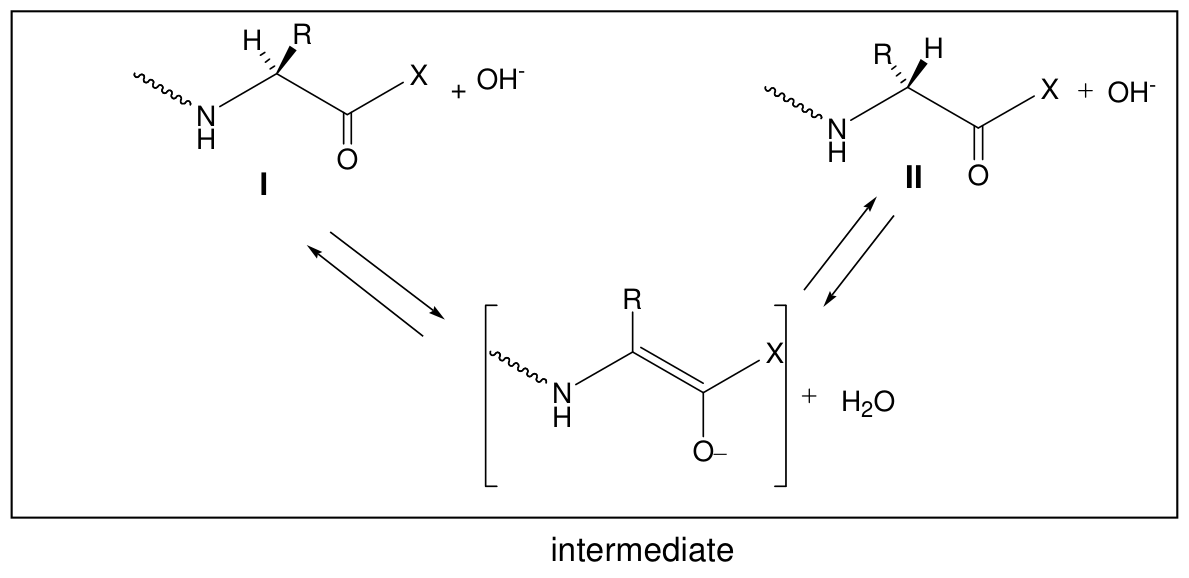
1. Draw stereochemical formulas I and II (with bold and dashed bonds) for the aminoacid components of the mixture that has reached equilibrium through the α-enolization mechanism described above operating on each of the following hydroxyaminoacids A and B:
A: serine (\(\mathrm{R}=\ce{-CH2OH}\))
B: \((2S,3R)\)-threonine (\(\mathrm{R}=\)
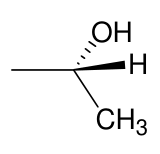
)
2. Mark the box that corresponds to the correct definition of the relationship between the structures you have drawn in each of the above cases A and B.
| enantiomers | diastereomers | |
|---|---|---|
| \(\mathbf{A}_{\mathrm{I,II}}\) | ☐ | ☐ |
| \(\mathbf{B}_{\mathrm{I,II}}\) | ☐ | ☐ |
During peptide synthesis, in order to form a new peptide bond the carboxyl group has to be activated, that is, it must bear a good leaving group, represented in a simplified scheme below:

It is at this stage of the synthesis that a second racemization mechanism may occur; the amidic carbonyl oxygen is five atoms away from the activated carboxyl group and can intramolecularly attack the activated carboxyl forming a five membered cyclic intermediate (an azalactone) which quickly equilibrates its hydrogen at the stereogenic center, represented in a simplified scheme below:
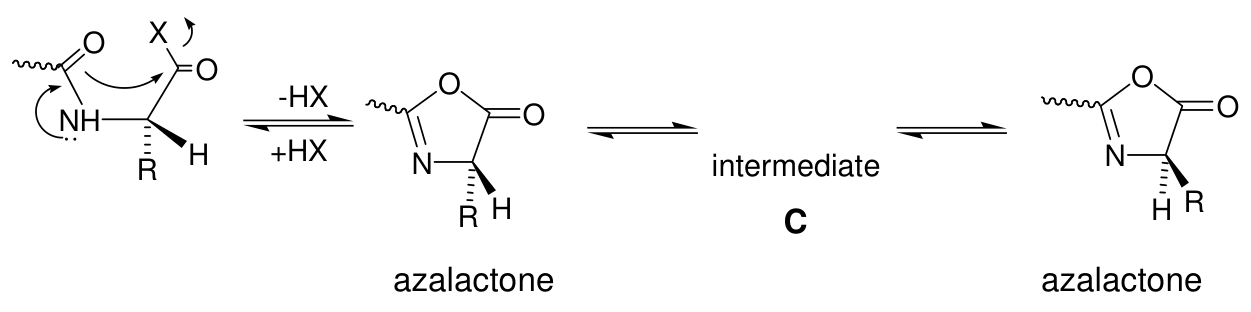
3. Write the structural formula for the intermediate C that interconverts the two azalactones and thus explains the scrambling of the stereochemistry at the stereogenic center.
Azalactones are very reactive substances that can still react with the amino group of an aminoacid. Therefore, the coupling reaction can proceed to completion albeit affording racemized or epimerized products.
4. If N-benzoyl glycine, \(\ce{C9H9NO3}\), is warmed to \(40\,^\circ\mathrm{C}\) with acetic anhydride it is converted into a highly reactive substance, \(\ce{C9H7NO2}\) (P₁).
a) Propose a structure for substance P₁.
b) Write the reaction product(s) of the substance P₁ with S-alanine ethyl ester (P₂) (the side chain R of the aminoacid alanine is a methyl group) using stereochemical formulas (with bold and dashed bonds) for both reactants and product.
Official English text of the problem.
Answers
- A — serine:
- I: \((2S)\)-serine,
N[C@@H](CO)C(=O)O. - II: \((2R)\)-serine,N[C@H](CO)C(=O)O.
B — threonine:
- I: \((2S,3R)\)-threonine, N[C@@H]([C@H](O)C)C(=O)O.
- II: \((2R,3R)\)-allo-threonine, N[C@H]([C@H](O)C)C(=O)O.
Precise wedge-and-dash drawing instructions are given below.
-
A: enantiomers. B: diastereomers, specifically epimers at C2.
-
C: the planar enol tautomer, a 2,4-disubstituted-1,3-oxazol-5-ol,
*C1=NC(*)=C(O)O1. The first*represents the substituent from the N-acyl group; the second represents the aminoacid side chain R. -
(a) P₁: 2-phenyl-1,3-oxazol-5(4H)-one, the glycine-derived azlactone,
O=C1CN=C(c2ccccc2)O1.
(b) P₂: ethyl \((2S)\)-2-aminopropanoate, N[C@@H](C)C(=O)OCC.
The single coupling product is N-benzoylglycyl-\((S)\)-alanine ethyl ester, O=C(c1ccccc1)NCC(=O)N[C@@H](C)C(=O)OCC. Its alanine stereocenter remains \(S\).
Solution
1. Stereochemical products of α-enolization
Removal of the α-hydrogen gives an intermediate whose α-carbon is trigonal planar. Reprotonation from either face restores a tetrahedral carbon and produces either configuration at that carbon.
For both aminoacids, the priority order at C2 is
\[ \ce{NH2}>\ce{COOH}>\text{side chain}>\ce{H}. \]
The carboxyl carbon outranks the side-chain carbon because its attached-atom list, counting the carbonyl double bond according to the CIP rules, is \((\mathrm{O,O,O})\). The corresponding lists for the serine and threonine side chains are \((\mathrm{O,H,H})\) and \((\mathrm{O,C,H})\), respectively.
A: serine. Serine has only one stereogenic center. Enolization therefore interconverts \((2S)\)-serine and \((2R)\)-serine. In an achiral medium, their equilibrium mixture is racemic.
B: threonine. The stated mechanism removes the hydrogen at C2. It does not change the configuration of the side-chain carbon C3. Consequently,
\[ (2S,3R)\ \rightleftharpoons\ (2R,3R). \]
The second component is \((2R,3R)\)-allo-threonine. The two components need not occur in a \(1:1\) equilibrium ratio because they are diastereomers.
For the requested drawings, use the following precise convention. Ordinary bonds lie in the page; a solid wedge points toward the viewer, and a dashed wedge points away.
- At C2, draw the bond to the carboxyl carbon down-left and the bond to the side chain down-right, both in the page.
- For I, draw \(\ce{NH2}\) up-right on a solid wedge and \(\ce{H}\) up-left on a dashed wedge. This gives \(2S\).
- For II, draw \(\ce{NH2}\) up-left on a dashed wedge and \(\ce{H}\) up-right on a solid wedge. This gives \(2R\).
- For threonine, continue the drawing at C3 with its bond to C2 up-left and its bond to \(\ce{CH3}\) up-right, both in the page. Draw \(\ce{OH}\) down-right on a solid wedge and \(\ce{H}\) down-left on a dashed wedge. Keep this arrangement in both B-I and B-II: it gives \(3R\).
These structures are written in the neutral aminoacid form; protonation state does not alter the stereochemical conclusions.
2. Relationships between the products
For serine, inversion of its only stereogenic center produces its nonsuperimposable mirror image. The pair consists of enantiomers.
For threonine, C2 is inverted while C3 retains its configuration. The products are therefore diastereomers, specifically C2 epimers.
The completed boxes are:
| enantiomers | diastereomers | |
|---|---|---|
| \(\mathbf{A}_{\mathrm{I,II}}\) | ☒ | ☐ |
| \(\mathbf{B}_{\mathrm{I,II}}\) | ☐ | ☒ |
3. Intermediate C
Number the azlactone ring consecutively as O1–C2–N3–C4–C5. The aminoacid α-carbon becomes ring carbon C4.
Enolization transfers the C4 hydrogen to the carbonyl oxygen, changing the C4–C5 bond into a double bond and the C5 carbonyl into an hydroxyl group. The resulting neutral intermediate is the 2,4-disubstituted-1,3-oxazol-5-ol identified above:
*C1=NC(*)=C(O)O1
To draw it, construct a five-membered ring with these successive bonds and substituents:
- O1–C2, with the original N-acyl substituent attached to C2;
- C2=N3;
- N3–C4, with side chain R attached to C4;
- C4=C5, with \(\ce{OH}\) attached to C5;
- C5–O1, closing the ring.
C4 has no hydrogen in this tautomer and is planar, so it has no wedge or dashed bond specifying a configuration. On returning to the carbonyl form, protonation at C4 can occur from either face.
Under basic conditions, the corresponding azlactone enolate, *C1=NC(*)=C([O-])O1, provides the same loss of configuration at C4. Its negative charge is delocalized; the displayed SMILES gives the oxygen-charged resonance form.
4(a). Identification and formation of P₁
The starting material is N-benzoylglycine (hippuric acid), O=C(O)CNC(=O)c1ccccc1.
The formula change
\[ \ce{C9H9NO3 -> C9H7NO2 + H2O} \]
corresponds formally to loss of one molecule of water, O. This is consistent with cyclodehydration to an azlactone.
Acetic anhydride, CC(=O)OC(=O)C, activates the carboxyl group. The benzamide carbonyl oxygen attacks the activated carboxyl carbon intramolecularly. Elimination and proton transfer then form 2-phenyl-1,3-oxazol-5(4H)-one, \(P_1\):
O=C1CN=C(c2ccccc2)O1
For its drawing, the five-membered ring has the successive atoms and bonds O1–C2=N3–C4–C5–O1. Attach a phenyl group to C2, draw C4 as \(\ce{CH2}\), and draw a carbonyl oxygen double-bonded to C5. There is no stereogenic center in \(P_1\).
With acetic anhydride included, the balanced overall reaction produces acetic acid, CC(=O)O:
\[ \boxed{ \ce{C9H9NO3 + (CH3CO)2O -> C9H7NO2 + 2CH3COOH} } \qquad (40\,^\circ\mathrm{C}). \]
4(b). Reaction with S-alanine ethyl ester
The amino nitrogen of ethyl \((2S)\)-2-aminopropanoate, \(P_2\), attacks the C5 carbonyl of \(P_1\). Collapse of the tetrahedral intermediate breaks the C5–O1 ring bond. Proton transfers restore the benzamide carbonyl and give the peptide:
\[ \boxed{ \ce{C9H7NO2 + H2NCH(CH3)COOCH2CH3 -> C6H5CONHCH2CONHCH(CH3)COOCH2CH3} } \]
The product is N-benzoylglycyl-\((S)\)-alanine ethyl ester:
O=C(c1ccccc1)NCC(=O)N[C@@H](C)C(=O)OCC
All atoms of the two reactants are retained. The molecular-formula balance is
\[ \ce{C9H7NO2 + C5H11NO2 -> C14H18N2O4}. \]
For the stereochemical drawings of \(P_2\) and the product, place the alanine α-carbon’s bond to the ester carbonyl down-left and its bond to \(\ce{CH3}\) down-right, both in the page. Draw its bond to nitrogen up-right on a solid wedge and its bond to hydrogen up-left on a dashed wedge. This gives \(S\) in both structures. The nitrogen bears two hydrogens in \(P_2\); in the product, it bears one hydrogen and the acyl group \(\ce{-C(=O)CH2NHC(=O)C6H5}\).
The glycine residue remains \(\ce{CH2}\) and cannot become a stereogenic center. The alanine stereocenter is retained during coupling. Thus the specified azlactone pathway gives one stereochemical product.
The solution was checked against the official solution.
IChO 2003 · Theorieaufgabe 33
Peptide
Die Racemisierung von α-Aminosäuren und Peptiden kann über einen α-Enolisierungsmechanismus erfolgen; sowohl Wärme als auch die Anwesenheit starker Basen beschleunigen den Vorgang erheblich:
1. Zeichnen Sie die stereochemischen Formeln I und II (mit ausgefüllten und gestrichelten Keilbindungen) der Aminosäurekomponenten des Gemisches, das durch den oben beschriebenen α-Enolisierungsmechanismus aus jeder der folgenden Hydroxyaminosäuren A und B im Gleichgewicht entsteht:
A: Serin (\(\mathrm{R}=\ce{-CH2OH}\))
B: \((2S,3R)\)-Threonin (\(\mathrm{R}=\)
)
2. Kreuzen Sie das Kästchen an, das die Beziehung zwischen den von Ihnen gezeichneten Strukturen für die beiden obigen Fälle A und B korrekt bezeichnet.
| Enantiomere | Diastereomere | |
|---|---|---|
| \(\mathbf{A}_{\mathrm{I,II}}\) | ☐ | ☐ |
| \(\mathbf{B}_{\mathrm{I,II}}\) | ☐ | ☐ |
Bei der Peptidsynthese muss die Carboxylgruppe aktiviert werden, um eine neue Peptidbindung zu bilden; das heißt, sie muss eine gute Abgangsgruppe tragen, wie im folgenden vereinfachten Schema dargestellt:
In diesem Stadium der Synthese kann ein zweiter Racemisierungsmechanismus auftreten; das Carbonylsauerstoffatom der Amidgruppe ist fünf Atome von der aktivierten Carboxylgruppe entfernt und kann diese intramolekular angreifen. Dabei entsteht ein fünfgliedriges cyclisches Zwischenprodukt (ein Azlacton), dessen Wasserstoffatom am stereogenen Zentrum rasch eine Gleichgewichtseinstellung ermöglicht, wie im folgenden vereinfachten Schema dargestellt:
3. Geben Sie die Strukturformel des Zwischenprodukts C an, über das die beiden Azlactone ineinander übergehen und das somit die Aufhebung der stereochemischen Einheitlichkeit am stereogenen Zentrum erklärt.
Azlactone sind sehr reaktive Substanzen, die weiterhin mit der Aminogruppe einer Aminosäure reagieren können. Daher kann die Kupplungsreaktion vollständig ablaufen, wobei allerdings racemisierte oder epimerisierte Produkte entstehen.
4. Wird N-Benzoylglycin, \(\ce{C9H9NO3}\), mit Essigsäureanhydrid auf \(40\,^\circ\mathrm{C}\) erwärmt, so wird es in eine hochreaktive Substanz, \(\ce{C9H7NO2}\) (P₁), umgewandelt.
a) Schlagen Sie eine Struktur für die Substanz P₁ vor.
b) Geben Sie das Reaktionsprodukt bzw. die Reaktionsprodukte der Substanz P₁ mit S-Alaninethylester (P₂) an (die Seitenkette R der Aminosäure Alanin ist eine Methylgruppe). Verwenden Sie dabei stereochemische Formeln (mit ausgefüllten und gestrichelten Keilbindungen) sowohl für die Edukte als auch für das Produkt.
Aufgabentext aus dem offiziellen englischen Text übersetzt.
Antworten
- A — Serin:
- I: \((2S)\)-Serin,
N[C@@H](CO)C(=O)O. - II: \((2R)\)-Serin,N[C@H](CO)C(=O)O.
B — Threonin:
- I: \((2S,3R)\)-Threonin, N[C@@H]([C@H](O)C)C(=O)O.
- II: \((2R,3R)\)-allo-Threonin, N[C@H]([C@H](O)C)C(=O)O.
Genaue Anweisungen zum Zeichnen mit ausgefüllten und gestrichelten Keilen sind weiter unten angegeben.
-
A: Enantiomere. B: Diastereomere, genauer gesagt Epimere an C2.
-
C: das planare Enol-Tautomer, ein 2,4-disubstituiertes 1,3-Oxazol-5-ol,
*C1=NC(*)=C(O)O1. Das erste*steht für den Substituenten aus der N-Acylgruppe; das zweite steht für die Aminosäureseitenkette R. -
(a) P₁: 2-Phenyl-1,3-oxazol-5(4H)-on, das vom Glycin abgeleitete Azlacton,
O=C1CN=C(c2ccccc2)O1.
(b) P₂: Ethyl-\((2S)\)-2-aminopropanoat, N[C@@H](C)C(=O)OCC.
Das einzige Kupplungsprodukt ist N-Benzoylglycyl-\((S)\)-alaninethylester, O=C(c1ccccc1)NCC(=O)N[C@@H](C)C(=O)OCC. Sein Alanin-Stereozentrum behält die Konfiguration \(S\).
Lösung
1. Stereochemische Produkte der α-Enolisierung
Die Abspaltung des α-Wasserstoffatoms ergibt ein Zwischenprodukt, dessen α-Kohlenstoffatom trigonal-planar ist. Durch erneute Protonierung von einer der beiden Seiten entsteht wieder ein tetraedrisches Kohlenstoffatom, wobei an diesem Kohlenstoffatom jede der beiden Konfigurationen gebildet werden kann.
Für beide Aminosäuren lautet die Prioritätsreihenfolge an C2
\[ \ce{NH2}>\ce{COOH}>\text{Seitenkette}>\ce{H}. \]
Das Carboxylkohlenstoffatom hat eine höhere Priorität als das Kohlenstoffatom der Seitenkette, weil die Liste seiner gebundenen Atome unter Berücksichtigung der Carbonyldoppelbindung gemäß den CIP-Regeln \((\mathrm{O,O,O})\) lautet. Die entsprechenden Listen für die Seitenketten von Serin und Threonin lauten \((\mathrm{O,H,H})\) bzw. \((\mathrm{O,C,H})\).
A: Serin. Serin besitzt nur ein stereogenes Zentrum. Durch Enolisierung gehen daher \((2S)\)-Serin und \((2R)\)-Serin ineinander über. In einem achiralen Medium ist ihr Gleichgewichtsgemisch racemisch.
B: Threonin. Bei dem angegebenen Mechanismus wird das Wasserstoffatom an C2 abgespalten. Die Konfiguration des Seitenkettenkohlenstoffatoms C3 wird dadurch nicht verändert. Folglich gilt
\[ (2S,3R)\ \rightleftharpoons\ (2R,3R). \]
Die zweite Komponente ist \((2R,3R)\)-allo-Threonin. Die beiden Komponenten müssen im Gleichgewicht nicht in einem Verhältnis von \(1:1\) vorliegen, da sie Diastereomere sind.
Verwenden Sie für die geforderten Zeichnungen die folgende genaue Konvention. Gewöhnliche Bindungen liegen in der Zeichenebene; ein ausgefüllter Keil zeigt zum Betrachter hin, ein gestrichelter Keil vom Betrachter weg.
- Zeichnen Sie an C2 die Bindung zum Carboxylkohlenstoffatom nach links unten und die Bindung zur Seitenkette nach rechts unten, beide in der Zeichenebene.
- Zeichnen Sie für I \(\ce{NH2}\) an einem ausgefüllten Keil nach rechts oben und \(\ce{H}\) an einem gestrichelten Keil nach links oben. Dies ergibt \(2S\).
- Zeichnen Sie für II \(\ce{NH2}\) an einem gestrichelten Keil nach links oben und \(\ce{H}\) an einem ausgefüllten Keil nach rechts oben. Dies ergibt \(2R\).
- Setzen Sie die Zeichnung für Threonin an C3 fort: Zeichnen Sie dessen Bindung zu C2 nach links oben und dessen Bindung zu \(\ce{CH3}\) nach rechts oben, beide in der Zeichenebene. Zeichnen Sie \(\ce{OH}\) an einem ausgefüllten Keil nach rechts unten und \(\ce{H}\) an einem gestrichelten Keil nach links unten. Behalten Sie diese Anordnung sowohl in B-I als auch in B-II bei: Sie ergibt \(3R\).
Diese Strukturen sind in der neutralen Aminosäureform dargestellt; der Protonierungszustand ändert die stereochemischen Schlussfolgerungen nicht.
2. Beziehungen zwischen den Produkten
Bei Serin entsteht durch Inversion seines einzigen stereogenen Zentrums sein nicht zur Deckung zu bringendes Spiegelbild. Das Paar besteht aus Enantiomeren.
Bei Threonin wird C2 invertiert, während C3 seine Konfiguration beibehält. Die Produkte sind daher Diastereomere, genauer gesagt C2-Epimere.
Die angekreuzten Kästchen sind:
| Enantiomere | Diastereomere | |
|---|---|---|
| \(\mathbf{A}_{\mathrm{I,II}}\) | ☒ | ☐ |
| \(\mathbf{B}_{\mathrm{I,II}}\) | ☐ | ☒ |
3. Zwischenprodukt C
Nummerieren Sie den Azlactonring fortlaufend als O1–C2–N3–C4–C5. Das α-Kohlenstoffatom der Aminosäure wird zum Ringkohlenstoffatom C4.
Durch Enolisierung wird das Wasserstoffatom an C4 auf das Carbonylsauerstoffatom übertragen, wobei die C4–C5-Bindung in eine Doppelbindung und die Carbonylgruppe an C5 in eine Hydroxygruppe umgewandelt wird. Das entstehende neutrale Zwischenprodukt ist das oben angegebene 2,4-disubstituierte 1,3-Oxazol-5-ol:
*C1=NC(*)=C(O)O1
Zeichnen Sie dazu einen fünfgliedrigen Ring mit den folgenden aufeinanderfolgenden Bindungen und Substituenten:
- O1–C2, mit dem ursprünglichen N-Acylsubstituenten an C2;
- C2=N3;
- N3–C4, mit der Seitenkette R an C4;
- C4=C5, mit \(\ce{OH}\) an C5;
- C5–O1, wodurch der Ring geschlossen wird.
C4 trägt in diesem Tautomer kein Wasserstoffatom und ist planar; daher besitzt es keine ausgefüllte oder gestrichelte Keilbindung, die eine Konfiguration festlegt. Bei der Rückbildung der Carbonylform kann die Protonierung an C4 von beiden Seiten erfolgen.
Unter basischen Bedingungen führt das entsprechende Azlacton-Enolat, *C1=NC(*)=C([O-])O1, zum gleichen Verlust der Konfiguration an C4. Seine negative Ladung ist delokalisiert; der angegebene SMILES stellt die mesomere Grenzstruktur mit der Ladung am Sauerstoff dar.
4(a). Identifizierung und Bildung von P₁
Die Ausgangssubstanz ist N-Benzoylglycin (Hippursäure), O=C(O)CNC(=O)c1ccccc1.
Die Änderung der Summenformel
\[ \ce{C9H9NO3 -> C9H7NO2 + H2O} \]
entspricht formal der Abspaltung eines Moleküls Wasser, O. Dies steht mit einer Cyclodehydratisierung zu einem Azlacton im Einklang.
Essigsäureanhydrid, CC(=O)OC(=O)C, aktiviert die Carboxylgruppe. Das Carbonylsauerstoffatom der Benzamidgruppe greift das aktivierte Carboxylkohlenstoffatom intramolekular an. Durch Eliminierung und Protonenübertragung entsteht anschließend 2-Phenyl-1,3-oxazol-5(4H)-on, \(P_1\):
O=C1CN=C(c2ccccc2)O1
Für die Zeichnung weist der fünfgliedrige Ring die aufeinanderfolgenden Atome und Bindungen O1–C2=N3–C4–C5–O1 auf. Fügen Sie an C2 eine Phenylgruppe an, zeichnen Sie C4 als \(\ce{CH2}\) und ein Carbonylsauerstoffatom mit einer Doppelbindung an C5. In \(P_1\) gibt es kein stereogenes Zentrum.
Unter Einbeziehung von Essigsäureanhydrid entsteht in der ausgeglichenen Gesamtreaktion Essigsäure, CC(=O)O:
\[ \boxed{ \ce{C9H9NO3 + (CH3CO)2O -> C9H7NO2 + 2CH3COOH} } \qquad (40\,^\circ\mathrm{C}). \]
4(b). Reaktion mit S-Alaninethylester
Das Aminostickstoffatom von Ethyl-\((2S)\)-2-aminopropanoat, \(P_2\), greift die Carbonylgruppe an C5 von \(P_1\) an. Beim Zerfall des tetraedrischen Zwischenprodukts wird die C5–O1-Ringbindung gespalten. Protonenübertragungen stellen die Carbonylgruppe der Benzamidgruppe wieder her und ergeben das Peptid:
\[ \boxed{ \ce{C9H7NO2 + H2NCH(CH3)COOCH2CH3 -> C6H5CONHCH2CONHCH(CH3)COOCH2CH3} } \]
Das Produkt ist N-Benzoylglycyl-\((S)\)-alaninethylester:
O=C(c1ccccc1)NCC(=O)N[C@@H](C)C(=O)OCC
Alle Atome der beiden Edukte bleiben erhalten. Die Summenformelbilanz lautet
\[ \ce{C9H7NO2 + C5H11NO2 -> C14H18N2O4}. \]
Zeichnen Sie für die stereochemischen Darstellungen von \(P_2\) und dem Produkt die Bindung des α-Kohlenstoffatoms des Alanins zum Estercarbonylkohlenstoffatom nach links unten und seine Bindung zu \(\ce{CH3}\) nach rechts unten, beide in der Zeichenebene. Zeichnen Sie seine Bindung zum Stickstoff an einem ausgefüllten Keil nach rechts oben und seine Bindung zum Wasserstoff an einem gestrichelten Keil nach links oben. Dies ergibt in beiden Strukturen \(S\). Der Stickstoff trägt in \(P_2\) zwei Wasserstoffatome; im Produkt trägt er ein Wasserstoffatom und die Acylgruppe \(\ce{-C(=O)CH2NHC(=O)C6H5}\).
Der Glycinrest bleibt \(\ce{CH2}\) und kann kein stereogenes Zentrum bilden. Das Alanin-Stereozentrum bleibt während der Kupplung erhalten. Somit ergibt der angegebene Azlacton-Reaktionsweg ein einziges stereochemisches Produkt.
Die Lösung wurde mit der offiziellen Lösung abgeglichen.
IChO 2003 · Teori sorusu 33
Peptitler
α-amino asitlerin ve peptitlerin rasemleşmesi, bir α-enolleşme mekanizmasıyla gerçekleşebilir ve hem ısı hem de kuvvetli bazların varlığı bu süreci büyük ölçüde hızlandırır:
1. Yukarıda açıklanan α-enolleşme mekanizmasının aşağıdaki hidroksiamino asitler A ve B'nin her birine uygulanmasıyla dengeye ulaşan karışımın amino asit bileşenleri için I ve II stereokimyasal formüllerini (kalın ve kesikli bağlarla) çiziniz:
A: serin (\(\mathrm{R}=\ce{-CH2OH}\))
B: \((2S,3R)\)-treonin (\(\mathrm{R}=\)
)
2. Yukarıdaki A ve B durumlarının her birinde çizdiğiniz yapılar arasındaki ilişkiyi doğru tanımlayan kutucuğu işaretleyiniz.
| enantiyomerler | diastereomerler | |
|---|---|---|
| \(\mathbf{A}_{\mathrm{I,II}}\) | ☐ | ☐ |
| \(\mathbf{B}_{\mathrm{I,II}}\) | ☐ | ☐ |
Peptit sentezi sırasında yeni bir peptit bağı oluşturmak için karboksil grubunun etkinleştirilmesi gerekir; yani aşağıdaki basitleştirilmiş şemada gösterildiği gibi iyi bir ayrılan grup taşımalıdır:
Sentezin bu aşamasında ikinci bir rasemleşme mekanizması gerçekleşebilir; amidik karbonil oksijeni, etkinleştirilmiş karboksil grubundan beş atom uzaktadır ve etkinleştirilmiş karboksile molekül içi saldırıda bulunarak beş üyeli halkalı bir ara ürün (bir azlakton) oluşturabilir. Bu ara ürünün stereojenik merkezindeki hidrojen, aşağıdaki basitleştirilmiş şemada gösterildiği gibi hızla dengeye ulaşır:
3. İki azlaktonun birbirine dönüşmesini sağlayan ve böylece stereojenik merkezdeki stereokimyanın karışmasını açıklayan C ara ürününün yapı formülünü yazınız.
Azlaktonlar, bir amino asidin amino grubuyla hâlâ tepkimeye girebilen, çok reaktif maddelerdir. Bu nedenle kenetlenme tepkimesi, rasemleşmiş veya epimerleşmiş ürünler verse de tamamlanabilir.
4. N-benzoil glisin, \(\ce{C9H9NO3}\), asetik anhidrit ile \(40\,^\circ\mathrm{C}\)'ye ısıtılırsa oldukça reaktif bir maddeye, \(\ce{C9H7NO2}\) (P₁), dönüşür.
a) P₁ maddesi için bir yapı öneriniz.
b) P₁ maddesinin S-alanin etil esteri (P₂) ile tepkimesinin ürününü veya ürünlerini (alanin amino asidinin R yan zinciri bir metil grubudur), hem reaktanlar hem de ürün için stereokimyasal formüller (kalın ve kesikli bağlarla) kullanarak yazınız.
Soru metni resmi İngilizce metinden çevrilmiştir.
Cevaplar
- A — serin:
- I: \((2S)\)-serin,
N[C@@H](CO)C(=O)O. - II: \((2R)\)-serin,N[C@H](CO)C(=O)O.
B — treonin:
- I: \((2S,3R)\)-treonin, N[C@@H]([C@H](O)C)C(=O)O.
- II: \((2R,3R)\)-allo-treonin, N[C@H]([C@H](O)C)C(=O)O.
Dolu ve kesikli kama bağlarıyla çizim için ayrıntılı yönergeler aşağıda verilmiştir.
-
A: enantiyomerler. B: diastereomerler, daha özel olarak C2 epimerleri.
-
C: düzlemsel enol tautomeri, bir 2,4-disübstitüe-1,3-oksazol-5-ol,
*C1=NC(*)=C(O)O1. İlk*, N-açil grubundan gelen sübstitüenti; ikincisi ise amino asidin R yan zincirini temsil eder. -
(a) P₁: 2-fenil-1,3-oksazol-5(4H)-on, glisinden türeyen azlakton,
O=C1CN=C(c2ccccc2)O1.
(b) P₂: etil \((2S)\)-2-aminopropanoat, N[C@@H](C)C(=O)OCC.
Tek kenetlenme ürünü N-benzoilglisil-\((S)\)-alanin etil esteri, O=C(c1ccccc1)NCC(=O)N[C@@H](C)C(=O)OCC'dir. Alanin stereomerkezi \(S\) olarak kalır.
Çözüm
1. α-enolleşmenin stereokimyasal ürünleri
α-hidrojenin uzaklaştırılması, α-karbonu üçgen düzlemsel olan bir ara ürün verir. Her iki yüzden yeniden protonlanma, tetrahedral bir karbonu yeniden oluşturur ve bu karbonda iki konfigürasyondan birini meydana getirir.
Her iki amino asit için C2'deki öncelik sırası şöyledir:
\[ \ce{NH2}>\ce{COOH}>\text{yan zincir}>\ce{H}. \]
Karboksil karbonu, yan zincir karbonundan daha yüksek önceliğe sahiptir; çünkü karbonil çift bağı CIP kurallarına göre sayıldığında, karboksil karbonuna bağlı atomların listesi \((\mathrm{O,O,O})\)'dur. Serin ve treonin yan zincirleri için karşılık gelen listeler sırasıyla \((\mathrm{O,H,H})\) ve \((\mathrm{O,C,H})\)'dir.
A: serin. Serinin yalnızca bir stereojenik merkezi vardır. Bu nedenle enolleşme, \((2S)\)-serin ile \((2R)\)-serinin birbirine dönüşmesini sağlar. Akiral bir ortamda bunların denge karışımı rasemiktir.
B: treonin. Belirtilen mekanizma, C2'deki hidrojeni uzaklaştırır. Yan zincir karbonu C3'ün konfigürasyonunu değiştirmez. Dolayısıyla,
\[ (2S,3R)\ \rightleftharpoons\ (2R,3R). \]
İkinci bileşen \((2R,3R)\)-allo-treonindir. İki bileşen diastereomer oldukları için dengede \(1:1\) oranında bulunmaları gerekmez.
İstenen çizimler için aşağıdaki kesin gösterim kuralını kullanınız. Normal bağlar sayfa düzleminde yer alır; dolu kama gözlemciye doğru, kesikli kama ise gözlemciden uzağa yönelir.
- C2'de, karboksil karbonuna giden bağı sol aşağıya, yan zincire giden bağı sağ aşağıya doğru, her ikisi de sayfa düzleminde olacak şekilde çiziniz.
- I için \(\ce{NH2}\)'yi sağ yukarıya doğru dolu kama üzerinde, \(\ce{H}\)'yi sol yukarıya doğru kesikli kama üzerinde çiziniz. Bu, \(2S\) konfigürasyonunu verir.
- II için \(\ce{NH2}\)'yi sol yukarıya doğru kesikli kama üzerinde, \(\ce{H}\)'yi sağ yukarıya doğru dolu kama üzerinde çiziniz. Bu, \(2R\) konfigürasyonunu verir.
- Treonin için çizime C3'te devam ediniz; C2'ye giden bağını sol yukarıya, \(\ce{CH3}\)'e giden bağını sağ yukarıya doğru, her ikisi de sayfa düzleminde olacak şekilde çiziniz. \(\ce{OH}\)'yi sağ aşağıya doğru dolu kama üzerinde, \(\ce{H}\)'yi sol aşağıya doğru kesikli kama üzerinde çiziniz. Bu düzeni hem B-I hem de B-II'de koruyunuz: bu, \(3R\) konfigürasyonunu verir.
Bu yapılar nötr amino asit biçiminde yazılmıştır; protonlanma durumu stereokimyasal sonuçları değiştirmez.
2. Ürünler arasındaki ilişkiler
Serinde, tek stereojenik merkezin tersine çevrilmesi, üst üste çakıştırılamayan ayna görüntüsünü oluşturur. Bu çift enantiyomerlerden oluşur.
Treoninde C2 tersine çevrilirken C3 konfigürasyonunu korur. Dolayısıyla ürünler diastereomerler, daha özel olarak C2 epimerleridir.
İşaretlenmiş kutucuklar şöyledir:
| enantiyomerler | diastereomerler | |
|---|---|---|
| \(\mathbf{A}_{\mathrm{I,II}}\) | ☒ | ☐ |
| \(\mathbf{B}_{\mathrm{I,II}}\) | ☐ | ☒ |
3. C ara ürünü
Azlakton halkasını sırasıyla O1–C2–N3–C4–C5 olarak numaralandırınız. Amino asidin α-karbonu, halkanın C4 karbonu olur.
Enolleşme, C4 hidrojenini karbonil oksijenine aktararak C4–C5 bağını çift bağa, C5 karbonilini ise hidroksil grubuna dönüştürür. Oluşan nötr ara ürün, yukarıda tanımlanan 2,4-disübstitüe-1,3-oksazol-5-oldür:
*C1=NC(*)=C(O)O1
Bunu çizmek için aşağıdaki ardışık bağları ve sübstitüentleri içeren beş üyeli bir halka oluşturunuz:
- O1–C2; başlangıçtaki N-açil sübstitüenti C2'ye bağlı olacak şekilde;
- C2=N3;
- N3–C4; R yan zinciri C4'e bağlı olacak şekilde;
- C4=C5; \(\ce{OH}\), C5'e bağlı olacak şekilde;
- halkayı kapatan C5–O1.
Bu tautomerin C4 atomunda hidrojen yoktur ve C4 düzlemseldir; bu nedenle konfigürasyon belirten dolu veya kesikli kama bağı bulunmaz. Karbonil biçimine dönüş sırasında C4'te protonlanma her iki yüzden de gerçekleşebilir.
Bazik koşullarda, karşılık gelen azlakton enolatı, *C1=NC(*)=C([O-])O1, C4'te aynı konfigürasyon kaybını sağlar. Negatif yükü delokalizedir; gösterilen SMILES, yükün oksijen üzerinde olduğu rezonans biçimini verir.
4(a). P₁'in tanımlanması ve oluşumu
Başlangıç maddesi N-benzoilglisin (hipürik asit), O=C(O)CNC(=O)c1ccccc1'dir.
Formül değişimi
\[ \ce{C9H9NO3 -> C9H7NO2 + H2O} \]
biçimsel olarak bir su, O, molekülünün kaybına karşılık gelir. Bu, bir azlakton oluşturmak üzere siklodehidrasyonla uyumludur.
Asetik anhidrit, CC(=O)OC(=O)C, karboksil grubunu etkinleştirir. Benzamidin karbonil oksijeni, etkinleştirilmiş karboksil karbonuna molekül içi saldırıda bulunur. Ardından eliminasyon ve proton aktarımı, 2-fenil-1,3-oksazol-5(4H)-on, \(P_1\), oluşturur:
O=C1CN=C(c2ccccc2)O1
Çiziminde, beş üyeli halkadaki ardışık atomlar ve bağlar O1–C2=N3–C4–C5–O1 şeklindedir. C2'ye bir fenil grubu bağlayınız, C4'ü \(\ce{CH2}\) olarak çiziniz ve C5'e çift bağla bağlı bir karbonil oksijeni çiziniz. \(P_1\)'de stereojenik merkez yoktur.
Asetik anhidrit de dâhil edildiğinde, denkleştirilmiş toplam tepkimede asetik asit, CC(=O)O, oluşur:
\[ \boxed{ \ce{C9H9NO3 + (CH3CO)2O -> C9H7NO2 + 2CH3COOH} } \qquad (40\,^\circ\mathrm{C}). \]
4(b). S-alanin etil esteri ile tepkime
Etil \((2S)\)-2-aminopropanoatın, \(P_2\), amino azotu, \(P_1\)'in C5 karboniline saldırır. Tetrahedral ara ürünün çökmesi, C5–O1 halka bağını koparır. Proton aktarımları, benzamid karbonilini yeniden oluşturur ve peptidi verir:
\[ \boxed{ \ce{C9H7NO2 + H2NCH(CH3)COOCH2CH3 -> C6H5CONHCH2CONHCH(CH3)COOCH2CH3} } \]
Ürün N-benzoilglisil-\((S)\)-alanin etil esteridir:
O=C(c1ccccc1)NCC(=O)N[C@@H](C)C(=O)OCC
İki reaktanın tüm atomları korunur. Molekül formülleri açısından denklik şöyledir:
\[ \ce{C9H7NO2 + C5H11NO2 -> C14H18N2O4}. \]
\(P_2\)'nin ve ürünün stereokimyasal çizimleri için alanin α-karbonunun ester karboniline giden bağını sol aşağıya, \(\ce{CH3}\)'e giden bağını sağ aşağıya doğru, her ikisi de sayfa düzleminde olacak şekilde yerleştiriniz. Azota giden bağını sağ yukarıya doğru dolu kama üzerinde, hidrojene giden bağını sol yukarıya doğru kesikli kama üzerinde çiziniz. Bu, her iki yapıda da \(S\) konfigürasyonunu verir. Azot, \(P_2\)'de iki hidrojen taşır; üründe ise bir hidrojen ve \(\ce{-C(=O)CH2NHC(=O)C6H5}\) açil grubunu taşır.
Glisin kalıntısı \(\ce{CH2}\) olarak kalır ve stereojenik bir merkeze dönüşemez. Alanin stereomerkezi kenetlenme sırasında korunur. Dolayısıyla belirtilen azlakton yolu tek bir stereokimyasal ürün verir.
Çözüm, resmi çözümle karşılaştırılarak kontrol edildi.
IChO 2003 · Problema teórico 33
Péptidos
La racemización de los α-aminoácidos y los péptidos puede producirse mediante un mecanismo de α-enolización, y tanto el calor como la presencia de bases fuertes aceleran considerablemente el proceso:
1. Dibuje las fórmulas estereoquímicas I y II (con enlaces en cuña sólida y discontinua) de los aminoácidos que componen la mezcla que ha alcanzado el equilibrio mediante el mecanismo de α-enolización descrito anteriormente, aplicado a cada uno de los siguientes hidroxiaminoácidos A y B:
A: serina (\(\mathrm{R}=\ce{-CH2OH}\))
B: \((2S,3R)\)-treonina (\(\mathrm{R}=\)
)
2. Marque la casilla que corresponda a la definición correcta de la relación entre las estructuras que ha dibujado en cada uno de los casos A y B anteriores.
| enantiómeros | diastereómeros | |
|---|---|---|
| \(\mathbf{A}_{\mathrm{I,II}}\) | ☐ | ☐ |
| \(\mathbf{B}_{\mathrm{I,II}}\) | ☐ | ☐ |
Durante la síntesis de péptidos, para formar un nuevo enlace peptídico es necesario activar el grupo carboxilo, es decir, este debe poseer un buen grupo saliente, tal como se representa en el siguiente esquema simplificado:
En esta etapa de la síntesis puede producirse un segundo mecanismo de racemización; el oxígeno carbonílico de la amida se encuentra a cinco átomos de distancia del grupo carboxilo activado y puede atacar intramolecularmente al carboxilo activado, formando un intermedio cíclico de cinco miembros (una azlactona) cuyo hidrógeno en el centro estereogénico se equilibra rápidamente, tal como se representa en el siguiente esquema simplificado:
3. Escriba la fórmula estructural del intermedio C que interconvierte las dos azlactonas y explica así la pérdida de la configuración estereoquímica del centro estereogénico.
Las azlactonas son sustancias muy reactivas que aún pueden reaccionar con el grupo amino de un aminoácido. Por tanto, la reacción de acoplamiento puede llegar a completarse, aunque dé lugar a productos racemizados o epimerizados.
4. Si se calienta N-benzoilglicina, \(\ce{C9H9NO3}\), a \(40\,^\circ\mathrm{C}\) con anhídrido acético, se convierte en una sustancia muy reactiva, \(\ce{C9H7NO2}\) (P₁).
a) Proponga una estructura para la sustancia P₁.
b) Escriba el producto o los productos de la reacción de la sustancia P₁ con el éster etílico de la S-alanina (P₂) (la cadena lateral R del aminoácido alanina es un grupo metilo), utilizando fórmulas estereoquímicas (con enlaces en cuña sólida y discontinua) tanto para los reactivos como para el producto.
Enunciado traducido del texto oficial en inglés.
Respuestas
- A — serina:
- I: \((2S)\)-serina,
N[C@@H](CO)C(=O)O. - II: \((2R)\)-serina,N[C@H](CO)C(=O)O.
B — treonina:
- I: \((2S,3R)\)-treonina, N[C@@H]([C@H](O)C)C(=O)O.
- II: \((2R,3R)\)-alo-treonina, N[C@H]([C@H](O)C)C(=O)O.
Más adelante se dan instrucciones precisas para dibujar los enlaces en cuña sólida y discontinua.
-
A: enantiómeros. B: diastereómeros, concretamente epímeros en C2.
-
C: el tautómero enólico plano, un 1,3-oxazol-5-ol 2,4-disustituido,
*C1=NC(*)=C(O)O1. El primer*representa el sustituyente procedente del grupo N-acilo; el segundo representa la cadena lateral R del aminoácido. -
(a) P₁: 2-fenil-1,3-oxazol-5(4H)-ona, la azlactona derivada de la glicina,
O=C1CN=C(c2ccccc2)O1.
(b) P₂: \((2S)\)-2-aminopropanoato de etilo, N[C@@H](C)C(=O)OCC.
El único producto de acoplamiento es el éster etílico de la N-benzoilglicil-\((S)\)-alanina, O=C(c1ccccc1)NCC(=O)N[C@@H](C)C(=O)OCC. Su estereocentro de alanina conserva la configuración \(S\).
Solución
1. Productos estereoquímicos de la α-enolización
La eliminación del hidrógeno α da lugar a un intermedio cuyo carbono α es trigonal plano. La reprotonación por cualquiera de las dos caras restablece un carbono tetraédrico y produce una u otra configuración en ese carbono.
Para ambos aminoácidos, el orden de prioridad en C2 es
\[ \ce{NH2}>\ce{COOH}>\text{cadena lateral}>\ce{H}. \]
El carbono del carboxilo tiene mayor prioridad que el carbono de la cadena lateral porque su lista de átomos unidos, contando el doble enlace carbonílico según las reglas CIP, es \((\mathrm{O,O,O})\). Las listas correspondientes a las cadenas laterales de la serina y la treonina son \((\mathrm{O,H,H})\) y \((\mathrm{O,C,H})\), respectivamente.
A: serina. La serina tiene un solo centro estereogénico. Por tanto, la enolización interconvierte la \((2S)\)-serina y la \((2R)\)-serina. En un medio aquiral, su mezcla en equilibrio es racémica.
B: treonina. El mecanismo indicado elimina el hidrógeno de C2. No cambia la configuración del carbono C3 de la cadena lateral. En consecuencia,
\[ (2S,3R)\ \rightleftharpoons\ (2R,3R). \]
El segundo componente es la \((2R,3R)\)-alo-treonina. Los dos componentes no tienen por qué encontrarse en una proporción de equilibrio \(1:1\), ya que son diastereómeros.
Para los dibujos solicitados, utilice la siguiente convención precisa. Los enlaces ordinarios se encuentran en el plano de la página; una cuña sólida apunta hacia el observador y una cuña discontinua apunta en sentido contrario.
- En C2, dibuje el enlace con el carbono del carboxilo hacia abajo a la izquierda y el enlace con la cadena lateral hacia abajo a la derecha, ambos en el plano de la página.
- Para I, dibuje \(\ce{NH2}\) hacia arriba a la derecha con una cuña sólida y \(\ce{H}\) hacia arriba a la izquierda con una cuña discontinua. Esto da la configuración \(2S\).
- Para II, dibuje \(\ce{NH2}\) hacia arriba a la izquierda con una cuña discontinua y \(\ce{H}\) hacia arriba a la derecha con una cuña sólida. Esto da la configuración \(2R\).
- Para la treonina, continúe el dibujo en C3 con su enlace con C2 hacia arriba a la izquierda y su enlace con \(\ce{CH3}\) hacia arriba a la derecha, ambos en el plano de la página. Dibuje \(\ce{OH}\) hacia abajo a la derecha con una cuña sólida y \(\ce{H}\) hacia abajo a la izquierda con una cuña discontinua. Mantenga esta disposición tanto en B-I como en B-II: da la configuración \(3R\).
Estas estructuras se escriben en la forma neutra del aminoácido; el estado de protonación no altera las conclusiones estereoquímicas.
2. Relaciones entre los productos
En la serina, la inversión de su único centro estereogénico produce su imagen especular no superponible. El par está formado por enantiómeros.
En la treonina, C2 se invierte mientras que C3 conserva su configuración. Por tanto, los productos son diastereómeros, concretamente epímeros en C2.
Las casillas cumplimentadas son:
| enantiómeros | diastereómeros | |
|---|---|---|
| \(\mathbf{A}_{\mathrm{I,II}}\) | ☒ | ☐ |
| \(\mathbf{B}_{\mathrm{I,II}}\) | ☐ | ☒ |
3. Intermedio C
Numere consecutivamente el anillo de la azlactona como O1–C2–N3–C4–C5. El carbono α del aminoácido se convierte en el carbono C4 del anillo.
La enolización transfiere el hidrógeno de C4 al oxígeno carbonílico, transformando el enlace C4–C5 en un doble enlace y el carbonilo de C5 en un grupo hidroxilo. El intermedio neutro resultante es el 1,3-oxazol-5-ol 2,4-disustituido identificado anteriormente:
*C1=NC(*)=C(O)O1
Para dibujarlo, construya un anillo de cinco miembros con estos enlaces y sustituyentes sucesivos:
- O1–C2, con el sustituyente N-acilo original unido a C2;
- C2=N3;
- N3–C4, con la cadena lateral R unida a C4;
- C4=C5, con \(\ce{OH}\) unido a C5;
- C5–O1, cerrando el anillo.
C4 no tiene hidrógeno en este tautómero y es plano, por lo que no presenta ningún enlace en cuña sólida o discontinua que especifique una configuración. Al volver a la forma carbonílica, la protonación en C4 puede producirse por cualquiera de las dos caras.
En condiciones básicas, el enolato de la azlactona correspondiente, *C1=NC(*)=C([O-])O1, produce la misma pérdida de configuración en C4. Su carga negativa está deslocalizada; el SMILES mostrado representa la forma de resonancia con la carga en el oxígeno.
4(a). Identificación y formación de P₁
El material de partida es la N-benzoilglicina (ácido hipúrico), O=C(O)CNC(=O)c1ccccc1.
El cambio de fórmula
\[ \ce{C9H9NO3 -> C9H7NO2 + H2O} \]
corresponde formalmente a la pérdida de una molécula de agua, O. Esto concuerda con una ciclodeshidratación para formar una azlactona.
El anhídrido acético, CC(=O)OC(=O)C, activa el grupo carboxilo. El oxígeno carbonílico de la benzamida ataca intramolecularmente al carbono del carboxilo activado. A continuación, la eliminación y la transferencia de protones forman la 2-fenil-1,3-oxazol-5(4H)-ona, \(P_1\):
O=C1CN=C(c2ccccc2)O1
Para dibujarla, el anillo de cinco miembros tiene los átomos y enlaces sucesivos O1–C2=N3–C4–C5–O1. Una un grupo fenilo a C2, dibuje C4 como \(\ce{CH2}\) y dibuje un oxígeno carbonílico unido mediante un doble enlace a C5. No hay ningún centro estereogénico en \(P_1\).
Al incluir el anhídrido acético, la reacción global ajustada produce ácido acético, CC(=O)O:
\[ \boxed{ \ce{C9H9NO3 + (CH3CO)2O -> C9H7NO2 + 2CH3COOH} } \qquad (40\,^\circ\mathrm{C}). \]
4(b). Reacción con el éster etílico de la S-alanina
El nitrógeno del grupo amino del \((2S)\)-2-aminopropanoato de etilo, \(P_2\), ataca el carbonilo de C5 de \(P_1\). El colapso del intermedio tetraédrico rompe el enlace C5–O1 del anillo. Las transferencias de protones restablecen el carbonilo de la benzamida y dan lugar al péptido:
\[ \boxed{ \ce{C9H7NO2 + H2NCH(CH3)COOCH2CH3 -> C6H5CONHCH2CONHCH(CH3)COOCH2CH3} } \]
El producto es el éster etílico de la N-benzoilglicil-\((S)\)-alanina:
O=C(c1ccccc1)NCC(=O)N[C@@H](C)C(=O)OCC
Se conservan todos los átomos de los dos reactivos. El balance de fórmulas moleculares es
\[ \ce{C9H7NO2 + C5H11NO2 -> C14H18N2O4}. \]
Para los dibujos estereoquímicos de \(P_2\) y del producto, sitúe el enlace del carbono α de la alanina con el carbonilo del éster hacia abajo a la izquierda y su enlace con \(\ce{CH3}\) hacia abajo a la derecha, ambos en el plano de la página. Dibuje su enlace con el nitrógeno hacia arriba a la derecha con una cuña sólida y su enlace con el hidrógeno hacia arriba a la izquierda con una cuña discontinua. Esto da la configuración \(S\) en ambas estructuras. El nitrógeno lleva dos hidrógenos en \(P_2\); en el producto, lleva un hidrógeno y el grupo acilo \(\ce{-C(=O)CH2NHC(=O)C6H5}\).
El residuo de glicina permanece como \(\ce{CH2}\) y no puede convertirse en un centro estereogénico. El estereocentro de la alanina se conserva durante el acoplamiento. Por tanto, la vía de la azlactona especificada da lugar a un único producto estereoquímico.
La solución se comprobó con la solución oficial.
IChO 2003 · 理论题 33
肽
α-氨基酸和肽可通过 α-烯醇化机理发生外消旋化,加热和强碱的存在均会大大加快这一过程:
1. 下述羟基氨基酸 A 和 B 分别通过上述 α-烯醇化机理达到平衡后,画出混合物中氨基酸组分的立体化学结构式 I 和 II(使用实楔键和虚楔键):
A:丝氨酸(\(\mathrm{R}=\ce{-CH2OH}\))
B:\((2S,3R)\)-苏氨酸(\(\mathrm{R}=\)
)
2. 对于上述 A 和 B 两种情况,在与所画结构之间关系的正确定义相对应的方框内打勾。
| 对映异构体 | 非对映异构体 | |
|---|---|---|
| \(\mathbf{A}_{\mathrm{I,II}}\) | ☐ | ☐ |
| \(\mathbf{B}_{\mathrm{I,II}}\) | ☐ | ☐ |
在肽的合成过程中,为形成新的肽键,必须将羧基活化,即使其带有一个良好的离去基团,简化示意图如下:
正是在这一合成阶段,可能发生第二种外消旋化机理;酰胺羰基氧与活化羧基之间相距五个原子,可在分子内进攻活化羧基,形成五元环中间体(吖内酯),其立体中心上的氢可迅速发生平衡交换,简化示意图如下:
3. 写出使两种吖内酯相互转化的中间体 C 的结构式,从而解释立体中心处立体构型的混杂。
吖内酯是反应活性很高的物质,仍可与氨基酸的氨基反应。因此,偶联反应可以进行完全,但会生成外消旋化或差向异构化的产物。
4. 将 N-苯甲酰甘氨酸 \(\ce{C9H9NO3}\) 与乙酸酐一起加热至 \(40\,^\circ\mathrm{C}\),它会转化为一种反应活性很高的物质 \(\ce{C9H7NO2}\)(P₁)。
a) 提出物质 P₁ 的结构。
b) 写出物质 P₁ 与 S-丙氨酸乙酯(P₂)的反应产物(氨基酸丙氨酸的侧链 R 为甲基),反应物和产物均须使用立体化学结构式(实楔键和虚楔键)表示。
题目译自官方英文原文。
答案
- A — 丝氨酸:
- I: \((2S)\)-丝氨酸,
N[C@@H](CO)C(=O)O。 - II: \((2R)\)-丝氨酸,N[C@H](CO)C(=O)O。
B — 苏氨酸:
- I: \((2S,3R)\)-苏氨酸,N[C@@H]([C@H](O)C)C(=O)O。
- II: \((2R,3R)\)-别苏氨酸,N[C@H]([C@H](O)C)C(=O)O。
下文给出了使用实楔键和虚楔键绘图的准确说明。
-
A: 对映异构体。B: 非对映异构体,具体而言是 C2 位的差向异构体。
-
C: 平面的烯醇互变异构体,即 2,4-二取代-1,3-噁唑-5-醇,
*C1=NC(*)=C(O)O1。第一个*表示来自 N-酰基的取代基;第二个表示氨基酸侧链 R。 -
(a) P₁: 2-苯基-1,3-噁唑-5(4H)-酮,由甘氨酸衍生的吖内酯,
O=C1CN=C(c2ccccc2)O1。
(b) P₂: \((2S)\)-2-氨基丙酸乙酯,N[C@@H](C)C(=O)OCC。
唯一的偶联产物是 N-苯甲酰甘氨酰-\((S)\)-丙氨酸乙酯,O=C(c1ccccc1)NCC(=O)N[C@@H](C)C(=O)OCC。其丙氨酸立体中心保持 \(S\) 构型。
解答
1. α-烯醇化的立体化学产物
脱去 α-氢后形成的中间体,其 α-碳呈平面三角形构型。从任一面重新质子化,都会恢复四面体碳原子,并在该碳原子处生成两种构型之一。
对于这两种氨基酸,C2 位的优先次序均为
\[ \ce{NH2}>\ce{COOH}>\text{侧链}>\ce{H}. \]
羧基碳的优先次序高于侧链碳,因为按照 CIP 规则处理羰基双键后,与羧基碳相连的原子列表为 \((\mathrm{O,O,O})\)。丝氨酸和苏氨酸侧链的相应列表分别为 \((\mathrm{O,H,H})\) 和 \((\mathrm{O,C,H})\)。
A:丝氨酸。 丝氨酸只有一个立体中心。因此,烯醇化使 \((2S)\)-丝氨酸与 \((2R)\)-丝氨酸相互转化。在非手性介质中,其平衡混合物为外消旋混合物。
B:苏氨酸。 题述机理脱去的是 C2 位的氢,并不改变侧链碳 C3 的构型。因此,
\[ (2S,3R)\ \rightleftharpoons\ (2R,3R). \]
第二种组分是 \((2R,3R)\)-别苏氨酸。由于这两种组分是非对映异构体,它们在平衡时的比例不一定为 \(1:1\)。
对于题目要求的结构图,采用以下准确的约定。普通键位于纸面内;实楔键指向观察者,虚楔键背向观察者。
- 在 C2 处,将通向羧基碳的键画向左下方,将通向侧链的键画向右下方,两者均位于纸面内。
- 对于 I,将 \(\ce{NH2}\) 用实楔键画在右上方,将 \(\ce{H}\) 用虚楔键画在左上方。这样得到 \(2S\) 构型。
- 对于 II,将 \(\ce{NH2}\) 用虚楔键画在左上方,将 \(\ce{H}\) 用实楔键画在右上方。这样得到 \(2R\) 构型。
- 对于苏氨酸,在 C3 处继续绘图:将其通向 C2 的键画向左上方,通向 \(\ce{CH3}\) 的键画向右上方,两者均位于纸面内。将 \(\ce{OH}\) 用实楔键画在右下方,将 \(\ce{H}\) 用虚楔键画在左下方。在 B-I 和 B-II 中均保持这一排列:它给出 \(3R\) 构型。
这些结构以中性氨基酸形式表示;质子化状态不会改变立体化学结论。
2. 产物之间的关系
对于丝氨酸,其唯一立体中心的构型反转会生成与其不能重合的镜像。这一对分子互为对映异构体。
对于苏氨酸,C2 的构型反转,而 C3 保持其构型。因此,产物互为非对映异构体,具体而言是 C2 位的差向异构体。
勾选后的表格为:
| 对映异构体 | 非对映异构体 | |
|---|---|---|
| \(\mathbf{A}_{\mathrm{I,II}}\) | ☒ | ☐ |
| \(\mathbf{B}_{\mathrm{I,II}}\) | ☐ | ☒ |
3. 中间体 C
将吖内酯环依次编号为 O1–C2–N3–C4–C5。氨基酸的 α-碳成为环上的碳原子 C4。
烯醇化使 C4 上的氢转移至羰基氧,将 C4–C5 键变为双键,并将 C5 上的羰基变为羟基。所得中性中间体即为上述 2,4-二取代-1,3-噁唑-5-醇:
*C1=NC(*)=C(O)O1
绘图时,按以下依次相连的键和取代基构建五元环:
- O1–C2,原 N-酰基上的取代基连接在 C2 上;
- C2=N3;
- N3–C4,侧链 R 连接在 C4 上;
- C4=C5,\(\ce{OH}\) 连接在 C5 上;
- C5–O1,使环闭合。
在这一互变异构体中,C4 上没有氢,且呈平面构型,因此无需用实楔键或虚楔键指定构型。恢复为羰基形式时,C4 可从任一面发生质子化。
在碱性条件下,相应的吖内酯烯醇负离子 *C1=NC(*)=C([O-])O1 同样使 C4 丧失原有构型。其负电荷是离域的;所示 SMILES 给出的是负电荷位于氧上的共振式。
4(a). P₁ 的鉴定与形成
起始原料是 N-苯甲酰甘氨酸(马尿酸),O=C(O)CNC(=O)c1ccccc1。
分子式的变化
\[ \ce{C9H9NO3 -> C9H7NO2 + H2O} \]
在形式上相当于失去一分子水,O。这与环化脱水生成吖内酯相符。
乙酸酐 CC(=O)OC(=O)C 使羧基活化。苯甲酰胺的羰基氧在分子内进攻活化的羧基碳。随后经消除和质子转移,形成 2-苯基-1,3-噁唑-5(4H)-酮,\(P_1\):
O=C1CN=C(c2ccccc2)O1
绘图时,五元环中依次相连的原子和键为 O1–C2=N3–C4–C5–O1。在 C2 上连接一个苯基,将 C4 画为 \(\ce{CH2}\),并在 C5 上以双键连接一个羰基氧。\(P_1\) 中没有立体中心。
计入乙酸酐后,配平的总反应生成乙酸,CC(=O)O:
\[ \boxed{ \ce{C9H9NO3 + (CH3CO)2O -> C9H7NO2 + 2CH3COOH} } \qquad (40\,^\circ\mathrm{C}). \]
4(b). 与 S-丙氨酸乙酯的反应
\((2S)\)-2-氨基丙酸乙酯 \(P_2\) 的氨基氮原子进攻 \(P_1\) 的 C5 羰基。四面体中间体分解时,C5–O1 环键断裂。经质子转移后,苯甲酰胺羰基恢复,得到肽:
\[ \boxed{ \ce{C9H7NO2 + H2NCH(CH3)COOCH2CH3 -> C6H5CONHCH2CONHCH(CH3)COOCH2CH3} } \]
产物为 N-苯甲酰甘氨酰-\((S)\)-丙氨酸乙酯:
O=C(c1ccccc1)NCC(=O)N[C@@H](C)C(=O)OCC
两种反应物的所有原子均被保留。分子式的配平关系为
\[ \ce{C9H7NO2 + C5H11NO2 -> C14H18N2O4}. \]
绘制 \(P_2\) 和产物的立体化学结构式时,将丙氨酸 α-碳通向酯羰基的键画向左下方,将其通向 \(\ce{CH3}\) 的键画向右下方,两者均位于纸面内。将其通向氮原子的键用实楔键画向右上方,将其通向氢原子的键用虚楔键画向左上方。这样,两种结构均为 \(S\) 构型。在 \(P_2\) 中,氮原子连接两个氢;在产物中,氮原子连接一个氢和酰基 \(\ce{-C(=O)CH2NHC(=O)C6H5}\)。
甘氨酸残基保持为 \(\ce{CH2}\),不能成为立体中心。偶联过程中,丙氨酸立体中心的构型保持不变。因此,所述吖内酯途径生成一种立体化学产物。
解答已与官方解答核对。
IChO 2003 · Теоретическая задача 33
Пептиды
Рацемизация α-аминокислот и пептидов может протекать по механизму α-енолизации, причём как нагревание, так и присутствие сильных оснований значительно ускоряют этот процесс:
1. Изобразите стереохимические формулы I и II (с жирными и штриховыми связями) аминокислотных компонентов смеси, достигшей равновесия в результате описанного выше механизма α-енолизации для каждой из следующих гидроксиаминокислот A и B:
A: серин (\(\mathrm{R}=\ce{-CH2OH}\))
B: \((2S,3R)\)-треонин (\(\mathrm{R}=\)
)
2. Отметьте клетку, соответствующую правильному определению отношения между изображёнными вами структурами в каждом из приведённых выше случаев A и B.
| энантиомеры | диастереомеры | |
|---|---|---|
| \(\mathbf{A}_{\mathrm{I,II}}\) | ☐ | ☐ |
| \(\mathbf{B}_{\mathrm{I,II}}\) | ☐ | ☐ |
При синтезе пептидов для образования новой пептидной связи необходимо активировать карбоксильную группу, то есть она должна содержать хорошую уходящую группу, как показано на приведённой ниже упрощённой схеме:
Именно на этой стадии синтеза может реализоваться второй механизм рацемизации; карбонильный кислород амидной группы находится на расстоянии пяти атомов от активированной карбоксильной группы и может внутримолекулярно атаковать её с образованием пятичленного циклического промежуточного соединения (азлактона), у которого быстро устанавливается равновесие между конфигурациями водорода при стереогенном центре, как показано на приведённой ниже упрощённой схеме:
3. Напишите структурную формулу промежуточного соединения C, через которое происходит взаимопревращение двух азлактонов, объясняющее тем самым утрату определённой конфигурации стереогенного центра.
Азлактоны — весьма реакционноспособные вещества, которые сохраняют способность реагировать с аминогруппой аминокислоты. Поэтому реакция сочетания может протекать до конца, хотя при этом образуются рацемизированные или эпимеризованные продукты.
4. Если N-бензоилглицин, \(\ce{C9H9NO3}\), нагреть до \(40\,^\circ\mathrm{C}\) с уксусным ангидридом, он превращается в высокореакционноспособное вещество \(\ce{C9H7NO2}\) (P₁).
a) Предложите структуру вещества P₁.
b) Напишите продукт(ы) реакции вещества P₁ с этиловым эфиром S-аланина (P₂) (боковая цепь R аминокислоты аланина представляет собой метильную группу), используя стереохимические формулы (с жирными и штриховыми связями) для обоих реагентов и продукта.
Условие переведено с официального английского текста.
Ответы
- A — серин:
- I: \((2S)\)-серин,
N[C@@H](CO)C(=O)O. - II: \((2R)\)-серин,N[C@H](CO)C(=O)O.
B — треонин:
- I: \((2S,3R)\)-треонин, N[C@@H]([C@H](O)C)C(=O)O.
- II: \((2R,3R)\)-алло-треонин, N[C@H]([C@H](O)C)C(=O)O.
Точные указания по изображению формул с клиновидными и штриховыми связями приведены ниже.
-
A: энантиомеры. B: диастереомеры, а именно эпимеры по C2.
-
C: плоский енольный таутомер, 2,4-дизамещённый 1,3-оксазол-5-ол,
*C1=NC(*)=C(O)O1. Первый знак*обозначает заместитель из N-ацильной группы; второй — боковую цепь R аминокислоты. -
(a) P₁: 2-фенил-1,3-оксазол-5(4H)-он, азлактон, образующийся из производного глицина,
O=C1CN=C(c2ccccc2)O1.
(b) P₂: этил \((2S)\)-2-аминопропаноат, N[C@@H](C)C(=O)OCC.
Единственный продукт сочетания — этиловый эфир N-бензоилглицил-\((S)\)-аланина, O=C(c1ccccc1)NCC(=O)N[C@@H](C)C(=O)OCC. Его стереоцентр в остатке аланина сохраняет конфигурацию \(S\).
Решение
1. Стереохимические продукты α-енолизации
Отщепление α-водорода приводит к образованию промежуточного соединения, в котором α-углерод имеет тригонально-плоское окружение. Повторное протонирование с любой из двух сторон восстанавливает тетраэдрическое окружение атома углерода и приводит к образованию любой из двух конфигураций этого атома.
Для обеих аминокислот порядок старшинства заместителей при C2 следующий:
\[ \ce{NH2}>\ce{COOH}>\text{боковая цепь}>\ce{H}. \]
Карбоксильный атом углерода старше атома углерода боковой цепи, поскольку список связанных с ним атомов, с учётом двойной карбонильной связи по правилам CIP, имеет вид \((\mathrm{O,O,O})\). Соответствующие списки для боковых цепей серина и треонина имеют вид \((\mathrm{O,H,H})\) и \((\mathrm{O,C,H})\) соответственно.
A: серин. У серина только один стереогенный центр. Поэтому енолизация приводит к взаимопревращению \((2S)\)-серина и \((2R)\)-серина. В ахиральной среде их равновесная смесь является рацемической.
B: треонин. Указанный механизм включает отщепление водорода при C2. Он не изменяет конфигурацию атома углерода боковой цепи C3. Следовательно,
\[ (2S,3R)\ \rightleftharpoons\ (2R,3R). \]
Второй компонент — \((2R,3R)\)-алло-треонин. Равновесное соотношение этих двух компонентов не обязательно равно \(1:1\), поскольку они являются диастереомерами.
Для изображения требуемых формул используйте следующие точные условные обозначения. Обычные связи лежат в плоскости страницы; сплошной клин направлен к наблюдателю, а штриховой клин — от него.
- При C2 изобразите связь с карбоксильным атомом углерода вниз-влево, а связь с боковой цепью — вниз-вправо, обе в плоскости страницы.
- Для I изобразите \(\ce{NH2}\) вверху справа на сплошном клине, а \(\ce{H}\) — вверху слева на штриховом клине. Это даёт конфигурацию \(2S\).
- Для II изобразите \(\ce{NH2}\) вверху слева на штриховом клине, а \(\ce{H}\) — вверху справа на сплошном клине. Это даёт конфигурацию \(2R\).
- Для треонина продолжите рисунок при C3, направив его связь с C2 вверх-влево, а связь с \(\ce{CH3}\) — вверх-вправо, обе в плоскости страницы. Изобразите \(\ce{OH}\) внизу справа на сплошном клине, а \(\ce{H}\) — внизу слева на штриховом клине. Сохраните это расположение как в B-I, так и в B-II: оно даёт конфигурацию \(3R\).
Эти структуры записаны в нейтральной форме аминокислоты; состояние протонирования не влияет на стереохимические выводы.
2. Отношения между продуктами
В случае серина инверсия его единственного стереогенного центра приводит к образованию его несовместимого с ним зеркального отражения. Эта пара состоит из энантиомеров.
В случае треонина конфигурация C2 инвертируется, тогда как C3 сохраняет свою конфигурацию. Поэтому продукты являются диастереомерами, а именно эпимерами по C2.
Заполненные клетки:
| энантиомеры | диастереомеры | |
|---|---|---|
| \(\mathbf{A}_{\mathrm{I,II}}\) | ☒ | ☐ |
| \(\mathbf{B}_{\mathrm{I,II}}\) | ☐ | ☒ |
3. Промежуточное соединение C
Пронумеруйте атомы азлактонного кольца последовательно как O1–C2–N3–C4–C5. α-Атом углерода аминокислоты становится атомом углерода кольца C4.
При енолизации водород при C4 переносится на карбонильный кислород, связь C4–C5 превращается в двойную, а карбонильная группа при C5 — в гидроксильную. Образующееся нейтральное промежуточное соединение — указанный выше 2,4-дизамещённый 1,3-оксазол-5-ол:
*C1=NC(*)=C(O)O1
Чтобы изобразить его, постройте пятичленное кольцо со следующими последовательными связями и заместителями:
- O1–C2, с исходным заместителем из N-ацильной группы при C2;
- C2=N3;
- N3–C4, с боковой цепью R при C4;
- C4=C5, с \(\ce{OH}\) при C5;
- C5–O1, замыкающая кольцо.
В этом таутомере C4 не имеет водорода и обладает плоским окружением, поэтому при нём нет клиновидной или штриховой связи, задающей конфигурацию. При возвращении к карбонильной форме протонирование C4 может происходить с любой из двух сторон.
В основных условиях соответствующий енолят азлактона, *C1=NC(*)=C([O-])O1, приводит к такой же утрате конфигурации при C4. Его отрицательный заряд делокализован; приведённая запись SMILES соответствует резонансной форме с зарядом на кислороде.
4(a). Установление структуры и образование P₁
Исходное вещество — N-бензоилглицин (гиппуровая кислота), O=C(O)CNC(=O)c1ccccc1.
Изменение формулы
\[ \ce{C9H9NO3 -> C9H7NO2 + H2O} \]
формально соответствует отщеплению одной молекулы воды, O. Это согласуется с циклодегидратацией с образованием азлактона.
Уксусный ангидрид, CC(=O)OC(=O)C, активирует карбоксильную группу. Карбонильный кислород бензамидной группы внутримолекулярно атакует активированный карбоксильный атом углерода. Последующие элиминирование и перенос протона приводят к образованию 2-фенил-1,3-оксазол-5(4H)-она, \(P_1\):
O=C1CN=C(c2ccccc2)O1
Для изображения его формулы постройте пятичленное кольцо с последовательностью атомов и связей O1–C2=N3–C4–C5–O1. Присоедините фенильную группу к C2, изобразите C4 как \(\ce{CH2}\), а карбонильный кислород соедините двойной связью с C5. В \(P_1\) нет стереогенного центра.
С учётом уксусного ангидрида уравненное суммарное уравнение реакции предусматривает образование уксусной кислоты, CC(=O)O:
\[ \boxed{ \ce{C9H9NO3 + (CH3CO)2O -> C9H7NO2 + 2CH3COOH} } \qquad (40\,^\circ\mathrm{C}). \]
4(b). Реакция с этиловым эфиром S-аланина
Атом азота аминогруппы этил \((2S)\)-2-аминопропаноата, \(P_2\), атакует карбонильную группу при C5 в \(P_1\). Распад тетраэдрического промежуточного соединения приводит к разрыву связи C5–O1 кольца. Переносы протонов восстанавливают карбонильную группу бензамидного фрагмента и приводят к образованию пептида:
\[ \boxed{ \ce{C9H7NO2 + H2NCH(CH3)COOCH2CH3 -> C6H5CONHCH2CONHCH(CH3)COOCH2CH3} } \]
Продукт — этиловый эфир N-бензоилглицил-\((S)\)-аланина:
O=C(c1ccccc1)NCC(=O)N[C@@H](C)C(=O)OCC
Все атомы обоих реагентов сохраняются. Баланс молекулярных формул имеет вид
\[ \ce{C9H7NO2 + C5H11NO2 -> C14H18N2O4}. \]
Для изображения стереохимических формул \(P_2\) и продукта направьте связь α-атома углерода аланина со сложноэфирным карбонилом вниз-влево, а его связь с \(\ce{CH3}\) — вниз-вправо, обе в плоскости страницы. Изобразите его связь с азотом вверх-вправо сплошным клином, а связь с водородом — вверх-влево штриховым клином. Это даёт конфигурацию \(S\) в обеих структурах. В \(P_2\) атом азота несёт два атома водорода; в продукте он несёт один атом водорода и ацильную группу \(\ce{-C(=O)CH2NHC(=O)C6H5}\).
Остаток глицина сохраняет группу \(\ce{CH2}\) и не может приобрести стереогенный центр. Стереоцентр аланина сохраняется в ходе сочетания. Таким образом, указанный путь через азлактон даёт один стереохимический продукт.
Решение проверено по официальному решению.
IChO 2003 · مسألة نظرية 33
الببتيدات
يمكن أن تحدث الرسمنة في الأحماض الأمينية α والببتيدات بآلية تكوّن الإنول عند الموضع α، وتُسرِّع كلٌّ من الحرارة ووجود قواعد قوية هذه العملية بدرجة كبيرة:
1. ارسم الصيغ الكيميائية الفراغية I وII (بروابط غليظة ومتقطعة) لمكوّنات الأحماض الأمينية في المزيج الذي بلغ الاتزان بفعل آلية تكوّن الإنول عند الموضع α الموصوفة أعلاه، عند تطبيقها على كلٍّ من الحمضين الأمينيين الهيدروكسيليين الآتيين A وB:
A: السيرين (\(\mathrm{R}=\ce{-CH2OH}\))
B: \((2S,3R)\)-ثريونين (\(\mathrm{R}=\)
)
2. ضع علامة في المربع الموافق للتعريف الصحيح للعلاقة بين البنيتين اللتين رسمتهما في كلٍّ من الحالتين A وB أعلاه.
| متماكبان مرآتيان | متماكبان فراغيان غير مرآتيين | |
|---|---|---|
| \(\mathbf{A}_{\mathrm{I,II}}\) | ☐ | ☐ |
| \(\mathbf{B}_{\mathrm{I,II}}\) | ☐ | ☐ |
أثناء اصطناع الببتيدات، يجب تنشيط مجموعة الكربوكسيل لتكوين رابطة ببتيدية جديدة، أي يجب أن تحمل مجموعة مغادرة جيدة، كما هو موضّح في المخطط المبسّط أدناه:
في هذه المرحلة من الاصطناع قد تحدث آلية ثانية للرسمنة؛ إذ تفصل خمس ذرات بين أكسجين الكربونيل الأميدي ومجموعة الكربوكسيل المنشَّطة، ويمكن لهذا الأكسجين أن يهاجم الكربوكسيل المنشَّط داخل الجزيء، مكوِّنًا وسيطًا حلقيًّا خماسي الأعضاء (أزلاكتونًا)، يصل الهيدروجين عند مركزه المولِّد للتصاوغ الفراغي سريعًا إلى الاتزان، كما هو موضّح في المخطط المبسّط أدناه:
3. اكتب الصيغة البنائية للوسيط C الذي يتيح التحوّل المتبادل بين الأزلاكتونين، ويفسّر بذلك اختلاط التشكيلات الفراغية عند المركز المولِّد للتصاوغ الفراغي.
الأزلاكتونات مواد شديدة التفاعلية تظل قادرة على التفاعل مع المجموعة الأمينية لحمض أميني. ولذلك، يمكن أن يستمر تفاعل الاقتران حتى الاكتمال، وإن كان يعطي نواتج خضعت للرسمنة أو التصاوغ الإبيمري.
4. إذا سُخِّن N-بنزويل غليسين، \(\ce{C9H9NO3}\)، إلى \(40\,^\circ\mathrm{C}\) مع أنهيدريد الأسيتيك، فإنه يتحوّل إلى مادة شديدة التفاعلية، \(\ce{C9H7NO2}\) (P₁).
a) اقترح بنية للمادة P₁.
b) اكتب ناتج (أو نواتج) تفاعل المادة P₁ مع إستر الإيثيل لـ S-ألانين (P₂) (السلسلة الجانبية R للحمض الأميني ألانين هي مجموعة ميثيل)، مستخدمًا صيغًا كيميائية فراغية (بروابط غليظة ومتقطعة) لكلٍّ من المتفاعلين والناتج.
نص المسألة مترجم عن النص الإنجليزي الرسمي.
الإجابات
- A — السيرين:
- I: \((2S)\)-سيرين،
N[C@@H](CO)C(=O)O. - II: \((2R)\)-سيرين،N[C@H](CO)C(=O)O.
B — الثريونين:
- I: \((2S,3R)\)-ثريونين، N[C@@H]([C@H](O)C)C(=O)O.
- II: \((2R,3R)\)-ألو-ثريونين، N[C@H]([C@H](O)C)C(=O)O.
ترد أدناه تعليمات دقيقة للرسم باستخدام الروابط الإسفينية والمتقطعة.
-
A: متماكبان مرآتيان. B: متماكبان فراغيان غير مرآتيين، وبالتحديد إبيمران عند C2.
-
C: التوتومر الإنولي المستوي، وهو 1,3-أوكسازول-5-ول ثنائي الاستبدال في الموضعين 2,4،
*C1=NC(*)=C(O)O1. تمثّل*الأولى المستبدَل القادم من مجموعة N-أسيل؛ وتمثّل الثانية السلسلة الجانبية R للحمض الأميني. -
(a) P₁: 2-فينيل-1,3-أوكسازول-5(4H)-ون، وهو الأزلاكتون المشتق من الغليسين،
O=C1CN=C(c2ccccc2)O1.
(b) P₂: \((2S)\)-2-أمينوبروبانوات الإيثيل، N[C@@H](C)C(=O)OCC.
ناتج الاقتران الوحيد هو إستر الإيثيل لـ N-بنزويل غليسيل-\((S)\)-ألانين، O=C(c1ccccc1)NCC(=O)N[C@@H](C)C(=O)OCC. ويظل مركز الألانين الفراغي فيه ذا التشكيل \(S\).
الحل
1. النواتج الكيميائية الفراغية لتكوّن الإنول عند الموضع α
يؤدي انتزاع هيدروجين α إلى وسيط تكون فيه ذرة الكربون α ذات هندسة مثلثية مستوية. وتُعيد إضافة البروتون من أيٍّ من الوجهين تكوين ذرة كربون رباعية السطوح، وتنتج أحد التشكيلين عند تلك الذرة.
في كلا الحمضين الأمينيين، يكون ترتيب الأولوية عند C2 كما يلي:
\[ \ce{NH2}>\ce{COOH}>\text{السلسلة الجانبية}>\ce{H}. \]
تتقدّم ذرة كربون الكربوكسيل في الأولوية على ذرة كربون السلسلة الجانبية، لأن قائمة الذرات المرتبطة بها، عند احتساب الرابطة المزدوجة للكربونيل وفق قواعد CIP، هي \((\mathrm{O,O,O})\). والقائمتان المناظرتان للسلسلتين الجانبيتين للسيرين والثريونين هما \((\mathrm{O,H,H})\) و\((\mathrm{O,C,H})\)، على الترتيب.
A: السيرين. للسيرين مركز واحد فقط مولِّد للتصاوغ الفراغي. ولذلك، يتيح تكوّن الإنول التحوّل المتبادل بين \((2S)\)-سيرين و\((2R)\)-سيرين. وفي وسط غير كيرالي، يكون مزيجهما عند الاتزان راسيميًّا.
B: الثريونين. تنتزع الآلية المذكورة الهيدروجين عند C2. وهي لا تغيّر تشكيل ذرة الكربون C3 في السلسلة الجانبية. وبناءً على ذلك،
\[ (2S,3R)\ \rightleftharpoons\ (2R,3R). \]
المكوّن الثاني هو \((2R,3R)\)-ألو-ثريونين. وليس من الضروري أن يوجد المكوّنان بنسبة اتزان \(1:1\)، لأنهما متماكبان فراغيان غير مرآتيين.
لإعداد الرسوم المطلوبة، استخدم الاصطلاح الدقيق الآتي. تقع الروابط العادية في مستوى الصفحة؛ ويشير الإسفين الممتلئ نحو الناظر، بينما يشير الإسفين المتقطع بعيدًا عنه.
- عند C2، ارسم الرابطة مع كربون الكربوكسيل نحو أسفل اليسار، والرابطة مع السلسلة الجانبية نحو أسفل اليمين، وكلتاهما في مستوى الصفحة.
- في I، ارسم \(\ce{NH2}\) نحو أعلى اليمين على إسفين ممتلئ، و\(\ce{H}\) نحو أعلى اليسار على إسفين متقطع. يعطي ذلك \(2S\).
- في II، ارسم \(\ce{NH2}\) نحو أعلى اليسار على إسفين متقطع، و\(\ce{H}\) نحو أعلى اليمين على إسفين ممتلئ. يعطي ذلك \(2R\).
- في الثريونين، أكمل الرسم عند C3 بحيث تكون رابطتها مع C2 نحو أعلى اليسار، ورابطتها مع \(\ce{CH3}\) نحو أعلى اليمين، وكلتاهما في مستوى الصفحة. ارسم \(\ce{OH}\) نحو أسفل اليمين على إسفين ممتلئ، و\(\ce{H}\) نحو أسفل اليسار على إسفين متقطع. احتفظ بهذا الترتيب في كلٍّ من B-I وB-II: فهو يعطي \(3R\).
كُتبت هذه البنى بصيغة الحمض الأميني المتعادلة؛ ولا تغيّر حالة البروتنة الاستنتاجات الكيميائية الفراغية.
2. العلاقات بين النواتج
في السيرين، يؤدي قلب تشكيل مركزه الوحيد المولِّد للتصاوغ الفراغي إلى صورته المرآتية غير القابلة للتطابق معه. ويتكوّن الزوج من متماكبين مرآتيين.
في الثريونين، ينقلب تشكيل C2 بينما تحتفظ C3 بتشكيلها. ولذلك، يكون الناتجان متماكبين فراغيين غير مرآتيين، وبالتحديد إبيمرين عند C2.
المربعات بعد إكمالها هي:
| متماكبان مرآتيان | متماكبان فراغيان غير مرآتيين | |
|---|---|---|
| \(\mathbf{A}_{\mathrm{I,II}}\) | ☒ | ☐ |
| \(\mathbf{B}_{\mathrm{I,II}}\) | ☐ | ☒ |
3. الوسيط C
رقِّم حلقة الأزلاكتون بالتتابع على النحو O1–C2–N3–C4–C5. تصبح ذرة الكربون α للحمض الأميني ذرة كربون الحلقة C4.
ينقل تكوّن الإنول هيدروجين C4 إلى أكسجين الكربونيل، محوِّلًا الرابطة C4–C5 إلى رابطة مزدوجة، وكربونيل C5 إلى مجموعة هيدروكسيل. والوسيط المتعادل الناتج هو 1,3-أوكسازول-5-ول ثنائي الاستبدال في الموضعين 2,4 المحدَّد أعلاه:
*C1=NC(*)=C(O)O1
لرسمه، أنشئ حلقة خماسية الأعضاء بالروابط والمستبدَلات المتتابعة الآتية:
- O1–C2، مع ارتباط المستبدَل الأصلي لمجموعة N-أسيل بـ C2؛
- C2=N3؛
- N3–C4، مع ارتباط السلسلة الجانبية R بـ C4؛
- C4=C5، مع ارتباط \(\ce{OH}\) بـ C5؛
- C5–O1، لإغلاق الحلقة.
لا تحمل C4 أي هيدروجين في هذا التوتومر، وهي مستوية، ولذلك لا توجد عندها رابطة إسفينية أو متقطعة تحدّد تشكيلًا فراغيًّا. وعند العودة إلى الصيغة الكربونيلية، يمكن أن تحدث البروتنة عند C4 من أيٍّ من الوجهين.
في الظروف القاعدية، تؤدي إنولات الأزلاكتون المناظرة، *C1=NC(*)=C([O-])O1، إلى فقدان التشكيل الفراغي عند C4 بالطريقة نفسها. وشحنتها السالبة غير متمركزة؛ وتُظهر صيغة SMILES المعروضة صيغة الرنين التي تقع فيها الشحنة على الأكسجين.
4(a). تحديد P₁ وتكوّنه
المادة الابتدائية هي N-بنزويل غليسين (حمض الهيبوريك)، O=C(O)CNC(=O)c1ccccc1.
إن التغيّر في الصيغة
\[ \ce{C9H9NO3 -> C9H7NO2 + H2O} \]
يقابل صوريًّا فقدان جزيء واحد من الماء، O. ويتفق هذا مع نزع الماء المصحوب بتكوين حلقة لإعطاء أزلاكتون.
يُنشِّط أنهيدريد الأسيتيك، CC(=O)OC(=O)C، مجموعة الكربوكسيل. ويهاجم أكسجين كربونيل البنزاميد ذرة كربون الكربوكسيل المنشَّطة داخل الجزيء. ثم يؤدي الحذف وانتقال البروتون إلى تكوين 2-فينيل-1,3-أوكسازول-5(4H)-ون، \(P_1\):
O=C1CN=C(c2ccccc2)O1
لرسمه، تكون الذرات والروابط المتتابعة في الحلقة الخماسية الأعضاء على النحو O1–C2=N3–C4–C5–O1. صِل مجموعة فينيل بـ C2، وارسم C4 على هيئة \(\ce{CH2}\)، وارسم أكسجين كربونيل مرتبطًا برابطة مزدوجة مع C5. لا يوجد مركز مولِّد للتصاوغ الفراغي في \(P_1\).
عند تضمين أنهيدريد الأسيتيك، يُنتج التفاعل الكلي الموزون حمض الأسيتيك، CC(=O)O:
\[ \boxed{ \ce{C9H9NO3 + (CH3CO)2O -> C9H7NO2 + 2CH3COOH} } \qquad (40\,^\circ\mathrm{C}). \]
4(b). التفاعل مع إستر الإيثيل لـ S-ألانين
تهاجم ذرة النيتروجين الأمينية في \((2S)\)-2-أمينوبروبانوات الإيثيل، \(P_2\)، كربونيل C5 في \(P_1\). ويؤدي تفكّك الوسيط رباعي السطوح إلى كسر رابطة الحلقة C5–O1. وتُعيد انتقالات البروتون تكوين كربونيل البنزاميد وتعطي الببتيد:
\[ \boxed{ \ce{C9H7NO2 + H2NCH(CH3)COOCH2CH3 -> C6H5CONHCH2CONHCH(CH3)COOCH2CH3} } \]
الناتج هو إستر الإيثيل لـ N-بنزويل غليسيل-\((S)\)-ألانين:
O=C(c1ccccc1)NCC(=O)N[C@@H](C)C(=O)OCC
يُحتفَظ بجميع ذرات المتفاعلين. ويكون توازن الصيغ الجزيئية كما يلي:
\[ \ce{C9H7NO2 + C5H11NO2 -> C14H18N2O4}. \]
في الرسوم الكيميائية الفراغية لـ \(P_2\) والناتج، ضع رابطة ذرة الكربون α للألانين مع كربونيل الإستر نحو أسفل اليسار، ورابطتها مع \(\ce{CH3}\) نحو أسفل اليمين، وكلتاهما في مستوى الصفحة. ارسم رابطتها مع النيتروجين نحو أعلى اليمين على إسفين ممتلئ، ورابطتها مع الهيدروجين نحو أعلى اليسار على إسفين متقطع. يعطي ذلك \(S\) في كلتا البنيتين. تحمل ذرة النيتروجين ذرتَي هيدروجين في \(P_2\)؛ أما في الناتج، فتحمل ذرة هيدروجين واحدة ومجموعة الأسيل \(\ce{-C(=O)CH2NHC(=O)C6H5}\).
تظل بقية الغليسين \(\ce{CH2}\)، ولا يمكن أن تصبح مركزًا مولِّدًا للتصاوغ الفراغي. ويُحتفَظ بالمركز الفراغي للألانين أثناء الاقتران. وهكذا، يعطي مسار الأزلاكتون المحدَّد ناتجًا كيميائيًّا فراغيًّا واحدًا.
تمت مراجعة الحل بمقارنته بالحل الرسمي.