IChO 2003 · Theory problem 32
NMR puzzle
An organic compound A (\(\ce{C8H10}\)) gives the following chain of reactions:
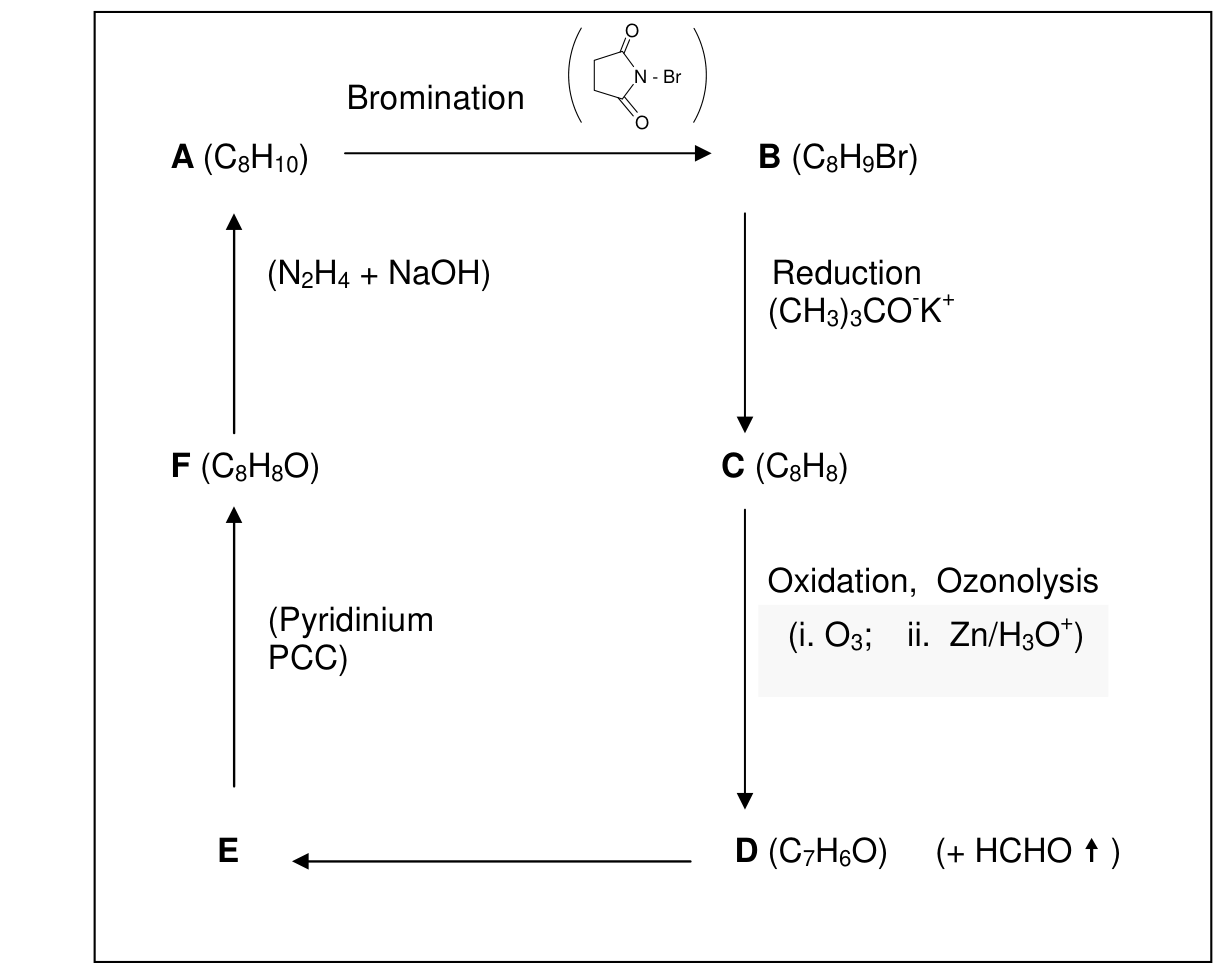
Based on the \({}^{1}\mathrm{H}\)-NMR spectra given, draw the structures of compounds A, B, C, D, E and F, and match the groups of the hydrogen atoms of each compound to the corresponding \({}^{1}\mathrm{H}\)-NMR peaks, as shown in the example.
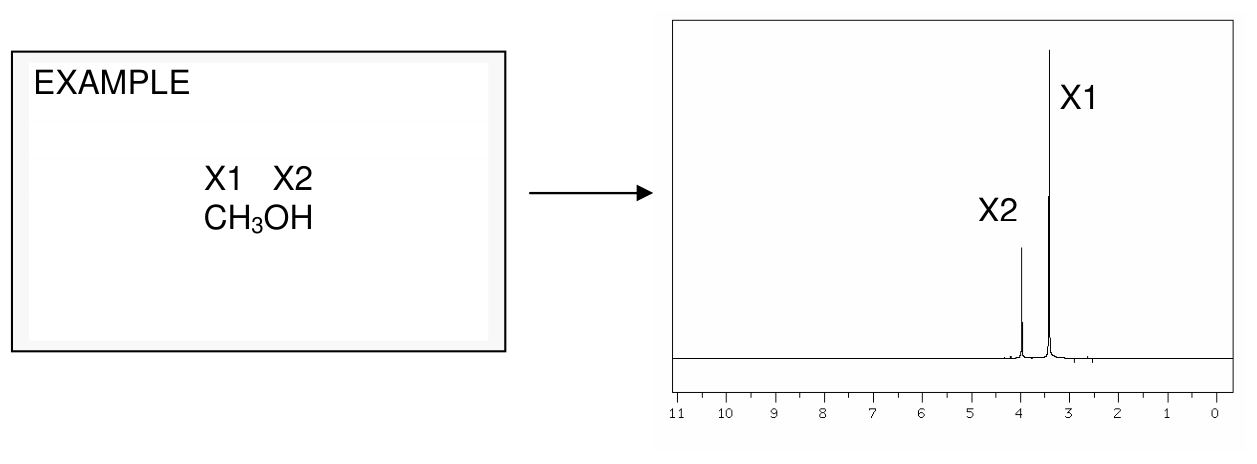
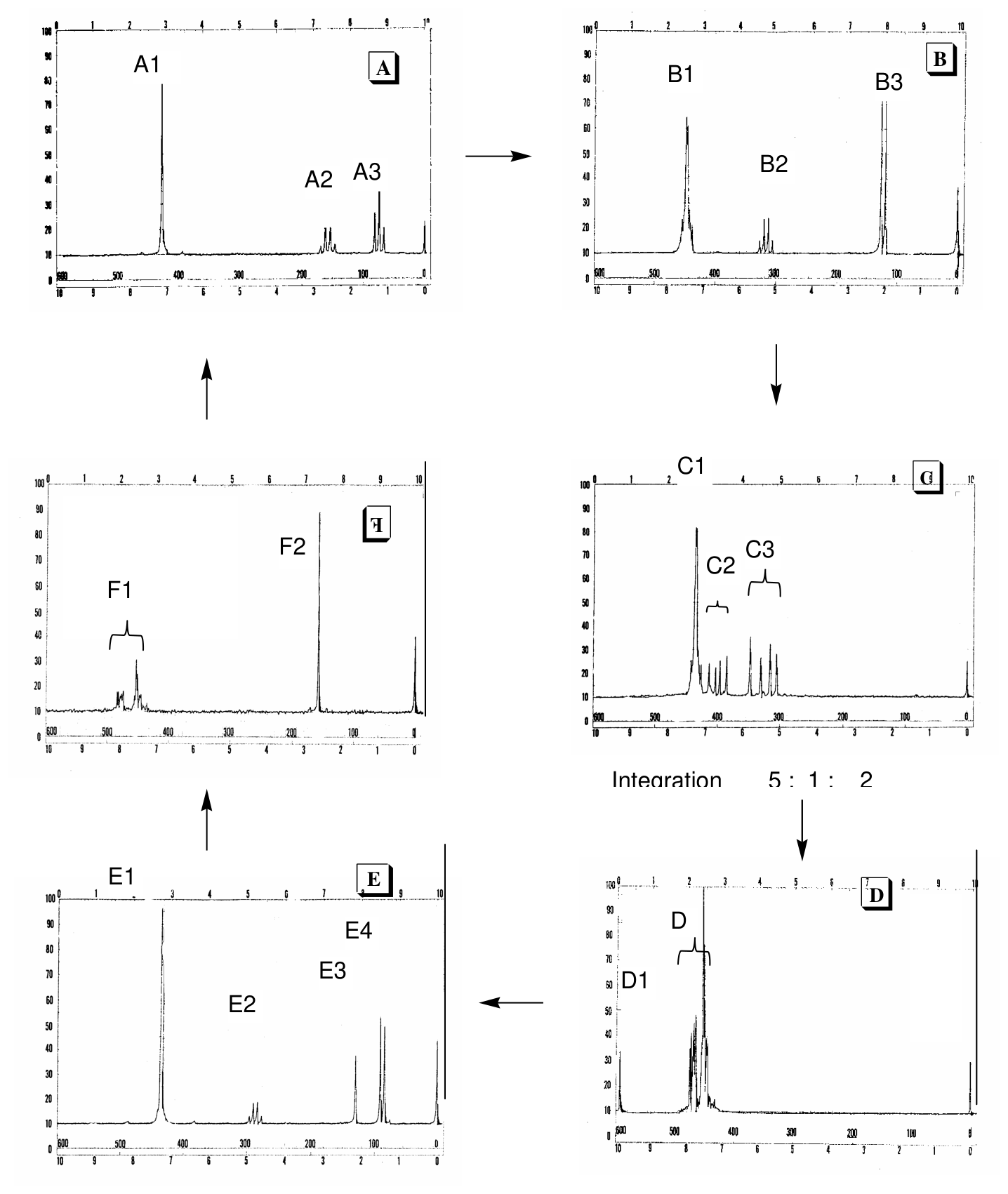
General remarks: NMR spectra were ecorded in \(\ce{CDCl3}\) on a 60 MHz Perkin Elmer Spectrometer. Under ordinary conditions (exposure to air, light and water vapour) acidic impurities may develop in \(\ce{CDCl3}\) solutions and catalyse rapid exchange of some particular protons.
Official English text of the problem.
Answers
The supplied problem has no numbered subparts or stated point values. The compound labels are retained below.
-
A — Ethylbenzene, \(\ce{C6H5CH2CH3}\), SMILES
CCc1ccccc1. A1: five aromatic H; A2: benzylic \(\ce{CH2}\), 2 H; A3: terminal \(\ce{CH3}\), 3 H. -
B — (1-Bromoethyl)benzene, \(\ce{C6H5CH(Br)CH3}\), expected as a racemate. Enantiomer SMILES:
C[C@H](Br)c1ccccc1andC[C@@H](Br)c1ccccc1. B1: five aromatic H; B2: \(\ce{CHBr}\), 1 H; B3: \(\ce{CH3}\), 3 H. -
C — Styrene (ethenylbenzene), \(\ce{C6H5CH=CH2}\), SMILES
C=Cc1ccccc1. C1: five aromatic H; C2: ring-adjacent vinylic \(\ce{CH}\), 1 H; C3: the two nonequivalent terminal vinylic H, 2 H total. -
D — Benzaldehyde, \(\ce{C6H5CHO}\), SMILES
O=Cc1ccccc1. D1: aldehydic H, 1 H; D2 (the aromatic bracket labelled “D” in the scan): five aromatic H. -
E — 1-Phenylethanol, \(\ce{C6H5CH(OH)CH3}\), molecular formula \(\ce{C8H10O}\), expected as a racemate. Enantiomer SMILES:
C[C@H](O)c1ccccc1andC[C@@H](O)c1ccccc1. E1: five aromatic H; E2: \(\ce{CH(OH)}\), 1 H; E3: hydroxyl H, 1 H; E4: \(\ce{CH3}\), 3 H. -
F — Acetophenone (1-phenylethan-1-one), \(\ce{C6H5COCH3}\), SMILES
CC(=O)c1ccccc1. F1: five aromatic H; F2: carbonyl-adjacent \(\ce{CH3}\), 3 H.
Solution
Chemical shifts below are approximate readings from the supplied spectra, in ppm. Each five-proton aromatic envelope contains the ortho, meta and para protons of a monosubstituted benzene ring; assigning them one label does not imply that all five are chemically equivalent.
A — Identification of the starting hydrocarbon
For \(\ce{C8H10}\), the degree of unsaturation is
\[ \mathrm{DBE}=\frac{2(8)+2-10}{2}=4. \]
This is consistent with a benzene ring. The spectrum identifies the remaining two carbons as an ethyl group:
| Label | Approximate \(\delta\) / ppm | Assignment | Multiplicity |
|---|---|---|---|
| A1 | 7.2 | Five aromatic H | Aromatic envelope |
| A2 | 2.6 | Benzylic \(\ce{CH2}\), 2 H | Quartet |
| A3 | 1.3 | Terminal \(\ce{CH3}\), 3 H | Triplet |
The methylene protons are split by three neighbouring methyl protons, while the methyl protons are split by two methylene protons. Thus A is ethylbenzene.
B — Benzylic bromination
The reagent drawn is N-bromosuccinimide, SMILES O=C1CCC(=O)N1Br. It replaces a benzylic hydrogen by bromine, giving (1-bromoethyl)benzene. The balanced reaction is
\[ \ce{C6H5CH2CH3 + C4H4BrNO2 -> C6H5CH(Br)CH3 + C4H5NO2}. \]
The other product is succinimide, SMILES O=C1CCC(=O)N1.
| Label | Approximate \(\delta\) / ppm | Assignment | Multiplicity |
|---|---|---|---|
| B1 | 7.2–7.6 | Five aromatic H | Multiplet |
| B2 | 5.2 | \(\ce{CHBr}\), 1 H | Quartet |
| B3 | 2.0 | \(\ce{CH3}\), 3 H | Doublet |
Replacing a benzylic H with electronegative bromine shifts the remaining methine H substantially downfield. The methine is split by three methyl H, and the methyl group is split by one methine H.
A stereogenic centre is created. Under achiral radical bromination conditions, the product is expected to be racemic; the two enantiomers have identical spectra in the stated achiral solvent.
C — Elimination to form styrene
Potassium tert-butoxide, SMILES CC(C)(C)[O-].[K+], removes a hydrogen from the methyl group while bromide leaves the adjacent carbon. This is an E2 dehydrobromination:
\[ \ce{C6H5CH(Br)CH3 + KOC(CH3)3 -> C6H5CH=CH2 + HOC(CH3)3 + KBr}. \]
The byproducts are tert-butanol, SMILES CC(C)(C)O, and potassium bromide, SMILES [K+].[Br-].
The arrow labelled “Reduction” in the scheme therefore represents an elimination. The product is styrene.
| Label | Approximate \(\delta\) / ppm | Assignment | Multiplicity |
|---|---|---|---|
| C1 | 7.2–7.5 | Five aromatic H | Multiplet |
| C2 | 6.7 | Ring-adjacent vinylic \(\ce{CH}\), 1 H | Approximately a doublet of doublets |
| C3 | 5.2 and 5.7 | Terminal \(\ce{CH2}\), 1 H at each position | Two approximately doublet-of-doublet patterns |
This gives the stated integration:
\[ \boxed{\mathrm{C1:C2:C3}=5:1:2}. \]
The two terminal alkene hydrogens are nonequivalent: one is cis and the other trans to the ring-adjacent vinylic hydrogen. They consequently have different chemical shifts and different vicinal coupling constants. C2 couples separately to both.
D — Reductive ozonolysis
Cleavage of the side-chain double bond produces one carbonyl compound from each alkene carbon:
- The ring-adjacent carbon gives benzaldehyde, D.
- The terminal carbon gives methanal (formaldehyde), SMILES
C=O.
A balanced net equation including the acidic zinc work-up is
\[ \ce{C6H5CH=CH2 + O3 + Zn + 2H3O+ -> C6H5CHO + HCHO + Zn^2+ + 3H2O}. \]
The reductive work-up preserves the aldehyde products.
| Label | Approximate \(\delta\) / ppm | Assignment | Multiplicity |
|---|---|---|---|
| D1 | 10 | Aldehydic \(\ce{CHO}\), 1 H | Approximately a singlet |
| D2, printed “D” | 7.4–8.0 | Five aromatic H | Multiplets |
The characteristic aldehydic resonance and the formula \(\ce{C7H6O}\) establish D as benzaldehyde.
E — Methyl addition to the aldehyde
The spectrum of E contains a methyl doublet, a methine quartet and an exchangeable hydroxyl proton. Together with five aromatic hydrogens, these identify 1-phenylethanol.
It is obtained from D by addition of methylmagnesium bromide, SMILES C[Mg]Br, followed by acidic work-up:
\[ \ce{C6H5CHO + CH3MgBr + H3O+ -> C6H5CH(OH)CH3 + Mg^2+ + Br- + H2O}. \]
The methyl group forms a bond to the aldehyde carbonyl carbon, and the resulting alkoxide oxygen is protonated during work-up. Addition to either face of the planar carbonyl group gives the two enantiomers in equal amounts under achiral conditions.
| Label | Approximate \(\delta\) / ppm | Assignment | Multiplicity |
|---|---|---|---|
| E1 | 7.3 | Five aromatic H | Aromatic envelope |
| E2 | 4.8 | \(\ce{CH(OH)}\), 1 H | Quartet |
| E3 | 2.2 | Hydroxyl H, 1 H | Exchangeable singlet |
| E4 | 1.5 | \(\ce{CH3}\), 3 H | Doublet |
The methine proton couples to the three methyl protons, while the methyl protons couple to the methine proton. The acid-catalysed exchange mentioned in the problem explains why the hydroxyl proton does not produce resolved additional splitting. Its shift and linewidth depend on the exchange conditions.
F — Alcohol oxidation and closure of the reaction cycle
Pyridinium chlorochromate (PCC), SMILES c1cc[nH+]cc1.[O-][Cr](=O)(=O)Cl, oxidizes the secondary alcohol E to the ketone acetophenone, F.
Using \(\ce{[O]}\) to denote one oxygen-atom equivalent supplied by the oxidant, the balanced organic transformation is
\[ \ce{C6H5CH(OH)CH3 + [O] ->[PCC] C6H5COCH3 + H2O}. \]
| Label | Approximate \(\delta\) / ppm | Assignment | Multiplicity |
|---|---|---|---|
| F1 | 7.4–8.0 | Five aromatic H | Multiplets |
| F2 | 2.6 | \(\ce{COCH3}\), 3 H | Singlet |
The methyl group has no adjacent proton-bearing carbon, so its signal is a singlet. Its downfield position is consistent with attachment to a carbonyl group. The methine and hydroxyl resonances of E disappear.
Finally, hydrazine, SMILES NN, with sodium hydroxide, SMILES [Na+].[OH-], effects a Wolff–Kishner reduction on heating:
\[ \ce{C6H5COCH3 + N2H4 -> C6H5CH2CH3 + N2 + H2O}. \]
The carbonyl group becomes a methylene group, regenerating ethylbenzene, A. The byproducts are dinitrogen, SMILES N#N, and water, SMILES O.
For completeness, the other species in the balanced work-up equations are ozone O=[O+][O-], zinc [Zn], hydronium [OH3+], zinc(II) ion [Zn+2], magnesium(II) ion [Mg+2], and bromide ion [Br-].
The solution was checked against the official solution. Where this solution differs from the official solution, the official solution contains an error or a misprint.
IChO 2003 · Theorieaufgabe 32
NMR-Rätsel
Eine organische Verbindung A (\(\ce{C8H10}\)) durchläuft die folgende Reaktionsfolge:
Zeichnen Sie anhand der angegebenen \({}^{1}\mathrm{H}\)-NMR-Spektren die Strukturen der Verbindungen A, B, C, D, E und F und ordnen Sie die Gruppen der Wasserstoffatome jeder Verbindung den entsprechenden \({}^{1}\mathrm{H}\)-NMR-Signalen zu, wie im Beispiel gezeigt.
Allgemeine Anmerkungen: Die NMR-Spektren wurden in \(\ce{CDCl3}\) an einem 60-MHz-Spektrometer von Perkin Elmer aufgenommen. Unter normalen Bedingungen (Einwirkung von Luft, Licht und Wasserdampf) können in \(\ce{CDCl3}\)-Lösungen saure Verunreinigungen entstehen, die einen schnellen Austausch bestimmter Protonen katalysieren.
Aufgabentext aus dem offiziellen englischen Text übersetzt.
Antworten
Die vorliegende Aufgabe enthält weder nummerierte Teilaufgaben noch Angaben zur Punkteverteilung. Die Bezeichnungen der Verbindungen werden im Folgenden beibehalten.
-
A — Ethylbenzol, \(\ce{C6H5CH2CH3}\), SMILES
CCc1ccccc1. A1: fünf aromatische H; A2: benzylische \(\ce{CH2}\)-Gruppe, 2 H; A3: endständige \(\ce{CH3}\)-Gruppe, 3 H. -
B — (1-Bromethyl)benzol, \(\ce{C6H5CH(Br)CH3}\), als Racemat zu erwarten. SMILES der Enantiomere:
C[C@H](Br)c1ccccc1undC[C@@H](Br)c1ccccc1. B1: fünf aromatische H; B2: \(\ce{CHBr}\), 1 H; B3: \(\ce{CH3}\), 3 H. -
C — Styrol (Ethenylbenzol), \(\ce{C6H5CH=CH2}\), SMILES
C=Cc1ccccc1. C1: fünf aromatische H; C2: dem Ring benachbarte vinylische \(\ce{CH}\)-Gruppe, 1 H; C3: die beiden nicht äquivalenten endständigen vinylischen H, insgesamt 2 H. -
D — Benzaldehyd, \(\ce{C6H5CHO}\), SMILES
O=Cc1ccccc1. D1: Aldehyd-H, 1 H; D2 (die im Scan mit „D“ beschriftete Klammer im aromatischen Bereich): fünf aromatische H. -
E — 1-Phenylethanol, \(\ce{C6H5CH(OH)CH3}\), Summenformel \(\ce{C8H10O}\), als Racemat zu erwarten. SMILES der Enantiomere:
C[C@H](O)c1ccccc1undC[C@@H](O)c1ccccc1. E1: fünf aromatische H; E2: \(\ce{CH(OH)}\), 1 H; E3: Hydroxyl-H, 1 H; E4: \(\ce{CH3}\), 3 H. -
F — Acetophenon (1-Phenylethan-1-on), \(\ce{C6H5COCH3}\), SMILES
CC(=O)c1ccccc1. F1: fünf aromatische H; F2: der Carbonylgruppe benachbarte \(\ce{CH3}\)-Gruppe, 3 H.
Lösung
Die folgenden chemischen Verschiebungen sind ungefähre, aus den vorliegenden Spektren abgelesene Werte in ppm. Jeder aromatische Signalbereich mit fünf Protonen umfasst die ortho-, meta- und para-Protonen eines monosubstituierten Benzolrings; die Zuordnung einer gemeinsamen Bezeichnung bedeutet nicht, dass alle fünf chemisch äquivalent sind.
A — Identifizierung des Ausgangskohlenwasserstoffs
Für \(\ce{C8H10}\) beträgt der Ungesättigtheitsgrad
\[ \mathrm{DBE}=\frac{2(8)+2-10}{2}=4. \]
Dies ist mit einem Benzolring vereinbar. Das Spektrum zeigt, dass die verbleibenden beiden Kohlenstoffatome eine Ethylgruppe bilden:
| Bezeichnung | Ungefähre \(\delta\) / ppm | Zuordnung | Multiplizität |
|---|---|---|---|
| A1 | 7.2 | Fünf aromatische H | Aromatischer Signalbereich |
| A2 | 2.6 | Benzylische \(\ce{CH2}\)-Gruppe, 2 H | Quartett |
| A3 | 1.3 | Endständige \(\ce{CH3}\)-Gruppe, 3 H | Triplett |
Das Signal der Methylenprotonen wird durch drei benachbarte Methylprotonen aufgespalten, während das Signal der Methylprotonen durch zwei Methylenprotonen aufgespalten wird. Somit ist A Ethylbenzol.
B — Benzylische Bromierung
Das dargestellte Reagenz ist N-Bromsuccinimid, SMILES O=C1CCC(=O)N1Br. Es ersetzt ein benzylisches Wasserstoffatom durch Brom, wobei (1-Bromethyl)benzol entsteht. Die ausgeglichene Reaktionsgleichung lautet
\[ \ce{C6H5CH2CH3 + C4H4BrNO2 -> C6H5CH(Br)CH3 + C4H5NO2}. \]
Das andere Produkt ist Succinimid, SMILES O=C1CCC(=O)N1.
| Bezeichnung | Ungefähre \(\delta\) / ppm | Zuordnung | Multiplizität |
|---|---|---|---|
| B1 | 7.2–7.6 | Fünf aromatische H | Multiplett |
| B2 | 5.2 | \(\ce{CHBr}\), 1 H | Quartett |
| B3 | 2.0 | \(\ce{CH3}\), 3 H | Dublett |
Der Ersatz eines benzylischen H durch elektronegatives Brom verschiebt das Signal des verbleibenden Methin-H deutlich zu tieferem Feld. Das Methinsignal wird durch drei Methyl-H aufgespalten, das Signal der Methylgruppe durch ein Methin-H.
Es entsteht ein stereogenes Zentrum. Unter achiralen Bedingungen der radikalischen Bromierung ist ein racemisches Produkt zu erwarten; die beiden Enantiomere weisen im angegebenen achiralen Lösungsmittel identische Spektren auf.
C — Eliminierung unter Bildung von Styrol
Kalium-tert-butanolat, SMILES CC(C)(C)[O-].[K+], entfernt ein Wasserstoffatom aus der Methylgruppe, während Bromid das benachbarte Kohlenstoffatom verlässt. Dies ist eine E2-Dehydrobromierung:
\[ \ce{C6H5CH(Br)CH3 + KOC(CH3)3 -> C6H5CH=CH2 + HOC(CH3)3 + KBr}. \]
Die Nebenprodukte sind tert-Butanol, SMILES CC(C)(C)O, und Kaliumbromid, SMILES [K+].[Br-].
Der im Schema mit „Reduktion“ beschriftete Pfeil stellt daher eine Eliminierung dar. Das Produkt ist Styrol.
| Bezeichnung | Ungefähre \(\delta\) / ppm | Zuordnung | Multiplizität |
|---|---|---|---|
| C1 | 7.2–7.5 | Fünf aromatische H | Multiplett |
| C2 | 6.7 | Dem Ring benachbarte vinylische \(\ce{CH}\)-Gruppe, 1 H | Näherungsweise ein Dublett von Dubletts |
| C3 | 5.2 und 5.7 | Endständige \(\ce{CH2}\)-Gruppe, jeweils 1 H bei jeder Verschiebung | Zwei näherungsweise als Dublett von Dubletts erscheinende Signalmuster |
Dies ergibt das angegebene Integrationsverhältnis:
\[ \boxed{\mathrm{C1:C2:C3}=5:1:2}. \]
Die beiden endständigen Alkenwasserstoffatome sind nicht äquivalent: Das eine steht cis und das andere trans zu dem vinylischen Wasserstoffatom am ringbenachbarten Kohlenstoffatom. Sie weisen daher unterschiedliche chemische Verschiebungen und unterschiedliche vicinale Kopplungskonstanten auf. C2 koppelt mit beiden einzeln.
D — Reduktive Ozonolyse
Die Spaltung der Doppelbindung in der Seitenkette liefert aus jedem Alkenkohlenstoffatom eine Carbonylverbindung:
- Das dem Ring benachbarte Kohlenstoffatom liefert Benzaldehyd, D.
- Das endständige Kohlenstoffatom liefert Methanal (Formaldehyd), SMILES
C=O.
Eine ausgeglichene Nettogleichung unter Einbeziehung der Aufarbeitung mit Zink im sauren Milieu lautet
\[ \ce{C6H5CH=CH2 + O3 + Zn + 2H3O+ -> C6H5CHO + HCHO + Zn^2+ + 3H2O}. \]
Bei der reduktiven Aufarbeitung bleiben die Aldehydprodukte erhalten.
| Bezeichnung | Ungefähre \(\delta\) / ppm | Zuordnung | Multiplizität |
|---|---|---|---|
| D1 | 10 | Aldehydische \(\ce{CHO}\)-Gruppe, 1 H | Näherungsweise ein Singulett |
| D2, als „D“ gedruckt | 7.4–8.0 | Fünf aromatische H | Multipletts |
Die charakteristische Aldehydresonanz und die Formel \(\ce{C7H6O}\) identifizieren D als Benzaldehyd.
E — Methyladdition an den Aldehyd
Das Spektrum von E enthält ein Methyldublett, ein Methinquartett und ein austauschbares Hydroxylproton. Zusammen mit fünf aromatischen Wasserstoffatomen weisen diese auf 1-Phenylethanol hin.
Es wird aus D durch Addition von Methylmagnesiumbromid, SMILES C[Mg]Br, und anschließende saure Aufarbeitung erhalten:
\[ \ce{C6H5CHO + CH3MgBr + H3O+ -> C6H5CH(OH)CH3 + Mg^2+ + Br- + H2O}. \]
Die Methylgruppe bildet eine Bindung zum Carbonylkohlenstoffatom des Aldehyds, und das dabei entstehende Alkoholat-Sauerstoffatom wird während der Aufarbeitung protoniert. Die Addition an beide Seiten der planaren Carbonylgruppe liefert unter achiralen Bedingungen die beiden Enantiomere in gleichen Mengen.
| Bezeichnung | Ungefähre \(\delta\) / ppm | Zuordnung | Multiplizität |
|---|---|---|---|
| E1 | 7.3 | Fünf aromatische H | Aromatischer Signalbereich |
| E2 | 4.8 | \(\ce{CH(OH)}\), 1 H | Quartett |
| E3 | 2.2 | Hydroxyl-H, 1 H | Singulett eines austauschbaren Protons |
| E4 | 1.5 | \(\ce{CH3}\), 3 H | Dublett |
Das Methinproton koppelt mit den drei Methylprotonen, während die Methylprotonen mit dem Methinproton koppeln. Der in der Aufgabenstellung erwähnte säurekatalysierte Austausch erklärt, warum das Hydroxylproton keine aufgelöste zusätzliche Aufspaltung hervorruft. Seine Verschiebung und Linienbreite hängen von den Austauschbedingungen ab.
F — Alkoholoxidation und Schließen des Reaktionszyklus
Pyridiniumchlorochromat (PCC), SMILES c1cc[nH+]cc1.[O-][Cr](=O)(=O)Cl, oxidiert den sekundären Alkohol E zum Keton Acetophenon, F.
Wenn \(\ce{[O]}\) ein vom Oxidationsmittel bereitgestelltes Sauerstoffatom-Äquivalent bezeichnet, lautet die ausgeglichene Gleichung der organischen Umsetzung
\[ \ce{C6H5CH(OH)CH3 + [O] ->[PCC] C6H5COCH3 + H2O}. \]
| Bezeichnung | Ungefähre \(\delta\) / ppm | Zuordnung | Multiplizität |
|---|---|---|---|
| F1 | 7.4–8.0 | Fünf aromatische H | Multipletts |
| F2 | 2.6 | \(\ce{COCH3}\), 3 H | Singulett |
Die Methylgruppe hat kein benachbartes Kohlenstoffatom, das Protonen trägt, sodass ihr Signal ein Singulett ist. Seine Lage bei tieferem Feld ist mit der Bindung an eine Carbonylgruppe vereinbar. Die Methin- und Hydroxylresonanzen von E verschwinden.
Schließlich bewirkt Hydrazin, SMILES NN, mit Natriumhydroxid, SMILES [Na+].[OH-], beim Erhitzen eine Wolff–Kishner-Reduktion:
\[ \ce{C6H5COCH3 + N2H4 -> C6H5CH2CH3 + N2 + H2O}. \]
Die Carbonylgruppe wird zu einer Methylengruppe, wodurch Ethylbenzol, A, zurückgebildet wird. Die Nebenprodukte sind Distickstoff, SMILES N#N, und Wasser, SMILES O.
Der Vollständigkeit halber sind die übrigen Spezies in den ausgeglichenen Gleichungen der Aufarbeitung Ozon O=[O+][O-], Zink [Zn], Oxonium [OH3+], Zink(II)-Ion [Zn+2], Magnesium(II)-Ion [Mg+2] und Bromidion [Br-].
Die Lösung wurde mit der offiziellen Lösung abgeglichen. Wo diese Lösung von der offiziellen Lösung abweicht, enthält die offizielle Lösung einen Fehler oder Druckfehler.
IChO 2003 · Teori sorusu 32
NMR bulmacası
Bir organik bileşik A (\(\ce{C8H10}\)) aşağıdaki tepkime zincirini verir:
Verilen \({}^{1}\mathrm{H}\)-NMR spektrumlarına dayanarak A, B, C, D, E ve F bileşiklerinin yapılarını çiziniz ve örnekte gösterildiği gibi her bileşiğin hidrojen atomu gruplarını karşılık gelen \({}^{1}\mathrm{H}\)-NMR pikleriyle eşleştiriniz.
Genel açıklamalar: NMR spektrumları, \(\ce{CDCl3}\) içinde 60 MHz Perkin Elmer spektrometresiyle kaydedilmiştir. Olağan koşullarda (hava, ışık ve su buharına maruz kalma) \(\ce{CDCl3}\) çözeltilerinde asidik safsızlıklar oluşabilir ve belirli protonların hızlı değişimini katalizleyebilir.
Soru metni resmi İngilizce metinden çevrilmiştir.
Cevaplar
Verilen soruda numaralandırılmış alt bölümler veya belirtilmiş puan değerleri yoktur. Bileşiklerin etiketleri aşağıda korunmuştur.
-
A — Etilbenzen, \(\ce{C6H5CH2CH3}\), SMILES
CCc1ccccc1. A1: beş aromatik H; A2: benzilik \(\ce{CH2}\), 2 H; A3: uçtaki \(\ce{CH3}\), 3 H. -
B — (1-Bromoetil)benzen, \(\ce{C6H5CH(Br)CH3}\), rasemat olarak oluşması beklenir. Enantiyomerlerin SMILES gösterimleri:
C[C@H](Br)c1ccccc1veC[C@@H](Br)c1ccccc1. B1: beş aromatik H; B2: \(\ce{CHBr}\), 1 H; B3: \(\ce{CH3}\), 3 H. -
C — Stiren (etenilbenzen), \(\ce{C6H5CH=CH2}\), SMILES
C=Cc1ccccc1. C1: beş aromatik H; C2: halkaya komşu vinilik \(\ce{CH}\), 1 H; C3: uçtaki iki eşdeğer olmayan vinilik H, toplam 2 H. -
D — Benzaldehit, \(\ce{C6H5CHO}\), SMILES
O=Cc1ccccc1. D1: aldehit H'si, 1 H; D2 (taranmış görüntüde “D” olarak etiketlenmiş aromatik bölge parantezi): beş aromatik H. -
E — 1-Feniletanol, \(\ce{C6H5CH(OH)CH3}\), molekül formülü \(\ce{C8H10O}\), rasemat olarak oluşması beklenir. Enantiyomerlerin SMILES gösterimleri:
C[C@H](O)c1ccccc1veC[C@@H](O)c1ccccc1. E1: beş aromatik H; E2: \(\ce{CH(OH)}\), 1 H; E3: hidroksil H'si, 1 H; E4: \(\ce{CH3}\), 3 H. -
F — Asetofenon (1-feniletan-1-on), \(\ce{C6H5COCH3}\), SMILES
CC(=O)c1ccccc1. F1: beş aromatik H; F2: karbonile komşu \(\ce{CH3}\), 3 H.
Çözüm
Aşağıdaki kimyasal kaymalar, verilen spektrumlardan ppm cinsinden yaklaşık olarak okunmuştur. Beş protona karşılık gelen her aromatik sinyal zarfı, tek sübstitüentli bir benzen halkasının orto, meta ve para protonlarını içerir; bunlara tek bir etiket atanması, beşinin de kimyasal olarak eşdeğer olduğu anlamına gelmez.
A — Başlangıç hidrokarbonunun belirlenmesi
\(\ce{C8H10}\) için doymamışlık derecesi şöyledir:
\[ \mathrm{DBE}=\frac{2(8)+2-10}{2}=4. \]
Bu değer bir benzen halkasıyla uyumludur. Spektrum, geriye kalan iki karbonun bir etil grubu oluşturduğunu gösterir:
| Etiket | Yaklaşık \(\delta\) / ppm | Atama | Çokluluk |
|---|---|---|---|
| A1 | 7.2 | Beş aromatik H | Aromatik sinyal zarfı |
| A2 | 2.6 | Benzilik \(\ce{CH2}\), 2 H | Kuartet |
| A3 | 1.3 | Uçtaki \(\ce{CH3}\), 3 H | Triplet |
Metilen protonlarının sinyali, komşu üç metil protonu tarafından yarılırken metil protonlarının sinyali iki metilen protonu tarafından yarılır. Dolayısıyla A etilbenzendir.
B — Benzilik bromlama
Çizilen reaktif N-bromosüksinimittir, SMILES O=C1CCC(=O)N1Br. Benzilik bir hidrojenin yerine brom geçirerek (1-bromoetil)benzen oluşturur. Denkleştirilmiş tepkime şöyledir:
\[ \ce{C6H5CH2CH3 + C4H4BrNO2 -> C6H5CH(Br)CH3 + C4H5NO2}. \]
Diğer ürün süksinimittir, SMILES O=C1CCC(=O)N1.
| Etiket | Yaklaşık \(\delta\) / ppm | Atama | Çokluluk |
|---|---|---|---|
| B1 | 7.2–7.6 | Beş aromatik H | Multiplet |
| B2 | 5.2 | \(\ce{CHBr}\), 1 H | Kuartet |
| B3 | 2.0 | \(\ce{CH3}\), 3 H | Dublet |
Benzilik bir H'nin elektronegatif bromla yer değiştirmesi, geriye kalan metin H'sinin sinyalini belirgin biçimde düşük alana kaydırır. Metin sinyali üç metil H'si tarafından, metil grubunun sinyali ise bir metin H'si tarafından yarılır.
Bir stereojenik merkez oluşur. Akiral radikal bromlama koşullarında ürünün rasemik olması beklenir; iki enantiyomer, belirtilen akiral çözücüde aynı spektrumları verir.
C — Stiren oluşturmak üzere eliminasyon
Potasyum tert-bütoksit, SMILES CC(C)(C)[O-].[K+], bromür komşu karbondan ayrılırken metil grubundan bir hidrojen uzaklaştırır. Bu, bir E2 dehidrobromlama tepkimesidir:
\[ \ce{C6H5CH(Br)CH3 + KOC(CH3)3 -> C6H5CH=CH2 + HOC(CH3)3 + KBr}. \]
Yan ürünler tert-bütanol, SMILES CC(C)(C)O, ve potasyum bromürdür, SMILES [K+].[Br-].
Dolayısıyla şemada “İndirgenme” olarak etiketlenmiş ok bir eliminasyonu temsil eder. Ürün stirendir.
| Etiket | Yaklaşık \(\delta\) / ppm | Atama | Çokluluk |
|---|---|---|---|
| C1 | 7.2–7.5 | Beş aromatik H | Multiplet |
| C2 | 6.7 | Halkaya komşu vinilik \(\ce{CH}\), 1 H | Yaklaşık olarak dubletin dubleti |
| C3 | 5.2 ve 5.7 | Uçtaki \(\ce{CH2}\), her konumda 1 H | Yaklaşık olarak dubletin dubleti biçiminde iki sinyal |
Bu, belirtilen integral oranını verir:
\[ \boxed{\mathrm{C1:C2:C3}=5:1:2}. \]
Uçtaki iki alken hidrojeni eşdeğer değildir: halkaya komşu vinilik hidrojene göre biri cis, diğeri trans konumundadır. Bu nedenle kimyasal kaymaları ve visinal eşleşme sabitleri farklıdır. C2, her ikisiyle ayrı ayrı eşleşir.
D — İndirgemeli ozonoliz
Yan zincirdeki çift bağın parçalanması, her alken karbonundan bir karbonil bileşiği oluşturur:
- Halkaya komşu karbon benzaldehit, D verir.
- Uçtaki karbon metanal (formaldehit) verir, SMILES
C=O.
Asidik ortamda çinko ile yapılan son işlemi de içeren denkleştirilmiş net denklem şöyledir:
\[ \ce{C6H5CH=CH2 + O3 + Zn + 2H3O+ -> C6H5CHO + HCHO + Zn^2+ + 3H2O}. \]
İndirgeyici son işlem, aldehit ürünlerini korur.
| Etiket | Yaklaşık \(\delta\) / ppm | Atama | Çokluluk |
|---|---|---|---|
| D1 | 10 | Aldehit \(\ce{CHO}\) grubu, 1 H | Yaklaşık olarak singlet |
| D2, “D” olarak basılmış | 7.4–8.0 | Beş aromatik H | Multipletler |
Karakteristik aldehit rezonansı ve \(\ce{C7H6O}\) formülü, D'nin benzaldehit olduğunu ortaya koyar.
E — Aldehide metil katılması
E'nin spektrumu bir metil dubleti, bir metin kuarteti ve değişime uğrayabilen bir hidroksil protonu içerir. Bunlar, beş aromatik hidrojenle birlikte bileşiğin 1-feniletanol olduğunu gösterir.
Bu bileşik, D'ye metilmagnezyum bromür, SMILES C[Mg]Br, katılmasının ardından asidik son işlem uygulanmasıyla elde edilir:
\[ \ce{C6H5CHO + CH3MgBr + H3O+ -> C6H5CH(OH)CH3 + Mg^2+ + Br- + H2O}. \]
Metil grubu, aldehidin karbonil karbonuyla bir bağ oluşturur ve oluşan alkoksit oksijeni son işlem sırasında protonlanır. Düzlemsel karbonil grubunun iki yüzünden de gerçekleşebilen katılma, akiral koşullarda iki enantiyomeri eşit miktarlarda verir.
| Etiket | Yaklaşık \(\delta\) / ppm | Atama | Çokluluk |
|---|---|---|---|
| E1 | 7.3 | Beş aromatik H | Aromatik sinyal zarfı |
| E2 | 4.8 | \(\ce{CH(OH)}\), 1 H | Kuartet |
| E3 | 2.2 | Hidroksil H'si, 1 H | Değişime uğrayabilen singlet |
| E4 | 1.5 | \(\ce{CH3}\), 3 H | Dublet |
Metin protonu üç metil protonuyla eşleşirken metil protonları metin protonuyla eşleşir. Soruda belirtilen asit katalizli değişim, hidroksil protonunun neden ayırt edilebilir ek bir yarılma oluşturmadığını açıklar. Bu protonun kimyasal kayması ve çizgi genişliği, değişim koşullarına bağlıdır.
F — Alkolün yükseltgenmesi ve tepkime döngüsünün tamamlanması
Piridinyum klorokromat (PCC), SMILES c1cc[nH+]cc1.[O-][Cr](=O)(=O)Cl, ikincil alkol E'yi asetofenon, F ketonuna yükseltger.
Yükseltgen tarafından sağlanan bir oksijen atomu eşdeğerini göstermek için \(\ce{[O]}\) kullanıldığında, denkleştirilmiş organik dönüşüm şöyledir:
\[ \ce{C6H5CH(OH)CH3 + [O] ->[PCC] C6H5COCH3 + H2O}. \]
| Etiket | Yaklaşık \(\delta\) / ppm | Atama | Çokluluk |
|---|---|---|---|
| F1 | 7.4–8.0 | Beş aromatik H | Multipletler |
| F2 | 2.6 | \(\ce{COCH3}\), 3 H | Singlet |
Metil grubunun komşuluğunda proton taşıyan bir karbon bulunmadığından sinyali singlettir. Sinyalin düşük alandaki konumu, grubun bir karbonil grubuna bağlı olmasıyla uyumludur. E'nin metin ve hidroksil rezonansları kaybolur.
Son olarak hidrazin, SMILES NN, sodyum hidroksit, SMILES [Na+].[OH-], ile birlikte ısıtıldığında Wolff–Kishner indirgenmesini gerçekleştirir:
\[ \ce{C6H5COCH3 + N2H4 -> C6H5CH2CH3 + N2 + H2O}. \]
Karbonil grubu bir metilen grubuna dönüşerek yeniden etilbenzen, A oluşturur. Yan ürünler diazot, SMILES N#N, ve sudur, SMILES O.
Eksiksiz olması için, denkleştirilmiş son işlem denklemlerindeki diğer türler ozon O=[O+][O-], çinko [Zn], hidronyum [OH3+], çinko(II) iyonu [Zn+2], magnezyum(II) iyonu [Mg+2] ve bromür iyonu [Br-] olarak verilmiştir.
Çözüm, resmi çözümle karşılaştırılarak kontrol edildi. Bu çözümün resmi çözümden ayrıldığı yerlerde resmi çözümde bir hata ya da baskı hatası vardır.
IChO 2003 · Problema teórico 32
Enigma de RMN
Un compuesto orgánico A (\(\ce{C8H10}\)) da lugar a la siguiente cadena de reacciones:
A partir de los espectros de RMN de \({}^{1}\mathrm{H}\) proporcionados, dibuje las estructuras de los compuestos A, B, C, D, E y F, y asigne los grupos de átomos de hidrógeno de cada compuesto a los picos correspondientes de RMN de \({}^{1}\mathrm{H}\), como se muestra en el ejemplo.
Observaciones generales: Los espectros de RMN se registraron en \(\ce{CDCl3}\) con un espectrómetro Perkin Elmer de 60 MHz. En condiciones normales (exposición al aire, a la luz y al vapor de agua), pueden formarse impurezas ácidas en las disoluciones de \(\ce{CDCl3}\) y catalizar el intercambio rápido de determinados protones.
Enunciado traducido del texto oficial en inglés.
Respuestas
El problema proporcionado no tiene apartados numerados ni puntuaciones indicadas. A continuación se conservan las etiquetas de los compuestos.
-
A — Etilbenceno, \(\ce{C6H5CH2CH3}\), SMILES
CCc1ccccc1. A1: cinco H aromáticos; A2: \(\ce{CH2}\) bencílico, 2 H; A3: \(\ce{CH3}\) terminal, 3 H. -
B — (1-Bromoetil)benceno, \(\ce{C6H5CH(Br)CH3}\), que se espera obtener como racemato. SMILES de los enantiómeros:
C[C@H](Br)c1ccccc1yC[C@@H](Br)c1ccccc1. B1: cinco H aromáticos; B2: \(\ce{CHBr}\), 1 H; B3: \(\ce{CH3}\), 3 H. -
C — Estireno (etenilbenceno), \(\ce{C6H5CH=CH2}\), SMILES
C=Cc1ccccc1. C1: cinco H aromáticos; C2: \(\ce{CH}\) vinílico adyacente al anillo, 1 H; C3: los dos H vinílicos terminales no equivalentes, 2 H en total. -
D — Benzaldehído, \(\ce{C6H5CHO}\), SMILES
O=Cc1ccccc1. D1: H aldehídico, 1 H; D2 (el corchete de la región aromática etiquetado como «D» en la imagen escaneada): cinco H aromáticos. -
E — 1-Feniletanol, \(\ce{C6H5CH(OH)CH3}\), fórmula molecular \(\ce{C8H10O}\), que se espera obtener como racemato. SMILES de los enantiómeros:
C[C@H](O)c1ccccc1yC[C@@H](O)c1ccccc1. E1: cinco H aromáticos; E2: \(\ce{CH(OH)}\), 1 H; E3: H del hidroxilo, 1 H; E4: \(\ce{CH3}\), 3 H. -
F — Acetofenona (1-feniletan-1-ona), \(\ce{C6H5COCH3}\), SMILES
CC(=O)c1ccccc1. F1: cinco H aromáticos; F2: \(\ce{CH3}\) adyacente al carbonilo, 3 H.
Solución
Los desplazamientos químicos que se indican a continuación son lecturas aproximadas de los espectros proporcionados, en ppm. Cada envolvente aromática de cinco protones contiene los protones orto, meta y para de un anillo bencénico monosustituido; asignarles una única etiqueta no implica que los cinco sean químicamente equivalentes.
A — Identificación del hidrocarburo de partida
Para \(\ce{C8H10}\), el grado de insaturación es
\[ \mathrm{DBE}=\frac{2(8)+2-10}{2}=4. \]
Esto es compatible con un anillo bencénico. El espectro identifica los dos carbonos restantes como un grupo etilo:
| Etiqueta | \(\delta\) aproximado / ppm | Asignación | Multiplicidad |
|---|---|---|---|
| A1 | 7.2 | Cinco H aromáticos | Envolvente aromática |
| A2 | 2.6 | \(\ce{CH2}\) bencílico, 2 H | Cuarteto |
| A3 | 1.3 | \(\ce{CH3}\) terminal, 3 H | Triplete |
La señal de los protones del metileno se desdobla por los tres protones vecinos del metilo, mientras que la señal de los protones del metilo se desdobla por los dos protones del metileno. Por tanto, A es etilbenceno.
B — Bromación bencílica
El reactivo representado es la N-bromosuccinimida, SMILES O=C1CCC(=O)N1Br. Sustituye un hidrógeno bencílico por bromo, dando (1-bromoetil)benceno. La reacción ajustada es
\[ \ce{C6H5CH2CH3 + C4H4BrNO2 -> C6H5CH(Br)CH3 + C4H5NO2}. \]
El otro producto es la succinimida, SMILES O=C1CCC(=O)N1.
| Etiqueta | \(\delta\) aproximado / ppm | Asignación | Multiplicidad |
|---|---|---|---|
| B1 | 7.2–7.6 | Cinco H aromáticos | Multiplete |
| B2 | 5.2 | \(\ce{CHBr}\), 1 H | Cuarteto |
| B3 | 2.0 | \(\ce{CH3}\), 3 H | Doblete |
La sustitución de un H bencílico por bromo electronegativo desplaza considerablemente a campo bajo la señal del H metínico restante. La señal del metino se desdobla por los tres H del metilo, y la del grupo metilo se desdobla por el único H metínico.
Se crea un centro estereogénico. En condiciones aquirales de bromación radicalaria, se espera que el producto sea racémico; los dos enantiómeros tienen espectros idénticos en el disolvente aquiral indicado.
C — Eliminación para formar estireno
El terc-butóxido de potasio, SMILES CC(C)(C)[O-].[K+], extrae un hidrógeno del grupo metilo mientras el bromuro se desprende del carbono adyacente. Se trata de una deshidrobromación E2:
\[ \ce{C6H5CH(Br)CH3 + KOC(CH3)3 -> C6H5CH=CH2 + HOC(CH3)3 + KBr}. \]
Los subproductos son terc-butanol, SMILES CC(C)(C)O, y bromuro de potasio, SMILES [K+].[Br-].
Por tanto, la flecha etiquetada como «Reducción» en el esquema representa una eliminación. El producto es estireno.
| Etiqueta | \(\delta\) aproximado / ppm | Asignación | Multiplicidad |
|---|---|---|---|
| C1 | 7.2–7.5 | Cinco H aromáticos | Multiplete |
| C2 | 6.7 | \(\ce{CH}\) vinílico adyacente al anillo, 1 H | Aproximadamente un doblete de dobletes |
| C3 | 5.2 y 5.7 | \(\ce{CH2}\) terminal, 1 H en cada posición | Dos patrones aproximadamente de doblete de dobletes |
Esto da la integración indicada:
\[ \boxed{\mathrm{C1:C2:C3}=5:1:2}. \]
Los dos hidrógenos terminales del alqueno no son equivalentes: uno es cis y el otro trans respecto al hidrógeno vinílico adyacente al anillo. Por ello, tienen distintos desplazamientos químicos y distintas constantes de acoplamiento vecinal. C2 se acopla por separado con ambos.
D — Ozonólisis reductora
La ruptura del doble enlace de la cadena lateral produce un compuesto carbonílico a partir de cada carbono del alqueno:
- El carbono adyacente al anillo da benzaldehído, D.
- El carbono terminal da metanal (formaldehído), SMILES
C=O.
Una ecuación neta ajustada que incluye el tratamiento final con zinc en medio ácido es
\[ \ce{C6H5CH=CH2 + O3 + Zn + 2H3O+ -> C6H5CHO + HCHO + Zn^2+ + 3H2O}. \]
El tratamiento final reductor preserva los aldehídos producidos.
| Etiqueta | \(\delta\) aproximado / ppm | Asignación | Multiplicidad |
|---|---|---|---|
| D1 | 10 | \(\ce{CHO}\) aldehídico, 1 H | Aproximadamente un singlete |
| D2, impreso como «D» | 7.4–8.0 | Cinco H aromáticos | Multipletes |
La resonancia aldehídica característica y la fórmula \(\ce{C7H6O}\) permiten identificar D como benzaldehído.
E — Adición de metilo al aldehído
El espectro de E contiene un doblete de metilo, un cuarteto de metino y un protón de hidroxilo intercambiable. Junto con los cinco hidrógenos aromáticos, estos permiten identificar el 1-feniletanol.
Se obtiene a partir de D por adición de bromuro de metilmagnesio, SMILES C[Mg]Br, seguida de un tratamiento final ácido:
\[ \ce{C6H5CHO + CH3MgBr + H3O+ -> C6H5CH(OH)CH3 + Mg^2+ + Br- + H2O}. \]
El grupo metilo forma un enlace con el carbono carbonílico del aldehído, y el oxígeno del alcóxido resultante se protona durante el tratamiento final. La adición a cualquiera de las dos caras del grupo carbonilo plano da los dos enantiómeros en cantidades iguales en condiciones aquirales.
| Etiqueta | \(\delta\) aproximado / ppm | Asignación | Multiplicidad |
|---|---|---|---|
| E1 | 7.3 | Cinco H aromáticos | Envolvente aromática |
| E2 | 4.8 | \(\ce{CH(OH)}\), 1 H | Cuarteto |
| E3 | 2.2 | H del hidroxilo, 1 H | Singlete intercambiable |
| E4 | 1.5 | \(\ce{CH3}\), 3 H | Doblete |
El protón metínico se acopla con los tres protones del metilo, mientras que los protones del metilo se acoplan con el protón metínico. El intercambio catalizado por ácido mencionado en el problema explica por qué el protón del hidroxilo no produce un desdoblamiento adicional resuelto. Su desplazamiento y su anchura de línea dependen de las condiciones de intercambio.
F — Oxidación del alcohol y cierre del ciclo de reacciones
El clorocromato de piridinio (PCC), SMILES c1cc[nH+]cc1.[O-][Cr](=O)(=O)Cl, oxida el alcohol secundario E a la cetona acetofenona, F.
Si se utiliza \(\ce{[O]}\) para representar un equivalente de átomo de oxígeno aportado por el oxidante, la transformación orgánica ajustada es
\[ \ce{C6H5CH(OH)CH3 + [O] ->[PCC] C6H5COCH3 + H2O}. \]
| Etiqueta | \(\delta\) aproximado / ppm | Asignación | Multiplicidad |
|---|---|---|---|
| F1 | 7.4–8.0 | Cinco H aromáticos | Multipletes |
| F2 | 2.6 | \(\ce{COCH3}\), 3 H | Singlete |
El grupo metilo no tiene ningún carbono adyacente que lleve protones, por lo que su señal es un singlete. Su posición a campo bajo es compatible con su unión a un grupo carbonilo. Las resonancias del metino y del hidroxilo de E desaparecen.
Por último, la hidrazina, SMILES NN, con hidróxido de sodio, SMILES [Na+].[OH-], lleva a cabo una reducción de Wolff–Kishner al calentar:
\[ \ce{C6H5COCH3 + N2H4 -> C6H5CH2CH3 + N2 + H2O}. \]
El grupo carbonilo se convierte en un grupo metileno, regenerando el etilbenceno, A. Los subproductos son dinitrógeno, SMILES N#N, y agua, SMILES O.
Para completar la información, las otras especies que aparecen en las ecuaciones ajustadas de los tratamientos finales son ozono O=[O+][O-], zinc [Zn], hidronio [OH3+], ion zinc(II) [Zn+2], ion magnesio(II) [Mg+2] e ion bromuro [Br-].
La solución se comprobó con la solución oficial. Donde esta solución difiere de la solución oficial, la solución oficial contiene un error o una errata.
IChO 2003 · 理论题 32
核磁共振谜题
一种有机化合物 A(\(\ce{C8H10}\))发生如下系列反应:
根据所给的 \({}^{1}\mathrm{H}\)-NMR 谱,画出化合物 A、B、C、D、E 和 F 的结构,并按照示例,将各化合物中的各组氢原子与相应的 \({}^{1}\mathrm{H}\)-NMR 谱峰对应起来。
一般说明:核磁共振谱以 \(\ce{CDCl3}\) 为溶剂,使用 60 MHz Perkin Elmer 核磁共振波谱仪测得。在通常条件下(暴露于空气、光和水蒸气中),\(\ce{CDCl3}\) 溶液中可能产生酸性杂质,催化某些特定质子的快速交换。
题目译自官方英文原文。
答案
所给题目没有编号的小问,也未注明分值。下文保留化合物的标号。
-
A — 乙苯,\(\ce{C6H5CH2CH3}\),SMILES
CCc1ccccc1。 A1:五个芳环氢;A2:苄位 \(\ce{CH2}\),2 个氢;A3:末端 \(\ce{CH3}\),3 个氢。 -
B — (1-溴乙基)苯,\(\ce{C6H5CH(Br)CH3}\),预计为外消旋体。对映异构体的 SMILES:
C[C@H](Br)c1ccccc1和C[C@@H](Br)c1ccccc1。 B1:五个芳环氢;B2:\(\ce{CHBr}\),1 个氢;B3:\(\ce{CH3}\),3 个氢。 -
C — 苯乙烯(乙烯基苯),\(\ce{C6H5CH=CH2}\),SMILES
C=Cc1ccccc1。 C1:五个芳环氢;C2:与苯环相连的烯基 \(\ce{CH}\),1 个氢;C3:两个不等价的末端烯基氢,共 2 个氢。 -
D — 苯甲醛,\(\ce{C6H5CHO}\),SMILES
O=Cc1ccccc1。 D1:醛基氢,1 个氢;D2(扫描图中标为“D”的芳香区括号):五个芳环氢。 -
E — 1-苯基乙醇,\(\ce{C6H5CH(OH)CH3}\),分子式为 \(\ce{C8H10O}\),预计为外消旋体。对映异构体的 SMILES:
C[C@H](O)c1ccccc1和C[C@@H](O)c1ccccc1。 E1:五个芳环氢;E2:\(\ce{CH(OH)}\),1 个氢;E3:羟基氢,1 个氢;E4:\(\ce{CH3}\),3 个氢。 -
F — 苯乙酮(1-苯基乙-1-酮),\(\ce{C6H5COCH3}\),SMILES
CC(=O)c1ccccc1。 F1:五个芳环氢;F2:与羰基相邻的 \(\ce{CH3}\),3 个氢。
解答
下列化学位移是从所给谱图中读取的近似值,单位为 ppm。每个积分对应五个质子的芳香区峰群都包含单取代苯环的邻位、间位和对位质子;将它们归于同一标号,并不意味着这五个质子都化学等价。
A — 起始烃的鉴定
对于 \(\ce{C8H10}\),不饱和度为
\[ \mathrm{DBE}=\frac{2(8)+2-10}{2}=4. \]
这与存在一个苯环相符。谱图表明其余两个碳构成一个乙基:
| 标号 | 近似 \(\delta\) / ppm | 归属 | 峰的多重性 |
|---|---|---|---|
| A1 | 7.2 | 五个芳环氢 | 芳香区峰群 |
| A2 | 2.6 | 苄位 \(\ce{CH2}\),2 个氢 | 四重峰 |
| A3 | 1.3 | 末端 \(\ce{CH3}\),3 个氢 | 三重峰 |
亚甲基质子的信号被相邻的三个甲基质子裂分,而甲基质子的信号被两个亚甲基质子裂分。因此,A 是乙苯。
B — 苄位溴化
图中所示试剂为 N-溴代丁二酰亚胺,SMILES O=C1CCC(=O)N1Br。它以溴取代一个苄位氢,生成 (1-溴乙基)苯。配平后的反应式为
\[ \ce{C6H5CH2CH3 + C4H4BrNO2 -> C6H5CH(Br)CH3 + C4H5NO2}. \]
另一产物为丁二酰亚胺,SMILES O=C1CCC(=O)N1。
| 标号 | 近似 \(\delta\) / ppm | 归属 | 峰的多重性 |
|---|---|---|---|
| B1 | 7.2–7.6 | 五个芳环氢 | 多重峰 |
| B2 | 5.2 | \(\ce{CHBr}\),1 个氢 | 四重峰 |
| B3 | 2.0 | \(\ce{CH3}\),3 个氢 | 二重峰 |
用电负性较强的溴取代一个苄位氢,使剩余的次甲基氢显著向低场位移。次甲基的信号被三个甲基氢裂分,甲基的信号则被一个次甲基氢裂分。
反应形成了一个立体异构中心。在非手性的自由基溴化条件下,预计产物为外消旋体;两种对映异构体在题述非手性溶剂中具有相同的谱图。
C — 消去生成苯乙烯
叔丁醇钾,SMILES CC(C)(C)[O-].[K+],从甲基上脱去一个氢,同时溴离子从相邻碳上离去。这是一个 E2 脱溴化氢反应:
\[ \ce{C6H5CH(Br)CH3 + KOC(CH3)3 -> C6H5CH=CH2 + HOC(CH3)3 + KBr}. \]
副产物为叔丁醇,SMILES CC(C)(C)O,以及溴化钾,SMILES [K+].[Br-]。
因此,反应路线中标注为“还原”的箭头实际表示的是消去反应。产物为苯乙烯。
| 标号 | 近似 \(\delta\) / ppm | 归属 | 峰的多重性 |
|---|---|---|---|
| C1 | 7.2–7.5 | 五个芳环氢 | 多重峰 |
| C2 | 6.7 | 与苯环相连的烯基 \(\ce{CH}\),1 个氢 | 近似为双二重峰 |
| C3 | 5.2 和 5.7 | 末端 \(\ce{CH2}\),每个位移处各 1 个氢 | 两组近似双二重峰 |
由此得到题示的积分比:
\[ \boxed{\mathrm{C1:C2:C3}=5:1:2}. \]
末端的两个烯烃氢不等价:相对于与苯环相连的烯基氢,一个处于顺式位置,另一个处于反式位置。因此,它们具有不同的化学位移和不同的邻位偶合常数。C2 分别与这两个氢偶合。
D — 还原性臭氧分解
侧链双键断裂后,双键的两个碳分别形成一种羰基化合物:
- 与苯环相连的碳生成苯甲醛 D。
- 末端碳生成甲醛(蚁醛),SMILES
C=O。
包括酸性条件下用锌后处理在内的配平总反应式为
\[ \ce{C6H5CH=CH2 + O3 + Zn + 2H3O+ -> C6H5CHO + HCHO + Zn^2+ + 3H2O}. \]
还原性后处理使醛类产物得以保留。
| 标号 | 近似 \(\delta\) / ppm | 归属 | 峰的多重性 |
|---|---|---|---|
| D1 | 10 | 醛基 \(\ce{CHO}\),1 个氢 | 近似为单峰 |
| D2,图中印为“D” | 7.4–8.0 | 五个芳环氢 | 多重峰 |
特征性的醛基共振信号和分子式 \(\ce{C7H6O}\) 确定了 D 为苯甲醛。
E — 甲基对醛的加成
E 的谱图包含一个甲基二重峰、一个次甲基四重峰和一个可交换的羟基质子。结合五个芳环氢,可确定该化合物为 1-苯基乙醇。
它由 D 与甲基溴化镁,SMILES C[Mg]Br,发生加成,随后经酸性后处理得到:
\[ \ce{C6H5CHO + CH3MgBr + H3O+ -> C6H5CH(OH)CH3 + Mg^2+ + Br- + H2O}. \]
甲基与醛的羰基碳成键,所形成的醇盐中的氧在后处理过程中被质子化。在非手性条件下,从平面羰基的两个面发生加成,会得到等量的两种对映异构体。
| 标号 | 近似 \(\delta\) / ppm | 归属 | 峰的多重性 |
|---|---|---|---|
| E1 | 7.3 | 五个芳环氢 | 芳香区峰群 |
| E2 | 4.8 | \(\ce{CH(OH)}\),1 个氢 | 四重峰 |
| E3 | 2.2 | 羟基氢,1 个氢 | 可交换的单峰 |
| E4 | 1.5 | \(\ce{CH3}\),3 个氢 | 二重峰 |
次甲基质子与三个甲基质子偶合,而甲基质子与次甲基质子偶合。题目中提到的酸催化交换解释了羟基质子为何不会产生可分辨的额外裂分。其化学位移和线宽取决于交换条件。
F — 醇的氧化及反应循环的闭合
氯铬酸吡啶鎓(PCC),SMILES c1cc[nH+]cc1.[O-][Cr](=O)(=O)Cl,将仲醇 E 氧化为酮,即苯乙酮 F。
用 \(\ce{[O]}\) 表示氧化剂提供的一个氧原子当量,配平后的有机转化反应式为
\[ \ce{C6H5CH(OH)CH3 + [O] ->[PCC] C6H5COCH3 + H2O}. \]
| 标号 | 近似 \(\delta\) / ppm | 归属 | 峰的多重性 |
|---|---|---|---|
| F1 | 7.4–8.0 | 五个芳环氢 | 多重峰 |
| F2 | 2.6 | \(\ce{COCH3}\),3 个氢 | 单峰 |
甲基没有与带氢的碳相邻,因此其信号为单峰。该信号位于较低场,与甲基连接于羰基相符。E 的次甲基和羟基共振信号消失。
最后,肼,SMILES NN,与氢氧化钠,SMILES [Na+].[OH-],在加热条件下使其发生 Wolff–Kishner 还原:
\[ \ce{C6H5COCH3 + N2H4 -> C6H5CH2CH3 + N2 + H2O}. \]
羰基变为亚甲基,重新生成乙苯 A。副产物为氮气,SMILES N#N,以及水,SMILES O。
为求完整,配平后的后处理反应式中其余物种分别为臭氧 O=[O+][O-]、锌 [Zn]、水合氢离子 [OH3+]、锌(II)离子 [Zn+2]、镁(II)离子 [Mg+2] 和溴离子 [Br-]。
解答已与官方解答核对。本解答与官方解答不同之处,均为官方解答中的错误或印刷错误。
IChO 2003 · Теоретическая задача 32
Головоломка по ЯМР
Органическое соединение A (\(\ce{C8H10}\)) вступает в следующую цепочку реакций:
На основании приведённых спектров \({}^{1}\mathrm{H}\)-ЯМР изобразите структуры соединений A, B, C, D, E и F и соотнесите группы атомов водорода каждого соединения с соответствующими пиками \({}^{1}\mathrm{H}\)-ЯМР, как показано в примере.
Общие замечания: Спектры ЯМР записаны в \(\ce{CDCl3}\) на спектрометре Perkin Elmer с рабочей частотой 60 МГц. В обычных условиях (при воздействии воздуха, света и водяного пара) в растворах в \(\ce{CDCl3}\) могут образовываться кислые примеси, катализирующие быстрый обмен некоторых протонов.
Условие переведено с официального английского текста.
Ответы
В представленном условии нет пронумерованных подпунктов и не указано количество баллов. Ниже сохранены обозначения соединений.
-
A — Этилбензол, \(\ce{C6H5CH2CH3}\), SMILES
CCc1ccccc1. A1: пять ароматических H; A2: бензильная группа \(\ce{CH2}\), 2 H; A3: концевая группа \(\ce{CH3}\), 3 H. -
B — (1-Бромэтил)бензол, \(\ce{C6H5CH(Br)CH3}\), ожидается в виде рацемата. SMILES энантиомеров:
C[C@H](Br)c1ccccc1иC[C@@H](Br)c1ccccc1. B1: пять ароматических H; B2: \(\ce{CHBr}\), 1 H; B3: \(\ce{CH3}\), 3 H. -
C — Стирол (этенилбензол), \(\ce{C6H5CH=CH2}\), SMILES
C=Cc1ccccc1. C1: пять ароматических H; C2: винильная группа \(\ce{CH}\), соседняя с кольцом, 1 H; C3: два неэквивалентных концевых винильных H, всего 2 H. -
D — Бензальдегид, \(\ce{C6H5CHO}\), SMILES
O=Cc1ccccc1. D1: альдегидный H, 1 H; D2 (скобка, охватывающая ароматические сигналы и обозначенная на скане «D»): пять ароматических H. -
E — 1-Фенилэтанол, \(\ce{C6H5CH(OH)CH3}\), молекулярная формула \(\ce{C8H10O}\), ожидается в виде рацемата. SMILES энантиомеров:
C[C@H](O)c1ccccc1иC[C@@H](O)c1ccccc1. E1: пять ароматических H; E2: \(\ce{CH(OH)}\), 1 H; E3: гидроксильный H, 1 H; E4: \(\ce{CH3}\), 3 H. -
F — Ацетофенон (1-фенилэтан-1-он), \(\ce{C6H5COCH3}\), SMILES
CC(=O)c1ccccc1. F1: пять ароматических H; F2: группа \(\ce{CH3}\), соседняя с карбонильной группой, 3 H.
Решение
Приведённые ниже химические сдвиги приблизительно определены по представленным спектрам и выражены в м. д. Каждая совокупность ароматических сигналов с интегральной интенсивностью, соответствующей пяти протонам, включает орто-, мета- и пара-протоны монозамещённого бензольного кольца; присвоение им одного обозначения не означает, что все пять химически эквивалентны.
A — Идентификация исходного углеводорода
Для \(\ce{C8H10}\) степень ненасыщенности равна
\[ \mathrm{DBE}=\frac{2(8)+2-10}{2}=4. \]
Это согласуется с наличием бензольного кольца. Спектр позволяет установить, что оставшиеся два атома углерода входят в этильную группу:
| Обозначение | Приблизительный \(\delta\) / м. д. | Отнесение | Мультиплетность |
|---|---|---|---|
| A1 | 7.2 | Пять ароматических H | Совокупность ароматических сигналов |
| A2 | 2.6 | Бензильная группа \(\ce{CH2}\), 2 H | Квартет |
| A3 | 1.3 | Концевая группа \(\ce{CH3}\), 3 H | Триплет |
Сигнал метиленовых протонов расщепляется тремя соседними метильными протонами, а сигнал метильных протонов — двумя метиленовыми протонами. Следовательно, A — этилбензол.
B — Бромирование в бензильном положении
Изображённый реагент — N-бромсукцинимид, SMILES O=C1CCC(=O)N1Br. Он замещает бензильный атом водорода бромом с образованием (1-бромэтил)бензола. Уравнение реакции с расставленными коэффициентами:
\[ \ce{C6H5CH2CH3 + C4H4BrNO2 -> C6H5CH(Br)CH3 + C4H5NO2}. \]
Другой продукт — сукцинимид, SMILES O=C1CCC(=O)N1.
| Обозначение | Приблизительный \(\delta\) / м. д. | Отнесение | Мультиплетность |
|---|---|---|---|
| B1 | 7.2–7.6 | Пять ароматических H | Мультиплет |
| B2 | 5.2 | \(\ce{CHBr}\), 1 H | Квартет |
| B3 | 2.0 | \(\ce{CH3}\), 3 H | Дублет |
Замещение бензильного H электроотрицательным бромом существенно сдвигает сигнал оставшегося метинового H в слабое поле. Сигнал метинового протона расщепляется тремя метильными H, а сигнал метильной группы — одним метиновым H.
Образуется стереогенный центр. В ахиральных условиях радикального бромирования ожидается рацемический продукт; два энантиомера имеют одинаковые спектры в указанном ахиральном растворителе.
C — Элиминирование с образованием стирола
Трет-бутоксид калия, SMILES CC(C)(C)[O-].[K+], отщепляет атом водорода от метильной группы, одновременно с чем бромид отщепляется от соседнего атома углерода. Это дегидробромирование по механизму E2:
\[ \ce{C6H5CH(Br)CH3 + KOC(CH3)3 -> C6H5CH=CH2 + HOC(CH3)3 + KBr}. \]
Побочные продукты — трет-бутанол, SMILES CC(C)(C)O, и бромид калия, SMILES [K+].[Br-].
Таким образом, стрелка с надписью «Восстановление» на схеме соответствует элиминированию. Продукт — стирол.
| Обозначение | Приблизительный \(\delta\) / м. д. | Отнесение | Мультиплетность |
|---|---|---|---|
| C1 | 7.2–7.5 | Пять ароматических H | Мультиплет |
| C2 | 6.7 | Винильная группа \(\ce{CH}\), соседняя с кольцом, 1 H | Приблизительно дублет дублетов |
| C3 | 5.2 и 5.7 | Концевая группа \(\ce{CH2}\), по 1 H в каждом положении | Две группы сигналов, каждая приблизительно представляет собой дублет дублетов |
Это даёт указанное соотношение интегральных интенсивностей:
\[ \boxed{\mathrm{C1:C2:C3}=5:1:2}. \]
Два концевых алкеновых атома водорода неэквивалентны: один находится в цис-положении, а другой — в транс-положении относительно винильного атома водорода, соседнего с кольцом. Поэтому они имеют разные химические сдвиги и разные константы вицинального спин-спинового взаимодействия. C2 взаимодействует с каждым из них по отдельности.
D — Восстановительный озонолиз
Расщепление двойной связи боковой цепи приводит к образованию одного карбонильного соединения из каждого алкенового атома углерода:
- Из атома углерода, соседнего с кольцом, образуется бензальдегид, D.
- Из концевого атома углерода образуется метаналь (формальдегид), SMILES
C=O.
Суммарное уравнение с расставленными коэффициентами, учитывающее обработку цинком в кислой среде:
\[ \ce{C6H5CH=CH2 + O3 + Zn + 2H3O+ -> C6H5CHO + HCHO + Zn^2+ + 3H2O}. \]
Восстановительная обработка сохраняет альдегидные продукты.
| Обозначение | Приблизительный \(\delta\) / м. д. | Отнесение | Мультиплетность |
|---|---|---|---|
| D1 | 10 | Альдегидная группа \(\ce{CHO}\), 1 H | Приблизительно синглет |
| D2, напечатано «D» | 7.4–8.0 | Пять ароматических H | Мультиплеты |
Характерный альдегидный сигнал и формула \(\ce{C7H6O}\) позволяют установить, что D — бензальдегид.
E — Присоединение метильной группы к альдегиду
Спектр E содержит метильный дублет, метиновый квартет и сигнал обменивающегося гидроксильного протона. Вместе с пятью ароматическими атомами водорода эти признаки позволяют идентифицировать 1-фенилэтанол.
Его получают из D присоединением метилмагнийбромида, SMILES C[Mg]Br, с последующей обработкой в кислой среде:
\[ \ce{C6H5CHO + CH3MgBr + H3O+ -> C6H5CH(OH)CH3 + Mg^2+ + Br- + H2O}. \]
Метильная группа образует связь с карбонильным атомом углерода альдегида, а атом кислорода образовавшегося алкоголята протонируется при последующей обработке. Присоединение с обеих сторон плоской карбонильной группы в ахиральных условиях даёт два энантиомера в равных количествах.
| Обозначение | Приблизительный \(\delta\) / м. д. | Отнесение | Мультиплетность |
|---|---|---|---|
| E1 | 7.3 | Пять ароматических H | Совокупность ароматических сигналов |
| E2 | 4.8 | \(\ce{CH(OH)}\), 1 H | Квартет |
| E3 | 2.2 | Гидроксильный H, 1 H | Синглет обменивающегося протона |
| E4 | 1.5 | \(\ce{CH3}\), 3 H | Дублет |
Метиновый протон взаимодействует с тремя метильными протонами, а метильные протоны — с метиновым протоном. Упомянутый в условии катализируемый кислотой обмен объясняет, почему гидроксильный протон не вызывает разрешённого дополнительного расщепления. Его химический сдвиг и ширина линии зависят от условий обмена.
F — Окисление спирта и замыкание цикла реакций
Хлорохромат пиридиния (PCC), SMILES c1cc[nH+]cc1.[O-][Cr](=O)(=O)Cl, окисляет вторичный спирт E до кетона ацетофенона, F.
Если обозначить через \(\ce{[O]}\) один эквивалент атома кислорода, предоставляемый окислителем, то уравнение органического превращения с расставленными коэффициентами имеет вид
\[ \ce{C6H5CH(OH)CH3 + [O] ->[PCC] C6H5COCH3 + H2O}. \]
| Обозначение | Приблизительный \(\delta\) / м. д. | Отнесение | Мультиплетность |
|---|---|---|---|
| F1 | 7.4–8.0 | Пять ароматических H | Мультиплеты |
| F2 | 2.6 | \(\ce{COCH3}\), 3 H | Синглет |
У метильной группы нет соседнего атома углерода, несущего протоны, поэтому её сигнал представляет собой синглет. Его положение в слабом поле согласуется с присоединением к карбонильной группе. Сигналы метинового и гидроксильного протонов E исчезают.
Наконец, гидразин, SMILES NN, в присутствии гидроксида натрия, SMILES [Na+].[OH-], при нагревании осуществляет восстановление по Вольфу—Кишнеру:
\[ \ce{C6H5COCH3 + N2H4 -> C6H5CH2CH3 + N2 + H2O}. \]
Карбонильная группа превращается в метиленовую, и вновь образуется этилбензол, A. Побочные продукты — молекулярный азот, SMILES N#N, и вода, SMILES O.
Для полноты перечислим остальные частицы в уравнениях последующей обработки с расставленными коэффициентами: озон O=[O+][O-], цинк [Zn], ион гидроксония [OH3+], ион цинка(II) [Zn+2], ион магния(II) [Mg+2] и бромид-ион [Br-].
Решение проверено по официальному решению. Там, где это решение расходится с официальным, в официальном решении есть ошибка или опечатка.
IChO 2003 · مسألة نظرية 32
لغز الرنين المغناطيسي النووي
يخضع مركب عضوي A (\(\ce{C8H10}\)) لسلسلة التفاعلات الآتية:
استنادًا إلى أطياف الرنين المغناطيسي النووي لـ \({}^{1}\mathrm{H}\) المعطاة، ارسم تراكيب المركبات A, B, C, D, E وF، وطابق مجموعات ذرات الهيدروجين في كل مركب مع قمم الرنين المغناطيسي النووي لـ \({}^{1}\mathrm{H}\) المقابلة لها، كما هو موضح في المثال.
ملاحظات عامة: سُجّلت أطياف الرنين المغناطيسي النووي في \(\ce{CDCl3}\) باستخدام مطياف Perkin Elmer بتردد 60 MHz. في الظروف العادية (التعرض للهواء والضوء وبخار الماء)، قد تتكوّن شوائب حمضية في محاليل \(\ce{CDCl3}\) وتحفّز التبادل السريع لبعض البروتونات المعينة.
نص المسألة مترجم عن النص الإنجليزي الرسمي.
الإجابات
لا تتضمن المسألة المقدمة أجزاء فرعية مرقّمة أو درجات محددة. وقد أُبقيت رموز المركبات أدناه.
-
A — إيثيل بنزين، \(\ce{C6H5CH2CH3}\)، SMILES
CCc1ccccc1. A1: خمس ذرات H أروماتية؛ A2: مجموعة \(\ce{CH2}\) بنزيلية، 2 H؛ A3: مجموعة \(\ce{CH3}\) طرفية، 3 H. -
B — (1-بروموإيثيل)بنزين، \(\ce{C6H5CH(Br)CH3}\)، يُتوقع الحصول عليه في صورة مزيج راسيمي. تمثيلا SMILES للمتماكبين المرآتيين:
C[C@H](Br)c1ccccc1وC[C@@H](Br)c1ccccc1. B1: خمس ذرات H أروماتية؛ B2: \(\ce{CHBr}\)، 1 H؛ B3: \(\ce{CH3}\)، 3 H. -
C — ستايرين (إيثينيل بنزين)، \(\ce{C6H5CH=CH2}\)، SMILES
C=Cc1ccccc1. C1: خمس ذرات H أروماتية؛ C2: مجموعة \(\ce{CH}\) فينيلية مجاورة للحلقة، 1 H؛ C3: ذرتا H الفينيليتان الطرفيتان غير المتكافئتين، بمجموع 2 H. -
D — بنزالدهيد، \(\ce{C6H5CHO}\)، SMILES
O=Cc1ccccc1. D1: ذرة H ألدهيدية، 1 H؛ D2 (القوس الذي يشمل الإشارات الأروماتية والموسوم بالحرف «D» في الصورة الممسوحة ضوئيًا): خمس ذرات H أروماتية. -
E — 1-فينيل إيثانول، \(\ce{C6H5CH(OH)CH3}\)، صيغته الجزيئية \(\ce{C8H10O}\)، يُتوقع الحصول عليه في صورة مزيج راسيمي. تمثيلا SMILES للمتماكبين المرآتيين:
C[C@H](O)c1ccccc1وC[C@@H](O)c1ccccc1. E1: خمس ذرات H أروماتية؛ E2: \(\ce{CH(OH)}\)، 1 H؛ E3: ذرة H هيدروكسيلية، 1 H؛ E4: \(\ce{CH3}\)، 3 H. -
F — أسيتوفينون (1-فينيل إيثان-1-ون)، \(\ce{C6H5COCH3}\)، SMILES
CC(=O)c1ccccc1. F1: خمس ذرات H أروماتية؛ F2: مجموعة \(\ce{CH3}\) مجاورة للكربونيل، 3 H.
الحل
الإزاحات الكيميائية أدناه قراءات تقريبية من الأطياف المقدمة، بوحدة ppm. يضم كل غلاف من الإشارات الأروماتية المتكاملة لخمسة بروتونات بروتونات الأورثو والميتا والبارا في حلقة بنزين أحادية الاستبدال؛ ولا يعني إسناد رمز واحد إليها أن البروتونات الخمسة جميعها متكافئة كيميائيًا.
A — تحديد الهيدروكربون الابتدائي
بالنسبة إلى \(\ce{C8H10}\)، فإن درجة عدم الإشباع هي
\[ \mathrm{DBE}=\frac{2(8)+2-10}{2}=4. \]
وهذا يتوافق مع وجود حلقة بنزين. ويبيّن الطيف أن ذرتي الكربون المتبقيتين تشكّلان مجموعة إيثيل:
| الرمز | \(\delta\) التقريبية / ppm | الإسناد | تعددية الإشارة |
|---|---|---|---|
| A1 | 7.2 | خمس ذرات H أروماتية | غلاف إشارات أروماتية |
| A2 | 2.6 | مجموعة \(\ce{CH2}\) بنزيلية، 2 H | رباعية |
| A3 | 1.3 | مجموعة \(\ce{CH3}\) طرفية، 3 H | ثلاثية |
تنشطر إشارة بروتونات الميثيلين بفعل ثلاثة بروتونات ميثيل مجاورة، بينما تنشطر إشارة بروتونات الميثيل بفعل بروتوني الميثيلين. إذن A هو إيثيل بنزين.
B — البرومة البنزيلية
الكاشف المرسوم هو N-بروموسكسينيميد، SMILES O=C1CCC(=O)N1Br. وهو يستبدل هيدروجينًا بنزيليًا بالبروم، ليعطي (1-بروموإيثيل)بنزين. والتفاعل الموزون هو
\[ \ce{C6H5CH2CH3 + C4H4BrNO2 -> C6H5CH(Br)CH3 + C4H5NO2}. \]
الناتج الآخر هو السكسينيميد، SMILES O=C1CCC(=O)N1.
| الرمز | \(\delta\) التقريبية / ppm | الإسناد | تعددية الإشارة |
|---|---|---|---|
| B1 | 7.2–7.6 | خمس ذرات H أروماتية | متعددة |
| B2 | 5.2 | \(\ce{CHBr}\)، 1 H | رباعية |
| B3 | 2.0 | \(\ce{CH3}\)، 3 H | مزدوجة |
يؤدي استبدال ذرة H بنزيلية بالبروم الكهروسالب إلى إزاحة إشارة ذرة H الميثينية المتبقية إزاحة كبيرة نحو المجال المنخفض. وتنشطر إشارة الميثين بفعل ثلاث ذرات H ميثيلية، وتنشطر إشارة مجموعة الميثيل بفعل ذرة H ميثينية واحدة.
يتكوّن مركز مولّد للتصاوغ الفراغي. وفي ظروف البرومة الجذرية غير الكيرالية، يُتوقع أن يكون الناتج راسيميًا؛ وللمتماكبين المرآتيين طيفان متطابقان في المذيب غير الكيرالي المذكور.
C — الحذف لتكوين الستايرين
ينتزع ثالثي-بوتوكسيد البوتاسيوم، SMILES CC(C)(C)[O-].[K+]، هيدروجينًا من مجموعة الميثيل، بينما يغادر البروميد ذرة الكربون المجاورة. وهذا تفاعل نزع لبروميد الهيدروجين بآلية E2:
\[ \ce{C6H5CH(Br)CH3 + KOC(CH3)3 -> C6H5CH=CH2 + HOC(CH3)3 + KBr}. \]
الناتجان الثانويان هما ثالثي-بيوتانول، SMILES CC(C)(C)O، وبروميد البوتاسيوم، SMILES [K+].[Br-].
وعليه، فإن السهم الموسوم بكلمة «اختزال» في المخطط يمثّل حذفًا. والناتج هو الستايرين.
| الرمز | \(\delta\) التقريبية / ppm | الإسناد | تعددية الإشارة |
|---|---|---|---|
| C1 | 7.2–7.5 | خمس ذرات H أروماتية | متعددة |
| C2 | 6.7 | مجموعة \(\ce{CH}\) فينيلية مجاورة للحلقة، 1 H | مزدوجة من مزدوجتين تقريبًا |
| C3 | 5.2 و5.7 | مجموعة \(\ce{CH2}\) طرفية، 1 H عند كل موضع | نمطان، كل منهما مزدوجة من مزدوجتين تقريبًا |
وهذا يعطي نسبة التكامل المذكورة:
\[ \boxed{\mathrm{C1:C2:C3}=5:1:2}. \]
ذرتا الهيدروجين الطرفيتان في الألكين غير متكافئتين: إحداهما في الوضع سيس والأخرى في الوضع ترانس بالنسبة إلى الهيدروجين الفينيلي المجاور للحلقة. ولذلك تختلفان في الإزاحة الكيميائية وفي ثوابت الاقتران المتجاور. ويقترن C2 بكل منهما على حدة.
D — التحلل بالأوزون الاختزالي
يؤدي شطر الرابطة المزدوجة في السلسلة الجانبية إلى تكوين مركب كربونيل واحد من كل ذرة كربون ألكينية:
- تعطي ذرة الكربون المجاورة للحلقة البنزالدهيد، D.
- تعطي ذرة الكربون الطرفية الميثانال (الفورمالدهيد)، SMILES
C=O.
المعادلة الإجمالية الموزونة، التي تتضمن المعالجة اللاحقة بالزنك في وسط حمضي، هي
\[ \ce{C6H5CH=CH2 + O3 + Zn + 2H3O+ -> C6H5CHO + HCHO + Zn^2+ + 3H2O}. \]
تحافظ المعالجة اللاحقة الاختزالية على النواتج الألدهيدية.
| الرمز | \(\delta\) التقريبية / ppm | الإسناد | تعددية الإشارة |
|---|---|---|---|
| D1 | 10 | مجموعة \(\ce{CHO}\) ألدهيدية، 1 H | مفردة تقريبًا |
| D2، مطبوعًا «D» | 7.4–8.0 | خمس ذرات H أروماتية | إشارات متعددة |
يثبت الرنين الألدهيدي المميز والصيغة \(\ce{C7H6O}\) أن D هو البنزالدهيد.
E — إضافة الميثيل إلى الألدهيد
يحتوي طيف E على إشارة ميثيل مزدوجة، وإشارة ميثين رباعية، وبروتون هيدروكسيل قابل للتبادل. وتحدّد هذه السمات، إلى جانب خمس ذرات هيدروجين أروماتية، المركب بأنه 1-فينيل إيثانول.
يُحضّر من D بإضافة بروميد ميثيل المغنيسيوم، SMILES C[Mg]Br، تليها معالجة في وسط حمضي:
\[ \ce{C6H5CHO + CH3MgBr + H3O+ -> C6H5CH(OH)CH3 + Mg^2+ + Br- + H2O}. \]
تكوّن مجموعة الميثيل رابطة مع ذرة كربون الكربونيل في الألدهيد، وتُبرتن ذرة أكسجين الألكوكسيد الناتج أثناء المعالجة اللاحقة. وتعطي الإضافة إلى أي من وجهي مجموعة الكربونيل المستوية المتماكبين المرآتيين بكميتين متساويتين في الظروف غير الكيرالية.
| الرمز | \(\delta\) التقريبية / ppm | الإسناد | تعددية الإشارة |
|---|---|---|---|
| E1 | 7.3 | خمس ذرات H أروماتية | غلاف إشارات أروماتية |
| E2 | 4.8 | \(\ce{CH(OH)}\)، 1 H | رباعية |
| E3 | 2.2 | ذرة H هيدروكسيلية، 1 H | مفردة قابلة للتبادل |
| E4 | 1.5 | \(\ce{CH3}\)، 3 H | مزدوجة |
يقترن بروتون الميثين ببروتونات الميثيل الثلاثة، بينما تقترن بروتونات الميثيل ببروتون الميثين. ويفسّر التبادل المحفَّز بالحمض، المذكور في المسألة، عدم تسبّب بروتون الهيدروكسيل في انشطار إضافي يمكن تمييزه. وتعتمد إزاحته وعرض خطه الطيفي على ظروف التبادل.
F — أكسدة الكحول وإغلاق دورة التفاعلات
يؤكسد كلوروكرومات البيريدينيوم (PCC)، SMILES c1cc[nH+]cc1.[O-][Cr](=O)(=O)Cl، الكحول الثانوي E إلى الكيتون أسيتوفينون، F.
باستخدام \(\ce{[O]}\) للدلالة على مكافئ ذرة أكسجين واحدة يوفّره العامل المؤكسد، يكون التحول العضوي الموزون هو
\[ \ce{C6H5CH(OH)CH3 + [O] ->[PCC] C6H5COCH3 + H2O}. \]
| الرمز | \(\delta\) التقريبية / ppm | الإسناد | تعددية الإشارة |
|---|---|---|---|
| F1 | 7.4–8.0 | خمس ذرات H أروماتية | إشارات متعددة |
| F2 | 2.6 | \(\ce{COCH3}\)، 3 H | مفردة |
لا توجد بجوار مجموعة الميثيل ذرة كربون تحمل بروتونات، لذا تكون إشارتها مفردة. ويتوافق موضعها في المجال المنخفض مع ارتباطها بمجموعة كربونيل. وتختفي إشارتا رنين الميثين والهيدروكسيل في E.
أخيرًا، يُحدث الهيدرازين، SMILES NN، مع هيدروكسيد الصوديوم، SMILES [Na+].[OH-]، اختزال وولف–كيشنر عند التسخين:
\[ \ce{C6H5COCH3 + N2H4 -> C6H5CH2CH3 + N2 + H2O}. \]
تتحول مجموعة الكربونيل إلى مجموعة ميثيلين، ليتكوّن إيثيل بنزين، A من جديد. والناتجان الثانويان هما ثنائي النيتروجين، SMILES N#N، والماء، SMILES O.
واستكمالًا للعرض، فإن الأنواع الكيميائية الأخرى الواردة في معادلات المعالجة اللاحقة الموزونة هي الأوزون O=[O+][O-]، والزنك [Zn]، والهيدرونيوم [OH3+]، وأيون الزنك(II) [Zn+2]، وأيون المغنيسيوم(II) [Mg+2]، وأيون البروميد [Br-].
تمت مراجعة الحل بمقارنته بالحل الرسمي. حيثما يختلف هذا الحل عن الحل الرسمي، يحتوي الحل الرسمي على خطأ أو خطأ مطبعي.