International Chemistry Olympiad
IChO 2002
Groningen, The Netherlands · 10 theory problems with complete solutions
Problem 1: Oxygen in Your Life
Theme 1 - Chemistry of Life
Life runs on chemistry. Understanding and monitoring life processes receive much attention in chemistry.
PROBLEM 1
OXYGEN IN YOUR LIFE
Oxygen is of vital importance for all of us. Oxygen enters the body via the lungs and is transported to the tissues in our body by blood. There it can deliver energy by the oxidation of sugars:

This reaction releases 400 kJ of energy per mol of oxygen. \(\ce{O2}\) uptake by blood is at four heme (Hm) groups in the protein hemoglobin (Hb).
Free Hm consists of an \(\ce{Fe^2+}\) ion attached to four \(\ce{N}\) atoms of a \(\ce{{porphyrin}^{2-}}\) ligand. Oxygen can bind at the coordination site of \(\ce{Fe^2+}\) giving a \(\ce{Hm.O2}\) complex. Carbon monoxide can be complexed similarly, giving a \(\ce{Hm.CO}\) complex. \(\ce{CO}\) is a poison as it binds more strongly to Hm than \(\ce{O2}\) does. The equilibrium constant \(K_1\) for the reaction:

is 10 000 times larger than the equilibrium constant \(K_2\) for the reaction:

Each Hb molecule can take up four molecules of \(\ce{O2}\). Blood in contact with \(\ce{O2}\) absorbs a fraction of this amount, depending on the oxygen pressure, as shown in Figure 1 (curve 1). Also shown are the curves (2) and (3) for blood with two kinds of deficient Hb. These occur in patients with certain hereditary diseases.
Relevant data: \(\ce{O2}\) pressure in lungs is 15 kPa; in the muscles it is 2 kPa. The maximum flow of blood through heart and lungs is \(4\times10^{-4}\ \mathrm{m^3\,s^{-1}}\). The red cells in blood occupy 40 % of the blood volume; inside the cells the concentration of Hb is \(340\ \mathrm{kg\,m^{-3}}\); Hb has a molar mass of \(64\ \mathrm{kg\,mol^{-1}}\). \(R=8.314\ \mathrm{J\,mol^{-1}\,K^{-1}}\). \(T=298\ \mathrm{K}\).
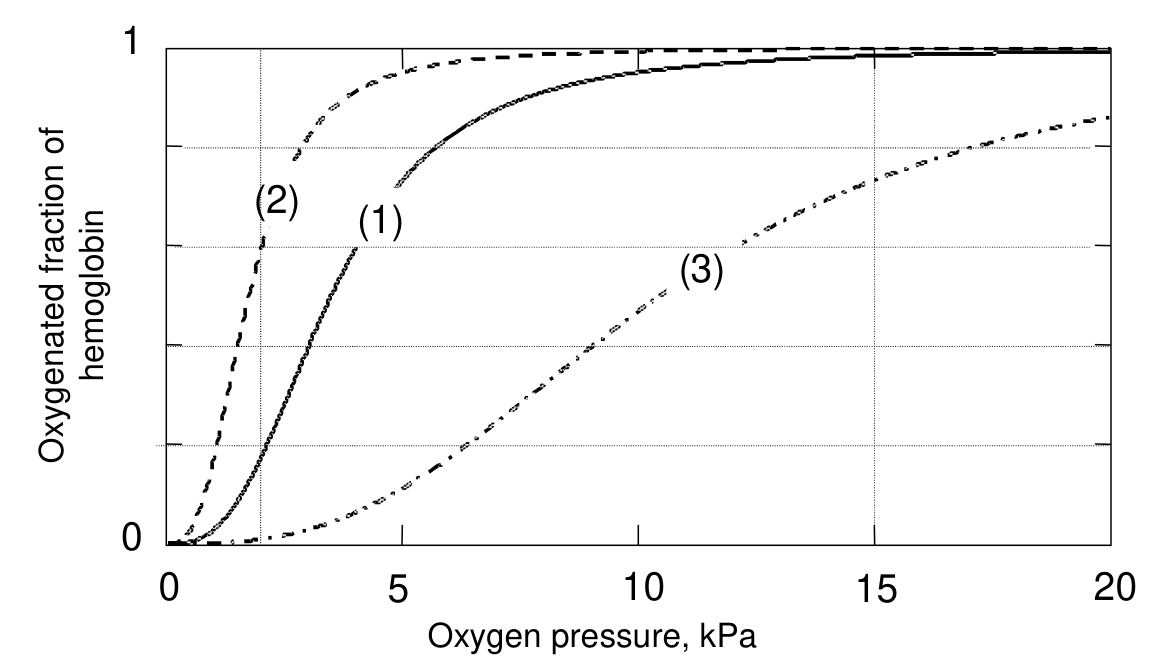
Figure 1
1.1 Using the relation between \(K\) and the standard Gibbs energy \(\Delta G^0\) for a reaction, calculate the difference between the \(\Delta G^0\) values for the heme reactions (1) and (2).
1.2 Estimate from Figure 1 (to 2 significant figures) how many moles of \(\ce{O2}\) are deposited in muscle tissue when one mole of Hb travels from the lungs to the muscles and back again for the three different types of Hb.
1.3 The special S-shaped uptake curve 1 is the result of subtle structural features of Hb. The deficient Hb shown in curve 2 is not optimal because:
- ☐ The binding with \(\ce{O2}\) is too weak.
- ☐ The binding with \(\ce{O2}\) is too strong.
- ☐ The maximum oxygen capacity is too low.
- ☐ The deficiency is caused by carbon monoxide poisoning.
1.4 Calculate how much oxygen (in \(\mathrm{mol\,s^{-1}}\)) can be deposited in tissue by blood with normal Hb (1).
1.5 Calculate the maximum power that the body can produce (assuming it is limited by oxygen transfer).
Official English text of the problem.
Problem 2: Nitrogen Cycle in Nature
Ammonia is a toxic substance to marine animals at levels exceeding 1 ppm. Nitrifying bacteria play an important role in the conversion of \(\ce{NH3}\) first to nitrite and then to nitrate, the storage form of nitrogen in the soil.

\(\ce{NADH}\) is the biochemical reducing agent of the coenzyme nicotinamide dinucleotide (NAD), \(\ce{NAD+}\) is the oxidized form of the coenzyme NAD.

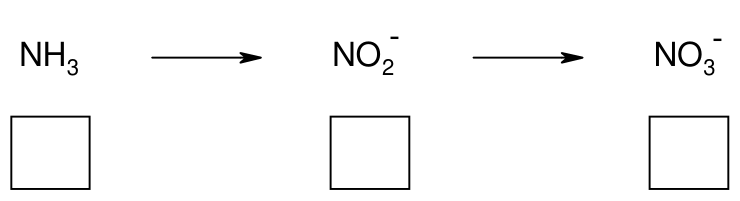
2.1 Give the oxidation states of N in the following series: (Use the boxes below the compounds)
The spectrophotometric analysis of nitrite is based on a reaction with an indicator. The coloured product then obtained has an absorbance maximum at \(\lambda = 543\ \mathrm{nm}\). For quantitative analyses a calibration curve has to be made, in which absorbance at the maximum absorbance wavelength \(\lambda = 543\ \mathrm{nm}\) is plotted against nitrite concentration in a series of standards.
2.2 The measurements are performed at the wavelength with the maximum absorbance because:
- ☐ There is no interference of impurities.
- ☐ There is no contribution of stray light.
- ☐ There is optimal accuracy of the measurement.
- ☐ None of these statements.
Mark the correct answer.
The absorption is measured with a single beam spectrophotometer. However 5 % of the light, the so-called stray light \(I_s\), strikes the detector directly (see Figure 2).
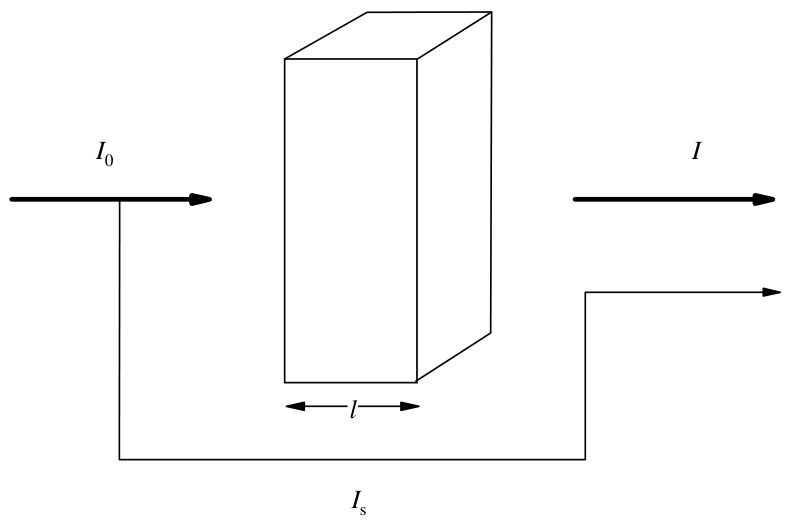
Figure 2
2.3 Calculate the value of the absorbance \(A\) shown by the spectrophotometer if \(\varepsilon = 6\,000\ \mathrm{M^{-1}\,cm^{-1}}\), \(l = 1\ \mathrm{cm}\) and \(c = 1\times10^{-4}\ \mathrm{M}\)
For a nitrite determination in water the following data have been measured.
Table 1
concentration of nitrite nitrogen (ppm) absorbance at 543 nm (1.000 cm cell) blank 0.003 (due to impurities in the solvent) 0.915 0.167 1.830 0.328 2.4 Determine (show calculation) from the data given above, using the values corrected for the solvent impurities, the slope \(m\) and the intercept \(b\) of the calibration curve \(A = mc + b\).
The duplicate analyses of a water sample are given below. The measurements have been performed at a wavelength of 543 nm and in a 2.000 cm cell.
Table 2
water sample absorbance analysis 1 0.562 analysis 2 0.554 For the calculation of the concentration of the nitrite nitrogen (\(c\) in ppm) the equation obtained by the method of least squares
\[ \text{corrected absorbance}=0.1769\,c+0.0015 \tag{a} \]
may be applied, using the measurements in a 1.000 cm cell.
2.5 Calculate the average nitrite nitrogen concentration in ppm and \(\mathrm{\mu g\,cm^{-3}}\).
Hint: Take the blank from problem 2.4.
Official English text of the problem.
Problem 3: Inulin, a New Renewable Raw Material
Theme II - Chemistry of Industrial Relevance
In our daily life we use many products that are produced on an industrial scale. Mastering the underlying chemistry is at the heart of this business.
PROBLEM 3
Inulin, a New Renewable Raw Material
Inulin, which is produced from chicory roots in Belgium and The Netherlands, is used as a food additive as it has a beneficial effect on the intestinal flora. It is also used as source of fructose which is 1.9 times sweeter than sucrose, and for the production of mannitol which is used in chewing gum. Inulin is a linear polymer of fructose units with a glucose unit at one end; its Haworth projection formula is shown at the left. In this problem inulin has 10 fructose units (\(n = 9\)).
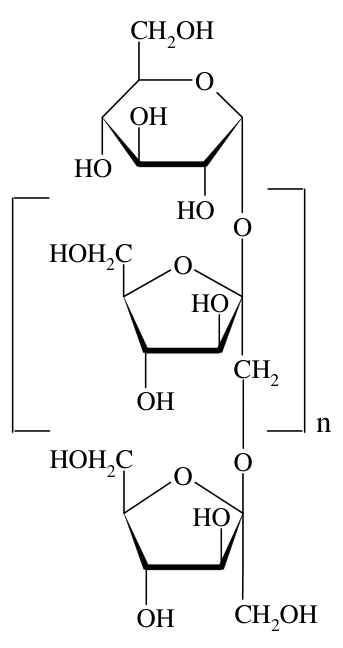
3.1 Inulin may be hydrolyzed under \(\ce{H+}\)-catalysis conditions. Of the four options below (A, B, C and D) indicate which C-O bond cleavage is most likely to occur.
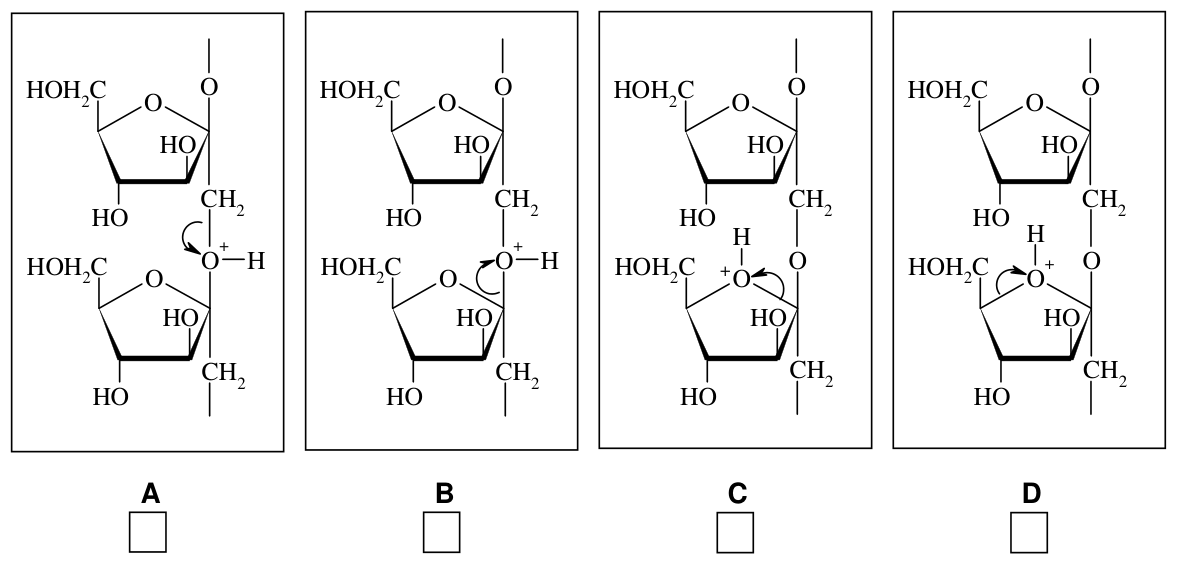
Mark the correct cleavage mechanism for the most efficient hydrolysis.
Hydrolysis with isotopically labelled water can provide information about the mechanism of hydrolysis using modern NMR techniques, which can “see” deuterium (\(\ce{^{2}H}\)) and the oxygen isotope \(\ce{^{17}O}\).
3.2 Indicate which labelled water can best be used for this purpose. Mark the correct answer.
- ☐ \(\ce{^{2}H2O}\)
- ☐ \(\ce{H2^{17}O}\)
- ☐ \(\ce{^{2}H2^{17}O}\)
- ☐ None of them.
Upon catalytic hydrogenation glucose gives sorbitol (S), whilst fructose (F) gives mannitol (M) and sorbitol (S).
3.3 Draw the Fischer projections of fructose (F), sorbitol (S) and mannitol (M).
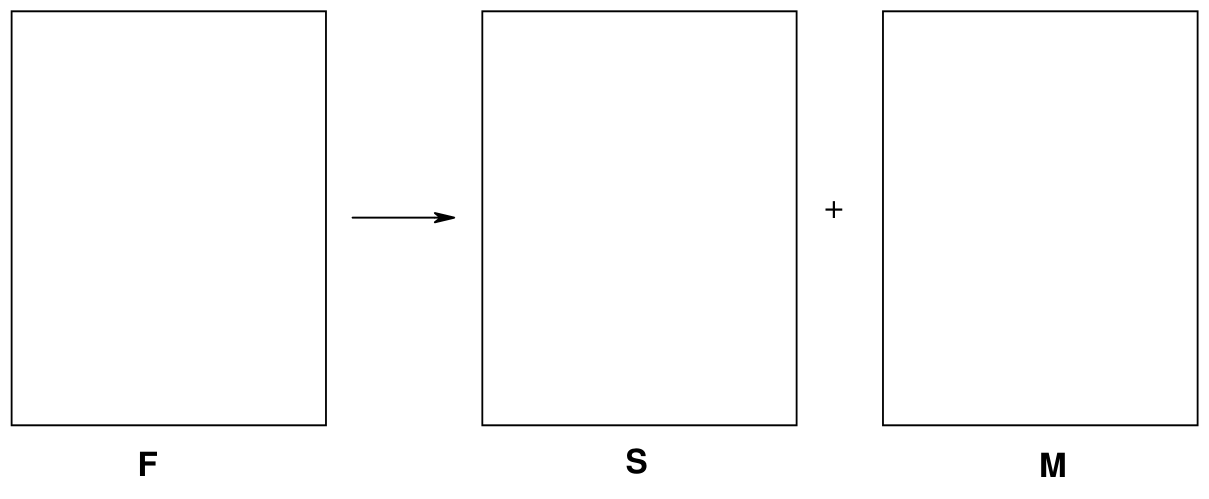
1.00 mol of inulin in 2.00 kg of water with added catalysts, is subjected to hydrolysis and hydrogenation at \(95\,^\circ\mathrm{C}\) in a one step process. The selectivity of the hydrogenation of fructose to mannitol / sorbitol is 7 / 3.
3.4 How many moles of mannitol and sorbitol are obtained?

After completion of the reactions the catalysts are removed and the reaction mixture is cooled to \(25\,^\circ\mathrm{C}\). The solubility of M is \(0.40\ \mathrm{mol\,kg^{-1}}\) in water at \(25\,^\circ\mathrm{C}\) and the solubility of S is so high that it will not precipitate.
3.5 Calculate how many moles of M will precipitate.
\(\underline{\hspace{4cm}}\)
Official English text of the problem.
Problem 4: Production of Methanol
Methanol (\(\ce{CH3OH}\)) is a chemical that is used for the production of additives in gasoline and many common plastics. A factory, producing methanol, is based on the reaction:

Hydrogen and \(\ce{CO}\) are obtained by the reaction:

The three units of the factory, namely, the “reformer” for the hydrogen / carbon monoxide production, the “methanol reactor” and a “separator” to separate methanol from \(\ce{CO}\) and \(\ce{H2}\), are schematically shown in Figure 1. Four positions are indicated by \(\alpha\), \(\beta\), \(\gamma\) and \(\delta\).
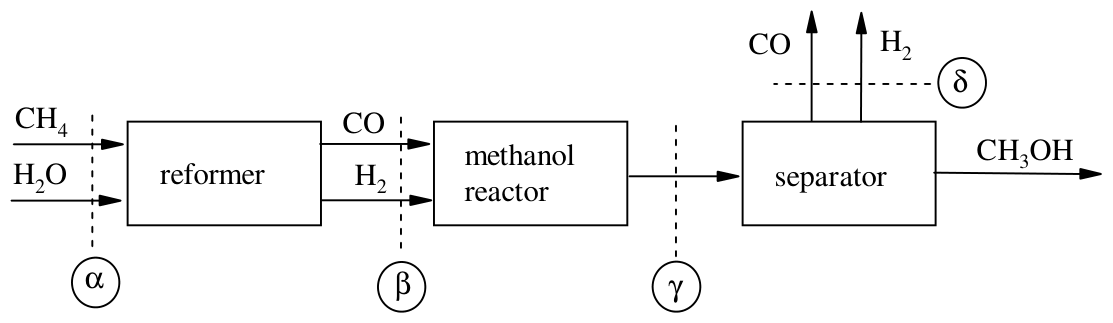
Figure 1
The flow of methanol at position \(\gamma\) is \(n[\ce{CH3OH},\gamma]=1000\ \mathrm{mol\,s^{-1}}\). The factory is so designed that 2/3 of the \(\ce{CO}\) is converted to methanol. Excess \(\ce{CO}\) and \(\ce{H2}\) at position \(\delta\) are used to heat the first reactor. Assume that the reformer reaction goes to completion.
4.1 Calculate the flow of \(\ce{CO}\) and \(\ce{H2}\) at position \(\beta\).
4.2 Calculate the flow of \(\ce{CO}\) and \(\ce{H2}\) at position \(\gamma\).
4.3 Calculate the flows of \(\ce{CH4}\) and \(\ce{H2O}\) needed at position \(\alpha\).
4.4 At point \(\gamma\) all species are gases. Calculate the partial pressures in MPa for \(\ce{CO}\), \(\ce{H2}\) and \(\ce{CH3OH}\) at position \(\gamma\) using the equation:
\[ p_i=p\frac{n_i}{n_{\mathrm{tot}}} \]
wherein \(n_i\) is the flow and \(p_i\) the partial pressure of the compound \(i\), \(n_{\mathrm{tot}}\) is the total flow at the position considered, and \(p\) the total pressure in the system. (\(p=10\ \mathrm{MPa}\))
When the methanol reactor is large enough the reaction goes to equilibrium. The partial pressures at point \(\gamma\) obey the equation:
\[ K_p=\frac{p_{\ce{CH3OH}}p_0^2}{p_{\ce{CO}}p_{\ce{H2}}^2} \]
wherein \(p_0\) is a constant (0.1 MPa) and \(K_p\) is a function of temperature as is shown in Figure 2 (the vertical scale is logarithmic).
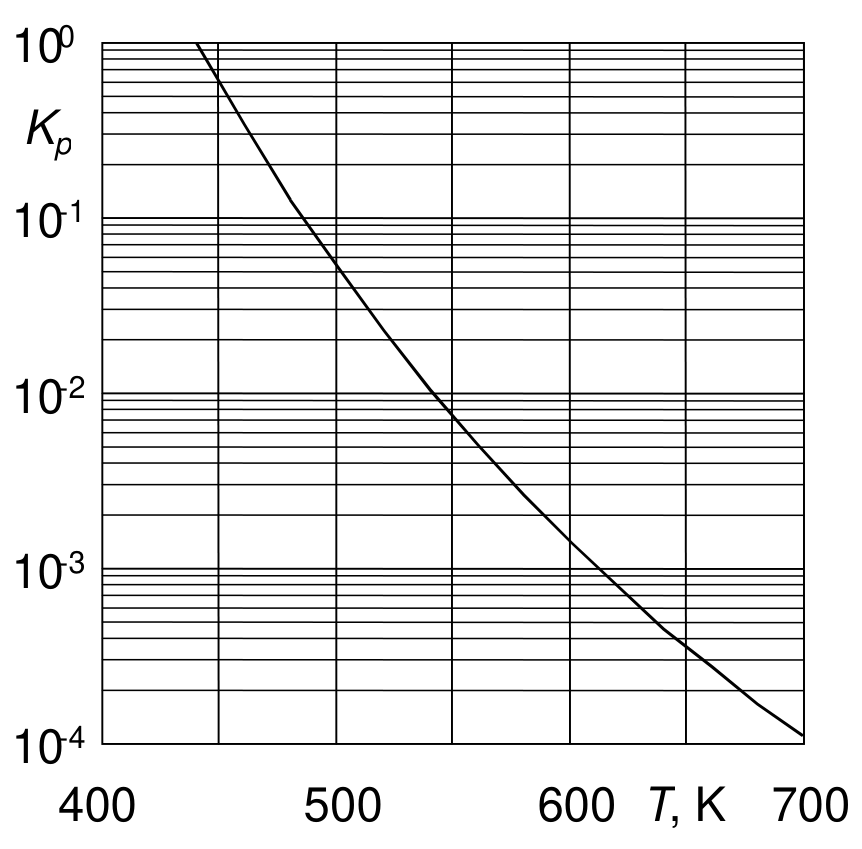
Figure 2
4.5 Calculate \(K_p\) and indicate at which temperature \(T\) the reaction must be operated to achieve this equilibrium.
Official English text of the problem.
Problem 5: Aramids, High-performance Polymeric Materials
Aromatic polyamides (aramids) are high strength, high performance polymer fibers that find use in composite materials, bullet-proof vests, high quality skis, safety helmets, etc. Aramid PPTA is marketed under the names Kevlar® (DuPont) and Twaron® (Teijin), and amongst others manufactured in the north of The Netherlands. The PPTA chains are neatly packed into fibers with a sheet type structure.
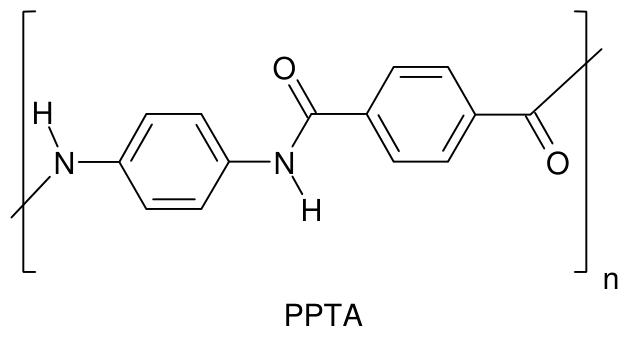
PPTA
5.1 Draw the structure of these sheets (three chains suffice).
For a polymerisation of equimolar amounts of two monomers the average chain length is \(\overline{P}_n\), the degree of conversion is \(p\), which equals the fraction of functional groups that have reacted, the total number of chains is \(N_t\) and the total initial number of monomers is \(U_0\).
Assuming that the polymerization equilibrium can fully be described by:

where C stands for any \(\ce{-CO2}\) group, A stands for any \(\ce{-NH2}\) group and Am stands for any amide group.
5.2 Calculate the degree of conversion needed to obtain an average chain length of 500.
5.3 For the synthesis of PPTA the following possibilities are considered. Which of the following reactions will work? Mark the correct answer(s).
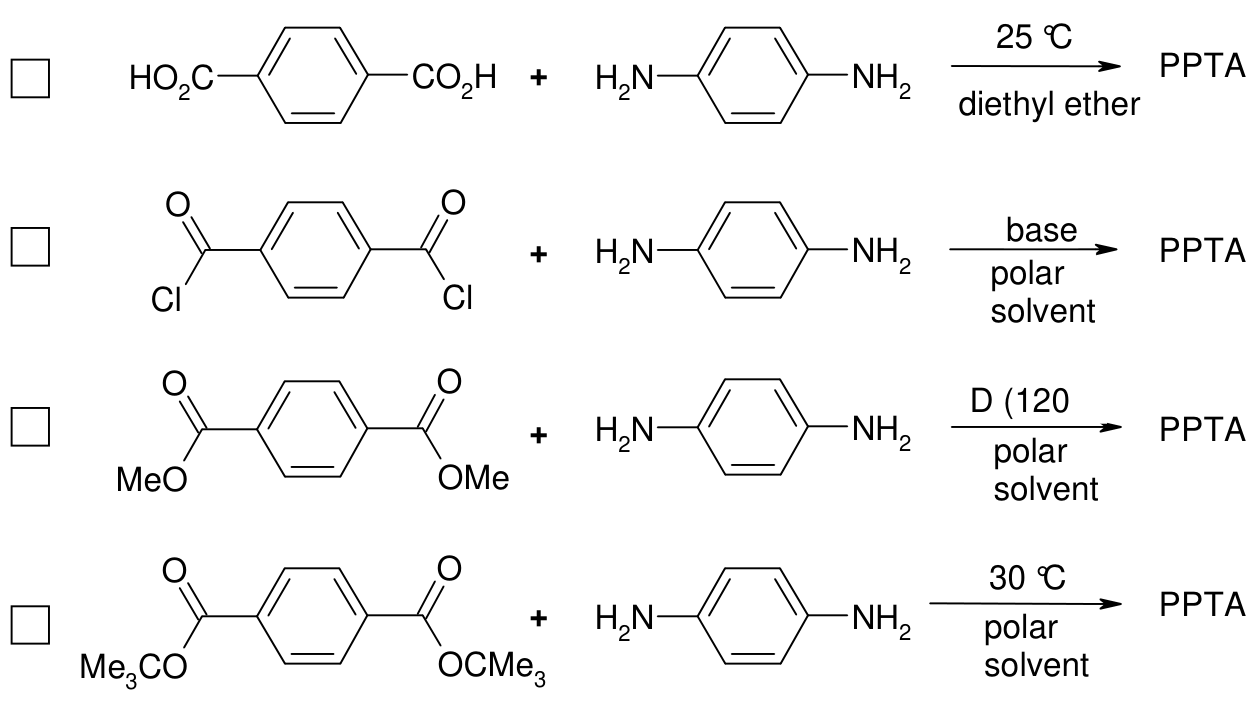
5.4 Another type of aramid can be produced from 4-aminobenzoic acid (4-aminobenzene-carboxylic acid) by heating.
(a) Give the structure of this aramid (\(n=4\))
(b) Calculate the average chain length at equilibrium (reaction is carried out in a closed vessel). The equilibrium constant \(K=576\).
Official English text of the problem.
Problem 6: Phospholipids in Membranes
Theme III - Chemistry of Functional Molecules in Nature
A challenge in chemistry is to discover what nature does and how the structures of biologically active molecules are related to what they do.
PROBLEM 6
Phospholipids in Membranes
Biological cell membranes are complex, functional, non-covalent molecular assemblies, largely consisting of lipids and proteins. Their function is of vital importance for life processes. They separate the cell from its environment and also determine the specific flow of information between the cell contents and the environment. Phospholipids are among the most important components of cell membranes. An example is compound A.
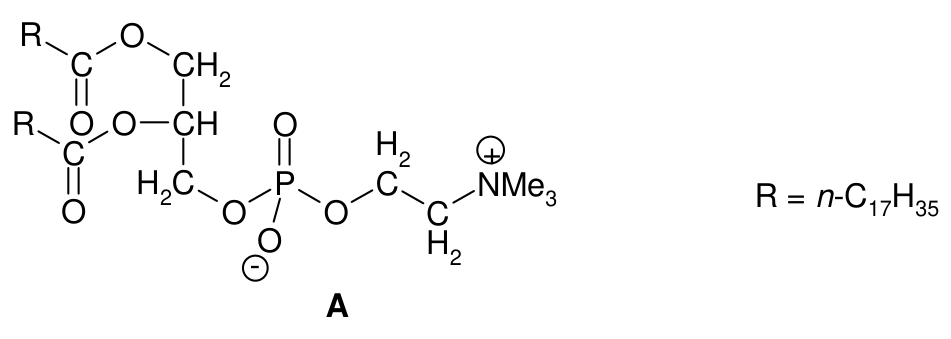
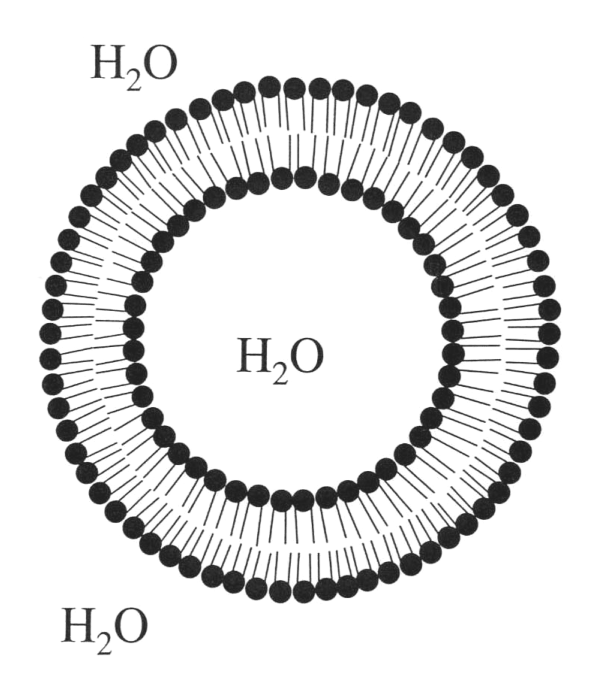
Upon dispersion in water (above a low critical concentration) compound A forms closed bilayer structures, called liposomes, which are employed as model compounds for aspects of the chemistry of the structurally much more complex cell membranes. Liposomes are globular aggregates with the polar or ionic head groups in contact with water and with the alkyl tails sequestered in a hydrophobic core. The bilayer structure encloses an aqueous inner compartment.
Double-tailed synthetic surfactants also form closed bilayer assemblies similar to liposomes but now called vesicles. An example is di-n-dodecyldimethylammonium chloride (DDAC).
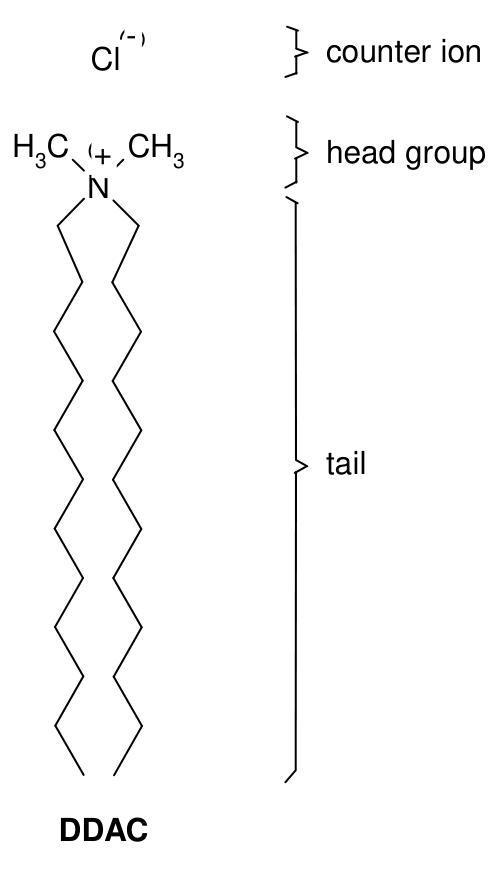
6.1 (a) How many stereoisomers are possible for compound A?
(b) How many stereoisomers are possible for the trialkylphosphate B?
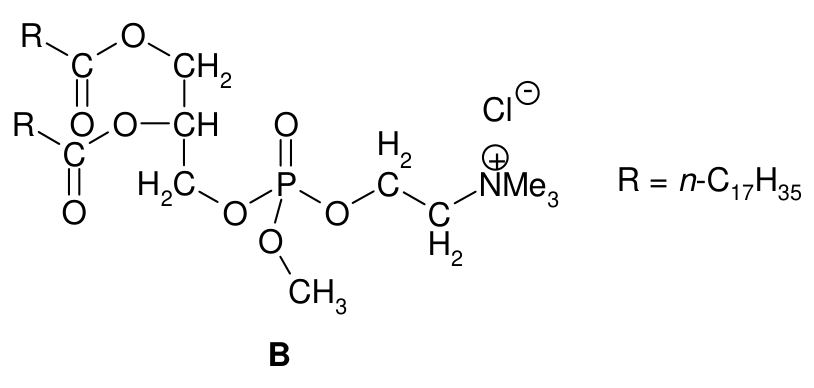
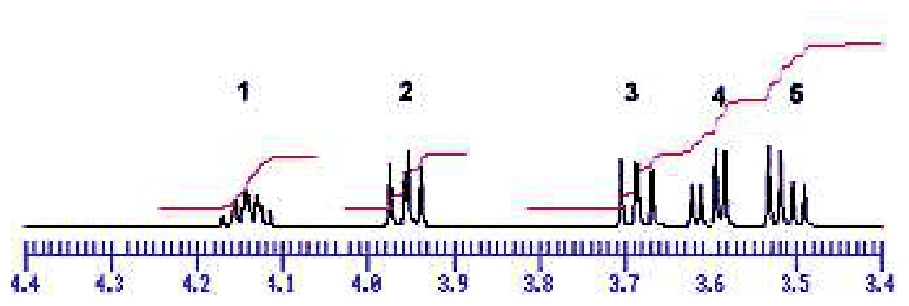
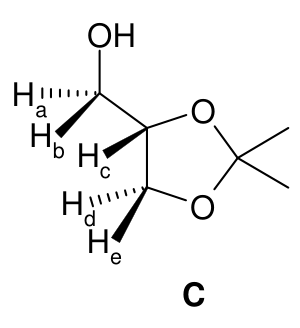
A precursor for the synthesis of compound A is the acetonide C derived from glycerol. Part of the \(\ce{^1H}\)-NMR spectrum of compound C is shown below.
6.2 Which signal number in the \(\ce{^1H}\)-NMR spectrum corresponds to proton \(H_{\mathrm c}\)?
The bilayer of a liposome can be characterized by \(V\) (the volume of the hydrocarbon chains), \(a_0\) (optimal cross-sectional surface area of the head groups of the phospholipid in the aggregate) and \(l_{\mathrm c}\) (the maximum chain length that the alkyl group can assume). A good approximation for unbranched alkyl tails containing \(n\) carbon atoms yields:
\[ V=(27.4+26.99\,n)\times10^{-3}\ \mathrm{nm^3} \]
\[ l_{\mathrm c}=(0.154+0.1265\,n)\ \mathrm{nm} \]
For very large \(n\) values, the intertail interactions dominate over the head group repulsions.
6.3 Calculate the minimum cross-sectional surface area of the head groups for such very large \(n\) values.
Vesicles formed from DDAC (above its critical vesicle concentration, cvc) catalyse the unimolecular decarboxylation of 6-nitro-benzisoxazole-3-carboxylate (6-NBIC).
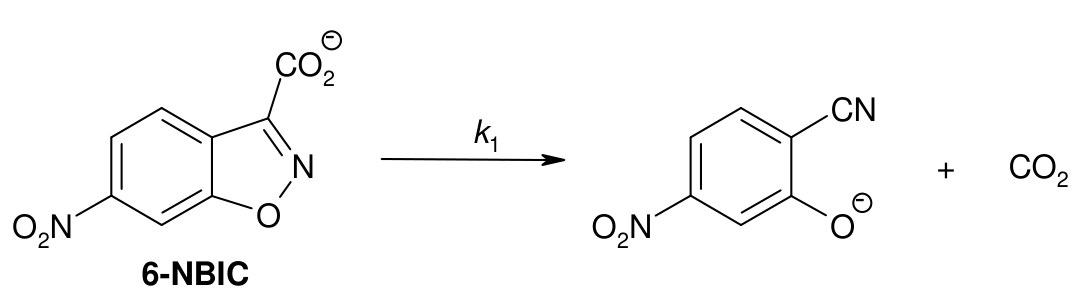
In water at \(25\,^\circ\mathrm{C}\) \(k_1=3.1\times10^{-6}\ \mathrm{s^{-1}}\). At the concentration \(c_1\) of DDAC at which 6-NBIC becomes fully bound to the vesicles, \(k_1=2.1\times10^{-3}\ \mathrm{s^{-1}}\).
6.4 Sketch a plot of \(k_1\) vs. [DDAC] for \(\textbf{[DDAC]}=0\rightarrow3c_1\).
6.5 The main reason for the efficient catalysis of the decarboxylation of 6-NBIC by DDAC vesicles is:
☐ The decarboxylation is catalysed by the \(\ce{Cl-}\) ions bound to the surface of the vesicles.
☐ Efficient loss of hydration of the carboxylate group of vesicle-bound 6-NBIC.
☐ Strong binding of \(\ce{CO2}\) in the interior of the vesicle.
☐ Strong binding of the organic reaction product to the vesicles relative to that of 6-NBIC.
Mark the correct answer.
Official English text of the problem.
Problem 7: Glutathione, an Essential Mini-Peptide
Glutathione, abbreviated as GSH, is a small peptide that is present in almost all tissues of animals. GSH fulfils important biological functions, such as detoxification of electrophilic chemicals and reduction of (organic) peroxides in blood. An electrophilic compound reacts irreversibly with GSH, especially in the liver, to give a primary product that is converted by a series of biotransformations into a so-called mercapturic acid, which is excreted via the urine. Oxidants react with GSH to give the disulfide GSSG, which can be enzymatically reverted to GSH with reductases. The ratio GSH/GSSG in most cells is ≥ 500.
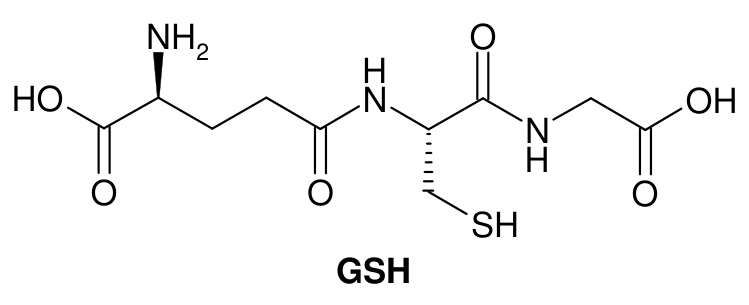
7.1 (a) How many amino acid residues are present in GSH?
(b) Draw the structures of the corresponding amino acids and mark the chiral centers with an asterisk.
A mercapturic acid A isolated from urine of a person who has been exposed to acrylonitrile (\(\ce{H2C=CH-CN}\)) has the molecular formula \(\ce{C8H12N2O3S}\). The \({}^{1}\mathrm{H}\)-NMR spectrum of A in \(\ce{(CD3)2SO}\) is shown in Figure 1. When the product is pretreated with \(\ce{D2O}\), the signals at \(\delta\) 12.8 and \(\delta\) 6.8 are no longer present and the signal 3 is simplified.
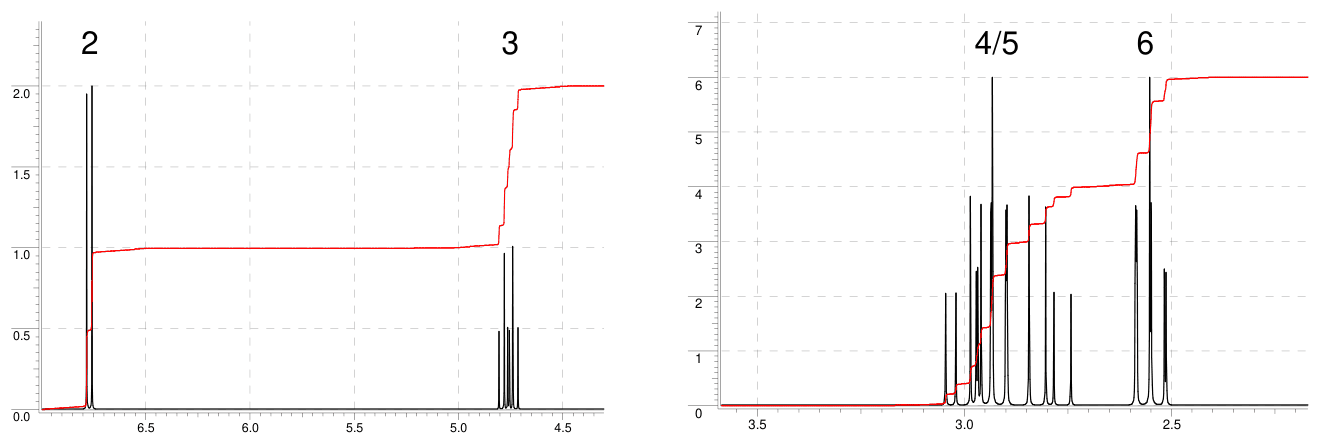
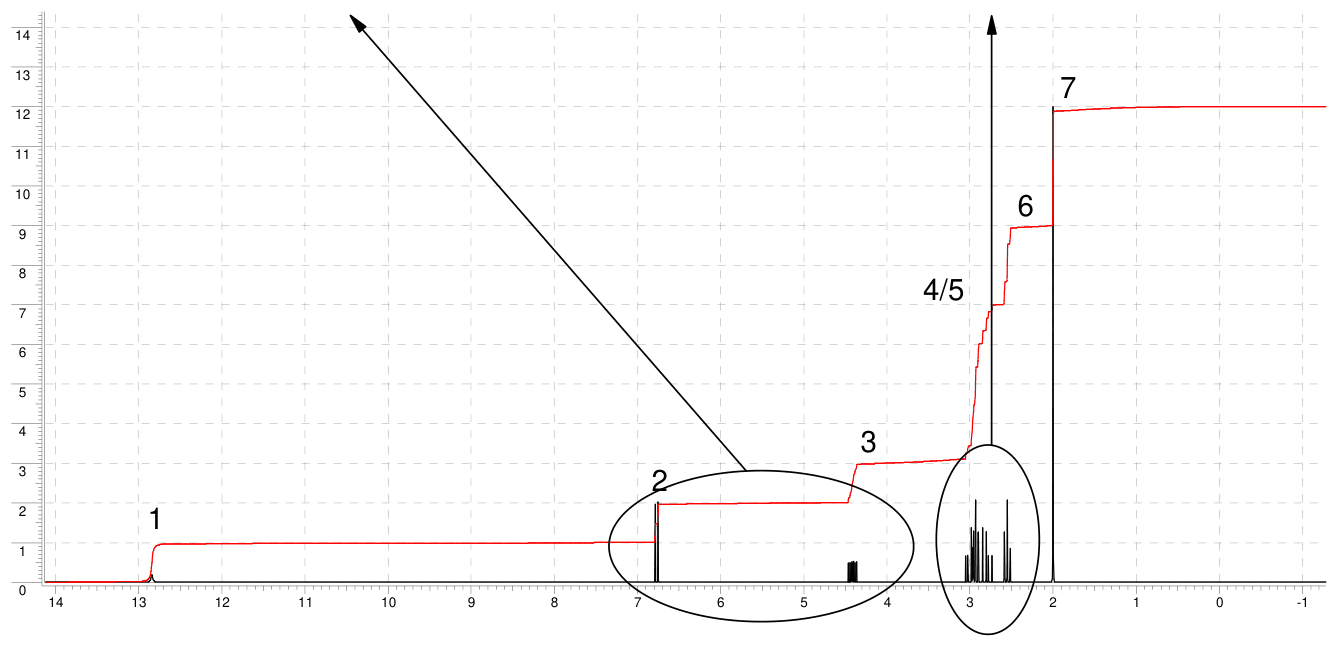
Figure 1
7.2 (a) The NMR-signals correspond with protons in the following groups: \(\ce{CH}\), \(\ce{CH2}\), \(\ce{CH3}\), \(\ce{OH}\) and \(\ce{NH}\). Indicate the appropriate proton group in the boxes for the signals 1 – 7.
Signals 1 2 3 4/5 6 7 Protons (b) How many carbon atoms are present in compound A that do not carry any protons?
(c) Draw the structure of compound A.
Vitamin C (ascorbic acid) reacts with oxidants to give dehydroascorbic acid D
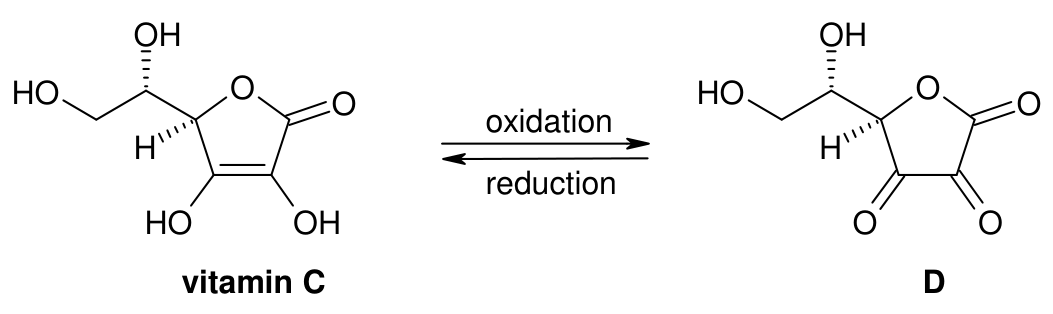
7.3 Eating fresh fruit and vegetables is healthy
- [ ] because vitamin C forms a complex with GSH.
- [ ] because vitamin C reacts with electrophilic compounds.
- [ ] because vitamin C removes oxidants and prevents undesired depletion of GSH.
- [ ] for many reasons, but none of them has anything to do with GSH.
Official English text of the problem.
Problem 8: Lighting Lamps
Theme IV - Chemistry Related to Light and Energy
Chemistry plays a major role in meeting our needs of light and energy. Our life is unthinkable without artificial light and energy for mobility.
PROBLEM 8
LIGHTING LAMPS
Since 1891 lighting lamps have been manufactured in The Netherlands. The improvement today in comparison to the first lamp is enormous, especially with the introduction of the gas discharge lamps. The life-time has increased by orders of magnitude. The colour is also an important aspect. Rare earth metal compounds like \(\ce{CeBr3}\) are now included to reach a colour temperature of 6000 K in the lamp. These compounds are ionic solids at room temperature, and upon heating they sublime partially to give a vapour of neutral metal halide molecules. To achieve a high vapour pressure, the sublimation enthalpy should be as low as possible.
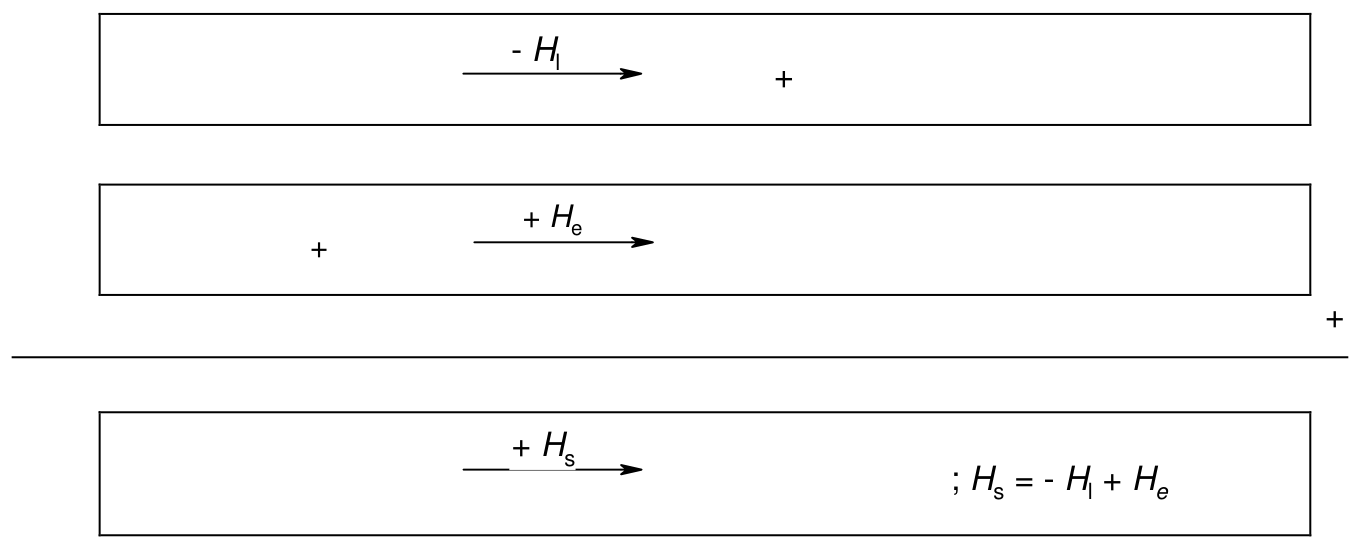
8.1 Give a thermochemical cycle (Law of Hess) for sublimation of \(\ce{CeBr3}\), via a vapour of mononuclear ions. (\(H_{\mathrm l}=H_{\mathrm{lattice}}\); \(H_{\mathrm e}=H_{\mathrm{electrostatic}}\); \(H_{\mathrm s}=H_{\mathrm{sublimation}}\); \(H\) is not absolute, \(H\) means \(\Delta H\))
The lattice energy of the solid can be calculated using the Born–Landé formula:
\[ H_{\mathrm l} =f\frac{Z_+Z_-Ae^2}{r_++r_-}\left(1-\frac1n\right) \]
The factor \(fe^2\) (necessary in order to calculate the lattice energy in \(\mathrm{kJ\,mol^{-1}}\)) amounts to 139 when the ionic radii are substituted in nm. The Madelung constant \(A\) for the lattice is 2.985. The Born exponent \(n\) is 11. The charges of the ions \(Z_+\) and \(Z_-\) are integer numbers (\(Z_-\) is negative). For the calculation of the energy of gaseous \(\ce{CeBr3}\) (when formed from ions) the same Born-Landé formula can be used without \(A\). The structure of \(\ce{CeBr3}\) in the gas phase is planar triangular. The radius of \(\ce{Ce^3+}\) is 0.115 nm and of \(\ce{Br^-}\) is 0.182 nm.
8.2 Calculate the enthalpy of sublimation of \(\ce{CeBr3}\) (in integers; be aware of the signs!)
Attempts to make a better lamp have been undertaken by adding a stoichiometric amount of \(\ce{CsBr}\) to the \(\ce{CeBr3}\) in the lamp leading at room temperature to solid \(\ce{CsCeBr4}\). When the sublimation temperature decreases the life time of the lamp will increase likewise. The \(\ce{CsCeBr4}\) lattice has a \(\ce{NaCl}\) structure with \(\ce{Cs+}\) as cations and tetrahedral \(\ce{CeBr4^-}\) as complex anions. Sublimation of \(\ce{CsCeBr4}\) leads to a vapour of \(\ce{CsBr}\) and \(\ce{CeBr3}\) molecules.
8.3 Give the reaction equations of the thermochemical cycle (Law of Hess) for this process in which some steps involve \(\ce{CeBr4^-}\) ions, mononuclear ions and/or neutral molecules in the gas phase.
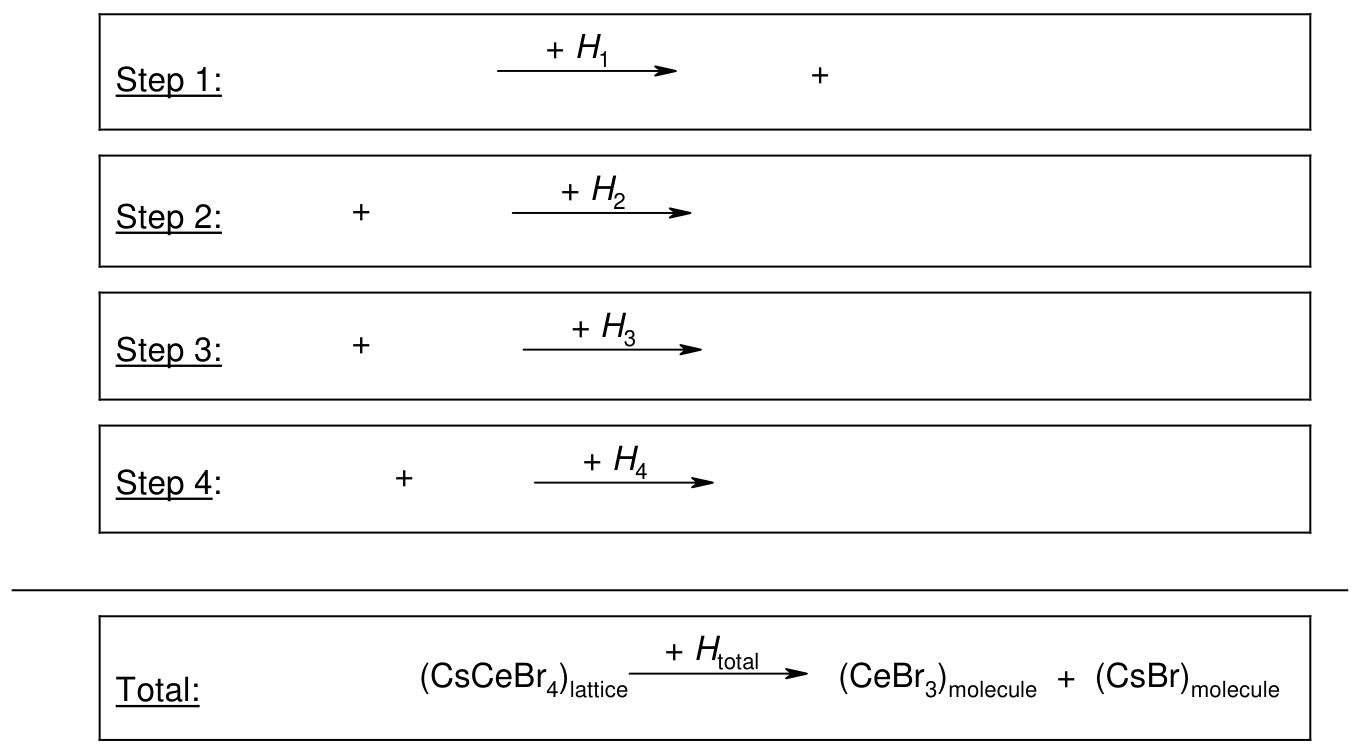
8.4 Calculate the enthalpy of sublimation of \(\ce{CsCeBr4}\) (in integers).
Use the Born–Landé formula for all steps in the process and report the separate energies also (be aware of the signs!). The Madelung constant for \(\ce{NaCl}\) is 1.75. The Cs–Ce distance in the lattice is 0.617 nm. The \(\ce{CeBr4^-}\) anion is a tetrahedron in which the ratio between the edge and the distance between a corner of the tetrahedron and the centre of gravity (body-radius) amounts to \((2\sqrt6)/3=1.633\). The Born exponent of \(\ce{CsBr}\) is 11. The radius of \(\ce{Cs+}\) is 0.181 nm.
8.5 Conclusion in relation to the previous answers: Was adding \(\ce{CsBr}\) a good idea? Mark the correct answer.
- [ ] Adding \(\ce{CsBr}\) is counterproductive.
- [ ] Adding \(\ce{CsBr}\) has no influence.
- [ ] Adding \(\ce{CsBr}\) is advantageous.
- [ ] From these data no clear answer can be given.
Official English text of the problem.
Problem 9: Red Ruby
Ruby crystals have a deep red colour and are well known for their use in jewellery. Not many people know that the heart of the first laser, built in 1960 by Maiman, was a big ruby crystal. The red colour of ruby originates from the absorption of light by \(\ce{Cr^3+}\) ions that are incorporated in colourless aluminium oxide (\(\ce{Al2O3}\)) crystals. The \(\ce{Cr^3+}\) ion has 3 electrons in the \(3d\) shell and the absorption of light is due to electronic transitions between \(3d\) orbitals of lower and higher energy.
9.1 Indicate which of the four absorption spectra belongs to ruby.
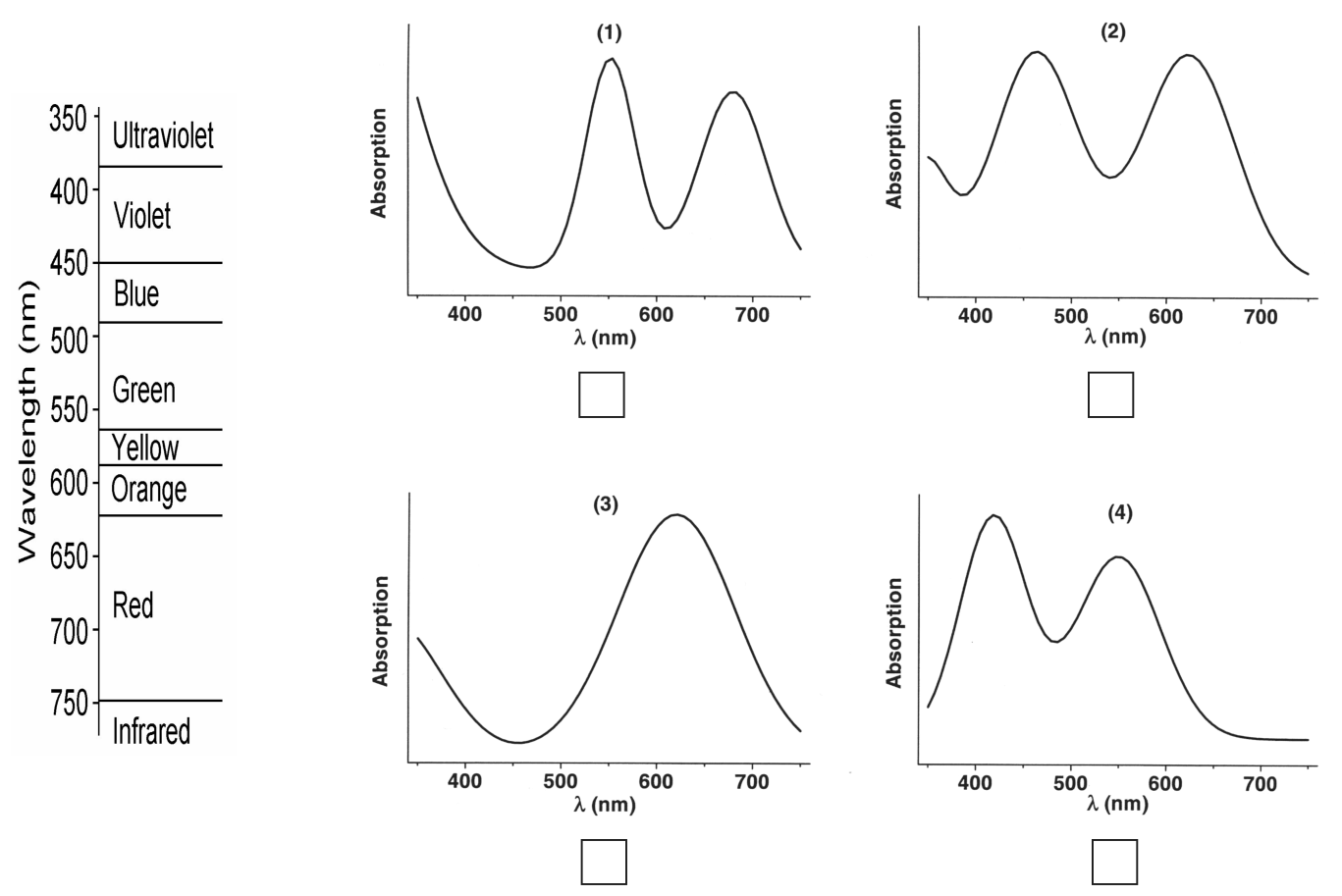
Figure 1
The rod used in ruby lasers is a cylinder with a length of 15.2 cm and a diameter of 1.15 cm. The amount of \(\ce{Cr^3+}\) ions is 0.050 mass %. The density of \(\ce{Al2O3}\) is \(4.05\ \mathrm{g\,cm^{-3}}\). The atomic mass of \(\ce{Cr}\) = \(52\,\mathrm{u}\). (\(1\,\mathrm{u}=1.67\times10^{-27}\ \mathrm{kg}\)).
9.2 Calculate how many \(\ce{Cr^3+}\) ions are in this laser rod.
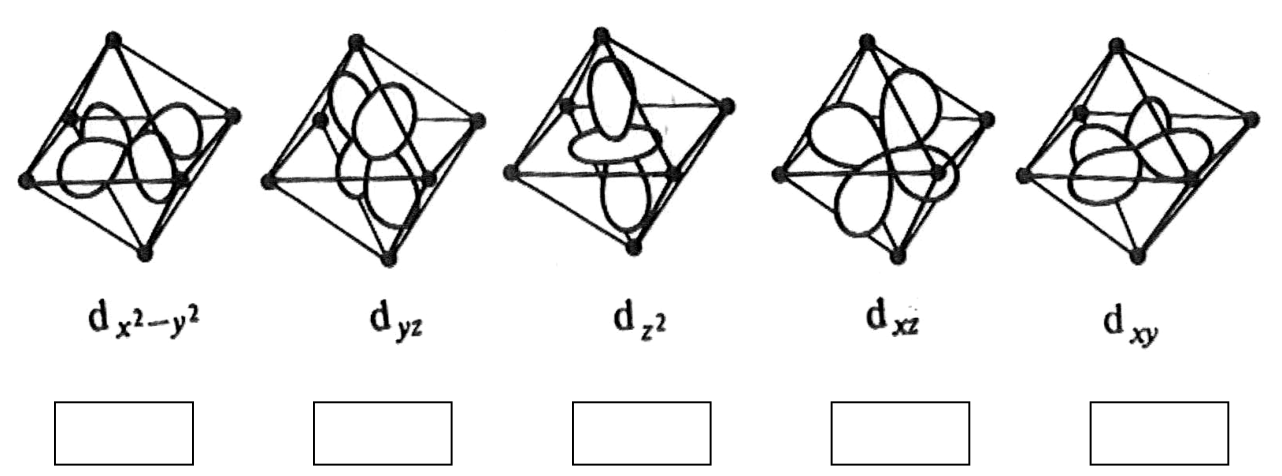
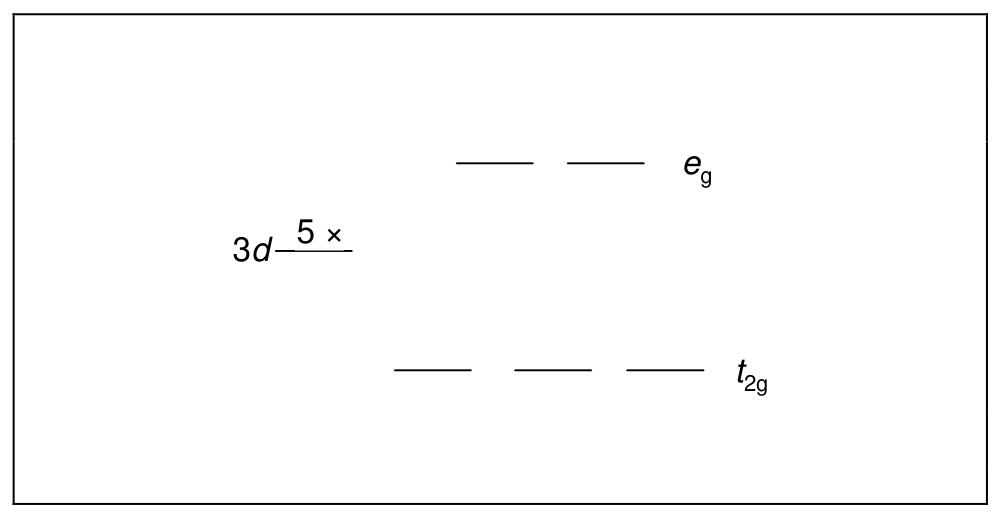
In rubies the \(\ce{Cr^3+}\) ions are coordinated by an octahedron of 6 oxygen ions. The shape of the five \(3d\) orbitals is shown below. The box below shows the splitting of the five \(3d\) orbitals into a group of three orbitals at lower energy (\(t_{2g}\)) and a group of two at higher energy (\(e_g\))..
9.3 Indicate in the boxes below which of the \(3d\) orbitals (\(d_{z^2}\), \(d_{xy}\), \(d_{yz}\), \(d_{x^2-y^2}\), \(d_{xz}\)) belong to the \(t_{2g}\) group and which belong to the \(e_g\) group.
9.4 Indicate with arrows the distribution and the direction of the magnetic spin moment of the three \(3d\) electrons of \(\ce{Cr^3+}\) over the five \(d\) orbitals in the lowest energy state of \(\ce{Cr^3+}\).
The ruby is placed on a (non-magnetic) scale. When the scale is in balance (Figure 2) a magnet is placed directly under the side with the ruby.
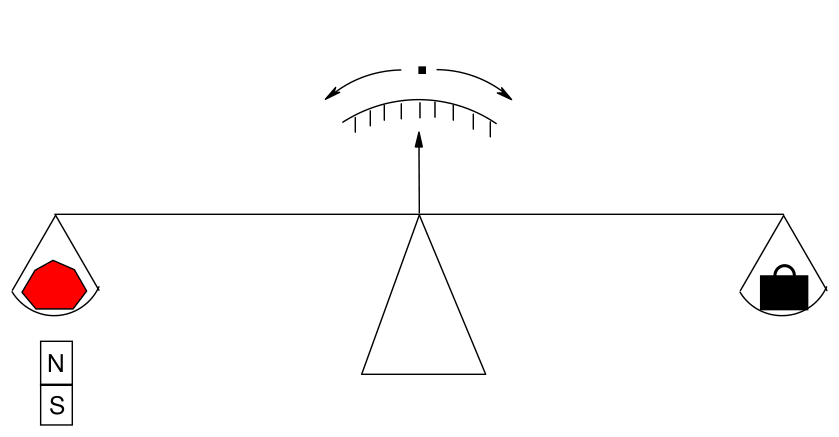
Figure 2
9.5 Indicate what will happen with the ruby (mark the correct answer)
- ☐ The magnet attracts the ruby (the ruby moves down)
- ☐ The magnet has no influence on the ruby (the ruby does not move)
- ☐ The magnet repels the ruby (the ruby moves up)
- ☐ The magnet has an oscillating effect on the ruby (the ruby moves up and down)
Official English text of the problem.
Problem 10: Vehicle Traction Batteries
Battery-powered electric vehicles (EV’s) are likely to become increasingly common in the next 50 years because of growing concern over pollution caused by vehicles using combustion engines. The reason for the current meagre commercial success of EV’s is that the battery specifications must have a performance and cost profile comparable to conventionally powered vehicles.
Lead-acid batteries are extensively used as portable power sources for vehicles and traction. A lead-acid battery capable of efficient recharging has an energy density of 45 Wh/kg.
In the current evolution of EV batteries, the most promising long-term solution is the rechargeable light weight lithium-ion battery. Such batteries are under intensive investigation worldwide and hold also promise for the storage of electricity from solar cells. Their weight is 1/3 of a lead-acid battery. Lithium is used as a negative electrode. It has a high specific capacity and electrode potential. A common positive electrode material is the environmentally benign spinel-type \(\ce{LiMn2O4}\). The spinel structure comprises a matrix of cubic close-packed oxide ions, stabilised by lithium ions in tetrahedral sites and manganese ions in octahedral sites. In \(\ce{LiMn2O4}\) half of the manganese ions has an oxidation state +3 and half the oxidation state +4.
A lead-acid battery is represented by:
\[ \ce{Pb(s)} \mid \ce{PbSO4(s)} \mid \ce{H2SO4(aq)} \mid \ce{PbSO4(s)} \mid \ce{PbO2(s)} \mid (\ce{Pb(s)}) \]
A lithium battery is represented by:
\[ \ce{Li(s)} \mid \ce{Li+}\text{-conducting (solid) electrolyte(s)} \mid \ce{LiMn2O4(s)} \]
Upon discharge the insertion product \(\ce{Li2Mn2O4}\) is formed. Charging the battery leads to the products \(\ce{Li(s)}\) and \(\ce{LiMn2O4}\).
10.1 Give the electrochemical reactions at the electrodes of the lead-acid battery during discharge.
10.2 Give the electrochemical reactions at the electrodes of the lithium-ion battery upon discharge.
10.3 Give the coordination numbers of the lithium ions and of the manganese ions in the spinel structure of \(\ce{LiMn2O4}\).
A typical family car of 1000 kg requires at least 5 kWh of energy to move 50 km, which corresponds with the consumption of about 5.0 litres or 3.78 kg of petrol. This conventional car has a petrol tank volume of 50 L. The weight of the tank is 10 kg. The fuel consumption is \(10\ \mathrm{km\,L^{-1}}\).
10.4 Calculate the extra weight of the car if the petrol tank is replaced by an equivalent battery in an EV based on (a) lead-acid battery and (b) lithium battery. Assume that in all cases the engine efficiency is the same. Calculate:
(a) Extra weight of a lead-acid battery car.
(b) Extra weight of a lithium battery car.
Official English text of the problem.
Internationale Chemie-Olympiade
IChO 2002
Groningen, Niederlande · 10 Theorieaufgaben mit vollständigen Lösungen
Aufgabe 1: Sauerstoff in Ihrem Leben
Thema 1 - Chemie des Lebens
Das Leben beruht auf Chemie. Dem Verständnis und der Überwachung von Lebensprozessen wird in der Chemie große Aufmerksamkeit gewidmet.
AUFGABE 1
SAUERSTOFF IN DEINEM LEBEN
Sauerstoff ist für uns alle lebenswichtig. Sauerstoff gelangt über die Lunge in den Körper und wird vom Blut zu den Geweben unseres Körpers transportiert. Dort kann er durch die Oxidation von Zuckern Energie liefern:
Diese Reaktion setzt 400 kJ Energie pro mol Sauerstoff frei. Die Aufnahme von \(\ce{O2}\) durch das Blut erfolgt an vier Hämgruppen (Hm) im Protein Hämoglobin (Hb).
Freies Hm besteht aus einem \(\ce{Fe^2+}\)-Ion, das an vier \(\ce{N}\)-Atome eines \(\ce{{porphyrin}^{2-}}\)-Liganden gebunden ist. Sauerstoff kann an der Koordinationsstelle von \(\ce{Fe^2+}\) binden, wobei ein \(\ce{Hm.O2}\)-Komplex entsteht. Kohlenstoffmonoxid kann auf ähnliche Weise komplexiert werden, wobei ein \(\ce{Hm.CO}\)-Komplex entsteht. \(\ce{CO}\) ist ein Gift, da es stärker an Hm bindet als \(\ce{O2}\). Die Gleichgewichtskonstante \(K_1\) für die Reaktion:
ist 10 000-mal größer als die Gleichgewichtskonstante \(K_2\) für die Reaktion:
Jedes Hb-Molekül kann vier Moleküle \(\ce{O2}\) aufnehmen. Blut, das mit \(\ce{O2}\) in Kontakt steht, nimmt abhängig vom Sauerstoffdruck einen Bruchteil dieser Menge auf, wie in Abbildung 1 (Kurve 1) dargestellt. Ebenfalls dargestellt sind die Kurven (2) und (3) für Blut mit zwei Arten von funktionsgestörtem Hb. Diese kommen bei Patienten mit bestimmten Erbkrankheiten vor.
Relevante Daten: Der \(\ce{O2}\)-Druck in der Lunge beträgt 15 kPa; in den Muskeln beträgt er 2 kPa. Der maximale Blutvolumenstrom durch Herz und Lunge beträgt \(4\times10^{-4}\ \mathrm{m^3\,s^{-1}}\). Die roten Blutkörperchen nehmen 40 % des Blutvolumens ein; innerhalb der Zellen beträgt die Konzentration von Hb \(340\ \mathrm{kg\,m^{-3}}\); Hb hat eine molare Masse von \(64\ \mathrm{kg\,mol^{-1}}\). \(R=8.314\ \mathrm{J\,mol^{-1}\,K^{-1}}\). \(T=298\ \mathrm{K}\).
Abbildung 1
1.1 Berechnen Sie mithilfe der Beziehung zwischen \(K\) und der Standard-Gibbs-Energie \(\Delta G^0\) einer Reaktion die Differenz zwischen den \(\Delta G^0\)-Werten für die Hämreaktionen (1) und (2).
1.2 Schätzen Sie anhand von Abbildung 1 (auf 2 signifikante Stellen), wie viele Mol \(\ce{O2}\) bei den drei verschiedenen Hb-Typen an das Muskelgewebe abgegeben werden, wenn ein Mol Hb von der Lunge zu den Muskeln und wieder zurück gelangt.
1.3 Die besondere S-förmige Aufnahmekurve 1 ist das Ergebnis subtiler Strukturmerkmale von Hb. Das in Kurve 2 dargestellte funktionsgestörte Hb ist nicht optimal, weil:
- ☐ Die Bindung an \(\ce{O2}\) zu schwach ist.
- ☐ Die Bindung an \(\ce{O2}\) zu stark ist.
- ☐ Die maximale Sauerstoffkapazität zu gering ist.
- ☐ Die Funktionsstörung durch eine Kohlenstoffmonoxidvergiftung verursacht wird.
1.4 Berechnen Sie, wie viel Sauerstoff (in \(\mathrm{mol\,s^{-1}}\)) durch Blut mit normalem Hb (1) an das Gewebe abgegeben werden kann.
1.5 Berechnen Sie die maximale Leistung, die der Körper erbringen kann (unter der Annahme, dass sie durch den Sauerstofftransport begrenzt ist).
Aufgabentext aus dem offiziellen englischen Text übersetzt.
Aufgabe 2: Stickstoffkreislauf in der Natur
Ammoniak ist für Meerestiere bei Konzentrationen über 1 ppm giftig. Nitrifizierende Bakterien spielen eine wichtige Rolle bei der Umwandlung von \(\ce{NH3}\) zunächst in Nitrit und anschließend in Nitrat, die Speicherform des Stickstoffs im Boden.
\(\ce{NADH}\) ist das biochemische Reduktionsmittel des Coenzyms Nicotinamiddinukleotid (NAD), \(\ce{NAD+}\) ist die oxidierte Form des Coenzyms NAD.
2.1 Geben Sie die Oxidationszahlen von N in der folgenden Reihe an: (Verwenden Sie die Kästchen unter den Verbindungen)
Die spektrophotometrische Bestimmung von Nitrit beruht auf einer Reaktion mit einem Indikator. Das dabei erhaltene gefärbte Produkt hat ein Absorbanzmaximum bei \(\lambda = 543\ \mathrm{nm}\). Für quantitative Analysen muss eine Kalibrierkurve erstellt werden, in der die Absorbanz bei der Wellenlänge des Absorbanzmaximums \(\lambda = 543\ \mathrm{nm}\) gegen die Nitritkonzentration einer Reihe von Standardlösungen aufgetragen wird.
2.2 Die Messungen werden bei der Wellenlänge des Absorbanzmaximums durchgeführt, weil:
- ☐ Keine Störung durch Verunreinigungen auftritt.
- ☐ Kein Beitrag von Streulicht auftritt.
- ☐ Die Messgenauigkeit optimal ist.
- ☐ Keine dieser Aussagen zutrifft.
Markieren Sie die richtige Antwort.
Die Absorption wird mit einem Einstrahlspektrophotometer gemessen. Allerdings treffen 5 % des Lichts, das sogenannte Streulicht \(I_s\), direkt auf den Detektor (siehe Abbildung 2).
Abbildung 2
2.3 Berechnen Sie den vom Spektrophotometer angezeigten Wert der Absorbanz \(A\), wenn \(\varepsilon = 6\,000\ \mathrm{M^{-1}\,cm^{-1}}\), \(l = 1\ \mathrm{cm}\) und \(c = 1\times10^{-4}\ \mathrm{M}\)
Für eine Nitritbestimmung in Wasser wurden die folgenden Daten gemessen.
Tabelle 1
Konzentration des Nitritstickstoffs (ppm) Absorbanz bei 543 nm (1.000-cm-Küvette) Blindwert 0.003 (aufgrund von Verunreinigungen im Lösungsmittel) 0.915 0.167 1.830 0.328 2.4 Bestimmen Sie aus den oben angegebenen Daten unter Verwendung der um die Lösungsmittelverunreinigungen korrigierten Werte die Steigung \(m\) und den Achsenabschnitt \(b\) der Kalibrierkurve \(A = mc + b\). Geben Sie den Rechenweg an.
Die Ergebnisse der Doppelbestimmung einer Wasserprobe sind nachstehend angegeben. Die Messungen wurden bei einer Wellenlänge von 543 nm in einer 2.000-cm-Küvette durchgeführt.
Tabelle 2
Wasserprobe Absorbanz Analyse 1 0.562 Analyse 2 0.554 Zur Berechnung der Konzentration des Nitritstickstoffs (\(c\) in ppm) kann die mit der Methode der kleinsten Quadrate erhaltene Gleichung
\[ \text{korrigierte Absorbanz}=0.1769\,c+0.0015 \tag{a} \]
unter Verwendung der Messwerte in einer 1.000-cm-Küvette angewendet werden.
2.5 Berechnen Sie die mittlere Nitritstickstoffkonzentration in ppm und \(\mathrm{\mu g\,cm^{-3}}\).
Hinweis: Verwenden Sie den Blindwert aus Aufgabe 2.4.
Aufgabentext aus dem offiziellen englischen Text übersetzt.
Aufgabe 3: Inulin, ein neuer nachwachsender Rohstoff
Thema II - Chemie von industrieller Bedeutung
In unserem Alltag verwenden wir viele Produkte, die im industriellen Maßstab hergestellt werden. Die Beherrschung der zugrunde liegenden Chemie steht im Mittelpunkt dieser Tätigkeit.
AUFGABE 3
Inulin, ein neuer nachwachsender Rohstoff
Inulin, das in Belgien und den Niederlanden aus Zichorienwurzeln gewonnen wird, wird als Lebensmittelzusatzstoff verwendet, da es sich günstig auf die Darmflora auswirkt. Es dient außerdem als Quelle für Fructose, die 1.9-mal süßer als Saccharose ist, sowie zur Herstellung von Mannitol, das in Kaugummi verwendet wird. Inulin ist ein lineares Polymer aus Fructoseeinheiten mit einer Glucoseeinheit an einem Ende; seine Haworth-Projektionsformel ist links dargestellt. In dieser Aufgabe enthält Inulin 10 Fructoseeinheiten (\(n = 9\)).
3.1 Inulin kann unter \(\ce{H+}\)-Katalyse hydrolysiert werden. Geben Sie unter den vier folgenden Möglichkeiten (A, B, C und D) an, welche C-O-Bindungsspaltung am wahrscheinlichsten erfolgt.
Markieren Sie den richtigen Spaltungsmechanismus für die effizienteste Hydrolyse.
Die Hydrolyse mit isotopenmarkiertem Wasser kann mithilfe moderner NMR-Techniken, die Deuterium (\(\ce{^{2}H}\)) und das Sauerstoffisotop \(\ce{^{17}O}\) „sehen“ können, Informationen über den Hydrolysemechanismus liefern.
3.2 Geben Sie an, welches markierte Wasser sich für diesen Zweck am besten eignet. Markieren Sie die richtige Antwort.
- ☐ \(\ce{^{2}H2O}\)
- ☐ \(\ce{H2^{17}O}\)
- ☐ \(\ce{^{2}H2^{17}O}\)
- ☐ Keines davon.
Bei der katalytischen Hydrierung liefert Glucose Sorbitol (S), während Fructose (F) Mannitol (M) und Sorbitol (S) liefert.
3.3 Zeichnen Sie die Fischer-Projektionen von Fructose (F), Sorbitol (S) und Mannitol (M).
1.00 mol Inulin werden in 2.00 kg Wasser unter Zusatz von Katalysatoren bei \(95\,^\circ\mathrm{C}\) in einem einstufigen Verfahren hydrolysiert und hydriert. Die Selektivität der Hydrierung von Fructose zu Mannitol / Sorbitol beträgt 7 / 3.
3.4 Wie viele Mol Mannitol und Sorbitol werden erhalten?
Nach Abschluss der Reaktionen werden die Katalysatoren entfernt und das Reaktionsgemisch auf \(25\,^\circ\mathrm{C}\) abgekühlt. Die Löslichkeit von M in Wasser bei \(25\,^\circ\mathrm{C}\) beträgt \(0.40\ \mathrm{mol\,kg^{-1}}\), und die Löslichkeit von S ist so hoch, dass es nicht ausfällt.
3.5 Berechnen Sie, wie viele Mol M ausfallen.
\(\underline{\hspace{4cm}}\)
Aufgabentext aus dem offiziellen englischen Text übersetzt.
Aufgabe 4: Herstellung von Methanol
Methanol (\(\ce{CH3OH}\)) ist eine Chemikalie, die zur Herstellung von Benzinzusätzen und vielen gebräuchlichen Kunststoffen verwendet wird. Eine Fabrik zur Herstellung von Methanol beruht auf der Reaktion:
Wasserstoff und \(\ce{CO}\) werden durch folgende Reaktion gewonnen:
Die drei Anlagenteile der Fabrik, nämlich der „Reformer“ zur Herstellung von Wasserstoff / Kohlenstoffmonoxid, der „Methanolreaktor“ und ein „Abscheider“ zur Abtrennung von Methanol von \(\ce{CO}\) und \(\ce{H2}\), sind in Abbildung 1 schematisch dargestellt. Vier Stellen sind mit \(\alpha\), \(\beta\), \(\gamma\) und \(\delta\) gekennzeichnet.
Abbildung 1
Der Methanolstoffstrom an der Stelle \(\gamma\) beträgt \(n[\ce{CH3OH},\gamma]=1000\ \mathrm{mol\,s^{-1}}\). Die Fabrik ist so ausgelegt, dass 2/3 des \(\ce{CO}\) zu Methanol umgesetzt werden. Überschüssiges \(\ce{CO}\) und \(\ce{H2}\) an der Stelle \(\delta\) werden zum Beheizen des ersten Reaktors verwendet. Nehmen Sie an, dass die Reaktion im Reformer vollständig abläuft.
4.1 Berechnen Sie die Stoffströme von \(\ce{CO}\) und \(\ce{H2}\) an der Stelle \(\beta\).
4.2 Berechnen Sie die Stoffströme von \(\ce{CO}\) und \(\ce{H2}\) an der Stelle \(\gamma\).
4.3 Berechnen Sie die an der Stelle \(\alpha\) benötigten Stoffströme von \(\ce{CH4}\) und \(\ce{H2O}\).
4.4 An der Stelle \(\gamma\) sind alle Stoffe gasförmig. Berechnen Sie die Partialdrücke in MPa für \(\ce{CO}\), \(\ce{H2}\) und \(\ce{CH3OH}\) an der Stelle \(\gamma\) mithilfe der Gleichung:
\[ p_i=p\frac{n_i}{n_{\mathrm{tot}}} \]
Dabei ist \(n_i\) der Stoffstrom und \(p_i\) der Partialdruck der Verbindung \(i\), \(n_{\mathrm{tot}}\) der Gesamtstoffstrom an der betrachteten Stelle und \(p\) der Gesamtdruck im System. (\(p=10\ \mathrm{MPa}\))
Wenn der Methanolreaktor groß genug ist, erreicht die Reaktion das Gleichgewicht. Die Partialdrücke an der Stelle \(\gamma\) erfüllen die Gleichung:
\[ K_p=\frac{p_{\ce{CH3OH}}p_0^2}{p_{\ce{CO}}p_{\ce{H2}}^2} \]
Dabei ist \(p_0\) eine Konstante (0.1 MPa), und \(K_p\) ist eine Funktion der Temperatur, wie in Abbildung 2 gezeigt (die vertikale Skala ist logarithmisch).
Abbildung 2
4.5 Berechnen Sie \(K_p\) und geben Sie an, bei welcher Temperatur \(T\) die Reaktion durchgeführt werden muss, um dieses Gleichgewicht zu erreichen.
Aufgabentext aus dem offiziellen englischen Text übersetzt.
Aufgabe 5: Aramide, polymere Hochleistungswerkstoffe
Aromatische Polyamide (Aramide) sind hochfeste Hochleistungs-Polymerfasern, die in Verbundwerkstoffen, schusssicheren Westen, hochwertigen Skiern, Schutzhelmen usw. Verwendung finden. Das Aramid PPTA wird unter den Namen Kevlar® (DuPont) und Twaron® (Teijin) vermarktet und unter anderem im Norden der Niederlande hergestellt. Die PPTA-Ketten sind in den Fasern geordnet in einer Schichtstruktur gepackt.
PPTA
5.1 Zeichnen Sie die Struktur dieser Schichten (drei Ketten genügen).
Bei einer Polymerisation äquimolarer Mengen zweier Monomere ist die mittlere Kettenlänge \(\overline{P}_n\), der Umsatzgrad ist \(p\), der dem Anteil der umgesetzten funktionellen Gruppen entspricht, die Gesamtzahl der Ketten ist \(N_t\) und die anfängliche Gesamtzahl der Monomere ist \(U_0\).
Es wird angenommen, dass sich das Polymerisationsgleichgewicht vollständig wie folgt beschreiben lässt:
Dabei steht C für eine beliebige \(\ce{-CO2}\)-Gruppe, A für eine beliebige \(\ce{-NH2}\)-Gruppe und Am für eine beliebige Amidgruppe.
5.2 Berechnen Sie den Umsatzgrad, der erforderlich ist, um eine mittlere Kettenlänge von 500 zu erhalten.
5.3 Für die Synthese von PPTA werden die folgenden Möglichkeiten in Betracht gezogen. Welche der folgenden Reaktionen funktionieren? Markieren Sie die richtige(n) Antwort(en).
5.4 Ein anderer Aramidtyp kann durch Erhitzen von 4-Aminobenzoesäure (4-Aminobenzolcarbonsäure) hergestellt werden.
(a) Geben Sie die Struktur dieses Aramids an (\(n=4\))
(b) Berechnen Sie die mittlere Kettenlänge im Gleichgewicht (die Reaktion wird in einem geschlossenen Gefäß durchgeführt). Die Gleichgewichtskonstante beträgt \(K=576\).
Aufgabentext aus dem offiziellen englischen Text übersetzt.
Aufgabe 6: Phospholipide in Membranen
Thema III - Chemie funktioneller Moleküle in der Natur
Eine Herausforderung der Chemie besteht darin, herauszufinden, was die Natur leistet und wie die Strukturen biologisch aktiver Moleküle mit ihrer Funktion zusammenhängen.
AUFGABE 6
Phospholipide in Membranen
Biologische Zellmembranen sind komplexe, funktionelle, nichtkovalente Molekülverbände, die größtenteils aus Lipiden und Proteinen bestehen. Ihre Funktion ist für die Lebensvorgänge von entscheidender Bedeutung. Sie trennen die Zelle von ihrer Umgebung und bestimmen zugleich den spezifischen Informationsfluss zwischen dem Zellinhalt und der Umgebung. Phospholipide gehören zu den wichtigsten Bestandteilen von Zellmembranen. Ein Beispiel ist die Verbindung A.
Beim Dispergieren in Wasser (oberhalb einer niedrigen kritischen Konzentration) bildet die Verbindung A geschlossene Doppelschichtstrukturen, die als Liposomen bezeichnet werden und als Modellverbindungen zur Untersuchung von Aspekten der Chemie der strukturell wesentlich komplexeren Zellmembranen dienen. Liposomen sind kugelförmige Aggregate, deren polare oder ionische Kopfgruppen mit Wasser in Kontakt stehen und deren Alkylketten in einem hydrophoben Kern abgeschirmt sind. Die Doppelschichtstruktur umschließt einen wässrigen Innenraum.
Auch synthetische Tenside mit zwei hydrophoben Ketten bilden geschlossene Doppelschichtaggregate, die Liposomen ähneln, jedoch als Vesikel bezeichnet werden. Ein Beispiel ist Di-n-dodecyldimethylammoniumchlorid (DDAC).
6.1 (a) Wie viele Stereoisomere sind für die Verbindung A möglich?
(b) Wie viele Stereoisomere sind für das Trialkylphosphat B möglich?
Eine Vorstufe für die Synthese der Verbindung A ist das von Glycerin abgeleitete Acetonid C. Ein Teil des \(\ce{^1H}\)-NMR-Spektrums der Verbindung C ist unten dargestellt.
6.2 Welche Signalnummer im \(\ce{^1H}\)-NMR-Spektrum entspricht dem Proton \(H_{\mathrm c}\)?
Die Doppelschicht eines Liposoms lässt sich durch \(V\) (das Volumen der Kohlenwasserstoffketten), \(a_0\) (die optimale Querschnittsfläche der Kopfgruppen des Phospholipids im Aggregat) und \(l_{\mathrm c}\) (die maximale Kettenlänge, die die Alkylgruppe annehmen kann) charakterisieren. Eine gute Näherung für unverzweigte Alkylketten mit \(n\) Kohlenstoffatomen liefert:
\[ V=(27.4+26.99\,n)\times10^{-3}\ \mathrm{nm^3} \]
\[ l_{\mathrm c}=(0.154+0.1265\,n)\ \mathrm{nm} \]
Bei sehr großen Werten von \(n\) überwiegen die Wechselwirkungen zwischen den Alkylketten gegenüber den Abstoßungen zwischen den Kopfgruppen.
6.3 Berechnen Sie die minimale Querschnittsfläche der Kopfgruppen für solche sehr großen Werte von \(n\).
Aus DDAC gebildete Vesikel (oberhalb seiner kritischen Vesikelkonzentration, cvc) katalysieren die unimolekulare Decarboxylierung von 6-Nitrobenzisoxazol-3-carboxylat (6-NBIC).
In Wasser gilt bei \(25\,^\circ\mathrm{C}\) \(k_1=3.1\times10^{-6}\ \mathrm{s^{-1}}\). Bei der Konzentration \(c_1\) von DDAC, bei der 6-NBIC vollständig an die Vesikel gebunden ist, gilt \(k_1=2.1\times10^{-3}\ \mathrm{s^{-1}}\).
6.4 Skizzieren Sie den Verlauf von \(k_1\) in Abhängigkeit von [DDAC] für \(\textbf{[DDAC]}=0\rightarrow3c_1\).
6.5 Der Hauptgrund für die effiziente Katalyse der Decarboxylierung von 6-NBIC durch DDAC-Vesikel ist:
☐ Die Decarboxylierung wird durch die an die Oberfläche der Vesikel gebundenen \(\ce{Cl-}\)-Ionen katalysiert.
☐ Effizienter Verlust der Hydrathülle der Carboxylatgruppe des an Vesikel gebundenen 6-NBIC.
☐ Starke Bindung von \(\ce{CO2}\) im Inneren des Vesikels.
☐ Starke Bindung des organischen Reaktionsprodukts an die Vesikel im Vergleich zur Bindung von 6-NBIC.
Kreuzen Sie die richtige Antwort an.
Aufgabentext aus dem offiziellen englischen Text übersetzt.
Aufgabe 7: Glutathion, ein essenzielles Minipeptid
Glutathion, abgekürzt GSH, ist ein kleines Peptid, das in nahezu allen tierischen Geweben vorkommt. GSH erfüllt wichtige biologische Funktionen, beispielsweise die Entgiftung elektrophiler Chemikalien und die Reduktion (organischer) Peroxide im Blut. Eine elektrophile Verbindung reagiert insbesondere in der Leber irreversibel mit GSH zu einem Primärprodukt, das durch eine Reihe von Biotransformationen in eine sogenannte Mercaptursäure umgewandelt wird, die über den Urin ausgeschieden wird. Oxidationsmittel reagieren mit GSH zum Disulfid GSSG, das mithilfe von Reduktasen enzymatisch wieder in GSH umgewandelt werden kann. Das Verhältnis GSH/GSSG beträgt in den meisten Zellen ≥ 500.
7.1 (a) Wie viele Aminosäurereste sind in GSH enthalten?
(b) Zeichnen Sie die Strukturen der entsprechenden Aminosäuren und kennzeichnen Sie die Chiralitätszentren mit einem Sternchen.
Eine Mercaptursäure A, die aus dem Urin einer Person isoliert wurde, die Acrylnitril (\(\ce{H2C=CH-CN}\)) ausgesetzt war, hat die Summenformel \(\ce{C8H12N2O3S}\). Das \({}^{1}\mathrm{H}\)-NMR-Spektrum von A in \(\ce{(CD3)2SO}\) ist in Abbildung 1 dargestellt. Wird das Produkt mit \(\ce{D2O}\) vorbehandelt, sind die Signale bei \(\delta\) 12.8 und \(\delta\) 6.8 nicht mehr vorhanden, und Signal 3 vereinfacht sich.
Abbildung 1
7.2 (a) Die NMR-Signale entsprechen Protonen in den folgenden Gruppen: \(\ce{CH}\), \(\ce{CH2}\), \(\ce{CH3}\), \(\ce{OH}\) und \(\ce{NH}\). Tragen Sie für die Signale 1 – 7 die jeweils zugehörige Protonengruppe in die Kästchen ein.
Signale 1 2 3 4/5 6 7 Protonen (b) Wie viele Kohlenstoffatome, die keine Protonen tragen, sind in Verbindung A enthalten?
(c) Zeichnen Sie die Struktur von Verbindung A.
Vitamin C (Ascorbinsäure) reagiert mit Oxidationsmitteln zu Dehydroascorbinsäure D
7.3 Der Verzehr von frischem Obst und Gemüse ist gesund
- [ ] weil Vitamin C einen Komplex mit GSH bildet.
- [ ] weil Vitamin C mit elektrophilen Verbindungen reagiert.
- [ ] weil Vitamin C Oxidationsmittel entfernt und einen unerwünschten Verbrauch von GSH verhindert.
- [ ] aus vielen Gründen, von denen jedoch keiner etwas mit GSH zu tun hat.
Aufgabentext aus dem offiziellen englischen Text übersetzt.
Aufgabe 8: Beleuchtungslampen
Thema IV - Chemie im Zusammenhang mit Licht und Energie
Die Chemie spielt eine wichtige Rolle bei der Deckung unseres Bedarfs an Licht und Energie. Unser Leben ist ohne künstliches Licht und Energie für die Mobilität undenkbar.
AUFGABE 8
BELEUCHTUNGSLAMPEN
Seit 1891 werden in den Niederlanden Beleuchtungslampen hergestellt. Die heutige Verbesserung gegenüber der ersten Lampe ist enorm, insbesondere durch die Einführung von Gasentladungslampen. Die Lebensdauer hat sich um Größenordnungen erhöht. Auch die Farbe ist ein wichtiger Aspekt. Heute werden Verbindungen der Seltenerdmetalle wie \(\ce{CeBr3}\) zugesetzt, um in der Lampe eine Farbtemperatur von 6000 K zu erreichen. Diese Verbindungen sind bei Raumtemperatur ionische Feststoffe und sublimieren beim Erhitzen teilweise, wobei ein Dampf aus neutralen Metallhalogenidmolekülen entsteht. Um einen hohen Dampfdruck zu erreichen, sollte die Sublimationsenthalpie möglichst niedrig sein.
8.1 Geben Sie einen thermochemischen Kreisprozess (Satz von Hess) für die Sublimation von \(\ce{CeBr3}\) über einen Dampf aus einkernigen Ionen an. (\(H_{\mathrm l}=H_{\mathrm{lattice}}\); \(H_{\mathrm e}=H_{\mathrm{electrostatic}}\); \(H_{\mathrm s}=H_{\mathrm{sublimation}}\); \(H\) ist nicht absolut, \(H\) bedeutet \(\Delta H\))
Die Gitterenergie des Feststoffs kann mit der Born–Landé-Formel berechnet werden:
\[ H_{\mathrm l} =f\frac{Z_+Z_-Ae^2}{r_++r_-}\left(1-\frac1n\right) \]
Der Faktor \(fe^2\) (der zur Berechnung der Gitterenergie in \(\mathrm{kJ\,mol^{-1}}\) erforderlich ist) beträgt 139, wenn die Ionenradien in nm eingesetzt werden. Die Madelung-Konstante \(A\) für das Gitter beträgt 2.985. Der Born-Exponent \(n\) ist 11. Die Ladungen der Ionen \(Z_+\) und \(Z_-\) sind ganze Zahlen (\(Z_-\) ist negativ). Zur Berechnung der Energie von gasförmigem \(\ce{CeBr3}\) (bei seiner Bildung aus Ionen) kann dieselbe Born–Landé-Formel ohne \(A\) verwendet werden. Die Struktur von \(\ce{CeBr3}\) in der Gasphase ist trigonal-planar. Der Radius von \(\ce{Ce^3+}\) beträgt 0.115 nm und der von \(\ce{Br^-}\) 0.182 nm.
8.2 Berechnen Sie die Sublimationsenthalpie von \(\ce{CeBr3}\) (in ganzen Zahlen; achten Sie auf die Vorzeichen!).
Es wurden Versuche unternommen, eine bessere Lampe herzustellen, indem dem \(\ce{CeBr3}\) in der Lampe eine stöchiometrische Menge \(\ce{CsBr}\) zugesetzt wurde, wodurch bei Raumtemperatur festes \(\ce{CsCeBr4}\) entsteht. Wenn die Sublimationstemperatur sinkt, erhöht sich entsprechend die Lebensdauer der Lampe. Das \(\ce{CsCeBr4}\)-Gitter besitzt eine \(\ce{NaCl}\)-Struktur mit \(\ce{Cs+}\) als Kationen und tetraedrischen \(\ce{CeBr4^-}\) als komplexen Anionen. Die Sublimation von \(\ce{CsCeBr4}\) führt zu einem Dampf aus \(\ce{CsBr}\)- und \(\ce{CeBr3}\)-Molekülen.
8.3 Geben Sie die Reaktionsgleichungen des thermochemischen Kreisprozesses (Satz von Hess) für diesen Vorgang an, bei dem in einigen Schritten \(\ce{CeBr4^-}\)-Ionen, einkernige Ionen und/oder neutrale Moleküle in der Gasphase auftreten.
8.4 Berechnen Sie die Sublimationsenthalpie von \(\ce{CsCeBr4}\) (in ganzen Zahlen).
Verwenden Sie für alle Schritte des Vorgangs die Born–Landé-Formel und geben Sie auch die einzelnen Energien an (achten Sie auf die Vorzeichen!). Die Madelung-Konstante für \(\ce{NaCl}\) beträgt 1.75. Der Cs–Ce-Abstand im Gitter beträgt 0.617 nm. Das \(\ce{CeBr4^-}\)-Anion ist ein Tetraeder, bei dem das Verhältnis zwischen der Kantenlänge und dem Abstand einer Tetraederecke vom Schwerpunkt (Umkugelradius) \((2\sqrt6)/3=1.633\) beträgt. Der Born-Exponent von \(\ce{CsBr}\) ist 11. Der Radius von \(\ce{Cs+}\) beträgt 0.181 nm.
8.5 Schlussfolgerung aus den vorherigen Antworten: War die Zugabe von \(\ce{CsBr}\) eine gute Idee? Kreuzen Sie die richtige Antwort an.
- [ ] Die Zugabe von \(\ce{CsBr}\) ist kontraproduktiv.
- [ ] Die Zugabe von \(\ce{CsBr}\) hat keinen Einfluss.
- [ ] Die Zugabe von \(\ce{CsBr}\) ist vorteilhaft.
- [ ] Aus diesen Daten lässt sich keine eindeutige Antwort ableiten.
Aufgabentext aus dem offiziellen englischen Text übersetzt.
Aufgabe 9: Roter Rubin
Rubinkristalle haben eine tiefrote Farbe und sind für ihre Verwendung als Schmucksteine bekannt. Nur wenige Menschen wissen, dass das Herzstück des ersten Lasers, den Maiman 1960 baute, ein großer Rubinkristall war. Die rote Farbe des Rubins entsteht durch die Absorption von Licht durch \(\ce{Cr^3+}\)-Ionen, die in farblose Aluminiumoxidkristalle (\(\ce{Al2O3}\)) eingebaut sind. Das \(\ce{Cr^3+}\)-Ion besitzt 3 Elektronen in der \(3d\)-Schale, und die Lichtabsorption beruht auf elektronischen Übergängen zwischen \(3d\)-Orbitalen niedrigerer und höherer Energie.
9.1 Geben Sie an, welches der vier Absorptionsspektren zu Rubin gehört.
Abbildung 1
Der in Rubinlasern verwendete Stab ist ein Zylinder mit einer Länge von 15.2 cm und einem Durchmesser von 1.15 cm. Der Massenanteil der \(\ce{Cr^3+}\)-Ionen beträgt 0.050 %. Die Dichte von \(\ce{Al2O3}\) beträgt \(4.05\ \mathrm{g\,cm^{-3}}\). Die Atommasse von \(\ce{Cr}\) = \(52\,\mathrm{u}\). (\(1\,\mathrm{u}=1.67\times10^{-27}\ \mathrm{kg}\)).
9.2 Berechnen Sie, wie viele \(\ce{Cr^3+}\)-Ionen sich in diesem Laserstab befinden.
In Rubinen sind die \(\ce{Cr^3+}\)-Ionen von 6 Sauerstoffionen oktaedrisch koordiniert. Die Form der fünf \(3d\)-Orbitale ist unten dargestellt. Das Kästchen darunter zeigt die Aufspaltung der fünf \(3d\)-Orbitale in eine Gruppe von drei Orbitalen niedrigerer Energie (\(t_{2g}\)) und eine Gruppe von zwei Orbitalen höherer Energie (\(e_g\)).
9.3 Geben Sie in den unten stehenden Kästchen an, welche der \(3d\)-Orbitale (\(d_{z^2}\), \(d_{xy}\), \(d_{yz}\), \(d_{x^2-y^2}\), \(d_{xz}\)) zur \(t_{2g}\)-Gruppe und welche zur \(e_g\)-Gruppe gehören.
9.4 Geben Sie mit Pfeilen die Verteilung und die Richtung des magnetischen Spinmoments der drei \(3d\)-Elektronen von \(\ce{Cr^3+}\) auf die fünf \(d\)-Orbitale im Zustand niedrigster Energie von \(\ce{Cr^3+}\) an.
Der Rubin wird auf eine (nichtmagnetische) Waage gelegt. Wenn sich die Waage im Gleichgewicht befindet (Abbildung 2), wird ein Magnet direkt unter der Seite mit dem Rubin platziert.
Abbildung 2
9.5 Geben Sie an, was mit dem Rubin geschieht (kreuzen Sie die richtige Antwort an)
- ☐ Der Magnet zieht den Rubin an (der Rubin bewegt sich nach unten)
- ☐ Der Magnet hat keinen Einfluss auf den Rubin (der Rubin bewegt sich nicht)
- ☐ Der Magnet stößt den Rubin ab (der Rubin bewegt sich nach oben)
- ☐ Der Magnet versetzt den Rubin in Schwingung (der Rubin bewegt sich auf und ab)
Aufgabentext aus dem offiziellen englischen Text übersetzt.
Aufgabe 10: Traktionsbatterien für Fahrzeuge
Batteriebetriebene Elektrofahrzeuge (EVs) werden in den nächsten 50 Jahren wahrscheinlich zunehmend verbreitet sein, da die Besorgnis über die Umweltverschmutzung durch Fahrzeuge mit Verbrennungsmotoren wächst. Der Grund für den derzeit geringen kommerziellen Erfolg von Elektrofahrzeugen liegt darin, dass die Batterien hinsichtlich ihrer Leistungsdaten und Kosten mit konventionell angetriebenen Fahrzeugen vergleichbar sein müssen.
Bleiakkumulatoren werden in großem Umfang als mobile Stromquellen für Fahrzeuge und für Traktionsanwendungen eingesetzt. Ein Bleiakkumulator, der sich effizient wiederaufladen lässt, hat eine Energiedichte von 45 Wh/kg.
Bei der derzeitigen Entwicklung von Batterien für Elektrofahrzeuge ist die wiederaufladbare, leichte Lithium-Ionen-Batterie die langfristig vielversprechendste Lösung. Solche Batterien werden weltweit intensiv untersucht und sind auch für die Speicherung von Strom aus Solarzellen vielversprechend. Ihre Masse beträgt 1/3 der Masse eines Bleiakkumulators. Als negative Elektrode wird Lithium verwendet. Es besitzt eine hohe spezifische Kapazität und ein hohes Elektrodenpotential. Ein häufig verwendetes Material für die positive Elektrode ist das umweltverträgliche \(\ce{LiMn2O4}\) vom Spinelltyp. Die Spinellstruktur besteht aus einer kubisch dichtesten Packung von Oxidionen, die durch Lithiumionen auf Tetraederplätzen und Manganionen auf Oktaederplätzen stabilisiert wird. In \(\ce{LiMn2O4}\) hat die Hälfte der Manganionen die Oxidationsstufe +3 und die andere Hälfte die Oxidationsstufe +4.
Ein Bleiakkumulator wird wie folgt dargestellt:
\[ \ce{Pb(s)} \mid \ce{PbSO4(s)} \mid \ce{H2SO4(aq)} \mid \ce{PbSO4(s)} \mid \ce{PbO2(s)} \mid (\ce{Pb(s)}) \]
Eine Lithiumbatterie wird wie folgt dargestellt:
\[ \ce{Li(s)} \mid \ce{Li+}\text{-leitender (fester) Elektrolyt(s)} \mid \ce{LiMn2O4(s)} \]
Bei der Entladung entsteht das Einlagerungsprodukt \(\ce{Li2Mn2O4}\). Beim Laden der Batterie entstehen die Produkte \(\ce{Li(s)}\) und \(\ce{LiMn2O4}\).
10.1 Geben Sie die elektrochemischen Reaktionen an den Elektroden des Bleiakkumulators während der Entladung an.
10.2 Geben Sie die elektrochemischen Reaktionen an den Elektroden der Lithium-Ionen-Batterie bei der Entladung an.
10.3 Geben Sie die Koordinationszahlen der Lithiumionen und der Manganionen in der Spinellstruktur von \(\ce{LiMn2O4}\) an.
Ein typischer Familienwagen mit einer Masse von 1000 kg benötigt mindestens 5 kWh Energie, um 50 km zurückzulegen; dies entspricht einem Verbrauch von etwa 5.0 Litern oder 3.78 kg Benzin. Dieses konventionelle Fahrzeug hat einen Benzintank mit einem Volumen von 50 L. Die Masse des Tanks beträgt 10 kg. Der Kraftstoffverbrauch beträgt \(10\ \mathrm{km\,L^{-1}}\).
10.4 Berechnen Sie die zusätzliche Masse des Fahrzeugs, wenn der Benzintank in einem Elektrofahrzeug durch eine gleichwertige Batterie auf der Grundlage (a) eines Bleiakkumulators und (b) einer Lithiumbatterie ersetzt wird. Nehmen Sie an, dass der Wirkungsgrad des Motors in allen Fällen gleich ist. Berechnen Sie:
(a) Die zusätzliche Masse eines Fahrzeugs mit Bleiakkumulator.
(b) Die zusätzliche Masse eines Fahrzeugs mit Lithiumbatterie.
Aufgabentext aus dem offiziellen englischen Text übersetzt.
Uluslararası Kimya Olimpiyatı
IChO 2002
Groningen, Hollanda · 10 teori sorusu, tam çözümleriyle
Soru 1: Yaşamınızda Oksijen
Tema 1 - Yaşamın Kimyası
Yaşam, kimyasal süreçlerle sürer. Yaşamsal süreçlerin anlaşılması ve izlenmesi kimyada büyük ilgi görmektedir.
SORU 1
YAŞAMINIZDA OKSİJEN
Oksijen hepimiz için yaşamsal öneme sahiptir. Oksijen vücuda akciğerler yoluyla girer ve kan tarafından vücudumuzdaki dokulara taşınır. Burada şekerlerin yükseltgenmesi yoluyla enerji sağlayabilir:
Bu tepkime, mol oksijen başına 400 kJ enerji açığa çıkarır. Kanın \(\ce{O2}\) alımı, hemoglobin (Hb) proteinindeki dört hem (Hm) grubunda gerçekleşir.
Serbest Hm, bir \(\ce{{porphyrin}^{2-}}\) ligandının dört \(\ce{N}\) atomuna bağlı bir \(\ce{Fe^2+}\) iyonundan oluşur. Oksijen, \(\ce{Fe^2+}\) iyonunun koordinasyon yerine bağlanarak bir \(\ce{Hm.O2}\) kompleksi oluşturabilir. Karbon monoksit de benzer şekilde kompleksleşerek bir \(\ce{Hm.CO}\) kompleksi oluşturabilir. \(\ce{CO}\), Hm'ye \(\ce{O2}\)'den daha kuvvetli bağlandığı için zehirlidir. Şu tepkimenin \(K_1\) denge sabiti:
aşağıdaki tepkimenin \(K_2\) denge sabitinden 10 000 kat büyüktür:
Her Hb molekülü dört \(\ce{O2}\) molekülü alabilir. \(\ce{O2}\) ile temas hâlindeki kan, Şekil 1'de (eğri 1) gösterildiği gibi oksijen basıncına bağlı olarak bu miktarın bir kesrini soğurur. İki farklı işlev bozukluğu olan Hb türünü içeren kan için (2) ve (3) eğrileri de gösterilmiştir. Bunlar, belirli kalıtsal hastalıkları olan hastalarda görülür.
İlgili veriler: Akciğerlerdeki \(\ce{O2}\) basıncı 15 kPa, kaslardaki ise 2 kPa'dır. Kalp ve akciğerlerden geçen kanın en yüksek hacimsel debisi \(4\times10^{-4}\ \mathrm{m^3\,s^{-1}}\) değerindedir. Kandaki alyuvarlar kan hacminin %40'ını kaplar; hücrelerin içindeki Hb derişimi \(340\ \mathrm{kg\,m^{-3}}\) değerindedir; Hb'nin molar kütlesi \(64\ \mathrm{kg\,mol^{-1}}\) değerindedir. \(R=8.314\ \mathrm{J\,mol^{-1}\,K^{-1}}\). \(T=298\ \mathrm{K}\).
Şekil 1
1.1 Bir tepkimenin \(K\) değeri ile standart Gibbs enerjisi \(\Delta G^0\) arasındaki bağıntıyı kullanarak (1) ve (2) hem tepkimelerinin \(\Delta G^0\) değerleri arasındaki farkı hesaplayınız.
1.2 Üç farklı Hb türü için, bir mol Hb akciğerlerden kaslara gidip tekrar geri döndüğünde kas dokusuna kaç mol \(\ce{O2}\) bırakıldığını Şekil 1'den (2 anlamlı rakamla) tahmin ediniz.
1.3 S biçimindeki özel alım eğrisi 1, Hb'nin ince yapısal özelliklerinin sonucudur. Eğri 2'de gösterilen işlev bozukluğu olan Hb en uygun durumda değildir, çünkü:
- ☐ \(\ce{O2}\) ile bağlanma çok zayıftır.
- ☐ \(\ce{O2}\) ile bağlanma çok kuvvetlidir.
- ☐ En yüksek oksijen kapasitesi çok düşüktür.
- ☐ İşlev bozukluğuna karbon monoksit zehirlenmesi neden olmaktadır.
1.4 Normal Hb (1) içeren kanın dokuya ne kadar oksijen (\(\mathrm{mol\,s^{-1}}\) cinsinden) bırakabileceğini hesaplayınız.
1.5 Vücudun üretebileceği en yüksek gücü (oksijen aktarımıyla sınırlı olduğunu varsayarak) hesaplayınız.
Soru metni resmi İngilizce metinden çevrilmiştir.
Soru 2: Doğada Azot Döngüsü
Amonyak, 1 ppm'i aşan düzeylerde deniz hayvanları için toksik bir maddedir. Nitrifikasyon bakterileri, \(\ce{NH3}\)'ün önce nitrite, ardından azotun topraktaki depolanma biçimi olan nitrata dönüştürülmesinde önemli bir rol oynar.
\(\ce{NADH}\), nikotinamid dinükleotit (NAD) koenziminin biyokimyasal indirgen maddesidir; \(\ce{NAD+}\) ise NAD koenziminin yükseltgenmiş biçimidir.
2.1 Aşağıdaki dizide N'nin yükseltgenme basamaklarını belirtiniz: (Bileşiklerin altındaki kutuları kullanınız)
Nitritin spektrofotometrik analizi, bir indikatörle verdiği tepkimeye dayanır. Bu tepkimede elde edilen renkli ürünün absorbansı \(\lambda = 543\ \mathrm{nm}\) dalga boyunda maksimumdur. Nicel analizler için, bir dizi standart çözeltinin maksimum absorbans dalga boyu olan \(\lambda = 543\ \mathrm{nm}\)'deki absorbanslarının nitrit derişimine karşı grafiğe geçirildiği bir kalibrasyon eğrisi oluşturulmalıdır.
2.2 Ölçümler maksimum absorbansın görüldüğü dalga boyunda yapılır, çünkü:
- ☐ Safsızlıkların girişimi yoktur.
- ☐ Kaçak ışığın katkısı yoktur.
- ☐ Ölçüm doğruluğu en uygun düzeydedir.
- ☐ Bu ifadelerin hiçbiri doğru değildir.
Doğru cevabı işaretleyiniz.
Soğurma, tek ışınlı bir spektrofotometreyle ölçülür. Ancak ışığın % 5'i, kaçak ışık olarak adlandırılan \(I_s\), doğrudan dedektöre ulaşır (bkz. Şekil 2).
Şekil 2
2.3 \(\varepsilon = 6\,000\ \mathrm{M^{-1}\,cm^{-1}}\), \(l = 1\ \mathrm{cm}\) ve \(c = 1\times10^{-4}\ \mathrm{M}\) olduğunda spektrofotometrenin gösterdiği absorbans \(A\) değerini hesaplayınız.
Suda nitrit tayini için aşağıdaki veriler ölçülmüştür.
Tablo 1
nitrit azotu derişimi (ppm) 543 nm'deki absorbans (1.000 cm'lik küvet) kör 0.003 (çözücüdeki safsızlıklardan kaynaklanır) 0.915 0.167 1.830 0.328 2.4 Yukarıda verilen verilerden, çözücü safsızlıkları için düzeltilmiş değerleri kullanarak \(A = mc + b\) kalibrasyon eğrisinin eğimini \(m\) ve düşey ekseni kesim noktasını \(b\) belirleyiniz (hesaplamayı gösteriniz).
Bir su numunesinin iki tekrarlı analizinin sonuçları aşağıda verilmiştir. Ölçümler 543 nm dalga boyunda ve 2.000 cm'lik bir küvette yapılmıştır.
Tablo 2
su numunesi absorbans analiz 1 0.562 analiz 2 0.554 Nitrit azotu derişiminin (ppm cinsinden \(c\)) hesaplanması için, 1.000 cm'lik bir küvette yapılan ölçümler kullanılarak en küçük kareler yöntemiyle elde edilen
\[ \text{düzeltilmiş absorbans}=0.1769\,c+0.0015 \tag{a} \]
denklemi uygulanabilir.
2.5 Ortalama nitrit azotu derişimini ppm ve \(\mathrm{\mu g\,cm^{-3}}\) cinsinden hesaplayınız.
İpucu: Kör değerini 2.4 numaralı sorudan alınız.
Soru metni resmi İngilizce metinden çevrilmiştir.
Soru 3: İnülin, Yeni Bir Yenilenebilir Ham Madde
Tema II - Endüstriyel Açıdan Önemli Kimya
Günlük yaşamımızda endüstriyel ölçekte üretilen birçok ürün kullanırız. Bu işin temelinde, üretimin dayandığı kimyaya hâkim olmak yatar.
SORU 3
İnülin, Yeni Bir Yenilenebilir Ham Madde
Belçika ve Hollanda'da hindiba köklerinden üretilen inülin, bağırsak florası üzerindeki yararlı etkisi nedeniyle gıda katkı maddesi olarak kullanılır. Ayrıca sakkarozdan 1.9 kat daha tatlı olan fruktozun kaynağı olarak ve sakızlarda kullanılan mannitolün üretiminde kullanılır. İnülin, bir ucunda glikoz birimi bulunan, fruktoz birimlerinden oluşan doğrusal bir polimerdir; Haworth izdüşüm formülü solda gösterilmiştir. Bu soruda inülin 10 fruktoz birimi içermektedir (\(n = 9\)).
3.1 İnülin, \(\ce{H+}\) katalizli koşullarda hidroliz edilebilir. Aşağıdaki dört seçenekten (A, B, C ve D) hangi C-O bağı kopmasının gerçekleşme olasılığının en yüksek olduğunu belirtiniz.
En verimli hidroliz için doğru bağ kopma mekanizmasını işaretleyiniz.
İzotopla işaretlenmiş su ile hidroliz, döteryumu (\(\ce{^{2}H}\)) ve oksijenin \(\ce{^{17}O}\) izotopunu “görebilen” modern NMR teknikleri kullanılarak hidroliz mekanizması hakkında bilgi sağlayabilir.
3.2 Bu amaç için hangi işaretlenmiş suyun en uygun olduğunu belirtiniz. Doğru cevabı işaretleyiniz.
- ☐ \(\ce{^{2}H2O}\)
- ☐ \(\ce{H2^{17}O}\)
- ☐ \(\ce{^{2}H2^{17}O}\)
- ☐ Hiçbiri.
Katalitik hidrojenleme sonucunda glikoz sorbitol (S) verirken fruktoz (F), mannitol (M) ve sorbitol (S) verir.
3.3 Fruktoz (F), sorbitol (S) ve mannitolün (M) Fischer izdüşümlerini çiziniz.
2.00 kg su içindeki 1.00 mol inülin, katalizörler eklenerek \(95\,^\circ\mathrm{C}\)'de tek basamaklı bir işlemle hidrolize ve hidrojenlemeye tabi tutulur. Fruktozun mannitol / sorbitole hidrojenlenmesinin seçiciliği 7 / 3'tür.
3.4 Kaç mol mannitol ve sorbitol elde edilir?
Tepkimeler tamamlandıktan sonra katalizörler uzaklaştırılır ve tepkime karışımı \(25\,^\circ\mathrm{C}\)'ye soğutulur. M'nin \(25\,^\circ\mathrm{C}\)'de sudaki çözünürlüğü \(0.40\ \mathrm{mol\,kg^{-1}}\)'dir ve S'nin çözünürlüğü çökelmeyecek kadar yüksektir.
3.5 Kaç mol M'nin çökeleceğini hesaplayınız.
\(\underline{\hspace{4cm}}\)
Soru metni resmi İngilizce metinden çevrilmiştir.
Soru 4: Metanol Üretimi
Metanol (\(\ce{CH3OH}\)), benzin katkı maddelerinin ve yaygın olarak kullanılan birçok plastiğin üretiminde kullanılan bir kimyasaldır. Metanol üreten bir fabrikada şu tepkime esas alınmaktadır:
Hidrojen ve \(\ce{CO}\) şu tepkimeyle elde edilir:
Fabrikanın üç ünitesi, yani hidrojen / karbon monoksit üretimi için kullanılan “reformer”, “metanol reaktörü” ve metanolü \(\ce{CO}\) ve \(\ce{H2}\)'den ayıran “ayırıcı”, Şekil 1'de şematik olarak gösterilmiştir. Dört konum \(\alpha\), \(\beta\), \(\gamma\) ve \(\delta\) ile belirtilmiştir.
Şekil 1
\(\gamma\) konumundaki metanol debisi \(n[\ce{CH3OH},\gamma]=1000\ \mathrm{mol\,s^{-1}}\)'dir. Fabrika, \(\ce{CO}\)'nun 2/3'ü metanole dönüşecek şekilde tasarlanmıştır. \(\delta\) konumundaki fazla \(\ce{CO}\) ve \(\ce{H2}\), birinci reaktörü ısıtmak için kullanılır. Reformerdeki tepkimenin tamamlandığını varsayınız.
4.1 \(\beta\) konumundaki \(\ce{CO}\) ve \(\ce{H2}\) debilerini hesaplayınız.
4.2 \(\gamma\) konumundaki \(\ce{CO}\) ve \(\ce{H2}\) debilerini hesaplayınız.
4.3 \(\alpha\) konumunda gerekli olan \(\ce{CH4}\) ve \(\ce{H2O}\) debilerini hesaplayınız.
4.4 \(\gamma\) noktasında bütün türler gaz hâlindedir. Aşağıdaki denklemi kullanarak \(\gamma\) konumundaki \(\ce{CO}\), \(\ce{H2}\) ve \(\ce{CH3OH}\)'ün kısmi basınçlarını MPa cinsinden hesaplayınız:
\[ p_i=p\frac{n_i}{n_{\mathrm{tot}}} \]
Burada \(n_i\), \(i\) bileşiğinin debisi ve \(p_i\) kısmi basıncı; \(n_{\mathrm{tot}}\), ele alınan konumdaki toplam debi; \(p\) ise sistemdeki toplam basınçtır. (\(p=10\ \mathrm{MPa}\))
Metanol reaktörü yeterince büyük olduğunda tepkime dengeye ulaşır. \(\gamma\) noktasındaki kısmi basınçlar şu denkleme uyar:
\[ K_p=\frac{p_{\ce{CH3OH}}p_0^2}{p_{\ce{CO}}p_{\ce{H2}}^2} \]
Burada \(p_0\) bir sabittir (0.1 MPa) ve \(K_p\), Şekil 2'de gösterildiği gibi sıcaklığın bir fonksiyonudur (düşey ölçek logaritmiktir).
Şekil 2
4.5 \(K_p\)'yi hesaplayınız ve bu dengeye ulaşmak için tepkimenin hangi \(T\) sıcaklığında yürütülmesi gerektiğini belirtiniz.
Soru metni resmi İngilizce metinden çevrilmiştir.
Soru 5: Aramidler, Yüksek Performanslı Polimerik Malzemeler
Aromatik poliamidler (aramidler), kompozit malzemelerde, kurşun geçirmez yeleklerde, yüksek kaliteli kayaklarda, koruyucu kasklarda vb. kullanılan, yüksek dayanımlı ve yüksek performanslı polimer liflerdir. PPTA aramidi, Kevlar® (DuPont) ve Twaron® (Teijin) adlarıyla pazarlanır ve diğer yerlerin yanı sıra Hollanda'nın kuzeyinde de üretilir. PPTA zincirleri, tabaka tipi bir yapıya sahip lifler içinde düzenli biçimde istiflenmiştir.
PPTA
5.1 Bu tabakaların yapısını çiziniz (üç zincir yeterlidir).
İki monomerin eşmolar miktarlarının polimerleşmesinde ortalama zincir uzunluğu \(\overline{P}_n\), tepkimeye girmiş fonksiyonel grupların oranına eşit olan dönüşüm derecesi \(p\), toplam zincir sayısı \(N_t\) ve başlangıçtaki toplam monomer sayısı \(U_0\) olarak gösterilir.
Polimerleşme dengesinin aşağıdaki gibi tam olarak tanımlanabildiğini varsayınız:
Burada C herhangi bir \(\ce{-CO2}\) grubunu, A herhangi bir \(\ce{-NH2}\) grubunu ve Am herhangi bir amit grubunu temsil eder.
5.2 Ortalama zincir uzunluğunun 500 olması için gereken dönüşüm derecesini hesaplayınız.
5.3 PPTA sentezi için aşağıdaki olasılıklar değerlendirilmektedir. Aşağıdaki tepkimelerden hangileri sonuç verir? Doğru yanıtı veya yanıtları işaretleyiniz.
5.4 Başka bir aramid türü, 4-aminobenzoik asidin (4-aminobenzen-karboksilik asit) ısıtılmasıyla üretilebilir.
(a) Bu aramidin yapısını veriniz (\(n=4\))
(b) Dengedeki ortalama zincir uzunluğunu hesaplayınız (tepkime kapalı bir kapta gerçekleştirilmektedir). Denge sabiti \(K=576\)'dır.
Soru metni resmi İngilizce metinden çevrilmiştir.
Soru 6: Membranlardaki Fosfolipitler
Tema III - Doğadaki İşlevsel Moleküllerin Kimyası
Kimyanın zorlu görevlerinden biri, doğanın ne yaptığını ve biyolojik olarak etkin moleküllerin yapılarının işlevleriyle nasıl ilişkili olduğunu keşfetmektir.
SORU 6
Membranlardaki Fosfolipitler
Biyolojik hücre membranları, büyük ölçüde lipitlerden ve proteinlerden oluşan, kovalent olmayan etkileşimlerle bir arada tutulan karmaşık ve işlevsel moleküler topluluklardır. İşlevleri, yaşam süreçleri açısından hayati önem taşır. Hücreyi çevresinden ayırır ve aynı zamanda hücre içeriği ile çevre arasındaki özgül bilgi akışını belirlerler. Fosfolipitler, hücre membranlarının en önemli bileşenleri arasındadır. A bileşiği bunlara bir örnektir.
A bileşiği suda dağıtıldığında (düşük bir kritik derişimin üzerinde), lipozom adı verilen kapalı çift tabakalı yapılar oluşturur. Bunlar, yapısal açıdan çok daha karmaşık olan hücre membranlarının kimyasının bazı yönlerini incelemek için model bileşikler olarak kullanılır. Lipozomlar, polar veya iyonik baş gruplarının suyla temas ettiği ve alkil kuyruklarının hidrofobik bir çekirdeğin içinde yer aldığı küresel agregatlardır. Çift tabakalı yapı, sulu bir iç bölmeyi çevreler.
Çift kuyruklu sentetik yüzey aktif maddeler de lipozomlara benzer kapalı çift tabakalı topluluklar oluşturur; ancak bunlara vezikül adı verilir. Di-n-dodesildimetilamonyum klorür (DDAC) bunlara bir örnektir.
6.1 (a) A bileşiği için kaç stereoizomer mümkündür?
(b) Trialkilfosfat B için kaç stereoizomer mümkündür?
A bileşiğinin sentezinde kullanılan bir öncül, gliserolden türetilen asetonit C'dir. C bileşiğinin \(\ce{^1H}\)-NMR spektrumunun bir bölümü aşağıda gösterilmiştir.
6.2 \(\ce{^1H}\)-NMR spektrumunda hangi sinyal numarası \(H_{\mathrm c}\) protonuna karşılık gelir?
Bir lipozomun çift tabakası, \(V\) (hidrokarbon zincirlerinin hacmi), \(a_0\) (agregattaki fosfolipidin baş gruplarının en uygun kesit yüzey alanı) ve \(l_{\mathrm c}\) (alkil grubunun alabileceği en büyük zincir uzunluğu) ile tanımlanabilir. \(n\) karbon atomu içeren dallanmamış alkil kuyrukları için iyi bir yaklaşım şu ifadeleri verir:
\[ V=(27.4+26.99\,n)\times10^{-3}\ \mathrm{nm^3} \]
\[ l_{\mathrm c}=(0.154+0.1265\,n)\ \mathrm{nm} \]
Çok büyük \(n\) değerlerinde kuyruklar arası etkileşimler, baş grupları arasındaki itmelere baskın gelir.
6.3 Bu tür çok büyük \(n\) değerleri için baş gruplarının en küçük kesit yüzey alanını hesaplayın.
DDAC'den oluşan veziküller (kritik vezikül derişimi olan cvc'nin üzerinde), 6-nitro-benzizoksazol-3-karboksilatın (6-NBIC) tek moleküllü dekarboksilasyonunu katalizler.
Suda, \(25\,^\circ\mathrm{C}\) sıcaklıkta \(k_1=3.1\times10^{-6}\ \mathrm{s^{-1}}\) değerindedir. 6-NBIC'nin veziküllere tamamen bağlandığı DDAC derişimi \(c_1\)'de, \(k_1=2.1\times10^{-3}\ \mathrm{s^{-1}}\) değerindedir.
6.4 \(\textbf{[DDAC]}=0\rightarrow3c_1\) aralığı için \(k_1\)'in [DDAC]'ye karşı grafiğini kabaca çizin.
6.5 6-NBIC'nin dekarboksilasyonunun DDAC vezikülleri tarafından etkin biçimde katalizlenmesinin temel nedeni şudur:
☐ Dekarboksilasyon, veziküllerin yüzeyine bağlı \(\ce{Cl-}\) iyonları tarafından katalizlenir.
☐ Veziküle bağlı 6-NBIC'nin karboksilat grubunun hidratasyonunu etkin biçimde kaybetmesi.
☐ \(\ce{CO2}\)'nin vezikülün iç kısmına kuvvetli biçimde bağlanması.
☐ Organik tepkime ürününün veziküllere 6-NBIC'ye kıyasla daha kuvvetli bağlanması.
Doğru cevabı işaretleyin.
Soru metni resmi İngilizce metinden çevrilmiştir.
Soru 7: Glutatyon, Yaşamsal Öneme Sahip Bir Mini Peptit
GSH olarak kısaltılan glutatyon, hayvanların hemen hemen tüm dokularında bulunan küçük bir peptittir. GSH, elektrofilik kimyasal maddelerin detoksifikasyonu ve kandaki (organik) peroksitlerin indirgenmesi gibi önemli biyolojik işlevleri yerine getirir. Elektrofilik bir bileşik, özellikle karaciğerde, GSH ile tersinmez biçimde tepkimeye girerek bir ilk ürün oluşturur; bu ürün, bir dizi biyotransformasyon sonucunda idrar yoluyla atılan ve merkaptürik asit olarak adlandırılan bir bileşiğe dönüşür. Yükseltgenler GSH ile tepkimeye girerek disülfit GSSG'yi oluşturur; GSSG, redüktazlar aracılığıyla enzimatik olarak yeniden GSH'ye dönüştürülebilir. Çoğu hücrede GSH/GSSG oranı ≥ 500'dür.
7.1 (a) GSH'de kaç amino asit kalıntısı bulunur?
(b) İlgili amino asitlerin yapılarını çiziniz ve kiral merkezleri bir yıldız işaretiyle belirtiniz.
Akrilonitrile (\(\ce{H2C=CH-CN}\)) maruz kalmış bir kişinin idrarından izole edilen bir merkaptürik asit olan A'nın molekül formülü \(\ce{C8H12N2O3S}\)'dir. A'nın \(\ce{(CD3)2SO}\) içindeki \({}^{1}\mathrm{H}\)-NMR spektrumu Şekil 1'de gösterilmiştir. Ürün önceden \(\ce{D2O}\) ile muamele edildiğinde, \(\delta\) 12.8 ve \(\delta\) 6.8'deki sinyaller kaybolur ve 3 numaralı sinyal basitleşir.
Şekil 1
7.2 (a) NMR sinyalleri şu gruplardaki protonlara karşılık gelir: \(\ce{CH}\), \(\ce{CH2}\), \(\ce{CH3}\), \(\ce{OH}\) ve \(\ce{NH}\). 1 – 7 numaralı sinyaller için kutulara uygun proton grubunu yazınız.
Sinyaller 1 2 3 4/5 6 7 Protonlar (b) A bileşiğinde hiç proton taşımayan kaç karbon atomu bulunur?
(c) A bileşiğinin yapısını çiziniz.
C vitamini (askorbik asit), yükseltgenlerle tepkimeye girerek dehidroaskorbik asit D'yi oluşturur
7.3 Taze meyve ve sebze yemek sağlıklıdır
- [ ] çünkü C vitamini GSH ile bir kompleks oluşturur.
- [ ] çünkü C vitamini elektrofilik bileşiklerle tepkimeye girer.
- [ ] çünkü C vitamini yükseltgenleri uzaklaştırır ve GSH'nin istenmeyen biçimde tükenmesini önler.
- [ ] birçok nedenle, ancak bunların hiçbirinin GSH ile ilgisi yoktur.
Soru metni resmi İngilizce metinden çevrilmiştir.
Soru 8: Aydınlatma Lambaları
Tema IV - Işık ve Enerjiyle İlgili Kimya
Kimya, ışık ve enerji gereksinimlerimizin karşılanmasında önemli bir rol oynar. Yapay ışık ve ulaşım için gerekli enerji olmadan yaşamımız düşünülemez.
SORU 8
AYDINLATMA LAMBALARI
Hollanda'da 1891 yılından bu yana aydınlatma lambaları üretilmektedir. Özellikle gaz deşarj lambalarının kullanıma girmesiyle, ilk lambaya kıyasla günümüzde muazzam bir gelişme sağlanmıştır. Kullanım ömrü mertebelerce artmıştır. Renk de önemli bir özelliktir. Lambada 6000 K renk sıcaklığına ulaşmak için artık \(\ce{CeBr3}\) gibi nadir toprak metali bileşikleri de kullanılmaktadır. Bu bileşikler oda sıcaklığında iyonik katılardır ve ısıtıldıklarında kısmen süblimleşerek nötr metal halojenür moleküllerinden oluşan bir buhar verirler. Yüksek bir buhar basıncı elde etmek için süblimleşme entalpisi olabildiğince düşük olmalıdır.
8.1 \(\ce{CeBr3}\)'ün tek çekirdekli iyonlardan oluşan bir buhar üzerinden süblimleşmesi için bir termokimyasal çevrim (Hess Yasası) veriniz. (\(H_{\mathrm l}=H_{\mathrm{lattice}}\); \(H_{\mathrm e}=H_{\mathrm{electrostatic}}\); \(H_{\mathrm s}=H_{\mathrm{sublimation}}\); \(H\) mutlak değildir, \(H\), \(\Delta H\) anlamına gelir.)
Katının örgü enerjisi Born–Landé formülü kullanılarak hesaplanabilir:
\[ H_{\mathrm l} =f\frac{Z_+Z_-Ae^2}{r_++r_-}\left(1-\frac1n\right) \]
\(fe^2\) çarpanı (örgü enerjisinin \(\mathrm{kJ\,mol^{-1}}\) cinsinden hesaplanabilmesi için gereklidir), iyon yarıçapları nm cinsinden yerine konulduğunda 139 değerini alır. Örgünün Madelung sabiti \(A\), 2.985'tir. Born üssü \(n\), 11'dir. İyonların yükleri \(Z_+\) ve \(Z_-\) tam sayılardır (\(Z_-\) negatiftir). Gaz hâlindeki \(\ce{CeBr3}\)'ün enerjisinin (iyonlardan oluştuğunda) hesaplanması için aynı Born-Landé formülü \(A\) olmadan kullanılabilir. Gaz fazındaki \(\ce{CeBr3}\)'ün yapısı düzlem üçgendir. \(\ce{Ce^3+}\)'ün yarıçapı 0.115 nm, \(\ce{Br^-}\)'ün yarıçapı ise 0.182 nm'dir.
8.2 \(\ce{CeBr3}\)'ün süblimleşme entalpisini hesaplayınız (tam sayı olarak; işaretlere dikkat ediniz!).
Lambadaki \(\ce{CeBr3}\)'e stokiyometrik miktarda \(\ce{CsBr}\) eklenerek daha iyi bir lamba yapılmaya çalışılmıştır; bu işlem oda sıcaklığında katı \(\ce{CsCeBr4}\) oluşmasına yol açar. Süblimleşme sıcaklığı düştüğünde lambanın kullanım ömrü de buna bağlı olarak artacaktır. \(\ce{CsCeBr4}\) örgüsü, katyonları \(\ce{Cs+}\), kompleks anyonları ise tetrahedral \(\ce{CeBr4^-}\) olan bir \(\ce{NaCl}\) yapısına sahiptir. \(\ce{CsCeBr4}\)'ün süblimleşmesi, \(\ce{CsBr}\) ve \(\ce{CeBr3}\) moleküllerinden oluşan bir buhar verir.
8.3 Bazı basamaklarında gaz fazında \(\ce{CeBr4^-}\) iyonları, tek çekirdekli iyonlar ve/veya nötr moleküller bulunan bu süreç için termokimyasal çevrimin (Hess Yasası) tepkime denklemlerini veriniz.
8.4 \(\ce{CsCeBr4}\)'ün süblimleşme entalpisini hesaplayınız (tam sayı olarak).
Sürecin tüm basamakları için Born–Landé formülünü kullanınız ve her bir enerjiyi ayrı ayrı da belirtiniz (işaretlere dikkat ediniz!). \(\ce{NaCl}\) için Madelung sabiti 1.75'tir. Örgüdeki Cs–Ce uzaklığı 0.617 nm'dir. \(\ce{CeBr4^-}\) anyonu bir tetrahedrondur; bu tetrahedronun kenar uzunluğunun, bir köşesi ile ağırlık merkezi arasındaki uzaklığa (gövde yarıçapına) oranı \((2\sqrt6)/3=1.633\)'tür. \(\ce{CsBr}\)'ün Born üssü 11'dir. \(\ce{Cs+}\)'un yarıçapı 0.181 nm'dir.
8.5 Önceki cevaplarla ilgili sonuç: \(\ce{CsBr}\) eklemek iyi bir fikir miydi? Doğru cevabı işaretleyiniz.
- [ ] \(\ce{CsBr}\) eklemek ters etki yapar.
- [ ] \(\ce{CsBr}\) eklemenin hiçbir etkisi yoktur.
- [ ] \(\ce{CsBr}\) eklemek avantajlıdır.
- [ ] Bu verilerden kesin bir cevap verilemez.
Soru metni resmi İngilizce metinden çevrilmiştir.
Soru 9: Kırmızı Yakut
Yakut kristalleri koyu kırmızı renktedir ve mücevherlerde kullanımlarıyla iyi bilinir. Maiman tarafından 1960 yılında yapılan ilk lazerin kalbinde büyük bir yakut kristali bulunduğunu pek az kişi bilir. Yakutun kırmızı rengi, renksiz alüminyum oksit (\(\ce{Al2O3}\)) kristallerinin yapısına katılan \(\ce{Cr^3+}\) iyonlarının ışığı soğurmasından kaynaklanır. \(\ce{Cr^3+}\) iyonunun \(3d\) kabuğunda 3 elektron bulunur ve ışığın soğurulması, düşük ve yüksek enerjili \(3d\) orbitalleri arasındaki elektronik geçişlerden kaynaklanır.
9.1 Dört soğurma spektrumundan hangisinin yakuta ait olduğunu belirtiniz.
Şekil 1
Yakut lazerlerinde kullanılan çubuk, uzunluğu 15.2 cm ve çapı 1.15 cm olan bir silindirdir. \(\ce{Cr^3+}\) iyonlarının miktarı kütlece %0.050'dir. \(\ce{Al2O3}\)'ün yoğunluğu \(4.05\ \mathrm{g\,cm^{-3}}\)'tür. \(\ce{Cr}\)'un atom kütlesi = \(52\,\mathrm{u}\). (\(1\,\mathrm{u}=1.67\times10^{-27}\ \mathrm{kg}\)).
9.2 Bu lazer çubuğunda kaç tane \(\ce{Cr^3+}\) iyonu bulunduğunu hesaplayınız.
Yakutlarda \(\ce{Cr^3+}\) iyonları, bir oktahedron oluşturan 6 oksijen iyonuyla koordine olur. Beş \(3d\) orbitalinin şekilleri aşağıda gösterilmiştir. Aşağıdaki kutuda, beş \(3d\) orbitalinin düşük enerjili üç orbitalden oluşan bir gruba (\(t_{2g}\)) ve yüksek enerjili iki orbitalden oluşan bir gruba (\(e_g\)) ayrılması gösterilmektedir.
9.3 \(3d\) orbitallerinden (\(d_{z^2}\), \(d_{xy}\), \(d_{yz}\), \(d_{x^2-y^2}\), \(d_{xz}\)) hangilerinin \(t_{2g}\) grubuna, hangilerinin \(e_g\) grubuna ait olduğunu aşağıdaki kutularda belirtiniz.
9.4 \(\ce{Cr^3+}\)'ün en düşük enerjili durumunda, üç \(3d\) elektronunun beş \(d\) orbitaline dağılımını ve manyetik spin momentlerinin yönünü oklarla belirtiniz.
Yakut, manyetik olmayan bir teraziye yerleştirilir. Terazi dengedeyken (Şekil 2), yakutun bulunduğu kefenin tam altına bir mıknatıs yerleştirilir.
Şekil 2
9.5 Yakuta ne olacağını belirtiniz (doğru cevabı işaretleyiniz)
- ☐ Mıknatıs yakutu çeker (yakut aşağı hareket eder)
- ☐ Mıknatısın yakut üzerinde etkisi yoktur (yakut hareket etmez)
- ☐ Mıknatıs yakutu iter (yakut yukarı hareket eder)
- ☐ Mıknatıs yakut üzerinde salınıma yol açan bir etki gösterir (yakut yukarı ve aşağı hareket eder)
Soru metni resmi İngilizce metinden çevrilmiştir.
Soru 10: Araç Çekiş Aküleri
İçten yanmalı motor kullanan araçların yol açtığı kirliliğe ilişkin kaygıların artması nedeniyle, aküyle çalışan elektrikli araçların (EV) önümüzdeki 50 yıl içinde giderek yaygınlaşması beklenmektedir. Elektrikli araçların günümüzde ticari açıdan sınırlı başarı göstermesinin nedeni, akülerin performans ve maliyet özelliklerinin geleneksel tahrik sistemlerine sahip araçlarınkiyle karşılaştırılabilir düzeyde olması gerekliliğidir.
Kurşun-asit aküler, araçlarda ve çekiş uygulamalarında taşınabilir güç kaynakları olarak yaygın biçimde kullanılmaktadır. Verimli biçimde yeniden şarj edilebilen bir kurşun-asit akünün enerji yoğunluğu 45 Wh/kg'dır.
Elektrikli araç akülerinin günümüzdeki gelişiminde, uzun vadede en umut verici çözüm, yeniden şarj edilebilen hafif lityum-iyon aküdür. Bu tür aküler dünya çapında yoğun biçimde araştırılmakta olup güneş pillerinden elde edilen elektriğin depolanması için de umut vadetmektedir. Ağırlıkları, bir kurşun-asit akünün ağırlığının 1/3'üdür. Negatif elektrot olarak lityum kullanılır. Lityumun özgül kapasitesi ve elektrot potansiyeli yüksektir. Yaygın bir pozitif elektrot malzemesi, çevreye zararsız spinel tipi \(\ce{LiMn2O4}\)'tür. Spinel yapısı, tetrahedral boşluklardaki lityum iyonları ve oktahedral boşluklardaki mangan iyonları tarafından kararlı hâle getirilen, kübik sıkı paketlenmiş oksit iyonlarından oluşan bir matris içerir. \(\ce{LiMn2O4}\)'te mangan iyonlarının yarısının yükseltgenme basamağı +3, diğer yarısınınki ise +4'tür.
Bir kurşun-asit akü aşağıdaki gibi gösterilir:
\[ \ce{Pb(s)} \mid \ce{PbSO4(s)} \mid \ce{H2SO4(aq)} \mid \ce{PbSO4(s)} \mid \ce{PbO2(s)} \mid (\ce{Pb(s)}) \]
Bir lityum akü aşağıdaki gibi gösterilir:
\[ \ce{Li(s)} \mid \ce{Li+}\text{ ileten (katı) elektrolit(s)} \mid \ce{LiMn2O4(s)} \]
Deşarj sırasında araya girme ürünü \(\ce{Li2Mn2O4}\) oluşur. Akünün şarj edilmesiyle \(\ce{Li(s)}\) ve \(\ce{LiMn2O4}\) ürünleri elde edilir.
10.1 Kurşun-asit akünün deşarjı sırasında elektrotlarda gerçekleşen elektrokimyasal tepkimeleri yazınız.
10.2 Lityum-iyon akünün deşarjı sırasında elektrotlarda gerçekleşen elektrokimyasal tepkimeleri yazınız.
10.3 \(\ce{LiMn2O4}\)'ün spinel yapısındaki lityum iyonlarının ve mangan iyonlarının koordinasyon sayılarını belirtiniz.
1000 kg kütleli tipik bir aile otomobilinin 50 km yol alması için en az 5 kWh enerji gerekir; bu, yaklaşık 5.0 litre veya 3.78 kg benzin tüketimine karşılık gelir. Bu geleneksel otomobilin benzin deposunun hacmi 50 L'dir. Deponun ağırlığı 10 kg'dır. Yakıt tüketimi \(10\ \mathrm{km\,L^{-1}}\)'dir.
10.4 Benzin deposunun, (a) kurşun-asit akü ve (b) lityum akü kullanan bir elektrikli araçta eşdeğer bir aküyle değiştirilmesi durumunda otomobilin ağırlığındaki artışı hesaplayınız. Her durumda motor veriminin aynı olduğunu varsayınız. Şunları hesaplayınız:
(a) Kurşun-asit akülü otomobilin ağırlığındaki artış.
(b) Lityum akülü otomobilin ağırlığındaki artış.
Soru metni resmi İngilizce metinden çevrilmiştir.
Olimpiada Internacional de Química
IChO 2002
Groninga, Países Bajos · 10 problemas teóricos con soluciones completas
Problema 1: El oxígeno en su vida
Tema 1 - Química de la vida
La vida funciona gracias a la química. La comprensión y el seguimiento de los procesos vitales reciben mucha atención en química.
PROBLEMA 1
EL OXÍGENO EN SU VIDA
El oxígeno es de vital importancia para todos nosotros. El oxígeno entra en el organismo a través de los pulmones y la sangre lo transporta a los tejidos de nuestro cuerpo. Allí puede proporcionar energía mediante la oxidación de los azúcares:
Esta reacción libera 400 kJ de energía por mol de oxígeno. La captación de \(\ce{O2}\) por la sangre tiene lugar en cuatro grupos hemo (Hm) de la proteína hemoglobina (Hb).
El Hm libre consta de un ion \(\ce{Fe^2+}\) unido a cuatro átomos de \(\ce{N}\) de un ligando \(\ce{{porphyrin}^{2-}}\). El oxígeno puede unirse al sitio de coordinación del \(\ce{Fe^2+}\), formando un complejo \(\ce{Hm.O2}\). El monóxido de carbono puede formar un complejo de manera similar, dando lugar a un complejo \(\ce{Hm.CO}\). El \(\ce{CO}\) es un veneno, ya que se une al Hm con mayor fuerza que el \(\ce{O2}\). La constante de equilibrio \(K_1\) de la reacción:
es 10 000 veces mayor que la constante de equilibrio \(K_2\) de la reacción:
Cada molécula de Hb puede captar cuatro moléculas de \(\ce{O2}\). La sangre en contacto con \(\ce{O2}\) absorbe una fracción de esta cantidad, que depende de la presión de oxígeno, como se muestra en la Figura 1 (curva 1). También se muestran las curvas (2) y (3) correspondientes a sangre con dos tipos de Hb defectuosa. Estos se encuentran en pacientes con determinadas enfermedades hereditarias.
Datos relevantes: la presión de \(\ce{O2}\) en los pulmones es de 15 kPa; en los músculos es de 2 kPa. El caudal máximo de sangre a través del corazón y los pulmones es de \(4\times10^{-4}\ \mathrm{m^3\,s^{-1}}\). Los glóbulos rojos ocupan el 40 % del volumen de la sangre; en el interior de estas células, la concentración de Hb es de \(340\ \mathrm{kg\,m^{-3}}\); la Hb tiene una masa molar de \(64\ \mathrm{kg\,mol^{-1}}\). \(R=8.314\ \mathrm{J\,mol^{-1}\,K^{-1}}\). \(T=298\ \mathrm{K}\).
Figura 1
1.1 Utilizando la relación entre \(K\) y la energía de Gibbs estándar \(\Delta G^0\) de una reacción, calcule la diferencia entre los valores de \(\Delta G^0\) de las reacciones del hemo (1) y (2).
1.2 Estime a partir de la Figura 1 (con 2 cifras significativas) cuántos moles de \(\ce{O2}\) se depositan en el tejido muscular cuando un mol de Hb viaja de los pulmones a los músculos y regresa, para los tres tipos distintos de Hb.
1.3 La peculiar forma de S de la curva de captación 1 se debe a características estructurales sutiles de la Hb. La Hb defectuosa representada en la curva 2 no es óptima porque:
- ☐ La unión con el \(\ce{O2}\) es demasiado débil.
- ☐ La unión con el \(\ce{O2}\) es demasiado fuerte.
- ☐ La capacidad máxima de oxígeno es demasiado baja.
- ☐ La deficiencia se debe a una intoxicación por monóxido de carbono.
1.4 Calcule cuánto oxígeno (en \(\mathrm{mol\,s^{-1}}\)) puede depositar en los tejidos la sangre con Hb normal (1).
1.5 Calcule la potencia máxima que puede producir el organismo (suponiendo que está limitada por la transferencia de oxígeno).
Enunciado traducido del texto oficial en inglés.
Problema 2: Ciclo del nitrógeno en la naturaleza
El amoníaco es una sustancia tóxica para los animales marinos a concentraciones superiores a 1 ppm. Las bacterias nitrificantes desempeñan un papel importante en la conversión del \(\ce{NH3}\) primero en nitrito y después en nitrato, la forma en que se almacena el nitrógeno en el suelo.
El \(\ce{NADH}\) es el agente reductor bioquímico de la coenzima nicotinamida dinucleótido (NAD), y el \(\ce{NAD+}\) es la forma oxidada de la coenzima NAD.
2.1 Indique los estados de oxidación del N en la siguiente serie: (Utilice las casillas situadas debajo de los compuestos)
El análisis espectrofotométrico del nitrito se basa en una reacción con un indicador. El producto coloreado obtenido presenta un máximo de absorbancia a \(\lambda = 543\ \mathrm{nm}\). Para los análisis cuantitativos se debe construir una curva de calibración, en la que se representa la absorbancia a la longitud de onda de máxima absorbancia \(\lambda = 543\ \mathrm{nm}\) frente a la concentración de nitrito en una serie de patrones.
2.2 Las mediciones se realizan a la longitud de onda de máxima absorbancia porque:
- ☐ No hay interferencias de las impurezas.
- ☐ No hay contribución de la luz parásita.
- ☐ La exactitud de la medición es óptima.
- ☐ Ninguna de estas afirmaciones.
Marque la respuesta correcta.
La absorción se mide con un espectrofotómetro de haz único. Sin embargo, el 5 % de la luz, la denominada luz parásita \(I_s\), incide directamente sobre el detector (véase la Figura 2).
Figura 2
2.3 Calcule el valor de la absorbancia \(A\) que muestra el espectrofotómetro si \(\varepsilon = 6\,000\ \mathrm{M^{-1}\,cm^{-1}}\), \(l = 1\ \mathrm{cm}\) y \(c = 1\times10^{-4}\ \mathrm{M}\)
En una determinación de nitrito en agua se han obtenido los siguientes datos experimentales.
Tabla 1
concentración de nitrógeno en forma de nitrito (ppm) absorbancia a 543 nm (cubeta de 1.000 cm) blanco 0.003 (debida a impurezas en el disolvente) 0.915 0.167 1.830 0.328 2.4 Determine (mostrando los cálculos), a partir de los datos anteriores y utilizando los valores corregidos por las impurezas del disolvente, la pendiente \(m\) y la ordenada en el origen \(b\) de la curva de calibración \(A = mc + b\).
A continuación se presentan los análisis por duplicado de una muestra de agua. Las mediciones se han realizado a una longitud de onda de 543 nm y en una cubeta de 2.000 cm.
Tabla 2
muestra de agua absorbancia análisis 1 0.562 análisis 2 0.554 Para calcular la concentración de nitrógeno en forma de nitrito (\(c\) en ppm), puede aplicarse la ecuación obtenida mediante el método de mínimos cuadrados
\[ \text{absorbancia corregida}=0.1769\,c+0.0015 \tag{a} \]
utilizando las mediciones en una cubeta de 1.000 cm.
2.5 Calcule la concentración media de nitrógeno en forma de nitrito en ppm y \(\mathrm{\mu g\,cm^{-3}}\).
Indicación: Tome el blanco del apartado 2.4.
Enunciado traducido del texto oficial en inglés.
Problema 3: Inulina, una nueva materia prima renovable
Tema II - Química de relevancia industrial
En nuestra vida cotidiana utilizamos muchos productos que se fabrican a escala industrial. Dominar la química que sustenta estos procesos es fundamental para esta actividad.
PROBLEMA 3
Inulina, una nueva materia prima renovable
La inulina, que se obtiene de las raíces de achicoria en Bélgica y los Países Bajos, se utiliza como aditivo alimentario porque tiene un efecto beneficioso sobre la flora intestinal. También se utiliza como fuente de fructosa, que es 1.9 veces más dulce que la sacarosa, y para la producción de manitol, que se emplea en los chicles. La inulina es un polímero lineal de unidades de fructosa con una unidad de glucosa en un extremo; su fórmula en proyección de Haworth se muestra a la izquierda. En este problema, la inulina tiene 10 unidades de fructosa (\(n = 9\)).
3.1 La inulina puede hidrolizarse en condiciones de catálisis por \(\ce{H+}\). De las cuatro opciones siguientes (A, B, C y D), indique qué ruptura del enlace C-O es más probable que ocurra.
Marque el mecanismo de ruptura correcto para la hidrólisis más eficaz.
La hidrólisis con agua marcada isotópicamente puede proporcionar información sobre el mecanismo de hidrólisis mediante técnicas modernas de RMN, que pueden «ver» el deuterio (\(\ce{^{2}H}\)) y el isótopo de oxígeno \(\ce{^{17}O}\).
3.2 Indique qué agua marcada es la más adecuada para este fin. Marque la respuesta correcta.
- ☐ \(\ce{^{2}H2O}\)
- ☐ \(\ce{H2^{17}O}\)
- ☐ \(\ce{^{2}H2^{17}O}\)
- ☐ Ninguna de ellas.
Por hidrogenación catalítica, la glucosa da sorbitol (S), mientras que la fructosa (F) da manitol (M) y sorbitol (S).
3.3 Dibuje las proyecciones de Fischer de la fructosa (F), el sorbitol (S) y el manitol (M).
Se somete 1.00 mol de inulina en 2.00 kg de agua, con catalizadores añadidos, a hidrólisis e hidrogenación a \(95\,^\circ\mathrm{C}\) en un proceso de una sola etapa. La selectividad de la hidrogenación de la fructosa a manitol / sorbitol es de 7 / 3.
3.4 ¿Cuántos moles de manitol y de sorbitol se obtienen?
Una vez completadas las reacciones, se retiran los catalizadores y la mezcla de reacción se enfría a \(25\,^\circ\mathrm{C}\). La solubilidad de M en agua a \(25\,^\circ\mathrm{C}\) es de \(0.40\ \mathrm{mol\,kg^{-1}}\) y la solubilidad de S es tan elevada que no precipitará.
3.5 Calcule cuántos moles de M precipitarán.
\(\underline{\hspace{4cm}}\)
Enunciado traducido del texto oficial en inglés.
Problema 4: Producción de metanol
El metanol (\(\ce{CH3OH}\)) es una sustancia química que se utiliza para producir aditivos para la gasolina y muchos plásticos de uso común. Una fábrica que produce metanol se basa en la reacción:
El hidrógeno y el \(\ce{CO}\) se obtienen mediante la reacción:
Las tres unidades de la fábrica, a saber, el «reformador» para la producción de hidrógeno / monóxido de carbono, el «reactor de metanol» y un «separador» para separar el metanol del \(\ce{CO}\) y del \(\ce{H2}\), se muestran esquemáticamente en la Figura 1. Se indican cuatro posiciones mediante \(\alpha\), \(\beta\), \(\gamma\) y \(\delta\).
Figura 1
El caudal de metanol en la posición \(\gamma\) es \(n[\ce{CH3OH},\gamma]=1000\ \mathrm{mol\,s^{-1}}\). La fábrica está diseñada de modo que 2/3 del \(\ce{CO}\) se convierte en metanol. El \(\ce{CO}\) y el \(\ce{H2}\) en exceso en la posición \(\delta\) se utilizan para calentar el primer reactor. Suponga que la reacción del reformador transcurre hasta completarse.
4.1 Calcule el caudal de \(\ce{CO}\) y de \(\ce{H2}\) en la posición \(\beta\).
4.2 Calcule el caudal de \(\ce{CO}\) y de \(\ce{H2}\) en la posición \(\gamma\).
4.3 Calcule los caudales de \(\ce{CH4}\) y de \(\ce{H2O}\) necesarios en la posición \(\alpha\).
4.4 En el punto \(\gamma\), todas las especies son gaseosas. Calcule las presiones parciales en MPa de \(\ce{CO}\), \(\ce{H2}\) y \(\ce{CH3OH}\) en la posición \(\gamma\) utilizando la ecuación:
\[ p_i=p\frac{n_i}{n_{\mathrm{tot}}} \]
donde \(n_i\) es el caudal y \(p_i\) la presión parcial del compuesto \(i\), \(n_{\mathrm{tot}}\) es el caudal total en la posición considerada y \(p\) la presión total del sistema. (\(p=10\ \mathrm{MPa}\))
Cuando el reactor de metanol es lo suficientemente grande, la reacción alcanza el equilibrio. Las presiones parciales en el punto \(\gamma\) cumplen la ecuación:
\[ K_p=\frac{p_{\ce{CH3OH}}p_0^2}{p_{\ce{CO}}p_{\ce{H2}}^2} \]
donde \(p_0\) es una constante (0.1 MPa) y \(K_p\) es una función de la temperatura, como se muestra en la Figura 2 (la escala vertical es logarítmica).
Figura 2
4.5 Calcule \(K_p\) e indique a qué temperatura \(T\) debe llevarse a cabo la reacción para alcanzar este equilibrio.
Enunciado traducido del texto oficial en inglés.
Problema 5: Aramidas, materiales poliméricos de altas prestaciones
Las poliamidas aromáticas (aramidas) son fibras poliméricas de alta resistencia y altas prestaciones que se utilizan en materiales compuestos, chalecos antibalas, esquís de alta calidad, cascos de seguridad, etc. La aramida PPTA se comercializa con los nombres Kevlar® (DuPont) y Twaron® (Teijin), y se fabrica, entre otros lugares, en el norte de los Países Bajos. Las cadenas de PPTA se empaquetan de forma ordenada en fibras con una estructura de tipo laminar.
PPTA
5.1 Dibuje la estructura de estas láminas (bastan tres cadenas).
Para una polimerización de cantidades equimolares de dos monómeros, la longitud media de cadena es \(\overline{P}_n\), el grado de conversión es \(p\), que equivale a la fracción de grupos funcionales que han reaccionado, el número total de cadenas es \(N_t\) y el número total inicial de monómeros es \(U_0\).
Suponga que el equilibrio de polimerización puede describirse por completo mediante:
donde C representa cualquier grupo \(\ce{-CO2}\), A representa cualquier grupo \(\ce{-NH2}\) y Am representa cualquier grupo amida.
5.2 Calcule el grado de conversión necesario para obtener una longitud media de cadena de 500.
5.3 Para la síntesis de PPTA se consideran las siguientes posibilidades. ¿Cuáles de las siguientes reacciones funcionarán? Marque la respuesta o las respuestas correctas.
5.4 Otro tipo de aramida puede producirse a partir del ácido 4-aminobenzoico (ácido 4-aminobencenocarboxílico) mediante calentamiento.
(a) Indique la estructura de esta aramida (\(n=4\))
(b) Calcule la longitud media de cadena en el equilibrio (la reacción se lleva a cabo en un recipiente cerrado). La constante de equilibrio es \(K=576\).
Enunciado traducido del texto oficial en inglés.
Problema 6: Fosfolípidos en las membranas
Tema III - Química de las moléculas funcionales en la naturaleza
Uno de los retos de la química es descubrir qué hace la naturaleza y cómo se relacionan las estructuras de las moléculas biológicamente activas con las funciones que desempeñan.
PROBLEMA 6
Fosfolípidos en las membranas
Las membranas celulares biológicas son ensamblajes moleculares complejos, funcionales y no covalentes, constituidos principalmente por lípidos y proteínas. Su función es de vital importancia para los procesos vitales. Separan la célula de su entorno y también determinan el flujo específico de información entre el contenido celular y el entorno. Los fosfolípidos se encuentran entre los componentes más importantes de las membranas celulares. Un ejemplo es el compuesto A.
Al dispersarse en agua (por encima de una concentración crítica baja), el compuesto A forma estructuras cerradas de bicapa, denominadas liposomas, que se emplean como compuestos modelo para estudiar aspectos de la química de las membranas celulares, estructuralmente mucho más complejas. Los liposomas son agregados globulares cuyas cabezas polares o iónicas están en contacto con el agua y cuyas colas alquílicas quedan confinadas en un núcleo hidrófobo. La estructura de bicapa encierra un compartimento interior acuoso.
Los tensioactivos sintéticos de dos colas también forman ensamblajes cerrados de bicapa similares a los liposomas, pero que en este caso se denominan vesículas. Un ejemplo es el cloruro de di-n-dodecildimetilamonio (DDAC).
6.1 (a) ¿Cuántos estereoisómeros son posibles para el compuesto A?
(b) ¿Cuántos estereoisómeros son posibles para el fosfato de trialquilo B?
Un precursor para la síntesis del compuesto A es el acetónido C, derivado del glicerol. A continuación se muestra parte del espectro de RMN de \(\ce{^1H}\) del compuesto C.
6.2 ¿Qué número de señal del espectro de RMN de \(\ce{^1H}\) corresponde al protón \(H_{\mathrm c}\)?
La bicapa de un liposoma puede caracterizarse mediante \(V\) (el volumen de las cadenas hidrocarbonadas), \(a_0\) (el área óptima de la sección transversal de las cabezas del fosfolípido en el agregado) y \(l_{\mathrm c}\) (la longitud máxima de cadena que puede adoptar el grupo alquilo). Una buena aproximación para las colas alquílicas no ramificadas que contienen \(n\) átomos de carbono proporciona:
\[ V=(27.4+26.99\,n)\times10^{-3}\ \mathrm{nm^3} \]
\[ l_{\mathrm c}=(0.154+0.1265\,n)\ \mathrm{nm} \]
Para valores muy grandes de \(n\), las interacciones entre las colas predominan sobre las repulsiones entre las cabezas.
6.3 Calcule el área mínima de la sección transversal de las cabezas para dichos valores muy grandes de \(n\).
Las vesículas formadas por DDAC (por encima de su concentración vesicular crítica, cvc) catalizan la descarboxilación unimolecular del 6-nitrobenzisoxazol-3-carboxilato (6-NBIC).
En agua a \(25\,^\circ\mathrm{C}\), \(k_1=3.1\times10^{-6}\ \mathrm{s^{-1}}\). A la concentración \(c_1\) de DDAC a la que el 6-NBIC queda completamente unido a las vesículas, \(k_1=2.1\times10^{-3}\ \mathrm{s^{-1}}\).
6.4 Esboce una gráfica de \(k_1\) frente a [DDAC] para \(\textbf{[DDAC]}=0\rightarrow3c_1\).
6.5 La razón principal de la catálisis eficaz de la descarboxilación del 6-NBIC por las vesículas de DDAC es:
☐ La descarboxilación está catalizada por los iones \(\ce{Cl-}\) unidos a la superficie de las vesículas.
☐ La pérdida eficaz de hidratación del grupo carboxilato del 6-NBIC unido a las vesículas.
☐ La fuerte unión del \(\ce{CO2}\) en el interior de la vesícula.
☐ La fuerte unión del producto orgánico de la reacción a las vesículas en comparación con la del 6-NBIC.
Marque la respuesta correcta.
Enunciado traducido del texto oficial en inglés.
Problema 7: Glutatión, un minipéptido esencial
El glutatión, abreviado como GSH, es un pequeño péptido presente en casi todos los tejidos de los animales. El GSH desempeña importantes funciones biológicas, como la detoxificación de sustancias químicas electrófilas y la reducción de peróxidos (orgánicos) en la sangre. Un compuesto electrófilo reacciona irreversiblemente con el GSH, especialmente en el hígado, para dar un producto primario que, mediante una serie de biotransformaciones, se convierte en un denominado ácido mercaptúrico, que se excreta por la orina. Los oxidantes reaccionan con el GSH para dar el disulfuro GSSG, que puede volver a convertirse en GSH por acción enzimática de reductasas. La relación GSH/GSSG en la mayoría de las células es ≥ 500.
7.1 (a) ¿Cuántos residuos de aminoácidos hay en el GSH?
(b) Dibuje las estructuras de los aminoácidos correspondientes y marque los centros quirales con un asterisco.
Un ácido mercaptúrico A aislado de la orina de una persona que ha estado expuesta al acrilonitrilo (\(\ce{H2C=CH-CN}\)) tiene la fórmula molecular \(\ce{C8H12N2O3S}\). El espectro de RMN de \({}^{1}\mathrm{H}\) de A en \(\ce{(CD3)2SO}\) se muestra en la Figura 1. Cuando el producto se trata previamente con \(\ce{D2O}\), las señales a \(\delta\) 12.8 y \(\delta\) 6.8 dejan de estar presentes y la señal 3 se simplifica.
Figura 1
7.2 (a) Las señales de RMN corresponden a protones de los siguientes grupos: \(\ce{CH}\), \(\ce{CH2}\), \(\ce{CH3}\), \(\ce{OH}\) y \(\ce{NH}\). Indique el grupo de protones apropiado en las casillas correspondientes a las señales 1 – 7.
Señales 1 2 3 4/5 6 7 Protones (b) ¿Cuántos átomos de carbono del compuesto A no tienen ningún protón unido?
(c) Dibuje la estructura del compuesto A.
La vitamina C (ácido ascórbico) reacciona con los oxidantes para dar ácido deshidroascórbico D
7.3 Comer frutas y verduras frescas es saludable
- [ ] porque la vitamina C forma un complejo con el GSH.
- [ ] porque la vitamina C reacciona con compuestos electrófilos.
- [ ] porque la vitamina C elimina los oxidantes y evita la disminución no deseada de GSH.
- [ ] por muchas razones, pero ninguna de ellas tiene relación con el GSH.
Enunciado traducido del texto oficial en inglés.
Problema 8: Lámparas de iluminación
Tema IV - Química relacionada con la luz y la energía
La química desempeña un papel fundamental a la hora de satisfacer nuestras necesidades de luz y energía. Nuestra vida es inconcebible sin luz artificial y sin energía para la movilidad.
PROBLEMA 8
LÁMPARAS DE ILUMINACIÓN
Desde 1891 se fabrican lámparas de iluminación en los Países Bajos. La mejora actual con respecto a la primera lámpara es enorme, especialmente con la introducción de las lámparas de descarga en gases. La vida útil ha aumentado en varios órdenes de magnitud. El color también es un aspecto importante. Actualmente se incorporan compuestos de metales de las tierras raras, como \(\ce{CeBr3}\), para alcanzar una temperatura de color de 6000 K en la lámpara. Estos compuestos son sólidos iónicos a temperatura ambiente y, al calentarlos, subliman parcialmente y producen un vapor de moléculas neutras de haluros metálicos. Para lograr una presión de vapor elevada, la entalpía de sublimación debe ser lo más baja posible.
8.1 Proponga un ciclo termoquímico (ley de Hess) para la sublimación de \(\ce{CeBr3}\), pasando por un vapor de iones mononucleares. (\(H_{\mathrm l}=H_{\mathrm{lattice}}\); \(H_{\mathrm e}=H_{\mathrm{electrostatic}}\); \(H_{\mathrm s}=H_{\mathrm{sublimation}}\); \(H\) no es absoluta, \(H\) significa \(\Delta H\))
La energía reticular del sólido puede calcularse mediante la fórmula de Born–Landé:
\[ H_{\mathrm l} =f\frac{Z_+Z_-Ae^2}{r_++r_-}\left(1-\frac1n\right) \]
El factor \(fe^2\) (necesario para calcular la energía reticular en \(\mathrm{kJ\,mol^{-1}}\)) vale 139 cuando los radios iónicos se introducen en nm. La constante de Madelung \(A\) para la red es 2.985. El exponente de Born \(n\) es 11. Las cargas de los iones \(Z_+\) y \(Z_-\) son números enteros (\(Z_-\) es negativo). Para calcular la energía del \(\ce{CeBr3}\) gaseoso (cuando se forma a partir de iones), puede utilizarse la misma fórmula de Born-Landé sin \(A\). La estructura del \(\ce{CeBr3}\) en fase gaseosa es trigonal plana. El radio de \(\ce{Ce^3+}\) es 0.115 nm y el de \(\ce{Br^-}\) es 0.182 nm.
8.2 Calcule la entalpía de sublimación de \(\ce{CeBr3}\) (en números enteros; ¡preste atención a los signos!).
Se ha intentado fabricar una lámpara mejor añadiendo una cantidad estequiométrica de \(\ce{CsBr}\) al \(\ce{CeBr3}\) de la lámpara, lo que da lugar a \(\ce{CsCeBr4}\) sólido a temperatura ambiente. Al disminuir la temperatura de sublimación, aumentará asimismo la vida útil de la lámpara. La red de \(\ce{CsCeBr4}\) presenta una estructura de tipo \(\ce{NaCl}\), con \(\ce{Cs+}\) como cationes y \(\ce{CeBr4^-}\) tetraédricos como aniones complejos. La sublimación de \(\ce{CsCeBr4}\) produce un vapor de moléculas de \(\ce{CsBr}\) y \(\ce{CeBr3}\).
8.3 Escriba las ecuaciones de reacción del ciclo termoquímico (ley de Hess) de este proceso, en el que algunas etapas implican iones \(\ce{CeBr4^-}\), iones mononucleares y/o moléculas neutras en fase gaseosa.
8.4 Calcule la entalpía de sublimación de \(\ce{CsCeBr4}\) (en números enteros).
Utilice la fórmula de Born–Landé para todas las etapas del proceso e indique también las energías de cada etapa (¡preste atención a los signos!). La constante de Madelung del \(\ce{NaCl}\) es 1.75. La distancia Cs–Ce en la red es 0.617 nm. El anión \(\ce{CeBr4^-}\) es un tetraedro en el que la relación entre la arista y la distancia entre un vértice del tetraedro y el centro de gravedad (radio circunscrito) es \((2\sqrt6)/3=1.633\). El exponente de Born del \(\ce{CsBr}\) es 11. El radio de \(\ce{Cs+}\) es 0.181 nm.
8.5 Conclusión en relación con las respuestas anteriores: ¿Fue una buena idea añadir \(\ce{CsBr}\)? Marque la respuesta correcta.
- [ ] Añadir \(\ce{CsBr}\) es contraproducente.
- [ ] Añadir \(\ce{CsBr}\) no tiene ninguna influencia.
- [ ] Añadir \(\ce{CsBr}\) es ventajoso.
- [ ] A partir de estos datos no se puede dar una respuesta clara.
Enunciado traducido del texto oficial en inglés.
Problema 9: Rubí rojo
Los cristales de rubí tienen un color rojo intenso y son muy conocidos por su uso en joyería. No mucha gente sabe que el corazón del primer láser, construido en 1960 por Maiman, era un gran cristal de rubí. El color rojo del rubí se debe a la absorción de luz por los iones \(\ce{Cr^3+}\) incorporados en cristales incoloros de óxido de aluminio (\(\ce{Al2O3}\)). El ion \(\ce{Cr^3+}\) tiene 3 electrones en la subcapa \(3d\), y la absorción de luz se debe a transiciones electrónicas entre orbitales \(3d\) de menor y mayor energía.
9.1 Indique cuál de los cuatro espectros de absorción corresponde al rubí.
Figura 1
La barra utilizada en los láseres de rubí es un cilindro de 15.2 cm de longitud y 1.15 cm de diámetro. El contenido de iones \(\ce{Cr^3+}\) es del 0.050 % en masa. La densidad del \(\ce{Al2O3}\) es \(4.05\ \mathrm{g\,cm^{-3}}\). La masa atómica del \(\ce{Cr}\) = \(52\,\mathrm{u}\). (\(1\,\mathrm{u}=1.67\times10^{-27}\ \mathrm{kg}\)).
9.2 Calcule cuántos iones \(\ce{Cr^3+}\) hay en esta barra láser.
En los rubíes, los iones \(\ce{Cr^3+}\) están coordinados por 6 iones de oxígeno dispuestos en un octaedro. A continuación se muestra la forma de los cinco orbitales \(3d\). El recuadro siguiente muestra el desdoblamiento de los cinco orbitales \(3d\) en un grupo de tres orbitales de menor energía (\(t_{2g}\)) y un grupo de dos de mayor energía (\(e_g\)).
9.3 Indique en las casillas siguientes cuáles de los orbitales \(3d\) (\(d_{z^2}\), \(d_{xy}\), \(d_{yz}\), \(d_{x^2-y^2}\), \(d_{xz}\)) pertenecen al grupo \(t_{2g}\) y cuáles al grupo \(e_g\).
9.4 Indique mediante flechas la distribución y la dirección del momento magnético de espín de los tres electrones \(3d\) del \(\ce{Cr^3+}\) entre los cinco orbitales \(d\) en el estado de menor energía del \(\ce{Cr^3+}\).
Se coloca el rubí en una balanza (no magnética). Cuando la balanza está en equilibrio (Figura 2), se coloca un imán directamente debajo del platillo que contiene el rubí.
Figura 2
9.5 Indique qué le ocurrirá al rubí (marque la respuesta correcta)
- ☐ El imán atrae al rubí (el rubí se mueve hacia abajo)
- ☐ El imán no influye en el rubí (el rubí no se mueve)
- ☐ El imán repele al rubí (el rubí se mueve hacia arriba)
- ☐ El imán tiene un efecto oscilante sobre el rubí (el rubí se mueve hacia arriba y hacia abajo)
Enunciado traducido del texto oficial en inglés.
Problema 10: Baterías de tracción para vehículos
Es probable que los vehículos eléctricos (VE) alimentados por baterías sean cada vez más comunes en los próximos 50 años debido a la creciente preocupación por la contaminación causada por los vehículos que utilizan motores de combustión. La razón del escaso éxito comercial actual de los VE es que las especificaciones de las baterías deben ofrecer unas prestaciones y unos costes comparables a los de los vehículos de propulsión convencional.
Las baterías de plomo-ácido se utilizan ampliamente como fuentes portátiles de energía para vehículos y para tracción. Una batería de plomo-ácido que puede recargarse de manera eficiente tiene una densidad de energía de 45 Wh/kg.
En el desarrollo actual de las baterías para VE, la solución más prometedora a largo plazo es la batería recargable y ligera de iones de litio. Estas baterías son objeto de intensas investigaciones en todo el mundo y también resultan prometedoras para el almacenamiento de electricidad procedente de células solares. Su peso es 1/3 del de una batería de plomo-ácido. El litio se utiliza como electrodo negativo. Tiene una elevada capacidad específica y un elevado potencial de electrodo. Un material habitual para el electrodo positivo es la espinela \(\ce{LiMn2O4}\), inocua para el medio ambiente. La estructura de espinela comprende una matriz de iones óxido con empaquetamiento cúbico compacto, estabilizada por iones de litio en huecos tetraédricos e iones de manganeso en huecos octaédricos. En \(\ce{LiMn2O4}\), la mitad de los iones de manganeso tiene un estado de oxidación +3 y la otra mitad, un estado de oxidación +4.
Una batería de plomo-ácido se representa mediante:
\[ \ce{Pb(s)} \mid \ce{PbSO4(s)} \mid \ce{H2SO4(aq)} \mid \ce{PbSO4(s)} \mid \ce{PbO2(s)} \mid (\ce{Pb(s)}) \]
Una batería de litio se representa mediante:
\[ \ce{Li(s)} \mid \ce{Li+}\text{-electrolito (sólido) conductor(s)} \mid \ce{LiMn2O4(s)} \]
Durante la descarga se forma el producto de inserción \(\ce{Li2Mn2O4}\). La carga de la batería da lugar a los productos \(\ce{Li(s)}\) y \(\ce{LiMn2O4}\).
10.1 Indique las reacciones electroquímicas que tienen lugar en los electrodos de la batería de plomo-ácido durante la descarga.
10.2 Indique las reacciones electroquímicas que tienen lugar en los electrodos de la batería de iones de litio durante la descarga.
10.3 Indique los números de coordinación de los iones de litio y de los iones de manganeso en la estructura de espinela de \(\ce{LiMn2O4}\).
Un automóvil familiar típico de 1000 kg necesita al menos 5 kWh de energía para recorrer 50 km, lo que corresponde al consumo de unos 5.0 litros o 3.78 kg de gasolina. Este automóvil convencional tiene un depósito de gasolina de 50 L de volumen. El peso del depósito es de 10 kg. El consumo de combustible es de \(10\ \mathrm{km\,L^{-1}}\).
10.4 Calcule el peso adicional del automóvil si el depósito de gasolina se sustituye por una batería equivalente en un VE basado en (a) una batería de plomo-ácido y (b) una batería de litio. Suponga que, en todos los casos, el rendimiento del motor es el mismo. Calcule:
(a) El peso adicional de un automóvil con batería de plomo-ácido.
(b) El peso adicional de un automóvil con batería de litio.
Enunciado traducido del texto oficial en inglés.
国际化学奥林匹克
IChO 2002
荷兰格罗宁根 · 10 道理论题及完整解答
题目 1:你生命中的氧
主题 1 - 生命化学
生命的运转依赖于化学。理解和监测生命过程在化学领域备受关注。
题目 1
你生命中的氧
氧对我们每个人都至关重要。氧经肺进入人体,并由血液输送到体内各组织。在那里,氧可以通过氧化糖类来提供能量:
该反应每消耗一摩尔氧气释放 400 kJ 的能量。血液对 \(\ce{O2}\) 的摄取发生在血红蛋白(Hb)中的四个血红素(Hm)基团上。
游离 Hm 由一个 \(\ce{Fe^2+}\) 离子与一个 \(\ce{{porphyrin}^{2-}}\) 配体的四个 \(\ce{N}\) 原子配位而成。氧气可以结合在 \(\ce{Fe^2+}\) 的配位位点上,形成 \(\ce{Hm.O2}\) 配合物。一氧化碳也可以类似地发生配位,形成 \(\ce{Hm.CO}\) 配合物。\(\ce{CO}\) 是一种毒物,因为它与 Hm 的结合比 \(\ce{O2}\) 更强。下列反应的平衡常数 \(K_1\):
是下列反应的平衡常数 \(K_2\) 的 10 000 倍:
每个 Hb 分子可以摄取四个 \(\ce{O2}\) 分子。血液与 \(\ce{O2}\) 接触时,所吸收的氧量占此最大量的比例取决于氧分压,如图 1(曲线 1)所示。图中还给出了含有两种缺陷型 Hb 的血液所对应的曲线(2)和(3)。这两种缺陷型 Hb 存在于某些遗传病患者中。
相关数据:肺中的 \(\ce{O2}\) 分压为 15 kPa;肌肉中的氧分压为 2 kPa。通过心脏和肺的最大血液流量为 \(4\times10^{-4}\ \mathrm{m^3\,s^{-1}}\)。血液中的红细胞占血液体积的 40 %;细胞内 Hb 的浓度为 \(340\ \mathrm{kg\,m^{-3}}\);Hb 的摩尔质量为 \(64\ \mathrm{kg\,mol^{-1}}\)。\(R=8.314\ \mathrm{J\,mol^{-1}\,K^{-1}}\)。\(T=298\ \mathrm{K}\)。
图 1
1.1 利用反应的 \(K\) 与标准吉布斯能 \(\Delta G^0\) 之间的关系,计算血红素反应(1)和(2)的 \(\Delta G^0\) 值之差。
1.2 对于这三种不同类型的 Hb,根据图 1 估算一摩尔 Hb 从肺到肌肉再返回肺的过程中向肌肉组织释放的 \(\ce{O2}\) 的物质的量(保留 2 位有效数字)。
1.3 特殊的 S 形摄氧曲线 1 源于 Hb 的精细结构特征。曲线 2 所示的缺陷型 Hb 并非最优,原因是:
- ☐ 与 \(\ce{O2}\) 的结合太弱。
- ☐ 与 \(\ce{O2}\) 的结合太强。
- ☐ 最大携氧容量太低。
- ☐ 这种缺陷由一氧化碳中毒引起。
1.4 计算含有正常 Hb(1)的血液能够向组织释放多少氧气(以 \(\mathrm{mol\,s^{-1}}\) 为单位)。
1.5 计算人体能够产生的最大功率(假设其受氧输送的限制)。
题目译自官方英文原文。
题目 2:自然界中的氮循环
当浓度超过 1 ppm 时,氨对海洋动物具有毒性。硝化细菌在将 \(\ce{NH3}\) 先转化为亚硝酸盐、再转化为硝酸盐的过程中起着重要作用,硝酸盐是氮在土壤中的储存形式。
\(\ce{NADH}\) 是辅酶烟酰胺二核苷酸(NAD)的生物化学还原剂形式,\(\ce{NAD+}\) 是辅酶 NAD 的氧化态形式。
2.1 给出下列一系列物质中 N 的氧化数:(填写在化合物下方的方框中)
亚硝酸盐的分光光度分析基于其与指示剂的反应。反应得到的有色产物在 \(\lambda = 543\ \mathrm{nm}\) 处具有最大吸光度。进行定量分析时,必须绘制校准曲线,即以一系列标准溶液中亚硝酸盐的浓度为横坐标,以最大吸收波长 \(\lambda = 543\ \mathrm{nm}\) 处的吸光度为纵坐标作图。
2.2 在最大吸收波长处进行测量,是因为:
- ☐ 不存在杂质的干扰。
- ☐ 不存在杂散光的影响。
- ☐ 测量的准确度最佳。
- ☐ 以上说法均不正确。
标出正确答案。
使用单光束分光光度计测量吸收。然而,有 5 % 的光,即所谓的杂散光 \(I_s\),直接照射到检测器上(见图 2)。
图 2
2.3 若 \(\varepsilon = 6\,000\ \mathrm{M^{-1}\,cm^{-1}}\)、\(l = 1\ \mathrm{cm}\) 且 \(c = 1\times10^{-4}\ \mathrm{M}\),计算分光光度计显示的吸光度 \(A\) 的值。
在测定水中亚硝酸盐时,测得以下数据。
表 1
亚硝酸盐氮的浓度(ppm) 543 nm 处的吸光度(1.000 cm 比色皿) 空白 0.003(由溶剂中的杂质引起) 0.915 0.167 1.830 0.328 2.4 根据上述数据,使用扣除溶剂杂质影响后的数值,确定校准曲线 \(A = mc + b\) 的斜率 \(m\) 和截距 \(b\)(写出计算过程)。
下表给出某水样的两次平行分析结果。测量在 543 nm 波长处进行,使用 2.000 cm 比色皿。
表 2
水样 吸光度 分析 1 0.562 分析 2 0.554 计算亚硝酸盐氮的浓度(\(c\),单位为 ppm)时,可使用根据 1.000 cm 比色皿中的测量结果,通过最小二乘法得到的方程
\[ \text{校正后的吸光度}=0.1769\,c+0.0015 \tag{a} \]
进行计算。
2.5 计算亚硝酸盐氮的平均浓度,分别以 ppm 和 \(\mathrm{\mu g\,cm^{-3}}\) 表示。
提示:使用第 2.4 题中的空白值。
题目译自官方英文原文。
题目 3:菊粉,一种新型可再生原料
主题 II - 与工业相关的化学
在日常生活中,我们使用许多工业规模生产的产品。掌握其背后的化学原理是这一行业的核心。
题目 3
菊粉,一种新型可再生原料
比利时和荷兰从菊苣根中生产菊粉。由于菊粉对肠道菌群有益,因此被用作食品添加剂。菊粉还可用来制取甜度为蔗糖 1.9 倍的果糖,以及用于口香糖中的甘露醇。菊粉是由果糖单元组成的线性聚合物,其一端有一个葡萄糖单元;其哈沃斯投影式如左图所示。本题中的菊粉含有 10 个果糖单元(\(n = 9\))。
3.1 菊粉可在 \(\ce{H+}\) 催化条件下水解。从以下四个选项(A、B、C 和 D)中指出最可能发生的 C-O 键断裂方式。
标出能最有效地实现水解的正确断键机理。
使用同位素标记的水进行水解,可借助现代核磁共振(NMR)技术获得有关水解机理的信息,该技术能够“看见”氘(\(\ce{^{2}H}\))和氧同位素 \(\ce{^{17}O}\)。
3.2 指出哪种同位素标记的水最适合用于这一目的。标出正确答案。
- ☐ \(\ce{^{2}H2O}\)
- ☐ \(\ce{H2^{17}O}\)
- ☐ \(\ce{^{2}H2^{17}O}\)
- ☐ 以上均不适用。
催化加氢时,葡萄糖生成山梨醇(S),而果糖(F)生成甘露醇(M)和山梨醇(S)。
3.3 画出果糖(F)、山梨醇(S)和甘露醇(M)的费歇尔投影式。
将 1.00 mol 菊粉加入 2.00 kg 水中,并加入催化剂,在 \(95\,^\circ\mathrm{C}\) 下通过一步工艺进行水解和加氢。果糖加氢生成甘露醇 / 山梨醇的选择性之比为 7 / 3。
3.4 得到的甘露醇和山梨醇各为多少摩尔?
反应完成后,除去催化剂,并将反应混合物冷却至 \(25\,^\circ\mathrm{C}\)。M 在 \(25\,^\circ\mathrm{C}\) 的水中的溶解度为 \(0.40\ \mathrm{mol\,kg^{-1}}\),而 S 的溶解度很高,不会析出。
3.5 计算将有多少摩尔的 M 析出。
\(\underline{\hspace{4cm}}\)
题目译自官方英文原文。
题目 4:甲醇的生产
甲醇(\(\ce{CH3OH}\))是一种用于生产汽油添加剂和许多常见塑料的化学品。某甲醇生产厂采用以下反应:
氢气和 \(\ce{CO}\) 通过以下反应制得:
该厂的三个装置,即用于生产氢气/一氧化碳的“重整炉”、“甲醇反应器”以及用于将甲醇与 \(\ce{CO}\) 和 \(\ce{H2}\) 分离的“分离器”,如图 1 所示。图中用 \(\alpha\)、\(\beta\)、\(\gamma\) 和 \(\delta\) 标出了四个位置。
图 1
\(\gamma\) 处的甲醇流量为 \(n[\ce{CH3OH},\gamma]=1000\ \mathrm{mol\,s^{-1}}\)。该厂的设计使 2/3 的 \(\ce{CO}\) 转化为甲醇。\(\delta\) 处剩余的 \(\ce{CO}\) 和 \(\ce{H2}\) 用于加热第一个反应器。假设重整炉中的反应完全进行。
4.1 计算 \(\beta\) 处 \(\ce{CO}\) 和 \(\ce{H2}\) 的流量。
4.2 计算 \(\gamma\) 处 \(\ce{CO}\) 和 \(\ce{H2}\) 的流量。
4.3 计算 \(\alpha\) 处所需的 \(\ce{CH4}\) 和 \(\ce{H2O}\) 的流量。
4.4 在 \(\gamma\) 处,所有物质均为气态。利用以下方程,计算 \(\gamma\) 处 \(\ce{CO}\)、\(\ce{H2}\) 和 \(\ce{CH3OH}\) 的分压,以 MPa 为单位:
\[ p_i=p\frac{n_i}{n_{\mathrm{tot}}} \]
其中,\(n_i\) 为化合物 \(i\) 的流量,\(p_i\) 为其分压,\(n_{\mathrm{tot}}\) 为所考察位置处的总流量,\(p\) 为体系的总压。(\(p=10\ \mathrm{MPa}\))
当甲醇反应器足够大时,反应达到平衡。\(\gamma\) 处的分压满足以下方程:
\[ K_p=\frac{p_{\ce{CH3OH}}p_0^2}{p_{\ce{CO}}p_{\ce{H2}}^2} \]
其中,\(p_0\) 为常数(0.1 MPa),\(K_p\) 是温度的函数,其关系如图 2 所示(纵轴采用对数刻度)。
图 2
4.5 计算 \(K_p\),并指出为达到此平衡,反应必须在什么温度 \(T\) 下进行。
题目译自官方英文原文。
题目 5:芳纶,高性能高分子材料
芳香族聚酰胺(芳纶)是一类高强度、高性能的聚合物纤维,可用于复合材料、防弹衣、高品质滑雪板、安全头盔等。芳纶 PPTA 以 Kevlar®(DuPont)和 Twaron®(Teijin)的商品名销售,其生产地包括荷兰北部。PPTA 分子链整齐地堆积成具有片层结构的纤维。
PPTA
5.1 画出这些片层的结构(三条链即可)。
对于两种单体以等物质的量进行的聚合反应,平均链长为 \(\overline{P}_n\),转化率为 \(p\),它等于已反应的官能团所占的分数,链的总数为 \(N_t\),单体的初始总数为 \(U_0\)。
假设聚合平衡可完全由下式描述:
其中,C 代表任意 \(\ce{-CO2}\) 基团,A 代表任意 \(\ce{-NH2}\) 基团,Am 代表任意酰胺基团。
5.2 计算获得平均链长为 500 的聚合物所需的转化率。
5.3 合成 PPTA 时,考虑以下几种方案。下列哪些反应可行?标出正确答案(可多选)。
5.4 另一种芳纶可通过加热 4-氨基苯甲酸(4-氨基苯羧酸)制得。
(a) 给出这种芳纶的结构(\(n=4\))
(b) 计算平衡时的平均链长(反应在密闭容器中进行)。平衡常数 \(K=576\)。
题目译自官方英文原文。
题目 6:膜中的磷脂
主题 III - 自然界中功能分子的化学
化学面临的一项挑战是揭示自然界的作用机制,以及生物活性分子的结构与其功能之间的关系。
题目 6
膜中的磷脂
生物细胞膜是复杂的、具有功能的非共价分子组装体,主要由脂质和蛋白质组成。其功能对生命过程至关重要。它们将细胞与周围环境分隔开来,同时也决定细胞内容物与环境之间特定的信息流动。磷脂是细胞膜中最重要的组成成分之一。化合物 A 就是一个例子。
当化合物 A 分散于水中时(浓度高于一个较低的临界浓度),会形成称为脂质体的封闭双分子层结构。脂质体可作为模型体系,用于研究结构复杂得多的细胞膜的某些化学性质。脂质体是球状聚集体,其极性或离子型头基与水接触,而烷基尾链则被包埋在疏水内核中。双分子层结构包围着一个含水的内部腔室。
具有两条尾链的合成表面活性剂也会形成类似脂质体的封闭双分子层组装体,但此时称为囊泡。氯化二正十二烷基二甲基铵(DDAC)就是一个例子。
6.1 (a) 化合物 A 可能有多少种立体异构体?
(b) 磷酸三烷基酯 B 可能有多少种立体异构体?
合成化合物 A 的一种前体是由甘油衍生的丙酮缩酮 C。下图给出了化合物 C 的部分 \(\ce{^1H}\)-NMR 谱。
6.2 \(\ce{^1H}\)-NMR 谱中哪个编号的信号对应于质子 \(H_{\mathrm c}\)?
脂质体的双分子层可用 \(V\)(烃链的体积)、\(a_0\)(聚集体中磷脂头基的最佳横截面积)和 \(l_{\mathrm c}\)(烷基所能达到的最大链长)来表征。对于含有 \(n\) 个碳原子的无支链烷基尾链,以下公式可给出良好的近似值:
\[ V=(27.4+26.99\,n)\times10^{-3}\ \mathrm{nm^3} \]
\[ l_{\mathrm c}=(0.154+0.1265\,n)\ \mathrm{nm} \]
当 \(n\) 非常大时,尾链间的相互作用相对于头基间的排斥作用占主导地位。
6.3 计算在 \(n\) 非常大的情况下头基的最小横截面积。
由 DDAC 形成的囊泡(在其临界囊泡浓度 cvc 以上)可催化 6-硝基苯并异噁唑-3-羧酸根(6-NBIC)的单分子脱羧反应。
在 \(25\,^\circ\mathrm{C}\) 的水中,\(k_1=3.1\times10^{-6}\ \mathrm{s^{-1}}\)。当 DDAC 的浓度达到 \(c_1\),使 6-NBIC 完全结合到囊泡上时,\(k_1=2.1\times10^{-3}\ \mathrm{s^{-1}}\)。
6.4 画出 \(\textbf{[DDAC]}=0\rightarrow3c_1\) 范围内 \(k_1\) 随 [DDAC] 变化的示意图。
6.5 DDAC 囊泡高效催化 6-NBIC 脱羧反应的主要原因是:
☐ 结合在囊泡表面的 \(\ce{Cl-}\) 离子催化了脱羧反应。
☐ 结合在囊泡上的 6-NBIC 的羧酸根基团有效地脱除了水合层。
☐ \(\ce{CO2}\) 在囊泡内部发生强结合。
☐ 与 6-NBIC 相比,有机反应产物与囊泡结合得更强。
标出正确答案。
题目译自官方英文原文。
题目 7:谷胱甘肽——一种不可或缺的小肽
谷胱甘肽,简称 GSH,是一种几乎存在于动物所有组织中的小肽。GSH 具有重要的生物学功能,例如对亲电性化学物质进行解毒,以及还原血液中的(有机)过氧化物。亲电性化合物与 GSH 发生不可逆反应(尤其是在肝脏中),生成初级产物;该产物经一系列生物转化,形成所谓的巯基尿酸,并通过尿液排出。氧化剂与 GSH 反应生成二硫化物 GSSG,后者可在还原酶的催化下重新转化为 GSH。大多数细胞中的 GSH/GSSG 比值 ≥ 500。
7.1 (a) GSH 中含有多少个氨基酸残基?
(b) 画出相应氨基酸的结构,并用星号标出手性中心。
从一名接触过丙烯腈(\(\ce{H2C=CH-CN}\))的人的尿液中分离出一种巯基尿酸 A,其分子式为 \(\ce{C8H12N2O3S}\)。A 在 \(\ce{(CD3)2SO}\) 中的 \({}^{1}\mathrm{H}\)-NMR 谱如图 1 所示。用 \(\ce{D2O}\) 对该产物进行预处理后,\(\delta\) 12.8 和 \(\delta\) 6.8 处的信号消失,信号 3 的峰形简化。
图 1
7.2 (a) NMR 信号对应于以下基团中的质子:\(\ce{CH}\)、\(\ce{CH2}\)、\(\ce{CH3}\)、\(\ce{OH}\) 和 \(\ce{NH}\)。在信号 1 – 7 对应的方框中填入相应的含质子基团。
信号 1 2 3 4/5 6 7 质子 (b) 化合物 A 中有多少个碳原子不连接任何质子?
(c) 画出化合物 A 的结构。
维生素 C(抗坏血酸)与氧化剂反应生成脱氢抗坏血酸 D
7.3 食用新鲜水果和蔬菜有益健康
- [ ] 因为维生素 C 与 GSH 形成配合物。
- [ ] 因为维生素 C 与亲电性化合物反应。
- [ ] 因为维生素 C 清除氧化剂,防止 GSH 发生不必要的消耗。
- [ ] 原因有很多,但都与 GSH 无关。
题目译自官方英文原文。
题目 8:照明灯
主题 IV - 与光和能量有关的化学
化学在满足我们对光和能量的需求方面发挥着重要作用。如果没有人工照明和用于出行的能源,我们的生活将难以想象。
题目 8
照明灯
荷兰自 1891 年起就开始制造照明灯。与最初的灯相比,如今的灯已有巨大的改进,尤其是在引入气体放电灯之后。灯的使用寿命已提高了数个数量级。光的颜色也是一个重要方面。如今,人们在灯中加入了诸如 \(\ce{CeBr3}\) 之类的稀土金属化合物,使灯的色温达到 6000 K。这些化合物在室温下是离子固体,加热时会部分升华,形成由中性金属卤化物分子组成的蒸气。为了获得较高的蒸气压,升华焓应尽可能低。
8.1 给出 \(\ce{CeBr3}\) 经由单核离子蒸气升华的热化学循环(盖斯定律)。(\(H_{\mathrm l}=H_{\mathrm{lattice}}\);\(H_{\mathrm e}=H_{\mathrm{electrostatic}}\);\(H_{\mathrm s}=H_{\mathrm{sublimation}}\);\(H\) 不是绝对值,\(H\) 表示 \(\Delta H\))
固体的晶格能可用玻恩–朗德公式计算:
\[ H_{\mathrm l} =f\frac{Z_+Z_-Ae^2}{r_++r_-}\left(1-\frac1n\right) \]
当离子半径以 nm 为单位代入时,因子 \(fe^2\)(将晶格能计算为以 \(\mathrm{kJ\,mol^{-1}}\) 为单位的数值所需的因子)的值为 139。该晶格的马德隆常数 \(A\) 为 2.985。玻恩指数 \(n\) 为 11。离子的电荷数 \(Z_+\) 和 \(Z_-\) 为整数(\(Z_-\) 为负数)。计算气态 \(\ce{CeBr3}\) 的能量(由离子形成时)可使用同一玻恩–朗德公式,但不含 \(A\)。气相中 \(\ce{CeBr3}\) 的结构为平面三角形。\(\ce{Ce^3+}\) 的半径为 0.115 nm,\(\ce{Br^-}\) 的半径为 0.182 nm。
8.2 计算 \(\ce{CeBr3}\) 的升华焓(取整数;注意正负号!)
为了制造性能更好的灯,人们尝试向灯中的 \(\ce{CeBr3}\) 加入化学计量的 \(\ce{CsBr}\),在室温下形成固态 \(\ce{CsCeBr4}\)。升华温度降低时,灯的使用寿命也会相应延长。\(\ce{CsCeBr4}\) 晶格具有 \(\ce{NaCl}\) 型结构,其中阳离子为 \(\ce{Cs+}\),配阴离子为四面体形的 \(\ce{CeBr4^-}\)。\(\ce{CsCeBr4}\) 升华后形成由 \(\ce{CsBr}\) 和 \(\ce{CeBr3}\) 分子组成的蒸气。
8.3 写出此过程的热化学循环(盖斯定律)中各步的反应方程式,其中某些步骤涉及气相中的 \(\ce{CeBr4^-}\) 离子、单核离子和/或中性分子。
8.4 计算 \(\ce{CsCeBr4}\) 的升华焓(取整数)。
对该过程中的所有步骤均使用玻恩–朗德公式,并同时给出各步的能量(注意正负号!)。\(\ce{NaCl}\) 的马德隆常数为 1.75。晶格中 Cs–Ce 的距离为 0.617 nm。\(\ce{CeBr4^-}\) 阴离子呈四面体形,其棱长与四面体顶点到重心的距离(体半径)之比为 \((2\sqrt6)/3=1.633\)。\(\ce{CsBr}\) 的玻恩指数为 11。\(\ce{Cs+}\) 的半径为 0.181 nm。
8.5 根据前面的答案得出结论:加入 \(\ce{CsBr}\) 是否是一个好主意?勾选正确答案。
- [ ] 加入 \(\ce{CsBr}\) 会适得其反。
- [ ] 加入 \(\ce{CsBr}\) 没有影响。
- [ ] 加入 \(\ce{CsBr}\) 是有利的。
- [ ] 根据这些数据无法给出明确的答案。
题目译自官方英文原文。
题目 9:红色红宝石
红宝石晶体呈深红色,因用于珠宝首饰而广为人知。鲜为人知的是,Maiman 于 1960 年制造的第一台激光器,其核心是一块大的红宝石晶体。红宝石的红色源于掺入无色氧化铝(\(\ce{Al2O3}\))晶体中的 \(\ce{Cr^3+}\) 离子对光的吸收。\(\ce{Cr^3+}\) 离子的 \(3d\) 壳层中有 3 个电子,光的吸收是由电子在能量较低和较高的 \(3d\) 轨道之间跃迁引起的。
9.1 指出四个吸收光谱中哪一个属于红宝石。
图 1
红宝石激光器所用的棒为圆柱体,长 15.2 cm,直径为 1.15 cm。\(\ce{Cr^3+}\) 离子的质量百分含量为 0.050%。\(\ce{Al2O3}\) 的密度为 \(4.05\ \mathrm{g\,cm^{-3}}\)。\(\ce{Cr}\) 的原子质量 = \(52\,\mathrm{u}\)。(\(1\,\mathrm{u}=1.67\times10^{-27}\ \mathrm{kg}\))。
9.2 计算这根激光棒中有多少个 \(\ce{Cr^3+}\) 离子。
在红宝石中,\(\ce{Cr^3+}\) 离子由 6 个氧离子以八面体构型配位。五个 \(3d\) 轨道的形状如下所示。下方框图显示了五个 \(3d\) 轨道分裂为一组能量较低的三个轨道(\(t_{2g}\))和一组能量较高的两个轨道(\(e_g\))的情况。
9.3 在下方方框中指出哪些 \(3d\) 轨道(\(d_{z^2}\)、\(d_{xy}\)、\(d_{yz}\)、\(d_{x^2-y^2}\)、\(d_{xz}\))属于 \(t_{2g}\) 组,哪些属于 \(e_g\) 组。
9.4 用箭头表示 \(\ce{Cr^3+}\) 处于最低能态时,其三个 \(3d\) 电子在五个 \(d\) 轨道中的分布及自旋磁矩的方向。
将红宝石放在一架(无磁性的)天平上。当天平平衡时(图 2),将一块磁铁放在有红宝石的一侧的正下方。
图 2
9.5 指出红宝石将发生什么变化(勾选正确答案)
- ☐ 磁铁吸引红宝石(红宝石向下移动)
- ☐ 磁铁对红宝石没有影响(红宝石不动)
- ☐ 磁铁排斥红宝石(红宝石向上移动)
- ☐ 磁铁使红宝石振荡(红宝石上下移动)
题目译自官方英文原文。
题目 10:车辆动力电池
随着人们日益关注内燃机车辆造成的污染,以电池供电的电动汽车(EV)很可能在未来 50 年内越来越普及。目前电动汽车在商业上取得的成功十分有限,其原因在于电池的性能和成本必须能够与传统动力汽车相媲美。
铅酸蓄电池广泛用作车辆及牵引用的便携式电源。能够高效充电的铅酸蓄电池的能量密度为 45 Wh/kg。
在当前电动汽车电池的发展中,最有前景的长期解决方案是可充电的轻质锂离子电池。世界各地正在深入研究这类电池,它们也有望用于储存太阳能电池产生的电能。其重量为铅酸蓄电池的 1/3。锂用作负极,具有很高的比容量和电极电势。一种常见的正极材料是对环境无害的尖晶石型 \(\ce{LiMn2O4}\)。尖晶石结构由氧离子呈立方最密堆积形成的基体构成,位于四面体空隙中的锂离子和位于八面体空隙中的锰离子使该结构稳定。在 \(\ce{LiMn2O4}\) 中,一半锰离子的氧化态为 +3,另一半为 +4。
铅酸蓄电池可表示为:
\[ \ce{Pb(s)} \mid \ce{PbSO4(s)} \mid \ce{H2SO4(aq)} \mid \ce{PbSO4(s)} \mid \ce{PbO2(s)} \mid (\ce{Pb(s)}) \]
锂电池可表示为:
\[ \ce{Li(s)} \mid \ce{Li+}\text{导电的(固态)电解质(s)} \mid \ce{LiMn2O4(s)} \]
放电时形成嵌入产物 \(\ce{Li2Mn2O4}\)。电池充电时生成 \(\ce{Li(s)}\) 和 \(\ce{LiMn2O4}\)。
10.1 写出铅酸蓄电池放电时各电极上的电化学反应。
10.2 写出锂离子电池放电时各电极上的电化学反应。
10.3 给出 \(\ce{LiMn2O4}\) 尖晶石结构中锂离子和锰离子的配位数。
一辆质量为 1000 kg 的典型家用汽车行驶 50 km 至少需要 5 kWh 的能量,这相当于消耗约 5.0 升或 3.78 kg 汽油。这种传统汽车的油箱容积为 50 L。油箱重量为 10 kg。燃油消耗对应的行驶里程为 \(10\ \mathrm{km\,L^{-1}}\)。
10.4 若将汽油箱替换为电动汽车中具有等效供能能力的电池,分别计算采用 (a) 铅酸蓄电池和 (b) 锂电池时汽车增加的重量。假设所有情况下发动机的效率相同。计算:
(a) 铅酸蓄电池汽车增加的重量。
(b) 锂电池汽车增加的重量。
题目译自官方英文原文。
Международная химическая олимпиада
IChO 2002
Гронинген, Нидерланды · 10 теоретических задач с полными решениями
Задача 1: Кислород в вашей жизни
Тема 1 - Химия жизни
В основе жизни лежат химические процессы. Изучению и мониторингу жизненных процессов в химии уделяется большое внимание.
ЗАДАЧА 1
КИСЛОРОД В ВАШЕЙ ЖИЗНИ
Кислород жизненно необходим каждому из нас. Кислород поступает в организм через лёгкие и переносится кровью к тканям нашего тела. Там он может обеспечивать выделение энергии при окислении сахаров:
В этой реакции выделяется 400 кДж энергии на моль кислорода. Поглощение \(\ce{O2}\) кровью происходит на четырёх гемовых (Hm) группах белка гемоглобина (Hb).
Свободный Hm состоит из иона \(\ce{Fe^2+}\), связанного с четырьмя атомами \(\ce{N}\) лиганда \(\ce{{porphyrin}^{2-}}\). Кислород может занимать координационное место у \(\ce{Fe^2+}\), образуя комплекс \(\ce{Hm.O2}\). Монооксид углерода может аналогичным образом образовывать комплекс \(\ce{Hm.CO}\). \(\ce{CO}\) ядовит, поскольку связывается с Hm прочнее, чем \(\ce{O2}\). Константа равновесия \(K_1\) реакции:
в 10 000 раз больше константы равновесия \(K_2\) реакции:
Каждая молекула Hb может связывать четыре молекулы \(\ce{O2}\). Кровь, контактирующая с \(\ce{O2}\), поглощает определённую долю этого количества в зависимости от давления кислорода, как показано на рисунке 1 (кривая 1). Также приведены кривые (2) и (3) для крови с двумя разновидностями дефектного Hb. Они встречаются у пациентов с некоторыми наследственными заболеваниями.
Необходимые данные: давление \(\ce{O2}\) в лёгких составляет 15 кПа; в мышцах — 2 кПа. Максимальный объёмный расход крови через сердце и лёгкие составляет \(4\times10^{-4}\ \mathrm{m^3\,s^{-1}}\). Эритроциты занимают 40 % объёма крови; концентрация Hb внутри клеток составляет \(340\ \mathrm{kg\,m^{-3}}\); молярная масса Hb равна \(64\ \mathrm{kg\,mol^{-1}}\). \(R=8.314\ \mathrm{J\,mol^{-1}\,K^{-1}}\). \(T=298\ \mathrm{K}\).
Рисунок 1
1.1 Используя связь между \(K\) и стандартной энергией Гиббса \(\Delta G^0\) реакции, рассчитайте разность значений \(\Delta G^0\) для реакций гема (1) и (2).
1.2 По рисунку 1 оцените (с точностью до 2 значащих цифр), сколько молей \(\ce{O2}\) отдаётся мышечной ткани при переносе одного моля Hb из лёгких в мышцы и обратно для трёх различных типов Hb.
1.3 Характерная S-образная кривая поглощения 1 обусловлена тонкими особенностями структуры Hb. Дефектный Hb, которому соответствует кривая 2, не оптимален, поскольку:
- ☐ Связывание с \(\ce{O2}\) слишком слабое.
- ☐ Связывание с \(\ce{O2}\) слишком сильное.
- ☐ Максимальная кислородная ёмкость слишком мала.
- ☐ Дефект вызван отравлением монооксидом углерода.
1.4 Рассчитайте, сколько кислорода (в \(\mathrm{mol\,s^{-1}}\)) может отдавать тканям кровь с нормальным Hb (1).
1.5 Рассчитайте максимальную мощность, которую может развивать организм (считая, что она ограничена переносом кислорода).
Условие переведено с официального английского текста.
Задача 2: Круговорот азота в природе
Аммиак токсичен для морских животных при концентрациях, превышающих 1 ppm. Нитрифицирующие бактерии играют важную роль в превращении \(\ce{NH3}\) сначала в нитрит, а затем в нитрат — форму, в которой азот накапливается в почве.
\(\ce{NADH}\) — биохимический восстановитель, восстановленная форма кофермента никотинамиддинуклеотида (NAD), \(\ce{NAD+}\) — окисленная форма кофермента NAD.
2.1 Укажите степени окисления N в следующем ряду: (Используйте поля под соединениями)
Спектрофотометрическое определение нитрита основано на реакции с индикатором. Образующийся окрашенный продукт имеет максимум поглощения при \(\lambda = 543\ \mathrm{nm}\). Для количественного анализа необходимо построить градуировочный график зависимости оптической плотности при длине волны максимального поглощения \(\lambda = 543\ \mathrm{nm}\) от концентрации нитрита в серии стандартных растворов.
2.2 Измерения проводят при длине волны максимального поглощения, потому что:
- ☐ Отсутствует мешающее влияние примесей.
- ☐ Отсутствует вклад рассеянного света.
- ☐ Обеспечивается оптимальная точность измерения.
- ☐ Ни одно из этих утверждений не верно.
Отметьте правильный ответ.
Оптическую плотность измеряют с помощью однолучевого спектрофотометра. Однако 5 % света, так называемый рассеянный свет \(I_s\), попадает непосредственно на детектор (см. рисунок 2).
Рисунок 2
2.3 Рассчитайте значение оптической плотности \(A\), показываемое спектрофотометром, если \(\varepsilon = 6\,000\ \mathrm{M^{-1}\,cm^{-1}}\), \(l = 1\ \mathrm{cm}\) и \(c = 1\times10^{-4}\ \mathrm{M}\)
При определении нитрита в воде были получены следующие данные измерений.
Таблица 1
концентрация нитритного азота (ppm) оптическая плотность при 543 нм (кювета 1.000 см) холостой опыт 0.003 (обусловлена примесями в растворителе) 0.915 0.167 1.830 0.328 2.4 По приведённым выше данным определите (покажите расчёт) угловой коэффициент \(m\) и свободный член \(b\) градуировочной прямой \(A = mc + b\), используя значения с поправкой на примеси в растворителе.
Ниже приведены результаты двух параллельных определений для пробы воды. Измерения проводили при длине волны 543 нм в кювете 2.000 см.
Таблица 2
проба воды оптическая плотность определение 1 0.562 определение 2 0.554 Для расчёта концентрации нитритного азота (\(c\) в ppm) можно использовать уравнение, полученное методом наименьших квадратов
\[ \text{оптическая плотность с поправкой}=0.1769\,c+0.0015 \tag{a} \]
по результатам измерений в кювете 1.000 см.
2.5 Рассчитайте среднюю концентрацию нитритного азота в ppm и \(\mathrm{\mu g\,cm^{-3}}\).
Указание: Используйте значение холостого опыта из задания 2.4.
Условие переведено с официального английского текста.
Задача 3: Инулин — новое возобновляемое сырьё
Тема II — Химия, имеющая промышленное значение
В повседневной жизни мы используем множество продуктов, производимых в промышленном масштабе. Понимание лежащих в основе их производства химических процессов составляет основу этой деятельности.
ЗАДАЧА 3
Инулин — новое возобновляемое сырьё
Инулин, который получают из корней цикория в Бельгии и Нидерландах, используется в качестве пищевой добавки, поскольку он благотворно влияет на микрофлору кишечника. Его также используют как источник фруктозы, которая в 1.9 раза слаще сахарозы, и для производства маннита, применяемого в жевательной резинке. Инулин представляет собой линейный полимер, состоящий из звеньев фруктозы и одного звена глюкозы на конце цепи; его проекционная формула Хеуорса показана слева. В этой задаче инулин содержит 10 звеньев фруктозы (\(n = 9\)).
3.1 Инулин можно гидролизовать в условиях катализа ионами \(\ce{H+}\). Укажите, какой из четырёх приведённых ниже вариантов (A, B, C и D) разрыва связи C-O наиболее вероятен.
Отметьте правильный механизм разрыва связи, обеспечивающий наиболее эффективный гидролиз.
Гидролиз с использованием изотопно-меченой воды позволяет получить информацию о механизме гидролиза с помощью современных методов ЯМР, которые позволяют «видеть» дейтерий (\(\ce{^{2}H}\)) и изотоп кислорода \(\ce{^{17}O}\).
3.2 Укажите, какую меченую воду лучше всего использовать для этой цели. Отметьте правильный ответ.
- ☐ \(\ce{^{2}H2O}\)
- ☐ \(\ce{H2^{17}O}\)
- ☐ \(\ce{^{2}H2^{17}O}\)
- ☐ Ни одну из перечисленных.
При каталитическом гидрировании глюкоза даёт сорбит (S), а фруктоза (F) — маннит (M) и сорбит (S).
3.3 Изобразите проекции Фишера для фруктозы (F), сорбита (S) и маннита (M).
1.00 моль инулина в 2.00 кг воды с добавленными катализаторами подвергают гидролизу и гидрированию при \(95\,^\circ\mathrm{C}\) в одностадийном процессе. Селективность гидрирования фруктозы с образованием маннита / сорбита составляет 7 / 3.
3.4 Сколько молей маннита и сорбита получится?
После завершения реакций катализаторы удаляют, а реакционную смесь охлаждают до \(25\,^\circ\mathrm{C}\). Растворимость M в воде при \(25\,^\circ\mathrm{C}\) составляет \(0.40\ \mathrm{mol\,kg^{-1}}\), а растворимость S настолько высока, что он не выпадает в осадок.
3.5 Рассчитайте, сколько молей M выпадет в осадок.
\(\underline{\hspace{4cm}}\)
Условие переведено с официального английского текста.
Задача 4: Производство метанола
Метанол (\(\ce{CH3OH}\)) — химическое вещество, используемое для производства присадок к бензину и многих распространённых пластмасс. Работа завода по производству метанола основана на реакции:
Водород и \(\ce{CO}\) получают по реакции:
Три установки завода, а именно «реактор паровой конверсии» для получения водорода и монооксида углерода, «реактор синтеза метанола» и «сепаратор» для отделения метанола от \(\ce{CO}\) и \(\ce{H2}\), схематически показаны на рисунке 1. Четыре точки обозначены как \(\alpha\), \(\beta\), \(\gamma\) и \(\delta\).
Рисунок 1
Молярный расход метанола в точке \(\gamma\) составляет \(n[\ce{CH3OH},\gamma]=1000\ \mathrm{mol\,s^{-1}}\). Завод спроектирован таким образом, что 2/3 количества \(\ce{CO}\) превращается в метанол. Избыток \(\ce{CO}\) и \(\ce{H2}\) в точке \(\delta\) используется для обогрева первого реактора. Считайте, что реакция паровой конверсии протекает до конца.
4.1 Рассчитайте молярные расходы \(\ce{CO}\) и \(\ce{H2}\) в точке \(\beta\).
4.2 Рассчитайте молярные расходы \(\ce{CO}\) и \(\ce{H2}\) в точке \(\gamma\).
4.3 Рассчитайте необходимые молярные расходы \(\ce{CH4}\) и \(\ce{H2O}\) в точке \(\alpha\).
4.4 В точке \(\gamma\) все вещества находятся в газообразном состоянии. Рассчитайте парциальные давления \(\ce{CO}\), \(\ce{H2}\) и \(\ce{CH3OH}\) в МПа в точке \(\gamma\), используя уравнение:
\[ p_i=p\frac{n_i}{n_{\mathrm{tot}}} \]
где \(n_i\) — молярный расход, а \(p_i\) — парциальное давление вещества \(i\), \(n_{\mathrm{tot}}\) — суммарный молярный расход в рассматриваемой точке, а \(p\) — общее давление в системе. (\(p=10\ \mathrm{MPa}\))
Если реактор синтеза метанола достаточно велик, реакция достигает равновесия. Парциальные давления в точке \(\gamma\) удовлетворяют уравнению:
\[ K_p=\frac{p_{\ce{CH3OH}}p_0^2}{p_{\ce{CO}}p_{\ce{H2}}^2} \]
где \(p_0\) — постоянная (0.1 МПа), а \(K_p\) — функция температуры, показанная на рисунке 2 (шкала вертикальной оси логарифмическая).
Рисунок 2
4.5 Рассчитайте \(K_p\) и укажите, при какой температуре \(T\) необходимо проводить реакцию, чтобы достичь этого равновесия.
Условие переведено с официального английского текста.
Задача 5: Арамиды — полимерные материалы с высокими эксплуатационными характеристиками
Ароматические полиамиды (арамиды) — это высокопрочные полимерные волокна с высокими эксплуатационными характеристиками, которые применяются в композиционных материалах, бронежилетах, высококачественных лыжах, защитных шлемах и т. д. Арамид PPTA продаётся под названиями Kevlar® (DuPont) и Twaron® (Teijin) и производится, в частности, на севере Нидерландов. Цепи PPTA упорядоченно упакованы в волокна со слоистой структурой.
PPTA
5.1 Изобразите структуру этих слоёв (достаточно трёх цепей).
При полимеризации эквимолярных количеств двух мономеров средняя длина цепи обозначается \(\overline{P}_n\), степень превращения — \(p\), причём она равна доле прореагировавших функциональных групп, общее число цепей — \(N_t\), а общее исходное число молекул мономеров — \(U_0\).
Предположим, что равновесие полимеризации можно полностью описать следующим образом:
где C обозначает любую группу \(\ce{-CO2}\), A — любую группу \(\ce{-NH2}\), а Am — любую амидную группу.
5.2 Рассчитайте степень превращения, необходимую для получения средней длины цепи 500.
5.3 Для синтеза PPTA рассматриваются следующие варианты. Какие из приведённых реакций будут протекать? Отметьте правильный ответ (ответы).
5.4 Другой тип арамида можно получить из 4-аминобензойной кислоты (4-аминобензолкарбоновой кислоты) при нагревании.
(a) Приведите структуру этого арамида (\(n=4\))
(b) Рассчитайте среднюю длину цепи при равновесии (реакцию проводят в закрытом сосуде). Константа равновесия \(K=576\).
Условие переведено с официального английского текста.
Задача 6: Фосфолипиды в мембранах
Тема III - Химия функциональных молекул в природе
Одна из задач химии — выяснить, какие процессы происходят в природе и как строение биологически активных молекул связано с выполняемыми ими функциями.
ЗАДАЧА 6
Фосфолипиды в мембранах
Мембраны биологических клеток представляют собой сложные функциональные нековалентные молекулярные ансамбли, состоящие преимущественно из липидов и белков. Их функционирование имеет жизненно важное значение для процессов жизнедеятельности. Они отделяют клетку от окружающей среды, а также определяют специфический обмен информацией между содержимым клетки и окружающей средой. Фосфолипиды относятся к важнейшим компонентам клеточных мембран. Примером служит соединение A.
При диспергировании в воде (выше небольшой критической концентрации) соединение A образует замкнутые бислойные структуры, называемые липосомами, которые используют в качестве модельных объектов для изучения отдельных аспектов химии клеточных мембран, имеющих значительно более сложное строение. Липосомы представляют собой сферические агрегаты, в которых полярные или ионные головные группы контактируют с водой, а алкильные хвосты скрыты в гидрофобной области. Бислойная структура окружает внутреннюю водную полость.
Синтетические поверхностно-активные вещества с двумя хвостами также образуют замкнутые бислойные ансамбли, подобные липосомам, но называемые везикулами. Примером служит хлорид ди-н-додецилдиметиламмония (DDAC).
6.1 (a) Сколько стереоизомеров возможно для соединения A?
(b) Сколько стереоизомеров возможно для триалкилфосфата B?
Исходным веществом для синтеза соединения A служит ацетонид C, полученный из глицерина. Ниже приведена часть спектра ЯМР \(\ce{^1H}\) соединения C.
6.2 Какой номер сигнала в спектре ЯМР \(\ce{^1H}\) соответствует протону \(H_{\mathrm c}\)?
Бислой липосомы можно охарактеризовать величинами \(V\) (объём углеводородных цепей), \(a_0\) (оптимальная площадь поперечного сечения головных групп фосфолипида в агрегате) и \(l_{\mathrm c}\) (максимальная длина цепи, которую может принимать алкильная группа). Для неразветвлённых алкильных хвостов, содержащих \(n\) атомов углерода, хорошее приближение дают выражения:
\[ V=(27.4+26.99\,n)\times10^{-3}\ \mathrm{nm^3} \]
\[ l_{\mathrm c}=(0.154+0.1265\,n)\ \mathrm{nm} \]
При очень больших значениях \(n\) взаимодействия между хвостами преобладают над отталкиванием головных групп.
6.3 Рассчитайте минимальную площадь поперечного сечения головных групп при таких очень больших значениях \(n\).
Везикулы, образованные DDAC (выше его критической концентрации везикулообразования, cvc), катализируют мономолекулярное декарбоксилирование 6-нитробензизоксазол-3-карбоксилата (6-NBIC).
В воде при \(25\,^\circ\mathrm{C}\) \(k_1=3.1\times10^{-6}\ \mathrm{s^{-1}}\). При концентрации \(c_1\) DDAC, при которой 6-NBIC полностью связывается с везикулами, \(k_1=2.1\times10^{-3}\ \mathrm{s^{-1}}\).
6.4 Схематически изобразите график зависимости \(k_1\) от [DDAC] для \(\textbf{[DDAC]}=0\rightarrow3c_1\).
6.5 Основная причина эффективного катализа декарбоксилирования 6-NBIC везикулами DDAC:
☐ Декарбоксилирование катализируется ионами \(\ce{Cl-}\), связанными с поверхностью везикул.
☐ Эффективная дегидратация карбоксилатной группы 6-NBIC, связанного с везикулами.
☐ Прочное связывание \(\ce{CO2}\) внутри везикулы.
☐ Более прочное связывание органического продукта реакции с везикулами по сравнению с 6-NBIC.
Отметьте правильный ответ.
Условие переведено с официального английского текста.
Задача 7: Глутатион — жизненно важный мини-пептид
Глутатион, сокращённо GSH, — небольшой пептид, присутствующий почти во всех тканях животных. GSH выполняет важные биологические функции, такие как обезвреживание электрофильных химических соединений и восстановление (органических) пероксидов в крови. Электрофильное соединение необратимо реагирует с GSH, особенно в печени, с образованием первичного продукта, который в результате ряда биотрансформаций превращается в так называемую меркаптуровую кислоту, выводимую с мочой. Окислители реагируют с GSH с образованием дисульфида GSSG, который может быть ферментативно превращён обратно в GSH с помощью редуктаз. Отношение GSH/GSSG в большинстве клеток составляет ≥ 500.
7.1 (a) Сколько аминокислотных остатков содержится в GSH?
(b) Изобразите структуры соответствующих аминокислот и отметьте хиральные центры звёздочкой.
Меркаптуровая кислота A, выделенная из мочи человека, подвергшегося воздействию акрилонитрила (\(\ce{H2C=CH-CN}\)), имеет молекулярную формулу \(\ce{C8H12N2O3S}\). Спектр ЯМР \({}^{1}\mathrm{H}\) соединения A в \(\ce{(CD3)2SO}\) представлен на рисунке 1. При предварительной обработке продукта \(\ce{D2O}\) сигналы при \(\delta\) 12.8 и \(\delta\) 6.8 исчезают, а сигнал 3 упрощается.
Рисунок 1
7.2 (a) Сигналы ЯМР соответствуют протонам следующих групп: \(\ce{CH}\), \(\ce{CH2}\), \(\ce{CH3}\), \(\ce{OH}\) и \(\ce{NH}\). Укажите в ячейках соответствующие группы протонов для сигналов 1 – 7.
Сигналы 1 2 3 4/5 6 7 Протоны (b) Сколько атомов углерода в соединении A не имеют связанных с ними протонов?
(c) Изобразите структуру соединения A.
Витамин C (аскорбиновая кислота) реагирует с окислителями с образованием дегидроаскорбиновой кислоты D
7.3 Употребление свежих фруктов и овощей полезно для здоровья
- [ ] потому что витамин C образует комплекс с GSH.
- [ ] потому что витамин C реагирует с электрофильными соединениями.
- [ ] потому что витамин C устраняет окислители и предотвращает нежелательное истощение запасов GSH.
- [ ] по многим причинам, но ни одна из них не связана с GSH.
Условие переведено с официального английского текста.
Задача 8: Осветительные лампы
Тема IV - Химия света и энергии
Химия играет важнейшую роль в удовлетворении наших потребностей в свете и энергии. Наша жизнь немыслима без искусственного освещения и энергии для передвижения.
ЗАДАЧА 8
ОСВЕТИТЕЛЬНЫЕ ЛАМПЫ
Осветительные лампы производят в Нидерландах с 1891 года. По сравнению с первой лампой современные лампы значительно усовершенствованы, особенно благодаря появлению газоразрядных ламп. Срок службы увеличился на несколько порядков. Важным аспектом является также цвет. Сейчас в лампы добавляют соединения редкоземельных металлов, такие как \(\ce{CeBr3}\), чтобы достичь цветовой температуры 6000 K. При комнатной температуре эти соединения представляют собой ионные твёрдые вещества, а при нагревании частично сублимируют с образованием пара, состоящего из нейтральных молекул галогенидов металлов. Для достижения высокого давления пара энтальпия сублимации должна быть как можно ниже.
8.1 Приведите термохимический цикл (закон Гесса) сублимации \(\ce{CeBr3}\) через пар, состоящий из одноатомных ионов. (\(H_{\mathrm l}=H_{\mathrm{lattice}}\); \(H_{\mathrm e}=H_{\mathrm{electrostatic}}\); \(H_{\mathrm s}=H_{\mathrm{sublimation}}\); \(H\) не является абсолютной величиной, под \(H\) подразумевается \(\Delta H\))
Энергию кристаллической решётки твёрдого вещества можно рассчитать по формуле Борна–Ланде:
\[ H_{\mathrm l} =f\frac{Z_+Z_-Ae^2}{r_++r_-}\left(1-\frac1n\right) \]
Множитель \(fe^2\) (необходимый для расчёта энергии кристаллической решётки в \(\mathrm{kJ\,mol^{-1}}\)) равен 139, если ионные радиусы подставляются в нм. Постоянная Маделунга \(A\) для этой решётки равна 2.985. Показатель Борна \(n\) равен 11. Заряды ионов \(Z_+\) и \(Z_-\) — целые числа (\(Z_-\) отрицателен). Для расчёта энергии газообразного \(\ce{CeBr3}\) (при его образовании из ионов) можно использовать ту же формулу Борна–Ланде без \(A\). Молекула \(\ce{CeBr3}\) в газовой фазе имеет плоское треугольное строение. Радиус \(\ce{Ce^3+}\) равен 0.115 нм, а радиус \(\ce{Br^-}\) — 0.182 нм.
8.2 Рассчитайте энтальпию сублимации \(\ce{CeBr3}\) (с округлением до целого числа; следите за знаками!)
Для улучшения лампы были предприняты попытки добавить к находящемуся в ней \(\ce{CeBr3}\) стехиометрическое количество \(\ce{CsBr}\), что при комнатной температуре приводит к образованию твёрдого \(\ce{CsCeBr4}\). При снижении температуры сублимации срок службы лампы также увеличится. Кристаллическая решётка \(\ce{CsCeBr4}\) имеет структуру типа \(\ce{NaCl}\), в которой катионами являются \(\ce{Cs+}\), а комплексными анионами — тетраэдрические \(\ce{CeBr4^-}\). Сублимация \(\ce{CsCeBr4}\) приводит к образованию пара, состоящего из молекул \(\ce{CsBr}\) и \(\ce{CeBr3}\).
8.3 Приведите уравнения реакций термохимического цикла (закон Гесса) для этого процесса, в котором некоторые стадии включают ионы \(\ce{CeBr4^-}\), одноатомные ионы и/или нейтральные молекулы в газовой фазе.
8.4 Рассчитайте энтальпию сублимации \(\ce{CsCeBr4}\) (с округлением до целого числа).
Используйте формулу Борна–Ланде для всех стадий процесса и приведите также энергии отдельных стадий (следите за знаками!). Постоянная Маделунга для \(\ce{NaCl}\) равна 1.75. Расстояние Cs–Ce в кристаллической решётке составляет 0.617 нм. Анион \(\ce{CeBr4^-}\) представляет собой тетраэдр, в котором отношение длины ребра к расстоянию между вершиной тетраэдра и центром тяжести (радиусу описанной сферы) составляет \((2\sqrt6)/3=1.633\). Показатель Борна для \(\ce{CsBr}\) равен 11. Радиус \(\ce{Cs+}\) равен 0.181 нм.
8.5 Вывод на основании предыдущих ответов: было ли добавление \(\ce{CsBr}\) удачной идеей? Отметьте правильный ответ.
- [ ] Добавление \(\ce{CsBr}\) приводит к обратному эффекту.
- [ ] Добавление \(\ce{CsBr}\) не оказывает влияния.
- [ ] Добавление \(\ce{CsBr}\) полезно.
- [ ] На основании этих данных нельзя дать однозначный ответ.
Условие переведено с официального английского текста.
Задача 9: Красный рубин
Кристаллы рубина имеют насыщенный красный цвет и широко известны своим применением в ювелирных изделиях. Немногие знают, что сердцем первого лазера, созданного в 1960 году Мейманом, был большой кристалл рубина. Красный цвет рубина обусловлен поглощением света ионами \(\ce{Cr^3+}\), внедрёнными в бесцветные кристаллы оксида алюминия (\(\ce{Al2O3}\)). Ион \(\ce{Cr^3+}\) имеет 3 электрона на \(3d\)-подуровне, а поглощение света связано с электронными переходами между \(3d\)-орбиталями с более низкой и более высокой энергией.
9.1 Укажите, какой из четырёх спектров поглощения принадлежит рубину.
Рисунок 1
Стержень, используемый в рубиновых лазерах, представляет собой цилиндр длиной 15.2 см и диаметром 1.15 см. Содержание ионов \(\ce{Cr^3+}\) составляет 0.050 масс. %. Плотность \(\ce{Al2O3}\) равна \(4.05\ \mathrm{g\,cm^{-3}}\). Атомная масса \(\ce{Cr}\) = \(52\,\mathrm{u}\). (\(1\,\mathrm{u}=1.67\times10^{-27}\ \mathrm{kg}\)).
9.2 Рассчитайте, сколько ионов \(\ce{Cr^3+}\) содержится в этом лазерном стержне.
В рубинах ионы \(\ce{Cr^3+}\) окружены 6 ионами кислорода, расположенными в вершинах октаэдра. Форма пяти \(3d\)-орбиталей показана ниже. В рамке ниже показано расщепление пяти \(3d\)-орбиталей на группу из трёх орбиталей с более низкой энергией (\(t_{2g}\)) и группу из двух орбиталей с более высокой энергией (\(e_g\)).
9.3 Укажите в полях ниже, какие из \(3d\)-орбиталей (\(d_{z^2}\), \(d_{xy}\), \(d_{yz}\), \(d_{x^2-y^2}\), \(d_{xz}\)) принадлежат к группе \(t_{2g}\), а какие — к группе \(e_g\).
9.4 С помощью стрелок укажите распределение трёх \(3d\)-электронов иона \(\ce{Cr^3+}\) по пяти \(d\)-орбиталям и направления их спиновых магнитных моментов в состоянии \(\ce{Cr^3+}\) с наименьшей энергией.
Рубин помещают на чашку весов (из немагнитного материала). Когда весы находятся в равновесии (рисунок 2), непосредственно под чашкой с рубином помещают магнит.
Рисунок 2
9.5 Укажите, что произойдёт с рубином (отметьте правильный ответ)
- ☐ Магнит притягивает рубин (рубин движется вниз)
- ☐ Магнит не влияет на рубин (рубин не движется)
- ☐ Магнит отталкивает рубин (рубин движется вверх)
- ☐ Магнит вызывает колебания рубина (рубин движется вверх и вниз)
Условие переведено с официального английского текста.
Задача 10: Тяговые аккумуляторные батареи для автомобилей
Вероятно, в ближайшие 50 лет электромобили с аккумуляторным питанием будут получать всё более широкое распространение из-за растущей обеспокоенности загрязнением окружающей среды автомобилями с двигателями внутреннего сгорания. Причина пока ещё скромного коммерческого успеха электромобилей заключается в том, что эксплуатационные характеристики и стоимость аккумуляторных батарей должны обеспечивать показатели, сопоставимые с показателями автомобилей с традиционной силовой установкой.
Свинцово-кислотные аккумуляторы широко используются в качестве переносных источников питания для автомобилей и электротяги. Свинцово-кислотный аккумулятор, допускающий эффективную перезарядку, имеет удельную энергию 45 Вт·ч/кг.
На современном этапе развития аккумуляторов для электромобилей наиболее перспективным долгосрочным решением является лёгкий перезаряжаемый литий-ионный аккумулятор. Такие аккумуляторы интенсивно исследуются во всём мире и также перспективны для накопления электроэнергии, получаемой от солнечных элементов. Их масса составляет 1/3 массы свинцово-кислотного аккумулятора. В качестве отрицательного электрода используется литий. Он обладает высокой удельной ёмкостью и высоким электродным потенциалом. Распространённым материалом положительного электрода является экологически безопасный оксид \(\ce{LiMn2O4}\) со структурой шпинели. Структура шпинели представляет собой каркас из оксид-ионов, образующих кубическую плотнейшую упаковку, стабилизированный ионами лития в тетраэдрических позициях и ионами марганца в октаэдрических позициях. В \(\ce{LiMn2O4}\) половина ионов марганца имеет степень окисления +3, а другая половина — степень окисления +4.
Свинцово-кислотный аккумулятор можно представить схемой:
\[ \ce{Pb(s)} \mid \ce{PbSO4(s)} \mid \ce{H2SO4(aq)} \mid \ce{PbSO4(s)} \mid \ce{PbO2(s)} \mid (\ce{Pb(s)}) \]
Литиевый аккумулятор можно представить схемой:
\[ \ce{Li(s)} \mid \ce{Li+}\text{-проводящий (твёрдый) электролит(s)} \mid \ce{LiMn2O4(s)} \]
При разряде образуется продукт внедрения \(\ce{Li2Mn2O4}\). Зарядка аккумулятора приводит к образованию \(\ce{Li(s)}\) и \(\ce{LiMn2O4}\).
10.1 Запишите электрохимические реакции на электродах свинцово-кислотного аккумулятора при разряде.
10.2 Запишите электрохимические реакции на электродах литий-ионного аккумулятора при разряде.
10.3 Укажите координационные числа ионов лития и ионов марганца в структуре шпинели \(\ce{LiMn2O4}\).
Типичному семейному автомобилю массой 1000 кг для преодоления 50 км требуется не менее 5 кВт·ч энергии, что соответствует расходу примерно 5.0 литров, или 3.78 кг, бензина. Объём бензобака этого обычного автомобиля составляет 50 л. Масса бака равна 10 кг. Расход топлива соответствует пробегу \(10\ \mathrm{km\,L^{-1}}\).
10.4 Рассчитайте увеличение массы автомобиля, если бензобак заменить эквивалентной по запасу энергии аккумуляторной батареей электромобиля на основе (a) свинцово-кислотного аккумулятора и (b) литиевого аккумулятора. Считайте, что во всех случаях КПД двигателя одинаков. Рассчитайте:
(a) Увеличение массы автомобиля со свинцово-кислотной аккумуляторной батареей.
(b) Увеличение массы автомобиля с литиевой аккумуляторной батареей.
Условие переведено с официального английского текста.
الأولمبياد الدولي للكيمياء
IChO 2002
خرونينغن، هولندا · 10 مسائل نظرية مع حلول كاملة
المسألة 1: الأكسجين في حياتك
المحور 1 - كيمياء الحياة
تقوم الحياة على الكيمياء. ويحظى فهم العمليات الحيوية ومراقبتها باهتمام كبير في الكيمياء.
المسألة 1
الأكسجين في حياتك
للأكسجين أهمية حيوية لنا جميعًا. يدخل الأكسجين الجسم عبر الرئتين، وينقله الدم إلى أنسجة أجسامنا. وهناك يمكنه توفير الطاقة من خلال أكسدة السكريات:
يحرّر هذا التفاعل 400 kJ من الطاقة لكل mol من الأكسجين. ويحدث امتصاص الدم لـ \(\ce{O2}\) عند أربع مجموعات هيم (Hm) في بروتين الهيموغلوبين (Hb).
يتكوّن Hm الحر من أيون \(\ce{Fe^2+}\) مرتبط بأربع ذرات \(\ce{N}\) تابعة لربيطة \(\ce{{porphyrin}^{2-}}\). ويمكن للأكسجين الارتباط بموقع التناسق في \(\ce{Fe^2+}\)، مكوّنًا معقّد \(\ce{Hm.O2}\). ويمكن لأول أكسيد الكربون تكوين معقّد بطريقة مماثلة، فينتج معقّد \(\ce{Hm.CO}\). ويُعدّ \(\ce{CO}\) سمًّا لأنه يرتبط بـ Hm بقوة أكبر من \(\ce{O2}\). وثابت الاتزان \(K_1\) للتفاعل:
أكبر بمقدار 10 000 مرة من ثابت الاتزان \(K_2\) للتفاعل:
يمكن لكل جزيء Hb أن يستوعب أربعة جزيئات من \(\ce{O2}\). ويمتص الدم الملامس لـ \(\ce{O2}\) جزءًا من هذه الكمية يعتمد على ضغط الأكسجين، كما هو موضح في الشكل 1 (المنحنى 1). ويُظهر الشكل أيضًا المنحنيين (2) و(3) لدم يحتوي على نوعين من Hb المختلّ وظيفيًا. ويوجد هذان النوعان لدى مرضى مصابين بأمراض وراثية معيّنة.
المعطيات ذات الصلة: ضغط \(\ce{O2}\) في الرئتين هو 15 kPa؛ وفي العضلات هو 2 kPa. وأقصى معدل لتدفق الدم عبر القلب والرئتين هو \(4\times10^{-4}\ \mathrm{m^3\,s^{-1}}\). تشغل كريات الدم الحمراء 40 % من حجم الدم؛ ويبلغ تركيز Hb داخل هذه الخلايا \(340\ \mathrm{kg\,m^{-3}}\)؛ وتبلغ الكتلة المولية لـ Hb مقدار \(64\ \mathrm{kg\,mol^{-1}}\). \(R=8.314\ \mathrm{J\,mol^{-1}\,K^{-1}}\). \(T=298\ \mathrm{K}\).
الشكل 1
1.1 باستخدام العلاقة بين \(K\) وطاقة غيبس القياسية \(\Delta G^0\) لتفاعل، احسب الفرق بين قيمتي \(\Delta G^0\) لتفاعلي الهيم (1) و(2).
1.2 قدّر من الشكل 1 (برقمين معنويين) عدد مولات \(\ce{O2}\) التي تُسلَّم إلى النسيج العضلي عندما ينتقل مول واحد من Hb من الرئتين إلى العضلات ثم يعود، وذلك للأنواع الثلاثة المختلفة من Hb.
1.3 ينتج منحنى الامتصاص 1 المميّز، الذي يتخذ شكل حرف S، عن سمات بنيوية دقيقة في Hb. ولا يكون Hb المختلّ وظيفيًا الممثَّل بالمنحنى 2 أمثلَ لأن:
- ☐ الارتباط بـ \(\ce{O2}\) أضعف مما ينبغي.
- ☐ الارتباط بـ \(\ce{O2}\) أقوى مما ينبغي.
- ☐ السعة القصوى للأكسجين أقل مما ينبغي.
- ☐ الخلل ناجم عن التسمم بأول أكسيد الكربون.
1.4 احسب كمية الأكسجين (بوحدة \(\mathrm{mol\,s^{-1}}\)) التي يمكن أن يسلّمها الدم المحتوي على Hb الطبيعي (1) إلى الأنسجة.
1.5 احسب القدرة القصوى التي يمكن للجسم إنتاجها (بافتراض أن انتقال الأكسجين هو العامل المحدِّد لها).
نص المسألة مترجم عن النص الإنجليزي الرسمي.
المسألة 2: دورة النيتروجين في الطبيعة
الأمونيا مادة سامة للحيوانات البحرية عند تراكيز تتجاوز 1 ppm. وتؤدي بكتيريا النترجة دورًا مهمًا في تحويل \(\ce{NH3}\) أولًا إلى نتريت ثم إلى نترات، وهي الصورة التي يُخزَّن بها النيتروجين في التربة.
\(\ce{NADH}\) هو العامل المختزل الكيميائي الحيوي للمرافق الإنزيمي نيكوتيناميد ثنائي النوكليوتيد (NAD)، و\(\ce{NAD+}\) هو الصورة المؤكسدة للمرافق الإنزيمي NAD.
2.1 أعطِ أعداد تأكسد N في السلسلة الآتية: (استخدم المربعات أسفل المركبات)
يعتمد التحليل الطيفي الضوئي للنتريت على تفاعله مع كاشف لوني. ويكون للناتج الملون المتكوّن أقصى امتصاصية عند \(\lambda = 543\ \mathrm{nm}\). ولإجراء التحاليل الكمية، يجب إنشاء منحنى معايرة تُمثَّل فيه الامتصاصية عند الطول الموجي لأقصى امتصاصية \(\lambda = 543\ \mathrm{nm}\) بدلالة تركيز النتريت في سلسلة من المحاليل القياسية.
2.2 تُجرى القياسات عند الطول الموجي لأقصى امتصاصية لأن:
- ☐ لا يوجد تداخل من الشوائب.
- ☐ لا توجد مساهمة للضوء الشارد.
- ☐ تكون دقة القياس مثلى.
- ☐ لا تنطبق أيٌّ من هذه العبارات.
ضع علامة على الإجابة الصحيحة.
يُقاس الامتصاص باستخدام مقياس طيف ضوئي أحادي الحزمة. إلا أن 5 % من الضوء، وهو ما يُسمَّى الضوء الشارد \(I_s\)، يسقط على الكاشف مباشرةً (انظر الشكل 2).
الشكل 2
2.3 احسب قيمة الامتصاصية \(A\) التي يُظهرها مقياس الطيف الضوئي إذا كانت \(\varepsilon = 6\,000\ \mathrm{M^{-1}\,cm^{-1}}\)، و\(l = 1\ \mathrm{cm}\)، و\(c = 1\times10^{-4}\ \mathrm{M}\)
قِيست البيانات الآتية لتعيين النتريت في الماء.
الجدول 1
تركيز نيتروجين النتريت (ppm) الامتصاصية عند 543 nm (خلية بطول 1.000 cm) العينة الشاهدة 0.003 (بسبب الشوائب الموجودة في المذيب) 0.915 0.167 1.830 0.328 2.4 حدِّد (مع إظهار الحسابات)، من البيانات الواردة أعلاه وباستخدام القيم المصححة لأثر شوائب المذيب، الميل \(m\) والمقطع \(b\) لمنحنى المعايرة \(A = mc + b\).
فيما يلي نتائج تحليلين مكررين لعينة ماء. أُجريت القياسات عند طول موجي قدره 543 nm وفي خلية بطول 2.000 cm.
الجدول 2
عينة الماء الامتصاصية التحليل 1 0.562 التحليل 2 0.554 لحساب تركيز نيتروجين النتريت (\(c\) بوحدة ppm)، يمكن تطبيق المعادلة المستنتجة بطريقة المربعات الصغرى
\[ \text{الامتصاصية المصححة}=0.1769\,c+0.0015 \tag{a} \]
باستخدام القياسات في خلية بطول 1.000 cm.
2.5 احسب متوسط تركيز نيتروجين النتريت بوحدتَي ppm و\(\mathrm{\mu g\,cm^{-3}}\).
تلميح: خذ قيمة العينة الشاهدة من المسألة 2.4.
نص المسألة مترجم عن النص الإنجليزي الرسمي.
المسألة 3: الإينولين، مادة خام متجددة جديدة
المحور II - الكيمياء ذات الأهمية الصناعية
نستخدم في حياتنا اليومية منتجات عديدة تُنتَج على نطاق صناعي. ويُعدّ إتقان الكيمياء التي تقوم عليها هذه المنتجات جوهر هذا النشاط.
المسألة 3
الإينولين، مادة خام متجددة جديدة
يُستخدم الإينولين، الذي يُنتَج من جذور الهندباء في بلجيكا وهولندا، مضافًا غذائيًا لما له من تأثير مفيد في النبيت المعوي. ويُستخدم أيضًا مصدرًا للفركتوز، الذي تبلغ حلاوته 1.9 ضعف حلاوة السكروز، ولإنتاج المانيتول الذي يُستخدم في العلكة. والإينولين بوليمر خطي من وحدات الفركتوز، توجد في أحد طرفيه وحدة غلوكوز؛ وتُعرض صيغته بإسقاط هاوورث على اليسار. في هذه المسألة، يحتوي الإينولين على 10 وحدات فركتوز (\(n = 9\)).
3.1 يمكن إجراء التحلل المائي للإينولين في ظروف التحفيز بـ \(\ce{H+}\). حدّد، من بين الخيارات الأربعة أدناه (A وB وC وD)، أيّ انشطار لرابطة C-O هو الأرجح حدوثًا.
ضع علامة على آلية الانشطار الصحيحة التي تحقق التحلل المائي الأكثر كفاءة.
يمكن للتحلل المائي باستخدام ماء موسوم نظائريًا أن يوفّر معلومات عن آلية التحلل المائي باستخدام تقنيات الرنين المغناطيسي النووي الحديثة، التي تستطيع «رؤية» الديوتيريوم (\(\ce{^{2}H}\)) ونظير الأكسجين \(\ce{^{17}O}\).
3.2 حدّد أيّ أنواع الماء الموسوم هو الأنسب لهذا الغرض. ضع علامة على الإجابة الصحيحة.
- ☐ \(\ce{^{2}H2O}\)
- ☐ \(\ce{H2^{17}O}\)
- ☐ \(\ce{^{2}H2^{17}O}\)
- ☐ لا شيء منها.
عند الهدرجة الحفزية، يعطي الغلوكوز السوربيتول (S)، بينما يعطي الفركتوز (F) المانيتول (M) والسوربيتول (S).
3.3 ارسم إسقاطات فيشر للفركتوز (F) والسوربيتول (S) والمانيتول (M).
تُخضَع كمية قدرها 1.00 mol من الإينولين في 2.00 kg من الماء، مع إضافة حفّازات، للتحلل المائي والهدرجة عند \(95\,^\circ\mathrm{C}\) في عملية من خطوة واحدة. وتبلغ انتقائية هدرجة الفركتوز إلى المانيتول / السوربيتول 7 / 3.
3.4 كم مولًا من المانيتول والسوربيتول يُحصَل عليه؟
بعد اكتمال التفاعلات، تُزال الحفّازات ويُبرَّد مزيج التفاعل إلى \(25\,^\circ\mathrm{C}\). تبلغ ذوبانية M في الماء عند \(25\,^\circ\mathrm{C}\) مقدار \(0.40\ \mathrm{mol\,kg^{-1}}\)، أما ذوبانية S فمرتفعة إلى حدّ أنه لن يترسّب.
3.5 احسب عدد مولات M التي ستترسّب.
\(\underline{\hspace{4cm}}\)
نص المسألة مترجم عن النص الإنجليزي الرسمي.
المسألة 4: إنتاج الميثانول
الميثانول (\(\ce{CH3OH}\)) مادة كيميائية تُستخدم في إنتاج إضافات البنزين والعديد من المواد البلاستيكية الشائعة. يعتمد مصنع لإنتاج الميثانول على التفاعل:
يُحصَل على الهيدروجين و\(\ce{CO}\) من خلال التفاعل:
يوضح الشكل 1 رسمًا تخطيطيًا لوحدات المصنع الثلاث، وهي «وحدة الإصلاح» لإنتاج الهيدروجين / أحادي أكسيد الكربون، و«مفاعل الميثانول»، و«فاصل» لفصل الميثانول عن \(\ce{CO}\) و\(\ce{H2}\). ويُشار إلى أربعة مواضع بالرموز \(\alpha\) و\(\beta\) و\(\gamma\) و\(\delta\).
الشكل 1
معدل تدفق الميثانول عند الموضع \(\gamma\) هو \(n[\ce{CH3OH},\gamma]=1000\ \mathrm{mol\,s^{-1}}\). صُمِّم المصنع بحيث يتحول 2/3 من \(\ce{CO}\) إلى ميثانول. ويُستخدم فائض \(\ce{CO}\) و\(\ce{H2}\) عند الموضع \(\delta\) لتسخين المفاعل الأول. افترض أن تفاعل الإصلاح يجري حتى الاكتمال.
4.1 احسب معدل تدفق كلٍّ من \(\ce{CO}\) و\(\ce{H2}\) عند الموضع \(\beta\).
4.2 احسب معدل تدفق كلٍّ من \(\ce{CO}\) و\(\ce{H2}\) عند الموضع \(\gamma\).
4.3 احسب معدلي تدفق \(\ce{CH4}\) و\(\ce{H2O}\) اللازمين عند الموضع \(\alpha\).
4.4 عند النقطة \(\gamma\)، تكون جميع الأنواع الكيميائية غازية. احسب الضغوط الجزئية بوحدة MPa لكلٍّ من \(\ce{CO}\) و\(\ce{H2}\) و\(\ce{CH3OH}\) عند الموضع \(\gamma\) باستخدام المعادلة:
\[ p_i=p\frac{n_i}{n_{\mathrm{tot}}} \]
حيث \(n_i\) هو معدل التدفق و\(p_i\) هو الضغط الجزئي للمركب \(i\)، و\(n_{\mathrm{tot}}\) هو معدل التدفق الكلي عند الموضع المدروس، و\(p\) هو الضغط الكلي في النظام. (\(p=10\ \mathrm{MPa}\))
عندما يكون مفاعل الميثانول كبيرًا بما يكفي، يصل التفاعل إلى الاتزان. وتخضع الضغوط الجزئية عند النقطة \(\gamma\) للمعادلة:
\[ K_p=\frac{p_{\ce{CH3OH}}p_0^2}{p_{\ce{CO}}p_{\ce{H2}}^2} \]
حيث \(p_0\) ثابت (0.1 MPa)، و\(K_p\) دالة في درجة الحرارة كما هو موضح في الشكل 2 (تدريج المحور الرأسي لوغاريتمي).
الشكل 2
4.5 احسب \(K_p\)، وحدد درجة الحرارة \(T\) التي يجب إجراء التفاعل عندها لتحقيق هذا الاتزان.
نص المسألة مترجم عن النص الإنجليزي الرسمي.
المسألة 5: الأراميدات، مواد بوليمرية عالية الأداء
البولي أميدات العطرية (الأراميدات) ألياف بوليمرية عالية المتانة وعالية الأداء تُستخدم في المواد المركبة، والسترات الواقية من الرصاص، والزلاجات عالية الجودة، وخوذات السلامة، وغيرها. ويُسوَّق الأراميد PPTA تحت الاسمين Kevlar® (DuPont) وTwaron® (Teijin)، ويُصنَّع، من بين مواقع أخرى، في شمال هولندا. وتتراص سلاسل PPTA بانتظام في ألياف ذات بنية صفائحية.
PPTA
5.1 ارسم بنية هذه الصفائح (تكفي ثلاث سلاسل).
في بلمرة كميتين متساويتين مولياً من مونومرين، يُرمز إلى متوسط طول السلسلة بـ \(\overline{P}_n\)، وإلى درجة التحول بـ \(p\)، وهي تساوي الكسر من المجموعات الوظيفية التي تفاعلت، وإلى العدد الكلي للسلاسل بـ \(N_t\)، وإلى العدد الابتدائي الكلي للمونومرات بـ \(U_0\).
بافتراض أن اتزان البلمرة يمكن وصفه بالكامل كما يأتي:
حيث يرمز C إلى أي مجموعة \(\ce{-CO2}\)، ويرمز A إلى أي مجموعة \(\ce{-NH2}\)، ويرمز Am إلى أي مجموعة أميد.
5.2 احسب درجة التحول اللازمة للحصول على متوسط طول سلسلة يساوي 500.
5.3 تُدرَس الاحتمالات الآتية لتحضير PPTA. أيّ التفاعلات الآتية سينجح؟ ضع علامة على الإجابة (الإجابات) الصحيحة.
5.4 يمكن إنتاج نوع آخر من الأراميد من حمض 4-أمينوبنزويك (حمض 4-أمينوبنزين-كربوكسيليك) بالتسخين.
(a) أعطِ بنية هذا الأراميد (\(n=4\))
(b) احسب متوسط طول السلسلة عند الاتزان (يُجرى التفاعل في وعاء مغلق). ثابت الاتزان \(K=576\).
نص المسألة مترجم عن النص الإنجليزي الرسمي.
المسألة 6: الفوسفوليبيدات في الأغشية
المحور III - كيمياء الجزيئات الوظيفية في الطبيعة
من التحديات في الكيمياء اكتشاف ما تفعله الطبيعة وكيف ترتبط تراكيب الجزيئات النشطة حيويًا بوظائفها.
المسألة 6
الفوسفوليبيدات في الأغشية
أغشية الخلايا الحيوية تجمعات جزيئية معقدة ووظيفية وغير تساهمية، تتكون إلى حد كبير من الليبيدات والبروتينات. ولوظيفتها أهمية حيوية في العمليات الحياتية. فهي تفصل الخلية عن بيئتها، وتحدد أيضًا التدفق النوعي للمعلومات بين محتويات الخلية والبيئة. وتُعد الفوسفوليبيدات من أهم مكونات أغشية الخلايا. ومن أمثلتها المركب A.
عند تشتيت المركب A في الماء (فوق تركيز حرج منخفض)، فإنه يشكل بنى مغلقة ثنائية الطبقة تُسمى الجسيمات الشحمية، وتُستخدم مركباتٍ نموذجية لدراسة جوانب من كيمياء أغشية الخلايا الأكثر تعقيدًا بكثير من حيث البنية. والجسيمات الشحمية تجمعات كروية تكون فيها مجموعات الرؤوس القطبية أو الأيونية على تماس مع الماء، بينما تنعزل الذيول الألكيلية في لب كاره للماء. وتحيط البنية ثنائية الطبقة بحيز داخلي مائي.
تُشكل المواد الخافضة للتوتر السطحي الاصطناعية ذات الذيلين أيضًا تجمعات مغلقة ثنائية الطبقة تشبه الجسيمات الشحمية، لكنها تُسمى في هذه الحالة حويصلات. ومن أمثلتها كلوريد ثنائي-n-دوديسيل ثنائي ميثيل الأمونيوم (DDAC).
6.1 (a) كم عدد المتماكبات الفراغية الممكنة للمركب A؟
(b) كم عدد المتماكبات الفراغية الممكنة لفوسفات ثلاثي الألكيل B؟
من طلائع تخليق المركب A الأسيتونيد C المشتق من الغليسرول. ويُعرض أدناه جزء من طيف الرنين المغناطيسي النووي لـ \(\ce{^1H}\) للمركب C.
6.2 ما رقم الإشارة في طيف الرنين المغناطيسي النووي لـ \(\ce{^1H}\) التي تقابل البروتون \(H_{\mathrm c}\)؟
يمكن توصيف الطبقة الثنائية للجسيم الشحمي باستخدام \(V\) (حجم السلاسل الهيدروكربونية)، و\(a_0\) (المساحة المثلى للمقطع العرضي لمجموعات رؤوس الفوسفوليبيد في التجمع)، و\(l_{\mathrm c}\) (أقصى طول للسلسلة يمكن أن تتخذه مجموعة الألكيل). ويعطي تقريب جيد للذيول الألكيلية غير المتفرعة التي تحتوي على \(n\) ذرة كربون ما يأتي:
\[ V=(27.4+26.99\,n)\times10^{-3}\ \mathrm{nm^3} \]
\[ l_{\mathrm c}=(0.154+0.1265\,n)\ \mathrm{nm} \]
عند قيم \(n\) الكبيرة جدًا، تطغى التآثرات بين الذيول على التنافرات بين مجموعات الرؤوس.
6.3 احسب المساحة الدنيا للمقطع العرضي لمجموعات الرؤوس عند هذه القيم الكبيرة جدًا لـ \(n\).
تُحفز الحويصلات المتشكلة من DDAC (فوق تركيزه الحرج لتكوّن الحويصلات، cvc) نزع الكربوكسيل أحادي الجزيء من 6-نيترو-بنزإيزوكسازول-3-كربوكسيلات (6-NBIC).
في الماء عند \(25\,^\circ\mathrm{C}\)، يكون \(k_1=3.1\times10^{-6}\ \mathrm{s^{-1}}\). وعند التركيز \(c_1\) من DDAC، الذي تصبح عنده 6-NBIC مرتبطة بالكامل بالحويصلات، يكون \(k_1=2.1\times10^{-3}\ \mathrm{s^{-1}}\).
6.4 ارسم رسمًا تخطيطيًا لـ \(k_1\) بدلالة [DDAC] في المجال \(\textbf{[DDAC]}=0\rightarrow3c_1\).
6.5 السبب الرئيس للتحفيز الفعال لنزع الكربوكسيل من 6-NBIC بواسطة حويصلات DDAC هو:
☐ تُحفز أيونات \(\ce{Cl-}\) المرتبطة بسطح الحويصلات نزع الكربوكسيل.
☐ الفقد الفعال لإماهة مجموعة الكربوكسيلات في 6-NBIC المرتبطة بالحويصلات.
☐ الارتباط القوي لـ \(\ce{CO2}\) داخل الحويصلة.
☐ الارتباط القوي لناتج التفاعل العضوي بالحويصلات مقارنةً بارتباط 6-NBIC بها.
ضع علامة على الإجابة الصحيحة.
نص المسألة مترجم عن النص الإنجليزي الرسمي.
المسألة 7: الغلوتاثيون، ببتيد صغير أساسي
الغلوتاثيون، الذي يُختصر اسمه إلى GSH، ببتيد صغير يوجد في جميع أنسجة الحيوانات تقريبًا. يؤدي GSH وظائف حيوية مهمة، مثل إزالة سمية المواد الكيميائية الإلكتروفيلية واختزال البيروكسيدات (العضوية) في الدم. يتفاعل المركب الإلكتروفيلي تفاعلًا غير عكوس مع GSH، وخصوصًا في الكبد، ليعطي ناتجًا أوليًا يتحول عبر سلسلة من التحولات الحيوية إلى ما يُسمّى حمض المركابتوريك، الذي يُطرح عن طريق البول. تتفاعل المؤكسدات مع GSH لتعطي ثنائي الكبريتيد GSSG، الذي يمكن تحويله إنزيميًا مرة أخرى إلى GSH بوساطة إنزيمات الاختزال. تبلغ النسبة GSH/GSSG في معظم الخلايا ≥ 500.
7.1 (a) كم عدد بقايا الأحماض الأمينية الموجودة في GSH؟
(b) ارسم تراكيب الأحماض الأمينية المقابلة، وعلّم المراكز الكيرالية بنجمة.
عُزل حمض مركابتوريك A من بول شخص تعرض للأكريلونيتريل (\(\ce{H2C=CH-CN}\))، وصيغته الجزيئية هي \(\ce{C8H12N2O3S}\). يظهر طيف الرنين المغناطيسي النووي لـ \({}^{1}\mathrm{H}\) للمركب A في \(\ce{(CD3)2SO}\) في الشكل 1. عند معالجة الناتج مسبقًا بـ \(\ce{D2O}\)، تختفي الإشارتان عند \(\delta\) 12.8 و\(\delta\) 6.8، وتصبح الإشارة 3 أبسط.
الشكل 1
7.2 (a) تقابل إشارات الرنين المغناطيسي النووي بروتونات المجموعات الآتية: \(\ce{CH}\) و\(\ce{CH2}\) و\(\ce{CH3}\) و\(\ce{OH}\) و\(\ce{NH}\). حدّد مجموعة البروتونات المناسبة في الخانات الخاصة بالإشارات 1 – 7.
الإشارات 1 2 3 4/5 6 7 البروتونات (b) كم عدد ذرات الكربون الموجودة في المركب A التي لا تحمل أي بروتونات؟
(c) ارسم تركيب المركب A.
يتفاعل فيتامين C (حمض الأسكوربيك) مع المؤكسدات ليعطي حمض الديهيدروأسكوربيك D
7.3 تناول الفواكه والخضراوات الطازجة مفيد للصحة
- [ ] لأن فيتامين C يُكوّن معقّدًا مع GSH.
- [ ] لأن فيتامين C يتفاعل مع المركبات الإلكتروفيلية.
- [ ] لأن فيتامين C يزيل المؤكسدات ويمنع الاستنزاف غير المرغوب فيه لـ GSH.
- [ ] لأسباب كثيرة، لكن لا علاقة لأي منها بـ GSH.
نص المسألة مترجم عن النص الإنجليزي الرسمي.
المسألة 8: مصابيح الإضاءة
المحور IV - الكيمياء المتعلقة بالضوء والطاقة
تؤدي الكيمياء دورًا رئيسيًا في تلبية احتياجاتنا من الضوء والطاقة. ولا يمكن تصور حياتنا من دون إضاءة اصطناعية وطاقة للتنقل.
المسألة 8
مصابيح الإضاءة
تُصنَّع مصابيح الإضاءة في هولندا منذ عام 1891. والتحسن الذي تحقق اليوم مقارنةً بالمصباح الأول هائل، ولا سيما مع ظهور مصابيح التفريغ الغازي. فقد ازداد العمر التشغيلي بعدة رتب عشرية. ويُعد اللون أيضًا جانبًا مهمًا. وتُضاف الآن مركبات فلزات الأتربة النادرة، مثل \(\ce{CeBr3}\)، للوصول إلى درجة حرارة لونية قدرها 6000 K في المصباح. وهذه المركبات مواد صلبة أيونية عند درجة حرارة الغرفة، وتتسامى جزئيًا عند تسخينها لتعطي بخارًا من جزيئات هاليدات الفلزات المتعادلة. ولتحقيق ضغط بخار مرتفع، ينبغي أن تكون إنثالبيّة التسامي منخفضة قدر الإمكان.
8.1 أعطِ دورة كيميائية حرارية (قانون هس) لتسامي \(\ce{CeBr3}\)، مرورًا ببخار من أيونات أحادية النواة. (\(H_{\mathrm l}=H_{\mathrm{lattice}}\)؛ \(H_{\mathrm e}=H_{\mathrm{electrostatic}}\)؛ \(H_{\mathrm s}=H_{\mathrm{sublimation}}\)؛ \(H\) ليست قيمة مطلقة، بل تعني \(\Delta H\))
يمكن حساب طاقة الشبكة البلورية للمادة الصلبة باستخدام معادلة بورن–لانديه:
\[ H_{\mathrm l} =f\frac{Z_+Z_-Ae^2}{r_++r_-}\left(1-\frac1n\right) \]
تبلغ قيمة العامل \(fe^2\) (اللازم لحساب طاقة الشبكة البلورية بوحدة \(\mathrm{kJ\,mol^{-1}}\)) مقدار 139 عند التعويض عن أنصاف الأقطار الأيونية بوحدة nm. وثابت مادلونغ \(A\) للشبكة هو 2.985. وأُس بورن \(n\) هو 11. وشحنتا الأيونات \(Z_+\) و\(Z_-\) عددان صحيحان (\(Z_-\) سالب). ولحساب طاقة \(\ce{CeBr3}\) الغازي (عند تكوّنه من الأيونات)، يمكن استخدام معادلة بورن–لانديه نفسها من دون \(A\). وبنية \(\ce{CeBr3}\) في الطور الغازي مثلثية مستوية. ونصف قطر \(\ce{Ce^3+}\) هو 0.115 nm، ونصف قطر \(\ce{Br^-}\) هو 0.182 nm.
8.2 احسب إنثالبيّة تسامي \(\ce{CeBr3}\) (بأعداد صحيحة؛ انتبه إلى الإشارات!)
أُجريت محاولات لصنع مصباح أفضل بإضافة كمية ستوكيومترية من \(\ce{CsBr}\) إلى \(\ce{CeBr3}\) في المصباح، مما يؤدي عند درجة حرارة الغرفة إلى تكوّن \(\ce{CsCeBr4}\) الصلب. وعندما تنخفض درجة حرارة التسامي، يزداد العمر التشغيلي للمصباح تبعًا لذلك. ولشبكة \(\ce{CsCeBr4}\) بنية \(\ce{NaCl}\)، حيث تكون \(\ce{Cs+}\) كاتيونات، و\(\ce{CeBr4^-}\) رباعية السطوح أنيونات معقدة. ويؤدي تسامي \(\ce{CsCeBr4}\) إلى بخار من جزيئات \(\ce{CsBr}\) و\(\ce{CeBr3}\).
8.3 أعطِ معادلات التفاعلات في الدورة الكيميائية الحرارية (قانون هس) لهذه العملية، التي تتضمن بعض خطواتها أيونات \(\ce{CeBr4^-}\)، وأيونات أحادية النواة و/أو جزيئات متعادلة في الطور الغازي.
8.4 احسب إنثالبيّة تسامي \(\ce{CsCeBr4}\) (بأعداد صحيحة).
استخدم معادلة بورن–لانديه لجميع خطوات العملية، واذكر أيضًا طاقة كل خطوة على حدة (انتبه إلى الإشارات!). وثابت مادلونغ لـ \(\ce{NaCl}\) هو 1.75. والمسافة Cs–Ce في الشبكة هي 0.617 nm. والأنيون \(\ce{CeBr4^-}\) رباعي سطوح، تبلغ فيه نسبة طول الحافة إلى المسافة بين أحد رؤوس رباعي السطوح ومركز ثقله (نصف قطر المجسم) \((2\sqrt6)/3=1.633\). وأُس بورن لـ \(\ce{CsBr}\) هو 11. ونصف قطر \(\ce{Cs+}\) هو 0.181 nm.
8.5 الاستنتاج في ضوء الإجابات السابقة: هل كانت إضافة \(\ce{CsBr}\) فكرة جيدة؟ ضع علامة على الإجابة الصحيحة.
- [ ] إضافة \(\ce{CsBr}\) تأتي بنتائج عكسية.
- [ ] إضافة \(\ce{CsBr}\) ليس لها تأثير.
- [ ] إضافة \(\ce{CsBr}\) مفيدة.
- [ ] لا يمكن إعطاء إجابة واضحة استنادًا إلى هذه المعطيات.
نص المسألة مترجم عن النص الإنجليزي الرسمي.
المسألة 9: الياقوت الأحمر
تتميز بلورات الياقوت بلون أحمر داكن، وهي معروفة جيدًا باستخدامها في المجوهرات. ولا يعرف كثير من الناس أن قلب أول جهاز ليزر، الذي صنعه مايمان عام 1960، كان بلورة ياقوت كبيرة. ينشأ اللون الأحمر للياقوت من امتصاص الضوء بواسطة أيونات \(\ce{Cr^3+}\) المدمجة في بلورات أكسيد الألومنيوم عديمة اللون (\(\ce{Al2O3}\)). يحتوي أيون \(\ce{Cr^3+}\) على 3 إلكترونات في الغلاف \(3d\)، ويعود امتصاص الضوء إلى انتقالات إلكترونية بين مدارات \(3d\) ذات الطاقة المنخفضة وتلك ذات الطاقة المرتفعة.
9.1 حدّد أيًّا من أطياف الامتصاص الأربعة يعود إلى الياقوت.
الشكل 1
القضيب المستخدم في ليزرات الياقوت أسطوانة طولها 15.2 cm وقطرها 1.15 cm. تبلغ النسبة المئوية الكتلية لأيونات \(\ce{Cr^3+}\) مقدار 0.050 %. تبلغ كثافة \(\ce{Al2O3}\) مقدار \(4.05\ \mathrm{g\,cm^{-3}}\). الكتلة الذرية لـ \(\ce{Cr}\) = \(52\,\mathrm{u}\). (\(1\,\mathrm{u}=1.67\times10^{-27}\ \mathrm{kg}\)).
9.2 احسب عدد أيونات \(\ce{Cr^3+}\) الموجودة في قضيب الليزر هذا.
في الياقوت، تتناسق أيونات \(\ce{Cr^3+}\) مع 6 أيونات أكسجين تشكّل ثماني أوجه. تظهر أدناه أشكال مدارات \(3d\) الخمسة. ويوضح المربع أدناه انقسام مدارات \(3d\) الخمسة إلى مجموعة من ثلاثة مدارات ذات طاقة أقل (\(t_{2g}\)) ومجموعة من مدارين ذوي طاقة أعلى (\(e_g\)).
9.3 حدّد في المربعات أدناه أيّ مدارات \(3d\) (\(d_{z^2}\)، \(d_{xy}\)، \(d_{yz}\)، \(d_{x^2-y^2}\)، \(d_{xz}\)) ينتمي إلى مجموعة \(t_{2g}\)، وأيّها ينتمي إلى مجموعة \(e_g\).
9.4 بيّن باستخدام الأسهم توزيع إلكترونات \(3d\) الثلاثة لأيون \(\ce{Cr^3+}\) على مدارات \(d\) الخمسة واتجاه العزم المغناطيسي المغزلي لكل منها، في الحالة الأقل طاقة لأيون \(\ce{Cr^3+}\).
توضع قطعة الياقوت على ميزان (غير مغناطيسي). وعندما يكون الميزان في حالة اتزان (الشكل 2)، يوضع مغناطيس مباشرة أسفل الكفة التي تحمل الياقوت.
الشكل 2
9.5 حدّد ما سيحدث للياقوت (ضع علامة أمام الإجابة الصحيحة)
- ☐ يجذب المغناطيس الياقوت (يتحرك الياقوت إلى أسفل)
- ☐ لا يؤثر المغناطيس في الياقوت (لا يتحرك الياقوت)
- ☐ ينفّر المغناطيس الياقوت (يتحرك الياقوت إلى أعلى)
- ☐ يُحدث المغناطيس تأثيرًا تذبذبيًا في الياقوت (يتحرك الياقوت إلى أعلى وإلى أسفل)
نص المسألة مترجم عن النص الإنجليزي الرسمي.
المسألة 10: بطاريات جرّ المركبات
من المرجح أن يزداد انتشار المركبات الكهربائية (EV’s) التي تعمل بالبطاريات خلال السنوات الخمسين المقبلة، بسبب تزايد القلق بشأن التلوث الناجم عن المركبات التي تستخدم محركات الاحتراق. ويعود النجاح التجاري المحدود حاليًا للمركبات الكهربائية إلى ضرورة أن تحقق مواصفات البطاريات مستوى من الأداء والتكلفة قابلًا للمقارنة مع المركبات التي تعمل بمصادر الطاقة التقليدية.
تُستخدم بطاريات الرصاص الحمضية على نطاق واسع بوصفها مصادر طاقة محمولة للمركبات وللجرّ. وتبلغ كثافة الطاقة لبطارية رصاص حمضية قابلة لإعادة الشحن بكفاءة 45 Wh/kg.
في إطار التطور الحالي لبطاريات المركبات الكهربائية، تُعدّ بطارية أيون الليثيوم الخفيفة الوزن والقابلة لإعادة الشحن الحل الأكثر وعدًا على المدى الطويل. وتخضع هذه البطاريات لأبحاث مكثفة في جميع أنحاء العالم، كما تبشّر بإمكان استخدامها لتخزين الكهرباء المولّدة من الخلايا الشمسية. ويبلغ وزنها 1/3 وزن بطارية الرصاص الحمضية. ويُستخدم الليثيوم قطبًا سالبًا، إذ يتمتع بسعة نوعية وجهد قطب مرتفعين. ومن المواد الشائعة للقطب الموجب المركب غير الضار بالبيئة من نمط الإسبينل \(\ce{LiMn2O4}\). تتكون بنية الإسبينل من شبكة من أيونات الأكسيد ذات تراصّ مكعّب متراصّ، تثبّتها أيونات الليثيوم في مواقع رباعية السطوح وأيونات المنغنيز في مواقع ثمانية السطوح. وفي \(\ce{LiMn2O4}\)، تكون حالة أكسدة نصف أيونات المنغنيز +3 وحالة أكسدة النصف الآخر +4.
تُمثَّل بطارية الرصاص الحمضية كما يأتي:
\[ \ce{Pb(s)} \mid \ce{PbSO4(s)} \mid \ce{H2SO4(aq)} \mid \ce{PbSO4(s)} \mid \ce{PbO2(s)} \mid (\ce{Pb(s)}) \]
تُمثَّل بطارية الليثيوم كما يأتي:
\[ \ce{Li(s)} \mid \ce{Li+}\text{-إلكتروليت (صلب) موصل لأيونات الليثيوم(s)} \mid \ce{LiMn2O4(s)} \]
عند التفريغ، يتكوّن ناتج الإقحام \(\ce{Li2Mn2O4}\). ويؤدي شحن البطارية إلى تكوّن الناتجين \(\ce{Li(s)}\) و\(\ce{LiMn2O4}\).
10.1 اكتب التفاعلات الكهروكيميائية عند قطبي بطارية الرصاص الحمضية أثناء التفريغ.
10.2 اكتب التفاعلات الكهروكيميائية عند قطبي بطارية أيون الليثيوم عند التفريغ.
10.3 أعطِ أعداد التناسق لأيونات الليثيوم ولأيونات المنغنيز في بنية الإسبينل للمركب \(\ce{LiMn2O4}\).
تحتاج سيارة عائلية نموذجية كتلتها 1000 kg إلى طاقة لا تقل عن 5 kWh لقطع مسافة 50 km، وهو ما يقابل استهلاك نحو 5.0 لترات أو 3.78 kg من البنزين. ويبلغ حجم خزان البنزين في هذه السيارة التقليدية 50 L. ويبلغ وزن الخزان 10 kg. ويبلغ معدل استهلاك الوقود \(10\ \mathrm{km\,L^{-1}}\).
10.4 احسب الوزن الإضافي للسيارة إذا استُبدل خزان البنزين ببطارية مكافئة في مركبة كهربائية تعتمد على (a) بطارية رصاص حمضية و(b) بطارية ليثيوم. افترض أن كفاءة المحرك متساوية في جميع الحالات. احسب:
(a) الوزن الإضافي لسيارة تعمل ببطارية رصاص حمضية.
(b) الوزن الإضافي لسيارة تعمل ببطارية ليثيوم.
نص المسألة مترجم عن النص الإنجليزي الرسمي.