IChO 2002 · Theory problem 6
Phospholipids in Membranes
Theme III - Chemistry of Functional Molecules in Nature
A challenge in chemistry is to discover what nature does and how the structures of biologically active molecules are related to what they do.
PROBLEM 6
Phospholipids in Membranes
Biological cell membranes are complex, functional, non-covalent molecular assemblies, largely consisting of lipids and proteins. Their function is of vital importance for life processes. They separate the cell from its environment and also determine the specific flow of information between the cell contents and the environment. Phospholipids are among the most important components of cell membranes. An example is compound A.
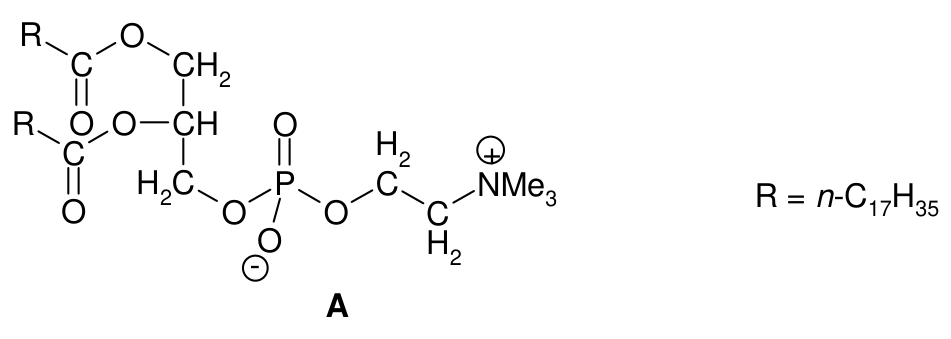
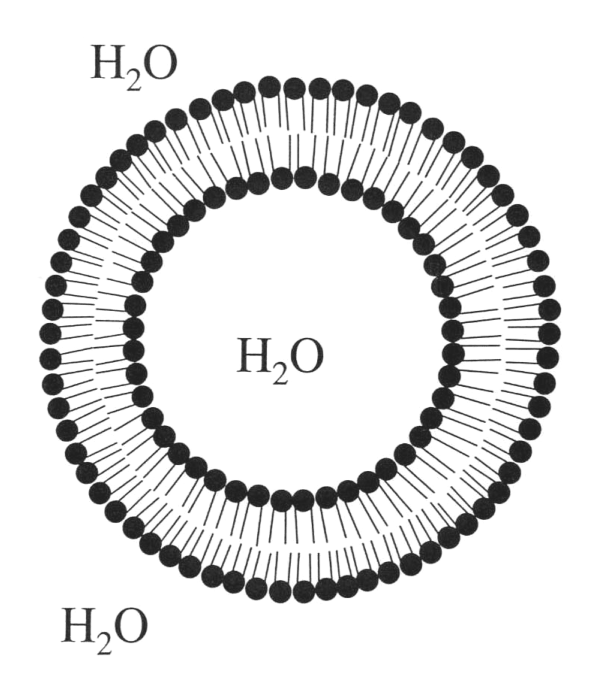
Upon dispersion in water (above a low critical concentration) compound A forms closed bilayer structures, called liposomes, which are employed as model compounds for aspects of the chemistry of the structurally much more complex cell membranes. Liposomes are globular aggregates with the polar or ionic head groups in contact with water and with the alkyl tails sequestered in a hydrophobic core. The bilayer structure encloses an aqueous inner compartment.
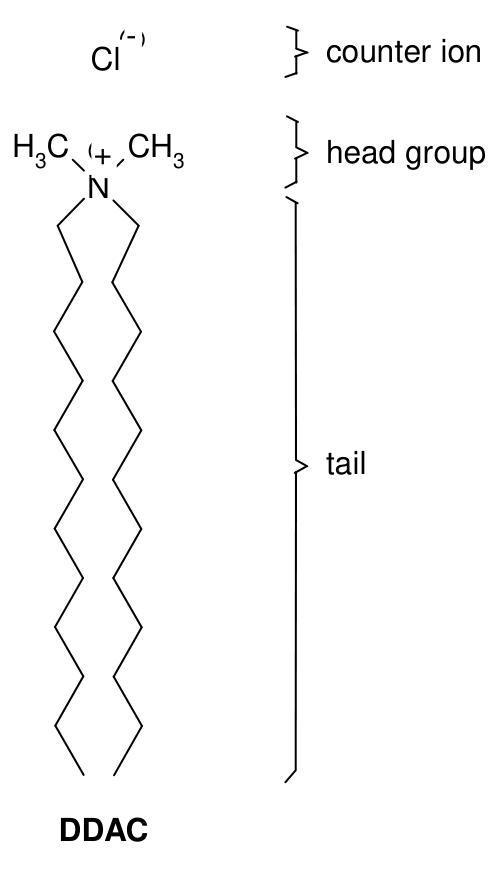
Double-tailed synthetic surfactants also form closed bilayer assemblies similar to liposomes but now called vesicles. An example is di-n-dodecyldimethylammonium chloride (DDAC).
6.1 (a) How many stereoisomers are possible for compound A?
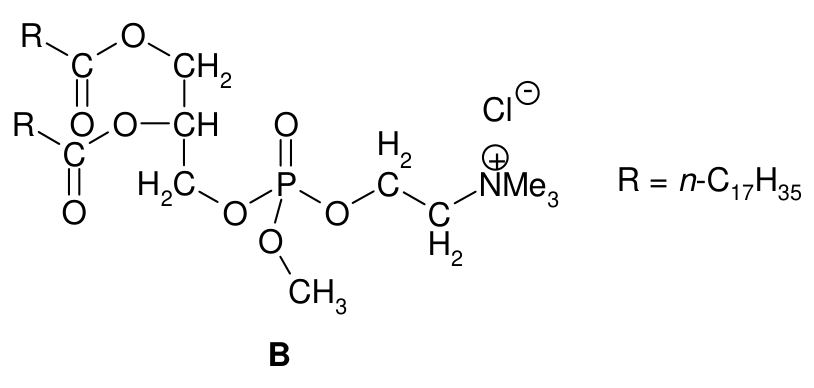
(b) How many stereoisomers are possible for the trialkylphosphate B?
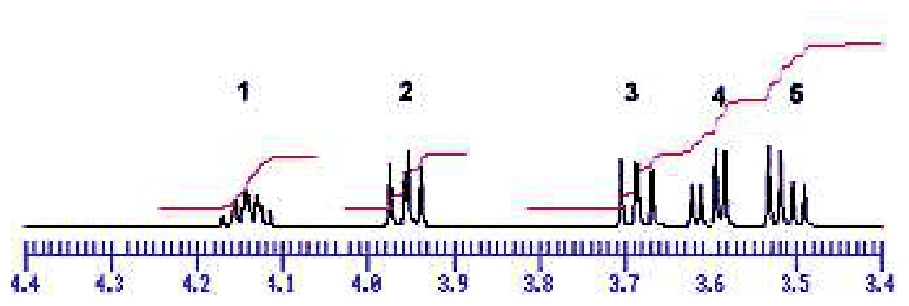
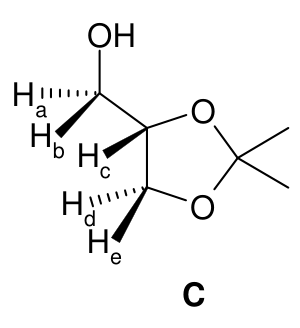
A precursor for the synthesis of compound A is the acetonide C derived from glycerol. Part of the \(\ce{^1H}\)-NMR spectrum of compound C is shown below.
6.2 Which signal number in the \(\ce{^1H}\)-NMR spectrum corresponds to proton \(H_{\mathrm c}\)?
The bilayer of a liposome can be characterized by \(V\) (the volume of the hydrocarbon chains), \(a_0\) (optimal cross-sectional surface area of the head groups of the phospholipid in the aggregate) and \(l_{\mathrm c}\) (the maximum chain length that the alkyl group can assume). A good approximation for unbranched alkyl tails containing \(n\) carbon atoms yields:
\[ V=(27.4+26.99\,n)\times10^{-3}\ \mathrm{nm^3} \]
\[ l_{\mathrm c}=(0.154+0.1265\,n)\ \mathrm{nm} \]
For very large \(n\) values, the intertail interactions dominate over the head group repulsions.
6.3 Calculate the minimum cross-sectional surface area of the head groups for such very large \(n\) values.
Vesicles formed from DDAC (above its critical vesicle concentration, cvc) catalyse the unimolecular decarboxylation of 6-nitro-benzisoxazole-3-carboxylate (6-NBIC).
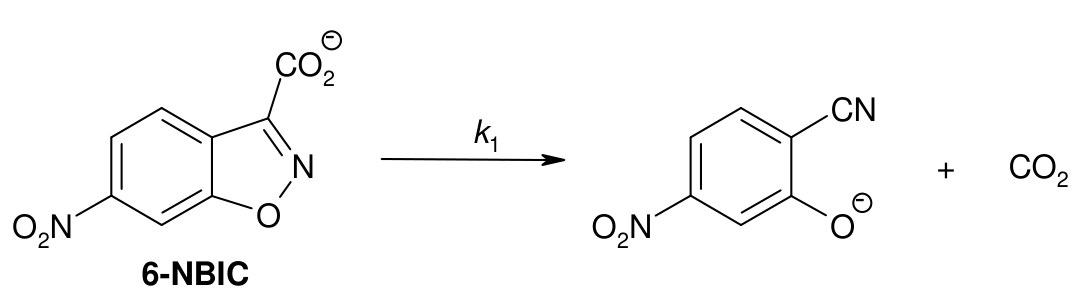
In water at \(25\,^\circ\mathrm{C}\) \(k_1=3.1\times10^{-6}\ \mathrm{s^{-1}}\). At the concentration \(c_1\) of DDAC at which 6-NBIC becomes fully bound to the vesicles, \(k_1=2.1\times10^{-3}\ \mathrm{s^{-1}}\).
6.4 Sketch a plot of \(k_1\) vs. [DDAC] for \(\textbf{[DDAC]}=0\rightarrow3c_1\).
6.5 The main reason for the efficient catalysis of the decarboxylation of 6-NBIC by DDAC vesicles is:
☐ The decarboxylation is catalysed by the \(\ce{Cl-}\) ions bound to the surface of the vesicles.
☐ Efficient loss of hydration of the carboxylate group of vesicle-bound 6-NBIC.
☐ Strong binding of \(\ce{CO2}\) in the interior of the vesicle.
☐ Strong binding of the organic reaction product to the vesicles relative to that of 6-NBIC.
Mark the correct answer.
Official English text of the problem.
Answers
- 6.1(a): 2 stereoisomers, an enantiomeric pair.
- 6.1(b): 4 stereoisomers, comprising two enantiomeric pairs.
- 6.2: Signal 1, at approximately \(\delta=4.14\ \mathrm{ppm}\).
- 6.3: \(\boxed{a_{0,\min}=0.2134\ \mathrm{nm^2}}\) per head group.
- 6.4: Begin at \(3.1\times10^{-6}\ \mathrm{s^{-1}}\); above the cvc, rise toward \(2.1\times10^{-3}\ \mathrm{s^{-1}}\), reaching the plateau by \(c_1\). Remain at this plateau through \(3c_1\).
- 6.5: The second option: efficient loss of hydration of the carboxylate group of vesicle-bound 6-NBIC.
Solution
6.1(a) — Stereoisomers of A
Compound A is distearoylphosphatidylcholine. Its central glycerol carbon is attached to four different groups: hydrogen, an ester oxygen, an esterified terminal methylene group, and a phosphorylated terminal methylene group. It is therefore stereogenic.
The phosphorus atom is not an additional stereogenic center. Its two non-esterified oxygen atoms are constitutionally equivalent: the drawing with one double bond and one negatively charged oxygen represents one resonance contributor. The trimethylammonium nitrogen is also not stereogenic, because three of its substituents are identical methyl groups.
There is consequently one stereogenic center:
\[ N_{\text{stereoisomers}}=2^1=\boxed{2}. \]
The two enantiomers are:
| Configuration at the glycerol carbon | Isomeric SMILES |
|---|---|
| \(R\)-distearoylphosphatidylcholine | C[N+](C)(C)CCOP(=O)([O-])OC[C@H](OC(=O)CCCCCCCCCCCCCCCCC)COC(=O)CCCCCCCCCCCCCCCCC |
| \(S\)-distearoylphosphatidylcholine | C[N+](C)(C)CCOP(=O)([O-])OC[C@@H](OC(=O)CCCCCCCCCCCCCCCCC)COC(=O)CCCCCCCCCCCCCCCCC |
6.1(b) — Stereoisomers of B
Compound B is the phosphate O-methyl ester of distearoylphosphatidylcholine, as its chloride salt.
The glycerol stereogenic center remains. Phosphorus now has four different oxygen-containing ligands: an oxo oxygen, a methoxy group, the choline-derived group, and the glycerol-derived group. Its approximately tetrahedral arrangement therefore introduces a second stereogenic center.
There is no internal symmetry that produces a meso form, so
\[ N_{\text{stereoisomers}}=2^2=\boxed{4}. \]
Writing configurations in the order (glycerol carbon, phosphorus):
| Configuration | Isomeric SMILES |
|---|---|
| \((R,R)\) | CO[P@](=O)(OCC[N+](C)(C)C)OC[C@H](OC(=O)CCCCCCCCCCCCCCCCC)COC(=O)CCCCCCCCCCCCCCCCC.[Cl-] |
| \((S,R)\) | CO[P@](=O)(OCC[N+](C)(C)C)OC[C@@H](OC(=O)CCCCCCCCCCCCCCCCC)COC(=O)CCCCCCCCCCCCCCCCC.[Cl-] |
| \((R,S)\) | CO[P@@](=O)(OCC[N+](C)(C)C)OC[C@H](OC(=O)CCCCCCCCCCCCCCCCC)COC(=O)CCCCCCCCCCCCCCCCC.[Cl-] |
| \((S,S)\) | CO[P@@](=O)(OCC[N+](C)(C)C)OC[C@@H](OC(=O)CCCCCCCCCCCCCCCCC)COC(=O)CCCCCCCCCCCCCCCCC.[Cl-] |
The enantiomeric pairs are \((R,R)/(S,S)\) and \((R,S)/(S,R)\).
6.2 — Assignment of \(H_{\mathrm c}\)
Compound C is glycerol acetonide, also called solketal or (2,2-dimethyl-1,3-dioxolan-4-yl)methanol. The depicted enantiomer is \(S\), with SMILES CC1(C)OC[C@H](CO)O1.
The methine proton \(H_{\mathrm c}\) has four vicinal proton neighbors:
\[ H_{\mathrm a},\quad H_{\mathrm b},\quad H_{\mathrm d},\quad H_{\mathrm e}. \]
The two protons within each methylene group are diastereotopic and need not have equal coupling constants to \(H_{\mathrm c}\). Thus \(H_{\mathrm c}\) can give a doublet of doublets of doublets of doublets, with overlapping or unresolved lines producing a complex multiplet.
Each of the other labeled protons instead has one geminal partner and one vicinal methine neighbor, giving a simpler principal splitting pattern.
The complex multiplet at approximately \(4.14\ \mathrm{ppm}\), labeled 1, therefore corresponds to \(H_{\mathrm c}\):
\[ \boxed{\text{Signal 1}}. \]
6.3 — Minimum head-group area
In the limiting, densely packed arrangement, the hydrocarbon volume associated with one head group occupies a column of cross-sectional area \(a_0\) and chain projection \(l\):
\[ V=a_0l. \]
Because the chain projection cannot exceed \(l_{\mathrm c}\),
\[ a_0\geq\frac{V}{l_{\mathrm c}}. \]
The smallest area corresponds to maximum chain extension. Using \(V\) as defined in the problem:
\[ \begin{aligned} a_{0,\min} &=\lim_{n\to\infty} \frac{(27.4+26.99n)\times10^{-3}\ \mathrm{nm^3}} {(0.154+0.1265n)\ \mathrm{nm}}\\[2mm] &=\frac{26.99\times10^{-3}}{0.1265}\ \mathrm{nm^2}\\ &=0.213359\ldots\ \mathrm{nm^2}. \end{aligned} \]
Hence
\[ \boxed{a_{0,\min}=0.2134\ \mathrm{nm^2}\text{ per head group}}. \]
6.4 — Rate constant versus DDAC concentration
DDAC is di-\(n\)-dodecyldimethylammonium chloride, SMILES CCCCCCCCCCCC[N+](C)(C)CCCCCCCCCCCC.[Cl-].
Let \(f_{\mathrm b}\) be the fraction of substrate bound to vesicles. Under the usual rapid-exchange description, the observed first-order rate constant is
\[ k_1=(1-f_{\mathrm b})k_{\mathrm w}+f_{\mathrm b}k_{\mathrm v}, \]
where
\[ k_{\mathrm w}=3.1\times10^{-6}\ \mathrm{s^{-1}}, \qquad k_{\mathrm v}=2.1\times10^{-3}\ \mathrm{s^{-1}}. \]
Draw the horizontal axis as \([\mathrm{DDAC}]\), extending from \(0\) to \(3c_1\), and the vertical axis as \(k_1\), in \(\mathrm{s^{-1}}\). The curve should have these features:
- From zero to the cvc: an approximately horizontal baseline at \(3.1\times10^{-6}\ \mathrm{s^{-1}}\).
- Above the cvc: a monotonic rise as an increasing fraction of 6-NBIC binds to vesicles.
- At \(c_1\): the curve reaches the full-binding value \(2.1\times10^{-3}\ \mathrm{s^{-1}}\).
- From \(c_1\) to \(3c_1\): a horizontal plateau at \(2.1\times10^{-3}\ \mathrm{s^{-1}}\).
Because the reaction is unimolecular, additional vesicles do not increase the intrinsic rate constant once all substrate is bound. The plateau is approximately
\[ \frac{k_{\mathrm v}}{k_{\mathrm w}} =\frac{2.1\times10^{-3}}{3.1\times10^{-6}} \approx6.8\times10^2 \]
times the aqueous value. On a linear vertical scale, the initial baseline therefore lies very close to zero.
6.5 — Origin of the catalytic effect
The relevant reactant and products are:
| Species | SMILES |
|---|---|
| 6-Nitro-1,2-benzisoxazole-3-carboxylate, 6-NBIC | O=C([O-])c1noc2cc([N+](=O)[O-])ccc12 |
| 2-Cyano-5-nitrophenolate | N#Cc1ccc([N+](=O)[O-])cc1[O-] |
| Carbon dioxide | O=C=O |
Their balanced molecular-formula equation is
\[ \ce{C8H3N2O5^- -> C7H3N2O3^- + CO2}. \]
The transformation involves decarboxylation and opening of the heterocyclic ring: formation of the nitrile group accompanies cleavage of the nitrogen–oxygen bond, whose electron pair moves onto the oxygen that becomes the phenolate oxygen.
In water, SMILES O, hydrogen bonding strongly stabilizes the localized carboxylate charge of the reactant. Binding at the vesicle interface reduces this hydration. The reactant consequently loses more solvation stabilization than the transition state, in which charge is being redistributed during decarboxylation and ring opening. This lowers the activation free energy and accelerates the reaction.
Therefore, mark:
\[ \boxed{\text{Efficient loss of hydration of the carboxylate group of vesicle-bound 6-NBIC.}} \]
The solution was checked against the official solution.
IChO 2002 · Theorieaufgabe 6
Phospholipide in Membranen
Thema III - Chemie funktioneller Moleküle in der Natur
Eine Herausforderung der Chemie besteht darin, herauszufinden, was die Natur leistet und wie die Strukturen biologisch aktiver Moleküle mit ihrer Funktion zusammenhängen.
AUFGABE 6
Phospholipide in Membranen
Biologische Zellmembranen sind komplexe, funktionelle, nichtkovalente Molekülverbände, die größtenteils aus Lipiden und Proteinen bestehen. Ihre Funktion ist für die Lebensvorgänge von entscheidender Bedeutung. Sie trennen die Zelle von ihrer Umgebung und bestimmen zugleich den spezifischen Informationsfluss zwischen dem Zellinhalt und der Umgebung. Phospholipide gehören zu den wichtigsten Bestandteilen von Zellmembranen. Ein Beispiel ist die Verbindung A.
Beim Dispergieren in Wasser (oberhalb einer niedrigen kritischen Konzentration) bildet die Verbindung A geschlossene Doppelschichtstrukturen, die als Liposomen bezeichnet werden und als Modellverbindungen zur Untersuchung von Aspekten der Chemie der strukturell wesentlich komplexeren Zellmembranen dienen. Liposomen sind kugelförmige Aggregate, deren polare oder ionische Kopfgruppen mit Wasser in Kontakt stehen und deren Alkylketten in einem hydrophoben Kern abgeschirmt sind. Die Doppelschichtstruktur umschließt einen wässrigen Innenraum.
Auch synthetische Tenside mit zwei hydrophoben Ketten bilden geschlossene Doppelschichtaggregate, die Liposomen ähneln, jedoch als Vesikel bezeichnet werden. Ein Beispiel ist Di-n-dodecyldimethylammoniumchlorid (DDAC).
6.1 (a) Wie viele Stereoisomere sind für die Verbindung A möglich?
(b) Wie viele Stereoisomere sind für das Trialkylphosphat B möglich?
Eine Vorstufe für die Synthese der Verbindung A ist das von Glycerin abgeleitete Acetonid C. Ein Teil des \(\ce{^1H}\)-NMR-Spektrums der Verbindung C ist unten dargestellt.
6.2 Welche Signalnummer im \(\ce{^1H}\)-NMR-Spektrum entspricht dem Proton \(H_{\mathrm c}\)?
Die Doppelschicht eines Liposoms lässt sich durch \(V\) (das Volumen der Kohlenwasserstoffketten), \(a_0\) (die optimale Querschnittsfläche der Kopfgruppen des Phospholipids im Aggregat) und \(l_{\mathrm c}\) (die maximale Kettenlänge, die die Alkylgruppe annehmen kann) charakterisieren. Eine gute Näherung für unverzweigte Alkylketten mit \(n\) Kohlenstoffatomen liefert:
\[ V=(27.4+26.99\,n)\times10^{-3}\ \mathrm{nm^3} \]
\[ l_{\mathrm c}=(0.154+0.1265\,n)\ \mathrm{nm} \]
Bei sehr großen Werten von \(n\) überwiegen die Wechselwirkungen zwischen den Alkylketten gegenüber den Abstoßungen zwischen den Kopfgruppen.
6.3 Berechnen Sie die minimale Querschnittsfläche der Kopfgruppen für solche sehr großen Werte von \(n\).
Aus DDAC gebildete Vesikel (oberhalb seiner kritischen Vesikelkonzentration, cvc) katalysieren die unimolekulare Decarboxylierung von 6-Nitrobenzisoxazol-3-carboxylat (6-NBIC).
In Wasser gilt bei \(25\,^\circ\mathrm{C}\) \(k_1=3.1\times10^{-6}\ \mathrm{s^{-1}}\). Bei der Konzentration \(c_1\) von DDAC, bei der 6-NBIC vollständig an die Vesikel gebunden ist, gilt \(k_1=2.1\times10^{-3}\ \mathrm{s^{-1}}\).
6.4 Skizzieren Sie den Verlauf von \(k_1\) in Abhängigkeit von [DDAC] für \(\textbf{[DDAC]}=0\rightarrow3c_1\).
6.5 Der Hauptgrund für die effiziente Katalyse der Decarboxylierung von 6-NBIC durch DDAC-Vesikel ist:
☐ Die Decarboxylierung wird durch die an die Oberfläche der Vesikel gebundenen \(\ce{Cl-}\)-Ionen katalysiert.
☐ Effizienter Verlust der Hydrathülle der Carboxylatgruppe des an Vesikel gebundenen 6-NBIC.
☐ Starke Bindung von \(\ce{CO2}\) im Inneren des Vesikels.
☐ Starke Bindung des organischen Reaktionsprodukts an die Vesikel im Vergleich zur Bindung von 6-NBIC.
Kreuzen Sie die richtige Antwort an.
Aufgabentext aus dem offiziellen englischen Text übersetzt.
Antworten
- 6.1(a): 2 Stereoisomere, ein Enantiomerenpaar.
- 6.1(b): 4 Stereoisomere, die zwei Enantiomerenpaare bilden.
- 6.2: Signal 1, bei ungefähr \(\delta=4.14\ \mathrm{ppm}\).
- 6.3: \(\boxed{a_{0,\min}=0.2134\ \mathrm{nm^2}}\) pro Kopfgruppe.
- 6.4: Beginn bei \(3.1\times10^{-6}\ \mathrm{s^{-1}}\); oberhalb der cvc Anstieg in Richtung \(2.1\times10^{-3}\ \mathrm{s^{-1}}\), wobei das Plateau bei \(c_1\) erreicht wird. Bis \(3c_1\) bleibt der Wert auf diesem Plateau.
- 6.5: Die zweite Option: effizienter Verlust der Hydrathülle der Carboxylatgruppe des an Vesikel gebundenen 6-NBIC.
Lösung
6.1(a) — Stereoisomere von A
Die Verbindung A ist Distearoylphosphatidylcholin. Ihr zentrales Glycerin-Kohlenstoffatom ist an vier verschiedene Gruppen gebunden: Wasserstoff, ein Ester-Sauerstoffatom, eine veresterte endständige Methylengruppe und eine phosphorylierte endständige Methylengruppe. Es ist daher stereogen.
Das Phosphoratom ist kein zusätzliches stereogenes Zentrum. Seine beiden nicht veresterten Sauerstoffatome sind konstitutionell äquivalent: Die Darstellung mit einer Doppelbindung und einem negativ geladenen Sauerstoffatom stellt eine mesomere Grenzstruktur dar. Das Stickstoffatom der Trimethylammoniumgruppe ist ebenfalls nicht stereogen, da drei seiner Substituenten identische Methylgruppen sind.
Folglich gibt es ein stereogenes Zentrum:
\[ N_{\text{Stereoisomere}}=2^1=\boxed{2}. \]
Die beiden Enantiomere sind:
| Konfiguration am Glycerin-Kohlenstoffatom | Isomerische SMILES |
|---|---|
| \(R\)-Distearoylphosphatidylcholin | C[N+](C)(C)CCOP(=O)([O-])OC[C@H](OC(=O)CCCCCCCCCCCCCCCCC)COC(=O)CCCCCCCCCCCCCCCCC |
| \(S\)-Distearoylphosphatidylcholin | C[N+](C)(C)CCOP(=O)([O-])OC[C@@H](OC(=O)CCCCCCCCCCCCCCCCC)COC(=O)CCCCCCCCCCCCCCCCC |
6.1(b) — Stereoisomere von B
Die Verbindung B ist der Phosphat-O-methylester von Distearoylphosphatidylcholin in Form seines Chloridsalzes.
Das stereogene Zentrum am Glycerin bleibt erhalten. Phosphor trägt nun vier verschiedene sauerstoffhaltige Liganden: ein Oxo-Sauerstoffatom, eine Methoxygruppe, die von Cholin abgeleitete Gruppe und die von Glycerin abgeleitete Gruppe. Seine annähernd tetraedrische Anordnung führt daher zu einem zweiten stereogenen Zentrum.
Es gibt keine innere Symmetrie, die eine meso-Form hervorbringt, daher gilt
\[ N_{\text{Stereoisomere}}=2^2=\boxed{4}. \]
Die Konfigurationen werden in der Reihenfolge (Glycerin-Kohlenstoffatom, Phosphor) angegeben:
| Konfiguration | Isomerische SMILES |
|---|---|
| \((R,R)\) | CO[P@](=O)(OCC[N+](C)(C)C)OC[C@H](OC(=O)CCCCCCCCCCCCCCCCC)COC(=O)CCCCCCCCCCCCCCCCC.[Cl-] |
| \((S,R)\) | CO[P@](=O)(OCC[N+](C)(C)C)OC[C@@H](OC(=O)CCCCCCCCCCCCCCCCC)COC(=O)CCCCCCCCCCCCCCCCC.[Cl-] |
| \((R,S)\) | CO[P@@](=O)(OCC[N+](C)(C)C)OC[C@H](OC(=O)CCCCCCCCCCCCCCCCC)COC(=O)CCCCCCCCCCCCCCCCC.[Cl-] |
| \((S,S)\) | CO[P@@](=O)(OCC[N+](C)(C)C)OC[C@@H](OC(=O)CCCCCCCCCCCCCCCCC)COC(=O)CCCCCCCCCCCCCCCCC.[Cl-] |
Die Enantiomerenpaare sind \((R,R)/(S,S)\) und \((R,S)/(S,R)\).
6.2 — Zuordnung von \(H_{\mathrm c}\)
Die Verbindung C ist Glycerinacetonid, auch Solketal oder (2,2-Dimethyl-1,3-dioxolan-4-yl)methanol genannt. Das dargestellte Enantiomer ist \(S\), mit dem SMILES CC1(C)OC[C@H](CO)O1.
Das Methinproton \(H_{\mathrm c}\) hat vier vicinale Protonennachbarn:
\[ H_{\mathrm a},\quad H_{\mathrm b},\quad H_{\mathrm d},\quad H_{\mathrm e}. \]
Die beiden Protonen innerhalb jeder Methylengruppe sind diastereotop und müssen nicht dieselben Kopplungskonstanten zu \(H_{\mathrm c}\) aufweisen. Daher kann \(H_{\mathrm c}\) ein Dublett von Dubletts von Dubletts von Dubletts ergeben, wobei überlappende oder nicht aufgelöste Linien ein komplexes Multiplett erzeugen.
Jedes der anderen gekennzeichneten Protonen hat hingegen einen geminalen Partner und einen vicinalen Methin-Nachbarn, was zu einem einfacheren Hauptaufspaltungsmuster führt.
Das komplexe Multiplett bei ungefähr \(4.14\ \mathrm{ppm}\), das mit 1 gekennzeichnet ist, entspricht daher \(H_{\mathrm c}\):
\[ \boxed{\text{Signal 1}}. \]
6.3 — Minimale Kopfgruppenfläche
Im Grenzfall einer dicht gepackten Anordnung nimmt das einer Kopfgruppe zugeordnete Kohlenwasserstoffvolumen eine Säule mit der Querschnittsfläche \(a_0\) und der Kettenprojektion \(l\) ein:
\[ V=a_0l. \]
Da die Kettenprojektion \(l_{\mathrm c}\) nicht überschreiten kann, gilt
\[ a_0\geq\frac{V}{l_{\mathrm c}}. \]
Die kleinste Fläche entspricht der maximalen Kettenstreckung. Mit \(V\) gemäß der Definition in der Aufgabenstellung ergibt sich:
\[ \begin{aligned} a_{0,\min} &=\lim_{n\to\infty} \frac{(27.4+26.99n)\times10^{-3}\ \mathrm{nm^3}} {(0.154+0.1265n)\ \mathrm{nm}}\\[2mm] &=\frac{26.99\times10^{-3}}{0.1265}\ \mathrm{nm^2}\\ &=0.213359\ldots\ \mathrm{nm^2}. \end{aligned} \]
Somit gilt
\[ \boxed{a_{0,\min}=0.2134\ \mathrm{nm^2}\text{ pro Kopfgruppe}}. \]
6.4 — Geschwindigkeitskonstante in Abhängigkeit von der DDAC-Konzentration
DDAC ist Di-\(n\)-dodecyldimethylammoniumchlorid, SMILES CCCCCCCCCCCC[N+](C)(C)CCCCCCCCCCCC.[Cl-].
Sei \(f_{\mathrm b}\) der Anteil des an Vesikel gebundenen Substrats. Bei der üblichen Beschreibung unter Annahme eines schnellen Austauschs ist die beobachtete Geschwindigkeitskonstante erster Ordnung
\[ k_1=(1-f_{\mathrm b})k_{\mathrm w}+f_{\mathrm b}k_{\mathrm v}, \]
wobei
\[ k_{\mathrm w}=3.1\times10^{-6}\ \mathrm{s^{-1}}, \qquad k_{\mathrm v}=2.1\times10^{-3}\ \mathrm{s^{-1}}. \]
Tragen Sie auf der horizontalen Achse \([\mathrm{DDAC}]\) von \(0\) bis \(3c_1\) und auf der vertikalen Achse \(k_1\) in \(\mathrm{s^{-1}}\) auf. Die Kurve sollte folgende Merkmale aufweisen:
- Von null bis zur cvc: eine annähernd horizontale Basislinie bei \(3.1\times10^{-6}\ \mathrm{s^{-1}}\).
- Oberhalb der cvc: ein monotoner Anstieg, da ein zunehmender Anteil von 6-NBIC an Vesikel bindet.
- Bei \(c_1\): Die Kurve erreicht den Wert bei vollständiger Bindung, \(2.1\times10^{-3}\ \mathrm{s^{-1}}\).
- Von \(c_1\) bis \(3c_1\): ein horizontales Plateau bei \(2.1\times10^{-3}\ \mathrm{s^{-1}}\).
Da die Reaktion unimolekular ist, erhöhen zusätzliche Vesikel die intrinsische Geschwindigkeitskonstante nicht, sobald das gesamte Substrat gebunden ist. Der Plateauwert beträgt ungefähr das
\[ \frac{k_{\mathrm v}}{k_{\mathrm w}} =\frac{2.1\times10^{-3}}{3.1\times10^{-6}} \approx6.8\times10^2 \]
Fache des Werts in wässriger Lösung. Bei einer linearen vertikalen Skala liegt die anfängliche Basislinie daher sehr nahe bei null.
6.5 — Ursache der katalytischen Wirkung
Das betreffende Edukt und die Produkte sind:
| Spezies | SMILES |
|---|---|
| 6-Nitro-1,2-benzisoxazol-3-carboxylat, 6-NBIC | O=C([O-])c1noc2cc([N+](=O)[O-])ccc12 |
| 2-Cyano-5-nitrophenolat | N#Cc1ccc([N+](=O)[O-])cc1[O-] |
| Kohlenstoffdioxid | O=C=O |
Die ausgeglichene Reaktionsgleichung in Summenformeln lautet
\[ \ce{C8H3N2O5^- -> C7H3N2O3^- + CO2}. \]
Die Umsetzung umfasst eine Decarboxylierung und die Öffnung des heterocyclischen Rings: Die Bildung der Nitrilgruppe geht mit der Spaltung der Stickstoff–Sauerstoff-Bindung einher, deren Elektronenpaar auf das Sauerstoffatom übergeht, das zum Phenolat-Sauerstoffatom wird.
In Wasser, SMILES O, stabilisieren Wasserstoffbrückenbindungen die lokalisierte Carboxylatladung des Edukts stark. Die Bindung an der Vesikelgrenzfläche verringert diese Hydratation. Das Edukt verliert folglich mehr Solvatationsstabilisierung als der Übergangszustand, in dem während der Decarboxylierung und Ringöffnung eine Ladungsumverteilung stattfindet. Dies senkt die freie Aktivierungsenergie und beschleunigt die Reaktion.
Kreuzen Sie daher an:
\[ \boxed{\text{Effizienter Verlust der Hydrathülle der Carboxylatgruppe des an Vesikel gebundenen 6-NBIC.}} \]
Die Lösung wurde mit der offiziellen Lösung abgeglichen.
IChO 2002 · Teori sorusu 6
Membranlardaki Fosfolipitler
Tema III - Doğadaki İşlevsel Moleküllerin Kimyası
Kimyanın zorlu görevlerinden biri, doğanın ne yaptığını ve biyolojik olarak etkin moleküllerin yapılarının işlevleriyle nasıl ilişkili olduğunu keşfetmektir.
SORU 6
Membranlardaki Fosfolipitler
Biyolojik hücre membranları, büyük ölçüde lipitlerden ve proteinlerden oluşan, kovalent olmayan etkileşimlerle bir arada tutulan karmaşık ve işlevsel moleküler topluluklardır. İşlevleri, yaşam süreçleri açısından hayati önem taşır. Hücreyi çevresinden ayırır ve aynı zamanda hücre içeriği ile çevre arasındaki özgül bilgi akışını belirlerler. Fosfolipitler, hücre membranlarının en önemli bileşenleri arasındadır. A bileşiği bunlara bir örnektir.
A bileşiği suda dağıtıldığında (düşük bir kritik derişimin üzerinde), lipozom adı verilen kapalı çift tabakalı yapılar oluşturur. Bunlar, yapısal açıdan çok daha karmaşık olan hücre membranlarının kimyasının bazı yönlerini incelemek için model bileşikler olarak kullanılır. Lipozomlar, polar veya iyonik baş gruplarının suyla temas ettiği ve alkil kuyruklarının hidrofobik bir çekirdeğin içinde yer aldığı küresel agregatlardır. Çift tabakalı yapı, sulu bir iç bölmeyi çevreler.
Çift kuyruklu sentetik yüzey aktif maddeler de lipozomlara benzer kapalı çift tabakalı topluluklar oluşturur; ancak bunlara vezikül adı verilir. Di-n-dodesildimetilamonyum klorür (DDAC) bunlara bir örnektir.
6.1 (a) A bileşiği için kaç stereoizomer mümkündür?
(b) Trialkilfosfat B için kaç stereoizomer mümkündür?
A bileşiğinin sentezinde kullanılan bir öncül, gliserolden türetilen asetonit C'dir. C bileşiğinin \(\ce{^1H}\)-NMR spektrumunun bir bölümü aşağıda gösterilmiştir.
6.2 \(\ce{^1H}\)-NMR spektrumunda hangi sinyal numarası \(H_{\mathrm c}\) protonuna karşılık gelir?
Bir lipozomun çift tabakası, \(V\) (hidrokarbon zincirlerinin hacmi), \(a_0\) (agregattaki fosfolipidin baş gruplarının en uygun kesit yüzey alanı) ve \(l_{\mathrm c}\) (alkil grubunun alabileceği en büyük zincir uzunluğu) ile tanımlanabilir. \(n\) karbon atomu içeren dallanmamış alkil kuyrukları için iyi bir yaklaşım şu ifadeleri verir:
\[ V=(27.4+26.99\,n)\times10^{-3}\ \mathrm{nm^3} \]
\[ l_{\mathrm c}=(0.154+0.1265\,n)\ \mathrm{nm} \]
Çok büyük \(n\) değerlerinde kuyruklar arası etkileşimler, baş grupları arasındaki itmelere baskın gelir.
6.3 Bu tür çok büyük \(n\) değerleri için baş gruplarının en küçük kesit yüzey alanını hesaplayın.
DDAC'den oluşan veziküller (kritik vezikül derişimi olan cvc'nin üzerinde), 6-nitro-benzizoksazol-3-karboksilatın (6-NBIC) tek moleküllü dekarboksilasyonunu katalizler.
Suda, \(25\,^\circ\mathrm{C}\) sıcaklıkta \(k_1=3.1\times10^{-6}\ \mathrm{s^{-1}}\) değerindedir. 6-NBIC'nin veziküllere tamamen bağlandığı DDAC derişimi \(c_1\)'de, \(k_1=2.1\times10^{-3}\ \mathrm{s^{-1}}\) değerindedir.
6.4 \(\textbf{[DDAC]}=0\rightarrow3c_1\) aralığı için \(k_1\)'in [DDAC]'ye karşı grafiğini kabaca çizin.
6.5 6-NBIC'nin dekarboksilasyonunun DDAC vezikülleri tarafından etkin biçimde katalizlenmesinin temel nedeni şudur:
☐ Dekarboksilasyon, veziküllerin yüzeyine bağlı \(\ce{Cl-}\) iyonları tarafından katalizlenir.
☐ Veziküle bağlı 6-NBIC'nin karboksilat grubunun hidratasyonunu etkin biçimde kaybetmesi.
☐ \(\ce{CO2}\)'nin vezikülün iç kısmına kuvvetli biçimde bağlanması.
☐ Organik tepkime ürününün veziküllere 6-NBIC'ye kıyasla daha kuvvetli bağlanması.
Doğru cevabı işaretleyin.
Soru metni resmi İngilizce metinden çevrilmiştir.
Cevaplar
- 6.1(a): Bir enantiyomer çifti oluşturan 2 stereoizomer.
- 6.1(b): İki enantiyomer çifti oluşturan 4 stereoizomer.
- 6.2: Yaklaşık \(\delta=4.14\ \mathrm{ppm}\) değerindeki Sinyal 1.
- 6.3: Baş grubu başına \(\boxed{a_{0,\min}=0.2134\ \mathrm{nm^2}}\).
- 6.4: \(3.1\times10^{-6}\ \mathrm{s^{-1}}\) değerinden başlayın; cvc'nin üzerinde \(2.1\times10^{-3}\ \mathrm{s^{-1}}\) değerine doğru yükselin ve \(c_1\)'e gelindiğinde platoya ulaşın. \(3c_1\)'e kadar bu platoda kalın.
- 6.5: İkinci seçenek: veziküle bağlı 6-NBIC'nin karboksilat grubunun hidratasyonunu etkin biçimde kaybetmesi.
Çözüm
6.1(a) — A'nın stereoizomerleri
A bileşiği distearoilfosfatidilkolindir. Merkezdeki gliserol karbonu dört farklı gruba bağlıdır: hidrojen, bir ester oksijeni, esterleşmiş bir uç metilen grubu ve fosforillenmiş bir uç metilen grubu. Bu nedenle stereojeniktir.
Fosfor atomu ek bir stereojenik merkez değildir. Esterleşmemiş iki oksijen atomu bağlanma düzeni bakımından eşdeğerdir: bir çift bağ ve bir negatif yüklü oksijen içeren çizim, rezonansa katkıda bulunan yapılardan birini temsil eder. Trimetilamonyum azotu da stereojenik değildir; çünkü sübstitüentlerinden üçü özdeş metil gruplarıdır.
Dolayısıyla bir stereojenik merkez vardır:
\[ N_{\text{stereoizomerler}}=2^1=\boxed{2}. \]
İki enantiyomer şunlardır:
| Gliserol karbonundaki konfigürasyon | İzomerik SMILES |
|---|---|
| \(R\)-distearoilfosfatidilkolin | C[N+](C)(C)CCOP(=O)([O-])OC[C@H](OC(=O)CCCCCCCCCCCCCCCCC)COC(=O)CCCCCCCCCCCCCCCCC |
| \(S\)-distearoilfosfatidilkolin | C[N+](C)(C)CCOP(=O)([O-])OC[C@@H](OC(=O)CCCCCCCCCCCCCCCCC)COC(=O)CCCCCCCCCCCCCCCCC |
6.1(b) — B'nin stereoizomerleri
B bileşiği, distearoilfosfatidilkolinin fosfat O-metil esterinin klorür tuzudur.
Gliseroldeki stereojenik merkez korunur. Fosfor artık oksijen içeren dört farklı liganda sahiptir: bir okso oksijeni, bir metoksi grubu, kolinden türeyen grup ve gliserolden türeyen grup. Dolayısıyla yaklaşık tetrahedral düzenlenmesi ikinci bir stereojenik merkez oluşturur.
Mezo form oluşturan bir iç simetri yoktur; bu nedenle
\[ N_{\text{stereoizomerler}}=2^2=\boxed{4}. \]
Konfigürasyonlar (gliserol karbonu, fosfor) sırasıyla yazıldığında:
| Konfigürasyon | İzomerik SMILES |
|---|---|
| \((R,R)\) | CO[P@](=O)(OCC[N+](C)(C)C)OC[C@H](OC(=O)CCCCCCCCCCCCCCCCC)COC(=O)CCCCCCCCCCCCCCCCC.[Cl-] |
| \((S,R)\) | CO[P@](=O)(OCC[N+](C)(C)C)OC[C@@H](OC(=O)CCCCCCCCCCCCCCCCC)COC(=O)CCCCCCCCCCCCCCCCC.[Cl-] |
| \((R,S)\) | CO[P@@](=O)(OCC[N+](C)(C)C)OC[C@H](OC(=O)CCCCCCCCCCCCCCCCC)COC(=O)CCCCCCCCCCCCCCCCC.[Cl-] |
| \((S,S)\) | CO[P@@](=O)(OCC[N+](C)(C)C)OC[C@@H](OC(=O)CCCCCCCCCCCCCCCCC)COC(=O)CCCCCCCCCCCCCCCCC.[Cl-] |
Enantiyomer çiftleri \((R,R)/(S,S)\) ve \((R,S)/(S,R)\)'dir.
6.2 — \(H_{\mathrm c}\) sinyalinin atanması
C bileşiği, solketal veya (2,2-dimetil-1,3-dioksolan-4-il)metanol olarak da adlandırılan gliserol asetonittir. Gösterilen enantiyomer \(S\)'dir ve SMILES gösterimi CC1(C)OC[C@H](CO)O1 şeklindedir.
Metin protonu \(H_{\mathrm c}\)'nin dört visinal proton komşusu vardır:
\[ H_{\mathrm a},\quad H_{\mathrm b},\quad H_{\mathrm d},\quad H_{\mathrm e}. \]
Her bir metilen grubundaki iki proton diastereotopiktir ve \(H_{\mathrm c}\) ile eşleşme sabitlerinin eşit olması gerekmez. Bu nedenle \(H_{\mathrm c}\), dubletin dubletinin dubletinin dubleti biçiminde bir sinyal verebilir; örtüşen veya çözümlenemeyen çizgiler karmaşık bir multiplet oluşturur.
Buna karşılık, işaretlenmiş diğer protonların her birinin bir geminal eşi ve bir visinal metin komşusu vardır; bu da daha basit bir temel yarılma örüntüsü verir.
Dolayısıyla yaklaşık \(4.14\ \mathrm{ppm}\) değerinde bulunan ve 1 ile işaretlenen karmaşık multiplet, \(H_{\mathrm c}\)'ye karşılık gelir:
\[ \boxed{\text{Sinyal 1}}. \]
6.3 — En küçük baş grubu alanı
Sınır durumundaki sıkı paketlenmiş düzenlenmede, bir baş grubuyla ilişkili hidrokarbon hacmi, kesit alanı \(a_0\) ve zincir izdüşümü \(l\) olan bir sütunu kaplar:
\[ V=a_0l. \]
Zincir izdüşümü \(l_{\mathrm c}\)'yi aşamayacağından,
\[ a_0\geq\frac{V}{l_{\mathrm c}}. \]
En küçük alan, zincirin en fazla uzandığı duruma karşılık gelir. Soruda tanımlandığı biçimiyle \(V\) kullanıldığında:
\[ \begin{aligned} a_{0,\min} &=\lim_{n\to\infty} \frac{(27.4+26.99n)\times10^{-3}\ \mathrm{nm^3}} {(0.154+0.1265n)\ \mathrm{nm}}\\[2mm] &=\frac{26.99\times10^{-3}}{0.1265}\ \mathrm{nm^2}\\ &=0.213359\ldots\ \mathrm{nm^2}. \end{aligned} \]
Böylece
\[ \boxed{a_{0,\min}=0.2134\ \mathrm{nm^2}\text{ baş grubu başına}}. \]
6.4 — DDAC derişimine karşı hız sabiti
DDAC, di-\(n\)-dodesildimetilamonyum klorürdür; SMILES gösterimi CCCCCCCCCCCC[N+](C)(C)CCCCCCCCCCCC.[Cl-] şeklindedir.
\(f_{\mathrm b}\), veziküllere bağlı substratın kesri olsun. Alışılmış hızlı değişim yaklaşımında, gözlenen birinci dereceden hız sabiti
\[ k_1=(1-f_{\mathrm b})k_{\mathrm w}+f_{\mathrm b}k_{\mathrm v}, \]
şeklindedir; burada
\[ k_{\mathrm w}=3.1\times10^{-6}\ \mathrm{s^{-1}}, \qquad k_{\mathrm v}=2.1\times10^{-3}\ \mathrm{s^{-1}}. \]
Yatay ekseni \(0\)'dan \(3c_1\)'e uzanan \([\mathrm{DDAC}]\), düşey ekseni ise \(\mathrm{s^{-1}}\) biriminde \(k_1\) olarak çizin. Eğri şu özelliklere sahip olmalıdır:
- Sıfırdan cvc'ye kadar: \(3.1\times10^{-6}\ \mathrm{s^{-1}}\) değerinde yaklaşık yatay bir taban çizgisi.
- cvc'nin üzerinde: 6-NBIC'nin giderek artan bir kesrinin veziküllere bağlanmasıyla monoton bir yükseliş.
- \(c_1\)'de: eğri, tam bağlanma değeri olan \(2.1\times10^{-3}\ \mathrm{s^{-1}}\)'e ulaşır.
- \(c_1\)'den \(3c_1\)'e kadar: \(2.1\times10^{-3}\ \mathrm{s^{-1}}\) değerinde yatay bir plato.
Tepkime tek moleküllü olduğundan, substratın tamamı bağlandıktan sonra ilave veziküller içsel hız sabitini artırmaz. Plato değeri, sulu ortamdaki değerin yaklaşık
\[ \frac{k_{\mathrm v}}{k_{\mathrm w}} =\frac{2.1\times10^{-3}}{3.1\times10^{-6}} \approx6.8\times10^2 \]
katıdır. Bu nedenle, doğrusal bir düşey ölçekte başlangıçtaki taban çizgisi sıfıra çok yakın yer alır.
6.5 — Katalitik etkinin kaynağı
İlgili reaktan ve ürünler şunlardır:
| Tür | SMILES |
|---|---|
| 6-Nitro-1,2-benzizoksazol-3-karboksilat, 6-NBIC | O=C([O-])c1noc2cc([N+](=O)[O-])ccc12 |
| 2-Siyano-5-nitrofenolat | N#Cc1ccc([N+](=O)[O-])cc1[O-] |
| Karbon dioksit | O=C=O |
Molekül formülleriyle yazılan denkleştirilmiş tepkime denklemi şöyledir:
\[ \ce{C8H3N2O5^- -> C7H3N2O3^- + CO2}. \]
Dönüşüm, dekarboksilasyonu ve heterosiklik halkanın açılmasını içerir: nitril grubunun oluşumuna azot–oksijen bağının kopması eşlik eder; bu bağın elektron çifti, fenolat oksijenine dönüşen oksijenin üzerine geçer.
SMILES gösterimi O olan suda, hidrojen bağları reaktanın karboksilat grubundaki yerelleşmiş yükü kuvvetli biçimde kararlılaştırır. Vezikül ara yüzeyine bağlanma, bu hidratasyonu azaltır. Sonuç olarak reaktan, dekarboksilasyon ve halka açılması sırasında yükün yeniden dağıldığı geçiş durumuna kıyasla solvatasyondan kaynaklanan kararlılaşmanın daha büyük bir kısmını kaybeder. Bu, aktivasyon serbest enerjisini düşürür ve tepkimeyi hızlandırır.
Bu nedenle şu seçeneği işaretleyin:
\[ \boxed{\text{Veziküle bağlı 6-NBIC'nin karboksilat grubunun hidratasyonunu etkin biçimde kaybetmesi.}} \]
Çözüm, resmi çözümle karşılaştırılarak kontrol edildi.
IChO 2002 · Problema teórico 6
Fosfolípidos en las membranas
Tema III - Química de las moléculas funcionales en la naturaleza
Uno de los retos de la química es descubrir qué hace la naturaleza y cómo se relacionan las estructuras de las moléculas biológicamente activas con las funciones que desempeñan.
PROBLEMA 6
Fosfolípidos en las membranas
Las membranas celulares biológicas son ensamblajes moleculares complejos, funcionales y no covalentes, constituidos principalmente por lípidos y proteínas. Su función es de vital importancia para los procesos vitales. Separan la célula de su entorno y también determinan el flujo específico de información entre el contenido celular y el entorno. Los fosfolípidos se encuentran entre los componentes más importantes de las membranas celulares. Un ejemplo es el compuesto A.
Al dispersarse en agua (por encima de una concentración crítica baja), el compuesto A forma estructuras cerradas de bicapa, denominadas liposomas, que se emplean como compuestos modelo para estudiar aspectos de la química de las membranas celulares, estructuralmente mucho más complejas. Los liposomas son agregados globulares cuyas cabezas polares o iónicas están en contacto con el agua y cuyas colas alquílicas quedan confinadas en un núcleo hidrófobo. La estructura de bicapa encierra un compartimento interior acuoso.
Los tensioactivos sintéticos de dos colas también forman ensamblajes cerrados de bicapa similares a los liposomas, pero que en este caso se denominan vesículas. Un ejemplo es el cloruro de di-n-dodecildimetilamonio (DDAC).
6.1 (a) ¿Cuántos estereoisómeros son posibles para el compuesto A?
(b) ¿Cuántos estereoisómeros son posibles para el fosfato de trialquilo B?
Un precursor para la síntesis del compuesto A es el acetónido C, derivado del glicerol. A continuación se muestra parte del espectro de RMN de \(\ce{^1H}\) del compuesto C.
6.2 ¿Qué número de señal del espectro de RMN de \(\ce{^1H}\) corresponde al protón \(H_{\mathrm c}\)?
La bicapa de un liposoma puede caracterizarse mediante \(V\) (el volumen de las cadenas hidrocarbonadas), \(a_0\) (el área óptima de la sección transversal de las cabezas del fosfolípido en el agregado) y \(l_{\mathrm c}\) (la longitud máxima de cadena que puede adoptar el grupo alquilo). Una buena aproximación para las colas alquílicas no ramificadas que contienen \(n\) átomos de carbono proporciona:
\[ V=(27.4+26.99\,n)\times10^{-3}\ \mathrm{nm^3} \]
\[ l_{\mathrm c}=(0.154+0.1265\,n)\ \mathrm{nm} \]
Para valores muy grandes de \(n\), las interacciones entre las colas predominan sobre las repulsiones entre las cabezas.
6.3 Calcule el área mínima de la sección transversal de las cabezas para dichos valores muy grandes de \(n\).
Las vesículas formadas por DDAC (por encima de su concentración vesicular crítica, cvc) catalizan la descarboxilación unimolecular del 6-nitrobenzisoxazol-3-carboxilato (6-NBIC).
En agua a \(25\,^\circ\mathrm{C}\), \(k_1=3.1\times10^{-6}\ \mathrm{s^{-1}}\). A la concentración \(c_1\) de DDAC a la que el 6-NBIC queda completamente unido a las vesículas, \(k_1=2.1\times10^{-3}\ \mathrm{s^{-1}}\).
6.4 Esboce una gráfica de \(k_1\) frente a [DDAC] para \(\textbf{[DDAC]}=0\rightarrow3c_1\).
6.5 La razón principal de la catálisis eficaz de la descarboxilación del 6-NBIC por las vesículas de DDAC es:
☐ La descarboxilación está catalizada por los iones \(\ce{Cl-}\) unidos a la superficie de las vesículas.
☐ La pérdida eficaz de hidratación del grupo carboxilato del 6-NBIC unido a las vesículas.
☐ La fuerte unión del \(\ce{CO2}\) en el interior de la vesícula.
☐ La fuerte unión del producto orgánico de la reacción a las vesículas en comparación con la del 6-NBIC.
Marque la respuesta correcta.
Enunciado traducido del texto oficial en inglés.
Respuestas
- 6.1(a): 2 estereoisómeros, un par de enantiómeros.
- 6.1(b): 4 estereoisómeros, que constituyen dos pares de enantiómeros.
- 6.2: Señal 1, aproximadamente a \(\delta=4.14\ \mathrm{ppm}\).
- 6.3: \(\boxed{a_{0,\min}=0.2134\ \mathrm{nm^2}}\) por cabeza.
- 6.4: Comience en \(3.1\times10^{-6}\ \mathrm{s^{-1}}\); por encima de la cvc, aumente hacia \(2.1\times10^{-3}\ \mathrm{s^{-1}}\), alcanzando la meseta al llegar a \(c_1\). Manténgase en esta meseta hasta \(3c_1\).
- 6.5: La segunda opción: la pérdida eficaz de hidratación del grupo carboxilato del 6-NBIC unido a las vesículas.
Solución
6.1(a) — Estereoisómeros de A
El compuesto A es la diestearoilfosfatidilcolina. Su carbono central del glicerol está unido a cuatro grupos diferentes: un hidrógeno, un oxígeno de éster, un grupo metileno terminal esterificado y un grupo metileno terminal fosforilado. Por tanto, es estereogénico.
El átomo de fósforo no es un centro estereogénico adicional. Sus dos átomos de oxígeno no esterificados son constitucionalmente equivalentes: el dibujo con un doble enlace y un oxígeno con carga negativa representa una estructura contribuyente de resonancia. El nitrógeno del trimetilamonio tampoco es estereogénico, porque tres de sus sustituyentes son grupos metilo idénticos.
Por consiguiente, hay un centro estereogénico:
\[ N_{\text{estereoisómeros}}=2^1=\boxed{2}. \]
Los dos enantiómeros son:
| Configuración en el carbono del glicerol | SMILES isomérico |
|---|---|
| \(R\)-diestearoilfosfatidilcolina | C[N+](C)(C)CCOP(=O)([O-])OC[C@H](OC(=O)CCCCCCCCCCCCCCCCC)COC(=O)CCCCCCCCCCCCCCCCC |
| \(S\)-diestearoilfosfatidilcolina | C[N+](C)(C)CCOP(=O)([O-])OC[C@@H](OC(=O)CCCCCCCCCCCCCCCCC)COC(=O)CCCCCCCCCCCCCCCCC |
6.1(b) — Estereoisómeros de B
El compuesto B es el éster O-metílico del grupo fosfato de la diestearoilfosfatidilcolina, en forma de su sal de cloruro.
El centro estereogénico del glicerol se conserva. El fósforo tiene ahora cuatro ligandos diferentes que contienen oxígeno: un oxígeno oxo, un grupo metoxi, el grupo derivado de la colina y el grupo derivado del glicerol. Su disposición aproximadamente tetraédrica introduce, por tanto, un segundo centro estereogénico.
No hay simetría interna que dé lugar a una forma meso, de modo que
\[ N_{\text{estereoisómeros}}=2^2=\boxed{4}. \]
Escribiendo las configuraciones en el orden (carbono del glicerol, fósforo):
| Configuración | SMILES isomérico |
|---|---|
| \((R,R)\) | CO[P@](=O)(OCC[N+](C)(C)C)OC[C@H](OC(=O)CCCCCCCCCCCCCCCCC)COC(=O)CCCCCCCCCCCCCCCCC.[Cl-] |
| \((S,R)\) | CO[P@](=O)(OCC[N+](C)(C)C)OC[C@@H](OC(=O)CCCCCCCCCCCCCCCCC)COC(=O)CCCCCCCCCCCCCCCCC.[Cl-] |
| \((R,S)\) | CO[P@@](=O)(OCC[N+](C)(C)C)OC[C@H](OC(=O)CCCCCCCCCCCCCCCCC)COC(=O)CCCCCCCCCCCCCCCCC.[Cl-] |
| \((S,S)\) | CO[P@@](=O)(OCC[N+](C)(C)C)OC[C@@H](OC(=O)CCCCCCCCCCCCCCCCC)COC(=O)CCCCCCCCCCCCCCCCC.[Cl-] |
Los pares de enantiómeros son \((R,R)/(S,S)\) y \((R,S)/(S,R)\).
6.2 — Asignación de \(H_{\mathrm c}\)
El compuesto C es el acetónido de glicerol, también llamado solketal o (2,2-dimetil-1,3-dioxolan-4-il)metanol. El enantiómero representado es el \(S\), con SMILES CC1(C)OC[C@H](CO)O1.
El protón metínico \(H_{\mathrm c}\) tiene cuatro protones vecinos vicinales:
\[ H_{\mathrm a},\quad H_{\mathrm b},\quad H_{\mathrm d},\quad H_{\mathrm e}. \]
Los dos protones de cada grupo metileno son diastereotópicos y no tienen por qué presentar constantes de acoplamiento iguales con \(H_{\mathrm c}\). Por ello, \(H_{\mathrm c}\) puede dar un doblete de dobletes de dobletes de dobletes, cuyas líneas solapadas o no resueltas producen un multiplete complejo.
En cambio, cada uno de los demás protones señalados tiene un protón geminal y un protón metínico vecino vicinal, lo que da lugar a un patrón principal de desdoblamiento más sencillo.
Por tanto, el multiplete complejo situado aproximadamente a \(4.14\ \mathrm{ppm}\), señalado con el número 1, corresponde a \(H_{\mathrm c}\):
\[ \boxed{\text{Señal 1}}. \]
6.3 — Área mínima de las cabezas
En la disposición límite de empaquetamiento denso, el volumen hidrocarbonado asociado a una cabeza ocupa una columna de área transversal \(a_0\) y proyección de la cadena \(l\):
\[ V=a_0l. \]
Como la proyección de la cadena no puede superar \(l_{\mathrm c}\),
\[ a_0\geq\frac{V}{l_{\mathrm c}}. \]
El área más pequeña corresponde a la extensión máxima de la cadena. Utilizando \(V\) tal como se define en el enunciado:
\[ \begin{aligned} a_{0,\min} &=\lim_{n\to\infty} \frac{(27.4+26.99n)\times10^{-3}\ \mathrm{nm^3}} {(0.154+0.1265n)\ \mathrm{nm}}\\[2mm] &=\frac{26.99\times10^{-3}}{0.1265}\ \mathrm{nm^2}\\ &=0.213359\ldots\ \mathrm{nm^2}. \end{aligned} \]
Por tanto,
\[ \boxed{a_{0,\min}=0.2134\ \mathrm{nm^2}\text{ por cabeza}}. \]
6.4 — Constante de velocidad frente a la concentración de DDAC
El DDAC es el cloruro de di-\(n\)-dodecildimetilamonio, SMILES CCCCCCCCCCCC[N+](C)(C)CCCCCCCCCCCC.[Cl-].
Sea \(f_{\mathrm b}\) la fracción de sustrato unido a las vesículas. Según la descripción habitual de intercambio rápido, la constante de velocidad observada de primer orden es
\[ k_1=(1-f_{\mathrm b})k_{\mathrm w}+f_{\mathrm b}k_{\mathrm v}, \]
donde
\[ k_{\mathrm w}=3.1\times10^{-6}\ \mathrm{s^{-1}}, \qquad k_{\mathrm v}=2.1\times10^{-3}\ \mathrm{s^{-1}}. \]
Represente en el eje horizontal \([\mathrm{DDAC}]\), desde \(0\) hasta \(3c_1\), y en el eje vertical \(k_1\), en \(\mathrm{s^{-1}}\). La curva debe presentar las siguientes características:
- Desde cero hasta la cvc: una línea de base aproximadamente horizontal a \(3.1\times10^{-6}\ \mathrm{s^{-1}}\).
- Por encima de la cvc: un aumento monótono a medida que una fracción creciente de 6-NBIC se une a las vesículas.
- En \(c_1\): la curva alcanza el valor correspondiente a la unión completa, \(2.1\times10^{-3}\ \mathrm{s^{-1}}\).
- Desde \(c_1\) hasta \(3c_1\): una meseta horizontal a \(2.1\times10^{-3}\ \mathrm{s^{-1}}\).
Como la reacción es unimolecular, las vesículas adicionales no aumentan la constante de velocidad intrínseca una vez que todo el sustrato está unido. El valor de la meseta es aproximadamente
\[ \frac{k_{\mathrm v}}{k_{\mathrm w}} =\frac{2.1\times10^{-3}}{3.1\times10^{-6}} \approx6.8\times10^2 \]
veces el valor en medio acuoso. Por tanto, en una escala vertical lineal, la línea de base inicial se sitúa muy cerca de cero.
6.5 — Origen del efecto catalítico
El reactivo y los productos pertinentes son:
| Especie | SMILES |
|---|---|
| 6-Nitro-1,2-benzisoxazol-3-carboxilato, 6-NBIC | O=C([O-])c1noc2cc([N+](=O)[O-])ccc12 |
| 2-Ciano-5-nitrofenolato | N#Cc1ccc([N+](=O)[O-])cc1[O-] |
| Dióxido de carbono | O=C=O |
Su ecuación ajustada, expresada mediante fórmulas moleculares, es
\[ \ce{C8H3N2O5^- -> C7H3N2O3^- + CO2}. \]
La transformación implica la descarboxilación y la apertura del anillo heterocíclico: la formación del grupo nitrilo va acompañada de la ruptura del enlace nitrógeno–oxígeno, cuyo par de electrones se desplaza hacia el oxígeno que se convierte en el oxígeno del fenolato.
En agua, SMILES O, los enlaces de hidrógeno estabilizan fuertemente la carga localizada del carboxilato del reactivo. La unión en la interfase de la vesícula reduce esta hidratación. En consecuencia, el reactivo pierde más estabilización por solvatación que el estado de transición, en el que la carga se está redistribuyendo durante la descarboxilación y la apertura del anillo. Esto reduce la energía libre de activación y acelera la reacción.
Por tanto, marque:
\[ \boxed{\text{Pérdida eficaz de hidratación del grupo carboxilato del 6-NBIC unido a las vesículas.}} \]
La solución se comprobó con la solución oficial.
IChO 2002 · 理论题 6
膜中的磷脂
主题 III - 自然界中功能分子的化学
化学面临的一项挑战是揭示自然界的作用机制,以及生物活性分子的结构与其功能之间的关系。
题目 6
膜中的磷脂
生物细胞膜是复杂的、具有功能的非共价分子组装体,主要由脂质和蛋白质组成。其功能对生命过程至关重要。它们将细胞与周围环境分隔开来,同时也决定细胞内容物与环境之间特定的信息流动。磷脂是细胞膜中最重要的组成成分之一。化合物 A 就是一个例子。
当化合物 A 分散于水中时(浓度高于一个较低的临界浓度),会形成称为脂质体的封闭双分子层结构。脂质体可作为模型体系,用于研究结构复杂得多的细胞膜的某些化学性质。脂质体是球状聚集体,其极性或离子型头基与水接触,而烷基尾链则被包埋在疏水内核中。双分子层结构包围着一个含水的内部腔室。
具有两条尾链的合成表面活性剂也会形成类似脂质体的封闭双分子层组装体,但此时称为囊泡。氯化二正十二烷基二甲基铵(DDAC)就是一个例子。
6.1 (a) 化合物 A 可能有多少种立体异构体?
(b) 磷酸三烷基酯 B 可能有多少种立体异构体?
合成化合物 A 的一种前体是由甘油衍生的丙酮缩酮 C。下图给出了化合物 C 的部分 \(\ce{^1H}\)-NMR 谱。
6.2 \(\ce{^1H}\)-NMR 谱中哪个编号的信号对应于质子 \(H_{\mathrm c}\)?
脂质体的双分子层可用 \(V\)(烃链的体积)、\(a_0\)(聚集体中磷脂头基的最佳横截面积)和 \(l_{\mathrm c}\)(烷基所能达到的最大链长)来表征。对于含有 \(n\) 个碳原子的无支链烷基尾链,以下公式可给出良好的近似值:
\[ V=(27.4+26.99\,n)\times10^{-3}\ \mathrm{nm^3} \]
\[ l_{\mathrm c}=(0.154+0.1265\,n)\ \mathrm{nm} \]
当 \(n\) 非常大时,尾链间的相互作用相对于头基间的排斥作用占主导地位。
6.3 计算在 \(n\) 非常大的情况下头基的最小横截面积。
由 DDAC 形成的囊泡(在其临界囊泡浓度 cvc 以上)可催化 6-硝基苯并异噁唑-3-羧酸根(6-NBIC)的单分子脱羧反应。
在 \(25\,^\circ\mathrm{C}\) 的水中,\(k_1=3.1\times10^{-6}\ \mathrm{s^{-1}}\)。当 DDAC 的浓度达到 \(c_1\),使 6-NBIC 完全结合到囊泡上时,\(k_1=2.1\times10^{-3}\ \mathrm{s^{-1}}\)。
6.4 画出 \(\textbf{[DDAC]}=0\rightarrow3c_1\) 范围内 \(k_1\) 随 [DDAC] 变化的示意图。
6.5 DDAC 囊泡高效催化 6-NBIC 脱羧反应的主要原因是:
☐ 结合在囊泡表面的 \(\ce{Cl-}\) 离子催化了脱羧反应。
☐ 结合在囊泡上的 6-NBIC 的羧酸根基团有效地脱除了水合层。
☐ \(\ce{CO2}\) 在囊泡内部发生强结合。
☐ 与 6-NBIC 相比,有机反应产物与囊泡结合得更强。
标出正确答案。
题目译自官方英文原文。
答案
- 6.1(a): 2 种立体异构体,构成一对对映异构体。
- 6.1(b): 4 种立体异构体,构成两对对映异构体。
- 6.2: 信号 1,位于约 \(\delta=4.14\ \mathrm{ppm}\) 处。
- 6.3: 每个头基的面积为 \(\boxed{a_{0,\min}=0.2134\ \mathrm{nm^2}}\)。
- 6.4: 从 \(3.1\times10^{-6}\ \mathrm{s^{-1}}\) 开始;超过 cvc 后,向 \(2.1\times10^{-3}\ \mathrm{s^{-1}}\) 上升,在 \(c_1\) 处达到平台。此后直至 \(3c_1\) 均保持在这一平台。
- 6.5: 第二个选项:结合在囊泡上的 6-NBIC 的羧酸根基团有效地脱除了水合层。
解答
6.1(a) — A 的立体异构体
化合物 A 是二硬脂酰磷脂酰胆碱。其甘油骨架的中央碳原子连接着四个不同的基团:氢、一个酯基氧原子、一个酯化的末端亚甲基和一个磷酸化的末端亚甲基。因此,该碳原子是立体中心。
磷原子不是另一个立体中心。其两个未酯化的氧原子在构造上是等价的:图中一个双键和一个带负电荷的氧原子的画法表示一个共振贡献式。三甲基铵中的氮原子也不是立体中心,因为它的三个取代基是相同的甲基。
因此,分子中只有一个立体中心:
\[ N_{\text{立体异构体}}=2^1=\boxed{2}. \]
这两个对映异构体为:
| 甘油碳原子的构型 | 异构体 SMILES |
|---|---|
| \(R\)-二硬脂酰磷脂酰胆碱 | C[N+](C)(C)CCOP(=O)([O-])OC[C@H](OC(=O)CCCCCCCCCCCCCCCCC)COC(=O)CCCCCCCCCCCCCCCCC |
| \(S\)-二硬脂酰磷脂酰胆碱 | C[N+](C)(C)CCOP(=O)([O-])OC[C@@H](OC(=O)CCCCCCCCCCCCCCCCC)COC(=O)CCCCCCCCCCCCCCCCC |
6.1(b) — B 的立体异构体
化合物 B 是二硬脂酰磷脂酰胆碱的磷酸基团经 O-甲基酯化后形成的氯化物盐。
甘油上的立体中心仍然存在。此时,磷原子具有四种不同的含氧配体:一个氧代氧原子、一个甲氧基、一个胆碱衍生基团和一个甘油衍生基团。因此,其近似四面体的排列引入了第二个立体中心。
分子不存在能产生内消旋体的内部对称性,因此
\[ N_{\text{立体异构体}}=2^2=\boxed{4}. \]
按(甘油碳原子,磷原子)的顺序写出构型:
| 构型 | 异构体 SMILES |
|---|---|
| \((R,R)\) | CO[P@](=O)(OCC[N+](C)(C)C)OC[C@H](OC(=O)CCCCCCCCCCCCCCCCC)COC(=O)CCCCCCCCCCCCCCCCC.[Cl-] |
| \((S,R)\) | CO[P@](=O)(OCC[N+](C)(C)C)OC[C@@H](OC(=O)CCCCCCCCCCCCCCCCC)COC(=O)CCCCCCCCCCCCCCCCC.[Cl-] |
| \((R,S)\) | CO[P@@](=O)(OCC[N+](C)(C)C)OC[C@H](OC(=O)CCCCCCCCCCCCCCCCC)COC(=O)CCCCCCCCCCCCCCCCC.[Cl-] |
| \((S,S)\) | CO[P@@](=O)(OCC[N+](C)(C)C)OC[C@@H](OC(=O)CCCCCCCCCCCCCCCCC)COC(=O)CCCCCCCCCCCCCCCCC.[Cl-] |
两对对映异构体分别为 \((R,R)/(S,S)\) 和 \((R,S)/(S,R)\)。
6.2 — \(H_{\mathrm c}\) 的信号归属
化合物 C 是甘油丙酮缩酮,也称为异丙叉甘油或 (2,2-二甲基-1,3-二氧戊环-4-基)甲醇。图示对映异构体为 \(S\) 构型,其 SMILES 为 CC1(C)OC[C@H](CO)O1。
次甲基质子 \(H_{\mathrm c}\) 有四个邻位质子:
\[ H_{\mathrm a},\quad H_{\mathrm b},\quad H_{\mathrm d},\quad H_{\mathrm e}. \]
每个亚甲基中的两个质子互为非对映异位质子,它们与 \(H_{\mathrm c}\) 的耦合常数不一定相等。因此,\(H_{\mathrm c}\) 可产生经四重二重裂分形成的峰型,谱线的重叠或未能分辨会使其呈现复杂的多重峰。
相比之下,其余每个标记的质子各有一个同碳质子和一个邻位次甲基质子,因此其主要裂分峰型较为简单。
所以,位于约 \(4.14\ \mathrm{ppm}\) 处、标记为 1 的复杂多重峰对应于 \(H_{\mathrm c}\):
\[ \boxed{\text{信号 1}}. \]
6.3 — 头基的最小面积
在紧密堆积的极限排列中,与一个头基相连的烃链体积占据一个横截面积为 \(a_0\)、链投影长度为 \(l\) 的柱状空间:
\[ V=a_0l. \]
由于链的投影长度不能超过 \(l_{\mathrm c}\),
\[ a_0\geq\frac{V}{l_{\mathrm c}}. \]
最小面积对应于链的最大伸展长度。采用题目中定义的 \(V\):
\[ \begin{aligned} a_{0,\min} &=\lim_{n\to\infty} \frac{(27.4+26.99n)\times10^{-3}\ \mathrm{nm^3}} {(0.154+0.1265n)\ \mathrm{nm}}\\[2mm] &=\frac{26.99\times10^{-3}}{0.1265}\ \mathrm{nm^2}\\ &=0.213359\ldots\ \mathrm{nm^2}. \end{aligned} \]
因此
\[ \boxed{a_{0,\min}=0.2134\ \mathrm{nm^2}\text{ 每个头基}}. \]
6.4 — 速率常数随 DDAC 浓度的变化
DDAC 是氯化二正(\(n\))十二烷基二甲基铵,SMILES 为 CCCCCCCCCCCC[N+](C)(C)CCCCCCCCCCCC.[Cl-]。
设 \(f_{\mathrm b}\) 为结合在囊泡上的底物所占的分数。在通常的快速交换描述下,观测到的一级速率常数为
\[ k_1=(1-f_{\mathrm b})k_{\mathrm w}+f_{\mathrm b}k_{\mathrm v}, \]
其中
\[ k_{\mathrm w}=3.1\times10^{-6}\ \mathrm{s^{-1}}, \qquad k_{\mathrm v}=2.1\times10^{-3}\ \mathrm{s^{-1}}. \]
以 \([\mathrm{DDAC}]\) 为横轴,范围从 \(0\) 到 \(3c_1\);以 \(k_1\) 为纵轴,单位为 \(\mathrm{s^{-1}}\)。曲线应具有以下特征:
- 从零到 cvc:位于 \(3.1\times10^{-6}\ \mathrm{s^{-1}}\) 的近似水平基线。
- 超过 cvc 后:随着结合到囊泡上的 6-NBIC 的比例增大,曲线单调上升。
- 在 \(c_1\) 处:曲线达到完全结合时的数值 \(2.1\times10^{-3}\ \mathrm{s^{-1}}\)。
- 从 \(c_1\) 到 \(3c_1\):保持在 \(2.1\times10^{-3}\ \mathrm{s^{-1}}\) 的水平平台。
由于该反应是单分子反应,一旦所有底物均已结合,增加囊泡数量就不会提高本征速率常数。平台值约为水相中数值的
\[ \frac{k_{\mathrm v}}{k_{\mathrm w}} =\frac{2.1\times10^{-3}}{3.1\times10^{-6}} \approx6.8\times10^2 \]
倍。因此,在采用线性纵轴刻度时,初始基线非常接近零。
6.5 — 催化效应的来源
相关反应物和产物如下:
| 物种 | SMILES |
|---|---|
| 6-硝基-1,2-苯并异噁唑-3-羧酸根,6-NBIC | O=C([O-])c1noc2cc([N+](=O)[O-])ccc12 |
| 2-氰基-5-硝基苯酚根 | N#Cc1ccc([N+](=O)[O-])cc1[O-] |
| 二氧化碳 | O=C=O |
用分子式表示的配平反应方程式为
\[ \ce{C8H3N2O5^- -> C7H3N2O3^- + CO2}. \]
该转化涉及脱羧和杂环开环:腈基的形成伴随着氮—氧键的断裂,该键的电子对转移至氧原子上,而这个氧原子随后成为苯酚根的氧原子。
在水中(水的 SMILES 为 O),氢键使反应物羧酸根上局域化的电荷得到强烈稳定。与囊泡界面结合会减少这种水合作用。因此,反应物失去的溶剂化稳定作用比过渡态更多;在过渡态中,电荷正随着脱羧和开环而重新分布。这降低了活化自由能,从而加快反应。
因此,应标出:
\[ \boxed{\text{结合在囊泡上的 6-NBIC 的羧酸根基团有效地脱除了水合层。}} \]
解答已与官方解答核对。
IChO 2002 · Теоретическая задача 6
Фосфолипиды в мембранах
Тема III - Химия функциональных молекул в природе
Одна из задач химии — выяснить, какие процессы происходят в природе и как строение биологически активных молекул связано с выполняемыми ими функциями.
ЗАДАЧА 6
Фосфолипиды в мембранах
Мембраны биологических клеток представляют собой сложные функциональные нековалентные молекулярные ансамбли, состоящие преимущественно из липидов и белков. Их функционирование имеет жизненно важное значение для процессов жизнедеятельности. Они отделяют клетку от окружающей среды, а также определяют специфический обмен информацией между содержимым клетки и окружающей средой. Фосфолипиды относятся к важнейшим компонентам клеточных мембран. Примером служит соединение A.
При диспергировании в воде (выше небольшой критической концентрации) соединение A образует замкнутые бислойные структуры, называемые липосомами, которые используют в качестве модельных объектов для изучения отдельных аспектов химии клеточных мембран, имеющих значительно более сложное строение. Липосомы представляют собой сферические агрегаты, в которых полярные или ионные головные группы контактируют с водой, а алкильные хвосты скрыты в гидрофобной области. Бислойная структура окружает внутреннюю водную полость.
Синтетические поверхностно-активные вещества с двумя хвостами также образуют замкнутые бислойные ансамбли, подобные липосомам, но называемые везикулами. Примером служит хлорид ди-н-додецилдиметиламмония (DDAC).
6.1 (a) Сколько стереоизомеров возможно для соединения A?
(b) Сколько стереоизомеров возможно для триалкилфосфата B?
Исходным веществом для синтеза соединения A служит ацетонид C, полученный из глицерина. Ниже приведена часть спектра ЯМР \(\ce{^1H}\) соединения C.
6.2 Какой номер сигнала в спектре ЯМР \(\ce{^1H}\) соответствует протону \(H_{\mathrm c}\)?
Бислой липосомы можно охарактеризовать величинами \(V\) (объём углеводородных цепей), \(a_0\) (оптимальная площадь поперечного сечения головных групп фосфолипида в агрегате) и \(l_{\mathrm c}\) (максимальная длина цепи, которую может принимать алкильная группа). Для неразветвлённых алкильных хвостов, содержащих \(n\) атомов углерода, хорошее приближение дают выражения:
\[ V=(27.4+26.99\,n)\times10^{-3}\ \mathrm{nm^3} \]
\[ l_{\mathrm c}=(0.154+0.1265\,n)\ \mathrm{nm} \]
При очень больших значениях \(n\) взаимодействия между хвостами преобладают над отталкиванием головных групп.
6.3 Рассчитайте минимальную площадь поперечного сечения головных групп при таких очень больших значениях \(n\).
Везикулы, образованные DDAC (выше его критической концентрации везикулообразования, cvc), катализируют мономолекулярное декарбоксилирование 6-нитробензизоксазол-3-карбоксилата (6-NBIC).
В воде при \(25\,^\circ\mathrm{C}\) \(k_1=3.1\times10^{-6}\ \mathrm{s^{-1}}\). При концентрации \(c_1\) DDAC, при которой 6-NBIC полностью связывается с везикулами, \(k_1=2.1\times10^{-3}\ \mathrm{s^{-1}}\).
6.4 Схематически изобразите график зависимости \(k_1\) от [DDAC] для \(\textbf{[DDAC]}=0\rightarrow3c_1\).
6.5 Основная причина эффективного катализа декарбоксилирования 6-NBIC везикулами DDAC:
☐ Декарбоксилирование катализируется ионами \(\ce{Cl-}\), связанными с поверхностью везикул.
☐ Эффективная дегидратация карбоксилатной группы 6-NBIC, связанного с везикулами.
☐ Прочное связывание \(\ce{CO2}\) внутри везикулы.
☐ Более прочное связывание органического продукта реакции с везикулами по сравнению с 6-NBIC.
Отметьте правильный ответ.
Условие переведено с официального английского текста.
Ответы
- 6.1(a): 2 стереоизомера, образующие энантиомерную пару.
- 6.1(b): 4 стереоизомера, образующие две энантиомерные пары.
- 6.2: Сигнал 1, приблизительно при \(\delta=4.14\ \mathrm{ppm}\).
- 6.3: \(\boxed{a_{0,\min}=0.2134\ \mathrm{nm^2}}\) на одну головную группу.
- 6.4: Начать с \(3.1\times10^{-6}\ \mathrm{s^{-1}}\); выше cvc кривая возрастает к \(2.1\times10^{-3}\ \mathrm{s^{-1}}\), достигая плато к \(c_1\). Далее она остаётся на этом плато до \(3c_1\).
- 6.5: Второй вариант: эффективная дегидратация карбоксилатной группы 6-NBIC, связанного с везикулами.
Решение
6.1(a) — Стереоизомеры A
Соединение A представляет собой дистеароилфосфатидилхолин. Центральный атом углерода глицеринового остатка связан с четырьмя различными группами: водородом, сложноэфирным атомом кислорода, этерифицированной концевой метиленовой группой и фосфорилированной концевой метиленовой группой. Поэтому он является стереогенным.
Атом фосфора не является дополнительным стереогенным центром. Два его неэтерифицированных атома кислорода эквивалентны по связности: изображение с одной двойной связью и одним отрицательно заряженным атомом кислорода представляет собой одну из резонансных структур. Атом азота триметиламмониевой группы также не является стереогенным, поскольку три его заместителя — одинаковые метильные группы.
Следовательно, имеется один стереогенный центр:
\[ N_{\text{стереоизомеров}}=2^1=\boxed{2}. \]
Два энантиомера:
| Конфигурация атома углерода глицеринового остатка | Изомерический SMILES |
|---|---|
| \(R\)-дистеароилфосфатидилхолин | C[N+](C)(C)CCOP(=O)([O-])OC[C@H](OC(=O)CCCCCCCCCCCCCCCCC)COC(=O)CCCCCCCCCCCCCCCCC |
| \(S\)-дистеароилфосфатидилхолин | C[N+](C)(C)CCOP(=O)([O-])OC[C@@H](OC(=O)CCCCCCCCCCCCCCCCC)COC(=O)CCCCCCCCCCCCCCCCC |
6.1(b) — Стереоизомеры B
Соединение B представляет собой O-метиловый эфир дистеароилфосфатидилхолина по фосфатной группе в виде хлорида.
Стереогенный центр глицеринового остатка сохраняется. Теперь фосфор имеет четыре различных кислородсодержащих лиганда: атом кислорода оксогруппы, метоксигруппу, группу, происходящую от холина, и группу, происходящую от глицерина. Их приблизительно тетраэдрическое расположение, таким образом, создаёт второй стереогенный центр.
Внутренняя симметрия, приводящая к образованию мезоформы, отсутствует, поэтому
\[ N_{\text{стереоизомеров}}=2^2=\boxed{4}. \]
Запишем конфигурации в порядке (атом углерода глицеринового остатка, фосфор):
| Конфигурация | Изомерический SMILES |
|---|---|
| \((R,R)\) | CO[P@](=O)(OCC[N+](C)(C)C)OC[C@H](OC(=O)CCCCCCCCCCCCCCCCC)COC(=O)CCCCCCCCCCCCCCCCC.[Cl-] |
| \((S,R)\) | CO[P@](=O)(OCC[N+](C)(C)C)OC[C@@H](OC(=O)CCCCCCCCCCCCCCCCC)COC(=O)CCCCCCCCCCCCCCCCC.[Cl-] |
| \((R,S)\) | CO[P@@](=O)(OCC[N+](C)(C)C)OC[C@H](OC(=O)CCCCCCCCCCCCCCCCC)COC(=O)CCCCCCCCCCCCCCCCC.[Cl-] |
| \((S,S)\) | CO[P@@](=O)(OCC[N+](C)(C)C)OC[C@@H](OC(=O)CCCCCCCCCCCCCCCCC)COC(=O)CCCCCCCCCCCCCCCCC.[Cl-] |
Энантиомерные пары: \((R,R)/(S,S)\) и \((R,S)/(S,R)\).
6.2 — Отнесение сигнала \(H_{\mathrm c}\)
Соединение C представляет собой ацетонид глицерина, также называемый солкеталем или (2,2-диметил-1,3-диоксолан-4-ил)метанолом. Изображённый энантиомер имеет конфигурацию \(S\) и SMILES CC1(C)OC[C@H](CO)O1.
Метиновый протон \(H_{\mathrm c}\) имеет четыре соседних вицинальных протона:
\[ H_{\mathrm a},\quad H_{\mathrm b},\quad H_{\mathrm d},\quad H_{\mathrm e}. \]
Два протона в каждой метиленовой группе диастереотопны, и их константы спин-спинового взаимодействия с \(H_{\mathrm c}\) не обязательно одинаковы. Поэтому \(H_{\mathrm c}\) может давать дублет дублетов дублетов дублетов, в котором перекрывающиеся или неразрешённые линии образуют сложный мультиплет.
Каждый из остальных обозначенных протонов, напротив, имеет одного геминального партнёра и одного соседнего вицинального метинового протона, что приводит к более простой основной картине расщепления.
Таким образом, сложный мультиплет приблизительно при \(4.14\ \mathrm{ppm}\), обозначенный номером 1, соответствует \(H_{\mathrm c}\):
\[ \boxed{\text{Сигнал 1}}. \]
6.3 — Минимальная площадь головной группы
В предельном случае плотной упаковки объём углеводородной части, приходящийся на одну головную группу, занимает столбик с площадью поперечного сечения \(a_0\) и длиной проекции цепи \(l\):
\[ V=a_0l. \]
Поскольку длина проекции цепи не может превышать \(l_{\mathrm c}\),
\[ a_0\geq\frac{V}{l_{\mathrm c}}. \]
Наименьшая площадь соответствует максимальному вытягиванию цепи. Используя \(V\) в том смысле, в котором эта величина определена в условии задачи, получаем:
\[ \begin{aligned} a_{0,\min} &=\lim_{n\to\infty} \frac{(27.4+26.99n)\times10^{-3}\ \mathrm{nm^3}} {(0.154+0.1265n)\ \mathrm{nm}}\\[2mm] &=\frac{26.99\times10^{-3}}{0.1265}\ \mathrm{nm^2}\\ &=0.213359\ldots\ \mathrm{nm^2}. \end{aligned} \]
Следовательно,
\[ \boxed{a_{0,\min}=0.2134\ \mathrm{nm^2}\text{ на одну головную группу}}. \]
6.4 — Зависимость константы скорости от концентрации DDAC
DDAC — хлорид ди-\(n\)-додецилдиметиламмония, SMILES CCCCCCCCCCCC[N+](C)(C)CCCCCCCCCCCC.[Cl-].
Пусть \(f_{\mathrm b}\) — доля субстрата, связанного с везикулами. В рамках обычного описания с быстрым обменом наблюдаемая константа скорости первого порядка равна
\[ k_1=(1-f_{\mathrm b})k_{\mathrm w}+f_{\mathrm b}k_{\mathrm v}, \]
где
\[ k_{\mathrm w}=3.1\times10^{-6}\ \mathrm{s^{-1}}, \qquad k_{\mathrm v}=2.1\times10^{-3}\ \mathrm{s^{-1}}. \]
По горизонтальной оси отложите \([\mathrm{DDAC}]\) в диапазоне от \(0\) до \(3c_1\), а по вертикальной — \(k_1\) в \(\mathrm{s^{-1}}\). Кривая должна иметь следующие особенности:
- От нуля до cvc: приблизительно горизонтальная базовая линия на уровне \(3.1\times10^{-6}\ \mathrm{s^{-1}}\).
- Выше cvc: монотонный рост по мере увеличения доли 6-NBIC, связанного с везикулами.
- При \(c_1\): кривая достигает значения \(2.1\times10^{-3}\ \mathrm{s^{-1}}\), соответствующего полному связыванию.
- От \(c_1\) до \(3c_1\): горизонтальное плато на уровне \(2.1\times10^{-3}\ \mathrm{s^{-1}}\).
Поскольку реакция мономолекулярная, дополнительные везикулы не увеличивают собственную константу скорости после связывания всего субстрата. Значение на плато приблизительно в
\[ \frac{k_{\mathrm v}}{k_{\mathrm w}} =\frac{2.1\times10^{-3}}{3.1\times10^{-6}} \approx6.8\times10^2 \]
раз превышает значение в воде. Поэтому при линейном масштабе вертикальной оси начальная базовая линия расположена очень близко к нулю.
6.5 — Причина каталитического эффекта
Соответствующие исходное вещество и продукты:
| Частица | SMILES |
|---|---|
| 6-Нитро-1,2-бензизоксазол-3-карбоксилат, 6-NBIC | O=C([O-])c1noc2cc([N+](=O)[O-])ccc12 |
| 2-Циано-5-нитрофенолят | N#Cc1ccc([N+](=O)[O-])cc1[O-] |
| Диоксид углерода | O=C=O |
Уравнение реакции с расставленными коэффициентами, записанное с использованием молекулярных формул:
\[ \ce{C8H3N2O5^- -> C7H3N2O3^- + CO2}. \]
Превращение включает декарбоксилирование и раскрытие гетероциклического кольца: образование нитрильной группы сопровождается разрывом связи азот–кислород, электронная пара которой переходит к атому кислорода, становящемуся фенолятным атомом кислорода.
В воде, SMILES O, водородные связи сильно стабилизируют локализованный заряд карбоксилатной группы исходного вещества. Связывание на границе раздела везикулы уменьшает эту гидратацию. В результате исходное вещество теряет больше сольватационной стабилизации, чем переходное состояние, в котором при декарбоксилировании и раскрытии кольца происходит перераспределение заряда. Это снижает свободную энергию активации и ускоряет реакцию.
Таким образом, следует отметить:
\[ \boxed{\text{Эффективная дегидратация карбоксилатной группы 6-NBIC, связанного с везикулами.}} \]
Решение проверено по официальному решению.
IChO 2002 · مسألة نظرية 6
الفوسفوليبيدات في الأغشية
المحور III - كيمياء الجزيئات الوظيفية في الطبيعة
من التحديات في الكيمياء اكتشاف ما تفعله الطبيعة وكيف ترتبط تراكيب الجزيئات النشطة حيويًا بوظائفها.
المسألة 6
الفوسفوليبيدات في الأغشية
أغشية الخلايا الحيوية تجمعات جزيئية معقدة ووظيفية وغير تساهمية، تتكون إلى حد كبير من الليبيدات والبروتينات. ولوظيفتها أهمية حيوية في العمليات الحياتية. فهي تفصل الخلية عن بيئتها، وتحدد أيضًا التدفق النوعي للمعلومات بين محتويات الخلية والبيئة. وتُعد الفوسفوليبيدات من أهم مكونات أغشية الخلايا. ومن أمثلتها المركب A.
عند تشتيت المركب A في الماء (فوق تركيز حرج منخفض)، فإنه يشكل بنى مغلقة ثنائية الطبقة تُسمى الجسيمات الشحمية، وتُستخدم مركباتٍ نموذجية لدراسة جوانب من كيمياء أغشية الخلايا الأكثر تعقيدًا بكثير من حيث البنية. والجسيمات الشحمية تجمعات كروية تكون فيها مجموعات الرؤوس القطبية أو الأيونية على تماس مع الماء، بينما تنعزل الذيول الألكيلية في لب كاره للماء. وتحيط البنية ثنائية الطبقة بحيز داخلي مائي.
تُشكل المواد الخافضة للتوتر السطحي الاصطناعية ذات الذيلين أيضًا تجمعات مغلقة ثنائية الطبقة تشبه الجسيمات الشحمية، لكنها تُسمى في هذه الحالة حويصلات. ومن أمثلتها كلوريد ثنائي-n-دوديسيل ثنائي ميثيل الأمونيوم (DDAC).
6.1 (a) كم عدد المتماكبات الفراغية الممكنة للمركب A؟
(b) كم عدد المتماكبات الفراغية الممكنة لفوسفات ثلاثي الألكيل B؟
من طلائع تخليق المركب A الأسيتونيد C المشتق من الغليسرول. ويُعرض أدناه جزء من طيف الرنين المغناطيسي النووي لـ \(\ce{^1H}\) للمركب C.
6.2 ما رقم الإشارة في طيف الرنين المغناطيسي النووي لـ \(\ce{^1H}\) التي تقابل البروتون \(H_{\mathrm c}\)؟
يمكن توصيف الطبقة الثنائية للجسيم الشحمي باستخدام \(V\) (حجم السلاسل الهيدروكربونية)، و\(a_0\) (المساحة المثلى للمقطع العرضي لمجموعات رؤوس الفوسفوليبيد في التجمع)، و\(l_{\mathrm c}\) (أقصى طول للسلسلة يمكن أن تتخذه مجموعة الألكيل). ويعطي تقريب جيد للذيول الألكيلية غير المتفرعة التي تحتوي على \(n\) ذرة كربون ما يأتي:
\[ V=(27.4+26.99\,n)\times10^{-3}\ \mathrm{nm^3} \]
\[ l_{\mathrm c}=(0.154+0.1265\,n)\ \mathrm{nm} \]
عند قيم \(n\) الكبيرة جدًا، تطغى التآثرات بين الذيول على التنافرات بين مجموعات الرؤوس.
6.3 احسب المساحة الدنيا للمقطع العرضي لمجموعات الرؤوس عند هذه القيم الكبيرة جدًا لـ \(n\).
تُحفز الحويصلات المتشكلة من DDAC (فوق تركيزه الحرج لتكوّن الحويصلات، cvc) نزع الكربوكسيل أحادي الجزيء من 6-نيترو-بنزإيزوكسازول-3-كربوكسيلات (6-NBIC).
في الماء عند \(25\,^\circ\mathrm{C}\)، يكون \(k_1=3.1\times10^{-6}\ \mathrm{s^{-1}}\). وعند التركيز \(c_1\) من DDAC، الذي تصبح عنده 6-NBIC مرتبطة بالكامل بالحويصلات، يكون \(k_1=2.1\times10^{-3}\ \mathrm{s^{-1}}\).
6.4 ارسم رسمًا تخطيطيًا لـ \(k_1\) بدلالة [DDAC] في المجال \(\textbf{[DDAC]}=0\rightarrow3c_1\).
6.5 السبب الرئيس للتحفيز الفعال لنزع الكربوكسيل من 6-NBIC بواسطة حويصلات DDAC هو:
☐ تُحفز أيونات \(\ce{Cl-}\) المرتبطة بسطح الحويصلات نزع الكربوكسيل.
☐ الفقد الفعال لإماهة مجموعة الكربوكسيلات في 6-NBIC المرتبطة بالحويصلات.
☐ الارتباط القوي لـ \(\ce{CO2}\) داخل الحويصلة.
☐ الارتباط القوي لناتج التفاعل العضوي بالحويصلات مقارنةً بارتباط 6-NBIC بها.
ضع علامة على الإجابة الصحيحة.
نص المسألة مترجم عن النص الإنجليزي الرسمي.
الإجابات
- 6.1(a): متماكبان فراغيان، يشكلان زوجًا من المتماكبات المرآتية.
- 6.1(b): 4 متماكبات فراغية، تضم زوجين من المتماكبات المرآتية.
- 6.2: الإشارة 1، عند نحو \(\delta=4.14\ \mathrm{ppm}\).
- 6.3: \(\boxed{a_{0,\min}=0.2134\ \mathrm{nm^2}}\) لكل مجموعة رأس.
- 6.4: ابدأ عند \(3.1\times10^{-6}\ \mathrm{s^{-1}}\)؛ وفوق cvc، ارتفع نحو \(2.1\times10^{-3}\ \mathrm{s^{-1}}\)، بحيث تبلغ الهضبة بحلول \(c_1\). وابقَ عند هذه الهضبة حتى \(3c_1\).
- 6.5: الخيار الثاني: الفقد الفعال لإماهة مجموعة الكربوكسيلات في 6-NBIC المرتبطة بالحويصلات.
الحل
6.1(a) — المتماكبات الفراغية للمركب A
المركب A هو ثنائي ستيارويل فوسفاتيديل كولين. ترتبط ذرة الكربون المركزية في الغليسرول بأربع مجموعات مختلفة: هيدروجين، وأكسجين إستر، ومجموعة ميثيلين طرفية مؤسترة، ومجموعة ميثيلين طرفية مفسفرة. ولذلك فهي مركز مولد للتصاوغ الفراغي.
ذرة الفوسفور ليست مركزًا إضافيًا مولدًا للتصاوغ الفراغي. فذرتا الأكسجين غير المؤسترتين فيها متكافئتان من حيث الترابط البنيوي: إذ يمثل الرسم الذي يتضمن رابطة مزدوجة واحدة وذرة أكسجين واحدة سالبة الشحنة إحدى صيغ الرنين المساهمة. كما أن ذرة نيتروجين ثلاثي ميثيل الأمونيوم ليست مركزًا مولدًا للتصاوغ الفراغي، لأن ثلاثة من مستبدلاتها مجموعات ميثيل متماثلة.
وعليه، يوجد مركز واحد مولد للتصاوغ الفراغي:
\[ N_{\text{المتماكبات الفراغية}}=2^1=\boxed{2}. \]
المتماكبان المرآتيان هما:
| التكوين الفراغي عند ذرة كربون الغليسرول | تمثيل SMILES المتماكبي |
|---|---|
| \(R\)-ثنائي ستيارويل فوسفاتيديل كولين | C[N+](C)(C)CCOP(=O)([O-])OC[C@H](OC(=O)CCCCCCCCCCCCCCCCC)COC(=O)CCCCCCCCCCCCCCCCC |
| \(S\)-ثنائي ستيارويل فوسفاتيديل كولين | C[N+](C)(C)CCOP(=O)([O-])OC[C@@H](OC(=O)CCCCCCCCCCCCCCCCC)COC(=O)CCCCCCCCCCCCCCCCC |
6.1(b) — المتماكبات الفراغية للمركب B
المركب B هو إستر O-ميثيل الفوسفات لثنائي ستيارويل فوسفاتيديل كولين، على هيئة ملح الكلوريد.
يبقى مركز الغليسرول المولد للتصاوغ الفراغي قائمًا. وأصبح للفوسفور الآن أربع ربيطات مختلفة محتوية على الأكسجين: ذرة أكسجين أوكسو، ومجموعة ميثوكسي، والمجموعة المشتقة من الكولين، والمجموعة المشتقة من الغليسرول. ومن ثم فإن ترتيبها شبه رباعي السطوح يُنشئ مركزًا ثانيًا مولدًا للتصاوغ الفراغي.
لا يوجد تناظر داخلي ينتج عنه شكل ميزو، ولذلك
\[ N_{\text{المتماكبات الفراغية}}=2^2=\boxed{4}. \]
عند كتابة التكوينات الفراغية بالترتيب (كربون الغليسرول، الفوسفور):
| التكوين الفراغي | تمثيل SMILES المتماكبي |
|---|---|
| \((R,R)\) | CO[P@](=O)(OCC[N+](C)(C)C)OC[C@H](OC(=O)CCCCCCCCCCCCCCCCC)COC(=O)CCCCCCCCCCCCCCCCC.[Cl-] |
| \((S,R)\) | CO[P@](=O)(OCC[N+](C)(C)C)OC[C@@H](OC(=O)CCCCCCCCCCCCCCCCC)COC(=O)CCCCCCCCCCCCCCCCC.[Cl-] |
| \((R,S)\) | CO[P@@](=O)(OCC[N+](C)(C)C)OC[C@H](OC(=O)CCCCCCCCCCCCCCCCC)COC(=O)CCCCCCCCCCCCCCCCC.[Cl-] |
| \((S,S)\) | CO[P@@](=O)(OCC[N+](C)(C)C)OC[C@@H](OC(=O)CCCCCCCCCCCCCCCCC)COC(=O)CCCCCCCCCCCCCCCCC.[Cl-] |
زوجا المتماكبات المرآتية هما \((R,R)/(S,S)\) و\((R,S)/(S,R)\).
6.2 — تعيين إشارة \(H_{\mathrm c}\)
المركب C هو أسيتونيد الغليسرول، ويُسمى أيضًا سولكيتال أو (2,2-ثنائي ميثيل-1,3-ديوكسولان-4-يل)ميثانول. والمتماكب المرآتي المرسوم هو \(S\)، وتمثيله بصيغة SMILES هو CC1(C)OC[C@H](CO)O1.
لبروتون الميثين \(H_{\mathrm c}\) أربعة بروتونات مجاورة مرتبطة بذرات كربون مجاورة:
\[ H_{\mathrm a},\quad H_{\mathrm b},\quad H_{\mathrm d},\quad H_{\mathrm e}. \]
البروتونان في كل مجموعة ميثيلين متغايرا الموضع الفراغي، ولا يلزم أن يكون لهما ثابتا اقتران متساويان مع \(H_{\mathrm c}\). لذلك يمكن أن يعطي \(H_{\mathrm c}\) مزدوجة من مزدوجات من مزدوجات من مزدوجات، تؤدي خطوطها المتراكبة أو غير المفصولة إلى إشارة متعددة معقدة.
أما كل بروتون من البروتونات الأخرى الموسومة، فله بروتون شريك واحد مرتبط بذرة الكربون نفسها، وبروتون ميثين مجاور واحد، مما يعطي نمط انقسام رئيسيًا أبسط.
وعليه، فإن الإشارة المتعددة المعقدة عند نحو \(4.14\ \mathrm{ppm}\)، والموسومة بالرقم 1، تقابل \(H_{\mathrm c}\):
\[ \boxed{\text{الإشارة 1}}. \]
6.3 — المساحة الدنيا لمجموعة الرأس
في الترتيب الحدي المتراص بكثافة، يشغل حجم الهيدروكربون المرتبط بمجموعة رأس واحدة عمودًا مساحة مقطعه العرضي \(a_0\) وطول إسقاط السلسلة فيه \(l\):
\[ V=a_0l. \]
ولأن طول إسقاط السلسلة لا يمكن أن يتجاوز \(l_{\mathrm c}\)، فإن
\[ a_0\geq\frac{V}{l_{\mathrm c}}. \]
تقابل المساحة الصغرى أقصى امتداد للسلسلة. وباستخدام \(V\) وفق تعريفه في المسألة:
\[ \begin{aligned} a_{0,\min} &=\lim_{n\to\infty} \frac{(27.4+26.99n)\times10^{-3}\ \mathrm{nm^3}} {(0.154+0.1265n)\ \mathrm{nm}}\\[2mm] &=\frac{26.99\times10^{-3}}{0.1265}\ \mathrm{nm^2}\\ &=0.213359\ldots\ \mathrm{nm^2}. \end{aligned} \]
ومن ثم
\[ \boxed{a_{0,\min}=0.2134\ \mathrm{nm^2}\text{ لكل مجموعة رأس}}. \]
6.4 — ثابت السرعة بدلالة تركيز DDAC
DDAC هو كلوريد ثنائي-\(n\)-دوديسيل ثنائي ميثيل الأمونيوم، وتمثيله بصيغة SMILES هو CCCCCCCCCCCC[N+](C)(C)CCCCCCCCCCCC.[Cl-].
ليكن \(f_{\mathrm b}\) الكسر من الركيزة المرتبط بالحويصلات. وفق الوصف المعتاد للتبادل السريع، يكون ثابت السرعة المرصود من الرتبة الأولى
\[ k_1=(1-f_{\mathrm b})k_{\mathrm w}+f_{\mathrm b}k_{\mathrm v}, \]
حيث
\[ k_{\mathrm w}=3.1\times10^{-6}\ \mathrm{s^{-1}}, \qquad k_{\mathrm v}=2.1\times10^{-3}\ \mathrm{s^{-1}}. \]
ارسم المحور الأفقي ممثلًا لـ \([\mathrm{DDAC}]\)، ممتدًا من \(0\) إلى \(3c_1\)، والمحور الرأسي ممثلًا لـ \(k_1\)، بوحدة \(\mathrm{s^{-1}}\). وينبغي أن يتصف المنحنى بالسمات الآتية:
- من الصفر إلى cvc: خط أساس أفقي تقريبًا عند \(3.1\times10^{-6}\ \mathrm{s^{-1}}\).
- فوق cvc: ارتفاع رتيب مع ارتباط كسر متزايد من 6-NBIC بالحويصلات.
- عند \(c_1\): يصل المنحنى إلى قيمة الارتباط الكامل \(2.1\times10^{-3}\ \mathrm{s^{-1}}\).
- من \(c_1\) إلى \(3c_1\): هضبة أفقية عند \(2.1\times10^{-3}\ \mathrm{s^{-1}}\).
لأن التفاعل أحادي الجزيء، فإن الحويصلات الإضافية لا تزيد ثابت السرعة الذاتي بعد ارتباط الركيزة كلها. وتبلغ قيمة الهضبة نحو
\[ \frac{k_{\mathrm v}}{k_{\mathrm w}} =\frac{2.1\times10^{-3}}{3.1\times10^{-6}} \approx6.8\times10^2 \]
ضعف القيمة في الوسط المائي. ولذلك يقع خط الأساس الابتدائي قريبًا جدًا من الصفر على مقياس رأسي خطي.
6.5 — منشأ التأثير التحفيزي
المتفاعل والنواتج المعنية هي:
| النوع الكيميائي | SMILES |
|---|---|
| 6-نيترو-1,2-بنزإيزوكسازول-3-كربوكسيلات، 6-NBIC | O=C([O-])c1noc2cc([N+](=O)[O-])ccc12 |
| 2-سيانو-5-نيتروفينولات | N#Cc1ccc([N+](=O)[O-])cc1[O-] |
| ثاني أكسيد الكربون | O=C=O |
معادلتها الموزونة بالصيغ الجزيئية هي
\[ \ce{C8H3N2O5^- -> C7H3N2O3^- + CO2}. \]
يتضمن التحول نزع الكربوكسيل وفتح الحلقة غير المتجانسة: إذ يترافق تشكّل مجموعة النتريل مع انشطار رابطة النيتروجين–الأكسجين، وينتقل زوج إلكتروناتها إلى ذرة الأكسجين التي تصبح أكسجين الفينولات.
في الماء، الذي تمثيله بصيغة SMILES هو O، تثبّت الروابط الهيدروجينية بقوة شحنة الكربوكسيلات الموضعية في المتفاعل. ويقلل الارتباط عند السطح البيني للحويصلة هذه الإماهة. ونتيجة لذلك، يفقد المتفاعل من التثبيت الناتج عن الإذابة مقدارًا أكبر مما تفقده الحالة الانتقالية، التي يُعاد فيها توزيع الشحنة أثناء نزع الكربوكسيل وفتح الحلقة. وهذا يخفض طاقة التنشيط الحرة ويُسرّع التفاعل.
لذلك، ضع علامة على:
\[ \boxed{\text{الفقد الفعال لإماهة مجموعة الكربوكسيلات في 6-NBIC المرتبطة بالحويصلات.}} \]
تمت مراجعة الحل بمقارنته بالحل الرسمي.