IChO 2002 · Theory problem 7
Glutathione, an Essential Mini-Peptide
Glutathione, abbreviated as GSH, is a small peptide that is present in almost all tissues of animals. GSH fulfils important biological functions, such as detoxification of electrophilic chemicals and reduction of (organic) peroxides in blood. An electrophilic compound reacts irreversibly with GSH, especially in the liver, to give a primary product that is converted by a series of biotransformations into a so-called mercapturic acid, which is excreted via the urine. Oxidants react with GSH to give the disulfide GSSG, which can be enzymatically reverted to GSH with reductases. The ratio GSH/GSSG in most cells is ≥ 500.
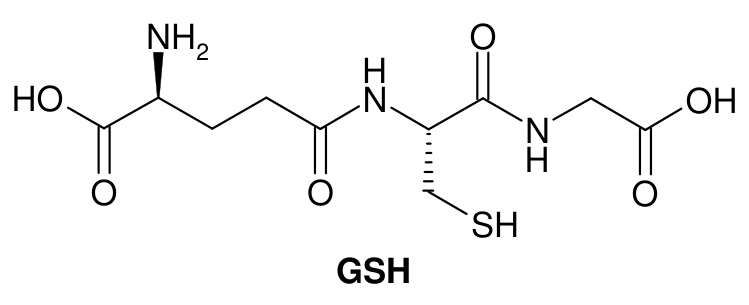
7.1 (a) How many amino acid residues are present in GSH?
(b) Draw the structures of the corresponding amino acids and mark the chiral centers with an asterisk.
A mercapturic acid A isolated from urine of a person who has been exposed to acrylonitrile (\(\ce{H2C=CH-CN}\)) has the molecular formula \(\ce{C8H12N2O3S}\). The \({}^{1}\mathrm{H}\)-NMR spectrum of A in \(\ce{(CD3)2SO}\) is shown in Figure 1. When the product is pretreated with \(\ce{D2O}\), the signals at \(\delta\) 12.8 and \(\delta\) 6.8 are no longer present and the signal 3 is simplified.
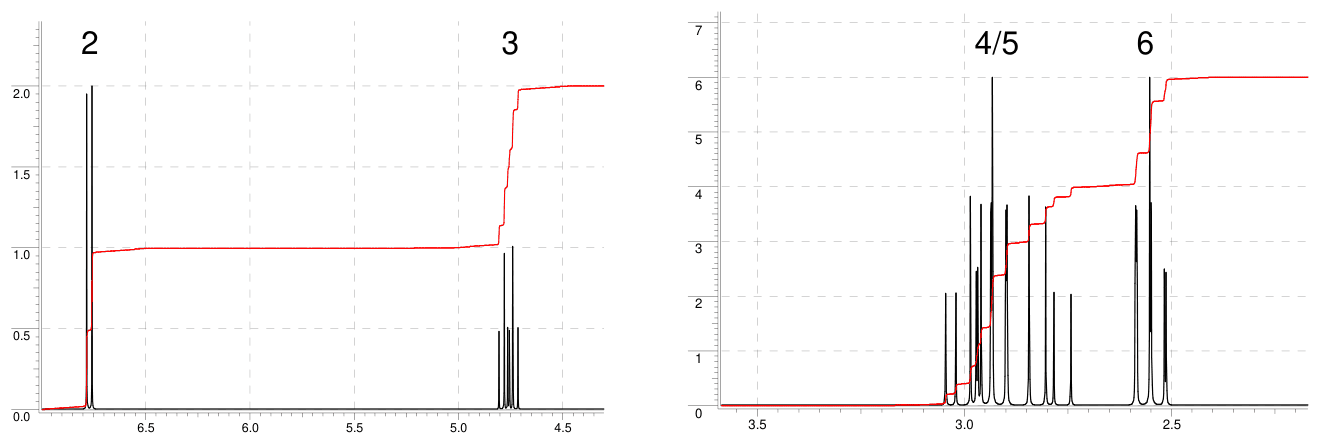
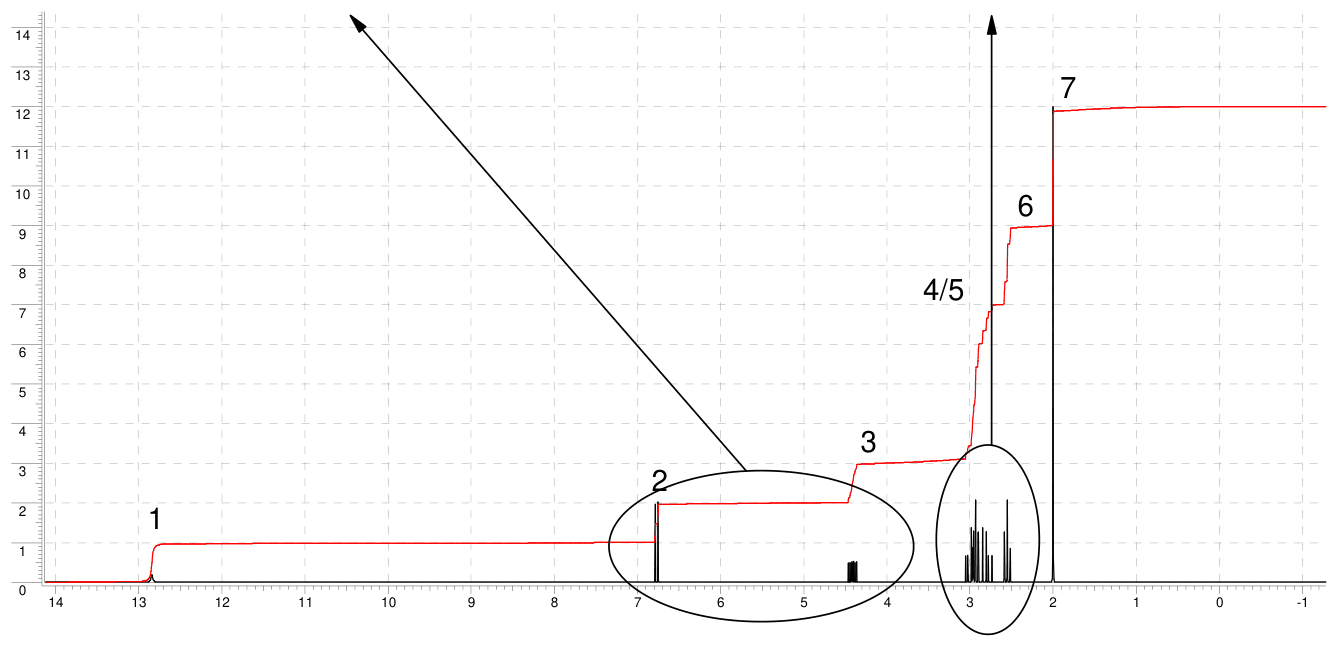
Figure 1
7.2 (a) The NMR-signals correspond with protons in the following groups: \(\ce{CH}\), \(\ce{CH2}\), \(\ce{CH3}\), \(\ce{OH}\) and \(\ce{NH}\). Indicate the appropriate proton group in the boxes for the signals 1 – 7.
| Signals | 1 | 2 | 3 | 4/5 | 6 | 7 |
|---|---|---|---|---|---|---|
| Protons |
(b) How many carbon atoms are present in compound A that do not carry any protons?
(c) Draw the structure of compound A.
Vitamin C (ascorbic acid) reacts with oxidants to give dehydroascorbic acid D
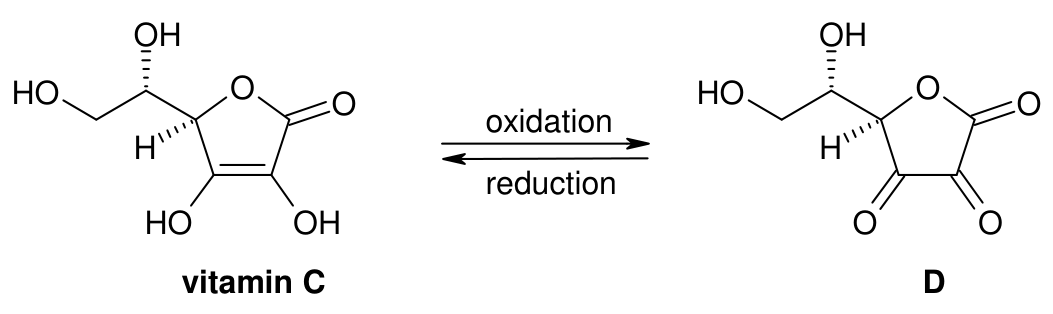
7.3 Eating fresh fruit and vegetables is healthy
- [ ] because vitamin C forms a complex with GSH.
- [ ] because vitamin C reacts with electrophilic compounds.
- [ ] because vitamin C removes oxidants and prevents undesired depletion of GSH.
- [ ] for many reasons, but none of them has anything to do with GSH.
Official English text of the problem.
Answers
- 7.1(a): Three amino acid residues.
- 7.1(b):
- L-Glutamic acid:
N[C@@H](CCC(=O)O)C(=O)O. Mark its α-carbon with an asterisk; it has \(S\) configuration. - L-Cysteine:
N[C@@H](CS)C(=O)O. Mark its α-carbon with an asterisk; it has \(R\) configuration. - Glycine:
NCC(=O)O. It has no chiral center. - 7.2(a): \(1:\ce{OH};\ 2:\ce{NH};\ 3:\ce{CH};\ 4/5:\) two \(\ce{CH2}\) groups; \(6:\ce{CH2};\ 7:\ce{CH3}\).
- 7.2(b): Three: the carboxyl carbon, the amide carbonyl carbon, and the nitrile carbon.
- 7.2(c): N-Acetyl-S-(2-cyanoethyl)-L-cysteine,
CC(=O)N[C@@H](CSCCC#N)C(=O)O. Its α-carbon has \(R\) configuration. - 7.3: Select the third statement: “because vitamin C removes oxidants and prevents undesired depletion of GSH.”
Solution
7.1(a)
GSH is γ-L-glutamyl-L-cysteinylglycine, with SMILES N[C@@H](CCC(=O)N[C@@H](CS)C(=O)NCC(=O)O)C(=O)O.
The two amide linkages connect one glutamic acid residue, one cysteine residue, and one glycine residue. Thus, GSH contains three amino acid residues. The glutamyl linkage uses glutamic acid’s side-chain carboxyl group.
7.1(b)
The free amino acids have the following structures. An asterisk above a \(\ce{CH}\) group marks its carbon atom.
| Amino acid | Structure with chiral center marked | Configuration |
|---|---|---|
| L-Glutamic acid | \(\ce{HOOC}-\overset{*}{\ce{CH}}(\ce{NH2})-\ce{CH2-CH2-COOH}\) | \(S\) |
| L-Cysteine | \(\ce{HOOC}-\overset{*}{\ce{CH}}(\ce{NH2})-\ce{CH2-SH}\) | \(R\) |
| Glycine | \(\ce{H2N-CH2-COOH}\) | Achiral |
The α-carbon of glutamic acid and that of cysteine each bear four different substituents. Glycine’s α-carbon bears two identical hydrogen atoms and therefore is not chiral.
L-Cysteine has \(R\) configuration because its sulfur-containing side chain has higher CIP priority than its carboxyl group; this does not change its designation as an L-amino acid.
7.2(a)
The integral increases give the proton counts:
| Signal | Approximate \(\delta\) / ppm | Number of protons | Assignment |
|---|---|---|---|
| 1 | 12.8 | 1 | Carboxylic-acid \(\ce{OH}\) |
| 2 | 6.8 | 1 | Amide \(\ce{NH}\) |
| 3 | 4.8 | 1 | \(\ce{CH}\) |
| 4/5 | 2.7–3.1 | 4 combined | Two \(\ce{CH2}\) groups |
| 6 | 2.55 | 2 | \(\ce{CH2}\) |
| 7 | 2.0 | 3 | \(\ce{CH3}\) |
Signals 1 and 2 disappear after treatment with \(\ce{D2O}\), identifying exchangeable hydrogens. The very downfield signal at \(\delta 12.8\) is characteristic of a carboxylic-acid proton. Signal 2 is consequently the \(\ce{NH}\) proton.
Signal 3 integrates to one proton and is assigned to the amino-acid α-\(\ce{CH}\). Its simplification after deuterium exchange shows that part of its original splitting arose from coupling to the neighboring \(\ce{NH}\) proton.
The remaining integrals identify three methylene groups and one methyl group. The total is
\[ 1+1+1+4+2+3=12 \]
hydrogens, agreeing with \(\ce{C8H12N2O3S}\).
7.2(b)
The carbon-bound hydrogens belong to one \(\ce{CH}\), three \(\ce{CH2}\), and one \(\ce{CH3}\) group. These account for
\[ 1+3+1=5 \]
carbon atoms. Since A contains eight carbon atoms, the number without attached hydrogens is
\[ \boxed{8-5=3}. \]
In the identified structure, these are the two carbonyl carbons and the nitrile carbon.
7.2(c)
Acrylonitrile, C=CC#N, is an activated alkene. Conjugate addition of the cysteine sulfur of GSH to its terminal alkene carbon produces the fragment
\[ \ce{-S-CH2-CH2-C#N}. \]
The cysteine portion supplies the carboxylic-acid group, the α-\(\ce{CH}\), and another methylene group attached to sulfur. Removal of the glutamyl and glycyl portions and acetylation of the remaining amino group produce the mercapturic acid.
The methyl signal near \(\delta 2.0\), together with the amide \(\ce{NH}\), supports an N-acetyl group, \(\ce{-NH-C(=O)-CH3}\). Combining these fragments gives
\[ \boxed{\ce{HOOC-CH(NH-C(=O)-CH3)-CH2-S-CH2-CH2-C#N}}. \]
Thus, A is N-acetyl-S-(2-cyanoethyl)-L-cysteine, CC(=O)N[C@@H](CSCCC#N)C(=O)O. Draw the α-carbon in the \(R\) configuration retained from the cysteine residue of GSH.
The structure accounts for every signal:
- The carboxylic-acid and amide hydrogens give signals 1 and 2.
- The α-\(\ce{CH}\) gives signal 3.
- The two sulfur-adjacent methylene groups give the overlapping signals 4/5.
- The methylene adjacent to the nitrile gives signal 6.
- The acetyl methyl group gives signal 7.
Its hydrogen count is \(1_{\mathrm{OH}}+1_{\mathrm{NH}}+1_{\mathrm{CH}}+6_{\mathrm{CH_2}}+3_{\mathrm{CH_3}}=12\). Its three oxygen atoms belong to the carboxylic acid and amide, and its two nitrogen atoms belong to the amide and nitrile.
As a further check, the degree of unsaturation is
\[ \mathrm{DBE}=\frac{2(8)+2+2-12}{2}=4. \]
The two carbonyl groups contribute two units, and the nitrile triple bond contributes two more.
7.3
Select the third statement.
Vitamin C, L-ascorbic acid, OC[C@H](O)[C@H]1OC(=O)C(O)=C1O, reduces oxidants while being oxidized to dehydroascorbic acid D, OC[C@H](O)[C@H]1OC(=O)C(=O)C1=O, as depicted in the problem. The corresponding balanced oxidation half-reaction is
\[ \ce{C6H8O6 -> C6H6O6 + 2H+ + 2e-}. \]
By donating electrons to oxidants, vitamin C reduces the amount of GSH that must be consumed in removing them, helping preserve reduced glutathione.
The solution was checked against the official solution.
IChO 2002 · Theorieaufgabe 7
Glutathion, ein essenzielles Minipeptid
Glutathion, abgekürzt GSH, ist ein kleines Peptid, das in nahezu allen tierischen Geweben vorkommt. GSH erfüllt wichtige biologische Funktionen, beispielsweise die Entgiftung elektrophiler Chemikalien und die Reduktion (organischer) Peroxide im Blut. Eine elektrophile Verbindung reagiert insbesondere in der Leber irreversibel mit GSH zu einem Primärprodukt, das durch eine Reihe von Biotransformationen in eine sogenannte Mercaptursäure umgewandelt wird, die über den Urin ausgeschieden wird. Oxidationsmittel reagieren mit GSH zum Disulfid GSSG, das mithilfe von Reduktasen enzymatisch wieder in GSH umgewandelt werden kann. Das Verhältnis GSH/GSSG beträgt in den meisten Zellen ≥ 500.
7.1 (a) Wie viele Aminosäurereste sind in GSH enthalten?
(b) Zeichnen Sie die Strukturen der entsprechenden Aminosäuren und kennzeichnen Sie die Chiralitätszentren mit einem Sternchen.
Eine Mercaptursäure A, die aus dem Urin einer Person isoliert wurde, die Acrylnitril (\(\ce{H2C=CH-CN}\)) ausgesetzt war, hat die Summenformel \(\ce{C8H12N2O3S}\). Das \({}^{1}\mathrm{H}\)-NMR-Spektrum von A in \(\ce{(CD3)2SO}\) ist in Abbildung 1 dargestellt. Wird das Produkt mit \(\ce{D2O}\) vorbehandelt, sind die Signale bei \(\delta\) 12.8 und \(\delta\) 6.8 nicht mehr vorhanden, und Signal 3 vereinfacht sich.
Abbildung 1
7.2 (a) Die NMR-Signale entsprechen Protonen in den folgenden Gruppen: \(\ce{CH}\), \(\ce{CH2}\), \(\ce{CH3}\), \(\ce{OH}\) und \(\ce{NH}\). Tragen Sie für die Signale 1 – 7 die jeweils zugehörige Protonengruppe in die Kästchen ein.
| Signale | 1 | 2 | 3 | 4/5 | 6 | 7 |
|---|---|---|---|---|---|---|
| Protonen |
(b) Wie viele Kohlenstoffatome, die keine Protonen tragen, sind in Verbindung A enthalten?
(c) Zeichnen Sie die Struktur von Verbindung A.
Vitamin C (Ascorbinsäure) reagiert mit Oxidationsmitteln zu Dehydroascorbinsäure D
7.3 Der Verzehr von frischem Obst und Gemüse ist gesund
- [ ] weil Vitamin C einen Komplex mit GSH bildet.
- [ ] weil Vitamin C mit elektrophilen Verbindungen reagiert.
- [ ] weil Vitamin C Oxidationsmittel entfernt und einen unerwünschten Verbrauch von GSH verhindert.
- [ ] aus vielen Gründen, von denen jedoch keiner etwas mit GSH zu tun hat.
Aufgabentext aus dem offiziellen englischen Text übersetzt.
Antworten
- 7.1(a): Drei Aminosäurereste.
- 7.1(b):
- L-Glutaminsäure:
N[C@@H](CCC(=O)O)C(=O)O. Kennzeichnen Sie ihr α-Kohlenstoffatom mit einem Sternchen; es hat \(S\)-Konfiguration. - L-Cystein:
N[C@@H](CS)C(=O)O. Kennzeichnen Sie sein α-Kohlenstoffatom mit einem Sternchen; es hat \(R\)-Konfiguration. - Glycin:
NCC(=O)O. Es hat kein Chiralitätszentrum. - 7.2(a): \(1:\ce{OH};\ 2:\ce{NH};\ 3:\ce{CH};\ 4/5:\) zwei \(\ce{CH2}\)-Gruppen; \(6:\ce{CH2};\ 7:\ce{CH3}\).
- 7.2(b): Drei: das Carboxyl-Kohlenstoffatom, das Carbonyl-Kohlenstoffatom der Amidgruppe und das Nitril-Kohlenstoffatom.
- 7.2(c): N-Acetyl-S-(2-cyanethyl)-L-cystein,
CC(=O)N[C@@H](CSCCC#N)C(=O)O. Sein α-Kohlenstoffatom hat \(R\)-Konfiguration. - 7.3: Wählen Sie die dritte Aussage: „weil Vitamin C Oxidationsmittel entfernt und einen unerwünschten Verbrauch von GSH verhindert.“
Lösung
7.1(a)
GSH ist γ-L-Glutamyl-L-cysteinylglycin mit dem SMILES-Code N[C@@H](CCC(=O)N[C@@H](CS)C(=O)NCC(=O)O)C(=O)O.
Die beiden Amidbindungen verbinden einen Glutaminsäurerest, einen Cysteinrest und einen Glycinrest. Somit enthält GSH drei Aminosäurereste. Die Glutamylbindung erfolgt über die Carboxylgruppe der Seitenkette der Glutaminsäure.
7.1(b)
Die freien Aminosäuren haben die folgenden Strukturen. Ein Sternchen über einer \(\ce{CH}\)-Gruppe kennzeichnet deren Kohlenstoffatom.
| Aminosäure | Struktur mit gekennzeichnetem Chiralitätszentrum | Konfiguration |
|---|---|---|
| L-Glutaminsäure | \(\ce{HOOC}-\overset{*}{\ce{CH}}(\ce{NH2})-\ce{CH2-CH2-COOH}\) | \(S\) |
| L-Cystein | \(\ce{HOOC}-\overset{*}{\ce{CH}}(\ce{NH2})-\ce{CH2-SH}\) | \(R\) |
| Glycin | \(\ce{H2N-CH2-COOH}\) | Achiral |
Das α-Kohlenstoffatom der Glutaminsäure und das des Cysteins tragen jeweils vier verschiedene Substituenten. Das α-Kohlenstoffatom des Glycins trägt zwei identische Wasserstoffatome und ist daher nicht chiral.
L-Cystein hat \(R\)-Konfiguration, weil seine schwefelhaltige Seitenkette eine höhere CIP-Priorität als seine Carboxylgruppe hat; dies ändert nichts an seiner Bezeichnung als L-Aminosäure.
7.2(a)
Die Stufenhöhen der Integralkurve ergeben die Protonenzahlen:
| Signal | Ungefährer Wert von \(\delta\) / ppm | Anzahl der Protonen | Zuordnung |
|---|---|---|---|
| 1 | 12.8 | 1 | \(\ce{OH}\) der Carboxylgruppe |
| 2 | 6.8 | 1 | \(\ce{NH}\) der Amidgruppe |
| 3 | 4.8 | 1 | \(\ce{CH}\) |
| 4/5 | 2.7–3.1 | insgesamt 4 | Zwei \(\ce{CH2}\)-Gruppen |
| 6 | 2.55 | 2 | \(\ce{CH2}\) |
| 7 | 2.0 | 3 | \(\ce{CH3}\) |
Die Signale 1 und 2 verschwinden nach der Behandlung mit \(\ce{D2O}\), wodurch austauschbare Wasserstoffatome identifiziert werden. Das sehr weit tieffeldverschobene Signal bei \(\delta 12.8\) ist charakteristisch für ein Carboxylproton. Signal 2 gehört folglich zum \(\ce{NH}\)-Proton.
Das Integral von Signal 3 entspricht einem Proton; es wird der α-\(\ce{CH}\)-Gruppe der Aminosäure zugeordnet. Seine Vereinfachung nach dem Deuteriumaustausch zeigt, dass ein Teil seiner ursprünglichen Aufspaltung durch die Kopplung mit dem benachbarten \(\ce{NH}\)-Proton zustande kam.
Die übrigen Integrale weisen auf drei Methylengruppen und eine Methylgruppe hin. Insgesamt sind es
\[ 1+1+1+4+2+3=12 \]
Wasserstoffatome, in Übereinstimmung mit \(\ce{C8H12N2O3S}\).
7.2(b)
Die an Kohlenstoff gebundenen Wasserstoffatome gehören zu einer \(\ce{CH}\)-, drei \(\ce{CH2}\)- und einer \(\ce{CH3}\)-Gruppe. Auf diese entfallen
\[ 1+3+1=5 \]
Kohlenstoffatome. Da A acht Kohlenstoffatome enthält, beträgt die Anzahl der Kohlenstoffatome ohne gebundene Wasserstoffatome
\[ \boxed{8-5=3}. \]
In der identifizierten Struktur sind dies die beiden Carbonyl-Kohlenstoffatome und das Nitril-Kohlenstoffatom.
7.2(c)
Acrylnitril, C=CC#N, ist ein aktiviertes Alken. Die konjugierte Addition des Cystein-Schwefelatoms von GSH an dessen endständiges Alken-Kohlenstoffatom erzeugt das Fragment
\[ \ce{-S-CH2-CH2-C#N}. \]
Der Cysteinanteil liefert die Carboxylgruppe, die α-\(\ce{CH}\)-Gruppe und eine weitere an Schwefel gebundene Methylengruppe. Die Abspaltung der Glutamyl- und Glycylanteile und die Acetylierung der verbleibenden Aminogruppe ergeben die Mercaptursäure.
Das Methylsignal nahe \(\delta 2.0\) stützt zusammen mit der \(\ce{NH}\)-Gruppe des Amids die Zuordnung einer N-Acetylgruppe, \(\ce{-NH-C(=O)-CH3}\). Die Kombination dieser Fragmente ergibt
\[ \boxed{\ce{HOOC-CH(NH-C(=O)-CH3)-CH2-S-CH2-CH2-C#N}}. \]
Somit ist A N-Acetyl-S-(2-cyanethyl)-L-cystein, CC(=O)N[C@@H](CSCCC#N)C(=O)O. Zeichnen Sie das α-Kohlenstoffatom in der \(R\)-Konfiguration, die vom Cysteinrest des GSH erhalten bleibt.
Die Struktur erklärt jedes Signal:
- Die Wasserstoffatome der Carboxyl- und der Amidgruppe ergeben die Signale 1 und 2.
- Die α-\(\ce{CH}\)-Gruppe ergibt Signal 3.
- Die beiden an Schwefel angrenzenden Methylengruppen ergeben die überlappenden Signale 4/5.
- Die an die Nitrilgruppe angrenzende Methylengruppe ergibt Signal 6.
- Die Methylgruppe des Acetylrests ergibt Signal 7.
Die Anzahl ihrer Wasserstoffatome beträgt \(1_{\mathrm{OH}}+1_{\mathrm{NH}}+1_{\mathrm{CH}}+6_{\mathrm{CH_2}}+3_{\mathrm{CH_3}}=12\). Ihre drei Sauerstoffatome gehören zur Carboxyl- und zur Amidgruppe, und ihre beiden Stickstoffatome gehören zur Amid- und zur Nitrilgruppe.
Als weitere Kontrolle ergibt sich für den Doppelbindungsäquivalentwert
\[ \mathrm{DBE}=\frac{2(8)+2+2-12}{2}=4. \]
Die beiden Carbonylgruppen tragen zwei Einheiten bei, und die Nitril-Dreifachbindung trägt zwei weitere bei.
7.3
Wählen Sie die dritte Aussage.
Vitamin C, L-Ascorbinsäure, OC[C@H](O)[C@H]1OC(=O)C(O)=C1O, reduziert Oxidationsmittel und wird dabei zu Dehydroascorbinsäure D, OC[C@H](O)[C@H]1OC(=O)C(=O)C1=O, oxidiert, wie in der Aufgabenstellung dargestellt. Die entsprechende ausgeglichene Oxidationshalbreaktion lautet
\[ \ce{C6H8O6 -> C6H6O6 + 2H+ + 2e-}. \]
Durch die Abgabe von Elektronen an Oxidationsmittel verringert Vitamin C die Menge an GSH, die zu deren Entfernung verbraucht werden muss, und trägt so zum Erhalt von reduziertem Glutathion bei.
Die Lösung wurde mit der offiziellen Lösung abgeglichen.
IChO 2002 · Teori sorusu 7
Glutatyon, Yaşamsal Öneme Sahip Bir Mini Peptit
GSH olarak kısaltılan glutatyon, hayvanların hemen hemen tüm dokularında bulunan küçük bir peptittir. GSH, elektrofilik kimyasal maddelerin detoksifikasyonu ve kandaki (organik) peroksitlerin indirgenmesi gibi önemli biyolojik işlevleri yerine getirir. Elektrofilik bir bileşik, özellikle karaciğerde, GSH ile tersinmez biçimde tepkimeye girerek bir ilk ürün oluşturur; bu ürün, bir dizi biyotransformasyon sonucunda idrar yoluyla atılan ve merkaptürik asit olarak adlandırılan bir bileşiğe dönüşür. Yükseltgenler GSH ile tepkimeye girerek disülfit GSSG'yi oluşturur; GSSG, redüktazlar aracılığıyla enzimatik olarak yeniden GSH'ye dönüştürülebilir. Çoğu hücrede GSH/GSSG oranı ≥ 500'dür.
7.1 (a) GSH'de kaç amino asit kalıntısı bulunur?
(b) İlgili amino asitlerin yapılarını çiziniz ve kiral merkezleri bir yıldız işaretiyle belirtiniz.
Akrilonitrile (\(\ce{H2C=CH-CN}\)) maruz kalmış bir kişinin idrarından izole edilen bir merkaptürik asit olan A'nın molekül formülü \(\ce{C8H12N2O3S}\)'dir. A'nın \(\ce{(CD3)2SO}\) içindeki \({}^{1}\mathrm{H}\)-NMR spektrumu Şekil 1'de gösterilmiştir. Ürün önceden \(\ce{D2O}\) ile muamele edildiğinde, \(\delta\) 12.8 ve \(\delta\) 6.8'deki sinyaller kaybolur ve 3 numaralı sinyal basitleşir.
Şekil 1
7.2 (a) NMR sinyalleri şu gruplardaki protonlara karşılık gelir: \(\ce{CH}\), \(\ce{CH2}\), \(\ce{CH3}\), \(\ce{OH}\) ve \(\ce{NH}\). 1 – 7 numaralı sinyaller için kutulara uygun proton grubunu yazınız.
| Sinyaller | 1 | 2 | 3 | 4/5 | 6 | 7 |
|---|---|---|---|---|---|---|
| Protonlar |
(b) A bileşiğinde hiç proton taşımayan kaç karbon atomu bulunur?
(c) A bileşiğinin yapısını çiziniz.
C vitamini (askorbik asit), yükseltgenlerle tepkimeye girerek dehidroaskorbik asit D'yi oluşturur
7.3 Taze meyve ve sebze yemek sağlıklıdır
- [ ] çünkü C vitamini GSH ile bir kompleks oluşturur.
- [ ] çünkü C vitamini elektrofilik bileşiklerle tepkimeye girer.
- [ ] çünkü C vitamini yükseltgenleri uzaklaştırır ve GSH'nin istenmeyen biçimde tükenmesini önler.
- [ ] birçok nedenle, ancak bunların hiçbirinin GSH ile ilgisi yoktur.
Soru metni resmi İngilizce metinden çevrilmiştir.
Cevaplar
- 7.1(a): Üç amino asit kalıntısı.
- 7.1(b):
- L-Glutamik asit:
N[C@@H](CCC(=O)O)C(=O)O. α-karbonunu bir yıldız işaretiyle belirtiniz; bu karbon \(S\) konfigürasyonundadır. - L-Sistein:
N[C@@H](CS)C(=O)O. α-karbonunu bir yıldız işaretiyle belirtiniz; bu karbon \(R\) konfigürasyonundadır. - Glisin:
NCC(=O)O. Kiral merkezi yoktur. - 7.2(a): \(1:\ce{OH};\ 2:\ce{NH};\ 3:\ce{CH};\ 4/5:\) iki \(\ce{CH2}\) grubu; \(6:\ce{CH2};\ 7:\ce{CH3}\).
- 7.2(b): Üç: karboksil karbonu, amit karbonil karbonu ve nitril karbonu.
- 7.2(c): N-Asetil-S-(2-siyanoetil)-L-sistein,
CC(=O)N[C@@H](CSCCC#N)C(=O)O. α-karbonu \(R\) konfigürasyonundadır. - 7.3: Üçüncü ifadeyi seçiniz: “çünkü C vitamini yükseltgenleri uzaklaştırır ve GSH'nin istenmeyen biçimde tükenmesini önler.”
Çözüm
7.1(a)
GSH, SMILES gösterimi N[C@@H](CCC(=O)N[C@@H](CS)C(=O)NCC(=O)O)C(=O)O olan γ-L-glutamil-L-sisteinilglisindir.
İki amit bağı, bir glutamik asit kalıntısını, bir sistein kalıntısını ve bir glisin kalıntısını birbirine bağlar. Dolayısıyla GSH üç amino asit kalıntısı içerir. Glutamil bağı, glutamik asidin yan zincirindeki karboksil grubu üzerinden oluşur.
7.1(b)
Serbest amino asitlerin yapıları aşağıdaki gibidir. Bir \(\ce{CH}\) grubunun üzerindeki yıldız işareti, o grubun karbon atomunu işaretler.
| Amino asit | Kiral merkezi işaretlenmiş yapı | Konfigürasyon |
|---|---|---|
| L-Glutamik asit | \(\ce{HOOC}-\overset{*}{\ce{CH}}(\ce{NH2})-\ce{CH2-CH2-COOH}\) | \(S\) |
| L-Sistein | \(\ce{HOOC}-\overset{*}{\ce{CH}}(\ce{NH2})-\ce{CH2-SH}\) | \(R\) |
| Glisin | \(\ce{H2N-CH2-COOH}\) | Akiral |
Glutamik asidin ve sisteinin α-karbonlarının her biri dört farklı sübstitüent taşır. Glisinin α-karbonu iki özdeş hidrojen atomu taşıdığından kiral değildir.
L-Sistein, kükürt içeren yan zincirinin CIP önceliği karboksil grubununkinden daha yüksek olduğu için \(R\) konfigürasyonundadır; bu durum, onun L-amino asit olarak adlandırılmasını değiştirmez.
7.2(a)
İntegral artışları proton sayılarını verir:
| Sinyal | Yaklaşık \(\delta\) / ppm | Proton sayısı | Atama |
|---|---|---|---|
| 1 | 12.8 | 1 | Karboksilik asit \(\ce{OH}\) grubu |
| 2 | 6.8 | 1 | Amit \(\ce{NH}\) grubu |
| 3 | 4.8 | 1 | \(\ce{CH}\) |
| 4/5 | 2.7–3.1 | Toplam 4 | İki \(\ce{CH2}\) grubu |
| 6 | 2.55 | 2 | \(\ce{CH2}\) |
| 7 | 2.0 | 3 | \(\ce{CH3}\) |
1 ve 2 numaralı sinyaller \(\ce{D2O}\) ile muameleden sonra kaybolur; bu, değişebilir hidrojenleri belirler. \(\delta 12.8\)'deki çok düşük alan sinyali, bir karboksilik asit protonunun karakteristiğidir. Dolayısıyla 2 numaralı sinyal \(\ce{NH}\) protonuna aittir.
3 numaralı sinyalin integrali bir protona karşılık gelir ve bu sinyal amino asidin α-\(\ce{CH}\) grubuna atanır. Döteryum değişiminden sonra basitleşmesi, başlangıçtaki yarılmanın bir kısmının komşu \(\ce{NH}\) protonuyla eşleşmeden kaynaklandığını gösterir.
Kalan integraller, üç metilen grubu ve bir metil grubu bulunduğunu gösterir. Toplam hidrojen sayısı
\[ 1+1+1+4+2+3=12 \]
olup \(\ce{C8H12N2O3S}\) ile uyumludur.
7.2(b)
Karbona bağlı hidrojenler bir \(\ce{CH}\), üç \(\ce{CH2}\) ve bir \(\ce{CH3}\) grubuna aittir. Bunlar
\[ 1+3+1=5 \]
karbon atomuna karşılık gelir. A sekiz karbon atomu içerdiğinden, kendisine hidrojen bağlı olmayan karbon atomlarının sayısı
\[ \boxed{8-5=3}. \]
Belirlenen yapıda bunlar, iki karbonil karbonu ve nitril karbonudur.
7.2(c)
Akrilonitril, C=CC#N, etkinleştirilmiş bir alkendir. GSH'nin sistein kükürdünün akrilonitrilin uç alken karbonuna konjuge katılması şu yapı parçasını oluşturur:
\[ \ce{-S-CH2-CH2-C#N}. \]
Sistein kısmı, karboksilik asit grubunu, α-\(\ce{CH}\) grubunu ve kükürde bağlı bir başka metilen grubunu sağlar. Glutamil ve glisil kısımlarının uzaklaştırılması ve kalan amino grubunun asetillenmesi merkaptürik asidi oluşturur.
\(\delta 2.0\) yakınındaki metil sinyali, amit \(\ce{NH}\) grubuyla birlikte, bir N-asetil grubunun, \(\ce{-NH-C(=O)-CH3}\), varlığını destekler. Bu yapı parçalarının birleştirilmesiyle şu yapı elde edilir:
\[ \boxed{\ce{HOOC-CH(NH-C(=O)-CH3)-CH2-S-CH2-CH2-C#N}}. \]
Dolayısıyla A, N-asetil-S-(2-siyanoetil)-L-sistein, CC(=O)N[C@@H](CSCCC#N)C(=O)O, bileşiğidir. α-karbonunu, GSH'nin sistein kalıntısından korunan \(R\) konfigürasyonunda çiziniz.
Yapı, her bir sinyali açıklar:
- Karboksilik asit ve amit hidrojenleri 1 ve 2 numaralı sinyalleri verir.
- α-\(\ce{CH}\) grubu 3 numaralı sinyali verir.
- Kükürde komşu iki metilen grubu, birbiriyle örtüşen 4/5 numaralı sinyalleri verir.
- Nitrile komşu metilen grubu 6 numaralı sinyali verir.
- Asetil grubunun metil grubu 7 numaralı sinyali verir.
Hidrojen sayısı \(1_{\mathrm{OH}}+1_{\mathrm{NH}}+1_{\mathrm{CH}}+6_{\mathrm{CH_2}}+3_{\mathrm{CH_3}}=12\)'dir. Üç oksijen atomu karboksilik asit ve amit gruplarına, iki azot atomu ise amit ve nitril gruplarına aittir.
Ek bir kontrol olarak, doymamışlık derecesi şöyledir:
\[ \mathrm{DBE}=\frac{2(8)+2+2-12}{2}=4. \]
İki karbonil grubu iki birim, nitril üçlü bağı ise iki birim daha katkıda bulunur.
7.3
Üçüncü ifadeyi seçiniz.
C vitamini, L-askorbik asit, OC[C@H](O)[C@H]1OC(=O)C(O)=C1O, soruda gösterildiği gibi kendisi dehidroaskorbik asit D'ye, OC[C@H](O)[C@H]1OC(=O)C(=O)C1=O, yükseltgenirken yükseltgenleri indirger. Buna karşılık gelen denkleştirilmiş yükseltgenme yarı tepkimesi şöyledir:
\[ \ce{C6H8O6 -> C6H6O6 + 2H+ + 2e-}. \]
C vitamini, yükseltgenlere elektron vererek bunların uzaklaştırılmasında tüketilmesi gereken GSH miktarını azaltır ve indirgenmiş glutatyonun korunmasına yardımcı olur.
Çözüm, resmi çözümle karşılaştırılarak kontrol edildi.
IChO 2002 · Problema teórico 7
Glutatión, un minipéptido esencial
El glutatión, abreviado como GSH, es un pequeño péptido presente en casi todos los tejidos de los animales. El GSH desempeña importantes funciones biológicas, como la detoxificación de sustancias químicas electrófilas y la reducción de peróxidos (orgánicos) en la sangre. Un compuesto electrófilo reacciona irreversiblemente con el GSH, especialmente en el hígado, para dar un producto primario que, mediante una serie de biotransformaciones, se convierte en un denominado ácido mercaptúrico, que se excreta por la orina. Los oxidantes reaccionan con el GSH para dar el disulfuro GSSG, que puede volver a convertirse en GSH por acción enzimática de reductasas. La relación GSH/GSSG en la mayoría de las células es ≥ 500.
7.1 (a) ¿Cuántos residuos de aminoácidos hay en el GSH?
(b) Dibuje las estructuras de los aminoácidos correspondientes y marque los centros quirales con un asterisco.
Un ácido mercaptúrico A aislado de la orina de una persona que ha estado expuesta al acrilonitrilo (\(\ce{H2C=CH-CN}\)) tiene la fórmula molecular \(\ce{C8H12N2O3S}\). El espectro de RMN de \({}^{1}\mathrm{H}\) de A en \(\ce{(CD3)2SO}\) se muestra en la Figura 1. Cuando el producto se trata previamente con \(\ce{D2O}\), las señales a \(\delta\) 12.8 y \(\delta\) 6.8 dejan de estar presentes y la señal 3 se simplifica.
Figura 1
7.2 (a) Las señales de RMN corresponden a protones de los siguientes grupos: \(\ce{CH}\), \(\ce{CH2}\), \(\ce{CH3}\), \(\ce{OH}\) y \(\ce{NH}\). Indique el grupo de protones apropiado en las casillas correspondientes a las señales 1 – 7.
| Señales | 1 | 2 | 3 | 4/5 | 6 | 7 |
|---|---|---|---|---|---|---|
| Protones |
(b) ¿Cuántos átomos de carbono del compuesto A no tienen ningún protón unido?
(c) Dibuje la estructura del compuesto A.
La vitamina C (ácido ascórbico) reacciona con los oxidantes para dar ácido deshidroascórbico D
7.3 Comer frutas y verduras frescas es saludable
- [ ] porque la vitamina C forma un complejo con el GSH.
- [ ] porque la vitamina C reacciona con compuestos electrófilos.
- [ ] porque la vitamina C elimina los oxidantes y evita la disminución no deseada de GSH.
- [ ] por muchas razones, pero ninguna de ellas tiene relación con el GSH.
Enunciado traducido del texto oficial en inglés.
Respuestas
- 7.1(a): Tres residuos de aminoácidos.
- 7.1(b):
- Ácido L-glutámico:
N[C@@H](CCC(=O)O)C(=O)O. Marque su carbono α con un asterisco; tiene configuración \(S\). - L-Cisteína:
N[C@@H](CS)C(=O)O. Marque su carbono α con un asterisco; tiene configuración \(R\). - Glicina:
NCC(=O)O. No tiene ningún centro quiral. - 7.2(a): \(1:\ce{OH};\ 2:\ce{NH};\ 3:\ce{CH};\ 4/5:\) dos grupos \(\ce{CH2}\); \(6:\ce{CH2};\ 7:\ce{CH3}\).
- 7.2(b): Tres: el carbono del carboxilo, el carbono carbonílico de la amida y el carbono del nitrilo.
- 7.2(c): N-Acetil-S-(2-cianoetil)-L-cisteína,
CC(=O)N[C@@H](CSCCC#N)C(=O)O. Su carbono α tiene configuración \(R\). - 7.3: Seleccione la tercera afirmación: «porque la vitamina C elimina los oxidantes y evita la disminución no deseada de GSH».
Solución
7.1(a)
El GSH es γ-L-glutamil-L-cisteinilglicina, con SMILES N[C@@H](CCC(=O)N[C@@H](CS)C(=O)NCC(=O)O)C(=O)O.
Los dos enlaces amida conectan un residuo de ácido glutámico, un residuo de cisteína y un residuo de glicina. Por tanto, el GSH contiene tres residuos de aminoácidos. El enlace del grupo glutamil utiliza el grupo carboxilo de la cadena lateral del ácido glutámico.
7.1(b)
Los aminoácidos libres tienen las siguientes estructuras. Un asterisco sobre un grupo \(\ce{CH}\) marca su átomo de carbono.
| Aminoácido | Estructura con el centro quiral marcado | Configuración |
|---|---|---|
| Ácido L-glutámico | \(\ce{HOOC}-\overset{*}{\ce{CH}}(\ce{NH2})-\ce{CH2-CH2-COOH}\) | \(S\) |
| L-Cisteína | \(\ce{HOOC}-\overset{*}{\ce{CH}}(\ce{NH2})-\ce{CH2-SH}\) | \(R\) |
| Glicina | \(\ce{H2N-CH2-COOH}\) | Aquiral |
El carbono α del ácido glutámico y el de la cisteína tienen, cada uno, cuatro sustituyentes diferentes. El carbono α de la glicina tiene dos átomos de hidrógeno idénticos y, por tanto, no es quiral.
La L-cisteína tiene configuración \(R\) porque su cadena lateral, que contiene azufre, tiene mayor prioridad CIP que su grupo carboxilo; esto no cambia su designación como L-aminoácido.
7.2(a)
Los incrementos de la integral proporcionan el número de protones:
| Señal | \(\delta\) aproximado / ppm | Número de protones | Asignación |
|---|---|---|---|
| 1 | 12.8 | 1 | \(\ce{OH}\) de ácido carboxílico |
| 2 | 6.8 | 1 | \(\ce{NH}\) de amida |
| 3 | 4.8 | 1 | \(\ce{CH}\) |
| 4/5 | 2.7–3.1 | 4 en conjunto | Dos grupos \(\ce{CH2}\) |
| 6 | 2.55 | 2 | \(\ce{CH2}\) |
| 7 | 2.0 | 3 | \(\ce{CH3}\) |
Las señales 1 y 2 desaparecen tras el tratamiento con \(\ce{D2O}\), lo que permite identificar hidrógenos intercambiables. La señal a campo muy bajo, a \(\delta 12.8\), es característica de un protón de ácido carboxílico. En consecuencia, la señal 2 corresponde al protón de \(\ce{NH}\).
La integral de la señal 3 corresponde a un protón y se asigna al α-\(\ce{CH}\) del aminoácido. Su simplificación tras el intercambio con deuterio muestra que parte de su desdoblamiento original se debía al acoplamiento con el protón de \(\ce{NH}\) vecino.
Las integrales restantes permiten identificar tres grupos metileno y un grupo metilo. El total es de
\[ 1+1+1+4+2+3=12 \]
hidrógenos, en concordancia con \(\ce{C8H12N2O3S}\).
7.2(b)
Los hidrógenos unidos a carbono pertenecen a un grupo \(\ce{CH}\), tres grupos \(\ce{CH2}\) y un grupo \(\ce{CH3}\). Estos representan
\[ 1+3+1=5 \]
átomos de carbono. Puesto que A contiene ocho átomos de carbono, el número de ellos sin hidrógenos unidos es
\[ \boxed{8-5=3}. \]
En la estructura identificada, estos son los dos carbonos carbonílicos y el carbono del nitrilo.
7.2(c)
El acrilonitrilo, C=CC#N, es un alqueno activado. La adición conjugada del azufre de la cisteína del GSH al carbono terminal del alqueno produce el fragmento
\[ \ce{-S-CH2-CH2-C#N}. \]
La porción de cisteína aporta el grupo ácido carboxílico, el α-\(\ce{CH}\) y otro grupo metileno unido al azufre. La eliminación de las porciones glutamil y glicil y la acetilación del grupo amino restante producen el ácido mercaptúrico.
La señal del metilo cerca de \(\delta 2.0\), junto con el \(\ce{NH}\) de la amida, respalda la presencia de un grupo N-acetilo, \(\ce{-NH-C(=O)-CH3}\). La combinación de estos fragmentos da
\[ \boxed{\ce{HOOC-CH(NH-C(=O)-CH3)-CH2-S-CH2-CH2-C#N}}. \]
Por tanto, A es N-acetil-S-(2-cianoetil)-L-cisteína, CC(=O)N[C@@H](CSCCC#N)C(=O)O. Dibuje el carbono α con la configuración \(R\) que conserva del residuo de cisteína del GSH.
La estructura explica todas las señales:
- Los hidrógenos del ácido carboxílico y de la amida dan las señales 1 y 2.
- El α-\(\ce{CH}\) da la señal 3.
- Los dos grupos metileno adyacentes al azufre dan las señales solapadas 4/5.
- El metileno adyacente al nitrilo da la señal 6.
- El grupo metilo del acetilo da la señal 7.
Su número de hidrógenos es \(1_{\mathrm{OH}}+1_{\mathrm{NH}}+1_{\mathrm{CH}}+6_{\mathrm{CH_2}}+3_{\mathrm{CH_3}}=12\). Sus tres átomos de oxígeno pertenecen al ácido carboxílico y a la amida, y sus dos átomos de nitrógeno pertenecen a la amida y al nitrilo.
Como comprobación adicional, el grado de insaturación es
\[ \mathrm{DBE}=\frac{2(8)+2+2-12}{2}=4. \]
Los dos grupos carbonilo contribuyen con dos unidades, y el triple enlace del nitrilo contribuye con otras dos.
7.3
Seleccione la tercera afirmación.
La vitamina C, ácido L-ascórbico, OC[C@H](O)[C@H]1OC(=O)C(O)=C1O, reduce los oxidantes al tiempo que se oxida a ácido deshidroascórbico D, OC[C@H](O)[C@H]1OC(=O)C(=O)C1=O, tal como se representa en el enunciado. La semirreacción de oxidación ajustada correspondiente es
\[ \ce{C6H8O6 -> C6H6O6 + 2H+ + 2e-}. \]
Al ceder electrones a los oxidantes, la vitamina C reduce la cantidad de GSH que debe consumirse para eliminarlos, lo que ayuda a preservar el glutatión reducido.
La solución se comprobó con la solución oficial.
IChO 2002 · 理论题 7
谷胱甘肽——一种不可或缺的小肽
谷胱甘肽,简称 GSH,是一种几乎存在于动物所有组织中的小肽。GSH 具有重要的生物学功能,例如对亲电性化学物质进行解毒,以及还原血液中的(有机)过氧化物。亲电性化合物与 GSH 发生不可逆反应(尤其是在肝脏中),生成初级产物;该产物经一系列生物转化,形成所谓的巯基尿酸,并通过尿液排出。氧化剂与 GSH 反应生成二硫化物 GSSG,后者可在还原酶的催化下重新转化为 GSH。大多数细胞中的 GSH/GSSG 比值 ≥ 500。
7.1 (a) GSH 中含有多少个氨基酸残基?
(b) 画出相应氨基酸的结构,并用星号标出手性中心。
从一名接触过丙烯腈(\(\ce{H2C=CH-CN}\))的人的尿液中分离出一种巯基尿酸 A,其分子式为 \(\ce{C8H12N2O3S}\)。A 在 \(\ce{(CD3)2SO}\) 中的 \({}^{1}\mathrm{H}\)-NMR 谱如图 1 所示。用 \(\ce{D2O}\) 对该产物进行预处理后,\(\delta\) 12.8 和 \(\delta\) 6.8 处的信号消失,信号 3 的峰形简化。
图 1
7.2 (a) NMR 信号对应于以下基团中的质子:\(\ce{CH}\)、\(\ce{CH2}\)、\(\ce{CH3}\)、\(\ce{OH}\) 和 \(\ce{NH}\)。在信号 1 – 7 对应的方框中填入相应的含质子基团。
| 信号 | 1 | 2 | 3 | 4/5 | 6 | 7 |
|---|---|---|---|---|---|---|
| 质子 |
(b) 化合物 A 中有多少个碳原子不连接任何质子?
(c) 画出化合物 A 的结构。
维生素 C(抗坏血酸)与氧化剂反应生成脱氢抗坏血酸 D
7.3 食用新鲜水果和蔬菜有益健康
- [ ] 因为维生素 C 与 GSH 形成配合物。
- [ ] 因为维生素 C 与亲电性化合物反应。
- [ ] 因为维生素 C 清除氧化剂,防止 GSH 发生不必要的消耗。
- [ ] 原因有很多,但都与 GSH 无关。
题目译自官方英文原文。
答案
- 7.1(a): 三个氨基酸残基。
- 7.1(b):
- L-谷氨酸:
N[C@@H](CCC(=O)O)C(=O)O。用星号标出其 α-碳原子;该碳原子具有 \(S\) 构型。 - L-半胱氨酸:
N[C@@H](CS)C(=O)O。用星号标出其 α-碳原子;该碳原子具有 \(R\) 构型。 - 甘氨酸:
NCC(=O)O。它没有手性中心。 - 7.2(a): \(1:\ce{OH};\ 2:\ce{NH};\ 3:\ce{CH};\ 4/5:\) 两个 \(\ce{CH2}\) 基团;\(6:\ce{CH2};\ 7:\ce{CH3}\)。
- 7.2(b): 三个: 羧基碳原子、酰胺羰基碳原子和腈基碳原子。
- 7.2(c): N-乙酰基-S-(2-氰乙基)-L-半胱氨酸,
CC(=O)N[C@@H](CSCCC#N)C(=O)O。其 α-碳原子具有 \(R\) 构型。 - 7.3: 选择第三项陈述:“因为维生素 C 清除氧化剂,防止 GSH 发生不必要的消耗。”
解答
7.1(a)
GSH 是 γ-L-谷氨酰-L-半胱氨酰甘氨酸,其 SMILES 为 N[C@@H](CCC(=O)N[C@@H](CS)C(=O)NCC(=O)O)C(=O)O。
两个酰胺键将一个谷氨酸残基、一个半胱氨酸残基和一个甘氨酸残基连接起来。因此,GSH 含有三个氨基酸残基。谷氨酰基通过谷氨酸的侧链羧基形成连接。
7.1(b)
游离氨基酸具有以下结构。\(\ce{CH}\) 基团上方的星号标记该基团的碳原子。
| 氨基酸 | 标出手性中心的结构 | 构型 |
|---|---|---|
| L-谷氨酸 | \(\ce{HOOC}-\overset{*}{\ce{CH}}(\ce{NH2})-\ce{CH2-CH2-COOH}\) | \(S\) |
| L-半胱氨酸 | \(\ce{HOOC}-\overset{*}{\ce{CH}}(\ce{NH2})-\ce{CH2-SH}\) | \(R\) |
| 甘氨酸 | \(\ce{H2N-CH2-COOH}\) | 非手性 |
谷氨酸和半胱氨酸的 α-碳原子各自连接四个不同的取代基。甘氨酸的 α-碳原子连接两个相同的氢原子,因此不具有手性。
L-半胱氨酸具有 \(R\) 构型,是因为其含硫侧链的 CIP 优先次序高于羧基;这并不改变其作为 L-氨基酸的命名。
7.2(a)
积分曲线的增量给出质子数:
| 信号 | 近似 \(\delta\) / ppm | 质子数 | 归属 |
|---|---|---|---|
| 1 | 12.8 | 1 | 羧酸的 \(\ce{OH}\) |
| 2 | 6.8 | 1 | 酰胺的 \(\ce{NH}\) |
| 3 | 4.8 | 1 | \(\ce{CH}\) |
| 4/5 | 2.7–3.1 | 合计 4 | 两个 \(\ce{CH2}\) 基团 |
| 6 | 2.55 | 2 | \(\ce{CH2}\) |
| 7 | 2.0 | 3 | \(\ce{CH3}\) |
经 \(\ce{D2O}\) 处理后,信号 1 和 2 消失,表明它们对应可交换的氢。\(\delta 12.8\) 处极低场的信号是羧酸质子的特征。因此,信号 2 对应 \(\ce{NH}\) 质子。
信号 3 的积分对应一个质子,归属于氨基酸的 α-\(\ce{CH}\)。氘交换后其峰形简化,表明其原有裂分的一部分来自与相邻 \(\ce{NH}\) 质子的耦合。
其余积分表明存在三个亚甲基和一个甲基。氢原子总数为
\[ 1+1+1+4+2+3=12 \]
个,与 \(\ce{C8H12N2O3S}\) 一致。
7.2(b)
与碳相连的氢属于一个 \(\ce{CH}\)、三个 \(\ce{CH2}\) 和一个 \(\ce{CH3}\) 基团。这些基团共含有
\[ 1+3+1=5 \]
个碳原子。由于 A 含有八个碳原子,因此不连接氢原子的碳原子数为
\[ \boxed{8-5=3}. \]
在所确定的结构中,它们是两个羰基碳原子和一个腈基碳原子。
7.2(c)
丙烯腈 C=CC#N 是一种活化烯烃。GSH 中半胱氨酸的硫原子对其末端烯碳原子发生共轭加成,生成以下片段
\[ \ce{-S-CH2-CH2-C#N}. \]
半胱氨酸部分提供羧酸基团、α-\(\ce{CH}\) 以及另一个与硫相连的亚甲基。脱去谷氨酰基和甘氨酰基部分,并将剩余的氨基乙酰化,即生成巯基尿酸。
\(\delta 2.0\) 附近的甲基信号与酰胺 \(\ce{NH}\) 共同支持存在 N-乙酰基,即 \(\ce{-NH-C(=O)-CH3}\)。将这些片段组合起来,得到
\[ \boxed{\ce{HOOC-CH(NH-C(=O)-CH3)-CH2-S-CH2-CH2-C#N}}. \]
因此,A 为 N-乙酰基-S-(2-氰乙基)-L-半胱氨酸,CC(=O)N[C@@H](CSCCC#N)C(=O)O。绘制结构时,应将 α-碳原子画成从 GSH 的半胱氨酸残基保留下来的 \(R\) 构型。
该结构能够解释每一个信号:
- 羧酸和酰胺上的氢产生信号 1 和 2。
- α-\(\ce{CH}\) 产生信号 3。
- 两个与硫相邻的亚甲基产生相互重叠的信号 4/5。
- 与腈基相邻的亚甲基产生信号 6。
- 乙酰基中的甲基产生信号 7。
其氢原子数为 \(1_{\mathrm{OH}}+1_{\mathrm{NH}}+1_{\mathrm{CH}}+6_{\mathrm{CH_2}}+3_{\mathrm{CH_3}}=12\)。其三个氧原子属于羧酸和酰胺,两个氮原子属于酰胺和腈基。
作为进一步检验,其不饱和度为
\[ \mathrm{DBE}=\frac{2(8)+2+2-12}{2}=4. \]
两个羰基贡献两个不饱和度,腈基的三键再贡献两个不饱和度。
7.3
选择第三项陈述。
维生素 C,即 L-抗坏血酸,OC[C@H](O)[C@H]1OC(=O)C(O)=C1O,还原氧化剂,同时自身被氧化为脱氢抗坏血酸 D,OC[C@H](O)[C@H]1OC(=O)C(=O)C1=O,如题目所示。相应的配平氧化半反应为
\[ \ce{C6H8O6 -> C6H6O6 + 2H+ + 2e-}. \]
维生素 C 通过向氧化剂提供电子,减少清除这些氧化剂所必需消耗的 GSH,从而有助于维持还原型谷胱甘肽的含量。
解答已与官方解答核对。
IChO 2002 · Теоретическая задача 7
Глутатион — жизненно важный мини-пептид
Глутатион, сокращённо GSH, — небольшой пептид, присутствующий почти во всех тканях животных. GSH выполняет важные биологические функции, такие как обезвреживание электрофильных химических соединений и восстановление (органических) пероксидов в крови. Электрофильное соединение необратимо реагирует с GSH, особенно в печени, с образованием первичного продукта, который в результате ряда биотрансформаций превращается в так называемую меркаптуровую кислоту, выводимую с мочой. Окислители реагируют с GSH с образованием дисульфида GSSG, который может быть ферментативно превращён обратно в GSH с помощью редуктаз. Отношение GSH/GSSG в большинстве клеток составляет ≥ 500.
7.1 (a) Сколько аминокислотных остатков содержится в GSH?
(b) Изобразите структуры соответствующих аминокислот и отметьте хиральные центры звёздочкой.
Меркаптуровая кислота A, выделенная из мочи человека, подвергшегося воздействию акрилонитрила (\(\ce{H2C=CH-CN}\)), имеет молекулярную формулу \(\ce{C8H12N2O3S}\). Спектр ЯМР \({}^{1}\mathrm{H}\) соединения A в \(\ce{(CD3)2SO}\) представлен на рисунке 1. При предварительной обработке продукта \(\ce{D2O}\) сигналы при \(\delta\) 12.8 и \(\delta\) 6.8 исчезают, а сигнал 3 упрощается.
Рисунок 1
7.2 (a) Сигналы ЯМР соответствуют протонам следующих групп: \(\ce{CH}\), \(\ce{CH2}\), \(\ce{CH3}\), \(\ce{OH}\) и \(\ce{NH}\). Укажите в ячейках соответствующие группы протонов для сигналов 1 – 7.
| Сигналы | 1 | 2 | 3 | 4/5 | 6 | 7 |
|---|---|---|---|---|---|---|
| Протоны |
(b) Сколько атомов углерода в соединении A не имеют связанных с ними протонов?
(c) Изобразите структуру соединения A.
Витамин C (аскорбиновая кислота) реагирует с окислителями с образованием дегидроаскорбиновой кислоты D
7.3 Употребление свежих фруктов и овощей полезно для здоровья
- [ ] потому что витамин C образует комплекс с GSH.
- [ ] потому что витамин C реагирует с электрофильными соединениями.
- [ ] потому что витамин C устраняет окислители и предотвращает нежелательное истощение запасов GSH.
- [ ] по многим причинам, но ни одна из них не связана с GSH.
Условие переведено с официального английского текста.
Ответы
- 7.1(a): Три аминокислотных остатка.
- 7.1(b):
- L-Глутаминовая кислота:
N[C@@H](CCC(=O)O)C(=O)O. Отметьте её α-атом углерода звёздочкой; он имеет \(S\)-конфигурацию. - L-Цистеин:
N[C@@H](CS)C(=O)O. Отметьте его α-атом углерода звёздочкой; он имеет \(R\)-конфигурацию. - Глицин:
NCC(=O)O. У него нет хирального центра. - 7.2(a): \(1:\ce{OH};\ 2:\ce{NH};\ 3:\ce{CH};\ 4/5:\) две группы \(\ce{CH2}\); \(6:\ce{CH2};\ 7:\ce{CH3}\).
- 7.2(b): Три: атом углерода карбоксильной группы, атом углерода амидной карбонильной группы и атом углерода нитрильной группы.
- 7.2(c): N-Ацетил-S-(2-цианоэтил)-L-цистеин,
CC(=O)N[C@@H](CSCCC#N)C(=O)O. Его α-атом углерода имеет \(R\)-конфигурацию. - 7.3: Выберите третье утверждение: «потому что витамин C устраняет окислители и предотвращает нежелательное истощение запасов GSH».
Решение
7.1(a)
GSH — это γ-L-глутамил-L-цистеинилглицин, со строкой SMILES N[C@@H](CCC(=O)N[C@@H](CS)C(=O)NCC(=O)O)C(=O)O.
Две амидные связи соединяют один остаток глутаминовой кислоты, один остаток цистеина и один остаток глицина. Таким образом, GSH содержит три аминокислотных остатка. Связь с участием глутамильного остатка образована карбоксильной группой боковой цепи глутаминовой кислоты.
7.1(b)
Свободные аминокислоты имеют следующие структуры. Звёздочка над группой \(\ce{CH}\) отмечает её атом углерода.
| Аминокислота | Структура с отмеченным хиральным центром | Конфигурация |
|---|---|---|
| L-Глутаминовая кислота | \(\ce{HOOC}-\overset{*}{\ce{CH}}(\ce{NH2})-\ce{CH2-CH2-COOH}\) | \(S\) |
| L-Цистеин | \(\ce{HOOC}-\overset{*}{\ce{CH}}(\ce{NH2})-\ce{CH2-SH}\) | \(R\) |
| Глицин | \(\ce{H2N-CH2-COOH}\) | Ахирален |
α-Атом углерода глутаминовой кислоты и α-атом углерода цистеина имеют по четыре различных заместителя. α-Атом углерода глицина связан с двумя одинаковыми атомами водорода и поэтому не является хиральным.
L-Цистеин имеет \(R\)-конфигурацию, поскольку его серосодержащая боковая цепь имеет более высокий приоритет по правилам CIP, чем карбоксильная группа; это не меняет его обозначения как L-аминокислоты.
7.2(a)
Приращения интегральной кривой дают числа протонов:
| Сигнал | Приблизительное значение \(\delta\) / м. д. | Число протонов | Отнесение |
|---|---|---|---|
| 1 | 12.8 | 1 | \(\ce{OH}\) карбоксильной группы |
| 2 | 6.8 | 1 | Амидная группа \(\ce{NH}\) |
| 3 | 4.8 | 1 | \(\ce{CH}\) |
| 4/5 | 2.7–3.1 | Всего 4 | Две группы \(\ce{CH2}\) |
| 6 | 2.55 | 2 | \(\ce{CH2}\) |
| 7 | 2.0 | 3 | \(\ce{CH3}\) |
Сигналы 1 и 2 исчезают после обработки \(\ce{D2O}\), что указывает на обменивающиеся атомы водорода. Сигнал в очень слабом поле при \(\delta 12.8\) характерен для протона карбоксильной группы. Следовательно, сигнал 2 соответствует протону \(\ce{NH}\).
Интегральная интенсивность сигнала 3 соответствует одному протону, и его относят к α-\(\ce{CH}\)-группе аминокислоты. Его упрощение после дейтериевого обмена показывает, что часть исходного расщепления была обусловлена спин-спиновым взаимодействием с соседним протоном \(\ce{NH}\).
Остальные интегральные интенсивности указывают на три метиленовые группы и одну метильную группу. Общее число атомов водорода составляет
\[ 1+1+1+4+2+3=12 \]
и согласуется с формулой \(\ce{C8H12N2O3S}\).
7.2(b)
Атомы водорода, связанные с углеродом, принадлежат одной группе \(\ce{CH}\), трём группам \(\ce{CH2}\) и одной группе \(\ce{CH3}\). На них приходится
\[ 1+3+1=5 \]
атомов углерода. Поскольку A содержит восемь атомов углерода, число атомов углерода без связанных с ними атомов водорода равно
\[ \boxed{8-5=3}. \]
В установленной структуре это два карбонильных атома углерода и атом углерода нитрильной группы.
7.2(c)
Акрилонитрил, C=CC#N, представляет собой активированный алкен. Сопряжённое присоединение атома серы цистеинового остатка GSH к концевому атому углерода его алкеновой группы приводит к образованию фрагмента
\[ \ce{-S-CH2-CH2-C#N}. \]
Цистеиновая часть молекулы даёт карбоксильную группу, α-\(\ce{CH}\)-группу и ещё одну метиленовую группу, связанную с серой. Удаление глутамильного и глицильного фрагментов и ацетилирование оставшейся аминогруппы приводят к образованию меркаптуровой кислоты.
Сигнал метильной группы вблизи \(\delta 2.0\) вместе с амидной группой \(\ce{NH}\) свидетельствует в пользу наличия N-ацетильной группы, \(\ce{-NH-C(=O)-CH3}\). Объединение этих фрагментов даёт
\[ \boxed{\ce{HOOC-CH(NH-C(=O)-CH3)-CH2-S-CH2-CH2-C#N}}. \]
Таким образом, A — это N-ацетил-S-(2-цианоэтил)-L-цистеин, CC(=O)N[C@@H](CSCCC#N)C(=O)O. Изобразите α-атом углерода в \(R\)-конфигурации, сохраняющейся от цистеинового остатка GSH.
Эта структура объясняет все сигналы:
- Атомы водорода карбоксильной и амидной групп дают сигналы 1 и 2.
- α-\(\ce{CH}\)-группа даёт сигнал 3.
- Две метиленовые группы, соседние с атомом серы, дают перекрывающиеся сигналы 4/5.
- Метиленовая группа, соседняя с нитрильной группой, даёт сигнал 6.
- Метильная группа ацетильного фрагмента даёт сигнал 7.
Число атомов водорода в этой структуре равно \(1_{\mathrm{OH}}+1_{\mathrm{NH}}+1_{\mathrm{CH}}+6_{\mathrm{CH_2}}+3_{\mathrm{CH_3}}=12\). Три её атома кислорода принадлежат карбоксильной и амидной группам, а два атома азота — амидной и нитрильной группам.
В качестве дополнительной проверки вычислим степень ненасыщенности:
\[ \mathrm{DBE}=\frac{2(8)+2+2-12}{2}=4. \]
Две карбонильные группы дают две единицы ненасыщенности, а тройная связь нитрильной группы — ещё две.
7.3
Выберите третье утверждение.
Витамин C, L-аскорбиновая кислота, OC[C@H](O)[C@H]1OC(=O)C(O)=C1O, восстанавливает окислители, сам окисляясь до дегидроаскорбиновой кислоты D, OC[C@H](O)[C@H]1OC(=O)C(=O)C1=O, как показано в условии задачи. Соответствующее сбалансированное уравнение полуреакции окисления имеет вид
\[ \ce{C6H8O6 -> C6H6O6 + 2H+ + 2e-}. \]
Отдавая электроны окислителям, витамин C уменьшает количество GSH, которое должно расходоваться на их устранение, тем самым способствуя сохранению восстановленного глутатиона.
Решение проверено по официальному решению.
IChO 2002 · مسألة نظرية 7
الغلوتاثيون، ببتيد صغير أساسي
الغلوتاثيون، الذي يُختصر اسمه إلى GSH، ببتيد صغير يوجد في جميع أنسجة الحيوانات تقريبًا. يؤدي GSH وظائف حيوية مهمة، مثل إزالة سمية المواد الكيميائية الإلكتروفيلية واختزال البيروكسيدات (العضوية) في الدم. يتفاعل المركب الإلكتروفيلي تفاعلًا غير عكوس مع GSH، وخصوصًا في الكبد، ليعطي ناتجًا أوليًا يتحول عبر سلسلة من التحولات الحيوية إلى ما يُسمّى حمض المركابتوريك، الذي يُطرح عن طريق البول. تتفاعل المؤكسدات مع GSH لتعطي ثنائي الكبريتيد GSSG، الذي يمكن تحويله إنزيميًا مرة أخرى إلى GSH بوساطة إنزيمات الاختزال. تبلغ النسبة GSH/GSSG في معظم الخلايا ≥ 500.
7.1 (a) كم عدد بقايا الأحماض الأمينية الموجودة في GSH؟
(b) ارسم تراكيب الأحماض الأمينية المقابلة، وعلّم المراكز الكيرالية بنجمة.
عُزل حمض مركابتوريك A من بول شخص تعرض للأكريلونيتريل (\(\ce{H2C=CH-CN}\))، وصيغته الجزيئية هي \(\ce{C8H12N2O3S}\). يظهر طيف الرنين المغناطيسي النووي لـ \({}^{1}\mathrm{H}\) للمركب A في \(\ce{(CD3)2SO}\) في الشكل 1. عند معالجة الناتج مسبقًا بـ \(\ce{D2O}\)، تختفي الإشارتان عند \(\delta\) 12.8 و\(\delta\) 6.8، وتصبح الإشارة 3 أبسط.
الشكل 1
7.2 (a) تقابل إشارات الرنين المغناطيسي النووي بروتونات المجموعات الآتية: \(\ce{CH}\) و\(\ce{CH2}\) و\(\ce{CH3}\) و\(\ce{OH}\) و\(\ce{NH}\). حدّد مجموعة البروتونات المناسبة في الخانات الخاصة بالإشارات 1 – 7.
| الإشارات | 1 | 2 | 3 | 4/5 | 6 | 7 |
|---|---|---|---|---|---|---|
| البروتونات |
(b) كم عدد ذرات الكربون الموجودة في المركب A التي لا تحمل أي بروتونات؟
(c) ارسم تركيب المركب A.
يتفاعل فيتامين C (حمض الأسكوربيك) مع المؤكسدات ليعطي حمض الديهيدروأسكوربيك D
7.3 تناول الفواكه والخضراوات الطازجة مفيد للصحة
- [ ] لأن فيتامين C يُكوّن معقّدًا مع GSH.
- [ ] لأن فيتامين C يتفاعل مع المركبات الإلكتروفيلية.
- [ ] لأن فيتامين C يزيل المؤكسدات ويمنع الاستنزاف غير المرغوب فيه لـ GSH.
- [ ] لأسباب كثيرة، لكن لا علاقة لأي منها بـ GSH.
نص المسألة مترجم عن النص الإنجليزي الرسمي.
الإجابات
- 7.1(a): ثلاث بقايا أحماض أمينية.
- 7.1(b):
- حمض L-الغلوتاميك:
N[C@@H](CCC(=O)O)C(=O)O. علّم ذرة الكربون α فيه بنجمة؛ فتشكيلها الفراغي هو \(S\). - L-السيستئين:
N[C@@H](CS)C(=O)O. علّم ذرة الكربون α فيه بنجمة؛ فتشكيلها الفراغي هو \(R\). - الغليسين:
NCC(=O)O. لا يحتوي على مركز كيرالي. - 7.2(a): \(1:\ce{OH};\ 2:\ce{NH};\ 3:\ce{CH};\ 4/5:\) مجموعتان من \(\ce{CH2}\)؛ \(6:\ce{CH2};\ 7:\ce{CH3}\).
- 7.2(b): ثلاث: ذرة كربون الكربوكسيل، وذرة كربون الكربونيل في الأميد، وذرة كربون النتريل.
- 7.2(c): N-أسيتيل-S-(2-سيانوإيثيل)-L-سيستئين،
CC(=O)N[C@@H](CSCCC#N)C(=O)O. التشكيل الفراغي لذرة الكربون α فيه هو \(R\). - 7.3: اختر العبارة الثالثة: «لأن فيتامين C يزيل المؤكسدات ويمنع الاستنزاف غير المرغوب فيه لـ GSH».
الحل
7.1(a)
GSH هو γ-L-غلوتاميل-L-سيستئينيل غليسين، وتمثيله بصيغة SMILES هو N[C@@H](CCC(=O)N[C@@H](CS)C(=O)NCC(=O)O)C(=O)O.
تربط الرابطتان الأميديتان بين بقية واحدة من حمض الغلوتاميك، وبقية واحدة من السيستئين، وبقية واحدة من الغليسين. ومن ثم يحتوي GSH على ثلاث بقايا أحماض أمينية. تتكون رابطة الغلوتاميل باستخدام مجموعة الكربوكسيل في السلسلة الجانبية لحمض الغلوتاميك.
7.1(b)
للأحماض الأمينية الحرة التراكيب الآتية. تشير النجمة الموضوعة فوق مجموعة \(\ce{CH}\) إلى ذرة الكربون فيها.
| الحمض الأميني | التركيب مع تعليم المركز الكيرالي | التشكيل الفراغي |
|---|---|---|
| حمض L-الغلوتاميك | \(\ce{HOOC}-\overset{*}{\ce{CH}}(\ce{NH2})-\ce{CH2-CH2-COOH}\) | \(S\) |
| L-السيستئين | \(\ce{HOOC}-\overset{*}{\ce{CH}}(\ce{NH2})-\ce{CH2-SH}\) | \(R\) |
| الغليسين | \(\ce{H2N-CH2-COOH}\) | غير كيرالي |
تحمل كل من ذرة الكربون α في حمض الغلوتاميك وذرة الكربون α في السيستئين أربعة مستبدلات مختلفة. أما ذرة الكربون α في الغليسين فتحمل ذرتي هيدروجين متماثلتين، ولذلك فهي ليست كيرالية.
التشكيل الفراغي لـ L-السيستئين هو \(R\) لأن سلسلته الجانبية المحتوية على الكبريت أعلى أولوية وفق قواعد CIP من مجموعة الكربوكسيل فيه؛ ولا يغيّر ذلك من تصنيفه حمضًا أمينيًا من النمط L.
7.2(a)
تعطي الزيادات في منحنى التكامل أعداد البروتونات:
| الإشارة | \(\delta\) التقريبية / ppm | عدد البروتونات | التعيين |
|---|---|---|---|
| 1 | 12.8 | 1 | \(\ce{OH}\) في الحمض الكربوكسيلي |
| 2 | 6.8 | 1 | \(\ce{NH}\) في الأميد |
| 3 | 4.8 | 1 | \(\ce{CH}\) |
| 4/5 | 2.7–3.1 | 4 إجمالًا | مجموعتان من \(\ce{CH2}\) |
| 6 | 2.55 | 2 | \(\ce{CH2}\) |
| 7 | 2.0 | 3 | \(\ce{CH3}\) |
تختفي الإشارتان 1 و2 بعد المعالجة بـ \(\ce{D2O}\)، مما يدل على هيدروجينات قابلة للتبادل. والإشارة الواقعة عند مجال منخفض جدًا، عند \(\delta 12.8\)، مميزة لبروتون حمض كربوكسيلي. وعليه، فإن الإشارة 2 تعود إلى بروتون \(\ce{NH}\).
يقابل تكامل الإشارة 3 بروتونًا واحدًا، وتُعيّن هذه الإشارة لمجموعة α-\(\ce{CH}\) في الحمض الأميني. ويدل تبسّطها بعد التبادل بالديوتيريوم على أن جزءًا من انقسامها الأصلي نشأ عن الاقتران ببروتون \(\ce{NH}\) المجاور.
تُحدّد التكاملات المتبقية ثلاث مجموعات ميثيلين ومجموعة ميثيل واحدة. ويكون المجموع
\[ 1+1+1+4+2+3=12 \]
ذرة هيدروجين، وهو ما يتفق مع \(\ce{C8H12N2O3S}\).
7.2(b)
تنتمي الهيدروجينات المرتبطة بالكربون إلى مجموعة \(\ce{CH}\) واحدة، وثلاث مجموعات \(\ce{CH2}\)، ومجموعة \(\ce{CH3}\) واحدة. وتمثل هذه المجموعات
\[ 1+3+1=5 \]
ذرات كربون. وبما أن A يحتوي على ثماني ذرات كربون، فإن عدد الذرات التي لا ترتبط بها هيدروجينات هو
\[ \boxed{8-5=3}. \]
في التركيب الذي جرى تحديده، هذه الذرات هي ذرتا كربون الكربونيل وذرة كربون النتريل.
7.2(c)
الأكريلونيتريل، C=CC#N، ألكين منشّط. تؤدي الإضافة المترافقة لذرة كبريت السيستئين في GSH إلى ذرة كربون الألكين الطرفية فيه إلى تكوين الجزء
\[ \ce{-S-CH2-CH2-C#N}. \]
يوفّر جزء السيستئين مجموعة الحمض الكربوكسيلي، ومجموعة α-\(\ce{CH}\)، ومجموعة ميثيلين أخرى مرتبطة بالكبريت. وتؤدي إزالة جزأي الغلوتاميل والغليسيل وأستلة مجموعة الأمين المتبقية إلى تكوين حمض المركابتوريك.
تدعم إشارة الميثيل قرب \(\delta 2.0\)، مع مجموعة \(\ce{NH}\) الأميدية، وجود مجموعة N-أسيتيل، \(\ce{-NH-C(=O)-CH3}\). ويعطي جمع هذه الأجزاء
\[ \boxed{\ce{HOOC-CH(NH-C(=O)-CH3)-CH2-S-CH2-CH2-C#N}}. \]
إذن، A هو N-أسيتيل-S-(2-سيانوإيثيل)-L-سيستئين، CC(=O)N[C@@H](CSCCC#N)C(=O)O. ارسم ذرة الكربون α بالتشكيل الفراغي \(R\) الذي احتفظت به من بقية السيستئين في GSH.
يفسّر التركيب جميع الإشارات:
- تعطي هيدروجينات الحمض الكربوكسيلي والأميد الإشارتين 1 و2.
- تعطي مجموعة α-\(\ce{CH}\) الإشارة 3.
- تعطي مجموعتا الميثيلين المجاورتان للكبريت الإشارتين المتداخلتين 4/5.
- تعطي مجموعة الميثيلين المجاورة للنتريل الإشارة 6.
- تعطي مجموعة الميثيل في الأسيتيل الإشارة 7.
عدد ذرات الهيدروجين فيه هو \(1_{\mathrm{OH}}+1_{\mathrm{NH}}+1_{\mathrm{CH}}+6_{\mathrm{CH_2}}+3_{\mathrm{CH_3}}=12\). وتنتمي ذرات الأكسجين الثلاث فيه إلى الحمض الكربوكسيلي والأميد، وتنتمي ذرتا النيتروجين فيه إلى الأميد والنتريل.
ولإجراء تحقق إضافي، فإن درجة عدم الإشباع هي
\[ \mathrm{DBE}=\frac{2(8)+2+2-12}{2}=4. \]
تسهم مجموعتا الكربونيل بوحدتين، وتسهم الرابطة الثلاثية في النتريل بوحدتين إضافيتين.
7.3
اختر العبارة الثالثة.
يختزل فيتامين C، حمض L-الأسكوربيك، OC[C@H](O)[C@H]1OC(=O)C(O)=C1O، المؤكسدات بينما يتأكسد إلى حمض الديهيدروأسكوربيك D، OC[C@H](O)[C@H]1OC(=O)C(=O)C1=O، كما هو موضح في المسألة. ونصف تفاعل الأكسدة الموزون المقابل هو
\[ \ce{C6H8O6 -> C6H6O6 + 2H+ + 2e-}. \]
بمنحه الإلكترونات للمؤكسدات، يقلّل فيتامين C كمية GSH التي يجب استهلاكها في إزالتها، مما يساعد على الحفاظ على الغلوتاثيون المختزَل.
تمت مراجعة الحل بمقارنته بالحل الرسمي.