IChO 2002 · Theory problem 8
Lighting Lamps
Theme IV - Chemistry Related to Light and Energy
Chemistry plays a major role in meeting our needs of light and energy. Our life is unthinkable without artificial light and energy for mobility.
PROBLEM 8
LIGHTING LAMPS
Since 1891 lighting lamps have been manufactured in The Netherlands. The improvement today in comparison to the first lamp is enormous, especially with the introduction of the gas discharge lamps. The life-time has increased by orders of magnitude. The colour is also an important aspect. Rare earth metal compounds like \(\ce{CeBr3}\) are now included to reach a colour temperature of 6000 K in the lamp. These compounds are ionic solids at room temperature, and upon heating they sublime partially to give a vapour of neutral metal halide molecules. To achieve a high vapour pressure, the sublimation enthalpy should be as low as possible.
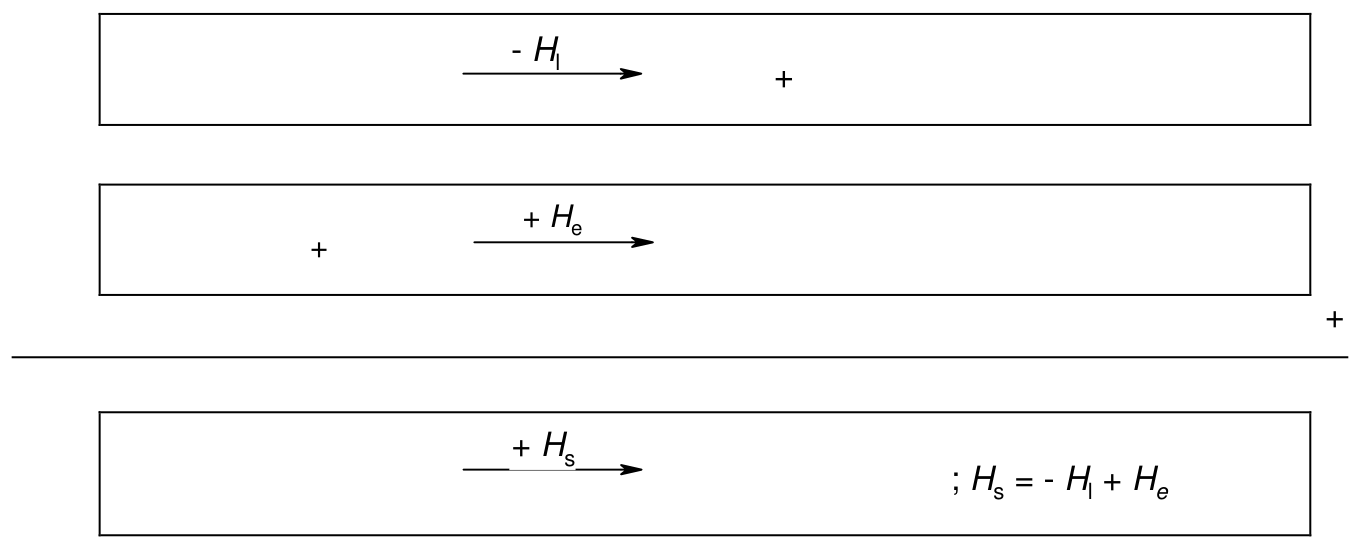
8.1 Give a thermochemical cycle (Law of Hess) for sublimation of \(\ce{CeBr3}\), via a vapour of mononuclear ions. (\(H_{\mathrm l}=H_{\mathrm{lattice}}\); \(H_{\mathrm e}=H_{\mathrm{electrostatic}}\); \(H_{\mathrm s}=H_{\mathrm{sublimation}}\); \(H\) is not absolute, \(H\) means \(\Delta H\))
The lattice energy of the solid can be calculated using the Born–Landé formula:
\[ H_{\mathrm l} =f\frac{Z_+Z_-Ae^2}{r_++r_-}\left(1-\frac1n\right) \]
The factor \(fe^2\) (necessary in order to calculate the lattice energy in \(\mathrm{kJ\,mol^{-1}}\)) amounts to 139 when the ionic radii are substituted in nm. The Madelung constant \(A\) for the lattice is 2.985. The Born exponent \(n\) is 11. The charges of the ions \(Z_+\) and \(Z_-\) are integer numbers (\(Z_-\) is negative). For the calculation of the energy of gaseous \(\ce{CeBr3}\) (when formed from ions) the same Born-Landé formula can be used without \(A\). The structure of \(\ce{CeBr3}\) in the gas phase is planar triangular. The radius of \(\ce{Ce^3+}\) is 0.115 nm and of \(\ce{Br^-}\) is 0.182 nm.
8.2 Calculate the enthalpy of sublimation of \(\ce{CeBr3}\) (in integers; be aware of the signs!)
Attempts to make a better lamp have been undertaken by adding a stoichiometric amount of \(\ce{CsBr}\) to the \(\ce{CeBr3}\) in the lamp leading at room temperature to solid \(\ce{CsCeBr4}\). When the sublimation temperature decreases the life time of the lamp will increase likewise. The \(\ce{CsCeBr4}\) lattice has a \(\ce{NaCl}\) structure with \(\ce{Cs+}\) as cations and tetrahedral \(\ce{CeBr4^-}\) as complex anions. Sublimation of \(\ce{CsCeBr4}\) leads to a vapour of \(\ce{CsBr}\) and \(\ce{CeBr3}\) molecules.
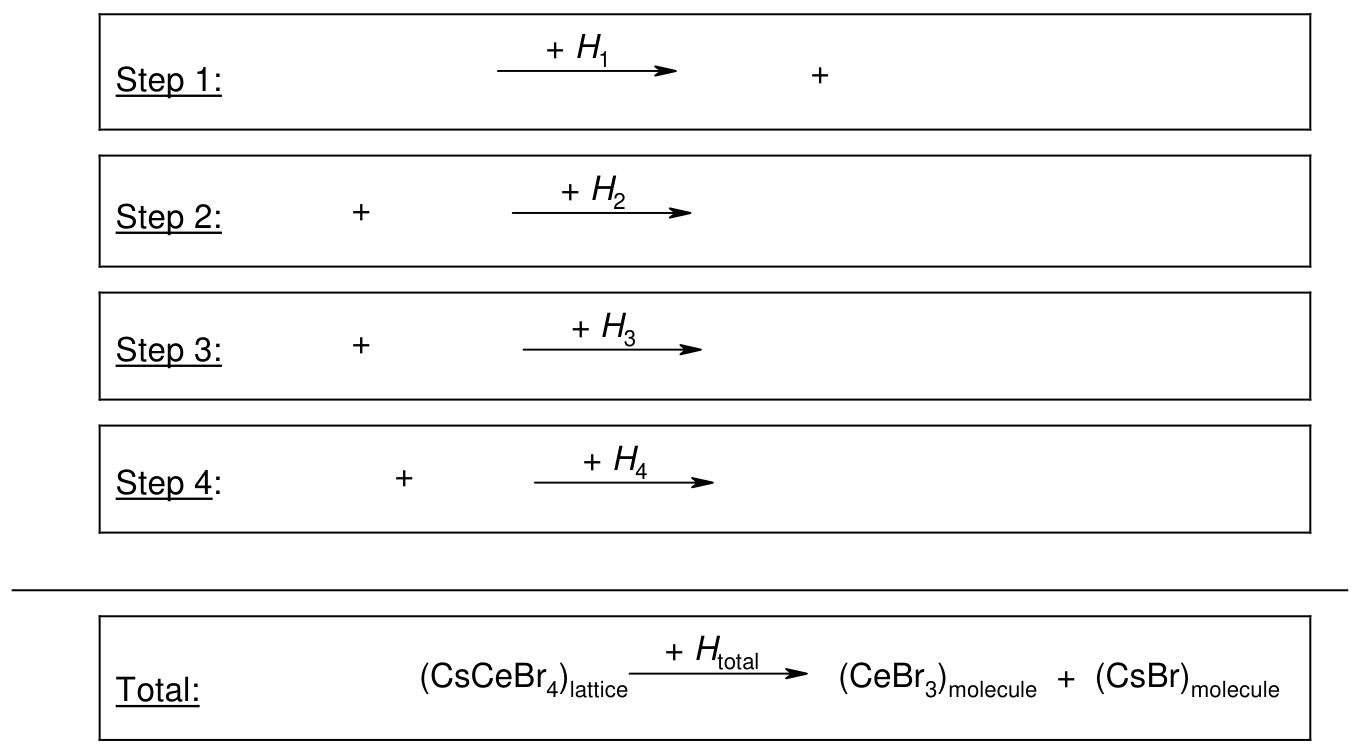
8.3 Give the reaction equations of the thermochemical cycle (Law of Hess) for this process in which some steps involve \(\ce{CeBr4^-}\) ions, mononuclear ions and/or neutral molecules in the gas phase.
8.4 Calculate the enthalpy of sublimation of \(\ce{CsCeBr4}\) (in integers).
Use the Born–Landé formula for all steps in the process and report the separate energies also (be aware of the signs!). The Madelung constant for \(\ce{NaCl}\) is 1.75. The Cs–Ce distance in the lattice is 0.617 nm. The \(\ce{CeBr4^-}\) anion is a tetrahedron in which the ratio between the edge and the distance between a corner of the tetrahedron and the centre of gravity (body-radius) amounts to \((2\sqrt6)/3=1.633\). The Born exponent of \(\ce{CsBr}\) is 11. The radius of \(\ce{Cs+}\) is 0.181 nm.
8.5 Conclusion in relation to the previous answers: Was adding \(\ce{CsBr}\) a good idea? Mark the correct answer.
- [ ] Adding \(\ce{CsBr}\) is counterproductive.
- [ ] Adding \(\ce{CsBr}\) has no influence.
- [ ] Adding \(\ce{CsBr}\) is advantageous.
- [ ] From these data no clear answer can be given.
Official English text of the problem.
Answers
-
8.1 \[ \begin{aligned} \ce{CeBr3(s) &-> Ce^3+(g) + 3Br^-(g)} &&\Delta H=-H_{\mathrm l},\\ \ce{Ce^3+(g) + 3Br^-(g) &-> CeBr3(g)} &&\Delta H=H_{\mathrm e}. \end{aligned} \] Thus \(\ce{CeBr3(s) -> CeBr3(g)}\), with \[ \boxed{H_{\mathrm s}=-H_{\mathrm l}+H_{\mathrm e}}. \]
-
8.2 \[ H_{\mathrm l}=-3810,\qquad H_{\mathrm e}=-3092,\qquad \boxed{H_{\mathrm s}=+718\ \mathrm{kJ\,mol^{-1}}}. \] All listed energies are in \(\mathrm{kJ\,mol^{-1}}\).
-
8.3 A consistent ordering of the four steps is \[ \begin{aligned} 1:\quad&\ce{CsCeBr4(s) -> Cs+(g) + CeBr4^-(g)},\\ 2:\quad&\ce{Cs+(g) + CeBr4^-(g) -> Cs+(g) + Ce^3+(g) + 4Br^-(g)},\\ 3:\quad&\ce{Ce^3+(g) + 3Br^-(g) -> CeBr3(g)},\\ 4:\quad&\ce{Cs+(g) + Br^-(g) -> CsBr(g)}. \end{aligned} \] Their sum is \[ \boxed{\ce{CsCeBr4(s) -> CeBr3(g) + CsBr(g)}}. \]
-
8.4 For the ordering above: \[ \boxed{ H_1=+358,\quad H_2=+3542,\quad H_3=-3092,\quad H_4=-348 \quad(\mathrm{kJ\,mol^{-1}}) } \] \[ \boxed{H_{\mathrm{total}}=+460\ \mathrm{kJ\,mol^{-1}}}. \]
-
8.5 Mark “Adding \(\ce{CsBr}\) is advantageous.”
Solution
8.1 — Thermochemical cycle for cerium(III) bromide
The species are cerium(III) ions, \(\ce{Ce^3+}\), SMILES [Ce+3]; bromide ions, \(\ce{Br^-}\), SMILES [Br-]; and neutral gaseous cerium(III) bromide, \(\ce{CeBr3}\), connected SMILES [Ce](Br)(Br)Br. The gas molecule is trigonal planar, with Ce at the centre and three Br atoms at the vertices of an equilateral triangle. SMILES does not specify this geometry.
Solid cerium(III) bromide is an extended ionic lattice; its formula-unit composition can be represented by [Ce+3].[Br-].[Br-].[Br-].
The given Born–Landé expression uses signed ionic charges. Consequently, \(H_{\mathrm l}<0\) describes formation of the lattice from separated gaseous ions. Breaking the lattice therefore requires \(-H_{\mathrm l}>0\).
Fill the first reaction box with
\[ \ce{CeBr3(s) -> Ce^3+(g) + 3Br^-(g)}, \qquad \Delta H=-H_{\mathrm l}. \]
Fill the second box with association of the gaseous ions into a neutral molecule:
\[ \ce{Ce^3+(g) + 3Br^-(g) -> CeBr3(g)}, \qquad \Delta H=H_{\mathrm e}. \]
Adding these equations cancels all gaseous ions. The bottom box is therefore
\[ \ce{CeBr3(s) -> CeBr3(g)}, \qquad \boxed{H_{\mathrm s}=-H_{\mathrm l}+H_{\mathrm e}}. \]
8.2 — Sublimation enthalpy of cerium(III) bromide
Define the common factor
\[ C=fe^2\left(1-\frac1n\right) =139\left(1-\frac1{11}\right) =126.3636\ \mathrm{kJ\,nm\,mol^{-1}}. \]
The Ce–Br separation is
\[ r=0.115+0.182=0.297\ \mathrm{nm}. \]
Using the given lattice expression once per mole of \(\ce{CeBr3}\),
\[ H_{\mathrm l} =C\frac{(3)(-1)(2.985)}{0.297} =-3810.06\ \mathrm{kJ\,mol^{-1}}. \]
For the gaseous molecule, sum the energies of every distinct ion pair, using the prescribed expression without a Madelung constant.
There are three attractive Ce–Br pairs. There are also three repulsive Br–Br pairs, whose separation follows from the \(120^\circ\) Br–Ce–Br angle:
\[ d_{\mathrm{Br-Br}} =\sqrt{r^2+r^2-2r^2\cos120^\circ} =\sqrt3\,r =0.514419\ \mathrm{nm}. \]
Thus
\[ \begin{aligned} H_{\mathrm e} &=C\left[ 3\frac{(3)(-1)}{r} +3\frac{(-1)(-1)}{\sqrt3\,r} \right]\\ &=\frac{126.3636}{0.297} \left(-9+\frac3{\sqrt3}\right)\\ &=-3092.27\ \mathrm{kJ\,mol^{-1}}. \end{aligned} \]
The attractive contribution is \(-3829.20\ \mathrm{kJ\,mol^{-1}}\), while bromide–bromide repulsion contributes \(+736.93\ \mathrm{kJ\,mol^{-1}}\).
Hess’s law gives
\[ \begin{aligned} H_{\mathrm s} &=-(-3810.06)+(-3092.27)\\ &=717.78\ \mathrm{kJ\,mol^{-1}}. \end{aligned} \]
Therefore, to the requested integer,
\[ \boxed{H_{\mathrm s}\bigl(\ce{CeBr3}\bigr)=+718\ \mathrm{kJ\,mol^{-1}}}. \]
8.3 — Thermochemical cycle for caesium tetrabromidocerate(III)
The additional species are:
| Species | Name | SMILES | Geometry |
|---|---|---|---|
| \(\ce{Cs+}\) | Caesium ion | [Cs+] |
Monatomic |
| \(\ce{CeBr4^-}\) | Tetrabromidocerate(III) ion | [Ce-](Br)(Br)(Br)Br |
Ce at the centre of a regular tetrahedron of Br atoms |
| \(\ce{CsBr(g)}\) | Caesium bromide molecule | [Cs]Br |
Diatomic |
The connected SMILES encode connectivity and overall charge. In particular, the formal charge on [Ce-] does not denote the oxidation state: Ce is \(+3\) in \(\ce{CeBr4^-}\). The tetrahedral geometry must be stated separately.
Solid caesium tetrabromidocerate(III), \(\ce{CsCeBr4}\), has the formula-unit representation [Cs+].[Ce-](Br)(Br)(Br)Br. Its extended rock-salt lattice consists of caesium cations and tetrahedral complex anions.
Fill the four reaction boxes as follows.
-
Separate the lattice into gaseous constituent ions: \[ \ce{CsCeBr4(s) -> Cs+(g) + CeBr4^-(g)}, \qquad \Delta H=H_1. \]
-
Dissociate the complex anion into mononuclear ions: \[ \ce{Cs+(g) + CeBr4^-(g) -> Cs+(g) + Ce^3+(g) + 4Br^-(g)}, \qquad \Delta H=H_2. \] The caesium ion is a spectator and contributes zero net enthalpy to this step.
-
Form one gaseous cerium(III) bromide molecule: \[ \ce{Ce^3+(g) + 3Br^-(g) -> CeBr3(g)}, \qquad \Delta H=H_3. \]
-
Form one gaseous caesium bromide molecule: \[ \ce{Cs+(g) + Br^-(g) -> CsBr(g)}, \qquad \Delta H=H_4. \]
All intermediate ions cancel on addition:
\[ \ce{CsCeBr4(s) -> CeBr3(g) + CsBr(g)}, \]
\[ \boxed{H_{\mathrm{total}}=H_1+H_2+H_3+H_4}. \]
8.4 — Sublimation enthalpy of caesium tetrabromidocerate(III)
Use \(C=126.3636\ \mathrm{kJ\,nm\,mol^{-1}}\) throughout.
For step 1, the lattice contains ions of charges \(+1\) and \(-1\). Their separation is the given Cs–Ce distance, \(0.617\ \mathrm{nm}\). Reversing lattice formation gives
\[ H_1 =-C\frac{(+1)(-1)(1.75)}{0.617} =+358.41\ \mathrm{kJ\,mol^{-1}}, \]
so
\[ \boxed{H_1=+358\ \mathrm{kJ\,mol^{-1}}}. \]
For step 2, calculate the energy of forming the tetrahedral complex anion from its mononuclear ions, then reverse the sign.
The four Ce–Br distances are \(r=0.297\ \mathrm{nm}\). Each of the six Br–Br pairs lies along an edge of the tetrahedron, so
\[ d_{\mathrm{Br-Br}}=1.633r =1.633(0.297) =0.485001\ \mathrm{nm}. \]
The complex-ion formation energy is
\[ \begin{aligned} E_4 &=C\left[ 4\frac{(3)(-1)}{r} +6\frac{(-1)(-1)}{1.633r} \right]\\ &=\frac{126.3636}{0.297} \left(-12+\frac6{1.633}\right)\\ &=-3542.34\ \mathrm{kJ\,mol^{-1}}. \end{aligned} \]
Dissociation is the reverse process:
\[ H_2=-E_4=+3542.34\ \mathrm{kJ\,mol^{-1}}, \]
\[ \boxed{H_2=+3542\ \mathrm{kJ\,mol^{-1}}}. \]
For step 3, the formation of gaseous \(\ce{CeBr3}\) was calculated in 8.2:
\[ H_3=-3092.27\ \mathrm{kJ\,mol^{-1}}, \qquad \boxed{H_3=-3092\ \mathrm{kJ\,mol^{-1}}}. \]
For step 4, the caesium–bromide separation is
\[ r_{\mathrm{Cs-Br}}=0.181+0.182=0.363\ \mathrm{nm}. \]
There is one attractive ion pair and no Madelung factor:
\[ H_4 =C\frac{(+1)(-1)}{0.363} =-348.11\ \mathrm{kJ\,mol^{-1}}, \]
\[ \boxed{H_4=-348\ \mathrm{kJ\,mol^{-1}}}. \]
Adding the unrounded values,
\[ \begin{aligned} H_{\mathrm{total}} &=358.41+3542.34-3092.27-348.11\\ &=460.37\ \mathrm{kJ\,mol^{-1}}. \end{aligned} \]
Therefore,
\[ \boxed{H_{\mathrm s}\bigl(\ce{CsCeBr4}\bigr)=+460\ \mathrm{kJ\,mol^{-1}}}. \]
This value is per mole of solid \(\ce{CsCeBr4}\), producing one mole each of gaseous \(\ce{CeBr3}\) and \(\ce{CsBr}\).
8.5 — Effect of adding caesium bromide
Both sublimation processes produce one mole of gaseous \(\ce{CeBr3}\) per mole of starting cerium-containing solid, but
\[ 460\ \mathrm{kJ\,mol^{-1}} < 718\ \mathrm{kJ\,mol^{-1}}. \]
According to the enthalpy criterion specified in the problem, adding \(\ce{CsBr}\) therefore makes vaporization more favourable and permits operation at a lower temperature, increasing lamp life.
Mark the third option: “Adding \(\ce{CsBr}\) is advantageous.”
The solution was checked against the official solution. Where this solution differs from the official solution, the official solution contains an error or a misprint.
IChO 2002 · Theorieaufgabe 8
Beleuchtungslampen
Thema IV - Chemie im Zusammenhang mit Licht und Energie
Die Chemie spielt eine wichtige Rolle bei der Deckung unseres Bedarfs an Licht und Energie. Unser Leben ist ohne künstliches Licht und Energie für die Mobilität undenkbar.
AUFGABE 8
BELEUCHTUNGSLAMPEN
Seit 1891 werden in den Niederlanden Beleuchtungslampen hergestellt. Die heutige Verbesserung gegenüber der ersten Lampe ist enorm, insbesondere durch die Einführung von Gasentladungslampen. Die Lebensdauer hat sich um Größenordnungen erhöht. Auch die Farbe ist ein wichtiger Aspekt. Heute werden Verbindungen der Seltenerdmetalle wie \(\ce{CeBr3}\) zugesetzt, um in der Lampe eine Farbtemperatur von 6000 K zu erreichen. Diese Verbindungen sind bei Raumtemperatur ionische Feststoffe und sublimieren beim Erhitzen teilweise, wobei ein Dampf aus neutralen Metallhalogenidmolekülen entsteht. Um einen hohen Dampfdruck zu erreichen, sollte die Sublimationsenthalpie möglichst niedrig sein.
8.1 Geben Sie einen thermochemischen Kreisprozess (Satz von Hess) für die Sublimation von \(\ce{CeBr3}\) über einen Dampf aus einkernigen Ionen an. (\(H_{\mathrm l}=H_{\mathrm{lattice}}\); \(H_{\mathrm e}=H_{\mathrm{electrostatic}}\); \(H_{\mathrm s}=H_{\mathrm{sublimation}}\); \(H\) ist nicht absolut, \(H\) bedeutet \(\Delta H\))
Die Gitterenergie des Feststoffs kann mit der Born–Landé-Formel berechnet werden:
\[ H_{\mathrm l} =f\frac{Z_+Z_-Ae^2}{r_++r_-}\left(1-\frac1n\right) \]
Der Faktor \(fe^2\) (der zur Berechnung der Gitterenergie in \(\mathrm{kJ\,mol^{-1}}\) erforderlich ist) beträgt 139, wenn die Ionenradien in nm eingesetzt werden. Die Madelung-Konstante \(A\) für das Gitter beträgt 2.985. Der Born-Exponent \(n\) ist 11. Die Ladungen der Ionen \(Z_+\) und \(Z_-\) sind ganze Zahlen (\(Z_-\) ist negativ). Zur Berechnung der Energie von gasförmigem \(\ce{CeBr3}\) (bei seiner Bildung aus Ionen) kann dieselbe Born–Landé-Formel ohne \(A\) verwendet werden. Die Struktur von \(\ce{CeBr3}\) in der Gasphase ist trigonal-planar. Der Radius von \(\ce{Ce^3+}\) beträgt 0.115 nm und der von \(\ce{Br^-}\) 0.182 nm.
8.2 Berechnen Sie die Sublimationsenthalpie von \(\ce{CeBr3}\) (in ganzen Zahlen; achten Sie auf die Vorzeichen!).
Es wurden Versuche unternommen, eine bessere Lampe herzustellen, indem dem \(\ce{CeBr3}\) in der Lampe eine stöchiometrische Menge \(\ce{CsBr}\) zugesetzt wurde, wodurch bei Raumtemperatur festes \(\ce{CsCeBr4}\) entsteht. Wenn die Sublimationstemperatur sinkt, erhöht sich entsprechend die Lebensdauer der Lampe. Das \(\ce{CsCeBr4}\)-Gitter besitzt eine \(\ce{NaCl}\)-Struktur mit \(\ce{Cs+}\) als Kationen und tetraedrischen \(\ce{CeBr4^-}\) als komplexen Anionen. Die Sublimation von \(\ce{CsCeBr4}\) führt zu einem Dampf aus \(\ce{CsBr}\)- und \(\ce{CeBr3}\)-Molekülen.
8.3 Geben Sie die Reaktionsgleichungen des thermochemischen Kreisprozesses (Satz von Hess) für diesen Vorgang an, bei dem in einigen Schritten \(\ce{CeBr4^-}\)-Ionen, einkernige Ionen und/oder neutrale Moleküle in der Gasphase auftreten.
8.4 Berechnen Sie die Sublimationsenthalpie von \(\ce{CsCeBr4}\) (in ganzen Zahlen).
Verwenden Sie für alle Schritte des Vorgangs die Born–Landé-Formel und geben Sie auch die einzelnen Energien an (achten Sie auf die Vorzeichen!). Die Madelung-Konstante für \(\ce{NaCl}\) beträgt 1.75. Der Cs–Ce-Abstand im Gitter beträgt 0.617 nm. Das \(\ce{CeBr4^-}\)-Anion ist ein Tetraeder, bei dem das Verhältnis zwischen der Kantenlänge und dem Abstand einer Tetraederecke vom Schwerpunkt (Umkugelradius) \((2\sqrt6)/3=1.633\) beträgt. Der Born-Exponent von \(\ce{CsBr}\) ist 11. Der Radius von \(\ce{Cs+}\) beträgt 0.181 nm.
8.5 Schlussfolgerung aus den vorherigen Antworten: War die Zugabe von \(\ce{CsBr}\) eine gute Idee? Kreuzen Sie die richtige Antwort an.
- [ ] Die Zugabe von \(\ce{CsBr}\) ist kontraproduktiv.
- [ ] Die Zugabe von \(\ce{CsBr}\) hat keinen Einfluss.
- [ ] Die Zugabe von \(\ce{CsBr}\) ist vorteilhaft.
- [ ] Aus diesen Daten lässt sich keine eindeutige Antwort ableiten.
Aufgabentext aus dem offiziellen englischen Text übersetzt.
Antworten
-
8.1 \[ \begin{aligned} \ce{CeBr3(s) &-> Ce^3+(g) + 3Br^-(g)} &&\Delta H=-H_{\mathrm l},\\ \ce{Ce^3+(g) + 3Br^-(g) &-> CeBr3(g)} &&\Delta H=H_{\mathrm e}. \end{aligned} \] Somit gilt \(\ce{CeBr3(s) -> CeBr3(g)}\), mit \[ \boxed{H_{\mathrm s}=-H_{\mathrm l}+H_{\mathrm e}}. \]
-
8.2 \[ H_{\mathrm l}=-3810,\qquad H_{\mathrm e}=-3092,\qquad \boxed{H_{\mathrm s}=+718\ \mathrm{kJ\,mol^{-1}}}. \] Alle aufgeführten Energien sind in \(\mathrm{kJ\,mol^{-1}}\) angegeben.
-
8.3 Eine konsistente Reihenfolge der vier Schritte lautet \[ \begin{aligned} 1:\quad&\ce{CsCeBr4(s) -> Cs+(g) + CeBr4^-(g)},\\ 2:\quad&\ce{Cs+(g) + CeBr4^-(g) -> Cs+(g) + Ce^3+(g) + 4Br^-(g)},\\ 3:\quad&\ce{Ce^3+(g) + 3Br^-(g) -> CeBr3(g)},\\ 4:\quad&\ce{Cs+(g) + Br^-(g) -> CsBr(g)}. \end{aligned} \] Ihre Summe ist \[ \boxed{\ce{CsCeBr4(s) -> CeBr3(g) + CsBr(g)}}. \]
-
8.4 Für die obige Reihenfolge: \[ \boxed{ H_1=+358,\quad H_2=+3542,\quad H_3=-3092,\quad H_4=-348 \quad(\mathrm{kJ\,mol^{-1}}) } \] \[ \boxed{H_{\mathrm{total}}=+460\ \mathrm{kJ\,mol^{-1}}}. \]
-
8.5 Kreuzen Sie „Die Zugabe von \(\ce{CsBr}\) ist vorteilhaft.“ an.
Lösung
8.1 — Thermochemischer Kreisprozess für Cer(III)-bromid
Die Spezies sind Cer(III)-Ionen, \(\ce{Ce^3+}\), SMILES [Ce+3]; Bromidionen, \(\ce{Br^-}\), SMILES [Br-]; und neutrales gasförmiges Cer(III)-bromid, \(\ce{CeBr3}\), zusammenhängender SMILES [Ce](Br)(Br)Br. Das Molekül in der Gasphase ist trigonal-planar, mit Ce im Zentrum und drei Br-Atomen an den Ecken eines gleichseitigen Dreiecks. SMILES legt diese Geometrie nicht fest.
Festes Cer(III)-bromid bildet ein ausgedehntes Ionengitter; die Zusammensetzung seiner Formeleinheit kann durch [Ce+3].[Br-].[Br-].[Br-] dargestellt werden.
Der angegebene Born–Landé-Ausdruck verwendet vorzeichenbehaftete Ionenladungen. Folglich beschreibt \(H_{\mathrm l}<0\) die Bildung des Gitters aus getrennten gasförmigen Ionen. Das Aufbrechen des Gitters erfordert daher \(-H_{\mathrm l}>0\).
Tragen Sie in das erste Reaktionsfeld ein:
\[ \ce{CeBr3(s) -> Ce^3+(g) + 3Br^-(g)}, \qquad \Delta H=-H_{\mathrm l}. \]
Tragen Sie in das zweite Feld die Assoziation der gasförmigen Ionen zu einem neutralen Molekül ein:
\[ \ce{Ce^3+(g) + 3Br^-(g) -> CeBr3(g)}, \qquad \Delta H=H_{\mathrm e}. \]
Bei der Addition dieser Gleichungen kürzen sich alle gasförmigen Ionen heraus. Im unteren Feld steht daher
\[ \ce{CeBr3(s) -> CeBr3(g)}, \qquad \boxed{H_{\mathrm s}=-H_{\mathrm l}+H_{\mathrm e}}. \]
8.2 — Sublimationsenthalpie von Cer(III)-bromid
Definieren Sie den gemeinsamen Faktor
\[ C=fe^2\left(1-\frac1n\right) =139\left(1-\frac1{11}\right) =126.3636\ \mathrm{kJ\,nm\,mol^{-1}}. \]
Der Ce–Br-Abstand beträgt
\[ r=0.115+0.182=0.297\ \mathrm{nm}. \]
Wendet man den angegebenen Ausdruck für die Gitterenergie einmal pro Mol \(\ce{CeBr3}\) an, erhält man
\[ H_{\mathrm l} =C\frac{(3)(-1)(2.985)}{0.297} =-3810.06\ \mathrm{kJ\,mol^{-1}}. \]
Für das gasförmige Molekül werden die Energien aller unterschiedlichen Ionenpaare unter Verwendung des vorgegebenen Ausdrucks ohne Madelung-Konstante summiert.
Es gibt drei anziehende Ce–Br-Paare. Außerdem gibt es drei abstoßende Br–Br-Paare, deren Abstand sich aus dem Br–Ce–Br-Winkel von \(120^\circ\) ergibt:
\[ d_{\mathrm{Br-Br}} =\sqrt{r^2+r^2-2r^2\cos120^\circ} =\sqrt3\,r =0.514419\ \mathrm{nm}. \]
Somit gilt
\[ \begin{aligned} H_{\mathrm e} &=C\left[ 3\frac{(3)(-1)}{r} +3\frac{(-1)(-1)}{\sqrt3\,r} \right]\\ &=\frac{126.3636}{0.297} \left(-9+\frac3{\sqrt3}\right)\\ &=-3092.27\ \mathrm{kJ\,mol^{-1}}. \end{aligned} \]
Der anziehende Beitrag beträgt \(-3829.20\ \mathrm{kJ\,mol^{-1}}\), während die Bromid–Bromid-Abstoßung einen Beitrag von \(+736.93\ \mathrm{kJ\,mol^{-1}}\) liefert.
Der Satz von Hess ergibt
\[ \begin{aligned} H_{\mathrm s} &=-(-3810.06)+(-3092.27)\\ &=717.78\ \mathrm{kJ\,mol^{-1}}. \end{aligned} \]
Auf die geforderte ganze Zahl gerundet ergibt sich daher
\[ \boxed{H_{\mathrm s}\bigl(\ce{CeBr3}\bigr)=+718\ \mathrm{kJ\,mol^{-1}}}. \]
8.3 — Thermochemischer Kreisprozess für Caesiumtetrabromidocerat(III)
Die zusätzlichen Spezies sind:
| Spezies | Name | SMILES | Geometrie |
|---|---|---|---|
| \(\ce{Cs+}\) | Caesiumion | [Cs+] |
Einatomig |
| \(\ce{CeBr4^-}\) | Tetrabromidocerat(III)-Ion | [Ce-](Br)(Br)(Br)Br |
Ce im Zentrum eines regelmäßigen Tetraeders aus Br-Atomen |
| \(\ce{CsBr(g)}\) | Caesiumbromidmolekül | [Cs]Br |
Zweiatomig |
Die zusammenhängenden SMILES codieren die Konnektivität und die Gesamtladung. Insbesondere bezeichnet die Formalladung an [Ce-] nicht die Oxidationsstufe: Ce hat in \(\ce{CeBr4^-}\) die Oxidationsstufe \(+3\). Die tetraedrische Geometrie muss gesondert angegeben werden.
Festes Caesiumtetrabromidocerat(III), \(\ce{CsCeBr4}\), besitzt die Formeleinheitsdarstellung [Cs+].[Ce-](Br)(Br)(Br)Br. Sein ausgedehntes Steinsalzgitter besteht aus Caesiumkationen und tetraedrischen komplexen Anionen.
Füllen Sie die vier Reaktionsfelder wie folgt aus.
-
Zerlegen Sie das Gitter in seine gasförmigen Bestandteilsionen: \[ \ce{CsCeBr4(s) -> Cs+(g) + CeBr4^-(g)}, \qquad \Delta H=H_1. \]
-
Dissoziieren Sie das komplexe Anion in einkernige Ionen: \[ \ce{Cs+(g) + CeBr4^-(g) -> Cs+(g) + Ce^3+(g) + 4Br^-(g)}, \qquad \Delta H=H_2. \] Das Caesiumion ist ein Zuschauerion und liefert zu diesem Schritt keinen Nettoenthalpiebeitrag.
-
Bilden Sie ein gasförmiges Cer(III)-bromidmolekül: \[ \ce{Ce^3+(g) + 3Br^-(g) -> CeBr3(g)}, \qquad \Delta H=H_3. \]
-
Bilden Sie ein gasförmiges Caesiumbromidmolekül: \[ \ce{Cs+(g) + Br^-(g) -> CsBr(g)}, \qquad \Delta H=H_4. \]
Alle intermediären Ionen kürzen sich bei der Addition heraus:
\[ \ce{CsCeBr4(s) -> CeBr3(g) + CsBr(g)}, \]
\[ \boxed{H_{\mathrm{total}}=H_1+H_2+H_3+H_4}. \]
8.4 — Sublimationsenthalpie von Caesiumtetrabromidocerat(III)
Verwenden Sie durchgehend \(C=126.3636\ \mathrm{kJ\,nm\,mol^{-1}}\).
Für Schritt 1 enthält das Gitter Ionen mit den Ladungen \(+1\) und \(-1\). Ihr Abstand entspricht dem angegebenen Cs–Ce-Abstand von \(0.617\ \mathrm{nm}\). Die Umkehrung der Gitterbildung ergibt
\[ H_1 =-C\frac{(+1)(-1)(1.75)}{0.617} =+358.41\ \mathrm{kJ\,mol^{-1}}, \]
also
\[ \boxed{H_1=+358\ \mathrm{kJ\,mol^{-1}}}. \]
Berechnen Sie für Schritt 2 die Energie der Bildung des tetraedrischen komplexen Anions aus seinen einkernigen Ionen und kehren Sie anschließend das Vorzeichen um.
Die vier Ce–Br-Abstände betragen \(r=0.297\ \mathrm{nm}\). Jedes der sechs Br–Br-Paare liegt entlang einer Tetraederkante, sodass gilt
\[ d_{\mathrm{Br-Br}}=1.633r =1.633(0.297) =0.485001\ \mathrm{nm}. \]
Die Bildungsenergie des Komplexions beträgt
\[ \begin{aligned} E_4 &=C\left[ 4\frac{(3)(-1)}{r} +6\frac{(-1)(-1)}{1.633r} \right]\\ &=\frac{126.3636}{0.297} \left(-12+\frac6{1.633}\right)\\ &=-3542.34\ \mathrm{kJ\,mol^{-1}}. \end{aligned} \]
Die Dissoziation ist der umgekehrte Vorgang:
\[ H_2=-E_4=+3542.34\ \mathrm{kJ\,mol^{-1}}, \]
\[ \boxed{H_2=+3542\ \mathrm{kJ\,mol^{-1}}}. \]
Für Schritt 3 wurde die Bildung von gasförmigem \(\ce{CeBr3}\) in 8.2 berechnet:
\[ H_3=-3092.27\ \mathrm{kJ\,mol^{-1}}, \qquad \boxed{H_3=-3092\ \mathrm{kJ\,mol^{-1}}}. \]
Für Schritt 4 beträgt der Caesium–Bromid-Abstand
\[ r_{\mathrm{Cs-Br}}=0.181+0.182=0.363\ \mathrm{nm}. \]
Es gibt ein anziehendes Ionenpaar und keinen Madelung-Faktor:
\[ H_4 =C\frac{(+1)(-1)}{0.363} =-348.11\ \mathrm{kJ\,mol^{-1}}, \]
\[ \boxed{H_4=-348\ \mathrm{kJ\,mol^{-1}}}. \]
Durch Addition der ungerundeten Werte erhält man
\[ \begin{aligned} H_{\mathrm{total}} &=358.41+3542.34-3092.27-348.11\\ &=460.37\ \mathrm{kJ\,mol^{-1}}. \end{aligned} \]
Daher gilt
\[ \boxed{H_{\mathrm s}\bigl(\ce{CsCeBr4}\bigr)=+460\ \mathrm{kJ\,mol^{-1}}}. \]
Dieser Wert bezieht sich auf ein Mol festes \(\ce{CsCeBr4}\), wobei jeweils ein Mol gasförmiges \(\ce{CeBr3}\) und \(\ce{CsBr}\) entsteht.
8.5 — Wirkung der Zugabe von Caesiumbromid
Beide Sublimationsvorgänge erzeugen ein Mol gasförmiges \(\ce{CeBr3}\) pro Mol des cerhaltigen Ausgangsfeststoffs, aber
\[ 460\ \mathrm{kJ\,mol^{-1}} < 718\ \mathrm{kJ\,mol^{-1}}. \]
Nach dem in der Aufgabe vorgegebenen Enthalpiekriterium begünstigt die Zugabe von \(\ce{CsBr}\) daher die Überführung in die Gasphase und ermöglicht den Betrieb bei einer niedrigeren Temperatur, wodurch sich die Lebensdauer der Lampe erhöht.
Kreuzen Sie die dritte Option: „Die Zugabe von \(\ce{CsBr}\) ist vorteilhaft.“ an.
Die Lösung wurde mit der offiziellen Lösung abgeglichen. Wo diese Lösung von der offiziellen Lösung abweicht, enthält die offizielle Lösung einen Fehler oder Druckfehler.
IChO 2002 · Teori sorusu 8
Aydınlatma Lambaları
Tema IV - Işık ve Enerjiyle İlgili Kimya
Kimya, ışık ve enerji gereksinimlerimizin karşılanmasında önemli bir rol oynar. Yapay ışık ve ulaşım için gerekli enerji olmadan yaşamımız düşünülemez.
SORU 8
AYDINLATMA LAMBALARI
Hollanda'da 1891 yılından bu yana aydınlatma lambaları üretilmektedir. Özellikle gaz deşarj lambalarının kullanıma girmesiyle, ilk lambaya kıyasla günümüzde muazzam bir gelişme sağlanmıştır. Kullanım ömrü mertebelerce artmıştır. Renk de önemli bir özelliktir. Lambada 6000 K renk sıcaklığına ulaşmak için artık \(\ce{CeBr3}\) gibi nadir toprak metali bileşikleri de kullanılmaktadır. Bu bileşikler oda sıcaklığında iyonik katılardır ve ısıtıldıklarında kısmen süblimleşerek nötr metal halojenür moleküllerinden oluşan bir buhar verirler. Yüksek bir buhar basıncı elde etmek için süblimleşme entalpisi olabildiğince düşük olmalıdır.
8.1 \(\ce{CeBr3}\)'ün tek çekirdekli iyonlardan oluşan bir buhar üzerinden süblimleşmesi için bir termokimyasal çevrim (Hess Yasası) veriniz. (\(H_{\mathrm l}=H_{\mathrm{lattice}}\); \(H_{\mathrm e}=H_{\mathrm{electrostatic}}\); \(H_{\mathrm s}=H_{\mathrm{sublimation}}\); \(H\) mutlak değildir, \(H\), \(\Delta H\) anlamına gelir.)
Katının örgü enerjisi Born–Landé formülü kullanılarak hesaplanabilir:
\[ H_{\mathrm l} =f\frac{Z_+Z_-Ae^2}{r_++r_-}\left(1-\frac1n\right) \]
\(fe^2\) çarpanı (örgü enerjisinin \(\mathrm{kJ\,mol^{-1}}\) cinsinden hesaplanabilmesi için gereklidir), iyon yarıçapları nm cinsinden yerine konulduğunda 139 değerini alır. Örgünün Madelung sabiti \(A\), 2.985'tir. Born üssü \(n\), 11'dir. İyonların yükleri \(Z_+\) ve \(Z_-\) tam sayılardır (\(Z_-\) negatiftir). Gaz hâlindeki \(\ce{CeBr3}\)'ün enerjisinin (iyonlardan oluştuğunda) hesaplanması için aynı Born-Landé formülü \(A\) olmadan kullanılabilir. Gaz fazındaki \(\ce{CeBr3}\)'ün yapısı düzlem üçgendir. \(\ce{Ce^3+}\)'ün yarıçapı 0.115 nm, \(\ce{Br^-}\)'ün yarıçapı ise 0.182 nm'dir.
8.2 \(\ce{CeBr3}\)'ün süblimleşme entalpisini hesaplayınız (tam sayı olarak; işaretlere dikkat ediniz!).
Lambadaki \(\ce{CeBr3}\)'e stokiyometrik miktarda \(\ce{CsBr}\) eklenerek daha iyi bir lamba yapılmaya çalışılmıştır; bu işlem oda sıcaklığında katı \(\ce{CsCeBr4}\) oluşmasına yol açar. Süblimleşme sıcaklığı düştüğünde lambanın kullanım ömrü de buna bağlı olarak artacaktır. \(\ce{CsCeBr4}\) örgüsü, katyonları \(\ce{Cs+}\), kompleks anyonları ise tetrahedral \(\ce{CeBr4^-}\) olan bir \(\ce{NaCl}\) yapısına sahiptir. \(\ce{CsCeBr4}\)'ün süblimleşmesi, \(\ce{CsBr}\) ve \(\ce{CeBr3}\) moleküllerinden oluşan bir buhar verir.
8.3 Bazı basamaklarında gaz fazında \(\ce{CeBr4^-}\) iyonları, tek çekirdekli iyonlar ve/veya nötr moleküller bulunan bu süreç için termokimyasal çevrimin (Hess Yasası) tepkime denklemlerini veriniz.
8.4 \(\ce{CsCeBr4}\)'ün süblimleşme entalpisini hesaplayınız (tam sayı olarak).
Sürecin tüm basamakları için Born–Landé formülünü kullanınız ve her bir enerjiyi ayrı ayrı da belirtiniz (işaretlere dikkat ediniz!). \(\ce{NaCl}\) için Madelung sabiti 1.75'tir. Örgüdeki Cs–Ce uzaklığı 0.617 nm'dir. \(\ce{CeBr4^-}\) anyonu bir tetrahedrondur; bu tetrahedronun kenar uzunluğunun, bir köşesi ile ağırlık merkezi arasındaki uzaklığa (gövde yarıçapına) oranı \((2\sqrt6)/3=1.633\)'tür. \(\ce{CsBr}\)'ün Born üssü 11'dir. \(\ce{Cs+}\)'un yarıçapı 0.181 nm'dir.
8.5 Önceki cevaplarla ilgili sonuç: \(\ce{CsBr}\) eklemek iyi bir fikir miydi? Doğru cevabı işaretleyiniz.
- [ ] \(\ce{CsBr}\) eklemek ters etki yapar.
- [ ] \(\ce{CsBr}\) eklemenin hiçbir etkisi yoktur.
- [ ] \(\ce{CsBr}\) eklemek avantajlıdır.
- [ ] Bu verilerden kesin bir cevap verilemez.
Soru metni resmi İngilizce metinden çevrilmiştir.
Cevaplar
-
8.1 \[ \begin{aligned} \ce{CeBr3(s) &-> Ce^3+(g) + 3Br^-(g)} &&\Delta H=-H_{\mathrm l},\\ \ce{Ce^3+(g) + 3Br^-(g) &-> CeBr3(g)} &&\Delta H=H_{\mathrm e}. \end{aligned} \] Böylece \(\ce{CeBr3(s) -> CeBr3(g)}\) olur ve \[ \boxed{H_{\mathrm s}=-H_{\mathrm l}+H_{\mathrm e}}. \]
-
8.2 \[ H_{\mathrm l}=-3810,\qquad H_{\mathrm e}=-3092,\qquad \boxed{H_{\mathrm s}=+718\ \mathrm{kJ\,mol^{-1}}}. \] Verilen tüm enerjiler \(\mathrm{kJ\,mol^{-1}}\) cinsindendir.
-
8.3 Dört basamağın tutarlı bir sıralaması şöyledir: \[ \begin{aligned} 1:\quad&\ce{CsCeBr4(s) -> Cs+(g) + CeBr4^-(g)},\\ 2:\quad&\ce{Cs+(g) + CeBr4^-(g) -> Cs+(g) + Ce^3+(g) + 4Br^-(g)},\\ 3:\quad&\ce{Ce^3+(g) + 3Br^-(g) -> CeBr3(g)},\\ 4:\quad&\ce{Cs+(g) + Br^-(g) -> CsBr(g)}. \end{aligned} \] Bunların toplamı \[ \boxed{\ce{CsCeBr4(s) -> CeBr3(g) + CsBr(g)}}. \]
-
8.4 Yukarıdaki sıralama için: \[ \boxed{ H_1=+358,\quad H_2=+3542,\quad H_3=-3092,\quad H_4=-348 \quad(\mathrm{kJ\,mol^{-1}}) } \] \[ \boxed{H_{\mathrm{total}}=+460\ \mathrm{kJ\,mol^{-1}}}. \]
-
8.5 “\(\ce{CsBr}\) eklemek avantajlıdır.” seçeneğini işaretleyiniz.
Çözüm
8.1 — Seryum(III) bromür için termokimyasal çevrim
Kimyasal türler; seryum(III) iyonları, \(\ce{Ce^3+}\), SMILES [Ce+3]; bromür iyonları, \(\ce{Br^-}\), SMILES [Br-]; ve nötr gaz hâlindeki seryum(III) bromür, \(\ce{CeBr3}\), bağlantılı SMILES [Ce](Br)(Br)Br şeklindedir. Gaz molekülü düzlem üçgen geometrilidir; Ce merkezde, üç Br atomu ise bir eşkenar üçgenin köşelerinde bulunur. SMILES bu geometriyi belirtmez.
Katı seryum(III) bromür, uzanımlı bir iyonik örgüdür; formül biriminin bileşimi [Ce+3].[Br-].[Br-].[Br-] ile gösterilebilir.
Verilen Born–Landé ifadesi, iyon yüklerini işaretleriyle birlikte kullanır. Dolayısıyla \(H_{\mathrm l}<0\), birbirinden ayrılmış gaz hâlindeki iyonlardan örgü oluşumunu ifade eder. Bu nedenle örgünün parçalanması \(-H_{\mathrm l}>0\) gerektirir.
İlk tepkime kutusunu şu şekilde doldurunuz:
\[ \ce{CeBr3(s) -> Ce^3+(g) + 3Br^-(g)}, \qquad \Delta H=-H_{\mathrm l}. \]
İkinci kutuya gaz hâlindeki iyonların nötr bir molekül oluşturmak üzere birleşmesini yazınız:
\[ \ce{Ce^3+(g) + 3Br^-(g) -> CeBr3(g)}, \qquad \Delta H=H_{\mathrm e}. \]
Bu denklemler toplandığında gaz hâlindeki tüm iyonlar sadeleşir. Dolayısıyla en alttaki kutu şöyledir:
\[ \ce{CeBr3(s) -> CeBr3(g)}, \qquad \boxed{H_{\mathrm s}=-H_{\mathrm l}+H_{\mathrm e}}. \]
8.2 — Seryum(III) bromürün süblimleşme entalpisi
Ortak çarpanı şöyle tanımlayalım:
\[ C=fe^2\left(1-\frac1n\right) =139\left(1-\frac1{11}\right) =126.3636\ \mathrm{kJ\,nm\,mol^{-1}}. \]
Ce–Br uzaklığı
\[ r=0.115+0.182=0.297\ \mathrm{nm}. \]
Verilen örgü ifadesini bir mol \(\ce{CeBr3}\) başına bir kez kullanırsak,
\[ H_{\mathrm l} =C\frac{(3)(-1)(2.985)}{0.297} =-3810.06\ \mathrm{kJ\,mol^{-1}}. \]
Gaz hâlindeki molekül için, belirtilen ifadeyi Madelung sabiti olmadan kullanarak birbirinden farklı tüm iyon çiftlerinin enerjilerini toplayınız.
Aralarında çekim olan üç Ce–Br çifti vardır. Ayrıca aralarında itme olan üç Br–Br çifti vardır; bunların arasındaki uzaklık, \(120^\circ\) olan Br–Ce–Br açısından bulunur:
\[ d_{\mathrm{Br-Br}} =\sqrt{r^2+r^2-2r^2\cos120^\circ} =\sqrt3\,r =0.514419\ \mathrm{nm}. \]
Böylece
\[ \begin{aligned} H_{\mathrm e} &=C\left[ 3\frac{(3)(-1)}{r} +3\frac{(-1)(-1)}{\sqrt3\,r} \right]\\ &=\frac{126.3636}{0.297} \left(-9+\frac3{\sqrt3}\right)\\ &=-3092.27\ \mathrm{kJ\,mol^{-1}}. \end{aligned} \]
Çekim katkısı \(-3829.20\ \mathrm{kJ\,mol^{-1}}\) iken bromür–bromür itmesinin katkısı \(+736.93\ \mathrm{kJ\,mol^{-1}}\)'dir.
Hess yasası şu sonucu verir:
\[ \begin{aligned} H_{\mathrm s} &=-(-3810.06)+(-3092.27)\\ &=717.78\ \mathrm{kJ\,mol^{-1}}. \end{aligned} \]
Dolayısıyla, istendiği gibi tam sayıya yuvarlandığında,
\[ \boxed{H_{\mathrm s}\bigl(\ce{CeBr3}\bigr)=+718\ \mathrm{kJ\,mol^{-1}}}. \]
8.3 — Sezyum tetrabromidoserat(III) için termokimyasal çevrim
Ek kimyasal türler şunlardır:
| Tür | Adı | SMILES | Geometri |
|---|---|---|---|
| \(\ce{Cs+}\) | Sezyum iyonu | [Cs+] |
Tek atomlu |
| \(\ce{CeBr4^-}\) | Tetrabromidoserat(III) iyonu | [Ce-](Br)(Br)(Br)Br |
Ce, Br atomlarının oluşturduğu düzgün bir tetrahedronun merkezindedir |
| \(\ce{CsBr(g)}\) | Sezyum bromür molekülü | [Cs]Br |
İki atomlu |
Bağlantılı SMILES gösterimleri, atomların bağlanma düzenini ve toplam yükü kodlar. Özellikle, [Ce-] üzerindeki formal yük yükseltgenme basamağını göstermez: \(\ce{CeBr4^-}\) içinde Ce'nin yükseltgenme basamağı \(+3\)'tür. Tetrahedral geometri ayrıca belirtilmelidir.
Katı sezyum tetrabromidoserat(III), \(\ce{CsCeBr4}\), [Cs+].[Ce-](Br)(Br)(Br)Br formül birimi gösterimine sahiptir. Uzanımlı kaya tuzu örgüsü, sezyum katyonlarından ve tetrahedral kompleks anyonlardan oluşur.
Dört tepkime kutusunu aşağıdaki gibi doldurunuz.
-
Örgüyü, onu oluşturan gaz hâlindeki iyonlara ayırınız: \[ \ce{CsCeBr4(s) -> Cs+(g) + CeBr4^-(g)}, \qquad \Delta H=H_1. \]
-
Kompleks anyonu tek çekirdekli iyonlarına ayrıştırınız: \[ \ce{Cs+(g) + CeBr4^-(g) -> Cs+(g) + Ce^3+(g) + 4Br^-(g)}, \qquad \Delta H=H_2. \] Sezyum iyonu seyirci iyondur ve bu basamağın net entalpisine katkısı sıfırdır.
-
Gaz hâlinde bir seryum(III) bromür molekülü oluşturunuz: \[ \ce{Ce^3+(g) + 3Br^-(g) -> CeBr3(g)}, \qquad \Delta H=H_3. \]
-
Gaz hâlinde bir sezyum bromür molekülü oluşturunuz: \[ \ce{Cs+(g) + Br^-(g) -> CsBr(g)}, \qquad \Delta H=H_4. \]
Toplandığında tüm ara iyonlar sadeleşir:
\[ \ce{CsCeBr4(s) -> CeBr3(g) + CsBr(g)}, \]
\[ \boxed{H_{\mathrm{total}}=H_1+H_2+H_3+H_4}. \]
8.4 — Sezyum tetrabromidoserat(III)'ün süblimleşme entalpisi
Tüm hesaplamalarda \(C=126.3636\ \mathrm{kJ\,nm\,mol^{-1}}\) kullanınız.
1. basamak için örgü, yükleri \(+1\) ve \(-1\) olan iyonlar içerir. Aralarındaki uzaklık, verilen Cs–Ce uzaklığı olan \(0.617\ \mathrm{nm}\)'dir. Örgü oluşumunun tersine çevrilmesiyle
\[ H_1 =-C\frac{(+1)(-1)(1.75)}{0.617} =+358.41\ \mathrm{kJ\,mol^{-1}}, \]
dolayısıyla
\[ \boxed{H_1=+358\ \mathrm{kJ\,mol^{-1}}}. \]
2. basamak için tetrahedral kompleks anyonun tek çekirdekli iyonlarından oluşma enerjisini hesaplayınız, ardından işareti tersine çeviriniz.
Dört Ce–Br uzaklığı da \(r=0.297\ \mathrm{nm}\)'dir. Altı Br–Br çiftinin her biri tetrahedronun bir kenarı boyunca yer alır; dolayısıyla
\[ d_{\mathrm{Br-Br}}=1.633r =1.633(0.297) =0.485001\ \mathrm{nm}. \]
Kompleks iyonun oluşma enerjisi
\[ \begin{aligned} E_4 &=C\left[ 4\frac{(3)(-1)}{r} +6\frac{(-1)(-1)}{1.633r} \right]\\ &=\frac{126.3636}{0.297} \left(-12+\frac6{1.633}\right)\\ &=-3542.34\ \mathrm{kJ\,mol^{-1}}. \end{aligned} \]
Ayrışma bunun tersi olan süreçtir:
\[ H_2=-E_4=+3542.34\ \mathrm{kJ\,mol^{-1}}, \]
\[ \boxed{H_2=+3542\ \mathrm{kJ\,mol^{-1}}}. \]
3. basamak için gaz hâlindeki \(\ce{CeBr3}\)'ün oluşumu 8.2'de hesaplanmıştı:
\[ H_3=-3092.27\ \mathrm{kJ\,mol^{-1}}, \qquad \boxed{H_3=-3092\ \mathrm{kJ\,mol^{-1}}}. \]
4. basamak için sezyum–bromür uzaklığı
\[ r_{\mathrm{Cs-Br}}=0.181+0.182=0.363\ \mathrm{nm}. \]
Aralarında çekim olan bir iyon çifti vardır ve Madelung çarpanı yoktur:
\[ H_4 =C\frac{(+1)(-1)}{0.363} =-348.11\ \mathrm{kJ\,mol^{-1}}, \]
\[ \boxed{H_4=-348\ \mathrm{kJ\,mol^{-1}}}. \]
Yuvarlanmamış değerler toplandığında,
\[ \begin{aligned} H_{\mathrm{total}} &=358.41+3542.34-3092.27-348.11\\ &=460.37\ \mathrm{kJ\,mol^{-1}}. \end{aligned} \]
Dolayısıyla,
\[ \boxed{H_{\mathrm s}\bigl(\ce{CsCeBr4}\bigr)=+460\ \mathrm{kJ\,mol^{-1}}}. \]
Bu değer, gaz hâlinde birer mol \(\ce{CeBr3}\) ve \(\ce{CsBr}\) oluşturan bir mol katı \(\ce{CsCeBr4}\) başınadır.
8.5 — Sezyum bromür eklenmesinin etkisi
Her iki süblimleşme süreci de başlangıçtaki seryum içeren katının molü başına bir mol gaz hâlinde \(\ce{CeBr3}\) oluşturur, ancak
\[ 460\ \mathrm{kJ\,mol^{-1}} < 718\ \mathrm{kJ\,mol^{-1}}. \]
Soruda belirtilen entalpi ölçütüne göre, \(\ce{CsBr}\) eklemek bu nedenle buharlaşmayı daha elverişli hâle getirir ve daha düşük bir sıcaklıkta çalışmaya olanak tanıyarak lambanın kullanım ömrünü uzatır.
Üçüncü seçeneği: “\(\ce{CsBr}\) eklemek avantajlıdır.” işaretleyiniz.
Çözüm, resmi çözümle karşılaştırılarak kontrol edildi. Bu çözümün resmi çözümden ayrıldığı yerlerde resmi çözümde bir hata ya da baskı hatası vardır.
IChO 2002 · Problema teórico 8
Lámparas de iluminación
Tema IV - Química relacionada con la luz y la energía
La química desempeña un papel fundamental a la hora de satisfacer nuestras necesidades de luz y energía. Nuestra vida es inconcebible sin luz artificial y sin energía para la movilidad.
PROBLEMA 8
LÁMPARAS DE ILUMINACIÓN
Desde 1891 se fabrican lámparas de iluminación en los Países Bajos. La mejora actual con respecto a la primera lámpara es enorme, especialmente con la introducción de las lámparas de descarga en gases. La vida útil ha aumentado en varios órdenes de magnitud. El color también es un aspecto importante. Actualmente se incorporan compuestos de metales de las tierras raras, como \(\ce{CeBr3}\), para alcanzar una temperatura de color de 6000 K en la lámpara. Estos compuestos son sólidos iónicos a temperatura ambiente y, al calentarlos, subliman parcialmente y producen un vapor de moléculas neutras de haluros metálicos. Para lograr una presión de vapor elevada, la entalpía de sublimación debe ser lo más baja posible.
8.1 Proponga un ciclo termoquímico (ley de Hess) para la sublimación de \(\ce{CeBr3}\), pasando por un vapor de iones mononucleares. (\(H_{\mathrm l}=H_{\mathrm{lattice}}\); \(H_{\mathrm e}=H_{\mathrm{electrostatic}}\); \(H_{\mathrm s}=H_{\mathrm{sublimation}}\); \(H\) no es absoluta, \(H\) significa \(\Delta H\))
La energía reticular del sólido puede calcularse mediante la fórmula de Born–Landé:
\[ H_{\mathrm l} =f\frac{Z_+Z_-Ae^2}{r_++r_-}\left(1-\frac1n\right) \]
El factor \(fe^2\) (necesario para calcular la energía reticular en \(\mathrm{kJ\,mol^{-1}}\)) vale 139 cuando los radios iónicos se introducen en nm. La constante de Madelung \(A\) para la red es 2.985. El exponente de Born \(n\) es 11. Las cargas de los iones \(Z_+\) y \(Z_-\) son números enteros (\(Z_-\) es negativo). Para calcular la energía del \(\ce{CeBr3}\) gaseoso (cuando se forma a partir de iones), puede utilizarse la misma fórmula de Born-Landé sin \(A\). La estructura del \(\ce{CeBr3}\) en fase gaseosa es trigonal plana. El radio de \(\ce{Ce^3+}\) es 0.115 nm y el de \(\ce{Br^-}\) es 0.182 nm.
8.2 Calcule la entalpía de sublimación de \(\ce{CeBr3}\) (en números enteros; ¡preste atención a los signos!).
Se ha intentado fabricar una lámpara mejor añadiendo una cantidad estequiométrica de \(\ce{CsBr}\) al \(\ce{CeBr3}\) de la lámpara, lo que da lugar a \(\ce{CsCeBr4}\) sólido a temperatura ambiente. Al disminuir la temperatura de sublimación, aumentará asimismo la vida útil de la lámpara. La red de \(\ce{CsCeBr4}\) presenta una estructura de tipo \(\ce{NaCl}\), con \(\ce{Cs+}\) como cationes y \(\ce{CeBr4^-}\) tetraédricos como aniones complejos. La sublimación de \(\ce{CsCeBr4}\) produce un vapor de moléculas de \(\ce{CsBr}\) y \(\ce{CeBr3}\).
8.3 Escriba las ecuaciones de reacción del ciclo termoquímico (ley de Hess) de este proceso, en el que algunas etapas implican iones \(\ce{CeBr4^-}\), iones mononucleares y/o moléculas neutras en fase gaseosa.
8.4 Calcule la entalpía de sublimación de \(\ce{CsCeBr4}\) (en números enteros).
Utilice la fórmula de Born–Landé para todas las etapas del proceso e indique también las energías de cada etapa (¡preste atención a los signos!). La constante de Madelung del \(\ce{NaCl}\) es 1.75. La distancia Cs–Ce en la red es 0.617 nm. El anión \(\ce{CeBr4^-}\) es un tetraedro en el que la relación entre la arista y la distancia entre un vértice del tetraedro y el centro de gravedad (radio circunscrito) es \((2\sqrt6)/3=1.633\). El exponente de Born del \(\ce{CsBr}\) es 11. El radio de \(\ce{Cs+}\) es 0.181 nm.
8.5 Conclusión en relación con las respuestas anteriores: ¿Fue una buena idea añadir \(\ce{CsBr}\)? Marque la respuesta correcta.
- [ ] Añadir \(\ce{CsBr}\) es contraproducente.
- [ ] Añadir \(\ce{CsBr}\) no tiene ninguna influencia.
- [ ] Añadir \(\ce{CsBr}\) es ventajoso.
- [ ] A partir de estos datos no se puede dar una respuesta clara.
Enunciado traducido del texto oficial en inglés.
Respuestas
-
8.1 \[ \begin{aligned} \ce{CeBr3(s) &-> Ce^3+(g) + 3Br^-(g)} &&\Delta H=-H_{\mathrm l},\\ \ce{Ce^3+(g) + 3Br^-(g) &-> CeBr3(g)} &&\Delta H=H_{\mathrm e}. \end{aligned} \] Por tanto, \(\ce{CeBr3(s) -> CeBr3(g)}\), con \[ \boxed{H_{\mathrm s}=-H_{\mathrm l}+H_{\mathrm e}}. \]
-
8.2 \[ H_{\mathrm l}=-3810,\qquad H_{\mathrm e}=-3092,\qquad \boxed{H_{\mathrm s}=+718\ \mathrm{kJ\,mol^{-1}}}. \] Todas las energías indicadas se expresan en \(\mathrm{kJ\,mol^{-1}}\).
-
8.3 Un orden coherente de las cuatro etapas es \[ \begin{aligned} 1:\quad&\ce{CsCeBr4(s) -> Cs+(g) + CeBr4^-(g)},\\ 2:\quad&\ce{Cs+(g) + CeBr4^-(g) -> Cs+(g) + Ce^3+(g) + 4Br^-(g)},\\ 3:\quad&\ce{Ce^3+(g) + 3Br^-(g) -> CeBr3(g)},\\ 4:\quad&\ce{Cs+(g) + Br^-(g) -> CsBr(g)}. \end{aligned} \] Su suma es \[ \boxed{\ce{CsCeBr4(s) -> CeBr3(g) + CsBr(g)}}. \]
-
8.4 Para el orden anterior: \[ \boxed{ H_1=+358,\quad H_2=+3542,\quad H_3=-3092,\quad H_4=-348 \quad(\mathrm{kJ\,mol^{-1}}) } \] \[ \boxed{H_{\mathrm{total}}=+460\ \mathrm{kJ\,mol^{-1}}}. \]
-
8.5 Marque «Añadir \(\ce{CsBr}\) es ventajoso».
Solución
8.1 — Ciclo termoquímico del bromuro de cerio(III)
Las especies son los iones cerio(III), \(\ce{Ce^3+}\), SMILES [Ce+3]; los iones bromuro, \(\ce{Br^-}\), SMILES [Br-]; y el bromuro de cerio(III) gaseoso neutro, \(\ce{CeBr3}\), SMILES conectado [Ce](Br)(Br)Br. La molécula gaseosa es trigonal plana, con el Ce en el centro y tres átomos de Br en los vértices de un triángulo equilátero. El SMILES no especifica esta geometría.
El bromuro de cerio(III) sólido es una red iónica extendida; la composición de su unidad fórmula puede representarse mediante [Ce+3].[Br-].[Br-].[Br-].
La expresión de Born–Landé dada utiliza las cargas iónicas con su signo. En consecuencia, \(H_{\mathrm l}<0\) describe la formación de la red a partir de iones gaseosos separados. Por tanto, romper la red requiere \(-H_{\mathrm l}>0\).
Complete el primer recuadro de reacción con
\[ \ce{CeBr3(s) -> Ce^3+(g) + 3Br^-(g)}, \qquad \Delta H=-H_{\mathrm l}. \]
Complete el segundo recuadro con la asociación de los iones gaseosos para formar una molécula neutra:
\[ \ce{Ce^3+(g) + 3Br^-(g) -> CeBr3(g)}, \qquad \Delta H=H_{\mathrm e}. \]
Al sumar estas ecuaciones se cancelan todos los iones gaseosos. Por tanto, el recuadro inferior es
\[ \ce{CeBr3(s) -> CeBr3(g)}, \qquad \boxed{H_{\mathrm s}=-H_{\mathrm l}+H_{\mathrm e}}. \]
8.2 — Entalpía de sublimación del bromuro de cerio(III)
Definimos el factor común
\[ C=fe^2\left(1-\frac1n\right) =139\left(1-\frac1{11}\right) =126.3636\ \mathrm{kJ\,nm\,mol^{-1}}. \]
La separación Ce–Br es
\[ r=0.115+0.182=0.297\ \mathrm{nm}. \]
Aplicando la expresión reticular dada una vez por mol de \(\ce{CeBr3}\),
\[ H_{\mathrm l} =C\frac{(3)(-1)(2.985)}{0.297} =-3810.06\ \mathrm{kJ\,mol^{-1}}. \]
Para la molécula gaseosa, sumamos las energías de cada par distinto de iones, utilizando la expresión indicada sin constante de Madelung.
Hay tres pares Ce–Br atractivos. También hay tres pares Br–Br repulsivos, cuya separación se obtiene a partir del ángulo Br–Ce–Br de \(120^\circ\):
\[ d_{\mathrm{Br-Br}} =\sqrt{r^2+r^2-2r^2\cos120^\circ} =\sqrt3\,r =0.514419\ \mathrm{nm}. \]
Así,
\[ \begin{aligned} H_{\mathrm e} &=C\left[ 3\frac{(3)(-1)}{r} +3\frac{(-1)(-1)}{\sqrt3\,r} \right]\\ &=\frac{126.3636}{0.297} \left(-9+\frac3{\sqrt3}\right)\\ &=-3092.27\ \mathrm{kJ\,mol^{-1}}. \end{aligned} \]
La contribución atractiva es \(-3829.20\ \mathrm{kJ\,mol^{-1}}\), mientras que la repulsión bromuro–bromuro contribuye con \(+736.93\ \mathrm{kJ\,mol^{-1}}\).
La ley de Hess da
\[ \begin{aligned} H_{\mathrm s} &=-(-3810.06)+(-3092.27)\\ &=717.78\ \mathrm{kJ\,mol^{-1}}. \end{aligned} \]
Por tanto, redondeando al entero solicitado,
\[ \boxed{H_{\mathrm s}\bigl(\ce{CeBr3}\bigr)=+718\ \mathrm{kJ\,mol^{-1}}}. \]
8.3 — Ciclo termoquímico del tetrabromidocerato(III) de cesio
Las especies adicionales son:
| Especie | Nombre | SMILES | Geometría |
|---|---|---|---|
| \(\ce{Cs+}\) | Ion cesio | [Cs+] |
Monoatómica |
| \(\ce{CeBr4^-}\) | Ion tetrabromidocerato(III) | [Ce-](Br)(Br)(Br)Br |
Ce en el centro de un tetraedro regular de átomos de Br |
| \(\ce{CsBr(g)}\) | Molécula de bromuro de cesio | [Cs]Br |
Diatómica |
Los SMILES conectados codifican la conectividad y la carga global. En particular, la carga formal de [Ce-] no indica el estado de oxidación: el Ce es \(+3\) en \(\ce{CeBr4^-}\). La geometría tetraédrica debe indicarse por separado.
El tetrabromidocerato(III) de cesio sólido, \(\ce{CsCeBr4}\), tiene la representación de unidad fórmula [Cs+].[Ce-](Br)(Br)(Br)Br. Su red extendida de tipo sal gema está formada por cationes cesio y aniones complejos tetraédricos.
Complete los cuatro recuadros de reacción como sigue.
-
Separe la red en sus iones constituyentes gaseosos: \[ \ce{CsCeBr4(s) -> Cs+(g) + CeBr4^-(g)}, \qquad \Delta H=H_1. \]
-
Disocie el anión complejo en iones mononucleares: \[ \ce{Cs+(g) + CeBr4^-(g) -> Cs+(g) + Ce^3+(g) + 4Br^-(g)}, \qquad \Delta H=H_2. \] El ion cesio es un espectador y su contribución neta a la entalpía de esta etapa es nula.
-
Forme una molécula gaseosa de bromuro de cerio(III): \[ \ce{Ce^3+(g) + 3Br^-(g) -> CeBr3(g)}, \qquad \Delta H=H_3. \]
-
Forme una molécula gaseosa de bromuro de cesio: \[ \ce{Cs+(g) + Br^-(g) -> CsBr(g)}, \qquad \Delta H=H_4. \]
Todos los iones intermedios se cancelan al sumar:
\[ \ce{CsCeBr4(s) -> CeBr3(g) + CsBr(g)}, \]
\[ \boxed{H_{\mathrm{total}}=H_1+H_2+H_3+H_4}. \]
8.4 — Entalpía de sublimación del tetrabromidocerato(III) de cesio
Utilizamos \(C=126.3636\ \mathrm{kJ\,nm\,mol^{-1}}\) en todos los cálculos.
Para la etapa 1, la red contiene iones de cargas \(+1\) y \(-1\). Su separación es la distancia Cs–Ce dada, \(0.617\ \mathrm{nm}\). Al invertir la formación de la red se obtiene
\[ H_1 =-C\frac{(+1)(-1)(1.75)}{0.617} =+358.41\ \mathrm{kJ\,mol^{-1}}, \]
por lo que
\[ \boxed{H_1=+358\ \mathrm{kJ\,mol^{-1}}}. \]
Para la etapa 2, calculamos la energía de formación del anión complejo tetraédrico a partir de sus iones mononucleares y después invertimos el signo.
Las cuatro distancias Ce–Br son \(r=0.297\ \mathrm{nm}\). Cada uno de los seis pares Br–Br se sitúa a lo largo de una arista del tetraedro, por lo que
\[ d_{\mathrm{Br-Br}}=1.633r =1.633(0.297) =0.485001\ \mathrm{nm}. \]
La energía de formación del ion complejo es
\[ \begin{aligned} E_4 &=C\left[ 4\frac{(3)(-1)}{r} +6\frac{(-1)(-1)}{1.633r} \right]\\ &=\frac{126.3636}{0.297} \left(-12+\frac6{1.633}\right)\\ &=-3542.34\ \mathrm{kJ\,mol^{-1}}. \end{aligned} \]
La disociación es el proceso inverso:
\[ H_2=-E_4=+3542.34\ \mathrm{kJ\,mol^{-1}}, \]
\[ \boxed{H_2=+3542\ \mathrm{kJ\,mol^{-1}}}. \]
Para la etapa 3, la formación de \(\ce{CeBr3}\) gaseoso se calculó en 8.2:
\[ H_3=-3092.27\ \mathrm{kJ\,mol^{-1}}, \qquad \boxed{H_3=-3092\ \mathrm{kJ\,mol^{-1}}}. \]
Para la etapa 4, la separación cesio–bromuro es
\[ r_{\mathrm{Cs-Br}}=0.181+0.182=0.363\ \mathrm{nm}. \]
Hay un par iónico atractivo y no hay factor de Madelung:
\[ H_4 =C\frac{(+1)(-1)}{0.363} =-348.11\ \mathrm{kJ\,mol^{-1}}, \]
\[ \boxed{H_4=-348\ \mathrm{kJ\,mol^{-1}}}. \]
Sumando los valores sin redondear,
\[ \begin{aligned} H_{\mathrm{total}} &=358.41+3542.34-3092.27-348.11\\ &=460.37\ \mathrm{kJ\,mol^{-1}}. \end{aligned} \]
Por tanto,
\[ \boxed{H_{\mathrm s}\bigl(\ce{CsCeBr4}\bigr)=+460\ \mathrm{kJ\,mol^{-1}}}. \]
Este valor corresponde a un mol de \(\ce{CsCeBr4}\) sólido, que produce un mol de \(\ce{CeBr3}\) gaseoso y un mol de \(\ce{CsBr}\) gaseoso.
8.5 — Efecto de añadir bromuro de cesio
Ambos procesos de sublimación producen un mol de \(\ce{CeBr3}\) gaseoso por mol de sólido inicial que contiene cerio, pero
\[ 460\ \mathrm{kJ\,mol^{-1}} < 718\ \mathrm{kJ\,mol^{-1}}. \]
De acuerdo con el criterio entálpico especificado en el problema, añadir \(\ce{CsBr}\) hace, por tanto, más favorable la vaporización y permite el funcionamiento a una temperatura más baja, lo que aumenta la vida útil de la lámpara.
Marque la tercera opción: «Añadir \(\ce{CsBr}\) es ventajoso».
La solución se comprobó con la solución oficial. Donde esta solución difiere de la solución oficial, la solución oficial contiene un error o una errata.
IChO 2002 · 理论题 8
照明灯
主题 IV - 与光和能量有关的化学
化学在满足我们对光和能量的需求方面发挥着重要作用。如果没有人工照明和用于出行的能源,我们的生活将难以想象。
题目 8
照明灯
荷兰自 1891 年起就开始制造照明灯。与最初的灯相比,如今的灯已有巨大的改进,尤其是在引入气体放电灯之后。灯的使用寿命已提高了数个数量级。光的颜色也是一个重要方面。如今,人们在灯中加入了诸如 \(\ce{CeBr3}\) 之类的稀土金属化合物,使灯的色温达到 6000 K。这些化合物在室温下是离子固体,加热时会部分升华,形成由中性金属卤化物分子组成的蒸气。为了获得较高的蒸气压,升华焓应尽可能低。
8.1 给出 \(\ce{CeBr3}\) 经由单核离子蒸气升华的热化学循环(盖斯定律)。(\(H_{\mathrm l}=H_{\mathrm{lattice}}\);\(H_{\mathrm e}=H_{\mathrm{electrostatic}}\);\(H_{\mathrm s}=H_{\mathrm{sublimation}}\);\(H\) 不是绝对值,\(H\) 表示 \(\Delta H\))
固体的晶格能可用玻恩–朗德公式计算:
\[ H_{\mathrm l} =f\frac{Z_+Z_-Ae^2}{r_++r_-}\left(1-\frac1n\right) \]
当离子半径以 nm 为单位代入时,因子 \(fe^2\)(将晶格能计算为以 \(\mathrm{kJ\,mol^{-1}}\) 为单位的数值所需的因子)的值为 139。该晶格的马德隆常数 \(A\) 为 2.985。玻恩指数 \(n\) 为 11。离子的电荷数 \(Z_+\) 和 \(Z_-\) 为整数(\(Z_-\) 为负数)。计算气态 \(\ce{CeBr3}\) 的能量(由离子形成时)可使用同一玻恩–朗德公式,但不含 \(A\)。气相中 \(\ce{CeBr3}\) 的结构为平面三角形。\(\ce{Ce^3+}\) 的半径为 0.115 nm,\(\ce{Br^-}\) 的半径为 0.182 nm。
8.2 计算 \(\ce{CeBr3}\) 的升华焓(取整数;注意正负号!)
为了制造性能更好的灯,人们尝试向灯中的 \(\ce{CeBr3}\) 加入化学计量的 \(\ce{CsBr}\),在室温下形成固态 \(\ce{CsCeBr4}\)。升华温度降低时,灯的使用寿命也会相应延长。\(\ce{CsCeBr4}\) 晶格具有 \(\ce{NaCl}\) 型结构,其中阳离子为 \(\ce{Cs+}\),配阴离子为四面体形的 \(\ce{CeBr4^-}\)。\(\ce{CsCeBr4}\) 升华后形成由 \(\ce{CsBr}\) 和 \(\ce{CeBr3}\) 分子组成的蒸气。
8.3 写出此过程的热化学循环(盖斯定律)中各步的反应方程式,其中某些步骤涉及气相中的 \(\ce{CeBr4^-}\) 离子、单核离子和/或中性分子。
8.4 计算 \(\ce{CsCeBr4}\) 的升华焓(取整数)。
对该过程中的所有步骤均使用玻恩–朗德公式,并同时给出各步的能量(注意正负号!)。\(\ce{NaCl}\) 的马德隆常数为 1.75。晶格中 Cs–Ce 的距离为 0.617 nm。\(\ce{CeBr4^-}\) 阴离子呈四面体形,其棱长与四面体顶点到重心的距离(体半径)之比为 \((2\sqrt6)/3=1.633\)。\(\ce{CsBr}\) 的玻恩指数为 11。\(\ce{Cs+}\) 的半径为 0.181 nm。
8.5 根据前面的答案得出结论:加入 \(\ce{CsBr}\) 是否是一个好主意?勾选正确答案。
- [ ] 加入 \(\ce{CsBr}\) 会适得其反。
- [ ] 加入 \(\ce{CsBr}\) 没有影响。
- [ ] 加入 \(\ce{CsBr}\) 是有利的。
- [ ] 根据这些数据无法给出明确的答案。
题目译自官方英文原文。
答案
-
8.1 \[ \begin{aligned} \ce{CeBr3(s) &-> Ce^3+(g) + 3Br^-(g)} &&\Delta H=-H_{\mathrm l},\\ \ce{Ce^3+(g) + 3Br^-(g) &-> CeBr3(g)} &&\Delta H=H_{\mathrm e}. \end{aligned} \] 因此,\(\ce{CeBr3(s) -> CeBr3(g)}\),且 \[ \boxed{H_{\mathrm s}=-H_{\mathrm l}+H_{\mathrm e}}. \]
-
8.2 \[ H_{\mathrm l}=-3810,\qquad H_{\mathrm e}=-3092,\qquad \boxed{H_{\mathrm s}=+718\ \mathrm{kJ\,mol^{-1}}}. \] 所列各能量的单位均为 \(\mathrm{kJ\,mol^{-1}}\)。
-
8.3 四个步骤的一种自洽排列顺序为 \[ \begin{aligned} 1:\quad&\ce{CsCeBr4(s) -> Cs+(g) + CeBr4^-(g)},\\ 2:\quad&\ce{Cs+(g) + CeBr4^-(g) -> Cs+(g) + Ce^3+(g) + 4Br^-(g)},\\ 3:\quad&\ce{Ce^3+(g) + 3Br^-(g) -> CeBr3(g)},\\ 4:\quad&\ce{Cs+(g) + Br^-(g) -> CsBr(g)}. \end{aligned} \] 将它们相加,得 \[ \boxed{\ce{CsCeBr4(s) -> CeBr3(g) + CsBr(g)}}. \]
-
8.4 按照上述顺序: \[ \boxed{ H_1=+358,\quad H_2=+3542,\quad H_3=-3092,\quad H_4=-348 \quad(\mathrm{kJ\,mol^{-1}}) } \] \[ \boxed{H_{\mathrm{total}}=+460\ \mathrm{kJ\,mol^{-1}}}. \]
-
8.5 勾选 “加入 \(\ce{CsBr}\) 是有利的。”
解答
8.1 — 溴化铈(III)的热化学循环
所涉及的物种为铈(III)离子 \(\ce{Ce^3+}\),SMILES 为 [Ce+3];溴离子 \(\ce{Br^-}\),SMILES 为 [Br-];以及中性的气态溴化铈(III) \(\ce{CeBr3}\),其连通形式的 SMILES 为 [Ce](Br)(Br)Br。该气态分子呈平面三角形,Ce 位于中心,三个 Br 原子位于等边三角形的顶点。SMILES 并不指定这种几何构型。
固态溴化铈(III)形成延展的离子晶格;其化学式单元的组成可表示为 [Ce+3].[Br-].[Br-].[Br-]。
给定的玻恩–朗德表达式使用带正负号的离子电荷数。因此,\(H_{\mathrm l}<0\) 描述的是由彼此分离的气态离子形成晶格的过程。破坏晶格因而需要 \(-H_{\mathrm l}>0\)。
在第一个反应框中填入
\[ \ce{CeBr3(s) -> Ce^3+(g) + 3Br^-(g)}, \qquad \Delta H=-H_{\mathrm l}. \]
在第二个框中填入气态离子结合成中性分子的反应:
\[ \ce{Ce^3+(g) + 3Br^-(g) -> CeBr3(g)}, \qquad \Delta H=H_{\mathrm e}. \]
将这些方程式相加,所有气态离子均被消去。因此,底部框中应填入
\[ \ce{CeBr3(s) -> CeBr3(g)}, \qquad \boxed{H_{\mathrm s}=-H_{\mathrm l}+H_{\mathrm e}}. \]
8.2 — 溴化铈(III)的升华焓
定义公用因子
\[ C=fe^2\left(1-\frac1n\right) =139\left(1-\frac1{11}\right) =126.3636\ \mathrm{kJ\,nm\,mol^{-1}}. \]
Ce–Br 间距为
\[ r=0.115+0.182=0.297\ \mathrm{nm}. \]
对每摩尔 \(\ce{CeBr3}\) 使用一次给定的晶格能表达式,得
\[ H_{\mathrm l} =C\frac{(3)(-1)(2.985)}{0.297} =-3810.06\ \mathrm{kJ\,mol^{-1}}. \]
对于气态分子,使用规定的不含马德隆常数的表达式,将每一对不同离子之间的能量求和。
其中有三对相互吸引的 Ce–Br 离子对。此外,还有三对相互排斥的 Br–Br 离子对,它们的间距可由 \(120^\circ\) 的 Br–Ce–Br 夹角求得:
\[ d_{\mathrm{Br-Br}} =\sqrt{r^2+r^2-2r^2\cos120^\circ} =\sqrt3\,r =0.514419\ \mathrm{nm}. \]
因此
\[ \begin{aligned} H_{\mathrm e} &=C\left[ 3\frac{(3)(-1)}{r} +3\frac{(-1)(-1)}{\sqrt3\,r} \right]\\ &=\frac{126.3636}{0.297} \left(-9+\frac3{\sqrt3}\right)\\ &=-3092.27\ \mathrm{kJ\,mol^{-1}}. \end{aligned} \]
吸引作用的贡献为 \(-3829.20\ \mathrm{kJ\,mol^{-1}}\),而溴离子之间排斥作用的贡献为 \(+736.93\ \mathrm{kJ\,mol^{-1}}\)。
由盖斯定律得
\[ \begin{aligned} H_{\mathrm s} &=-(-3810.06)+(-3092.27)\\ &=717.78\ \mathrm{kJ\,mol^{-1}}. \end{aligned} \]
因此,按要求取整数,得
\[ \boxed{H_{\mathrm s}\bigl(\ce{CeBr3}\bigr)=+718\ \mathrm{kJ\,mol^{-1}}}. \]
8.3 — 四溴合铈(III)酸铯的热化学循环
新增的物种如下:
| 物种 | 名称 | SMILES | 几何构型 |
|---|---|---|---|
| \(\ce{Cs+}\) | 铯离子 | [Cs+] |
单原子 |
| \(\ce{CeBr4^-}\) | 四溴合铈(III)酸根离子 | [Ce-](Br)(Br)(Br)Br |
Ce 位于 Br 原子构成的正四面体的中心 |
| \(\ce{CsBr(g)}\) | 溴化铯分子 | [Cs]Br |
双原子 |
连通形式的 SMILES 表示连接关系和总电荷。特别是,[Ce-] 上的形式电荷并不表示氧化态:在 \(\ce{CeBr4^-}\) 中,Ce 的氧化态为 \(+3\)。四面体几何构型必须另行说明。
固态四溴合铈(III)酸铯 \(\ce{CsCeBr4}\) 的化学式单元可表示为 [Cs+].[Ce-](Br)(Br)(Br)Br。其延展的岩盐型晶格由铯阳离子和四面体形的配阴离子组成。
按如下方式填写四个反应框。
-
将晶格拆解为组成它的气态离子: \[ \ce{CsCeBr4(s) -> Cs+(g) + CeBr4^-(g)}, \qquad \Delta H=H_1. \]
-
将配阴离子解离为单核离子: \[ \ce{Cs+(g) + CeBr4^-(g) -> Cs+(g) + Ce^3+(g) + 4Br^-(g)}, \qquad \Delta H=H_2. \] 铯离子是旁观离子,对此步骤的净焓变贡献为零。
-
形成一个气态溴化铈(III)分子: \[ \ce{Ce^3+(g) + 3Br^-(g) -> CeBr3(g)}, \qquad \Delta H=H_3. \]
-
形成一个气态溴化铯分子: \[ \ce{Cs+(g) + Br^-(g) -> CsBr(g)}, \qquad \Delta H=H_4. \]
相加后,所有中间离子均被消去:
\[ \ce{CsCeBr4(s) -> CeBr3(g) + CsBr(g)}, \]
\[ \boxed{H_{\mathrm{total}}=H_1+H_2+H_3+H_4}. \]
8.4 — 四溴合铈(III)酸铯的升华焓
以下计算均使用 \(C=126.3636\ \mathrm{kJ\,nm\,mol^{-1}}\)。
对于步骤 1,晶格包含电荷数为 \(+1\) 和 \(-1\) 的离子。它们的间距为题目给定的 Cs–Ce 距离,即 \(0.617\ \mathrm{nm}\)。将晶格形成过程逆转,得
\[ H_1 =-C\frac{(+1)(-1)(1.75)}{0.617} =+358.41\ \mathrm{kJ\,mol^{-1}}, \]
所以
\[ \boxed{H_1=+358\ \mathrm{kJ\,mol^{-1}}}. \]
对于步骤 2,先计算由单核离子形成四面体形配阴离子的能量,再将其变号。
四个 Ce–Br 距离均为 \(r=0.297\ \mathrm{nm}\)。六对 Br–Br 离子对中的每一对都位于四面体的一条棱的两端,因此
\[ d_{\mathrm{Br-Br}}=1.633r =1.633(0.297) =0.485001\ \mathrm{nm}. \]
配离子的形成能为
\[ \begin{aligned} E_4 &=C\left[ 4\frac{(3)(-1)}{r} +6\frac{(-1)(-1)}{1.633r} \right]\\ &=\frac{126.3636}{0.297} \left(-12+\frac6{1.633}\right)\\ &=-3542.34\ \mathrm{kJ\,mol^{-1}}. \end{aligned} \]
解离是其逆过程:
\[ H_2=-E_4=+3542.34\ \mathrm{kJ\,mol^{-1}}, \]
\[ \boxed{H_2=+3542\ \mathrm{kJ\,mol^{-1}}}. \]
对于步骤 3,气态 \(\ce{CeBr3}\) 的形成能已在 8.2 中计算:
\[ H_3=-3092.27\ \mathrm{kJ\,mol^{-1}}, \qquad \boxed{H_3=-3092\ \mathrm{kJ\,mol^{-1}}}. \]
对于步骤 4,铯离子与溴离子之间的间距为
\[ r_{\mathrm{Cs-Br}}=0.181+0.182=0.363\ \mathrm{nm}. \]
其中只有一对相互吸引的离子对,且不含马德隆因子:
\[ H_4 =C\frac{(+1)(-1)}{0.363} =-348.11\ \mathrm{kJ\,mol^{-1}}, \]
\[ \boxed{H_4=-348\ \mathrm{kJ\,mol^{-1}}}. \]
将未取整的数值相加,得
\[ \begin{aligned} H_{\mathrm{total}} &=358.41+3542.34-3092.27-348.11\\ &=460.37\ \mathrm{kJ\,mol^{-1}}. \end{aligned} \]
因此,
\[ \boxed{H_{\mathrm s}\bigl(\ce{CsCeBr4}\bigr)=+460\ \mathrm{kJ\,mol^{-1}}}. \]
此数值以每摩尔固态 \(\ce{CsCeBr4}\) 计,该过程生成各一摩尔的气态 \(\ce{CeBr3}\) 和 \(\ce{CsBr}\)。
8.5 — 加入溴化铯的影响
在这两个升华过程中,每摩尔起始含铈固体均生成一摩尔气态 \(\ce{CeBr3}\),但
\[ 460\ \mathrm{kJ\,mol^{-1}} < 718\ \mathrm{kJ\,mol^{-1}}. \]
根据题目规定的焓判据,加入 \(\ce{CsBr}\) 因而使气化更为有利,并使灯能够在较低的温度下工作,从而延长灯的使用寿命。
勾选第三个选项:“加入 \(\ce{CsBr}\) 是有利的。”
解答已与官方解答核对。本解答与官方解答不同之处,均为官方解答中的错误或印刷错误。
IChO 2002 · Теоретическая задача 8
Осветительные лампы
Тема IV - Химия света и энергии
Химия играет важнейшую роль в удовлетворении наших потребностей в свете и энергии. Наша жизнь немыслима без искусственного освещения и энергии для передвижения.
ЗАДАЧА 8
ОСВЕТИТЕЛЬНЫЕ ЛАМПЫ
Осветительные лампы производят в Нидерландах с 1891 года. По сравнению с первой лампой современные лампы значительно усовершенствованы, особенно благодаря появлению газоразрядных ламп. Срок службы увеличился на несколько порядков. Важным аспектом является также цвет. Сейчас в лампы добавляют соединения редкоземельных металлов, такие как \(\ce{CeBr3}\), чтобы достичь цветовой температуры 6000 K. При комнатной температуре эти соединения представляют собой ионные твёрдые вещества, а при нагревании частично сублимируют с образованием пара, состоящего из нейтральных молекул галогенидов металлов. Для достижения высокого давления пара энтальпия сублимации должна быть как можно ниже.
8.1 Приведите термохимический цикл (закон Гесса) сублимации \(\ce{CeBr3}\) через пар, состоящий из одноатомных ионов. (\(H_{\mathrm l}=H_{\mathrm{lattice}}\); \(H_{\mathrm e}=H_{\mathrm{electrostatic}}\); \(H_{\mathrm s}=H_{\mathrm{sublimation}}\); \(H\) не является абсолютной величиной, под \(H\) подразумевается \(\Delta H\))
Энергию кристаллической решётки твёрдого вещества можно рассчитать по формуле Борна–Ланде:
\[ H_{\mathrm l} =f\frac{Z_+Z_-Ae^2}{r_++r_-}\left(1-\frac1n\right) \]
Множитель \(fe^2\) (необходимый для расчёта энергии кристаллической решётки в \(\mathrm{kJ\,mol^{-1}}\)) равен 139, если ионные радиусы подставляются в нм. Постоянная Маделунга \(A\) для этой решётки равна 2.985. Показатель Борна \(n\) равен 11. Заряды ионов \(Z_+\) и \(Z_-\) — целые числа (\(Z_-\) отрицателен). Для расчёта энергии газообразного \(\ce{CeBr3}\) (при его образовании из ионов) можно использовать ту же формулу Борна–Ланде без \(A\). Молекула \(\ce{CeBr3}\) в газовой фазе имеет плоское треугольное строение. Радиус \(\ce{Ce^3+}\) равен 0.115 нм, а радиус \(\ce{Br^-}\) — 0.182 нм.
8.2 Рассчитайте энтальпию сублимации \(\ce{CeBr3}\) (с округлением до целого числа; следите за знаками!)
Для улучшения лампы были предприняты попытки добавить к находящемуся в ней \(\ce{CeBr3}\) стехиометрическое количество \(\ce{CsBr}\), что при комнатной температуре приводит к образованию твёрдого \(\ce{CsCeBr4}\). При снижении температуры сублимации срок службы лампы также увеличится. Кристаллическая решётка \(\ce{CsCeBr4}\) имеет структуру типа \(\ce{NaCl}\), в которой катионами являются \(\ce{Cs+}\), а комплексными анионами — тетраэдрические \(\ce{CeBr4^-}\). Сублимация \(\ce{CsCeBr4}\) приводит к образованию пара, состоящего из молекул \(\ce{CsBr}\) и \(\ce{CeBr3}\).
8.3 Приведите уравнения реакций термохимического цикла (закон Гесса) для этого процесса, в котором некоторые стадии включают ионы \(\ce{CeBr4^-}\), одноатомные ионы и/или нейтральные молекулы в газовой фазе.
8.4 Рассчитайте энтальпию сублимации \(\ce{CsCeBr4}\) (с округлением до целого числа).
Используйте формулу Борна–Ланде для всех стадий процесса и приведите также энергии отдельных стадий (следите за знаками!). Постоянная Маделунга для \(\ce{NaCl}\) равна 1.75. Расстояние Cs–Ce в кристаллической решётке составляет 0.617 нм. Анион \(\ce{CeBr4^-}\) представляет собой тетраэдр, в котором отношение длины ребра к расстоянию между вершиной тетраэдра и центром тяжести (радиусу описанной сферы) составляет \((2\sqrt6)/3=1.633\). Показатель Борна для \(\ce{CsBr}\) равен 11. Радиус \(\ce{Cs+}\) равен 0.181 нм.
8.5 Вывод на основании предыдущих ответов: было ли добавление \(\ce{CsBr}\) удачной идеей? Отметьте правильный ответ.
- [ ] Добавление \(\ce{CsBr}\) приводит к обратному эффекту.
- [ ] Добавление \(\ce{CsBr}\) не оказывает влияния.
- [ ] Добавление \(\ce{CsBr}\) полезно.
- [ ] На основании этих данных нельзя дать однозначный ответ.
Условие переведено с официального английского текста.
Ответы
-
8.1 \[ \begin{aligned} \ce{CeBr3(s) &-> Ce^3+(g) + 3Br^-(g)} &&\Delta H=-H_{\mathrm l},\\ \ce{Ce^3+(g) + 3Br^-(g) &-> CeBr3(g)} &&\Delta H=H_{\mathrm e}. \end{aligned} \] Таким образом, \(\ce{CeBr3(s) -> CeBr3(g)}\), причём \[ \boxed{H_{\mathrm s}=-H_{\mathrm l}+H_{\mathrm e}}. \]
-
8.2 \[ H_{\mathrm l}=-3810,\qquad H_{\mathrm e}=-3092,\qquad \boxed{H_{\mathrm s}=+718\ \mathrm{kJ\,mol^{-1}}}. \] Все приведённые энергии выражены в \(\mathrm{kJ\,mol^{-1}}\).
-
8.3 Согласованная последовательность четырёх стадий имеет вид \[ \begin{aligned} 1:\quad&\ce{CsCeBr4(s) -> Cs+(g) + CeBr4^-(g)},\\ 2:\quad&\ce{Cs+(g) + CeBr4^-(g) -> Cs+(g) + Ce^3+(g) + 4Br^-(g)},\\ 3:\quad&\ce{Ce^3+(g) + 3Br^-(g) -> CeBr3(g)},\\ 4:\quad&\ce{Cs+(g) + Br^-(g) -> CsBr(g)}. \end{aligned} \] Их сумма даёт \[ \boxed{\ce{CsCeBr4(s) -> CeBr3(g) + CsBr(g)}}. \]
-
8.4 Для приведённой выше последовательности: \[ \boxed{ H_1=+358,\quad H_2=+3542,\quad H_3=-3092,\quad H_4=-348 \quad(\mathrm{kJ\,mol^{-1}}) } \] \[ \boxed{H_{\mathrm{total}}=+460\ \mathrm{kJ\,mol^{-1}}}. \]
-
8.5 Отметьте «Добавление \(\ce{CsBr}\) полезно.»
Решение
8.1 — Термохимический цикл для бромида церия(III)
Рассматриваемые частицы — ионы церия(III), \(\ce{Ce^3+}\), SMILES [Ce+3]; бромид-ионы, \(\ce{Br^-}\), SMILES [Br-]; и нейтральный газообразный бромид церия(III), \(\ce{CeBr3}\), связная запись SMILES [Ce](Br)(Br)Br. Молекула в газовой фазе имеет плоское треугольное строение: Ce находится в центре, а три атома Br — в вершинах равностороннего треугольника. SMILES не задаёт эту геометрию.
Твёрдый бромид церия(III) образует протяжённую ионную решётку; состав его формульной единицы можно представить записью [Ce+3].[Br-].[Br-].[Br-].
В приведённом выражении Борна–Ланде используются заряды ионов с учётом знака. Следовательно, \(H_{\mathrm l}<0\) описывает образование кристаллической решётки из разделённых газообразных ионов. Поэтому разрушение решётки требует энергии \(-H_{\mathrm l}>0\).
Впишите в первое поле для реакции
\[ \ce{CeBr3(s) -> Ce^3+(g) + 3Br^-(g)}, \qquad \Delta H=-H_{\mathrm l}. \]
Во второе поле впишите реакцию объединения газообразных ионов в нейтральную молекулу:
\[ \ce{Ce^3+(g) + 3Br^-(g) -> CeBr3(g)}, \qquad \Delta H=H_{\mathrm e}. \]
При сложении этих уравнений все газообразные ионы сокращаются. Поэтому в нижнем поле следует записать
\[ \ce{CeBr3(s) -> CeBr3(g)}, \qquad \boxed{H_{\mathrm s}=-H_{\mathrm l}+H_{\mathrm e}}. \]
8.2 — Энтальпия сублимации бромида церия(III)
Определим общий множитель
\[ C=fe^2\left(1-\frac1n\right) =139\left(1-\frac1{11}\right) =126.3636\ \mathrm{kJ\,nm\,mol^{-1}}. \]
Расстояние Ce–Br равно
\[ r=0.115+0.182=0.297\ \mathrm{nm}. \]
Применяя данное выражение для энергии решётки один раз в расчёте на моль \(\ce{CeBr3}\), получаем
\[ H_{\mathrm l} =C\frac{(3)(-1)(2.985)}{0.297} =-3810.06\ \mathrm{kJ\,mol^{-1}}. \]
Для газообразной молекулы просуммируем энергии всех различных пар ионов, используя предписанное выражение без постоянной Маделунга.
Имеются три притягивающиеся пары Ce–Br. Также имеются три отталкивающиеся пары Br–Br, расстояние в которых определяется углом Br–Ce–Br, равным \(120^\circ\):
\[ d_{\mathrm{Br-Br}} =\sqrt{r^2+r^2-2r^2\cos120^\circ} =\sqrt3\,r =0.514419\ \mathrm{nm}. \]
Таким образом,
\[ \begin{aligned} H_{\mathrm e} &=C\left[ 3\frac{(3)(-1)}{r} +3\frac{(-1)(-1)}{\sqrt3\,r} \right]\\ &=\frac{126.3636}{0.297} \left(-9+\frac3{\sqrt3}\right)\\ &=-3092.27\ \mathrm{kJ\,mol^{-1}}. \end{aligned} \]
Вклад притяжения составляет \(-3829.20\ \mathrm{kJ\,mol^{-1}}\), а отталкивание между бромид-ионами вносит вклад \(+736.93\ \mathrm{kJ\,mol^{-1}}\).
По закону Гесса
\[ \begin{aligned} H_{\mathrm s} &=-(-3810.06)+(-3092.27)\\ &=717.78\ \mathrm{kJ\,mol^{-1}}. \end{aligned} \]
Следовательно, с требуемым округлением до целого числа,
\[ \boxed{H_{\mathrm s}\bigl(\ce{CeBr3}\bigr)=+718\ \mathrm{kJ\,mol^{-1}}}. \]
8.3 — Термохимический цикл для тетрабромоцерата(III) цезия
Дополнительные частицы:
| Частица | Название | SMILES | Геометрия |
|---|---|---|---|
| \(\ce{Cs+}\) | Ион цезия | [Cs+] |
Одноатомный |
| \(\ce{CeBr4^-}\) | Тетрабромоцерат(III)-ион | [Ce-](Br)(Br)(Br)Br |
Ce в центре правильного тетраэдра из атомов Br |
| \(\ce{CsBr(g)}\) | Молекула бромида цезия | [Cs]Br |
Двухатомная |
Связные записи SMILES кодируют порядок соединения атомов и общий заряд. В частности, формальный заряд на [Ce-] не обозначает степень окисления: в \(\ce{CeBr4^-}\) степень окисления Ce равна \(+3\). Тетраэдрическую геометрию необходимо указывать отдельно.
Твёрдый тетрабромоцерат(III) цезия, \(\ce{CsCeBr4}\), имеет представление формульной единицы [Cs+].[Ce-](Br)(Br)(Br)Br. Его протяжённая кристаллическая решётка типа каменной соли состоит из катионов цезия и тетраэдрических комплексных анионов.
Заполните четыре поля для реакций следующим образом.
-
Разрушение решётки с образованием составляющих её газообразных ионов: \[ \ce{CsCeBr4(s) -> Cs+(g) + CeBr4^-(g)}, \qquad \Delta H=H_1. \]
-
Диссоциация комплексного аниона на одноатомные ионы: \[ \ce{Cs+(g) + CeBr4^-(g) -> Cs+(g) + Ce^3+(g) + 4Br^-(g)}, \qquad \Delta H=H_2. \] Ион цезия не участвует в превращении, и его суммарный вклад в энтальпию этой стадии равен нулю.
-
Образование одной молекулы газообразного бромида церия(III): \[ \ce{Ce^3+(g) + 3Br^-(g) -> CeBr3(g)}, \qquad \Delta H=H_3. \]
-
Образование одной молекулы газообразного бромида цезия: \[ \ce{Cs+(g) + Br^-(g) -> CsBr(g)}, \qquad \Delta H=H_4. \]
При сложении все промежуточные ионы сокращаются:
\[ \ce{CsCeBr4(s) -> CeBr3(g) + CsBr(g)}, \]
\[ \boxed{H_{\mathrm{total}}=H_1+H_2+H_3+H_4}. \]
8.4 — Энтальпия сублимации тетрабромоцерата(III) цезия
Во всех расчётах используем \(C=126.3636\ \mathrm{kJ\,nm\,mol^{-1}}\).
На стадии 1 решётка содержит ионы с зарядами \(+1\) и \(-1\). Расстояние между ними равно заданному расстоянию Cs–Ce, \(0.617\ \mathrm{nm}\). Для процесса, обратного образованию решётки, получаем
\[ H_1 =-C\frac{(+1)(-1)(1.75)}{0.617} =+358.41\ \mathrm{kJ\,mol^{-1}}, \]
поэтому
\[ \boxed{H_1=+358\ \mathrm{kJ\,mol^{-1}}}. \]
Для стадии 2 рассчитаем энергию образования тетраэдрического комплексного аниона из составляющих его одноатомных ионов, а затем изменим знак на противоположный.
Все четыре расстояния Ce–Br равны \(r=0.297\ \mathrm{nm}\). Каждая из шести пар Br–Br расположена вдоль ребра тетраэдра, поэтому
\[ d_{\mathrm{Br-Br}}=1.633r =1.633(0.297) =0.485001\ \mathrm{nm}. \]
Энергия образования комплексного иона равна
\[ \begin{aligned} E_4 &=C\left[ 4\frac{(3)(-1)}{r} +6\frac{(-1)(-1)}{1.633r} \right]\\ &=\frac{126.3636}{0.297} \left(-12+\frac6{1.633}\right)\\ &=-3542.34\ \mathrm{kJ\,mol^{-1}}. \end{aligned} \]
Диссоциация — обратный процесс:
\[ H_2=-E_4=+3542.34\ \mathrm{kJ\,mol^{-1}}, \]
\[ \boxed{H_2=+3542\ \mathrm{kJ\,mol^{-1}}}. \]
Для стадии 3 энергия образования газообразного \(\ce{CeBr3}\) была рассчитана в 8.2:
\[ H_3=-3092.27\ \mathrm{kJ\,mol^{-1}}, \qquad \boxed{H_3=-3092\ \mathrm{kJ\,mol^{-1}}}. \]
Для стадии 4 расстояние между ионом цезия и бромид-ионом равно
\[ r_{\mathrm{Cs-Br}}=0.181+0.182=0.363\ \mathrm{nm}. \]
Имеется одна притягивающаяся пара ионов, и множитель Маделунга отсутствует:
\[ H_4 =C\frac{(+1)(-1)}{0.363} =-348.11\ \mathrm{kJ\,mol^{-1}}, \]
\[ \boxed{H_4=-348\ \mathrm{kJ\,mol^{-1}}}. \]
Складывая неокруглённые значения, получаем
\[ \begin{aligned} H_{\mathrm{total}} &=358.41+3542.34-3092.27-348.11\\ &=460.37\ \mathrm{kJ\,mol^{-1}}. \end{aligned} \]
Следовательно,
\[ \boxed{H_{\mathrm s}\bigl(\ce{CsCeBr4}\bigr)=+460\ \mathrm{kJ\,mol^{-1}}}. \]
Это значение относится к одному молю твёрдого \(\ce{CsCeBr4}\), из которого образуется по одному молю газообразных \(\ce{CeBr3}\) и \(\ce{CsBr}\).
8.5 — Влияние добавления бромида цезия
В обоих процессах сублимации из одного моля исходного церийсодержащего твёрдого вещества образуется один моль газообразного \(\ce{CeBr3}\), однако
\[ 460\ \mathrm{kJ\,mol^{-1}} < 718\ \mathrm{kJ\,mol^{-1}}. \]
Таким образом, согласно указанному в задаче энтальпийному критерию, добавление \(\ce{CsBr}\) делает переход в газовую фазу более выгодным и позволяет работать при более низкой температуре, увеличивая срок службы лампы.
Отметьте третий вариант: «Добавление \(\ce{CsBr}\) полезно.»
Решение проверено по официальному решению. Там, где это решение расходится с официальным, в официальном решении есть ошибка или опечатка.
IChO 2002 · مسألة نظرية 8
مصابيح الإضاءة
المحور IV - الكيمياء المتعلقة بالضوء والطاقة
تؤدي الكيمياء دورًا رئيسيًا في تلبية احتياجاتنا من الضوء والطاقة. ولا يمكن تصور حياتنا من دون إضاءة اصطناعية وطاقة للتنقل.
المسألة 8
مصابيح الإضاءة
تُصنَّع مصابيح الإضاءة في هولندا منذ عام 1891. والتحسن الذي تحقق اليوم مقارنةً بالمصباح الأول هائل، ولا سيما مع ظهور مصابيح التفريغ الغازي. فقد ازداد العمر التشغيلي بعدة رتب عشرية. ويُعد اللون أيضًا جانبًا مهمًا. وتُضاف الآن مركبات فلزات الأتربة النادرة، مثل \(\ce{CeBr3}\)، للوصول إلى درجة حرارة لونية قدرها 6000 K في المصباح. وهذه المركبات مواد صلبة أيونية عند درجة حرارة الغرفة، وتتسامى جزئيًا عند تسخينها لتعطي بخارًا من جزيئات هاليدات الفلزات المتعادلة. ولتحقيق ضغط بخار مرتفع، ينبغي أن تكون إنثالبيّة التسامي منخفضة قدر الإمكان.
8.1 أعطِ دورة كيميائية حرارية (قانون هس) لتسامي \(\ce{CeBr3}\)، مرورًا ببخار من أيونات أحادية النواة. (\(H_{\mathrm l}=H_{\mathrm{lattice}}\)؛ \(H_{\mathrm e}=H_{\mathrm{electrostatic}}\)؛ \(H_{\mathrm s}=H_{\mathrm{sublimation}}\)؛ \(H\) ليست قيمة مطلقة، بل تعني \(\Delta H\))
يمكن حساب طاقة الشبكة البلورية للمادة الصلبة باستخدام معادلة بورن–لانديه:
\[ H_{\mathrm l} =f\frac{Z_+Z_-Ae^2}{r_++r_-}\left(1-\frac1n\right) \]
تبلغ قيمة العامل \(fe^2\) (اللازم لحساب طاقة الشبكة البلورية بوحدة \(\mathrm{kJ\,mol^{-1}}\)) مقدار 139 عند التعويض عن أنصاف الأقطار الأيونية بوحدة nm. وثابت مادلونغ \(A\) للشبكة هو 2.985. وأُس بورن \(n\) هو 11. وشحنتا الأيونات \(Z_+\) و\(Z_-\) عددان صحيحان (\(Z_-\) سالب). ولحساب طاقة \(\ce{CeBr3}\) الغازي (عند تكوّنه من الأيونات)، يمكن استخدام معادلة بورن–لانديه نفسها من دون \(A\). وبنية \(\ce{CeBr3}\) في الطور الغازي مثلثية مستوية. ونصف قطر \(\ce{Ce^3+}\) هو 0.115 nm، ونصف قطر \(\ce{Br^-}\) هو 0.182 nm.
8.2 احسب إنثالبيّة تسامي \(\ce{CeBr3}\) (بأعداد صحيحة؛ انتبه إلى الإشارات!)
أُجريت محاولات لصنع مصباح أفضل بإضافة كمية ستوكيومترية من \(\ce{CsBr}\) إلى \(\ce{CeBr3}\) في المصباح، مما يؤدي عند درجة حرارة الغرفة إلى تكوّن \(\ce{CsCeBr4}\) الصلب. وعندما تنخفض درجة حرارة التسامي، يزداد العمر التشغيلي للمصباح تبعًا لذلك. ولشبكة \(\ce{CsCeBr4}\) بنية \(\ce{NaCl}\)، حيث تكون \(\ce{Cs+}\) كاتيونات، و\(\ce{CeBr4^-}\) رباعية السطوح أنيونات معقدة. ويؤدي تسامي \(\ce{CsCeBr4}\) إلى بخار من جزيئات \(\ce{CsBr}\) و\(\ce{CeBr3}\).
8.3 أعطِ معادلات التفاعلات في الدورة الكيميائية الحرارية (قانون هس) لهذه العملية، التي تتضمن بعض خطواتها أيونات \(\ce{CeBr4^-}\)، وأيونات أحادية النواة و/أو جزيئات متعادلة في الطور الغازي.
8.4 احسب إنثالبيّة تسامي \(\ce{CsCeBr4}\) (بأعداد صحيحة).
استخدم معادلة بورن–لانديه لجميع خطوات العملية، واذكر أيضًا طاقة كل خطوة على حدة (انتبه إلى الإشارات!). وثابت مادلونغ لـ \(\ce{NaCl}\) هو 1.75. والمسافة Cs–Ce في الشبكة هي 0.617 nm. والأنيون \(\ce{CeBr4^-}\) رباعي سطوح، تبلغ فيه نسبة طول الحافة إلى المسافة بين أحد رؤوس رباعي السطوح ومركز ثقله (نصف قطر المجسم) \((2\sqrt6)/3=1.633\). وأُس بورن لـ \(\ce{CsBr}\) هو 11. ونصف قطر \(\ce{Cs+}\) هو 0.181 nm.
8.5 الاستنتاج في ضوء الإجابات السابقة: هل كانت إضافة \(\ce{CsBr}\) فكرة جيدة؟ ضع علامة على الإجابة الصحيحة.
- [ ] إضافة \(\ce{CsBr}\) تأتي بنتائج عكسية.
- [ ] إضافة \(\ce{CsBr}\) ليس لها تأثير.
- [ ] إضافة \(\ce{CsBr}\) مفيدة.
- [ ] لا يمكن إعطاء إجابة واضحة استنادًا إلى هذه المعطيات.
نص المسألة مترجم عن النص الإنجليزي الرسمي.
الإجابات
-
8.1 \[ \begin{aligned} \ce{CeBr3(s) &-> Ce^3+(g) + 3Br^-(g)} &&\Delta H=-H_{\mathrm l},\\ \ce{Ce^3+(g) + 3Br^-(g) &-> CeBr3(g)} &&\Delta H=H_{\mathrm e}. \end{aligned} \] إذن \(\ce{CeBr3(s) -> CeBr3(g)}\)، حيث \[ \boxed{H_{\mathrm s}=-H_{\mathrm l}+H_{\mathrm e}}. \]
-
8.2 \[ H_{\mathrm l}=-3810,\qquad H_{\mathrm e}=-3092,\qquad \boxed{H_{\mathrm s}=+718\ \mathrm{kJ\,mol^{-1}}}. \] جميع الطاقات المذكورة بوحدة \(\mathrm{kJ\,mol^{-1}}\).
-
8.3 ترتيب متسق للخطوات الأربع هو \[ \begin{aligned} 1:\quad&\ce{CsCeBr4(s) -> Cs+(g) + CeBr4^-(g)},\\ 2:\quad&\ce{Cs+(g) + CeBr4^-(g) -> Cs+(g) + Ce^3+(g) + 4Br^-(g)},\\ 3:\quad&\ce{Ce^3+(g) + 3Br^-(g) -> CeBr3(g)},\\ 4:\quad&\ce{Cs+(g) + Br^-(g) -> CsBr(g)}. \end{aligned} \] ومجموعها هو \[ \boxed{\ce{CsCeBr4(s) -> CeBr3(g) + CsBr(g)}}. \]
-
8.4 وفقًا للترتيب أعلاه: \[ \boxed{ H_1=+358,\quad H_2=+3542,\quad H_3=-3092,\quad H_4=-348 \quad(\mathrm{kJ\,mol^{-1}}) } \] \[ \boxed{H_{\mathrm{total}}=+460\ \mathrm{kJ\,mol^{-1}}}. \]
-
8.5 ضع علامة على «إضافة \(\ce{CsBr}\) مفيدة.»
الحل
8.1 — الدورة الكيميائية الحرارية لبروميد السيريوم(III)
الأنواع الكيميائية هي أيونات السيريوم(III)، \(\ce{Ce^3+}\)، وتمثيلها بصيغة SMILES هو [Ce+3]؛ وأيونات البروميد، \(\ce{Br^-}\)، وتمثيلها بصيغة SMILES هو [Br-]؛ وبروميد السيريوم(III) الغازي المتعادل، \(\ce{CeBr3}\)، وتمثيله المتصل بصيغة SMILES هو [Ce](Br)(Br)Br. والجزيء الغازي مثلثي مستوٍ، تقع فيه Ce في المركز وثلاث ذرات Br عند رؤوس مثلث متساوي الأضلاع. ولا تحدد صيغة SMILES هذه البنية الهندسية.
بروميد السيريوم(III) الصلب شبكة أيونية ممتدة؛ ويمكن تمثيل تركيب وحدة صيغته بالصيغة [Ce+3].[Br-].[Br-].[Br-].
يستخدم تعبير بورن–لانديه المعطى الشحنات الأيونية بإشاراتها. ومن ثم، فإن \(H_{\mathrm l}<0\) يصف تكوّن الشبكة من أيونات غازية منفصلة. ولذلك يتطلب تفكيك الشبكة \(-H_{\mathrm l}>0\).
املأ مربع التفاعل الأول بالآتي
\[ \ce{CeBr3(s) -> Ce^3+(g) + 3Br^-(g)}, \qquad \Delta H=-H_{\mathrm l}. \]
املأ المربع الثاني باتحاد الأيونات الغازية لتكوين جزيء متعادل:
\[ \ce{Ce^3+(g) + 3Br^-(g) -> CeBr3(g)}, \qquad \Delta H=H_{\mathrm e}. \]
عند جمع هاتين المعادلتين تُختزل جميع الأيونات الغازية. ولذلك يكون المربع السفلي
\[ \ce{CeBr3(s) -> CeBr3(g)}, \qquad \boxed{H_{\mathrm s}=-H_{\mathrm l}+H_{\mathrm e}}. \]
8.2 — إنثالبيّة تسامي بروميد السيريوم(III)
نعرّف العامل المشترك
\[ C=fe^2\left(1-\frac1n\right) =139\left(1-\frac1{11}\right) =126.3636\ \mathrm{kJ\,nm\,mol^{-1}}. \]
المسافة Ce–Br هي
\[ r=0.115+0.182=0.297\ \mathrm{nm}. \]
باستخدام تعبير طاقة الشبكة المعطى مرة واحدة لكل مول من \(\ce{CeBr3}\)،
\[ H_{\mathrm l} =C\frac{(3)(-1)(2.985)}{0.297} =-3810.06\ \mathrm{kJ\,mol^{-1}}. \]
بالنسبة إلى الجزيء الغازي، نجمع طاقات جميع أزواج الأيونات المتميزة، باستخدام التعبير المحدد من دون ثابت مادلونغ.
توجد ثلاثة أزواج Ce–Br تتجاذب. وتوجد أيضًا ثلاثة أزواج Br–Br تتنافر، وتُستنتج المسافة بينها من زاوية Br–Ce–Br البالغة \(120^\circ\):
\[ d_{\mathrm{Br-Br}} =\sqrt{r^2+r^2-2r^2\cos120^\circ} =\sqrt3\,r =0.514419\ \mathrm{nm}. \]
إذن
\[ \begin{aligned} H_{\mathrm e} &=C\left[ 3\frac{(3)(-1)}{r} +3\frac{(-1)(-1)}{\sqrt3\,r} \right]\\ &=\frac{126.3636}{0.297} \left(-9+\frac3{\sqrt3}\right)\\ &=-3092.27\ \mathrm{kJ\,mol^{-1}}. \end{aligned} \]
مساهمة التجاذب هي \(-3829.20\ \mathrm{kJ\,mol^{-1}}\)، بينما يسهم التنافر بين أيونات البروميد بمقدار \(+736.93\ \mathrm{kJ\,mol^{-1}}\).
يعطي قانون هس
\[ \begin{aligned} H_{\mathrm s} &=-(-3810.06)+(-3092.27)\\ &=717.78\ \mathrm{kJ\,mol^{-1}}. \end{aligned} \]
وعليه، بالتقريب إلى عدد صحيح كما هو مطلوب،
\[ \boxed{H_{\mathrm s}\bigl(\ce{CeBr3}\bigr)=+718\ \mathrm{kJ\,mol^{-1}}}. \]
8.3 — الدورة الكيميائية الحرارية لرباعي بروميدو سيرات(III) السيزيوم
الأنواع الكيميائية الإضافية هي:
| النوع الكيميائي | الاسم | SMILES | البنية الهندسية |
|---|---|---|---|
| \(\ce{Cs+}\) | أيون السيزيوم | [Cs+] |
أحادي الذرة |
| \(\ce{CeBr4^-}\) | أيون رباعي بروميدو سيرات(III) | [Ce-](Br)(Br)(Br)Br |
تقع Ce في مركز رباعي سطوح منتظم من ذرات Br |
| \(\ce{CsBr(g)}\) | جزيء بروميد السيزيوم | [Cs]Br |
ثنائي الذرة |
ترمّز تمثيلات SMILES المتصلة كيفية اتصال الذرات والشحنة الكلية. وعلى وجه الخصوص، لا تدل الشحنة الشكلية على [Ce-] على حالة الأكسدة: فحالة أكسدة Ce هي \(+3\) في \(\ce{CeBr4^-}\). ويجب ذكر البنية الهندسية رباعية السطوح بصورة منفصلة.
يُمثَّل تركيب وحدة الصيغة لرباعي بروميدو سيرات(III) السيزيوم الصلب، \(\ce{CsCeBr4}\)، بالصيغة [Cs+].[Ce-](Br)(Br)(Br)Br. وتتكون شبكته الممتدة، التي تتخذ بنية الملح الصخري، من كاتيونات السيزيوم وأنيونات معقدة رباعية السطوح.
املأ مربعات التفاعلات الأربعة كما يلي.
-
فكّك الشبكة إلى الأيونات الغازية المكوّنة لها: \[ \ce{CsCeBr4(s) -> Cs+(g) + CeBr4^-(g)}, \qquad \Delta H=H_1. \]
-
فكّك الأنيون المعقد إلى أيونات أحادية النواة: \[ \ce{Cs+(g) + CeBr4^-(g) -> Cs+(g) + Ce^3+(g) + 4Br^-(g)}, \qquad \Delta H=H_2. \] أيون السيزيوم أيون متفرج، ومساهمته الصافية في إنثالبيّة هذه الخطوة تساوي صفرًا.
-
كوّن جزيئًا غازيًا واحدًا من بروميد السيريوم(III): \[ \ce{Ce^3+(g) + 3Br^-(g) -> CeBr3(g)}, \qquad \Delta H=H_3. \]
-
كوّن جزيئًا غازيًا واحدًا من بروميد السيزيوم: \[ \ce{Cs+(g) + Br^-(g) -> CsBr(g)}, \qquad \Delta H=H_4. \]
تُختزل جميع الأيونات الوسيطة عند الجمع:
\[ \ce{CsCeBr4(s) -> CeBr3(g) + CsBr(g)}, \]
\[ \boxed{H_{\mathrm{total}}=H_1+H_2+H_3+H_4}. \]
8.4 — إنثالبيّة تسامي رباعي بروميدو سيرات(III) السيزيوم
استخدم \(C=126.3636\ \mathrm{kJ\,nm\,mol^{-1}}\) في جميع الخطوات.
في الخطوة 1، تحتوي الشبكة على أيونات بشحنتين \(+1\) و\(-1\). والمسافة بينها هي المسافة Cs–Ce المعطاة، \(0.617\ \mathrm{nm}\). ويعطي عكس عملية تكوّن الشبكة
\[ H_1 =-C\frac{(+1)(-1)(1.75)}{0.617} =+358.41\ \mathrm{kJ\,mol^{-1}}, \]
ومن ثم
\[ \boxed{H_1=+358\ \mathrm{kJ\,mol^{-1}}}. \]
في الخطوة 2، احسب طاقة تكوّن الأنيون المعقد رباعي السطوح من أيوناته أحادية النواة، ثم اعكس الإشارة.
المسافات الأربع Ce–Br هي \(r=0.297\ \mathrm{nm}\). ويقع كل زوج من أزواج Br–Br الستة على امتداد حافة من حواف رباعي السطوح، ولذلك
\[ d_{\mathrm{Br-Br}}=1.633r =1.633(0.297) =0.485001\ \mathrm{nm}. \]
طاقة تكوّن الأيون المعقد هي
\[ \begin{aligned} E_4 &=C\left[ 4\frac{(3)(-1)}{r} +6\frac{(-1)(-1)}{1.633r} \right]\\ &=\frac{126.3636}{0.297} \left(-12+\frac6{1.633}\right)\\ &=-3542.34\ \mathrm{kJ\,mol^{-1}}. \end{aligned} \]
التفكك هو العملية العكسية:
\[ H_2=-E_4=+3542.34\ \mathrm{kJ\,mol^{-1}}, \]
\[ \boxed{H_2=+3542\ \mathrm{kJ\,mol^{-1}}}. \]
في الخطوة 3، حُسبت طاقة تكوّن \(\ce{CeBr3}\) الغازي في 8.2:
\[ H_3=-3092.27\ \mathrm{kJ\,mol^{-1}}, \qquad \boxed{H_3=-3092\ \mathrm{kJ\,mol^{-1}}}. \]
في الخطوة 4، المسافة بين أيوني السيزيوم والبروميد هي
\[ r_{\mathrm{Cs-Br}}=0.181+0.182=0.363\ \mathrm{nm}. \]
يوجد زوج أيوني واحد يتجاذب، ولا يوجد عامل مادلونغ:
\[ H_4 =C\frac{(+1)(-1)}{0.363} =-348.11\ \mathrm{kJ\,mol^{-1}}, \]
\[ \boxed{H_4=-348\ \mathrm{kJ\,mol^{-1}}}. \]
بجمع القيم غير المقرّبة،
\[ \begin{aligned} H_{\mathrm{total}} &=358.41+3542.34-3092.27-348.11\\ &=460.37\ \mathrm{kJ\,mol^{-1}}. \end{aligned} \]
وعليه،
\[ \boxed{H_{\mathrm s}\bigl(\ce{CsCeBr4}\bigr)=+460\ \mathrm{kJ\,mol^{-1}}}. \]
هذه القيمة لكل مول من \(\ce{CsCeBr4}\) الصلب، الذي ينتج مولًا واحدًا من كل من \(\ce{CeBr3}\) و\(\ce{CsBr}\) الغازيين.
8.5 — تأثير إضافة بروميد السيزيوم
تنتج كلتا عمليتي التسامي مولًا واحدًا من \(\ce{CeBr3}\) الغازي لكل مول من المادة الصلبة الابتدائية المحتوية على السيريوم، ولكن
\[ 460\ \mathrm{kJ\,mol^{-1}} < 718\ \mathrm{kJ\,mol^{-1}}. \]
وفقًا لمعيار الإنثالبيّة المحدد في المسألة، تجعل إضافة \(\ce{CsBr}\) التحول إلى بخار أكثر ملاءمة، وتتيح التشغيل عند درجة حرارة أقل، مما يزيد العمر التشغيلي للمصباح.
ضع علامة على الخيار الثالث: «إضافة \(\ce{CsBr}\) مفيدة.»
تمت مراجعة الحل بمقارنته بالحل الرسمي. حيثما يختلف هذا الحل عن الحل الرسمي، يحتوي الحل الرسمي على خطأ أو خطأ مطبعي.