IChO 2002 · Theory problem 9
Red Ruby
Ruby crystals have a deep red colour and are well known for their use in jewellery. Not many people know that the heart of the first laser, built in 1960 by Maiman, was a big ruby crystal. The red colour of ruby originates from the absorption of light by \(\ce{Cr^3+}\) ions that are incorporated in colourless aluminium oxide (\(\ce{Al2O3}\)) crystals. The \(\ce{Cr^3+}\) ion has 3 electrons in the \(3d\) shell and the absorption of light is due to electronic transitions between \(3d\) orbitals of lower and higher energy.
9.1 Indicate which of the four absorption spectra belongs to ruby.
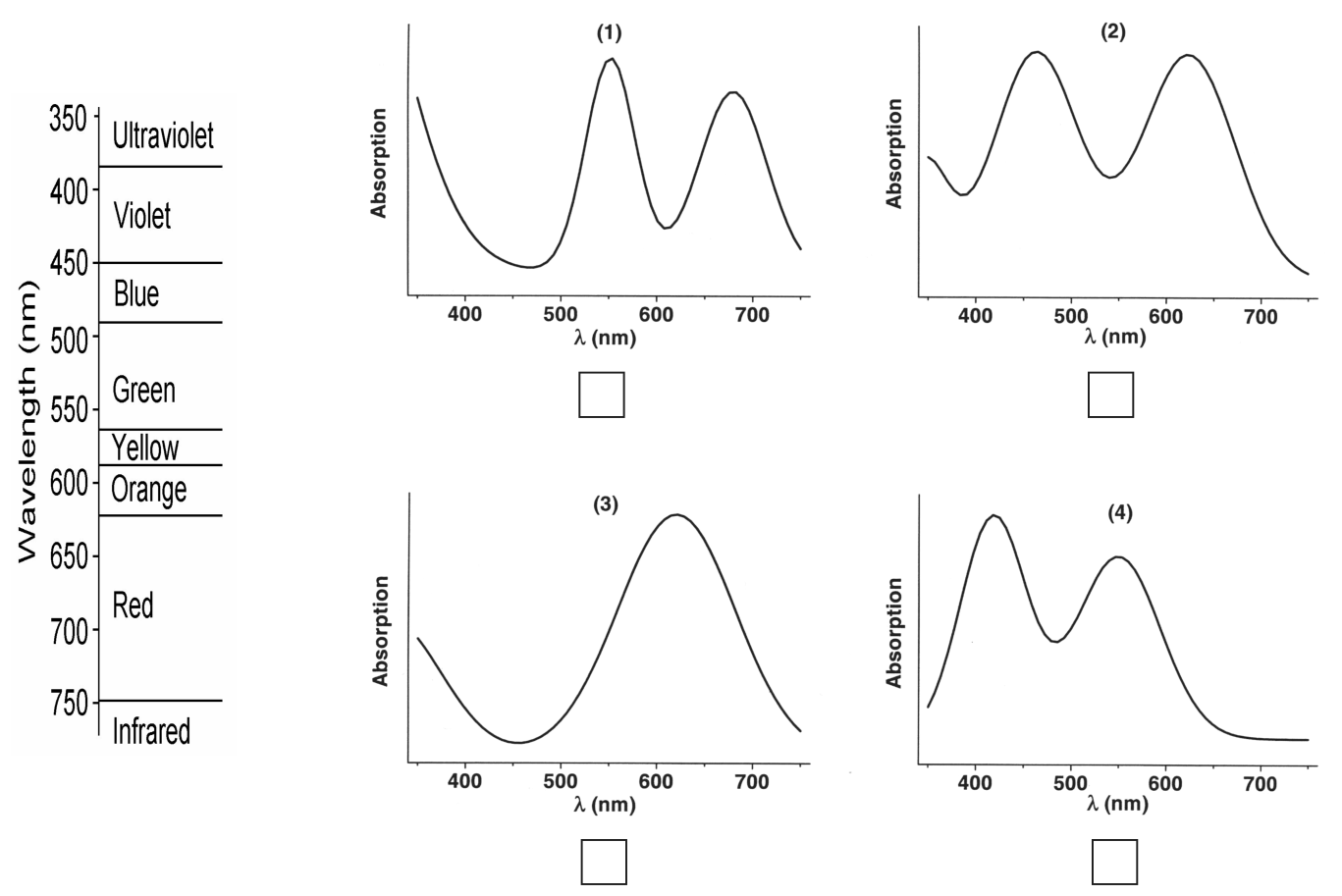
Figure 1
The rod used in ruby lasers is a cylinder with a length of 15.2 cm and a diameter of 1.15 cm. The amount of \(\ce{Cr^3+}\) ions is 0.050 mass %. The density of \(\ce{Al2O3}\) is \(4.05\ \mathrm{g\,cm^{-3}}\). The atomic mass of \(\ce{Cr}\) = \(52\,\mathrm{u}\). (\(1\,\mathrm{u}=1.67\times10^{-27}\ \mathrm{kg}\)).
9.2 Calculate how many \(\ce{Cr^3+}\) ions are in this laser rod.
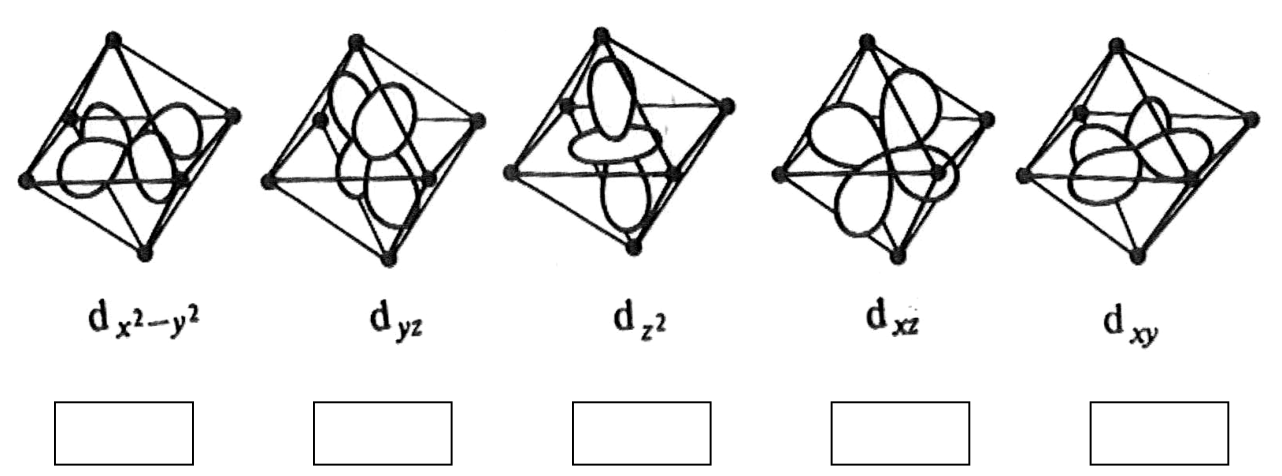
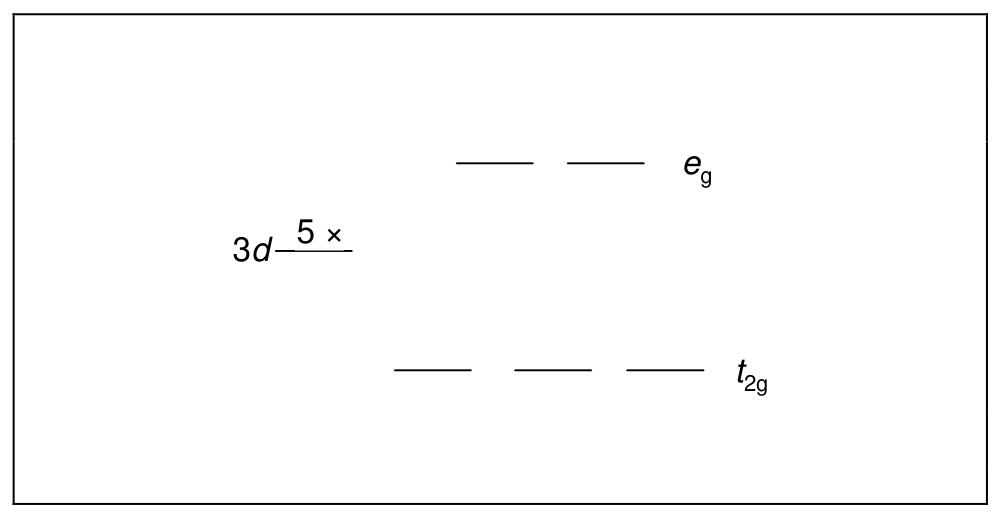
In rubies the \(\ce{Cr^3+}\) ions are coordinated by an octahedron of 6 oxygen ions. The shape of the five \(3d\) orbitals is shown below. The box below shows the splitting of the five \(3d\) orbitals into a group of three orbitals at lower energy (\(t_{2g}\)) and a group of two at higher energy (\(e_g\))..
9.3 Indicate in the boxes below which of the \(3d\) orbitals (\(d_{z^2}\), \(d_{xy}\), \(d_{yz}\), \(d_{x^2-y^2}\), \(d_{xz}\)) belong to the \(t_{2g}\) group and which belong to the \(e_g\) group.
9.4 Indicate with arrows the distribution and the direction of the magnetic spin moment of the three \(3d\) electrons of \(\ce{Cr^3+}\) over the five \(d\) orbitals in the lowest energy state of \(\ce{Cr^3+}\).
The ruby is placed on a (non-magnetic) scale. When the scale is in balance (Figure 2) a magnet is placed directly under the side with the ruby.
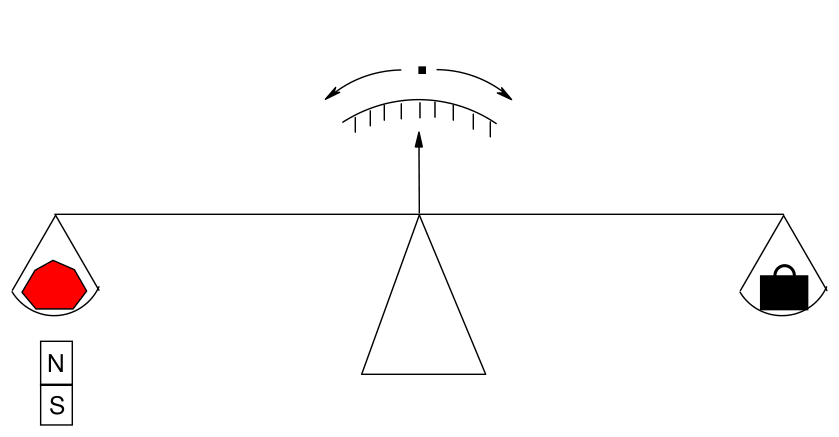
Figure 2
9.5 Indicate what will happen with the ruby (mark the correct answer)
- ☐ The magnet attracts the ruby (the ruby moves down)
- ☐ The magnet has no influence on the ruby (the ruby does not move)
- ☐ The magnet repels the ruby (the ruby moves up)
- ☐ The magnet has an oscillating effect on the ruby (the ruby moves up and down)
Official English text of the problem.
Answers
- 9.1: Spectrum (4).
- 9.2: \(\boxed{3.7\times10^{20}}\) chromium(III) ions, \(\ce{Cr^3+}\), SMILES
[Cr+3]. - 9.3: \(t_{2g}:d_{xy},d_{yz},d_{xz}\); \(e_g:d_{z^2},d_{x^2-y^2}\). Fill the boxes from left to right with \(e_g,\ t_{2g},\ e_g,\ t_{2g},\ t_{2g}\).
- 9.4: \(t_{2g}^{3}e_g^{0}\): one electron in each \(t_{2g}\) orbital, all three with parallel spins; both \(e_g\) orbitals empty.
- 9.5: The magnet attracts the ruby (the ruby moves down).
Solution
9.1
Ruby appears red because it absorbs other visible wavelengths more strongly than red wavelengths.
Spectrum (4) has strong absorption in the violet–blue and green regions, with very little absorption in the red region, especially at approximately \(650\)–\(750\ \mathrm{nm}\). Thus red light is preferentially transmitted, giving the crystal its red colour. Mark the box beneath spectrum (4).
9.2
The cylindrical rod has volume
\[ V=\pi\left(\frac{d}{2}\right)^2L =\pi\left(\frac{1.15\ \mathrm{cm}}{2}\right)^2 (15.2\ \mathrm{cm}) =15.79\ \mathrm{cm^3}. \]
Using the supplied density, its mass is
\[ m_{\mathrm{rod}}=\rho V =(4.05\ \mathrm{g\,cm^{-3}})(15.79\ \mathrm{cm^3}) =63.94\ \mathrm{g}. \]
The chromium mass fraction is
\[ w=\frac{0.050}{100}=5.0\times10^{-4}. \]
Therefore, retaining guard digits,
\[ m_{\mathrm{Cr}}=wm_{\mathrm{rod}} =(5.0\times10^{-4})(63.94\ \mathrm{g}) =0.03197\ \mathrm{g} =3.197\times10^{-5}\ \mathrm{kg}. \]
Using the given atomic mass for each chromium(III) ion,
\[ m_{\mathrm{ion}} =(52)(1.67\times10^{-27}\ \mathrm{kg}) =8.684\times10^{-26}\ \mathrm{kg}. \]
Hence
\[ N=\frac{m_{\mathrm{Cr}}}{m_{\mathrm{ion}}} =\frac{3.197\times10^{-5}\ \mathrm{kg}} {8.684\times10^{-26}\ \mathrm{kg}} =3.682\times10^{20}. \]
The chromium mass percentage is given to two significant figures, so
\[ \boxed{N=3.7\times10^{20}\ \text{chromium(III) ions}.} \]
9.3
Each chromium(III) ion, \(\ce{Cr^3+}\) ([Cr+3]), is surrounded by six oxide ions, \(\ce{O^2-}\) ([O-2]), in an octahedral arrangement. These individual-ion SMILES do not encode the coordination geometry of the crystal.
Taking the metal–oxygen directions as the Cartesian axes:
- The \(d_{z^2}\) and \(d_{x^2-y^2}\) orbitals point directly toward the surrounding ions. Their electrons experience greater electrostatic repulsion, so these orbitals form the higher-energy \(e_g\) group.
- The \(d_{xy}\), \(d_{yz}\), and \(d_{xz}\) orbitals point between those directions. They experience less repulsion and form the lower-energy \(t_{2g}\) group.
Thus,
\[ \boxed{t_{2g}=\{d_{xy},d_{yz},d_{xz}\}}, \qquad \boxed{e_g=\{d_{z^2},d_{x^2-y^2}\}}. \]
The drawings are ordered \(d_{x^2-y^2},d_{yz},d_{z^2},d_{xz},d_{xy}\), so write in the boxes, from left to right:
\[ \boxed{e_g,\quad t_{2g},\quad e_g,\quad t_{2g},\quad t_{2g}}. \]
9.4
The three \(3d\) electrons occupy the three lower-energy \(t_{2g}\) orbitals. Hund’s rule requires singly occupied degenerate orbitals with parallel spins before pairing occurs.
The ground-state occupation is therefore
\[ \boxed{t_{2g}^{3}e_g^{0}}. \]
On the answer-sheet diagram, put one upward arrow on each of the three lower \(t_{2g}\) lines, and leave both upper \(e_g\) lines empty. Three downward arrows would describe the equivalent opposite orientation.
There are three unpaired electrons, with total spin
\[ S=3\left(\frac12\right)=\frac32. \]
9.5
The three unpaired electrons give the chromium(III) centres a paramagnetic response. In the treatment intended by the problem, the ruby is consequently attracted toward the stronger magnetic field near the magnet.
Since the magnet is underneath the ruby, the magnetic force is downward. Select the first option:
The magnet attracts the ruby (the ruby moves down).
The solution was checked against the official solution.
IChO 2002 · Theorieaufgabe 9
Roter Rubin
Rubinkristalle haben eine tiefrote Farbe und sind für ihre Verwendung als Schmucksteine bekannt. Nur wenige Menschen wissen, dass das Herzstück des ersten Lasers, den Maiman 1960 baute, ein großer Rubinkristall war. Die rote Farbe des Rubins entsteht durch die Absorption von Licht durch \(\ce{Cr^3+}\)-Ionen, die in farblose Aluminiumoxidkristalle (\(\ce{Al2O3}\)) eingebaut sind. Das \(\ce{Cr^3+}\)-Ion besitzt 3 Elektronen in der \(3d\)-Schale, und die Lichtabsorption beruht auf elektronischen Übergängen zwischen \(3d\)-Orbitalen niedrigerer und höherer Energie.
9.1 Geben Sie an, welches der vier Absorptionsspektren zu Rubin gehört.
Abbildung 1
Der in Rubinlasern verwendete Stab ist ein Zylinder mit einer Länge von 15.2 cm und einem Durchmesser von 1.15 cm. Der Massenanteil der \(\ce{Cr^3+}\)-Ionen beträgt 0.050 %. Die Dichte von \(\ce{Al2O3}\) beträgt \(4.05\ \mathrm{g\,cm^{-3}}\). Die Atommasse von \(\ce{Cr}\) = \(52\,\mathrm{u}\). (\(1\,\mathrm{u}=1.67\times10^{-27}\ \mathrm{kg}\)).
9.2 Berechnen Sie, wie viele \(\ce{Cr^3+}\)-Ionen sich in diesem Laserstab befinden.
In Rubinen sind die \(\ce{Cr^3+}\)-Ionen von 6 Sauerstoffionen oktaedrisch koordiniert. Die Form der fünf \(3d\)-Orbitale ist unten dargestellt. Das Kästchen darunter zeigt die Aufspaltung der fünf \(3d\)-Orbitale in eine Gruppe von drei Orbitalen niedrigerer Energie (\(t_{2g}\)) und eine Gruppe von zwei Orbitalen höherer Energie (\(e_g\)).
9.3 Geben Sie in den unten stehenden Kästchen an, welche der \(3d\)-Orbitale (\(d_{z^2}\), \(d_{xy}\), \(d_{yz}\), \(d_{x^2-y^2}\), \(d_{xz}\)) zur \(t_{2g}\)-Gruppe und welche zur \(e_g\)-Gruppe gehören.
9.4 Geben Sie mit Pfeilen die Verteilung und die Richtung des magnetischen Spinmoments der drei \(3d\)-Elektronen von \(\ce{Cr^3+}\) auf die fünf \(d\)-Orbitale im Zustand niedrigster Energie von \(\ce{Cr^3+}\) an.
Der Rubin wird auf eine (nichtmagnetische) Waage gelegt. Wenn sich die Waage im Gleichgewicht befindet (Abbildung 2), wird ein Magnet direkt unter der Seite mit dem Rubin platziert.
Abbildung 2
9.5 Geben Sie an, was mit dem Rubin geschieht (kreuzen Sie die richtige Antwort an)
- ☐ Der Magnet zieht den Rubin an (der Rubin bewegt sich nach unten)
- ☐ Der Magnet hat keinen Einfluss auf den Rubin (der Rubin bewegt sich nicht)
- ☐ Der Magnet stößt den Rubin ab (der Rubin bewegt sich nach oben)
- ☐ Der Magnet versetzt den Rubin in Schwingung (der Rubin bewegt sich auf und ab)
Aufgabentext aus dem offiziellen englischen Text übersetzt.
Antworten
- 9.1: Spektrum (4).
- 9.2: \(\boxed{3.7\times10^{20}}\) Chrom(III)-Ionen, \(\ce{Cr^3+}\), SMILES
[Cr+3]. - 9.3: \(t_{2g}:d_{xy},d_{yz},d_{xz}\); \(e_g:d_{z^2},d_{x^2-y^2}\). Tragen Sie von links nach rechts \(e_g,\ t_{2g},\ e_g,\ t_{2g},\ t_{2g}\) in die Kästchen ein.
- 9.4: \(t_{2g}^{3}e_g^{0}\): ein Elektron in jedem \(t_{2g}\)-Orbital, alle drei mit parallelen Spins; beide \(e_g\)-Orbitale sind leer.
- 9.5: Der Magnet zieht den Rubin an (der Rubin bewegt sich nach unten).
Lösung
9.1
Rubin erscheint rot, weil er Licht anderer sichtbarer Wellenlängen stärker absorbiert als Licht roter Wellenlängen.
Spektrum (4) zeigt eine starke Absorption im violett-blauen und im grünen Bereich, bei sehr geringer Absorption im roten Bereich, insbesondere bei etwa \(650\)–\(750\ \mathrm{nm}\). Daher wird rotes Licht bevorzugt durchgelassen, wodurch der Kristall seine rote Farbe erhält. Kreuzen Sie das Kästchen unter Spektrum (4) an.
9.2
Der zylindrische Stab hat das Volumen
\[ V=\pi\left(\frac{d}{2}\right)^2L =\pi\left(\frac{1.15\ \mathrm{cm}}{2}\right)^2 (15.2\ \mathrm{cm}) =15.79\ \mathrm{cm^3}. \]
Mit der angegebenen Dichte ergibt sich seine Masse zu
\[ m_{\mathrm{rod}}=\rho V =(4.05\ \mathrm{g\,cm^{-3}})(15.79\ \mathrm{cm^3}) =63.94\ \mathrm{g}. \]
Der Massenanteil von Chrom beträgt
\[ w=\frac{0.050}{100}=5.0\times10^{-4}. \]
Daraus folgt unter Beibehaltung zusätzlicher Rechenstellen
\[ m_{\mathrm{Cr}}=wm_{\mathrm{rod}} =(5.0\times10^{-4})(63.94\ \mathrm{g}) =0.03197\ \mathrm{g} =3.197\times10^{-5}\ \mathrm{kg}. \]
Mit der angegebenen Atommasse für jedes Chrom(III)-Ion ergibt sich
\[ m_{\mathrm{ion}} =(52)(1.67\times10^{-27}\ \mathrm{kg}) =8.684\times10^{-26}\ \mathrm{kg}. \]
Somit gilt
\[ N=\frac{m_{\mathrm{Cr}}}{m_{\mathrm{ion}}} =\frac{3.197\times10^{-5}\ \mathrm{kg}} {8.684\times10^{-26}\ \mathrm{kg}} =3.682\times10^{20}. \]
Der prozentuale Massenanteil von Chrom ist mit zwei signifikanten Stellen angegeben, daher
\[ \boxed{N=3.7\times10^{20}\ \text{Chrom(III)-Ionen}.} \]
9.3
Jedes Chrom(III)-Ion, \(\ce{Cr^3+}\) ([Cr+3]), ist von sechs Oxidionen, \(\ce{O^2-}\) ([O-2]), in oktaedrischer Anordnung umgeben. Diese SMILES für einzelne Ionen codieren nicht die Koordinationsgeometrie des Kristalls.
Wenn die Metall–Sauerstoff-Richtungen als kartesische Achsen gewählt werden:
- Die \(d_{z^2}\)- und \(d_{x^2-y^2}\)-Orbitale sind direkt auf die umgebenden Ionen gerichtet. Ihre Elektronen erfahren eine stärkere elektrostatische Abstoßung, sodass diese Orbitale die energetisch höher liegende \(e_g\)-Gruppe bilden.
- Die \(d_{xy}\)-, \(d_{yz}\)- und \(d_{xz}\)-Orbitale sind zwischen diesen Richtungen ausgerichtet. Sie erfahren eine geringere Abstoßung und bilden die energetisch tiefer liegende \(t_{2g}\)-Gruppe.
Somit gilt
\[ \boxed{t_{2g}=\{d_{xy},d_{yz},d_{xz}\}}, \qquad \boxed{e_g=\{d_{z^2},d_{x^2-y^2}\}}. \]
Die Zeichnungen sind in der Reihenfolge \(d_{x^2-y^2},d_{yz},d_{z^2},d_{xz},d_{xy}\) angeordnet. Tragen Sie daher von links nach rechts in die Kästchen ein:
\[ \boxed{e_g,\quad t_{2g},\quad e_g,\quad t_{2g},\quad t_{2g}}. \]
9.4
Die drei \(3d\)-Elektronen besetzen die drei energetisch tiefer liegenden \(t_{2g}\)-Orbitale. Nach der Hundschen Regel werden entartete Orbitale zunächst einzeln mit parallelen Spins besetzt, bevor eine Paarung erfolgt.
Die Besetzung im Grundzustand ist daher
\[ \boxed{t_{2g}^{3}e_g^{0}}. \]
Zeichnen Sie im Diagramm auf dem Antwortblatt je einen nach oben gerichteten Pfeil auf jede der drei unteren \(t_{2g}\)-Linien und lassen Sie die beiden oberen \(e_g\)-Linien leer. Drei nach unten gerichtete Pfeile würden die gleichwertige entgegengesetzte Orientierung beschreiben.
Es gibt drei ungepaarte Elektronen mit dem Gesamtspin
\[ S=3\left(\frac12\right)=\frac32. \]
9.5
Die drei ungepaarten Elektronen verleihen den Chrom(III)-Zentren ein paramagnetisches Verhalten. Im Rahmen der in der Aufgabe vorgesehenen Betrachtung wird der Rubin daher zum stärkeren Magnetfeld in der Nähe des Magneten hingezogen.
Da sich der Magnet unter dem Rubin befindet, ist die magnetische Kraft nach unten gerichtet. Wählen Sie die erste Antwortmöglichkeit:
Der Magnet zieht den Rubin an (der Rubin bewegt sich nach unten).
Die Lösung wurde mit der offiziellen Lösung abgeglichen.
IChO 2002 · Teori sorusu 9
Kırmızı Yakut
Yakut kristalleri koyu kırmızı renktedir ve mücevherlerde kullanımlarıyla iyi bilinir. Maiman tarafından 1960 yılında yapılan ilk lazerin kalbinde büyük bir yakut kristali bulunduğunu pek az kişi bilir. Yakutun kırmızı rengi, renksiz alüminyum oksit (\(\ce{Al2O3}\)) kristallerinin yapısına katılan \(\ce{Cr^3+}\) iyonlarının ışığı soğurmasından kaynaklanır. \(\ce{Cr^3+}\) iyonunun \(3d\) kabuğunda 3 elektron bulunur ve ışığın soğurulması, düşük ve yüksek enerjili \(3d\) orbitalleri arasındaki elektronik geçişlerden kaynaklanır.
9.1 Dört soğurma spektrumundan hangisinin yakuta ait olduğunu belirtiniz.
Şekil 1
Yakut lazerlerinde kullanılan çubuk, uzunluğu 15.2 cm ve çapı 1.15 cm olan bir silindirdir. \(\ce{Cr^3+}\) iyonlarının miktarı kütlece %0.050'dir. \(\ce{Al2O3}\)'ün yoğunluğu \(4.05\ \mathrm{g\,cm^{-3}}\)'tür. \(\ce{Cr}\)'un atom kütlesi = \(52\,\mathrm{u}\). (\(1\,\mathrm{u}=1.67\times10^{-27}\ \mathrm{kg}\)).
9.2 Bu lazer çubuğunda kaç tane \(\ce{Cr^3+}\) iyonu bulunduğunu hesaplayınız.
Yakutlarda \(\ce{Cr^3+}\) iyonları, bir oktahedron oluşturan 6 oksijen iyonuyla koordine olur. Beş \(3d\) orbitalinin şekilleri aşağıda gösterilmiştir. Aşağıdaki kutuda, beş \(3d\) orbitalinin düşük enerjili üç orbitalden oluşan bir gruba (\(t_{2g}\)) ve yüksek enerjili iki orbitalden oluşan bir gruba (\(e_g\)) ayrılması gösterilmektedir.
9.3 \(3d\) orbitallerinden (\(d_{z^2}\), \(d_{xy}\), \(d_{yz}\), \(d_{x^2-y^2}\), \(d_{xz}\)) hangilerinin \(t_{2g}\) grubuna, hangilerinin \(e_g\) grubuna ait olduğunu aşağıdaki kutularda belirtiniz.
9.4 \(\ce{Cr^3+}\)'ün en düşük enerjili durumunda, üç \(3d\) elektronunun beş \(d\) orbitaline dağılımını ve manyetik spin momentlerinin yönünü oklarla belirtiniz.
Yakut, manyetik olmayan bir teraziye yerleştirilir. Terazi dengedeyken (Şekil 2), yakutun bulunduğu kefenin tam altına bir mıknatıs yerleştirilir.
Şekil 2
9.5 Yakuta ne olacağını belirtiniz (doğru cevabı işaretleyiniz)
- ☐ Mıknatıs yakutu çeker (yakut aşağı hareket eder)
- ☐ Mıknatısın yakut üzerinde etkisi yoktur (yakut hareket etmez)
- ☐ Mıknatıs yakutu iter (yakut yukarı hareket eder)
- ☐ Mıknatıs yakut üzerinde salınıma yol açan bir etki gösterir (yakut yukarı ve aşağı hareket eder)
Soru metni resmi İngilizce metinden çevrilmiştir.
Cevaplar
- 9.1: (4) numaralı spektrum.
- 9.2: \(\boxed{3.7\times10^{20}}\) krom(III) iyonu, \(\ce{Cr^3+}\), SMILES
[Cr+3]. - 9.3: \(t_{2g}:d_{xy},d_{yz},d_{xz}\); \(e_g:d_{z^2},d_{x^2-y^2}\). Kutuları soldan sağa \(e_g,\ t_{2g},\ e_g,\ t_{2g},\ t_{2g}\) ile doldurunuz.
- 9.4: \(t_{2g}^{3}e_g^{0}\): her \(t_{2g}\) orbitalinde bir elektron bulunur ve üçünün de spinleri paraleldir; her iki \(e_g\) orbitali boştur.
- 9.5: Mıknatıs yakutu çeker (yakut aşağı hareket eder).
Çözüm
9.1
Yakut, görünür bölgedeki diğer dalga boylarını kırmızı dalga boylarından daha güçlü soğurduğu için kırmızı görünür.
(4) numaralı spektrumda mor–mavi ve yeşil bölgelerde güçlü soğurma görülürken kırmızı bölgede, özellikle yaklaşık \(650\)–\(750\ \mathrm{nm}\) aralığında, soğurma çok azdır. Bu nedenle kırmızı ışık daha çok geçirilir ve kristale kırmızı rengini verir. (4) numaralı spektrumun altındaki kutuyu işaretleyiniz.
9.2
Silindirik çubuğun hacmi şöyledir:
\[ V=\pi\left(\frac{d}{2}\right)^2L =\pi\left(\frac{1.15\ \mathrm{cm}}{2}\right)^2 (15.2\ \mathrm{cm}) =15.79\ \mathrm{cm^3}. \]
Verilen yoğunluk kullanılarak kütlesi şöyle bulunur:
\[ m_{\mathrm{rod}}=\rho V =(4.05\ \mathrm{g\,cm^{-3}})(15.79\ \mathrm{cm^3}) =63.94\ \mathrm{g}. \]
Kromun kütle kesri şöyledir:
\[ w=\frac{0.050}{100}=5.0\times10^{-4}. \]
Dolayısıyla, ara hesaplamalarda ek basamaklar korunarak,
\[ m_{\mathrm{Cr}}=wm_{\mathrm{rod}} =(5.0\times10^{-4})(63.94\ \mathrm{g}) =0.03197\ \mathrm{g} =3.197\times10^{-5}\ \mathrm{kg}. \]
Her bir krom(III) iyonu için verilen atom kütlesi kullanılarak,
\[ m_{\mathrm{ion}} =(52)(1.67\times10^{-27}\ \mathrm{kg}) =8.684\times10^{-26}\ \mathrm{kg}. \]
Böylece
\[ N=\frac{m_{\mathrm{Cr}}}{m_{\mathrm{ion}}} =\frac{3.197\times10^{-5}\ \mathrm{kg}} {8.684\times10^{-26}\ \mathrm{kg}} =3.682\times10^{20}. \]
Kromun kütle yüzdesi iki anlamlı basamakla verildiğinden,
\[ \boxed{N=3.7\times10^{20}\ \text{krom(III) iyonu}.} \]
9.3
Her krom(III) iyonu, \(\ce{Cr^3+}\) ([Cr+3]), oktahedral bir düzende altı oksit iyonuyla, \(\ce{O^2-}\) ([O-2]), çevrilidir. Tek tek iyonları gösteren bu SMILES gösterimleri, kristalin koordinasyon geometrisini kodlamaz.
Metal–oksijen doğrultuları Kartezyen eksenler olarak alındığında:
- \(d_{z^2}\) ve \(d_{x^2-y^2}\) orbitalleri doğrudan çevredeki iyonlara yönelir. Bu orbitallerdeki elektronlar daha büyük elektrostatik itmeye maruz kalır; bu nedenle bu orbitaller yüksek enerjili \(e_g\) grubunu oluşturur.
- \(d_{xy}\), \(d_{yz}\) ve \(d_{xz}\) orbitalleri bu doğrultuların arasına yönelir. Daha az itmeye maruz kalırlar ve düşük enerjili \(t_{2g}\) grubunu oluştururlar.
Böylece,
\[ \boxed{t_{2g}=\{d_{xy},d_{yz},d_{xz}\}}, \qquad \boxed{e_g=\{d_{z^2},d_{x^2-y^2}\}}. \]
Çizimler \(d_{x^2-y^2},d_{yz},d_{z^2},d_{xz},d_{xy}\) sırasındadır; bu nedenle kutulara soldan sağa şunları yazınız:
\[ \boxed{e_g,\quad t_{2g},\quad e_g,\quad t_{2g},\quad t_{2g}}. \]
9.4
Üç \(3d\) elektronu, düşük enerjili üç \(t_{2g}\) orbitalini doldurur. Hund kuralına göre, eşleşme gerçekleşmeden önce eş enerjili orbitallerin her birine paralel spinli birer elektron yerleşir.
Bu nedenle temel durumdaki elektron yerleşimi şöyledir:
\[ \boxed{t_{2g}^{3}e_g^{0}}. \]
Cevap kâğıdındaki diyagramda, alttaki üç \(t_{2g}\) çizgisinin her birine yukarı yönlü bir ok koyunuz ve üstteki iki \(e_g\) çizgisini de boş bırakınız. Aşağı yönlü üç ok da eşdeğer zıt yönelimi ifade eder.
Eşleşmemiş üç elektron vardır ve toplam spin şöyledir:
\[ S=3\left(\frac12\right)=\frac32. \]
9.5
Eşleşmemiş üç elektron, krom(III) merkezlerine paramanyetik özellik kazandırır. Soruda öngörülen yaklaşıma göre yakut, bunun sonucunda mıknatısın yakınındaki daha güçlü manyetik alana doğru çekilir.
Mıknatıs yakutun altında olduğundan, manyetik kuvvet aşağı yönlüdür. İlk seçeneği işaretleyiniz:
Mıknatıs yakutu çeker (yakut aşağı hareket eder).
Çözüm, resmi çözümle karşılaştırılarak kontrol edildi.
IChO 2002 · Problema teórico 9
Rubí rojo
Los cristales de rubí tienen un color rojo intenso y son muy conocidos por su uso en joyería. No mucha gente sabe que el corazón del primer láser, construido en 1960 por Maiman, era un gran cristal de rubí. El color rojo del rubí se debe a la absorción de luz por los iones \(\ce{Cr^3+}\) incorporados en cristales incoloros de óxido de aluminio (\(\ce{Al2O3}\)). El ion \(\ce{Cr^3+}\) tiene 3 electrones en la subcapa \(3d\), y la absorción de luz se debe a transiciones electrónicas entre orbitales \(3d\) de menor y mayor energía.
9.1 Indique cuál de los cuatro espectros de absorción corresponde al rubí.
Figura 1
La barra utilizada en los láseres de rubí es un cilindro de 15.2 cm de longitud y 1.15 cm de diámetro. El contenido de iones \(\ce{Cr^3+}\) es del 0.050 % en masa. La densidad del \(\ce{Al2O3}\) es \(4.05\ \mathrm{g\,cm^{-3}}\). La masa atómica del \(\ce{Cr}\) = \(52\,\mathrm{u}\). (\(1\,\mathrm{u}=1.67\times10^{-27}\ \mathrm{kg}\)).
9.2 Calcule cuántos iones \(\ce{Cr^3+}\) hay en esta barra láser.
En los rubíes, los iones \(\ce{Cr^3+}\) están coordinados por 6 iones de oxígeno dispuestos en un octaedro. A continuación se muestra la forma de los cinco orbitales \(3d\). El recuadro siguiente muestra el desdoblamiento de los cinco orbitales \(3d\) en un grupo de tres orbitales de menor energía (\(t_{2g}\)) y un grupo de dos de mayor energía (\(e_g\)).
9.3 Indique en las casillas siguientes cuáles de los orbitales \(3d\) (\(d_{z^2}\), \(d_{xy}\), \(d_{yz}\), \(d_{x^2-y^2}\), \(d_{xz}\)) pertenecen al grupo \(t_{2g}\) y cuáles al grupo \(e_g\).
9.4 Indique mediante flechas la distribución y la dirección del momento magnético de espín de los tres electrones \(3d\) del \(\ce{Cr^3+}\) entre los cinco orbitales \(d\) en el estado de menor energía del \(\ce{Cr^3+}\).
Se coloca el rubí en una balanza (no magnética). Cuando la balanza está en equilibrio (Figura 2), se coloca un imán directamente debajo del platillo que contiene el rubí.
Figura 2
9.5 Indique qué le ocurrirá al rubí (marque la respuesta correcta)
- ☐ El imán atrae al rubí (el rubí se mueve hacia abajo)
- ☐ El imán no influye en el rubí (el rubí no se mueve)
- ☐ El imán repele al rubí (el rubí se mueve hacia arriba)
- ☐ El imán tiene un efecto oscilante sobre el rubí (el rubí se mueve hacia arriba y hacia abajo)
Enunciado traducido del texto oficial en inglés.
Respuestas
- 9.1: Espectro (4).
- 9.2: \(\boxed{3.7\times10^{20}}\) iones de cromo(III), \(\ce{Cr^3+}\), SMILES
[Cr+3]. - 9.3: \(t_{2g}:d_{xy},d_{yz},d_{xz}\); \(e_g:d_{z^2},d_{x^2-y^2}\). Rellene las casillas de izquierda a derecha con \(e_g,\ t_{2g},\ e_g,\ t_{2g},\ t_{2g}\).
- 9.4: \(t_{2g}^{3}e_g^{0}\): un electrón en cada orbital \(t_{2g}\), los tres con espines paralelos; ambos orbitales \(e_g\) vacíos.
- 9.5: El imán atrae al rubí (el rubí se mueve hacia abajo).
Solución
9.1
El rubí se ve rojo porque absorbe otras longitudes de onda visibles con mayor intensidad que las longitudes de onda rojas.
El espectro (4) presenta una fuerte absorción en las regiones violeta–azul y verde, con muy poca absorción en la región roja, especialmente entre aproximadamente \(650\)–\(750\ \mathrm{nm}\). Por tanto, la luz roja se transmite preferentemente, lo que confiere al cristal su color rojo. Marque la casilla situada debajo del espectro (4).
9.2
El volumen de la barra cilíndrica es
\[ V=\pi\left(\frac{d}{2}\right)^2L =\pi\left(\frac{1.15\ \mathrm{cm}}{2}\right)^2 (15.2\ \mathrm{cm}) =15.79\ \mathrm{cm^3}. \]
Utilizando la densidad proporcionada, su masa es
\[ m_{\mathrm{rod}}=\rho V =(4.05\ \mathrm{g\,cm^{-3}})(15.79\ \mathrm{cm^3}) =63.94\ \mathrm{g}. \]
La fracción másica de cromo es
\[ w=\frac{0.050}{100}=5.0\times10^{-4}. \]
Por tanto, conservando cifras adicionales en los cálculos intermedios,
\[ m_{\mathrm{Cr}}=wm_{\mathrm{rod}} =(5.0\times10^{-4})(63.94\ \mathrm{g}) =0.03197\ \mathrm{g} =3.197\times10^{-5}\ \mathrm{kg}. \]
Utilizando la masa atómica dada para cada ion de cromo(III),
\[ m_{\mathrm{ion}} =(52)(1.67\times10^{-27}\ \mathrm{kg}) =8.684\times10^{-26}\ \mathrm{kg}. \]
Por consiguiente,
\[ N=\frac{m_{\mathrm{Cr}}}{m_{\mathrm{ion}}} =\frac{3.197\times10^{-5}\ \mathrm{kg}} {8.684\times10^{-26}\ \mathrm{kg}} =3.682\times10^{20}. \]
El porcentaje en masa de cromo se da con dos cifras significativas, por lo que
\[ \boxed{N=3.7\times10^{20}\ \text{iones de cromo(III)}.} \]
9.3
Cada ion de cromo(III), \(\ce{Cr^3+}\) ([Cr+3]), está rodeado por seis iones óxido, \(\ce{O^2-}\) ([O-2]), en una disposición octaédrica. Estos SMILES de iones individuales no codifican la geometría de coordinación del cristal.
Tomando las direcciones metal–oxígeno como ejes cartesianos:
- Los orbitales \(d_{z^2}\) y \(d_{x^2-y^2}\) apuntan directamente hacia los iones circundantes. Sus electrones experimentan una mayor repulsión electrostática, por lo que estos orbitales forman el grupo \(e_g\) de mayor energía.
- Los orbitales \(d_{xy}\), \(d_{yz}\) y \(d_{xz}\) apuntan entre esas direcciones. Experimentan una menor repulsión y forman el grupo \(t_{2g}\) de menor energía.
Así,
\[ \boxed{t_{2g}=\{d_{xy},d_{yz},d_{xz}\}}, \qquad \boxed{e_g=\{d_{z^2},d_{x^2-y^2}\}}. \]
Los dibujos están ordenados como \(d_{x^2-y^2},d_{yz},d_{z^2},d_{xz},d_{xy}\), por lo que debe escribir en las casillas, de izquierda a derecha:
\[ \boxed{e_g,\quad t_{2g},\quad e_g,\quad t_{2g},\quad t_{2g}}. \]
9.4
Los tres electrones \(3d\) ocupan los tres orbitales \(t_{2g}\) de menor energía. La regla de Hund exige que los orbitales degenerados se ocupen individualmente con espines paralelos antes de que se produzca el apareamiento.
La ocupación en el estado fundamental es, por tanto,
\[ \boxed{t_{2g}^{3}e_g^{0}}. \]
En el diagrama de la hoja de respuestas, coloque una flecha hacia arriba en cada una de las tres líneas inferiores \(t_{2g}\) y deje vacías ambas líneas superiores \(e_g\). Tres flechas hacia abajo representarían la orientación opuesta equivalente.
Hay tres electrones desapareados, con espín total
\[ S=3\left(\frac12\right)=\frac32. \]
9.5
Los tres electrones desapareados confieren a los centros de cromo(III) una respuesta paramagnética. En el tratamiento previsto por el problema, el rubí es, por consiguiente, atraído hacia el campo magnético más intenso cerca del imán.
Como el imán está debajo del rubí, la fuerza magnética se dirige hacia abajo. Seleccione la primera opción:
El imán atrae al rubí (el rubí se mueve hacia abajo).
La solución se comprobó con la solución oficial.
IChO 2002 · 理论题 9
红色红宝石
红宝石晶体呈深红色,因用于珠宝首饰而广为人知。鲜为人知的是,Maiman 于 1960 年制造的第一台激光器,其核心是一块大的红宝石晶体。红宝石的红色源于掺入无色氧化铝(\(\ce{Al2O3}\))晶体中的 \(\ce{Cr^3+}\) 离子对光的吸收。\(\ce{Cr^3+}\) 离子的 \(3d\) 壳层中有 3 个电子,光的吸收是由电子在能量较低和较高的 \(3d\) 轨道之间跃迁引起的。
9.1 指出四个吸收光谱中哪一个属于红宝石。
图 1
红宝石激光器所用的棒为圆柱体,长 15.2 cm,直径为 1.15 cm。\(\ce{Cr^3+}\) 离子的质量百分含量为 0.050%。\(\ce{Al2O3}\) 的密度为 \(4.05\ \mathrm{g\,cm^{-3}}\)。\(\ce{Cr}\) 的原子质量 = \(52\,\mathrm{u}\)。(\(1\,\mathrm{u}=1.67\times10^{-27}\ \mathrm{kg}\))。
9.2 计算这根激光棒中有多少个 \(\ce{Cr^3+}\) 离子。
在红宝石中,\(\ce{Cr^3+}\) 离子由 6 个氧离子以八面体构型配位。五个 \(3d\) 轨道的形状如下所示。下方框图显示了五个 \(3d\) 轨道分裂为一组能量较低的三个轨道(\(t_{2g}\))和一组能量较高的两个轨道(\(e_g\))的情况。
9.3 在下方方框中指出哪些 \(3d\) 轨道(\(d_{z^2}\)、\(d_{xy}\)、\(d_{yz}\)、\(d_{x^2-y^2}\)、\(d_{xz}\))属于 \(t_{2g}\) 组,哪些属于 \(e_g\) 组。
9.4 用箭头表示 \(\ce{Cr^3+}\) 处于最低能态时,其三个 \(3d\) 电子在五个 \(d\) 轨道中的分布及自旋磁矩的方向。
将红宝石放在一架(无磁性的)天平上。当天平平衡时(图 2),将一块磁铁放在有红宝石的一侧的正下方。
图 2
9.5 指出红宝石将发生什么变化(勾选正确答案)
- ☐ 磁铁吸引红宝石(红宝石向下移动)
- ☐ 磁铁对红宝石没有影响(红宝石不动)
- ☐ 磁铁排斥红宝石(红宝石向上移动)
- ☐ 磁铁使红宝石振荡(红宝石上下移动)
题目译自官方英文原文。
答案
- 9.1: 光谱 (4)。
- 9.2: \(\boxed{3.7\times10^{20}}\) 个铬(III)离子,\(\ce{Cr^3+}\),SMILES 为
[Cr+3]。 - 9.3: \(t_{2g}:d_{xy},d_{yz},d_{xz}\);\(e_g:d_{z^2},d_{x^2-y^2}\)。在方框中从左到右填入 \(e_g,\ t_{2g},\ e_g,\ t_{2g},\ t_{2g}\)。
- 9.4: \(t_{2g}^{3}e_g^{0}\):每个 \(t_{2g}\) 轨道中各有一个电子,三个电子的自旋均平行;两个 \(e_g\) 轨道均为空。
- 9.5: 磁铁吸引红宝石(红宝石向下移动)。
解答
9.1
红宝石呈红色,是因为它对其他可见光波长的吸收比对红光波长的吸收更强。
光谱 (4) 在紫光至蓝光区域和绿光区域有强吸收,而在红光区域的吸收很弱,尤其是在约 \(650\)–\(750\ \mathrm{nm}\) 范围内。因此,红光更容易透过,使晶体呈现红色。勾选光谱 (4) 下方的方框。
9.2
圆柱形棒的体积为
\[ V=\pi\left(\frac{d}{2}\right)^2L =\pi\left(\frac{1.15\ \mathrm{cm}}{2}\right)^2 (15.2\ \mathrm{cm}) =15.79\ \mathrm{cm^3}. \]
利用给定的密度,求得其质量为
\[ m_{\mathrm{rod}}=\rho V =(4.05\ \mathrm{g\,cm^{-3}})(15.79\ \mathrm{cm^3}) =63.94\ \mathrm{g}. \]
铬的质量分数为
\[ w=\frac{0.050}{100}=5.0\times10^{-4}. \]
因此,保留用于避免舍入误差的额外位数,得到
\[ m_{\mathrm{Cr}}=wm_{\mathrm{rod}} =(5.0\times10^{-4})(63.94\ \mathrm{g}) =0.03197\ \mathrm{g} =3.197\times10^{-5}\ \mathrm{kg}. \]
用给定的原子质量计算每个铬(III)离子的质量,得到
\[ m_{\mathrm{ion}} =(52)(1.67\times10^{-27}\ \mathrm{kg}) =8.684\times10^{-26}\ \mathrm{kg}. \]
于是
\[ N=\frac{m_{\mathrm{Cr}}}{m_{\mathrm{ion}}} =\frac{3.197\times10^{-5}\ \mathrm{kg}} {8.684\times10^{-26}\ \mathrm{kg}} =3.682\times10^{20}. \]
给定的铬质量百分含量有两位有效数字,因此
\[ \boxed{N=3.7\times10^{20}\ \text{个铬(III)离子}.} \]
9.3
每个铬(III)离子 \(\ce{Cr^3+}\)([Cr+3])周围都有六个氧离子 \(\ce{O^2-}\)([O-2]),呈八面体排列。这些单个离子的 SMILES 不表示晶体的配位几何构型。
以金属–氧方向作为笛卡尔坐标轴:
- \(d_{z^2}\) 和 \(d_{x^2-y^2}\) 轨道直接指向周围的离子。其中的电子受到更强的静电排斥,因此这些轨道构成能量较高的 \(e_g\) 组。
- \(d_{xy}\)、\(d_{yz}\) 和 \(d_{xz}\) 轨道指向这些方向之间。它们受到的排斥较小,构成能量较低的 \(t_{2g}\) 组。
因此,
\[ \boxed{t_{2g}=\{d_{xy},d_{yz},d_{xz}\}}, \qquad \boxed{e_g=\{d_{z^2},d_{x^2-y^2}\}}. \]
图中的轨道依次为 \(d_{x^2-y^2},d_{yz},d_{z^2},d_{xz},d_{xy}\),因此在方框中从左到右填入:
\[ \boxed{e_g,\quad t_{2g},\quad e_g,\quad t_{2g},\quad t_{2g}}. \]
9.4
三个 \(3d\) 电子占据能量较低的三个 \(t_{2g}\) 轨道。洪特规则要求,电子在成对之前,先以平行自旋分别单独占据简并轨道。
因此,基态的电子排布为
\[ \boxed{t_{2g}^{3}e_g^{0}}. \]
在答题纸的图中,在下方的三条 \(t_{2g}\) 能级线上各画一个向上的箭头,并使上方的两条 \(e_g\) 能级线均保持空白。三个向下的箭头表示等价的相反取向。
共有三个未成对电子,总自旋为
\[ S=3\left(\frac12\right)=\frac32. \]
9.5
三个未成对电子使铬(III)中心具有顺磁性。按照本题所采用的处理方式,红宝石因此受到吸引,趋向磁铁附近磁场较强的区域。
由于磁铁位于红宝石下方,磁力方向向下。选择第一个选项:
磁铁吸引红宝石(红宝石向下移动)。
解答已与官方解答核对。
IChO 2002 · Теоретическая задача 9
Красный рубин
Кристаллы рубина имеют насыщенный красный цвет и широко известны своим применением в ювелирных изделиях. Немногие знают, что сердцем первого лазера, созданного в 1960 году Мейманом, был большой кристалл рубина. Красный цвет рубина обусловлен поглощением света ионами \(\ce{Cr^3+}\), внедрёнными в бесцветные кристаллы оксида алюминия (\(\ce{Al2O3}\)). Ион \(\ce{Cr^3+}\) имеет 3 электрона на \(3d\)-подуровне, а поглощение света связано с электронными переходами между \(3d\)-орбиталями с более низкой и более высокой энергией.
9.1 Укажите, какой из четырёх спектров поглощения принадлежит рубину.
Рисунок 1
Стержень, используемый в рубиновых лазерах, представляет собой цилиндр длиной 15.2 см и диаметром 1.15 см. Содержание ионов \(\ce{Cr^3+}\) составляет 0.050 масс. %. Плотность \(\ce{Al2O3}\) равна \(4.05\ \mathrm{g\,cm^{-3}}\). Атомная масса \(\ce{Cr}\) = \(52\,\mathrm{u}\). (\(1\,\mathrm{u}=1.67\times10^{-27}\ \mathrm{kg}\)).
9.2 Рассчитайте, сколько ионов \(\ce{Cr^3+}\) содержится в этом лазерном стержне.
В рубинах ионы \(\ce{Cr^3+}\) окружены 6 ионами кислорода, расположенными в вершинах октаэдра. Форма пяти \(3d\)-орбиталей показана ниже. В рамке ниже показано расщепление пяти \(3d\)-орбиталей на группу из трёх орбиталей с более низкой энергией (\(t_{2g}\)) и группу из двух орбиталей с более высокой энергией (\(e_g\)).
9.3 Укажите в полях ниже, какие из \(3d\)-орбиталей (\(d_{z^2}\), \(d_{xy}\), \(d_{yz}\), \(d_{x^2-y^2}\), \(d_{xz}\)) принадлежат к группе \(t_{2g}\), а какие — к группе \(e_g\).
9.4 С помощью стрелок укажите распределение трёх \(3d\)-электронов иона \(\ce{Cr^3+}\) по пяти \(d\)-орбиталям и направления их спиновых магнитных моментов в состоянии \(\ce{Cr^3+}\) с наименьшей энергией.
Рубин помещают на чашку весов (из немагнитного материала). Когда весы находятся в равновесии (рисунок 2), непосредственно под чашкой с рубином помещают магнит.
Рисунок 2
9.5 Укажите, что произойдёт с рубином (отметьте правильный ответ)
- ☐ Магнит притягивает рубин (рубин движется вниз)
- ☐ Магнит не влияет на рубин (рубин не движется)
- ☐ Магнит отталкивает рубин (рубин движется вверх)
- ☐ Магнит вызывает колебания рубина (рубин движется вверх и вниз)
Условие переведено с официального английского текста.
Ответы
- 9.1: Спектр (4).
- 9.2: \(\boxed{3.7\times10^{20}}\) ионов хрома(III), \(\ce{Cr^3+}\), SMILES
[Cr+3]. - 9.3: \(t_{2g}:d_{xy},d_{yz},d_{xz}\); \(e_g:d_{z^2},d_{x^2-y^2}\). Заполните поля слева направо: \(e_g,\ t_{2g},\ e_g,\ t_{2g},\ t_{2g}\).
- 9.4: \(t_{2g}^{3}e_g^{0}\): по одному электрону на каждой \(t_{2g}\)-орбитали, спины всех трёх электронов параллельны; обе \(e_g\)-орбитали пусты.
- 9.5: Магнит притягивает рубин (рубин движется вниз).
Решение
9.1
Рубин выглядит красным, поскольку он сильнее поглощает свет других длин волн видимого диапазона, чем свет в красной области.
Спектр (4) характеризуется сильным поглощением в фиолетово-синей и зелёной областях и очень слабым поглощением в красной области, особенно приблизительно от \(650\) до \(750\ \mathrm{nm}\). Поэтому преимущественно проходит красный свет, что и придаёт кристаллу красный цвет. Отметьте поле под спектром (4).
9.2
Объём цилиндрического стержня равен
\[ V=\pi\left(\frac{d}{2}\right)^2L =\pi\left(\frac{1.15\ \mathrm{cm}}{2}\right)^2 (15.2\ \mathrm{cm}) =15.79\ \mathrm{cm^3}. \]
Используя указанную плотность, находим его массу:
\[ m_{\mathrm{rod}}=\rho V =(4.05\ \mathrm{g\,cm^{-3}})(15.79\ \mathrm{cm^3}) =63.94\ \mathrm{g}. \]
Массовая доля хрома равна
\[ w=\frac{0.050}{100}=5.0\times10^{-4}. \]
Следовательно, сохраняя дополнительные цифры в промежуточных вычислениях, получаем
\[ m_{\mathrm{Cr}}=wm_{\mathrm{rod}} =(5.0\times10^{-4})(63.94\ \mathrm{g}) =0.03197\ \mathrm{g} =3.197\times10^{-5}\ \mathrm{kg}. \]
Используя указанную атомную массу для каждого иона хрома(III), получаем
\[ m_{\mathrm{ion}} =(52)(1.67\times10^{-27}\ \mathrm{kg}) =8.684\times10^{-26}\ \mathrm{kg}. \]
Отсюда
\[ N=\frac{m_{\mathrm{Cr}}}{m_{\mathrm{ion}}} =\frac{3.197\times10^{-5}\ \mathrm{kg}} {8.684\times10^{-26}\ \mathrm{kg}} =3.682\times10^{20}. \]
Массовое содержание хрома в процентах задано с двумя значащими цифрами, поэтому
\[ \boxed{N=3.7\times10^{20}\ \text{ионов хрома(III)}.} \]
9.3
Каждый ион хрома(III), \(\ce{Cr^3+}\) ([Cr+3]), окружён шестью оксид-ионами, \(\ce{O^2-}\) ([O-2]), расположенными в вершинах октаэдра. Эти записи SMILES отдельных ионов не кодируют координационную геометрию кристалла.
Примем направления металл–кислород за декартовы оси:
- Орбитали \(d_{z^2}\) и \(d_{x^2-y^2}\) направлены непосредственно к окружающим ионам. Их электроны испытывают более сильное электростатическое отталкивание, поэтому эти орбитали образуют группу \(e_g\) с более высокой энергией.
- Орбитали \(d_{xy}\), \(d_{yz}\) и \(d_{xz}\) направлены между этими направлениями. Они испытывают меньшее отталкивание и образуют группу \(t_{2g}\) с более низкой энергией.
Таким образом,
\[ \boxed{t_{2g}=\{d_{xy},d_{yz},d_{xz}\}}, \qquad \boxed{e_g=\{d_{z^2},d_{x^2-y^2}\}}. \]
Рисунки расположены в порядке \(d_{x^2-y^2},d_{yz},d_{z^2},d_{xz},d_{xy}\), поэтому впишите в поля слева направо:
\[ \boxed{e_g,\quad t_{2g},\quad e_g,\quad t_{2g},\quad t_{2g}}. \]
9.4
Три \(3d\)-электрона занимают три \(t_{2g}\)-орбитали с более низкой энергией. Согласно правилу Хунда, прежде чем начнётся спаривание, вырожденные орбитали заполняются по одному электрону с параллельными спинами.
Следовательно, заполнение орбиталей в основном состоянии имеет вид
\[ \boxed{t_{2g}^{3}e_g^{0}}. \]
На схеме в бланке ответов нарисуйте по одной стрелке вверх на каждой из трёх нижних линий \(t_{2g}\) и оставьте обе верхние линии \(e_g\) пустыми. Три стрелки вниз описывали бы эквивалентную противоположную ориентацию.
Имеются три неспаренных электрона с суммарным спином
\[ S=3\left(\frac12\right)=\frac32. \]
9.5
Три неспаренных электрона обусловливают парамагнитные свойства центров хрома(III). Поэтому в рамках рассматриваемой в задаче модели рубин притягивается в область более сильного магнитного поля вблизи магнита.
Поскольку магнит находится под рубином, магнитная сила направлена вниз. Выберите первый вариант:
Магнит притягивает рубин (рубин движется вниз).
Решение проверено по официальному решению.
IChO 2002 · مسألة نظرية 9
الياقوت الأحمر
تتميز بلورات الياقوت بلون أحمر داكن، وهي معروفة جيدًا باستخدامها في المجوهرات. ولا يعرف كثير من الناس أن قلب أول جهاز ليزر، الذي صنعه مايمان عام 1960، كان بلورة ياقوت كبيرة. ينشأ اللون الأحمر للياقوت من امتصاص الضوء بواسطة أيونات \(\ce{Cr^3+}\) المدمجة في بلورات أكسيد الألومنيوم عديمة اللون (\(\ce{Al2O3}\)). يحتوي أيون \(\ce{Cr^3+}\) على 3 إلكترونات في الغلاف \(3d\)، ويعود امتصاص الضوء إلى انتقالات إلكترونية بين مدارات \(3d\) ذات الطاقة المنخفضة وتلك ذات الطاقة المرتفعة.
9.1 حدّد أيًّا من أطياف الامتصاص الأربعة يعود إلى الياقوت.
الشكل 1
القضيب المستخدم في ليزرات الياقوت أسطوانة طولها 15.2 cm وقطرها 1.15 cm. تبلغ النسبة المئوية الكتلية لأيونات \(\ce{Cr^3+}\) مقدار 0.050 %. تبلغ كثافة \(\ce{Al2O3}\) مقدار \(4.05\ \mathrm{g\,cm^{-3}}\). الكتلة الذرية لـ \(\ce{Cr}\) = \(52\,\mathrm{u}\). (\(1\,\mathrm{u}=1.67\times10^{-27}\ \mathrm{kg}\)).
9.2 احسب عدد أيونات \(\ce{Cr^3+}\) الموجودة في قضيب الليزر هذا.
في الياقوت، تتناسق أيونات \(\ce{Cr^3+}\) مع 6 أيونات أكسجين تشكّل ثماني أوجه. تظهر أدناه أشكال مدارات \(3d\) الخمسة. ويوضح المربع أدناه انقسام مدارات \(3d\) الخمسة إلى مجموعة من ثلاثة مدارات ذات طاقة أقل (\(t_{2g}\)) ومجموعة من مدارين ذوي طاقة أعلى (\(e_g\)).
9.3 حدّد في المربعات أدناه أيّ مدارات \(3d\) (\(d_{z^2}\)، \(d_{xy}\)، \(d_{yz}\)، \(d_{x^2-y^2}\)، \(d_{xz}\)) ينتمي إلى مجموعة \(t_{2g}\)، وأيّها ينتمي إلى مجموعة \(e_g\).
9.4 بيّن باستخدام الأسهم توزيع إلكترونات \(3d\) الثلاثة لأيون \(\ce{Cr^3+}\) على مدارات \(d\) الخمسة واتجاه العزم المغناطيسي المغزلي لكل منها، في الحالة الأقل طاقة لأيون \(\ce{Cr^3+}\).
توضع قطعة الياقوت على ميزان (غير مغناطيسي). وعندما يكون الميزان في حالة اتزان (الشكل 2)، يوضع مغناطيس مباشرة أسفل الكفة التي تحمل الياقوت.
الشكل 2
9.5 حدّد ما سيحدث للياقوت (ضع علامة أمام الإجابة الصحيحة)
- ☐ يجذب المغناطيس الياقوت (يتحرك الياقوت إلى أسفل)
- ☐ لا يؤثر المغناطيس في الياقوت (لا يتحرك الياقوت)
- ☐ ينفّر المغناطيس الياقوت (يتحرك الياقوت إلى أعلى)
- ☐ يُحدث المغناطيس تأثيرًا تذبذبيًا في الياقوت (يتحرك الياقوت إلى أعلى وإلى أسفل)
نص المسألة مترجم عن النص الإنجليزي الرسمي.
الإجابات
- 9.1: الطيف (4).
- 9.2: \(\boxed{3.7\times10^{20}}\) أيون كروم(III)، \(\ce{Cr^3+}\)، وتمثيل SMILES هو
[Cr+3]. - 9.3: \(t_{2g}:d_{xy},d_{yz},d_{xz}\)؛ \(e_g:d_{z^2},d_{x^2-y^2}\). املأ المربعات من اليسار إلى اليمين بـ \(e_g,\ t_{2g},\ e_g,\ t_{2g},\ t_{2g}\).
- 9.4: \(t_{2g}^{3}e_g^{0}\): إلكترون واحد في كل مدار من مدارات \(t_{2g}\)، ولفّاتها المغزلية الثلاثة متوازية؛ وكلا مداري \(e_g\) فارغ.
- 9.5: يجذب المغناطيس الياقوت (يتحرك الياقوت إلى أسفل).
الحل
9.1
يبدو الياقوت أحمر لأنه يمتص الأطوال الموجية المرئية الأخرى بدرجة أكبر من امتصاصه الأطوال الموجية الحمراء.
يُظهر الطيف (4) امتصاصًا قويًا في منطقتي البنفسجي–الأزرق والأخضر، مع امتصاص ضئيل جدًا في المنطقة الحمراء، ولا سيما عند نحو \(650\)–\(750\ \mathrm{nm}\). ولذلك ينفذ الضوء الأحمر بدرجة أكبر، مما يمنح البلورة لونها الأحمر. ضع علامة في المربع أسفل الطيف (4).
9.2
حجم القضيب الأسطواني هو
\[ V=\pi\left(\frac{d}{2}\right)^2L =\pi\left(\frac{1.15\ \mathrm{cm}}{2}\right)^2 (15.2\ \mathrm{cm}) =15.79\ \mathrm{cm^3}. \]
وباستخدام الكثافة المعطاة، تكون كتلته
\[ m_{\mathrm{rod}}=\rho V =(4.05\ \mathrm{g\,cm^{-3}})(15.79\ \mathrm{cm^3}) =63.94\ \mathrm{g}. \]
الكسر الكتلي للكروم هو
\[ w=\frac{0.050}{100}=5.0\times10^{-4}. \]
ولذلك، مع الاحتفاظ بأرقام إضافية لتجنب أخطاء التقريب،
\[ m_{\mathrm{Cr}}=wm_{\mathrm{rod}} =(5.0\times10^{-4})(63.94\ \mathrm{g}) =0.03197\ \mathrm{g} =3.197\times10^{-5}\ \mathrm{kg}. \]
وباستخدام الكتلة الذرية المعطاة لكل أيون كروم(III)،
\[ m_{\mathrm{ion}} =(52)(1.67\times10^{-27}\ \mathrm{kg}) =8.684\times10^{-26}\ \mathrm{kg}. \]
ومن ثمّ
\[ N=\frac{m_{\mathrm{Cr}}}{m_{\mathrm{ion}}} =\frac{3.197\times10^{-5}\ \mathrm{kg}} {8.684\times10^{-26}\ \mathrm{kg}} =3.682\times10^{20}. \]
النسبة المئوية الكتلية للكروم معطاة برقمين معنويين، لذا
\[ \boxed{N=3.7\times10^{20}\ \text{أيون كروم(III)}.} \]
9.3
يُحاط كل أيون كروم(III)، \(\ce{Cr^3+}\) ([Cr+3])، بستة أيونات أكسيد، \(\ce{O^2-}\) ([O-2])، في ترتيب ثماني الأوجه. ولا ترمّز تمثيلات SMILES هذه للأيونات المنفردة الهندسة التناسقية للبلورة.
باعتبار اتجاهات الفلز–الأكسجين محاور ديكارتية:
- يتجه المداران \(d_{z^2}\) و\(d_{x^2-y^2}\) مباشرة نحو الأيونات المحيطة. وتتعرض إلكتروناتهما لتنافر كهروستاتيكي أكبر، لذلك يشكّل هذان المداران مجموعة \(e_g\) ذات الطاقة الأعلى.
- تتجه مدارات \(d_{xy}\) و\(d_{yz}\) و\(d_{xz}\) بين تلك الاتجاهات. وهي تتعرض لتنافر أقل وتشكّل مجموعة \(t_{2g}\) ذات الطاقة الأقل.
إذًا،
\[ \boxed{t_{2g}=\{d_{xy},d_{yz},d_{xz}\}}, \qquad \boxed{e_g=\{d_{z^2},d_{x^2-y^2}\}}. \]
الرسوم مرتّبة وفق التسلسل \(d_{x^2-y^2},d_{yz},d_{z^2},d_{xz},d_{xy}\)، لذا اكتب في المربعات، من اليسار إلى اليمين:
\[ \boxed{e_g,\quad t_{2g},\quad e_g,\quad t_{2g},\quad t_{2g}}. \]
9.4
تشغل إلكترونات \(3d\) الثلاثة مدارات \(t_{2g}\) الثلاثة ذات الطاقة الأقل. وتقتضي قاعدة هوند أن تُشغَل المدارات المتساوية الطاقة بإلكترون واحد في كل منها، بلفّات مغزلية متوازية، قبل حدوث الازدواج.
ولذلك يكون إشغال المدارات في الحالة الأرضية
\[ \boxed{t_{2g}^{3}e_g^{0}}. \]
في الرسم الموجود في ورقة الإجابة، ضع سهمًا واحدًا متجهًا إلى أعلى على كل خط من خطوط \(t_{2g}\) الثلاثة السفلية، واترك كلا خطّي \(e_g\) العلويين فارغين. وتمثّل ثلاثة أسهم متجهة إلى أسفل الاتجاه المعاكس المكافئ.
توجد ثلاثة إلكترونات غير مزدوجة، ويبلغ اللفّ المغزلي الكلي
\[ S=3\left(\frac12\right)=\frac32. \]
9.5
تمنح الإلكترونات الثلاثة غير المزدوجة مراكز الكروم(III) استجابة بارامغناطيسية. ووفق المعالجة المقصودة في المسألة، ينجذب الياقوت نتيجةً لذلك نحو المجال المغناطيسي الأقوى قرب المغناطيس.
وبما أن المغناطيس يقع أسفل الياقوت، فإن القوة المغناطيسية تتجه إلى أسفل. اختر الخيار الأول:
يجذب المغناطيس الياقوت (يتحرك الياقوت إلى أسفل).
تمت مراجعة الحل بمقارنته بالحل الرسمي.