IChO 2002 · Theory problem 5
Aramids, High-performance Polymeric Materials
Aromatic polyamides (aramids) are high strength, high performance polymer fibers that find use in composite materials, bullet-proof vests, high quality skis, safety helmets, etc. Aramid PPTA is marketed under the names Kevlar® (DuPont) and Twaron® (Teijin), and amongst others manufactured in the north of The Netherlands. The PPTA chains are neatly packed into fibers with a sheet type structure.
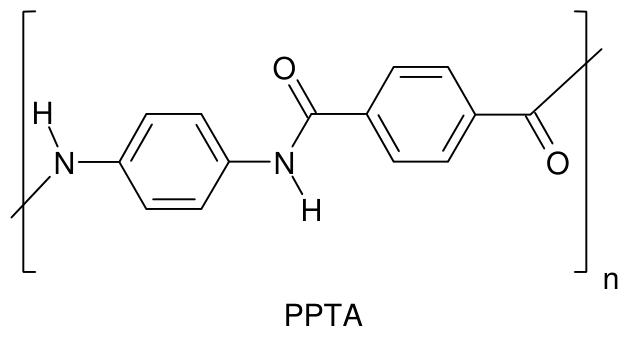
PPTA
5.1 Draw the structure of these sheets (three chains suffice).
For a polymerisation of equimolar amounts of two monomers the average chain length is \(\overline{P}_n\), the degree of conversion is \(p\), which equals the fraction of functional groups that have reacted, the total number of chains is \(N_t\) and the total initial number of monomers is \(U_0\).
Assuming that the polymerization equilibrium can fully be described by:

where C stands for any \(\ce{-CO2}\) group, A stands for any \(\ce{-NH2}\) group and Am stands for any amide group.
5.2 Calculate the degree of conversion needed to obtain an average chain length of 500.
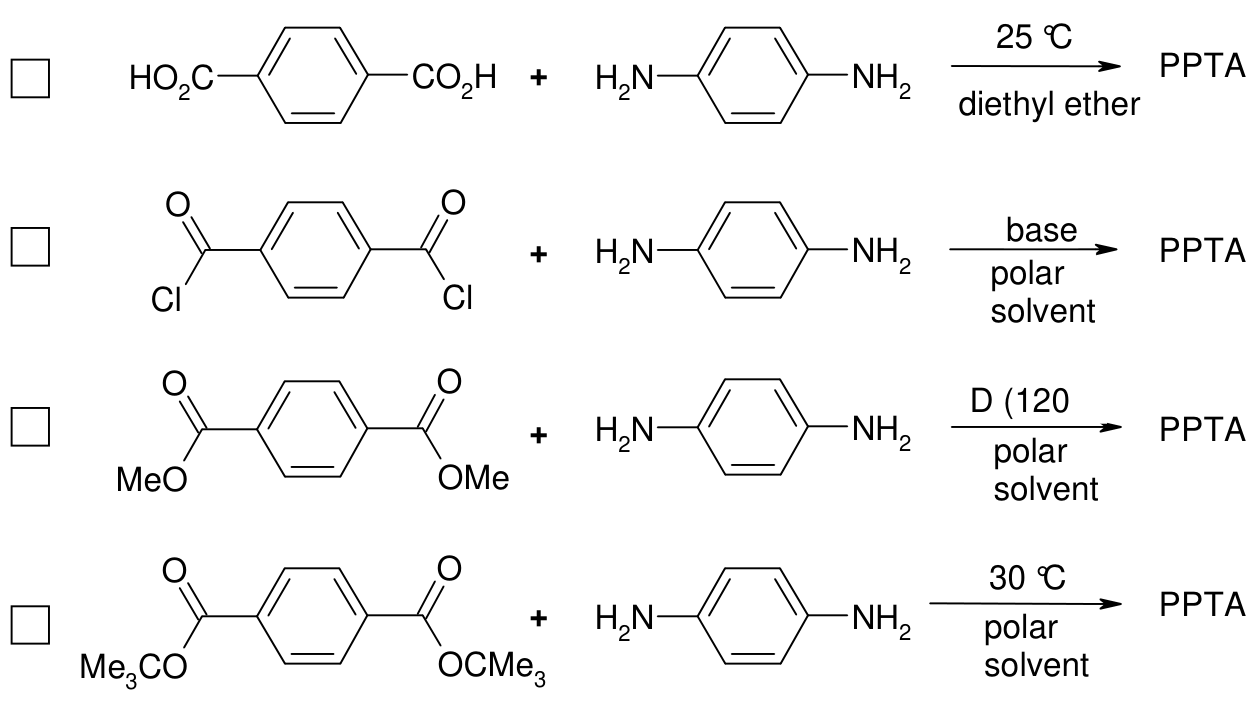
5.3 For the synthesis of PPTA the following possibilities are considered. Which of the following reactions will work? Mark the correct answer(s).
5.4 Another type of aramid can be produced from 4-aminobenzoic acid (4-aminobenzene-carboxylic acid) by heating.
(a) Give the structure of this aramid (\(n=4\))
(b) Calculate the average chain length at equilibrium (reaction is carried out in a closed vessel). The equilibrium constant \(K=576\).
Official English text of the problem.
Answers
- 5.1: Three extended, parallel PPTA chains joined into a sheet by repeated interchain \(\ce{N-H}\cdots\ce{O=C}\) hydrogen bonds. The repeat-fragment SMILES and drawing description are given below.
- 5.2: \(\boxed{p=0.998=99.8\%}\).
- 5.3: Mark the second and third reactions: terephthaloyl chloride with the diamine, and heated dimethyl terephthalate with the diamine.
- 5.4(a): The linear poly(p-benzamide) tetramer: \[ \ce{H2N-R-CO-NH-R-CO-NH-R-CO-NH-R-COOH}, \] where \(R\) is para-phenylene. Its explicit SMILES is given below.
- 5.4(b): \(\boxed{\overline{P}_n=25}\) monomer residues per chain, with equilibrium conversion \(p=0.960\).
Solution
5.1 — Hydrogen-bonded sheets
PPTA is poly(p-phenylene terephthalamide). Its repeating fragment has SMILES
[*]Nc1ccc(NC(=O)c2ccc(C(=O)[*])cc2)cc1.
The two [*] atoms indicate continuation into neighbouring repeat units; this notation describes the covalent connectivity.
To draw the requested sheet:
- Draw three extended PPTA chains with parallel chain axes and predominantly trans amide groups.
- Align adjacent chains so that an amide \(\ce{N-H}\) group directed into the gap faces a carbonyl oxygen on the neighbouring chain.
- Draw a dashed hydrogen bond from that hydrogen to the oxygen: \[ \ce{N-H}\cdots\ce{O=C}. \]
- Repeat these contacts along both gaps, so that the middle chain hydrogen-bonds to both outer chains.
The nearly linear donor–hydrogen–acceptor contacts hold the chains together within the sheet. Their spatial arrangement and the amide conformations are not specified by the SMILES.
5.2 — Conversion required for a chain length of 500
Each monomer is bifunctional, so the initial number of functional groups is \(2U_0\). At conversion \(p\), the number of reacted functional groups is \(2U_0p\).
Each new amide linkage consumes two functional groups. Consequently, the number of linkages formed is \(U_0p\). For linear polymerization without cyclization, each linkage reduces the number of separate molecules by one:
\[ N_t=U_0-U_0p=U_0(1-p). \]
The number-average chain length therefore obeys the Carothers equation:
\[ \overline{P}_n=\frac{U_0}{N_t}=\frac{1}{1-p}. \]
Thus,
\[ 500=\frac{1}{1-p} \quad\Longrightarrow\quad p=1-\frac{1}{500} =\boxed{0.998=99.8\%}. \]
Here chain length counts individual original monomer residues.
5.3 — Suitable synthesis routes
The common diamine is p-phenylenediamine, also called benzene-1,4-diamine, SMILES Nc1ccc(N)cc1.
| Scheme, from top to bottom | Carbonyl-containing monomer and SMILES | Works under the indicated conditions? | Reason |
|---|---|---|---|
| 1 | Terephthalic acid, O=C(O)c1ccc(C(=O)O)cc1 |
No | At \(25\,^\circ\mathrm C\), the unactivated carboxylic acid and amine primarily undergo acid–base interaction. These conditions do not provide effective dehydrative amidation. |
| 2 | Terephthaloyl chloride, O=C(Cl)c1ccc(C(=O)Cl)cc1 |
Yes | Acid chlorides readily acylate amines. The base captures the acid produced and maintains the amine’s nucleophilicity. |
| 3 | Dimethyl terephthalate, COC(=O)c1ccc(C(=O)OC)cc1 |
Yes | Heating enables ester aminolysis: amide bonds form with elimination of methanol. |
| 4 | Di-tert-butyl terephthalate, CC(C)(C)OC(=O)c1ccc(C(=O)OC(C)(C)C)cc1 |
No | The hindered, unactivated tert-butyl ester does not undergo effective aminolysis with this aromatic diamine at \(30\,^\circ\mathrm C\). |
For balanced polymerization equations, let \(R\) denote para-phenylene, or benzene-1,4-diyl, fragment SMILES [*]c1ccc([*])cc1. In the condensed structures below, \(\ce{CO}\) denotes a carbonyl group, \(\ce{C(=O)}\).
A representative finite chain containing \(n\) molecules of each monomer has \(2n-1\) newly formed amide bonds. The acid-chloride route is therefore
\[ \begin{aligned} &\ce{n ClCO-R-COCl + n H2N-R-NH2}\\ &\qquad\ce{-> H-[NH-R-NH-CO-R-CO]_{n}-Cl + (2n-1) HCl}. \end{aligned} \]
The corresponding methyl-ester route is
\[ \begin{aligned} &\ce{n CH3OCO-R-COOCH3 + n H2N-R-NH2}\\ &\qquad\ce{->[\Delta] H-[NH-R-NH-CO-R-CO]_{n}-OCH3 + (2n-1) CH3OH}. \end{aligned} \]
These equations retain the end groups explicitly: the leading hydrogen completes an amino end group, while the other end retains an acid chloride or methyl ester group.
The byproducts are hydrogen chloride, SMILES Cl, and methanol, SMILES CO, respectively. In the second scheme, the added base captures the hydrogen chloride.
5.4(a) — Aramid from 4-aminobenzoic acid
The monomer is 4-aminobenzoic acid, SMILES Nc1ccc(C(=O)O)cc1. Its amino group reacts with another molecule’s carboxyl group, producing poly(p-benzamide).
Four monomers form three amide bonds and release three molecules of water, SMILES O:
\[ \begin{aligned} &\ce{4 H2N-R-COOH}\\ &\qquad\ce{->[\Delta] H2N-R-CO-NH-R-CO-NH-R-CO-NH-R-COOH + 3 H2O}. \end{aligned} \]
The linear 4-aminobenzoic acid tetramer has SMILES
Nc1ccc(C(=O)Nc2ccc(C(=O)Nc3ccc(C(=O)Nc4ccc(C(=O)O)cc4)cc3)cc2)cc1.
The requested drawing should show four benzene rings, each substituted in the para positions, connected successively by three \(\ce{-C(=O)-NH-}\) links. One end is an amino group and the other is a carboxylic acid group. Its molecular formula is \(\ce{C28H22N4O5}\).
5.4(b) — Equilibrium chain length in a closed vessel
Use the stated functional-group equilibrium:
\[ \ce{C + A <=> Am + H2O}. \]
Let \(c_0\) be the initial monomer concentration, in \(\mathrm{mol\,L^{-1}}\). Taking the starting monomer to contain no water, each amide linkage produces one water molecule, which remains in the closed vessel.
At conversion \(p\),
\[ [\mathrm C]=[\mathrm A]=c_0(1-p), \qquad [\mathrm{Am}]=[\ce{H2O}]=c_0p. \]
Under the problem’s equilibrium model,
\[ K= \frac{[\mathrm{Am}][\ce{H2O}]}{[\mathrm C][\mathrm A]} = \frac{(c_0p)^2}{[c_0(1-p)]^2} = \left(\frac{p}{1-p}\right)^2. \]
Therefore,
\[ \frac{p}{1-p}=\sqrt{576}=24, \qquad p=\frac{24}{25}=0.960. \]
Applying the chain-count relation from 5.2,
\[ \boxed{\overline{P}_n=\frac{1}{1-p}=25}. \]
Thus the equilibrium average is 25 monomer residues per chain.
The solution was checked against the official solution.
IChO 2002 · Theorieaufgabe 5
Aramide, polymere Hochleistungswerkstoffe
Aromatische Polyamide (Aramide) sind hochfeste Hochleistungs-Polymerfasern, die in Verbundwerkstoffen, schusssicheren Westen, hochwertigen Skiern, Schutzhelmen usw. Verwendung finden. Das Aramid PPTA wird unter den Namen Kevlar® (DuPont) und Twaron® (Teijin) vermarktet und unter anderem im Norden der Niederlande hergestellt. Die PPTA-Ketten sind in den Fasern geordnet in einer Schichtstruktur gepackt.
PPTA
5.1 Zeichnen Sie die Struktur dieser Schichten (drei Ketten genügen).
Bei einer Polymerisation äquimolarer Mengen zweier Monomere ist die mittlere Kettenlänge \(\overline{P}_n\), der Umsatzgrad ist \(p\), der dem Anteil der umgesetzten funktionellen Gruppen entspricht, die Gesamtzahl der Ketten ist \(N_t\) und die anfängliche Gesamtzahl der Monomere ist \(U_0\).
Es wird angenommen, dass sich das Polymerisationsgleichgewicht vollständig wie folgt beschreiben lässt:
Dabei steht C für eine beliebige \(\ce{-CO2}\)-Gruppe, A für eine beliebige \(\ce{-NH2}\)-Gruppe und Am für eine beliebige Amidgruppe.
5.2 Berechnen Sie den Umsatzgrad, der erforderlich ist, um eine mittlere Kettenlänge von 500 zu erhalten.
5.3 Für die Synthese von PPTA werden die folgenden Möglichkeiten in Betracht gezogen. Welche der folgenden Reaktionen funktionieren? Markieren Sie die richtige(n) Antwort(en).
5.4 Ein anderer Aramidtyp kann durch Erhitzen von 4-Aminobenzoesäure (4-Aminobenzolcarbonsäure) hergestellt werden.
(a) Geben Sie die Struktur dieses Aramids an (\(n=4\))
(b) Berechnen Sie die mittlere Kettenlänge im Gleichgewicht (die Reaktion wird in einem geschlossenen Gefäß durchgeführt). Die Gleichgewichtskonstante beträgt \(K=576\).
Aufgabentext aus dem offiziellen englischen Text übersetzt.
Antworten
- 5.1: Drei gestreckte, parallele PPTA-Ketten, die durch wiederholte intermolekulare \(\ce{N-H}\cdots\ce{O=C}\)-Wasserstoffbrücken zwischen den Ketten zu einer Schicht verbunden sind. Die SMILES-Notation des Wiederholungsfragments und die Beschreibung der Zeichnung sind unten angegeben.
- 5.2: \(\boxed{p=0.998=99.8\%}\).
- 5.3: Markieren Sie die zweite und die dritte Reaktion: Terephthaloylchlorid mit dem Diamin sowie erhitztes Dimethylterephthalat mit dem Diamin.
- 5.4(a): Das lineare Poly(p-benzamid)-Tetramer: \[ \ce{H2N-R-CO-NH-R-CO-NH-R-CO-NH-R-COOH}, \] wobei \(R\) für para-Phenylen steht. Seine explizite SMILES-Notation ist unten angegeben.
- 5.4(b): \(\boxed{\overline{P}_n=25}\) Monomerreste pro Kette, bei einem Gleichgewichtsumsatz von \(p=0.960\).
Lösung
5.1 — Durch Wasserstoffbrücken verbundene Schichten
PPTA ist Poly(p-phenylenterephthalamid). Sein Wiederholungsfragment hat die SMILES-Notation
[*]Nc1ccc(NC(=O)c2ccc(C(=O)[*])cc2)cc1.
Die beiden [*]-Atome kennzeichnen die Fortsetzung in benachbarte Wiederholungseinheiten; diese Notation beschreibt die Verknüpfung durch kovalente Bindungen.
So zeichnen Sie die geforderte Schicht:
- Zeichnen Sie drei gestreckte PPTA-Ketten mit parallelen Kettenachsen und überwiegend trans-konfigurierten Amidgruppen.
- Richten Sie benachbarte Ketten so aus, dass eine in den Zwischenraum gerichtete \(\ce{N-H}\)-Gruppe eines Amids einem Carbonylsauerstoffatom der benachbarten Kette gegenüberliegt.
- Zeichnen Sie eine gestrichelte Wasserstoffbrücke von diesem Wasserstoffatom zum Sauerstoffatom: \[ \ce{N-H}\cdots\ce{O=C}. \]
- Wiederholen Sie diese Kontakte entlang beider Zwischenräume, sodass die mittlere Kette mit beiden äußeren Ketten Wasserstoffbrücken bildet.
Die nahezu linearen Donor–Wasserstoff–Akzeptor-Kontakte halten die Ketten innerhalb der Schicht zusammen. Ihre räumliche Anordnung und die Konformationen der Amidgruppen sind durch die SMILES-Notation nicht festgelegt.
5.2 — Erforderlicher Umsatz für eine Kettenlänge von 500
Jedes Monomer ist bifunktionell, sodass die anfängliche Anzahl funktioneller Gruppen \(2U_0\) beträgt. Beim Umsatzgrad \(p\) beträgt die Anzahl der umgesetzten funktionellen Gruppen \(2U_0p\).
Jede neue Amidbindung verbraucht zwei funktionelle Gruppen. Folglich beträgt die Anzahl der gebildeten Bindungen \(U_0p\). Bei einer linearen Polymerisation ohne Cyclisierung verringert jede Bindung die Anzahl der separaten Moleküle um eins:
\[ N_t=U_0-U_0p=U_0(1-p). \]
Die zahlenmittlere Kettenlänge folgt daher der Carothers-Gleichung:
\[ \overline{P}_n=\frac{U_0}{N_t}=\frac{1}{1-p}. \]
Somit gilt:
\[ 500=\frac{1}{1-p} \quad\Longrightarrow\quad p=1-\frac{1}{500} =\boxed{0.998=99.8\%}. \]
Die Kettenlänge zählt hier die einzelnen Reste der ursprünglichen Monomere.
5.3 — Geeignete Synthesewege
Das in allen Fällen verwendete Diamin ist p-Phenylendiamin, auch Benzol-1,4-diamin genannt, mit der SMILES-Notation Nc1ccc(N)cc1.
| Reaktionsschema, von oben nach unten | Carbonylhaltiges Monomer und SMILES-Notation | Funktioniert unter den angegebenen Bedingungen? | Begründung |
|---|---|---|---|
| 1 | Terephthalsäure, O=C(O)c1ccc(C(=O)O)cc1 |
Nein | Bei \(25\,^\circ\mathrm C\) gehen die nicht aktivierte Carbonsäure und das Amin vorwiegend eine Säure-Base-Reaktion ein. Unter diesen Bedingungen findet keine wirksame Amidierung unter Wasserabspaltung statt. |
| 2 | Terephthaloylchlorid, O=C(Cl)c1ccc(C(=O)Cl)cc1 |
Ja | Säurechloride acylieren Amine leicht. Die Base fängt die entstehende Säure ab und erhält die Nukleophilie des Amins. |
| 3 | Dimethylterephthalat, COC(=O)c1ccc(C(=O)OC)cc1 |
Ja | Erhitzen ermöglicht die Aminolyse des Esters: Unter Abspaltung von Methanol bilden sich Amidbindungen. |
| 4 | Di-tert-butylterephthalat, CC(C)(C)OC(=O)c1ccc(C(=O)OC(C)(C)C)cc1 |
Nein | Der sterisch gehinderte, nicht aktivierte tert-Butylester geht mit diesem aromatischen Diamin bei \(30\,^\circ\mathrm C\) keine wirksame Aminolyse ein. |
Für ausgeglichene Polymerisationsgleichungen bezeichne \(R\) para-Phenylen, auch Benzol-1,4-diyl genannt, mit der Fragment-SMILES-Notation [*]c1ccc([*])cc1. In den folgenden verkürzten Strukturformeln bezeichnet \(\ce{CO}\) eine Carbonylgruppe, \(\ce{C(=O)}\).
Eine repräsentative endliche Kette, die \(n\) Moleküle jedes Monomers enthält, besitzt \(2n-1\) neu gebildete Amidbindungen. Der Syntheseweg über das Säurechlorid lautet daher:
\[ \begin{aligned} &\ce{n ClCO-R-COCl + n H2N-R-NH2}\\ &\qquad\ce{-> H-[NH-R-NH-CO-R-CO]_{n}-Cl + (2n-1) HCl}. \end{aligned} \]
Der entsprechende Syntheseweg über den Methylester lautet:
\[ \begin{aligned} &\ce{n CH3OCO-R-COOCH3 + n H2N-R-NH2}\\ &\qquad\ce{->[\Delta] H-[NH-R-NH-CO-R-CO]_{n}-OCH3 + (2n-1) CH3OH}. \end{aligned} \]
In diesen Gleichungen sind die Endgruppen ausdrücklich enthalten: Das vorangestellte Wasserstoffatom vervollständigt eine Aminoendgruppe, während am anderen Ende eine Säurechlorid- bzw. Methylestergruppe erhalten bleibt.
Die Nebenprodukte sind Chlorwasserstoff, SMILES-Notation Cl, bzw. Methanol, SMILES-Notation CO. Im zweiten Reaktionsschema fängt die zugesetzte Base den Chlorwasserstoff ab.
5.4(a) — Aramid aus 4-Aminobenzoesäure
Das Monomer ist 4-Aminobenzoesäure, SMILES-Notation Nc1ccc(C(=O)O)cc1. Seine Aminogruppe reagiert mit der Carboxylgruppe eines anderen Moleküls, wobei Poly(p-benzamid) entsteht.
Vier Monomere bilden drei Amidbindungen und setzen drei Moleküle Wasser, SMILES-Notation O, frei:
\[ \begin{aligned} &\ce{4 H2N-R-COOH}\\ &\qquad\ce{->[\Delta] H2N-R-CO-NH-R-CO-NH-R-CO-NH-R-COOH + 3 H2O}. \end{aligned} \]
Das lineare 4-Aminobenzoesäure-Tetramer hat die SMILES-Notation
Nc1ccc(C(=O)Nc2ccc(C(=O)Nc3ccc(C(=O)Nc4ccc(C(=O)O)cc4)cc3)cc2)cc1.
Die geforderte Zeichnung sollte vier Benzolringe zeigen, die jeweils in para-Stellung substituiert und nacheinander durch drei \(\ce{-C(=O)-NH-}\)-Bindeglieder verbunden sind. An einem Ende befindet sich eine Aminogruppe, am anderen eine Carboxylgruppe. Die Summenformel lautet \(\ce{C28H22N4O5}\).
5.4(b) — Kettenlänge im Gleichgewicht in einem geschlossenen Gefäß
Wir verwenden das angegebene Gleichgewicht der funktionellen Gruppen:
\[ \ce{C + A <=> Am + H2O}. \]
Es sei \(c_0\) die anfängliche Monomerkonzentration in \(\mathrm{mol\,L^{-1}}\). Unter der Annahme, dass das Ausgangsmonomer kein Wasser enthält, entsteht bei der Bildung jeder Amidbindung ein Wassermolekül, das im geschlossenen Gefäß verbleibt.
Beim Umsatzgrad \(p\) gilt:
\[ [\mathrm C]=[\mathrm A]=c_0(1-p), \qquad [\mathrm{Am}]=[\ce{H2O}]=c_0p. \]
Nach dem Gleichgewichtsmodell der Aufgabe gilt:
\[ K= \frac{[\mathrm{Am}][\ce{H2O}]}{[\mathrm C][\mathrm A]} = \frac{(c_0p)^2}{[c_0(1-p)]^2} = \left(\frac{p}{1-p}\right)^2. \]
Daraus folgt:
\[ \frac{p}{1-p}=\sqrt{576}=24, \qquad p=\frac{24}{25}=0.960. \]
Mit der Beziehung für die Kettenzahl aus 5.2 ergibt sich:
\[ \boxed{\overline{P}_n=\frac{1}{1-p}=25}. \]
Damit beträgt der Mittelwert im Gleichgewicht 25 Monomerreste pro Kette.
Die Lösung wurde mit der offiziellen Lösung abgeglichen.
IChO 2002 · Teori sorusu 5
Aramidler, Yüksek Performanslı Polimerik Malzemeler
Aromatik poliamidler (aramidler), kompozit malzemelerde, kurşun geçirmez yeleklerde, yüksek kaliteli kayaklarda, koruyucu kasklarda vb. kullanılan, yüksek dayanımlı ve yüksek performanslı polimer liflerdir. PPTA aramidi, Kevlar® (DuPont) ve Twaron® (Teijin) adlarıyla pazarlanır ve diğer yerlerin yanı sıra Hollanda'nın kuzeyinde de üretilir. PPTA zincirleri, tabaka tipi bir yapıya sahip lifler içinde düzenli biçimde istiflenmiştir.
PPTA
5.1 Bu tabakaların yapısını çiziniz (üç zincir yeterlidir).
İki monomerin eşmolar miktarlarının polimerleşmesinde ortalama zincir uzunluğu \(\overline{P}_n\), tepkimeye girmiş fonksiyonel grupların oranına eşit olan dönüşüm derecesi \(p\), toplam zincir sayısı \(N_t\) ve başlangıçtaki toplam monomer sayısı \(U_0\) olarak gösterilir.
Polimerleşme dengesinin aşağıdaki gibi tam olarak tanımlanabildiğini varsayınız:
Burada C herhangi bir \(\ce{-CO2}\) grubunu, A herhangi bir \(\ce{-NH2}\) grubunu ve Am herhangi bir amit grubunu temsil eder.
5.2 Ortalama zincir uzunluğunun 500 olması için gereken dönüşüm derecesini hesaplayınız.
5.3 PPTA sentezi için aşağıdaki olasılıklar değerlendirilmektedir. Aşağıdaki tepkimelerden hangileri sonuç verir? Doğru yanıtı veya yanıtları işaretleyiniz.
5.4 Başka bir aramid türü, 4-aminobenzoik asidin (4-aminobenzen-karboksilik asit) ısıtılmasıyla üretilebilir.
(a) Bu aramidin yapısını veriniz (\(n=4\))
(b) Dengedeki ortalama zincir uzunluğunu hesaplayınız (tepkime kapalı bir kapta gerçekleştirilmektedir). Denge sabiti \(K=576\)'dır.
Soru metni resmi İngilizce metinden çevrilmiştir.
Cevaplar
- 5.1: Zincirler arası tekrarlanan \(\ce{N-H}\cdots\ce{O=C}\) hidrojen bağlarıyla bir tabaka oluşturacak şekilde birbirine bağlanmış, uzanmış ve birbirine paralel üç PPTA zinciri. Tekrarlayan parçanın SMILES gösterimi ve çizimin açıklaması aşağıda verilmiştir.
- 5.2: \(\boxed{p=0.998=99.8\%}\).
- 5.3: İkinci ve üçüncü tepkimeleri işaretleyiniz: tereftaloil klorürün diaminle tepkimesi ve dimetil tereftalatın diaminle ısıtılarak gerçekleştirilen tepkimesi.
- 5.4(a): Doğrusal poli(p-benzamit) tetrameri: \[ \ce{H2N-R-CO-NH-R-CO-NH-R-CO-NH-R-COOH}, \] burada \(R\), para-fenilendir. Açık SMILES gösterimi aşağıda verilmiştir.
- 5.4(b): Zincir başına \(\boxed{\overline{P}_n=25}\) monomer kalıntısı; denge dönüşümü \(p=0.960\)'tır.
Çözüm
5.1 — Hidrojen bağlarıyla bağlanmış tabakalar
PPTA, poli(p-fenilen tereftalamit)tir. Tekrarlayan parçasının SMILES gösterimi şöyledir:
[*]Nc1ccc(NC(=O)c2ccc(C(=O)[*])cc2)cc1.
İki [*] atomu, komşu tekrarlayan birimlere doğru devamlılığı gösterir; bu gösterim kovalent bağlanma düzenini tanımlar.
İstenen tabakayı çizmek için:
- Zincir eksenleri birbirine paralel ve amit grupları ağırlıklı olarak trans konumunda olan, uzanmış üç PPTA zinciri çiziniz.
- Komşu zincirleri, aralarındaki boşluğa yönelmiş bir amit \(\ce{N-H}\) grubu komşu zincirdeki bir karbonil oksijeninin karşısına gelecek şekilde hizalayınız.
- Bu hidrojenden oksijene doğru kesikli çizgiyle bir hidrojen bağı çiziniz: \[ \ce{N-H}\cdots\ce{O=C}. \]
- Bu temasları her iki boşluk boyunca tekrarlayınız; böylece ortadaki zincir, dıştaki iki zincirle de hidrojen bağları oluştursun.
Neredeyse doğrusal olan verici–hidrojen–alıcı temasları, zincirleri tabaka içinde bir arada tutar. Bunların uzaysal düzeni ve amit konformasyonları SMILES gösteriminde belirtilmez.
5.2 — 500 zincir uzunluğu için gereken dönüşüm
Her monomer iki fonksiyonlu olduğundan, başlangıçtaki fonksiyonel grup sayısı \(2U_0\)'dır. \(p\) dönüşümünde, tepkimeye girmiş fonksiyonel grup sayısı \(2U_0p\)'dir.
Her yeni amit bağı iki fonksiyonel grup tüketir. Dolayısıyla oluşan bağ sayısı \(U_0p\)'dir. Halkalaşmanın olmadığı doğrusal polimerleşmede her bağ, ayrı moleküllerin sayısını bir azaltır:
\[ N_t=U_0-U_0p=U_0(1-p). \]
Bu nedenle sayıca ortalama zincir uzunluğu Carothers denklemine uyar:
\[ \overline{P}_n=\frac{U_0}{N_t}=\frac{1}{1-p}. \]
Böylece,
\[ 500=\frac{1}{1-p} \quad\Longrightarrow\quad p=1-\frac{1}{500} =\boxed{0.998=99.8\%}. \]
Burada zincir uzunluğu, başlangıçtaki monomerlerin her birinden kalan kalıntıları sayar.
5.3 — Uygun sentez yolları
Ortak diamin, benzen-1,4-diamin olarak da adlandırılan p-fenilendiamindir; SMILES gösterimi Nc1ccc(N)cc1 şeklindedir.
| Yukarıdan aşağıya tepkime şeması | Karbonil içeren monomer ve SMILES gösterimi | Belirtilen koşullarda sonuç verir mi? | Gerekçe |
|---|---|---|---|
| 1 | Tereftalik asit, O=C(O)c1ccc(C(=O)O)cc1 |
Hayır | \(25\,^\circ\mathrm C\)'de, etkinleştirilmemiş karboksilik asit ile amin öncelikle asit–baz etkileşimine girer. Bu koşullar, su uzaklaşmasıyla etkin bir amit oluşumu sağlamaz. |
| 2 | Tereftaloil klorür, O=C(Cl)c1ccc(C(=O)Cl)cc1 |
Evet | Asit klorürler aminleri kolaylıkla açiller. Baz, oluşan asidi tutar ve aminin nükleofilliğini korur. |
| 3 | Dimetil tereftalat, COC(=O)c1ccc(C(=O)OC)cc1 |
Evet | Isıtma, esterin aminolizini mümkün kılar: metanol ayrılmasıyla amit bağları oluşur. |
| 4 | Di-tert-bütil tereftalat, CC(C)(C)OC(=O)c1ccc(C(=O)OC(C)(C)C)cc1 |
Hayır | Sterik engelli, etkinleştirilmemiş tert-bütil ester, \(30\,^\circ\mathrm C\)'de bu aromatik diaminle etkin biçimde aminolize uğramaz. |
Denkleştirilmiş polimerleşme denklemleri için \(R\), parça SMILES gösterimi [*]c1ccc([*])cc1 olan para-fenileni, diğer adıyla benzen-1,4-diili göstersin. Aşağıdaki kısaltılmış yapılarda \(\ce{CO}\), bir karbonil grubunu, \(\ce{C(=O)}\), gösterir.
Her monomerden \(n\) molekül içeren temsili bir sonlu zincirde, yeni oluşmuş \(2n-1\) amit bağı bulunur. Bu nedenle asit klorür yolu şöyledir:
\[ \begin{aligned} &\ce{n ClCO-R-COCl + n H2N-R-NH2}\\ &\qquad\ce{-> H-[NH-R-NH-CO-R-CO]_{n}-Cl + (2n-1) HCl}. \end{aligned} \]
Buna karşılık gelen metil ester yolu şöyledir:
\[ \begin{aligned} &\ce{n CH3OCO-R-COOCH3 + n H2N-R-NH2}\\ &\qquad\ce{->[\Delta] H-[NH-R-NH-CO-R-CO]_{n}-OCH3 + (2n-1) CH3OH}. \end{aligned} \]
Bu denklemlerde uç gruplar açıkça korunmuştur: baştaki hidrojen bir amino uç grubunu tamamlarken diğer uçta bir asit klorür veya metil ester grubu kalır.
Yan ürünler sırasıyla SMILES gösterimi Cl olan hidrojen klorür ve SMILES gösterimi CO olan metanoldür. İkinci tepkime şemasında eklenen baz, hidrojen klorürü tutar.
5.4(a) — 4-aminobenzoik asitten elde edilen aramid
Monomer, SMILES gösterimi Nc1ccc(C(=O)O)cc1 olan 4-aminobenzoik asittir. Amino grubu, başka bir molekülün karboksil grubuyla tepkimeye girerek poli(p-benzamit) oluşturur.
Dört monomer, üç amit bağı oluşturur ve SMILES gösterimi O olan üç su molekülü açığa çıkarır:
\[ \begin{aligned} &\ce{4 H2N-R-COOH}\\ &\qquad\ce{->[\Delta] H2N-R-CO-NH-R-CO-NH-R-CO-NH-R-COOH + 3 H2O}. \end{aligned} \]
Doğrusal 4-aminobenzoik asit tetramerinin SMILES gösterimi şöyledir:
Nc1ccc(C(=O)Nc2ccc(C(=O)Nc3ccc(C(=O)Nc4ccc(C(=O)O)cc4)cc3)cc2)cc1.
İstenen çizim, her biri para konumlarında sübstitüe olmuş ve üç \(\ce{-C(=O)-NH-}\) bağıyla art arda bağlanmış dört benzen halkasını göstermelidir. Bir uçta amino grubu, diğer uçta karboksilik asit grubu bulunur. Molekül formülü \(\ce{C28H22N4O5}\)'tir.
5.4(b) — Kapalı bir kapta denge zincir uzunluğu
Verilen fonksiyonel grup dengesini kullanınız:
\[ \ce{C + A <=> Am + H2O}. \]
\(c_0\), \(\mathrm{mol\,L^{-1}}\) cinsinden başlangıç monomer derişimi olsun. Başlangıçtaki monomerin su içermediği kabul edildiğinde, her amit bağı kapalı kapta kalan bir su molekülü üretir.
\(p\) dönüşümünde,
\[ [\mathrm C]=[\mathrm A]=c_0(1-p), \qquad [\mathrm{Am}]=[\ce{H2O}]=c_0p. \]
Soruda verilen denge modeline göre,
\[ K= \frac{[\mathrm{Am}][\ce{H2O}]}{[\mathrm C][\mathrm A]} = \frac{(c_0p)^2}{[c_0(1-p)]^2} = \left(\frac{p}{1-p}\right)^2. \]
Dolayısıyla,
\[ \frac{p}{1-p}=\sqrt{576}=24, \qquad p=\frac{24}{25}=0.960. \]
5.2'deki zincir sayısı bağıntısı uygulandığında,
\[ \boxed{\overline{P}_n=\frac{1}{1-p}=25}. \]
Böylece dengedeki ortalama, zincir başına 25 monomer kalıntısıdır.
Çözüm, resmi çözümle karşılaştırılarak kontrol edildi.
IChO 2002 · Problema teórico 5
Aramidas, materiales poliméricos de altas prestaciones
Las poliamidas aromáticas (aramidas) son fibras poliméricas de alta resistencia y altas prestaciones que se utilizan en materiales compuestos, chalecos antibalas, esquís de alta calidad, cascos de seguridad, etc. La aramida PPTA se comercializa con los nombres Kevlar® (DuPont) y Twaron® (Teijin), y se fabrica, entre otros lugares, en el norte de los Países Bajos. Las cadenas de PPTA se empaquetan de forma ordenada en fibras con una estructura de tipo laminar.
PPTA
5.1 Dibuje la estructura de estas láminas (bastan tres cadenas).
Para una polimerización de cantidades equimolares de dos monómeros, la longitud media de cadena es \(\overline{P}_n\), el grado de conversión es \(p\), que equivale a la fracción de grupos funcionales que han reaccionado, el número total de cadenas es \(N_t\) y el número total inicial de monómeros es \(U_0\).
Suponga que el equilibrio de polimerización puede describirse por completo mediante:
donde C representa cualquier grupo \(\ce{-CO2}\), A representa cualquier grupo \(\ce{-NH2}\) y Am representa cualquier grupo amida.
5.2 Calcule el grado de conversión necesario para obtener una longitud media de cadena de 500.
5.3 Para la síntesis de PPTA se consideran las siguientes posibilidades. ¿Cuáles de las siguientes reacciones funcionarán? Marque la respuesta o las respuestas correctas.
5.4 Otro tipo de aramida puede producirse a partir del ácido 4-aminobenzoico (ácido 4-aminobencenocarboxílico) mediante calentamiento.
(a) Indique la estructura de esta aramida (\(n=4\))
(b) Calcule la longitud media de cadena en el equilibrio (la reacción se lleva a cabo en un recipiente cerrado). La constante de equilibrio es \(K=576\).
Enunciado traducido del texto oficial en inglés.
Respuestas
- 5.1: Tres cadenas de PPTA extendidas y paralelas, unidas en una lámina mediante enlaces de hidrógeno intercatenarios repetidos \(\ce{N-H}\cdots\ce{O=C}\). A continuación se proporcionan el SMILES del fragmento repetitivo y la descripción del dibujo.
- 5.2: \(\boxed{p=0.998=99.8\%}\).
- 5.3: Marque la segunda y la tercera reacción: cloruro de tereftaloilo con la diamina y tereftalato de dimetilo con la diamina mediante calentamiento.
- 5.4(a): El tetrámero lineal de poli(p-benzamida): \[ \ce{H2N-R-CO-NH-R-CO-NH-R-CO-NH-R-COOH}, \] donde \(R\) es para-fenileno. Su SMILES explícito se proporciona a continuación.
- 5.4(b): \(\boxed{\overline{P}_n=25}\) residuos de monómero por cadena, con una conversión en el equilibrio de \(p=0.960\).
Solución
5.1 — Láminas unidas por enlaces de hidrógeno
La PPTA es poli(p-fenilentereftalamida). Su fragmento repetitivo tiene el SMILES
[*]Nc1ccc(NC(=O)c2ccc(C(=O)[*])cc2)cc1.
Los dos átomos [*] indican la continuación hacia las unidades repetitivas vecinas; esta notación describe la conectividad covalente.
Para dibujar la lámina solicitada:
- Dibuje tres cadenas de PPTA extendidas, con ejes de cadena paralelos y grupos amida predominantemente trans.
- Alinee las cadenas adyacentes de modo que un grupo \(\ce{N-H}\) de una amida orientado hacia el espacio entre ellas quede frente a un oxígeno carbonílico de la cadena vecina.
- Dibuje un enlace de hidrógeno con una línea discontinua desde ese hidrógeno hasta el oxígeno: \[ \ce{N-H}\cdots\ce{O=C}. \]
- Repita estos contactos a lo largo de ambos espacios entre cadenas, de modo que la cadena central forme enlaces de hidrógeno con las dos cadenas exteriores.
Los contactos donante–hidrógeno–aceptor, casi lineales, mantienen unidas las cadenas dentro de la lámina. El SMILES no especifica su disposición espacial ni las conformaciones de las amidas.
5.2 — Conversión necesaria para una longitud de cadena de 500
Cada monómero es bifuncional, por lo que el número inicial de grupos funcionales es \(2U_0\). A una conversión \(p\), el número de grupos funcionales que han reaccionado es \(2U_0p\).
Cada nuevo enlace amida consume dos grupos funcionales. Por consiguiente, el número de enlaces formados es \(U_0p\). En una polimerización lineal sin ciclación, cada enlace reduce en uno el número de moléculas independientes:
\[ N_t=U_0-U_0p=U_0(1-p). \]
Por tanto, la longitud de cadena media en número obedece a la ecuación de Carothers:
\[ \overline{P}_n=\frac{U_0}{N_t}=\frac{1}{1-p}. \]
Así,
\[ 500=\frac{1}{1-p} \quad\Longrightarrow\quad p=1-\frac{1}{500} =\boxed{0.998=99.8\%}. \]
Aquí, la longitud de cadena cuenta los residuos individuales de los monómeros originales.
5.3 — Vías de síntesis adecuadas
La diamina común a todas las reacciones es la p-fenilendiamina, también llamada benceno-1,4-diamina, con SMILES Nc1ccc(N)cc1.
| Esquema, de arriba abajo | Monómero que contiene grupos carbonilo y SMILES | ¿Funciona en las condiciones indicadas? | Motivo |
|---|---|---|---|
| 1 | Ácido tereftálico, O=C(O)c1ccc(C(=O)O)cc1 |
No | A \(25\,^\circ\mathrm C\), el ácido carboxílico no activado y la amina experimentan principalmente una interacción ácido–base. Estas condiciones no permiten una amidación deshidratante eficaz. |
| 2 | Cloruro de tereftaloilo, O=C(Cl)c1ccc(C(=O)Cl)cc1 |
Sí | Los cloruros de ácido acilan fácilmente las aminas. La base capta el ácido producido y mantiene la nucleofilia de la amina. |
| 3 | Tereftalato de dimetilo, COC(=O)c1ccc(C(=O)OC)cc1 |
Sí | El calentamiento permite la aminólisis del éster: se forman enlaces amida con eliminación de metanol. |
| 4 | Tereftalato de di-terc-butilo, CC(C)(C)OC(=O)c1ccc(C(=O)OC(C)(C)C)cc1 |
No | El éster terc-butílico, estéricamente impedido y no activado, no experimenta una aminólisis eficaz con esta diamina aromática a \(30\,^\circ\mathrm C\). |
Para las ecuaciones ajustadas de polimerización, sea \(R\) el grupo para-fenileno, o benceno-1,4-diilo, cuyo fragmento tiene el SMILES [*]c1ccc([*])cc1. En las estructuras condensadas que figuran a continuación, \(\ce{CO}\) representa un grupo carbonilo, \(\ce{C(=O)}\).
Una cadena finita representativa que contiene \(n\) moléculas de cada monómero tiene \(2n-1\) enlaces amida recién formados. Por tanto, la vía del cloruro de ácido es
\[ \begin{aligned} &\ce{n ClCO-R-COCl + n H2N-R-NH2}\\ &\qquad\ce{-> H-[NH-R-NH-CO-R-CO]_{n}-Cl + (2n-1) HCl}. \end{aligned} \]
La vía correspondiente del éster metílico es
\[ \begin{aligned} &\ce{n CH3OCO-R-COOCH3 + n H2N-R-NH2}\\ &\qquad\ce{->[\Delta] H-[NH-R-NH-CO-R-CO]_{n}-OCH3 + (2n-1) CH3OH}. \end{aligned} \]
Estas ecuaciones conservan explícitamente los grupos terminales: el hidrógeno inicial completa un grupo amino terminal, mientras que el otro extremo conserva un grupo cloruro de ácido o éster metílico.
Los subproductos son cloruro de hidrógeno, con SMILES Cl, y metanol, con SMILES CO, respectivamente. En el segundo esquema, la base añadida capta el cloruro de hidrógeno.
5.4(a) — Aramida a partir del ácido 4-aminobenzoico
El monómero es el ácido 4-aminobenzoico, con SMILES Nc1ccc(C(=O)O)cc1. Su grupo amino reacciona con el grupo carboxilo de otra molécula y produce poli(p-benzamida).
Cuatro monómeros forman tres enlaces amida y liberan tres moléculas de agua, con SMILES O:
\[ \begin{aligned} &\ce{4 H2N-R-COOH}\\ &\qquad\ce{->[\Delta] H2N-R-CO-NH-R-CO-NH-R-CO-NH-R-COOH + 3 H2O}. \end{aligned} \]
El tetrámero lineal del ácido 4-aminobenzoico tiene el SMILES
Nc1ccc(C(=O)Nc2ccc(C(=O)Nc3ccc(C(=O)Nc4ccc(C(=O)O)cc4)cc3)cc2)cc1.
El dibujo solicitado debe mostrar cuatro anillos de benceno, cada uno sustituido en las posiciones para, conectados sucesivamente mediante tres enlaces \(\ce{-C(=O)-NH-}\). Un extremo es un grupo amino y el otro es un grupo ácido carboxílico. Su fórmula molecular es \(\ce{C28H22N4O5}\).
5.4(b) — Longitud de cadena en el equilibrio en un recipiente cerrado
Utilice el equilibrio entre grupos funcionales indicado:
\[ \ce{C + A <=> Am + H2O}. \]
Sea \(c_0\) la concentración inicial de monómero, en \(\mathrm{mol\,L^{-1}}\). Suponiendo que el monómero de partida no contiene agua, cada enlace amida produce una molécula de agua, que permanece en el recipiente cerrado.
A una conversión \(p\),
\[ [\mathrm C]=[\mathrm A]=c_0(1-p), \qquad [\mathrm{Am}]=[\ce{H2O}]=c_0p. \]
Según el modelo de equilibrio del problema,
\[ K= \frac{[\mathrm{Am}][\ce{H2O}]}{[\mathrm C][\mathrm A]} = \frac{(c_0p)^2}{[c_0(1-p)]^2} = \left(\frac{p}{1-p}\right)^2. \]
Por tanto,
\[ \frac{p}{1-p}=\sqrt{576}=24, \qquad p=\frac{24}{25}=0.960. \]
Aplicando la relación de recuento de cadenas del apartado 5.2,
\[ \boxed{\overline{P}_n=\frac{1}{1-p}=25}. \]
Así, la media en el equilibrio es de 25 residuos de monómero por cadena.
La solución se comprobó con la solución oficial.
IChO 2002 · 理论题 5
芳纶,高性能高分子材料
芳香族聚酰胺(芳纶)是一类高强度、高性能的聚合物纤维,可用于复合材料、防弹衣、高品质滑雪板、安全头盔等。芳纶 PPTA 以 Kevlar®(DuPont)和 Twaron®(Teijin)的商品名销售,其生产地包括荷兰北部。PPTA 分子链整齐地堆积成具有片层结构的纤维。
PPTA
5.1 画出这些片层的结构(三条链即可)。
对于两种单体以等物质的量进行的聚合反应,平均链长为 \(\overline{P}_n\),转化率为 \(p\),它等于已反应的官能团所占的分数,链的总数为 \(N_t\),单体的初始总数为 \(U_0\)。
假设聚合平衡可完全由下式描述:
其中,C 代表任意 \(\ce{-CO2}\) 基团,A 代表任意 \(\ce{-NH2}\) 基团,Am 代表任意酰胺基团。
5.2 计算获得平均链长为 500 的聚合物所需的转化率。
5.3 合成 PPTA 时,考虑以下几种方案。下列哪些反应可行?标出正确答案(可多选)。
5.4 另一种芳纶可通过加热 4-氨基苯甲酸(4-氨基苯羧酸)制得。
(a) 给出这种芳纶的结构(\(n=4\))
(b) 计算平衡时的平均链长(反应在密闭容器中进行)。平衡常数 \(K=576\)。
题目译自官方英文原文。
答案
- 5.1: 三条伸展、平行的 PPTA 分子链通过重复出现的链间 \(\ce{N-H}\cdots\ce{O=C}\) 氢键连接成片层。重复片段的 SMILES 和绘图说明见下文。
- 5.2: \(\boxed{p=0.998=99.8\%}\)。
- 5.3: 标出第二个和第三个反应:对苯二甲酰氯与二胺的反应,以及对苯二甲酸二甲酯与二胺在加热条件下的反应。
- 5.4(a): 线性聚对苯甲酰胺四聚体: \[ \ce{H2N-R-CO-NH-R-CO-NH-R-CO-NH-R-COOH}, \] 其中 \(R\) 为对亚苯基。其完整的 SMILES 见下文。
- 5.4(b): 每条链含 \(\boxed{\overline{P}_n=25}\) 个单体残基,平衡转化率为 \(p=0.960\)。
解答
5.1 — 氢键连接的片层
PPTA 是聚对苯二甲酰对苯二胺。其重复片段的 SMILES 为
[*]Nc1ccc(NC(=O)c2ccc(C(=O)[*])cc2)cc1。
两个 [*] 原子表示向相邻重复单元延伸;这一表示法描述的是共价键的连接关系。
按以下步骤画出题目要求的片层:
- 画出三条伸展的 PPTA 分子链,使链轴相互平行,酰胺基团主要呈反式构型。
- 调整相邻分子链的位置,使朝向链间空隙的酰胺 \(\ce{N-H}\) 基团与相邻链上的羰基氧相对。
- 从该氢原子向氧原子画一条虚线,表示氢键: \[ \ce{N-H}\cdots\ce{O=C}. \]
- 沿两处链间空隙重复画出这些接触,使中间的链与两侧的链都形成氢键。
这些近乎线性的供体—氢—受体接触将片层内的分子链结合在一起。SMILES 并未指定它们的空间排列和酰胺基团的构象。
5.2 — 链长为 500 时所需的转化率
每个单体均为双官能团单体,因此初始官能团数为 \(2U_0\)。当转化率为 \(p\) 时,已反应的官能团数为 \(2U_0p\)。
每形成一个新的酰胺键,就消耗两个官能团。因此,形成的酰胺键数为 \(U_0p\)。对于不发生环化的线性聚合反应,每形成一个键,独立分子的数目就减少一个:
\[ N_t=U_0-U_0p=U_0(1-p). \]
因此,数均链长遵循 Carothers 方程:
\[ \overline{P}_n=\frac{U_0}{N_t}=\frac{1}{1-p}. \]
于是,
\[ 500=\frac{1}{1-p} \quad\Longrightarrow\quad p=1-\frac{1}{500} =\boxed{0.998=99.8\%}. \]
这里的链长按各个原始单体的残基计数。
5.3 — 合适的合成路线
各方案中所用的二胺均为对苯二胺,也称苯-1,4-二胺,SMILES 为 Nc1ccc(N)cc1。
| 反应方案,自上而下 | 含羰基的单体及其 SMILES | 在所示条件下是否可行? | 原因 |
|---|---|---|---|
| 1 | 对苯二甲酸,O=C(O)c1ccc(C(=O)O)cc1 |
否 | 在 \(25\,^\circ\mathrm C\) 下,未经活化的羧酸与胺主要发生酸碱作用。这些条件不能实现有效的脱水酰胺化。 |
| 2 | 对苯二甲酰氯,O=C(Cl)c1ccc(C(=O)Cl)cc1 |
是 | 酰氯容易使胺发生酰化。碱可吸收生成的酸,并保持胺的亲核性。 |
| 3 | 对苯二甲酸二甲酯,COC(=O)c1ccc(C(=O)OC)cc1 |
是 | 加热可使酯发生氨解:形成酰胺键,同时脱除甲醇。 |
| 4 | 对苯二甲酸二叔丁酯,CC(C)(C)OC(=O)c1ccc(C(=O)OC(C)(C)C)cc1 |
否 | 这种位阻较大且未经活化的叔丁酯在 \(30\,^\circ\mathrm C\) 下不能与该芳香族二胺发生有效的氨解反应。 |
为写出配平的聚合反应方程式,令 \(R\) 表示对亚苯基,即苯-1,4-二基,其片段 SMILES 为 [*]c1ccc([*])cc1。在下列结构简式中,\(\ce{CO}\) 表示羰基,即 \(\ce{C(=O)}\)。
一条由两种单体各 \(n\) 个分子形成的代表性有限链含有 \(2n-1\) 个新形成的酰胺键。因此,酰氯路线为
\[ \begin{aligned} &\ce{n ClCO-R-COCl + n H2N-R-NH2}\\ &\qquad\ce{-> H-[NH-R-NH-CO-R-CO]_{n}-Cl + (2n-1) HCl}. \end{aligned} \]
相应的甲酯路线为
\[ \begin{aligned} &\ce{n CH3OCO-R-COOCH3 + n H2N-R-NH2}\\ &\qquad\ce{->[\Delta] H-[NH-R-NH-CO-R-CO]_{n}-OCH3 + (2n-1) CH3OH}. \end{aligned} \]
这些方程式明确保留了端基:开头的氢原子补全一个氨基端基,而另一端则保留酰氯基团或甲酯基团。
副产物分别为氯化氢(SMILES 为 Cl)和甲醇(SMILES 为 CO)。在第二个反应方案中,加入的碱吸收氯化氢。
5.4(a) — 由 4-氨基苯甲酸制备的芳纶
单体为 4-氨基苯甲酸,SMILES 为 Nc1ccc(C(=O)O)cc1。其氨基与另一分子的羧基反应,生成聚对苯甲酰胺。
四个单体形成三个酰胺键,并释放三个水分子,水的 SMILES 为 O:
\[ \begin{aligned} &\ce{4 H2N-R-COOH}\\ &\qquad\ce{->[\Delta] H2N-R-CO-NH-R-CO-NH-R-CO-NH-R-COOH + 3 H2O}. \end{aligned} \]
4-氨基苯甲酸的线性四聚体的 SMILES 为
Nc1ccc(C(=O)Nc2ccc(C(=O)Nc3ccc(C(=O)Nc4ccc(C(=O)O)cc4)cc3)cc2)cc1。
所要求的结构图应画出四个苯环,每个苯环均在对位取代,并通过三个 \(\ce{-C(=O)-NH-}\) 连接基团依次相连。一端为氨基,另一端为羧基。其分子式为 \(\ce{C28H22N4O5}\)。
5.4(b) — 密闭容器中的平衡链长
采用题目给出的官能团平衡:
\[ \ce{C + A <=> Am + H2O}. \]
设 \(c_0\) 为初始单体浓度,单位为 \(\mathrm{mol\,L^{-1}}\)。假定起始单体不含水,每形成一个酰胺键便生成一个水分子,且水保留在密闭容器中。
当转化率为 \(p\) 时,
\[ [\mathrm C]=[\mathrm A]=c_0(1-p), \qquad [\mathrm{Am}]=[\ce{H2O}]=c_0p. \]
根据题目中的平衡模型,
\[ K= \frac{[\mathrm{Am}][\ce{H2O}]}{[\mathrm C][\mathrm A]} = \frac{(c_0p)^2}{[c_0(1-p)]^2} = \left(\frac{p}{1-p}\right)^2. \]
因此,
\[ \frac{p}{1-p}=\sqrt{576}=24, \qquad p=\frac{24}{25}=0.960. \]
应用 5.2 中的链数关系,
\[ \boxed{\overline{P}_n=\frac{1}{1-p}=25}. \]
因此,平衡时每条链平均含有 25 个单体残基。
解答已与官方解答核对。
IChO 2002 · Теоретическая задача 5
Арамиды — полимерные материалы с высокими эксплуатационными характеристиками
Ароматические полиамиды (арамиды) — это высокопрочные полимерные волокна с высокими эксплуатационными характеристиками, которые применяются в композиционных материалах, бронежилетах, высококачественных лыжах, защитных шлемах и т. д. Арамид PPTA продаётся под названиями Kevlar® (DuPont) и Twaron® (Teijin) и производится, в частности, на севере Нидерландов. Цепи PPTA упорядоченно упакованы в волокна со слоистой структурой.
PPTA
5.1 Изобразите структуру этих слоёв (достаточно трёх цепей).
При полимеризации эквимолярных количеств двух мономеров средняя длина цепи обозначается \(\overline{P}_n\), степень превращения — \(p\), причём она равна доле прореагировавших функциональных групп, общее число цепей — \(N_t\), а общее исходное число молекул мономеров — \(U_0\).
Предположим, что равновесие полимеризации можно полностью описать следующим образом:
где C обозначает любую группу \(\ce{-CO2}\), A — любую группу \(\ce{-NH2}\), а Am — любую амидную группу.
5.2 Рассчитайте степень превращения, необходимую для получения средней длины цепи 500.
5.3 Для синтеза PPTA рассматриваются следующие варианты. Какие из приведённых реакций будут протекать? Отметьте правильный ответ (ответы).
5.4 Другой тип арамида можно получить из 4-аминобензойной кислоты (4-аминобензолкарбоновой кислоты) при нагревании.
(a) Приведите структуру этого арамида (\(n=4\))
(b) Рассчитайте среднюю длину цепи при равновесии (реакцию проводят в закрытом сосуде). Константа равновесия \(K=576\).
Условие переведено с официального английского текста.
Ответы
- 5.1: Три вытянутые параллельные цепи PPTA, объединённые в слой повторяющимися межцепными водородными связями \(\ce{N-H}\cdots\ce{O=C}\). SMILES повторяющегося фрагмента и описание построения рисунка приведены ниже.
- 5.2: \(\boxed{p=0.998=99.8\%}\).
- 5.3: Отметьте вторую и третью реакции: хлорангидрида терефталевой кислоты с диамином и диметилтерефталата с диамином при нагревании.
- 5.4(a): Линейный тетрамер поли(п-бензамида): \[ \ce{H2N-R-CO-NH-R-CO-NH-R-CO-NH-R-COOH}, \] где \(R\) — пара-фенилен. Его полная запись SMILES приведена ниже.
- 5.4(b): \(\boxed{\overline{P}_n=25}\) мономерных остатков на цепь при равновесной степени превращения \(p=0.960\).
Решение
5.1 — Слои, образованные водородными связями
PPTA — это поли(п-фенилентерефталамид). Его повторяющийся фрагмент имеет SMILES
[*]Nc1ccc(NC(=O)c2ccc(C(=O)[*])cc2)cc1.
Два атома [*] обозначают продолжение цепи в соседних повторяющихся звеньях; эта запись описывает соединение атомов ковалентными связями.
Чтобы изобразить требуемый слой:
- Нарисуйте три вытянутые цепи PPTA с параллельными осями цепей и амидными группами преимущественно в транс-конформации.
- Расположите соседние цепи так, чтобы амидная группа \(\ce{N-H}\), направленная в промежуток между цепями, находилась напротив карбонильного атома кислорода соседней цепи.
- Изобразите пунктиром водородную связь от этого атома водорода к атому кислорода: \[ \ce{N-H}\cdots\ce{O=C}. \]
- Повторите эти контакты вдоль обоих промежутков, чтобы средняя цепь была связана водородными связями с обеими крайними цепями.
Почти линейные контакты донор–водород–акцептор удерживают цепи вместе внутри слоя. Их пространственное расположение и конформации амидных групп не задаются записью SMILES.
5.2 — Степень превращения, необходимая для длины цепи 500
Каждый мономер бифункционален, поэтому исходное число функциональных групп равно \(2U_0\). При степени превращения \(p\) число прореагировавших функциональных групп составляет \(2U_0p\).
При образовании каждой новой амидной связи расходуются две функциональные группы. Следовательно, число образовавшихся связей равно \(U_0p\). При линейной полимеризации без циклизации каждая связь уменьшает число отдельных молекул на единицу:
\[ N_t=U_0-U_0p=U_0(1-p). \]
Таким образом, среднечисловая длина цепи подчиняется уравнению Карозерса:
\[ \overline{P}_n=\frac{U_0}{N_t}=\frac{1}{1-p}. \]
Следовательно,
\[ 500=\frac{1}{1-p} \quad\Longrightarrow\quad p=1-\frac{1}{500} =\boxed{0.998=99.8\%}. \]
Здесь длина цепи выражается числом отдельных остатков исходных мономеров.
5.3 — Подходящие пути синтеза
Во всех схемах используется один и тот же диамин — п-фенилендиамин, также называемый бензол-1,4-диамином, SMILES Nc1ccc(N)cc1.
| Схема, сверху вниз | Карбонилсодержащий мономер и SMILES | Протекает ли реакция в указанных условиях? | Причина |
|---|---|---|---|
| 1 | Терефталевая кислота, O=C(O)c1ccc(C(=O)O)cc1 |
Нет | При \(25\,^\circ\mathrm C\) неактивированная карбоновая кислота и амин преимущественно вступают в кислотно-основное взаимодействие. Эти условия не обеспечивают эффективного образования амидных связей с отщеплением воды. |
| 2 | Хлорангидрид терефталевой кислоты, O=C(Cl)c1ccc(C(=O)Cl)cc1 |
Да | Хлорангидриды карбоновых кислот легко ацилируют амины. Основание связывает образующуюся кислоту и сохраняет нуклеофильность амина. |
| 3 | Диметилтерефталат, COC(=O)c1ccc(C(=O)OC)cc1 |
Да | Нагревание обеспечивает аминолиз сложного эфира: амидные связи образуются с отщеплением метанола. |
| 4 | Ди-трет-бутилтерефталат, CC(C)(C)OC(=O)c1ccc(C(=O)OC(C)(C)C)cc1 |
Нет | Стерически затруднённый неактивированный трет-бутиловый эфир не подвергается эффективному аминолизу этим ароматическим диамином при \(30\,^\circ\mathrm C\). |
Для записи уравнений полимеризации с уравненными коэффициентами обозначим через \(R\) пара-фенилен, или бензол-1,4-диил, SMILES фрагмента [*]c1ccc([*])cc1. В приведённых ниже сокращённых структурных формулах \(\ce{CO}\) обозначает карбонильную группу \(\ce{C(=O)}\).
Типичная цепь конечной длины, содержащая \(n\) молекул каждого мономера, имеет \(2n-1\) вновь образованных амидных связей. Поэтому путь синтеза через хлорангидрид описывается уравнением
\[ \begin{aligned} &\ce{n ClCO-R-COCl + n H2N-R-NH2}\\ &\qquad\ce{-> H-[NH-R-NH-CO-R-CO]_{n}-Cl + (2n-1) HCl}. \end{aligned} \]
Соответствующий путь синтеза через метиловый эфир описывается уравнением
\[ \begin{aligned} &\ce{n CH3OCO-R-COOCH3 + n H2N-R-NH2}\\ &\qquad\ce{->[\Delta] H-[NH-R-NH-CO-R-CO]_{n}-OCH3 + (2n-1) CH3OH}. \end{aligned} \]
В этих уравнениях явно сохранены концевые группы: атом водорода в начале формулы дополняет концевую аминогруппу, тогда как на другом конце сохраняется хлорангидридная или метилэфирная группа.
Побочными продуктами являются соответственно хлороводород, SMILES Cl, и метанол, SMILES CO. Во второй схеме добавленное основание связывает хлороводород.
5.4(a) — Арамид из 4-аминобензойной кислоты
Мономер — 4-аминобензойная кислота, SMILES Nc1ccc(C(=O)O)cc1. Её аминогруппа реагирует с карбоксильной группой другой молекулы с образованием поли(п-бензамида).
Четыре молекулы мономера образуют три амидные связи и выделяют три молекулы воды, SMILES O:
\[ \begin{aligned} &\ce{4 H2N-R-COOH}\\ &\qquad\ce{->[\Delta] H2N-R-CO-NH-R-CO-NH-R-CO-NH-R-COOH + 3 H2O}. \end{aligned} \]
Линейный тетрамер 4-аминобензойной кислоты имеет SMILES
Nc1ccc(C(=O)Nc2ccc(C(=O)Nc3ccc(C(=O)Nc4ccc(C(=O)O)cc4)cc3)cc2)cc1.
На требуемом рисунке следует изобразить четыре бензольных кольца, каждое с заместителями в пара-положениях, последовательно соединённых тремя группами \(\ce{-C(=O)-NH-}\). На одном конце находится аминогруппа, а на другом — карбоксильная группа. Его молекулярная формула — \(\ce{C28H22N4O5}\).
5.4(b) — Равновесная длина цепи в закрытом сосуде
Используем указанное в условии равновесие между функциональными группами:
\[ \ce{C + A <=> Am + H2O}. \]
Пусть \(c_0\) — исходная концентрация мономера в \(\mathrm{mol\,L^{-1}}\). Будем считать, что исходный мономер не содержит воды; при образовании каждой амидной связи выделяется одна молекула воды, которая остаётся в закрытом сосуде.
При степени превращения \(p\)
\[ [\mathrm C]=[\mathrm A]=c_0(1-p), \qquad [\mathrm{Am}]=[\ce{H2O}]=c_0p. \]
В рамках принятой в задаче модели равновесия
\[ K= \frac{[\mathrm{Am}][\ce{H2O}]}{[\mathrm C][\mathrm A]} = \frac{(c_0p)^2}{[c_0(1-p)]^2} = \left(\frac{p}{1-p}\right)^2. \]
Следовательно,
\[ \frac{p}{1-p}=\sqrt{576}=24, \qquad p=\frac{24}{25}=0.960. \]
Применяя соотношение для числа цепей из пункта 5.2, получаем
\[ \boxed{\overline{P}_n=\frac{1}{1-p}=25}. \]
Таким образом, при равновесии средняя длина цепи составляет 25 мономерных остатков на цепь.
Решение проверено по официальному решению.
IChO 2002 · مسألة نظرية 5
الأراميدات، مواد بوليمرية عالية الأداء
البولي أميدات العطرية (الأراميدات) ألياف بوليمرية عالية المتانة وعالية الأداء تُستخدم في المواد المركبة، والسترات الواقية من الرصاص، والزلاجات عالية الجودة، وخوذات السلامة، وغيرها. ويُسوَّق الأراميد PPTA تحت الاسمين Kevlar® (DuPont) وTwaron® (Teijin)، ويُصنَّع، من بين مواقع أخرى، في شمال هولندا. وتتراص سلاسل PPTA بانتظام في ألياف ذات بنية صفائحية.
PPTA
5.1 ارسم بنية هذه الصفائح (تكفي ثلاث سلاسل).
في بلمرة كميتين متساويتين مولياً من مونومرين، يُرمز إلى متوسط طول السلسلة بـ \(\overline{P}_n\)، وإلى درجة التحول بـ \(p\)، وهي تساوي الكسر من المجموعات الوظيفية التي تفاعلت، وإلى العدد الكلي للسلاسل بـ \(N_t\)، وإلى العدد الابتدائي الكلي للمونومرات بـ \(U_0\).
بافتراض أن اتزان البلمرة يمكن وصفه بالكامل كما يأتي:
حيث يرمز C إلى أي مجموعة \(\ce{-CO2}\)، ويرمز A إلى أي مجموعة \(\ce{-NH2}\)، ويرمز Am إلى أي مجموعة أميد.
5.2 احسب درجة التحول اللازمة للحصول على متوسط طول سلسلة يساوي 500.
5.3 تُدرَس الاحتمالات الآتية لتحضير PPTA. أيّ التفاعلات الآتية سينجح؟ ضع علامة على الإجابة (الإجابات) الصحيحة.
5.4 يمكن إنتاج نوع آخر من الأراميد من حمض 4-أمينوبنزويك (حمض 4-أمينوبنزين-كربوكسيليك) بالتسخين.
(a) أعطِ بنية هذا الأراميد (\(n=4\))
(b) احسب متوسط طول السلسلة عند الاتزان (يُجرى التفاعل في وعاء مغلق). ثابت الاتزان \(K=576\).
نص المسألة مترجم عن النص الإنجليزي الرسمي.
الإجابات
- 5.1: ثلاث سلاسل PPTA ممتدة ومتوازية، ترتبط معاً في صفيحة بروابط هيدروجينية متكررة بين السلاسل من النمط \(\ce{N-H}\cdots\ce{O=C}\). يرد أدناه تمثيل SMILES للجزء المتكرر ووصف الرسم.
- 5.2: \(\boxed{p=0.998=99.8\%}\).
- 5.3: ضع علامة على التفاعلين الثاني والثالث: كلوريد التيرفثالويل مع ثنائي الأمين، وتيرفثالات ثنائي الميثيل المسخَّنة مع ثنائي الأمين.
- 5.4(a): رباعي الوحدات الخطي من بولي(بارا-بنزاميد): \[ \ce{H2N-R-CO-NH-R-CO-NH-R-CO-NH-R-COOH}, \] حيث \(R\) هو بارا-فينيلين. يرد أدناه تمثيل SMILES الصريح له.
- 5.4(b): \(\boxed{\overline{P}_n=25}\) بقية مونومر لكل سلسلة، مع درجة تحول عند الاتزان \(p=0.960\).
الحل
5.1 — صفائح مترابطة بروابط هيدروجينية
PPTA هو بولي(بارا-فينيلين تيرفثالاميد). ولجزئه المتكرر تمثيل SMILES الآتي:
[*]Nc1ccc(NC(=O)c2ccc(C(=O)[*])cc2)cc1.
تشير الذرتان [*] إلى الامتداد نحو الوحدات المتكررة المجاورة؛ ويصف هذا الترميز كيفية الترابط التساهمي.
لرسم الصفيحة المطلوبة:
- ارسم ثلاث سلاسل PPTA ممتدة، بحيث تكون محاور السلاسل متوازية ومجموعات الأميد في الوضعية ترانس في معظمها.
- حاذِ السلاسل المتجاورة بحيث تقابل مجموعة \(\ce{N-H}\) أميدية متجهة نحو الفجوة ذرة أكسجين كربونيلية في السلسلة المجاورة.
- ارسم رابطة هيدروجينية متقطعة من ذرة الهيدروجين تلك إلى ذرة الأكسجين: \[ \ce{N-H}\cdots\ce{O=C}. \]
- كرر هذه التآثرات على امتداد الفجوتين، بحيث ترتبط السلسلة الوسطى بروابط هيدروجينية بكلتا السلسلتين الخارجيتين.
تُبقي تآثرات المانح–الهيدروجين–المستقبِل شبه الخطية السلاسل مترابطة داخل الصفيحة. ولا يحدد تمثيل SMILES ترتيبها الفراغي ولا التشكلات الفراغية لمجموعات الأميد.
5.2 — درجة التحول اللازمة لطول سلسلة يساوي 500
كل مونومر ثنائي الوظيفة، ولذلك فإن العدد الابتدائي للمجموعات الوظيفية هو \(2U_0\). وعند درجة تحول \(p\)، يكون عدد المجموعات الوظيفية التي تفاعلت \(2U_0p\).
تستهلك كل رابطة أميدية جديدة مجموعتين وظيفيتين. ومن ثم، فإن عدد الروابط المتكونة هو \(U_0p\). وفي البلمرة الخطية من دون تكوّن حلقات، تُنقص كل رابطة عدد الجزيئات المنفصلة بمقدار واحد:
\[ N_t=U_0-U_0p=U_0(1-p). \]
ولذلك يخضع المتوسط العددي لطول السلسلة لمعادلة كاروثرز:
\[ \overline{P}_n=\frac{U_0}{N_t}=\frac{1}{1-p}. \]
وعليه،
\[ 500=\frac{1}{1-p} \quad\Longrightarrow\quad p=1-\frac{1}{500} =\boxed{0.998=99.8\%}. \]
يُقاس طول السلسلة هنا بعدد بقايا المونومرات الأصلية المفردة.
5.3 — مسارات التحضير المناسبة
ثنائي الأمين المشترك هو بارا-فينيلين ثنائي الأمين، ويُسمى أيضاً بنزين-1,4-ثنائي الأمين، وتمثيله بصيغة SMILES هو Nc1ccc(N)cc1.
| المخطط، من الأعلى إلى الأسفل | المونومر المحتوي على الكربونيل وتمثيله بصيغة SMILES | هل ينجح في الظروف المبينة؟ | السبب |
|---|---|---|---|
| 1 | حمض التيرفثاليك، O=C(O)c1ccc(C(=O)O)cc1 |
لا | عند \(25\,^\circ\mathrm C\)، يخضع الحمض الكربوكسيلي غير المنشَّط والأمين أساساً لتآثر حمض–قاعدة. ولا تتيح هذه الظروف تكوين الأميد بنزع الماء بفعالية. |
| 2 | كلوريد التيرفثالويل، O=C(Cl)c1ccc(C(=O)Cl)cc1 |
نعم | تؤسِّل كلوريدات الأحماض الأمينات بسهولة. وتلتقط القاعدة الحمض الناتج وتحافظ على نوكليوفيلية الأمين. |
| 3 | تيرفثالات ثنائي الميثيل، COC(=O)c1ccc(C(=O)OC)cc1 |
نعم | يتيح التسخين التحلل الأميني للإستر: تتكون روابط أميدية مع انفصال الميثانول. |
| 4 | تيرفثالات ثنائي ثالثي البوتيل، CC(C)(C)OC(=O)c1ccc(C(=O)OC(C)(C)C)cc1 |
لا | لا يخضع إستر ثالثي البوتيل المعاق فراغياً وغير المنشَّط لتحلل أميني فعّال مع ثنائي الأمين العطري هذا عند \(30\,^\circ\mathrm C\). |
لكتابة معادلات البلمرة الموزونة، لنجعل \(R\) يرمز إلى بارا-فينيلين، أو بنزين-1,4-دييل، وتمثيل هذا الجزء بصيغة SMILES هو [*]c1ccc([*])cc1. وفي البنى المكثفة أدناه، يرمز \(\ce{CO}\) إلى مجموعة كربونيل، \(\ce{C(=O)}\).
تحتوي سلسلة نموذجية محدودة الطول تضم \(n\) جزيئاً من كل مونومر على \(2n-1\) رابطة أميدية حديثة التكوّن. ولذلك فإن مسار كلوريد الحمض هو
\[ \begin{aligned} &\ce{n ClCO-R-COCl + n H2N-R-NH2}\\ &\qquad\ce{-> H-[NH-R-NH-CO-R-CO]_{n}-Cl + (2n-1) HCl}. \end{aligned} \]
ومسار إستر الميثيل المقابل هو
\[ \begin{aligned} &\ce{n CH3OCO-R-COOCH3 + n H2N-R-NH2}\\ &\qquad\ce{->[\Delta] H-[NH-R-NH-CO-R-CO]_{n}-OCH3 + (2n-1) CH3OH}. \end{aligned} \]
تُبقي هذه المعادلات المجموعات الطرفية ظاهرة صراحةً: فذرة الهيدروجين في البداية تُكمل مجموعة أمينية طرفية، بينما يحتفظ الطرف الآخر بمجموعة كلوريد حمض أو إستر ميثيل.
الناتجان الثانويان هما كلوريد الهيدروجين، وتمثيله بصيغة SMILES هو Cl، والميثانول، وتمثيله بصيغة SMILES هو CO، على الترتيب. وفي المخطط الثاني، تلتقط القاعدة المضافة كلوريد الهيدروجين.
5.4(a) — أراميد من حمض 4-أمينوبنزويك
المونومر هو حمض 4-أمينوبنزويك، وتمثيله بصيغة SMILES هو Nc1ccc(C(=O)O)cc1. وتتفاعل مجموعته الأمينية مع مجموعة الكربوكسيل في جزيء آخر، لينتج بولي(بارا-بنزاميد).
تكوّن أربعة مونومرات ثلاث روابط أميدية وتُطلق ثلاثة جزيئات من الماء، وتمثيله بصيغة SMILES هو O:
\[ \begin{aligned} &\ce{4 H2N-R-COOH}\\ &\qquad\ce{->[\Delta] H2N-R-CO-NH-R-CO-NH-R-CO-NH-R-COOH + 3 H2O}. \end{aligned} \]
لـ رباعي الوحدات الخطي لحمض 4-أمينوبنزويك تمثيل SMILES الآتي:
Nc1ccc(C(=O)Nc2ccc(C(=O)Nc3ccc(C(=O)Nc4ccc(C(=O)O)cc4)cc3)cc2)cc1.
ينبغي أن يُظهر الرسم المطلوب أربع حلقات بنزين، تحمل كل منها مستبدلات في موضعي بارا، ومتصلة على التوالي بثلاث روابط \(\ce{-C(=O)-NH-}\). أحد الطرفين مجموعة أمينية والآخر مجموعة حمض كربوكسيلي. وصيغته الجزيئية هي \(\ce{C28H22N4O5}\).
5.4(b) — طول السلسلة عند الاتزان في وعاء مغلق
نستخدم اتزان المجموعات الوظيفية المذكور:
\[ \ce{C + A <=> Am + H2O}. \]
ليكن \(c_0\) التركيز الابتدائي للمونومر، بوحدة \(\mathrm{mol\,L^{-1}}\). وبافتراض خلو المونومر الابتدائي من الماء، تنتج كل رابطة أميدية جزيء ماء واحداً يبقى في الوعاء المغلق.
عند درجة تحول \(p\)،
\[ [\mathrm C]=[\mathrm A]=c_0(1-p), \qquad [\mathrm{Am}]=[\ce{H2O}]=c_0p. \]
وفق نموذج الاتزان الوارد في المسألة،
\[ K= \frac{[\mathrm{Am}][\ce{H2O}]}{[\mathrm C][\mathrm A]} = \frac{(c_0p)^2}{[c_0(1-p)]^2} = \left(\frac{p}{1-p}\right)^2. \]
ومن ثم،
\[ \frac{p}{1-p}=\sqrt{576}=24, \qquad p=\frac{24}{25}=0.960. \]
بتطبيق علاقة عدّ السلاسل من 5.2،
\[ \boxed{\overline{P}_n=\frac{1}{1-p}=25}. \]
إذن، المتوسط عند الاتزان هو 25 بقية مونومر لكل سلسلة.
تمت مراجعة الحل بمقارنته بالحل الرسمي.