IChO 2002 · Theory problem 4
Production of Methanol
Methanol (\(\ce{CH3OH}\)) is a chemical that is used for the production of additives in gasoline and many common plastics. A factory, producing methanol, is based on the reaction:

Hydrogen and \(\ce{CO}\) are obtained by the reaction:

The three units of the factory, namely, the “reformer” for the hydrogen / carbon monoxide production, the “methanol reactor” and a “separator” to separate methanol from \(\ce{CO}\) and \(\ce{H2}\), are schematically shown in Figure 1. Four positions are indicated by \(\alpha\), \(\beta\), \(\gamma\) and \(\delta\).
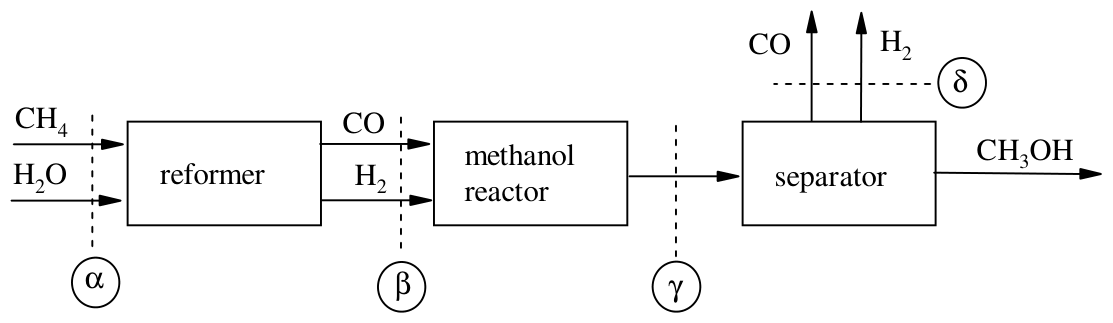
Figure 1
The flow of methanol at position \(\gamma\) is \(n[\ce{CH3OH},\gamma]=1000\ \mathrm{mol\,s^{-1}}\). The factory is so designed that 2/3 of the \(\ce{CO}\) is converted to methanol. Excess \(\ce{CO}\) and \(\ce{H2}\) at position \(\delta\) are used to heat the first reactor. Assume that the reformer reaction goes to completion.
4.1 Calculate the flow of \(\ce{CO}\) and \(\ce{H2}\) at position \(\beta\).
4.2 Calculate the flow of \(\ce{CO}\) and \(\ce{H2}\) at position \(\gamma\).
4.3 Calculate the flows of \(\ce{CH4}\) and \(\ce{H2O}\) needed at position \(\alpha\).
4.4 At point \(\gamma\) all species are gases. Calculate the partial pressures in MPa for \(\ce{CO}\), \(\ce{H2}\) and \(\ce{CH3OH}\) at position \(\gamma\) using the equation:
\[ p_i=p\frac{n_i}{n_{\mathrm{tot}}} \]
wherein \(n_i\) is the flow and \(p_i\) the partial pressure of the compound \(i\), \(n_{\mathrm{tot}}\) is the total flow at the position considered, and \(p\) the total pressure in the system. (\(p=10\ \mathrm{MPa}\))
When the methanol reactor is large enough the reaction goes to equilibrium. The partial pressures at point \(\gamma\) obey the equation:
\[ K_p=\frac{p_{\ce{CH3OH}}p_0^2}{p_{\ce{CO}}p_{\ce{H2}}^2} \]
wherein \(p_0\) is a constant (0.1 MPa) and \(K_p\) is a function of temperature as is shown in Figure 2 (the vertical scale is logarithmic).
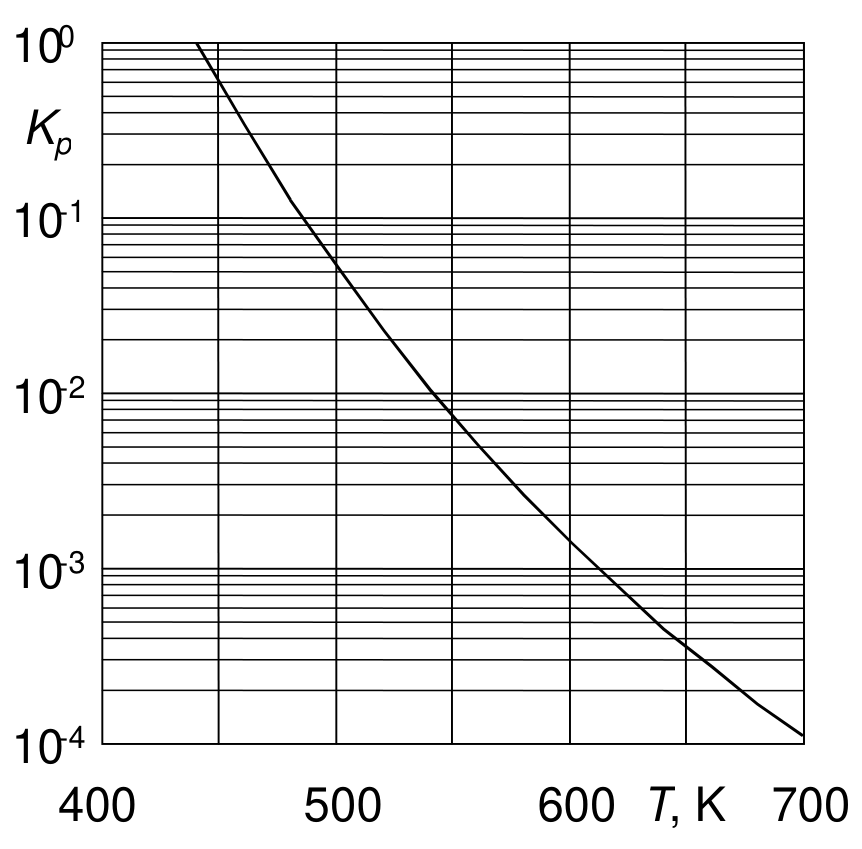
Figure 2
4.5 Calculate \(K_p\) and indicate at which temperature \(T\) the reaction must be operated to achieve this equilibrium.
Official English text of the problem.
Answers
Molecular names and SMILES used below: carbon monoxide, \(\ce{CO}\), [C-]#[O+]; hydrogen, \(\ce{H2}\), [H][H]; methane, \(\ce{CH4}\), C; water, \(\ce{H2O}\), O; methanol, \(\ce{CH3OH}\), CO.
- 4.1: \(n[\ce{CO},\beta]=1.50\times10^3\ \mathrm{mol\,s^{-1}}\); \(n[\ce{H2},\beta]=4.50\times10^3\ \mathrm{mol\,s^{-1}}\).
- 4.2: \(n[\ce{CO},\gamma]=5.00\times10^2\ \mathrm{mol\,s^{-1}}\); \(n[\ce{H2},\gamma]=2.50\times10^3\ \mathrm{mol\,s^{-1}}\).
- 4.3: \(n[\ce{CH4},\alpha]=n[\ce{H2O},\alpha]=1.50\times10^3\ \mathrm{mol\,s^{-1}}\).
- 4.4: At \(\gamma\), \(p_{\ce{CO}}=1.25\ \mathrm{MPa}\), \(p_{\ce{H2}}=6.25\ \mathrm{MPa}\), and \(p_{\ce{CH3OH}}=2.50\ \mathrm{MPa}\).
- 4.5: \(K_p=5.12\times10^{-4}\), dimensionless; \(T\approx640\ \mathrm{K}\), read from Figure 2.
Solution
4.1 — Flows entering the methanol reactor
The balanced methanol synthesis reaction is
\[ \ce{CO + 2H2 <=> CH3OH}. \]
Each mole of methanol formed consumes one mole of carbon monoxide. Thus, producing \(1000\ \mathrm{mol\,s^{-1}}\) of methanol consumes \(1000\ \mathrm{mol\,s^{-1}}\) of carbon monoxide. Since this represents \(2/3\) of the incoming carbon monoxide,
\[ \frac{2}{3}\,n[\ce{CO},\beta] =1000\ \mathrm{mol\,s^{-1}}, \]
giving
\[ \boxed{n[\ce{CO},\beta]=1500\ \mathrm{mol\,s^{-1}}}. \]
The balanced reforming reaction, taken to completion as instructed, is
\[ \ce{CH4 + H2O -> CO + 3H2}. \]
It produces three moles of hydrogen for each mole of carbon monoxide. Therefore,
\[ n[\ce{H2},\beta]=3\,n[\ce{CO},\beta] =3(1500), \]
\[ \boxed{n[\ce{H2},\beta]=4500\ \mathrm{mol\,s^{-1}}}. \]
4.2 — Flows leaving the methanol reactor
Subtract the quantities consumed in forming methanol:
\[ n[\ce{CO},\gamma] =(1500-1000)\ \mathrm{mol\,s^{-1}} =\boxed{500\ \mathrm{mol\,s^{-1}}}, \]
\[ n[\ce{H2},\gamma] =(4500-2\times1000)\ \mathrm{mol\,s^{-1}} =\boxed{2500\ \mathrm{mol\,s^{-1}}}. \]
The methanol flow is the given \(1000\ \mathrm{mol\,s^{-1}}\).
4.3 — Required methane and water feeds
The reforming reaction consumes one mole each of methane and water per mole of carbon monoxide produced. Complete reforming must supply \(1500\ \mathrm{mol\,s^{-1}}\) of carbon monoxide, so the required stoichiometric feeds are
\[ \boxed{n[\ce{CH4},\alpha]=1500\ \mathrm{mol\,s^{-1}}}, \]
\[ \boxed{n[\ce{H2O},\alpha]=1500\ \mathrm{mol\,s^{-1}}}. \]
4.4 — Partial pressures at \(\gamma\)
The total gas flow is
\[ n_{\mathrm{tot},\gamma} =(500+2500+1000)\ \mathrm{mol\,s^{-1}} =4000\ \mathrm{mol\,s^{-1}}. \]
Using \(p_i=p\,n_i/n_{\mathrm{tot}}\) at \(p=10\ \mathrm{MPa}\),
\[ p_{\ce{CO}} =(10\ \mathrm{MPa})\frac{500}{4000} =\boxed{1.25\ \mathrm{MPa}}, \]
\[ p_{\ce{H2}} =(10\ \mathrm{MPa})\frac{2500}{4000} =\boxed{6.25\ \mathrm{MPa}}, \]
\[ p_{\ce{CH3OH}} =(10\ \mathrm{MPa})\frac{1000}{4000} =\boxed{2.50\ \mathrm{MPa}}. \]
These partial pressures sum to \(10.00\ \mathrm{MPa}\), as required.
4.5 — Equilibrium constant and temperature
Substitute the partial pressures and \(p_0=0.1\ \mathrm{MPa}\) into the given expression:
\[ \begin{aligned} K_p &=\frac{p_{\ce{CH3OH}}p_0^2} {p_{\ce{CO}}p_{\ce{H2}}^2}\\[2mm] &=\frac{(2.50\ \mathrm{MPa})(0.1\ \mathrm{MPa})^2} {(1.25\ \mathrm{MPa})(6.25\ \mathrm{MPa})^2}\\[2mm] &=\boxed{5.12\times10^{-4}}. \end{aligned} \]
The pressure units cancel, so \(K_p\) is dimensionless.
On the logarithmic vertical axis of Figure 2, this value lies between \(10^{-3}\) and \(10^{-4}\), at
\[ \log_{10}K_p=-3.291. \]
Following this level horizontally to the curve and then vertically down to the temperature axis gives
\[ \boxed{T\approx640\ \mathrm{K}}. \]
The solution was checked against the official solution.
IChO 2002 · Theorieaufgabe 4
Herstellung von Methanol
Methanol (\(\ce{CH3OH}\)) ist eine Chemikalie, die zur Herstellung von Benzinzusätzen und vielen gebräuchlichen Kunststoffen verwendet wird. Eine Fabrik zur Herstellung von Methanol beruht auf der Reaktion:
Wasserstoff und \(\ce{CO}\) werden durch folgende Reaktion gewonnen:
Die drei Anlagenteile der Fabrik, nämlich der „Reformer“ zur Herstellung von Wasserstoff / Kohlenstoffmonoxid, der „Methanolreaktor“ und ein „Abscheider“ zur Abtrennung von Methanol von \(\ce{CO}\) und \(\ce{H2}\), sind in Abbildung 1 schematisch dargestellt. Vier Stellen sind mit \(\alpha\), \(\beta\), \(\gamma\) und \(\delta\) gekennzeichnet.
Abbildung 1
Der Methanolstoffstrom an der Stelle \(\gamma\) beträgt \(n[\ce{CH3OH},\gamma]=1000\ \mathrm{mol\,s^{-1}}\). Die Fabrik ist so ausgelegt, dass 2/3 des \(\ce{CO}\) zu Methanol umgesetzt werden. Überschüssiges \(\ce{CO}\) und \(\ce{H2}\) an der Stelle \(\delta\) werden zum Beheizen des ersten Reaktors verwendet. Nehmen Sie an, dass die Reaktion im Reformer vollständig abläuft.
4.1 Berechnen Sie die Stoffströme von \(\ce{CO}\) und \(\ce{H2}\) an der Stelle \(\beta\).
4.2 Berechnen Sie die Stoffströme von \(\ce{CO}\) und \(\ce{H2}\) an der Stelle \(\gamma\).
4.3 Berechnen Sie die an der Stelle \(\alpha\) benötigten Stoffströme von \(\ce{CH4}\) und \(\ce{H2O}\).
4.4 An der Stelle \(\gamma\) sind alle Stoffe gasförmig. Berechnen Sie die Partialdrücke in MPa für \(\ce{CO}\), \(\ce{H2}\) und \(\ce{CH3OH}\) an der Stelle \(\gamma\) mithilfe der Gleichung:
\[ p_i=p\frac{n_i}{n_{\mathrm{tot}}} \]
Dabei ist \(n_i\) der Stoffstrom und \(p_i\) der Partialdruck der Verbindung \(i\), \(n_{\mathrm{tot}}\) der Gesamtstoffstrom an der betrachteten Stelle und \(p\) der Gesamtdruck im System. (\(p=10\ \mathrm{MPa}\))
Wenn der Methanolreaktor groß genug ist, erreicht die Reaktion das Gleichgewicht. Die Partialdrücke an der Stelle \(\gamma\) erfüllen die Gleichung:
\[ K_p=\frac{p_{\ce{CH3OH}}p_0^2}{p_{\ce{CO}}p_{\ce{H2}}^2} \]
Dabei ist \(p_0\) eine Konstante (0.1 MPa), und \(K_p\) ist eine Funktion der Temperatur, wie in Abbildung 2 gezeigt (die vertikale Skala ist logarithmisch).
Abbildung 2
4.5 Berechnen Sie \(K_p\) und geben Sie an, bei welcher Temperatur \(T\) die Reaktion durchgeführt werden muss, um dieses Gleichgewicht zu erreichen.
Aufgabentext aus dem offiziellen englischen Text übersetzt.
Antworten
Im Folgenden verwendete Molekülnamen und SMILES: Kohlenstoffmonoxid, \(\ce{CO}\), [C-]#[O+]; Wasserstoff, \(\ce{H2}\), [H][H]; Methan, \(\ce{CH4}\), C; Wasser, \(\ce{H2O}\), O; Methanol, \(\ce{CH3OH}\), CO.
- 4.1: \(n[\ce{CO},\beta]=1.50\times10^3\ \mathrm{mol\,s^{-1}}\); \(n[\ce{H2},\beta]=4.50\times10^3\ \mathrm{mol\,s^{-1}}\).
- 4.2: \(n[\ce{CO},\gamma]=5.00\times10^2\ \mathrm{mol\,s^{-1}}\); \(n[\ce{H2},\gamma]=2.50\times10^3\ \mathrm{mol\,s^{-1}}\).
- 4.3: \(n[\ce{CH4},\alpha]=n[\ce{H2O},\alpha]=1.50\times10^3\ \mathrm{mol\,s^{-1}}\).
- 4.4: An der Stelle \(\gamma\) gilt \(p_{\ce{CO}}=1.25\ \mathrm{MPa}\), \(p_{\ce{H2}}=6.25\ \mathrm{MPa}\) und \(p_{\ce{CH3OH}}=2.50\ \mathrm{MPa}\).
- 4.5: \(K_p=5.12\times10^{-4}\), dimensionslos; \(T\approx640\ \mathrm{K}\), aus Abbildung 2 abgelesen.
Lösung
4.1 — In den Methanolreaktor eintretende Stoffströme
Die ausgeglichene Reaktionsgleichung der Methanolsynthese lautet
\[ \ce{CO + 2H2 <=> CH3OH}. \]
Für jedes gebildete Mol Methanol wird ein Mol Kohlenstoffmonoxid verbraucht. Somit werden zur Herstellung von \(1000\ \mathrm{mol\,s^{-1}}\) Methanol \(1000\ \mathrm{mol\,s^{-1}}\) Kohlenstoffmonoxid verbraucht. Da dies \(2/3\) des eintretenden Kohlenstoffmonoxids entspricht,
\[ \frac{2}{3}\,n[\ce{CO},\beta] =1000\ \mathrm{mol\,s^{-1}}, \]
ergibt sich
\[ \boxed{n[\ce{CO},\beta]=1500\ \mathrm{mol\,s^{-1}}}. \]
Die ausgeglichene Reaktionsgleichung der Reformierung, die gemäß der Vorgabe vollständig abläuft, lautet
\[ \ce{CH4 + H2O -> CO + 3H2}. \]
Dabei entstehen drei Mol Wasserstoff je Mol Kohlenstoffmonoxid. Daher gilt
\[ n[\ce{H2},\beta]=3\,n[\ce{CO},\beta] =3(1500), \]
\[ \boxed{n[\ce{H2},\beta]=4500\ \mathrm{mol\,s^{-1}}}. \]
4.2 — Aus dem Methanolreaktor austretende Stoffströme
Die bei der Bildung von Methanol verbrauchten Mengen werden abgezogen:
\[ n[\ce{CO},\gamma] =(1500-1000)\ \mathrm{mol\,s^{-1}} =\boxed{500\ \mathrm{mol\,s^{-1}}}, \]
\[ n[\ce{H2},\gamma] =(4500-2\times1000)\ \mathrm{mol\,s^{-1}} =\boxed{2500\ \mathrm{mol\,s^{-1}}}. \]
Der Methanolstoffstrom beträgt die vorgegebenen \(1000\ \mathrm{mol\,s^{-1}}\).
4.3 — Erforderliche Methan- und Wasserzufuhr
Bei der Reformierungsreaktion wird je Mol erzeugtem Kohlenstoffmonoxid jeweils ein Mol Methan und Wasser verbraucht. Die vollständige Reformierung muss \(1500\ \mathrm{mol\,s^{-1}}\) Kohlenstoffmonoxid liefern, sodass die erforderlichen stöchiometrischen Zulaufströme betragen:
\[ \boxed{n[\ce{CH4},\alpha]=1500\ \mathrm{mol\,s^{-1}}}, \]
\[ \boxed{n[\ce{H2O},\alpha]=1500\ \mathrm{mol\,s^{-1}}}. \]
4.4 — Partialdrücke an der Stelle \(\gamma\)
Der Gesamtstoffstrom des Gases beträgt
\[ n_{\mathrm{tot},\gamma} =(500+2500+1000)\ \mathrm{mol\,s^{-1}} =4000\ \mathrm{mol\,s^{-1}}. \]
Mit \(p_i=p\,n_i/n_{\mathrm{tot}}\) bei \(p=10\ \mathrm{MPa}\) ergibt sich
\[ p_{\ce{CO}} =(10\ \mathrm{MPa})\frac{500}{4000} =\boxed{1.25\ \mathrm{MPa}}, \]
\[ p_{\ce{H2}} =(10\ \mathrm{MPa})\frac{2500}{4000} =\boxed{6.25\ \mathrm{MPa}}, \]
\[ p_{\ce{CH3OH}} =(10\ \mathrm{MPa})\frac{1000}{4000} =\boxed{2.50\ \mathrm{MPa}}. \]
Diese Partialdrücke ergeben in der Summe wie gefordert \(10.00\ \mathrm{MPa}\).
4.5 — Gleichgewichtskonstante und Temperatur
Die Partialdrücke und \(p_0=0.1\ \mathrm{MPa}\) werden in den gegebenen Ausdruck eingesetzt:
\[ \begin{aligned} K_p &=\frac{p_{\ce{CH3OH}}p_0^2} {p_{\ce{CO}}p_{\ce{H2}}^2}\\[2mm] &=\frac{(2.50\ \mathrm{MPa})(0.1\ \mathrm{MPa})^2} {(1.25\ \mathrm{MPa})(6.25\ \mathrm{MPa})^2}\\[2mm] &=\boxed{5.12\times10^{-4}}. \end{aligned} \]
Die Druckeinheiten kürzen sich heraus, sodass \(K_p\) dimensionslos ist.
Auf der logarithmischen vertikalen Achse in Abbildung 2 liegt dieser Wert zwischen \(10^{-3}\) und \(10^{-4}\), bei
\[ \log_{10}K_p=-3.291. \]
Geht man von dieser Höhe waagerecht bis zur Kurve und anschließend senkrecht nach unten zur Temperaturachse, erhält man
\[ \boxed{T\approx640\ \mathrm{K}}. \]
Die Lösung wurde mit der offiziellen Lösung abgeglichen.
IChO 2002 · Teori sorusu 4
Metanol Üretimi
Metanol (\(\ce{CH3OH}\)), benzin katkı maddelerinin ve yaygın olarak kullanılan birçok plastiğin üretiminde kullanılan bir kimyasaldır. Metanol üreten bir fabrikada şu tepkime esas alınmaktadır:
Hidrojen ve \(\ce{CO}\) şu tepkimeyle elde edilir:
Fabrikanın üç ünitesi, yani hidrojen / karbon monoksit üretimi için kullanılan “reformer”, “metanol reaktörü” ve metanolü \(\ce{CO}\) ve \(\ce{H2}\)'den ayıran “ayırıcı”, Şekil 1'de şematik olarak gösterilmiştir. Dört konum \(\alpha\), \(\beta\), \(\gamma\) ve \(\delta\) ile belirtilmiştir.
Şekil 1
\(\gamma\) konumundaki metanol debisi \(n[\ce{CH3OH},\gamma]=1000\ \mathrm{mol\,s^{-1}}\)'dir. Fabrika, \(\ce{CO}\)'nun 2/3'ü metanole dönüşecek şekilde tasarlanmıştır. \(\delta\) konumundaki fazla \(\ce{CO}\) ve \(\ce{H2}\), birinci reaktörü ısıtmak için kullanılır. Reformerdeki tepkimenin tamamlandığını varsayınız.
4.1 \(\beta\) konumundaki \(\ce{CO}\) ve \(\ce{H2}\) debilerini hesaplayınız.
4.2 \(\gamma\) konumundaki \(\ce{CO}\) ve \(\ce{H2}\) debilerini hesaplayınız.
4.3 \(\alpha\) konumunda gerekli olan \(\ce{CH4}\) ve \(\ce{H2O}\) debilerini hesaplayınız.
4.4 \(\gamma\) noktasında bütün türler gaz hâlindedir. Aşağıdaki denklemi kullanarak \(\gamma\) konumundaki \(\ce{CO}\), \(\ce{H2}\) ve \(\ce{CH3OH}\)'ün kısmi basınçlarını MPa cinsinden hesaplayınız:
\[ p_i=p\frac{n_i}{n_{\mathrm{tot}}} \]
Burada \(n_i\), \(i\) bileşiğinin debisi ve \(p_i\) kısmi basıncı; \(n_{\mathrm{tot}}\), ele alınan konumdaki toplam debi; \(p\) ise sistemdeki toplam basınçtır. (\(p=10\ \mathrm{MPa}\))
Metanol reaktörü yeterince büyük olduğunda tepkime dengeye ulaşır. \(\gamma\) noktasındaki kısmi basınçlar şu denkleme uyar:
\[ K_p=\frac{p_{\ce{CH3OH}}p_0^2}{p_{\ce{CO}}p_{\ce{H2}}^2} \]
Burada \(p_0\) bir sabittir (0.1 MPa) ve \(K_p\), Şekil 2'de gösterildiği gibi sıcaklığın bir fonksiyonudur (düşey ölçek logaritmiktir).
Şekil 2
4.5 \(K_p\)'yi hesaplayınız ve bu dengeye ulaşmak için tepkimenin hangi \(T\) sıcaklığında yürütülmesi gerektiğini belirtiniz.
Soru metni resmi İngilizce metinden çevrilmiştir.
Cevaplar
Aşağıda kullanılan molekül adları ve SMILES gösterimleri: karbon monoksit, \(\ce{CO}\), [C-]#[O+]; hidrojen, \(\ce{H2}\), [H][H]; metan, \(\ce{CH4}\), C; su, \(\ce{H2O}\), O; metanol, \(\ce{CH3OH}\), CO.
- 4.1: \(n[\ce{CO},\beta]=1.50\times10^3\ \mathrm{mol\,s^{-1}}\); \(n[\ce{H2},\beta]=4.50\times10^3\ \mathrm{mol\,s^{-1}}\).
- 4.2: \(n[\ce{CO},\gamma]=5.00\times10^2\ \mathrm{mol\,s^{-1}}\); \(n[\ce{H2},\gamma]=2.50\times10^3\ \mathrm{mol\,s^{-1}}\).
- 4.3: \(n[\ce{CH4},\alpha]=n[\ce{H2O},\alpha]=1.50\times10^3\ \mathrm{mol\,s^{-1}}\).
- 4.4: \(\gamma\) konumunda \(p_{\ce{CO}}=1.25\ \mathrm{MPa}\), \(p_{\ce{H2}}=6.25\ \mathrm{MPa}\) ve \(p_{\ce{CH3OH}}=2.50\ \mathrm{MPa}\).
- 4.5: \(K_p=5.12\times10^{-4}\), boyutsuz; Şekil 2'den okunan sıcaklık \(T\approx640\ \mathrm{K}\).
Çözüm
4.1 — Metanol reaktörüne giren debiler
Denkleştirilmiş metanol sentezi tepkimesi şöyledir:
\[ \ce{CO + 2H2 <=> CH3OH}. \]
Oluşan her bir mol metanol için bir mol karbon monoksit tüketilir. Dolayısıyla, \(1000\ \mathrm{mol\,s^{-1}}\) metanol üretimi için \(1000\ \mathrm{mol\,s^{-1}}\) karbon monoksit tüketilir. Bu, giren karbon monoksitin \(2/3\)'ünü oluşturduğundan,
\[ \frac{2}{3}\,n[\ce{CO},\beta] =1000\ \mathrm{mol\,s^{-1}}, \]
buradan
\[ \boxed{n[\ce{CO},\beta]=1500\ \mathrm{mol\,s^{-1}}}. \]
Soruda belirtildiği üzere tamamlandığı kabul edilen, denkleştirilmiş reformlama tepkimesi şöyledir:
\[ \ce{CH4 + H2O -> CO + 3H2}. \]
Bu tepkimede her bir mol karbon monoksit için üç mol hidrojen üretilir. Dolayısıyla,
\[ n[\ce{H2},\beta]=3\,n[\ce{CO},\beta] =3(1500), \]
\[ \boxed{n[\ce{H2},\beta]=4500\ \mathrm{mol\,s^{-1}}}. \]
4.2 — Metanol reaktöründen çıkan debiler
Metanol oluşumunda tüketilen miktarları çıkarınız:
\[ n[\ce{CO},\gamma] =(1500-1000)\ \mathrm{mol\,s^{-1}} =\boxed{500\ \mathrm{mol\,s^{-1}}}, \]
\[ n[\ce{H2},\gamma] =(4500-2\times1000)\ \mathrm{mol\,s^{-1}} =\boxed{2500\ \mathrm{mol\,s^{-1}}}. \]
Metanol debisi, verilen \(1000\ \mathrm{mol\,s^{-1}}\) değeridir.
4.3 — Gerekli metan ve su beslemeleri
Reformlama tepkimesinde, üretilen her bir mol karbon monoksit için birer mol metan ve su tüketilir. Tamamlanan reformlama tepkimesi \(1500\ \mathrm{mol\,s^{-1}}\) karbon monoksit sağlamalıdır; dolayısıyla gerekli stokiyometrik besleme debileri şöyledir:
\[ \boxed{n[\ce{CH4},\alpha]=1500\ \mathrm{mol\,s^{-1}}}, \]
\[ \boxed{n[\ce{H2O},\alpha]=1500\ \mathrm{mol\,s^{-1}}}. \]
4.4 — \(\gamma\) konumundaki kısmi basınçlar
Toplam gaz debisi şöyledir:
\[ n_{\mathrm{tot},\gamma} =(500+2500+1000)\ \mathrm{mol\,s^{-1}} =4000\ \mathrm{mol\,s^{-1}}. \]
\(p=10\ \mathrm{MPa}\) basıncında \(p_i=p\,n_i/n_{\mathrm{tot}}\) bağıntısı kullanılarak,
\[ p_{\ce{CO}} =(10\ \mathrm{MPa})\frac{500}{4000} =\boxed{1.25\ \mathrm{MPa}}, \]
\[ p_{\ce{H2}} =(10\ \mathrm{MPa})\frac{2500}{4000} =\boxed{6.25\ \mathrm{MPa}}, \]
\[ p_{\ce{CH3OH}} =(10\ \mathrm{MPa})\frac{1000}{4000} =\boxed{2.50\ \mathrm{MPa}}. \]
Bu kısmi basınçların toplamı, olması gerektiği gibi \(10.00\ \mathrm{MPa}\)'dır.
4.5 — Denge sabiti ve sıcaklık
Kısmi basınçları ve \(p_0=0.1\ \mathrm{MPa}\) değerini verilen ifadede yerine koyunuz:
\[ \begin{aligned} K_p &=\frac{p_{\ce{CH3OH}}p_0^2} {p_{\ce{CO}}p_{\ce{H2}}^2}\\[2mm] &=\frac{(2.50\ \mathrm{MPa})(0.1\ \mathrm{MPa})^2} {(1.25\ \mathrm{MPa})(6.25\ \mathrm{MPa})^2}\\[2mm] &=\boxed{5.12\times10^{-4}}. \end{aligned} \]
Basınç birimleri sadeleştiğinden \(K_p\) boyutsuzdur.
Şekil 2'nin logaritmik düşey ekseninde bu değer, \(10^{-3}\) ile \(10^{-4}\) arasında, şu konumda yer alır:
\[ \log_{10}K_p=-3.291. \]
Bu düzeyden yatay olarak eğriye, ardından düşey olarak aşağıya, sıcaklık eksenine ilerlenerek şu değer elde edilir:
\[ \boxed{T\approx640\ \mathrm{K}}. \]
Çözüm, resmi çözümle karşılaştırılarak kontrol edildi.
IChO 2002 · Problema teórico 4
Producción de metanol
El metanol (\(\ce{CH3OH}\)) es una sustancia química que se utiliza para producir aditivos para la gasolina y muchos plásticos de uso común. Una fábrica que produce metanol se basa en la reacción:
El hidrógeno y el \(\ce{CO}\) se obtienen mediante la reacción:
Las tres unidades de la fábrica, a saber, el «reformador» para la producción de hidrógeno / monóxido de carbono, el «reactor de metanol» y un «separador» para separar el metanol del \(\ce{CO}\) y del \(\ce{H2}\), se muestran esquemáticamente en la Figura 1. Se indican cuatro posiciones mediante \(\alpha\), \(\beta\), \(\gamma\) y \(\delta\).
Figura 1
El caudal de metanol en la posición \(\gamma\) es \(n[\ce{CH3OH},\gamma]=1000\ \mathrm{mol\,s^{-1}}\). La fábrica está diseñada de modo que 2/3 del \(\ce{CO}\) se convierte en metanol. El \(\ce{CO}\) y el \(\ce{H2}\) en exceso en la posición \(\delta\) se utilizan para calentar el primer reactor. Suponga que la reacción del reformador transcurre hasta completarse.
4.1 Calcule el caudal de \(\ce{CO}\) y de \(\ce{H2}\) en la posición \(\beta\).
4.2 Calcule el caudal de \(\ce{CO}\) y de \(\ce{H2}\) en la posición \(\gamma\).
4.3 Calcule los caudales de \(\ce{CH4}\) y de \(\ce{H2O}\) necesarios en la posición \(\alpha\).
4.4 En el punto \(\gamma\), todas las especies son gaseosas. Calcule las presiones parciales en MPa de \(\ce{CO}\), \(\ce{H2}\) y \(\ce{CH3OH}\) en la posición \(\gamma\) utilizando la ecuación:
\[ p_i=p\frac{n_i}{n_{\mathrm{tot}}} \]
donde \(n_i\) es el caudal y \(p_i\) la presión parcial del compuesto \(i\), \(n_{\mathrm{tot}}\) es el caudal total en la posición considerada y \(p\) la presión total del sistema. (\(p=10\ \mathrm{MPa}\))
Cuando el reactor de metanol es lo suficientemente grande, la reacción alcanza el equilibrio. Las presiones parciales en el punto \(\gamma\) cumplen la ecuación:
\[ K_p=\frac{p_{\ce{CH3OH}}p_0^2}{p_{\ce{CO}}p_{\ce{H2}}^2} \]
donde \(p_0\) es una constante (0.1 MPa) y \(K_p\) es una función de la temperatura, como se muestra en la Figura 2 (la escala vertical es logarítmica).
Figura 2
4.5 Calcule \(K_p\) e indique a qué temperatura \(T\) debe llevarse a cabo la reacción para alcanzar este equilibrio.
Enunciado traducido del texto oficial en inglés.
Respuestas
Nombres de las moléculas y SMILES utilizados a continuación: monóxido de carbono, \(\ce{CO}\), [C-]#[O+]; hidrógeno, \(\ce{H2}\), [H][H]; metano, \(\ce{CH4}\), C; agua, \(\ce{H2O}\), O; metanol, \(\ce{CH3OH}\), CO.
- 4.1: \(n[\ce{CO},\beta]=1.50\times10^3\ \mathrm{mol\,s^{-1}}\); \(n[\ce{H2},\beta]=4.50\times10^3\ \mathrm{mol\,s^{-1}}\).
- 4.2: \(n[\ce{CO},\gamma]=5.00\times10^2\ \mathrm{mol\,s^{-1}}\); \(n[\ce{H2},\gamma]=2.50\times10^3\ \mathrm{mol\,s^{-1}}\).
- 4.3: \(n[\ce{CH4},\alpha]=n[\ce{H2O},\alpha]=1.50\times10^3\ \mathrm{mol\,s^{-1}}\).
- 4.4: En \(\gamma\), \(p_{\ce{CO}}=1.25\ \mathrm{MPa}\), \(p_{\ce{H2}}=6.25\ \mathrm{MPa}\) y \(p_{\ce{CH3OH}}=2.50\ \mathrm{MPa}\).
- 4.5: \(K_p=5.12\times10^{-4}\), adimensional; \(T\approx640\ \mathrm{K}\), leído de la Figura 2.
Solución
4.1 — Caudales que entran en el reactor de metanol
La reacción ajustada de síntesis del metanol es
\[ \ce{CO + 2H2 <=> CH3OH}. \]
Cada mol de metanol formado consume un mol de monóxido de carbono. Por tanto, producir \(1000\ \mathrm{mol\,s^{-1}}\) de metanol consume \(1000\ \mathrm{mol\,s^{-1}}\) de monóxido de carbono. Dado que esto representa \(2/3\) del monóxido de carbono que entra,
\[ \frac{2}{3}\,n[\ce{CO},\beta] =1000\ \mathrm{mol\,s^{-1}}, \]
se obtiene
\[ \boxed{n[\ce{CO},\beta]=1500\ \mathrm{mol\,s^{-1}}}. \]
La reacción ajustada de reformado, que se considera completa según lo indicado, es
\[ \ce{CH4 + H2O -> CO + 3H2}. \]
Produce tres moles de hidrógeno por cada mol de monóxido de carbono. Por tanto,
\[ n[\ce{H2},\beta]=3\,n[\ce{CO},\beta] =3(1500), \]
\[ \boxed{n[\ce{H2},\beta]=4500\ \mathrm{mol\,s^{-1}}}. \]
4.2 — Caudales que salen del reactor de metanol
Se restan las cantidades consumidas en la formación de metanol:
\[ n[\ce{CO},\gamma] =(1500-1000)\ \mathrm{mol\,s^{-1}} =\boxed{500\ \mathrm{mol\,s^{-1}}}, \]
\[ n[\ce{H2},\gamma] =(4500-2\times1000)\ \mathrm{mol\,s^{-1}} =\boxed{2500\ \mathrm{mol\,s^{-1}}}. \]
El caudal de metanol es el valor dado de \(1000\ \mathrm{mol\,s^{-1}}\).
4.3 — Caudales de alimentación de metano y agua necesarios
La reacción de reformado consume un mol de metano y un mol de agua por cada mol de monóxido de carbono producido. El reformado completo debe suministrar \(1500\ \mathrm{mol\,s^{-1}}\) de monóxido de carbono, por lo que los caudales de alimentación estequiométricos necesarios son
\[ \boxed{n[\ce{CH4},\alpha]=1500\ \mathrm{mol\,s^{-1}}}, \]
\[ \boxed{n[\ce{H2O},\alpha]=1500\ \mathrm{mol\,s^{-1}}}. \]
4.4 — Presiones parciales en \(\gamma\)
El caudal total de gas es
\[ n_{\mathrm{tot},\gamma} =(500+2500+1000)\ \mathrm{mol\,s^{-1}} =4000\ \mathrm{mol\,s^{-1}}. \]
Utilizando \(p_i=p\,n_i/n_{\mathrm{tot}}\) a \(p=10\ \mathrm{MPa}\),
\[ p_{\ce{CO}} =(10\ \mathrm{MPa})\frac{500}{4000} =\boxed{1.25\ \mathrm{MPa}}, \]
\[ p_{\ce{H2}} =(10\ \mathrm{MPa})\frac{2500}{4000} =\boxed{6.25\ \mathrm{MPa}}, \]
\[ p_{\ce{CH3OH}} =(10\ \mathrm{MPa})\frac{1000}{4000} =\boxed{2.50\ \mathrm{MPa}}. \]
Estas presiones parciales suman \(10.00\ \mathrm{MPa}\), como corresponde.
4.5 — Constante de equilibrio y temperatura
Se sustituyen las presiones parciales y \(p_0=0.1\ \mathrm{MPa}\) en la expresión dada:
\[ \begin{aligned} K_p &=\frac{p_{\ce{CH3OH}}p_0^2} {p_{\ce{CO}}p_{\ce{H2}}^2}\\[2mm] &=\frac{(2.50\ \mathrm{MPa})(0.1\ \mathrm{MPa})^2} {(1.25\ \mathrm{MPa})(6.25\ \mathrm{MPa})^2}\\[2mm] &=\boxed{5.12\times10^{-4}}. \end{aligned} \]
Las unidades de presión se cancelan, por lo que \(K_p\) es adimensional.
En el eje vertical logarítmico de la Figura 2, este valor se encuentra entre \(10^{-3}\) y \(10^{-4}\), en
\[ \log_{10}K_p=-3.291. \]
Siguiendo este nivel horizontalmente hasta la curva y luego verticalmente hacia abajo hasta el eje de temperatura, se obtiene
\[ \boxed{T\approx640\ \mathrm{K}}. \]
La solución se comprobó con la solución oficial.
IChO 2002 · 理论题 4
甲醇的生产
甲醇(\(\ce{CH3OH}\))是一种用于生产汽油添加剂和许多常见塑料的化学品。某甲醇生产厂采用以下反应:
氢气和 \(\ce{CO}\) 通过以下反应制得:
该厂的三个装置,即用于生产氢气/一氧化碳的“重整炉”、“甲醇反应器”以及用于将甲醇与 \(\ce{CO}\) 和 \(\ce{H2}\) 分离的“分离器”,如图 1 所示。图中用 \(\alpha\)、\(\beta\)、\(\gamma\) 和 \(\delta\) 标出了四个位置。
图 1
\(\gamma\) 处的甲醇流量为 \(n[\ce{CH3OH},\gamma]=1000\ \mathrm{mol\,s^{-1}}\)。该厂的设计使 2/3 的 \(\ce{CO}\) 转化为甲醇。\(\delta\) 处剩余的 \(\ce{CO}\) 和 \(\ce{H2}\) 用于加热第一个反应器。假设重整炉中的反应完全进行。
4.1 计算 \(\beta\) 处 \(\ce{CO}\) 和 \(\ce{H2}\) 的流量。
4.2 计算 \(\gamma\) 处 \(\ce{CO}\) 和 \(\ce{H2}\) 的流量。
4.3 计算 \(\alpha\) 处所需的 \(\ce{CH4}\) 和 \(\ce{H2O}\) 的流量。
4.4 在 \(\gamma\) 处,所有物质均为气态。利用以下方程,计算 \(\gamma\) 处 \(\ce{CO}\)、\(\ce{H2}\) 和 \(\ce{CH3OH}\) 的分压,以 MPa 为单位:
\[ p_i=p\frac{n_i}{n_{\mathrm{tot}}} \]
其中,\(n_i\) 为化合物 \(i\) 的流量,\(p_i\) 为其分压,\(n_{\mathrm{tot}}\) 为所考察位置处的总流量,\(p\) 为体系的总压。(\(p=10\ \mathrm{MPa}\))
当甲醇反应器足够大时,反应达到平衡。\(\gamma\) 处的分压满足以下方程:
\[ K_p=\frac{p_{\ce{CH3OH}}p_0^2}{p_{\ce{CO}}p_{\ce{H2}}^2} \]
其中,\(p_0\) 为常数(0.1 MPa),\(K_p\) 是温度的函数,其关系如图 2 所示(纵轴采用对数刻度)。
图 2
4.5 计算 \(K_p\),并指出为达到此平衡,反应必须在什么温度 \(T\) 下进行。
题目译自官方英文原文。
答案
下文使用的分子名称及 SMILES:一氧化碳,\(\ce{CO}\),[C-]#[O+];氢气,\(\ce{H2}\),[H][H];甲烷,\(\ce{CH4}\),C;水,\(\ce{H2O}\),O;甲醇,\(\ce{CH3OH}\),CO。
- 4.1: \(n[\ce{CO},\beta]=1.50\times10^3\ \mathrm{mol\,s^{-1}}\);\(n[\ce{H2},\beta]=4.50\times10^3\ \mathrm{mol\,s^{-1}}\)。
- 4.2: \(n[\ce{CO},\gamma]=5.00\times10^2\ \mathrm{mol\,s^{-1}}\);\(n[\ce{H2},\gamma]=2.50\times10^3\ \mathrm{mol\,s^{-1}}\)。
- 4.3: \(n[\ce{CH4},\alpha]=n[\ce{H2O},\alpha]=1.50\times10^3\ \mathrm{mol\,s^{-1}}\)。
- 4.4: 在 \(\gamma\) 处,\(p_{\ce{CO}}=1.25\ \mathrm{MPa}\),\(p_{\ce{H2}}=6.25\ \mathrm{MPa}\),\(p_{\ce{CH3OH}}=2.50\ \mathrm{MPa}\)。
- 4.5: \(K_p=5.12\times10^{-4}\),无量纲;\(T\approx640\ \mathrm{K}\),由图 2 读出。
解答
4.1 — 进入甲醇反应器的流量
配平后的甲醇合成反应为
\[ \ce{CO + 2H2 <=> CH3OH}. \]
每生成一摩尔甲醇,消耗一摩尔一氧化碳。因此,生成 \(1000\ \mathrm{mol\,s^{-1}}\) 的甲醇需要消耗 \(1000\ \mathrm{mol\,s^{-1}}\) 的一氧化碳。由于这占进入反应器的一氧化碳的 \(2/3\),
\[ \frac{2}{3}\,n[\ce{CO},\beta] =1000\ \mathrm{mol\,s^{-1}}, \]
得到
\[ \boxed{n[\ce{CO},\beta]=1500\ \mathrm{mol\,s^{-1}}}. \]
按题意,重整反应完全进行,其配平后的反应方程式为
\[ \ce{CH4 + H2O -> CO + 3H2}. \]
每生成一摩尔一氧化碳,同时生成三摩尔氢气。因此,
\[ n[\ce{H2},\beta]=3\,n[\ce{CO},\beta] =3(1500), \]
\[ \boxed{n[\ce{H2},\beta]=4500\ \mathrm{mol\,s^{-1}}}. \]
4.2 — 离开甲醇反应器的流量
减去生成甲醇时消耗的量:
\[ n[\ce{CO},\gamma] =(1500-1000)\ \mathrm{mol\,s^{-1}} =\boxed{500\ \mathrm{mol\,s^{-1}}}, \]
\[ n[\ce{H2},\gamma] =(4500-2\times1000)\ \mathrm{mol\,s^{-1}} =\boxed{2500\ \mathrm{mol\,s^{-1}}}. \]
甲醇流量为题目给出的 \(1000\ \mathrm{mol\,s^{-1}}\)。
4.3 — 所需的甲烷和水的进料流量
重整反应每生成一摩尔一氧化碳,消耗甲烷和水各一摩尔。完全进行的重整反应必须提供 \(1500\ \mathrm{mol\,s^{-1}}\) 的一氧化碳,因此,按化学计量关系所需的进料流量为
\[ \boxed{n[\ce{CH4},\alpha]=1500\ \mathrm{mol\,s^{-1}}}, \]
\[ \boxed{n[\ce{H2O},\alpha]=1500\ \mathrm{mol\,s^{-1}}}. \]
4.4 — \(\gamma\) 处的分压
气体总流量为
\[ n_{\mathrm{tot},\gamma} =(500+2500+1000)\ \mathrm{mol\,s^{-1}} =4000\ \mathrm{mol\,s^{-1}}. \]
在 \(p=10\ \mathrm{MPa}\) 下,利用 \(p_i=p\,n_i/n_{\mathrm{tot}}\),
\[ p_{\ce{CO}} =(10\ \mathrm{MPa})\frac{500}{4000} =\boxed{1.25\ \mathrm{MPa}}, \]
\[ p_{\ce{H2}} =(10\ \mathrm{MPa})\frac{2500}{4000} =\boxed{6.25\ \mathrm{MPa}}, \]
\[ p_{\ce{CH3OH}} =(10\ \mathrm{MPa})\frac{1000}{4000} =\boxed{2.50\ \mathrm{MPa}}. \]
这些分压之和为 \(10.00\ \mathrm{MPa}\),符合要求。
4.5 — 平衡常数和温度
将各分压和 \(p_0=0.1\ \mathrm{MPa}\) 代入给定的表达式:
\[ \begin{aligned} K_p &=\frac{p_{\ce{CH3OH}}p_0^2} {p_{\ce{CO}}p_{\ce{H2}}^2}\\[2mm] &=\frac{(2.50\ \mathrm{MPa})(0.1\ \mathrm{MPa})^2} {(1.25\ \mathrm{MPa})(6.25\ \mathrm{MPa})^2}\\[2mm] &=\boxed{5.12\times10^{-4}}. \end{aligned} \]
压力单位相消,因此 \(K_p\) 为无量纲量。
在图 2 采用对数刻度的纵轴上,该值位于 \(10^{-3}\) 和 \(10^{-4}\) 之间,对应于
\[ \log_{10}K_p=-3.291. \]
从这一高度沿水平方向找到曲线,再竖直向下找到温度轴,即得
\[ \boxed{T\approx640\ \mathrm{K}}. \]
解答已与官方解答核对。
IChO 2002 · Теоретическая задача 4
Производство метанола
Метанол (\(\ce{CH3OH}\)) — химическое вещество, используемое для производства присадок к бензину и многих распространённых пластмасс. Работа завода по производству метанола основана на реакции:
Водород и \(\ce{CO}\) получают по реакции:
Три установки завода, а именно «реактор паровой конверсии» для получения водорода и монооксида углерода, «реактор синтеза метанола» и «сепаратор» для отделения метанола от \(\ce{CO}\) и \(\ce{H2}\), схематически показаны на рисунке 1. Четыре точки обозначены как \(\alpha\), \(\beta\), \(\gamma\) и \(\delta\).
Рисунок 1
Молярный расход метанола в точке \(\gamma\) составляет \(n[\ce{CH3OH},\gamma]=1000\ \mathrm{mol\,s^{-1}}\). Завод спроектирован таким образом, что 2/3 количества \(\ce{CO}\) превращается в метанол. Избыток \(\ce{CO}\) и \(\ce{H2}\) в точке \(\delta\) используется для обогрева первого реактора. Считайте, что реакция паровой конверсии протекает до конца.
4.1 Рассчитайте молярные расходы \(\ce{CO}\) и \(\ce{H2}\) в точке \(\beta\).
4.2 Рассчитайте молярные расходы \(\ce{CO}\) и \(\ce{H2}\) в точке \(\gamma\).
4.3 Рассчитайте необходимые молярные расходы \(\ce{CH4}\) и \(\ce{H2O}\) в точке \(\alpha\).
4.4 В точке \(\gamma\) все вещества находятся в газообразном состоянии. Рассчитайте парциальные давления \(\ce{CO}\), \(\ce{H2}\) и \(\ce{CH3OH}\) в МПа в точке \(\gamma\), используя уравнение:
\[ p_i=p\frac{n_i}{n_{\mathrm{tot}}} \]
где \(n_i\) — молярный расход, а \(p_i\) — парциальное давление вещества \(i\), \(n_{\mathrm{tot}}\) — суммарный молярный расход в рассматриваемой точке, а \(p\) — общее давление в системе. (\(p=10\ \mathrm{MPa}\))
Если реактор синтеза метанола достаточно велик, реакция достигает равновесия. Парциальные давления в точке \(\gamma\) удовлетворяют уравнению:
\[ K_p=\frac{p_{\ce{CH3OH}}p_0^2}{p_{\ce{CO}}p_{\ce{H2}}^2} \]
где \(p_0\) — постоянная (0.1 МПа), а \(K_p\) — функция температуры, показанная на рисунке 2 (шкала вертикальной оси логарифмическая).
Рисунок 2
4.5 Рассчитайте \(K_p\) и укажите, при какой температуре \(T\) необходимо проводить реакцию, чтобы достичь этого равновесия.
Условие переведено с официального английского текста.
Ответы
Названия молекул и записи SMILES, используемые ниже: монооксид углерода, \(\ce{CO}\), [C-]#[O+]; водород, \(\ce{H2}\), [H][H]; метан, \(\ce{CH4}\), C; вода, \(\ce{H2O}\), O; метанол, \(\ce{CH3OH}\), CO.
- 4.1: \(n[\ce{CO},\beta]=1.50\times10^3\ \mathrm{mol\,s^{-1}}\); \(n[\ce{H2},\beta]=4.50\times10^3\ \mathrm{mol\,s^{-1}}\).
- 4.2: \(n[\ce{CO},\gamma]=5.00\times10^2\ \mathrm{mol\,s^{-1}}\); \(n[\ce{H2},\gamma]=2.50\times10^3\ \mathrm{mol\,s^{-1}}\).
- 4.3: \(n[\ce{CH4},\alpha]=n[\ce{H2O},\alpha]=1.50\times10^3\ \mathrm{mol\,s^{-1}}\).
- 4.4: В точке \(\gamma\): \(p_{\ce{CO}}=1.25\ \mathrm{MPa}\), \(p_{\ce{H2}}=6.25\ \mathrm{MPa}\) и \(p_{\ce{CH3OH}}=2.50\ \mathrm{MPa}\).
- 4.5: \(K_p=5.12\times10^{-4}\), безразмерная величина; \(T\approx640\ \mathrm{K}\), по рисунку 2.
Решение
4.1 — Молярные расходы на входе в реактор синтеза метанола
Уравнение реакции синтеза метанола с расставленными коэффициентами:
\[ \ce{CO + 2H2 <=> CH3OH}. \]
На образование каждого моля метанола расходуется один моль монооксида углерода. Следовательно, при получении \(1000\ \mathrm{mol\,s^{-1}}\) метанола расходуется \(1000\ \mathrm{mol\,s^{-1}}\) монооксида углерода. Поскольку это составляет \(2/3\) поступающего монооксида углерода,
\[ \frac{2}{3}\,n[\ce{CO},\beta] =1000\ \mathrm{mol\,s^{-1}}, \]
откуда
\[ \boxed{n[\ce{CO},\beta]=1500\ \mathrm{mol\,s^{-1}}}. \]
Уравнение реакции паровой конверсии с расставленными коэффициентами, которая, согласно условию, протекает до конца:
\[ \ce{CH4 + H2O -> CO + 3H2}. \]
В этой реакции на каждый моль монооксида углерода образуется три моля водорода. Поэтому
\[ n[\ce{H2},\beta]=3\,n[\ce{CO},\beta] =3(1500), \]
\[ \boxed{n[\ce{H2},\beta]=4500\ \mathrm{mol\,s^{-1}}}. \]
4.2 — Молярные расходы на выходе из реактора синтеза метанола
Вычтем количества веществ, расходуемые на образование метанола:
\[ n[\ce{CO},\gamma] =(1500-1000)\ \mathrm{mol\,s^{-1}} =\boxed{500\ \mathrm{mol\,s^{-1}}}, \]
\[ n[\ce{H2},\gamma] =(4500-2\times1000)\ \mathrm{mol\,s^{-1}} =\boxed{2500\ \mathrm{mol\,s^{-1}}}. \]
Молярный расход метанола задан в условии и составляет \(1000\ \mathrm{mol\,s^{-1}}\).
4.3 — Необходимые расходы подаваемых метана и воды
В реакции паровой конверсии на каждый моль образующегося монооксида углерода расходуется по одному молю метана и воды. При полном протекании паровой конверсии должно образовываться \(1500\ \mathrm{mol\,s^{-1}}\) монооксида углерода, поэтому необходимые стехиометрические расходы подаваемых веществ равны
\[ \boxed{n[\ce{CH4},\alpha]=1500\ \mathrm{mol\,s^{-1}}}, \]
\[ \boxed{n[\ce{H2O},\alpha]=1500\ \mathrm{mol\,s^{-1}}}. \]
4.4 — Парциальные давления в точке \(\gamma\)
Суммарный молярный расход газа равен
\[ n_{\mathrm{tot},\gamma} =(500+2500+1000)\ \mathrm{mol\,s^{-1}} =4000\ \mathrm{mol\,s^{-1}}. \]
Используя \(p_i=p\,n_i/n_{\mathrm{tot}}\) при \(p=10\ \mathrm{MPa}\), получаем
\[ p_{\ce{CO}} =(10\ \mathrm{MPa})\frac{500}{4000} =\boxed{1.25\ \mathrm{MPa}}, \]
\[ p_{\ce{H2}} =(10\ \mathrm{MPa})\frac{2500}{4000} =\boxed{6.25\ \mathrm{MPa}}, \]
\[ p_{\ce{CH3OH}} =(10\ \mathrm{MPa})\frac{1000}{4000} =\boxed{2.50\ \mathrm{MPa}}. \]
Сумма этих парциальных давлений равна \(10.00\ \mathrm{MPa}\), как и должно быть.
4.5 — Константа равновесия и температура
Подставим парциальные давления и \(p_0=0.1\ \mathrm{MPa}\) в данное выражение:
\[ \begin{aligned} K_p &=\frac{p_{\ce{CH3OH}}p_0^2} {p_{\ce{CO}}p_{\ce{H2}}^2}\\[2mm] &=\frac{(2.50\ \mathrm{MPa})(0.1\ \mathrm{MPa})^2} {(1.25\ \mathrm{MPa})(6.25\ \mathrm{MPa})^2}\\[2mm] &=\boxed{5.12\times10^{-4}}. \end{aligned} \]
Единицы давления сокращаются, поэтому \(K_p\) — безразмерная величина.
На логарифмической вертикальной оси рисунка 2 это значение находится между \(10^{-3}\) и \(10^{-4}\), на уровне
\[ \log_{10}K_p=-3.291. \]
Проводя от этого уровня горизонтальную линию до кривой, а затем вертикальную линию вниз до оси температур, получаем
\[ \boxed{T\approx640\ \mathrm{K}}. \]
Решение проверено по официальному решению.
IChO 2002 · مسألة نظرية 4
إنتاج الميثانول
الميثانول (\(\ce{CH3OH}\)) مادة كيميائية تُستخدم في إنتاج إضافات البنزين والعديد من المواد البلاستيكية الشائعة. يعتمد مصنع لإنتاج الميثانول على التفاعل:
يُحصَل على الهيدروجين و\(\ce{CO}\) من خلال التفاعل:
يوضح الشكل 1 رسمًا تخطيطيًا لوحدات المصنع الثلاث، وهي «وحدة الإصلاح» لإنتاج الهيدروجين / أحادي أكسيد الكربون، و«مفاعل الميثانول»، و«فاصل» لفصل الميثانول عن \(\ce{CO}\) و\(\ce{H2}\). ويُشار إلى أربعة مواضع بالرموز \(\alpha\) و\(\beta\) و\(\gamma\) و\(\delta\).
الشكل 1
معدل تدفق الميثانول عند الموضع \(\gamma\) هو \(n[\ce{CH3OH},\gamma]=1000\ \mathrm{mol\,s^{-1}}\). صُمِّم المصنع بحيث يتحول 2/3 من \(\ce{CO}\) إلى ميثانول. ويُستخدم فائض \(\ce{CO}\) و\(\ce{H2}\) عند الموضع \(\delta\) لتسخين المفاعل الأول. افترض أن تفاعل الإصلاح يجري حتى الاكتمال.
4.1 احسب معدل تدفق كلٍّ من \(\ce{CO}\) و\(\ce{H2}\) عند الموضع \(\beta\).
4.2 احسب معدل تدفق كلٍّ من \(\ce{CO}\) و\(\ce{H2}\) عند الموضع \(\gamma\).
4.3 احسب معدلي تدفق \(\ce{CH4}\) و\(\ce{H2O}\) اللازمين عند الموضع \(\alpha\).
4.4 عند النقطة \(\gamma\)، تكون جميع الأنواع الكيميائية غازية. احسب الضغوط الجزئية بوحدة MPa لكلٍّ من \(\ce{CO}\) و\(\ce{H2}\) و\(\ce{CH3OH}\) عند الموضع \(\gamma\) باستخدام المعادلة:
\[ p_i=p\frac{n_i}{n_{\mathrm{tot}}} \]
حيث \(n_i\) هو معدل التدفق و\(p_i\) هو الضغط الجزئي للمركب \(i\)، و\(n_{\mathrm{tot}}\) هو معدل التدفق الكلي عند الموضع المدروس، و\(p\) هو الضغط الكلي في النظام. (\(p=10\ \mathrm{MPa}\))
عندما يكون مفاعل الميثانول كبيرًا بما يكفي، يصل التفاعل إلى الاتزان. وتخضع الضغوط الجزئية عند النقطة \(\gamma\) للمعادلة:
\[ K_p=\frac{p_{\ce{CH3OH}}p_0^2}{p_{\ce{CO}}p_{\ce{H2}}^2} \]
حيث \(p_0\) ثابت (0.1 MPa)، و\(K_p\) دالة في درجة الحرارة كما هو موضح في الشكل 2 (تدريج المحور الرأسي لوغاريتمي).
الشكل 2
4.5 احسب \(K_p\)، وحدد درجة الحرارة \(T\) التي يجب إجراء التفاعل عندها لتحقيق هذا الاتزان.
نص المسألة مترجم عن النص الإنجليزي الرسمي.
الإجابات
أسماء الجزيئات وتمثيلاتها بصيغة SMILES المستخدمة أدناه: أحادي أكسيد الكربون، \(\ce{CO}\)، [C-]#[O+]؛ الهيدروجين، \(\ce{H2}\)، [H][H]؛ الميثان، \(\ce{CH4}\)، C؛ الماء، \(\ce{H2O}\)، O؛ الميثانول، \(\ce{CH3OH}\)، CO.
- 4.1: \(n[\ce{CO},\beta]=1.50\times10^3\ \mathrm{mol\,s^{-1}}\)؛ \(n[\ce{H2},\beta]=4.50\times10^3\ \mathrm{mol\,s^{-1}}\).
- 4.2: \(n[\ce{CO},\gamma]=5.00\times10^2\ \mathrm{mol\,s^{-1}}\)؛ \(n[\ce{H2},\gamma]=2.50\times10^3\ \mathrm{mol\,s^{-1}}\).
- 4.3: \(n[\ce{CH4},\alpha]=n[\ce{H2O},\alpha]=1.50\times10^3\ \mathrm{mol\,s^{-1}}\).
- 4.4: عند \(\gamma\)، \(p_{\ce{CO}}=1.25\ \mathrm{MPa}\)، و\(p_{\ce{H2}}=6.25\ \mathrm{MPa}\)، و\(p_{\ce{CH3OH}}=2.50\ \mathrm{MPa}\).
- 4.5: \(K_p=5.12\times10^{-4}\)، بلا أبعاد؛ \(T\approx640\ \mathrm{K}\)، بالقراءة من الشكل 2.
الحل
4.1 — معدلات التدفق الداخلة إلى مفاعل الميثانول
المعادلة الموزونة لتفاعل اصطناع الميثانول هي
\[ \ce{CO + 2H2 <=> CH3OH}. \]
يستهلك كل مول متكوّن من الميثانول مولًا واحدًا من أحادي أكسيد الكربون. ومن ثم، فإن إنتاج \(1000\ \mathrm{mol\,s^{-1}}\) من الميثانول يستهلك \(1000\ \mathrm{mol\,s^{-1}}\) من أحادي أكسيد الكربون. وبما أن هذا يمثل \(2/3\) من أحادي أكسيد الكربون الداخل، فإن
\[ \frac{2}{3}\,n[\ce{CO},\beta] =1000\ \mathrm{mol\,s^{-1}}, \]
ومن ذلك نحصل على
\[ \boxed{n[\ce{CO},\beta]=1500\ \mathrm{mol\,s^{-1}}}. \]
المعادلة الموزونة لتفاعل الإصلاح، الذي يُفترض اكتماله وفقًا للتعليمات، هي
\[ \ce{CH4 + H2O -> CO + 3H2}. \]
ينتج هذا التفاعل ثلاثة مولات من الهيدروجين مقابل كل مول من أحادي أكسيد الكربون. لذلك،
\[ n[\ce{H2},\beta]=3\,n[\ce{CO},\beta] =3(1500), \]
\[ \boxed{n[\ce{H2},\beta]=4500\ \mathrm{mol\,s^{-1}}}. \]
4.2 — معدلات التدفق الخارجة من مفاعل الميثانول
نطرح الكميات المستهلكة في تكوين الميثانول:
\[ n[\ce{CO},\gamma] =(1500-1000)\ \mathrm{mol\,s^{-1}} =\boxed{500\ \mathrm{mol\,s^{-1}}}, \]
\[ n[\ce{H2},\gamma] =(4500-2\times1000)\ \mathrm{mol\,s^{-1}} =\boxed{2500\ \mathrm{mol\,s^{-1}}}. \]
معدل تدفق الميثانول هو القيمة المعطاة \(1000\ \mathrm{mol\,s^{-1}}\).
4.3 — معدلا التغذية المطلوبان للميثان والماء
يستهلك تفاعل الإصلاح مولًا واحدًا من كلٍّ من الميثان والماء مقابل كل مول يُنتَج من أحادي أكسيد الكربون. ويجب أن يوفر الإصلاح الكامل \(1500\ \mathrm{mol\,s^{-1}}\) من أحادي أكسيد الكربون، لذا فإن معدلي التغذية المطلوبين وفق النسب الستوكيومترية هما
\[ \boxed{n[\ce{CH4},\alpha]=1500\ \mathrm{mol\,s^{-1}}}, \]
\[ \boxed{n[\ce{H2O},\alpha]=1500\ \mathrm{mol\,s^{-1}}}. \]
4.4 — الضغوط الجزئية عند \(\gamma\)
معدل التدفق الكلي للغاز هو
\[ n_{\mathrm{tot},\gamma} =(500+2500+1000)\ \mathrm{mol\,s^{-1}} =4000\ \mathrm{mol\,s^{-1}}. \]
باستخدام \(p_i=p\,n_i/n_{\mathrm{tot}}\) عند \(p=10\ \mathrm{MPa}\)،
\[ p_{\ce{CO}} =(10\ \mathrm{MPa})\frac{500}{4000} =\boxed{1.25\ \mathrm{MPa}}, \]
\[ p_{\ce{H2}} =(10\ \mathrm{MPa})\frac{2500}{4000} =\boxed{6.25\ \mathrm{MPa}}, \]
\[ p_{\ce{CH3OH}} =(10\ \mathrm{MPa})\frac{1000}{4000} =\boxed{2.50\ \mathrm{MPa}}. \]
مجموع هذه الضغوط الجزئية يساوي \(10.00\ \mathrm{MPa}\)، كما هو مطلوب.
4.5 — ثابت الاتزان ودرجة الحرارة
نعوّض بالضغوط الجزئية وبالقيمة \(p_0=0.1\ \mathrm{MPa}\) في التعبير المعطى:
\[ \begin{aligned} K_p &=\frac{p_{\ce{CH3OH}}p_0^2} {p_{\ce{CO}}p_{\ce{H2}}^2}\\[2mm] &=\frac{(2.50\ \mathrm{MPa})(0.1\ \mathrm{MPa})^2} {(1.25\ \mathrm{MPa})(6.25\ \mathrm{MPa})^2}\\[2mm] &=\boxed{5.12\times10^{-4}}. \end{aligned} \]
تُختزل وحدات الضغط، لذا فإن \(K_p\) بلا أبعاد.
على المحور الرأسي اللوغاريتمي في الشكل 2، تقع هذه القيمة بين \(10^{-3}\) و\(10^{-4}\)، عند
\[ \log_{10}K_p=-3.291. \]
بتتبّع هذا المستوى أفقيًا حتى المنحنى، ثم رأسيًا إلى أسفل حتى محور درجة الحرارة، نحصل على
\[ \boxed{T\approx640\ \mathrm{K}}. \]
تمت مراجعة الحل بمقارنته بالحل الرسمي.