IChO 2002 · Theory problem 3
Inulin, a New Renewable Raw Material
Theme II - Chemistry of Industrial Relevance
In our daily life we use many products that are produced on an industrial scale. Mastering the underlying chemistry is at the heart of this business.
PROBLEM 3
Inulin, a New Renewable Raw Material
Inulin, which is produced from chicory roots in Belgium and The Netherlands, is used as a food additive as it has a beneficial effect on the intestinal flora. It is also used as source of fructose which is 1.9 times sweeter than sucrose, and for the production of mannitol which is used in chewing gum. Inulin is a linear polymer of fructose units with a glucose unit at one end; its Haworth projection formula is shown at the left. In this problem inulin has 10 fructose units (\(n = 9\)).
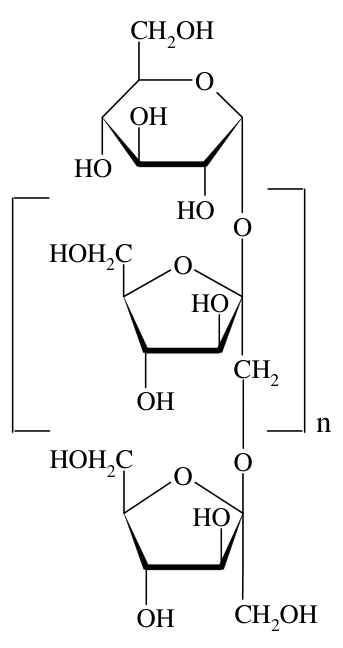
3.1 Inulin may be hydrolyzed under \(\ce{H+}\)-catalysis conditions. Of the four options below (A, B, C and D) indicate which C-O bond cleavage is most likely to occur.
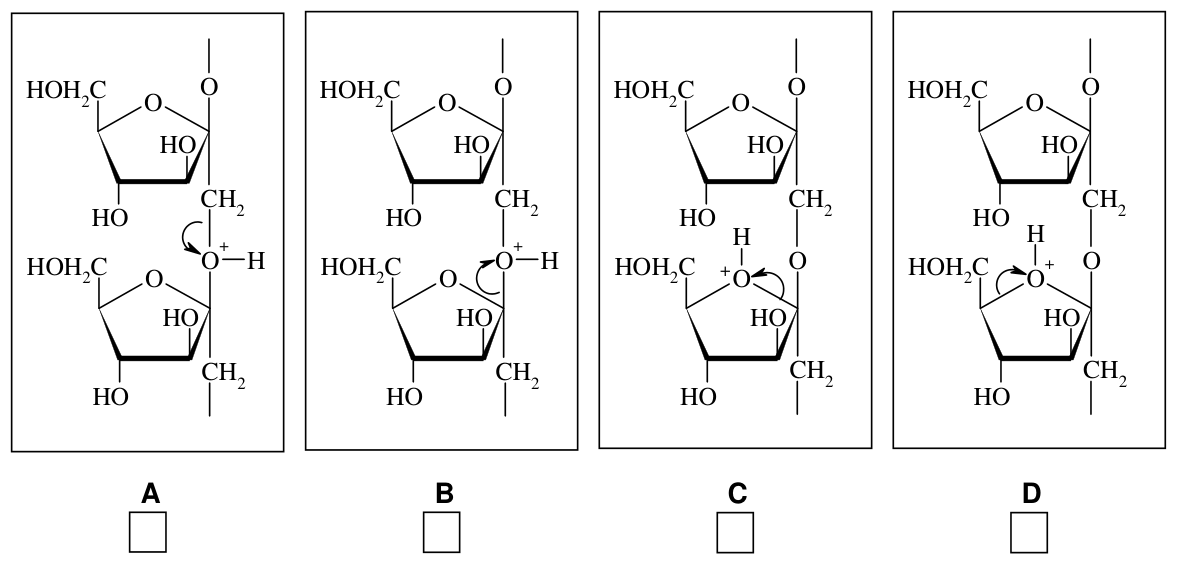
Mark the correct cleavage mechanism for the most efficient hydrolysis.
Hydrolysis with isotopically labelled water can provide information about the mechanism of hydrolysis using modern NMR techniques, which can “see” deuterium (\(\ce{^{2}H}\)) and the oxygen isotope \(\ce{^{17}O}\).
3.2 Indicate which labelled water can best be used for this purpose. Mark the correct answer.
- ☐ \(\ce{^{2}H2O}\)
- ☐ \(\ce{H2^{17}O}\)
- ☐ \(\ce{^{2}H2^{17}O}\)
- ☐ None of them.
Upon catalytic hydrogenation glucose gives sorbitol (S), whilst fructose (F) gives mannitol (M) and sorbitol (S).
3.3 Draw the Fischer projections of fructose (F), sorbitol (S) and mannitol (M).
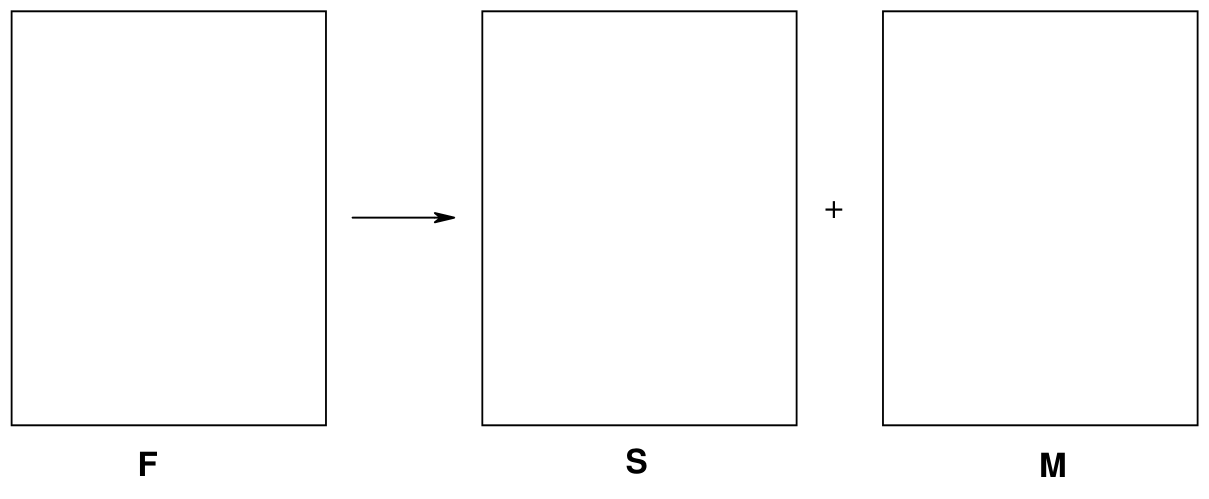
1.00 mol of inulin in 2.00 kg of water with added catalysts, is subjected to hydrolysis and hydrogenation at \(95\,^\circ\mathrm{C}\) in a one step process. The selectivity of the hydrogenation of fructose to mannitol / sorbitol is 7 / 3.
3.4 How many moles of mannitol and sorbitol are obtained?

After completion of the reactions the catalysts are removed and the reaction mixture is cooled to \(25\,^\circ\mathrm{C}\). The solubility of M is \(0.40\ \mathrm{mol\,kg^{-1}}\) in water at \(25\,^\circ\mathrm{C}\) and the solubility of S is so high that it will not precipitate.
3.5 Calculate how many moles of M will precipitate.
\(\underline{\hspace{4cm}}\)
Official English text of the problem.
Answers
- 3.1: B — cleavage of the protonated glycosidic bond at the anomeric carbon, C2, of fructose.
- 3.2: \(\ce{H2^{17}O}\), oxygen-17-labelled water,
[17OH2]. - 3.3: The required structures are:
- F: D-fructose,
OCC(=O)[C@@H](O)[C@H](O)[C@H](O)CO. - S: Sorbitol (D-glucitol),
OC[C@H](O)[C@@H](O)[C@H](O)[C@H](O)CO. - M: D-mannitol,
OC[C@@H](O)[C@@H](O)[C@H](O)[C@H](O)CO.
Their Fischer projections are specified in part 3.3 below. - 3.4: \(\boxed{n(\mathrm M)=7.00\ \mathrm{mol},\qquad n(\mathrm S)=4.00\ \mathrm{mol}}\). - 3.5: \(\boxed{6.27\ \mathrm{mol}}\) of mannitol precipitates.
Solution
3.1 — Acid-catalysed bond cleavage
The fructose residues are connected through glycosidic bonds between anomeric C2 of one residue and the oxygen attached to C1 of another.
In B, the bridging oxygen is protonated, and the bond between this oxygen and anomeric C2 breaks. The curved arrow indicates that the bonding electron pair moves onto the protonated oxygen. This produces an alcohol on the departing fragment and an oxocarbenium centre on the fructose residue. The positive charge is stabilised by electron donation from the adjacent ring oxygen.
Water, O, then attacks the anomeric carbon. Subsequent deprotonation produces the anomeric hydroxyl group and regenerates the acid catalyst, represented by \(\ce{H+}\), [H+].
The alternatives explain the preference:
- A would generate an unstabilised primary carbocation at C1.
- C opens the fructofuranose ring without directly breaking the connection between the two residues.
- D breaks the ring at a non-anomeric carbon, without the favourable oxocarbenium stabilisation obtained in B.
Thus B directly cleaves the polymer chain through the favourable anomeric pathway.
3.2 — Choice of isotopically labelled water
Choose oxygen-17-labelled water, \(\ce{H2^{17}O}\), [17OH2].
In mechanism B, the oxygen of the attacking water becomes the oxygen of the newly formed hydroxyl group at fructose C2. The original bridging oxygen remains attached to C1 of the other fragment. Consequently, the location of the oxygen isotope identifies where water enters during hydrolysis.
Deuterated water, \(\ce{^{2}H2O}\), [2H]O[2H], is less informative because hydroxyl hydrogens readily exchange with the solvent. Deuterium would therefore appear at many hydroxyl groups, independently of glycosidic bond cleavage.
Doubly labelled water, \(\ce{^{2}H2^{17}O}\), [2H][17O][2H], would provide the useful oxygen label, but its deuterium labels add no necessary positional information. The best choice is therefore the oxygen-only label.
3.3 — Fischer projections and hydrogenation
Use a vertical six-carbon chain, numbered C1 at the top to C6 at the bottom, with \(\ce{CH2OH}\) at both ends. The required arrangements are:
| Carbon | D-fructose, F | Sorbitol, S | Mannitol, M |
|---|---|---|---|
| C2 | Carbonyl, \(\ce{C=O}\) | OH on the right | OH on the left |
| C3 | OH on the left | OH on the left | OH on the left |
| C4 | OH on the right | OH on the right | OH on the right |
| C5 | OH on the right | OH on the right | OH on the right |
At every stereogenic carbon, hydrogen occupies the horizontal position opposite OH. In the fructose projection, draw the carbonyl oxygen to the right of C2 with a double bond. As usual for Fischer projections, horizontal bonds point towards the viewer and vertical bonds point away. The stereochemical SMILES are given in the Answers section.
Hydrogenation of fructose reduces its C2 ketone and creates a new stereogenic centre. The two possible C2 configurations give sorbitol and mannitol, while the configurations at C3, C4 and C5 remain unchanged.
For comparison, D-glucose has open-chain SMILES O=C[C@H](O)[C@@H](O)[C@H](O)[C@H](O)CO. Reducing its C1 aldehyde to \(\ce{CH2OH}\) gives sorbitol without creating a new stereogenic centre.
Molecular hydrogen is \(\ce{H2}\), [H][H]. Each individual hydrogenation—glucose to sorbitol, fructose to sorbitol, or fructose to mannitol—has the balanced stoichiometry
\[ \ce{C6H12O6 + H2 ->[catalyst] C6H14O6}. \]
One mole of fructose therefore yields one mole of total hexitol products.
3.4 — Amounts of mannitol and sorbitol
Each inulin molecule contains one glucose residue and ten fructose residues: 11 monosaccharide residues joined by 10 glycosidic bonds.
The molecular formula follows from condensation of the eleven monosaccharides:
\[ 11(\ce{C6H12O6})-10(\ce{H2O}) =\ce{C66H112O56}. \]
The balanced hydrolysis is
\[ \ce{C66H112O56 + 10H2O ->[H+] C6H12O6 + 10C6H12O6}, \]
where the first product term is glucose and the second is fructose. Thus, \(1.00\ \mathrm{mol}\) of inulin produces
\[ n(\text{glucose})=1.00\ \mathrm{mol}, \qquad n(\text{fructose})=10.0\ \mathrm{mol}. \]
The fructose hydrogenation selectivity is
\[ \mathrm{M:S}=7:3. \]
Hence
\[ n(\mathrm M) =10.0\ \mathrm{mol}\times\frac{7}{10} =\boxed{7.00\ \mathrm{mol}}, \]
and the fructose-derived sorbitol is
\[ n(\mathrm S;\text{from fructose}) =10.0\ \mathrm{mol}\times\frac{3}{10} =3.00\ \mathrm{mol}. \]
The glucose supplies another \(1.00\ \mathrm{mol}\) of sorbitol:
\[ n(\mathrm S)=3.00+1.00 =\boxed{4.00\ \mathrm{mol}}. \]
The combined hydrolysis and hydrogenation balance is
\[ \ce{C66H112O56 + 10H2O + 11H2 ->[catalysts] 11C6H14O6}, \]
with the eleven product moles distributed as seven moles of mannitol and four moles of sorbitol.
3.5 — Precipitation of mannitol
Hydrolysis consumes ten moles of water per mole of inulin:
\[ n(\text{water consumed}) =10(1.00\ \mathrm{mol}) =10.0\ \mathrm{mol}. \]
Using \(M(\ce{H2O})=18.0\ \mathrm{g\,mol^{-1}}\), the remaining water mass is
\[ \begin{aligned} m(\text{water}) &=2.00\ \mathrm{kg} -(10.0\ \mathrm{mol})(18.0\ \mathrm{g\,mol^{-1}}) \left(10^{-3}\ \mathrm{kg\,g^{-1}}\right)\\ &=1.82\ \mathrm{kg}. \end{aligned} \]
Hydrogenation does not change this water balance.
At \(25\,^\circ\mathrm{C}\), the amount of mannitol that remains dissolved is
\[ n(\mathrm M;\text{dissolved}) =(0.40\ \mathrm{mol\,kg^{-1}})(1.82\ \mathrm{kg}) =0.728\ \mathrm{mol}. \]
Retaining these digits until the final subtraction,
\[ \begin{aligned} n(\mathrm M;\text{precipitated}) &=7.00-0.728\\ &=6.272\ \mathrm{mol}\\ &\approx\boxed{6.27\ \mathrm{mol}}. \end{aligned} \]
The solution was checked against the official solution.
IChO 2002 · Theorieaufgabe 3
Inulin, ein neuer nachwachsender Rohstoff
Thema II - Chemie von industrieller Bedeutung
In unserem Alltag verwenden wir viele Produkte, die im industriellen Maßstab hergestellt werden. Die Beherrschung der zugrunde liegenden Chemie steht im Mittelpunkt dieser Tätigkeit.
AUFGABE 3
Inulin, ein neuer nachwachsender Rohstoff
Inulin, das in Belgien und den Niederlanden aus Zichorienwurzeln gewonnen wird, wird als Lebensmittelzusatzstoff verwendet, da es sich günstig auf die Darmflora auswirkt. Es dient außerdem als Quelle für Fructose, die 1.9-mal süßer als Saccharose ist, sowie zur Herstellung von Mannitol, das in Kaugummi verwendet wird. Inulin ist ein lineares Polymer aus Fructoseeinheiten mit einer Glucoseeinheit an einem Ende; seine Haworth-Projektionsformel ist links dargestellt. In dieser Aufgabe enthält Inulin 10 Fructoseeinheiten (\(n = 9\)).
3.1 Inulin kann unter \(\ce{H+}\)-Katalyse hydrolysiert werden. Geben Sie unter den vier folgenden Möglichkeiten (A, B, C und D) an, welche C-O-Bindungsspaltung am wahrscheinlichsten erfolgt.
Markieren Sie den richtigen Spaltungsmechanismus für die effizienteste Hydrolyse.
Die Hydrolyse mit isotopenmarkiertem Wasser kann mithilfe moderner NMR-Techniken, die Deuterium (\(\ce{^{2}H}\)) und das Sauerstoffisotop \(\ce{^{17}O}\) „sehen“ können, Informationen über den Hydrolysemechanismus liefern.
3.2 Geben Sie an, welches markierte Wasser sich für diesen Zweck am besten eignet. Markieren Sie die richtige Antwort.
- ☐ \(\ce{^{2}H2O}\)
- ☐ \(\ce{H2^{17}O}\)
- ☐ \(\ce{^{2}H2^{17}O}\)
- ☐ Keines davon.
Bei der katalytischen Hydrierung liefert Glucose Sorbitol (S), während Fructose (F) Mannitol (M) und Sorbitol (S) liefert.
3.3 Zeichnen Sie die Fischer-Projektionen von Fructose (F), Sorbitol (S) und Mannitol (M).
1.00 mol Inulin werden in 2.00 kg Wasser unter Zusatz von Katalysatoren bei \(95\,^\circ\mathrm{C}\) in einem einstufigen Verfahren hydrolysiert und hydriert. Die Selektivität der Hydrierung von Fructose zu Mannitol / Sorbitol beträgt 7 / 3.
3.4 Wie viele Mol Mannitol und Sorbitol werden erhalten?
Nach Abschluss der Reaktionen werden die Katalysatoren entfernt und das Reaktionsgemisch auf \(25\,^\circ\mathrm{C}\) abgekühlt. Die Löslichkeit von M in Wasser bei \(25\,^\circ\mathrm{C}\) beträgt \(0.40\ \mathrm{mol\,kg^{-1}}\), und die Löslichkeit von S ist so hoch, dass es nicht ausfällt.
3.5 Berechnen Sie, wie viele Mol M ausfallen.
\(\underline{\hspace{4cm}}\)
Aufgabentext aus dem offiziellen englischen Text übersetzt.
Antworten
- 3.1: B — Spaltung der protonierten glycosidischen Bindung am anomeren Kohlenstoffatom C2 der Fructose.
- 3.2: \(\ce{H2^{17}O}\), mit Sauerstoff-17 markiertes Wasser,
[17OH2]. - 3.3: Die gesuchten Strukturen sind:
- F: D-Fructose,
OCC(=O)[C@@H](O)[C@H](O)[C@H](O)CO. - S: Sorbitol (D-Glucitol),
OC[C@H](O)[C@@H](O)[C@H](O)[C@H](O)CO. - M: D-Mannitol,
OC[C@@H](O)[C@@H](O)[C@H](O)[C@H](O)CO.
Ihre Fischer-Projektionen sind unten in Teil 3.3 angegeben. - 3.4: \(\boxed{n(\mathrm M)=7.00\ \mathrm{mol},\qquad n(\mathrm S)=4.00\ \mathrm{mol}}\). - 3.5: \(\boxed{6.27\ \mathrm{mol}}\) Mannitol fallen aus.
Lösung
3.1 — Säurekatalysierte Bindungsspaltung
Die Fructosereste sind über glycosidische Bindungen zwischen dem anomeren C2 eines Restes und dem an C1 eines anderen Restes gebundenen Sauerstoffatom verknüpft.
In B wird das verbrückende Sauerstoffatom protoniert, und die Bindung zwischen diesem Sauerstoffatom und dem anomeren C2 wird gespalten. Der gekrümmte Pfeil zeigt an, dass das bindende Elektronenpaar auf das protonierte Sauerstoffatom übergeht. Dadurch entstehen ein Alkohol am abgehenden Fragment und ein Oxocarbeniumzentrum am Fructoserest. Die positive Ladung wird durch Elektronendonationen des benachbarten Ringsauerstoffatoms stabilisiert.
Wasser, O, greift anschließend das anomere Kohlenstoffatom an. Durch die anschließende Deprotonierung entsteht die anomere Hydroxygruppe, und der Säurekatalysator, dargestellt durch \(\ce{H+}\), [H+], wird regeneriert.
Die Alternativen erklären, warum dieser Mechanismus bevorzugt ist:
- A würde ein nicht stabilisiertes primäres Carbokation an C1 erzeugen.
- C öffnet den Fructofuranosering, ohne die Verknüpfung zwischen den beiden Resten direkt zu spalten.
- D spaltet den Ring an einem nicht anomeren Kohlenstoffatom, ohne die günstige Oxocarbeniumstabilisierung, die bei B erreicht wird.
Somit spaltet B die Polymerkette direkt über den günstigen anomeren Reaktionsweg.
3.2 — Wahl des isotopenmarkierten Wassers
Zu wählen ist mit Sauerstoff-17 markiertes Wasser, \(\ce{H2^{17}O}\), [17OH2].
Bei Mechanismus B wird das Sauerstoffatom des angreifenden Wassers zum Sauerstoffatom der neu gebildeten Hydroxygruppe an C2 der Fructose. Das ursprüngliche verbrückende Sauerstoffatom bleibt an C1 des anderen Fragments gebunden. Die Position des Sauerstoffisotops zeigt daher, an welcher Stelle Wasser während der Hydrolyse eingebaut wird.
Deuteriertes Wasser, \(\ce{^{2}H2O}\), [2H]O[2H], ist weniger aussagekräftig, da die Wasserstoffatome der Hydroxygruppen leicht mit dem Lösungsmittel ausgetauscht werden. Deuterium würde daher unabhängig von der Spaltung der glycosidischen Bindung an vielen Hydroxygruppen auftreten.
Doppelt markiertes Wasser, \(\ce{^{2}H2^{17}O}\), [2H][17O][2H], würde die nützliche Sauerstoffmarkierung liefern, doch seine Deuteriummarkierungen liefern keine zusätzlich erforderlichen Positionsinformationen. Die beste Wahl ist daher die ausschließliche Sauerstoffmarkierung.
3.3 — Fischer-Projektionen und Hydrierung
Verwenden Sie eine senkrechte Kette aus sechs Kohlenstoffatomen, nummeriert von C1 oben bis C6 unten, mit \(\ce{CH2OH}\) an beiden Enden. Die gesuchten Anordnungen sind:
| Kohlenstoffatom | D-Fructose, F | Sorbitol, S | Mannitol, M |
|---|---|---|---|
| C2 | Carbonylgruppe, \(\ce{C=O}\) | OH rechts | OH links |
| C3 | OH links | OH links | OH links |
| C4 | OH rechts | OH rechts | OH rechts |
| C5 | OH rechts | OH rechts | OH rechts |
An jedem stereogenen Kohlenstoffatom nimmt Wasserstoff die horizontale Position gegenüber OH ein. Zeichnen Sie in der Fructoseprojektion das Carbonylsauerstoffatom mit einer Doppelbindung rechts von C2. Wie bei Fischer-Projektionen üblich, zeigen horizontale Bindungen zum Betrachter hin und vertikale Bindungen vom Betrachter weg. Die stereochemischen SMILES sind im Abschnitt Antworten angegeben.
Bei der Hydrierung von Fructose wird ihre Ketogruppe an C2 reduziert, wodurch ein neues stereogenes Zentrum entsteht. Die beiden möglichen Konfigurationen an C2 ergeben Sorbitol und Mannitol, während die Konfigurationen an C3, C4 und C5 unverändert bleiben.
Zum Vergleich: D-Glucose hat in der offenkettigen Form den SMILES O=C[C@H](O)[C@@H](O)[C@H](O)[C@H](O)CO. Die Reduktion ihrer Aldehydgruppe an C1 zu \(\ce{CH2OH}\) ergibt Sorbitol, ohne ein neues stereogenes Zentrum zu erzeugen.
Molekularer Wasserstoff ist \(\ce{H2}\), [H][H]. Jede einzelne Hydrierung — Glucose zu Sorbitol, Fructose zu Sorbitol oder Fructose zu Mannitol — hat die ausgeglichene Stöchiometrie
\[ \ce{C6H12O6 + H2 ->[catalyst] C6H14O6}. \]
Ein Mol Fructose liefert daher insgesamt ein Mol Hexitolprodukte.
3.4 — Stoffmengen von Mannitol und Sorbitol
Jedes Inulinmolekül enthält einen Glucoserest und zehn Fructosereste: 11 Monosaccharidreste, die durch 10 glycosidische Bindungen verknüpft sind.
Die Summenformel ergibt sich aus der Kondensation der elf Monosaccharide:
\[ 11(\ce{C6H12O6})-10(\ce{H2O}) =\ce{C66H112O56}. \]
Die ausgeglichene Hydrolysegleichung lautet
\[ \ce{C66H112O56 + 10H2O ->[H+] C6H12O6 + 10C6H12O6}, \]
wobei der erste Produktterm Glucose und der zweite Fructose bezeichnet. Somit entstehen aus \(1.00\ \mathrm{mol}\) Inulin
\[ n(\text{Glucose})=1.00\ \mathrm{mol}, \qquad n(\text{Fructose})=10.0\ \mathrm{mol}. \]
Die Selektivität der Fructosehydrierung beträgt
\[ \mathrm{M:S}=7:3. \]
Daher gilt
\[ n(\mathrm M) =10.0\ \mathrm{mol}\times\frac{7}{10} =\boxed{7.00\ \mathrm{mol}}, \]
und die aus Fructose erhaltene Sorbitolmenge beträgt
\[ n(\mathrm S;\text{aus Fructose}) =10.0\ \mathrm{mol}\times\frac{3}{10} =3.00\ \mathrm{mol}. \]
Die Glucose liefert weitere \(1.00\ \mathrm{mol}\) Sorbitol:
\[ n(\mathrm S)=3.00+1.00 =\boxed{4.00\ \mathrm{mol}}. \]
Die Gesamtbilanz von Hydrolyse und Hydrierung lautet
\[ \ce{C66H112O56 + 10H2O + 11H2 ->[catalysts] 11C6H14O6}, \]
wobei sich die elf Mol Produkte auf sieben Mol Mannitol und vier Mol Sorbitol verteilen.
3.5 — Ausfällung von Mannitol
Die Hydrolyse verbraucht zehn Mol Wasser pro Mol Inulin:
\[ n(\text{verbrauchtes Wasser}) =10(1.00\ \mathrm{mol}) =10.0\ \mathrm{mol}. \]
Mit \(M(\ce{H2O})=18.0\ \mathrm{g\,mol^{-1}}\) ergibt sich für die verbleibende Wassermasse
\[ \begin{aligned} m(\text{Wasser}) &=2.00\ \mathrm{kg} -(10.0\ \mathrm{mol})(18.0\ \mathrm{g\,mol^{-1}}) \left(10^{-3}\ \mathrm{kg\,g^{-1}}\right)\\ &=1.82\ \mathrm{kg}. \end{aligned} \]
Die Hydrierung verändert diese Wasserbilanz nicht.
Bei \(25\,^\circ\mathrm{C}\) beträgt die Stoffmenge des gelöst bleibenden Mannitols
\[ n(\mathrm M;\text{gelöst}) =(0.40\ \mathrm{mol\,kg^{-1}})(1.82\ \mathrm{kg}) =0.728\ \mathrm{mol}. \]
Werden diese Ziffern bis zur abschließenden Subtraktion beibehalten, ergibt sich
\[ \begin{aligned} n(\mathrm M;\text{ausgefällt}) &=7.00-0.728\\ &=6.272\ \mathrm{mol}\\ &\approx\boxed{6.27\ \mathrm{mol}}. \end{aligned} \]
Die Lösung wurde mit der offiziellen Lösung abgeglichen.
IChO 2002 · Teori sorusu 3
İnülin, Yeni Bir Yenilenebilir Ham Madde
Tema II - Endüstriyel Açıdan Önemli Kimya
Günlük yaşamımızda endüstriyel ölçekte üretilen birçok ürün kullanırız. Bu işin temelinde, üretimin dayandığı kimyaya hâkim olmak yatar.
SORU 3
İnülin, Yeni Bir Yenilenebilir Ham Madde
Belçika ve Hollanda'da hindiba köklerinden üretilen inülin, bağırsak florası üzerindeki yararlı etkisi nedeniyle gıda katkı maddesi olarak kullanılır. Ayrıca sakkarozdan 1.9 kat daha tatlı olan fruktozun kaynağı olarak ve sakızlarda kullanılan mannitolün üretiminde kullanılır. İnülin, bir ucunda glikoz birimi bulunan, fruktoz birimlerinden oluşan doğrusal bir polimerdir; Haworth izdüşüm formülü solda gösterilmiştir. Bu soruda inülin 10 fruktoz birimi içermektedir (\(n = 9\)).
3.1 İnülin, \(\ce{H+}\) katalizli koşullarda hidroliz edilebilir. Aşağıdaki dört seçenekten (A, B, C ve D) hangi C-O bağı kopmasının gerçekleşme olasılığının en yüksek olduğunu belirtiniz.
En verimli hidroliz için doğru bağ kopma mekanizmasını işaretleyiniz.
İzotopla işaretlenmiş su ile hidroliz, döteryumu (\(\ce{^{2}H}\)) ve oksijenin \(\ce{^{17}O}\) izotopunu “görebilen” modern NMR teknikleri kullanılarak hidroliz mekanizması hakkında bilgi sağlayabilir.
3.2 Bu amaç için hangi işaretlenmiş suyun en uygun olduğunu belirtiniz. Doğru cevabı işaretleyiniz.
- ☐ \(\ce{^{2}H2O}\)
- ☐ \(\ce{H2^{17}O}\)
- ☐ \(\ce{^{2}H2^{17}O}\)
- ☐ Hiçbiri.
Katalitik hidrojenleme sonucunda glikoz sorbitol (S) verirken fruktoz (F), mannitol (M) ve sorbitol (S) verir.
3.3 Fruktoz (F), sorbitol (S) ve mannitolün (M) Fischer izdüşümlerini çiziniz.
2.00 kg su içindeki 1.00 mol inülin, katalizörler eklenerek \(95\,^\circ\mathrm{C}\)'de tek basamaklı bir işlemle hidrolize ve hidrojenlemeye tabi tutulur. Fruktozun mannitol / sorbitole hidrojenlenmesinin seçiciliği 7 / 3'tür.
3.4 Kaç mol mannitol ve sorbitol elde edilir?
Tepkimeler tamamlandıktan sonra katalizörler uzaklaştırılır ve tepkime karışımı \(25\,^\circ\mathrm{C}\)'ye soğutulur. M'nin \(25\,^\circ\mathrm{C}\)'de sudaki çözünürlüğü \(0.40\ \mathrm{mol\,kg^{-1}}\)'dir ve S'nin çözünürlüğü çökelmeyecek kadar yüksektir.
3.5 Kaç mol M'nin çökeleceğini hesaplayınız.
\(\underline{\hspace{4cm}}\)
Soru metni resmi İngilizce metinden çevrilmiştir.
Cevaplar
- 3.1: B — protonlanmış glikozidik bağın fruktozun anomerik karbonu C2'de kopması.
- 3.2: \(\ce{H2^{17}O}\), oksijen-17 ile işaretlenmiş su,
[17OH2]. - 3.3: İstenen yapılar şunlardır:
- F: D-fruktoz,
OCC(=O)[C@@H](O)[C@H](O)[C@H](O)CO. - S: Sorbitol (D-glusitol),
OC[C@H](O)[C@@H](O)[C@H](O)[C@H](O)CO. - M: D-mannitol,
OC[C@@H](O)[C@@H](O)[C@H](O)[C@H](O)CO.
Bunların Fischer izdüşümleri aşağıda 3.3 kısmında belirtilmiştir. - 3.4: \(\boxed{n(\mathrm M)=7.00\ \mathrm{mol},\qquad n(\mathrm S)=4.00\ \mathrm{mol}}\). - 3.5: \(\boxed{6.27\ \mathrm{mol}}\) mannitol çökelir.
Çözüm
3.1 — Asit katalizli bağ kopması
Fruktoz kalıntıları, bir kalıntının anomerik C2 atomu ile başka bir kalıntının C1 atomuna bağlı oksijen arasındaki glikozidik bağlarla birbirine bağlanır.
B'de köprü oksijeni protonlanır ve bu oksijen ile anomerik C2 arasındaki bağ kopar. Eğri ok, bağ elektron çiftinin protonlanmış oksijene geçtiğini gösterir. Bunun sonucunda ayrılan parçada bir alkol ve fruktoz kalıntısında bir oksokarbenyum merkezi oluşur. Pozitif yük, komşu halka oksijeninin elektron vermesiyle kararlı hâle gelir.
Ardından su, O, anomerik karbona saldırır. Sonraki deprotonlanma, anomerik hidroksil grubunu oluşturur ve \(\ce{H+}\), [H+] ile gösterilen asit katalizörünü yeniden meydana getirir.
Diğer seçenekler bu tercihin nedenini açıklar:
- A, C1'de kararlılaştırılmamış bir birincil karbokatyon oluşturur.
- C, iki kalıntı arasındaki bağlantıyı doğrudan koparmadan fruktofuranoz halkasını açar.
- D, B'de elde edilen elverişli oksokarbenyum kararlılaşması olmaksızın, halkayı anomerik olmayan bir karbonda açar.
Dolayısıyla B, elverişli anomerik yol üzerinden polimer zincirini doğrudan koparır.
3.2 — İzotopla işaretlenmiş suyun seçimi
Oksijen-17 ile işaretlenmiş suyu, \(\ce{H2^{17}O}\), [17OH2], seçiniz.
B mekanizmasında, saldıran suyun oksijeni fruktozun C2 atomunda yeni oluşan hidroksil grubunun oksijeni olur. Başlangıçtaki köprü oksijeni diğer parçanın C1 atomuna bağlı kalır. Bu nedenle oksijen izotopunun konumu, hidroliz sırasında suyun nereye katıldığını gösterir.
Döteryumlu su, \(\ce{^{2}H2O}\), [2H]O[2H], daha az bilgi sağlar; çünkü hidroksil hidrojenleri çözücüyle kolayca değiş tokuş olur. Bu nedenle döteryum, glikozidik bağın kopmasından bağımsız olarak birçok hidroksil grubunda görülür.
Çift işaretli su, \(\ce{^{2}H2^{17}O}\), [2H][17O][2H], yararlı olan oksijen işaretini sağlar; ancak döteryum işaretleri gerekli herhangi bir ek konum bilgisi vermez. Bu nedenle en iyi seçenek yalnızca oksijenin işaretlenmiş olmasıdır.
3.3 — Fischer izdüşümleri ve hidrojenleme
Her iki ucunda \(\ce{CH2OH}\) bulunan ve en üstte C1'den en altta C6'ya doğru numaralandırılmış, düşey bir altı karbonlu zincir kullanınız. İstenen düzenlemeler şunlardır:
| Karbon | D-fruktoz, F | Sorbitol, S | Mannitol, M |
|---|---|---|---|
| C2 | Karbonil, \(\ce{C=O}\) | OH sağda | OH solda |
| C3 | OH solda | OH solda | OH solda |
| C4 | OH sağda | OH sağda | OH sağda |
| C5 | OH sağda | OH sağda | OH sağda |
Her stereojenik karbonda hidrojen, OH'nin karşısındaki yatay konumda yer alır. Fruktoz izdüşümünde karbonil oksijenini C2'nin sağına çift bağla çiziniz. Fischer izdüşümlerinde her zamanki gibi, yatay bağlar gözlemciye doğru, düşey bağlar ise gözlemciden uzağa yönelir. Stereokimyasal SMILES gösterimleri Cevaplar bölümünde verilmiştir.
Fruktozun hidrojenlenmesi, C2'deki keton grubunu indirger ve yeni bir stereojenik merkez oluşturur. C2'deki iki olası konfigürasyon sorbitol ve mannitolü verirken C3, C4 ve C5'teki konfigürasyonlar değişmeden kalır.
Karşılaştırma için, D-glikozun açık zincirli SMILES gösterimi O=C[C@H](O)[C@@H](O)[C@H](O)[C@H](O)CO şeklindedir. C1'deki aldehit grubunun \(\ce{CH2OH}\)'ye indirgenmesi, yeni bir stereojenik merkez oluşturmadan sorbitol verir.
Moleküler hidrojen \(\ce{H2}\), [H][H] şeklindedir. Her bir hidrojenleme — glikozdan sorbitole, fruktozdan sorbitole veya fruktozdan mannitole — aşağıdaki denkleştirilmiş stokiyometriye sahiptir:
\[ \ce{C6H12O6 + H2 ->[catalyst] C6H14O6}. \]
Dolayısıyla bir mol fruktoz, toplam bir mol heksitol ürünü verir.
3.4 — Mannitol ve sorbitol miktarları
Her inülin molekülü bir glikoz kalıntısı ve on fruktoz kalıntısı içerir: 10 glikozidik bağla birbirine bağlanmış 11 monosakkarit kalıntısı.
Molekül formülü, on bir monosakkaritin kondenzasyonundan elde edilir:
\[ 11(\ce{C6H12O6})-10(\ce{H2O}) =\ce{C66H112O56}. \]
Denkleştirilmiş hidroliz tepkimesi şöyledir:
\[ \ce{C66H112O56 + 10H2O ->[H+] C6H12O6 + 10C6H12O6}, \]
Burada ilk ürün terimi glikoz, ikincisi ise fruktozdur. Dolayısıyla \(1.00\ \mathrm{mol}\) inülinden şu miktarlar elde edilir:
\[ n(\text{glikoz})=1.00\ \mathrm{mol}, \qquad n(\text{fruktoz})=10.0\ \mathrm{mol}. \]
Fruktozun hidrojenlenmesinin seçiciliği şöyledir:
\[ \mathrm{M:S}=7:3. \]
Buna göre
\[ n(\mathrm M) =10.0\ \mathrm{mol}\times\frac{7}{10} =\boxed{7.00\ \mathrm{mol}}, \]
ve fruktozdan elde edilen sorbitol miktarı şöyledir:
\[ n(\mathrm S;\text{fruktozdan}) =10.0\ \mathrm{mol}\times\frac{3}{10} =3.00\ \mathrm{mol}. \]
Glikozdan ayrıca \(1.00\ \mathrm{mol}\) sorbitol elde edilir:
\[ n(\mathrm S)=3.00+1.00 =\boxed{4.00\ \mathrm{mol}}. \]
Hidroliz ve hidrojenlemenin birleşik denklemi şöyledir:
\[ \ce{C66H112O56 + 10H2O + 11H2 ->[catalysts] 11C6H14O6}, \]
Burada on bir mol ürün, yedi mol mannitol ve dört mol sorbitol olarak dağılır.
3.5 — Mannitolün çökelmesi
Hidroliz, her bir mol inülin başına on mol su tüketir:
\[ n(\text{tüketilen su}) =10(1.00\ \mathrm{mol}) =10.0\ \mathrm{mol}. \]
\(M(\ce{H2O})=18.0\ \mathrm{g\,mol^{-1}}\) kullanıldığında, kalan suyun kütlesi şöyledir:
\[ \begin{aligned} m(\text{su}) &=2.00\ \mathrm{kg} -(10.0\ \mathrm{mol})(18.0\ \mathrm{g\,mol^{-1}}) \left(10^{-3}\ \mathrm{kg\,g^{-1}}\right)\\ &=1.82\ \mathrm{kg}. \end{aligned} \]
Hidrojenleme bu su dengesini değiştirmez.
\(25\,^\circ\mathrm{C}\)'de çözünmüş hâlde kalan mannitol miktarı şöyledir:
\[ n(\mathrm M;\text{çözünmüş}) =(0.40\ \mathrm{mol\,kg^{-1}})(1.82\ \mathrm{kg}) =0.728\ \mathrm{mol}. \]
Son çıkarma işlemine kadar bu basamaklar korunduğunda,
\[ \begin{aligned} n(\mathrm M;\text{çökelmiş}) &=7.00-0.728\\ &=6.272\ \mathrm{mol}\\ &\approx\boxed{6.27\ \mathrm{mol}}. \end{aligned} \]
Çözüm, resmi çözümle karşılaştırılarak kontrol edildi.
IChO 2002 · Problema teórico 3
Inulina, una nueva materia prima renovable
Tema II - Química de relevancia industrial
En nuestra vida cotidiana utilizamos muchos productos que se fabrican a escala industrial. Dominar la química que sustenta estos procesos es fundamental para esta actividad.
PROBLEMA 3
Inulina, una nueva materia prima renovable
La inulina, que se obtiene de las raíces de achicoria en Bélgica y los Países Bajos, se utiliza como aditivo alimentario porque tiene un efecto beneficioso sobre la flora intestinal. También se utiliza como fuente de fructosa, que es 1.9 veces más dulce que la sacarosa, y para la producción de manitol, que se emplea en los chicles. La inulina es un polímero lineal de unidades de fructosa con una unidad de glucosa en un extremo; su fórmula en proyección de Haworth se muestra a la izquierda. En este problema, la inulina tiene 10 unidades de fructosa (\(n = 9\)).
3.1 La inulina puede hidrolizarse en condiciones de catálisis por \(\ce{H+}\). De las cuatro opciones siguientes (A, B, C y D), indique qué ruptura del enlace C-O es más probable que ocurra.
Marque el mecanismo de ruptura correcto para la hidrólisis más eficaz.
La hidrólisis con agua marcada isotópicamente puede proporcionar información sobre el mecanismo de hidrólisis mediante técnicas modernas de RMN, que pueden «ver» el deuterio (\(\ce{^{2}H}\)) y el isótopo de oxígeno \(\ce{^{17}O}\).
3.2 Indique qué agua marcada es la más adecuada para este fin. Marque la respuesta correcta.
- ☐ \(\ce{^{2}H2O}\)
- ☐ \(\ce{H2^{17}O}\)
- ☐ \(\ce{^{2}H2^{17}O}\)
- ☐ Ninguna de ellas.
Por hidrogenación catalítica, la glucosa da sorbitol (S), mientras que la fructosa (F) da manitol (M) y sorbitol (S).
3.3 Dibuje las proyecciones de Fischer de la fructosa (F), el sorbitol (S) y el manitol (M).
Se somete 1.00 mol de inulina en 2.00 kg de agua, con catalizadores añadidos, a hidrólisis e hidrogenación a \(95\,^\circ\mathrm{C}\) en un proceso de una sola etapa. La selectividad de la hidrogenación de la fructosa a manitol / sorbitol es de 7 / 3.
3.4 ¿Cuántos moles de manitol y de sorbitol se obtienen?
Una vez completadas las reacciones, se retiran los catalizadores y la mezcla de reacción se enfría a \(25\,^\circ\mathrm{C}\). La solubilidad de M en agua a \(25\,^\circ\mathrm{C}\) es de \(0.40\ \mathrm{mol\,kg^{-1}}\) y la solubilidad de S es tan elevada que no precipitará.
3.5 Calcule cuántos moles de M precipitarán.
\(\underline{\hspace{4cm}}\)
Enunciado traducido del texto oficial en inglés.
Respuestas
- 3.1: B — ruptura del enlace glucosídico protonado en el carbono anomérico, C2, de la fructosa.
- 3.2: \(\ce{H2^{17}O}\), agua marcada con oxígeno-17,
[17OH2]. - 3.3: Las estructuras requeridas son:
- F: D-fructosa,
OCC(=O)[C@@H](O)[C@H](O)[C@H](O)CO. - S: Sorbitol (D-glucitol),
OC[C@H](O)[C@@H](O)[C@H](O)[C@H](O)CO. - M: D-manitol,
OC[C@@H](O)[C@@H](O)[C@H](O)[C@H](O)CO.
Sus proyecciones de Fischer se especifican en el apartado 3.3 que figura a continuación. - 3.4: \(\boxed{n(\mathrm M)=7.00\ \mathrm{mol},\qquad n(\mathrm S)=4.00\ \mathrm{mol}}\). - 3.5: Precipitan \(\boxed{6.27\ \mathrm{mol}}\) de manitol.
Solución
3.1 — Ruptura del enlace catalizada por ácido
Los residuos de fructosa están conectados mediante enlaces glucosídicos entre el C2 anomérico de un residuo y el oxígeno unido al C1 de otro.
En B, el oxígeno puente se protona y se rompe el enlace entre este oxígeno y el C2 anomérico. La flecha curva indica que el par de electrones del enlace se desplaza hacia el oxígeno protonado. Esto produce un alcohol en el fragmento que se separa y un centro oxocarbenio en el residuo de fructosa. La carga positiva se estabiliza por donación electrónica del oxígeno adyacente del anillo.
A continuación, el agua, O, ataca al carbono anomérico. La desprotonación posterior produce el grupo hidroxilo anomérico y regenera el catalizador ácido, representado por \(\ce{H+}\), [H+].
Las alternativas explican esta preferencia:
- A generaría un carbocatión primario no estabilizado en C1.
- C abre el anillo de fructofuranosa sin romper directamente la conexión entre los dos residuos.
- D rompe el anillo en un carbono no anomérico, sin la estabilización favorable del oxocarbenio que se obtiene en B.
Por tanto, B rompe directamente la cadena polimérica mediante la vía anomérica favorable.
3.2 — Elección del agua marcada isotópicamente
Elija agua marcada con oxígeno-17, \(\ce{H2^{17}O}\), [17OH2].
En el mecanismo B, el oxígeno del agua que ataca se convierte en el oxígeno del grupo hidroxilo recién formado en el C2 de la fructosa. El oxígeno puente original permanece unido al C1 del otro fragmento. Por consiguiente, la posición del isótopo de oxígeno permite identificar dónde se incorpora el agua durante la hidrólisis.
El agua deuterada, \(\ce{^{2}H2O}\), [2H]O[2H], proporciona menos información porque los hidrógenos de los grupos hidroxilo se intercambian fácilmente con el disolvente. Por tanto, el deuterio aparecería en muchos grupos hidroxilo, independientemente de la ruptura del enlace glucosídico.
El agua doblemente marcada, \(\ce{^{2}H2^{17}O}\), [2H][17O][2H], proporcionaría la marca útil de oxígeno, pero sus marcas de deuterio no aportan información posicional necesaria. Por ello, la mejor elección es el marcado únicamente en el oxígeno.
3.3 — Proyecciones de Fischer e hidrogenación
Utilice una cadena vertical de seis carbonos, numerados desde C1 en la parte superior hasta C6 en la parte inferior, con \(\ce{CH2OH}\) en ambos extremos. Las disposiciones requeridas son:
| Carbono | D-fructosa, F | Sorbitol, S | Manitol, M |
|---|---|---|---|
| C2 | Carbonilo, \(\ce{C=O}\) | OH a la derecha | OH a la izquierda |
| C3 | OH a la izquierda | OH a la izquierda | OH a la izquierda |
| C4 | OH a la derecha | OH a la derecha | OH a la derecha |
| C5 | OH a la derecha | OH a la derecha | OH a la derecha |
En cada carbono estereogénico, el hidrógeno ocupa la posición horizontal opuesta al OH. En la proyección de la fructosa, dibuje el oxígeno carbonílico a la derecha de C2 con un doble enlace. Como es habitual en las proyecciones de Fischer, los enlaces horizontales apuntan hacia el observador y los verticales se alejan de él. Los SMILES estereoquímicos se indican en la sección Respuestas.
La hidrogenación de la fructosa reduce su grupo cetona en C2 y crea un nuevo centro estereogénico. Las dos configuraciones posibles en C2 dan sorbitol y manitol, mientras que las configuraciones en C3, C4 y C5 permanecen inalteradas.
A modo de comparación, la D-glucosa tiene el SMILES de cadena abierta O=C[C@H](O)[C@@H](O)[C@H](O)[C@H](O)CO. La reducción de su grupo aldehído en C1 a \(\ce{CH2OH}\) da sorbitol sin crear un nuevo centro estereogénico.
El hidrógeno molecular es \(\ce{H2}\), [H][H]. Cada hidrogenación individual —de glucosa a sorbitol, de fructosa a sorbitol o de fructosa a manitol— tiene la estequiometría ajustada
\[ \ce{C6H12O6 + H2 ->[catalyst] C6H14O6}. \]
Por tanto, un mol de fructosa da un mol de productos de tipo hexitol en total.
3.4 — Cantidades de manitol y sorbitol
Cada molécula de inulina contiene un residuo de glucosa y diez residuos de fructosa: 11 residuos de monosacáridos unidos por 10 enlaces glucosídicos.
La fórmula molecular se obtiene de la condensación de los once monosacáridos:
\[ 11(\ce{C6H12O6})-10(\ce{H2O}) =\ce{C66H112O56}. \]
La ecuación ajustada de la hidrólisis es
\[ \ce{C66H112O56 + 10H2O ->[H+] C6H12O6 + 10C6H12O6}, \]
donde el primer término de los productos es glucosa y el segundo es fructosa. Así, \(1.00\ \mathrm{mol}\) de inulina produce
\[ n(\text{glucosa})=1.00\ \mathrm{mol}, \qquad n(\text{fructosa})=10.0\ \mathrm{mol}. \]
La selectividad de la hidrogenación de la fructosa es
\[ \mathrm{M:S}=7:3. \]
Por tanto,
\[ n(\mathrm M) =10.0\ \mathrm{mol}\times\frac{7}{10} =\boxed{7.00\ \mathrm{mol}}, \]
y el sorbitol procedente de la fructosa es
\[ n(\mathrm S;\text{procedente de la fructosa}) =10.0\ \mathrm{mol}\times\frac{3}{10} =3.00\ \mathrm{mol}. \]
La glucosa aporta otro \(1.00\ \mathrm{mol}\) de sorbitol:
\[ n(\mathrm S)=3.00+1.00 =\boxed{4.00\ \mathrm{mol}}. \]
El balance combinado de hidrólisis e hidrogenación es
\[ \ce{C66H112O56 + 10H2O + 11H2 ->[catalysts] 11C6H14O6}, \]
con los once moles de productos distribuidos en siete moles de manitol y cuatro moles de sorbitol.
3.5 — Precipitación del manitol
La hidrólisis consume diez moles de agua por mol de inulina:
\[ n(\text{agua consumida}) =10(1.00\ \mathrm{mol}) =10.0\ \mathrm{mol}. \]
Utilizando \(M(\ce{H2O})=18.0\ \mathrm{g\,mol^{-1}}\), la masa de agua restante es
\[ \begin{aligned} m(\text{agua}) &=2.00\ \mathrm{kg} -(10.0\ \mathrm{mol})(18.0\ \mathrm{g\,mol^{-1}}) \left(10^{-3}\ \mathrm{kg\,g^{-1}}\right)\\ &=1.82\ \mathrm{kg}. \end{aligned} \]
La hidrogenación no modifica este balance de agua.
A \(25\,^\circ\mathrm{C}\), la cantidad de manitol que permanece disuelta es
\[ n(\mathrm M;\text{disuelto}) =(0.40\ \mathrm{mol\,kg^{-1}})(1.82\ \mathrm{kg}) =0.728\ \mathrm{mol}. \]
Conservando estas cifras hasta la resta final,
\[ \begin{aligned} n(\mathrm M;\text{precipitado}) &=7.00-0.728\\ &=6.272\ \mathrm{mol}\\ &\approx\boxed{6.27\ \mathrm{mol}}. \end{aligned} \]
La solución se comprobó con la solución oficial.
IChO 2002 · 理论题 3
菊粉,一种新型可再生原料
主题 II - 与工业相关的化学
在日常生活中,我们使用许多工业规模生产的产品。掌握其背后的化学原理是这一行业的核心。
题目 3
菊粉,一种新型可再生原料
比利时和荷兰从菊苣根中生产菊粉。由于菊粉对肠道菌群有益,因此被用作食品添加剂。菊粉还可用来制取甜度为蔗糖 1.9 倍的果糖,以及用于口香糖中的甘露醇。菊粉是由果糖单元组成的线性聚合物,其一端有一个葡萄糖单元;其哈沃斯投影式如左图所示。本题中的菊粉含有 10 个果糖单元(\(n = 9\))。
3.1 菊粉可在 \(\ce{H+}\) 催化条件下水解。从以下四个选项(A、B、C 和 D)中指出最可能发生的 C-O 键断裂方式。
标出能最有效地实现水解的正确断键机理。
使用同位素标记的水进行水解,可借助现代核磁共振(NMR)技术获得有关水解机理的信息,该技术能够“看见”氘(\(\ce{^{2}H}\))和氧同位素 \(\ce{^{17}O}\)。
3.2 指出哪种同位素标记的水最适合用于这一目的。标出正确答案。
- ☐ \(\ce{^{2}H2O}\)
- ☐ \(\ce{H2^{17}O}\)
- ☐ \(\ce{^{2}H2^{17}O}\)
- ☐ 以上均不适用。
催化加氢时,葡萄糖生成山梨醇(S),而果糖(F)生成甘露醇(M)和山梨醇(S)。
3.3 画出果糖(F)、山梨醇(S)和甘露醇(M)的费歇尔投影式。
将 1.00 mol 菊粉加入 2.00 kg 水中,并加入催化剂,在 \(95\,^\circ\mathrm{C}\) 下通过一步工艺进行水解和加氢。果糖加氢生成甘露醇 / 山梨醇的选择性之比为 7 / 3。
3.4 得到的甘露醇和山梨醇各为多少摩尔?
反应完成后,除去催化剂,并将反应混合物冷却至 \(25\,^\circ\mathrm{C}\)。M 在 \(25\,^\circ\mathrm{C}\) 的水中的溶解度为 \(0.40\ \mathrm{mol\,kg^{-1}}\),而 S 的溶解度很高,不会析出。
3.5 计算将有多少摩尔的 M 析出。
\(\underline{\hspace{4cm}}\)
题目译自官方英文原文。
答案
- 3.1: B — 质子化的糖苷键在果糖的异头碳 C2 处断裂。
- 3.2: \(\ce{H2^{17}O}\),氧-17 标记的水,
[17OH2]。 - 3.3: 所需结构为:
- F: D-果糖,
OCC(=O)[C@@H](O)[C@H](O)[C@H](O)CO。 - S: 山梨醇(D-葡萄糖醇),
OC[C@H](O)[C@@H](O)[C@H](O)[C@H](O)CO。 - M: D-甘露醇,
OC[C@@H](O)[C@@H](O)[C@H](O)[C@H](O)CO。
它们的费歇尔投影式详见下文 3.3 部分。 - 3.4: \(\boxed{n(\mathrm M)=7.00\ \mathrm{mol},\qquad n(\mathrm S)=4.00\ \mathrm{mol}}\)。 - 3.5: 析出 \(\boxed{6.27\ \mathrm{mol}}\) 甘露醇。
解答
3.1 — 酸催化的键断裂
果糖残基通过糖苷键相连,该键连接一个残基的异头碳 C2 与另一个残基上连接于 C1 的氧原子。
在 B 中,桥氧被质子化,该氧原子与异头碳 C2 之间的键断裂。弯箭头表示成键电子对转移至质子化的氧原子上。由此,离去片段上形成醇羟基,果糖残基上形成一个氧代碳正离子中心。相邻环氧原子的供电子作用使正电荷得到稳定。
随后,水 O 进攻异头碳。之后的去质子化生成异头羟基,并使酸催化剂再生;酸催化剂表示为 \(\ce{H+}\),[H+]。
考察其他选项即可解释为何优先选择这一途径:
- A 会在 C1 处生成一个未得到稳定的伯碳正离子。
- C 会使呋喃果糖环开环,却不直接断开两个残基之间的连接。
- D 在非异头碳处使环断裂,无法获得 B 中有利的氧代碳正离子稳定作用。
因此,B 通过有利的异头碳反应途径直接切断聚合物链。
3.2 — 同位素标记水的选择
选择氧-17 标记的水,\(\ce{H2^{17}O}\),[17OH2]。
在机理 B 中,进攻的水分子中的氧原子成为果糖 C2 处新形成的羟基中的氧原子。原来的桥氧仍连接于另一片段的 C1。因此,氧同位素的位置可以确定水在水解过程中进入的位置。
氘代水 \(\ce{^{2}H2O}\),[2H]O[2H],提供的信息较少,因为羟基上的氢容易与溶剂发生交换。因此,无论是否发生糖苷键断裂,氘都会出现在许多羟基上。
双重标记的水 \(\ce{^{2}H2^{17}O}\),[2H][17O][2H],可以提供有用的氧标记,但其中的氘标记并不增加任何必要的位置信息。因此,最佳选择是仅对氧进行标记的水。
3.3 — 费歇尔投影式与加氢
采用竖直的六碳链,编号为顶端 C1 至底端 C6,两端均为 \(\ce{CH2OH}\)。所需的排列如下:
| 碳原子 | D-果糖,F | 山梨醇,S | 甘露醇,M |
|---|---|---|---|
| C2 | 羰基,\(\ce{C=O}\) | OH 在右侧 | OH 在左侧 |
| C3 | OH 在左侧 | OH 在左侧 | OH 在左侧 |
| C4 | OH 在右侧 | OH 在右侧 | OH 在右侧 |
| C5 | OH 在右侧 | OH 在右侧 | OH 在右侧 |
在每个立体中心碳原子上,氢位于与 OH 相对的另一侧水平位置。在果糖的投影式中,将羰基氧画在 C2 右侧,并用双键连接。按照费歇尔投影式的通常约定,水平键朝向观察者,竖直键背向观察者。立体化学 SMILES 已在答案部分给出。
果糖加氢时,C2 处的酮基被还原,并形成一个新的立体中心。C2 的两种可能构型分别生成山梨醇和甘露醇,而 C3、C4 和 C5 的构型保持不变。
作为对比,D-葡萄糖的开链 SMILES 为 O=C[C@H](O)[C@@H](O)[C@H](O)[C@H](O)CO。将其 C1 处的醛基还原为 \(\ce{CH2OH}\),即可得到山梨醇,而不形成新的立体中心。
氢分子为 \(\ce{H2}\),[H][H]。每一种单独的加氢反应——葡萄糖生成山梨醇、果糖生成山梨醇或果糖生成甘露醇——均具有以下配平的化学计量关系:
\[ \ce{C6H12O6 + H2 ->[catalyst] C6H14O6}. \]
因此,一摩尔果糖生成的己六醇产物总量为一摩尔。
3.4 — 甘露醇和山梨醇的物质的量
每个菊粉分子含有一个葡萄糖残基和十个果糖残基:11 个单糖残基通过 10 个糖苷键连接。
由十一个单糖分子的缩合可得分子式:
\[ 11(\ce{C6H12O6})-10(\ce{H2O}) =\ce{C66H112O56}. \]
配平的水解反应为
\[ \ce{C66H112O56 + 10H2O ->[H+] C6H12O6 + 10C6H12O6}, \]
其中,第一个产物项为葡萄糖,第二个为果糖。因此,\(1.00\ \mathrm{mol}\) 菊粉生成
\[ n(\text{葡萄糖})=1.00\ \mathrm{mol}, \qquad n(\text{果糖})=10.0\ \mathrm{mol}. \]
果糖加氢的选择性之比为
\[ \mathrm{M:S}=7:3. \]
因此
\[ n(\mathrm M) =10.0\ \mathrm{mol}\times\frac{7}{10} =\boxed{7.00\ \mathrm{mol}}, \]
而由果糖生成的山梨醇为
\[ n(\mathrm S;\text{来自果糖}) =10.0\ \mathrm{mol}\times\frac{3}{10} =3.00\ \mathrm{mol}. \]
葡萄糖另生成 \(1.00\ \mathrm{mol}\) 山梨醇:
\[ n(\mathrm S)=3.00+1.00 =\boxed{4.00\ \mathrm{mol}}. \]
水解与加氢合并后的配平反应为
\[ \ce{C66H112O56 + 10H2O + 11H2 ->[catalysts] 11C6H14O6}, \]
其中,十一摩尔产物分为七摩尔甘露醇和四摩尔山梨醇。
3.5 — 甘露醇的析出
每摩尔菊粉水解消耗十摩尔水:
\[ n(\text{消耗的水}) =10(1.00\ \mathrm{mol}) =10.0\ \mathrm{mol}. \]
取 \(M(\ce{H2O})=18.0\ \mathrm{g\,mol^{-1}}\),剩余水的质量为
\[ \begin{aligned} m(\text{水}) &=2.00\ \mathrm{kg} -(10.0\ \mathrm{mol})(18.0\ \mathrm{g\,mol^{-1}}) \left(10^{-3}\ \mathrm{kg\,g^{-1}}\right)\\ &=1.82\ \mathrm{kg}. \end{aligned} \]
加氢不改变这一水量衡算。
在 \(25\,^\circ\mathrm{C}\) 下,仍溶解在水中的甘露醇的物质的量为
\[ n(\mathrm M;\text{溶解}) =(0.40\ \mathrm{mol\,kg^{-1}})(1.82\ \mathrm{kg}) =0.728\ \mathrm{mol}. \]
保留这些数字直至最后的减法计算,
\[ \begin{aligned} n(\mathrm M;\text{析出}) &=7.00-0.728\\ &=6.272\ \mathrm{mol}\\ &\approx\boxed{6.27\ \mathrm{mol}}. \end{aligned} \]
解答已与官方解答核对。
IChO 2002 · Теоретическая задача 3
Инулин — новое возобновляемое сырьё
Тема II — Химия, имеющая промышленное значение
В повседневной жизни мы используем множество продуктов, производимых в промышленном масштабе. Понимание лежащих в основе их производства химических процессов составляет основу этой деятельности.
ЗАДАЧА 3
Инулин — новое возобновляемое сырьё
Инулин, который получают из корней цикория в Бельгии и Нидерландах, используется в качестве пищевой добавки, поскольку он благотворно влияет на микрофлору кишечника. Его также используют как источник фруктозы, которая в 1.9 раза слаще сахарозы, и для производства маннита, применяемого в жевательной резинке. Инулин представляет собой линейный полимер, состоящий из звеньев фруктозы и одного звена глюкозы на конце цепи; его проекционная формула Хеуорса показана слева. В этой задаче инулин содержит 10 звеньев фруктозы (\(n = 9\)).
3.1 Инулин можно гидролизовать в условиях катализа ионами \(\ce{H+}\). Укажите, какой из четырёх приведённых ниже вариантов (A, B, C и D) разрыва связи C-O наиболее вероятен.
Отметьте правильный механизм разрыва связи, обеспечивающий наиболее эффективный гидролиз.
Гидролиз с использованием изотопно-меченой воды позволяет получить информацию о механизме гидролиза с помощью современных методов ЯМР, которые позволяют «видеть» дейтерий (\(\ce{^{2}H}\)) и изотоп кислорода \(\ce{^{17}O}\).
3.2 Укажите, какую меченую воду лучше всего использовать для этой цели. Отметьте правильный ответ.
- ☐ \(\ce{^{2}H2O}\)
- ☐ \(\ce{H2^{17}O}\)
- ☐ \(\ce{^{2}H2^{17}O}\)
- ☐ Ни одну из перечисленных.
При каталитическом гидрировании глюкоза даёт сорбит (S), а фруктоза (F) — маннит (M) и сорбит (S).
3.3 Изобразите проекции Фишера для фруктозы (F), сорбита (S) и маннита (M).
1.00 моль инулина в 2.00 кг воды с добавленными катализаторами подвергают гидролизу и гидрированию при \(95\,^\circ\mathrm{C}\) в одностадийном процессе. Селективность гидрирования фруктозы с образованием маннита / сорбита составляет 7 / 3.
3.4 Сколько молей маннита и сорбита получится?
После завершения реакций катализаторы удаляют, а реакционную смесь охлаждают до \(25\,^\circ\mathrm{C}\). Растворимость M в воде при \(25\,^\circ\mathrm{C}\) составляет \(0.40\ \mathrm{mol\,kg^{-1}}\), а растворимость S настолько высока, что он не выпадает в осадок.
3.5 Рассчитайте, сколько молей M выпадет в осадок.
\(\underline{\hspace{4cm}}\)
Условие переведено с официального английского текста.
Ответы
- 3.1: B — разрыв протонированной гликозидной связи у аномерного атома углерода C2 фруктозы.
- 3.2: \(\ce{H2^{17}O}\), вода, меченная кислородом-17,
[17OH2]. - 3.3: Требуемые структуры:
- F: D-фруктоза,
OCC(=O)[C@@H](O)[C@H](O)[C@H](O)CO. - S: Сорбит (D-глюцит),
OC[C@H](O)[C@@H](O)[C@H](O)[C@H](O)CO. - M: D-маннит,
OC[C@@H](O)[C@@H](O)[C@H](O)[C@H](O)CO.
Их проекции Фишера приведены ниже в пункте 3.3. - 3.4: \(\boxed{n(\mathrm M)=7.00\ \mathrm{mol},\qquad n(\mathrm S)=4.00\ \mathrm{mol}}\). - 3.5: В осадок выпадает \(\boxed{6.27\ \mathrm{mol}}\) маннита.
Решение
3.1 — Разрыв связи при кислотном катализе
Остатки фруктозы соединены гликозидными связями между аномерным атомом C2 одного остатка и атомом кислорода, связанным с C1 другого.
В варианте B мостиковый атом кислорода протонируется, и связь между этим атомом кислорода и аномерным атомом C2 разрывается. Изогнутая стрелка показывает, что связывающая электронная пара переходит к протонированному атому кислорода. При этом на уходящем фрагменте образуется спиртовая группа, а на остатке фруктозы — оксокарбениевый центр. Положительный заряд стабилизируется за счёт донорного взаимодействия с электронами соседнего атома кислорода в цикле.
Затем вода, O, атакует аномерный атом углерода. Последующее депротонирование приводит к образованию аномерной гидроксильной группы и регенерации кислотного катализатора, обозначаемого \(\ce{H+}\), [H+].
Рассмотрение других вариантов объясняет это предпочтение:
- A привёл бы к образованию нестабилизированного первичного карбокатиона на C1.
- C раскрывает фруктофуранозный цикл, не разрывая непосредственно связь между двумя остатками.
- D разрывает цикл у неаномерного атома углерода, без выгодной стабилизации оксокарбениевого центра, возникающей в B.
Таким образом, B непосредственно расщепляет полимерную цепь по благоприятному пути с участием аномерного центра.
3.2 — Выбор изотопно-меченой воды
Следует выбрать воду, меченную кислородом-17, \(\ce{H2^{17}O}\), [17OH2].
В механизме B атом кислорода атакующей молекулы воды становится атомом кислорода вновь образованной гидроксильной группы при C2 фруктозы. Исходный мостиковый атом кислорода остаётся связанным с C1 другого фрагмента. Следовательно, положение изотопа кислорода позволяет определить место присоединения воды при гидролизе.
Дейтерированная вода, \(\ce{^{2}H2O}\), [2H]O[2H], менее информативна, поскольку атомы водорода гидроксильных групп легко обмениваются с растворителем. Поэтому дейтерий оказался бы во многих гидроксильных группах независимо от разрыва гликозидной связи.
Вода с двойной изотопной меткой, \(\ce{^{2}H2^{17}O}\), [2H][17O][2H], дала бы полезную кислородную метку, однако дейтериевые метки не добавляют необходимой информации о положении атомов. Поэтому наилучший выбор — вода с меткой только по кислороду.
3.3 — Проекции Фишера и гидрирование
Используйте вертикальную цепь из шести атомов углерода с нумерацией от C1 вверху до C6 внизу и группами \(\ce{CH2OH}\) на обоих концах. Требуемое расположение групп:
| Атом углерода | D-фруктоза, F | Сорбит, S | Маннит, M |
|---|---|---|---|
| C2 | Карбонильная группа, \(\ce{C=O}\) | OH справа | OH слева |
| C3 | OH слева | OH слева | OH слева |
| C4 | OH справа | OH справа | OH справа |
| C5 | OH справа | OH справа | OH справа |
При каждом стереогенном атоме углерода водород занимает горизонтальное положение, противоположное OH. В проекции фруктозы изобразите карбонильный атом кислорода справа от C2, соединив их двойной связью. Как обычно в проекциях Фишера, горизонтальные связи направлены к наблюдателю, а вертикальные — от него. Стереохимические записи SMILES приведены в разделе «Ответы».
При гидрировании фруктозы её кетогруппа при C2 восстанавливается и возникает новый стереогенный центр. Две возможные конфигурации C2 дают сорбит и маннит, а конфигурации C3, C4 и C5 остаются неизменными.
Для сравнения, запись SMILES открытой формы D-глюкозы имеет вид O=C[C@H](O)[C@@H](O)[C@H](O)[C@H](O)CO. Восстановление её альдегидной группы при C1 до \(\ce{CH2OH}\) даёт сорбит без образования нового стереогенного центра.
Молекулярный водород — это \(\ce{H2}\), [H][H]. Каждая отдельная реакция гидрирования — глюкозы в сорбит, фруктозы в сорбит или фруктозы в маннит — описывается следующим уравнением с расставленными коэффициентами:
\[ \ce{C6H12O6 + H2 ->[catalyst] C6H14O6}. \]
Следовательно, один моль фруктозы даёт суммарно один моль продуктов-гекситов.
3.4 — Количества маннита и сорбита
Каждая молекула инулина содержит один остаток глюкозы и десять остатков фруктозы: 11 моносахаридных остатков, соединённых 10 гликозидными связями.
Молекулярную формулу получают, рассматривая конденсацию одиннадцати моносахаридов:
\[ 11(\ce{C6H12O6})-10(\ce{H2O}) =\ce{C66H112O56}. \]
Уравнение гидролиза с расставленными коэффициентами:
\[ \ce{C66H112O56 + 10H2O ->[H+] C6H12O6 + 10C6H12O6}, \]
где первое слагаемое среди продуктов обозначает глюкозу, а второе — фруктозу. Таким образом, из \(1.00\ \mathrm{mol}\) инулина образуется
\[ n(\text{глюкоза})=1.00\ \mathrm{mol}, \qquad n(\text{фруктоза})=10.0\ \mathrm{mol}. \]
Селективность гидрирования фруктозы составляет
\[ \mathrm{M:S}=7:3. \]
Следовательно,
\[ n(\mathrm M) =10.0\ \mathrm{mol}\times\frac{7}{10} =\boxed{7.00\ \mathrm{mol}}, \]
а количество сорбита, полученного из фруктозы, равно
\[ n(\mathrm S;\text{из фруктозы}) =10.0\ \mathrm{mol}\times\frac{3}{10} =3.00\ \mathrm{mol}. \]
Глюкоза даёт ещё \(1.00\ \mathrm{mol}\) сорбита:
\[ n(\mathrm S)=3.00+1.00 =\boxed{4.00\ \mathrm{mol}}. \]
Суммарное уравнение гидролиза и гидрирования имеет вид
\[ \ce{C66H112O56 + 10H2O + 11H2 ->[catalysts] 11C6H14O6}, \]
причём из одиннадцати молей продуктов семь молей приходится на маннит и четыре моля — на сорбит.
3.5 — Осаждение маннита
При гидролизе на один моль инулина расходуется десять молей воды:
\[ n(\text{израсходованная вода}) =10(1.00\ \mathrm{mol}) =10.0\ \mathrm{mol}. \]
Используя \(M(\ce{H2O})=18.0\ \mathrm{g\,mol^{-1}}\), находим массу оставшейся воды:
\[ \begin{aligned} m(\text{вода}) &=2.00\ \mathrm{kg} -(10.0\ \mathrm{mol})(18.0\ \mathrm{g\,mol^{-1}}) \left(10^{-3}\ \mathrm{kg\,g^{-1}}\right)\\ &=1.82\ \mathrm{kg}. \end{aligned} \]
Гидрирование не изменяет этот баланс воды.
При \(25\,^\circ\mathrm{C}\) количество маннита, остающегося в растворе, равно
\[ n(\mathrm M;\text{в растворе}) =(0.40\ \mathrm{mol\,kg^{-1}})(1.82\ \mathrm{kg}) =0.728\ \mathrm{mol}. \]
Сохраняя эти цифры до окончательного вычитания, получаем
\[ \begin{aligned} n(\mathrm M;\text{в осадке}) &=7.00-0.728\\ &=6.272\ \mathrm{mol}\\ &\approx\boxed{6.27\ \mathrm{mol}}. \end{aligned} \]
Решение проверено по официальному решению.
IChO 2002 · مسألة نظرية 3
الإينولين، مادة خام متجددة جديدة
المحور II - الكيمياء ذات الأهمية الصناعية
نستخدم في حياتنا اليومية منتجات عديدة تُنتَج على نطاق صناعي. ويُعدّ إتقان الكيمياء التي تقوم عليها هذه المنتجات جوهر هذا النشاط.
المسألة 3
الإينولين، مادة خام متجددة جديدة
يُستخدم الإينولين، الذي يُنتَج من جذور الهندباء في بلجيكا وهولندا، مضافًا غذائيًا لما له من تأثير مفيد في النبيت المعوي. ويُستخدم أيضًا مصدرًا للفركتوز، الذي تبلغ حلاوته 1.9 ضعف حلاوة السكروز، ولإنتاج المانيتول الذي يُستخدم في العلكة. والإينولين بوليمر خطي من وحدات الفركتوز، توجد في أحد طرفيه وحدة غلوكوز؛ وتُعرض صيغته بإسقاط هاوورث على اليسار. في هذه المسألة، يحتوي الإينولين على 10 وحدات فركتوز (\(n = 9\)).
3.1 يمكن إجراء التحلل المائي للإينولين في ظروف التحفيز بـ \(\ce{H+}\). حدّد، من بين الخيارات الأربعة أدناه (A وB وC وD)، أيّ انشطار لرابطة C-O هو الأرجح حدوثًا.
ضع علامة على آلية الانشطار الصحيحة التي تحقق التحلل المائي الأكثر كفاءة.
يمكن للتحلل المائي باستخدام ماء موسوم نظائريًا أن يوفّر معلومات عن آلية التحلل المائي باستخدام تقنيات الرنين المغناطيسي النووي الحديثة، التي تستطيع «رؤية» الديوتيريوم (\(\ce{^{2}H}\)) ونظير الأكسجين \(\ce{^{17}O}\).
3.2 حدّد أيّ أنواع الماء الموسوم هو الأنسب لهذا الغرض. ضع علامة على الإجابة الصحيحة.
- ☐ \(\ce{^{2}H2O}\)
- ☐ \(\ce{H2^{17}O}\)
- ☐ \(\ce{^{2}H2^{17}O}\)
- ☐ لا شيء منها.
عند الهدرجة الحفزية، يعطي الغلوكوز السوربيتول (S)، بينما يعطي الفركتوز (F) المانيتول (M) والسوربيتول (S).
3.3 ارسم إسقاطات فيشر للفركتوز (F) والسوربيتول (S) والمانيتول (M).
تُخضَع كمية قدرها 1.00 mol من الإينولين في 2.00 kg من الماء، مع إضافة حفّازات، للتحلل المائي والهدرجة عند \(95\,^\circ\mathrm{C}\) في عملية من خطوة واحدة. وتبلغ انتقائية هدرجة الفركتوز إلى المانيتول / السوربيتول 7 / 3.
3.4 كم مولًا من المانيتول والسوربيتول يُحصَل عليه؟
بعد اكتمال التفاعلات، تُزال الحفّازات ويُبرَّد مزيج التفاعل إلى \(25\,^\circ\mathrm{C}\). تبلغ ذوبانية M في الماء عند \(25\,^\circ\mathrm{C}\) مقدار \(0.40\ \mathrm{mol\,kg^{-1}}\)، أما ذوبانية S فمرتفعة إلى حدّ أنه لن يترسّب.
3.5 احسب عدد مولات M التي ستترسّب.
\(\underline{\hspace{4cm}}\)
نص المسألة مترجم عن النص الإنجليزي الرسمي.
الإجابات
- 3.1: B — انشطار الرابطة الغليكوسيدية المُبرتنَة عند ذرة الكربون الأنوميرية C2 في الفركتوز.
- 3.2: \(\ce{H2^{17}O}\)، الماء الموسوم بالأكسجين-17،
[17OH2]. - 3.3: البنى المطلوبة هي:
- F: D-فركتوز،
OCC(=O)[C@@H](O)[C@H](O)[C@H](O)CO. - S: السوربيتول (D-غلوكيتول)،
OC[C@H](O)[C@@H](O)[C@H](O)[C@H](O)CO. - M: D-مانيتول،
OC[C@@H](O)[C@@H](O)[C@H](O)[C@H](O)CO.
تُحدَّد إسقاطات فيشر لهذه المركبات في الجزء 3.3 أدناه. - 3.4: \(\boxed{n(\mathrm M)=7.00\ \mathrm{mol},\qquad n(\mathrm S)=4.00\ \mathrm{mol}}\). - 3.5: تترسّب كمية قدرها \(\boxed{6.27\ \mathrm{mol}}\) من المانيتول.
الحل
3.1 — انشطار الرابطة المحفَّز بالحمض
ترتبط بقايا الفركتوز بروابط غليكوسيدية بين ذرة الكربون الأنوميرية C2 في إحدى البقايا وذرة الأكسجين المرتبطة بذرة الكربون C1 في بقية أخرى.
في B، تُبرتن ذرة الأكسجين الجسرية، وتنكسر الرابطة بين هذه الذرة وذرة الكربون الأنوميرية C2. يشير السهم المنحني إلى انتقال زوج إلكترونات الرابطة إلى ذرة الأكسجين المُبرتنَة. وينتج عن ذلك كحول على الشقّ المغادر ومركز أوكسوكربينيوم على بقية الفركتوز. وتستقر الشحنة الموجبة بفعل منح الإلكترونات من ذرة الأكسجين المجاورة في الحلقة.
يهاجم الماء، O، بعد ذلك ذرة الكربون الأنوميرية. ثم يؤدي نزع البروتون إلى تكوين مجموعة الهيدروكسيل الأنوميرية وتجديد الحفّاز الحمضي، الممثَّل بـ \(\ce{H+}\)، [H+].
توضّح البدائل سبب تفضيل هذه الآلية:
- تؤدي A إلى توليد كربوكاتيون أولي غير مستقر عند C1.
- تفتح C حلقة الفركتوفورانوز من دون أن تقطع مباشرةً الاتصال بين البقيتين.
- تكسر D الحلقة عند ذرة كربون غير أنوميرية، من دون الاستقرار الملائم الناتج عن تكوّن الأوكسوكربينيوم في B.
وهكذا، تشطر B سلسلة البوليمر مباشرةً عبر المسار الأنوميري الملائم.
3.2 — اختيار الماء الموسوم نظائريًا
نختار الماء الموسوم بالأكسجين-17، \(\ce{H2^{17}O}\)، [17OH2].
في الآلية B، تصبح ذرة الأكسجين في الماء المهاجم ذرة الأكسجين في مجموعة الهيدروكسيل المتكوّنة حديثًا عند C2 في الفركتوز. وتبقى ذرة الأكسجين الجسرية الأصلية مرتبطة بذرة الكربون C1 في الشقّ الآخر. ومن ثمّ، يحدّد موضع نظير الأكسجين موضع دخول الماء أثناء التحلل المائي.
يوفّر الماء المُديوتر، \(\ce{^{2}H2O}\)، [2H]O[2H]، معلومات أقل، لأن ذرات هيدروجين مجموعات الهيدروكسيل تتبادل بسهولة مع المذيب. لذلك سيظهر الديوتيريوم في مجموعات هيدروكسيل عديدة، بصورة مستقلة عن انشطار الرابطة الغليكوسيدية.
يوفّر الماء الموسوم وسمًا مزدوجًا، \(\ce{^{2}H2^{17}O}\)، [2H][17O][2H]، وسم الأكسجين المفيد، لكن وسوم الديوتيريوم فيه لا تضيف أيّ معلومات موضعية ضرورية. ولذلك فإن الوسم بالأكسجين وحده هو الخيار الأفضل.
3.3 — إسقاطات فيشر والهدرجة
نستخدم سلسلة رأسية من ست ذرات كربون، مرقّمة من C1 في الأعلى إلى C6 في الأسفل، مع وجود \(\ce{CH2OH}\) عند كلا الطرفين. والترتيبات المطلوبة هي:
| الكربون | D-فركتوز، F | السوربيتول، S | المانيتول، M |
|---|---|---|---|
| C2 | كربونيل، \(\ce{C=O}\) | OH على اليمين | OH على اليسار |
| C3 | OH على اليسار | OH على اليسار | OH على اليسار |
| C4 | OH على اليمين | OH على اليمين | OH على اليمين |
| C5 | OH على اليمين | OH على اليمين | OH على اليمين |
عند كل ذرة كربون مولِّدة للتصاوغ الفراغي، يشغل الهيدروجين الموضع الأفقي المقابل لمجموعة OH. في إسقاط الفركتوز، تُرسَم ذرة أكسجين الكربونيل إلى يمين C2 برابطة مزدوجة. وكالمعتاد في إسقاطات فيشر، تتجه الروابط الأفقية نحو المشاهد وتتجه الروابط الرأسية بعيدًا عنه. وتُورَد تمثيلات SMILES للكيمياء الفراغية في قسم الإجابات.
تختزل هدرجة الفركتوز مجموعة الكيتون عند C2 وتُنشئ مركزًا جديدًا مولِّدًا للتصاوغ الفراغي. ويعطي التشكيلان الفراغيان الممكنان عند C2 السوربيتول والمانيتول، بينما تبقى التشكيلات الفراغية عند C3 وC4 وC5 دون تغيير.
للمقارنة، فإن تمثيل SMILES للشكل مفتوح السلسلة من D-غلوكوز هو O=C[C@H](O)[C@@H](O)[C@H](O)[C@H](O)CO. ويعطي اختزال مجموعة الألدهيد عند C1 إلى \(\ce{CH2OH}\) السوربيتول من دون إنشاء مركز جديد مولِّد للتصاوغ الفراغي.
الهيدروجين الجزيئي هو \(\ce{H2}\)، [H][H]. ولكل عملية هدرجة منفردة — من الغلوكوز إلى السوربيتول، أو من الفركتوز إلى السوربيتول، أو من الفركتوز إلى المانيتول — المعادلة الستوكيومترية الموزونة الآتية
\[ \ce{C6H12O6 + H2 ->[catalyst] C6H14O6}. \]
لذلك، يعطي مول واحد من الفركتوز مولًا واحدًا من مجموع نواتج الهكسيتول.
3.4 — كميتا المانيتول والسوربيتول
يحتوي كل جزيء إينولين على بقية غلوكوز واحدة وعشر بقايا فركتوز: 11 بقية من السكريات الأحادية تربط بينها 10 روابط غليكوسيدية.
تنتج الصيغة الجزيئية من تكاثف جزيئات السكريات الأحادية الأحد عشر:
\[ 11(\ce{C6H12O6})-10(\ce{H2O}) =\ce{C66H112O56}. \]
معادلة التحلل المائي الموزونة هي
\[ \ce{C66H112O56 + 10H2O ->[H+] C6H12O6 + 10C6H12O6}, \]
حيث يمثّل الحدّ الأول في النواتج الغلوكوز ويمثّل الثاني الفركتوز. وهكذا، تنتج كمية قدرها \(1.00\ \mathrm{mol}\) من الإينولين
\[ n(\text{الغلوكوز})=1.00\ \mathrm{mol}, \qquad n(\text{الفركتوز})=10.0\ \mathrm{mol}. \]
انتقائية هدرجة الفركتوز هي
\[ \mathrm{M:S}=7:3. \]
ومن ثمّ
\[ n(\mathrm M) =10.0\ \mathrm{mol}\times\frac{7}{10} =\boxed{7.00\ \mathrm{mol}}, \]
وكمية السوربيتول الناتجة من الفركتوز هي
\[ n(\mathrm S;\text{من الفركتوز}) =10.0\ \mathrm{mol}\times\frac{3}{10} =3.00\ \mathrm{mol}. \]
يعطي الغلوكوز كمية إضافية قدرها \(1.00\ \mathrm{mol}\) من السوربيتول:
\[ n(\mathrm S)=3.00+1.00 =\boxed{4.00\ \mathrm{mol}}. \]
المعادلة الموزونة الجامعة للتحلل المائي والهدرجة هي
\[ \ce{C66H112O56 + 10H2O + 11H2 ->[catalysts] 11C6H14O6}, \]
وتتوزّع مولات الناتج الأحد عشر إلى سبعة مولات من المانيتول وأربعة مولات من السوربيتول.
3.5 — ترسّب المانيتول
يستهلك التحلل المائي عشرة مولات من الماء لكل مول من الإينولين:
\[ n(\text{الماء المستهلك}) =10(1.00\ \mathrm{mol}) =10.0\ \mathrm{mol}. \]
باستخدام \(M(\ce{H2O})=18.0\ \mathrm{g\,mol^{-1}}\)، تكون كتلة الماء المتبقية
\[ \begin{aligned} m(\text{الماء}) &=2.00\ \mathrm{kg} -(10.0\ \mathrm{mol})(18.0\ \mathrm{g\,mol^{-1}}) \left(10^{-3}\ \mathrm{kg\,g^{-1}}\right)\\ &=1.82\ \mathrm{kg}. \end{aligned} \]
لا تغيّر الهدرجة هذه الموازنة المائية.
عند \(25\,^\circ\mathrm{C}\)، تكون كمية المانيتول التي تبقى ذائبة
\[ n(\mathrm M;\text{الذائب}) =(0.40\ \mathrm{mol\,kg^{-1}})(1.82\ \mathrm{kg}) =0.728\ \mathrm{mol}. \]
مع الاحتفاظ بهذه الأرقام حتى عملية الطرح النهائية،
\[ \begin{aligned} n(\mathrm M;\text{المترسّب}) &=7.00-0.728\\ &=6.272\ \mathrm{mol}\\ &\approx\boxed{6.27\ \mathrm{mol}}. \end{aligned} \]
تمت مراجعة الحل بمقارنته بالحل الرسمي.