IChO 2003 · Theory problem 10
Particles emitted in nuclear reactions
Identify particle X in each of the following nuclear reactions:
a)
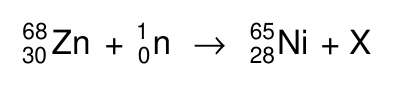
alpha ( ), beta ( ), gamma ( ), neutron ( )
b)
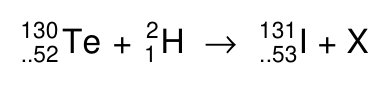
alpha ( ), beta ( ), gamma ( ), neutron ( )
c)
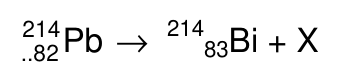
alpha ( ), beta ( ), gamma ( ), neutron ( )
d)
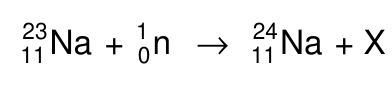
alpha ( ), beta ( ), gamma ( ), neutron ( )
e)
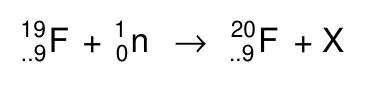
alpha ( ), beta ( ), gamma ( ), neutron ( )
Official English text of the problem.
Answers
- a) Alpha particle, \(\alpha\): a helium-4 nucleus, \(\ce{^{4}_{2}He}\), equivalent to the helium-4 dication
[4He+2]. Mark alpha. - b) Neutron, \(\ce{^{1}_{0}n}\). Mark neutron.
- c) Beta-minus particle, \(\beta^-\): an electron, \(\ce{^{0}_{-1}e}\). Mark beta.
- d) Gamma photon, \(\gamma\). Mark gamma.
- e) Gamma photon, \(\gamma\). Mark gamma.
Solution
Nuclear equations conserve total mass number \(A\) and electric charge. Thus, the sums of the superscripts and of the subscripts must each be equal on both sides. For an emitted electron, the subscript is \(-1\), representing its charge in units of the elementary charge.
a)
The missing particle has \[ A_X=68+1-65=4,\qquad Z_X=30+0-28=2. \] These values identify a helium-4 nucleus, an alpha particle: \[ \ce{^{68}_{30}Zn + ^{1}_{0}n -> ^{65}_{28}Ni + ^{4}_{2}He}. \]
b)
The missing particle has \[ A_X=130+2-131=1,\qquad Z_X=52+1-53=0. \] A particle with mass number \(1\) and no electric charge is a neutron: \[ \ce{^{130}_{52}Te + ^{2}_{1}H -> ^{131}_{53}I + ^{1}_{0}n}. \]
c)
The missing particle has \[ A_X=214-214=0,\qquad Z_X=82-83=-1. \] It is an electron, corresponding to beta-minus emission: \[ \ce{^{214}_{82}Pb -> ^{214}_{83}Bi + ^{0}_{-1}e}. \] The mass number remains unchanged while the nuclear charge increases by one: a neutron in the nucleus converts into a proton.
The equation above follows the problem’s abbreviated notation. Physically, beta-minus decay also emits an electron antineutrino: \[ \ce{^{214}_{82}Pb -> ^{214}_{83}Bi + ^{0}_{-1}e} +\bar{\nu}_e. \] The antineutrino has zero electric charge and zero mass number, so it does not alter the identification of \(X\) as the beta particle.
d)
The missing particle has \[ A_X=23+1-24=0,\qquad Z_X=11+0-11=0. \] Among the listed choices, this identifies a gamma photon. Neutron capture produces an excited sodium-24 nucleus, which releases excitation energy as gamma radiation: \[ \ce{^{23}_{11}Na + ^{1}_{0}n -> ^{24}_{11}Na + ^{0}_{0}\gamma}. \]
e)
The missing particle has \[ A_X=19+1-20=0,\qquad Z_X=9+0-9=0. \] Again, the appropriate listed particle is a gamma photon, emitted as the fluorine-20 nucleus releases excitation energy following neutron capture: \[ \ce{^{19}_{9}F + ^{1}_{0}n -> ^{20}_{9}F + ^{0}_{0}\gamma}. \]
The answers were checked against the official answers published by the organisers.
IChO 2003 · Theorieaufgabe 10
Bei Kernreaktionen emittierte Teilchen
Bestimmen Sie das Teilchen X in jeder der folgenden Kernreaktionen:
a)
Alpha ( ), Beta ( ), Gamma ( ), Neutron ( )
b)
Alpha ( ), Beta ( ), Gamma ( ), Neutron ( )
c)
Alpha ( ), Beta ( ), Gamma ( ), Neutron ( )
d)
Alpha ( ), Beta ( ), Gamma ( ), Neutron ( )
e)
Alpha ( ), Beta ( ), Gamma ( ), Neutron ( )
Aufgabentext aus dem offiziellen englischen Text übersetzt.
Antworten
- a) Alphateilchen, \(\alpha\): ein Helium-4-Kern, \(\ce{^{4}_{2}He}\), gleichbedeutend mit dem Helium-4-Dikation
[4He+2]. Kreuzen Sie Alpha an. - b) Neutron, \(\ce{^{1}_{0}n}\). Kreuzen Sie Neutron an.
- c) Beta-Minus-Teilchen, \(\beta^-\): ein Elektron, \(\ce{^{0}_{-1}e}\). Kreuzen Sie Beta an.
- d) Gammaphoton, \(\gamma\). Kreuzen Sie Gamma an.
- e) Gammaphoton, \(\gamma\). Kreuzen Sie Gamma an.
Lösung
In Kernreaktionsgleichungen bleiben die Gesamtmassenzahl \(A\) und die elektrische Ladung erhalten. Daher müssen sowohl die Summen der hochgestellten Zahlen als auch die Summen der tiefgestellten Zahlen auf beiden Seiten jeweils gleich sein. Bei einem emittierten Elektron ist die tiefgestellte Zahl \(-1\); sie gibt seine Ladung in Einheiten der Elementarladung an.
a)
Für das fehlende Teilchen gilt \[ A_X=68+1-65=4,\qquad Z_X=30+0-28=2. \] Diese Werte kennzeichnen einen Helium-4-Kern, ein Alphateilchen: \[ \ce{^{68}_{30}Zn + ^{1}_{0}n -> ^{65}_{28}Ni + ^{4}_{2}He}. \]
b)
Für das fehlende Teilchen gilt \[ A_X=130+2-131=1,\qquad Z_X=52+1-53=0. \] Ein Teilchen mit der Massenzahl \(1\) und ohne elektrische Ladung ist ein Neutron: \[ \ce{^{130}_{52}Te + ^{2}_{1}H -> ^{131}_{53}I + ^{1}_{0}n}. \]
c)
Für das fehlende Teilchen gilt \[ A_X=214-214=0,\qquad Z_X=82-83=-1. \] Es handelt sich um ein Elektron, was einer Beta-Minus-Emission entspricht: \[ \ce{^{214}_{82}Pb -> ^{214}_{83}Bi + ^{0}_{-1}e}. \] Die Massenzahl bleibt unverändert, während die Kernladungszahl um eins zunimmt: Ein Neutron im Kern wandelt sich in ein Proton um.
Die obige Gleichung folgt der verkürzten Schreibweise der Aufgabenstellung. Physikalisch wird beim Beta-Minus-Zerfall außerdem ein Elektron-Antineutrino emittiert: \[ \ce{^{214}_{82}Pb -> ^{214}_{83}Bi + ^{0}_{-1}e} +\bar{\nu}_e. \] Das Antineutrino hat die elektrische Ladung null und die Massenzahl null, sodass es die Identifizierung von \(X\) als Betateilchen nicht verändert.
d)
Für das fehlende Teilchen gilt \[ A_X=23+1-24=0,\qquad Z_X=11+0-11=0. \] Unter den aufgeführten Auswahlmöglichkeiten kennzeichnet dies ein Gammaphoton. Durch Neutroneneinfang entsteht ein angeregter Natrium-24-Kern, der Anregungsenergie in Form von Gammastrahlung abgibt: \[ \ce{^{23}_{11}Na + ^{1}_{0}n -> ^{24}_{11}Na + ^{0}_{0}\gamma}. \]
e)
Für das fehlende Teilchen gilt \[ A_X=19+1-20=0,\qquad Z_X=9+0-9=0. \] Auch hier ist das passende aufgeführte Teilchen ein Gammaphoton, das emittiert wird, wenn der Fluor-20-Kern nach dem Neutroneneinfang Anregungsenergie abgibt: \[ \ce{^{19}_{9}F + ^{1}_{0}n -> ^{20}_{9}F + ^{0}_{0}\gamma}. \]
Die Ergebnisse wurden mit den von den Veranstaltern veröffentlichten offiziellen Ergebnissen abgeglichen.
IChO 2003 · Teori sorusu 10
Nükleer tepkimelerde yayılan parçacıklar
Aşağıdaki nükleer tepkimelerin her birinde X parçacığını belirleyiniz:
a)
alfa ( ), beta ( ), gama ( ), nötron ( )
b)
alfa ( ), beta ( ), gama ( ), nötron ( )
c)
alfa ( ), beta ( ), gama ( ), nötron ( )
d)
alfa ( ), beta ( ), gama ( ), nötron ( )
e)
alfa ( ), beta ( ), gama ( ), nötron ( )
Soru metni resmi İngilizce metinden çevrilmiştir.
Cevaplar
- a) Alfa parçacığı, \(\alpha\): helyum-4 dikatyonuna
[4He+2]eşdeğer olan bir helyum-4 çekirdeği, \(\ce{^{4}_{2}He}\). Alfa seçeneğini işaretleyiniz. - b) Nötron, \(\ce{^{1}_{0}n}\). Nötron seçeneğini işaretleyiniz.
- c) Beta-eksi parçacığı, \(\beta^-\): bir elektron, \(\ce{^{0}_{-1}e}\). Beta seçeneğini işaretleyiniz.
- d) Gama fotonu, \(\gamma\). Gama seçeneğini işaretleyiniz.
- e) Gama fotonu, \(\gamma\). Gama seçeneğini işaretleyiniz.
Çözüm
Nükleer denklemlerde toplam kütle numarası \(A\) ve elektrik yükü korunur. Dolayısıyla, üst indislerin toplamı ve alt indislerin toplamı, denklemin her iki tarafında ayrı ayrı eşit olmalıdır. Yayılan bir elektronun alt indisi \(-1\) olup elektronun temel yük birimindeki yükünü gösterir.
a)
Eksik parçacık için \[ A_X=68+1-65=4,\qquad Z_X=30+0-28=2. \] Bu değerler bir helyum-4 çekirdeğini, yani bir alfa parçacığını tanımlar: \[ \ce{^{68}_{30}Zn + ^{1}_{0}n -> ^{65}_{28}Ni + ^{4}_{2}He}. \]
b)
Eksik parçacık için \[ A_X=130+2-131=1,\qquad Z_X=52+1-53=0. \] Kütle numarası \(1\) olan ve elektrik yükü taşımayan bir parçacık, nötrondur: \[ \ce{^{130}_{52}Te + ^{2}_{1}H -> ^{131}_{53}I + ^{1}_{0}n}. \]
c)
Eksik parçacık için \[ A_X=214-214=0,\qquad Z_X=82-83=-1. \] Bu parçacık bir elektrondur ve bu durum beta-eksi yayımına karşılık gelir: \[ \ce{^{214}_{82}Pb -> ^{214}_{83}Bi + ^{0}_{-1}e}. \] Kütle numarası değişmeden kalırken çekirdek yükü bir artar: çekirdekteki bir nötron bir protona dönüşür.
Yukarıdaki denklem, sorudaki kısaltılmış gösterime uygundur. Fiziksel olarak, beta-eksi bozunmasında bir elektron antinötrinosu da yayılır: \[ \ce{^{214}_{82}Pb -> ^{214}_{83}Bi + ^{0}_{-1}e} +\bar{\nu}_e. \] Antinötrinonun elektrik yükü ve kütle numarası sıfırdır; bu nedenle \(X\)'in beta parçacığı olarak belirlenmesini etkilemez.
d)
Eksik parçacık için \[ A_X=23+1-24=0,\qquad Z_X=11+0-11=0. \] Verilen seçenekler arasında bu değerler bir gama fotonunu tanımlar. Nötron yakalanması sonucunda uyarılmış bir sodyum-24 çekirdeği oluşur ve bu çekirdek uyarılma enerjisini gama ışınımı olarak salar: \[ \ce{^{23}_{11}Na + ^{1}_{0}n -> ^{24}_{11}Na + ^{0}_{0}\gamma}. \]
e)
Eksik parçacık için \[ A_X=19+1-20=0,\qquad Z_X=9+0-9=0. \] Yine, verilen seçenekler arasındaki uygun parçacık bir gama fotonudur; flor-20 çekirdeği nötron yakalanmasının ardından uyarılma enerjisini salarken bu foton yayılır: \[ \ce{^{19}_{9}F + ^{1}_{0}n -> ^{20}_{9}F + ^{0}_{0}\gamma}. \]
Sonuçlar, düzenleyicilerin yayımladığı resmi sonuçlarla karşılaştırılarak kontrol edildi.
IChO 2003 · Problema teórico 10
Partículas emitidas en reacciones nucleares
Identifique la partícula X en cada una de las siguientes reacciones nucleares:
a)
alfa ( ), beta ( ), gamma ( ), neutrón ( )
b)
alfa ( ), beta ( ), gamma ( ), neutrón ( )
c)
alfa ( ), beta ( ), gamma ( ), neutrón ( )
d)
alfa ( ), beta ( ), gamma ( ), neutrón ( )
e)
alfa ( ), beta ( ), gamma ( ), neutrón ( )
Enunciado traducido del texto oficial en inglés.
Respuestas
- a) Partícula alfa, \(\alpha\): un núcleo de helio-4, \(\ce{^{4}_{2}He}\), equivalente al dicatión de helio-4
[4He+2]. Marque alfa. - b) Neutrón, \(\ce{^{1}_{0}n}\). Marque neutrón.
- c) Partícula beta menos, \(\beta^-\): un electrón, \(\ce{^{0}_{-1}e}\). Marque beta.
- d) Fotón gamma, \(\gamma\). Marque gamma.
- e) Fotón gamma, \(\gamma\). Marque gamma.
Solución
Las ecuaciones nucleares conservan el número másico total \(A\) y la carga eléctrica. Por tanto, tanto la suma de los superíndices como la de los subíndices deben ser iguales en ambos miembros. Para un electrón emitido, el subíndice es \(-1\), que representa su carga en unidades de la carga elemental.
a)
La partícula que falta tiene \[ A_X=68+1-65=4,\qquad Z_X=30+0-28=2. \] Estos valores identifican un núcleo de helio-4, una partícula alfa: \[ \ce{^{68}_{30}Zn + ^{1}_{0}n -> ^{65}_{28}Ni + ^{4}_{2}He}. \]
b)
La partícula que falta tiene \[ A_X=130+2-131=1,\qquad Z_X=52+1-53=0. \] Una partícula con número másico \(1\) y sin carga eléctrica es un neutrón: \[ \ce{^{130}_{52}Te + ^{2}_{1}H -> ^{131}_{53}I + ^{1}_{0}n}. \]
c)
La partícula que falta tiene \[ A_X=214-214=0,\qquad Z_X=82-83=-1. \] Es un electrón, lo que corresponde a una emisión beta menos: \[ \ce{^{214}_{82}Pb -> ^{214}_{83}Bi + ^{0}_{-1}e}. \] El número másico permanece invariable, mientras que la carga nuclear aumenta en una unidad: un neutrón del núcleo se convierte en un protón.
La ecuación anterior sigue la notación abreviada del problema. Físicamente, en la desintegración beta menos también se emite un antineutrino electrónico: \[ \ce{^{214}_{82}Pb -> ^{214}_{83}Bi + ^{0}_{-1}e} +\bar{\nu}_e. \] El antineutrino tiene carga eléctrica nula y número másico cero, por lo que no altera la identificación de \(X\) como la partícula beta.
d)
La partícula que falta tiene \[ A_X=23+1-24=0,\qquad Z_X=11+0-11=0. \] Entre las opciones indicadas, estos valores identifican un fotón gamma. La captura de un neutrón produce un núcleo excitado de sodio-24, que libera energía de excitación en forma de radiación gamma: \[ \ce{^{23}_{11}Na + ^{1}_{0}n -> ^{24}_{11}Na + ^{0}_{0}\gamma}. \]
e)
La partícula que falta tiene \[ A_X=19+1-20=0,\qquad Z_X=9+0-9=0. \] De nuevo, la partícula adecuada entre las opciones indicadas es un fotón gamma, emitido cuando el núcleo de flúor-20 libera energía de excitación tras la captura de un neutrón: \[ \ce{^{19}_{9}F + ^{1}_{0}n -> ^{20}_{9}F + ^{0}_{0}\gamma}. \]
Los resultados se comprobaron con los resultados oficiales publicados por los organizadores.
IChO 2003 · 理论题 10
核反应中放出的粒子
确定下列各核反应中的粒子 X:
a)
α 粒子 ( ), β 粒子 ( ), γ 光子 ( ), 中子 ( )
b)
α 粒子 ( ), β 粒子 ( ), γ 光子 ( ), 中子 ( )
c)
α 粒子 ( ), β 粒子 ( ), γ 光子 ( ), 中子 ( )
d)
α 粒子 ( ), β 粒子 ( ), γ 光子 ( ), 中子 ( )
e)
α 粒子 ( ), β 粒子 ( ), γ 光子 ( ), 中子 ( )
题目译自官方英文原文。
答案
- a) α 粒子,\(\alpha\):氦-4 原子核,\(\ce{^{4}_{2}He}\),等同于氦-4 二价阳离子
[4He+2]。勾选 α 粒子。 - b) 中子,\(\ce{^{1}_{0}n}\)。勾选中子。
- c) β⁻ 粒子,\(\beta^-\):电子,\(\ce{^{0}_{-1}e}\)。勾选 β 粒子。
- d) γ 光子,\(\gamma\)。勾选 γ 光子。
- e) γ 光子,\(\gamma\)。勾选 γ 光子。
解答
核反应方程式遵循总质量数 \(A\) 和电荷守恒。因此,方程式两边的上标之和必须相等,下标之和也必须相等。对于放出的电子,其下标为 \(-1\),表示以元电荷为单位的电荷量。
a)
未知粒子的质量数和电荷数为 \[ A_X=68+1-65=4,\qquad Z_X=30+0-28=2. \] 由这些数值可确定该粒子为氦-4 原子核,即 α 粒子: \[ \ce{^{68}_{30}Zn + ^{1}_{0}n -> ^{65}_{28}Ni + ^{4}_{2}He}. \]
b)
未知粒子的质量数和电荷数为 \[ A_X=130+2-131=1,\qquad Z_X=52+1-53=0. \] 质量数为 \(1\) 且不带电荷的粒子是中子: \[ \ce{^{130}_{52}Te + ^{2}_{1}H -> ^{131}_{53}I + ^{1}_{0}n}. \]
c)
未知粒子的质量数和电荷数为 \[ A_X=214-214=0,\qquad Z_X=82-83=-1. \] 该粒子是电子,对应于 β⁻ 发射: \[ \ce{^{214}_{82}Pb -> ^{214}_{83}Bi + ^{0}_{-1}e}. \] 质量数保持不变,而核电荷数增加一:原子核中的一个中子转变为一个质子。
上式采用了题目中的简略表示法。实际上,β⁻ 衰变还会放出一个电子反中微子: \[ \ce{^{214}_{82}Pb -> ^{214}_{83}Bi + ^{0}_{-1}e} +\bar{\nu}_e. \] 反中微子的电荷和质量数均为零,因此它不影响将 \(X\) 确定为 β 粒子。
d)
未知粒子的质量数和电荷数为 \[ A_X=23+1-24=0,\qquad Z_X=11+0-11=0. \] 在所列选项中,符合这些数值的是 γ 光子。中子俘获产生处于激发态的钠-24 原子核,该原子核以 γ 辐射的形式释放激发能: \[ \ce{^{23}_{11}Na + ^{1}_{0}n -> ^{24}_{11}Na + ^{0}_{0}\gamma}. \]
e)
未知粒子的质量数和电荷数为 \[ A_X=19+1-20=0,\qquad Z_X=9+0-9=0. \] 同样,在所列粒子中,符合条件的是 γ 光子,它是在中子俘获后形成的氟-20 原子核释放激发能的过程中放出的: \[ \ce{^{19}_{9}F + ^{1}_{0}n -> ^{20}_{9}F + ^{0}_{0}\gamma}. \]
结果已与主办方公布的官方答案核对。
IChO 2003 · Теоретическая задача 10
Частицы, испускаемые в ядерных реакциях
Определите частицу X в каждой из следующих ядерных реакций:
a)
альфа ( ), бета ( ), гамма ( ), нейтрон ( )
b)
альфа ( ), бета ( ), гамма ( ), нейтрон ( )
c)
альфа ( ), бета ( ), гамма ( ), нейтрон ( )
d)
альфа ( ), бета ( ), гамма ( ), нейтрон ( )
e)
альфа ( ), бета ( ), гамма ( ), нейтрон ( )
Условие переведено с официального английского текста.
Ответы
- a) Альфа-частица, \(\alpha\): ядро гелия-4, \(\ce{^{4}_{2}He}\), эквивалентное дикатиону гелия-4
[4He+2]. Отметьте альфа. - b) Нейтрон, \(\ce{^{1}_{0}n}\). Отметьте нейтрон.
- c) Бета-минус-частица, \(\beta^-\): электрон, \(\ce{^{0}_{-1}e}\). Отметьте бета.
- d) Гамма-фотон, \(\gamma\). Отметьте гамма.
- e) Гамма-фотон, \(\gamma\). Отметьте гамма.
Решение
В уравнениях ядерных реакций сохраняются суммарное массовое число \(A\) и электрический заряд. Поэтому суммы верхних индексов и суммы нижних индексов должны быть соответственно равны в обеих частях уравнения. Для испускаемого электрона нижний индекс равен \(-1\) и обозначает его заряд в единицах элементарного заряда.
a)
Для неизвестной частицы получаем \[ A_X=68+1-65=4,\qquad Z_X=30+0-28=2. \] Эти значения соответствуют ядру гелия-4 — альфа-частице: \[ \ce{^{68}_{30}Zn + ^{1}_{0}n -> ^{65}_{28}Ni + ^{4}_{2}He}. \]
b)
Для неизвестной частицы получаем \[ A_X=130+2-131=1,\qquad Z_X=52+1-53=0. \] Частица с массовым числом \(1\), не имеющая электрического заряда, — это нейтрон: \[ \ce{^{130}_{52}Te + ^{2}_{1}H -> ^{131}_{53}I + ^{1}_{0}n}. \]
c)
Для неизвестной частицы получаем \[ A_X=214-214=0,\qquad Z_X=82-83=-1. \] Это электрон, что соответствует бета-минус-распаду: \[ \ce{^{214}_{82}Pb -> ^{214}_{83}Bi + ^{0}_{-1}e}. \] Массовое число остаётся неизменным, а заряд ядра увеличивается на единицу: нейтрон в ядре превращается в протон.
Приведённое выше уравнение записано в сокращённой форме, принятой в условии задачи. В действительности при бета-минус-распаде также испускается электронное антинейтрино: \[ \ce{^{214}_{82}Pb -> ^{214}_{83}Bi + ^{0}_{-1}e} +\bar{\nu}_e. \] Антинейтрино имеет нулевой электрический заряд и нулевое массовое число, поэтому его учёт не меняет вывода о том, что \(X\) — бета-частица.
d)
Для неизвестной частицы получаем \[ A_X=23+1-24=0,\qquad Z_X=11+0-11=0. \] Среди перечисленных вариантов этим значениям соответствует гамма-фотон. При захвате нейтрона образуется возбуждённое ядро натрия-24, которое высвобождает энергию возбуждения в виде гамма-излучения: \[ \ce{^{23}_{11}Na + ^{1}_{0}n -> ^{24}_{11}Na + ^{0}_{0}\gamma}. \]
e)
Для неизвестной частицы получаем \[ A_X=19+1-20=0,\qquad Z_X=9+0-9=0. \] И здесь подходящей частицей из перечисленных является гамма-фотон, испускаемый при высвобождении ядром фтора-20 энергии возбуждения после захвата нейтрона: \[ \ce{^{19}_{9}F + ^{1}_{0}n -> ^{20}_{9}F + ^{0}_{0}\gamma}. \]
Ответы проверены по официальным ответам, опубликованным организаторами.
IChO 2003 · مسألة نظرية 10
الجسيمات المنبعثة في التفاعلات النووية
حدِّد الجسيم X في كلٍّ من التفاعلات النووية الآتية:
a)
ألفا ( )، بيتا ( )، غاما ( )، نيوترون ( )
b)
ألفا ( )، بيتا ( )، غاما ( )، نيوترون ( )
c)
ألفا ( )، بيتا ( )، غاما ( )، نيوترون ( )
d)
ألفا ( )، بيتا ( )، غاما ( )، نيوترون ( )
e)
ألفا ( )، بيتا ( )، غاما ( )، نيوترون ( )
نص المسألة مترجم عن النص الإنجليزي الرسمي.
الإجابات
- a) جسيم ألفا، \(\alpha\): نواة هيليوم-4، \(\ce{^{4}_{2}He}\)، تكافئ كاتيون الهيليوم-4 ثنائي الشحنة الموجبة
[4He+2]. ضع علامة عند ألفا. - b) نيوترون، \(\ce{^{1}_{0}n}\). ضع علامة عند نيوترون.
- c) جسيم بيتا السالب، \(\beta^-\): إلكترون، \(\ce{^{0}_{-1}e}\). ضع علامة عند بيتا.
- d) فوتون غاما، \(\gamma\). ضع علامة عند غاما.
- e) فوتون غاما، \(\gamma\). ضع علامة عند غاما.
الحل
في المعادلات النووية، يُحفَظ مجموع العدد الكتلي \(A\) والشحنة الكهربائية. لذا يجب أن يتساوى مجموع الأعداد العلوية على طرفي المعادلة، وكذلك مجموع الأعداد السفلية. بالنسبة إلى الإلكترون المنبعث، يكون العدد السفلي \(-1\)، وهو يمثّل شحنته بوحدات الشحنة الأولية.
a)
للجسيم المفقود القيمتان الآتيتان: \[ A_X=68+1-65=4,\qquad Z_X=30+0-28=2. \] تحدِّد هاتان القيمتان نواة هيليوم-4، وهي جسيم ألفا: \[ \ce{^{68}_{30}Zn + ^{1}_{0}n -> ^{65}_{28}Ni + ^{4}_{2}He}. \]
b)
للجسيم المفقود القيمتان الآتيتان: \[ A_X=130+2-131=1,\qquad Z_X=52+1-53=0. \] الجسيم ذو العدد الكتلي \(1\) والذي لا يحمل شحنة كهربائية هو نيوترون: \[ \ce{^{130}_{52}Te + ^{2}_{1}H -> ^{131}_{53}I + ^{1}_{0}n}. \]
c)
للجسيم المفقود القيمتان الآتيتان: \[ A_X=214-214=0,\qquad Z_X=82-83=-1. \] إنه إلكترون، وهو ما يقابل انبعاث بيتا السالب: \[ \ce{^{214}_{82}Pb -> ^{214}_{83}Bi + ^{0}_{-1}e}. \] يبقى العدد الكتلي دون تغيير، بينما تزداد الشحنة النووية بمقدار واحد: يتحوّل نيوترون في النواة إلى بروتون.
تتبع المعادلة أعلاه الترميز المختصر المستخدم في المسألة. ومن الناحية الفيزيائية، ينبعث أيضًا نيوترينو إلكتروني مضاد في اضمحلال بيتا السالب: \[ \ce{^{214}_{82}Pb -> ^{214}_{83}Bi + ^{0}_{-1}e} +\bar{\nu}_e. \] الشحنة الكهربائية للنيوترينو المضاد وعدده الكتلي كلاهما صفر، ولذلك لا يغيّر تحديد \(X\) على أنه جسيم بيتا.
d)
للجسيم المفقود القيمتان الآتيتان: \[ A_X=23+1-24=0,\qquad Z_X=11+0-11=0. \] من بين الخيارات المدرجة، تحدِّد هاتان القيمتان فوتون غاما. ينتج عن التقاط النيوترون نواة صوديوم-24 مثارة، تُطلِق طاقة الإثارة على هيئة إشعاع غاما: \[ \ce{^{23}_{11}Na + ^{1}_{0}n -> ^{24}_{11}Na + ^{0}_{0}\gamma}. \]
e)
للجسيم المفقود القيمتان الآتيتان: \[ A_X=19+1-20=0,\qquad Z_X=9+0-9=0. \] مرة أخرى، الجسيم المناسب من بين الخيارات المدرجة هو فوتون غاما، وينبعث عندما تُطلِق نواة الفلور-20 طاقة الإثارة عقب التقاط النيوترون: \[ \ce{^{19}_{9}F + ^{1}_{0}n -> ^{20}_{9}F + ^{0}_{0}\gamma}. \]
تمت مراجعة النتائج بمقارنتها بالنتائج الرسمية التي نشرها المنظمون.