International Chemistry Olympiad
IChO 2004
Kiel, Germany · 8 theory problems with complete solutions
Problem 1: Thermodynamics
For his \(18^{\mathrm{th}}\) birthday party in February Peter plans to turn a hut in the garden of his parents into a swimming pool with an artificial beach. In order to estimate the costs for heating the water and the house, Peter obtains the data for the natural gas composition and its price.
1.1 Write down the chemical equations for the complete combustion of the main components of natural gas, methane and ethane, given in Table 1. Assume that nitrogen is inert under the chosen conditions.
Calculate the reaction enthalpy, the reaction entropy, and the Gibbs energy under standard conditions (\(1.013\cdot10^5\ \mathrm{Pa}\), \(25.0\,^\circ\mathrm C\)) for the combustion of methane and ethane according to the equations above assuming that all products are gaseous.
The thermodynamic properties and the composition of natural gas can be found in Table 1.
1.2 The density of natural gas is \(0.740\ \mathrm{g\,dm^{-3}}\) (\(1.013\times10^5\ \mathrm{Pa}\), \(25.0\,^\circ\mathrm C\)) specified by PUC, the public utility company.
a) Calculate the amount of methane and ethane (in moles) in \(1.00\ \mathrm{m^3}\) of natural gas (natural gas, methane, and ethane are not ideal gases!).
b) Calculate the combustion energy which is released as thermal energy during the burning of \(1.00\ \mathrm{m^3}\) of natural gas under standard conditions assuming that all products are gaseous. (If you do not have the amount from 1.2a) assume that \(1.00\ \mathrm{m^3}\) natural gas corresponds to \(40.00\ \mathrm{mol}\) natural gas.)
According to the PUC the combustion energy will be \(9.981\ \mathrm{kWh}\) per \(\mathrm{m^3}\) of natural gas if all products are gaseous. How large is the deviation (in percent) from the value you obtained in b)
The swimming pool inside the house is \(3.00\ \mathrm m\) wide, \(5.00\ \mathrm m\) long and \(1.50\ \mathrm m\) deep (below the floor). The tap water temperature is \(8.00\,^\circ\mathrm C\) and the air temperature in the house (dimensions given in the figure below) is \(10.0\,^\circ\mathrm C\). Assume a water density of \(\rho=1.00\ \mathrm{kg\,dm^{-3}}\) and air behaving like an ideal gas.
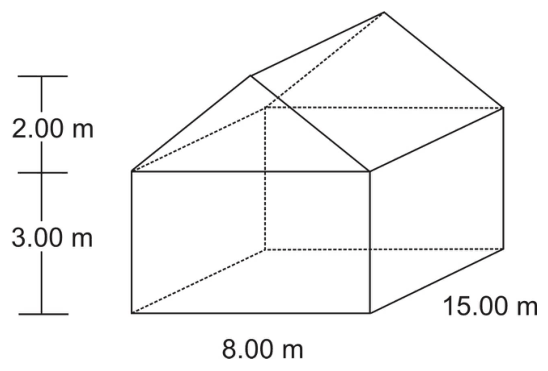
1.3 Calculate the energy (in MJ) which is required to heat the water in the pool to \(22.0\,^\circ\mathrm C\) and the energy which is required to heat the initial amount of air (\(21.0\ \%\) of \(\ce{O2}\), \(79.0\ \%\) of \(\ce{N2}\)) to \(30.0\,^\circ\mathrm C\) at a pressure of \(1.013\times10^5\ \mathrm{Pa}\).
In February, the outside temperature is about \(5\,^\circ\mathrm C\) in Northern Germany. Since the concrete walls and the roof of the house are relatively thin (\(20.0\ \mathrm{cm}\)) there will be a loss of energy. This energy is released to the surroundings (heat loss released to water and/or ground should be neglected). The heat conductivity of the wall and roof is \(1.00\ \mathrm{W\,K^{-1}\,m^{-1}}\).
1.4 Calculate the energy (in MJ) which is needed to maintain the temperature inside the house at \(30.0\,^\circ\mathrm C\) during the party (12 hours).
\(1.00\ \mathrm{m^3}\) of natural gas as delivered by PUC costs 0.40 € and \(1.00\ \mathrm{kWh}\) of electricity costs 0.137 €. The rent for the equipment for gas heating will cost him about 150.00 € while the corresponding electrical heaters will only cost 100.00 €.
1.5 What is the total energy (in MJ) needed for Peter’s “winter swimming pool” calculated in 1.3 and 1.4? How much natural gas will he need, if the gas heater has an efficiency of \(90.0\ \%\)? What are the different costs for the use of either natural gas or electricity? Use the values given by PUC for your calculations and assume \(100\ \%\) efficiency for the electric heater.
Table 1: Composition of natural gas
Chemical Substance mol fraction \(x\) \(\Delta_{\mathrm f}H^0\,(\mathrm{kJ\,mol^{-1}})^{-1}\) \(S^0\,(\mathrm{J\,mol^{-1}\,K^{-1}})^{-1}\) \(C_p^0\,(\mathrm{J\,mol^{-1}\,K^{-1}})^{-1}\) \(\ce{CO2(g)}\) 0.0024 −393.5 213.8 37.1 \(\ce{N2(g)}\) 0.0134 0.0 191.6 29.1 \(\ce{CH4(g)}\) 0.9732 −74.6 186.3 35.7 \(\ce{C2H6(g)}\) 0.0110 −84.0 229.2 52.5 \(\ce{H2O(l)}\) – −285.8 70.0 75.3 \(\ce{H2O(g)}\) – −241.8 188.8 33.6 \(\ce{O2(g)}\) – 0.0 205.2 29.4 Equation:
\[ J=E\times(A\times\Delta t)^{-1} =\lambda_{\mathrm{wall}}\times\Delta T\times d^{-1} \]
\(J\) energy flow \(E\) along a temperature gradient (wall direction \(z\)) per area \(A\) and time \(\Delta t\)
\(d\) wall thickness
\(\lambda_{\mathrm{wall}}\) heat conductivity
\(\Delta T\) difference in temperature between the inside and the outside of the house
Official English text of the problem.
Problem 2: Kinetics at catalyst surfaces
Apart from other compounds the exhaust gases of an Otto engine are the main pollutants carbon monoxide, nitrogen monoxide and uncombusted hydrocarbons, as, for example, octane. To minimize them they are converted to carbon dioxide, nitrogen and water in a regulated three-way catalytic converter.
2.1 Complete the chemical reaction equations for the reactions of the main pollutants in the catalyst.
To remove the main pollutants from the exhaust gas of an Otto engine optimally, the \(\lambda\)-value is determined by an electro-chemical element, the so called lambda probe. It is located in the exhaust gas stream between engine and the three-way catalytic converter.
The lambda value is defined as \[ \lambda= \frac{\text{amount of air at the inlet}} {\text{amount of air necessary for complete combustion}}. \]
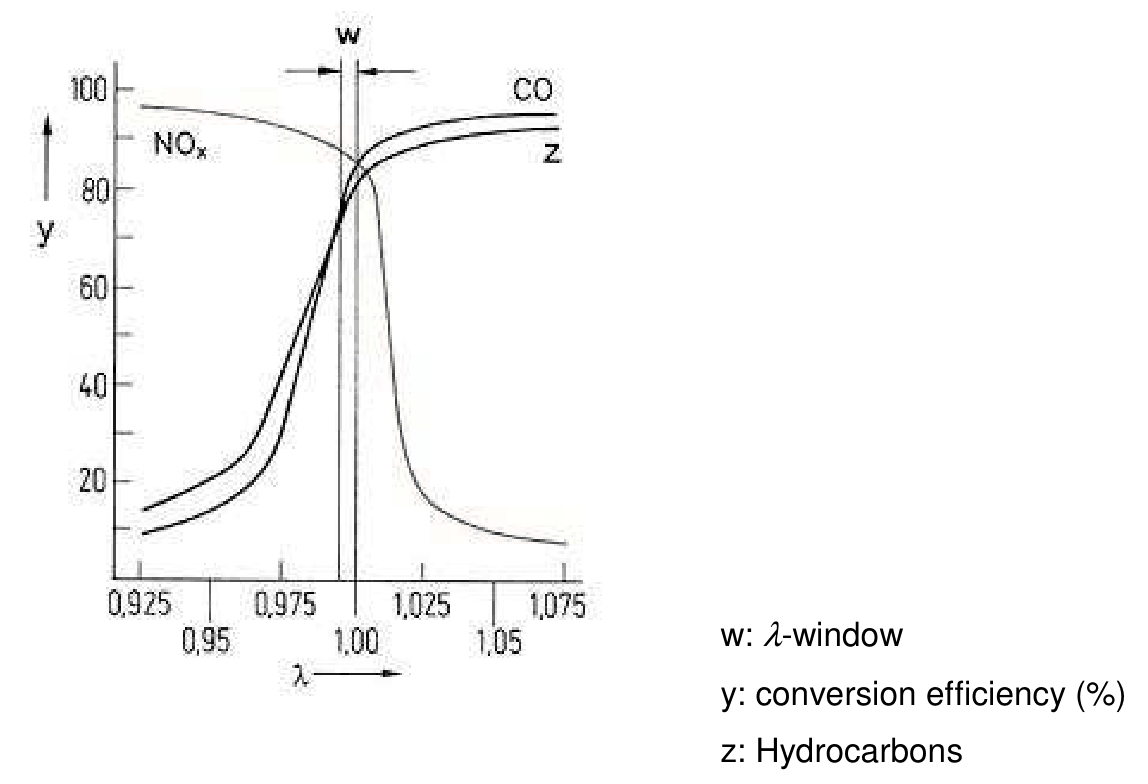
2.2 Decide the questions on the answer sheet concerning the \(\lambda\) probe.
The adsorption of gas molecules on a solid surface can be described in a simple model by using the Langmuir isotherm: \[ \theta=\frac{K\times p}{1+K\times p} \] where \(\theta\) is the fraction of surface sites that are occupied by the gas molecules, p is the gas pressure and K is a constant.
The adsorption of a gas at 25 °C may be described by using the Langmuir isotherm with \(K=0.85\ \mathrm{kPa^{-1}}\).
2.3 a) Determine the surface coverage \(\theta\) at a pressure of 0.65 kPa.
b) Determine the pressure p at which 15 % of the surface is covered.
c) The rate r of the decomposition of gas molecules at a solid surface depends on the surface coverage \(\theta\) (reverse reaction neglected): \(r=k\theta\)
Give the order of the decomposition reaction at low and at high gas pressures assuming the validity of the Langmuir isotherm given above (products to be neglected).
d) Data for the adsorption of another gas on a metal surface (at 25 °C)
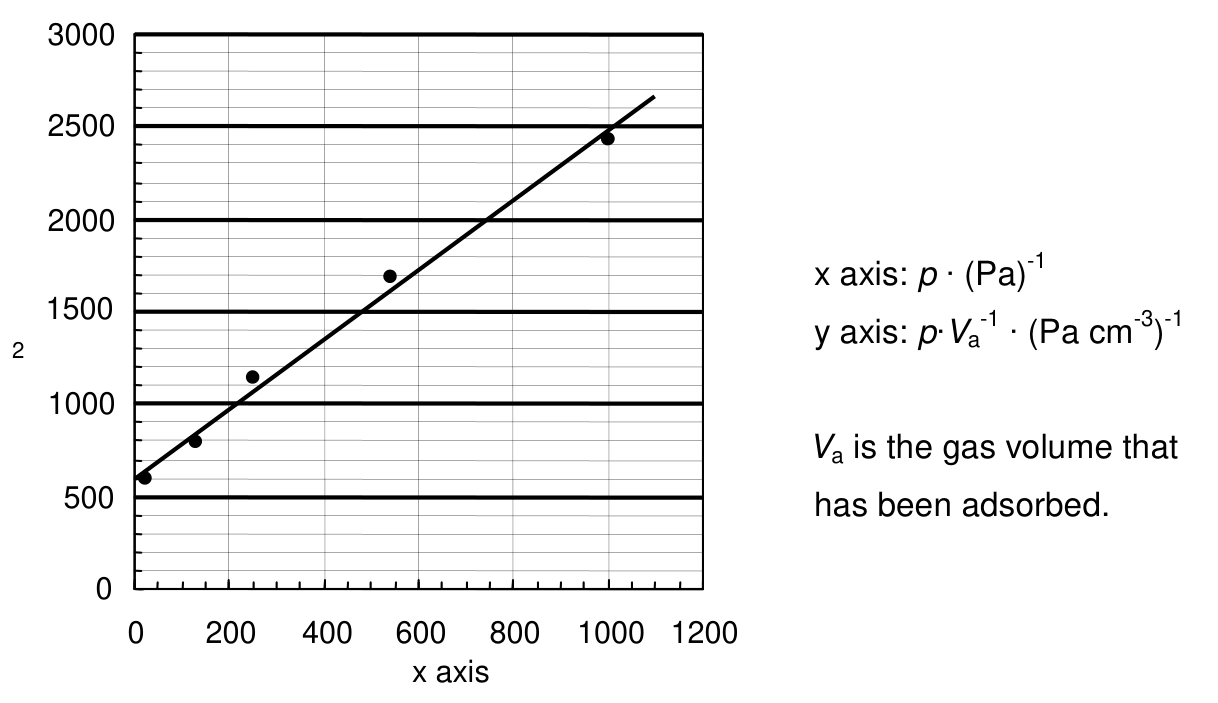
If the Langmuir isotherm can be applied, determine the gas volume \(V_{\mathrm{a,max}}\) needed for a complete coverage of the metal surface and the product \(K V_{\mathrm{a,max}}\).
Hint: Set \(\theta=V_{\mathrm a}/V_{\mathrm{a,max}}\).
Assume that the catalytic oxidation of \(\ce{CO}\) on a \(\ce{Pd}\) surface with equal surface sites proceeds in the following way:
In a first step adsorbed \(\ce{CO}\) and adsorbed \(\ce{O2}\) form adsorbed \(\ce{CO2}\) in a fast equilibrium,
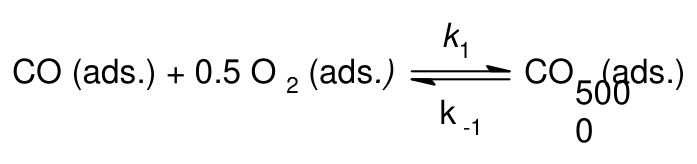
In a slow second step, \(\ce{CO2}\) is then desorbed from the surface:
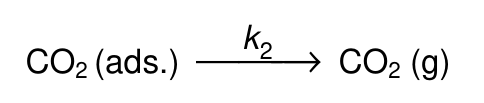
2.4 Derive the formula for the reaction rate of the \(\ce{CO2(g)}\) - formation as a function of the partial pressures of the reaction components.
Hint: Use the Langmuir isotherm with the proper number of gas components \[ \theta_i= \frac{K_i\times p_i} {1+\displaystyle\sum_j K_j\times p_j} \qquad \text{j: relevant gas components} \]
Official English text of the problem.
Problem 3: Monovalent alkaline earth compounds?
In the past there have been several reports on compounds of monovalent calcium. Until recently the nature of these “compounds” was not known but they are still of great interest to solid state chemists.
Attempts to reduce \(\ce{CaCl2}\) to \(\ce{CaCl}\) have been made with
(a) Calcium (b) Hydrogen (c) Carbon
3.1 Give the corresponding reaction equations that could potentially lead to the formation of \(\ce{CaCl}\).
After an attempt to reduce \(\ce{CaCl2}\) with the stoichiometric 1 : 1 molar amount of \(\ce{Ca}\) one obtains an inhomogeneous grey substance. A closer look under the microscope reveals silvery metallic particles and colourless crystals.
3.2 What substance are the metallic particles and the colourless crystals?
When \(\ce{CaCl2}\) is attempted to be reduced with elemental hydrogen a white product forms. Elemental analysis shows that the sample contains 52.36 % (by mass) of calcium and 46.32 mass % of chlorine.
3.3 Determine the empirical formula of the compound formed.
When \(\ce{CaCl2}\) is attempted to be reduced with elemental carbon a red crystalline product forms. The molar ratio of \(\ce{Ca}\) and \(\ce{Cl}\) determined by elemental analysis is \(n(\ce{Ca}) : n(\ce{Cl}) = 1.5 : 1\). During the hydrolysis of the red crystalline substance the same gas is evolved as during the hydrolysis of \(\ce{Mg2C3}\).
3.4 a) Show the two acyclic constitutional isomers of the gas that are formed by hydrolysis.
b) What compound is formed by the reaction of \(\ce{CaCl2}\) with carbon?
(Provided that monovalent calcium does not exist.)
As none of these attempts lead to the formation of \(\ce{CaCl}\) more consideration has to be given as to the hypothetical structure of \(\ce{CaCl}\). One can assume that \(\ce{CaCl}\) is likely to crystallize in a simple crystal structure.
It is the radius ratio of cation \(r(\ce{M^{m+}})\) and anion \(r(\ce{X^{x-}})\) of salts that often determines the crystal structure of a particular compound as shown for \(\ce{MX}\) compounds in the table below.
Coordination number of \(\ce{M}\) Surrounding of \(\ce{X}\) Radius ratio \(r_{\mathrm M}/r_{\mathrm X}\) Structure type estimated \(\Delta_{\mathrm L}H^0\) for \(\ce{CaCl}\) 3 Triangular 0.155 – 0.225 \(\ce{BN}\) \(-663.8\ \mathrm{kJ\,mol^{-1}}\) 4 Tetrahedral 0.225 – 0.414 \(\ce{ZnS}\) \(-704.8\ \mathrm{kJ\,mol^{-1}}\) 6 Octahedral 0.414 – 0.732 \(\ce{NaCl}\) \(-751.9\ \mathrm{kJ\,mol^{-1}}\) 8 Cubic 0.732 – 1.000 \(\ce{CsCl}\) \(-758.4\ \mathrm{kJ\,mol^{-1}}\) \(\Delta_{\mathrm L}H^0(\ce{CaCl})\) is defined for the reaction \(\ce{Ca+(g) + Cl-(g) -> CaCl(s)}\)
3.5 a) What type of structure is \(\ce{CaCl}\) likely to have?
[\(r(\ce{Ca+}) \approx 120\ \mathrm{pm}\) (estimated), \(r(\ce{Cl-}) \approx 167\ \mathrm{pm}\))]
Not only the lattice energy \(\Delta_{\mathrm L}H^0\) for \(\ce{CaCl}\) is important for the decision whether \(\ce{CaCl}\) is thermodynamically stable or not. In order to decide whether it is stable against decomposition into its elements, the standard enthalpy of formation \(\Delta_{\mathrm f}H^0\) of \(\ce{CaCl}\) has to be known.
b) Calculate the value of \(\Delta_{\mathrm f}H^0(\ce{CaCl})\) with the aid of a Born-Haber-cycle.
heat of fusion \(\Delta_{\mathrm{fusion}}H^0(\ce{Ca})\) \(9.3\ \mathrm{kJ\,mol^{-1}}\) ionization enthalpy \(\Delta_{\mathrm{1.\,IE}}H(\ce{Ca})\) \(\ce{Ca -> Ca+}\) \(589.7\ \mathrm{kJ\,mol^{-1}}\) ionization enthalpy \(\Delta_{\mathrm{2.\,IE}}H(\ce{Ca})\) \(\ce{Ca+ -> Ca^2+}\) \(1145.0\ \mathrm{kJ\,mol^{-1}}\) heat of vaporization \(\Delta_{\mathrm{vap}}H^0(\ce{Ca})\) \(150.0\ \mathrm{kJ\,mol^{-1}}\) dissociation energy \(\Delta_{\mathrm{diss}}H(\ce{Cl2})\) \(\ce{Cl2 -> 2Cl}\) \(240.0\ \mathrm{kJ\,mol^{-1}}\) enthalpy of formation \(\Delta_{\mathrm f}H^0(\ce{CaCl2})\) \(-796.0\ \mathrm{kJ\,mol^{-1}}\) electron affinity \(\Delta_{\mathrm{EA}}H(\ce{Cl})\) \(\ce{Cl + e- -> Cl-}\) \(-349.0\ \mathrm{kJ\,mol^{-1}}\) To decide whether \(\ce{CaCl}\) is thermodynamically stable to disproportionation into \(\ce{Ca}\) and \(\ce{CaCl2}\) the standard enthalpy of this process has to be calculated. (The change of the entropy \(\Delta S\) is very small in this case, so its influence is negligible.)
3.6 Does the disproportionation of \(\ce{CaCl}\) take place from a thermodynamic point of view? Base your decision on a calculation!
Official English text of the problem.
Problem 4: Determining atomic masses
The reaction of the element X with hydrogen leads to a class of compounds that is analogous to hydrocarbons. 5.000 g of X form 5.628 g of a molar 2 : 1 mixture of the stoichiometric X-analogues of methane and ethane, respectively.
4.1 Determine the molar mass of X from this information. Give the chemical symbol of X, and the 3D-structure of the two products.
The following more complex case is of great historical interest.
The mineral Argyrodite is a stoichiometric compound that contains silver (oxidation state +1), sulphur (oxidation state -2) and an unknown element Y (oxidation state +4). The ratio between the masses of silver and Y in Argyrodite is \(m(\ce{Ag}) : m(\ce{Y}) = 11.88 : 1\). Y forms a reddish brown lower sulfide (oxidation state of Y is +2) and a higher white sulfide (oxidation state of Y is +4). The coloured lower sulfide is the sublimate obtained by heating Argyrodite in a flow of hydrogen. The residues are \(\ce{Ag2S}\) and \(\ce{H2S}\). To convert 10.0 g of Argyrodite completely, 0.295 \(\mathrm{dm^3}\) of hydrogen are needed at 400 K and 100 kPa.
4.2 Determine the molar mass of Y from this information. Give the chemical symbol of Y, and the empirical formula of Argyrodite.
The atomic masses are correlated with spectroscopic properties. To determine the vibrational frequency \(\tilde{\nu}\) expressed in wave numbers of chemical bonds in IR spectra chemists use Hooke's law which focuses on the frequency of the vibration (attention to units!):
\[ \tilde{\nu}=\frac{1}{2\pi c}\cdot\sqrt{\frac{k}{\mu}} \]
\(\tilde{\nu}\) - vibrational frequency of the bond, in wavenumbers (\(\mathrm{cm^{-1}}\))
\(c\) - speed of light
\(k\) - force constant, indicating the strength of the bond (\(\mathrm{N\,m^{-1}=kg\,s^{-2}}\))
\(\mu\) reduced mass in \(\ce{AB4}\), which is given by \[ \mu=\frac{3\,m(A)\,m(B)}{3\,m(A)+4\,m(B)} \]
\(m(A),m(B)\) - the masses of the two bond atoms
The vibrational frequency of the \(\ce{C-H}\) bond of methane is known to be 3030.00 \(\mathrm{cm^{-1}}\).
The vibrational frequency of the Z-analogue of methane is known to be 2938.45 \(\mathrm{cm^{-1}}\). The bond enthalpy of a \(\ce{C-H}\) bond in methane is 438.4 \(\mathrm{kJ\,mol^{-1}}\). The bond enthalpy of a \(\ce{Z-H}\) bond in the Z-analogue of methane is known to be 450.2 \(\mathrm{kJ\,mol^{-1}}\).
4.3 Determine the force constant \(k\) of a \(\ce{C-H}\) bond using Hooke's law.
Estimate the force constant \(k\) of a \(\ce{Z-H}\) bond, assuming that there is a linear proportionality between force constant and bond enthalpy.
Determine the atomic mass of Z from this information.
Give the chemical symbol of Z.
Official English text of the problem.
Problem 5: Biochemistry with Thermodynamics
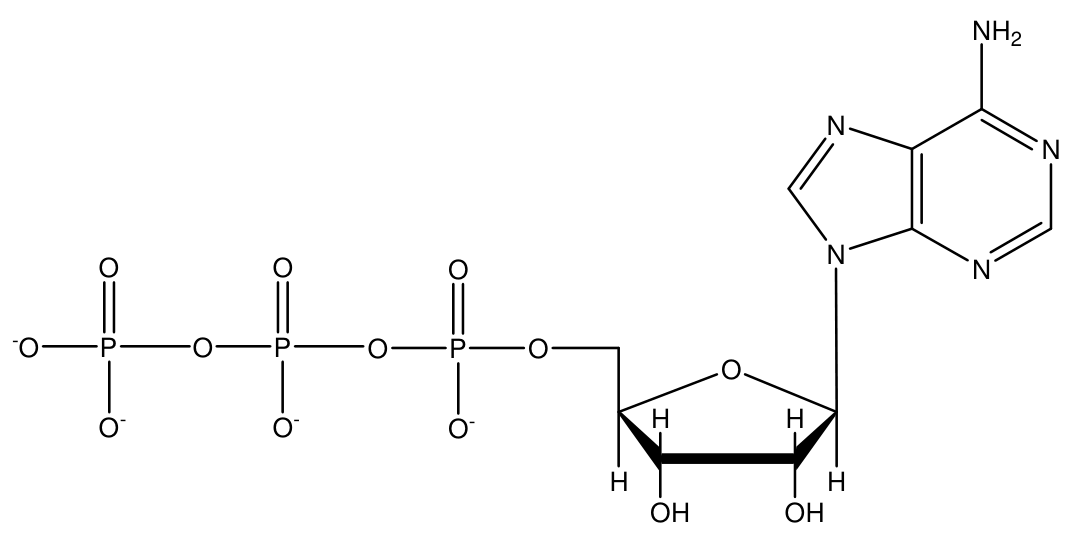
Structure of \(\ce{ATP^{4-}}\)
Shifting chemical equilibria with ATP:
Animals use free energy from the oxidation of their food to maintain concentrations of ATP, ADP, and phosphate far from equilibrium. In red blood cells the following concentrations have been measured:
\[ \begin{aligned} c(\ce{ATP^{4-}})&=2.25\ \mathrm{mmol\,dm^{-3}}\\ c(\ce{ADP^{3-}})&=0.25\ \mathrm{mmol\,dm^{-3}}\\ c(\ce{HPO4^{2-}})&=1.65\ \mathrm{mmol\,dm^{-3}} \end{aligned} \]
Free energy stored in ATP can be released according to the following reaction:

As the pH is close to 7 in most living cells, biochemists use \(\Delta G^{\circ\prime}\) instead of \(\Delta G^\circ\). The standard state of \(\Delta G^{\circ\prime}\) is defined as having a constant pH of 7. In equations with \(\Delta G^{\circ\prime}\) and \(K'\) for reactions at \(pH=7\) the concentration of \(\ce{H+}\) is therefore omitted. Standard concentration is \(1\ \mathrm{mol\,dm^{-3}}\).
5.1 Calculate the actual \(\Delta G'\) of reaction (1) in the red blood cell at \(25\ ^\circ\mathrm{C}\) and \(pH=7\).
In living cells many so-called “anabolic” reactions take place, which are at first sight thermodynamically unfavourable because of a positive \(\Delta G\). The phosphorylation of glucose is an example:

5.2 Calculate first the equilibrium constant \(K'\) of reaction (2) and then the ratio \(c(\text{glucose 6-phosphate})/c(\text{glucose})\) in the red blood cell in chemical equilibrium at \(25\ ^\circ\mathrm{C}\) and \(pH=7\).
To shift the equilibrium to a higher concentration of glucose 6-phosphate, reaction (2) is coupled with hydrolysis of ATP:

5.3 Calculate \(\Delta G^{\circ\prime}\) and \(K'\) of reaction (3).
What is now the ratio \(c(\text{glucose 6-phosphate})/c(\text{glucose})\) in the red blood cell in chemical equilibrium at \(25\ ^\circ\mathrm{C}\) and \(pH=7\)?
ATP synthesis:
An adult person ingests about \(8000\ \mathrm{kJ}\) of energy \((\Delta G')\) per day with the food.
5.4 a) What will be the mass of ATP that is produced per day if half of this energy is used for ATP synthesis? Assume a \(\Delta G'\) of \(-52\ \mathrm{kJ\,mol^{-1}}\) for reaction (1), and a molecular weight of \(503\ \mathrm{g\,mol^{-1}}\) for ATP.
b) What mass of ATP does the human body contain on average if the mean lifetime of an ATP molecule until its hydrolysis is \(1\ \mathrm{min}\)?
c) What happens to the rest of the free energy, which is not used for ATP synthesis? Mark on the answer sheet.
In animals the energy obtained by the oxidation of food is used to pump protons out of specialized membrane vesicles, the mitochondria. ATP-synthase, an enzyme, will allow protons to re-enter the mitochondria if ATP is simultaneously synthesized from ADP and phosphate.
5.5 a) How many protons \((\ce{H+})\) are in a spherical mitochondrium with a diameter of \(1\ \mathrm{\mu m}\) at \(pH=7\)?
b) How many protons have to enter into each of the 1000 mitochondria of a liver cell via the ATP-synthase to allow the production of a mass of \(0.2\ \mathrm{fg}\) of ATP per cell? Assume that 3 protons have to enter for the synthesis of 1 molecule of ATP.
Official English text of the problem.
Problem 6: Diels-Alder Reactions
The Diels-Alder reaction, a concerted [4+2]-cycloaddition between a diene and an olefin to yield a cyclohexene, was discovered in 1928 here in Kiel. Prof. Otto Diels and his coworker Kurt Alder mixed p-benzoquinone with an excess of cyclopentadiene and obtained the following result:
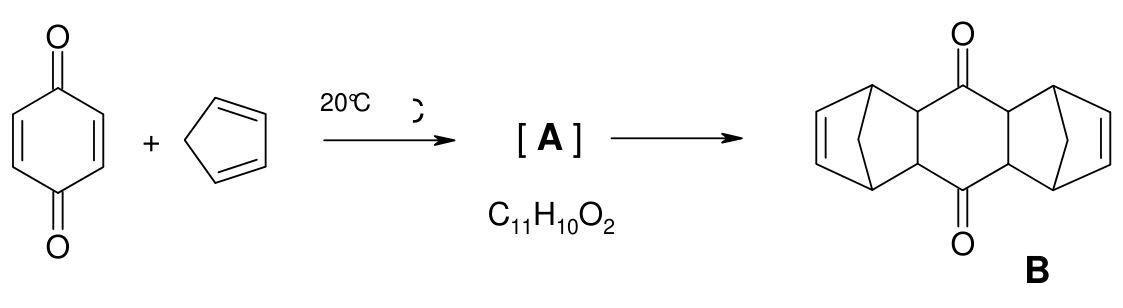
6.1 Draw the structure of A (without stereochemical information).
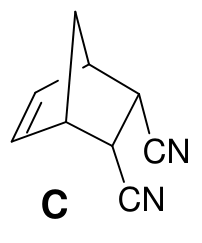
The Diels-Alder reaction is a concerted, one-step reaction that proceeds with high stereospecificity. For example, only a single stereoisomer C is formed in the following reaction
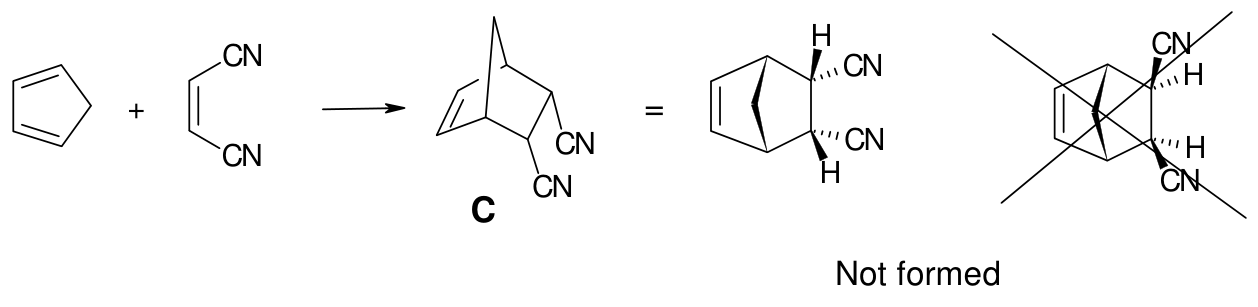
If you use the E-isomer of the alkene instead, you will obtain two other stereoisomers D1 and D2.
6.2 Give the structures of D1 and D2.
Accordingly, in the original reaction (formation of B from cyclopentadiene and benzoquinone) Diels and Alder found only one of the following six conceivable stereoisomers of B (see next page).
Hints:
- keep the stereospecific formation of C in mind
and
- the sterically less hindered isomer forms.
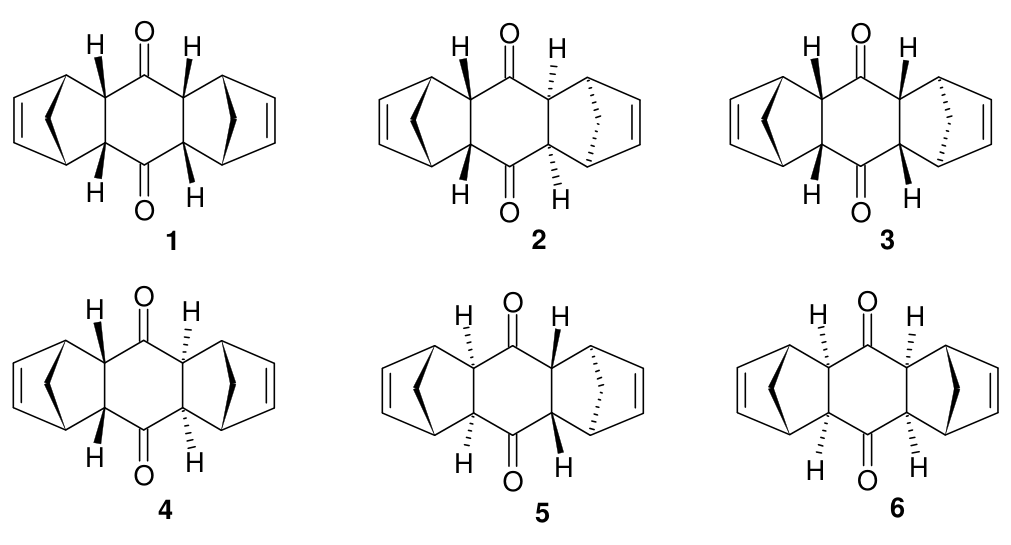
6.3 Which single isomer of the six stereoisomers 1-6 of B shown above did they isolate?
After prolonged heating (15h, \(120\,^\circ\mathrm{C}\)) of the originally isolated stereoisomer B (melting point mp: \(157\,^\circ\mathrm{C}\)), Diels and Alder obtained two new stereoisomers E (mp: \(153\,^\circ\mathrm{C}\)) and F (mp: \(163\,^\circ\mathrm{C}\)). Equilibration of B with a catalytic amount of a strong base at \(25\,^\circ\mathrm{C}\) gave a further stereoisomer G (mp: \(184\,^\circ\mathrm{C}\)).
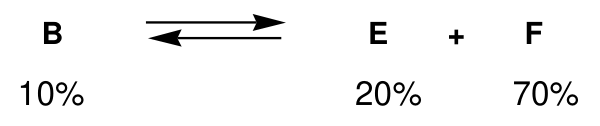
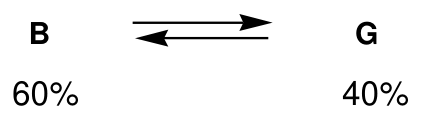
6.4 Decide the questions on the answer sheet concerning the Diels-Alder reaction.
Hint: You do not need to know, which of the six stereoisomers 1 – 6 (shown above) corresponds to either E, F or G in order to answer this question.
The Diels-Alder reaction plays also an important role in the following reaction sequence.
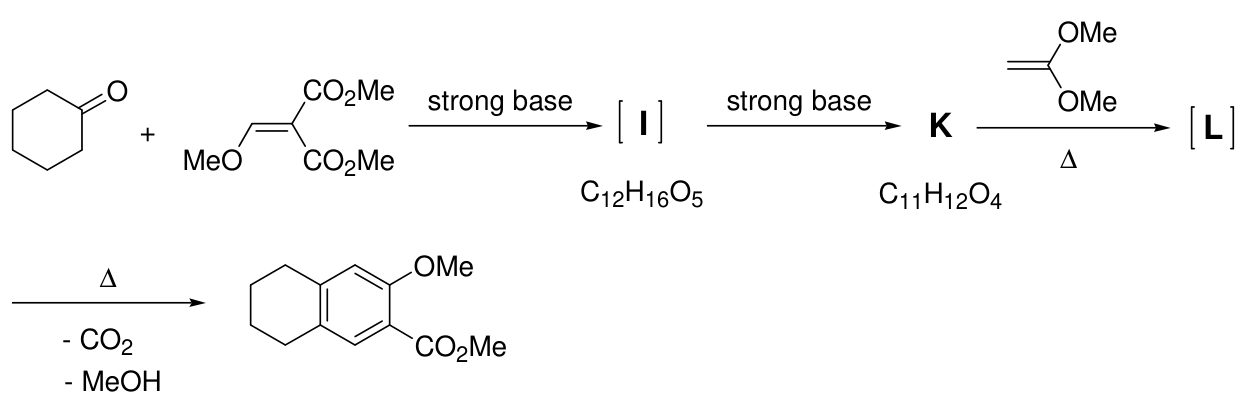
6.5 Draw the structures for I, K and L.
Hints:
- K has only one methyl group.
- L is the Diels-Alder adduct of K and the alkene shown.
Official English text of the problem.
Problem 7: Stereochemistry in Drugs
The Cahn-Ingold-Prelog rules are used to specify the stereochemistry of molecules.
7.1 Order the groups on the answer sheet according to their priority in the Cahn-Ingold-Prelog (CIP)-system.
Pseudoephedrine (1) is a constituent in many common drugs against colds, e.g. in nasal sprays.
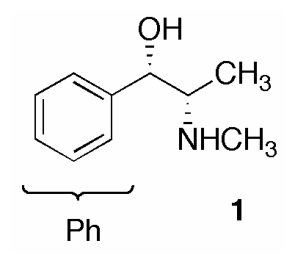
7.2 Mark the stereocenters in 1 with an asterisk * on the answer sheet.
Order the substituents on each stereocenter in 1 according to their priority and determine their absolute configuration (\(R\) or \(S\)).
7.3 Draw a Newman or a sawhorse representation of 1.
Draw a Fischer representation of 1.
Treatment of 1 with acidic permanganate solutions under mild conditions yields the stimulant Methcathinone 2:
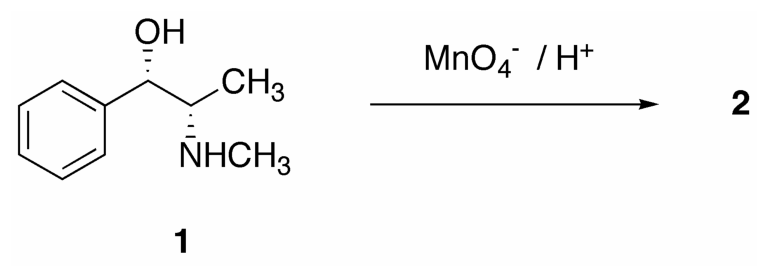
7.4 Draw the stereochemically correct structure of compound 2 and a balanced redox equation of the reaction. Indicate in your equation the particular oxidation number on all atoms which undergo a change in their formal oxidation numbers.
The treatment of 2 with \(\ce{LiAlH4}\) results exclusively in compound 3, which differs from 1 in its melting point.
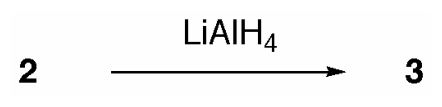
7.5
a) Draw the stereochemically correct structure of 3.
b) Decide the statements on the answer sheet concerning isomers.
c) Draw a structural model to rationalize the exclusive formation of 3 from 2.Official English text of the problem.
Problem 8: Colloids
The combination of an inorganic and an organic component on a nanometer scale yields materials with excellent properties. Thus the synthesis of hybrid nanoparticles is of interest.
(\(T = 298.15\ \mathrm{K}\) throughout whole problem)
Solution A is an aqueous solution of \(\ce{CaCl2}\) with a concentration of \(1.780\ \mathrm{g\,dm^{-3}}\).
Solution B is an aqueous solution of \(\ce{Na2CO3}\) with a concentration of \(1.700\ \mathrm{g\,dm^{-3}}\).
\[ pK_{a1}(\ce{H2CO3}) = 6.37 \qquad pK_{a2}(\ce{HCO3-}) = 10.33 \]
8.1 Calculate the \(pH\) of solution B using reasonable assumptions.
\(100\ \mathrm{cm^3}\) of solution A and \(100\ \mathrm{cm^3}\) of solution B are mixed to form solution C. Solution C is adjusted to \(pH\) 10. A precipitate forms.
\[ K_{sp}(\ce{Ca(OH)2}) = 6.46\times10^{-6} \qquad K_{sp}(\ce{CaCO3}) = 3.31\times10^{-9} \]
8.2 Show by calculation for each of the compounds \(\ce{Ca(OH)2}\) and \(\ce{CaCO3}\) whether it can be found in the precipitate or not.
In a similar experiment \(100\ \mathrm{cm^3}\) of solution A additionally contain \(2\ \mathrm{g}\) of a copolymer consisting of two water soluble blocks: a poly(ethylene oxide) block and a poly(acrylic acid) block:
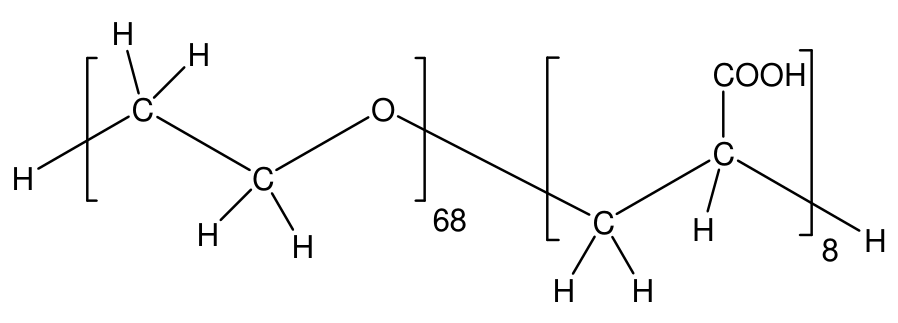
The polymer does not undergo any chemical reaction (except protolysis of the acid) and yet has a strong effect: after mixing of the two solutions (A+B) no precipitate can be observed. Small calcium carbonate particles with the polymer chains attached to their surface form. The attached polymers prevent further crystal growth and the hybrid particles remain in solution.
8.3 Circle the block of the polymer (on the answer sheet) that attaches to the surface of the growing calcium carbonate crystal.
To characterize the hybrid particles they are separated from the preparation solution and transferred into \(50\ \mathrm{cm^3}\) of an aqueous \(\ce{NaOH}\) solution (\(c(\ce{NaOH}) = 0.19\ \mathrm{mol\,dm^{-3}}\)). The solution is diluted by the addition of \(200\ \mathrm{cm^3}\) of water. Assume that the new solution contains only the hybrid particles and no additional calcium or carbonate ions. All acidic groups participate in the acid-base equilibrium.
- For the new solution, a \(pH\) of 12.30 is measured.
- In electron microscopy you only can see the inorganic particles (not the polymer): Spherical particles of \(100\ \mathrm{nm}\) diameter are observed.
- The molar mass of the hybrid particles (inorganic and organic part together) is determined to be \(M = 8.01\cdot10^8\ \mathrm{g\,mol^{-1}}\).
- The charge of the particles is found to be \(Z = -800\) (number of unit charges).
(\(pK_a(\ce{COOH},\text{ copolymer}) = 4.88\))
8.4 How much of the initial amount of polymer (\(2\ \mathrm{g}\)) can still be found in the hybrid particles?
8.5 Calculate which modification of calcium carbonate has been formed.
Modification density Calcite \(2.71\ \mathrm{g\,cm^{-3}}\) Vaterite \(2.54\ \mathrm{g\,cm^{-3}}\) Aragonite \(2.95\ \mathrm{g\,cm^{-3}}\) Official English text of the problem.
Internationale Chemie-Olympiade
IChO 2004
Kiel, Deutschland · 8 Theorieaufgaben mit vollständigen Lösungen
Aufgabe 1: Thermodynamik
Für seine Geburtstagsfeier zum \(18^{\mathrm{th}}\) Geburtstag im Februar plant Peter, eine Hütte im Garten seiner Eltern in ein Schwimmbad mit künstlichem Strand umzuwandeln. Um die Kosten für das Erwärmen des Wassers und das Beheizen des Hauses abzuschätzen, beschafft sich Peter Angaben zur Zusammensetzung und zum Preis von Erdgas.
1.1 Stellen Sie die Reaktionsgleichungen für die vollständige Verbrennung der in Tabelle 1 aufgeführten Hauptbestandteile von Erdgas, Methan und Ethan, auf. Nehmen Sie an, dass Stickstoff unter den gewählten Bedingungen inert ist.
Berechnen Sie die Reaktionsenthalpie, die Reaktionsentropie und die Gibbs-Energie unter Standardbedingungen (\(1.013\cdot10^5\ \mathrm{Pa}\), \(25.0\,^\circ\mathrm C\)) für die Verbrennung von Methan und Ethan gemäß den obigen Gleichungen unter der Annahme, dass alle Produkte gasförmig sind.
Die thermodynamischen Eigenschaften und die Zusammensetzung des Erdgases sind in Tabelle 1 angegeben.
1.2 Die Dichte des Erdgases beträgt laut dem öffentlichen Versorgungsunternehmen PUC \(0.740\ \mathrm{g\,dm^{-3}}\) (\(1.013\times10^5\ \mathrm{Pa}\), \(25.0\,^\circ\mathrm C\)).
a) Berechnen Sie die Stoffmengen von Methan und Ethan (in Mol) in \(1.00\ \mathrm{m^3}\) Erdgas (Erdgas, Methan und Ethan sind keine idealen Gase!).
b) Berechnen Sie die Verbrennungsenergie, die beim Verbrennen von \(1.00\ \mathrm{m^3}\) Erdgas unter Standardbedingungen als Wärmeenergie freigesetzt wird, unter der Annahme, dass alle Produkte gasförmig sind. (Falls Ihnen die Stoffmenge aus 1.2a) nicht vorliegt, nehmen Sie an, dass \(1.00\ \mathrm{m^3}\) Erdgas \(40.00\ \mathrm{mol}\) Erdgas entspricht.)
Laut PUC beträgt die Verbrennungsenergie \(9.981\ \mathrm{kWh}\) pro \(\mathrm{m^3}\) Erdgas, wenn alle Produkte gasförmig sind. Wie groß ist die Abweichung (in Prozent) von dem Wert, den Sie in b) erhalten haben?
Das Schwimmbecken im Haus ist \(3.00\ \mathrm m\) breit, \(5.00\ \mathrm m\) lang und \(1.50\ \mathrm m\) tief (unterhalb des Fußbodens). Die Temperatur des Leitungswassers beträgt \(8.00\,^\circ\mathrm C\), und die Lufttemperatur im Haus (Abmessungen siehe Abbildung unten) beträgt \(10.0\,^\circ\mathrm C\). Nehmen Sie eine Wasserdichte von \(\rho=1.00\ \mathrm{kg\,dm^{-3}}\) an und betrachten Sie Luft als ideales Gas.
1.3 Berechnen Sie die Energie (in MJ), die benötigt wird, um das Wasser im Becken auf \(22.0\,^\circ\mathrm C\) zu erwärmen, sowie die Energie, die benötigt wird, um die anfänglich vorhandene Luftmenge (\(21.0\ \%\) \(\ce{O2}\), \(79.0\ \%\) \(\ce{N2}\)) bei einem Druck von \(1.013\times10^5\ \mathrm{Pa}\) auf \(30.0\,^\circ\mathrm C\) zu erwärmen.
Im Februar beträgt die Außentemperatur in Norddeutschland etwa \(5\,^\circ\mathrm C\). Da die Betonwände und das Dach des Hauses relativ dünn sind (\(20.0\ \mathrm{cm}\)), treten Energieverluste auf. Diese Energie wird an die Umgebung abgegeben (Wärmeverluste an das Wasser und/oder den Boden sind zu vernachlässigen). Die Wärmeleitfähigkeit der Wände und des Daches beträgt \(1.00\ \mathrm{W\,K^{-1}\,m^{-1}}\).
1.4 Berechnen Sie die Energie (in MJ), die benötigt wird, um die Temperatur im Haus während der Feier (12 Stunden) auf \(30.0\,^\circ\mathrm C\) zu halten.
\(1.00\ \mathrm{m^3}\) Erdgas von PUC kostet 0.40 €, und \(1.00\ \mathrm{kWh}\) Strom kostet 0.137 €. Die Miete für die Gasheizgeräte beträgt etwa 150.00 €, während die entsprechenden elektrischen Heizgeräte nur 100.00 € kosten.
1.5 Wie hoch ist der in 1.3 und 1.4 berechnete Gesamtenergiebedarf (in MJ) für Peters „Winterschwimmbad“? Wie viel Erdgas benötigt er, wenn die Gasheizung einen Wirkungsgrad von \(90.0\ \%\) hat? Welche Kosten entstehen jeweils bei der Verwendung von Erdgas bzw. Strom? Verwenden Sie für Ihre Berechnungen die von PUC angegebenen Werte und nehmen Sie für die elektrische Heizung einen Wirkungsgrad von \(100\ \%\) an.
Tabelle 1: Zusammensetzung von Erdgas
Chemischer Stoff Stoffmengenanteil \(x\) \(\Delta_{\mathrm f}H^0\,(\mathrm{kJ\,mol^{-1}})^{-1}\) \(S^0\,(\mathrm{J\,mol^{-1}\,K^{-1}})^{-1}\) \(C_p^0\,(\mathrm{J\,mol^{-1}\,K^{-1}})^{-1}\) \(\ce{CO2(g)}\) 0.0024 −393.5 213.8 37.1 \(\ce{N2(g)}\) 0.0134 0.0 191.6 29.1 \(\ce{CH4(g)}\) 0.9732 −74.6 186.3 35.7 \(\ce{C2H6(g)}\) 0.0110 −84.0 229.2 52.5 \(\ce{H2O(l)}\) – −285.8 70.0 75.3 \(\ce{H2O(g)}\) – −241.8 188.8 33.6 \(\ce{O2(g)}\) – 0.0 205.2 29.4 Gleichung:
\[ J=E\times(A\times\Delta t)^{-1} =\lambda_{\mathrm{wall}}\times\Delta T\times d^{-1} \]
\(J\) Energiefluss \(E\) entlang eines Temperaturgradienten (Wandrichtung \(z\)) pro Fläche \(A\) und Zeit \(\Delta t\)
\(d\) Wanddicke
\(\lambda_{\mathrm{wall}}\) Wärmeleitfähigkeit
\(\Delta T\) Temperaturdifferenz zwischen dem Inneren und dem Äußeren des Hauses
Aufgabentext aus dem offiziellen englischen Text übersetzt.
Aufgabe 2: Kinetik an Katalysatoroberflächen
Die Abgase eines Ottomotors enthalten neben anderen Verbindungen die Hauptschadstoffe Kohlenstoffmonoxid, Stickstoffmonoxid und unverbrannte Kohlenwasserstoffe, beispielsweise Octan. Um ihre Emissionen zu minimieren, werden sie in einem geregelten Drei-Wege-Katalysator zu Kohlenstoffdioxid, Stickstoff und Wasser umgesetzt.
2.1 Vervollständigen Sie die chemischen Reaktionsgleichungen für die Reaktionen der Hauptschadstoffe im Katalysator.
Um die Hauptschadstoffe optimal aus dem Abgas eines Ottomotors zu entfernen, wird der \(\lambda\)-Wert durch ein elektrochemisches Element, die sogenannte Lambdasonde, bestimmt. Diese befindet sich im Abgasstrom zwischen Motor und Drei-Wege-Katalysator.
Der Lambdawert ist definiert als \[ \lambda= \frac{\text{zugeführte Luftmenge}} {\text{für die vollständige Verbrennung erforderliche Luftmenge}}. \]
2.2 Beantworten Sie die Fragen auf dem Antwortblatt zur \(\lambda\)-Sonde.
Die Adsorption von Gasmolekülen an einer festen Oberfläche lässt sich in einem einfachen Modell mithilfe der Langmuir-Isotherme beschreiben: \[ \theta=\frac{K\times p}{1+K\times p} \] Dabei ist \(\theta\) der Anteil der Oberflächenplätze, die von Gasmolekülen besetzt sind, p der Gasdruck und K eine Konstante.
Die Adsorption eines Gases bei 25 °C lässt sich mithilfe der Langmuir-Isotherme mit \(K=0.85\ \mathrm{kPa^{-1}}\) beschreiben.
2.3 a) Bestimmen Sie den Bedeckungsgrad \(\theta\) bei einem Druck von 0.65 kPa.
b) Bestimmen Sie den Druck p, bei dem 15 % der Oberfläche bedeckt sind.
c) Die Geschwindigkeit r der Zersetzung von Gasmolekülen an einer festen Oberfläche hängt vom Bedeckungsgrad \(\theta\) ab (die Rückreaktion wird vernachlässigt): \(r=k\theta\)
Geben Sie die Ordnung der Zersetzungsreaktion bei niedrigen und bei hohen Gasdrücken an, unter der Annahme, dass die oben angegebene Langmuir-Isotherme gilt (die Produkte sind zu vernachlässigen).
d) Daten zur Adsorption eines anderen Gases an einer Metalloberfläche (bei 25 °C)
Bestimmen Sie, sofern die Langmuir-Isotherme anwendbar ist, das für eine vollständige Bedeckung der Metalloberfläche erforderliche Gasvolumen \(V_{\mathrm{a,max}}\) und das Produkt \(K V_{\mathrm{a,max}}\).
Hinweis: Setzen Sie \(\theta=V_{\mathrm a}/V_{\mathrm{a,max}}\).
Nehmen Sie an, dass die katalytische Oxidation von \(\ce{CO}\) an einer \(\ce{Pd}\)-Oberfläche mit gleichwertigen Oberflächenplätzen folgendermaßen abläuft:
In einem ersten Schritt bilden adsorbiertes \(\ce{CO}\) und adsorbiertes \(\ce{O2}\) in einem schnellen Gleichgewicht adsorbiertes \(\ce{CO2}\),
In einem langsamen zweiten Schritt wird \(\ce{CO2}\) anschließend von der Oberfläche desorbiert:
2.4 Leiten Sie die Formel für die Reaktionsgeschwindigkeit der Bildung von \(\ce{CO2(g)}\) als Funktion der Partialdrücke der Reaktionskomponenten her.
Hinweis: Verwenden Sie die Langmuir-Isotherme mit der entsprechenden Anzahl an Gaskomponenten \[ \theta_i= \frac{K_i\times p_i} {1+\displaystyle\sum_j K_j\times p_j} \qquad \text{j: relevante Gaskomponenten} \]
Aufgabentext aus dem offiziellen englischen Text übersetzt.
Aufgabe 3: Verbindungen einwertiger Erdalkalimetalle?
In der Vergangenheit gab es mehrere Berichte über Verbindungen des einwertigen Calciums. Bis vor Kurzem war die Natur dieser „Verbindungen“ nicht bekannt, doch sie sind für Festkörperchemiker nach wie vor von großem Interesse.
Es wurden Versuche unternommen, \(\ce{CaCl2}\) zu \(\ce{CaCl}\) zu reduzieren, und zwar mit
(a) Calcium (b) Wasserstoff (c) Kohlenstoff
3.1 Geben Sie die entsprechenden Reaktionsgleichungen an, die möglicherweise zur Bildung von \(\ce{CaCl}\) führen könnten.
Nach einem Versuch, \(\ce{CaCl2}\) mit der stöchiometrischen Stoffmenge an \(\ce{Ca}\) im molaren Verhältnis 1 : 1 zu reduzieren, erhält man eine inhomogene graue Substanz. Eine genauere Betrachtung unter dem Mikroskop zeigt silbrig glänzende Metallteilchen und farblose Kristalle.
3.2 Aus welchen Substanzen bestehen die Metallteilchen und die farblosen Kristalle?
Beim Versuch, \(\ce{CaCl2}\) mit elementarem Wasserstoff zu reduzieren, entsteht ein weißes Produkt. Die Elementaranalyse zeigt, dass die Probe 52.36 Massen-% Calcium und 46.32 Massen-% Chlor enthält.
3.3 Bestimmen Sie die Verhältnisformel der gebildeten Verbindung.
Beim Versuch, \(\ce{CaCl2}\) mit elementarem Kohlenstoff zu reduzieren, entsteht ein rotes kristallines Produkt. Das durch Elementaranalyse bestimmte Stoffmengenverhältnis von \(\ce{Ca}\) und \(\ce{Cl}\) beträgt \(n(\ce{Ca}) : n(\ce{Cl}) = 1.5 : 1\). Bei der Hydrolyse der roten kristallinen Substanz wird dasselbe Gas freigesetzt wie bei der Hydrolyse von \(\ce{Mg2C3}\).
3.4 a) Stellen Sie die beiden acyclischen Konstitutionsisomere des Gases dar, die bei der Hydrolyse entstehen.
b) Welche Verbindung entsteht bei der Reaktion von \(\ce{CaCl2}\) mit Kohlenstoff?
(Unter der Voraussetzung, dass einwertiges Calcium nicht existiert.)
Da keiner dieser Versuche zur Bildung von \(\ce{CaCl}\) führt, muss die hypothetische Struktur von \(\ce{CaCl}\) näher betrachtet werden. Man kann annehmen, dass \(\ce{CaCl}\) wahrscheinlich in einer einfachen Kristallstruktur kristallisiert.
Das Radienverhältnis von Kation \(r(\ce{M^{m+}})\) und Anion \(r(\ce{X^{x-}})\) in Salzen bestimmt häufig die Kristallstruktur einer bestimmten Verbindung, wie in der folgenden Tabelle für \(\ce{MX}\)-Verbindungen gezeigt.
Koordinationszahl von \(\ce{M}\) Anordnung der umgebenden \(\ce{X}\) Radienverhältnis \(r_{\mathrm M}/r_{\mathrm X}\) Strukturtyp Geschätzte \(\Delta_{\mathrm L}H^0\) für \(\ce{CaCl}\) 3 Dreieckig 0.155 – 0.225 \(\ce{BN}\) \(-663.8\ \mathrm{kJ\,mol^{-1}}\) 4 Tetraedrisch 0.225 – 0.414 \(\ce{ZnS}\) \(-704.8\ \mathrm{kJ\,mol^{-1}}\) 6 Oktaedrisch 0.414 – 0.732 \(\ce{NaCl}\) \(-751.9\ \mathrm{kJ\,mol^{-1}}\) 8 Kubisch 0.732 – 1.000 \(\ce{CsCl}\) \(-758.4\ \mathrm{kJ\,mol^{-1}}\) \(\Delta_{\mathrm L}H^0(\ce{CaCl})\) ist für die Reaktion \(\ce{Ca+(g) + Cl-(g) -> CaCl(s)}\) definiert.
3.5 a) Welchen Strukturtyp hat \(\ce{CaCl}\) wahrscheinlich?
[\(r(\ce{Ca+}) \approx 120\ \mathrm{pm}\) (geschätzt), \(r(\ce{Cl-}) \approx 167\ \mathrm{pm}\))]
Für die Entscheidung, ob \(\ce{CaCl}\) thermodynamisch stabil ist oder nicht, ist nicht nur die Gitterenergie \(\Delta_{\mathrm L}H^0\) von \(\ce{CaCl}\) wichtig. Um zu entscheiden, ob es gegenüber dem Zerfall in seine Elemente stabil ist, muss die Standardbildungsenthalpie \(\Delta_{\mathrm f}H^0\) von \(\ce{CaCl}\) bekannt sein.
b) Berechnen Sie den Wert von \(\Delta_{\mathrm f}H^0(\ce{CaCl})\) mithilfe eines Born-Haber-Kreisprozesses.
Schmelzenthalpie \(\Delta_{\mathrm{fusion}}H^0(\ce{Ca})\) \(9.3\ \mathrm{kJ\,mol^{-1}}\) Ionisierungsenthalpie \(\Delta_{\mathrm{1.\,IE}}H(\ce{Ca})\) \(\ce{Ca -> Ca+}\) \(589.7\ \mathrm{kJ\,mol^{-1}}\) Ionisierungsenthalpie \(\Delta_{\mathrm{2.\,IE}}H(\ce{Ca})\) \(\ce{Ca+ -> Ca^2+}\) \(1145.0\ \mathrm{kJ\,mol^{-1}}\) Verdampfungsenthalpie \(\Delta_{\mathrm{vap}}H^0(\ce{Ca})\) \(150.0\ \mathrm{kJ\,mol^{-1}}\) Dissoziationsenergie \(\Delta_{\mathrm{diss}}H(\ce{Cl2})\) \(\ce{Cl2 -> 2Cl}\) \(240.0\ \mathrm{kJ\,mol^{-1}}\) Bildungsenthalpie \(\Delta_{\mathrm f}H^0(\ce{CaCl2})\) \(-796.0\ \mathrm{kJ\,mol^{-1}}\) Elektronenaffinität \(\Delta_{\mathrm{EA}}H(\ce{Cl})\) \(\ce{Cl + e- -> Cl-}\) \(-349.0\ \mathrm{kJ\,mol^{-1}}\) Um zu entscheiden, ob \(\ce{CaCl}\) thermodynamisch stabil gegenüber der Disproportionierung zu \(\ce{Ca}\) und \(\ce{CaCl2}\) ist, muss die Standardenthalpie dieses Vorgangs berechnet werden. (Die Entropieänderung \(\Delta S\) ist in diesem Fall sehr klein, sodass ihr Einfluss vernachlässigbar ist.)
3.6 Findet die Disproportionierung von \(\ce{CaCl}\) aus thermodynamischer Sicht statt? Begründen Sie Ihre Entscheidung durch eine Berechnung!
Aufgabentext aus dem offiziellen englischen Text übersetzt.
Aufgabe 4: Bestimmung von Atommassen
Die Reaktion des Elements X mit Wasserstoff führt zu einer Verbindungsklasse, die den Kohlenwasserstoffen analog ist. Aus 5.000 g X entstehen 5.628 g eines Gemisches der stöchiometrischen X-Analoga von Methan und Ethan im Stoffmengenverhältnis 2 : 1.
4.1 Bestimmen Sie anhand dieser Angaben die molare Masse von X. Geben Sie das chemische Symbol von X sowie die räumliche Struktur der beiden Produkte an.
Der folgende komplexere Fall ist von großem historischem Interesse.
Das Mineral Argyrodit ist eine stöchiometrische Verbindung, die Silber (Oxidationsstufe +1), Schwefel (Oxidationsstufe -2) und ein unbekanntes Element Y (Oxidationsstufe +4) enthält. Das Verhältnis der Massen von Silber und Y in Argyrodit beträgt \(m(\ce{Ag}) : m(\ce{Y}) = 11.88 : 1\). Y bildet ein rötlich braunes niederes Sulfid (Oxidationsstufe von Y: +2) und ein weißes höheres Sulfid (Oxidationsstufe von Y: +4). Das farbige niedere Sulfid ist das Sublimat, das beim Erhitzen von Argyrodit in einem Wasserstoffstrom erhalten wird. Zurück bleiben \(\ce{Ag2S}\) und \(\ce{H2S}\). Zur vollständigen Umsetzung von 10.0 g Argyrodit werden bei 400 K und 100 kPa 0.295 \(\mathrm{dm^3}\) Wasserstoff benötigt.
4.2 Bestimmen Sie anhand dieser Angaben die molare Masse von Y. Geben Sie das chemische Symbol von Y sowie die Verhältnisformel von Argyrodit an.
Die Atommassen stehen mit spektroskopischen Eigenschaften in Zusammenhang. Zur Bestimmung der als Wellenzahl ausgedrückten Schwingungsfrequenz \(\tilde{\nu}\) chemischer Bindungen in IR-Spektren verwenden Chemiker das Hookesche Gesetz, das die Frequenz der Schwingung beschreibt (achten Sie auf die Einheiten!):
\[ \tilde{\nu}=\frac{1}{2\pi c}\cdot\sqrt{\frac{k}{\mu}} \]
\(\tilde{\nu}\) - Schwingungsfrequenz der Bindung, als Wellenzahl (\(\mathrm{cm^{-1}}\))
\(c\) - Lichtgeschwindigkeit
\(k\) - Kraftkonstante als Maß für die Stärke der Bindung (\(\mathrm{N\,m^{-1}=kg\,s^{-2}}\))
\(\mu\) reduzierte Masse in \(\ce{AB4}\), gegeben durch \[ \mu=\frac{3\,m(A)\,m(B)}{3\,m(A)+4\,m(B)} \]
\(m(A),m(B)\) - die Massen der beiden an der Bindung beteiligten Atome
Die Schwingungsfrequenz der \(\ce{C-H}\)-Bindung in Methan beträgt bekanntermaßen 3030.00 \(\mathrm{cm^{-1}}\).
Die Schwingungsfrequenz des Z-Analogons von Methan beträgt bekanntermaßen 2938.45 \(\mathrm{cm^{-1}}\). Die Bindungsenthalpie einer \(\ce{C-H}\)-Bindung in Methan beträgt 438.4 \(\mathrm{kJ\,mol^{-1}}\). Die Bindungsenthalpie einer \(\ce{Z-H}\)-Bindung im Z-Analogon von Methan beträgt bekanntermaßen 450.2 \(\mathrm{kJ\,mol^{-1}}\).
4.3 Bestimmen Sie mithilfe des Hookeschen Gesetzes die Kraftkonstante \(k\) einer \(\ce{C-H}\)-Bindung.
Schätzen Sie die Kraftkonstante \(k\) einer \(\ce{Z-H}\)-Bindung unter der Annahme ab, dass zwischen Kraftkonstante und Bindungsenthalpie eine lineare Proportionalität besteht.
Bestimmen Sie anhand dieser Angaben die Atommasse von Z.
Geben Sie das chemische Symbol von Z an.
Aufgabentext aus dem offiziellen englischen Text übersetzt.
Aufgabe 5: Biochemie mit Thermodynamik
Struktur von \(\ce{ATP^{4-}}\)
Verschiebung chemischer Gleichgewichte mit ATP:
Tiere nutzen die freie Enthalpie aus der Oxidation ihrer Nahrung, um die Konzentrationen von ATP, ADP und Phosphat weit vom Gleichgewicht entfernt zu halten. In roten Blutkörperchen wurden folgende Konzentrationen gemessen:
\[ \begin{aligned} c(\ce{ATP^{4-}})&=2.25\ \mathrm{mmol\,dm^{-3}}\\ c(\ce{ADP^{3-}})&=0.25\ \mathrm{mmol\,dm^{-3}}\\ c(\ce{HPO4^{2-}})&=1.65\ \mathrm{mmol\,dm^{-3}} \end{aligned} \]
Die in ATP gespeicherte freie Enthalpie kann durch die folgende Reaktion freigesetzt werden:
Da der pH-Wert in den meisten lebenden Zellen nahe bei 7 liegt, verwenden Biochemiker \(\Delta G^{\circ\prime}\) anstelle von \(\Delta G^\circ\). Der Standardzustand von \(\Delta G^{\circ\prime}\) ist durch einen konstanten pH-Wert von 7 definiert. In Gleichungen mit \(\Delta G^{\circ\prime}\) und \(K'\) für Reaktionen bei \(pH=7\) wird die Konzentration von \(\ce{H+}\) daher weggelassen. Die Standardkonzentration beträgt \(1\ \mathrm{mol\,dm^{-3}}\).
5.1 Berechnen Sie die tatsächliche freie Reaktionsenthalpie \(\Delta G'\) der Reaktion (1) im roten Blutkörperchen bei \(25\ ^\circ\mathrm{C}\) und \(pH=7\).
In lebenden Zellen laufen viele sogenannte „anabole“ Reaktionen ab, die auf den ersten Blick wegen eines positiven \(\Delta G\) thermodynamisch ungünstig sind. Die Phosphorylierung von Glucose ist ein Beispiel:
5.2 Berechnen Sie zunächst die Gleichgewichtskonstante \(K'\) der Reaktion (2) und anschließend das Verhältnis \(c(\text{Glucose-6-phosphat})/c(\text{Glucose})\) im roten Blutkörperchen im chemischen Gleichgewicht bei \(25\ ^\circ\mathrm{C}\) und \(pH=7\).
Um das Gleichgewicht zu einer höheren Konzentration von Glucose-6-phosphat zu verschieben, wird Reaktion (2) mit der Hydrolyse von ATP gekoppelt:
5.3 Berechnen Sie \(\Delta G^{\circ\prime}\) und \(K'\) der Reaktion (3).
Wie groß ist nun das Verhältnis \(c(\text{Glucose-6-phosphat})/c(\text{Glucose})\) im roten Blutkörperchen im chemischen Gleichgewicht bei \(25\ ^\circ\mathrm{C}\) und \(pH=7\)?
ATP-Synthese:
Ein erwachsener Mensch nimmt mit der Nahrung täglich etwa \(8000\ \mathrm{kJ}\) an Energie \((\Delta G')\) auf.
5.4 a) Welche Masse an ATP wird pro Tag produziert, wenn die Hälfte dieser Energie für die ATP-Synthese verwendet wird? Nehmen Sie für Reaktion (1) ein \(\Delta G'\) von \(-52\ \mathrm{kJ\,mol^{-1}}\) und für ATP eine molare Masse von \(503\ \mathrm{g\,mol^{-1}}\) an.
b) Welche Masse an ATP enthält der menschliche Körper im Durchschnitt, wenn die mittlere Lebensdauer eines ATP-Moleküls bis zu seiner Hydrolyse \(1\ \mathrm{min}\) beträgt?
c) Was geschieht mit dem Rest der freien Enthalpie, der nicht für die ATP-Synthese verwendet wird? Kreuzen Sie dies auf dem Antwortbogen an.
Bei Tieren wird die durch die Oxidation der Nahrung gewonnene Energie dazu verwendet, Protonen aus spezialisierten Membranvesikeln, den Mitochondrien, herauszupumpen. Die ATP-Synthase, ein Enzym, ermöglicht den Protonen den Wiedereintritt in die Mitochondrien, wenn gleichzeitig ATP aus ADP und Phosphat synthetisiert wird.
5.5 a) Wie viele Protonen \((\ce{H+})\) befinden sich bei \(pH=7\) in einem kugelförmigen Mitochondrium mit einem Durchmesser von \(1\ \mathrm{\mu m}\)?
b) Wie viele Protonen müssen über die ATP-Synthase in jedes der 1000 Mitochondrien einer Leberzelle eintreten, um die Produktion einer Masse von \(0.2\ \mathrm{fg}\) ATP pro Zelle zu ermöglichen? Nehmen Sie an, dass für die Synthese von 1 ATP-Molekül 3 Protonen eintreten müssen.
Aufgabentext aus dem offiziellen englischen Text übersetzt.
Aufgabe 6: Diels-Alder-Reaktionen
Die Diels-Alder-Reaktion, eine konzertierte [4+2]-Cycloaddition zwischen einem Dien und einem Olefin unter Bildung eines Cyclohexens, wurde 1928 hier in Kiel entdeckt. Prof. Otto Diels und sein Mitarbeiter Kurt Alder mischten p-Benzochinon mit einem Überschuss an Cyclopentadien und erhielten folgendes Ergebnis:
6.1 Zeichnen Sie die Struktur von A (ohne stereochemische Angaben).
Die Diels-Alder-Reaktion ist eine konzertierte, einstufige Reaktion, die mit hoher Stereospezifität verläuft. Beispielsweise entsteht bei der folgenden Reaktion nur ein einziges Stereoisomer C
Wenn Sie stattdessen das E-Isomer des Alkens verwenden, erhalten Sie zwei andere Stereoisomere D1 und D2.
6.2 Geben Sie die Strukturen von D1 und D2 an.
Dementsprechend fanden Diels und Alder bei der ursprünglichen Reaktion (Bildung von B aus Cyclopentadien und Benzochinon) nur eines der folgenden sechs denkbaren Stereoisomere von B (siehe nächste Seite).
Hinweise:
- Beachten Sie die stereospezifische Bildung von C
und
- es entsteht das sterisch weniger gehinderte Isomer.
6.3 Welches einzelne Isomer der sechs oben gezeigten Stereoisomere 1-6 von B isolierten sie?
Nach längerem Erhitzen (15h, \(120\,^\circ\mathrm{C}\)) des ursprünglich isolierten Stereoisomers B (Schmelzpunkt Smp.: \(157\,^\circ\mathrm{C}\)) erhielten Diels und Alder zwei neue Stereoisomere E (Smp.: \(153\,^\circ\mathrm{C}\)) und F (Smp.: \(163\,^\circ\mathrm{C}\)). Die Gleichgewichtseinstellung von B mit einer katalytischen Menge einer starken Base bei \(25\,^\circ\mathrm{C}\) ergab ein weiteres Stereoisomer G (Smp.: \(184\,^\circ\mathrm{C}\)).
6.4 Beantworten Sie die Fragen auf dem Antwortblatt zur Diels-Alder-Reaktion.
Hinweis: Um diese Frage zu beantworten, müssen Sie nicht wissen, welches der sechs (oben gezeigten) Stereoisomere 1 – 6 jeweils E, F oder G entspricht.
Die Diels-Alder-Reaktion spielt auch in der folgenden Reaktionssequenz eine wichtige Rolle.
6.5 Zeichnen Sie die Strukturen von I, K und L.
Hinweise:
- K besitzt nur eine Methylgruppe.
- L ist das Diels-Alder-Addukt aus K und dem gezeigten Alken.
Aufgabentext aus dem offiziellen englischen Text übersetzt.
Aufgabe 7: Stereochemie in Arzneimitteln
Die Cahn-Ingold-Prelog-Regeln werden verwendet, um die Stereochemie von Molekülen anzugeben.
7.1 Ordnen Sie die Gruppen auf dem Antwortbogen nach ihrer Priorität im Cahn-Ingold-Prelog-System (CIP-System).
Pseudoephedrin (1) ist ein Bestandteil vieler gängiger Erkältungsmittel, z. B. von Nasensprays.
7.2 Kennzeichnen Sie auf dem Antwortbogen die Stereozentren in 1 mit einem Sternchen *.
Ordnen Sie die Substituenten an jedem Stereozentrum in 1 nach ihrer Priorität und bestimmen Sie die jeweilige absolute Konfiguration (\(R\) oder \(S\)).
7.3 Zeichnen Sie eine Newman- oder Sägebockdarstellung von 1.
Zeichnen Sie eine Fischer-Darstellung von 1.
Die Behandlung von 1 mit sauren Permanganatlösungen unter milden Bedingungen liefert das Stimulans Methcathinon 2:
7.4 Zeichnen Sie die stereochemisch korrekte Struktur der Verbindung 2 und geben Sie eine ausgeglichene Redoxgleichung für die Reaktion an. Geben Sie in Ihrer Gleichung die jeweilige Oxidationszahl an allen Atomen an, deren formale Oxidationszahl sich ändert.
Die Behandlung von 2 mit \(\ce{LiAlH4}\) ergibt ausschließlich Verbindung 3, die sich in ihrem Schmelzpunkt von 1 unterscheidet.
7.5
a) Zeichnen Sie die stereochemisch korrekte Struktur von 3.
b) Beurteilen Sie die Aussagen zu Isomeren auf dem Antwortbogen.
c) Zeichnen Sie ein Strukturmodell, das die ausschließliche Bildung von 3 aus 2 erklärt.Aufgabentext aus dem offiziellen englischen Text übersetzt.
Aufgabe 8: Kolloide
Die Kombination einer anorganischen und einer organischen Komponente im Nanometermaßstab ergibt Materialien mit hervorragenden Eigenschaften. Daher ist die Synthese hybrider Nanopartikel von Interesse.
(\(T = 298.15\ \mathrm{K}\) in der gesamten Aufgabe)
Lösung A ist eine wässrige Lösung von \(\ce{CaCl2}\) mit einer Konzentration von \(1.780\ \mathrm{g\,dm^{-3}}\).
Lösung B ist eine wässrige Lösung von \(\ce{Na2CO3}\) mit einer Konzentration von \(1.700\ \mathrm{g\,dm^{-3}}\).
\[ pK_{a1}(\ce{H2CO3}) = 6.37 \qquad pK_{a2}(\ce{HCO3-}) = 10.33 \]
8.1 Berechnen Sie den \(pH\)-Wert der Lösung B unter Verwendung sinnvoller Annahmen.
\(100\ \mathrm{cm^3}\) der Lösung A und \(100\ \mathrm{cm^3}\) der Lösung B werden zur Lösung C gemischt. Lösung C wird auf einen \(pH\)-Wert von 10 eingestellt. Es bildet sich ein Niederschlag.
\[ K_{sp}(\ce{Ca(OH)2}) = 6.46\times10^{-6} \qquad K_{sp}(\ce{CaCO3}) = 3.31\times10^{-9} \]
8.2 Zeigen Sie für jede der Verbindungen \(\ce{Ca(OH)2}\) und \(\ce{CaCO3}\) durch Rechnung, ob sie im Niederschlag enthalten sein kann oder nicht.
In einem ähnlichen Experiment enthalten \(100\ \mathrm{cm^3}\) der Lösung A zusätzlich \(2\ \mathrm{g}\) eines Copolymers, das aus zwei wasserlöslichen Blöcken besteht: einem Polyethylenoxidblock und einem Polyacrylsäureblock:
Das Polymer geht keine chemische Reaktion ein (mit Ausnahme der Protolyse der Säure) und hat dennoch einen starken Einfluss: Nach dem Mischen der beiden Lösungen (A+B) ist kein Niederschlag zu beobachten. Es bilden sich kleine Calciumcarbonatpartikel, an deren Oberfläche die Polymerketten gebunden sind. Die gebundenen Polymere verhindern ein weiteres Kristallwachstum, und die Hybridpartikel verbleiben in Lösung.
8.3 Kreisen Sie den Block des Polymers (auf dem Antwortblatt) ein, der sich an die Oberfläche des wachsenden Calciumcarbonatkristalls anlagert.
Zur Charakterisierung der Hybridpartikel werden diese von der Herstellungslösung abgetrennt und in \(50\ \mathrm{cm^3}\) einer wässrigen \(\ce{NaOH}\)-Lösung (\(c(\ce{NaOH}) = 0.19\ \mathrm{mol\,dm^{-3}}\)) überführt. Die Lösung wird durch Zugabe von \(200\ \mathrm{cm^3}\) Wasser verdünnt. Nehmen Sie an, dass die neue Lösung nur die Hybridpartikel und keine zusätzlichen Calcium- oder Carbonationen enthält. Alle sauren Gruppen nehmen am Säure-Base-Gleichgewicht teil.
- Für die neue Lösung wird ein \(pH\)-Wert von 12.30 gemessen.
- In der Elektronenmikroskopie sind nur die anorganischen Partikel (nicht das Polymer) sichtbar: Es werden kugelförmige Partikel mit einem Durchmesser von \(100\ \mathrm{nm}\) beobachtet.
- Die molare Masse der Hybridpartikel (anorganischer und organischer Anteil zusammen) wird zu \(M = 8.01\cdot10^8\ \mathrm{g\,mol^{-1}}\) bestimmt.
- Die Ladung der Partikel wird zu \(Z = -800\) (Anzahl der Elementarladungen) bestimmt.
(\(pK_a(\ce{COOH},\text{ Copolymer}) = 4.88\))
8.4 Wie viel von der ursprünglichen Polymermenge (\(2\ \mathrm{g}\)) befindet sich noch in den Hybridpartikeln?
8.5 Berechnen Sie, welche Modifikation des Calciumcarbonats sich gebildet hat.
Modifikation Dichte Calcit \(2.71\ \mathrm{g\,cm^{-3}}\) Vaterit \(2.54\ \mathrm{g\,cm^{-3}}\) Aragonit \(2.95\ \mathrm{g\,cm^{-3}}\) Aufgabentext aus dem offiziellen englischen Text übersetzt.
Uluslararası Kimya Olimpiyatı
IChO 2004
Kiel, Almanya · 8 teori sorusu, tam çözümleriyle
Soru 1: Termodinamik
Peter, şubat ayındaki \(18^{\mathrm{th}}\) yaş günü partisi için anne ve babasının bahçesindeki bir kulübeyi yapay plajı olan bir yüzme havuzuna dönüştürmeyi planlamaktadır. Suyu ve binayı ısıtmanın maliyetini tahmin etmek için Peter, doğal gazın bileşimine ve fiyatına ilişkin verileri edinir.
1.1 Tablo 1'de verilen doğal gazın ana bileşenleri olan metan ve etanın tam yanmasına ilişkin kimyasal denklemleri yazınız. Azotun seçilen koşullarda inert olduğunu varsayınız.
Tüm ürünlerin gaz hâlinde olduğunu varsayarak, yukarıdaki denklemlere göre metan ve etanın yanması için standart koşullarda (\(1.013\cdot10^5\ \mathrm{Pa}\), \(25.0\,^\circ\mathrm C\)) tepkime entalpisini, tepkime entropisini ve Gibbs enerjisini hesaplayınız.
Termodinamik özellikler ve doğal gazın bileşimi Tablo 1'de verilmiştir.
1.2 Kamu hizmeti şirketi PUC tarafından belirtilen doğal gaz yoğunluğu \(0.740\ \mathrm{g\,dm^{-3}}\) (\(1.013\times10^5\ \mathrm{Pa}\), \(25.0\,^\circ\mathrm C\)) değerindedir.
a) \(1.00\ \mathrm{m^3}\) doğal gazdaki metan ve etan miktarlarını (mol cinsinden) hesaplayınız (doğal gaz, metan ve etan ideal gaz değildir!).
b) Tüm ürünlerin gaz hâlinde olduğunu varsayarak, standart koşullarda \(1.00\ \mathrm{m^3}\) doğal gazın yanması sırasında ısı enerjisi olarak açığa çıkan yanma enerjisini hesaplayınız. (1.2a)'daki miktarı bulamadıysanız, \(1.00\ \mathrm{m^3}\) doğal gazın \(40.00\ \mathrm{mol}\) doğal gaza karşılık geldiğini varsayınız.)
PUC'ye göre tüm ürünler gaz hâlindeyse yanma enerjisi, doğal gazın her \(\mathrm{m^3}\)ü için \(9.981\ \mathrm{kWh}\) olacaktır. b)'de elde ettiğiniz değerden sapma (yüzde olarak) ne kadardır?
Binanın içindeki yüzme havuzu \(3.00\ \mathrm m\) genişliğinde, \(5.00\ \mathrm m\) uzunluğunda ve (zeminin altında) \(1.50\ \mathrm m\) derinliğindedir. Musluk suyunun sıcaklığı \(8.00\,^\circ\mathrm C\), binanın içindeki havanın sıcaklığı ise \(10.0\,^\circ\mathrm C\)'dir (binanın boyutları aşağıdaki şekilde verilmiştir). Suyun yoğunluğunu \(\rho=1.00\ \mathrm{kg\,dm^{-3}}\) alınız ve havanın ideal gaz gibi davrandığını varsayınız.
1.3 Havuzdaki suyu \(22.0\,^\circ\mathrm C\)'ye ısıtmak için gereken enerjiyi (MJ cinsinden) ve başlangıçtaki hava miktarını (\(21.0\ \%\) \(\ce{O2}\), \(79.0\ \%\) \(\ce{N2}\)) \(1.013\times10^5\ \mathrm{Pa}\) basınçta \(30.0\,^\circ\mathrm C\)'ye ısıtmak için gereken enerjiyi hesaplayınız.
Şubat ayında Kuzey Almanya'da dış ortam sıcaklığı yaklaşık \(5\,^\circ\mathrm C\)'dir. Binanın beton duvarları ve çatısı nispeten ince (\(20.0\ \mathrm{cm}\)) olduğundan enerji kaybı olacaktır. Bu enerji çevreye aktarılır (suya ve/veya toprağa aktarılan ısı kaybı ihmal edilmelidir). Duvarın ve çatının ısıl iletkenliği \(1.00\ \mathrm{W\,K^{-1}\,m^{-1}}\)'dir.
1.4 Parti boyunca (12 saat) bina içindeki sıcaklığı \(30.0\,^\circ\mathrm C\)'de tutmak için gereken enerjiyi (MJ cinsinden) hesaplayınız.
PUC tarafından sağlanan \(1.00\ \mathrm{m^3}\) doğal gazın fiyatı 0.40 €, \(1.00\ \mathrm{kWh}\) elektriğin fiyatı ise 0.137 €'dur. Gazla ısıtma ekipmanının kiralanması Peter'a yaklaşık 150.00 €'ya mal olurken, buna karşılık gelen elektrikli ısıtıcıların kira bedeli yalnızca 100.00 € olacaktır.
1.5 Peter'ın “kış yüzme havuzu” için 1.3 ve 1.4'te hesaplanan toplam enerji gereksinimi (MJ cinsinden) nedir? Gazlı ısıtıcının verimi \(90.0\ \%\) ise ne kadar doğal gaza ihtiyacı olacaktır? Doğal gaz veya elektrik kullanımının maliyetleri ayrı ayrı ne kadardır? Hesaplamalarınızda PUC tarafından verilen değerleri kullanınız ve elektrikli ısıtıcının verimini \(100\ \%\) kabul ediniz.
Tablo 1: Doğal gazın bileşimi
Kimyasal madde Mol kesri \(x\) \(\Delta_{\mathrm f}H^0\,(\mathrm{kJ\,mol^{-1}})^{-1}\) \(S^0\,(\mathrm{J\,mol^{-1}\,K^{-1}})^{-1}\) \(C_p^0\,(\mathrm{J\,mol^{-1}\,K^{-1}})^{-1}\) \(\ce{CO2(g)}\) 0.0024 −393.5 213.8 37.1 \(\ce{N2(g)}\) 0.0134 0.0 191.6 29.1 \(\ce{CH4(g)}\) 0.9732 −74.6 186.3 35.7 \(\ce{C2H6(g)}\) 0.0110 −84.0 229.2 52.5 \(\ce{H2O(l)}\) – −285.8 70.0 75.3 \(\ce{H2O(g)}\) – −241.8 188.8 33.6 \(\ce{O2(g)}\) – 0.0 205.2 29.4 Denklem:
\[ J=E\times(A\times\Delta t)^{-1} =\lambda_{\mathrm{wall}}\times\Delta T\times d^{-1} \]
\(J\) bir sıcaklık gradyanı boyunca (duvar doğrultusu \(z\)) birim alan \(A\) ve birim zaman \(\Delta t\) başına enerji \(E\) akışı
\(d\) duvar kalınlığı
\(\lambda_{\mathrm{wall}}\) ısıl iletkenlik
\(\Delta T\) binanın içi ile dışı arasındaki sıcaklık farkı
Soru metni resmi İngilizce metinden çevrilmiştir.
Soru 2: Katalizör yüzeylerinde kinetik
Bir Otto motorunun egzoz gazları, diğer bileşiklerin yanı sıra başlıca kirleticiler olan karbon monoksit, azot monoksit ve örneğin oktan gibi yanmamış hidrokarbonları içerir. Bunları en aza indirmek için, kontrollü bir üç yollu katalitik konvertörde karbon dioksit, azot ve suya dönüştürülürler.
2.1 Başlıca kirleticilerin katalizördeki tepkimelerine ait kimyasal tepkime denklemlerini tamamlayınız.
Bir Otto motorunun egzoz gazındaki başlıca kirleticileri en uygun biçimde gidermek için, \(\lambda\) değeri lambda sondası adı verilen bir elektrokimyasal hücreyle belirlenir. Bu sonda, motor ile üç yollu katalitik konvertör arasındaki egzoz gazı akışında yer alır.
Lambda değeri şöyle tanımlanır: \[ \lambda= \frac{\text{girişteki hava miktarı}} {\text{tam yanma için gerekli hava miktarı}}. \]
2.2 Cevap kâğıdında \(\lambda\) sondasıyla ilgili soruları yanıtlayınız.
Gaz moleküllerinin katı bir yüzey üzerindeki adsorpsiyonu, Langmuir izotermi kullanılarak basit bir modelle açıklanabilir: \[ \theta=\frac{K\times p}{1+K\times p} \] Burada \(\theta\), yüzeydeki merkezlerin gaz molekülleri tarafından işgal edilen kesri, p gaz basıncı ve K bir sabittir.
Bir gazın 25 °C'deki adsorpsiyonu, \(K=0.85\ \mathrm{kPa^{-1}}\) olmak üzere Langmuir izotermiyle açıklanabilir.
2.3 a) 0.65 kPa basınçta yüzey örtülme oranını, \(\theta\), belirleyiniz.
b) Yüzeyin %15'inin örtüldüğü p basıncını belirleyiniz.
c) Gaz moleküllerinin katı bir yüzeydeki bozunma hızı r, yüzey örtülme oranına, \(\theta\), bağlıdır (ters tepkime ihmal edilmektedir): \(r=k\theta\)
Yukarıda verilen Langmuir izoterminin geçerli olduğunu varsayarak, düşük ve yüksek gaz basınçlarında bozunma tepkimesinin derecesini belirtiniz (ürünler ihmal edilecektir).
d) Başka bir gazın metal yüzeyindeki adsorpsiyonuna ait veriler (25 °C'de)
Langmuir izotermi uygulanabiliyorsa, metal yüzeyinin tamamen örtülmesi için gereken gaz hacmini, \(V_{\mathrm{a,max}}\), ve \(K V_{\mathrm{a,max}}\) çarpımını belirleyiniz.
İpucu: \(\theta=V_{\mathrm a}/V_{\mathrm{a,max}}\) alınız.
Eşdeğer yüzey merkezlerine sahip bir \(\ce{Pd}\) yüzeyinde \(\ce{CO}\)'nun katalitik yükseltgenmesinin aşağıdaki şekilde ilerlediğini varsayınız:
İlk basamakta, adsorplanmış \(\ce{CO}\) ve adsorplanmış \(\ce{O2}\), hızlı bir dengeyle adsorplanmış \(\ce{CO2}\) oluşturur,
Ardından, yavaş olan ikinci basamakta \(\ce{CO2}\) yüzeyden desorplanır:
2.4 \(\ce{CO2(g)}\) oluşumunun tepkime hızı bağıntısını, tepkime bileşenlerinin kısmi basınçlarının bir fonksiyonu olarak türetiniz.
İpucu: Uygun sayıda gaz bileşeni için Langmuir izotermini kullanınız: \[ \theta_i= \frac{K_i\times p_i} {1+\displaystyle\sum_j K_j\times p_j} \qquad \text{j: ilgili gaz bileşenleri} \]
Soru metni resmi İngilizce metinden çevrilmiştir.
Soru 3: Tek değerlikli toprak alkali metal bileşikleri?
Geçmişte tek değerlikli kalsiyum bileşikleri üzerine çeşitli çalışmalar yayımlanmıştır. Yakın zamana kadar bu “bileşiklerin” niteliği bilinmiyordu; ancak katı hâl kimyacıları için hâlâ büyük ilgi taşımaktadırlar.
\(\ce{CaCl2}\) bileşiğini \(\ce{CaCl}\) bileşiğine indirgemek için şu maddelerle denemeler yapılmıştır:
(a) Kalsiyum (b) Hidrojen (c) Karbon
3.1 \(\ce{CaCl}\) oluşumuna yol açabilecek ilgili tepkime denklemlerini yazınız.
\(\ce{CaCl2}\) bileşiğini stokiyometrik olarak 1 : 1 mol oranında \(\ce{Ca}\) ile indirgeme girişiminin ardından homojen olmayan gri bir madde elde edilir. Mikroskop altında daha yakından incelendiğinde gümüşümsü metalik tanecikler ve renksiz kristaller görülür.
3.2 Metalik tanecikler ve renksiz kristaller hangi maddelerdir?
\(\ce{CaCl2}\) elementel hidrojenle indirgenmeye çalışıldığında beyaz bir ürün oluşur. Element analizi, örneğin kütlece %52.36 kalsiyum ve kütlece %46.32 klor içerdiğini göstermektedir.
3.3 Oluşan bileşiğin basit formülünü belirleyiniz.
\(\ce{CaCl2}\) elementel karbonla indirgenmeye çalışıldığında kırmızı kristal bir ürün oluşur. Element analiziyle belirlenen \(\ce{Ca}\) ve \(\ce{Cl}\) mol oranı \(n(\ce{Ca}) : n(\ce{Cl}) = 1.5 : 1\) şeklindedir. Kırmızı kristal maddenin hidrolizi sırasında, \(\ce{Mg2C3}\) bileşiğinin hidrolizinde açığa çıkan gazın aynısı açığa çıkar.
3.4 a) Hidrolizle oluşan gazın halkasız iki yapı izomerini gösteriniz.
b) \(\ce{CaCl2}\) ile karbonun tepkimesinden hangi bileşik oluşur?
(Tek değerlikli kalsiyumun bulunmadığı kabul edilmektedir.)
Bu girişimlerin hiçbiri \(\ce{CaCl}\) oluşumuna yol açmadığından, \(\ce{CaCl}\) bileşiğinin varsayımsal yapısı üzerinde daha fazla düşünmek gerekir. \(\ce{CaCl}\) bileşiğinin basit bir kristal yapıda kristallenmesinin olası olduğu varsayılabilir.
Aşağıdaki tabloda \(\ce{MX}\) bileşikleri için gösterildiği gibi, belirli bir bileşiğin kristal yapısını çoğu zaman tuzlardaki katyonun \(r(\ce{M^{m+}})\) ve anyonun \(r(\ce{X^{x-}})\) yarıçaplarının oranı belirler.
\(\ce{M}\) için koordinasyon sayısı \(\ce{X}\) iyonlarının oluşturduğu çevre Yarıçap oranı \(r_{\mathrm M}/r_{\mathrm X}\) Yapı türü \(\ce{CaCl}\) için tahmini \(\Delta_{\mathrm L}H^0\) 3 Üçgensel 0.155 – 0.225 \(\ce{BN}\) \(-663.8\ \mathrm{kJ\,mol^{-1}}\) 4 Dörtyüzlü 0.225 – 0.414 \(\ce{ZnS}\) \(-704.8\ \mathrm{kJ\,mol^{-1}}\) 6 Sekizyüzlü 0.414 – 0.732 \(\ce{NaCl}\) \(-751.9\ \mathrm{kJ\,mol^{-1}}\) 8 Kübik 0.732 – 1.000 \(\ce{CsCl}\) \(-758.4\ \mathrm{kJ\,mol^{-1}}\) \(\Delta_{\mathrm L}H^0(\ce{CaCl})\), \(\ce{Ca+(g) + Cl-(g) -> CaCl(s)}\) tepkimesi için tanımlanmıştır.
3.5 a) \(\ce{CaCl}\) bileşiğinin hangi yapı türüne sahip olması beklenir?
[\(r(\ce{Ca+}) \approx 120\ \mathrm{pm}\) (tahmini), \(r(\ce{Cl-}) \approx 167\ \mathrm{pm}\))]
\(\ce{CaCl}\) bileşiğinin termodinamik olarak kararlı olup olmadığına karar verirken yalnızca \(\ce{CaCl}\) için örgü enerjisi \(\Delta_{\mathrm L}H^0\) önemli değildir. Elementlerine ayrışmaya karşı kararlı olup olmadığına karar verebilmek için \(\ce{CaCl}\) bileşiğinin standart oluşum entalpisi \(\Delta_{\mathrm f}H^0\) bilinmelidir.
b) Bir Born–Haber çevrimi yardımıyla \(\Delta_{\mathrm f}H^0(\ce{CaCl})\) değerini hesaplayınız.
erime ısısı \(\Delta_{\mathrm{fusion}}H^0(\ce{Ca})\) \(9.3\ \mathrm{kJ\,mol^{-1}}\) iyonlaşma entalpisi \(\Delta_{\mathrm{1.\,IE}}H(\ce{Ca})\) \(\ce{Ca -> Ca+}\) \(589.7\ \mathrm{kJ\,mol^{-1}}\) iyonlaşma entalpisi \(\Delta_{\mathrm{2.\,IE}}H(\ce{Ca})\) \(\ce{Ca+ -> Ca^2+}\) \(1145.0\ \mathrm{kJ\,mol^{-1}}\) buharlaşma ısısı \(\Delta_{\mathrm{vap}}H^0(\ce{Ca})\) \(150.0\ \mathrm{kJ\,mol^{-1}}\) ayrışma enerjisi \(\Delta_{\mathrm{diss}}H(\ce{Cl2})\) \(\ce{Cl2 -> 2Cl}\) \(240.0\ \mathrm{kJ\,mol^{-1}}\) oluşum entalpisi \(\Delta_{\mathrm f}H^0(\ce{CaCl2})\) \(-796.0\ \mathrm{kJ\,mol^{-1}}\) elektron ilgisi \(\Delta_{\mathrm{EA}}H(\ce{Cl})\) \(\ce{Cl + e- -> Cl-}\) \(-349.0\ \mathrm{kJ\,mol^{-1}}\) \(\ce{CaCl}\) bileşiğinin \(\ce{Ca}\) ve \(\ce{CaCl2}\) oluşturacak şekilde disproporsiyonlaşmaya karşı termodinamik olarak kararlı olup olmadığına karar vermek için bu sürecin standart entalpisi hesaplanmalıdır. (Bu durumda entropi değişimi \(\Delta S\) çok küçüktür; dolayısıyla etkisi ihmal edilebilir.)
3.6 Termodinamik açıdan \(\ce{CaCl}\) bileşiğinin disproporsiyonlaşması gerçekleşir mi? Kararınızı bir hesaplamaya dayandırınız!
Soru metni resmi İngilizce metinden çevrilmiştir.
Soru 4: Atom kütlelerinin belirlenmesi
X elementinin hidrojenle tepkimesi, hidrokarbonlara benzer bir bileşik sınıfı oluşturur. 5.000 g X, metan ve etanın stokiyometrik X analoglarının sırasıyla 2 : 1 mol oranındaki karışımından 5.628 g oluşturur.
4.1 Bu bilgilerden X'in molar kütlesini belirleyiniz. X'in kimyasal simgesini ve iki ürünün üç boyutlu yapılarını veriniz.
Aşağıdaki daha karmaşık durum, tarihsel açıdan büyük ilgi taşımaktadır.
Arjirodit minerali, gümüş (yükseltgenme basamağı +1), kükürt (yükseltgenme basamağı -2) ve bilinmeyen bir Y elementi (yükseltgenme basamağı +4) içeren stokiyometrik bir bileşiktir. Arjiroditte gümüş ve Y'nin kütleleri arasındaki oran \(m(\ce{Ag}) : m(\ce{Y}) = 11.88 : 1\) şeklindedir. Y, kırmızımsı kahverengi bir düşük yükseltgenme basamaklı sülfür (Y'nin yükseltgenme basamağı +2) ve beyaz bir yüksek yükseltgenme basamaklı sülfür (Y'nin yükseltgenme basamağı +4) oluşturur. Renkli, düşük yükseltgenme basamaklı sülfür, arjiroditin hidrojen akımı altında ısıtılmasıyla elde edilen süblimattır. Geriye kalan maddeler \(\ce{Ag2S}\) ve \(\ce{H2S}\)'dir. 10.0 g arjiroditin tamamen dönüştürülmesi için 400 K ve 100 kPa'da 0.295 \(\mathrm{dm^3}\) hidrojen gereklidir.
4.2 Bu bilgilerden Y'nin molar kütlesini belirleyiniz. Y'nin kimyasal simgesini ve arjiroditin basit formülünü veriniz.
Atom kütleleri spektroskopik özelliklerle ilişkilidir. Kimyacılar, IR spektrumlarında kimyasal bağların dalga sayısı cinsinden ifade edilen titreşim frekansını \(\tilde{\nu}\) belirlemek için titreşimin frekansını esas alan Hooke yasasını kullanırlar (birimlere dikkat ediniz!):
\[ \tilde{\nu}=\frac{1}{2\pi c}\cdot\sqrt{\frac{k}{\mu}} \]
\(\tilde{\nu}\) - bağın dalga sayısı cinsinden titreşim frekansı (\(\mathrm{cm^{-1}}\))
\(c\) - ışık hızı
\(k\) - bağın kuvvetini gösteren kuvvet sabiti (\(\mathrm{N\,m^{-1}=kg\,s^{-2}}\))
\(\mu\), \(\ce{AB4}\) için aşağıdaki bağıntıyla verilen indirgenmiş kütledir: \[ \mu=\frac{3\,m(A)\,m(B)}{3\,m(A)+4\,m(B)} \]
\(m(A),m(B)\) - bağı oluşturan iki atomun kütleleri
Metandaki \(\ce{C-H}\) bağının titreşim frekansının 3030.00 \(\mathrm{cm^{-1}}\) olduğu bilinmektedir.
Metanın Z analoğunun titreşim frekansının 2938.45 \(\mathrm{cm^{-1}}\) olduğu bilinmektedir. Metandaki bir \(\ce{C-H}\) bağının bağ entalpisi 438.4 \(\mathrm{kJ\,mol^{-1}}\)'dir. Metanın Z analoğundaki bir \(\ce{Z-H}\) bağının bağ entalpisinin 450.2 \(\mathrm{kJ\,mol^{-1}}\) olduğu bilinmektedir.
4.3 Hooke yasasını kullanarak bir \(\ce{C-H}\) bağının kuvvet sabiti \(k\)'yi belirleyiniz.
Kuvvet sabiti ile bağ entalpisi arasında doğrusal bir orantı olduğunu varsayarak bir \(\ce{Z-H}\) bağının kuvvet sabiti \(k\)'yi tahmin ediniz.
Bu bilgilerden Z'nin atom kütlesini belirleyiniz.
Z'nin kimyasal simgesini veriniz.
Soru metni resmi İngilizce metinden çevrilmiştir.
Soru 5: Termodinamik ile Biyokimya
\(\ce{ATP^{4-}}\) yapısı
ATP ile kimyasal dengelerin kaydırılması:
Hayvanlar, ATP, ADP ve fosfat derişimlerini denge değerlerinden uzak tutmak için besinlerinin yükseltgenmesinden elde edilen serbest enerjiyi kullanır. Alyuvarlarda aşağıdaki derişimler ölçülmüştür:
\[ \begin{aligned} c(\ce{ATP^{4-}})&=2.25\ \mathrm{mmol\,dm^{-3}}\\ c(\ce{ADP^{3-}})&=0.25\ \mathrm{mmol\,dm^{-3}}\\ c(\ce{HPO4^{2-}})&=1.65\ \mathrm{mmol\,dm^{-3}} \end{aligned} \]
ATP'de depolanan serbest enerji, aşağıdaki tepkimeye göre açığa çıkabilir:
Canlı hücrelerin çoğunda pH 7'ye yakın olduğundan, biyokimyacılar \(\Delta G^\circ\) yerine \(\Delta G^{\circ\prime}\) kullanır. \(\Delta G^{\circ\prime}\) için standart hâl, pH'ın 7'de sabit tutulduğu durum olarak tanımlanır. Bu nedenle, \(pH=7\) koşulundaki tepkimeler için \(\Delta G^{\circ\prime}\) ve \(K'\) içeren denklemlerde \(\ce{H+}\) derişimine yer verilmez. Standart derişim \(1\ \mathrm{mol\,dm^{-3}}\) değerindedir.
5.1 \(25\ ^\circ\mathrm{C}\) ve \(pH=7\) koşullarında alyuvarda (1) tepkimesinin gerçek \(\Delta G'\) değerini hesaplayın.
Canlı hücrelerde, \(\Delta G\) değerleri pozitif olduğundan ilk bakışta termodinamik açıdan elverişsiz görünen, “anabolik” olarak adlandırılan birçok tepkime gerçekleşir. Glikozun fosforillenmesi buna bir örnektir:
5.2 Önce (2) tepkimesinin denge sabiti \(K'\) değerini, ardından \(25\ ^\circ\mathrm{C}\) ve \(pH=7\) koşullarında kimyasal dengede bulunan alyuvardaki \(c(\text{glikoz 6-fosfat})/c(\text{glikoz})\) oranını hesaplayın.
Dengeyi daha yüksek glikoz 6-fosfat derişimi yönüne kaydırmak için (2) tepkimesi ATP hidroliziyle eşleştirilir:
5.3 (3) tepkimesinin \(\Delta G^{\circ\prime}\) ve \(K'\) değerlerini hesaplayın.
Bu durumda \(25\ ^\circ\mathrm{C}\) ve \(pH=7\) koşullarında kimyasal dengede bulunan alyuvardaki \(c(\text{glikoz 6-fosfat})/c(\text{glikoz})\) oranı nedir?
ATP sentezi:
Yetişkin bir insan besinlerle günde yaklaşık \(8000\ \mathrm{kJ}\) enerji \((\Delta G')\) alır.
5.4 a) Bu enerjinin yarısı ATP sentezi için kullanılırsa, bir günde üretilen ATP'nin kütlesi ne olur? (1) tepkimesi için \(\Delta G'\) değerini \(-52\ \mathrm{kJ\,mol^{-1}}\), ATP'nin molar kütlesini ise \(503\ \mathrm{g\,mol^{-1}}\) kabul edin.
b) Bir ATP molekülünün hidrolize uğrayana kadarki ortalama ömrü \(1\ \mathrm{min}\) ise, insan vücudunda ortalama ne kadar kütlede ATP bulunur?
c) Serbest enerjinin ATP sentezinde kullanılmayan geri kalan kısmına ne olur? Cevap kâğıdında işaretleyin.
Hayvanlarda besinlerin yükseltgenmesinden elde edilen enerji, protonları mitokondri adı verilen özelleşmiş zar keseciklerinin dışına pompalamak için kullanılır. Bir enzim olan ATP sentaz, eş zamanlı olarak ADP ve fosfattan ATP sentezlenmesi durumunda protonların mitokondrilere yeniden girmesine izin verir.
5.5 a) \(pH=7\) koşulunda, çapı \(1\ \mathrm{\mu m}\) olan küresel bir mitokondride kaç proton \((\ce{H+})\) bulunur?
b) Hücre başına \(0.2\ \mathrm{fg}\) kütlesinde ATP üretilebilmesi için bir karaciğer hücresindeki 1000 mitokondrinin her birine ATP sentaz aracılığıyla kaç proton girmelidir? 1 ATP molekülünün sentezi için 3 protonun girmesi gerektiğini kabul edin.
Soru metni resmi İngilizce metinden çevrilmiştir.
Soru 6: Diels-Alder Tepkimeleri
Bir dien ile bir olefin arasında gerçekleşerek bir sikloheksen oluşturan eşzamanlı bir [4+2]-siklokatılma olan Diels-Alder tepkimesi, 1928 yılında burada, Kiel'de keşfedilmiştir. Prof. Otto Diels ve çalışma arkadaşı Kurt Alder, p-benzokinonu fazla miktarda siklopentadien ile karıştırmış ve aşağıdaki sonucu elde etmişlerdir:
6.1 A'nın yapısını (stereokimyasal bilgi vermeden) çiziniz.
Diels-Alder tepkimesi, yüksek stereospesifiklikle ilerleyen, eşzamanlı ve tek basamaklı bir tepkimedir. Örneğin, aşağıdaki tepkimede yalnızca tek bir stereoizomer olan C oluşur
Bunun yerine alkenin E-izomerini kullanırsanız, başka iki stereoizomer olan D1 ve D2'yi elde edersiniz.
6.2 D1 ve D2'nin yapılarını veriniz.
Buna uygun olarak, ilk tepkimede (siklopentadien ve benzokinondan B'nin oluşumu) Diels ve Alder, B'nin aşağıda verilen olası altı stereoizomerinden yalnızca birini bulmuşlardır (sonraki sayfaya bakınız).
İpuçları:
- C'nin stereospesifik oluşumunu göz önünde bulundurunuz
ve
- sterik engeli daha az olan izomer oluşur.
6.3 B'nin yukarıda gösterilen 1-6 numaralı altı stereoizomerinden hangisini tek izomer olarak izole etmişlerdir?
Başlangıçta izole edilen B stereoizomerinin (erime noktası en: \(157\,^\circ\mathrm{C}\)) uzun süre ısıtılması (15 saat, \(120\,^\circ\mathrm{C}\)) sonucunda Diels ve Alder, iki yeni stereoizomer olan E (en: \(153\,^\circ\mathrm{C}\)) ve F'yi (en: \(163\,^\circ\mathrm{C}\)) elde etmişlerdir. B'nin katalitik miktarda kuvvetli bir bazla \(25\,^\circ\mathrm{C}\)'de dengeye getirilmesi, başka bir stereoizomer olan G'yi (en: \(184\,^\circ\mathrm{C}\)) vermiştir.
6.4 Cevap kâğıdında Diels-Alder tepkimesiyle ilgili soruları yanıtlayınız.
İpucu: Bu soruyu yanıtlamak için (yukarıda gösterilen) 1 – 6 numaralı altı stereoizomerden hangilerinin E, F veya G'ye karşılık geldiğini bilmeniz gerekmez.
Diels-Alder tepkimesi, aşağıdaki tepkime dizisinde de önemli bir rol oynar.
6.5 I, K ve L'nin yapılarını çiziniz.
İpuçları:
- K yalnızca bir metil grubuna sahiptir.
- L, K ile gösterilen alkenin Diels-Alder katılma ürünüdür.
Soru metni resmi İngilizce metinden çevrilmiştir.
Soru 7: İlaçlarda Stereokimya
Moleküllerin stereokimyasını belirtmek için Cahn-Ingold-Prelog kuralları kullanılır.
7.1 Cevap kâğıdındaki grupları Cahn-Ingold-Prelog (CIP) sistemindeki önceliklerine göre sıralayınız.
Psödoefedrin (1), soğuk algınlığına karşı yaygın olarak kullanılan birçok ilacın, örneğin burun spreylerinin bileşiminde bulunur.
7.2 Cevap kâğıdında 1'deki stereomerkezleri bir yıldız * ile işaretleyiniz.
1'deki her stereomerkez üzerindeki sübstitüentleri önceliklerine göre sıralayınız ve mutlak konfigürasyonlarını (\(R\) veya \(S\)) belirleyiniz.
7.3 1'in Newman veya testere tezgâhı gösterimini çiziniz.
1'in Fischer gösterimini çiziniz.
1'in ılımlı koşullarda asidik permanganat çözeltileriyle tepkimeye sokulması, uyarıcı bir madde olan metkatinon 2'yi verir:
7.4 2 bileşiğinin stereokimyasal olarak doğru yapısını çiziniz ve tepkimenin denkleştirilmiş redoks denklemini yazınız. Denkleminizde, formal yükseltgenme basamakları değişen tüm atomların ilgili yükseltgenme basamaklarını belirtiniz.
2'nin \(\ce{LiAlH4}\) ile tepkimeye sokulması sonucunda yalnızca, erime noktası bakımından 1'den farklı olan 3 bileşiği oluşur.
7.5
a) 3'ün stereokimyasal olarak doğru yapısını çiziniz.
b) Cevap kâğıdındaki izomerlerle ilgili ifadelerin doğruluğuna karar veriniz.
c) 2'den yalnızca 3'ün oluşmasını açıklayan bir yapısal model çiziniz.Soru metni resmi İngilizce metinden çevrilmiştir.
Soru 8: Kolloidler
İnorganik ve organik bir bileşenin nanometre ölçeğinde bir araya getirilmesi, üstün özelliklere sahip malzemeler elde edilmesini sağlar. Bu nedenle hibrit nanoparçacıkların sentezi ilgi çekmektedir.
(Sorunun tamamında \(T = 298.15\ \mathrm{K}\))
A çözeltisi, derişimi \(1.780\ \mathrm{g\,dm^{-3}}\) olan sulu bir \(\ce{CaCl2}\) çözeltisidir.
B çözeltisi, derişimi \(1.700\ \mathrm{g\,dm^{-3}}\) olan sulu bir \(\ce{Na2CO3}\) çözeltisidir.
\[ pK_{a1}(\ce{H2CO3}) = 6.37 \qquad pK_{a2}(\ce{HCO3-}) = 10.33 \]
8.1 Uygun varsayımlar kullanarak B çözeltisinin \(pH\) değerini hesaplayınız.
A çözeltisinin \(100\ \mathrm{cm^3}\)'ü ile B çözeltisinin \(100\ \mathrm{cm^3}\)'ü karıştırılarak C çözeltisi oluşturulur. C çözeltisinin \(pH\) değeri 10'a ayarlanır. Bir çökelti oluşur.
\[ K_{sp}(\ce{Ca(OH)2}) = 6.46\times10^{-6} \qquad K_{sp}(\ce{CaCO3}) = 3.31\times10^{-9} \]
8.2 \(\ce{Ca(OH)2}\) ve \(\ce{CaCO3}\) bileşiklerinin her biri için, çökeltide bulunup bulunamayacağını hesaplama yaparak gösteriniz.
Benzer bir deneyde, A çözeltisinin \(100\ \mathrm{cm^3}\)'ü ayrıca suda çözünen iki bloktan, bir poli(etilen oksit) bloğu ve bir poli(akrilik asit) bloğundan oluşan bir kopolimerden \(2\ \mathrm{g}\) içerir:
Polimer herhangi bir kimyasal tepkimeye girmez (asidin protolizi dışında), buna rağmen güçlü bir etki gösterir: iki çözelti (A+B) karıştırıldıktan sonra herhangi bir çökelti gözlenmez. Yüzeylerine polimer zincirlerinin bağlandığı küçük kalsiyum karbonat parçacıkları oluşur. Bağlanan polimerler kristalin daha fazla büyümesini önler ve hibrit parçacıklar çözeltide kalır.
8.3 Polimerin büyüyen kalsiyum karbonat kristalinin yüzeyine bağlanan bloğunu (cevap kâğıdında) daire içine alınız.
Hibrit parçacıkları karakterize etmek için bunlar hazırlandıkları çözeltiden ayrılır ve \(50\ \mathrm{cm^3}\) sulu \(\ce{NaOH}\) çözeltisine (\(c(\ce{NaOH}) = 0.19\ \mathrm{mol\,dm^{-3}}\)) aktarılır. Çözelti, \(200\ \mathrm{cm^3}\) su eklenerek seyreltilir. Yeni çözeltinin yalnızca hibrit parçacıkları içerdiğini ve ilave kalsiyum veya karbonat iyonları içermediğini varsayınız. Asidik grupların tamamı asit-baz dengesine katılır.
- Yeni çözeltinin \(pH\) değeri 12.30 olarak ölçülür.
- Elektron mikroskobunda yalnızca inorganik parçacıkları görebilirsiniz (polimeri göremezsiniz): çapı \(100\ \mathrm{nm}\) olan küresel parçacıklar gözlenir.
- Hibrit parçacıkların molar kütlesi (inorganik ve organik kısımlar birlikte) \(M = 8.01\cdot10^8\ \mathrm{g\,mol^{-1}}\) olarak belirlenir.
- Parçacıkların yükü \(Z = -800\) (birim yük sayısı) olarak bulunur.
(\(pK_a(\ce{COOH},\text{ kopolimer}) = 4.88\))
8.4 Başlangıçtaki polimer miktarının (\(2\ \mathrm{g}\)) ne kadarı hâlâ hibrit parçacıklarda bulunur?
8.5 Kalsiyum karbonatın hangi kristal biçiminin oluştuğunu hesaplayınız.
Kristal biçimi yoğunluk Kalsit \(2.71\ \mathrm{g\,cm^{-3}}\) Vaterit \(2.54\ \mathrm{g\,cm^{-3}}\) Aragonit \(2.95\ \mathrm{g\,cm^{-3}}\) Soru metni resmi İngilizce metinden çevrilmiştir.
Olimpiada Internacional de Química
IChO 2004
Kiel, Alemania · 8 problemas teóricos con soluciones completas
Problema 1: Termodinámica
Para la fiesta de su \(18^{\mathrm{th}}\) cumpleaños, en febrero, Peter planea convertir una caseta del jardín de sus padres en una piscina con una playa artificial. Para estimar los costes de calentar el agua y la caseta, Peter obtiene los datos de la composición del gas natural y de su precio.
1.1 Escriba las ecuaciones químicas de la combustión completa de los principales componentes del gas natural, el metano y el etano, que figuran en la Tabla 1. Suponga que el nitrógeno es inerte en las condiciones elegidas.
Calcule la entalpía de reacción, la entropía de reacción y la energía de Gibbs en condiciones estándar (\(1.013\cdot10^5\ \mathrm{Pa}\), \(25.0\,^\circ\mathrm C\)) para la combustión del metano y del etano según las ecuaciones anteriores, suponiendo que todos los productos son gaseosos.
Las propiedades termodinámicas y la composición del gas natural se encuentran en la Tabla 1.
1.2 La densidad del gas natural especificada por PUC, la empresa de servicios públicos, es \(0.740\ \mathrm{g\,dm^{-3}}\) (\(1.013\times10^5\ \mathrm{Pa}\), \(25.0\,^\circ\mathrm C\)).
a) Calcule la cantidad de metano y de etano (en moles) en \(1.00\ \mathrm{m^3}\) de gas natural (¡el gas natural, el metano y el etano no son gases ideales!).
b) Calcule la energía de combustión que se libera como energía térmica al quemar \(1.00\ \mathrm{m^3}\) de gas natural en condiciones estándar, suponiendo que todos los productos son gaseosos. (Si no ha obtenido la cantidad en 1.2a), suponga que \(1.00\ \mathrm{m^3}\) de gas natural corresponde a \(40.00\ \mathrm{mol}\) de gas natural.)
Según PUC, la energía de combustión será de \(9.981\ \mathrm{kWh}\) por \(\mathrm{m^3}\) de gas natural si todos los productos son gaseosos. ¿Cuál es la desviación (en porcentaje) respecto al valor que ha obtenido en b)?
La piscina del interior de la caseta tiene \(3.00\ \mathrm m\) de ancho, \(5.00\ \mathrm m\) de largo y \(1.50\ \mathrm m\) de profundidad (por debajo del suelo). La temperatura del agua del grifo es de \(8.00\,^\circ\mathrm C\) y la temperatura del aire en la caseta (cuyas dimensiones se indican en la figura siguiente) es de \(10.0\,^\circ\mathrm C\). Suponga una densidad del agua de \(\rho=1.00\ \mathrm{kg\,dm^{-3}}\) y que el aire se comporta como un gas ideal.
1.3 Calcule la energía (en MJ) necesaria para calentar el agua de la piscina hasta \(22.0\,^\circ\mathrm C\) y la energía necesaria para calentar la cantidad inicial de aire (\(21.0\ \%\) de \(\ce{O2}\), \(79.0\ \%\) de \(\ce{N2}\)) hasta \(30.0\,^\circ\mathrm C\) a una presión de \(1.013\times10^5\ \mathrm{Pa}\).
En febrero, la temperatura exterior es de unos \(5\,^\circ\mathrm C\) en el norte de Alemania. Como las paredes de hormigón y el tejado de la caseta son relativamente delgados (\(20.0\ \mathrm{cm}\)), habrá una pérdida de energía. Esta energía se transfiere al entorno (deben despreciarse las pérdidas de calor hacia el agua y/o el terreno). La conductividad térmica de las paredes y del tejado es de \(1.00\ \mathrm{W\,K^{-1}\,m^{-1}}\).
1.4 Calcule la energía (en MJ) necesaria para mantener la temperatura del interior de la caseta a \(30.0\,^\circ\mathrm C\) durante la fiesta (12 horas).
\(1.00\ \mathrm{m^3}\) de gas natural suministrado por PUC cuesta 0.40 € y \(1.00\ \mathrm{kWh}\) de electricidad cuesta 0.137 €. El alquiler del equipo de calefacción de gas le costará unos 150.00 €, mientras que los calefactores eléctricos correspondientes solo le costarán 100.00 €.
1.5 ¿Cuál es la energía total (en MJ) necesaria para la «piscina de invierno» de Peter, calculada en 1.3 y 1.4? ¿Cuánto gas natural necesitará si el calefactor de gas tiene un rendimiento del \(90.0\ \%\)? ¿Cuáles son los costes respectivos de utilizar gas natural o electricidad? Utilice los valores proporcionados por PUC para sus cálculos y suponga un rendimiento del \(100\ \%\) para el calefactor eléctrico.
Tabla 1: Composición del gas natural
Sustancia química Fracción molar \(x\) \(\Delta_{\mathrm f}H^0\,(\mathrm{kJ\,mol^{-1}})^{-1}\) \(S^0\,(\mathrm{J\,mol^{-1}\,K^{-1}})^{-1}\) \(C_p^0\,(\mathrm{J\,mol^{-1}\,K^{-1}})^{-1}\) \(\ce{CO2(g)}\) 0.0024 −393.5 213.8 37.1 \(\ce{N2(g)}\) 0.0134 0.0 191.6 29.1 \(\ce{CH4(g)}\) 0.9732 −74.6 186.3 35.7 \(\ce{C2H6(g)}\) 0.0110 −84.0 229.2 52.5 \(\ce{H2O(l)}\) – −285.8 70.0 75.3 \(\ce{H2O(g)}\) – −241.8 188.8 33.6 \(\ce{O2(g)}\) – 0.0 205.2 29.4 Ecuación:
\[ J=E\times(A\times\Delta t)^{-1} =\lambda_{\mathrm{wall}}\times\Delta T\times d^{-1} \]
\(J\) flujo de energía \(E\) a lo largo de un gradiente de temperatura (dirección \(z\) de la pared) por unidad de área \(A\) y de tiempo \(\Delta t\)
\(d\) espesor de la pared
\(\lambda_{\mathrm{wall}}\) conductividad térmica
\(\Delta T\) diferencia de temperatura entre el interior y el exterior de la caseta
Enunciado traducido del texto oficial en inglés.
Problema 2: Cinética en superficies catalíticas
Además de otros compuestos, los gases de escape de un motor Otto contienen los principales contaminantes: monóxido de carbono, monóxido de nitrógeno e hidrocarburos sin quemar, como, por ejemplo, el octano. Para reducir al mínimo su presencia, se convierten en dióxido de carbono, nitrógeno y agua en un convertidor catalítico de tres vías regulado.
2.1 Complete las ecuaciones de las reacciones químicas de los principales contaminantes en el catalizador.
Para eliminar de forma óptima los principales contaminantes de los gases de escape de un motor Otto, el valor de \(\lambda\) se determina mediante un elemento electroquímico, la denominada sonda lambda. Esta se encuentra en la corriente de gases de escape, entre el motor y el convertidor catalítico de tres vías.
El valor lambda se define como \[ \lambda= \frac{\text{cantidad de aire en la entrada}} {\text{cantidad de aire necesaria para la combustión completa}}. \]
2.2 Responda a las preguntas de la hoja de respuestas relativas a la sonda \(\lambda\).
La adsorción de moléculas de gas sobre una superficie sólida puede describirse mediante un modelo sencillo utilizando la isoterma de Langmuir: \[ \theta=\frac{K\times p}{1+K\times p} \] donde \(\theta\) es la fracción de sitios superficiales ocupados por las moléculas de gas, p es la presión del gas y K es una constante.
La adsorción de un gas a 25 °C puede describirse utilizando la isoterma de Langmuir con \(K=0.85\ \mathrm{kPa^{-1}}\).
2.3 a) Determine el grado de recubrimiento superficial \(\theta\) a una presión de 0.65 kPa.
b) Determine la presión p a la que está recubierto el 15 % de la superficie.
c) La velocidad r de descomposición de las moléculas de gas en una superficie sólida depende del grado de recubrimiento superficial \(\theta\) (se desprecia la reacción inversa): \(r=k\theta\)
Indique el orden de la reacción de descomposición a presiones bajas y altas del gas, suponiendo que es válida la isoterma de Langmuir indicada anteriormente (se deben despreciar los productos).
d) Datos de la adsorción de otro gas sobre una superficie metálica (a 25 °C)
Si se puede aplicar la isoterma de Langmuir, determine el volumen de gas \(V_{\mathrm{a,max}}\) necesario para recubrir completamente la superficie metálica y el producto \(K V_{\mathrm{a,max}}\).
Indicación: Haga \(\theta=V_{\mathrm a}/V_{\mathrm{a,max}}\).
Suponga que la oxidación catalítica de \(\ce{CO}\) sobre una superficie de \(\ce{Pd}\) con sitios superficiales equivalentes transcurre de la siguiente manera:
En una primera etapa, el \(\ce{CO}\) adsorbido y el \(\ce{O2}\) adsorbido forman \(\ce{CO2}\) adsorbido en un equilibrio rápido,
En una segunda etapa lenta, el \(\ce{CO2}\) se desorbe de la superficie:
2.4 Deduzca la fórmula de la velocidad de reacción de formación de \(\ce{CO2(g)}\) en función de las presiones parciales de los componentes de la reacción.
Indicación: Utilice la isoterma de Langmuir con el número adecuado de componentes gaseosos \[ \theta_i= \frac{K_i\times p_i} {1+\displaystyle\sum_j K_j\times p_j} \qquad \text{j: componentes gaseosos pertinentes} \]
Enunciado traducido del texto oficial en inglés.
Problema 3: ¿Compuestos de metales alcalinotérreos monovalentes?
En el pasado se han publicado varios informes sobre compuestos de calcio monovalente. Hasta hace poco no se conocía la naturaleza de estos «compuestos», pero siguen siendo de gran interés para los químicos del estado sólido.
Se ha intentado reducir \(\ce{CaCl2}\) a \(\ce{CaCl}\) con
(a) Calcio (b) Hidrógeno (c) Carbono
3.1 Escriba las ecuaciones de reacción correspondientes que podrían conducir a la formación de \(\ce{CaCl}\).
Tras un intento de reducir \(\ce{CaCl2}\) con una cantidad molar estequiométrica de \(\ce{Ca}\) en proporción 1 : 1, se obtiene una sustancia gris heterogénea. Una observación más detallada al microscopio revela partículas metálicas plateadas y cristales incoloros.
3.2 ¿Qué sustancias son las partículas metálicas y los cristales incoloros?
Cuando se intenta reducir \(\ce{CaCl2}\) con hidrógeno elemental, se forma un producto blanco. El análisis elemental muestra que la muestra contiene un 52.36 % (en masa) de calcio y un 46.32 % en masa de cloro.
3.3 Determine la fórmula empírica del compuesto formado.
Cuando se intenta reducir \(\ce{CaCl2}\) con carbono elemental, se forma un producto cristalino rojo. La proporción molar de \(\ce{Ca}\) y \(\ce{Cl}\) determinada mediante análisis elemental es \(n(\ce{Ca}) : n(\ce{Cl}) = 1.5 : 1\). Durante la hidrólisis de la sustancia cristalina roja se desprende el mismo gas que durante la hidrólisis de \(\ce{Mg2C3}\).
3.4 a) Represente los dos isómeros constitucionales acíclicos del gas que se forman por hidrólisis.
b) ¿Qué compuesto se forma por reacción de \(\ce{CaCl2}\) con carbono?
(Suponiendo que el calcio monovalente no existe.)
Como ninguno de estos intentos conduce a la formación de \(\ce{CaCl}\), es necesario examinar con más detenimiento la estructura hipotética de \(\ce{CaCl}\). Cabe suponer que \(\ce{CaCl}\) probablemente cristalice en una estructura cristalina sencilla.
La relación entre los radios del catión \(r(\ce{M^{m+}})\) y del anión \(r(\ce{X^{x-}})\) de las sales determina a menudo la estructura cristalina de un compuesto dado, como se muestra para los compuestos \(\ce{MX}\) en la tabla siguiente.
Número de coordinación de \(\ce{M}\) Disposición de los \(\ce{X}\) circundantes Relación de radios \(r_{\mathrm M}/r_{\mathrm X}\) Tipo de estructura \(\Delta_{\mathrm L}H^0\) estimada para \(\ce{CaCl}\) 3 Triangular 0.155 – 0.225 \(\ce{BN}\) \(-663.8\ \mathrm{kJ\,mol^{-1}}\) 4 Tetraédrica 0.225 – 0.414 \(\ce{ZnS}\) \(-704.8\ \mathrm{kJ\,mol^{-1}}\) 6 Octaédrica 0.414 – 0.732 \(\ce{NaCl}\) \(-751.9\ \mathrm{kJ\,mol^{-1}}\) 8 Cúbica 0.732 – 1.000 \(\ce{CsCl}\) \(-758.4\ \mathrm{kJ\,mol^{-1}}\) \(\Delta_{\mathrm L}H^0(\ce{CaCl})\) se define para la reacción \(\ce{Ca+(g) + Cl-(g) -> CaCl(s)}\)
3.5 a) ¿Qué tipo de estructura es probable que tenga \(\ce{CaCl}\)?
[\(r(\ce{Ca+}) \approx 120\ \mathrm{pm}\) (estimado), \(r(\ce{Cl-}) \approx 167\ \mathrm{pm}\))]
La energía reticular \(\Delta_{\mathrm L}H^0\) de \(\ce{CaCl}\) no es el único factor importante para decidir si \(\ce{CaCl}\) es termodinámicamente estable. Para decidir si es estable frente a la descomposición en sus elementos, es necesario conocer la entalpía estándar de formación \(\Delta_{\mathrm f}H^0\) de \(\ce{CaCl}\).
b) Calcule el valor de \(\Delta_{\mathrm f}H^0(\ce{CaCl})\) con ayuda de un ciclo de Born-Haber.
calor de fusión \(\Delta_{\mathrm{fusion}}H^0(\ce{Ca})\) \(9.3\ \mathrm{kJ\,mol^{-1}}\) entalpía de ionización \(\Delta_{\mathrm{1.\,IE}}H(\ce{Ca})\) \(\ce{Ca -> Ca+}\) \(589.7\ \mathrm{kJ\,mol^{-1}}\) entalpía de ionización \(\Delta_{\mathrm{2.\,IE}}H(\ce{Ca})\) \(\ce{Ca+ -> Ca^2+}\) \(1145.0\ \mathrm{kJ\,mol^{-1}}\) calor de vaporización \(\Delta_{\mathrm{vap}}H^0(\ce{Ca})\) \(150.0\ \mathrm{kJ\,mol^{-1}}\) energía de disociación \(\Delta_{\mathrm{diss}}H(\ce{Cl2})\) \(\ce{Cl2 -> 2Cl}\) \(240.0\ \mathrm{kJ\,mol^{-1}}\) entalpía de formación \(\Delta_{\mathrm f}H^0(\ce{CaCl2})\) \(-796.0\ \mathrm{kJ\,mol^{-1}}\) afinidad electrónica \(\Delta_{\mathrm{EA}}H(\ce{Cl})\) \(\ce{Cl + e- -> Cl-}\) \(-349.0\ \mathrm{kJ\,mol^{-1}}\) Para decidir si \(\ce{CaCl}\) es termodinámicamente estable frente a la desproporción en \(\ce{Ca}\) y \(\ce{CaCl2}\), es necesario calcular la entalpía estándar de este proceso. (La variación de entropía \(\Delta S\) es muy pequeña en este caso, por lo que su influencia es despreciable.)
3.6 ¿Tiene lugar la desproporción de \(\ce{CaCl}\) desde el punto de vista termodinámico? ¡Fundamente su decisión mediante un cálculo!
Enunciado traducido del texto oficial en inglés.
Problema 4: Determinación de masas atómicas
La reacción del elemento X con hidrógeno da lugar a una clase de compuestos análoga a los hidrocarburos. 5.000 g de X forman 5.628 g de una mezcla en proporción molar 2 : 1 de los análogos estequiométricos de metano y etano con X, respectivamente.
4.1 Determine la masa molar de X a partir de esta información. Indique el símbolo químico de X y la estructura tridimensional de los dos productos.
El siguiente caso, más complejo, tiene un gran interés histórico.
El mineral argirodita es un compuesto estequiométrico que contiene plata (estado de oxidación +1), azufre (estado de oxidación -2) y un elemento desconocido Y (estado de oxidación +4). La relación entre las masas de plata y de Y en la argirodita es \(m(\ce{Ag}) : m(\ce{Y}) = 11.88 : 1\). Y forma un sulfuro inferior de color pardo rojizo (el estado de oxidación de Y es +2) y un sulfuro superior blanco (el estado de oxidación de Y es +4). El sulfuro inferior coloreado es el sublimado obtenido al calentar argirodita en una corriente de hidrógeno. Los residuos son \(\ce{Ag2S}\) y \(\ce{H2S}\). Para transformar completamente 10.0 g de argirodita, se necesitan 0.295 \(\mathrm{dm^3}\) de hidrógeno a 400 K y 100 kPa.
4.2 Determine la masa molar de Y a partir de esta información. Indique el símbolo químico de Y y la fórmula empírica de la argirodita.
Las masas atómicas están correlacionadas con las propiedades espectroscópicas. Para determinar la frecuencia de vibración \(\tilde{\nu}\), expresada en números de onda, de los enlaces químicos en los espectros IR, los químicos utilizan la ley de Hooke, que se centra en la frecuencia de la vibración (¡atención a las unidades!):
\[ \tilde{\nu}=\frac{1}{2\pi c}\cdot\sqrt{\frac{k}{\mu}} \]
\(\tilde{\nu}\) - frecuencia de vibración del enlace, en números de onda (\(\mathrm{cm^{-1}}\))
\(c\) - velocidad de la luz
\(k\) - constante de fuerza, que indica la fuerza del enlace (\(\mathrm{N\,m^{-1}=kg\,s^{-2}}\))
\(\mu\) masa reducida en \(\ce{AB4}\), dada por \[ \mu=\frac{3\,m(A)\,m(B)}{3\,m(A)+4\,m(B)} \]
\(m(A),m(B)\) - masas de los dos átomos del enlace
Se sabe que la frecuencia de vibración del enlace \(\ce{C-H}\) del metano es 3030.00 \(\mathrm{cm^{-1}}\).
Se sabe que la frecuencia de vibración del análogo del metano con Z es 2938.45 \(\mathrm{cm^{-1}}\). La entalpía de enlace de un enlace \(\ce{C-H}\) en el metano es 438.4 \(\mathrm{kJ\,mol^{-1}}\). Se sabe que la entalpía de enlace de un enlace \(\ce{Z-H}\) en el análogo del metano con Z es 450.2 \(\mathrm{kJ\,mol^{-1}}\).
4.3 Determine la constante de fuerza \(k\) de un enlace \(\ce{C-H}\) utilizando la ley de Hooke.
Estime la constante de fuerza \(k\) de un enlace \(\ce{Z-H}\), suponiendo que existe una proporcionalidad lineal entre la constante de fuerza y la entalpía de enlace.
Determine la masa atómica de Z a partir de esta información.
Indique el símbolo químico de Z.
Enunciado traducido del texto oficial en inglés.
Problema 5: Bioquímica con termodinámica
Estructura del \(\ce{ATP^{4-}}\)
Desplazamiento de los equilibrios químicos mediante ATP:
Los animales utilizan la energía libre procedente de la oxidación de sus alimentos para mantener las concentraciones de ATP, ADP y fosfato lejos del equilibrio. En los glóbulos rojos se han medido las siguientes concentraciones:
\[ \begin{aligned} c(\ce{ATP^{4-}})&=2.25\ \mathrm{mmol\,dm^{-3}}\\ c(\ce{ADP^{3-}})&=0.25\ \mathrm{mmol\,dm^{-3}}\\ c(\ce{HPO4^{2-}})&=1.65\ \mathrm{mmol\,dm^{-3}} \end{aligned} \]
La energía libre almacenada en el ATP puede liberarse según la siguiente reacción:
Como el pH es cercano a 7 en la mayoría de las células vivas, los bioquímicos utilizan \(\Delta G^{\circ\prime}\) en lugar de \(\Delta G^\circ\). El estado estándar de \(\Delta G^{\circ\prime}\) se define con un pH constante de 7. Por tanto, en las ecuaciones con \(\Delta G^{\circ\prime}\) y \(K'\) para reacciones a \(pH=7\) se omite la concentración de \(\ce{H+}\). La concentración estándar es \(1\ \mathrm{mol\,dm^{-3}}\).
5.1 Calcule el valor real de \(\Delta G'\) de la reacción (1) en el glóbulo rojo a \(25\ ^\circ\mathrm{C}\) y \(pH=7\).
En las células vivas tienen lugar muchas reacciones denominadas «anabólicas», que a primera vista son termodinámicamente desfavorables por tener un \(\Delta G\) positivo. La fosforilación de la glucosa es un ejemplo:
5.2 Calcule primero la constante de equilibrio \(K'\) de la reacción (2) y después la relación \(c(\text{glucosa 6-fosfato})/c(\text{glucosa})\) en el glóbulo rojo en equilibrio químico a \(25\ ^\circ\mathrm{C}\) y \(pH=7\).
Para desplazar el equilibrio hacia una mayor concentración de glucosa 6-fosfato, la reacción (2) se acopla a la hidrólisis del ATP:
5.3 Calcule \(\Delta G^{\circ\prime}\) y \(K'\) de la reacción (3).
¿Cuál es ahora la relación \(c(\text{glucosa 6-fosfato})/c(\text{glucosa})\) en el glóbulo rojo en equilibrio químico a \(25\ ^\circ\mathrm{C}\) y \(pH=7\)?
Síntesis de ATP:
Una persona adulta ingiere con los alimentos unos \(8000\ \mathrm{kJ}\) de energía \((\Delta G')\) al día.
5.4 a) ¿Qué masa de ATP se producirá al día si la mitad de esta energía se utiliza para la síntesis de ATP? Suponga un \(\Delta G'\) de \(-52\ \mathrm{kJ\,mol^{-1}}\) para la reacción (1) y una masa molar de \(503\ \mathrm{g\,mol^{-1}}\) para el ATP.
b) ¿Qué masa de ATP contiene por término medio el cuerpo humano si el tiempo de vida medio de una molécula de ATP hasta su hidrólisis es de \(1\ \mathrm{min}\)?
c) ¿Qué ocurre con el resto de la energía libre, que no se utiliza para la síntesis de ATP? Marque la respuesta en la hoja de respuestas.
En los animales, la energía obtenida por la oxidación de los alimentos se utiliza para bombear protones hacia el exterior de unas vesículas membranosas especializadas, las mitocondrias. La ATP sintasa, una enzima, permite que los protones vuelvan a entrar en las mitocondrias si simultáneamente se sintetiza ATP a partir de ADP y fosfato.
5.5 a) ¿Cuántos protones \((\ce{H+})\) hay en una mitocondria esférica de \(1\ \mathrm{\mu m}\) de diámetro a \(pH=7\)?
b) ¿Cuántos protones deben entrar en cada una de las 1000 mitocondrias de una célula hepática a través de la ATP sintasa para permitir la producción de una masa de \(0.2\ \mathrm{fg}\) de ATP por célula? Suponga que deben entrar 3 protones para sintetizar 1 molécula de ATP.
Enunciado traducido del texto oficial en inglés.
Problema 6: Reacciones de Diels-Alder
La reacción de Diels-Alder, una cicloadición [4+2] concertada entre un dieno y una olefina para dar un ciclohexeno, se descubrió en 1928 aquí, en Kiel. El profesor Otto Diels y su colaborador Kurt Alder mezclaron p-benzoquinona con un exceso de ciclopentadieno y obtuvieron el siguiente resultado:
6.1 Dibuje la estructura de A (sin información estereoquímica).
La reacción de Diels-Alder es una reacción concertada, de una sola etapa, que transcurre con una elevada estereoespecificidad. Por ejemplo, en la siguiente reacción se forma un único estereoisómero C
Si utiliza en su lugar el isómero E del alqueno, obtendrá otros dos estereoisómeros, D1 y D2.
6.2 Indique las estructuras de D1 y D2.
En consecuencia, en la reacción original (formación de B a partir de ciclopentadieno y benzoquinona), Diels y Alder encontraron solo uno de los siguientes seis estereoisómeros posibles de B (véase la página siguiente).
Indicaciones:
- tenga presente la formación estereoespecífica de C
y
- se forma el isómero con menor impedimento estérico.
6.3 ¿Cuál fue el único isómero que aislaron de los seis estereoisómeros 1-6 de B mostrados arriba?
Tras un calentamiento prolongado (15h, \(120\,^\circ\mathrm{C}\)) del estereoisómero B aislado originalmente (punto de fusión pf: \(157\,^\circ\mathrm{C}\)), Diels y Alder obtuvieron dos nuevos estereoisómeros, E (pf: \(153\,^\circ\mathrm{C}\)) y F (pf: \(163\,^\circ\mathrm{C}\)). Al llevar B al equilibrio con una cantidad catalítica de una base fuerte a \(25\,^\circ\mathrm{C}\), se obtuvo otro estereoisómero, G (pf: \(184\,^\circ\mathrm{C}\)).
6.4 Responda a las preguntas de la hoja de respuestas relativas a la reacción de Diels-Alder.
Indicación: Para responder a esta pregunta no necesita saber cuál de los seis estereoisómeros 1 – 6 (mostrados arriba) corresponde a E, F o G.
La reacción de Diels-Alder también desempeña un papel importante en la siguiente secuencia de reacciones.
6.5 Dibuje las estructuras de I, K y L.
Indicaciones:
- K tiene un solo grupo metilo.
- L es el aducto de Diels-Alder de K y el alqueno mostrado.
Enunciado traducido del texto oficial en inglés.
Problema 7: Estereoquímica en los fármacos
Las reglas de Cahn-Ingold-Prelog se utilizan para especificar la estereoquímica de las moléculas.
7.1 Ordene los grupos de la hoja de respuestas según su prioridad en el sistema de Cahn-Ingold-Prelog (CIP).
La pseudoefedrina (1) es un componente de muchos medicamentos comunes contra el resfriado, por ejemplo, de los aerosoles nasales.
7.2 Marque los estereocentros de 1 con un asterisco * en la hoja de respuestas.
Ordene los sustituyentes de cada estereocentro de 1 según su prioridad y determine su configuración absoluta (\(R\) o \(S\)).
7.3 Dibuje una representación de Newman o de caballete de 1.
Dibuje una representación de Fischer de 1.
El tratamiento de 1 con disoluciones ácidas de permanganato en condiciones suaves produce el estimulante metcatinona 2:
7.4 Dibuje la estructura estereoquímicamente correcta del compuesto 2 y una ecuación redox ajustada de la reacción. Indique en la ecuación el número de oxidación correspondiente de todos los átomos cuyos números de oxidación formales cambian.
El tratamiento de 2 con \(\ce{LiAlH4}\) da lugar exclusivamente al compuesto 3, que difiere de 1 en su punto de fusión.
7.5
a) Dibuje la estructura estereoquímicamente correcta de 3.
b) Determine si son verdaderas o falsas las afirmaciones de la hoja de respuestas relativas a los isómeros.
c) Dibuje un modelo estructural que permita explicar la formación exclusiva de 3 a partir de 2.Enunciado traducido del texto oficial en inglés.
Problema 8: Coloides
La combinación de un componente inorgánico y uno orgánico a escala nanométrica da lugar a materiales con excelentes propiedades. Por ello, la síntesis de nanopartículas híbridas resulta de interés.
(\(T = 298.15\ \mathrm{K}\) en todo el problema)
La disolución A es una disolución acuosa de \(\ce{CaCl2}\) con una concentración de \(1.780\ \mathrm{g\,dm^{-3}}\).
La disolución B es una disolución acuosa de \(\ce{Na2CO3}\) con una concentración de \(1.700\ \mathrm{g\,dm^{-3}}\).
\[ pK_{a1}(\ce{H2CO3}) = 6.37 \qquad pK_{a2}(\ce{HCO3-}) = 10.33 \]
8.1 Calcule el \(pH\) de la disolución B utilizando aproximaciones razonables.
Se mezclan \(100\ \mathrm{cm^3}\) de la disolución A y \(100\ \mathrm{cm^3}\) de la disolución B para formar la disolución C. Se ajusta la disolución C a \(pH\) 10. Se forma un precipitado.
\[ K_{sp}(\ce{Ca(OH)2}) = 6.46\times10^{-6} \qquad K_{sp}(\ce{CaCO3}) = 3.31\times10^{-9} \]
8.2 Demuestre mediante cálculos, para cada uno de los compuestos \(\ce{Ca(OH)2}\) y \(\ce{CaCO3}\), si puede encontrarse o no en el precipitado.
En un experimento similar, \(100\ \mathrm{cm^3}\) de la disolución A contienen además \(2\ \mathrm{g}\) de un copolímero constituido por dos bloques solubles en agua: un bloque de poli(óxido de etileno) y un bloque de poli(ácido acrílico):
El polímero no experimenta ninguna reacción química (excepto la protólisis del ácido) y, sin embargo, tiene un efecto considerable: tras mezclar las dos disoluciones (A+B), no se observa ningún precipitado. Se forman pequeñas partículas de carbonato de calcio con las cadenas poliméricas unidas a su superficie. Los polímeros unidos impiden que continúe el crecimiento cristalino y las partículas híbridas permanecen en la disolución.
8.3 Rodee con un círculo el bloque del polímero (en la hoja de respuestas) que se une a la superficie del cristal de carbonato de calcio en crecimiento.
Para caracterizar las partículas híbridas, se separan de la disolución de preparación y se transfieren a \(50\ \mathrm{cm^3}\) de una disolución acuosa de \(\ce{NaOH}\) (\(c(\ce{NaOH}) = 0.19\ \mathrm{mol\,dm^{-3}}\)). La disolución se diluye añadiendo \(200\ \mathrm{cm^3}\) de agua. Suponga que la nueva disolución contiene únicamente las partículas híbridas y ningún ion calcio o carbonato adicional. Todos los grupos ácidos participan en el equilibrio ácido-base.
- En la nueva disolución se mide un \(pH\) de 12.30.
- Mediante microscopía electrónica solo pueden verse las partículas inorgánicas (no el polímero): se observan partículas esféricas de \(100\ \mathrm{nm}\) de diámetro.
- Se determina que la masa molar de las partículas híbridas (las partes inorgánica y orgánica conjuntamente) es \(M = 8.01\cdot10^8\ \mathrm{g\,mol^{-1}}\).
- Se determina que la carga de las partículas es \(Z = -800\) (número de cargas elementales).
(\(pK_a(\ce{COOH},\text{ copolímero}) = 4.88\))
8.4 ¿Qué cantidad del polímero inicial (\(2\ \mathrm{g}\)) sigue presente en las partículas híbridas?
8.5 Calcule qué modificación del carbonato de calcio se ha formado.
Modificación densidad Calcita \(2.71\ \mathrm{g\,cm^{-3}}\) Vaterita \(2.54\ \mathrm{g\,cm^{-3}}\) Aragonito \(2.95\ \mathrm{g\,cm^{-3}}\) Enunciado traducido del texto oficial en inglés.
国际化学奥林匹克
IChO 2004
德国基尔 · 8 道理论题及完整解答
题目 1:热力学
为了在二月举办他的 \(18^{\mathrm{th}}\) 岁生日聚会,Peter 计划将父母家花园中的一间小屋改造成带有人造沙滩的游泳池。为了估算加热池水和房屋所需的费用,Peter 获取了天然气组成及其价格的数据。
1.1 写出表 1 中所列天然气的主要组分甲烷和乙烷完全燃烧的化学方程式。假定氮气在所选条件下呈惰性。
根据上述方程式,计算甲烷和乙烷在标准条件(\(1.013\cdot10^5\ \mathrm{Pa}\)、\(25.0\,^\circ\mathrm C\))下燃烧的反应焓、反应熵和吉布斯能,假定所有产物均为气态。
天然气的热力学性质及其组成见表 1。
1.2 公用事业公司 PUC 给出的天然气密度为 \(0.740\ \mathrm{g\,dm^{-3}}\)(\(1.013\times10^5\ \mathrm{Pa}\)、\(25.0\,^\circ\mathrm C\))。
a) 计算 \(1.00\ \mathrm{m^3}\) 天然气中甲烷和乙烷的物质的量(以摩尔为单位)(天然气、甲烷和乙烷均不是理想气体!)。
b) 计算 \(1.00\ \mathrm{m^3}\) 天然气在标准条件下燃烧时以热能形式释放的燃烧能量,假定所有产物均为气态。(若未求出 1.2a) 中的物质的量,可假定 \(1.00\ \mathrm{m^3}\) 天然气对应于 \(40.00\ \mathrm{mol}\) 天然气。)
根据 PUC 提供的数据,若所有产物均为气态,每 \(\mathrm{m^3}\) 天然气的燃烧能量为 \(9.981\ \mathrm{kWh}\)。该值与你在 b) 中所得数值的偏差是多少(以百分数表示)?
屋内的游泳池宽 \(3.00\ \mathrm m\)、长 \(5.00\ \mathrm m\)、深 \(1.50\ \mathrm m\)(位于地板以下)。自来水温度为 \(8.00\,^\circ\mathrm C\),屋内空气温度为 \(10.0\,^\circ\mathrm C\)(房屋尺寸见下图)。假定水的密度为 \(\rho=1.00\ \mathrm{kg\,dm^{-3}}\),且空气具有理想气体的行为。
1.3 计算将池水加热至 \(22.0\,^\circ\mathrm C\) 所需的能量(以 MJ 为单位),以及在 \(1.013\times10^5\ \mathrm{Pa}\) 的压力下将屋内初始量的空气(\(21.0\ \%\) 为 \(\ce{O2}\),\(79.0\ \%\) 为 \(\ce{N2}\))加热至 \(30.0\,^\circ\mathrm C\) 所需的能量。
二月,德国北部的室外温度约为 \(5\,^\circ\mathrm C\)。由于房屋的混凝土墙壁和屋顶较薄(\(20.0\ \mathrm{cm}\)),会发生能量损失。这部分能量释放到周围环境中(应忽略向水和/或地面散失的热量)。墙壁和屋顶的热导率为 \(1.00\ \mathrm{W\,K^{-1}\,m^{-1}}\)。
1.4 计算在聚会期间(12 小时)将屋内温度维持在 \(30.0\,^\circ\mathrm C\) 所需的能量(以 MJ 为单位)。
PUC 供应的天然气每 \(1.00\ \mathrm{m^3}\) 价格为 0.40 €,电价为每 \(1.00\ \mathrm{kWh}\) 0.137 €。燃气加热设备的租金约为 150.00 €,而相应电加热器的租金仅为 100.00 €。
1.5 根据 1.3 和 1.4 的计算,Peter 的“冬季游泳池”总共需要多少能量(以 MJ 为单位)?若燃气加热器的效率为 \(90.0\ \%\),他需要多少天然气?使用天然气或电力的费用分别是多少?计算时使用 PUC 给出的数值,并假定电加热器的效率为 \(100\ \%\)。
表 1:天然气的组成
化学物质 摩尔分数 \(x\) \(\Delta_{\mathrm f}H^0\,(\mathrm{kJ\,mol^{-1}})^{-1}\) \(S^0\,(\mathrm{J\,mol^{-1}\,K^{-1}})^{-1}\) \(C_p^0\,(\mathrm{J\,mol^{-1}\,K^{-1}})^{-1}\) \(\ce{CO2(g)}\) 0.0024 −393.5 213.8 37.1 \(\ce{N2(g)}\) 0.0134 0.0 191.6 29.1 \(\ce{CH4(g)}\) 0.9732 −74.6 186.3 35.7 \(\ce{C2H6(g)}\) 0.0110 −84.0 229.2 52.5 \(\ce{H2O(l)}\) – −285.8 70.0 75.3 \(\ce{H2O(g)}\) – −241.8 188.8 33.6 \(\ce{O2(g)}\) – 0.0 205.2 29.4 公式:
\[ J=E\times(A\times\Delta t)^{-1} =\lambda_{\mathrm{wall}}\times\Delta T\times d^{-1} \]
\(J\) 沿温度梯度(墙壁方向 \(z\))传递的能量 \(E\) 除以面积 \(A\) 和时间 \(\Delta t\)
\(d\) 墙壁厚度
\(\lambda_{\mathrm{wall}}\) 热导率
\(\Delta T\) 房屋内外的温度差
题目译自官方英文原文。
题目 2:催化剂表面的动力学
奥托发动机的尾气除含有其他化合物外,还含有主要污染物一氧化碳、一氧化氮以及未燃烧的烃类,例如辛烷。为尽量减少这些污染物,利用受控三元催化转化器将其转化为二氧化碳、氮气和水。
2.1 补全主要污染物在催化剂上发生反应的化学反应方程式。
为了以最佳效果去除奥托发动机尾气中的主要污染物,使用一种称为 lambda 探头的电化学元件测定 \(\lambda\) 值。该探头位于发动机与三元催化转化器之间的尾气气流中。
lambda 值定义为 \[ \lambda= \frac{\text{进气口的空气量}} {\text{完全燃烧所需的空气量}}. \]
2.2 对答题纸上有关 \(\lambda\) 探头的问题作出判断。
气体分子在固体表面的吸附可用一个简单模型,即朗缪尔等温式来描述: \[ \theta=\frac{K\times p}{1+K\times p} \] 其中,\(\theta\) 为被气体分子占据的表面位点所占的比例,p 为气体压力,K 为常数。
某种气体在 25 °C 下的吸附可用朗缪尔等温式描述,其中 \(K=0.85\ \mathrm{kPa^{-1}}\)。
2.3 a) 求压力为 0.65 kPa 时的表面覆盖度 \(\theta\)。
b) 求表面覆盖率为 15 % 时的压力 p。
c) 气体分子在固体表面的分解速率 r 取决于表面覆盖度 \(\theta\)(忽略逆反应):\(r=k\theta\)
假设上述朗缪尔等温式成立,给出低气体压力和高气体压力下分解反应的反应级数(忽略产物)。
d) 另一种气体在金属表面吸附的数据(25 °C 下)
若朗缪尔等温式适用,求完全覆盖金属表面所需的气体体积 \(V_{\mathrm{a,max}}\) 及乘积 \(K V_{\mathrm{a,max}}\)。
提示:令 \(\theta=V_{\mathrm a}/V_{\mathrm{a,max}}\)。
假设 \(\ce{CO}\) 在具有等价表面位点的 \(\ce{Pd}\) 表面上的催化氧化按以下方式进行:
第一步中,吸附态 \(\ce{CO}\) 与吸附态 \(\ce{O2}\) 形成吸附态 \(\ce{CO2}\),并迅速达到平衡,
随后,在缓慢的第二步中,\(\ce{CO2}\) 从表面脱附:
2.4 推导 \(\ce{CO2(g)}\) 生成反应速率与各反应组分分压之间的函数关系式。
提示:使用包含适当数量气体组分的朗缪尔等温式 \[ \theta_i= \frac{K_i\times p_i} {1+\displaystyle\sum_j K_j\times p_j} \qquad \text{j: 相关气体组分} \]
题目译自官方英文原文。
题目 3:一价碱土金属化合物?
过去曾有多篇关于一价钙化合物的报道。直到最近,这些“化合物”的本质仍不为人知,但固态化学家对它们依然十分感兴趣。
人们曾尝试用下列物质将 \(\ce{CaCl2}\) 还原为 \(\ce{CaCl}\):
(a) 钙 (b) 氢气 (c) 碳
3.1 写出可能生成 \(\ce{CaCl}\) 的相应反应方程式。
尝试用化学计量摩尔比为 1 : 1 的 \(\ce{Ca}\) 还原 \(\ce{CaCl2}\) 后,得到一种不均匀的灰色物质。在显微镜下仔细观察,可以发现银白色的金属颗粒和无色晶体。
3.2 这些金属颗粒和无色晶体分别是什么物质?
尝试用单质氢还原 \(\ce{CaCl2}\) 时,生成一种白色产物。元素分析表明,该样品含钙 52.36 %(质量分数),含氯 46.32 %(质量分数)。
3.3 确定所生成化合物的实验式。
尝试用单质碳还原 \(\ce{CaCl2}\) 时,生成一种红色晶体产物。元素分析测得 \(\ce{Ca}\) 与 \(\ce{Cl}\) 的摩尔比为 \(n(\ce{Ca}) : n(\ce{Cl}) = 1.5 : 1\)。这种红色晶体物质水解时,放出的气体与 \(\ce{Mg2C3}\) 水解时放出的气体相同。
3.4 a) 写出水解所生成气体的两种无环构造异构体。
b) \(\ce{CaCl2}\) 与碳反应生成了什么化合物?
(假定不存在一价钙。)
由于上述尝试均未能生成 \(\ce{CaCl}\),需要进一步考虑 \(\ce{CaCl}\) 的假想结构。可以假定,\(\ce{CaCl}\) 很可能以一种简单的晶体结构结晶。
盐中阳离子的半径 \(r(\ce{M^{m+}})\) 与阴离子的半径 \(r(\ce{X^{x-}})\) 之比,往往决定某种化合物的晶体结构。下表以 \(\ce{MX}\) 型化合物为例说明这一点。
\(\ce{M}\) 的配位数 \(\ce{X}\) 的周围排列 半径比 \(r_{\mathrm M}/r_{\mathrm X}\) 结构类型 \(\ce{CaCl}\) 的估算 \(\Delta_{\mathrm L}H^0\) 3 三角形 0.155 – 0.225 \(\ce{BN}\) \(-663.8\ \mathrm{kJ\,mol^{-1}}\) 4 四面体 0.225 – 0.414 \(\ce{ZnS}\) \(-704.8\ \mathrm{kJ\,mol^{-1}}\) 6 八面体 0.414 – 0.732 \(\ce{NaCl}\) \(-751.9\ \mathrm{kJ\,mol^{-1}}\) 8 立方体 0.732 – 1.000 \(\ce{CsCl}\) \(-758.4\ \mathrm{kJ\,mol^{-1}}\) \(\Delta_{\mathrm L}H^0(\ce{CaCl})\) 定义为反应 \(\ce{Ca+(g) + Cl-(g) -> CaCl(s)}\) 的焓变。
3.5 a) \(\ce{CaCl}\) 可能具有哪种结构类型?
[\(r(\ce{Ca+}) \approx 120\ \mathrm{pm}\)(估算值),\(r(\ce{Cl-}) \approx 167\ \mathrm{pm}\))]
判断 \(\ce{CaCl}\) 是否具有热力学稳定性时,除了 \(\ce{CaCl}\) 的晶格能 \(\Delta_{\mathrm L}H^0\) 之外,还需要考虑其他因素。要判断它是否能稳定存在而不分解为单质,必须知道 \(\ce{CaCl}\) 的标准生成焓 \(\Delta_{\mathrm f}H^0\)。
b) 利用玻恩–哈伯循环计算 \(\Delta_{\mathrm f}H^0(\ce{CaCl})\) 的值。
熔化热 \(\Delta_{\mathrm{fusion}}H^0(\ce{Ca})\) \(9.3\ \mathrm{kJ\,mol^{-1}}\) 电离焓 \(\Delta_{\mathrm{1.\,IE}}H(\ce{Ca})\) \(\ce{Ca -> Ca+}\) \(589.7\ \mathrm{kJ\,mol^{-1}}\) 电离焓 \(\Delta_{\mathrm{2.\,IE}}H(\ce{Ca})\) \(\ce{Ca+ -> Ca^2+}\) \(1145.0\ \mathrm{kJ\,mol^{-1}}\) 汽化热 \(\Delta_{\mathrm{vap}}H^0(\ce{Ca})\) \(150.0\ \mathrm{kJ\,mol^{-1}}\) 解离能 \(\Delta_{\mathrm{diss}}H(\ce{Cl2})\) \(\ce{Cl2 -> 2Cl}\) \(240.0\ \mathrm{kJ\,mol^{-1}}\) 生成焓 \(\Delta_{\mathrm f}H^0(\ce{CaCl2})\) \(-796.0\ \mathrm{kJ\,mol^{-1}}\) 电子亲和能 \(\Delta_{\mathrm{EA}}H(\ce{Cl})\) \(\ce{Cl + e- -> Cl-}\) \(-349.0\ \mathrm{kJ\,mol^{-1}}\) 要判断 \(\ce{CaCl}\) 在热力学上是否能稳定存在而不歧化为 \(\ce{Ca}\) 和 \(\ce{CaCl2}\),必须计算这一过程的标准焓变。(在这种情况下,熵变 \(\Delta S\) 很小,因此其影响可以忽略。)
3.6 从热力学角度看,\(\ce{CaCl}\) 是否会发生歧化?请通过计算作出判断!
题目译自官方英文原文。
题目 4:原子质量的测定
元素 X 与氢反应生成一类与烃类似的化合物。5.000 g X 生成 5.628 g 混合物,其中甲烷和乙烷的相应 X 类似物具有与各自原型相同的化学计量组成,二者的物质的量之比为 2 : 1。
4.1 根据这些信息确定 X 的摩尔质量。给出 X 的化学符号以及两种产物的三维结构。
下面这个更复杂的例子具有重要的历史意义。
矿物硫银锗矿是一种化学计量化合物,含有银(氧化态为 +1)、硫(氧化态为 -2)以及一种未知元素 Y(氧化态为 +4)。硫银锗矿中银与 Y 的质量之比为 \(m(\ce{Ag}) : m(\ce{Y}) = 11.88 : 1\)。Y 能形成一种红棕色的低价硫化物(Y 的氧化态为 +2)和一种白色的高价硫化物(Y 的氧化态为 +4)。在氢气流中加热硫银锗矿,得到的升华产物就是这种有色的低价硫化物。其余产物为 \(\ce{Ag2S}\) 和 \(\ce{H2S}\)。要使 10.0 g 硫银锗矿完全转化,需要在 400 K 和 100 kPa 下体积为 0.295 \(\mathrm{dm^3}\) 的氢气。
4.2 根据这些信息确定 Y 的摩尔质量。给出 Y 的化学符号以及硫银锗矿的实验式。
原子质量与光谱性质相关。为了确定红外光谱中以波数表示的化学键振动频率 \(\tilde{\nu}\),化学家使用描述振动频率的胡克定律(注意单位!):
\[ \tilde{\nu}=\frac{1}{2\pi c}\cdot\sqrt{\frac{k}{\mu}} \]
\(\tilde{\nu}\) - 键的振动频率,以波数(\(\mathrm{cm^{-1}}\))表示
\(c\) - 光速
\(k\) - 力常数,表示键的强度(\(\mathrm{N\,m^{-1}=kg\,s^{-2}}\))
\(\mu\) 为 \(\ce{AB4}\) 中的约化质量,由下式给出 \[ \mu=\frac{3\,m(A)\,m(B)}{3\,m(A)+4\,m(B)} \]
\(m(A),m(B)\) - 成键的两个原子的质量
已知甲烷中 \(\ce{C-H}\) 键的振动频率为 3030.00 \(\mathrm{cm^{-1}}\)。
已知甲烷的 Z 类似物的振动频率为 2938.45 \(\mathrm{cm^{-1}}\)。甲烷中 \(\ce{C-H}\) 键的键焓为 438.4 \(\mathrm{kJ\,mol^{-1}}\)。已知甲烷的 Z 类似物中 \(\ce{Z-H}\) 键的键焓为 450.2 \(\mathrm{kJ\,mol^{-1}}\)。
4.3 利用胡克定律确定 \(\ce{C-H}\) 键的力常数 \(k\)。
假设力常数与键焓成正比,估算 \(\ce{Z-H}\) 键的力常数 \(k\)。
根据这些信息确定 Z 的原子质量。
给出 Z 的化学符号。
题目译自官方英文原文。
题目 5:生物化学中的热力学
\(\ce{ATP^{4-}}\) 的结构
利用 ATP 移动化学平衡:
动物利用食物氧化所释放的自由能,使 ATP、ADP 和磷酸盐的浓度维持在远离平衡的水平。在红细胞中测得的浓度如下:
\[ \begin{aligned} c(\ce{ATP^{4-}})&=2.25\ \mathrm{mmol\,dm^{-3}}\\ c(\ce{ADP^{3-}})&=0.25\ \mathrm{mmol\,dm^{-3}}\\ c(\ce{HPO4^{2-}})&=1.65\ \mathrm{mmol\,dm^{-3}} \end{aligned} \]
储存在 ATP 中的自由能可通过下列反应释放:
由于大多数活细胞中的 pH 接近 7,生物化学家使用 \(\Delta G^{\circ\prime}\) 代替 \(\Delta G^\circ\)。\(\Delta G^{\circ\prime}\) 的标准态规定 pH 恒定为 7。因此,对于在 \(pH=7\) 时进行的反应,含有 \(\Delta G^{\circ\prime}\) 和 \(K'\) 的方程中省略了 \(\ce{H+}\) 的浓度。标准浓度为 \(1\ \mathrm{mol\,dm^{-3}}\)。
5.1 计算在 \(25\ ^\circ\mathrm{C}\)、\(pH=7\) 时,红细胞中反应 (1) 的实际 \(\Delta G'\)。
活细胞中进行着许多所谓的“合成代谢”反应;由于这些反应的 \(\Delta G\) 为正,乍看之下,它们在热力学上是不利的。葡萄糖的磷酸化就是一个例子:
5.2 先计算反应 (2) 的平衡常数 \(K'\),再计算在 \(25\ ^\circ\mathrm{C}\)、\(pH=7\) 时,红细胞中达到化学平衡时的比值 \(c(\text{葡萄糖-6-磷酸})/c(\text{葡萄糖})\)。
为了使平衡向葡萄糖-6-磷酸浓度增大的方向移动,将反应 (2) 与 ATP 的水解反应偶联:
5.3 计算反应 (3) 的 \(\Delta G^{\circ\prime}\) 和 \(K'\)。
此时,在 \(25\ ^\circ\mathrm{C}\)、\(pH=7\) 时,红细胞中达到化学平衡时的比值 \(c(\text{葡萄糖-6-磷酸})/c(\text{葡萄糖})\) 是多少?
ATP 的合成:
一个成年人每天通过食物摄入约 \(8000\ \mathrm{kJ}\) 的能量 \((\Delta G')\)。
5.4 a) 如果其中一半的能量用于合成 ATP,每天生成的 ATP 质量是多少?假设反应 (1) 的 \(\Delta G'\) 为 \(-52\ \mathrm{kJ\,mol^{-1}}\),ATP 的摩尔质量为 \(503\ \mathrm{g\,mol^{-1}}\)。
b) 如果 ATP 分子在水解之前的平均寿命为 \(1\ \mathrm{min}\),人体内平均含有多少质量的 ATP?
c) 未用于合成 ATP 的其余自由能去向何处?请在答题纸上标出。
动物利用食物氧化所获得的能量,将质子泵出一种特化的膜囊泡——线粒体。ATP 合酶是一种酶,当 ADP 和磷酸盐同时合成 ATP 时,它允许质子重新进入线粒体。
5.5 a) 在 \(pH=7\) 时,一个直径为 \(1\ \mathrm{\mu m}\) 的球形线粒体内有多少个质子 \((\ce{H+})\)?
b) 一个肝细胞含有 1000 个线粒体。若要使每个细胞生成质量为 \(0.2\ \mathrm{fg}\) 的 ATP,需要有多少个质子通过 ATP 合酶进入其中的每个线粒体?假设每合成 1 个 ATP 分子,需要有 3 个质子进入。
题目译自官方英文原文。
题目 6:Diels-Alder 反应
Diels-Alder 反应是二烯与烯烃之间生成环己烯的协同 [4+2] 环加成反应,于 1928 年在此地基尔被发现。Otto Diels 教授及其合作者 Kurt Alder 将对苯醌与过量的环戊二烯混合,得到如下结果:
6.1 画出 A 的结构(无需表示立体化学信息)。
Diels-Alder 反应是具有高度立体专一性的协同单步反应。例如,下面的反应只生成一种立体异构体 C
如果改用该烯烃的 E 异构体,则会得到另外两种立体异构体 D1 和 D2。
6.2 给出 D1 和 D2 的结构。
相应地,在最初的反应(由环戊二烯和苯醌生成 B)中,Diels 和 Alder 只发现了以下六种可能的 B 的立体异构体中的一种(见下一页)。
提示:
- 注意 C 的生成具有立体专一性
以及
- 生成的是空间位阻较小的异构体。
6.3 他们分离得到的是上图所示 B 的六种立体异构体 1-6 中的哪一种?
将最初分离得到的立体异构体 B(熔点 mp:\(157\,^\circ\mathrm{C}\))长时间加热(15h,\(120\,^\circ\mathrm{C}\))后,Diels 和 Alder 得到了两种新的立体异构体 E(mp:\(153\,^\circ\mathrm{C}\))和 F(mp:\(163\,^\circ\mathrm{C}\))。在 \(25\,^\circ\mathrm{C}\) 下,用催化量的强碱使 B 达到平衡,得到了另一种立体异构体 G(mp:\(184\,^\circ\mathrm{C}\))。
6.4 对答题纸上有关 Diels-Alder 反应的问题作出判断。
提示:回答此问时,无需知道(上图所示)六种立体异构体 1 – 6 中的哪一种分别对应 E、F 或 G。
Diels-Alder 反应在以下反应序列中也起着重要作用。
6.5 画出 I、K 和 L 的结构。
提示:
- K 只有一个甲基。
- L 是 K 与图示烯烃的 Diels-Alder 加成产物。
题目译自官方英文原文。
题目 7:药物中的立体化学
Cahn-Ingold-Prelog 规则用于描述分子的立体化学。
7.1 按照 Cahn-Ingold-Prelog(CIP)体系中的优先次序,对答题纸上的基团进行排序。
伪麻黄碱(1)是许多常见感冒药(例如鼻用喷雾剂)中的一种成分。
7.2 在答题纸上用星号 * 标出 1 中的立体中心。
按照优先次序对 1 中各立体中心上的取代基进行排序,并确定各立体中心的绝对构型(\(R\) 或 \(S\))。
7.3 画出 1 的纽曼投影式或锯架式。
画出 1 的费歇尔投影式。
在温和条件下,用酸性高锰酸盐溶液处理 1,可得到兴奋剂甲卡西酮 2:
7.4 画出化合物 2 立体化学正确的结构式,并写出该反应配平后的氧化还原方程式。在方程式中标明所有形式氧化数发生变化的原子的具体氧化数。
用 \(\ce{LiAlH4}\) 处理 2,只生成化合物 3,其熔点与 1 不同。
7.5
a) 画出 3 立体化学正确的结构式。
b) 判断答题纸上有关异构体的陈述是否正确。
c) 画出一个结构模型,解释为何由 2 只生成 3。题目译自官方英文原文。
题目 8:胶体
在纳米尺度上将无机组分与有机组分相结合,可以得到性能优异的材料。因此,杂化纳米粒子的合成具有研究价值。
(本题中始终取 \(T = 298.15\ \mathrm{K}\))
溶液 A 是浓度为 \(1.780\ \mathrm{g\,dm^{-3}}\) 的 \(\ce{CaCl2}\) 水溶液。
溶液 B 是浓度为 \(1.700\ \mathrm{g\,dm^{-3}}\) 的 \(\ce{Na2CO3}\) 水溶液。
\[ pK_{a1}(\ce{H2CO3}) = 6.37 \qquad pK_{a2}(\ce{HCO3-}) = 10.33 \]
8.1 作出合理假设,计算溶液 B 的 \(pH\)。
将 \(100\ \mathrm{cm^3}\) 溶液 A 与 \(100\ \mathrm{cm^3}\) 溶液 B 混合,得到溶液 C。将溶液 C 的 \(pH\) 调至 10。有沉淀生成。
\[ K_{sp}(\ce{Ca(OH)2}) = 6.46\times10^{-6} \qquad K_{sp}(\ce{CaCO3}) = 3.31\times10^{-9} \]
8.2 分别通过计算,说明 \(\ce{Ca(OH)2}\) 和 \(\ce{CaCO3}\) 是否会存在于沉淀中。
在一个类似的实验中,\(100\ \mathrm{cm^3}\) 溶液 A 中还含有 \(2\ \mathrm{g}\) 共聚物,该共聚物由两个水溶性嵌段组成:聚氧化乙烯嵌段和聚丙烯酸嵌段:
该聚合物不发生任何化学反应(酸的质子解离除外),却有显著的作用:将两种溶液(A+B)混合后,观察不到沉淀。体系中形成了表面附着有聚合物链的碳酸钙小颗粒。附着的聚合物阻止晶体进一步生长,使杂化粒子保留在溶液中。
8.3 (在答题纸上)圈出附着于正在生长的碳酸钙晶体表面的聚合物嵌段。
为表征这些杂化粒子,将其从制备溶液中分离出来,并转移至 \(50\ \mathrm{cm^3}\) 的 \(\ce{NaOH}\) 水溶液(\(c(\ce{NaOH}) = 0.19\ \mathrm{mol\,dm^{-3}}\))中。加入 \(200\ \mathrm{cm^3}\) 水,将溶液稀释。假设新溶液中仅含杂化粒子,不含额外的钙离子或碳酸根离子。所有酸性基团均参与酸碱平衡。
- 测得新溶液的 \(pH\) 为 12.30。
- 通过电子显微镜只能观察到无机颗粒(看不到聚合物):观察到直径为 \(100\ \mathrm{nm}\) 的球形颗粒。
- 测得杂化粒子(无机部分与有机部分合计)的摩尔质量为 \(M = 8.01\cdot10^8\ \mathrm{g\,mol^{-1}}\)。
- 测得粒子的电荷为 \(Z = -800\)(以元电荷为单位的电荷数)。
(\(pK_a(\ce{COOH},\text{ 共聚物}) = 4.88\))
8.4 最初加入的聚合物(\(2\ \mathrm{g}\))中,有多少仍存在于杂化粒子中?
8.5 通过计算确定生成了哪一种晶型的碳酸钙。
晶型 密度 方解石 \(2.71\ \mathrm{g\,cm^{-3}}\) 球霰石 \(2.54\ \mathrm{g\,cm^{-3}}\) 霰石 \(2.95\ \mathrm{g\,cm^{-3}}\) 题目译自官方英文原文。
Международная химическая олимпиада
IChO 2004
Киль, Германия · 8 теоретических задач с полными решениями
Задача 1: Термодинамика
Для празднования своего \(18^{\mathrm{th}}\) дня рождения в феврале Петер планирует превратить садовый домик своих родителей в бассейн с искусственным пляжем. Чтобы оценить затраты на нагрев воды и отопление домика, Петер получает данные о составе природного газа и его цене.
1.1 Напишите уравнения реакций полного сгорания основных компонентов природного газа — метана и этана, приведённых в таблице 1. Считайте, что в выбранных условиях азот инертен.
Рассчитайте энтальпию реакции, энтропию реакции и энергию Гиббса при стандартных условиях (\(1.013\cdot10^5\ \mathrm{Pa}\), \(25.0\,^\circ\mathrm C\)) для сгорания метана и этана по записанным выше уравнениям, считая, что все продукты газообразные.
Термодинамические свойства и состав природного газа приведены в таблице 1.
1.2 Плотность природного газа, указанная коммунальной компанией PUC, составляет \(0.740\ \mathrm{g\,dm^{-3}}\) (\(1.013\times10^5\ \mathrm{Pa}\), \(25.0\,^\circ\mathrm C\)).
a) Рассчитайте количества метана и этана (в молях) в \(1.00\ \mathrm{m^3}\) природного газа (природный газ, метан и этан не являются идеальными газами!).
b) Рассчитайте энергию сгорания, которая выделяется в виде теплоты при сжигании \(1.00\ \mathrm{m^3}\) природного газа при стандартных условиях, считая, что все продукты газообразные. (Если вы не нашли количество вещества в 1.2a), считайте, что \(1.00\ \mathrm{m^3}\) природного газа соответствует \(40.00\ \mathrm{mol}\) природного газа.)
По данным PUC, энергия сгорания составляет \(9.981\ \mathrm{kWh}\) на \(\mathrm{m^3}\) природного газа, если все продукты газообразные. Каково отклонение (в процентах) от значения, полученного вами в b)?
Бассейн внутри домика имеет ширину \(3.00\ \mathrm m\), длину \(5.00\ \mathrm m\) и глубину \(1.50\ \mathrm m\) (ниже уровня пола). Температура водопроводной воды составляет \(8.00\,^\circ\mathrm C\), а температура воздуха в домике (размеры указаны на рисунке ниже) — \(10.0\,^\circ\mathrm C\). Считайте плотность воды равной \(\rho=1.00\ \mathrm{kg\,dm^{-3}}\), а воздух — идеальным газом.
1.3 Рассчитайте энергию (в МДж), необходимую для нагрева воды в бассейне до \(22.0\,^\circ\mathrm C\), и энергию, необходимую для нагрева первоначального количества воздуха (\(21.0\ \%\) \(\ce{O2}\), \(79.0\ \%\) \(\ce{N2}\)) до \(30.0\,^\circ\mathrm C\) при давлении \(1.013\times10^5\ \mathrm{Pa}\).
В феврале температура наружного воздуха в Северной Германии составляет около \(5\,^\circ\mathrm C\). Поскольку бетонные стены и крыша домика относительно тонкие (\(20.0\ \mathrm{cm}\)), будут происходить потери энергии. Эта энергия передаётся окружающей среде (потерями теплоты в воду и/или грунт следует пренебречь). Коэффициент теплопроводности стен и крыши равен \(1.00\ \mathrm{W\,K^{-1}\,m^{-1}}\).
1.4 Рассчитайте энергию (в МДж), необходимую для поддержания температуры внутри домика на уровне \(30.0\,^\circ\mathrm C\) во время праздника (12 часов).
\(1.00\ \mathrm{m^3}\) природного газа, поставляемого PUC, стоит 0.40 €, а \(1.00\ \mathrm{kWh}\) электроэнергии стоит 0.137 €. Аренда оборудования для газового отопления обойдётся ему примерно в 150.00 €, тогда как аренда соответствующих электрических обогревателей будет стоить всего 100.00 €.
1.5 Какова общая энергия (в МДж), необходимая для «зимнего бассейна» Петера, рассчитанная в 1.3 и 1.4? Сколько природного газа ему потребуется, если КПД газового нагревателя составляет \(90.0\ \%\)? Каковы затраты при использовании природного газа и электроэнергии? Используйте в расчётах значения, предоставленные PUC, и считайте КПД электрического нагревателя равным \(100\ \%\).
Таблица 1: Состав природного газа
Химическое вещество Мольная доля \(x\) \(\Delta_{\mathrm f}H^0\,(\mathrm{kJ\,mol^{-1}})^{-1}\) \(S^0\,(\mathrm{J\,mol^{-1}\,K^{-1}})^{-1}\) \(C_p^0\,(\mathrm{J\,mol^{-1}\,K^{-1}})^{-1}\) \(\ce{CO2(g)}\) 0.0024 −393.5 213.8 37.1 \(\ce{N2(g)}\) 0.0134 0.0 191.6 29.1 \(\ce{CH4(g)}\) 0.9732 −74.6 186.3 35.7 \(\ce{C2H6(g)}\) 0.0110 −84.0 229.2 52.5 \(\ce{H2O(l)}\) – −285.8 70.0 75.3 \(\ce{H2O(g)}\) – −241.8 188.8 33.6 \(\ce{O2(g)}\) – 0.0 205.2 29.4 Уравнение:
\[ J=E\times(A\times\Delta t)^{-1} =\lambda_{\mathrm{wall}}\times\Delta T\times d^{-1} \]
\(J\) поток энергии \(E\) вдоль градиента температуры (направление \(z\) в стене), отнесённый к площади \(A\) и времени \(\Delta t\)
\(d\) толщина стены
\(\lambda_{\mathrm{wall}}\) коэффициент теплопроводности
\(\Delta T\) разность температур внутри и снаружи домика
Условие переведено с официального английского текста.
Задача 2: Кинетика на поверхности катализаторов
Помимо других соединений, выхлопные газы двигателя Отто содержат основные загрязняющие вещества: монооксид углерода, монооксид азота и несгоревшие углеводороды, например октан. Для сведения их содержания к минимуму их превращают в диоксид углерода, азот и воду в трёхкомпонентном каталитическом нейтрализаторе с системой регулирования.
2.1 Дополните уравнения химических реакций основных загрязняющих веществ в каталитическом нейтрализаторе.
Для оптимального удаления основных загрязняющих веществ из выхлопных газов двигателя Отто значение \(\lambda\) определяют с помощью электрохимического элемента, так называемого лямбда-зонда. Он расположен в потоке выхлопных газов между двигателем и трёхкомпонентным каталитическим нейтрализатором.
Значение лямбда определяется как \[ \lambda= \frac{\text{количество воздуха на входе}} {\text{количество воздуха, необходимое для полного сгорания}}. \]
2.2 Ответьте на вопросы в листе ответов, касающиеся \(\lambda\)-зонда.
Адсорбцию молекул газа на твёрдой поверхности можно описать в рамках простой модели с помощью изотермы Ленгмюра: \[ \theta=\frac{K\times p}{1+K\times p} \] где \(\theta\) — доля поверхностных центров, занятых молекулами газа, p — давление газа, а K — константа.
Адсорбцию газа при 25 °C можно описать с помощью изотермы Ленгмюра с \(K=0.85\ \mathrm{kPa^{-1}}\).
2.3 a) Определите степень заполнения поверхности \(\theta\) при давлении 0.65 кПа.
b) Определите давление p, при котором занято 15 % поверхности.
c) Скорость r разложения молекул газа на твёрдой поверхности зависит от степени заполнения поверхности \(\theta\) (обратной реакцией пренебрегают): \(r=k\theta\)
Укажите порядок реакции разложения при низких и высоких давлениях газа, предполагая применимость приведённой выше изотермы Ленгмюра (продуктами следует пренебречь).
d) Данные об адсорбции другого газа на поверхности металла (при 25 °C)
Если изотерма Ленгмюра применима, определите объём газа \(V_{\mathrm{a,max}}\), необходимый для полного заполнения поверхности металла, и произведение \(K V_{\mathrm{a,max}}\).
Указание: положите \(\theta=V_{\mathrm a}/V_{\mathrm{a,max}}\).
Предположите, что каталитическое окисление \(\ce{CO}\) на поверхности \(\ce{Pd}\) с равноценными поверхностными центрами протекает следующим образом:
На первой стадии адсорбированные \(\ce{CO}\) и \(\ce{O2}\) образуют адсорбированный \(\ce{CO2}\) в условиях быстро устанавливающегося равновесия,
Затем на медленной второй стадии \(\ce{CO2}\) десорбируется с поверхности:
2.4 Выведите формулу для скорости образования \(\ce{CO2(g)}\) как функции парциальных давлений компонентов реакции.
Указание: используйте изотерму Ленгмюра с соответствующим числом газовых компонентов \[ \theta_i= \frac{K_i\times p_i} {1+\displaystyle\sum_j K_j\times p_j} \qquad \text{j: учитываемые газовые компоненты} \]
Условие переведено с официального английского текста.
Задача 3: Соединения одновалентных щёлочноземельных металлов?
В прошлом появлялось несколько сообщений о соединениях одновалентного кальция. До недавнего времени природа этих «соединений» была неизвестна, однако они по-прежнему представляют большой интерес для специалистов по химии твёрдого тела.
Предпринимались попытки восстановить \(\ce{CaCl2}\) до \(\ce{CaCl}\) с помощью
(a) кальция (b) водорода (c) углерода
3.1 Напишите соответствующие уравнения реакций, которые потенциально могли бы привести к образованию \(\ce{CaCl}\).
После попытки восстановить \(\ce{CaCl2}\) стехиометрическим количеством \(\ce{Ca}\) при молярном соотношении 1 : 1 получают неоднородное серое вещество. При более тщательном рассмотрении под микроскопом обнаруживаются серебристые металлические частицы и бесцветные кристаллы.
3.2 Какими веществами являются металлические частицы и бесцветные кристаллы?
При попытке восстановить \(\ce{CaCl2}\) водородом как простым веществом образуется белый продукт. Элементный анализ показывает, что образец содержит 52.36 % (по массе) кальция и 46.32 масс. % хлора.
3.3 Определите простейшую формулу образовавшегося соединения.
При попытке восстановить \(\ce{CaCl2}\) углеродом как простым веществом образуется красный кристаллический продукт. Молярное соотношение \(\ce{Ca}\) и \(\ce{Cl}\), определённое методом элементного анализа, составляет \(n(\ce{Ca}) : n(\ce{Cl}) = 1.5 : 1\). При гидролизе красного кристаллического вещества выделяется тот же газ, что и при гидролизе \(\ce{Mg2C3}\).
3.4 a) Изобразите два ациклических структурных изомера газа, образующегося при гидролизе.
b) Какое соединение образуется при реакции \(\ce{CaCl2}\) с углеродом?
(При условии, что одновалентного кальция не существует.)
Поскольку ни одна из этих попыток не приводит к образованию \(\ce{CaCl}\), необходимо подробнее рассмотреть гипотетическую структуру \(\ce{CaCl}\). Можно предположить, что \(\ce{CaCl}\), вероятно, кристаллизуется в одной из простых кристаллических структур.
Именно отношение радиусов катиона \(r(\ce{M^{m+}})\) и аниона \(r(\ce{X^{x-}})\) в солях часто определяет кристаллическую структуру конкретного соединения, как показано для соединений \(\ce{MX}\) в приведённой ниже таблице.
Координационное число \(\ce{M}\) Окружение из \(\ce{X}\) Отношение радиусов \(r_{\mathrm M}/r_{\mathrm X}\) Структурный тип Оценка \(\Delta_{\mathrm L}H^0\) для \(\ce{CaCl}\) 3 Треугольное 0.155 – 0.225 \(\ce{BN}\) \(-663.8\ \mathrm{kJ\,mol^{-1}}\) 4 Тетраэдрическое 0.225 – 0.414 \(\ce{ZnS}\) \(-704.8\ \mathrm{kJ\,mol^{-1}}\) 6 Октаэдрическое 0.414 – 0.732 \(\ce{NaCl}\) \(-751.9\ \mathrm{kJ\,mol^{-1}}\) 8 Кубическое 0.732 – 1.000 \(\ce{CsCl}\) \(-758.4\ \mathrm{kJ\,mol^{-1}}\) \(\Delta_{\mathrm L}H^0(\ce{CaCl})\) определяется для реакции \(\ce{Ca+(g) + Cl-(g) -> CaCl(s)}\)
3.5 a) Какой структурный тип наиболее вероятен для \(\ce{CaCl}\)?
[\(r(\ce{Ca+}) \approx 120\ \mathrm{pm}\) (оценка), \(r(\ce{Cl-}) \approx 167\ \mathrm{pm}\))]
Для определения того, является ли \(\ce{CaCl}\) термодинамически устойчивым, важна не только энергия кристаллической решётки \(\Delta_{\mathrm L}H^0\) для \(\ce{CaCl}\). Чтобы установить, устойчиво ли это соединение к разложению на простые вещества, необходимо знать стандартную энтальпию образования \(\Delta_{\mathrm f}H^0\) соединения \(\ce{CaCl}\).
b) Рассчитайте значение \(\Delta_{\mathrm f}H^0(\ce{CaCl})\) с помощью цикла Борна — Габера.
теплота плавления \(\Delta_{\mathrm{fusion}}H^0(\ce{Ca})\) \(9.3\ \mathrm{kJ\,mol^{-1}}\) энтальпия ионизации \(\Delta_{\mathrm{1.\,IE}}H(\ce{Ca})\) \(\ce{Ca -> Ca+}\) \(589.7\ \mathrm{kJ\,mol^{-1}}\) энтальпия ионизации \(\Delta_{\mathrm{2.\,IE}}H(\ce{Ca})\) \(\ce{Ca+ -> Ca^2+}\) \(1145.0\ \mathrm{kJ\,mol^{-1}}\) теплота испарения \(\Delta_{\mathrm{vap}}H^0(\ce{Ca})\) \(150.0\ \mathrm{kJ\,mol^{-1}}\) энергия диссоциации \(\Delta_{\mathrm{diss}}H(\ce{Cl2})\) \(\ce{Cl2 -> 2Cl}\) \(240.0\ \mathrm{kJ\,mol^{-1}}\) энтальпия образования \(\Delta_{\mathrm f}H^0(\ce{CaCl2})\) \(-796.0\ \mathrm{kJ\,mol^{-1}}\) сродство к электрону \(\Delta_{\mathrm{EA}}H(\ce{Cl})\) \(\ce{Cl + e- -> Cl-}\) \(-349.0\ \mathrm{kJ\,mol^{-1}}\) Чтобы определить, является ли \(\ce{CaCl}\) термодинамически устойчивым к диспропорционированию на \(\ce{Ca}\) и \(\ce{CaCl2}\), необходимо рассчитать стандартную энтальпию этого процесса. (Изменение энтропии \(\Delta S\) в данном случае очень мало, поэтому его влиянием можно пренебречь.)
3.6 Происходит ли диспропорционирование \(\ce{CaCl}\) с термодинамической точки зрения? Обоснуйте свой вывод расчётом!
Условие переведено с официального английского текста.
Задача 4: Определение атомных масс
Реакция элемента X с водородом приводит к образованию класса соединений, аналогичного углеводородам. Из 5.000 г X образуется 5.628 г смеси стехиометрических X-аналогов метана и этана в молярном соотношении 2 : 1 соответственно.
4.1 Определите молярную массу X на основании этих данных. Укажите химический символ X и пространственное строение двух продуктов.
Следующий, более сложный случай представляет большой исторический интерес.
Минерал аргиродит — стехиометрическое соединение, содержащее серебро (степень окисления +1), серу (степень окисления -2) и неизвестный элемент Y (степень окисления +4). Соотношение масс серебра и Y в аргиродите составляет \(m(\ce{Ag}) : m(\ce{Y}) = 11.88 : 1\). Y образует красновато-коричневый низший сульфид (степень окисления Y равна +2) и белый высший сульфид (степень окисления Y равна +4). Окрашенный низший сульфид представляет собой возгон, получаемый при нагревании аргиродита в токе водорода. Остальные продукты — \(\ce{Ag2S}\) и \(\ce{H2S}\). Для полного превращения 10.0 г аргиродита требуется 0.295 \(\mathrm{dm^3}\) водорода при 400 К и 100 кПа.
4.2 Определите молярную массу Y на основании этих данных. Укажите химический символ Y и простейшую формулу аргиродита.
Атомные массы связаны со спектроскопическими свойствами. Для определения колебательной частоты \(\tilde{\nu}\), выраженной в волновых числах, для химических связей в ИК-спектрах химики используют закон Гука, описывающий частоту колебаний (обратите внимание на единицы измерения!):
\[ \tilde{\nu}=\frac{1}{2\pi c}\cdot\sqrt{\frac{k}{\mu}} \]
\(\tilde{\nu}\) — колебательная частота связи, выраженная в волновых числах (\(\mathrm{cm^{-1}}\))
\(c\) — скорость света
\(k\) — силовая постоянная, характеризующая прочность связи (\(\mathrm{N\,m^{-1}=kg\,s^{-2}}\))
\(\mu\) — приведённая масса в \(\ce{AB4}\), которая задаётся выражением \[ \mu=\frac{3\,m(A)\,m(B)}{3\,m(A)+4\,m(B)} \]
\(m(A),m(B)\) — массы двух атомов, образующих связь
Известно, что колебательная частота связи \(\ce{C-H}\) в метане составляет 3030.00 \(\mathrm{cm^{-1}}\).
Известно, что колебательная частота Z-аналога метана составляет 2938.45 \(\mathrm{cm^{-1}}\). Энтальпия связи \(\ce{C-H}\) в метане равна 438.4 \(\mathrm{kJ\,mol^{-1}}\). Известно, что энтальпия связи \(\ce{Z-H}\) в Z-аналоге метана составляет 450.2 \(\mathrm{kJ\,mol^{-1}}\).
4.3 Определите силовую постоянную \(k\) связи \(\ce{C-H}\), используя закон Гука.
Оцените силовую постоянную \(k\) связи \(\ce{Z-H}\), предполагая, что между силовой постоянной и энтальпией связи существует прямая пропорциональность.
Определите атомную массу Z на основании этих данных.
Укажите химический символ Z.
Условие переведено с официального английского текста.
Задача 5: Биохимия и термодинамика
Структура \(\ce{ATP^{4-}}\)
Смещение химических равновесий с помощью АТФ:
Животные используют свободную энергию окисления пищи для поддержания концентраций АТФ, АДФ и фосфата на уровнях, далёких от равновесных. В эритроцитах были измерены следующие концентрации:
\[ \begin{aligned} c(\ce{ATP^{4-}})&=2.25\ \mathrm{mmol\,dm^{-3}}\\ c(\ce{ADP^{3-}})&=0.25\ \mathrm{mmol\,dm^{-3}}\\ c(\ce{HPO4^{2-}})&=1.65\ \mathrm{mmol\,dm^{-3}} \end{aligned} \]
Свободная энергия, запасённая в АТФ, может высвобождаться в результате следующей реакции:
Поскольку в большинстве живых клеток pH близок к 7, биохимики используют \(\Delta G^{\circ\prime}\) вместо \(\Delta G^\circ\). Стандартное состояние для \(\Delta G^{\circ\prime}\) определяется при постоянном pH, равном 7. Поэтому в уравнениях с \(\Delta G^{\circ\prime}\) и \(K'\) для реакций при \(pH=7\) концентрация \(\ce{H+}\) не включается. Стандартная концентрация составляет \(1\ \mathrm{mol\,dm^{-3}}\).
5.1 Рассчитайте фактическое значение \(\Delta G'\) реакции (1) в эритроците при \(25\ ^\circ\mathrm{C}\) и \(pH=7\).
В живых клетках протекает множество так называемых «анаболических» реакций, которые на первый взгляд термодинамически невыгодны из-за положительного значения \(\Delta G\). Примером служит фосфорилирование глюкозы:
5.2 Рассчитайте сначала константу равновесия \(K'\) реакции (2), а затем отношение \(c(\text{глюкозо-6-фосфат})/c(\text{глюкоза})\) в эритроците в состоянии химического равновесия при \(25\ ^\circ\mathrm{C}\) и \(pH=7\).
Для смещения равновесия в сторону более высокой концентрации глюкозо-6-фосфата реакцию (2) сопрягают с гидролизом АТФ:
5.3 Рассчитайте \(\Delta G^{\circ\prime}\) и \(K'\) реакции (3).
Чему теперь равно отношение \(c(\text{глюкозо-6-фосфат})/c(\text{глюкоза})\) в эритроците в состоянии химического равновесия при \(25\ ^\circ\mathrm{C}\) и \(pH=7\)?
Синтез АТФ:
Взрослый человек ежедневно получает с пищей около \(8000\ \mathrm{kJ}\) энергии \((\Delta G')\).
5.4 a) Какова масса АТФ, образующейся за сутки, если половина этой энергии используется для синтеза АТФ? Примите \(\Delta G'\) реакции (1) равной \(-52\ \mathrm{kJ\,mol^{-1}}\), а молярную массу АТФ — \(503\ \mathrm{g\,mol^{-1}}\).
b) Какая масса АТФ в среднем содержится в организме человека, если среднее время жизни молекулы АТФ до её гидролиза составляет \(1\ \mathrm{min}\)?
c) Что происходит с оставшейся свободной энергией, которая не используется для синтеза АТФ? Отметьте ответ в бланке ответов.
У животных энергия, получаемая при окислении пищи, используется для выкачивания протонов из специализированных мембранных пузырьков — митохондрий. Фермент АТФ-синтаза позволяет протонам возвращаться в митохондрии, если одновременно из АДФ и фосфата синтезируется АТФ.
5.5 a) Сколько протонов \((\ce{H+})\) находится в сферической митохондрии диаметром \(1\ \mathrm{\mu m}\) при \(pH=7\)?
b) Сколько протонов должно войти в каждую из 1000 митохондрий клетки печени через АТФ-синтазу, чтобы обеспечить образование АТФ массой \(0.2\ \mathrm{fg}\) на клетку? Примите, что для синтеза 1 молекулы АТФ должны войти 3 протона.
Условие переведено с официального английского текста.
Задача 6: Реакции Дильса—Альдера
Реакция Дильса—Альдера — согласованное [4+2]-циклоприсоединение диена к олефину с образованием циклогексена — была открыта в 1928 году здесь, в Киле. Профессор Отто Дильс и его сотрудник Курт Альдер смешали п-бензохинон с избытком циклопентадиена и получили следующий результат:
6.1 Изобразите структуру A (без указания стереохимии).
Реакция Дильса—Альдера — согласованная одностадийная реакция, протекающая с высокой стереоспецифичностью. Например, в следующей реакции образуется только один стереоизомер C
Если вместо этого использовать E-изомер алкена, будут получены два других стереоизомера — D1 и D2.
6.2 Приведите структуры D1 и D2.
Соответственно, в исходной реакции (образование B из циклопентадиена и бензохинона) Дильс и Альдер обнаружили лишь один из следующих шести возможных стереоизомеров B (см. следующую страницу).
Подсказки:
- учитывайте стереоспецифичность образования C
и
- то, что образуется изомер с меньшими стерическими затруднениями.
6.3 Какой единственный изомер из шести показанных выше стереоизомеров 1-6 соединения B они выделили?
После длительного нагревания (15 ч, \(120\,^\circ\mathrm{C}\)) первоначально выделенного стереоизомера B (температура плавления, т. пл.: \(157\,^\circ\mathrm{C}\)) Дильс и Альдер получили два новых стереоизомера — E (т. пл.: \(153\,^\circ\mathrm{C}\)) и F (т. пл.: \(163\,^\circ\mathrm{C}\)). При установлении равновесия в присутствии каталитического количества сильного основания при \(25\,^\circ\mathrm{C}\) из B был получен ещё один стереоизомер — G (т. пл.: \(184\,^\circ\mathrm{C}\)).
6.4 Ответьте на вопросы о реакции Дильса—Альдера, приведённые в листе ответов.
Подсказка: для ответа на этот вопрос не требуется знать, какие из шести стереоизомеров 1 – 6 (показанных выше) соответствуют E, F или G.
Реакция Дильса—Альдера также играет важную роль в следующей последовательности реакций.
6.5 Изобразите структуры I, K и L.
Подсказки:
- K содержит только одну метильную группу.
- L — аддукт Дильса—Альдера соединения K и показанного алкена.
Условие переведено с официального английского текста.
Задача 7: Стереохимия лекарственных средств
Для описания стереохимии молекул используют правила Кана — Ингольда — Прелога.
7.1 Расположите группы, приведённые в листе ответов, в порядке их старшинства по системе Кана — Ингольда — Прелога (CIP).
Псевдоэфедрин (1) входит в состав многих распространённых средств против простуды, например назальных спреев.
7.2 Отметьте звёздочкой * стереоцентры в 1 на листе ответов.
Расположите заместители при каждом стереоцентре в 1 в порядке их старшинства и определите абсолютную конфигурацию этих центров (\(R\) или \(S\)).
7.3 Изобразите 1 в проекции Ньюмена или в перспективной проекции («козлы»).
Изобразите 1 в проекции Фишера.
Обработка 1 подкисленными растворами перманганата в мягких условиях приводит к образованию стимулятора меткатинона 2:
7.4 Изобразите стереохимически правильную структуру соединения 2 и составьте уравнение окислительно-восстановительной реакции с расставленными коэффициентами. Укажите в уравнении степени окисления всех атомов, формальные степени окисления которых изменяются.
При обработке 2 реагентом \(\ce{LiAlH4}\) образуется исключительно соединение 3, отличающееся от 1 температурой плавления.
7.5
a) Изобразите стереохимически правильную структуру 3.
b) Определите правильность утверждений об изомерах, приведённых в листе ответов.
c) Изобразите структурную модель, объясняющую образование исключительно 3 из 2.Условие переведено с официального английского текста.
Задача 8: Коллоиды
Сочетание неорганического и органического компонентов в нанометровом масштабе позволяет получать материалы с превосходными свойствами. Поэтому синтез гибридных наночастиц представляет интерес.
(Во всей задаче \(T = 298.15\ \mathrm{K}\))
Раствор A — водный раствор \(\ce{CaCl2}\) с концентрацией \(1.780\ \mathrm{g\,dm^{-3}}\).
Раствор B — водный раствор \(\ce{Na2CO3}\) с концентрацией \(1.700\ \mathrm{g\,dm^{-3}}\).
\[ pK_{a1}(\ce{H2CO3}) = 6.37 \qquad pK_{a2}(\ce{HCO3-}) = 10.33 \]
8.1 Рассчитайте \(pH\) раствора B, используя обоснованные допущения.
Смешивают \(100\ \mathrm{cm^3}\) раствора A и \(100\ \mathrm{cm^3}\) раствора B, получая раствор C. Значение \(pH\) раствора C доводят до 10. Образуется осадок.
\[ K_{sp}(\ce{Ca(OH)2}) = 6.46\times10^{-6} \qquad K_{sp}(\ce{CaCO3}) = 3.31\times10^{-9} \]
8.2 Для каждого из соединений \(\ce{Ca(OH)2}\) и \(\ce{CaCO3}\) покажите расчётом, может ли оно присутствовать в осадке.
В аналогичном опыте \(100\ \mathrm{cm^3}\) раствора A дополнительно содержат \(2\ \mathrm{g}\) сополимера, состоящего из двух водорастворимых блоков: блока полиэтиленоксида и блока полиакриловой кислоты:
Полимер не вступает ни в какие химические реакции (за исключением протолиза кислоты), но тем не менее оказывает сильное влияние: после смешивания двух растворов (A+B) осадок не наблюдается. Образуются мелкие частицы карбоната кальция с полимерными цепями, закреплёнными на их поверхности. Закреплённые полимеры препятствуют дальнейшему росту кристаллов, и гибридные частицы остаются в растворе.
8.3 Обведите (на листе ответов) блок полимера, который закрепляется на поверхности растущего кристалла карбоната кальция.
Для исследования характеристик гибридных частиц их отделяют от раствора, в котором они были получены, и переносят в \(50\ \mathrm{cm^3}\) водного раствора \(\ce{NaOH}\) (\(c(\ce{NaOH}) = 0.19\ \mathrm{mol\,dm^{-3}}\)). Раствор разбавляют добавлением \(200\ \mathrm{cm^3}\) воды. Считайте, что новый раствор содержит только гибридные частицы и не содержит дополнительных ионов кальция или карбонат-ионов. Все кислотные группы участвуют в кислотно-основном равновесии.
- Измеренное значение \(pH\) нового раствора составляет 12.30.
- При электронной микроскопии видны только неорганические частицы (но не полимер): наблюдаются сферические частицы диаметром \(100\ \mathrm{nm}\).
- Установлено, что молярная масса гибридных частиц (неорганической и органической частей вместе) составляет \(M = 8.01\cdot10^8\ \mathrm{g\,mol^{-1}}\).
- Установлено, что заряд частиц равен \(Z = -800\) (число элементарных зарядов).
(\(pK_a(\ce{COOH},\text{ сополимер}) = 4.88\))
8.4 Какая часть исходного количества полимера (\(2\ \mathrm{g}\)) сохраняется в гибридных частицах?
8.5 Определите расчётом, какая модификация карбоната кальция образовалась.
Модификация Плотность Кальцит \(2.71\ \mathrm{g\,cm^{-3}}\) Ватерит \(2.54\ \mathrm{g\,cm^{-3}}\) Арагонит \(2.95\ \mathrm{g\,cm^{-3}}\) Условие переведено с официального английского текста.
الأولمبياد الدولي للكيمياء
IChO 2004
كيل، ألمانيا · 8 مسائل نظرية مع حلول كاملة
المسألة 1: الديناميكا الحرارية
يخطط بيتر، بمناسبة حفلة عيد ميلاده \(18^{\mathrm{th}}\) في فبراير، لتحويل كوخ في حديقة والديه إلى مسبح ذي شاطئ اصطناعي. ولتقدير تكاليف تسخين الماء وتدفئة المبنى، يحصل بيتر على بيانات عن تركيب الغاز الطبيعي وسعره.
1.1 اكتب المعادلات الكيميائية للاحتراق التام للمكوّنين الرئيسيين للغاز الطبيعي، وهما الميثان والإيثان، الواردين في الجدول 1. افترض أن النيتروجين خامل في الظروف المختارة.
احسب إنثالبي التفاعل وإنتروبي التفاعل وطاقة غيبس في الظروف القياسية (\(1.013\cdot10^5\ \mathrm{Pa}\)، \(25.0\,^\circ\mathrm C\)) لاحتراق الميثان والإيثان وفقًا للمعادلات أعلاه، بافتراض أن جميع النواتج غازية.
ترد الخواص الديناميكية الحرارية وتركيب الغاز الطبيعي في الجدول 1.
1.2 تبلغ كثافة الغاز الطبيعي \(0.740\ \mathrm{g\,dm^{-3}}\) (\(1.013\times10^5\ \mathrm{Pa}\)، \(25.0\,^\circ\mathrm C\)) وفقًا لما تحدده شركة المرافق العامة PUC.
a) احسب كمية الميثان والإيثان (بالمول) في \(1.00\ \mathrm{m^3}\) من الغاز الطبيعي (الغاز الطبيعي والميثان والإيثان ليست غازات مثالية!).
b) احسب طاقة الاحتراق التي تنطلق على هيئة طاقة حرارية عند حرق \(1.00\ \mathrm{m^3}\) من الغاز الطبيعي في الظروف القياسية، بافتراض أن جميع النواتج غازية. (إذا لم تكن لديك الكمية من 1.2a)، فافترض أن \(1.00\ \mathrm{m^3}\) من الغاز الطبيعي يعادل \(40.00\ \mathrm{mol}\) من الغاز الطبيعي.)
وفقًا لشركة PUC، تبلغ طاقة الاحتراق \(9.981\ \mathrm{kWh}\) لكل \(\mathrm{m^3}\) من الغاز الطبيعي إذا كانت جميع النواتج غازية. ما مقدار الانحراف (بالنسبة المئوية) عن القيمة التي حصلت عليها في b)
يبلغ عرض المسبح داخل المبنى \(3.00\ \mathrm m\)، وطوله \(5.00\ \mathrm m\)، وعمقه \(1.50\ \mathrm m\) (تحت مستوى الأرضية). تبلغ درجة حرارة ماء الصنبور \(8.00\,^\circ\mathrm C\)، ودرجة حرارة الهواء في المبنى (أبعاده موضحة في الشكل أدناه) \(10.0\,^\circ\mathrm C\). افترض أن كثافة الماء \(\rho=1.00\ \mathrm{kg\,dm^{-3}}\)، وأن الهواء يسلك سلوك الغاز المثالي.
1.3 احسب الطاقة (بوحدة MJ) اللازمة لتسخين ماء المسبح إلى \(22.0\,^\circ\mathrm C\)، والطاقة اللازمة لتسخين كمية الهواء الابتدائية (\(21.0\ \%\) من \(\ce{O2}\)، و\(79.0\ \%\) من \(\ce{N2}\)) إلى \(30.0\,^\circ\mathrm C\) عند ضغط \(1.013\times10^5\ \mathrm{Pa}\).
في فبراير، تبلغ درجة الحرارة الخارجية نحو \(5\,^\circ\mathrm C\) في شمال ألمانيا. ولأن الجدران الخرسانية وسقف المبنى رقيقة نسبيًا (\(20.0\ \mathrm{cm}\))، فسيحدث فقد للطاقة. وتنتقل هذه الطاقة إلى الوسط المحيط (ينبغي إهمال الفقد الحراري إلى الماء و/أو الأرض). تبلغ الموصلية الحرارية للجدار والسقف \(1.00\ \mathrm{W\,K^{-1}\,m^{-1}}\).
1.4 احسب الطاقة (بوحدة MJ) اللازمة للحفاظ على درجة الحرارة داخل المبنى عند \(30.0\,^\circ\mathrm C\) طوال الحفلة (12 ساعة).
تبلغ تكلفة \(1.00\ \mathrm{m^3}\) من الغاز الطبيعي الذي توفره شركة PUC مقدار 0.40 €، وتبلغ تكلفة \(1.00\ \mathrm{kWh}\) من الكهرباء 0.137 €. سيكلفه استئجار معدات التدفئة بالغاز نحو 150.00 €، في حين لن يكلف استئجار المدافئ الكهربائية المقابلة سوى 100.00 €.
1.5 ما إجمالي الطاقة (بوحدة MJ) اللازمة لـ«مسبح بيتر الشتوي»، المحسوبة في 1.3 و1.4؟ ما كمية الغاز الطبيعي التي سيحتاج إليها إذا كانت كفاءة المدفأة الغازية \(90.0\ \%\)؟ ما التكاليف المختلفة لاستخدام الغاز الطبيعي أو الكهرباء؟ استخدم القيم التي تقدمها شركة PUC في حساباتك، وافترض أن كفاءة المدفأة الكهربائية \(100\ \%\).
الجدول 1: تركيب الغاز الطبيعي
المادة الكيميائية الكسر المولي \(x\) \(\Delta_{\mathrm f}H^0\,(\mathrm{kJ\,mol^{-1}})^{-1}\) \(S^0\,(\mathrm{J\,mol^{-1}\,K^{-1}})^{-1}\) \(C_p^0\,(\mathrm{J\,mol^{-1}\,K^{-1}})^{-1}\) \(\ce{CO2(g)}\) 0.0024 −393.5 213.8 37.1 \(\ce{N2(g)}\) 0.0134 0.0 191.6 29.1 \(\ce{CH4(g)}\) 0.9732 −74.6 186.3 35.7 \(\ce{C2H6(g)}\) 0.0110 −84.0 229.2 52.5 \(\ce{H2O(l)}\) – −285.8 70.0 75.3 \(\ce{H2O(g)}\) – −241.8 188.8 33.6 \(\ce{O2(g)}\) – 0.0 205.2 29.4 المعادلة:
\[ J=E\times(A\times\Delta t)^{-1} =\lambda_{\mathrm{wall}}\times\Delta T\times d^{-1} \]
\(J\) تدفق الطاقة \(E\) على امتداد تدرج في درجة الحرارة (اتجاه الجدار \(z\)) لكل وحدة مساحة \(A\) ووحدة زمن \(\Delta t\)
\(d\) سُمك الجدار
\(\lambda_{\mathrm{wall}}\) الموصلية الحرارية
\(\Delta T\) فرق درجة الحرارة بين داخل المبنى وخارجه
نص المسألة مترجم عن النص الإنجليزي الرسمي.
المسألة 2: الحركية على سطوح الحفّازات
تحتوي غازات العادم لمحرك أوتو، إلى جانب مركبات أخرى، على الملوِّثات الرئيسية أحادي أكسيد الكربون وأحادي أكسيد النيتروجين والهيدروكربونات غير المحترقة، مثل الأوكتان. ولتقليل هذه الملوِّثات إلى أدنى حد، تُحوَّل إلى ثاني أكسيد الكربون والنيتروجين والماء في محوِّل حفزي ثلاثي الوظائف ذي تحكم منظَّم.
2.1 أكمل معادلات التفاعلات الكيميائية للملوِّثات الرئيسية في الحفّاز.
لإزالة الملوِّثات الرئيسية من غاز عادم محرك أوتو على النحو الأمثل، تُحدَّد قيمة \(\lambda\) بواسطة عنصر كهروكيميائي يُسمّى مسبار لامبدا. ويقع هذا المسبار في تيار غاز العادم بين المحرك والمحوِّل الحفزي ثلاثي الوظائف.
تُعرَّف قيمة لامبدا كما يأتي: \[ \lambda= \frac{\text{كمية الهواء عند المدخل}} {\text{كمية الهواء اللازمة للاحتراق الكامل}}. \]
2.2 أجب عن الأسئلة الواردة في ورقة الإجابة والمتعلقة بمسبار \(\lambda\).
يمكن وصف امتزاز جزيئات الغاز على سطح صلب بنموذج بسيط باستخدام متساوي حرارة لانغموير: \[ \theta=\frac{K\times p}{1+K\times p} \] حيث تمثّل \(\theta\) نسبة المواقع السطحية التي تشغلها جزيئات الغاز، ويمثّل p ضغط الغاز، وK ثابتًا.
يمكن وصف امتزاز غاز عند 25 °C باستخدام متساوي حرارة لانغموير مع \(K=0.85\ \mathrm{kPa^{-1}}\).
2.3 a) حدّد التغطية السطحية \(\theta\) عند ضغط مقداره 0.65 kPa.
b) حدّد الضغط p الذي يكون عنده 15 % من السطح مغطًّى.
c) تعتمد سرعة r تفكّك جزيئات الغاز على سطح صلب على التغطية السطحية \(\theta\) (مع إهمال التفاعل العكسي): \(r=k\theta\)
أعطِ رتبة تفاعل التفكّك عند ضغوط الغاز المنخفضة والمرتفعة، بافتراض انطباق متساوي حرارة لانغموير المعطى أعلاه (مع إهمال النواتج).
d) بيانات امتزاز غاز آخر على سطح فلزي (عند 25 °C)
إذا أمكن تطبيق متساوي حرارة لانغموير، فحدّد حجم الغاز \(V_{\mathrm{a,max}}\) اللازم لتغطية السطح الفلزي تغطية كاملة، وحاصل الضرب \(K V_{\mathrm{a,max}}\).
تلميح: ضع \(\theta=V_{\mathrm a}/V_{\mathrm{a,max}}\).
افترض أن الأكسدة الحفزية لـ \(\ce{CO}\) على سطح من \(\ce{Pd}\) ذي مواقع سطحية متكافئة تجري على النحو الآتي:
في خطوة أولى، يُكوِّن كلٌّ من \(\ce{CO}\) الممتز و\(\ce{O2}\) الممتز \(\ce{CO2}\) ممتزًّا في اتزان سريع،
ثم في خطوة ثانية بطيئة، يتحرّر \(\ce{CO2}\) من السطح بالانتزاز:
2.4 اشتق صيغة سرعة تفاعل تكوّن \(\ce{CO2(g)}\) بدلالة الضغوط الجزئية لمكوّنات التفاعل.
تلميح: استخدم متساوي حرارة لانغموير مع العدد المناسب من المكوّنات الغازية \[ \theta_i= \frac{K_i\times p_i} {1+\displaystyle\sum_j K_j\times p_j} \qquad \text{j: المكوّنات الغازية المعنية} \]
نص المسألة مترجم عن النص الإنجليزي الرسمي.
المسألة 3: مركبات الفلزات القلوية الترابية أحادية التكافؤ؟
وردت في الماضي عدة تقارير عن مركبات للكالسيوم أحادي التكافؤ. وحتى وقت قريب، لم تكن طبيعة هذه «المركبات» معروفة، لكنها لا تزال موضع اهتمام كبير لدى كيميائيي الحالة الصلبة.
أُجريت محاولات لاختزال \(\ce{CaCl2}\) إلى \(\ce{CaCl}\) باستخدام
(a) الكالسيوم (b) الهيدروجين (c) الكربون
3.1 اكتب معادلات التفاعل المقابلة التي يمكن أن تؤدي إلى تكوّن \(\ce{CaCl}\).
بعد محاولة اختزال \(\ce{CaCl2}\) بكمية مولية ستوكيومترية من \(\ce{Ca}\) بنسبة 1 : 1، يُحصل على مادة رمادية غير متجانسة. ويكشف فحص أدق تحت المجهر عن جسيمات فلزية فضية اللون وبلورات عديمة اللون.
3.2 ما المادة التي تتكوّن منها الجسيمات الفلزية والبلورات عديمة اللون؟
عند محاولة اختزال \(\ce{CaCl2}\) بالهيدروجين العنصري، يتكوّن ناتج أبيض. ويُظهر التحليل العنصري أن العينة تحتوي على 52.36 % (بالكتلة) من الكالسيوم و46.32 % بالكتلة من الكلور.
3.3 حدّد الصيغة الأولية للمركب المتكوّن.
عند محاولة اختزال \(\ce{CaCl2}\) بالكربون العنصري، يتكوّن ناتج بلوري أحمر. وتبلغ النسبة المولية بين \(\ce{Ca}\) و\(\ce{Cl}\)، المحدّدة بالتحليل العنصري، \(n(\ce{Ca}) : n(\ce{Cl}) = 1.5 : 1\). وأثناء التحلل المائي للمادة البلورية الحمراء، يتصاعد الغاز نفسه الذي يتصاعد أثناء التحلل المائي لـ \(\ce{Mg2C3}\).
3.4 a) بيّن المتماكبين البنائيين غير الحلقيين للغاز اللذين يتكوّنان بالتحلل المائي.
b) ما المركب الذي يتكوّن من تفاعل \(\ce{CaCl2}\) مع الكربون؟
(بافتراض عدم وجود كالسيوم أحادي التكافؤ.)
بما أن أياً من هذه المحاولات لا يؤدي إلى تكوّن \(\ce{CaCl}\)، فلا بد من النظر بمزيد من التفصيل في البنية الافتراضية لـ \(\ce{CaCl}\). ويمكن افتراض أن \(\ce{CaCl}\) يُرجّح أن يتبلور في بنية بلورية بسيطة.
غالباً ما تحدّد نسبة نصف قطر الكاتيون \(r(\ce{M^{m+}})\) إلى نصف قطر الأنيون \(r(\ce{X^{x-}})\) في الأملاح البنية البلورية لمركب معيّن، كما هو مبيّن لمركبات \(\ce{MX}\) في الجدول أدناه.
عدد التناسق لـ \(\ce{M}\) ترتيب \(\ce{X}\) المحيطة نسبة نصفي القطر \(r_{\mathrm M}/r_{\mathrm X}\) نوع البنية القيمة المقدّرة لـ \(\Delta_{\mathrm L}H^0\) لـ \(\ce{CaCl}\) 3 مثلثي 0.155 – 0.225 \(\ce{BN}\) \(-663.8\ \mathrm{kJ\,mol^{-1}}\) 4 رباعي السطوح 0.225 – 0.414 \(\ce{ZnS}\) \(-704.8\ \mathrm{kJ\,mol^{-1}}\) 6 ثماني السطوح 0.414 – 0.732 \(\ce{NaCl}\) \(-751.9\ \mathrm{kJ\,mol^{-1}}\) 8 مكعّبي 0.732 – 1.000 \(\ce{CsCl}\) \(-758.4\ \mathrm{kJ\,mol^{-1}}\) تُعرَّف \(\Delta_{\mathrm L}H^0(\ce{CaCl})\) للتفاعل \(\ce{Ca+(g) + Cl-(g) -> CaCl(s)}\)
3.5 a) ما نوع البنية الذي يُرجّح أن يكون لـ \(\ce{CaCl}\)؟
[\(r(\ce{Ca+}) \approx 120\ \mathrm{pm}\) (قيمة مقدّرة)، \(r(\ce{Cl-}) \approx 167\ \mathrm{pm}\))]
ليست طاقة الشبكة البلورية \(\Delta_{\mathrm L}H^0\) لـ \(\ce{CaCl}\) وحدها المهمة لتحديد ما إذا كان \(\ce{CaCl}\) مستقراً ترموديناميكياً أم لا. فلتحديد ما إذا كان مستقراً إزاء التحلل إلى عناصره، يجب معرفة إنثالبي التكوين القياسي \(\Delta_{\mathrm f}H^0\) لـ \(\ce{CaCl}\).
b) احسب قيمة \(\Delta_{\mathrm f}H^0(\ce{CaCl})\) بالاستعانة بدورة بورن–هابر.
حرارة الانصهار \(\Delta_{\mathrm{fusion}}H^0(\ce{Ca})\) \(9.3\ \mathrm{kJ\,mol^{-1}}\) إنثالبي التأين \(\Delta_{\mathrm{1.\,IE}}H(\ce{Ca})\) \(\ce{Ca -> Ca+}\) \(589.7\ \mathrm{kJ\,mol^{-1}}\) إنثالبي التأين \(\Delta_{\mathrm{2.\,IE}}H(\ce{Ca})\) \(\ce{Ca+ -> Ca^2+}\) \(1145.0\ \mathrm{kJ\,mol^{-1}}\) حرارة التبخر \(\Delta_{\mathrm{vap}}H^0(\ce{Ca})\) \(150.0\ \mathrm{kJ\,mol^{-1}}\) طاقة التفكك \(\Delta_{\mathrm{diss}}H(\ce{Cl2})\) \(\ce{Cl2 -> 2Cl}\) \(240.0\ \mathrm{kJ\,mol^{-1}}\) إنثالبي التكوين \(\Delta_{\mathrm f}H^0(\ce{CaCl2})\) \(-796.0\ \mathrm{kJ\,mol^{-1}}\) الألفة الإلكترونية \(\Delta_{\mathrm{EA}}H(\ce{Cl})\) \(\ce{Cl + e- -> Cl-}\) \(-349.0\ \mathrm{kJ\,mol^{-1}}\) لتحديد ما إذا كان \(\ce{CaCl}\) مستقراً ترموديناميكياً إزاء عدم التناسب إلى \(\ce{Ca}\) و\(\ce{CaCl2}\)، يجب حساب الإنثالبي القياسي لهذه العملية. (التغيّر في الإنتروبيا \(\Delta S\) صغير جداً في هذه الحالة، ولذلك يمكن إهمال تأثيره.)
3.6 هل يحدث تفاعل عدم التناسب لـ \(\ce{CaCl}\) من وجهة نظر ترموديناميكية؟ استند في قرارك إلى حساب!
نص المسألة مترجم عن النص الإنجليزي الرسمي.
المسألة 4: تعيين الكتل الذرية
يؤدي تفاعل العنصر X مع الهيدروجين إلى فئة من المركبات المماثلة للهيدروكربونات. تكوّن 5.000 g من X مزيجًا كتلته 5.628 g من النظيرين الستوكيومتريين للميثان والإيثان اللذين يحل فيهما X محل الكربون، بنسبة مولية 2 : 1، على الترتيب.
4.1 عيّن الكتلة المولية للعنصر X باستخدام هذه المعلومات. اذكر الرمز الكيميائي للعنصر X، والبنية ثلاثية الأبعاد لكل من الناتجين.
تمثل الحالة التالية، وهي أكثر تعقيدًا، أهمية تاريخية كبيرة.
معدن الأرغيروديت مركب ستوكيومتري يحتوي على الفضة (حالة الأكسدة +1)، والكبريت (حالة الأكسدة -2)، وعنصر مجهول Y (حالة الأكسدة +4). نسبة كتلة الفضة إلى كتلة Y في الأرغيروديت هي \(m(\ce{Ag}) : m(\ce{Y}) = 11.88 : 1\). يكوّن Y كبريتيدًا أدنى ذا لون بني محمر (حالة أكسدة Y فيه +2)، وكبريتيدًا أعلى أبيض اللون (حالة أكسدة Y فيه +4). والكبريتيد الأدنى الملون هو ناتج التسامي الذي يُحصل عليه بتسخين الأرغيروديت في تيار من الهيدروجين. أما النواتج المتبقية فهي \(\ce{Ag2S}\) و\(\ce{H2S}\). ولتحويل 10.0 g من الأرغيروديت تحويلًا كاملًا، يلزم 0.295 \(\mathrm{dm^3}\) من الهيدروجين عند 400 K و100 kPa.
4.2 عيّن الكتلة المولية للعنصر Y باستخدام هذه المعلومات. اذكر الرمز الكيميائي للعنصر Y، والصيغة الأولية للأرغيروديت.
ترتبط الكتل الذرية بالخواص الطيفية. ولتعيين التردد الاهتزازي \(\tilde{\nu}\) للروابط الكيميائية في أطياف الأشعة تحت الحمراء، معبّرًا عنه بالأعداد الموجية، يستخدم الكيميائيون قانون هوك الذي يتناول تردد الاهتزاز (انتبه إلى الوحدات!):
\[ \tilde{\nu}=\frac{1}{2\pi c}\cdot\sqrt{\frac{k}{\mu}} \]
\(\tilde{\nu}\) - التردد الاهتزازي للرابطة، معبّرًا عنه بالعدد الموجي (\(\mathrm{cm^{-1}}\))
\(c\) - سرعة الضوء
\(k\) - ثابت القوة، الذي يدل على قوة الرابطة (\(\mathrm{N\,m^{-1}=kg\,s^{-2}}\))
\(\mu\) الكتلة المختزلة في \(\ce{AB4}\)، وتُعطى بالعلاقة \[ \mu=\frac{3\,m(A)\,m(B)}{3\,m(A)+4\,m(B)} \]
\(m(A),m(B)\) - كتلتا الذرتين المكوّنتين للرابطة
من المعروف أن التردد الاهتزازي لرابطة \(\ce{C-H}\) في الميثان يساوي 3030.00 \(\mathrm{cm^{-1}}\).
من المعروف أن التردد الاهتزازي لنظير الميثان الذي يحل فيه Z محل الكربون يساوي 2938.45 \(\mathrm{cm^{-1}}\). إنثالبي رابطة \(\ce{C-H}\) في الميثان هو 438.4 \(\mathrm{kJ\,mol^{-1}}\). ومن المعروف أن إنثالبي رابطة \(\ce{Z-H}\) في نظير الميثان الذي يحل فيه Z محل الكربون يساوي 450.2 \(\mathrm{kJ\,mol^{-1}}\).
4.3 عيّن ثابت القوة \(k\) لرابطة \(\ce{C-H}\) باستخدام قانون هوك.
قدّر ثابت القوة \(k\) لرابطة \(\ce{Z-H}\)، بافتراض وجود تناسب خطي بين ثابت القوة وإنثالبي الرابطة.
عيّن الكتلة الذرية للعنصر Z باستخدام هذه المعلومات.
اذكر الرمز الكيميائي للعنصر Z.
نص المسألة مترجم عن النص الإنجليزي الرسمي.
المسألة 5: الكيمياء الحيوية مع الديناميكا الحرارية
بنية \(\ce{ATP^{4-}}\)
إزاحة الاتزانات الكيميائية باستخدام ATP:
تستخدم الحيوانات الطاقة الحرة الناتجة عن أكسدة غذائها للحفاظ على تراكيز ATP وADP والفوسفات بعيدةً عن الاتزان. وقد قِيست التراكيز الآتية في خلايا الدم الحمراء:
\[ \begin{aligned} c(\ce{ATP^{4-}})&=2.25\ \mathrm{mmol\,dm^{-3}}\\ c(\ce{ADP^{3-}})&=0.25\ \mathrm{mmol\,dm^{-3}}\\ c(\ce{HPO4^{2-}})&=1.65\ \mathrm{mmol\,dm^{-3}} \end{aligned} \]
يمكن تحرير الطاقة الحرة المخزنة في ATP وفق التفاعل الآتي:
نظرًا إلى أن pH قريب من 7 في معظم الخلايا الحية، يستخدم الكيميائيون الحيويون \(\Delta G^{\circ\prime}\) بدلًا من \(\Delta G^\circ\). وتُعرَّف الحالة القياسية لـ \(\Delta G^{\circ\prime}\) بأنها حالة تكون فيها قيمة pH ثابتة وتساوي 7. ولذلك يُحذَف تركيز \(\ce{H+}\) من المعادلات التي تتضمن \(\Delta G^{\circ\prime}\) و\(K'\) للتفاعلات عند \(pH=7\). والتركيز القياسي هو \(1\ \mathrm{mol\,dm^{-3}}\).
5.1 احسب \(\Delta G'\) الفعلية للتفاعل (1) في خلية الدم الحمراء عند \(25\ ^\circ\mathrm{C}\) و\(pH=7\).
تحدث في الخلايا الحية تفاعلات كثيرة تُسمّى «تفاعلات البناء»، وهي تبدو للوهلة الأولى غير مواتية من الناحية الديناميكية الحرارية لأن قيمة \(\Delta G\) لها موجبة. ومن أمثلتها فسفرة الغلوكوز:
5.2 احسب أولًا ثابت الاتزان \(K'\) للتفاعل (2)، ثم النسبة \(c(\text{غلوكوز 6-فوسفات})/c(\text{غلوكوز})\) في خلية الدم الحمراء في حالة الاتزان الكيميائي عند \(25\ ^\circ\mathrm{C}\) و\(pH=7\).
لإزاحة الاتزان نحو تركيز أعلى من غلوكوز 6-فوسفات، يُقرَن التفاعل (2) بالتحلل المائي لـ ATP:
5.3 احسب \(\Delta G^{\circ\prime}\) و\(K'\) للتفاعل (3).
ما النسبة \(c(\text{غلوكوز 6-فوسفات})/c(\text{غلوكوز})\) الآن في خلية الدم الحمراء في حالة الاتزان الكيميائي عند \(25\ ^\circ\mathrm{C}\) و\(pH=7\)؟
تخليق ATP:
يتناول الشخص البالغ مع الغذاء نحو \(8000\ \mathrm{kJ}\) من الطاقة \((\Delta G')\) يوميًا.
5.4 a) ما كتلة ATP التي تُنتَج يوميًا إذا استُخدم نصف هذه الطاقة في تخليق ATP؟ افترض أن قيمة \(\Delta G'\) للتفاعل (1) تساوي \(-52\ \mathrm{kJ\,mol^{-1}}\)، وأن الكتلة الجزيئية لـ ATP تساوي \(503\ \mathrm{g\,mol^{-1}}\).
b) ما كتلة ATP التي يحتوي عليها جسم الإنسان في المتوسط إذا كان متوسط عمر جزيء ATP حتى تحلله مائيًا هو \(1\ \mathrm{min}\)؟
c) ماذا يحدث لبقية الطاقة الحرة التي لا تُستخدَم في تخليق ATP؟ ضع علامة على ورقة الإجابة.
تُستخدَم الطاقة الناتجة عن أكسدة الغذاء في الحيوانات لضخ البروتونات إلى خارج حويصلات غشائية متخصصة، هي الميتوكوندريا. ويسمح إنزيم سينثاز ATP للبروتونات بالعودة إلى داخل الميتوكوندريا إذا جرى، بالتزامن مع ذلك، تخليق ATP من ADP والفوسفات.
5.5 a) كم عدد البروتونات \((\ce{H+})\) الموجودة في ميتوكوندريا كروية قطرها \(1\ \mathrm{\mu m}\) عند \(pH=7\)؟
b) كم عدد البروتونات التي يجب أن تدخل عبر إنزيم سينثاز ATP إلى كل واحدة من الميتوكوندريا البالغ عددها 1000 في خلية كبدية، للسماح بإنتاج كتلة من ATP مقدارها \(0.2\ \mathrm{fg}\) لكل خلية؟ افترض أن تخليق جزيء واحد من ATP يتطلب دخول 3 بروتونات.
نص المسألة مترجم عن النص الإنجليزي الرسمي.
المسألة 6: تفاعلات ديلز–ألدر
اكتُشف تفاعل ديلز–ألدر، وهو إضافة حلقية متزامنة من النمط [4+2] بين ديين وأوليفين لإنتاج سيكلوهكسين، في عام 1928 هنا في كيل. وقد مزج الأستاذ أوتو ديلز وزميله كورت ألدر p-بنزوكينون مع فائض من السيكلوبنتاديين وحصلا على النتيجة الآتية:
6.1 ارسم بنية A (من دون معلومات عن الكيمياء الفراغية).
تفاعل ديلز–ألدر تفاعل متزامن يحدث في خطوة واحدة، ويتسم بنوعية فراغية عالية. فعلى سبيل المثال، لا يتكوّن في التفاعل الآتي سوى متماكب فراغي واحد C
إذا استخدمت المتماكب E للألكين بدلًا منه، فستحصل على متماكبين فراغيين آخرين D1 وD2.
6.2 أعطِ بنيتي D1 وD2.
وبناءً على ذلك، لم يجد ديلز وألدر في التفاعل الأصلي (تكوّن B من السيكلوبنتاديين والبنزوكينون) سوى واحد من المتماكبات الفراغية الستة الممكنة الآتية للمركب B (انظر الصفحة التالية).
تلميحات:
- ضع في اعتبارك التكوّن النوعي فراغيًا للمركب C
و
- أن المتماكب الأقل إعاقة فراغية هو الذي يتكوّن.
6.3 أي متماكب منفرد من المتماكبات الفراغية الستة 1-6 للمركب B الموضحة أعلاه عزلاه؟
بعد تسخين مطوّل (15h، \(120\,^\circ\mathrm{C}\)) للمتماكب الفراغي B المعزول في البداية (درجة الانصهار mp: \(157\,^\circ\mathrm{C}\))، حصل ديلز وألدر على متماكبين فراغيين جديدين E (mp: \(153\,^\circ\mathrm{C}\)) وF (mp: \(163\,^\circ\mathrm{C}\)). وأدّى إيصال B إلى الاتزان بوجود كمية حفزية من قاعدة قوية عند \(25\,^\circ\mathrm{C}\) إلى متماكب فراغي إضافي G (mp: \(184\,^\circ\mathrm{C}\)).
6.4 أجب عن الأسئلة الواردة في ورقة الإجابة والمتعلقة بتفاعل ديلز–ألدر.
تلميح: لا تحتاج إلى معرفة أيٍّ من المتماكبات الفراغية الستة 1 – 6 (الموضحة أعلاه) يقابل E أو F أو G لكي تجيب عن هذا السؤال.
يؤدي تفاعل ديلز–ألدر أيضًا دورًا مهمًا في تسلسل التفاعلات الآتي.
6.5 ارسم بُنى I وK وL.
تلميحات:
- يحتوي K على مجموعة ميثيل واحدة فقط.
- L هو ناتج إضافة ديلز–ألدر بين K والألكين الموضح.
نص المسألة مترجم عن النص الإنجليزي الرسمي.
المسألة 7: الكيمياء الفراغية في الأدوية
تُستخدم قواعد كان–إنغولد–بريلوغ لتحديد الكيمياء الفراغية للجزيئات.
7.1 رتّب المجموعات الواردة في ورقة الإجابة وفقًا لأولويتها في نظام كان–إنغولد–بريلوغ (CIP).
السودوإيفيدرين (1) مكوّن في كثير من الأدوية الشائعة لعلاج نزلات البرد، مثل بخاخات الأنف.
7.2 حدّد المراكز الفراغية في 1 بوضع علامة النجمة * عليها في ورقة الإجابة.
رتّب المستبدلات عند كل مركز فراغي في 1 وفقًا لأولويتها، وحدّد التشكيل المطلق لكل مركز (\(R\) أو \(S\)).
7.3 ارسم تمثيلًا للمركب 1 بإسقاط نيومان أو بإسقاط منضدة النشر.
ارسم تمثيلًا للمركب 1 بإسقاط فيشر.
تؤدي معالجة 1 بمحاليل البرمنغنات الحمضية في ظروف معتدلة إلى إنتاج المادة المنبّهة ميثكاثينون 2:
7.4 ارسم البنية الصحيحة فراغيًا للمركب 2، واكتب معادلة أكسدة واختزال موزونة للتفاعل. بيّن في معادلتك عدد التأكسد المحدّد لكل ذرة يتغيّر عدد تأكسدها الصوري.
تؤدي معالجة 2 بـ \(\ce{LiAlH4}\) إلى تكوّن المركب 3 حصرًا، وهو يختلف عن 1 في درجة انصهاره.
7.5
a) ارسم البنية الصحيحة فراغيًا للمركب 3.
b) حدّد صحة العبارات الواردة في ورقة الإجابة بشأن المتماكبات.
c) ارسم نموذجًا بنيويًا لتفسير التكوّن الحصري للمركب 3 من 2.نص المسألة مترجم عن النص الإنجليزي الرسمي.
المسألة 8: الغرويات
يؤدي الجمع بين مكوّن غير عضوي ومكوّن عضوي على مقياس النانومتر إلى الحصول على مواد ذات خواص ممتازة. ولذلك فإن تحضير الجسيمات النانوية الهجينة يحظى بالاهتمام.
(\(T = 298.15\ \mathrm{K}\) في المسألة بأكملها)
المحلول A هو محلول مائي من \(\ce{CaCl2}\) تركيزه \(1.780\ \mathrm{g\,dm^{-3}}\).
المحلول B هو محلول مائي من \(\ce{Na2CO3}\) تركيزه \(1.700\ \mathrm{g\,dm^{-3}}\).
\[ pK_{a1}(\ce{H2CO3}) = 6.37 \qquad pK_{a2}(\ce{HCO3-}) = 10.33 \]
8.1 احسب \(pH\) المحلول B باستخدام افتراضات معقولة.
يُمزج \(100\ \mathrm{cm^3}\) من المحلول A مع \(100\ \mathrm{cm^3}\) من المحلول B لتكوين المحلول C. وتُضبط قيمة \(pH\) للمحلول C عند 10. فيتكوّن راسب.
\[ K_{sp}(\ce{Ca(OH)2}) = 6.46\times10^{-6} \qquad K_{sp}(\ce{CaCO3}) = 3.31\times10^{-9} \]
8.2 بيّن بالحساب، لكلٍّ من المركّبين \(\ce{Ca(OH)2}\) و\(\ce{CaCO3}\)، ما إذا كان يمكن أن يوجد في الراسب أم لا.
في تجربة مماثلة، يحتوي \(100\ \mathrm{cm^3}\) من المحلول A أيضًا على \(2\ \mathrm{g}\) من بوليمر مشترك يتكوّن من كتلتين قابلتين للذوبان في الماء: كتلة من بولي(أكسيد الإيثيلين) وكتلة من بولي(حمض الأكريليك):
لا يخضع البوليمر لأي تفاعل كيميائي (باستثناء انتقال البروتون من الحمض)، ومع ذلك فإن له تأثيرًا قويًا: بعد مزج المحلولين (A+B) لا يمكن ملاحظة أي راسب. وتتكوّن جسيمات صغيرة من كربونات الكالسيوم ترتبط سلاسل البوليمر بأسطحها. وتمنع البوليمرات المرتبطة استمرار نمو البلورات، وتبقى الجسيمات الهجينة في المحلول.
8.3 ضع دائرة حول كتلة البوليمر (في ورقة الإجابة) التي ترتبط بسطح بلورة كربونات الكالسيوم النامية.
لتوصيف الجسيمات الهجينة، تُفصل عن محلول التحضير وتُنقل إلى \(50\ \mathrm{cm^3}\) من محلول مائي من \(\ce{NaOH}\) (\(c(\ce{NaOH}) = 0.19\ \mathrm{mol\,dm^{-3}}\)). ويُخفَّف المحلول بإضافة \(200\ \mathrm{cm^3}\) من الماء. افترض أن المحلول الجديد يحتوي على الجسيمات الهجينة فقط، ولا يحتوي على أي أيونات إضافية من الكالسيوم أو الكربونات. وتشارك جميع المجموعات الحمضية في الاتزان الحمضي القاعدي.
- تُقاس للمحلول الجديد قيمة \(pH\) مقدارها 12.30.
- لا يمكن رؤية سوى الجسيمات غير العضوية بالمجهر الإلكتروني (ولا يمكن رؤية البوليمر): وتُلاحَظ جسيمات كروية قطرها \(100\ \mathrm{nm}\).
- تُحدَّد الكتلة المولية للجسيمات الهجينة (الجزآن غير العضوي والعضوي معًا) فتكون \(M = 8.01\cdot10^8\ \mathrm{g\,mol^{-1}}\).
- يُوجَد أن شحنة الجسيمات تساوي \(Z = -800\) (عدد الشحنات الأولية).
(\(pK_a(\ce{COOH},\text{ البوليمر المشترك}) = 4.88\))
8.4 ما مقدار ما يبقى من الكمية الابتدائية للبوليمر (\(2\ \mathrm{g}\)) في الجسيمات الهجينة؟
8.5 حدّد بالحساب أي شكل بلوري من كربونات الكالسيوم قد تكوّن.
الشكل البلوري الكثافة الكالسيت \(2.71\ \mathrm{g\,cm^{-3}}\) الفاتيريت \(2.54\ \mathrm{g\,cm^{-3}}\) الأراغونيت \(2.95\ \mathrm{g\,cm^{-3}}\) نص المسألة مترجم عن النص الإنجليزي الرسمي.