IChO 2004 · Theory problem 2
Kinetics at catalyst surfaces
Apart from other compounds the exhaust gases of an Otto engine are the main pollutants carbon monoxide, nitrogen monoxide and uncombusted hydrocarbons, as, for example, octane. To minimize them they are converted to carbon dioxide, nitrogen and water in a regulated three-way catalytic converter.
2.1 Complete the chemical reaction equations for the reactions of the main pollutants in the catalyst.
To remove the main pollutants from the exhaust gas of an Otto engine optimally, the \(\lambda\)-value is determined by an electro-chemical element, the so called lambda probe. It is located in the exhaust gas stream between engine and the three-way catalytic converter.
The lambda value is defined as \[ \lambda= \frac{\text{amount of air at the inlet}} {\text{amount of air necessary for complete combustion}}. \]
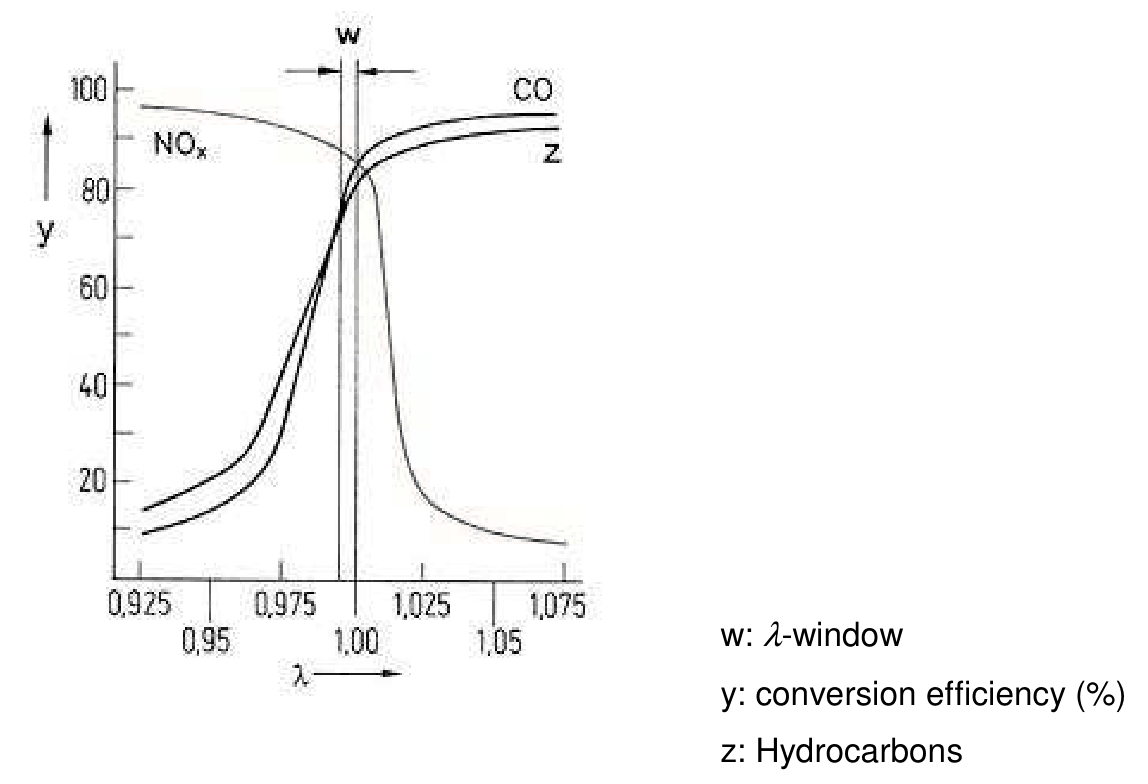
2.2 Decide the questions on the answer sheet concerning the \(\lambda\) probe.
The adsorption of gas molecules on a solid surface can be described in a simple model by using the Langmuir isotherm: \[ \theta=\frac{K\times p}{1+K\times p} \] where \(\theta\) is the fraction of surface sites that are occupied by the gas molecules, p is the gas pressure and K is a constant.
The adsorption of a gas at 25 °C may be described by using the Langmuir isotherm with \(K=0.85\ \mathrm{kPa^{-1}}\).
2.3 a) Determine the surface coverage \(\theta\) at a pressure of 0.65 kPa.
b) Determine the pressure p at which 15 % of the surface is covered.
c) The rate r of the decomposition of gas molecules at a solid surface depends on the surface coverage \(\theta\) (reverse reaction neglected): \(r=k\theta\)
Give the order of the decomposition reaction at low and at high gas pressures assuming the validity of the Langmuir isotherm given above (products to be neglected).
d) Data for the adsorption of another gas on a metal surface (at 25 °C)
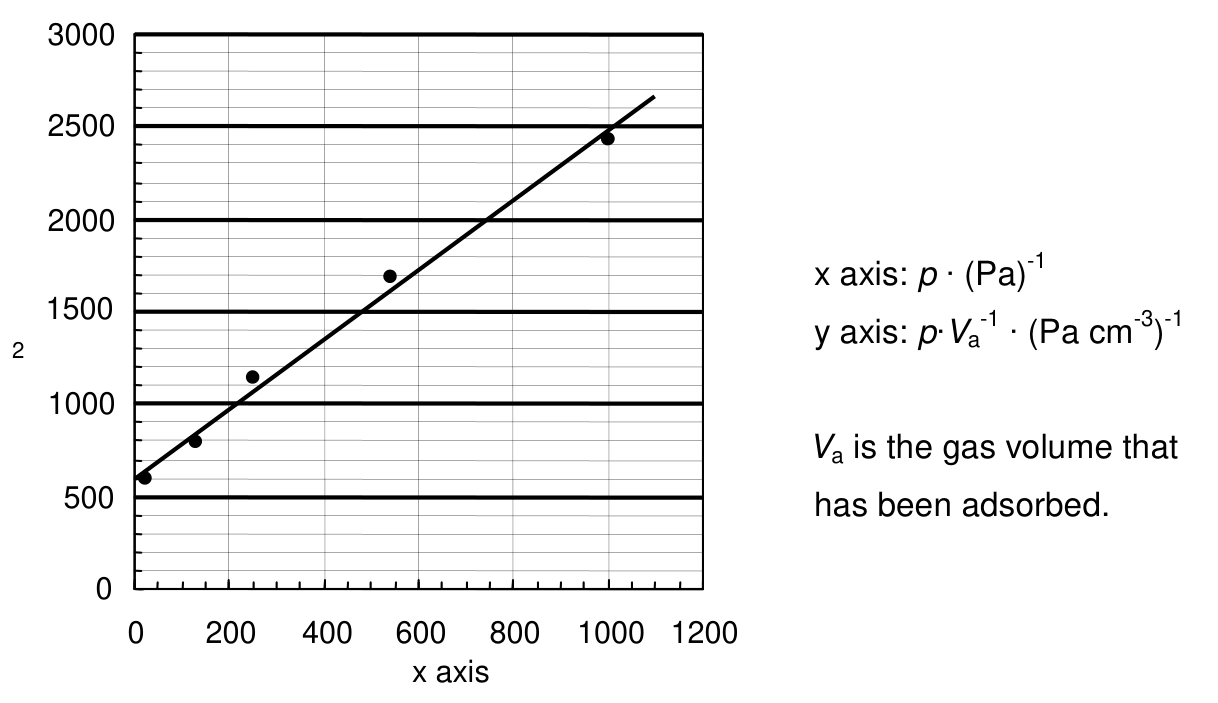
If the Langmuir isotherm can be applied, determine the gas volume \(V_{\mathrm{a,max}}\) needed for a complete coverage of the metal surface and the product \(K V_{\mathrm{a,max}}\).
Hint: Set \(\theta=V_{\mathrm a}/V_{\mathrm{a,max}}\).
Assume that the catalytic oxidation of \(\ce{CO}\) on a \(\ce{Pd}\) surface with equal surface sites proceeds in the following way:
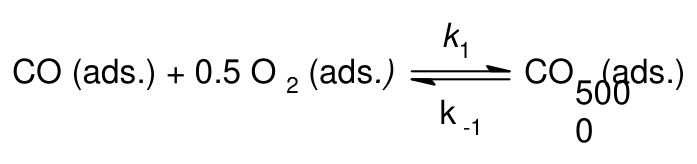
In a first step adsorbed \(\ce{CO}\) and adsorbed \(\ce{O2}\) form adsorbed \(\ce{CO2}\) in a fast equilibrium,
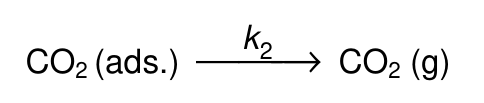
In a slow second step, \(\ce{CO2}\) is then desorbed from the surface:
2.4 Derive the formula for the reaction rate of the \(\ce{CO2(g)}\) - formation as a function of the partial pressures of the reaction components.
Hint: Use the Langmuir isotherm with the proper number of gas components \[ \theta_i= \frac{K_i\times p_i} {1+\displaystyle\sum_j K_j\times p_j} \qquad \text{j: relevant gas components} \]
Official English text of the problem.
Answers
-
2.1 \[ \ce{2CO + O2 -> 2CO2} \] \[ \ce{2NO + 2CO -> N2 + 2CO2} \] \[ \ce{2C8H18 + 25O2 -> 16CO2 + 18H2O} \]
-
2.2 Simultaneous removal of the three pollutants requires operation within the narrow \(\lambda\)-window near \(\lambda=1\), slightly on the fuel-rich side in the diagram.
\(\lambda<1\): fuel-rich, insufficient air.
\(\lambda>1\): fuel-lean, excess air.
The probe supplies an oxygen-dependent voltage used to regulate the air–fuel ratio. The individual answer-sheet statements are unavailable. -
2.3(a) \(\boxed{\theta\approx0.36}\), or approximately \(\boxed{36\%}\) coverage.
-
2.3(b) \(\boxed{p\approx0.21\ \mathrm{kPa}}\).
-
2.3(c) First order at low pressure, \(Kp\ll1\); zero order at high pressure, \(Kp\gg1\).
-
2.3(d) From the plotted straight line: \[ \boxed{V_{\mathrm{a,max}}\approx0.53\ \mathrm{cm^3}}, \qquad \boxed{K V_{\mathrm{a,max}}\approx1.7\times10^{-3}\ \mathrm{cm^3\,Pa^{-1}}}. \]
-
2.4 \[ \boxed{ r=\frac{k_1k_2}{k_{-1}}\, \frac{K_{\ce{CO}}p_{\ce{CO}} \sqrt{K_{\ce{O2}}p_{\ce{O2}}}} {D^{3/2}} } \] For reactant-only competitive adsorption, \[ D=1+K_{\ce{CO}}p_{\ce{CO}}+K_{\ce{O2}}p_{\ce{O2}}. \] If gaseous carbon dioxide is also included as a competing adsorbate, use \[ D=1+K_{\ce{CO}}p_{\ce{CO}} +K_{\ce{O2}}p_{\ce{O2}} +K_{\ce{CO2}}p_{\ce{CO2}}. \] The distinction is discussed below.
Solution
The molecular and ionic identities used in the solution are:
| Name | Formula | SMILES |
|---|---|---|
| Carbon monoxide | \(\ce{CO}\) | [C-]#[O+] |
| Nitrogen monoxide, or nitric oxide | \(\ce{NO}\) | [N]=O |
| Octane, represented by \(n\)-octane | \(\ce{C8H18}\) | CCCCCCCC |
| Carbon dioxide | \(\ce{CO2}\) | O=C=O |
| Dinitrogen | \(\ce{N2}\) | N#N |
| Water | \(\ce{H2O}\) | O |
| Dioxygen | \(\ce{O2}\) | O=O |
| Oxide ion | \(\ce{O^2-}\) | [O-2] |
All octane isomers have the same combustion stoichiometry. These SMILES describe the molecular identities; they do not specify adsorption geometries on palladium. The conventional dioxygen SMILES also does not specify its triplet electronic ground state.
2.1 — Reactions in the catalytic converter
Carbon monoxide is oxidized to carbon dioxide: \[ \ce{2CO + O2 -> 2CO2}. \] Carbon changes from oxidation state \(+2\) to \(+4\).
Nitrogen monoxide is reduced to nitrogen, with carbon monoxide supplying the reducing equivalents: \[ \ce{2NO + 2CO -> N2 + 2CO2}. \] Each nitrogen atom changes from \(+2\) to \(0\), accepting two electrons. Each carbon atom changes from \(+2\) to \(+4\), supplying two electrons. Thus the required mole ratio of nitrogen monoxide to carbon monoxide is \(1:1\).
Complete oxidation of one octane molecule produces eight carbon dioxide molecules and nine water molecules: \[ \ce{C8H18 + 25/2 O2 -> 8CO2 + 9H2O}. \] The products contain \(16+9=25\) oxygen atoms. Multiplying by two gives integer coefficients: \[ \boxed{\ce{2C8H18 + 25O2 -> 16CO2 + 18H2O}}. \]
2.2 — Lambda probe and operating window
The definition of \(\lambda\) directly gives:
| Condition | Air–fuel mixture | Consequence for conversion |
|---|---|---|
| \(\lambda<1\) | Fuel-rich; less air than required for complete combustion | Nitrogen monoxide reduction is favoured, but oxidation of carbon monoxide and hydrocarbons is limited by oxygen availability. |
| \(\lambda\approx1\) | Approximately stoichiometric | A narrow range permits efficient simultaneous oxidation and reduction. |
| \(\lambda>1\) | Fuel-lean; excess air | Carbon monoxide and hydrocarbon oxidation are favoured, while nitrogen monoxide reduction becomes inefficient. |
In the diagram, the operating window is the narrow band between the two marked vertical lines immediately below and approximately at \(\lambda=1\). The falling curve represents nitrogen oxides; the two rising curves represent carbon monoxide and hydrocarbons.
A conventional oxygen-ion-conducting lambda probe is an electrochemical oxygen concentration cell. Its electrode equilibrium is \[ \ce{O2 + 4e- <=> 2O^2-}. \] Oxide ions move through the solid electrolyte, and electrons move through the external circuit.
With reference air on one side and exhaust gas on the other, the ideal cell voltage, with the reference electrode taken as positive, is \[ E=\frac{RT}{4F} \ln\!\left( \frac{p_{\ce{O2},\mathrm{reference}}} {p_{\ce{O2},\mathrm{exhaust}}} \right). \] Here \(T\) is the probe’s operating temperature.
Fuel-rich exhaust has a very low oxygen partial pressure and gives a relatively high voltage. Lean exhaust has a higher oxygen partial pressure and gives a lower voltage. This signal allows the engine controller to adjust the fuel supply and keep \(\lambda\) within the operating window.
2.3(a) — Surface coverage
Using \[ \theta=\frac{Kp}{1+Kp}, \] the dimensionless product is \[ Kp=(0.85\ \mathrm{kPa^{-1}})(0.65\ \mathrm{kPa})=0.5525. \] Therefore, \[ \theta=\frac{0.5525}{1.5525}=0.35588. \] To two significant figures, \[ \boxed{\theta=0.36,\qquad \text{coverage}=36\%}. \]
2.3(b) — Pressure for 15% coverage
Rearranging the Langmuir equation, \[ \theta(1+Kp)=Kp, \] \[ \theta=Kp(1-\theta), \] so \[ p=\frac{\theta}{K(1-\theta)}. \] At \(\theta=0.15\), \[ p= \frac{0.15} {(0.85\ \mathrm{kPa^{-1}})(0.85)} =0.20761\ \mathrm{kPa}. \] Thus, \[ \boxed{p=0.21\ \mathrm{kPa}}. \]
2.3(c) — Limiting reaction orders
Substitution of the Langmuir isotherm into \(r=k\theta\) gives \[ r=\frac{kKp}{1+Kp}. \]
At low pressure, \(Kp\ll1\): \[ r\approx kKp. \] The rate is proportional to pressure, so the reaction is first order.
At high pressure, \(Kp\gg1\): \[ r\approx k. \] The surface is almost completely covered. Increasing the pressure produces essentially no further increase in coverage or rate, so the reaction is zero order.
The continuous transition can be expressed through the apparent order: \[ n=\frac{\mathrm d\ln r}{\mathrm d\ln p} =\frac{1}{1+Kp}. \]
2.3(d) — Maximum adsorbed volume
With the supplied identification \[ \theta=\frac{V_{\mathrm a}}{V_{\mathrm{a,max}}}, \] the Langmuir equation becomes \[ V_{\mathrm a} =V_{\mathrm{a,max}}\frac{Kp}{1+Kp}. \] Rearrangement gives the straight-line form \[ \boxed{ \frac{p}{V_{\mathrm a}} = \frac{1}{K V_{\mathrm{a,max}}} +\frac{p}{V_{\mathrm{a,max}}} }. \]
Thus a plot of \(p/V_{\mathrm a}\) against \(p\) has \[ \text{slope }m=\frac{1}{V_{\mathrm{a,max}}}, \qquad \text{intercept }b=\frac{1}{K V_{\mathrm{a,max}}}. \]
The graph’s abscissa is pressure in pascals, and its ordinate is \(p/V_{\mathrm a}\) in \(\mathrm{Pa\,cm^{-3}}\). Reading the drawn line approximately, \[ b\approx600\ \mathrm{Pa\,cm^{-3}}, \] and, using its ordinate near \(p=1000\ \mathrm{Pa}\), \[ m\approx \frac{(2500-600)\ \mathrm{Pa\,cm^{-3}}} {1000\ \mathrm{Pa}} =1.9\ \mathrm{cm^{-3}}. \]
Consequently, \[ V_{\mathrm{a,max}}=\frac{1}{m} \approx\frac{1}{1.9\ \mathrm{cm^{-3}}} =\boxed{0.53\ \mathrm{cm^3}}, \] and \[ K V_{\mathrm{a,max}}=\frac{1}{b} \approx\frac{1}{600\ \mathrm{Pa\,cm^{-3}}} =\boxed{1.7\times10^{-3}\ \mathrm{cm^3\,Pa^{-1}}}. \]
These are graphical estimates for the second gas.
2.4 — Rate of carbon dioxide formation
The stipulated surface equilibrium is \[ \ce{CO(ads) + 1/2 O2(ads) <=> CO2(ads)}. \]
Using the mass-action interpretation of this equilibrium, its forward and reverse rates are \[ v_1=k_1\theta_{\ce{CO}}\theta_{\ce{O2}}^{1/2}, \qquad v_{-1}=k_{-1}\theta_{\ce{CO2}}. \] Because this step is fast compared with desorption, \[ k_1\theta_{\ce{CO}}\theta_{\ce{O2}}^{1/2} \approx k_{-1}\theta_{\ce{CO2}}, \] giving \[ \theta_{\ce{CO2}} = \frac{k_1}{k_{-1}} \theta_{\ce{CO}}\theta_{\ce{O2}}^{1/2}. \]
The slow step is \[ \ce{CO2(ads) -> CO2(g)}, \] so, in the same surface-coverage rate convention used in 2.3(c), \[ r=k_2\theta_{\ce{CO2}} =\frac{k_1k_2}{k_{-1}} \theta_{\ce{CO}}\theta_{\ce{O2}}^{1/2}. \]
Write the common competitive-adsorption denominator as \[ D=1+\sum_j K_jp_j. \] The supplied isotherm then gives \[ \theta_{\ce{CO}}=\frac{K_{\ce{CO}}p_{\ce{CO}}}{D}, \qquad \theta_{\ce{O2}}=\frac{K_{\ce{O2}}p_{\ce{O2}}}{D}. \] Substitution yields \[ \boxed{ r=\frac{k_1k_2}{k_{-1}}\, \frac{K_{\ce{CO}}p_{\ce{CO}} \sqrt{K_{\ce{O2}}p_{\ce{O2}}}} {D^{3/2}} }. \] The denominator exponent is \(1+\tfrac12=\tfrac32\).
For the reactant-only competitive Langmuir approximation, \[ \boxed{ r= \frac{k_1k_2}{k_{-1}}\, \frac{K_{\ce{CO}}p_{\ce{CO}} \sqrt{K_{\ce{O2}}p_{\ce{O2}}}} {\left(1+K_{\ce{CO}}p_{\ce{CO}} +K_{\ce{O2}}p_{\ce{O2}}\right)^{3/2}} }. \]
If the instruction “relevant gas components” includes competitive adsorption of gaseous carbon dioxide, the formal three-component expression instead is \[ \boxed{ r= \frac{k_1k_2}{k_{-1}}\, \frac{K_{\ce{CO}}p_{\ce{CO}} \sqrt{K_{\ce{O2}}p_{\ce{O2}}}} {\left(1+K_{\ce{CO}}p_{\ce{CO}} +K_{\ce{O2}}p_{\ce{O2}} +K_{\ce{CO2}}p_{\ce{CO2}}\right)^{3/2}} }. \] Setting the product-adsorption contribution to zero recovers the reactant-only expression.
The solution was checked against the official solution.
IChO 2004 · Theorieaufgabe 2
Kinetik an Katalysatoroberflächen
Die Abgase eines Ottomotors enthalten neben anderen Verbindungen die Hauptschadstoffe Kohlenstoffmonoxid, Stickstoffmonoxid und unverbrannte Kohlenwasserstoffe, beispielsweise Octan. Um ihre Emissionen zu minimieren, werden sie in einem geregelten Drei-Wege-Katalysator zu Kohlenstoffdioxid, Stickstoff und Wasser umgesetzt.
2.1 Vervollständigen Sie die chemischen Reaktionsgleichungen für die Reaktionen der Hauptschadstoffe im Katalysator.
Um die Hauptschadstoffe optimal aus dem Abgas eines Ottomotors zu entfernen, wird der \(\lambda\)-Wert durch ein elektrochemisches Element, die sogenannte Lambdasonde, bestimmt. Diese befindet sich im Abgasstrom zwischen Motor und Drei-Wege-Katalysator.
Der Lambdawert ist definiert als \[ \lambda= \frac{\text{zugeführte Luftmenge}} {\text{für die vollständige Verbrennung erforderliche Luftmenge}}. \]
2.2 Beantworten Sie die Fragen auf dem Antwortblatt zur \(\lambda\)-Sonde.
Die Adsorption von Gasmolekülen an einer festen Oberfläche lässt sich in einem einfachen Modell mithilfe der Langmuir-Isotherme beschreiben: \[ \theta=\frac{K\times p}{1+K\times p} \] Dabei ist \(\theta\) der Anteil der Oberflächenplätze, die von Gasmolekülen besetzt sind, p der Gasdruck und K eine Konstante.
Die Adsorption eines Gases bei 25 °C lässt sich mithilfe der Langmuir-Isotherme mit \(K=0.85\ \mathrm{kPa^{-1}}\) beschreiben.
2.3 a) Bestimmen Sie den Bedeckungsgrad \(\theta\) bei einem Druck von 0.65 kPa.
b) Bestimmen Sie den Druck p, bei dem 15 % der Oberfläche bedeckt sind.
c) Die Geschwindigkeit r der Zersetzung von Gasmolekülen an einer festen Oberfläche hängt vom Bedeckungsgrad \(\theta\) ab (die Rückreaktion wird vernachlässigt): \(r=k\theta\)
Geben Sie die Ordnung der Zersetzungsreaktion bei niedrigen und bei hohen Gasdrücken an, unter der Annahme, dass die oben angegebene Langmuir-Isotherme gilt (die Produkte sind zu vernachlässigen).
d) Daten zur Adsorption eines anderen Gases an einer Metalloberfläche (bei 25 °C)
Bestimmen Sie, sofern die Langmuir-Isotherme anwendbar ist, das für eine vollständige Bedeckung der Metalloberfläche erforderliche Gasvolumen \(V_{\mathrm{a,max}}\) und das Produkt \(K V_{\mathrm{a,max}}\).
Hinweis: Setzen Sie \(\theta=V_{\mathrm a}/V_{\mathrm{a,max}}\).
Nehmen Sie an, dass die katalytische Oxidation von \(\ce{CO}\) an einer \(\ce{Pd}\)-Oberfläche mit gleichwertigen Oberflächenplätzen folgendermaßen abläuft:
In einem ersten Schritt bilden adsorbiertes \(\ce{CO}\) und adsorbiertes \(\ce{O2}\) in einem schnellen Gleichgewicht adsorbiertes \(\ce{CO2}\),
In einem langsamen zweiten Schritt wird \(\ce{CO2}\) anschließend von der Oberfläche desorbiert:
2.4 Leiten Sie die Formel für die Reaktionsgeschwindigkeit der Bildung von \(\ce{CO2(g)}\) als Funktion der Partialdrücke der Reaktionskomponenten her.
Hinweis: Verwenden Sie die Langmuir-Isotherme mit der entsprechenden Anzahl an Gaskomponenten \[ \theta_i= \frac{K_i\times p_i} {1+\displaystyle\sum_j K_j\times p_j} \qquad \text{j: relevante Gaskomponenten} \]
Aufgabentext aus dem offiziellen englischen Text übersetzt.
Antworten
-
2.1 \[ \ce{2CO + O2 -> 2CO2} \] \[ \ce{2NO + 2CO -> N2 + 2CO2} \] \[ \ce{2C8H18 + 25O2 -> 16CO2 + 18H2O} \]
-
2.2 Die gleichzeitige Entfernung der drei Schadstoffe erfordert einen Betrieb innerhalb des schmalen \(\lambda\)-Fensters nahe \(\lambda=1\), im Diagramm leicht auf der kraftstoffreichen Seite.
\(\lambda<1\): kraftstoffreich, Luftmangel.
\(\lambda>1\): kraftstoffarm, Luftüberschuss.
Die Sonde liefert eine vom Sauerstoffgehalt abhängige Spannung, die zur Regelung des Luft-Kraftstoff-Verhältnisses verwendet wird. Die einzelnen Aussagen des Antwortblatts liegen nicht vor. -
2.3(a) \(\boxed{\theta\approx0.36}\), oder ein Bedeckungsgrad von ungefähr \(\boxed{36\%}\).
-
2.3(b) \(\boxed{p\approx0.21\ \mathrm{kPa}}\).
-
2.3(c) Erste Ordnung bei niedrigem Druck, \(Kp\ll1\); nullte Ordnung bei hohem Druck, \(Kp\gg1\).
-
2.3(d) Aus der eingezeichneten Geraden: \[ \boxed{V_{\mathrm{a,max}}\approx0.53\ \mathrm{cm^3}}, \qquad \boxed{K V_{\mathrm{a,max}}\approx1.7\times10^{-3}\ \mathrm{cm^3\,Pa^{-1}}}. \]
-
2.4 \[ \boxed{ r=\frac{k_1k_2}{k_{-1}}\, \frac{K_{\ce{CO}}p_{\ce{CO}} \sqrt{K_{\ce{O2}}p_{\ce{O2}}}} {D^{3/2}} } \] Für die kompetitive Adsorption ausschließlich der Edukte gilt \[ D=1+K_{\ce{CO}}p_{\ce{CO}}+K_{\ce{O2}}p_{\ce{O2}}. \] Wird gasförmiges Kohlenstoffdioxid ebenfalls als konkurrierendes Adsorbat berücksichtigt, verwendet man \[ D=1+K_{\ce{CO}}p_{\ce{CO}} +K_{\ce{O2}}p_{\ce{O2}} +K_{\ce{CO2}}p_{\ce{CO2}}. \] Der Unterschied wird weiter unten erläutert.
Lösung
Die in der Lösung verwendeten Moleküle und Ionen sind:
| Name | Formel | SMILES |
|---|---|---|
| Kohlenstoffmonoxid | \(\ce{CO}\) | [C-]#[O+] |
| Stickstoffmonoxid, auch Stickoxid genannt | \(\ce{NO}\) | [N]=O |
| Octan, dargestellt durch \(n\)-Octan | \(\ce{C8H18}\) | CCCCCCCC |
| Kohlenstoffdioxid | \(\ce{CO2}\) | O=C=O |
| Distickstoff | \(\ce{N2}\) | N#N |
| Wasser | \(\ce{H2O}\) | O |
| Disauerstoff | \(\ce{O2}\) | O=O |
| Oxidion | \(\ce{O^2-}\) | [O-2] |
Alle Octanisomere haben dieselbe Verbrennungsstöchiometrie. Diese SMILES beschreiben die Identität der Moleküle; sie legen keine Adsorptionsgeometrien auf Palladium fest. Die konventionelle SMILES-Darstellung von Disauerstoff legt auch dessen elektronischen Triplett-Grundzustand nicht fest.
2.1 — Reaktionen im Katalysator
Kohlenstoffmonoxid wird zu Kohlenstoffdioxid oxidiert: \[ \ce{2CO + O2 -> 2CO2}. \] Die Oxidationszahl des Kohlenstoffs ändert sich von \(+2\) zu \(+4\).
Stickstoffmonoxid wird zu Stickstoff reduziert, wobei Kohlenstoffmonoxid die Reduktionsäquivalente liefert: \[ \ce{2NO + 2CO -> N2 + 2CO2}. \] Die Oxidationszahl jedes Stickstoffatoms ändert sich von \(+2\) zu \(0\), wobei es zwei Elektronen aufnimmt. Die Oxidationszahl jedes Kohlenstoffatoms ändert sich von \(+2\) zu \(+4\), wobei es zwei Elektronen abgibt. Somit beträgt das erforderliche Stoffmengenverhältnis von Stickstoffmonoxid zu Kohlenstoffmonoxid \(1:1\).
Bei der vollständigen Oxidation eines Octanmoleküls entstehen acht Kohlenstoffdioxidmoleküle und neun Wassermoleküle: \[ \ce{C8H18 + 25/2 O2 -> 8CO2 + 9H2O}. \] Die Produkte enthalten \(16+9=25\) Sauerstoffatome. Durch Multiplikation mit zwei erhält man ganzzahlige Koeffizienten: \[ \boxed{\ce{2C8H18 + 25O2 -> 16CO2 + 18H2O}}. \]
2.2 — Lambdasonde und Betriebsfenster
Aus der Definition von \(\lambda\) ergibt sich unmittelbar:
| Bedingung | Luft-Kraftstoff-Gemisch | Auswirkung auf die Umsetzung |
|---|---|---|
| \(\lambda<1\) | Fett; weniger Luft als für die vollständige Verbrennung erforderlich | Die Reduktion von Stickstoffmonoxid wird begünstigt, die Oxidation von Kohlenstoffmonoxid und Kohlenwasserstoffen wird jedoch durch die Verfügbarkeit von Sauerstoff begrenzt. |
| \(\lambda\approx1\) | Annähernd stöchiometrisch | Ein enger Bereich ermöglicht eine effiziente gleichzeitige Oxidation und Reduktion. |
| \(\lambda>1\) | Mager; Luftüberschuss | Die Oxidation von Kohlenstoffmonoxid und Kohlenwasserstoffen wird begünstigt, während die Reduktion von Stickstoffmonoxid ineffizient wird. |
Im Diagramm ist das Betriebsfenster der schmale Bereich zwischen den beiden markierten senkrechten Linien unmittelbar unterhalb von und ungefähr bei \(\lambda=1\). Die fallende Kurve steht für Stickstoffoxide; die beiden ansteigenden Kurven stehen für Kohlenstoffmonoxid und Kohlenwasserstoffe.
Eine herkömmliche sauerstoffionenleitende Lambdasonde ist eine elektrochemische Sauerstoffkonzentrationszelle. Ihr Elektrodengleichgewicht lautet \[ \ce{O2 + 4e- <=> 2O^2-}. \] Oxidionen bewegen sich durch den Festelektrolyten, Elektronen durch den äußeren Stromkreis.
Mit Referenzluft auf der einen Seite und Abgas auf der anderen beträgt die ideale Zellspannung, wenn die Referenzelektrode als positiv angenommen wird, \[ E=\frac{RT}{4F} \ln\!\left( \frac{p_{\ce{O2},\mathrm{reference}}} {p_{\ce{O2},\mathrm{exhaust}}} \right). \] Dabei ist \(T\) die Betriebstemperatur der Sonde.
Das Abgas eines fetten Gemisches hat einen sehr niedrigen Sauerstoffpartialdruck und liefert eine relativ hohe Spannung. Das Abgas eines mageren Gemisches hat einen höheren Sauerstoffpartialdruck und liefert eine niedrigere Spannung. Dieses Signal ermöglicht es der Motorsteuerung, die Kraftstoffzufuhr anzupassen und \(\lambda\) innerhalb des Betriebsfensters zu halten.
2.3(a) — Bedeckungsgrad
Unter Verwendung von \[ \theta=\frac{Kp}{1+Kp}, \] beträgt das dimensionslose Produkt \[ Kp=(0.85\ \mathrm{kPa^{-1}})(0.65\ \mathrm{kPa})=0.5525. \] Daher gilt \[ \theta=\frac{0.5525}{1.5525}=0.35588. \] Auf zwei signifikante Stellen gerundet: \[ \boxed{\theta=0.36,\qquad \text{Bedeckungsgrad}=36\%}. \]
2.3(b) — Druck für einen Bedeckungsgrad von 15 %
Durch Umstellen der Langmuir-Gleichung erhält man \[ \theta(1+Kp)=Kp, \] \[ \theta=Kp(1-\theta), \] also \[ p=\frac{\theta}{K(1-\theta)}. \] Bei \(\theta=0.15\) gilt \[ p= \frac{0.15} {(0.85\ \mathrm{kPa^{-1}})(0.85)} =0.20761\ \mathrm{kPa}. \] Somit ergibt sich \[ \boxed{p=0.21\ \mathrm{kPa}}. \]
2.3(c) — Reaktionsordnungen in den Grenzfällen
Einsetzen der Langmuir-Isotherme in \(r=k\theta\) ergibt \[ r=\frac{kKp}{1+Kp}. \]
Bei niedrigem Druck, \(Kp\ll1\): \[ r\approx kKp. \] Die Geschwindigkeit ist proportional zum Druck, daher ist die Reaktion erster Ordnung.
Bei hohem Druck, \(Kp\gg1\): \[ r\approx k. \] Die Oberfläche ist nahezu vollständig bedeckt. Eine Druckerhöhung führt praktisch zu keiner weiteren Zunahme des Bedeckungsgrads oder der Geschwindigkeit, daher ist die Reaktion nullter Ordnung.
Der kontinuierliche Übergang lässt sich durch die scheinbare Reaktionsordnung ausdrücken: \[ n=\frac{\mathrm d\ln r}{\mathrm d\ln p} =\frac{1}{1+Kp}. \]
2.3(d) — Maximales adsorbiertes Volumen
Mit der vorgegebenen Zuordnung \[ \theta=\frac{V_{\mathrm a}}{V_{\mathrm{a,max}}}, \] wird die Langmuir-Gleichung zu \[ V_{\mathrm a} =V_{\mathrm{a,max}}\frac{Kp}{1+Kp}. \] Durch Umstellen erhält man die Geradengleichung \[ \boxed{ \frac{p}{V_{\mathrm a}} = \frac{1}{K V_{\mathrm{a,max}}} +\frac{p}{V_{\mathrm{a,max}}} }. \]
Somit hat eine Auftragung von \(p/V_{\mathrm a}\) gegen \(p\) \[ \text{Steigung }m=\frac{1}{V_{\mathrm{a,max}}}, \qquad \text{Ordinatenabschnitt }b=\frac{1}{K V_{\mathrm{a,max}}}. \]
Die Abszisse des Diagramms gibt den Druck in Pascal an, die Ordinate \(p/V_{\mathrm a}\) in \(\mathrm{Pa\,cm^{-3}}\). Aus der eingezeichneten Geraden liest man näherungsweise ab: \[ b\approx600\ \mathrm{Pa\,cm^{-3}}, \] und unter Verwendung ihres Ordinatenwerts nahe \(p=1000\ \mathrm{Pa}\) erhält man \[ m\approx \frac{(2500-600)\ \mathrm{Pa\,cm^{-3}}} {1000\ \mathrm{Pa}} =1.9\ \mathrm{cm^{-3}}. \]
Folglich gilt \[ V_{\mathrm{a,max}}=\frac{1}{m} \approx\frac{1}{1.9\ \mathrm{cm^{-3}}} =\boxed{0.53\ \mathrm{cm^3}}, \] und \[ K V_{\mathrm{a,max}}=\frac{1}{b} \approx\frac{1}{600\ \mathrm{Pa\,cm^{-3}}} =\boxed{1.7\times10^{-3}\ \mathrm{cm^3\,Pa^{-1}}}. \]
Dies sind grafisch ermittelte Näherungswerte für das zweite Gas.
2.4 — Geschwindigkeit der Bildung von Kohlenstoffdioxid
Das vorgegebene Oberflächengleichgewicht lautet \[ \ce{CO(ads) + 1/2 O2(ads) <=> CO2(ads)}. \]
Bei Anwendung des Massenwirkungsgesetzes auf dieses Gleichgewicht lauten die Geschwindigkeiten der Hin- und Rückreaktion \[ v_1=k_1\theta_{\ce{CO}}\theta_{\ce{O2}}^{1/2}, \qquad v_{-1}=k_{-1}\theta_{\ce{CO2}}. \] Da dieser Schritt im Vergleich zur Desorption schnell ist, gilt \[ k_1\theta_{\ce{CO}}\theta_{\ce{O2}}^{1/2} \approx k_{-1}\theta_{\ce{CO2}}, \] woraus folgt: \[ \theta_{\ce{CO2}} = \frac{k_1}{k_{-1}} \theta_{\ce{CO}}\theta_{\ce{O2}}^{1/2}. \]
Der langsame Schritt lautet \[ \ce{CO2(ads) -> CO2(g)}, \] also gilt bei derselben auf den Bedeckungsgrad bezogenen Definition der Geschwindigkeit wie in 2.3(c) \[ r=k_2\theta_{\ce{CO2}} =\frac{k_1k_2}{k_{-1}} \theta_{\ce{CO}}\theta_{\ce{O2}}^{1/2}. \]
Den gemeinsamen Nenner der kompetitiven Adsorption schreiben wir als \[ D=1+\sum_j K_jp_j. \] Die angegebene Isotherme liefert dann \[ \theta_{\ce{CO}}=\frac{K_{\ce{CO}}p_{\ce{CO}}}{D}, \qquad \theta_{\ce{O2}}=\frac{K_{\ce{O2}}p_{\ce{O2}}}{D}. \] Einsetzen ergibt \[ \boxed{ r=\frac{k_1k_2}{k_{-1}}\, \frac{K_{\ce{CO}}p_{\ce{CO}} \sqrt{K_{\ce{O2}}p_{\ce{O2}}}} {D^{3/2}} }. \] Der Exponent im Nenner ist \(1+\tfrac12=\tfrac32\).
Für die kompetitive Langmuir-Näherung, die ausschließlich die Edukte berücksichtigt, gilt \[ \boxed{ r= \frac{k_1k_2}{k_{-1}}\, \frac{K_{\ce{CO}}p_{\ce{CO}} \sqrt{K_{\ce{O2}}p_{\ce{O2}}}} {\left(1+K_{\ce{CO}}p_{\ce{CO}} +K_{\ce{O2}}p_{\ce{O2}}\right)^{3/2}} }. \]
Wenn die Angabe „relevante Gaskomponenten“ die kompetitive Adsorption von gasförmigem Kohlenstoffdioxid einschließt, lautet der formale Ausdruck für drei Komponenten stattdessen \[ \boxed{ r= \frac{k_1k_2}{k_{-1}}\, \frac{K_{\ce{CO}}p_{\ce{CO}} \sqrt{K_{\ce{O2}}p_{\ce{O2}}}} {\left(1+K_{\ce{CO}}p_{\ce{CO}} +K_{\ce{O2}}p_{\ce{O2}} +K_{\ce{CO2}}p_{\ce{CO2}}\right)^{3/2}} }. \] Setzt man den Beitrag der Produktadsorption gleich null, erhält man wieder den Ausdruck, der ausschließlich die Edukte berücksichtigt.
Die Lösung wurde mit der offiziellen Lösung abgeglichen.
IChO 2004 · Teori sorusu 2
Katalizör yüzeylerinde kinetik
Bir Otto motorunun egzoz gazları, diğer bileşiklerin yanı sıra başlıca kirleticiler olan karbon monoksit, azot monoksit ve örneğin oktan gibi yanmamış hidrokarbonları içerir. Bunları en aza indirmek için, kontrollü bir üç yollu katalitik konvertörde karbon dioksit, azot ve suya dönüştürülürler.
2.1 Başlıca kirleticilerin katalizördeki tepkimelerine ait kimyasal tepkime denklemlerini tamamlayınız.
Bir Otto motorunun egzoz gazındaki başlıca kirleticileri en uygun biçimde gidermek için, \(\lambda\) değeri lambda sondası adı verilen bir elektrokimyasal hücreyle belirlenir. Bu sonda, motor ile üç yollu katalitik konvertör arasındaki egzoz gazı akışında yer alır.
Lambda değeri şöyle tanımlanır: \[ \lambda= \frac{\text{girişteki hava miktarı}} {\text{tam yanma için gerekli hava miktarı}}. \]
2.2 Cevap kâğıdında \(\lambda\) sondasıyla ilgili soruları yanıtlayınız.
Gaz moleküllerinin katı bir yüzey üzerindeki adsorpsiyonu, Langmuir izotermi kullanılarak basit bir modelle açıklanabilir: \[ \theta=\frac{K\times p}{1+K\times p} \] Burada \(\theta\), yüzeydeki merkezlerin gaz molekülleri tarafından işgal edilen kesri, p gaz basıncı ve K bir sabittir.
Bir gazın 25 °C'deki adsorpsiyonu, \(K=0.85\ \mathrm{kPa^{-1}}\) olmak üzere Langmuir izotermiyle açıklanabilir.
2.3 a) 0.65 kPa basınçta yüzey örtülme oranını, \(\theta\), belirleyiniz.
b) Yüzeyin %15'inin örtüldüğü p basıncını belirleyiniz.
c) Gaz moleküllerinin katı bir yüzeydeki bozunma hızı r, yüzey örtülme oranına, \(\theta\), bağlıdır (ters tepkime ihmal edilmektedir): \(r=k\theta\)
Yukarıda verilen Langmuir izoterminin geçerli olduğunu varsayarak, düşük ve yüksek gaz basınçlarında bozunma tepkimesinin derecesini belirtiniz (ürünler ihmal edilecektir).
d) Başka bir gazın metal yüzeyindeki adsorpsiyonuna ait veriler (25 °C'de)
Langmuir izotermi uygulanabiliyorsa, metal yüzeyinin tamamen örtülmesi için gereken gaz hacmini, \(V_{\mathrm{a,max}}\), ve \(K V_{\mathrm{a,max}}\) çarpımını belirleyiniz.
İpucu: \(\theta=V_{\mathrm a}/V_{\mathrm{a,max}}\) alınız.
Eşdeğer yüzey merkezlerine sahip bir \(\ce{Pd}\) yüzeyinde \(\ce{CO}\)'nun katalitik yükseltgenmesinin aşağıdaki şekilde ilerlediğini varsayınız:
İlk basamakta, adsorplanmış \(\ce{CO}\) ve adsorplanmış \(\ce{O2}\), hızlı bir dengeyle adsorplanmış \(\ce{CO2}\) oluşturur,
Ardından, yavaş olan ikinci basamakta \(\ce{CO2}\) yüzeyden desorplanır:
2.4 \(\ce{CO2(g)}\) oluşumunun tepkime hızı bağıntısını, tepkime bileşenlerinin kısmi basınçlarının bir fonksiyonu olarak türetiniz.
İpucu: Uygun sayıda gaz bileşeni için Langmuir izotermini kullanınız: \[ \theta_i= \frac{K_i\times p_i} {1+\displaystyle\sum_j K_j\times p_j} \qquad \text{j: ilgili gaz bileşenleri} \]
Soru metni resmi İngilizce metinden çevrilmiştir.
Cevaplar
-
2.1 \[ \ce{2CO + O2 -> 2CO2} \] \[ \ce{2NO + 2CO -> N2 + 2CO2} \] \[ \ce{2C8H18 + 25O2 -> 16CO2 + 18H2O} \]
-
2.2 Üç kirleticinin eş zamanlı olarak giderilmesi, \(\lambda=1\) yakınındaki dar \(\lambda\) aralığında, diyagramda yakıtça zengin tarafa biraz kaymış bir noktada çalışmayı gerektirir.
\(\lambda<1\): yakıtça zengin, yetersiz hava.
\(\lambda>1\): yakıtça fakir, fazla hava.
Sonda, hava–yakıt oranını düzenlemek için kullanılan, oksijene bağlı bir gerilim üretir. Cevap kâğıdındaki tek tek ifadelere erişilemiyor. -
2.3(a) \(\boxed{\theta\approx0.36}\), yani yaklaşık \(\boxed{36\%}\) örtülme.
-
2.3(b) \(\boxed{p\approx0.21\ \mathrm{kPa}}\).
-
2.3(c) Düşük basınçta, \(Kp\ll1\), birinci dereceden; yüksek basınçta, \(Kp\gg1\), sıfırıncı derecedendir.
-
2.3(d) Grafikteki doğrudan: \[ \boxed{V_{\mathrm{a,max}}\approx0.53\ \mathrm{cm^3}}, \qquad \boxed{K V_{\mathrm{a,max}}\approx1.7\times10^{-3}\ \mathrm{cm^3\,Pa^{-1}}}. \]
-
2.4 \[ \boxed{ r=\frac{k_1k_2}{k_{-1}}\, \frac{K_{\ce{CO}}p_{\ce{CO}} \sqrt{K_{\ce{O2}}p_{\ce{O2}}}} {D^{3/2}} } \] Yalnızca reaktanların yarışmalı adsorpsiyonu için, \[ D=1+K_{\ce{CO}}p_{\ce{CO}}+K_{\ce{O2}}p_{\ce{O2}}. \] Gaz hâlindeki karbon dioksit de yarışmalı olarak adsorplanan bir tür olarak hesaba katılıyorsa, \[ D=1+K_{\ce{CO}}p_{\ce{CO}} +K_{\ce{O2}}p_{\ce{O2}} +K_{\ce{CO2}}p_{\ce{CO2}}. \] kullanılmalıdır. Bu ayrım aşağıda ele alınmaktadır.
Çözüm
Çözümde kullanılan molekül ve iyon türleri şunlardır:
| Ad | Formül | SMILES |
|---|---|---|
| Karbon monoksit | \(\ce{CO}\) | [C-]#[O+] |
| Azot monoksit veya nitrik oksit | \(\ce{NO}\) | [N]=O |
| \(n\)-oktan ile temsil edilen oktan | \(\ce{C8H18}\) | CCCCCCCC |
| Karbon dioksit | \(\ce{CO2}\) | O=C=O |
| Diazot | \(\ce{N2}\) | N#N |
| Su | \(\ce{H2O}\) | O |
| Dioksijen | \(\ce{O2}\) | O=O |
| Oksit iyonu | \(\ce{O^2-}\) | [O-2] |
Tüm oktan izomerleri aynı yanma stokiyometrisine sahiptir. Bu SMILES gösterimleri moleküler türleri tanımlar; paladyum üzerindeki adsorpsiyon geometrilerini belirtmez. Geleneksel dioksijen SMILES gösterimi de onun triplet elektronik temel hâlini belirtmez.
2.1 — Katalitik konvertördeki tepkimeler
Karbon monoksit, karbon dioksite yükseltgenir: \[ \ce{2CO + O2 -> 2CO2}. \] Karbonun yükseltgenme basamağı \(+2\)'den \(+4\)'e değişir.
Azot monoksit azota indirgenirken, indirgeme eşdeğerlerini karbon monoksit sağlar: \[ \ce{2NO + 2CO -> N2 + 2CO2}. \] Her azot atomu iki elektron alarak \(+2\)'den \(0\)'a geçer. Her karbon atomu iki elektron vererek \(+2\)'den \(+4\)'e geçer. Dolayısıyla azot monoksitin karbon monoksite gerekli mol oranı \(1:1\)'dir.
Bir oktan molekülünün tamamen yükseltgenmesi, sekiz karbon dioksit molekülü ve dokuz su molekülü oluşturur: \[ \ce{C8H18 + 25/2 O2 -> 8CO2 + 9H2O}. \] Ürünler \(16+9=25\) oksijen atomu içerir. İkiyle çarpıldığında tam sayı katsayılar elde edilir: \[ \boxed{\ce{2C8H18 + 25O2 -> 16CO2 + 18H2O}}. \]
2.2 — Lambda sondası ve çalışma aralığı
\(\lambda\)'nın tanımı doğrudan şunları verir:
| Koşul | Hava–yakıt karışımı | Dönüşüm üzerindeki sonuç |
|---|---|---|
| \(\lambda<1\) | Yakıtça zengin; tam yanma için gerekenden daha az hava | Azot monoksitin indirgenmesi elverişlidir, ancak karbon monoksitin ve hidrokarbonların yükseltgenmesi mevcut oksijen miktarıyla sınırlıdır. |
| \(\lambda\approx1\) | Yaklaşık olarak stokiyometrik | Dar bir aralık, yükseltgenme ve indirgenmenin eş zamanlı olarak verimli biçimde gerçekleşmesini sağlar. |
| \(\lambda>1\) | Yakıtça fakir; fazla hava | Karbon monoksitin ve hidrokarbonların yükseltgenmesi elverişliyken, azot monoksitin indirgenmesi verimsiz hâle gelir. |
Diyagramda çalışma aralığı, \(\lambda=1\)'in hemen altında ve yaklaşık bu değerde işaretlenmiş iki düşey çizgi arasındaki dar banttır. Azalan eğri azot oksitlerini; yükselen iki eğri ise karbon monoksiti ve hidrokarbonları temsil eder.
Geleneksel bir oksijen iyonu iletkenli lambda sondası, elektrokimyasal bir oksijen derişim hücresidir. Elektrot dengesi şöyledir: \[ \ce{O2 + 4e- <=> 2O^2-}. \] Oksit iyonları katı elektrolit içinde, elektronlar ise dış devrede hareket eder.
Bir tarafta referans havası ve diğer tarafta egzoz gazı bulunduğunda, referans elektrot pozitif kabul edilirse ideal hücre gerilimi şöyledir: \[ E=\frac{RT}{4F} \ln\!\left( \frac{p_{\ce{O2},\mathrm{reference}}} {p_{\ce{O2},\mathrm{exhaust}}} \right). \] Burada \(T\), sondanın çalışma sıcaklığıdır.
Yakıtça zengin egzoz gazının oksijen kısmi basıncı çok düşüktür ve nispeten yüksek bir gerilim oluşturur. Yakıtça fakir egzoz gazının oksijen kısmi basıncı daha yüksektir ve daha düşük bir gerilim oluşturur. Bu sinyal, motor kontrol biriminin yakıt beslemesini ayarlamasını ve \(\lambda\)'yı çalışma aralığında tutmasını sağlar.
2.3(a) — Yüzey örtülme oranı
\[ \theta=\frac{Kp}{1+Kp}, \] bağıntısı kullanıldığında, boyutsuz çarpım şöyledir: \[ Kp=(0.85\ \mathrm{kPa^{-1}})(0.65\ \mathrm{kPa})=0.5525. \] Dolayısıyla, \[ \theta=\frac{0.5525}{1.5525}=0.35588. \] İki anlamlı rakamla, \[ \boxed{\theta=0.36,\qquad \text{örtülme oranı}=36\%}. \]
2.3(b) — %15 örtülme için basınç
Langmuir denklemi yeniden düzenlenirse, \[ \theta(1+Kp)=Kp, \] \[ \theta=Kp(1-\theta), \] buradan \[ p=\frac{\theta}{K(1-\theta)}. \] \(\theta=0.15\) için, \[ p= \frac{0.15} {(0.85\ \mathrm{kPa^{-1}})(0.85)} =0.20761\ \mathrm{kPa}. \] Böylece, \[ \boxed{p=0.21\ \mathrm{kPa}}. \]
2.3(c) — Sınır durumlarındaki tepkime dereceleri
Langmuir izotermi \(r=k\theta\) bağıntısında yerine konulduğunda, \[ r=\frac{kKp}{1+Kp}. \]
Düşük basınçta, \(Kp\ll1\): \[ r\approx kKp. \] Hız basınçla orantılıdır, dolayısıyla tepkime birinci derecedendir.
Yüksek basınçta, \(Kp\gg1\): \[ r\approx k. \] Yüzey neredeyse tamamen örtülmüştür. Basıncın artırılması, örtülme oranında veya hızda hemen hemen hiçbir ek artışa yol açmaz; dolayısıyla tepkime sıfırıncı derecedendir.
Sürekli geçiş, görünür derece aracılığıyla ifade edilebilir: \[ n=\frac{\mathrm d\ln r}{\mathrm d\ln p} =\frac{1}{1+Kp}. \]
2.3(d) — Adsorplanan maksimum hacim
Verilen \[ \theta=\frac{V_{\mathrm a}}{V_{\mathrm{a,max}}}, \] eşitliğiyle Langmuir denklemi şu hâle gelir: \[ V_{\mathrm a} =V_{\mathrm{a,max}}\frac{Kp}{1+Kp}. \] Yeniden düzenleme, doğrusal biçimi verir: \[ \boxed{ \frac{p}{V_{\mathrm a}} = \frac{1}{K V_{\mathrm{a,max}}} +\frac{p}{V_{\mathrm{a,max}}} }. \]
Böylece \(p/V_{\mathrm a}\)'nın \(p\)'ye karşı grafiğinde \[ \text{eğim }m=\frac{1}{V_{\mathrm{a,max}}}, \qquad \text{düşey ekseni kesim noktası }b=\frac{1}{K V_{\mathrm{a,max}}}. \]
Grafiğin yatay ekseni paskal cinsinden basıncı, düşey ekseni ise \(\mathrm{Pa\,cm^{-3}}\) cinsinden \(p/V_{\mathrm a}\)'yı gösterir. Çizilen doğrudan yaklaşık olarak okunduğunda, \[ b\approx600\ \mathrm{Pa\,cm^{-3}}, \] ve \(p=1000\ \mathrm{Pa}\) yakınındaki ordinatı kullanıldığında, \[ m\approx \frac{(2500-600)\ \mathrm{Pa\,cm^{-3}}} {1000\ \mathrm{Pa}} =1.9\ \mathrm{cm^{-3}}. \]
Sonuç olarak, \[ V_{\mathrm{a,max}}=\frac{1}{m} \approx\frac{1}{1.9\ \mathrm{cm^{-3}}} =\boxed{0.53\ \mathrm{cm^3}}, \] ve \[ K V_{\mathrm{a,max}}=\frac{1}{b} \approx\frac{1}{600\ \mathrm{Pa\,cm^{-3}}} =\boxed{1.7\times10^{-3}\ \mathrm{cm^3\,Pa^{-1}}}. \]
Bunlar ikinci gaz için grafikten elde edilen yaklaşık değerlerdir.
2.4 — Karbon dioksit oluşum hızı
Verilen yüzey dengesi şöyledir: \[ \ce{CO(ads) + 1/2 O2(ads) <=> CO2(ads)}. \]
Bu dengeye kütle etkisi yasası uygulandığında, ileri ve geri tepkime hızları şöyledir: \[ v_1=k_1\theta_{\ce{CO}}\theta_{\ce{O2}}^{1/2}, \qquad v_{-1}=k_{-1}\theta_{\ce{CO2}}. \] Bu basamak desorpsiyona göre hızlı olduğundan, \[ k_1\theta_{\ce{CO}}\theta_{\ce{O2}}^{1/2} \approx k_{-1}\theta_{\ce{CO2}}, \] buradan \[ \theta_{\ce{CO2}} = \frac{k_1}{k_{-1}} \theta_{\ce{CO}}\theta_{\ce{O2}}^{1/2}. \]
Yavaş basamak şöyledir: \[ \ce{CO2(ads) -> CO2(g)}, \] dolayısıyla, 2.3(c)'de kullanılan yüzey örtülme oranına dayalı aynı hız tanımıyla, \[ r=k_2\theta_{\ce{CO2}} =\frac{k_1k_2}{k_{-1}} \theta_{\ce{CO}}\theta_{\ce{O2}}^{1/2}. \]
Yarışmalı adsorpsiyonun ortak paydasını şöyle yazalım: \[ D=1+\sum_j K_jp_j. \] Verilen izoterm bu durumda şunu verir: \[ \theta_{\ce{CO}}=\frac{K_{\ce{CO}}p_{\ce{CO}}}{D}, \qquad \theta_{\ce{O2}}=\frac{K_{\ce{O2}}p_{\ce{O2}}}{D}. \] Yerine koyma işlemiyle, \[ \boxed{ r=\frac{k_1k_2}{k_{-1}}\, \frac{K_{\ce{CO}}p_{\ce{CO}} \sqrt{K_{\ce{O2}}p_{\ce{O2}}}} {D^{3/2}} }. \] Paydanın üssü \(1+\tfrac12=\tfrac32\)'dir.
Yalnızca reaktanların yarışmalı adsorpsiyonunu içeren Langmuir yaklaşımı için, \[ \boxed{ r= \frac{k_1k_2}{k_{-1}}\, \frac{K_{\ce{CO}}p_{\ce{CO}} \sqrt{K_{\ce{O2}}p_{\ce{O2}}}} {\left(1+K_{\ce{CO}}p_{\ce{CO}} +K_{\ce{O2}}p_{\ce{O2}}\right)^{3/2}} }. \]
“İlgili gaz bileşenleri” ifadesi gaz hâlindeki karbon dioksitin yarışmalı adsorpsiyonunu da kapsıyorsa, bunun yerine üç bileşenli biçimsel ifade şöyledir: \[ \boxed{ r= \frac{k_1k_2}{k_{-1}}\, \frac{K_{\ce{CO}}p_{\ce{CO}} \sqrt{K_{\ce{O2}}p_{\ce{O2}}}} {\left(1+K_{\ce{CO}}p_{\ce{CO}} +K_{\ce{O2}}p_{\ce{O2}} +K_{\ce{CO2}}p_{\ce{CO2}}\right)^{3/2}} }. \] Ürün adsorpsiyonunun katkısı sıfır alındığında, yalnızca reaktanları içeren ifade yeniden elde edilir.
Çözüm, resmi çözümle karşılaştırılarak kontrol edildi.
IChO 2004 · Problema teórico 2
Cinética en superficies catalíticas
Además de otros compuestos, los gases de escape de un motor Otto contienen los principales contaminantes: monóxido de carbono, monóxido de nitrógeno e hidrocarburos sin quemar, como, por ejemplo, el octano. Para reducir al mínimo su presencia, se convierten en dióxido de carbono, nitrógeno y agua en un convertidor catalítico de tres vías regulado.
2.1 Complete las ecuaciones de las reacciones químicas de los principales contaminantes en el catalizador.
Para eliminar de forma óptima los principales contaminantes de los gases de escape de un motor Otto, el valor de \(\lambda\) se determina mediante un elemento electroquímico, la denominada sonda lambda. Esta se encuentra en la corriente de gases de escape, entre el motor y el convertidor catalítico de tres vías.
El valor lambda se define como \[ \lambda= \frac{\text{cantidad de aire en la entrada}} {\text{cantidad de aire necesaria para la combustión completa}}. \]
2.2 Responda a las preguntas de la hoja de respuestas relativas a la sonda \(\lambda\).
La adsorción de moléculas de gas sobre una superficie sólida puede describirse mediante un modelo sencillo utilizando la isoterma de Langmuir: \[ \theta=\frac{K\times p}{1+K\times p} \] donde \(\theta\) es la fracción de sitios superficiales ocupados por las moléculas de gas, p es la presión del gas y K es una constante.
La adsorción de un gas a 25 °C puede describirse utilizando la isoterma de Langmuir con \(K=0.85\ \mathrm{kPa^{-1}}\).
2.3 a) Determine el grado de recubrimiento superficial \(\theta\) a una presión de 0.65 kPa.
b) Determine la presión p a la que está recubierto el 15 % de la superficie.
c) La velocidad r de descomposición de las moléculas de gas en una superficie sólida depende del grado de recubrimiento superficial \(\theta\) (se desprecia la reacción inversa): \(r=k\theta\)
Indique el orden de la reacción de descomposición a presiones bajas y altas del gas, suponiendo que es válida la isoterma de Langmuir indicada anteriormente (se deben despreciar los productos).
d) Datos de la adsorción de otro gas sobre una superficie metálica (a 25 °C)
Si se puede aplicar la isoterma de Langmuir, determine el volumen de gas \(V_{\mathrm{a,max}}\) necesario para recubrir completamente la superficie metálica y el producto \(K V_{\mathrm{a,max}}\).
Indicación: Haga \(\theta=V_{\mathrm a}/V_{\mathrm{a,max}}\).
Suponga que la oxidación catalítica de \(\ce{CO}\) sobre una superficie de \(\ce{Pd}\) con sitios superficiales equivalentes transcurre de la siguiente manera:
En una primera etapa, el \(\ce{CO}\) adsorbido y el \(\ce{O2}\) adsorbido forman \(\ce{CO2}\) adsorbido en un equilibrio rápido,
En una segunda etapa lenta, el \(\ce{CO2}\) se desorbe de la superficie:
2.4 Deduzca la fórmula de la velocidad de reacción de formación de \(\ce{CO2(g)}\) en función de las presiones parciales de los componentes de la reacción.
Indicación: Utilice la isoterma de Langmuir con el número adecuado de componentes gaseosos \[ \theta_i= \frac{K_i\times p_i} {1+\displaystyle\sum_j K_j\times p_j} \qquad \text{j: componentes gaseosos pertinentes} \]
Enunciado traducido del texto oficial en inglés.
Respuestas
-
2.1 \[ \ce{2CO + O2 -> 2CO2} \] \[ \ce{2NO + 2CO -> N2 + 2CO2} \] \[ \ce{2C8H18 + 25O2 -> 16CO2 + 18H2O} \]
-
2.2 La eliminación simultánea de los tres contaminantes requiere operar dentro del estrecho intervalo de \(\lambda\) próximo a \(\lambda=1\), ligeramente del lado de mezcla rica en combustible en el diagrama.
\(\lambda<1\): mezcla rica en combustible, aire insuficiente.
\(\lambda>1\): mezcla pobre en combustible, exceso de aire.
La sonda proporciona una tensión dependiente del oxígeno que se utiliza para regular la relación aire–combustible. No se dispone de los enunciados individuales de la hoja de respuestas. -
2.3(a) \(\boxed{\theta\approx0.36}\), o aproximadamente un \(\boxed{36\%}\) de recubrimiento.
-
2.3(b) \(\boxed{p\approx0.21\ \mathrm{kPa}}\).
-
2.3(c) Primer orden a baja presión, \(Kp\ll1\); orden cero a alta presión, \(Kp\gg1\).
-
2.3(d) A partir de la recta representada: \[ \boxed{V_{\mathrm{a,max}}\approx0.53\ \mathrm{cm^3}}, \qquad \boxed{K V_{\mathrm{a,max}}\approx1.7\times10^{-3}\ \mathrm{cm^3\,Pa^{-1}}}. \]
-
2.4 \[ \boxed{ r=\frac{k_1k_2}{k_{-1}}\, \frac{K_{\ce{CO}}p_{\ce{CO}} \sqrt{K_{\ce{O2}}p_{\ce{O2}}}} {D^{3/2}} } \] Para la adsorción competitiva únicamente de los reactivos, \[ D=1+K_{\ce{CO}}p_{\ce{CO}}+K_{\ce{O2}}p_{\ce{O2}}. \] Si también se incluye el dióxido de carbono gaseoso como adsorbato competidor, utilice \[ D=1+K_{\ce{CO}}p_{\ce{CO}} +K_{\ce{O2}}p_{\ce{O2}} +K_{\ce{CO2}}p_{\ce{CO2}}. \] Esta distinción se analiza más adelante.
Solución
Las identidades moleculares e iónicas utilizadas en la solución son:
| Nombre | Fórmula | SMILES |
|---|---|---|
| Monóxido de carbono | \(\ce{CO}\) | [C-]#[O+] |
| Monóxido de nitrógeno, u óxido nítrico | \(\ce{NO}\) | [N]=O |
| Octano, representado por el \(n\)-octano | \(\ce{C8H18}\) | CCCCCCCC |
| Dióxido de carbono | \(\ce{CO2}\) | O=C=O |
| Dinitrógeno | \(\ce{N2}\) | N#N |
| Agua | \(\ce{H2O}\) | O |
| Dioxígeno | \(\ce{O2}\) | O=O |
| Ion óxido | \(\ce{O^2-}\) | [O-2] |
Todos los isómeros del octano tienen la misma estequiometría de combustión. Estos SMILES describen las identidades moleculares; no especifican las geometrías de adsorción sobre el paladio. El SMILES convencional del dioxígeno tampoco especifica su estado electrónico fundamental triplete.
2.1 — Reacciones en el convertidor catalítico
El monóxido de carbono se oxida a dióxido de carbono: \[ \ce{2CO + O2 -> 2CO2}. \] El carbono pasa del estado de oxidación \(+2\) al \(+4\).
El monóxido de nitrógeno se reduce a nitrógeno, y el monóxido de carbono aporta los equivalentes reductores: \[ \ce{2NO + 2CO -> N2 + 2CO2}. \] Cada átomo de nitrógeno pasa de \(+2\) a \(0\), aceptando dos electrones. Cada átomo de carbono pasa de \(+2\) a \(+4\), cediendo dos electrones. Por tanto, la relación molar requerida entre el monóxido de nitrógeno y el monóxido de carbono es \(1:1\).
La oxidación completa de una molécula de octano produce ocho moléculas de dióxido de carbono y nueve moléculas de agua: \[ \ce{C8H18 + 25/2 O2 -> 8CO2 + 9H2O}. \] Los productos contienen \(16+9=25\) átomos de oxígeno. Al multiplicar por dos se obtienen coeficientes enteros: \[ \boxed{\ce{2C8H18 + 25O2 -> 16CO2 + 18H2O}}. \]
2.2 — Sonda lambda e intervalo de funcionamiento
De la definición de \(\lambda\) se obtiene directamente:
| Condición | Mezcla aire–combustible | Consecuencia para la conversión |
|---|---|---|
| \(\lambda<1\) | Rica en combustible; menos aire del necesario para la combustión completa | Se favorece la reducción del monóxido de nitrógeno, pero la oxidación del monóxido de carbono y de los hidrocarburos está limitada por la disponibilidad de oxígeno. |
| \(\lambda\approx1\) | Aproximadamente estequiométrica | Un intervalo estrecho permite que la oxidación y la reducción simultáneas sean eficientes. |
| \(\lambda>1\) | Pobre en combustible; exceso de aire | Se favorece la oxidación del monóxido de carbono y de los hidrocarburos, mientras que la reducción del monóxido de nitrógeno se vuelve ineficiente. |
En el diagrama, el intervalo de funcionamiento es la estrecha banda entre las dos líneas verticales marcadas, situadas inmediatamente por debajo de \(\lambda=1\) y aproximadamente en ese valor. La curva descendente representa los óxidos de nitrógeno; las dos curvas ascendentes representan el monóxido de carbono y los hidrocarburos.
Una sonda lambda convencional conductora de iones óxido es una pila electroquímica de concentración de oxígeno. Su equilibrio electródico es \[ \ce{O2 + 4e- <=> 2O^2-}. \] Los iones óxido se desplazan a través del electrolito sólido y los electrones lo hacen a través del circuito externo.
Con aire de referencia en un lado y gases de escape en el otro, la tensión ideal de la pila, tomando el electrodo de referencia como positivo, es \[ E=\frac{RT}{4F} \ln\!\left( \frac{p_{\ce{O2},\mathrm{reference}}} {p_{\ce{O2},\mathrm{exhaust}}} \right). \] Aquí, \(T\) es la temperatura de funcionamiento de la sonda.
Los gases de escape de una mezcla rica en combustible tienen una presión parcial de oxígeno muy baja y generan una tensión relativamente alta. Los gases de escape de una mezcla pobre tienen una presión parcial de oxígeno mayor y generan una tensión menor. Esta señal permite que la unidad de control del motor ajuste el suministro de combustible y mantenga \(\lambda\) dentro del intervalo de funcionamiento.
2.3(a) — Grado de recubrimiento superficial
Utilizando \[ \theta=\frac{Kp}{1+Kp}, \] el producto adimensional es \[ Kp=(0.85\ \mathrm{kPa^{-1}})(0.65\ \mathrm{kPa})=0.5525. \] Por tanto, \[ \theta=\frac{0.5525}{1.5525}=0.35588. \] Con dos cifras significativas, \[ \boxed{\theta=0.36,\qquad \text{recubrimiento}=36\%}. \]
2.3(b) — Presión para un recubrimiento del 15%
Reordenando la ecuación de Langmuir, \[ \theta(1+Kp)=Kp, \] \[ \theta=Kp(1-\theta), \] por lo que \[ p=\frac{\theta}{K(1-\theta)}. \] Para \(\theta=0.15\), \[ p= \frac{0.15} {(0.85\ \mathrm{kPa^{-1}})(0.85)} =0.20761\ \mathrm{kPa}. \] Así, \[ \boxed{p=0.21\ \mathrm{kPa}}. \]
2.3(c) — Órdenes de reacción en los casos límite
La sustitución de la isoterma de Langmuir en \(r=k\theta\) da \[ r=\frac{kKp}{1+Kp}. \]
A baja presión, \(Kp\ll1\): \[ r\approx kKp. \] La velocidad es proporcional a la presión, por lo que la reacción es de primer orden.
A alta presión, \(Kp\gg1\): \[ r\approx k. \] La superficie está casi completamente recubierta. Aumentar la presión prácticamente no produce ningún incremento adicional del recubrimiento ni de la velocidad, por lo que la reacción es de orden cero.
La transición continua puede expresarse mediante el orden aparente: \[ n=\frac{\mathrm d\ln r}{\mathrm d\ln p} =\frac{1}{1+Kp}. \]
2.3(d) — Volumen máximo adsorbido
Con la identificación proporcionada \[ \theta=\frac{V_{\mathrm a}}{V_{\mathrm{a,max}}}, \] la ecuación de Langmuir se convierte en \[ V_{\mathrm a} =V_{\mathrm{a,max}}\frac{Kp}{1+Kp}. \] Al reordenarla se obtiene la forma de una recta \[ \boxed{ \frac{p}{V_{\mathrm a}} = \frac{1}{K V_{\mathrm{a,max}}} +\frac{p}{V_{\mathrm{a,max}}} }. \]
Por tanto, una representación de \(p/V_{\mathrm a}\) frente a \(p\) tiene \[ \text{pendiente }m=\frac{1}{V_{\mathrm{a,max}}}, \qquad \text{ordenada en el origen }b=\frac{1}{K V_{\mathrm{a,max}}}. \]
La abscisa de la gráfica es la presión en pascales y su ordenada es \(p/V_{\mathrm a}\) en \(\mathrm{Pa\,cm^{-3}}\). Leyendo aproximadamente la recta trazada, \[ b\approx600\ \mathrm{Pa\,cm^{-3}}, \] y, utilizando su ordenada cerca de \(p=1000\ \mathrm{Pa}\), \[ m\approx \frac{(2500-600)\ \mathrm{Pa\,cm^{-3}}} {1000\ \mathrm{Pa}} =1.9\ \mathrm{cm^{-3}}. \]
En consecuencia, \[ V_{\mathrm{a,max}}=\frac{1}{m} \approx\frac{1}{1.9\ \mathrm{cm^{-3}}} =\boxed{0.53\ \mathrm{cm^3}}, \] y \[ K V_{\mathrm{a,max}}=\frac{1}{b} \approx\frac{1}{600\ \mathrm{Pa\,cm^{-3}}} =\boxed{1.7\times10^{-3}\ \mathrm{cm^3\,Pa^{-1}}}. \]
Estas son estimaciones gráficas para el segundo gas.
2.4 — Velocidad de formación del dióxido de carbono
El equilibrio superficial estipulado es \[ \ce{CO(ads) + 1/2 O2(ads) <=> CO2(ads)}. \]
Aplicando la ley de acción de masas a este equilibrio, sus velocidades directa e inversa son \[ v_1=k_1\theta_{\ce{CO}}\theta_{\ce{O2}}^{1/2}, \qquad v_{-1}=k_{-1}\theta_{\ce{CO2}}. \] Dado que esta etapa es rápida en comparación con la desorción, \[ k_1\theta_{\ce{CO}}\theta_{\ce{O2}}^{1/2} \approx k_{-1}\theta_{\ce{CO2}}, \] de donde se obtiene \[ \theta_{\ce{CO2}} = \frac{k_1}{k_{-1}} \theta_{\ce{CO}}\theta_{\ce{O2}}^{1/2}. \]
La etapa lenta es \[ \ce{CO2(ads) -> CO2(g)}, \] por lo que, con la misma convención para expresar la velocidad en función del grado de recubrimiento superficial utilizada en 2.3(c), \[ r=k_2\theta_{\ce{CO2}} =\frac{k_1k_2}{k_{-1}} \theta_{\ce{CO}}\theta_{\ce{O2}}^{1/2}. \]
Escribamos el denominador común de la adsorción competitiva como \[ D=1+\sum_j K_jp_j. \] La isoterma proporcionada da entonces \[ \theta_{\ce{CO}}=\frac{K_{\ce{CO}}p_{\ce{CO}}}{D}, \qquad \theta_{\ce{O2}}=\frac{K_{\ce{O2}}p_{\ce{O2}}}{D}. \] La sustitución da \[ \boxed{ r=\frac{k_1k_2}{k_{-1}}\, \frac{K_{\ce{CO}}p_{\ce{CO}} \sqrt{K_{\ce{O2}}p_{\ce{O2}}}} {D^{3/2}} }. \] El exponente del denominador es \(1+\tfrac12=\tfrac32\).
Para la aproximación de Langmuir con adsorción competitiva únicamente de los reactivos, \[ \boxed{ r= \frac{k_1k_2}{k_{-1}}\, \frac{K_{\ce{CO}}p_{\ce{CO}} \sqrt{K_{\ce{O2}}p_{\ce{O2}}}} {\left(1+K_{\ce{CO}}p_{\ce{CO}} +K_{\ce{O2}}p_{\ce{O2}}\right)^{3/2}} }. \]
Si la indicación «componentes gaseosos pertinentes» incluye la adsorción competitiva del dióxido de carbono gaseoso, la expresión formal de tres componentes es, en cambio, \[ \boxed{ r= \frac{k_1k_2}{k_{-1}}\, \frac{K_{\ce{CO}}p_{\ce{CO}} \sqrt{K_{\ce{O2}}p_{\ce{O2}}}} {\left(1+K_{\ce{CO}}p_{\ce{CO}} +K_{\ce{O2}}p_{\ce{O2}} +K_{\ce{CO2}}p_{\ce{CO2}}\right)^{3/2}} }. \] Al hacer cero la contribución de la adsorción del producto, se recupera la expresión que considera únicamente los reactivos.
La solución se comprobó con la solución oficial.
IChO 2004 · 理论题 2
催化剂表面的动力学
奥托发动机的尾气除含有其他化合物外,还含有主要污染物一氧化碳、一氧化氮以及未燃烧的烃类,例如辛烷。为尽量减少这些污染物,利用受控三元催化转化器将其转化为二氧化碳、氮气和水。
2.1 补全主要污染物在催化剂上发生反应的化学反应方程式。
为了以最佳效果去除奥托发动机尾气中的主要污染物,使用一种称为 lambda 探头的电化学元件测定 \(\lambda\) 值。该探头位于发动机与三元催化转化器之间的尾气气流中。
lambda 值定义为 \[ \lambda= \frac{\text{进气口的空气量}} {\text{完全燃烧所需的空气量}}. \]
2.2 对答题纸上有关 \(\lambda\) 探头的问题作出判断。
气体分子在固体表面的吸附可用一个简单模型,即朗缪尔等温式来描述: \[ \theta=\frac{K\times p}{1+K\times p} \] 其中,\(\theta\) 为被气体分子占据的表面位点所占的比例,p 为气体压力,K 为常数。
某种气体在 25 °C 下的吸附可用朗缪尔等温式描述,其中 \(K=0.85\ \mathrm{kPa^{-1}}\)。
2.3 a) 求压力为 0.65 kPa 时的表面覆盖度 \(\theta\)。
b) 求表面覆盖率为 15 % 时的压力 p。
c) 气体分子在固体表面的分解速率 r 取决于表面覆盖度 \(\theta\)(忽略逆反应):\(r=k\theta\)
假设上述朗缪尔等温式成立,给出低气体压力和高气体压力下分解反应的反应级数(忽略产物)。
d) 另一种气体在金属表面吸附的数据(25 °C 下)
若朗缪尔等温式适用,求完全覆盖金属表面所需的气体体积 \(V_{\mathrm{a,max}}\) 及乘积 \(K V_{\mathrm{a,max}}\)。
提示:令 \(\theta=V_{\mathrm a}/V_{\mathrm{a,max}}\)。
假设 \(\ce{CO}\) 在具有等价表面位点的 \(\ce{Pd}\) 表面上的催化氧化按以下方式进行:
第一步中,吸附态 \(\ce{CO}\) 与吸附态 \(\ce{O2}\) 形成吸附态 \(\ce{CO2}\),并迅速达到平衡,
随后,在缓慢的第二步中,\(\ce{CO2}\) 从表面脱附:
2.4 推导 \(\ce{CO2(g)}\) 生成反应速率与各反应组分分压之间的函数关系式。
提示:使用包含适当数量气体组分的朗缪尔等温式 \[ \theta_i= \frac{K_i\times p_i} {1+\displaystyle\sum_j K_j\times p_j} \qquad \text{j: 相关气体组分} \]
题目译自官方英文原文。
答案
-
2.1 \[ \ce{2CO + O2 -> 2CO2} \] \[ \ce{2NO + 2CO -> N2 + 2CO2} \] \[ \ce{2C8H18 + 25O2 -> 16CO2 + 18H2O} \]
-
2.2 要同时去除三种污染物,必须在 \(\lambda=1\) 附近的狭窄 \(\lambda\) 窗口内运行,该窗口在图中略偏向富燃料一侧。
\(\lambda<1\):富燃料,空气不足。
\(\lambda>1\):贫燃料,空气过量。
探头提供随氧含量变化的电压,用于调节空燃比。无法获得答题纸上的各条陈述。 -
2.3(a) \(\boxed{\theta\approx0.36}\),即覆盖率约为 \(\boxed{36\%}\)。
-
2.3(b) \(\boxed{p\approx0.21\ \mathrm{kPa}}\)。
-
2.3(c) 低压下,\(Kp\ll1\),为一级反应;高压下,\(Kp\gg1\),为零级反应。
-
2.3(d) 由图中的直线可得: \[ \boxed{V_{\mathrm{a,max}}\approx0.53\ \mathrm{cm^3}}, \qquad \boxed{K V_{\mathrm{a,max}}\approx1.7\times10^{-3}\ \mathrm{cm^3\,Pa^{-1}}}. \]
-
2.4 \[ \boxed{ r=\frac{k_1k_2}{k_{-1}}\, \frac{K_{\ce{CO}}p_{\ce{CO}} \sqrt{K_{\ce{O2}}p_{\ce{O2}}}} {D^{3/2}} } \] 对于仅考虑反应物竞争吸附的情形, \[ D=1+K_{\ce{CO}}p_{\ce{CO}}+K_{\ce{O2}}p_{\ce{O2}}. \] 若也将气态二氧化碳作为竞争吸附物种计入,则使用 \[ D=1+K_{\ce{CO}}p_{\ce{CO}} +K_{\ce{O2}}p_{\ce{O2}} +K_{\ce{CO2}}p_{\ce{CO2}}. \] 下文将讨论这一区别。
解答
解答中涉及的分子和离子如下:
| 名称 | 化学式 | SMILES |
|---|---|---|
| 一氧化碳 | \(\ce{CO}\) | [C-]#[O+] |
| 一氧化氮,又称氧化氮 | \(\ce{NO}\) | [N]=O |
| 辛烷,以正辛烷(\(n\)-辛烷)为代表 | \(\ce{C8H18}\) | CCCCCCCC |
| 二氧化碳 | \(\ce{CO2}\) | O=C=O |
| 氮气 | \(\ce{N2}\) | N#N |
| 水 | \(\ce{H2O}\) | O |
| 氧气 | \(\ce{O2}\) | O=O |
| 氧离子 | \(\ce{O^2-}\) | [O-2] |
辛烷的所有异构体具有相同的燃烧反应化学计量关系。这些 SMILES 描述的是分子本身的化学结构,并未指定它们在钯表面的吸附几何构型。氧气的常规 SMILES 也未指定其三重态电子基态。
2.1 — 催化转化器中的反应
一氧化碳被氧化为二氧化碳: \[ \ce{2CO + O2 -> 2CO2}. \] 碳的氧化态由 \(+2\) 变为 \(+4\)。
一氧化氮被还原为氮气,一氧化碳提供还原当量: \[ \ce{2NO + 2CO -> N2 + 2CO2}. \] 每个氮原子的氧化态由 \(+2\) 变为 \(0\),接受两个电子。每个碳原子的氧化态由 \(+2\) 变为 \(+4\),提供两个电子。因此,所需的一氧化氮与一氧化碳的物质的量之比为 \(1:1\)。
一个辛烷分子完全氧化,生成八个二氧化碳分子和九个水分子: \[ \ce{C8H18 + 25/2 O2 -> 8CO2 + 9H2O}. \] 产物中含有 \(16+9=25\) 个氧原子。各系数乘以二,得到整数系数: \[ \boxed{\ce{2C8H18 + 25O2 -> 16CO2 + 18H2O}}. \]
2.2 — Lambda 探头与工作窗口
由 \(\lambda\) 的定义可直接得到:
| 条件 | 空气与燃料的混合气 | 对转化的影响 |
|---|---|---|
| \(\lambda<1\) | 富燃料;空气量小于完全燃烧所需的量 | 有利于一氧化氮的还原,但一氧化碳和烃类的氧化受到供氧量的限制。 |
| \(\lambda\approx1\) | 近似符合化学计量比 | 在一个狭窄范围内,氧化与还原能够同时高效进行。 |
| \(\lambda>1\) | 贫燃料;空气过量 | 有利于一氧化碳和烃类的氧化,而一氧化氮的还原效率降低。 |
图中的工作窗口是两条标出的竖线之间的狭窄区域,两条竖线分别位于略低于 \(\lambda=1\) 和近似等于 \(\lambda=1\) 的位置。下降曲线代表氮氧化物;两条上升曲线分别代表一氧化碳和烃类。
常规的氧离子导电型 lambda 探头是一种电化学氧浓差电池。其电极平衡为 \[ \ce{O2 + 4e- <=> 2O^2-}. \] 氧离子通过固体电解质迁移,电子通过外电路移动。
一侧为参比空气,另一侧为尾气,取参比电极为正极时,理想电池电压为 \[ E=\frac{RT}{4F} \ln\!\left( \frac{p_{\ce{O2},\mathrm{reference}}} {p_{\ce{O2},\mathrm{exhaust}}} \right). \] 这里,\(T\) 为探头的工作温度。
富燃料尾气的氧分压很低,产生相对较高的电压。贫燃料尾气的氧分压较高,产生较低的电压。发动机控制器利用这一信号调节燃料供给,使 \(\lambda\) 保持在工作窗口内。
2.3(a) — 表面覆盖度
利用 \[ \theta=\frac{Kp}{1+Kp}, \] 无量纲乘积为 \[ Kp=(0.85\ \mathrm{kPa^{-1}})(0.65\ \mathrm{kPa})=0.5525. \] 因此, \[ \theta=\frac{0.5525}{1.5525}=0.35588. \] 保留两位有效数字, \[ \boxed{\theta=0.36,\qquad \text{覆盖率}=36\%}. \]
2.3(b) — 覆盖率为 15% 时的压力
将朗缪尔方程变形, \[ \theta(1+Kp)=Kp, \] \[ \theta=Kp(1-\theta), \] 所以 \[ p=\frac{\theta}{K(1-\theta)}. \] 当 \(\theta=0.15\) 时, \[ p= \frac{0.15} {(0.85\ \mathrm{kPa^{-1}})(0.85)} =0.20761\ \mathrm{kPa}. \] 因此, \[ \boxed{p=0.21\ \mathrm{kPa}}. \]
2.3(c) — 极限情况下的反应级数
将朗缪尔等温式代入 \(r=k\theta\),得到 \[ r=\frac{kKp}{1+Kp}. \]
低压下,\(Kp\ll1\): \[ r\approx kKp. \] 速率与压力成正比,因此该反应为一级反应。
高压下,\(Kp\gg1\): \[ r\approx k. \] 表面几乎被完全覆盖。继续增大压力,覆盖度或速率基本不再增加,因此该反应为零级反应。
这一连续过渡可以通过表观反应级数来表示: \[ n=\frac{\mathrm d\ln r}{\mathrm d\ln p} =\frac{1}{1+Kp}. \]
2.3(d) — 最大吸附体积
根据题目给出的对应关系 \[ \theta=\frac{V_{\mathrm a}}{V_{\mathrm{a,max}}}, \] 朗缪尔方程变为 \[ V_{\mathrm a} =V_{\mathrm{a,max}}\frac{Kp}{1+Kp}. \] 变形后得到直线形式 \[ \boxed{ \frac{p}{V_{\mathrm a}} = \frac{1}{K V_{\mathrm{a,max}}} +\frac{p}{V_{\mathrm{a,max}}} }. \]
因此,以 \(p/V_{\mathrm a}\) 对 \(p\) 作图,所得直线具有 \[ \text{斜率 }m=\frac{1}{V_{\mathrm{a,max}}}, \qquad \text{截距 }b=\frac{1}{K V_{\mathrm{a,max}}}. \]
图的横坐标为以帕斯卡为单位的压力,纵坐标为 \(p/V_{\mathrm a}\),单位为 \(\mathrm{Pa\,cm^{-3}}\)。由图中直线近似读得, \[ b\approx600\ \mathrm{Pa\,cm^{-3}}, \] 并利用其在 \(p=1000\ \mathrm{Pa}\) 附近的纵坐标,得到 \[ m\approx \frac{(2500-600)\ \mathrm{Pa\,cm^{-3}}} {1000\ \mathrm{Pa}} =1.9\ \mathrm{cm^{-3}}. \]
因此, \[ V_{\mathrm{a,max}}=\frac{1}{m} \approx\frac{1}{1.9\ \mathrm{cm^{-3}}} =\boxed{0.53\ \mathrm{cm^3}}, \] 以及 \[ K V_{\mathrm{a,max}}=\frac{1}{b} \approx\frac{1}{600\ \mathrm{Pa\,cm^{-3}}} =\boxed{1.7\times10^{-3}\ \mathrm{cm^3\,Pa^{-1}}}. \]
这些是根据图像得到的第二种气体的估计值。
2.4 — 二氧化碳的生成速率
题目规定的表面平衡为 \[ \ce{CO(ads) + 1/2 O2(ads) <=> CO2(ads)}. \]
按质量作用定律解释这一平衡,其正、逆反应速率为 \[ v_1=k_1\theta_{\ce{CO}}\theta_{\ce{O2}}^{1/2}, \qquad v_{-1}=k_{-1}\theta_{\ce{CO2}}. \] 由于这一步相对于脱附过程很快, \[ k_1\theta_{\ce{CO}}\theta_{\ce{O2}}^{1/2} \approx k_{-1}\theta_{\ce{CO2}}, \] 得到 \[ \theta_{\ce{CO2}} = \frac{k_1}{k_{-1}} \theta_{\ce{CO}}\theta_{\ce{O2}}^{1/2}. \]
慢步骤为 \[ \ce{CO2(ads) -> CO2(g)}, \] 因此,采用与 2.3(c) 相同的以表面覆盖度表示速率的约定, \[ r=k_2\theta_{\ce{CO2}} =\frac{k_1k_2}{k_{-1}} \theta_{\ce{CO}}\theta_{\ce{O2}}^{1/2}. \]
将竞争吸附的共同分母记为 \[ D=1+\sum_j K_jp_j. \] 由题目给出的等温式可得 \[ \theta_{\ce{CO}}=\frac{K_{\ce{CO}}p_{\ce{CO}}}{D}, \qquad \theta_{\ce{O2}}=\frac{K_{\ce{O2}}p_{\ce{O2}}}{D}. \] 代入得 \[ \boxed{ r=\frac{k_1k_2}{k_{-1}}\, \frac{K_{\ce{CO}}p_{\ce{CO}} \sqrt{K_{\ce{O2}}p_{\ce{O2}}}} {D^{3/2}} }. \] 分母的指数为 \(1+\tfrac12=\tfrac32\)。
对于仅考虑反应物竞争吸附的朗缪尔近似, \[ \boxed{ r= \frac{k_1k_2}{k_{-1}}\, \frac{K_{\ce{CO}}p_{\ce{CO}} \sqrt{K_{\ce{O2}}p_{\ce{O2}}}} {\left(1+K_{\ce{CO}}p_{\ce{CO}} +K_{\ce{O2}}p_{\ce{O2}}\right)^{3/2}} }. \]
若提示中的“相关气体组分”包括气态二氧化碳的竞争吸附,则相应的三组分形式表达式为 \[ \boxed{ r= \frac{k_1k_2}{k_{-1}}\, \frac{K_{\ce{CO}}p_{\ce{CO}} \sqrt{K_{\ce{O2}}p_{\ce{O2}}}} {\left(1+K_{\ce{CO}}p_{\ce{CO}} +K_{\ce{O2}}p_{\ce{O2}} +K_{\ce{CO2}}p_{\ce{CO2}}\right)^{3/2}} }. \] 将产物吸附的贡献设为零,即可还原为仅考虑反应物的表达式。
解答已与官方解答核对。
IChO 2004 · Теоретическая задача 2
Кинетика на поверхности катализаторов
Помимо других соединений, выхлопные газы двигателя Отто содержат основные загрязняющие вещества: монооксид углерода, монооксид азота и несгоревшие углеводороды, например октан. Для сведения их содержания к минимуму их превращают в диоксид углерода, азот и воду в трёхкомпонентном каталитическом нейтрализаторе с системой регулирования.
2.1 Дополните уравнения химических реакций основных загрязняющих веществ в каталитическом нейтрализаторе.
Для оптимального удаления основных загрязняющих веществ из выхлопных газов двигателя Отто значение \(\lambda\) определяют с помощью электрохимического элемента, так называемого лямбда-зонда. Он расположен в потоке выхлопных газов между двигателем и трёхкомпонентным каталитическим нейтрализатором.
Значение лямбда определяется как \[ \lambda= \frac{\text{количество воздуха на входе}} {\text{количество воздуха, необходимое для полного сгорания}}. \]
2.2 Ответьте на вопросы в листе ответов, касающиеся \(\lambda\)-зонда.
Адсорбцию молекул газа на твёрдой поверхности можно описать в рамках простой модели с помощью изотермы Ленгмюра: \[ \theta=\frac{K\times p}{1+K\times p} \] где \(\theta\) — доля поверхностных центров, занятых молекулами газа, p — давление газа, а K — константа.
Адсорбцию газа при 25 °C можно описать с помощью изотермы Ленгмюра с \(K=0.85\ \mathrm{kPa^{-1}}\).
2.3 a) Определите степень заполнения поверхности \(\theta\) при давлении 0.65 кПа.
b) Определите давление p, при котором занято 15 % поверхности.
c) Скорость r разложения молекул газа на твёрдой поверхности зависит от степени заполнения поверхности \(\theta\) (обратной реакцией пренебрегают): \(r=k\theta\)
Укажите порядок реакции разложения при низких и высоких давлениях газа, предполагая применимость приведённой выше изотермы Ленгмюра (продуктами следует пренебречь).
d) Данные об адсорбции другого газа на поверхности металла (при 25 °C)
Если изотерма Ленгмюра применима, определите объём газа \(V_{\mathrm{a,max}}\), необходимый для полного заполнения поверхности металла, и произведение \(K V_{\mathrm{a,max}}\).
Указание: положите \(\theta=V_{\mathrm a}/V_{\mathrm{a,max}}\).
Предположите, что каталитическое окисление \(\ce{CO}\) на поверхности \(\ce{Pd}\) с равноценными поверхностными центрами протекает следующим образом:
На первой стадии адсорбированные \(\ce{CO}\) и \(\ce{O2}\) образуют адсорбированный \(\ce{CO2}\) в условиях быстро устанавливающегося равновесия,
Затем на медленной второй стадии \(\ce{CO2}\) десорбируется с поверхности:
2.4 Выведите формулу для скорости образования \(\ce{CO2(g)}\) как функции парциальных давлений компонентов реакции.
Указание: используйте изотерму Ленгмюра с соответствующим числом газовых компонентов \[ \theta_i= \frac{K_i\times p_i} {1+\displaystyle\sum_j K_j\times p_j} \qquad \text{j: учитываемые газовые компоненты} \]
Условие переведено с официального английского текста.
Ответы
-
2.1 \[ \ce{2CO + O2 -> 2CO2} \] \[ \ce{2NO + 2CO -> N2 + 2CO2} \] \[ \ce{2C8H18 + 25O2 -> 16CO2 + 18H2O} \]
-
2.2 Одновременное удаление трёх загрязняющих веществ требует работы в узком \(\lambda\)-интервале вблизи \(\lambda=1\), на диаграмме — с небольшим смещением в сторону обогащённой смеси.
\(\lambda<1\): обогащённая топливом смесь, недостаток воздуха.
\(\lambda>1\): обеднённая топливом смесь, избыток воздуха.
Зонд создаёт зависящее от содержания кислорода напряжение, которое используется для регулирования соотношения воздуха и топлива. Отдельные утверждения из листа ответов недоступны. -
2.3(a) \(\boxed{\theta\approx0.36}\), или степень заполнения приблизительно \(\boxed{36\%}\).
-
2.3(b) \(\boxed{p\approx0.21\ \mathrm{kPa}}\).
-
2.3(c) Первый порядок при низком давлении, \(Kp\ll1\); нулевой порядок при высоком давлении, \(Kp\gg1\).
-
2.3(d) По прямой, изображённой на графике: \[ \boxed{V_{\mathrm{a,max}}\approx0.53\ \mathrm{cm^3}}, \qquad \boxed{K V_{\mathrm{a,max}}\approx1.7\times10^{-3}\ \mathrm{cm^3\,Pa^{-1}}}. \]
-
2.4 \[ \boxed{ r=\frac{k_1k_2}{k_{-1}}\, \frac{K_{\ce{CO}}p_{\ce{CO}} \sqrt{K_{\ce{O2}}p_{\ce{O2}}}} {D^{3/2}} } \] При конкурентной адсорбции только исходных реагентов \[ D=1+K_{\ce{CO}}p_{\ce{CO}}+K_{\ce{O2}}p_{\ce{O2}}. \] Если газообразный диоксид углерода также учитывается как конкурирующий адсорбат, используйте \[ D=1+K_{\ce{CO}}p_{\ce{CO}} +K_{\ce{O2}}p_{\ce{O2}} +K_{\ce{CO2}}p_{\ce{CO2}}. \] Это различие обсуждается ниже.
Решение
В решении используются следующие молекулы и ионы:
| Название | Формула | SMILES |
|---|---|---|
| Монооксид углерода | \(\ce{CO}\) | [C-]#[O+] |
| Монооксид азота, или оксид азота(II) | \(\ce{NO}\) | [N]=O |
| Октан, представленный \(n\)-октаном | \(\ce{C8H18}\) | CCCCCCCC |
| Диоксид углерода | \(\ce{CO2}\) | O=C=O |
| Молекулярный азот | \(\ce{N2}\) | N#N |
| Вода | \(\ce{H2O}\) | O |
| Молекулярный кислород | \(\ce{O2}\) | O=O |
| Оксид-ион | \(\ce{O^2-}\) | [O-2] |
Все изомеры октана имеют одинаковую стехиометрию сгорания. Эти записи SMILES описывают молекулярные структуры; они не задают геометрию адсорбции на палладии. Общепринятая запись SMILES для молекулярного кислорода также не задаёт его триплетное основное электронное состояние.
2.1 — Реакции в каталитическом нейтрализаторе
Монооксид углерода окисляется до диоксида углерода: \[ \ce{2CO + O2 -> 2CO2}. \] Степень окисления углерода изменяется от \(+2\) до \(+4\).
Монооксид азота восстанавливается до азота, при этом монооксид углерода служит источником восстановительных эквивалентов: \[ \ce{2NO + 2CO -> N2 + 2CO2}. \] Степень окисления каждого атома азота изменяется от \(+2\) до \(0\), при этом он принимает два электрона. Степень окисления каждого атома углерода изменяется от \(+2\) до \(+4\), при этом он отдаёт два электрона. Таким образом, необходимое молярное соотношение монооксида азота и монооксида углерода составляет \(1:1\).
При полном окислении одной молекулы октана образуются восемь молекул диоксида углерода и девять молекул воды: \[ \ce{C8H18 + 25/2 O2 -> 8CO2 + 9H2O}. \] Продукты содержат \(16+9=25\) атомов кислорода. Умножение на два даёт целочисленные коэффициенты: \[ \boxed{\ce{2C8H18 + 25O2 -> 16CO2 + 18H2O}}. \]
2.2 — Лямбда-зонд и рабочий интервал
Из определения \(\lambda\) непосредственно следует:
| Условие | Топливовоздушная смесь | Влияние на превращение загрязняющих веществ |
|---|---|---|
| \(\lambda<1\) | Обогащённая топливом; воздуха меньше, чем требуется для полного сгорания | Создаются благоприятные условия для восстановления монооксида азота, но окисление монооксида углерода и углеводородов ограничено наличием кислорода. |
| \(\lambda\approx1\) | Приблизительно стехиометрическая | В узком интервале возможно эффективное одновременное протекание окисления и восстановления. |
| \(\lambda>1\) | Обеднённая топливом; избыток воздуха | Создаются благоприятные условия для окисления монооксида углерода и углеводородов, тогда как восстановление монооксида азота становится неэффективным. |
На диаграмме рабочий интервал представляет собой узкую полосу между двумя отмеченными вертикальными линиями непосредственно ниже и приблизительно при \(\lambda=1\). Нисходящая кривая соответствует оксидам азота; две восходящие кривые соответствуют монооксиду углерода и углеводородам.
Обычный лямбда-зонд с проводимостью по ионам кислорода представляет собой электрохимический кислородный концентрационный элемент. Его электродное равновесие имеет вид \[ \ce{O2 + 4e- <=> 2O^2-}. \] Оксид-ионы перемещаются через твёрдый электролит, а электроны — по внешней цепи.
При наличии эталонного воздуха с одной стороны и выхлопных газов с другой идеальное напряжение элемента, если электрод сравнения принят за положительный, равно \[ E=\frac{RT}{4F} \ln\!\left( \frac{p_{\ce{O2},\mathrm{reference}}} {p_{\ce{O2},\mathrm{exhaust}}} \right). \] Здесь \(T\) — рабочая температура зонда.
Выхлопные газы при обогащённой смеси имеют очень низкое парциальное давление кислорода и дают относительно высокое напряжение. Выхлопные газы при обеднённой смеси имеют более высокое парциальное давление кислорода и дают более низкое напряжение. Этот сигнал позволяет блоку управления двигателем регулировать подачу топлива и поддерживать \(\lambda\) в пределах рабочего интервала.
2.3(a) — Степень заполнения поверхности
Используя \[ \theta=\frac{Kp}{1+Kp}, \] получаем безразмерное произведение \[ Kp=(0.85\ \mathrm{kPa^{-1}})(0.65\ \mathrm{kPa})=0.5525. \] Следовательно, \[ \theta=\frac{0.5525}{1.5525}=0.35588. \] С точностью до двух значащих цифр \[ \boxed{\theta=0.36,\qquad \text{степень заполнения}=36\%}. \]
2.3(b) — Давление при степени заполнения 15%
Преобразуя уравнение Ленгмюра, \[ \theta(1+Kp)=Kp, \] \[ \theta=Kp(1-\theta), \] получаем \[ p=\frac{\theta}{K(1-\theta)}. \] При \(\theta=0.15\) \[ p= \frac{0.15} {(0.85\ \mathrm{kPa^{-1}})(0.85)} =0.20761\ \mathrm{kPa}. \] Таким образом, \[ \boxed{p=0.21\ \mathrm{kPa}}. \]
2.3(c) — Предельные порядки реакции
Подстановка изотермы Ленгмюра в \(r=k\theta\) даёт \[ r=\frac{kKp}{1+Kp}. \]
При низком давлении, \(Kp\ll1\): \[ r\approx kKp. \] Скорость пропорциональна давлению, поэтому реакция имеет первый порядок.
При высоком давлении, \(Kp\gg1\): \[ r\approx k. \] Поверхность почти полностью заполнена. Повышение давления практически не приводит к дальнейшему увеличению степени заполнения или скорости, поэтому реакция имеет нулевой порядок.
Непрерывный переход можно выразить через кажущийся порядок: \[ n=\frac{\mathrm d\ln r}{\mathrm d\ln p} =\frac{1}{1+Kp}. \]
2.3(d) — Максимальный объём адсорбированного газа
С учётом заданного соотношения \[ \theta=\frac{V_{\mathrm a}}{V_{\mathrm{a,max}}}, \] уравнение Ленгмюра принимает вид \[ V_{\mathrm a} =V_{\mathrm{a,max}}\frac{Kp}{1+Kp}. \] Преобразование даёт линейную форму \[ \boxed{ \frac{p}{V_{\mathrm a}} = \frac{1}{K V_{\mathrm{a,max}}} +\frac{p}{V_{\mathrm{a,max}}} }. \]
Таким образом, график зависимости \(p/V_{\mathrm a}\) от \(p\) имеет \[ \text{угловой коэффициент }m=\frac{1}{V_{\mathrm{a,max}}}, \qquad \text{отрезок на оси ординат }b=\frac{1}{K V_{\mathrm{a,max}}}. \]
По оси абсцисс графика отложено давление в паскалях, а по оси ординат — \(p/V_{\mathrm a}\) в \(\mathrm{Pa\,cm^{-3}}\). Приблизительное считывание значений с проведённой прямой даёт \[ b\approx600\ \mathrm{Pa\,cm^{-3}}, \] а по её ординате вблизи \(p=1000\ \mathrm{Pa}\) получаем \[ m\approx \frac{(2500-600)\ \mathrm{Pa\,cm^{-3}}} {1000\ \mathrm{Pa}} =1.9\ \mathrm{cm^{-3}}. \]
Следовательно, \[ V_{\mathrm{a,max}}=\frac{1}{m} \approx\frac{1}{1.9\ \mathrm{cm^{-3}}} =\boxed{0.53\ \mathrm{cm^3}}, \] и \[ K V_{\mathrm{a,max}}=\frac{1}{b} \approx\frac{1}{600\ \mathrm{Pa\,cm^{-3}}} =\boxed{1.7\times10^{-3}\ \mathrm{cm^3\,Pa^{-1}}}. \]
Это графические оценки для второго газа.
2.4 — Скорость образования диоксида углерода
Заданное поверхностное равновесие имеет вид \[ \ce{CO(ads) + 1/2 O2(ads) <=> CO2(ads)}. \]
Применяя закон действующих масс к этому равновесию, получаем скорости прямой и обратной реакций: \[ v_1=k_1\theta_{\ce{CO}}\theta_{\ce{O2}}^{1/2}, \qquad v_{-1}=k_{-1}\theta_{\ce{CO2}}. \] Поскольку эта стадия протекает быстро по сравнению с десорбцией, \[ k_1\theta_{\ce{CO}}\theta_{\ce{O2}}^{1/2} \approx k_{-1}\theta_{\ce{CO2}}, \] откуда \[ \theta_{\ce{CO2}} = \frac{k_1}{k_{-1}} \theta_{\ce{CO}}\theta_{\ce{O2}}^{1/2}. \]
Медленная стадия имеет вид \[ \ce{CO2(ads) -> CO2(g)}, \] поэтому при том же способе выражения скорости через степень заполнения поверхности, что и в 2.3(c), \[ r=k_2\theta_{\ce{CO2}} =\frac{k_1k_2}{k_{-1}} \theta_{\ce{CO}}\theta_{\ce{O2}}^{1/2}. \]
Обозначим общий знаменатель в выражениях для конкурентной адсорбции как \[ D=1+\sum_j K_jp_j. \] Тогда из заданной изотермы следует \[ \theta_{\ce{CO}}=\frac{K_{\ce{CO}}p_{\ce{CO}}}{D}, \qquad \theta_{\ce{O2}}=\frac{K_{\ce{O2}}p_{\ce{O2}}}{D}. \] Подстановка даёт \[ \boxed{ r=\frac{k_1k_2}{k_{-1}}\, \frac{K_{\ce{CO}}p_{\ce{CO}} \sqrt{K_{\ce{O2}}p_{\ce{O2}}}} {D^{3/2}} }. \] Показатель степени знаменателя равен \(1+\tfrac12=\tfrac32\).
В приближении конкурентной адсорбции Ленгмюра, учитывающем только исходные реагенты, \[ \boxed{ r= \frac{k_1k_2}{k_{-1}}\, \frac{K_{\ce{CO}}p_{\ce{CO}} \sqrt{K_{\ce{O2}}p_{\ce{O2}}}} {\left(1+K_{\ce{CO}}p_{\ce{CO}} +K_{\ce{O2}}p_{\ce{O2}}\right)^{3/2}} }. \]
Если указание «учитываемые газовые компоненты» включает конкурентную адсорбцию газообразного диоксида углерода, то формальное выражение для трёх компонентов принимает вид \[ \boxed{ r= \frac{k_1k_2}{k_{-1}}\, \frac{K_{\ce{CO}}p_{\ce{CO}} \sqrt{K_{\ce{O2}}p_{\ce{O2}}}} {\left(1+K_{\ce{CO}}p_{\ce{CO}} +K_{\ce{O2}}p_{\ce{O2}} +K_{\ce{CO2}}p_{\ce{CO2}}\right)^{3/2}} }. \] Приравнивание вклада адсорбции продукта к нулю возвращает выражение, учитывающее только исходные реагенты.
Решение проверено по официальному решению.
IChO 2004 · مسألة نظرية 2
الحركية على سطوح الحفّازات
تحتوي غازات العادم لمحرك أوتو، إلى جانب مركبات أخرى، على الملوِّثات الرئيسية أحادي أكسيد الكربون وأحادي أكسيد النيتروجين والهيدروكربونات غير المحترقة، مثل الأوكتان. ولتقليل هذه الملوِّثات إلى أدنى حد، تُحوَّل إلى ثاني أكسيد الكربون والنيتروجين والماء في محوِّل حفزي ثلاثي الوظائف ذي تحكم منظَّم.
2.1 أكمل معادلات التفاعلات الكيميائية للملوِّثات الرئيسية في الحفّاز.
لإزالة الملوِّثات الرئيسية من غاز عادم محرك أوتو على النحو الأمثل، تُحدَّد قيمة \(\lambda\) بواسطة عنصر كهروكيميائي يُسمّى مسبار لامبدا. ويقع هذا المسبار في تيار غاز العادم بين المحرك والمحوِّل الحفزي ثلاثي الوظائف.
تُعرَّف قيمة لامبدا كما يأتي: \[ \lambda= \frac{\text{كمية الهواء عند المدخل}} {\text{كمية الهواء اللازمة للاحتراق الكامل}}. \]
2.2 أجب عن الأسئلة الواردة في ورقة الإجابة والمتعلقة بمسبار \(\lambda\).
يمكن وصف امتزاز جزيئات الغاز على سطح صلب بنموذج بسيط باستخدام متساوي حرارة لانغموير: \[ \theta=\frac{K\times p}{1+K\times p} \] حيث تمثّل \(\theta\) نسبة المواقع السطحية التي تشغلها جزيئات الغاز، ويمثّل p ضغط الغاز، وK ثابتًا.
يمكن وصف امتزاز غاز عند 25 °C باستخدام متساوي حرارة لانغموير مع \(K=0.85\ \mathrm{kPa^{-1}}\).
2.3 a) حدّد التغطية السطحية \(\theta\) عند ضغط مقداره 0.65 kPa.
b) حدّد الضغط p الذي يكون عنده 15 % من السطح مغطًّى.
c) تعتمد سرعة r تفكّك جزيئات الغاز على سطح صلب على التغطية السطحية \(\theta\) (مع إهمال التفاعل العكسي): \(r=k\theta\)
أعطِ رتبة تفاعل التفكّك عند ضغوط الغاز المنخفضة والمرتفعة، بافتراض انطباق متساوي حرارة لانغموير المعطى أعلاه (مع إهمال النواتج).
d) بيانات امتزاز غاز آخر على سطح فلزي (عند 25 °C)
إذا أمكن تطبيق متساوي حرارة لانغموير، فحدّد حجم الغاز \(V_{\mathrm{a,max}}\) اللازم لتغطية السطح الفلزي تغطية كاملة، وحاصل الضرب \(K V_{\mathrm{a,max}}\).
تلميح: ضع \(\theta=V_{\mathrm a}/V_{\mathrm{a,max}}\).
افترض أن الأكسدة الحفزية لـ \(\ce{CO}\) على سطح من \(\ce{Pd}\) ذي مواقع سطحية متكافئة تجري على النحو الآتي:
في خطوة أولى، يُكوِّن كلٌّ من \(\ce{CO}\) الممتز و\(\ce{O2}\) الممتز \(\ce{CO2}\) ممتزًّا في اتزان سريع،
ثم في خطوة ثانية بطيئة، يتحرّر \(\ce{CO2}\) من السطح بالانتزاز:
2.4 اشتق صيغة سرعة تفاعل تكوّن \(\ce{CO2(g)}\) بدلالة الضغوط الجزئية لمكوّنات التفاعل.
تلميح: استخدم متساوي حرارة لانغموير مع العدد المناسب من المكوّنات الغازية \[ \theta_i= \frac{K_i\times p_i} {1+\displaystyle\sum_j K_j\times p_j} \qquad \text{j: المكوّنات الغازية المعنية} \]
نص المسألة مترجم عن النص الإنجليزي الرسمي.
الإجابات
-
2.1 \[ \ce{2CO + O2 -> 2CO2} \] \[ \ce{2NO + 2CO -> N2 + 2CO2} \] \[ \ce{2C8H18 + 25O2 -> 16CO2 + 18H2O} \]
-
2.2 تتطلّب إزالة الملوِّثات الثلاثة في آن واحد التشغيل ضمن نطاق \(\lambda\) الضيّق قرب \(\lambda=1\)، مع ميل طفيف إلى الجانب الغني بالوقود في الرسم البياني.
\(\lambda<1\): خليط غني بالوقود، وهواء غير كافٍ.
\(\lambda>1\): خليط فقير بالوقود، وهواء فائض.
يولّد المسبار جهدًا يعتمد على الأكسجين ويُستخدم لتنظيم نسبة الهواء إلى الوقود. العبارات المنفردة الواردة في ورقة الإجابة غير متاحة. -
2.3(a) \(\boxed{\theta\approx0.36}\)، أي تغطية مقدارها نحو \(\boxed{36\%}\).
-
2.3(b) \(\boxed{p\approx0.21\ \mathrm{kPa}}\).
-
2.3(c) من الرتبة الأولى عند الضغط المنخفض، \(Kp\ll1\)؛ ومن الرتبة الصفرية عند الضغط المرتفع، \(Kp\gg1\).
-
2.3(d) من الخط المستقيم المرسوم: \[ \boxed{V_{\mathrm{a,max}}\approx0.53\ \mathrm{cm^3}}, \qquad \boxed{K V_{\mathrm{a,max}}\approx1.7\times10^{-3}\ \mathrm{cm^3\,Pa^{-1}}}. \]
-
2.4 \[ \boxed{ r=\frac{k_1k_2}{k_{-1}}\, \frac{K_{\ce{CO}}p_{\ce{CO}} \sqrt{K_{\ce{O2}}p_{\ce{O2}}}} {D^{3/2}} } \] للامتزاز التنافسي المقتصر على المتفاعلات، \[ D=1+K_{\ce{CO}}p_{\ce{CO}}+K_{\ce{O2}}p_{\ce{O2}}. \] إذا أُدرج ثاني أكسيد الكربون الغازي أيضًا بوصفه مادة ممتزّة منافسة، فاستخدم \[ D=1+K_{\ce{CO}}p_{\ce{CO}} +K_{\ce{O2}}p_{\ce{O2}} +K_{\ce{CO2}}p_{\ce{CO2}}. \] يُناقَش الفرق أدناه.
الحل
الأنواع الجزيئية والأيونية المستخدمة في الحل هي:
| الاسم | الصيغة | SMILES |
|---|---|---|
| أحادي أكسيد الكربون | \(\ce{CO}\) | [C-]#[O+] |
| أحادي أكسيد النيتروجين، أو أكسيد النتريك | \(\ce{NO}\) | [N]=O |
| الأوكتان، ممثَّلًا بالأوكتان النظامي \(n\) | \(\ce{C8H18}\) | CCCCCCCC |
| ثاني أكسيد الكربون | \(\ce{CO2}\) | O=C=O |
| ثنائي النيتروجين | \(\ce{N2}\) | N#N |
| الماء | \(\ce{H2O}\) | O |
| ثنائي الأكسجين | \(\ce{O2}\) | O=O |
| أيون الأكسيد | \(\ce{O^2-}\) | [O-2] |
لجميع متماكبات الأوكتان النسب الستوكيومترية نفسها في الاحتراق. تصف رموز SMILES هذه هويات الجزيئات؛ ولا تحدّد الأشكال الهندسية لامتزازها على البلاديوم. كما أن ترميز SMILES التقليدي لثنائي الأكسجين لا يحدّد حالته الإلكترونية الأساسية الثلاثية.
2.1 — التفاعلات في المحوِّل الحفزي
يتأكسد أحادي أكسيد الكربون إلى ثاني أكسيد الكربون: \[ \ce{2CO + O2 -> 2CO2}. \] تتغيّر حالة أكسدة الكربون من \(+2\) إلى \(+4\).
يُختزَل أحادي أكسيد النيتروجين إلى النيتروجين، ويزوّد أحادي أكسيد الكربون التفاعل بالمكافئات الاختزالية: \[ \ce{2NO + 2CO -> N2 + 2CO2}. \] تتغيّر حالة أكسدة كل ذرة نيتروجين من \(+2\) إلى \(0\)، باكتساب إلكترونين. وتتغيّر حالة أكسدة كل ذرة كربون من \(+2\) إلى \(+4\)، بمنح إلكترونين. ومن ثمّ، فإن النسبة المولية المطلوبة لأحادي أكسيد النيتروجين إلى أحادي أكسيد الكربون هي \(1:1\).
تنتج الأكسدة الكاملة لجزيء أوكتان واحد ثمانية جزيئات من ثاني أكسيد الكربون وتسعة جزيئات من الماء: \[ \ce{C8H18 + 25/2 O2 -> 8CO2 + 9H2O}. \] تحتوي النواتج على \(16+9=25\) ذرة أكسجين. وبالضرب في اثنين نحصل على معاملات صحيحة: \[ \boxed{\ce{2C8H18 + 25O2 -> 16CO2 + 18H2O}}. \]
2.2 — مسبار لامبدا ونطاق التشغيل
يعطي تعريف \(\lambda\) مباشرةً ما يأتي:
| الشرط | خليط الهواء والوقود | الأثر في التحويل |
|---|---|---|
| \(\lambda<1\) | غني بالوقود؛ كمية الهواء أقل من اللازمة للاحتراق الكامل | يكون اختزال أحادي أكسيد النيتروجين مفضَّلًا، لكن توافر الأكسجين يحدّ من أكسدة أحادي أكسيد الكربون والهيدروكربونات. |
| \(\lambda\approx1\) | ستوكيومتري تقريبًا | يسمح نطاق ضيّق بحدوث الأكسدة والاختزال بكفاءة في آن واحد. |
| \(\lambda>1\) | فقير بالوقود؛ هواء فائض | تكون أكسدة أحادي أكسيد الكربون والهيدروكربونات مفضَّلة، بينما يصبح اختزال أحادي أكسيد النيتروجين غير فعّال. |
في الرسم البياني، يقع نطاق التشغيل في الحيّز الضيّق بين الخطّين الرأسيّين المحدّدين، عند قيم أدنى مباشرةً من \(\lambda=1\) وعندها تقريبًا. يمثّل المنحنى الهابط أكاسيد النيتروجين؛ ويمثّل المنحنيان الصاعدان أحادي أكسيد الكربون والهيدروكربونات.
مسبار لامبدا التقليدي الموصِّل لأيونات الأكسجين هو خلية تركيز كهروكيميائية للأكسجين. واتزان القطب فيه هو \[ \ce{O2 + 4e- <=> 2O^2-}. \] تتحرّك أيونات الأكسيد عبر الإلكتروليت الصلب، وتتحرّك الإلكترونات عبر الدائرة الخارجية.
عند وجود هواء مرجعي على أحد الجانبين وغاز العادم على الجانب الآخر، يكون جهد الخلية المثالي، باعتبار القطب المرجعي موجبًا، \[ E=\frac{RT}{4F} \ln\!\left( \frac{p_{\ce{O2},\mathrm{reference}}} {p_{\ce{O2},\mathrm{exhaust}}} \right). \] هنا تمثّل \(T\) درجة حرارة تشغيل المسبار.
يكون الضغط الجزئي للأكسجين في عادم الخليط الغني بالوقود منخفضًا جدًّا، ويعطي جهدًا مرتفعًا نسبيًّا. أمّا عادم الخليط الفقير بالوقود، فيكون فيه الضغط الجزئي للأكسجين أعلى ويعطي جهدًا أقل. وتسمح هذه الإشارة لوحدة التحكم في المحرك بضبط إمداد الوقود وإبقاء \(\lambda\) ضمن نطاق التشغيل.
2.3(a) — التغطية السطحية
باستخدام \[ \theta=\frac{Kp}{1+Kp}, \] يكون حاصل الضرب العديم الأبعاد \[ Kp=(0.85\ \mathrm{kPa^{-1}})(0.65\ \mathrm{kPa})=0.5525. \] وعليه، \[ \theta=\frac{0.5525}{1.5525}=0.35588. \] بالتقريب إلى رقمين معنويين، \[ \boxed{\theta=0.36,\qquad \text{التغطية}=36\%}. \]
2.3(b) — الضغط اللازم لتغطية 15%
بإعادة ترتيب معادلة لانغموير، \[ \theta(1+Kp)=Kp, \] \[ \theta=Kp(1-\theta), \] إذن \[ p=\frac{\theta}{K(1-\theta)}. \] عند \(\theta=0.15\)، \[ p= \frac{0.15} {(0.85\ \mathrm{kPa^{-1}})(0.85)} =0.20761\ \mathrm{kPa}. \] ومن ثمّ، \[ \boxed{p=0.21\ \mathrm{kPa}}. \]
2.3(c) — رتب التفاعل في الحالتين الحدّيتين
بالتعويض بمتساوي حرارة لانغموير في \(r=k\theta\) نحصل على \[ r=\frac{kKp}{1+Kp}. \]
عند الضغط المنخفض، \(Kp\ll1\): \[ r\approx kKp. \] تتناسب السرعة طرديًّا مع الضغط، لذا يكون التفاعل من الرتبة الأولى.
عند الضغط المرتفع، \(Kp\gg1\): \[ r\approx k. \] يكون السطح مغطًّى تغطية شبه كاملة. ولا تؤدّي زيادة الضغط عمليًّا إلى أي زيادة إضافية في التغطية أو السرعة، لذا يكون التفاعل من الرتبة الصفرية.
يمكن التعبير عن الانتقال المستمر بواسطة الرتبة الظاهرية: \[ n=\frac{\mathrm d\ln r}{\mathrm d\ln p} =\frac{1}{1+Kp}. \]
2.3(d) — الحجم الأقصى الممتز
باستخدام العلاقة المعطاة \[ \theta=\frac{V_{\mathrm a}}{V_{\mathrm{a,max}}}, \] تصبح معادلة لانغموير \[ V_{\mathrm a} =V_{\mathrm{a,max}}\frac{Kp}{1+Kp}. \] تعطي إعادة الترتيب صيغة الخط المستقيم \[ \boxed{ \frac{p}{V_{\mathrm a}} = \frac{1}{K V_{\mathrm{a,max}}} +\frac{p}{V_{\mathrm{a,max}}} }. \]
ومن ثمّ، فإن تمثيل \(p/V_{\mathrm a}\) بدلالة \(p\) بيانيًّا له \[ \text{الميل }m=\frac{1}{V_{\mathrm{a,max}}}, \qquad \text{المقطع }b=\frac{1}{K V_{\mathrm{a,max}}}. \]
يمثّل المحور الأفقي للرسم الضغط بوحدة الباسكال، ويمثّل محوره الرأسي \(p/V_{\mathrm a}\) بوحدة \(\mathrm{Pa\,cm^{-3}}\). وبالقراءة التقريبية للخط المرسوم، \[ b\approx600\ \mathrm{Pa\,cm^{-3}}, \] وباستخدام إحداثيه الرأسي قرب \(p=1000\ \mathrm{Pa}\)، \[ m\approx \frac{(2500-600)\ \mathrm{Pa\,cm^{-3}}} {1000\ \mathrm{Pa}} =1.9\ \mathrm{cm^{-3}}. \]
وبناءً على ذلك، \[ V_{\mathrm{a,max}}=\frac{1}{m} \approx\frac{1}{1.9\ \mathrm{cm^{-3}}} =\boxed{0.53\ \mathrm{cm^3}}, \] و \[ K V_{\mathrm{a,max}}=\frac{1}{b} \approx\frac{1}{600\ \mathrm{Pa\,cm^{-3}}} =\boxed{1.7\times10^{-3}\ \mathrm{cm^3\,Pa^{-1}}}. \]
هذه تقديرات بيانية للغاز الثاني.
2.4 — سرعة تكوّن ثاني أكسيد الكربون
الاتزان السطحي المفترض هو \[ \ce{CO(ads) + 1/2 O2(ads) <=> CO2(ads)}. \]
باستخدام تفسير هذا الاتزان وفق قانون فعل الكتلة، تكون سرعتا التفاعل الأمامي والعكسي \[ v_1=k_1\theta_{\ce{CO}}\theta_{\ce{O2}}^{1/2}, \qquad v_{-1}=k_{-1}\theta_{\ce{CO2}}. \] لأن هذه الخطوة سريعة مقارنةً بالانتزاز، \[ k_1\theta_{\ce{CO}}\theta_{\ce{O2}}^{1/2} \approx k_{-1}\theta_{\ce{CO2}}, \] فنحصل على \[ \theta_{\ce{CO2}} = \frac{k_1}{k_{-1}} \theta_{\ce{CO}}\theta_{\ce{O2}}^{1/2}. \]
الخطوة البطيئة هي \[ \ce{CO2(ads) -> CO2(g)}, \] لذا، وفق الاصطلاح نفسه للتعبير عن السرعة بدلالة التغطية السطحية والمستخدم في 2.3(c)، \[ r=k_2\theta_{\ce{CO2}} =\frac{k_1k_2}{k_{-1}} \theta_{\ce{CO}}\theta_{\ce{O2}}^{1/2}. \]
نكتب المقام المشترك للامتزاز التنافسي على الصورة \[ D=1+\sum_j K_jp_j. \] وعندئذٍ يعطي متساوي الحرارة المعطى \[ \theta_{\ce{CO}}=\frac{K_{\ce{CO}}p_{\ce{CO}}}{D}, \qquad \theta_{\ce{O2}}=\frac{K_{\ce{O2}}p_{\ce{O2}}}{D}. \] بالتعويض نحصل على \[ \boxed{ r=\frac{k_1k_2}{k_{-1}}\, \frac{K_{\ce{CO}}p_{\ce{CO}} \sqrt{K_{\ce{O2}}p_{\ce{O2}}}} {D^{3/2}} }. \] أسّ المقام هو \(1+\tfrac12=\tfrac32\).
لتقريب لانغموير التنافسي المقتصر على المتفاعلات، \[ \boxed{ r= \frac{k_1k_2}{k_{-1}}\, \frac{K_{\ce{CO}}p_{\ce{CO}} \sqrt{K_{\ce{O2}}p_{\ce{O2}}}} {\left(1+K_{\ce{CO}}p_{\ce{CO}} +K_{\ce{O2}}p_{\ce{O2}}\right)^{3/2}} }. \]
إذا كانت عبارة «المكوّنات الغازية المعنية» في التعليمات تشمل الامتزاز التنافسي لثاني أكسيد الكربون الغازي، فإن الصيغة الشكلية ذات المكوّنات الثلاثة تكون بدلًا من ذلك \[ \boxed{ r= \frac{k_1k_2}{k_{-1}}\, \frac{K_{\ce{CO}}p_{\ce{CO}} \sqrt{K_{\ce{O2}}p_{\ce{O2}}}} {\left(1+K_{\ce{CO}}p_{\ce{CO}} +K_{\ce{O2}}p_{\ce{O2}} +K_{\ce{CO2}}p_{\ce{CO2}}\right)^{3/2}} }. \] بوضع مساهمة امتزاز الناتج مساويةً للصفر، نستعيد الصيغة المقتصرة على المتفاعلات.
تمت مراجعة الحل بمقارنته بالحل الرسمي.