IChO 2004 · Theory problem 1
Thermodynamics
For his \(18^{\mathrm{th}}\) birthday party in February Peter plans to turn a hut in the garden of his parents into a swimming pool with an artificial beach. In order to estimate the costs for heating the water and the house, Peter obtains the data for the natural gas composition and its price.
1.1 Write down the chemical equations for the complete combustion of the main components of natural gas, methane and ethane, given in Table 1. Assume that nitrogen is inert under the chosen conditions.
Calculate the reaction enthalpy, the reaction entropy, and the Gibbs energy under standard conditions (\(1.013\cdot10^5\ \mathrm{Pa}\), \(25.0\,^\circ\mathrm C\)) for the combustion of methane and ethane according to the equations above assuming that all products are gaseous.
The thermodynamic properties and the composition of natural gas can be found in Table 1.
1.2 The density of natural gas is \(0.740\ \mathrm{g\,dm^{-3}}\) (\(1.013\times10^5\ \mathrm{Pa}\), \(25.0\,^\circ\mathrm C\)) specified by PUC, the public utility company.
a) Calculate the amount of methane and ethane (in moles) in \(1.00\ \mathrm{m^3}\) of natural gas (natural gas, methane, and ethane are not ideal gases!).
b) Calculate the combustion energy which is released as thermal energy during the burning of \(1.00\ \mathrm{m^3}\) of natural gas under standard conditions assuming that all products are gaseous. (If you do not have the amount from 1.2a) assume that \(1.00\ \mathrm{m^3}\) natural gas corresponds to \(40.00\ \mathrm{mol}\) natural gas.)
According to the PUC the combustion energy will be \(9.981\ \mathrm{kWh}\) per \(\mathrm{m^3}\) of natural gas if all products are gaseous. How large is the deviation (in percent) from the value you obtained in b)
The swimming pool inside the house is \(3.00\ \mathrm m\) wide, \(5.00\ \mathrm m\) long and \(1.50\ \mathrm m\) deep (below the floor). The tap water temperature is \(8.00\,^\circ\mathrm C\) and the air temperature in the house (dimensions given in the figure below) is \(10.0\,^\circ\mathrm C\). Assume a water density of \(\rho=1.00\ \mathrm{kg\,dm^{-3}}\) and air behaving like an ideal gas.
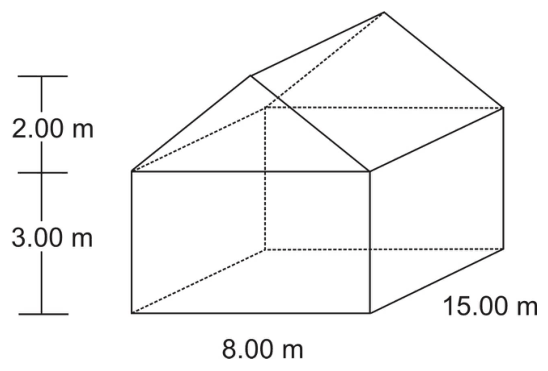
1.3 Calculate the energy (in MJ) which is required to heat the water in the pool to \(22.0\,^\circ\mathrm C\) and the energy which is required to heat the initial amount of air (\(21.0\ \%\) of \(\ce{O2}\), \(79.0\ \%\) of \(\ce{N2}\)) to \(30.0\,^\circ\mathrm C\) at a pressure of \(1.013\times10^5\ \mathrm{Pa}\).
In February, the outside temperature is about \(5\,^\circ\mathrm C\) in Northern Germany. Since the concrete walls and the roof of the house are relatively thin (\(20.0\ \mathrm{cm}\)) there will be a loss of energy. This energy is released to the surroundings (heat loss released to water and/or ground should be neglected). The heat conductivity of the wall and roof is \(1.00\ \mathrm{W\,K^{-1}\,m^{-1}}\).
1.4 Calculate the energy (in MJ) which is needed to maintain the temperature inside the house at \(30.0\,^\circ\mathrm C\) during the party (12 hours).
\(1.00\ \mathrm{m^3}\) of natural gas as delivered by PUC costs 0.40 € and \(1.00\ \mathrm{kWh}\) of electricity costs 0.137 €. The rent for the equipment for gas heating will cost him about 150.00 € while the corresponding electrical heaters will only cost 100.00 €.
1.5 What is the total energy (in MJ) needed for Peter’s “winter swimming pool” calculated in 1.3 and 1.4? How much natural gas will he need, if the gas heater has an efficiency of \(90.0\ \%\)? What are the different costs for the use of either natural gas or electricity? Use the values given by PUC for your calculations and assume \(100\ \%\) efficiency for the electric heater.
Table 1: Composition of natural gas
| Chemical Substance | mol fraction \(x\) | \(\Delta_{\mathrm f}H^0\,(\mathrm{kJ\,mol^{-1}})^{-1}\) | \(S^0\,(\mathrm{J\,mol^{-1}\,K^{-1}})^{-1}\) | \(C_p^0\,(\mathrm{J\,mol^{-1}\,K^{-1}})^{-1}\) |
|---|---|---|---|---|
| \(\ce{CO2(g)}\) | 0.0024 | −393.5 | 213.8 | 37.1 |
| \(\ce{N2(g)}\) | 0.0134 | 0.0 | 191.6 | 29.1 |
| \(\ce{CH4(g)}\) | 0.9732 | −74.6 | 186.3 | 35.7 |
| \(\ce{C2H6(g)}\) | 0.0110 | −84.0 | 229.2 | 52.5 |
| \(\ce{H2O(l)}\) | – | −285.8 | 70.0 | 75.3 |
| \(\ce{H2O(g)}\) | – | −241.8 | 188.8 | 33.6 |
| \(\ce{O2(g)}\) | – | 0.0 | 205.2 | 29.4 |
Equation:
\[ J=E\times(A\times\Delta t)^{-1} =\lambda_{\mathrm{wall}}\times\Delta T\times d^{-1} \]
\(J\) energy flow \(E\) along a temperature gradient (wall direction \(z\)) per area \(A\) and time \(\Delta t\)
\(d\) wall thickness
\(\lambda_{\mathrm{wall}}\) heat conductivity
\(\Delta T\) difference in temperature between the inside and the outside of the house
Official English text of the problem.
Answers
- 1.1 The balanced combustion equations are \[ \ce{CH4(g) + 2 O2(g) -> CO2(g) + 2 H2O(g)} \] \[ \ce{C2H6(g) + 7/2 O2(g) -> 2 CO2(g) + 3 H2O(g)}. \] The thermodynamic quantities at \(298.15\ \mathrm K\), per mole of fuel, are:
| Fuel | \(\Delta_{\mathrm r}H^\circ\) / \(\mathrm{kJ\,mol^{-1}}\) | \(\Delta_{\mathrm r}S^\circ\) / \(\mathrm{J\,mol^{-1}\,K^{-1}}\) | \(\Delta_{\mathrm r}G^\circ\) / \(\mathrm{kJ\,mol^{-1}}\) |
|---|---|---|---|
Methane C |
−802.5 | −5.3 | −800.9 |
Ethane CC |
−1428.4 | +46.6 | −1442.3 |
-
1.2(a) In \(1.00\ \mathrm{m^3}\) of natural gas: \[ \boxed{n(\ce{CH4})=43.9\ \mathrm{mol}},\qquad \boxed{n(\ce{C2H6})=0.496\ \mathrm{mol}}. \]
-
1.2(b) The heat released is \[ \boxed{Q=35.9\ \mathrm{MJ}=9.97\ \mathrm{kWh}}. \] Using unrounded intermediate values, PUC’s value is approximately \(0.086\%\) higher, or about \(0.1\%\).
-
1.3 \[ \boxed{Q_{\mathrm{water}}=1.32\times10^3\ \mathrm{MJ}},\qquad \boxed{Q_{\mathrm{air}}=12.0\ \mathrm{MJ}}. \]
-
1.4 \[ \boxed{Q_{\mathrm{loss}}=1.56\times10^3\ \mathrm{MJ}}. \]
-
1.5 The total heat requirement and natural-gas volume are \[ \boxed{Q_{\mathrm{total}}=2.88\times10^3\ \mathrm{MJ}},\qquad \boxed{V_{\mathrm{gas}}=89.2\ \mathrm{m^3}}. \] Including equipment rental, the estimated costs are €185.68 for gas and €209.77 for electricity. Gas heating saves approximately €24.09.
Solution
The molecular identities used throughout are methane C (\(\ce{CH4}\)), ethane CC (\(\ce{C2H6}\)), oxygen O=O (\(\ce{O2}\)), carbon dioxide O=C=O (\(\ce{CO2}\)), water O (\(\ce{H2O}\)), and nitrogen N#N (\(\ce{N2}\)). SMILES do not specify physical phase; gaseous and liquid water are distinguished by the phase labels.
1.1 — Combustion equations and thermodynamic quantities
Complete combustion converts the carbon atoms into carbon dioxide and the hydrogen atoms into water. Balancing carbon, hydrogen, and then oxygen gives
\[ \ce{CH4(g) + 2 O2(g) -> CO2(g) + 2 H2O(g)} \]
and
\[ \ce{C2H6(g) + 7/2 O2(g) -> 2 CO2(g) + 3 H2O(g)}. \]
Nitrogen remains unchanged under the stated assumption. Each equation is written for one mole of fuel.
For either reaction,
\[ \Delta_{\mathrm r}H^\circ =\sum_{\mathrm{products}}\nu_i\Delta_{\mathrm f}H_i^\circ -\sum_{\mathrm{reactants}}\nu_i\Delta_{\mathrm f}H_i^\circ, \]
\[ \Delta_{\mathrm r}S^\circ =\sum_{\mathrm{products}}\nu_iS_i^\circ -\sum_{\mathrm{reactants}}\nu_iS_i^\circ, \]
and, at \(T=25.0+273.15=298.15\ \mathrm K\),
\[ \Delta_{\mathrm r}G^\circ =\Delta_{\mathrm r}H^\circ-T\Delta_{\mathrm r}S^\circ. \]
For methane, using the data for gaseous water,
\[ \begin{aligned} \Delta_{\mathrm r}H^\circ &=[-393.5+2(-241.8)]-[-74.6+2(0)]\\ &=\boxed{-802.5\ \mathrm{kJ\,mol^{-1}}}, \end{aligned} \]
\[ \begin{aligned} \Delta_{\mathrm r}S^\circ &=[213.8+2(188.8)]-[186.3+2(205.2)]\\ &=\boxed{-5.3\ \mathrm{J\,mol^{-1}\,K^{-1}}}, \end{aligned} \]
\[ \begin{aligned} \Delta_{\mathrm r}G^\circ &=-802.5-(298.15)(-5.3\times10^{-3})\\ &=\boxed{-800.9\ \mathrm{kJ\,mol^{-1}}}. \end{aligned} \]
For ethane,
\[ \begin{aligned} \Delta_{\mathrm r}H^\circ &=[2(-393.5)+3(-241.8)]-[-84.0+\tfrac72(0)]\\ &=\boxed{-1428.4\ \mathrm{kJ\,mol^{-1}}}, \end{aligned} \]
\[ \begin{aligned} \Delta_{\mathrm r}S^\circ &=[2(213.8)+3(188.8)]-[229.2+\tfrac72(205.2)]\\ &=\boxed{+46.6\ \mathrm{J\,mol^{-1}\,K^{-1}}}, \end{aligned} \]
\[ \begin{aligned} \Delta_{\mathrm r}G^\circ &=-1428.4-(298.15)(46.6\times10^{-3})\\ &=\boxed{-1442.3\ \mathrm{kJ\,mol^{-1}}}. \end{aligned} \]
1.2(a) — Amounts of methane and ethane
The supplied density gives the mass directly:
\[ m=\rho V =(0.740\ \mathrm{g\,dm^{-3}})(1000\ \mathrm{dm^3}) =740\ \mathrm g. \]
Use the conventional molar masses
\[ \begin{aligned} M(\ce{CO2})&=44.01\ \mathrm{g\,mol^{-1}},& M(\ce{N2})&=28.02\ \mathrm{g\,mol^{-1}},\\ M(\ce{CH4})&=16.04\ \mathrm{g\,mol^{-1}},& M(\ce{C2H6})&=30.07\ \mathrm{g\,mol^{-1}}. \end{aligned} \]
The mean molar mass is the mole-fraction-weighted average, including the noncombustible components:
\[ \begin{aligned} \overline M &=\sum_i x_iM_i\\ &=0.0024(44.01)+0.0134(28.02) +0.9732(16.04)+0.0110(30.07)\\ &=16.42199\ \mathrm{g\,mol^{-1}}. \end{aligned} \]
Hence
\[ n_{\mathrm{total}} =\frac{740}{16.42199} =45.0615\ \mathrm{mol}. \]
The individual amounts are
\[ n(\ce{CH4}) =x_{\ce{CH4}}n_{\mathrm{total}} =0.9732(45.0615) =43.8539\ \mathrm{mol} \approx\boxed{43.9\ \mathrm{mol}}, \]
\[ n(\ce{C2H6}) =x_{\ce{C2H6}}n_{\mathrm{total}} =0.0110(45.0615) =0.495677\ \mathrm{mol} \approx\boxed{0.496\ \mathrm{mol}}. \]
These mass and mole-fraction relationships do not require ideal-gas behaviour.
1.2(b) — Heat of combustion and comparison with PUC
At constant pressure, the heat released is the negative of the combustion enthalpy. Only methane and ethane contribute to the combustion heat:
\[ \begin{aligned} Q_{\mathrm{released}} &=-\left[n(\ce{CH4})\Delta_{\mathrm r}H^\circ_{\ce{CH4}} +n(\ce{C2H6})\Delta_{\mathrm r}H^\circ_{\ce{C2H6}}\right]\\ &=(43.8539)(802.5)+(0.495677)(1428.4)\\ &=35900.8\ \mathrm{kJ}\\ &=35.9008\ \mathrm{MJ}. \end{aligned} \]
Since \(1\ \mathrm{kWh}=3.600\ \mathrm{MJ}\),
\[ Q_{\mathrm{released}} =\frac{35.9008}{3.600} =9.97243\ \mathrm{kWh}. \]
Thus, to three significant figures,
\[ \boxed{Q_{\mathrm{released}}=35.9\ \mathrm{MJ}=9.97\ \mathrm{kWh}}. \]
Taking the calculated value as the reference, as requested,
\[ \begin{aligned} \text{deviation} &=\frac{Q_{\mathrm{PUC}}-Q_{\mathrm{calculated}}} {Q_{\mathrm{calculated}}}\times100\%\\ &=\frac{9.981-9.97243}{9.97243}\times100\%\\ &=\boxed{0.0859\%}. \end{aligned} \]
PUC’s value is therefore approximately \(0.09\%\) higher; this very small difference is about \(0.1\%\).
1.3 — Heating the water and the initial air
The supplied heat capacities are treated as constant over the temperature intervals.
For the pool water,
\[ V_{\mathrm{water}} =(3.00)(5.00)(1.50) =22.5\ \mathrm{m^3} =2.25\times10^4\ \mathrm{dm^3}. \]
Its mass is
\[ m_{\mathrm{water}} =(1.00\ \mathrm{kg\,dm^{-3}}) (2.25\times10^4\ \mathrm{dm^3}) =2.25\times10^4\ \mathrm{kg}. \]
Using \(M(\ce{H2O})=18.02\ \mathrm{g\,mol^{-1}}\),
\[ n_{\mathrm{water}} =\frac{2.25\times10^7\ \mathrm g} {18.02\ \mathrm{g\,mol^{-1}}} =1.24861\times10^6\ \mathrm{mol}. \]
The temperature increase is
\[ \Delta T_{\mathrm{water}}=22.0-8.00=14.0\ \mathrm K. \]
Therefore,
\[ \begin{aligned} Q_{\mathrm{water}} &=n_{\mathrm{water}}C_{p,\mathrm{water}}\Delta T_{\mathrm{water}}\\ &=(1.24861\times10^6)(75.3)(14.0)\ \mathrm J\\ &=1316.29\ \mathrm{MJ}\\ &\approx\boxed{1.32\times10^3\ \mathrm{MJ}}. \end{aligned} \]
For the air, the building consists of a rectangular prism topped by a triangular prism. Its volume is
\[ \begin{aligned} V_{\mathrm{air}} &=(8.00)(15.00)(3.00) +\frac12(8.00)(2.00)(15.00)\\ &=360+120\\ &=480\ \mathrm{m^3}. \end{aligned} \]
The pool is below floor level, so its volume is not subtracted.
At the initial temperature \(T_i=283.15\ \mathrm K\), the ideal-gas law, with \(R=8.314\ \mathrm{J\,mol^{-1}\,K^{-1}}\), gives
\[ n_{\mathrm{air}} =\frac{pV}{RT_i} =\frac{(1.013\times10^5)(480)} {(8.314)(283.15)} =2.06549\times10^4\ \mathrm{mol}. \]
The molar heat capacity of the mixture is
\[ \begin{aligned} C_{p,\mathrm{air}} &=0.210\,C_p(\ce{O2})+0.790\,C_p(\ce{N2})\\ &=0.210(29.4)+0.790(29.1)\\ &=29.163\ \mathrm{J\,mol^{-1}\,K^{-1}}. \end{aligned} \]
The question specifies heating the initial amount of air at constant pressure, so \(C_p\) applies:
\[ \begin{aligned} Q_{\mathrm{air}} &=n_{\mathrm{air}}C_{p,\mathrm{air}}(30.0-10.0)\\ &=(2.06549\times10^4)(29.163)(20.0)\ \mathrm J\\ &=12.0472\ \mathrm{MJ}\\ &\approx\boxed{12.0\ \mathrm{MJ}}. \end{aligned} \]
1.4 — Heat loss during the party
Heat passes through the four walls, including the two triangular gables, and the two sloping roof faces.
The rectangular wall area is
\[ A_{\mathrm{rectangular}} =2(15.00)(3.00)+2(8.00)(3.00) =138.0\ \mathrm{m^2}. \]
The combined area of the triangular gables is
\[ A_{\mathrm{gables}} =2\left[\frac12(8.00)(2.00)\right] =16.0\ \mathrm{m^2}. \]
The sloping distance from an eave to the ridge is
\[ s=\sqrt{(8.00/2)^2+(2.00)^2} =\sqrt{20.00} =4.47214\ \mathrm m. \]
Thus the roof area is
\[ A_{\mathrm{roof}} =2(15.00)(4.47214) =134.164\ \mathrm{m^2}. \]
The total area conducting heat to the outside is
\[ A=138.0+16.0+134.164 =288.164\ \mathrm{m^2}. \]
The temperature difference, thickness, and duration are
\[ \Delta T=30.0-5=25\ \mathrm K,\qquad d=0.200\ \mathrm m,\qquad \Delta t=12(3600)=43200\ \mathrm s. \]
Rearranging the supplied heat-flow equation,
\[ Q_{\mathrm{loss}} =\frac{\lambda A\Delta T\,\Delta t}{d}. \]
Therefore,
\[ \begin{aligned} Q_{\mathrm{loss}} &=\frac{(1.00)(288.164)(25)(43200)}{0.200}\ \mathrm J\\ &=1.556086\times10^9\ \mathrm J\\ &=1556.09\ \mathrm{MJ}\\ &\approx\boxed{1.56\times10^3\ \mathrm{MJ}}. \end{aligned} \]
This is the heat that must be supplied during the party to maintain the indoor temperature.
1.5 — Total energy, gas consumption, and costs
Adding the results without prematurely rounding,
\[ \begin{aligned} Q_{\mathrm{total}} &=Q_{\mathrm{water}}+Q_{\mathrm{air}}+Q_{\mathrm{loss}}\\ &=1316.287+12.047+1556.086\\ &=2884.42\ \mathrm{MJ}\\ &\approx\boxed{2.88\times10^3\ \mathrm{MJ}}. \end{aligned} \]
For gas heating, use PUC’s specified energy content:
\[ q_{\mathrm{gas}} =9.981\ \mathrm{kWh\,m^{-3}} =35.9316\ \mathrm{MJ\,m^{-3}}. \]
At \(90.0\%\) efficiency, each cubic metre supplies
\[ q_{\mathrm{useful}} =0.900(35.9316) =32.33844\ \mathrm{MJ\,m^{-3}}. \]
Hence
\[ V_{\mathrm{gas}} =\frac{2884.42}{32.33844} =89.1948\ \mathrm{m^3} \approx\boxed{89.2\ \mathrm{m^3}}. \]
The fuel charge is
\[ C_{\mathrm{gas,fuel}} =(89.1948\ \mathrm{m^3})(0.40\ \text{€}\,\mathrm{m^{-3}}) =35.68\ \text{€}. \]
Including equipment rental,
\[ \boxed{C_{\mathrm{gas,total}}\approx35.68+150.00=185.68\ \text{€}}. \]
For electric heating, the \(100\%\) efficiency means the required electrical energy is
\[ E_{\mathrm{electricity}} =\frac{2884.42}{3.600} =801.228\ \mathrm{kWh}. \]
The electricity charge is
\[ C_{\mathrm{electricity,energy}} =(801.228)(0.137) =109.77\ \text{€}. \]
Including equipment rental,
\[ \boxed{C_{\mathrm{electricity,total}}\approx109.77+100.00=209.77\ \text{€}}. \]
The estimated saving from choosing gas is
\[ \boxed{209.77-185.68=24.09\ \text{€}}. \]
The solution was checked against the official solution.
IChO 2004 · Theorieaufgabe 1
Thermodynamik
Für seine Geburtstagsfeier zum \(18^{\mathrm{th}}\) Geburtstag im Februar plant Peter, eine Hütte im Garten seiner Eltern in ein Schwimmbad mit künstlichem Strand umzuwandeln. Um die Kosten für das Erwärmen des Wassers und das Beheizen des Hauses abzuschätzen, beschafft sich Peter Angaben zur Zusammensetzung und zum Preis von Erdgas.
1.1 Stellen Sie die Reaktionsgleichungen für die vollständige Verbrennung der in Tabelle 1 aufgeführten Hauptbestandteile von Erdgas, Methan und Ethan, auf. Nehmen Sie an, dass Stickstoff unter den gewählten Bedingungen inert ist.
Berechnen Sie die Reaktionsenthalpie, die Reaktionsentropie und die Gibbs-Energie unter Standardbedingungen (\(1.013\cdot10^5\ \mathrm{Pa}\), \(25.0\,^\circ\mathrm C\)) für die Verbrennung von Methan und Ethan gemäß den obigen Gleichungen unter der Annahme, dass alle Produkte gasförmig sind.
Die thermodynamischen Eigenschaften und die Zusammensetzung des Erdgases sind in Tabelle 1 angegeben.
1.2 Die Dichte des Erdgases beträgt laut dem öffentlichen Versorgungsunternehmen PUC \(0.740\ \mathrm{g\,dm^{-3}}\) (\(1.013\times10^5\ \mathrm{Pa}\), \(25.0\,^\circ\mathrm C\)).
a) Berechnen Sie die Stoffmengen von Methan und Ethan (in Mol) in \(1.00\ \mathrm{m^3}\) Erdgas (Erdgas, Methan und Ethan sind keine idealen Gase!).
b) Berechnen Sie die Verbrennungsenergie, die beim Verbrennen von \(1.00\ \mathrm{m^3}\) Erdgas unter Standardbedingungen als Wärmeenergie freigesetzt wird, unter der Annahme, dass alle Produkte gasförmig sind. (Falls Ihnen die Stoffmenge aus 1.2a) nicht vorliegt, nehmen Sie an, dass \(1.00\ \mathrm{m^3}\) Erdgas \(40.00\ \mathrm{mol}\) Erdgas entspricht.)
Laut PUC beträgt die Verbrennungsenergie \(9.981\ \mathrm{kWh}\) pro \(\mathrm{m^3}\) Erdgas, wenn alle Produkte gasförmig sind. Wie groß ist die Abweichung (in Prozent) von dem Wert, den Sie in b) erhalten haben?
Das Schwimmbecken im Haus ist \(3.00\ \mathrm m\) breit, \(5.00\ \mathrm m\) lang und \(1.50\ \mathrm m\) tief (unterhalb des Fußbodens). Die Temperatur des Leitungswassers beträgt \(8.00\,^\circ\mathrm C\), und die Lufttemperatur im Haus (Abmessungen siehe Abbildung unten) beträgt \(10.0\,^\circ\mathrm C\). Nehmen Sie eine Wasserdichte von \(\rho=1.00\ \mathrm{kg\,dm^{-3}}\) an und betrachten Sie Luft als ideales Gas.
1.3 Berechnen Sie die Energie (in MJ), die benötigt wird, um das Wasser im Becken auf \(22.0\,^\circ\mathrm C\) zu erwärmen, sowie die Energie, die benötigt wird, um die anfänglich vorhandene Luftmenge (\(21.0\ \%\) \(\ce{O2}\), \(79.0\ \%\) \(\ce{N2}\)) bei einem Druck von \(1.013\times10^5\ \mathrm{Pa}\) auf \(30.0\,^\circ\mathrm C\) zu erwärmen.
Im Februar beträgt die Außentemperatur in Norddeutschland etwa \(5\,^\circ\mathrm C\). Da die Betonwände und das Dach des Hauses relativ dünn sind (\(20.0\ \mathrm{cm}\)), treten Energieverluste auf. Diese Energie wird an die Umgebung abgegeben (Wärmeverluste an das Wasser und/oder den Boden sind zu vernachlässigen). Die Wärmeleitfähigkeit der Wände und des Daches beträgt \(1.00\ \mathrm{W\,K^{-1}\,m^{-1}}\).
1.4 Berechnen Sie die Energie (in MJ), die benötigt wird, um die Temperatur im Haus während der Feier (12 Stunden) auf \(30.0\,^\circ\mathrm C\) zu halten.
\(1.00\ \mathrm{m^3}\) Erdgas von PUC kostet 0.40 €, und \(1.00\ \mathrm{kWh}\) Strom kostet 0.137 €. Die Miete für die Gasheizgeräte beträgt etwa 150.00 €, während die entsprechenden elektrischen Heizgeräte nur 100.00 € kosten.
1.5 Wie hoch ist der in 1.3 und 1.4 berechnete Gesamtenergiebedarf (in MJ) für Peters „Winterschwimmbad“? Wie viel Erdgas benötigt er, wenn die Gasheizung einen Wirkungsgrad von \(90.0\ \%\) hat? Welche Kosten entstehen jeweils bei der Verwendung von Erdgas bzw. Strom? Verwenden Sie für Ihre Berechnungen die von PUC angegebenen Werte und nehmen Sie für die elektrische Heizung einen Wirkungsgrad von \(100\ \%\) an.
Tabelle 1: Zusammensetzung von Erdgas
| Chemischer Stoff | Stoffmengenanteil \(x\) | \(\Delta_{\mathrm f}H^0\,(\mathrm{kJ\,mol^{-1}})^{-1}\) | \(S^0\,(\mathrm{J\,mol^{-1}\,K^{-1}})^{-1}\) | \(C_p^0\,(\mathrm{J\,mol^{-1}\,K^{-1}})^{-1}\) |
|---|---|---|---|---|
| \(\ce{CO2(g)}\) | 0.0024 | −393.5 | 213.8 | 37.1 |
| \(\ce{N2(g)}\) | 0.0134 | 0.0 | 191.6 | 29.1 |
| \(\ce{CH4(g)}\) | 0.9732 | −74.6 | 186.3 | 35.7 |
| \(\ce{C2H6(g)}\) | 0.0110 | −84.0 | 229.2 | 52.5 |
| \(\ce{H2O(l)}\) | – | −285.8 | 70.0 | 75.3 |
| \(\ce{H2O(g)}\) | – | −241.8 | 188.8 | 33.6 |
| \(\ce{O2(g)}\) | – | 0.0 | 205.2 | 29.4 |
Gleichung:
\[ J=E\times(A\times\Delta t)^{-1} =\lambda_{\mathrm{wall}}\times\Delta T\times d^{-1} \]
\(J\) Energiefluss \(E\) entlang eines Temperaturgradienten (Wandrichtung \(z\)) pro Fläche \(A\) und Zeit \(\Delta t\)
\(d\) Wanddicke
\(\lambda_{\mathrm{wall}}\) Wärmeleitfähigkeit
\(\Delta T\) Temperaturdifferenz zwischen dem Inneren und dem Äußeren des Hauses
Aufgabentext aus dem offiziellen englischen Text übersetzt.
Antworten
- 1.1 Die ausgeglichenen Verbrennungsgleichungen lauten \[ \ce{CH4(g) + 2 O2(g) -> CO2(g) + 2 H2O(g)} \] \[ \ce{C2H6(g) + 7/2 O2(g) -> 2 CO2(g) + 3 H2O(g)}. \] Die thermodynamischen Größen bei \(298.15\ \mathrm K\), pro Mol Brennstoff, betragen:
| Brennstoff | \(\Delta_{\mathrm r}H^\circ\) / \(\mathrm{kJ\,mol^{-1}}\) | \(\Delta_{\mathrm r}S^\circ\) / \(\mathrm{J\,mol^{-1}\,K^{-1}}\) | \(\Delta_{\mathrm r}G^\circ\) / \(\mathrm{kJ\,mol^{-1}}\) |
|---|---|---|---|
Methan C |
−802.5 | −5.3 | −800.9 |
Ethan CC |
−1428.4 | +46.6 | −1442.3 |
-
1.2(a) In \(1.00\ \mathrm{m^3}\) Erdgas: \[ \boxed{n(\ce{CH4})=43.9\ \mathrm{mol}},\qquad \boxed{n(\ce{C2H6})=0.496\ \mathrm{mol}}. \]
-
1.2(b) Die freigesetzte Wärme beträgt \[ \boxed{Q=35.9\ \mathrm{MJ}=9.97\ \mathrm{kWh}}. \] Bei Verwendung ungerundeter Zwischenwerte liegt der Wert von PUC um ungefähr \(0.086\%\) höher, also um etwa \(0.1\%\).
-
1.3 \[ \boxed{Q_{\mathrm{water}}=1.32\times10^3\ \mathrm{MJ}},\qquad \boxed{Q_{\mathrm{air}}=12.0\ \mathrm{MJ}}. \]
-
1.4 \[ \boxed{Q_{\mathrm{loss}}=1.56\times10^3\ \mathrm{MJ}}. \]
-
1.5 Der Gesamtwärmebedarf und das benötigte Erdgasvolumen betragen \[ \boxed{Q_{\mathrm{total}}=2.88\times10^3\ \mathrm{MJ}},\qquad \boxed{V_{\mathrm{gas}}=89.2\ \mathrm{m^3}}. \] Einschließlich der Gerätemiete betragen die geschätzten Kosten 185.68 € für Gas und 209.77 € für Strom. Mit der Gasheizung werden ungefähr 24.09 € eingespart.
Lösung
Die durchgehend verwendeten Moleküle sind Methan C (\(\ce{CH4}\)), Ethan CC (\(\ce{C2H6}\)), Sauerstoff O=O (\(\ce{O2}\)), Kohlenstoffdioxid O=C=O (\(\ce{CO2}\)), Wasser O (\(\ce{H2O}\)) und Stickstoff N#N (\(\ce{N2}\)). SMILES geben den Aggregatzustand nicht an; gasförmiges und flüssiges Wasser werden durch die Phasenangaben unterschieden.
1.1 — Verbrennungsgleichungen und thermodynamische Größen
Bei der vollständigen Verbrennung werden die Kohlenstoffatome in Kohlenstoffdioxid und die Wasserstoffatome in Wasser überführt. Der Ausgleich von Kohlenstoff, Wasserstoff und anschließend Sauerstoff ergibt
\[ \ce{CH4(g) + 2 O2(g) -> CO2(g) + 2 H2O(g)} \]
und
\[ \ce{C2H6(g) + 7/2 O2(g) -> 2 CO2(g) + 3 H2O(g)}. \]
Stickstoff bleibt unter der genannten Annahme unverändert. Jede Gleichung ist für ein Mol Brennstoff formuliert.
Für beide Reaktionen gilt
\[ \Delta_{\mathrm r}H^\circ =\sum_{\mathrm{products}}\nu_i\Delta_{\mathrm f}H_i^\circ -\sum_{\mathrm{reactants}}\nu_i\Delta_{\mathrm f}H_i^\circ, \]
\[ \Delta_{\mathrm r}S^\circ =\sum_{\mathrm{products}}\nu_iS_i^\circ -\sum_{\mathrm{reactants}}\nu_iS_i^\circ, \]
und bei \(T=25.0+273.15=298.15\ \mathrm K\)
\[ \Delta_{\mathrm r}G^\circ =\Delta_{\mathrm r}H^\circ-T\Delta_{\mathrm r}S^\circ. \]
Für Methan ergibt sich unter Verwendung der Daten für gasförmiges Wasser
\[ \begin{aligned} \Delta_{\mathrm r}H^\circ &=[-393.5+2(-241.8)]-[-74.6+2(0)]\\ &=\boxed{-802.5\ \mathrm{kJ\,mol^{-1}}}, \end{aligned} \]
\[ \begin{aligned} \Delta_{\mathrm r}S^\circ &=[213.8+2(188.8)]-[186.3+2(205.2)]\\ &=\boxed{-5.3\ \mathrm{J\,mol^{-1}\,K^{-1}}}, \end{aligned} \]
\[ \begin{aligned} \Delta_{\mathrm r}G^\circ &=-802.5-(298.15)(-5.3\times10^{-3})\\ &=\boxed{-800.9\ \mathrm{kJ\,mol^{-1}}}. \end{aligned} \]
Für Ethan ergibt sich
\[ \begin{aligned} \Delta_{\mathrm r}H^\circ &=[2(-393.5)+3(-241.8)]-[-84.0+\tfrac72(0)]\\ &=\boxed{-1428.4\ \mathrm{kJ\,mol^{-1}}}, \end{aligned} \]
\[ \begin{aligned} \Delta_{\mathrm r}S^\circ &=[2(213.8)+3(188.8)]-[229.2+\tfrac72(205.2)]\\ &=\boxed{+46.6\ \mathrm{J\,mol^{-1}\,K^{-1}}}, \end{aligned} \]
\[ \begin{aligned} \Delta_{\mathrm r}G^\circ &=-1428.4-(298.15)(46.6\times10^{-3})\\ &=\boxed{-1442.3\ \mathrm{kJ\,mol^{-1}}}. \end{aligned} \]
1.2(a) — Stoffmengen von Methan und Ethan
Aus der angegebenen Dichte ergibt sich unmittelbar die Masse:
\[ m=\rho V =(0.740\ \mathrm{g\,dm^{-3}})(1000\ \mathrm{dm^3}) =740\ \mathrm g. \]
Wir verwenden die üblichen molaren Massen
\[ \begin{aligned} M(\ce{CO2})&=44.01\ \mathrm{g\,mol^{-1}},& M(\ce{N2})&=28.02\ \mathrm{g\,mol^{-1}},\\ M(\ce{CH4})&=16.04\ \mathrm{g\,mol^{-1}},& M(\ce{C2H6})&=30.07\ \mathrm{g\,mol^{-1}}. \end{aligned} \]
Die mittlere molare Masse ist der mit den Stoffmengenanteilen gewichtete Mittelwert unter Einbeziehung der nicht brennbaren Bestandteile:
\[ \begin{aligned} \overline M &=\sum_i x_iM_i\\ &=0.0024(44.01)+0.0134(28.02) +0.9732(16.04)+0.0110(30.07)\\ &=16.42199\ \mathrm{g\,mol^{-1}}. \end{aligned} \]
Daraus folgt
\[ n_{\mathrm{total}} =\frac{740}{16.42199} =45.0615\ \mathrm{mol}. \]
Die einzelnen Stoffmengen betragen
\[ n(\ce{CH4}) =x_{\ce{CH4}}n_{\mathrm{total}} =0.9732(45.0615) =43.8539\ \mathrm{mol} \approx\boxed{43.9\ \mathrm{mol}}, \]
\[ n(\ce{C2H6}) =x_{\ce{C2H6}}n_{\mathrm{total}} =0.0110(45.0615) =0.495677\ \mathrm{mol} \approx\boxed{0.496\ \mathrm{mol}}. \]
Diese Beziehungen zwischen Masse und Stoffmengenanteilen setzen kein ideales Gasverhalten voraus.
1.2(b) — Verbrennungswärme und Vergleich mit PUC
Bei konstantem Druck ist die freigesetzte Wärme gleich dem Negativen der Verbrennungsenthalpie. Nur Methan und Ethan tragen zur Verbrennungswärme bei:
\[ \begin{aligned} Q_{\mathrm{released}} &=-\left[n(\ce{CH4})\Delta_{\mathrm r}H^\circ_{\ce{CH4}} +n(\ce{C2H6})\Delta_{\mathrm r}H^\circ_{\ce{C2H6}}\right]\\ &=(43.8539)(802.5)+(0.495677)(1428.4)\\ &=35900.8\ \mathrm{kJ}\\ &=35.9008\ \mathrm{MJ}. \end{aligned} \]
Da \(1\ \mathrm{kWh}=3.600\ \mathrm{MJ}\), gilt
\[ Q_{\mathrm{released}} =\frac{35.9008}{3.600} =9.97243\ \mathrm{kWh}. \]
Auf drei signifikante Stellen gerundet ergibt sich somit
\[ \boxed{Q_{\mathrm{released}}=35.9\ \mathrm{MJ}=9.97\ \mathrm{kWh}}. \]
Wird wie gefordert der berechnete Wert als Bezugswert verwendet, ergibt sich
\[ \begin{aligned} \text{Abweichung} &=\frac{Q_{\mathrm{PUC}}-Q_{\mathrm{calculated}}} {Q_{\mathrm{calculated}}}\times100\%\\ &=\frac{9.981-9.97243}{9.97243}\times100\%\\ &=\boxed{0.0859\%}. \end{aligned} \]
Der Wert von PUC liegt somit um ungefähr \(0.09\%\) höher; diese sehr kleine Differenz beträgt etwa \(0.1\%\).
1.3 — Erwärmen des Wassers und der anfänglich vorhandenen Luft
Die angegebenen Wärmekapazitäten werden über die jeweiligen Temperaturintervalle als konstant betrachtet.
Für das Beckenwasser gilt
\[ V_{\mathrm{water}} =(3.00)(5.00)(1.50) =22.5\ \mathrm{m^3} =2.25\times10^4\ \mathrm{dm^3}. \]
Seine Masse beträgt
\[ m_{\mathrm{water}} =(1.00\ \mathrm{kg\,dm^{-3}}) (2.25\times10^4\ \mathrm{dm^3}) =2.25\times10^4\ \mathrm{kg}. \]
Mit \(M(\ce{H2O})=18.02\ \mathrm{g\,mol^{-1}}\) ergibt sich
\[ n_{\mathrm{water}} =\frac{2.25\times10^7\ \mathrm g} {18.02\ \mathrm{g\,mol^{-1}}} =1.24861\times10^6\ \mathrm{mol}. \]
Die Temperaturerhöhung beträgt
\[ \Delta T_{\mathrm{water}}=22.0-8.00=14.0\ \mathrm K. \]
Damit ergibt sich
\[ \begin{aligned} Q_{\mathrm{water}} &=n_{\mathrm{water}}C_{p,\mathrm{water}}\Delta T_{\mathrm{water}}\\ &=(1.24861\times10^6)(75.3)(14.0)\ \mathrm J\\ &=1316.29\ \mathrm{MJ}\\ &\approx\boxed{1.32\times10^3\ \mathrm{MJ}}. \end{aligned} \]
Für die Luft wird berücksichtigt, dass das Gebäude aus einem Quader mit einem daraufgesetzten dreieckigen Prisma besteht. Sein Volumen beträgt
\[ \begin{aligned} V_{\mathrm{air}} &=(8.00)(15.00)(3.00) +\frac12(8.00)(2.00)(15.00)\\ &=360+120\\ &=480\ \mathrm{m^3}. \end{aligned} \]
Das Becken liegt unterhalb des Fußbodens, daher wird sein Volumen nicht abgezogen.
Bei der Anfangstemperatur \(T_i=283.15\ \mathrm K\) ergibt die ideale Gasgleichung mit \(R=8.314\ \mathrm{J\,mol^{-1}\,K^{-1}}\)
\[ n_{\mathrm{air}} =\frac{pV}{RT_i} =\frac{(1.013\times10^5)(480)} {(8.314)(283.15)} =2.06549\times10^4\ \mathrm{mol}. \]
Die molare Wärmekapazität des Gemisches beträgt
\[ \begin{aligned} C_{p,\mathrm{air}} &=0.210\,C_p(\ce{O2})+0.790\,C_p(\ce{N2})\\ &=0.210(29.4)+0.790(29.1)\\ &=29.163\ \mathrm{J\,mol^{-1}\,K^{-1}}. \end{aligned} \]
Die Aufgabe verlangt das Erwärmen der anfänglich vorhandenen Luftmenge bei konstantem Druck, daher ist \(C_p\) zu verwenden:
\[ \begin{aligned} Q_{\mathrm{air}} &=n_{\mathrm{air}}C_{p,\mathrm{air}}(30.0-10.0)\\ &=(2.06549\times10^4)(29.163)(20.0)\ \mathrm J\\ &=12.0472\ \mathrm{MJ}\\ &\approx\boxed{12.0\ \mathrm{MJ}}. \end{aligned} \]
1.4 — Wärmeverlust während der Feier
Wärme wird durch die vier Wände einschließlich der beiden dreieckigen Giebel sowie durch die beiden geneigten Dachflächen übertragen.
Die rechteckige Wandfläche beträgt
\[ A_{\mathrm{rectangular}} =2(15.00)(3.00)+2(8.00)(3.00) =138.0\ \mathrm{m^2}. \]
Die Gesamtfläche der dreieckigen Giebel beträgt
\[ A_{\mathrm{gables}} =2\left[\frac12(8.00)(2.00)\right] =16.0\ \mathrm{m^2}. \]
Die schräge Strecke von einer Traufe bis zum First beträgt
\[ s=\sqrt{(8.00/2)^2+(2.00)^2} =\sqrt{20.00} =4.47214\ \mathrm m. \]
Damit beträgt die Dachfläche
\[ A_{\mathrm{roof}} =2(15.00)(4.47214) =134.164\ \mathrm{m^2}. \]
Die gesamte Fläche, durch die Wärme nach außen geleitet wird, beträgt
\[ A=138.0+16.0+134.164 =288.164\ \mathrm{m^2}. \]
Die Temperaturdifferenz, die Dicke und die Dauer betragen
\[ \Delta T=30.0-5=25\ \mathrm K,\qquad d=0.200\ \mathrm m,\qquad \Delta t=12(3600)=43200\ \mathrm s. \]
Durch Umstellen der angegebenen Gleichung für den Wärmefluss erhält man
\[ Q_{\mathrm{loss}} =\frac{\lambda A\Delta T\,\Delta t}{d}. \]
Damit ergibt sich
\[ \begin{aligned} Q_{\mathrm{loss}} &=\frac{(1.00)(288.164)(25)(43200)}{0.200}\ \mathrm J\\ &=1.556086\times10^9\ \mathrm J\\ &=1556.09\ \mathrm{MJ}\\ &\approx\boxed{1.56\times10^3\ \mathrm{MJ}}. \end{aligned} \]
Dies ist die Wärme, die während der Feier zugeführt werden muss, um die Innentemperatur aufrechtzuerhalten.
1.5 — Gesamtenergie, Gasverbrauch und Kosten
Durch Addition der Ergebnisse ohne vorzeitiges Runden erhält man
\[ \begin{aligned} Q_{\mathrm{total}} &=Q_{\mathrm{water}}+Q_{\mathrm{air}}+Q_{\mathrm{loss}}\\ &=1316.287+12.047+1556.086\\ &=2884.42\ \mathrm{MJ}\\ &\approx\boxed{2.88\times10^3\ \mathrm{MJ}}. \end{aligned} \]
Für die Gasheizung wird der von PUC angegebene Energiegehalt verwendet:
\[ q_{\mathrm{gas}} =9.981\ \mathrm{kWh\,m^{-3}} =35.9316\ \mathrm{MJ\,m^{-3}}. \]
Bei einem Wirkungsgrad von \(90.0\%\) liefert jeder Kubikmeter
\[ q_{\mathrm{useful}} =0.900(35.9316) =32.33844\ \mathrm{MJ\,m^{-3}}. \]
Daraus folgt
\[ V_{\mathrm{gas}} =\frac{2884.42}{32.33844} =89.1948\ \mathrm{m^3} \approx\boxed{89.2\ \mathrm{m^3}}. \]
Die Brennstoffkosten betragen
\[ C_{\mathrm{gas,fuel}} =(89.1948\ \mathrm{m^3})(0.40\ \text{€}\,\mathrm{m^{-3}}) =35.68\ \text{€}. \]
Einschließlich der Gerätemiete ergibt sich
\[ \boxed{C_{\mathrm{gas,total}}\approx35.68+150.00=185.68\ \text{€}}. \]
Für die elektrische Heizung ergibt sich bei einem Wirkungsgrad von \(100\%\) die benötigte elektrische Energie zu
\[ E_{\mathrm{electricity}} =\frac{2884.42}{3.600} =801.228\ \mathrm{kWh}. \]
Die Stromkosten betragen
\[ C_{\mathrm{electricity,energy}} =(801.228)(0.137) =109.77\ \text{€}. \]
Einschließlich der Gerätemiete ergibt sich
\[ \boxed{C_{\mathrm{electricity,total}}\approx109.77+100.00=209.77\ \text{€}}. \]
Die geschätzte Ersparnis bei der Wahl von Gas beträgt
\[ \boxed{209.77-185.68=24.09\ \text{€}}. \]
Die Lösung wurde mit der offiziellen Lösung abgeglichen.
IChO 2004 · Teori sorusu 1
Termodinamik
Peter, şubat ayındaki \(18^{\mathrm{th}}\) yaş günü partisi için anne ve babasının bahçesindeki bir kulübeyi yapay plajı olan bir yüzme havuzuna dönüştürmeyi planlamaktadır. Suyu ve binayı ısıtmanın maliyetini tahmin etmek için Peter, doğal gazın bileşimine ve fiyatına ilişkin verileri edinir.
1.1 Tablo 1'de verilen doğal gazın ana bileşenleri olan metan ve etanın tam yanmasına ilişkin kimyasal denklemleri yazınız. Azotun seçilen koşullarda inert olduğunu varsayınız.
Tüm ürünlerin gaz hâlinde olduğunu varsayarak, yukarıdaki denklemlere göre metan ve etanın yanması için standart koşullarda (\(1.013\cdot10^5\ \mathrm{Pa}\), \(25.0\,^\circ\mathrm C\)) tepkime entalpisini, tepkime entropisini ve Gibbs enerjisini hesaplayınız.
Termodinamik özellikler ve doğal gazın bileşimi Tablo 1'de verilmiştir.
1.2 Kamu hizmeti şirketi PUC tarafından belirtilen doğal gaz yoğunluğu \(0.740\ \mathrm{g\,dm^{-3}}\) (\(1.013\times10^5\ \mathrm{Pa}\), \(25.0\,^\circ\mathrm C\)) değerindedir.
a) \(1.00\ \mathrm{m^3}\) doğal gazdaki metan ve etan miktarlarını (mol cinsinden) hesaplayınız (doğal gaz, metan ve etan ideal gaz değildir!).
b) Tüm ürünlerin gaz hâlinde olduğunu varsayarak, standart koşullarda \(1.00\ \mathrm{m^3}\) doğal gazın yanması sırasında ısı enerjisi olarak açığa çıkan yanma enerjisini hesaplayınız. (1.2a)'daki miktarı bulamadıysanız, \(1.00\ \mathrm{m^3}\) doğal gazın \(40.00\ \mathrm{mol}\) doğal gaza karşılık geldiğini varsayınız.)
PUC'ye göre tüm ürünler gaz hâlindeyse yanma enerjisi, doğal gazın her \(\mathrm{m^3}\)ü için \(9.981\ \mathrm{kWh}\) olacaktır. b)'de elde ettiğiniz değerden sapma (yüzde olarak) ne kadardır?
Binanın içindeki yüzme havuzu \(3.00\ \mathrm m\) genişliğinde, \(5.00\ \mathrm m\) uzunluğunda ve (zeminin altında) \(1.50\ \mathrm m\) derinliğindedir. Musluk suyunun sıcaklığı \(8.00\,^\circ\mathrm C\), binanın içindeki havanın sıcaklığı ise \(10.0\,^\circ\mathrm C\)'dir (binanın boyutları aşağıdaki şekilde verilmiştir). Suyun yoğunluğunu \(\rho=1.00\ \mathrm{kg\,dm^{-3}}\) alınız ve havanın ideal gaz gibi davrandığını varsayınız.
1.3 Havuzdaki suyu \(22.0\,^\circ\mathrm C\)'ye ısıtmak için gereken enerjiyi (MJ cinsinden) ve başlangıçtaki hava miktarını (\(21.0\ \%\) \(\ce{O2}\), \(79.0\ \%\) \(\ce{N2}\)) \(1.013\times10^5\ \mathrm{Pa}\) basınçta \(30.0\,^\circ\mathrm C\)'ye ısıtmak için gereken enerjiyi hesaplayınız.
Şubat ayında Kuzey Almanya'da dış ortam sıcaklığı yaklaşık \(5\,^\circ\mathrm C\)'dir. Binanın beton duvarları ve çatısı nispeten ince (\(20.0\ \mathrm{cm}\)) olduğundan enerji kaybı olacaktır. Bu enerji çevreye aktarılır (suya ve/veya toprağa aktarılan ısı kaybı ihmal edilmelidir). Duvarın ve çatının ısıl iletkenliği \(1.00\ \mathrm{W\,K^{-1}\,m^{-1}}\)'dir.
1.4 Parti boyunca (12 saat) bina içindeki sıcaklığı \(30.0\,^\circ\mathrm C\)'de tutmak için gereken enerjiyi (MJ cinsinden) hesaplayınız.
PUC tarafından sağlanan \(1.00\ \mathrm{m^3}\) doğal gazın fiyatı 0.40 €, \(1.00\ \mathrm{kWh}\) elektriğin fiyatı ise 0.137 €'dur. Gazla ısıtma ekipmanının kiralanması Peter'a yaklaşık 150.00 €'ya mal olurken, buna karşılık gelen elektrikli ısıtıcıların kira bedeli yalnızca 100.00 € olacaktır.
1.5 Peter'ın “kış yüzme havuzu” için 1.3 ve 1.4'te hesaplanan toplam enerji gereksinimi (MJ cinsinden) nedir? Gazlı ısıtıcının verimi \(90.0\ \%\) ise ne kadar doğal gaza ihtiyacı olacaktır? Doğal gaz veya elektrik kullanımının maliyetleri ayrı ayrı ne kadardır? Hesaplamalarınızda PUC tarafından verilen değerleri kullanınız ve elektrikli ısıtıcının verimini \(100\ \%\) kabul ediniz.
Tablo 1: Doğal gazın bileşimi
| Kimyasal madde | Mol kesri \(x\) | \(\Delta_{\mathrm f}H^0\,(\mathrm{kJ\,mol^{-1}})^{-1}\) | \(S^0\,(\mathrm{J\,mol^{-1}\,K^{-1}})^{-1}\) | \(C_p^0\,(\mathrm{J\,mol^{-1}\,K^{-1}})^{-1}\) |
|---|---|---|---|---|
| \(\ce{CO2(g)}\) | 0.0024 | −393.5 | 213.8 | 37.1 |
| \(\ce{N2(g)}\) | 0.0134 | 0.0 | 191.6 | 29.1 |
| \(\ce{CH4(g)}\) | 0.9732 | −74.6 | 186.3 | 35.7 |
| \(\ce{C2H6(g)}\) | 0.0110 | −84.0 | 229.2 | 52.5 |
| \(\ce{H2O(l)}\) | – | −285.8 | 70.0 | 75.3 |
| \(\ce{H2O(g)}\) | – | −241.8 | 188.8 | 33.6 |
| \(\ce{O2(g)}\) | – | 0.0 | 205.2 | 29.4 |
Denklem:
\[ J=E\times(A\times\Delta t)^{-1} =\lambda_{\mathrm{wall}}\times\Delta T\times d^{-1} \]
\(J\) bir sıcaklık gradyanı boyunca (duvar doğrultusu \(z\)) birim alan \(A\) ve birim zaman \(\Delta t\) başına enerji \(E\) akışı
\(d\) duvar kalınlığı
\(\lambda_{\mathrm{wall}}\) ısıl iletkenlik
\(\Delta T\) binanın içi ile dışı arasındaki sıcaklık farkı
Soru metni resmi İngilizce metinden çevrilmiştir.
Cevaplar
- 1.1 Denkleştirilmiş yanma denklemleri şöyledir: \[ \ce{CH4(g) + 2 O2(g) -> CO2(g) + 2 H2O(g)} \] \[ \ce{C2H6(g) + 7/2 O2(g) -> 2 CO2(g) + 3 H2O(g)}. \] \(298.15\ \mathrm K\)'de bir mol yakıt başına termodinamik büyüklükler şöyledir:
| Yakıt | \(\Delta_{\mathrm r}H^\circ\) / \(\mathrm{kJ\,mol^{-1}}\) | \(\Delta_{\mathrm r}S^\circ\) / \(\mathrm{J\,mol^{-1}\,K^{-1}}\) | \(\Delta_{\mathrm r}G^\circ\) / \(\mathrm{kJ\,mol^{-1}}\) |
|---|---|---|---|
Metan C |
−802.5 | −5.3 | −800.9 |
Etan CC |
−1428.4 | +46.6 | −1442.3 |
-
1.2(a) \(1.00\ \mathrm{m^3}\) doğal gazda: \[ \boxed{n(\ce{CH4})=43.9\ \mathrm{mol}},\qquad \boxed{n(\ce{C2H6})=0.496\ \mathrm{mol}}. \]
-
1.2(b) Açığa çıkan ısı: \[ \boxed{Q=35.9\ \mathrm{MJ}=9.97\ \mathrm{kWh}}. \] Yuvarlanmamış ara değerler kullanıldığında, PUC'nin değeri yaklaşık \(0.086\%\) daha yüksektir; bu da yaklaşık \(0.1\%\)'dir.
-
1.3 \[ \boxed{Q_{\mathrm{water}}=1.32\times10^3\ \mathrm{MJ}},\qquad \boxed{Q_{\mathrm{air}}=12.0\ \mathrm{MJ}}. \]
-
1.4 \[ \boxed{Q_{\mathrm{loss}}=1.56\times10^3\ \mathrm{MJ}}. \]
-
1.5 Toplam ısı gereksinimi ve doğal gaz hacmi: \[ \boxed{Q_{\mathrm{total}}=2.88\times10^3\ \mathrm{MJ}},\qquad \boxed{V_{\mathrm{gas}}=89.2\ \mathrm{m^3}}. \] Ekipman kirası dâhil tahmini maliyetler gaz için 185.68 € ve elektrik için 209.77 €'dur. Gazla ısıtma yaklaşık 24.09 € tasarruf sağlar.
Çözüm
Çözüm boyunca kullanılan moleküller metan C (\(\ce{CH4}\)), etan CC (\(\ce{C2H6}\)), oksijen O=O (\(\ce{O2}\)), karbon dioksit O=C=O (\(\ce{CO2}\)), su O (\(\ce{H2O}\)) ve azot N#N (\(\ce{N2}\)) şeklindedir. SMILES gösterimleri fiziksel hâli belirtmez; gaz ve sıvı hâldeki su, hâl simgeleriyle ayırt edilir.
1.1 — Yanma denklemleri ve termodinamik büyüklükler
Tam yanma, karbon atomlarını karbon dioksite, hidrojen atomlarını ise suya dönüştürür. Önce karbon, sonra hidrojen ve ardından oksijen denkleştirildiğinde
\[ \ce{CH4(g) + 2 O2(g) -> CO2(g) + 2 H2O(g)} \]
ve
\[ \ce{C2H6(g) + 7/2 O2(g) -> 2 CO2(g) + 3 H2O(g)}. \]
elde edilir. Belirtilen varsayım altında azot değişmeden kalır. Her denklem bir mol yakıt için yazılmıştır.
Her iki tepkime için de
\[ \Delta_{\mathrm r}H^\circ =\sum_{\mathrm{products}}\nu_i\Delta_{\mathrm f}H_i^\circ -\sum_{\mathrm{reactants}}\nu_i\Delta_{\mathrm f}H_i^\circ, \]
\[ \Delta_{\mathrm r}S^\circ =\sum_{\mathrm{products}}\nu_iS_i^\circ -\sum_{\mathrm{reactants}}\nu_iS_i^\circ, \]
ve \(T=25.0+273.15=298.15\ \mathrm K\)'de
\[ \Delta_{\mathrm r}G^\circ =\Delta_{\mathrm r}H^\circ-T\Delta_{\mathrm r}S^\circ. \]
Metan için, gaz hâldeki suya ait veriler kullanıldığında,
\[ \begin{aligned} \Delta_{\mathrm r}H^\circ &=[-393.5+2(-241.8)]-[-74.6+2(0)]\\ &=\boxed{-802.5\ \mathrm{kJ\,mol^{-1}}}, \end{aligned} \]
\[ \begin{aligned} \Delta_{\mathrm r}S^\circ &=[213.8+2(188.8)]-[186.3+2(205.2)]\\ &=\boxed{-5.3\ \mathrm{J\,mol^{-1}\,K^{-1}}}, \end{aligned} \]
\[ \begin{aligned} \Delta_{\mathrm r}G^\circ &=-802.5-(298.15)(-5.3\times10^{-3})\\ &=\boxed{-800.9\ \mathrm{kJ\,mol^{-1}}}. \end{aligned} \]
Etan için,
\[ \begin{aligned} \Delta_{\mathrm r}H^\circ &=[2(-393.5)+3(-241.8)]-[-84.0+\tfrac72(0)]\\ &=\boxed{-1428.4\ \mathrm{kJ\,mol^{-1}}}, \end{aligned} \]
\[ \begin{aligned} \Delta_{\mathrm r}S^\circ &=[2(213.8)+3(188.8)]-[229.2+\tfrac72(205.2)]\\ &=\boxed{+46.6\ \mathrm{J\,mol^{-1}\,K^{-1}}}, \end{aligned} \]
\[ \begin{aligned} \Delta_{\mathrm r}G^\circ &=-1428.4-(298.15)(46.6\times10^{-3})\\ &=\boxed{-1442.3\ \mathrm{kJ\,mol^{-1}}}. \end{aligned} \]
1.2(a) — Metan ve etan miktarları
Verilen yoğunluk doğrudan kütleyi verir:
\[ m=\rho V =(0.740\ \mathrm{g\,dm^{-3}})(1000\ \mathrm{dm^3}) =740\ \mathrm g. \]
Standart olarak kullanılan molar kütleler alınır:
\[ \begin{aligned} M(\ce{CO2})&=44.01\ \mathrm{g\,mol^{-1}},& M(\ce{N2})&=28.02\ \mathrm{g\,mol^{-1}},\\ M(\ce{CH4})&=16.04\ \mathrm{g\,mol^{-1}},& M(\ce{C2H6})&=30.07\ \mathrm{g\,mol^{-1}}. \end{aligned} \]
Ortalama molar kütle, yanıcı olmayan bileşenler de dâhil olmak üzere, mol kesirleriyle ağırlıklandırılmış ortalamadır:
\[ \begin{aligned} \overline M &=\sum_i x_iM_i\\ &=0.0024(44.01)+0.0134(28.02) +0.9732(16.04)+0.0110(30.07)\\ &=16.42199\ \mathrm{g\,mol^{-1}}. \end{aligned} \]
Böylece
\[ n_{\mathrm{total}} =\frac{740}{16.42199} =45.0615\ \mathrm{mol}. \]
Bileşenlerin ayrı ayrı miktarları şöyledir:
\[ n(\ce{CH4}) =x_{\ce{CH4}}n_{\mathrm{total}} =0.9732(45.0615) =43.8539\ \mathrm{mol} \approx\boxed{43.9\ \mathrm{mol}}, \]
\[ n(\ce{C2H6}) =x_{\ce{C2H6}}n_{\mathrm{total}} =0.0110(45.0615) =0.495677\ \mathrm{mol} \approx\boxed{0.496\ \mathrm{mol}}. \]
Bu kütle ve mol kesri bağıntıları ideal gaz davranışı gerektirmez.
1.2(b) — Yanma ısısı ve PUC ile karşılaştırma
Sabit basınçta açığa çıkan ısı, yanma entalpisinin negatifidir. Yanma ısısına yalnızca metan ve etan katkıda bulunur:
\[ \begin{aligned} Q_{\mathrm{released}} &=-\left[n(\ce{CH4})\Delta_{\mathrm r}H^\circ_{\ce{CH4}} +n(\ce{C2H6})\Delta_{\mathrm r}H^\circ_{\ce{C2H6}}\right]\\ &=(43.8539)(802.5)+(0.495677)(1428.4)\\ &=35900.8\ \mathrm{kJ}\\ &=35.9008\ \mathrm{MJ}. \end{aligned} \]
\(1\ \mathrm{kWh}=3.600\ \mathrm{MJ}\) olduğundan,
\[ Q_{\mathrm{released}} =\frac{35.9008}{3.600} =9.97243\ \mathrm{kWh}. \]
Dolayısıyla üç anlamlı rakamla,
\[ \boxed{Q_{\mathrm{released}}=35.9\ \mathrm{MJ}=9.97\ \mathrm{kWh}}. \]
İstendiği gibi hesaplanan değer referans alındığında,
\[ \begin{aligned} \text{sapma} &=\frac{Q_{\mathrm{PUC}}-Q_{\mathrm{calculated}}} {Q_{\mathrm{calculated}}}\times100\%\\ &=\frac{9.981-9.97243}{9.97243}\times100\%\\ &=\boxed{0.0859\%}. \end{aligned} \]
Dolayısıyla PUC'nin değeri yaklaşık \(0.09\%\) daha yüksektir; bu çok küçük fark yaklaşık \(0.1\%\)'dir.
1.3 — Suyun ve başlangıçtaki havanın ısıtılması
Verilen ısı kapasiteleri, sıcaklık aralıkları boyunca sabit kabul edilir.
Havuz suyu için,
\[ V_{\mathrm{water}} =(3.00)(5.00)(1.50) =22.5\ \mathrm{m^3} =2.25\times10^4\ \mathrm{dm^3}. \]
Kütlesi şöyledir:
\[ m_{\mathrm{water}} =(1.00\ \mathrm{kg\,dm^{-3}}) (2.25\times10^4\ \mathrm{dm^3}) =2.25\times10^4\ \mathrm{kg}. \]
\(M(\ce{H2O})=18.02\ \mathrm{g\,mol^{-1}}\) kullanılarak,
\[ n_{\mathrm{water}} =\frac{2.25\times10^7\ \mathrm g} {18.02\ \mathrm{g\,mol^{-1}}} =1.24861\times10^6\ \mathrm{mol}. \]
Sıcaklık artışı şöyledir:
\[ \Delta T_{\mathrm{water}}=22.0-8.00=14.0\ \mathrm K. \]
Buna göre,
\[ \begin{aligned} Q_{\mathrm{water}} &=n_{\mathrm{water}}C_{p,\mathrm{water}}\Delta T_{\mathrm{water}}\\ &=(1.24861\times10^6)(75.3)(14.0)\ \mathrm J\\ &=1316.29\ \mathrm{MJ}\\ &\approx\boxed{1.32\times10^3\ \mathrm{MJ}}. \end{aligned} \]
Hava için, bina üstünde bir üçgen prizma bulunan bir dikdörtgenler prizmasından oluşur. Hacmi şöyledir:
\[ \begin{aligned} V_{\mathrm{air}} &=(8.00)(15.00)(3.00) +\frac12(8.00)(2.00)(15.00)\\ &=360+120\\ &=480\ \mathrm{m^3}. \end{aligned} \]
Havuz zemin seviyesinin altında olduğundan hacmi çıkarılmaz.
Başlangıç sıcaklığı \(T_i=283.15\ \mathrm K\)'de, \(R=8.314\ \mathrm{J\,mol^{-1}\,K^{-1}}\) alınarak ideal gaz yasasından
\[ n_{\mathrm{air}} =\frac{pV}{RT_i} =\frac{(1.013\times10^5)(480)} {(8.314)(283.15)} =2.06549\times10^4\ \mathrm{mol}. \]
Karışımın molar ısı kapasitesi şöyledir:
\[ \begin{aligned} C_{p,\mathrm{air}} &=0.210\,C_p(\ce{O2})+0.790\,C_p(\ce{N2})\\ &=0.210(29.4)+0.790(29.1)\\ &=29.163\ \mathrm{J\,mol^{-1}\,K^{-1}}. \end{aligned} \]
Soruda başlangıçtaki hava miktarının sabit basınçta ısıtılması istendiğinden \(C_p\) kullanılır:
\[ \begin{aligned} Q_{\mathrm{air}} &=n_{\mathrm{air}}C_{p,\mathrm{air}}(30.0-10.0)\\ &=(2.06549\times10^4)(29.163)(20.0)\ \mathrm J\\ &=12.0472\ \mathrm{MJ}\\ &\approx\boxed{12.0\ \mathrm{MJ}}. \end{aligned} \]
1.4 — Parti sırasındaki ısı kaybı
Isı, iki üçgen alınlık da dâhil olmak üzere dört duvardan ve çatının iki eğimli yüzeyinden geçer.
Dikdörtgen duvar alanı şöyledir:
\[ A_{\mathrm{rectangular}} =2(15.00)(3.00)+2(8.00)(3.00) =138.0\ \mathrm{m^2}. \]
Üçgen alınlıkların toplam alanı şöyledir:
\[ A_{\mathrm{gables}} =2\left[\frac12(8.00)(2.00)\right] =16.0\ \mathrm{m^2}. \]
Saçaktan mahyaya kadar olan eğimli mesafe şöyledir:
\[ s=\sqrt{(8.00/2)^2+(2.00)^2} =\sqrt{20.00} =4.47214\ \mathrm m. \]
Böylece çatı alanı
\[ A_{\mathrm{roof}} =2(15.00)(4.47214) =134.164\ \mathrm{m^2}. \]
Dışarıya ısı ileten toplam alan şöyledir:
\[ A=138.0+16.0+134.164 =288.164\ \mathrm{m^2}. \]
Sıcaklık farkı, kalınlık ve süre şöyledir:
\[ \Delta T=30.0-5=25\ \mathrm K,\qquad d=0.200\ \mathrm m,\qquad \Delta t=12(3600)=43200\ \mathrm s. \]
Verilen ısı akışı denklemi yeniden düzenlendiğinde,
\[ Q_{\mathrm{loss}} =\frac{\lambda A\Delta T\,\Delta t}{d}. \]
Buna göre,
\[ \begin{aligned} Q_{\mathrm{loss}} &=\frac{(1.00)(288.164)(25)(43200)}{0.200}\ \mathrm J\\ &=1.556086\times10^9\ \mathrm J\\ &=1556.09\ \mathrm{MJ}\\ &\approx\boxed{1.56\times10^3\ \mathrm{MJ}}. \end{aligned} \]
Bu, iç ortam sıcaklığını korumak için parti boyunca sağlanması gereken ısıdır.
1.5 — Toplam enerji, gaz tüketimi ve maliyetler
Sonuçlar ara aşamalarda yuvarlanmadan toplandığında,
\[ \begin{aligned} Q_{\mathrm{total}} &=Q_{\mathrm{water}}+Q_{\mathrm{air}}+Q_{\mathrm{loss}}\\ &=1316.287+12.047+1556.086\\ &=2884.42\ \mathrm{MJ}\\ &\approx\boxed{2.88\times10^3\ \mathrm{MJ}}. \end{aligned} \]
Gazla ısıtma için PUC'nin belirttiği enerji içeriği kullanılır:
\[ q_{\mathrm{gas}} =9.981\ \mathrm{kWh\,m^{-3}} =35.9316\ \mathrm{MJ\,m^{-3}}. \]
\(90.0\%\) verimle her bir metreküpün sağladığı enerji şöyledir:
\[ q_{\mathrm{useful}} =0.900(35.9316) =32.33844\ \mathrm{MJ\,m^{-3}}. \]
Böylece
\[ V_{\mathrm{gas}} =\frac{2884.42}{32.33844} =89.1948\ \mathrm{m^3} \approx\boxed{89.2\ \mathrm{m^3}}. \]
Yakıt bedeli şöyledir:
\[ C_{\mathrm{gas,fuel}} =(89.1948\ \mathrm{m^3})(0.40\ \text{€}\,\mathrm{m^{-3}}) =35.68\ \text{€}. \]
Ekipman kirası dâhil edildiğinde,
\[ \boxed{C_{\mathrm{gas,total}}\approx35.68+150.00=185.68\ \text{€}}. \]
Elektrikle ısıtma için \(100\%\) verim, gerekli elektrik enerjisinin aşağıdaki gibi olduğu anlamına gelir:
\[ E_{\mathrm{electricity}} =\frac{2884.42}{3.600} =801.228\ \mathrm{kWh}. \]
Elektrik bedeli şöyledir:
\[ C_{\mathrm{electricity,energy}} =(801.228)(0.137) =109.77\ \text{€}. \]
Ekipman kirası dâhil edildiğinde,
\[ \boxed{C_{\mathrm{electricity,total}}\approx109.77+100.00=209.77\ \text{€}}. \]
Gazın seçilmesiyle sağlanan tahmini tasarruf şöyledir:
\[ \boxed{209.77-185.68=24.09\ \text{€}}. \]
Çözüm, resmi çözümle karşılaştırılarak kontrol edildi.
IChO 2004 · Problema teórico 1
Termodinámica
Para la fiesta de su \(18^{\mathrm{th}}\) cumpleaños, en febrero, Peter planea convertir una caseta del jardín de sus padres en una piscina con una playa artificial. Para estimar los costes de calentar el agua y la caseta, Peter obtiene los datos de la composición del gas natural y de su precio.
1.1 Escriba las ecuaciones químicas de la combustión completa de los principales componentes del gas natural, el metano y el etano, que figuran en la Tabla 1. Suponga que el nitrógeno es inerte en las condiciones elegidas.
Calcule la entalpía de reacción, la entropía de reacción y la energía de Gibbs en condiciones estándar (\(1.013\cdot10^5\ \mathrm{Pa}\), \(25.0\,^\circ\mathrm C\)) para la combustión del metano y del etano según las ecuaciones anteriores, suponiendo que todos los productos son gaseosos.
Las propiedades termodinámicas y la composición del gas natural se encuentran en la Tabla 1.
1.2 La densidad del gas natural especificada por PUC, la empresa de servicios públicos, es \(0.740\ \mathrm{g\,dm^{-3}}\) (\(1.013\times10^5\ \mathrm{Pa}\), \(25.0\,^\circ\mathrm C\)).
a) Calcule la cantidad de metano y de etano (en moles) en \(1.00\ \mathrm{m^3}\) de gas natural (¡el gas natural, el metano y el etano no son gases ideales!).
b) Calcule la energía de combustión que se libera como energía térmica al quemar \(1.00\ \mathrm{m^3}\) de gas natural en condiciones estándar, suponiendo que todos los productos son gaseosos. (Si no ha obtenido la cantidad en 1.2a), suponga que \(1.00\ \mathrm{m^3}\) de gas natural corresponde a \(40.00\ \mathrm{mol}\) de gas natural.)
Según PUC, la energía de combustión será de \(9.981\ \mathrm{kWh}\) por \(\mathrm{m^3}\) de gas natural si todos los productos son gaseosos. ¿Cuál es la desviación (en porcentaje) respecto al valor que ha obtenido en b)?
La piscina del interior de la caseta tiene \(3.00\ \mathrm m\) de ancho, \(5.00\ \mathrm m\) de largo y \(1.50\ \mathrm m\) de profundidad (por debajo del suelo). La temperatura del agua del grifo es de \(8.00\,^\circ\mathrm C\) y la temperatura del aire en la caseta (cuyas dimensiones se indican en la figura siguiente) es de \(10.0\,^\circ\mathrm C\). Suponga una densidad del agua de \(\rho=1.00\ \mathrm{kg\,dm^{-3}}\) y que el aire se comporta como un gas ideal.
1.3 Calcule la energía (en MJ) necesaria para calentar el agua de la piscina hasta \(22.0\,^\circ\mathrm C\) y la energía necesaria para calentar la cantidad inicial de aire (\(21.0\ \%\) de \(\ce{O2}\), \(79.0\ \%\) de \(\ce{N2}\)) hasta \(30.0\,^\circ\mathrm C\) a una presión de \(1.013\times10^5\ \mathrm{Pa}\).
En febrero, la temperatura exterior es de unos \(5\,^\circ\mathrm C\) en el norte de Alemania. Como las paredes de hormigón y el tejado de la caseta son relativamente delgados (\(20.0\ \mathrm{cm}\)), habrá una pérdida de energía. Esta energía se transfiere al entorno (deben despreciarse las pérdidas de calor hacia el agua y/o el terreno). La conductividad térmica de las paredes y del tejado es de \(1.00\ \mathrm{W\,K^{-1}\,m^{-1}}\).
1.4 Calcule la energía (en MJ) necesaria para mantener la temperatura del interior de la caseta a \(30.0\,^\circ\mathrm C\) durante la fiesta (12 horas).
\(1.00\ \mathrm{m^3}\) de gas natural suministrado por PUC cuesta 0.40 € y \(1.00\ \mathrm{kWh}\) de electricidad cuesta 0.137 €. El alquiler del equipo de calefacción de gas le costará unos 150.00 €, mientras que los calefactores eléctricos correspondientes solo le costarán 100.00 €.
1.5 ¿Cuál es la energía total (en MJ) necesaria para la «piscina de invierno» de Peter, calculada en 1.3 y 1.4? ¿Cuánto gas natural necesitará si el calefactor de gas tiene un rendimiento del \(90.0\ \%\)? ¿Cuáles son los costes respectivos de utilizar gas natural o electricidad? Utilice los valores proporcionados por PUC para sus cálculos y suponga un rendimiento del \(100\ \%\) para el calefactor eléctrico.
Tabla 1: Composición del gas natural
| Sustancia química | Fracción molar \(x\) | \(\Delta_{\mathrm f}H^0\,(\mathrm{kJ\,mol^{-1}})^{-1}\) | \(S^0\,(\mathrm{J\,mol^{-1}\,K^{-1}})^{-1}\) | \(C_p^0\,(\mathrm{J\,mol^{-1}\,K^{-1}})^{-1}\) |
|---|---|---|---|---|
| \(\ce{CO2(g)}\) | 0.0024 | −393.5 | 213.8 | 37.1 |
| \(\ce{N2(g)}\) | 0.0134 | 0.0 | 191.6 | 29.1 |
| \(\ce{CH4(g)}\) | 0.9732 | −74.6 | 186.3 | 35.7 |
| \(\ce{C2H6(g)}\) | 0.0110 | −84.0 | 229.2 | 52.5 |
| \(\ce{H2O(l)}\) | – | −285.8 | 70.0 | 75.3 |
| \(\ce{H2O(g)}\) | – | −241.8 | 188.8 | 33.6 |
| \(\ce{O2(g)}\) | – | 0.0 | 205.2 | 29.4 |
Ecuación:
\[ J=E\times(A\times\Delta t)^{-1} =\lambda_{\mathrm{wall}}\times\Delta T\times d^{-1} \]
\(J\) flujo de energía \(E\) a lo largo de un gradiente de temperatura (dirección \(z\) de la pared) por unidad de área \(A\) y de tiempo \(\Delta t\)
\(d\) espesor de la pared
\(\lambda_{\mathrm{wall}}\) conductividad térmica
\(\Delta T\) diferencia de temperatura entre el interior y el exterior de la caseta
Enunciado traducido del texto oficial en inglés.
Respuestas
- 1.1 Las ecuaciones de combustión ajustadas son \[ \ce{CH4(g) + 2 O2(g) -> CO2(g) + 2 H2O(g)} \] \[ \ce{C2H6(g) + 7/2 O2(g) -> 2 CO2(g) + 3 H2O(g)}. \] Las magnitudes termodinámicas a \(298.15\ \mathrm K\), por mol de combustible, son:
| Combustible | \(\Delta_{\mathrm r}H^\circ\) / \(\mathrm{kJ\,mol^{-1}}\) | \(\Delta_{\mathrm r}S^\circ\) / \(\mathrm{J\,mol^{-1}\,K^{-1}}\) | \(\Delta_{\mathrm r}G^\circ\) / \(\mathrm{kJ\,mol^{-1}}\) |
|---|---|---|---|
Metano C |
−802.5 | −5.3 | −800.9 |
Etano CC |
−1428.4 | +46.6 | −1442.3 |
-
1.2(a) En \(1.00\ \mathrm{m^3}\) de gas natural: \[ \boxed{n(\ce{CH4})=43.9\ \mathrm{mol}},\qquad \boxed{n(\ce{C2H6})=0.496\ \mathrm{mol}}. \]
-
1.2(b) El calor liberado es \[ \boxed{Q=35.9\ \mathrm{MJ}=9.97\ \mathrm{kWh}}. \] Utilizando valores intermedios sin redondear, el valor de PUC es aproximadamente un \(0.086\%\) mayor, es decir, alrededor de un \(0.1\%\).
-
1.3 \[ \boxed{Q_{\mathrm{water}}=1.32\times10^3\ \mathrm{MJ}},\qquad \boxed{Q_{\mathrm{air}}=12.0\ \mathrm{MJ}}. \]
-
1.4 \[ \boxed{Q_{\mathrm{loss}}=1.56\times10^3\ \mathrm{MJ}}. \]
-
1.5 La necesidad total de calor y el volumen de gas natural son \[ \boxed{Q_{\mathrm{total}}=2.88\times10^3\ \mathrm{MJ}},\qquad \boxed{V_{\mathrm{gas}}=89.2\ \mathrm{m^3}}. \] Incluyendo el alquiler del equipo, los costes estimados son 185.68 € para el gas y 209.77 € para la electricidad. La calefacción de gas permite ahorrar aproximadamente 24.09 €.
Solución
Las especies moleculares utilizadas a lo largo de la solución son metano C (\(\ce{CH4}\)), etano CC (\(\ce{C2H6}\)), oxígeno O=O (\(\ce{O2}\)), dióxido de carbono O=C=O (\(\ce{CO2}\)), agua O (\(\ce{H2O}\)) y nitrógeno N#N (\(\ce{N2}\)). Los SMILES no especifican la fase física; el agua gaseosa y el agua líquida se distinguen mediante las indicaciones de fase.
1.1 — Ecuaciones de combustión y magnitudes termodinámicas
La combustión completa transforma los átomos de carbono en dióxido de carbono y los átomos de hidrógeno en agua. Al ajustar el carbono, el hidrógeno y, por último, el oxígeno, se obtiene
\[ \ce{CH4(g) + 2 O2(g) -> CO2(g) + 2 H2O(g)} \]
y
\[ \ce{C2H6(g) + 7/2 O2(g) -> 2 CO2(g) + 3 H2O(g)}. \]
El nitrógeno permanece inalterado según la hipótesis indicada. Cada ecuación está escrita para un mol de combustible.
Para cualquiera de las dos reacciones,
\[ \Delta_{\mathrm r}H^\circ =\sum_{\mathrm{products}}\nu_i\Delta_{\mathrm f}H_i^\circ -\sum_{\mathrm{reactants}}\nu_i\Delta_{\mathrm f}H_i^\circ, \]
\[ \Delta_{\mathrm r}S^\circ =\sum_{\mathrm{products}}\nu_iS_i^\circ -\sum_{\mathrm{reactants}}\nu_iS_i^\circ, \]
y, a \(T=25.0+273.15=298.15\ \mathrm K\),
\[ \Delta_{\mathrm r}G^\circ =\Delta_{\mathrm r}H^\circ-T\Delta_{\mathrm r}S^\circ. \]
Para el metano, utilizando los datos del agua gaseosa,
\[ \begin{aligned} \Delta_{\mathrm r}H^\circ &=[-393.5+2(-241.8)]-[-74.6+2(0)]\\ &=\boxed{-802.5\ \mathrm{kJ\,mol^{-1}}}, \end{aligned} \]
\[ \begin{aligned} \Delta_{\mathrm r}S^\circ &=[213.8+2(188.8)]-[186.3+2(205.2)]\\ &=\boxed{-5.3\ \mathrm{J\,mol^{-1}\,K^{-1}}}, \end{aligned} \]
\[ \begin{aligned} \Delta_{\mathrm r}G^\circ &=-802.5-(298.15)(-5.3\times10^{-3})\\ &=\boxed{-800.9\ \mathrm{kJ\,mol^{-1}}}. \end{aligned} \]
Para el etano,
\[ \begin{aligned} \Delta_{\mathrm r}H^\circ &=[2(-393.5)+3(-241.8)]-[-84.0+\tfrac72(0)]\\ &=\boxed{-1428.4\ \mathrm{kJ\,mol^{-1}}}, \end{aligned} \]
\[ \begin{aligned} \Delta_{\mathrm r}S^\circ &=[2(213.8)+3(188.8)]-[229.2+\tfrac72(205.2)]\\ &=\boxed{+46.6\ \mathrm{J\,mol^{-1}\,K^{-1}}}, \end{aligned} \]
\[ \begin{aligned} \Delta_{\mathrm r}G^\circ &=-1428.4-(298.15)(46.6\times10^{-3})\\ &=\boxed{-1442.3\ \mathrm{kJ\,mol^{-1}}}. \end{aligned} \]
1.2(a) — Cantidades de metano y etano
La densidad proporcionada permite obtener directamente la masa:
\[ m=\rho V =(0.740\ \mathrm{g\,dm^{-3}})(1000\ \mathrm{dm^3}) =740\ \mathrm g. \]
Se utilizan las masas molares convencionales
\[ \begin{aligned} M(\ce{CO2})&=44.01\ \mathrm{g\,mol^{-1}},& M(\ce{N2})&=28.02\ \mathrm{g\,mol^{-1}},\\ M(\ce{CH4})&=16.04\ \mathrm{g\,mol^{-1}},& M(\ce{C2H6})&=30.07\ \mathrm{g\,mol^{-1}}. \end{aligned} \]
La masa molar media es el promedio ponderado por las fracciones molares, incluidos los componentes no combustibles:
\[ \begin{aligned} \overline M &=\sum_i x_iM_i\\ &=0.0024(44.01)+0.0134(28.02) +0.9732(16.04)+0.0110(30.07)\\ &=16.42199\ \mathrm{g\,mol^{-1}}. \end{aligned} \]
Por tanto,
\[ n_{\mathrm{total}} =\frac{740}{16.42199} =45.0615\ \mathrm{mol}. \]
Las cantidades individuales son
\[ n(\ce{CH4}) =x_{\ce{CH4}}n_{\mathrm{total}} =0.9732(45.0615) =43.8539\ \mathrm{mol} \approx\boxed{43.9\ \mathrm{mol}}, \]
\[ n(\ce{C2H6}) =x_{\ce{C2H6}}n_{\mathrm{total}} =0.0110(45.0615) =0.495677\ \mathrm{mol} \approx\boxed{0.496\ \mathrm{mol}}. \]
Estas relaciones entre masas y fracciones molares no requieren un comportamiento de gas ideal.
1.2(b) — Calor de combustión y comparación con PUC
A presión constante, el calor liberado es el opuesto de la entalpía de combustión. Solo el metano y el etano contribuyen al calor de combustión:
\[ \begin{aligned} Q_{\mathrm{released}} &=-\left[n(\ce{CH4})\Delta_{\mathrm r}H^\circ_{\ce{CH4}} +n(\ce{C2H6})\Delta_{\mathrm r}H^\circ_{\ce{C2H6}}\right]\\ &=(43.8539)(802.5)+(0.495677)(1428.4)\\ &=35900.8\ \mathrm{kJ}\\ &=35.9008\ \mathrm{MJ}. \end{aligned} \]
Puesto que \(1\ \mathrm{kWh}=3.600\ \mathrm{MJ}\),
\[ Q_{\mathrm{released}} =\frac{35.9008}{3.600} =9.97243\ \mathrm{kWh}. \]
Así, con tres cifras significativas,
\[ \boxed{Q_{\mathrm{released}}=35.9\ \mathrm{MJ}=9.97\ \mathrm{kWh}}. \]
Tomando como referencia el valor calculado, tal como se pide,
\[ \begin{aligned} \text{desviación} &=\frac{Q_{\mathrm{PUC}}-Q_{\mathrm{calculated}}} {Q_{\mathrm{calculated}}}\times100\%\\ &=\frac{9.981-9.97243}{9.97243}\times100\%\\ &=\boxed{0.0859\%}. \end{aligned} \]
Por tanto, el valor de PUC es aproximadamente un \(0.09\%\) mayor; esta diferencia tan pequeña es de alrededor del \(0.1\%\).
1.3 — Calentamiento del agua y del aire inicial
Las capacidades caloríficas proporcionadas se consideran constantes en los intervalos de temperatura.
Para el agua de la piscina,
\[ V_{\mathrm{water}} =(3.00)(5.00)(1.50) =22.5\ \mathrm{m^3} =2.25\times10^4\ \mathrm{dm^3}. \]
Su masa es
\[ m_{\mathrm{water}} =(1.00\ \mathrm{kg\,dm^{-3}}) (2.25\times10^4\ \mathrm{dm^3}) =2.25\times10^4\ \mathrm{kg}. \]
Utilizando \(M(\ce{H2O})=18.02\ \mathrm{g\,mol^{-1}}\),
\[ n_{\mathrm{water}} =\frac{2.25\times10^7\ \mathrm g} {18.02\ \mathrm{g\,mol^{-1}}} =1.24861\times10^6\ \mathrm{mol}. \]
El aumento de temperatura es
\[ \Delta T_{\mathrm{water}}=22.0-8.00=14.0\ \mathrm K. \]
Por tanto,
\[ \begin{aligned} Q_{\mathrm{water}} &=n_{\mathrm{water}}C_{p,\mathrm{water}}\Delta T_{\mathrm{water}}\\ &=(1.24861\times10^6)(75.3)(14.0)\ \mathrm J\\ &=1316.29\ \mathrm{MJ}\\ &\approx\boxed{1.32\times10^3\ \mathrm{MJ}}. \end{aligned} \]
Para el aire, el edificio consta de un prisma rectangular coronado por un prisma triangular. Su volumen es
\[ \begin{aligned} V_{\mathrm{air}} &=(8.00)(15.00)(3.00) +\frac12(8.00)(2.00)(15.00)\\ &=360+120\\ &=480\ \mathrm{m^3}. \end{aligned} \]
La piscina está por debajo del nivel del suelo, por lo que no se resta su volumen.
A la temperatura inicial \(T_i=283.15\ \mathrm K\), la ley de los gases ideales, con \(R=8.314\ \mathrm{J\,mol^{-1}\,K^{-1}}\), da
\[ n_{\mathrm{air}} =\frac{pV}{RT_i} =\frac{(1.013\times10^5)(480)} {(8.314)(283.15)} =2.06549\times10^4\ \mathrm{mol}. \]
La capacidad calorífica molar de la mezcla es
\[ \begin{aligned} C_{p,\mathrm{air}} &=0.210\,C_p(\ce{O2})+0.790\,C_p(\ce{N2})\\ &=0.210(29.4)+0.790(29.1)\\ &=29.163\ \mathrm{J\,mol^{-1}\,K^{-1}}. \end{aligned} \]
El enunciado especifica que se calienta la cantidad inicial de aire a presión constante, por lo que corresponde utilizar \(C_p\):
\[ \begin{aligned} Q_{\mathrm{air}} &=n_{\mathrm{air}}C_{p,\mathrm{air}}(30.0-10.0)\\ &=(2.06549\times10^4)(29.163)(20.0)\ \mathrm J\\ &=12.0472\ \mathrm{MJ}\\ &\approx\boxed{12.0\ \mathrm{MJ}}. \end{aligned} \]
1.4 — Pérdida de calor durante la fiesta
El calor atraviesa las cuatro paredes, incluidos los dos hastiales triangulares, y las dos vertientes inclinadas del tejado.
El área de las paredes rectangulares es
\[ A_{\mathrm{rectangular}} =2(15.00)(3.00)+2(8.00)(3.00) =138.0\ \mathrm{m^2}. \]
El área conjunta de los hastiales triangulares es
\[ A_{\mathrm{gables}} =2\left[\frac12(8.00)(2.00)\right] =16.0\ \mathrm{m^2}. \]
La distancia inclinada desde un alero hasta la cumbrera es
\[ s=\sqrt{(8.00/2)^2+(2.00)^2} =\sqrt{20.00} =4.47214\ \mathrm m. \]
Por tanto, el área del tejado es
\[ A_{\mathrm{roof}} =2(15.00)(4.47214) =134.164\ \mathrm{m^2}. \]
El área total que conduce calor hacia el exterior es
\[ A=138.0+16.0+134.164 =288.164\ \mathrm{m^2}. \]
La diferencia de temperatura, el espesor y la duración son
\[ \Delta T=30.0-5=25\ \mathrm K,\qquad d=0.200\ \mathrm m,\qquad \Delta t=12(3600)=43200\ \mathrm s. \]
Reordenando la ecuación del flujo de calor proporcionada,
\[ Q_{\mathrm{loss}} =\frac{\lambda A\Delta T\,\Delta t}{d}. \]
Por tanto,
\[ \begin{aligned} Q_{\mathrm{loss}} &=\frac{(1.00)(288.164)(25)(43200)}{0.200}\ \mathrm J\\ &=1.556086\times10^9\ \mathrm J\\ &=1556.09\ \mathrm{MJ}\\ &\approx\boxed{1.56\times10^3\ \mathrm{MJ}}. \end{aligned} \]
Este es el calor que debe suministrarse durante la fiesta para mantener la temperatura interior.
1.5 — Energía total, consumo de gas y costes
Sumando los resultados sin redondear prematuramente,
\[ \begin{aligned} Q_{\mathrm{total}} &=Q_{\mathrm{water}}+Q_{\mathrm{air}}+Q_{\mathrm{loss}}\\ &=1316.287+12.047+1556.086\\ &=2884.42\ \mathrm{MJ}\\ &\approx\boxed{2.88\times10^3\ \mathrm{MJ}}. \end{aligned} \]
Para la calefacción de gas, se utiliza el contenido energético especificado por PUC:
\[ q_{\mathrm{gas}} =9.981\ \mathrm{kWh\,m^{-3}} =35.9316\ \mathrm{MJ\,m^{-3}}. \]
Con un rendimiento del \(90.0\%\), cada metro cúbico suministra
\[ q_{\mathrm{useful}} =0.900(35.9316) =32.33844\ \mathrm{MJ\,m^{-3}}. \]
Por tanto,
\[ V_{\mathrm{gas}} =\frac{2884.42}{32.33844} =89.1948\ \mathrm{m^3} \approx\boxed{89.2\ \mathrm{m^3}}. \]
El coste del combustible es
\[ C_{\mathrm{gas,fuel}} =(89.1948\ \mathrm{m^3})(0.40\ \text{€}\,\mathrm{m^{-3}}) =35.68\ \text{€}. \]
Incluyendo el alquiler del equipo,
\[ \boxed{C_{\mathrm{gas,total}}\approx35.68+150.00=185.68\ \text{€}}. \]
Para la calefacción eléctrica, el rendimiento del \(100\%\) implica que la energía eléctrica necesaria es
\[ E_{\mathrm{electricity}} =\frac{2884.42}{3.600} =801.228\ \mathrm{kWh}. \]
El coste de la electricidad es
\[ C_{\mathrm{electricity,energy}} =(801.228)(0.137) =109.77\ \text{€}. \]
Incluyendo el alquiler del equipo,
\[ \boxed{C_{\mathrm{electricity,total}}\approx109.77+100.00=209.77\ \text{€}}. \]
El ahorro estimado al elegir el gas es
\[ \boxed{209.77-185.68=24.09\ \text{€}}. \]
La solución se comprobó con la solución oficial.
IChO 2004 · 理论题 1
热力学
为了在二月举办他的 \(18^{\mathrm{th}}\) 岁生日聚会,Peter 计划将父母家花园中的一间小屋改造成带有人造沙滩的游泳池。为了估算加热池水和房屋所需的费用,Peter 获取了天然气组成及其价格的数据。
1.1 写出表 1 中所列天然气的主要组分甲烷和乙烷完全燃烧的化学方程式。假定氮气在所选条件下呈惰性。
根据上述方程式,计算甲烷和乙烷在标准条件(\(1.013\cdot10^5\ \mathrm{Pa}\)、\(25.0\,^\circ\mathrm C\))下燃烧的反应焓、反应熵和吉布斯能,假定所有产物均为气态。
天然气的热力学性质及其组成见表 1。
1.2 公用事业公司 PUC 给出的天然气密度为 \(0.740\ \mathrm{g\,dm^{-3}}\)(\(1.013\times10^5\ \mathrm{Pa}\)、\(25.0\,^\circ\mathrm C\))。
a) 计算 \(1.00\ \mathrm{m^3}\) 天然气中甲烷和乙烷的物质的量(以摩尔为单位)(天然气、甲烷和乙烷均不是理想气体!)。
b) 计算 \(1.00\ \mathrm{m^3}\) 天然气在标准条件下燃烧时以热能形式释放的燃烧能量,假定所有产物均为气态。(若未求出 1.2a) 中的物质的量,可假定 \(1.00\ \mathrm{m^3}\) 天然气对应于 \(40.00\ \mathrm{mol}\) 天然气。)
根据 PUC 提供的数据,若所有产物均为气态,每 \(\mathrm{m^3}\) 天然气的燃烧能量为 \(9.981\ \mathrm{kWh}\)。该值与你在 b) 中所得数值的偏差是多少(以百分数表示)?
屋内的游泳池宽 \(3.00\ \mathrm m\)、长 \(5.00\ \mathrm m\)、深 \(1.50\ \mathrm m\)(位于地板以下)。自来水温度为 \(8.00\,^\circ\mathrm C\),屋内空气温度为 \(10.0\,^\circ\mathrm C\)(房屋尺寸见下图)。假定水的密度为 \(\rho=1.00\ \mathrm{kg\,dm^{-3}}\),且空气具有理想气体的行为。
1.3 计算将池水加热至 \(22.0\,^\circ\mathrm C\) 所需的能量(以 MJ 为单位),以及在 \(1.013\times10^5\ \mathrm{Pa}\) 的压力下将屋内初始量的空气(\(21.0\ \%\) 为 \(\ce{O2}\),\(79.0\ \%\) 为 \(\ce{N2}\))加热至 \(30.0\,^\circ\mathrm C\) 所需的能量。
二月,德国北部的室外温度约为 \(5\,^\circ\mathrm C\)。由于房屋的混凝土墙壁和屋顶较薄(\(20.0\ \mathrm{cm}\)),会发生能量损失。这部分能量释放到周围环境中(应忽略向水和/或地面散失的热量)。墙壁和屋顶的热导率为 \(1.00\ \mathrm{W\,K^{-1}\,m^{-1}}\)。
1.4 计算在聚会期间(12 小时)将屋内温度维持在 \(30.0\,^\circ\mathrm C\) 所需的能量(以 MJ 为单位)。
PUC 供应的天然气每 \(1.00\ \mathrm{m^3}\) 价格为 0.40 €,电价为每 \(1.00\ \mathrm{kWh}\) 0.137 €。燃气加热设备的租金约为 150.00 €,而相应电加热器的租金仅为 100.00 €。
1.5 根据 1.3 和 1.4 的计算,Peter 的“冬季游泳池”总共需要多少能量(以 MJ 为单位)?若燃气加热器的效率为 \(90.0\ \%\),他需要多少天然气?使用天然气或电力的费用分别是多少?计算时使用 PUC 给出的数值,并假定电加热器的效率为 \(100\ \%\)。
表 1:天然气的组成
| 化学物质 | 摩尔分数 \(x\) | \(\Delta_{\mathrm f}H^0\,(\mathrm{kJ\,mol^{-1}})^{-1}\) | \(S^0\,(\mathrm{J\,mol^{-1}\,K^{-1}})^{-1}\) | \(C_p^0\,(\mathrm{J\,mol^{-1}\,K^{-1}})^{-1}\) |
|---|---|---|---|---|
| \(\ce{CO2(g)}\) | 0.0024 | −393.5 | 213.8 | 37.1 |
| \(\ce{N2(g)}\) | 0.0134 | 0.0 | 191.6 | 29.1 |
| \(\ce{CH4(g)}\) | 0.9732 | −74.6 | 186.3 | 35.7 |
| \(\ce{C2H6(g)}\) | 0.0110 | −84.0 | 229.2 | 52.5 |
| \(\ce{H2O(l)}\) | – | −285.8 | 70.0 | 75.3 |
| \(\ce{H2O(g)}\) | – | −241.8 | 188.8 | 33.6 |
| \(\ce{O2(g)}\) | – | 0.0 | 205.2 | 29.4 |
公式:
\[ J=E\times(A\times\Delta t)^{-1} =\lambda_{\mathrm{wall}}\times\Delta T\times d^{-1} \]
\(J\) 沿温度梯度(墙壁方向 \(z\))传递的能量 \(E\) 除以面积 \(A\) 和时间 \(\Delta t\)
\(d\) 墙壁厚度
\(\lambda_{\mathrm{wall}}\) 热导率
\(\Delta T\) 房屋内外的温度差
题目译自官方英文原文。
答案
- 1.1 配平后的燃烧方程式为 \[ \ce{CH4(g) + 2 O2(g) -> CO2(g) + 2 H2O(g)} \] \[ \ce{C2H6(g) + 7/2 O2(g) -> 2 CO2(g) + 3 H2O(g)}. \] 在 \(298.15\ \mathrm K\) 下,每摩尔燃料对应的热力学量为:
| 燃料 | \(\Delta_{\mathrm r}H^\circ\) / \(\mathrm{kJ\,mol^{-1}}\) | \(\Delta_{\mathrm r}S^\circ\) / \(\mathrm{J\,mol^{-1}\,K^{-1}}\) | \(\Delta_{\mathrm r}G^\circ\) / \(\mathrm{kJ\,mol^{-1}}\) |
|---|---|---|---|
甲烷 C |
−802.5 | −5.3 | −800.9 |
乙烷 CC |
−1428.4 | +46.6 | −1442.3 |
-
1.2(a) 在 \(1.00\ \mathrm{m^3}\) 天然气中: \[ \boxed{n(\ce{CH4})=43.9\ \mathrm{mol}},\qquad \boxed{n(\ce{C2H6})=0.496\ \mathrm{mol}}. \]
-
1.2(b) 释放的热量为 \[ \boxed{Q=35.9\ \mathrm{MJ}=9.97\ \mathrm{kWh}}. \] 使用未舍入的中间数值计算,PUC 给出的数值约高出 \(0.086\%\),即约 \(0.1\%\)。
-
1.3 \[ \boxed{Q_{\mathrm{water}}=1.32\times10^3\ \mathrm{MJ}},\qquad \boxed{Q_{\mathrm{air}}=12.0\ \mathrm{MJ}}. \]
-
1.4 \[ \boxed{Q_{\mathrm{loss}}=1.56\times10^3\ \mathrm{MJ}}. \]
-
1.5 所需的总热量和天然气体积为 \[ \boxed{Q_{\mathrm{total}}=2.88\times10^3\ \mathrm{MJ}},\qquad \boxed{V_{\mathrm{gas}}=89.2\ \mathrm{m^3}}. \] 包括设备租金在内,预计使用燃气的费用为 €185.68,使用电力的费用为 €209.77。燃气加热约可节省 €24.09。
解答
全文涉及的分子为甲烷 C(\(\ce{CH4}\))、乙烷 CC(\(\ce{C2H6}\))、氧气 O=O(\(\ce{O2}\))、二氧化碳 O=C=O(\(\ce{CO2}\))、水 O(\(\ce{H2O}\))和氮气 N#N(\(\ce{N2}\))。SMILES 不指明物态;气态水和液态水通过物态标记区分。
1.1 — 燃烧方程式与热力学量
完全燃烧将碳原子转化为二氧化碳,将氢原子转化为水。依次配平碳、氢和氧,得到
\[ \ce{CH4(g) + 2 O2(g) -> CO2(g) + 2 H2O(g)} \]
和
\[ \ce{C2H6(g) + 7/2 O2(g) -> 2 CO2(g) + 3 H2O(g)}. \]
在题设假定下,氮气保持不变。每个方程式均以一摩尔燃料为基准书写。
对于任一反应,
\[ \Delta_{\mathrm r}H^\circ =\sum_{\mathrm{products}}\nu_i\Delta_{\mathrm f}H_i^\circ -\sum_{\mathrm{reactants}}\nu_i\Delta_{\mathrm f}H_i^\circ, \]
\[ \Delta_{\mathrm r}S^\circ =\sum_{\mathrm{products}}\nu_iS_i^\circ -\sum_{\mathrm{reactants}}\nu_iS_i^\circ, \]
且在 \(T=25.0+273.15=298.15\ \mathrm K\) 时,
\[ \Delta_{\mathrm r}G^\circ =\Delta_{\mathrm r}H^\circ-T\Delta_{\mathrm r}S^\circ. \]
对于甲烷,使用气态水的数据,
\[ \begin{aligned} \Delta_{\mathrm r}H^\circ &=[-393.5+2(-241.8)]-[-74.6+2(0)]\\ &=\boxed{-802.5\ \mathrm{kJ\,mol^{-1}}}, \end{aligned} \]
\[ \begin{aligned} \Delta_{\mathrm r}S^\circ &=[213.8+2(188.8)]-[186.3+2(205.2)]\\ &=\boxed{-5.3\ \mathrm{J\,mol^{-1}\,K^{-1}}}, \end{aligned} \]
\[ \begin{aligned} \Delta_{\mathrm r}G^\circ &=-802.5-(298.15)(-5.3\times10^{-3})\\ &=\boxed{-800.9\ \mathrm{kJ\,mol^{-1}}}. \end{aligned} \]
对于乙烷,
\[ \begin{aligned} \Delta_{\mathrm r}H^\circ &=[2(-393.5)+3(-241.8)]-[-84.0+\tfrac72(0)]\\ &=\boxed{-1428.4\ \mathrm{kJ\,mol^{-1}}}, \end{aligned} \]
\[ \begin{aligned} \Delta_{\mathrm r}S^\circ &=[2(213.8)+3(188.8)]-[229.2+\tfrac72(205.2)]\\ &=\boxed{+46.6\ \mathrm{J\,mol^{-1}\,K^{-1}}}, \end{aligned} \]
\[ \begin{aligned} \Delta_{\mathrm r}G^\circ &=-1428.4-(298.15)(46.6\times10^{-3})\\ &=\boxed{-1442.3\ \mathrm{kJ\,mol^{-1}}}. \end{aligned} \]
1.2(a) — 甲烷和乙烷的物质的量
由给定的密度可直接求得质量:
\[ m=\rho V =(0.740\ \mathrm{g\,dm^{-3}})(1000\ \mathrm{dm^3}) =740\ \mathrm g. \]
采用常用的摩尔质量
\[ \begin{aligned} M(\ce{CO2})&=44.01\ \mathrm{g\,mol^{-1}},& M(\ce{N2})&=28.02\ \mathrm{g\,mol^{-1}},\\ M(\ce{CH4})&=16.04\ \mathrm{g\,mol^{-1}},& M(\ce{C2H6})&=30.07\ \mathrm{g\,mol^{-1}}. \end{aligned} \]
平均摩尔质量为按摩尔分数加权的平均值,其中包括不可燃组分:
\[ \begin{aligned} \overline M &=\sum_i x_iM_i\\ &=0.0024(44.01)+0.0134(28.02) +0.9732(16.04)+0.0110(30.07)\\ &=16.42199\ \mathrm{g\,mol^{-1}}. \end{aligned} \]
因此
\[ n_{\mathrm{total}} =\frac{740}{16.42199} =45.0615\ \mathrm{mol}. \]
各组分的物质的量为
\[ n(\ce{CH4}) =x_{\ce{CH4}}n_{\mathrm{total}} =0.9732(45.0615) =43.8539\ \mathrm{mol} \approx\boxed{43.9\ \mathrm{mol}}, \]
\[ n(\ce{C2H6}) =x_{\ce{C2H6}}n_{\mathrm{total}} =0.0110(45.0615) =0.495677\ \mathrm{mol} \approx\boxed{0.496\ \mathrm{mol}}. \]
这些质量和摩尔分数关系不要求气体具有理想气体的行为。
1.2(b) — 燃烧热及与 PUC 数据的比较
在恒压下,释放的热量等于燃烧焓的负值。只有甲烷和乙烷对燃烧热有贡献:
\[ \begin{aligned} Q_{\mathrm{released}} &=-\left[n(\ce{CH4})\Delta_{\mathrm r}H^\circ_{\ce{CH4}} +n(\ce{C2H6})\Delta_{\mathrm r}H^\circ_{\ce{C2H6}}\right]\\ &=(43.8539)(802.5)+(0.495677)(1428.4)\\ &=35900.8\ \mathrm{kJ}\\ &=35.9008\ \mathrm{MJ}. \end{aligned} \]
由于 \(1\ \mathrm{kWh}=3.600\ \mathrm{MJ}\),
\[ Q_{\mathrm{released}} =\frac{35.9008}{3.600} =9.97243\ \mathrm{kWh}. \]
因此,保留三位有效数字,
\[ \boxed{Q_{\mathrm{released}}=35.9\ \mathrm{MJ}=9.97\ \mathrm{kWh}}. \]
按题目要求,以计算值为基准,
\[ \begin{aligned} \text{偏差} &=\frac{Q_{\mathrm{PUC}}-Q_{\mathrm{calculated}}} {Q_{\mathrm{calculated}}}\times100\%\\ &=\frac{9.981-9.97243}{9.97243}\times100\%\\ &=\boxed{0.0859\%}. \end{aligned} \]
因此,PUC 给出的数值约高出 \(0.09\%\);这一差异很小,约为 \(0.1\%\)。
1.3 — 加热池水和初始量的空气
将给定的热容视为在相应温度区间内保持不变。
对于池水,
\[ V_{\mathrm{water}} =(3.00)(5.00)(1.50) =22.5\ \mathrm{m^3} =2.25\times10^4\ \mathrm{dm^3}. \]
其质量为
\[ m_{\mathrm{water}} =(1.00\ \mathrm{kg\,dm^{-3}}) (2.25\times10^4\ \mathrm{dm^3}) =2.25\times10^4\ \mathrm{kg}. \]
采用 \(M(\ce{H2O})=18.02\ \mathrm{g\,mol^{-1}}\),
\[ n_{\mathrm{water}} =\frac{2.25\times10^7\ \mathrm g} {18.02\ \mathrm{g\,mol^{-1}}} =1.24861\times10^6\ \mathrm{mol}. \]
温度升高量为
\[ \Delta T_{\mathrm{water}}=22.0-8.00=14.0\ \mathrm K. \]
因此,
\[ \begin{aligned} Q_{\mathrm{water}} &=n_{\mathrm{water}}C_{p,\mathrm{water}}\Delta T_{\mathrm{water}}\\ &=(1.24861\times10^6)(75.3)(14.0)\ \mathrm J\\ &=1316.29\ \mathrm{MJ}\\ &\approx\boxed{1.32\times10^3\ \mathrm{MJ}}. \end{aligned} \]
对于空气,房屋由一个长方体及其顶部的一个三棱柱组成。其体积为
\[ \begin{aligned} V_{\mathrm{air}} &=(8.00)(15.00)(3.00) +\frac12(8.00)(2.00)(15.00)\\ &=360+120\\ &=480\ \mathrm{m^3}. \end{aligned} \]
游泳池位于地板以下,因此不扣除其体积。
在初始温度 \(T_i=283.15\ \mathrm K\) 下,利用理想气体状态方程,并取 \(R=8.314\ \mathrm{J\,mol^{-1}\,K^{-1}}\),得到
\[ n_{\mathrm{air}} =\frac{pV}{RT_i} =\frac{(1.013\times10^5)(480)} {(8.314)(283.15)} =2.06549\times10^4\ \mathrm{mol}. \]
混合气体的摩尔热容为
\[ \begin{aligned} C_{p,\mathrm{air}} &=0.210\,C_p(\ce{O2})+0.790\,C_p(\ce{N2})\\ &=0.210(29.4)+0.790(29.1)\\ &=29.163\ \mathrm{J\,mol^{-1}\,K^{-1}}. \end{aligned} \]
题目指定在恒压下加热初始量的空气,因此应使用 \(C_p\):
\[ \begin{aligned} Q_{\mathrm{air}} &=n_{\mathrm{air}}C_{p,\mathrm{air}}(30.0-10.0)\\ &=(2.06549\times10^4)(29.163)(20.0)\ \mathrm J\\ &=12.0472\ \mathrm{MJ}\\ &\approx\boxed{12.0\ \mathrm{MJ}}. \end{aligned} \]
1.4 — 聚会期间的热量损失
热量通过四面墙壁(包括两面三角形山墙)和两个倾斜屋面传递。
矩形墙面的面积为
\[ A_{\mathrm{rectangular}} =2(15.00)(3.00)+2(8.00)(3.00) =138.0\ \mathrm{m^2}. \]
三角形山墙的总面积为
\[ A_{\mathrm{gables}} =2\left[\frac12(8.00)(2.00)\right] =16.0\ \mathrm{m^2}. \]
从屋檐到屋脊的斜面长度为
\[ s=\sqrt{(8.00/2)^2+(2.00)^2} =\sqrt{20.00} =4.47214\ \mathrm m. \]
因此,屋顶面积为
\[ A_{\mathrm{roof}} =2(15.00)(4.47214) =134.164\ \mathrm{m^2}. \]
向室外传导热量的总面积为
\[ A=138.0+16.0+134.164 =288.164\ \mathrm{m^2}. \]
温度差、厚度和持续时间分别为
\[ \Delta T=30.0-5=25\ \mathrm K,\qquad d=0.200\ \mathrm m,\qquad \Delta t=12(3600)=43200\ \mathrm s. \]
将给定的热流方程变形,得
\[ Q_{\mathrm{loss}} =\frac{\lambda A\Delta T\,\Delta t}{d}. \]
因此,
\[ \begin{aligned} Q_{\mathrm{loss}} &=\frac{(1.00)(288.164)(25)(43200)}{0.200}\ \mathrm J\\ &=1.556086\times10^9\ \mathrm J\\ &=1556.09\ \mathrm{MJ}\\ &\approx\boxed{1.56\times10^3\ \mathrm{MJ}}. \end{aligned} \]
这就是在聚会期间为维持室内温度而必须补充的热量。
1.5 — 总能量、天然气用量与费用
将各项结果相加,避免过早舍入,
\[ \begin{aligned} Q_{\mathrm{total}} &=Q_{\mathrm{water}}+Q_{\mathrm{air}}+Q_{\mathrm{loss}}\\ &=1316.287+12.047+1556.086\\ &=2884.42\ \mathrm{MJ}\\ &\approx\boxed{2.88\times10^3\ \mathrm{MJ}}. \end{aligned} \]
对于燃气加热,使用 PUC 给出的单位体积能量:
\[ q_{\mathrm{gas}} =9.981\ \mathrm{kWh\,m^{-3}} =35.9316\ \mathrm{MJ\,m^{-3}}. \]
在 \(90.0\%\) 的效率下,每立方米可提供
\[ q_{\mathrm{useful}} =0.900(35.9316) =32.33844\ \mathrm{MJ\,m^{-3}}. \]
因此
\[ V_{\mathrm{gas}} =\frac{2884.42}{32.33844} =89.1948\ \mathrm{m^3} \approx\boxed{89.2\ \mathrm{m^3}}. \]
燃料费用为
\[ C_{\mathrm{gas,fuel}} =(89.1948\ \mathrm{m^3})(0.40\ \text{€}\,\mathrm{m^{-3}}) =35.68\ \text{€}. \]
计入设备租金,
\[ \boxed{C_{\mathrm{gas,total}}\approx35.68+150.00=185.68\ \text{€}}. \]
对于电加热,\(100\%\) 的效率意味着所需的电能为
\[ E_{\mathrm{electricity}} =\frac{2884.42}{3.600} =801.228\ \mathrm{kWh}. \]
电费为
\[ C_{\mathrm{electricity,energy}} =(801.228)(0.137) =109.77\ \text{€}. \]
计入设备租金,
\[ \boxed{C_{\mathrm{electricity,total}}\approx109.77+100.00=209.77\ \text{€}}. \]
选择燃气预计可节省的费用为
\[ \boxed{209.77-185.68=24.09\ \text{€}}. \]
解答已与官方解答核对。
IChO 2004 · Теоретическая задача 1
Термодинамика
Для празднования своего \(18^{\mathrm{th}}\) дня рождения в феврале Петер планирует превратить садовый домик своих родителей в бассейн с искусственным пляжем. Чтобы оценить затраты на нагрев воды и отопление домика, Петер получает данные о составе природного газа и его цене.
1.1 Напишите уравнения реакций полного сгорания основных компонентов природного газа — метана и этана, приведённых в таблице 1. Считайте, что в выбранных условиях азот инертен.
Рассчитайте энтальпию реакции, энтропию реакции и энергию Гиббса при стандартных условиях (\(1.013\cdot10^5\ \mathrm{Pa}\), \(25.0\,^\circ\mathrm C\)) для сгорания метана и этана по записанным выше уравнениям, считая, что все продукты газообразные.
Термодинамические свойства и состав природного газа приведены в таблице 1.
1.2 Плотность природного газа, указанная коммунальной компанией PUC, составляет \(0.740\ \mathrm{g\,dm^{-3}}\) (\(1.013\times10^5\ \mathrm{Pa}\), \(25.0\,^\circ\mathrm C\)).
a) Рассчитайте количества метана и этана (в молях) в \(1.00\ \mathrm{m^3}\) природного газа (природный газ, метан и этан не являются идеальными газами!).
b) Рассчитайте энергию сгорания, которая выделяется в виде теплоты при сжигании \(1.00\ \mathrm{m^3}\) природного газа при стандартных условиях, считая, что все продукты газообразные. (Если вы не нашли количество вещества в 1.2a), считайте, что \(1.00\ \mathrm{m^3}\) природного газа соответствует \(40.00\ \mathrm{mol}\) природного газа.)
По данным PUC, энергия сгорания составляет \(9.981\ \mathrm{kWh}\) на \(\mathrm{m^3}\) природного газа, если все продукты газообразные. Каково отклонение (в процентах) от значения, полученного вами в b)?
Бассейн внутри домика имеет ширину \(3.00\ \mathrm m\), длину \(5.00\ \mathrm m\) и глубину \(1.50\ \mathrm m\) (ниже уровня пола). Температура водопроводной воды составляет \(8.00\,^\circ\mathrm C\), а температура воздуха в домике (размеры указаны на рисунке ниже) — \(10.0\,^\circ\mathrm C\). Считайте плотность воды равной \(\rho=1.00\ \mathrm{kg\,dm^{-3}}\), а воздух — идеальным газом.
1.3 Рассчитайте энергию (в МДж), необходимую для нагрева воды в бассейне до \(22.0\,^\circ\mathrm C\), и энергию, необходимую для нагрева первоначального количества воздуха (\(21.0\ \%\) \(\ce{O2}\), \(79.0\ \%\) \(\ce{N2}\)) до \(30.0\,^\circ\mathrm C\) при давлении \(1.013\times10^5\ \mathrm{Pa}\).
В феврале температура наружного воздуха в Северной Германии составляет около \(5\,^\circ\mathrm C\). Поскольку бетонные стены и крыша домика относительно тонкие (\(20.0\ \mathrm{cm}\)), будут происходить потери энергии. Эта энергия передаётся окружающей среде (потерями теплоты в воду и/или грунт следует пренебречь). Коэффициент теплопроводности стен и крыши равен \(1.00\ \mathrm{W\,K^{-1}\,m^{-1}}\).
1.4 Рассчитайте энергию (в МДж), необходимую для поддержания температуры внутри домика на уровне \(30.0\,^\circ\mathrm C\) во время праздника (12 часов).
\(1.00\ \mathrm{m^3}\) природного газа, поставляемого PUC, стоит 0.40 €, а \(1.00\ \mathrm{kWh}\) электроэнергии стоит 0.137 €. Аренда оборудования для газового отопления обойдётся ему примерно в 150.00 €, тогда как аренда соответствующих электрических обогревателей будет стоить всего 100.00 €.
1.5 Какова общая энергия (в МДж), необходимая для «зимнего бассейна» Петера, рассчитанная в 1.3 и 1.4? Сколько природного газа ему потребуется, если КПД газового нагревателя составляет \(90.0\ \%\)? Каковы затраты при использовании природного газа и электроэнергии? Используйте в расчётах значения, предоставленные PUC, и считайте КПД электрического нагревателя равным \(100\ \%\).
Таблица 1: Состав природного газа
| Химическое вещество | Мольная доля \(x\) | \(\Delta_{\mathrm f}H^0\,(\mathrm{kJ\,mol^{-1}})^{-1}\) | \(S^0\,(\mathrm{J\,mol^{-1}\,K^{-1}})^{-1}\) | \(C_p^0\,(\mathrm{J\,mol^{-1}\,K^{-1}})^{-1}\) |
|---|---|---|---|---|
| \(\ce{CO2(g)}\) | 0.0024 | −393.5 | 213.8 | 37.1 |
| \(\ce{N2(g)}\) | 0.0134 | 0.0 | 191.6 | 29.1 |
| \(\ce{CH4(g)}\) | 0.9732 | −74.6 | 186.3 | 35.7 |
| \(\ce{C2H6(g)}\) | 0.0110 | −84.0 | 229.2 | 52.5 |
| \(\ce{H2O(l)}\) | – | −285.8 | 70.0 | 75.3 |
| \(\ce{H2O(g)}\) | – | −241.8 | 188.8 | 33.6 |
| \(\ce{O2(g)}\) | – | 0.0 | 205.2 | 29.4 |
Уравнение:
\[ J=E\times(A\times\Delta t)^{-1} =\lambda_{\mathrm{wall}}\times\Delta T\times d^{-1} \]
\(J\) поток энергии \(E\) вдоль градиента температуры (направление \(z\) в стене), отнесённый к площади \(A\) и времени \(\Delta t\)
\(d\) толщина стены
\(\lambda_{\mathrm{wall}}\) коэффициент теплопроводности
\(\Delta T\) разность температур внутри и снаружи домика
Условие переведено с официального английского текста.
Ответы
- 1.1 Уравнения реакций сгорания с расставленными коэффициентами: \[ \ce{CH4(g) + 2 O2(g) -> CO2(g) + 2 H2O(g)} \] \[ \ce{C2H6(g) + 7/2 O2(g) -> 2 CO2(g) + 3 H2O(g)}. \] Термодинамические величины при \(298.15\ \mathrm K\) на моль топлива:
| Топливо | \(\Delta_{\mathrm r}H^\circ\) / \(\mathrm{kJ\,mol^{-1}}\) | \(\Delta_{\mathrm r}S^\circ\) / \(\mathrm{J\,mol^{-1}\,K^{-1}}\) | \(\Delta_{\mathrm r}G^\circ\) / \(\mathrm{kJ\,mol^{-1}}\) |
|---|---|---|---|
Метан C |
−802.5 | −5.3 | −800.9 |
Этан CC |
−1428.4 | +46.6 | −1442.3 |
-
1.2(a) В \(1.00\ \mathrm{m^3}\) природного газа: \[ \boxed{n(\ce{CH4})=43.9\ \mathrm{mol}},\qquad \boxed{n(\ce{C2H6})=0.496\ \mathrm{mol}}. \]
-
1.2(b) Выделяющаяся теплота составляет \[ \boxed{Q=35.9\ \mathrm{MJ}=9.97\ \mathrm{kWh}}. \] При использовании неокруглённых промежуточных значений значение PUC оказывается приблизительно на \(0.086\%\) выше, то есть примерно на \(0.1\%\).
-
1.3 \[ \boxed{Q_{\mathrm{water}}=1.32\times10^3\ \mathrm{MJ}},\qquad \boxed{Q_{\mathrm{air}}=12.0\ \mathrm{MJ}}. \]
-
1.4 \[ \boxed{Q_{\mathrm{loss}}=1.56\times10^3\ \mathrm{MJ}}. \]
-
1.5 Общая потребность в теплоте и объём природного газа составляют \[ \boxed{Q_{\mathrm{total}}=2.88\times10^3\ \mathrm{MJ}},\qquad \boxed{V_{\mathrm{gas}}=89.2\ \mathrm{m^3}}. \] С учётом аренды оборудования расчётные затраты составляют €185.68 для газа и €209.77 для электроэнергии. Газовое отопление позволяет сэкономить приблизительно €24.09.
Решение
Во всём решении используются следующие вещества с соответствующими молекулярными обозначениями: метан C (\(\ce{CH4}\)), этан CC (\(\ce{C2H6}\)), кислород O=O (\(\ce{O2}\)), диоксид углерода O=C=O (\(\ce{CO2}\)), вода O (\(\ce{H2O}\)) и азот N#N (\(\ce{N2}\)). Записи SMILES не указывают агрегатное состояние; газообразная и жидкая вода различаются обозначениями фаз.
1.1 — Уравнения реакций сгорания и термодинамические величины
При полном сгорании атомы углерода переходят в диоксид углерода, а атомы водорода — в воду. Уравнивая число атомов углерода, затем водорода и кислорода, получаем
\[ \ce{CH4(g) + 2 O2(g) -> CO2(g) + 2 H2O(g)} \]
и
\[ \ce{C2H6(g) + 7/2 O2(g) -> 2 CO2(g) + 3 H2O(g)}. \]
В соответствии с указанным допущением азот остаётся неизменным. Каждое уравнение записано для одного моля топлива.
Для каждой из двух реакций
\[ \Delta_{\mathrm r}H^\circ =\sum_{\mathrm{products}}\nu_i\Delta_{\mathrm f}H_i^\circ -\sum_{\mathrm{reactants}}\nu_i\Delta_{\mathrm f}H_i^\circ, \]
\[ \Delta_{\mathrm r}S^\circ =\sum_{\mathrm{products}}\nu_iS_i^\circ -\sum_{\mathrm{reactants}}\nu_iS_i^\circ, \]
а при \(T=25.0+273.15=298.15\ \mathrm K\)
\[ \Delta_{\mathrm r}G^\circ =\Delta_{\mathrm r}H^\circ-T\Delta_{\mathrm r}S^\circ. \]
Для метана, используя данные для газообразной воды, получаем
\[ \begin{aligned} \Delta_{\mathrm r}H^\circ &=[-393.5+2(-241.8)]-[-74.6+2(0)]\\ &=\boxed{-802.5\ \mathrm{kJ\,mol^{-1}}}, \end{aligned} \]
\[ \begin{aligned} \Delta_{\mathrm r}S^\circ &=[213.8+2(188.8)]-[186.3+2(205.2)]\\ &=\boxed{-5.3\ \mathrm{J\,mol^{-1}\,K^{-1}}}, \end{aligned} \]
\[ \begin{aligned} \Delta_{\mathrm r}G^\circ &=-802.5-(298.15)(-5.3\times10^{-3})\\ &=\boxed{-800.9\ \mathrm{kJ\,mol^{-1}}}. \end{aligned} \]
Для этана
\[ \begin{aligned} \Delta_{\mathrm r}H^\circ &=[2(-393.5)+3(-241.8)]-[-84.0+\tfrac72(0)]\\ &=\boxed{-1428.4\ \mathrm{kJ\,mol^{-1}}}, \end{aligned} \]
\[ \begin{aligned} \Delta_{\mathrm r}S^\circ &=[2(213.8)+3(188.8)]-[229.2+\tfrac72(205.2)]\\ &=\boxed{+46.6\ \mathrm{J\,mol^{-1}\,K^{-1}}}, \end{aligned} \]
\[ \begin{aligned} \Delta_{\mathrm r}G^\circ &=-1428.4-(298.15)(46.6\times10^{-3})\\ &=\boxed{-1442.3\ \mathrm{kJ\,mol^{-1}}}. \end{aligned} \]
1.2(a) — Количества метана и этана
Указанная плотность позволяет непосредственно найти массу:
\[ m=\rho V =(0.740\ \mathrm{g\,dm^{-3}})(1000\ \mathrm{dm^3}) =740\ \mathrm g. \]
Используем общепринятые значения молярных масс
\[ \begin{aligned} M(\ce{CO2})&=44.01\ \mathrm{g\,mol^{-1}},& M(\ce{N2})&=28.02\ \mathrm{g\,mol^{-1}},\\ M(\ce{CH4})&=16.04\ \mathrm{g\,mol^{-1}},& M(\ce{C2H6})&=30.07\ \mathrm{g\,mol^{-1}}. \end{aligned} \]
Средняя молярная масса представляет собой среднее значение, взвешенное по мольным долям, с учётом негорючих компонентов:
\[ \begin{aligned} \overline M &=\sum_i x_iM_i\\ &=0.0024(44.01)+0.0134(28.02) +0.9732(16.04)+0.0110(30.07)\\ &=16.42199\ \mathrm{g\,mol^{-1}}. \end{aligned} \]
Следовательно,
\[ n_{\mathrm{total}} =\frac{740}{16.42199} =45.0615\ \mathrm{mol}. \]
Количества отдельных веществ равны
\[ n(\ce{CH4}) =x_{\ce{CH4}}n_{\mathrm{total}} =0.9732(45.0615) =43.8539\ \mathrm{mol} \approx\boxed{43.9\ \mathrm{mol}}, \]
\[ n(\ce{C2H6}) =x_{\ce{C2H6}}n_{\mathrm{total}} =0.0110(45.0615) =0.495677\ \mathrm{mol} \approx\boxed{0.496\ \mathrm{mol}}. \]
Эти соотношения между массой и мольными долями не требуют, чтобы газ был идеальным.
1.2(b) — Теплота сгорания и сравнение с данными PUC
При постоянном давлении выделяющаяся теплота равна энтальпии сгорания, взятой с противоположным знаком. Вклад в теплоту сгорания вносят только метан и этан:
\[ \begin{aligned} Q_{\mathrm{released}} &=-\left[n(\ce{CH4})\Delta_{\mathrm r}H^\circ_{\ce{CH4}} +n(\ce{C2H6})\Delta_{\mathrm r}H^\circ_{\ce{C2H6}}\right]\\ &=(43.8539)(802.5)+(0.495677)(1428.4)\\ &=35900.8\ \mathrm{kJ}\\ &=35.9008\ \mathrm{MJ}. \end{aligned} \]
Поскольку \(1\ \mathrm{kWh}=3.600\ \mathrm{MJ}\),
\[ Q_{\mathrm{released}} =\frac{35.9008}{3.600} =9.97243\ \mathrm{kWh}. \]
Таким образом, с тремя значащими цифрами
\[ \boxed{Q_{\mathrm{released}}=35.9\ \mathrm{MJ}=9.97\ \mathrm{kWh}}. \]
Принимая, как требуется в условии, рассчитанное значение за основу сравнения, получаем
\[ \begin{aligned} \text{отклонение} &=\frac{Q_{\mathrm{PUC}}-Q_{\mathrm{calculated}}} {Q_{\mathrm{calculated}}}\times100\%\\ &=\frac{9.981-9.97243}{9.97243}\times100\%\\ &=\boxed{0.0859\%}. \end{aligned} \]
Следовательно, значение PUC приблизительно на \(0.09\%\) выше; эта очень малая разница составляет около \(0.1\%\).
1.3 — Нагрев воды и первоначального количества воздуха
Приведённые теплоёмкости считаем постоянными в рассматриваемых интервалах температур.
Для воды в бассейне
\[ V_{\mathrm{water}} =(3.00)(5.00)(1.50) =22.5\ \mathrm{m^3} =2.25\times10^4\ \mathrm{dm^3}. \]
Её масса равна
\[ m_{\mathrm{water}} =(1.00\ \mathrm{kg\,dm^{-3}}) (2.25\times10^4\ \mathrm{dm^3}) =2.25\times10^4\ \mathrm{kg}. \]
Используя \(M(\ce{H2O})=18.02\ \mathrm{g\,mol^{-1}}\), получаем
\[ n_{\mathrm{water}} =\frac{2.25\times10^7\ \mathrm g} {18.02\ \mathrm{g\,mol^{-1}}} =1.24861\times10^6\ \mathrm{mol}. \]
Повышение температуры составляет
\[ \Delta T_{\mathrm{water}}=22.0-8.00=14.0\ \mathrm K. \]
Поэтому
\[ \begin{aligned} Q_{\mathrm{water}} &=n_{\mathrm{water}}C_{p,\mathrm{water}}\Delta T_{\mathrm{water}}\\ &=(1.24861\times10^6)(75.3)(14.0)\ \mathrm J\\ &=1316.29\ \mathrm{MJ}\\ &\approx\boxed{1.32\times10^3\ \mathrm{MJ}}. \end{aligned} \]
Для расчёта нагрева воздуха учитываем, что здание состоит из прямоугольного параллелепипеда и расположенной над ним треугольной призмы. Его объём равен
\[ \begin{aligned} V_{\mathrm{air}} &=(8.00)(15.00)(3.00) +\frac12(8.00)(2.00)(15.00)\\ &=360+120\\ &=480\ \mathrm{m^3}. \end{aligned} \]
Бассейн находится ниже уровня пола, поэтому его объём не вычитается.
При начальной температуре \(T_i=283.15\ \mathrm K\) уравнение состояния идеального газа при \(R=8.314\ \mathrm{J\,mol^{-1}\,K^{-1}}\) даёт
\[ n_{\mathrm{air}} =\frac{pV}{RT_i} =\frac{(1.013\times10^5)(480)} {(8.314)(283.15)} =2.06549\times10^4\ \mathrm{mol}. \]
Молярная теплоёмкость смеси равна
\[ \begin{aligned} C_{p,\mathrm{air}} &=0.210\,C_p(\ce{O2})+0.790\,C_p(\ce{N2})\\ &=0.210(29.4)+0.790(29.1)\\ &=29.163\ \mathrm{J\,mol^{-1}\,K^{-1}}. \end{aligned} \]
В условии указан нагрев первоначального количества воздуха при постоянном давлении, поэтому используется \(C_p\):
\[ \begin{aligned} Q_{\mathrm{air}} &=n_{\mathrm{air}}C_{p,\mathrm{air}}(30.0-10.0)\\ &=(2.06549\times10^4)(29.163)(20.0)\ \mathrm J\\ &=12.0472\ \mathrm{MJ}\\ &\approx\boxed{12.0\ \mathrm{MJ}}. \end{aligned} \]
1.4 — Потери теплоты во время праздника
Теплота проходит через четыре стены, включая два треугольных фронтона, и два ската крыши.
Площадь прямоугольных участков стен равна
\[ A_{\mathrm{rectangular}} =2(15.00)(3.00)+2(8.00)(3.00) =138.0\ \mathrm{m^2}. \]
Суммарная площадь треугольных фронтонов равна
\[ A_{\mathrm{gables}} =2\left[\frac12(8.00)(2.00)\right] =16.0\ \mathrm{m^2}. \]
Расстояние по скату от карниза до конька равно
\[ s=\sqrt{(8.00/2)^2+(2.00)^2} =\sqrt{20.00} =4.47214\ \mathrm m. \]
Таким образом, площадь крыши равна
\[ A_{\mathrm{roof}} =2(15.00)(4.47214) =134.164\ \mathrm{m^2}. \]
Общая площадь, через которую теплота передаётся наружу, равна
\[ A=138.0+16.0+134.164 =288.164\ \mathrm{m^2}. \]
Разность температур, толщина и продолжительность составляют
\[ \Delta T=30.0-5=25\ \mathrm K,\qquad d=0.200\ \mathrm m,\qquad \Delta t=12(3600)=43200\ \mathrm s. \]
Преобразуя приведённое уравнение теплового потока, получаем
\[ Q_{\mathrm{loss}} =\frac{\lambda A\Delta T\,\Delta t}{d}. \]
Поэтому
\[ \begin{aligned} Q_{\mathrm{loss}} &=\frac{(1.00)(288.164)(25)(43200)}{0.200}\ \mathrm J\\ &=1.556086\times10^9\ \mathrm J\\ &=1556.09\ \mathrm{MJ}\\ &\approx\boxed{1.56\times10^3\ \mathrm{MJ}}. \end{aligned} \]
Именно такое количество теплоты необходимо подводить во время праздника для поддержания температуры внутри помещения.
1.5 — Общая энергия, расход газа и затраты
Складывая результаты без преждевременного округления, получаем
\[ \begin{aligned} Q_{\mathrm{total}} &=Q_{\mathrm{water}}+Q_{\mathrm{air}}+Q_{\mathrm{loss}}\\ &=1316.287+12.047+1556.086\\ &=2884.42\ \mathrm{MJ}\\ &\approx\boxed{2.88\times10^3\ \mathrm{MJ}}. \end{aligned} \]
Для газового отопления используем указанную PUC теплоту сгорания единицы объёма газа:
\[ q_{\mathrm{gas}} =9.981\ \mathrm{kWh\,m^{-3}} =35.9316\ \mathrm{MJ\,m^{-3}}. \]
При КПД \(90.0\%\) каждый кубический метр обеспечивает
\[ q_{\mathrm{useful}} =0.900(35.9316) =32.33844\ \mathrm{MJ\,m^{-3}}. \]
Следовательно,
\[ V_{\mathrm{gas}} =\frac{2884.42}{32.33844} =89.1948\ \mathrm{m^3} \approx\boxed{89.2\ \mathrm{m^3}}. \]
Стоимость топлива составляет
\[ C_{\mathrm{gas,fuel}} =(89.1948\ \mathrm{m^3})(0.40\ \text{€}\,\mathrm{m^{-3}}) =35.68\ \text{€}. \]
С учётом аренды оборудования
\[ \boxed{C_{\mathrm{gas,total}}\approx35.68+150.00=185.68\ \text{€}}. \]
Для электрического отопления КПД \(100\%\) означает, что необходимая электрическая энергия составляет
\[ E_{\mathrm{electricity}} =\frac{2884.42}{3.600} =801.228\ \mathrm{kWh}. \]
Стоимость электроэнергии составляет
\[ C_{\mathrm{electricity,energy}} =(801.228)(0.137) =109.77\ \text{€}. \]
С учётом аренды оборудования
\[ \boxed{C_{\mathrm{electricity,total}}\approx109.77+100.00=209.77\ \text{€}}. \]
Расчётная экономия при выборе газа составляет
\[ \boxed{209.77-185.68=24.09\ \text{€}}. \]
Решение проверено по официальному решению.
IChO 2004 · مسألة نظرية 1
الديناميكا الحرارية
يخطط بيتر، بمناسبة حفلة عيد ميلاده \(18^{\mathrm{th}}\) في فبراير، لتحويل كوخ في حديقة والديه إلى مسبح ذي شاطئ اصطناعي. ولتقدير تكاليف تسخين الماء وتدفئة المبنى، يحصل بيتر على بيانات عن تركيب الغاز الطبيعي وسعره.
1.1 اكتب المعادلات الكيميائية للاحتراق التام للمكوّنين الرئيسيين للغاز الطبيعي، وهما الميثان والإيثان، الواردين في الجدول 1. افترض أن النيتروجين خامل في الظروف المختارة.
احسب إنثالبي التفاعل وإنتروبي التفاعل وطاقة غيبس في الظروف القياسية (\(1.013\cdot10^5\ \mathrm{Pa}\)، \(25.0\,^\circ\mathrm C\)) لاحتراق الميثان والإيثان وفقًا للمعادلات أعلاه، بافتراض أن جميع النواتج غازية.
ترد الخواص الديناميكية الحرارية وتركيب الغاز الطبيعي في الجدول 1.
1.2 تبلغ كثافة الغاز الطبيعي \(0.740\ \mathrm{g\,dm^{-3}}\) (\(1.013\times10^5\ \mathrm{Pa}\)، \(25.0\,^\circ\mathrm C\)) وفقًا لما تحدده شركة المرافق العامة PUC.
a) احسب كمية الميثان والإيثان (بالمول) في \(1.00\ \mathrm{m^3}\) من الغاز الطبيعي (الغاز الطبيعي والميثان والإيثان ليست غازات مثالية!).
b) احسب طاقة الاحتراق التي تنطلق على هيئة طاقة حرارية عند حرق \(1.00\ \mathrm{m^3}\) من الغاز الطبيعي في الظروف القياسية، بافتراض أن جميع النواتج غازية. (إذا لم تكن لديك الكمية من 1.2a)، فافترض أن \(1.00\ \mathrm{m^3}\) من الغاز الطبيعي يعادل \(40.00\ \mathrm{mol}\) من الغاز الطبيعي.)
وفقًا لشركة PUC، تبلغ طاقة الاحتراق \(9.981\ \mathrm{kWh}\) لكل \(\mathrm{m^3}\) من الغاز الطبيعي إذا كانت جميع النواتج غازية. ما مقدار الانحراف (بالنسبة المئوية) عن القيمة التي حصلت عليها في b)
يبلغ عرض المسبح داخل المبنى \(3.00\ \mathrm m\)، وطوله \(5.00\ \mathrm m\)، وعمقه \(1.50\ \mathrm m\) (تحت مستوى الأرضية). تبلغ درجة حرارة ماء الصنبور \(8.00\,^\circ\mathrm C\)، ودرجة حرارة الهواء في المبنى (أبعاده موضحة في الشكل أدناه) \(10.0\,^\circ\mathrm C\). افترض أن كثافة الماء \(\rho=1.00\ \mathrm{kg\,dm^{-3}}\)، وأن الهواء يسلك سلوك الغاز المثالي.
1.3 احسب الطاقة (بوحدة MJ) اللازمة لتسخين ماء المسبح إلى \(22.0\,^\circ\mathrm C\)، والطاقة اللازمة لتسخين كمية الهواء الابتدائية (\(21.0\ \%\) من \(\ce{O2}\)، و\(79.0\ \%\) من \(\ce{N2}\)) إلى \(30.0\,^\circ\mathrm C\) عند ضغط \(1.013\times10^5\ \mathrm{Pa}\).
في فبراير، تبلغ درجة الحرارة الخارجية نحو \(5\,^\circ\mathrm C\) في شمال ألمانيا. ولأن الجدران الخرسانية وسقف المبنى رقيقة نسبيًا (\(20.0\ \mathrm{cm}\))، فسيحدث فقد للطاقة. وتنتقل هذه الطاقة إلى الوسط المحيط (ينبغي إهمال الفقد الحراري إلى الماء و/أو الأرض). تبلغ الموصلية الحرارية للجدار والسقف \(1.00\ \mathrm{W\,K^{-1}\,m^{-1}}\).
1.4 احسب الطاقة (بوحدة MJ) اللازمة للحفاظ على درجة الحرارة داخل المبنى عند \(30.0\,^\circ\mathrm C\) طوال الحفلة (12 ساعة).
تبلغ تكلفة \(1.00\ \mathrm{m^3}\) من الغاز الطبيعي الذي توفره شركة PUC مقدار 0.40 €، وتبلغ تكلفة \(1.00\ \mathrm{kWh}\) من الكهرباء 0.137 €. سيكلفه استئجار معدات التدفئة بالغاز نحو 150.00 €، في حين لن يكلف استئجار المدافئ الكهربائية المقابلة سوى 100.00 €.
1.5 ما إجمالي الطاقة (بوحدة MJ) اللازمة لـ«مسبح بيتر الشتوي»، المحسوبة في 1.3 و1.4؟ ما كمية الغاز الطبيعي التي سيحتاج إليها إذا كانت كفاءة المدفأة الغازية \(90.0\ \%\)؟ ما التكاليف المختلفة لاستخدام الغاز الطبيعي أو الكهرباء؟ استخدم القيم التي تقدمها شركة PUC في حساباتك، وافترض أن كفاءة المدفأة الكهربائية \(100\ \%\).
الجدول 1: تركيب الغاز الطبيعي
| المادة الكيميائية | الكسر المولي \(x\) | \(\Delta_{\mathrm f}H^0\,(\mathrm{kJ\,mol^{-1}})^{-1}\) | \(S^0\,(\mathrm{J\,mol^{-1}\,K^{-1}})^{-1}\) | \(C_p^0\,(\mathrm{J\,mol^{-1}\,K^{-1}})^{-1}\) |
|---|---|---|---|---|
| \(\ce{CO2(g)}\) | 0.0024 | −393.5 | 213.8 | 37.1 |
| \(\ce{N2(g)}\) | 0.0134 | 0.0 | 191.6 | 29.1 |
| \(\ce{CH4(g)}\) | 0.9732 | −74.6 | 186.3 | 35.7 |
| \(\ce{C2H6(g)}\) | 0.0110 | −84.0 | 229.2 | 52.5 |
| \(\ce{H2O(l)}\) | – | −285.8 | 70.0 | 75.3 |
| \(\ce{H2O(g)}\) | – | −241.8 | 188.8 | 33.6 |
| \(\ce{O2(g)}\) | – | 0.0 | 205.2 | 29.4 |
المعادلة:
\[ J=E\times(A\times\Delta t)^{-1} =\lambda_{\mathrm{wall}}\times\Delta T\times d^{-1} \]
\(J\) تدفق الطاقة \(E\) على امتداد تدرج في درجة الحرارة (اتجاه الجدار \(z\)) لكل وحدة مساحة \(A\) ووحدة زمن \(\Delta t\)
\(d\) سُمك الجدار
\(\lambda_{\mathrm{wall}}\) الموصلية الحرارية
\(\Delta T\) فرق درجة الحرارة بين داخل المبنى وخارجه
نص المسألة مترجم عن النص الإنجليزي الرسمي.
الإجابات
- 1.1 معادلات الاحتراق الموزونة هي \[ \ce{CH4(g) + 2 O2(g) -> CO2(g) + 2 H2O(g)} \] \[ \ce{C2H6(g) + 7/2 O2(g) -> 2 CO2(g) + 3 H2O(g)}. \] الكميات الديناميكية الحرارية عند \(298.15\ \mathrm K\)، لكل مول من الوقود، هي:
| الوقود | \(\Delta_{\mathrm r}H^\circ\) / \(\mathrm{kJ\,mol^{-1}}\) | \(\Delta_{\mathrm r}S^\circ\) / \(\mathrm{J\,mol^{-1}\,K^{-1}}\) | \(\Delta_{\mathrm r}G^\circ\) / \(\mathrm{kJ\,mol^{-1}}\) |
|---|---|---|---|
الميثان C |
−802.5 | −5.3 | −800.9 |
الإيثان CC |
−1428.4 | +46.6 | −1442.3 |
-
1.2(a) في \(1.00\ \mathrm{m^3}\) من الغاز الطبيعي: \[ \boxed{n(\ce{CH4})=43.9\ \mathrm{mol}},\qquad \boxed{n(\ce{C2H6})=0.496\ \mathrm{mol}}. \]
-
1.2(b) الحرارة المنطلقة هي \[ \boxed{Q=35.9\ \mathrm{MJ}=9.97\ \mathrm{kWh}}. \] باستخدام القيم الوسيطة دون تقريب، تكون قيمة شركة PUC أعلى بنحو \(0.086\%\)، أي بنحو \(0.1\%\).
-
1.3 \[ \boxed{Q_{\mathrm{water}}=1.32\times10^3\ \mathrm{MJ}},\qquad \boxed{Q_{\mathrm{air}}=12.0\ \mathrm{MJ}}. \]
-
1.4 \[ \boxed{Q_{\mathrm{loss}}=1.56\times10^3\ \mathrm{MJ}}. \]
-
1.5 إجمالي الحرارة المطلوبة وحجم الغاز الطبيعي هما \[ \boxed{Q_{\mathrm{total}}=2.88\times10^3\ \mathrm{MJ}},\qquad \boxed{V_{\mathrm{gas}}=89.2\ \mathrm{m^3}}. \] مع احتساب استئجار المعدات، تبلغ التكاليف التقديرية €185.68 للغاز و€209.77 للكهرباء. وتوفر التدفئة بالغاز نحو €24.09.
الحل
الجزيئات المستخدمة في جميع أجزاء الحل هي الميثان C (\(\ce{CH4}\))، والإيثان CC (\(\ce{C2H6}\))، والأكسجين O=O (\(\ce{O2}\))، وثاني أكسيد الكربون O=C=O (\(\ce{CO2}\))، والماء O (\(\ce{H2O}\))، والنيتروجين N#N (\(\ce{N2}\)). لا تحدد تمثيلات SMILES الطور الفيزيائي؛ ويُميَّز الماء الغازي من الماء السائل باستخدام رموز الأطوار.
1.1 — معادلات الاحتراق والكميات الديناميكية الحرارية
يحوّل الاحتراق التام ذرات الكربون إلى ثاني أكسيد الكربون وذرات الهيدروجين إلى ماء. وبموازنة الكربون والهيدروجين ثم الأكسجين نحصل على
\[ \ce{CH4(g) + 2 O2(g) -> CO2(g) + 2 H2O(g)} \]
و
\[ \ce{C2H6(g) + 7/2 O2(g) -> 2 CO2(g) + 3 H2O(g)}. \]
يبقى النيتروجين دون تغير وفقًا للافتراض المذكور. وكُتبت كل معادلة لمول واحد من الوقود.
لكلٍّ من التفاعلين،
\[ \Delta_{\mathrm r}H^\circ =\sum_{\mathrm{products}}\nu_i\Delta_{\mathrm f}H_i^\circ -\sum_{\mathrm{reactants}}\nu_i\Delta_{\mathrm f}H_i^\circ, \]
\[ \Delta_{\mathrm r}S^\circ =\sum_{\mathrm{products}}\nu_iS_i^\circ -\sum_{\mathrm{reactants}}\nu_iS_i^\circ, \]
وعند \(T=25.0+273.15=298.15\ \mathrm K\)،
\[ \Delta_{\mathrm r}G^\circ =\Delta_{\mathrm r}H^\circ-T\Delta_{\mathrm r}S^\circ. \]
بالنسبة إلى الميثان، باستخدام بيانات الماء الغازي،
\[ \begin{aligned} \Delta_{\mathrm r}H^\circ &=[-393.5+2(-241.8)]-[-74.6+2(0)]\\ &=\boxed{-802.5\ \mathrm{kJ\,mol^{-1}}}, \end{aligned} \]
\[ \begin{aligned} \Delta_{\mathrm r}S^\circ &=[213.8+2(188.8)]-[186.3+2(205.2)]\\ &=\boxed{-5.3\ \mathrm{J\,mol^{-1}\,K^{-1}}}, \end{aligned} \]
\[ \begin{aligned} \Delta_{\mathrm r}G^\circ &=-802.5-(298.15)(-5.3\times10^{-3})\\ &=\boxed{-800.9\ \mathrm{kJ\,mol^{-1}}}. \end{aligned} \]
بالنسبة إلى الإيثان،
\[ \begin{aligned} \Delta_{\mathrm r}H^\circ &=[2(-393.5)+3(-241.8)]-[-84.0+\tfrac72(0)]\\ &=\boxed{-1428.4\ \mathrm{kJ\,mol^{-1}}}, \end{aligned} \]
\[ \begin{aligned} \Delta_{\mathrm r}S^\circ &=[2(213.8)+3(188.8)]-[229.2+\tfrac72(205.2)]\\ &=\boxed{+46.6\ \mathrm{J\,mol^{-1}\,K^{-1}}}, \end{aligned} \]
\[ \begin{aligned} \Delta_{\mathrm r}G^\circ &=-1428.4-(298.15)(46.6\times10^{-3})\\ &=\boxed{-1442.3\ \mathrm{kJ\,mol^{-1}}}. \end{aligned} \]
1.2(a) — كميتا الميثان والإيثان
تُعطي الكثافة المعطاة الكتلة مباشرة:
\[ m=\rho V =(0.740\ \mathrm{g\,dm^{-3}})(1000\ \mathrm{dm^3}) =740\ \mathrm g. \]
نستخدم الكتل المولية المتعارف عليها
\[ \begin{aligned} M(\ce{CO2})&=44.01\ \mathrm{g\,mol^{-1}},& M(\ce{N2})&=28.02\ \mathrm{g\,mol^{-1}},\\ M(\ce{CH4})&=16.04\ \mathrm{g\,mol^{-1}},& M(\ce{C2H6})&=30.07\ \mathrm{g\,mol^{-1}}. \end{aligned} \]
الكتلة المولية المتوسطة هي المتوسط المرجّح بالكسور المولية، مع تضمين المكوّنات غير القابلة للاحتراق:
\[ \begin{aligned} \overline M &=\sum_i x_iM_i\\ &=0.0024(44.01)+0.0134(28.02) +0.9732(16.04)+0.0110(30.07)\\ &=16.42199\ \mathrm{g\,mol^{-1}}. \end{aligned} \]
ومن ثم
\[ n_{\mathrm{total}} =\frac{740}{16.42199} =45.0615\ \mathrm{mol}. \]
الكميتان المنفردتان هما
\[ n(\ce{CH4}) =x_{\ce{CH4}}n_{\mathrm{total}} =0.9732(45.0615) =43.8539\ \mathrm{mol} \approx\boxed{43.9\ \mathrm{mol}}, \]
\[ n(\ce{C2H6}) =x_{\ce{C2H6}}n_{\mathrm{total}} =0.0110(45.0615) =0.495677\ \mathrm{mol} \approx\boxed{0.496\ \mathrm{mol}}. \]
لا تتطلب علاقات الكتلة والكسر المولي هذه سلوكًا مثاليًا للغاز.
1.2(b) — حرارة الاحتراق والمقارنة مع شركة PUC
عند ضغط ثابت، تساوي الحرارة المنطلقة سالب إنثالبي الاحتراق. ولا يسهم في حرارة الاحتراق سوى الميثان والإيثان:
\[ \begin{aligned} Q_{\mathrm{released}} &=-\left[n(\ce{CH4})\Delta_{\mathrm r}H^\circ_{\ce{CH4}} +n(\ce{C2H6})\Delta_{\mathrm r}H^\circ_{\ce{C2H6}}\right]\\ &=(43.8539)(802.5)+(0.495677)(1428.4)\\ &=35900.8\ \mathrm{kJ}\\ &=35.9008\ \mathrm{MJ}. \end{aligned} \]
بما أن \(1\ \mathrm{kWh}=3.600\ \mathrm{MJ}\)،
\[ Q_{\mathrm{released}} =\frac{35.9008}{3.600} =9.97243\ \mathrm{kWh}. \]
إذن، بالتقريب إلى ثلاثة أرقام معنوية،
\[ \boxed{Q_{\mathrm{released}}=35.9\ \mathrm{MJ}=9.97\ \mathrm{kWh}}. \]
باتخاذ القيمة المحسوبة مرجعًا، كما هو مطلوب،
\[ \begin{aligned} \text{الانحراف} &=\frac{Q_{\mathrm{PUC}}-Q_{\mathrm{calculated}}} {Q_{\mathrm{calculated}}}\times100\%\\ &=\frac{9.981-9.97243}{9.97243}\times100\%\\ &=\boxed{0.0859\%}. \end{aligned} \]
وعليه، فإن قيمة شركة PUC أعلى بنحو \(0.09\%\)؛ وهذا الفرق الضئيل جدًا يساوي نحو \(0.1\%\).
1.3 — تسخين الماء وكمية الهواء الابتدائية
تُعامل السعات الحرارية المعطاة على أنها ثابتة خلال مجالات درجات الحرارة.
بالنسبة إلى ماء المسبح،
\[ V_{\mathrm{water}} =(3.00)(5.00)(1.50) =22.5\ \mathrm{m^3} =2.25\times10^4\ \mathrm{dm^3}. \]
كتلته هي
\[ m_{\mathrm{water}} =(1.00\ \mathrm{kg\,dm^{-3}}) (2.25\times10^4\ \mathrm{dm^3}) =2.25\times10^4\ \mathrm{kg}. \]
باستخدام \(M(\ce{H2O})=18.02\ \mathrm{g\,mol^{-1}}\)،
\[ n_{\mathrm{water}} =\frac{2.25\times10^7\ \mathrm g} {18.02\ \mathrm{g\,mol^{-1}}} =1.24861\times10^6\ \mathrm{mol}. \]
الزيادة في درجة الحرارة هي
\[ \Delta T_{\mathrm{water}}=22.0-8.00=14.0\ \mathrm K. \]
لذلك،
\[ \begin{aligned} Q_{\mathrm{water}} &=n_{\mathrm{water}}C_{p,\mathrm{water}}\Delta T_{\mathrm{water}}\\ &=(1.24861\times10^6)(75.3)(14.0)\ \mathrm J\\ &=1316.29\ \mathrm{MJ}\\ &\approx\boxed{1.32\times10^3\ \mathrm{MJ}}. \end{aligned} \]
بالنسبة إلى الهواء، يتكون المبنى من منشور مستطيل يعلوه منشور ثلاثي. وحجمه هو
\[ \begin{aligned} V_{\mathrm{air}} &=(8.00)(15.00)(3.00) +\frac12(8.00)(2.00)(15.00)\\ &=360+120\\ &=480\ \mathrm{m^3}. \end{aligned} \]
يقع المسبح تحت مستوى الأرضية، لذا لا يُطرح حجمه.
عند درجة الحرارة الابتدائية \(T_i=283.15\ \mathrm K\)، يعطي قانون الغاز المثالي، مع \(R=8.314\ \mathrm{J\,mol^{-1}\,K^{-1}}\)،
\[ n_{\mathrm{air}} =\frac{pV}{RT_i} =\frac{(1.013\times10^5)(480)} {(8.314)(283.15)} =2.06549\times10^4\ \mathrm{mol}. \]
السعة الحرارية المولية للمزيج هي
\[ \begin{aligned} C_{p,\mathrm{air}} &=0.210\,C_p(\ce{O2})+0.790\,C_p(\ce{N2})\\ &=0.210(29.4)+0.790(29.1)\\ &=29.163\ \mathrm{J\,mol^{-1}\,K^{-1}}. \end{aligned} \]
ينص السؤال على تسخين كمية الهواء الابتدائية عند ضغط ثابت، لذا تُستخدم \(C_p\):
\[ \begin{aligned} Q_{\mathrm{air}} &=n_{\mathrm{air}}C_{p,\mathrm{air}}(30.0-10.0)\\ &=(2.06549\times10^4)(29.163)(20.0)\ \mathrm J\\ &=12.0472\ \mathrm{MJ}\\ &\approx\boxed{12.0\ \mathrm{MJ}}. \end{aligned} \]
1.4 — الفقد الحراري خلال الحفلة
تنتقل الحرارة عبر الجدران الأربعة، بما فيها الجملونان المثلثان، وعبر وجهي السقف المائلين.
مساحة الأجزاء المستطيلة من الجدران هي
\[ A_{\mathrm{rectangular}} =2(15.00)(3.00)+2(8.00)(3.00) =138.0\ \mathrm{m^2}. \]
المساحة الإجمالية للجملونين المثلثين هي
\[ A_{\mathrm{gables}} =2\left[\frac12(8.00)(2.00)\right] =16.0\ \mathrm{m^2}. \]
المسافة المائلة من إحدى حافتي السقف السفليتين إلى خط قمته هي
\[ s=\sqrt{(8.00/2)^2+(2.00)^2} =\sqrt{20.00} =4.47214\ \mathrm m. \]
إذن مساحة السقف هي
\[ A_{\mathrm{roof}} =2(15.00)(4.47214) =134.164\ \mathrm{m^2}. \]
المساحة الإجمالية التي توصل الحرارة إلى الخارج هي
\[ A=138.0+16.0+134.164 =288.164\ \mathrm{m^2}. \]
فرق درجة الحرارة والسُّمك والمدة هي
\[ \Delta T=30.0-5=25\ \mathrm K,\qquad d=0.200\ \mathrm m,\qquad \Delta t=12(3600)=43200\ \mathrm s. \]
بإعادة ترتيب معادلة التدفق الحراري المعطاة،
\[ Q_{\mathrm{loss}} =\frac{\lambda A\Delta T\,\Delta t}{d}. \]
لذلك،
\[ \begin{aligned} Q_{\mathrm{loss}} &=\frac{(1.00)(288.164)(25)(43200)}{0.200}\ \mathrm J\\ &=1.556086\times10^9\ \mathrm J\\ &=1556.09\ \mathrm{MJ}\\ &\approx\boxed{1.56\times10^3\ \mathrm{MJ}}. \end{aligned} \]
هذه هي الحرارة التي يجب تزويد المبنى بها خلال الحفلة للحفاظ على درجة حرارته الداخلية.
1.5 — إجمالي الطاقة واستهلاك الغاز والتكاليف
بجمع النتائج دون تقريب مبكر،
\[ \begin{aligned} Q_{\mathrm{total}} &=Q_{\mathrm{water}}+Q_{\mathrm{air}}+Q_{\mathrm{loss}}\\ &=1316.287+12.047+1556.086\\ &=2884.42\ \mathrm{MJ}\\ &\approx\boxed{2.88\times10^3\ \mathrm{MJ}}. \end{aligned} \]
بالنسبة إلى التدفئة بالغاز، نستخدم المحتوى الطاقي الذي تحدده شركة PUC:
\[ q_{\mathrm{gas}} =9.981\ \mathrm{kWh\,m^{-3}} =35.9316\ \mathrm{MJ\,m^{-3}}. \]
عند كفاءة \(90.0\%\)، يوفر كل متر مكعب
\[ q_{\mathrm{useful}} =0.900(35.9316) =32.33844\ \mathrm{MJ\,m^{-3}}. \]
ومن ثم
\[ V_{\mathrm{gas}} =\frac{2884.42}{32.33844} =89.1948\ \mathrm{m^3} \approx\boxed{89.2\ \mathrm{m^3}}. \]
تكلفة الوقود هي
\[ C_{\mathrm{gas,fuel}} =(89.1948\ \mathrm{m^3})(0.40\ \text{€}\,\mathrm{m^{-3}}) =35.68\ \text{€}. \]
مع احتساب استئجار المعدات،
\[ \boxed{C_{\mathrm{gas,total}}\approx35.68+150.00=185.68\ \text{€}}. \]
بالنسبة إلى التدفئة الكهربائية، تعني الكفاءة البالغة \(100\%\) أن الطاقة الكهربائية المطلوبة هي
\[ E_{\mathrm{electricity}} =\frac{2884.42}{3.600} =801.228\ \mathrm{kWh}. \]
تكلفة الكهرباء هي
\[ C_{\mathrm{electricity,energy}} =(801.228)(0.137) =109.77\ \text{€}. \]
مع احتساب استئجار المعدات،
\[ \boxed{C_{\mathrm{electricity,total}}\approx109.77+100.00=209.77\ \text{€}}. \]
الوفر التقديري الناتج عن اختيار الغاز هو
\[ \boxed{209.77-185.68=24.09\ \text{€}}. \]
تمت مراجعة الحل بمقارنته بالحل الرسمي.