IChO 2004 · Theory problem 8
Colloids
The combination of an inorganic and an organic component on a nanometer scale yields materials with excellent properties. Thus the synthesis of hybrid nanoparticles is of interest.
(\(T = 298.15\ \mathrm{K}\) throughout whole problem)
Solution A is an aqueous solution of \(\ce{CaCl2}\) with a concentration of \(1.780\ \mathrm{g\,dm^{-3}}\).
Solution B is an aqueous solution of \(\ce{Na2CO3}\) with a concentration of \(1.700\ \mathrm{g\,dm^{-3}}\).
\[ pK_{a1}(\ce{H2CO3}) = 6.37 \qquad pK_{a2}(\ce{HCO3-}) = 10.33 \]
8.1 Calculate the \(pH\) of solution B using reasonable assumptions.
\(100\ \mathrm{cm^3}\) of solution A and \(100\ \mathrm{cm^3}\) of solution B are mixed to form solution C. Solution C is adjusted to \(pH\) 10. A precipitate forms.
\[ K_{sp}(\ce{Ca(OH)2}) = 6.46\times10^{-6} \qquad K_{sp}(\ce{CaCO3}) = 3.31\times10^{-9} \]
8.2 Show by calculation for each of the compounds \(\ce{Ca(OH)2}\) and \(\ce{CaCO3}\) whether it can be found in the precipitate or not.
In a similar experiment \(100\ \mathrm{cm^3}\) of solution A additionally contain \(2\ \mathrm{g}\) of a copolymer consisting of two water soluble blocks: a poly(ethylene oxide) block and a poly(acrylic acid) block:
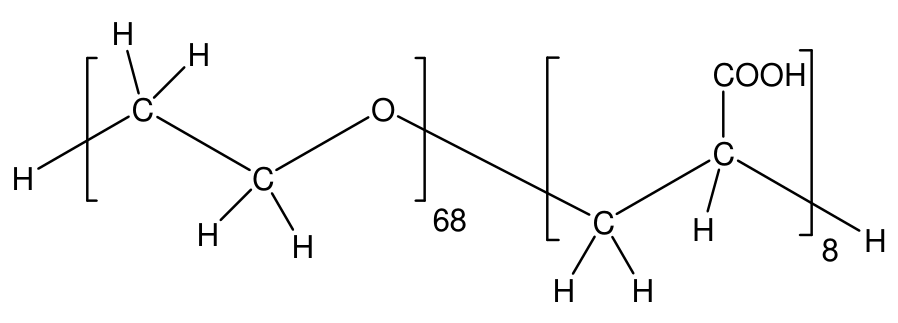
The polymer does not undergo any chemical reaction (except protolysis of the acid) and yet has a strong effect: after mixing of the two solutions (A+B) no precipitate can be observed. Small calcium carbonate particles with the polymer chains attached to their surface form. The attached polymers prevent further crystal growth and the hybrid particles remain in solution.
8.3 Circle the block of the polymer (on the answer sheet) that attaches to the surface of the growing calcium carbonate crystal.
To characterize the hybrid particles they are separated from the preparation solution and transferred into \(50\ \mathrm{cm^3}\) of an aqueous \(\ce{NaOH}\) solution (\(c(\ce{NaOH}) = 0.19\ \mathrm{mol\,dm^{-3}}\)). The solution is diluted by the addition of \(200\ \mathrm{cm^3}\) of water. Assume that the new solution contains only the hybrid particles and no additional calcium or carbonate ions. All acidic groups participate in the acid-base equilibrium.
- For the new solution, a \(pH\) of 12.30 is measured.
- In electron microscopy you only can see the inorganic particles (not the polymer): Spherical particles of \(100\ \mathrm{nm}\) diameter are observed.
- The molar mass of the hybrid particles (inorganic and organic part together) is determined to be \(M = 8.01\cdot10^8\ \mathrm{g\,mol^{-1}}\).
- The charge of the particles is found to be \(Z = -800\) (number of unit charges).
(\(pK_a(\ce{COOH},\text{ copolymer}) = 4.88\))
8.4 How much of the initial amount of polymer (\(2\ \mathrm{g}\)) can still be found in the hybrid particles?
8.5 Calculate which modification of calcium carbonate has been formed.
| Modification | density |
|---|---|
| Calcite | \(2.71\ \mathrm{g\,cm^{-3}}\) |
| Vaterite | \(2.54\ \mathrm{g\,cm^{-3}}\) |
| Aragonite | \(2.95\ \mathrm{g\,cm^{-3}}\) |
Official English text of the problem.
Answers
- 8.1: \(\boxed{pH \approx 11.24}\). The usual small-hydrolysis approximation gives \(11.27\).
- 8.2: Calcium carbonate, \(\ce{CaCO3}\),
[Ca+2].[O-]C(=O)[O-], precipitates. Calcium hydroxide, \(\ce{Ca(OH)2}\),[Ca+2].[OH-].[OH-], does not precipitate. - 8.3: Circle the right-hand poly(acrylic acid) block, containing eight repeat units. Its acid-form repeat-unit SMILES is
[*]CC(C(=O)O)[*]; its deprotonated form is[*]CC(C(=O)[O-])[*]. - 8.4: The formal acid–base calculation gives \(\boxed{m_{\mathrm{polymer}}\approx2.0\ \mathrm{g}}\), essentially 100% of the initial polymer.
- 8.5: The individual-particle data give \(\boxed{\rho\approx2.54\ \mathrm{g\,cm^{-3}}}\), identifying vaterite, a calcium carbonate polymorph.
The results for 8.4 and 8.5 cannot both satisfy the overall material balance with all the supplied data. The titration in 8.4 gives \(4.512\times10^{-3}\ \mathrm{mol}\) of carboxylate charges, that is \(5.640\times10^{-6}\ \mathrm{mol}\) of particles with 800 charges each; at the stated molar mass this would be \(4.52\times10^3\ \mathrm{g}\) of hybrid, whereas the initial calcium and polymer allow only about \(2.16\ \mathrm{g}\).
Solution
Use \(K_w=1.00\times10^{-14}\) at \(298.15\ \mathrm{K}\), \(N_A=6.022\times10^{23}\ \mathrm{mol^{-1}}\), and standard atomic molar masses. Activities are approximated by concentrations, and volume changes other than the stated mixing and dilution are neglected.
8.1 — pH of solution B
The analytical concentration of sodium carbonate, [Na+].[Na+].[O-]C(=O)[O-], is
\[ C_B=\frac{1.700\ \mathrm{g\,dm^{-3}}} {105.99\ \mathrm{g\,mol^{-1}}} =0.01604\ \mathrm{mol\,dm^{-3}}. \]
Carbonate, [O-]C(=O)[O-], reacts with water, O, to give hydrogen carbonate, OC(=O)[O-], and hydroxide, [OH-]:
\[ \ce{CO3^2- + H2O <=> HCO3- + OH-}. \]
The corresponding base constant is
\[ K_b=\frac{K_w}{K_{a2}} =\frac{10^{-14}}{10^{-10.33}} =2.138\times10^{-4}. \]
Further hydrolysis to carbonic acid, OC(=O)O,
\[ \ce{HCO3- + H2O <=> H2CO3 + OH-}, \]
has \(K_b'=K_w/K_{a1}=2.34\times10^{-8}\) and is negligible here. Water autoionization also contributes negligibly to the hydroxide concentration.
Let \(x=[\ce{OH-}]\approx[\ce{HCO3-}]\). Then
\[ K_b=\frac{x^2}{C_B-x}, \]
so
\[ x=\frac{-K_b+\sqrt{K_b^2+4K_bC_B}}{2} =1.748\times10^{-3}\ \mathrm{mol\,dm^{-3}}. \]
Therefore,
\[ pOH=2.7575, \qquad \boxed{pH=11.2425\approx11.24}. \]
If carbonate depletion is also neglected,
\[ x\approx\sqrt{K_bC_B}, \qquad pH\approx \frac{pK_w+pK_{a2}+\log C_B}{2} =11.27. \]
The quadratic calculation avoids this last approximation: about \(10.9\%\) of the carbonate undergoes hydrolysis.
8.2 — Composition of the precipitate
For calcium chloride, [Ca+2].[Cl-].[Cl-],
\[ c_A=\frac{1.780}{110.98} =0.01604\ \mathrm{mol\,dm^{-3}}. \]
Mixing equal volumes halves both analytical concentrations:
\[ C_{\mathrm{Ca}}=8.019\times10^{-3}\ \mathrm{mol\,dm^{-3}}, \qquad C_{\mathrm{carbonate}}=8.020\times10^{-3}\ \mathrm{mol\,dm^{-3}}. \]
At \(pH=10\),
\[ [\ce{OH-}]=10^{-4}\ \mathrm{mol\,dm^{-3}}. \]
For calcium hydroxide, the dissolution equilibrium is
\[ \ce{Ca(OH)2(s) <=> Ca^2+ + 2OH-}. \]
The concentration of calcium(II) ions, [Ca+2], cannot exceed \(C_{\mathrm{Ca}}\). Thus the largest possible ion product is
\[ Q_{\ce{Ca(OH)2}} \leq (8.019\times10^{-3})(10^{-4})^2 =8.019\times10^{-11}. \]
Since
\[ 8.019\times10^{-11}\ll6.46\times10^{-6}, \]
\[ \boxed{\ce{Ca(OH)2}\text{ cannot precipitate}.} \]
For calcium carbonate, carbonate protonation must be considered. At \(pH=10\),
\[ \frac{[\ce{HCO3-}]}{[\ce{CO3^2-}]} =10^{pK_{a2}-pH} =10^{0.33}=2.138. \]
Also,
\[ \frac{[\ce{H2CO3}]}{[\ce{HCO3-}]} =10^{6.37-10} =2.34\times10^{-4}, \]
so carbonic acid makes a negligible contribution. Before precipitation, therefore,
\[ [\ce{CO3^2-}] \approx\frac{8.020\times10^{-3}}{1+2.138} =2.56\times10^{-3}\ \mathrm{mol\,dm^{-3}}. \]
The initial ion product is
\[ Q_{\ce{CaCO3}} =(8.019\times10^{-3})(2.56\times10^{-3}) =2.05\times10^{-5}. \]
Because
\[ 2.05\times10^{-5}\gg3.31\times10^{-9}, \]
calcium carbonate precipitates:
\[ \boxed{\ce{Ca^2+ + CO3^2- -> CaCO3(s)}}. \]
Its precipitation further lowers the calcium concentration, reinforcing the exclusion of calcium hydroxide.
8.3 — Polymer block attached to the crystal
Circle the entire right-hand bracketed block with subscript 8, containing the pendant \(\ce{COOH}\) groups.
This is the poly(acrylic acid) block:
- Acid-form repeat unit:
[*]CC(C(=O)O)[*]. - Deprotonated polyacrylate repeat unit:
[*]CC(C(=O)[O-])[*].
The negatively charged carboxylate groups adsorb at calcium sites on the growing crystal surface. The hydrated poly(ethylene oxide) block, repeat-unit SMILES [*]CCO[*], extends into the surrounding water and provides steric stabilization.
Here [*] marks continuation of the polymer chain; the repeat counts are eight for the acrylic acid block and 68 for the ethylene oxide block. The drawing specifies no tacticity. These fragment SMILES do not describe the spatial arrangement of the adsorbed chains.
8.4 — Amount of retained polymer
The intended titration balance attributes the consumption of added hydroxide to the polymer’s acidic groups:
\[ \ce{RCOOH + OH- -> RCOO- + H2O}, \]
where \(R\) denotes the polymer backbone.
At the measured pH,
\[ \frac{[\ce{RCOO-}]}{[\ce{RCOOH}]} =10^{12.30-4.88} =2.63\times10^7. \]
Consequently, the fraction of deprotonated acid groups is
\[ \alpha= \frac{1}{1+10^{4.88-12.30}} =0.999999962\approx1. \]
The added sodium hydroxide, [Na+].[OH-], supplies
\[ n_{\ce{OH-},0} =(0.050\ \mathrm{dm^3}) (0.19\ \mathrm{mol\,dm^{-3}}) =9.50\times10^{-3}\ \mathrm{mol}. \]
The final volume is
\[ V=0.050+0.200=0.250\ \mathrm{dm^3}. \]
Since \(pOH=14.00-12.30=1.70\),
\[ [\ce{OH-}]_{\mathrm{final}} =10^{-1.70} =1.995\times10^{-2}\ \mathrm{mol\,dm^{-3}}, \]
and hence
\[ n_{\ce{OH-},\mathrm{final}} =(0.250)(1.995\times10^{-2}) =4.988\times10^{-3}\ \mathrm{mol}. \]
Thus the amount of deprotonated carboxyl groups inferred from this balance is
\[ n_{\mathrm{carboxylate}} =9.50\times10^{-3}-4.988\times10^{-3} =4.512\times10^{-3}\ \mathrm{mol}. \]
Each polymer chain has eight acidic groups, so
\[ n_P=\frac{n_{\mathrm{carboxylate}}}{8\alpha} =5.640\times10^{-4}\ \mathrm{mol}. \]
The depicted chain contains 68 ethylene oxide repeat units, eight acrylic acid repeat units, and two terminal hydrogen atoms. Its acid-form molar mass is approximately
\[ M_P =68(44.052)+8(72.062)+2(1.008) =3574\ \mathrm{g\,mol^{-1}}. \]
Therefore,
\[ m_P=n_PM_P =(5.640\times10^{-4})(3574) =2.016\ \mathrm{g}. \]
With the precision of the supplied measurements,
\[ \boxed{m_P\approx2.0\ \mathrm{g},\qquad \text{retained fraction}\approx100\%.} \]
The small calculated excess over the initial \(2\ \mathrm{g}\) is consistent with rounding: complete neutralization of exactly \(2.000\ \mathrm{g}\) would give \(pH\approx12.303\).
8.5 — Calcium carbonate modification
For a neutral, stoichiometric calcium carbonate core, the negative particle charge is attributed to the polymer’s deprotonated carboxyl groups. Each chain contributes approximately eight negative unit charges. Thus the number of attached chains per particle is
\[ N_P=\frac{|Z|}{8\alpha} \approx\frac{800}{8} =100. \]
Allowing for loss of the acidic hydrogen atoms, the organic contribution per mole of hybrid particles is
\[ M_{\mathrm{organic}} \approx100\bigl(3574-8(1.008)\bigr) =3.57\times10^5\ \mathrm{g\,mol^{-1}}. \]
The inorganic contribution is therefore
\[ M_{\mathrm{inorganic}} =8.01\times10^8-3.57\times10^5 =8.0064\times10^8\ \mathrm{g\,mol^{-1}}. \]
Electron microscopy gives the inorganic diameter. Hence
\[ r=50\ \mathrm{nm}=5.00\times10^{-6}\ \mathrm{cm}, \]
and the inorganic volume per particle is
\[ V_{\mathrm{inorganic}} =\frac{4\pi r^3}{3} =5.236\times10^{-16}\ \mathrm{cm^3}. \]
The inorganic mass per particle is
\[ m_{\mathrm{inorganic}} =\frac{M_{\mathrm{inorganic}}}{N_A} =1.330\times10^{-15}\ \mathrm{g}. \]
Therefore,
\[ \rho =\frac{m_{\mathrm{inorganic}}}{V_{\mathrm{inorganic}}} =\frac{1.330\times10^{-15}}{5.236\times10^{-16}} \approx2.54\ \mathrm{g\,cm^{-3}}. \]
This matches the tabulated density of vaterite:
\[ \boxed{\text{The individual-particle data identify vaterite.}} \]
Vaterite, calcite, and aragonite all have the ionic composition represented by [Ca+2].[O-]C(=O)[O-]. This SMILES does not distinguish their crystal lattices.
The solution was checked against the official solution.
IChO 2004 · Theorieaufgabe 8
Kolloide
Die Kombination einer anorganischen und einer organischen Komponente im Nanometermaßstab ergibt Materialien mit hervorragenden Eigenschaften. Daher ist die Synthese hybrider Nanopartikel von Interesse.
(\(T = 298.15\ \mathrm{K}\) in der gesamten Aufgabe)
Lösung A ist eine wässrige Lösung von \(\ce{CaCl2}\) mit einer Konzentration von \(1.780\ \mathrm{g\,dm^{-3}}\).
Lösung B ist eine wässrige Lösung von \(\ce{Na2CO3}\) mit einer Konzentration von \(1.700\ \mathrm{g\,dm^{-3}}\).
\[ pK_{a1}(\ce{H2CO3}) = 6.37 \qquad pK_{a2}(\ce{HCO3-}) = 10.33 \]
8.1 Berechnen Sie den \(pH\)-Wert der Lösung B unter Verwendung sinnvoller Annahmen.
\(100\ \mathrm{cm^3}\) der Lösung A und \(100\ \mathrm{cm^3}\) der Lösung B werden zur Lösung C gemischt. Lösung C wird auf einen \(pH\)-Wert von 10 eingestellt. Es bildet sich ein Niederschlag.
\[ K_{sp}(\ce{Ca(OH)2}) = 6.46\times10^{-6} \qquad K_{sp}(\ce{CaCO3}) = 3.31\times10^{-9} \]
8.2 Zeigen Sie für jede der Verbindungen \(\ce{Ca(OH)2}\) und \(\ce{CaCO3}\) durch Rechnung, ob sie im Niederschlag enthalten sein kann oder nicht.
In einem ähnlichen Experiment enthalten \(100\ \mathrm{cm^3}\) der Lösung A zusätzlich \(2\ \mathrm{g}\) eines Copolymers, das aus zwei wasserlöslichen Blöcken besteht: einem Polyethylenoxidblock und einem Polyacrylsäureblock:
Das Polymer geht keine chemische Reaktion ein (mit Ausnahme der Protolyse der Säure) und hat dennoch einen starken Einfluss: Nach dem Mischen der beiden Lösungen (A+B) ist kein Niederschlag zu beobachten. Es bilden sich kleine Calciumcarbonatpartikel, an deren Oberfläche die Polymerketten gebunden sind. Die gebundenen Polymere verhindern ein weiteres Kristallwachstum, und die Hybridpartikel verbleiben in Lösung.
8.3 Kreisen Sie den Block des Polymers (auf dem Antwortblatt) ein, der sich an die Oberfläche des wachsenden Calciumcarbonatkristalls anlagert.
Zur Charakterisierung der Hybridpartikel werden diese von der Herstellungslösung abgetrennt und in \(50\ \mathrm{cm^3}\) einer wässrigen \(\ce{NaOH}\)-Lösung (\(c(\ce{NaOH}) = 0.19\ \mathrm{mol\,dm^{-3}}\)) überführt. Die Lösung wird durch Zugabe von \(200\ \mathrm{cm^3}\) Wasser verdünnt. Nehmen Sie an, dass die neue Lösung nur die Hybridpartikel und keine zusätzlichen Calcium- oder Carbonationen enthält. Alle sauren Gruppen nehmen am Säure-Base-Gleichgewicht teil.
- Für die neue Lösung wird ein \(pH\)-Wert von 12.30 gemessen.
- In der Elektronenmikroskopie sind nur die anorganischen Partikel (nicht das Polymer) sichtbar: Es werden kugelförmige Partikel mit einem Durchmesser von \(100\ \mathrm{nm}\) beobachtet.
- Die molare Masse der Hybridpartikel (anorganischer und organischer Anteil zusammen) wird zu \(M = 8.01\cdot10^8\ \mathrm{g\,mol^{-1}}\) bestimmt.
- Die Ladung der Partikel wird zu \(Z = -800\) (Anzahl der Elementarladungen) bestimmt.
(\(pK_a(\ce{COOH},\text{ Copolymer}) = 4.88\))
8.4 Wie viel von der ursprünglichen Polymermenge (\(2\ \mathrm{g}\)) befindet sich noch in den Hybridpartikeln?
8.5 Berechnen Sie, welche Modifikation des Calciumcarbonats sich gebildet hat.
| Modifikation | Dichte |
|---|---|
| Calcit | \(2.71\ \mathrm{g\,cm^{-3}}\) |
| Vaterit | \(2.54\ \mathrm{g\,cm^{-3}}\) |
| Aragonit | \(2.95\ \mathrm{g\,cm^{-3}}\) |
Aufgabentext aus dem offiziellen englischen Text übersetzt.
Antworten
- 8.1: \(\boxed{pH \approx 11.24}\). Die übliche Näherung für einen geringen Hydrolysegrad ergibt \(11.27\).
- 8.2: Calciumcarbonat, \(\ce{CaCO3}\),
[Ca+2].[O-]C(=O)[O-], fällt aus. Calciumhydroxid, \(\ce{Ca(OH)2}\),[Ca+2].[OH-].[OH-], fällt nicht aus. - 8.3: Einzukreisen ist der rechte Polyacrylsäureblock, der acht Wiederholungseinheiten enthält. Der SMILES-Code seiner Wiederholungseinheit in der Säureform lautet
[*]CC(C(=O)O)[*]; derjenige der deprotonierten Form lautet[*]CC(C(=O)[O-])[*]. - 8.4: Die formale Säure-Base-Rechnung ergibt \(\boxed{m_{\mathrm{polymer}}\approx2.0\ \mathrm{g}}\), also im Wesentlichen 100% des ursprünglichen Polymers.
- 8.5: Aus den Daten für die einzelnen Partikel ergibt sich \(\boxed{\rho\approx2.54\ \mathrm{g\,cm^{-3}}}\); damit wird Vaterit, eine polymorphe Form des Calciumcarbonats, identifiziert.
Die Ergebnisse für 8.4 und 8.5 können unter Berücksichtigung aller angegebenen Daten nicht beide die gesamte Stoffbilanz erfüllen. Die Titration in 8.4 ergibt \(4.512\times10^{-3}\ \mathrm{mol}\) an Carboxylatladungen, also \(5.640\times10^{-6}\ \mathrm{mol}\) an Partikeln mit jeweils 800 Ladungen; bei der angegebenen molaren Masse entspräche dies \(4.52\times10^3\ \mathrm{g}\) Hybridmaterial, während die anfänglichen Mengen an Calcium und Polymer nur etwa \(2.16\ \mathrm{g}\) ermöglichen.
Lösung
Verwendet werden \(K_w=1.00\times10^{-14}\) bei \(298.15\ \mathrm{K}\), \(N_A=6.022\times10^{23}\ \mathrm{mol^{-1}}\) und die üblichen molaren Atommassen. Aktivitäten werden durch Konzentrationen angenähert, und Volumenänderungen außer den angegebenen Mischungs- und Verdünnungsschritten werden vernachlässigt.
8.1 — pH-Wert der Lösung B
Die analytische Konzentration von Natriumcarbonat, [Na+].[Na+].[O-]C(=O)[O-], beträgt
\[ C_B=\frac{1.700\ \mathrm{g\,dm^{-3}}} {105.99\ \mathrm{g\,mol^{-1}}} =0.01604\ \mathrm{mol\,dm^{-3}}. \]
Carbonat, [O-]C(=O)[O-], reagiert mit Wasser, O, zu Hydrogencarbonat, OC(=O)[O-], und Hydroxid, [OH-]:
\[ \ce{CO3^2- + H2O <=> HCO3- + OH-}. \]
Die entsprechende Basenkonstante beträgt
\[ K_b=\frac{K_w}{K_{a2}} =\frac{10^{-14}}{10^{-10.33}} =2.138\times10^{-4}. \]
Die weitere Hydrolyse zu Kohlensäure, OC(=O)O,
\[ \ce{HCO3- + H2O <=> H2CO3 + OH-}, \]
hat die Konstante \(K_b'=K_w/K_{a1}=2.34\times10^{-8}\) und ist hier vernachlässigbar. Auch die Autoprotolyse des Wassers liefert einen vernachlässigbaren Beitrag zur Hydroxidkonzentration.
Es sei \(x=[\ce{OH-}]\approx[\ce{HCO3-}]\). Dann gilt
\[ K_b=\frac{x^2}{C_B-x}, \]
also
\[ x=\frac{-K_b+\sqrt{K_b^2+4K_bC_B}}{2} =1.748\times10^{-3}\ \mathrm{mol\,dm^{-3}}. \]
Daraus folgt
\[ pOH=2.7575, \qquad \boxed{pH=11.2425\approx11.24}. \]
Wird auch die Abnahme der Carbonatkonzentration vernachlässigt, gilt
\[ x\approx\sqrt{K_bC_B}, \qquad pH\approx \frac{pK_w+pK_{a2}+\log C_B}{2} =11.27. \]
Die Berechnung mittels der quadratischen Gleichung vermeidet diese letzte Näherung: Etwa \(10.9\%\) des Carbonats werden hydrolysiert.
8.2 — Zusammensetzung des Niederschlags
Für Calciumchlorid, [Ca+2].[Cl-].[Cl-], gilt
\[ c_A=\frac{1.780}{110.98} =0.01604\ \mathrm{mol\,dm^{-3}}. \]
Das Mischen gleicher Volumina halbiert beide analytischen Konzentrationen:
\[ C_{\mathrm{Ca}}=8.019\times10^{-3}\ \mathrm{mol\,dm^{-3}}, \qquad C_{\mathrm{carbonate}}=8.020\times10^{-3}\ \mathrm{mol\,dm^{-3}}. \]
Bei \(pH=10\) gilt
\[ [\ce{OH-}]=10^{-4}\ \mathrm{mol\,dm^{-3}}. \]
Für Calciumhydroxid lautet das Lösungsgleichgewicht
\[ \ce{Ca(OH)2(s) <=> Ca^2+ + 2OH-}. \]
Die Konzentration der Calcium(II)-Ionen, [Ca+2], kann \(C_{\mathrm{Ca}}\) nicht überschreiten. Somit beträgt das größtmögliche Ionenprodukt
\[ Q_{\ce{Ca(OH)2}} \leq (8.019\times10^{-3})(10^{-4})^2 =8.019\times10^{-11}. \]
Da
\[ 8.019\times10^{-11}\ll6.46\times10^{-6}, \]
\[ \boxed{\ce{Ca(OH)2}\text{ kann nicht ausfallen}.} \]
Für Calciumcarbonat muss die Protonierung des Carbonats berücksichtigt werden. Bei \(pH=10\) gilt
\[ \frac{[\ce{HCO3-}]}{[\ce{CO3^2-}]} =10^{pK_{a2}-pH} =10^{0.33}=2.138. \]
Außerdem gilt
\[ \frac{[\ce{H2CO3}]}{[\ce{HCO3-}]} =10^{6.37-10} =2.34\times10^{-4}, \]
sodass Kohlensäure einen vernachlässigbaren Beitrag liefert. Vor der Fällung gilt daher
\[ [\ce{CO3^2-}] \approx\frac{8.020\times10^{-3}}{1+2.138} =2.56\times10^{-3}\ \mathrm{mol\,dm^{-3}}. \]
Das anfängliche Ionenprodukt beträgt
\[ Q_{\ce{CaCO3}} =(8.019\times10^{-3})(2.56\times10^{-3}) =2.05\times10^{-5}. \]
Da
\[ 2.05\times10^{-5}\gg3.31\times10^{-9}, \]
fällt Calciumcarbonat aus:
\[ \boxed{\ce{Ca^2+ + CO3^2- -> CaCO3(s)}}. \]
Durch seine Fällung sinkt die Calciumkonzentration weiter, was den Ausschluss einer Calciumhydroxidfällung zusätzlich bekräftigt.
8.3 — An den Kristall gebundener Polymerblock
Einzukreisen ist der gesamte rechte eingeklammerte Block mit dem Index 8, der die seitenständigen \(\ce{COOH}\)-Gruppen enthält.
Dies ist der Polyacrylsäureblock:
- Wiederholungseinheit in der Säureform:
[*]CC(C(=O)O)[*]. - Deprotonierte Polyacrylat-Wiederholungseinheit:
[*]CC(C(=O)[O-])[*].
Die negativ geladenen Carboxylatgruppen adsorbieren an Calciumplätzen auf der wachsenden Kristalloberfläche. Der hydratisierte Polyethylenoxidblock mit dem SMILES-Code der Wiederholungseinheit [*]CCO[*] ragt in das umgebende Wasser hinein und sorgt für sterische Stabilisierung.
Hier kennzeichnet [*] die Fortsetzung der Polymerkette; die Anzahl der Wiederholungseinheiten beträgt acht für den Acrylsäureblock und 68 für den Ethylenoxidblock. Die Zeichnung legt keine Taktizität fest. Diese Fragment-SMILES beschreiben nicht die räumliche Anordnung der adsorbierten Ketten.
8.4 — Menge des verbliebenen Polymers
Die vorgesehene Titrationsbilanz führt den Verbrauch des zugesetzten Hydroxids auf die sauren Gruppen des Polymers zurück:
\[ \ce{RCOOH + OH- -> RCOO- + H2O}, \]
wobei \(R\) das Polymerrückgrat bezeichnet.
Beim gemessenen pH-Wert gilt
\[ \frac{[\ce{RCOO-}]}{[\ce{RCOOH}]} =10^{12.30-4.88} =2.63\times10^7. \]
Folglich beträgt der Anteil der deprotonierten Säuregruppen
\[ \alpha= \frac{1}{1+10^{4.88-12.30}} =0.999999962\approx1. \]
Das zugesetzte Natriumhydroxid, [Na+].[OH-], liefert
\[ n_{\ce{OH-},0} =(0.050\ \mathrm{dm^3}) (0.19\ \mathrm{mol\,dm^{-3}}) =9.50\times10^{-3}\ \mathrm{mol}. \]
Das Endvolumen beträgt
\[ V=0.050+0.200=0.250\ \mathrm{dm^3}. \]
Da \(pOH=14.00-12.30=1.70\), gilt
\[ [\ce{OH-}]_{\mathrm{final}} =10^{-1.70} =1.995\times10^{-2}\ \mathrm{mol\,dm^{-3}}, \]
und somit
\[ n_{\ce{OH-},\mathrm{final}} =(0.250)(1.995\times10^{-2}) =4.988\times10^{-3}\ \mathrm{mol}. \]
Die aus dieser Bilanz abgeleitete Stoffmenge deprotonierter Carboxylgruppen beträgt somit
\[ n_{\mathrm{carboxylate}} =9.50\times10^{-3}-4.988\times10^{-3} =4.512\times10^{-3}\ \mathrm{mol}. \]
Jede Polymerkette besitzt acht saure Gruppen, also gilt
\[ n_P=\frac{n_{\mathrm{carboxylate}}}{8\alpha} =5.640\times10^{-4}\ \mathrm{mol}. \]
Die dargestellte Kette enthält 68 Ethylenoxid-Wiederholungseinheiten, acht Acrylsäure-Wiederholungseinheiten und zwei endständige Wasserstoffatome. Ihre molare Masse in der Säureform beträgt näherungsweise
\[ M_P =68(44.052)+8(72.062)+2(1.008) =3574\ \mathrm{g\,mol^{-1}}. \]
Daraus folgt
\[ m_P=n_PM_P =(5.640\times10^{-4})(3574) =2.016\ \mathrm{g}. \]
Bei der Genauigkeit der angegebenen Messwerte ergibt sich
\[ \boxed{m_P\approx2.0\ \mathrm{g},\qquad \text{verbliebener Anteil}\approx100\%.} \]
Die geringfügige rechnerische Überschreitung der ursprünglichen \(2\ \mathrm{g}\) ist mit Rundung vereinbar: Die vollständige Neutralisation von genau \(2.000\ \mathrm{g}\) würde \(pH\approx12.303\) ergeben.
8.5 — Calciumcarbonatmodifikation
Für einen neutralen, stöchiometrisch zusammengesetzten Calciumcarbonatkern wird die negative Partikelladung auf die deprotonierten Carboxylgruppen des Polymers zurückgeführt. Jede Kette trägt etwa acht negative Elementarladungen bei. Somit beträgt die Anzahl der gebundenen Ketten pro Partikel
\[ N_P=\frac{|Z|}{8\alpha} \approx\frac{800}{8} =100. \]
Unter Berücksichtigung des Verlusts der sauren Wasserstoffatome beträgt der organische Beitrag pro Mol Hybridpartikel
\[ M_{\mathrm{organic}} \approx100\bigl(3574-8(1.008)\bigr) =3.57\times10^5\ \mathrm{g\,mol^{-1}}. \]
Der anorganische Beitrag beträgt daher
\[ M_{\mathrm{inorganic}} =8.01\times10^8-3.57\times10^5 =8.0064\times10^8\ \mathrm{g\,mol^{-1}}. \]
Die Elektronenmikroskopie liefert den anorganischen Durchmesser. Daher gilt
\[ r=50\ \mathrm{nm}=5.00\times10^{-6}\ \mathrm{cm}, \]
und das anorganische Volumen pro Partikel beträgt
\[ V_{\mathrm{inorganic}} =\frac{4\pi r^3}{3} =5.236\times10^{-16}\ \mathrm{cm^3}. \]
Die anorganische Masse pro Partikel beträgt
\[ m_{\mathrm{inorganic}} =\frac{M_{\mathrm{inorganic}}}{N_A} =1.330\times10^{-15}\ \mathrm{g}. \]
Daraus folgt
\[ \rho =\frac{m_{\mathrm{inorganic}}}{V_{\mathrm{inorganic}}} =\frac{1.330\times10^{-15}}{5.236\times10^{-16}} \approx2.54\ \mathrm{g\,cm^{-3}}. \]
Dies stimmt mit der tabellierten Dichte von Vaterit überein:
\[ \boxed{\text{Die Daten für die einzelnen Partikel identifizieren Vaterit.}} \]
Vaterit, Calcit und Aragonit haben alle die durch [Ca+2].[O-]C(=O)[O-] dargestellte Ionenzusammensetzung. Dieser SMILES-Code unterscheidet ihre Kristallgitter nicht.
Die Lösung wurde mit der offiziellen Lösung abgeglichen.
IChO 2004 · Teori sorusu 8
Kolloidler
İnorganik ve organik bir bileşenin nanometre ölçeğinde bir araya getirilmesi, üstün özelliklere sahip malzemeler elde edilmesini sağlar. Bu nedenle hibrit nanoparçacıkların sentezi ilgi çekmektedir.
(Sorunun tamamında \(T = 298.15\ \mathrm{K}\))
A çözeltisi, derişimi \(1.780\ \mathrm{g\,dm^{-3}}\) olan sulu bir \(\ce{CaCl2}\) çözeltisidir.
B çözeltisi, derişimi \(1.700\ \mathrm{g\,dm^{-3}}\) olan sulu bir \(\ce{Na2CO3}\) çözeltisidir.
\[ pK_{a1}(\ce{H2CO3}) = 6.37 \qquad pK_{a2}(\ce{HCO3-}) = 10.33 \]
8.1 Uygun varsayımlar kullanarak B çözeltisinin \(pH\) değerini hesaplayınız.
A çözeltisinin \(100\ \mathrm{cm^3}\)'ü ile B çözeltisinin \(100\ \mathrm{cm^3}\)'ü karıştırılarak C çözeltisi oluşturulur. C çözeltisinin \(pH\) değeri 10'a ayarlanır. Bir çökelti oluşur.
\[ K_{sp}(\ce{Ca(OH)2}) = 6.46\times10^{-6} \qquad K_{sp}(\ce{CaCO3}) = 3.31\times10^{-9} \]
8.2 \(\ce{Ca(OH)2}\) ve \(\ce{CaCO3}\) bileşiklerinin her biri için, çökeltide bulunup bulunamayacağını hesaplama yaparak gösteriniz.
Benzer bir deneyde, A çözeltisinin \(100\ \mathrm{cm^3}\)'ü ayrıca suda çözünen iki bloktan, bir poli(etilen oksit) bloğu ve bir poli(akrilik asit) bloğundan oluşan bir kopolimerden \(2\ \mathrm{g}\) içerir:
Polimer herhangi bir kimyasal tepkimeye girmez (asidin protolizi dışında), buna rağmen güçlü bir etki gösterir: iki çözelti (A+B) karıştırıldıktan sonra herhangi bir çökelti gözlenmez. Yüzeylerine polimer zincirlerinin bağlandığı küçük kalsiyum karbonat parçacıkları oluşur. Bağlanan polimerler kristalin daha fazla büyümesini önler ve hibrit parçacıklar çözeltide kalır.
8.3 Polimerin büyüyen kalsiyum karbonat kristalinin yüzeyine bağlanan bloğunu (cevap kâğıdında) daire içine alınız.
Hibrit parçacıkları karakterize etmek için bunlar hazırlandıkları çözeltiden ayrılır ve \(50\ \mathrm{cm^3}\) sulu \(\ce{NaOH}\) çözeltisine (\(c(\ce{NaOH}) = 0.19\ \mathrm{mol\,dm^{-3}}\)) aktarılır. Çözelti, \(200\ \mathrm{cm^3}\) su eklenerek seyreltilir. Yeni çözeltinin yalnızca hibrit parçacıkları içerdiğini ve ilave kalsiyum veya karbonat iyonları içermediğini varsayınız. Asidik grupların tamamı asit-baz dengesine katılır.
- Yeni çözeltinin \(pH\) değeri 12.30 olarak ölçülür.
- Elektron mikroskobunda yalnızca inorganik parçacıkları görebilirsiniz (polimeri göremezsiniz): çapı \(100\ \mathrm{nm}\) olan küresel parçacıklar gözlenir.
- Hibrit parçacıkların molar kütlesi (inorganik ve organik kısımlar birlikte) \(M = 8.01\cdot10^8\ \mathrm{g\,mol^{-1}}\) olarak belirlenir.
- Parçacıkların yükü \(Z = -800\) (birim yük sayısı) olarak bulunur.
(\(pK_a(\ce{COOH},\text{ kopolimer}) = 4.88\))
8.4 Başlangıçtaki polimer miktarının (\(2\ \mathrm{g}\)) ne kadarı hâlâ hibrit parçacıklarda bulunur?
8.5 Kalsiyum karbonatın hangi kristal biçiminin oluştuğunu hesaplayınız.
| Kristal biçimi | yoğunluk |
|---|---|
| Kalsit | \(2.71\ \mathrm{g\,cm^{-3}}\) |
| Vaterit | \(2.54\ \mathrm{g\,cm^{-3}}\) |
| Aragonit | \(2.95\ \mathrm{g\,cm^{-3}}\) |
Soru metni resmi İngilizce metinden çevrilmiştir.
Cevaplar
- 8.1: \(\boxed{pH \approx 11.24}\). Hidrolizin az olduğu varsayımına dayanan yaygın yaklaşım \(11.27\) sonucunu verir.
- 8.2: Kalsiyum karbonat, \(\ce{CaCO3}\),
[Ca+2].[O-]C(=O)[O-], çöker. Kalsiyum hidroksit, \(\ce{Ca(OH)2}\),[Ca+2].[OH-].[OH-], çökmez. - 8.3: Sekiz tekrar birimi içeren sağdaki poli(akrilik asit) bloğunu daire içine alınız. Asit biçimindeki tekrar biriminin SMILES gösterimi
[*]CC(C(=O)O)[*]; protonu uzaklaştırılmış biçimininki ise[*]CC(C(=O)[O-])[*]şeklindedir. - 8.4: Biçimsel asit–baz hesabı \(\boxed{m_{\mathrm{polymer}}\approx2.0\ \mathrm{g}}\) sonucunu verir; bu, başlangıçtaki polimerin esasen %100'üdür.
- 8.5: Tek tek parçacıklara ilişkin veriler \(\boxed{\rho\approx2.54\ \mathrm{g\,cm^{-3}}}\) sonucunu verir; bu da kalsiyum karbonatın bir polimorfu olan vateriti gösterir.
8.4 ve 8.5'in sonuçları, verilen tüm verilerle birlikte toplam madde bilançosunu aynı anda sağlayamaz. 8.4'teki titrasyon, \(4.512\times10^{-3}\ \mathrm{mol}\) karboksilat yükü, yani her biri 800 yük taşıyan \(5.640\times10^{-6}\ \mathrm{mol}\) parçacık verir; belirtilen molar kütlede bu, \(4.52\times10^3\ \mathrm{g}\) hibrit maddeye karşılık gelirken, başlangıçtaki kalsiyum ve polimer yalnızca yaklaşık \(2.16\ \mathrm{g}\) elde edilmesine olanak tanır.
Çözüm
\(298.15\ \mathrm{K}\)'de \(K_w=1.00\times10^{-14}\), \(N_A=6.022\times10^{23}\ \mathrm{mol^{-1}}\) ve standart atomik molar kütleleri kullanınız. Aktiviteler yaklaşık olarak derişimlere eşit kabul edilir ve belirtilen karıştırma ve seyreltme dışındaki hacim değişimleri ihmal edilir.
8.1 — B çözeltisinin pH değeri
Sodyum karbonatın, [Na+].[Na+].[O-]C(=O)[O-], analitik derişimi şöyledir:
\[ C_B=\frac{1.700\ \mathrm{g\,dm^{-3}}} {105.99\ \mathrm{g\,mol^{-1}}} =0.01604\ \mathrm{mol\,dm^{-3}}. \]
Karbonat, [O-]C(=O)[O-], suyla, O, tepkimeye girerek hidrojen karbonat, OC(=O)[O-], ve hidroksit, [OH-], oluşturur:
\[ \ce{CO3^2- + H2O <=> HCO3- + OH-}. \]
Buna karşılık gelen bazlık sabiti şöyledir:
\[ K_b=\frac{K_w}{K_{a2}} =\frac{10^{-14}}{10^{-10.33}} =2.138\times10^{-4}. \]
Karbonik aside, OC(=O)O, kadar ilerleyen hidroliz tepkimesi
\[ \ce{HCO3- + H2O <=> H2CO3 + OH-}, \]
için \(K_b'=K_w/K_{a1}=2.34\times10^{-8}\) olup bu tepkime burada ihmal edilebilir. Suyun otoiyonlaşmasının hidroksit derişimine katkısı da ihmal edilebilir düzeydedir.
\(x=[\ce{OH-}]\approx[\ce{HCO3-}]\) olsun. Bu durumda
\[ K_b=\frac{x^2}{C_B-x}, \]
olduğundan
\[ x=\frac{-K_b+\sqrt{K_b^2+4K_bC_B}}{2} =1.748\times10^{-3}\ \mathrm{mol\,dm^{-3}}. \]
Dolayısıyla,
\[ pOH=2.7575, \qquad \boxed{pH=11.2425\approx11.24}. \]
Karbonatın azalması da ihmal edilirse,
\[ x\approx\sqrt{K_bC_B}, \qquad pH\approx \frac{pK_w+pK_{a2}+\log C_B}{2} =11.27. \]
İkinci dereceden denklemle yapılan hesap bu son yaklaşımı kullanmaz: karbonatın yaklaşık \(10.9\%\)'u hidrolize uğrar.
8.2 — Çökeltinin bileşimi
Kalsiyum klorür, [Ca+2].[Cl-].[Cl-], için
\[ c_A=\frac{1.780}{110.98} =0.01604\ \mathrm{mol\,dm^{-3}}. \]
Eşit hacimlerin karıştırılması her iki analitik derişimi de yarıya indirir:
\[ C_{\mathrm{Ca}}=8.019\times10^{-3}\ \mathrm{mol\,dm^{-3}}, \qquad C_{\mathrm{carbonate}}=8.020\times10^{-3}\ \mathrm{mol\,dm^{-3}}. \]
\(pH=10\) olduğunda,
\[ [\ce{OH-}]=10^{-4}\ \mathrm{mol\,dm^{-3}}. \]
Kalsiyum hidroksit için çözünme dengesi şöyledir:
\[ \ce{Ca(OH)2(s) <=> Ca^2+ + 2OH-}. \]
Kalsiyum(II) iyonlarının, [Ca+2], derişimi \(C_{\mathrm{Ca}}\) değerini aşamaz. Bu nedenle mümkün olan en büyük iyon çarpımı şöyledir:
\[ Q_{\ce{Ca(OH)2}} \leq (8.019\times10^{-3})(10^{-4})^2 =8.019\times10^{-11}. \]
\[ 8.019\times10^{-11}\ll6.46\times10^{-6}, \]
olduğundan,
\[ \boxed{\ce{Ca(OH)2}\text{ çökemez}.} \]
Kalsiyum karbonat için karbonatın protonlanması dikkate alınmalıdır. \(pH=10\) olduğunda,
\[ \frac{[\ce{HCO3-}]}{[\ce{CO3^2-}]} =10^{pK_{a2}-pH} =10^{0.33}=2.138. \]
Ayrıca,
\[ \frac{[\ce{H2CO3}]}{[\ce{HCO3-}]} =10^{6.37-10} =2.34\times10^{-4}, \]
olduğundan karbonik asidin katkısı ihmal edilebilir. Dolayısıyla çökelme öncesinde,
\[ [\ce{CO3^2-}] \approx\frac{8.020\times10^{-3}}{1+2.138} =2.56\times10^{-3}\ \mathrm{mol\,dm^{-3}}. \]
Başlangıçtaki iyon çarpımı şöyledir:
\[ Q_{\ce{CaCO3}} =(8.019\times10^{-3})(2.56\times10^{-3}) =2.05\times10^{-5}. \]
\[ 2.05\times10^{-5}\gg3.31\times10^{-9}, \]
olduğundan kalsiyum karbonat çöker:
\[ \boxed{\ce{Ca^2+ + CO3^2- -> CaCO3(s)}}. \]
Kalsiyum karbonatın çökmesi kalsiyum derişimini daha da düşürerek kalsiyum hidroksidin çökelmeyeceği sonucunu pekiştirir.
8.3 — Kristale bağlanan polimer bloğu
Yan zincirlerdeki \(\ce{COOH}\) gruplarını içeren, sağ tarafta köşeli parantez içinde gösterilen ve alt indisi 8 olan bloğun tamamını daire içine alınız.
Bu, poli(akrilik asit) bloğudur:
- Asit biçimindeki tekrar birimi:
[*]CC(C(=O)O)[*]. - Protonu uzaklaştırılmış poliakrilat tekrar birimi:
[*]CC(C(=O)[O-])[*].
Negatif yüklü karboksilat grupları, büyüyen kristal yüzeyindeki kalsiyum merkezlerine adsorplanır. Tekrar biriminin SMILES gösterimi [*]CCO[*] olan hidratlanmış poli(etilen oksit) bloğu, çevredeki suya doğru uzanır ve sterik kararlılık sağlar.
Burada [*], polimer zincirinin devamını gösterir; tekrar sayıları akrilik asit bloğu için sekiz, etilen oksit bloğu için 68'dir. Çizimde taktisite belirtilmemiştir. Bu parçalara ait SMILES gösterimleri, adsorplanmış zincirlerin uzaysal düzenini tanımlamaz.
8.4 — Parçacıklarda kalan polimer miktarı
Öngörülen titrasyon bilançosu, eklenen hidroksidin tüketimini polimerin asidik gruplarına bağlar:
\[ \ce{RCOOH + OH- -> RCOO- + H2O}, \]
burada \(R\), polimerin ana zincirini gösterir.
Ölçülen pH değerinde,
\[ \frac{[\ce{RCOO-}]}{[\ce{RCOOH}]} =10^{12.30-4.88} =2.63\times10^7. \]
Buna göre, protonu uzaklaştırılmış asit gruplarının kesri şöyledir:
\[ \alpha= \frac{1}{1+10^{4.88-12.30}} =0.999999962\approx1. \]
Eklenen sodyum hidroksit, [Na+].[OH-], şu miktarda hidroksit sağlar:
\[ n_{\ce{OH-},0} =(0.050\ \mathrm{dm^3}) (0.19\ \mathrm{mol\,dm^{-3}}) =9.50\times10^{-3}\ \mathrm{mol}. \]
Son hacim şöyledir:
\[ V=0.050+0.200=0.250\ \mathrm{dm^3}. \]
\(pOH=14.00-12.30=1.70\) olduğundan,
\[ [\ce{OH-}]_{\mathrm{final}} =10^{-1.70} =1.995\times10^{-2}\ \mathrm{mol\,dm^{-3}}, \]
ve dolayısıyla
\[ n_{\ce{OH-},\mathrm{final}} =(0.250)(1.995\times10^{-2}) =4.988\times10^{-3}\ \mathrm{mol}. \]
Böylece, bu bilançodan çıkarılan protonu uzaklaştırılmış karboksil grubu miktarı şöyledir:
\[ n_{\mathrm{carboxylate}} =9.50\times10^{-3}-4.988\times10^{-3} =4.512\times10^{-3}\ \mathrm{mol}. \]
Her polimer zincirinde sekiz asidik grup bulunduğundan,
\[ n_P=\frac{n_{\mathrm{carboxylate}}}{8\alpha} =5.640\times10^{-4}\ \mathrm{mol}. \]
Gösterilen zincir, 68 etilen oksit tekrar birimi, sekiz akrilik asit tekrar birimi ve uçlarda iki hidrojen atomu içerir. Asit biçimindeki molar kütlesi yaklaşık olarak şöyledir:
\[ M_P =68(44.052)+8(72.062)+2(1.008) =3574\ \mathrm{g\,mol^{-1}}. \]
Dolayısıyla,
\[ m_P=n_PM_P =(5.640\times10^{-4})(3574) =2.016\ \mathrm{g}. \]
Verilen ölçümlerin hassasiyeti dikkate alındığında,
\[ \boxed{m_P\approx2.0\ \mathrm{g},\qquad \text{parçacıklarda kalan kesir}\approx100\%.} \]
Hesaplanan değerin başlangıçtaki \(2\ \mathrm{g}\)'ı az miktarda aşması yuvarlamayla tutarlıdır: tam olarak \(2.000\ \mathrm{g}\)'ın tamamen nötrleşmesi \(pH\approx12.303\) sonucunu verirdi.
8.5 — Kalsiyum karbonatın kristal biçimi
Nötr ve stokiyometrik bir kalsiyum karbonat çekirdeği için parçacığın negatif yükü, polimerin protonu uzaklaştırılmış karboksil gruplarına bağlanır. Her zincir yaklaşık sekiz negatif birim yük sağlar. Dolayısıyla parçacık başına bağlanan zincir sayısı şöyledir:
\[ N_P=\frac{|Z|}{8\alpha} \approx\frac{800}{8} =100. \]
Asidik hidrojen atomlarının kaybı hesaba katıldığında, hibrit parçacıkların bir molü başına organik kısmın katkısı şöyledir:
\[ M_{\mathrm{organic}} \approx100\bigl(3574-8(1.008)\bigr) =3.57\times10^5\ \mathrm{g\,mol^{-1}}. \]
Dolayısıyla inorganik kısmın katkısı şöyledir:
\[ M_{\mathrm{inorganic}} =8.01\times10^8-3.57\times10^5 =8.0064\times10^8\ \mathrm{g\,mol^{-1}}. \]
Elektron mikroskobu inorganik kısmın çapını verir. Bu nedenle
\[ r=50\ \mathrm{nm}=5.00\times10^{-6}\ \mathrm{cm}, \]
ve parçacık başına inorganik hacim şöyledir:
\[ V_{\mathrm{inorganic}} =\frac{4\pi r^3}{3} =5.236\times10^{-16}\ \mathrm{cm^3}. \]
Parçacık başına inorganik kütle şöyledir:
\[ m_{\mathrm{inorganic}} =\frac{M_{\mathrm{inorganic}}}{N_A} =1.330\times10^{-15}\ \mathrm{g}. \]
Dolayısıyla,
\[ \rho =\frac{m_{\mathrm{inorganic}}}{V_{\mathrm{inorganic}}} =\frac{1.330\times10^{-15}}{5.236\times10^{-16}} \approx2.54\ \mathrm{g\,cm^{-3}}. \]
Bu değer, tabloda verilen vaterit yoğunluğuyla örtüşür:
\[ \boxed{\text{Tek tek parçacıklara ilişkin veriler vateriti gösterir.}} \]
Vaterit, kalsit ve aragonitin tümü, [Ca+2].[O-]C(=O)[O-] ile gösterilen iyonik bileşime sahiptir. Bu SMILES gösterimi, bunların kristal örgülerini birbirinden ayırt etmez.
Çözüm, resmi çözümle karşılaştırılarak kontrol edildi.
IChO 2004 · Problema teórico 8
Coloides
La combinación de un componente inorgánico y uno orgánico a escala nanométrica da lugar a materiales con excelentes propiedades. Por ello, la síntesis de nanopartículas híbridas resulta de interés.
(\(T = 298.15\ \mathrm{K}\) en todo el problema)
La disolución A es una disolución acuosa de \(\ce{CaCl2}\) con una concentración de \(1.780\ \mathrm{g\,dm^{-3}}\).
La disolución B es una disolución acuosa de \(\ce{Na2CO3}\) con una concentración de \(1.700\ \mathrm{g\,dm^{-3}}\).
\[ pK_{a1}(\ce{H2CO3}) = 6.37 \qquad pK_{a2}(\ce{HCO3-}) = 10.33 \]
8.1 Calcule el \(pH\) de la disolución B utilizando aproximaciones razonables.
Se mezclan \(100\ \mathrm{cm^3}\) de la disolución A y \(100\ \mathrm{cm^3}\) de la disolución B para formar la disolución C. Se ajusta la disolución C a \(pH\) 10. Se forma un precipitado.
\[ K_{sp}(\ce{Ca(OH)2}) = 6.46\times10^{-6} \qquad K_{sp}(\ce{CaCO3}) = 3.31\times10^{-9} \]
8.2 Demuestre mediante cálculos, para cada uno de los compuestos \(\ce{Ca(OH)2}\) y \(\ce{CaCO3}\), si puede encontrarse o no en el precipitado.
En un experimento similar, \(100\ \mathrm{cm^3}\) de la disolución A contienen además \(2\ \mathrm{g}\) de un copolímero constituido por dos bloques solubles en agua: un bloque de poli(óxido de etileno) y un bloque de poli(ácido acrílico):
El polímero no experimenta ninguna reacción química (excepto la protólisis del ácido) y, sin embargo, tiene un efecto considerable: tras mezclar las dos disoluciones (A+B), no se observa ningún precipitado. Se forman pequeñas partículas de carbonato de calcio con las cadenas poliméricas unidas a su superficie. Los polímeros unidos impiden que continúe el crecimiento cristalino y las partículas híbridas permanecen en la disolución.
8.3 Rodee con un círculo el bloque del polímero (en la hoja de respuestas) que se une a la superficie del cristal de carbonato de calcio en crecimiento.
Para caracterizar las partículas híbridas, se separan de la disolución de preparación y se transfieren a \(50\ \mathrm{cm^3}\) de una disolución acuosa de \(\ce{NaOH}\) (\(c(\ce{NaOH}) = 0.19\ \mathrm{mol\,dm^{-3}}\)). La disolución se diluye añadiendo \(200\ \mathrm{cm^3}\) de agua. Suponga que la nueva disolución contiene únicamente las partículas híbridas y ningún ion calcio o carbonato adicional. Todos los grupos ácidos participan en el equilibrio ácido-base.
- En la nueva disolución se mide un \(pH\) de 12.30.
- Mediante microscopía electrónica solo pueden verse las partículas inorgánicas (no el polímero): se observan partículas esféricas de \(100\ \mathrm{nm}\) de diámetro.
- Se determina que la masa molar de las partículas híbridas (las partes inorgánica y orgánica conjuntamente) es \(M = 8.01\cdot10^8\ \mathrm{g\,mol^{-1}}\).
- Se determina que la carga de las partículas es \(Z = -800\) (número de cargas elementales).
(\(pK_a(\ce{COOH},\text{ copolímero}) = 4.88\))
8.4 ¿Qué cantidad del polímero inicial (\(2\ \mathrm{g}\)) sigue presente en las partículas híbridas?
8.5 Calcule qué modificación del carbonato de calcio se ha formado.
| Modificación | densidad |
|---|---|
| Calcita | \(2.71\ \mathrm{g\,cm^{-3}}\) |
| Vaterita | \(2.54\ \mathrm{g\,cm^{-3}}\) |
| Aragonito | \(2.95\ \mathrm{g\,cm^{-3}}\) |
Enunciado traducido del texto oficial en inglés.
Respuestas
- 8.1: \(\boxed{pH \approx 11.24}\). La aproximación habitual de hidrólisis pequeña da \(11.27\).
- 8.2: El carbonato de calcio, \(\ce{CaCO3}\),
[Ca+2].[O-]C(=O)[O-], precipita. El hidróxido de calcio, \(\ce{Ca(OH)2}\),[Ca+2].[OH-].[OH-], no precipita. - 8.3: Rodee con un círculo el bloque de poli(ácido acrílico) de la derecha, que contiene ocho unidades repetitivas. El SMILES de su unidad repetitiva en forma ácida es
[*]CC(C(=O)O)[*]; el de su forma desprotonada es[*]CC(C(=O)[O-])[*]. - 8.4: El cálculo formal ácido-base da \(\boxed{m_{\mathrm{polymer}}\approx2.0\ \mathrm{g}}\), esencialmente el 100% del polímero inicial.
- 8.5: Los datos de las partículas individuales dan \(\boxed{\rho\approx2.54\ \mathrm{g\,cm^{-3}}}\), lo que permite identificar la vaterita, un polimorfo del carbonato de calcio.
Los resultados de 8.4 y 8.5 no pueden satisfacer simultáneamente el balance global de materia con todos los datos proporcionados. La valoración en 8.4 da \(4.512\times10^{-3}\ \mathrm{mol}\) de cargas de carboxilato, es decir, \(5.640\times10^{-6}\ \mathrm{mol}\) de partículas con 800 cargas cada una; con la masa molar indicada, esto correspondería a \(4.52\times10^3\ \mathrm{g}\) de híbrido, mientras que el calcio y el polímero iniciales solo permiten obtener unos \(2.16\ \mathrm{g}\).
Solución
Se utilizan \(K_w=1.00\times10^{-14}\) a \(298.15\ \mathrm{K}\), \(N_A=6.022\times10^{23}\ \mathrm{mol^{-1}}\) y las masas molares atómicas estándar. Las actividades se aproximan mediante las concentraciones y se desprecian los cambios de volumen distintos de los debidos a la mezcla y la dilución indicadas.
8.1 — pH de la disolución B
La concentración analítica de carbonato de sodio, [Na+].[Na+].[O-]C(=O)[O-], es
\[ C_B=\frac{1.700\ \mathrm{g\,dm^{-3}}} {105.99\ \mathrm{g\,mol^{-1}}} =0.01604\ \mathrm{mol\,dm^{-3}}. \]
El carbonato, [O-]C(=O)[O-], reacciona con el agua, O, para dar hidrogenocarbonato, OC(=O)[O-], e hidróxido, [OH-]:
\[ \ce{CO3^2- + H2O <=> HCO3- + OH-}. \]
La constante de basicidad correspondiente es
\[ K_b=\frac{K_w}{K_{a2}} =\frac{10^{-14}}{10^{-10.33}} =2.138\times10^{-4}. \]
La hidrólisis posterior a ácido carbónico, OC(=O)O,
\[ \ce{HCO3- + H2O <=> H2CO3 + OH-}, \]
tiene \(K_b'=K_w/K_{a1}=2.34\times10^{-8}\) y es despreciable en este caso. La autoionización del agua también contribuye de forma despreciable a la concentración de hidróxido.
Sea \(x=[\ce{OH-}]\approx[\ce{HCO3-}]\). Entonces
\[ K_b=\frac{x^2}{C_B-x}, \]
por lo que
\[ x=\frac{-K_b+\sqrt{K_b^2+4K_bC_B}}{2} =1.748\times10^{-3}\ \mathrm{mol\,dm^{-3}}. \]
Por tanto,
\[ pOH=2.7575, \qquad \boxed{pH=11.2425\approx11.24}. \]
Si también se desprecia la disminución de la concentración de carbonato,
\[ x\approx\sqrt{K_bC_B}, \qquad pH\approx \frac{pK_w+pK_{a2}+\log C_B}{2} =11.27. \]
El cálculo mediante la ecuación de segundo grado evita esta última aproximación: aproximadamente el \(10.9\%\) del carbonato experimenta hidrólisis.
8.2 — Composición del precipitado
Para el cloruro de calcio, [Ca+2].[Cl-].[Cl-],
\[ c_A=\frac{1.780}{110.98} =0.01604\ \mathrm{mol\,dm^{-3}}. \]
La mezcla de volúmenes iguales reduce a la mitad ambas concentraciones analíticas:
\[ C_{\mathrm{Ca}}=8.019\times10^{-3}\ \mathrm{mol\,dm^{-3}}, \qquad C_{\mathrm{carbonate}}=8.020\times10^{-3}\ \mathrm{mol\,dm^{-3}}. \]
A \(pH=10\),
\[ [\ce{OH-}]=10^{-4}\ \mathrm{mol\,dm^{-3}}. \]
Para el hidróxido de calcio, el equilibrio de disolución es
\[ \ce{Ca(OH)2(s) <=> Ca^2+ + 2OH-}. \]
La concentración de iones calcio(II), [Ca+2], no puede superar \(C_{\mathrm{Ca}}\). Por tanto, el mayor producto iónico posible es
\[ Q_{\ce{Ca(OH)2}} \leq (8.019\times10^{-3})(10^{-4})^2 =8.019\times10^{-11}. \]
Puesto que
\[ 8.019\times10^{-11}\ll6.46\times10^{-6}, \]
\[ \boxed{\ce{Ca(OH)2}\text{ no puede precipitar}.} \]
Para el carbonato de calcio, debe tenerse en cuenta la protonación del carbonato. A \(pH=10\),
\[ \frac{[\ce{HCO3-}]}{[\ce{CO3^2-}]} =10^{pK_{a2}-pH} =10^{0.33}=2.138. \]
Además,
\[ \frac{[\ce{H2CO3}]}{[\ce{HCO3-}]} =10^{6.37-10} =2.34\times10^{-4}, \]
por lo que la contribución del ácido carbónico es despreciable. Por tanto, antes de la precipitación,
\[ [\ce{CO3^2-}] \approx\frac{8.020\times10^{-3}}{1+2.138} =2.56\times10^{-3}\ \mathrm{mol\,dm^{-3}}. \]
El producto iónico inicial es
\[ Q_{\ce{CaCO3}} =(8.019\times10^{-3})(2.56\times10^{-3}) =2.05\times10^{-5}. \]
Puesto que
\[ 2.05\times10^{-5}\gg3.31\times10^{-9}, \]
el carbonato de calcio precipita:
\[ \boxed{\ce{Ca^2+ + CO3^2- -> CaCO3(s)}}. \]
Su precipitación disminuye aún más la concentración de calcio, reforzando la exclusión del hidróxido de calcio.
8.3 — Bloque del polímero unido al cristal
Rodee con un círculo todo el bloque entre corchetes de la derecha con subíndice 8, que contiene los grupos laterales \(\ce{COOH}\).
Este es el bloque de poli(ácido acrílico):
- Unidad repetitiva en forma ácida:
[*]CC(C(=O)O)[*]. - Unidad repetitiva de poliacrilato desprotonado:
[*]CC(C(=O)[O-])[*].
Los grupos carboxilato con carga negativa se adsorben en los sitios de calcio de la superficie del cristal en crecimiento. El bloque hidratado de poli(óxido de etileno), cuyo SMILES de la unidad repetitiva es [*]CCO[*], se extiende hacia el agua circundante y proporciona estabilización estérica.
Aquí, [*] indica la continuación de la cadena polimérica; el número de unidades repetitivas es ocho para el bloque de ácido acrílico y 68 para el bloque de óxido de etileno. El dibujo no especifica ninguna tacticidad. Estos SMILES de fragmentos no describen la disposición espacial de las cadenas adsorbidas.
8.4 — Cantidad de polímero retenido
El balance de valoración previsto atribuye el consumo del hidróxido añadido a los grupos ácidos del polímero:
\[ \ce{RCOOH + OH- -> RCOO- + H2O}, \]
donde \(R\) representa la cadena principal del polímero.
Al pH medido,
\[ \frac{[\ce{RCOO-}]}{[\ce{RCOOH}]} =10^{12.30-4.88} =2.63\times10^7. \]
En consecuencia, la fracción de grupos ácidos desprotonados es
\[ \alpha= \frac{1}{1+10^{4.88-12.30}} =0.999999962\approx1. \]
El hidróxido de sodio añadido, [Na+].[OH-], aporta
\[ n_{\ce{OH-},0} =(0.050\ \mathrm{dm^3}) (0.19\ \mathrm{mol\,dm^{-3}}) =9.50\times10^{-3}\ \mathrm{mol}. \]
El volumen final es
\[ V=0.050+0.200=0.250\ \mathrm{dm^3}. \]
Puesto que \(pOH=14.00-12.30=1.70\),
\[ [\ce{OH-}]_{\mathrm{final}} =10^{-1.70} =1.995\times10^{-2}\ \mathrm{mol\,dm^{-3}}, \]
y, por tanto,
\[ n_{\ce{OH-},\mathrm{final}} =(0.250)(1.995\times10^{-2}) =4.988\times10^{-3}\ \mathrm{mol}. \]
Así, la cantidad de grupos carboxilo desprotonados que se deduce de este balance es
\[ n_{\mathrm{carboxylate}} =9.50\times10^{-3}-4.988\times10^{-3} =4.512\times10^{-3}\ \mathrm{mol}. \]
Cada cadena polimérica tiene ocho grupos ácidos, por lo que
\[ n_P=\frac{n_{\mathrm{carboxylate}}}{8\alpha} =5.640\times10^{-4}\ \mathrm{mol}. \]
La cadena representada contiene 68 unidades repetitivas de óxido de etileno, ocho unidades repetitivas de ácido acrílico y dos átomos de hidrógeno terminales. Su masa molar en forma ácida es aproximadamente
\[ M_P =68(44.052)+8(72.062)+2(1.008) =3574\ \mathrm{g\,mol^{-1}}. \]
Por tanto,
\[ m_P=n_PM_P =(5.640\times10^{-4})(3574) =2.016\ \mathrm{g}. \]
Con la precisión de las mediciones proporcionadas,
\[ \boxed{m_P\approx2.0\ \mathrm{g},\qquad \text{fracción retenida}\approx100\%.} \]
El pequeño exceso calculado respecto a los \(2\ \mathrm{g}\) iniciales es compatible con el redondeo: la neutralización completa de exactamente \(2.000\ \mathrm{g}\) daría \(pH\approx12.303\).
8.5 — Modificación del carbonato de calcio
Para un núcleo de carbonato de calcio neutro y estequiométrico, la carga negativa de la partícula se atribuye a los grupos carboxilo desprotonados del polímero. Cada cadena aporta aproximadamente ocho cargas elementales negativas. Así, el número de cadenas unidas a cada partícula es
\[ N_P=\frac{|Z|}{8\alpha} \approx\frac{800}{8} =100. \]
Teniendo en cuenta la pérdida de los átomos de hidrógeno ácidos, la contribución orgánica por mol de partículas híbridas es
\[ M_{\mathrm{organic}} \approx100\bigl(3574-8(1.008)\bigr) =3.57\times10^5\ \mathrm{g\,mol^{-1}}. \]
La contribución inorgánica es, por tanto,
\[ M_{\mathrm{inorganic}} =8.01\times10^8-3.57\times10^5 =8.0064\times10^8\ \mathrm{g\,mol^{-1}}. \]
La microscopía electrónica proporciona el diámetro inorgánico. Por ello,
\[ r=50\ \mathrm{nm}=5.00\times10^{-6}\ \mathrm{cm}, \]
y el volumen inorgánico por partícula es
\[ V_{\mathrm{inorganic}} =\frac{4\pi r^3}{3} =5.236\times10^{-16}\ \mathrm{cm^3}. \]
La masa inorgánica por partícula es
\[ m_{\mathrm{inorganic}} =\frac{M_{\mathrm{inorganic}}}{N_A} =1.330\times10^{-15}\ \mathrm{g}. \]
Por tanto,
\[ \rho =\frac{m_{\mathrm{inorganic}}}{V_{\mathrm{inorganic}}} =\frac{1.330\times10^{-15}}{5.236\times10^{-16}} \approx2.54\ \mathrm{g\,cm^{-3}}. \]
Este valor coincide con la densidad tabulada de la vaterita:
\[ \boxed{\text{Los datos de las partículas individuales identifican la vaterita.}} \]
La vaterita, la calcita y el aragonito tienen la composición iónica representada por [Ca+2].[O-]C(=O)[O-]. Este SMILES no distingue sus redes cristalinas.
La solución se comprobó con la solución oficial.
IChO 2004 · 理论题 8
胶体
在纳米尺度上将无机组分与有机组分相结合,可以得到性能优异的材料。因此,杂化纳米粒子的合成具有研究价值。
(本题中始终取 \(T = 298.15\ \mathrm{K}\))
溶液 A 是浓度为 \(1.780\ \mathrm{g\,dm^{-3}}\) 的 \(\ce{CaCl2}\) 水溶液。
溶液 B 是浓度为 \(1.700\ \mathrm{g\,dm^{-3}}\) 的 \(\ce{Na2CO3}\) 水溶液。
\[ pK_{a1}(\ce{H2CO3}) = 6.37 \qquad pK_{a2}(\ce{HCO3-}) = 10.33 \]
8.1 作出合理假设,计算溶液 B 的 \(pH\)。
将 \(100\ \mathrm{cm^3}\) 溶液 A 与 \(100\ \mathrm{cm^3}\) 溶液 B 混合,得到溶液 C。将溶液 C 的 \(pH\) 调至 10。有沉淀生成。
\[ K_{sp}(\ce{Ca(OH)2}) = 6.46\times10^{-6} \qquad K_{sp}(\ce{CaCO3}) = 3.31\times10^{-9} \]
8.2 分别通过计算,说明 \(\ce{Ca(OH)2}\) 和 \(\ce{CaCO3}\) 是否会存在于沉淀中。
在一个类似的实验中,\(100\ \mathrm{cm^3}\) 溶液 A 中还含有 \(2\ \mathrm{g}\) 共聚物,该共聚物由两个水溶性嵌段组成:聚氧化乙烯嵌段和聚丙烯酸嵌段:
该聚合物不发生任何化学反应(酸的质子解离除外),却有显著的作用:将两种溶液(A+B)混合后,观察不到沉淀。体系中形成了表面附着有聚合物链的碳酸钙小颗粒。附着的聚合物阻止晶体进一步生长,使杂化粒子保留在溶液中。
8.3 (在答题纸上)圈出附着于正在生长的碳酸钙晶体表面的聚合物嵌段。
为表征这些杂化粒子,将其从制备溶液中分离出来,并转移至 \(50\ \mathrm{cm^3}\) 的 \(\ce{NaOH}\) 水溶液(\(c(\ce{NaOH}) = 0.19\ \mathrm{mol\,dm^{-3}}\))中。加入 \(200\ \mathrm{cm^3}\) 水,将溶液稀释。假设新溶液中仅含杂化粒子,不含额外的钙离子或碳酸根离子。所有酸性基团均参与酸碱平衡。
- 测得新溶液的 \(pH\) 为 12.30。
- 通过电子显微镜只能观察到无机颗粒(看不到聚合物):观察到直径为 \(100\ \mathrm{nm}\) 的球形颗粒。
- 测得杂化粒子(无机部分与有机部分合计)的摩尔质量为 \(M = 8.01\cdot10^8\ \mathrm{g\,mol^{-1}}\)。
- 测得粒子的电荷为 \(Z = -800\)(以元电荷为单位的电荷数)。
(\(pK_a(\ce{COOH},\text{ 共聚物}) = 4.88\))
8.4 最初加入的聚合物(\(2\ \mathrm{g}\))中,有多少仍存在于杂化粒子中?
8.5 通过计算确定生成了哪一种晶型的碳酸钙。
| 晶型 | 密度 |
|---|---|
| 方解石 | \(2.71\ \mathrm{g\,cm^{-3}}\) |
| 球霰石 | \(2.54\ \mathrm{g\,cm^{-3}}\) |
| 霰石 | \(2.95\ \mathrm{g\,cm^{-3}}\) |
题目译自官方英文原文。
答案
- 8.1: \(\boxed{pH \approx 11.24}\)。采用通常的水解程度很小的近似,得到 \(11.27\)。
- 8.2: 碳酸钙,\(\ce{CaCO3}\),
[Ca+2].[O-]C(=O)[O-],会沉淀。氢氧化钙,\(\ce{Ca(OH)2}\),[Ca+2].[OH-].[OH-],不会沉淀。 - 8.3: 圈出右侧的聚丙烯酸嵌段,该嵌段含有八个重复单元。其酸式重复单元的 SMILES 为
[*]CC(C(=O)O)[*];其去质子化形式为[*]CC(C(=O)[O-])[*]。 - 8.4: 形式上的酸碱计算得到 \(\boxed{m_{\mathrm{polymer}}\approx2.0\ \mathrm{g}}\),基本上为初始聚合物的 100%。
- 8.5: 单个粒子的数据给出 \(\boxed{\rho\approx2.54\ \mathrm{g\,cm^{-3}}}\),由此确定其为碳酸钙的一种多晶型——球霰石。
结合全部所给数据,8.4 和 8.5 的结果无法同时满足总体物料衡算。 8.4 中的滴定得到 \(4.512\times10^{-3}\ \mathrm{mol}\) 的羧酸根电荷,即 \(5.640\times10^{-6}\ \mathrm{mol}\) 每个带有 800 个电荷的粒子;按所给摩尔质量计算,这将对应 \(4.52\times10^3\ \mathrm{g}\) 杂化材料,而初始的钙和聚合物仅能提供约 \(2.16\ \mathrm{g}\)。
解答
采用 \(298.15\ \mathrm{K}\) 时的 \(K_w=1.00\times10^{-14}\)、\(N_A=6.022\times10^{23}\ \mathrm{mol^{-1}}\) 以及标准原子摩尔质量。以浓度近似代替活度,并忽略题目所述混合与稀释以外的体积变化。
8.1 — 溶液 B 的 pH
碳酸钠 [Na+].[Na+].[O-]C(=O)[O-] 的分析浓度为
\[ C_B=\frac{1.700\ \mathrm{g\,dm^{-3}}} {105.99\ \mathrm{g\,mol^{-1}}} =0.01604\ \mathrm{mol\,dm^{-3}}. \]
碳酸根离子 [O-]C(=O)[O-] 与水 O 反应,生成碳酸氢根离子 OC(=O)[O-] 和氢氧根离子 [OH-]:
\[ \ce{CO3^2- + H2O <=> HCO3- + OH-}. \]
相应的碱解离常数为
\[ K_b=\frac{K_w}{K_{a2}} =\frac{10^{-14}}{10^{-10.33}} =2.138\times10^{-4}. \]
进一步水解生成碳酸 OC(=O)O 的反应
\[ \ce{HCO3- + H2O <=> H2CO3 + OH-}, \]
其 \(K_b'=K_w/K_{a1}=2.34\times10^{-8}\),在此可以忽略。水的自解离对氢氧根离子浓度的贡献也可忽略不计。
令 \(x=[\ce{OH-}]\approx[\ce{HCO3-}]\)。则
\[ K_b=\frac{x^2}{C_B-x}, \]
因此
\[ x=\frac{-K_b+\sqrt{K_b^2+4K_bC_B}}{2} =1.748\times10^{-3}\ \mathrm{mol\,dm^{-3}}. \]
于是,
\[ pOH=2.7575, \qquad \boxed{pH=11.2425\approx11.24}. \]
若进一步忽略碳酸根离子的消耗,
\[ x\approx\sqrt{K_bC_B}, \qquad pH\approx \frac{pK_w+pK_{a2}+\log C_B}{2} =11.27. \]
求解二次方程的计算避免了最后这一近似:约有 \(10.9\%\) 的碳酸根离子发生水解。
8.2 — 沉淀的组成
对于氯化钙 [Ca+2].[Cl-].[Cl-],
\[ c_A=\frac{1.780}{110.98} =0.01604\ \mathrm{mol\,dm^{-3}}. \]
等体积混合使两种物质的分析浓度均减半:
\[ C_{\mathrm{Ca}}=8.019\times10^{-3}\ \mathrm{mol\,dm^{-3}}, \qquad C_{\mathrm{carbonate}}=8.020\times10^{-3}\ \mathrm{mol\,dm^{-3}}. \]
在 \(pH=10\) 时,
\[ [\ce{OH-}]=10^{-4}\ \mathrm{mol\,dm^{-3}}. \]
氢氧化钙的溶解平衡为
\[ \ce{Ca(OH)2(s) <=> Ca^2+ + 2OH-}. \]
钙(II)离子 [Ca+2] 的浓度不可能超过 \(C_{\mathrm{Ca}}\)。因此,可能达到的最大离子积为
\[ Q_{\ce{Ca(OH)2}} \leq (8.019\times10^{-3})(10^{-4})^2 =8.019\times10^{-11}. \]
由于
\[ 8.019\times10^{-11}\ll6.46\times10^{-6}, \]
\[ \boxed{\ce{Ca(OH)2}\text{ 不会沉淀}.} \]
对于碳酸钙,必须考虑碳酸根离子的质子化。在 \(pH=10\) 时,
\[ \frac{[\ce{HCO3-}]}{[\ce{CO3^2-}]} =10^{pK_{a2}-pH} =10^{0.33}=2.138. \]
此外,
\[ \frac{[\ce{H2CO3}]}{[\ce{HCO3-}]} =10^{6.37-10} =2.34\times10^{-4}, \]
因此碳酸的贡献可以忽略。所以,在沉淀形成前,
\[ [\ce{CO3^2-}] \approx\frac{8.020\times10^{-3}}{1+2.138} =2.56\times10^{-3}\ \mathrm{mol\,dm^{-3}}. \]
初始离子积为
\[ Q_{\ce{CaCO3}} =(8.019\times10^{-3})(2.56\times10^{-3}) =2.05\times10^{-5}. \]
因为
\[ 2.05\times10^{-5}\gg3.31\times10^{-9}, \]
所以碳酸钙会沉淀:
\[ \boxed{\ce{Ca^2+ + CO3^2- -> CaCO3(s)}}. \]
碳酸钙的沉淀进一步降低了钙离子浓度,更加说明氢氧化钙不会沉淀。
8.3 — 附着于晶体的聚合物嵌段
圈出右侧带下标 8 的括号所括起的整个嵌段,该嵌段含有侧基 \(\ce{COOH}\)。
这是聚丙烯酸嵌段:
- 酸式重复单元:
[*]CC(C(=O)O)[*]。 - 去质子化的聚丙烯酸根重复单元:
[*]CC(C(=O)[O-])[*]。
带负电的羧酸根基团吸附在正在生长的晶体表面的钙位点上。水合的聚氧化乙烯嵌段(重复单元的 SMILES 为 [*]CCO[*])伸展到周围的水中,提供空间位阻稳定作用。
这里的 [*] 表示聚合物链的延续;丙烯酸嵌段的重复单元数为八,氧化乙烯嵌段的重复单元数为 68。图中未指定立构规整性。这些片段 SMILES 不描述吸附链的空间排列。
8.4 — 保留的聚合物量
题目预期的滴定物料衡算将所加氢氧根离子的消耗归因于聚合物的酸性基团:
\[ \ce{RCOOH + OH- -> RCOO- + H2O}, \]
其中 \(R\) 表示聚合物主链。
在测得的 pH 下,
\[ \frac{[\ce{RCOO-}]}{[\ce{RCOOH}]} =10^{12.30-4.88} =2.63\times10^7. \]
因此,酸性基团的去质子化分数为
\[ \alpha= \frac{1}{1+10^{4.88-12.30}} =0.999999962\approx1. \]
加入的氢氧化钠 [Na+].[OH-] 提供的氢氧根离子物质的量为
\[ n_{\ce{OH-},0} =(0.050\ \mathrm{dm^3}) (0.19\ \mathrm{mol\,dm^{-3}}) =9.50\times10^{-3}\ \mathrm{mol}. \]
最终体积为
\[ V=0.050+0.200=0.250\ \mathrm{dm^3}. \]
由于 \(pOH=14.00-12.30=1.70\),
\[ [\ce{OH-}]_{\mathrm{final}} =10^{-1.70} =1.995\times10^{-2}\ \mathrm{mol\,dm^{-3}}, \]
因此
\[ n_{\ce{OH-},\mathrm{final}} =(0.250)(1.995\times10^{-2}) =4.988\times10^{-3}\ \mathrm{mol}. \]
由此,根据这一物料衡算推得的去质子化羧基的物质的量为
\[ n_{\mathrm{carboxylate}} =9.50\times10^{-3}-4.988\times10^{-3} =4.512\times10^{-3}\ \mathrm{mol}. \]
每条聚合物链含有八个酸性基团,因此
\[ n_P=\frac{n_{\mathrm{carboxylate}}}{8\alpha} =5.640\times10^{-4}\ \mathrm{mol}. \]
图示的聚合物链含有 68 个氧化乙烯重复单元、八个丙烯酸重复单元以及两个末端氢原子。其酸式的摩尔质量约为
\[ M_P =68(44.052)+8(72.062)+2(1.008) =3574\ \mathrm{g\,mol^{-1}}. \]
因此,
\[ m_P=n_PM_P =(5.640\times10^{-4})(3574) =2.016\ \mathrm{g}. \]
按所给测量数据的精度,
\[ \boxed{m_P\approx2.0\ \mathrm{g},\qquad \text{保留比例}\approx100\%.} \]
计算值略高于初始的 \(2\ \mathrm{g}\),这一微小偏差与舍入误差相符:恰好 \(2.000\ \mathrm{g}\) 聚合物完全中和时,将得到 \(pH\approx12.303\)。
8.5 — 碳酸钙的晶型
对于电中性且符合化学计量组成的碳酸钙核,粒子的负电荷归因于聚合物中去质子化的羧基。每条链贡献约八个负元电荷。因此,每个粒子上附着的聚合物链数为
\[ N_P=\frac{|Z|}{8\alpha} \approx\frac{800}{8} =100. \]
考虑到酸性氢原子的失去,每摩尔杂化粒子中有机部分的质量为
\[ M_{\mathrm{organic}} \approx100\bigl(3574-8(1.008)\bigr) =3.57\times10^5\ \mathrm{g\,mol^{-1}}. \]
因此,无机部分的贡献为
\[ M_{\mathrm{inorganic}} =8.01\times10^8-3.57\times10^5 =8.0064\times10^8\ \mathrm{g\,mol^{-1}}. \]
电子显微镜给出的是无机部分的直径。因此
\[ r=50\ \mathrm{nm}=5.00\times10^{-6}\ \mathrm{cm}, \]
每个粒子的无机部分体积为
\[ V_{\mathrm{inorganic}} =\frac{4\pi r^3}{3} =5.236\times10^{-16}\ \mathrm{cm^3}. \]
每个粒子的无机部分质量为
\[ m_{\mathrm{inorganic}} =\frac{M_{\mathrm{inorganic}}}{N_A} =1.330\times10^{-15}\ \mathrm{g}. \]
因此,
\[ \rho =\frac{m_{\mathrm{inorganic}}}{V_{\mathrm{inorganic}}} =\frac{1.330\times10^{-15}}{5.236\times10^{-16}} \approx2.54\ \mathrm{g\,cm^{-3}}. \]
这与表中球霰石的密度相符:
\[ \boxed{\text{单个粒子的数据表明其为球霰石。}} \]
球霰石、方解石和霰石的离子组成都可用 [Ca+2].[O-]C(=O)[O-] 表示。这一 SMILES 无法区分它们的晶格。
解答已与官方解答核对。
IChO 2004 · Теоретическая задача 8
Коллоиды
Сочетание неорганического и органического компонентов в нанометровом масштабе позволяет получать материалы с превосходными свойствами. Поэтому синтез гибридных наночастиц представляет интерес.
(Во всей задаче \(T = 298.15\ \mathrm{K}\))
Раствор A — водный раствор \(\ce{CaCl2}\) с концентрацией \(1.780\ \mathrm{g\,dm^{-3}}\).
Раствор B — водный раствор \(\ce{Na2CO3}\) с концентрацией \(1.700\ \mathrm{g\,dm^{-3}}\).
\[ pK_{a1}(\ce{H2CO3}) = 6.37 \qquad pK_{a2}(\ce{HCO3-}) = 10.33 \]
8.1 Рассчитайте \(pH\) раствора B, используя обоснованные допущения.
Смешивают \(100\ \mathrm{cm^3}\) раствора A и \(100\ \mathrm{cm^3}\) раствора B, получая раствор C. Значение \(pH\) раствора C доводят до 10. Образуется осадок.
\[ K_{sp}(\ce{Ca(OH)2}) = 6.46\times10^{-6} \qquad K_{sp}(\ce{CaCO3}) = 3.31\times10^{-9} \]
8.2 Для каждого из соединений \(\ce{Ca(OH)2}\) и \(\ce{CaCO3}\) покажите расчётом, может ли оно присутствовать в осадке.
В аналогичном опыте \(100\ \mathrm{cm^3}\) раствора A дополнительно содержат \(2\ \mathrm{g}\) сополимера, состоящего из двух водорастворимых блоков: блока полиэтиленоксида и блока полиакриловой кислоты:
Полимер не вступает ни в какие химические реакции (за исключением протолиза кислоты), но тем не менее оказывает сильное влияние: после смешивания двух растворов (A+B) осадок не наблюдается. Образуются мелкие частицы карбоната кальция с полимерными цепями, закреплёнными на их поверхности. Закреплённые полимеры препятствуют дальнейшему росту кристаллов, и гибридные частицы остаются в растворе.
8.3 Обведите (на листе ответов) блок полимера, который закрепляется на поверхности растущего кристалла карбоната кальция.
Для исследования характеристик гибридных частиц их отделяют от раствора, в котором они были получены, и переносят в \(50\ \mathrm{cm^3}\) водного раствора \(\ce{NaOH}\) (\(c(\ce{NaOH}) = 0.19\ \mathrm{mol\,dm^{-3}}\)). Раствор разбавляют добавлением \(200\ \mathrm{cm^3}\) воды. Считайте, что новый раствор содержит только гибридные частицы и не содержит дополнительных ионов кальция или карбонат-ионов. Все кислотные группы участвуют в кислотно-основном равновесии.
- Измеренное значение \(pH\) нового раствора составляет 12.30.
- При электронной микроскопии видны только неорганические частицы (но не полимер): наблюдаются сферические частицы диаметром \(100\ \mathrm{nm}\).
- Установлено, что молярная масса гибридных частиц (неорганической и органической частей вместе) составляет \(M = 8.01\cdot10^8\ \mathrm{g\,mol^{-1}}\).
- Установлено, что заряд частиц равен \(Z = -800\) (число элементарных зарядов).
(\(pK_a(\ce{COOH},\text{ сополимер}) = 4.88\))
8.4 Какая часть исходного количества полимера (\(2\ \mathrm{g}\)) сохраняется в гибридных частицах?
8.5 Определите расчётом, какая модификация карбоната кальция образовалась.
| Модификация | Плотность |
|---|---|
| Кальцит | \(2.71\ \mathrm{g\,cm^{-3}}\) |
| Ватерит | \(2.54\ \mathrm{g\,cm^{-3}}\) |
| Арагонит | \(2.95\ \mathrm{g\,cm^{-3}}\) |
Условие переведено с официального английского текста.
Ответы
- 8.1: \(\boxed{pH \approx 11.24}\). Обычное приближение малой степени гидролиза даёт \(11.27\).
- 8.2: Карбонат кальция, \(\ce{CaCO3}\),
[Ca+2].[O-]C(=O)[O-], выпадает в осадок. Гидроксид кальция, \(\ce{Ca(OH)2}\),[Ca+2].[OH-].[OH-], не выпадает в осадок. - 8.3: Следует обвести расположенный справа блок полиакриловой кислоты, содержащий восемь повторяющихся звеньев. SMILES его повторяющегося звена в кислотной форме:
[*]CC(C(=O)O)[*]; в депротонированной форме:[*]CC(C(=O)[O-])[*]. - 8.4: Формальный кислотно-основной расчёт даёт \(\boxed{m_{\mathrm{polymer}}\approx2.0\ \mathrm{g}}\), то есть практически 100% исходного полимера.
- 8.5: Данные для отдельных частиц дают \(\boxed{\rho\approx2.54\ \mathrm{g\,cm^{-3}}}\), что позволяет идентифицировать ватерит, полиморфную модификацию карбоната кальция.
Результаты для 8.4 и 8.5 не могут одновременно удовлетворять общему материальному балансу с учётом всех приведённых данных. Титрование в 8.4 даёт \(4.512\times10^{-3}\ \mathrm{mol}\) карбоксилатных зарядов, то есть \(5.640\times10^{-6}\ \mathrm{mol}\) частиц с 800 зарядами каждая; при указанной молярной массе это соответствовало бы \(4.52\times10^3\ \mathrm{g}\) гибридного материала, тогда как исходные количества кальция и полимера позволяют получить лишь около \(2.16\ \mathrm{g}\).
Решение
Используем \(K_w=1.00\times10^{-14}\) при \(298.15\ \mathrm{K}\), \(N_A=6.022\times10^{23}\ \mathrm{mol^{-1}}\) и стандартные атомные молярные массы. Активности приближённо заменяем концентрациями, а изменениями объёма, кроме указанных смешивания и разбавления, пренебрегаем.
8.1 — pH раствора B
Аналитическая концентрация карбоната натрия, [Na+].[Na+].[O-]C(=O)[O-], равна
\[ C_B=\frac{1.700\ \mathrm{g\,dm^{-3}}} {105.99\ \mathrm{g\,mol^{-1}}} =0.01604\ \mathrm{mol\,dm^{-3}}. \]
Карбонат-ион, [O-]C(=O)[O-], реагирует с водой, O, с образованием гидрокарбонат-иона, OC(=O)[O-], и гидроксид-иона, [OH-]:
\[ \ce{CO3^2- + H2O <=> HCO3- + OH-}. \]
Соответствующая константа основности равна
\[ K_b=\frac{K_w}{K_{a2}} =\frac{10^{-14}}{10^{-10.33}} =2.138\times10^{-4}. \]
Дальнейший гидролиз с образованием угольной кислоты, OC(=O)O,
\[ \ce{HCO3- + H2O <=> H2CO3 + OH-}, \]
характеризуется константой \(K_b'=K_w/K_{a1}=2.34\times10^{-8}\), и им в данном случае можно пренебречь. Вклад автоионизации воды в концентрацию гидроксид-ионов также пренебрежимо мал.
Пусть \(x=[\ce{OH-}]\approx[\ce{HCO3-}]\). Тогда
\[ K_b=\frac{x^2}{C_B-x}, \]
откуда
\[ x=\frac{-K_b+\sqrt{K_b^2+4K_bC_B}}{2} =1.748\times10^{-3}\ \mathrm{mol\,dm^{-3}}. \]
Следовательно,
\[ pOH=2.7575, \qquad \boxed{pH=11.2425\approx11.24}. \]
Если также пренебречь уменьшением концентрации карбонат-ионов,
\[ x\approx\sqrt{K_bC_B}, \qquad pH\approx \frac{pK_w+pK_{a2}+\log C_B}{2} =11.27. \]
Решение квадратного уравнения позволяет обойтись без этого последнего приближения: гидролизу подвергается около \(10.9\%\) карбонат-ионов.
8.2 — Состав осадка
Для хлорида кальция, [Ca+2].[Cl-].[Cl-],
\[ c_A=\frac{1.780}{110.98} =0.01604\ \mathrm{mol\,dm^{-3}}. \]
При смешивании равных объёмов обе аналитические концентрации уменьшаются вдвое:
\[ C_{\mathrm{Ca}}=8.019\times10^{-3}\ \mathrm{mol\,dm^{-3}}, \qquad C_{\mathrm{carbonate}}=8.020\times10^{-3}\ \mathrm{mol\,dm^{-3}}. \]
При \(pH=10\)
\[ [\ce{OH-}]=10^{-4}\ \mathrm{mol\,dm^{-3}}. \]
Для гидроксида кальция равновесие растворения имеет вид
\[ \ce{Ca(OH)2(s) <=> Ca^2+ + 2OH-}. \]
Концентрация ионов кальция(II), [Ca+2], не может превышать \(C_{\mathrm{Ca}}\). Поэтому наибольшее возможное ионное произведение равно
\[ Q_{\ce{Ca(OH)2}} \leq (8.019\times10^{-3})(10^{-4})^2 =8.019\times10^{-11}. \]
Поскольку
\[ 8.019\times10^{-11}\ll6.46\times10^{-6}, \]
\[ \boxed{\ce{Ca(OH)2}\text{ не может выпасть в осадок}.} \]
Для карбоната кальция необходимо учитывать протонирование карбонат-ионов. При \(pH=10\)
\[ \frac{[\ce{HCO3-}]}{[\ce{CO3^2-}]} =10^{pK_{a2}-pH} =10^{0.33}=2.138. \]
Кроме того,
\[ \frac{[\ce{H2CO3}]}{[\ce{HCO3-}]} =10^{6.37-10} =2.34\times10^{-4}, \]
поэтому вклад угольной кислоты пренебрежимо мал. Следовательно, до выпадения осадка
\[ [\ce{CO3^2-}] \approx\frac{8.020\times10^{-3}}{1+2.138} =2.56\times10^{-3}\ \mathrm{mol\,dm^{-3}}. \]
Начальное ионное произведение равно
\[ Q_{\ce{CaCO3}} =(8.019\times10^{-3})(2.56\times10^{-3}) =2.05\times10^{-5}. \]
Поскольку
\[ 2.05\times10^{-5}\gg3.31\times10^{-9}, \]
карбонат кальция выпадает в осадок:
\[ \boxed{\ce{Ca^2+ + CO3^2- -> CaCO3(s)}}. \]
Его осаждение дополнительно снижает концентрацию кальция, ещё более исключая возможность осаждения гидроксида кальция.
8.3 — Блок полимера, закрепляющийся на кристалле
Обведите весь расположенный справа блок, заключённый в скобки с нижним индексом 8, содержащий боковые группы \(\ce{COOH}\).
Это блок полиакриловой кислоты:
- Повторяющееся звено в кислотной форме:
[*]CC(C(=O)O)[*]. - Депротонированное повторяющееся звено полиакрилата:
[*]CC(C(=O)[O-])[*].
Отрицательно заряженные карбоксилатные группы адсорбируются на кальциевых центрах поверхности растущего кристалла. Гидратированный блок полиэтиленоксида, SMILES повторяющегося звена которого имеет вид [*]CCO[*], выступает в окружающую воду и обеспечивает стерическую стабилизацию.
Здесь [*] обозначает продолжение полимерной цепи; число повторяющихся звеньев составляет восемь для блока акриловой кислоты и 68 для блока этиленоксида. Тактичность на рисунке не указана. Эти SMILES фрагментов не описывают пространственного расположения адсорбированных цепей.
8.4 — Количество сохранившегося полимера
Предполагаемый баланс титрования относит расход добавленных гидроксид-ионов к кислотным группам полимера:
\[ \ce{RCOOH + OH- -> RCOO- + H2O}, \]
где \(R\) обозначает основную цепь полимера.
При измеренном значении pH
\[ \frac{[\ce{RCOO-}]}{[\ce{RCOOH}]} =10^{12.30-4.88} =2.63\times10^7. \]
Следовательно, доля депротонированных кислотных групп равна
\[ \alpha= \frac{1}{1+10^{4.88-12.30}} =0.999999962\approx1. \]
Добавленный гидроксид натрия, [Na+].[OH-], вносит
\[ n_{\ce{OH-},0} =(0.050\ \mathrm{dm^3}) (0.19\ \mathrm{mol\,dm^{-3}}) =9.50\times10^{-3}\ \mathrm{mol}. \]
Конечный объём равен
\[ V=0.050+0.200=0.250\ \mathrm{dm^3}. \]
Поскольку \(pOH=14.00-12.30=1.70\),
\[ [\ce{OH-}]_{\mathrm{final}} =10^{-1.70} =1.995\times10^{-2}\ \mathrm{mol\,dm^{-3}}, \]
и, следовательно,
\[ n_{\ce{OH-},\mathrm{final}} =(0.250)(1.995\times10^{-2}) =4.988\times10^{-3}\ \mathrm{mol}. \]
Таким образом, количество депротонированных карбоксильных групп, определяемое из этого баланса, равно
\[ n_{\mathrm{carboxylate}} =9.50\times10^{-3}-4.988\times10^{-3} =4.512\times10^{-3}\ \mathrm{mol}. \]
Каждая полимерная цепь содержит восемь кислотных групп, поэтому
\[ n_P=\frac{n_{\mathrm{carboxylate}}}{8\alpha} =5.640\times10^{-4}\ \mathrm{mol}. \]
Изображённая цепь содержит 68 повторяющихся звеньев этиленоксида, восемь повторяющихся звеньев акриловой кислоты и два концевых атома водорода. Её молярная масса в кислотной форме приблизительно равна
\[ M_P =68(44.052)+8(72.062)+2(1.008) =3574\ \mathrm{g\,mol^{-1}}. \]
Следовательно,
\[ m_P=n_PM_P =(5.640\times10^{-4})(3574) =2.016\ \mathrm{g}. \]
С учётом точности приведённых измерений
\[ \boxed{m_P\approx2.0\ \mathrm{g},\qquad \text{сохранившаяся доля}\approx100\%.} \]
Небольшое превышение рассчитанной массы над исходными \(2\ \mathrm{g}\) согласуется с округлением: полная нейтрализация ровно \(2.000\ \mathrm{g}\) дала бы \(pH\approx12.303\).
8.5 — Модификация карбоната кальция
Для нейтрального ядра из карбоната кальция стехиометрического состава отрицательный заряд частицы обусловлен депротонированными карбоксильными группами полимера. Каждая цепь вносит приблизительно восемь отрицательных элементарных зарядов. Таким образом, число закреплённых цепей на одну частицу равно
\[ N_P=\frac{|Z|}{8\alpha} \approx\frac{800}{8} =100. \]
С учётом потери кислотных атомов водорода вклад органической части в молярную массу гибридных частиц равен
\[ M_{\mathrm{organic}} \approx100\bigl(3574-8(1.008)\bigr) =3.57\times10^5\ \mathrm{g\,mol^{-1}}. \]
Следовательно, вклад неорганической части равен
\[ M_{\mathrm{inorganic}} =8.01\times10^8-3.57\times10^5 =8.0064\times10^8\ \mathrm{g\,mol^{-1}}. \]
Электронная микроскопия даёт диаметр неорганической части. Поэтому
\[ r=50\ \mathrm{nm}=5.00\times10^{-6}\ \mathrm{cm}, \]
а объём неорганической части одной частицы равен
\[ V_{\mathrm{inorganic}} =\frac{4\pi r^3}{3} =5.236\times10^{-16}\ \mathrm{cm^3}. \]
Масса неорганической части одной частицы равна
\[ m_{\mathrm{inorganic}} =\frac{M_{\mathrm{inorganic}}}{N_A} =1.330\times10^{-15}\ \mathrm{g}. \]
Следовательно,
\[ \rho =\frac{m_{\mathrm{inorganic}}}{V_{\mathrm{inorganic}}} =\frac{1.330\times10^{-15}}{5.236\times10^{-16}} \approx2.54\ \mathrm{g\,cm^{-3}}. \]
Это совпадает с табличной плотностью ватерита:
\[ \boxed{\text{Данные для отдельных частиц позволяют идентифицировать ватерит.}} \]
Ватерит, кальцит и арагонит имеют одинаковый ионный состав, представленный записью [Ca+2].[O-]C(=O)[O-]. Эта запись SMILES не различает их кристаллические решётки.
Решение проверено по официальному решению.
IChO 2004 · مسألة نظرية 8
الغرويات
يؤدي الجمع بين مكوّن غير عضوي ومكوّن عضوي على مقياس النانومتر إلى الحصول على مواد ذات خواص ممتازة. ولذلك فإن تحضير الجسيمات النانوية الهجينة يحظى بالاهتمام.
(\(T = 298.15\ \mathrm{K}\) في المسألة بأكملها)
المحلول A هو محلول مائي من \(\ce{CaCl2}\) تركيزه \(1.780\ \mathrm{g\,dm^{-3}}\).
المحلول B هو محلول مائي من \(\ce{Na2CO3}\) تركيزه \(1.700\ \mathrm{g\,dm^{-3}}\).
\[ pK_{a1}(\ce{H2CO3}) = 6.37 \qquad pK_{a2}(\ce{HCO3-}) = 10.33 \]
8.1 احسب \(pH\) المحلول B باستخدام افتراضات معقولة.
يُمزج \(100\ \mathrm{cm^3}\) من المحلول A مع \(100\ \mathrm{cm^3}\) من المحلول B لتكوين المحلول C. وتُضبط قيمة \(pH\) للمحلول C عند 10. فيتكوّن راسب.
\[ K_{sp}(\ce{Ca(OH)2}) = 6.46\times10^{-6} \qquad K_{sp}(\ce{CaCO3}) = 3.31\times10^{-9} \]
8.2 بيّن بالحساب، لكلٍّ من المركّبين \(\ce{Ca(OH)2}\) و\(\ce{CaCO3}\)، ما إذا كان يمكن أن يوجد في الراسب أم لا.
في تجربة مماثلة، يحتوي \(100\ \mathrm{cm^3}\) من المحلول A أيضًا على \(2\ \mathrm{g}\) من بوليمر مشترك يتكوّن من كتلتين قابلتين للذوبان في الماء: كتلة من بولي(أكسيد الإيثيلين) وكتلة من بولي(حمض الأكريليك):
لا يخضع البوليمر لأي تفاعل كيميائي (باستثناء انتقال البروتون من الحمض)، ومع ذلك فإن له تأثيرًا قويًا: بعد مزج المحلولين (A+B) لا يمكن ملاحظة أي راسب. وتتكوّن جسيمات صغيرة من كربونات الكالسيوم ترتبط سلاسل البوليمر بأسطحها. وتمنع البوليمرات المرتبطة استمرار نمو البلورات، وتبقى الجسيمات الهجينة في المحلول.
8.3 ضع دائرة حول كتلة البوليمر (في ورقة الإجابة) التي ترتبط بسطح بلورة كربونات الكالسيوم النامية.
لتوصيف الجسيمات الهجينة، تُفصل عن محلول التحضير وتُنقل إلى \(50\ \mathrm{cm^3}\) من محلول مائي من \(\ce{NaOH}\) (\(c(\ce{NaOH}) = 0.19\ \mathrm{mol\,dm^{-3}}\)). ويُخفَّف المحلول بإضافة \(200\ \mathrm{cm^3}\) من الماء. افترض أن المحلول الجديد يحتوي على الجسيمات الهجينة فقط، ولا يحتوي على أي أيونات إضافية من الكالسيوم أو الكربونات. وتشارك جميع المجموعات الحمضية في الاتزان الحمضي القاعدي.
- تُقاس للمحلول الجديد قيمة \(pH\) مقدارها 12.30.
- لا يمكن رؤية سوى الجسيمات غير العضوية بالمجهر الإلكتروني (ولا يمكن رؤية البوليمر): وتُلاحَظ جسيمات كروية قطرها \(100\ \mathrm{nm}\).
- تُحدَّد الكتلة المولية للجسيمات الهجينة (الجزآن غير العضوي والعضوي معًا) فتكون \(M = 8.01\cdot10^8\ \mathrm{g\,mol^{-1}}\).
- يُوجَد أن شحنة الجسيمات تساوي \(Z = -800\) (عدد الشحنات الأولية).
(\(pK_a(\ce{COOH},\text{ البوليمر المشترك}) = 4.88\))
8.4 ما مقدار ما يبقى من الكمية الابتدائية للبوليمر (\(2\ \mathrm{g}\)) في الجسيمات الهجينة؟
8.5 حدّد بالحساب أي شكل بلوري من كربونات الكالسيوم قد تكوّن.
| الشكل البلوري | الكثافة |
|---|---|
| الكالسيت | \(2.71\ \mathrm{g\,cm^{-3}}\) |
| الفاتيريت | \(2.54\ \mathrm{g\,cm^{-3}}\) |
| الأراغونيت | \(2.95\ \mathrm{g\,cm^{-3}}\) |
نص المسألة مترجم عن النص الإنجليزي الرسمي.
الإجابات
- 8.1: \(\boxed{pH \approx 11.24}\). ويعطي التقريب المعتاد الذي يفترض ضآلة التحلّل المائي القيمة \(11.27\).
- 8.2: كربونات الكالسيوم، \(\ce{CaCO3}\)،
[Ca+2].[O-]C(=O)[O-]، تترسّب. أمّا هيدروكسيد الكالسيوم، \(\ce{Ca(OH)2}\)،[Ca+2].[OH-].[OH-]، فلا يترسّب. - 8.3: ضع دائرة حول كتلة بولي(حمض الأكريليك) الواقعة على اليمين، والتي تحتوي على ثماني وحدات متكرّرة. وتمثيل SMILES للوحدة المتكرّرة في صورتها الحمضية هو
[*]CC(C(=O)O)[*]؛ أمّا صورتها المنزوعة البروتون فهي[*]CC(C(=O)[O-])[*]. - 8.4: يعطي الحساب الشكلي للاتزان الحمضي القاعدي \(\boxed{m_{\mathrm{polymer}}\approx2.0\ \mathrm{g}}\)، أي ما يعادل عمليًا 100% من البوليمر الابتدائي.
- 8.5: تعطي بيانات الجسيم المفرد \(\boxed{\rho\approx2.54\ \mathrm{g\,cm^{-3}}}\)، مما يحدّد الفاتيريت، وهو أحد الأشكال البلورية لكربونات الكالسيوم.
لا يمكن لنتيجتي 8.4 و8.5 أن تحقّقا معًا الميزان المادي الكلي مع جميع المعطيات المقدَّمة. تعطي المعايرة في 8.4 مقدار \(4.512\times10^{-3}\ \mathrm{mol}\) من شحنات الكربوكسيلات، أي \(5.640\times10^{-6}\ \mathrm{mol}\) من الجسيمات التي يحمل كلٌّ منها 800 شحنة؛ وعند الكتلة المولية المذكورة، يعادل ذلك \(4.52\times10^3\ \mathrm{g}\) من المادة الهجينة، بينما لا تسمح الكميتان الابتدائيتان من الكالسيوم والبوليمر إلا بنحو \(2.16\ \mathrm{g}\).
الحل
استخدم \(K_w=1.00\times10^{-14}\) عند \(298.15\ \mathrm{K}\)، و\(N_A=6.022\times10^{23}\ \mathrm{mol^{-1}}\)، والكتل المولية الذرية القياسية. تُقرَّب الفعاليات بالتراكيز، وتُهمَل تغيّرات الحجم عدا تلك الناتجة عن المزج والتخفيف المذكورين.
8.1 — الأس الهيدروجيني للمحلول B
التركيز التحليلي لكربونات الصوديوم، [Na+].[Na+].[O-]C(=O)[O-]، هو
\[ C_B=\frac{1.700\ \mathrm{g\,dm^{-3}}} {105.99\ \mathrm{g\,mol^{-1}}} =0.01604\ \mathrm{mol\,dm^{-3}}. \]
تتفاعل الكربونات، [O-]C(=O)[O-]، مع الماء، O، لتعطي هيدروجين كربونات، OC(=O)[O-]، وهيدروكسيد، [OH-]:
\[ \ce{CO3^2- + H2O <=> HCO3- + OH-}. \]
ثابت القاعدية الموافق هو
\[ K_b=\frac{K_w}{K_{a2}} =\frac{10^{-14}}{10^{-10.33}} =2.138\times10^{-4}. \]
أمّا التحلّل المائي اللاحق المؤدّي إلى حمض الكربونيك، OC(=O)O،
\[ \ce{HCO3- + H2O <=> H2CO3 + OH-}, \]
فثابته \(K_b'=K_w/K_{a1}=2.34\times10^{-8}\)، ويمكن إهماله هنا. كما أن إسهام التأيّن الذاتي للماء في تركيز الهيدروكسيد ضئيل ويمكن إهماله.
لتكن \(x=[\ce{OH-}]\approx[\ce{HCO3-}]\). عندئذٍ
\[ K_b=\frac{x^2}{C_B-x}, \]
ومن ثمّ
\[ x=\frac{-K_b+\sqrt{K_b^2+4K_bC_B}}{2} =1.748\times10^{-3}\ \mathrm{mol\,dm^{-3}}. \]
إذن،
\[ pOH=2.7575, \qquad \boxed{pH=11.2425\approx11.24}. \]
إذا أُهمل أيضًا النقص في تركيز الكربونات،
\[ x\approx\sqrt{K_bC_B}, \qquad pH\approx \frac{pK_w+pK_{a2}+\log C_B}{2} =11.27. \]
يتجنّب الحساب باستخدام المعادلة التربيعية هذا التقريب الأخير: إذ يخضع نحو \(10.9\%\) من الكربونات للتحلّل المائي.
8.2 — تركيب الراسب
بالنسبة إلى كلوريد الكالسيوم، [Ca+2].[Cl-].[Cl-]،
\[ c_A=\frac{1.780}{110.98} =0.01604\ \mathrm{mol\,dm^{-3}}. \]
يؤدي مزج حجمين متساويين إلى خفض كلا التركيزين التحليليين إلى النصف:
\[ C_{\mathrm{Ca}}=8.019\times10^{-3}\ \mathrm{mol\,dm^{-3}}, \qquad C_{\mathrm{carbonate}}=8.020\times10^{-3}\ \mathrm{mol\,dm^{-3}}. \]
عند \(pH=10\)،
\[ [\ce{OH-}]=10^{-4}\ \mathrm{mol\,dm^{-3}}. \]
بالنسبة إلى هيدروكسيد الكالسيوم، يكون اتزان الذوبان
\[ \ce{Ca(OH)2(s) <=> Ca^2+ + 2OH-}. \]
لا يمكن أن يتجاوز تركيز أيونات الكالسيوم(II)، [Ca+2]، القيمة \(C_{\mathrm{Ca}}\). ومن ثمّ فإن أكبر حاصل ضرب أيوني ممكن هو
\[ Q_{\ce{Ca(OH)2}} \leq (8.019\times10^{-3})(10^{-4})^2 =8.019\times10^{-11}. \]
وبما أن
\[ 8.019\times10^{-11}\ll6.46\times10^{-6}, \]
\[ \boxed{\ce{Ca(OH)2}\text{ لا يمكن أن يترسّب}.} \]
بالنسبة إلى كربونات الكالسيوم، يجب أخذ بروتنة الكربونات في الحسبان. عند \(pH=10\)،
\[ \frac{[\ce{HCO3-}]}{[\ce{CO3^2-}]} =10^{pK_{a2}-pH} =10^{0.33}=2.138. \]
كذلك،
\[ \frac{[\ce{H2CO3}]}{[\ce{HCO3-}]} =10^{6.37-10} =2.34\times10^{-4}, \]
لذا فإن إسهام حمض الكربونيك ضئيل ويمكن إهماله. ومن ثمّ، قبل الترسيب،
\[ [\ce{CO3^2-}] \approx\frac{8.020\times10^{-3}}{1+2.138} =2.56\times10^{-3}\ \mathrm{mol\,dm^{-3}}. \]
حاصل الضرب الأيوني الابتدائي هو
\[ Q_{\ce{CaCO3}} =(8.019\times10^{-3})(2.56\times10^{-3}) =2.05\times10^{-5}. \]
وبما أن
\[ 2.05\times10^{-5}\gg3.31\times10^{-9}, \]
فإن كربونات الكالسيوم تترسّب:
\[ \boxed{\ce{Ca^2+ + CO3^2- -> CaCO3(s)}}. \]
ويؤدي ترسّبها إلى مزيد من الانخفاض في تركيز الكالسيوم، مما يعزّز استبعاد ترسّب هيدروكسيد الكالسيوم.
8.3 — كتلة البوليمر المرتبطة بالبلورة
ضع دائرة حول الكتلة المحصورة بين قوسين على اليمين بكاملها، ذات الدليل السفلي 8، والتي تحتوي على مجموعات \(\ce{COOH}\) الجانبية.
هذه هي كتلة بولي(حمض الأكريليك):
- الوحدة المتكرّرة في الصورة الحمضية:
[*]CC(C(=O)O)[*]. - الوحدة المتكرّرة للبولي أكريلات المنزوعة البروتون:
[*]CC(C(=O)[O-])[*].
تمتزّ مجموعات الكربوكسيلات سالبة الشحنة عند مواقع الكالسيوم على سطح البلورة النامية. وتمتد كتلة بولي(أكسيد الإيثيلين) المميّهة، التي يكون تمثيل SMILES لوحدتها المتكرّرة [*]CCO[*]، إلى الماء المحيط وتوفّر تثبيتًا فراغيًا.
يشير [*] هنا إلى استمرار سلسلة البوليمر؛ وعدد الوحدات المتكرّرة هو ثمانٍ لكتلة حمض الأكريليك و68 لكتلة أكسيد الإيثيلين. ولا يحدّد الرسم أي انتظام فراغي للسلسلة. ولا تصف تمثيلات SMILES لهذه الشظايا الترتيب المكاني للسلاسل الممتزّة.
8.4 — كمية البوليمر المحتفَظ بها
ينسب ميزان المعايرة المقصود استهلاك الهيدروكسيد المضاف إلى المجموعات الحمضية في البوليمر:
\[ \ce{RCOOH + OH- -> RCOO- + H2O}, \]
حيث يرمز \(R\) إلى السلسلة الرئيسية للبوليمر.
عند الأس الهيدروجيني المقاس،
\[ \frac{[\ce{RCOO-}]}{[\ce{RCOOH}]} =10^{12.30-4.88} =2.63\times10^7. \]
وبناءً على ذلك، فإن الكسر الذي تمثّله المجموعات الحمضية المنزوعة البروتون هو
\[ \alpha= \frac{1}{1+10^{4.88-12.30}} =0.999999962\approx1. \]
يوفّر هيدروكسيد الصوديوم المضاف، [Na+].[OH-]،
\[ n_{\ce{OH-},0} =(0.050\ \mathrm{dm^3}) (0.19\ \mathrm{mol\,dm^{-3}}) =9.50\times10^{-3}\ \mathrm{mol}. \]
الحجم النهائي هو
\[ V=0.050+0.200=0.250\ \mathrm{dm^3}. \]
وبما أن \(pOH=14.00-12.30=1.70\)،
\[ [\ce{OH-}]_{\mathrm{final}} =10^{-1.70} =1.995\times10^{-2}\ \mathrm{mol\,dm^{-3}}, \]
ومن ثمّ
\[ n_{\ce{OH-},\mathrm{final}} =(0.250)(1.995\times10^{-2}) =4.988\times10^{-3}\ \mathrm{mol}. \]
إذن، كمية مجموعات الكربوكسيل المنزوعة البروتون المستنتجة من هذا الميزان هي
\[ n_{\mathrm{carboxylate}} =9.50\times10^{-3}-4.988\times10^{-3} =4.512\times10^{-3}\ \mathrm{mol}. \]
تحتوي كل سلسلة بوليمر على ثماني مجموعات حمضية، لذا
\[ n_P=\frac{n_{\mathrm{carboxylate}}}{8\alpha} =5.640\times10^{-4}\ \mathrm{mol}. \]
تحتوي السلسلة المرسومة على 68 وحدة متكرّرة من أكسيد الإيثيلين، وثماني وحدات متكرّرة من حمض الأكريليك، وذرّتَي هيدروجين طرفيتين. وتبلغ كتلتها المولية في الصورة الحمضية تقريبًا
\[ M_P =68(44.052)+8(72.062)+2(1.008) =3574\ \mathrm{g\,mol^{-1}}. \]
إذن،
\[ m_P=n_PM_P =(5.640\times10^{-4})(3574) =2.016\ \mathrm{g}. \]
مع مراعاة دقة القياسات المقدَّمة،
\[ \boxed{m_P\approx2.0\ \mathrm{g},\qquad \text{النسبة المحتفَظ بها}\approx100\%.} \]
تتوافق الزيادة الصغيرة المحسوبة فوق الكمية الابتدائية البالغة \(2\ \mathrm{g}\) مع التقريب: إذ إن التعادل الكامل لكمية مقدارها \(2.000\ \mathrm{g}\) بالضبط سيعطي \(pH\approx12.303\).
8.5 — الشكل البلوري لكربونات الكالسيوم
بالنسبة إلى لُبّ متعادل من كربونات الكالسيوم ذي تركيب ستوكيومتري، تُعزى شحنة الجسيم السالبة إلى مجموعات الكربوكسيل المنزوعة البروتون في البوليمر. وتسهم كل سلسلة بنحو ثماني شحنات أولية سالبة. ومن ثمّ فإن عدد السلاسل المرتبطة بكل جسيم هو
\[ N_P=\frac{|Z|}{8\alpha} \approx\frac{800}{8} =100. \]
مع مراعاة فقدان ذرّات الهيدروجين الحمضية، تكون مساهمة الجزء العضوي لكل مول من الجسيمات الهجينة
\[ M_{\mathrm{organic}} \approx100\bigl(3574-8(1.008)\bigr) =3.57\times10^5\ \mathrm{g\,mol^{-1}}. \]
ومن ثمّ تكون مساهمة الجزء غير العضوي
\[ M_{\mathrm{inorganic}} =8.01\times10^8-3.57\times10^5 =8.0064\times10^8\ \mathrm{g\,mol^{-1}}. \]
يعطي الفحص بالمجهر الإلكتروني قطر الجزء غير العضوي. وعليه
\[ r=50\ \mathrm{nm}=5.00\times10^{-6}\ \mathrm{cm}, \]
ويكون حجم الجزء غير العضوي لكل جسيم
\[ V_{\mathrm{inorganic}} =\frac{4\pi r^3}{3} =5.236\times10^{-16}\ \mathrm{cm^3}. \]
كتلة الجزء غير العضوي لكل جسيم هي
\[ m_{\mathrm{inorganic}} =\frac{M_{\mathrm{inorganic}}}{N_A} =1.330\times10^{-15}\ \mathrm{g}. \]
إذن،
\[ \rho =\frac{m_{\mathrm{inorganic}}}{V_{\mathrm{inorganic}}} =\frac{1.330\times10^{-15}}{5.236\times10^{-16}} \approx2.54\ \mathrm{g\,cm^{-3}}. \]
تتطابق هذه القيمة مع كثافة الفاتيريت الواردة في الجدول:
\[ \boxed{\text{تحدّد بيانات الجسيم المفرد الفاتيريت.}} \]
للفاتيريت والكالسيت والأراغونيت جميعًا التركيب الأيوني الذي يمثّله [Ca+2].[O-]C(=O)[O-]. ولا يميّز تمثيل SMILES هذا بين شبكاتها البلورية.
تمت مراجعة الحل بمقارنته بالحل الرسمي.