IChO 2004 · Theory problem 7
Stereochemistry in Drugs
The Cahn-Ingold-Prelog rules are used to specify the stereochemistry of molecules.
7.1 Order the groups on the answer sheet according to their priority in the Cahn-Ingold-Prelog (CIP)-system.
Pseudoephedrine (1) is a constituent in many common drugs against colds, e.g. in nasal sprays.
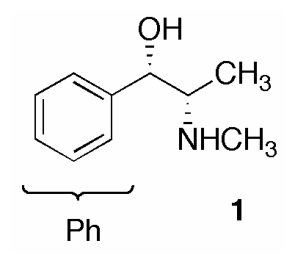
7.2 Mark the stereocenters in 1 with an asterisk * on the answer sheet.
Order the substituents on each stereocenter in 1 according to their priority and determine their absolute configuration (\(R\) or \(S\)).
7.3 Draw a Newman or a sawhorse representation of 1.
Draw a Fischer representation of 1.
Treatment of 1 with acidic permanganate solutions under mild conditions yields the stimulant Methcathinone 2:
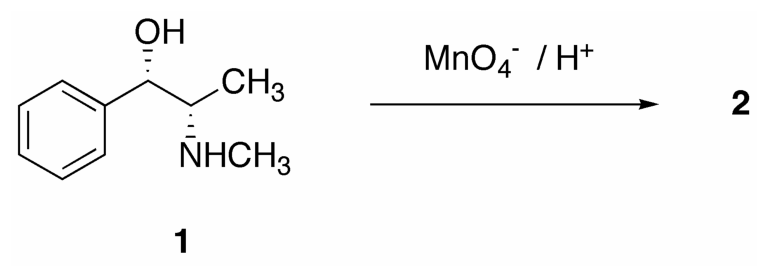
7.4 Draw the stereochemically correct structure of compound 2 and a balanced redox equation of the reaction. Indicate in your equation the particular oxidation number on all atoms which undergo a change in their formal oxidation numbers.
The treatment of 2 with \(\ce{LiAlH4}\) results exclusively in compound 3, which differs from 1 in its melting point.
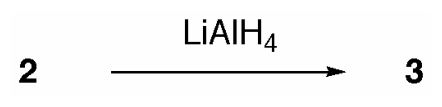
7.5
a) Draw the stereochemically correct structure of 3.
b) Decide the statements on the answer sheet concerning isomers.
c) Draw a structural model to rationalize the exclusive formation of 3 from 2.
Official English text of the problem.
Answers
Throughout, \(C_1\) is the carbon attached directly to phenyl and bearing the alcohol or carbonyl group; \(C_2\) is the adjacent carbon bearing methylamino.
-
7.1: The answer-sheet group list is missing, so its exact ordering cannot be recovered. For the substituent types visible in this problem, decreasing CIP priority is \[ \ce{-OH} > \ce{-NHCH3} > \ce{-CH(OH)Ph} > \ce{-CH(NHCH3)CH3} > \ce{-Ph} > \ce{-CH3} > \ce{-H}. \]
-
7.2: Mark \(C_1\) and \(C_2\). Both are \(S\).
- At \(C_1\): \(\ce{OH}>\ce{CH(NHCH3)CH3}>\ce{Ph}>\ce{H}\).
- At \(C_2\): \(\ce{NHCH3}>\ce{CH(OH)Ph}>\ce{CH3}>\ce{H}\).
Compound 1 is (1S,2S)-pseudoephedrine, or (1S,2S)-2-(methylamino)-1-phenylpropan-1-ol, CN[C@@H](C)[C@@H](O)c1ccccc1.
-
7.3: One valid staggered Newman projection, looking from \(C_1\) toward \(C_2\), has front groups phenyl at 12 o’clock, hydroxyl at 4 o’clock and hydrogen at 8 o’clock; rear groups methylamino at 2 o’clock, methyl at 6 o’clock and hydrogen at 10 o’clock. For a Fischer projection with phenyl at the top and methyl at the bottom, put hydroxyl on the right at \(C_1\) and methylamino on the left at \(C_2\).
-
7.4: Compound 2 is (2S)-methcathinone, or (2S)-2-(methylamino)-1-phenylpropan-1-one,
CN[C@@H](C)C(=O)c1ccccc1. The balanced redox equation is \[ 5\,\mathbf{1}+2\,\ce{MnO4^-}+6\,\ce{H+} \ce{->} 5\,\mathbf{2}+2\,\ce{Mn^{2+}}+8\,\ce{H2O}. \] The changing oxidation numbers are \(C_1:0\rightarrow+\mathrm{II}\) and manganese \(+\mathrm{VII}\rightarrow+\mathrm{II}\). -
7.5(a): Compound 3 is (1R,2S)-ephedrine, or (1R,2S)-2-(methylamino)-1-phenylpropan-1-ol,
CN[C@@H](C)[C@H](O)c1ccccc1. In the original drawing, reverse only the hydroxyl-bearing stereocenter. -
7.5(b): 1 and 3 are diastereomers, specifically \(C_1\) epimers. The alcohol connectivity admits four configurational stereoisomers, comprising two enantiomeric pairs; none is meso.
-
7.5(c): An oxygen–nitrogen chelate to aluminium constrains the ketone conformation. Hydride approaches the carbonyl from the face opposite the \(C_2\) methyl group—the Si face in the model described below—giving \(C_1=R\) while retaining \(C_2=S\).
Solution
7.1 — CIP priorities
CIP comparison proceeds as follows:
- Compare the atomic numbers of the atoms directly attached to the stereocenter. Higher atomic number gives higher priority.
- For isotopes of the same element, higher mass number gives higher priority.
- If the directly attached atoms tie, compare their outward attached atoms, arranged in decreasing atomic number, until the first difference.
- Treat multiple bonds using duplicate atoms for the purpose of comparison.
The missing answer-sheet list prevents a specific answer for its unknown groups. However, all the substituent types needed for the supplied structures can be ranked:
| Decreasing priority | Group | Fragment SMILES | First relevant comparison |
|---|---|---|---|
| 1 | Hydroxyl | [*]O |
Directly attached oxygen |
| 2 | Methylamino | [*]NC |
Directly attached nitrogen |
| 3 | Hydroxy(phenyl)methyl | [*]C(O)c1ccccc1 |
Carbon followed by \((\ce{O},\ce{C},\ce{H})\) |
| 4 | 1-(Methylamino)ethyl | [*]C(NC)C |
Carbon followed by \((\ce{N},\ce{C},\ce{H})\) |
| 5 | Phenyl | [*]c1ccccc1 |
Carbon followed by \((\ce{C},\ce{C},\ce{C})\) |
| 6 | Methyl | [*]C |
Carbon followed by \((\ce{H},\ce{H},\ce{H})\) |
| 7 | Hydrogen | [*][H] |
Directly attached hydrogen |
Here [*] denotes the attachment point in a fragment SMILES. The phenyl comparison includes the duplicate carbon arising from its aromatic bonding.
7.2 — Stereocenters and absolute configurations
The side chain is
\[ \ce{Ph-CH(OH)-CH(NHCH3)-CH3}. \]
Both methine carbons have four different substituents, so place an asterisk on each. The secondary amine nitrogen undergoes rapid pyramidal inversion and is not counted as an additional configurationally stable stereocenter.
At \(C_1\), oxygen has highest priority and hydrogen lowest. The two carbon substituents are distinguished by
\[ \begin{aligned} \ce{CH(NHCH3)CH3}&:\quad(\ce{N},\ce{C},\ce{H}),\\ \ce{Ph}&:\quad(\ce{C},\ce{C},\ce{C}). \end{aligned} \]
Because nitrogen outranks carbon,
\[ \boxed{\ce{OH}>\ce{CH(NHCH3)CH3}>\ce{Ph}>\ce{H}}. \]
At \(C_2\), nitrogen has highest priority. The remaining carbon groups give
\[ \begin{aligned} \ce{CH(OH)Ph}&:\quad(\ce{O},\ce{C},\ce{H}),\\ \ce{CH3}&:\quad(\ce{H},\ce{H},\ce{H}), \end{aligned} \]
and hence
\[ \boxed{\ce{NHCH3}>\ce{CH(OH)Ph}>\ce{CH3}>\ce{H}}. \]
In the supplied drawing, both the hydroxyl bond and the methylamino bond are hashed wedges pointing away from the viewer. The omitted hydrogen therefore points toward the viewer at each center.
At each center, the visible \(1\rightarrow2\rightarrow3\) sequence is clockwise. Since priority 4 points toward the viewer, reverse that result: both centers are \(S\).
Thus 1 is \(\boxed{(1S,2S)}\).
7.3 — Newman and Fischer representations
For the Newman projection, look along the \(C_1-C_2\) bond from the alcohol-bearing carbon toward the amino-bearing carbon. Draw \(C_1\) as the central point and \(C_2\) as the rear circle.
| Carbon | Substituent | Clock position |
|---|---|---|
| Front, \(C_1\) | Phenyl | 12 |
| Front, \(C_1\) | Hydroxyl | 4 |
| Front, \(C_1\) | Hydrogen | 8 |
| Rear, \(C_2\) | Methylamino | 2 |
| Rear, \(C_2\) | Methyl | 6 |
| Rear, \(C_2\) | Hydrogen | 10 |
This is a staggered conformer with phenyl and methyl anti. Its two configurations are \(S,S\). The clock positions specify conformation, which the ordinary stereochemical SMILES does not encode.
For the Fischer projection, draw the vertical chain in the order
\[ \ce{Ph}-C_1-C_2-\ce{CH3}, \]
with phenyl at the top and methyl at the bottom. Place the horizontal substituents as follows:
| Center | Left | Right |
|---|---|---|
| \(C_1\) | \(\ce{H}\) | \(\ce{OH}\) |
| \(C_2\) | \(\ce{NHCH3}\) | \(\ce{H}\) |
Horizontal bonds point toward the viewer; vertical bonds point away. This gives the required \(S,S\) configuration.
7.4 — Oxidation product and redox balance
Oxidation converts the secondary alcohol into a ketone:
\[ \ce{Ph-CH(OH)-CH(NHCH3)-CH3 -> Ph-C(=O)-CH(NHCH3)-CH3}. \]
The carbonyl carbon is trigonal planar, so \(C_1\) ceases to be a stereocenter. No bond at \(C_2\) is broken, and its spatial configuration is retained.
Its CIP priorities also retain their order:
\[ \ce{NHCH3}>\ce{C(=O)Ph}>\ce{CH3}>\ce{H}, \]
because the carbonyl substituent presents \((\ce{O},\ce{O},\ce{C})\), whereas methyl presents \((\ce{H},\ce{H},\ce{H})\). Thus 2 is the \(2S\) ketone.
To draw 2, replace the alcohol-bearing carbon in the original skeleton with a carbonyl group. Keep the methylamino bond at \(C_2\) hashed away from the viewer, with its hydrogen toward the viewer.
For the changing oxidation numbers:
- At the alcohol carbon, one \(\ce{C-O}\) bond contributes \(+1\), one \(\ce{C-H}\) bond contributes \(-1\), and the carbon–carbon bonds contribute zero. Therefore \(C_1\) initially has oxidation number \(0\).
- In the ketone, the \(\ce{C=O}\) bond contributes \(+2\), so \(C_1\) becomes \(+\mathrm{II}\).
- Manganese changes from \(+\mathrm{VII}\) in permanganate to \(+\mathrm{II}\).
The half-equations are
\[ \ce{Ph-CH(OH)-CH(NHCH3)-CH3 -> Ph-C(=O)-CH(NHCH3)-CH3 + 2 H+ + 2 e-} \]
and
\[ \ce{MnO4^- + 8 H+ + 5 e- -> Mn^{2+} + 4 H2O}. \]
Multiplying the first by 5 and the second by 2 gives the balanced equation, with every changing oxidation number identified:
\[ \begin{aligned} &5\,\underbrace{\ce{Ph-CH(OH)-CH(NHCH3)-CH3}}_{\mathbf{1};\ C_1:\,0} +2\,\underbrace{\ce{MnO4^-}}_{\mathrm{Mn}:\,+\mathrm{VII}} +6\,\ce{H+}\\ &\qquad\ce{->} 5\,\underbrace{\ce{Ph-C(=O)-CH(NHCH3)-CH3}}_{\mathbf{2};\ C_1:\,+\mathrm{II}} +2\,\underbrace{\ce{Mn^{2+}}}_{\mathrm{Mn}:\,+\mathrm{II}} +8\,\ce{H2O}. \end{aligned} \]
Five alcohol molecules lose ten electrons, and two permanganate ions gain ten electrons. Both sides have net charge \(+4\).
The inorganic species are permanganate, [O-][Mn](=O)(=O)=O; hydrogen ion, [H+]; manganese(II) ion, [Mn+2]; and water, O.
The equation uses the neutral organic structures shown in the problem. In the acidic medium, their amines are protonated: protonated (1S,2S)-pseudoephedrine, C[NH2+][C@@H](C)[C@@H](O)c1ccccc1, and protonated (2S)-methcathinone, C[NH2+][C@@H](C)C(=O)c1ccccc1. Using these forms on both sides leaves the redox coefficients unchanged.
7.5(a) — Identification of compound 3
Reduction restores the alcohol group and creates a new stereocenter at \(C_1\). The existing \(C_2=S\) center remains unchanged. The two possible alcohol configurations are therefore
\[ (1S,2S)\quad\text{and}\quad(1R,2S). \]
The first is the starting compound 1. Since the problem specifies a different compound with a different melting point, the product is
\[ \boxed{\mathbf{3}=(1R,2S)\text{-ephedrine}}. \]
For the requested drawing, retain the original carbon skeleton and the hashed methylamino bond. Change the hydroxyl bond from a hashed wedge to a solid wedge toward the viewer; its hydrogen now points away.
Equivalently, in a Fischer projection with phenyl at the top and methyl at the bottom:
| Center | Left | Right |
|---|---|---|
| \(C_1\) | \(\ce{OH}\) | \(\ce{H}\) |
| \(C_2\) | \(\ce{NHCH3}\) | \(\ce{H}\) |
7.5(b) — Isomer relationships
Compounds 1 and 3 have identical connectivity and differ at exactly one of their two stereocenters. Therefore they are diastereomers, specifically epimers at \(C_1\).
The complete configurational stereoisomer set is:
| Configuration | Name | SMILES |
|---|---|---|
| \((1S,2S)\) | (1S,2S)-Pseudoephedrine, 1 | CN[C@@H](C)[C@@H](O)c1ccccc1 |
| \((1R,2R)\) | (1R,2R)-Pseudoephedrine | CN[C@H](C)[C@H](O)c1ccccc1 |
| \((1R,2S)\) | (1R,2S)-Ephedrine, 3 | CN[C@@H](C)[C@H](O)c1ccccc1 |
| \((1S,2R)\) | (1S,2R)-Ephedrine | CN[C@H](C)[C@@H](O)c1ccccc1 |
The enantiomeric pairs are
\[ (1S,2S)\leftrightarrow(1R,2R), \qquad (1R,2S)\leftrightarrow(1S,2R). \]
There is no internal symmetry allowing a meso form, so all four are chiral. Pure enantiomers have the same melting point under the same achiral conditions; diastereomers can have different melting points. The sign of optical rotation cannot be inferred simply from an \(R\) or \(S\) descriptor.
Compound 2 has one stereocenter and therefore two enantiomers. Its mirror image is (2R)-methcathinone, CN[C@H](C)C(=O)c1ccccc1. It is not an isomer of either alcohol: its formula is \(\ce{C10H13NO}\), whereas 1 and 3 have formula \(\ce{C10H15NO}\).
7.5(c) — Structural model for stereoselective reduction
The reagent is lithium aluminium hydride, [Li+].[AlH4-]. A suitable model is chelation-controlled reduction: the carbonyl oxygen and amino nitrogen bind a common aluminium center, forming a five-membered ring containing aluminium, oxygen, \(C_1\), \(C_2\), and nitrogen.
Describe the model drawing as follows:
- Draw the five-membered chelate approximately in the page, with aluminium at the top, oxygen upper left, nitrogen upper right, \(C_1\) lower left, and \(C_2\) lower right. Retain the carbonyl double bond between \(C_1\) and oxygen.
- Draw phenyl outward from \(C_1\), toward the lower left in the plane.
- At \(C_2\), draw methyl on a solid wedge toward the viewer and hydrogen on a hashed wedge away. This arrangement gives \(C_2=S\).
- Draw hydride attack at \(C_1\) from behind the page, opposite the protruding methyl group.
Viewed from the front, the carbonyl substituent priorities are oxygen first, \(C_2\) second, and phenyl third. Their clockwise order identifies the front as the Re face. The rear is consequently the Si face, which is less hindered by the \(C_2\) methyl group.
Transfer of hydride, [H-], to this Si face moves the carbonyl \(\pi\)-electron pair onto oxygen. Protonation during work-up gives the alcohol. The newly introduced hydrogen points away in this drawing, and the remaining priorities run clockwise, so the new center is \(C_1=R\).
The product is therefore \((1R,2S)\)-3. The chelate geometry, attack direction, and electron movements are specified by this model; ordinary SMILES encode the product’s configuration but do not encode those mechanistic details.
The solution was checked against the official solution.
IChO 2004 · Theorieaufgabe 7
Stereochemie in Arzneimitteln
Die Cahn-Ingold-Prelog-Regeln werden verwendet, um die Stereochemie von Molekülen anzugeben.
7.1 Ordnen Sie die Gruppen auf dem Antwortbogen nach ihrer Priorität im Cahn-Ingold-Prelog-System (CIP-System).
Pseudoephedrin (1) ist ein Bestandteil vieler gängiger Erkältungsmittel, z. B. von Nasensprays.
7.2 Kennzeichnen Sie auf dem Antwortbogen die Stereozentren in 1 mit einem Sternchen *.
Ordnen Sie die Substituenten an jedem Stereozentrum in 1 nach ihrer Priorität und bestimmen Sie die jeweilige absolute Konfiguration (\(R\) oder \(S\)).
7.3 Zeichnen Sie eine Newman- oder Sägebockdarstellung von 1.
Zeichnen Sie eine Fischer-Darstellung von 1.
Die Behandlung von 1 mit sauren Permanganatlösungen unter milden Bedingungen liefert das Stimulans Methcathinon 2:
7.4 Zeichnen Sie die stereochemisch korrekte Struktur der Verbindung 2 und geben Sie eine ausgeglichene Redoxgleichung für die Reaktion an. Geben Sie in Ihrer Gleichung die jeweilige Oxidationszahl an allen Atomen an, deren formale Oxidationszahl sich ändert.
Die Behandlung von 2 mit \(\ce{LiAlH4}\) ergibt ausschließlich Verbindung 3, die sich in ihrem Schmelzpunkt von 1 unterscheidet.
7.5
a) Zeichnen Sie die stereochemisch korrekte Struktur von 3.
b) Beurteilen Sie die Aussagen zu Isomeren auf dem Antwortbogen.
c) Zeichnen Sie ein Strukturmodell, das die ausschließliche Bildung von 3 aus 2 erklärt.
Aufgabentext aus dem offiziellen englischen Text übersetzt.
Antworten
Im gesamten Text bezeichnet \(C_1\) das direkt an Phenyl gebundene Kohlenstoffatom, das die Alkohol- oder Carbonylgruppe trägt; \(C_2\) bezeichnet das benachbarte Kohlenstoffatom, das die Methylaminogruppe trägt.
-
7.1: Die Gruppenliste auf dem Antwortbogen fehlt, sodass ihre genaue Reihenfolge nicht rekonstruiert werden kann. Für die in dieser Aufgabe sichtbaren Substituententypen gilt folgende abnehmende CIP-Priorität: \[ \ce{-OH} > \ce{-NHCH3} > \ce{-CH(OH)Ph} > \ce{-CH(NHCH3)CH3} > \ce{-Ph} > \ce{-CH3} > \ce{-H}. \]
-
7.2: Markieren Sie \(C_1\) und \(C_2\). Beide sind \(S\).
- An \(C_1\): \(\ce{OH}>\ce{CH(NHCH3)CH3}>\ce{Ph}>\ce{H}\).
- An \(C_2\): \(\ce{NHCH3}>\ce{CH(OH)Ph}>\ce{CH3}>\ce{H}\).
Verbindung 1 ist (1S,2S)-Pseudoephedrin, auch (1S,2S)-2-(Methylamino)-1-phenylpropan-1-ol, CN[C@@H](C)[C@@H](O)c1ccccc1.
-
7.3: Eine mögliche gestaffelte Newman-Projektion mit Blick von \(C_1\) auf \(C_2\) zeigt vorne Phenyl auf 12 Uhr, Hydroxyl auf 4 Uhr und Wasserstoff auf 8 Uhr; hinten stehen Methylamino auf 2 Uhr, Methyl auf 6 Uhr und Wasserstoff auf 10 Uhr. Für eine Fischer-Projektion mit Phenyl oben und Methyl unten wird Hydroxyl an \(C_1\) rechts und Methylamino an \(C_2\) links angeordnet.
-
7.4: Verbindung 2 ist (2S)-Methcathinon, auch (2S)-2-(Methylamino)-1-phenylpropan-1-on,
CN[C@@H](C)C(=O)c1ccccc1. Die ausgeglichene Redoxgleichung lautet \[ 5\,\mathbf{1}+2\,\ce{MnO4^-}+6\,\ce{H+} \ce{->} 5\,\mathbf{2}+2\,\ce{Mn^{2+}}+8\,\ce{H2O}. \] Die Änderungen der Oxidationszahlen sind \(C_1:0\rightarrow+\mathrm{II}\) und für Mangan \(+\mathrm{VII}\rightarrow+\mathrm{II}\). -
7.5(a): Verbindung 3 ist (1R,2S)-Ephedrin, auch (1R,2S)-2-(Methylamino)-1-phenylpropan-1-ol,
CN[C@@H](C)[C@H](O)c1ccccc1. Kehren Sie in der ursprünglichen Zeichnung nur die Konfiguration des Stereozentrums um, das die Hydroxylgruppe trägt. -
7.5(b): 1 und 3 sind Diastereomere, genauer \(C_1\)-Epimere. Die Konnektivität des Alkohols lässt vier Konfigurationsstereoisomere zu, die zwei Enantiomerenpaare bilden; keines ist eine meso-Form.
-
7.5(c): Ein Sauerstoff–Stickstoff-Chelat mit Aluminium schränkt die Konformation des Ketons ein. Hydrid nähert sich der Carbonylgruppe von der Seite, die der Methylgruppe an \(C_2\) gegenüberliegt — im unten beschriebenen Modell der Si-Seite —, wodurch \(C_1=R\) entsteht, während \(C_2=S\) erhalten bleibt.
Lösung
7.1 — CIP-Prioritäten
Der CIP-Vergleich erfolgt wie folgt:
- Vergleichen Sie die Ordnungszahlen der direkt an das Stereozentrum gebundenen Atome. Eine höhere Ordnungszahl bedeutet eine höhere Priorität.
- Bei Isotopen desselben Elements bedeutet eine höhere Massenzahl eine höhere Priorität.
- Sind die direkt gebundenen Atome gleichrangig, vergleichen Sie die nach außen an sie gebundenen Atome, geordnet nach abnehmender Ordnungszahl, bis zum ersten Unterschied.
- Behandeln Sie Mehrfachbindungen für den Vergleich mithilfe von Duplikatatomen.
Die fehlende Liste auf dem Antwortbogen verhindert eine konkrete Antwort für die dort aufgeführten unbekannten Gruppen. Alle für die vorgegebenen Strukturen benötigten Substituententypen lassen sich jedoch ordnen:
| Abnehmende Priorität | Gruppe | Fragment-SMILES | Erster relevanter Vergleich |
|---|---|---|---|
| 1 | Hydroxyl | [*]O |
Direkt gebundener Sauerstoff |
| 2 | Methylamino | [*]NC |
Direkt gebundener Stickstoff |
| 3 | Hydroxy(phenyl)methyl | [*]C(O)c1ccccc1 |
Kohlenstoff, gefolgt von \((\ce{O},\ce{C},\ce{H})\) |
| 4 | 1-(Methylamino)ethyl | [*]C(NC)C |
Kohlenstoff, gefolgt von \((\ce{N},\ce{C},\ce{H})\) |
| 5 | Phenyl | [*]c1ccccc1 |
Kohlenstoff, gefolgt von \((\ce{C},\ce{C},\ce{C})\) |
| 6 | Methyl | [*]C |
Kohlenstoff, gefolgt von \((\ce{H},\ce{H},\ce{H})\) |
| 7 | Wasserstoff | [*][H] |
Direkt gebundener Wasserstoff |
Dabei bezeichnet [*] die Verknüpfungsstelle in einem Fragment-SMILES. Beim Vergleich der Phenylgruppe wird das aus ihrer aromatischen Bindung resultierende Kohlenstoff-Duplikatatom berücksichtigt.
7.2 — Stereozentren und absolute Konfigurationen
Die Seitenkette lautet
\[ \ce{Ph-CH(OH)-CH(NHCH3)-CH3}. \]
Beide Methin-Kohlenstoffatome besitzen vier verschiedene Substituenten, daher wird jedes mit einem Sternchen gekennzeichnet. Das Stickstoffatom des sekundären Amins unterliegt einer schnellen pyramidalen Inversion und wird nicht als zusätzliches konfigurationsstabiles Stereozentrum gezählt.
An \(C_1\) hat Sauerstoff die höchste und Wasserstoff die niedrigste Priorität. Die beiden Kohlenstoffsubstituenten werden anhand folgender Vergleiche unterschieden:
\[ \begin{aligned} \ce{CH(NHCH3)CH3}&:\quad(\ce{N},\ce{C},\ce{H}),\\ \ce{Ph}&:\quad(\ce{C},\ce{C},\ce{C}). \end{aligned} \]
Da Stickstoff eine höhere Priorität als Kohlenstoff hat, gilt
\[ \boxed{\ce{OH}>\ce{CH(NHCH3)CH3}>\ce{Ph}>\ce{H}}. \]
An \(C_2\) hat Stickstoff die höchste Priorität. Die übrigen Kohlenstoffgruppen ergeben
\[ \begin{aligned} \ce{CH(OH)Ph}&:\quad(\ce{O},\ce{C},\ce{H}),\\ \ce{CH3}&:\quad(\ce{H},\ce{H},\ce{H}), \end{aligned} \]
und somit
\[ \boxed{\ce{NHCH3}>\ce{CH(OH)Ph}>\ce{CH3}>\ce{H}}. \]
In der vorgegebenen Zeichnung sind sowohl die Bindung zur Hydroxylgruppe als auch die Bindung zur Methylaminogruppe als gestrichelte Keile dargestellt, die vom Betrachter wegweisen. Der nicht eingezeichnete Wasserstoff zeigt daher an jedem Zentrum zum Betrachter hin.
An jedem Zentrum verläuft die sichtbare Abfolge \(1\rightarrow2\rightarrow3\) im Uhrzeigersinn. Da die Gruppe mit Priorität 4 zum Betrachter hinzeigt, wird dieses Ergebnis umgekehrt: Beide Zentren sind \(S\).
Damit ist 1 \(\boxed{(1S,2S)}\).
7.3 — Newman- und Fischer-Darstellungen
Für die Newman-Projektion blickt man entlang der \(C_1-C_2\)-Bindung vom Kohlenstoffatom mit der Alkoholgruppe zum Kohlenstoffatom mit der Aminogruppe. Zeichnen Sie \(C_1\) als zentralen Punkt und \(C_2\) als dahinterliegenden Kreis.
| Kohlenstoffatom | Substituent | Uhrposition |
|---|---|---|
| Vorne, \(C_1\) | Phenyl | 12 |
| Vorne, \(C_1\) | Hydroxyl | 4 |
| Vorne, \(C_1\) | Wasserstoff | 8 |
| Hinten, \(C_2\) | Methylamino | 2 |
| Hinten, \(C_2\) | Methyl | 6 |
| Hinten, \(C_2\) | Wasserstoff | 10 |
Dies ist ein gestaffeltes Konformer, in dem Phenyl und Methyl anti zueinander stehen. Seine beiden Konfigurationen sind \(S,S\). Die Uhrpositionen legen die Konformation fest, die im gewöhnlichen stereochemischen SMILES nicht codiert wird.
Für die Fischer-Projektion zeichnen Sie die vertikale Kette in der Reihenfolge
\[ \ce{Ph}-C_1-C_2-\ce{CH3}, \]
mit Phenyl oben und Methyl unten. Ordnen Sie die horizontalen Substituenten wie folgt an:
| Zentrum | Links | Rechts |
|---|---|---|
| \(C_1\) | \(\ce{H}\) | \(\ce{OH}\) |
| \(C_2\) | \(\ce{NHCH3}\) | \(\ce{H}\) |
Horizontale Bindungen zeigen zum Betrachter hin; vertikale Bindungen zeigen von ihm weg. Dies ergibt die geforderte \(S,S\)-Konfiguration.
7.4 — Oxidationsprodukt und Redoxbilanz
Durch die Oxidation wird der sekundäre Alkohol in ein Keton umgewandelt:
\[ \ce{Ph-CH(OH)-CH(NHCH3)-CH3 -> Ph-C(=O)-CH(NHCH3)-CH3}. \]
Das Carbonyl-Kohlenstoffatom ist trigonal-planar, sodass \(C_1\) kein Stereozentrum mehr ist. An \(C_2\) wird keine Bindung gespalten, und seine räumliche Konfiguration bleibt erhalten.
Auch die Reihenfolge seiner CIP-Prioritäten bleibt erhalten:
\[ \ce{NHCH3}>\ce{C(=O)Ph}>\ce{CH3}>\ce{H}, \]
denn der Carbonylsubstituent liefert \((\ce{O},\ce{O},\ce{C})\), während Methyl \((\ce{H},\ce{H},\ce{H})\) liefert. Somit ist 2 das \(2S\)-Keton.
Um 2 zu zeichnen, ersetzen Sie das Kohlenstoffatom mit der Alkoholgruppe im ursprünglichen Gerüst durch eine Carbonylgruppe. Behalten Sie die Bindung zur Methylaminogruppe an \(C_2\) als gestrichelten, vom Betrachter wegweisenden Keil bei, während der zugehörige Wasserstoff zum Betrachter hinzeigt.
Für die sich ändernden Oxidationszahlen gilt:
- Am Alkohol-Kohlenstoffatom trägt eine \(\ce{C-O}\)-Bindung \(+1\) bei, eine \(\ce{C-H}\)-Bindung \(-1\), und die Kohlenstoff–Kohlenstoff-Bindungen tragen null bei. Daher hat \(C_1\) anfangs die Oxidationszahl \(0\).
- Im Keton trägt die \(\ce{C=O}\)-Bindung \(+2\) bei, sodass \(C_1\) die Oxidationszahl \(+\mathrm{II}\) erhält.
- Die Oxidationszahl von Mangan ändert sich von \(+\mathrm{VII}\) im Permanganat zu \(+\mathrm{II}\).
Die Teilgleichungen lauten
\[ \ce{Ph-CH(OH)-CH(NHCH3)-CH3 -> Ph-C(=O)-CH(NHCH3)-CH3 + 2 H+ + 2 e-} \]
und
\[ \ce{MnO4^- + 8 H+ + 5 e- -> Mn^{2+} + 4 H2O}. \]
Durch Multiplikation der ersten Gleichung mit 5 und der zweiten mit 2 ergibt sich die ausgeglichene Gleichung, in der jede sich ändernde Oxidationszahl angegeben ist:
\[ \begin{aligned} &5\,\underbrace{\ce{Ph-CH(OH)-CH(NHCH3)-CH3}}_{\mathbf{1};\ C_1:\,0} +2\,\underbrace{\ce{MnO4^-}}_{\mathrm{Mn}:\,+\mathrm{VII}} +6\,\ce{H+}\\ &\qquad\ce{->} 5\,\underbrace{\ce{Ph-C(=O)-CH(NHCH3)-CH3}}_{\mathbf{2};\ C_1:\,+\mathrm{II}} +2\,\underbrace{\ce{Mn^{2+}}}_{\mathrm{Mn}:\,+\mathrm{II}} +8\,\ce{H2O}. \end{aligned} \]
Fünf Alkoholmoleküle geben zehn Elektronen ab, und zwei Permanganationen nehmen zehn Elektronen auf. Beide Seiten haben die Nettoladung \(+4\).
Die anorganischen Spezies sind Permanganat, [O-][Mn](=O)(=O)=O; Wasserstoffion, [H+]; Mangan(II)-Ion, [Mn+2]; und Wasser, O.
Die Gleichung verwendet die in der Aufgabe gezeigten neutralen organischen Strukturen. Im sauren Medium sind ihre Aminogruppen protoniert: protoniertes (1S,2S)-Pseudoephedrin, C[NH2+][C@@H](C)[C@@H](O)c1ccccc1, und protoniertes (2S)-Methcathinon, C[NH2+][C@@H](C)C(=O)c1ccccc1. Werden diese Formen auf beiden Seiten verwendet, bleiben die Redoxkoeffizienten unverändert.
7.5(a) — Identifizierung von Verbindung 3
Die Reduktion stellt die Alkoholgruppe wieder her und erzeugt ein neues Stereozentrum an \(C_1\). Das vorhandene Zentrum \(C_2=S\) bleibt unverändert. Die beiden möglichen Konfigurationen des Alkohols sind daher
\[ (1S,2S)\quad\text{und}\quad(1R,2S). \]
Die erste ist die Ausgangsverbindung 1. Da die Aufgabe eine andere Verbindung mit einem anderen Schmelzpunkt vorgibt, ist das Produkt
\[ \boxed{\mathbf{3}=(1R,2S)\text{-Ephedrin}}. \]
Behalten Sie für die geforderte Zeichnung das ursprüngliche Kohlenstoffgerüst und die gestrichelte Bindung zur Methylaminogruppe bei. Ändern Sie die Bindung zur Hydroxylgruppe von einem gestrichelten Keil zu einem ausgefüllten, zum Betrachter hinweisenden Keil; der zugehörige Wasserstoff zeigt nun vom Betrachter weg.
Gleichwertig ergibt sich in einer Fischer-Projektion mit Phenyl oben und Methyl unten:
| Zentrum | Links | Rechts |
|---|---|---|
| \(C_1\) | \(\ce{OH}\) | \(\ce{H}\) |
| \(C_2\) | \(\ce{NHCH3}\) | \(\ce{H}\) |
7.5(b) — Isomeriebeziehungen
Die Verbindungen 1 und 3 besitzen die gleiche Konnektivität und unterscheiden sich an genau einem ihrer beiden Stereozentren. Daher sind sie Diastereomere, genauer Epimere an \(C_1\).
Die vollständige Gruppe der Konfigurationsstereoisomere ist:
| Konfiguration | Name | SMILES |
|---|---|---|
| \((1S,2S)\) | (1S,2S)-Pseudoephedrin, 1 | CN[C@@H](C)[C@@H](O)c1ccccc1 |
| \((1R,2R)\) | (1R,2R)-Pseudoephedrin | CN[C@H](C)[C@H](O)c1ccccc1 |
| \((1R,2S)\) | (1R,2S)-Ephedrin, 3 | CN[C@@H](C)[C@H](O)c1ccccc1 |
| \((1S,2R)\) | (1S,2R)-Ephedrin | CN[C@H](C)[C@@H](O)c1ccccc1 |
Die Enantiomerenpaare sind
\[ (1S,2S)\leftrightarrow(1R,2R), \qquad (1R,2S)\leftrightarrow(1S,2R). \]
Es gibt keine innere Symmetrie, die eine meso-Form ermöglichen würde, daher sind alle vier chiral. Reine Enantiomere haben unter denselben achiralen Bedingungen denselben Schmelzpunkt; Diastereomere können unterschiedliche Schmelzpunkte haben. Das Vorzeichen der optischen Drehung lässt sich nicht allein aus einem \(R\)- oder \(S\)-Deskriptor ableiten.
Verbindung 2 besitzt ein Stereozentrum und daher zwei Enantiomere. Ihr Spiegelbild ist (2R)-Methcathinon, CN[C@H](C)C(=O)c1ccccc1. Sie ist kein Isomer eines der beiden Alkohole: Ihre Summenformel lautet \(\ce{C10H13NO}\), während 1 und 3 die Summenformel \(\ce{C10H15NO}\) haben.
7.5(c) — Strukturmodell für die stereoselektive Reduktion
Das Reagenz ist Lithiumaluminiumhydrid, [Li+].[AlH4-]. Ein geeignetes Modell ist die chelatkontrollierte Reduktion: Der Carbonylsauerstoff und der Aminostickstoff binden an dasselbe Aluminiumzentrum und bilden einen fünfgliedrigen Ring aus Aluminium, Sauerstoff, \(C_1\), \(C_2\) und Stickstoff.
Die Modellzeichnung lässt sich wie folgt beschreiben:
- Zeichnen Sie den fünfgliedrigen Chelatring ungefähr in der Zeichenebene, mit Aluminium oben, Sauerstoff oben links, Stickstoff oben rechts, \(C_1\) unten links und \(C_2\) unten rechts. Behalten Sie die Carbonyl-Doppelbindung zwischen \(C_1\) und Sauerstoff bei.
- Zeichnen Sie Phenyl von \(C_1\) nach außen, in der Ebene nach links unten gerichtet.
- Zeichnen Sie an \(C_2\) Methyl an einem ausgefüllten Keil zum Betrachter hin und Wasserstoff an einem gestrichelten Keil vom Betrachter weg. Diese Anordnung ergibt \(C_2=S\).
- Zeichnen Sie den Hydridangriff an \(C_1\) von hinter der Zeichenebene, gegenüber der hervorstehenden Methylgruppe.
Von vorne betrachtet haben die Carbonylsubstituenten folgende Prioritäten: Sauerstoff an erster Stelle, \(C_2\) an zweiter und Phenyl an dritter Stelle. Ihre Reihenfolge im Uhrzeigersinn kennzeichnet die Vorderseite als Re-Seite. Die Rückseite ist folglich die Si-Seite, die durch die Methylgruppe an \(C_2\) weniger abgeschirmt wird.
Bei der Übertragung von Hydrid, [H-], auf diese Si-Seite wird das \(\pi\)-Elektronenpaar der Carbonylgruppe auf den Sauerstoff verschoben. Die Protonierung bei der Aufarbeitung liefert den Alkohol. Der neu eingeführte Wasserstoff zeigt in dieser Zeichnung vom Betrachter weg, und die übrigen Prioritäten verlaufen im Uhrzeigersinn, sodass das neue Zentrum \(C_1=R\) ist.
Das Produkt ist daher \((1R,2S)\)-3. Die Chelatgeometrie, die Angriffsrichtung und die Elektronenverschiebungen werden durch dieses Modell festgelegt; gewöhnliche SMILES codieren die Konfiguration des Produkts, aber nicht diese mechanistischen Einzelheiten.
Die Lösung wurde mit der offiziellen Lösung abgeglichen.
IChO 2004 · Teori sorusu 7
İlaçlarda Stereokimya
Moleküllerin stereokimyasını belirtmek için Cahn-Ingold-Prelog kuralları kullanılır.
7.1 Cevap kâğıdındaki grupları Cahn-Ingold-Prelog (CIP) sistemindeki önceliklerine göre sıralayınız.
Psödoefedrin (1), soğuk algınlığına karşı yaygın olarak kullanılan birçok ilacın, örneğin burun spreylerinin bileşiminde bulunur.
7.2 Cevap kâğıdında 1'deki stereomerkezleri bir yıldız * ile işaretleyiniz.
1'deki her stereomerkez üzerindeki sübstitüentleri önceliklerine göre sıralayınız ve mutlak konfigürasyonlarını (\(R\) veya \(S\)) belirleyiniz.
7.3 1'in Newman veya testere tezgâhı gösterimini çiziniz.
1'in Fischer gösterimini çiziniz.
1'in ılımlı koşullarda asidik permanganat çözeltileriyle tepkimeye sokulması, uyarıcı bir madde olan metkatinon 2'yi verir:
7.4 2 bileşiğinin stereokimyasal olarak doğru yapısını çiziniz ve tepkimenin denkleştirilmiş redoks denklemini yazınız. Denkleminizde, formal yükseltgenme basamakları değişen tüm atomların ilgili yükseltgenme basamaklarını belirtiniz.
2'nin \(\ce{LiAlH4}\) ile tepkimeye sokulması sonucunda yalnızca, erime noktası bakımından 1'den farklı olan 3 bileşiği oluşur.
7.5
a) 3'ün stereokimyasal olarak doğru yapısını çiziniz.
b) Cevap kâğıdındaki izomerlerle ilgili ifadelerin doğruluğuna karar veriniz.
c) 2'den yalnızca 3'ün oluşmasını açıklayan bir yapısal model çiziniz.
Soru metni resmi İngilizce metinden çevrilmiştir.
Cevaplar
Metnin tamamında \(C_1\), fenile doğrudan bağlı olan ve alkol veya karbonil grubunu taşıyan karbonu; \(C_2\) ise metilamino grubunu taşıyan komşu karbonu belirtir.
-
7.1: Cevap kâğıdındaki grup listesi eksik olduğundan, bu listenin kesin sıralaması belirlenemez. Bu soruda görülen sübstitüent türleri için azalan CIP önceliği şöyledir: \[ \ce{-OH} > \ce{-NHCH3} > \ce{-CH(OH)Ph} > \ce{-CH(NHCH3)CH3} > \ce{-Ph} > \ce{-CH3} > \ce{-H}. \]
-
7.2: \(C_1\) ve \(C_2\)'yi işaretleyiniz. Her ikisi de \(S\) konfigürasyonundadır.
- \(C_1\)'de: \(\ce{OH}>\ce{CH(NHCH3)CH3}>\ce{Ph}>\ce{H}\).
- \(C_2\)'de: \(\ce{NHCH3}>\ce{CH(OH)Ph}>\ce{CH3}>\ce{H}\).
1 bileşiği (1S,2S)-psödoefedrin, diğer adıyla (1S,2S)-2-(metilamino)-1-fenilpropan-1-oldür; CN[C@@H](C)[C@@H](O)c1ccccc1.
-
7.3: \(C_1\)'den \(C_2\)'ye doğru bakıldığında, geçerli bir şaşırtmalı Newman izdüşümünde öndeki gruplardan fenil saat 12, hidroksil saat 4 ve hidrojen saat 8 konumundadır; arkadaki gruplardan metilamino saat 2, metil saat 6 ve hidrojen saat 10 konumundadır. Fenilin üstte, metilin altta olduğu bir Fischer izdüşümü için \(C_1\)'de hidroksili sağa, \(C_2\)'de metilaminoyu sola yerleştiriniz.
-
7.4: 2 bileşiği (2S)-metkatinon, diğer adıyla (2S)-2-(metilamino)-1-fenilpropan-1-ondur;
CN[C@@H](C)C(=O)c1ccccc1. Denkleştirilmiş redoks denklemi şöyledir: \[ 5\,\mathbf{1}+2\,\ce{MnO4^-}+6\,\ce{H+} \ce{->} 5\,\mathbf{2}+2\,\ce{Mn^{2+}}+8\,\ce{H2O}. \] Değişen yükseltgenme basamakları \(C_1:0\rightarrow+\mathrm{II}\) ve mangan için \(+\mathrm{VII}\rightarrow+\mathrm{II}\) şeklindedir. -
7.5(a): 3 bileşiği (1R,2S)-efedrin, diğer adıyla (1R,2S)-2-(metilamino)-1-fenilpropan-1-oldür;
CN[C@@H](C)[C@H](O)c1ccccc1. Özgün çizimde yalnızca hidroksil taşıyan stereomerkezin konfigürasyonunu tersine çeviriniz. -
7.5(b): 1 ve 3, diastereomerler, daha özel olarak \(C_1\) epimerleridir. Alkolün atomlarının bağlanma düzeni, iki enantiyomer çiftinden oluşan dört konfigürasyonel stereoizomere olanak verir; hiçbiri mezo değildir.
-
7.5(c): Alüminyumla oluşan bir oksijen–azot şelatı, ketonun konformasyonunu kısıtlar. Hidrür, karbonile \(C_2\) metil grubunun karşı tarafındaki yüzden —aşağıda açıklanan modelde Si yüzünden— yaklaşır; böylece \(C_2=S\) korunurken \(C_1=R\) elde edilir.
Çözüm
7.1 — CIP öncelikleri
CIP karşılaştırması şu şekilde yapılır:
- Stereomerkeze doğrudan bağlı atomların atom numaralarını karşılaştırınız. Daha büyük atom numarası daha yüksek öncelik verir.
- Aynı elementin izotopları için daha büyük kütle numarası daha yüksek öncelik verir.
- Doğrudan bağlı atomlar aynıysa, bunlara dışa doğru bağlı atomları azalan atom numarasına göre sıralayarak ilk fark ortaya çıkana kadar karşılaştırınız.
- Karşılaştırma amacıyla, çoklu bağları atomların kopyalarını kullanarak ele alınız.
Cevap kâğıdındaki listenin eksik olması, bilinmeyen grupları için belirli bir cevap verilmesini engeller. Bununla birlikte, verilen yapılar için gereken tüm sübstitüent türleri sıralanabilir:
| Azalan öncelik | Grup | Parça SMILES gösterimi | İlk belirleyici karşılaştırma |
|---|---|---|---|
| 1 | Hidroksil | [*]O |
Doğrudan bağlı oksijen |
| 2 | Metilamino | [*]NC |
Doğrudan bağlı azot |
| 3 | Hidroksi(fenil)metil | [*]C(O)c1ccccc1 |
Karbonun ardından \((\ce{O},\ce{C},\ce{H})\) |
| 4 | 1-(Metilamino)etil | [*]C(NC)C |
Karbonun ardından \((\ce{N},\ce{C},\ce{H})\) |
| 5 | Fenil | [*]c1ccccc1 |
Karbonun ardından \((\ce{C},\ce{C},\ce{C})\) |
| 6 | Metil | [*]C |
Karbonun ardından \((\ce{H},\ce{H},\ce{H})\) |
| 7 | Hidrojen | [*][H] |
Doğrudan bağlı hidrojen |
Burada [*], bir parça SMILES gösterimindeki bağlanma noktasını belirtir. Fenil karşılaştırması, aromatik bağlanmadan kaynaklanan karbon kopyasını içerir.
7.2 — Stereomerkezler ve mutlak konfigürasyonlar
Yan zincir şöyledir:
\[ \ce{Ph-CH(OH)-CH(NHCH3)-CH3}. \]
Her iki metin karbonunun da dört farklı sübstitüenti vardır; bu nedenle her birine bir yıldız koyunuz. Sekonder amin azotu hızlı piramidal inversiyona uğrar ve konfigürasyonel olarak kararlı ek bir stereomerkez olarak sayılmaz.
\(C_1\)'de oksijen en yüksek, hidrojen ise en düşük önceliğe sahiptir. İki karbon sübstitüenti şu şekilde ayırt edilir:
\[ \begin{aligned} \ce{CH(NHCH3)CH3}&:\quad(\ce{N},\ce{C},\ce{H}),\\ \ce{Ph}&:\quad(\ce{C},\ce{C},\ce{C}). \end{aligned} \]
Azotun önceliği karbonunkinden yüksek olduğundan,
\[ \boxed{\ce{OH}>\ce{CH(NHCH3)CH3}>\ce{Ph}>\ce{H}}. \]
\(C_2\)'de azot en yüksek önceliğe sahiptir. Geriye kalan karbon grupları için
\[ \begin{aligned} \ce{CH(OH)Ph}&:\quad(\ce{O},\ce{C},\ce{H}),\\ \ce{CH3}&:\quad(\ce{H},\ce{H},\ce{H}), \end{aligned} \]
elde edilir ve dolayısıyla
\[ \boxed{\ce{NHCH3}>\ce{CH(OH)Ph}>\ce{CH3}>\ce{H}}. \]
Verilen çizimde hem hidroksil bağı hem de metilamino bağı, gözlemciden uzağa yönelen kesik çizgili kamalarla gösterilmiştir. Dolayısıyla gösterilmeyen hidrojen, her merkezde gözlemciye doğru yönelir.
Her merkezde, görünen \(1\rightarrow2\rightarrow3\) sırası saat yönündedir. Önceliği 4 olan grup gözlemciye doğru yöneldiğinden bu sonucu tersine çeviriniz: her iki merkez de \(S\)'dir.
Dolayısıyla 1, \(\boxed{(1S,2S)}\) konfigürasyonundadır.
7.3 — Newman ve Fischer gösterimleri
Newman izdüşümü için \(C_1-C_2\) bağı boyunca, alkol taşıyan karbondan amino grubu taşıyan karbona doğru bakınız. \(C_1\)'i merkezdeki nokta, \(C_2\)'yi ise arkadaki çember olarak çiziniz.
| Karbon | Sübstitüent | Saat konumu |
|---|---|---|
| Ön, \(C_1\) | Fenil | 12 |
| Ön, \(C_1\) | Hidroksil | 4 |
| Ön, \(C_1\) | Hidrojen | 8 |
| Arka, \(C_2\) | Metilamino | 2 |
| Arka, \(C_2\) | Metil | 6 |
| Arka, \(C_2\) | Hidrojen | 10 |
Bu, fenil ve metilin anti konumda olduğu şaşırtmalı bir konformerdir. İki merkezinin konfigürasyonları \(S,S\)'dir. Saat konumları, sıradan stereokimyasal SMILES gösteriminin kodlamadığı konformasyonu belirtir.
Fischer izdüşümü için düşey zinciri
\[ \ce{Ph}-C_1-C_2-\ce{CH3}, \]
sırasıyla, fenil üstte ve metil altta olacak şekilde çiziniz. Yatay sübstitüentleri şu şekilde yerleştiriniz:
| Merkez | Sol | Sağ |
|---|---|---|
| \(C_1\) | \(\ce{H}\) | \(\ce{OH}\) |
| \(C_2\) | \(\ce{NHCH3}\) | \(\ce{H}\) |
Yatay bağlar gözlemciye doğru, düşey bağlar ise gözlemciden uzağa yönelir. Bu, istenen \(S,S\) konfigürasyonunu verir.
7.4 — Yükseltgenme ürünü ve redoks denkleştirmesi
Yükseltgenme, sekonder alkolü bir ketona dönüştürür:
\[ \ce{Ph-CH(OH)-CH(NHCH3)-CH3 -> Ph-C(=O)-CH(NHCH3)-CH3}. \]
Karbonil karbonu üçgen düzlemsel olduğundan \(C_1\) artık bir stereomerkez değildir. \(C_2\)'de hiçbir bağ kırılmaz ve uzaysal konfigürasyonu korunur.
CIP önceliklerinin sırası da korunur:
\[ \ce{NHCH3}>\ce{C(=O)Ph}>\ce{CH3}>\ce{H}, \]
çünkü karbonil sübstitüenti \((\ce{O},\ce{O},\ce{C})\) dizisini verirken metil \((\ce{H},\ce{H},\ce{H})\) dizisini verir. Dolayısıyla 2, \(2S\) ketonudur.
2'yi çizmek için özgün iskeletteki alkol taşıyan karbonun yerine bir karbonil grubu koyunuz. \(C_2\)'deki metilamino bağını, gözlemciden uzağa yönelen kesik çizgili kama olarak, hidrojenini ise gözlemciye doğru yönelmiş olarak koruyunuz.
Değişen yükseltgenme basamakları için:
- Alkol karbonunda bir \(\ce{C-O}\) bağı \(+1\), bir \(\ce{C-H}\) bağı \(-1\) katkı yapar ve karbon–karbon bağlarının katkısı sıfırdır. Bu nedenle \(C_1\)'in başlangıçtaki yükseltgenme basamağı \(0\)'dır.
- Ketonda \(\ce{C=O}\) bağı \(+2\) katkı yapar; dolayısıyla \(C_1\)'in yükseltgenme basamağı \(+\mathrm{II}\) olur.
- Manganın yükseltgenme basamağı, permanganattaki \(+\mathrm{VII}\)'den \(+\mathrm{II}\)'ye değişir.
Yarı tepkime denklemleri şöyledir:
\[ \ce{Ph-CH(OH)-CH(NHCH3)-CH3 -> Ph-C(=O)-CH(NHCH3)-CH3 + 2 H+ + 2 e-} \]
ve
\[ \ce{MnO4^- + 8 H+ + 5 e- -> Mn^{2+} + 4 H2O}. \]
Birinciyi 5, ikinciyi 2 ile çarpmak, değişen her yükseltgenme basamağının belirtildiği denkleştirilmiş denklemi verir:
\[ \begin{aligned} &5\,\underbrace{\ce{Ph-CH(OH)-CH(NHCH3)-CH3}}_{\mathbf{1};\ C_1:\,0} +2\,\underbrace{\ce{MnO4^-}}_{\mathrm{Mn}:\,+\mathrm{VII}} +6\,\ce{H+}\\ &\qquad\ce{->} 5\,\underbrace{\ce{Ph-C(=O)-CH(NHCH3)-CH3}}_{\mathbf{2};\ C_1:\,+\mathrm{II}} +2\,\underbrace{\ce{Mn^{2+}}}_{\mathrm{Mn}:\,+\mathrm{II}} +8\,\ce{H2O}. \end{aligned} \]
Beş alkol molekülü on elektron verir ve iki permanganat iyonu on elektron alır. Her iki tarafın da net yükü \(+4\)'tür.
İnorganik türler permanganat, [O-][Mn](=O)(=O)=O; hidrojen iyonu, [H+]; mangan(II) iyonu, [Mn+2]; ve su, O'dur.
Denklemde soruda gösterilen nötr organik yapılar kullanılmıştır. Asidik ortamda bunların amin grupları protonlanır: protonlanmış (1S,2S)-psödoefedrin, C[NH2+][C@@H](C)[C@@H](O)c1ccccc1, ve protonlanmış (2S)-metkatinon, C[NH2+][C@@H](C)C(=O)c1ccccc1. Her iki tarafta da bu biçimlerin kullanılması redoks katsayılarını değiştirmez.
7.5(a) — 3 bileşiğinin belirlenmesi
İndirgenme, alkol grubunu yeniden oluşturur ve \(C_1\)'de yeni bir stereomerkez meydana getirir. Mevcut \(C_2=S\) merkezi değişmeden kalır. Dolayısıyla olası iki alkol konfigürasyonu şunlardır:
\[ (1S,2S)\quad\text{ve}\quad(1R,2S). \]
Birincisi başlangıç bileşiği 1'dir. Soruda farklı bir erime noktasına sahip farklı bir bileşik belirtildiğinden ürün şöyledir:
\[ \boxed{\mathbf{3}=(1R,2S)\text{-efedrin}}. \]
İstenen çizim için özgün karbon iskeletini ve kesik çizgili kama ile gösterilen metilamino bağını koruyunuz. Hidroksil bağını kesik çizgili kamadan, gözlemciye doğru yönelen dolu kamaya dönüştürünüz; hidrojeni artık gözlemciden uzağa yönelir.
Eşdeğer olarak, fenilin üstte ve metilin altta olduğu bir Fischer izdüşümünde:
| Merkez | Sol | Sağ |
|---|---|---|
| \(C_1\) | \(\ce{OH}\) | \(\ce{H}\) |
| \(C_2\) | \(\ce{NHCH3}\) | \(\ce{H}\) |
7.5(b) — İzomerlik ilişkileri
1 ve 3 bileşiklerinin atomlarının bağlanma düzeni aynıdır ve iki stereomerkezlerinden yalnızca birinde farklılık gösterirler. Dolayısıyla bunlar diastereomerler, daha özel olarak \(C_1\)'de epimerlerdir.
Konfigürasyonel stereoizomerlerin tam kümesi şöyledir:
| Konfigürasyon | Ad | SMILES |
|---|---|---|
| \((1S,2S)\) | (1S,2S)-Psödoefedrin, 1 | CN[C@@H](C)[C@@H](O)c1ccccc1 |
| \((1R,2R)\) | (1R,2R)-Psödoefedrin | CN[C@H](C)[C@H](O)c1ccccc1 |
| \((1R,2S)\) | (1R,2S)-Efedrin, 3 | CN[C@@H](C)[C@H](O)c1ccccc1 |
| \((1S,2R)\) | (1S,2R)-Efedrin | CN[C@H](C)[C@@H](O)c1ccccc1 |
Enantiyomer çiftleri şöyledir:
\[ (1S,2S)\leftrightarrow(1R,2R), \qquad (1R,2S)\leftrightarrow(1S,2R). \]
Mezo bir biçime olanak veren iç simetri bulunmadığından dördü de kiraldir. Saf enantiyomerler aynı akiral koşullarda aynı erime noktasına sahiptir; diastereomerlerin erime noktaları farklı olabilir. Optik çevirmenin işareti yalnızca \(R\) veya \(S\) tanımlayıcısından çıkarılamaz.
2 bileşiğinin bir stereomerkezi ve dolayısıyla iki enantiyomeri vardır. Ayna görüntüsü (2R)-metkatinondur; CN[C@H](C)C(=O)c1ccccc1. İki alkolden herhangi birinin izomeri değildir: formülü \(\ce{C10H13NO}\) iken 1 ve 3'ün formülü \(\ce{C10H15NO}\)'dur.
7.5(c) — Stereoseçici indirgenme için yapısal model
Reaktif lityum alüminyum hidrürdür; [Li+].[AlH4-]. Uygun bir model, şelatlaşma kontrollü indirgenmedir: karbonil oksijeni ve amino azotu aynı alüminyum merkezine bağlanarak alüminyum, oksijen, \(C_1\), \(C_2\) ve azot içeren beş üyeli bir halka oluşturur.
Model çizimini şu şekilde betimleyiniz:
- Beş üyeli şelatı yaklaşık olarak sayfa düzleminde; alüminyum üstte, oksijen sol üstte, azot sağ üstte, \(C_1\) sol altta ve \(C_2\) sağ altta olacak şekilde çiziniz. \(C_1\) ile oksijen arasındaki karbonil çift bağını koruyunuz.
- Fenili \(C_1\)'den dışarıya, düzlem içinde sol alta doğru çiziniz.
- \(C_2\)'de metili gözlemciye doğru yönelen dolu bir kama, hidrojeni ise gözlemciden uzağa yönelen kesik çizgili bir kama üzerinde çiziniz. Bu düzenleme \(C_2=S\) konfigürasyonunu verir.
- \(C_1\)'e hidrür saldırısını, dışarı doğru uzanan metil grubunun karşı tarafından, sayfanın arkasından olacak şekilde çiziniz.
Önden bakıldığında karbonil sübstitüentlerinin öncelikleri sırasıyla oksijen birinci, \(C_2\) ikinci ve fenil üçüncüdür. Saat yönündeki sıraları, ön yüzün Re yüzü olduğunu gösterir. Dolayısıyla arka yüz, \(C_2\) metil grubunun sterik olarak daha az engellediği Si yüzüdür.
Hidrürün, [H-], bu Si yüzüne aktarılması, karbonilin \(\pi\)-elektron çiftini oksijene taşır. Tepkime sonrası işlemler sırasında protonlanma alkolü verir. Yeni eklenen hidrojen bu çizimde gözlemciden uzağa yönelir ve geriye kalan grupların öncelikleri saat yönünde sıralanır; dolayısıyla yeni merkez \(C_1=R\)'dir.
Bu nedenle ürün \((1R,2S)\)-3'tür. Şelat geometrisi, saldırı yönü ve elektron hareketleri bu modelle belirtilir; sıradan SMILES gösterimleri ürünün konfigürasyonunu kodlar, ancak bu mekanizma ayrıntılarını kodlamaz.
Çözüm, resmi çözümle karşılaştırılarak kontrol edildi.
IChO 2004 · Problema teórico 7
Estereoquímica en los fármacos
Las reglas de Cahn-Ingold-Prelog se utilizan para especificar la estereoquímica de las moléculas.
7.1 Ordene los grupos de la hoja de respuestas según su prioridad en el sistema de Cahn-Ingold-Prelog (CIP).
La pseudoefedrina (1) es un componente de muchos medicamentos comunes contra el resfriado, por ejemplo, de los aerosoles nasales.
7.2 Marque los estereocentros de 1 con un asterisco * en la hoja de respuestas.
Ordene los sustituyentes de cada estereocentro de 1 según su prioridad y determine su configuración absoluta (\(R\) o \(S\)).
7.3 Dibuje una representación de Newman o de caballete de 1.
Dibuje una representación de Fischer de 1.
El tratamiento de 1 con disoluciones ácidas de permanganato en condiciones suaves produce el estimulante metcatinona 2:
7.4 Dibuje la estructura estereoquímicamente correcta del compuesto 2 y una ecuación redox ajustada de la reacción. Indique en la ecuación el número de oxidación correspondiente de todos los átomos cuyos números de oxidación formales cambian.
El tratamiento de 2 con \(\ce{LiAlH4}\) da lugar exclusivamente al compuesto 3, que difiere de 1 en su punto de fusión.
7.5
a) Dibuje la estructura estereoquímicamente correcta de 3.
b) Determine si son verdaderas o falsas las afirmaciones de la hoja de respuestas relativas a los isómeros.
c) Dibuje un modelo estructural que permita explicar la formación exclusiva de 3 a partir de 2.
Enunciado traducido del texto oficial en inglés.
Respuestas
En todo el texto, \(C_1\) es el carbono unido directamente al fenilo y que porta el grupo alcohol o carbonilo; \(C_2\) es el carbono adyacente que porta el grupo metilamino.
-
7.1: Falta la lista de grupos de la hoja de respuestas, por lo que no se puede recuperar su orden exacto. Para los tipos de sustituyentes visibles en este problema, el orden decreciente de prioridad CIP es \[ \ce{-OH} > \ce{-NHCH3} > \ce{-CH(OH)Ph} > \ce{-CH(NHCH3)CH3} > \ce{-Ph} > \ce{-CH3} > \ce{-H}. \]
-
7.2: Marque \(C_1\) y \(C_2\). Ambos son \(S\).
- En \(C_1\): \(\ce{OH}>\ce{CH(NHCH3)CH3}>\ce{Ph}>\ce{H}\).
- En \(C_2\): \(\ce{NHCH3}>\ce{CH(OH)Ph}>\ce{CH3}>\ce{H}\).
El compuesto 1 es (1S,2S)-pseudoefedrina, o (1S,2S)-2-(metilamino)-1-fenilpropan-1-ol, CN[C@@H](C)[C@@H](O)c1ccccc1.
-
7.3: Una proyección de Newman alternada válida, mirando desde \(C_1\) hacia \(C_2\), tiene los grupos delanteros fenilo a las 12, hidroxilo a las 4 e hidrógeno a las 8; los grupos traseros son metilamino a las 2, metilo a las 6 e hidrógeno a las 10. Para una proyección de Fischer con fenilo arriba y metilo abajo, coloque el hidroxilo a la derecha en \(C_1\) y el metilamino a la izquierda en \(C_2\).
-
7.4: El compuesto 2 es (2S)-metcatinona, o (2S)-2-(metilamino)-1-fenilpropan-1-ona,
CN[C@@H](C)C(=O)c1ccccc1. La ecuación redox ajustada es \[ 5\,\mathbf{1}+2\,\ce{MnO4^-}+6\,\ce{H+} \ce{->} 5\,\mathbf{2}+2\,\ce{Mn^{2+}}+8\,\ce{H2O}. \] Los números de oxidación que cambian son \(C_1:0\rightarrow+\mathrm{II}\) y, para el manganeso, \(+\mathrm{VII}\rightarrow+\mathrm{II}\). -
7.5(a): El compuesto 3 es (1R,2S)-efedrina, o (1R,2S)-2-(metilamino)-1-fenilpropan-1-ol,
CN[C@@H](C)[C@H](O)c1ccccc1. En el dibujo original, invierta únicamente el estereocentro que porta el hidroxilo. -
7.5(b): 1 y 3 son diastereómeros, concretamente epímeros en \(C_1\). La conectividad del alcohol admite cuatro estereoisómeros configuracionales, que constituyen dos pares de enantiómeros; ninguno es meso.
-
7.5(c): Un quelato de oxígeno y nitrógeno con aluminio restringe la conformación de la cetona. El hidruro se aproxima al carbonilo por la cara opuesta al grupo metilo de \(C_2\), la cara Si en el modelo descrito más adelante, dando \(C_1=R\) y conservando \(C_2=S\).
Solución
7.1 — Prioridades CIP
La comparación CIP se realiza del siguiente modo:
- Compare los números atómicos de los átomos unidos directamente al estereocentro. Un número atómico mayor confiere una prioridad mayor.
- Para los isótopos de un mismo elemento, un número másico mayor confiere una prioridad mayor.
- Si los átomos unidos directamente son iguales, compare los átomos unidos a ellos hacia el exterior, ordenados por número atómico decreciente, hasta encontrar la primera diferencia.
- A efectos de la comparación, trate los enlaces múltiples utilizando átomos duplicados.
La ausencia de la lista de la hoja de respuestas impide dar una respuesta específica para sus grupos desconocidos. Sin embargo, se pueden ordenar todos los tipos de sustituyentes necesarios para las estructuras proporcionadas:
| Prioridad decreciente | Grupo | SMILES del fragmento | Primera comparación pertinente |
|---|---|---|---|
| 1 | Hidroxilo | [*]O |
Oxígeno unido directamente |
| 2 | Metilamino | [*]NC |
Nitrógeno unido directamente |
| 3 | Hidroxi(fenil)metilo | [*]C(O)c1ccccc1 |
Carbono seguido de \((\ce{O},\ce{C},\ce{H})\) |
| 4 | 1-(Metilamino)etilo | [*]C(NC)C |
Carbono seguido de \((\ce{N},\ce{C},\ce{H})\) |
| 5 | Fenilo | [*]c1ccccc1 |
Carbono seguido de \((\ce{C},\ce{C},\ce{C})\) |
| 6 | Metilo | [*]C |
Carbono seguido de \((\ce{H},\ce{H},\ce{H})\) |
| 7 | Hidrógeno | [*][H] |
Hidrógeno unido directamente |
Aquí, [*] indica el punto de unión en el SMILES de un fragmento. La comparación del fenilo incluye el carbono duplicado que resulta de sus enlaces aromáticos.
7.2 — Estereocentros y configuraciones absolutas
La cadena lateral es
\[ \ce{Ph-CH(OH)-CH(NHCH3)-CH3}. \]
Ambos carbonos metínicos tienen cuatro sustituyentes diferentes, por lo que se debe colocar un asterisco en cada uno. El nitrógeno de la amina secundaria experimenta una inversión piramidal rápida y no se cuenta como un estereocentro adicional configuracionalmente estable.
En \(C_1\), el oxígeno tiene la prioridad más alta y el hidrógeno la más baja. Los dos sustituyentes carbonados se distinguen por
\[ \begin{aligned} \ce{CH(NHCH3)CH3}&:\quad(\ce{N},\ce{C},\ce{H}),\\ \ce{Ph}&:\quad(\ce{C},\ce{C},\ce{C}). \end{aligned} \]
Como el nitrógeno tiene mayor prioridad que el carbono,
\[ \boxed{\ce{OH}>\ce{CH(NHCH3)CH3}>\ce{Ph}>\ce{H}}. \]
En \(C_2\), el nitrógeno tiene la prioridad más alta. Los grupos carbonados restantes dan
\[ \begin{aligned} \ce{CH(OH)Ph}&:\quad(\ce{O},\ce{C},\ce{H}),\\ \ce{CH3}&:\quad(\ce{H},\ce{H},\ce{H}), \end{aligned} \]
y, por tanto,
\[ \boxed{\ce{NHCH3}>\ce{CH(OH)Ph}>\ce{CH3}>\ce{H}}. \]
En el dibujo proporcionado, tanto el enlace del hidroxilo como el del metilamino son cuñas discontinuas que se alejan del observador. Por tanto, el hidrógeno omitido apunta hacia el observador en cada centro.
En cada centro, la secuencia visible \(1\rightarrow2\rightarrow3\) sigue el sentido horario. Como el sustituyente de prioridad 4 apunta hacia el observador, se invierte ese resultado: ambos centros son \(S\).
Así, 1 es \(\boxed{(1S,2S)}\).
7.3 — Representaciones de Newman y Fischer
Para la proyección de Newman, mire a lo largo del enlace \(C_1-C_2\) desde el carbono que porta el grupo alcohol hacia el carbono que porta el grupo amino. Dibuje \(C_1\) como el punto central y \(C_2\) como el círculo trasero.
| Carbono | Sustituyente | Posición en la esfera del reloj |
|---|---|---|
| Delantero, \(C_1\) | Fenilo | 12 |
| Delantero, \(C_1\) | Hidroxilo | 4 |
| Delantero, \(C_1\) | Hidrógeno | 8 |
| Trasero, \(C_2\) | Metilamino | 2 |
| Trasero, \(C_2\) | Metilo | 6 |
| Trasero, \(C_2\) | Hidrógeno | 10 |
Este es un confórmero alternado con el fenilo y el metilo en disposición anti. Sus dos configuraciones son \(S,S\). Las posiciones en la esfera del reloj especifican la conformación, que el SMILES estereoquímico ordinario no codifica.
Para la proyección de Fischer, dibuje la cadena vertical en el orden
\[ \ce{Ph}-C_1-C_2-\ce{CH3}, \]
con el fenilo arriba y el metilo abajo. Coloque los sustituyentes horizontales del siguiente modo:
| Centro | Izquierda | Derecha |
|---|---|---|
| \(C_1\) | \(\ce{H}\) | \(\ce{OH}\) |
| \(C_2\) | \(\ce{NHCH3}\) | \(\ce{H}\) |
Los enlaces horizontales apuntan hacia el observador; los enlaces verticales se alejan de él. Esto da la configuración \(S,S\) requerida.
7.4 — Producto de oxidación y ajuste redox
La oxidación convierte el alcohol secundario en una cetona:
\[ \ce{Ph-CH(OH)-CH(NHCH3)-CH3 -> Ph-C(=O)-CH(NHCH3)-CH3}. \]
El carbono carbonílico tiene geometría trigonal plana, por lo que \(C_1\) deja de ser un estereocentro. No se rompe ningún enlace en \(C_2\), y su configuración espacial se conserva.
Sus prioridades CIP también conservan su orden:
\[ \ce{NHCH3}>\ce{C(=O)Ph}>\ce{CH3}>\ce{H}, \]
porque el sustituyente carbonílico presenta \((\ce{O},\ce{O},\ce{C})\), mientras que el metilo presenta \((\ce{H},\ce{H},\ce{H})\). Por tanto, 2 es la cetona \(2S\).
Para dibujar 2, sustituya el carbono que porta el grupo alcohol en el esqueleto original por un grupo carbonilo. Mantenga el enlace del metilamino en \(C_2\) como una cuña discontinua que se aleja del observador, con su hidrógeno hacia el observador.
En cuanto a los números de oxidación que cambian:
- En el carbono del grupo alcohol, un enlace \(\ce{C-O}\) contribuye con \(+1\), un enlace \(\ce{C-H}\) contribuye con \(-1\), y los enlaces carbono–carbono contribuyen con cero. Por tanto, \(C_1\) tiene inicialmente un número de oxidación de \(0\).
- En la cetona, el enlace \(\ce{C=O}\) contribuye con \(+2\), por lo que \(C_1\) pasa a \(+\mathrm{II}\).
- El manganeso pasa de \(+\mathrm{VII}\) en el permanganato a \(+\mathrm{II}\).
Las semirreacciones son
\[ \ce{Ph-CH(OH)-CH(NHCH3)-CH3 -> Ph-C(=O)-CH(NHCH3)-CH3 + 2 H+ + 2 e-} \]
y
\[ \ce{MnO4^- + 8 H+ + 5 e- -> Mn^{2+} + 4 H2O}. \]
Al multiplicar la primera por 5 y la segunda por 2 se obtiene la ecuación ajustada, con todos los números de oxidación que cambian identificados:
\[ \begin{aligned} &5\,\underbrace{\ce{Ph-CH(OH)-CH(NHCH3)-CH3}}_{\mathbf{1};\ C_1:\,0} +2\,\underbrace{\ce{MnO4^-}}_{\mathrm{Mn}:\,+\mathrm{VII}} +6\,\ce{H+}\\ &\qquad\ce{->} 5\,\underbrace{\ce{Ph-C(=O)-CH(NHCH3)-CH3}}_{\mathbf{2};\ C_1:\,+\mathrm{II}} +2\,\underbrace{\ce{Mn^{2+}}}_{\mathrm{Mn}:\,+\mathrm{II}} +8\,\ce{H2O}. \end{aligned} \]
Cinco moléculas de alcohol pierden diez electrones, y dos iones permanganato ganan diez electrones. Ambos miembros tienen una carga neta de \(+4\).
Las especies inorgánicas son permanganato, [O-][Mn](=O)(=O)=O; ion hidrógeno, [H+]; ion manganeso(II), [Mn+2]; y agua, O.
La ecuación utiliza las estructuras orgánicas neutras mostradas en el problema. En el medio ácido, sus aminas están protonadas: (1S,2S)-pseudoefedrina protonada, C[NH2+][C@@H](C)[C@@H](O)c1ccccc1, y (2S)-metcatinona protonada, C[NH2+][C@@H](C)C(=O)c1ccccc1. El uso de estas formas en ambos miembros no modifica los coeficientes redox.
7.5(a) — Identificación del compuesto 3
La reducción restablece el grupo alcohol y crea un nuevo estereocentro en \(C_1\). El centro \(C_2=S\) existente permanece inalterado. Por tanto, las dos configuraciones posibles del alcohol son
\[ (1S,2S)\quad\text{y}\quad(1R,2S). \]
La primera es la del compuesto de partida 1. Como el problema especifica un compuesto diferente con un punto de fusión distinto, el producto es
\[ \boxed{\mathbf{3}=(1R,2S)\text{-efedrina}}. \]
Para el dibujo solicitado, conserve el esqueleto carbonado original y el enlace del metilamino en cuña discontinua. Cambie el enlace del hidroxilo de una cuña discontinua a una cuña sólida hacia el observador; su hidrógeno apunta ahora en sentido opuesto.
De forma equivalente, en una proyección de Fischer con fenilo arriba y metilo abajo:
| Centro | Izquierda | Derecha |
|---|---|---|
| \(C_1\) | \(\ce{OH}\) | \(\ce{H}\) |
| \(C_2\) | \(\ce{NHCH3}\) | \(\ce{H}\) |
7.5(b) — Relaciones de isomería
Los compuestos 1 y 3 tienen la misma conectividad y difieren exactamente en uno de sus dos estereocentros. Por tanto, son diastereómeros, concretamente epímeros en \(C_1\).
El conjunto completo de estereoisómeros configuracionales es:
| Configuración | Nombre | SMILES |
|---|---|---|
| \((1S,2S)\) | (1S,2S)-Pseudoefedrina, 1 | CN[C@@H](C)[C@@H](O)c1ccccc1 |
| \((1R,2R)\) | (1R,2R)-Pseudoefedrina | CN[C@H](C)[C@H](O)c1ccccc1 |
| \((1R,2S)\) | (1R,2S)-Efedrina, 3 | CN[C@@H](C)[C@H](O)c1ccccc1 |
| \((1S,2R)\) | (1S,2R)-Efedrina | CN[C@H](C)[C@@H](O)c1ccccc1 |
Los pares de enantiómeros son
\[ (1S,2S)\leftrightarrow(1R,2R), \qquad (1R,2S)\leftrightarrow(1S,2R). \]
No existe simetría interna que permita una forma meso, por lo que los cuatro son quirales. Los enantiómeros puros tienen el mismo punto de fusión en las mismas condiciones aquirales; los diastereómeros pueden tener puntos de fusión diferentes. El signo de la rotación óptica no se puede deducir simplemente de un descriptor \(R\) o \(S\).
El compuesto 2 tiene un estereocentro y, por tanto, dos enantiómeros. Su imagen especular es (2R)-metcatinona, CN[C@H](C)C(=O)c1ccccc1. No es un isómero de ninguno de los dos alcoholes: su fórmula es \(\ce{C10H13NO}\), mientras que 1 y 3 tienen la fórmula \(\ce{C10H15NO}\).
7.5(c) — Modelo estructural de la reducción estereoselectiva
El reactivo es hidruro de litio y aluminio, [Li+].[AlH4-]. Un modelo adecuado es la reducción controlada por quelación: el oxígeno carbonílico y el nitrógeno del grupo amino se unen a un mismo centro de aluminio, formando un anillo de cinco miembros que contiene aluminio, oxígeno, \(C_1\), \(C_2\) y nitrógeno.
Describa el dibujo del modelo del siguiente modo:
- Dibuje el quelato de cinco miembros aproximadamente en el plano de la página, con el aluminio arriba, el oxígeno arriba a la izquierda, el nitrógeno arriba a la derecha, \(C_1\) abajo a la izquierda y \(C_2\) abajo a la derecha. Conserve el doble enlace carbonílico entre \(C_1\) y el oxígeno.
- Dibuje el fenilo hacia fuera desde \(C_1\), hacia abajo a la izquierda en el plano.
- En \(C_2\), dibuje el metilo en una cuña sólida hacia el observador y el hidrógeno en una cuña discontinua en sentido opuesto. Esta disposición da \(C_2=S\).
- Dibuje el ataque del hidruro a \(C_1\) desde detrás de la página, por el lado opuesto al grupo metilo que sobresale.
Vistas desde delante, las prioridades de los sustituyentes del carbonilo son: primero el oxígeno, segundo \(C_2\) y tercero el fenilo. Su orden horario identifica la cara delantera como la cara Re. En consecuencia, la trasera es la cara Si, que presenta un menor impedimento estérico debido al grupo metilo de \(C_2\).
La transferencia de hidruro, [H-], a esta cara Si desplaza el par de electrones \(\pi\) del carbonilo hacia el oxígeno. La protonación durante el tratamiento posterior de la reacción da el alcohol. El hidrógeno recién introducido se aleja del observador en este dibujo, y las prioridades restantes siguen el sentido horario, por lo que el nuevo centro es \(C_1=R\).
Por tanto, el producto es \((1R,2S)\)-3. Este modelo especifica la geometría del quelato, la dirección del ataque y los movimientos de los electrones; los SMILES ordinarios codifican la configuración del producto, pero no codifican esos detalles mecanísticos.
La solución se comprobó con la solución oficial.
IChO 2004 · 理论题 7
药物中的立体化学
Cahn-Ingold-Prelog 规则用于描述分子的立体化学。
7.1 按照 Cahn-Ingold-Prelog(CIP)体系中的优先次序,对答题纸上的基团进行排序。
伪麻黄碱(1)是许多常见感冒药(例如鼻用喷雾剂)中的一种成分。
7.2 在答题纸上用星号 * 标出 1 中的立体中心。
按照优先次序对 1 中各立体中心上的取代基进行排序,并确定各立体中心的绝对构型(\(R\) 或 \(S\))。
7.3 画出 1 的纽曼投影式或锯架式。
画出 1 的费歇尔投影式。
在温和条件下,用酸性高锰酸盐溶液处理 1,可得到兴奋剂甲卡西酮 2:
7.4 画出化合物 2 立体化学正确的结构式,并写出该反应配平后的氧化还原方程式。在方程式中标明所有形式氧化数发生变化的原子的具体氧化数。
用 \(\ce{LiAlH4}\) 处理 2,只生成化合物 3,其熔点与 1 不同。
7.5
a) 画出 3 立体化学正确的结构式。
b) 判断答题纸上有关异构体的陈述是否正确。
c) 画出一个结构模型,解释为何由 2 只生成 3。
题目译自官方英文原文。
答案
全文中,\(C_1\) 指直接与苯基相连且带有醇羟基或羰基的碳原子;\(C_2\) 指与其相邻、带有甲氨基的碳原子。
-
7.1: 答题纸上的基团列表缺失,因此无法还原其确切排序。对于本题中可见的取代基类型,CIP 优先次序由高到低为 \[ \ce{-OH} > \ce{-NHCH3} > \ce{-CH(OH)Ph} > \ce{-CH(NHCH3)CH3} > \ce{-Ph} > \ce{-CH3} > \ce{-H}. \]
-
7.2: 标出 \(C_1\) 和 \(C_2\)。两者均为 \(S\) 构型。
- 在 \(C_1\) 处:\(\ce{OH}>\ce{CH(NHCH3)CH3}>\ce{Ph}>\ce{H}\)。
- 在 \(C_2\) 处:\(\ce{NHCH3}>\ce{CH(OH)Ph}>\ce{CH3}>\ce{H}\)。
化合物 1 为 (1S,2S)-伪麻黄碱,即 (1S,2S)-2-(甲氨基)-1-苯基丙-1-醇,CN[C@@H](C)[C@@H](O)c1ccccc1。
-
7.3: 沿 \(C_1\) 指向 \(C_2\) 的方向观察,一种正确的交叉式纽曼投影为:前方的苯基位于 12 点钟方向,羟基位于 4 点钟方向,氢位于 8 点钟方向;后方的甲氨基位于 2 点钟方向,甲基位于 6 点钟方向,氢位于 10 点钟方向。对于苯基在上、甲基在下的费歇尔投影式,将 \(C_1\) 上的羟基放在右侧,将 \(C_2\) 上的甲氨基放在左侧。
-
7.4: 化合物 2 为 (2S)-甲卡西酮,即 (2S)-2-(甲氨基)-1-苯基丙-1-酮,
CN[C@@H](C)C(=O)c1ccccc1。配平后的氧化还原方程式为 \[ 5\,\mathbf{1}+2\,\ce{MnO4^-}+6\,\ce{H+} \ce{->} 5\,\mathbf{2}+2\,\ce{Mn^{2+}}+8\,\ce{H2O}. \] 发生变化的氧化数为 \(C_1:0\rightarrow+\mathrm{II}\),以及锰的 \(+\mathrm{VII}\rightarrow+\mathrm{II}\)。 -
7.5(a): 化合物 3 为 (1R,2S)-麻黄碱,即 (1R,2S)-2-(甲氨基)-1-苯基丙-1-醇,
CN[C@@H](C)[C@H](O)c1ccccc1。在原图中,只需反转带有羟基的立体中心的构型。 -
7.5(b): 1 和 3 是非对映异构体,具体而言,是 \(C_1\) 差向异构体。该醇的原子连接方式允许存在四种构型立体异构体,构成两对对映异构体;其中没有内消旋体。
-
7.5(c): 氧、氮与铝形成的螯合结构限制了酮的构象。氢负离子从与 \(C_2\) 上甲基相反的一面接近羰基——在下文所述模型中为 Si 面——使 \(C_1=R\),同时保持 \(C_2=S\)。
解答
7.1 — CIP 优先次序
CIP 比较按以下步骤进行:
- 比较直接与立体中心相连的原子的原子序数。原子序数越大,优先次序越高。
- 对于同一元素的同位素,质量数越大,优先次序越高。
- 如果直接相连的原子相同,则将与这些原子向外相连的原子按原子序数由大到小排列,逐层比较,直到出现第一个差异。
- 比较时,用复制原子的方式处理多重键。
由于答题纸上的列表缺失,无法对其中未知的基团给出具体答案。不过,所给结构中涉及的所有取代基类型均可排序:
| 优先次序由高到低 | 基团 | 片段 SMILES | 首个相关比较项 |
|---|---|---|---|
| 1 | 羟基 | [*]O |
直接相连的氧原子 |
| 2 | 甲氨基 | [*]NC |
直接相连的氮原子 |
| 3 | 羟基(苯基)甲基 | [*]C(O)c1ccccc1 |
碳原子下一层为 \((\ce{O},\ce{C},\ce{H})\) |
| 4 | 1-(甲氨基)乙基 | [*]C(NC)C |
碳原子下一层为 \((\ce{N},\ce{C},\ce{H})\) |
| 5 | 苯基 | [*]c1ccccc1 |
碳原子下一层为 \((\ce{C},\ce{C},\ce{C})\) |
| 6 | 甲基 | [*]C |
碳原子下一层为 \((\ce{H},\ce{H},\ce{H})\) |
| 7 | 氢 | [*][H] |
直接相连的氢原子 |
这里,[*] 表示片段 SMILES 中的连接位点。苯基的比较包含由其芳香成键方式引入的复制碳原子。
7.2 — 立体中心与绝对构型
侧链为
\[ \ce{Ph-CH(OH)-CH(NHCH3)-CH3}. \]
两个次甲基碳原子均连接四个不同的取代基,因此应在两者上各标一个星号。仲胺氮原子会发生快速的三角锥反转,因此不计为额外的构型稳定的立体中心。
在 \(C_1\) 处,氧的优先次序最高,氢最低。两个碳取代基通过以下比较加以区分:
\[ \begin{aligned} \ce{CH(NHCH3)CH3}&:\quad(\ce{N},\ce{C},\ce{H}),\\ \ce{Ph}&:\quad(\ce{C},\ce{C},\ce{C}). \end{aligned} \]
由于氮的优先次序高于碳,
\[ \boxed{\ce{OH}>\ce{CH(NHCH3)CH3}>\ce{Ph}>\ce{H}}. \]
在 \(C_2\) 处,氮的优先次序最高。其余碳基团的比较为
\[ \begin{aligned} \ce{CH(OH)Ph}&:\quad(\ce{O},\ce{C},\ce{H}),\\ \ce{CH3}&:\quad(\ce{H},\ce{H},\ce{H}), \end{aligned} \]
因此
\[ \boxed{\ce{NHCH3}>\ce{CH(OH)Ph}>\ce{CH3}>\ce{H}}. \]
在所给图中,连接羟基和甲氨基的键均为背向观察者的虚楔线。因此,在每个中心处,省略的氢原子均朝向观察者。
在每个中心处,图中可见的 \(1\rightarrow2\rightarrow3\) 顺序均为顺时针。由于优先次序为 4 的基团朝向观察者,应将该结果反转:两个中心均为 \(S\) 构型。
因此,1 为 \(\boxed{(1S,2S)}\)。
7.3 — 纽曼投影式与费歇尔投影式
对于纽曼投影式,沿 \(C_1-C_2\) 键,从带有醇羟基的碳原子朝带有氨基的碳原子方向观察。将 \(C_1\) 画为中心点,将 \(C_2\) 画为后方的圆。
| 碳原子 | 取代基 | 钟点位置 |
|---|---|---|
| 前方,\(C_1\) | 苯基 | 12 |
| 前方,\(C_1\) | 羟基 | 4 |
| 前方,\(C_1\) | 氢 | 8 |
| 后方,\(C_2\) | 甲氨基 | 2 |
| 后方,\(C_2\) | 甲基 | 6 |
| 后方,\(C_2\) | 氢 | 10 |
这是一个苯基与甲基处于对位交叉位置的交叉式构象。其两个中心的构型为 \(S,S\)。钟点位置确定的是构象,而普通的立体化学 SMILES 不编码构象信息。
对于费歇尔投影式,按以下顺序画出竖直链:
\[ \ce{Ph}-C_1-C_2-\ce{CH3}, \]
其中苯基在上,甲基在下。水平取代基按下表放置:
| 中心 | 左侧 | 右侧 |
|---|---|---|
| \(C_1\) | \(\ce{H}\) | \(\ce{OH}\) |
| \(C_2\) | \(\ce{NHCH3}\) | \(\ce{H}\) |
水平键朝向观察者;竖直键背向观察者。由此得到所需的 \(S,S\) 构型。
7.4 — 氧化产物与氧化还原配平
氧化将仲醇转化为酮:
\[ \ce{Ph-CH(OH)-CH(NHCH3)-CH3 -> Ph-C(=O)-CH(NHCH3)-CH3}. \]
羰基碳原子呈平面三角形,因此 \(C_1\) 不再是立体中心。\(C_2\) 处没有任何键断裂,其空间构型得以保留。
其 CIP 优先次序也保持不变:
\[ \ce{NHCH3}>\ce{C(=O)Ph}>\ce{CH3}>\ce{H}, \]
因为羰基取代基的下一层原子为 \((\ce{O},\ce{O},\ce{C})\),而甲基的下一层原子为 \((\ce{H},\ce{H},\ce{H})\)。因此,2 是 \(2S\) 构型的酮。
画 2 时,将原骨架中带有醇羟基的碳原子替换为羰基。保留 \(C_2\) 处连接甲氨基的虚楔线键,使其背向观察者,而氢原子朝向观察者。
对于发生变化的氧化数:
- 在带有醇羟基的碳原子处,一个 \(\ce{C-O}\) 键贡献 \(+1\),一个 \(\ce{C-H}\) 键贡献 \(-1\),碳—碳键的贡献为零。因此,\(C_1\) 最初的氧化数为 \(0\)。
- 在酮中,\(\ce{C=O}\) 键贡献 \(+2\),因此 \(C_1\) 的氧化数变为 \(+\mathrm{II}\)。
- 锰的氧化数从高锰酸根中的 \(+\mathrm{VII}\) 变为 \(+\mathrm{II}\)。
半反应方程式为
\[ \ce{Ph-CH(OH)-CH(NHCH3)-CH3 -> Ph-C(=O)-CH(NHCH3)-CH3 + 2 H+ + 2 e-} \]
和
\[ \ce{MnO4^- + 8 H+ + 5 e- -> Mn^{2+} + 4 H2O}. \]
将第一个半反应乘以 5,第二个乘以 2,得到配平后的方程式,并标明所有发生变化的氧化数:
\[ \begin{aligned} &5\,\underbrace{\ce{Ph-CH(OH)-CH(NHCH3)-CH3}}_{\mathbf{1};\ C_1:\,0} +2\,\underbrace{\ce{MnO4^-}}_{\mathrm{Mn}:\,+\mathrm{VII}} +6\,\ce{H+}\\ &\qquad\ce{->} 5\,\underbrace{\ce{Ph-C(=O)-CH(NHCH3)-CH3}}_{\mathbf{2};\ C_1:\,+\mathrm{II}} +2\,\underbrace{\ce{Mn^{2+}}}_{\mathrm{Mn}:\,+\mathrm{II}} +8\,\ce{H2O}. \end{aligned} \]
五个醇分子失去十个电子,两个高锰酸根离子得到十个电子。两边的净电荷均为 \(+4\)。
无机物种为高锰酸根离子,[O-][Mn](=O)(=O)=O;氢离子,[H+];锰(II)离子,[Mn+2];以及水,O。
方程式使用的是题目所示的中性有机物结构。在酸性介质中,它们的胺基被质子化:质子化的 (1S,2S)-伪麻黄碱,C[NH2+][C@@H](C)[C@@H](O)c1ccccc1,以及质子化的 (2S)-甲卡西酮,C[NH2+][C@@H](C)C(=O)c1ccccc1。在方程式两边均使用这些形式时,氧化还原反应的系数保持不变。
7.5(a) — 化合物 3 的确定
还原恢复醇羟基,并在 \(C_1\) 处形成一个新的立体中心。原有的 \(C_2=S\) 中心保持不变。因此,两种可能的醇构型为
\[ (1S,2S)\quad\text{和}\quad(1R,2S). \]
第一种是起始化合物 1。由于题目指明所得产物是熔点不同的另一种化合物,因此产物为
\[ \boxed{\mathbf{3}=(1R,2S)\text{-麻黄碱}}. \]
按要求作图时,保留原有的碳骨架和连接甲氨基的虚楔线键。将连接羟基的键从虚楔线改为朝向观察者的实楔线;此时其氢原子背向观察者。
等价地,在苯基在上、甲基在下的费歇尔投影式中:
| 中心 | 左侧 | 右侧 |
|---|---|---|
| \(C_1\) | \(\ce{OH}\) | \(\ce{H}\) |
| \(C_2\) | \(\ce{NHCH3}\) | \(\ce{H}\) |
7.5(b) — 异构体关系
化合物 1 和 3 的原子连接方式完全相同,且两个立体中心中恰有一个的构型不同。因此,它们是非对映异构体,具体而言,是 \(C_1\) 处的差向异构体。
全部构型立体异构体如下:
| 构型 | 名称 | SMILES |
|---|---|---|
| \((1S,2S)\) | (1S,2S)-伪麻黄碱,1 | CN[C@@H](C)[C@@H](O)c1ccccc1 |
| \((1R,2R)\) | (1R,2R)-伪麻黄碱 | CN[C@H](C)[C@H](O)c1ccccc1 |
| \((1R,2S)\) | (1R,2S)-麻黄碱,3 | CN[C@@H](C)[C@H](O)c1ccccc1 |
| \((1S,2R)\) | (1S,2R)-麻黄碱 | CN[C@H](C)[C@@H](O)c1ccccc1 |
对映异构体对为
\[ (1S,2S)\leftrightarrow(1R,2R), \qquad (1R,2S)\leftrightarrow(1S,2R). \]
分子不存在使内消旋形式成为可能的内部对称性,因此四种异构体均具有手性。在相同的非手性条件下,纯对映异构体具有相同的熔点;非对映异构体则可能具有不同的熔点。不能仅凭 \(R\) 或 \(S\) 构型描述符推断旋光方向的正负。
化合物 2 具有一个立体中心,因此有两个对映异构体。其镜像为 (2R)-甲卡西酮,CN[C@H](C)C(=O)c1ccccc1。它与上述任一种醇都不是同分异构体:其分子式为 \(\ce{C10H13NO}\),而 1 和 3 的分子式为 \(\ce{C10H15NO}\)。
7.5(c) — 立体选择性还原的结构模型
所用试剂为氢化铝锂,[Li+].[AlH4-]。一个合适的模型是螯合控制的还原:羰基氧原子和氨基氮原子与同一个铝中心配位,形成一个由铝、氧、\(C_1\)、\(C_2\) 和氮组成的五元环。
该模型的绘图方式描述如下:
- 将五元螯合环画成大致位于纸面内,铝在顶部,氧在左上方,氮在右上方,\(C_1\) 在左下方,\(C_2\) 在右下方。保留 \(C_1\) 与氧之间的羰基双键。
- 将苯基从 \(C_1\) 向环外画出,指向纸面内的左下方。
- 在 \(C_2\) 处,用朝向观察者的实楔线连接甲基,用背向观察者的虚楔线连接氢原子。此排列使 \(C_2=S\)。
- 画出氢负离子从纸面后方进攻 \(C_1\),即从与凸出的甲基相反的一侧进攻。
从正面观察,羰基取代基的优先次序为氧第一、\(C_2\) 第二、苯基第三。它们按顺时针排列,因此正面为 Re 面。相应地,背面为 Si 面,受到 \(C_2\) 上甲基的位阻较小。
氢负离子 [H-] 向该 Si 面转移,使羰基的 \(\pi\) 电子对移至氧原子上。后处理过程中的质子化生成醇。在该图中,新引入的氢原子背向观察者,其余基团的优先次序按顺时针排列,因此新形成的中心为 \(C_1=R\)。
因此,产物为 \((1R,2S)\)-3。该模型明确给出了螯合结构的几何形状、进攻方向和电子移动;普通 SMILES 编码产物的构型,但不编码这些机理细节。
解答已与官方解答核对。
IChO 2004 · Теоретическая задача 7
Стереохимия лекарственных средств
Для описания стереохимии молекул используют правила Кана — Ингольда — Прелога.
7.1 Расположите группы, приведённые в листе ответов, в порядке их старшинства по системе Кана — Ингольда — Прелога (CIP).
Псевдоэфедрин (1) входит в состав многих распространённых средств против простуды, например назальных спреев.
7.2 Отметьте звёздочкой * стереоцентры в 1 на листе ответов.
Расположите заместители при каждом стереоцентре в 1 в порядке их старшинства и определите абсолютную конфигурацию этих центров (\(R\) или \(S\)).
7.3 Изобразите 1 в проекции Ньюмена или в перспективной проекции («козлы»).
Изобразите 1 в проекции Фишера.
Обработка 1 подкисленными растворами перманганата в мягких условиях приводит к образованию стимулятора меткатинона 2:
7.4 Изобразите стереохимически правильную структуру соединения 2 и составьте уравнение окислительно-восстановительной реакции с расставленными коэффициентами. Укажите в уравнении степени окисления всех атомов, формальные степени окисления которых изменяются.
При обработке 2 реагентом \(\ce{LiAlH4}\) образуется исключительно соединение 3, отличающееся от 1 температурой плавления.
7.5
a) Изобразите стереохимически правильную структуру 3.
b) Определите правильность утверждений об изомерах, приведённых в листе ответов.
c) Изобразите структурную модель, объясняющую образование исключительно 3 из 2.
Условие переведено с официального английского текста.
Ответы
Здесь и далее \(C_1\) — атом углерода, непосредственно связанный с фенилом и несущий спиртовую или карбонильную группу; \(C_2\) — соседний атом углерода, несущий метиламиногруппу.
-
7.1: Список групп из листа ответов отсутствует, поэтому их точный порядок восстановить невозможно. Для типов заместителей, представленных в этой задаче, порядок убывания старшинства по CIP следующий: \[ \ce{-OH} > \ce{-NHCH3} > \ce{-CH(OH)Ph} > \ce{-CH(NHCH3)CH3} > \ce{-Ph} > \ce{-CH3} > \ce{-H}. \]
-
7.2: Отметьте \(C_1\) и \(C_2\). Оба имеют конфигурацию \(S\).
- При \(C_1\): \(\ce{OH}>\ce{CH(NHCH3)CH3}>\ce{Ph}>\ce{H}\).
- При \(C_2\): \(\ce{NHCH3}>\ce{CH(OH)Ph}>\ce{CH3}>\ce{H}\).
Соединение 1 — (1S,2S)-псевдоэфедрин, или (1S,2S)-2-(метиламино)-1-фенилпропан-1-ол, CN[C@@H](C)[C@@H](O)c1ccccc1.
-
7.3: В одной из допустимых заторможенных проекций Ньюмена, если смотреть от \(C_1\) к \(C_2\), передние группы расположены следующим образом: фенил — на 12 часах, гидроксил — на 4 часах, водород — на 8 часах; задние группы: метиламиногруппа — на 2 часах, метил — на 6 часах, водород — на 10 часах. В проекции Фишера с фенилом вверху и метилом внизу расположите гидроксил справа при \(C_1\), а метиламиногруппу слева при \(C_2\).
-
7.4: Соединение 2 — (2S)-меткатинон, или (2S)-2-(метиламино)-1-фенилпропан-1-он,
CN[C@@H](C)C(=O)c1ccccc1. Уравнение окислительно-восстановительной реакции с расставленными коэффициентами: \[ 5\,\mathbf{1}+2\,\ce{MnO4^-}+6\,\ce{H+} \ce{->} 5\,\mathbf{2}+2\,\ce{Mn^{2+}}+8\,\ce{H2O}. \] Изменения степеней окисления: \(C_1:0\rightarrow+\mathrm{II}\) и для марганца \(+\mathrm{VII}\rightarrow+\mathrm{II}\). -
7.5(a): Соединение 3 — (1R,2S)-эфедрин, или (1R,2S)-2-(метиламино)-1-фенилпропан-1-ол,
CN[C@@H](C)[C@H](O)c1ccccc1. В исходном рисунке измените конфигурацию только стереоцентра, несущего гидроксил. -
7.5(b): 1 и 3 — диастереомеры, а именно эпимеры по \(C_1\). При данном порядке соединения атомов спирта возможны четыре конфигурационных стереоизомера, составляющих две пары энантиомеров; мезоформ среди них нет.
-
7.5(c): Хелатный комплекс алюминия с кислородом и азотом ограничивает конформационную подвижность кетона. Гидрид атакует карбонильную группу со стороны, противоположной метильной группе при \(C_2\), — со стороны Si-грани в описанной ниже модели, — что приводит к \(C_1=R\) при сохранении \(C_2=S\).
Решение
7.1 — Старшинство по CIP
Сравнение по CIP проводят следующим образом:
- Сравнивают атомные номера атомов, непосредственно связанных со стереоцентром. Более высокий атомный номер соответствует большему старшинству.
- Для изотопов одного элемента более высокое массовое число соответствует большему старшинству.
- Если непосредственно связанные атомы одинаковы, сравнивают связанные с ними атомы в направлении от стереоцентра, расположенные по убыванию атомного номера, до первого различия.
- При сравнении кратные связи учитывают с помощью дублирующих атомов.
Отсутствие списка из листа ответов не позволяет дать конкретный ответ для неизвестных групп. Однако все типы заместителей, необходимые для приведённых структур, можно расположить в порядке старшинства:
| В порядке убывания старшинства | Группа | SMILES фрагмента | Первое значимое сравнение |
|---|---|---|---|
| 1 | Гидроксил | [*]O |
Непосредственно связанный атом кислорода |
| 2 | Метиламиногруппа | [*]NC |
Непосредственно связанный атом азота |
| 3 | Гидрокси(фенил)метил | [*]C(O)c1ccccc1 |
Углерод, за которым следуют \((\ce{O},\ce{C},\ce{H})\) |
| 4 | 1-(Метиламино)этил | [*]C(NC)C |
Углерод, за которым следуют \((\ce{N},\ce{C},\ce{H})\) |
| 5 | Фенил | [*]c1ccccc1 |
Углерод, за которым следуют \((\ce{C},\ce{C},\ce{C})\) |
| 6 | Метил | [*]C |
Углерод, за которым следуют \((\ce{H},\ce{H},\ce{H})\) |
| 7 | Водород | [*][H] |
Непосредственно связанный атом водорода |
Здесь [*] обозначает точку присоединения в SMILES фрагмента. При сравнении фенила учитывается дублирующий атом углерода, обусловленный ароматическими связями.
7.2 — Стереоцентры и абсолютные конфигурации
Боковая цепь имеет вид
\[ \ce{Ph-CH(OH)-CH(NHCH3)-CH3}. \]
Оба метиновых атома углерода имеют четыре различных заместителя, поэтому каждый из них следует отметить звёздочкой. Атом азота вторичной аминогруппы претерпевает быструю пирамидальную инверсию и не учитывается как дополнительный конфигурационно устойчивый стереоцентр.
При \(C_1\) кислород имеет наибольшее старшинство, а водород — наименьшее. Два углеродных заместителя различаются следующим образом:
\[ \begin{aligned} \ce{CH(NHCH3)CH3}&:\quad(\ce{N},\ce{C},\ce{H}),\\ \ce{Ph}&:\quad(\ce{C},\ce{C},\ce{C}). \end{aligned} \]
Поскольку азот старше углерода,
\[ \boxed{\ce{OH}>\ce{CH(NHCH3)CH3}>\ce{Ph}>\ce{H}}. \]
При \(C_2\) наибольшее старшинство имеет азот. Для остальных углеродных групп получаем
\[ \begin{aligned} \ce{CH(OH)Ph}&:\quad(\ce{O},\ce{C},\ce{H}),\\ \ce{CH3}&:\quad(\ce{H},\ce{H},\ce{H}), \end{aligned} \]
и, следовательно,
\[ \boxed{\ce{NHCH3}>\ce{CH(OH)Ph}>\ce{CH3}>\ce{H}}. \]
На приведённом рисунке и связь с гидроксилом, и связь с метиламиногруппой изображены штриховыми клиньями, направленными от наблюдателя. Следовательно, не показанный атом водорода при каждом центре направлен к наблюдателю.
При каждом центре видимая последовательность \(1\rightarrow2\rightarrow3\) идёт по часовой стрелке. Поскольку заместитель с приоритетом 4 направлен к наблюдателю, результат следует обратить: оба центра имеют конфигурацию \(S\).
Таким образом, 1 имеет конфигурацию \(\boxed{(1S,2S)}\).
7.3 — Проекции Ньюмена и Фишера
Для проекции Ньюмена смотрите вдоль связи \(C_1-C_2\) от атома углерода, несущего спиртовую группу, к атому углерода, несущему аминогруппу. Изобразите \(C_1\) точкой в центре, а \(C_2\) — расположенной позади окружностью.
| Атом углерода | Заместитель | Положение на циферблате |
|---|---|---|
| Передний, \(C_1\) | Фенил | 12 |
| Передний, \(C_1\) | Гидроксил | 4 |
| Передний, \(C_1\) | Водород | 8 |
| Задний, \(C_2\) | Метиламиногруппа | 2 |
| Задний, \(C_2\) | Метил | 6 |
| Задний, \(C_2\) | Водород | 10 |
Это заторможенный конформер с анти-расположением фенила и метила. Конфигурации его двух центров — \(S,S\). Положения на циферблате задают конформацию, которую обычная стереохимическая запись SMILES не кодирует.
Для проекции Фишера изобразите вертикальную цепь в порядке
\[ \ce{Ph}-C_1-C_2-\ce{CH3}, \]
с фенилом вверху и метилом внизу. Расположите горизонтальные заместители следующим образом:
| Центр | Слева | Справа |
|---|---|---|
| \(C_1\) | \(\ce{H}\) | \(\ce{OH}\) |
| \(C_2\) | \(\ce{NHCH3}\) | \(\ce{H}\) |
Горизонтальные связи направлены к наблюдателю, вертикальные — от него. Это даёт требуемую конфигурацию \(S,S\).
7.4 — Продукт окисления и окислительно-восстановительный баланс
При окислении вторичный спирт превращается в кетон:
\[ \ce{Ph-CH(OH)-CH(NHCH3)-CH3 -> Ph-C(=O)-CH(NHCH3)-CH3}. \]
Карбонильный атом углерода имеет тригонально-плоское окружение, поэтому \(C_1\) перестаёт быть стереоцентром. Ни одна связь при \(C_2\) не разрывается, и его пространственная конфигурация сохраняется.
Порядок старшинства по CIP при нём также сохраняется:
\[ \ce{NHCH3}>\ce{C(=O)Ph}>\ce{CH3}>\ce{H}, \]
поскольку карбонильному заместителю соответствует набор \((\ce{O},\ce{O},\ce{C})\), а метилу — \((\ce{H},\ce{H},\ce{H})\). Таким образом, 2 — кетон с конфигурацией \(2S\).
Чтобы изобразить 2, замените атом углерода, несущий спиртовую группу, в исходном скелете на карбонильную группу. Сохраните связь с метиламиногруппой при \(C_2\) в виде штрихового клина, направленного от наблюдателя, а водород при этом центре — направленным к наблюдателю.
Изменяющиеся степени окисления определяются следующим образом:
- У атома углерода спиртовой группы одна связь \(\ce{C-O}\) даёт вклад \(+1\), одна связь \(\ce{C-H}\) — вклад \(-1\), а связи углерод–углерод дают нулевой вклад. Поэтому исходная степень окисления \(C_1\) равна \(0\).
- В кетоне связь \(\ce{C=O}\) даёт вклад \(+2\), поэтому степень окисления \(C_1\) становится равной \(+\mathrm{II}\).
- Степень окисления марганца изменяется с \(+\mathrm{VII}\) в перманганате до \(+\mathrm{II}\).
Уравнения полуреакций:
\[ \ce{Ph-CH(OH)-CH(NHCH3)-CH3 -> Ph-C(=O)-CH(NHCH3)-CH3 + 2 H+ + 2 e-} \]
и
\[ \ce{MnO4^- + 8 H+ + 5 e- -> Mn^{2+} + 4 H2O}. \]
Умножив первое уравнение на 5, а второе на 2, получаем уравнение с расставленными коэффициентами и указанием всех изменяющихся степеней окисления:
\[ \begin{aligned} &5\,\underbrace{\ce{Ph-CH(OH)-CH(NHCH3)-CH3}}_{\mathbf{1};\ C_1:\,0} +2\,\underbrace{\ce{MnO4^-}}_{\mathrm{Mn}:\,+\mathrm{VII}} +6\,\ce{H+}\\ &\qquad\ce{->} 5\,\underbrace{\ce{Ph-C(=O)-CH(NHCH3)-CH3}}_{\mathbf{2};\ C_1:\,+\mathrm{II}} +2\,\underbrace{\ce{Mn^{2+}}}_{\mathrm{Mn}:\,+\mathrm{II}} +8\,\ce{H2O}. \end{aligned} \]
Пять молекул спирта отдают десять электронов, а два перманганат-иона принимают десять электронов. Суммарный заряд каждой части уравнения равен \(+4\).
Неорганические частицы: перманганат-ион, [O-][Mn](=O)(=O)=O; ион водорода, [H+]; ион марганца(II), [Mn+2]; и вода, O.
В уравнении использованы нейтральные органические структуры, приведённые в условии. В кислой среде их аминогруппы протонированы: протонированный (1S,2S)-псевдоэфедрин, C[NH2+][C@@H](C)[C@@H](O)c1ccccc1, и протонированный (2S)-меткатинон, C[NH2+][C@@H](C)C(=O)c1ccccc1. Использование этих форм в обеих частях уравнения не изменяет коэффициенты окислительно-восстановительной реакции.
7.5(a) — Установление структуры соединения 3
Восстановление вновь образует спиртовую группу и создаёт новый стереоцентр при \(C_1\). Существующий центр \(C_2=S\) остаётся неизменным. Поэтому возможны две конфигурации спирта:
\[ (1S,2S)\quad\text{и}\quad(1R,2S). \]
Первая соответствует исходному соединению 1. Поскольку в условии указано другое соединение с иной температурой плавления, продуктом является
\[ \boxed{\mathbf{3}=(1R,2S)\text{-эфедрин}}. \]
На требуемом рисунке сохраните исходный углеродный скелет и штриховую клиновидную связь с метиламиногруппой. Замените штриховой клин связи с гидроксилом на сплошной клин, направленный к наблюдателю; водород при этом центре теперь направлен от наблюдателя.
Эквивалентное изображение в проекции Фишера с фенилом вверху и метилом внизу:
| Центр | Слева | Справа |
|---|---|---|
| \(C_1\) | \(\ce{OH}\) | \(\ce{H}\) |
| \(C_2\) | \(\ce{NHCH3}\) | \(\ce{H}\) |
7.5(b) — Изомерные отношения
Соединения 1 и 3 имеют одинаковый порядок соединения атомов и различаются конфигурацией ровно одного из двух стереоцентров. Следовательно, это диастереомеры, а именно эпимеры по \(C_1\).
Полный набор конфигурационных стереоизомеров:
| Конфигурация | Название | SMILES |
|---|---|---|
| \((1S,2S)\) | (1S,2S)-Псевдоэфедрин, 1 | CN[C@@H](C)[C@@H](O)c1ccccc1 |
| \((1R,2R)\) | (1R,2R)-Псевдоэфедрин | CN[C@H](C)[C@H](O)c1ccccc1 |
| \((1R,2S)\) | (1R,2S)-Эфедрин, 3 | CN[C@@H](C)[C@H](O)c1ccccc1 |
| \((1S,2R)\) | (1S,2R)-Эфедрин | CN[C@H](C)[C@@H](O)c1ccccc1 |
Пары энантиомеров:
\[ (1S,2S)\leftrightarrow(1R,2R), \qquad (1R,2S)\leftrightarrow(1S,2R). \]
Внутренняя симметрия, допускающая существование мезоформы, отсутствует, поэтому все четыре изомера хиральны. Чистые энантиомеры имеют одинаковую температуру плавления в одинаковых ахиральных условиях; диастереомеры могут иметь разные температуры плавления. Знак оптического вращения нельзя определить только по дескриптору \(R\) или \(S\).
Соединение 2 имеет один стереоцентр и, следовательно, два энантиомера. Его зеркальное отражение — (2R)-меткатинон, CN[C@H](C)C(=O)c1ccccc1. Оно не является изомером ни одного из спиртов: его формула — \(\ce{C10H13NO}\), тогда как 1 и 3 имеют формулу \(\ce{C10H15NO}\).
7.5(c) — Структурная модель стереоселективного восстановления
Реагент — алюмогидрид лития, [Li+].[AlH4-]. Подходящая модель — восстановление под хелатным контролем: карбонильный кислород и азот аминогруппы связываются с одним и тем же центром алюминия, образуя пятичленный цикл, содержащий алюминий, кислород, \(C_1\), \(C_2\) и азот.
Рисунок модели можно описать следующим образом:
- Изобразите пятичленный хелатный цикл приблизительно в плоскости страницы: алюминий вверху, кислород слева вверху, азот справа вверху, \(C_1\) слева внизу и \(C_2\) справа внизу. Сохраните карбонильную двойную связь между \(C_1\) и кислородом.
- Изобразите фенил направленным наружу от \(C_1\), влево вниз в плоскости страницы.
- При \(C_2\) изобразите метил на сплошном клине, направленном к наблюдателю, а водород — на штриховом клине, направленном от наблюдателя. Такое расположение даёт \(C_2=S\).
- Изобразите атаку гидрида на \(C_1\) с обратной стороны страницы, противоположной выступающей метильной группе.
При взгляде спереди старшинство заместителей при карбонильном атоме углерода следующее: кислород — первый, \(C_2\) — второй, фенил — третий. Их расположение по часовой стрелке определяет переднюю сторону как Re-грань. Следовательно, задняя сторона — Si-грань, менее экранированная метильной группой при \(C_2\).
Перенос гидрид-иона, [H-], на эту Si-грань смещает \(\pi\)-электронную пару карбонильной группы на кислород. Протонирование при последующей обработке реакционной смеси даёт спирт. Вновь введённый водород на этом рисунке направлен от наблюдателя, а остальные заместители в порядке старшинства расположены по часовой стрелке, поэтому новый центр имеет конфигурацию \(C_1=R\).
Таким образом, продукт — \((1R,2S)\)-3. Эта модель задаёт геометрию хелатного комплекса, направление атаки и перемещения электронов; обычная запись SMILES кодирует конфигурацию продукта, но не эти детали механизма.
Решение проверено по официальному решению.
IChO 2004 · مسألة نظرية 7
الكيمياء الفراغية في الأدوية
تُستخدم قواعد كان–إنغولد–بريلوغ لتحديد الكيمياء الفراغية للجزيئات.
7.1 رتّب المجموعات الواردة في ورقة الإجابة وفقًا لأولويتها في نظام كان–إنغولد–بريلوغ (CIP).
السودوإيفيدرين (1) مكوّن في كثير من الأدوية الشائعة لعلاج نزلات البرد، مثل بخاخات الأنف.
7.2 حدّد المراكز الفراغية في 1 بوضع علامة النجمة * عليها في ورقة الإجابة.
رتّب المستبدلات عند كل مركز فراغي في 1 وفقًا لأولويتها، وحدّد التشكيل المطلق لكل مركز (\(R\) أو \(S\)).
7.3 ارسم تمثيلًا للمركب 1 بإسقاط نيومان أو بإسقاط منضدة النشر.
ارسم تمثيلًا للمركب 1 بإسقاط فيشر.
تؤدي معالجة 1 بمحاليل البرمنغنات الحمضية في ظروف معتدلة إلى إنتاج المادة المنبّهة ميثكاثينون 2:
7.4 ارسم البنية الصحيحة فراغيًا للمركب 2، واكتب معادلة أكسدة واختزال موزونة للتفاعل. بيّن في معادلتك عدد التأكسد المحدّد لكل ذرة يتغيّر عدد تأكسدها الصوري.
تؤدي معالجة 2 بـ \(\ce{LiAlH4}\) إلى تكوّن المركب 3 حصرًا، وهو يختلف عن 1 في درجة انصهاره.
7.5
a) ارسم البنية الصحيحة فراغيًا للمركب 3.
b) حدّد صحة العبارات الواردة في ورقة الإجابة بشأن المتماكبات.
c) ارسم نموذجًا بنيويًا لتفسير التكوّن الحصري للمركب 3 من 2.
نص المسألة مترجم عن النص الإنجليزي الرسمي.
الإجابات
في جميع ما يأتي، يشير \(C_1\) إلى ذرة الكربون المرتبطة مباشرةً بمجموعة الفينيل والحاملة لمجموعة الكحول أو الكربونيل؛ ويشير \(C_2\) إلى ذرة الكربون المجاورة الحاملة لمجموعة ميثيل أمينو.
-
7.1: قائمة المجموعات في ورقة الإجابة مفقودة، لذا لا يمكن استعادة ترتيبها الدقيق. أمّا أنواع المستبدلات الظاهرة في هذه المسألة، فترتيبها التنازلي حسب أولوية CIP هو \[ \ce{-OH} > \ce{-NHCH3} > \ce{-CH(OH)Ph} > \ce{-CH(NHCH3)CH3} > \ce{-Ph} > \ce{-CH3} > \ce{-H}. \]
-
7.2: ضع العلامة على \(C_1\) و\(C_2\). كلاهما \(S\).
- عند \(C_1\): \(\ce{OH}>\ce{CH(NHCH3)CH3}>\ce{Ph}>\ce{H}\).
- عند \(C_2\): \(\ce{NHCH3}>\ce{CH(OH)Ph}>\ce{CH3}>\ce{H}\).
المركب 1 هو (1S,2S)-سودوإيفيدرين، أو (1S,2S)-2-(ميثيل أمينو)-1-فينيل بروبان-1-ول، CN[C@@H](C)[C@@H](O)c1ccccc1.
-
7.3: أحد إسقاطات نيومان المتخالفة الصحيحة، عند النظر من \(C_1\) نحو \(C_2\)، تكون فيه المجموعات الأمامية: الفينيل عند موضع الساعة 12، والهيدروكسيل عند موضع الساعة 4، والهيدروجين عند موضع الساعة 8؛ والمجموعات الخلفية: ميثيل أمينو عند موضع الساعة 2، والميثيل عند موضع الساعة 6، والهيدروجين عند موضع الساعة 10. ولإسقاط فيشر الذي يكون فيه الفينيل في الأعلى والميثيل في الأسفل، ضع الهيدروكسيل على اليمين عند \(C_1\)، وميثيل أمينو على اليسار عند \(C_2\).
-
7.4: المركب 2 هو (2S)-ميثكاثينون، أو (2S)-2-(ميثيل أمينو)-1-فينيل بروبان-1-ون،
CN[C@@H](C)C(=O)c1ccccc1. معادلة الأكسدة والاختزال الموزونة هي \[ 5\,\mathbf{1}+2\,\ce{MnO4^-}+6\,\ce{H+} \ce{->} 5\,\mathbf{2}+2\,\ce{Mn^{2+}}+8\,\ce{H2O}. \] أعداد التأكسد التي تتغيّر هي \(C_1:0\rightarrow+\mathrm{II}\)، وللمنغنيز \(+\mathrm{VII}\rightarrow+\mathrm{II}\). -
7.5(a): المركب 3 هو (1R,2S)-إيفيدرين، أو (1R,2S)-2-(ميثيل أمينو)-1-فينيل بروبان-1-ول،
CN[C@@H](C)[C@H](O)c1ccccc1. في الرسم الأصلي، اعكس فقط المركز الفراغي الحامل للهيدروكسيل. -
7.5(b): المركبان 1 و3 هما متماكبان فراغيان غير مرآتيين، وتحديدًا إبيمران عند \(C_1\). يتيح نمط ترابط الذرات في الكحول أربعة متماكبات فراغية تشكيلية، تتألف من زوجين من المتماكبات المرآتية؛ وليس أيٌّ منها ميزو.
-
7.5(c): يقيّد معقّد مخلبي يرتبط فيه الأكسجين والنيتروجين بالألومنيوم الهيئة الفراغية للكيتون. يقترب الهيدريد من الكربونيل من الوجه المقابل لمجموعة الميثيل عند \(C_2\)—وهو الوجه Si في النموذج الموصوف أدناه—فيعطي \(C_1=R\) مع الإبقاء على \(C_2=S\).
الحل
7.1 — أولويات CIP
تُجرى المقارنة وفق قواعد CIP كما يأتي:
- قارِن الأعداد الذرية للذرات المرتبطة مباشرةً بالمركز الفراغي. العدد الذري الأعلى يمنح أولوية أعلى.
- في حالة نظائر العنصر نفسه، يمنح العدد الكتلي الأعلى أولوية أعلى.
- إذا تساوت الذرات المرتبطة مباشرةً، فقارِن الذرات المرتبطة بها باتجاه الخارج، مرتّبةً تنازليًا حسب العدد الذري، حتى أول اختلاف.
- عالِج الروابط المتعددة باستخدام ذرات مكرّرة لغرض المقارنة.
يحول غياب قائمة ورقة الإجابة دون إعطاء إجابة محدّدة لمجموعاتها المجهولة. ومع ذلك، يمكن ترتيب جميع أنواع المستبدلات اللازمة للبنى المعطاة:
| الأولوية التنازلية | المجموعة | تمثيل الجزء بصيغة SMILES | أول مقارنة ذات صلة |
|---|---|---|---|
| 1 | هيدروكسيل | [*]O |
أكسجين مرتبط مباشرةً |
| 2 | ميثيل أمينو | [*]NC |
نيتروجين مرتبط مباشرةً |
| 3 | هيدروكسي(فينيل)ميثيل | [*]C(O)c1ccccc1 |
كربون تتبعه \((\ce{O},\ce{C},\ce{H})\) |
| 4 | 1-(ميثيل أمينو)إيثيل | [*]C(NC)C |
كربون تتبعه \((\ce{N},\ce{C},\ce{H})\) |
| 5 | فينيل | [*]c1ccccc1 |
كربون تتبعه \((\ce{C},\ce{C},\ce{C})\) |
| 6 | ميثيل | [*]C |
كربون تتبعه \((\ce{H},\ce{H},\ce{H})\) |
| 7 | هيدروجين | [*][H] |
هيدروجين مرتبط مباشرةً |
يرمز [*] هنا إلى نقطة الارتباط في تمثيل الجزء بصيغة SMILES. وتشمل مقارنة الفينيل ذرة الكربون المكرّرة الناشئة عن الترابط العطري فيه.
7.2 — المراكز الفراغية والتشكيلات المطلقة
السلسلة الجانبية هي
\[ \ce{Ph-CH(OH)-CH(NHCH3)-CH3}. \]
تحمل كلٌّ من ذرتَي كربون الميثين أربعة مستبدلات مختلفة، لذا ضع نجمة على كلٍّ منهما. ويخضع نيتروجين الأمين الثانوي لانقلاب هرمي سريع، فلا يُعدّ مركزًا فراغيًا إضافيًا ثابت التشكيل.
عند \(C_1\)، تكون الأولوية الأعلى للأكسجين والأدنى للهيدروجين. ويُميَّز المستبدلان الكربونيان بالمقارنة الآتية:
\[ \begin{aligned} \ce{CH(NHCH3)CH3}&:\quad(\ce{N},\ce{C},\ce{H}),\\ \ce{Ph}&:\quad(\ce{C},\ce{C},\ce{C}). \end{aligned} \]
ولأن أولوية النيتروجين أعلى من أولوية الكربون،
\[ \boxed{\ce{OH}>\ce{CH(NHCH3)CH3}>\ce{Ph}>\ce{H}}. \]
عند \(C_2\)، تكون الأولوية الأعلى للنيتروجين. وتعطي المجموعتان الكربونيتان المتبقيتان
\[ \begin{aligned} \ce{CH(OH)Ph}&:\quad(\ce{O},\ce{C},\ce{H}),\\ \ce{CH3}&:\quad(\ce{H},\ce{H},\ce{H}), \end{aligned} \]
ومن ثمّ
\[ \boxed{\ce{NHCH3}>\ce{CH(OH)Ph}>\ce{CH3}>\ce{H}}. \]
في الرسم المعطى، تُمثَّل كلٌّ من رابطة الهيدروكسيل ورابطة ميثيل أمينو بإسفين مخطّط متجه بعيدًا عن الناظر. ولذلك يتجه الهيدروجين غير المرسوم نحو الناظر عند كل مركز.
عند كل مركز، يكون التسلسل الظاهر \(1\rightarrow2\rightarrow3\) في اتجاه عقارب الساعة. وبما أن المجموعة ذات الأولوية 4 تتجه نحو الناظر، فاعكس هذه النتيجة: كلا المركزين \(S\).
إذًا، تشكيل 1 هو \(\boxed{(1S,2S)}\).
7.3 — تمثيلا نيومان وفيشر
لرسم إسقاط نيومان، انظر على امتداد الرابطة \(C_1-C_2\) من ذرة الكربون الحاملة لمجموعة الكحول نحو ذرة الكربون الحاملة لمجموعة الأمينو. ارسم \(C_1\) كنقطة مركزية و\(C_2\) كدائرة خلفية.
| الكربون | المستبدل | الموضع على الساعة |
|---|---|---|
| الأمامي، \(C_1\) | فينيل | 12 |
| الأمامي، \(C_1\) | هيدروكسيل | 4 |
| الأمامي، \(C_1\) | هيدروجين | 8 |
| الخلفي، \(C_2\) | ميثيل أمينو | 2 |
| الخلفي، \(C_2\) | ميثيل | 6 |
| الخلفي، \(C_2\) | هيدروجين | 10 |
هذا متماكب هيئي متخالف تكون فيه مجموعتا الفينيل والميثيل في وضع متضاد. وتشكيلَا مركزيه هما \(S,S\). وتحدّد المواضع على الساعة الهيئة الفراغية، التي لا يرمّزها تمثيل SMILES الفراغي المعتاد.
لرسم إسقاط فيشر، ارسم السلسلة الرأسية بالترتيب
\[ \ce{Ph}-C_1-C_2-\ce{CH3}, \]
بحيث يكون الفينيل في الأعلى والميثيل في الأسفل. وضع المستبدلات الأفقية كما يأتي:
| المركز | اليسار | اليمين |
|---|---|---|
| \(C_1\) | \(\ce{H}\) | \(\ce{OH}\) |
| \(C_2\) | \(\ce{NHCH3}\) | \(\ce{H}\) |
تتجه الروابط الأفقية نحو الناظر، بينما تتجه الروابط الرأسية بعيدًا عنه. وهذا يعطي التشكيل المطلوب \(S,S\).
7.4 — ناتج الأكسدة وموازنة الأكسدة والاختزال
تحوّل الأكسدة الكحول الثانوي إلى كيتون:
\[ \ce{Ph-CH(OH)-CH(NHCH3)-CH3 -> Ph-C(=O)-CH(NHCH3)-CH3}. \]
تكون ذرة كربون الكربونيل ذات هندسة مثلثية مستوية، لذا لا يعود \(C_1\) مركزًا فراغيًا. ولا تُكسَر أي رابطة عند \(C_2\)، ويُحتفَظ بتشكيله الفراغي.
كما تحتفظ أولوياته وفق CIP بترتيبها:
\[ \ce{NHCH3}>\ce{C(=O)Ph}>\ce{CH3}>\ce{H}, \]
لأن مستبدل الكربونيل يقدّم للمقارنة \((\ce{O},\ce{O},\ce{C})\)، بينما يقدّم الميثيل \((\ce{H},\ce{H},\ce{H})\). وهكذا يكون 2 هو الكيتون ذو التشكيل \(2S\).
لرسم 2، استبدل بذرة الكربون الحاملة لمجموعة الكحول في الهيكل الأصلي مجموعة كربونيل. وأبقِ رابطة ميثيل أمينو عند \(C_2\) مخطّطةً ومتجهةً بعيدًا عن الناظر، مع توجّه هيدروجينه نحو الناظر.
بالنسبة إلى أعداد التأكسد التي تتغيّر:
- عند كربون الكحول، تسهم رابطة \(\ce{C-O}\) واحدة بمقدار \(+1\)، وتسهم رابطة \(\ce{C-H}\) واحدة بمقدار \(-1\)، وتسهم روابط الكربون–الكربون بصفر. لذلك يكون عدد تأكسد \(C_1\) في البداية \(0\).
- في الكيتون، تسهم الرابطة \(\ce{C=O}\) بمقدار \(+2\)، فيصبح عدد تأكسد \(C_1\) هو \(+\mathrm{II}\).
- يتغيّر عدد تأكسد المنغنيز من \(+\mathrm{VII}\) في البرمنغنات إلى \(+\mathrm{II}\).
المعادلتان النصفيتان هما
\[ \ce{Ph-CH(OH)-CH(NHCH3)-CH3 -> Ph-C(=O)-CH(NHCH3)-CH3 + 2 H+ + 2 e-} \]
و
\[ \ce{MnO4^- + 8 H+ + 5 e- -> Mn^{2+} + 4 H2O}. \]
بضرب الأولى في 5 والثانية في 2 نحصل على المعادلة الموزونة، مع تحديد كل عدد تأكسد يتغيّر:
\[ \begin{aligned} &5\,\underbrace{\ce{Ph-CH(OH)-CH(NHCH3)-CH3}}_{\mathbf{1};\ C_1:\,0} +2\,\underbrace{\ce{MnO4^-}}_{\mathrm{Mn}:\,+\mathrm{VII}} +6\,\ce{H+}\\ &\qquad\ce{->} 5\,\underbrace{\ce{Ph-C(=O)-CH(NHCH3)-CH3}}_{\mathbf{2};\ C_1:\,+\mathrm{II}} +2\,\underbrace{\ce{Mn^{2+}}}_{\mathrm{Mn}:\,+\mathrm{II}} +8\,\ce{H2O}. \end{aligned} \]
تفقد خمسة جزيئات من الكحول عشرة إلكترونات، ويكتسب أيونا برمنغنات عشرة إلكترونات. وتبلغ الشحنة الصافية في كلٍّ من الطرفين \(+4\).
الأنواع غير العضوية هي البرمنغنات، [O-][Mn](=O)(=O)=O؛ وأيون الهيدروجين، [H+]؛ وأيون المنغنيز(II)، [Mn+2]؛ والماء، O.
تستخدم المعادلة البنى العضوية المتعادلة المبيّنة في المسألة. وفي الوسط الحمضي، تكون مجموعات الأمين فيها مبرطنة: (1S,2S)-سودوإيفيدرين المبرطن، C[NH2+][C@@H](C)[C@@H](O)c1ccccc1، و(2S)-ميثكاثينون المبرطن، C[NH2+][C@@H](C)C(=O)c1ccccc1. واستخدام هاتين الصورتين على الطرفين يُبقي معاملات الأكسدة والاختزال دون تغيير.
7.5(a) — تحديد هوية المركب 3
يعيد الاختزال تكوين مجموعة الكحول، وينشئ مركزًا فراغيًا جديدًا عند \(C_1\). ويظل المركز الموجود \(C_2=S\) دون تغيير. لذلك فإن التشكيلين الممكنين للكحول هما
\[ (1S,2S)\quad\text{و}\quad(1R,2S). \]
الأول هو المركب الابتدائي 1. وبما أن المسألة تحدّد مركبًا مختلفًا ذا درجة انصهار مختلفة، فإن الناتج هو
\[ \boxed{\mathbf{3}=(1R,2S)\text{-إيفيدرين}}. \]
في الرسم المطلوب، احتفظ بالهيكل الكربوني الأصلي وبرابطة ميثيل أمينو المخطّطة. وغيّر رابطة الهيدروكسيل من إسفين مخطّط إلى إسفين ممتلئ متجه نحو الناظر؛ ويصبح هيدروجينها متجهًا بعيدًا عنه.
وبصورة مكافئة، في إسقاط فيشر الذي يكون فيه الفينيل في الأعلى والميثيل في الأسفل:
| المركز | اليسار | اليمين |
|---|---|---|
| \(C_1\) | \(\ce{OH}\) | \(\ce{H}\) |
| \(C_2\) | \(\ce{NHCH3}\) | \(\ce{H}\) |
7.5(b) — علاقات التماكب
للمركبين 1 و3 نمط ترابط ذري متطابق، ويختلفان عند مركز واحد فقط من مركزيهما الفراغيين. ولذلك فهما متماكبان فراغيان غير مرآتيين، وتحديدًا إبيمران عند \(C_1\).
المجموعة الكاملة للمتماكبات الفراغية التشكيلية هي:
| التشكيل | الاسم | SMILES |
|---|---|---|
| \((1S,2S)\) | (1S,2S)-سودوإيفيدرين، 1 | CN[C@@H](C)[C@@H](O)c1ccccc1 |
| \((1R,2R)\) | (1R,2R)-سودوإيفيدرين | CN[C@H](C)[C@H](O)c1ccccc1 |
| \((1R,2S)\) | (1R,2S)-إيفيدرين، 3 | CN[C@@H](C)[C@H](O)c1ccccc1 |
| \((1S,2R)\) | (1S,2R)-إيفيدرين | CN[C@H](C)[C@@H](O)c1ccccc1 |
زوجا المتماكبات المرآتية هما
\[ (1S,2S)\leftrightarrow(1R,2R), \qquad (1R,2S)\leftrightarrow(1S,2R). \]
لا يوجد تناظر داخلي يسمح بوجود صورة ميزو، لذا فالمتماكبات الأربعة جميعها كيرالية. وللمتماكبات المرآتية النقية درجة الانصهار نفسها في الظروف اللاكيرالية نفسها؛ أمّا المتماكبات الفراغية غير المرآتية فقد تختلف درجات انصهارها. ولا يمكن استنتاج إشارة الدوران الضوئي من الواصف \(R\) أو \(S\) وحده.
للمركب 2 مركز فراغي واحد، ومن ثمّ متماكبان مرآتيان. وصورته المرآتية هي (2R)-ميثكاثينون، CN[C@H](C)C(=O)c1ccccc1. وهو ليس متماكبًا لأيٍّ من الكحولين: فصيغته \(\ce{C10H13NO}\)، بينما صيغة كلٍّ من 1 و3 هي \(\ce{C10H15NO}\).
7.5(c) — نموذج بنيوي للاختزال الانتقائي فراغيًا
الكاشف هو هيدريد ألومنيوم الليثيوم، [Li+].[AlH4-]. والنموذج المناسب هو الاختزال المتحكَّم فيه بالتخليب: يرتبط أكسجين الكربونيل ونيتروجين الأمينو بمركز ألومنيوم واحد، فيشكّلان حلقة خماسية الأعضاء تحتوي على الألومنيوم والأكسجين و\(C_1\) و\(C_2\) والنيتروجين.
يُوصَف رسم النموذج كما يأتي:
- ارسم الحلقة المخلبية الخماسية الأعضاء في مستوى الصفحة تقريبًا، بحيث يكون الألومنيوم في الأعلى، والأكسجين أعلى اليسار، والنيتروجين أعلى اليمين، و\(C_1\) أسفل اليسار، و\(C_2\) أسفل اليمين. واحتفظ برابطة الكربونيل المزدوجة بين \(C_1\) والأكسجين.
- ارسم الفينيل ممتدًا إلى الخارج من \(C_1\)، باتجاه أسفل اليسار في المستوى.
- عند \(C_2\)، ارسم الميثيل على إسفين ممتلئ متجه نحو الناظر، والهيدروجين على إسفين مخطّط متجه بعيدًا عنه. ويعطي هذا الترتيب \(C_2=S\).
- ارسم هجوم الهيدريد على \(C_1\) من خلف الصفحة، مقابل مجموعة الميثيل البارزة.
عند النظر من الأمام، تكون أولويات مستبدلات الكربونيل: الأكسجين أولًا، و\(C_2\) ثانيًا، والفينيل ثالثًا. ويحدّد ترتيبها في اتجاه عقارب الساعة الوجه الأمامي بوصفه الوجه Re. ومن ثمّ يكون الوجه الخلفي هو الوجه Si، الذي تكون الإعاقة الفراغية فيه بفعل مجموعة الميثيل عند \(C_2\) أقل.
يؤدي انتقال الهيدريد، [H-]، إلى هذا الوجه Si إلى انتقال زوج إلكترونات \(\pi\) للكربونيل إلى الأكسجين. وتعطي البرطنة أثناء المعالجة النهائية الكحول. ويتجه الهيدروجين المُدخَل حديثًا بعيدًا عن الناظر في هذا الرسم، وتتتابع الأولويات المتبقية في اتجاه عقارب الساعة، لذا يكون المركز الجديد \(C_1=R\).
وعليه، يكون الناتج \((1R,2S)\)-3. يحدّد هذا النموذج هندسة المعقّد المخلبي واتجاه الهجوم وحركات الإلكترونات؛ أمّا تمثيلات SMILES المعتادة فترمّز تشكيل الناتج، لكنها لا ترمّز تلك التفاصيل الآلية.
تمت مراجعة الحل بمقارنته بالحل الرسمي.