International Chemistry Olympiad
IChO 2005
Taipei, Taiwan · 8 theory problems with complete solutions
Problem 1: Chemistry of Amides and Phenols
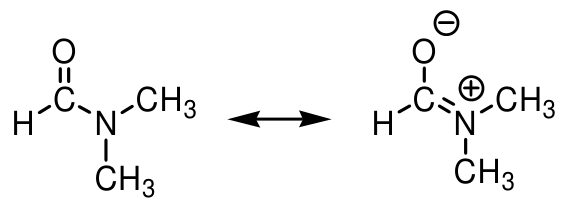
Condensation of a carboxylic acid with an amine gives an amide product. For example, condensation of formic acid with dimethylamine forms N,N-dimethylformamide (DMF), which can be described as the following resonance structures.
1.1 Predict the order of melting points among N,N-dimethylformamide (compound A), N-methylacetamide (\(\ce{CH3CONHCH3}\), compound B), and propionamide (compound C, \(\ce{CH3CH2CONH2}\),). Express your answer from high to low melting point as follows:
\(\_\_\_\_ > \_\_\_\_ > \_\_\_\_\) (Insert compound codes A, B, C)
1.2 Carbonyl groups are usually identified by their characteristic strong absorptions in the infrared spectra. The position of the absorption is dependent on the strength of the \(\ce{C=O}\) bond, which in turn is reflected in their bond lengths. In amides, the strength of the carbonyl groups can be shown by the resonance structure noted above. For example, cyclohexanone shows an absorption at \(1715\ \mathrm{cm^{-1}}\) for the carbonyl group (\(\ce{C=O}\)). In comparison with cyclohexanone, predict the absorption band for the carbonyl group in propionamide. Select your answer from the following choices.
(a) \(1660\ \mathrm{cm^{-1}}\) because of the shorter carbonyl bond length.
(b) \(1660\ \mathrm{cm^{-1}}\) because of the longer carbonyl bond length.
(c) \(1740\ \mathrm{cm^{-1}}\) because of the shorter carbonyl bond length.
(d) \(1740\ \mathrm{cm^{-1}}\) because of the longer carbonyl bond length.1.3 Glycine (\(\ce{H2N-CH2-COOH}\)) is an \(\alpha\)-amino acid. Three glycine molecules can form a tripeptide Gly-Gly-Gly via amide linkages, accompanied by elimination of two water molecules. Draw the structural formula of this tripeptide.
1.4 When an \(\alpha\)-amino acid contains a substituent, there is a possibility of optical isomers. For example, L-alanine and D-alanine are two enantiomers. What is the number of all possible linear tripeptides that can be formed from the following three amino acids: glycine, L-alanine and D-alanine as the starting materials in the condensation reaction?
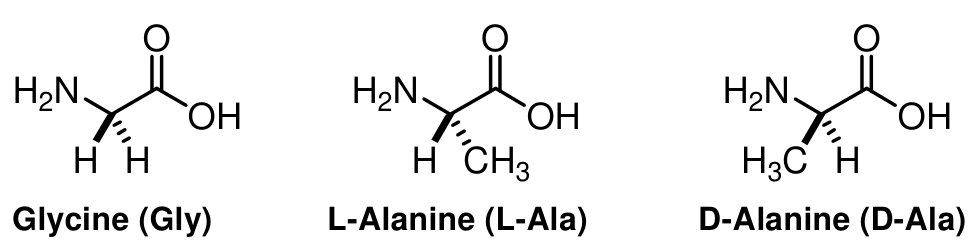
1.5 Among the tripeptides synthesized in 1-4, how many are optically active?
Nowadays, polyacrylamide gel associated with electrophoresis (PAGE) was widely used in analyses of proteins and nucleic acids. However, one of the first applications of polyamide gel is the separation of phenol compounds on thin-layer chromatography. The phenol compounds bearing different substituents have varied acidities. The higher acidity results in stronger binding to PAGE gel.
1.6 Predict the binding affinity of phenol (compound D), 4-methylphenol (compound E) and 4-nitrophenol (compound F) with a polyamide gel. Express your answer from high to low binding affinity as follows:
\(\_\_\_\_ > \_\_\_\_ > \_\_\_\_\) (Insert compound codes D, E, and F)
The absorption maximum of a molecule in its ultraviolet and visible spectrum (UV-vis spectrum) is related to the number of conjugated double bonds in a chain. A compound containing more than 5 conjugated double bonds tends to absorb visible light, and hence shows the complementary colour. For example, phenolphthalein is a commonly used acid-base indicator, which is colourless in acidic and neutral solutions, but reddish pink in basic solutions (\(pH\ 8.3–10.0\)).
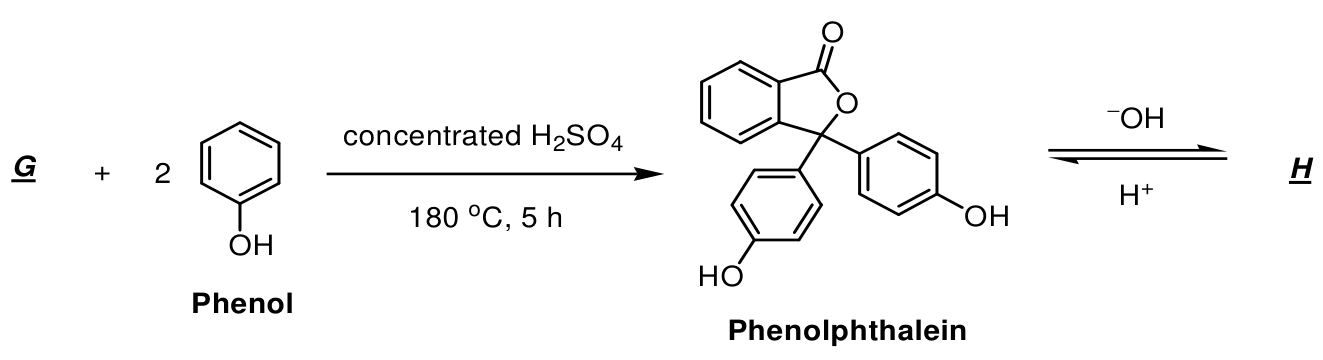
1.7 Draw the structural formula of H derived from phenolphthalein that is attributable to the reddish pink colour in aqueous \(\ce{NaOH}\) solution.
1.8 A simple way to prepare phenolphthalein is via condensation of compound G with 2 equivalents of phenol. What is the most effective reagent for G to accomplish this transformation? Select your answer from the following compounds.
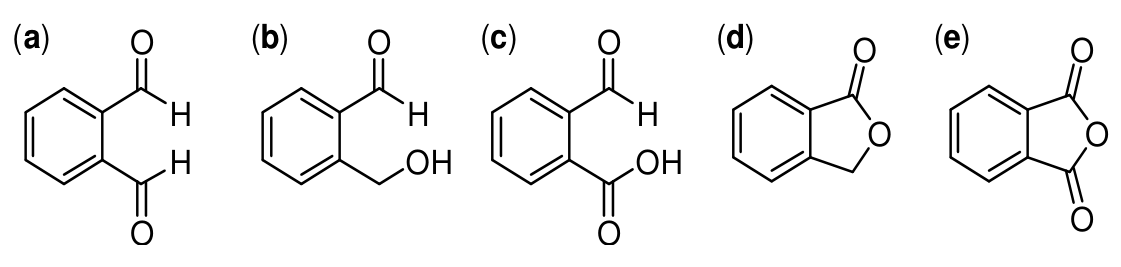
\(\_\_\_\_\_\_\_\_\_\_\_\_\_\_\_\)
Official English text of the problem.
Problem 2: Organic Synthesis and Stereochemistry
Natural carbohydrates are generally produced by photosynthesis in plants. However, unnatural carbohydrates can be prepared by organic synthesis. The following outline is a synthetic scheme for the unnatural L-ribose (compound I).
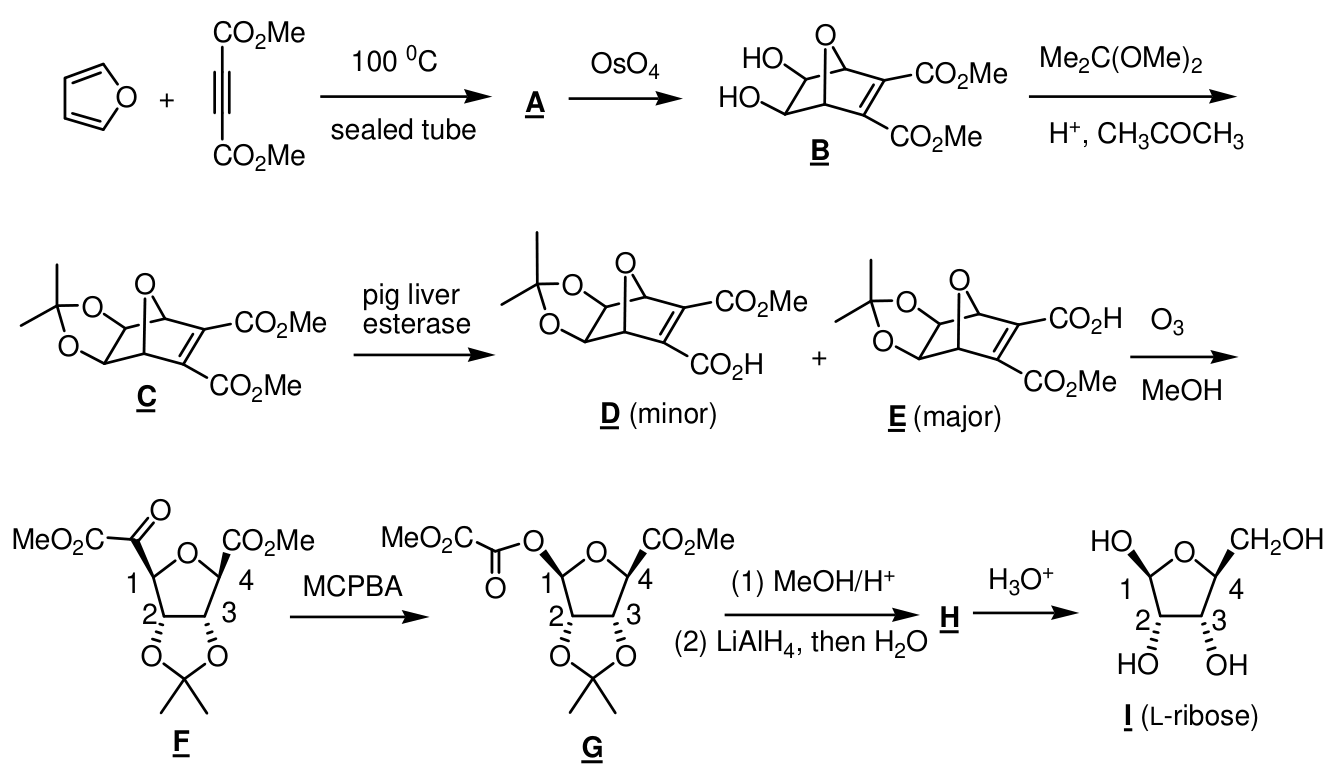
2.1 Compound A has the molecular formula of \(\ce{C10H10O5}\). Draw the structural formula of A.
2.2 Given the chemistry described for reaction sequence A to C, indicate whether the following statements are true or false (Use T to represent true and F to represent false).
___ (a) \(\ce{OsO4}\) is an oxidizing agent in the reaction of A to B.
___ (b) \(\ce{MeOH}\) is generated as a by-product in the reaction of B to C.
___ (c) Protons act as the catalyst in the transformation of B to C.
___ (d) C will still be formed albeit in lower yields in the absence of \(\ce{Me2C(OMe)2}\).
Pig liver esterase is an enzyme that can hydrolyze esters to carboxylic acids. Hydrolysis of C by the pig liver esterase afforded an enantiomeric mixture of D and E, in which E was the major component. The optical rotation of the mixture was \([\alpha]_{\mathrm D}^{20}=-37.1^\circ\). Further purification by recrystallization gave pure E with the optical rotation \([\alpha]_{\mathrm D}^{20}=-49.0^\circ\).
2.3 What is the molar ratio of D/E in the product mixture before the recrystallization? Show your work.
2.4 Reaction of F with meta-chloroperbenzoic acid (MCPBA) afforded G as the product. Indicate whether the following statements are true or false (Use T to represent true and F to represent false).
___ (a) The reaction was to oxidize compound F.
___ (b) The oxygen atom inserted originated from MCPBA.
___ (c) The \(R/S\) notation of C-1 remained unchanged before and after the reaction.
The molecular formula of H is \(\ce{C9H16O5}\). Proton NMR data of H are listed as follows:
\({}^{1}\mathrm H\) NMR (\(\ce{CDCl3}\)) \(\delta\) 1.24 (s, 3H), 1.40 (s, 3H), 3.24 (m, 1 H), 3.35 (s, 3H), 3.58 (m, 2H), 4.33 (m, 1H); 4.50 (d, \(J=6\ \mathrm{Hz}\), 1H), 4.74 (d, \(J=6\ \mathrm{Hz}\), 1H), 4.89 (s, 1H).
2.5 Draw the configurational formula of H.
2.6 Assign R/S notations for compound I at C-1, C-2, C-3 and C-4. Give your answers as follows:
C-1: _; C-2: ; C-3: _; C-4: .
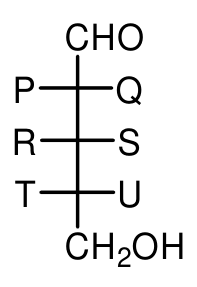
2.7 What are the identities of P, Q, R, S, T and U in the Fischer projection of compound I (L-ribose)?
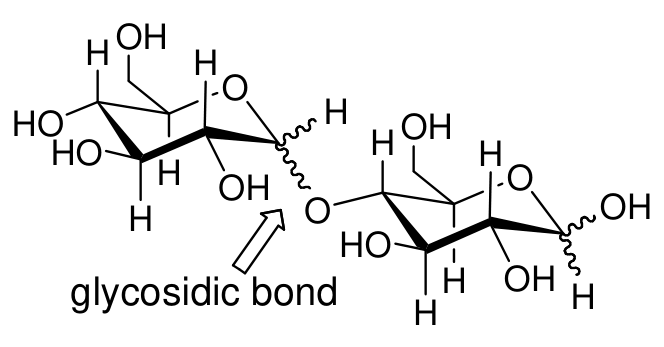
Disaccharides are compounds with two monosaccharide subunits linked together by a glycosidic bond. Polysaccharides contain as few as ten, or as many as thousands, monosaccharide subunits. An example of a disaccharides is as follows:
2.8 How many diastereoisomers would be obtained for pentasaccharide J, if it is derived from five units of D-glucose?
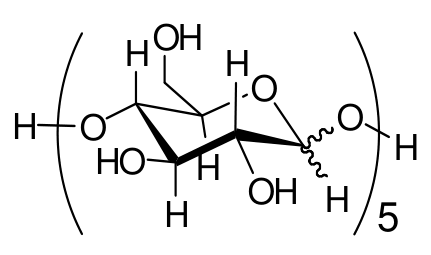
pentasaccharide J derived from D-glucose
Official English text of the problem.
Problem 3: Organic Photochemistry and Photophysics
Crown ethers show size-dependent binding capability to alkali metal ions. For example, the azacrowns A and B exhibit different binding constants for \(\ce{Na+}\), \(\ce{K+}\), and \(\ce{Cs+}\).
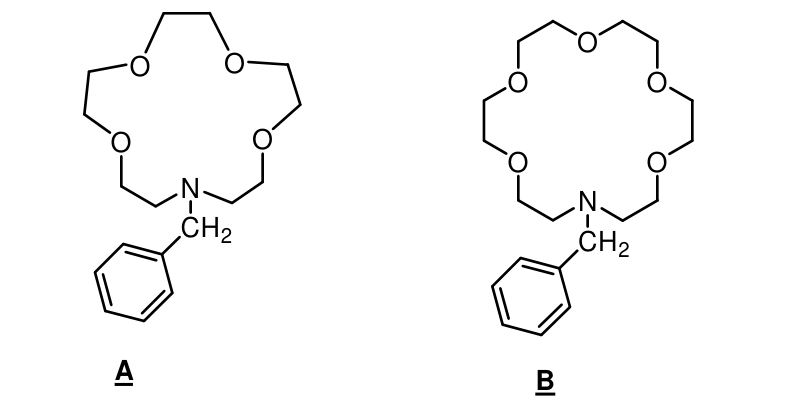
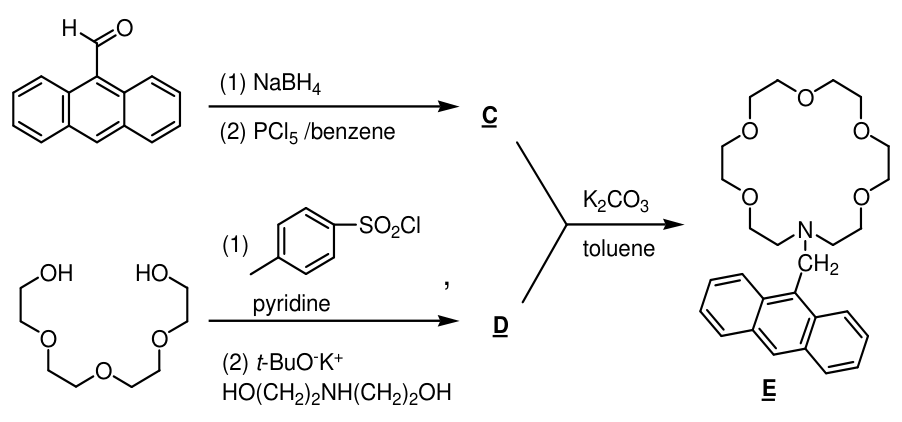
Binding constant (\(\log_{10} K\)) Metal ion Radius (pm) Compound A Compound B \(\ce{Na+}\) 98 2.49 3.57 \(\ce{K+}\) 133 1.83 5.00 \(\ce{Cs+}\) 165 1.37 3.39 Anthracene exhibits strong fluorescence with emission wavelength centered at 325 nm. Combining the binding selectivity of azacrowns for alkali metal ions and the highly fluorescent anthracene, a metal ion selective fluorescent sensor E has been developed.
3.1 Provide the structural formula of C and D in the following synthesis.
For comparison studies, the anthracene derivatives F and G shown below were also synthesized. These compounds E, F, and G are almost non-fluorescent in neutral conditions due to the strong photoinduced electron transfer (PET) quenching process arising by donating nitrogen lone-pair electron to the anthracene excited-state.
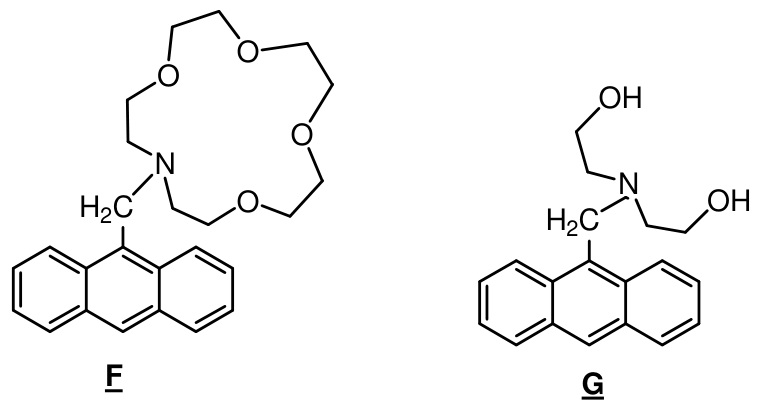
3.2 Upon adding aqueous \(\ce{HCl}\), which compound will exhibit strong fluorescence? Select your answer from the following choices.
(a) none of them (b) E and F only (c) G only (d) all of them
3.3 By adding one equivalent of potassium acetate into a dilute solution (\(1\times10^{-5}\ \mathrm{M}\)) of E, F, and G in methanol, respectively, which compound will show the strongest fluorescence? Select your answer from the following choices.
(a) E (b) F (c) G
3.4 Upon adding one equivalent of metal acetate to a dilute solution of F, which metal acetate will cause the strongest fluorescence? Select your answer from the following choices.
(a) sodium acetate (b) potassium acetate (c) cesium acetate (d) doesn’t make any difference
Upon irradiation with ultraviolet light, trans-stilbene is transformed into an intermediate H, which undergoes a photocyclization to form dihydrophenanthrene I. Further oxidation of I gives phenanthrene.

3.5 Draw the structural formula of compound H?
3.6 What is the relative stereochemistry of the two H-atoms shown (cis or trans) in compound I?
Dihydroazulene derivative J exhibits interesting photochromic behavior. Upon irradiation, colorless dihydroazulene J undergoes photoinduced rearrangement to the corresponding vinylheptafulvene K. The vinylheptafulvene undergoes thermal reversion to dihydroazulene.
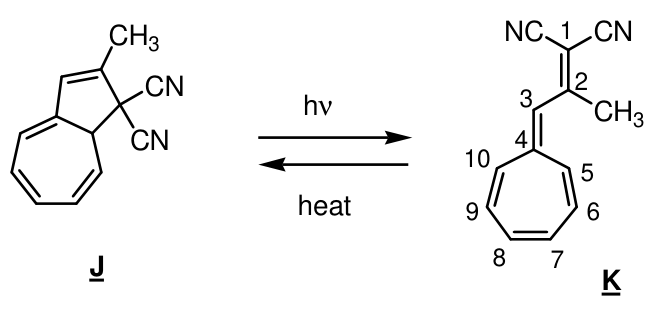
3.7 Which compound will absorb light with longer wavelength? Select your answer from the following choices: (a) J (b) K
3.8 Compound K can react with one equivalent of \(\ce{CF3CO2H}\) to generate a stable aromatic salt. Which position of K is most likely protonated? Select your answer from the following choices.
(a) C-2 (b) C-3 (c) C-4 (d) C-5
Official English text of the problem.
Problem 4: Gold Capital of Asia
A
Gold Capital of Asia
Chiufen, the old mining town located within the hills in the northeast Taiwan, is a place where you can really experience Taiwan's historical legacy. It was the site of one of the largest gold mines In Asia. Accordingly, Chiufen is often referred to as the Gold Capital of Asia. The compound \(\ce{KCN}\) is traditionally used to extract gold from ore. Gold dissolves in cyanide (\(\ce{CN^-}\)) solutions in the presence of air to form \(\ce{Au(CN)2^-}\), which is stable in aqueous solution.

4.A-1 Draw a structure for \(\ce{Au(CN)2^-}\) showing the spatial arrangements of the atoms.
4.A-2 How many grams of \(\ce{KCN}\) are needed to extract 20 g of gold from ore? Show your work.
Aqua regia, a 3 : 1 mixture (by volume) of concentrated hydrochloric acid and nitric acid, was developed by the alchemists as a means to “dissolve” gold. The process is actually a redox reaction with the following simplified chemical equation:

4.A-3 Write down the half reactions, and use them to obtain a balanced redox reaction for this process.
4.A-4 What are the oxidizing and reducing agents for 4.A-3 process?
Gold is too noble to react with nitric acid. However, gold does react with aqua regia because the complex ion \(\ce{AuCl4^-}\) forms. Consider the following half-reactions:

An electrochemical cell can be formed from these two redox couples.
4.A-5 Calculate the formation constant for \(\ce{AuCl4^-}\) at \(25\,^\circ\mathrm{C}\):
\[ K=\frac{[\ce{AuCl4^-}]}{[\ce{Au^3+}][\ce{Cl^-}]^4} \]
4.A-6 The function of \(\ce{HCl}\) is to provide \(\ce{Cl^-}\). What is the purpose of the \(\ce{Cl^-}\) for the above reaction. Select your answer from the following choices.
(a) \(\ce{Cl^-}\) is an oxidizing agent
(b) \(\ce{Cl^-}\) is a reducing agent
(c) \(\ce{Cl^-}\) is a complexing agent
(d) \(\ce{Cl^-}\) is a catalystB
Gold Nanoparticles
The synthesis and characterization of gold nanoparticles is currently an active research area. The Brust-Schiffrin method for the synthesis of gold nanoparticle (AuNP) allows the facile preparation of thermally stable and air-stable AuNPs of reduced polydispersity with a controlled size distribution ranging in diameter between 1.5 and 5.2 nm. The preparative procedure is briefly described as follows. An aqueous solution of \(\ce{HAuCl4}\) is mixed with a toluene solution of tetra-n-octylammonium bromide. The solution is mixed with dodecanethiol and is treated with an excess of \(\ce{NaBH4}\). Formation of the AuNPs is evidenced by the immediate, pronounced darkening of the toluene phase. After ca. 24 h, the toluene solvent is removed with a rotary evaporator and the resulting solid washed on a frit with ethanol and hexane to remove excess thiol. These AuNPs can be repeatedly isolated and re-dissolved in common organic solvents without irreversible aggregation or decomposition.
4.B-1 Is the methodology for this fabrication referred to a top-down or a bottom-up approach? Select your answer from the following choices.
(a) top-down approach, which entails reducing the size of the smallest structures to the nanoscale
(b) bottom-up approach, which involves manipulating individual atoms and molecules into nanostructures4.B-2 The trimethyl-n-octylammonium bromide can also be used as a phase-transfer reagent. It can carry \(\ce{AlCl4^-}\) from an aqueous phase to an organic phase. Which property does trimethyl-n-octylammonium bromide possess to function as an efficient phase-transfer reagent? Select your answer from the following choices.
(a) one side of the molecule is electropositive, the other side is electronegative.
(b) one side of the molecule is hydrophilic, the other side is hydrophobic.
(c) one side of the molecule is acidic, the other side is basic.4.B-3 What is the function of \(\ce{NaBH4}\) in this preparation? Select your answer from the following choices.
(a) reducing agent
(b) oxidizing agent
(c) neutralization agent
(d) complexing agent4.B-4 If the average diameter of a gold nanoparticle is 3 nm, what is the estimated number of \(\ce{Au}\) atoms in each nanoparticle? (the atomic radius of \(\ce{Au}\) is 0.144 nm). Select your answer from the following choices and show your work.
(a) \(10^2\)
(b) \(10^3\)
(c) \(10^4\)
(d) \(10^5\)4.B-5 What is the estimated percentage of \(\ce{Au}\) atoms on the surface of a nanoparticle? Select your answer from the following choices and show your work.
(a) 20 – 30 %
(b) 40 – 50 %
(c) 60 – 70 %
(d) 80 – 90 %Official English text of the problem.
Problem 5: Lewis Structure
5.1 Draw one Lewis structure for each of the following molecules.
a) \(\ce{N2}\)
b) \(\ce{NH3}\)
c) \(\ce{O3}\)
d) \(\ce{SO3}\)5.2 Draw the Lewis structure of carbon monoxide and assign formal charges and oxidation states to both the carbon and oxygen atoms in carbon monoxide.
Thiourea-S,S-dioxide, \(\ce{O2SC(NH2)2}\), has the following skeletal structure
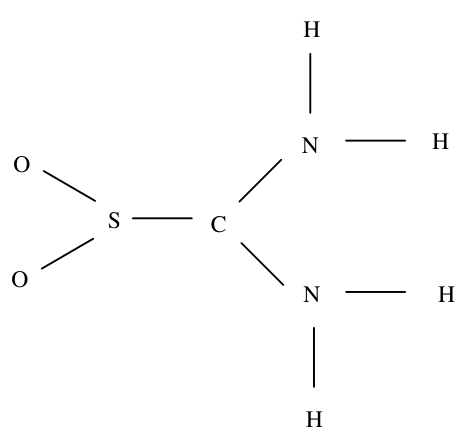
5.3 Draw the Lewis structure of thiourea-S,S-dioxide with zero formal charges on all atoms.
5.4 Based on the Valence Shell Electron Pair Repulsion (VSEPR) model, what is the geometry around the sulfur, carbon, and nitrogen according to the Lewis structure you predicted from 5.3?
5.4a What is the geometry around the sulfur atom? Select your answer from the following choices.
a) trigonal pyramidal
b) triangular planar
c) T-shape5.4b Similarly, what is the geometry around the C-atom? Select your answer from the following choices.
a) trigonal pyramidal
b) triangular planar
c) T-shape5.4c Finally, what is the geometry around the N-atom? Select your answer from the following choices.
a) trigonal pyramidal
b) triangular planar
c) T-shapeMolecular structure in the solid state is usually determined by X-ray diffraction analysis. According to this method, the structure of thiourea-S,S-dioxide is shown below:
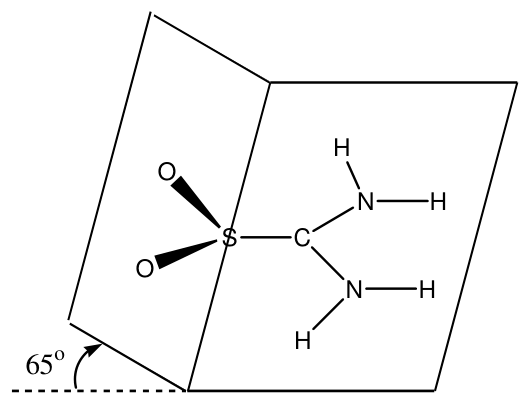
All the N, H atoms are coplanar with S, C atoms, and the dihedral angle between the \(\ce{OSO}\) plane and the \(\ce{SC(NH2)2}\) plane is \(65^\circ\).
5.5 Draw the Lewis structure and resonance forms that are consistent with the geometry determined.
Official English text of the problem.
Problem 6: Alkalinity of Water and Solubility of CO2
Alkalinity of Water and Solubility of \(\ce{CO2}\)
The capacity of water to accept \(\ce{H+}\) ions is called alkalinity. Alkalinity is important in water treatment and in the chemistry and biology of natural waters. Generally, the basic species responsible for alkalinity in water are \(\ce{HCO3^-}\), \(\ce{CO3^2-}\), and \(\ce{OH^-}\). At pH values below 7, \(\ce{H+}\) in water detracts significantly from alkalinity. Therefore, the complete equation for alkalinity in a medium where \(\ce{HCO3^-}\), \(\ce{CO3^2-}\), and \(\ce{OH^-}\) are the only contributors to alkalinity can be expressed as
\[ \text{alkalinity} =[\ce{HCO3^-}]+2[\ce{CO3^2-}]+[\ce{OH^-}]-[\ce{H+}] \]
The contributions made by different species to alkalinity depend upon pH. Relevant chemical equations and equilibrium constants (at 298 K) are shown below:
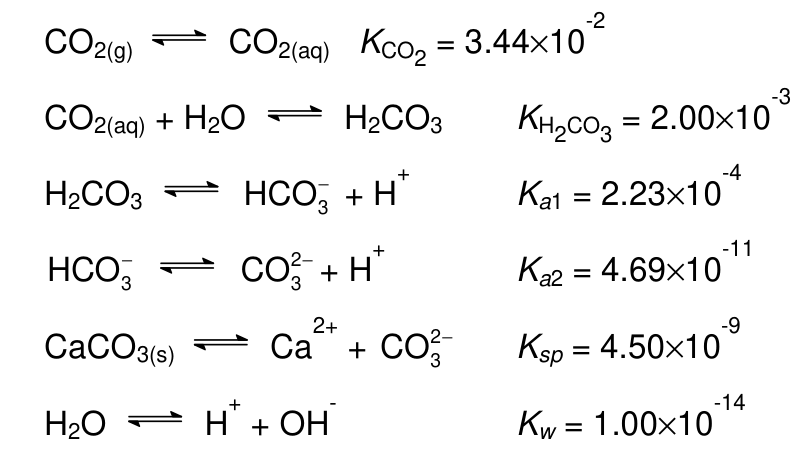
Note: Calculations must be shown.
6.1 Natural waters (river or lake water) generally contain dissolved \(\ce{CO2}\). The ratio of \([\ce{H2CO3}]:[\ce{HCO3^-}]:[\ce{CO3^2-}]\) in a water at \([\ce{H+}]=1.00\times10^{-7}\ \mathrm{M}\) will be:
\[ \underline{(a)}:1.00:\underline{(b)}. \]
Calculate (a) and (b).
6.2 Gaseous \(\ce{CO2}\) in the atmosphere can be regarded as a contributor to the alkalinity of water in equilibrium with air. Calculate the concentration of \(\ce{CO2(aq)}\) \((\mathrm{mol\,dm^{-3}})\) in pure water that is in equilibrium with the unpolluted air at \(1.01\times10^5\ \mathrm{Pa}\) and 298 K containing 0.0360 % (molar ratio) \(\ce{CO2}\). (assuming standard pressure \(=1.01\times10^5\ \mathrm{Pa}\)).
If you are unable to solve this problem, assume that concentration of \(\ce{CO2(aq)}\) is equal to \(1.11\times10^{-5}\ \mathrm{M}\) for further calculations.
The solubility (\(S\)) of \(\ce{CO2}\) in water can be defined as
\[ S=[\ce{CO2(aq)}]+[\ce{H2CO3}]+[\ce{HCO3^-}]+[\ce{CO3^2-}]. \]
The solubility of atmospheric \(\ce{CO2}\) in water that is in equilibrium with the unpolluted air at 298 K and \(1.01\times10^5\ \mathrm{Pa}\) will vary with alkalinity.
6-3 Find the solubility of atmospheric \(\ce{CO2}\) in pure water \((\mathrm{mol\,dm^{-3}})\). Neglect dissociation of water.
6.4 Find the solubility of atmospheric \(\ce{CO2}\) \((\mathrm{mol\,dm^{-3}})\) in a \(1.00\times10^{-3}\ \mathrm{mol\,dm^{-3}}\) \(\ce{NaOH}\) solution.
At 298 K, \(1.01\times10^5\ \mathrm{Pa}\) unpolluted air is in equilibrium with natural water saturated with \(\ce{CaCO3}\). The following main equilibrium may exist:

6.5 Calculate the equilibrium constant for the above equation.
If you are unable to solve this problem, assume that equilibrium constant \(K_{\mathrm{eq}}=5.00\times10^{-5}\) for further calculations.
6.6 Calculate the concentration of \(\ce{Ca^2+}\) \((\mathrm{mg\,dm^{-3}})\) in \(\ce{CaCO3}\)-saturated natural water that is in equilibrium with atmospheric \(\ce{CO2}\).
If you are unable to solve this problem, assume that concentration of \(\ce{Ca^2+(aq)}=40.1\ \mathrm{mg\,dm^{-3}}\) for further calculations.
6.7 Find the alkalinity (mol/L) of the above solution.
6.8 In an underground lake saturated with \(\ce{CaCO3}\), the water has a high content of \(\ce{CO2}\). The concentration of \(\ce{Ca^2+}\) in this lake was found to be as high as \(100\ \mathrm{mg\,dm^{-3}}\). Assume the lake and the air above is a closed system, calculate the effective pressure of \(\ce{CO2}\) (Pa) in air which is in equilibrium with this \(\ce{Ca^2+}\) content.
Official English text of the problem.
Problem 7: Kinetic Behaviour of Ozone
Ozone (\(\ce{O3}\)) is a form of oxygen. It is a natural component of the stratosphere, where it shields the earth from life-destroying ultraviolet radiation. On absorbing light in this region, ozone is converted to dioxygen molecules.
For the overall reaction of ozone decomposition,
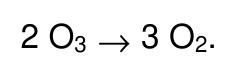
One of the proposed mechanisms is expressed as
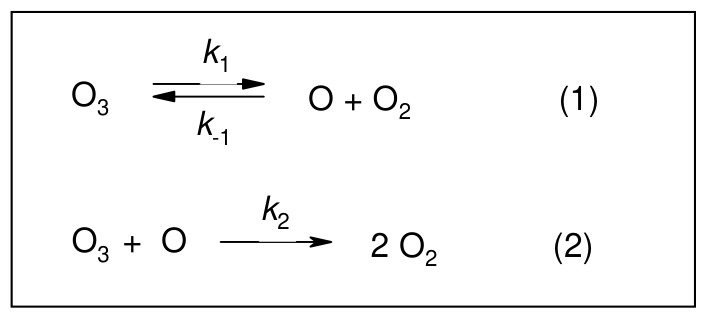
where \(k_1\), \(k_{-1}\), and \(k_2\) are the rate constants.
7.1 According to the above mechanism what are the differential rate equations for the formation (or consumption) of \(\ce{O3}\), \(\ce{O2}\), and \(\ce{O}\) at time \(t\), assuming step 2 is irreversible.
7.2 Simplification in obtaining the rate law may be found by making appropriate assumptions. Assuming that the concentration of \(\ce{O}\) atoms reaches equilibrium rapidly, its concentration may be given by the equilibrium constant of the reaction (1). The second step is rate determining. Under this equilibrium approximation, deduce the differential rate equation for the \(\ce{O3}\) depletion as a function of \(\ce{O2}\) and \(\ce{O3}\) concentrations.
7.3 Another assumption frequently made is that the rates of oxygen atom production and consumption are equal (this is called steady state). Under the steady state approximation, that is \(d[\ce{O}]/dt=0\), show that the rate equation is: \[ -\frac{d[\ce{O3}]}{dt} = \frac{2k_1k_2[\ce{O3}]^2} {k_{-1}[\ce{O2}]+k_2[\ce{O3}]}. \]
One pathway for the destruction of ozone (\(\ce{2O3 -> 3O2}\)) in the upper atmosphere is catalyzed by Freons. For instance, when \(\ce{CCl2F2}\) (Freon-12) migrates to the upper atmosphere, the ultraviolet photolysis of \(\ce{CCl2F2}\) may give rise to \(\ce{Cl}\) atoms according to the following reaction:

7.4 Chlorine atom can act as a catalyst for the destruction of ozone. The first slow step of a \(\ce{Cl}\)-catalyzed mechanism is proposed as follows:

Assuming a two-step mechanism, propose the second step in the mechanism.
7.5 The activation energy for \(\ce{Cl}\)-catalyzed destruction of ozone is \(2.1\ \mathrm{kJ\,mol^{-1}}\), while the activation energy for the reaction without the presence of catalyst is \(14.0\ \mathrm{kJ\,mol^{-1}}\). Estimate the ratio of the rate constant for the catalyzed reaction to that for the uncatalyzed reaction at \(25\,^\circ\mathrm{C}\). Assume the frequency factor is the same for each reaction.
Official English text of the problem.
Problem 8: Protein Folding
Most proteins exist usually only in two forms, the native form (N) and the unfolded form (U) when they are thermally or chemically denatured, without appreciable concentrations of other stable intermediates in equilibrium with the native and unfolded forms. For these proteins, the folding-unfolding equilibrium can be described by the following simple chemical equation:
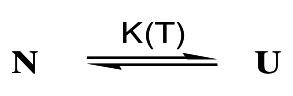
where N and U denote the folded state (native state) and the unfolded state (denatured state) of the protein, respectively. \(K(T)\) is the equilibrium constant for the process at absolute temperature \(T\).
8.1 What is the equilibrium constant for the process when the native and denatured states are present in equal proportions at equilibrium?
8.2 What is the standard free energy change of the process \((\Delta G^\circ(T))\) when the native and denatured states are present in equal proportions at equilibrium? Express your answer in SI units.
8.3 If \((C_{\mathrm N})_{\mathrm{eq}}\) and \((C_{\mathrm U})_{\mathrm{eq}}\) denote the equilibrium concentrations of \(N\) and \(U\) in solution, respectively, and \(C\) is the total concentration of the protein, the fraction of the total protein that is unfolded under the equilibrium condition is given by \(f_{\mathrm U}=(C_{\mathrm U})_{\mathrm{eq}}/C\). Deduce an expression for \(f_{\mathrm U}\) in terms of the equilibrium constant \(K\). Show all work on the answer sheet.
When a protein is denatured by increasing the temperature of the solution, the fraction of the unfolded protein increases with temperature, as shown in the following Figure.
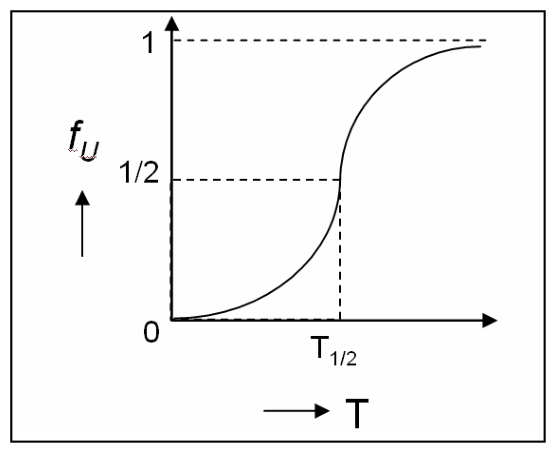
The mid-point of the denaturation curve is given by \(f_{\mathrm U}=\tfrac12\) and \(T=T_{1/2}\). The latter is often referred to as the denaturation temperature. At temperatures higher than \(T_{1/2}\), \(f_{\mathrm U}\) increases above \(\tfrac12\), but at temperatures lower than \(T_{1/2}\), \(f_{\mathrm U}\) decreases below \(\tfrac12\).
8.4 What is the sign of \(\Delta G^\circ(T)\) at temperatures below and above \(T_{1/2}\)? Select your answer from the following choices.
a) Negative both below and above \(T_{1/2}\).
b) Positive both below and above \(T_{1/2}\).
c) Positive below \(T_{1/2}\), but negative above \(T_{1/2}\).
d) Negative below \(T_{1/2}\), but positive above \(T_{1/2}\)..
8.5 How does the standard Gibbs free energy change for the process vary when the temperature (i) increases above \(T_{1/2}\) and (ii) decreases below \(T_{1/2}\)? Select your answer from the following choices.
a) Decrease in both cases.
b) Increase in both cases.
c) Increases above \(T_{1/2}\), but decreases below \(T_{1/2}\).
d) Decreases above \(T_{1/2}\), but increases below \(T_{1/2}\).
The kinetics of unfolding and refolding of a protein has recently become an intense area of study. We could rewrite the chemical equation for the process as follows:
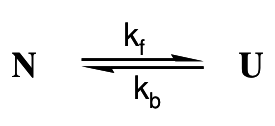
where \(k_f\) and \(k_b\) denote the forward and backward reaction rate constants, respectively., assuming that both the forward and reverse processes are elementary steps that follow first-order kinetics.
8.6 For the simple chemical equation and elementary kinetic steps used to describe the protein folding-unfolding process outlined above, what is the relationship between equilibrium constant \(K\) and the rate constants \(k_f\) and \(k_b\)?
8.7 Derive a rate law for the overall process, that is \(\mathrm dC_{\mathrm U}/\mathrm dt\) in terms of only rate constants, \(C_{\mathrm U}\) and \((C_{\mathrm U})_{\mathrm{eq}}\).
Official English text of the problem.
Internationale Chemie-Olympiade
IChO 2005
Taipeh, Taiwan · 8 Theorieaufgaben mit vollständigen Lösungen
Aufgabe 1: Chemie der Amide und Phenole
Bei der Kondensation einer Carbonsäure mit einem Amin entsteht ein Amid. Beispielsweise bildet sich bei der Kondensation von Ameisensäure mit Dimethylamin N,N-Dimethylformamid (DMF), das durch die folgenden mesomeren Grenzstrukturen beschrieben werden kann.
1.1 Sagen Sie die Reihenfolge der Schmelzpunkte von N,N-Dimethylformamid (Verbindung A), N-Methylacetamid (\(\ce{CH3CONHCH3}\), Verbindung B) und Propionamid (Verbindung C, \(\ce{CH3CH2CONH2}\),) voraus. Geben Sie Ihre Antwort in absteigender Reihenfolge der Schmelzpunkte wie folgt an:
\(\_\_\_\_ > \_\_\_\_ > \_\_\_\_\) (Tragen Sie die Verbindungscodes A, B, C ein.)
1.2 Carbonylgruppen werden gewöhnlich anhand ihrer charakteristischen starken Absorptionen in Infrarotspektren identifiziert. Die Lage der Absorption hängt von der Stärke der \(\ce{C=O}\)-Bindung ab, die sich wiederum in ihrer Bindungslänge widerspiegelt. Bei Amiden lässt sich die Stärke der Carbonylgruppen durch die oben angegebene mesomere Grenzstruktur veranschaulichen. Beispielsweise zeigt Cyclohexanon eine Absorption bei \(1715\ \mathrm{cm^{-1}}\) für die Carbonylgruppe (\(\ce{C=O}\)). Sagen Sie im Vergleich zu Cyclohexanon die Absorptionsbande der Carbonylgruppe in Propionamid voraus. Wählen Sie Ihre Antwort aus den folgenden Möglichkeiten.
(a) \(1660\ \mathrm{cm^{-1}}\) aufgrund der kürzeren Carbonylbindung.
(b) \(1660\ \mathrm{cm^{-1}}\) aufgrund der längeren Carbonylbindung.
(c) \(1740\ \mathrm{cm^{-1}}\) aufgrund der kürzeren Carbonylbindung.
(d) \(1740\ \mathrm{cm^{-1}}\) aufgrund der längeren Carbonylbindung.1.3 Glycin (\(\ce{H2N-CH2-COOH}\)) ist eine \(\alpha\)-Aminosäure. Drei Glycinmoleküle können über Amidbindungen unter Abspaltung zweier Wassermoleküle das Tripeptid Gly-Gly-Gly bilden. Zeichnen Sie die Strukturformel dieses Tripeptids.
1.4 Wenn eine \(\alpha\)-Aminosäure einen Substituenten enthält, können optische Isomere auftreten. Beispielsweise sind L-Alanin und D-Alanin zwei Enantiomere. Wie groß ist die Anzahl aller möglichen linearen Tripeptide, die aus den folgenden drei Aminosäuren als Ausgangsstoffen der Kondensationsreaktion gebildet werden können: Glycin, L-Alanin und D-Alanin?
1.5 Wie viele der in 1-4 synthetisierten Tripeptide sind optisch aktiv?
Heutzutage wird die Polyacrylamid-Gelelektrophorese (PAGE) häufig zur Analyse von Proteinen und Nukleinsäuren eingesetzt. Eine der ersten Anwendungen von Polyamidgel war jedoch die Trennung phenolischer Verbindungen mittels Dünnschichtchromatographie. Phenolische Verbindungen mit unterschiedlichen Substituenten weisen unterschiedliche Aciditäten auf. Eine höhere Acidität führt zu einer stärkeren Bindung an das PAGE-Gel.
1.6 Sagen Sie die Bindungsaffinität von Phenol (Verbindung D), 4-Methylphenol (Verbindung E) und 4-Nitrophenol (Verbindung F) zu einem Polyamidgel voraus. Geben Sie Ihre Antwort in absteigender Reihenfolge der Bindungsaffinität wie folgt an:
\(\_\_\_\_ > \_\_\_\_ > \_\_\_\_\) (Tragen Sie die Verbindungscodes D, E und F ein.)
Das Absorptionsmaximum eines Moleküls in seinem Ultraviolett- und sichtbaren Spektrum (UV-Vis-Spektrum) hängt mit der Anzahl konjugierter Doppelbindungen in einer Kette zusammen. Eine Verbindung mit mehr als 5 konjugierten Doppelbindungen absorbiert tendenziell sichtbares Licht und zeigt daher die Komplementärfarbe. Beispielsweise ist Phenolphthalein ein häufig verwendeter Säure-Base-Indikator, der in sauren und neutralen Lösungen farblos ist, in basischen Lösungen jedoch rötlich rosa erscheint (\(pH\ 8.3–10.0\)).
1.7 Zeichnen Sie die Strukturformel der von Phenolphthalein abgeleiteten Verbindung H, die für die rötlich rosa Farbe in wässriger \(\ce{NaOH}\)-Lösung verantwortlich ist.
1.8 Eine einfache Methode zur Herstellung von Phenolphthalein ist die Kondensation der Verbindung G mit 2 Äquivalenten Phenol. Welches Reagenz eignet sich als G am besten, um diese Umsetzung durchzuführen? Wählen Sie Ihre Antwort aus den folgenden Verbindungen.
\(\_\_\_\_\_\_\_\_\_\_\_\_\_\_\_\)
Aufgabentext aus dem offiziellen englischen Text übersetzt.
Aufgabe 2: Organische Synthese und Stereochemie
Natürliche Kohlenhydrate werden im Allgemeinen durch Photosynthese in Pflanzen gebildet. Nicht natürlich vorkommende Kohlenhydrate lassen sich jedoch durch organische Synthese herstellen. Das folgende Schema zeigt einen Syntheseweg für die nicht natürlich vorkommende L-Ribose (Verbindung I).
2.1 Verbindung A hat die Summenformel \(\ce{C10H10O5}\). Zeichnen Sie die Strukturformel von A.
2.2 Geben Sie anhand der für die Reaktionsfolge A bis C beschriebenen chemischen Vorgänge an, ob die folgenden Aussagen richtig oder falsch sind (verwenden Sie T für richtig und F für falsch).
___ (a) \(\ce{OsO4}\) ist bei der Reaktion von A zu B ein Oxidationsmittel.
___ (b) Bei der Reaktion von B zu C entsteht \(\ce{MeOH}\) als Nebenprodukt.
___ (c) Protonen wirken bei der Umwandlung von B zu C als Katalysator.
___ (d) C wird auch in Abwesenheit von \(\ce{Me2C(OMe)2}\) gebildet, allerdings in geringerer Ausbeute.
Schweineleberesterase ist ein Enzym, das Ester zu Carbonsäuren hydrolysieren kann. Die Hydrolyse von C durch Schweineleberesterase ergab ein Enantiomerengemisch aus D und E, in dem E die Hauptkomponente war. Der spezifische Drehwinkel des Gemisches betrug \([\alpha]_{\mathrm D}^{20}=-37.1^\circ\). Weitere Reinigung durch Umkristallisation lieferte reines E mit dem spezifischen Drehwinkel \([\alpha]_{\mathrm D}^{20}=-49.0^\circ\).
2.3 Wie groß ist das Stoffmengenverhältnis D/E im Produktgemisch vor der Umkristallisation? Zeigen Sie Ihren Rechenweg.
2.4 Die Reaktion von F mit meta-Chlorperbenzoesäure (MCPBA) lieferte G als Produkt. Geben Sie an, ob die folgenden Aussagen richtig oder falsch sind (verwenden Sie T für richtig und F für falsch).
___ (a) Bei der Reaktion wurde Verbindung F oxidiert.
___ (b) Das eingefügte Sauerstoffatom stammte aus MCPBA.
___ (c) Der \(R/S\)-Deskriptor von C-1 blieb vor und nach der Reaktion unverändert.
Die Summenformel von H lautet \(\ce{C9H16O5}\). Die Protonen-NMR-Daten von H sind im Folgenden aufgeführt:
\({}^{1}\mathrm H\)-NMR (\(\ce{CDCl3}\)) \(\delta\) 1.24 (s, 3H), 1.40 (s, 3H), 3.24 (m, 1 H), 3.35 (s, 3H), 3.58 (m, 2H), 4.33 (m, 1H); 4.50 (d, \(J=6\ \mathrm{Hz}\), 1H), 4.74 (d, \(J=6\ \mathrm{Hz}\), 1H), 4.89 (s, 1H).
2.5 Zeichnen Sie die Konfigurationsformel von H.
2.6 Ordnen Sie für Verbindung I an C-1, C-2, C-3 und C-4 die R/S-Deskriptoren zu. Geben Sie Ihre Antworten wie folgt an:
C-1: _; C-2: ; C-3: _; C-4: .
2.7 Wofür stehen P, Q, R, S, T und U in der Fischer-Projektion von Verbindung I (L-Ribose)?
Disaccharide sind Verbindungen aus zwei Monosaccharideinheiten, die durch eine glycosidische Bindung miteinander verknüpft sind. Polysaccharide enthalten mindestens zehn bis hin zu Tausenden von Monosaccharideinheiten. Ein Beispiel für ein Disaccharid ist im Folgenden dargestellt:
2.8 Wie viele Diastereoisomere ergeben sich für Pentasaccharid J, wenn es aus fünf Einheiten D-Glucose aufgebaut ist?
aus D-Glucose aufgebautes Pentasaccharid J
Aufgabentext aus dem offiziellen englischen Text übersetzt.
Aufgabe 3: Organische Photochemie und Photophysik
Kronenether zeigen eine größenabhängige Bindungsfähigkeit gegenüber Alkalimetallionen. Beispielsweise weisen die Azakronenether A und B unterschiedliche Bindungskonstanten für \(\ce{Na+}\), \(\ce{K+}\) und \(\ce{Cs+}\) auf.
Bindungskonstante (\(\log_{10} K\)) Metallion Radius (pm) Verbindung A Verbindung B \(\ce{Na+}\) 98 2.49 3.57 \(\ce{K+}\) 133 1.83 5.00 \(\ce{Cs+}\) 165 1.37 3.39 Anthracen zeigt eine starke Fluoreszenz mit einer Emissionswellenlänge um 325 nm. Durch die Kombination der Bindungsselektivität von Azakronenethern für Alkalimetallionen mit dem stark fluoreszierenden Anthracen wurde ein metallionenselektiver Fluoreszenzsensor E entwickelt.
3.1 Geben Sie die Strukturformeln von C und D in der folgenden Synthese an.
Für Vergleichsuntersuchungen wurden auch die unten gezeigten Anthracenderivate F und G synthetisiert. Diese Verbindungen E, F und G fluoreszieren unter neutralen Bedingungen nahezu nicht, da ein starker Löschungsprozess durch photoinduzierten Elektronentransfer (PET) stattfindet, bei dem ein Elektron des freien Elektronenpaars am Stickstoff auf Anthracen im angeregten Zustand übertragen wird.
3.2 Welche Verbindung zeigt nach Zugabe von wässriger \(\ce{HCl}\) eine starke Fluoreszenz? Wählen Sie Ihre Antwort aus den folgenden Möglichkeiten.
(a) keine von ihnen (b) nur E und F (c) nur G (d) alle
3.3 Zu jeweils einer verdünnten Lösung (\(1\times10^{-5}\ \mathrm{M}\)) von E, F und G in Methanol wird ein Äquivalent Kaliumacetat gegeben. Welche Verbindung zeigt die stärkste Fluoreszenz? Wählen Sie Ihre Antwort aus den folgenden Möglichkeiten.
(a) E (b) F (c) G
3.4 Ein Äquivalent eines Metallacetats wird zu einer verdünnten Lösung von F gegeben. Welches Metallacetat bewirkt die stärkste Fluoreszenz? Wählen Sie Ihre Antwort aus den folgenden Möglichkeiten.
(a) Natriumacetat (b) Kaliumacetat (c) Cäsiumacetat (d) es macht keinen Unterschied
Bei Bestrahlung mit ultraviolettem Licht wird trans-Stilben in ein Zwischenprodukt H umgewandelt, das durch Photocyclisierung Dihydrophenanthren I bildet. Die anschließende Oxidation von I liefert Phenanthren.
3.5 Zeichnen Sie die Strukturformel der Verbindung H.
3.6 Welche relative Stereochemie haben die beiden gezeigten H-Atome (cis oder trans) in Verbindung I?
Das Dihydroazulenderivat J zeigt ein interessantes photochromes Verhalten. Bei Bestrahlung wird das farblose Dihydroazulen J durch eine photoinduzierte Umlagerung in das entsprechende Vinylheptafulven K umgewandelt. Das Vinylheptafulven wandelt sich thermisch wieder in Dihydroazulen um.
3.7 Welche Verbindung absorbiert Licht mit einer längeren Wellenlänge? Wählen Sie Ihre Antwort aus den folgenden Möglichkeiten: (a) J (b) K
3.8 Verbindung K kann mit einem Äquivalent \(\ce{CF3CO2H}\) reagieren und dabei ein stabiles aromatisches Salz bilden. Welche Position von K wird am wahrscheinlichsten protoniert? Wählen Sie Ihre Antwort aus den folgenden Möglichkeiten.
(a) C-2 (b) C-3 (c) C-4 (d) C-5
Aufgabentext aus dem offiziellen englischen Text übersetzt.
Aufgabe 4: Goldhauptstadt Asiens
A
Goldhauptstadt Asiens
Chiufen, die alte Bergbaustadt in den Hügeln im Nordosten Taiwans, ist ein Ort, an dem man Taiwans historisches Erbe hautnah erleben kann. Hier befand sich eine der größten Goldminen Asiens. Daher wird Chiufen häufig als Goldhauptstadt Asiens bezeichnet. Die Verbindung \(\ce{KCN}\) wird traditionell zur Gewinnung von Gold aus Erz verwendet. In Gegenwart von Luft löst sich Gold in Cyanidlösungen (\(\ce{CN^-}\)) unter Bildung von \(\ce{Au(CN)2^-}\), das in wässriger Lösung stabil ist.
4.A-1 Zeichnen Sie eine Struktur von \(\ce{Au(CN)2^-}\), aus der die räumliche Anordnung der Atome hervorgeht.
4.A-2 Wie viele Gramm \(\ce{KCN}\) werden benötigt, um 20 g Gold aus Erz zu gewinnen? Geben Sie Ihren Rechenweg an.
Königswasser, eine Mischung aus konzentrierter Salzsäure und Salpetersäure im Volumenverhältnis 3 : 1, wurde von den Alchemisten als Mittel zum „Auflösen“ von Gold entwickelt. Tatsächlich handelt es sich dabei um eine Redoxreaktion mit der folgenden vereinfachten Reaktionsgleichung:
4.A-3 Schreiben Sie die Teilreaktionen auf und leiten Sie daraus eine ausgeglichene Redoxgleichung für diesen Vorgang ab.
4.A-4 Welche Stoffe sind bei dem Vorgang in 4.A-3 das Oxidationsmittel und das Reduktionsmittel?
Gold ist zu edel, um mit Salpetersäure zu reagieren. Mit Königswasser reagiert Gold jedoch, weil sich das Komplexion \(\ce{AuCl4^-}\) bildet. Betrachten Sie die folgenden Teilreaktionen:
Aus diesen beiden Redoxpaaren lässt sich eine elektrochemische Zelle aufbauen.
4.A-5 Berechnen Sie die Bildungskonstante von \(\ce{AuCl4^-}\) bei \(25\,^\circ\mathrm{C}\):
\[ K=\frac{[\ce{AuCl4^-}]}{[\ce{Au^3+}][\ce{Cl^-}]^4} \]
4.A-6 Die Funktion von \(\ce{HCl}\) besteht darin, \(\ce{Cl^-}\) bereitzustellen. Welche Aufgabe hat \(\ce{Cl^-}\) bei der obigen Reaktion? Wählen Sie Ihre Antwort aus den folgenden Möglichkeiten.
(a) \(\ce{Cl^-}\) ist ein Oxidationsmittel
(b) \(\ce{Cl^-}\) ist ein Reduktionsmittel
(c) \(\ce{Cl^-}\) ist ein Komplexbildner
(d) \(\ce{Cl^-}\) ist ein KatalysatorB
Goldnanopartikel
Die Synthese und Charakterisierung von Goldnanopartikeln ist derzeit ein aktives Forschungsgebiet. Die Brust-Schiffrin-Methode zur Synthese von Goldnanopartikeln (AuNP) ermöglicht die einfache Herstellung thermisch stabiler und luftstabiler AuNP mit verringerter Polydispersität und einer kontrollierten Größenverteilung mit Durchmessern zwischen 1.5 und 5.2 nm. Das präparative Verfahren lässt sich kurz wie folgt beschreiben. Eine wässrige Lösung von \(\ce{HAuCl4}\) wird mit einer Lösung von Tetra-n-octylammoniumbromid in Toluol gemischt. Die Lösung wird mit Dodecanthiol versetzt und mit einem Überschuss an \(\ce{NaBH4}\) behandelt. Die Bildung der AuNP zeigt sich an der sofortigen, ausgeprägten Dunkelfärbung der Toluolphase. Nach ca. 24 h wird das Lösungsmittel Toluol mit einem Rotationsverdampfer entfernt und der erhaltene Feststoff auf einer Fritte mit Ethanol und Hexan gewaschen, um überschüssiges Thiol zu entfernen. Diese AuNP lassen sich wiederholt isolieren und in gängigen organischen Lösungsmitteln wieder lösen, ohne dass es zu irreversibler Aggregation oder Zersetzung kommt.
4.B-1 Wird die Methodik dieses Herstellungsverfahrens als Top-down- oder als Bottom-up-Ansatz bezeichnet? Wählen Sie Ihre Antwort aus den folgenden Möglichkeiten.
(a) Top-down-Ansatz, bei dem die kleinsten Strukturen bis auf die Nanoskala verkleinert werden
(b) Bottom-up-Ansatz, bei dem einzelne Atome und Moleküle gezielt zu Nanostrukturen zusammengefügt werden4.B-2 Trimethyl-n-octylammoniumbromid kann ebenfalls als Phasentransferreagenz verwendet werden. Es kann \(\ce{AlCl4^-}\) aus einer wässrigen Phase in eine organische Phase transportieren. Welche Eigenschaft besitzt Trimethyl-n-octylammoniumbromid, die es zu einem wirksamen Phasentransferreagenz macht? Wählen Sie Ihre Antwort aus den folgenden Möglichkeiten.
(a) Eine Seite des Moleküls ist elektropositiv, die andere Seite ist elektronegativ.
(b) Eine Seite des Moleküls ist hydrophil, die andere Seite ist hydrophob.
(c) Eine Seite des Moleküls ist sauer, die andere Seite ist basisch.4.B-3 Welche Funktion hat \(\ce{NaBH4}\) bei dieser Herstellung? Wählen Sie Ihre Antwort aus den folgenden Möglichkeiten.
(a) Reduktionsmittel
(b) Oxidationsmittel
(c) Neutralisationsmittel
(d) Komplexbildner4.B-4 Wenn der mittlere Durchmesser eines Goldnanopartikels 3 nm beträgt, wie groß ist dann schätzungsweise die Anzahl der \(\ce{Au}\)-Atome in jedem Nanopartikel? (Der Atomradius von \(\ce{Au}\) beträgt 0.144 nm.) Wählen Sie Ihre Antwort aus den folgenden Möglichkeiten und geben Sie Ihren Rechenweg an.
(a) \(10^2\)
(b) \(10^3\)
(c) \(10^4\)
(d) \(10^5\)4.B-5 Wie groß ist schätzungsweise der prozentuale Anteil der \(\ce{Au}\)-Atome an der Oberfläche eines Nanopartikels? Wählen Sie Ihre Antwort aus den folgenden Möglichkeiten und geben Sie Ihren Rechenweg an.
(a) 20 – 30 %
(b) 40 – 50 %
(c) 60 – 70 %
(d) 80 – 90 %Aufgabentext aus dem offiziellen englischen Text übersetzt.
Aufgabe 5: Lewis-Struktur
5.1 Zeichnen Sie für jedes der folgenden Moleküle eine Lewis-Struktur.
a) \(\ce{N2}\)
b) \(\ce{NH3}\)
c) \(\ce{O3}\)
d) \(\ce{SO3}\)5.2 Zeichnen Sie die Lewis-Struktur von Kohlenstoffmonoxid und ordnen Sie sowohl dem Kohlenstoffatom als auch dem Sauerstoffatom im Kohlenstoffmonoxid Formalladungen und Oxidationszahlen zu.
Thioharnstoff-S,S-dioxid, \(\ce{O2SC(NH2)2}\), hat die folgende Skelettstruktur
5.3 Zeichnen Sie die Lewis-Struktur von Thioharnstoff-S,S-dioxid, bei der alle Atome die Formalladung null haben.
5.4 Welche Geometrie ergibt sich nach dem Valenzschalen-Elektronenpaar-Abstoßungsmodell (VSEPR-Modell) um Schwefel, Kohlenstoff und Stickstoff gemäß der von Ihnen in 5.3 vorhergesagten Lewis-Struktur?
5.4a Welche Geometrie liegt um das Schwefelatom vor? Wählen Sie Ihre Antwort aus den folgenden Möglichkeiten.
a) trigonal-pyramidal
b) dreieckig-planar
c) T-förmig5.4b Welche Geometrie liegt entsprechend um das C-Atom vor? Wählen Sie Ihre Antwort aus den folgenden Möglichkeiten.
a) trigonal-pyramidal
b) dreieckig-planar
c) T-förmig5.4c Welche Geometrie liegt schließlich um das N-Atom vor? Wählen Sie Ihre Antwort aus den folgenden Möglichkeiten.
a) trigonal-pyramidal
b) dreieckig-planar
c) T-förmigDie Molekülstruktur im festen Zustand wird üblicherweise durch Röntgenbeugungsanalyse bestimmt. Nach dieser Methode ergibt sich die unten dargestellte Struktur von Thioharnstoff-S,S-dioxid:
Alle N- und H-Atome liegen mit den S- und C-Atomen in einer Ebene, und der Diederwinkel zwischen der \(\ce{OSO}\)-Ebene und der \(\ce{SC(NH2)2}\)-Ebene beträgt \(65^\circ\).
5.5 Zeichnen Sie die Lewis-Struktur und die mesomeren Grenzstrukturen, die mit der bestimmten Geometrie übereinstimmen.
Aufgabentext aus dem offiziellen englischen Text übersetzt.
Aufgabe 6: Alkalinität von Wasser und Löslichkeit von CO2
Alkalinität von Wasser und Löslichkeit von \(\ce{CO2}\)
Die Fähigkeit von Wasser, \(\ce{H+}\)-Ionen aufzunehmen, wird als Alkalinität bezeichnet. Die Alkalinität ist für die Wasseraufbereitung sowie für die Chemie und Biologie natürlicher Gewässer von Bedeutung. Im Allgemeinen sind die basischen Spezies, die für die Alkalinität von Wasser verantwortlich sind, \(\ce{HCO3^-}\), \(\ce{CO3^2-}\) und \(\ce{OH^-}\). Bei pH-Werten unter 7 verringern \(\ce{H+}\)-Ionen im Wasser die Alkalinität erheblich. Daher lässt sich die vollständige Gleichung für die Alkalinität in einem Medium, in dem ausschließlich \(\ce{HCO3^-}\), \(\ce{CO3^2-}\) und \(\ce{OH^-}\) zur Alkalinität beitragen, wie folgt ausdrücken:
\[ \text{Alkalinität} =[\ce{HCO3^-}]+2[\ce{CO3^2-}]+[\ce{OH^-}]-[\ce{H+}] \]
Die Beiträge der verschiedenen Spezies zur Alkalinität hängen vom pH-Wert ab. Die relevanten chemischen Gleichungen und Gleichgewichtskonstanten (bei 298 K) sind nachstehend angegeben:
Hinweis: Die Berechnungen müssen angegeben werden.
6.1 Natürliche Gewässer (Fluss- oder Seewasser) enthalten im Allgemeinen gelöstes \(\ce{CO2}\). Das Verhältnis \([\ce{H2CO3}]:[\ce{HCO3^-}]:[\ce{CO3^2-}]\) in einem Wasser mit \([\ce{H+}]=1.00\times10^{-7}\ \mathrm{M}\) beträgt:
\[ \underline{(a)}:1.00:\underline{(b)}. \]
Berechnen Sie (a) und (b).
6.2 Gasförmiges \(\ce{CO2}\) in der Atmosphäre kann als Beitrag zur Alkalinität von Wasser betrachtet werden, das sich im Gleichgewicht mit Luft befindet. Berechnen Sie die Konzentration von \(\ce{CO2(aq)}\) \((\mathrm{mol\,dm^{-3}})\) in reinem Wasser, das bei \(1.01\times10^5\ \mathrm{Pa}\) und 298 K im Gleichgewicht mit unbelasteter Luft steht, die 0.0360 % (Stoffmengenanteil) \(\ce{CO2}\) enthält. (Angenommener Standarddruck \(=1.01\times10^5\ \mathrm{Pa}\).)
Falls Sie diese Aufgabe nicht lösen können, nehmen Sie für die weiteren Berechnungen an, dass die Konzentration von \(\ce{CO2(aq)}\) gleich \(1.11\times10^{-5}\ \mathrm{M}\) ist.
Die Löslichkeit (\(S\)) von \(\ce{CO2}\) in Wasser lässt sich definieren als
\[ S=[\ce{CO2(aq)}]+[\ce{H2CO3}]+[\ce{HCO3^-}]+[\ce{CO3^2-}]. \]
Die Löslichkeit von atmosphärischem \(\ce{CO2}\) in Wasser, das bei 298 K und \(1.01\times10^5\ \mathrm{Pa}\) im Gleichgewicht mit unbelasteter Luft steht, variiert mit der Alkalinität.
6-3 Bestimmen Sie die Löslichkeit von atmosphärischem \(\ce{CO2}\) in reinem Wasser \((\mathrm{mol\,dm^{-3}})\). Vernachlässigen Sie die Dissoziation des Wassers.
6.4 Bestimmen Sie die Löslichkeit von atmosphärischem \(\ce{CO2}\) \((\mathrm{mol\,dm^{-3}})\) in einer \(1.00\times10^{-3}\ \mathrm{mol\,dm^{-3}}\) \(\ce{NaOH}\)-Lösung.
Bei 298 K und \(1.01\times10^5\ \mathrm{Pa}\) steht unbelastete Luft im Gleichgewicht mit natürlichem Wasser, das mit \(\ce{CaCO3}\) gesättigt ist. Dabei kann das folgende Hauptgleichgewicht vorliegen:
6.5 Berechnen Sie die Gleichgewichtskonstante für die obige Gleichung.
Falls Sie diese Aufgabe nicht lösen können, nehmen Sie für die weiteren Berechnungen eine Gleichgewichtskonstante von \(K_{\mathrm{eq}}=5.00\times10^{-5}\) an.
6.6 Berechnen Sie die Konzentration von \(\ce{Ca^2+}\) \((\mathrm{mg\,dm^{-3}})\) in mit \(\ce{CaCO3}\) gesättigtem natürlichem Wasser, das im Gleichgewicht mit atmosphärischem \(\ce{CO2}\) steht.
Falls Sie diese Aufgabe nicht lösen können, nehmen Sie für die weiteren Berechnungen eine Konzentration von \(\ce{Ca^2+(aq)}=40.1\ \mathrm{mg\,dm^{-3}}\) an.
6.7 Bestimmen Sie die Alkalinität (mol/L) der obigen Lösung.
6.8 In einem unterirdischen See, der mit \(\ce{CaCO3}\) gesättigt ist, weist das Wasser einen hohen Gehalt an \(\ce{CO2}\) auf. In diesem See wurde eine Konzentration von \(\ce{Ca^2+}\) von bis zu \(100\ \mathrm{mg\,dm^{-3}}\) festgestellt. Nehmen Sie an, dass der See und die darüber befindliche Luft ein geschlossenes System bilden, und berechnen Sie den effektiven Druck von \(\ce{CO2}\) (Pa) in der Luft, die mit diesem \(\ce{Ca^2+}\)-Gehalt im Gleichgewicht steht.
Aufgabentext aus dem offiziellen englischen Text übersetzt.
Aufgabe 7: Kinetisches Verhalten von Ozon
Ozon (\(\ce{O3}\)) ist eine Form des Sauerstoffs. Es ist ein natürlicher Bestandteil der Stratosphäre, wo es die Erde vor lebenszerstörender ultravioletter Strahlung schützt. Bei der Absorption von Licht in diesem Bereich wird Ozon in Disauerstoffmoleküle umgewandelt.
Für die Gesamtreaktion des Ozonzerfalls
wird einer der vorgeschlagenen Mechanismen wie folgt dargestellt:
Dabei sind \(k_1\), \(k_{-1}\) und \(k_2\) die Geschwindigkeitskonstanten.
7.1 Wie lauten nach dem obigen Mechanismus die differentiellen Geschwindigkeitsgleichungen für die Bildung (oder den Verbrauch) von \(\ce{O3}\), \(\ce{O2}\) und \(\ce{O}\) zum Zeitpunkt \(t\), wenn Schritt 2 als irreversibel angenommen wird?
7.2 Durch geeignete Annahmen lässt sich die Herleitung des Geschwindigkeitsgesetzes vereinfachen. Unter der Annahme, dass die Konzentration der \(\ce{O}\)-Atome rasch ihren Gleichgewichtswert erreicht, kann ihre Konzentration mithilfe der Gleichgewichtskonstante der Reaktion (1) angegeben werden. Der zweite Schritt ist geschwindigkeitsbestimmend. Leiten Sie unter dieser Gleichgewichtsnäherung die differentielle Geschwindigkeitsgleichung für die Abnahme von \(\ce{O3}\) als Funktion der Konzentrationen von \(\ce{O2}\) und \(\ce{O3}\) her.
7.3 Eine weitere häufig verwendete Annahme ist, dass die Geschwindigkeiten der Bildung und des Verbrauchs von Sauerstoffatomen gleich sind (dies wird als stationärer Zustand bezeichnet). Zeigen Sie unter der Quasistationaritätsnäherung, also \(d[\ce{O}]/dt=0\), dass die Geschwindigkeitsgleichung wie folgt lautet: \[ -\frac{d[\ce{O3}]}{dt} = \frac{2k_1k_2[\ce{O3}]^2} {k_{-1}[\ce{O2}]+k_2[\ce{O3}]}. \]
Ein Reaktionsweg zum Abbau von Ozon (\(\ce{2O3 -> 3O2}\)) in der oberen Atmosphäre wird durch Freone katalysiert. Gelangt beispielsweise \(\ce{CCl2F2}\) (Freon-12) in die obere Atmosphäre, so können bei der UV-Photolyse von \(\ce{CCl2F2}\) gemäß der folgenden Reaktion \(\ce{Cl}\)-Atome entstehen:
7.4 Ein Chloratom kann als Katalysator für den Ozonabbau wirken. Für den ersten langsamen Schritt eines \(\ce{Cl}\)-katalysierten Mechanismus wird Folgendes vorgeschlagen:
Schlagen Sie unter der Annahme eines zweistufigen Mechanismus den zweiten Schritt des Mechanismus vor.
7.5 Die Aktivierungsenergie für den \(\ce{Cl}\)-katalysierten Ozonabbau beträgt \(2.1\ \mathrm{kJ\,mol^{-1}}\), während die Aktivierungsenergie für die Reaktion ohne Katalysator \(14.0\ \mathrm{kJ\,mol^{-1}}\) beträgt. Schätzen Sie das Verhältnis der Geschwindigkeitskonstante der katalysierten Reaktion zu derjenigen der unkatalysierten Reaktion bei \(25\,^\circ\mathrm{C}\) ab. Nehmen Sie an, dass der Frequenzfaktor für beide Reaktionen gleich ist.
Aufgabentext aus dem offiziellen englischen Text übersetzt.
Aufgabe 8: Proteinfaltung
Die meisten Proteine liegen gewöhnlich nur in zwei Formen vor, der nativen Form (N) und der entfalteten Form (U), wenn sie thermisch oder chemisch denaturiert werden, ohne dass andere stabile Zwischenzustände in nennenswerten Konzentrationen im Gleichgewicht mit der nativen und der entfalteten Form vorliegen. Für diese Proteine lässt sich das Faltungs-Entfaltungs-Gleichgewicht durch die folgende einfache chemische Gleichung beschreiben:
Dabei bezeichnen N und U den gefalteten Zustand (nativen Zustand) bzw. den entfalteten Zustand (denaturierten Zustand) des Proteins. \(K(T)\) ist die Gleichgewichtskonstante des Vorgangs bei der absoluten Temperatur \(T\).
8.1 Wie groß ist die Gleichgewichtskonstante des Vorgangs, wenn der native und der denaturierte Zustand im Gleichgewicht zu gleichen Anteilen vorliegen?
8.2 Wie groß ist die Änderung der freien Standardenthalpie des Vorgangs \((\Delta G^\circ(T))\), wenn der native und der denaturierte Zustand im Gleichgewicht zu gleichen Anteilen vorliegen? Geben Sie Ihre Antwort in SI-Einheiten an.
8.3 Wenn \((C_{\mathrm N})_{\mathrm{eq}}\) und \((C_{\mathrm U})_{\mathrm{eq}}\) die Gleichgewichtskonzentrationen von \(N\) bzw. \(U\) in Lösung bezeichnen und \(C\) die Gesamtkonzentration des Proteins ist, ist der Anteil des gesamten Proteins, der unter Gleichgewichtsbedingungen entfaltet vorliegt, durch \(f_{\mathrm U}=(C_{\mathrm U})_{\mathrm{eq}}/C\) gegeben. Leiten Sie einen Ausdruck für \(f_{\mathrm U}\) in Abhängigkeit von der Gleichgewichtskonstante \(K\) her. Geben Sie den vollständigen Rechenweg auf dem Antwortbogen an.
Wird ein Protein durch Erhöhung der Temperatur der Lösung denaturiert, nimmt der Anteil des entfalteten Proteins mit der Temperatur zu, wie in der folgenden Abbildung dargestellt.
Der Mittelpunkt der Denaturierungskurve ist durch \(f_{\mathrm U}=\tfrac12\) und \(T=T_{1/2}\) gegeben. Letztere wird häufig als Denaturierungstemperatur bezeichnet. Bei Temperaturen oberhalb von \(T_{1/2}\) steigt \(f_{\mathrm U}\) über \(\tfrac12\), während \(f_{\mathrm U}\) bei Temperaturen unterhalb von \(T_{1/2}\) unter \(\tfrac12\) sinkt.
8.4 Welches Vorzeichen hat \(\Delta G^\circ(T)\) bei Temperaturen unterhalb und oberhalb von \(T_{1/2}\)? Wählen Sie Ihre Antwort aus den folgenden Möglichkeiten aus.
a) Negativ sowohl unterhalb als auch oberhalb von \(T_{1/2}\).
b) Positiv sowohl unterhalb als auch oberhalb von \(T_{1/2}\).
c) Positiv unterhalb von \(T_{1/2}\), aber negativ oberhalb von \(T_{1/2}\).
d) Negativ unterhalb von \(T_{1/2}\), aber positiv oberhalb von \(T_{1/2}\)..
8.5 Wie verändert sich die Änderung der freien Standardenthalpie des Vorgangs, wenn die Temperatur (i) über \(T_{1/2}\) erhöht und (ii) unter \(T_{1/2}\) gesenkt wird? Wählen Sie Ihre Antwort aus den folgenden Möglichkeiten aus.
a) Sie nimmt in beiden Fällen ab.
b) Sie nimmt in beiden Fällen zu.
c) Sie nimmt oberhalb von \(T_{1/2}\) zu, aber unterhalb von \(T_{1/2}\) ab.
d) Sie nimmt oberhalb von \(T_{1/2}\) ab, aber unterhalb von \(T_{1/2}\) zu.
Die Kinetik der Entfaltung und Rückfaltung eines Proteins ist in jüngster Zeit zu einem intensiv untersuchten Forschungsgebiet geworden. Die chemische Gleichung für den Vorgang lässt sich wie folgt umschreiben:
Dabei bezeichnen \(k_f\) und \(k_b\) die Geschwindigkeitskonstanten der Hin- bzw. Rückreaktion, wobei angenommen wird, dass sowohl der Hin- als auch der Rückvorgang Elementarschritte sind, die einer Kinetik erster Ordnung folgen.
8.6 Welcher Zusammenhang besteht zwischen der Gleichgewichtskonstante \(K\) und den Geschwindigkeitskonstanten \(k_f\) und \(k_b\) für die oben angegebene einfache chemische Gleichung und die kinetischen Elementarschritte zur Beschreibung der Faltung und Entfaltung des Proteins?
8.7 Leiten Sie ein Geschwindigkeitsgesetz für den Gesamtvorgang her, also \(\mathrm dC_{\mathrm U}/\mathrm dt\), das nur von den Geschwindigkeitskonstanten, \(C_{\mathrm U}\) und \((C_{\mathrm U})_{\mathrm{eq}}\) abhängt.
Aufgabentext aus dem offiziellen englischen Text übersetzt.
Uluslararası Kimya Olimpiyatı
IChO 2005
Taipei, Tayvan · 8 teori sorusu, tam çözümleriyle
Soru 1: Amitlerin ve Fenollerin Kimyası
Bir karboksilik asidin bir aminle kondenzasyonu bir amit ürünü verir. Örneğin, formik asidin dimetilaminle kondenzasyonu sonucunda, aşağıdaki rezonans yapılarıyla gösterilebilen N,N-dimetilformamit (DMF) oluşur.
1.1 N,N-dimetilformamit (A bileşiği), N-metilasetamit (\(\ce{CH3CONHCH3}\), B bileşiği) ve propiyonamidin (C bileşiği, \(\ce{CH3CH2CONH2}\),) erime noktalarının sıralamasını tahmin edin. Cevabınızı yüksek erime noktasından düşük erime noktasına doğru aşağıdaki gibi ifade edin:
\(\_\_\_\_ > \_\_\_\_ > \_\_\_\_\) (A, B, C bileşik kodlarını yazın)
1.2 Karbonil grupları genellikle kızılötesi spektrumlarındaki karakteristik güçlü soğurma bantlarıyla tanımlanır. Soğurmanın konumu, \(\ce{C=O}\) bağının kuvvetine bağlıdır; bu kuvvet de bağ uzunluklarına yansır. Amitlerde karbonil gruplarının bağ kuvveti, yukarıda belirtilen rezonans yapısıyla gösterilebilir. Örneğin, siklohekzanonun karbonil grubu (\(\ce{C=O}\)), \(1715\ \mathrm{cm^{-1}}\) değerinde soğurma gösterir. Siklohekzanonla karşılaştırarak propiyonamitteki karbonil grubunun soğurma bandını tahmin edin. Cevabınızı aşağıdaki seçeneklerden seçin.
(a) Karbonil bağının daha kısa olması nedeniyle \(1660\ \mathrm{cm^{-1}}\).
(b) Karbonil bağının daha uzun olması nedeniyle \(1660\ \mathrm{cm^{-1}}\).
(c) Karbonil bağının daha kısa olması nedeniyle \(1740\ \mathrm{cm^{-1}}\).
(d) Karbonil bağının daha uzun olması nedeniyle \(1740\ \mathrm{cm^{-1}}\).1.3 Glisin (\(\ce{H2N-CH2-COOH}\)) bir \(\alpha\)-amino asittir. Üç glisin molekülü, iki su molekülünün ayrılmasıyla birlikte amit bağları aracılığıyla Gly-Gly-Gly tripeptidini oluşturabilir. Bu tripeptidin yapı formülünü çizin.
1.4 Bir \(\alpha\)-amino asit bir sübstitüent içerdiğinde optik izomerlerin bulunması mümkündür. Örneğin, L-alanin ve D-alanin iki enantiyomerdir. Kondenzasyon tepkimesinde başlangıç maddeleri olarak glisin, L-alanin ve D-alanin kullanıldığında oluşabilecek tüm doğrusal tripeptitlerin sayısı kaçtır?
1.5 1-4'te sentezlenen tripeptitlerden kaçı optikçe aktiftir?
Günümüzde, elektroforezle birlikte kullanılan poliakrilamit jel (PAGE), proteinlerin ve nükleik asitlerin analizlerinde yaygın olarak kullanılmaktadır. Bununla birlikte, poliamit jelin ilk uygulamalarından biri, fenol bileşiklerinin ince tabaka kromatografisiyle ayrılmasıdır. Farklı sübstitüentler taşıyan fenol bileşiklerinin asitlikleri farklıdır. Daha yüksek asitlik, PAGE jeline daha güçlü bağlanmayla sonuçlanır.
1.6 Fenol (D bileşiği), 4-metilfenol (E bileşiği) ve 4-nitrofenolün (F bileşiği) bir poliamit jele bağlanma afinitelerini tahmin edin. Cevabınızı yüksek bağlanma afinitesinden düşük bağlanma afinitesine doğru aşağıdaki gibi ifade edin:
\(\_\_\_\_ > \_\_\_\_ > \_\_\_\_\) (D, E ve F bileşik kodlarını yazın)
Bir molekülün ultraviyole ve görünür bölge spektrumundaki (UV-vis spektrumu) soğurma maksimumu, bir zincirdeki konjuge çift bağların sayısıyla ilişkilidir. 5'ten fazla konjuge çift bağ içeren bir bileşik, görünür ışığı soğurma eğilimindedir ve dolayısıyla tamamlayıcı rengi gösterir. Örneğin, yaygın olarak kullanılan bir asit-baz indikatörü olan fenolftalein, asidik ve nötr çözeltilerde renksiz, bazik çözeltilerde ise kırmızımsı pembedir (\(pH\ 8.3–10.0\)).
1.7 Fenolftaleinden türeyen ve sulu \(\ce{NaOH}\) çözeltisindeki kırmızımsı pembe renkten sorumlu olan H'nin yapı formülünü çizin.
1.8 Fenolftalein hazırlamanın basit bir yolu, G bileşiğinin 2 eşdeğer fenolle kondenzasyonudur. Bu dönüşümü gerçekleştirmek için G olarak kullanılabilecek en etkili reaktif hangisidir? Cevabınızı aşağıdaki bileşiklerden seçin.
\(\_\_\_\_\_\_\_\_\_\_\_\_\_\_\_\)
Soru metni resmi İngilizce metinden çevrilmiştir.
Soru 2: Organik Sentez ve Stereokimya
Doğal karbonhidratlar genellikle bitkilerde fotosentez yoluyla üretilir. Ancak doğal olmayan karbonhidratlar organik sentez yoluyla hazırlanabilir. Aşağıdaki şema, doğal olmayan L-ribozun (I bileşiği) sentez şemasıdır.
2.1 A bileşiğinin molekül formülü \(\ce{C10H10O5}\)'tir. A'nın yapı formülünü çiziniz.
2.2 A'dan C'ye giden tepkime dizisi için açıklanan kimyasal dönüşümleri dikkate alarak aşağıdaki ifadelerin doğru mu yanlış mı olduğunu belirtiniz (Doğru için T, yanlış için F kullanınız).
___ (a) \(\ce{OsO4}\), A'dan B'ye giden tepkimede bir yükseltgendir.
___ (b) B'den C'ye giden tepkimede yan ürün olarak \(\ce{MeOH}\) oluşur.
___ (c) B'nin C'ye dönüşümünde protonlar katalizör görevi görür.
___ (d) \(\ce{Me2C(OMe)2}\) bulunmadığında da daha düşük verimle olsa bile C oluşur.
Domuz karaciğeri esterazı, esterleri karboksilik asitlere hidroliz edebilen bir enzimdir. C'nin domuz karaciğeri esterazı ile hidrolizi, E'nin ana bileşen olduğu bir D ve E enantiyomer karışımı vermiştir. Karışımın optik çevirmesi \([\alpha]_{\mathrm D}^{20}=-37.1^\circ\) olarak bulunmuştur. Yeniden kristallendirmeyle daha ileri saflaştırma sonucunda, optik çevirmesi \([\alpha]_{\mathrm D}^{20}=-49.0^\circ\) olan saf E elde edilmiştir.
2.3 Yeniden kristallendirmeden önce ürün karışımındaki D/E mol oranı nedir? Hesaplamanızı gösteriniz.
2.4 F'nin meta-kloroperbenzoik asitle (MCPBA) tepkimesi ürün olarak G'yi vermiştir. Aşağıdaki ifadelerin doğru mu yanlış mı olduğunu belirtiniz (Doğru için T, yanlış için F kullanınız).
___ (a) Tepkimede F bileşiği yükseltgenmiştir.
___ (b) Araya giren oksijen atomu MCPBA'dan gelmiştir.
___ (c) C-1'in \(R/S\) gösterimi tepkime öncesinde ve sonrasında değişmeden kalmıştır.
H'nin molekül formülü \(\ce{C9H16O5}\)'tir. H'nin proton NMR verileri aşağıda verilmiştir:
\({}^{1}\mathrm H\) NMR (\(\ce{CDCl3}\)) \(\delta\) 1.24 (s, 3H), 1.40 (s, 3H), 3.24 (m, 1 H), 3.35 (s, 3H), 3.58 (m, 2H), 4.33 (m, 1H); 4.50 (d, \(J=6\ \mathrm{Hz}\), 1H), 4.74 (d, \(J=6\ \mathrm{Hz}\), 1H), 4.89 (s, 1H).
2.5 H'nin konfigürasyon formülünü çiziniz.
2.6 I bileşiğinin C-1, C-2, C-3 ve C-4 atomları için R/S gösterimlerini belirleyiniz. Cevaplarınızı aşağıdaki biçimde veriniz:
C-1: _; C-2: ; C-3: _; C-4: .
2.7 I bileşiğinin (L-riboz) Fischer izdüşümündeki P, Q, R, S, T ve U grupları nelerdir?
Disakkaritler, bir glikozidik bağla birbirine bağlanmış iki monosakkarit alt birimi içeren bileşiklerdir. Polisakkaritler, sayıları on kadar az ya da binlerce kadar çok olabilen monosakkarit alt birimleri içerir. Bir disakkarit örneği aşağıda verilmiştir:
2.8 Beş D-glikoz biriminden türetilen pentasakkarit J için kaç diastereoizomer elde edilir?
D-glikozdan türetilen pentasakkarit J
Soru metni resmi İngilizce metinden çevrilmiştir.
Soru 3: Organik Fotokimya ve Fotofizik
Taç eterler, alkali metal iyonlarına boyuta bağlı olarak bağlanma yeteneği gösterir. Örneğin, A ve B aza-taç eterlerinin \(\ce{Na+}\), \(\ce{K+}\) ve \(\ce{Cs+}\) için bağlanma sabitleri farklıdır.
Bağlanma sabiti (\(\log_{10} K\)) Metal iyonu Yarıçap (pm) A bileşiği B bileşiği \(\ce{Na+}\) 98 2.49 3.57 \(\ce{K+}\) 133 1.83 5.00 \(\ce{Cs+}\) 165 1.37 3.39 Antrasen, emisyon dalga boyunun merkezi 325 nm olan güçlü bir floresans gösterir. Aza-taç eterlerinin alkali metal iyonlarına bağlanma seçiciliği ile antrasenin güçlü floresans özelliği birleştirilerek metal iyonlarına seçici bir floresan sensör olan E geliştirilmiştir.
3.1 Aşağıdaki sentezde C ve D'nin yapı formüllerini veriniz.
Karşılaştırma çalışmaları için aşağıda gösterilen F ve G antrasen türevleri de sentezlenmiştir. E, F ve G bileşikleri, azotun ortaklanmamış elektron çiftinden antrasenin uyarılmış hâline elektron verilmesiyle ortaya çıkan güçlü fotoindüklenmiş elektron aktarımı (PET) sönümleme süreci nedeniyle nötr koşullarda hemen hemen hiç floresans göstermez.
3.2 Sulu \(\ce{HCl}\) eklendiğinde hangi bileşik güçlü floresans gösterir? Yanıtınızı aşağıdaki seçeneklerden seçiniz.
(a) hiçbiri (b) yalnızca E ve F (c) yalnızca G (d) hepsi
3.3 E, F ve G'nin metanoldeki seyreltik çözeltilerine (\(1\times10^{-5}\ \mathrm{M}\)) ayrı ayrı bir eşdeğer potasyum asetat eklendiğinde hangi bileşik en güçlü floresansı gösterir? Yanıtınızı aşağıdaki seçeneklerden seçiniz.
(a) E (b) F (c) G
3.4 F'nin seyreltik bir çözeltisine bir eşdeğer metal asetat eklendiğinde hangi metal asetat en güçlü floresansa yol açar? Yanıtınızı aşağıdaki seçeneklerden seçiniz.
(a) sodyum asetat (b) potasyum asetat (c) sezyum asetat (d) herhangi bir fark yaratmaz
Ultraviyole ışıkla ışınlandığında trans-stilben, H ara ürününe dönüşür; bu ara ürün fotosiklizasyona uğrayarak dihidrofenantren I'yı oluşturur. I'nın daha sonra yükseltgenmesiyle fenantren elde edilir.
3.5 H bileşiğinin yapı formülünü çiziniz.
3.6 I bileşiğinde gösterilen iki H atomunun bağıl stereokimyası nedir (cis mi, trans mı)?
Dihidroazulen türevi J, ilginç bir fotokromik davranış gösterir. Işınlandığında renksiz dihidroazulen J, fotoindüklenmiş yeniden düzenlenmeye uğrayarak karşılık gelen vinilheptafulven K'ye dönüşür. Vinilheptafulven, ısıl olarak yeniden dihidroazulene dönüşür.
3.7 Hangi bileşik daha uzun dalga boylu ışığı soğurur? Yanıtınızı aşağıdaki seçeneklerden seçiniz: (a) J (b) K
3.8 K bileşiği, bir eşdeğer \(\ce{CF3CO2H}\) ile tepkimeye girerek kararlı bir aromatik tuz oluşturabilir. K'nin hangi konumunun protonlanması en olasıdır? Yanıtınızı aşağıdaki seçeneklerden seçiniz.
(a) C-2 (b) C-3 (c) C-4 (d) C-5
Soru metni resmi İngilizce metinden çevrilmiştir.
Soru 4: Asya'nın Altın Başkenti
A
Asya'nın Altın Başkenti
Tayvan'ın kuzeydoğusundaki tepeler arasında yer alan eski madencilik kasabası Chiufen, Tayvan'ın tarihî mirasını gerçekten deneyimleyebileceğiniz bir yerdir. Asya'nın en büyük altın madenlerinden biri burada bulunuyordu. Bu nedenle Chiufen sıklıkla Asya'nın Altın Başkenti olarak anılır. Cevherden altın elde etmek için geleneksel olarak \(\ce{KCN}\) bileşiği kullanılır. Altın, hava varlığında siyanür (\(\ce{CN^-}\)) çözeltilerinde çözünerek sulu çözeltide kararlı olan \(\ce{Au(CN)2^-}\) oluşturur.
4.A-1 \(\ce{Au(CN)2^-}\) için atomların uzaysal düzenini gösteren bir yapı çiziniz.
4.A-2 Cevherden 20 g altın elde etmek için kaç gram \(\ce{KCN}\) gerekir? İşlemlerinizi gösteriniz.
Hacimce 3 : 1 oranında derişik hidroklorik asit ve nitrik asit karışımı olan kral suyu, simyacılar tarafından altını “çözmek” amacıyla geliştirilmiştir. Bu işlem aslında aşağıdaki basitleştirilmiş kimyasal denklemle gösterilen bir redoks tepkimesidir:
4.A-3 Yarı tepkimeleri yazınız ve bunları kullanarak bu işlem için denkleştirilmiş bir redoks tepkimesi elde ediniz.
4.A-4 4.A-3 işlemindeki yükseltgen ve indirgen maddeler nelerdir?
Altın, nitrik asitle tepkimeye giremeyecek kadar soy bir metaldir. Ancak \(\ce{AuCl4^-}\) kompleks iyonu oluştuğundan kral suyuyla tepkimeye girer. Aşağıdaki yarı tepkimeleri ele alınız:
Bu iki redoks çiftinden bir elektrokimyasal hücre oluşturulabilir.
4.A-5 \(25\,^\circ\mathrm{C}\) sıcaklıkta \(\ce{AuCl4^-}\) için oluşum sabitini hesaplayınız:
\[ K=\frac{[\ce{AuCl4^-}]}{[\ce{Au^3+}][\ce{Cl^-}]^4} \]
4.A-6 \(\ce{HCl}\)'nin işlevi \(\ce{Cl^-}\) sağlamaktır. Yukarıdaki tepkimede \(\ce{Cl^-}\)'nin rolü nedir? Yanıtınızı aşağıdaki seçeneklerden seçiniz.
(a) \(\ce{Cl^-}\) bir yükseltgen maddedir
(b) \(\ce{Cl^-}\) bir indirgen maddedir
(c) \(\ce{Cl^-}\) bir kompleksleştirici maddedir
(d) \(\ce{Cl^-}\) bir katalizördürB
Altın Nanoparçacıklar
Altın nanoparçacıkların sentezi ve karakterizasyonu günümüzde etkin bir araştırma alanıdır. Altın nanoparçacık (AuNP) sentezi için kullanılan Brust-Schiffrin yöntemi, çapları 1.5 ile 5.2 nm arasında değişen kontrollü bir boyut dağılımına ve düşük polidispersiteye sahip, ısıl olarak ve havada kararlı AuNP'lerin kolayca hazırlanmasını sağlar. Hazırlama işlemi kısaca şöyledir. Sulu bir \(\ce{HAuCl4}\) çözeltisi, tetra-n-oktilamonyum bromürün toluendeki çözeltisiyle karıştırılır. Çözelti dodekantiyol ile karıştırılır ve fazla miktarda \(\ce{NaBH4}\) ile muamele edilir. Toluen fazının anında ve belirgin biçimde koyulaşması, AuNP'lerin oluştuğunu gösterir. Yaklaşık 24 saat sonra toluen çözücüsü bir döner buharlaştırıcıyla uzaklaştırılır ve elde edilen katı, fazla tiyolü uzaklaştırmak için gözenekli cam filtre üzerinde etanol ve heksanla yıkanır. Bu AuNP'ler, geri dönüşümsüz agregasyon veya bozunma olmadan tekrar tekrar izole edilebilir ve yaygın organik çözücülerde yeniden çözülebilir.
4.B-1 Bu üretimde kullanılan yöntem yukarıdan aşağıya mı, yoksa aşağıdan yukarıya bir yaklaşım olarak mı adlandırılır? Yanıtınızı aşağıdaki seçeneklerden seçiniz.
(a) en küçük yapıların boyutlarının nano ölçeğe indirilmesini içeren yukarıdan aşağıya yaklaşım
(b) tek tek atom ve moleküllerin düzenlenerek nanoyapılar oluşturulmasını içeren aşağıdan yukarıya yaklaşım4.B-2 Trimetil-n-oktilamonyum bromür de faz transfer reaktifi olarak kullanılabilir. \(\ce{AlCl4^-}\) iyonunu sulu fazdan organik faza taşıyabilir. Trimetil-n-oktilamonyum bromürün etkili bir faz transfer reaktifi olarak işlev görmesini sağlayan özelliği hangisidir? Yanıtınızı aşağıdaki seçeneklerden seçiniz.
(a) molekülün bir tarafı elektropozitif, diğer tarafı elektronegatiftir.
(b) molekülün bir tarafı hidrofilik, diğer tarafı hidrofobiktir.
(c) molekülün bir tarafı asidik, diğer tarafı baziktir.4.B-3 Bu hazırlama işleminde \(\ce{NaBH4}\)'ün işlevi nedir? Yanıtınızı aşağıdaki seçeneklerden seçiniz.
(a) indirgen madde
(b) yükseltgen madde
(c) nötrleştirici madde
(d) kompleksleştirici madde4.B-4 Bir altın nanoparçacığın ortalama çapı 3 nm ise her bir nanoparçacıktaki tahminî \(\ce{Au}\) atomu sayısı nedir? (\(\ce{Au}\)'nun atom yarıçapı 0.144 nm'dir). Yanıtınızı aşağıdaki seçeneklerden seçiniz ve işlemlerinizi gösteriniz.
(a) \(10^2\)
(b) \(10^3\)
(c) \(10^4\)
(d) \(10^5\)4.B-5 Bir nanoparçacığın yüzeyindeki \(\ce{Au}\) atomlarının tahminî yüzdesi nedir? Yanıtınızı aşağıdaki seçeneklerden seçiniz ve işlemlerinizi gösteriniz.
(a) 20 – 30 %
(b) 40 – 50 %
(c) 60 – 70 %
(d) 80 – 90 %Soru metni resmi İngilizce metinden çevrilmiştir.
Soru 5: Lewis Yapısı
5.1 Aşağıdaki moleküllerin her biri için bir Lewis yapısı çiziniz.
a) \(\ce{N2}\)
b) \(\ce{NH3}\)
c) \(\ce{O3}\)
d) \(\ce{SO3}\)5.2 Karbon monoksidin Lewis yapısını çiziniz ve karbon monoksitteki hem karbon hem de oksijen atomlarının formal yüklerini ve yükseltgenme basamaklarını belirleyiniz.
Tiyoüre-S,S-dioksit, \(\ce{O2SC(NH2)2}\), aşağıdaki iskelet yapısına sahiptir
5.3 Tiyoüre-S,S-dioksidin tüm atomlarındaki formal yüklerin sıfır olduğu Lewis yapısını çiziniz.
5.4 Değerlik Kabuğu Elektron Çifti İtmesi (VSEPR) modeline göre, 5.3'te öngördüğünüz Lewis yapısında kükürt, karbon ve azotun çevresindeki geometri nasıldır?
5.4a Kükürt atomunun çevresindeki geometri nasıldır? Yanıtınızı aşağıdaki seçeneklerden seçiniz.
a) üçgen piramidal
b) düzlem üçgen
c) T şeklinde5.4b Benzer şekilde, C atomunun çevresindeki geometri nasıldır? Yanıtınızı aşağıdaki seçeneklerden seçiniz.
a) üçgen piramidal
b) düzlem üçgen
c) T şeklinde5.4c Son olarak, N atomunun çevresindeki geometri nasıldır? Yanıtınızı aşağıdaki seçeneklerden seçiniz.
a) üçgen piramidal
b) düzlem üçgen
c) T şeklindeKatı hâldeki molekül yapısı genellikle X-ışını kırınımı analiziyle belirlenir. Bu yönteme göre tiyoüre-S,S-dioksidin yapısı aşağıda gösterilmiştir:
N ve H atomlarının tümü S ve C atomlarıyla aynı düzlemdedir ve \(\ce{OSO}\) düzlemi ile \(\ce{SC(NH2)2}\) düzlemi arasındaki dihedral açı \(65^\circ\)'dir.
5.5 Belirlenen geometriyle uyumlu Lewis yapısını ve rezonans yapılarını çiziniz.
Soru metni resmi İngilizce metinden çevrilmiştir.
Soru 6: Suyun Alkalinitesi ve CO2’nin Çözünürlüğü
Suyun Alkalinitesi ve \(\ce{CO2}\)’nin Çözünürlüğü
Suyun \(\ce{H+}\) iyonlarını kabul etme kapasitesine alkalinite denir. Alkalinite, su arıtımında ve doğal suların kimyası ile biyolojisinde önemlidir. Genel olarak, sudaki alkaliniteden sorumlu bazik türler \(\ce{HCO3^-}\), \(\ce{CO3^2-}\) ve \(\ce{OH^-}\)’dir. pH değerinin 7’nin altında olduğu durumlarda sudaki \(\ce{H+}\), alkaliniteyi önemli ölçüde azaltır. Dolayısıyla, alkaliniteye katkıda bulunan tek türlerin \(\ce{HCO3^-}\), \(\ce{CO3^2-}\) ve \(\ce{OH^-}\) olduğu bir ortamda alkaliniteyi veren tam denklem şu şekilde ifade edilebilir:
\[ \text{alkalinite} =[\ce{HCO3^-}]+2[\ce{CO3^2-}]+[\ce{OH^-}]-[\ce{H+}] \]
Farklı türlerin alkaliniteye katkıları pH’a bağlıdır. İlgili kimyasal denklemler ve denge sabitleri (298 K’de) aşağıda gösterilmiştir:
Not: Hesaplamalar gösterilmelidir.
6.1 Doğal sular (nehir veya göl suyu) genellikle çözünmüş \(\ce{CO2}\) içerir. \([\ce{H+}]=1.00\times10^{-7}\ \mathrm{M}\) olan bir sudaki \([\ce{H2CO3}]:[\ce{HCO3^-}]:[\ce{CO3^2-}]\) oranı şöyle olacaktır:
\[ \underline{(a)}:1.00:\underline{(b)}. \]
(a) ve (b)’yi hesaplayınız.
6.2 Atmosferdeki gaz hâlindeki \(\ce{CO2}\), havayla dengede bulunan suyun alkalinitesine katkıda bulunan bir bileşen olarak kabul edilebilir. \(1.01\times10^5\ \mathrm{Pa}\) ve 298 K’de, % 0.0360 (mol oranı) \(\ce{CO2}\) içeren kirlenmemiş havayla dengede bulunan saf sudaki \(\ce{CO2(aq)}\) derişimini \((\mathrm{mol\,dm^{-3}})\) hesaplayınız. (Standart basıncın \(=1.01\times10^5\ \mathrm{Pa}\) olduğunu varsayınız.)
Bu soruyu çözemediyseniz sonraki hesaplamalar için \(\ce{CO2(aq)}\) derişiminin \(1.11\times10^{-5}\ \mathrm{M}\) olduğunu varsayınız.
\(\ce{CO2}\)’nin sudaki çözünürlüğü (\(S\)) şu şekilde tanımlanabilir:
\[ S=[\ce{CO2(aq)}]+[\ce{H2CO3}]+[\ce{HCO3^-}]+[\ce{CO3^2-}]. \]
Atmosferik \(\ce{CO2}\)’nin, 298 K ve \(1.01\times10^5\ \mathrm{Pa}\)’da kirlenmemiş havayla dengede bulunan sudaki çözünürlüğü alkaliniteye bağlı olarak değişir.
6-3 Atmosferik \(\ce{CO2}\)’nin saf sudaki çözünürlüğünü \((\mathrm{mol\,dm^{-3}})\) bulunuz. Suyun ayrışmasını ihmal ediniz.
6.4 Atmosferik \(\ce{CO2}\)’nin \(1.00\times10^{-3}\ \mathrm{mol\,dm^{-3}}\) derişimindeki bir \(\ce{NaOH}\) çözeltisindeki çözünürlüğünü \((\mathrm{mol\,dm^{-3}})\) bulunuz.
298 K ve \(1.01\times10^5\ \mathrm{Pa}\)’da kirlenmemiş hava, \(\ce{CaCO3}\) ile doymuş doğal suyla dengededir. Aşağıdaki temel denge kurulabilir:
6.5 Yukarıdaki denklemin denge sabitini hesaplayınız.
Bu soruyu çözemediyseniz sonraki hesaplamalar için denge sabitinin \(K_{\mathrm{eq}}=5.00\times10^{-5}\) olduğunu varsayınız.
6.6 Atmosferik \(\ce{CO2}\) ile dengede bulunan, \(\ce{CaCO3}\) ile doymuş doğal sudaki \(\ce{Ca^2+}\) derişimini \((\mathrm{mg\,dm^{-3}})\) hesaplayınız.
Bu soruyu çözemediyseniz sonraki hesaplamalar için \(\ce{Ca^2+(aq)}=40.1\ \mathrm{mg\,dm^{-3}}\) derişimini varsayınız.
6.7 Yukarıdaki çözeltinin alkalinitesini (mol/L) bulunuz.
6.8 \(\ce{CaCO3}\) ile doymuş bir yer altı gölünde suyun \(\ce{CO2}\) içeriği yüksektir. Bu göldeki \(\ce{Ca^2+}\) derişiminin \(100\ \mathrm{mg\,dm^{-3}}\) kadar yüksek olduğu bulunmuştur. Gölün ve üzerindeki havanın kapalı bir sistem oluşturduğunu varsayarak, bu \(\ce{Ca^2+}\) içeriğiyle dengede bulunan havadaki \(\ce{CO2}\)’nin etkin basıncını (Pa) hesaplayınız.
Soru metni resmi İngilizce metinden çevrilmiştir.
Soru 7: Ozonun Kinetik Davranışı
Ozon (\(\ce{O3}\)), oksijenin bir biçimidir. Stratosferin doğal bir bileşenidir ve burada yeryüzünü yaşamı yok eden morötesi ışınımdan korur. Bu bölgede ışık soğurduğunda ozon, dioksijen moleküllerine dönüşür.
Ozonun bozunmasının toplam tepkimesi için,
Önerilen mekanizmalardan biri şu şekilde ifade edilir:
Burada \(k_1\), \(k_{-1}\) ve \(k_2\) hız sabitleridir.
7.1 Yukarıdaki mekanizmaya göre, 2. basamağın tersinmez olduğunu varsayarak, \(t\) anında \(\ce{O3}\), \(\ce{O2}\) ve \(\ce{O}\) oluşumu (veya tüketimi) için diferansiyel hız denklemleri nelerdir?
7.2 Uygun varsayımlar yapılarak hız yasasının elde edilmesi basitleştirilebilir. \(\ce{O}\) atomlarının derişiminin hızla dengeye ulaştığı varsayılırsa, bu derişim (1) tepkimesinin denge sabiti kullanılarak verilebilir. İkinci basamak hız belirleyicidir. Bu denge yaklaşımı altında, \(\ce{O3}\) tüketimi için diferansiyel hız denklemini \(\ce{O2}\) ve \(\ce{O3}\) derişimlerinin bir fonksiyonu olarak türetiniz.
7.3 Sıklıkla yapılan bir diğer varsayım, oksijen atomlarının oluşum ve tüketim hızlarının eşit olduğudur (buna kararlı hâl denir). Kararlı hâl yaklaşımı altında, yani \(d[\ce{O}]/dt=0\) iken, hız denkleminin aşağıdaki gibi olduğunu gösteriniz: \[ -\frac{d[\ce{O3}]}{dt} = \frac{2k_1k_2[\ce{O3}]^2} {k_{-1}[\ce{O2}]+k_2[\ce{O3}]}. \]
Üst atmosferde ozonun yok edilmesine (\(\ce{2O3 -> 3O2}\)) yol açan yollardan biri Freonlar tarafından katalizlenir. Örneğin, \(\ce{CCl2F2}\) (Freon-12) üst atmosfere taşındığında, \(\ce{CCl2F2}\)'nin morötesi ışıkla fotolizi aşağıdaki tepkimeye göre \(\ce{Cl}\) atomlarının oluşmasına yol açabilir:
7.4 Klor atomu, ozonun yok edilmesinde katalizör olarak işlev görebilir. \(\ce{Cl}\) ile katalizlenen bir mekanizmanın ilk yavaş basamağı aşağıdaki gibi önerilmektedir:
İki basamaklı bir mekanizma varsayarak mekanizmanın ikinci basamağını öneriniz.
7.5 Ozonun \(\ce{Cl}\) ile katalizlenen yok edilme tepkimesinin aktivasyon enerjisi \(2.1\ \mathrm{kJ\,mol^{-1}}\) iken, katalizör bulunmadığında tepkimenin aktivasyon enerjisi \(14.0\ \mathrm{kJ\,mol^{-1}}\)'dir. \(25\,^\circ\mathrm{C}\)'de katalizlenen tepkimenin hız sabitinin katalizlenmeyen tepkimeninkine oranını tahmin ediniz. Her iki tepkime için frekans faktörünün aynı olduğunu varsayınız.
Soru metni resmi İngilizce metinden çevrilmiştir.
Soru 8: Protein Katlanması
Çoğu protein, doğal ve açılmış biçimleriyle dengede bulunan diğer kararlı ara türlerin kayda değer derişimleri olmaksızın, genellikle yalnızca iki biçimde bulunur: doğal biçim (N) ve ısıl ya da kimyasal olarak denatüre edildiklerinde aldıkları açılmış biçim (U). Bu proteinler için katlanma-açılma dengesi aşağıdaki basit kimyasal denklemle açıklanabilir:
Burada N ve U, sırasıyla proteinin katlanmış hâlini (doğal hâlini) ve açılmış hâlini (denatüre hâlini) gösterir. \(K(T)\), \(T\) mutlak sıcaklığında bu sürecin denge sabitidir.
8.1 Doğal ve denatüre hâller dengede eşit oranlarda bulunduğunda sürecin denge sabiti nedir?
8.2 Doğal ve denatüre hâller dengede eşit oranlarda bulunduğunda sürecin standart serbest enerji değişimi \((\Delta G^\circ(T))\) nedir? Yanıtınızı SI birimleriyle ifade ediniz.
8.3 \((C_{\mathrm N})_{\mathrm{eq}}\) ve \((C_{\mathrm U})_{\mathrm{eq}}\), sırasıyla çözeltideki \(N\) ve \(U\)'nun denge derişimlerini, \(C\) ise proteinin toplam derişimini gösteriyorsa, denge koşullarında toplam proteinin açılmış olan kesri \(f_{\mathrm U}=(C_{\mathrm U})_{\mathrm{eq}}/C\) ile verilir. \(f_{\mathrm U}\) için denge sabiti \(K\) cinsinden bir ifade türetiniz. Tüm işlemleri yanıt kâğıdında gösteriniz.
Bir protein, çözeltinin sıcaklığı artırılarak denatüre edildiğinde, açılmış protein kesri aşağıdaki şekilde gösterildiği gibi sıcaklıkla artar.
Denatürasyon eğrisinin orta noktası \(f_{\mathrm U}=\tfrac12\) ve \(T=T_{1/2}\) ile verilir. Bu sıcaklık genellikle denatürasyon sıcaklığı olarak adlandırılır. \(T_{1/2}\)'den yüksek sıcaklıklarda \(f_{\mathrm U}\), \(\tfrac12\)'nin üzerine çıkarken, \(T_{1/2}\)'den düşük sıcaklıklarda \(f_{\mathrm U}\), \(\tfrac12\)'nin altına iner.
8.4 \(T_{1/2}\)'nin altındaki ve üzerindeki sıcaklıklarda \(\Delta G^\circ(T)\)'nin işareti nedir? Yanıtınızı aşağıdaki seçeneklerden seçiniz.
a) \(T_{1/2}\)'nin hem altında hem de üzerinde negatiftir.
b) \(T_{1/2}\)'nin hem altında hem de üzerinde pozitiftir.
c) \(T_{1/2}\)'nin altında pozitif, üzerinde ise negatiftir.
d) \(T_{1/2}\)'nin altında negatif, üzerinde ise pozitiftir.
8.5 Sıcaklık (i) \(T_{1/2}\)'nin üzerine çıkarıldığında ve (ii) \(T_{1/2}\)'nin altına düşürüldüğünde sürecin standart Gibbs serbest enerji değişimi nasıl değişir? Yanıtınızı aşağıdaki seçeneklerden seçiniz.
a) Her iki durumda da azalır.
b) Her iki durumda da artar.
c) \(T_{1/2}\)'nin üzerine çıkıldığında artar, altına inildiğinde ise azalır.
d) \(T_{1/2}\)'nin üzerine çıkıldığında azalır, altına inildiğinde ise artar.
Bir proteinin açılma ve yeniden katlanma kinetiği son zamanlarda yoğun biçimde çalışılan bir araştırma alanı hâline gelmiştir. Sürecin kimyasal denklemini aşağıdaki gibi yeniden yazabiliriz:
Burada \(k_f\) ve \(k_b\), sırasıyla ileri ve geri tepkimelerin hız sabitlerini gösterir; hem ileri hem de geri süreçlerin birinci dereceden kinetiğe uyan elementer basamaklar olduğu varsayılmaktadır.
8.6 Yukarıda özetlenen protein katlanma-açılma sürecini açıklamak için kullanılan basit kimyasal denklem ve elementer kinetik basamaklar için denge sabiti \(K\) ile hız sabitleri \(k_f\) ve \(k_b\) arasındaki ilişki nedir?
8.7 Toplam süreç için, yani \(\mathrm dC_{\mathrm U}/\mathrm dt\) için, yalnızca hız sabitleri, \(C_{\mathrm U}\) ve \((C_{\mathrm U})_{\mathrm{eq}}\) cinsinden bir hız yasası türetiniz.
Soru metni resmi İngilizce metinden çevrilmiştir.
Olimpiada Internacional de Química
IChO 2005
Taipéi, Taiwán · 8 problemas teóricos con soluciones completas
Problema 1: Química de las amidas y los fenoles
La condensación de un ácido carboxílico con una amina da lugar a una amida. Por ejemplo, la condensación del ácido fórmico con dimetilamina forma N,N-dimetilformamida (DMF), que puede describirse mediante las siguientes estructuras de resonancia.
1.1 Prediga el orden de los puntos de fusión de la N,N-dimetilformamida (compuesto A), la N-metilacetamida (\(\ce{CH3CONHCH3}\), compuesto B) y la propionamida (compuesto C, \(\ce{CH3CH2CONH2}\),). Exprese su respuesta de mayor a menor punto de fusión de la siguiente manera:
\(\_\_\_\_ > \_\_\_\_ > \_\_\_\_\) (Inserte los códigos de los compuestos A, B, C)
1.2 Los grupos carbonilo suelen identificarse por sus absorciones intensas características en los espectros infrarrojos. La posición de la absorción depende de la fuerza del enlace \(\ce{C=O}\), que a su vez se refleja en su longitud de enlace. En las amidas, la fuerza del enlace del grupo carbonilo puede representarse mediante la estructura de resonancia indicada anteriormente. Por ejemplo, la ciclohexanona presenta una absorción a \(1715\ \mathrm{cm^{-1}}\) correspondiente al grupo carbonilo (\(\ce{C=O}\)). En comparación con la ciclohexanona, prediga la banda de absorción del grupo carbonilo en la propionamida. Seleccione su respuesta entre las siguientes opciones.
(a) \(1660\ \mathrm{cm^{-1}}\) debido a la menor longitud del enlace carbonilo.
(b) \(1660\ \mathrm{cm^{-1}}\) debido a la mayor longitud del enlace carbonilo.
(c) \(1740\ \mathrm{cm^{-1}}\) debido a la menor longitud del enlace carbonilo.
(d) \(1740\ \mathrm{cm^{-1}}\) debido a la mayor longitud del enlace carbonilo.1.3 La glicina (\(\ce{H2N-CH2-COOH}\)) es un \(\alpha\)-aminoácido. Tres moléculas de glicina pueden formar un tripéptido Gly-Gly-Gly mediante enlaces amida, con la eliminación de dos moléculas de agua. Dibuje la fórmula estructural de este tripéptido.
1.4 Cuando un \(\alpha\)-aminoácido contiene un sustituyente, existe la posibilidad de que haya isómeros ópticos. Por ejemplo, la L-alanina y la D-alanina son dos enantiómeros. ¿Cuál es el número total de tripéptidos lineales posibles que pueden formarse a partir de los tres aminoácidos siguientes: glicina, L-alanina y D-alanina, como sustancias de partida en la reacción de condensación?
1.5 Entre los tripéptidos sintetizados en 1-4, ¿cuántos son ópticamente activos?
En la actualidad, el gel de poliacrilamida asociado a la electroforesis (PAGE) se utiliza ampliamente en el análisis de proteínas y ácidos nucleicos. Sin embargo, una de las primeras aplicaciones del gel de poliamida es la separación de compuestos fenólicos mediante cromatografía en capa fina. Los compuestos fenólicos con distintos sustituyentes presentan diferentes acideces. Una mayor acidez da lugar a una unión más fuerte al gel de PAGE.
1.6 Prediga la afinidad de unión del fenol (compuesto D), el 4-metilfenol (compuesto E) y el 4-nitrofenol (compuesto F) a un gel de poliamida. Exprese su respuesta de mayor a menor afinidad de unión de la siguiente manera:
\(\_\_\_\_ > \_\_\_\_ > \_\_\_\_\) (Inserte los códigos de los compuestos D, E y F)
El máximo de absorción de una molécula en su espectro ultravioleta y visible (espectro UV-vis) está relacionado con el número de dobles enlaces conjugados en una cadena. Un compuesto que contiene más de 5 dobles enlaces conjugados tiende a absorber luz visible y, por tanto, presenta el color complementario. Por ejemplo, la fenolftaleína es un indicador ácido-base de uso habitual, que es incoloro en disoluciones ácidas y neutras, pero de color rosa rojizo en disoluciones básicas (\(pH\ 8.3–10.0\)).
1.7 Dibuje la fórmula estructural de H, derivado de la fenolftaleína responsable del color rosa rojizo en disolución acuosa de \(\ce{NaOH}\).
1.8 Una forma sencilla de preparar fenolftaleína es mediante la condensación del compuesto G con 2 equivalentes de fenol. ¿Cuál es el reactivo más eficaz como G para llevar a cabo esta transformación? Seleccione su respuesta entre los siguientes compuestos.
\(\_\_\_\_\_\_\_\_\_\_\_\_\_\_\_\)
Enunciado traducido del texto oficial en inglés.
Problema 2: Síntesis orgánica y estereoquímica
Los carbohidratos naturales se producen generalmente mediante la fotosíntesis en las plantas. Sin embargo, los carbohidratos no naturales pueden prepararse mediante síntesis orgánica. El siguiente esquema muestra una ruta sintética para obtener la L-ribosa no natural (compuesto I).
2.1 El compuesto A tiene la fórmula molecular \(\ce{C10H10O5}\). Dibuje la fórmula estructural de A.
2.2 A partir de las transformaciones químicas descritas para la secuencia de reacciones de A a C, indique si las siguientes afirmaciones son verdaderas o falsas (utilice T para verdadero y F para falso).
___ (a) \(\ce{OsO4}\) es un agente oxidante en la reacción de A a B.
___ (b) Se genera \(\ce{MeOH}\) como subproducto en la reacción de B a C.
___ (c) Los protones actúan como catalizador en la transformación de B a C.
___ (d) C seguirá formándose, aunque con menor rendimiento, en ausencia de \(\ce{Me2C(OMe)2}\).
La esterasa de hígado de cerdo es una enzima que puede hidrolizar ésteres a ácidos carboxílicos. La hidrólisis de C mediante la esterasa de hígado de cerdo produjo una mezcla enantiomérica de D y E, en la que E era el componente mayoritario. La rotación óptica de la mezcla era \([\alpha]_{\mathrm D}^{20}=-37.1^\circ\). Una purificación posterior por recristalización proporcionó E puro, con una rotación óptica de \([\alpha]_{\mathrm D}^{20}=-49.0^\circ\).
2.3 ¿Cuál es la relación molar D/E en la mezcla de productos antes de la recristalización? Muestre sus cálculos.
2.4 La reacción de F con ácido meta-cloroperbenzoico (MCPBA) proporcionó G como producto. Indique si las siguientes afirmaciones son verdaderas o falsas (utilice T para verdadero y F para falso).
___ (a) La reacción consistió en oxidar el compuesto F.
___ (b) El átomo de oxígeno insertado procedía del MCPBA.
___ (c) La notación \(R/S\) de C-1 permaneció inalterada antes y después de la reacción.
La fórmula molecular de H es \(\ce{C9H16O5}\). Los datos de RMN de protón de H se indican a continuación:
RMN de \({}^{1}\mathrm H\) (\(\ce{CDCl3}\)) \(\delta\) 1.24 (s, 3H), 1.40 (s, 3H), 3.24 (m, 1 H), 3.35 (s, 3H), 3.58 (m, 2H), 4.33 (m, 1H); 4.50 (d, \(J=6\ \mathrm{Hz}\), 1H), 4.74 (d, \(J=6\ \mathrm{Hz}\), 1H), 4.89 (s, 1H).
2.5 Dibuje la fórmula configuracional de H.
2.6 Asigne las notaciones R/S al compuesto I en C-1, C-2, C-3 y C-4. Dé sus respuestas de la siguiente forma:
C-1: _; C-2: ; C-3: _; C-4: .
2.7 ¿Cuáles son las identidades de P, Q, R, S, T y U en la proyección de Fischer del compuesto I (L-ribosa)?
Los disacáridos son compuestos con dos subunidades de monosacárido unidas mediante un enlace glucosídico. Los polisacáridos contienen desde tan solo diez hasta miles de subunidades de monosacárido. A continuación se muestra un ejemplo de disacárido:
2.8 ¿Cuántos diastereoisómeros se obtendrían para el pentasacárido J, si se deriva de cinco unidades de D-glucosa?
pentasacárido J derivado de D-glucosa
Enunciado traducido del texto oficial en inglés.
Problema 3: Fotoquímica y fotofísica orgánicas
Los éteres corona muestran una capacidad de unión a los iones de metales alcalinos que depende del tamaño. Por ejemplo, las azacoronas A y B presentan diferentes constantes de unión para \(\ce{Na+}\), \(\ce{K+}\) y \(\ce{Cs+}\).
Constante de unión (\(\log_{10} K\)) Ion metálico Radio (pm) Compuesto A Compuesto B \(\ce{Na+}\) 98 2.49 3.57 \(\ce{K+}\) 133 1.83 5.00 \(\ce{Cs+}\) 165 1.37 3.39 El antraceno presenta una intensa fluorescencia con una longitud de onda de emisión centrada en 325 nm. Combinando la selectividad de unión de las azacoronas por los iones de metales alcalinos y la intensa fluorescencia del antraceno, se ha desarrollado un sensor fluorescente E selectivo para iones metálicos.
3.1 Proporcione las fórmulas estructurales de C y D en la siguiente síntesis.
Para realizar estudios comparativos, también se sintetizaron los derivados del antraceno F y G que se muestran a continuación. Estos compuestos E, F y G son prácticamente no fluorescentes en condiciones neutras debido al intenso proceso de desactivación por transferencia electrónica fotoinducida (PET), que se produce por la donación de un electrón del par solitario del nitrógeno al estado excitado del antraceno.
3.2 Al añadir \(\ce{HCl}\) acuoso, ¿qué compuesto presentará una intensa fluorescencia? Seleccione su respuesta entre las siguientes opciones.
(a) ninguno de ellos (b) solo E y F (c) solo G (d) todos ellos
3.3 Al añadir un equivalente de acetato de potasio a sendas disoluciones diluidas (\(1\times10^{-5}\ \mathrm{M}\)) de E, F y G en metanol, ¿qué compuesto mostrará la fluorescencia más intensa? Seleccione su respuesta entre las siguientes opciones.
(a) E (b) F (c) G
3.4 Al añadir un equivalente de un acetato metálico a una disolución diluida de F, ¿qué acetato metálico producirá la fluorescencia más intensa? Seleccione su respuesta entre las siguientes opciones.
(a) acetato de sodio (b) acetato de potasio (c) acetato de cesio (d) no hay ninguna diferencia
Al irradiarlo con luz ultravioleta, el trans-estilbeno se transforma en un intermedio H, que experimenta una fotociclación para formar el dihidrofenantreno I. La posterior oxidación de I da fenantreno.
3.5 Dibuje la fórmula estructural del compuesto H.
3.6 ¿Cuál es la estereoquímica relativa de los dos átomos de H indicados (cis o trans) en el compuesto I?
El derivado del dihidroazuleno J presenta un interesante comportamiento fotocrómico. Al irradiarlo, el dihidroazuleno incoloro J experimenta un reordenamiento fotoinducido que da lugar al vinilheptafulveno K correspondiente. El vinilheptafulveno experimenta una reversión térmica a dihidroazuleno.
3.7 ¿Qué compuesto absorberá luz de mayor longitud de onda? Seleccione su respuesta entre las siguientes opciones: (a) J (b) K
3.8 El compuesto K puede reaccionar con un equivalente de \(\ce{CF3CO2H}\) para generar una sal aromática estable. ¿Qué posición de K es más probable que se protone? Seleccione su respuesta entre las siguientes opciones.
(a) C-2 (b) C-3 (c) C-4 (d) C-5
Enunciado traducido del texto oficial en inglés.
Problema 4: Capital del oro de Asia
A
Capital del oro de Asia
Chiufen, la antigua localidad minera situada entre las colinas del noreste de Taiwán, es un lugar donde se puede experimentar de verdad el legado histórico de Taiwán. Allí se encontraba una de las mayores minas de oro de Asia. Por ello, a Chiufen se la suele llamar la capital del oro de Asia. El compuesto \(\ce{KCN}\) se utiliza tradicionalmente para extraer oro del mineral. El oro se disuelve en disoluciones de cianuro (\(\ce{CN^-}\)) en presencia de aire para formar \(\ce{Au(CN)2^-}\), que es estable en disolución acuosa.
4.A-1 Dibuje una estructura de \(\ce{Au(CN)2^-}\) que muestre la disposición espacial de los átomos.
4.A-2 ¿Cuántos gramos de \(\ce{KCN}\) se necesitan para extraer 20 g de oro del mineral? Muestre los cálculos.
El agua regia, una mezcla 3 : 1 (en volumen) de ácido clorhídrico concentrado y ácido nítrico concentrado, fue desarrollada por los alquimistas como medio para «disolver» el oro. El proceso es, en realidad, una reacción de oxidación-reducción con la siguiente ecuación química simplificada:
4.A-3 Escriba las semirreacciones y utilícelas para obtener una reacción de oxidación-reducción ajustada para este proceso.
4.A-4 ¿Cuáles son los agentes oxidante y reductor del proceso 4.A-3?
El oro es demasiado noble para reaccionar con el ácido nítrico. Sin embargo, el oro sí reacciona con el agua regia porque se forma el ion complejo \(\ce{AuCl4^-}\). Considere las siguientes semirreacciones:
Se puede formar una celda electroquímica a partir de estos dos pares redox.
4.A-5 Calcule la constante de formación de \(\ce{AuCl4^-}\) a \(25\,^\circ\mathrm{C}\):
\[ K=\frac{[\ce{AuCl4^-}]}{[\ce{Au^3+}][\ce{Cl^-}]^4} \]
4.A-6 La función del \(\ce{HCl}\) es proporcionar \(\ce{Cl^-}\). ¿Cuál es la función del \(\ce{Cl^-}\) en la reacción anterior? Seleccione su respuesta entre las siguientes opciones.
(a) El \(\ce{Cl^-}\) es un agente oxidante
(b) El \(\ce{Cl^-}\) es un agente reductor
(c) El \(\ce{Cl^-}\) es un agente complejante
(d) El \(\ce{Cl^-}\) es un catalizadorB
Nanopartículas de oro
La síntesis y la caracterización de nanopartículas de oro constituyen actualmente un campo de investigación activo. El método de Brust-Schiffrin para la síntesis de nanopartículas de oro (AuNP) permite preparar fácilmente AuNP estables térmicamente y al aire, de baja polidispersidad y con una distribución controlada de tamaños cuyos diámetros oscilan entre 1.5 y 5.2 nm. El procedimiento de preparación se describe brevemente a continuación. Se mezcla una disolución acuosa de \(\ce{HAuCl4}\) con una disolución de bromuro de tetra-n-octilamonio en tolueno. La disolución se mezcla con dodecanotiol y se trata con un exceso de \(\ce{NaBH4}\). La formación de las AuNP se manifiesta por el oscurecimiento inmediato y pronunciado de la fase de tolueno. Al cabo de unas 24 h, se elimina el disolvente tolueno con un evaporador rotatorio y se lava el sólido resultante sobre un filtro de vidrio sinterizado con etanol y hexano para eliminar el exceso de tiol. Estas AuNP pueden aislarse y volver a disolverse repetidamente en disolventes orgánicos habituales sin agregación irreversible ni descomposición.
4.B-1 ¿La metodología de esta fabricación se denomina enfoque descendente o ascendente? Seleccione su respuesta entre las siguientes opciones.
(a) enfoque descendente, que consiste en reducir el tamaño de las estructuras más pequeñas hasta la escala nanométrica
(b) enfoque ascendente, que consiste en manipular átomos y moléculas individuales para formar nanoestructuras4.B-2 El bromuro de trimetil-n-octilamonio también puede utilizarse como reactivo de transferencia de fase. Puede transportar \(\ce{AlCl4^-}\) de una fase acuosa a una fase orgánica. ¿Qué propiedad posee el bromuro de trimetil-n-octilamonio que le permite funcionar como un reactivo eficaz de transferencia de fase? Seleccione su respuesta entre las siguientes opciones.
(a) un extremo de la molécula es electropositivo y el otro es electronegativo.
(b) un extremo de la molécula es hidrófilo y el otro es hidrófobo.
(c) un extremo de la molécula es ácido y el otro es básico.4.B-3 ¿Cuál es la función del \(\ce{NaBH4}\) en esta preparación? Seleccione su respuesta entre las siguientes opciones.
(a) agente reductor
(b) agente oxidante
(c) agente neutralizante
(d) agente complejante4.B-4 Si el diámetro medio de una nanopartícula de oro es de 3 nm, ¿cuál es el número estimado de átomos de \(\ce{Au}\) en cada nanopartícula? (El radio atómico del \(\ce{Au}\) es de 0.144 nm). Seleccione su respuesta entre las siguientes opciones y muestre los cálculos.
(a) \(10^2\)
(b) \(10^3\)
(c) \(10^4\)
(d) \(10^5\)4.B-5 ¿Cuál es el porcentaje estimado de átomos de \(\ce{Au}\) en la superficie de una nanopartícula? Seleccione su respuesta entre las siguientes opciones y muestre los cálculos.
(a) 20 – 30 %
(b) 40 – 50 %
(c) 60 – 70 %
(d) 80 – 90 %Enunciado traducido del texto oficial en inglés.
Problema 5: Estructura de Lewis
5.1 Dibuje una estructura de Lewis para cada una de las siguientes moléculas.
a) \(\ce{N2}\)
b) \(\ce{NH3}\)
c) \(\ce{O3}\)
d) \(\ce{SO3}\)5.2 Dibuje la estructura de Lewis del monóxido de carbono y asigne las cargas formales y los estados de oxidación tanto al átomo de carbono como al de oxígeno del monóxido de carbono.
El S,S-dióxido de tiourea, \(\ce{O2SC(NH2)2}\), tiene el siguiente esqueleto estructural
5.3 Dibuje la estructura de Lewis del S,S-dióxido de tiourea con cargas formales nulas en todos los átomos.
5.4 Según el modelo de repulsión de los pares de electrones de la capa de valencia (VSEPR), ¿cuál es la geometría alrededor del azufre, del carbono y del nitrógeno de acuerdo con la estructura de Lewis que ha predicho en 5.3?
5.4a ¿Cuál es la geometría alrededor del átomo de azufre? Seleccione su respuesta entre las siguientes opciones.
a) piramidal trigonal
b) triangular plana
c) en forma de T5.4b Del mismo modo, ¿cuál es la geometría alrededor del átomo de C? Seleccione su respuesta entre las siguientes opciones.
a) piramidal trigonal
b) triangular plana
c) en forma de T5.4c Por último, ¿cuál es la geometría alrededor del átomo de N? Seleccione su respuesta entre las siguientes opciones.
a) piramidal trigonal
b) triangular plana
c) en forma de TLa estructura molecular en estado sólido suele determinarse mediante análisis por difracción de rayos X. Según este método, la estructura del S,S-dióxido de tiourea es la que se muestra a continuación:
Todos los átomos de N y H son coplanares con los átomos de S y C, y el ángulo diedro entre el plano \(\ce{OSO}\) y el plano \(\ce{SC(NH2)2}\) es de \(65^\circ\).
5.5 Dibuje la estructura de Lewis y las formas resonantes que sean compatibles con la geometría determinada.
Enunciado traducido del texto oficial en inglés.
Problema 6: Alcalinidad del agua y solubilidad del CO2
Alcalinidad del agua y solubilidad del \(\ce{CO2}\)
La capacidad del agua para aceptar iones \(\ce{H+}\) se denomina alcalinidad. La alcalinidad es importante en el tratamiento del agua y en la química y la biología de las aguas naturales. En general, las especies básicas responsables de la alcalinidad del agua son \(\ce{HCO3^-}\), \(\ce{CO3^2-}\) y \(\ce{OH^-}\). A valores de pH inferiores a 7, los iones \(\ce{H+}\) presentes en el agua reducen significativamente la alcalinidad. Por tanto, la ecuación completa de la alcalinidad en un medio en el que \(\ce{HCO3^-}\), \(\ce{CO3^2-}\) y \(\ce{OH^-}\) son las únicas especies que contribuyen a ella puede expresarse como
\[ \text{alcalinidad} =[\ce{HCO3^-}]+2[\ce{CO3^2-}]+[\ce{OH^-}]-[\ce{H+}] \]
Las contribuciones de las distintas especies a la alcalinidad dependen del pH. A continuación se muestran las ecuaciones químicas y las constantes de equilibrio pertinentes (a 298 K):
Nota: Deben mostrarse los cálculos.
6.1 Las aguas naturales (agua de ríos o lagos) suelen contener \(\ce{CO2}\) disuelto. La proporción \([\ce{H2CO3}]:[\ce{HCO3^-}]:[\ce{CO3^2-}]\) en un agua con \([\ce{H+}]=1.00\times10^{-7}\ \mathrm{M}\) será:
\[ \underline{(a)}:1.00:\underline{(b)}. \]
Calcule (a) y (b).
6.2 El \(\ce{CO2}\) gaseoso de la atmósfera puede considerarse una especie que contribuye a la alcalinidad del agua en equilibrio con el aire. Calcule la concentración de \(\ce{CO2(aq)}\) \((\mathrm{mol\,dm^{-3}})\) en agua pura en equilibrio con aire no contaminado a \(1.01\times10^5\ \mathrm{Pa}\) y 298 K que contiene un 0.0360 % (proporción molar) de \(\ce{CO2}\). (Suponga una presión estándar \(=1.01\times10^5\ \mathrm{Pa}\)).
Si no puede resolver este apartado, suponga que la concentración de \(\ce{CO2(aq)}\) es igual a \(1.11\times10^{-5}\ \mathrm{M}\) para los cálculos posteriores.
La solubilidad (\(S\)) del \(\ce{CO2}\) en agua puede definirse como
\[ S=[\ce{CO2(aq)}]+[\ce{H2CO3}]+[\ce{HCO3^-}]+[\ce{CO3^2-}]. \]
La solubilidad del \(\ce{CO2}\) atmosférico en agua en equilibrio con aire no contaminado a 298 K y \(1.01\times10^5\ \mathrm{Pa}\) variará con la alcalinidad.
6-3 Determine la solubilidad del \(\ce{CO2}\) atmosférico en agua pura \((\mathrm{mol\,dm^{-3}})\). Desprecie la disociación del agua.
6.4 Determine la solubilidad del \(\ce{CO2}\) atmosférico \((\mathrm{mol\,dm^{-3}})\) en una disolución de \(1.00\times10^{-3}\ \mathrm{mol\,dm^{-3}}\) de \(\ce{NaOH}\).
A 298 K y \(1.01\times10^5\ \mathrm{Pa}\), el aire no contaminado está en equilibrio con agua natural saturada de \(\ce{CaCO3}\). Puede establecerse el siguiente equilibrio principal:
6.5 Calcule la constante de equilibrio de la ecuación anterior.
Si no puede resolver este apartado, suponga que la constante de equilibrio es \(K_{\mathrm{eq}}=5.00\times10^{-5}\) para los cálculos posteriores.
6.6 Calcule la concentración de \(\ce{Ca^2+}\) \((\mathrm{mg\,dm^{-3}})\) en agua natural saturada de \(\ce{CaCO3}\) que está en equilibrio con el \(\ce{CO2}\) atmosférico.
Si no puede resolver este apartado, suponga que la concentración de \(\ce{Ca^2+(aq)}=40.1\ \mathrm{mg\,dm^{-3}}\) para los cálculos posteriores.
6.7 Determine la alcalinidad (mol/L) de la disolución anterior.
6.8 En un lago subterráneo saturado de \(\ce{CaCO3}\), el agua tiene un contenido elevado de \(\ce{CO2}\). Se encontró que la concentración de \(\ce{Ca^2+}\) en este lago alcanzaba los \(100\ \mathrm{mg\,dm^{-3}}\). Suponiendo que el lago y el aire situado sobre él constituyen un sistema cerrado, calcule la presión efectiva de \(\ce{CO2}\) (Pa) en el aire que está en equilibrio con este contenido de \(\ce{Ca^2+}\).
Enunciado traducido del texto oficial en inglés.
Problema 7: Comportamiento cinético del ozono
El ozono (\(\ce{O3}\)) es una forma del oxígeno. Es un componente natural de la estratosfera, donde protege a la Tierra de la radiación ultravioleta que destruye la vida. Al absorber luz en esta región, el ozono se convierte en moléculas de dioxígeno.
Para la reacción global de descomposición del ozono,
Uno de los mecanismos propuestos se expresa como
donde \(k_1\), \(k_{-1}\) y \(k_2\) son las constantes de velocidad.
7.1 De acuerdo con el mecanismo anterior, ¿cuáles son las ecuaciones diferenciales de velocidad para la formación (o el consumo) de \(\ce{O3}\), \(\ce{O2}\) y \(\ce{O}\) en el instante \(t\), suponiendo que la etapa 2 es irreversible?
7.2 La obtención de la ley de velocidad puede simplificarse mediante suposiciones adecuadas. Suponiendo que la concentración de átomos de \(\ce{O}\) alcanza rápidamente el equilibrio, su concentración puede expresarse mediante la constante de equilibrio de la reacción (1). La segunda etapa es la determinante de la velocidad. Bajo esta aproximación de equilibrio, deduzca la ecuación diferencial de velocidad para la desaparición de \(\ce{O3}\) en función de las concentraciones de \(\ce{O2}\) y \(\ce{O3}\).
7.3 Otra suposición frecuente es que las velocidades de producción y consumo de átomos de oxígeno son iguales (esto se denomina estado estacionario). Bajo la aproximación del estado estacionario, es decir, \(d[\ce{O}]/dt=0\), demuestre que la ecuación de velocidad es: \[ -\frac{d[\ce{O3}]}{dt} = \frac{2k_1k_2[\ce{O3}]^2} {k_{-1}[\ce{O2}]+k_2[\ce{O3}]}. \]
Una vía de destrucción del ozono (\(\ce{2O3 -> 3O2}\)) en la alta atmósfera está catalizada por los freones. Por ejemplo, cuando el \(\ce{CCl2F2}\) (freón-12) migra hacia la alta atmósfera, la fotólisis ultravioleta del \(\ce{CCl2F2}\) puede dar lugar a átomos de \(\ce{Cl}\) según la siguiente reacción:
7.4 El átomo de cloro puede actuar como catalizador de la destrucción del ozono. Se propone la siguiente primera etapa lenta de un mecanismo catalizado por \(\ce{Cl}\):
Suponiendo un mecanismo de dos etapas, proponga la segunda etapa del mecanismo.
7.5 La energía de activación de la destrucción del ozono catalizada por \(\ce{Cl}\) es de \(2.1\ \mathrm{kJ\,mol^{-1}}\), mientras que la energía de activación de la reacción en ausencia de catalizador es de \(14.0\ \mathrm{kJ\,mol^{-1}}\). Estime el cociente entre la constante de velocidad de la reacción catalizada y la de la reacción no catalizada a \(25\,^\circ\mathrm{C}\). Suponga que el factor de frecuencia es el mismo para ambas reacciones.
Enunciado traducido del texto oficial en inglés.
Problema 8: Plegamiento de proteínas
La mayoría de las proteínas suelen existir únicamente en dos formas, la forma nativa (N) y la forma desplegada (U) cuando se desnaturalizan térmica o químicamente, sin concentraciones apreciables de otros intermediarios estables en equilibrio con las formas nativa y desplegada. Para estas proteínas, el equilibrio de plegamiento-desplegamiento puede describirse mediante la siguiente ecuación química sencilla:
donde N y U representan el estado plegado (estado nativo) y el estado desplegado (estado desnaturalizado) de la proteína, respectivamente. \(K(T)\) es la constante de equilibrio del proceso a la temperatura absoluta \(T\).
8.1 ¿Cuál es la constante de equilibrio del proceso cuando los estados nativo y desnaturalizado están presentes en proporciones iguales en el equilibrio?
8.2 ¿Cuál es la variación de energía libre estándar del proceso \((\Delta G^\circ(T))\) cuando los estados nativo y desnaturalizado están presentes en proporciones iguales en el equilibrio? Exprese su respuesta en unidades del SI.
8.3 Si \((C_{\mathrm N})_{\mathrm{eq}}\) y \((C_{\mathrm U})_{\mathrm{eq}}\) representan las concentraciones de equilibrio de \(N\) y \(U\) en disolución, respectivamente, y \(C\) es la concentración total de la proteína, la fracción de la proteína total que está desplegada en condiciones de equilibrio viene dada por \(f_{\mathrm U}=(C_{\mathrm U})_{\mathrm{eq}}/C\). Deduzca una expresión para \(f_{\mathrm U}\) en función de la constante de equilibrio \(K\). Muestre todos los pasos en la hoja de respuestas.
Cuando una proteína se desnaturaliza al aumentar la temperatura de la disolución, la fracción de proteína desplegada aumenta con la temperatura, como se muestra en la siguiente figura.
El punto medio de la curva de desnaturalización viene dado por \(f_{\mathrm U}=\tfrac12\) y \(T=T_{1/2}\). Esta última suele denominarse temperatura de desnaturalización. A temperaturas superiores a \(T_{1/2}\), \(f_{\mathrm U}\) aumenta por encima de \(\tfrac12\), pero a temperaturas inferiores a \(T_{1/2}\), \(f_{\mathrm U}\) disminuye por debajo de \(\tfrac12\).
8.4 ¿Cuál es el signo de \(\Delta G^\circ(T)\) a temperaturas inferiores y superiores a \(T_{1/2}\)? Seleccione su respuesta entre las siguientes opciones.
a) Negativo tanto por debajo como por encima de \(T_{1/2}\).
b) Positivo tanto por debajo como por encima de \(T_{1/2}\).
c) Positivo por debajo de \(T_{1/2}\), pero negativo por encima de \(T_{1/2}\).
d) Negativo por debajo de \(T_{1/2}\), pero positivo por encima de \(T_{1/2}\)..
8.5 ¿Cómo varía la variación de energía libre de Gibbs estándar del proceso cuando la temperatura (i) aumenta por encima de \(T_{1/2}\) y (ii) disminuye por debajo de \(T_{1/2}\)? Seleccione su respuesta entre las siguientes opciones.
a) Disminuye en ambos casos.
b) Aumenta en ambos casos.
c) Aumenta por encima de \(T_{1/2}\), pero disminuye por debajo de \(T_{1/2}\).
d) Disminuye por encima de \(T_{1/2}\), pero aumenta por debajo de \(T_{1/2}\).
La cinética del desplegamiento y del replegamiento de una proteína se ha convertido recientemente en un campo de estudio intenso. Podríamos reescribir la ecuación química del proceso de la siguiente manera:
donde \(k_f\) y \(k_b\) representan las constantes de velocidad de las reacciones directa e inversa, respectivamente, suponiendo que tanto el proceso directo como el inverso son etapas elementales que siguen una cinética de primer orden.
8.6 Para la ecuación química sencilla y las etapas cinéticas elementales utilizadas para describir el proceso de plegamiento-desplegamiento de la proteína expuesto anteriormente, ¿cuál es la relación entre la constante de equilibrio \(K\) y las constantes de velocidad \(k_f\) y \(k_b\)?
8.7 Deduzca una ley de velocidad para el proceso global, es decir, \(\mathrm dC_{\mathrm U}/\mathrm dt\), en función únicamente de las constantes de velocidad, \(C_{\mathrm U}\) y \((C_{\mathrm U})_{\mathrm{eq}}\).
Enunciado traducido del texto oficial en inglés.
国际化学奥林匹克
IChO 2005
台湾台北 · 8 道理论题及完整解答
题目 1:酰胺和酚的化学
羧酸与胺缩合生成酰胺产物。例如,甲酸与二甲胺缩合生成 N,N-二甲基甲酰胺(DMF),其结构可用下列共振结构描述。
1.1 预测 N,N-二甲基甲酰胺(化合物 A)、N-甲基乙酰胺(\(\ce{CH3CONHCH3}\),化合物 B)和丙酰胺(化合物 C,\(\ce{CH3CH2CONH2}\))的熔点顺序。按熔点从高到低的顺序,将答案填写如下:
\(\_\_\_\_ > \_\_\_\_ > \_\_\_\_\) (填入化合物代号 A, B, C)
1.2 羰基通常可通过其在红外光谱中的特征强吸收来识别。吸收位置取决于 \(\ce{C=O}\) 键的强度,而键的强度又反映在其键长上。在酰胺中,羰基的强度可由上述共振结构来说明。例如,环己酮的羰基(\(\ce{C=O}\))在 \(1715\ \mathrm{cm^{-1}}\) 处出现吸收。与环己酮比较,预测丙酰胺中羰基的吸收带。从以下选项中选择答案。
(a) \(1660\ \mathrm{cm^{-1}}\),因为羰基键长较短。
(b) \(1660\ \mathrm{cm^{-1}}\),因为羰基键长较长。
(c) \(1740\ \mathrm{cm^{-1}}\),因为羰基键长较短。
(d) \(1740\ \mathrm{cm^{-1}}\),因为羰基键长较长。1.3 甘氨酸(\(\ce{H2N-CH2-COOH}\))是一种 \(\alpha\)-氨基酸。三个甘氨酸分子可通过酰胺键连接形成三肽 Gly-Gly-Gly,同时脱去两个水分子。画出该三肽的结构式。
1.4 当 \(\alpha\)-氨基酸含有取代基时,就可能存在旋光异构体。例如,L-丙氨酸和 D-丙氨酸是一对对映异构体。以下列三种氨基酸——甘氨酸、L-丙氨酸和 D-丙氨酸——为缩合反应的起始原料,能形成的所有可能的直链三肽共有多少种?
1.5 在 1-4 中合成的三肽中,有多少种具有旋光性?
如今,聚丙烯酰胺凝胶电泳(PAGE)已广泛用于蛋白质和核酸的分析。然而,聚酰胺凝胶最早的应用之一是通过薄层色谱分离酚类化合物。带有不同取代基的酚类化合物具有不同的酸性。酸性越强,与 PAGE 凝胶的结合越强。
1.6 预测苯酚(化合物 D)、4-甲基苯酚(化合物 E)和 4-硝基苯酚(化合物 F)与聚酰胺凝胶的结合亲和力。按结合亲和力从高到低的顺序,将答案填写如下:
\(\_\_\_\_ > \_\_\_\_ > \_\_\_\_\) (填入化合物代号 D、E 和 F)
分子在紫外-可见光谱(UV-vis 光谱)中的最大吸收波长与链中共轭双键的数目有关。含有超过 5 个共轭双键的化合物往往会吸收可见光,从而呈现其互补色。例如,酚酞是一种常用的酸碱指示剂,在酸性和中性溶液中无色,而在碱性溶液(\(pH\ 8.3–10.0\))中呈粉红色。
1.7 画出由酚酞衍生的 H 的结构式,该物种使 \(\ce{NaOH}\) 水溶液呈粉红色。
1.8 制备酚酞的一种简单方法是使化合物 G 与 2 当量的苯酚缩合。要完成这一转化,选用哪种试剂作为 G 最有效?从下列化合物中选择答案。
\(\_\_\_\_\_\_\_\_\_\_\_\_\_\_\_\)
题目译自官方英文原文。
题目 2:有机合成与立体化学
天然糖类通常通过植物的光合作用生成。然而,非天然糖类可以通过有机合成制备。下图给出了非天然 L-核糖(化合物 I)的合成路线。
2.1 化合物 A 的分子式为 \(\ce{C10H10O5}\)。画出 A 的结构式。
2.2 根据 A 到 C 的反应序列中所述的化学过程,判断下列说法是否正确(用 T 表示正确,F 表示错误)。
___ (a) 在 A 到 B 的反应中,\(\ce{OsO4}\) 是氧化剂。
___ (b) 在 B 到 C 的反应中,生成的副产物为 \(\ce{MeOH}\)。
___ (c) 在 B 到 C 的转化中,质子起催化剂的作用。
___ (d) 在没有 \(\ce{Me2C(OMe)2}\) 的情况下,仍会生成 C,但产率较低。
猪肝酯酶是一种能将酯水解为羧酸的酶。用猪肝酯酶水解 C,得到由对映异构体 D 和 E 组成的混合物,其中 E 为主要组分。该混合物的比旋光度为 \([\alpha]_{\mathrm D}^{20}=-37.1^\circ\)。通过重结晶进一步纯化,得到纯 E,其比旋光度为 \([\alpha]_{\mathrm D}^{20}=-49.0^\circ\)。
2.3 重结晶前,产物混合物中 D/E 的摩尔比是多少?写出计算过程。
2.4 F 与间氯过氧苯甲酸(MCPBA)反应,得到产物 G。判断下列说法是否正确(用 T 表示正确,F 表示错误)。
___ (a) 该反应使化合物 F 氧化。
___ (b) 插入的氧原子来源于 MCPBA。
___ (c) 反应前后 C-1 的 \(R/S\) 标记保持不变。
H 的分子式为 \(\ce{C9H16O5}\)。H 的核磁共振氢谱数据如下:
\({}^{1}\mathrm H\) NMR (\(\ce{CDCl3}\)) \(\delta\) 1.24 (s, 3H), 1.40 (s, 3H), 3.24 (m, 1 H), 3.35 (s, 3H), 3.58 (m, 2H), 4.33 (m, 1H); 4.50 (d, \(J=6\ \mathrm{Hz}\), 1H), 4.74 (d, \(J=6\ \mathrm{Hz}\), 1H), 4.89 (s, 1H)。
2.5 画出 H 的构型式。
2.6 标出化合物 I 中 C-1、C-2、C-3 和 C-4 的 R/S 构型。按如下格式作答:
C-1: _; C-2: ; C-3: _; C-4: 。
2.7 化合物 I(L-核糖)的 Fischer 投影式中,P、Q、R、S、T 和 U 分别是什么?
二糖是由两个单糖单元通过糖苷键连接而成的化合物。多糖所含的单糖单元少则十个,多则数千个。下面是一个二糖的例子:
2.8 如果五糖 J 由五个 D-葡萄糖单元组成,它有多少种非对映异构体?
由 D-葡萄糖衍生的五糖 J
题目译自官方英文原文。
题目 3:有机光化学与光物理
冠醚对碱金属离子的结合能力取决于尺寸。例如,氮杂冠醚 A 和 B 对 \(\ce{Na+}\)、\(\ce{K+}\) 和 \(\ce{Cs+}\) 的结合常数各不相同。
结合常数(\(\log_{10} K\)) 金属离子 半径(pm) 化合物 A 化合物 B \(\ce{Na+}\) 98 2.49 3.57 \(\ce{K+}\) 133 1.83 5.00 \(\ce{Cs+}\) 165 1.37 3.39 蒽具有很强的荧光,其发射波长以 325 nm 为中心。将氮杂冠醚对碱金属离子的结合选择性与蒽的强荧光特性相结合,研究人员开发出了一种具有金属离子选择性的荧光传感器 E。
3.1 写出下列合成中 C 和 D 的结构式。
为进行对比研究,还合成了如下所示的蒽衍生物 F 和 G。在中性条件下,这些化合物 E、F 和 G 几乎不发荧光,这是因为氮的孤对电子向激发态蒽转移,引起了强烈的光诱导电子转移(PET)猝灭过程。
3.2 加入 \(\ce{HCl}\) 水溶液后,哪种化合物会表现出强荧光?从以下选项中选择答案。
(a) 均不会 (b) 仅 E 和 F (c) 仅 G (d) 全部都会
3.3 分别向 E、F 和 G 的甲醇稀溶液(\(1\times10^{-5}\ \mathrm{M}\))中加入一当量乙酸钾,哪种化合物会表现出最强的荧光?从以下选项中选择答案。
(a) E (b) F (c) G
3.4 向 F 的稀溶液中加入一当量金属乙酸盐,哪种金属乙酸盐会使其产生最强的荧光?从以下选项中选择答案。
(a) 乙酸钠 (b) 乙酸钾 (c) 乙酸铯 (d) 没有任何差别
在紫外光照射下,反式二苯乙烯转化为中间体 H,后者经光环化反应形成二氢菲 I。I 进一步氧化生成菲。
3.5 画出化合物 H 的结构式。
3.6 化合物 I 中所标出的两个氢原子的相对立体化学关系是什么(顺式还是反式)?
二氢薁衍生物 J 表现出有趣的光致变色行为。在光照下,无色的二氢薁 J 发生光诱导重排,生成相应的乙烯基庚富烯 K。该乙烯基庚富烯经热反应转变回二氢薁。
3.7 哪种化合物吸收光的波长更长?从以下选项中选择答案: (a) J (b) K
3.8 化合物 K 可与一当量 \(\ce{CF3CO2H}\) 反应,生成稳定的芳香性盐。K 的哪个位置最可能发生质子化?从以下选项中选择答案。
(a) C-2 (b) C-3 (c) C-4 (d) C-5
题目译自官方英文原文。
题目 4:亚洲金都
A
亚洲金都
九份是位于台湾东北部山间的一座古老矿业小镇,在这里,你可以真切地感受到台湾的历史遗产。这里曾是亚洲最大的金矿之一的所在地。因此,九份常被称为亚洲金都。传统上,人们使用化合物 \(\ce{KCN}\) 从矿石中提取金。在空气存在的条件下,金溶解于氰化物(\(\ce{CN^-}\))溶液中,形成在水溶液中稳定的 \(\ce{Au(CN)2^-}\)。
4.A-1 画出 \(\ce{Au(CN)2^-}\) 的结构,表示出各原子的空间排列。
4.A-2 从矿石中提取 20 g 金需要多少克 \(\ce{KCN}\)?写出计算过程。
王水是浓盐酸和浓硝酸按 3 : 1 的体积比混合而成的混合物,是炼金术士为“溶解”金而开发的。该过程实际上是氧化还原反应,其简化的化学方程式如下:
4.A-3 写出半反应,并利用它们得到该过程配平的氧化还原反应方程式。
4.A-4 4.A-3 过程中,氧化剂和还原剂分别是什么?
金的化学性质十分不活泼,不能与硝酸反应。然而,金却能与王水反应,这是因为生成了配离子 \(\ce{AuCl4^-}\)。考虑以下半反应:
这两个氧化还原电对可以组成一个电化学电池。
4.A-5 计算 \(25\,^\circ\mathrm{C}\) 时 \(\ce{AuCl4^-}\) 的生成常数:
\[ K=\frac{[\ce{AuCl4^-}]}{[\ce{Au^3+}][\ce{Cl^-}]^4} \]
4.A-6 \(\ce{HCl}\) 的作用是提供 \(\ce{Cl^-}\)。在上述反应中,\(\ce{Cl^-}\) 的作用是什么?从以下选项中选择答案。
(a) \(\ce{Cl^-}\) 是氧化剂
(b) \(\ce{Cl^-}\) 是还原剂
(c) \(\ce{Cl^-}\) 是配位剂
(d) \(\ce{Cl^-}\) 是催化剂B
金纳米颗粒
金纳米颗粒的合成与表征是当前活跃的研究领域。用于合成金纳米颗粒(AuNP)的 Brust-Schiffrin 法可以方便地制备出热稳定性和空气稳定性良好、多分散性较低且粒径分布可控的 AuNP,其直径范围为 1.5 至 5.2 nm。制备过程简述如下。将 \(\ce{HAuCl4}\) 水溶液与四正辛基溴化铵的甲苯溶液混合。向该溶液中混入十二烷硫醇,再用过量的 \(\ce{NaBH4}\) 处理。甲苯相立即明显变暗,表明形成了 AuNP。约 24 h 后,用旋转蒸发仪除去甲苯溶剂,并在砂芯滤器上用乙醇和己烷洗涤所得固体,以除去过量的硫醇。这些 AuNP 可以反复分离并重新溶解于常见的有机溶剂中,而不会发生不可逆的聚集或分解。
4.B-1 这种制备方法属于自上而下法还是自下而上法?从以下选项中选择答案。
(a) 自上而下法,即将最小结构的尺寸减小至纳米尺度
(b) 自下而上法,即操纵单个原子和分子,使其组成纳米结构4.B-2 三甲基正辛基溴化铵也可以用作相转移试剂。它可以将 \(\ce{AlCl4^-}\) 从水相转移至有机相。三甲基正辛基溴化铵具有什么性质,使其能够用作高效的相转移试剂?从以下选项中选择答案。
(a) 分子的一端具有电正性,另一端具有电负性。
(b) 分子的一端具有亲水性,另一端具有疏水性。
(c) 分子的一端呈酸性,另一端呈碱性。4.B-3 \(\ce{NaBH4}\) 在这一制备过程中的作用是什么?从以下选项中选择答案。
(a) 还原剂
(b) 氧化剂
(c) 中和剂
(d) 配位剂4.B-4 若金纳米颗粒的平均直径为 3 nm,估算每个纳米颗粒中含有多少个 \(\ce{Au}\) 原子?(\(\ce{Au}\) 的原子半径为 0.144 nm。)从以下选项中选择答案,并写出计算过程。
(a) \(10^2\)
(b) \(10^3\)
(c) \(10^4\)
(d) \(10^5\)4.B-5 估算纳米颗粒表面上的 \(\ce{Au}\) 原子所占的百分比。从以下选项中选择答案,并写出计算过程。
(a) 20 – 30 %
(b) 40 – 50 %
(c) 60 – 70 %
(d) 80 – 90 %题目译自官方英文原文。
题目 5:路易斯结构
5.1 为下列每种分子各画出一种路易斯结构。
a) \(\ce{N2}\)
b) \(\ce{NH3}\)
c) \(\ce{O3}\)
d) \(\ce{SO3}\)5.2 画出一氧化碳的路易斯结构,并确定一氧化碳中碳原子和氧原子的形式电荷及氧化态。
硫脲-S,S-二氧化物,\(\ce{O2SC(NH2)2}\),具有如下骨架结构
5.3 画出硫脲-S,S-二氧化物的路易斯结构,使所有原子的形式电荷均为零。
5.4 根据价层电子对互斥(VSEPR)模型,按照你在 5.3 中预测的路易斯结构,硫、碳和氮原子周围的几何构型分别是什么?
5.4a 硫原子周围的几何构型是什么?从以下选项中选择答案。
a) 三角锥形
b) 平面三角形
c) T 形5.4b 同样,C 原子周围的几何构型是什么?从以下选项中选择答案。
a) 三角锥形
b) 平面三角形
c) T 形5.4c 最后,N 原子周围的几何构型是什么?从以下选项中选择答案。
a) 三角锥形
b) 平面三角形
c) T 形固态中的分子结构通常通过 X 射线衍射分析确定。用这种方法测得的硫脲-S,S-二氧化物结构如下所示:
所有 N、H 原子均与 S、C 原子共面,且 \(\ce{OSO}\) 平面与 \(\ce{SC(NH2)2}\) 平面之间的二面角为 \(65^\circ\)。
5.5 画出与所测定的几何构型相符的路易斯结构及共振式。
题目译自官方英文原文。
题目 6:水的碱度与 CO2 的溶解度
水的碱度与 \(\ce{CO2}\) 的溶解度
水接受 \(\ce{H+}\) 离子的能力称为碱度。碱度在水处理以及天然水体的化学和生物学中具有重要意义。通常,水中产生碱度的碱性物种是 \(\ce{HCO3^-}\)、\(\ce{CO3^2-}\) 和 \(\ce{OH^-}\)。当 pH 值低于 7 时,水中的 \(\ce{H+}\) 会显著降低碱度。因此,在仅有 \(\ce{HCO3^-}\)、\(\ce{CO3^2-}\) 和 \(\ce{OH^-}\) 对碱度作出贡献的介质中,碱度的完整表达式可写为
\[ \text{碱度} =[\ce{HCO3^-}]+2[\ce{CO3^2-}]+[\ce{OH^-}]-[\ce{H+}] \]
不同物种对碱度的贡献取决于 pH。相关化学方程式和平衡常数(298 K 时)如下所示:
注意:必须写出计算过程。
6.1 天然水(河水或湖水)通常含有溶解的 \(\ce{CO2}\)。当水中 \([\ce{H+}]=1.00\times10^{-7}\ \mathrm{M}\) 时,\([\ce{H2CO3}]:[\ce{HCO3^-}]:[\ce{CO3^2-}]\) 的比值为:
\[ \underline{(a)}:1.00:\underline{(b)}. \]
计算 (a) 和 (b)。
6.2 大气中的气态 \(\ce{CO2}\) 可视为对与空气处于平衡的水的碱度作出贡献的物质。计算在 \(1.01\times10^5\ \mathrm{Pa}\) 和 298 K 下,与含有 0.0360 %(摩尔比)\(\ce{CO2}\) 的未受污染空气处于平衡的纯水中 \(\ce{CO2(aq)}\) 的浓度 \((\mathrm{mol\,dm^{-3}})\)。(假设标准压力 \(=1.01\times10^5\ \mathrm{Pa}\))。
如果你无法解答本题,请在后续计算中假设 \(\ce{CO2(aq)}\) 的浓度等于 \(1.11\times10^{-5}\ \mathrm{M}\)。
\(\ce{CO2}\) 在水中的溶解度(\(S\))可定义为
\[ S=[\ce{CO2(aq)}]+[\ce{H2CO3}]+[\ce{HCO3^-}]+[\ce{CO3^2-}]. \]
在 298 K 和 \(1.01\times10^5\ \mathrm{Pa}\) 下,与未受污染空气处于平衡的水中,大气 \(\ce{CO2}\) 的溶解度随碱度而变化。
6-3 求大气 \(\ce{CO2}\) 在纯水中的溶解度 \((\mathrm{mol\,dm^{-3}})\)。忽略水的电离。
6.4 求大气 \(\ce{CO2}\) 在 \(1.00\times10^{-3}\ \mathrm{mol\,dm^{-3}}\) 的 \(\ce{NaOH}\) 溶液中的溶解度 \((\mathrm{mol\,dm^{-3}})\)。
在 298 K、\(1.01\times10^5\ \mathrm{Pa}\) 下,未受污染的空气与 \(\ce{CaCO3}\) 饱和的天然水处于平衡。可能存在以下主要平衡:
6.5 计算上述方程式的平衡常数。
如果你无法解答本题,请在后续计算中假设平衡常数 \(K_{\mathrm{eq}}=5.00\times10^{-5}\)。
6.6 计算与大气 \(\ce{CO2}\) 处于平衡的 \(\ce{CaCO3}\) 饱和天然水中 \(\ce{Ca^2+}\) 的浓度 \((\mathrm{mg\,dm^{-3}})\)。
如果你无法解答本题,请在后续计算中假设 \(\ce{Ca^2+(aq)}=40.1\ \mathrm{mg\,dm^{-3}}\) 为其浓度。
6.7 求上述溶液的碱度(mol/L)。
6.8 在一个 \(\ce{CaCO3}\) 饱和的地下湖中,水的 \(\ce{CO2}\) 含量很高。测得该湖中 \(\ce{Ca^2+}\) 的浓度高达 \(100\ \mathrm{mg\,dm^{-3}}\)。假设湖水及其上方的空气构成一个封闭体系,计算与这一 \(\ce{Ca^2+}\) 含量处于平衡的空气中 \(\ce{CO2}\) 的有效压力(Pa)。
题目译自官方英文原文。
题目 7:臭氧的动力学行为
臭氧(\(\ce{O3}\))是氧的一种存在形式。它是平流层中的一种天然组分,在那里保护地球免受危害生命的紫外辐射。臭氧吸收这一区域的光后,会转化为氧分子。
臭氧分解的总反应为:
所提出的机理之一可表示为:
其中,\(k_1\)、\(k_{-1}\) 和 \(k_2\) 为速率常数。
7.1 根据上述机理,假设步骤 2 不可逆,写出 \(t\) 时刻 \(\ce{O3}\)、\(\ce{O2}\) 和 \(\ce{O}\) 生成(或消耗)的微分速率方程。
7.2 作出适当的假设可以简化速率定律的推导。假设 \(\ce{O}\) 原子的浓度迅速达到平衡,则可由反应 (1) 的平衡常数求出其浓度。第二步为速率决定步骤。在这一平衡近似下,推导 \(\ce{O3}\) 消耗的微分速率方程,将其表示为 \(\ce{O2}\) 和 \(\ce{O3}\) 浓度的函数。
7.3 另一种常用的假设是氧原子的生成速率与消耗速率相等(称为稳态)。在稳态近似下,即 \(d[\ce{O}]/dt=0\),证明速率方程为: \[ -\frac{d[\ce{O3}]}{dt} = \frac{2k_1k_2[\ce{O3}]^2} {k_{-1}[\ce{O2}]+k_2[\ce{O3}]}. \]
高层大气中臭氧被破坏(\(\ce{2O3 -> 3O2}\))的一条途径由氟利昂催化。例如,当 \(\ce{CCl2F2}\)(氟利昂-12)迁移到高层大气时,\(\ce{CCl2F2}\) 的紫外光解可按下列反应产生 \(\ce{Cl}\) 原子:
7.4 氯原子可以催化臭氧的破坏。所提出的 \(\ce{Cl}\) 催化机理中,缓慢的第一步如下:
假设该机理包含两个步骤,提出机理中的第二步。
7.5 \(\ce{Cl}\) 催化臭氧破坏反应的活化能为 \(2.1\ \mathrm{kJ\,mol^{-1}}\),而无催化剂时该反应的活化能为 \(14.0\ \mathrm{kJ\,mol^{-1}}\)。估算在 \(25\,^\circ\mathrm{C}\) 时,催化反应与非催化反应的速率常数之比。假设两个反应的指前因子相同。
题目译自官方英文原文。
题目 8:蛋白质折叠
大多数蛋白质在受热或化学作用而变性时,通常只以天然态(N)和去折叠态(U)两种形式存在,不存在浓度可观且与天然态和去折叠态处于平衡的其他稳定中间态。对于这些蛋白质,折叠–去折叠平衡可用以下简单的化学方程式描述:
其中,N 和 U 分别表示蛋白质的折叠态(天然态)和去折叠态(变性态)。\(K(T)\) 为该过程在绝对温度 \(T\) 下的平衡常数。
8.1 当平衡时天然态和变性态的比例相等,该过程的平衡常数是多少?
8.2 当平衡时天然态和变性态的比例相等,该过程的标准自由能变化 \((\Delta G^\circ(T))\) 是多少?用 SI 单位表示答案。
8.3 若 \((C_{\mathrm N})_{\mathrm{eq}}\) 和 \((C_{\mathrm U})_{\mathrm{eq}}\) 分别表示溶液中 \(N\) 和 \(U\) 的平衡浓度,\(C\) 为蛋白质的总浓度,则在平衡条件下,去折叠蛋白质占蛋白质总量的分数为 \(f_{\mathrm U}=(C_{\mathrm U})_{\mathrm{eq}}/C\)。推导用平衡常数 \(K\) 表示 \(f_{\mathrm U}\) 的表达式。在答题纸上写出完整的推导过程。
通过升高溶液温度使蛋白质变性时,去折叠蛋白质的分数随温度升高而增大,如下图所示。
变性曲线的中点对应于 \(f_{\mathrm U}=\tfrac12\) 和 \(T=T_{1/2}\)。后者通常称为变性温度。温度高于 \(T_{1/2}\) 时,\(f_{\mathrm U}\) 增大至 \(\tfrac12\) 以上;而温度低于 \(T_{1/2}\) 时,\(f_{\mathrm U}\) 减小至 \(\tfrac12\) 以下。
8.4 在温度低于和高于 \(T_{1/2}\) 时,\(\Delta G^\circ(T)\) 的正负号分别是什么?从以下选项中选择答案。
a) 在低于和高于 \(T_{1/2}\) 时均为负。
b) 在低于和高于 \(T_{1/2}\) 时均为正。
c) 在低于 \(T_{1/2}\) 时为正,但在高于 \(T_{1/2}\) 时为负。
d) 在低于 \(T_{1/2}\) 时为负,但在高于 \(T_{1/2}\) 时为正。
8.5 当温度 (i) 升高至 \(T_{1/2}\) 以上和 (ii) 降低至 \(T_{1/2}\) 以下时,该过程的标准吉布斯自由能变化如何改变?从以下选项中选择答案。
a) 两种情况下均减小。
b) 两种情况下均增大。
c) 在升高至 \(T_{1/2}\) 以上时增大,但在降低至 \(T_{1/2}\) 以下时减小。
d) 在升高至 \(T_{1/2}\) 以上时减小,但在降低至 \(T_{1/2}\) 以下时增大。
蛋白质去折叠与再折叠的动力学近年来已成为一个研究热点。我们可以将该过程的化学方程式改写如下:
其中,\(k_f\) 和 \(k_b\) 分别表示正向和逆向反应的速率常数,假定正向和逆向过程都是遵循一级反应动力学的基元步骤。
8.6 对于上述用于描述蛋白质折叠–去折叠过程的简单化学方程式和基元动力学步骤,平衡常数 \(K\) 与速率常数 \(k_f\) 和 \(k_b\) 之间有什么关系?
8.7 推导总过程的速率方程,即仅用速率常数、\(C_{\mathrm U}\) 和 \((C_{\mathrm U})_{\mathrm{eq}}\) 表示 \(\mathrm dC_{\mathrm U}/\mathrm dt\)。
题目译自官方英文原文。
Международная химическая олимпиада
IChO 2005
Тайбэй, Тайвань · 8 теоретических задач с полными решениями
Задача 1: Химия амидов и фенолов
При конденсации карбоновой кислоты с амином образуется амид. Например, при конденсации муравьиной кислоты с диметиламином образуется N,N-диметилформамид (DMF), который можно описать следующими резонансными структурами.
1.1 Предскажите порядок температур плавления N,N-диметилформамида (соединение A), N-метилацетамида (\(\ce{CH3CONHCH3}\), соединение B) и пропионамида (соединение C, \(\ce{CH3CH2CONH2}\),). Запишите ответ в порядке убывания температуры плавления следующим образом:
\(\_\_\_\_ > \_\_\_\_ > \_\_\_\_\) (Вставьте обозначения соединений A, B, C)
1.2 Карбонильные группы обычно идентифицируют по характерным интенсивным полосам поглощения в инфракрасных спектрах. Положение полосы поглощения зависит от прочности связи \(\ce{C=O}\), которая, в свою очередь, отражается в длине этой связи. В амидах прочность карбонильной связи можно объяснить с помощью приведённой выше резонансной структуры. Например, циклогексанон имеет полосу поглощения карбонильной группы (\(\ce{C=O}\)) при \(1715\ \mathrm{cm^{-1}}\). Предскажите положение полосы поглощения карбонильной группы пропионамида по сравнению с циклогексаноном. Выберите ответ из следующих вариантов.
(a) \(1660\ \mathrm{cm^{-1}}\) вследствие меньшей длины карбонильной связи.
(b) \(1660\ \mathrm{cm^{-1}}\) вследствие большей длины карбонильной связи.
(c) \(1740\ \mathrm{cm^{-1}}\) вследствие меньшей длины карбонильной связи.
(d) \(1740\ \mathrm{cm^{-1}}\) вследствие большей длины карбонильной связи.1.3 Глицин (\(\ce{H2N-CH2-COOH}\)) является \(\alpha\)-аминокислотой. Три молекулы глицина могут образовать трипептид Gly-Gly-Gly за счёт образования амидных связей с отщеплением двух молекул воды. Изобразите структурную формулу этого трипептида.
1.4 Если \(\alpha\)-аминокислота содержит заместитель, возможно существование оптических изомеров. Например, L-аланин и D-аланин — два энантиомера. Каково число всех возможных линейных трипептидов, которые можно получить, используя следующие три аминокислоты — глицин, L-аланин и D-аланин — в качестве исходных веществ в реакции конденсации?
1.5 Сколько из трипептидов, синтезированных в 1-4, оптически активны?
В настоящее время электрофорез в полиакриламидном геле (PAGE) широко используется для анализа белков и нуклеиновых кислот. Однако одним из первых применений полиамидного геля было разделение фенольных соединений методом тонкослойной хроматографии. Фенольные соединения с различными заместителями обладают разной кислотностью. Более высокая кислотность приводит к более прочному связыванию с гелем PAGE.
1.6 Предскажите сродство фенола (соединение D), 4-метилфенола (соединение E) и 4-нитрофенола (соединение F) к полиамидному гелю. Запишите ответ в порядке убывания сродства следующим образом:
\(\_\_\_\_ > \_\_\_\_ > \_\_\_\_\) (Вставьте обозначения соединений D, E и F)
Максимум поглощения молекулы в её ультрафиолетовом и видимом спектре (УФ-видимом спектре) связан с числом сопряжённых двойных связей в цепи. Соединение, содержащее более 5 сопряжённых двойных связей, обычно поглощает видимый свет и поэтому имеет дополнительный цвет. Например, фенолфталеин — широко используемый кислотно-основный индикатор, бесцветный в кислых и нейтральных растворах, но имеющий красновато-розовую окраску в щелочных растворах (\(pH\ 8.3–10.0\)).
1.7 Изобразите структурную формулу образующегося из фенолфталеина соединения H, которое обусловливает красновато-розовую окраску в водном растворе \(\ce{NaOH}\).
1.8 Простой способ получения фенолфталеина заключается в конденсации соединения G с 2 эквивалентами фенола. Какой реагент наиболее эффективно использовать в качестве G для осуществления этого превращения? Выберите ответ из следующих соединений.
\(\_\_\_\_\_\_\_\_\_\_\_\_\_\_\_\)
Условие переведено с официального английского текста.
Задача 2: Органический синтез и стереохимия
Природные углеводы обычно образуются в результате фотосинтеза в растениях. Однако углеводы, не встречающиеся в природе, можно получить методами органического синтеза. Ниже приведена схема синтеза не встречающейся в природе L-рибозы (соединение I).
2.1 Соединение A имеет молекулярную формулу \(\ce{C10H10O5}\). Изобразите структурную формулу A.
2.2 На основании химических превращений в последовательности реакций от A до C укажите, верны или неверны следующие утверждения (используйте T для верных и F для неверных утверждений).
___ (a) \(\ce{OsO4}\) является окислителем в реакции превращения A в B.
___ (b) В реакции превращения B в C в качестве побочного продукта образуется \(\ce{MeOH}\).
___ (c) Протоны служат катализатором превращения B в C.
___ (d) В отсутствие \(\ce{Me2C(OMe)2}\) соединение C также будет образовываться, хотя и с меньшим выходом.
Эстераза печени свиньи — фермент, способный гидролизовать сложные эфиры до карбоновых кислот. Гидролиз C под действием эстеразы печени свиньи привёл к получению смеси энантиомеров D и E, в которой преобладал E. Удельное оптическое вращение смеси составляло \([\alpha]_{\mathrm D}^{20}=-37.1^\circ\). Дополнительная очистка перекристаллизацией позволила получить чистый E с удельным оптическим вращением \([\alpha]_{\mathrm D}^{20}=-49.0^\circ\).
2.3 Каково молярное соотношение D/E в смеси продуктов до перекристаллизации? Приведите расчёт.
2.4 Реакция F с мета-хлорпербензойной кислотой (MCPBA) привела к образованию продукта G. Укажите, верны или неверны следующие утверждения (используйте T для верных и F для неверных утверждений).
___ (a) В этой реакции происходило окисление соединения F.
___ (b) Внедрённый атом кислорода происходил из MCPBA.
___ (c) Обозначение \(R/S\) для C-1 осталось неизменным после реакции по сравнению с исходным соединением.
Молекулярная формула H — \(\ce{C9H16O5}\). Ниже приведены данные протонного ЯМР для H:
ЯМР \({}^{1}\mathrm H\) (\(\ce{CDCl3}\)) \(\delta\) 1.24 (с, 3H), 1.40 (с, 3H), 3.24 (м, 1 H), 3.35 (с, 3H), 3.58 (м, 2H), 4.33 (м, 1H); 4.50 (д, \(J=6\ \mathrm{Hz}\), 1H), 4.74 (д, \(J=6\ \mathrm{Hz}\), 1H), 4.89 (с, 1H).
2.5 Изобразите конфигурационную формулу H.
2.6 Укажите обозначения R/S для атомов C-1, C-2, C-3 и C-4 соединения I. Приведите ответы в следующем виде:
C-1: _; C-2: ; C-3: _; C-4: .
2.7 Какие группы обозначены P, Q, R, S, T и U в проекции Фишера соединения I (L-рибозы)?
Дисахариды — это соединения, состоящие из двух моносахаридных звеньев, соединённых гликозидной связью. Полисахариды содержат от десяти до нескольких тысяч моносахаридных звеньев. Ниже приведён пример дисахарида:
2.8 Сколько диастереоизомеров можно получить для пентасахарида J, если он образован из пяти звеньев D-глюкозы?
пентасахарид J, образованный из D-глюкозы
Условие переведено с официального английского текста.
Задача 3: Органическая фотохимия и фотофизика
Способность краун-эфиров связывать ионы щелочных металлов зависит от размера ионов. Например, азакраун-эфиры A и B имеют разные константы связывания для \(\ce{Na+}\), \(\ce{K+}\) и \(\ce{Cs+}\).
Константа связывания (\(\log_{10} K\)) Ион металла Радиус (пм) Соединение A Соединение B \(\ce{Na+}\) 98 2.49 3.57 \(\ce{K+}\) 133 1.83 5.00 \(\ce{Cs+}\) 165 1.37 3.39 Антрацен обладает интенсивной флуоресценцией с максимумом излучения при длине волны 325 нм. Путём сочетания избирательного связывания ионов щелочных металлов азакраун-эфирами и интенсивной флуоресценции антрацена был разработан флуоресцентный сенсор E, селективный к ионам металлов.
3.1 Приведите структурные формулы C и D в следующей схеме синтеза.
Для сравнительных исследований были также синтезированы показанные ниже производные антрацена F и G. Эти соединения E, F и G практически не флуоресцируют в нейтральной среде вследствие сильного тушения за счёт фотоиндуцированного переноса электрона (PET), происходящего при передаче электрона неподелённой пары азота на антрацен в возбуждённом состоянии.
3.2 Какое соединение будет интенсивно флуоресцировать при добавлении водного раствора \(\ce{HCl}\)? Выберите ответ из следующих вариантов.
(a) ни одно из них (b) только E и F (c) только G (d) все они
3.3 Какое соединение будет флуоресцировать наиболее интенсивно при добавлении одного эквивалента ацетата калия к разбавленным растворам (\(1\times10^{-5}\ \mathrm{M}\)) E, F и G в метаноле соответственно? Выберите ответ из следующих вариантов.
(a) E (b) F (c) G
3.4 При добавлении одного эквивалента ацетата металла к разбавленному раствору F какой ацетат металла вызовет наиболее интенсивную флуоресценцию? Выберите ответ из следующих вариантов.
(a) ацетат натрия (b) ацетат калия (c) ацетат цезия (d) различий не будет
При облучении ультрафиолетовым светом транс-стильбен превращается в промежуточное соединение H, которое подвергается фотоциклизации с образованием дигидрофенантрена I. Дальнейшее окисление I даёт фенантрен.
3.5 Изобразите структурную формулу соединения H.
3.6 Какова относительная стереохимия двух показанных атомов H (цис или транс) в соединении I?
Производное дигидроазулена J проявляет интересные фотохромные свойства. При облучении бесцветный дигидроазулен J претерпевает фотоиндуцированную перегруппировку в соответствующий винилгептафульвен K. Винилгептафульвен при нагревании превращается обратно в дигидроазулен.
3.7 Какое соединение будет поглощать свет с большей длиной волны? Выберите ответ из следующих вариантов: (a) J (b) K
3.8 Соединение K может реагировать с одним эквивалентом \(\ce{CF3CO2H}\) с образованием устойчивой ароматической соли. Какое положение в K наиболее вероятно подвергается протонированию? Выберите ответ из следующих вариантов.
(a) C-2 (b) C-3 (c) C-4 (d) C-5
Условие переведено с официального английского текста.
Задача 4: Золотая столица Азии
A
Золотая столица Азии
Цзюфэнь, старый шахтёрский городок, расположенный среди холмов на северо-востоке Тайваня, — место, где можно по-настоящему ощутить историческое наследие Тайваня. Здесь находился один из крупнейших золотых рудников Азии. Поэтому Цзюфэнь часто называют золотой столицей Азии. Соединение \(\ce{KCN}\) традиционно используют для извлечения золота из руды. В присутствии воздуха золото растворяется в растворах цианида (\(\ce{CN^-}\)) с образованием \(\ce{Au(CN)2^-}\), устойчивого в водном растворе.
4.A-1 Изобразите структуру \(\ce{Au(CN)2^-}\), показав пространственное расположение атомов.
4.A-2 Сколько граммов \(\ce{KCN}\) необходимо для извлечения 20 г золота из руды? Приведите расчёты.
Царская водка — смесь концентрированных соляной и азотной кислот в объёмном соотношении 3 : 1 — была создана алхимиками как средство для «растворения» золота. В действительности этот процесс представляет собой окислительно-восстановительную реакцию, описываемую следующим упрощённым химическим уравнением:
4.A-3 Запишите полуреакции и с их помощью составьте уравнение окислительно-восстановительной реакции для этого процесса с расставленными коэффициентами.
4.A-4 Какие вещества являются окислителем и восстановителем в процессе 4.A-3?
Золото — слишком благородный металл, чтобы реагировать с азотной кислотой. Однако оно реагирует с царской водкой благодаря образованию комплексного иона \(\ce{AuCl4^-}\). Рассмотрите следующие полуреакции:
Из этих двух окислительно-восстановительных пар можно составить гальванический элемент.
4.A-5 Рассчитайте константу образования \(\ce{AuCl4^-}\) при \(25\,^\circ\mathrm{C}\):
\[ K=\frac{[\ce{AuCl4^-}]}{[\ce{Au^3+}][\ce{Cl^-}]^4} \]
4.A-6 Функция \(\ce{HCl}\) заключается в обеспечении реакции ионами \(\ce{Cl^-}\). Какова роль \(\ce{Cl^-}\) в приведённой выше реакции? Выберите ответ из следующих вариантов.
(a) \(\ce{Cl^-}\) — окислитель
(b) \(\ce{Cl^-}\) — восстановитель
(c) \(\ce{Cl^-}\) — комплексообразующий реагент
(d) \(\ce{Cl^-}\) — катализаторB
Наночастицы золота
Синтез и изучение характеристик наночастиц золота в настоящее время являются активно развивающейся областью исследований. Метод Бруста — Шиффрина для синтеза наночастиц золота (AuNP) позволяет легко получать термически устойчивые и устойчивые на воздухе AuNP с пониженной полидисперсностью и контролируемым распределением по размерам в диапазоне диаметров от 1.5 до 5.2 нм. Методика получения кратко описана ниже. Водный раствор \(\ce{HAuCl4}\) смешивают с раствором бромида тетра-н-октиламмония в толуоле. Раствор смешивают с додекантиолом и обрабатывают избытком \(\ce{NaBH4}\). Об образовании AuNP свидетельствует немедленное резкое потемнение толуольной фазы. Примерно через 24 ч толуол удаляют на роторном испарителе, а полученное твёрдое вещество промывают на фильтре из пористого стекла этанолом и гексаном для удаления избытка тиола. Эти AuNP можно многократно выделять и вновь растворять в обычных органических растворителях без необратимой агрегации или разложения.
4.B-1 Относится ли этот метод получения к подходу «сверху вниз» или «снизу вверх»? Выберите ответ из следующих вариантов.
(a) подход «сверху вниз», предполагающий уменьшение размеров мельчайших структур до наномасштаба
(b) подход «снизу вверх», предполагающий создание наноструктур путём манипулирования отдельными атомами и молекулами4.B-2 Бромид триметил-н-октиламмония также можно использовать в качестве межфазного переносчика. Он может переносить \(\ce{AlCl4^-}\) из водной фазы в органическую. Каким свойством обладает бромид триметил-н-октиламмония, позволяющим ему эффективно выполнять роль межфазного переносчика? Выберите ответ из следующих вариантов.
(a) одна часть молекулы электроположительна, а другая электроотрицательна.
(b) одна часть молекулы гидрофильна, а другая гидрофобна.
(c) одна часть молекулы обладает кислотными свойствами, а другая — основными.4.B-3 Какова роль \(\ce{NaBH4}\) в этом синтезе? Выберите ответ из следующих вариантов.
(a) восстановитель
(b) окислитель
(c) нейтрализующий реагент
(d) комплексообразующий реагент4.B-4 Если средний диаметр наночастицы золота равен 3 нм, каково приблизительное число атомов \(\ce{Au}\) в каждой наночастице? (Атомный радиус \(\ce{Au}\) равен 0.144 нм.) Выберите ответ из следующих вариантов и приведите расчёты.
(a) \(10^2\)
(b) \(10^3\)
(c) \(10^4\)
(d) \(10^5\)4.B-5 Какова приблизительная доля атомов \(\ce{Au}\), находящихся на поверхности наночастицы, в процентах? Выберите ответ из следующих вариантов и приведите расчёты.
(a) 20 – 30 %
(b) 40 – 50 %
(c) 60 – 70 %
(d) 80 – 90 %Условие переведено с официального английского текста.
Задача 5: Структура Льюиса
5.1 Изобразите по одной структуре Льюиса для каждой из следующих молекул.
a) \(\ce{N2}\)
b) \(\ce{NH3}\)
c) \(\ce{O3}\)
d) \(\ce{SO3}\)5.2 Изобразите структуру Льюиса монооксида углерода и укажите формальные заряды и степени окисления обоих атомов — углерода и кислорода — в монооксиде углерода.
S,S-диоксид тиомочевины, \(\ce{O2SC(NH2)2}\), имеет следующую скелетную структуру
5.3 Изобразите структуру Льюиса S,S-диоксида тиомочевины с нулевыми формальными зарядами на всех атомах.
5.4 Какова, согласно модели отталкивания электронных пар валентной оболочки (VSEPR), геометрия окружения атомов серы, углерода и азота в структуре Льюиса, предложенной вами в 5.3?
5.4a Какова геометрия окружения атома серы? Выберите ответ из следующих вариантов.
a) тригонально-пирамидальная
b) плоская треугольная
c) Т-образная5.4b Аналогично, какова геометрия окружения атома C? Выберите ответ из следующих вариантов.
a) тригонально-пирамидальная
b) плоская треугольная
c) Т-образная5.4c Наконец, какова геометрия окружения атома N? Выберите ответ из следующих вариантов.
a) тригонально-пирамидальная
b) плоская треугольная
c) Т-образнаяСтроение молекул в твёрдом состоянии обычно определяют методом рентгеноструктурного анализа. Согласно результатам этого метода, структура S,S-диоксида тиомочевины имеет показанный ниже вид:
Все атомы N и H лежат в одной плоскости с атомами S и C, а двугранный угол между плоскостью \(\ce{OSO}\) и плоскостью \(\ce{SC(NH2)2}\) составляет \(65^\circ\).
5.5 Изобразите структуру Льюиса и резонансные формы, согласующиеся с установленной геометрией.
Условие переведено с официального английского текста.
Задача 6: Щёлочность воды и растворимость CO2
Щёлочность воды и растворимость \(\ce{CO2}\)
Способность воды присоединять ионы \(\ce{H+}\) называется щёлочностью. Щёлочность играет важную роль в водоподготовке, а также в химии и биологии природных вод. Обычно основными частицами, обусловливающими щёлочность воды, являются \(\ce{HCO3^-}\), \(\ce{CO3^2-}\) и \(\ce{OH^-}\). При значениях pH ниже 7 присутствующие в воде ионы \(\ce{H+}\) существенно снижают щёлочность. Поэтому полное выражение для щёлочности среды, в которой единственными частицами, обусловливающими щёлочность, являются \(\ce{HCO3^-}\), \(\ce{CO3^2-}\) и \(\ce{OH^-}\), можно записать в виде
\[ \text{щёлочность} =[\ce{HCO3^-}]+2[\ce{CO3^2-}]+[\ce{OH^-}]-[\ce{H+}] \]
Вклады различных частиц в щёлочность зависят от pH. Соответствующие химические уравнения и константы равновесия (при 298 K) приведены ниже:
Примечание: необходимо привести расчёты.
6.1 Природные воды (речная или озёрная вода) обычно содержат растворённый \(\ce{CO2}\). Соотношение \([\ce{H2CO3}]:[\ce{HCO3^-}]:[\ce{CO3^2-}]\) в воде при \([\ce{H+}]=1.00\times10^{-7}\ \mathrm{M}\) будет следующим:
\[ \underline{(a)}:1.00:\underline{(b)}. \]
Рассчитайте (a) и (b).
6.2 Газообразный \(\ce{CO2}\), содержащийся в атмосфере, можно рассматривать как фактор, влияющий на щёлочность воды, находящейся в равновесии с воздухом. Рассчитайте концентрацию \(\ce{CO2(aq)}\) \((\mathrm{mol\,dm^{-3}})\) в чистой воде, находящейся в равновесии с незагрязнённым воздухом при \(1.01\times10^5\ \mathrm{Pa}\) и 298 K, содержащим 0.0360 % (мольная доля) \(\ce{CO2}\). (Считайте, что стандартное давление \(=1.01\times10^5\ \mathrm{Pa}\).)
Если вам не удалось решить этот пункт задачи, для дальнейших расчётов примите концентрацию \(\ce{CO2(aq)}\) равной \(1.11\times10^{-5}\ \mathrm{M}\).
Растворимость (\(S\)) \(\ce{CO2}\) в воде можно определить как
\[ S=[\ce{CO2(aq)}]+[\ce{H2CO3}]+[\ce{HCO3^-}]+[\ce{CO3^2-}]. \]
Растворимость атмосферного \(\ce{CO2}\) в воде, находящейся в равновесии с незагрязнённым воздухом при 298 K и \(1.01\times10^5\ \mathrm{Pa}\), будет зависеть от щёлочности.
6-3 Найдите растворимость атмосферного \(\ce{CO2}\) в чистой воде \((\mathrm{mol\,dm^{-3}})\). Пренебрегите диссоциацией воды.
6.4 Найдите растворимость атмосферного \(\ce{CO2}\) \((\mathrm{mol\,dm^{-3}})\) в растворе \(\ce{NaOH}\) с концентрацией \(1.00\times10^{-3}\ \mathrm{mol\,dm^{-3}}\).
При 298 K и \(1.01\times10^5\ \mathrm{Pa}\) незагрязнённый воздух находится в равновесии с природной водой, насыщенной \(\ce{CaCO3}\). Может устанавливаться следующее основное равновесие:
6.5 Рассчитайте константу равновесия для приведённого выше уравнения.
Если вам не удалось решить этот пункт задачи, для дальнейших расчётов примите константу равновесия \(K_{\mathrm{eq}}=5.00\times10^{-5}\).
6.6 Рассчитайте концентрацию \(\ce{Ca^2+}\) \((\mathrm{mg\,dm^{-3}})\) в природной воде, насыщенной \(\ce{CaCO3}\) и находящейся в равновесии с атмосферным \(\ce{CO2}\).
Если вам не удалось решить этот пункт задачи, для дальнейших расчётов примите концентрацию \(\ce{Ca^2+(aq)}=40.1\ \mathrm{mg\,dm^{-3}}\).
6.7 Найдите щёлочность (моль/л) указанного выше раствора.
6.8 В подземном озере, насыщенном \(\ce{CaCO3}\), вода имеет высокое содержание \(\ce{CO2}\). Было установлено, что концентрация \(\ce{Ca^2+}\) в этом озере достигает \(100\ \mathrm{mg\,dm^{-3}}\). Считая озеро и воздух над ним замкнутой системой, рассчитайте эффективное давление \(\ce{CO2}\) (Па) в воздухе, находящемся в равновесии с водой при таком содержании \(\ce{Ca^2+}\).
Условие переведено с официального английского текста.
Задача 7: Кинетическое поведение озона
Озон (\(\ce{O3}\)) — одна из форм кислорода. Он является естественным компонентом стратосферы, где защищает Землю от губительного для жизни ультрафиолетового излучения. При поглощении света в этой области озон превращается в молекулы кислорода.
Для суммарной реакции разложения озона
один из предложенных механизмов имеет вид
где \(k_1\), \(k_{-1}\) и \(k_2\) — константы скорости.
7.1 Согласно приведённому выше механизму, каковы дифференциальные уравнения скорости образования (или расходования) \(\ce{O3}\), \(\ce{O2}\) и \(\ce{O}\) в момент времени \(t\), если считать стадию 2 необратимой?
7.2 Вывод кинетического уравнения можно упростить, приняв подходящие допущения. Если предположить, что концентрация атомов \(\ce{O}\) быстро достигает равновесного значения, её можно выразить через константу равновесия реакции (1). Вторая стадия является лимитирующей. В рамках этого приближения равновесия выведите дифференциальное уравнение скорости расходования \(\ce{O3}\) как функцию концентраций \(\ce{O2}\) и \(\ce{O3}\).
7.3 Ещё одно часто используемое допущение состоит в том, что скорости образования и расходования атомов кислорода равны (это называется стационарным состоянием). В рамках приближения стационарного состояния, то есть \(d[\ce{O}]/dt=0\), покажите, что кинетическое уравнение имеет вид: \[ -\frac{d[\ce{O3}]}{dt} = \frac{2k_1k_2[\ce{O3}]^2} {k_{-1}[\ce{O2}]+k_2[\ce{O3}]}. \]
Один из путей разрушения озона (\(\ce{2O3 -> 3O2}\)) в верхних слоях атмосферы катализируется фреонами. Например, когда \(\ce{CCl2F2}\) (фреон-12) попадает в верхние слои атмосферы, фотолиз \(\ce{CCl2F2}\) под действием ультрафиолетового излучения может приводить к образованию атомов \(\ce{Cl}\) согласно следующей реакции:
7.4 Атом хлора может выступать в качестве катализатора разрушения озона. Для механизма, катализируемого \(\ce{Cl}\), предложена следующая первая медленная стадия:
Предполагая, что механизм состоит из двух стадий, предложите вторую стадию механизма.
7.5 Энергия активации разрушения озона, катализируемого \(\ce{Cl}\), составляет \(2.1\ \mathrm{kJ\,mol^{-1}}\), тогда как энергия активации реакции в отсутствие катализатора составляет \(14.0\ \mathrm{kJ\,mol^{-1}}\). Оцените отношение константы скорости каталитической реакции к константе скорости некаталитической реакции при \(25\,^\circ\mathrm{C}\). Считайте, что частотный множитель одинаков для обеих реакций.
Условие переведено с официального английского текста.
Задача 8: Сворачивание белка
Большинство белков при термической или химической денатурации обычно существует лишь в двух формах — нативной (N) и развёрнутой (U), причём другие устойчивые промежуточные формы, находящиеся в равновесии с нативной и развёрнутой формами, не присутствуют в заметных концентрациях. Для таких белков равновесие между сворачиванием и разворачиванием можно описать следующим простым химическим уравнением:
где N и U обозначают соответственно свёрнутое состояние (нативное состояние) и развёрнутое состояние (денатурированное состояние) белка. \(K(T)\) — константа равновесия этого процесса при абсолютной температуре \(T\).
8.1 Чему равна константа равновесия этого процесса, если в состоянии равновесия нативная и денатурированная формы присутствуют в равных долях?
8.2 Чему равно стандартное изменение свободной энергии этого процесса \((\Delta G^\circ(T))\), если в состоянии равновесия нативная и денатурированная формы присутствуют в равных долях? Выразите ответ в единицах СИ.
8.3 Если \((C_{\mathrm N})_{\mathrm{eq}}\) и \((C_{\mathrm U})_{\mathrm{eq}}\) обозначают равновесные концентрации \(N\) и \(U\) в растворе соответственно, а \(C\) — общую концентрацию белка, то доля развёрнутого белка от его общего количества в состоянии равновесия задаётся выражением \(f_{\mathrm U}=(C_{\mathrm U})_{\mathrm{eq}}/C\). Выведите выражение для \(f_{\mathrm U}\) через константу равновесия \(K\). Приведите все выкладки на листе ответов.
При денатурации белка путём повышения температуры раствора доля развёрнутого белка увеличивается с температурой, как показано на следующем рисунке.
Середина кривой денатурации определяется условиями \(f_{\mathrm U}=\tfrac12\) и \(T=T_{1/2}\). Последнюю величину часто называют температурой денатурации. При температурах выше \(T_{1/2}\) значение \(f_{\mathrm U}\) становится больше \(\tfrac12\), а при температурах ниже \(T_{1/2}\) значение \(f_{\mathrm U}\) становится меньше \(\tfrac12\).
8.4 Каков знак \(\Delta G^\circ(T)\) при температурах ниже и выше \(T_{1/2}\)? Выберите ответ из следующих вариантов.
a) Отрицательный как ниже, так и выше \(T_{1/2}\).
b) Положительный как ниже, так и выше \(T_{1/2}\).
c) Положительный ниже \(T_{1/2}\), но отрицательный выше \(T_{1/2}\).
d) Отрицательный ниже \(T_{1/2}\), но положительный выше \(T_{1/2}\)..
8.5 Как меняется стандартное изменение свободной энергии Гиббса этого процесса, когда температура (i) повышается выше \(T_{1/2}\) и (ii) понижается ниже \(T_{1/2}\)? Выберите ответ из следующих вариантов.
a) Уменьшается в обоих случаях.
b) Увеличивается в обоих случаях.
c) Увеличивается выше \(T_{1/2}\), но уменьшается ниже \(T_{1/2}\).
d) Уменьшается выше \(T_{1/2}\), но увеличивается ниже \(T_{1/2}\).
В последнее время кинетика разворачивания и повторного сворачивания белка стала предметом интенсивных исследований. Химическое уравнение этого процесса можно переписать следующим образом:
где \(k_f\) и \(k_b\) обозначают константы скорости прямой и обратной реакций соответственно; предполагается, что как прямой, так и обратный процессы являются элементарными стадиями, подчиняющимися кинетике первого порядка.
8.6 Какова связь между константой равновесия \(K\) и константами скорости \(k_f\) и \(k_b\) для простого химического уравнения и элементарных кинетических стадий, используемых для описания приведённого выше процесса сворачивания и разворачивания белка?
8.7 Выведите кинетическое уравнение суммарного процесса, то есть выразите \(\mathrm dC_{\mathrm U}/\mathrm dt\) только через константы скорости, \(C_{\mathrm U}\) и \((C_{\mathrm U})_{\mathrm{eq}}\).
Условие переведено с официального английского текста.
الأولمبياد الدولي للكيمياء
IChO 2005
تايبيه، تايوان · 8 مسائل نظرية مع حلول كاملة
المسألة 1: كيمياء الأميدات والفينولات
يؤدي تكاثف حمض كربوكسيلي مع أمين إلى تكوين أميد. فعلى سبيل المثال، يؤدي تكاثف حمض الفورميك مع ثنائي ميثيل أمين إلى تكوين N,N-ثنائي ميثيل فورماميد (DMF)، الذي يمكن تمثيله بصيغ الرنين الآتية.
1.1 توقّع ترتيب درجات الانصهار لكل من N,N-ثنائي ميثيل فورماميد (المركب A)، وN-ميثيل أسيتاميد (\(\ce{CH3CONHCH3}\)، المركب B)، والبروبيوناميد (المركب C، \(\ce{CH3CH2CONH2}\)،). عبّر عن إجابتك بترتيب درجات الانصهار من الأعلى إلى الأدنى كما يأتي:
\(\_\_\_\_ > \_\_\_\_ > \_\_\_\_\) (أدرج رموز المركبات A, B, C)
1.2 تُعرَف مجموعات الكربونيل عادةً من امتصاصاتها القوية المميزة في أطياف الأشعة تحت الحمراء. ويعتمد موضع الامتصاص على قوة رابطة \(\ce{C=O}\)، التي تنعكس بدورها في طول الرابطة. وفي الأميدات، يمكن بيان قوة مجموعات الكربونيل من خلال صيغة الرنين المشار إليها أعلاه. فعلى سبيل المثال، يُظهر الهكسانون الحلقي امتصاصًا عند \(1715\ \mathrm{cm^{-1}}\) لمجموعة الكربونيل (\(\ce{C=O}\)). بالمقارنة مع الهكسانون الحلقي، توقّع حزمة امتصاص مجموعة الكربونيل في البروبيوناميد. اختر إجابتك من الخيارات الآتية.
(a) \(1660\ \mathrm{cm^{-1}}\) بسبب قِصَر طول رابطة الكربونيل.
(b) \(1660\ \mathrm{cm^{-1}}\) بسبب زيادة طول رابطة الكربونيل.
(c) \(1740\ \mathrm{cm^{-1}}\) بسبب قِصَر طول رابطة الكربونيل.
(d) \(1740\ \mathrm{cm^{-1}}\) بسبب زيادة طول رابطة الكربونيل.1.3 الغليسين (\(\ce{H2N-CH2-COOH}\)) حمض أميني من النوع \(\alpha\). ويمكن لثلاثة جزيئات من الغليسين أن تكوّن ثلاثي الببتيد Gly-Gly-Gly بروابط أميدية، مع خروج جزيئَي ماء. ارسم الصيغة البنائية لهذا الببتيد الثلاثي.
1.4 عندما يحتوي حمض أميني من النوع \(\alpha\) على مجموعة مستبدلة، يُحتمل وجود متماكبات ضوئية. فعلى سبيل المثال، يُعدّ L-ألانين وD-ألانين متماكبين مرآتيين. ما عدد جميع الببتيدات الثلاثية الخطية الممكنة التي يمكن تكوينها من الأحماض الأمينية الثلاثة الآتية: الغليسين، وL-ألانين، وD-ألانين، بوصفها مواد البدء في تفاعل التكاثف؟
1.5 من بين الببتيدات الثلاثية المُحضَّرة في 1-4، كم عدد الببتيدات النشطة ضوئيًا؟
يُستخدم هلام متعدد الأكريلاميد المقترن بالرحلان الكهربائي (PAGE) على نطاق واسع في الوقت الحاضر في تحليل البروتينات والأحماض النووية. ومع ذلك، كان فصل المركبات الفينولية باستشراب الطبقة الرقيقة أحد أوائل تطبيقات هلام متعدد الأميد. وتتفاوت حموضة المركبات الفينولية التي تحمل مجموعات مستبدلة مختلفة. وتؤدي زيادة الحموضة إلى ارتباط أقوى بهلام PAGE.
1.6 توقّع ألفة ارتباط الفينول (المركب D)، و4-ميثيل فينول (المركب E)، و4-نيتروفينول (المركب F) بهلام متعدد الأميد. عبّر عن إجابتك بترتيب ألفة الارتباط من الأعلى إلى الأدنى كما يأتي:
\(\_\_\_\_ > \_\_\_\_ > \_\_\_\_\) (أدرج رموز المركبات D, E, وF)
ترتبط قمة امتصاص الجزيء في طيفه في منطقتَي الأشعة فوق البنفسجية والمرئية (طيف UV-vis) بعدد الروابط المزدوجة المترافقة في سلسلة. ويميل المركب الذي يحتوي على أكثر من 5 روابط مزدوجة مترافقة إلى امتصاص الضوء المرئي، ومن ثم يُظهر اللون المكمّل. فعلى سبيل المثال، الفينولفثالين دليل حمضي قاعدي شائع الاستخدام، وهو عديم اللون في المحاليل الحمضية والمتعادلة، لكنه وردي مائل إلى الحمرة في المحاليل القاعدية (\(pH\ 8.3–10.0\)).
1.7 ارسم الصيغة البنائية للمركب H المشتق من الفينولفثالين، المسؤول عن اللون الوردي المائل إلى الحمرة في محلول \(\ce{NaOH}\) المائي.
1.8 من الطرق البسيطة لتحضير الفينولفثالين تكاثف المركب G مع مكافئَين من الفينول. ما الكاشف الأكثر فاعلية الذي يمكن استخدامه بوصفه G لإنجاز هذا التحول؟ اختر إجابتك من المركبات الآتية.
\(\_\_\_\_\_\_\_\_\_\_\_\_\_\_\_\)
نص المسألة مترجم عن النص الإنجليزي الرسمي.
المسألة 2: التخليق العضوي والكيمياء الفراغية
تُنتَج الكربوهيدرات الطبيعية عمومًا بعملية البناء الضوئي في النباتات. غير أنه يمكن تحضير الكربوهيدرات غير الطبيعية بالتخليق العضوي. يبيّن المخطط الآتي مسارًا لتخليق L-ريبوز غير الطبيعي (المركب I).
2.1 الصيغة الجزيئية للمركب A هي \(\ce{C10H10O5}\). ارسم الصيغة البنائية للمركب A.
2.2 استنادًا إلى الكيمياء الموصوفة لتتابع التفاعلات من A إلى C، حدّد ما إذا كانت العبارات الآتية صحيحة أم خاطئة (استخدم T للدلالة على «صحيحة» وF للدلالة على «خاطئة»).
___ (a) يُعَدّ \(\ce{OsO4}\) عاملًا مؤكسدًا في تفاعل A إلى B.
___ (b) يتولّد \(\ce{MeOH}\) بوصفه ناتجًا جانبيًا في تفاعل B إلى C.
___ (c) تعمل البروتونات حفّازًا في تحوّل B إلى C.
___ (d) سيظل C يتكوّن في غياب \(\ce{Me2C(OMe)2}\)، وإن كان بمردود أقل.
إستيراز كبد الخنزير إنزيم يمكنه حلمهة الإسترات إلى أحماض كربوكسيلية. أدّت حلمهة C بإستيراز كبد الخنزير إلى مزيج من المتماكبين المرآتيين D وE، كان فيه E المكوّن الغالب. بلغ الدوران الضوئي للمزيج \([\alpha]_{\mathrm D}^{20}=-37.1^\circ\). وأعطت تنقية إضافية بإعادة التبلور المركب E النقي، الذي بلغ دورانه الضوئي \([\alpha]_{\mathrm D}^{20}=-49.0^\circ\).
2.3 ما النسبة المولية D/E في مزيج النواتج قبل إعادة التبلور؟ بيّن خطوات حسابك.
2.4 أعطى تفاعل F مع حمض ميتا-كلوروبيربنزويك (MCPBA) المركب G ناتجًا. حدّد ما إذا كانت العبارات الآتية صحيحة أم خاطئة (استخدم T للدلالة على «صحيحة» وF للدلالة على «خاطئة»).
___ (a) كان التفاعل أكسدةً للمركب F.
___ (b) كان مصدر ذرة الأكسجين المُدرَجة هو MCPBA.
___ (c) بقي توصيف \(R/S\) عند C-1 دون تغيير قبل التفاعل وبعده.
الصيغة الجزيئية للمركب H هي \(\ce{C9H16O5}\). ترد فيما يأتي بيانات طيف الرنين المغناطيسي النووي للبروتون للمركب H:
\({}^{1}\mathrm H\) الرنين المغناطيسي النووي (\(\ce{CDCl3}\)) \(\delta\) 1.24 (s, 3H), 1.40 (s, 3H), 3.24 (m, 1 H), 3.35 (s, 3H), 3.58 (m, 2H), 4.33 (m, 1H); 4.50 (d, \(J=6\ \mathrm{Hz}\), 1H), 4.74 (d, \(J=6\ \mathrm{Hz}\), 1H), 4.89 (s, 1H).
2.5 ارسم الصيغة التكوينية الفراغية للمركب H.
2.6 عيّن توصيفات R/S للمركب I عند C-1 وC-2 وC-3 وC-4. قدّم إجاباتك على النحو الآتي:
C-1: _; C-2: ; C-3: _; C-4: .
2.7 ما هويات P وQ وR وS وT وU في مسقط فيشر للمركب I (L-ريبوز)؟
السكريات الثنائية مركبات تتألف من وحدتين فرعيتين من السكريات الأحادية مرتبطتين برابطة غليكوسيدية. وتحتوي عديدات السكاريد على وحدات فرعية من السكريات الأحادية قد يقل عددها إلى عشر وحدات أو يرتفع إلى آلاف الوحدات. وفيما يأتي مثال على سكر ثنائي:
2.8 كم عدد المتماكبات الفراغية غير المرآتية التي يمكن الحصول عليها للسكر الخماسي J، إذا كان مشتقًا من خمس وحدات من D-غلوكوز؟
السكر الخماسي J المشتق من D-غلوكوز
نص المسألة مترجم عن النص الإنجليزي الرسمي.
المسألة 3: الكيمياء الضوئية والفيزياء الضوئية العضويتان
تُظهر الإيثرات التاجية قدرة على الارتباط بأيونات الفلزات القلوية تعتمد على الحجم. فعلى سبيل المثال، يُظهر التاجان الآزوتيان A وB ثوابت ارتباط مختلفة مع \(\ce{Na+}\) و\(\ce{K+}\) و\(\ce{Cs+}\).
ثابت الارتباط (\(\log_{10} K\)) أيون الفلز نصف القطر (pm) المركب A المركب B \(\ce{Na+}\) 98 2.49 3.57 \(\ce{K+}\) 133 1.83 5.00 \(\ce{Cs+}\) 165 1.37 3.39 يُظهر الأنثراسين فلورة قوية يتمركز طول موجة انبعاثها عند 325 nm. وبالجمع بين انتقائية ارتباط التيجان الآزوتية بأيونات الفلزات القلوية والأنثراسين شديد الفلورة، طُوِّر مستشعر فلوري E انتقائي لأيونات الفلزات.
3.1 أعطِ الصيغتين البنيويتين للمركبين C وD في عملية التخليق الآتية.
لإجراء دراسات مقارنة، خُلِّق أيضًا مشتقا الأنثراسين F وG الموضَّحان أدناه. تكاد هذه المركبات E وF وG لا تُظهر فلورة في الظروف المتعادلة، بسبب عملية الإخماد القوية الناتجة عن انتقال الإلكترون المحرَّض ضوئيًا (PET)، والتي تنشأ من منح إلكترون من الزوج الحر على النيتروجين إلى الأنثراسين في حالته المثارة.
3.2 عند إضافة محلول مائي من \(\ce{HCl}\)، أي مركب سيُظهر فلورة قوية؟ اختر إجابتك من الخيارات الآتية.
(a) لا واحد منها (b) E وF فقط (c) G فقط (d) جميعها
3.3 عند إضافة مكافئ واحد من أسيتات البوتاسيوم إلى محلول مخفف (\(1\times10^{-5}\ \mathrm{M}\)) لكل من E وF وG في الميثانول، على الترتيب، أي مركب سيُظهر أقوى فلورة؟ اختر إجابتك من الخيارات الآتية.
(a) E (b) F (c) G
3.4 عند إضافة مكافئ واحد من أسيتات فلز إلى محلول مخفف من F، أي أسيتات فلز ستؤدي إلى أقوى فلورة؟ اختر إجابتك من الخيارات الآتية.
(a) أسيتات الصوديوم (b) أسيتات البوتاسيوم (c) أسيتات السيزيوم (d) لا يوجد أي فرق
عند التشعيع بالضوء فوق البنفسجي، يتحول ترانس-ستلبين إلى مركب وسيط H، يخضع لتحلّق ضوئي ليكوِّن ثنائي هيدروفينانثرين I. وتعطي أكسدة I اللاحقة الفينانثرين.
3.5 ارسم الصيغة البنيوية للمركب H؟
3.6 ما الكيمياء الفراغية النسبية لذرتي الهيدروجين الموضَّحتين (سيس أم ترانس) في المركب I؟
يُظهر مشتق ثنائي هيدروآزولين J سلوكًا لونيًا ضوئيًا مثيرًا للاهتمام. فعند التشعيع، يخضع ثنائي هيدروآزولين J عديم اللون لإعادة ترتيب محرَّضة ضوئيًا ليعطي فينيل هبتافولفين K الموافق. ويخضع فينيل هبتافولفين لتحول عكسي حراري إلى ثنائي هيدروآزولين.
3.7 أي مركب سيمتص ضوءًا ذا طول موجي أطول؟ اختر إجابتك من الخيارات الآتية: (a) J (b) K
3.8 يمكن أن يتفاعل المركب K مع مكافئ واحد من \(\ce{CF3CO2H}\) ليولِّد ملحًا عطريًا مستقرًا. أي موضع في K هو الأرجح أن يتعرض للبروتنة؟ اختر إجابتك من الخيارات الآتية.
(a) C-2 (b) C-3 (c) C-4 (d) C-5
نص المسألة مترجم عن النص الإنجليزي الرسمي.
المسألة 4: عاصمة الذهب في آسيا
A
عاصمة الذهب في آسيا
تشيوفن، بلدة التعدين القديمة الواقعة بين التلال في شمال شرق تايوان، مكان يمكنك فيه أن تعايش حقًا إرث تايوان التاريخي. وقد كانت موقعًا لأحد أكبر مناجم الذهب في آسيا. ولذلك، كثيرًا ما يُشار إلى تشيوفن باسم عاصمة الذهب في آسيا. يُستخدم المركب \(\ce{KCN}\) تقليديًا لاستخلاص الذهب من خامه. يذوب الذهب في محاليل السيانيد (\(\ce{CN^-}\)) بوجود الهواء ليكوّن \(\ce{Au(CN)2^-}\)، الذي يكون مستقرًا في المحلول المائي.
4.A-1 ارسم بنيةً لـ \(\ce{Au(CN)2^-}\) تُظهر الترتيب الفراغي للذرات.
4.A-2 كم غرامًا من \(\ce{KCN}\) يلزم لاستخلاص 20 g من الذهب من خامه؟ بيّن خطوات حسابك.
طوّر الخيميائيون الماء الملكي، وهو مزيج بنسبة 3 : 1 (حجمًا) من حمض الهيدروكلوريك المركّز وحمض النتريك المركّز، وسيلةً «لإذابة» الذهب. وهذه العملية في الواقع تفاعل أكسدة واختزال تمثّله المعادلة الكيميائية المبسّطة الآتية:
4.A-3 اكتب نصفي التفاعل، واستخدمهما للحصول على تفاعل أكسدة واختزال موزون لهذه العملية.
4.A-4 ما العامل المؤكسد والعامل المختزل في العملية 4.A-3؟
الذهب فلز نبيل بدرجة تمنعه من التفاعل مع حمض النتريك. ومع ذلك، يتفاعل الذهب مع الماء الملكي بسبب تكوّن الأيون المعقّد \(\ce{AuCl4^-}\). تأمّل نصفي التفاعل الآتيين:
يمكن تكوين خلية كهروكيميائية من هذين الزوجين من أزواج الأكسدة والاختزال.
4.A-5 احسب ثابت تكوين \(\ce{AuCl4^-}\) عند \(25\,^\circ\mathrm{C}\):
\[ K=\frac{[\ce{AuCl4^-}]}{[\ce{Au^3+}][\ce{Cl^-}]^4} \]
4.A-6 تتمثّل وظيفة \(\ce{HCl}\) في توفير \(\ce{Cl^-}\). ما الغرض من \(\ce{Cl^-}\) في التفاعل أعلاه؟ اختر إجابتك من الخيارات الآتية.
(a) \(\ce{Cl^-}\) عامل مؤكسد
(b) \(\ce{Cl^-}\) عامل مختزل
(c) \(\ce{Cl^-}\) عامل مُعقِّد
(d) \(\ce{Cl^-}\) حفّازB
جسيمات الذهب النانوية
يُعدّ تحضير جسيمات الذهب النانوية وتوصيفها حاليًا مجالًا بحثيًا نشطًا. تتيح طريقة بروست–شيفرين لتحضير جسيمات الذهب النانوية (AuNP) تحضيرًا سهلًا لجسيمات AuNP مستقرة حراريًا وفي الهواء، ذات تعدّد تشتّت منخفض وتوزيع حجمي مضبوط تتراوح أقطارها فيه بين 1.5 و5.2 nm. وفيما يأتي وصف موجز لإجراء التحضير. يُمزج محلول مائي من \(\ce{HAuCl4}\) مع محلول بروميد رباعي-n-أوكتيل الأمونيوم في التولوين. ويُمزج المحلول مع الدوديكانثيول ويُعالج بفائض من \(\ce{NaBH4}\). ويُستدلّ على تكوّن جسيمات AuNP من الاسوداد الفوري الواضح لطور التولوين. وبعد نحو 24 h، يُزال مذيب التولوين باستخدام مبخّر دوّار، وتُغسل المادة الصلبة الناتجة على مرشّح زجاجي ملبّد بالإيثانول والهكسان لإزالة الثيول الزائد. ويمكن عزل جسيمات AuNP هذه وإعادة إذابتها مرارًا في المذيبات العضوية الشائعة دون حدوث تجمّع غير عكوس أو تحلّل.
4.B-1 هل تُسمّى منهجية هذا التصنيع نهجًا من أعلى إلى أسفل أم نهجًا من أسفل إلى أعلى؟ اختر إجابتك من الخيارات الآتية.
(a) نهج من أعلى إلى أسفل، يتضمّن تقليل حجم أصغر البنى إلى المقياس النانوي
(b) نهج من أسفل إلى أعلى، يتضمّن ترتيب الذرات والجزيئات المفردة لتكوين بنى نانوية4.B-2 يمكن أيضًا استخدام بروميد ثلاثي ميثيل-n-أوكتيل الأمونيوم كاشفًا لنقل الطور. ويمكنه نقل \(\ce{AlCl4^-}\) من طور مائي إلى طور عضوي. ما الخاصية التي يمتلكها بروميد ثلاثي ميثيل-n-أوكتيل الأمونيوم وتجعله كاشفًا فعّالًا لنقل الطور؟ اختر إجابتك من الخيارات الآتية.
(a) أحد طرفي الجزيء موجب كهربائيًا، والطرف الآخر سالب كهربائيًا.
(b) أحد طرفي الجزيء محبّ للماء، والطرف الآخر كاره للماء.
(c) أحد طرفي الجزيء حمضي، والطرف الآخر قاعدي.4.B-3 ما وظيفة \(\ce{NaBH4}\) في هذا التحضير؟ اختر إجابتك من الخيارات الآتية.
(a) عامل مختزل
(b) عامل مؤكسد
(c) عامل تعادل
(d) عامل مُعقِّد4.B-4 إذا كان متوسط قطر جسيم الذهب النانوي 3 nm، فما العدد التقديري لذرات \(\ce{Au}\) في كل جسيم نانوي؟ (نصف القطر الذري لـ \(\ce{Au}\) هو 0.144 nm). اختر إجابتك من الخيارات الآتية وبيّن خطوات حسابك.
(a) \(10^2\)
(b) \(10^3\)
(c) \(10^4\)
(d) \(10^5\)4.B-5 ما النسبة المئوية التقديرية لذرات \(\ce{Au}\) الموجودة على سطح جسيم نانوي؟ اختر إجابتك من الخيارات الآتية وبيّن خطوات حسابك.
(a) 20 – 30 %
(b) 40 – 50 %
(c) 60 – 70 %
(d) 80 – 90 %نص المسألة مترجم عن النص الإنجليزي الرسمي.
المسألة 5: بنية لويس
5.1 ارسم بنية لويس واحدة لكل جزيء من الجزيئات الآتية.
a) \(\ce{N2}\)
b) \(\ce{NH3}\)
c) \(\ce{O3}\)
d) \(\ce{SO3}\)5.2 ارسم بنية لويس لأول أكسيد الكربون، وحدد الشحنات الشكلية وحالات التأكسد لكل من ذرتي الكربون والأكسجين في أول أكسيد الكربون.
لثنائي أكسيد الثيويوريا-S,S، \(\ce{O2SC(NH2)2}\)، البنية الهيكلية الآتية
5.3 ارسم بنية لويس لثنائي أكسيد الثيويوريا-S,S بحيث تكون الشحنات الشكلية على جميع الذرات صفرًا.
5.4 استنادًا إلى نموذج تنافر أزواج إلكترونات غلاف التكافؤ (VSEPR)، ما الشكل الهندسي حول الكبريت والكربون والنيتروجين وفقًا لبنية لويس التي توقعتها في 5.3؟
5.4a ما الشكل الهندسي حول ذرة الكبريت؟ اختر إجابتك من الخيارات الآتية.
a) هرمي ثلاثي
b) مثلثي مستوٍ
c) على شكل حرف T5.4b وبالمثل، ما الشكل الهندسي حول ذرة C؟ اختر إجابتك من الخيارات الآتية.
a) هرمي ثلاثي
b) مثلثي مستوٍ
c) على شكل حرف T5.4c وأخيرًا، ما الشكل الهندسي حول ذرة N؟ اختر إجابتك من الخيارات الآتية.
a) هرمي ثلاثي
b) مثلثي مستوٍ
c) على شكل حرف Tتُحدَّد البنية الجزيئية في الحالة الصلبة عادةً بتحليل حيود الأشعة السينية. ووفقًا لهذه الطريقة، فإن بنية ثنائي أكسيد الثيويوريا-S,S موضحة أدناه:
تقع جميع ذرات N وH في مستوى واحد مع ذرتي S وC، وتبلغ الزاوية ثنائية السطح بين مستوى \(\ce{OSO}\) ومستوى \(\ce{SC(NH2)2}\) مقدار \(65^\circ\).
5.5 ارسم بنية لويس وصيغ الرنين التي تتوافق مع الشكل الهندسي المحدَّد.
نص المسألة مترجم عن النص الإنجليزي الرسمي.
المسألة 6: قلوية الماء وذوبانية CO2
قلوية الماء وذوبانية \(\ce{CO2}\)
تُسمّى قدرة الماء على استقبال أيونات \(\ce{H+}\) القلوية. وتكتسب القلوية أهمية في معالجة المياه وفي كيمياء المياه الطبيعية وبيولوجيتها. وعمومًا، فإن الأنواع الكيميائية القاعدية المسؤولة عن قلوية الماء هي \(\ce{HCO3^-}\) و\(\ce{CO3^2-}\) و\(\ce{OH^-}\). وعند قيم pH الأقل من 7، تُنقِص أيونات \(\ce{H+}\) الموجودة في الماء القلويةَ بدرجة ملحوظة. لذلك، يمكن التعبير عن المعادلة الكاملة للقلوية في وسط تكون فيه \(\ce{HCO3^-}\) و\(\ce{CO3^2-}\) و\(\ce{OH^-}\) الأنواع الوحيدة التي تسهم في القلوية كما يلي:
\[ \text{القلوية} =[\ce{HCO3^-}]+2[\ce{CO3^2-}]+[\ce{OH^-}]-[\ce{H+}] \]
تعتمد مساهمات الأنواع الكيميائية المختلفة في القلوية على pH. وترد فيما يلي المعادلات الكيميائية وثوابت الاتزان ذات الصلة (عند 298 K):
ملاحظة: يجب إظهار الحسابات.
6.1 تحتوي المياه الطبيعية (مياه الأنهار أو البحيرات) عمومًا على \(\ce{CO2}\) مذاب. وتكون النسبة \([\ce{H2CO3}]:[\ce{HCO3^-}]:[\ce{CO3^2-}]\) في ماء عند \([\ce{H+}]=1.00\times10^{-7}\ \mathrm{M}\) كما يلي:
\[ \underline{(a)}:1.00:\underline{(b)}. \]
احسب (a) و(b).
6.2 يمكن اعتبار \(\ce{CO2}\) الغازي الموجود في الغلاف الجوي مساهمًا في قلوية الماء المتزن مع الهواء. احسب تركيز \(\ce{CO2(aq)}\) بوحدة \((\mathrm{mol\,dm^{-3}})\) في الماء النقي المتزن مع هواء غير ملوث عند \(1.01\times10^5\ \mathrm{Pa}\) و298 K، ويحتوي على 0.0360 % (نسبة مولية) من \(\ce{CO2}\). (بافتراض أن الضغط القياسي \(=1.01\times10^5\ \mathrm{Pa}\)).
إذا لم تتمكن من حل هذا السؤال، فافترض أن تركيز \(\ce{CO2(aq)}\) يساوي \(1.11\times10^{-5}\ \mathrm{M}\) لإجراء الحسابات اللاحقة.
يمكن تعريف ذوبانية (\(S\)) \(\ce{CO2}\) في الماء كما يلي:
\[ S=[\ce{CO2(aq)}]+[\ce{H2CO3}]+[\ce{HCO3^-}]+[\ce{CO3^2-}]. \]
تتغير ذوبانية \(\ce{CO2}\) الجوي في الماء المتزن مع هواء غير ملوث عند 298 K و\(1.01\times10^5\ \mathrm{Pa}\) بتغير القلوية.
6-3 أوجد ذوبانية \(\ce{CO2}\) الجوي في الماء النقي بوحدة \((\mathrm{mol\,dm^{-3}})\). أهمل تفكك الماء.
6.4 أوجد ذوبانية \(\ce{CO2}\) الجوي بوحدة \((\mathrm{mol\,dm^{-3}})\) في محلول \(\ce{NaOH}\) تركيزه \(1.00\times10^{-3}\ \mathrm{mol\,dm^{-3}}\).
عند 298 K و\(1.01\times10^5\ \mathrm{Pa}\)، يكون الهواء غير الملوث في حالة اتزان مع ماء طبيعي مشبع بـ\(\ce{CaCO3}\). وقد يسود الاتزان الرئيسي الآتي:
6.5 احسب ثابت الاتزان للمعادلة أعلاه.
إذا لم تتمكن من حل هذا السؤال، فافترض أن ثابت الاتزان \(K_{\mathrm{eq}}=5.00\times10^{-5}\) لإجراء الحسابات اللاحقة.
6.6 احسب تركيز \(\ce{Ca^2+}\) بوحدة \((\mathrm{mg\,dm^{-3}})\) في ماء طبيعي مشبع بـ\(\ce{CaCO3}\) ومتزن مع \(\ce{CO2}\) الجوي.
إذا لم تتمكن من حل هذا السؤال، فافترض أن تركيز \(\ce{Ca^2+(aq)}=40.1\ \mathrm{mg\,dm^{-3}}\) لإجراء الحسابات اللاحقة.
6.7 أوجد قلوية المحلول أعلاه (mol/L).
6.8 في بحيرة جوفية مشبعة بـ\(\ce{CaCO3}\)، يحتوي الماء على كمية كبيرة من \(\ce{CO2}\). وقد وُجد أن تركيز \(\ce{Ca^2+}\) في هذه البحيرة يصل إلى \(100\ \mathrm{mg\,dm^{-3}}\). بافتراض أن البحيرة والهواء الذي يعلوها يشكلان نظامًا مغلقًا، احسب الضغط الفعّال لـ\(\ce{CO2}\) (Pa) في الهواء المتزن مع هذا المحتوى من \(\ce{Ca^2+}\).
نص المسألة مترجم عن النص الإنجليزي الرسمي.
المسألة 7: السلوك الحركي للأوزون
الأوزون (\(\ce{O3}\)) أحد أشكال الأكسجين. وهو مكوّن طبيعي من مكوّنات الستراتوسفير، حيث يحمي الأرض من الأشعة فوق البنفسجية المدمّرة للحياة. وعند امتصاص الضوء في هذه المنطقة، يتحول الأوزون إلى جزيئات ثنائي الأكسجين.
للتفاعل الكلي لتفكك الأوزون،
تُعبَّر عن إحدى الآليات المقترحة كما يأتي
حيث \(k_1\) و\(k_{-1}\) و\(k_2\) هي ثوابت السرعة.
7.1 وفقًا للآلية أعلاه، ما معادلات السرعة التفاضلية لتكوّن (أو استهلاك) \(\ce{O3}\) و\(\ce{O2}\) و\(\ce{O}\) عند الزمن \(t\)، بافتراض أن الخطوة 2 غير عكوسة؟
7.2 يمكن تبسيط اشتقاق قانون السرعة بوضع افتراضات مناسبة. بافتراض أن تركيز ذرات \(\ce{O}\) يصل إلى الاتزان سريعًا، يمكن التعبير عن تركيزها باستخدام ثابت اتزان التفاعل (1). والخطوة الثانية هي المحدِّدة للسرعة. في ظل تقريب الاتزان هذا، استنتج معادلة السرعة التفاضلية لاستهلاك \(\ce{O3}\) بدلالة تركيزي \(\ce{O2}\) و\(\ce{O3}\).
7.3 ثمة افتراض آخر شائع، وهو تساوي سرعتي إنتاج ذرات الأكسجين واستهلاكها (وهذا ما يُسمّى الحالة المستقرة). في ظل تقريب الحالة المستقرة، أي \(d[\ce{O}]/dt=0\)، بيّن أن معادلة السرعة هي: \[ -\frac{d[\ce{O3}]}{dt} = \frac{2k_1k_2[\ce{O3}]^2} {k_{-1}[\ce{O2}]+k_2[\ce{O3}]}. \]
تحفّز الفريونات أحد مسارات تحطّم الأوزون (\(\ce{2O3 -> 3O2}\)) في الطبقات العليا من الغلاف الجوي. فعلى سبيل المثال، عندما ينتقل \(\ce{CCl2F2}\) (فريون-12) إلى الطبقات العليا من الغلاف الجوي، قد ينتج عن التحلل الضوئي لـ\(\ce{CCl2F2}\) بفعل الأشعة فوق البنفسجية ذرات \(\ce{Cl}\) وفقًا للتفاعل الآتي:
7.4 يمكن لذرة الكلور أن تعمل حفّازًا لتحطّم الأوزون. وتُقترح الخطوة الأولى البطيئة لآلية محفَّزة بـ\(\ce{Cl}\) على النحو الآتي:
بافتراض أن الآلية تتكوّن من خطوتين، اقترح الخطوة الثانية فيها.
7.5 تبلغ طاقة التنشيط لتحطّم الأوزون المحفَّز بـ\(\ce{Cl}\) مقدار \(2.1\ \mathrm{kJ\,mol^{-1}}\)، بينما تبلغ طاقة التنشيط للتفاعل في غياب الحفّاز \(14.0\ \mathrm{kJ\,mol^{-1}}\). قدّر نسبة ثابت سرعة التفاعل المحفَّز إلى ثابت سرعة التفاعل غير المحفَّز عند \(25\,^\circ\mathrm{C}\). افترض أن عامل التردد متماثل في كلا التفاعلين.
نص المسألة مترجم عن النص الإنجليزي الرسمي.
المسألة 8: طي البروتين
توجد معظم البروتينات عادةً في شكلين فقط، هما الشكل الطبيعي (N) والشكل غير المطوي (U) عند تمسخها حراريًا أو كيميائيًا، دون وجود تراكيز يُعتد بها من حالات وسيطة مستقرة أخرى في اتزان مع الشكلين الطبيعي وغير المطوي. ويمكن وصف اتزان الطي والانبساط لهذه البروتينات بالمعادلة الكيميائية البسيطة الآتية:
حيث يشير N وU إلى الحالة المطوية (الحالة الطبيعية) والحالة غير المطوية (الحالة المتمسخة) للبروتين، على الترتيب. ويمثل \(K(T)\) ثابت اتزان العملية عند درجة الحرارة المطلقة \(T\).
8.1 ما ثابت اتزان العملية عندما توجد الحالتان الطبيعية والمتمسخة بنسب متساوية عند الاتزان؟
8.2 ما التغير في الطاقة الحرة القياسية للعملية \((\Delta G^\circ(T))\) عندما توجد الحالتان الطبيعية والمتمسخة بنسب متساوية عند الاتزان؟ عبّر عن إجابتك بوحدات النظام الدولي.
8.3 إذا كان \((C_{\mathrm N})_{\mathrm{eq}}\) و\((C_{\mathrm U})_{\mathrm{eq}}\) يمثلان تركيزي \(N\) و\(U\) في المحلول عند الاتزان، على الترتيب، وكان \(C\) هو التركيز الكلي للبروتين، فإن كسر البروتين الكلي الموجود في الحالة غير المطوية عند الاتزان يُعطى بالعلاقة \(f_{\mathrm U}=(C_{\mathrm U})_{\mathrm{eq}}/C\). استنتج تعبيرًا عن \(f_{\mathrm U}\) بدلالة ثابت الاتزان \(K\). بيّن جميع خطوات الحل في ورقة الإجابة.
عندما يتمسخ بروتين برفع درجة حرارة المحلول، يزداد كسر البروتين غير المطوي مع درجة الحرارة، كما هو موضح في الشكل الآتي.
تُحدَّد نقطة منتصف منحنى التمسخ بالعلاقتين \(f_{\mathrm U}=\tfrac12\) و\(T=T_{1/2}\). وغالبًا ما تُسمّى درجة الحرارة الأخيرة درجة حرارة التمسخ. وعند درجات حرارة أعلى من \(T_{1/2}\)، يزداد \(f_{\mathrm U}\) فوق \(\tfrac12\)، أما عند درجات حرارة أدنى من \(T_{1/2}\)، فينخفض \(f_{\mathrm U}\) إلى أقل من \(\tfrac12\).
8.4 ما إشارة \(\Delta G^\circ(T)\) عند درجات حرارة أدنى من \(T_{1/2}\) وأعلى منها؟ اختر إجابتك من الخيارات الآتية.
a) سالبة عند درجات حرارة أدنى من \(T_{1/2}\) وأعلى منها.
b) موجبة عند درجات حرارة أدنى من \(T_{1/2}\) وأعلى منها.
c) موجبة عند درجات حرارة أدنى من \(T_{1/2}\)، ولكنها سالبة عند درجات حرارة أعلى منها.
d) سالبة عند درجات حرارة أدنى من \(T_{1/2}\)، ولكنها موجبة عند درجات حرارة أعلى منها..
8.5 كيف يتغير التغير في طاقة غيبس الحرة القياسية للعملية عندما تكون درجة الحرارة (i) آخذة في الارتفاع فوق \(T_{1/2}\) و(ii) آخذة في الانخفاض دون \(T_{1/2}\)؟ اختر إجابتك من الخيارات الآتية.
a) ينخفض في كلتا الحالتين.
b) يرتفع في كلتا الحالتين.
c) يرتفع فوق \(T_{1/2}\)، ولكنه ينخفض دون \(T_{1/2}\).
d) ينخفض فوق \(T_{1/2}\)، ولكنه يرتفع دون \(T_{1/2}\).
أصبحت حركية انبساط البروتين وإعادة طيه مؤخرًا مجالًا للدراسة المكثفة. ويمكننا إعادة كتابة المعادلة الكيميائية للعملية على النحو الآتي:
حيث يمثل \(k_f\) و\(k_b\) ثابتي سرعة التفاعل الأمامي والعكسي، على الترتيب، بافتراض أن العمليتين الأمامية والعكسية خطوتان أوليتان تتبعان حركية من الرتبة الأولى.
8.6 بالنسبة إلى المعادلة الكيميائية البسيطة والخطوات الحركية الأولية المستخدمة لوصف عملية طي البروتين وانبساطه المبينة أعلاه، ما العلاقة بين ثابت الاتزان \(K\) وثابتي السرعة \(k_f\) و\(k_b\)؟
8.7 اشتق قانون سرعة للعملية الكلية، أي \(\mathrm dC_{\mathrm U}/\mathrm dt\) بدلالة ثوابت السرعة و\(C_{\mathrm U}\) و\((C_{\mathrm U})_{\mathrm{eq}}\) فقط.
نص المسألة مترجم عن النص الإنجليزي الرسمي.