IChO 2005 · Theory problem 6
Alkalinity of Water and Solubility of CO2
Alkalinity of Water and Solubility of \(\ce{CO2}\)
The capacity of water to accept \(\ce{H+}\) ions is called alkalinity. Alkalinity is important in water treatment and in the chemistry and biology of natural waters. Generally, the basic species responsible for alkalinity in water are \(\ce{HCO3^-}\), \(\ce{CO3^2-}\), and \(\ce{OH^-}\). At pH values below 7, \(\ce{H+}\) in water detracts significantly from alkalinity. Therefore, the complete equation for alkalinity in a medium where \(\ce{HCO3^-}\), \(\ce{CO3^2-}\), and \(\ce{OH^-}\) are the only contributors to alkalinity can be expressed as
\[ \text{alkalinity} =[\ce{HCO3^-}]+2[\ce{CO3^2-}]+[\ce{OH^-}]-[\ce{H+}] \]
The contributions made by different species to alkalinity depend upon pH. Relevant chemical equations and equilibrium constants (at 298 K) are shown below:
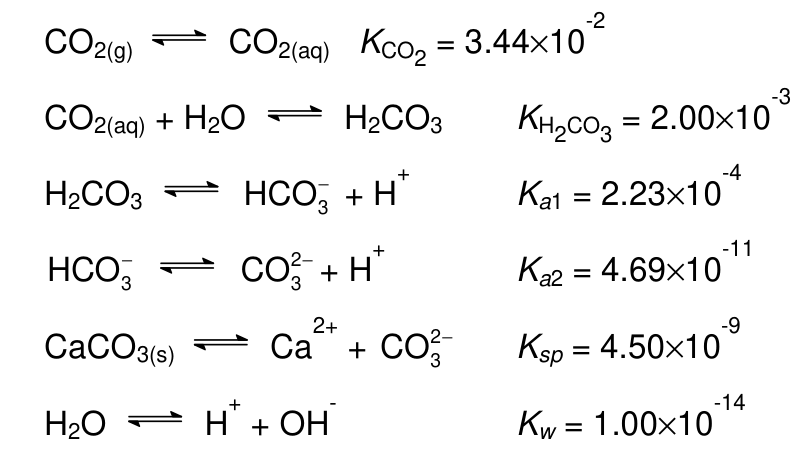
Note: Calculations must be shown.
6.1 Natural waters (river or lake water) generally contain dissolved \(\ce{CO2}\). The ratio of \([\ce{H2CO3}]:[\ce{HCO3^-}]:[\ce{CO3^2-}]\) in a water at \([\ce{H+}]=1.00\times10^{-7}\ \mathrm{M}\) will be:
\[ \underline{(a)}:1.00:\underline{(b)}. \]
Calculate (a) and (b).
6.2 Gaseous \(\ce{CO2}\) in the atmosphere can be regarded as a contributor to the alkalinity of water in equilibrium with air. Calculate the concentration of \(\ce{CO2(aq)}\) \((\mathrm{mol\,dm^{-3}})\) in pure water that is in equilibrium with the unpolluted air at \(1.01\times10^5\ \mathrm{Pa}\) and 298 K containing 0.0360 % (molar ratio) \(\ce{CO2}\). (assuming standard pressure \(=1.01\times10^5\ \mathrm{Pa}\)).
If you are unable to solve this problem, assume that concentration of \(\ce{CO2(aq)}\) is equal to \(1.11\times10^{-5}\ \mathrm{M}\) for further calculations.
The solubility (\(S\)) of \(\ce{CO2}\) in water can be defined as
\[ S=[\ce{CO2(aq)}]+[\ce{H2CO3}]+[\ce{HCO3^-}]+[\ce{CO3^2-}]. \]
The solubility of atmospheric \(\ce{CO2}\) in water that is in equilibrium with the unpolluted air at 298 K and \(1.01\times10^5\ \mathrm{Pa}\) will vary with alkalinity.
6-3 Find the solubility of atmospheric \(\ce{CO2}\) in pure water \((\mathrm{mol\,dm^{-3}})\). Neglect dissociation of water.
6.4 Find the solubility of atmospheric \(\ce{CO2}\) \((\mathrm{mol\,dm^{-3}})\) in a \(1.00\times10^{-3}\ \mathrm{mol\,dm^{-3}}\) \(\ce{NaOH}\) solution.
At 298 K, \(1.01\times10^5\ \mathrm{Pa}\) unpolluted air is in equilibrium with natural water saturated with \(\ce{CaCO3}\). The following main equilibrium may exist:

6.5 Calculate the equilibrium constant for the above equation.
If you are unable to solve this problem, assume that equilibrium constant \(K_{\mathrm{eq}}=5.00\times10^{-5}\) for further calculations.
6.6 Calculate the concentration of \(\ce{Ca^2+}\) \((\mathrm{mg\,dm^{-3}})\) in \(\ce{CaCO3}\)-saturated natural water that is in equilibrium with atmospheric \(\ce{CO2}\).
If you are unable to solve this problem, assume that concentration of \(\ce{Ca^2+(aq)}=40.1\ \mathrm{mg\,dm^{-3}}\) for further calculations.
6.7 Find the alkalinity (mol/L) of the above solution.
6.8 In an underground lake saturated with \(\ce{CaCO3}\), the water has a high content of \(\ce{CO2}\). The concentration of \(\ce{Ca^2+}\) in this lake was found to be as high as \(100\ \mathrm{mg\,dm^{-3}}\). Assume the lake and the air above is a closed system, calculate the effective pressure of \(\ce{CO2}\) (Pa) in air which is in equilibrium with this \(\ce{Ca^2+}\) content.
Official English text of the problem.
Answers
The results retain all given equilibria, except water dissociation in 6-3, as instructed. Parenthetical alternatives use the approximation \([\ce{HCO3^-}]\approx2[\ce{Ca^2+}]\).
- 6.1: \(a=4.48\times10^{-4}\), \(b=4.69\times10^{-4}\); hence the ratio is \(4.48\times10^{-4}:1.00:4.69\times10^{-4}\).
- 6.2: \([\ce{CO2(aq)}]=1.24\times10^{-5}\ \mathrm{mol\,dm^{-3}}\).
- 6-3: \(S=1.48\times10^{-5}\ \mathrm{mol\,dm^{-3}}\).
- 6.4: \(S=1.00\times10^{-3}\ \mathrm{mol\,dm^{-3}}\).
- 6.5: \(K_{\mathrm{eq}}=4.28\times10^{-5}\).
- 6.6: \([\ce{Ca^2+}]=20.7\ \mathrm{mg\,dm^{-3}}\) (\(20.4\ \mathrm{mg\,dm^{-3}}\) with the approximation).
- 6.7: Alkalinity \(=1.03\times10^{-3}\ \mathrm{mol\,L^{-1}}\) (\(1.02\times10^{-3}\ \mathrm{mol\,L^{-1}}\) with the approximation).
- 6.8: \(p_{\ce{CO2}}=4.25\times10^3\ \mathrm{Pa}\) (\(4.26\times10^3\ \mathrm{Pa}\) with the approximation).
Solution
The species used below have the following names and SMILES:
| Species and name | SMILES |
|---|---|
| \(\ce{CO2}\), carbon dioxide | O=C=O |
| \(\ce{H2O}\), water | O |
| \(\ce{H2CO3}\), carbonic acid | O=C(O)O |
| \(\ce{HCO3^-}\), hydrogen carbonate (bicarbonate) ion | O=C(O)[O-] |
| \(\ce{CO3^2-}\), carbonate ion | O=C([O-])[O-] |
| \(\ce{H+}\), hydrogen ion (proton) | [H+] |
| \(\ce{OH^-}\), hydroxide ion | [OH-] |
| \(\ce{Ca^2+}\), calcium ion | [Ca+2] |
| \(\ce{Na+}\), sodium ion | [Na+] |
| \(\ce{CaCO3}\), calcium carbonate | [Ca+2].[O-]C(=O)[O-] |
| \(\ce{NaOH}\), sodium hydroxide | [Na+].[OH-] |
The disconnected-ion SMILES for the salts do not describe their crystal lattices. SMILES also do not specify gas versus aqueous state or aqueous solvation; \(\ce{H+}\) is the conventional shorthand for the solvated proton.
Use ideal-solution equilibrium expressions, with concentrations in \(\mathrm{mol\,dm^{-3}}\) and unit standard concentration understood. Pure water and solid calcium carbonate have unit activity. For mass conversions, take \(M(\ce{Ca})=40.1\ \mathrm{g\,mol^{-1}}\).
6.1
The two acid dissociations give
\[ K_{a1}=\frac{[\ce{HCO3^-}][\ce{H+}]}{[\ce{H2CO3}]}, \qquad K_{a2}=\frac{[\ce{CO3^2-}][\ce{H+}]}{[\ce{HCO3^-}]}. \]
Normalizing the bicarbonate concentration to 1.00,
\[ a=\frac{[\ce{H2CO3}]}{[\ce{HCO3^-}]} =\frac{1.00\times10^{-7}}{2.23\times10^{-4}} =\boxed{4.48\times10^{-4}}, \]
\[ b=\frac{[\ce{CO3^2-}]}{[\ce{HCO3^-}]} =\frac{4.69\times10^{-11}}{1.00\times10^{-7}} =\boxed{4.69\times10^{-4}}. \]
Thus bicarbonate overwhelmingly predominates among these three species at the specified hydrogen-ion concentration.
6.2
The carbon dioxide mole fraction and partial pressure are
\[ y_{\ce{CO2}}=\frac{0.0360}{100}=3.60\times10^{-4}, \]
\[ p_{\ce{CO2}} =y_{\ce{CO2}}P =(3.60\times10^{-4})(1.01\times10^5) =36.36\ \mathrm{Pa}. \]
For
\[ \ce{CO2(g) <=> CO2(aq)}, \]
the given equilibrium constant uses pressure relative to the standard pressure:
\[ K_{\ce{CO2}} =\frac{[\ce{CO2(aq)}]/c^\circ}{p_{\ce{CO2}}/p^\circ}, \qquad c^\circ=1\ \mathrm{mol\,dm^{-3}}. \]
Therefore,
\[ [\ce{CO2(aq)}] =(3.44\times10^{-2}) \frac{36.36}{1.01\times10^5} (1\ \mathrm{mol\,dm^{-3}}) =1.2384\times10^{-5}\ \mathrm{mol\,dm^{-3}}. \]
\[ \boxed{[\ce{CO2(aq)}]=1.24\times10^{-5}\ \mathrm{mol\,dm^{-3}}} \]
This is the concentration of molecular dissolved carbon dioxide, rather than the sum of all dissolved carbon species.
6-3
Hydration gives
\[ \ce{CO2(aq) + H2O(l) <=> H2CO3(aq)}, \]
so
\[ [\ce{H2CO3}] =K_{\ce{H2CO3}}[\ce{CO2(aq)}] =(2.00\times10^{-3})(1.2384\times10^{-5}) =2.4768\times10^{-8}\ \mathrm{M}. \]
Define
\[ h=[\ce{H+}], \qquad A=K_{a1}[\ce{H2CO3}] =5.523264\times10^{-12}\ \mathrm{M^2}. \]
Then
\[ [\ce{HCO3^-}]=\frac{A}{h}, \qquad [\ce{CO3^2-}]=\frac{K_{a2}A}{h^2}. \]
Neglecting water dissociation, electroneutrality requires
\[ h=[\ce{HCO3^-}]+2[\ce{CO3^2-}] =\frac{A}{h}+\frac{2K_{a2}A}{h^2}. \]
The second dissociation is very small, so initially
\[ h\simeq\sqrt{A}=2.3502\times10^{-6}\ \mathrm{M}. \]
Indeed,
\[ \frac{[\ce{CO3^2-}]}{[\ce{HCO3^-}]} =\frac{K_{a2}}{h}\simeq2.00\times10^{-5}, \]
which verifies that approximation. Retaining the small carbonate term gives
\[ [\ce{HCO3^-}]=2.35012\times10^{-6}\ \mathrm{M}, \qquad [\ce{CO3^2-}]=4.68981\times10^{-11}\ \mathrm{M}. \]
Hence
\[ \begin{aligned} S &=1.2384\times10^{-5} +2.4768\times10^{-8} +2.35012\times10^{-6} +4.68981\times10^{-11}\\ &=1.47589\times10^{-5}\ \mathrm{mol\,dm^{-3}}. \end{aligned} \]
\[ \boxed{S=1.48\times10^{-5}\ \mathrm{mol\,dm^{-3}}} \]
6.4
Sodium hydroxide dissociates completely:
\[ \ce{NaOH(aq) -> Na+(aq) + OH^-(aq)}. \]
Atmospheric carbon dioxide consumes hydroxide, principally through
\[ \ce{CO2(aq) + OH^-(aq) <=> HCO3^-(aq)}. \]
Consequently, the final hydroxide concentration is not the initial analytical sodium hydroxide concentration. The conserved sodium concentration is
\[ [\ce{Na+}]=1.00\times10^{-3}\ \mathrm{M}. \]
Equilibrium with the same atmosphere fixes \([\ce{CO2(aq)}]\), \([\ce{H2CO3}]\), and \(A\) at the values found above. Electroneutrality gives
\[ [\ce{Na+}]+h =\frac{A}{h}+\frac{2K_{a2}A}{h^2}+\frac{K_w}{h}. \]
Thus
\[ 1.00\times10^{-3} =\frac{A+K_w}{h} +\frac{2K_{a2}A}{h^2}-h. \]
Equivalently,
\[ h^3+(1.00\times10^{-3})h^2 -(A+K_w)h-2K_{a2}A=0. \]
The positive root is
\[ h=5.62533\times10^{-9}\ \mathrm{M}, \]
giving
\[ \begin{aligned} [\ce{HCO3^-}]&=9.81856\times10^{-4}\ \mathrm{M},\\ [\ce{CO3^2-}]&=8.18602\times10^{-6}\ \mathrm{M},\\ [\ce{OH^-}]&=1.77767\times10^{-6}\ \mathrm{M}. \end{aligned} \]
Therefore,
\[ \begin{aligned} S &=1.2384\times10^{-5} +2.4768\times10^{-8} +9.81856\times10^{-4} +8.18602\times10^{-6}\\ &=1.00245\times10^{-3}\ \mathrm{mol\,dm^{-3}}. \end{aligned} \]
\[ \boxed{S=1.00\times10^{-3}\ \mathrm{mol\,dm^{-3}}} \]
6.5
The required balanced reaction is
\[ \ce{CaCO3(s) + CO2(aq) + H2O(l) <=> Ca^2+(aq) + 2HCO3^-(aq)}. \]
It is obtained by adding the following equilibria:
\[ \begin{array}{ll} \ce{CaCO3(s) <=> Ca^2+(aq) + CO3^2-(aq)} &K_{sp},\\[2pt] \ce{CO2(aq) + H2O(l) <=> H2CO3(aq)} &K_{\ce{H2CO3}},\\[2pt] \ce{H2CO3(aq) <=> HCO3^-(aq) + H+(aq)} &K_{a1},\\[2pt] \ce{CO3^2-(aq) + H+(aq) <=> HCO3^-(aq)} &1/K_{a2}. \end{array} \]
Adding reactions multiplies their equilibrium constants, so
\[ K_{\mathrm{eq}} =\frac{K_{sp}K_{\ce{H2CO3}}K_{a1}}{K_{a2}} =\frac{(4.50\times10^{-9})(2.00\times10^{-3})(2.23\times10^{-4})} {4.69\times10^{-11}}. \]
\[ \boxed{K_{\mathrm{eq}}=4.28\times10^{-5}} \]
Its activity expression is
\[ K_{\mathrm{eq}} =\frac{a_{\ce{Ca^2+}}a_{\ce{HCO3^-}}^2}{a_{\ce{CO2(aq)}}}. \]
With the concentration convention used here, its working expression is
\[ K_{\mathrm{eq}} =\frac{[\ce{Ca^2+}][\ce{HCO3^-}]^2}{[\ce{CO2(aq)}]}. \]
6.6
Write \(x=[\ce{Ca^2+}]\). If bicarbonate is the dominant anion, electroneutrality gives
\[ [\ce{HCO3^-}]\simeq2x. \]
The main equilibrium then yields
\[ K_{\mathrm{eq}}\simeq\frac{x(2x)^2}{[\ce{CO2(aq)}]}, \]
so
\[ x\simeq \left(\frac{K_{\mathrm{eq}}[\ce{CO2(aq)}]}{4}\right)^{1/3} = \left(\frac{(4.27932\times10^{-5})(1.2384\times10^{-5})}{4}\right)^{1/3} =5.09791\times10^{-4}\ \mathrm{M}. \]
This approximation gives
\[ [\ce{Ca^2+}] \simeq(5.09791\times10^{-4})(40.1)(10^3) =\boxed{20.4\ \mathrm{mg\,dm^{-3}}}. \]
To retain all the supplied equilibria, use the complete charge balance
\[ 2x+h=[\ce{HCO3^-}]+2[\ce{CO3^2-}]+[\ce{OH^-}], \]
together with
\[ [\ce{HCO3^-}]=\frac{A}{h}, \qquad [\ce{CO3^2-}]=\frac{K_{a2}A}{h^2}, \qquad x=\frac{K_{sp}h^2}{K_{a2}A}. \]
Substitution gives a single equation:
\[ \frac{2K_{sp}h^2}{K_{a2}A}+h =\frac{A+K_w}{h}+\frac{2K_{a2}A}{h^2}. \]
Its positive solution is
\[ h=5.45130\times10^{-9}\ \mathrm{M}, \qquad x=5.16232\times10^{-4}\ \mathrm{M}. \]
The corresponding anion concentrations are
\[ \begin{aligned} [\ce{HCO3^-}]&=1.01320\times10^{-3}\ \mathrm{M},\\ [\ce{CO3^2-}]&=8.71702\times10^{-6}\ \mathrm{M},\\ [\ce{OH^-}]&=1.83442\times10^{-6}\ \mathrm{M}. \end{aligned} \]
Thus the complete equilibrium calculation gives
\[ \boxed{ [\ce{Ca^2+}] =(5.16232\times10^{-4})(40.1)(10^3) =20.7\ \mathrm{mg\,dm^{-3}} }. \]
The dominant-bicarbonate approximation underestimates this result by about \(1.25\%\).
6.7
Rearranging the charge balance from 6.6,
\[ [\ce{HCO3^-}]+2[\ce{CO3^2-}]+[\ce{OH^-}]-[\ce{H+}] =2[\ce{Ca^2+}]. \]
Therefore, for the specified calcium carbonate–carbon dioxide–water system,
\[ \text{alkalinity}=2[\ce{Ca^2+}]. \]
Using the complete equilibrium result,
\[ \text{alkalinity} =2(5.16232\times10^{-4}) =1.03246\times10^{-3}\ \mathrm{mol\,L^{-1}}, \]
\[ \boxed{\text{alkalinity}=1.03\times10^{-3}\ \mathrm{mol\,L^{-1}}}. \]
Using the approximate calcium concentration instead gives
\[ \boxed{\text{alkalinity}\simeq1.02\times10^{-3}\ \mathrm{mol\,L^{-1}}}. \]
6.8
Convert the measured calcium concentration:
\[ x=[\ce{Ca^2+}] =\frac{100\times10^{-3}\ \mathrm{g\,dm^{-3}}} {40.1\ \mathrm{g\,mol^{-1}}} =2.49377\times10^{-3}\ \mathrm{M}. \]
Calcium carbonate saturation fixes the carbonate concentration:
\[ D=[\ce{CO3^2-}] =\frac{K_{sp}}{x} =\frac{4.50\times10^{-9}}{2.49377\times10^{-3}} =1.80450\times10^{-6}\ \mathrm{M}. \]
From the second acid dissociation,
\[ [\ce{HCO3^-}]=\frac{Dh}{K_{a2}}. \]
The complete charge balance is consequently
\[ 2x+h=\frac{Dh}{K_{a2}}+2D+\frac{K_w}{h}, \]
or
\[ \left(\frac{D}{K_{a2}}-1\right)h^2 -(2x-2D)h+K_w=0. \]
The root corresponding to the high-\(\ce{CO2}\) water specified in the question gives
\[ h=1.29536\times10^{-7}\ \mathrm{M}, \qquad [\ce{HCO3^-}]=4.98397\times10^{-3}\ \mathrm{M}. \]
The equilibrium from 6.5 now determines molecular dissolved carbon dioxide:
\[ [\ce{CO2(aq)}] =\frac{x[\ce{HCO3^-}]^2}{K_{\mathrm{eq}}} =\frac{(2.49377\times10^{-3})(4.98397\times10^{-3})^2} {4.27932\times10^{-5}} =1.44755\times10^{-3}\ \mathrm{M}. \]
Applying Henry’s law,
\[ p_{\ce{CO2}} =p^\circ\frac{[\ce{CO2(aq)}]/c^\circ}{K_{\ce{CO2}}} =(1.01\times10^5) \frac{1.44755\times10^{-3}}{3.44\times10^{-2}} =4.25007\times10^3\ \mathrm{Pa}. \]
\[ \boxed{p_{\ce{CO2}}=4.25\times10^3\ \mathrm{Pa}} \]
With the simpler approximation \([\ce{HCO3^-}]\simeq2x\),
\[ p_{\ce{CO2}} \simeq p^\circ\frac{4x^3}{K_{\mathrm{eq}}K_{\ce{CO2}}} =\boxed{4.26\times10^3\ \mathrm{Pa}}. \]
The headspace volume is unnecessary: the aqueous equilibrium composition determines the required equilibrium partial pressure.
The solution was checked against the official solution.
IChO 2005 · Theorieaufgabe 6
Alkalinität von Wasser und Löslichkeit von CO2
Alkalinität von Wasser und Löslichkeit von \(\ce{CO2}\)
Die Fähigkeit von Wasser, \(\ce{H+}\)-Ionen aufzunehmen, wird als Alkalinität bezeichnet. Die Alkalinität ist für die Wasseraufbereitung sowie für die Chemie und Biologie natürlicher Gewässer von Bedeutung. Im Allgemeinen sind die basischen Spezies, die für die Alkalinität von Wasser verantwortlich sind, \(\ce{HCO3^-}\), \(\ce{CO3^2-}\) und \(\ce{OH^-}\). Bei pH-Werten unter 7 verringern \(\ce{H+}\)-Ionen im Wasser die Alkalinität erheblich. Daher lässt sich die vollständige Gleichung für die Alkalinität in einem Medium, in dem ausschließlich \(\ce{HCO3^-}\), \(\ce{CO3^2-}\) und \(\ce{OH^-}\) zur Alkalinität beitragen, wie folgt ausdrücken:
\[ \text{Alkalinität} =[\ce{HCO3^-}]+2[\ce{CO3^2-}]+[\ce{OH^-}]-[\ce{H+}] \]
Die Beiträge der verschiedenen Spezies zur Alkalinität hängen vom pH-Wert ab. Die relevanten chemischen Gleichungen und Gleichgewichtskonstanten (bei 298 K) sind nachstehend angegeben:
Hinweis: Die Berechnungen müssen angegeben werden.
6.1 Natürliche Gewässer (Fluss- oder Seewasser) enthalten im Allgemeinen gelöstes \(\ce{CO2}\). Das Verhältnis \([\ce{H2CO3}]:[\ce{HCO3^-}]:[\ce{CO3^2-}]\) in einem Wasser mit \([\ce{H+}]=1.00\times10^{-7}\ \mathrm{M}\) beträgt:
\[ \underline{(a)}:1.00:\underline{(b)}. \]
Berechnen Sie (a) und (b).
6.2 Gasförmiges \(\ce{CO2}\) in der Atmosphäre kann als Beitrag zur Alkalinität von Wasser betrachtet werden, das sich im Gleichgewicht mit Luft befindet. Berechnen Sie die Konzentration von \(\ce{CO2(aq)}\) \((\mathrm{mol\,dm^{-3}})\) in reinem Wasser, das bei \(1.01\times10^5\ \mathrm{Pa}\) und 298 K im Gleichgewicht mit unbelasteter Luft steht, die 0.0360 % (Stoffmengenanteil) \(\ce{CO2}\) enthält. (Angenommener Standarddruck \(=1.01\times10^5\ \mathrm{Pa}\).)
Falls Sie diese Aufgabe nicht lösen können, nehmen Sie für die weiteren Berechnungen an, dass die Konzentration von \(\ce{CO2(aq)}\) gleich \(1.11\times10^{-5}\ \mathrm{M}\) ist.
Die Löslichkeit (\(S\)) von \(\ce{CO2}\) in Wasser lässt sich definieren als
\[ S=[\ce{CO2(aq)}]+[\ce{H2CO3}]+[\ce{HCO3^-}]+[\ce{CO3^2-}]. \]
Die Löslichkeit von atmosphärischem \(\ce{CO2}\) in Wasser, das bei 298 K und \(1.01\times10^5\ \mathrm{Pa}\) im Gleichgewicht mit unbelasteter Luft steht, variiert mit der Alkalinität.
6-3 Bestimmen Sie die Löslichkeit von atmosphärischem \(\ce{CO2}\) in reinem Wasser \((\mathrm{mol\,dm^{-3}})\). Vernachlässigen Sie die Dissoziation des Wassers.
6.4 Bestimmen Sie die Löslichkeit von atmosphärischem \(\ce{CO2}\) \((\mathrm{mol\,dm^{-3}})\) in einer \(1.00\times10^{-3}\ \mathrm{mol\,dm^{-3}}\) \(\ce{NaOH}\)-Lösung.
Bei 298 K und \(1.01\times10^5\ \mathrm{Pa}\) steht unbelastete Luft im Gleichgewicht mit natürlichem Wasser, das mit \(\ce{CaCO3}\) gesättigt ist. Dabei kann das folgende Hauptgleichgewicht vorliegen:
6.5 Berechnen Sie die Gleichgewichtskonstante für die obige Gleichung.
Falls Sie diese Aufgabe nicht lösen können, nehmen Sie für die weiteren Berechnungen eine Gleichgewichtskonstante von \(K_{\mathrm{eq}}=5.00\times10^{-5}\) an.
6.6 Berechnen Sie die Konzentration von \(\ce{Ca^2+}\) \((\mathrm{mg\,dm^{-3}})\) in mit \(\ce{CaCO3}\) gesättigtem natürlichem Wasser, das im Gleichgewicht mit atmosphärischem \(\ce{CO2}\) steht.
Falls Sie diese Aufgabe nicht lösen können, nehmen Sie für die weiteren Berechnungen eine Konzentration von \(\ce{Ca^2+(aq)}=40.1\ \mathrm{mg\,dm^{-3}}\) an.
6.7 Bestimmen Sie die Alkalinität (mol/L) der obigen Lösung.
6.8 In einem unterirdischen See, der mit \(\ce{CaCO3}\) gesättigt ist, weist das Wasser einen hohen Gehalt an \(\ce{CO2}\) auf. In diesem See wurde eine Konzentration von \(\ce{Ca^2+}\) von bis zu \(100\ \mathrm{mg\,dm^{-3}}\) festgestellt. Nehmen Sie an, dass der See und die darüber befindliche Luft ein geschlossenes System bilden, und berechnen Sie den effektiven Druck von \(\ce{CO2}\) (Pa) in der Luft, die mit diesem \(\ce{Ca^2+}\)-Gehalt im Gleichgewicht steht.
Aufgabentext aus dem offiziellen englischen Text übersetzt.
Antworten
Die Ergebnisse berücksichtigen alle angegebenen Gleichgewichte mit Ausnahme der Dissoziation des Wassers in 6-3, wie dort gefordert. Die Alternativwerte in Klammern beruhen auf der Näherung \([\ce{HCO3^-}]\approx2[\ce{Ca^2+}]\).
- 6.1: \(a=4.48\times10^{-4}\), \(b=4.69\times10^{-4}\); somit beträgt das Verhältnis \(4.48\times10^{-4}:1.00:4.69\times10^{-4}\).
- 6.2: \([\ce{CO2(aq)}]=1.24\times10^{-5}\ \mathrm{mol\,dm^{-3}}\).
- 6-3: \(S=1.48\times10^{-5}\ \mathrm{mol\,dm^{-3}}\).
- 6.4: \(S=1.00\times10^{-3}\ \mathrm{mol\,dm^{-3}}\).
- 6.5: \(K_{\mathrm{eq}}=4.28\times10^{-5}\).
- 6.6: \([\ce{Ca^2+}]=20.7\ \mathrm{mg\,dm^{-3}}\) (\(20.4\ \mathrm{mg\,dm^{-3}}\) mit der Näherung).
- 6.7: Alkalinität \(=1.03\times10^{-3}\ \mathrm{mol\,L^{-1}}\) (\(1.02\times10^{-3}\ \mathrm{mol\,L^{-1}}\) mit der Näherung).
- 6.8: \(p_{\ce{CO2}}=4.25\times10^3\ \mathrm{Pa}\) (\(4.26\times10^3\ \mathrm{Pa}\) mit der Näherung).
Lösung
Die nachfolgend verwendeten Spezies haben die folgenden Namen und SMILES:
| Spezies und Name | SMILES |
|---|---|
| \(\ce{CO2}\), Kohlenstoffdioxid | O=C=O |
| \(\ce{H2O}\), Wasser | O |
| \(\ce{H2CO3}\), Kohlensäure | O=C(O)O |
| \(\ce{HCO3^-}\), Hydrogencarbonat-Ion (Bicarbonat-Ion) | O=C(O)[O-] |
| \(\ce{CO3^2-}\), Carbonat-Ion | O=C([O-])[O-] |
| \(\ce{H+}\), Wasserstoff-Ion (Proton) | [H+] |
| \(\ce{OH^-}\), Hydroxid-Ion | [OH-] |
| \(\ce{Ca^2+}\), Calcium-Ion | [Ca+2] |
| \(\ce{Na+}\), Natrium-Ion | [Na+] |
| \(\ce{CaCO3}\), Calciumcarbonat | [Ca+2].[O-]C(=O)[O-] |
| \(\ce{NaOH}\), Natriumhydroxid | [Na+].[OH-] |
Die SMILES der Salze stellen getrennte Ionen dar und beschreiben nicht deren Kristallgitter. SMILES geben außerdem weder den gasförmigen bzw. wässrigen Zustand noch die Solvatation in Wasser an; \(\ce{H+}\) ist die übliche Kurzschreibweise für das solvatisierte Proton.
Verwenden Sie Gleichgewichtsausdrücke für ideale Lösungen mit Konzentrationen in \(\mathrm{mol\,dm^{-3}}\), wobei eine Standardkonzentration von eins vorausgesetzt wird. Reines Wasser und festes Calciumcarbonat haben die Aktivität eins. Verwenden Sie für die Umrechnung in Massen \(M(\ce{Ca})=40.1\ \mathrm{g\,mol^{-1}}\).
6.1
Aus den beiden Säuredissoziationen folgt
\[ K_{a1}=\frac{[\ce{HCO3^-}][\ce{H+}]}{[\ce{H2CO3}]}, \qquad K_{a2}=\frac{[\ce{CO3^2-}][\ce{H+}]}{[\ce{HCO3^-}]}. \]
Bei Normierung der Hydrogencarbonatkonzentration auf 1.00 ergibt sich
\[ a=\frac{[\ce{H2CO3}]}{[\ce{HCO3^-}]} =\frac{1.00\times10^{-7}}{2.23\times10^{-4}} =\boxed{4.48\times10^{-4}}, \]
\[ b=\frac{[\ce{CO3^2-}]}{[\ce{HCO3^-}]} =\frac{4.69\times10^{-11}}{1.00\times10^{-7}} =\boxed{4.69\times10^{-4}}. \]
Somit überwiegt Hydrogencarbonat bei der angegebenen Wasserstoffionenkonzentration unter diesen drei Spezies bei Weitem.
6.2
Der Stoffmengenanteil und der Partialdruck von Kohlenstoffdioxid betragen
\[ y_{\ce{CO2}}=\frac{0.0360}{100}=3.60\times10^{-4}, \]
\[ p_{\ce{CO2}} =y_{\ce{CO2}}P =(3.60\times10^{-4})(1.01\times10^5) =36.36\ \mathrm{Pa}. \]
Für
\[ \ce{CO2(g) <=> CO2(aq)}, \]
wird in der angegebenen Gleichgewichtskonstante der auf den Standarddruck bezogene Druck verwendet:
\[ K_{\ce{CO2}} =\frac{[\ce{CO2(aq)}]/c^\circ}{p_{\ce{CO2}}/p^\circ}, \qquad c^\circ=1\ \mathrm{mol\,dm^{-3}}. \]
Daher gilt
\[ [\ce{CO2(aq)}] =(3.44\times10^{-2}) \frac{36.36}{1.01\times10^5} (1\ \mathrm{mol\,dm^{-3}}) =1.2384\times10^{-5}\ \mathrm{mol\,dm^{-3}}. \]
\[ \boxed{[\ce{CO2(aq)}]=1.24\times10^{-5}\ \mathrm{mol\,dm^{-3}}} \]
Dies ist die Konzentration des molekular gelösten Kohlenstoffdioxids und nicht die Summe aller gelösten Kohlenstoffspezies.
6-3
Für die Hydratation gilt
\[ \ce{CO2(aq) + H2O(l) <=> H2CO3(aq)}, \]
also
\[ [\ce{H2CO3}] =K_{\ce{H2CO3}}[\ce{CO2(aq)}] =(2.00\times10^{-3})(1.2384\times10^{-5}) =2.4768\times10^{-8}\ \mathrm{M}. \]
Wir definieren
\[ h=[\ce{H+}], \qquad A=K_{a1}[\ce{H2CO3}] =5.523264\times10^{-12}\ \mathrm{M^2}. \]
Dann gilt
\[ [\ce{HCO3^-}]=\frac{A}{h}, \qquad [\ce{CO3^2-}]=\frac{K_{a2}A}{h^2}. \]
Bei Vernachlässigung der Dissoziation des Wassers verlangt die Elektroneutralität
\[ h=[\ce{HCO3^-}]+2[\ce{CO3^2-}] =\frac{A}{h}+\frac{2K_{a2}A}{h^2}. \]
Die zweite Dissoziation ist sehr gering, sodass zunächst gilt
\[ h\simeq\sqrt{A}=2.3502\times10^{-6}\ \mathrm{M}. \]
Tatsächlich gilt
\[ \frac{[\ce{CO3^2-}]}{[\ce{HCO3^-}]} =\frac{K_{a2}}{h}\simeq2.00\times10^{-5}, \]
womit diese Näherung bestätigt ist. Unter Berücksichtigung des kleinen Carbonatterms erhält man
\[ [\ce{HCO3^-}]=2.35012\times10^{-6}\ \mathrm{M}, \qquad [\ce{CO3^2-}]=4.68981\times10^{-11}\ \mathrm{M}. \]
Somit folgt
\[ \begin{aligned} S &=1.2384\times10^{-5} +2.4768\times10^{-8} +2.35012\times10^{-6} +4.68981\times10^{-11}\\ &=1.47589\times10^{-5}\ \mathrm{mol\,dm^{-3}}. \end{aligned} \]
\[ \boxed{S=1.48\times10^{-5}\ \mathrm{mol\,dm^{-3}}} \]
6.4
Natriumhydroxid dissoziiert vollständig:
\[ \ce{NaOH(aq) -> Na+(aq) + OH^-(aq)}. \]
Atmosphärisches Kohlenstoffdioxid verbraucht Hydroxid, hauptsächlich durch
\[ \ce{CO2(aq) + OH^-(aq) <=> HCO3^-(aq)}. \]
Folglich ist die endgültige Hydroxidkonzentration nicht gleich der anfänglichen analytischen Natriumhydroxidkonzentration. Die erhalten bleibende Natriumkonzentration beträgt
\[ [\ce{Na+}]=1.00\times10^{-3}\ \mathrm{M}. \]
Das Gleichgewicht mit derselben Atmosphäre legt \([\ce{CO2(aq)}]\), \([\ce{H2CO3}]\) und \(A\) auf die oben ermittelten Werte fest. Aus der Elektroneutralität folgt
\[ [\ce{Na+}]+h =\frac{A}{h}+\frac{2K_{a2}A}{h^2}+\frac{K_w}{h}. \]
Somit gilt
\[ 1.00\times10^{-3} =\frac{A+K_w}{h} +\frac{2K_{a2}A}{h^2}-h. \]
Äquivalent dazu ist
\[ h^3+(1.00\times10^{-3})h^2 -(A+K_w)h-2K_{a2}A=0. \]
Die positive Nullstelle ist
\[ h=5.62533\times10^{-9}\ \mathrm{M}, \]
woraus sich ergibt
\[ \begin{aligned} [\ce{HCO3^-}]&=9.81856\times10^{-4}\ \mathrm{M},\\ [\ce{CO3^2-}]&=8.18602\times10^{-6}\ \mathrm{M},\\ [\ce{OH^-}]&=1.77767\times10^{-6}\ \mathrm{M}. \end{aligned} \]
Daher gilt
\[ \begin{aligned} S &=1.2384\times10^{-5} +2.4768\times10^{-8} +9.81856\times10^{-4} +8.18602\times10^{-6}\\ &=1.00245\times10^{-3}\ \mathrm{mol\,dm^{-3}}. \end{aligned} \]
\[ \boxed{S=1.00\times10^{-3}\ \mathrm{mol\,dm^{-3}}} \]
6.5
Die gesuchte ausgeglichene Reaktionsgleichung lautet
\[ \ce{CaCO3(s) + CO2(aq) + H2O(l) <=> Ca^2+(aq) + 2HCO3^-(aq)}. \]
Sie ergibt sich durch Addition der folgenden Gleichgewichte:
\[ \begin{array}{ll} \ce{CaCO3(s) <=> Ca^2+(aq) + CO3^2-(aq)} &K_{sp},\\[2pt] \ce{CO2(aq) + H2O(l) <=> H2CO3(aq)} &K_{\ce{H2CO3}},\\[2pt] \ce{H2CO3(aq) <=> HCO3^-(aq) + H+(aq)} &K_{a1},\\[2pt] \ce{CO3^2-(aq) + H+(aq) <=> HCO3^-(aq)} &1/K_{a2}. \end{array} \]
Beim Addieren von Reaktionen werden ihre Gleichgewichtskonstanten multipliziert, also
\[ K_{\mathrm{eq}} =\frac{K_{sp}K_{\ce{H2CO3}}K_{a1}}{K_{a2}} =\frac{(4.50\times10^{-9})(2.00\times10^{-3})(2.23\times10^{-4})} {4.69\times10^{-11}}. \]
\[ \boxed{K_{\mathrm{eq}}=4.28\times10^{-5}} \]
Ihr Ausdruck in Aktivitäten lautet
\[ K_{\mathrm{eq}} =\frac{a_{\ce{Ca^2+}}a_{\ce{HCO3^-}}^2}{a_{\ce{CO2(aq)}}}. \]
Mit der hier verwendeten Konzentrationskonvention lautet der für die Rechnung verwendete Ausdruck
\[ K_{\mathrm{eq}} =\frac{[\ce{Ca^2+}][\ce{HCO3^-}]^2}{[\ce{CO2(aq)}]}. \]
6.6
Wir setzen \(x=[\ce{Ca^2+}]\). Wenn Hydrogencarbonat das vorherrschende Anion ist, ergibt sich aus der Elektroneutralität
\[ [\ce{HCO3^-}]\simeq2x. \]
Das Hauptgleichgewicht liefert dann
\[ K_{\mathrm{eq}}\simeq\frac{x(2x)^2}{[\ce{CO2(aq)}]}, \]
also
\[ x\simeq \left(\frac{K_{\mathrm{eq}}[\ce{CO2(aq)}]}{4}\right)^{1/3} = \left(\frac{(4.27932\times10^{-5})(1.2384\times10^{-5})}{4}\right)^{1/3} =5.09791\times10^{-4}\ \mathrm{M}. \]
Diese Näherung ergibt
\[ [\ce{Ca^2+}] \simeq(5.09791\times10^{-4})(40.1)(10^3) =\boxed{20.4\ \mathrm{mg\,dm^{-3}}}. \]
Um alle angegebenen Gleichgewichte zu berücksichtigen, verwenden wir die vollständige Ladungsbilanz
\[ 2x+h=[\ce{HCO3^-}]+2[\ce{CO3^2-}]+[\ce{OH^-}], \]
zusammen mit
\[ [\ce{HCO3^-}]=\frac{A}{h}, \qquad [\ce{CO3^2-}]=\frac{K_{a2}A}{h^2}, \qquad x=\frac{K_{sp}h^2}{K_{a2}A}. \]
Durch Einsetzen ergibt sich eine einzige Gleichung:
\[ \frac{2K_{sp}h^2}{K_{a2}A}+h =\frac{A+K_w}{h}+\frac{2K_{a2}A}{h^2}. \]
Ihre positive Lösung ist
\[ h=5.45130\times10^{-9}\ \mathrm{M}, \qquad x=5.16232\times10^{-4}\ \mathrm{M}. \]
Die zugehörigen Anionenkonzentrationen betragen
\[ \begin{aligned} [\ce{HCO3^-}]&=1.01320\times10^{-3}\ \mathrm{M},\\ [\ce{CO3^2-}]&=8.71702\times10^{-6}\ \mathrm{M},\\ [\ce{OH^-}]&=1.83442\times10^{-6}\ \mathrm{M}. \end{aligned} \]
Somit ergibt die vollständige Gleichgewichtsberechnung
\[ \boxed{ [\ce{Ca^2+}] =(5.16232\times10^{-4})(40.1)(10^3) =20.7\ \mathrm{mg\,dm^{-3}} }. \]
Die Näherung mit vorherrschendem Hydrogencarbonat unterschätzt dieses Ergebnis um etwa \(1.25\%\).
6.7
Durch Umstellen der Ladungsbilanz aus 6.6 erhält man
\[ [\ce{HCO3^-}]+2[\ce{CO3^2-}]+[\ce{OH^-}]-[\ce{H+}] =2[\ce{Ca^2+}]. \]
Daher gilt für das angegebene System Calciumcarbonat–Kohlenstoffdioxid–Wasser
\[ \text{Alkalinität}=2[\ce{Ca^2+}]. \]
Mit dem Ergebnis der vollständigen Gleichgewichtsberechnung folgt
\[ \text{Alkalinität} =2(5.16232\times10^{-4}) =1.03246\times10^{-3}\ \mathrm{mol\,L^{-1}}, \]
\[ \boxed{\text{Alkalinität}=1.03\times10^{-3}\ \mathrm{mol\,L^{-1}}}. \]
Verwendet man stattdessen die näherungsweise berechnete Calciumkonzentration, ergibt sich
\[ \boxed{\text{Alkalinität}\simeq1.02\times10^{-3}\ \mathrm{mol\,L^{-1}}}. \]
6.8
Wir rechnen die gemessene Calciumkonzentration um:
\[ x=[\ce{Ca^2+}] =\frac{100\times10^{-3}\ \mathrm{g\,dm^{-3}}} {40.1\ \mathrm{g\,mol^{-1}}} =2.49377\times10^{-3}\ \mathrm{M}. \]
Die Sättigung mit Calciumcarbonat legt die Carbonatkonzentration fest:
\[ D=[\ce{CO3^2-}] =\frac{K_{sp}}{x} =\frac{4.50\times10^{-9}}{2.49377\times10^{-3}} =1.80450\times10^{-6}\ \mathrm{M}. \]
Aus der zweiten Säuredissoziation folgt
\[ [\ce{HCO3^-}]=\frac{Dh}{K_{a2}}. \]
Die vollständige Ladungsbilanz lautet somit
\[ 2x+h=\frac{Dh}{K_{a2}}+2D+\frac{K_w}{h}, \]
oder
\[ \left(\frac{D}{K_{a2}}-1\right)h^2 -(2x-2D)h+K_w=0. \]
Die Nullstelle, die dem in der Aufgabe angegebenen Wasser mit hohem \(\ce{CO2}\)-Gehalt entspricht, ergibt
\[ h=1.29536\times10^{-7}\ \mathrm{M}, \qquad [\ce{HCO3^-}]=4.98397\times10^{-3}\ \mathrm{M}. \]
Das Gleichgewicht aus 6.5 bestimmt nun die Konzentration des molekular gelösten Kohlenstoffdioxids:
\[ [\ce{CO2(aq)}] =\frac{x[\ce{HCO3^-}]^2}{K_{\mathrm{eq}}} =\frac{(2.49377\times10^{-3})(4.98397\times10^{-3})^2} {4.27932\times10^{-5}} =1.44755\times10^{-3}\ \mathrm{M}. \]
Mit dem Henry-Gesetz folgt
\[ p_{\ce{CO2}} =p^\circ\frac{[\ce{CO2(aq)}]/c^\circ}{K_{\ce{CO2}}} =(1.01\times10^5) \frac{1.44755\times10^{-3}}{3.44\times10^{-2}} =4.25007\times10^3\ \mathrm{Pa}. \]
\[ \boxed{p_{\ce{CO2}}=4.25\times10^3\ \mathrm{Pa}} \]
Mit der einfacheren Näherung \([\ce{HCO3^-}]\simeq2x\) gilt
\[ p_{\ce{CO2}} \simeq p^\circ\frac{4x^3}{K_{\mathrm{eq}}K_{\ce{CO2}}} =\boxed{4.26\times10^3\ \mathrm{Pa}}. \]
Das Volumen des Gasraums wird nicht benötigt: Die Gleichgewichtszusammensetzung der wässrigen Phase bestimmt den erforderlichen Gleichgewichtspartialdruck.
Die Lösung wurde mit der offiziellen Lösung abgeglichen.
IChO 2005 · Teori sorusu 6
Suyun Alkalinitesi ve CO2’nin Çözünürlüğü
Suyun Alkalinitesi ve \(\ce{CO2}\)’nin Çözünürlüğü
Suyun \(\ce{H+}\) iyonlarını kabul etme kapasitesine alkalinite denir. Alkalinite, su arıtımında ve doğal suların kimyası ile biyolojisinde önemlidir. Genel olarak, sudaki alkaliniteden sorumlu bazik türler \(\ce{HCO3^-}\), \(\ce{CO3^2-}\) ve \(\ce{OH^-}\)’dir. pH değerinin 7’nin altında olduğu durumlarda sudaki \(\ce{H+}\), alkaliniteyi önemli ölçüde azaltır. Dolayısıyla, alkaliniteye katkıda bulunan tek türlerin \(\ce{HCO3^-}\), \(\ce{CO3^2-}\) ve \(\ce{OH^-}\) olduğu bir ortamda alkaliniteyi veren tam denklem şu şekilde ifade edilebilir:
\[ \text{alkalinite} =[\ce{HCO3^-}]+2[\ce{CO3^2-}]+[\ce{OH^-}]-[\ce{H+}] \]
Farklı türlerin alkaliniteye katkıları pH’a bağlıdır. İlgili kimyasal denklemler ve denge sabitleri (298 K’de) aşağıda gösterilmiştir:
Not: Hesaplamalar gösterilmelidir.
6.1 Doğal sular (nehir veya göl suyu) genellikle çözünmüş \(\ce{CO2}\) içerir. \([\ce{H+}]=1.00\times10^{-7}\ \mathrm{M}\) olan bir sudaki \([\ce{H2CO3}]:[\ce{HCO3^-}]:[\ce{CO3^2-}]\) oranı şöyle olacaktır:
\[ \underline{(a)}:1.00:\underline{(b)}. \]
(a) ve (b)’yi hesaplayınız.
6.2 Atmosferdeki gaz hâlindeki \(\ce{CO2}\), havayla dengede bulunan suyun alkalinitesine katkıda bulunan bir bileşen olarak kabul edilebilir. \(1.01\times10^5\ \mathrm{Pa}\) ve 298 K’de, % 0.0360 (mol oranı) \(\ce{CO2}\) içeren kirlenmemiş havayla dengede bulunan saf sudaki \(\ce{CO2(aq)}\) derişimini \((\mathrm{mol\,dm^{-3}})\) hesaplayınız. (Standart basıncın \(=1.01\times10^5\ \mathrm{Pa}\) olduğunu varsayınız.)
Bu soruyu çözemediyseniz sonraki hesaplamalar için \(\ce{CO2(aq)}\) derişiminin \(1.11\times10^{-5}\ \mathrm{M}\) olduğunu varsayınız.
\(\ce{CO2}\)’nin sudaki çözünürlüğü (\(S\)) şu şekilde tanımlanabilir:
\[ S=[\ce{CO2(aq)}]+[\ce{H2CO3}]+[\ce{HCO3^-}]+[\ce{CO3^2-}]. \]
Atmosferik \(\ce{CO2}\)’nin, 298 K ve \(1.01\times10^5\ \mathrm{Pa}\)’da kirlenmemiş havayla dengede bulunan sudaki çözünürlüğü alkaliniteye bağlı olarak değişir.
6-3 Atmosferik \(\ce{CO2}\)’nin saf sudaki çözünürlüğünü \((\mathrm{mol\,dm^{-3}})\) bulunuz. Suyun ayrışmasını ihmal ediniz.
6.4 Atmosferik \(\ce{CO2}\)’nin \(1.00\times10^{-3}\ \mathrm{mol\,dm^{-3}}\) derişimindeki bir \(\ce{NaOH}\) çözeltisindeki çözünürlüğünü \((\mathrm{mol\,dm^{-3}})\) bulunuz.
298 K ve \(1.01\times10^5\ \mathrm{Pa}\)’da kirlenmemiş hava, \(\ce{CaCO3}\) ile doymuş doğal suyla dengededir. Aşağıdaki temel denge kurulabilir:
6.5 Yukarıdaki denklemin denge sabitini hesaplayınız.
Bu soruyu çözemediyseniz sonraki hesaplamalar için denge sabitinin \(K_{\mathrm{eq}}=5.00\times10^{-5}\) olduğunu varsayınız.
6.6 Atmosferik \(\ce{CO2}\) ile dengede bulunan, \(\ce{CaCO3}\) ile doymuş doğal sudaki \(\ce{Ca^2+}\) derişimini \((\mathrm{mg\,dm^{-3}})\) hesaplayınız.
Bu soruyu çözemediyseniz sonraki hesaplamalar için \(\ce{Ca^2+(aq)}=40.1\ \mathrm{mg\,dm^{-3}}\) derişimini varsayınız.
6.7 Yukarıdaki çözeltinin alkalinitesini (mol/L) bulunuz.
6.8 \(\ce{CaCO3}\) ile doymuş bir yer altı gölünde suyun \(\ce{CO2}\) içeriği yüksektir. Bu göldeki \(\ce{Ca^2+}\) derişiminin \(100\ \mathrm{mg\,dm^{-3}}\) kadar yüksek olduğu bulunmuştur. Gölün ve üzerindeki havanın kapalı bir sistem oluşturduğunu varsayarak, bu \(\ce{Ca^2+}\) içeriğiyle dengede bulunan havadaki \(\ce{CO2}\)’nin etkin basıncını (Pa) hesaplayınız.
Soru metni resmi İngilizce metinden çevrilmiştir.
Cevaplar
Sonuçlarda, belirtildiği üzere 6-3’te suyun ayrışması dışında, verilen tüm dengeler dikkate alınmıştır. Parantez içindeki alternatif değerlerde \([\ce{HCO3^-}]\approx2[\ce{Ca^2+}]\) yaklaşımı kullanılmıştır.
- 6.1: \(a=4.48\times10^{-4}\), \(b=4.69\times10^{-4}\); dolayısıyla oran \(4.48\times10^{-4}:1.00:4.69\times10^{-4}\) olur.
- 6.2: \([\ce{CO2(aq)}]=1.24\times10^{-5}\ \mathrm{mol\,dm^{-3}}\).
- 6-3: \(S=1.48\times10^{-5}\ \mathrm{mol\,dm^{-3}}\).
- 6.4: \(S=1.00\times10^{-3}\ \mathrm{mol\,dm^{-3}}\).
- 6.5: \(K_{\mathrm{eq}}=4.28\times10^{-5}\).
- 6.6: \([\ce{Ca^2+}]=20.7\ \mathrm{mg\,dm^{-3}}\) (yaklaşım kullanıldığında \(20.4\ \mathrm{mg\,dm^{-3}}\)).
- 6.7: Alkalinite \(=1.03\times10^{-3}\ \mathrm{mol\,L^{-1}}\) (yaklaşım kullanıldığında \(1.02\times10^{-3}\ \mathrm{mol\,L^{-1}}\)).
- 6.8: \(p_{\ce{CO2}}=4.25\times10^3\ \mathrm{Pa}\) (yaklaşım kullanıldığında \(4.26\times10^3\ \mathrm{Pa}\)).
Çözüm
Aşağıda kullanılan türlerin adları ve SMILES gösterimleri şöyledir:
| Tür ve adı | SMILES |
|---|---|
| \(\ce{CO2}\), karbon dioksit | O=C=O |
| \(\ce{H2O}\), su | O |
| \(\ce{H2CO3}\), karbonik asit | O=C(O)O |
| \(\ce{HCO3^-}\), hidrojen karbonat (bikarbonat) iyonu | O=C(O)[O-] |
| \(\ce{CO3^2-}\), karbonat iyonu | O=C([O-])[O-] |
| \(\ce{H+}\), hidrojen iyonu (proton) | [H+] |
| \(\ce{OH^-}\), hidroksit iyonu | [OH-] |
| \(\ce{Ca^2+}\), kalsiyum iyonu | [Ca+2] |
| \(\ce{Na+}\), sodyum iyonu | [Na+] |
| \(\ce{CaCO3}\), kalsiyum karbonat | [Ca+2].[O-]C(=O)[O-] |
| \(\ce{NaOH}\), sodyum hidroksit | [Na+].[OH-] |
Tuzların iyonlarını birbirinden ayrı gösteren SMILES gösterimleri, kristal örgülerini betimlemez. SMILES ayrıca gaz hâli ile sulu çözelti hâlini veya sulu çözeltideki solvatasyonu belirtmez; \(\ce{H+}\), solvatlanmış proton için kullanılan geleneksel kısa gösterimdir.
Derişimlerin \(\mathrm{mol\,dm^{-3}}\) cinsinden olduğu ve standart derişimin birim değer aldığı kabulüyle ideal çözelti denge ifadelerini kullanınız. Saf suyun ve katı kalsiyum karbonatın aktiviteleri birdir. Kütle dönüşümleri için \(M(\ce{Ca})=40.1\ \mathrm{g\,mol^{-1}}\) alınız.
6.1
İki asit ayrışması şu bağıntıları verir:
\[ K_{a1}=\frac{[\ce{HCO3^-}][\ce{H+}]}{[\ce{H2CO3}]}, \qquad K_{a2}=\frac{[\ce{CO3^2-}][\ce{H+}]}{[\ce{HCO3^-}]}. \]
Bikarbonat derişimi 1.00 olacak şekilde normalize edildiğinde,
\[ a=\frac{[\ce{H2CO3}]}{[\ce{HCO3^-}]} =\frac{1.00\times10^{-7}}{2.23\times10^{-4}} =\boxed{4.48\times10^{-4}}, \]
\[ b=\frac{[\ce{CO3^2-}]}{[\ce{HCO3^-}]} =\frac{4.69\times10^{-11}}{1.00\times10^{-7}} =\boxed{4.69\times10^{-4}}. \]
Dolayısıyla belirtilen hidrojen iyonu derişiminde, bu üç tür arasında bikarbonat açık ara baskındır.
6.2
Karbon dioksitin mol kesri ve kısmi basıncı şöyledir:
\[ y_{\ce{CO2}}=\frac{0.0360}{100}=3.60\times10^{-4}, \]
\[ p_{\ce{CO2}} =y_{\ce{CO2}}P =(3.60\times10^{-4})(1.01\times10^5) =36.36\ \mathrm{Pa}. \]
Şu denge için
\[ \ce{CO2(g) <=> CO2(aq)}, \]
verilen denge sabitinde basıncın standart basınca oranı kullanılır:
\[ K_{\ce{CO2}} =\frac{[\ce{CO2(aq)}]/c^\circ}{p_{\ce{CO2}}/p^\circ}, \qquad c^\circ=1\ \mathrm{mol\,dm^{-3}}. \]
Dolayısıyla,
\[ [\ce{CO2(aq)}] =(3.44\times10^{-2}) \frac{36.36}{1.01\times10^5} (1\ \mathrm{mol\,dm^{-3}}) =1.2384\times10^{-5}\ \mathrm{mol\,dm^{-3}}. \]
\[ \boxed{[\ce{CO2(aq)}]=1.24\times10^{-5}\ \mathrm{mol\,dm^{-3}}} \]
Bu değer, çözünmüş tüm karbon türlerinin toplamı değil, moleküler hâlde çözünmüş karbon dioksitin derişimidir.
6-3
Hidratasyon dengesi şöyledir:
\[ \ce{CO2(aq) + H2O(l) <=> H2CO3(aq)}, \]
dolayısıyla
\[ [\ce{H2CO3}] =K_{\ce{H2CO3}}[\ce{CO2(aq)}] =(2.00\times10^{-3})(1.2384\times10^{-5}) =2.4768\times10^{-8}\ \mathrm{M}. \]
Şu tanımları yapalım:
\[ h=[\ce{H+}], \qquad A=K_{a1}[\ce{H2CO3}] =5.523264\times10^{-12}\ \mathrm{M^2}. \]
Böylece
\[ [\ce{HCO3^-}]=\frac{A}{h}, \qquad [\ce{CO3^2-}]=\frac{K_{a2}A}{h^2}. \]
Suyun ayrışması ihmal edildiğinde, elektriksel nötrlük şu koşulu gerektirir:
\[ h=[\ce{HCO3^-}]+2[\ce{CO3^2-}] =\frac{A}{h}+\frac{2K_{a2}A}{h^2}. \]
İkinci ayrışma çok küçük olduğundan ilk yaklaşım olarak
\[ h\simeq\sqrt{A}=2.3502\times10^{-6}\ \mathrm{M}. \]
Nitekim,
\[ \frac{[\ce{CO3^2-}]}{[\ce{HCO3^-}]} =\frac{K_{a2}}{h}\simeq2.00\times10^{-5}, \]
bu da söz konusu yaklaşımı doğrular. Küçük karbonat terimi de hesaba katıldığında,
\[ [\ce{HCO3^-}]=2.35012\times10^{-6}\ \mathrm{M}, \qquad [\ce{CO3^2-}]=4.68981\times10^{-11}\ \mathrm{M}. \]
Böylece
\[ \begin{aligned} S &=1.2384\times10^{-5} +2.4768\times10^{-8} +2.35012\times10^{-6} +4.68981\times10^{-11}\\ &=1.47589\times10^{-5}\ \mathrm{mol\,dm^{-3}}. \end{aligned} \]
\[ \boxed{S=1.48\times10^{-5}\ \mathrm{mol\,dm^{-3}}} \]
6.4
Sodyum hidroksit tamamen ayrışır:
\[ \ce{NaOH(aq) -> Na+(aq) + OH^-(aq)}. \]
Atmosferik karbon dioksit, başlıca şu tepkime yoluyla hidroksiti tüketir:
\[ \ce{CO2(aq) + OH^-(aq) <=> HCO3^-(aq)}. \]
Bu nedenle son hidroksit derişimi, başlangıçtaki analitik sodyum hidroksit derişimine eşit değildir. Korunan sodyum derişimi şöyledir:
\[ [\ce{Na+}]=1.00\times10^{-3}\ \mathrm{M}. \]
Aynı atmosferle dengede bulunması, \([\ce{CO2(aq)}]\), \([\ce{H2CO3}]\) ve \(A\)’yı yukarıda bulunan değerlere sabitler. Elektriksel nötrlük şu bağıntıyı verir:
\[ [\ce{Na+}]+h =\frac{A}{h}+\frac{2K_{a2}A}{h^2}+\frac{K_w}{h}. \]
Böylece
\[ 1.00\times10^{-3} =\frac{A+K_w}{h} +\frac{2K_{a2}A}{h^2}-h. \]
Eşdeğer biçimde,
\[ h^3+(1.00\times10^{-3})h^2 -(A+K_w)h-2K_{a2}A=0. \]
Pozitif kök şöyledir:
\[ h=5.62533\times10^{-9}\ \mathrm{M}, \]
buradan
\[ \begin{aligned} [\ce{HCO3^-}]&=9.81856\times10^{-4}\ \mathrm{M},\\ [\ce{CO3^2-}]&=8.18602\times10^{-6}\ \mathrm{M},\\ [\ce{OH^-}]&=1.77767\times10^{-6}\ \mathrm{M}. \end{aligned} \]
Dolayısıyla,
\[ \begin{aligned} S &=1.2384\times10^{-5} +2.4768\times10^{-8} +9.81856\times10^{-4} +8.18602\times10^{-6}\\ &=1.00245\times10^{-3}\ \mathrm{mol\,dm^{-3}}. \end{aligned} \]
\[ \boxed{S=1.00\times10^{-3}\ \mathrm{mol\,dm^{-3}}} \]
6.5
İstenen denkleştirilmiş tepkime şöyledir:
\[ \ce{CaCO3(s) + CO2(aq) + H2O(l) <=> Ca^2+(aq) + 2HCO3^-(aq)}. \]
Bu tepkime, aşağıdaki dengelerin toplanmasıyla elde edilir:
\[ \begin{array}{ll} \ce{CaCO3(s) <=> Ca^2+(aq) + CO3^2-(aq)} &K_{sp},\\[2pt] \ce{CO2(aq) + H2O(l) <=> H2CO3(aq)} &K_{\ce{H2CO3}},\\[2pt] \ce{H2CO3(aq) <=> HCO3^-(aq) + H+(aq)} &K_{a1},\\[2pt] \ce{CO3^2-(aq) + H+(aq) <=> HCO3^-(aq)} &1/K_{a2}. \end{array} \]
Tepkimeler toplandığında denge sabitleri çarpılır; dolayısıyla
\[ K_{\mathrm{eq}} =\frac{K_{sp}K_{\ce{H2CO3}}K_{a1}}{K_{a2}} =\frac{(4.50\times10^{-9})(2.00\times10^{-3})(2.23\times10^{-4})} {4.69\times10^{-11}}. \]
\[ \boxed{K_{\mathrm{eq}}=4.28\times10^{-5}} \]
Aktiviteler cinsinden ifadesi şöyledir:
\[ K_{\mathrm{eq}} =\frac{a_{\ce{Ca^2+}}a_{\ce{HCO3^-}}^2}{a_{\ce{CO2(aq)}}}. \]
Burada benimsenen derişim kabulüyle hesaplamalarda kullanılan ifade şöyledir:
\[ K_{\mathrm{eq}} =\frac{[\ce{Ca^2+}][\ce{HCO3^-}]^2}{[\ce{CO2(aq)}]}. \]
6.6
\(x=[\ce{Ca^2+}]\) yazalım. Bikarbonat baskın anyon ise elektriksel nötrlük şu bağıntıyı verir:
\[ [\ce{HCO3^-}]\simeq2x. \]
Bu durumda temel dengeden
\[ K_{\mathrm{eq}}\simeq\frac{x(2x)^2}{[\ce{CO2(aq)}]}, \]
dolayısıyla
\[ x\simeq \left(\frac{K_{\mathrm{eq}}[\ce{CO2(aq)}]}{4}\right)^{1/3} = \left(\frac{(4.27932\times10^{-5})(1.2384\times10^{-5})}{4}\right)^{1/3} =5.09791\times10^{-4}\ \mathrm{M}. \]
Bu yaklaşımla
\[ [\ce{Ca^2+}] \simeq(5.09791\times10^{-4})(40.1)(10^3) =\boxed{20.4\ \mathrm{mg\,dm^{-3}}}. \]
Verilen tüm dengeleri dikkate almak için tam yük denkliğini
\[ 2x+h=[\ce{HCO3^-}]+2[\ce{CO3^2-}]+[\ce{OH^-}], \]
şu bağıntılarla birlikte kullanınız:
\[ [\ce{HCO3^-}]=\frac{A}{h}, \qquad [\ce{CO3^2-}]=\frac{K_{a2}A}{h^2}, \qquad x=\frac{K_{sp}h^2}{K_{a2}A}. \]
Yerine koyma işlemi tek bir denklem verir:
\[ \frac{2K_{sp}h^2}{K_{a2}A}+h =\frac{A+K_w}{h}+\frac{2K_{a2}A}{h^2}. \]
Bu denklemin pozitif çözümü şöyledir:
\[ h=5.45130\times10^{-9}\ \mathrm{M}, \qquad x=5.16232\times10^{-4}\ \mathrm{M}. \]
Buna karşılık gelen anyon derişimleri şöyledir:
\[ \begin{aligned} [\ce{HCO3^-}]&=1.01320\times10^{-3}\ \mathrm{M},\\ [\ce{CO3^2-}]&=8.71702\times10^{-6}\ \mathrm{M},\\ [\ce{OH^-}]&=1.83442\times10^{-6}\ \mathrm{M}. \end{aligned} \]
Böylece tüm dengelerin hesaba katıldığı hesaplama şu sonucu verir:
\[ \boxed{ [\ce{Ca^2+}] =(5.16232\times10^{-4})(40.1)(10^3) =20.7\ \mathrm{mg\,dm^{-3}} }. \]
Bikarbonatın baskın olduğu yaklaşımı, bu sonuçtan yaklaşık \(1.25\%\) daha düşük bir değer verir.
6.7
6.6’daki yük denkliği yeniden düzenlendiğinde,
\[ [\ce{HCO3^-}]+2[\ce{CO3^2-}]+[\ce{OH^-}]-[\ce{H+}] =2[\ce{Ca^2+}]. \]
Dolayısıyla, belirtilen kalsiyum karbonat–karbon dioksit–su sistemi için,
\[ \text{alkalinite}=2[\ce{Ca^2+}]. \]
Tüm dengelerin hesaba katıldığı sonuç kullanıldığında,
\[ \text{alkalinite} =2(5.16232\times10^{-4}) =1.03246\times10^{-3}\ \mathrm{mol\,L^{-1}}, \]
\[ \boxed{\text{alkalinite}=1.03\times10^{-3}\ \mathrm{mol\,L^{-1}}}. \]
Bunun yerine yaklaşık kalsiyum derişimi kullanıldığında,
\[ \boxed{\text{alkalinite}\simeq1.02\times10^{-3}\ \mathrm{mol\,L^{-1}}}. \]
6.8
Ölçülen kalsiyum derişimini dönüştürelim:
\[ x=[\ce{Ca^2+}] =\frac{100\times10^{-3}\ \mathrm{g\,dm^{-3}}} {40.1\ \mathrm{g\,mol^{-1}}} =2.49377\times10^{-3}\ \mathrm{M}. \]
Kalsiyum karbonata doygunluk, karbonat derişimini belirler:
\[ D=[\ce{CO3^2-}] =\frac{K_{sp}}{x} =\frac{4.50\times10^{-9}}{2.49377\times10^{-3}} =1.80450\times10^{-6}\ \mathrm{M}. \]
İkinci asit ayrışmasından,
\[ [\ce{HCO3^-}]=\frac{Dh}{K_{a2}}. \]
Dolayısıyla tam yük denkliği şöyledir:
\[ 2x+h=\frac{Dh}{K_{a2}}+2D+\frac{K_w}{h}, \]
veya
\[ \left(\frac{D}{K_{a2}}-1\right)h^2 -(2x-2D)h+K_w=0. \]
Soruda belirtilen yüksek \(\ce{CO2}\) içeriğine sahip suya karşılık gelen kök şu değerleri verir:
\[ h=1.29536\times10^{-7}\ \mathrm{M}, \qquad [\ce{HCO3^-}]=4.98397\times10^{-3}\ \mathrm{M}. \]
Artık 6.5’teki denge, moleküler hâlde çözünmüş karbon dioksiti belirler:
\[ [\ce{CO2(aq)}] =\frac{x[\ce{HCO3^-}]^2}{K_{\mathrm{eq}}} =\frac{(2.49377\times10^{-3})(4.98397\times10^{-3})^2} {4.27932\times10^{-5}} =1.44755\times10^{-3}\ \mathrm{M}. \]
Henry yasası uygulandığında,
\[ p_{\ce{CO2}} =p^\circ\frac{[\ce{CO2(aq)}]/c^\circ}{K_{\ce{CO2}}} =(1.01\times10^5) \frac{1.44755\times10^{-3}}{3.44\times10^{-2}} =4.25007\times10^3\ \mathrm{Pa}. \]
\[ \boxed{p_{\ce{CO2}}=4.25\times10^3\ \mathrm{Pa}} \]
Daha basit olan \([\ce{HCO3^-}]\simeq2x\) yaklaşımıyla,
\[ p_{\ce{CO2}} \simeq p^\circ\frac{4x^3}{K_{\mathrm{eq}}K_{\ce{CO2}}} =\boxed{4.26\times10^3\ \mathrm{Pa}}. \]
Suyun üzerindeki gaz boşluğunun hacmi gerekli değildir: sulu fazın denge bileşimi, gerekli denge kısmi basıncını belirler.
Çözüm, resmi çözümle karşılaştırılarak kontrol edildi.
IChO 2005 · Problema teórico 6
Alcalinidad del agua y solubilidad del CO2
Alcalinidad del agua y solubilidad del \(\ce{CO2}\)
La capacidad del agua para aceptar iones \(\ce{H+}\) se denomina alcalinidad. La alcalinidad es importante en el tratamiento del agua y en la química y la biología de las aguas naturales. En general, las especies básicas responsables de la alcalinidad del agua son \(\ce{HCO3^-}\), \(\ce{CO3^2-}\) y \(\ce{OH^-}\). A valores de pH inferiores a 7, los iones \(\ce{H+}\) presentes en el agua reducen significativamente la alcalinidad. Por tanto, la ecuación completa de la alcalinidad en un medio en el que \(\ce{HCO3^-}\), \(\ce{CO3^2-}\) y \(\ce{OH^-}\) son las únicas especies que contribuyen a ella puede expresarse como
\[ \text{alcalinidad} =[\ce{HCO3^-}]+2[\ce{CO3^2-}]+[\ce{OH^-}]-[\ce{H+}] \]
Las contribuciones de las distintas especies a la alcalinidad dependen del pH. A continuación se muestran las ecuaciones químicas y las constantes de equilibrio pertinentes (a 298 K):
Nota: Deben mostrarse los cálculos.
6.1 Las aguas naturales (agua de ríos o lagos) suelen contener \(\ce{CO2}\) disuelto. La proporción \([\ce{H2CO3}]:[\ce{HCO3^-}]:[\ce{CO3^2-}]\) en un agua con \([\ce{H+}]=1.00\times10^{-7}\ \mathrm{M}\) será:
\[ \underline{(a)}:1.00:\underline{(b)}. \]
Calcule (a) y (b).
6.2 El \(\ce{CO2}\) gaseoso de la atmósfera puede considerarse una especie que contribuye a la alcalinidad del agua en equilibrio con el aire. Calcule la concentración de \(\ce{CO2(aq)}\) \((\mathrm{mol\,dm^{-3}})\) en agua pura en equilibrio con aire no contaminado a \(1.01\times10^5\ \mathrm{Pa}\) y 298 K que contiene un 0.0360 % (proporción molar) de \(\ce{CO2}\). (Suponga una presión estándar \(=1.01\times10^5\ \mathrm{Pa}\)).
Si no puede resolver este apartado, suponga que la concentración de \(\ce{CO2(aq)}\) es igual a \(1.11\times10^{-5}\ \mathrm{M}\) para los cálculos posteriores.
La solubilidad (\(S\)) del \(\ce{CO2}\) en agua puede definirse como
\[ S=[\ce{CO2(aq)}]+[\ce{H2CO3}]+[\ce{HCO3^-}]+[\ce{CO3^2-}]. \]
La solubilidad del \(\ce{CO2}\) atmosférico en agua en equilibrio con aire no contaminado a 298 K y \(1.01\times10^5\ \mathrm{Pa}\) variará con la alcalinidad.
6-3 Determine la solubilidad del \(\ce{CO2}\) atmosférico en agua pura \((\mathrm{mol\,dm^{-3}})\). Desprecie la disociación del agua.
6.4 Determine la solubilidad del \(\ce{CO2}\) atmosférico \((\mathrm{mol\,dm^{-3}})\) en una disolución de \(1.00\times10^{-3}\ \mathrm{mol\,dm^{-3}}\) de \(\ce{NaOH}\).
A 298 K y \(1.01\times10^5\ \mathrm{Pa}\), el aire no contaminado está en equilibrio con agua natural saturada de \(\ce{CaCO3}\). Puede establecerse el siguiente equilibrio principal:
6.5 Calcule la constante de equilibrio de la ecuación anterior.
Si no puede resolver este apartado, suponga que la constante de equilibrio es \(K_{\mathrm{eq}}=5.00\times10^{-5}\) para los cálculos posteriores.
6.6 Calcule la concentración de \(\ce{Ca^2+}\) \((\mathrm{mg\,dm^{-3}})\) en agua natural saturada de \(\ce{CaCO3}\) que está en equilibrio con el \(\ce{CO2}\) atmosférico.
Si no puede resolver este apartado, suponga que la concentración de \(\ce{Ca^2+(aq)}=40.1\ \mathrm{mg\,dm^{-3}}\) para los cálculos posteriores.
6.7 Determine la alcalinidad (mol/L) de la disolución anterior.
6.8 En un lago subterráneo saturado de \(\ce{CaCO3}\), el agua tiene un contenido elevado de \(\ce{CO2}\). Se encontró que la concentración de \(\ce{Ca^2+}\) en este lago alcanzaba los \(100\ \mathrm{mg\,dm^{-3}}\). Suponiendo que el lago y el aire situado sobre él constituyen un sistema cerrado, calcule la presión efectiva de \(\ce{CO2}\) (Pa) en el aire que está en equilibrio con este contenido de \(\ce{Ca^2+}\).
Enunciado traducido del texto oficial en inglés.
Respuestas
Los resultados tienen en cuenta todos los equilibrios dados, excepto la disociación del agua en 6-3, tal como se indica. Las alternativas entre paréntesis utilizan la aproximación \([\ce{HCO3^-}]\approx2[\ce{Ca^2+}]\).
- 6.1: \(a=4.48\times10^{-4}\), \(b=4.69\times10^{-4}\); por tanto, la proporción es \(4.48\times10^{-4}:1.00:4.69\times10^{-4}\).
- 6.2: \([\ce{CO2(aq)}]=1.24\times10^{-5}\ \mathrm{mol\,dm^{-3}}\).
- 6-3: \(S=1.48\times10^{-5}\ \mathrm{mol\,dm^{-3}}\).
- 6.4: \(S=1.00\times10^{-3}\ \mathrm{mol\,dm^{-3}}\).
- 6.5: \(K_{\mathrm{eq}}=4.28\times10^{-5}\).
- 6.6: \([\ce{Ca^2+}]=20.7\ \mathrm{mg\,dm^{-3}}\) (\(20.4\ \mathrm{mg\,dm^{-3}}\) con la aproximación).
- 6.7: Alcalinidad \(=1.03\times10^{-3}\ \mathrm{mol\,L^{-1}}\) (\(1.02\times10^{-3}\ \mathrm{mol\,L^{-1}}\) con la aproximación).
- 6.8: \(p_{\ce{CO2}}=4.25\times10^3\ \mathrm{Pa}\) (\(4.26\times10^3\ \mathrm{Pa}\) con la aproximación).
Solución
Las especies utilizadas a continuación tienen los siguientes nombres y SMILES:
| Especie y nombre | SMILES |
|---|---|
| \(\ce{CO2}\), dióxido de carbono | O=C=O |
| \(\ce{H2O}\), agua | O |
| \(\ce{H2CO3}\), ácido carbónico | O=C(O)O |
| \(\ce{HCO3^-}\), ion hidrogenocarbonato (bicarbonato) | O=C(O)[O-] |
| \(\ce{CO3^2-}\), ion carbonato | O=C([O-])[O-] |
| \(\ce{H+}\), ion hidrógeno (protón) | [H+] |
| \(\ce{OH^-}\), ion hidróxido | [OH-] |
| \(\ce{Ca^2+}\), ion calcio | [Ca+2] |
| \(\ce{Na+}\), ion sodio | [Na+] |
| \(\ce{CaCO3}\), carbonato de calcio | [Ca+2].[O-]C(=O)[O-] |
| \(\ce{NaOH}\), hidróxido de sodio | [Na+].[OH-] |
Los SMILES de las sales, que representan iones separados, no describen sus redes cristalinas. Los SMILES tampoco especifican si se trata del estado gaseoso o acuoso ni la solvatación acuosa; \(\ce{H+}\) es la abreviatura convencional del protón solvatado.
Se utilizan expresiones de equilibrio para disoluciones ideales, con concentraciones en \(\mathrm{mol\,dm^{-3}}\) y una concentración estándar unitaria implícita. El agua pura y el carbonato de calcio sólido tienen actividad unitaria. Para las conversiones de masa, se toma \(M(\ce{Ca})=40.1\ \mathrm{g\,mol^{-1}}\).
6.1
Las dos disociaciones ácidas dan
\[ K_{a1}=\frac{[\ce{HCO3^-}][\ce{H+}]}{[\ce{H2CO3}]}, \qquad K_{a2}=\frac{[\ce{CO3^2-}][\ce{H+}]}{[\ce{HCO3^-}]}. \]
Normalizando la concentración de bicarbonato a 1.00,
\[ a=\frac{[\ce{H2CO3}]}{[\ce{HCO3^-}]} =\frac{1.00\times10^{-7}}{2.23\times10^{-4}} =\boxed{4.48\times10^{-4}}, \]
\[ b=\frac{[\ce{CO3^2-}]}{[\ce{HCO3^-}]} =\frac{4.69\times10^{-11}}{1.00\times10^{-7}} =\boxed{4.69\times10^{-4}}. \]
Por tanto, el bicarbonato predomina ampliamente entre estas tres especies a la concentración de iones hidrógeno especificada.
6.2
La fracción molar y la presión parcial del dióxido de carbono son
\[ y_{\ce{CO2}}=\frac{0.0360}{100}=3.60\times10^{-4}, \]
\[ p_{\ce{CO2}} =y_{\ce{CO2}}P =(3.60\times10^{-4})(1.01\times10^5) =36.36\ \mathrm{Pa}. \]
Para
\[ \ce{CO2(g) <=> CO2(aq)}, \]
la constante de equilibrio dada utiliza la presión relativa a la presión estándar:
\[ K_{\ce{CO2}} =\frac{[\ce{CO2(aq)}]/c^\circ}{p_{\ce{CO2}}/p^\circ}, \qquad c^\circ=1\ \mathrm{mol\,dm^{-3}}. \]
Por tanto,
\[ [\ce{CO2(aq)}] =(3.44\times10^{-2}) \frac{36.36}{1.01\times10^5} (1\ \mathrm{mol\,dm^{-3}}) =1.2384\times10^{-5}\ \mathrm{mol\,dm^{-3}}. \]
\[ \boxed{[\ce{CO2(aq)}]=1.24\times10^{-5}\ \mathrm{mol\,dm^{-3}}} \]
Esta es la concentración de dióxido de carbono molecular disuelto, no la suma de todas las especies de carbono disueltas.
6-3
La hidratación da
\[ \ce{CO2(aq) + H2O(l) <=> H2CO3(aq)}, \]
por lo que
\[ [\ce{H2CO3}] =K_{\ce{H2CO3}}[\ce{CO2(aq)}] =(2.00\times10^{-3})(1.2384\times10^{-5}) =2.4768\times10^{-8}\ \mathrm{M}. \]
Se define
\[ h=[\ce{H+}], \qquad A=K_{a1}[\ce{H2CO3}] =5.523264\times10^{-12}\ \mathrm{M^2}. \]
Entonces
\[ [\ce{HCO3^-}]=\frac{A}{h}, \qquad [\ce{CO3^2-}]=\frac{K_{a2}A}{h^2}. \]
Despreciando la disociación del agua, la electroneutralidad exige
\[ h=[\ce{HCO3^-}]+2[\ce{CO3^2-}] =\frac{A}{h}+\frac{2K_{a2}A}{h^2}. \]
La segunda disociación es muy pequeña, por lo que, en una primera aproximación,
\[ h\simeq\sqrt{A}=2.3502\times10^{-6}\ \mathrm{M}. \]
En efecto,
\[ \frac{[\ce{CO3^2-}]}{[\ce{HCO3^-}]} =\frac{K_{a2}}{h}\simeq2.00\times10^{-5}, \]
lo que confirma esa aproximación. Al conservar el pequeño término del carbonato se obtiene
\[ [\ce{HCO3^-}]=2.35012\times10^{-6}\ \mathrm{M}, \qquad [\ce{CO3^2-}]=4.68981\times10^{-11}\ \mathrm{M}. \]
Por tanto,
\[ \begin{aligned} S &=1.2384\times10^{-5} +2.4768\times10^{-8} +2.35012\times10^{-6} +4.68981\times10^{-11}\\ &=1.47589\times10^{-5}\ \mathrm{mol\,dm^{-3}}. \end{aligned} \]
\[ \boxed{S=1.48\times10^{-5}\ \mathrm{mol\,dm^{-3}}} \]
6.4
El hidróxido de sodio se disocia completamente:
\[ \ce{NaOH(aq) -> Na+(aq) + OH^-(aq)}. \]
El dióxido de carbono atmosférico consume hidróxido, principalmente mediante
\[ \ce{CO2(aq) + OH^-(aq) <=> HCO3^-(aq)}. \]
En consecuencia, la concentración final de hidróxido no es la concentración analítica inicial de hidróxido de sodio. La concentración de sodio, que se conserva, es
\[ [\ce{Na+}]=1.00\times10^{-3}\ \mathrm{M}. \]
El equilibrio con la misma atmósfera fija \([\ce{CO2(aq)}]\), \([\ce{H2CO3}]\) y \(A\) en los valores obtenidos anteriormente. La electroneutralidad da
\[ [\ce{Na+}]+h =\frac{A}{h}+\frac{2K_{a2}A}{h^2}+\frac{K_w}{h}. \]
Así,
\[ 1.00\times10^{-3} =\frac{A+K_w}{h} +\frac{2K_{a2}A}{h^2}-h. \]
De forma equivalente,
\[ h^3+(1.00\times10^{-3})h^2 -(A+K_w)h-2K_{a2}A=0. \]
La raíz positiva es
\[ h=5.62533\times10^{-9}\ \mathrm{M}, \]
lo que da
\[ \begin{aligned} [\ce{HCO3^-}]&=9.81856\times10^{-4}\ \mathrm{M},\\ [\ce{CO3^2-}]&=8.18602\times10^{-6}\ \mathrm{M},\\ [\ce{OH^-}]&=1.77767\times10^{-6}\ \mathrm{M}. \end{aligned} \]
Por tanto,
\[ \begin{aligned} S &=1.2384\times10^{-5} +2.4768\times10^{-8} +9.81856\times10^{-4} +8.18602\times10^{-6}\\ &=1.00245\times10^{-3}\ \mathrm{mol\,dm^{-3}}. \end{aligned} \]
\[ \boxed{S=1.00\times10^{-3}\ \mathrm{mol\,dm^{-3}}} \]
6.5
La reacción ajustada requerida es
\[ \ce{CaCO3(s) + CO2(aq) + H2O(l) <=> Ca^2+(aq) + 2HCO3^-(aq)}. \]
Se obtiene sumando los siguientes equilibrios:
\[ \begin{array}{ll} \ce{CaCO3(s) <=> Ca^2+(aq) + CO3^2-(aq)} &K_{sp},\\[2pt] \ce{CO2(aq) + H2O(l) <=> H2CO3(aq)} &K_{\ce{H2CO3}},\\[2pt] \ce{H2CO3(aq) <=> HCO3^-(aq) + H+(aq)} &K_{a1},\\[2pt] \ce{CO3^2-(aq) + H+(aq) <=> HCO3^-(aq)} &1/K_{a2}. \end{array} \]
Al sumar reacciones se multiplican sus constantes de equilibrio, por lo que
\[ K_{\mathrm{eq}} =\frac{K_{sp}K_{\ce{H2CO3}}K_{a1}}{K_{a2}} =\frac{(4.50\times10^{-9})(2.00\times10^{-3})(2.23\times10^{-4})} {4.69\times10^{-11}}. \]
\[ \boxed{K_{\mathrm{eq}}=4.28\times10^{-5}} \]
Su expresión en términos de actividades es
\[ K_{\mathrm{eq}} =\frac{a_{\ce{Ca^2+}}a_{\ce{HCO3^-}}^2}{a_{\ce{CO2(aq)}}}. \]
Con la convención de concentraciones utilizada aquí, la expresión de trabajo es
\[ K_{\mathrm{eq}} =\frac{[\ce{Ca^2+}][\ce{HCO3^-}]^2}{[\ce{CO2(aq)}]}. \]
6.6
Sea \(x=[\ce{Ca^2+}]\). Si el bicarbonato es el anión predominante, la electroneutralidad da
\[ [\ce{HCO3^-}]\simeq2x. \]
El equilibrio principal da entonces
\[ K_{\mathrm{eq}}\simeq\frac{x(2x)^2}{[\ce{CO2(aq)}]}, \]
por lo que
\[ x\simeq \left(\frac{K_{\mathrm{eq}}[\ce{CO2(aq)}]}{4}\right)^{1/3} = \left(\frac{(4.27932\times10^{-5})(1.2384\times10^{-5})}{4}\right)^{1/3} =5.09791\times10^{-4}\ \mathrm{M}. \]
Esta aproximación da
\[ [\ce{Ca^2+}] \simeq(5.09791\times10^{-4})(40.1)(10^3) =\boxed{20.4\ \mathrm{mg\,dm^{-3}}}. \]
Para tener en cuenta todos los equilibrios proporcionados, se utiliza el balance de cargas completo
\[ 2x+h=[\ce{HCO3^-}]+2[\ce{CO3^2-}]+[\ce{OH^-}], \]
junto con
\[ [\ce{HCO3^-}]=\frac{A}{h}, \qquad [\ce{CO3^2-}]=\frac{K_{a2}A}{h^2}, \qquad x=\frac{K_{sp}h^2}{K_{a2}A}. \]
La sustitución da una única ecuación:
\[ \frac{2K_{sp}h^2}{K_{a2}A}+h =\frac{A+K_w}{h}+\frac{2K_{a2}A}{h^2}. \]
Su solución positiva es
\[ h=5.45130\times10^{-9}\ \mathrm{M}, \qquad x=5.16232\times10^{-4}\ \mathrm{M}. \]
Las concentraciones correspondientes de los aniones son
\[ \begin{aligned} [\ce{HCO3^-}]&=1.01320\times10^{-3}\ \mathrm{M},\\ [\ce{CO3^2-}]&=8.71702\times10^{-6}\ \mathrm{M},\\ [\ce{OH^-}]&=1.83442\times10^{-6}\ \mathrm{M}. \end{aligned} \]
Así, el cálculo completo del equilibrio da
\[ \boxed{ [\ce{Ca^2+}] =(5.16232\times10^{-4})(40.1)(10^3) =20.7\ \mathrm{mg\,dm^{-3}} }. \]
La aproximación de predominio del bicarbonato subestima este resultado en aproximadamente un \(1.25\%\).
6.7
Reordenando el balance de cargas de 6.6,
\[ [\ce{HCO3^-}]+2[\ce{CO3^2-}]+[\ce{OH^-}]-[\ce{H+}] =2[\ce{Ca^2+}]. \]
Por tanto, para el sistema carbonato de calcio–dióxido de carbono–agua especificado,
\[ \text{alcalinidad}=2[\ce{Ca^2+}]. \]
Utilizando el resultado del equilibrio completo,
\[ \text{alcalinidad} =2(5.16232\times10^{-4}) =1.03246\times10^{-3}\ \mathrm{mol\,L^{-1}}, \]
\[ \boxed{\text{alcalinidad}=1.03\times10^{-3}\ \mathrm{mol\,L^{-1}}}. \]
Si se utiliza en su lugar la concentración aproximada de calcio, se obtiene
\[ \boxed{\text{alcalinidad}\simeq1.02\times10^{-3}\ \mathrm{mol\,L^{-1}}}. \]
6.8
Se convierte la concentración de calcio medida:
\[ x=[\ce{Ca^2+}] =\frac{100\times10^{-3}\ \mathrm{g\,dm^{-3}}} {40.1\ \mathrm{g\,mol^{-1}}} =2.49377\times10^{-3}\ \mathrm{M}. \]
La saturación de carbonato de calcio fija la concentración de carbonato:
\[ D=[\ce{CO3^2-}] =\frac{K_{sp}}{x} =\frac{4.50\times10^{-9}}{2.49377\times10^{-3}} =1.80450\times10^{-6}\ \mathrm{M}. \]
A partir de la segunda disociación ácida,
\[ [\ce{HCO3^-}]=\frac{Dh}{K_{a2}}. \]
En consecuencia, el balance de cargas completo es
\[ 2x+h=\frac{Dh}{K_{a2}}+2D+\frac{K_w}{h}, \]
o bien
\[ \left(\frac{D}{K_{a2}}-1\right)h^2 -(2x-2D)h+K_w=0. \]
La raíz correspondiente al agua con un contenido elevado de \(\ce{CO2}\) especificada en el enunciado da
\[ h=1.29536\times10^{-7}\ \mathrm{M}, \qquad [\ce{HCO3^-}]=4.98397\times10^{-3}\ \mathrm{M}. \]
El equilibrio de 6.5 determina ahora el dióxido de carbono molecular disuelto:
\[ [\ce{CO2(aq)}] =\frac{x[\ce{HCO3^-}]^2}{K_{\mathrm{eq}}} =\frac{(2.49377\times10^{-3})(4.98397\times10^{-3})^2} {4.27932\times10^{-5}} =1.44755\times10^{-3}\ \mathrm{M}. \]
Aplicando la ley de Henry,
\[ p_{\ce{CO2}} =p^\circ\frac{[\ce{CO2(aq)}]/c^\circ}{K_{\ce{CO2}}} =(1.01\times10^5) \frac{1.44755\times10^{-3}}{3.44\times10^{-2}} =4.25007\times10^3\ \mathrm{Pa}. \]
\[ \boxed{p_{\ce{CO2}}=4.25\times10^3\ \mathrm{Pa}} \]
Con la aproximación más sencilla \([\ce{HCO3^-}]\simeq2x\),
\[ p_{\ce{CO2}} \simeq p^\circ\frac{4x^3}{K_{\mathrm{eq}}K_{\ce{CO2}}} =\boxed{4.26\times10^3\ \mathrm{Pa}}. \]
No es necesario conocer el volumen del espacio gaseoso sobre el agua: la composición de la fase acuosa en equilibrio determina la presión parcial de equilibrio requerida.
La solución se comprobó con la solución oficial.
IChO 2005 · 理论题 6
水的碱度与 CO2 的溶解度
水的碱度与 \(\ce{CO2}\) 的溶解度
水接受 \(\ce{H+}\) 离子的能力称为碱度。碱度在水处理以及天然水体的化学和生物学中具有重要意义。通常,水中产生碱度的碱性物种是 \(\ce{HCO3^-}\)、\(\ce{CO3^2-}\) 和 \(\ce{OH^-}\)。当 pH 值低于 7 时,水中的 \(\ce{H+}\) 会显著降低碱度。因此,在仅有 \(\ce{HCO3^-}\)、\(\ce{CO3^2-}\) 和 \(\ce{OH^-}\) 对碱度作出贡献的介质中,碱度的完整表达式可写为
\[ \text{碱度} =[\ce{HCO3^-}]+2[\ce{CO3^2-}]+[\ce{OH^-}]-[\ce{H+}] \]
不同物种对碱度的贡献取决于 pH。相关化学方程式和平衡常数(298 K 时)如下所示:
注意:必须写出计算过程。
6.1 天然水(河水或湖水)通常含有溶解的 \(\ce{CO2}\)。当水中 \([\ce{H+}]=1.00\times10^{-7}\ \mathrm{M}\) 时,\([\ce{H2CO3}]:[\ce{HCO3^-}]:[\ce{CO3^2-}]\) 的比值为:
\[ \underline{(a)}:1.00:\underline{(b)}. \]
计算 (a) 和 (b)。
6.2 大气中的气态 \(\ce{CO2}\) 可视为对与空气处于平衡的水的碱度作出贡献的物质。计算在 \(1.01\times10^5\ \mathrm{Pa}\) 和 298 K 下,与含有 0.0360 %(摩尔比)\(\ce{CO2}\) 的未受污染空气处于平衡的纯水中 \(\ce{CO2(aq)}\) 的浓度 \((\mathrm{mol\,dm^{-3}})\)。(假设标准压力 \(=1.01\times10^5\ \mathrm{Pa}\))。
如果你无法解答本题,请在后续计算中假设 \(\ce{CO2(aq)}\) 的浓度等于 \(1.11\times10^{-5}\ \mathrm{M}\)。
\(\ce{CO2}\) 在水中的溶解度(\(S\))可定义为
\[ S=[\ce{CO2(aq)}]+[\ce{H2CO3}]+[\ce{HCO3^-}]+[\ce{CO3^2-}]. \]
在 298 K 和 \(1.01\times10^5\ \mathrm{Pa}\) 下,与未受污染空气处于平衡的水中,大气 \(\ce{CO2}\) 的溶解度随碱度而变化。
6-3 求大气 \(\ce{CO2}\) 在纯水中的溶解度 \((\mathrm{mol\,dm^{-3}})\)。忽略水的电离。
6.4 求大气 \(\ce{CO2}\) 在 \(1.00\times10^{-3}\ \mathrm{mol\,dm^{-3}}\) 的 \(\ce{NaOH}\) 溶液中的溶解度 \((\mathrm{mol\,dm^{-3}})\)。
在 298 K、\(1.01\times10^5\ \mathrm{Pa}\) 下,未受污染的空气与 \(\ce{CaCO3}\) 饱和的天然水处于平衡。可能存在以下主要平衡:
6.5 计算上述方程式的平衡常数。
如果你无法解答本题,请在后续计算中假设平衡常数 \(K_{\mathrm{eq}}=5.00\times10^{-5}\)。
6.6 计算与大气 \(\ce{CO2}\) 处于平衡的 \(\ce{CaCO3}\) 饱和天然水中 \(\ce{Ca^2+}\) 的浓度 \((\mathrm{mg\,dm^{-3}})\)。
如果你无法解答本题,请在后续计算中假设 \(\ce{Ca^2+(aq)}=40.1\ \mathrm{mg\,dm^{-3}}\) 为其浓度。
6.7 求上述溶液的碱度(mol/L)。
6.8 在一个 \(\ce{CaCO3}\) 饱和的地下湖中,水的 \(\ce{CO2}\) 含量很高。测得该湖中 \(\ce{Ca^2+}\) 的浓度高达 \(100\ \mathrm{mg\,dm^{-3}}\)。假设湖水及其上方的空气构成一个封闭体系,计算与这一 \(\ce{Ca^2+}\) 含量处于平衡的空气中 \(\ce{CO2}\) 的有效压力(Pa)。
题目译自官方英文原文。
答案
除按要求在 6-3 中忽略水的电离外,以下结果均保留所有给定的平衡。括号内的备选结果采用近似 \([\ce{HCO3^-}]\approx2[\ce{Ca^2+}]\)。
- 6.1: \(a=4.48\times10^{-4}\),\(b=4.69\times10^{-4}\);因此,比值为 \(4.48\times10^{-4}:1.00:4.69\times10^{-4}\)。
- 6.2: \([\ce{CO2(aq)}]=1.24\times10^{-5}\ \mathrm{mol\,dm^{-3}}\)。
- 6-3: \(S=1.48\times10^{-5}\ \mathrm{mol\,dm^{-3}}\)。
- 6.4: \(S=1.00\times10^{-3}\ \mathrm{mol\,dm^{-3}}\)。
- 6.5: \(K_{\mathrm{eq}}=4.28\times10^{-5}\)。
- 6.6: \([\ce{Ca^2+}]=20.7\ \mathrm{mg\,dm^{-3}}\)(采用近似时为 \(20.4\ \mathrm{mg\,dm^{-3}}\))。
- 6.7: 碱度 \(=1.03\times10^{-3}\ \mathrm{mol\,L^{-1}}\)(采用近似时为 \(1.02\times10^{-3}\ \mathrm{mol\,L^{-1}}\))。
- 6.8: \(p_{\ce{CO2}}=4.25\times10^3\ \mathrm{Pa}\)(采用近似时为 \(4.26\times10^3\ \mathrm{Pa}\))。
解答
下文所用物种的名称和 SMILES 如下:
| 物种及名称 | SMILES |
|---|---|
| \(\ce{CO2}\),二氧化碳 | O=C=O |
| \(\ce{H2O}\),水 | O |
| \(\ce{H2CO3}\),碳酸 | O=C(O)O |
| \(\ce{HCO3^-}\),碳酸氢根(重碳酸根)离子 | O=C(O)[O-] |
| \(\ce{CO3^2-}\),碳酸根离子 | O=C([O-])[O-] |
| \(\ce{H+}\),氢离子(质子) | [H+] |
| \(\ce{OH^-}\),氢氧根离子 | [OH-] |
| \(\ce{Ca^2+}\),钙离子 | [Ca+2] |
| \(\ce{Na+}\),钠离子 | [Na+] |
| \(\ce{CaCO3}\),碳酸钙 | [Ca+2].[O-]C(=O)[O-] |
| \(\ce{NaOH}\),氢氧化钠 | [Na+].[OH-] |
这些盐的 SMILES 以彼此分离的离子表示,并不描述其晶格。SMILES 也不区分气态与水溶液状态,且不表示水溶液中的溶剂化;\(\ce{H+}\) 是溶剂化质子的惯用简写。
采用理想溶液的平衡表达式,浓度以 \(\mathrm{mol\,dm^{-3}}\) 为单位,并默认使用单位标准浓度。纯水和固体碳酸钙的活度均为 1。质量换算时,取 \(M(\ce{Ca})=40.1\ \mathrm{g\,mol^{-1}}\)。
6.1
由两级酸的电离可得
\[ K_{a1}=\frac{[\ce{HCO3^-}][\ce{H+}]}{[\ce{H2CO3}]}, \qquad K_{a2}=\frac{[\ce{CO3^2-}][\ce{H+}]}{[\ce{HCO3^-}]}. \]
将碳酸氢根的浓度归一化为 1.00,
\[ a=\frac{[\ce{H2CO3}]}{[\ce{HCO3^-}]} =\frac{1.00\times10^{-7}}{2.23\times10^{-4}} =\boxed{4.48\times10^{-4}}, \]
\[ b=\frac{[\ce{CO3^2-}]}{[\ce{HCO3^-}]} =\frac{4.69\times10^{-11}}{1.00\times10^{-7}} =\boxed{4.69\times10^{-4}}. \]
因此,在指定的氢离子浓度下,碳酸氢根在这三种物种中占绝对优势。
6.2
二氧化碳的摩尔分数和分压分别为
\[ y_{\ce{CO2}}=\frac{0.0360}{100}=3.60\times10^{-4}, \]
\[ p_{\ce{CO2}} =y_{\ce{CO2}}P =(3.60\times10^{-4})(1.01\times10^5) =36.36\ \mathrm{Pa}. \]
对于
\[ \ce{CO2(g) <=> CO2(aq)}, \]
给定的平衡常数采用相对于标准压力的压力:
\[ K_{\ce{CO2}} =\frac{[\ce{CO2(aq)}]/c^\circ}{p_{\ce{CO2}}/p^\circ}, \qquad c^\circ=1\ \mathrm{mol\,dm^{-3}}. \]
因此,
\[ [\ce{CO2(aq)}] =(3.44\times10^{-2}) \frac{36.36}{1.01\times10^5} (1\ \mathrm{mol\,dm^{-3}}) =1.2384\times10^{-5}\ \mathrm{mol\,dm^{-3}}. \]
\[ \boxed{[\ce{CO2(aq)}]=1.24\times10^{-5}\ \mathrm{mol\,dm^{-3}}} \]
这是以分子形式溶解的二氧化碳的浓度,而非所有溶解的含碳物种浓度之和。
6-3
水合反应为
\[ \ce{CO2(aq) + H2O(l) <=> H2CO3(aq)}, \]
因此
\[ [\ce{H2CO3}] =K_{\ce{H2CO3}}[\ce{CO2(aq)}] =(2.00\times10^{-3})(1.2384\times10^{-5}) =2.4768\times10^{-8}\ \mathrm{M}. \]
定义
\[ h=[\ce{H+}], \qquad A=K_{a1}[\ce{H2CO3}] =5.523264\times10^{-12}\ \mathrm{M^2}. \]
则
\[ [\ce{HCO3^-}]=\frac{A}{h}, \qquad [\ce{CO3^2-}]=\frac{K_{a2}A}{h^2}. \]
忽略水的电离,电中性条件要求
\[ h=[\ce{HCO3^-}]+2[\ce{CO3^2-}] =\frac{A}{h}+\frac{2K_{a2}A}{h^2}. \]
第二级电离程度很小,因此初步近似为
\[ h\simeq\sqrt{A}=2.3502\times10^{-6}\ \mathrm{M}. \]
事实上,
\[ \frac{[\ce{CO3^2-}]}{[\ce{HCO3^-}]} =\frac{K_{a2}}{h}\simeq2.00\times10^{-5}, \]
这验证了上述近似。保留较小的碳酸根项可得
\[ [\ce{HCO3^-}]=2.35012\times10^{-6}\ \mathrm{M}, \qquad [\ce{CO3^2-}]=4.68981\times10^{-11}\ \mathrm{M}. \]
于是
\[ \begin{aligned} S &=1.2384\times10^{-5} +2.4768\times10^{-8} +2.35012\times10^{-6} +4.68981\times10^{-11}\\ &=1.47589\times10^{-5}\ \mathrm{mol\,dm^{-3}}. \end{aligned} \]
\[ \boxed{S=1.48\times10^{-5}\ \mathrm{mol\,dm^{-3}}} \]
6.4
氢氧化钠完全电离:
\[ \ce{NaOH(aq) -> Na+(aq) + OH^-(aq)}. \]
大气中的二氧化碳主要通过以下反应消耗氢氧根:
\[ \ce{CO2(aq) + OH^-(aq) <=> HCO3^-(aq)}. \]
因此,最终的氢氧根浓度并不等于初始氢氧化钠的分析浓度。保持不变的钠离子浓度为
\[ [\ce{Na+}]=1.00\times10^{-3}\ \mathrm{M}. \]
与同一大气处于平衡使 \([\ce{CO2(aq)}]\)、\([\ce{H2CO3}]\) 和 \(A\) 固定为上文求得的值。由电中性条件可得
\[ [\ce{Na+}]+h =\frac{A}{h}+\frac{2K_{a2}A}{h^2}+\frac{K_w}{h}. \]
因此
\[ 1.00\times10^{-3} =\frac{A+K_w}{h} +\frac{2K_{a2}A}{h^2}-h. \]
等价地,
\[ h^3+(1.00\times10^{-3})h^2 -(A+K_w)h-2K_{a2}A=0. \]
其正根为
\[ h=5.62533\times10^{-9}\ \mathrm{M}, \]
由此得到
\[ \begin{aligned} [\ce{HCO3^-}]&=9.81856\times10^{-4}\ \mathrm{M},\\ [\ce{CO3^2-}]&=8.18602\times10^{-6}\ \mathrm{M},\\ [\ce{OH^-}]&=1.77767\times10^{-6}\ \mathrm{M}. \end{aligned} \]
因此,
\[ \begin{aligned} S &=1.2384\times10^{-5} +2.4768\times10^{-8} +9.81856\times10^{-4} +8.18602\times10^{-6}\\ &=1.00245\times10^{-3}\ \mathrm{mol\,dm^{-3}}. \end{aligned} \]
\[ \boxed{S=1.00\times10^{-3}\ \mathrm{mol\,dm^{-3}}} \]
6.5
所求的配平反应式为
\[ \ce{CaCO3(s) + CO2(aq) + H2O(l) <=> Ca^2+(aq) + 2HCO3^-(aq)}. \]
将下列平衡相加即可得到该反应:
\[ \begin{array}{ll} \ce{CaCO3(s) <=> Ca^2+(aq) + CO3^2-(aq)} &K_{sp},\\[2pt] \ce{CO2(aq) + H2O(l) <=> H2CO3(aq)} &K_{\ce{H2CO3}},\\[2pt] \ce{H2CO3(aq) <=> HCO3^-(aq) + H+(aq)} &K_{a1},\\[2pt] \ce{CO3^2-(aq) + H+(aq) <=> HCO3^-(aq)} &1/K_{a2}. \end{array} \]
反应相加时,其平衡常数相乘,因此
\[ K_{\mathrm{eq}} =\frac{K_{sp}K_{\ce{H2CO3}}K_{a1}}{K_{a2}} =\frac{(4.50\times10^{-9})(2.00\times10^{-3})(2.23\times10^{-4})} {4.69\times10^{-11}}. \]
\[ \boxed{K_{\mathrm{eq}}=4.28\times10^{-5}} \]
其活度表达式为
\[ K_{\mathrm{eq}} =\frac{a_{\ce{Ca^2+}}a_{\ce{HCO3^-}}^2}{a_{\ce{CO2(aq)}}}. \]
按此处采用的浓度约定,其计算表达式为
\[ K_{\mathrm{eq}} =\frac{[\ce{Ca^2+}][\ce{HCO3^-}]^2}{[\ce{CO2(aq)}]}. \]
6.6
令 \(x=[\ce{Ca^2+}]\)。若碳酸氢根是占主导地位的阴离子,由电中性条件可得
\[ [\ce{HCO3^-}]\simeq2x. \]
于是,由主要平衡得到
\[ K_{\mathrm{eq}}\simeq\frac{x(2x)^2}{[\ce{CO2(aq)}]}, \]
因此
\[ x\simeq \left(\frac{K_{\mathrm{eq}}[\ce{CO2(aq)}]}{4}\right)^{1/3} = \left(\frac{(4.27932\times10^{-5})(1.2384\times10^{-5})}{4}\right)^{1/3} =5.09791\times10^{-4}\ \mathrm{M}. \]
这一近似给出
\[ [\ce{Ca^2+}] \simeq(5.09791\times10^{-4})(40.1)(10^3) =\boxed{20.4\ \mathrm{mg\,dm^{-3}}}. \]
为保留所有给定的平衡,采用完整的电荷平衡式
\[ 2x+h=[\ce{HCO3^-}]+2[\ce{CO3^2-}]+[\ce{OH^-}], \]
并结合
\[ [\ce{HCO3^-}]=\frac{A}{h}, \qquad [\ce{CO3^2-}]=\frac{K_{a2}A}{h^2}, \qquad x=\frac{K_{sp}h^2}{K_{a2}A}. \]
代入后得到一个方程:
\[ \frac{2K_{sp}h^2}{K_{a2}A}+h =\frac{A+K_w}{h}+\frac{2K_{a2}A}{h^2}. \]
其正解为
\[ h=5.45130\times10^{-9}\ \mathrm{M}, \qquad x=5.16232\times10^{-4}\ \mathrm{M}. \]
相应的阴离子浓度为
\[ \begin{aligned} [\ce{HCO3^-}]&=1.01320\times10^{-3}\ \mathrm{M},\\ [\ce{CO3^2-}]&=8.71702\times10^{-6}\ \mathrm{M},\\ [\ce{OH^-}]&=1.83442\times10^{-6}\ \mathrm{M}. \end{aligned} \]
因此,完整的平衡计算给出
\[ \boxed{ [\ce{Ca^2+}] =(5.16232\times10^{-4})(40.1)(10^3) =20.7\ \mathrm{mg\,dm^{-3}} }. \]
碳酸氢根占主导地位的近似使计算结果比此结果低约 \(1.25\%\)。
6.7
将 6.6 中的电荷平衡式重排,
\[ [\ce{HCO3^-}]+2[\ce{CO3^2-}]+[\ce{OH^-}]-[\ce{H+}] =2[\ce{Ca^2+}]. \]
因此,对于指定的碳酸钙–二氧化碳–水体系,
\[ \text{碱度}=2[\ce{Ca^2+}]. \]
采用完整的平衡计算结果,
\[ \text{碱度} =2(5.16232\times10^{-4}) =1.03246\times10^{-3}\ \mathrm{mol\,L^{-1}}, \]
\[ \boxed{\text{碱度}=1.03\times10^{-3}\ \mathrm{mol\,L^{-1}}}. \]
若改用近似的钙离子浓度,则得到
\[ \boxed{\text{碱度}\simeq1.02\times10^{-3}\ \mathrm{mol\,L^{-1}}}. \]
6.8
换算测得的钙离子浓度:
\[ x=[\ce{Ca^2+}] =\frac{100\times10^{-3}\ \mathrm{g\,dm^{-3}}} {40.1\ \mathrm{g\,mol^{-1}}} =2.49377\times10^{-3}\ \mathrm{M}. \]
碳酸钙饱和条件确定了碳酸根浓度:
\[ D=[\ce{CO3^2-}] =\frac{K_{sp}}{x} =\frac{4.50\times10^{-9}}{2.49377\times10^{-3}} =1.80450\times10^{-6}\ \mathrm{M}. \]
由第二级酸的电离可得,
\[ [\ce{HCO3^-}]=\frac{Dh}{K_{a2}}. \]
因此,完整的电荷平衡式为
\[ 2x+h=\frac{Dh}{K_{a2}}+2D+\frac{K_w}{h}, \]
或
\[ \left(\frac{D}{K_{a2}}-1\right)h^2 -(2x-2D)h+K_w=0. \]
与题目所述高 \(\ce{CO2}\) 含量的水相对应的根给出
\[ h=1.29536\times10^{-7}\ \mathrm{M}, \qquad [\ce{HCO3^-}]=4.98397\times10^{-3}\ \mathrm{M}. \]
此时,利用 6.5 中的平衡可确定以分子形式溶解的二氧化碳浓度:
\[ [\ce{CO2(aq)}] =\frac{x[\ce{HCO3^-}]^2}{K_{\mathrm{eq}}} =\frac{(2.49377\times10^{-3})(4.98397\times10^{-3})^2} {4.27932\times10^{-5}} =1.44755\times10^{-3}\ \mathrm{M}. \]
应用亨利定律,
\[ p_{\ce{CO2}} =p^\circ\frac{[\ce{CO2(aq)}]/c^\circ}{K_{\ce{CO2}}} =(1.01\times10^5) \frac{1.44755\times10^{-3}}{3.44\times10^{-2}} =4.25007\times10^3\ \mathrm{Pa}. \]
\[ \boxed{p_{\ce{CO2}}=4.25\times10^3\ \mathrm{Pa}} \]
采用更简单的近似 \([\ce{HCO3^-}]\simeq2x\),
\[ p_{\ce{CO2}} \simeq p^\circ\frac{4x^3}{K_{\mathrm{eq}}K_{\ce{CO2}}} =\boxed{4.26\times10^3\ \mathrm{Pa}}. \]
无需知道上方气相空间的体积:水相的平衡组成决定了所需的平衡分压。
解答已与官方解答核对。
IChO 2005 · Теоретическая задача 6
Щёлочность воды и растворимость CO2
Щёлочность воды и растворимость \(\ce{CO2}\)
Способность воды присоединять ионы \(\ce{H+}\) называется щёлочностью. Щёлочность играет важную роль в водоподготовке, а также в химии и биологии природных вод. Обычно основными частицами, обусловливающими щёлочность воды, являются \(\ce{HCO3^-}\), \(\ce{CO3^2-}\) и \(\ce{OH^-}\). При значениях pH ниже 7 присутствующие в воде ионы \(\ce{H+}\) существенно снижают щёлочность. Поэтому полное выражение для щёлочности среды, в которой единственными частицами, обусловливающими щёлочность, являются \(\ce{HCO3^-}\), \(\ce{CO3^2-}\) и \(\ce{OH^-}\), можно записать в виде
\[ \text{щёлочность} =[\ce{HCO3^-}]+2[\ce{CO3^2-}]+[\ce{OH^-}]-[\ce{H+}] \]
Вклады различных частиц в щёлочность зависят от pH. Соответствующие химические уравнения и константы равновесия (при 298 K) приведены ниже:
Примечание: необходимо привести расчёты.
6.1 Природные воды (речная или озёрная вода) обычно содержат растворённый \(\ce{CO2}\). Соотношение \([\ce{H2CO3}]:[\ce{HCO3^-}]:[\ce{CO3^2-}]\) в воде при \([\ce{H+}]=1.00\times10^{-7}\ \mathrm{M}\) будет следующим:
\[ \underline{(a)}:1.00:\underline{(b)}. \]
Рассчитайте (a) и (b).
6.2 Газообразный \(\ce{CO2}\), содержащийся в атмосфере, можно рассматривать как фактор, влияющий на щёлочность воды, находящейся в равновесии с воздухом. Рассчитайте концентрацию \(\ce{CO2(aq)}\) \((\mathrm{mol\,dm^{-3}})\) в чистой воде, находящейся в равновесии с незагрязнённым воздухом при \(1.01\times10^5\ \mathrm{Pa}\) и 298 K, содержащим 0.0360 % (мольная доля) \(\ce{CO2}\). (Считайте, что стандартное давление \(=1.01\times10^5\ \mathrm{Pa}\).)
Если вам не удалось решить этот пункт задачи, для дальнейших расчётов примите концентрацию \(\ce{CO2(aq)}\) равной \(1.11\times10^{-5}\ \mathrm{M}\).
Растворимость (\(S\)) \(\ce{CO2}\) в воде можно определить как
\[ S=[\ce{CO2(aq)}]+[\ce{H2CO3}]+[\ce{HCO3^-}]+[\ce{CO3^2-}]. \]
Растворимость атмосферного \(\ce{CO2}\) в воде, находящейся в равновесии с незагрязнённым воздухом при 298 K и \(1.01\times10^5\ \mathrm{Pa}\), будет зависеть от щёлочности.
6-3 Найдите растворимость атмосферного \(\ce{CO2}\) в чистой воде \((\mathrm{mol\,dm^{-3}})\). Пренебрегите диссоциацией воды.
6.4 Найдите растворимость атмосферного \(\ce{CO2}\) \((\mathrm{mol\,dm^{-3}})\) в растворе \(\ce{NaOH}\) с концентрацией \(1.00\times10^{-3}\ \mathrm{mol\,dm^{-3}}\).
При 298 K и \(1.01\times10^5\ \mathrm{Pa}\) незагрязнённый воздух находится в равновесии с природной водой, насыщенной \(\ce{CaCO3}\). Может устанавливаться следующее основное равновесие:
6.5 Рассчитайте константу равновесия для приведённого выше уравнения.
Если вам не удалось решить этот пункт задачи, для дальнейших расчётов примите константу равновесия \(K_{\mathrm{eq}}=5.00\times10^{-5}\).
6.6 Рассчитайте концентрацию \(\ce{Ca^2+}\) \((\mathrm{mg\,dm^{-3}})\) в природной воде, насыщенной \(\ce{CaCO3}\) и находящейся в равновесии с атмосферным \(\ce{CO2}\).
Если вам не удалось решить этот пункт задачи, для дальнейших расчётов примите концентрацию \(\ce{Ca^2+(aq)}=40.1\ \mathrm{mg\,dm^{-3}}\).
6.7 Найдите щёлочность (моль/л) указанного выше раствора.
6.8 В подземном озере, насыщенном \(\ce{CaCO3}\), вода имеет высокое содержание \(\ce{CO2}\). Было установлено, что концентрация \(\ce{Ca^2+}\) в этом озере достигает \(100\ \mathrm{mg\,dm^{-3}}\). Считая озеро и воздух над ним замкнутой системой, рассчитайте эффективное давление \(\ce{CO2}\) (Па) в воздухе, находящемся в равновесии с водой при таком содержании \(\ce{Ca^2+}\).
Условие переведено с официального английского текста.
Ответы
При получении результатов учтены все заданные равновесия, за исключением диссоциации воды в 6-3, как предписано в условии. Альтернативные значения в скобках получены с использованием приближения \([\ce{HCO3^-}]\approx2[\ce{Ca^2+}]\).
- 6.1: \(a=4.48\times10^{-4}\), \(b=4.69\times10^{-4}\); следовательно, соотношение равно \(4.48\times10^{-4}:1.00:4.69\times10^{-4}\).
- 6.2: \([\ce{CO2(aq)}]=1.24\times10^{-5}\ \mathrm{mol\,dm^{-3}}\).
- 6-3: \(S=1.48\times10^{-5}\ \mathrm{mol\,dm^{-3}}\).
- 6.4: \(S=1.00\times10^{-3}\ \mathrm{mol\,dm^{-3}}\).
- 6.5: \(K_{\mathrm{eq}}=4.28\times10^{-5}\).
- 6.6: \([\ce{Ca^2+}]=20.7\ \mathrm{mg\,dm^{-3}}\) (\(20.4\ \mathrm{mg\,dm^{-3}}\) при использовании приближения).
- 6.7: Щёлочность \(=1.03\times10^{-3}\ \mathrm{mol\,L^{-1}}\) (\(1.02\times10^{-3}\ \mathrm{mol\,L^{-1}}\) при использовании приближения).
- 6.8: \(p_{\ce{CO2}}=4.25\times10^3\ \mathrm{Pa}\) (\(4.26\times10^3\ \mathrm{Pa}\) при использовании приближения).
Решение
Используемые ниже химические частицы имеют следующие названия и записи SMILES:
| Частица и название | SMILES |
|---|---|
| \(\ce{CO2}\), диоксид углерода | O=C=O |
| \(\ce{H2O}\), вода | O |
| \(\ce{H2CO3}\), угольная кислота | O=C(O)O |
| \(\ce{HCO3^-}\), гидрокарбонат-ион (бикарбонат-ион) | O=C(O)[O-] |
| \(\ce{CO3^2-}\), карбонат-ион | O=C([O-])[O-] |
| \(\ce{H+}\), ион водорода (протон) | [H+] |
| \(\ce{OH^-}\), гидроксид-ион | [OH-] |
| \(\ce{Ca^2+}\), ион кальция | [Ca+2] |
| \(\ce{Na+}\), ион натрия | [Na+] |
| \(\ce{CaCO3}\), карбонат кальция | [Ca+2].[O-]C(=O)[O-] |
| \(\ce{NaOH}\), гидроксид натрия | [Na+].[OH-] |
Записи SMILES для солей, в которых ионы представлены раздельно, не описывают их кристаллические решётки. SMILES также не указывают, находится ли вещество в газообразном состоянии или в водном растворе, и не описывают сольватацию в воде; \(\ce{H+}\) — общепринятое сокращённое обозначение сольватированного протона.
Используем выражения для равновесий в идеальном растворе, в которых концентрации выражены в \(\mathrm{mol\,dm^{-3}}\), а стандартная концентрация подразумевается равной единице. Активности чистой воды и твёрдого карбоната кальция равны единице. Для пересчёта в массовые единицы примем \(M(\ce{Ca})=40.1\ \mathrm{g\,mol^{-1}}\).
6.1
Для двух ступеней диссоциации кислоты имеем
\[ K_{a1}=\frac{[\ce{HCO3^-}][\ce{H+}]}{[\ce{H2CO3}]}, \qquad K_{a2}=\frac{[\ce{CO3^2-}][\ce{H+}]}{[\ce{HCO3^-}]}. \]
Нормируя концентрацию гидрокарбонат-иона к 1.00, получаем
\[ a=\frac{[\ce{H2CO3}]}{[\ce{HCO3^-}]} =\frac{1.00\times10^{-7}}{2.23\times10^{-4}} =\boxed{4.48\times10^{-4}}, \]
\[ b=\frac{[\ce{CO3^2-}]}{[\ce{HCO3^-}]} =\frac{4.69\times10^{-11}}{1.00\times10^{-7}} =\boxed{4.69\times10^{-4}}. \]
Таким образом, при указанной концентрации ионов водорода гидрокарбонат-ионы в подавляющей степени преобладают среди этих трёх частиц.
6.2
Мольная доля и парциальное давление диоксида углерода равны
\[ y_{\ce{CO2}}=\frac{0.0360}{100}=3.60\times10^{-4}, \]
\[ p_{\ce{CO2}} =y_{\ce{CO2}}P =(3.60\times10^{-4})(1.01\times10^5) =36.36\ \mathrm{Pa}. \]
Для равновесия
\[ \ce{CO2(g) <=> CO2(aq)}, \]
в выражении для заданной константы равновесия используется давление, отнесённое к стандартному давлению:
\[ K_{\ce{CO2}} =\frac{[\ce{CO2(aq)}]/c^\circ}{p_{\ce{CO2}}/p^\circ}, \qquad c^\circ=1\ \mathrm{mol\,dm^{-3}}. \]
Следовательно,
\[ [\ce{CO2(aq)}] =(3.44\times10^{-2}) \frac{36.36}{1.01\times10^5} (1\ \mathrm{mol\,dm^{-3}}) =1.2384\times10^{-5}\ \mathrm{mol\,dm^{-3}}. \]
\[ \boxed{[\ce{CO2(aq)}]=1.24\times10^{-5}\ \mathrm{mol\,dm^{-3}}} \]
Это концентрация растворённого молекулярного диоксида углерода, а не сумма концентраций всех растворённых углеродсодержащих частиц.
6-3
Гидратация описывается равновесием
\[ \ce{CO2(aq) + H2O(l) <=> H2CO3(aq)}, \]
поэтому
\[ [\ce{H2CO3}] =K_{\ce{H2CO3}}[\ce{CO2(aq)}] =(2.00\times10^{-3})(1.2384\times10^{-5}) =2.4768\times10^{-8}\ \mathrm{M}. \]
Введём обозначения
\[ h=[\ce{H+}], \qquad A=K_{a1}[\ce{H2CO3}] =5.523264\times10^{-12}\ \mathrm{M^2}. \]
Тогда
\[ [\ce{HCO3^-}]=\frac{A}{h}, \qquad [\ce{CO3^2-}]=\frac{K_{a2}A}{h^2}. \]
Если пренебречь диссоциацией воды, условие электронейтральности имеет вид
\[ h=[\ce{HCO3^-}]+2[\ce{CO3^2-}] =\frac{A}{h}+\frac{2K_{a2}A}{h^2}. \]
Диссоциация по второй ступени очень мала, поэтому в первом приближении
\[ h\simeq\sqrt{A}=2.3502\times10^{-6}\ \mathrm{M}. \]
Действительно,
\[ \frac{[\ce{CO3^2-}]}{[\ce{HCO3^-}]} =\frac{K_{a2}}{h}\simeq2.00\times10^{-5}, \]
что подтверждает справедливость этого приближения. С учётом малого слагаемого, соответствующего карбонат-ионам, получаем
\[ [\ce{HCO3^-}]=2.35012\times10^{-6}\ \mathrm{M}, \qquad [\ce{CO3^2-}]=4.68981\times10^{-11}\ \mathrm{M}. \]
Следовательно,
\[ \begin{aligned} S &=1.2384\times10^{-5} +2.4768\times10^{-8} +2.35012\times10^{-6} +4.68981\times10^{-11}\\ &=1.47589\times10^{-5}\ \mathrm{mol\,dm^{-3}}. \end{aligned} \]
\[ \boxed{S=1.48\times10^{-5}\ \mathrm{mol\,dm^{-3}}} \]
6.4
Гидроксид натрия диссоциирует полностью:
\[ \ce{NaOH(aq) -> Na+(aq) + OH^-(aq)}. \]
Атмосферный диоксид углерода расходует гидроксид-ионы преимущественно в реакции
\[ \ce{CO2(aq) + OH^-(aq) <=> HCO3^-(aq)}. \]
Следовательно, конечная концентрация гидроксид-ионов не равна исходной аналитической концентрации гидроксида натрия. Сохраняющаяся концентрация ионов натрия равна
\[ [\ce{Na+}]=1.00\times10^{-3}\ \mathrm{M}. \]
Равновесие с той же атмосферой фиксирует значения \([\ce{CO2(aq)}]\), \([\ce{H2CO3}]\) и \(A\) на найденных выше уровнях. Условие электронейтральности даёт
\[ [\ce{Na+}]+h =\frac{A}{h}+\frac{2K_{a2}A}{h^2}+\frac{K_w}{h}. \]
Таким образом,
\[ 1.00\times10^{-3} =\frac{A+K_w}{h} +\frac{2K_{a2}A}{h^2}-h. \]
Эквивалентная запись:
\[ h^3+(1.00\times10^{-3})h^2 -(A+K_w)h-2K_{a2}A=0. \]
Положительный корень равен
\[ h=5.62533\times10^{-9}\ \mathrm{M}, \]
откуда
\[ \begin{aligned} [\ce{HCO3^-}]&=9.81856\times10^{-4}\ \mathrm{M},\\ [\ce{CO3^2-}]&=8.18602\times10^{-6}\ \mathrm{M},\\ [\ce{OH^-}]&=1.77767\times10^{-6}\ \mathrm{M}. \end{aligned} \]
Следовательно,
\[ \begin{aligned} S &=1.2384\times10^{-5} +2.4768\times10^{-8} +9.81856\times10^{-4} +8.18602\times10^{-6}\\ &=1.00245\times10^{-3}\ \mathrm{mol\,dm^{-3}}. \end{aligned} \]
\[ \boxed{S=1.00\times10^{-3}\ \mathrm{mol\,dm^{-3}}} \]
6.5
Искомое уравнение реакции с расставленными коэффициентами имеет вид
\[ \ce{CaCO3(s) + CO2(aq) + H2O(l) <=> Ca^2+(aq) + 2HCO3^-(aq)}. \]
Его получают сложением следующих равновесий:
\[ \begin{array}{ll} \ce{CaCO3(s) <=> Ca^2+(aq) + CO3^2-(aq)} &K_{sp},\\[2pt] \ce{CO2(aq) + H2O(l) <=> H2CO3(aq)} &K_{\ce{H2CO3}},\\[2pt] \ce{H2CO3(aq) <=> HCO3^-(aq) + H+(aq)} &K_{a1},\\[2pt] \ce{CO3^2-(aq) + H+(aq) <=> HCO3^-(aq)} &1/K_{a2}. \end{array} \]
При сложении реакций их константы равновесия перемножаются, поэтому
\[ K_{\mathrm{eq}} =\frac{K_{sp}K_{\ce{H2CO3}}K_{a1}}{K_{a2}} =\frac{(4.50\times10^{-9})(2.00\times10^{-3})(2.23\times10^{-4})} {4.69\times10^{-11}}. \]
\[ \boxed{K_{\mathrm{eq}}=4.28\times10^{-5}} \]
Выражение этой константы через активности имеет вид
\[ K_{\mathrm{eq}} =\frac{a_{\ce{Ca^2+}}a_{\ce{HCO3^-}}^2}{a_{\ce{CO2(aq)}}}. \]
При принятом здесь соглашении о концентрациях рабочее выражение имеет вид
\[ K_{\mathrm{eq}} =\frac{[\ce{Ca^2+}][\ce{HCO3^-}]^2}{[\ce{CO2(aq)}]}. \]
6.6
Обозначим \(x=[\ce{Ca^2+}]\). Если гидрокарбонат-ион является преобладающим анионом, из условия электронейтральности следует
\[ [\ce{HCO3^-}]\simeq2x. \]
Тогда основное равновесие даёт
\[ K_{\mathrm{eq}}\simeq\frac{x(2x)^2}{[\ce{CO2(aq)}]}, \]
поэтому
\[ x\simeq \left(\frac{K_{\mathrm{eq}}[\ce{CO2(aq)}]}{4}\right)^{1/3} = \left(\frac{(4.27932\times10^{-5})(1.2384\times10^{-5})}{4}\right)^{1/3} =5.09791\times10^{-4}\ \mathrm{M}. \]
Это приближение даёт
\[ [\ce{Ca^2+}] \simeq(5.09791\times10^{-4})(40.1)(10^3) =\boxed{20.4\ \mathrm{mg\,dm^{-3}}}. \]
Чтобы учесть все заданные равновесия, используем полное уравнение баланса зарядов
\[ 2x+h=[\ce{HCO3^-}]+2[\ce{CO3^2-}]+[\ce{OH^-}], \]
совместно с соотношениями
\[ [\ce{HCO3^-}]=\frac{A}{h}, \qquad [\ce{CO3^2-}]=\frac{K_{a2}A}{h^2}, \qquad x=\frac{K_{sp}h^2}{K_{a2}A}. \]
Подстановка даёт одно уравнение:
\[ \frac{2K_{sp}h^2}{K_{a2}A}+h =\frac{A+K_w}{h}+\frac{2K_{a2}A}{h^2}. \]
Его положительное решение равно
\[ h=5.45130\times10^{-9}\ \mathrm{M}, \qquad x=5.16232\times10^{-4}\ \mathrm{M}. \]
Соответствующие концентрации анионов равны
\[ \begin{aligned} [\ce{HCO3^-}]&=1.01320\times10^{-3}\ \mathrm{M},\\ [\ce{CO3^2-}]&=8.71702\times10^{-6}\ \mathrm{M},\\ [\ce{OH^-}]&=1.83442\times10^{-6}\ \mathrm{M}. \end{aligned} \]
Таким образом, расчёт с учётом всех равновесий даёт
\[ \boxed{ [\ce{Ca^2+}] =(5.16232\times10^{-4})(40.1)(10^3) =20.7\ \mathrm{mg\,dm^{-3}} }. \]
Приближение, основанное на преобладании гидрокарбонат-ионов, занижает этот результат примерно на \(1.25\%\).
6.7
Преобразуя уравнение баланса зарядов из 6.6, получаем
\[ [\ce{HCO3^-}]+2[\ce{CO3^2-}]+[\ce{OH^-}]-[\ce{H+}] =2[\ce{Ca^2+}]. \]
Следовательно, для указанной системы карбонат кальция–диоксид углерода–вода
\[ \text{щёлочность}=2[\ce{Ca^2+}]. \]
Используя результат расчёта с учётом всех равновесий, получаем
\[ \text{щёлочность} =2(5.16232\times10^{-4}) =1.03246\times10^{-3}\ \mathrm{mol\,L^{-1}}, \]
\[ \boxed{\text{щёлочность}=1.03\times10^{-3}\ \mathrm{mol\,L^{-1}}}. \]
Если вместо этого использовать приближённую концентрацию кальция, получаем
\[ \boxed{\text{щёлочность}\simeq1.02\times10^{-3}\ \mathrm{mol\,L^{-1}}}. \]
6.8
Пересчитаем измеренную концентрацию кальция:
\[ x=[\ce{Ca^2+}] =\frac{100\times10^{-3}\ \mathrm{g\,dm^{-3}}} {40.1\ \mathrm{g\,mol^{-1}}} =2.49377\times10^{-3}\ \mathrm{M}. \]
Насыщение карбонатом кальция фиксирует концентрацию карбонат-ионов:
\[ D=[\ce{CO3^2-}] =\frac{K_{sp}}{x} =\frac{4.50\times10^{-9}}{2.49377\times10^{-3}} =1.80450\times10^{-6}\ \mathrm{M}. \]
Из равновесия диссоциации кислоты по второй ступени следует
\[ [\ce{HCO3^-}]=\frac{Dh}{K_{a2}}. \]
Следовательно, полное уравнение баланса зарядов имеет вид
\[ 2x+h=\frac{Dh}{K_{a2}}+2D+\frac{K_w}{h}, \]
или
\[ \left(\frac{D}{K_{a2}}-1\right)h^2 -(2x-2D)h+K_w=0. \]
Корень, соответствующий указанной в условии воде с высоким содержанием \(\ce{CO2}\), даёт
\[ h=1.29536\times10^{-7}\ \mathrm{M}, \qquad [\ce{HCO3^-}]=4.98397\times10^{-3}\ \mathrm{M}. \]
Теперь равновесие из 6.5 определяет концентрацию растворённого молекулярного диоксида углерода:
\[ [\ce{CO2(aq)}] =\frac{x[\ce{HCO3^-}]^2}{K_{\mathrm{eq}}} =\frac{(2.49377\times10^{-3})(4.98397\times10^{-3})^2} {4.27932\times10^{-5}} =1.44755\times10^{-3}\ \mathrm{M}. \]
Применяя закон Генри, получаем
\[ p_{\ce{CO2}} =p^\circ\frac{[\ce{CO2(aq)}]/c^\circ}{K_{\ce{CO2}}} =(1.01\times10^5) \frac{1.44755\times10^{-3}}{3.44\times10^{-2}} =4.25007\times10^3\ \mathrm{Pa}. \]
\[ \boxed{p_{\ce{CO2}}=4.25\times10^3\ \mathrm{Pa}} \]
При использовании более простого приближения \([\ce{HCO3^-}]\simeq2x\)
\[ p_{\ce{CO2}} \simeq p^\circ\frac{4x^3}{K_{\mathrm{eq}}K_{\ce{CO2}}} =\boxed{4.26\times10^3\ \mathrm{Pa}}. \]
Объём газового пространства над водой не нужен: равновесный состав водного раствора определяет требуемое равновесное парциальное давление.
Решение проверено по официальному решению.
IChO 2005 · مسألة نظرية 6
قلوية الماء وذوبانية CO2
قلوية الماء وذوبانية \(\ce{CO2}\)
تُسمّى قدرة الماء على استقبال أيونات \(\ce{H+}\) القلوية. وتكتسب القلوية أهمية في معالجة المياه وفي كيمياء المياه الطبيعية وبيولوجيتها. وعمومًا، فإن الأنواع الكيميائية القاعدية المسؤولة عن قلوية الماء هي \(\ce{HCO3^-}\) و\(\ce{CO3^2-}\) و\(\ce{OH^-}\). وعند قيم pH الأقل من 7، تُنقِص أيونات \(\ce{H+}\) الموجودة في الماء القلويةَ بدرجة ملحوظة. لذلك، يمكن التعبير عن المعادلة الكاملة للقلوية في وسط تكون فيه \(\ce{HCO3^-}\) و\(\ce{CO3^2-}\) و\(\ce{OH^-}\) الأنواع الوحيدة التي تسهم في القلوية كما يلي:
\[ \text{القلوية} =[\ce{HCO3^-}]+2[\ce{CO3^2-}]+[\ce{OH^-}]-[\ce{H+}] \]
تعتمد مساهمات الأنواع الكيميائية المختلفة في القلوية على pH. وترد فيما يلي المعادلات الكيميائية وثوابت الاتزان ذات الصلة (عند 298 K):
ملاحظة: يجب إظهار الحسابات.
6.1 تحتوي المياه الطبيعية (مياه الأنهار أو البحيرات) عمومًا على \(\ce{CO2}\) مذاب. وتكون النسبة \([\ce{H2CO3}]:[\ce{HCO3^-}]:[\ce{CO3^2-}]\) في ماء عند \([\ce{H+}]=1.00\times10^{-7}\ \mathrm{M}\) كما يلي:
\[ \underline{(a)}:1.00:\underline{(b)}. \]
احسب (a) و(b).
6.2 يمكن اعتبار \(\ce{CO2}\) الغازي الموجود في الغلاف الجوي مساهمًا في قلوية الماء المتزن مع الهواء. احسب تركيز \(\ce{CO2(aq)}\) بوحدة \((\mathrm{mol\,dm^{-3}})\) في الماء النقي المتزن مع هواء غير ملوث عند \(1.01\times10^5\ \mathrm{Pa}\) و298 K، ويحتوي على 0.0360 % (نسبة مولية) من \(\ce{CO2}\). (بافتراض أن الضغط القياسي \(=1.01\times10^5\ \mathrm{Pa}\)).
إذا لم تتمكن من حل هذا السؤال، فافترض أن تركيز \(\ce{CO2(aq)}\) يساوي \(1.11\times10^{-5}\ \mathrm{M}\) لإجراء الحسابات اللاحقة.
يمكن تعريف ذوبانية (\(S\)) \(\ce{CO2}\) في الماء كما يلي:
\[ S=[\ce{CO2(aq)}]+[\ce{H2CO3}]+[\ce{HCO3^-}]+[\ce{CO3^2-}]. \]
تتغير ذوبانية \(\ce{CO2}\) الجوي في الماء المتزن مع هواء غير ملوث عند 298 K و\(1.01\times10^5\ \mathrm{Pa}\) بتغير القلوية.
6-3 أوجد ذوبانية \(\ce{CO2}\) الجوي في الماء النقي بوحدة \((\mathrm{mol\,dm^{-3}})\). أهمل تفكك الماء.
6.4 أوجد ذوبانية \(\ce{CO2}\) الجوي بوحدة \((\mathrm{mol\,dm^{-3}})\) في محلول \(\ce{NaOH}\) تركيزه \(1.00\times10^{-3}\ \mathrm{mol\,dm^{-3}}\).
عند 298 K و\(1.01\times10^5\ \mathrm{Pa}\)، يكون الهواء غير الملوث في حالة اتزان مع ماء طبيعي مشبع بـ\(\ce{CaCO3}\). وقد يسود الاتزان الرئيسي الآتي:
6.5 احسب ثابت الاتزان للمعادلة أعلاه.
إذا لم تتمكن من حل هذا السؤال، فافترض أن ثابت الاتزان \(K_{\mathrm{eq}}=5.00\times10^{-5}\) لإجراء الحسابات اللاحقة.
6.6 احسب تركيز \(\ce{Ca^2+}\) بوحدة \((\mathrm{mg\,dm^{-3}})\) في ماء طبيعي مشبع بـ\(\ce{CaCO3}\) ومتزن مع \(\ce{CO2}\) الجوي.
إذا لم تتمكن من حل هذا السؤال، فافترض أن تركيز \(\ce{Ca^2+(aq)}=40.1\ \mathrm{mg\,dm^{-3}}\) لإجراء الحسابات اللاحقة.
6.7 أوجد قلوية المحلول أعلاه (mol/L).
6.8 في بحيرة جوفية مشبعة بـ\(\ce{CaCO3}\)، يحتوي الماء على كمية كبيرة من \(\ce{CO2}\). وقد وُجد أن تركيز \(\ce{Ca^2+}\) في هذه البحيرة يصل إلى \(100\ \mathrm{mg\,dm^{-3}}\). بافتراض أن البحيرة والهواء الذي يعلوها يشكلان نظامًا مغلقًا، احسب الضغط الفعّال لـ\(\ce{CO2}\) (Pa) في الهواء المتزن مع هذا المحتوى من \(\ce{Ca^2+}\).
نص المسألة مترجم عن النص الإنجليزي الرسمي.
الإجابات
تأخذ النتائج جميع الاتزانات المعطاة في الحسبان، باستثناء تفكك الماء في 6-3، وفقًا للتعليمات. وتستخدم القيم البديلة الواردة بين قوسين التقريب \([\ce{HCO3^-}]\approx2[\ce{Ca^2+}]\).
- 6.1: \(a=4.48\times10^{-4}\)، \(b=4.69\times10^{-4}\)؛ ومن ثم فإن النسبة هي \(4.48\times10^{-4}:1.00:4.69\times10^{-4}\).
- 6.2: \([\ce{CO2(aq)}]=1.24\times10^{-5}\ \mathrm{mol\,dm^{-3}}\).
- 6-3: \(S=1.48\times10^{-5}\ \mathrm{mol\,dm^{-3}}\).
- 6.4: \(S=1.00\times10^{-3}\ \mathrm{mol\,dm^{-3}}\).
- 6.5: \(K_{\mathrm{eq}}=4.28\times10^{-5}\).
- 6.6: \([\ce{Ca^2+}]=20.7\ \mathrm{mg\,dm^{-3}}\) (\(20.4\ \mathrm{mg\,dm^{-3}}\) باستخدام التقريب).
- 6.7: القلوية \(=1.03\times10^{-3}\ \mathrm{mol\,L^{-1}}\) (\(1.02\times10^{-3}\ \mathrm{mol\,L^{-1}}\) باستخدام التقريب).
- 6.8: \(p_{\ce{CO2}}=4.25\times10^3\ \mathrm{Pa}\) (\(4.26\times10^3\ \mathrm{Pa}\) باستخدام التقريب).
الحل
للأنواع الكيميائية المستخدمة أدناه الأسماء وتمثيلات SMILES الآتية:
| النوع الكيميائي واسمه | SMILES |
|---|---|
| \(\ce{CO2}\)، ثاني أكسيد الكربون | O=C=O |
| \(\ce{H2O}\)، الماء | O |
| \(\ce{H2CO3}\)، حمض الكربونيك | O=C(O)O |
| \(\ce{HCO3^-}\)، أيون الهيدروجين كربونات (البيكربونات) | O=C(O)[O-] |
| \(\ce{CO3^2-}\)، أيون الكربونات | O=C([O-])[O-] |
| \(\ce{H+}\)، أيون الهيدروجين (البروتون) | [H+] |
| \(\ce{OH^-}\)، أيون الهيدروكسيد | [OH-] |
| \(\ce{Ca^2+}\)، أيون الكالسيوم | [Ca+2] |
| \(\ce{Na+}\)، أيون الصوديوم | [Na+] |
| \(\ce{CaCO3}\)، كربونات الكالسيوم | [Ca+2].[O-]C(=O)[O-] |
| \(\ce{NaOH}\)، هيدروكسيد الصوديوم | [Na+].[OH-] |
لا تصف تمثيلات SMILES للأملاح، التي تُظهر الأيونات منفصلة، شبكاتها البلورية. كذلك لا تحدد تمثيلات SMILES الحالة الغازية أو المائية، ولا الإماهة في المحلول المائي؛ و\(\ce{H+}\) هو الرمز المختصر المتعارف عليه للبروتون المُمَاه.
استخدم تعبيرات الاتزان للمحاليل المثالية، مع التعبير عن التراكيز بوحدة \(\mathrm{mol\,dm^{-3}}\) واعتبار التركيز القياسي مساويًا لوحدة واحدة ضمنًا. فعالية كل من الماء النقي وكربونات الكالسيوم الصلبة تساوي الواحد. وللتحويلات الكتلية، خذ \(M(\ce{Ca})=40.1\ \mathrm{g\,mol^{-1}}\).
6.1
يعطي تفككا الحمض:
\[ K_{a1}=\frac{[\ce{HCO3^-}][\ce{H+}]}{[\ce{H2CO3}]}, \qquad K_{a2}=\frac{[\ce{CO3^2-}][\ce{H+}]}{[\ce{HCO3^-}]}. \]
بتطبيع تركيز البيكربونات إلى 1.00،
\[ a=\frac{[\ce{H2CO3}]}{[\ce{HCO3^-}]} =\frac{1.00\times10^{-7}}{2.23\times10^{-4}} =\boxed{4.48\times10^{-4}}, \]
\[ b=\frac{[\ce{CO3^2-}]}{[\ce{HCO3^-}]} =\frac{4.69\times10^{-11}}{1.00\times10^{-7}} =\boxed{4.69\times10^{-4}}. \]
إذن، تسود البيكربونات بفارق كبير بين هذه الأنواع الثلاثة عند تركيز أيونات الهيدروجين المحدد.
6.2
الكسر المولي لثاني أكسيد الكربون وضغطه الجزئي هما:
\[ y_{\ce{CO2}}=\frac{0.0360}{100}=3.60\times10^{-4}, \]
\[ p_{\ce{CO2}} =y_{\ce{CO2}}P =(3.60\times10^{-4})(1.01\times10^5) =36.36\ \mathrm{Pa}. \]
بالنسبة إلى الاتزان
\[ \ce{CO2(g) <=> CO2(aq)}, \]
يستخدم ثابت الاتزان المعطى الضغطَ منسوبًا إلى الضغط القياسي:
\[ K_{\ce{CO2}} =\frac{[\ce{CO2(aq)}]/c^\circ}{p_{\ce{CO2}}/p^\circ}, \qquad c^\circ=1\ \mathrm{mol\,dm^{-3}}. \]
لذلك،
\[ [\ce{CO2(aq)}] =(3.44\times10^{-2}) \frac{36.36}{1.01\times10^5} (1\ \mathrm{mol\,dm^{-3}}) =1.2384\times10^{-5}\ \mathrm{mol\,dm^{-3}}. \]
\[ \boxed{[\ce{CO2(aq)}]=1.24\times10^{-5}\ \mathrm{mol\,dm^{-3}}} \]
هذا هو تركيز ثاني أكسيد الكربون الجزيئي المذاب، وليس مجموع جميع أنواع الكربون المذابة.
6-3
تعطي الإماهة:
\[ \ce{CO2(aq) + H2O(l) <=> H2CO3(aq)}, \]
ومن ثم
\[ [\ce{H2CO3}] =K_{\ce{H2CO3}}[\ce{CO2(aq)}] =(2.00\times10^{-3})(1.2384\times10^{-5}) =2.4768\times10^{-8}\ \mathrm{M}. \]
نعرّف
\[ h=[\ce{H+}], \qquad A=K_{a1}[\ce{H2CO3}] =5.523264\times10^{-12}\ \mathrm{M^2}. \]
عندئذٍ
\[ [\ce{HCO3^-}]=\frac{A}{h}, \qquad [\ce{CO3^2-}]=\frac{K_{a2}A}{h^2}. \]
بإهمال تفكك الماء، يقتضي التعادل الكهربائي أن
\[ h=[\ce{HCO3^-}]+2[\ce{CO3^2-}] =\frac{A}{h}+\frac{2K_{a2}A}{h^2}. \]
التفكك الثاني ضئيل جدًا، لذا نحصل مبدئيًا على
\[ h\simeq\sqrt{A}=2.3502\times10^{-6}\ \mathrm{M}. \]
وبالفعل،
\[ \frac{[\ce{CO3^2-}]}{[\ce{HCO3^-}]} =\frac{K_{a2}}{h}\simeq2.00\times10^{-5}, \]
مما يؤكد صحة هذا التقريب. وبالإبقاء على حد الكربونات الصغير نحصل على
\[ [\ce{HCO3^-}]=2.35012\times10^{-6}\ \mathrm{M}, \qquad [\ce{CO3^2-}]=4.68981\times10^{-11}\ \mathrm{M}. \]
ومن ثم
\[ \begin{aligned} S &=1.2384\times10^{-5} +2.4768\times10^{-8} +2.35012\times10^{-6} +4.68981\times10^{-11}\\ &=1.47589\times10^{-5}\ \mathrm{mol\,dm^{-3}}. \end{aligned} \]
\[ \boxed{S=1.48\times10^{-5}\ \mathrm{mol\,dm^{-3}}} \]
6.4
يتفكك هيدروكسيد الصوديوم تفككًا تامًا:
\[ \ce{NaOH(aq) -> Na+(aq) + OH^-(aq)}. \]
يستهلك ثاني أكسيد الكربون الجوي الهيدروكسيد، أساسًا عبر التفاعل
\[ \ce{CO2(aq) + OH^-(aq) <=> HCO3^-(aq)}. \]
وبالتالي، فإن تركيز الهيدروكسيد النهائي لا يساوي التركيز التحليلي الابتدائي لهيدروكسيد الصوديوم. ويظل تركيز الصوديوم محفوظًا عند
\[ [\ce{Na+}]=1.00\times10^{-3}\ \mathrm{M}. \]
يثبّت الاتزان مع الغلاف الجوي نفسه قيم \([\ce{CO2(aq)}]\) و\([\ce{H2CO3}]\) و\(A\) عند القيم التي وُجدت أعلاه. ويعطي التعادل الكهربائي
\[ [\ce{Na+}]+h =\frac{A}{h}+\frac{2K_{a2}A}{h^2}+\frac{K_w}{h}. \]
إذن
\[ 1.00\times10^{-3} =\frac{A+K_w}{h} +\frac{2K_{a2}A}{h^2}-h. \]
وبصورة مكافئة،
\[ h^3+(1.00\times10^{-3})h^2 -(A+K_w)h-2K_{a2}A=0. \]
الجذر الموجب هو
\[ h=5.62533\times10^{-9}\ \mathrm{M}, \]
وهو يعطي
\[ \begin{aligned} [\ce{HCO3^-}]&=9.81856\times10^{-4}\ \mathrm{M},\\ [\ce{CO3^2-}]&=8.18602\times10^{-6}\ \mathrm{M},\\ [\ce{OH^-}]&=1.77767\times10^{-6}\ \mathrm{M}. \end{aligned} \]
لذلك،
\[ \begin{aligned} S &=1.2384\times10^{-5} +2.4768\times10^{-8} +9.81856\times10^{-4} +8.18602\times10^{-6}\\ &=1.00245\times10^{-3}\ \mathrm{mol\,dm^{-3}}. \end{aligned} \]
\[ \boxed{S=1.00\times10^{-3}\ \mathrm{mol\,dm^{-3}}} \]
6.5
معادلة التفاعل الموزونة المطلوبة هي
\[ \ce{CaCO3(s) + CO2(aq) + H2O(l) <=> Ca^2+(aq) + 2HCO3^-(aq)}. \]
ويُحصل عليها بجمع الاتزانات الآتية:
\[ \begin{array}{ll} \ce{CaCO3(s) <=> Ca^2+(aq) + CO3^2-(aq)} &K_{sp},\\[2pt] \ce{CO2(aq) + H2O(l) <=> H2CO3(aq)} &K_{\ce{H2CO3}},\\[2pt] \ce{H2CO3(aq) <=> HCO3^-(aq) + H+(aq)} &K_{a1},\\[2pt] \ce{CO3^2-(aq) + H+(aq) <=> HCO3^-(aq)} &1/K_{a2}. \end{array} \]
يقابل جمعَ التفاعلات ضربُ ثوابت اتزانها، لذا
\[ K_{\mathrm{eq}} =\frac{K_{sp}K_{\ce{H2CO3}}K_{a1}}{K_{a2}} =\frac{(4.50\times10^{-9})(2.00\times10^{-3})(2.23\times10^{-4})} {4.69\times10^{-11}}. \]
\[ \boxed{K_{\mathrm{eq}}=4.28\times10^{-5}} \]
تعبيره بدلالة الفعاليات هو
\[ K_{\mathrm{eq}} =\frac{a_{\ce{Ca^2+}}a_{\ce{HCO3^-}}^2}{a_{\ce{CO2(aq)}}}. \]
ووفق الاصطلاح المستخدم هنا للتراكيز، يكون التعبير المستخدم في الحسابات
\[ K_{\mathrm{eq}} =\frac{[\ce{Ca^2+}][\ce{HCO3^-}]^2}{[\ce{CO2(aq)}]}. \]
6.6
لنكتب \(x=[\ce{Ca^2+}]\). إذا كانت البيكربونات هي الأنيون السائد، فإن التعادل الكهربائي يعطي
\[ [\ce{HCO3^-}]\simeq2x. \]
وعندئذٍ يعطي الاتزان الرئيسي
\[ K_{\mathrm{eq}}\simeq\frac{x(2x)^2}{[\ce{CO2(aq)}]}, \]
ومن ثم
\[ x\simeq \left(\frac{K_{\mathrm{eq}}[\ce{CO2(aq)}]}{4}\right)^{1/3} = \left(\frac{(4.27932\times10^{-5})(1.2384\times10^{-5})}{4}\right)^{1/3} =5.09791\times10^{-4}\ \mathrm{M}. \]
يعطي هذا التقريب
\[ [\ce{Ca^2+}] \simeq(5.09791\times10^{-4})(40.1)(10^3) =\boxed{20.4\ \mathrm{mg\,dm^{-3}}}. \]
لأخذ جميع الاتزانات المعطاة في الحسبان، نستخدم موازنة الشحنة الكاملة
\[ 2x+h=[\ce{HCO3^-}]+2[\ce{CO3^2-}]+[\ce{OH^-}], \]
مع
\[ [\ce{HCO3^-}]=\frac{A}{h}, \qquad [\ce{CO3^2-}]=\frac{K_{a2}A}{h^2}, \qquad x=\frac{K_{sp}h^2}{K_{a2}A}. \]
يعطي التعويض معادلة واحدة:
\[ \frac{2K_{sp}h^2}{K_{a2}A}+h =\frac{A+K_w}{h}+\frac{2K_{a2}A}{h^2}. \]
حلها الموجب هو
\[ h=5.45130\times10^{-9}\ \mathrm{M}, \qquad x=5.16232\times10^{-4}\ \mathrm{M}. \]
وتراكيز الأنيونات المقابلة هي
\[ \begin{aligned} [\ce{HCO3^-}]&=1.01320\times10^{-3}\ \mathrm{M},\\ [\ce{CO3^2-}]&=8.71702\times10^{-6}\ \mathrm{M},\\ [\ce{OH^-}]&=1.83442\times10^{-6}\ \mathrm{M}. \end{aligned} \]
إذن، يعطي حساب الاتزان الكامل
\[ \boxed{ [\ce{Ca^2+}] =(5.16232\times10^{-4})(40.1)(10^3) =20.7\ \mathrm{mg\,dm^{-3}} }. \]
يعطي تقريب سيادة البيكربونات قيمة أقل من هذه النتيجة بنحو \(1.25\%\).
6.7
بإعادة ترتيب موازنة الشحنة الواردة في 6.6،
\[ [\ce{HCO3^-}]+2[\ce{CO3^2-}]+[\ce{OH^-}]-[\ce{H+}] =2[\ce{Ca^2+}]. \]
لذلك، بالنسبة إلى النظام المحدد المكوّن من كربونات الكالسيوم وثاني أكسيد الكربون والماء،
\[ \text{القلوية}=2[\ce{Ca^2+}]. \]
باستخدام نتيجة الاتزان الكامل،
\[ \text{القلوية} =2(5.16232\times10^{-4}) =1.03246\times10^{-3}\ \mathrm{mol\,L^{-1}}, \]
\[ \boxed{\text{القلوية}=1.03\times10^{-3}\ \mathrm{mol\,L^{-1}}}. \]
أما استخدام تركيز الكالسيوم التقريبي فيعطي
\[ \boxed{\text{القلوية}\simeq1.02\times10^{-3}\ \mathrm{mol\,L^{-1}}}. \]
6.8
نحوّل تركيز الكالسيوم المقاس:
\[ x=[\ce{Ca^2+}] =\frac{100\times10^{-3}\ \mathrm{g\,dm^{-3}}} {40.1\ \mathrm{g\,mol^{-1}}} =2.49377\times10^{-3}\ \mathrm{M}. \]
يثبّت التشبع بكربونات الكالسيوم تركيزَ الكربونات:
\[ D=[\ce{CO3^2-}] =\frac{K_{sp}}{x} =\frac{4.50\times10^{-9}}{2.49377\times10^{-3}} =1.80450\times10^{-6}\ \mathrm{M}. \]
من التفكك الحمضي الثاني،
\[ [\ce{HCO3^-}]=\frac{Dh}{K_{a2}}. \]
وعليه، تكون موازنة الشحنة الكاملة
\[ 2x+h=\frac{Dh}{K_{a2}}+2D+\frac{K_w}{h}, \]
أو
\[ \left(\frac{D}{K_{a2}}-1\right)h^2 -(2x-2D)h+K_w=0. \]
يعطي الجذر الموافق للماء ذي المحتوى المرتفع من \(\ce{CO2}\)، المحدد في السؤال،
\[ h=1.29536\times10^{-7}\ \mathrm{M}, \qquad [\ce{HCO3^-}]=4.98397\times10^{-3}\ \mathrm{M}. \]
يحدد الاتزان الوارد في 6.5 الآن تركيز ثاني أكسيد الكربون الجزيئي المذاب:
\[ [\ce{CO2(aq)}] =\frac{x[\ce{HCO3^-}]^2}{K_{\mathrm{eq}}} =\frac{(2.49377\times10^{-3})(4.98397\times10^{-3})^2} {4.27932\times10^{-5}} =1.44755\times10^{-3}\ \mathrm{M}. \]
بتطبيق قانون هنري،
\[ p_{\ce{CO2}} =p^\circ\frac{[\ce{CO2(aq)}]/c^\circ}{K_{\ce{CO2}}} =(1.01\times10^5) \frac{1.44755\times10^{-3}}{3.44\times10^{-2}} =4.25007\times10^3\ \mathrm{Pa}. \]
\[ \boxed{p_{\ce{CO2}}=4.25\times10^3\ \mathrm{Pa}} \]
باستخدام التقريب الأبسط \([\ce{HCO3^-}]\simeq2x\)،
\[ p_{\ce{CO2}} \simeq p^\circ\frac{4x^3}{K_{\mathrm{eq}}K_{\ce{CO2}}} =\boxed{4.26\times10^3\ \mathrm{Pa}}. \]
لا حاجة إلى معرفة حجم الحيز الغازي فوق الماء: فتركيب المحلول المائي عند الاتزان يحدد الضغط الجزئي اللازم للاتزان.
تمت مراجعة الحل بمقارنته بالحل الرسمي.