IChO 2005 · Theory problem 5
Lewis Structure
5.1 Draw one Lewis structure for each of the following molecules.
a) \(\ce{N2}\)
b) \(\ce{NH3}\)
c) \(\ce{O3}\)
d) \(\ce{SO3}\)
5.2 Draw the Lewis structure of carbon monoxide and assign formal charges and oxidation states to both the carbon and oxygen atoms in carbon monoxide.
Thiourea-S,S-dioxide, \(\ce{O2SC(NH2)2}\), has the following skeletal structure
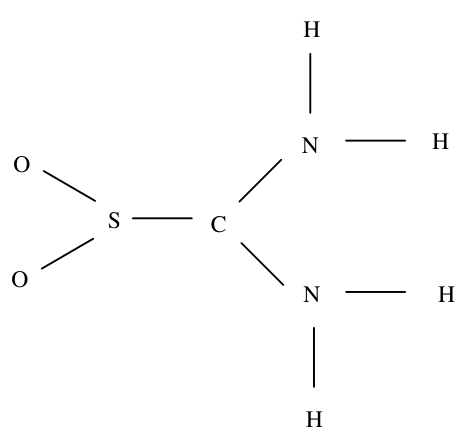
5.3 Draw the Lewis structure of thiourea-S,S-dioxide with zero formal charges on all atoms.
5.4 Based on the Valence Shell Electron Pair Repulsion (VSEPR) model, what is the geometry around the sulfur, carbon, and nitrogen according to the Lewis structure you predicted from 5.3?
5.4a What is the geometry around the sulfur atom? Select your answer from the following choices.
a) trigonal pyramidal
b) triangular planar
c) T-shape
5.4b Similarly, what is the geometry around the C-atom? Select your answer from the following choices.
a) trigonal pyramidal
b) triangular planar
c) T-shape
5.4c Finally, what is the geometry around the N-atom? Select your answer from the following choices.
a) trigonal pyramidal
b) triangular planar
c) T-shape
Molecular structure in the solid state is usually determined by X-ray diffraction analysis. According to this method, the structure of thiourea-S,S-dioxide is shown below:
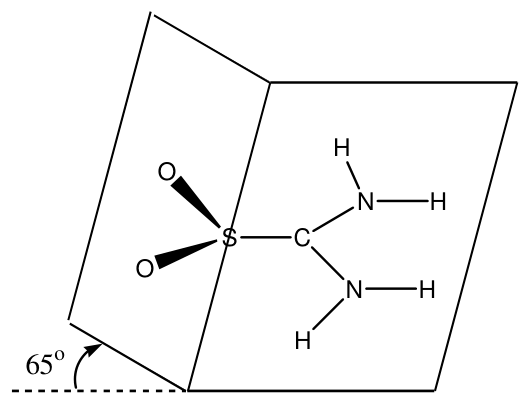
All the N, H atoms are coplanar with S, C atoms, and the dihedral angle between the \(\ce{OSO}\) plane and the \(\ce{SC(NH2)2}\) plane is \(65^\circ\).
5.5 Draw the Lewis structure and resonance forms that are consistent with the geometry determined.
Official English text of the problem.
Answers
- 5.1(a): Dinitrogen,
N#N: an \(\ce{N#N}\) triple bond and one lone pair on each N. - 5.1(b): Ammonia,
N: three single \(\ce{N-H}\) bonds and one lone pair on N. - 5.1(c): Ozone,
O=[O+][O-]: \(\ce{O=O^+-O^-}\). The double-bonded terminal O, central O, and single-bonded terminal O have two, one, and three lone pairs, respectively. - 5.1(d): Sulfur trioxide,
O=S(=O)=O: three \(\ce{S=O}\) double bonds; two lone pairs on each O and none on S. All formal charges are zero. - 5.2: Carbon monoxide,
[C-]#[O+]: a triple bond and one lone pair on each atom. Formal charges: C \(-1\), O \(+1\). Oxidation states: C \(+2\), O \(-2\). - 5.3: Thiourea-S,S-dioxide,
NC(N)=S(=O)=O: \(\ce{O=S(=O)=C(NH2)2}\). Each O has two lone pairs, each N has one, and S and C have none. Every formal charge is zero. - 5.4a: b) triangular planar around S.
- 5.4b: b) triangular planar around C.
- 5.4c: a) trigonal pyramidal around each N.
- 5.5: Geometry-consistent thiourea-S,S-dioxide contributors include
NC(=[NH2+])[S-](=O)=Oand[NH2+]=C(N)[S-](=O)=O. Each has a single S–C bond and one lone pair on S. Related contributors place the negative formal charge on oxygen, for exampleNC(=[NH2+])S(=O)[O-]. Together, the resonance description accounts for pyramidal S and planar C and N environments.
Solution
For the following electron bookkeeping, \[ \text{formal charge} = V-n_{\mathrm{nonbonding}}-\sum(\text{bond orders}), \] where \(V\) is the number of valence electrons of the neutral atom and \(n_{\mathrm{nonbonding}}\) counts nonbonding electrons, not pairs.
5.1
a) Dinitrogen, N#N.
The molecule has \(2(5)=10\) valence electrons. Put six electrons into the triple bond and leave one lone pair on each nitrogen. Both atoms have octets, and each formal charge is \[ 5-2-3=0. \]
b) Ammonia, N.
There are \(5+3(1)=8\) valence electrons. Three single nitrogen–hydrogen bonds use six electrons; the remaining two constitute a lone pair on nitrogen. Nitrogen has an octet and each hydrogen a duet. All formal charges are zero.
c) Ozone, O=[O+][O-].
There are \(3(6)=18\) valence electrons. Draw an O–O–O chain with one double bond and one single bond: \[ \ce{O=O^+-O^-}. \] The bonds contain six electrons. Assign two lone pairs to the double-bonded terminal oxygen, one to the central oxygen, and three to the single-bonded terminal oxygen, accounting for the remaining twelve electrons.
The formal charges are \[ \begin{aligned} \text{double-bonded terminal O:}&\quad 6-4-2=0,\\ \text{central O:}&\quad 6-2-3=+1,\\ \text{single-bonded terminal O:}&\quad 6-6-1=-1. \end{aligned} \] Exchanging the single and double bonds gives the equivalent resonance contributor.
d) Sulfur trioxide, O=S(=O)=O.
There are \(6+3(6)=24\) valence electrons. One conventional expanded-octet Lewis structure has three sulfur–oxygen double bonds. These use twelve electrons; the remaining twelve form two lone pairs on each oxygen.
Sulfur has no lone pair and has twelve electrons in its bonding shell. The formal charges are \[ \mathrm{FC(S)}=6-6=0,\qquad \mathrm{FC(O)}=6-4-2=0. \]
5.2
Carbon monoxide, [C-]#[O+], has \(4+6=10\) valence electrons. A triple bond and one lone pair on each atom give both atoms octets.
Formal charges follow from equal division of the bonding electrons: \[ \mathrm{FC(C)}=4-2-3=-1,\qquad \mathrm{FC(O)}=6-2-3=+1. \]
For oxidation states, assign all bonding electrons to the more electronegative oxygen. Carbon retains only its two nonbonding electrons, whereas oxygen receives eight electrons in total: \[ \mathrm{OS(C)}=4-2=+2,\qquad \mathrm{OS(O)}=6-8=-2. \]
| Atom | Formal charge | Oxidation state |
|---|---|---|
| C | \(-1\) | \(+2\) |
| O | \(+1\) | \(-2\) |
5.3
Thiourea-S,S-dioxide has \[ 2(6)+6+4+2(5)+4(1)=36 \] valence electrons.
With the specified skeleton and zero formal charges:
- Each nitrogen has three single bonds—two to hydrogen and one to carbon—and one lone pair.
- Each oxygen has a double bond to sulfur and two lone pairs.
- Carbon requires a total bond order of four. Its two single bonds to nitrogen therefore require a double bond to sulfur.
The resulting structure is thiourea-S,S-dioxide, NC(N)=S(=O)=O:
\[
\ce{O=S(=O)=C(NH2)2}.
\]
Thus, sulfur has three double bonds and no lone pair. The formal-charge check is:
| Atom | Nonbonding electrons | Sum of bond orders | Formal charge |
|---|---|---|---|
| S | 0 | 6 | \(6-0-6=0\) |
| C | 0 | 4 | \(4-0-4=0\) |
| Each N | 2 | 3 | \(5-2-3=0\) |
| Each O | 4 | 2 | \(6-4-2=0\) |
| Each H | 0 | 1 | \(1-0-1=0\) |
The structure contains 24 bonding electrons and 12 nonbonding electrons, totaling the required 36.
5.4
In VSEPR, a multiple bond counts as one electron domain. Applying the model specifically to the localized, zero-formal-charge structure from 5.3 gives:
| Part | Central atom | Bonding domains | Lone pairs | VSEPR type | Predicted geometry and choice |
|---|---|---|---|---|---|
| 5.4a | S | 3 | 0 | \(AX_3\) | b) triangular planar |
| 5.4b | C | 3 | 0 | \(AX_3\) | b) triangular planar |
| 5.4c | Each N | 3 | 1 | \(AX_3E\) | a) trigonal pyramidal |
“Triangular planar” in the choices is the usual trigonal planar geometry.
5.5
The experimental drawing shows a pyramidal sulfur environment and a planar \(\ce{SC(NH2)2}\) portion. The zero-formal-charge structure alone does not explain these features.
Starting from that structure, move the carbon–sulfur \(\pi\)-electron pair onto sulfur and donate a nitrogen lone pair into a carbon–nitrogen \(\pi\) bond. This is resonance electron bookkeeping, with no movement of atoms.
A suitable pair of thiourea-S,S-dioxide contributors is:
\[ \ce{H2N-C(=NH2^+)-S^-(=O)2 <-> H2N^+=C(-NH2)-S^-(=O)2}. \]
Their SMILES are NC(=[NH2+])[S-](=O)=O and [NH2+]=C(N)[S-](=O)=O.
To draw each contributor completely:
- Connect sulfur to carbon by a single bond, and to each oxygen by a double bond.
- Give sulfur one lone pair and formal charge \(-1\).
- Double-bond carbon to one nitrogen. That nitrogen has two N–H bonds, no lone pair, and formal charge \(+1\).
- Single-bond carbon to the other nitrogen. That nitrogen has two N–H bonds and one lone pair.
- Give each oxygen two lone pairs.
- Obtain the second contributor by exchanging the roles of the two nitrogen atoms.
The nonzero formal charges are verified by \[ \mathrm{FC(S)}=6-2-5=-1,\qquad \mathrm{FC(N_{\text{double-bonded}})}=5-0-4=+1. \]
Related contributors place the negative formal charge on oxygen. One is thiourea-S,S-dioxide, NC(=[NH2+])S(=O)[O-]:
\[
\ce{H2N-C(=NH2^+)-S(=O)-O^-}.
\]
Here sulfur still has one lone pair, but its formal charge is zero: \[ \mathrm{FC(S)}=6-2-4=0. \] The single-bonded oxygen has three lone pairs and charge \(-1\); the double-bonded oxygen has two lone pairs. Independently exchanging the two nitrogen roles and the two oxygen roles gives four contributors of this type.
These resonance descriptions explain the geometry:
- Sulfur: three bonded neighbors and one lone pair give an \(AX_3E\), trigonal pyramidal environment.
- Carbon: three bonding domains give a trigonal planar environment.
- Nitrogen: delocalization across the nitrogen–carbon–nitrogen group gives both carbon–nitrogen bonds partial double-bond character. Planar nitrogen environments permit the required orbital overlap.
- Relative orientation: the single carbon–sulfur bond in these contributors accommodates the noncoplanar arrangement shown experimentally. Lewis structures and elementary VSEPR do not determine the numerical dihedral angle of \(65^\circ\).
The solution was checked against the official solution.
IChO 2005 · Theorieaufgabe 5
Lewis-Struktur
5.1 Zeichnen Sie für jedes der folgenden Moleküle eine Lewis-Struktur.
a) \(\ce{N2}\)
b) \(\ce{NH3}\)
c) \(\ce{O3}\)
d) \(\ce{SO3}\)
5.2 Zeichnen Sie die Lewis-Struktur von Kohlenstoffmonoxid und ordnen Sie sowohl dem Kohlenstoffatom als auch dem Sauerstoffatom im Kohlenstoffmonoxid Formalladungen und Oxidationszahlen zu.
Thioharnstoff-S,S-dioxid, \(\ce{O2SC(NH2)2}\), hat die folgende Skelettstruktur
5.3 Zeichnen Sie die Lewis-Struktur von Thioharnstoff-S,S-dioxid, bei der alle Atome die Formalladung null haben.
5.4 Welche Geometrie ergibt sich nach dem Valenzschalen-Elektronenpaar-Abstoßungsmodell (VSEPR-Modell) um Schwefel, Kohlenstoff und Stickstoff gemäß der von Ihnen in 5.3 vorhergesagten Lewis-Struktur?
5.4a Welche Geometrie liegt um das Schwefelatom vor? Wählen Sie Ihre Antwort aus den folgenden Möglichkeiten.
a) trigonal-pyramidal
b) dreieckig-planar
c) T-förmig
5.4b Welche Geometrie liegt entsprechend um das C-Atom vor? Wählen Sie Ihre Antwort aus den folgenden Möglichkeiten.
a) trigonal-pyramidal
b) dreieckig-planar
c) T-förmig
5.4c Welche Geometrie liegt schließlich um das N-Atom vor? Wählen Sie Ihre Antwort aus den folgenden Möglichkeiten.
a) trigonal-pyramidal
b) dreieckig-planar
c) T-förmig
Die Molekülstruktur im festen Zustand wird üblicherweise durch Röntgenbeugungsanalyse bestimmt. Nach dieser Methode ergibt sich die unten dargestellte Struktur von Thioharnstoff-S,S-dioxid:
Alle N- und H-Atome liegen mit den S- und C-Atomen in einer Ebene, und der Diederwinkel zwischen der \(\ce{OSO}\)-Ebene und der \(\ce{SC(NH2)2}\)-Ebene beträgt \(65^\circ\).
5.5 Zeichnen Sie die Lewis-Struktur und die mesomeren Grenzstrukturen, die mit der bestimmten Geometrie übereinstimmen.
Aufgabentext aus dem offiziellen englischen Text übersetzt.
Antworten
- 5.1(a): Distickstoff,
N#N: eine \(\ce{N#N}\)-Dreifachbindung und ein freies Elektronenpaar an jedem N. - 5.1(b): Ammoniak,
N: drei \(\ce{N-H}\)-Einfachbindungen und ein freies Elektronenpaar am N. - 5.1(c): Ozon,
O=[O+][O-]: \(\ce{O=O^+-O^-}\). Das doppelt gebundene endständige O, das zentrale O und das einfach gebundene endständige O haben zwei, ein beziehungsweise drei freie Elektronenpaare. - 5.1(d): Schwefeltrioxid,
O=S(=O)=O: drei \(\ce{S=O}\)-Doppelbindungen; zwei freie Elektronenpaare an jedem O und keines am S. Alle Formalladungen sind null. - 5.2: Kohlenstoffmonoxid,
[C-]#[O+]: eine Dreifachbindung und ein freies Elektronenpaar an jedem Atom. Formalladungen: C \(-1\), O \(+1\). Oxidationszahlen: C \(+2\), O \(-2\). - 5.3: Thioharnstoff-S,S-dioxid,
NC(N)=S(=O)=O: \(\ce{O=S(=O)=C(NH2)2}\). Jedes O hat zwei freie Elektronenpaare, jedes N hat eines, und S und C haben keine. Jede Formalladung ist null. - 5.4a: b) dreieckig-planar um S.
- 5.4b: b) dreieckig-planar um C.
- 5.4c: a) trigonal-pyramidal um jedes N.
- 5.5: Zu den mit der Geometrie übereinstimmenden Grenzstrukturen von Thioharnstoff-S,S-dioxid gehören
NC(=[NH2+])[S-](=O)=Ound[NH2+]=C(N)[S-](=O)=O. Jede hat eine S–C-Einfachbindung und ein freies Elektronenpaar am S. In verwandten Grenzstrukturen befindet sich die negative Formalladung am Sauerstoff, zum Beispiel inNC(=[NH2+])S(=O)[O-]. Insgesamt erklärt die Beschreibung durch Mesomerie die pyramidale Umgebung von S und die planaren Umgebungen von C und N.
Lösung
Für die folgende Elektronenbilanz gilt \[ \text{Formalladung} = V-n_{\mathrm{nonbonding}}-\sum(\text{Bindungsordnungen}), \] wobei \(V\) die Anzahl der Valenzelektronen des neutralen Atoms ist und \(n_{\mathrm{nonbonding}}\) die nichtbindenden Elektronen, nicht die Elektronenpaare, zählt.
5.1
a) Distickstoff, N#N.
Das Molekül hat \(2(5)=10\) Valenzelektronen. Sechs Elektronen werden der Dreifachbindung zugeordnet, und an jedem Stickstoffatom verbleibt ein freies Elektronenpaar. Beide Atome besitzen ein Oktett, und jede Formalladung beträgt \[ 5-2-3=0. \]
b) Ammoniak, N.
Es gibt \(5+3(1)=8\) Valenzelektronen. Drei Stickstoff–Wasserstoff-Einfachbindungen beanspruchen sechs Elektronen; die verbleibenden zwei bilden ein freies Elektronenpaar am Stickstoff. Stickstoff besitzt ein Oktett und jedes Wasserstoffatom ein Duett. Alle Formalladungen sind null.
c) Ozon, O=[O+][O-].
Es gibt \(3(6)=18\) Valenzelektronen. Man zeichnet eine O–O–O-Kette mit einer Doppelbindung und einer Einfachbindung: \[ \ce{O=O^+-O^-}. \] Die Bindungen enthalten sechs Elektronen. Dem doppelt gebundenen endständigen Sauerstoff werden zwei freie Elektronenpaare, dem zentralen Sauerstoff eines und dem einfach gebundenen endständigen Sauerstoff drei zugeordnet; damit sind die verbleibenden zwölf Elektronen berücksichtigt.
Die Formalladungen betragen \[ \begin{aligned} \text{doppelt gebundenes endständiges O:}&\quad 6-4-2=0,\\ \text{zentrales O:}&\quad 6-2-3=+1,\\ \text{einfach gebundenes endständiges O:}&\quad 6-6-1=-1. \end{aligned} \] Durch Vertauschen der Einfach- und Doppelbindung erhält man die gleichwertige mesomere Grenzstruktur.
d) Schwefeltrioxid, O=S(=O)=O.
Es gibt \(6+3(6)=24\) Valenzelektronen. Eine gebräuchliche Lewis-Struktur mit erweitertem Oktett hat drei Schwefel–Sauerstoff-Doppelbindungen. Diese beanspruchen zwölf Elektronen; die verbleibenden zwölf bilden zwei freie Elektronenpaare an jedem Sauerstoffatom.
Schwefel hat kein freies Elektronenpaar und besitzt zwölf Elektronen in seiner Bindungsschale. Die Formalladungen betragen \[ \mathrm{FC(S)}=6-6=0,\qquad \mathrm{FC(O)}=6-4-2=0. \]
5.2
Kohlenstoffmonoxid, [C-]#[O+], hat \(4+6=10\) Valenzelektronen. Eine Dreifachbindung und ein freies Elektronenpaar an jedem Atom ergeben für beide Atome ein Oktett.
Die Formalladungen ergeben sich aus der gleichmäßigen Aufteilung der Bindungselektronen: \[ \mathrm{FC(C)}=4-2-3=-1,\qquad \mathrm{FC(O)}=6-2-3=+1. \]
Für die Oxidationszahlen werden alle Bindungselektronen dem elektronegativeren Sauerstoff zugeordnet. Kohlenstoff behält nur seine zwei nichtbindenden Elektronen, während Sauerstoff insgesamt acht Elektronen erhält: \[ \mathrm{OS(C)}=4-2=+2,\qquad \mathrm{OS(O)}=6-8=-2. \]
| Atom | Formalladung | Oxidationszahl |
|---|---|---|
| C | \(-1\) | \(+2\) |
| O | \(+1\) | \(-2\) |
5.3
Thioharnstoff-S,S-dioxid hat \[ 2(6)+6+4+2(5)+4(1)=36 \] Valenzelektronen.
Bei dem vorgegebenen Gerüst und Formalladungen von null gilt:
- Jedes Stickstoffatom hat drei Einfachbindungen – zwei zu Wasserstoff und eine zu Kohlenstoff – und ein freies Elektronenpaar.
- Jedes Sauerstoffatom hat eine Doppelbindung zum Schwefel und zwei freie Elektronenpaare.
- Kohlenstoff benötigt eine Summe der Bindungsordnungen von vier. Seine zwei Einfachbindungen zu Stickstoff erfordern daher eine Doppelbindung zum Schwefel.
Die resultierende Struktur ist Thioharnstoff-S,S-dioxid, NC(N)=S(=O)=O:
\[
\ce{O=S(=O)=C(NH2)2}.
\]
Somit hat Schwefel drei Doppelbindungen und kein freies Elektronenpaar. Die Überprüfung der Formalladungen ergibt:
| Atom | Nichtbindende Elektronen | Summe der Bindungsordnungen | Formalladung |
|---|---|---|---|
| S | 0 | 6 | \(6-0-6=0\) |
| C | 0 | 4 | \(4-0-4=0\) |
| Jedes N | 2 | 3 | \(5-2-3=0\) |
| Jedes O | 4 | 2 | \(6-4-2=0\) |
| Jedes H | 0 | 1 | \(1-0-1=0\) |
Die Struktur enthält 24 bindende Elektronen und 12 nichtbindende Elektronen, insgesamt also die erforderlichen 36.
5.4
Im VSEPR-Modell zählt eine Mehrfachbindung als eine Elektronendomäne. Die Anwendung des Modells speziell auf die lokalisierte Struktur aus 5.3 mit Formalladungen von null ergibt:
| Teil | Zentralatom | Bindende Domänen | Freie Elektronenpaare | VSEPR-Typ | Vorhergesagte Geometrie und Antwortmöglichkeit |
|---|---|---|---|---|---|
| 5.4a | S | 3 | 0 | \(AX_3\) | b) dreieckig-planar |
| 5.4b | C | 3 | 0 | \(AX_3\) | b) dreieckig-planar |
| 5.4c | Jedes N | 3 | 1 | \(AX_3E\) | a) trigonal-pyramidal |
„Dreieckig-planar“ in den Antwortmöglichkeiten bezeichnet die übliche trigonal-planare Geometrie.
5.5
Die experimentelle Darstellung zeigt eine pyramidale Umgebung des Schwefels und einen planaren \(\ce{SC(NH2)2}\)-Teil. Die Struktur mit Formalladungen von null allein erklärt diese Merkmale nicht.
Ausgehend von dieser Struktur wird das Kohlenstoff–Schwefel-\(\pi\)-Elektronenpaar auf den Schwefel verschoben, und ein freies Elektronenpaar eines Stickstoffatoms wird zur Bildung einer Kohlenstoff–Stickstoff-\(\pi\)-Bindung herangezogen. Dies ist eine Elektronenbilanz im Rahmen der Mesomerie, ohne dass sich Atome bewegen.
Ein geeignetes Paar von Grenzstrukturen des Thioharnstoff-S,S-dioxids ist:
\[ \ce{H2N-C(=NH2^+)-S^-(=O)2 <-> H2N^+=C(-NH2)-S^-(=O)2}. \]
Ihre SMILES sind NC(=[NH2+])[S-](=O)=O und [NH2+]=C(N)[S-](=O)=O.
Um jede Grenzstruktur vollständig zu zeichnen:
- Verbinden Sie Schwefel über eine Einfachbindung mit Kohlenstoff und über jeweils eine Doppelbindung mit jedem Sauerstoffatom.
- Geben Sie Schwefel ein freies Elektronenpaar und die Formalladung \(-1\).
- Verbinden Sie Kohlenstoff über eine Doppelbindung mit einem Stickstoffatom. Dieses Stickstoffatom hat zwei N–H-Bindungen, kein freies Elektronenpaar und die Formalladung \(+1\).
- Verbinden Sie Kohlenstoff über eine Einfachbindung mit dem anderen Stickstoffatom. Dieses Stickstoffatom hat zwei N–H-Bindungen und ein freies Elektronenpaar.
- Geben Sie jedem Sauerstoffatom zwei freie Elektronenpaare.
- Die zweite Grenzstruktur erhalten Sie durch Vertauschen der Rollen der beiden Stickstoffatome.
Die von null verschiedenen Formalladungen werden durch folgende Rechnung bestätigt: \[ \mathrm{FC(S)}=6-2-5=-1,\qquad \mathrm{FC(N_{\text{doppelt gebunden}})}=5-0-4=+1. \]
In verwandten Grenzstrukturen befindet sich die negative Formalladung am Sauerstoff. Eine davon ist Thioharnstoff-S,S-dioxid, NC(=[NH2+])S(=O)[O-]:
\[
\ce{H2N-C(=NH2^+)-S(=O)-O^-}.
\]
Hier hat Schwefel weiterhin ein freies Elektronenpaar, aber seine Formalladung ist null: \[ \mathrm{FC(S)}=6-2-4=0. \] Der einfach gebundene Sauerstoff hat drei freie Elektronenpaare und die Ladung \(-1\); der doppelt gebundene Sauerstoff hat zwei freie Elektronenpaare. Durch unabhängiges Vertauschen der Rollen der beiden Stickstoffatome und der beiden Sauerstoffatome erhält man vier Grenzstrukturen dieses Typs.
Diese Beschreibungen durch Mesomerie erklären die Geometrie:
- Schwefel: Drei gebundene Nachbaratome und ein freies Elektronenpaar ergeben eine trigonal-pyramidale Umgebung vom Typ \(AX_3E\).
- Kohlenstoff: Drei bindende Domänen ergeben eine trigonal-planare Umgebung.
- Stickstoff: Die Delokalisierung über die Stickstoff–Kohlenstoff–Stickstoff-Gruppe verleiht beiden Kohlenstoff–Stickstoff-Bindungen partiellen Doppelbindungscharakter. Planare Umgebungen der Stickstoffatome ermöglichen die erforderliche Orbitalüberlappung.
- Relative Orientierung: Die Kohlenstoff–Schwefel-Einfachbindung in diesen Grenzstrukturen ermöglicht die experimentell gezeigte nicht koplanare Anordnung. Lewis-Strukturen und das elementare VSEPR-Modell legen den Zahlenwert des Diederwinkels von \(65^\circ\) nicht fest.
Die Lösung wurde mit der offiziellen Lösung abgeglichen.
IChO 2005 · Teori sorusu 5
Lewis Yapısı
5.1 Aşağıdaki moleküllerin her biri için bir Lewis yapısı çiziniz.
a) \(\ce{N2}\)
b) \(\ce{NH3}\)
c) \(\ce{O3}\)
d) \(\ce{SO3}\)
5.2 Karbon monoksidin Lewis yapısını çiziniz ve karbon monoksitteki hem karbon hem de oksijen atomlarının formal yüklerini ve yükseltgenme basamaklarını belirleyiniz.
Tiyoüre-S,S-dioksit, \(\ce{O2SC(NH2)2}\), aşağıdaki iskelet yapısına sahiptir
5.3 Tiyoüre-S,S-dioksidin tüm atomlarındaki formal yüklerin sıfır olduğu Lewis yapısını çiziniz.
5.4 Değerlik Kabuğu Elektron Çifti İtmesi (VSEPR) modeline göre, 5.3'te öngördüğünüz Lewis yapısında kükürt, karbon ve azotun çevresindeki geometri nasıldır?
5.4a Kükürt atomunun çevresindeki geometri nasıldır? Yanıtınızı aşağıdaki seçeneklerden seçiniz.
a) üçgen piramidal
b) düzlem üçgen
c) T şeklinde
5.4b Benzer şekilde, C atomunun çevresindeki geometri nasıldır? Yanıtınızı aşağıdaki seçeneklerden seçiniz.
a) üçgen piramidal
b) düzlem üçgen
c) T şeklinde
5.4c Son olarak, N atomunun çevresindeki geometri nasıldır? Yanıtınızı aşağıdaki seçeneklerden seçiniz.
a) üçgen piramidal
b) düzlem üçgen
c) T şeklinde
Katı hâldeki molekül yapısı genellikle X-ışını kırınımı analiziyle belirlenir. Bu yönteme göre tiyoüre-S,S-dioksidin yapısı aşağıda gösterilmiştir:
N ve H atomlarının tümü S ve C atomlarıyla aynı düzlemdedir ve \(\ce{OSO}\) düzlemi ile \(\ce{SC(NH2)2}\) düzlemi arasındaki dihedral açı \(65^\circ\)'dir.
5.5 Belirlenen geometriyle uyumlu Lewis yapısını ve rezonans yapılarını çiziniz.
Soru metni resmi İngilizce metinden çevrilmiştir.
Cevaplar
- 5.1(a): Diazot,
N#N: bir \(\ce{N#N}\) üçlü bağı ve her N üzerinde bir ortaklanmamış elektron çifti. - 5.1(b): Amonyak,
N: üç tekli \(\ce{N-H}\) bağı ve N üzerinde bir ortaklanmamış elektron çifti. - 5.1(c): Ozon,
O=[O+][O-]: \(\ce{O=O^+-O^-}\). Çift bağla bağlı uç O, merkezî O ve tek bağla bağlı uç O üzerinde sırasıyla iki, bir ve üç ortaklanmamış elektron çifti bulunur. - 5.1(d): Kükürt trioksit,
O=S(=O)=O: üç \(\ce{S=O}\) çift bağı; her O üzerinde iki ortaklanmamış elektron çifti bulunur, S üzerinde ise bulunmaz. Tüm formal yükler sıfırdır. - 5.2: Karbon monoksit,
[C-]#[O+]: bir üçlü bağ ve her atom üzerinde bir ortaklanmamış elektron çifti. Formal yükler: C \(-1\), O \(+1\). Yükseltgenme basamakları: C \(+2\), O \(-2\). - 5.3: Tiyoüre-S,S-dioksit,
NC(N)=S(=O)=O: \(\ce{O=S(=O)=C(NH2)2}\). Her O üzerinde iki, her N üzerinde bir ortaklanmamış elektron çifti bulunur; S ve C üzerinde ise bulunmaz. Her bir formal yük sıfırdır. - 5.4a: S çevresinde b) düzlem üçgen.
- 5.4b: C çevresinde b) düzlem üçgen.
- 5.4c: Her N çevresinde a) üçgen piramidal.
- 5.5: Tiyoüre-S,S-dioksidin geometriyle uyumlu rezonans katkı yapıları arasında
NC(=[NH2+])[S-](=O)=Ove[NH2+]=C(N)[S-](=O)=Obulunur. Her birinde tekli bir S–C bağı ve S üzerinde bir ortaklanmamış elektron çifti vardır. İlgili diğer katkı yapılarında negatif formal yük oksijen üzerinde yer alır; örneğinNC(=[NH2+])S(=O)[O-]. Bu rezonans betimlemesi, bir bütün olarak S çevresinin piramidal, C ve N çevrelerinin ise düzlemsel olmasını açıklar.
Çözüm
Aşağıdaki elektron hesabında, \[ \text{formal yük} = V-n_{\mathrm{nonbonding}}-\sum(\text{bağ mertebeleri}), \] burada \(V\), nötr atomun değerlik elektronlarının sayısıdır; \(n_{\mathrm{nonbonding}}\) ise bağ yapmayan elektron çiftlerini değil, elektronları sayar.
5.1
a) Diazot, N#N.
Molekülün \(2(5)=10\) değerlik elektronu vardır. Üçlü bağa altı elektron yerleştiriniz ve her azot üzerinde bir ortaklanmamış elektron çifti bırakınız. Her iki atom da oktetini tamamlar ve her birinin formal yükü \[ 5-2-3=0. \] olur.
b) Amonyak, N.
\(5+3(1)=8\) değerlik elektronu vardır. Üç tekli azot–hidrojen bağında altı elektron kullanılır; kalan iki elektron azot üzerinde bir ortaklanmamış elektron çifti oluşturur. Azot oktetini, her hidrojen ise dubletini tamamlar. Tüm formal yükler sıfırdır.
c) Ozon, O=[O+][O-].
\(3(6)=18\) değerlik elektronu vardır. Bir çift bağ ve bir tek bağ içeren bir O–O–O zinciri çiziniz: \[ \ce{O=O^+-O^-}. \] Bağlar altı elektron içerir. Çift bağla bağlı uç oksijene iki, merkezî oksijene bir ve tek bağla bağlı uç oksijene üç ortaklanmamış elektron çifti yerleştirerek kalan on iki elektronu dağıtınız.
Formal yükler şöyledir: \[ \begin{aligned} \text{çift bağla bağlı uç O:}&\quad 6-4-2=0,\\ \text{merkezî O:}&\quad 6-2-3=+1,\\ \text{tek bağla bağlı uç O:}&\quad 6-6-1=-1. \end{aligned} \] Tek ve çift bağların yerlerini değiştirmek, eşdeğer rezonans katkı yapısını verir.
d) Kükürt trioksit, O=S(=O)=O.
\(6+3(6)=24\) değerlik elektronu vardır. Yaygın olarak kullanılan genişlemiş oktetli Lewis yapılarından biri, üç kükürt–oksijen çift bağı içerir. Bu bağlarda on iki elektron kullanılır; kalan on iki elektron her oksijen üzerinde iki ortaklanmamış elektron çifti oluşturur.
Kükürdün ortaklanmamış elektron çifti yoktur ve bağ oluşumuna katılan kabuğunda on iki elektron bulunur. Formal yükler şöyledir: \[ \mathrm{FC(S)}=6-6=0,\qquad \mathrm{FC(O)}=6-4-2=0. \]
5.2
Karbon monoksidin, [C-]#[O+], \(4+6=10\) değerlik elektronu vardır. Bir üçlü bağ ve her atom üzerindeki bir ortaklanmamış elektron çifti, her iki atomun da oktetini tamamlamasını sağlar.
Formal yükler, bağ elektronlarının eşit olarak paylaştırılmasıyla bulunur: \[ \mathrm{FC(C)}=4-2-3=-1,\qquad \mathrm{FC(O)}=6-2-3=+1. \]
Yükseltgenme basamakları için tüm bağ elektronlarını elektronegatifliği daha yüksek olan oksijene atayınız. Karbonda yalnızca bağ yapmayan iki elektronu kalırken oksijen toplam sekiz elektron alır: \[ \mathrm{OS(C)}=4-2=+2,\qquad \mathrm{OS(O)}=6-8=-2. \]
| Atom | Formal yük | Yükseltgenme basamağı |
|---|---|---|
| C | \(-1\) | \(+2\) |
| O | \(+1\) | \(-2\) |
5.3
Tiyoüre-S,S-dioksidin \[ 2(6)+6+4+2(5)+4(1)=36 \] değerlik elektronu vardır.
Verilen iskelet yapısı kullanıldığında ve formal yüklerin sıfır olması koşuluyla:
- Her azotun, ikisi hidrojene ve biri karbona olmak üzere üç tek bağı ve bir ortaklanmamış elektron çifti vardır.
- Her oksijenin kükürde bir çift bağı ve iki ortaklanmamış elektron çifti vardır.
- Karbonun toplam bağ mertebesinin dört olması gerekir. Dolayısıyla azota yaptığı iki tek bağ, kükürde bir çift bağ yapmasını gerektirir.
Ortaya çıkan yapı tiyoüre-S,S-dioksittir, NC(N)=S(=O)=O:
\[
\ce{O=S(=O)=C(NH2)2}.
\]
Böylece kükürdün üç çift bağı vardır ve ortaklanmamış elektron çifti yoktur. Formal yük kontrolü şöyledir:
| Atom | Bağ yapmayan elektronlar | Bağ mertebeleri toplamı | Formal yük |
|---|---|---|---|
| S | 0 | 6 | \(6-0-6=0\) |
| C | 0 | 4 | \(4-0-4=0\) |
| Her N | 2 | 3 | \(5-2-3=0\) |
| Her O | 4 | 2 | \(6-4-2=0\) |
| Her H | 0 | 1 | \(1-0-1=0\) |
Yapı, 24 bağ elektronu ve bağ yapmayan 12 elektron içerir; bunların toplamı gereken 36 elektronu verir.
5.4
VSEPR modelinde çoklu bir bağ, tek bir elektron bölgesi olarak sayılır. Modelin özellikle 5.3'teki yerelleşmiş, formal yükleri sıfır olan yapıya uygulanması şu sonuçları verir:
| Kısım | Merkez atom | Bağ bölgeleri | Ortaklanmamış elektron çiftleri | VSEPR türü | Öngörülen geometri ve seçenek |
|---|---|---|---|---|---|
| 5.4a | S | 3 | 0 | \(AX_3\) | b) düzlem üçgen |
| 5.4b | C | 3 | 0 | \(AX_3\) | b) düzlem üçgen |
| 5.4c | Her N | 3 | 1 | \(AX_3E\) | a) üçgen piramidal |
Seçeneklerdeki “düzlem üçgen”, yaygın olarak üçgen düzlemsel diye adlandırılan geometridir.
5.5
Deneysel çizim, kükürt çevresinin piramidal ve \(\ce{SC(NH2)2}\) kısmının düzlemsel olduğunu gösterir. Formal yükleri sıfır olan yapı tek başına bu özellikleri açıklamaz.
Bu yapıdan başlayarak karbon–kükürt \(\pi\)-elektron çiftini kükürt üzerine taşıyınız ve azotun ortaklanmamış elektron çiftlerinden birini bir karbon–azot \(\pi\) bağı oluşturmak üzere aktarınız. Bu işlem, atomların yer değiştirmediği bir rezonans elektron hesabıdır.
Tiyoüre-S,S-dioksit için uygun bir rezonans katkı yapısı çifti şöyledir:
\[ \ce{H2N-C(=NH2^+)-S^-(=O)2 <-> H2N^+=C(-NH2)-S^-(=O)2}. \]
Bunların SMILES gösterimleri NC(=[NH2+])[S-](=O)=O ve [NH2+]=C(N)[S-](=O)=O şeklindedir.
Her bir katkı yapısını eksiksiz çizmek için:
- Kükürdü karbona tek bağla, her bir oksijene ise çift bağla bağlayınız.
- Kükürde bir ortaklanmamış elektron çifti ve \(-1\) formal yük veriniz.
- Karbonu azotlardan birine çift bağla bağlayınız. Bu azotun iki N–H bağı vardır, ortaklanmamış elektron çifti yoktur ve formal yükü \(+1\)'dir.
- Karbonu diğer azota tek bağla bağlayınız. Bu azotun iki N–H bağı ve bir ortaklanmamış elektron çifti vardır.
- Her oksijene iki ortaklanmamış elektron çifti veriniz.
- İki azot atomunun rollerini değiştirerek ikinci katkı yapısını elde ediniz.
Sıfırdan farklı formal yükler şu şekilde doğrulanır: \[ \mathrm{FC(S)}=6-2-5=-1,\qquad \mathrm{FC(N_{\text{çift bağla bağlı}})}=5-0-4=+1. \]
İlgili diğer katkı yapılarında negatif formal yük oksijen üzerinde yer alır. Bunlardan biri tiyoüre-S,S-dioksittir, NC(=[NH2+])S(=O)[O-]:
\[
\ce{H2N-C(=NH2^+)-S(=O)-O^-}.
\]
Burada kükürdün yine bir ortaklanmamış elektron çifti vardır, ancak formal yükü sıfırdır: \[ \mathrm{FC(S)}=6-2-4=0. \] Tek bağla bağlı oksijenin üç ortaklanmamış elektron çifti ve \(-1\) yükü vardır; çift bağla bağlı oksijenin ise iki ortaklanmamış elektron çifti vardır. İki azotun rollerini ve iki oksijenin rollerini birbirinden bağımsız olarak değiştirmek, bu türden dört katkı yapısı verir.
Bu rezonans betimlemeleri geometriyi açıklar:
- Kükürt: Bağlı üç komşu atom ve bir ortaklanmamış elektron çifti, \(AX_3E\) türünde, üçgen piramidal bir çevre oluşturur.
- Karbon: Üç bağ bölgesi, üçgen düzlemsel bir çevre oluşturur.
- Azot: Azot–karbon–azot grubu boyunca delokalizasyon, her iki karbon–azot bağına da kısmi çift bağ karakteri kazandırır. Azot çevrelerinin düzlemsel olması, gerekli orbital örtüşmesine olanak tanır.
- Birbirlerine göre yönelim: Bu katkı yapılarındaki tekli karbon–kükürt bağı, deneysel olarak gösterilen, aynı düzlemde olmayan düzenlenmeye olanak tanır. Lewis yapıları ve temel VSEPR modeli, dihedral açının \(65^\circ\) olan sayısal değerini belirlemez.
Çözüm, resmi çözümle karşılaştırılarak kontrol edildi.
IChO 2005 · Problema teórico 5
Estructura de Lewis
5.1 Dibuje una estructura de Lewis para cada una de las siguientes moléculas.
a) \(\ce{N2}\)
b) \(\ce{NH3}\)
c) \(\ce{O3}\)
d) \(\ce{SO3}\)
5.2 Dibuje la estructura de Lewis del monóxido de carbono y asigne las cargas formales y los estados de oxidación tanto al átomo de carbono como al de oxígeno del monóxido de carbono.
El S,S-dióxido de tiourea, \(\ce{O2SC(NH2)2}\), tiene el siguiente esqueleto estructural
5.3 Dibuje la estructura de Lewis del S,S-dióxido de tiourea con cargas formales nulas en todos los átomos.
5.4 Según el modelo de repulsión de los pares de electrones de la capa de valencia (VSEPR), ¿cuál es la geometría alrededor del azufre, del carbono y del nitrógeno de acuerdo con la estructura de Lewis que ha predicho en 5.3?
5.4a ¿Cuál es la geometría alrededor del átomo de azufre? Seleccione su respuesta entre las siguientes opciones.
a) piramidal trigonal
b) triangular plana
c) en forma de T
5.4b Del mismo modo, ¿cuál es la geometría alrededor del átomo de C? Seleccione su respuesta entre las siguientes opciones.
a) piramidal trigonal
b) triangular plana
c) en forma de T
5.4c Por último, ¿cuál es la geometría alrededor del átomo de N? Seleccione su respuesta entre las siguientes opciones.
a) piramidal trigonal
b) triangular plana
c) en forma de T
La estructura molecular en estado sólido suele determinarse mediante análisis por difracción de rayos X. Según este método, la estructura del S,S-dióxido de tiourea es la que se muestra a continuación:
Todos los átomos de N y H son coplanares con los átomos de S y C, y el ángulo diedro entre el plano \(\ce{OSO}\) y el plano \(\ce{SC(NH2)2}\) es de \(65^\circ\).
5.5 Dibuje la estructura de Lewis y las formas resonantes que sean compatibles con la geometría determinada.
Enunciado traducido del texto oficial en inglés.
Respuestas
- 5.1(a): Dinitrógeno,
N#N: un enlace triple \(\ce{N#N}\) y un par solitario en cada N. - 5.1(b): Amoníaco,
N: tres enlaces simples \(\ce{N-H}\) y un par solitario en N. - 5.1(c): Ozono,
O=[O+][O-]: \(\ce{O=O^+-O^-}\). El O terminal con enlace doble, el O central y el O terminal con enlace simple tienen dos, uno y tres pares solitarios, respectivamente. - 5.1(d): Trióxido de azufre,
O=S(=O)=O: tres enlaces dobles \(\ce{S=O}\); dos pares solitarios en cada O y ninguno en S. Todas las cargas formales son nulas. - 5.2: Monóxido de carbono,
[C-]#[O+]: un enlace triple y un par solitario en cada átomo. Cargas formales: C \(-1\), O \(+1\). Estados de oxidación: C \(+2\), O \(-2\). - 5.3: S,S-dióxido de tiourea,
NC(N)=S(=O)=O: \(\ce{O=S(=O)=C(NH2)2}\). Cada O tiene dos pares solitarios, cada N tiene uno, y S y C no tienen ninguno. Todas las cargas formales son nulas. - 5.4a: b) triangular plana alrededor de S.
- 5.4b: b) triangular plana alrededor de C.
- 5.4c: a) piramidal trigonal alrededor de cada N.
- 5.5: Entre las estructuras contribuyentes del S,S-dióxido de tiourea compatibles con la geometría se encuentran
NC(=[NH2+])[S-](=O)=Oy[NH2+]=C(N)[S-](=O)=O. Cada una tiene un enlace simple S–C y un par solitario en S. Otras estructuras contribuyentes relacionadas sitúan la carga formal negativa en el oxígeno, por ejemplo,NC(=[NH2+])S(=O)[O-]. En conjunto, la descripción mediante resonancia explica los entornos piramidales de S y planos de C y N.
Solución
Para el siguiente recuento de electrones, \[ \text{carga formal} = V-n_{\mathrm{nonbonding}}-\sum(\text{órdenes de enlace}), \] donde \(V\) es el número de electrones de valencia del átomo neutro y \(n_{\mathrm{nonbonding}}\) cuenta los electrones no enlazantes, no los pares.
5.1
a) Dinitrógeno, N#N.
La molécula tiene \(2(5)=10\) electrones de valencia. Coloque seis electrones en el enlace triple y deje un par solitario en cada nitrógeno. Ambos átomos tienen octetos, y cada carga formal es \[ 5-2-3=0. \]
b) Amoníaco, N.
Hay \(5+3(1)=8\) electrones de valencia. Tres enlaces simples nitrógeno–hidrógeno utilizan seis electrones; los dos restantes constituyen un par solitario en el nitrógeno. El nitrógeno tiene un octeto y cada hidrógeno un dueto. Todas las cargas formales son nulas.
c) Ozono, O=[O+][O-].
Hay \(3(6)=18\) electrones de valencia. Dibuje una cadena O–O–O con un enlace doble y uno simple: \[ \ce{O=O^+-O^-}. \] Los enlaces contienen seis electrones. Asigne dos pares solitarios al oxígeno terminal con enlace doble, uno al oxígeno central y tres al oxígeno terminal con enlace simple, con lo que quedan distribuidos los doce electrones restantes.
Las cargas formales son \[ \begin{aligned} \text{O terminal con enlace doble:}&\quad 6-4-2=0,\\ \text{O central:}&\quad 6-2-3=+1,\\ \text{O terminal con enlace simple:}&\quad 6-6-1=-1. \end{aligned} \] Al intercambiar los enlaces simple y doble se obtiene la estructura contribuyente de resonancia equivalente.
d) Trióxido de azufre, O=S(=O)=O.
Hay \(6+3(6)=24\) electrones de valencia. Una estructura de Lewis convencional con octeto expandido tiene tres enlaces dobles azufre–oxígeno. Estos utilizan doce electrones; los doce restantes forman dos pares solitarios en cada oxígeno.
El azufre no tiene ningún par solitario y tiene doce electrones en su capa de enlace. Las cargas formales son \[ \mathrm{FC(S)}=6-6=0,\qquad \mathrm{FC(O)}=6-4-2=0. \]
5.2
El monóxido de carbono, [C-]#[O+], tiene \(4+6=10\) electrones de valencia. Un enlace triple y un par solitario en cada átomo proporcionan octetos a ambos átomos.
Las cargas formales se obtienen al repartir por igual los electrones de enlace: \[ \mathrm{FC(C)}=4-2-3=-1,\qquad \mathrm{FC(O)}=6-2-3=+1. \]
Para los estados de oxidación, asigne todos los electrones de enlace al oxígeno, que es más electronegativo. El carbono conserva únicamente sus dos electrones no enlazantes, mientras que el oxígeno recibe ocho electrones en total: \[ \mathrm{OS(C)}=4-2=+2,\qquad \mathrm{OS(O)}=6-8=-2. \]
| Átomo | Carga formal | Estado de oxidación |
|---|---|---|
| C | \(-1\) | \(+2\) |
| O | \(+1\) | \(-2\) |
5.3
El S,S-dióxido de tiourea tiene \[ 2(6)+6+4+2(5)+4(1)=36 \] electrones de valencia.
Con el esqueleto especificado y cargas formales nulas:
- Cada nitrógeno tiene tres enlaces simples —dos con hidrógeno y uno con carbono— y un par solitario.
- Cada oxígeno tiene un enlace doble con el azufre y dos pares solitarios.
- El carbono requiere una suma de órdenes de enlace de cuatro. Por tanto, sus dos enlaces simples con nitrógeno requieren un enlace doble con el azufre.
La estructura resultante es la del S,S-dióxido de tiourea, NC(N)=S(=O)=O:
\[
\ce{O=S(=O)=C(NH2)2}.
\]
Así, el azufre tiene tres enlaces dobles y ningún par solitario. La comprobación de las cargas formales es:
| Átomo | Electrones no enlazantes | Suma de órdenes de enlace | Carga formal |
|---|---|---|---|
| S | 0 | 6 | \(6-0-6=0\) |
| C | 0 | 4 | \(4-0-4=0\) |
| Cada N | 2 | 3 | \(5-2-3=0\) |
| Cada O | 4 | 2 | \(6-4-2=0\) |
| Cada H | 0 | 1 | \(1-0-1=0\) |
La estructura contiene 24 electrones de enlace y 12 electrones no enlazantes, que suman los 36 requeridos.
5.4
En el modelo VSEPR, un enlace múltiple cuenta como un dominio electrónico. Al aplicar el modelo específicamente a la estructura localizada con cargas formales nulas de 5.3 se obtiene:
| Parte | Átomo central | Dominios de enlace | Pares solitarios | Tipo VSEPR | Geometría predicha y opción |
|---|---|---|---|---|---|
| 5.4a | S | 3 | 0 | \(AX_3\) | b) triangular plana |
| 5.4b | C | 3 | 0 | \(AX_3\) | b) triangular plana |
| 5.4c | Cada N | 3 | 1 | \(AX_3E\) | a) piramidal trigonal |
«Triangular plana», en las opciones, es la geometría habitualmente denominada trigonal plana.
5.5
El dibujo experimental muestra un entorno piramidal del azufre y una porción \(\ce{SC(NH2)2}\) plana. La estructura con cargas formales nulas por sí sola no explica estas características.
Partiendo de esa estructura, desplace el par de electrones \(\pi\) del enlace carbono–azufre al azufre y aporte un par solitario de un nitrógeno a un enlace \(\pi\) carbono–nitrógeno. Se trata de una redistribución de electrones para describir la resonancia, sin movimiento de átomos.
Un par adecuado de estructuras contribuyentes del S,S-dióxido de tiourea es:
\[ \ce{H2N-C(=NH2^+)-S^-(=O)2 <-> H2N^+=C(-NH2)-S^-(=O)2}. \]
Sus SMILES son NC(=[NH2+])[S-](=O)=O y [NH2+]=C(N)[S-](=O)=O.
Para dibujar cada estructura contribuyente de forma completa:
- Una el azufre al carbono mediante un enlace simple, y a cada oxígeno mediante un enlace doble.
- Asigne al azufre un par solitario y una carga formal de \(-1\).
- Una el carbono a un nitrógeno mediante un enlace doble. Ese nitrógeno tiene dos enlaces N–H, ningún par solitario y una carga formal de \(+1\).
- Una el carbono al otro nitrógeno mediante un enlace simple. Ese nitrógeno tiene dos enlaces N–H y un par solitario.
- Asigne a cada oxígeno dos pares solitarios.
- Obtenga la segunda estructura contribuyente intercambiando los papeles de los dos átomos de nitrógeno.
Las cargas formales no nulas se verifican mediante \[ \mathrm{FC(S)}=6-2-5=-1,\qquad \mathrm{FC(N_{\text{con enlace doble}})}=5-0-4=+1. \]
Otras estructuras contribuyentes relacionadas sitúan la carga formal negativa en el oxígeno. Una de ellas es la del S,S-dióxido de tiourea, NC(=[NH2+])S(=O)[O-]:
\[
\ce{H2N-C(=NH2^+)-S(=O)-O^-}.
\]
Aquí el azufre sigue teniendo un par solitario, pero su carga formal es nula: \[ \mathrm{FC(S)}=6-2-4=0. \] El oxígeno con enlace simple tiene tres pares solitarios y una carga de \(-1\); el oxígeno con enlace doble tiene dos pares solitarios. Al intercambiar de forma independiente los papeles de los dos nitrógenos y los de los dos oxígenos se obtienen cuatro estructuras contribuyentes de este tipo.
Estas descripciones mediante resonancia explican la geometría:
- Azufre: tres átomos vecinos enlazados y un par solitario dan un entorno \(AX_3E\), piramidal trigonal.
- Carbono: tres dominios de enlace dan un entorno trigonal plano.
- Nitrógeno: la deslocalización a lo largo del grupo nitrógeno–carbono–nitrógeno confiere a ambos enlaces carbono–nitrógeno un carácter parcial de enlace doble. Los entornos planos de los nitrógenos permiten el solapamiento orbital requerido.
- Orientación relativa: el enlace simple carbono–azufre de estas estructuras contribuyentes permite la disposición no coplanar observada experimentalmente. Las estructuras de Lewis y el modelo VSEPR elemental no determinan el valor numérico del ángulo diedro de \(65^\circ\).
La solución se comprobó con la solución oficial.
IChO 2005 · 理论题 5
路易斯结构
5.1 为下列每种分子各画出一种路易斯结构。
a) \(\ce{N2}\)
b) \(\ce{NH3}\)
c) \(\ce{O3}\)
d) \(\ce{SO3}\)
5.2 画出一氧化碳的路易斯结构,并确定一氧化碳中碳原子和氧原子的形式电荷及氧化态。
硫脲-S,S-二氧化物,\(\ce{O2SC(NH2)2}\),具有如下骨架结构
5.3 画出硫脲-S,S-二氧化物的路易斯结构,使所有原子的形式电荷均为零。
5.4 根据价层电子对互斥(VSEPR)模型,按照你在 5.3 中预测的路易斯结构,硫、碳和氮原子周围的几何构型分别是什么?
5.4a 硫原子周围的几何构型是什么?从以下选项中选择答案。
a) 三角锥形
b) 平面三角形
c) T 形
5.4b 同样,C 原子周围的几何构型是什么?从以下选项中选择答案。
a) 三角锥形
b) 平面三角形
c) T 形
5.4c 最后,N 原子周围的几何构型是什么?从以下选项中选择答案。
a) 三角锥形
b) 平面三角形
c) T 形
固态中的分子结构通常通过 X 射线衍射分析确定。用这种方法测得的硫脲-S,S-二氧化物结构如下所示:
所有 N、H 原子均与 S、C 原子共面,且 \(\ce{OSO}\) 平面与 \(\ce{SC(NH2)2}\) 平面之间的二面角为 \(65^\circ\)。
5.5 画出与所测定的几何构型相符的路易斯结构及共振式。
题目译自官方英文原文。
答案
- 5.1(a): 氮气,
N#N:一个 \(\ce{N#N}\) 三键,且每个 N 上有一对孤电子对。 - 5.1(b): 氨,
N:三个 \(\ce{N-H}\) 单键,且 N 上有一对孤电子对。 - 5.1(c): 臭氧,
O=[O+][O-]:\(\ce{O=O^+-O^-}\)。以双键相连的端位 O、中心 O 和以单键相连的端位 O 分别有两对、一对和三对孤电子对。 - 5.1(d): 三氧化硫,
O=S(=O)=O:三个 \(\ce{S=O}\) 双键;每个 O 上有两对孤电子对,S 上没有孤电子对。所有形式电荷均为零。 - 5.2: 一氧化碳,
[C-]#[O+]:一个三键,且每个原子上有一对孤电子对。形式电荷:C 为 \(-1\),O 为 \(+1\)。氧化态:C 为 \(+2\),O 为 \(-2\)。 - 5.3: 硫脲-S,S-二氧化物,
NC(N)=S(=O)=O:\(\ce{O=S(=O)=C(NH2)2}\)。每个 O 上有两对孤电子对,每个 N 上有一对,S 和 C 上均没有孤电子对。所有形式电荷均为零。 - 5.4a: S 周围为 b) 平面三角形。
- 5.4b: C 周围为 b) 平面三角形。
- 5.4c: 每个 N 周围为 a) 三角锥形。
- 5.5: 与几何构型相符的硫脲-S,S-二氧化物共振贡献式包括
NC(=[NH2+])[S-](=O)=O和[NH2+]=C(N)[S-](=O)=O。每个贡献式均具有一个 S–C 单键,且 S 上有一对孤电子对。相关的贡献式将负形式电荷置于氧上,例如NC(=[NH2+])S(=O)[O-]。这些共振描述共同解释了 S 周围呈锥形,而 C 和 N 周围呈平面形的构型。
解答
以下电子计数采用 \[ \text{形式电荷} = V-n_{\mathrm{nonbonding}}-\sum(\text{键级}), \] 其中,\(V\) 为中性原子的价电子数,\(n_{\mathrm{nonbonding}}\) 计数的是非键合电子,而不是电子对。
5.1
a) 氮气,N#N。
该分子有 \(2(5)=10\) 个价电子。将六个电子用于形成三键,并在每个氮原子上保留一对孤电子对。两个原子均满足八隅体规则,且各自的形式电荷为 \[ 5-2-3=0. \]
b) 氨,N。
共有 \(5+3(1)=8\) 个价电子。三个氮–氢单键使用六个电子;剩余两个电子在氮上构成一对孤电子对。氮满足八隅体规则,每个氢则具有双电子稳定结构。所有形式电荷均为零。
c) 臭氧,O=[O+][O-]。
共有 \(3(6)=18\) 个价电子。画出一条含有一个双键和一个单键的 O–O–O 链: \[ \ce{O=O^+-O^-}. \] 这些键含有六个电子。在以双键相连的端位氧上安排两对孤电子对,在中心氧上安排一对,在以单键相连的端位氧上安排三对,恰好用完剩余的十二个电子。
形式电荷为 \[ \begin{aligned} \text{以双键相连的端位 O:}&\quad 6-4-2=0,\\ \text{中心 O:}&\quad 6-2-3=+1,\\ \text{以单键相连的端位 O:}&\quad 6-6-1=-1. \end{aligned} \] 交换单键和双键的位置,即得到等价的共振贡献式。
d) 三氧化硫,O=S(=O)=O。
共有 \(6+3(6)=24\) 个价电子。一种常用的扩展八隅体路易斯结构含有三个硫–氧双键。这些键使用十二个电子;剩余十二个电子在每个氧上形成两对孤电子对。
硫上没有孤电子对,其成键电子层中有十二个电子。形式电荷为 \[ \mathrm{FC(S)}=6-6=0,\qquad \mathrm{FC(O)}=6-4-2=0. \]
5.2
一氧化碳,[C-]#[O+],有 \(4+6=10\) 个价电子。一个三键加上每个原子上的一对孤电子对,使两个原子均满足八隅体规则。
将成键电子平均分配,即可求得形式电荷: \[ \mathrm{FC(C)}=4-2-3=-1,\qquad \mathrm{FC(O)}=6-2-3=+1. \]
求氧化态时,将所有成键电子分配给电负性较大的氧。碳仅保留其两个非键合电子,而氧总共分得八个电子: \[ \mathrm{OS(C)}=4-2=+2,\qquad \mathrm{OS(O)}=6-8=-2. \]
| 原子 | 形式电荷 | 氧化态 |
|---|---|---|
| C | \(-1\) | \(+2\) |
| O | \(+1\) | \(-2\) |
5.3
硫脲-S,S-二氧化物具有 \[ 2(6)+6+4+2(5)+4(1)=36 \] 个价电子。
在给定骨架且所有形式电荷均为零的条件下:
- 每个氮形成三个单键,其中两个与氢相连,一个与碳相连,并有一对孤电子对。
- 每个氧与硫形成一个双键,并有两对孤电子对。
- 碳的键级总和必须为四。由于它与氮形成两个单键,因此它必须与硫形成一个双键。
所得结构为硫脲-S,S-二氧化物,NC(N)=S(=O)=O:
\[
\ce{O=S(=O)=C(NH2)2}.
\]
因此,硫形成三个双键,且没有孤电子对。形式电荷的核算如下:
| 原子 | 非键合电子数 | 键级总和 | 形式电荷 |
|---|---|---|---|
| S | 0 | 6 | \(6-0-6=0\) |
| C | 0 | 4 | \(4-0-4=0\) |
| 每个 N | 2 | 3 | \(5-2-3=0\) |
| 每个 O | 4 | 2 | \(6-4-2=0\) |
| 每个 H | 0 | 1 | \(1-0-1=0\) |
该结构含有 24 个成键电子和 12 个非键合电子,合计为所需的 36 个电子。
5.4
在 VSEPR 模型中,一个多重键计作一个电子域。将该模型具体应用于 5.3 中形式电荷均为零的定域结构,可得:
| 小题 | 中心原子 | 成键电子域数 | 孤电子对数 | VSEPR 类型 | 预测的几何构型及选项 |
|---|---|---|---|---|---|
| 5.4a | S | 3 | 0 | \(AX_3\) | b) 平面三角形 |
| 5.4b | C | 3 | 0 | \(AX_3\) | b) 平面三角形 |
| 5.4c | 每个 N | 3 | 1 | \(AX_3E\) | a) 三角锥形 |
选项中的“平面三角形”就是通常所说的平面三角形构型。
5.5
实验结构图显示,硫周围呈锥形构型,\(\ce{SC(NH2)2}\) 部分呈平面结构。仅靠形式电荷均为零的结构无法解释这些特征。
从该结构出发,将碳–硫 \(\pi\) 电子对移至硫上,并将氮上的一对孤电子对用于形成碳–氮 \(\pi\) 键。这是共振中的电子分配方式,不涉及原子的移动。
一对合适的硫脲-S,S-二氧化物共振贡献式为:
\[ \ce{H2N-C(=NH2^+)-S^-(=O)2 <-> H2N^+=C(-NH2)-S^-(=O)2}. \]
它们的 SMILES 分别为 NC(=[NH2+])[S-](=O)=O 和 [NH2+]=C(N)[S-](=O)=O。
要完整画出每个共振贡献式:
- 用单键连接硫与碳,用双键连接硫与每个氧。
- 在硫上标出一对孤电子对及形式电荷 \(-1\)。
- 用双键连接碳与其中一个氮。该氮还形成两个 N–H 键,没有孤电子对,形式电荷为 \(+1\)。
- 用单键连接碳与另一个氮。该氮还形成两个 N–H 键,并有一对孤电子对。
- 在每个氧上标出两对孤电子对。
- 交换两个氮原子的作用,即得到第二个共振贡献式。
非零形式电荷可通过下式核实: \[ \mathrm{FC(S)}=6-2-5=-1,\qquad \mathrm{FC(N_{\text{以双键相连}})}=5-0-4=+1. \]
相关的共振贡献式将负形式电荷置于氧上。其中一个是硫脲-S,S-二氧化物,NC(=[NH2+])S(=O)[O-]:
\[
\ce{H2N-C(=NH2^+)-S(=O)-O^-}.
\]
这里硫仍有一对孤电子对,但其形式电荷为零: \[ \mathrm{FC(S)}=6-2-4=0. \] 以单键相连的氧有三对孤电子对,电荷为 \(-1\);以双键相连的氧有两对孤电子对。分别独立交换两个氮的作用和两个氧的作用,可得到四个此类共振贡献式。
这些共振描述解释了相应的几何构型:
- 硫:三个成键邻原子和一对孤电子对构成 \(AX_3E\) 型的三角锥形构型。
- 碳:三个成键电子域构成平面三角形构型。
- 氮:氮–碳–氮基团中的电子离域使两个碳–氮键均具有部分双键性质。氮周围的平面构型使所需的轨道重叠成为可能。
- 相对取向:这些共振贡献式中的碳–硫单键允许出现实验所示的非共面排列。路易斯结构和基本的 VSEPR 模型无法确定二面角为 \(65^\circ\) 这一具体数值。
解答已与官方解答核对。
IChO 2005 · Теоретическая задача 5
Структура Льюиса
5.1 Изобразите по одной структуре Льюиса для каждой из следующих молекул.
a) \(\ce{N2}\)
b) \(\ce{NH3}\)
c) \(\ce{O3}\)
d) \(\ce{SO3}\)
5.2 Изобразите структуру Льюиса монооксида углерода и укажите формальные заряды и степени окисления обоих атомов — углерода и кислорода — в монооксиде углерода.
S,S-диоксид тиомочевины, \(\ce{O2SC(NH2)2}\), имеет следующую скелетную структуру
5.3 Изобразите структуру Льюиса S,S-диоксида тиомочевины с нулевыми формальными зарядами на всех атомах.
5.4 Какова, согласно модели отталкивания электронных пар валентной оболочки (VSEPR), геометрия окружения атомов серы, углерода и азота в структуре Льюиса, предложенной вами в 5.3?
5.4a Какова геометрия окружения атома серы? Выберите ответ из следующих вариантов.
a) тригонально-пирамидальная
b) плоская треугольная
c) Т-образная
5.4b Аналогично, какова геометрия окружения атома C? Выберите ответ из следующих вариантов.
a) тригонально-пирамидальная
b) плоская треугольная
c) Т-образная
5.4c Наконец, какова геометрия окружения атома N? Выберите ответ из следующих вариантов.
a) тригонально-пирамидальная
b) плоская треугольная
c) Т-образная
Строение молекул в твёрдом состоянии обычно определяют методом рентгеноструктурного анализа. Согласно результатам этого метода, структура S,S-диоксида тиомочевины имеет показанный ниже вид:
Все атомы N и H лежат в одной плоскости с атомами S и C, а двугранный угол между плоскостью \(\ce{OSO}\) и плоскостью \(\ce{SC(NH2)2}\) составляет \(65^\circ\).
5.5 Изобразите структуру Льюиса и резонансные формы, согласующиеся с установленной геометрией.
Условие переведено с официального английского текста.
Ответы
- 5.1(a): Азот,
N#N: тройная связь \(\ce{N#N}\) и по одной неподелённой электронной паре на каждом атоме N. - 5.1(b): Аммиак,
N: три одинарные связи \(\ce{N-H}\) и одна неподелённая электронная пара на атоме N. - 5.1(c): Озон,
O=[O+][O-]: \(\ce{O=O^+-O^-}\). Концевой атом O, связанный двойной связью, центральный атом O и концевой атом O, связанный одинарной связью, имеют соответственно две, одну и три неподелённые электронные пары. - 5.1(d): Триоксид серы,
O=S(=O)=O: три двойные связи \(\ce{S=O}\); по две неподелённые электронные пары на каждом атоме O и ни одной на атоме S. Все формальные заряды равны нулю. - 5.2: Монооксид углерода,
[C-]#[O+]: тройная связь и по одной неподелённой электронной паре на каждом атоме. Формальные заряды: C \(-1\), O \(+1\). Степени окисления: C \(+2\), O \(-2\). - 5.3: S,S-диоксид тиомочевины,
NC(N)=S(=O)=O: \(\ce{O=S(=O)=C(NH2)2}\). Каждый атом O имеет две неподелённые электронные пары, каждый атом N — одну, а атомы S и C не имеют неподелённых электронных пар. Все формальные заряды равны нулю. - 5.4a: b) плоская треугольная вокруг S.
- 5.4b: b) плоская треугольная вокруг C.
- 5.4c: a) тригонально-пирамидальная вокруг каждого атома N.
- 5.5: К резонансным формам S,S-диоксида тиомочевины, согласующимся с геометрией, относятся
NC(=[NH2+])[S-](=O)=Oи[NH2+]=C(N)[S-](=O)=O. Каждая из них имеет одинарную связь S–C и одну неподелённую электронную пару на атоме S. В других родственных резонансных формах отрицательный формальный заряд находится на кислороде, например вNC(=[NH2+])S(=O)[O-]. В совокупности резонансное описание объясняет пирамидальное окружение S и плоское окружение C и N.
Решение
Для приведённого ниже подсчёта электронов используем формулу \[ \text{формальный заряд} = V-n_{\mathrm{nonbonding}}-\sum(\text{порядки связей}), \] где \(V\) — число валентных электронов нейтрального атома, а \(n_{\mathrm{nonbonding}}\) — число несвязывающих электронов, а не пар.
5.1
a) Азот, N#N.
Молекула имеет \(2(5)=10\) валентных электронов. Разместим шесть электронов в тройной связи и оставим по одной неподелённой электронной паре на каждом атоме азота. Оба атома имеют октеты, а формальный заряд каждого равен \[ 5-2-3=0. \]
b) Аммиак, N.
Всего имеется \(5+3(1)=8\) валентных электронов. На три одинарные связи азот–водород расходуется шесть электронов; оставшиеся два образуют неподелённую электронную пару на атоме азота. Азот имеет октет, а каждый атом водорода — дублет. Все формальные заряды равны нулю.
c) Озон, O=[O+][O-].
Всего имеется \(3(6)=18\) валентных электронов. Изобразим цепь O–O–O с одной двойной и одной одинарной связью: \[ \ce{O=O^+-O^-}. \] Связи содержат шесть электронов. Разместим две неподелённые электронные пары на концевом атоме кислорода, связанном двойной связью, одну — на центральном атоме кислорода и три — на концевом атоме кислорода, связанном одинарной связью; таким образом будут распределены оставшиеся двенадцать электронов.
Формальные заряды равны \[ \begin{aligned} \text{концевой O с двойной связью:}&\quad 6-4-2=0,\\ \text{центральный O:}&\quad 6-2-3=+1,\\ \text{концевой O с одинарной связью:}&\quad 6-6-1=-1. \end{aligned} \] Перестановка одинарной и двойной связей даёт эквивалентную резонансную форму.
d) Триоксид серы, O=S(=O)=O.
Всего имеется \(6+3(6)=24\) валентных электрона. Одна из общепринятых структур Льюиса с расширенным октетом содержит три двойные связи сера–кислород. На них расходуется двенадцать электронов; оставшиеся двенадцать образуют по две неподелённые электронные пары на каждом атоме кислорода.
У серы нет неподелённых электронных пар, а её валентная оболочка содержит двенадцать электронов, участвующих в образовании связей. Формальные заряды равны \[ \mathrm{FC(S)}=6-6=0,\qquad \mathrm{FC(O)}=6-4-2=0. \]
5.2
Монооксид углерода, [C-]#[O+], имеет \(4+6=10\) валентных электронов. Тройная связь и по одной неподелённой электронной паре на каждом атоме обеспечивают октеты обоим атомам.
Формальные заряды определяются при равном распределении связывающих электронов между атомами: \[ \mathrm{FC(C)}=4-2-3=-1,\qquad \mathrm{FC(O)}=6-2-3=+1. \]
Для определения степеней окисления отнесём все связывающие электроны к более электроотрицательному кислороду. Углерод сохраняет только два своих несвязывающих электрона, тогда как кислороду в общей сложности приписывается восемь электронов: \[ \mathrm{OS(C)}=4-2=+2,\qquad \mathrm{OS(O)}=6-8=-2. \]
| Атом | Формальный заряд | Степень окисления |
|---|---|---|
| C | \(-1\) | \(+2\) |
| O | \(+1\) | \(-2\) |
5.3
S,S-диоксид тиомочевины имеет \[ 2(6)+6+4+2(5)+4(1)=36 \] валентных электронов.
При заданном скелете и нулевых формальных зарядах:
- Каждый атом азота имеет три одинарные связи — две с водородом и одну с углеродом — и одну неподелённую электронную пару.
- Каждый атом кислорода имеет двойную связь с серой и две неподелённые электронные пары.
- Для углерода сумма порядков связей должна равняться четырём. Поэтому при наличии двух одинарных связей с азотом ему необходима двойная связь с серой.
Полученная структура S,S-диоксида тиомочевины, NC(N)=S(=O)=O, имеет вид:
\[
\ce{O=S(=O)=C(NH2)2}.
\]
Таким образом, сера имеет три двойные связи и не имеет неподелённых электронных пар. Проверим формальные заряды:
| Атом | Несвязывающие электроны | Сумма порядков связей | Формальный заряд |
|---|---|---|---|
| S | 0 | 6 | \(6-0-6=0\) |
| C | 0 | 4 | \(4-0-4=0\) |
| Каждый N | 2 | 3 | \(5-2-3=0\) |
| Каждый O | 4 | 2 | \(6-4-2=0\) |
| Каждый H | 0 | 1 | \(1-0-1=0\) |
Структура содержит 24 связывающих электрона и 12 несвязывающих электронов, что в сумме даёт требуемые 36.
5.4
В модели VSEPR кратная связь считается одной областью электронной плотности. Применение модели именно к локализованной структуре с нулевыми формальными зарядами из 5.3 даёт:
| Часть | Центральный атом | Связывающие области | Неподелённые пары | Тип VSEPR | Предсказанная геометрия и вариант ответа |
|---|---|---|---|---|---|
| 5.4a | S | 3 | 0 | \(AX_3\) | b) плоская треугольная |
| 5.4b | C | 3 | 0 | \(AX_3\) | b) плоская треугольная |
| 5.4c | Каждый N | 3 | 1 | \(AX_3E\) | a) тригонально-пирамидальная |
«Плоская треугольная» в вариантах ответа — это обычная тригонально-плоская геометрия.
5.5
На рисунке, полученном по экспериментальным данным, показаны пирамидальное окружение серы и плоский фрагмент \(\ce{SC(NH2)2}\). Одна лишь структура с нулевыми формальными зарядами не объясняет этих особенностей.
Исходя из этой структуры, перенесём \(\pi\)-электронную пару связи углерод–сера на серу, а неподелённую электронную пару азота направим на образование \(\pi\)-связи углерод–азот. Это перераспределение электронов при записи резонансных форм; атомы при этом не перемещаются.
Подходящая пара резонансных форм S,S-диоксида тиомочевины имеет вид:
\[ \ce{H2N-C(=NH2^+)-S^-(=O)2 <-> H2N^+=C(-NH2)-S^-(=O)2}. \]
Их записи SMILES: NC(=[NH2+])[S-](=O)=O и [NH2+]=C(N)[S-](=O)=O.
Чтобы полностью изобразить каждую резонансную форму:
- Соедините серу с углеродом одинарной связью, а с каждым атомом кислорода — двойной связью.
- Укажите на сере одну неподелённую электронную пару и формальный заряд \(-1\).
- Соедините углерод двойной связью с одним атомом азота. Этот атом азота имеет две связи N–H, не имеет неподелённых электронных пар и несёт формальный заряд \(+1\).
- Соедините углерод одинарной связью с другим атомом азота. Этот атом азота имеет две связи N–H и одну неподелённую электронную пару.
- Укажите на каждом атоме кислорода две неподелённые электронные пары.
- Получите вторую резонансную форму, поменяв роли двух атомов азота.
Ненулевые формальные заряды подтверждаются расчётом \[ \mathrm{FC(S)}=6-2-5=-1,\qquad \mathrm{FC(N_{\text{с двойной связью}})}=5-0-4=+1. \]
В родственных резонансных формах отрицательный формальный заряд находится на кислороде. Одна из таких форм S,S-диоксида тиомочевины, NC(=[NH2+])S(=O)[O-], имеет вид:
\[
\ce{H2N-C(=NH2^+)-S(=O)-O^-}.
\]
Здесь сера по-прежнему имеет одну неподелённую электронную пару, но её формальный заряд равен нулю: \[ \mathrm{FC(S)}=6-2-4=0. \] Атом кислорода, связанный одинарной связью, имеет три неподелённые электронные пары и заряд \(-1\); атом кислорода, связанный двойной связью, имеет две неподелённые электронные пары. Независимая перестановка ролей двух атомов азота и двух атомов кислорода даёт четыре резонансные формы этого типа.
Эти резонансные описания объясняют геометрию:
- Сера: три связанных с ней соседних атома и одна неподелённая электронная пара дают тригонально-пирамидальное окружение типа \(AX_3E\).
- Углерод: три связывающие области электронной плотности дают тригонально-плоское окружение.
- Азот: делокализация в группе азот–углерод–азот придаёт обеим связям углерод–азот частично двойной характер. Плоское окружение атомов азота обеспечивает необходимое перекрывание орбиталей.
- Взаимная ориентация: одинарная связь углерод–сера в этих резонансных формах допускает наблюдаемое экспериментально расположение фрагментов в разных плоскостях. Структуры Льюиса и элементарная модель VSEPR не позволяют определить численное значение двугранного угла \(65^\circ\).
Решение проверено по официальному решению.
IChO 2005 · مسألة نظرية 5
بنية لويس
5.1 ارسم بنية لويس واحدة لكل جزيء من الجزيئات الآتية.
a) \(\ce{N2}\)
b) \(\ce{NH3}\)
c) \(\ce{O3}\)
d) \(\ce{SO3}\)
5.2 ارسم بنية لويس لأول أكسيد الكربون، وحدد الشحنات الشكلية وحالات التأكسد لكل من ذرتي الكربون والأكسجين في أول أكسيد الكربون.
لثنائي أكسيد الثيويوريا-S,S، \(\ce{O2SC(NH2)2}\)، البنية الهيكلية الآتية
5.3 ارسم بنية لويس لثنائي أكسيد الثيويوريا-S,S بحيث تكون الشحنات الشكلية على جميع الذرات صفرًا.
5.4 استنادًا إلى نموذج تنافر أزواج إلكترونات غلاف التكافؤ (VSEPR)، ما الشكل الهندسي حول الكبريت والكربون والنيتروجين وفقًا لبنية لويس التي توقعتها في 5.3؟
5.4a ما الشكل الهندسي حول ذرة الكبريت؟ اختر إجابتك من الخيارات الآتية.
a) هرمي ثلاثي
b) مثلثي مستوٍ
c) على شكل حرف T
5.4b وبالمثل، ما الشكل الهندسي حول ذرة C؟ اختر إجابتك من الخيارات الآتية.
a) هرمي ثلاثي
b) مثلثي مستوٍ
c) على شكل حرف T
5.4c وأخيرًا، ما الشكل الهندسي حول ذرة N؟ اختر إجابتك من الخيارات الآتية.
a) هرمي ثلاثي
b) مثلثي مستوٍ
c) على شكل حرف T
تُحدَّد البنية الجزيئية في الحالة الصلبة عادةً بتحليل حيود الأشعة السينية. ووفقًا لهذه الطريقة، فإن بنية ثنائي أكسيد الثيويوريا-S,S موضحة أدناه:
تقع جميع ذرات N وH في مستوى واحد مع ذرتي S وC، وتبلغ الزاوية ثنائية السطح بين مستوى \(\ce{OSO}\) ومستوى \(\ce{SC(NH2)2}\) مقدار \(65^\circ\).
5.5 ارسم بنية لويس وصيغ الرنين التي تتوافق مع الشكل الهندسي المحدَّد.
نص المسألة مترجم عن النص الإنجليزي الرسمي.
الإجابات
- 5.1(a): ثنائي النيتروجين،
N#N: رابطة ثلاثية \(\ce{N#N}\) وزوج إلكتروني منفرد واحد على كل ذرة N. - 5.1(b): الأمونيا،
N: ثلاث روابط أحادية \(\ce{N-H}\) وزوج إلكتروني منفرد واحد على N. - 5.1(c): الأوزون،
O=[O+][O-]: \(\ce{O=O^+-O^-}\). تحتوي ذرة O الطرفية المرتبطة برابطة مزدوجة، وذرة O المركزية، وذرة O الطرفية المرتبطة برابطة أحادية، على زوجين إلكترونيين منفردين، وزوج واحد، وثلاثة أزواج، على الترتيب. - 5.1(d): ثالث أكسيد الكبريت،
O=S(=O)=O: ثلاث روابط مزدوجة \(\ce{S=O}\)؛ زوجان إلكترونيان منفردان على كل ذرة O، ولا توجد أزواج منفردة على S. جميع الشحنات الشكلية تساوي صفرًا. - 5.2: أول أكسيد الكربون،
[C-]#[O+]: رابطة ثلاثية وزوج إلكتروني منفرد واحد على كل ذرة. الشحنات الشكلية: C \(-1\)، O \(+1\). حالات التأكسد: C \(+2\)، O \(-2\). - 5.3: ثنائي أكسيد الثيويوريا-S,S،
NC(N)=S(=O)=O: \(\ce{O=S(=O)=C(NH2)2}\). تحتوي كل ذرة O على زوجين إلكترونيين منفردين، وكل ذرة N على زوج واحد، ولا توجد أزواج منفردة على S وC. كل شحنة شكلية تساوي صفرًا. - 5.4a: b) مثلثي مستوٍ حول S.
- 5.4b: b) مثلثي مستوٍ حول C.
- 5.4c: a) هرمي ثلاثي حول كل ذرة N.
- 5.5: تشمل صيغ الرنين المساهمة لثنائي أكسيد الثيويوريا-S,S المتوافقة مع الشكل الهندسي
NC(=[NH2+])[S-](=O)=Oو[NH2+]=C(N)[S-](=O)=O. تحتوي كل منهما على رابطة S–C أحادية وزوج إلكتروني منفرد واحد على S. وتضع صيغ مساهمة ذات صلة الشحنة الشكلية السالبة على الأكسجين، مثلNC(=[NH2+])S(=O)[O-]. ويفسر الوصف بالرنين، بمجموع هذه الصيغ، البيئة الهرمية حول S والبيئات المستوية حول C وN.
الحل
لحساب الإلكترونات فيما يأتي، \[ \text{الشحنة الشكلية} = V-n_{\mathrm{nonbonding}}-\sum(\text{رتب الروابط}), \] حيث \(V\) هو عدد إلكترونات التكافؤ للذرة المتعادلة، و\(n_{\mathrm{nonbonding}}\) يحصي الإلكترونات غير الرابطة، لا أزواجها.
5.1
a) ثنائي النيتروجين، N#N.
يحتوي الجزيء على \(2(5)=10\) إلكترونات تكافؤ. ضع ستة إلكترونات في الرابطة الثلاثية، وأبقِ زوجًا إلكترونيًا منفردًا واحدًا على كل ذرة نيتروجين. تكتمل الثمانية لكلتا الذرتين، وتكون الشحنة الشكلية لكل منهما \[ 5-2-3=0. \]
b) الأمونيا، N.
يوجد \(5+3(1)=8\) إلكترونات تكافؤ. تستهلك الروابط الأحادية الثلاث بين النيتروجين والهيدروجين ستة إلكترونات؛ ويشكّل الإلكترونان المتبقيان زوجًا منفردًا على النيتروجين. تكتمل الثمانية للنيتروجين والثنائية لكل ذرة هيدروجين. جميع الشحنات الشكلية تساوي صفرًا.
c) الأوزون، O=[O+][O-].
يوجد \(3(6)=18\) إلكترون تكافؤ. ارسم سلسلة O–O–O ذات رابطة مزدوجة واحدة ورابطة أحادية واحدة: \[ \ce{O=O^+-O^-}. \] تحتوي الروابط على ستة إلكترونات. ضع زوجين إلكترونيين منفردين على الأكسجين الطرفي المرتبط برابطة مزدوجة، وزوجًا واحدًا على الأكسجين المركزي، وثلاثة أزواج على الأكسجين الطرفي المرتبط برابطة أحادية، وبذلك تُوزَّع الإلكترونات الاثنا عشر المتبقية.
الشحنات الشكلية هي \[ \begin{aligned} \text{ذرة O الطرفية المرتبطة برابطة مزدوجة:}&\quad 6-4-2=0,\\ \text{ذرة O المركزية:}&\quad 6-2-3=+1,\\ \text{ذرة O الطرفية المرتبطة برابطة أحادية:}&\quad 6-6-1=-1. \end{aligned} \] يؤدي تبادل موضعي الرابطتين الأحادية والمزدوجة إلى صيغة رنين مساهمة مكافئة.
d) ثالث أكسيد الكبريت، O=S(=O)=O.
يوجد \(6+3(6)=24\) إلكترون تكافؤ. تتضمن إحدى بنيات لويس التقليدية ذات الثمانية الموسَّعة ثلاث روابط مزدوجة بين الكبريت والأكسجين. تستهلك هذه الروابط اثني عشر إلكترونًا؛ وتشكّل الإلكترونات الاثنا عشر المتبقية زوجين منفردين على كل ذرة أكسجين.
لا يحتوي الكبريت على أي زوج إلكتروني منفرد، ويحتوي غلافه الرابط على اثني عشر إلكترونًا. الشحنات الشكلية هي \[ \mathrm{FC(S)}=6-6=0,\qquad \mathrm{FC(O)}=6-4-2=0. \]
5.2
يحتوي أول أكسيد الكربون، [C-]#[O+]، على \(4+6=10\) إلكترونات تكافؤ. وتُكمل رابطة ثلاثية وزوج إلكتروني منفرد واحد على كل ذرة الثمانية لكلتا الذرتين.
تنتج الشحنات الشكلية من تقسيم الإلكترونات الرابطة بالتساوي: \[ \mathrm{FC(C)}=4-2-3=-1,\qquad \mathrm{FC(O)}=6-2-3=+1. \]
لتحديد حالات التأكسد، انسب جميع الإلكترونات الرابطة إلى الأكسجين الأعلى كهرسلبية. يحتفظ الكربون بإلكترونيه غير الرابطين فقط، بينما يُنسب إلى الأكسجين ثمانية إلكترونات إجمالًا: \[ \mathrm{OS(C)}=4-2=+2,\qquad \mathrm{OS(O)}=6-8=-2. \]
| الذرة | الشحنة الشكلية | حالة التأكسد |
|---|---|---|
| C | \(-1\) | \(+2\) |
| O | \(+1\) | \(-2\) |
5.3
يبلغ عدد إلكترونات التكافؤ في ثنائي أكسيد الثيويوريا-S,S \[ 2(6)+6+4+2(5)+4(1)=36 \] إلكترونًا.
مع البنية الهيكلية المحدَّدة واشتراط انعدام الشحنات الشكلية:
- ترتبط كل ذرة نيتروجين بثلاث روابط أحادية — اثنتان بالهيدروجين وواحدة بالكربون — وتحتوي على زوج إلكتروني منفرد واحد.
- ترتبط كل ذرة أكسجين برابطة مزدوجة بالكبريت، وتحتوي على زوجين إلكترونيين منفردين.
- يتطلب الكربون مجموع رتب روابط يساوي أربعة. ولذلك، تستلزم رابطتاه الأحاديتان بالنيتروجين وجود رابطة مزدوجة بالكبريت.
البنية الناتجة هي ثنائي أكسيد الثيويوريا-S,S، NC(N)=S(=O)=O:
\[
\ce{O=S(=O)=C(NH2)2}.
\]
إذن، يرتبط الكبريت بثلاث روابط مزدوجة ولا يحتوي على أي زوج إلكتروني منفرد. ويكون التحقق من الشحنات الشكلية كما يأتي:
| الذرة | الإلكترونات غير الرابطة | مجموع رتب الروابط | الشحنة الشكلية |
|---|---|---|---|
| S | 0 | 6 | \(6-0-6=0\) |
| C | 0 | 4 | \(4-0-4=0\) |
| كل ذرة N | 2 | 3 | \(5-2-3=0\) |
| كل ذرة O | 4 | 2 | \(6-4-2=0\) |
| كل ذرة H | 0 | 1 | \(1-0-1=0\) |
تحتوي البنية على 24 إلكترونًا رابطًا و12 إلكترونًا غير رابط، ليكون المجموع 36 إلكترونًا، وهو العدد المطلوب.
5.4
في نموذج VSEPR، تُعد الرابطة المتعددة مجالًا إلكترونيًا واحدًا. ويعطي تطبيق النموذج تحديدًا على البنية ذات الروابط المتموضعة والشحنات الشكلية الصفرية في 5.3 ما يأتي:
| الجزء | الذرة المركزية | المجالات الرابطة | الأزواج المنفردة | نوع VSEPR | الشكل الهندسي المتوقع والخيار |
|---|---|---|---|---|---|
| 5.4a | S | 3 | 0 | \(AX_3\) | b) مثلثي مستوٍ |
| 5.4b | C | 3 | 0 | \(AX_3\) | b) مثلثي مستوٍ |
| 5.4c | كل ذرة N | 3 | 1 | \(AX_3E\) | a) هرمي ثلاثي |
المقصود بعبارة «مثلثي مستوٍ» في الخيارات هو الشكل الهندسي المعتاد المثلثي المستوي.
5.5
يُظهر الرسم التجريبي بيئة هرمية حول الكبريت وجزءًا مستويًا هو \(\ce{SC(NH2)2}\). ولا تفسر البنية ذات الشحنات الشكلية الصفرية وحدها هاتين السمتين.
انطلاقًا من تلك البنية، انقل زوج إلكترونات \(\pi\) في رابطة الكربون–الكبريت إلى الكبريت، واجعل زوجًا إلكترونيًا منفردًا على النيتروجين يشارك في تكوين رابطة \(\pi\) بين الكربون والنيتروجين. هذا توزيع للإلكترونات في وصف الرنين، دون أي حركة للذرات.
زوج مناسب من صيغ الرنين المساهمة لثنائي أكسيد الثيويوريا-S,S هو:
\[ \ce{H2N-C(=NH2^+)-S^-(=O)2 <-> H2N^+=C(-NH2)-S^-(=O)2}. \]
تمثيلاهما بصيغة SMILES هما NC(=[NH2+])[S-](=O)=O و[NH2+]=C(N)[S-](=O)=O.
لرسم كل صيغة مساهمة كاملةً:
- اربط الكبريت بالكربون بواسطة رابطة أحادية، وبكل ذرة أكسجين بواسطة رابطة مزدوجة.
- ضع على الكبريت زوجًا إلكترونيًا منفردًا واحدًا وشحنة شكلية \(-1\).
- اربط الكربون بإحدى ذرتي النيتروجين برابطة مزدوجة. لهذه الذرة رابطتا N–H، ولا يوجد عليها أي زوج إلكتروني منفرد، وشحنتها الشكلية \(+1\).
- اربط الكربون بذرة النيتروجين الأخرى برابطة أحادية. لهذه الذرة رابطتا N–H وزوج إلكتروني منفرد واحد.
- ضع على كل ذرة أكسجين زوجين إلكترونيين منفردين.
- احصل على الصيغة المساهمة الثانية بتبادل دوري ذرتي النيتروجين.
يُتحقَّق من الشحنات الشكلية غير الصفرية بالعلاقتين \[ \mathrm{FC(S)}=6-2-5=-1,\qquad \mathrm{FC(N_{\text{المرتبط برابطة مزدوجة}})}=5-0-4=+1. \]
تضع صيغ مساهمة ذات صلة الشحنة الشكلية السالبة على الأكسجين. وإحداها هي ثنائي أكسيد الثيويوريا-S,S، NC(=[NH2+])S(=O)[O-]:
\[
\ce{H2N-C(=NH2^+)-S(=O)-O^-}.
\]
هنا يظل الكبريت محتويًا على زوج إلكتروني منفرد واحد، لكن شحنته الشكلية تساوي صفرًا: \[ \mathrm{FC(S)}=6-2-4=0. \] يحتوي الأكسجين المرتبط برابطة أحادية على ثلاثة أزواج إلكترونية منفردة وشحنة \(-1\)؛ ويحتوي الأكسجين المرتبط برابطة مزدوجة على زوجين إلكترونيين منفردين. ويؤدي تبادل دوري ذرتي النيتروجين ودوري ذرتي الأكسجين، كلٌّ على حدة، إلى أربع صيغ مساهمة من هذا النوع.
تفسر أوصاف الرنين هذه الشكل الهندسي:
- الكبريت: تعطي ثلاث ذرات مجاورة مرتبطة وزوج إلكتروني منفرد واحد بيئة من النوع \(AX_3E\)، ذات شكل هرمي ثلاثي.
- الكربون: تعطي ثلاثة مجالات رابطة بيئة مثلثية مستوية.
- النيتروجين: يمنح عدم تموضع الإلكترونات عبر مجموعة النيتروجين–الكربون–النيتروجين رابطتي الكربون–النيتروجين طابعًا جزئيًا للرابطة المزدوجة. وتتيح البيئات المستوية حول النيتروجين التداخل المداري المطلوب.
- الاتجاه النسبي: تسمح رابطة الكربون–الكبريت الأحادية في هذه الصيغ المساهمة بالترتيب غير المستوي الذي أظهرته التجربة. ولا تحدد بنيات لويس ونموذج VSEPR الأولي القيمة العددية للزاوية ثنائية السطح البالغة \(65^\circ\).
تمت مراجعة الحل بمقارنته بالحل الرسمي.