IChO 2005 · Theory problem 7
Kinetic Behaviour of Ozone
Ozone (\(\ce{O3}\)) is a form of oxygen. It is a natural component of the stratosphere, where it shields the earth from life-destroying ultraviolet radiation. On absorbing light in this region, ozone is converted to dioxygen molecules.
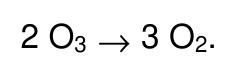
For the overall reaction of ozone decomposition,
One of the proposed mechanisms is expressed as
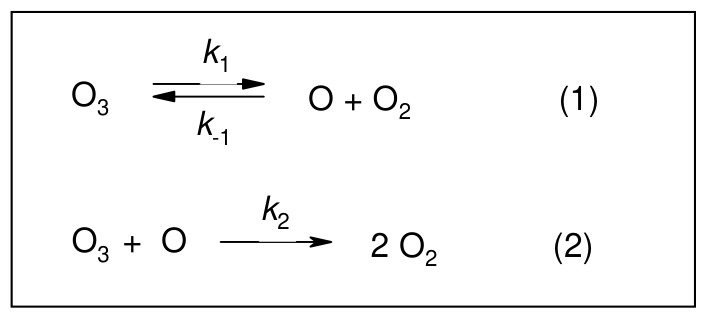
where \(k_1\), \(k_{-1}\), and \(k_2\) are the rate constants.
7.1 According to the above mechanism what are the differential rate equations for the formation (or consumption) of \(\ce{O3}\), \(\ce{O2}\), and \(\ce{O}\) at time \(t\), assuming step 2 is irreversible.
7.2 Simplification in obtaining the rate law may be found by making appropriate assumptions. Assuming that the concentration of \(\ce{O}\) atoms reaches equilibrium rapidly, its concentration may be given by the equilibrium constant of the reaction (1). The second step is rate determining. Under this equilibrium approximation, deduce the differential rate equation for the \(\ce{O3}\) depletion as a function of \(\ce{O2}\) and \(\ce{O3}\) concentrations.
7.3 Another assumption frequently made is that the rates of oxygen atom production and consumption are equal (this is called steady state). Under the steady state approximation, that is \(d[\ce{O}]/dt=0\), show that the rate equation is: \[ -\frac{d[\ce{O3}]}{dt} = \frac{2k_1k_2[\ce{O3}]^2} {k_{-1}[\ce{O2}]+k_2[\ce{O3}]}. \]
One pathway for the destruction of ozone (\(\ce{2O3 -> 3O2}\)) in the upper atmosphere is catalyzed by Freons. For instance, when \(\ce{CCl2F2}\) (Freon-12) migrates to the upper atmosphere, the ultraviolet photolysis of \(\ce{CCl2F2}\) may give rise to \(\ce{Cl}\) atoms according to the following reaction:

7.4 Chlorine atom can act as a catalyst for the destruction of ozone. The first slow step of a \(\ce{Cl}\)-catalyzed mechanism is proposed as follows:

Assuming a two-step mechanism, propose the second step in the mechanism.
7.5 The activation energy for \(\ce{Cl}\)-catalyzed destruction of ozone is \(2.1\ \mathrm{kJ\,mol^{-1}}\), while the activation energy for the reaction without the presence of catalyst is \(14.0\ \mathrm{kJ\,mol^{-1}}\). Estimate the ratio of the rate constant for the catalyzed reaction to that for the uncatalyzed reaction at \(25\,^\circ\mathrm{C}\). Assume the frequency factor is the same for each reaction.
Official English text of the problem.
Answers
-
7.1 \[ \boxed{ \begin{aligned} \frac{d[\ce{O3}]}{dt} &=-k_1[\ce{O3}]+k_{-1}[\ce{O}][\ce{O2}] -k_2[\ce{O3}][\ce{O}],\\ \frac{d[\ce{O2}]}{dt} &=k_1[\ce{O3}]-k_{-1}[\ce{O}][\ce{O2}] +2k_2[\ce{O3}][\ce{O}],\\ \frac{d[\ce{O}]}{dt} &=k_1[\ce{O3}]-k_{-1}[\ce{O}][\ce{O2}] -k_2[\ce{O3}][\ce{O}]. \end{aligned}} \]
-
7.2 With literal cancellation of the forward and reverse equilibrium rates, \[ \boxed{ -\frac{d[\ce{O3}]}{dt} =\frac{k_1k_2}{k_{-1}} \frac{[\ce{O3}]^2}{[\ce{O2}]} }. \]
-
7.3 \[ \boxed{ -\frac{d[\ce{O3}]}{dt} =\frac{2k_1k_2[\ce{O3}]^2} {k_{-1}[\ce{O2}]+k_2[\ce{O3}]} }. \]
-
7.4 \[ \boxed{\ce{ClO(g) + O3(g) -> Cl(g) + 2O2(g)}}. \]
-
7.5 \[ \boxed{\frac{k_{\mathrm{cat}}}{k_{\mathrm{uncat}}} \approx 1.2\times10^2} \] —a dimensionless ratio of approximately \(120\).
Solution
The species appearing in the mechanism are identified below.
| Formula | Name | SMILES |
|---|---|---|
| \(\ce{O3}\) | Ozone | O=[O+][O-] |
| \(\ce{O2}\) | Dioxygen | O=O |
| \(\ce{O}\) | Oxygen atom | [O] |
| \(\ce{Cl}\) | Chlorine atom | [Cl] |
| \(\ce{ClO}\) | Chlorine monoxide radical | Cl[O] |
| \(\ce{CCl2F2}\) | Dichlorodifluoromethane (Freon-12) | FC(F)(Cl)Cl |
| \(\ce{CF2Cl}\) | Chlorodifluoromethyl radical | F[C](F)Cl |
The ozone SMILES depicts one resonance contributor; the actual molecule is bent with equivalent oxygen–oxygen bonds. These SMILES do not specify electronic spin states, including the triplet ground state of dioxygen. The photolysis shown in reaction (3) involves homolytic carbon–chlorine bond cleavage, with one bonding electron going to each radical fragment.
7.1
For the elementary reactions \[ \ce{O3 <=>[k_1][k_{-1}] O + O2}, \qquad \ce{O3 + O ->[k_2] 2O2}, \] define the event rates \[ v_1=k_1[\ce{O3}],\qquad v_{-1}=k_{-1}[\ce{O}][\ce{O2}],\qquad v_2=k_2[\ce{O3}][\ce{O}]. \]
Each forward event of step (1) consumes one ozone molecule and produces one oxygen atom and one dioxygen molecule. The reverse event has the opposite effects. Each event of step (2) consumes one ozone molecule and one oxygen atom and produces two dioxygen molecules. Therefore, \[ \begin{aligned} \frac{d[\ce{O3}]}{dt}&=-v_1+v_{-1}-v_2,\\ \frac{d[\ce{O2}]}{dt}&=v_1-v_{-1}+2v_2,\\ \frac{d[\ce{O}]}{dt}&=v_1-v_{-1}-v_2. \end{aligned} \] Substitution gives the three expanded equations in the answers.
As an atom-balance check, \[ \frac{d}{dt}\left(3[\ce{O3}]+2[\ce{O2}]+[\ce{O}]\right)=0. \]
If concentrations are expressed in \(\mathrm{mol\,L^{-1}}\), \(k_1\) has units \(\mathrm{s^{-1}}\), while \(k_{-1}\) and \(k_2\) have units \(\mathrm{L\,mol^{-1}\,s^{-1}}\).
7.2
For equilibrium in step (1), \[ k_1[\ce{O3}]=k_{-1}[\ce{O}][\ce{O2}], \] so \[ K_c=\frac{[\ce{O}][\ce{O2}]}{[\ce{O3}]} =\frac{k_1}{k_{-1}}, \qquad [\ce{O}]_{\mathrm{eq}} =\frac{k_1[\ce{O3}]}{k_{-1}[\ce{O2}]}. \]
Applying the literal equilibrium cancellation \(v_1=v_{-1}\) to the ozone balance in 7.1 gives \[ -\frac{d[\ce{O3}]}{dt} =v_2=k_2[\ce{O3}][\ce{O}]_{\mathrm{eq}}. \] Hence, \[ \boxed{ -\frac{d[\ce{O3}]}{dt} =\frac{k_1k_2[\ce{O3}]^2}{k_{-1}[\ce{O2}]} }. \]
This expression is second order in ozone and inverse first order in dioxygen. The equilibrium cancellation used here differs from the steady-state condition imposed next.
7.3
The steady-state condition for oxygen atoms is \[ 0=\frac{d[\ce{O}]}{dt} =k_1[\ce{O3}] -\left(k_{-1}[\ce{O2}]+k_2[\ce{O3}]\right)[\ce{O}]. \] Consequently, \[ [\ce{O}]_{\mathrm{ss}} =\frac{k_1[\ce{O3}]} {k_{-1}[\ce{O2}]+k_2[\ce{O3}]}. \]
The same condition can be written \[ v_1-v_{-1}=v_2. \] Substituting this into the ozone balance, \[ -\frac{d[\ce{O3}]}{dt} =v_1-v_{-1}+v_2 =2v_2. \] Thus, \[ \boxed{ -\frac{d[\ce{O3}]}{dt} =2k_2[\ce{O3}][\ce{O}]_{\mathrm{ss}} =\frac{2k_1k_2[\ce{O3}]^2} {k_{-1}[\ce{O2}]+k_2[\ce{O3}]} }. \]
The factor of two has a stoichiometric origin: step (2) consumes one ozone molecule, while net forward reaction through step (1) consumes another ozone molecule to replace the oxygen atom used in step (2).
7.4
The second step must consume the chlorine monoxide intermediate, regenerate the chlorine catalyst, and complete the overall reaction \(\ce{2O3 -> 3O2}\).
Subtracting the given first step, \[ \ce{Cl(g) + O3(g) -> ClO(g) + O2(g)}, \] from the required overall reaction gives \[ \boxed{\ce{ClO(g) + O3(g) -> Cl(g) + 2O2(g)}}. \]
Adding these two steps cancels both \(\ce{Cl}\) and \(\ce{ClO}\), leaving \[ \ce{2O3(g) -> 3O2(g)}. \] The proposed step conserves one chlorine atom and four oxygen atoms. Chlorine is regenerated and is therefore the catalyst; chlorine monoxide is formed and subsequently consumed and is therefore an intermediate.
7.5
The Arrhenius equation is \[ k=A\exp\left(-\frac{E_a}{RT}\right). \] Because the frequency factors are assumed equal, \[ \frac{k_{\mathrm{cat}}}{k_{\mathrm{uncat}}} = \exp\left( \frac{E_{a,\mathrm{uncat}}-E_{a,\mathrm{cat}}}{RT} \right). \]
The activation-energy difference and temperature are \[ \Delta E_a=(14.0-2.1)\ \mathrm{kJ\,mol^{-1}} =11900\ \mathrm{J\,mol^{-1}}, \] \[ T=25+273.15=298.15\ \mathrm{K}. \]
Using \(R=8.314\ \mathrm{J\,mol^{-1}\,K^{-1}}\), \[ \frac{k_{\mathrm{cat}}}{k_{\mathrm{uncat}}} = \exp\left[ \frac{11900\ \mathrm{J\,mol^{-1}}} {(8.314\ \mathrm{J\,mol^{-1}\,K^{-1}})(298.15\ \mathrm{K})} \right] =e^{4.8007} =121.6. \] Therefore, \[ \boxed{\frac{k_{\mathrm{cat}}}{k_{\mathrm{uncat}}} \approx1.2\times10^2}. \]
The solution was checked against the official solution.
IChO 2005 · Theorieaufgabe 7
Kinetisches Verhalten von Ozon
Ozon (\(\ce{O3}\)) ist eine Form des Sauerstoffs. Es ist ein natürlicher Bestandteil der Stratosphäre, wo es die Erde vor lebenszerstörender ultravioletter Strahlung schützt. Bei der Absorption von Licht in diesem Bereich wird Ozon in Disauerstoffmoleküle umgewandelt.
Für die Gesamtreaktion des Ozonzerfalls
wird einer der vorgeschlagenen Mechanismen wie folgt dargestellt:
Dabei sind \(k_1\), \(k_{-1}\) und \(k_2\) die Geschwindigkeitskonstanten.
7.1 Wie lauten nach dem obigen Mechanismus die differentiellen Geschwindigkeitsgleichungen für die Bildung (oder den Verbrauch) von \(\ce{O3}\), \(\ce{O2}\) und \(\ce{O}\) zum Zeitpunkt \(t\), wenn Schritt 2 als irreversibel angenommen wird?
7.2 Durch geeignete Annahmen lässt sich die Herleitung des Geschwindigkeitsgesetzes vereinfachen. Unter der Annahme, dass die Konzentration der \(\ce{O}\)-Atome rasch ihren Gleichgewichtswert erreicht, kann ihre Konzentration mithilfe der Gleichgewichtskonstante der Reaktion (1) angegeben werden. Der zweite Schritt ist geschwindigkeitsbestimmend. Leiten Sie unter dieser Gleichgewichtsnäherung die differentielle Geschwindigkeitsgleichung für die Abnahme von \(\ce{O3}\) als Funktion der Konzentrationen von \(\ce{O2}\) und \(\ce{O3}\) her.
7.3 Eine weitere häufig verwendete Annahme ist, dass die Geschwindigkeiten der Bildung und des Verbrauchs von Sauerstoffatomen gleich sind (dies wird als stationärer Zustand bezeichnet). Zeigen Sie unter der Quasistationaritätsnäherung, also \(d[\ce{O}]/dt=0\), dass die Geschwindigkeitsgleichung wie folgt lautet: \[ -\frac{d[\ce{O3}]}{dt} = \frac{2k_1k_2[\ce{O3}]^2} {k_{-1}[\ce{O2}]+k_2[\ce{O3}]}. \]
Ein Reaktionsweg zum Abbau von Ozon (\(\ce{2O3 -> 3O2}\)) in der oberen Atmosphäre wird durch Freone katalysiert. Gelangt beispielsweise \(\ce{CCl2F2}\) (Freon-12) in die obere Atmosphäre, so können bei der UV-Photolyse von \(\ce{CCl2F2}\) gemäß der folgenden Reaktion \(\ce{Cl}\)-Atome entstehen:
7.4 Ein Chloratom kann als Katalysator für den Ozonabbau wirken. Für den ersten langsamen Schritt eines \(\ce{Cl}\)-katalysierten Mechanismus wird Folgendes vorgeschlagen:
Schlagen Sie unter der Annahme eines zweistufigen Mechanismus den zweiten Schritt des Mechanismus vor.
7.5 Die Aktivierungsenergie für den \(\ce{Cl}\)-katalysierten Ozonabbau beträgt \(2.1\ \mathrm{kJ\,mol^{-1}}\), während die Aktivierungsenergie für die Reaktion ohne Katalysator \(14.0\ \mathrm{kJ\,mol^{-1}}\) beträgt. Schätzen Sie das Verhältnis der Geschwindigkeitskonstante der katalysierten Reaktion zu derjenigen der unkatalysierten Reaktion bei \(25\,^\circ\mathrm{C}\) ab. Nehmen Sie an, dass der Frequenzfaktor für beide Reaktionen gleich ist.
Aufgabentext aus dem offiziellen englischen Text übersetzt.
Antworten
-
7.1 \[ \boxed{ \begin{aligned} \frac{d[\ce{O3}]}{dt} &=-k_1[\ce{O3}]+k_{-1}[\ce{O}][\ce{O2}] -k_2[\ce{O3}][\ce{O}],\\ \frac{d[\ce{O2}]}{dt} &=k_1[\ce{O3}]-k_{-1}[\ce{O}][\ce{O2}] +2k_2[\ce{O3}][\ce{O}],\\ \frac{d[\ce{O}]}{dt} &=k_1[\ce{O3}]-k_{-1}[\ce{O}][\ce{O2}] -k_2[\ce{O3}][\ce{O}]. \end{aligned}} \]
-
7.2 Bei wörtlicher Aufhebung der Geschwindigkeiten der Hin- und Rückreaktion im Gleichgewicht gilt: \[ \boxed{ -\frac{d[\ce{O3}]}{dt} =\frac{k_1k_2}{k_{-1}} \frac{[\ce{O3}]^2}{[\ce{O2}]} }. \]
-
7.3 \[ \boxed{ -\frac{d[\ce{O3}]}{dt} =\frac{2k_1k_2[\ce{O3}]^2} {k_{-1}[\ce{O2}]+k_2[\ce{O3}]} }. \]
-
7.4 \[ \boxed{\ce{ClO(g) + O3(g) -> Cl(g) + 2O2(g)}}. \]
-
7.5 \[ \boxed{\frac{k_{\mathrm{cat}}}{k_{\mathrm{uncat}}} \approx 1.2\times10^2} \] —ein dimensionsloses Verhältnis von ungefähr \(120\).
Lösung
Die im Mechanismus vorkommenden Spezies sind nachstehend aufgeführt.
| Formel | Name | SMILES |
|---|---|---|
| \(\ce{O3}\) | Ozon | O=[O+][O-] |
| \(\ce{O2}\) | Disauerstoff | O=O |
| \(\ce{O}\) | Sauerstoffatom | [O] |
| \(\ce{Cl}\) | Chloratom | [Cl] |
| \(\ce{ClO}\) | Chlormonoxidradikal | Cl[O] |
| \(\ce{CCl2F2}\) | Dichlordifluormethan (Freon-12) | FC(F)(Cl)Cl |
| \(\ce{CF2Cl}\) | Chlordifluormethylradikal | F[C](F)Cl |
Die SMILES-Darstellung von Ozon zeigt eine mesomere Grenzstruktur; das tatsächliche Molekül ist gewinkelt und besitzt gleichwertige Sauerstoff–Sauerstoff-Bindungen. Diese SMILES geben keine elektronischen Spinzustände an, auch nicht den Triplett-Grundzustand von Disauerstoff. Die in Reaktion (3) dargestellte Photolyse beinhaltet eine homolytische Spaltung der Kohlenstoff–Chlor-Bindung, bei der jedes Radikalfragment ein Bindungselektron erhält.
7.1
Für die Elementarreaktionen \[ \ce{O3 <=>[k_1][k_{-1}] O + O2}, \qquad \ce{O3 + O ->[k_2] 2O2}, \] werden die Geschwindigkeiten der einzelnen Reaktionsereignisse definiert als \[ v_1=k_1[\ce{O3}],\qquad v_{-1}=k_{-1}[\ce{O}][\ce{O2}],\qquad v_2=k_2[\ce{O3}][\ce{O}]. \]
Jedes Reaktionsereignis in Vorwärtsrichtung von Schritt (1) verbraucht ein Ozonmolekül und bildet ein Sauerstoffatom sowie ein Disauerstoffmolekül. Das Rückreaktionsereignis hat die entgegengesetzten Auswirkungen. Jedes Reaktionsereignis von Schritt (2) verbraucht ein Ozonmolekül und ein Sauerstoffatom und bildet zwei Disauerstoffmoleküle. Daher gilt: \[ \begin{aligned} \frac{d[\ce{O3}]}{dt}&=-v_1+v_{-1}-v_2,\\ \frac{d[\ce{O2}]}{dt}&=v_1-v_{-1}+2v_2,\\ \frac{d[\ce{O}]}{dt}&=v_1-v_{-1}-v_2. \end{aligned} \] Durch Einsetzen erhält man die drei ausgeschriebenen Gleichungen im Abschnitt Antworten.
Zur Überprüfung der Atombilanz gilt: \[ \frac{d}{dt}\left(3[\ce{O3}]+2[\ce{O2}]+[\ce{O}]\right)=0. \]
Werden die Konzentrationen in \(\mathrm{mol\,L^{-1}}\) angegeben, so hat \(k_1\) die Einheit \(\mathrm{s^{-1}}\), während \(k_{-1}\) und \(k_2\) die Einheit \(\mathrm{L\,mol^{-1}\,s^{-1}}\) haben.
7.2
Für das Gleichgewicht in Schritt (1) gilt: \[ k_1[\ce{O3}]=k_{-1}[\ce{O}][\ce{O2}], \] also \[ K_c=\frac{[\ce{O}][\ce{O2}]}{[\ce{O3}]} =\frac{k_1}{k_{-1}}, \qquad [\ce{O}]_{\mathrm{eq}} =\frac{k_1[\ce{O3}]}{k_{-1}[\ce{O2}]}. \]
Wendet man die wörtliche Aufhebung der Gleichgewichtsgeschwindigkeiten \(v_1=v_{-1}\) auf die Ozonbilanz aus 7.1 an, erhält man \[ -\frac{d[\ce{O3}]}{dt} =v_2=k_2[\ce{O3}][\ce{O}]_{\mathrm{eq}}. \] Somit gilt: \[ \boxed{ -\frac{d[\ce{O3}]}{dt} =\frac{k_1k_2[\ce{O3}]^2}{k_{-1}[\ce{O2}]} }. \]
Dieser Ausdruck ist zweiter Ordnung bezüglich Ozon und invers erster Ordnung bezüglich Disauerstoff. Die hier verwendete Aufhebung der Gleichgewichtsgeschwindigkeiten unterscheidet sich von der im Folgenden angesetzten Quasistationaritätsbedingung.
7.3
Die Quasistationaritätsbedingung für Sauerstoffatome lautet: \[ 0=\frac{d[\ce{O}]}{dt} =k_1[\ce{O3}] -\left(k_{-1}[\ce{O2}]+k_2[\ce{O3}]\right)[\ce{O}]. \] Folglich gilt: \[ [\ce{O}]_{\mathrm{ss}} =\frac{k_1[\ce{O3}]} {k_{-1}[\ce{O2}]+k_2[\ce{O3}]}. \]
Dieselbe Bedingung lässt sich schreiben als \[ v_1-v_{-1}=v_2. \] Einsetzen in die Ozonbilanz ergibt: \[ -\frac{d[\ce{O3}]}{dt} =v_1-v_{-1}+v_2 =2v_2. \] Damit gilt: \[ \boxed{ -\frac{d[\ce{O3}]}{dt} =2k_2[\ce{O3}][\ce{O}]_{\mathrm{ss}} =\frac{2k_1k_2[\ce{O3}]^2} {k_{-1}[\ce{O2}]+k_2[\ce{O3}]} }. \]
Der Faktor zwei hat einen stöchiometrischen Ursprung: Schritt (2) verbraucht ein Ozonmolekül, während die Nettoreaktion in Vorwärtsrichtung von Schritt (1) ein weiteres Ozonmolekül verbraucht, um das in Schritt (2) verbrauchte Sauerstoffatom zu ersetzen.
7.4
Der zweite Schritt muss das Zwischenprodukt Chlormonoxid verbrauchen, den Chlorkatalysator regenerieren und die Gesamtreaktion \(\ce{2O3 -> 3O2}\) vervollständigen.
Subtrahiert man den gegebenen ersten Schritt \[ \ce{Cl(g) + O3(g) -> ClO(g) + O2(g)}, \] von der geforderten Gesamtreaktion, erhält man \[ \boxed{\ce{ClO(g) + O3(g) -> Cl(g) + 2O2(g)}}. \]
Bei der Addition dieser beiden Schritte kürzen sich sowohl \(\ce{Cl}\) als auch \(\ce{ClO}\) heraus, und es verbleibt: \[ \ce{2O3(g) -> 3O2(g)}. \] Im vorgeschlagenen Schritt bleiben ein Chloratom und vier Sauerstoffatome erhalten. Chlor wird regeneriert und ist daher der Katalysator; Chlormonoxid wird gebildet und anschließend verbraucht und ist daher ein Zwischenprodukt.
7.5
Die Arrhenius-Gleichung lautet: \[ k=A\exp\left(-\frac{E_a}{RT}\right). \] Da die Frequenzfaktoren als gleich angenommen werden, gilt: \[ \frac{k_{\mathrm{cat}}}{k_{\mathrm{uncat}}} = \exp\left( \frac{E_{a,\mathrm{uncat}}-E_{a,\mathrm{cat}}}{RT} \right). \]
Die Differenz der Aktivierungsenergien und die Temperatur betragen \[ \Delta E_a=(14.0-2.1)\ \mathrm{kJ\,mol^{-1}} =11900\ \mathrm{J\,mol^{-1}}, \] \[ T=25+273.15=298.15\ \mathrm{K}. \]
Mit \(R=8.314\ \mathrm{J\,mol^{-1}\,K^{-1}}\) erhält man \[ \frac{k_{\mathrm{cat}}}{k_{\mathrm{uncat}}} = \exp\left[ \frac{11900\ \mathrm{J\,mol^{-1}}} {(8.314\ \mathrm{J\,mol^{-1}\,K^{-1}})(298.15\ \mathrm{K})} \right] =e^{4.8007} =121.6. \] Daher gilt: \[ \boxed{\frac{k_{\mathrm{cat}}}{k_{\mathrm{uncat}}} \approx1.2\times10^2}. \]
Die Lösung wurde mit der offiziellen Lösung abgeglichen.
IChO 2005 · Teori sorusu 7
Ozonun Kinetik Davranışı
Ozon (\(\ce{O3}\)), oksijenin bir biçimidir. Stratosferin doğal bir bileşenidir ve burada yeryüzünü yaşamı yok eden morötesi ışınımdan korur. Bu bölgede ışık soğurduğunda ozon, dioksijen moleküllerine dönüşür.
Ozonun bozunmasının toplam tepkimesi için,
Önerilen mekanizmalardan biri şu şekilde ifade edilir:
Burada \(k_1\), \(k_{-1}\) ve \(k_2\) hız sabitleridir.
7.1 Yukarıdaki mekanizmaya göre, 2. basamağın tersinmez olduğunu varsayarak, \(t\) anında \(\ce{O3}\), \(\ce{O2}\) ve \(\ce{O}\) oluşumu (veya tüketimi) için diferansiyel hız denklemleri nelerdir?
7.2 Uygun varsayımlar yapılarak hız yasasının elde edilmesi basitleştirilebilir. \(\ce{O}\) atomlarının derişiminin hızla dengeye ulaştığı varsayılırsa, bu derişim (1) tepkimesinin denge sabiti kullanılarak verilebilir. İkinci basamak hız belirleyicidir. Bu denge yaklaşımı altında, \(\ce{O3}\) tüketimi için diferansiyel hız denklemini \(\ce{O2}\) ve \(\ce{O3}\) derişimlerinin bir fonksiyonu olarak türetiniz.
7.3 Sıklıkla yapılan bir diğer varsayım, oksijen atomlarının oluşum ve tüketim hızlarının eşit olduğudur (buna kararlı hâl denir). Kararlı hâl yaklaşımı altında, yani \(d[\ce{O}]/dt=0\) iken, hız denkleminin aşağıdaki gibi olduğunu gösteriniz: \[ -\frac{d[\ce{O3}]}{dt} = \frac{2k_1k_2[\ce{O3}]^2} {k_{-1}[\ce{O2}]+k_2[\ce{O3}]}. \]
Üst atmosferde ozonun yok edilmesine (\(\ce{2O3 -> 3O2}\)) yol açan yollardan biri Freonlar tarafından katalizlenir. Örneğin, \(\ce{CCl2F2}\) (Freon-12) üst atmosfere taşındığında, \(\ce{CCl2F2}\)'nin morötesi ışıkla fotolizi aşağıdaki tepkimeye göre \(\ce{Cl}\) atomlarının oluşmasına yol açabilir:
7.4 Klor atomu, ozonun yok edilmesinde katalizör olarak işlev görebilir. \(\ce{Cl}\) ile katalizlenen bir mekanizmanın ilk yavaş basamağı aşağıdaki gibi önerilmektedir:
İki basamaklı bir mekanizma varsayarak mekanizmanın ikinci basamağını öneriniz.
7.5 Ozonun \(\ce{Cl}\) ile katalizlenen yok edilme tepkimesinin aktivasyon enerjisi \(2.1\ \mathrm{kJ\,mol^{-1}}\) iken, katalizör bulunmadığında tepkimenin aktivasyon enerjisi \(14.0\ \mathrm{kJ\,mol^{-1}}\)'dir. \(25\,^\circ\mathrm{C}\)'de katalizlenen tepkimenin hız sabitinin katalizlenmeyen tepkimeninkine oranını tahmin ediniz. Her iki tepkime için frekans faktörünün aynı olduğunu varsayınız.
Soru metni resmi İngilizce metinden çevrilmiştir.
Cevaplar
-
7.1 \[ \boxed{ \begin{aligned} \frac{d[\ce{O3}]}{dt} &=-k_1[\ce{O3}]+k_{-1}[\ce{O}][\ce{O2}] -k_2[\ce{O3}][\ce{O}],\\ \frac{d[\ce{O2}]}{dt} &=k_1[\ce{O3}]-k_{-1}[\ce{O}][\ce{O2}] +2k_2[\ce{O3}][\ce{O}],\\ \frac{d[\ce{O}]}{dt} &=k_1[\ce{O3}]-k_{-1}[\ce{O}][\ce{O2}] -k_2[\ce{O3}][\ce{O}]. \end{aligned}} \]
-
7.2 İleri ve geri yöndeki denge hızları doğrudan birbirini götürecek şekilde alındığında, \[ \boxed{ -\frac{d[\ce{O3}]}{dt} =\frac{k_1k_2}{k_{-1}} \frac{[\ce{O3}]^2}{[\ce{O2}]} }. \]
-
7.3 \[ \boxed{ -\frac{d[\ce{O3}]}{dt} =\frac{2k_1k_2[\ce{O3}]^2} {k_{-1}[\ce{O2}]+k_2[\ce{O3}]} }. \]
-
7.4 \[ \boxed{\ce{ClO(g) + O3(g) -> Cl(g) + 2O2(g)}}. \]
-
7.5 \[ \boxed{\frac{k_{\mathrm{cat}}}{k_{\mathrm{uncat}}} \approx 1.2\times10^2} \] —yaklaşık \(120\) olan boyutsuz bir oran.
Çözüm
Mekanizmada yer alan kimyasal türler aşağıda tanımlanmıştır.
| Formül | Adı | SMILES |
|---|---|---|
| \(\ce{O3}\) | Ozon | O=[O+][O-] |
| \(\ce{O2}\) | Dioksijen | O=O |
| \(\ce{O}\) | Oksijen atomu | [O] |
| \(\ce{Cl}\) | Klor atomu | [Cl] |
| \(\ce{ClO}\) | Klor monoksit radikali | Cl[O] |
| \(\ce{CCl2F2}\) | Diklorodiflorometan (Freon-12) | FC(F)(Cl)Cl |
| \(\ce{CF2Cl}\) | Klorodiflorometil radikali | F[C](F)Cl |
Ozonun SMILES gösterimi, rezonansa katkıda bulunan yapılardan birini betimler; gerçek molekül, eşdeğer oksijen–oksijen bağlarına sahip açısal bir yapıdadır. Bu SMILES gösterimleri, dioksijenin triplet temel hâli de dâhil olmak üzere elektronik spin durumlarını belirtmez. (3) tepkimesinde gösterilen fotoliz, karbon–klor bağının homolitik olarak kırılmasını içerir; bağ elektronlarından biri radikal parçacıkların her birine gider.
7.1
Elementer tepkimeler \[ \ce{O3 <=>[k_1][k_{-1}] O + O2}, \qquad \ce{O3 + O ->[k_2] 2O2}, \] için tepkime olaylarının hızlarını şöyle tanımlayalım: \[ v_1=k_1[\ce{O3}],\qquad v_{-1}=k_{-1}[\ce{O}][\ce{O2}],\qquad v_2=k_2[\ce{O3}][\ce{O}]. \]
(1) basamağının ileri yöndeki her bir gerçekleşmesinde bir ozon molekülü tüketilir ve bir oksijen atomu ile bir dioksijen molekülü oluşur. Ters yöndeki gerçekleşmenin etkileri bunun zıddıdır. (2) basamağının her bir gerçekleşmesinde bir ozon molekülü ile bir oksijen atomu tüketilir ve iki dioksijen molekülü oluşur. Dolayısıyla, \[ \begin{aligned} \frac{d[\ce{O3}]}{dt}&=-v_1+v_{-1}-v_2,\\ \frac{d[\ce{O2}]}{dt}&=v_1-v_{-1}+2v_2,\\ \frac{d[\ce{O}]}{dt}&=v_1-v_{-1}-v_2. \end{aligned} \] Yerine koyma işlemi, cevaplarda verilen üç açık denklemi verir.
Atom denkliğini kontrol etmek için, \[ \frac{d}{dt}\left(3[\ce{O3}]+2[\ce{O2}]+[\ce{O}]\right)=0. \]
Derişimler \(\mathrm{mol\,L^{-1}}\) cinsinden ifade edilirse, \(k_1\)'in birimi \(\mathrm{s^{-1}}\) iken, \(k_{-1}\) ve \(k_2\)'nin birimleri \(\mathrm{L\,mol^{-1}\,s^{-1}}\)'dir.
7.2
(1) basamağındaki denge için, \[ k_1[\ce{O3}]=k_{-1}[\ce{O}][\ce{O2}], \] dolayısıyla \[ K_c=\frac{[\ce{O}][\ce{O2}]}{[\ce{O3}]} =\frac{k_1}{k_{-1}}, \qquad [\ce{O}]_{\mathrm{eq}} =\frac{k_1[\ce{O3}]}{k_{-1}[\ce{O2}]}. \]
Denge hızlarının doğrudan birbirini götürmesini sağlayan \(v_1=v_{-1}\) eşitliği 7.1'deki ozon denkliğine uygulandığında \[ -\frac{d[\ce{O3}]}{dt} =v_2=k_2[\ce{O3}][\ce{O}]_{\mathrm{eq}}. \] elde edilir. Böylece, \[ \boxed{ -\frac{d[\ce{O3}]}{dt} =\frac{k_1k_2[\ce{O3}]^2}{k_{-1}[\ce{O2}]} }. \]
Bu ifade ozona göre ikinci dereceden, dioksijene göre ise eksi birinci derecedendir. Burada kullanılan denge hızlarının birbirini götürmesi, bir sonraki kısımda uygulanan kararlı hâl koşulundan farklıdır.
7.3
Oksijen atomları için kararlı hâl koşulu şöyledir: \[ 0=\frac{d[\ce{O}]}{dt} =k_1[\ce{O3}] -\left(k_{-1}[\ce{O2}]+k_2[\ce{O3}]\right)[\ce{O}]. \] Bunun sonucunda, \[ [\ce{O}]_{\mathrm{ss}} =\frac{k_1[\ce{O3}]} {k_{-1}[\ce{O2}]+k_2[\ce{O3}]}. \]
Aynı koşul şu şekilde yazılabilir: \[ v_1-v_{-1}=v_2. \] Bu ifade ozon denkliğinde yerine konulduğunda, \[ -\frac{d[\ce{O3}]}{dt} =v_1-v_{-1}+v_2 =2v_2. \] Böylece, \[ \boxed{ -\frac{d[\ce{O3}]}{dt} =2k_2[\ce{O3}][\ce{O}]_{\mathrm{ss}} =\frac{2k_1k_2[\ce{O3}]^2} {k_{-1}[\ce{O2}]+k_2[\ce{O3}]} }. \]
İki çarpanının kökeni stokiyometriktir: (2) basamağı bir ozon molekülünü tüketirken, (1) basamağı üzerinden gerçekleşen net ileri tepkime, (2) basamağında kullanılan oksijen atomunu yerine koymak için bir başka ozon molekülünü tüketir.
7.4
İkinci basamak, klor monoksit ara ürününü tüketmeli, klor katalizörünü yeniden oluşturmalı ve toplam \(\ce{2O3 -> 3O2}\) tepkimesini tamamlamalıdır.
Verilen ilk basamak, \[ \ce{Cl(g) + O3(g) -> ClO(g) + O2(g)}, \] gerekli toplam tepkimeden çıkarıldığında şu elde edilir: \[ \boxed{\ce{ClO(g) + O3(g) -> Cl(g) + 2O2(g)}}. \]
Bu iki basamak toplandığında hem \(\ce{Cl}\) hem de \(\ce{ClO}\) birbirini götürür ve geriye \[ \ce{2O3(g) -> 3O2(g)}. \] kalır. Önerilen basamakta bir klor atomu ve dört oksijen atomu korunur. Klor yeniden oluştuğu için katalizördür; klor monoksit ise oluşup daha sonra tüketildiği için bir ara üründür.
7.5
Arrhenius denklemi şöyledir: \[ k=A\exp\left(-\frac{E_a}{RT}\right). \] Frekans faktörlerinin eşit olduğu varsayıldığından, \[ \frac{k_{\mathrm{cat}}}{k_{\mathrm{uncat}}} = \exp\left( \frac{E_{a,\mathrm{uncat}}-E_{a,\mathrm{cat}}}{RT} \right). \]
Aktivasyon enerjisi farkı ve sıcaklık şöyledir: \[ \Delta E_a=(14.0-2.1)\ \mathrm{kJ\,mol^{-1}} =11900\ \mathrm{J\,mol^{-1}}, \] \[ T=25+273.15=298.15\ \mathrm{K}. \]
\(R=8.314\ \mathrm{J\,mol^{-1}\,K^{-1}}\) kullanıldığında, \[ \frac{k_{\mathrm{cat}}}{k_{\mathrm{uncat}}} = \exp\left[ \frac{11900\ \mathrm{J\,mol^{-1}}} {(8.314\ \mathrm{J\,mol^{-1}\,K^{-1}})(298.15\ \mathrm{K})} \right] =e^{4.8007} =121.6. \] Dolayısıyla, \[ \boxed{\frac{k_{\mathrm{cat}}}{k_{\mathrm{uncat}}} \approx1.2\times10^2}. \]
Çözüm, resmi çözümle karşılaştırılarak kontrol edildi.
IChO 2005 · Problema teórico 7
Comportamiento cinético del ozono
El ozono (\(\ce{O3}\)) es una forma del oxígeno. Es un componente natural de la estratosfera, donde protege a la Tierra de la radiación ultravioleta que destruye la vida. Al absorber luz en esta región, el ozono se convierte en moléculas de dioxígeno.
Para la reacción global de descomposición del ozono,
Uno de los mecanismos propuestos se expresa como
donde \(k_1\), \(k_{-1}\) y \(k_2\) son las constantes de velocidad.
7.1 De acuerdo con el mecanismo anterior, ¿cuáles son las ecuaciones diferenciales de velocidad para la formación (o el consumo) de \(\ce{O3}\), \(\ce{O2}\) y \(\ce{O}\) en el instante \(t\), suponiendo que la etapa 2 es irreversible?
7.2 La obtención de la ley de velocidad puede simplificarse mediante suposiciones adecuadas. Suponiendo que la concentración de átomos de \(\ce{O}\) alcanza rápidamente el equilibrio, su concentración puede expresarse mediante la constante de equilibrio de la reacción (1). La segunda etapa es la determinante de la velocidad. Bajo esta aproximación de equilibrio, deduzca la ecuación diferencial de velocidad para la desaparición de \(\ce{O3}\) en función de las concentraciones de \(\ce{O2}\) y \(\ce{O3}\).
7.3 Otra suposición frecuente es que las velocidades de producción y consumo de átomos de oxígeno son iguales (esto se denomina estado estacionario). Bajo la aproximación del estado estacionario, es decir, \(d[\ce{O}]/dt=0\), demuestre que la ecuación de velocidad es: \[ -\frac{d[\ce{O3}]}{dt} = \frac{2k_1k_2[\ce{O3}]^2} {k_{-1}[\ce{O2}]+k_2[\ce{O3}]}. \]
Una vía de destrucción del ozono (\(\ce{2O3 -> 3O2}\)) en la alta atmósfera está catalizada por los freones. Por ejemplo, cuando el \(\ce{CCl2F2}\) (freón-12) migra hacia la alta atmósfera, la fotólisis ultravioleta del \(\ce{CCl2F2}\) puede dar lugar a átomos de \(\ce{Cl}\) según la siguiente reacción:
7.4 El átomo de cloro puede actuar como catalizador de la destrucción del ozono. Se propone la siguiente primera etapa lenta de un mecanismo catalizado por \(\ce{Cl}\):
Suponiendo un mecanismo de dos etapas, proponga la segunda etapa del mecanismo.
7.5 La energía de activación de la destrucción del ozono catalizada por \(\ce{Cl}\) es de \(2.1\ \mathrm{kJ\,mol^{-1}}\), mientras que la energía de activación de la reacción en ausencia de catalizador es de \(14.0\ \mathrm{kJ\,mol^{-1}}\). Estime el cociente entre la constante de velocidad de la reacción catalizada y la de la reacción no catalizada a \(25\,^\circ\mathrm{C}\). Suponga que el factor de frecuencia es el mismo para ambas reacciones.
Enunciado traducido del texto oficial en inglés.
Respuestas
-
7.1 \[ \boxed{ \begin{aligned} \frac{d[\ce{O3}]}{dt} &=-k_1[\ce{O3}]+k_{-1}[\ce{O}][\ce{O2}] -k_2[\ce{O3}][\ce{O}],\\ \frac{d[\ce{O2}]}{dt} &=k_1[\ce{O3}]-k_{-1}[\ce{O}][\ce{O2}] +2k_2[\ce{O3}][\ce{O}],\\ \frac{d[\ce{O}]}{dt} &=k_1[\ce{O3}]-k_{-1}[\ce{O}][\ce{O2}] -k_2[\ce{O3}][\ce{O}]. \end{aligned}} \]
-
7.2 Con la cancelación literal de las velocidades directa e inversa en el equilibrio, \[ \boxed{ -\frac{d[\ce{O3}]}{dt} =\frac{k_1k_2}{k_{-1}} \frac{[\ce{O3}]^2}{[\ce{O2}]} }. \]
-
7.3 \[ \boxed{ -\frac{d[\ce{O3}]}{dt} =\frac{2k_1k_2[\ce{O3}]^2} {k_{-1}[\ce{O2}]+k_2[\ce{O3}]} }. \]
-
7.4 \[ \boxed{\ce{ClO(g) + O3(g) -> Cl(g) + 2O2(g)}}. \]
-
7.5 \[ \boxed{\frac{k_{\mathrm{cat}}}{k_{\mathrm{uncat}}} \approx 1.2\times10^2} \] —un cociente adimensional de aproximadamente \(120\).
Solución
A continuación se identifican las especies que aparecen en el mecanismo.
| Fórmula | Nombre | SMILES |
|---|---|---|
| \(\ce{O3}\) | Ozono | O=[O+][O-] |
| \(\ce{O2}\) | Dioxígeno | O=O |
| \(\ce{O}\) | Átomo de oxígeno | [O] |
| \(\ce{Cl}\) | Átomo de cloro | [Cl] |
| \(\ce{ClO}\) | Radical monóxido de cloro | Cl[O] |
| \(\ce{CCl2F2}\) | Diclorodifluorometano (freón-12) | FC(F)(Cl)Cl |
| \(\ce{CF2Cl}\) | Radical clorodifluorometilo | F[C](F)Cl |
El SMILES del ozono representa una de sus estructuras resonantes; la molécula real es angular y presenta enlaces oxígeno–oxígeno equivalentes. Estos SMILES no especifican los estados de espín electrónico, incluido el estado fundamental triplete del dioxígeno. La fotólisis mostrada en la reacción (3) implica la ruptura homolítica del enlace carbono–cloro, en la que cada fragmento radicalario recibe uno de los electrones del enlace.
7.1
Para las reacciones elementales \[ \ce{O3 <=>[k_1][k_{-1}] O + O2}, \qquad \ce{O3 + O ->[k_2] 2O2}, \] se definen las velocidades de los procesos elementales \[ v_1=k_1[\ce{O3}],\qquad v_{-1}=k_{-1}[\ce{O}][\ce{O2}],\qquad v_2=k_2[\ce{O3}][\ce{O}]. \]
Cada proceso directo de la etapa (1) consume una molécula de ozono y produce un átomo de oxígeno y una molécula de dioxígeno. El proceso inverso tiene los efectos opuestos. Cada proceso de la etapa (2) consume una molécula de ozono y un átomo de oxígeno y produce dos moléculas de dioxígeno. Por tanto, \[ \begin{aligned} \frac{d[\ce{O3}]}{dt}&=-v_1+v_{-1}-v_2,\\ \frac{d[\ce{O2}]}{dt}&=v_1-v_{-1}+2v_2,\\ \frac{d[\ce{O}]}{dt}&=v_1-v_{-1}-v_2. \end{aligned} \] La sustitución da las tres ecuaciones desarrolladas que figuran en las respuestas.
Como comprobación del balance atómico, \[ \frac{d}{dt}\left(3[\ce{O3}]+2[\ce{O2}]+[\ce{O}]\right)=0. \]
Si las concentraciones se expresan en \(\mathrm{mol\,L^{-1}}\), \(k_1\) tiene unidades de \(\mathrm{s^{-1}}\), mientras que \(k_{-1}\) y \(k_2\) tienen unidades de \(\mathrm{L\,mol^{-1}\,s^{-1}}\).
7.2
Para el equilibrio en la etapa (1), \[ k_1[\ce{O3}]=k_{-1}[\ce{O}][\ce{O2}], \] por lo que \[ K_c=\frac{[\ce{O}][\ce{O2}]}{[\ce{O3}]} =\frac{k_1}{k_{-1}}, \qquad [\ce{O}]_{\mathrm{eq}} =\frac{k_1[\ce{O3}]}{k_{-1}[\ce{O2}]}. \]
Al aplicar la cancelación literal en el equilibrio \(v_1=v_{-1}\) al balance de ozono de 7.1, se obtiene \[ -\frac{d[\ce{O3}]}{dt} =v_2=k_2[\ce{O3}][\ce{O}]_{\mathrm{eq}}. \] Por consiguiente, \[ \boxed{ -\frac{d[\ce{O3}]}{dt} =\frac{k_1k_2[\ce{O3}]^2}{k_{-1}[\ce{O2}]} }. \]
Esta expresión es de segundo orden respecto al ozono y de orden menos uno respecto al dioxígeno. La cancelación en el equilibrio utilizada aquí difiere de la condición de estado estacionario que se impone a continuación.
7.3
La condición de estado estacionario para los átomos de oxígeno es \[ 0=\frac{d[\ce{O}]}{dt} =k_1[\ce{O3}] -\left(k_{-1}[\ce{O2}]+k_2[\ce{O3}]\right)[\ce{O}]. \] En consecuencia, \[ [\ce{O}]_{\mathrm{ss}} =\frac{k_1[\ce{O3}]} {k_{-1}[\ce{O2}]+k_2[\ce{O3}]}. \]
La misma condición puede escribirse como \[ v_1-v_{-1}=v_2. \] Al sustituirla en el balance de ozono, \[ -\frac{d[\ce{O3}]}{dt} =v_1-v_{-1}+v_2 =2v_2. \] Así, \[ \boxed{ -\frac{d[\ce{O3}]}{dt} =2k_2[\ce{O3}][\ce{O}]_{\mathrm{ss}} =\frac{2k_1k_2[\ce{O3}]^2} {k_{-1}[\ce{O2}]+k_2[\ce{O3}]} }. \]
El factor de dos tiene un origen estequiométrico: la etapa (2) consume una molécula de ozono, mientras que la reacción neta en sentido directo de la etapa (1) consume otra molécula de ozono para reponer el átomo de oxígeno utilizado en la etapa (2).
7.4
La segunda etapa debe consumir el intermedio monóxido de cloro, regenerar el catalizador de cloro y completar la reacción global \(\ce{2O3 -> 3O2}\).
Al restar la primera etapa dada, \[ \ce{Cl(g) + O3(g) -> ClO(g) + O2(g)}, \] de la reacción global requerida, se obtiene \[ \boxed{\ce{ClO(g) + O3(g) -> Cl(g) + 2O2(g)}}. \]
Al sumar estas dos etapas se cancelan tanto \(\ce{Cl}\) como \(\ce{ClO}\), y queda \[ \ce{2O3(g) -> 3O2(g)}. \] La etapa propuesta conserva un átomo de cloro y cuatro átomos de oxígeno. El cloro se regenera y, por tanto, es el catalizador; el monóxido de cloro se forma y posteriormente se consume y, por tanto, es un intermedio.
7.5
La ecuación de Arrhenius es \[ k=A\exp\left(-\frac{E_a}{RT}\right). \] Como se supone que los factores de frecuencia son iguales, \[ \frac{k_{\mathrm{cat}}}{k_{\mathrm{uncat}}} = \exp\left( \frac{E_{a,\mathrm{uncat}}-E_{a,\mathrm{cat}}}{RT} \right). \]
La diferencia entre las energías de activación y la temperatura son \[ \Delta E_a=(14.0-2.1)\ \mathrm{kJ\,mol^{-1}} =11900\ \mathrm{J\,mol^{-1}}, \] \[ T=25+273.15=298.15\ \mathrm{K}. \]
Utilizando \(R=8.314\ \mathrm{J\,mol^{-1}\,K^{-1}}\), \[ \frac{k_{\mathrm{cat}}}{k_{\mathrm{uncat}}} = \exp\left[ \frac{11900\ \mathrm{J\,mol^{-1}}} {(8.314\ \mathrm{J\,mol^{-1}\,K^{-1}})(298.15\ \mathrm{K})} \right] =e^{4.8007} =121.6. \] Por tanto, \[ \boxed{\frac{k_{\mathrm{cat}}}{k_{\mathrm{uncat}}} \approx1.2\times10^2}. \]
La solución se comprobó con la solución oficial.
IChO 2005 · 理论题 7
臭氧的动力学行为
臭氧(\(\ce{O3}\))是氧的一种存在形式。它是平流层中的一种天然组分,在那里保护地球免受危害生命的紫外辐射。臭氧吸收这一区域的光后,会转化为氧分子。
臭氧分解的总反应为:
所提出的机理之一可表示为:
其中,\(k_1\)、\(k_{-1}\) 和 \(k_2\) 为速率常数。
7.1 根据上述机理,假设步骤 2 不可逆,写出 \(t\) 时刻 \(\ce{O3}\)、\(\ce{O2}\) 和 \(\ce{O}\) 生成(或消耗)的微分速率方程。
7.2 作出适当的假设可以简化速率定律的推导。假设 \(\ce{O}\) 原子的浓度迅速达到平衡,则可由反应 (1) 的平衡常数求出其浓度。第二步为速率决定步骤。在这一平衡近似下,推导 \(\ce{O3}\) 消耗的微分速率方程,将其表示为 \(\ce{O2}\) 和 \(\ce{O3}\) 浓度的函数。
7.3 另一种常用的假设是氧原子的生成速率与消耗速率相等(称为稳态)。在稳态近似下,即 \(d[\ce{O}]/dt=0\),证明速率方程为: \[ -\frac{d[\ce{O3}]}{dt} = \frac{2k_1k_2[\ce{O3}]^2} {k_{-1}[\ce{O2}]+k_2[\ce{O3}]}. \]
高层大气中臭氧被破坏(\(\ce{2O3 -> 3O2}\))的一条途径由氟利昂催化。例如,当 \(\ce{CCl2F2}\)(氟利昂-12)迁移到高层大气时,\(\ce{CCl2F2}\) 的紫外光解可按下列反应产生 \(\ce{Cl}\) 原子:
7.4 氯原子可以催化臭氧的破坏。所提出的 \(\ce{Cl}\) 催化机理中,缓慢的第一步如下:
假设该机理包含两个步骤,提出机理中的第二步。
7.5 \(\ce{Cl}\) 催化臭氧破坏反应的活化能为 \(2.1\ \mathrm{kJ\,mol^{-1}}\),而无催化剂时该反应的活化能为 \(14.0\ \mathrm{kJ\,mol^{-1}}\)。估算在 \(25\,^\circ\mathrm{C}\) 时,催化反应与非催化反应的速率常数之比。假设两个反应的指前因子相同。
题目译自官方英文原文。
答案
-
7.1 \[ \boxed{ \begin{aligned} \frac{d[\ce{O3}]}{dt} &=-k_1[\ce{O3}]+k_{-1}[\ce{O}][\ce{O2}] -k_2[\ce{O3}][\ce{O}],\\ \frac{d[\ce{O2}]}{dt} &=k_1[\ce{O3}]-k_{-1}[\ce{O}][\ce{O2}] +2k_2[\ce{O3}][\ce{O}],\\ \frac{d[\ce{O}]}{dt} &=k_1[\ce{O3}]-k_{-1}[\ce{O}][\ce{O2}] -k_2[\ce{O3}][\ce{O}]. \end{aligned}} \]
-
7.2 若直接将平衡时的正、逆反应速率相消,则有 \[ \boxed{ -\frac{d[\ce{O3}]}{dt} =\frac{k_1k_2}{k_{-1}} \frac{[\ce{O3}]^2}{[\ce{O2}]} }. \]
-
7.3 \[ \boxed{ -\frac{d[\ce{O3}]}{dt} =\frac{2k_1k_2[\ce{O3}]^2} {k_{-1}[\ce{O2}]+k_2[\ce{O3}]} }. \]
-
7.4 \[ \boxed{\ce{ClO(g) + O3(g) -> Cl(g) + 2O2(g)}}. \]
-
7.5 \[ \boxed{\frac{k_{\mathrm{cat}}}{k_{\mathrm{uncat}}} \approx 1.2\times10^2} \] ——这是一个约为 \(120\) 的无量纲比值。
解答
机理中出现的各物种如下所示。
| 化学式 | 名称 | SMILES |
|---|---|---|
| \(\ce{O3}\) | 臭氧 | O=[O+][O-] |
| \(\ce{O2}\) | 氧气 | O=O |
| \(\ce{O}\) | 氧原子 | [O] |
| \(\ce{Cl}\) | 氯原子 | [Cl] |
| \(\ce{ClO}\) | 一氧化氯自由基 | Cl[O] |
| \(\ce{CCl2F2}\) | 二氯二氟甲烷(氟利昂-12) | FC(F)(Cl)Cl |
| \(\ce{CF2Cl}\) | 氯二氟甲基自由基 | F[C](F)Cl |
臭氧的 SMILES 表示其一个共振式;实际分子呈折线形,氧—氧键彼此等价。这些 SMILES 未指定电子自旋态,包括氧分子的三重态基态。反应 (3) 所示的光解涉及碳—氯键的均裂,成键电子分别归属于两个自由基碎片,每个碎片获得一个电子。
7.1
对于基元反应 \[ \ce{O3 <=>[k_1][k_{-1}] O + O2}, \qquad \ce{O3 + O ->[k_2] 2O2}, \] 定义反应事件的速率为 \[ v_1=k_1[\ce{O3}],\qquad v_{-1}=k_{-1}[\ce{O}][\ce{O2}],\qquad v_2=k_2[\ce{O3}][\ce{O}]. \]
步骤 (1) 每发生一次正向反应,就消耗一个臭氧分子,并生成一个氧原子和一个氧分子。逆向反应的作用恰好相反。步骤 (2) 每发生一次反应,就消耗一个臭氧分子和一个氧原子,并生成两个氧分子。因此, \[ \begin{aligned} \frac{d[\ce{O3}]}{dt}&=-v_1+v_{-1}-v_2,\\ \frac{d[\ce{O2}]}{dt}&=v_1-v_{-1}+2v_2,\\ \frac{d[\ce{O}]}{dt}&=v_1-v_{-1}-v_2. \end{aligned} \] 代入各速率表达式,即得答案中的三个展开后的方程。
利用原子守恒进行检验,有 \[ \frac{d}{dt}\left(3[\ce{O3}]+2[\ce{O2}]+[\ce{O}]\right)=0. \]
若浓度以 \(\mathrm{mol\,L^{-1}}\) 表示,则 \(k_1\) 的单位为 \(\mathrm{s^{-1}}\),而 \(k_{-1}\) 和 \(k_2\) 的单位为 \(\mathrm{L\,mol^{-1}\,s^{-1}}\)。
7.2
步骤 (1) 达到平衡时, \[ k_1[\ce{O3}]=k_{-1}[\ce{O}][\ce{O2}], \] 所以 \[ K_c=\frac{[\ce{O}][\ce{O2}]}{[\ce{O3}]} =\frac{k_1}{k_{-1}}, \qquad [\ce{O}]_{\mathrm{eq}} =\frac{k_1[\ce{O3}]}{k_{-1}[\ce{O2}]}. \]
在 7.1 的臭氧物料衡算式中,直接按平衡关系 \(v_1=v_{-1}\) 将两项相消,得到 \[ -\frac{d[\ce{O3}]}{dt} =v_2=k_2[\ce{O3}][\ce{O}]_{\mathrm{eq}}. \] 因此, \[ \boxed{ -\frac{d[\ce{O3}]}{dt} =\frac{k_1k_2[\ce{O3}]^2}{k_{-1}[\ce{O2}]} }. \]
此表达式对臭氧为二级,对氧气为负一级。此处采用的平衡速率相消与接下来施加的稳态条件不同。
7.3
氧原子的稳态条件为 \[ 0=\frac{d[\ce{O}]}{dt} =k_1[\ce{O3}] -\left(k_{-1}[\ce{O2}]+k_2[\ce{O3}]\right)[\ce{O}]. \] 由此可得, \[ [\ce{O}]_{\mathrm{ss}} =\frac{k_1[\ce{O3}]} {k_{-1}[\ce{O2}]+k_2[\ce{O3}]}. \]
同一条件也可写为 \[ v_1-v_{-1}=v_2. \] 将其代入臭氧物料衡算式,得到 \[ -\frac{d[\ce{O3}]}{dt} =v_1-v_{-1}+v_2 =2v_2. \] 于是, \[ \boxed{ -\frac{d[\ce{O3}]}{dt} =2k_2[\ce{O3}][\ce{O}]_{\mathrm{ss}} =\frac{2k_1k_2[\ce{O3}]^2} {k_{-1}[\ce{O2}]+k_2[\ce{O3}]} }. \]
系数 2 源于化学计量关系:步骤 (2) 消耗一个臭氧分子,而步骤 (1) 的净正向反应又消耗另一个臭氧分子,以补充步骤 (2) 中消耗的氧原子。
7.4
第二步必须消耗一氧化氯中间体,使氯催化剂再生,并使总反应成为 \(\ce{2O3 -> 3O2}\)。
从所要求的总反应中减去给定的第一步, \[ \ce{Cl(g) + O3(g) -> ClO(g) + O2(g)}, \] 得到 \[ \boxed{\ce{ClO(g) + O3(g) -> Cl(g) + 2O2(g)}}. \]
将这两步相加,\(\ce{Cl}\) 和 \(\ce{ClO}\) 均被消去,剩下 \[ \ce{2O3(g) -> 3O2(g)}. \] 所提出的步骤中,一个氯原子和四个氧原子均守恒。氯得到再生,因此是催化剂;一氧化氯先生成,随后被消耗,因此是中间体。
7.5
阿伦尼乌斯方程为 \[ k=A\exp\left(-\frac{E_a}{RT}\right). \] 由于假设指前因子相等, \[ \frac{k_{\mathrm{cat}}}{k_{\mathrm{uncat}}} = \exp\left( \frac{E_{a,\mathrm{uncat}}-E_{a,\mathrm{cat}}}{RT} \right). \]
活化能之差和温度分别为 \[ \Delta E_a=(14.0-2.1)\ \mathrm{kJ\,mol^{-1}} =11900\ \mathrm{J\,mol^{-1}}, \] \[ T=25+273.15=298.15\ \mathrm{K}. \]
取 \(R=8.314\ \mathrm{J\,mol^{-1}\,K^{-1}}\), \[ \frac{k_{\mathrm{cat}}}{k_{\mathrm{uncat}}} = \exp\left[ \frac{11900\ \mathrm{J\,mol^{-1}}} {(8.314\ \mathrm{J\,mol^{-1}\,K^{-1}})(298.15\ \mathrm{K})} \right] =e^{4.8007} =121.6. \] 因此, \[ \boxed{\frac{k_{\mathrm{cat}}}{k_{\mathrm{uncat}}} \approx1.2\times10^2}. \]
解答已与官方解答核对。
IChO 2005 · Теоретическая задача 7
Кинетическое поведение озона
Озон (\(\ce{O3}\)) — одна из форм кислорода. Он является естественным компонентом стратосферы, где защищает Землю от губительного для жизни ультрафиолетового излучения. При поглощении света в этой области озон превращается в молекулы кислорода.
Для суммарной реакции разложения озона
один из предложенных механизмов имеет вид
где \(k_1\), \(k_{-1}\) и \(k_2\) — константы скорости.
7.1 Согласно приведённому выше механизму, каковы дифференциальные уравнения скорости образования (или расходования) \(\ce{O3}\), \(\ce{O2}\) и \(\ce{O}\) в момент времени \(t\), если считать стадию 2 необратимой?
7.2 Вывод кинетического уравнения можно упростить, приняв подходящие допущения. Если предположить, что концентрация атомов \(\ce{O}\) быстро достигает равновесного значения, её можно выразить через константу равновесия реакции (1). Вторая стадия является лимитирующей. В рамках этого приближения равновесия выведите дифференциальное уравнение скорости расходования \(\ce{O3}\) как функцию концентраций \(\ce{O2}\) и \(\ce{O3}\).
7.3 Ещё одно часто используемое допущение состоит в том, что скорости образования и расходования атомов кислорода равны (это называется стационарным состоянием). В рамках приближения стационарного состояния, то есть \(d[\ce{O}]/dt=0\), покажите, что кинетическое уравнение имеет вид: \[ -\frac{d[\ce{O3}]}{dt} = \frac{2k_1k_2[\ce{O3}]^2} {k_{-1}[\ce{O2}]+k_2[\ce{O3}]}. \]
Один из путей разрушения озона (\(\ce{2O3 -> 3O2}\)) в верхних слоях атмосферы катализируется фреонами. Например, когда \(\ce{CCl2F2}\) (фреон-12) попадает в верхние слои атмосферы, фотолиз \(\ce{CCl2F2}\) под действием ультрафиолетового излучения может приводить к образованию атомов \(\ce{Cl}\) согласно следующей реакции:
7.4 Атом хлора может выступать в качестве катализатора разрушения озона. Для механизма, катализируемого \(\ce{Cl}\), предложена следующая первая медленная стадия:
Предполагая, что механизм состоит из двух стадий, предложите вторую стадию механизма.
7.5 Энергия активации разрушения озона, катализируемого \(\ce{Cl}\), составляет \(2.1\ \mathrm{kJ\,mol^{-1}}\), тогда как энергия активации реакции в отсутствие катализатора составляет \(14.0\ \mathrm{kJ\,mol^{-1}}\). Оцените отношение константы скорости каталитической реакции к константе скорости некаталитической реакции при \(25\,^\circ\mathrm{C}\). Считайте, что частотный множитель одинаков для обеих реакций.
Условие переведено с официального английского текста.
Ответы
-
7.1 \[ \boxed{ \begin{aligned} \frac{d[\ce{O3}]}{dt} &=-k_1[\ce{O3}]+k_{-1}[\ce{O}][\ce{O2}] -k_2[\ce{O3}][\ce{O}],\\ \frac{d[\ce{O2}]}{dt} &=k_1[\ce{O3}]-k_{-1}[\ce{O}][\ce{O2}] +2k_2[\ce{O3}][\ce{O}],\\ \frac{d[\ce{O}]}{dt} &=k_1[\ce{O3}]-k_{-1}[\ce{O}][\ce{O2}] -k_2[\ce{O3}][\ce{O}]. \end{aligned}} \]
-
7.2 При буквальном взаимном сокращении скоростей прямой и обратной реакций в условиях равновесия \[ \boxed{ -\frac{d[\ce{O3}]}{dt} =\frac{k_1k_2}{k_{-1}} \frac{[\ce{O3}]^2}{[\ce{O2}]} }. \]
-
7.3 \[ \boxed{ -\frac{d[\ce{O3}]}{dt} =\frac{2k_1k_2[\ce{O3}]^2} {k_{-1}[\ce{O2}]+k_2[\ce{O3}]} }. \]
-
7.4 \[ \boxed{\ce{ClO(g) + O3(g) -> Cl(g) + 2O2(g)}}. \]
-
7.5 \[ \boxed{\frac{k_{\mathrm{cat}}}{k_{\mathrm{uncat}}} \approx 1.2\times10^2} \] — безразмерное отношение, приблизительно равное \(120\).
Решение
Частицы, участвующие в механизме, указаны ниже.
| Формула | Название | SMILES |
|---|---|---|
| \(\ce{O3}\) | Озон | O=[O+][O-] |
| \(\ce{O2}\) | Молекулярный кислород | O=O |
| \(\ce{O}\) | Атом кислорода | [O] |
| \(\ce{Cl}\) | Атом хлора | [Cl] |
| \(\ce{ClO}\) | Радикал монооксида хлора | Cl[O] |
| \(\ce{CCl2F2}\) | Дихлордифторметан (фреон-12) | FC(F)(Cl)Cl |
| \(\ce{CF2Cl}\) | Хлордифторметильный радикал | F[C](F)Cl |
Запись SMILES для озона изображает одну из резонансных структур; реальная молекула имеет угловую форму с равноценными связями кислород–кислород. Эти записи SMILES не задают электронные спиновые состояния, в том числе триплетное основное состояние молекулярного кислорода. Фотолиз, показанный в реакции (3), включает гомолитический разрыв связи углерод–хлор, при котором каждый радикальный фрагмент получает один из электронов связи.
7.1
Для элементарных реакций \[ \ce{O3 <=>[k_1][k_{-1}] O + O2}, \qquad \ce{O3 + O ->[k_2] 2O2}, \] определим скорости элементарных актов: \[ v_1=k_1[\ce{O3}],\qquad v_{-1}=k_{-1}[\ce{O}][\ce{O2}],\qquad v_2=k_2[\ce{O3}][\ce{O}]. \]
В каждом прямом акте стадии (1) расходуется одна молекула озона и образуются один атом кислорода и одна молекула кислорода. Обратный акт приводит к противоположным изменениям. В каждом акте стадии (2) расходуются одна молекула озона и один атом кислорода и образуются две молекулы кислорода. Следовательно, \[ \begin{aligned} \frac{d[\ce{O3}]}{dt}&=-v_1+v_{-1}-v_2,\\ \frac{d[\ce{O2}]}{dt}&=v_1-v_{-1}+2v_2,\\ \frac{d[\ce{O}]}{dt}&=v_1-v_{-1}-v_2. \end{aligned} \] Подстановка даёт три уравнения в развёрнутом виде, приведённые в ответах.
Для проверки баланса атомов: \[ \frac{d}{dt}\left(3[\ce{O3}]+2[\ce{O2}]+[\ce{O}]\right)=0. \]
Если концентрации выражены в \(\mathrm{mol\,L^{-1}}\), то \(k_1\) имеет единицы \(\mathrm{s^{-1}}\), а \(k_{-1}\) и \(k_2\) — единицы \(\mathrm{L\,mol^{-1}\,s^{-1}}\).
7.2
При равновесии на стадии (1) \[ k_1[\ce{O3}]=k_{-1}[\ce{O}][\ce{O2}], \] поэтому \[ K_c=\frac{[\ce{O}][\ce{O2}]}{[\ce{O3}]} =\frac{k_1}{k_{-1}}, \qquad [\ce{O}]_{\mathrm{eq}} =\frac{k_1[\ce{O3}]}{k_{-1}[\ce{O2}]}. \]
Буквальное взаимное сокращение равновесных скоростей \(v_1=v_{-1}\) в уравнении баланса озона из пункта 7.1 даёт \[ -\frac{d[\ce{O3}]}{dt} =v_2=k_2[\ce{O3}][\ce{O}]_{\mathrm{eq}}. \] Отсюда \[ \boxed{ -\frac{d[\ce{O3}]}{dt} =\frac{k_1k_2[\ce{O3}]^2}{k_{-1}[\ce{O2}]} }. \]
Это выражение соответствует второму порядку по озону и обратной зависимости первой степени от концентрации молекулярного кислорода. Использованное здесь взаимное сокращение равновесных скоростей отличается от условия стационарного состояния, которое вводится далее.
7.3
Условие стационарного состояния для атомов кислорода имеет вид \[ 0=\frac{d[\ce{O}]}{dt} =k_1[\ce{O3}] -\left(k_{-1}[\ce{O2}]+k_2[\ce{O3}]\right)[\ce{O}]. \] Следовательно, \[ [\ce{O}]_{\mathrm{ss}} =\frac{k_1[\ce{O3}]} {k_{-1}[\ce{O2}]+k_2[\ce{O3}]}. \]
То же условие можно записать как \[ v_1-v_{-1}=v_2. \] Подставляя его в уравнение баланса озона, получаем \[ -\frac{d[\ce{O3}]}{dt} =v_1-v_{-1}+v_2 =2v_2. \] Таким образом, \[ \boxed{ -\frac{d[\ce{O3}]}{dt} =2k_2[\ce{O3}][\ce{O}]_{\mathrm{ss}} =\frac{2k_1k_2[\ce{O3}]^2} {k_{-1}[\ce{O2}]+k_2[\ce{O3}]} }. \]
Множитель два имеет стехиометрическое происхождение: на стадии (2) расходуется одна молекула озона, а результирующее протекание стадии (1) в прямом направлении приводит к расходованию ещё одной молекулы озона для восполнения атома кислорода, использованного на стадии (2).
7.4
На второй стадии должен расходоваться промежуточный монооксид хлора, регенерироваться хлорный катализатор и завершаться суммарная реакция \(\ce{2O3 -> 3O2}\).
Вычитая данную первую стадию \[ \ce{Cl(g) + O3(g) -> ClO(g) + O2(g)}, \] из требуемой суммарной реакции, получаем \[ \boxed{\ce{ClO(g) + O3(g) -> Cl(g) + 2O2(g)}}. \]
При сложении этих двух стадий сокращаются и \(\ce{Cl}\), и \(\ce{ClO}\), и остаётся \[ \ce{2O3(g) -> 3O2(g)}. \] Предложенная стадия сохраняет один атом хлора и четыре атома кислорода. Хлор регенерируется и поэтому является катализатором; монооксид хлора образуется, а затем расходуется и поэтому является промежуточным веществом.
7.5
Уравнение Аррениуса имеет вид \[ k=A\exp\left(-\frac{E_a}{RT}\right). \] Поскольку частотные множители считаются равными, \[ \frac{k_{\mathrm{cat}}}{k_{\mathrm{uncat}}} = \exp\left( \frac{E_{a,\mathrm{uncat}}-E_{a,\mathrm{cat}}}{RT} \right). \]
Разность энергий активации и температура равны \[ \Delta E_a=(14.0-2.1)\ \mathrm{kJ\,mol^{-1}} =11900\ \mathrm{J\,mol^{-1}}, \] \[ T=25+273.15=298.15\ \mathrm{K}. \]
Используя \(R=8.314\ \mathrm{J\,mol^{-1}\,K^{-1}}\), получаем \[ \frac{k_{\mathrm{cat}}}{k_{\mathrm{uncat}}} = \exp\left[ \frac{11900\ \mathrm{J\,mol^{-1}}} {(8.314\ \mathrm{J\,mol^{-1}\,K^{-1}})(298.15\ \mathrm{K})} \right] =e^{4.8007} =121.6. \] Следовательно, \[ \boxed{\frac{k_{\mathrm{cat}}}{k_{\mathrm{uncat}}} \approx1.2\times10^2}. \]
Решение проверено по официальному решению.
IChO 2005 · مسألة نظرية 7
السلوك الحركي للأوزون
الأوزون (\(\ce{O3}\)) أحد أشكال الأكسجين. وهو مكوّن طبيعي من مكوّنات الستراتوسفير، حيث يحمي الأرض من الأشعة فوق البنفسجية المدمّرة للحياة. وعند امتصاص الضوء في هذه المنطقة، يتحول الأوزون إلى جزيئات ثنائي الأكسجين.
للتفاعل الكلي لتفكك الأوزون،
تُعبَّر عن إحدى الآليات المقترحة كما يأتي
حيث \(k_1\) و\(k_{-1}\) و\(k_2\) هي ثوابت السرعة.
7.1 وفقًا للآلية أعلاه، ما معادلات السرعة التفاضلية لتكوّن (أو استهلاك) \(\ce{O3}\) و\(\ce{O2}\) و\(\ce{O}\) عند الزمن \(t\)، بافتراض أن الخطوة 2 غير عكوسة؟
7.2 يمكن تبسيط اشتقاق قانون السرعة بوضع افتراضات مناسبة. بافتراض أن تركيز ذرات \(\ce{O}\) يصل إلى الاتزان سريعًا، يمكن التعبير عن تركيزها باستخدام ثابت اتزان التفاعل (1). والخطوة الثانية هي المحدِّدة للسرعة. في ظل تقريب الاتزان هذا، استنتج معادلة السرعة التفاضلية لاستهلاك \(\ce{O3}\) بدلالة تركيزي \(\ce{O2}\) و\(\ce{O3}\).
7.3 ثمة افتراض آخر شائع، وهو تساوي سرعتي إنتاج ذرات الأكسجين واستهلاكها (وهذا ما يُسمّى الحالة المستقرة). في ظل تقريب الحالة المستقرة، أي \(d[\ce{O}]/dt=0\)، بيّن أن معادلة السرعة هي: \[ -\frac{d[\ce{O3}]}{dt} = \frac{2k_1k_2[\ce{O3}]^2} {k_{-1}[\ce{O2}]+k_2[\ce{O3}]}. \]
تحفّز الفريونات أحد مسارات تحطّم الأوزون (\(\ce{2O3 -> 3O2}\)) في الطبقات العليا من الغلاف الجوي. فعلى سبيل المثال، عندما ينتقل \(\ce{CCl2F2}\) (فريون-12) إلى الطبقات العليا من الغلاف الجوي، قد ينتج عن التحلل الضوئي لـ\(\ce{CCl2F2}\) بفعل الأشعة فوق البنفسجية ذرات \(\ce{Cl}\) وفقًا للتفاعل الآتي:
7.4 يمكن لذرة الكلور أن تعمل حفّازًا لتحطّم الأوزون. وتُقترح الخطوة الأولى البطيئة لآلية محفَّزة بـ\(\ce{Cl}\) على النحو الآتي:
بافتراض أن الآلية تتكوّن من خطوتين، اقترح الخطوة الثانية فيها.
7.5 تبلغ طاقة التنشيط لتحطّم الأوزون المحفَّز بـ\(\ce{Cl}\) مقدار \(2.1\ \mathrm{kJ\,mol^{-1}}\)، بينما تبلغ طاقة التنشيط للتفاعل في غياب الحفّاز \(14.0\ \mathrm{kJ\,mol^{-1}}\). قدّر نسبة ثابت سرعة التفاعل المحفَّز إلى ثابت سرعة التفاعل غير المحفَّز عند \(25\,^\circ\mathrm{C}\). افترض أن عامل التردد متماثل في كلا التفاعلين.
نص المسألة مترجم عن النص الإنجليزي الرسمي.
الإجابات
-
7.1 \[ \boxed{ \begin{aligned} \frac{d[\ce{O3}]}{dt} &=-k_1[\ce{O3}]+k_{-1}[\ce{O}][\ce{O2}] -k_2[\ce{O3}][\ce{O}],\\ \frac{d[\ce{O2}]}{dt} &=k_1[\ce{O3}]-k_{-1}[\ce{O}][\ce{O2}] +2k_2[\ce{O3}][\ce{O}],\\ \frac{d[\ce{O}]}{dt} &=k_1[\ce{O3}]-k_{-1}[\ce{O}][\ce{O2}] -k_2[\ce{O3}][\ce{O}]. \end{aligned}} \]
-
7.2 بإلغاء سرعتي التفاعل الأمامي والعكسي عند الاتزان إلغاءً حرفيًا، \[ \boxed{ -\frac{d[\ce{O3}]}{dt} =\frac{k_1k_2}{k_{-1}} \frac{[\ce{O3}]^2}{[\ce{O2}]} }. \]
-
7.3 \[ \boxed{ -\frac{d[\ce{O3}]}{dt} =\frac{2k_1k_2[\ce{O3}]^2} {k_{-1}[\ce{O2}]+k_2[\ce{O3}]} }. \]
-
7.4 \[ \boxed{\ce{ClO(g) + O3(g) -> Cl(g) + 2O2(g)}}. \]
-
7.5 \[ \boxed{\frac{k_{\mathrm{cat}}}{k_{\mathrm{uncat}}} \approx 1.2\times10^2} \] —وهي نسبة بلا أبعاد تساوي تقريبًا \(120\).
الحل
تُعرَّف الأنواع الكيميائية الواردة في الآلية أدناه.
| الصيغة | الاسم | SMILES |
|---|---|---|
| \(\ce{O3}\) | الأوزون | O=[O+][O-] |
| \(\ce{O2}\) | ثنائي الأكسجين | O=O |
| \(\ce{O}\) | ذرة الأكسجين | [O] |
| \(\ce{Cl}\) | ذرة الكلور | [Cl] |
| \(\ce{ClO}\) | جذر أحادي أكسيد الكلور | Cl[O] |
| \(\ce{CCl2F2}\) | ثنائي كلورو ثنائي فلورو الميثان (فريون-12) | FC(F)(Cl)Cl |
| \(\ce{CF2Cl}\) | جذر كلورو ثنائي فلورو الميثيل | F[C](F)Cl |
يمثّل ترميز SMILES للأوزون إحدى البنى المساهمة في الرنين؛ أما الجزيء الفعلي فمنحنٍ، وروابط الأكسجين–الأكسجين فيه متكافئة. ولا تحدّد ترميزات SMILES هذه حالات اللف المغزلي الإلكتروني، بما فيها الحالة الأرضية الثلاثية لثنائي الأكسجين. ويتضمن التحلل الضوئي الموضّح في التفاعل (3) انشطارًا متماثلًا لرابطة الكربون–الكلور، بحيث ينتقل إلكترون واحد من إلكتروني الرابطة إلى كل شظية جذرية.
7.1
للتفاعلات الأولية \[ \ce{O3 <=>[k_1][k_{-1}] O + O2}, \qquad \ce{O3 + O ->[k_2] 2O2}, \] نعرّف معدلات حدوث التفاعلات \[ v_1=k_1[\ce{O3}],\qquad v_{-1}=k_{-1}[\ce{O}][\ce{O2}],\qquad v_2=k_2[\ce{O3}][\ce{O}]. \]
كل حدوث للخطوة (1) في الاتجاه الأمامي يستهلك جزيئًا واحدًا من الأوزون وينتج ذرة أكسجين واحدة وجزيئًا واحدًا من ثنائي الأكسجين. ويكون لحدوثها في الاتجاه العكسي آثار معاكسة. وكل حدوث للخطوة (2) يستهلك جزيئًا واحدًا من الأوزون وذرة أكسجين واحدة وينتج جزيئين من ثنائي الأكسجين. لذلك، \[ \begin{aligned} \frac{d[\ce{O3}]}{dt}&=-v_1+v_{-1}-v_2,\\ \frac{d[\ce{O2}]}{dt}&=v_1-v_{-1}+2v_2,\\ \frac{d[\ce{O}]}{dt}&=v_1-v_{-1}-v_2. \end{aligned} \] يعطي التعويض المعادلات الثلاث بصيغتها الموسّعة الواردة في الإجابات.
وللتحقق من توازن الذرات، \[ \frac{d}{dt}\left(3[\ce{O3}]+2[\ce{O2}]+[\ce{O}]\right)=0. \]
إذا عُبّر عن التراكيز بوحدة \(\mathrm{mol\,L^{-1}}\)، فإن وحدة \(k_1\) هي \(\mathrm{s^{-1}}\)، بينما وحدة كلٍّ من \(k_{-1}\) و\(k_2\) هي \(\mathrm{L\,mol^{-1}\,s^{-1}}\).
7.2
عند الاتزان في الخطوة (1)، \[ k_1[\ce{O3}]=k_{-1}[\ce{O}][\ce{O2}], \] ومن ثم \[ K_c=\frac{[\ce{O}][\ce{O2}]}{[\ce{O3}]} =\frac{k_1}{k_{-1}}, \qquad [\ce{O}]_{\mathrm{eq}} =\frac{k_1[\ce{O3}]}{k_{-1}[\ce{O2}]}. \]
بتطبيق الإلغاء الحرفي عند الاتزان \(v_1=v_{-1}\) على معادلة موازنة الأوزون في 7.1 نحصل على \[ -\frac{d[\ce{O3}]}{dt} =v_2=k_2[\ce{O3}][\ce{O}]_{\mathrm{eq}}. \] وعليه، \[ \boxed{ -\frac{d[\ce{O3}]}{dt} =\frac{k_1k_2[\ce{O3}]^2}{k_{-1}[\ce{O2}]} }. \]
هذا التعبير من الرتبة الثانية بالنسبة إلى الأوزون، ويتناسب عكسيًا مع القوة الأولى لتركيز ثنائي الأكسجين. ويختلف الإلغاء عند الاتزان المستخدم هنا عن شرط الحالة المستقرة المفروض فيما يأتي.
7.3
شرط الحالة المستقرة لذرات الأكسجين هو \[ 0=\frac{d[\ce{O}]}{dt} =k_1[\ce{O3}] -\left(k_{-1}[\ce{O2}]+k_2[\ce{O3}]\right)[\ce{O}]. \] وبناءً على ذلك، \[ [\ce{O}]_{\mathrm{ss}} =\frac{k_1[\ce{O3}]} {k_{-1}[\ce{O2}]+k_2[\ce{O3}]}. \]
يمكن كتابة الشرط نفسه على الصورة \[ v_1-v_{-1}=v_2. \] وبالتعويض بذلك في معادلة موازنة الأوزون، \[ -\frac{d[\ce{O3}]}{dt} =v_1-v_{-1}+v_2 =2v_2. \] إذن، \[ \boxed{ -\frac{d[\ce{O3}]}{dt} =2k_2[\ce{O3}][\ce{O}]_{\mathrm{ss}} =\frac{2k_1k_2[\ce{O3}]^2} {k_{-1}[\ce{O2}]+k_2[\ce{O3}]} }. \]
يرجع العامل اثنان إلى التكافؤ الكيميائي: فالخطوة (2) تستهلك جزيئًا واحدًا من الأوزون، بينما يستهلك التفاعل الصافي في الاتجاه الأمامي عبر الخطوة (1) جزيئًا آخر من الأوزون لتعويض ذرة الأكسجين المستهلكة في الخطوة (2).
7.4
يجب أن تستهلك الخطوة الثانية وسيط أحادي أكسيد الكلور، وأن تجدّد حفّاز الكلور، وأن تُكمل التفاعل الكلي \(\ce{2O3 -> 3O2}\).
بطرح الخطوة الأولى المعطاة، \[ \ce{Cl(g) + O3(g) -> ClO(g) + O2(g)}, \] من التفاعل الكلي المطلوب نحصل على \[ \boxed{\ce{ClO(g) + O3(g) -> Cl(g) + 2O2(g)}}. \]
بجمع هاتين الخطوتين يُلغى كلٌّ من \(\ce{Cl}\) و\(\ce{ClO}\)، ويتبقى \[ \ce{2O3(g) -> 3O2(g)}. \] تحافظ الخطوة المقترحة على ذرة كلور واحدة وأربع ذرات أكسجين. ويتجدّد الكلور، ولذلك فهو الحفّاز؛ أما أحادي أكسيد الكلور فيتكوّن ثم يُستهلك لاحقًا، ولذلك فهو وسيط.
7.5
معادلة أرهينيوس هي \[ k=A\exp\left(-\frac{E_a}{RT}\right). \] وبما أن عاملي التردد مفترضان متساويين، \[ \frac{k_{\mathrm{cat}}}{k_{\mathrm{uncat}}} = \exp\left( \frac{E_{a,\mathrm{uncat}}-E_{a,\mathrm{cat}}}{RT} \right). \]
فرق طاقتي التنشيط ودرجة الحرارة هما \[ \Delta E_a=(14.0-2.1)\ \mathrm{kJ\,mol^{-1}} =11900\ \mathrm{J\,mol^{-1}}, \] \[ T=25+273.15=298.15\ \mathrm{K}. \]
باستخدام \(R=8.314\ \mathrm{J\,mol^{-1}\,K^{-1}}\)، \[ \frac{k_{\mathrm{cat}}}{k_{\mathrm{uncat}}} = \exp\left[ \frac{11900\ \mathrm{J\,mol^{-1}}} {(8.314\ \mathrm{J\,mol^{-1}\,K^{-1}})(298.15\ \mathrm{K})} \right] =e^{4.8007} =121.6. \] لذلك، \[ \boxed{\frac{k_{\mathrm{cat}}}{k_{\mathrm{uncat}}} \approx1.2\times10^2}. \]
تمت مراجعة الحل بمقارنته بالحل الرسمي.