IChO 2005 · Theory problem 2
Organic Synthesis and Stereochemistry
Natural carbohydrates are generally produced by photosynthesis in plants. However, unnatural carbohydrates can be prepared by organic synthesis. The following outline is a synthetic scheme for the unnatural L-ribose (compound I).
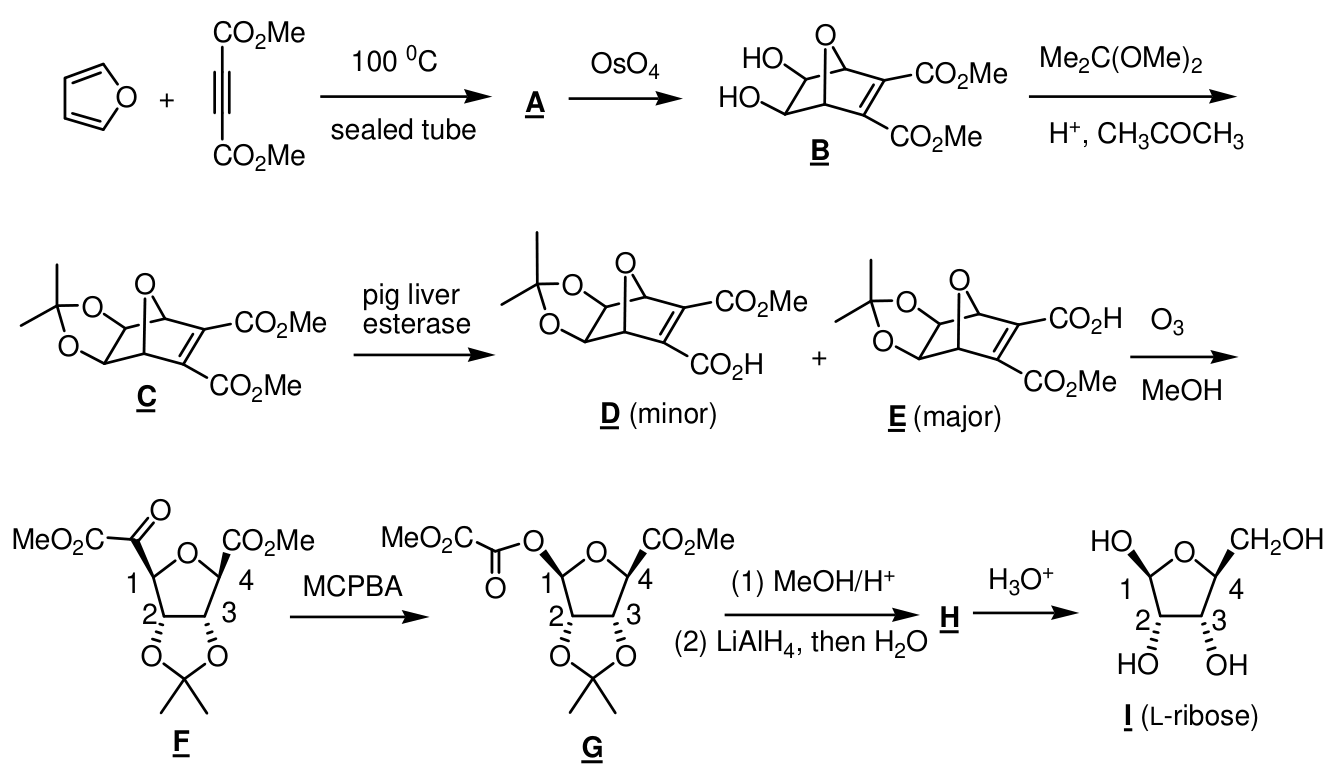
2.1 Compound A has the molecular formula of \(\ce{C10H10O5}\). Draw the structural formula of A.
2.2 Given the chemistry described for reaction sequence A to C, indicate whether the following statements are true or false (Use T to represent true and F to represent false).
___ (a) \(\ce{OsO4}\) is an oxidizing agent in the reaction of A to B.
___ (b) \(\ce{MeOH}\) is generated as a by-product in the reaction of B to C.
___ (c) Protons act as the catalyst in the transformation of B to C.
___ (d) C will still be formed albeit in lower yields in the absence of \(\ce{Me2C(OMe)2}\).
Pig liver esterase is an enzyme that can hydrolyze esters to carboxylic acids. Hydrolysis of C by the pig liver esterase afforded an enantiomeric mixture of D and E, in which E was the major component. The optical rotation of the mixture was \([\alpha]_{\mathrm D}^{20}=-37.1^\circ\). Further purification by recrystallization gave pure E with the optical rotation \([\alpha]_{\mathrm D}^{20}=-49.0^\circ\).
2.3 What is the molar ratio of D/E in the product mixture before the recrystallization? Show your work.
2.4 Reaction of F with meta-chloroperbenzoic acid (MCPBA) afforded G as the product. Indicate whether the following statements are true or false (Use T to represent true and F to represent false).
___ (a) The reaction was to oxidize compound F.
___ (b) The oxygen atom inserted originated from MCPBA.
___ (c) The \(R/S\) notation of C-1 remained unchanged before and after the reaction.
The molecular formula of H is \(\ce{C9H16O5}\). Proton NMR data of H are listed as follows:
\({}^{1}\mathrm H\) NMR (\(\ce{CDCl3}\)) \(\delta\) 1.24 (s, 3H), 1.40 (s, 3H), 3.24 (m, 1 H), 3.35 (s, 3H), 3.58 (m, 2H), 4.33 (m, 1H); 4.50 (d, \(J=6\ \mathrm{Hz}\), 1H), 4.74 (d, \(J=6\ \mathrm{Hz}\), 1H), 4.89 (s, 1H).
2.5 Draw the configurational formula of H.
2.6 Assign R/S notations for compound I at C-1, C-2, C-3 and C-4. Give your answers as follows:
C-1: _; C-2: ; C-3: _; C-4: .
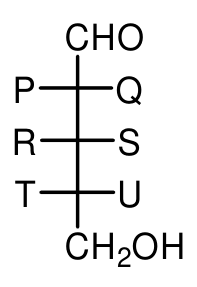
2.7 What are the identities of P, Q, R, S, T and U in the Fischer projection of compound I (L-ribose)?
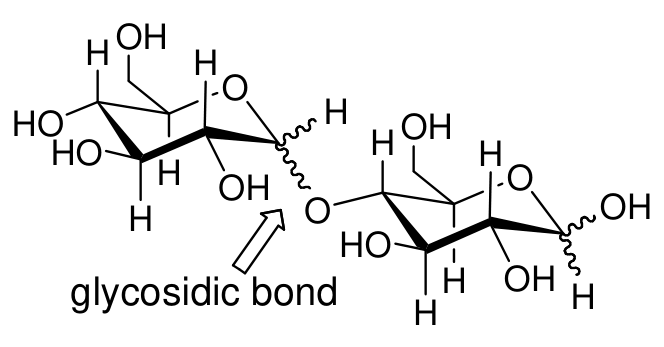
Disaccharides are compounds with two monosaccharide subunits linked together by a glycosidic bond. Polysaccharides contain as few as ten, or as many as thousands, monosaccharide subunits. An example of a disaccharides is as follows:
2.8 How many diastereoisomers would be obtained for pentasaccharide J, if it is derived from five units of D-glucose?
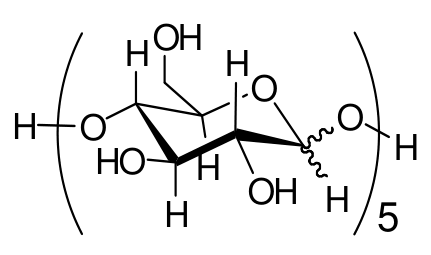
pentasaccharide J derived from D-glucose
Official English text of the problem.
Answers
-
2.1 A is dimethyl 7-oxabicyclo[2.2.1]hepta-2,5-diene-2,3-dicarboxylate:
COC(=O)C1=C(C(=O)OC)[C@H]2C=C[C@@H]1O2 -
2.2 (a) T; (b) T; (c) T; (d) T.
-
2.3 \(\boxed{D/E=0.138}\), or \(\boxed{D:E=1:7.24}\). The mixture contains approximately 12.1 mol% D and 87.9 mol% E.
-
2.4 (a) T; (b) T; (c) F. C-1 changes from \(S\) in F to \(R\) in G, despite retention of its spatial configuration.
-
2.5 H is methyl 2,3-O-isopropylidene-β-L-ribofuranoside:
CO[C@H]1O[C@@H](CO)[C@@H]2OC(C)(C)O[C@H]12
In the orientation used for G, draw the C-1 methoxy group and C-4 hydroxymethyl group on solid wedges; retain the dashed bonds from C-2 and C-3 to the acetonide oxygens. -
2.6 \(\boxed{\text{C-1: }S;\quad\text{C-2: }S;\quad\text{C-3: }R;\quad\text{C-4: }S}\).
The illustrated I is β-L-ribofuranose:
O[C@H]1O[C@@H](CO)[C@H](O)[C@@H]1O -
2.7 \(\boxed{P=R=T=\ce{OH};\quad Q=S=U=\ce{H}}\). All three hydroxyl groups are on the left of the Fischer projection.
-
2.8 \(\boxed{2^5=32}\) diastereoisomeric configurations.
Solution
2.1 — Identification of A
Furan, c1ccoc1, reacts with dimethyl acetylenedicarboxylate, COC(=O)C#CC(=O)OC, by a Diels–Alder cycloaddition. Furan supplies the four-electron diene, and the alkyne supplies the two-electron dienophile.
The atom-balanced reaction is
\[ \ce{C4H4O + C6H6O4 -> C10H10O5}. \]
No atoms are eliminated. One π bond remains between the two former alkyne carbons, and another remains between the two internal carbons of the furan diene. The original furan oxygen becomes the bridge of the bicyclic product.
To draw A, take the structure of B, remove its two hydroxyl groups, and restore a double bond between the carbons that carried them. The two methyl ester groups remain attached to the other double bond. This gives the bicyclic structure named and encoded in Answer 2.1.
2.2 — Oxidation and diol protection
(a) True. Osmium tetroxide, O=[Os](=O)(=O)=O, effects syn dihydroxylation of the unsubstituted double bond of A, producing the cis vicinal diol B. The organic substrate undergoes a two-electron oxidation.
A balanced oxidation half-equation is
\[ \ce{C10H10O5 + 2H2O -> C10H12O7 + 2H+ + 2e-}. \]
(b) True. The two hydroxyl groups of B react with 2,2-dimethoxypropane, COC(C)(C)OC, to form the cyclic isopropylidene ketal, or acetonide, of C. Both methoxy groups of the reagent can leave as methanol, CO.
The balanced net equation is
\[ \ce{C10H12O7 + C5H12O2 <=> C13H16O7 + 2CH3OH}. \]
Thus two molecules of methanol are formed per acetonide formed by this net reaction.
(c) True. Protonation facilitates cleavage of a methoxy group and subsequent substitution by the diol oxygens. Deprotonation regenerates the acid catalyst. Protons are therefore catalytic, rather than consumed stoichiometrically.
(d) True. Acetone, CC(=O)C, is also present and can itself react with the diol under acid catalysis:
\[ \ce{C10H12O7 + CH3COCH3 <=> C13H16O7 + H2O}. \]
This equilibrium produces water, O, which promotes the reverse reaction. The dimethoxy reagent helps drive acetonide formation; it can also consume water according to
\[ \ce{Me2C(OMe)2 + H2O <=> Me2CO + 2MeOH}. \]
Consequently, acetone and acid can still produce C without 2,2-dimethoxypropane, but less efficiently under the stated conditions.
2.3 — Enantiomeric composition
The esterase hydrolyzes one methyl ester group:
\[ \ce{C13H16O7 + H2O -> C12H14O7 + CH3OH}. \]
Because D and E are enantiomers, their specific rotations under identical conditions have equal magnitudes and opposite signs:
\[ [\alpha]_D=+49.0^\circ,\qquad [\alpha]_E=-49.0^\circ. \]
Let their mole fractions be \(x_D\) and \(x_E\). Their molar masses are identical, so the specific rotation is weighted by these same fractions:
\[ x_D+x_E=1, \]
\[ -37.1^\circ =x_D(49.0^\circ)+x_E(-49.0^\circ). \]
Therefore,
\[ x_E-x_D=\frac{37.1}{49.0}=0.75714. \]
The enantiomeric excess in favour of E is consequently \(75.7\%\), and
\[ x_D=\frac{1-0.75714}{2}=0.12143, \qquad x_E=\frac{1+0.75714}{2}=0.87857. \]
Hence
\[ \boxed{ \frac{n_D}{n_E} =\frac{49.0-37.1}{49.0+37.1} =\frac{11.9}{86.1} =0.138 } \]
or
\[ \boxed{D:E=1:7.24}. \]
2.4 — Baeyer–Villiger oxidation and C-1 configuration
The relevant structures are:
| Compound | Structural description | Stereochemical SMILES |
|---|---|---|
| F | Protected ribofuranosyl α-keto ester | COC(=O)C(=O)[C@H]1O[C@@H](C(=O)OC)[C@@H]2OC(C)(C)O[C@H]12 |
| G | Corresponding protected ribofuranosyl methyl oxalate | COC(=O)C(=O)O[C@H]1O[C@@H](C(=O)OC)[C@@H]2OC(C)(C)O[C@H]12 |
The reagent is 3-chloroperoxybenzoic acid, O=C(OO)c1cccc(Cl)c1. Its reduction product is 3-chlorobenzoic acid, O=C(O)c1cccc(Cl)c1.
Writing \(R\) for the protected sugar residue attached through C-1, the balanced transformation is
\[ \ce{ R-C(=O)-C(=O)-OMe + m-ClC6H4CO3H -> R-O-C(=O)-C(=O)-OMe + m-ClC6H4CO2H }. \]
(a) True. This is a Baeyer–Villiger oxidation: oxygen is inserted between C-1 of the sugar and the adjacent ketone carbonyl carbon.
(b) True. The inserted oxygen comes from the terminal peroxide oxygen of MCPBA. Mechanistically, peracid addition gives a Criegee intermediate; migration of the sugar group accompanies cleavage of the peroxide bond.
(c) False. Migration occurs with retention of spatial configuration at the migrating C-1, but its CIP priorities change.
| Compound | C-1 priorities, highest to lowest | Configuration |
|---|---|---|
| F | Ring oxygen \(>\) acyl carbon \(>\) C-2 \(>\) H | \(S\) |
| G | Exocyclic oxalate oxygen \(>\) ring oxygen \(>\) C-2 \(>\) H | \(R\) |
In F, the acyl carbon outranks C-2 because its next attached-atom list is \((\mathrm O,\mathrm O,\mathrm C)\), compared with \((\mathrm O,\mathrm C,\mathrm H)\) for C-2.
In G, both leading substituents begin with oxygen. The exocyclic oxygen leads to a carbonyl carbon and outranks the ring oxygen, which leads to saturated C-4.
Thus the two highest priorities exchange their spatial positions:
\[ \boxed{S\longrightarrow R} \]
without inversion of the stereocenter.
2.5 — Identification and configuration of H
The two operations convert the substituents of G as follows:
- Acidic methanol converts the anomeric oxalate ester into a methyl glycoside.
- Lithium aluminium hydride,
[Li+].[AlH4-], reduces the methyl ester attached to C-4 to a hydroxymethyl group. The acetonide remains intact.
A balanced net representation of the first functional-group change is
\[ \ce{R-OCOCO2Me + MeOH -> R-OMe + HOCOCO2Me}. \]
Here the oxalate-derived coproduct is methyl hydrogen oxalate, COC(=O)C(=O)O.
The ester reduction can be represented by
\[ \ce{R'-CO2Me + 4[H] -> R'-CH2OH + MeOH}, \]
where \(\ce{[H]}\) denotes a formal reducing hydrogen equivalent.
These transformations give methyl 2,3-O-isopropylidene-β-L-ribofuranoside, the structure in Answer 2.5. Its formula follows directly from its groups:
- Five carbons in the sugar skeleton.
- Three carbons in the acetonide.
- One carbon in the methoxy group.
- Five oxygens: one ring oxygen, two acetonide oxygens, one methoxy oxygen, and one alcohol oxygen.
Thus its molecular formula is \(\ce{C9H16O5}\), as required.
The proton NMR data support this assignment:
| \(\delta\) / ppm | Integral and multiplicity | Assignment |
|---|---|---|
| 1.24, 1.40 | Two singlets, 3H each | The two nonequivalent acetonide methyl groups |
| 3.24 | Multiplet, 1H | Alcohol \(\ce{OH}\) proton |
| 3.35 | Singlet, 3H | Anomeric methoxy group |
| 3.58 | Multiplet, 2H | \(\ce{CH2OH}\) |
| 4.33 | Multiplet, 1H | H-4 |
| 4.50, 4.74 | Two doublets, \(J=6\ \mathrm{Hz}\), 1H each | Mutually coupled H-2 and H-3 |
| 4.89 | Singlet, 1H | Anomeric H-1 |
The integrations total \(16\) hydrogens. The anomeric singlet is consistent with the very small H-1/H-2 coupling of the β anomer in this acetonide-constrained furanose. The absolute stereochemistry is supplied by the synthetic sequence.
For the requested drawing, retain the five-membered sugar ring and the 2,3-acetonide of G. Replace the C-1 oxalate substituent by a solid-wedge methoxy group, and replace the C-4 methyl ester by a solid-wedge hydroxymethyl group. The two bonds from C-2 and C-3 to the acetonide oxygens remain dashed.
The subsequent acid hydrolysis removes both protecting groups:
\[ \ce{C9H16O5 + 2H2O -> C5H10O5 + CH3OH + CH3COCH3}. \]
2.6 — Absolute configurations of I
Apply the CIP rules to the cyclic structure actually drawn.
| Center | Priorities, highest to lowest | Result |
|---|---|---|
| C-1 | Ring oxygen \(>\) hydroxyl oxygen \(>\) C-2 \(>\) H | \(S\) |
| C-2 | Hydroxyl oxygen \(>\) C-1 \(>\) C-3 \(>\) H | \(S\) |
| C-3 | Hydroxyl oxygen \(>\) C-4 \(>\) C-2 \(>\) H | \(R\) |
| C-4 | Ring oxygen \(>\) C-3 \(>\) hydroxymethyl carbon \(>\) H | \(S\) |
The distinction at C-3 deserves attention. Both adjacent carbons initially present the list \((\mathrm O,\mathrm C,\mathrm H)\). Following their oxygen branches breaks the tie:
- The oxygen reached through C-4 is bonded onward to carbon.
- The hydroxyl oxygen reached through C-2 is bonded to hydrogen.
Therefore C-4 outranks C-2.
The answer for the illustrated β-L-ribofuranose is
\[ \boxed{(1S,2S,3R,4S)}. \]
Free L-ribose can equilibrate between forms in solution; these assignments refer specifically to I as drawn.
2.7 — Fischer projection of L-ribose
Open-chain L-ribose, systematically (2S,3S,4S)-2,3,4,5-tetrahydroxypentanal, has SMILES
O=C[C@@H](O)[C@@H](O)[C@@H](O)CO.
With the aldehyde group at the top and the hydroxymethyl group at the bottom, all three hydroxyl groups lie on the left, and all three hydrogens lie on the right. Consequently,
\[ \boxed{P=R=T=\ce{OH}}, \qquad \boxed{Q=S=U=\ce{H}}. \]
Here a hydroxyl substituent can be represented as [*]O, with * denoting its attachment to the carbon skeleton; hydrogen is [H].
The open-chain C-3 descriptor is \(S\), whereas cyclic I has C-3 \(R\). Ring closure changes the CIP ordering of the two carbon paths; it does not require inversion at that carbon.
2.8 — Number of pentasaccharide diastereoisomers
The D-glucose units fix the configurations of their nonanomeric stereocenters. Each of the five anomeric carbons can independently have either configuration:
- Four occur at glycosidic linkages.
- The fifth is the free anomeric center at the reducing end.
The linkage pattern is fixed by the drawing. The chain ends are different, so reversing the sequence does not identify otherwise distinct configurations.
Therefore,
\[ N=2^4\times2=\boxed{32}. \]
They are diastereoisomers because changing these anomeric configurations leaves the other D-glucose stereocenters unchanged.
The solution was checked against the official solution.
IChO 2005 · Theorieaufgabe 2
Organische Synthese und Stereochemie
Natürliche Kohlenhydrate werden im Allgemeinen durch Photosynthese in Pflanzen gebildet. Nicht natürlich vorkommende Kohlenhydrate lassen sich jedoch durch organische Synthese herstellen. Das folgende Schema zeigt einen Syntheseweg für die nicht natürlich vorkommende L-Ribose (Verbindung I).
2.1 Verbindung A hat die Summenformel \(\ce{C10H10O5}\). Zeichnen Sie die Strukturformel von A.
2.2 Geben Sie anhand der für die Reaktionsfolge A bis C beschriebenen chemischen Vorgänge an, ob die folgenden Aussagen richtig oder falsch sind (verwenden Sie T für richtig und F für falsch).
___ (a) \(\ce{OsO4}\) ist bei der Reaktion von A zu B ein Oxidationsmittel.
___ (b) Bei der Reaktion von B zu C entsteht \(\ce{MeOH}\) als Nebenprodukt.
___ (c) Protonen wirken bei der Umwandlung von B zu C als Katalysator.
___ (d) C wird auch in Abwesenheit von \(\ce{Me2C(OMe)2}\) gebildet, allerdings in geringerer Ausbeute.
Schweineleberesterase ist ein Enzym, das Ester zu Carbonsäuren hydrolysieren kann. Die Hydrolyse von C durch Schweineleberesterase ergab ein Enantiomerengemisch aus D und E, in dem E die Hauptkomponente war. Der spezifische Drehwinkel des Gemisches betrug \([\alpha]_{\mathrm D}^{20}=-37.1^\circ\). Weitere Reinigung durch Umkristallisation lieferte reines E mit dem spezifischen Drehwinkel \([\alpha]_{\mathrm D}^{20}=-49.0^\circ\).
2.3 Wie groß ist das Stoffmengenverhältnis D/E im Produktgemisch vor der Umkristallisation? Zeigen Sie Ihren Rechenweg.
2.4 Die Reaktion von F mit meta-Chlorperbenzoesäure (MCPBA) lieferte G als Produkt. Geben Sie an, ob die folgenden Aussagen richtig oder falsch sind (verwenden Sie T für richtig und F für falsch).
___ (a) Bei der Reaktion wurde Verbindung F oxidiert.
___ (b) Das eingefügte Sauerstoffatom stammte aus MCPBA.
___ (c) Der \(R/S\)-Deskriptor von C-1 blieb vor und nach der Reaktion unverändert.
Die Summenformel von H lautet \(\ce{C9H16O5}\). Die Protonen-NMR-Daten von H sind im Folgenden aufgeführt:
\({}^{1}\mathrm H\)-NMR (\(\ce{CDCl3}\)) \(\delta\) 1.24 (s, 3H), 1.40 (s, 3H), 3.24 (m, 1 H), 3.35 (s, 3H), 3.58 (m, 2H), 4.33 (m, 1H); 4.50 (d, \(J=6\ \mathrm{Hz}\), 1H), 4.74 (d, \(J=6\ \mathrm{Hz}\), 1H), 4.89 (s, 1H).
2.5 Zeichnen Sie die Konfigurationsformel von H.
2.6 Ordnen Sie für Verbindung I an C-1, C-2, C-3 und C-4 die R/S-Deskriptoren zu. Geben Sie Ihre Antworten wie folgt an:
C-1: _; C-2: ; C-3: _; C-4: .
2.7 Wofür stehen P, Q, R, S, T und U in der Fischer-Projektion von Verbindung I (L-Ribose)?
Disaccharide sind Verbindungen aus zwei Monosaccharideinheiten, die durch eine glycosidische Bindung miteinander verknüpft sind. Polysaccharide enthalten mindestens zehn bis hin zu Tausenden von Monosaccharideinheiten. Ein Beispiel für ein Disaccharid ist im Folgenden dargestellt:
2.8 Wie viele Diastereoisomere ergeben sich für Pentasaccharid J, wenn es aus fünf Einheiten D-Glucose aufgebaut ist?
aus D-Glucose aufgebautes Pentasaccharid J
Aufgabentext aus dem offiziellen englischen Text übersetzt.
Antworten
-
2.1 A ist Dimethyl-7-oxabicyclo[2.2.1]hepta-2,5-dien-2,3-dicarboxylat:
COC(=O)C1=C(C(=O)OC)[C@H]2C=C[C@@H]1O2 -
2.2 (a) T; (b) T; (c) T; (d) T.
-
2.3 \(\boxed{D/E=0.138}\) oder \(\boxed{D:E=1:7.24}\). Das Gemisch enthält ungefähr 12.1 mol% D und 87.9 mol% E.
-
2.4 (a) T; (b) T; (c) F. C-1 wechselt von \(S\) in F zu \(R\) in G, obwohl seine räumliche Konfiguration erhalten bleibt.
-
2.5 H ist Methyl-2,3-O-isopropyliden-β-L-ribofuranosid:
CO[C@H]1O[C@@H](CO)[C@@H]2OC(C)(C)O[C@H]12
Zeichnen Sie in der für G verwendeten Orientierung die Methoxygruppe an C-1 und die Hydroxymethylgruppe an C-4 mit ausgefüllten Keilbindungen; behalten Sie die gestrichelten Bindungen von C-2 und C-3 zu den Acetonid-Sauerstoffatomen bei. -
2.6 \(\boxed{\text{C-1: }S;\quad\text{C-2: }S;\quad\text{C-3: }R;\quad\text{C-4: }S}\).
Das dargestellte I ist β-L-Ribofuranose:
O[C@H]1O[C@@H](CO)[C@H](O)[C@@H]1O -
2.7 \(\boxed{P=R=T=\ce{OH};\quad Q=S=U=\ce{H}}\). Alle drei Hydroxygruppen stehen in der Fischer-Projektion links.
-
2.8 \(\boxed{2^5=32}\) diastereoisomere Konfigurationen.
Lösung
2.1 — Identifizierung von A
Furan, c1ccoc1, reagiert mit Acetylendicarbonsäuredimethylester, COC(=O)C#CC(=O)OC, in einer Diels–Alder-Cycloaddition. Furan liefert das Dien mit vier Elektronen, und das Alkin liefert das Dienophil mit zwei Elektronen.
Die hinsichtlich der Atome ausgeglichene Reaktionsgleichung lautet
\[ \ce{C4H4O + C6H6O4 -> C10H10O5}. \]
Es werden keine Atome abgespalten. Eine π-Bindung bleibt zwischen den beiden ehemaligen Alkin-Kohlenstoffatomen bestehen, eine weitere zwischen den beiden inneren Kohlenstoffatomen des Furan-Diens. Das ursprüngliche Sauerstoffatom des Furans bildet die Brücke des bicyclischen Produkts.
Um A zu zeichnen, gehen Sie von der Struktur von B aus, entfernen Sie dessen beide Hydroxygruppen und stellen Sie zwischen den Kohlenstoffatomen, an denen diese gebunden waren, wieder eine Doppelbindung her. Die beiden Methylestergruppen bleiben an der anderen Doppelbindung gebunden. So ergibt sich die in Antwort 2.1 benannte und codierte bicyclische Struktur.
2.2 — Oxidation und Diolschutz
(a) Richtig. Osmiumtetroxid, O=[Os](=O)(=O)=O, bewirkt eine syn-Dihydroxylierung der unsubstituierten Doppelbindung von A, wobei das cis-vicinale Diol B entsteht. Das organische Substrat erfährt eine Zweielektronenoxidation.
Eine ausgeglichene Oxidationshalbreaktion lautet
\[ \ce{C10H10O5 + 2H2O -> C10H12O7 + 2H+ + 2e-}. \]
(b) Richtig. Die beiden Hydroxygruppen von B reagieren mit 2,2-Dimethoxypropan, COC(C)(C)OC, unter Bildung des cyclischen Isopropylidenketals, auch Acetonid genannt, von C. Beide Methoxygruppen des Reagenzes können als Methanol, CO, abgespalten werden.
Die ausgeglichene Nettogleichung lautet
\[ \ce{C10H12O7 + C5H12O2 <=> C13H16O7 + 2CH3OH}. \]
Somit entstehen bei dieser Nettoreaktion pro gebildetem Acetonid zwei Moleküle Methanol.
(c) Richtig. Die Protonierung erleichtert die Abspaltung einer Methoxygruppe und die anschließende Substitution durch die Sauerstoffatome des Diols. Durch Deprotonierung wird der Säurekatalysator regeneriert. Protonen wirken daher katalytisch und werden nicht stöchiometrisch verbraucht.
(d) Richtig. Aceton, CC(=O)C, ist ebenfalls vorhanden und kann selbst unter Säurekatalyse mit dem Diol reagieren:
\[ \ce{C10H12O7 + CH3COCH3 <=> C13H16O7 + H2O}. \]
Bei diesem Gleichgewicht entsteht Wasser, O, das die Rückreaktion begünstigt. Das Dimethoxyreagenz fördert die Acetonidbildung; es kann außerdem gemäß folgender Gleichung Wasser verbrauchen:
\[ \ce{Me2C(OMe)2 + H2O <=> Me2CO + 2MeOH}. \]
Folglich können Aceton und Säure auch ohne 2,2-Dimethoxypropan C bilden, unter den angegebenen Bedingungen jedoch weniger effizient.
2.3 — Enantiomerenzusammensetzung
Die Esterase hydrolysiert eine Methylestergruppe:
\[ \ce{C13H16O7 + H2O -> C12H14O7 + CH3OH}. \]
Da D und E Enantiomere sind, haben ihre spezifischen Drehwinkel unter identischen Bedingungen den gleichen Betrag und entgegengesetzte Vorzeichen:
\[ [\alpha]_D=+49.0^\circ,\qquad [\alpha]_E=-49.0^\circ. \]
Ihre Stoffmengenanteile seien \(x_D\) und \(x_E\). Ihre molaren Massen sind identisch, daher wird der spezifische Drehwinkel mit genau diesen Anteilen gewichtet:
\[ x_D+x_E=1, \]
\[ -37.1^\circ =x_D(49.0^\circ)+x_E(-49.0^\circ). \]
Daraus folgt
\[ x_E-x_D=\frac{37.1}{49.0}=0.75714. \]
Der Enantiomerenüberschuss zugunsten von E beträgt somit \(75.7\%\), und
\[ x_D=\frac{1-0.75714}{2}=0.12143, \qquad x_E=\frac{1+0.75714}{2}=0.87857. \]
Damit ergibt sich
\[ \boxed{ \frac{n_D}{n_E} =\frac{49.0-37.1}{49.0+37.1} =\frac{11.9}{86.1} =0.138 } \]
oder
\[ \boxed{D:E=1:7.24}. \]
2.4 — Baeyer–Villiger-Oxidation und Konfiguration an C-1
Die relevanten Strukturen sind:
| Verbindung | Strukturbeschreibung | Stereochemischer SMILES-Code |
|---|---|---|
| F | Geschützter Ribofuranosyl-α-ketoester | COC(=O)C(=O)[C@H]1O[C@@H](C(=O)OC)[C@@H]2OC(C)(C)O[C@H]12 |
| G | Entsprechendes geschütztes Ribofuranosylmethyloxalat | COC(=O)C(=O)O[C@H]1O[C@@H](C(=O)OC)[C@@H]2OC(C)(C)O[C@H]12 |
Das Reagenz ist 3-Chlorperoxybenzoesäure, O=C(OO)c1cccc(Cl)c1. Ihr Reduktionsprodukt ist 3-Chlorbenzoesäure, O=C(O)c1cccc(Cl)c1.
Bezeichnet \(R\) den über C-1 gebundenen geschützten Zuckerrest, so lautet die ausgeglichene Reaktionsgleichung
\[ \ce{ R-C(=O)-C(=O)-OMe + m-ClC6H4CO3H -> R-O-C(=O)-C(=O)-OMe + m-ClC6H4CO2H }. \]
(a) Richtig. Es handelt sich um eine Baeyer–Villiger-Oxidation: Zwischen C-1 des Zuckers und dem benachbarten Carbonylkohlenstoffatom der Ketogruppe wird Sauerstoff eingefügt.
(b) Richtig. Der eingefügte Sauerstoff stammt vom endständigen Peroxidsauerstoffatom der MCPBA. Mechanistisch entsteht durch Addition der Persäure eine Criegee-Zwischenstufe; die Wanderung der Zuckergruppe geht mit der Spaltung der Peroxidbindung einher.
(c) Falsch. Die Wanderung erfolgt unter Erhalt der räumlichen Konfiguration am wandernden C-1, seine CIP-Prioritäten ändern sich jedoch.
| Verbindung | Prioritäten an C-1, von der höchsten zur niedrigsten | Konfiguration |
|---|---|---|
| F | Ringsauerstoff \(>\) Acylkohlenstoff \(>\) C-2 \(>\) H | \(S\) |
| G | Exocyclischer Oxalatsauerstoff \(>\) Ringsauerstoff \(>\) C-2 \(>\) H | \(R\) |
In F hat der Acylkohlenstoff eine höhere Priorität als C-2, weil seine Liste der auf der nächsten Ebene gebundenen Atome \((\mathrm O,\mathrm O,\mathrm C)\) lautet, verglichen mit \((\mathrm O,\mathrm C,\mathrm H)\) für C-2.
In G beginnen die beiden Substituenten mit den höchsten Prioritäten jeweils mit Sauerstoff. Der exocyclische Sauerstoff führt zu einem Carbonylkohlenstoffatom und hat eine höhere Priorität als der Ringsauerstoff, der zum gesättigten C-4 führt.
Somit tauschen die beiden höchsten Prioritäten ihre räumlichen Positionen:
\[ \boxed{S\longrightarrow R} \]
ohne Inversion des Stereozentrums.
2.5 — Identifizierung und Konfiguration von H
Die beiden Reaktionsschritte wandeln die Substituenten von G wie folgt um:
- Saures Methanol wandelt den anomeren Oxalatester in ein Methylglycosid um.
- Lithiumaluminiumhydrid,
[Li+].[AlH4-], reduziert den an C-4 gebundenen Methylester zu einer Hydroxymethylgruppe. Das Acetonid bleibt intakt.
Eine ausgeglichene Nettodarstellung der ersten Umwandlung einer funktionellen Gruppe lautet
\[ \ce{R-OCOCO2Me + MeOH -> R-OMe + HOCOCO2Me}. \]
Das vom Oxalat abgeleitete Nebenprodukt ist hier Methylhydrogenoxalat, COC(=O)C(=O)O.
Die Esterreduktion lässt sich darstellen durch
\[ \ce{R'-CO2Me + 4[H] -> R'-CH2OH + MeOH}, \]
wobei \(\ce{[H]}\) ein formales reduzierendes Wasserstoffäquivalent bezeichnet.
Diese Umwandlungen ergeben Methyl-2,3-O-isopropyliden-β-L-ribofuranosid, die Struktur aus Antwort 2.5. Seine Summenformel ergibt sich unmittelbar aus seinen Gruppen:
- Fünf Kohlenstoffatome im Zuckergerüst.
- Drei Kohlenstoffatome im Acetonid.
- Ein Kohlenstoffatom in der Methoxygruppe.
- Fünf Sauerstoffatome: ein Ringsauerstoffatom, zwei Acetonid-Sauerstoffatome, ein Methoxy-Sauerstoffatom und ein Alkohol-Sauerstoffatom.
Somit lautet seine Summenformel wie gefordert \(\ce{C9H16O5}\).
Die Protonen-NMR-Daten stützen diese Zuordnung:
| \(\delta\) / ppm | Integral und Multiplizität | Zuordnung |
|---|---|---|
| 1.24, 1.40 | Zwei Singuletts, jeweils 3H | Die beiden nicht äquivalenten Acetonid-Methylgruppen |
| 3.24 | Multiplett, 1H | Alkoholisches \(\ce{OH}\)-Proton |
| 3.35 | Singulett, 3H | Anomere Methoxygruppe |
| 3.58 | Multiplett, 2H | \(\ce{CH2OH}\) |
| 4.33 | Multiplett, 1H | H-4 |
| 4.50, 4.74 | Zwei Dubletts, \(J=6\ \mathrm{Hz}\), jeweils 1H | Miteinander gekoppeltes H-2 und H-3 |
| 4.89 | Singulett, 1H | Anomeres H-1 |
Die Integrale ergeben insgesamt \(16\) Wasserstoffatome. Das anomere Singulett stimmt mit der sehr kleinen H-1/H-2-Kopplung des β-Anomers in dieser durch das Acetonid konformativ eingeschränkten Furanose überein. Die absolute Stereochemie ergibt sich aus der Synthesefolge.
Behalten Sie für die geforderte Zeichnung den fünfgliedrigen Zuckerring und das 2,3-Acetonid von G bei. Ersetzen Sie den Oxalatsubstituenten an C-1 durch eine Methoxygruppe mit ausgefüllter Keilbindung und den Methylester an C-4 durch eine Hydroxymethylgruppe mit ausgefüllter Keilbindung. Die beiden Bindungen von C-2 und C-3 zu den Acetonid-Sauerstoffatomen bleiben gestrichelt.
Die anschließende saure Hydrolyse entfernt beide Schutzgruppen:
\[ \ce{C9H16O5 + 2H2O -> C5H10O5 + CH3OH + CH3COCH3}. \]
2.6 — Absolute Konfigurationen von I
Wenden Sie die CIP-Regeln auf die tatsächlich gezeichnete cyclische Struktur an.
| Zentrum | Prioritäten, von der höchsten zur niedrigsten | Ergebnis |
|---|---|---|
| C-1 | Ringsauerstoff \(>\) Hydroxysauerstoff \(>\) C-2 \(>\) H | \(S\) |
| C-2 | Hydroxysauerstoff \(>\) C-1 \(>\) C-3 \(>\) H | \(S\) |
| C-3 | Hydroxysauerstoff \(>\) C-4 \(>\) C-2 \(>\) H | \(R\) |
| C-4 | Ringsauerstoff \(>\) C-3 \(>\) Hydroxymethylkohlenstoff \(>\) H | \(S\) |
Die Unterscheidung an C-3 verdient Beachtung. Beide benachbarten Kohlenstoffatome weisen zunächst die Liste \((\mathrm O,\mathrm C,\mathrm H)\) auf. Verfolgt man ihre Sauerstoffzweige weiter, lässt sich der Gleichstand auflösen:
- Der über C-4 erreichte Sauerstoff ist im weiteren Verlauf an Kohlenstoff gebunden.
- Der über C-2 erreichte Hydroxysauerstoff ist an Wasserstoff gebunden.
Daher hat C-4 eine höhere Priorität als C-2.
Die Antwort für die dargestellte β-L-Ribofuranose lautet
\[ \boxed{(1S,2S,3R,4S)}. \]
Freie L-Ribose kann in Lösung ein Gleichgewicht zwischen verschiedenen Formen einstellen; diese Zuordnungen beziehen sich ausdrücklich auf I in der gezeichneten Form.
2.7 — Fischer-Projektion von L-Ribose
Offenkettige L-Ribose, systematisch (2S,3S,4S)-2,3,4,5-Tetrahydroxypentanal, hat den SMILES-Code
O=C[C@@H](O)[C@@H](O)[C@@H](O)CO.
Wenn die Aldehydgruppe oben und die Hydroxymethylgruppe unten steht, stehen alle drei Hydroxygruppen links und alle drei Wasserstoffatome rechts. Folglich gilt
\[ \boxed{P=R=T=\ce{OH}}, \qquad \boxed{Q=S=U=\ce{H}}. \]
Hier kann ein Hydroxysubstituent als [*]O dargestellt werden, wobei * seine Verknüpfung mit dem Kohlenstoffgerüst bezeichnet; Wasserstoff wird als [H] dargestellt.
Der Deskriptor an C-3 in der offenkettigen Form lautet \(S\), während das cyclische I an C-3 \(R\) aufweist. Der Ringschluss verändert die CIP-Rangfolge der beiden Kohlenstoffpfade; er erfordert keine Inversion an diesem Kohlenstoffatom.
2.8 — Anzahl der Diastereoisomere des Pentasaccharids
Die D-Glucoseeinheiten legen die Konfigurationen ihrer nichtanomeren Stereozentren fest. Jedes der fünf anomeren Kohlenstoffatome kann unabhängig eine von zwei Konfigurationen aufweisen:
- Vier befinden sich an glycosidischen Verknüpfungen.
- Das fünfte ist das freie anomere Zentrum am reduzierenden Ende.
Das Verknüpfungsmuster ist durch die Zeichnung festgelegt. Die Kettenenden sind verschieden, daher führt eine Umkehrung der Reihenfolge nicht dazu, dass ansonsten unterschiedliche Konfigurationen identisch werden.
Daher gilt
\[ N=2^4\times2=\boxed{32}. \]
Es handelt sich um Diastereoisomere, weil eine Änderung dieser anomeren Konfigurationen die übrigen Stereozentren der D-Glucose unverändert lässt.
Die Lösung wurde mit der offiziellen Lösung abgeglichen.
IChO 2005 · Teori sorusu 2
Organik Sentez ve Stereokimya
Doğal karbonhidratlar genellikle bitkilerde fotosentez yoluyla üretilir. Ancak doğal olmayan karbonhidratlar organik sentez yoluyla hazırlanabilir. Aşağıdaki şema, doğal olmayan L-ribozun (I bileşiği) sentez şemasıdır.
2.1 A bileşiğinin molekül formülü \(\ce{C10H10O5}\)'tir. A'nın yapı formülünü çiziniz.
2.2 A'dan C'ye giden tepkime dizisi için açıklanan kimyasal dönüşümleri dikkate alarak aşağıdaki ifadelerin doğru mu yanlış mı olduğunu belirtiniz (Doğru için T, yanlış için F kullanınız).
___ (a) \(\ce{OsO4}\), A'dan B'ye giden tepkimede bir yükseltgendir.
___ (b) B'den C'ye giden tepkimede yan ürün olarak \(\ce{MeOH}\) oluşur.
___ (c) B'nin C'ye dönüşümünde protonlar katalizör görevi görür.
___ (d) \(\ce{Me2C(OMe)2}\) bulunmadığında da daha düşük verimle olsa bile C oluşur.
Domuz karaciğeri esterazı, esterleri karboksilik asitlere hidroliz edebilen bir enzimdir. C'nin domuz karaciğeri esterazı ile hidrolizi, E'nin ana bileşen olduğu bir D ve E enantiyomer karışımı vermiştir. Karışımın optik çevirmesi \([\alpha]_{\mathrm D}^{20}=-37.1^\circ\) olarak bulunmuştur. Yeniden kristallendirmeyle daha ileri saflaştırma sonucunda, optik çevirmesi \([\alpha]_{\mathrm D}^{20}=-49.0^\circ\) olan saf E elde edilmiştir.
2.3 Yeniden kristallendirmeden önce ürün karışımındaki D/E mol oranı nedir? Hesaplamanızı gösteriniz.
2.4 F'nin meta-kloroperbenzoik asitle (MCPBA) tepkimesi ürün olarak G'yi vermiştir. Aşağıdaki ifadelerin doğru mu yanlış mı olduğunu belirtiniz (Doğru için T, yanlış için F kullanınız).
___ (a) Tepkimede F bileşiği yükseltgenmiştir.
___ (b) Araya giren oksijen atomu MCPBA'dan gelmiştir.
___ (c) C-1'in \(R/S\) gösterimi tepkime öncesinde ve sonrasında değişmeden kalmıştır.
H'nin molekül formülü \(\ce{C9H16O5}\)'tir. H'nin proton NMR verileri aşağıda verilmiştir:
\({}^{1}\mathrm H\) NMR (\(\ce{CDCl3}\)) \(\delta\) 1.24 (s, 3H), 1.40 (s, 3H), 3.24 (m, 1 H), 3.35 (s, 3H), 3.58 (m, 2H), 4.33 (m, 1H); 4.50 (d, \(J=6\ \mathrm{Hz}\), 1H), 4.74 (d, \(J=6\ \mathrm{Hz}\), 1H), 4.89 (s, 1H).
2.5 H'nin konfigürasyon formülünü çiziniz.
2.6 I bileşiğinin C-1, C-2, C-3 ve C-4 atomları için R/S gösterimlerini belirleyiniz. Cevaplarınızı aşağıdaki biçimde veriniz:
C-1: _; C-2: ; C-3: _; C-4: .
2.7 I bileşiğinin (L-riboz) Fischer izdüşümündeki P, Q, R, S, T ve U grupları nelerdir?
Disakkaritler, bir glikozidik bağla birbirine bağlanmış iki monosakkarit alt birimi içeren bileşiklerdir. Polisakkaritler, sayıları on kadar az ya da binlerce kadar çok olabilen monosakkarit alt birimleri içerir. Bir disakkarit örneği aşağıda verilmiştir:
2.8 Beş D-glikoz biriminden türetilen pentasakkarit J için kaç diastereoizomer elde edilir?
D-glikozdan türetilen pentasakkarit J
Soru metni resmi İngilizce metinden çevrilmiştir.
Cevaplar
-
2.1 A, dimetil 7-oksabisiklo[2.2.1]hepta-2,5-dien-2,3-dikarboksilattır:
COC(=O)C1=C(C(=O)OC)[C@H]2C=C[C@@H]1O2 -
2.2 (a) T; (b) T; (c) T; (d) T.
-
2.3 \(\boxed{D/E=0.138}\) veya \(\boxed{D:E=1:7.24}\). Karışım yaklaşık molce %12.1 D ve molce %87.9 E içerir.
-
2.4 (a) T; (b) T; (c) F. Uzaysal konfigürasyonu korunmasına rağmen C-1, F'de \(S\) iken G'de \(R\) olur.
-
2.5 H, metil 2,3-O-izopropiliden-β-L-ribofuranozittir:
CO[C@H]1O[C@@H](CO)[C@@H]2OC(C)(C)O[C@H]12
G için kullanılan yönelimde, C-1 metoksi grubunu ve C-4 hidroksimetil grubunu dolu kama bağlarıyla çiziniz; C-2 ve C-3'ten asetonit oksijenlerine uzanan kesikli bağları koruyunuz. -
2.6 \(\boxed{\text{C-1: }S;\quad\text{C-2: }S;\quad\text{C-3: }R;\quad\text{C-4: }S}\).
Şekilde gösterilen I, β-L-ribofuranozdur:
O[C@H]1O[C@@H](CO)[C@H](O)[C@@H]1O -
2.7 \(\boxed{P=R=T=\ce{OH};\quad Q=S=U=\ce{H}}\). Üç hidroksil grubunun tamamı Fischer izdüşümünün solundadır.
-
2.8 \(\boxed{2^5=32}\) diastereoizomerik konfigürasyon.
Çözüm
2.1 — A'nın belirlenmesi
Furan, c1ccoc1, dimetil asetilendikarboksilat, COC(=O)C#CC(=O)OC, ile bir Diels–Alder siklokatılma tepkimesi verir. Furan dört elektronlu dieni, alkin ise iki elektronlu dienofili sağlar.
Atom sayıları bakımından denkleştirilmiş tepkime şöyledir:
\[ \ce{C4H4O + C6H6O4 -> C10H10O5}. \]
Hiçbir atom ayrılmaz. Başlangıçtaki iki alkin karbonu arasında bir π bağı, furan dieninin iki iç karbonu arasında da başka bir π bağı kalır. Başlangıçtaki furan oksijeni, bisiklik ürünün köprüsünü oluşturur.
A'yı çizmek için B'nin yapısını alınız, iki hidroksil grubunu çıkarınız ve bu grupları taşıyan karbonlar arasında yeniden bir çift bağ oluşturunuz. İki metil ester grubu diğer çift bağa bağlı kalır. Böylece Cevap 2.1'de adı ve kodu verilen bisiklik yapı elde edilir.
2.2 — Yükseltgenme ve diolün korunması
(a) Doğru. Osmiyum tetroksit, O=[Os](=O)(=O)=O, A'nın sübstitüe olmamış çift bağında syn dihidroksilleme gerçekleştirerek cis visinal diol B'yi oluşturur. Organik substrat iki elektronlu bir yükseltgenmeye uğrar.
Denkleştirilmiş bir yükseltgenme yarı tepkimesi şöyledir:
\[ \ce{C10H10O5 + 2H2O -> C10H12O7 + 2H+ + 2e-}. \]
(b) Doğru. B'nin iki hidroksil grubu, 2,2-dimetoksipropan, COC(C)(C)OC, ile tepkimeye girerek C'nin halkalı izopropiliden ketalini, yani asetonitini oluşturur. Reaktifin her iki metoksi grubu da metanol, CO, olarak ayrılabilir.
Denkleştirilmiş net denklem şöyledir:
\[ \ce{C10H12O7 + C5H12O2 <=> C13H16O7 + 2CH3OH}. \]
Dolayısıyla bu net tepkimeyle oluşan her asetonit başına iki metanol molekülü oluşur.
(c) Doğru. Protonlanma, bir metoksi grubunun ayrılmasını ve ardından diol oksijenlerinin onun yerini almasını kolaylaştırır. Proton kaybı asit katalizörünü yeniden oluşturur. Dolayısıyla protonlar stokiyometrik olarak tüketilmez, katalitik görev görür.
(d) Doğru. Ortamda aseton, CC(=O)C, da bulunur ve asetonun kendisi asit katalizi altında diolle tepkimeye girebilir:
\[ \ce{C10H12O7 + CH3COCH3 <=> C13H16O7 + H2O}. \]
Bu dengede oluşan su, O, ters tepkimeyi destekler. Dimetoksi reaktifi asetonit oluşumunu destekler; ayrıca aşağıdaki tepkimeye göre suyu da tüketebilir:
\[ \ce{Me2C(OMe)2 + H2O <=> Me2CO + 2MeOH}. \]
Sonuç olarak aseton ve asit, 2,2-dimetoksipropan olmadan da C'yi oluşturabilir; ancak belirtilen koşullarda bu daha düşük verimle gerçekleşir.
2.3 — Enantiyomerik bileşim
Esteraz, bir metil ester grubunu hidroliz eder:
\[ \ce{C13H16O7 + H2O -> C12H14O7 + CH3OH}. \]
D ve E enantiyomer olduklarından, aynı koşullar altında özgül çevirmeleri eşit büyüklükte ve zıt işaretlidir:
\[ [\alpha]_D=+49.0^\circ,\qquad [\alpha]_E=-49.0^\circ. \]
Mol kesirleri \(x_D\) ve \(x_E\) olsun. Mol kütleleri aynı olduğundan özgül çevirme, bu aynı kesirlerle ağırlıklandırılır:
\[ x_D+x_E=1, \]
\[ -37.1^\circ =x_D(49.0^\circ)+x_E(-49.0^\circ). \]
Dolayısıyla,
\[ x_E-x_D=\frac{37.1}{49.0}=0.75714. \]
Buna göre E lehine enantiyomerik fazlalık \(75.7\%\)'dir ve
\[ x_D=\frac{1-0.75714}{2}=0.12143, \qquad x_E=\frac{1+0.75714}{2}=0.87857. \]
Buradan
\[ \boxed{ \frac{n_D}{n_E} =\frac{49.0-37.1}{49.0+37.1} =\frac{11.9}{86.1} =0.138 } \]
veya
\[ \boxed{D:E=1:7.24}. \]
2.4 — Baeyer–Villiger yükseltgenmesi ve C-1 konfigürasyonu
İlgili yapılar şunlardır:
| Bileşik | Yapısal tanım | Stereokimyasal SMILES |
|---|---|---|
| F | Korunmuş ribofuranozil α-keto ester | COC(=O)C(=O)[C@H]1O[C@@H](C(=O)OC)[C@@H]2OC(C)(C)O[C@H]12 |
| G | Karşılık gelen korunmuş ribofuranozil metil oksalat | COC(=O)C(=O)O[C@H]1O[C@@H](C(=O)OC)[C@@H]2OC(C)(C)O[C@H]12 |
Reaktif 3-kloroperoksibenzoik asit, O=C(OO)c1cccc(Cl)c1, bileşiğidir. İndirgenme ürünü 3-klorobenzoik asit, O=C(O)c1cccc(Cl)c1, bileşiğidir.
C-1 üzerinden bağlı korunmuş şeker kalıntısını \(R\) ile gösterirsek denkleştirilmiş dönüşüm şöyledir:
\[ \ce{ R-C(=O)-C(=O)-OMe + m-ClC6H4CO3H -> R-O-C(=O)-C(=O)-OMe + m-ClC6H4CO2H }. \]
(a) Doğru. Bu bir Baeyer–Villiger yükseltgenmesidir: şekerin C-1 atomu ile komşu keton karbonil karbonu arasına oksijen girer.
(b) Doğru. Araya giren oksijen, MCPBA'nın uçtaki peroksit oksijeninden gelir. Mekanizma açısından, perasidin katılması bir Criegee ara ürünü verir; şeker grubunun göçüne peroksit bağının kırılması eşlik eder.
(c) Yanlış. Göç, göç eden C-1'de uzaysal konfigürasyon korunarak gerçekleşir, ancak bu merkezin CIP öncelikleri değişir.
| Bileşik | C-1 öncelikleri, en yüksekten en düşüğe | Konfigürasyon |
|---|---|---|
| F | Halka oksijeni \(>\) açil karbonu \(>\) C-2 \(>\) H | \(S\) |
| G | Halka dışı oksalat oksijeni \(>\) halka oksijeni \(>\) C-2 \(>\) H | \(R\) |
F'de açil karbonu C-2'den daha yüksek önceliklidir; çünkü bir sonraki bağlı atomlar listesi açil karbonu için \((\mathrm O,\mathrm O,\mathrm C)\), C-2 için ise \((\mathrm O,\mathrm C,\mathrm H)\)'dir.
G'de en yüksek öncelikli iki sübstitüent de oksijenle başlar. Halka dışı oksijen bir karbonil karbonuna bağlanır ve doymuş C-4'e bağlanan halka oksijeninden daha yüksek öncelik alır.
Böylece en yüksek iki öncelik uzaysal konumlarını değiştirir:
\[ \boxed{S\longrightarrow R} \]
Bu değişim stereomerkezin tersine dönmesi olmadan gerçekleşir.
2.5 — H'nin belirlenmesi ve konfigürasyonu
İki işlem, G'nin sübstitüentlerini aşağıdaki gibi dönüştürür:
- Asidik metanol, anomerik oksalat esterini bir metil glikozide dönüştürür.
- Lityum alüminyum hidrür,
[Li+].[AlH4-], C-4'e bağlı metil esterini bir hidroksimetil grubuna indirger. Asetonit bozulmadan kalır.
İlk fonksiyonel grup değişiminin denkleştirilmiş net gösterimi şöyledir:
\[ \ce{R-OCOCO2Me + MeOH -> R-OMe + HOCOCO2Me}. \]
Burada oksalattan türeyen yan ürün metil hidrojen oksalat, COC(=O)C(=O)O, bileşiğidir.
Ester indirgenmesi şu şekilde gösterilebilir:
\[ \ce{R'-CO2Me + 4[H] -> R'-CH2OH + MeOH}, \]
burada \(\ce{[H]}\) biçimsel bir indirgeyici hidrojen eşdeğerini gösterir.
Bu dönüşümler, Cevap 2.5'te yapısı verilen metil 2,3-O-izopropiliden-β-L-ribofuranoziti verir. Formülü, içerdiği gruplardan doğrudan çıkarılır:
- Şeker iskeletinde beş karbon.
- Asetonitte üç karbon.
- Metoksi grubunda bir karbon.
- Beş oksijen: bir halka oksijeni, iki asetonit oksijeni, bir metoksi oksijeni ve bir alkol oksijeni.
Dolayısıyla molekül formülü, istenildiği gibi \(\ce{C9H16O5}\)'tir.
Proton NMR verileri bu yapı atamasını destekler:
| \(\delta\) / ppm | İntegral ve çokluluk | Atama |
|---|---|---|
| 1.24, 1.40 | Her biri 3H olan iki singlet | Eşdeğer olmayan iki asetonit metil grubu |
| 3.24 | Multiplet, 1H | Alkol \(\ce{OH}\) protonu |
| 3.35 | Singlet, 3H | Anomerik metoksi grubu |
| 3.58 | Multiplet, 2H | \(\ce{CH2OH}\) |
| 4.33 | Multiplet, 1H | H-4 |
| 4.50, 4.74 | Her biri 1H olan iki dublet, \(J=6\ \mathrm{Hz}\) | Birbiriyle eşleşen H-2 ve H-3 |
| 4.89 | Singlet, 1H | Anomerik H-1 |
İntegrallerin toplamı \(16\) hidrojendir. Anomerik singlet, asetonit tarafından konformasyonu kısıtlanan bu furanozun β anomerindeki çok küçük H-1/H-2 eşleşmesiyle uyumludur. Mutlak stereokimya sentez dizisinden belirlenir.
İstenen çizim için G'nin beş üyeli şeker halkasını ve 2,3-asetonitini koruyunuz. C-1 oksalat sübstitüentini dolu kama bağıyla gösterilen bir metoksi grubuyla, C-4 metil esterini ise dolu kama bağıyla gösterilen bir hidroksimetil grubuyla değiştiriniz. C-2 ve C-3'ten asetonit oksijenlerine uzanan iki bağ kesikli olarak kalır.
Sonraki asit hidrolizi her iki koruyucu grubu uzaklaştırır:
\[ \ce{C9H16O5 + 2H2O -> C5H10O5 + CH3OH + CH3COCH3}. \]
2.6 — I'nın mutlak konfigürasyonları
CIP kurallarını çizimde gösterilen halkalı yapıya uygulayınız.
| Merkez | Öncelikler, en yüksekten en düşüğe | Sonuç |
|---|---|---|
| C-1 | Halka oksijeni \(>\) hidroksil oksijeni \(>\) C-2 \(>\) H | \(S\) |
| C-2 | Hidroksil oksijeni \(>\) C-1 \(>\) C-3 \(>\) H | \(S\) |
| C-3 | Hidroksil oksijeni \(>\) C-4 \(>\) C-2 \(>\) H | \(R\) |
| C-4 | Halka oksijeni \(>\) C-3 \(>\) hidroksimetil karbonu \(>\) H | \(S\) |
C-3'teki ayrım dikkat gerektirir. Her iki komşu karbon da başlangıçta \((\mathrm O,\mathrm C,\mathrm H)\) listesini verir. Oksijen dalları izlendiğinde eşitlik bozulur:
- C-4 üzerinden ulaşılan oksijen, devamında bir karbona bağlıdır.
- C-2 üzerinden ulaşılan hidroksil oksijeni hidrojene bağlıdır.
Dolayısıyla C-4, C-2'den daha yüksek önceliklidir.
Şekilde gösterilen β-L-ribofuranoz için cevap şöyledir:
\[ \boxed{(1S,2S,3R,4S)}. \]
Serbest L-riboz, çözeltide farklı biçimleri arasında denge kurabilir; bu atamalar özellikle I'nın çizildiği biçimi için geçerlidir.
2.7 — L-ribozun Fischer izdüşümü
Açık zincirli L-ribozun, sistematik adıyla (2S,3S,4S)-2,3,4,5-tetrahidroksipentanalın, SMILES gösterimi şöyledir:
O=C[C@@H](O)[C@@H](O)[C@@H](O)CO.
Aldehit grubu üstte ve hidroksimetil grubu altta olduğunda, üç hidroksil grubunun tamamı solda, üç hidrojenin tamamı ise sağda yer alır. Dolayısıyla,
\[ \boxed{P=R=T=\ce{OH}}, \qquad \boxed{Q=S=U=\ce{H}}. \]
Burada bir hidroksil sübstitüenti [*]O ile gösterilebilir; *, karbon iskeletine bağlanma yerini belirtir; hidrojen ise [H] ile gösterilir.
Açık zincirli biçimde C-3'ün konfigürasyon belirteci \(S\) iken halkalı I'da C-3 \(R\)'dir. Halka kapanması iki karbon yolunun CIP sıralamasını değiştirir; bu karbonda konfigürasyonun tersine dönmesini gerektirmez.
2.8 — Pentasakkarit diastereoizomerlerinin sayısı
D-glikoz birimleri, anomerik olmayan stereomerkezlerinin konfigürasyonlarını sabitler. Beş anomerik karbonun her biri, birbirinden bağımsız olarak iki konfigürasyondan herhangi birine sahip olabilir:
- Dördü glikozidik bağlarda yer alır.
- Beşincisi, indirgen uçtaki serbest anomerik merkezdir.
Bağlanma düzeni çizimle sabitlenmiştir. Zincirin uçları farklıdır; dolayısıyla dizilimin tersine çevrilmesi, birbirinden farklı konfigürasyonları özdeş hâle getirmez.
Dolayısıyla,
\[ N=2^4\times2=\boxed{32}. \]
Bunlar diastereoizomerdir; çünkü bu anomerik konfigürasyonların değiştirilmesi, diğer D-glikoz stereomerkezlerini değiştirmez.
Çözüm, resmi çözümle karşılaştırılarak kontrol edildi.
IChO 2005 · Problema teórico 2
Síntesis orgánica y estereoquímica
Los carbohidratos naturales se producen generalmente mediante la fotosíntesis en las plantas. Sin embargo, los carbohidratos no naturales pueden prepararse mediante síntesis orgánica. El siguiente esquema muestra una ruta sintética para obtener la L-ribosa no natural (compuesto I).
2.1 El compuesto A tiene la fórmula molecular \(\ce{C10H10O5}\). Dibuje la fórmula estructural de A.
2.2 A partir de las transformaciones químicas descritas para la secuencia de reacciones de A a C, indique si las siguientes afirmaciones son verdaderas o falsas (utilice T para verdadero y F para falso).
___ (a) \(\ce{OsO4}\) es un agente oxidante en la reacción de A a B.
___ (b) Se genera \(\ce{MeOH}\) como subproducto en la reacción de B a C.
___ (c) Los protones actúan como catalizador en la transformación de B a C.
___ (d) C seguirá formándose, aunque con menor rendimiento, en ausencia de \(\ce{Me2C(OMe)2}\).
La esterasa de hígado de cerdo es una enzima que puede hidrolizar ésteres a ácidos carboxílicos. La hidrólisis de C mediante la esterasa de hígado de cerdo produjo una mezcla enantiomérica de D y E, en la que E era el componente mayoritario. La rotación óptica de la mezcla era \([\alpha]_{\mathrm D}^{20}=-37.1^\circ\). Una purificación posterior por recristalización proporcionó E puro, con una rotación óptica de \([\alpha]_{\mathrm D}^{20}=-49.0^\circ\).
2.3 ¿Cuál es la relación molar D/E en la mezcla de productos antes de la recristalización? Muestre sus cálculos.
2.4 La reacción de F con ácido meta-cloroperbenzoico (MCPBA) proporcionó G como producto. Indique si las siguientes afirmaciones son verdaderas o falsas (utilice T para verdadero y F para falso).
___ (a) La reacción consistió en oxidar el compuesto F.
___ (b) El átomo de oxígeno insertado procedía del MCPBA.
___ (c) La notación \(R/S\) de C-1 permaneció inalterada antes y después de la reacción.
La fórmula molecular de H es \(\ce{C9H16O5}\). Los datos de RMN de protón de H se indican a continuación:
RMN de \({}^{1}\mathrm H\) (\(\ce{CDCl3}\)) \(\delta\) 1.24 (s, 3H), 1.40 (s, 3H), 3.24 (m, 1 H), 3.35 (s, 3H), 3.58 (m, 2H), 4.33 (m, 1H); 4.50 (d, \(J=6\ \mathrm{Hz}\), 1H), 4.74 (d, \(J=6\ \mathrm{Hz}\), 1H), 4.89 (s, 1H).
2.5 Dibuje la fórmula configuracional de H.
2.6 Asigne las notaciones R/S al compuesto I en C-1, C-2, C-3 y C-4. Dé sus respuestas de la siguiente forma:
C-1: _; C-2: ; C-3: _; C-4: .
2.7 ¿Cuáles son las identidades de P, Q, R, S, T y U en la proyección de Fischer del compuesto I (L-ribosa)?
Los disacáridos son compuestos con dos subunidades de monosacárido unidas mediante un enlace glucosídico. Los polisacáridos contienen desde tan solo diez hasta miles de subunidades de monosacárido. A continuación se muestra un ejemplo de disacárido:
2.8 ¿Cuántos diastereoisómeros se obtendrían para el pentasacárido J, si se deriva de cinco unidades de D-glucosa?
pentasacárido J derivado de D-glucosa
Enunciado traducido del texto oficial en inglés.
Respuestas
-
2.1 A es 7-oxabiciclo[2.2.1]hepta-2,5-dieno-2,3-dicarboxilato de dimetilo:
COC(=O)C1=C(C(=O)OC)[C@H]2C=C[C@@H]1O2 -
2.2 (a) T; (b) T; (c) T; (d) T.
-
2.3 \(\boxed{D/E=0.138}\), o \(\boxed{D:E=1:7.24}\). La mezcla contiene aproximadamente 12.1 mol% de D y 87.9 mol% de E.
-
2.4 (a) T; (b) T; (c) F. C-1 cambia de \(S\) en F a \(R\) en G, pese a la retención de su configuración espacial.
-
2.5 H es 2,3-O-isopropiliden-β-L-ribofuranósido de metilo:
CO[C@H]1O[C@@H](CO)[C@@H]2OC(C)(C)O[C@H]12
En la orientación utilizada para G, dibuje el grupo metoxi de C-1 y el grupo hidroximetilo de C-4 con cuñas sólidas; mantenga los enlaces discontinuos de C-2 y C-3 a los oxígenos del acetónido. -
2.6 \(\boxed{\text{C-1: }S;\quad\text{C-2: }S;\quad\text{C-3: }R;\quad\text{C-4: }S}\).
El compuesto I representado es β-L-ribofuranosa:
O[C@H]1O[C@@H](CO)[C@H](O)[C@@H]1O -
2.7 \(\boxed{P=R=T=\ce{OH};\quad Q=S=U=\ce{H}}\). Los tres grupos hidroxilo están a la izquierda en la proyección de Fischer.
-
2.8 \(\boxed{2^5=32}\) configuraciones diastereoisoméricas.
Solución
2.1 — Identificación de A
El furano, c1ccoc1, reacciona con el acetilenodicarboxilato de dimetilo, COC(=O)C#CC(=O)OC, mediante una cicloadición de Diels–Alder. El furano aporta el dieno de cuatro electrones y el alquino aporta el dienófilo de dos electrones.
La reacción ajustada en cuanto a átomos es
\[ \ce{C4H4O + C6H6O4 -> C10H10O5}. \]
No se elimina ningún átomo. Un enlace π permanece entre los dos carbonos que pertenecían al alquino, y otro permanece entre los dos carbonos internos del dieno del furano. El oxígeno original del furano se convierte en el puente del producto bicíclico.
Para dibujar A, tome la estructura de B, elimine sus dos grupos hidroxilo y restablezca un doble enlace entre los carbonos que los portaban. Los dos grupos éster metílico permanecen unidos al otro doble enlace. Así se obtiene la estructura bicíclica cuyo nombre y código se indican en la respuesta 2.1.
2.2 — Oxidación y protección del diol
(a) Verdadero. El tetróxido de osmio, O=[Os](=O)(=O)=O, lleva a cabo la dihidroxilación syn del doble enlace no sustituido de A, produciendo el diol vecinal cis B. El sustrato orgánico experimenta una oxidación de dos electrones.
Una semirreacción de oxidación ajustada es
\[ \ce{C10H10O5 + 2H2O -> C10H12O7 + 2H+ + 2e-}. \]
(b) Verdadero. Los dos grupos hidroxilo de B reaccionan con 2,2-dimetoxipropano, COC(C)(C)OC, para formar el cetal cíclico de isopropilideno, o acetónido, de C. Ambos grupos metoxi del reactivo pueden salir como metanol, CO.
La ecuación neta ajustada es
\[ \ce{C10H12O7 + C5H12O2 <=> C13H16O7 + 2CH3OH}. \]
Por tanto, se forman dos moléculas de metanol por cada acetónido formado mediante esta reacción neta.
(c) Verdadero. La protonación facilita la escisión de un grupo metoxi y su posterior sustitución por los oxígenos del diol. La desprotonación regenera el catalizador ácido. Por tanto, los protones actúan catalíticamente, en lugar de consumirse estequiométricamente.
(d) Verdadero. También está presente la acetona, CC(=O)C, que puede reaccionar por sí misma con el diol bajo catálisis ácida:
\[ \ce{C10H12O7 + CH3COCH3 <=> C13H16O7 + H2O}. \]
Este equilibrio produce agua, O, que favorece la reacción inversa. El reactivo dimetoxilado ayuda a favorecer la formación del acetónido; también puede consumir agua según
\[ \ce{Me2C(OMe)2 + H2O <=> Me2CO + 2MeOH}. \]
En consecuencia, la acetona y el ácido pueden seguir produciendo C sin 2,2-dimetoxipropano, pero con menor eficiencia en las condiciones indicadas.
2.3 — Composición enantiomérica
La esterasa hidroliza un grupo éster metílico:
\[ \ce{C13H16O7 + H2O -> C12H14O7 + CH3OH}. \]
Como D y E son enantiómeros, sus rotaciones específicas en condiciones idénticas tienen la misma magnitud y signos opuestos:
\[ [\alpha]_D=+49.0^\circ,\qquad [\alpha]_E=-49.0^\circ. \]
Sean \(x_D\) y \(x_E\) sus fracciones molares. Sus masas molares son idénticas, por lo que la rotación específica se pondera con esas mismas fracciones:
\[ x_D+x_E=1, \]
\[ -37.1^\circ =x_D(49.0^\circ)+x_E(-49.0^\circ). \]
Por tanto,
\[ x_E-x_D=\frac{37.1}{49.0}=0.75714. \]
El exceso enantiomérico a favor de E es, en consecuencia, \(75.7\%\), y
\[ x_D=\frac{1-0.75714}{2}=0.12143, \qquad x_E=\frac{1+0.75714}{2}=0.87857. \]
De ahí que
\[ \boxed{ \frac{n_D}{n_E} =\frac{49.0-37.1}{49.0+37.1} =\frac{11.9}{86.1} =0.138 } \]
o bien
\[ \boxed{D:E=1:7.24}. \]
2.4 — Oxidación de Baeyer–Villiger y configuración de C-1
Las estructuras pertinentes son:
| Compuesto | Descripción estructural | SMILES estereoquímico |
|---|---|---|
| F | α-Cetoéster de ribofuranosilo protegido | COC(=O)C(=O)[C@H]1O[C@@H](C(=O)OC)[C@@H]2OC(C)(C)O[C@H]12 |
| G | Oxalato de metilo y ribofuranosilo protegido correspondiente | COC(=O)C(=O)O[C@H]1O[C@@H](C(=O)OC)[C@@H]2OC(C)(C)O[C@H]12 |
El reactivo es el ácido 3-cloroperoxibenzoico, O=C(OO)c1cccc(Cl)c1. Su producto de reducción es el ácido 3-clorobenzoico, O=C(O)c1cccc(Cl)c1.
Si se escribe \(R\) para representar el residuo de azúcar protegido unido a través de C-1, la transformación ajustada es
\[ \ce{ R-C(=O)-C(=O)-OMe + m-ClC6H4CO3H -> R-O-C(=O)-C(=O)-OMe + m-ClC6H4CO2H }. \]
(a) Verdadero. Se trata de una oxidación de Baeyer–Villiger: se inserta oxígeno entre C-1 del azúcar y el carbono carbonílico de la cetona adyacente.
(b) Verdadero. El oxígeno insertado procede del oxígeno peroxídico terminal del MCPBA. Desde el punto de vista del mecanismo, la adición del perácido genera un intermedio de Criegee; la migración del grupo de azúcar va acompañada de la escisión del enlace peroxídico.
(c) Falso. La migración ocurre con retención de la configuración espacial en el C-1 que migra, pero sus prioridades CIP cambian.
| Compuesto | Prioridades en C-1, de mayor a menor | Configuración |
|---|---|---|
| F | Oxígeno del anillo \(>\) carbono del acilo \(>\) C-2 \(>\) H | \(S\) |
| G | Oxígeno exocíclico del oxalato \(>\) oxígeno del anillo \(>\) C-2 \(>\) H | \(R\) |
En F, el carbono del acilo tiene mayor prioridad que C-2 porque su siguiente lista de átomos unidos es \((\mathrm O,\mathrm O,\mathrm C)\), frente a \((\mathrm O,\mathrm C,\mathrm H)\) para C-2.
En G, ambos sustituyentes de mayor prioridad comienzan por oxígeno. El oxígeno exocíclico conduce a un carbono carbonílico y tiene mayor prioridad que el oxígeno del anillo, que conduce al C-4 saturado.
Así, las dos prioridades más altas intercambian sus posiciones espaciales:
\[ \boxed{S\longrightarrow R} \]
sin inversión del estereocentro.
2.5 — Identificación y configuración de H
Las dos operaciones transforman los sustituyentes de G de la siguiente manera:
- El metanol en medio ácido convierte el éster oxálico anomérico en un glucósido de metilo.
- El hidruro de litio y aluminio,
[Li+].[AlH4-], reduce el éster metílico unido a C-4 a un grupo hidroximetilo. El acetónido permanece intacto.
Una representación neta ajustada del primer cambio de grupo funcional es
\[ \ce{R-OCOCO2Me + MeOH -> R-OMe + HOCOCO2Me}. \]
Aquí, el coproducto derivado del oxalato es el hidrogenooxalato de metilo, COC(=O)C(=O)O.
La reducción del éster puede representarse mediante
\[ \ce{R'-CO2Me + 4[H] -> R'-CH2OH + MeOH}, \]
donde \(\ce{[H]}\) denota un equivalente formal de hidrógeno reductor.
Estas transformaciones dan 2,3-O-isopropiliden-β-L-ribofuranósido de metilo, la estructura de la respuesta 2.5. Su fórmula se deduce directamente de sus grupos:
- Cinco carbonos en el esqueleto del azúcar.
- Tres carbonos en el acetónido.
- Un carbono en el grupo metoxi.
- Cinco oxígenos: un oxígeno del anillo, dos oxígenos del acetónido, un oxígeno del metoxi y un oxígeno del alcohol.
Por tanto, su fórmula molecular es \(\ce{C9H16O5}\), como se requiere.
Los datos de RMN de protón respaldan esta asignación:
| \(\delta\) / ppm | Integral y multiplicidad | Asignación |
|---|---|---|
| 1.24, 1.40 | Dos singletes, 3H cada uno | Los dos grupos metilo no equivalentes del acetónido |
| 3.24 | Multiplete, 1H | Protón del \(\ce{OH}\) del alcohol |
| 3.35 | Singlete, 3H | Grupo metoxi anomérico |
| 3.58 | Multiplete, 2H | \(\ce{CH2OH}\) |
| 4.33 | Multiplete, 1H | H-4 |
| 4.50, 4.74 | Dos dobletes, \(J=6\ \mathrm{Hz}\), 1H cada uno | H-2 y H-3 acoplados entre sí |
| 4.89 | Singlete, 1H | H-1 anomérico |
Las integrales suman un total de \(16\) hidrógenos. El singlete anomérico es compatible con el acoplamiento H-1/H-2 muy pequeño del anómero β en esta furanosa cuya conformación está restringida por el acetónido. La estereoquímica absoluta viene dada por la secuencia sintética.
Para el dibujo solicitado, mantenga el anillo de cinco miembros del azúcar y el 2,3-acetónido de G. Sustituya el sustituyente oxalato de C-1 por un grupo metoxi con enlace en cuña sólida, y sustituya el éster metílico de C-4 por un grupo hidroximetilo con enlace en cuña sólida. Los dos enlaces de C-2 y C-3 a los oxígenos del acetónido permanecen discontinuos.
La hidrólisis ácida posterior elimina ambos grupos protectores:
\[ \ce{C9H16O5 + 2H2O -> C5H10O5 + CH3OH + CH3COCH3}. \]
2.6 — Configuraciones absolutas de I
Aplique las reglas CIP a la estructura cíclica tal como está dibujada.
| Centro | Prioridades, de mayor a menor | Resultado |
|---|---|---|
| C-1 | Oxígeno del anillo \(>\) oxígeno del hidroxilo \(>\) C-2 \(>\) H | \(S\) |
| C-2 | Oxígeno del hidroxilo \(>\) C-1 \(>\) C-3 \(>\) H | \(S\) |
| C-3 | Oxígeno del hidroxilo \(>\) C-4 \(>\) C-2 \(>\) H | \(R\) |
| C-4 | Oxígeno del anillo \(>\) C-3 \(>\) carbono del hidroximetilo \(>\) H | \(S\) |
La distinción en C-3 merece atención. Ambos carbonos adyacentes presentan inicialmente la lista \((\mathrm O,\mathrm C,\mathrm H)\). Seguir sus ramificaciones a través del oxígeno permite resolver el empate:
- El oxígeno al que se llega a través de C-4 está unido a continuación a un carbono.
- El oxígeno del hidroxilo al que se llega a través de C-2 está unido a un hidrógeno.
Por tanto, C-4 tiene mayor prioridad que C-2.
La respuesta para la β-L-ribofuranosa representada es
\[ \boxed{(1S,2S,3R,4S)}. \]
La L-ribosa libre puede establecer un equilibrio entre distintas formas en disolución; estas asignaciones se refieren específicamente a I tal como está dibujado.
2.7 — Proyección de Fischer de la L-ribosa
La L-ribosa de cadena abierta, cuyo nombre sistemático es (2S,3S,4S)-2,3,4,5-tetrahidroxipentanal, tiene el SMILES
O=C[C@@H](O)[C@@H](O)[C@@H](O)CO.
Con el grupo aldehído en la parte superior y el grupo hidroximetilo en la parte inferior, los tres grupos hidroxilo se sitúan a la izquierda, y los tres hidrógenos se sitúan a la derecha. En consecuencia,
\[ \boxed{P=R=T=\ce{OH}}, \qquad \boxed{Q=S=U=\ce{H}}. \]
Aquí, un sustituyente hidroxilo puede representarse como [*]O, donde * denota su punto de unión al esqueleto carbonado; el hidrógeno es [H].
El descriptor de C-3 en la cadena abierta es \(S\), mientras que en I cíclico C-3 es \(R\). El cierre del anillo cambia el orden de prioridad CIP de las dos rutas a través de carbonos; no requiere una inversión en ese carbono.
2.8 — Número de diastereoisómeros del pentasacárido
Las unidades de D-glucosa fijan las configuraciones de sus estereocentros no anoméricos. Cada uno de los cinco carbonos anoméricos puede presentar independientemente cualquiera de las dos configuraciones:
- Cuatro se encuentran en enlaces glucosídicos.
- El quinto es el centro anomérico libre del extremo reductor.
El patrón de enlaces queda fijado por el dibujo. Los extremos de la cadena son diferentes, por lo que invertir la secuencia no hace equivalentes configuraciones que, de otro modo, son distintas.
Por tanto,
\[ N=2^4\times2=\boxed{32}. \]
Son diastereoisómeros porque cambiar estas configuraciones anoméricas deja inalterados los demás estereocentros de la D-glucosa.
La solución se comprobó con la solución oficial.
IChO 2005 · 理论题 2
有机合成与立体化学
天然糖类通常通过植物的光合作用生成。然而,非天然糖类可以通过有机合成制备。下图给出了非天然 L-核糖(化合物 I)的合成路线。
2.1 化合物 A 的分子式为 \(\ce{C10H10O5}\)。画出 A 的结构式。
2.2 根据 A 到 C 的反应序列中所述的化学过程,判断下列说法是否正确(用 T 表示正确,F 表示错误)。
___ (a) 在 A 到 B 的反应中,\(\ce{OsO4}\) 是氧化剂。
___ (b) 在 B 到 C 的反应中,生成的副产物为 \(\ce{MeOH}\)。
___ (c) 在 B 到 C 的转化中,质子起催化剂的作用。
___ (d) 在没有 \(\ce{Me2C(OMe)2}\) 的情况下,仍会生成 C,但产率较低。
猪肝酯酶是一种能将酯水解为羧酸的酶。用猪肝酯酶水解 C,得到由对映异构体 D 和 E 组成的混合物,其中 E 为主要组分。该混合物的比旋光度为 \([\alpha]_{\mathrm D}^{20}=-37.1^\circ\)。通过重结晶进一步纯化,得到纯 E,其比旋光度为 \([\alpha]_{\mathrm D}^{20}=-49.0^\circ\)。
2.3 重结晶前,产物混合物中 D/E 的摩尔比是多少?写出计算过程。
2.4 F 与间氯过氧苯甲酸(MCPBA)反应,得到产物 G。判断下列说法是否正确(用 T 表示正确,F 表示错误)。
___ (a) 该反应使化合物 F 氧化。
___ (b) 插入的氧原子来源于 MCPBA。
___ (c) 反应前后 C-1 的 \(R/S\) 标记保持不变。
H 的分子式为 \(\ce{C9H16O5}\)。H 的核磁共振氢谱数据如下:
\({}^{1}\mathrm H\) NMR (\(\ce{CDCl3}\)) \(\delta\) 1.24 (s, 3H), 1.40 (s, 3H), 3.24 (m, 1 H), 3.35 (s, 3H), 3.58 (m, 2H), 4.33 (m, 1H); 4.50 (d, \(J=6\ \mathrm{Hz}\), 1H), 4.74 (d, \(J=6\ \mathrm{Hz}\), 1H), 4.89 (s, 1H)。
2.5 画出 H 的构型式。
2.6 标出化合物 I 中 C-1、C-2、C-3 和 C-4 的 R/S 构型。按如下格式作答:
C-1: _; C-2: ; C-3: _; C-4: 。
2.7 化合物 I(L-核糖)的 Fischer 投影式中,P、Q、R、S、T 和 U 分别是什么?
二糖是由两个单糖单元通过糖苷键连接而成的化合物。多糖所含的单糖单元少则十个,多则数千个。下面是一个二糖的例子:
2.8 如果五糖 J 由五个 D-葡萄糖单元组成,它有多少种非对映异构体?
由 D-葡萄糖衍生的五糖 J
题目译自官方英文原文。
答案
-
2.1 A 为 7-氧杂双环[2.2.1]庚-2,5-二烯-2,3-二甲酸二甲酯:
COC(=O)C1=C(C(=O)OC)[C@H]2C=C[C@@H]1O2 -
2.2 (a) T;(b) T;(c) T;(d) T。
-
2.3 \(\boxed{D/E=0.138}\),或 \(\boxed{D:E=1:7.24}\)。混合物中约含 12.1 mol% 的 D 和 87.9 mol% 的 E。
-
2.4 (a) T;(b) T;(c) F。尽管 C-1 的空间构型保持不变,其构型标记仍由 F 中的 \(S\) 变为 G 中的 \(R\)。
-
2.5 H 为 2,3-O-异丙叉-β-L-呋喃核糖甲苷:
CO[C@H]1O[C@@H](CO)[C@@H]2OC(C)(C)O[C@H]12
按照 G 所采用的取向,将 C-1 上的甲氧基和 C-4 上的羟甲基画为实楔形键;保留 C-2 和 C-3 与丙酮缩酮氧原子之间的虚线键。 -
2.6 \(\boxed{\text{C-1: }S;\quad\text{C-2: }S;\quad\text{C-3: }R;\quad\text{C-4: }S}\)。
图示的 I 为 β-L-呋喃核糖:
O[C@H]1O[C@@H](CO)[C@H](O)[C@@H]1O -
2.7 \(\boxed{P=R=T=\ce{OH};\quad Q=S=U=\ce{H}}\)。三个羟基均位于 Fischer 投影式的左侧。
-
2.8 \(\boxed{2^5=32}\) 种互为非对映异构体的构型。
解答
2.1 — A 的鉴定
呋喃 c1ccoc1 与乙炔二甲酸二甲酯 COC(=O)C#CC(=O)OC 发生 Diels–Alder 环加成反应。呋喃提供含四个电子的二烯组分,炔烃提供含两个电子的亲二烯体组分。
原子守恒的反应方程式为
\[ \ce{C4H4O + C6H6O4 -> C10H10O5}. \]
反应中没有原子被消去。原炔键的两个碳原子之间保留一个 π 键,呋喃二烯组分的两个内部碳原子之间也保留一个 π 键。呋喃原有的氧原子成为双环产物中的桥。
画 A 时,以 B 的结构为基础,去掉其两个羟基,并在原来连接这两个羟基的碳原子之间恢复一个双键。两个甲酯基仍连接在另一个双键上。这样便得到答案 2.1 中已给出名称及编码的双环结构。
2.2 — 氧化与二醇的保护
(a) 正确。 四氧化锇 O=[Os](=O)(=O)=O 使 A 中未取代的双键发生同面二羟基化,生成顺式邻二醇 B。有机底物发生二电子氧化。
配平后的氧化半反应方程式为
\[ \ce{C10H10O5 + 2H2O -> C10H12O7 + 2H+ + 2e-}. \]
(b) 正确。 B 的两个羟基与 2,2-二甲氧基丙烷 COC(C)(C)OC 反应,形成 C 中的环状异丙叉缩酮,即丙酮缩酮。该试剂的两个甲氧基均可作为甲醇 CO 离去。
配平后的净反应方程式为
\[ \ce{C10H12O7 + C5H12O2 <=> C13H16O7 + 2CH3OH}. \]
因此,该净反应每形成一个丙酮缩酮分子,就生成两个甲醇分子。
(c) 正确。 质子化有利于甲氧基的断裂以及随后二醇氧原子对其进行的取代。去质子化使酸催化剂再生。因此,质子起催化作用,而不是按化学计量消耗。
(d) 正确。 体系中还存在丙酮 CC(=O)C,它本身也能在酸催化下与二醇反应:
\[ \ce{C10H12O7 + CH3COCH3 <=> C13H16O7 + H2O}. \]
这一平衡会生成水 O,从而促进逆反应。二甲氧基试剂有助于推动丙酮缩酮的形成;它还可以按下式消耗水:
\[ \ce{Me2C(OMe)2 + H2O <=> Me2CO + 2MeOH}. \]
因此,即使没有 2,2-二甲氧基丙烷,丙酮和酸仍能使 C 生成,但在所述条件下效率较低。
2.3 — 对映异构体组成
酯酶使一个甲酯基水解:
\[ \ce{C13H16O7 + H2O -> C12H14O7 + CH3OH}. \]
由于 D 和 E 是对映异构体,它们在相同条件下的比旋光度大小相等、符号相反:
\[ [\alpha]_D=+49.0^\circ,\qquad [\alpha]_E=-49.0^\circ. \]
设其摩尔分数分别为 \(x_D\) 和 \(x_E\)。两者摩尔质量相同,因此比旋光度可用这两个摩尔分数进行加权:
\[ x_D+x_E=1, \]
\[ -37.1^\circ =x_D(49.0^\circ)+x_E(-49.0^\circ). \]
因此,
\[ x_E-x_D=\frac{37.1}{49.0}=0.75714. \]
由此可知,以 E 为过量组分的对映体过量为 \(75.7\%\),且
\[ x_D=\frac{1-0.75714}{2}=0.12143, \qquad x_E=\frac{1+0.75714}{2}=0.87857. \]
所以
\[ \boxed{ \frac{n_D}{n_E} =\frac{49.0-37.1}{49.0+37.1} =\frac{11.9}{86.1} =0.138 } \]
或
\[ \boxed{D:E=1:7.24}. \]
2.4 — Baeyer–Villiger 氧化与 C-1 的构型
相关结构如下:
| 化合物 | 结构描述 | 立体化学 SMILES |
|---|---|---|
| F | 受保护的呋喃核糖基 α-酮酸酯 | COC(=O)C(=O)[C@H]1O[C@@H](C(=O)OC)[C@@H]2OC(C)(C)O[C@H]12 |
| G | 相应的受保护的草酸呋喃核糖基甲酯 | COC(=O)C(=O)O[C@H]1O[C@@H](C(=O)OC)[C@@H]2OC(C)(C)O[C@H]12 |
所用试剂为 3-氯过氧苯甲酸 O=C(OO)c1cccc(Cl)c1。其还原产物为 3-氯苯甲酸 O=C(O)c1cccc(Cl)c1。
用 \(R\) 表示通过 C-1 连接的受保护糖残基,配平后的转化方程式为
\[ \ce{ R-C(=O)-C(=O)-OMe + m-ClC6H4CO3H -> R-O-C(=O)-C(=O)-OMe + m-ClC6H4CO2H }. \]
(a) 正确。 这是 Baeyer–Villiger 氧化:氧原子插入糖的 C-1 与相邻的酮羰基碳原子之间。
(b) 正确。 插入的氧原子来自 MCPBA 的末端过氧氧原子。从机理上看,过氧酸加成生成 Criegee 中间体;糖基迁移的同时,过氧键断裂。
(c) 错误。 迁移过程中,发生迁移的 C-1 的空间构型保持不变,但其 CIP 优先次序发生变化。
| 化合物 | C-1 的优先次序,由高到低 | 构型 |
|---|---|---|
| F | 环氧原子 \(>\) 酰基碳原子 \(>\) C-2 \(>\) H | \(S\) |
| G | 环外草酸酯氧原子 \(>\) 环氧原子 \(>\) C-2 \(>\) H | \(R\) |
在 F 中,酰基碳原子的优先次序高于 C-2,因为其下一层所连接原子的列表为 \((\mathrm O,\mathrm O,\mathrm C)\),而 C-2 的相应列表为 \((\mathrm O,\mathrm C,\mathrm H)\)。
在 G 中,优先次序最高的两个取代基均以氧原子起始。环外氧原子连接羰基碳原子,其优先次序高于连接饱和 C-4 的环氧原子。
因此,优先次序最高的两项所对应的空间位置互换:
\[ \boxed{S\longrightarrow R} \]
而立体中心并未发生构型翻转。
2.5 — H 的鉴定与构型
这两步操作使 G 的取代基发生如下转化:
- 酸性甲醇将异头位草酸酯转化为甲基糖苷。
- 氢化铝锂
[Li+].[AlH4-]将连接在 C-4 上的甲酯基还原为羟甲基。丙酮缩酮保持完整。
第一个官能团变化可用以下配平的净反应式表示:
\[ \ce{R-OCOCO2Me + MeOH -> R-OMe + HOCOCO2Me}. \]
这里由草酸酯衍生的副产物为草酸氢甲酯 COC(=O)C(=O)O。
酯的还原可表示为
\[ \ce{R'-CO2Me + 4[H] -> R'-CH2OH + MeOH}, \]
其中 \(\ce{[H]}\) 表示形式上的还原性氢当量。
这些转化得到 2,3-O-异丙叉-β-L-呋喃核糖甲苷,其结构见答案 2.5。由其各基团可直接得出分子式:
- 糖骨架中有五个碳原子。
- 丙酮缩酮中有三个碳原子。
- 甲氧基中有一个碳原子。
- 五个氧原子:一个环氧原子、两个丙酮缩酮氧原子、一个甲氧基氧原子和一个醇羟基氧原子。
因此,其分子式为 \(\ce{C9H16O5}\),符合题意。
核磁共振氢谱数据支持这一结构归属:
| \(\delta\) / ppm | 积分与峰形 | 归属 |
|---|---|---|
| 1.24, 1.40 | 两个单峰,各为 3H | 丙酮缩酮中两个不等价的甲基 |
| 3.24 | 多重峰,1H | 醇羟基 \(\ce{OH}\) 质子 |
| 3.35 | 单峰,3H | 异头位甲氧基 |
| 3.58 | 多重峰,2H | \(\ce{CH2OH}\) |
| 4.33 | 多重峰,1H | H-4 |
| 4.50, 4.74 | 两个双峰,\(J=6\ \mathrm{Hz}\),各为 1H | 相互耦合的 H-2 和 H-3 |
| 4.89 | 单峰,1H | 异头位 H-1 |
积分总计为 \(16\) 个氢。在这种受丙酮缩酮约束的呋喃糖中,β 异头体的 H-1/H-2 耦合很小,与异头位质子呈单峰相符。绝对立体化学由合成路线确定。
按题目要求画图时,保留 G 的五元糖环和 2,3-丙酮缩酮。将 C-1 上的草酸酯取代基替换为以实楔形键连接的甲氧基,将 C-4 上的甲酯基替换为以实楔形键连接的羟甲基。C-2 和 C-3 与丙酮缩酮氧原子之间的两个键仍为虚线键。
随后的酸水解脱去两个保护基:
\[ \ce{C9H16O5 + 2H2O -> C5H10O5 + CH3OH + CH3COCH3}. \]
2.6 — I 的绝对构型
对实际画出的环状结构应用 CIP 规则。
| 中心 | 优先次序,由高到低 | 结果 |
|---|---|---|
| C-1 | 环氧原子 \(>\) 羟基氧原子 \(>\) C-2 \(>\) H | \(S\) |
| C-2 | 羟基氧原子 \(>\) C-1 \(>\) C-3 \(>\) H | \(S\) |
| C-3 | 羟基氧原子 \(>\) C-4 \(>\) C-2 \(>\) H | \(R\) |
| C-4 | 环氧原子 \(>\) C-3 \(>\) 羟甲基碳原子 \(>\) H | \(S\) |
C-3 处的区别值得注意。两个相邻碳原子最初给出的原子列表均为 \((\mathrm O,\mathrm C,\mathrm H)\)。沿它们的氧原子分支继续比较,就能区分优先次序:
- 经 C-4 到达的氧原子还与碳原子相连。
- 经 C-2 到达的羟基氧原子与氢原子相连。
因此,C-4 的优先次序高于 C-2。
图示 β-L-呋喃核糖的答案为
\[ \boxed{(1S,2S,3R,4S)}. \]
游离 L-核糖在溶液中可以在不同形式之间建立平衡;这些构型标记专指图示形式的 I。
2.7 — L-核糖的 Fischer 投影式
开链 L-核糖的系统名称为 (2S,3S,4S)-2,3,4,5-四羟基戊醛,其 SMILES 为
O=C[C@@H](O)[C@@H](O)[C@@H](O)CO。
将醛基置于顶部、羟甲基置于底部时,三个羟基均位于左侧,三个氢原子均位于右侧。因此,
\[ \boxed{P=R=T=\ce{OH}}, \qquad \boxed{Q=S=U=\ce{H}}. \]
这里,羟基取代基可表示为 [*]O,其中 * 表示它与碳骨架的连接位置;氢表示为 [H]。
开链形式的 C-3 构型标记为 \(S\),而环状 I 的 C-3 为 \(R\)。成环改变了两条碳链路径的 CIP 优先次序,并不要求该碳原子发生构型翻转。
2.8 — 五糖非对映异构体的数目
D-葡萄糖单元确定了其非异头位立体中心的构型。五个异头碳原子中的每一个均可独立地具有两种构型中的任意一种:
- 其中四个位于糖苷键连接处。
- 第五个是还原端的游离异头中心。
连接方式已由图示确定。链的两端不同,因此将序列反向并不会使原本不同的构型变为同一种构型。
因此,
\[ N=2^4\times2=\boxed{32}. \]
它们互为非对映异构体,因为改变这些异头位构型时,其他 D-葡萄糖立体中心的构型保持不变。
解答已与官方解答核对。
IChO 2005 · Теоретическая задача 2
Органический синтез и стереохимия
Природные углеводы обычно образуются в результате фотосинтеза в растениях. Однако углеводы, не встречающиеся в природе, можно получить методами органического синтеза. Ниже приведена схема синтеза не встречающейся в природе L-рибозы (соединение I).
2.1 Соединение A имеет молекулярную формулу \(\ce{C10H10O5}\). Изобразите структурную формулу A.
2.2 На основании химических превращений в последовательности реакций от A до C укажите, верны или неверны следующие утверждения (используйте T для верных и F для неверных утверждений).
___ (a) \(\ce{OsO4}\) является окислителем в реакции превращения A в B.
___ (b) В реакции превращения B в C в качестве побочного продукта образуется \(\ce{MeOH}\).
___ (c) Протоны служат катализатором превращения B в C.
___ (d) В отсутствие \(\ce{Me2C(OMe)2}\) соединение C также будет образовываться, хотя и с меньшим выходом.
Эстераза печени свиньи — фермент, способный гидролизовать сложные эфиры до карбоновых кислот. Гидролиз C под действием эстеразы печени свиньи привёл к получению смеси энантиомеров D и E, в которой преобладал E. Удельное оптическое вращение смеси составляло \([\alpha]_{\mathrm D}^{20}=-37.1^\circ\). Дополнительная очистка перекристаллизацией позволила получить чистый E с удельным оптическим вращением \([\alpha]_{\mathrm D}^{20}=-49.0^\circ\).
2.3 Каково молярное соотношение D/E в смеси продуктов до перекристаллизации? Приведите расчёт.
2.4 Реакция F с мета-хлорпербензойной кислотой (MCPBA) привела к образованию продукта G. Укажите, верны или неверны следующие утверждения (используйте T для верных и F для неверных утверждений).
___ (a) В этой реакции происходило окисление соединения F.
___ (b) Внедрённый атом кислорода происходил из MCPBA.
___ (c) Обозначение \(R/S\) для C-1 осталось неизменным после реакции по сравнению с исходным соединением.
Молекулярная формула H — \(\ce{C9H16O5}\). Ниже приведены данные протонного ЯМР для H:
ЯМР \({}^{1}\mathrm H\) (\(\ce{CDCl3}\)) \(\delta\) 1.24 (с, 3H), 1.40 (с, 3H), 3.24 (м, 1 H), 3.35 (с, 3H), 3.58 (м, 2H), 4.33 (м, 1H); 4.50 (д, \(J=6\ \mathrm{Hz}\), 1H), 4.74 (д, \(J=6\ \mathrm{Hz}\), 1H), 4.89 (с, 1H).
2.5 Изобразите конфигурационную формулу H.
2.6 Укажите обозначения R/S для атомов C-1, C-2, C-3 и C-4 соединения I. Приведите ответы в следующем виде:
C-1: _; C-2: ; C-3: _; C-4: .
2.7 Какие группы обозначены P, Q, R, S, T и U в проекции Фишера соединения I (L-рибозы)?
Дисахариды — это соединения, состоящие из двух моносахаридных звеньев, соединённых гликозидной связью. Полисахариды содержат от десяти до нескольких тысяч моносахаридных звеньев. Ниже приведён пример дисахарида:
2.8 Сколько диастереоизомеров можно получить для пентасахарида J, если он образован из пяти звеньев D-глюкозы?
пентасахарид J, образованный из D-глюкозы
Условие переведено с официального английского текста.
Ответы
-
2.1 A — диметил-7-оксабицикло[2.2.1]гепта-2,5-диен-2,3-дикарбоксилат:
COC(=O)C1=C(C(=O)OC)[C@H]2C=C[C@@H]1O2 -
2.2 (a) T; (b) T; (c) T; (d) T.
-
2.3 \(\boxed{D/E=0.138}\), или \(\boxed{D:E=1:7.24}\). Смесь содержит приблизительно 12.1 мол.% D и 87.9 мол.% E.
-
2.4 (a) T; (b) T; (c) F. Обозначение C-1 меняется с \(S\) в F на \(R\) в G, несмотря на сохранение его пространственной конфигурации.
-
2.5 H — метил-2,3-O-изопропилиден-β-L-рибофуранозид:
CO[C@H]1O[C@@H](CO)[C@@H]2OC(C)(C)O[C@H]12
В ориентации, использованной для G, изобразите метоксигруппу при C-1 и гидроксиметильную группу при C-4 сплошными клиновидными связями; сохраните штриховые связи от C-2 и C-3 к атомам кислорода ацетонида. -
2.6 \(\boxed{\text{C-1: }S;\quad\text{C-2: }S;\quad\text{C-3: }R;\quad\text{C-4: }S}\).
Изображённое соединение I — β-L-рибофураноза:
O[C@H]1O[C@@H](CO)[C@H](O)[C@@H]1O -
2.7 \(\boxed{P=R=T=\ce{OH};\quad Q=S=U=\ce{H}}\). Все три гидроксильные группы находятся слева в проекции Фишера.
-
2.8 \(\boxed{2^5=32}\) диастереоизомерные конфигурации.
Решение
2.1 — Установление структуры A
Фуран, c1ccoc1, реагирует с диметилацетилендикарбоксилатом, COC(=O)C#CC(=O)OC, по реакции циклоприсоединения Дильса — Альдера. Фуран выступает в роли четырёхэлектронного диена, а алкин — двухэлектронного диенофила.
Уравнение реакции с соблюдением баланса атомов:
\[ \ce{C4H4O + C6H6O4 -> C10H10O5}. \]
Ни один атом не отщепляется. Одна π-связь остаётся между двумя атомами углерода бывшей тройной связи алкина, а другая — между двумя внутренними атомами углерода диенового фрагмента фурана. Исходный атом кислорода фурана становится мостиком бициклического продукта.
Чтобы изобразить A, возьмите структуру B, удалите обе её гидроксильные группы и восстановите двойную связь между атомами углерода, при которых они находились. Две метилэфирные группы остаются присоединёнными к другой двойной связи. Получается бициклическая структура, название и код которой приведены в ответе 2.1.
2.2 — Окисление и защита диола
(a) Верно. Тетраоксид осмия, O=[Os](=O)(=O)=O, осуществляет син-дигидроксилирование незамещённой двойной связи A с образованием цис-вицинального диола B. Органический субстрат подвергается двухэлектронному окислению.
Уравнение полуреакции окисления с уравненными коэффициентами:
\[ \ce{C10H10O5 + 2H2O -> C10H12O7 + 2H+ + 2e-}. \]
(b) Верно. Две гидроксильные группы B реагируют с 2,2-диметоксипропаном, COC(C)(C)OC, с образованием циклического изопропилиденкеталя, или ацетонида, C. Обе метоксигруппы реагента могут отщепляться в виде метанола, CO.
Суммарное уравнение с уравненными коэффициентами:
\[ \ce{C10H12O7 + C5H12O2 <=> C13H16O7 + 2CH3OH}. \]
Таким образом, на каждую молекулу ацетонида, образующуюся в этой суммарной реакции, образуются две молекулы метанола.
(c) Верно. Протонирование облегчает отщепление метоксигруппы и последующее замещение с участием атомов кислорода диола. Депротонирование регенерирует кислотный катализатор. Следовательно, протоны выполняют каталитическую функцию, а не расходуются в стехиометрическом количестве.
(d) Верно. Ацетон, CC(=O)C, также присутствует в реакционной смеси и сам может реагировать с диолом в условиях кислотного катализа:
\[ \ce{C10H12O7 + CH3COCH3 <=> C13H16O7 + H2O}. \]
В этой равновесной реакции образуется вода, O, которая способствует обратной реакции. Диметоксиреагент способствует смещению равновесия в сторону образования ацетонида; он также может связывать воду согласно уравнению
\[ \ce{Me2C(OMe)2 + H2O <=> Me2CO + 2MeOH}. \]
Следовательно, ацетон и кислота могут обеспечить образование C и без 2,2-диметоксипропана, но в указанных условиях менее эффективно.
2.3 — Энантиомерный состав
Эстераза гидролизует одну метилэфирную группу:
\[ \ce{C13H16O7 + H2O -> C12H14O7 + CH3OH}. \]
Поскольку D и E — энантиомеры, их удельные вращения в одинаковых условиях равны по абсолютной величине и противоположны по знаку:
\[ [\alpha]_D=+49.0^\circ,\qquad [\alpha]_E=-49.0^\circ. \]
Пусть их мольные доли равны \(x_D\) и \(x_E\). Их молярные массы одинаковы, поэтому удельное вращение представляет собой сумму вкладов, взвешенных по этим же долям:
\[ x_D+x_E=1, \]
\[ -37.1^\circ =x_D(49.0^\circ)+x_E(-49.0^\circ). \]
Следовательно,
\[ x_E-x_D=\frac{37.1}{49.0}=0.75714. \]
Таким образом, энантиомерный избыток E составляет \(75.7\%\), и
\[ x_D=\frac{1-0.75714}{2}=0.12143, \qquad x_E=\frac{1+0.75714}{2}=0.87857. \]
Отсюда
\[ \boxed{ \frac{n_D}{n_E} =\frac{49.0-37.1}{49.0+37.1} =\frac{11.9}{86.1} =0.138 } \]
или
\[ \boxed{D:E=1:7.24}. \]
2.4 — Окисление Байера — Виллигера и конфигурация C-1
Соответствующие структуры:
| Соединение | Описание структуры | Стереохимическая запись SMILES |
|---|---|---|
| F | Защищённый рибофуранозильный α-кетоэфир | COC(=O)C(=O)[C@H]1O[C@@H](C(=O)OC)[C@@H]2OC(C)(C)O[C@H]12 |
| G | Соответствующий защищённый рибофуранозилметилоксалат | COC(=O)C(=O)O[C@H]1O[C@@H](C(=O)OC)[C@@H]2OC(C)(C)O[C@H]12 |
Реагент — 3-хлорпероксибензойная кислота, O=C(OO)c1cccc(Cl)c1. Продукт её восстановления — 3-хлорбензойная кислота, O=C(O)c1cccc(Cl)c1.
Если обозначить через \(R\) защищённый остаток сахара, присоединённый через C-1, то уравнение превращения с уравненными коэффициентами имеет вид
\[ \ce{ R-C(=O)-C(=O)-OMe + m-ClC6H4CO3H -> R-O-C(=O)-C(=O)-OMe + m-ClC6H4CO2H }. \]
(a) Верно. Это окисление Байера — Виллигера: атом кислорода внедряется между C-1 сахара и соседним атомом углерода кетонной карбонильной группы.
(b) Верно. Внедряемый кислород происходит из концевого атома кислорода пероксидной группы MCPBA. Согласно механизму, присоединение перкислоты даёт интермедиат Криге; миграция сахарного остатка сопровождается разрывом пероксидной связи.
(c) Неверно. Миграция происходит с сохранением пространственной конфигурации мигрирующего центра C-1, однако его приоритеты по правилам CIP изменяются.
| Соединение | Приоритеты при C-1, от высшего к низшему | Конфигурация |
|---|---|---|
| F | Атом кислорода кольца \(>\) ацильный атом углерода \(>\) C-2 \(>\) H | \(S\) |
| G | Экзоциклический атом кислорода оксалатной группы \(>\) атом кислорода кольца \(>\) C-2 \(>\) H | \(R\) |
В F ацильный атом углерода имеет более высокий приоритет, чем C-2, поскольку список присоединённых к нему атомов на следующем уровне — \((\mathrm O,\mathrm O,\mathrm C)\), тогда как для C-2 он имеет вид \((\mathrm O,\mathrm C,\mathrm H)\).
В G оба старших заместителя начинаются с кислорода. Экзоциклический атом кислорода связан с карбонильным атомом углерода и имеет более высокий приоритет, чем атом кислорода кольца, связанный с насыщенным атомом C-4.
Таким образом, два высших приоритета меняются местами в пространстве:
\[ \boxed{S\longrightarrow R} \]
без инверсии стереоцентра.
2.5 — Установление структуры и конфигурации H
Две стадии преобразуют заместители G следующим образом:
- Метанол в кислой среде превращает аномерный оксалатный эфир в метилгликозид.
- Алюмогидрид лития,
[Li+].[AlH4-], восстанавливает метилэфирную группу при C-4 до гидроксиметильной группы. Ацетонид остаётся неизменным.
Суммарное уравнение первого изменения функциональной группы с уравненными коэффициентами:
\[ \ce{R-OCOCO2Me + MeOH -> R-OMe + HOCOCO2Me}. \]
Здесь сопутствующий продукт, образовавшийся из оксалатного фрагмента, — метилгидрооксалат, COC(=O)C(=O)O.
Восстановление сложного эфира можно представить уравнением
\[ \ce{R'-CO2Me + 4[H] -> R'-CH2OH + MeOH}, \]
где \(\ce{[H]}\) обозначает формальный восстановительный эквивалент водорода.
Эти превращения дают метил-2,3-O-изопропилиден-β-L-рибофуранозид, структура которого приведена в ответе 2.5. Его формула непосредственно следует из состава его групп:
- Пять атомов углерода в сахарном скелете.
- Три атома углерода в ацетониде.
- Один атом углерода в метоксигруппе.
- Пять атомов кислорода: один в кольце, два в ацетониде, один в метоксигруппе и один в спиртовой группе.
Таким образом, его молекулярная формула — \(\ce{C9H16O5}\), как и требуется.
Данные протонного ЯМР подтверждают это отнесение:
| \(\delta\) / м.д. | Интегральная интенсивность и мультиплетность | Отнесение |
|---|---|---|
| 1.24, 1.40 | Два синглета, по 3H каждый | Две неэквивалентные метильные группы ацетонида |
| 3.24 | Мультиплет, 1H | Протон спиртовой группы \(\ce{OH}\) |
| 3.35 | Синглет, 3H | Аномерная метоксигруппа |
| 3.58 | Мультиплет, 2H | \(\ce{CH2OH}\) |
| 4.33 | Мультиплет, 1H | H-4 |
| 4.50, 4.74 | Два дублета, \(J=6\ \mathrm{Hz}\), по 1H каждый | Взаимодействующие друг с другом H-2 и H-3 |
| 4.89 | Синглет, 1H | Аномерный H-1 |
Суммарная интегральная интенсивность соответствует \(16\) атомам водорода. Аномерный синглет согласуется с очень малой константой спин-спинового взаимодействия H-1/H-2 у β-аномера этой фуранозы, конформация которой ограничена ацетонидной группой. Абсолютная стереохимия определяется последовательностью синтетических превращений.
На требуемом рисунке сохраните пятичленное сахарное кольцо и 2,3-ацетонид G. Замените оксалатный заместитель при C-1 на метоксигруппу, изображённую сплошной клиновидной связью, а метилэфирную группу при C-4 — на гидроксиметильную группу, изображённую сплошной клиновидной связью. Две связи от C-2 и C-3 к атомам кислорода ацетонида остаются штриховыми.
Последующий кислотный гидролиз удаляет обе защитные группы:
\[ \ce{C9H16O5 + 2H2O -> C5H10O5 + CH3OH + CH3COCH3}. \]
2.6 — Абсолютные конфигурации I
Применим правила CIP к именно той циклической структуре, которая изображена.
| Центр | Приоритеты, от высшего к низшему | Результат |
|---|---|---|
| C-1 | Атом кислорода кольца \(>\) атом кислорода гидроксильной группы \(>\) C-2 \(>\) H | \(S\) |
| C-2 | Атом кислорода гидроксильной группы \(>\) C-1 \(>\) C-3 \(>\) H | \(S\) |
| C-3 | Атом кислорода гидроксильной группы \(>\) C-4 \(>\) C-2 \(>\) H | \(R\) |
| C-4 | Атом кислорода кольца \(>\) C-3 \(>\) атом углерода гидроксиметильной группы \(>\) H | \(S\) |
Различие при C-3 заслуживает внимания. Оба соседних атома углерода на первом этапе дают список \((\mathrm O,\mathrm C,\mathrm H)\). Рассмотрение их кислородных ветвей позволяет устранить равенство:
- Атом кислорода, достигаемый через C-4, далее связан с атомом углерода.
- Атом кислорода гидроксильной группы, достигаемый через C-2, связан с водородом.
Поэтому C-4 имеет более высокий приоритет, чем C-2.
Ответ для изображённой β-L-рибофуранозы:
\[ \boxed{(1S,2S,3R,4S)}. \]
В растворе между формами свободной L-рибозы может устанавливаться равновесие; эти обозначения относятся именно к I в изображённой форме.
2.7 — Проекция Фишера L-рибозы
L-Рибоза с открытой цепью, систематическое название — (2S,3S,4S)-2,3,4,5-тетрагидроксипентаналь, имеет запись SMILES
O=C[C@@H](O)[C@@H](O)[C@@H](O)CO.
Если альдегидная группа расположена вверху, а гидроксиметильная группа — внизу, все три гидроксильные группы находятся слева, а все три атома водорода — справа. Следовательно,
\[ \boxed{P=R=T=\ce{OH}}, \qquad \boxed{Q=S=U=\ce{H}}. \]
Здесь гидроксильный заместитель можно представить как [*]O, где * обозначает место его присоединения к углеродному скелету; водород записывается как [H].
Дескриптор C-3 в открытой цепи — \(S\), тогда как в циклическом соединении I C-3 имеет дескриптор \(R\). Замыкание кольца изменяет порядок старшинства двух углеродных ветвей по правилам CIP; оно не требует инверсии при этом атоме углерода.
2.8 — Число диастереоизомеров пентасахарида
Звенья D-глюкозы задают конфигурации своих неаномерных стереоцентров. Каждый из пяти аномерных атомов углерода независимо может иметь любую из двух конфигураций:
- Четыре участвуют в образовании гликозидных связей.
- Пятый представляет собой свободный аномерный центр на восстанавливающем конце.
Порядок соединения звеньев задан рисунком. Концы цепи различны, поэтому обращение последовательности не делает различные конфигурации тождественными.
Следовательно,
\[ N=2^4\times2=\boxed{32}. \]
Это диастереоизомеры, поскольку при изменении указанных аномерных конфигураций остальные стереоцентры D-глюкозы остаются неизменными.
Решение проверено по официальному решению.
IChO 2005 · مسألة نظرية 2
التخليق العضوي والكيمياء الفراغية
تُنتَج الكربوهيدرات الطبيعية عمومًا بعملية البناء الضوئي في النباتات. غير أنه يمكن تحضير الكربوهيدرات غير الطبيعية بالتخليق العضوي. يبيّن المخطط الآتي مسارًا لتخليق L-ريبوز غير الطبيعي (المركب I).
2.1 الصيغة الجزيئية للمركب A هي \(\ce{C10H10O5}\). ارسم الصيغة البنائية للمركب A.
2.2 استنادًا إلى الكيمياء الموصوفة لتتابع التفاعلات من A إلى C، حدّد ما إذا كانت العبارات الآتية صحيحة أم خاطئة (استخدم T للدلالة على «صحيحة» وF للدلالة على «خاطئة»).
___ (a) يُعَدّ \(\ce{OsO4}\) عاملًا مؤكسدًا في تفاعل A إلى B.
___ (b) يتولّد \(\ce{MeOH}\) بوصفه ناتجًا جانبيًا في تفاعل B إلى C.
___ (c) تعمل البروتونات حفّازًا في تحوّل B إلى C.
___ (d) سيظل C يتكوّن في غياب \(\ce{Me2C(OMe)2}\)، وإن كان بمردود أقل.
إستيراز كبد الخنزير إنزيم يمكنه حلمهة الإسترات إلى أحماض كربوكسيلية. أدّت حلمهة C بإستيراز كبد الخنزير إلى مزيج من المتماكبين المرآتيين D وE، كان فيه E المكوّن الغالب. بلغ الدوران الضوئي للمزيج \([\alpha]_{\mathrm D}^{20}=-37.1^\circ\). وأعطت تنقية إضافية بإعادة التبلور المركب E النقي، الذي بلغ دورانه الضوئي \([\alpha]_{\mathrm D}^{20}=-49.0^\circ\).
2.3 ما النسبة المولية D/E في مزيج النواتج قبل إعادة التبلور؟ بيّن خطوات حسابك.
2.4 أعطى تفاعل F مع حمض ميتا-كلوروبيربنزويك (MCPBA) المركب G ناتجًا. حدّد ما إذا كانت العبارات الآتية صحيحة أم خاطئة (استخدم T للدلالة على «صحيحة» وF للدلالة على «خاطئة»).
___ (a) كان التفاعل أكسدةً للمركب F.
___ (b) كان مصدر ذرة الأكسجين المُدرَجة هو MCPBA.
___ (c) بقي توصيف \(R/S\) عند C-1 دون تغيير قبل التفاعل وبعده.
الصيغة الجزيئية للمركب H هي \(\ce{C9H16O5}\). ترد فيما يأتي بيانات طيف الرنين المغناطيسي النووي للبروتون للمركب H:
\({}^{1}\mathrm H\) الرنين المغناطيسي النووي (\(\ce{CDCl3}\)) \(\delta\) 1.24 (s, 3H), 1.40 (s, 3H), 3.24 (m, 1 H), 3.35 (s, 3H), 3.58 (m, 2H), 4.33 (m, 1H); 4.50 (d, \(J=6\ \mathrm{Hz}\), 1H), 4.74 (d, \(J=6\ \mathrm{Hz}\), 1H), 4.89 (s, 1H).
2.5 ارسم الصيغة التكوينية الفراغية للمركب H.
2.6 عيّن توصيفات R/S للمركب I عند C-1 وC-2 وC-3 وC-4. قدّم إجاباتك على النحو الآتي:
C-1: _; C-2: ; C-3: _; C-4: .
2.7 ما هويات P وQ وR وS وT وU في مسقط فيشر للمركب I (L-ريبوز)؟
السكريات الثنائية مركبات تتألف من وحدتين فرعيتين من السكريات الأحادية مرتبطتين برابطة غليكوسيدية. وتحتوي عديدات السكاريد على وحدات فرعية من السكريات الأحادية قد يقل عددها إلى عشر وحدات أو يرتفع إلى آلاف الوحدات. وفيما يأتي مثال على سكر ثنائي:
2.8 كم عدد المتماكبات الفراغية غير المرآتية التي يمكن الحصول عليها للسكر الخماسي J، إذا كان مشتقًا من خمس وحدات من D-غلوكوز؟
السكر الخماسي J المشتق من D-غلوكوز
نص المسألة مترجم عن النص الإنجليزي الرسمي.
الإجابات
-
2.1 المركب A هو ثنائي ميثيل 7-أوكسابيسيكلو[2.2.1]هبتا-2,5-ديين-2,3-ثنائي الكربوكسيلات:
COC(=O)C1=C(C(=O)OC)[C@H]2C=C[C@@H]1O2 -
2.2 (a) T؛ (b) T؛ (c) T؛ (d) T.
-
2.3 \(\boxed{D/E=0.138}\)، أو \(\boxed{D:E=1:7.24}\). يحتوي المزيج على نحو 12.1 mol% من D و87.9 mol% من E.
-
2.4 (a) T؛ (b) T؛ (c) F. يتغير توصيف C-1 من \(S\) في F إلى \(R\) في G، على الرغم من احتفاظه بتكوينه الفراغي.
-
2.5 المركب H هو ميثيل 2,3-O-أيزوبروبيليدين-β-L-ريبوفورانوسيد:
CO[C@H]1O[C@@H](CO)[C@@H]2OC(C)(C)O[C@H]12
وفق الاتجاه المستخدم لرسم G، ارسم مجموعة الميثوكسي عند C-1 ومجموعة الهيدروكسيميثيل عند C-4 بروابط إسفينية ممتلئة؛ وأبقِ الرابطتين من C-2 وC-3 إلى ذرتَي أكسجين الأسيتونيد متقطعتين. -
2.6 \(\boxed{\text{C-1: }S;\quad\text{C-2: }S;\quad\text{C-3: }R;\quad\text{C-4: }S}\).
المركب I المرسوم هو β-L-ريبوفورانوز:
O[C@H]1O[C@@H](CO)[C@H](O)[C@@H]1O -
2.7 \(\boxed{P=R=T=\ce{OH};\quad Q=S=U=\ce{H}}\). تقع مجموعات الهيدروكسيل الثلاث جميعها على يسار مسقط فيشر.
-
2.8 \(\boxed{2^5=32}\) تكوينًا فراغيًا متماكبًا غير مرآتي.
الحل
2.1 — تحديد هوية A
يتفاعل الفوران، c1ccoc1، مع ثنائي ميثيل أسيتيلين ثنائي الكربوكسيلات، COC(=O)C#CC(=O)OC، بتفاعل إضافة حلقية من نوع ديلز–ألدر. يوفّر الفوران الديين ذا الإلكترونات الأربعة، ويوفّر الألكاين محبّ الديين ذا الإلكترونين.
التفاعل الموزون من حيث الذرات هو
\[ \ce{C4H4O + C6H6O4 -> C10H10O5}. \]
لا تُحذَف أي ذرات. تبقى رابطة π واحدة بين ذرتَي الكربون اللتين كانتا تكوّنان الألكاين، وتبقى أخرى بين ذرتَي الكربون الداخليتين في ديين الفوران. وتصبح ذرة الأكسجين الأصلية في الفوران جسرًا في الناتج ثنائي الحلقة.
لرسم A، خذ بنية B، واحذف مجموعتَي الهيدروكسيل منها، وأعِد رابطة مزدوجة بين ذرتَي الكربون اللتين كانتا تحملانهما. وتبقى مجموعتا إستر الميثيل مرتبطتين بالرابطة المزدوجة الأخرى. ينتج عن ذلك التركيب ثنائي الحلقة الذي ورد اسمه وترميزه في الإجابة 2.1.
2.2 — الأكسدة وحماية الديول
(a) صحيحة. يُحدِث رباعي أكسيد الأوزميوم، O=[Os](=O)(=O)=O، إضافة مجموعتَي هيدروكسيل من الجهة نفسها (syn) إلى الرابطة المزدوجة غير المستبدلة في A، فينتج الديول المتجاور ذو التكوين المقرون (cis) B. وتخضع الركيزة العضوية لأكسدة بإلكترونين.
نصف معادلة الأكسدة الموزون هو
\[ \ce{C10H10O5 + 2H2O -> C10H12O7 + 2H+ + 2e-}. \]
(b) صحيحة. تتفاعل مجموعتا الهيدروكسيل في B مع 2,2-ثنائي ميثوكسي بروبان، COC(C)(C)OC، لتكوين كيتال الأيزوبروبيليدين الحلقي، أو الأسيتونيد، في C. ويمكن أن تغادر كلتا مجموعتَي الميثوكسي في الكاشف على هيئة ميثانول، CO.
المعادلة الصافية الموزونة هي
\[ \ce{C10H12O7 + C5H12O2 <=> C13H16O7 + 2CH3OH}. \]
وهكذا يتكوّن جزيئان من الميثانول لكل جزيء أسيتونيد يتكوّن بهذا التفاعل الصافي.
(c) صحيحة. تسهّل البروتنة انفصال مجموعة ميثوكسي وإحلال ذرتَي أكسجين الديول لاحقًا. ويُجدِّد نزع البروتون الحفّاز الحمضي. لذا تؤدي البروتونات دورًا حفزيًا، ولا تُستهلك بكميات ستوكيومترية.
(d) صحيحة. يوجد أيضًا الأسيتون، CC(=O)C، ويمكنه أن يتفاعل بنفسه مع الديول بوجود حفّاز حمضي:
\[ \ce{C10H12O7 + CH3COCH3 <=> C13H16O7 + H2O}. \]
ينتج هذا الاتزان ماءً، O، يعزّز التفاعل العكسي. ويساعد كاشف ثنائي الميثوكسي على دفع تكوّن الأسيتونيد؛ كما يمكنه استهلاك الماء وفقًا للمعادلة
\[ \ce{Me2C(OMe)2 + H2O <=> Me2CO + 2MeOH}. \]
وبناءً على ذلك، يظل بإمكان الأسيتون والحمض إنتاج C دون 2,2-ثنائي ميثوكسي بروبان، ولكن بكفاءة أقل في الظروف المذكورة.
2.3 — تركيب مزيج المتماكبين المرآتيين
يُحلمِه الإستيراز مجموعة إستر ميثيل واحدة:
\[ \ce{C13H16O7 + H2O -> C12H14O7 + CH3OH}. \]
بما أن D وE متماكبان مرآتيان، فإن دورانيهما النوعيين في ظروف متماثلة متساويان مقدارًا ومتعاكسان إشارةً:
\[ [\alpha]_D=+49.0^\circ,\qquad [\alpha]_E=-49.0^\circ. \]
لتكن كسراهما الموليان \(x_D\) و\(x_E\). كتلتهما المولية متطابقة، لذا يُرجَّح الدوران النوعي بهذين الكسرين نفسيهما:
\[ x_D+x_E=1, \]
\[ -37.1^\circ =x_D(49.0^\circ)+x_E(-49.0^\circ). \]
ومن ثم،
\[ x_E-x_D=\frac{37.1}{49.0}=0.75714. \]
لذلك يبلغ الفائض المرآتي لصالح E مقدار \(75.7\%\)، و
\[ x_D=\frac{1-0.75714}{2}=0.12143, \qquad x_E=\frac{1+0.75714}{2}=0.87857. \]
وعليه،
\[ \boxed{ \frac{n_D}{n_E} =\frac{49.0-37.1}{49.0+37.1} =\frac{11.9}{86.1} =0.138 } \]
أو
\[ \boxed{D:E=1:7.24}. \]
2.4 — أكسدة باير–فيليغر والتكوين الفراغي عند C-1
البنى ذات الصلة هي:
| المركب | الوصف البنائي | ترميز SMILES للكيمياء الفراغية |
|---|---|---|
| F | إستر α-كيتوني ريبوفورانوزيلي محمي | COC(=O)C(=O)[C@H]1O[C@@H](C(=O)OC)[C@@H]2OC(C)(C)O[C@H]12 |
| G | أكسالات الميثيل والريبوفورانوزيل المحمي الموافقة | COC(=O)C(=O)O[C@H]1O[C@@H](C(=O)OC)[C@@H]2OC(C)(C)O[C@H]12 |
الكاشف هو حمض 3-كلوروبيروكسي بنزويك، O=C(OO)c1cccc(Cl)c1. وناتج اختزاله هو حمض 3-كلوروبنزويك، O=C(O)c1cccc(Cl)c1.
إذا رمزنا بـ \(R\) إلى بقية السكر المحمية المرتبطة عبر C-1، فإن التحوّل الموزون هو
\[ \ce{ R-C(=O)-C(=O)-OMe + m-ClC6H4CO3H -> R-O-C(=O)-C(=O)-OMe + m-ClC6H4CO2H }. \]
(a) صحيحة. هذا التفاعل هو أكسدة باير–فيليغر: تُدرَج ذرة أكسجين بين C-1 في السكر وذرة كربون مجموعة الكربونيل الكيتونية المجاورة.
(b) صحيحة. تأتي ذرة الأكسجين المُدرَجة من ذرة أكسجين البيروكسيد الطرفية في MCPBA. ومن حيث الآلية، تؤدي إضافة الحمض البيروكسي إلى تكوّن وسيط كريغي؛ وتترافق هجرة مجموعة السكر مع انشطار رابطة البيروكسيد.
(c) خاطئة. تحدث الهجرة مع الاحتفاظ بالتكوين الفراغي عند C-1 المهاجر، لكن أولوياته وفق قواعد CIP تتغير.
| المركب | الأولويات عند C-1، من الأعلى إلى الأدنى | التكوين الفراغي |
|---|---|---|
| F | أكسجين الحلقة \(>\) كربون الأسيل \(>\) C-2 \(>\) H | \(S\) |
| G | أكسجين الأكسالات خارج الحلقة \(>\) أكسجين الحلقة \(>\) C-2 \(>\) H | \(R\) |
في F، يتقدم كربون الأسيل على C-2 في الأولوية لأن قائمة الذرات المرتبطة به في المستوى التالي هي \((\mathrm O,\mathrm O,\mathrm C)\)، مقارنةً بالقائمة \((\mathrm O,\mathrm C,\mathrm H)\) عند C-2.
في G، يبدأ كلا المستبدَلين الأعلى أولوية بذرة أكسجين. تؤدي ذرة الأكسجين خارج الحلقة إلى ذرة كربون كربونيلية، فتتقدم في الأولوية على أكسجين الحلقة الذي يؤدي إلى C-4 المشبع.
وهكذا تتبادل الأولويتان الأعلى موضعيهما الفراغيين:
\[ \boxed{S\longrightarrow R} \]
دون انقلاب المركز الفراغي.
2.5 — تحديد هوية H وتكوينه الفراغي
تحوّل العمليتان مستبدَلات G على النحو الآتي:
- يحوّل الميثانول الحمضي إستر الأكسالات الأنوميري إلى غليكوسيد ميثيلي.
- يختزل هيدريد الليثيوم والألومنيوم،
[Li+].[AlH4-]، إستر الميثيل المرتبط بـ C-4 إلى مجموعة هيدروكسيميثيل. ويبقى الأسيتونيد دون تغيير.
يمكن تمثيل التغير الأول في المجموعة الوظيفية بمعادلة صافية موزونة هي
\[ \ce{R-OCOCO2Me + MeOH -> R-OMe + HOCOCO2Me}. \]
الناتج المرافق المشتق من الأكسالات هنا هو هيدروجين أكسالات الميثيل، COC(=O)C(=O)O.
يمكن تمثيل اختزال الإستر بالمعادلة
\[ \ce{R'-CO2Me + 4[H] -> R'-CH2OH + MeOH}, \]
حيث ترمز \(\ce{[H]}\) إلى مكافئ صوري من الهيدروجين المختزِل.
تعطي هذه التحولات ميثيل 2,3-O-أيزوبروبيليدين-β-L-ريبوفورانوسيد، وهو التركيب الوارد في الإجابة 2.5. وتُستنتَج صيغته مباشرةً من مجموعاته:
- خمس ذرات كربون في الهيكل السكري.
- ثلاث ذرات كربون في الأسيتونيد.
- ذرة كربون واحدة في مجموعة الميثوكسي.
- خمس ذرات أكسجين: ذرة أكسجين واحدة في الحلقة، وذرتا أكسجين في الأسيتونيد، وذرة أكسجين واحدة في الميثوكسي، وذرة أكسجين كحولية واحدة.
ومن ثم تكون صيغته الجزيئية \(\ce{C9H16O5}\)، كما هو مطلوب.
تدعم بيانات الرنين المغناطيسي النووي للبروتون هذا التعيين:
| \(\delta\) / ppm | التكامل والتعددية | التعيين |
|---|---|---|
| 1.24, 1.40 | إشارتان أحاديتان، 3H لكل منهما | مجموعتا ميثيل الأسيتونيد غير المتكافئتين |
| 3.24 | إشارة متعددة، 1H | بروتون \(\ce{OH}\) الكحولي |
| 3.35 | إشارة أحادية، 3H | مجموعة الميثوكسي الأنوميرية |
| 3.58 | إشارة متعددة، 2H | \(\ce{CH2OH}\) |
| 4.33 | إشارة متعددة، 1H | H-4 |
| 4.50, 4.74 | إشارتان ثنائيتان، \(J=6\ \mathrm{Hz}\)، 1H لكل منهما | H-2 وH-3 المقترنان أحدهما بالآخر |
| 4.89 | إشارة أحادية، 1H | H-1 الأنوميري |
يبلغ مجموع التكاملات \(16\) ذرة هيدروجين. وتتفق الإشارة الأنوميرية الأحادية مع الاقتران الصغير جدًا بين H-1 وH-2 في الأنومير β لهذا الفورانوز المقيّد بالأسيتونيد. ويحدّد تتابع التخليق الكيمياء الفراغية المطلقة.
في الرسم المطلوب، أبقِ الحلقة السكرية الخماسية و2,3-أسيتونيد في G. استبدل مستبدَل الأكسالات عند C-1 بـ مجموعة ميثوكسي ذات رابطة إسفينية ممتلئة، واستبدل إستر الميثيل عند C-4 بـ مجموعة هيدروكسيميثيل ذات رابطة إسفينية ممتلئة. وتبقى الرابطتان من C-2 وC-3 إلى ذرتَي أكسجين الأسيتونيد متقطعتين.
تزيل الحلمهة الحمضية اللاحقة مجموعتَي الحماية كلتيهما:
\[ \ce{C9H16O5 + 2H2O -> C5H10O5 + CH3OH + CH3COCH3}. \]
2.6 — التكوينات الفراغية المطلقة للمركب I
طبّق قواعد CIP على البنية الحلقية المرسومة فعلًا.
| المركز | الأولويات، من الأعلى إلى الأدنى | النتيجة |
|---|---|---|
| C-1 | أكسجين الحلقة \(>\) أكسجين الهيدروكسيل \(>\) C-2 \(>\) H | \(S\) |
| C-2 | أكسجين الهيدروكسيل \(>\) C-1 \(>\) C-3 \(>\) H | \(S\) |
| C-3 | أكسجين الهيدروكسيل \(>\) C-4 \(>\) C-2 \(>\) H | \(R\) |
| C-4 | أكسجين الحلقة \(>\) C-3 \(>\) كربون الهيدروكسيميثيل \(>\) H | \(S\) |
يستحق التمييز عند C-3 الانتباه. تقدّم كلتا ذرتَي الكربون المجاورتين في البداية القائمة \((\mathrm O,\mathrm C,\mathrm H)\). ويُحسَم التعادل بتتبّع فرعي الأكسجين فيهما:
- ذرة الأكسجين التي نصل إليها عبر C-4 مرتبطة في المستوى التالي بذرة كربون.
- ذرة أكسجين الهيدروكسيل التي نصل إليها عبر C-2 مرتبطة بذرة هيدروجين.
لذلك يتقدم C-4 على C-2 في الأولوية.
الإجابة الخاصة بـ β-L-ريبوفورانوز المرسوم هي
\[ \boxed{(1S,2S,3R,4S)}. \]
يمكن أن يوجد L-ريبوز الحر في اتزان بين أشكاله في المحلول؛ وتشير هذه التعيينات تحديدًا إلى I كما هو مرسوم.
2.7 — مسقط فيشر لـ L-ريبوز
لـ L-ريبوز مفتوح السلسلة، واسمه النظامي (2S,3S,4S)-2,3,4,5-رباعي هيدروكسي بنتانال، ترميز SMILES الآتي
O=C[C@@H](O)[C@@H](O)[C@@H](O)CO.
عند وضع مجموعة الألدهيد في الأعلى ومجموعة الهيدروكسيميثيل في الأسفل، تقع مجموعات الهيدروكسيل الثلاث جميعها على اليسار، وتقع ذرات الهيدروجين الثلاث جميعها على اليمين. وبناءً على ذلك،
\[ \boxed{P=R=T=\ce{OH}}, \qquad \boxed{Q=S=U=\ce{H}}. \]
يمكن هنا تمثيل مستبدَل الهيدروكسيل بالترميز [*]O، حيث تدل * على موضع ارتباطه بالهيكل الكربوني؛ ويُمثَّل الهيدروجين بالترميز [H].
توصيف C-3 في السلسلة المفتوحة هو \(S\)، بينما يكون توصيف C-3 في المركب الحلقي I هو \(R\). يغيّر انغلاق الحلقة ترتيب أولوية المسارين الكربونيين وفق قواعد CIP؛ ولا يتطلب انقلاب التكوين عند ذرة الكربون تلك.
2.8 — عدد المتماكبات الفراغية غير المرآتية للسكر الخماسي
تحدّد وحدات D-غلوكوز التكوينات الفراغية لمراكزها الفراغية غير الأنوميرية. ويمكن لكل ذرة من ذرات الكربون الأنوميرية الخمس أن تتخذ أيًّا من التكوينين الفراغيين بصورة مستقلة:
- تقع أربع منها عند الروابط الغليكوسيدية.
- والخامسة هي المركز الأنوميري الحر عند الطرف المختزِل.
يحدّد الرسم نمط الارتباط. ويختلف طرفا السلسلة، لذا فإن عكس ترتيب الوحدات لا يجعل التكوينات المتمايزة متطابقة.
ومن ثم،
\[ N=2^4\times2=\boxed{32}. \]
وهي متماكبات فراغية غير مرآتية لأن تغيير هذه التكوينات الأنوميرية يُبقي المراكز الفراغية الأخرى في D-غلوكوز دون تغيير.
تمت مراجعة الحل بمقارنته بالحل الرسمي.