IChO 2005 · Theory problem 3
Organic Photochemistry and Photophysics
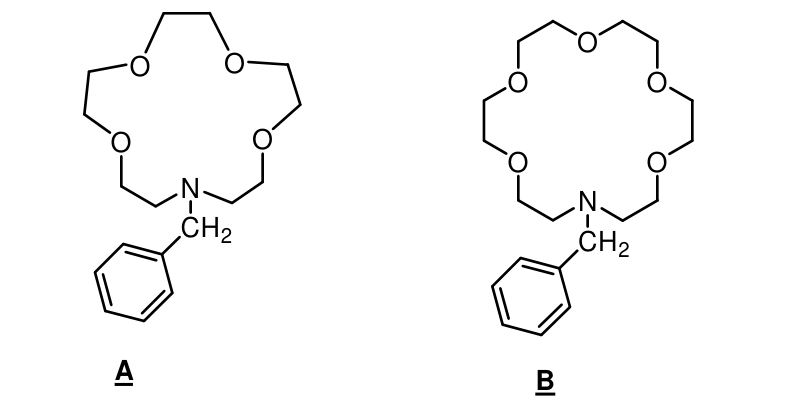
Crown ethers show size-dependent binding capability to alkali metal ions. For example, the azacrowns A and B exhibit different binding constants for \(\ce{Na+}\), \(\ce{K+}\), and \(\ce{Cs+}\).
| Binding constant (\(\log_{10} K\)) | |||
|---|---|---|---|
| Metal ion | Radius (pm) | Compound A | Compound B |
| \(\ce{Na+}\) | 98 | 2.49 | 3.57 |
| \(\ce{K+}\) | 133 | 1.83 | 5.00 |
| \(\ce{Cs+}\) | 165 | 1.37 | 3.39 |
Anthracene exhibits strong fluorescence with emission wavelength centered at 325 nm. Combining the binding selectivity of azacrowns for alkali metal ions and the highly fluorescent anthracene, a metal ion selective fluorescent sensor E has been developed.
3.1 Provide the structural formula of C and D in the following synthesis.
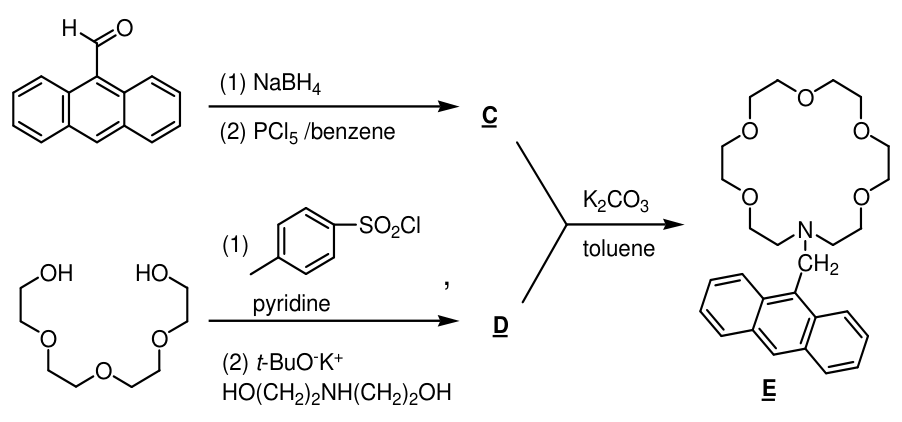
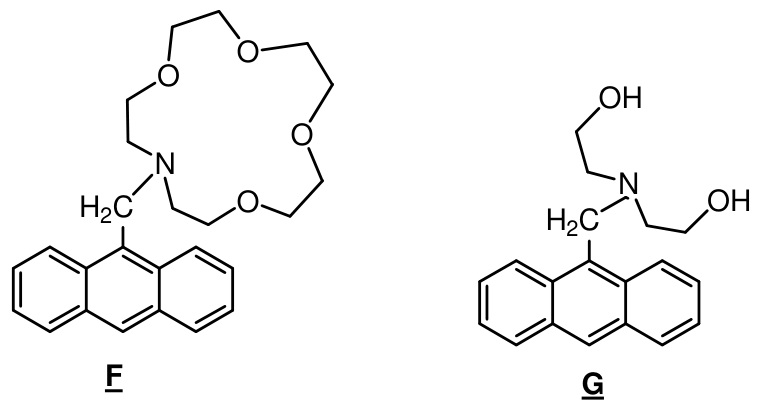
For comparison studies, the anthracene derivatives F and G shown below were also synthesized. These compounds E, F, and G are almost non-fluorescent in neutral conditions due to the strong photoinduced electron transfer (PET) quenching process arising by donating nitrogen lone-pair electron to the anthracene excited-state.
3.2 Upon adding aqueous \(\ce{HCl}\), which compound will exhibit strong fluorescence? Select your answer from the following choices.
(a) none of them (b) E and F only (c) G only (d) all of them
3.3 By adding one equivalent of potassium acetate into a dilute solution (\(1\times10^{-5}\ \mathrm{M}\)) of E, F, and G in methanol, respectively, which compound will show the strongest fluorescence? Select your answer from the following choices.
(a) E (b) F (c) G
3.4 Upon adding one equivalent of metal acetate to a dilute solution of F, which metal acetate will cause the strongest fluorescence? Select your answer from the following choices.
(a) sodium acetate (b) potassium acetate (c) cesium acetate (d) doesn’t make any difference
Upon irradiation with ultraviolet light, trans-stilbene is transformed into an intermediate H, which undergoes a photocyclization to form dihydrophenanthrene I. Further oxidation of I gives phenanthrene.

3.5 Draw the structural formula of compound H?
3.6 What is the relative stereochemistry of the two H-atoms shown (cis or trans) in compound I?
Dihydroazulene derivative J exhibits interesting photochromic behavior. Upon irradiation, colorless dihydroazulene J undergoes photoinduced rearrangement to the corresponding vinylheptafulvene K. The vinylheptafulvene undergoes thermal reversion to dihydroazulene.
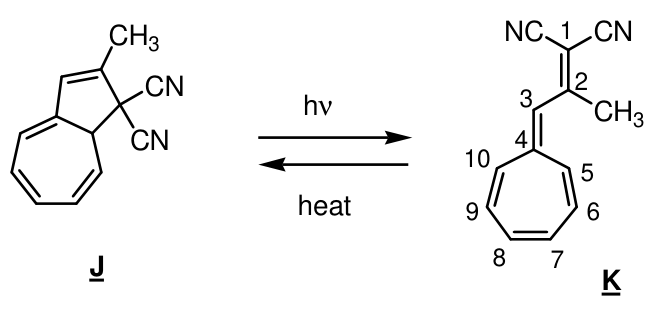
3.7 Which compound will absorb light with longer wavelength? Select your answer from the following choices: (a) J (b) K
3.8 Compound K can react with one equivalent of \(\ce{CF3CO2H}\) to generate a stable aromatic salt. Which position of K is most likely protonated? Select your answer from the following choices.
(a) C-2 (b) C-3 (c) C-4 (d) C-5
Official English text of the problem.
Answers
- 3.1: C is 9-(chloromethyl)anthracene; D is 1-aza-18-crown-6.
- 3.2: (d) All of them: E, F, and G.
- 3.3: (a) E.
- 3.4: (a) Sodium acetate.
- 3.5: H is cis-stilbene, or (Z)-1,2-diphenylethene.
- 3.6: trans.
- 3.7: (b) K.
- 3.8: (b) C-3, giving a substituted tropylium salt.
Solution
3.1 — Identification of C and D
C is 9-(chloromethyl)anthracene, SMILES ClCc1c2ccccc2cc2ccccc12.
The starting aldehyde is anthracene-9-carbaldehyde, O=Cc1c2ccccc2cc2ccccc12. Sodium borohydride reduces its aldehyde group to a primary alcohol, giving (anthracen-9-yl)methanol, OCc1c2ccccc2cc2ccccc12. Phosphorus pentachloride then replaces the hydroxyl group with chlorine.
Let \(\ce{R}\) denote the anthracen-9-yl group. Including hydrolysis during work-up, a balanced net reduction is
\[ \ce{4 RCHO + NaBH4 + 4 H2O -> 4 RCH2OH + Na[B(OH)4]}. \]
The chlorination is
\[ \ce{RCH2OH + PCl5 -> RCH2Cl + POCl3 + HCl}. \]
Thus, the drawing of C should show three linearly fused aromatic rings, with a \(\ce{-CH2Cl}\) substituent at carbon 9 of anthracene.
D is 1-aza-18-crown-6, SMILES [NH]1CCOCCOCCOCCOCCOCC1.
The starting polyether is tetraethylene glycol, OCCOCCOCCOCCO. Its two terminal hydroxyl groups are converted into tosylates by p-toluenesulfonyl chloride, Cc1ccc(S(=O)(=O)Cl)cc1, in pyridine.
The resulting tetraethylene glycol ditosylate has SMILES
Cc1ccc(S(=O)(=O)OCCOCCOCCOCCOS(=O)(=O)c2ccc(C)cc2)cc1.
With pyridine trapping the hydrogen chloride, the balanced reaction is
\[ \ce{C8H18O5 + 2 C7H7SO2Cl + 2 C5H5N -> C22H30O9S2 + 2 [C5H6N]+ + 2 Cl-}. \]
Potassium tert-butoxide generates alkoxide groups from the two hydroxyl groups of diethanolamine, OCCNCCO. These displace the two terminal tosylate groups, forming two new carbon–oxygen bonds and closing the macrocycle:
\[ \ce{C22H30O9S2 + C4H11NO2 + 2 KOC(CH3)3 -> C12H25NO5 + 2 KC7H7SO3 + 2 HOC(CH3)3}. \]
The product \(\ce{C12H25NO5}\) is D. Draw an 18-membered ring containing five oxygen atoms and one \(\ce{NH}\) group, with every successive pair of heteroatoms separated by two methylene groups. The nitrogen retains its hydrogen during this cyclization.
Finally, the secondary amine D attacks the chloromethyl carbon of C. Carbonate removes the nitrogen proton, producing the tertiary amine E, N-(anthracen-9-ylmethyl)-1-aza-18-crown-6:
N1(Cc2c3ccccc3cc3ccccc23)CCOCCOCCOCCOCCOCC1
A balanced overall equation, including carbonate neutralization, is
\[ \ce{2 C15H11Cl + 2 C12H25NO5 + K2CO3 -> 2 C27H35NO5 + 2 KCl + CO2 + H2O}. \]
Here the organic reactants are C and D, and the organic product is E.
3.2 — Fluorescence after adding hydrochloric acid
The answer is (d), all three compounds.
Besides E, the compounds are:
- F: N-(anthracen-9-ylmethyl)-1-aza-15-crown-5,
N1(Cc2c3ccccc3cc3ccccc23)CCOCCOCCOCCOCC1 - G: N-(anthracen-9-ylmethyl)diethanolamine,
OCCN(Cc1c2ccccc2cc2ccccc12)CCO
In each neutral compound, the tertiary-amine nitrogen has a lone pair that can donate an electron to excited anthracene. This PET process competes with fluorescence and quenches it.
Hydrochloric acid protonates the nitrogen:
\[ \ce{R3N + HCl -> R3NH+ + Cl-}. \]
The nitrogen-protonated products are:
| Ion | Name | SMILES |
|---|---|---|
| \(\ce{EH+}\) | N-protonated E | [NH+]1(Cc2c3ccccc3cc3ccccc23)CCOCCOCCOCCOCCOCC1 |
| \(\ce{FH+}\) | N-protonated F | [NH+]1(Cc2c3ccccc3cc3ccccc23)CCOCCOCCOCCOCC1 |
| \(\ce{GH+}\) | N-protonated G | OCC[NH+](Cc1c2ccccc2cc2ccccc12)CCO |
Protonation uses the nitrogen lone pair to form the new nitrogen–hydrogen bond. Nitrogen can therefore no longer act as the same electron donor, PET is suppressed, and strong anthracene fluorescence is restored in E, F, and G.
3.3 — Fluorescence after adding potassium acetate
The answer is (a), E.
The reference hosts are:
- A: N-benzyl-1-aza-15-crown-5,
N1(Cc2ccccc2)CCOCCOCCOCCOCC1 - B: N-benzyl-1-aza-18-crown-6,
N1(Cc2ccccc2)CCOCCOCCOCCOCCOCC1
E contains the same aza-18-crown-6 binding unit as B, whereas F contains the smaller aza-15-crown-5 unit of A. For potassium binding to these reference hosts,
\[ \log_{10}K_B=5.00,\qquad \log_{10}K_A=1.83, \]
so
\[ \frac{K_B}{K_A}=10^{5.00-1.83} \approx 1.5\times10^3. \]
Thus, the larger crown provides a much more favourable binding site for potassium(I), [K+]. G lacks the preorganized macrocyclic cavity.
Potassium binding engages the crown’s nitrogen and oxygen donors and reduces the nitrogen lone pair’s ability to participate in PET. Consequently, E shows the strongest fluorescence enhancement. The coordination contacts and folded crown conformation are described here in words; they are not encoded by the neutral ligand’s SMILES.
The numerical ratio above applies to A and B as tabulated. It supports the receptor comparison without assuming exact binding constants for E and F.
3.4 — Metal-ion selectivity of F
The answer is (a), sodium acetate, SMILES CC(=O)[O-].[Na+].
F has the smaller aza-15-crown-5 receptor of A. The given binding constants for A follow
\[ \log_{10}K(\ce{Na+})=2.49 > \log_{10}K(\ce{K+})=1.83 > \log_{10}K(\ce{Cs+})=1.37. \]
The smaller sodium ion, with radius \(98\ \mathrm{pm}\), fits this receptor most favourably. Sodium binding therefore produces the greatest suppression of PET, and hence the strongest fluorescence, among the three salts.
3.5 — Structure of H
H is cis-stilbene, also called (Z)-1,2-diphenylethene:
c1ccccc1/C=C\c1ccccc1
The starting trans-stilbene, or (E)-1,2-diphenylethene, has SMILES
c1ccccc1/C=C/c1ccccc1.
Light permits isomerization about the central alkene:
\[ \ce{\text{trans-}C6H5CH=CHC6H5 <=>[h\nu] \text{cis-}C6H5CH=CHC6H5}. \]
Draw H with the two phenyl groups on the same side of the carbon–carbon double bond. This configuration allows the two ortho positions that will form the new bond to approach one another in the reactive conformation.
3.6 — Relative stereochemistry in I
The two indicated hydrogens are trans.
The ring closure uses a conjugated six-\(\pi\)-electron system. A photochemical \(6\pi\) electrocyclization is conrotatory: the two terminal orbital systems rotate in the same sense. Applied to the reactive conformation of cis-stilbene, this places the two ring-junction hydrogens on opposite faces.
The product is trans-4a,4b-dihydrophenanthrene. A stereochemical SMILES for one enantiomer is
C1=CC=C[C@H]2C1=CC=C1C=CC=C[C@@H]12.
Opposite conrotation gives its mirror image. In the requested drawing, show one indicated hydrogen on a solid wedge and the other on a hashed wedge.
The photocyclization conserves the molecular formula \(\ce{C14H12}\). Subsequent oxidation removes the two ring-junction hydrogens and gives phenanthrene, c1ccc2c(c1)ccc1ccccc12. Because no oxidant is specified, its balanced oxidation half-reaction is
\[ \ce{C14H12 -> C14H10 + 2 H+ + 2 e-}. \]
3.7 — Longer-wavelength absorption
The answer is (b), K.
The structures are:
- J: 1,1-dicyano-2-methyl-1,8a-dihydroazulene,
CC1=CC2=CC=CC=CC2C1(C#N)C#N - K: the vinylheptafulvene, systematically 2-[1-(cyclohepta-2,4,6-trien-1-ylidene)propan-2-ylidene]propanedinitrile,
N#CC(C#N)=C(C)C=C1C=CC=CC=C1
The absolute configuration of J is not specified in the drawing and is therefore left unspecified in its SMILES.
In J, the tetrahedral dicyano-substituted carbon and the saturated ring-junction carbon interrupt conjugation. Ring opening gives K, with a more extensive conjugated system that includes the dicyano-substituted end of the molecule.
This lowers the relevant electronic excitation energy. Since
\[ \Delta E=\frac{hc}{\lambda}, \]
the smaller excitation energy corresponds to a longer absorption wavelength:
\[ \boxed{\lambda_{\max,K}>\lambda_{\max,J}}. \]
3.8 — Protonation of K
The answer is (b), C-3.
The relevant connectivity in K is
\[ \ce{(NC)2C=C(CH3)-CH=C_{\text{ring}}}, \]
where the chain \(\ce{CH}\) is C-3 and the attached ring carbon is C-4.
The electrons of the \(\ce{C3=C4}\) bond form a bond between C-3 and the proton. Consequently:
- C-3 becomes \(\ce{CH2}\).
- The C-3–C-4 bond becomes a single bond.
- A positive charge is initially placed at C-4.
The seven-membered ring now has three double bonds and an empty \(p\) orbital at C-4. All seven ring atoms participate in a continuous cyclic conjugated system containing six \(\pi\) electrons:
\[ 6=4n+2,\qquad n=1. \]
The product is therefore an aromatic substituted tropylium ion.
With trifluoroacetic acid, O=C(O)C(F)(F)F, the balanced reaction is
\[ \ce{C13H10N2 + CF3CO2H -> [C13H11N2]+ + CF3CO2-}. \]
The resulting C-3-protonated K trifluoroacetate, a substituted tropylium salt, has SMILES
N#CC(C#N)=C(C)C[C+]1C=CC=CC=C1.O=C([O-])C(F)(F)F.
This SMILES depicts one localized resonance contributor. In the actual aromatic cation, the positive charge is delocalized around the seven-membered ring. The drawing should show the side chain attached through a single bond to that ring, with C-3 now bearing two hydrogens.
The solution was checked against the official solution.
IChO 2005 · Theorieaufgabe 3
Organische Photochemie und Photophysik
Kronenether zeigen eine größenabhängige Bindungsfähigkeit gegenüber Alkalimetallionen. Beispielsweise weisen die Azakronenether A und B unterschiedliche Bindungskonstanten für \(\ce{Na+}\), \(\ce{K+}\) und \(\ce{Cs+}\) auf.
| Bindungskonstante (\(\log_{10} K\)) | |||
|---|---|---|---|
| Metallion | Radius (pm) | Verbindung A | Verbindung B |
| \(\ce{Na+}\) | 98 | 2.49 | 3.57 |
| \(\ce{K+}\) | 133 | 1.83 | 5.00 |
| \(\ce{Cs+}\) | 165 | 1.37 | 3.39 |
Anthracen zeigt eine starke Fluoreszenz mit einer Emissionswellenlänge um 325 nm. Durch die Kombination der Bindungsselektivität von Azakronenethern für Alkalimetallionen mit dem stark fluoreszierenden Anthracen wurde ein metallionenselektiver Fluoreszenzsensor E entwickelt.
3.1 Geben Sie die Strukturformeln von C und D in der folgenden Synthese an.
Für Vergleichsuntersuchungen wurden auch die unten gezeigten Anthracenderivate F und G synthetisiert. Diese Verbindungen E, F und G fluoreszieren unter neutralen Bedingungen nahezu nicht, da ein starker Löschungsprozess durch photoinduzierten Elektronentransfer (PET) stattfindet, bei dem ein Elektron des freien Elektronenpaars am Stickstoff auf Anthracen im angeregten Zustand übertragen wird.
3.2 Welche Verbindung zeigt nach Zugabe von wässriger \(\ce{HCl}\) eine starke Fluoreszenz? Wählen Sie Ihre Antwort aus den folgenden Möglichkeiten.
(a) keine von ihnen (b) nur E und F (c) nur G (d) alle
3.3 Zu jeweils einer verdünnten Lösung (\(1\times10^{-5}\ \mathrm{M}\)) von E, F und G in Methanol wird ein Äquivalent Kaliumacetat gegeben. Welche Verbindung zeigt die stärkste Fluoreszenz? Wählen Sie Ihre Antwort aus den folgenden Möglichkeiten.
(a) E (b) F (c) G
3.4 Ein Äquivalent eines Metallacetats wird zu einer verdünnten Lösung von F gegeben. Welches Metallacetat bewirkt die stärkste Fluoreszenz? Wählen Sie Ihre Antwort aus den folgenden Möglichkeiten.
(a) Natriumacetat (b) Kaliumacetat (c) Cäsiumacetat (d) es macht keinen Unterschied
Bei Bestrahlung mit ultraviolettem Licht wird trans-Stilben in ein Zwischenprodukt H umgewandelt, das durch Photocyclisierung Dihydrophenanthren I bildet. Die anschließende Oxidation von I liefert Phenanthren.
3.5 Zeichnen Sie die Strukturformel der Verbindung H.
3.6 Welche relative Stereochemie haben die beiden gezeigten H-Atome (cis oder trans) in Verbindung I?
Das Dihydroazulenderivat J zeigt ein interessantes photochromes Verhalten. Bei Bestrahlung wird das farblose Dihydroazulen J durch eine photoinduzierte Umlagerung in das entsprechende Vinylheptafulven K umgewandelt. Das Vinylheptafulven wandelt sich thermisch wieder in Dihydroazulen um.
3.7 Welche Verbindung absorbiert Licht mit einer längeren Wellenlänge? Wählen Sie Ihre Antwort aus den folgenden Möglichkeiten: (a) J (b) K
3.8 Verbindung K kann mit einem Äquivalent \(\ce{CF3CO2H}\) reagieren und dabei ein stabiles aromatisches Salz bilden. Welche Position von K wird am wahrscheinlichsten protoniert? Wählen Sie Ihre Antwort aus den folgenden Möglichkeiten.
(a) C-2 (b) C-3 (c) C-4 (d) C-5
Aufgabentext aus dem offiziellen englischen Text übersetzt.
Antworten
- 3.1: C ist 9-(Chlormethyl)anthracen; D ist 1-Aza-18-krone-6.
- 3.2: (d) Alle: E, F und G.
- 3.3: (a) E.
- 3.4: (a) Natriumacetat.
- 3.5: H ist cis-Stilben oder (Z)-1,2-Diphenylethen.
- 3.6: trans.
- 3.7: (b) K.
- 3.8: (b) C-3, wobei ein substituiertes Tropyliumsalz entsteht.
Lösung
3.1 — Identifizierung von C und D
C ist 9-(Chlormethyl)anthracen, SMILES ClCc1c2ccccc2cc2ccccc12.
Der als Ausgangsstoff eingesetzte Aldehyd ist Anthracen-9-carbaldehyd, O=Cc1c2ccccc2cc2ccccc12. Natriumborhydrid reduziert seine Aldehydgruppe zu einem primären Alkohol, wobei (Anthracen-9-yl)methanol, OCc1c2ccccc2cc2ccccc12, entsteht. Phosphorpentachlorid ersetzt anschließend die Hydroxygruppe durch Chlor.
\(\ce{R}\) bezeichne die Anthracen-9-yl-Gruppe. Unter Einbeziehung der Hydrolyse während der Aufarbeitung lautet eine ausgeglichene Nettogleichung der Reduktion
\[ \ce{4 RCHO + NaBH4 + 4 H2O -> 4 RCH2OH + Na[B(OH)4]}. \]
Die Chlorierung lautet
\[ \ce{RCH2OH + PCl5 -> RCH2Cl + POCl3 + HCl}. \]
Die Zeichnung von C sollte somit drei linear anellierte aromatische Ringe mit einem \(\ce{-CH2Cl}\)-Substituenten am Kohlenstoffatom 9 des Anthracens zeigen.
D ist 1-Aza-18-krone-6, SMILES [NH]1CCOCCOCCOCCOCCOCC1.
Der als Ausgangsstoff eingesetzte Polyether ist Tetraethylenglykol, OCCOCCOCCOCCO. Seine beiden endständigen Hydroxygruppen werden mit p-Toluolsulfonylchlorid, Cc1ccc(S(=O)(=O)Cl)cc1, in Pyridin in Tosylate umgewandelt.
Das entstandene Tetraethylenglykolditosylat hat den SMILES-Code
Cc1ccc(S(=O)(=O)OCCOCCOCCOCCOS(=O)(=O)c2ccc(C)cc2)cc1.
Wenn Pyridin den Chlorwasserstoff abfängt, lautet die ausgeglichene Reaktionsgleichung
\[ \ce{C8H18O5 + 2 C7H7SO2Cl + 2 C5H5N -> C22H30O9S2 + 2 [C5H6N]+ + 2 Cl-}. \]
Kalium-tert-butanolat erzeugt aus den beiden Hydroxygruppen von Diethanolamin, OCCNCCO, Alkoholatgruppen. Diese verdrängen die beiden endständigen Tosylatgruppen, wobei zwei neue Kohlenstoff–Sauerstoff-Bindungen entstehen und sich der Makrocyclus schließt:
\[ \ce{C22H30O9S2 + C4H11NO2 + 2 KOC(CH3)3 -> C12H25NO5 + 2 KC7H7SO3 + 2 HOC(CH3)3}. \]
Das Produkt \(\ce{C12H25NO5}\) ist D. Zeichnen Sie einen 18-gliedrigen Ring mit fünf Sauerstoffatomen und einer \(\ce{NH}\)-Gruppe, in dem jeweils zwei aufeinanderfolgende Heteroatome durch zwei Methylengruppen getrennt sind. Der Stickstoff behält bei dieser Cyclisierung sein Wasserstoffatom.
Schließlich greift das sekundäre Amin D das Chlormethyl-Kohlenstoffatom von C an. Carbonat entfernt das Proton am Stickstoff, wodurch das tertiäre Amin E, N-(Anthracen-9-ylmethyl)-1-aza-18-krone-6, entsteht:
N1(Cc2c3ccccc3cc3ccccc23)CCOCCOCCOCCOCCOCC1
Eine ausgeglichene Gesamtgleichung unter Einbeziehung der Neutralisation durch Carbonat lautet
\[ \ce{2 C15H11Cl + 2 C12H25NO5 + K2CO3 -> 2 C27H35NO5 + 2 KCl + CO2 + H2O}. \]
Hier sind die organischen Edukte C und D, und das organische Produkt ist E.
3.2 — Fluoreszenz nach Zugabe von Salzsäure
Die Antwort lautet (d), alle drei Verbindungen.
Neben E handelt es sich um folgende Verbindungen:
- F: N-(Anthracen-9-ylmethyl)-1-aza-15-krone-5,
N1(Cc2c3ccccc3cc3ccccc23)CCOCCOCCOCCOCC1 - G: N-(Anthracen-9-ylmethyl)diethanolamin,
OCCN(Cc1c2ccccc2cc2ccccc12)CCO
In jeder neutralen Verbindung besitzt der Stickstoff des tertiären Amins ein freies Elektronenpaar, das ein Elektron auf angeregtes Anthracen übertragen kann. Dieser PET-Prozess konkurriert mit der Fluoreszenz und löscht sie.
Salzsäure protoniert den Stickstoff:
\[ \ce{R3N + HCl -> R3NH+ + Cl-}. \]
Die am Stickstoff protonierten Produkte sind:
| Ion | Name | SMILES |
|---|---|---|
| \(\ce{EH+}\) | N-protoniertes E | [NH+]1(Cc2c3ccccc3cc3ccccc23)CCOCCOCCOCCOCCOCC1 |
| \(\ce{FH+}\) | N-protoniertes F | [NH+]1(Cc2c3ccccc3cc3ccccc23)CCOCCOCCOCCOCC1 |
| \(\ce{GH+}\) | N-protoniertes G | OCC[NH+](Cc1c2ccccc2cc2ccccc12)CCO |
Bei der Protonierung wird das freie Elektronenpaar am Stickstoff zur Bildung der neuen Stickstoff–Wasserstoff-Bindung verwendet. Der Stickstoff kann daher nicht mehr in gleicher Weise als Elektronendonor wirken, PET wird unterdrückt, und die starke Anthracenfluoreszenz wird in E, F und G wiederhergestellt.
3.3 — Fluoreszenz nach Zugabe von Kaliumacetat
Die Antwort lautet (a), E.
Die Referenz-Wirtmoleküle sind:
- A: N-Benzyl-1-aza-15-krone-5,
N1(Cc2ccccc2)CCOCCOCCOCCOCC1 - B: N-Benzyl-1-aza-18-krone-6,
N1(Cc2ccccc2)CCOCCOCCOCCOCCOCC1
E enthält dieselbe Aza-18-krone-6-Bindungseinheit wie B, während F die kleinere Aza-15-krone-5-Einheit von A enthält. Für die Bindung von Kalium an diese Referenz-Wirtmoleküle gilt
\[ \log_{10}K_B=5.00,\qquad \log_{10}K_A=1.83, \]
also
\[ \frac{K_B}{K_A}=10^{5.00-1.83} \approx 1.5\times10^3. \]
Somit bietet der größere Kronenether eine wesentlich günstigere Bindungsstelle für Kalium(I), [K+]. G besitzt keinen präorganisierten makrocyclischen Hohlraum.
Bei der Bindung von Kalium werden die Stickstoff- und Sauerstoffdonoren des Kronenethers einbezogen, und die Fähigkeit des freien Elektronenpaars am Stickstoff, an PET teilzunehmen, wird verringert. Folglich zeigt E die stärkste Fluoreszenzverstärkung. Die Koordinationskontakte und die gefaltete Konformation des Kronenethers werden hier in Worten beschrieben; sie sind im SMILES-Code des neutralen Liganden nicht codiert.
Das oben angegebene Zahlenverhältnis gilt für A und B gemäß der Tabelle. Es stützt den Vergleich der Rezeptoren, ohne genaue Bindungskonstanten für E und F vorauszusetzen.
3.4 — Metallionenselektivität von F
Die Antwort lautet (a), Natriumacetat, SMILES CC(=O)[O-].[Na+].
F besitzt den kleineren Aza-15-krone-5-Rezeptor von A. Die angegebenen Bindungskonstanten für A folgen der Reihenfolge
\[ \log_{10}K(\ce{Na+})=2.49 > \log_{10}K(\ce{K+})=1.83 > \log_{10}K(\ce{Cs+})=1.37. \]
Das kleinere Natriumion mit einem Radius von \(98\ \mathrm{pm}\) passt am besten in diesen Rezeptor. Die Bindung von Natrium bewirkt daher unter den drei Salzen die stärkste Unterdrückung von PET und damit die stärkste Fluoreszenz.
3.5 — Struktur von H
H ist cis-Stilben, auch (Z)-1,2-Diphenylethen genannt:
c1ccccc1/C=C\c1ccccc1
Das als Ausgangsstoff eingesetzte trans-Stilben, auch (E)-1,2-Diphenylethen, hat den SMILES-Code
c1ccccc1/C=C/c1ccccc1.
Licht ermöglicht die Isomerisierung an der zentralen Alkenbindung:
\[ \ce{\text{trans-}C6H5CH=CHC6H5 <=>[h\nu] \text{cis-}C6H5CH=CHC6H5}. \]
Zeichnen Sie H so, dass die beiden Phenylgruppen auf derselben Seite der Kohlenstoff–Kohlenstoff-Doppelbindung liegen. Diese Konfiguration ermöglicht es den beiden ortho-Positionen, zwischen denen die neue Bindung entsteht, sich in der reaktiven Konformation einander anzunähern.
3.6 — Relative Stereochemie in I
Die beiden gekennzeichneten Wasserstoffatome stehen trans zueinander.
Der Ringschluss erfolgt über ein konjugiertes Sechs-\(\pi\)-Elektronen-System. Eine photochemische \(6\pi\)-Elektrocyclisierung verläuft konrotatorisch: Die beiden endständigen Orbitalsysteme drehen sich im gleichen Sinn. Bei der reaktiven Konformation von cis-Stilben führt dies dazu, dass die beiden Wasserstoffatome an der Ringverknüpfung auf entgegengesetzten Seiten liegen.
Das Produkt ist trans-4a,4b-Dihydrophenanthren. Ein stereochemischer SMILES-Code für eines der Enantiomere lautet
C1=CC=C[C@H]2C1=CC=C1C=CC=C[C@@H]12.
Eine Konrotation in der entgegengesetzten Richtung liefert dessen Spiegelbild. Stellen Sie in der geforderten Zeichnung eines der gekennzeichneten Wasserstoffatome mit einem ausgefüllten Keil und das andere mit einem gestrichelten Keil dar.
Bei der Photocyclisierung bleibt die Summenformel \(\ce{C14H12}\) erhalten. Die anschließende Oxidation entfernt die beiden Wasserstoffatome an der Ringverknüpfung und liefert Phenanthren, c1ccc2c(c1)ccc1ccccc12. Da kein Oxidationsmittel angegeben ist, lautet die ausgeglichene Oxidationshalbreaktion
\[ \ce{C14H12 -> C14H10 + 2 H+ + 2 e-}. \]
3.7 — Absorption bei längerer Wellenlänge
Die Antwort lautet (b), K.
Die Strukturen sind:
- J: 1,1-Dicyan-2-methyl-1,8a-dihydroazulen,
CC1=CC2=CC=CC=CC2C1(C#N)C#N - K: das Vinylheptafulven, systematisch 2-[1-(Cyclohepta-2,4,6-trien-1-yliden)propan-2-yliden]propandinitril,
N#CC(C#N)=C(C)C=C1C=CC=CC=C1
Die absolute Konfiguration von J ist in der Zeichnung nicht angegeben und bleibt daher auch im SMILES-Code unspezifiziert.
In J unterbrechen das tetraedrische, dicyansubstituierte Kohlenstoffatom und das gesättigte Kohlenstoffatom an der Ringverknüpfung die Konjugation. Die Ringöffnung liefert K mit einem ausgedehnteren konjugierten System, das das dicyansubstituierte Ende des Moleküls einschließt.
Dadurch wird die betreffende elektronische Anregungsenergie verringert. Da
\[ \Delta E=\frac{hc}{\lambda}, \]
gilt, entspricht die geringere Anregungsenergie einer längeren Absorptionswellenlänge:
\[ \boxed{\lambda_{\max,K}>\lambda_{\max,J}}. \]
3.8 — Protonierung von K
Die Antwort lautet (b), C-3.
Die relevante Verknüpfung der Atome in K lautet
\[ \ce{(NC)2C=C(CH3)-CH=C_{\text{Ring}}}, \]
wobei das \(\ce{CH}\) der Kette C-3 und das daran gebundene Ringkohlenstoffatom C-4 ist.
Die Elektronen der \(\ce{C3=C4}\)-Bindung bilden eine Bindung zwischen C-3 und dem Proton. Daraus folgt:
- C-3 wird zu \(\ce{CH2}\).
- Die C-3–C-4-Bindung wird zu einer Einfachbindung.
- Eine positive Ladung befindet sich zunächst an C-4.
Der siebengliedrige Ring besitzt nun drei Doppelbindungen und ein leeres \(p\)-Orbital an C-4. Alle sieben Ringatome sind an einem durchgehend konjugierten cyclischen System mit sechs \(\pi\)-Elektronen beteiligt:
\[ 6=4n+2,\qquad n=1. \]
Das Produkt ist daher ein aromatisches substituiertes Tropyliumion.
Mit Trifluoressigsäure, O=C(O)C(F)(F)F, lautet die ausgeglichene Reaktionsgleichung
\[ \ce{C13H10N2 + CF3CO2H -> [C13H11N2]+ + CF3CO2-}. \]
Das entstandene Trifluoracetat des an C-3 protonierten K, ein substituiertes Tropyliumsalz, hat den SMILES-Code
N#CC(C#N)=C(C)C[C+]1C=CC=CC=C1.O=C([O-])C(F)(F)F.
Dieser SMILES-Code stellt eine lokalisierte mesomere Grenzstruktur dar. Im tatsächlichen aromatischen Kation ist die positive Ladung über den siebengliedrigen Ring delokalisiert. Die Zeichnung sollte die über eine Einfachbindung an diesen Ring gebundene Seitenkette zeigen, wobei C-3 nun zwei Wasserstoffatome trägt.
Die Lösung wurde mit der offiziellen Lösung abgeglichen.
IChO 2005 · Teori sorusu 3
Organik Fotokimya ve Fotofizik
Taç eterler, alkali metal iyonlarına boyuta bağlı olarak bağlanma yeteneği gösterir. Örneğin, A ve B aza-taç eterlerinin \(\ce{Na+}\), \(\ce{K+}\) ve \(\ce{Cs+}\) için bağlanma sabitleri farklıdır.
| Bağlanma sabiti (\(\log_{10} K\)) | |||
|---|---|---|---|
| Metal iyonu | Yarıçap (pm) | A bileşiği | B bileşiği |
| \(\ce{Na+}\) | 98 | 2.49 | 3.57 |
| \(\ce{K+}\) | 133 | 1.83 | 5.00 |
| \(\ce{Cs+}\) | 165 | 1.37 | 3.39 |
Antrasen, emisyon dalga boyunun merkezi 325 nm olan güçlü bir floresans gösterir. Aza-taç eterlerinin alkali metal iyonlarına bağlanma seçiciliği ile antrasenin güçlü floresans özelliği birleştirilerek metal iyonlarına seçici bir floresan sensör olan E geliştirilmiştir.
3.1 Aşağıdaki sentezde C ve D'nin yapı formüllerini veriniz.
Karşılaştırma çalışmaları için aşağıda gösterilen F ve G antrasen türevleri de sentezlenmiştir. E, F ve G bileşikleri, azotun ortaklanmamış elektron çiftinden antrasenin uyarılmış hâline elektron verilmesiyle ortaya çıkan güçlü fotoindüklenmiş elektron aktarımı (PET) sönümleme süreci nedeniyle nötr koşullarda hemen hemen hiç floresans göstermez.
3.2 Sulu \(\ce{HCl}\) eklendiğinde hangi bileşik güçlü floresans gösterir? Yanıtınızı aşağıdaki seçeneklerden seçiniz.
(a) hiçbiri (b) yalnızca E ve F (c) yalnızca G (d) hepsi
3.3 E, F ve G'nin metanoldeki seyreltik çözeltilerine (\(1\times10^{-5}\ \mathrm{M}\)) ayrı ayrı bir eşdeğer potasyum asetat eklendiğinde hangi bileşik en güçlü floresansı gösterir? Yanıtınızı aşağıdaki seçeneklerden seçiniz.
(a) E (b) F (c) G
3.4 F'nin seyreltik bir çözeltisine bir eşdeğer metal asetat eklendiğinde hangi metal asetat en güçlü floresansa yol açar? Yanıtınızı aşağıdaki seçeneklerden seçiniz.
(a) sodyum asetat (b) potasyum asetat (c) sezyum asetat (d) herhangi bir fark yaratmaz
Ultraviyole ışıkla ışınlandığında trans-stilben, H ara ürününe dönüşür; bu ara ürün fotosiklizasyona uğrayarak dihidrofenantren I'yı oluşturur. I'nın daha sonra yükseltgenmesiyle fenantren elde edilir.
3.5 H bileşiğinin yapı formülünü çiziniz.
3.6 I bileşiğinde gösterilen iki H atomunun bağıl stereokimyası nedir (cis mi, trans mı)?
Dihidroazulen türevi J, ilginç bir fotokromik davranış gösterir. Işınlandığında renksiz dihidroazulen J, fotoindüklenmiş yeniden düzenlenmeye uğrayarak karşılık gelen vinilheptafulven K'ye dönüşür. Vinilheptafulven, ısıl olarak yeniden dihidroazulene dönüşür.
3.7 Hangi bileşik daha uzun dalga boylu ışığı soğurur? Yanıtınızı aşağıdaki seçeneklerden seçiniz: (a) J (b) K
3.8 K bileşiği, bir eşdeğer \(\ce{CF3CO2H}\) ile tepkimeye girerek kararlı bir aromatik tuz oluşturabilir. K'nin hangi konumunun protonlanması en olasıdır? Yanıtınızı aşağıdaki seçeneklerden seçiniz.
(a) C-2 (b) C-3 (c) C-4 (d) C-5
Soru metni resmi İngilizce metinden çevrilmiştir.
Cevaplar
- 3.1: C, 9-(klorometil)antrasen; D ise 1-aza-18-taç-6'dır.
- 3.2: (d) Hepsi: E, F ve G.
- 3.3: (a) E.
- 3.4: (a) Sodyum asetat.
- 3.5: H, cis-stilben, diğer adıyla (Z)-1,2-difenileten'dir.
- 3.6: trans.
- 3.7: (b) K.
- 3.8: (b) C-3; sübstitüe bir tropilyum tuzu oluşur.
Çözüm
3.1 — C ve D'nin belirlenmesi
C, 9-(klorometil)antrasen olup SMILES gösterimi ClCc1c2ccccc2cc2ccccc12 şeklindedir.
Başlangıç aldehidi antrasen-9-karbaldehit, O=Cc1c2ccccc2cc2ccccc12, bileşiğidir. Sodyum borohidrür, aldehit grubunu bir birincil alkole indirgeyerek (antrasen-9-il)metanol, OCc1c2ccccc2cc2ccccc12, oluşturur. Ardından fosfor pentaklorür, hidroksil grubunu klorla değiştirir.
\(\ce{R}\), antrasen-9-il grubunu göstersin. Tepkime sonrası işlemler sırasındaki hidroliz de dâhil edildiğinde, denkleştirilmiş net indirgenme tepkimesi şöyledir:
\[ \ce{4 RCHO + NaBH4 + 4 H2O -> 4 RCH2OH + Na[B(OH)4]}. \]
Klorlama tepkimesi şöyledir:
\[ \ce{RCH2OH + PCl5 -> RCH2Cl + POCl3 + HCl}. \]
Dolayısıyla C'nin çiziminde, doğrusal olarak kaynaşmış üç aromatik halka ve antrasenin 9 numaralı karbonunda bir \(\ce{-CH2Cl}\) sübstitüenti gösterilmelidir.
D, 1-aza-18-taç-6 olup SMILES gösterimi [NH]1CCOCCOCCOCCOCCOCC1 şeklindedir.
Başlangıç polieteri tetraetilen glikol, OCCOCCOCCOCCO, bileşiğidir. İki uç hidroksil grubu, piridin içinde p-toluensülfonil klorür, Cc1ccc(S(=O)(=O)Cl)cc1, ile tosilatlara dönüştürülür.
Oluşan tetraetilen glikol ditosilat bileşiğinin SMILES gösterimi şöyledir:
Cc1ccc(S(=O)(=O)OCCOCCOCCOCCOS(=O)(=O)c2ccc(C)cc2)cc1.
Hidrojen klorürün piridin tarafından tutulduğu denkleştirilmiş tepkime şöyledir:
\[ \ce{C8H18O5 + 2 C7H7SO2Cl + 2 C5H5N -> C22H30O9S2 + 2 [C5H6N]+ + 2 Cl-}. \]
Potasyum tert-bütoksit, dietanolamin, OCCNCCO, bileşiğinin iki hidroksil grubundan alkoksit grupları oluşturur. Bunlar iki uç tosilat grubunun yerini alarak iki yeni karbon–oksijen bağı oluşturur ve makrohalkayı kapatır:
\[ \ce{C22H30O9S2 + C4H11NO2 + 2 KOC(CH3)3 -> C12H25NO5 + 2 KC7H7SO3 + 2 HOC(CH3)3}. \]
\(\ce{C12H25NO5}\) ürünü D'dir. Beş oksijen atomu ve bir \(\ce{NH}\) grubu içeren 18 üyeli bir halka çiziniz; ardışık her iki heteroatom arasında iki metilen grubu bulunmalıdır. Azot, bu halkalaşma sırasında hidrojenini korur.
Son olarak, ikincil amin D, C'nin klorometil karbonuna saldırır. Karbonat, azottaki protonu uzaklaştırarak üçüncül amin E'yi, yani N-(antrasen-9-ilmetil)-1-aza-18-taç-6'yı oluşturur:
N1(Cc2c3ccccc3cc3ccccc23)CCOCCOCCOCCOCCOCC1
Karbonatla nötralleşme de dâhil edildiğinde, denkleştirilmiş toplam tepkime şöyledir:
\[ \ce{2 C15H11Cl + 2 C12H25NO5 + K2CO3 -> 2 C27H35NO5 + 2 KCl + CO2 + H2O}. \]
Burada organik girenler C ve D, organik ürün ise E'dir.
3.2 — Hidroklorik asit eklendikten sonraki floresans
Cevap (d), üç bileşiğin hepsidir.
E dışındaki bileşikler şunlardır:
- F: N-(antrasen-9-ilmetil)-1-aza-15-taç-5,
N1(Cc2c3ccccc3cc3ccccc23)CCOCCOCCOCCOCC1 - G: N-(antrasen-9-ilmetil)dietanolamin,
OCCN(Cc1c2ccccc2cc2ccccc12)CCO
Her nötr bileşikte, üçüncül amin azotunun uyarılmış antrasene elektron verebilen bir ortaklanmamış elektron çifti vardır. Bu PET süreci floresansla rekabet eder ve floresansı söndürür.
Hidroklorik asit azotu protonlar:
\[ \ce{R3N + HCl -> R3NH+ + Cl-}. \]
Azot üzerinden protonlanmış ürünler şunlardır:
| İyon | Adı | SMILES |
|---|---|---|
| \(\ce{EH+}\) | N üzerinden protonlanmış E | [NH+]1(Cc2c3ccccc3cc3ccccc23)CCOCCOCCOCCOCCOCC1 |
| \(\ce{FH+}\) | N üzerinden protonlanmış F | [NH+]1(Cc2c3ccccc3cc3ccccc23)CCOCCOCCOCCOCC1 |
| \(\ce{GH+}\) | N üzerinden protonlanmış G | OCC[NH+](Cc1c2ccccc2cc2ccccc12)CCO |
Protonlanmada, yeni azot–hidrojen bağını oluşturmak için azotun ortaklanmamış elektron çifti kullanılır. Bu nedenle azot artık aynı elektron vericisi olarak işlev göremez; PET baskılanır ve E, F ve G'de güçlü antrasen floresansı yeniden ortaya çıkar.
3.3 — Potasyum asetat eklendikten sonraki floresans
Cevap (a), E'dir.
Referans konak moleküller şunlardır:
- A: N-benzil-1-aza-15-taç-5,
N1(Cc2ccccc2)CCOCCOCCOCCOCC1 - B: N-benzil-1-aza-18-taç-6,
N1(Cc2ccccc2)CCOCCOCCOCCOCCOCC1
E, B ile aynı aza-18-taç-6 bağlanma birimini içerirken F, A'nın daha küçük aza-15-taç-5 birimini içerir. Potasyumun bu referans konaklara bağlanması için
\[ \log_{10}K_B=5.00,\qquad \log_{10}K_A=1.83, \]
olduğundan
\[ \frac{K_B}{K_A}=10^{5.00-1.83} \approx 1.5\times10^3. \]
Dolayısıyla daha büyük taç eter, potasyum(I), [K+], için çok daha elverişli bir bağlanma bölgesi sağlar. G'de önceden düzenlenmiş bir makrohalkalı boşluk bulunmaz.
Potasyum bağlanırken taç eterin azot ve oksijen donörleri etkileşime katılır ve azotun ortaklanmamış elektron çiftinin PET'e katılma yeteneği azalır. Bu nedenle floresans şiddetindeki en büyük artışı E gösterir. Koordinasyon etkileşimleri ve taç eterin katlanmış konformasyonu burada sözel olarak açıklanmıştır; bunlar nötr ligandın SMILES gösteriminde kodlanmamıştır.
Yukarıdaki sayısal oran, tabloda verilen A ve B için geçerlidir. E ve F için kesin bağlanma sabitleri varsayılmadan reseptörlerin karşılaştırılmasını destekler.
3.4 — F'nin metal iyonu seçiciliği
Cevap (a), sodyum asetat olup SMILES gösterimi CC(=O)[O-].[Na+] şeklindedir.
F, A'nın daha küçük aza-15-taç-5 reseptörüne sahiptir. A için verilen bağlanma sabitleri şu sırayı izler:
\[ \log_{10}K(\ce{Na+})=2.49 > \log_{10}K(\ce{K+})=1.83 > \log_{10}K(\ce{Cs+})=1.37. \]
Yarıçapı \(98\ \mathrm{pm}\) olan daha küçük sodyum iyonu, bu reseptöre en uygun şekilde yerleşir. Bu nedenle sodyum bağlanması, üç tuz arasında PET'in en fazla baskılanmasını ve dolayısıyla en güçlü floresansı sağlar.
3.5 — H'nin yapısı
H, cis-stilben olup (Z)-1,2-difenileten olarak da adlandırılır:
c1ccccc1/C=C\c1ccccc1
Başlangıçtaki trans-stilben, diğer adıyla (E)-1,2-difenileten, şu SMILES gösterimine sahiptir:
c1ccccc1/C=C/c1ccccc1.
Işık, merkezdeki alken bağı etrafında izomerleşmeyi mümkün kılar:
\[ \ce{\text{trans-}C6H5CH=CHC6H5 <=>[h\nu] \text{cis-}C6H5CH=CHC6H5}. \]
H'yi, iki fenil grubu karbon–karbon çift bağının aynı tarafında olacak şekilde çiziniz. Bu konfigürasyon, yeni bağı oluşturacak iki orto konumunun tepkimeye elverişli konformasyonda birbirine yaklaşmasını sağlar.
3.6 — I'daki bağıl stereokimya
İşaretlenen iki hidrojen trans konumundadır.
Halka kapanması, konjuge bir altı-\(\pi\)-elektron sistemi üzerinden gerçekleşir. Fotokimyasal bir \(6\pi\) elektrosiklizasyon konrotatuvardır: iki uç orbital sistemi aynı yönde döner. Bu hareket, cis-stilbenin tepkimeye elverişli konformasyonuna uygulandığında iki halka birleşim hidrojenini karşıt yüzlere yerleştirir.
Ürün trans-4a,4b-dihidrofenantren'dir. Enantiyomerlerden birinin stereokimyasal SMILES gösterimi şöyledir:
C1=CC=C[C@H]2C1=CC=C1C=CC=C[C@@H]12.
Ters yöndeki konrotasyon, bunun ayna görüntüsünü verir. İstenen çizimde, işaretlenen hidrojenlerden birini dolu kama, diğerini kesik çizgili kama üzerinde gösteriniz.
Fotosiklizasyonda \(\ce{C14H12}\) molekül formülü korunur. Ardından gerçekleşen yükseltgenme, iki halka birleşim hidrojenini uzaklaştırır ve fenantren, c1ccc2c(c1)ccc1ccccc12, oluşur. Herhangi bir yükseltgen belirtilmediği için denkleştirilmiş yükseltgenme yarı tepkimesi şöyledir:
\[ \ce{C14H12 -> C14H10 + 2 H+ + 2 e-}. \]
3.7 — Daha uzun dalga boyunda soğurma
Cevap (b), K'dir.
Yapılar şunlardır:
- J: 1,1-disiyano-2-metil-1,8a-dihidroazulen,
CC1=CC2=CC=CC=CC2C1(C#N)C#N - K: vinilheptafulven, sistematik adıyla 2-[1-(siklohepta-2,4,6-trien-1-iliden)propan-2-iliden]propandinitril,
N#CC(C#N)=C(C)C=C1C=CC=CC=C1
J'nin mutlak konfigürasyonu çizimde belirtilmemiştir; bu nedenle SMILES gösteriminde de belirtilmeden bırakılmıştır.
J'de, disiyano sübstitüentli tetrahedral karbon ile doymuş halka birleşim karbonu konjugasyonu kesintiye uğratır. Halka açılmasıyla, molekülün disiyano sübstitüentli ucunu da kapsayan daha geniş bir konjuge sisteme sahip K oluşur.
Bu durum, ilgili elektronik uyarılma enerjisini düşürür.
\[ \Delta E=\frac{hc}{\lambda}, \]
olduğundan, daha küçük uyarılma enerjisi daha uzun bir soğurma dalga boyuna karşılık gelir:
\[ \boxed{\lambda_{\max,K}>\lambda_{\max,J}}. \]
3.8 — K'nin protonlanması
Cevap (b), C-3'tür.
K'deki ilgili bağlanma düzeni şöyledir:
\[ \ce{(NC)2C=C(CH3)-CH=C_{\text{halka}}}, \]
burada zincirdeki \(\ce{CH}\), C-3; ona bağlı halka karbonu ise C-4'tür.
\(\ce{C3=C4}\) bağının elektronları, C-3 ile proton arasında bir bağ oluşturur. Bunun sonucunda:
- C-3, \(\ce{CH2}\) hâline gelir.
- C-3–C-4 bağı tek bağa dönüşür.
- Pozitif yük başlangıçta C-4 üzerinde yer alır.
Yedi üyeli halka artık üç çift bağa ve C-4 üzerinde boş bir \(p\) orbitaline sahiptir. Halkadaki yedi atomun tamamı, altı \(\pi\) elektronu içeren kesintisiz, halkalı bir konjuge sisteme katılır:
\[ 6=4n+2,\qquad n=1. \]
Dolayısıyla ürün, aromatik bir sübstitüe tropilyum iyonudur.
Trifloroasetik asit, O=C(O)C(F)(F)F, ile denkleştirilmiş tepkime şöyledir:
\[ \ce{C13H10N2 + CF3CO2H -> [C13H11N2]+ + CF3CO2-}. \]
Oluşan C-3 üzerinden protonlanmış K trifloroasetat, sübstitüe bir tropilyum tuzudur ve SMILES gösterimi şöyledir:
N#CC(C#N)=C(C)C[C+]1C=CC=CC=C1.O=C([O-])C(F)(F)F.
Bu SMILES gösterimi, yükün yerelleştirildiği bir rezonans katkı yapısını betimler. Gerçek aromatik katyonda pozitif yük, yedi üyeli halka boyunca delokalizedir. Çizimde yan zincir bu halkaya tek bağla bağlı olarak gösterilmeli ve C-3 artık iki hidrojen taşımalıdır.
Çözüm, resmi çözümle karşılaştırılarak kontrol edildi.
IChO 2005 · Problema teórico 3
Fotoquímica y fotofísica orgánicas
Los éteres corona muestran una capacidad de unión a los iones de metales alcalinos que depende del tamaño. Por ejemplo, las azacoronas A y B presentan diferentes constantes de unión para \(\ce{Na+}\), \(\ce{K+}\) y \(\ce{Cs+}\).
| Constante de unión (\(\log_{10} K\)) | |||
|---|---|---|---|
| Ion metálico | Radio (pm) | Compuesto A | Compuesto B |
| \(\ce{Na+}\) | 98 | 2.49 | 3.57 |
| \(\ce{K+}\) | 133 | 1.83 | 5.00 |
| \(\ce{Cs+}\) | 165 | 1.37 | 3.39 |
El antraceno presenta una intensa fluorescencia con una longitud de onda de emisión centrada en 325 nm. Combinando la selectividad de unión de las azacoronas por los iones de metales alcalinos y la intensa fluorescencia del antraceno, se ha desarrollado un sensor fluorescente E selectivo para iones metálicos.
3.1 Proporcione las fórmulas estructurales de C y D en la siguiente síntesis.
Para realizar estudios comparativos, también se sintetizaron los derivados del antraceno F y G que se muestran a continuación. Estos compuestos E, F y G son prácticamente no fluorescentes en condiciones neutras debido al intenso proceso de desactivación por transferencia electrónica fotoinducida (PET), que se produce por la donación de un electrón del par solitario del nitrógeno al estado excitado del antraceno.
3.2 Al añadir \(\ce{HCl}\) acuoso, ¿qué compuesto presentará una intensa fluorescencia? Seleccione su respuesta entre las siguientes opciones.
(a) ninguno de ellos (b) solo E y F (c) solo G (d) todos ellos
3.3 Al añadir un equivalente de acetato de potasio a sendas disoluciones diluidas (\(1\times10^{-5}\ \mathrm{M}\)) de E, F y G en metanol, ¿qué compuesto mostrará la fluorescencia más intensa? Seleccione su respuesta entre las siguientes opciones.
(a) E (b) F (c) G
3.4 Al añadir un equivalente de un acetato metálico a una disolución diluida de F, ¿qué acetato metálico producirá la fluorescencia más intensa? Seleccione su respuesta entre las siguientes opciones.
(a) acetato de sodio (b) acetato de potasio (c) acetato de cesio (d) no hay ninguna diferencia
Al irradiarlo con luz ultravioleta, el trans-estilbeno se transforma en un intermedio H, que experimenta una fotociclación para formar el dihidrofenantreno I. La posterior oxidación de I da fenantreno.
3.5 Dibuje la fórmula estructural del compuesto H.
3.6 ¿Cuál es la estereoquímica relativa de los dos átomos de H indicados (cis o trans) en el compuesto I?
El derivado del dihidroazuleno J presenta un interesante comportamiento fotocrómico. Al irradiarlo, el dihidroazuleno incoloro J experimenta un reordenamiento fotoinducido que da lugar al vinilheptafulveno K correspondiente. El vinilheptafulveno experimenta una reversión térmica a dihidroazuleno.
3.7 ¿Qué compuesto absorberá luz de mayor longitud de onda? Seleccione su respuesta entre las siguientes opciones: (a) J (b) K
3.8 El compuesto K puede reaccionar con un equivalente de \(\ce{CF3CO2H}\) para generar una sal aromática estable. ¿Qué posición de K es más probable que se protone? Seleccione su respuesta entre las siguientes opciones.
(a) C-2 (b) C-3 (c) C-4 (d) C-5
Enunciado traducido del texto oficial en inglés.
Respuestas
- 3.1: C es 9-(clorometil)antraceno; D es 1-aza-18-corona-6.
- 3.2: (d) Todos ellos: E, F y G.
- 3.3: (a) E.
- 3.4: (a) Acetato de sodio.
- 3.5: H es cis-estilbeno, o (Z)-1,2-difenileteno.
- 3.6: trans.
- 3.7: (b) K.
- 3.8: (b) C-3, dando una sal de tropilio sustituido.
Solución
3.1 — Identificación de C y D
C es 9-(clorometil)antraceno, SMILES ClCc1c2ccccc2cc2ccccc12.
El aldehído de partida es antraceno-9-carbaldehído, O=Cc1c2ccccc2cc2ccccc12. El borohidruro de sodio reduce su grupo aldehído a un alcohol primario, dando (antracen-9-il)metanol, OCc1c2ccccc2cc2ccccc12. A continuación, el pentacloruro de fósforo sustituye el grupo hidroxilo por cloro.
Sea \(\ce{R}\) el grupo antracen-9-ilo. Incluyendo la hidrólisis durante el tratamiento de la mezcla de reacción, una ecuación neta ajustada de la reducción es
\[ \ce{4 RCHO + NaBH4 + 4 H2O -> 4 RCH2OH + Na[B(OH)4]}. \]
La cloración es
\[ \ce{RCH2OH + PCl5 -> RCH2Cl + POCl3 + HCl}. \]
Por tanto, el dibujo de C debe mostrar tres anillos aromáticos fusionados linealmente, con un sustituyente \(\ce{-CH2Cl}\) en el carbono 9 del antraceno.
D es 1-aza-18-corona-6, SMILES [NH]1CCOCCOCCOCCOCCOCC1.
El poliéter de partida es tetraetilenglicol, OCCOCCOCCOCCO. Sus dos grupos hidroxilo terminales se convierten en tosilatos mediante cloruro de p-toluenosulfonilo, Cc1ccc(S(=O)(=O)Cl)cc1, en piridina.
El ditosilato de tetraetilenglicol resultante tiene el SMILES
Cc1ccc(S(=O)(=O)OCCOCCOCCOCCOS(=O)(=O)c2ccc(C)cc2)cc1.
Con la piridina captando el cloruro de hidrógeno, la reacción ajustada es
\[ \ce{C8H18O5 + 2 C7H7SO2Cl + 2 C5H5N -> C22H30O9S2 + 2 [C5H6N]+ + 2 Cl-}. \]
El terc-butóxido de potasio genera grupos alcóxido a partir de los dos grupos hidroxilo de la dietanolamina, OCCNCCO. Estos desplazan los dos grupos tosilato terminales, formando dos nuevos enlaces carbono–oxígeno y cerrando el macrociclo:
\[ \ce{C22H30O9S2 + C4H11NO2 + 2 KOC(CH3)3 -> C12H25NO5 + 2 KC7H7SO3 + 2 HOC(CH3)3}. \]
El producto \(\ce{C12H25NO5}\) es D. Dibuje un anillo de 18 miembros que contenga cinco átomos de oxígeno y un grupo \(\ce{NH}\), con cada par de heteroátomos consecutivos separado por dos grupos metileno. El nitrógeno conserva su hidrógeno durante esta ciclación.
Finalmente, la amina secundaria D ataca el carbono del grupo clorometilo de C. El carbonato elimina el protón del nitrógeno, produciendo la amina terciaria E, N-(antracen-9-ilmetil)-1-aza-18-corona-6:
N1(Cc2c3ccccc3cc3ccccc23)CCOCCOCCOCCOCCOCC1
Una ecuación global ajustada, que incluye la neutralización con carbonato, es
\[ \ce{2 C15H11Cl + 2 C12H25NO5 + K2CO3 -> 2 C27H35NO5 + 2 KCl + CO2 + H2O}. \]
Aquí, los reactivos orgánicos son C y D, y el producto orgánico es E.
3.2 — Fluorescencia tras añadir ácido clorhídrico
La respuesta es (d), los tres compuestos.
Además de E, los compuestos son:
- F: N-(antracen-9-ilmetil)-1-aza-15-corona-5,
N1(Cc2c3ccccc3cc3ccccc23)CCOCCOCCOCCOCC1 - G: N-(antracen-9-ilmetil)dietanolamina,
OCCN(Cc1c2ccccc2cc2ccccc12)CCO
En cada compuesto neutro, el nitrógeno de la amina terciaria tiene un par solitario que puede donar un electrón al antraceno excitado. Este proceso PET compite con la fluorescencia y la desactiva.
El ácido clorhídrico protona el nitrógeno:
\[ \ce{R3N + HCl -> R3NH+ + Cl-}. \]
Los productos protonados en el nitrógeno son:
| Ion | Nombre | SMILES |
|---|---|---|
| \(\ce{EH+}\) | E protonado en N | [NH+]1(Cc2c3ccccc3cc3ccccc23)CCOCCOCCOCCOCCOCC1 |
| \(\ce{FH+}\) | F protonado en N | [NH+]1(Cc2c3ccccc3cc3ccccc23)CCOCCOCCOCCOCC1 |
| \(\ce{GH+}\) | G protonado en N | OCC[NH+](Cc1c2ccccc2cc2ccccc12)CCO |
La protonación utiliza el par solitario del nitrógeno para formar el nuevo enlace nitrógeno–hidrógeno. Por tanto, el nitrógeno ya no puede actuar como el mismo donador de electrones, se suprime la PET y se restablece la intensa fluorescencia del antraceno en E, F y G.
3.3 — Fluorescencia tras añadir acetato de potasio
La respuesta es (a), E.
Los receptores de referencia son:
- A: N-bencil-1-aza-15-corona-5,
N1(Cc2ccccc2)CCOCCOCCOCCOCC1 - B: N-bencil-1-aza-18-corona-6,
N1(Cc2ccccc2)CCOCCOCCOCCOCCOCC1
E contiene la misma unidad de unión aza-18-corona-6 que B, mientras que F contiene la unidad aza-15-corona-5, más pequeña, de A. Para la unión del potasio a estos receptores de referencia,
\[ \log_{10}K_B=5.00,\qquad \log_{10}K_A=1.83, \]
por lo que
\[ \frac{K_B}{K_A}=10^{5.00-1.83} \approx 1.5\times10^3. \]
Así, la corona más grande proporciona un sitio de unión mucho más favorable para el potasio(I), [K+]. G carece de la cavidad macrocíclica preorganizada.
La unión del potasio involucra a los átomos donadores de nitrógeno y oxígeno de la corona y reduce la capacidad del par solitario del nitrógeno para participar en la PET. En consecuencia, E muestra el mayor aumento de fluorescencia. Los contactos de coordinación y la conformación plegada de la corona se describen aquí con palabras; no están codificados en el SMILES del ligando neutro.
La relación numérica anterior se aplica a A y B tal como figuran en la tabla. Respalda la comparación de los receptores sin suponer constantes de unión exactas para E y F.
3.4 — Selectividad de F por los iones metálicos
La respuesta es (a), acetato de sodio, SMILES CC(=O)[O-].[Na+].
F tiene el receptor aza-15-corona-5, más pequeño, de A. Las constantes de unión dadas para A siguen el orden
\[ \log_{10}K(\ce{Na+})=2.49 > \log_{10}K(\ce{K+})=1.83 > \log_{10}K(\ce{Cs+})=1.37. \]
El ion sodio, más pequeño, con un radio de \(98\ \mathrm{pm}\), encaja de la manera más favorable en este receptor. Por tanto, entre las tres sales, la unión del sodio produce la mayor supresión de la PET y, en consecuencia, la fluorescencia más intensa.
3.5 — Estructura de H
H es cis-estilbeno, también llamado (Z)-1,2-difenileteno:
c1ccccc1/C=C\c1ccccc1
El trans-estilbeno de partida, o (E)-1,2-difenileteno, tiene el SMILES
c1ccccc1/C=C/c1ccccc1.
La luz permite la isomerización en torno al alqueno central:
\[ \ce{\text{trans-}C6H5CH=CHC6H5 <=>[h\nu] \text{cis-}C6H5CH=CHC6H5}. \]
Dibuje H con los dos grupos fenilo en el mismo lado del doble enlace carbono–carbono. Esta configuración permite que las dos posiciones orto que formarán el nuevo enlace se aproximen entre sí en la conformación reactiva.
3.6 — Estereoquímica relativa en I
Los dos hidrógenos indicados son trans.
El cierre del anillo utiliza un sistema conjugado de seis electrones \(\pi\). Una electrociclación fotoquímica \(6\pi\) es conrotatoria: los dos sistemas orbitales terminales giran en el mismo sentido. Aplicado a la conformación reactiva del cis-estilbeno, esto sitúa los dos hidrógenos de la unión de los anillos en caras opuestas.
El producto es trans-4a,4b-dihidrofenantreno. Un SMILES estereoquímico de uno de los enantiómeros es
C1=CC=C[C@H]2C1=CC=C1C=CC=C[C@@H]12.
La conrotación en sentido opuesto da su imagen especular. En el dibujo solicitado, muestre uno de los hidrógenos indicados mediante una cuña sólida y el otro mediante una cuña discontinua.
La fotociclación conserva la fórmula molecular \(\ce{C14H12}\). La oxidación posterior elimina los dos hidrógenos de la unión de los anillos y da fenantreno, c1ccc2c(c1)ccc1ccccc12. Como no se especifica ningún oxidante, su semirreacción de oxidación ajustada es
\[ \ce{C14H12 -> C14H10 + 2 H+ + 2 e-}. \]
3.7 — Absorción a mayor longitud de onda
La respuesta es (b), K.
Las estructuras son:
- J: 1,1-diciano-2-metil-1,8a-dihidroazuleno,
CC1=CC2=CC=CC=CC2C1(C#N)C#N - K: el vinilheptafulveno, denominado sistemáticamente 2-[1-(ciclohepta-2,4,6-trien-1-iliden)propan-2-iliden]propanodinitrilo,
N#CC(C#N)=C(C)C=C1C=CC=CC=C1
La configuración absoluta de J no se especifica en el dibujo y, por tanto, tampoco se especifica en su SMILES.
En J, el carbono tetraédrico sustituido por dos grupos ciano y el carbono saturado de la unión de los anillos interrumpen la conjugación. La apertura del anillo da K, con un sistema conjugado más extenso que incluye el extremo de la molécula sustituido por dos grupos ciano.
Esto reduce la energía de excitación electrónica pertinente. Puesto que
\[ \Delta E=\frac{hc}{\lambda}, \]
la menor energía de excitación corresponde a una mayor longitud de onda de absorción:
\[ \boxed{\lambda_{\max,K}>\lambda_{\max,J}}. \]
3.8 — Protonación de K
La respuesta es (b), C-3.
La conectividad pertinente en K es
\[ \ce{(NC)2C=C(CH3)-CH=C_{\text{anillo}}}, \]
donde el \(\ce{CH}\) de la cadena es C-3 y el carbono del anillo unido a él es C-4.
Los electrones del enlace \(\ce{C3=C4}\) forman un enlace entre C-3 y el protón. En consecuencia:
- C-3 se convierte en \(\ce{CH2}\).
- El enlace C-3–C-4 se convierte en un enlace sencillo.
- Una carga positiva se sitúa inicialmente en C-4.
El anillo de siete miembros tiene ahora tres dobles enlaces y un orbital \(p\) vacío en C-4. Los siete átomos del anillo participan en un sistema conjugado cíclico continuo que contiene seis electrones \(\pi\):
\[ 6=4n+2,\qquad n=1. \]
Por tanto, el producto es un ion tropilio sustituido aromático.
Con ácido trifluoroacético, O=C(O)C(F)(F)F, la reacción ajustada es
\[ \ce{C13H10N2 + CF3CO2H -> [C13H11N2]+ + CF3CO2-}. \]
El trifluoroacetato de K protonado en C-3 resultante, una sal de tropilio sustituido, tiene el SMILES
N#CC(C#N)=C(C)C[C+]1C=CC=CC=C1.O=C([O-])C(F)(F)F.
Este SMILES representa una forma resonante localizada. En el catión aromático real, la carga positiva está deslocalizada por todo el anillo de siete miembros. El dibujo debe mostrar la cadena lateral unida mediante un enlace sencillo a ese anillo, con C-3 portando ahora dos hidrógenos.
La solución se comprobó con la solución oficial.
IChO 2005 · 理论题 3
有机光化学与光物理
冠醚对碱金属离子的结合能力取决于尺寸。例如,氮杂冠醚 A 和 B 对 \(\ce{Na+}\)、\(\ce{K+}\) 和 \(\ce{Cs+}\) 的结合常数各不相同。
| 结合常数(\(\log_{10} K\)) | |||
|---|---|---|---|
| 金属离子 | 半径(pm) | 化合物 A | 化合物 B |
| \(\ce{Na+}\) | 98 | 2.49 | 3.57 |
| \(\ce{K+}\) | 133 | 1.83 | 5.00 |
| \(\ce{Cs+}\) | 165 | 1.37 | 3.39 |
蒽具有很强的荧光,其发射波长以 325 nm 为中心。将氮杂冠醚对碱金属离子的结合选择性与蒽的强荧光特性相结合,研究人员开发出了一种具有金属离子选择性的荧光传感器 E。
3.1 写出下列合成中 C 和 D 的结构式。
为进行对比研究,还合成了如下所示的蒽衍生物 F 和 G。在中性条件下,这些化合物 E、F 和 G 几乎不发荧光,这是因为氮的孤对电子向激发态蒽转移,引起了强烈的光诱导电子转移(PET)猝灭过程。
3.2 加入 \(\ce{HCl}\) 水溶液后,哪种化合物会表现出强荧光?从以下选项中选择答案。
(a) 均不会 (b) 仅 E 和 F (c) 仅 G (d) 全部都会
3.3 分别向 E、F 和 G 的甲醇稀溶液(\(1\times10^{-5}\ \mathrm{M}\))中加入一当量乙酸钾,哪种化合物会表现出最强的荧光?从以下选项中选择答案。
(a) E (b) F (c) G
3.4 向 F 的稀溶液中加入一当量金属乙酸盐,哪种金属乙酸盐会使其产生最强的荧光?从以下选项中选择答案。
(a) 乙酸钠 (b) 乙酸钾 (c) 乙酸铯 (d) 没有任何差别
在紫外光照射下,反式二苯乙烯转化为中间体 H,后者经光环化反应形成二氢菲 I。I 进一步氧化生成菲。
3.5 画出化合物 H 的结构式。
3.6 化合物 I 中所标出的两个氢原子的相对立体化学关系是什么(顺式还是反式)?
二氢薁衍生物 J 表现出有趣的光致变色行为。在光照下,无色的二氢薁 J 发生光诱导重排,生成相应的乙烯基庚富烯 K。该乙烯基庚富烯经热反应转变回二氢薁。
3.7 哪种化合物吸收光的波长更长?从以下选项中选择答案: (a) J (b) K
3.8 化合物 K 可与一当量 \(\ce{CF3CO2H}\) 反应,生成稳定的芳香性盐。K 的哪个位置最可能发生质子化?从以下选项中选择答案。
(a) C-2 (b) C-3 (c) C-4 (d) C-5
题目译自官方英文原文。
答案
- 3.1: C 是 9-(氯甲基)蒽;D 是 1-氮杂-18-冠-6。
- 3.2: (d) 全部:E、F 和 G。
- 3.3: (a) E。
- 3.4: (a) 乙酸钠。
- 3.5: H 是顺式二苯乙烯,即 (Z)-1,2-二苯基乙烯。
- 3.6: 反式。
- 3.7: (b) K。
- 3.8: (b) C-3,生成取代的䓬盐。
解答
3.1 — C 和 D 的确定
C 是 9-(氯甲基)蒽,SMILES 为 ClCc1c2ccccc2cc2ccccc12。
起始醛是蒽-9-甲醛,O=Cc1c2ccccc2cc2ccccc12。硼氢化钠将其醛基还原为伯醇,生成 (蒽-9-基)甲醇,OCc1c2ccccc2cc2ccccc12。随后,五氯化磷将羟基替换为氯。
令 \(\ce{R}\) 表示蒽-9-基。将后处理过程中的水解包括在内,配平后的还原总反应为
\[ \ce{4 RCHO + NaBH4 + 4 H2O -> 4 RCH2OH + Na[B(OH)4]}. \]
氯化反应为
\[ \ce{RCH2OH + PCl5 -> RCH2Cl + POCl3 + HCl}. \]
因此,C 的结构图应画出三个呈直线排列的稠合芳环,并在蒽的 9 号碳上连接一个 \(\ce{-CH2Cl}\) 取代基。
D 是 1-氮杂-18-冠-6,SMILES 为 [NH]1CCOCCOCCOCCOCCOCC1。
起始聚醚是四甘醇,OCCOCCOCCOCCO。在吡啶中,对甲苯磺酰氯,Cc1ccc(S(=O)(=O)Cl)cc1,将其两个末端羟基转化为对甲苯磺酸酯基。
所得的四甘醇二对甲苯磺酸酯的 SMILES 为
Cc1ccc(S(=O)(=O)OCCOCCOCCOCCOS(=O)(=O)c2ccc(C)cc2)cc1。
吡啶捕获生成的氯化氢,配平后的反应为
\[ \ce{C8H18O5 + 2 C7H7SO2Cl + 2 C5H5N -> C22H30O9S2 + 2 [C5H6N]+ + 2 Cl-}. \]
叔丁醇钾使二乙醇胺,OCCNCCO,的两个羟基转化为醇盐基团。这些基团取代两个末端的对甲苯磺酸酯基,形成两个新的碳—氧键,并闭合成大环:
\[ \ce{C22H30O9S2 + C4H11NO2 + 2 KOC(CH3)3 -> C12H25NO5 + 2 KC7H7SO3 + 2 HOC(CH3)3}. \]
产物 \(\ce{C12H25NO5}\) 即为 D。画出一个含有五个氧原子和一个 \(\ce{NH}\) 基团的十八元环,每一对相邻的杂原子之间均由两个亚甲基隔开。在这一环化过程中,氮上仍保留着氢。
最后,仲胺 D 进攻 C 的氯甲基碳原子。碳酸根脱去氮上的质子,生成叔胺 E,即 N-(蒽-9-基甲基)-1-氮杂-18-冠-6:
N1(Cc2c3ccccc3cc3ccccc23)CCOCCOCCOCCOCCOCC1
将碳酸根的中和作用包括在内,配平后的总反应方程式为
\[ \ce{2 C15H11Cl + 2 C12H25NO5 + K2CO3 -> 2 C27H35NO5 + 2 KCl + CO2 + H2O}. \]
其中,有机反应物为 C 和 D,有机产物为 E。
3.2 — 加入盐酸后的荧光
答案是 (d),三种化合物全部都会。
除 E 外,其余化合物为:
- F: N-(蒽-9-基甲基)-1-氮杂-15-冠-5,
N1(Cc2c3ccccc3cc3ccccc23)CCOCCOCCOCCOCC1 - G: N-(蒽-9-基甲基)二乙醇胺,
OCCN(Cc1c2ccccc2cc2ccccc12)CCO
在每一种中性化合物中,叔胺氮都具有一对孤对电子,能够向激发态蒽提供一个电子。这一 PET 过程与荧光过程竞争,从而使荧光猝灭。
盐酸使氮发生质子化:
\[ \ce{R3N + HCl -> R3NH+ + Cl-}. \]
氮质子化后的产物为:
| 离子 | 名称 | SMILES |
|---|---|---|
| \(\ce{EH+}\) | N-质子化的 E | [NH+]1(Cc2c3ccccc3cc3ccccc23)CCOCCOCCOCCOCCOCC1 |
| \(\ce{FH+}\) | N-质子化的 F | [NH+]1(Cc2c3ccccc3cc3ccccc23)CCOCCOCCOCCOCC1 |
| \(\ce{GH+}\) | N-质子化的 G | OCC[NH+](Cc1c2ccccc2cc2ccccc12)CCO |
质子化利用氮的孤对电子形成新的氮—氢键。因此,氮不再能以原来的方式充当电子给体,PET 受到抑制,E、F 和 G 中蒽的强荧光得以恢复。
3.3 — 加入乙酸钾后的荧光
答案是 (a),E。
参照主体化合物为:
- A: N-苄基-1-氮杂-15-冠-5,
N1(Cc2ccccc2)CCOCCOCCOCCOCC1 - B: N-苄基-1-氮杂-18-冠-6,
N1(Cc2ccccc2)CCOCCOCCOCCOCCOCC1
E 含有与 B 相同的氮杂-18-冠-6 结合单元,而 F 含有 A 中较小的氮杂-15-冠-5 单元。钾离子与这些参照主体结合时,
\[ \log_{10}K_B=5.00,\qquad \log_{10}K_A=1.83, \]
因此
\[ \frac{K_B}{K_A}=10^{5.00-1.83} \approx 1.5\times10^3. \]
由此可见,较大的冠醚为钾(I),[K+],提供了有利得多的结合位点。G 缺乏预组织化的大环空腔。
钾离子的结合涉及冠醚中的氮、氧给体原子,并降低了氮的孤对电子参与 PET 的能力。因此,E 的荧光增强最为显著。这里以文字描述配位接触及冠醚的折叠构象;中性配体的 SMILES 并未编码这些信息。
上述数值比值适用于表中列出的 A 和 B。它支持对受体的比较,而不需要假定 E 和 F 的确切结合常数。
3.4 — F 的金属离子选择性
答案是 (a),乙酸钠,SMILES 为 CC(=O)[O-].[Na+]。
F 具有 A 中较小的氮杂-15-冠-5 受体。题目给出的 A 的结合常数满足
\[ \log_{10}K(\ce{Na+})=2.49 > \log_{10}K(\ce{K+})=1.83 > \log_{10}K(\ce{Cs+})=1.37. \]
半径为 \(98\ \mathrm{pm}\) 的钠离子较小,与这一受体最为匹配。因此,在这三种盐中,钠离子的结合对 PET 的抑制最强,从而产生最强的荧光。
3.5 — H 的结构
H 是顺式二苯乙烯,也称为 (Z)-1,2-二苯基乙烯:
c1ccccc1/C=C\c1ccccc1
起始物反式二苯乙烯,即 (E)-1,2-二苯基乙烯,的 SMILES 为
c1ccccc1/C=C/c1ccccc1。
光照使中心碳碳双键处能够发生异构化:
\[ \ce{\text{反式-}C6H5CH=CHC6H5 <=>[h\nu] \text{顺式-}C6H5CH=CHC6H5}. \]
绘制 H 时,应将两个苯基画在碳—碳双键的同一侧。这一构型使将要形成新键的两个邻位在反应构象中能够彼此靠近。
3.6 — I 中的相对立体化学关系
所标出的两个氢为反式关系。
该闭环反应涉及一个共轭的六 \(\pi\) 电子体系。光化学 \(6\pi\) 电环化反应以同旋方式进行:两端的轨道体系沿相同方向旋转。对于顺式二苯乙烯的反应构象,这会使两个环稠合处的氢位于相反的两面。
产物为反式-4a,4b-二氢菲。其中一个对映异构体的立体化学 SMILES 为
C1=CC=C[C@H]2C1=CC=C1C=CC=C[C@@H]12。
沿相反方向同旋会生成其镜像。在所要求的结构图中,应将一个所标出的氢画在实楔形键上,另一个画在虚楔形键上。
光环化反应保持分子式 \(\ce{C14H12}\) 不变。随后的氧化除去环稠合处的两个氢,生成菲,c1ccc2c(c1)ccc1ccccc12。由于未指定氧化剂,其配平后的氧化半反应为
\[ \ce{C14H12 -> C14H10 + 2 H+ + 2 e-}. \]
3.7 — 较长波长的吸收
答案是 (b),K。
结构如下:
- J: 1,1-二氰基-2-甲基-1,8a-二氢薁,
CC1=CC2=CC=CC=CC2C1(C#N)C#N - K: 乙烯基庚富烯,其系统名称为 2-[1-(环庚-2,4,6-三烯-1-亚基)丙-2-亚基]丙二腈,
N#CC(C#N)=C(C)C=C1C=CC=CC=C1
图中未指定 J 的绝对构型,因此其 SMILES 中也未指定绝对构型。
在 J 中,呈四面体构型的二氰基取代碳原子和饱和的环稠合碳原子中断了共轭。开环生成 K 后,共轭体系更加广泛,并包含分子中被二氰基取代的一端。
这降低了相应的电子激发能。由于
\[ \Delta E=\frac{hc}{\lambda}, \]
较低的激发能对应较长的吸收波长:
\[ \boxed{\lambda_{\max,K}>\lambda_{\max,J}}. \]
3.8 — K 的质子化
答案是 (b),C-3。
K 中相关部分的连接方式为
\[ \ce{(NC)2C=C(CH3)-CH=C_{\text{环}}}, \]
其中,链上的 \(\ce{CH}\) 为 C-3,与其相连的环上碳原子为 C-4。
\(\ce{C3=C4}\) 键的电子在 C-3 与质子之间形成一个键。因此:
- C-3 变为 \(\ce{CH2}\)。
- C-3–C-4 键变为单键。
- 正电荷最初位于 C-4 上。
此时,七元环具有三个双键,且 C-4 上有一个空的 \(p\) 轨道。环上的全部七个原子都参与形成一个连续的环状共轭体系,其中含有六个 \(\pi\) 电子:
\[ 6=4n+2,\qquad n=1. \]
因此,产物是具有芳香性的取代䓬离子。
与三氟乙酸,O=C(O)C(F)(F)F,反应时,配平后的反应为
\[ \ce{C13H10N2 + CF3CO2H -> [C13H11N2]+ + CF3CO2-}. \]
所得的 C-3 质子化的 K 的三氟乙酸盐是一种取代䓬盐,其 SMILES 为
N#CC(C#N)=C(C)C[C+]1C=CC=CC=C1.O=C([O-])C(F)(F)F。
这一 SMILES 描绘的是一个局域化的共振式。在实际的芳香性阳离子中,正电荷在整个七元环上离域。结构图应显示侧链通过单键与该环相连,而 C-3 此时带有两个氢。
解答已与官方解答核对。
IChO 2005 · Теоретическая задача 3
Органическая фотохимия и фотофизика
Способность краун-эфиров связывать ионы щелочных металлов зависит от размера ионов. Например, азакраун-эфиры A и B имеют разные константы связывания для \(\ce{Na+}\), \(\ce{K+}\) и \(\ce{Cs+}\).
| Константа связывания (\(\log_{10} K\)) | |||
|---|---|---|---|
| Ион металла | Радиус (пм) | Соединение A | Соединение B |
| \(\ce{Na+}\) | 98 | 2.49 | 3.57 |
| \(\ce{K+}\) | 133 | 1.83 | 5.00 |
| \(\ce{Cs+}\) | 165 | 1.37 | 3.39 |
Антрацен обладает интенсивной флуоресценцией с максимумом излучения при длине волны 325 нм. Путём сочетания избирательного связывания ионов щелочных металлов азакраун-эфирами и интенсивной флуоресценции антрацена был разработан флуоресцентный сенсор E, селективный к ионам металлов.
3.1 Приведите структурные формулы C и D в следующей схеме синтеза.
Для сравнительных исследований были также синтезированы показанные ниже производные антрацена F и G. Эти соединения E, F и G практически не флуоресцируют в нейтральной среде вследствие сильного тушения за счёт фотоиндуцированного переноса электрона (PET), происходящего при передаче электрона неподелённой пары азота на антрацен в возбуждённом состоянии.
3.2 Какое соединение будет интенсивно флуоресцировать при добавлении водного раствора \(\ce{HCl}\)? Выберите ответ из следующих вариантов.
(a) ни одно из них (b) только E и F (c) только G (d) все они
3.3 Какое соединение будет флуоресцировать наиболее интенсивно при добавлении одного эквивалента ацетата калия к разбавленным растворам (\(1\times10^{-5}\ \mathrm{M}\)) E, F и G в метаноле соответственно? Выберите ответ из следующих вариантов.
(a) E (b) F (c) G
3.4 При добавлении одного эквивалента ацетата металла к разбавленному раствору F какой ацетат металла вызовет наиболее интенсивную флуоресценцию? Выберите ответ из следующих вариантов.
(a) ацетат натрия (b) ацетат калия (c) ацетат цезия (d) различий не будет
При облучении ультрафиолетовым светом транс-стильбен превращается в промежуточное соединение H, которое подвергается фотоциклизации с образованием дигидрофенантрена I. Дальнейшее окисление I даёт фенантрен.
3.5 Изобразите структурную формулу соединения H.
3.6 Какова относительная стереохимия двух показанных атомов H (цис или транс) в соединении I?
Производное дигидроазулена J проявляет интересные фотохромные свойства. При облучении бесцветный дигидроазулен J претерпевает фотоиндуцированную перегруппировку в соответствующий винилгептафульвен K. Винилгептафульвен при нагревании превращается обратно в дигидроазулен.
3.7 Какое соединение будет поглощать свет с большей длиной волны? Выберите ответ из следующих вариантов: (a) J (b) K
3.8 Соединение K может реагировать с одним эквивалентом \(\ce{CF3CO2H}\) с образованием устойчивой ароматической соли. Какое положение в K наиболее вероятно подвергается протонированию? Выберите ответ из следующих вариантов.
(a) C-2 (b) C-3 (c) C-4 (d) C-5
Условие переведено с официального английского текста.
Ответы
- 3.1: C — 9-(хлорметил)антрацен; D — 1-аза-18-краун-6.
- 3.2: (d) Все они: E, F и G.
- 3.3: (a) E.
- 3.4: (a) Ацетат натрия.
- 3.5: H — цис-стильбен, или (Z)-1,2-дифенилэтен.
- 3.6: транс.
- 3.7: (b) K.
- 3.8: (b) C-3, с образованием замещённой соли тропилия.
Решение
3.1 — Определение C и D
C — 9-(хлорметил)антрацен, SMILES ClCc1c2ccccc2cc2ccccc12.
Исходный альдегид — антрацен-9-карбальдегид, O=Cc1c2ccccc2cc2ccccc12. Борогидрид натрия восстанавливает его альдегидную группу до первичного спирта с образованием (антрацен-9-ил)метанола, OCc1c2ccccc2cc2ccccc12. Затем пентахлорид фосфора замещает гидроксильную группу на хлор.
Обозначим антрацен-9-ильную группу как \(\ce{R}\). С учётом гидролиза при обработке реакционной смеси суммарное уравнение восстановления с расставленными коэффициентами имеет вид
\[ \ce{4 RCHO + NaBH4 + 4 H2O -> 4 RCH2OH + Na[B(OH)4]}. \]
Хлорирование описывается уравнением
\[ \ce{RCH2OH + PCl5 -> RCH2Cl + POCl3 + HCl}. \]
Таким образом, на рисунке C должны быть показаны три линейно конденсированных ароматических кольца с заместителем \(\ce{-CH2Cl}\) при атоме углерода 9 антрацена.
D — 1-аза-18-краун-6, SMILES [NH]1CCOCCOCCOCCOCCOCC1.
Исходный полиэфир — тетраэтиленгликоль, OCCOCCOCCOCCO. Две его концевые гидроксильные группы превращают в тозилатные группы действием п-толуолсульфонилхлорида, Cc1ccc(S(=O)(=O)Cl)cc1, в пиридине.
Образующийся дитозилат тетраэтиленгликоля имеет SMILES
Cc1ccc(S(=O)(=O)OCCOCCOCCOCCOS(=O)(=O)c2ccc(C)cc2)cc1.
С учётом связывания хлороводорода пиридином уравнение реакции с расставленными коэффициентами имеет вид
\[ \ce{C8H18O5 + 2 C7H7SO2Cl + 2 C5H5N -> C22H30O9S2 + 2 [C5H6N]+ + 2 Cl-}. \]
Трет-бутоксид калия превращает две гидроксильные группы диэтаноламина, OCCNCCO, в алкоголятные группы. Они замещают две концевые тозилатные группы, образуя две новые связи углерод–кислород и замыкая макроцикл:
\[ \ce{C22H30O9S2 + C4H11NO2 + 2 KOC(CH3)3 -> C12H25NO5 + 2 KC7H7SO3 + 2 HOC(CH3)3}. \]
Продукт \(\ce{C12H25NO5}\) — это D. Изобразите 18-членное кольцо, содержащее пять атомов кислорода и одну группу \(\ce{NH}\), в котором каждая последовательная пара гетероатомов разделена двумя метиленовыми группами. В ходе этой циклизации атом азота сохраняет свой атом водорода.
Наконец, вторичный амин D атакует атом углерода хлорметильной группы C. Карбонат отщепляет протон от атома азота, в результате чего образуется третичный амин E, N-(антрацен-9-илметил)-1-аза-18-краун-6:
N1(Cc2c3ccccc3cc3ccccc23)CCOCCOCCOCCOCCOCC1
Суммарное уравнение с расставленными коэффициентами, учитывающее нейтрализацию карбонатом, имеет вид
\[ \ce{2 C15H11Cl + 2 C12H25NO5 + K2CO3 -> 2 C27H35NO5 + 2 KCl + CO2 + H2O}. \]
Здесь органические реагенты — C и D, а органический продукт — E.
3.2 — Флуоресценция после добавления соляной кислоты
Ответ — (d), все три соединения.
Помимо E, рассматриваются следующие соединения:
- F: N-(антрацен-9-илметил)-1-аза-15-краун-5,
N1(Cc2c3ccccc3cc3ccccc23)CCOCCOCCOCCOCC1 - G: N-(антрацен-9-илметил)диэтаноламин,
OCCN(Cc1c2ccccc2cc2ccccc12)CCO
В каждом нейтральном соединении атом азота третичной аминогруппы имеет неподелённую пару, которая может отдавать электрон возбуждённому антрацену. Этот процесс PET конкурирует с флуоресценцией и тушит её.
Соляная кислота протонирует атом азота:
\[ \ce{R3N + HCl -> R3NH+ + Cl-}. \]
Продукты протонирования по атому азота:
| Ион | Название | SMILES |
|---|---|---|
| \(\ce{EH+}\) | E, протонированный по N | [NH+]1(Cc2c3ccccc3cc3ccccc23)CCOCCOCCOCCOCCOCC1 |
| \(\ce{FH+}\) | F, протонированный по N | [NH+]1(Cc2c3ccccc3cc3ccccc23)CCOCCOCCOCCOCC1 |
| \(\ce{GH+}\) | G, протонированный по N | OCC[NH+](Cc1c2ccccc2cc2ccccc12)CCO |
При протонировании неподелённая пара азота используется для образования новой связи азот–водород. Поэтому азот больше не может выступать в прежней роли донора электрона, PET подавляется, и интенсивная флуоресценция антрацена восстанавливается в E, F и G.
3.3 — Флуоресценция после добавления ацетата калия
Ответ — (a), E.
Эталонные молекулы-хозяева:
- A: N-бензил-1-аза-15-краун-5,
N1(Cc2ccccc2)CCOCCOCCOCCOCC1 - B: N-бензил-1-аза-18-краун-6,
N1(Cc2ccccc2)CCOCCOCCOCCOCCOCC1
E содержит такой же связывающий фрагмент аза-18-краун-6, что и B, тогда как F содержит меньший фрагмент аза-15-краун-5, как в A. Для связывания калия этими эталонными молекулами-хозяевами
\[ \log_{10}K_B=5.00,\qquad \log_{10}K_A=1.83, \]
поэтому
\[ \frac{K_B}{K_A}=10^{5.00-1.83} \approx 1.5\times10^3. \]
Таким образом, более крупный краун-эфир предоставляет значительно более подходящий центр связывания для калия(I), [K+]. У G отсутствует предварительно организованная макроциклическая полость.
В связывании калия участвуют донорные атомы азота и кислорода краун-эфира, что снижает способность неподелённой пары азота участвовать в PET. Следовательно, E демонстрирует наиболее сильное усиление флуоресценции. Координационные контакты и складчатая конформация краун-эфира здесь описаны словами; они не закодированы в SMILES нейтрального лиганда.
Приведённое выше численное отношение относится к A и B, для которых даны табличные значения. Оно подтверждает сравнение рецепторов без предположения о точных значениях констант связывания для E и F.
3.4 — Селективность F к ионам металлов
Ответ — (a), ацетат натрия, SMILES CC(=O)[O-].[Na+].
F имеет меньший рецепторный фрагмент аза-15-краун-5, как в A. Приведённые константы связывания для A располагаются в следующем порядке:
\[ \log_{10}K(\ce{Na+})=2.49 > \log_{10}K(\ce{K+})=1.83 > \log_{10}K(\ce{Cs+})=1.37. \]
Меньший по размеру ион натрия с радиусом \(98\ \mathrm{pm}\) наилучшим образом соответствует этому рецептору. Поэтому среди трёх солей связывание натрия обеспечивает наибольшее подавление PET и, следовательно, наиболее интенсивную флуоресценцию.
3.5 — Структура H
H — цис-стильбен, также называемый (Z)-1,2-дифенилэтеном:
c1ccccc1/C=C\c1ccccc1
Исходный транс-стильбен, или (E)-1,2-дифенилэтен, имеет SMILES
c1ccccc1/C=C/c1ccccc1.
Свет делает возможной изомеризацию относительно центральной двойной связи:
\[ \ce{\text{транс-}C6H5CH=CHC6H5 <=>[h\nu] \text{цис-}C6H5CH=CHC6H5}. \]
Изобразите H так, чтобы две фенильные группы находились по одну сторону двойной связи углерод–углерод. Эта конфигурация позволяет двум орто-положениям, между которыми образуется новая связь, сблизиться в реакционноспособной конформации.
3.6 — Относительная стереохимия в I
Два указанных атома водорода находятся в транс-положении.
В замыкании кольца участвует сопряжённая шести-\(\pi\)-электронная система. Фотохимическая \(6\pi\)-электроциклизация является конротаторной: две концевые орбитальные системы вращаются в одном направлении. В реакционноспособной конформации цис-стильбена это приводит к расположению двух атомов водорода при атомах сочленения колец по разные стороны.
Продукт — транс-4a,4b-дигидрофенантрен. Стереохимический SMILES одного из энантиомеров:
C1=CC=C[C@H]2C1=CC=C1C=CC=C[C@@H]12.
Конротаторное вращение в противоположном направлении даёт его зеркальное отражение. На требуемом рисунке покажите связь с одним из указанных атомов водорода сплошным клином, а с другим — штриховым клином.
При фотоциклизации молекулярная формула \(\ce{C14H12}\) сохраняется. Последующее окисление удаляет два атома водорода при атомах сочленения колец и даёт фенантрен, c1ccc2c(c1)ccc1ccccc12. Поскольку окислитель не указан, уравнение полуреакции окисления с расставленными коэффициентами имеет вид
\[ \ce{C14H12 -> C14H10 + 2 H+ + 2 e-}. \]
3.7 — Поглощение при большей длине волны
Ответ — (b), K.
Структуры соединений:
- J: 1,1-дициано-2-метил-1,8a-дигидроазулен,
CC1=CC2=CC=CC=CC2C1(C#N)C#N - K: винилгептафульвен, систематическое название — 2-[1-(циклогепта-2,4,6-триен-1-илиден)пропан-2-илиден]пропандинитрил,
N#CC(C#N)=C(C)C=C1C=CC=CC=C1
Абсолютная конфигурация J на рисунке не указана, поэтому она также не задана в его SMILES.
В J тетраэдрический атом углерода с двумя цианогруппами и насыщенный атом углерода в месте сочленения колец прерывают сопряжение. Раскрытие кольца даёт K с более протяжённой сопряжённой системой, включающей конец молекулы с двумя цианогруппами.
Это снижает энергию соответствующего электронного возбуждения. Поскольку
\[ \Delta E=\frac{hc}{\lambda}, \]
меньшая энергия возбуждения соответствует большей длине волны поглощения:
\[ \boxed{\lambda_{\max,K}>\lambda_{\max,J}}. \]
3.8 — Протонирование K
Ответ — (b), C-3.
Последовательность связей в рассматриваемом фрагменте K имеет вид
\[ \ce{(NC)2C=C(CH3)-CH=C_{\text{кольцо}}}, \]
где \(\ce{CH}\) в цепи — это C-3, а связанный с ним атом углерода кольца — C-4.
Электроны связи \(\ce{C3=C4}\) образуют связь между C-3 и протоном. В результате:
- C-3 превращается в \(\ce{CH2}\).
- Связь C-3–C-4 становится одинарной.
- Положительный заряд первоначально оказывается на C-4.
Теперь семичленное кольцо имеет три двойные связи и вакантную \(p\)-орбиталь на C-4. Все семь атомов кольца участвуют в непрерывной циклической сопряжённой системе, содержащей шесть \(\pi\)-электронов:
\[ 6=4n+2,\qquad n=1. \]
Следовательно, продукт представляет собой ароматический замещённый ион тропилия.
Для реакции с трифторуксусной кислотой, O=C(O)C(F)(F)F, уравнение с расставленными коэффициентами имеет вид
\[ \ce{C13H10N2 + CF3CO2H -> [C13H11N2]+ + CF3CO2-}. \]
Образующийся трифторацетат K, протонированного по C-3, представляющий собой замещённую соль тропилия, имеет SMILES
N#CC(C#N)=C(C)C[C+]1C=CC=CC=C1.O=C([O-])C(F)(F)F.
Этот SMILES изображает одну локализованную резонансную структуру. В реальном ароматическом катионе положительный заряд делокализован по семичленному кольцу. На рисунке следует показать боковую цепь, присоединённую к этому кольцу одинарной связью, причём C-3 теперь несёт два атома водорода.
Решение проверено по официальному решению.
IChO 2005 · مسألة نظرية 3
الكيمياء الضوئية والفيزياء الضوئية العضويتان
تُظهر الإيثرات التاجية قدرة على الارتباط بأيونات الفلزات القلوية تعتمد على الحجم. فعلى سبيل المثال، يُظهر التاجان الآزوتيان A وB ثوابت ارتباط مختلفة مع \(\ce{Na+}\) و\(\ce{K+}\) و\(\ce{Cs+}\).
| ثابت الارتباط (\(\log_{10} K\)) | |||
|---|---|---|---|
| أيون الفلز | نصف القطر (pm) | المركب A | المركب B |
| \(\ce{Na+}\) | 98 | 2.49 | 3.57 |
| \(\ce{K+}\) | 133 | 1.83 | 5.00 |
| \(\ce{Cs+}\) | 165 | 1.37 | 3.39 |
يُظهر الأنثراسين فلورة قوية يتمركز طول موجة انبعاثها عند 325 nm. وبالجمع بين انتقائية ارتباط التيجان الآزوتية بأيونات الفلزات القلوية والأنثراسين شديد الفلورة، طُوِّر مستشعر فلوري E انتقائي لأيونات الفلزات.
3.1 أعطِ الصيغتين البنيويتين للمركبين C وD في عملية التخليق الآتية.
لإجراء دراسات مقارنة، خُلِّق أيضًا مشتقا الأنثراسين F وG الموضَّحان أدناه. تكاد هذه المركبات E وF وG لا تُظهر فلورة في الظروف المتعادلة، بسبب عملية الإخماد القوية الناتجة عن انتقال الإلكترون المحرَّض ضوئيًا (PET)، والتي تنشأ من منح إلكترون من الزوج الحر على النيتروجين إلى الأنثراسين في حالته المثارة.
3.2 عند إضافة محلول مائي من \(\ce{HCl}\)، أي مركب سيُظهر فلورة قوية؟ اختر إجابتك من الخيارات الآتية.
(a) لا واحد منها (b) E وF فقط (c) G فقط (d) جميعها
3.3 عند إضافة مكافئ واحد من أسيتات البوتاسيوم إلى محلول مخفف (\(1\times10^{-5}\ \mathrm{M}\)) لكل من E وF وG في الميثانول، على الترتيب، أي مركب سيُظهر أقوى فلورة؟ اختر إجابتك من الخيارات الآتية.
(a) E (b) F (c) G
3.4 عند إضافة مكافئ واحد من أسيتات فلز إلى محلول مخفف من F، أي أسيتات فلز ستؤدي إلى أقوى فلورة؟ اختر إجابتك من الخيارات الآتية.
(a) أسيتات الصوديوم (b) أسيتات البوتاسيوم (c) أسيتات السيزيوم (d) لا يوجد أي فرق
عند التشعيع بالضوء فوق البنفسجي، يتحول ترانس-ستلبين إلى مركب وسيط H، يخضع لتحلّق ضوئي ليكوِّن ثنائي هيدروفينانثرين I. وتعطي أكسدة I اللاحقة الفينانثرين.
3.5 ارسم الصيغة البنيوية للمركب H؟
3.6 ما الكيمياء الفراغية النسبية لذرتي الهيدروجين الموضَّحتين (سيس أم ترانس) في المركب I؟
يُظهر مشتق ثنائي هيدروآزولين J سلوكًا لونيًا ضوئيًا مثيرًا للاهتمام. فعند التشعيع، يخضع ثنائي هيدروآزولين J عديم اللون لإعادة ترتيب محرَّضة ضوئيًا ليعطي فينيل هبتافولفين K الموافق. ويخضع فينيل هبتافولفين لتحول عكسي حراري إلى ثنائي هيدروآزولين.
3.7 أي مركب سيمتص ضوءًا ذا طول موجي أطول؟ اختر إجابتك من الخيارات الآتية: (a) J (b) K
3.8 يمكن أن يتفاعل المركب K مع مكافئ واحد من \(\ce{CF3CO2H}\) ليولِّد ملحًا عطريًا مستقرًا. أي موضع في K هو الأرجح أن يتعرض للبروتنة؟ اختر إجابتك من الخيارات الآتية.
(a) C-2 (b) C-3 (c) C-4 (d) C-5
نص المسألة مترجم عن النص الإنجليزي الرسمي.
الإجابات
- 3.1: المركب C هو 9-(كلوروميثيل)أنثراسين؛ والمركب D هو 1-آزا-18-تاج-6.
- 3.2: (d) جميعها: E وF وG.
- 3.3: (a) E.
- 3.4: (a) أسيتات الصوديوم.
- 3.5: المركب H هو سيس-ستلبين، أو (Z)-1,2-ثنائي فينيل إيثين.
- 3.6: ترانس.
- 3.7: (b) K.
- 3.8: (b) C-3، مما يعطي ملح تروبيليوم مستبدَلًا.
الحل
3.1 — تحديد هوية C وD
المركب C هو 9-(كلوروميثيل)أنثراسين، وتمثيله بصيغة SMILES هو ClCc1c2ccccc2cc2ccccc12.
الألدهيد الابتدائي هو أنثراسين-9-كربالدهيد، O=Cc1c2ccccc2cc2ccccc12. يختزل بوروهيدريد الصوديوم مجموعة الألدهيد فيه إلى كحول أولي، فيعطي (أنثراسين-9-يل)ميثانول، OCc1c2ccccc2cc2ccccc12. ثم يستبدل خماسي كلوريد الفوسفور مجموعة الهيدروكسيل بالكلور.
لتكن \(\ce{R}\) رمزًا لمجموعة أنثراسين-9-يل. مع تضمين التحلل المائي أثناء المعالجة اللاحقة للتفاعل، تكون معادلة الاختزال الصافية الموزونة كما يأتي:
\[ \ce{4 RCHO + NaBH4 + 4 H2O -> 4 RCH2OH + Na[B(OH)4]}. \]
أما الكلورة فهي:
\[ \ce{RCH2OH + PCl5 -> RCH2Cl + POCl3 + HCl}. \]
إذن، ينبغي أن يُظهر رسم C ثلاث حلقات عطرية مندمجة على نحو خطي، مع مستبدَل \(\ce{-CH2Cl}\) عند ذرة الكربون 9 في الأنثراسين.
المركب D هو 1-آزا-18-تاج-6، وتمثيله بصيغة SMILES هو [NH]1CCOCCOCCOCCOCCOCC1.
متعدد الإيثر الابتدائي هو رباعي إيثيلين غليكول، OCCOCCOCCOCCO. وتُحوَّل مجموعتا الهيدروكسيل الطرفيتان فيه إلى مجموعتي توسيلات باستعمال كلوريد بارا-تولوين سلفونيل، Cc1ccc(S(=O)(=O)Cl)cc1، في البيريدين.
يكون تمثيل ثنائي توسيلات رباعي إيثيلين غليكول الناتج بصيغة SMILES كما يأتي:
Cc1ccc(S(=O)(=O)OCCOCCOCCOCCOS(=O)(=O)c2ccc(C)cc2)cc1.
مع التقاط البيريدين لكلوريد الهيدروجين، يكون التفاعل الموزون:
\[ \ce{C8H18O5 + 2 C7H7SO2Cl + 2 C5H5N -> C22H30O9S2 + 2 [C5H6N]+ + 2 Cl-}. \]
يولِّد ثالثي-بيوتوكسيد البوتاسيوم مجموعات ألكوكسيد من مجموعتي الهيدروكسيل في ثنائي إيثانول أمين، OCCNCCO. وتزيح هذه المجموعات مجموعتي التوسيلات الطرفيتين، فتكوِّن رابطتين جديدتين بين الكربون والأكسجين وتغلق الحلقة الكبيرة:
\[ \ce{C22H30O9S2 + C4H11NO2 + 2 KOC(CH3)3 -> C12H25NO5 + 2 KC7H7SO3 + 2 HOC(CH3)3}. \]
الناتج \(\ce{C12H25NO5}\) هو D. ارسم حلقة من 18 عضوًا تحتوي على خمس ذرات أكسجين ومجموعة \(\ce{NH}\) واحدة، بحيث تفصل مجموعتا ميثيلين بين كل زوج متتالٍ من الذرات غير المتجانسة. يحتفظ النيتروجين بذرة الهيدروجين المرتبطة به أثناء هذا التحلّق.
أخيرًا، يهاجم الأمين الثانوي D ذرة كربون مجموعة الكلوروميثيل في C. وتنزع الكربونات البروتون من النيتروجين، فينتج الأمين الثالثي E، N-(أنثراسين-9-يل ميثيل)-1-آزا-18-تاج-6:
N1(Cc2c3ccccc3cc3ccccc23)CCOCCOCCOCCOCCOCC1
تكون المعادلة الإجمالية الموزونة، مع تضمين التعادل بالكربونات، كما يأتي:
\[ \ce{2 C15H11Cl + 2 C12H25NO5 + K2CO3 -> 2 C27H35NO5 + 2 KCl + CO2 + H2O}. \]
المتفاعلان العضويان هنا هما C وD، والناتج العضوي هو E.
3.2 — الفلورة بعد إضافة حمض الهيدروكلوريك
الإجابة هي (d)، المركبات الثلاثة جميعها.
إلى جانب E، فإن المركبين هما:
- F: N-(أنثراسين-9-يل ميثيل)-1-آزا-15-تاج-5،
N1(Cc2c3ccccc3cc3ccccc23)CCOCCOCCOCCOCC1 - G: N-(أنثراسين-9-يل ميثيل)ثنائي إيثانول أمين،
OCCN(Cc1c2ccccc2cc2ccccc12)CCO
في كل مركب متعادل، تمتلك ذرة نيتروجين الأمين الثالثي زوجًا حرًا يمكنه منح إلكترون للأنثراسين المثار. تنافس عملية PET هذه الفلورة وتخمدها.
يُبرتن حمض الهيدروكلوريك النيتروجين:
\[ \ce{R3N + HCl -> R3NH+ + Cl-}. \]
النواتج المبرتنَة عند النيتروجين هي:
| الأيون | الاسم | SMILES |
|---|---|---|
| \(\ce{EH+}\) | E المبرتن عند N | [NH+]1(Cc2c3ccccc3cc3ccccc23)CCOCCOCCOCCOCCOCC1 |
| \(\ce{FH+}\) | F المبرتن عند N | [NH+]1(Cc2c3ccccc3cc3ccccc23)CCOCCOCCOCCOCC1 |
| \(\ce{GH+}\) | G المبرتن عند N | OCC[NH+](Cc1c2ccccc2cc2ccccc12)CCO |
تستخدم البروتنة الزوج الحر على النيتروجين لتكوين الرابطة الجديدة بين النيتروجين والهيدروجين. لذلك لا يعود النيتروجين قادرًا على أداء الدور نفسه كمانح للإلكترون، فتُثبَّط عملية PET وتُستعاد فلورة الأنثراسين القوية في E وF وG.
3.3 — الفلورة بعد إضافة أسيتات البوتاسيوم
الإجابة هي (a)، E.
الجزيئان المضيفان المرجعيان هما:
- A: N-بنزيل-1-آزا-15-تاج-5،
N1(Cc2ccccc2)CCOCCOCCOCCOCC1 - B: N-بنزيل-1-آزا-18-تاج-6،
N1(Cc2ccccc2)CCOCCOCCOCCOCCOCC1
يحتوي E على وحدة الارتباط آزا-18-تاج-6 نفسها الموجودة في B، في حين يحتوي F على وحدة آزا-15-تاج-5 الأصغر الموجودة في A. بالنسبة لارتباط البوتاسيوم بهذين المضيفين المرجعيين،
\[ \log_{10}K_B=5.00,\qquad \log_{10}K_A=1.83, \]
ومن ثم
\[ \frac{K_B}{K_A}=10^{5.00-1.83} \approx 1.5\times10^3. \]
إذن، يوفِّر التاج الأكبر موقع ارتباط أكثر ملاءمة بكثير لـالبوتاسيوم(I)، [K+]. ويفتقر G إلى التجويف الحلقي الكبير المنظَّم مسبقًا.
يُشرك ارتباط البوتاسيوم ذرات النيتروجين والأكسجين المانحة في التاج، ويقلِّل قدرة الزوج الحر على النيتروجين على المشاركة في عملية PET. ونتيجة لذلك، يُظهر E أكبر تعزيز للفلورة. توصف هنا بالكلمات التآثرات التناسقية والتشكيل المطوي للتاج؛ إذ لا يرمز إليها تمثيل الربيطة المتعادلة بصيغة SMILES.
تنطبق النسبة العددية أعلاه على A وB كما وردا في الجدول. وهي تدعم المقارنة بين المستقبِلين دون افتراض ثوابت ارتباط دقيقة لـE وF.
3.4 — انتقائية F لأيونات الفلزات
الإجابة هي (a)، أسيتات الصوديوم، وتمثيلها بصيغة SMILES هو CC(=O)[O-].[Na+].
يمتلك F المستقبِل الأصغر آزا-15-تاج-5 الموجود في A. وتتبع ثوابت الارتباط المعطاة لـA الترتيب الآتي:
\[ \log_{10}K(\ce{Na+})=2.49 > \log_{10}K(\ce{K+})=1.83 > \log_{10}K(\ce{Cs+})=1.37. \]
أيون الصوديوم الأصغر، الذي يبلغ نصف قطره \(98\ \mathrm{pm}\)، هو الأكثر ملاءمة لهذا المستقبِل. لذلك يؤدي ارتباط الصوديوم إلى أكبر تثبيط لعملية PET، ومن ثم إلى أقوى فلورة بين الأملاح الثلاثة.
3.5 — بنية H
المركب H هو سيس-ستلبين، ويُسمَّى أيضًا (Z)-1,2-ثنائي فينيل إيثين:
c1ccccc1/C=C\c1ccccc1
يكون تمثيل ترانس-ستلبين الابتدائي، أو (E)-1,2-ثنائي فينيل إيثين، بصيغة SMILES كما يأتي:
c1ccccc1/C=C/c1ccccc1.
يتيح الضوء التصاوغ حول رابطة الألكين المركزية:
\[ \ce{\text{ترانس-}C6H5CH=CHC6H5 <=>[h\nu] \text{سيس-}C6H5CH=CHC6H5}. \]
ارسم H بحيث تكون مجموعتا الفينيل على الجانب نفسه من الرابطة المزدوجة بين الكربون والكربون. يسمح هذا التكوين للموضعين أورثو اللذين سيكوِّنان الرابطة الجديدة بالاقتراب أحدهما من الآخر في التشكيل المتفاعل.
3.6 — الكيمياء الفراغية النسبية في I
ذرتا الهيدروجين المشار إليهما في وضعية ترانس.
يستخدم إغلاق الحلقة نظامًا مترافقًا من ستة إلكترونات \(\pi\). يكون التحلّق الكهروحَلَقي الضوئي \(6\pi\) متوافق الدوران: إذ يدور النظامان المداريان الطرفيان في الاتجاه نفسه. وعند تطبيق ذلك على التشكيل المتفاعل لسيس-ستلبين، فإنه يضع ذرتي الهيدروجين عند موضعي التحام الحلقتين على وجهين متقابلين.
الناتج هو ترانس-4a,4b-ثنائي هيدروفينانثرين. ويكون تمثيل أحد المتماكبين المرآتيين بصيغة SMILES المبيِّنة للكيمياء الفراغية كما يأتي:
C1=CC=C[C@H]2C1=CC=C1C=CC=C[C@@H]12.
يعطي توافق الدوران في الاتجاه المعاكس صورته المرآتية. في الرسم المطلوب، أظهر إحدى ذرتي الهيدروجين المشار إليهما على إسفين ممتلئ والأخرى على إسفين مخطَّط.
يحافظ التحلّق الضوئي على الصيغة الجزيئية \(\ce{C14H12}\). وتزيل الأكسدة اللاحقة ذرتي الهيدروجين عند موضعي التحام الحلقتين، وتعطي الفينانثرين، c1ccc2c(c1)ccc1ccccc12. ولأن العامل المؤكسد غير محدَّد، فإن نصف تفاعل الأكسدة الموزون هو:
\[ \ce{C14H12 -> C14H10 + 2 H+ + 2 e-}. \]
3.7 — الامتصاص عند طول موجي أطول
الإجابة هي (b)، K.
البنيتان هما:
- J: 1,1-ثنائي سيانو-2-ميثيل-1,8a-ثنائي هيدروآزولين،
CC1=CC2=CC=CC=CC2C1(C#N)C#N - K: فينيل هبتافولفين، واسمه النظامي 2-[1-(سيكلوهبتا-2,4,6-ترايين-1-يليدين)بروبان-2-يليدين]بروبان ثنائي النتريل،
N#CC(C#N)=C(C)C=C1C=CC=CC=C1
التكوين المطلق لـJ غير محدَّد في الرسم، ولذلك يُترك غير محدَّد في تمثيله بصيغة SMILES.
في J، تقطع ذرة الكربون رباعية السطوح المستبدَلة بمجموعتي سيانو وذرة الكربون المشبعة عند موضع التحام الحلقتين الترافق. ويعطي فتح الحلقة K، الذي يمتلك نظامًا مترافقًا أكثر امتدادًا يشمل طرف الجزيء المستبدَل بمجموعتي سيانو.
يخفض ذلك طاقة الإثارة الإلكترونية المعنية. وبما أن
\[ \Delta E=\frac{hc}{\lambda}, \]
فإن طاقة الإثارة الأصغر تقابل طولًا موجيًا أطول للامتصاص:
\[ \boxed{\lambda_{\max,K}>\lambda_{\max,J}}. \]
3.8 — بروتنة K
الإجابة هي (b)، C-3.
يكون ترابط الذرات المعني في K كما يأتي:
\[ \ce{(NC)2C=C(CH3)-CH=C_{\text{الحلقة}}}, \]
حيث إن مجموعة \(\ce{CH}\) في السلسلة هي C-3، وذرة كربون الحلقة المرتبطة بها هي C-4.
تكوِّن إلكترونات الرابطة \(\ce{C3=C4}\) رابطة بين C-3 والبروتون. ونتيجة لذلك:
- تصبح C-3 مجموعة \(\ce{CH2}\).
- تصبح الرابطة C-3–C-4 رابطة أحادية.
- تتموضع شحنة موجبة في البداية عند C-4.
أصبح في الحلقة السباعية الآن ثلاث روابط مزدوجة ومدار \(p\) فارغ عند C-4. وتشارك ذرات الحلقة السبع جميعها في نظام مترافق حلقي متصل يحتوي على ستة إلكترونات \(\pi\):
\[ 6=4n+2,\qquad n=1. \]
لذلك يكون الناتج أيون تروبيليوم مستبدَلًا عطريًا.
مع حمض ثلاثي فلورو الأسيتيك، O=C(O)C(F)(F)F، يكون التفاعل الموزون:
\[ \ce{C13H10N2 + CF3CO2H -> [C13H11N2]+ + CF3CO2-}. \]
يكون تمثيل ثلاثي فلورو أسيتات K المبرتن عند C-3 الناتج، وهو ملح تروبيليوم مستبدَل، بصيغة SMILES كما يأتي:
N#CC(C#N)=C(C)C[C+]1C=CC=CC=C1.O=C([O-])C(F)(F)F.
يُصوِّر تمثيل SMILES هذا إحدى الصيغ الرنينية ذات الشحنة المتموضعة. أما في الكاتيون العطري الفعلي، فتكون الشحنة الموجبة غير متموضعة وموزَّعة حول الحلقة السباعية. ينبغي أن يُظهر الرسم السلسلة الجانبية متصلة بتلك الحلقة برابطة أحادية، وأن C-3 أصبحت تحمل ذرتي هيدروجين.
تمت مراجعة الحل بمقارنته بالحل الرسمي.