IChO 2005 · Theory problem 1
Chemistry of Amides and Phenols
Condensation of a carboxylic acid with an amine gives an amide product. For example, condensation of formic acid with dimethylamine forms N,N-dimethylformamide (DMF), which can be described as the following resonance structures.
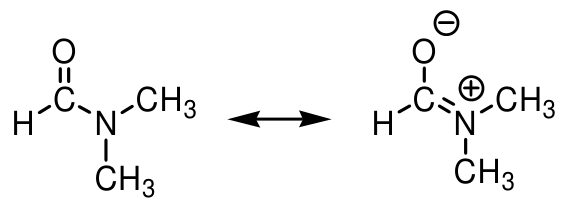
1.1 Predict the order of melting points among N,N-dimethylformamide (compound A), N-methylacetamide (\(\ce{CH3CONHCH3}\), compound B), and propionamide (compound C, \(\ce{CH3CH2CONH2}\),). Express your answer from high to low melting point as follows:
\(\_\_\_\_ > \_\_\_\_ > \_\_\_\_\) (Insert compound codes A, B, C)
1.2 Carbonyl groups are usually identified by their characteristic strong absorptions in the infrared spectra. The position of the absorption is dependent on the strength of the \(\ce{C=O}\) bond, which in turn is reflected in their bond lengths. In amides, the strength of the carbonyl groups can be shown by the resonance structure noted above. For example, cyclohexanone shows an absorption at \(1715\ \mathrm{cm^{-1}}\) for the carbonyl group (\(\ce{C=O}\)). In comparison with cyclohexanone, predict the absorption band for the carbonyl group in propionamide. Select your answer from the following choices.
(a) \(1660\ \mathrm{cm^{-1}}\) because of the shorter carbonyl bond length.
(b) \(1660\ \mathrm{cm^{-1}}\) because of the longer carbonyl bond length.
(c) \(1740\ \mathrm{cm^{-1}}\) because of the shorter carbonyl bond length.
(d) \(1740\ \mathrm{cm^{-1}}\) because of the longer carbonyl bond length.
1.3 Glycine (\(\ce{H2N-CH2-COOH}\)) is an \(\alpha\)-amino acid. Three glycine molecules can form a tripeptide Gly-Gly-Gly via amide linkages, accompanied by elimination of two water molecules. Draw the structural formula of this tripeptide.
1.4 When an \(\alpha\)-amino acid contains a substituent, there is a possibility of optical isomers. For example, L-alanine and D-alanine are two enantiomers. What is the number of all possible linear tripeptides that can be formed from the following three amino acids: glycine, L-alanine and D-alanine as the starting materials in the condensation reaction?
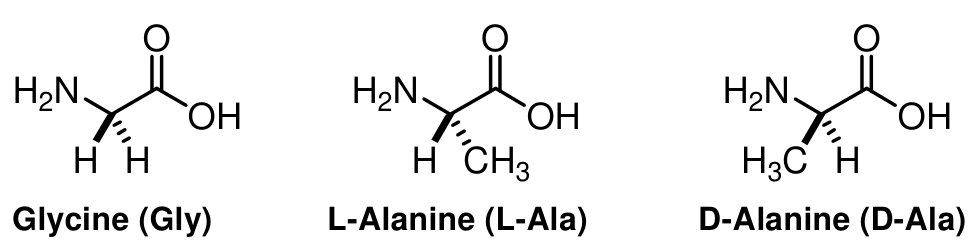
1.5 Among the tripeptides synthesized in 1-4, how many are optically active?
Nowadays, polyacrylamide gel associated with electrophoresis (PAGE) was widely used in analyses of proteins and nucleic acids. However, one of the first applications of polyamide gel is the separation of phenol compounds on thin-layer chromatography. The phenol compounds bearing different substituents have varied acidities. The higher acidity results in stronger binding to PAGE gel.
1.6 Predict the binding affinity of phenol (compound D), 4-methylphenol (compound E) and 4-nitrophenol (compound F) with a polyamide gel. Express your answer from high to low binding affinity as follows:
\(\_\_\_\_ > \_\_\_\_ > \_\_\_\_\) (Insert compound codes D, E, and F)
The absorption maximum of a molecule in its ultraviolet and visible spectrum (UV-vis spectrum) is related to the number of conjugated double bonds in a chain. A compound containing more than 5 conjugated double bonds tends to absorb visible light, and hence shows the complementary colour. For example, phenolphthalein is a commonly used acid-base indicator, which is colourless in acidic and neutral solutions, but reddish pink in basic solutions (\(pH\ 8.3–10.0\)).
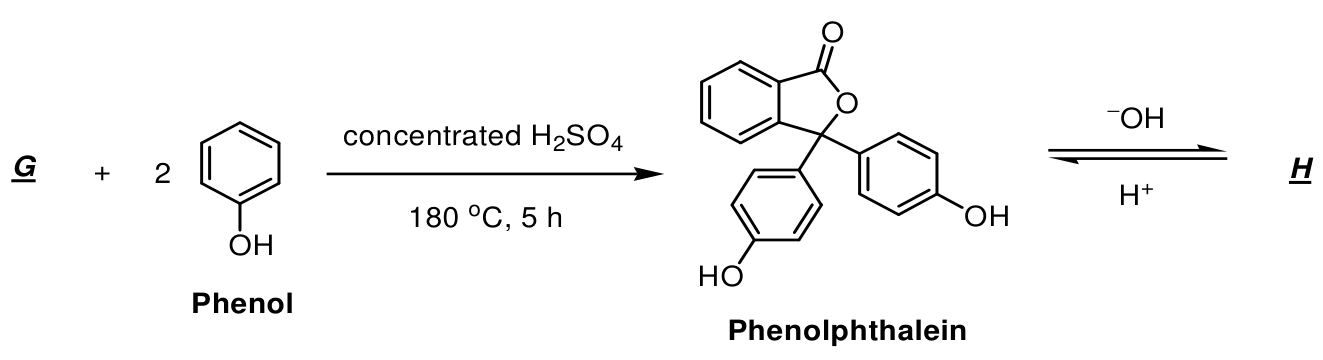
1.7 Draw the structural formula of H derived from phenolphthalein that is attributable to the reddish pink colour in aqueous \(\ce{NaOH}\) solution.
1.8 A simple way to prepare phenolphthalein is via condensation of compound G with 2 equivalents of phenol. What is the most effective reagent for G to accomplish this transformation? Select your answer from the following compounds.
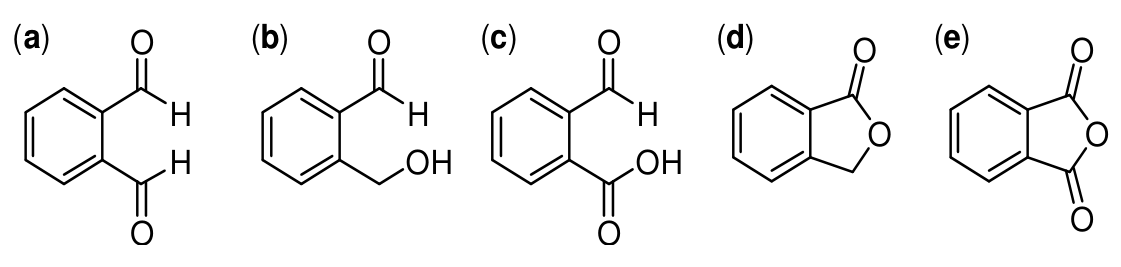
\(\_\_\_\_\_\_\_\_\_\_\_\_\_\_\_\)
Official English text of the problem.
Answers
- 1.1 \(\boxed{C>B>A}\): propionamide
CCC(=O)N> N-methylacetamideCC(=O)NC> N,N-dimethylformamideCN(C)C=O. - 1.2 \(\boxed{\text{(b)}}\): \(1660\ \mathrm{cm^{-1}}\), because the carbonyl bond is longer.
- 1.3 Glycylglycylglycine (triglycine),
NCC(=O)NCC(=O)NCC(=O)O: \[ \boxed{\ce{H2N-CH2-C(=O)-NH-CH2-C(=O)-NH-CH2-COOH}} \] - 1.4 \(\boxed{27}\) linear tripeptides.
- 1.5 \(\boxed{26}\) optically active tripeptides, comprising 13 enantiomeric pairs.
- 1.6 \(\boxed{F>D>E}\): 4-nitrophenol
Oc1ccc([N+](=O)[O-])cc1> phenolOc1ccccc1> 4-methylphenol (p-cresol)Cc1ccc(O)cc1. - 1.7 H is the ring-opened quinonoid dianion of phenolphthalein, \(\ce{C20H12O4^{2-}}\). One resonance contributor is
O=C([O-])c1ccccc1C(=C1C=CC(=O)C=C1)c1ccc([O-])cc1. - 1.8 \(\boxed{\text{(e)}}\): G is phthalic anhydride,
O=C1OC(=O)c2ccccc21.
Solution
1.1
These three amides are constitutional isomers with the same molecular formula, \(\ce{C3H7NO}\). Their different capacities for intermolecular hydrogen bonding provide the principal basis for the prediction.
| Compound | Amide type | Number of \(\ce{N-H}\) bonds per molecule |
|---|---|---|
| A, N,N-dimethylformamide | Tertiary | 0 |
| B, N-methylacetamide | Secondary | 1 |
| C, propionamide | Primary | 2 |
All three have a carbonyl oxygen that can accept hydrogen bonds. Propionamide has two hydrogen-bond donor hydrogens and can form an extensive intermolecular network. N-methylacetamide has one, whereas N,N-dimethylformamide has none.
The expected strength of the hydrogen-bonded crystal lattice therefore increases from A to B to C, giving
\[ \boxed{C>B>A}. \]
1.2
The nitrogen lone pair in propionamide is delocalized into the carbonyl group:
\[ \ce{CH3CH2C(=O)NH2} \;\longleftrightarrow\; \ce{CH3CH2C(-O^-)=NH2^+}. \]
The charge-separated resonance contributor of propionamide has SMILES CCC([O-])=[NH2+].
This contribution gives the carbonyl bond some single-bond character. Consequently, compared with the carbonyl bond in cyclohexanone, O=C1CCCCC1, the amide carbonyl bond is longer and has a smaller stretching force constant.
In the harmonic-oscillator approximation,
\[ \tilde{\nu}\approx \frac{1}{2\pi c}\sqrt{\frac{k}{\mu}}, \]
where \(k\) is the force constant and \(\mu\) is the effective reduced mass. The smaller force constant lowers the absorption wavenumber relative to \(1715\ \mathrm{cm^{-1}}\).
Thus the correct choice is
\[ \boxed{\text{(b): }1660\ \mathrm{cm^{-1}},\text{ because of the longer carbonyl bond length}.} \]
1.3
Glycine is NCC(=O)O. Joining three glycine molecules requires two peptide bonds, each formed with elimination of one water molecule, O:
\[ \ce{ 3 H2N-CH2-COOH -> H2N-CH2-C(=O)-NH-CH2-C(=O)-NH-CH2-COOH + 2 H2O }. \]
The product is glycylglycylglycine, also called triglycine, NCC(=O)NCC(=O)NCC(=O)O.
The requested drawing is a linear chain with a free amino group at one end, a free carboxyl group at the other, and two intervening \(\ce{-C(=O)-NH-}\) peptide linkages. Each amino-acid residue has a \(\ce{CH2}\) group at its \(\alpha\)-carbon.
1.4
The available residues are:
| Amino acid | Configuration | SMILES |
|---|---|---|
| Glycine | Achiral | NCC(=O)O |
| L-alanine | \(S\) | N[C@@H](C)C(=O)O |
| D-alanine | \(R\) | N[C@H](C)C(=O)O |
Each of the three positions can independently contain any of these three residues. Repetition is allowed, as illustrated by Gly-Gly-Gly in 1.3.
Peptide sequences are read from the amino terminus to the carboxyl terminus. Because these termini are different, reversing a sequence generally gives a different peptide.
Therefore,
\[ N=3\times3\times3=\boxed{27}. \]
1.5
Gly-Gly-Gly contains no stereogenic centre and is achiral. Every other peptide contains at least one alanine residue.
Taking a mirror image exchanges L-alanine and D-alanine at each occupied position while leaving glycine unchanged. The distinct amino and carboxyl termini prevent a symmetry operation from reversing the chain and identifying different residue positions. Thus mixed L/D sequences do not produce meso peptides.
Only Gly-Gly-Gly is identical to its mirror image. Hence,
\[ N_{\text{optically active}}=27-1=\boxed{26}. \]
These constitute
\[ \frac{26}{2}=\boxed{13} \]
enantiomeric pairs. This counts individual peptide species; an equimolar mixture of an enantiomeric pair would have zero net optical rotation.
1.6
The problem states that greater phenol acidity gives stronger binding to the gel. The acidity order follows from stabilization of the conjugate bases:
| Parent compound | Conjugate base | SMILES of conjugate base |
|---|---|---|
| D, phenol | Phenoxide | [O-]c1ccccc1 |
| E, 4-methylphenol | 4-Methylphenoxide | Cc1ccc([O-])cc1 |
| F, 4-nitrophenol | 4-Nitrophenoxide | [O-]c1ccc([N+](=O)[O-])cc1 |
The para nitro group withdraws electron density through both induction and resonance, stabilizing the conjugate base and increasing acidity. The methyl group donates electron density, making the corresponding phenol less acidic than unsubstituted phenol.
Therefore,
\[ \text{acidity: }F>D>E. \]
Following the stated relationship between acidity and gel binding,
\[ \boxed{\text{binding affinity: }F>D>E}. \]
The phenolic hydrogen can form a hydrogen bond to an amide carbonyl oxygen in the gel; the more acidic phenols are stronger donors in this interaction.
1.7
Neutral phenolphthalein, O=C1OC(c2ccc(O)cc2)(c2ccc(O)cc2)c2ccccc21, contains a closed lactone ring and a tetrahedral central carbon. That carbon interrupts conjugation between the phenol-derived rings.
In the stated basic indicator range, removal of two protons and opening of the lactone ring give the quinonoid phenolphthalein dianion H:
O=C([O-])c1ccccc1C(=C1C=CC(=O)C=C1)c1ccc([O-])cc1
The balanced net ionic equation is
\[ \boxed{\ce{C20H14O4 + 2 OH^- <=> C20H12O4^{2-} + 2 H2O}}. \]
Here hydroxide, [OH-], is supplied by aqueous sodium hydroxide, [Na+].[OH-].
To draw the displayed resonance contributor precisely:
- Open the lactone by breaking the bond between its ring oxygen and the central carbon. The resulting carboxylate group is ortho to the central-carbon substituent on the original fused benzene ring.
- Connect the central carbon by single bonds to that benzene ring and to a para-phenoxide ring.
- Double-bond the central carbon to the second phenol-derived ring. Draw this ring in quinonoid form, with a carbonyl group para to the exocyclic double bond and two internal \(\ce{C=C}\) bonds.
- Place one negative charge on the phenoxide oxygen and one on a carboxylate oxygen, giving an overall charge of \(2-\).
Electron donation from a deprotonated phenolic oxygen, accompanied by shifts of the ring \(\pi\) bonds and cleavage of the lactone bond, produces this conjugated arrangement. An equivalent resonance contributor exchanges the carbonyl and phenoxide roles of the two phenol-derived rings.
The SMILES represents one contributor; the actual electronic structure has delocalized bonding and charge. The central carbon is now trigonal planar, allowing extended conjugation that shifts absorption into the visible region and produces the reddish pink colour.
1.8
The correct reagent is phthalic anhydride, O=C1OC(=O)c2ccccc21, corresponding to (e).
Its cyclic anhydride supplies the two adjacent carbonyl-derived carbon atoms required for the lactone framework. Acid activation permits condensation with phenol, whose hydroxyl group directs substitution to the para position. Incorporation of two phenol molecules and lactone formation give phenolphthalein.
The balanced overall reaction is
\[ \boxed{\ce{C8H4O3 + 2 C6H5OH -> C20H14O4 + H2O}}. \]
The reactants and product are phthalic anhydride, phenol Oc1ccccc1, and phenolphthalein O=C1OC(c2ccc(O)cc2)(c2ccc(O)cc2)c2ccccc21, respectively.
The stated conditions are concentrated sulfuric acid, OS(=O)(=O)O, at \(180\,^\circ\mathrm{C}\) for \(5\ \mathrm{h}\). The acid promotes the condensation and is not consumed in the net equation. Starting from the anhydride gives one water molecule as the net byproduct.
The solution was checked against the official solution.
IChO 2005 · Theorieaufgabe 1
Chemie der Amide und Phenole
Bei der Kondensation einer Carbonsäure mit einem Amin entsteht ein Amid. Beispielsweise bildet sich bei der Kondensation von Ameisensäure mit Dimethylamin N,N-Dimethylformamid (DMF), das durch die folgenden mesomeren Grenzstrukturen beschrieben werden kann.
1.1 Sagen Sie die Reihenfolge der Schmelzpunkte von N,N-Dimethylformamid (Verbindung A), N-Methylacetamid (\(\ce{CH3CONHCH3}\), Verbindung B) und Propionamid (Verbindung C, \(\ce{CH3CH2CONH2}\),) voraus. Geben Sie Ihre Antwort in absteigender Reihenfolge der Schmelzpunkte wie folgt an:
\(\_\_\_\_ > \_\_\_\_ > \_\_\_\_\) (Tragen Sie die Verbindungscodes A, B, C ein.)
1.2 Carbonylgruppen werden gewöhnlich anhand ihrer charakteristischen starken Absorptionen in Infrarotspektren identifiziert. Die Lage der Absorption hängt von der Stärke der \(\ce{C=O}\)-Bindung ab, die sich wiederum in ihrer Bindungslänge widerspiegelt. Bei Amiden lässt sich die Stärke der Carbonylgruppen durch die oben angegebene mesomere Grenzstruktur veranschaulichen. Beispielsweise zeigt Cyclohexanon eine Absorption bei \(1715\ \mathrm{cm^{-1}}\) für die Carbonylgruppe (\(\ce{C=O}\)). Sagen Sie im Vergleich zu Cyclohexanon die Absorptionsbande der Carbonylgruppe in Propionamid voraus. Wählen Sie Ihre Antwort aus den folgenden Möglichkeiten.
(a) \(1660\ \mathrm{cm^{-1}}\) aufgrund der kürzeren Carbonylbindung.
(b) \(1660\ \mathrm{cm^{-1}}\) aufgrund der längeren Carbonylbindung.
(c) \(1740\ \mathrm{cm^{-1}}\) aufgrund der kürzeren Carbonylbindung.
(d) \(1740\ \mathrm{cm^{-1}}\) aufgrund der längeren Carbonylbindung.
1.3 Glycin (\(\ce{H2N-CH2-COOH}\)) ist eine \(\alpha\)-Aminosäure. Drei Glycinmoleküle können über Amidbindungen unter Abspaltung zweier Wassermoleküle das Tripeptid Gly-Gly-Gly bilden. Zeichnen Sie die Strukturformel dieses Tripeptids.
1.4 Wenn eine \(\alpha\)-Aminosäure einen Substituenten enthält, können optische Isomere auftreten. Beispielsweise sind L-Alanin und D-Alanin zwei Enantiomere. Wie groß ist die Anzahl aller möglichen linearen Tripeptide, die aus den folgenden drei Aminosäuren als Ausgangsstoffen der Kondensationsreaktion gebildet werden können: Glycin, L-Alanin und D-Alanin?
1.5 Wie viele der in 1-4 synthetisierten Tripeptide sind optisch aktiv?
Heutzutage wird die Polyacrylamid-Gelelektrophorese (PAGE) häufig zur Analyse von Proteinen und Nukleinsäuren eingesetzt. Eine der ersten Anwendungen von Polyamidgel war jedoch die Trennung phenolischer Verbindungen mittels Dünnschichtchromatographie. Phenolische Verbindungen mit unterschiedlichen Substituenten weisen unterschiedliche Aciditäten auf. Eine höhere Acidität führt zu einer stärkeren Bindung an das PAGE-Gel.
1.6 Sagen Sie die Bindungsaffinität von Phenol (Verbindung D), 4-Methylphenol (Verbindung E) und 4-Nitrophenol (Verbindung F) zu einem Polyamidgel voraus. Geben Sie Ihre Antwort in absteigender Reihenfolge der Bindungsaffinität wie folgt an:
\(\_\_\_\_ > \_\_\_\_ > \_\_\_\_\) (Tragen Sie die Verbindungscodes D, E und F ein.)
Das Absorptionsmaximum eines Moleküls in seinem Ultraviolett- und sichtbaren Spektrum (UV-Vis-Spektrum) hängt mit der Anzahl konjugierter Doppelbindungen in einer Kette zusammen. Eine Verbindung mit mehr als 5 konjugierten Doppelbindungen absorbiert tendenziell sichtbares Licht und zeigt daher die Komplementärfarbe. Beispielsweise ist Phenolphthalein ein häufig verwendeter Säure-Base-Indikator, der in sauren und neutralen Lösungen farblos ist, in basischen Lösungen jedoch rötlich rosa erscheint (\(pH\ 8.3–10.0\)).
1.7 Zeichnen Sie die Strukturformel der von Phenolphthalein abgeleiteten Verbindung H, die für die rötlich rosa Farbe in wässriger \(\ce{NaOH}\)-Lösung verantwortlich ist.
1.8 Eine einfache Methode zur Herstellung von Phenolphthalein ist die Kondensation der Verbindung G mit 2 Äquivalenten Phenol. Welches Reagenz eignet sich als G am besten, um diese Umsetzung durchzuführen? Wählen Sie Ihre Antwort aus den folgenden Verbindungen.
\(\_\_\_\_\_\_\_\_\_\_\_\_\_\_\_\)
Aufgabentext aus dem offiziellen englischen Text übersetzt.
Antworten
- 1.1 \(\boxed{C>B>A}\): Propionamid
CCC(=O)N> N-MethylacetamidCC(=O)NC> N,N-DimethylformamidCN(C)C=O. - 1.2 \(\boxed{\text{(b)}}\): \(1660\ \mathrm{cm^{-1}}\), da die Carbonylbindung länger ist.
- 1.3 Glycylglycylglycin (Triglycin),
NCC(=O)NCC(=O)NCC(=O)O: \[ \boxed{\ce{H2N-CH2-C(=O)-NH-CH2-C(=O)-NH-CH2-COOH}} \] - 1.4 \(\boxed{27}\) lineare Tripeptide.
- 1.5 \(\boxed{26}\) optisch aktive Tripeptide, die 13 Enantiomerenpaare bilden.
- 1.6 \(\boxed{F>D>E}\): 4-Nitrophenol
Oc1ccc([N+](=O)[O-])cc1> PhenolOc1ccccc1> 4-Methylphenol (p-Kresol)Cc1ccc(O)cc1. - 1.7 H ist das chinoide Dianion von Phenolphthalein mit geöffnetem Ring, \(\ce{C20H12O4^{2-}}\). Eine mesomere Grenzstruktur ist
O=C([O-])c1ccccc1C(=C1C=CC(=O)C=C1)c1ccc([O-])cc1. - 1.8 \(\boxed{\text{(e)}}\): G ist Phthalsäureanhydrid,
O=C1OC(=O)c2ccccc21.
Lösung
1.1
Diese drei Amide sind Konstitutionsisomere mit derselben Summenformel, \(\ce{C3H7NO}\). Ihre unterschiedlichen Möglichkeiten zur Ausbildung intermolekularer Wasserstoffbrückenbindungen bilden die wesentliche Grundlage für die Vorhersage.
| Verbindung | Amidtyp | Anzahl der \(\ce{N-H}\)-Bindungen pro Molekül |
|---|---|---|
| A, N,N-Dimethylformamid | Tertiär | 0 |
| B, N-Methylacetamid | Sekundär | 1 |
| C, Propionamid | Primär | 2 |
Alle drei besitzen ein Carbonylsauerstoffatom, das als Wasserstoffbrückenakzeptor wirken kann. Propionamid besitzt zwei Wasserstoffatome, die als Wasserstoffbrückendonoren wirken können, und kann ein ausgedehntes intermolekulares Netzwerk bilden. N-Methylacetamid besitzt eines, N,N-Dimethylformamid hingegen keines.
Die erwartete Festigkeit des durch Wasserstoffbrückenbindungen zusammengehaltenen Kristallgitters nimmt daher von A über B zu C zu, sodass sich ergibt:
\[ \boxed{C>B>A}. \]
1.2
Das freie Elektronenpaar am Stickstoffatom in Propionamid ist in die Carbonylgruppe hinein delokalisiert:
\[ \ce{CH3CH2C(=O)NH2} \;\longleftrightarrow\; \ce{CH3CH2C(-O^-)=NH2^+}. \]
Die mesomere Grenzstruktur von Propionamid mit getrennten Ladungen hat den SMILES-Code CCC([O-])=[NH2+].
Dieser Beitrag verleiht der Carbonylbindung einen gewissen Einfachbindungscharakter. Daher ist die Amidcarbonylbindung im Vergleich zur Carbonylbindung in Cyclohexanon, O=C1CCCCC1, länger und besitzt eine kleinere Kraftkonstante der Streckschwingung.
In der Näherung des harmonischen Oszillators gilt:
\[ \tilde{\nu}\approx \frac{1}{2\pi c}\sqrt{\frac{k}{\mu}}, \]
wobei \(k\) die Kraftkonstante und \(\mu\) die effektive reduzierte Masse ist. Die kleinere Kraftkonstante senkt die Absorptionswellenzahl gegenüber \(1715\ \mathrm{cm^{-1}}\).
Die richtige Antwort ist somit:
\[ \boxed{\text{(b): }1660\ \mathrm{cm^{-1}},\text{ aufgrund der längeren Carbonylbindung}.} \]
1.3
Glycin ist NCC(=O)O. Zur Verknüpfung dreier Glycinmoleküle sind zwei Peptidbindungen erforderlich, die jeweils unter Abspaltung eines Wassermoleküls, O, entstehen:
\[ \ce{ 3 H2N-CH2-COOH -> H2N-CH2-C(=O)-NH-CH2-C(=O)-NH-CH2-COOH + 2 H2O }. \]
Das Produkt ist Glycylglycylglycin, auch Triglycin genannt, NCC(=O)NCC(=O)NCC(=O)O.
Die geforderte Zeichnung zeigt eine lineare Kette mit einer freien Aminogruppe an einem Ende, einer freien Carboxylgruppe am anderen Ende und zwei dazwischenliegenden \(\ce{-C(=O)-NH-}\)-Peptidbindungen. Jeder Aminosäurerest besitzt am \(\alpha\)-Kohlenstoffatom eine \(\ce{CH2}\)-Gruppe.
1.4
Die verfügbaren Reste sind:
| Aminosäure | Konfiguration | SMILES |
|---|---|---|
| Glycin | Achiral | NCC(=O)O |
| L-Alanin | \(S\) | N[C@@H](C)C(=O)O |
| D-Alanin | \(R\) | N[C@H](C)C(=O)O |
Jede der drei Positionen kann unabhängig von den anderen einen beliebigen dieser drei Reste enthalten. Wiederholungen sind erlaubt, wie Gly-Gly-Gly in 1.3 veranschaulicht.
Peptidsequenzen werden vom Aminoterminus zum Carboxylterminus gelesen. Da diese Enden unterschiedlich sind, ergibt die Umkehrung einer Sequenz im Allgemeinen ein anderes Peptid.
Daher gilt:
\[ N=3\times3\times3=\boxed{27}. \]
1.5
Gly-Gly-Gly enthält kein stereogenes Zentrum und ist achiral. Jedes andere Peptid enthält mindestens einen Alaninrest.
Bei der Spiegelung werden L-Alanin und D-Alanin an jeder besetzten Position miteinander vertauscht, während Glycin unverändert bleibt. Die unterschiedlichen Amino- und Carboxyltermini verhindern, dass eine Symmetrieoperation die Kette umkehrt und unterschiedliche Restpositionen zur Deckung bringt. Gemischte L/D-Sequenzen ergeben daher keine meso-Peptide.
Nur Gly-Gly-Gly ist mit seinem Spiegelbild identisch. Somit gilt:
\[ N_{\text{optisch aktiv}}=27-1=\boxed{26}. \]
Diese bilden
\[ \frac{26}{2}=\boxed{13} \]
Enantiomerenpaare. Dabei werden einzelne Peptidspezies gezählt; ein äquimolares Gemisch eines Enantiomerenpaars würde insgesamt keine optische Drehung aufweisen.
1.6
Laut Aufgabenstellung führt eine höhere Acidität des Phenols zu einer stärkeren Bindung an das Gel. Die Reihenfolge der Acidität ergibt sich aus der Stabilisierung der konjugierten Basen:
| Ausgangsverbindung | Konjugierte Base | SMILES der konjugierten Base |
|---|---|---|
| D, Phenol | Phenolat | [O-]c1ccccc1 |
| E, 4-Methylphenol | 4-Methylphenolat | Cc1ccc([O-])cc1 |
| F, 4-Nitrophenol | 4-Nitrophenolat | [O-]c1ccc([N+](=O)[O-])cc1 |
Die Nitrogruppe in para-Stellung zieht sowohl durch induktive als auch durch mesomere Effekte Elektronendichte ab, stabilisiert dadurch die konjugierte Base und erhöht die Acidität. Die Methylgruppe gibt Elektronendichte ab, wodurch das entsprechende Phenol weniger sauer ist als unsubstituiertes Phenol.
Daher gilt:
\[ \text{Acidität: }F>D>E. \]
Aus dem angegebenen Zusammenhang zwischen Acidität und Bindung an das Gel folgt:
\[ \boxed{\text{Bindungsaffinität: }F>D>E}. \]
Das phenolische Wasserstoffatom kann eine Wasserstoffbrückenbindung zu einem Amidcarbonylsauerstoffatom im Gel bilden; die saureren Phenole sind bei dieser Wechselwirkung stärkere Donoren.
1.7
Neutrales Phenolphthalein, O=C1OC(c2ccc(O)cc2)(c2ccc(O)cc2)c2ccccc21, enthält einen geschlossenen Lactonring und ein tetraedrisches zentrales Kohlenstoffatom. Dieses Kohlenstoffatom unterbricht die Konjugation zwischen den vom Phenol abgeleiteten Ringen.
Im angegebenen basischen Umschlagsbereich des Indikators führen die Abspaltung zweier Protonen und die Öffnung des Lactonrings zum chinoiden Phenolphthalein-Dianion H:
O=C([O-])c1ccccc1C(=C1C=CC(=O)C=C1)c1ccc([O-])cc1
Die ausgeglichene Netto-Ionengleichung lautet:
\[ \boxed{\ce{C20H14O4 + 2 OH^- <=> C20H12O4^{2-} + 2 H2O}}. \]
Hier wird Hydroxid, [OH-], durch wässrige Natriumhydroxidlösung, [Na+].[OH-], bereitgestellt.
So zeichnen Sie die dargestellte mesomere Grenzstruktur genau:
- Öffnen Sie den Lactonring, indem Sie die Bindung zwischen seinem Ringsauerstoffatom und dem zentralen Kohlenstoffatom aufbrechen. Die entstehende Carboxylatgruppe steht am ursprünglich anellierten Benzolring in ortho-Stellung zum Substituenten mit dem zentralen Kohlenstoffatom.
- Verbinden Sie das zentrale Kohlenstoffatom durch Einfachbindungen mit diesem Benzolring und mit einem para-Phenolatring.
- Verbinden Sie das zentrale Kohlenstoffatom durch eine Doppelbindung mit dem zweiten vom Phenol abgeleiteten Ring. Zeichnen Sie diesen Ring in chinoider Form mit einer Carbonylgruppe in para-Stellung zur exocyclischen Doppelbindung und zwei innerhalb des Rings liegenden \(\ce{C=C}\)-Bindungen.
- Platzieren Sie eine negative Ladung am Phenolatsauerstoffatom und eine an einem Carboxylatsauerstoffatom, sodass sich eine Gesamtladung von \(2-\) ergibt.
Die Elektronenabgabe eines deprotonierten phenolischen Sauerstoffatoms, begleitet von Verschiebungen der \(\pi\)-Bindungen des Rings und der Spaltung der Lactonbindung, erzeugt diese konjugierte Anordnung. In einer gleichwertigen mesomeren Grenzstruktur sind die Rollen als Carbonylgruppe und Phenolatgruppe der beiden vom Phenol abgeleiteten Ringe vertauscht.
Der SMILES-Code stellt eine Grenzstruktur dar; in der tatsächlichen elektronischen Struktur sind Bindungen und Ladung delokalisiert. Das zentrale Kohlenstoffatom ist nun trigonal-planar, wodurch eine ausgedehnte Konjugation ermöglicht wird, die die Absorption in den sichtbaren Bereich verschiebt und die rötlich rosa Farbe hervorruft.
1.8
Das richtige Reagenz ist Phthalsäureanhydrid, O=C1OC(=O)c2ccccc21, entsprechend (e).
Seine cyclische Anhydridgruppe liefert die beiden benachbarten, von Carbonylgruppen stammenden Kohlenstoffatome, die für das Lactongerüst erforderlich sind. Die Aktivierung durch Säure ermöglicht die Kondensation mit Phenol, dessen Hydroxylgruppe die Substitution in die para-Stellung dirigiert. Der Einbau zweier Phenolmoleküle und die Lactonbildung ergeben Phenolphthalein.
Die ausgeglichene Gesamtreaktion lautet:
\[ \boxed{\ce{C8H4O3 + 2 C6H5OH -> C20H14O4 + H2O}}. \]
Die Edukte und das Produkt sind Phthalsäureanhydrid, Phenol Oc1ccccc1 beziehungsweise Phenolphthalein O=C1OC(c2ccc(O)cc2)(c2ccc(O)cc2)c2ccccc21.
Die angegebenen Bedingungen sind konzentrierte Schwefelsäure, OS(=O)(=O)O, bei \(180\,^\circ\mathrm{C}\) für \(5\ \mathrm{h}\). Die Säure fördert die Kondensation und wird in der Nettogleichung nicht verbraucht. Ausgehend vom Anhydrid entsteht netto ein Wassermolekül als Nebenprodukt.
Die Lösung wurde mit der offiziellen Lösung abgeglichen.
IChO 2005 · Teori sorusu 1
Amitlerin ve Fenollerin Kimyası
Bir karboksilik asidin bir aminle kondenzasyonu bir amit ürünü verir. Örneğin, formik asidin dimetilaminle kondenzasyonu sonucunda, aşağıdaki rezonans yapılarıyla gösterilebilen N,N-dimetilformamit (DMF) oluşur.
1.1 N,N-dimetilformamit (A bileşiği), N-metilasetamit (\(\ce{CH3CONHCH3}\), B bileşiği) ve propiyonamidin (C bileşiği, \(\ce{CH3CH2CONH2}\),) erime noktalarının sıralamasını tahmin edin. Cevabınızı yüksek erime noktasından düşük erime noktasına doğru aşağıdaki gibi ifade edin:
\(\_\_\_\_ > \_\_\_\_ > \_\_\_\_\) (A, B, C bileşik kodlarını yazın)
1.2 Karbonil grupları genellikle kızılötesi spektrumlarındaki karakteristik güçlü soğurma bantlarıyla tanımlanır. Soğurmanın konumu, \(\ce{C=O}\) bağının kuvvetine bağlıdır; bu kuvvet de bağ uzunluklarına yansır. Amitlerde karbonil gruplarının bağ kuvveti, yukarıda belirtilen rezonans yapısıyla gösterilebilir. Örneğin, siklohekzanonun karbonil grubu (\(\ce{C=O}\)), \(1715\ \mathrm{cm^{-1}}\) değerinde soğurma gösterir. Siklohekzanonla karşılaştırarak propiyonamitteki karbonil grubunun soğurma bandını tahmin edin. Cevabınızı aşağıdaki seçeneklerden seçin.
(a) Karbonil bağının daha kısa olması nedeniyle \(1660\ \mathrm{cm^{-1}}\).
(b) Karbonil bağının daha uzun olması nedeniyle \(1660\ \mathrm{cm^{-1}}\).
(c) Karbonil bağının daha kısa olması nedeniyle \(1740\ \mathrm{cm^{-1}}\).
(d) Karbonil bağının daha uzun olması nedeniyle \(1740\ \mathrm{cm^{-1}}\).
1.3 Glisin (\(\ce{H2N-CH2-COOH}\)) bir \(\alpha\)-amino asittir. Üç glisin molekülü, iki su molekülünün ayrılmasıyla birlikte amit bağları aracılığıyla Gly-Gly-Gly tripeptidini oluşturabilir. Bu tripeptidin yapı formülünü çizin.
1.4 Bir \(\alpha\)-amino asit bir sübstitüent içerdiğinde optik izomerlerin bulunması mümkündür. Örneğin, L-alanin ve D-alanin iki enantiyomerdir. Kondenzasyon tepkimesinde başlangıç maddeleri olarak glisin, L-alanin ve D-alanin kullanıldığında oluşabilecek tüm doğrusal tripeptitlerin sayısı kaçtır?
1.5 1-4'te sentezlenen tripeptitlerden kaçı optikçe aktiftir?
Günümüzde, elektroforezle birlikte kullanılan poliakrilamit jel (PAGE), proteinlerin ve nükleik asitlerin analizlerinde yaygın olarak kullanılmaktadır. Bununla birlikte, poliamit jelin ilk uygulamalarından biri, fenol bileşiklerinin ince tabaka kromatografisiyle ayrılmasıdır. Farklı sübstitüentler taşıyan fenol bileşiklerinin asitlikleri farklıdır. Daha yüksek asitlik, PAGE jeline daha güçlü bağlanmayla sonuçlanır.
1.6 Fenol (D bileşiği), 4-metilfenol (E bileşiği) ve 4-nitrofenolün (F bileşiği) bir poliamit jele bağlanma afinitelerini tahmin edin. Cevabınızı yüksek bağlanma afinitesinden düşük bağlanma afinitesine doğru aşağıdaki gibi ifade edin:
\(\_\_\_\_ > \_\_\_\_ > \_\_\_\_\) (D, E ve F bileşik kodlarını yazın)
Bir molekülün ultraviyole ve görünür bölge spektrumundaki (UV-vis spektrumu) soğurma maksimumu, bir zincirdeki konjuge çift bağların sayısıyla ilişkilidir. 5'ten fazla konjuge çift bağ içeren bir bileşik, görünür ışığı soğurma eğilimindedir ve dolayısıyla tamamlayıcı rengi gösterir. Örneğin, yaygın olarak kullanılan bir asit-baz indikatörü olan fenolftalein, asidik ve nötr çözeltilerde renksiz, bazik çözeltilerde ise kırmızımsı pembedir (\(pH\ 8.3–10.0\)).
1.7 Fenolftaleinden türeyen ve sulu \(\ce{NaOH}\) çözeltisindeki kırmızımsı pembe renkten sorumlu olan H'nin yapı formülünü çizin.
1.8 Fenolftalein hazırlamanın basit bir yolu, G bileşiğinin 2 eşdeğer fenolle kondenzasyonudur. Bu dönüşümü gerçekleştirmek için G olarak kullanılabilecek en etkili reaktif hangisidir? Cevabınızı aşağıdaki bileşiklerden seçin.
\(\_\_\_\_\_\_\_\_\_\_\_\_\_\_\_\)
Soru metni resmi İngilizce metinden çevrilmiştir.
Cevaplar
- 1.1 \(\boxed{C>B>A}\): propiyonamit
CCC(=O)N> N-metilasetamitCC(=O)NC> N,N-dimetilformamitCN(C)C=O. - 1.2 \(\boxed{\text{(b)}}\): \(1660\ \mathrm{cm^{-1}}\), çünkü karbonil bağı daha uzundur.
- 1.3 Glisilglisilglisin (triglisin),
NCC(=O)NCC(=O)NCC(=O)O: \[ \boxed{\ce{H2N-CH2-C(=O)-NH-CH2-C(=O)-NH-CH2-COOH}} \] - 1.4 \(\boxed{27}\) doğrusal tripeptit.
- 1.5 13 enantiyomer çifti oluşturan \(\boxed{26}\) optikçe aktif tripeptit.
- 1.6 \(\boxed{F>D>E}\): 4-nitrofenol
Oc1ccc([N+](=O)[O-])cc1> fenolOc1ccccc1> 4-metilfenol (p-krezol)Cc1ccc(O)cc1. - 1.7 H, fenolftaleinin halkası açılmış kinoid dianyonudur, \(\ce{C20H12O4^{2-}}\). Rezonansa katkıda bulunan yapılardan biri
O=C([O-])c1ccccc1C(=C1C=CC(=O)C=C1)c1ccc([O-])cc1şeklindedir. - 1.8 \(\boxed{\text{(e)}}\): G, ftalik anhidrittir,
O=C1OC(=O)c2ccccc21.
Çözüm
1.1
Bu üç amit, aynı molekül formülüne, \(\ce{C3H7NO}\), sahip yapı izomerleridir. Moleküller arası hidrojen bağı oluşturma kapasitelerindeki farklılıklar, tahminin temel dayanağını oluşturur.
| Bileşik | Amit türü | Molekül başına \(\ce{N-H}\) bağı sayısı |
|---|---|---|
| A, N,N-dimetilformamit | Tersiyer | 0 |
| B, N-metilasetamit | Sekonder | 1 |
| C, propiyonamit | Primer | 2 |
Üçünün de hidrojen bağı kabul edebilen bir karbonil oksijeni vardır. Propiyonamit, hidrojen bağı vericisi olan iki hidrojene sahiptir ve kapsamlı bir moleküller arası ağ oluşturabilir. N-metilasetamit bunlardan birine sahipken N,N-dimetilformamitte hiçbiri yoktur.
Dolayısıyla, hidrojen bağlarıyla oluşan kristal örgünün beklenen dayanıklılığı A'dan B'ye ve C'ye doğru artar ve şu sıralama elde edilir:
\[ \boxed{C>B>A}. \]
1.2
Propiyonamitte azotun ortaklanmamış elektron çifti, karbonil grubuna doğru delokalize olur:
\[ \ce{CH3CH2C(=O)NH2} \;\longleftrightarrow\; \ce{CH3CH2C(-O^-)=NH2^+}. \]
Propiyonamidin yüklerin ayrıldığı rezonans yapısının SMILES gösterimi CCC([O-])=[NH2+] şeklindedir.
Bu katkı, karbonil bağına bir miktar tek bağ karakteri kazandırır. Bunun sonucunda amit karbonil bağı, siklohekzanondaki, O=C1CCCCC1, karbonil bağına kıyasla daha uzundur ve daha küçük bir gerilme kuvvet sabitine sahiptir.
Harmonik osilatör yaklaşımında,
\[ \tilde{\nu}\approx \frac{1}{2\pi c}\sqrt{\frac{k}{\mu}}, \]
burada \(k\) kuvvet sabiti, \(\mu\) ise etkin indirgenmiş kütledir. Daha küçük kuvvet sabiti, soğurma dalga sayısını \(1715\ \mathrm{cm^{-1}}\) değerinin altına düşürür.
Dolayısıyla doğru seçenek şudur:
\[ \boxed{\text{(b): }1660\ \mathrm{cm^{-1}},\text{ karbonil bağının daha uzun olması nedeniyle}.} \]
1.3
Glisinin SMILES gösterimi NCC(=O)O şeklindedir. Üç glisin molekülünün birleştirilmesi, her biri bir su molekülünün, O, ayrılmasıyla oluşan iki peptit bağı gerektirir:
\[ \ce{ 3 H2N-CH2-COOH -> H2N-CH2-C(=O)-NH-CH2-C(=O)-NH-CH2-COOH + 2 H2O }. \]
Ürün, triglisin olarak da adlandırılan glisilglisilglisin, NCC(=O)NCC(=O)NCC(=O)O, bileşiğidir.
İstenen çizim, bir ucunda serbest bir amino grubu, diğer ucunda serbest bir karboksil grubu ve arada iki \(\ce{-C(=O)-NH-}\) peptit bağı bulunan doğrusal bir zincirdir. Her amino asit kalıntısının \(\alpha\)-karbonunda bir \(\ce{CH2}\) grubu bulunur.
1.4
Kullanılabilecek kalıntılar şunlardır:
| Amino asit | Konfigürasyon | SMILES |
|---|---|---|
| Glisin | Akiral | NCC(=O)O |
| L-alanin | \(S\) | N[C@@H](C)C(=O)O |
| D-alanin | \(R\) | N[C@H](C)C(=O)O |
Üç konumun her biri, birbirinden bağımsız olarak bu üç kalıntıdan herhangi birini içerebilir. 1.3'teki Gly-Gly-Gly örneğinde gösterildiği gibi tekrara izin verilir.
Peptit dizileri amino ucundan karboksil ucuna doğru okunur. Bu uçlar farklı olduğundan, bir dizinin ters çevrilmesi genellikle farklı bir peptit verir.
Dolayısıyla,
\[ N=3\times3\times3=\boxed{27}. \]
1.5
Gly-Gly-Gly hiçbir stereojenik merkez içermez ve akiraldir. Diğer peptitlerin her biri en az bir alanin kalıntısı içerir.
Ayna görüntüsü alındığında, alanin içeren her konumda L-alanin ile D-alanin yer değiştirirken glisin değişmeden kalır. Amino ve karboksil uçlarının farklı olması, zinciri ters çevirerek farklı kalıntı konumlarını eşdeğer kılacak bir simetri işlemini engeller. Bu nedenle karışık L/D dizileri mezo peptitler oluşturmaz.
Yalnızca Gly-Gly-Gly kendi ayna görüntüsüyle özdeştir. Bu nedenle,
\[ N_{\text{optikçe aktif}}=27-1=\boxed{26}. \]
Bunlar
\[ \frac{26}{2}=\boxed{13} \]
enantiyomer çifti oluşturur. Bu sayım, tek tek peptit türlerini kapsar; bir enantiyomer çiftinin eşmolar karışımının net optik çevirmesi sıfır olur.
1.6
Soruda, fenolün asitliği arttıkça jele daha güçlü bağlandığı belirtilmektedir. Asitlik sıralaması, eşlenik bazların kararlılığından elde edilir:
| Başlangıç bileşiği | Eşlenik baz | Eşlenik bazın SMILES gösterimi |
|---|---|---|
| D, fenol | Fenoksit | [O-]c1ccccc1 |
| E, 4-metilfenol | 4-Metilfenoksit | Cc1ccc([O-])cc1 |
| F, 4-nitrofenol | 4-Nitrofenoksit | [O-]c1ccc([N+](=O)[O-])cc1 |
Para konumundaki nitro grubu, hem indüktif etki hem de rezonans yoluyla elektron yoğunluğunu çeker; böylece eşlenik bazı kararlı hâle getirir ve asitliği artırır. Metil grubu ise elektron yoğunluğu verir ve ilgili fenolü sübstitüe olmamış fenolden daha az asidik hâle getirir.
Dolayısıyla,
\[ \text{asitlik: }F>D>E. \]
Asitlik ile jele bağlanma arasında belirtilen ilişkiye göre,
\[ \boxed{\text{bağlanma afinitesi: }F>D>E}. \]
Fenolik hidrojen, jeldeki bir amit karbonil oksijeniyle hidrojen bağı oluşturabilir; daha asidik fenoller bu etkileşimde daha güçlü vericilerdir.
1.7
Nötr fenolftalein, O=C1OC(c2ccc(O)cc2)(c2ccc(O)cc2)c2ccccc21, kapalı bir lakton halkası ve tetrahedral bir merkezî karbon içerir. Bu karbon, fenolden türeyen halkalar arasındaki konjugasyonu kesintiye uğratır.
Belirtilen bazik indikatör aralığında, iki protonun uzaklaştırılması ve lakton halkasının açılması sonucunda kinoid fenolftalein dianyonu H oluşur:
O=C([O-])c1ccccc1C(=C1C=CC(=O)C=C1)c1ccc([O-])cc1
Denkleştirilmiş net iyon denklemi şöyledir:
\[ \boxed{\ce{C20H14O4 + 2 OH^- <=> C20H12O4^{2-} + 2 H2O}}. \]
Burada hidroksit, [OH-], sulu sodyum hidroksit, [Na+].[OH-], tarafından sağlanır.
Gösterilen rezonans yapısını tam olarak çizmek için:
- Halka oksijeni ile merkezî karbon arasındaki bağı kırarak laktonu açın. Oluşan karboksilat grubu, başlangıçtaki kaynaşmış benzen halkasında merkezî karbon sübstitüentine göre orto konumundadır.
- Merkezî karbonu tek bağlarla bu benzen halkasına ve bir para-fenoksit halkasına bağlayın.
- Merkezî karbonu, fenolden türeyen ikinci halkaya çift bağla bağlayın. Bu halkayı, halka dışı çift bağa göre para konumunda bir karbonil grubu ve halka içinde iki \(\ce{C=C}\) bağı içerecek şekilde kinoid biçimde çizin.
- Fenoksit oksijenine bir negatif yük, karboksilat oksijenlerinden birine de bir negatif yük yerleştirerek toplam yükün \(2-\) olmasını sağlayın.
Protonu uzaklaştırılmış bir fenolik oksijenin elektron vermesi, halkadaki \(\pi\) bağlarının yer değiştirmesi ve lakton bağının kırılmasıyla birlikte bu konjuge düzeni oluşturur. Eşdeğer bir rezonans yapısında, fenolden türeyen iki halkanın karbonil ve fenoksit rolleri yer değiştirir.
SMILES gösterimi, rezonansa katkıda bulunan yapılardan birini temsil eder; gerçek elektronik yapıda bağlar ve yük delokalizedir. Merkezî karbon artık üçgen düzlemseldir; bu durum, soğurmayı görünür bölgeye kaydıran ve kırmızımsı pembe rengi oluşturan genişlemiş konjugasyona olanak tanır.
1.8
Doğru reaktif, (e) seçeneğine karşılık gelen ftalik anhidrit, O=C1OC(=O)c2ccccc21, bileşiğidir.
Bu halkalı anhidrit, lakton iskeleti için gereken, karbonil gruplarından gelen iki komşu karbon atomunu sağlar. Asitle aktivasyon, hidroksil grubu sübstitüsyonu para konumuna yönlendiren fenolle kondenzasyona olanak tanır. İki fenol molekülünün yapıya katılması ve lakton oluşumu sonucunda fenolftalein elde edilir.
Denkleştirilmiş toplam tepkime şöyledir:
\[ \boxed{\ce{C8H4O3 + 2 C6H5OH -> C20H14O4 + H2O}}. \]
Tepkimeye giren maddeler ve ürün, sırasıyla ftalik anhidrit, fenol Oc1ccccc1 ve fenolftalein O=C1OC(c2ccc(O)cc2)(c2ccc(O)cc2)c2ccccc21 bileşikleridir.
Belirtilen koşullar, derişik sülfürik asit, OS(=O)(=O)O, varlığında \(180\,^\circ\mathrm{C}\) sıcaklıkta \(5\ \mathrm{h}\) süredir. Asit, kondenzasyonu kolaylaştırır ve net denklemde tüketilmez. Anhidritten başlandığında net yan ürün olarak bir su molekülü oluşur.
Çözüm, resmi çözümle karşılaştırılarak kontrol edildi.
IChO 2005 · Problema teórico 1
Química de las amidas y los fenoles
La condensación de un ácido carboxílico con una amina da lugar a una amida. Por ejemplo, la condensación del ácido fórmico con dimetilamina forma N,N-dimetilformamida (DMF), que puede describirse mediante las siguientes estructuras de resonancia.
1.1 Prediga el orden de los puntos de fusión de la N,N-dimetilformamida (compuesto A), la N-metilacetamida (\(\ce{CH3CONHCH3}\), compuesto B) y la propionamida (compuesto C, \(\ce{CH3CH2CONH2}\),). Exprese su respuesta de mayor a menor punto de fusión de la siguiente manera:
\(\_\_\_\_ > \_\_\_\_ > \_\_\_\_\) (Inserte los códigos de los compuestos A, B, C)
1.2 Los grupos carbonilo suelen identificarse por sus absorciones intensas características en los espectros infrarrojos. La posición de la absorción depende de la fuerza del enlace \(\ce{C=O}\), que a su vez se refleja en su longitud de enlace. En las amidas, la fuerza del enlace del grupo carbonilo puede representarse mediante la estructura de resonancia indicada anteriormente. Por ejemplo, la ciclohexanona presenta una absorción a \(1715\ \mathrm{cm^{-1}}\) correspondiente al grupo carbonilo (\(\ce{C=O}\)). En comparación con la ciclohexanona, prediga la banda de absorción del grupo carbonilo en la propionamida. Seleccione su respuesta entre las siguientes opciones.
(a) \(1660\ \mathrm{cm^{-1}}\) debido a la menor longitud del enlace carbonilo.
(b) \(1660\ \mathrm{cm^{-1}}\) debido a la mayor longitud del enlace carbonilo.
(c) \(1740\ \mathrm{cm^{-1}}\) debido a la menor longitud del enlace carbonilo.
(d) \(1740\ \mathrm{cm^{-1}}\) debido a la mayor longitud del enlace carbonilo.
1.3 La glicina (\(\ce{H2N-CH2-COOH}\)) es un \(\alpha\)-aminoácido. Tres moléculas de glicina pueden formar un tripéptido Gly-Gly-Gly mediante enlaces amida, con la eliminación de dos moléculas de agua. Dibuje la fórmula estructural de este tripéptido.
1.4 Cuando un \(\alpha\)-aminoácido contiene un sustituyente, existe la posibilidad de que haya isómeros ópticos. Por ejemplo, la L-alanina y la D-alanina son dos enantiómeros. ¿Cuál es el número total de tripéptidos lineales posibles que pueden formarse a partir de los tres aminoácidos siguientes: glicina, L-alanina y D-alanina, como sustancias de partida en la reacción de condensación?
1.5 Entre los tripéptidos sintetizados en 1-4, ¿cuántos son ópticamente activos?
En la actualidad, el gel de poliacrilamida asociado a la electroforesis (PAGE) se utiliza ampliamente en el análisis de proteínas y ácidos nucleicos. Sin embargo, una de las primeras aplicaciones del gel de poliamida es la separación de compuestos fenólicos mediante cromatografía en capa fina. Los compuestos fenólicos con distintos sustituyentes presentan diferentes acideces. Una mayor acidez da lugar a una unión más fuerte al gel de PAGE.
1.6 Prediga la afinidad de unión del fenol (compuesto D), el 4-metilfenol (compuesto E) y el 4-nitrofenol (compuesto F) a un gel de poliamida. Exprese su respuesta de mayor a menor afinidad de unión de la siguiente manera:
\(\_\_\_\_ > \_\_\_\_ > \_\_\_\_\) (Inserte los códigos de los compuestos D, E y F)
El máximo de absorción de una molécula en su espectro ultravioleta y visible (espectro UV-vis) está relacionado con el número de dobles enlaces conjugados en una cadena. Un compuesto que contiene más de 5 dobles enlaces conjugados tiende a absorber luz visible y, por tanto, presenta el color complementario. Por ejemplo, la fenolftaleína es un indicador ácido-base de uso habitual, que es incoloro en disoluciones ácidas y neutras, pero de color rosa rojizo en disoluciones básicas (\(pH\ 8.3–10.0\)).
1.7 Dibuje la fórmula estructural de H, derivado de la fenolftaleína responsable del color rosa rojizo en disolución acuosa de \(\ce{NaOH}\).
1.8 Una forma sencilla de preparar fenolftaleína es mediante la condensación del compuesto G con 2 equivalentes de fenol. ¿Cuál es el reactivo más eficaz como G para llevar a cabo esta transformación? Seleccione su respuesta entre los siguientes compuestos.
\(\_\_\_\_\_\_\_\_\_\_\_\_\_\_\_\)
Enunciado traducido del texto oficial en inglés.
Respuestas
- 1.1 \(\boxed{C>B>A}\): propionamida
CCC(=O)N> N-metilacetamidaCC(=O)NC> N,N-dimetilformamidaCN(C)C=O. - 1.2 \(\boxed{\text{(b)}}\): \(1660\ \mathrm{cm^{-1}}\), porque el enlace carbonilo es más largo.
- 1.3 Glicilglicilglicina (triglicina),
NCC(=O)NCC(=O)NCC(=O)O: \[ \boxed{\ce{H2N-CH2-C(=O)-NH-CH2-C(=O)-NH-CH2-COOH}} \] - 1.4 \(\boxed{27}\) tripéptidos lineales.
- 1.5 \(\boxed{26}\) tripéptidos ópticamente activos, que constituyen 13 pares de enantiómeros.
- 1.6 \(\boxed{F>D>E}\): 4-nitrofenol
Oc1ccc([N+](=O)[O-])cc1> fenolOc1ccccc1> 4-metilfenol (p-cresol)Cc1ccc(O)cc1. - 1.7 H es el dianión quinonoide de la fenolftaleína con el anillo abierto, \(\ce{C20H12O4^{2-}}\). Una de sus estructuras contribuyentes de resonancia es
O=C([O-])c1ccccc1C(=C1C=CC(=O)C=C1)c1ccc([O-])cc1. - 1.8 \(\boxed{\text{(e)}}\): G es el anhídrido ftálico,
O=C1OC(=O)c2ccccc21.
Solución
1.1
Estas tres amidas son isómeros constitucionales con la misma fórmula molecular, \(\ce{C3H7NO}\). Sus diferentes capacidades para formar enlaces de hidrógeno intermoleculares constituyen la base principal de la predicción.
| Compuesto | Tipo de amida | Número de enlaces \(\ce{N-H}\) por molécula |
|---|---|---|
| A, N,N-dimetilformamida | Terciaria | 0 |
| B, N-metilacetamida | Secundaria | 1 |
| C, propionamida | Primaria | 2 |
Las tres tienen un oxígeno carbonílico que puede aceptar enlaces de hidrógeno. La propionamida tiene dos hidrógenos donadores de enlaces de hidrógeno y puede formar una extensa red intermolecular. La N-metilacetamida tiene uno, mientras que la N,N-dimetilformamida no tiene ninguno.
Por tanto, la fuerza esperada de la red cristalina unida por enlaces de hidrógeno aumenta de A a B y a C, lo que da
\[ \boxed{C>B>A}. \]
1.2
El par de electrones no enlazantes del nitrógeno de la propionamida se deslocaliza hacia el grupo carbonilo:
\[ \ce{CH3CH2C(=O)NH2} \;\longleftrightarrow\; \ce{CH3CH2C(-O^-)=NH2^+}. \]
La estructura contribuyente de resonancia de la propionamida con separación de cargas tiene el SMILES CCC([O-])=[NH2+].
Esta contribución confiere al enlace carbonilo cierto carácter de enlace sencillo. En consecuencia, en comparación con el enlace carbonilo de la ciclohexanona, O=C1CCCCC1, el enlace carbonilo de la amida es más largo y tiene una constante de fuerza de estiramiento menor.
En la aproximación del oscilador armónico,
\[ \tilde{\nu}\approx \frac{1}{2\pi c}\sqrt{\frac{k}{\mu}}, \]
donde \(k\) es la constante de fuerza y \(\mu\) es la masa reducida efectiva. La menor constante de fuerza reduce el número de onda de absorción respecto a \(1715\ \mathrm{cm^{-1}}\).
Por tanto, la opción correcta es
\[ \boxed{\text{(b): }1660\ \mathrm{cm^{-1}},\text{ debido a la mayor longitud del enlace carbonilo}.} \]
1.3
La glicina es NCC(=O)O. La unión de tres moléculas de glicina requiere dos enlaces peptídicos, cada uno de los cuales se forma con la eliminación de una molécula de agua, O:
\[ \ce{ 3 H2N-CH2-COOH -> H2N-CH2-C(=O)-NH-CH2-C(=O)-NH-CH2-COOH + 2 H2O }. \]
El producto es la glicilglicilglicina, también llamada triglicina, NCC(=O)NCC(=O)NCC(=O)O.
El dibujo solicitado es una cadena lineal con un grupo amino libre en un extremo, un grupo carboxilo libre en el otro y dos enlaces peptídicos \(\ce{-C(=O)-NH-}\) entre ambos. Cada residuo de aminoácido tiene un grupo \(\ce{CH2}\) en su carbono \(\alpha\).
1.4
Los residuos disponibles son:
| Aminoácido | Configuración | SMILES |
|---|---|---|
| Glicina | Aquiral | NCC(=O)O |
| L-alanina | \(S\) | N[C@@H](C)C(=O)O |
| D-alanina | \(R\) | N[C@H](C)C(=O)O |
Cada una de las tres posiciones puede contener, de forma independiente, cualquiera de estos tres residuos. Se permite la repetición, como ilustra Gly-Gly-Gly en 1.3.
Las secuencias peptídicas se leen desde el extremo amino hasta el extremo carboxilo. Como estos extremos son diferentes, invertir una secuencia generalmente da lugar a un péptido distinto.
Por tanto,
\[ N=3\times3\times3=\boxed{27}. \]
1.5
Gly-Gly-Gly no contiene ningún centro estereogénico y es aquiral. Todos los demás péptidos contienen al menos un residuo de alanina.
La obtención de la imagen especular intercambia la L-alanina y la D-alanina en cada posición ocupada, mientras que la glicina permanece inalterada. La diferencia entre los extremos amino y carboxilo impide que una operación de simetría invierta la cadena y haga equivalentes distintas posiciones de los residuos. Por tanto, las secuencias mixtas L/D no producen péptidos meso.
Solo Gly-Gly-Gly es idéntico a su imagen especular. Por consiguiente,
\[ N_{\text{ópticamente activos}}=27-1=\boxed{26}. \]
Estos constituyen
\[ \frac{26}{2}=\boxed{13} \]
pares de enantiómeros. Este recuento corresponde a especies peptídicas individuales; una mezcla equimolar de un par de enantiómeros tendría una rotación óptica neta nula.
1.6
El problema establece que una mayor acidez del fenol da lugar a una unión más fuerte al gel. El orden de acidez se deduce de la estabilización de las bases conjugadas:
| Compuesto de origen | Base conjugada | SMILES de la base conjugada |
|---|---|---|
| D, fenol | Fenóxido | [O-]c1ccccc1 |
| E, 4-metilfenol | 4-Metilfenóxido | Cc1ccc([O-])cc1 |
| F, 4-nitrofenol | 4-Nitrofenóxido | [O-]c1ccc([N+](=O)[O-])cc1 |
El grupo nitro en posición para atrae densidad electrónica tanto por inducción como por resonancia, estabilizando la base conjugada y aumentando la acidez. El grupo metilo cede densidad electrónica, haciendo que el fenol correspondiente sea menos ácido que el fenol no sustituido.
Por tanto,
\[ \text{acidez: }F>D>E. \]
De acuerdo con la relación indicada entre la acidez y la unión al gel,
\[ \boxed{\text{afinidad de unión: }F>D>E}. \]
El hidrógeno fenólico puede formar un enlace de hidrógeno con un oxígeno carbonílico de una amida del gel; los fenoles más ácidos son donadores más fuertes en esta interacción.
1.7
La fenolftaleína neutra, O=C1OC(c2ccc(O)cc2)(c2ccc(O)cc2)c2ccccc21, contiene un anillo de lactona cerrado y un carbono central tetraédrico. Ese carbono interrumpe la conjugación entre los anillos derivados del fenol.
En el intervalo básico indicado para el indicador, la pérdida de dos protones y la apertura del anillo de lactona dan lugar al dianión quinonoide de la fenolftaleína H:
O=C([O-])c1ccccc1C(=C1C=CC(=O)C=C1)c1ccc([O-])cc1
La ecuación iónica neta ajustada es
\[ \boxed{\ce{C20H14O4 + 2 OH^- <=> C20H12O4^{2-} + 2 H2O}}. \]
Aquí, el hidróxido, [OH-], procede del hidróxido de sodio acuoso, [Na+].[OH-].
Para dibujar con precisión la estructura contribuyente de resonancia mostrada:
- Abra la lactona rompiendo el enlace entre el oxígeno de su anillo y el carbono central. El grupo carboxilato resultante está en posición orto respecto al sustituyente del carbono central en el anillo de benceno fusionado original.
- Una el carbono central mediante enlaces sencillos a ese anillo de benceno y a un anillo de fenóxido en posición para.
- Una el carbono central mediante un doble enlace al segundo anillo derivado del fenol. Dibuje este anillo en forma quinonoide, con un grupo carbonilo en posición para respecto al doble enlace exocíclico y dos enlaces \(\ce{C=C}\) internos.
- Coloque una carga negativa en el oxígeno del fenóxido y otra en un oxígeno del carboxilato, de modo que la carga total sea \(2-\).
La cesión de electrones por parte de un oxígeno fenólico desprotonado, acompañada del desplazamiento de los enlaces \(\pi\) del anillo y de la ruptura del enlace de la lactona, produce esta disposición conjugada. Una estructura contribuyente de resonancia equivalente intercambia las funciones de carbonilo y fenóxido de los dos anillos derivados del fenol.
El SMILES representa una estructura contribuyente; la estructura electrónica real presenta enlaces y carga deslocalizados. El carbono central tiene ahora geometría trigonal plana, lo que permite una conjugación extendida que desplaza la absorción hacia la región visible y produce el color rosa rojizo.
1.8
El reactivo correcto es el anhídrido ftálico, O=C1OC(=O)c2ccccc21, correspondiente a (e).
Su grupo anhídrido cíclico aporta los dos átomos de carbono adyacentes derivados de grupos carbonilo que se requieren para la estructura de la lactona. La activación ácida permite la condensación con el fenol, cuyo grupo hidroxilo dirige la sustitución a la posición para. La incorporación de dos moléculas de fenol y la formación de la lactona dan lugar a la fenolftaleína.
La reacción global ajustada es
\[ \boxed{\ce{C8H4O3 + 2 C6H5OH -> C20H14O4 + H2O}}. \]
Los reactivos y el producto son el anhídrido ftálico, el fenol Oc1ccccc1 y la fenolftaleína O=C1OC(c2ccc(O)cc2)(c2ccc(O)cc2)c2ccccc21, respectivamente.
Las condiciones indicadas son ácido sulfúrico concentrado, OS(=O)(=O)O, a \(180\,^\circ\mathrm{C}\) durante \(5\ \mathrm{h}\). El ácido promueve la condensación y no se consume en la ecuación neta. Partir del anhídrido da lugar a una molécula de agua como subproducto neto.
La solución se comprobó con la solución oficial.
IChO 2005 · 理论题 1
酰胺和酚的化学
羧酸与胺缩合生成酰胺产物。例如,甲酸与二甲胺缩合生成 N,N-二甲基甲酰胺(DMF),其结构可用下列共振结构描述。
1.1 预测 N,N-二甲基甲酰胺(化合物 A)、N-甲基乙酰胺(\(\ce{CH3CONHCH3}\),化合物 B)和丙酰胺(化合物 C,\(\ce{CH3CH2CONH2}\))的熔点顺序。按熔点从高到低的顺序,将答案填写如下:
\(\_\_\_\_ > \_\_\_\_ > \_\_\_\_\) (填入化合物代号 A, B, C)
1.2 羰基通常可通过其在红外光谱中的特征强吸收来识别。吸收位置取决于 \(\ce{C=O}\) 键的强度,而键的强度又反映在其键长上。在酰胺中,羰基的强度可由上述共振结构来说明。例如,环己酮的羰基(\(\ce{C=O}\))在 \(1715\ \mathrm{cm^{-1}}\) 处出现吸收。与环己酮比较,预测丙酰胺中羰基的吸收带。从以下选项中选择答案。
(a) \(1660\ \mathrm{cm^{-1}}\),因为羰基键长较短。
(b) \(1660\ \mathrm{cm^{-1}}\),因为羰基键长较长。
(c) \(1740\ \mathrm{cm^{-1}}\),因为羰基键长较短。
(d) \(1740\ \mathrm{cm^{-1}}\),因为羰基键长较长。
1.3 甘氨酸(\(\ce{H2N-CH2-COOH}\))是一种 \(\alpha\)-氨基酸。三个甘氨酸分子可通过酰胺键连接形成三肽 Gly-Gly-Gly,同时脱去两个水分子。画出该三肽的结构式。
1.4 当 \(\alpha\)-氨基酸含有取代基时,就可能存在旋光异构体。例如,L-丙氨酸和 D-丙氨酸是一对对映异构体。以下列三种氨基酸——甘氨酸、L-丙氨酸和 D-丙氨酸——为缩合反应的起始原料,能形成的所有可能的直链三肽共有多少种?
1.5 在 1-4 中合成的三肽中,有多少种具有旋光性?
如今,聚丙烯酰胺凝胶电泳(PAGE)已广泛用于蛋白质和核酸的分析。然而,聚酰胺凝胶最早的应用之一是通过薄层色谱分离酚类化合物。带有不同取代基的酚类化合物具有不同的酸性。酸性越强,与 PAGE 凝胶的结合越强。
1.6 预测苯酚(化合物 D)、4-甲基苯酚(化合物 E)和 4-硝基苯酚(化合物 F)与聚酰胺凝胶的结合亲和力。按结合亲和力从高到低的顺序,将答案填写如下:
\(\_\_\_\_ > \_\_\_\_ > \_\_\_\_\) (填入化合物代号 D、E 和 F)
分子在紫外-可见光谱(UV-vis 光谱)中的最大吸收波长与链中共轭双键的数目有关。含有超过 5 个共轭双键的化合物往往会吸收可见光,从而呈现其互补色。例如,酚酞是一种常用的酸碱指示剂,在酸性和中性溶液中无色,而在碱性溶液(\(pH\ 8.3–10.0\))中呈粉红色。
1.7 画出由酚酞衍生的 H 的结构式,该物种使 \(\ce{NaOH}\) 水溶液呈粉红色。
1.8 制备酚酞的一种简单方法是使化合物 G 与 2 当量的苯酚缩合。要完成这一转化,选用哪种试剂作为 G 最有效?从下列化合物中选择答案。
\(\_\_\_\_\_\_\_\_\_\_\_\_\_\_\_\)
题目译自官方英文原文。
答案
- 1.1 \(\boxed{C>B>A}\):丙酰胺
CCC(=O)N> N-甲基乙酰胺CC(=O)NC> N,N-二甲基甲酰胺CN(C)C=O。 - 1.2 \(\boxed{\text{(b)}}\):\(1660\ \mathrm{cm^{-1}}\),因为羰基键较长。
- 1.3 甘氨酰甘氨酰甘氨酸(三甘氨酸),
NCC(=O)NCC(=O)NCC(=O)O: \[ \boxed{\ce{H2N-CH2-C(=O)-NH-CH2-C(=O)-NH-CH2-COOH}} \] - 1.4 \(\boxed{27}\) 种直链三肽。
- 1.5 \(\boxed{26}\) 种具有旋光性的三肽,组成 13 对对映异构体。
- 1.6 \(\boxed{F>D>E}\):4-硝基苯酚
Oc1ccc([N+](=O)[O-])cc1> 苯酚Oc1ccccc1> 4-甲基苯酚(对甲酚)Cc1ccc(O)cc1。 - 1.7 H 是酚酞开环形成的醌式二阴离子,\(\ce{C20H12O4^{2-}}\)。其一个共振式为
O=C([O-])c1ccccc1C(=C1C=CC(=O)C=C1)c1ccc([O-])cc1。 - 1.8 \(\boxed{\text{(e)}}\):G 是邻苯二甲酸酐,
O=C1OC(=O)c2ccccc21。
解答
1.1
这三种酰胺是构造异构体,具有相同的分子式 \(\ce{C3H7NO}\)。它们形成分子间氢键的能力不同,这是作出预测的主要依据。
| 化合物 | 酰胺类型 | 每个分子中 \(\ce{N-H}\) 键的数目 |
|---|---|---|
| A,N,N-二甲基甲酰胺 | 叔酰胺 | 0 |
| B,N-甲基乙酰胺 | 仲酰胺 | 1 |
| C,丙酰胺 | 伯酰胺 | 2 |
三者均含有可作为氢键受体的羰基氧。丙酰胺具有两个可作为氢键供体的氢原子,能够形成广泛的分子间氢键网络。N-甲基乙酰胺具有一个这样的氢原子,而 N,N-二甲基甲酰胺则没有。
因此,预计由氢键维系的晶格强度从 A 到 B 再到 C 依次增大,得到
\[ \boxed{C>B>A}. \]
1.2
丙酰胺中氮原子的孤电子对离域至羰基:
\[ \ce{CH3CH2C(=O)NH2} \;\longleftrightarrow\; \ce{CH3CH2C(-O^-)=NH2^+}. \]
丙酰胺的电荷分离共振式的 SMILES 为 CCC([O-])=[NH2+]。
这一共振式的贡献使羰基键具有一定的单键性质。因此,与环己酮 O=C1CCCCC1 中的羰基键相比,酰胺的羰基键较长,伸缩振动的力常数较小。
在简谐振子近似下,
\[ \tilde{\nu}\approx \frac{1}{2\pi c}\sqrt{\frac{k}{\mu}}, \]
其中,\(k\) 为力常数,\(\mu\) 为有效约化质量。较小的力常数使吸收波数低于 \(1715\ \mathrm{cm^{-1}}\)。
因此,正确选项为
\[ \boxed{\text{(b): }1660\ \mathrm{cm^{-1}},\text{ 因为羰基键长较长}.} \]
1.3
甘氨酸的 SMILES 为 NCC(=O)O。连接三个甘氨酸分子需要形成两个肽键,每形成一个肽键就脱去一个水分子 O:
\[ \ce{ 3 H2N-CH2-COOH -> H2N-CH2-C(=O)-NH-CH2-C(=O)-NH-CH2-COOH + 2 H2O }. \]
产物是甘氨酰甘氨酰甘氨酸,也称为三甘氨酸,NCC(=O)NCC(=O)NCC(=O)O。
所要求的结构图为一条直链,一端为游离氨基,另一端为游离羧基,中间含有两个 \(\ce{-C(=O)-NH-}\) 肽键。每个氨基酸残基的 \(\alpha\)-碳处均为 \(\ce{CH2}\) 基团。
1.4
可用的残基如下:
| 氨基酸 | 构型 | SMILES |
|---|---|---|
| 甘氨酸 | 非手性 | NCC(=O)O |
| L-丙氨酸 | \(S\) | N[C@@H](C)C(=O)O |
| D-丙氨酸 | \(R\) | N[C@H](C)C(=O)O |
三个位置中的每一个都可以独立地由这三种残基中的任意一种占据。允许重复使用同一种残基,1.3 中的 Gly-Gly-Gly 就是一个例子。
肽序列从氨基端读向羧基端。由于这两个末端不同,将序列反转通常会得到不同的肽。
因此,
\[ N=3\times3\times3=\boxed{27}. \]
1.5
Gly-Gly-Gly 不含立体中心,是非手性的。其余每一种肽都至少含有一个丙氨酸残基。
取镜像时,每个被丙氨酸占据的位置上的 L-丙氨酸与 D-丙氨酸相互交换,而甘氨酸保持不变。由于氨基端和羧基端不同,不存在能够将链反转并使不同残基位置彼此等同的对称操作。因此,混合含有 L/D 残基的序列不会形成内消旋肽。
只有 Gly-Gly-Gly 与其镜像相同。因此,
\[ N_{\text{具有旋光性}}=27-1=\boxed{26}. \]
它们组成
\[ \frac{26}{2}=\boxed{13} \]
对对映异构体。这里计数的是单个肽物种;一对对映异构体的等摩尔混合物的净旋光度为零。
1.6
题目指出,酚的酸性越强,与凝胶的结合越强。根据共轭碱的稳定性,可以确定酸性顺序:
| 母体化合物 | 共轭碱 | 共轭碱的 SMILES |
|---|---|---|
| D,苯酚 | 苯氧负离子 | [O-]c1ccccc1 |
| E,4-甲基苯酚 | 4-甲基苯氧负离子 | Cc1ccc([O-])cc1 |
| F,4-硝基苯酚 | 4-硝基苯氧负离子 | [O-]c1ccc([N+](=O)[O-])cc1 |
对位硝基通过诱导效应和共振效应吸电子,使共轭碱稳定,从而增强酸性。甲基具有给电子作用,使相应酚的酸性弱于未取代的苯酚。
因此,
\[ \text{酸性: }F>D>E. \]
根据题目给出的酸性与凝胶结合之间的关系,
\[ \boxed{\text{结合亲和力: }F>D>E}. \]
酚羟基中的氢可以与凝胶中的酰胺羰基氧形成氢键;在这一相互作用中,酸性较强的酚是较强的氢键供体。
1.7
中性酚酞 O=C1OC(c2ccc(O)cc2)(c2ccc(O)cc2)c2ccccc21 含有闭合的内酯环和一个呈四面体构型的中心碳原子。该碳原子阻断了两个来源于苯酚的环之间的共轭。
在题目所述的碱性指示剂变色范围内,脱去两个质子并打开内酯环,得到醌式酚酞二阴离子 H:
O=C([O-])c1ccccc1C(=C1C=CC(=O)C=C1)c1ccc([O-])cc1
配平后的净离子方程式为
\[ \boxed{\ce{C20H14O4 + 2 OH^- <=> C20H12O4^{2-} + 2 H2O}}. \]
其中,氢氧根离子 [OH-] 由氢氧化钠水溶液 [Na+].[OH-] 提供。
要准确画出所示的共振式:
- 断开内酯环中环氧原子与中心碳原子之间的键,使内酯开环。生成的羧酸根基团位于原稠合苯环上与中心碳取代基相邻的邻位。
- 用单键将中心碳原子分别连接到该苯环和一个对位带有氧负离子基团的苯环。
- 用双键将中心碳原子连接到第二个来源于苯酚的环。将此环画成醌式结构,使羰基位于环外双键的对位,并在环内画出两个 \(\ce{C=C}\) 键。
- 在苯氧负离子的氧原子上标一个负电荷,并在一个羧酸根氧原子上标一个负电荷,使总电荷为 \(2-\)。
去质子化的酚羟基氧原子给出电子,同时发生环内 \(\pi\) 键的移动和内酯键的断裂,从而形成这一共轭结构。在一个等价的共振式中,两个来源于苯酚的环所承担的羰基和苯氧负离子的角色互换。
该 SMILES 表示一个共振式;实际电子结构中的成键和电荷均发生离域。中心碳原子此时呈平面三角形构型,使共轭体系得以扩展,从而将吸收移至可见光区,并产生粉红色。
1.8
正确试剂是邻苯二甲酸酐 O=C1OC(=O)c2ccccc21,对应选项 (e)。
其环状酸酐部分提供了形成内酯骨架所需的两个相邻的、来源于羰基的碳原子。酸活化使其能够与苯酚缩合,苯酚的羟基将取代反应导向对位。引入两个苯酚分子并形成内酯后,即得到酚酞。
配平后的总反应为
\[ \boxed{\ce{C8H4O3 + 2 C6H5OH -> C20H14O4 + H2O}}. \]
反应物和产物分别为邻苯二甲酸酐、苯酚 Oc1ccccc1 和酚酞 O=C1OC(c2ccc(O)cc2)(c2ccc(O)cc2)c2ccccc21。
所述条件为使用浓硫酸 OS(=O)(=O)O,在 \(180\,^\circ\mathrm{C}\) 下反应 \(5\ \mathrm{h}\)。酸促进缩合反应,在净反应方程式中不被消耗。以酸酐为起始原料时,净生成的副产物为一个水分子。
解答已与官方解答核对。
IChO 2005 · Теоретическая задача 1
Химия амидов и фенолов
При конденсации карбоновой кислоты с амином образуется амид. Например, при конденсации муравьиной кислоты с диметиламином образуется N,N-диметилформамид (DMF), который можно описать следующими резонансными структурами.
1.1 Предскажите порядок температур плавления N,N-диметилформамида (соединение A), N-метилацетамида (\(\ce{CH3CONHCH3}\), соединение B) и пропионамида (соединение C, \(\ce{CH3CH2CONH2}\),). Запишите ответ в порядке убывания температуры плавления следующим образом:
\(\_\_\_\_ > \_\_\_\_ > \_\_\_\_\) (Вставьте обозначения соединений A, B, C)
1.2 Карбонильные группы обычно идентифицируют по характерным интенсивным полосам поглощения в инфракрасных спектрах. Положение полосы поглощения зависит от прочности связи \(\ce{C=O}\), которая, в свою очередь, отражается в длине этой связи. В амидах прочность карбонильной связи можно объяснить с помощью приведённой выше резонансной структуры. Например, циклогексанон имеет полосу поглощения карбонильной группы (\(\ce{C=O}\)) при \(1715\ \mathrm{cm^{-1}}\). Предскажите положение полосы поглощения карбонильной группы пропионамида по сравнению с циклогексаноном. Выберите ответ из следующих вариантов.
(a) \(1660\ \mathrm{cm^{-1}}\) вследствие меньшей длины карбонильной связи.
(b) \(1660\ \mathrm{cm^{-1}}\) вследствие большей длины карбонильной связи.
(c) \(1740\ \mathrm{cm^{-1}}\) вследствие меньшей длины карбонильной связи.
(d) \(1740\ \mathrm{cm^{-1}}\) вследствие большей длины карбонильной связи.
1.3 Глицин (\(\ce{H2N-CH2-COOH}\)) является \(\alpha\)-аминокислотой. Три молекулы глицина могут образовать трипептид Gly-Gly-Gly за счёт образования амидных связей с отщеплением двух молекул воды. Изобразите структурную формулу этого трипептида.
1.4 Если \(\alpha\)-аминокислота содержит заместитель, возможно существование оптических изомеров. Например, L-аланин и D-аланин — два энантиомера. Каково число всех возможных линейных трипептидов, которые можно получить, используя следующие три аминокислоты — глицин, L-аланин и D-аланин — в качестве исходных веществ в реакции конденсации?
1.5 Сколько из трипептидов, синтезированных в 1-4, оптически активны?
В настоящее время электрофорез в полиакриламидном геле (PAGE) широко используется для анализа белков и нуклеиновых кислот. Однако одним из первых применений полиамидного геля было разделение фенольных соединений методом тонкослойной хроматографии. Фенольные соединения с различными заместителями обладают разной кислотностью. Более высокая кислотность приводит к более прочному связыванию с гелем PAGE.
1.6 Предскажите сродство фенола (соединение D), 4-метилфенола (соединение E) и 4-нитрофенола (соединение F) к полиамидному гелю. Запишите ответ в порядке убывания сродства следующим образом:
\(\_\_\_\_ > \_\_\_\_ > \_\_\_\_\) (Вставьте обозначения соединений D, E и F)
Максимум поглощения молекулы в её ультрафиолетовом и видимом спектре (УФ-видимом спектре) связан с числом сопряжённых двойных связей в цепи. Соединение, содержащее более 5 сопряжённых двойных связей, обычно поглощает видимый свет и поэтому имеет дополнительный цвет. Например, фенолфталеин — широко используемый кислотно-основный индикатор, бесцветный в кислых и нейтральных растворах, но имеющий красновато-розовую окраску в щелочных растворах (\(pH\ 8.3–10.0\)).
1.7 Изобразите структурную формулу образующегося из фенолфталеина соединения H, которое обусловливает красновато-розовую окраску в водном растворе \(\ce{NaOH}\).
1.8 Простой способ получения фенолфталеина заключается в конденсации соединения G с 2 эквивалентами фенола. Какой реагент наиболее эффективно использовать в качестве G для осуществления этого превращения? Выберите ответ из следующих соединений.
\(\_\_\_\_\_\_\_\_\_\_\_\_\_\_\_\)
Условие переведено с официального английского текста.
Ответы
- 1.1 \(\boxed{C>B>A}\): пропионамид
CCC(=O)N> N-метилацетамидCC(=O)NC> N,N-диметилформамидCN(C)C=O. - 1.2 \(\boxed{\text{(b)}}\): \(1660\ \mathrm{cm^{-1}}\), поскольку карбонильная связь длиннее.
- 1.3 Глицилглицилглицин (триглицин),
NCC(=O)NCC(=O)NCC(=O)O: \[ \boxed{\ce{H2N-CH2-C(=O)-NH-CH2-C(=O)-NH-CH2-COOH}} \] - 1.4 \(\boxed{27}\) линейных трипептидов.
- 1.5 \(\boxed{26}\) оптически активных трипептидов, составляющих 13 энантиомерных пар.
- 1.6 \(\boxed{F>D>E}\): 4-нитрофенол
Oc1ccc([N+](=O)[O-])cc1> фенолOc1ccccc1> 4-метилфенол (п-крезол)Cc1ccc(O)cc1. - 1.7 H — хиноидный дианион фенолфталеина с раскрытым кольцом, \(\ce{C20H12O4^{2-}}\). Одна из резонансных структур:
O=C([O-])c1ccccc1C(=C1C=CC(=O)C=C1)c1ccc([O-])cc1. - 1.8 \(\boxed{\text{(e)}}\): G — фталевый ангидрид,
O=C1OC(=O)c2ccccc21.
Решение
1.1
Эти три амида — структурные изомеры с одинаковой молекулярной формулой \(\ce{C3H7NO}\). Основой для предсказания служат различия в их способности образовывать межмолекулярные водородные связи.
| Соединение | Тип амида | Число связей \(\ce{N-H}\) в молекуле |
|---|---|---|
| A, N,N-диметилформамид | Третичный | 0 |
| B, N-метилацетамид | Вторичный | 1 |
| C, пропионамид | Первичный | 2 |
Все три соединения содержат карбонильный атом кислорода, способный выступать акцептором водородных связей. Пропионамид имеет два атома водорода, способных участвовать в образовании водородных связей в качестве доноров, и может образовывать разветвлённую межмолекулярную сеть. У N-метилацетамида такой атом водорода один, а у N,N-диметилформамида их нет.
Поэтому ожидаемая прочность кристаллической решётки, скреплённой водородными связями, возрастает от A к B и далее к C, что даёт
\[ \boxed{C>B>A}. \]
1.2
Неподелённая электронная пара атома азота в пропионамиде делокализуется с участием карбонильной группы:
\[ \ce{CH3CH2C(=O)NH2} \;\longleftrightarrow\; \ce{CH3CH2C(-O^-)=NH2^+}. \]
Резонансная структура пропионамида с разделёнными зарядами имеет запись SMILES CCC([O-])=[NH2+].
Вклад этой структуры придаёт карбонильной связи частично одинарный характер. Поэтому по сравнению с карбонильной связью в циклогексаноне, O=C1CCCCC1, карбонильная связь амида длиннее и имеет меньшую силовую постоянную валентного колебания.
В приближении гармонического осциллятора
\[ \tilde{\nu}\approx \frac{1}{2\pi c}\sqrt{\frac{k}{\mu}}, \]
где \(k\) — силовая постоянная, а \(\mu\) — эффективная приведённая масса. Меньшая силовая постоянная снижает волновое число полосы поглощения по сравнению с \(1715\ \mathrm{cm^{-1}}\).
Таким образом, правильный вариант ответа:
\[ \boxed{\text{(b): }1660\ \mathrm{cm^{-1}},\text{ вследствие большей длины карбонильной связи}.} \]
1.3
Глицин имеет запись NCC(=O)O. Для соединения трёх молекул глицина необходимы две пептидные связи, каждая из которых образуется с отщеплением одной молекулы воды, O:
\[ \ce{ 3 H2N-CH2-COOH -> H2N-CH2-C(=O)-NH-CH2-C(=O)-NH-CH2-COOH + 2 H2O }. \]
Продукт — глицилглицилглицин, также называемый триглицином, NCC(=O)NCC(=O)NCC(=O)O.
Искомая структурная формула представляет собой линейную цепь со свободной аминогруппой на одном конце, свободной карбоксильной группой на другом и двумя пептидными связями \(\ce{-C(=O)-NH-}\) между ними. В каждом аминокислотном остатке \(\alpha\)-атом углерода входит в группу \(\ce{CH2}\).
1.4
Доступны следующие остатки:
| Аминокислота | Конфигурация | SMILES |
|---|---|---|
| Глицин | Ахирален | NCC(=O)O |
| L-аланин | \(S\) | N[C@@H](C)C(=O)O |
| D-аланин | \(R\) | N[C@H](C)C(=O)O |
Каждая из трёх позиций независимо может быть занята любым из этих трёх остатков. Повторения допускаются, как показывает пример Gly-Gly-Gly в 1.3.
Пептидные последовательности читают от аминоконца к карбоксильному концу. Поскольку эти концы различны, обращение последовательности в общем случае даёт другой пептид.
Следовательно,
\[ N=3\times3\times3=\boxed{27}. \]
1.5
Gly-Gly-Gly не содержит стереогенных центров и ахирален. Каждый другой пептид содержит по меньшей мере один остаток аланина.
При зеркальном отражении L-аланин и D-аланин меняются местами в каждой занятой ими позиции, а глицин остаётся неизменным. Различие аминоконца и карбоксильного конца исключает операцию симметрии, которая обращала бы направление цепи и совмещала различные позиции остатков. Поэтому смешанные L/D-последовательности не образуют мезопептидов.
Только Gly-Gly-Gly идентичен своему зеркальному отражению. Следовательно,
\[ N_{\text{оптически активных}}=27-1=\boxed{26}. \]
Они образуют
\[ \frac{26}{2}=\boxed{13} \]
энантиомерных пар. Здесь подсчитываются индивидуальные пептиды; эквимолярная смесь энантиомерной пары имела бы нулевое суммарное оптическое вращение.
1.6
В условии указано, что более высокая кислотность фенола обеспечивает более прочное связывание с гелем. Порядок кислотности определяется стабилизацией сопряжённых оснований:
| Исходное соединение | Сопряжённое основание | SMILES сопряжённого основания |
|---|---|---|
| D, фенол | Фенолят-ион | [O-]c1ccccc1 |
| E, 4-метилфенол | 4-Метилфенолят-ион | Cc1ccc([O-])cc1 |
| F, 4-нитрофенол | 4-Нитрофенолят-ион | [O-]c1ccc([N+](=O)[O-])cc1 |
Нитрогруппа в пара-положении оттягивает электронную плотность за счёт как индуктивного, так и мезомерного эффекта, стабилизируя сопряжённое основание и повышая кислотность. Метильная группа отдаёт электронную плотность, поэтому соответствующий фенол обладает меньшей кислотностью, чем незамещённый фенол.
Следовательно,
\[ \text{кислотность: }F>D>E. \]
Согласно указанной зависимости между кислотностью и связыванием с гелем,
\[ \boxed{\text{сродство к гелю: }F>D>E}. \]
Атом водорода фенольной группы может образовывать водородную связь с карбонильным атомом кислорода амидной группы в геле; более кислые фенолы являются более сильными донорами в этом взаимодействии.
1.7
Нейтральный фенолфталеин, O=C1OC(c2ccc(O)cc2)(c2ccc(O)cc2)c2ccccc21, содержит замкнутое лактонное кольцо и тетраэдрический центральный атом углерода. Этот атом углерода прерывает сопряжение между кольцами, происходящими из фенола.
В указанном щелочном интервале перехода окраски индикатора отщепление двух протонов и раскрытие лактонного кольца приводят к образованию хиноидного дианиона фенолфталеина H:
O=C([O-])c1ccccc1C(=C1C=CC(=O)C=C1)c1ccc([O-])cc1
Сбалансированное сокращённое ионное уравнение имеет вид
\[ \boxed{\ce{C20H14O4 + 2 OH^- <=> C20H12O4^{2-} + 2 H2O}}. \]
Здесь источником гидроксид-иона, [OH-], служит водный раствор гидроксида натрия, [Na+].[OH-].
Чтобы точно изобразить приведённую резонансную структуру:
- Раскройте лактонное кольцо, разорвав связь между его атомом кислорода и центральным атомом углерода. Образовавшаяся карбоксилатная группа находится в орто-положении к заместителю с центральным атомом углерода в исходном конденсированном бензольном кольце.
- Соедините центральный атом углерода одинарными связями с этим бензольным кольцом и с кольцом, содержащим фенолятную группу в пара-положении.
- Соедините центральный атом углерода двойной связью со вторым кольцом, происходящим из фенола. Изобразите это кольцо в хиноидной форме, с карбонильной группой в пара-положении к экзоциклической двойной связи и двумя внутрициклическими связями \(\ce{C=C}\).
- Поместите один отрицательный заряд на фенолятный атом кислорода и один на атом кислорода карбоксилатной группы, чтобы суммарный заряд составлял \(2-\).
Передача электронной плотности от депротонированного фенольного атома кислорода, сопровождающаяся смещением \(\pi\)-связей кольца и разрывом лактонной связи, создаёт эту сопряжённую систему. В эквивалентной резонансной структуре два кольца, происходящих из фенола, обмениваются ролями карбонильного и фенолятного фрагментов.
Запись SMILES представляет одну из резонансных структур; в реальной электронной структуре связи и заряд делокализованы. Центральный атом углерода теперь имеет тригонально-плоское окружение, что обеспечивает протяжённое сопряжение, смещающее поглощение в видимую область и вызывающее красновато-розовую окраску.
1.8
Правильный реагент — фталевый ангидрид, O=C1OC(=O)c2ccccc21, соответствующий варианту (e).
Его циклическая ангидридная группа обеспечивает два соседних атома углерода карбонильных групп, необходимых для формирования лактонного скелета. Кислотная активация позволяет провести конденсацию с фенолом, гидроксильная группа которого направляет замещение в пара-положение. Присоединение двух молекул фенола и образование лактона дают фенолфталеин.
Сбалансированное суммарное уравнение реакции имеет вид
\[ \boxed{\ce{C8H4O3 + 2 C6H5OH -> C20H14O4 + H2O}}. \]
Реагенты и продукт — соответственно фталевый ангидрид, фенол Oc1ccccc1 и фенолфталеин O=C1OC(c2ccc(O)cc2)(c2ccc(O)cc2)c2ccccc21.
Указанные условия — концентрированная серная кислота, OS(=O)(=O)O, при \(180\,^\circ\mathrm{C}\) в течение \(5\ \mathrm{h}\). Кислота способствует конденсации и не расходуется в суммарном уравнении. При использовании ангидрида в качестве исходного вещества суммарно образуется одна молекула воды как побочный продукт.
Решение проверено по официальному решению.
IChO 2005 · مسألة نظرية 1
كيمياء الأميدات والفينولات
يؤدي تكاثف حمض كربوكسيلي مع أمين إلى تكوين أميد. فعلى سبيل المثال، يؤدي تكاثف حمض الفورميك مع ثنائي ميثيل أمين إلى تكوين N,N-ثنائي ميثيل فورماميد (DMF)، الذي يمكن تمثيله بصيغ الرنين الآتية.
1.1 توقّع ترتيب درجات الانصهار لكل من N,N-ثنائي ميثيل فورماميد (المركب A)، وN-ميثيل أسيتاميد (\(\ce{CH3CONHCH3}\)، المركب B)، والبروبيوناميد (المركب C، \(\ce{CH3CH2CONH2}\)،). عبّر عن إجابتك بترتيب درجات الانصهار من الأعلى إلى الأدنى كما يأتي:
\(\_\_\_\_ > \_\_\_\_ > \_\_\_\_\) (أدرج رموز المركبات A, B, C)
1.2 تُعرَف مجموعات الكربونيل عادةً من امتصاصاتها القوية المميزة في أطياف الأشعة تحت الحمراء. ويعتمد موضع الامتصاص على قوة رابطة \(\ce{C=O}\)، التي تنعكس بدورها في طول الرابطة. وفي الأميدات، يمكن بيان قوة مجموعات الكربونيل من خلال صيغة الرنين المشار إليها أعلاه. فعلى سبيل المثال، يُظهر الهكسانون الحلقي امتصاصًا عند \(1715\ \mathrm{cm^{-1}}\) لمجموعة الكربونيل (\(\ce{C=O}\)). بالمقارنة مع الهكسانون الحلقي، توقّع حزمة امتصاص مجموعة الكربونيل في البروبيوناميد. اختر إجابتك من الخيارات الآتية.
(a) \(1660\ \mathrm{cm^{-1}}\) بسبب قِصَر طول رابطة الكربونيل.
(b) \(1660\ \mathrm{cm^{-1}}\) بسبب زيادة طول رابطة الكربونيل.
(c) \(1740\ \mathrm{cm^{-1}}\) بسبب قِصَر طول رابطة الكربونيل.
(d) \(1740\ \mathrm{cm^{-1}}\) بسبب زيادة طول رابطة الكربونيل.
1.3 الغليسين (\(\ce{H2N-CH2-COOH}\)) حمض أميني من النوع \(\alpha\). ويمكن لثلاثة جزيئات من الغليسين أن تكوّن ثلاثي الببتيد Gly-Gly-Gly بروابط أميدية، مع خروج جزيئَي ماء. ارسم الصيغة البنائية لهذا الببتيد الثلاثي.
1.4 عندما يحتوي حمض أميني من النوع \(\alpha\) على مجموعة مستبدلة، يُحتمل وجود متماكبات ضوئية. فعلى سبيل المثال، يُعدّ L-ألانين وD-ألانين متماكبين مرآتيين. ما عدد جميع الببتيدات الثلاثية الخطية الممكنة التي يمكن تكوينها من الأحماض الأمينية الثلاثة الآتية: الغليسين، وL-ألانين، وD-ألانين، بوصفها مواد البدء في تفاعل التكاثف؟
1.5 من بين الببتيدات الثلاثية المُحضَّرة في 1-4، كم عدد الببتيدات النشطة ضوئيًا؟
يُستخدم هلام متعدد الأكريلاميد المقترن بالرحلان الكهربائي (PAGE) على نطاق واسع في الوقت الحاضر في تحليل البروتينات والأحماض النووية. ومع ذلك، كان فصل المركبات الفينولية باستشراب الطبقة الرقيقة أحد أوائل تطبيقات هلام متعدد الأميد. وتتفاوت حموضة المركبات الفينولية التي تحمل مجموعات مستبدلة مختلفة. وتؤدي زيادة الحموضة إلى ارتباط أقوى بهلام PAGE.
1.6 توقّع ألفة ارتباط الفينول (المركب D)، و4-ميثيل فينول (المركب E)، و4-نيتروفينول (المركب F) بهلام متعدد الأميد. عبّر عن إجابتك بترتيب ألفة الارتباط من الأعلى إلى الأدنى كما يأتي:
\(\_\_\_\_ > \_\_\_\_ > \_\_\_\_\) (أدرج رموز المركبات D, E, وF)
ترتبط قمة امتصاص الجزيء في طيفه في منطقتَي الأشعة فوق البنفسجية والمرئية (طيف UV-vis) بعدد الروابط المزدوجة المترافقة في سلسلة. ويميل المركب الذي يحتوي على أكثر من 5 روابط مزدوجة مترافقة إلى امتصاص الضوء المرئي، ومن ثم يُظهر اللون المكمّل. فعلى سبيل المثال، الفينولفثالين دليل حمضي قاعدي شائع الاستخدام، وهو عديم اللون في المحاليل الحمضية والمتعادلة، لكنه وردي مائل إلى الحمرة في المحاليل القاعدية (\(pH\ 8.3–10.0\)).
1.7 ارسم الصيغة البنائية للمركب H المشتق من الفينولفثالين، المسؤول عن اللون الوردي المائل إلى الحمرة في محلول \(\ce{NaOH}\) المائي.
1.8 من الطرق البسيطة لتحضير الفينولفثالين تكاثف المركب G مع مكافئَين من الفينول. ما الكاشف الأكثر فاعلية الذي يمكن استخدامه بوصفه G لإنجاز هذا التحول؟ اختر إجابتك من المركبات الآتية.
\(\_\_\_\_\_\_\_\_\_\_\_\_\_\_\_\)
نص المسألة مترجم عن النص الإنجليزي الرسمي.
الإجابات
- 1.1 \(\boxed{C>B>A}\): البروبيوناميد
CCC(=O)N> N-ميثيل أسيتاميدCC(=O)NC> N,N-ثنائي ميثيل فورماميدCN(C)C=O. - 1.2 \(\boxed{\text{(b)}}\): \(1660\ \mathrm{cm^{-1}}\)، لأن رابطة الكربونيل أطول.
- 1.3 غليسيل غليسيل غليسين (ثلاثي الغليسين)،
NCC(=O)NCC(=O)NCC(=O)O: \[ \boxed{\ce{H2N-CH2-C(=O)-NH-CH2-C(=O)-NH-CH2-COOH}} \] - 1.4 \(\boxed{27}\) ببتيدًا ثلاثيًا خطيًا.
- 1.5 \(\boxed{26}\) ببتيدًا ثلاثيًا نشطًا ضوئيًا، تُشكّل 13 زوجًا من المتماكبات المرآتية.
- 1.6 \(\boxed{F>D>E}\): 4-نيتروفينول
Oc1ccc([N+](=O)[O-])cc1> الفينولOc1ccccc1> 4-ميثيل فينول (بارا-كريزول)Cc1ccc(O)cc1. - 1.7 H هو الأنيون الثنائي للفينولفثالين ذو البنية الكينونويدية والحلقة المفتوحة، \(\ce{C20H12O4^{2-}}\). ومن صيغ الرنين المساهمة فيه
O=C([O-])c1ccccc1C(=C1C=CC(=O)C=C1)c1ccc([O-])cc1. - 1.8 \(\boxed{\text{(e)}}\): G هو أنهيدريد الفثاليك،
O=C1OC(=O)c2ccccc21.
الحل
1.1
هذه الأميدات الثلاثة متماكبات بنائية لها الصيغة الجزيئية نفسها، \(\ce{C3H7NO}\). ويُعدّ اختلاف قدرتها على تكوين روابط هيدروجينية بين الجزيئات الأساس الرئيس لهذا التوقّع.
| المركب | نوع الأميد | عدد روابط \(\ce{N-H}\) في كل جزيء |
|---|---|---|
| A، N,N-ثنائي ميثيل فورماميد | ثالثي | 0 |
| B، N-ميثيل أسيتاميد | ثانوي | 1 |
| C، البروبيوناميد | أولي | 2 |
تحتوي المركبات الثلاثة جميعها على ذرة أكسجين كربونيلية قادرة على استقبال الروابط الهيدروجينية. ويحتوي البروبيوناميد على ذرتَي هيدروجين مانحتين للروابط الهيدروجينية، ويمكنه تكوين شبكة ممتدة بين الجزيئات. أما N-ميثيل أسيتاميد فيحتوي على ذرة واحدة، في حين لا يحتوي N,N-ثنائي ميثيل فورماميد على أي منها.
لذلك تزداد القوة المتوقعة للشبكة البلورية المرتبطة بروابط هيدروجينية من A إلى B إلى C، مما يعطي
\[ \boxed{C>B>A}. \]
1.2
يكون الزوج الإلكتروني الحر على النيتروجين في البروبيوناميد غير متمركز، إذ يمتد إلى مجموعة الكربونيل:
\[ \ce{CH3CH2C(=O)NH2} \;\longleftrightarrow\; \ce{CH3CH2C(-O^-)=NH2^+}. \]
تمثيل SMILES لصيغة الرنين المساهمة ذات الشحنات المنفصلة في البروبيوناميد هو CCC([O-])=[NH2+].
تُكسب هذه المساهمة رابطة الكربونيل قدرًا من طابع الرابطة الأحادية. وبناءً على ذلك، تكون رابطة الكربونيل الأميدية أطول، ويكون ثابت قوة استطالتها أصغر، مقارنةً برابطة الكربونيل في الهكسانون الحلقي، O=C1CCCCC1.
في تقريب المهتز التوافقي،
\[ \tilde{\nu}\approx \frac{1}{2\pi c}\sqrt{\frac{k}{\mu}}, \]
حيث \(k\) ثابت القوة و\(\mu\) الكتلة المختزلة الفعالة. ويؤدي انخفاض ثابت القوة إلى خفض العدد الموجي للامتصاص مقارنةً بـ \(1715\ \mathrm{cm^{-1}}\).
إذن الخيار الصحيح هو
\[ \boxed{\text{(b): }1660\ \mathrm{cm^{-1}},\text{ بسبب زيادة طول رابطة الكربونيل}.} \]
1.3
تمثيل الغليسين هو NCC(=O)O. ويتطلب وصل ثلاثة جزيئات من الغليسين رابطتَين ببتيديتَين، تتكوّن كل منهما مع خروج جزيء ماء واحد، O:
\[ \ce{ 3 H2N-CH2-COOH -> H2N-CH2-C(=O)-NH-CH2-C(=O)-NH-CH2-COOH + 2 H2O }. \]
الناتج هو غليسيل غليسيل غليسين، ويُسمّى أيضًا ثلاثي الغليسين، NCC(=O)NCC(=O)NCC(=O)O.
الرسم المطلوب سلسلة خطية ذات مجموعة أمينو حرة عند أحد طرفَيها، ومجموعة كربوكسيل حرة عند الطرف الآخر، ورابطتَين ببتيديتَين من النوع \(\ce{-C(=O)-NH-}\) بينهما. وتحتوي كل بقية حمض أميني على مجموعة \(\ce{CH2}\) عند كربون \(\alpha\) الخاص بها.
1.4
البقايا المتاحة هي:
| الحمض الأميني | التشكيل الفراغي | SMILES |
|---|---|---|
| الغليسين | غير كيرالي | NCC(=O)O |
| L-ألانين | \(S\) | N[C@@H](C)C(=O)O |
| D-ألانين | \(R\) | N[C@H](C)C(=O)O |
يمكن لكل موضع من المواضع الثلاثة أن يحتوي، بصورة مستقلة، على أيٍّ من هذه البقايا الثلاث. والتكرار مسموح، كما يوضّح Gly-Gly-Gly في 1.3.
تُقرأ تسلسلات الببتيدات من النهاية الأمينية إلى النهاية الكربوكسيلية. ولأن هاتَين النهايتَين مختلفتان، فإن عكس التسلسل يعطي عمومًا ببتيدًا مختلفًا.
وعليه،
\[ N=3\times3\times3=\boxed{27}. \]
1.5
لا يحتوي Gly-Gly-Gly على أي مركز مولّد للتصاوغ الفراغي، وهو غير كيرالي. ويحتوي كل ببتيد آخر على بقية ألانين واحدة على الأقل.
يؤدي أخذ الصورة المرآتية إلى تبادل L-ألانين وD-ألانين في كل موضع يشغلانه، مع بقاء الغليسين دون تغيير. ويمنع اختلاف النهايتَين الأمينية والكربوكسيلية وجود عملية تناظر تعكس السلسلة وتجعل مواضع البقايا المختلفة متكافئة. ومن ثم لا تنتج التسلسلات المختلطة L/D ببتيدات ميزو.
وحده Gly-Gly-Gly يتطابق مع صورته المرآتية. لذلك،
\[ N_{\text{النشطة ضوئيًا}}=27-1=\boxed{26}. \]
وتشكّل هذه الببتيدات
\[ \frac{26}{2}=\boxed{13} \]
زوجًا من المتماكبات المرآتية. ويشمل هذا العدّ الأنواع الببتيدية المنفردة؛ أما المزيج المتساوي المولات من زوج من المتماكبات المرآتية فيكون صافي دورانه الضوئي صفرًا.
1.6
تنص المسألة على أن زيادة حموضة الفينول تؤدي إلى ارتباط أقوى بالهلام. ويُستنتج ترتيب الحموضة من استقرار القواعد المرافقة:
| المركب الأصلي | القاعدة المرافقة | تمثيل SMILES للقاعدة المرافقة |
|---|---|---|
| D، الفينول | الفينوكسيد | [O-]c1ccccc1 |
| E، 4-ميثيل فينول | 4-ميثيل فينوكسيد | Cc1ccc([O-])cc1 |
| F، 4-نيتروفينول | 4-نيتروفينوكسيد | [O-]c1ccc([N+](=O)[O-])cc1 |
تسحب مجموعة النيترو في موضع بارا الكثافة الإلكترونية بالتأثير الحثي والرنين معًا، فتثبّت القاعدة المرافقة وتزيد الحموضة. وتمنح مجموعة الميثيل كثافة إلكترونية، مما يجعل الفينول الموافق أقل حموضةً من الفينول غير المستبدل.
وعليه،
\[ \text{الحموضة: }F>D>E. \]
وباتباع العلاقة المذكورة بين الحموضة والارتباط بالهلام،
\[ \boxed{\text{ألفة الارتباط: }F>D>E}. \]
يمكن للهيدروجين الفينولي أن يُكوّن رابطة هيدروجينية مع ذرة أكسجين كربونيلية أميدية في الهلام؛ وتكون الفينولات الأعلى حموضةً مانحات أقوى في هذا التآثر.
1.7
يحتوي الفينولفثالين المتعادل، O=C1OC(c2ccc(O)cc2)(c2ccc(O)cc2)c2ccccc21، على حلقة لاكتون مغلقة وذرة كربون مركزية ذات هندسة رباعية السطوح. وتقطع ذرة الكربون هذه الترافق بين الحلقتَين المشتقتَين من الفينول.
في مجال الدليل القاعدي المذكور، تؤدي إزالة بروتونَين وفتح حلقة اللاكتون إلى تكوين أنيون الفينولفثالين الثنائي ذي البنية الكينونويدية H:
O=C([O-])c1ccccc1C(=C1C=CC(=O)C=C1)c1ccc([O-])cc1
المعادلة الأيونية الصافية الموزونة هي
\[ \boxed{\ce{C20H14O4 + 2 OH^- <=> C20H12O4^{2-} + 2 H2O}}. \]
هنا يأتي الهيدروكسيد، [OH-]، من هيدروكسيد الصوديوم المائي، [Na+].[OH-].
لرسم صيغة الرنين المساهمة المعروضة بدقة:
- افتح حلقة اللاكتون بكسر الرابطة بين ذرة الأكسجين الحلقية وذرة الكربون المركزية. وتكون مجموعة الكربوكسيلات الناتجة في موضع أورثو بالنسبة إلى المستبدل المتصل عبر ذرة الكربون المركزية على حلقة البنزين الأصلية المندمجة.
- صِل ذرة الكربون المركزية بروابط أحادية بتلك الحلقة البنزينية وبحلقة بارا-فينوكسيد.
- اربط ذرة الكربون المركزية برابطة مزدوجة بالحلقة الثانية المشتقة من الفينول. ارسم هذه الحلقة في الصورة الكينونويدية، مع مجموعة كربونيل في موضع بارا بالنسبة إلى الرابطة المزدوجة خارج الحلقة، ورابطتَي \(\ce{C=C}\) داخل الحلقة.
- ضع شحنة سالبة واحدة على ذرة أكسجين الفينوكسيد، وأخرى على إحدى ذرتَي أكسجين الكربوكسيلات، فتكون الشحنة الكلية \(2-\).
يؤدي منح الإلكترونات من ذرة أكسجين فينولية منزوعة البروتون، بالتزامن مع انتقال روابط \(\pi\) في الحلقة وانشطار رابطة اللاكتون، إلى نشوء هذا الترتيب المترافق. وتتبادل صيغة رنين مساهمة مكافئة دورَي الكربونيل والفينوكسيد بين الحلقتَين المشتقتَين من الفينول.
يمثّل ترميز SMILES صيغة مساهمة واحدة؛ أما البنية الإلكترونية الفعلية فتتميز بعدم تمركز الروابط والشحنة. وتصبح ذرة الكربون المركزية الآن ذات هندسة مثلثية مستوية، مما يتيح ترافقًا ممتدًا يزيح الامتصاص إلى المنطقة المرئية ويُنتج اللون الوردي المائل إلى الحمرة.
1.8
الكاشف الصحيح هو أنهيدريد الفثاليك، O=C1OC(=O)c2ccccc21، الموافق للخيار (e).
توفّر مجموعة الأنهيدريد الحلقية فيه ذرتَي الكربون المتجاورتَين المشتقتَين من مجموعتَي الكربونيل واللازمتَين لبناء هيكل اللاكتون. ويتيح التنشيط الحمضي التكاثف مع الفينول، الذي توجّه مجموعة الهيدروكسيل فيه الاستبدال إلى موضع بارا. ويؤدي إدماج جزيئَين من الفينول وتكوين اللاكتون إلى الحصول على الفينولفثالين.
التفاعل الكلي الموزون هو
\[ \boxed{\ce{C8H4O3 + 2 C6H5OH -> C20H14O4 + H2O}}. \]
المتفاعلات والناتج هي أنهيدريد الفثاليك، والفينول Oc1ccccc1، والفينولفثالين O=C1OC(c2ccc(O)cc2)(c2ccc(O)cc2)c2ccccc21، على الترتيب.
الشروط المذكورة هي حمض الكبريتيك المركّز، OS(=O)(=O)O، عند \(180\,^\circ\mathrm{C}\) لمدة \(5\ \mathrm{h}\). ويعزّز الحمض التكاثف ولا يُستهلك في المعادلة الصافية. ويؤدي البدء بالأنهيدريد إلى تكوين جزيء ماء واحد بوصفه الناتج الثانوي الصافي.
تمت مراجعة الحل بمقارنته بالحل الرسمي.