IChO 2004 · Theory problem 5
Biochemistry with Thermodynamics
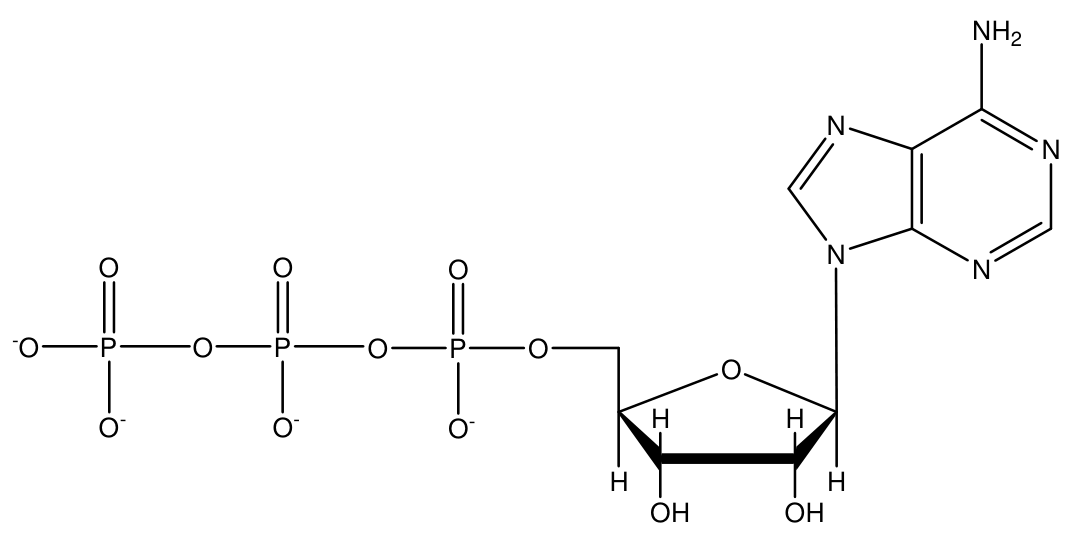
Structure of \(\ce{ATP^{4-}}\)
Shifting chemical equilibria with ATP:
Animals use free energy from the oxidation of their food to maintain concentrations of ATP, ADP, and phosphate far from equilibrium. In red blood cells the following concentrations have been measured:
\[ \begin{aligned} c(\ce{ATP^{4-}})&=2.25\ \mathrm{mmol\,dm^{-3}}\\ c(\ce{ADP^{3-}})&=0.25\ \mathrm{mmol\,dm^{-3}}\\ c(\ce{HPO4^{2-}})&=1.65\ \mathrm{mmol\,dm^{-3}} \end{aligned} \]
Free energy stored in ATP can be released according to the following reaction:

As the pH is close to 7 in most living cells, biochemists use \(\Delta G^{\circ\prime}\) instead of \(\Delta G^\circ\). The standard state of \(\Delta G^{\circ\prime}\) is defined as having a constant pH of 7. In equations with \(\Delta G^{\circ\prime}\) and \(K'\) for reactions at \(pH=7\) the concentration of \(\ce{H+}\) is therefore omitted. Standard concentration is \(1\ \mathrm{mol\,dm^{-3}}\).
5.1 Calculate the actual \(\Delta G'\) of reaction (1) in the red blood cell at \(25\ ^\circ\mathrm{C}\) and \(pH=7\).
In living cells many so-called “anabolic” reactions take place, which are at first sight thermodynamically unfavourable because of a positive \(\Delta G\). The phosphorylation of glucose is an example:

5.2 Calculate first the equilibrium constant \(K'\) of reaction (2) and then the ratio \(c(\text{glucose 6-phosphate})/c(\text{glucose})\) in the red blood cell in chemical equilibrium at \(25\ ^\circ\mathrm{C}\) and \(pH=7\).
To shift the equilibrium to a higher concentration of glucose 6-phosphate, reaction (2) is coupled with hydrolysis of ATP:

5.3 Calculate \(\Delta G^{\circ\prime}\) and \(K'\) of reaction (3).
What is now the ratio \(c(\text{glucose 6-phosphate})/c(\text{glucose})\) in the red blood cell in chemical equilibrium at \(25\ ^\circ\mathrm{C}\) and \(pH=7\)?
ATP synthesis:
An adult person ingests about \(8000\ \mathrm{kJ}\) of energy \((\Delta G')\) per day with the food.
5.4 a) What will be the mass of ATP that is produced per day if half of this energy is used for ATP synthesis? Assume a \(\Delta G'\) of \(-52\ \mathrm{kJ\,mol^{-1}}\) for reaction (1), and a molecular weight of \(503\ \mathrm{g\,mol^{-1}}\) for ATP.
b) What mass of ATP does the human body contain on average if the mean lifetime of an ATP molecule until its hydrolysis is \(1\ \mathrm{min}\)?
c) What happens to the rest of the free energy, which is not used for ATP synthesis? Mark on the answer sheet.
In animals the energy obtained by the oxidation of food is used to pump protons out of specialized membrane vesicles, the mitochondria. ATP-synthase, an enzyme, will allow protons to re-enter the mitochondria if ATP is simultaneously synthesized from ADP and phosphate.
5.5 a) How many protons \((\ce{H+})\) are in a spherical mitochondrium with a diameter of \(1\ \mathrm{\mu m}\) at \(pH=7\)?
b) How many protons have to enter into each of the 1000 mitochondria of a liver cell via the ATP-synthase to allow the production of a mass of \(0.2\ \mathrm{fg}\) of ATP per cell? Assume that 3 protons have to enter for the synthesis of 1 molecule of ATP.
Official English text of the problem.
Answers
- 5.1: \(\Delta G'=-51.8\ \mathrm{kJ\,mol^{-1}}\).
- 5.2: \(K'_2=3.82\times10^{-3}\); \(c(\text{glucose 6-phosphate})/c(\text{glucose})=6.31\times10^{-6}\).
- 5.3: \(\Delta G_3^{\circ\prime}=-16.7\ \mathrm{kJ\,mol^{-1}}\); \(K'_3=8.43\times10^2\); \(c(\text{glucose 6-phosphate})/c(\text{glucose})\approx7.6\times10^3\).
- 5.4(a): Approximately \(39\ \mathrm{kg}\) of ATP produced per day.
- 5.4(b): Approximately \(27\ \mathrm{g}\) of ATP present on average.
- 5.4(c): The remaining energy is dissipated as heat.
- 5.5(a): Approximately 32 free protons per mitochondrion.
- 5.5(b): Approximately \(7.2\times10^2\) protons must enter each mitochondrion.
Solution
Use \[ T=298.15\ \mathrm K,\qquad R=8.314\ \mathrm{J\,mol^{-1}\,K^{-1}},\qquad N_{\mathrm A}=6.022\times10^{23}\ \mathrm{mol^{-1}}. \]
Activities are approximated by \(a_i=c_i/c^\circ\), with \(c^\circ=1\ \mathrm{mol\,dm^{-3}}\); water has unit activity. At the fixed pH of 7, the proton activity is already incorporated into the primed thermodynamic quantities.
The chemical species used below have the following structural representations. The glucose SMILES show open-chain D forms, avoiding an arbitrary choice of anomer.
| Species | SMILES |
|---|---|
| Adenosine 5′-triphosphate(4−), \(\ce{ATP^{4-}}\) | Nc1ncnc2c1ncn2[C@@H]1O[C@H](COP(=O)([O-])OP(=O)([O-])OP(=O)([O-])[O-])[C@@H](O)[C@H]1O |
| Adenosine 5′-diphosphate(3−), \(\ce{ADP^{3-}}\) | Nc1ncnc2c1ncn2[C@@H]1O[C@H](COP(=O)([O-])OP(=O)([O-])[O-])[C@@H](O)[C@H]1O |
| Hydrogen phosphate, \(\ce{HPO4^{2-}}\) | O=P([O-])([O-])O |
| D-Glucose, \(\ce{C6H12O6}\) | O=C[C@H](O)[C@@H](O)[C@H](O)[C@H](O)CO |
| D-Glucose 6-phosphate(2−), \(\ce{C6H11O9P^{2-}}\) | O=C[C@H](O)[C@@H](O)[C@H](O)[C@H](O)COP(=O)([O-])[O-] |
| Water, \(\ce{H2O}\) | O |
| Proton, \(\ce{H+}\) | [H+] |
5.1 — Actual free energy of ATP hydrolysis
Reaction (1) is \[ \ce{ATP^{4-} + H2O <=> ADP^{3-} + HPO4^{2-} + H+}. \]
Its transformed reaction quotient is \[ Q'_1= \frac{\bigl[c(\ce{ADP^{3-}})/c^\circ\bigr] \bigl[c(\ce{HPO4^{2-}})/c^\circ\bigr]} {c(\ce{ATP^{4-}})/c^\circ}. \]
Converting the supplied concentrations to \(\mathrm{mol\,dm^{-3}}\), \[ Q'_1= \frac{(0.25\times10^{-3})(1.65\times10^{-3})} {2.25\times10^{-3}} =1.833\times10^{-4}. \]
Therefore, \[ \begin{aligned} \Delta G'_1 &=\Delta G_1^{\circ\prime}+RT\ln Q'_1\\ &=-30.5+ (8.314\times10^{-3})(298.15)\ln(1.833\times10^{-4})\\ &=\boxed{-51.8\ \mathrm{kJ\,mol^{-1}}}. \end{aligned} \]
5.2 — Uncoupled glucose phosphorylation
Reaction (2), written with molecular formulas, is \[ \ce{C6H12O6 + HPO4^{2-} <=> C6H11O9P^{2-} + H2O}. \]
The standard free energy gives \[ \Delta G_2^{\circ\prime}=-RT\ln K'_2, \] so \[ K'_2= \exp\!\left(-\frac{13800}{8.314\times298.15}\right) =\boxed{3.82\times10^{-3}}. \]
This is a dimensionless equilibrium constant: \[ K'_2= \frac{c(\text{glucose 6-phosphate})/c^\circ} {\bigl[c(\text{glucose})/c^\circ\bigr] \bigl[c(\ce{HPO4^{2-}})/c^\circ\bigr]}. \]
At the supplied phosphate concentration, \[ \begin{aligned} \frac{c(\text{glucose 6-phosphate})}{c(\text{glucose})} &=K'_2\frac{c(\ce{HPO4^{2-}})}{c^\circ}\\ &=(3.821\times10^{-3})(1.65\times10^{-3})\\ &=\boxed{6.31\times10^{-6}}. \end{aligned} \]
Thus the equilibrium strongly favours unphosphorylated glucose under these conditions.
5.3 — Glucose phosphorylation coupled to ATP hydrolysis
Adding reactions (1) and (2) cancels water and hydrogen phosphate. The resulting hexokinase-catalysed reaction is \[ \ce{C6H12O6 + ATP^{4-} <=> C6H11O9P^{2-} + ADP^{3-} + H+}. \]
Standard reaction free energies are additive: \[ \begin{aligned} \Delta G_3^{\circ\prime} &=\Delta G_1^{\circ\prime}+\Delta G_2^{\circ\prime}\\ &=-30.5+13.8\\ &=\boxed{-16.7\ \mathrm{kJ\,mol^{-1}}}. \end{aligned} \]
Consequently, \[ K'_3= \exp\!\left(\frac{16700}{8.314\times298.15}\right) =\boxed{8.43\times10^2}. \]
At fixed pH, \[ K'_3= \frac{c(\text{glucose 6-phosphate})\,c(\ce{ADP^{3-}})} {c(\text{glucose})\,c(\ce{ATP^{4-}})}. \]
Hence \[ \begin{aligned} \frac{c(\text{glucose 6-phosphate})}{c(\text{glucose})} &=K'_3\frac{c(\ce{ATP^{4-}})}{c(\ce{ADP^{3-}})}\\ &=(8.431\times10^2)\frac{2.25}{0.25}\\ &=7.588\times10^3\\ &\approx\boxed{7.6\times10^3}. \end{aligned} \]
These ratios describe equilibrium of the specified reaction with the supplied metabolite concentrations maintained. Coupling changes the net reaction and its free energy; hexokinase catalyses that reaction without changing its equilibrium constant.
5.4(a) — Daily ATP production
ATP synthesis reverses reaction (1): \[ \ce{ADP^{3-} + HPO4^{2-} + H+ -> ATP^{4-} + H2O}. \]
Its assumed free-energy requirement is therefore \[ \Delta G'_{\text{synthesis}}=+52\ \mathrm{kJ\,mol^{-1}}. \]
The daily energy allocated to synthesis is \[ E_{\text{synthesis}}=\frac{8000}{2}=4000\ \mathrm{kJ}. \]
Thus \[ n_{\text{ATP, daily}} =\frac{4000\ \mathrm{kJ}}{52\ \mathrm{kJ\,mol^{-1}}} =76.9\ \mathrm{mol}, \] and \[ \begin{aligned} m_{\text{ATP, daily}} &=(76.9\ \mathrm{mol})(503\ \mathrm{g\,mol^{-1}})\\ &=3.87\times10^4\ \mathrm g\\ &\approx\boxed{39\ \mathrm{kg}}. \end{aligned} \]
This is the mass synthesized through repeated turnover during one day.
5.4(b) — Average ATP mass in the body
At steady state, the average amount present equals the production rate multiplied by the mean lifetime: \[ m_{\text{pool}}=\dot m_{\text{synthesis}}\tau. \]
Since one day contains \(1440\ \mathrm{min}\), \[ m_{\text{pool}} =\frac{3.869\times10^4\ \mathrm g}{1440\ \mathrm{min}} (1\ \mathrm{min}) =26.9\ \mathrm g \approx\boxed{27\ \mathrm g}. \]
5.4(c) — Fate of the remaining free energy
The remaining energy, about \(4000\ \mathrm{kJ}\) per day in this model, is dissipated as heat, contributing to maintenance of body temperature. This is the answer to select on the missing answer sheet.
5.5(a) — Free protons inside one mitochondrion
At pH 7, \[ c(\ce{H+})=10^{-7}\ \mathrm{mol\,dm^{-3}}. \]
The radius is \[ r=\frac{1\ \mathrm{\mu m}}{2}=5.0\times10^{-7}\ \mathrm m. \]
The spherical volume is \[ \begin{aligned} V&=\frac{4\pi r^3}{3}\\ &=\frac{4\pi}{3}(5.0\times10^{-7}\ \mathrm m)^3\\ &=5.236\times10^{-19}\ \mathrm{m^3}\\ &=5.236\times10^{-16}\ \mathrm{dm^3}. \end{aligned} \]
The mean number of free protons is \[ \begin{aligned} N(\ce{H+}) &=c(\ce{H+})VN_{\mathrm A}\\ &=(10^{-7})(5.236\times10^{-16})(6.022\times10^{23})\\ &=31.5. \end{aligned} \]
Thus there are approximately \[ \boxed{32\ \text{free protons per mitochondrion}} \] on average.
5.5(b) — Proton entry required for ATP production
The ATP mass produced per cell is \[ 0.2\ \mathrm{fg}=0.2\times10^{-15}\ \mathrm g. \]
The corresponding number of ATP molecules is \[ N_{\text{ATP, cell}} =\frac{0.2\times10^{-15}\ \mathrm g} {503\ \mathrm{g\,mol^{-1}}} (6.022\times10^{23}\ \mathrm{mol^{-1}}) =2.394\times10^5. \]
Each molecule requires entry of three protons. Distributing the production equally among 1000 mitochondria gives \[ \begin{aligned} N_{\text{protons, each}} &=\frac{3N_{\text{ATP, cell}}}{1000}\\ &=\frac{3(2.394\times10^5)}{1000}\\ &=7.18\times10^2\\ &\approx\boxed{7.2\times10^2\ \text{protons}}. \end{aligned} \]
This is cumulative proton entry during ATP production. Proton pumping and buffering make it compatible with the small instantaneous free-proton population calculated in 5.5(a).
The solution was checked against the official solution.
IChO 2004 · Theorieaufgabe 5
Biochemie mit Thermodynamik
Struktur von \(\ce{ATP^{4-}}\)
Verschiebung chemischer Gleichgewichte mit ATP:
Tiere nutzen die freie Enthalpie aus der Oxidation ihrer Nahrung, um die Konzentrationen von ATP, ADP und Phosphat weit vom Gleichgewicht entfernt zu halten. In roten Blutkörperchen wurden folgende Konzentrationen gemessen:
\[ \begin{aligned} c(\ce{ATP^{4-}})&=2.25\ \mathrm{mmol\,dm^{-3}}\\ c(\ce{ADP^{3-}})&=0.25\ \mathrm{mmol\,dm^{-3}}\\ c(\ce{HPO4^{2-}})&=1.65\ \mathrm{mmol\,dm^{-3}} \end{aligned} \]
Die in ATP gespeicherte freie Enthalpie kann durch die folgende Reaktion freigesetzt werden:
Da der pH-Wert in den meisten lebenden Zellen nahe bei 7 liegt, verwenden Biochemiker \(\Delta G^{\circ\prime}\) anstelle von \(\Delta G^\circ\). Der Standardzustand von \(\Delta G^{\circ\prime}\) ist durch einen konstanten pH-Wert von 7 definiert. In Gleichungen mit \(\Delta G^{\circ\prime}\) und \(K'\) für Reaktionen bei \(pH=7\) wird die Konzentration von \(\ce{H+}\) daher weggelassen. Die Standardkonzentration beträgt \(1\ \mathrm{mol\,dm^{-3}}\).
5.1 Berechnen Sie die tatsächliche freie Reaktionsenthalpie \(\Delta G'\) der Reaktion (1) im roten Blutkörperchen bei \(25\ ^\circ\mathrm{C}\) und \(pH=7\).
In lebenden Zellen laufen viele sogenannte „anabole“ Reaktionen ab, die auf den ersten Blick wegen eines positiven \(\Delta G\) thermodynamisch ungünstig sind. Die Phosphorylierung von Glucose ist ein Beispiel:
5.2 Berechnen Sie zunächst die Gleichgewichtskonstante \(K'\) der Reaktion (2) und anschließend das Verhältnis \(c(\text{Glucose-6-phosphat})/c(\text{Glucose})\) im roten Blutkörperchen im chemischen Gleichgewicht bei \(25\ ^\circ\mathrm{C}\) und \(pH=7\).
Um das Gleichgewicht zu einer höheren Konzentration von Glucose-6-phosphat zu verschieben, wird Reaktion (2) mit der Hydrolyse von ATP gekoppelt:
5.3 Berechnen Sie \(\Delta G^{\circ\prime}\) und \(K'\) der Reaktion (3).
Wie groß ist nun das Verhältnis \(c(\text{Glucose-6-phosphat})/c(\text{Glucose})\) im roten Blutkörperchen im chemischen Gleichgewicht bei \(25\ ^\circ\mathrm{C}\) und \(pH=7\)?
ATP-Synthese:
Ein erwachsener Mensch nimmt mit der Nahrung täglich etwa \(8000\ \mathrm{kJ}\) an Energie \((\Delta G')\) auf.
5.4 a) Welche Masse an ATP wird pro Tag produziert, wenn die Hälfte dieser Energie für die ATP-Synthese verwendet wird? Nehmen Sie für Reaktion (1) ein \(\Delta G'\) von \(-52\ \mathrm{kJ\,mol^{-1}}\) und für ATP eine molare Masse von \(503\ \mathrm{g\,mol^{-1}}\) an.
b) Welche Masse an ATP enthält der menschliche Körper im Durchschnitt, wenn die mittlere Lebensdauer eines ATP-Moleküls bis zu seiner Hydrolyse \(1\ \mathrm{min}\) beträgt?
c) Was geschieht mit dem Rest der freien Enthalpie, der nicht für die ATP-Synthese verwendet wird? Kreuzen Sie dies auf dem Antwortbogen an.
Bei Tieren wird die durch die Oxidation der Nahrung gewonnene Energie dazu verwendet, Protonen aus spezialisierten Membranvesikeln, den Mitochondrien, herauszupumpen. Die ATP-Synthase, ein Enzym, ermöglicht den Protonen den Wiedereintritt in die Mitochondrien, wenn gleichzeitig ATP aus ADP und Phosphat synthetisiert wird.
5.5 a) Wie viele Protonen \((\ce{H+})\) befinden sich bei \(pH=7\) in einem kugelförmigen Mitochondrium mit einem Durchmesser von \(1\ \mathrm{\mu m}\)?
b) Wie viele Protonen müssen über die ATP-Synthase in jedes der 1000 Mitochondrien einer Leberzelle eintreten, um die Produktion einer Masse von \(0.2\ \mathrm{fg}\) ATP pro Zelle zu ermöglichen? Nehmen Sie an, dass für die Synthese von 1 ATP-Molekül 3 Protonen eintreten müssen.
Aufgabentext aus dem offiziellen englischen Text übersetzt.
Antworten
- 5.1: \(\Delta G'=-51.8\ \mathrm{kJ\,mol^{-1}}\).
- 5.2: \(K'_2=3.82\times10^{-3}\); \(c(\text{Glucose-6-phosphat})/c(\text{Glucose})=6.31\times10^{-6}\).
- 5.3: \(\Delta G_3^{\circ\prime}=-16.7\ \mathrm{kJ\,mol^{-1}}\); \(K'_3=8.43\times10^2\); \(c(\text{Glucose-6-phosphat})/c(\text{Glucose})\approx7.6\times10^3\).
- 5.4(a): Pro Tag werden ungefähr \(39\ \mathrm{kg}\) ATP produziert.
- 5.4(b): Im Durchschnitt sind ungefähr \(27\ \mathrm{g}\) ATP vorhanden.
- 5.4(c): Die verbleibende Energie wird als Wärme abgegeben.
- 5.5(a): Ungefähr 32 freie Protonen pro Mitochondrium.
- 5.5(b): Ungefähr \(7.2\times10^2\) Protonen müssen in jedes Mitochondrium eintreten.
Lösung
Verwendet werden \[ T=298.15\ \mathrm K,\qquad R=8.314\ \mathrm{J\,mol^{-1}\,K^{-1}},\qquad N_{\mathrm A}=6.022\times10^{23}\ \mathrm{mol^{-1}}. \]
Die Aktivitäten werden durch \(a_i=c_i/c^\circ\) mit \(c^\circ=1\ \mathrm{mol\,dm^{-3}}\) angenähert; Wasser hat die Aktivität eins. Beim festgelegten pH-Wert von 7 ist die Protonenaktivität bereits in den mit einem Strich gekennzeichneten thermodynamischen Größen berücksichtigt.
Die im Folgenden verwendeten chemischen Spezies haben die folgenden Strukturdarstellungen. Die SMILES für Glucose zeigen die offenkettigen D-Formen, wodurch eine willkürliche Wahl des Anomers vermieden wird.
| Spezies | SMILES |
|---|---|
| Adenosin-5′-triphosphat(4−), \(\ce{ATP^{4-}}\) | Nc1ncnc2c1ncn2[C@@H]1O[C@H](COP(=O)([O-])OP(=O)([O-])OP(=O)([O-])[O-])[C@@H](O)[C@H]1O |
| Adenosin-5′-diphosphat(3−), \(\ce{ADP^{3-}}\) | Nc1ncnc2c1ncn2[C@@H]1O[C@H](COP(=O)([O-])OP(=O)([O-])[O-])[C@@H](O)[C@H]1O |
| Hydrogenphosphat, \(\ce{HPO4^{2-}}\) | O=P([O-])([O-])O |
| D-Glucose, \(\ce{C6H12O6}\) | O=C[C@H](O)[C@@H](O)[C@H](O)[C@H](O)CO |
| D-Glucose-6-phosphat(2−), \(\ce{C6H11O9P^{2-}}\) | O=C[C@H](O)[C@@H](O)[C@H](O)[C@H](O)COP(=O)([O-])[O-] |
| Wasser, \(\ce{H2O}\) | O |
| Proton, \(\ce{H+}\) | [H+] |
5.1 — Tatsächliche freie Enthalpie der ATP-Hydrolyse
Reaktion (1) lautet \[ \ce{ATP^{4-} + H2O <=> ADP^{3-} + HPO4^{2-} + H+}. \]
Ihr transformierter Reaktionsquotient ist \[ Q'_1= \frac{\bigl[c(\ce{ADP^{3-}})/c^\circ\bigr] \bigl[c(\ce{HPO4^{2-}})/c^\circ\bigr]} {c(\ce{ATP^{4-}})/c^\circ}. \]
Nach Umrechnung der angegebenen Konzentrationen in \(\mathrm{mol\,dm^{-3}}\) ergibt sich \[ Q'_1= \frac{(0.25\times10^{-3})(1.65\times10^{-3})} {2.25\times10^{-3}} =1.833\times10^{-4}. \]
Daher gilt \[ \begin{aligned} \Delta G'_1 &=\Delta G_1^{\circ\prime}+RT\ln Q'_1\\ &=-30.5+ (8.314\times10^{-3})(298.15)\ln(1.833\times10^{-4})\\ &=\boxed{-51.8\ \mathrm{kJ\,mol^{-1}}}. \end{aligned} \]
5.2 — Ungekoppelte Phosphorylierung von Glucose
Mit Summenformeln geschrieben lautet Reaktion (2) \[ \ce{C6H12O6 + HPO4^{2-} <=> C6H11O9P^{2-} + H2O}. \]
Aus der freien Standardreaktionsenthalpie folgt \[ \Delta G_2^{\circ\prime}=-RT\ln K'_2, \] also \[ K'_2= \exp\!\left(-\frac{13800}{8.314\times298.15}\right) =\boxed{3.82\times10^{-3}}. \]
Dies ist eine dimensionslose Gleichgewichtskonstante: \[ K'_2= \frac{c(\text{Glucose-6-phosphat})/c^\circ} {\bigl[c(\text{Glucose})/c^\circ\bigr] \bigl[c(\ce{HPO4^{2-}})/c^\circ\bigr]}. \]
Bei der angegebenen Phosphatkonzentration gilt \[ \begin{aligned} \frac{c(\text{Glucose-6-phosphat})}{c(\text{Glucose})} &=K'_2\frac{c(\ce{HPO4^{2-}})}{c^\circ}\\ &=(3.821\times10^{-3})(1.65\times10^{-3})\\ &=\boxed{6.31\times10^{-6}}. \end{aligned} \]
Das Gleichgewicht liegt unter diesen Bedingungen somit stark auf der Seite der nicht phosphorylierten Glucose.
5.3 — Mit der ATP-Hydrolyse gekoppelte Phosphorylierung von Glucose
Bei der Addition der Reaktionen (1) und (2) kürzen sich Wasser und Hydrogenphosphat heraus. Die resultierende, durch Hexokinase katalysierte Reaktion lautet \[ \ce{C6H12O6 + ATP^{4-} <=> C6H11O9P^{2-} + ADP^{3-} + H+}. \]
Freie Standardreaktionsenthalpien sind additiv: \[ \begin{aligned} \Delta G_3^{\circ\prime} &=\Delta G_1^{\circ\prime}+\Delta G_2^{\circ\prime}\\ &=-30.5+13.8\\ &=\boxed{-16.7\ \mathrm{kJ\,mol^{-1}}}. \end{aligned} \]
Folglich gilt \[ K'_3= \exp\!\left(\frac{16700}{8.314\times298.15}\right) =\boxed{8.43\times10^2}. \]
Bei festgelegtem pH-Wert gilt \[ K'_3= \frac{c(\text{Glucose-6-phosphat})\,c(\ce{ADP^{3-}})} {c(\text{Glucose})\,c(\ce{ATP^{4-}})}. \]
Daraus folgt \[ \begin{aligned} \frac{c(\text{Glucose-6-phosphat})}{c(\text{Glucose})} &=K'_3\frac{c(\ce{ATP^{4-}})}{c(\ce{ADP^{3-}})}\\ &=(8.431\times10^2)\frac{2.25}{0.25}\\ &=7.588\times10^3\\ &\approx\boxed{7.6\times10^3}. \end{aligned} \]
Diese Verhältnisse beschreiben das Gleichgewicht der jeweiligen Reaktion bei Aufrechterhaltung der angegebenen Metabolitkonzentrationen. Die Kopplung verändert die Nettoreaktion und ihre freie Enthalpie; Hexokinase katalysiert diese Reaktion, ohne ihre Gleichgewichtskonstante zu verändern.
5.4(a) — Tägliche ATP-Produktion
Die ATP-Synthese kehrt Reaktion (1) um: \[ \ce{ADP^{3-} + HPO4^{2-} + H+ -> ATP^{4-} + H2O}. \]
Ihr angenommener Bedarf an freier Enthalpie beträgt daher \[ \Delta G'_{\text{Synthese}}=+52\ \mathrm{kJ\,mol^{-1}}. \]
Die täglich für die Synthese bereitgestellte Energie beträgt \[ E_{\text{Synthese}}=\frac{8000}{2}=4000\ \mathrm{kJ}. \]
Somit gilt \[ n_{\text{ATP, täglich}} =\frac{4000\ \mathrm{kJ}}{52\ \mathrm{kJ\,mol^{-1}}} =76.9\ \mathrm{mol}, \] und \[ \begin{aligned} m_{\text{ATP, täglich}} &=(76.9\ \mathrm{mol})(503\ \mathrm{g\,mol^{-1}})\\ &=3.87\times10^4\ \mathrm g\\ &\approx\boxed{39\ \mathrm{kg}}. \end{aligned} \]
Dies ist die Masse, die durch wiederholten Umsatz im Laufe eines Tages synthetisiert wird.
5.4(b) — Durchschnittliche ATP-Masse im Körper
Im stationären Zustand ist die durchschnittlich vorhandene Menge gleich der Produktionsrate multipliziert mit der mittleren Lebensdauer: \[ m_{\text{Vorrat}}=\dot m_{\text{Synthese}}\tau. \]
Da ein Tag \(1440\ \mathrm{min}\) umfasst, gilt \[ m_{\text{Vorrat}} =\frac{3.869\times10^4\ \mathrm g}{1440\ \mathrm{min}} (1\ \mathrm{min}) =26.9\ \mathrm g \approx\boxed{27\ \mathrm g}. \]
5.4(c) — Verbleib der restlichen freien Enthalpie
Die verbleibende Energie, in diesem Modell etwa \(4000\ \mathrm{kJ}\) pro Tag, wird als Wärme abgegeben und trägt damit zur Aufrechterhaltung der Körpertemperatur bei. Diese Antwort ist auf dem fehlenden Antwortbogen auszuwählen.
5.5(a) — Freie Protonen im Inneren eines Mitochondriums
Bei pH 7 gilt \[ c(\ce{H+})=10^{-7}\ \mathrm{mol\,dm^{-3}}. \]
Der Radius beträgt \[ r=\frac{1\ \mathrm{\mu m}}{2}=5.0\times10^{-7}\ \mathrm m. \]
Das Kugelvolumen beträgt \[ \begin{aligned} V&=\frac{4\pi r^3}{3}\\ &=\frac{4\pi}{3}(5.0\times10^{-7}\ \mathrm m)^3\\ &=5.236\times10^{-19}\ \mathrm{m^3}\\ &=5.236\times10^{-16}\ \mathrm{dm^3}. \end{aligned} \]
Die mittlere Anzahl freier Protonen beträgt \[ \begin{aligned} N(\ce{H+}) &=c(\ce{H+})VN_{\mathrm A}\\ &=(10^{-7})(5.236\times10^{-16})(6.022\times10^{23})\\ &=31.5. \end{aligned} \]
Somit gibt es ungefähr \[ \boxed{32\ \text{freie Protonen pro Mitochondrium}} \] im Durchschnitt.
5.5(b) — Für die ATP-Produktion erforderlicher Protoneneintritt
Die pro Zelle produzierte ATP-Masse beträgt \[ 0.2\ \mathrm{fg}=0.2\times10^{-15}\ \mathrm g. \]
Die entsprechende Anzahl an ATP-Molekülen beträgt \[ N_{\text{ATP, Zelle}} =\frac{0.2\times10^{-15}\ \mathrm g} {503\ \mathrm{g\,mol^{-1}}} (6.022\times10^{23}\ \mathrm{mol^{-1}}) =2.394\times10^5. \]
Für jedes Molekül müssen drei Protonen eintreten. Bei gleichmäßiger Verteilung der Produktion auf 1000 Mitochondrien ergibt sich \[ \begin{aligned} N_{\text{Protonen, je Mitochondrium}} &=\frac{3N_{\text{ATP, Zelle}}}{1000}\\ &=\frac{3(2.394\times10^5)}{1000}\\ &=7.18\times10^2\\ &\approx\boxed{7.2\times10^2\ \text{Protonen}}. \end{aligned} \]
Dies ist der kumulierte Protoneneintritt während der ATP-Produktion. Das Pumpen von Protonen und die Pufferung machen ihn mit der in 5.5(a) berechneten kleinen Anzahl momentan vorhandener freier Protonen vereinbar.
Die Lösung wurde mit der offiziellen Lösung abgeglichen.
IChO 2004 · Teori sorusu 5
Termodinamik ile Biyokimya
\(\ce{ATP^{4-}}\) yapısı
ATP ile kimyasal dengelerin kaydırılması:
Hayvanlar, ATP, ADP ve fosfat derişimlerini denge değerlerinden uzak tutmak için besinlerinin yükseltgenmesinden elde edilen serbest enerjiyi kullanır. Alyuvarlarda aşağıdaki derişimler ölçülmüştür:
\[ \begin{aligned} c(\ce{ATP^{4-}})&=2.25\ \mathrm{mmol\,dm^{-3}}\\ c(\ce{ADP^{3-}})&=0.25\ \mathrm{mmol\,dm^{-3}}\\ c(\ce{HPO4^{2-}})&=1.65\ \mathrm{mmol\,dm^{-3}} \end{aligned} \]
ATP'de depolanan serbest enerji, aşağıdaki tepkimeye göre açığa çıkabilir:
Canlı hücrelerin çoğunda pH 7'ye yakın olduğundan, biyokimyacılar \(\Delta G^\circ\) yerine \(\Delta G^{\circ\prime}\) kullanır. \(\Delta G^{\circ\prime}\) için standart hâl, pH'ın 7'de sabit tutulduğu durum olarak tanımlanır. Bu nedenle, \(pH=7\) koşulundaki tepkimeler için \(\Delta G^{\circ\prime}\) ve \(K'\) içeren denklemlerde \(\ce{H+}\) derişimine yer verilmez. Standart derişim \(1\ \mathrm{mol\,dm^{-3}}\) değerindedir.
5.1 \(25\ ^\circ\mathrm{C}\) ve \(pH=7\) koşullarında alyuvarda (1) tepkimesinin gerçek \(\Delta G'\) değerini hesaplayın.
Canlı hücrelerde, \(\Delta G\) değerleri pozitif olduğundan ilk bakışta termodinamik açıdan elverişsiz görünen, “anabolik” olarak adlandırılan birçok tepkime gerçekleşir. Glikozun fosforillenmesi buna bir örnektir:
5.2 Önce (2) tepkimesinin denge sabiti \(K'\) değerini, ardından \(25\ ^\circ\mathrm{C}\) ve \(pH=7\) koşullarında kimyasal dengede bulunan alyuvardaki \(c(\text{glikoz 6-fosfat})/c(\text{glikoz})\) oranını hesaplayın.
Dengeyi daha yüksek glikoz 6-fosfat derişimi yönüne kaydırmak için (2) tepkimesi ATP hidroliziyle eşleştirilir:
5.3 (3) tepkimesinin \(\Delta G^{\circ\prime}\) ve \(K'\) değerlerini hesaplayın.
Bu durumda \(25\ ^\circ\mathrm{C}\) ve \(pH=7\) koşullarında kimyasal dengede bulunan alyuvardaki \(c(\text{glikoz 6-fosfat})/c(\text{glikoz})\) oranı nedir?
ATP sentezi:
Yetişkin bir insan besinlerle günde yaklaşık \(8000\ \mathrm{kJ}\) enerji \((\Delta G')\) alır.
5.4 a) Bu enerjinin yarısı ATP sentezi için kullanılırsa, bir günde üretilen ATP'nin kütlesi ne olur? (1) tepkimesi için \(\Delta G'\) değerini \(-52\ \mathrm{kJ\,mol^{-1}}\), ATP'nin molar kütlesini ise \(503\ \mathrm{g\,mol^{-1}}\) kabul edin.
b) Bir ATP molekülünün hidrolize uğrayana kadarki ortalama ömrü \(1\ \mathrm{min}\) ise, insan vücudunda ortalama ne kadar kütlede ATP bulunur?
c) Serbest enerjinin ATP sentezinde kullanılmayan geri kalan kısmına ne olur? Cevap kâğıdında işaretleyin.
Hayvanlarda besinlerin yükseltgenmesinden elde edilen enerji, protonları mitokondri adı verilen özelleşmiş zar keseciklerinin dışına pompalamak için kullanılır. Bir enzim olan ATP sentaz, eş zamanlı olarak ADP ve fosfattan ATP sentezlenmesi durumunda protonların mitokondrilere yeniden girmesine izin verir.
5.5 a) \(pH=7\) koşulunda, çapı \(1\ \mathrm{\mu m}\) olan küresel bir mitokondride kaç proton \((\ce{H+})\) bulunur?
b) Hücre başına \(0.2\ \mathrm{fg}\) kütlesinde ATP üretilebilmesi için bir karaciğer hücresindeki 1000 mitokondrinin her birine ATP sentaz aracılığıyla kaç proton girmelidir? 1 ATP molekülünün sentezi için 3 protonun girmesi gerektiğini kabul edin.
Soru metni resmi İngilizce metinden çevrilmiştir.
Cevaplar
- 5.1: \(\Delta G'=-51.8\ \mathrm{kJ\,mol^{-1}}\).
- 5.2: \(K'_2=3.82\times10^{-3}\); \(c(\text{glikoz 6-fosfat})/c(\text{glikoz})=6.31\times10^{-6}\).
- 5.3: \(\Delta G_3^{\circ\prime}=-16.7\ \mathrm{kJ\,mol^{-1}}\); \(K'_3=8.43\times10^2\); \(c(\text{glikoz 6-fosfat})/c(\text{glikoz})\approx7.6\times10^3\).
- 5.4(a): Günde yaklaşık \(39\ \mathrm{kg}\) ATP üretilir.
- 5.4(b): Ortalama yaklaşık \(27\ \mathrm{g}\) ATP bulunur.
- 5.4(c): Geri kalan enerji ısı olarak yayılır.
- 5.5(a): Mitokondri başına yaklaşık 32 serbest proton bulunur.
- 5.5(b): Her mitokondriye yaklaşık \(7.2\times10^2\) proton girmelidir.
Çözüm
Şu değerleri kullanalım: \[ T=298.15\ \mathrm K,\qquad R=8.314\ \mathrm{J\,mol^{-1}\,K^{-1}},\qquad N_{\mathrm A}=6.022\times10^{23}\ \mathrm{mol^{-1}}. \]
Aktiviteler, \(c^\circ=1\ \mathrm{mol\,dm^{-3}}\) olmak üzere \(a_i=c_i/c^\circ\) ile yaklaşık olarak ifade edilir; suyun aktivitesi birdir. pH'ın 7'de sabit tutulduğu durumda proton aktivitesi, üst simgesinde kesme işareti bulunan termodinamik büyüklüklere zaten dâhil edilmiştir.
Aşağıda kullanılan kimyasal türlerin yapısal gösterimleri şöyledir. Glikoza ait SMILES gösterimleri, keyfî bir anomer seçimini önlemek için açık zincirli D biçimlerini gösterir.
| Tür | SMILES |
|---|---|
| Adenozin 5′-trifosfat(4−), \(\ce{ATP^{4-}}\) | Nc1ncnc2c1ncn2[C@@H]1O[C@H](COP(=O)([O-])OP(=O)([O-])OP(=O)([O-])[O-])[C@@H](O)[C@H]1O |
| Adenozin 5′-difosfat(3−), \(\ce{ADP^{3-}}\) | Nc1ncnc2c1ncn2[C@@H]1O[C@H](COP(=O)([O-])OP(=O)([O-])[O-])[C@@H](O)[C@H]1O |
| Hidrojen fosfat, \(\ce{HPO4^{2-}}\) | O=P([O-])([O-])O |
| D-Glikoz, \(\ce{C6H12O6}\) | O=C[C@H](O)[C@@H](O)[C@H](O)[C@H](O)CO |
| D-Glikoz 6-fosfat(2−), \(\ce{C6H11O9P^{2-}}\) | O=C[C@H](O)[C@@H](O)[C@H](O)[C@H](O)COP(=O)([O-])[O-] |
| Su, \(\ce{H2O}\) | O |
| Proton, \(\ce{H+}\) | [H+] |
5.1 — ATP hidrolizinin gerçek serbest enerjisi
(1) tepkimesi şöyledir: \[ \ce{ATP^{4-} + H2O <=> ADP^{3-} + HPO4^{2-} + H+}. \]
Bu tepkimenin dönüştürülmüş tepkime bölümü şöyledir: \[ Q'_1= \frac{\bigl[c(\ce{ADP^{3-}})/c^\circ\bigr] \bigl[c(\ce{HPO4^{2-}})/c^\circ\bigr]} {c(\ce{ATP^{4-}})/c^\circ}. \]
Verilen derişimler \(\mathrm{mol\,dm^{-3}}\) birimine dönüştürüldüğünde, \[ Q'_1= \frac{(0.25\times10^{-3})(1.65\times10^{-3})} {2.25\times10^{-3}} =1.833\times10^{-4}. \]
Dolayısıyla, \[ \begin{aligned} \Delta G'_1 &=\Delta G_1^{\circ\prime}+RT\ln Q'_1\\ &=-30.5+ (8.314\times10^{-3})(298.15)\ln(1.833\times10^{-4})\\ &=\boxed{-51.8\ \mathrm{kJ\,mol^{-1}}}. \end{aligned} \]
5.2 — Eşleştirilmemiş glikoz fosforillenmesi
(2) tepkimesi, molekül formülleriyle şöyle yazılır: \[ \ce{C6H12O6 + HPO4^{2-} <=> C6H11O9P^{2-} + H2O}. \]
Standart serbest enerji şu bağıntıyı verir: \[ \Delta G_2^{\circ\prime}=-RT\ln K'_2, \] dolayısıyla \[ K'_2= \exp\!\left(-\frac{13800}{8.314\times298.15}\right) =\boxed{3.82\times10^{-3}}. \]
Bu, boyutsuz bir denge sabitidir: \[ K'_2= \frac{c(\text{glikoz 6-fosfat})/c^\circ} {\bigl[c(\text{glikoz})/c^\circ\bigr] \bigl[c(\ce{HPO4^{2-}})/c^\circ\bigr]}. \]
Verilen fosfat derişiminde, \[ \begin{aligned} \frac{c(\text{glikoz 6-fosfat})}{c(\text{glikoz})} &=K'_2\frac{c(\ce{HPO4^{2-}})}{c^\circ}\\ &=(3.821\times10^{-3})(1.65\times10^{-3})\\ &=\boxed{6.31\times10^{-6}}. \end{aligned} \]
Dolayısıyla bu koşullarda denge, büyük ölçüde fosforillenmemiş glikoz tarafındadır.
5.3 — ATP hidroliziyle eşleştirilmiş glikoz fosforillenmesi
(1) ve (2) tepkimeleri toplandığında su ve hidrojen fosfat sadeleşir. Elde edilen, hekzokinaz tarafından katalizlenen tepkime şöyledir: \[ \ce{C6H12O6 + ATP^{4-} <=> C6H11O9P^{2-} + ADP^{3-} + H+}. \]
Standart tepkime serbest enerjileri toplanabilir: \[ \begin{aligned} \Delta G_3^{\circ\prime} &=\Delta G_1^{\circ\prime}+\Delta G_2^{\circ\prime}\\ &=-30.5+13.8\\ &=\boxed{-16.7\ \mathrm{kJ\,mol^{-1}}}. \end{aligned} \]
Buna göre, \[ K'_3= \exp\!\left(\frac{16700}{8.314\times298.15}\right) =\boxed{8.43\times10^2}. \]
Sabit pH'ta, \[ K'_3= \frac{c(\text{glikoz 6-fosfat})\,c(\ce{ADP^{3-}})} {c(\text{glikoz})\,c(\ce{ATP^{4-}})}. \]
Böylece \[ \begin{aligned} \frac{c(\text{glikoz 6-fosfat})}{c(\text{glikoz})} &=K'_3\frac{c(\ce{ATP^{4-}})}{c(\ce{ADP^{3-}})}\\ &=(8.431\times10^2)\frac{2.25}{0.25}\\ &=7.588\times10^3\\ &\approx\boxed{7.6\times10^3}. \end{aligned} \]
Bu oranlar, verilen metabolit derişimleri sabit tutulduğunda belirtilen tepkimenin dengesini tanımlar. Eşleştirme, net tepkimeyi ve onun serbest enerjisini değiştirir; hekzokinaz ise bu tepkimeyi denge sabitini değiştirmeden katalizler.
5.4(a) — Günlük ATP üretimi
ATP sentezi, (1) tepkimesinin tersidir: \[ \ce{ADP^{3-} + HPO4^{2-} + H+ -> ATP^{4-} + H2O}. \]
Dolayısıyla sentez için kabul edilen serbest enerji gereksinimi şöyledir: \[ \Delta G'_{\text{sentez}}=+52\ \mathrm{kJ\,mol^{-1}}. \]
Senteze ayrılan günlük enerji şöyledir: \[ E_{\text{sentez}}=\frac{8000}{2}=4000\ \mathrm{kJ}. \]
Böylece \[ n_{\text{ATP, günlük}} =\frac{4000\ \mathrm{kJ}}{52\ \mathrm{kJ\,mol^{-1}}} =76.9\ \mathrm{mol}, \] ve \[ \begin{aligned} m_{\text{ATP, günlük}} &=(76.9\ \mathrm{mol})(503\ \mathrm{g\,mol^{-1}})\\ &=3.87\times10^4\ \mathrm g\\ &\approx\boxed{39\ \mathrm{kg}}. \end{aligned} \]
Bu, bir gün boyunca tekrarlanan yapım ve yıkım döngüleriyle sentezlenen kütledir.
5.4(b) — Vücuttaki ortalama ATP kütlesi
Kararlı durumda, mevcut ortalama miktar üretim hızı ile ortalama ömrün çarpımına eşittir: \[ m_{\text{havuz}}=\dot m_{\text{sentez}}\tau. \]
Bir gün \(1440\ \mathrm{min}\) olduğundan, \[ m_{\text{havuz}} =\frac{3.869\times10^4\ \mathrm g}{1440\ \mathrm{min}} (1\ \mathrm{min}) =26.9\ \mathrm g \approx\boxed{27\ \mathrm g}. \]
5.4(c) — Geri kalan serbest enerjinin akıbeti
Bu modelde günde yaklaşık \(4000\ \mathrm{kJ}\) olan geri kalan enerji, ısı olarak yayılır ve vücut sıcaklığının korunmasına katkıda bulunur. Burada yer almayan cevap kâğıdında seçilmesi gereken cevap budur.
5.5(a) — Bir mitokondrinin içindeki serbest protonlar
pH 7'de, \[ c(\ce{H+})=10^{-7}\ \mathrm{mol\,dm^{-3}}. \]
Yarıçap şöyledir: \[ r=\frac{1\ \mathrm{\mu m}}{2}=5.0\times10^{-7}\ \mathrm m. \]
Kürenin hacmi şöyledir: \[ \begin{aligned} V&=\frac{4\pi r^3}{3}\\ &=\frac{4\pi}{3}(5.0\times10^{-7}\ \mathrm m)^3\\ &=5.236\times10^{-19}\ \mathrm{m^3}\\ &=5.236\times10^{-16}\ \mathrm{dm^3}. \end{aligned} \]
Ortalama serbest proton sayısı şöyledir: \[ \begin{aligned} N(\ce{H+}) &=c(\ce{H+})VN_{\mathrm A}\\ &=(10^{-7})(5.236\times10^{-16})(6.022\times10^{23})\\ &=31.5. \end{aligned} \]
Dolayısıyla ortalama olarak yaklaşık \[ \boxed{32\ \text{serbest proton/mitokondri}} \] bulunur.
5.5(b) — ATP üretimi için gereken proton girişi
Hücre başına üretilen ATP kütlesi şöyledir: \[ 0.2\ \mathrm{fg}=0.2\times10^{-15}\ \mathrm g. \]
Buna karşılık gelen ATP molekülü sayısı şöyledir: \[ N_{\text{ATP, hücre}} =\frac{0.2\times10^{-15}\ \mathrm g} {503\ \mathrm{g\,mol^{-1}}} (6.022\times10^{23}\ \mathrm{mol^{-1}}) =2.394\times10^5. \]
Her molekül için üç protonun girmesi gerekir. Üretim 1000 mitokondri arasında eşit olarak paylaştırıldığında \[ \begin{aligned} N_{\text{protonlar, her biri}} &=\frac{3N_{\text{ATP, hücre}}}{1000}\\ &=\frac{3(2.394\times10^5)}{1000}\\ &=7.18\times10^2\\ &\approx\boxed{7.2\times10^2\ \text{proton}}. \end{aligned} \]
Bu, ATP üretimi sırasındaki toplam proton girişidir. Proton pompalanması ve tamponlama, bu toplam girişin 5.5(a)'da hesaplanan anlık serbest proton sayısının azlığıyla bağdaşmasını sağlar.
Çözüm, resmi çözümle karşılaştırılarak kontrol edildi.
IChO 2004 · Problema teórico 5
Bioquímica con termodinámica
Estructura del \(\ce{ATP^{4-}}\)
Desplazamiento de los equilibrios químicos mediante ATP:
Los animales utilizan la energía libre procedente de la oxidación de sus alimentos para mantener las concentraciones de ATP, ADP y fosfato lejos del equilibrio. En los glóbulos rojos se han medido las siguientes concentraciones:
\[ \begin{aligned} c(\ce{ATP^{4-}})&=2.25\ \mathrm{mmol\,dm^{-3}}\\ c(\ce{ADP^{3-}})&=0.25\ \mathrm{mmol\,dm^{-3}}\\ c(\ce{HPO4^{2-}})&=1.65\ \mathrm{mmol\,dm^{-3}} \end{aligned} \]
La energía libre almacenada en el ATP puede liberarse según la siguiente reacción:
Como el pH es cercano a 7 en la mayoría de las células vivas, los bioquímicos utilizan \(\Delta G^{\circ\prime}\) en lugar de \(\Delta G^\circ\). El estado estándar de \(\Delta G^{\circ\prime}\) se define con un pH constante de 7. Por tanto, en las ecuaciones con \(\Delta G^{\circ\prime}\) y \(K'\) para reacciones a \(pH=7\) se omite la concentración de \(\ce{H+}\). La concentración estándar es \(1\ \mathrm{mol\,dm^{-3}}\).
5.1 Calcule el valor real de \(\Delta G'\) de la reacción (1) en el glóbulo rojo a \(25\ ^\circ\mathrm{C}\) y \(pH=7\).
En las células vivas tienen lugar muchas reacciones denominadas «anabólicas», que a primera vista son termodinámicamente desfavorables por tener un \(\Delta G\) positivo. La fosforilación de la glucosa es un ejemplo:
5.2 Calcule primero la constante de equilibrio \(K'\) de la reacción (2) y después la relación \(c(\text{glucosa 6-fosfato})/c(\text{glucosa})\) en el glóbulo rojo en equilibrio químico a \(25\ ^\circ\mathrm{C}\) y \(pH=7\).
Para desplazar el equilibrio hacia una mayor concentración de glucosa 6-fosfato, la reacción (2) se acopla a la hidrólisis del ATP:
5.3 Calcule \(\Delta G^{\circ\prime}\) y \(K'\) de la reacción (3).
¿Cuál es ahora la relación \(c(\text{glucosa 6-fosfato})/c(\text{glucosa})\) en el glóbulo rojo en equilibrio químico a \(25\ ^\circ\mathrm{C}\) y \(pH=7\)?
Síntesis de ATP:
Una persona adulta ingiere con los alimentos unos \(8000\ \mathrm{kJ}\) de energía \((\Delta G')\) al día.
5.4 a) ¿Qué masa de ATP se producirá al día si la mitad de esta energía se utiliza para la síntesis de ATP? Suponga un \(\Delta G'\) de \(-52\ \mathrm{kJ\,mol^{-1}}\) para la reacción (1) y una masa molar de \(503\ \mathrm{g\,mol^{-1}}\) para el ATP.
b) ¿Qué masa de ATP contiene por término medio el cuerpo humano si el tiempo de vida medio de una molécula de ATP hasta su hidrólisis es de \(1\ \mathrm{min}\)?
c) ¿Qué ocurre con el resto de la energía libre, que no se utiliza para la síntesis de ATP? Marque la respuesta en la hoja de respuestas.
En los animales, la energía obtenida por la oxidación de los alimentos se utiliza para bombear protones hacia el exterior de unas vesículas membranosas especializadas, las mitocondrias. La ATP sintasa, una enzima, permite que los protones vuelvan a entrar en las mitocondrias si simultáneamente se sintetiza ATP a partir de ADP y fosfato.
5.5 a) ¿Cuántos protones \((\ce{H+})\) hay en una mitocondria esférica de \(1\ \mathrm{\mu m}\) de diámetro a \(pH=7\)?
b) ¿Cuántos protones deben entrar en cada una de las 1000 mitocondrias de una célula hepática a través de la ATP sintasa para permitir la producción de una masa de \(0.2\ \mathrm{fg}\) de ATP por célula? Suponga que deben entrar 3 protones para sintetizar 1 molécula de ATP.
Enunciado traducido del texto oficial en inglés.
Respuestas
- 5.1: \(\Delta G'=-51.8\ \mathrm{kJ\,mol^{-1}}\).
- 5.2: \(K'_2=3.82\times10^{-3}\); \(c(\text{glucosa 6-fosfato})/c(\text{glucosa})=6.31\times10^{-6}\).
- 5.3: \(\Delta G_3^{\circ\prime}=-16.7\ \mathrm{kJ\,mol^{-1}}\); \(K'_3=8.43\times10^2\); \(c(\text{glucosa 6-fosfato})/c(\text{glucosa})\approx7.6\times10^3\).
- 5.4(a): Aproximadamente \(39\ \mathrm{kg}\) de ATP producidos al día.
- 5.4(b): Aproximadamente \(27\ \mathrm{g}\) de ATP presentes por término medio.
- 5.4(c): La energía restante se disipa en forma de calor.
- 5.5(a): Aproximadamente 32 protones libres por mitocondria.
- 5.5(b): Deben entrar aproximadamente \(7.2\times10^2\) protones en cada mitocondria.
Solución
Utilizamos \[ T=298.15\ \mathrm K,\qquad R=8.314\ \mathrm{J\,mol^{-1}\,K^{-1}},\qquad N_{\mathrm A}=6.022\times10^{23}\ \mathrm{mol^{-1}}. \]
Las actividades se aproximan mediante \(a_i=c_i/c^\circ\), con \(c^\circ=1\ \mathrm{mol\,dm^{-3}}\); el agua tiene actividad unitaria. Al pH fijo de 7, la actividad de los protones ya está incorporada en las magnitudes termodinámicas indicadas con prima.
Las especies químicas utilizadas a continuación tienen las siguientes representaciones estructurales. Los SMILES de la glucosa muestran las formas D de cadena abierta, evitando una elección arbitraria del anómero.
| Especie | SMILES |
|---|---|
| Adenosina 5′-trifosfato(4−), \(\ce{ATP^{4-}}\) | Nc1ncnc2c1ncn2[C@@H]1O[C@H](COP(=O)([O-])OP(=O)([O-])OP(=O)([O-])[O-])[C@@H](O)[C@H]1O |
| Adenosina 5′-difosfato(3−), \(\ce{ADP^{3-}}\) | Nc1ncnc2c1ncn2[C@@H]1O[C@H](COP(=O)([O-])OP(=O)([O-])[O-])[C@@H](O)[C@H]1O |
| Hidrogenofosfato, \(\ce{HPO4^{2-}}\) | O=P([O-])([O-])O |
| D-Glucosa, \(\ce{C6H12O6}\) | O=C[C@H](O)[C@@H](O)[C@H](O)[C@H](O)CO |
| D-Glucosa 6-fosfato(2−), \(\ce{C6H11O9P^{2-}}\) | O=C[C@H](O)[C@@H](O)[C@H](O)[C@H](O)COP(=O)([O-])[O-] |
| Agua, \(\ce{H2O}\) | O |
| Protón, \(\ce{H+}\) | [H+] |
5.1 — Energía libre real de la hidrólisis del ATP
La reacción (1) es \[ \ce{ATP^{4-} + H2O <=> ADP^{3-} + HPO4^{2-} + H+}. \]
Su cociente de reacción transformado es \[ Q'_1= \frac{\bigl[c(\ce{ADP^{3-}})/c^\circ\bigr] \bigl[c(\ce{HPO4^{2-}})/c^\circ\bigr]} {c(\ce{ATP^{4-}})/c^\circ}. \]
Al convertir las concentraciones dadas a \(\mathrm{mol\,dm^{-3}}\), \[ Q'_1= \frac{(0.25\times10^{-3})(1.65\times10^{-3})} {2.25\times10^{-3}} =1.833\times10^{-4}. \]
Por tanto, \[ \begin{aligned} \Delta G'_1 &=\Delta G_1^{\circ\prime}+RT\ln Q'_1\\ &=-30.5+ (8.314\times10^{-3})(298.15)\ln(1.833\times10^{-4})\\ &=\boxed{-51.8\ \mathrm{kJ\,mol^{-1}}}. \end{aligned} \]
5.2 — Fosforilación no acoplada de la glucosa
La reacción (2), escrita con fórmulas moleculares, es \[ \ce{C6H12O6 + HPO4^{2-} <=> C6H11O9P^{2-} + H2O}. \]
La energía libre estándar proporciona \[ \Delta G_2^{\circ\prime}=-RT\ln K'_2, \] por lo que \[ K'_2= \exp\!\left(-\frac{13800}{8.314\times298.15}\right) =\boxed{3.82\times10^{-3}}. \]
Esta es una constante de equilibrio adimensional: \[ K'_2= \frac{c(\text{glucosa 6-fosfato})/c^\circ} {\bigl[c(\text{glucosa})/c^\circ\bigr] \bigl[c(\ce{HPO4^{2-}})/c^\circ\bigr]}. \]
A la concentración de fosfato dada, \[ \begin{aligned} \frac{c(\text{glucosa 6-fosfato})}{c(\text{glucosa})} &=K'_2\frac{c(\ce{HPO4^{2-}})}{c^\circ}\\ &=(3.821\times10^{-3})(1.65\times10^{-3})\\ &=\boxed{6.31\times10^{-6}}. \end{aligned} \]
Así, en estas condiciones, el equilibrio favorece marcadamente a la glucosa no fosforilada.
5.3 — Fosforilación de la glucosa acoplada a la hidrólisis del ATP
Al sumar las reacciones (1) y (2), se cancelan el agua y el hidrogenofosfato. La reacción resultante, catalizada por la hexoquinasa, es \[ \ce{C6H12O6 + ATP^{4-} <=> C6H11O9P^{2-} + ADP^{3-} + H+}. \]
Las energías libres estándar de reacción son aditivas: \[ \begin{aligned} \Delta G_3^{\circ\prime} &=\Delta G_1^{\circ\prime}+\Delta G_2^{\circ\prime}\\ &=-30.5+13.8\\ &=\boxed{-16.7\ \mathrm{kJ\,mol^{-1}}}. \end{aligned} \]
En consecuencia, \[ K'_3= \exp\!\left(\frac{16700}{8.314\times298.15}\right) =\boxed{8.43\times10^2}. \]
A pH fijo, \[ K'_3= \frac{c(\text{glucosa 6-fosfato})\,c(\ce{ADP^{3-}})} {c(\text{glucosa})\,c(\ce{ATP^{4-}})}. \]
Por tanto, \[ \begin{aligned} \frac{c(\text{glucosa 6-fosfato})}{c(\text{glucosa})} &=K'_3\frac{c(\ce{ATP^{4-}})}{c(\ce{ADP^{3-}})}\\ &=(8.431\times10^2)\frac{2.25}{0.25}\\ &=7.588\times10^3\\ &\approx\boxed{7.6\times10^3}. \end{aligned} \]
Estas relaciones describen el equilibrio de la reacción especificada cuando se mantienen las concentraciones de metabolitos dadas. El acoplamiento modifica la reacción neta y su energía libre; la hexoquinasa cataliza esa reacción sin modificar su constante de equilibrio.
5.4(a) — Producción diaria de ATP
La síntesis de ATP invierte la reacción (1): \[ \ce{ADP^{3-} + HPO4^{2-} + H+ -> ATP^{4-} + H2O}. \]
Por tanto, la energía libre requerida que se supone para esta síntesis es \[ \Delta G'_{\text{síntesis}}=+52\ \mathrm{kJ\,mol^{-1}}. \]
La energía diaria destinada a la síntesis es \[ E_{\text{síntesis}}=\frac{8000}{2}=4000\ \mathrm{kJ}. \]
Así, \[ n_{\text{ATP, diario}} =\frac{4000\ \mathrm{kJ}}{52\ \mathrm{kJ\,mol^{-1}}} =76.9\ \mathrm{mol}, \] y \[ \begin{aligned} m_{\text{ATP, diario}} &=(76.9\ \mathrm{mol})(503\ \mathrm{g\,mol^{-1}})\\ &=3.87\times10^4\ \mathrm g\\ &\approx\boxed{39\ \mathrm{kg}}. \end{aligned} \]
Esta es la masa sintetizada mediante ciclos repetidos de renovación durante un día.
5.4(b) — Masa media de ATP en el cuerpo
En estado estacionario, la cantidad media presente es igual a la velocidad de producción multiplicada por el tiempo de vida medio: \[ m_{\text{reserva}}=\dot m_{\text{síntesis}}\tau. \]
Como un día contiene \(1440\ \mathrm{min}\), \[ m_{\text{reserva}} =\frac{3.869\times10^4\ \mathrm g}{1440\ \mathrm{min}} (1\ \mathrm{min}) =26.9\ \mathrm g \approx\boxed{27\ \mathrm g}. \]
5.4(c) — Destino de la energía libre restante
La energía restante, unos \(4000\ \mathrm{kJ}\) al día en este modelo, se disipa en forma de calor, contribuyendo al mantenimiento de la temperatura corporal. Esta es la respuesta que debe seleccionarse en la hoja de respuestas no incluida.
5.5(a) — Protones libres en el interior de una mitocondria
A pH 7, \[ c(\ce{H+})=10^{-7}\ \mathrm{mol\,dm^{-3}}. \]
El radio es \[ r=\frac{1\ \mathrm{\mu m}}{2}=5.0\times10^{-7}\ \mathrm m. \]
El volumen esférico es \[ \begin{aligned} V&=\frac{4\pi r^3}{3}\\ &=\frac{4\pi}{3}(5.0\times10^{-7}\ \mathrm m)^3\\ &=5.236\times10^{-19}\ \mathrm{m^3}\\ &=5.236\times10^{-16}\ \mathrm{dm^3}. \end{aligned} \]
El número medio de protones libres es \[ \begin{aligned} N(\ce{H+}) &=c(\ce{H+})VN_{\mathrm A}\\ &=(10^{-7})(5.236\times10^{-16})(6.022\times10^{23})\\ &=31.5. \end{aligned} \]
Así, hay aproximadamente \[ \boxed{32\ \text{protones libres por mitocondria}} \] por término medio.
5.5(b) — Entrada de protones necesaria para la producción de ATP
La masa de ATP producida por célula es \[ 0.2\ \mathrm{fg}=0.2\times10^{-15}\ \mathrm g. \]
El número correspondiente de moléculas de ATP es \[ N_{\text{ATP, célula}} =\frac{0.2\times10^{-15}\ \mathrm g} {503\ \mathrm{g\,mol^{-1}}} (6.022\times10^{23}\ \mathrm{mol^{-1}}) =2.394\times10^5. \]
Cada molécula requiere la entrada de tres protones. Al distribuir la producción por igual entre 1000 mitocondrias, se obtiene \[ \begin{aligned} N_{\text{protones, cada una}} &=\frac{3N_{\text{ATP, célula}}}{1000}\\ &=\frac{3(2.394\times10^5)}{1000}\\ &=7.18\times10^2\\ &\approx\boxed{7.2\times10^2\ \text{protones}}. \end{aligned} \]
Esta es la entrada acumulada de protones durante la producción de ATP. El bombeo de protones y la acción de los sistemas amortiguadores la hacen compatible con la pequeña población instantánea de protones libres calculada en 5.5(a).
La solución se comprobó con la solución oficial.
IChO 2004 · 理论题 5
生物化学中的热力学
\(\ce{ATP^{4-}}\) 的结构
利用 ATP 移动化学平衡:
动物利用食物氧化所释放的自由能,使 ATP、ADP 和磷酸盐的浓度维持在远离平衡的水平。在红细胞中测得的浓度如下:
\[ \begin{aligned} c(\ce{ATP^{4-}})&=2.25\ \mathrm{mmol\,dm^{-3}}\\ c(\ce{ADP^{3-}})&=0.25\ \mathrm{mmol\,dm^{-3}}\\ c(\ce{HPO4^{2-}})&=1.65\ \mathrm{mmol\,dm^{-3}} \end{aligned} \]
储存在 ATP 中的自由能可通过下列反应释放:
由于大多数活细胞中的 pH 接近 7,生物化学家使用 \(\Delta G^{\circ\prime}\) 代替 \(\Delta G^\circ\)。\(\Delta G^{\circ\prime}\) 的标准态规定 pH 恒定为 7。因此,对于在 \(pH=7\) 时进行的反应,含有 \(\Delta G^{\circ\prime}\) 和 \(K'\) 的方程中省略了 \(\ce{H+}\) 的浓度。标准浓度为 \(1\ \mathrm{mol\,dm^{-3}}\)。
5.1 计算在 \(25\ ^\circ\mathrm{C}\)、\(pH=7\) 时,红细胞中反应 (1) 的实际 \(\Delta G'\)。
活细胞中进行着许多所谓的“合成代谢”反应;由于这些反应的 \(\Delta G\) 为正,乍看之下,它们在热力学上是不利的。葡萄糖的磷酸化就是一个例子:
5.2 先计算反应 (2) 的平衡常数 \(K'\),再计算在 \(25\ ^\circ\mathrm{C}\)、\(pH=7\) 时,红细胞中达到化学平衡时的比值 \(c(\text{葡萄糖-6-磷酸})/c(\text{葡萄糖})\)。
为了使平衡向葡萄糖-6-磷酸浓度增大的方向移动,将反应 (2) 与 ATP 的水解反应偶联:
5.3 计算反应 (3) 的 \(\Delta G^{\circ\prime}\) 和 \(K'\)。
此时,在 \(25\ ^\circ\mathrm{C}\)、\(pH=7\) 时,红细胞中达到化学平衡时的比值 \(c(\text{葡萄糖-6-磷酸})/c(\text{葡萄糖})\) 是多少?
ATP 的合成:
一个成年人每天通过食物摄入约 \(8000\ \mathrm{kJ}\) 的能量 \((\Delta G')\)。
5.4 a) 如果其中一半的能量用于合成 ATP,每天生成的 ATP 质量是多少?假设反应 (1) 的 \(\Delta G'\) 为 \(-52\ \mathrm{kJ\,mol^{-1}}\),ATP 的摩尔质量为 \(503\ \mathrm{g\,mol^{-1}}\)。
b) 如果 ATP 分子在水解之前的平均寿命为 \(1\ \mathrm{min}\),人体内平均含有多少质量的 ATP?
c) 未用于合成 ATP 的其余自由能去向何处?请在答题纸上标出。
动物利用食物氧化所获得的能量,将质子泵出一种特化的膜囊泡——线粒体。ATP 合酶是一种酶,当 ADP 和磷酸盐同时合成 ATP 时,它允许质子重新进入线粒体。
5.5 a) 在 \(pH=7\) 时,一个直径为 \(1\ \mathrm{\mu m}\) 的球形线粒体内有多少个质子 \((\ce{H+})\)?
b) 一个肝细胞含有 1000 个线粒体。若要使每个细胞生成质量为 \(0.2\ \mathrm{fg}\) 的 ATP,需要有多少个质子通过 ATP 合酶进入其中的每个线粒体?假设每合成 1 个 ATP 分子,需要有 3 个质子进入。
题目译自官方英文原文。
答案
- 5.1: \(\Delta G'=-51.8\ \mathrm{kJ\,mol^{-1}}\)。
- 5.2: \(K'_2=3.82\times10^{-3}\);\(c(\text{葡萄糖-6-磷酸})/c(\text{葡萄糖})=6.31\times10^{-6}\)。
- 5.3: \(\Delta G_3^{\circ\prime}=-16.7\ \mathrm{kJ\,mol^{-1}}\);\(K'_3=8.43\times10^2\);\(c(\text{葡萄糖-6-磷酸})/c(\text{葡萄糖})\approx7.6\times10^3\)。
- 5.4(a): 每天生成约 \(39\ \mathrm{kg}\) 的 ATP。
- 5.4(b): 体内平均含有约 \(27\ \mathrm{g}\) 的 ATP。
- 5.4(c): 其余能量以热的形式耗散。
- 5.5(a): 每个线粒体内约有 32 个游离质子。
- 5.5(b): 约有 \(7.2\times10^2\) 个质子必须进入每个线粒体。
解答
取 \[ T=298.15\ \mathrm K,\qquad R=8.314\ \mathrm{J\,mol^{-1}\,K^{-1}},\qquad N_{\mathrm A}=6.022\times10^{23}\ \mathrm{mol^{-1}}. \]
活度近似取为 \(a_i=c_i/c^\circ\),其中 \(c^\circ=1\ \mathrm{mol\,dm^{-3}}\);水的活度为 1。在 pH 固定为 7 时,质子活度已计入带撇号的热力学量中。
下文所用化学物种的结构表示如下。葡萄糖的 SMILES 表示开链 D 型结构,以避免任意选择某一种异头体。
| 物种 | SMILES |
|---|---|
| 腺苷-5′-三磷酸根(4−),\(\ce{ATP^{4-}}\) | Nc1ncnc2c1ncn2[C@@H]1O[C@H](COP(=O)([O-])OP(=O)([O-])OP(=O)([O-])[O-])[C@@H](O)[C@H]1O |
| 腺苷-5′-二磷酸根(3−),\(\ce{ADP^{3-}}\) | Nc1ncnc2c1ncn2[C@@H]1O[C@H](COP(=O)([O-])OP(=O)([O-])[O-])[C@@H](O)[C@H]1O |
| 磷酸氢根,\(\ce{HPO4^{2-}}\) | O=P([O-])([O-])O |
| D-葡萄糖,\(\ce{C6H12O6}\) | O=C[C@H](O)[C@@H](O)[C@H](O)[C@H](O)CO |
| D-葡萄糖-6-磷酸根(2−),\(\ce{C6H11O9P^{2-}}\) | O=C[C@H](O)[C@@H](O)[C@H](O)[C@H](O)COP(=O)([O-])[O-] |
| 水,\(\ce{H2O}\) | O |
| 质子,\(\ce{H+}\) | [H+] |
5.1 — ATP 水解的实际自由能
反应 (1) 为 \[ \ce{ATP^{4-} + H2O <=> ADP^{3-} + HPO4^{2-} + H+}. \]
其变换反应商为 \[ Q'_1= \frac{\bigl[c(\ce{ADP^{3-}})/c^\circ\bigr] \bigl[c(\ce{HPO4^{2-}})/c^\circ\bigr]} {c(\ce{ATP^{4-}})/c^\circ}. \]
将给定浓度换算为 \(\mathrm{mol\,dm^{-3}}\),得 \[ Q'_1= \frac{(0.25\times10^{-3})(1.65\times10^{-3})} {2.25\times10^{-3}} =1.833\times10^{-4}. \]
因此, \[ \begin{aligned} \Delta G'_1 &=\Delta G_1^{\circ\prime}+RT\ln Q'_1\\ &=-30.5+ (8.314\times10^{-3})(298.15)\ln(1.833\times10^{-4})\\ &=\boxed{-51.8\ \mathrm{kJ\,mol^{-1}}}. \end{aligned} \]
5.2 — 未偶联的葡萄糖磷酸化
用分子式表示,反应 (2) 为 \[ \ce{C6H12O6 + HPO4^{2-} <=> C6H11O9P^{2-} + H2O}. \]
由标准自由能可得 \[ \Delta G_2^{\circ\prime}=-RT\ln K'_2, \] 因此 \[ K'_2= \exp\!\left(-\frac{13800}{8.314\times298.15}\right) =\boxed{3.82\times10^{-3}}. \]
这是一个无量纲的平衡常数: \[ K'_2= \frac{c(\text{葡萄糖-6-磷酸})/c^\circ} {\bigl[c(\text{葡萄糖})/c^\circ\bigr] \bigl[c(\ce{HPO4^{2-}})/c^\circ\bigr]}. \]
在给定的磷酸盐浓度下, \[ \begin{aligned} \frac{c(\text{葡萄糖-6-磷酸})}{c(\text{葡萄糖})} &=K'_2\frac{c(\ce{HPO4^{2-}})}{c^\circ}\\ &=(3.821\times10^{-3})(1.65\times10^{-3})\\ &=\boxed{6.31\times10^{-6}}. \end{aligned} \]
因此,在这些条件下,平衡强烈偏向未磷酸化的葡萄糖一侧。
5.3 — 与 ATP 水解偶联的葡萄糖磷酸化
将反应 (1) 和 (2) 相加,水和磷酸氢根相互消去。所得的由己糖激酶催化的反应为 \[ \ce{C6H12O6 + ATP^{4-} <=> C6H11O9P^{2-} + ADP^{3-} + H+}. \]
标准反应自由能具有加和性: \[ \begin{aligned} \Delta G_3^{\circ\prime} &=\Delta G_1^{\circ\prime}+\Delta G_2^{\circ\prime}\\ &=-30.5+13.8\\ &=\boxed{-16.7\ \mathrm{kJ\,mol^{-1}}}. \end{aligned} \]
因此, \[ K'_3= \exp\!\left(\frac{16700}{8.314\times298.15}\right) =\boxed{8.43\times10^2}. \]
在固定 pH 下, \[ K'_3= \frac{c(\text{葡萄糖-6-磷酸})\,c(\ce{ADP^{3-}})} {c(\text{葡萄糖})\,c(\ce{ATP^{4-}})}. \]
于是 \[ \begin{aligned} \frac{c(\text{葡萄糖-6-磷酸})}{c(\text{葡萄糖})} &=K'_3\frac{c(\ce{ATP^{4-}})}{c(\ce{ADP^{3-}})}\\ &=(8.431\times10^2)\frac{2.25}{0.25}\\ &=7.588\times10^3\\ &\approx\boxed{7.6\times10^3}. \end{aligned} \]
这些比值描述的是在给定的代谢物浓度保持不变时,相应反应的平衡状态。偶联改变了净反应及其自由能;己糖激酶催化该反应,但不改变其平衡常数。
5.4(a) — 每天的 ATP 生成量
ATP 的合成是反应 (1) 的逆反应: \[ \ce{ADP^{3-} + HPO4^{2-} + H+ -> ATP^{4-} + H2O}. \]
因此,假定合成所需的自由能为 \[ \Delta G'_{\text{合成}}=+52\ \mathrm{kJ\,mol^{-1}}. \]
每天用于合成的能量为 \[ E_{\text{合成}}=\frac{8000}{2}=4000\ \mathrm{kJ}. \]
所以 \[ n_{\text{ATP, 每天}} =\frac{4000\ \mathrm{kJ}}{52\ \mathrm{kJ\,mol^{-1}}} =76.9\ \mathrm{mol}, \] 并且 \[ \begin{aligned} m_{\text{ATP, 每天}} &=(76.9\ \mathrm{mol})(503\ \mathrm{g\,mol^{-1}})\\ &=3.87\times10^4\ \mathrm g\\ &\approx\boxed{39\ \mathrm{kg}}. \end{aligned} \]
这是一天内通过反复周转而合成的 ATP 总质量。
5.4(b) — 体内 ATP 的平均质量
在稳态下,平均存量等于生成速率乘以平均寿命: \[ m_{\text{储库}}=\dot m_{\text{合成}}\tau. \]
由于一天有 \(1440\ \mathrm{min}\), \[ m_{\text{储库}} =\frac{3.869\times10^4\ \mathrm g}{1440\ \mathrm{min}} (1\ \mathrm{min}) =26.9\ \mathrm g \approx\boxed{27\ \mathrm g}. \]
5.4(c) — 其余自由能的去向
在此模型中,其余能量约为每天 \(4000\ \mathrm{kJ}\),这些能量以热的形式耗散,有助于维持体温。这是在未提供的答题纸上应选择的答案。
5.5(a) — 一个线粒体内的游离质子
在 pH 为 7 时, \[ c(\ce{H+})=10^{-7}\ \mathrm{mol\,dm^{-3}}. \]
半径为 \[ r=\frac{1\ \mathrm{\mu m}}{2}=5.0\times10^{-7}\ \mathrm m. \]
球体的体积为 \[ \begin{aligned} V&=\frac{4\pi r^3}{3}\\ &=\frac{4\pi}{3}(5.0\times10^{-7}\ \mathrm m)^3\\ &=5.236\times10^{-19}\ \mathrm{m^3}\\ &=5.236\times10^{-16}\ \mathrm{dm^3}. \end{aligned} \]
游离质子的平均数目为 \[ \begin{aligned} N(\ce{H+}) &=c(\ce{H+})VN_{\mathrm A}\\ &=(10^{-7})(5.236\times10^{-16})(6.022\times10^{23})\\ &=31.5. \end{aligned} \]
因此,平均而言,约有 \[ \boxed{32\ \text{个游离质子(每个线粒体)}} \] 。
5.5(b) — 生成 ATP 所需进入的质子数
每个细胞生成的 ATP 质量为 \[ 0.2\ \mathrm{fg}=0.2\times10^{-15}\ \mathrm g. \]
相应的 ATP 分子数为 \[ N_{\text{ATP, 细胞}} =\frac{0.2\times10^{-15}\ \mathrm g} {503\ \mathrm{g\,mol^{-1}}} (6.022\times10^{23}\ \mathrm{mol^{-1}}) =2.394\times10^5. \]
每合成一个分子需要三个质子进入。将生成量平均分配到 1000 个线粒体,得 \[ \begin{aligned} N_{\text{质子, 每个}} &=\frac{3N_{\text{ATP, 细胞}}}{1000}\\ &=\frac{3(2.394\times10^5)}{1000}\\ &=7.18\times10^2\\ &\approx\boxed{7.2\times10^2\ \text{个质子}}. \end{aligned} \]
这是 ATP 生成过程中累积进入的质子数。质子泵送和缓冲作用使这一数值与 5.5(a) 中计算得到的较少的瞬时游离质子数相容。
解答已与官方解答核对。
IChO 2004 · Теоретическая задача 5
Биохимия и термодинамика
Структура \(\ce{ATP^{4-}}\)
Смещение химических равновесий с помощью АТФ:
Животные используют свободную энергию окисления пищи для поддержания концентраций АТФ, АДФ и фосфата на уровнях, далёких от равновесных. В эритроцитах были измерены следующие концентрации:
\[ \begin{aligned} c(\ce{ATP^{4-}})&=2.25\ \mathrm{mmol\,dm^{-3}}\\ c(\ce{ADP^{3-}})&=0.25\ \mathrm{mmol\,dm^{-3}}\\ c(\ce{HPO4^{2-}})&=1.65\ \mathrm{mmol\,dm^{-3}} \end{aligned} \]
Свободная энергия, запасённая в АТФ, может высвобождаться в результате следующей реакции:
Поскольку в большинстве живых клеток pH близок к 7, биохимики используют \(\Delta G^{\circ\prime}\) вместо \(\Delta G^\circ\). Стандартное состояние для \(\Delta G^{\circ\prime}\) определяется при постоянном pH, равном 7. Поэтому в уравнениях с \(\Delta G^{\circ\prime}\) и \(K'\) для реакций при \(pH=7\) концентрация \(\ce{H+}\) не включается. Стандартная концентрация составляет \(1\ \mathrm{mol\,dm^{-3}}\).
5.1 Рассчитайте фактическое значение \(\Delta G'\) реакции (1) в эритроците при \(25\ ^\circ\mathrm{C}\) и \(pH=7\).
В живых клетках протекает множество так называемых «анаболических» реакций, которые на первый взгляд термодинамически невыгодны из-за положительного значения \(\Delta G\). Примером служит фосфорилирование глюкозы:
5.2 Рассчитайте сначала константу равновесия \(K'\) реакции (2), а затем отношение \(c(\text{глюкозо-6-фосфат})/c(\text{глюкоза})\) в эритроците в состоянии химического равновесия при \(25\ ^\circ\mathrm{C}\) и \(pH=7\).
Для смещения равновесия в сторону более высокой концентрации глюкозо-6-фосфата реакцию (2) сопрягают с гидролизом АТФ:
5.3 Рассчитайте \(\Delta G^{\circ\prime}\) и \(K'\) реакции (3).
Чему теперь равно отношение \(c(\text{глюкозо-6-фосфат})/c(\text{глюкоза})\) в эритроците в состоянии химического равновесия при \(25\ ^\circ\mathrm{C}\) и \(pH=7\)?
Синтез АТФ:
Взрослый человек ежедневно получает с пищей около \(8000\ \mathrm{kJ}\) энергии \((\Delta G')\).
5.4 a) Какова масса АТФ, образующейся за сутки, если половина этой энергии используется для синтеза АТФ? Примите \(\Delta G'\) реакции (1) равной \(-52\ \mathrm{kJ\,mol^{-1}}\), а молярную массу АТФ — \(503\ \mathrm{g\,mol^{-1}}\).
b) Какая масса АТФ в среднем содержится в организме человека, если среднее время жизни молекулы АТФ до её гидролиза составляет \(1\ \mathrm{min}\)?
c) Что происходит с оставшейся свободной энергией, которая не используется для синтеза АТФ? Отметьте ответ в бланке ответов.
У животных энергия, получаемая при окислении пищи, используется для выкачивания протонов из специализированных мембранных пузырьков — митохондрий. Фермент АТФ-синтаза позволяет протонам возвращаться в митохондрии, если одновременно из АДФ и фосфата синтезируется АТФ.
5.5 a) Сколько протонов \((\ce{H+})\) находится в сферической митохондрии диаметром \(1\ \mathrm{\mu m}\) при \(pH=7\)?
b) Сколько протонов должно войти в каждую из 1000 митохондрий клетки печени через АТФ-синтазу, чтобы обеспечить образование АТФ массой \(0.2\ \mathrm{fg}\) на клетку? Примите, что для синтеза 1 молекулы АТФ должны войти 3 протона.
Условие переведено с официального английского текста.
Ответы
- 5.1: \(\Delta G'=-51.8\ \mathrm{kJ\,mol^{-1}}\).
- 5.2: \(K'_2=3.82\times10^{-3}\); \(c(\text{глюкозо-6-фосфат})/c(\text{глюкоза})=6.31\times10^{-6}\).
- 5.3: \(\Delta G_3^{\circ\prime}=-16.7\ \mathrm{kJ\,mol^{-1}}\); \(K'_3=8.43\times10^2\); \(c(\text{глюкозо-6-фосфат})/c(\text{глюкоза})\approx7.6\times10^3\).
- 5.4(a): За сутки образуется приблизительно \(39\ \mathrm{kg}\) АТФ.
- 5.4(b): В среднем в организме содержится приблизительно \(27\ \mathrm{g}\) АТФ.
- 5.4(c): Оставшаяся энергия рассеивается в виде теплоты.
- 5.5(a): Приблизительно 32 свободных протона на митохондрию.
- 5.5(b): В каждую митохондрию должно войти приблизительно \(7.2\times10^2\) протонов.
Решение
Используем \[ T=298.15\ \mathrm K,\qquad R=8.314\ \mathrm{J\,mol^{-1}\,K^{-1}},\qquad N_{\mathrm A}=6.022\times10^{23}\ \mathrm{mol^{-1}}. \]
Активности приближённо выражаются как \(a_i=c_i/c^\circ\), где \(c^\circ=1\ \mathrm{mol\,dm^{-3}}\); активность воды равна единице. При фиксированном pH, равном 7, активность протонов уже учтена в термодинамических величинах, обозначенных штрихом.
Используемые ниже химические частицы имеют следующие структурные представления. Записи SMILES для глюкозы показывают открытые цепные D-формы, что позволяет избежать произвольного выбора аномера.
| Частица | SMILES |
|---|---|
| Аденозин-5′-трифосфат(4−), \(\ce{ATP^{4-}}\) | Nc1ncnc2c1ncn2[C@@H]1O[C@H](COP(=O)([O-])OP(=O)([O-])OP(=O)([O-])[O-])[C@@H](O)[C@H]1O |
| Аденозин-5′-дифосфат(3−), \(\ce{ADP^{3-}}\) | Nc1ncnc2c1ncn2[C@@H]1O[C@H](COP(=O)([O-])OP(=O)([O-])[O-])[C@@H](O)[C@H]1O |
| Гидрофосфат, \(\ce{HPO4^{2-}}\) | O=P([O-])([O-])O |
| D-Глюкоза, \(\ce{C6H12O6}\) | O=C[C@H](O)[C@@H](O)[C@H](O)[C@H](O)CO |
| D-Глюкозо-6-фосфат(2−), \(\ce{C6H11O9P^{2-}}\) | O=C[C@H](O)[C@@H](O)[C@H](O)[C@H](O)COP(=O)([O-])[O-] |
| Вода, \(\ce{H2O}\) | O |
| Протон, \(\ce{H+}\) | [H+] |
5.1 — Фактическая свободная энергия гидролиза АТФ
Реакция (1) имеет вид \[ \ce{ATP^{4-} + H2O <=> ADP^{3-} + HPO4^{2-} + H+}. \]
Её преобразованное реакционное отношение равно \[ Q'_1= \frac{\bigl[c(\ce{ADP^{3-}})/c^\circ\bigr] \bigl[c(\ce{HPO4^{2-}})/c^\circ\bigr]} {c(\ce{ATP^{4-}})/c^\circ}. \]
Переводя заданные концентрации в \(\mathrm{mol\,dm^{-3}}\), получаем \[ Q'_1= \frac{(0.25\times10^{-3})(1.65\times10^{-3})} {2.25\times10^{-3}} =1.833\times10^{-4}. \]
Следовательно, \[ \begin{aligned} \Delta G'_1 &=\Delta G_1^{\circ\prime}+RT\ln Q'_1\\ &=-30.5+ (8.314\times10^{-3})(298.15)\ln(1.833\times10^{-4})\\ &=\boxed{-51.8\ \mathrm{kJ\,mol^{-1}}}. \end{aligned} \]
5.2 — Несопряжённое фосфорилирование глюкозы
Реакция (2), записанная с использованием молекулярных формул, имеет вид \[ \ce{C6H12O6 + HPO4^{2-} <=> C6H11O9P^{2-} + H2O}. \]
Стандартная свободная энергия связана с константой равновесия соотношением \[ \Delta G_2^{\circ\prime}=-RT\ln K'_2, \] поэтому \[ K'_2= \exp\!\left(-\frac{13800}{8.314\times298.15}\right) =\boxed{3.82\times10^{-3}}. \]
Это безразмерная константа равновесия: \[ K'_2= \frac{c(\text{глюкозо-6-фосфат})/c^\circ} {\bigl[c(\text{глюкоза})/c^\circ\bigr] \bigl[c(\ce{HPO4^{2-}})/c^\circ\bigr]}. \]
При заданной концентрации фосфата \[ \begin{aligned} \frac{c(\text{глюкозо-6-фосфат})}{c(\text{глюкоза})} &=K'_2\frac{c(\ce{HPO4^{2-}})}{c^\circ}\\ &=(3.821\times10^{-3})(1.65\times10^{-3})\\ &=\boxed{6.31\times10^{-6}}. \end{aligned} \]
Таким образом, в этих условиях равновесие сильно смещено в сторону нефосфорилированной глюкозы.
5.3 — Фосфорилирование глюкозы, сопряжённое с гидролизом АТФ
При сложении реакций (1) и (2) вода и гидрофосфат сокращаются. Полученная реакция, катализируемая гексокиназой, имеет вид \[ \ce{C6H12O6 + ATP^{4-} <=> C6H11O9P^{2-} + ADP^{3-} + H+}. \]
Стандартные свободные энергии реакций аддитивны: \[ \begin{aligned} \Delta G_3^{\circ\prime} &=\Delta G_1^{\circ\prime}+\Delta G_2^{\circ\prime}\\ &=-30.5+13.8\\ &=\boxed{-16.7\ \mathrm{kJ\,mol^{-1}}}. \end{aligned} \]
Следовательно, \[ K'_3= \exp\!\left(\frac{16700}{8.314\times298.15}\right) =\boxed{8.43\times10^2}. \]
При фиксированном pH \[ K'_3= \frac{c(\text{глюкозо-6-фосфат})\,c(\ce{ADP^{3-}})} {c(\text{глюкоза})\,c(\ce{ATP^{4-}})}. \]
Отсюда \[ \begin{aligned} \frac{c(\text{глюкозо-6-фосфат})}{c(\text{глюкоза})} &=K'_3\frac{c(\ce{ATP^{4-}})}{c(\ce{ADP^{3-}})}\\ &=(8.431\times10^2)\frac{2.25}{0.25}\\ &=7.588\times10^3\\ &\approx\boxed{7.6\times10^3}. \end{aligned} \]
Эти отношения описывают равновесие указанной реакции при поддержании заданных концентраций метаболитов. Сопряжение изменяет суммарную реакцию и её свободную энергию; гексокиназа катализирует эту реакцию, не изменяя её константу равновесия.
5.4(a) — Суточное образование АТФ
Синтез АТФ представляет собой реакцию (1), протекающую в обратном направлении: \[ \ce{ADP^{3-} + HPO4^{2-} + H+ -> ATP^{4-} + H2O}. \]
Поэтому предполагаемые затраты свободной энергии на него составляют \[ \Delta G'_{\text{синтез}}=+52\ \mathrm{kJ\,mol^{-1}}. \]
Энергия, выделяемая на синтез за сутки, равна \[ E_{\text{синтез}}=\frac{8000}{2}=4000\ \mathrm{kJ}. \]
Таким образом, \[ n_{\text{ATP, за сутки}} =\frac{4000\ \mathrm{kJ}}{52\ \mathrm{kJ\,mol^{-1}}} =76.9\ \mathrm{mol}, \] и \[ \begin{aligned} m_{\text{ATP, за сутки}} &=(76.9\ \mathrm{mol})(503\ \mathrm{g\,mol^{-1}})\\ &=3.87\times10^4\ \mathrm g\\ &\approx\boxed{39\ \mathrm{kg}}. \end{aligned} \]
Это масса, синтезируемая в ходе многократного обновления АТФ за одни сутки.
5.4(b) — Средняя масса АТФ в организме
В стационарном состоянии среднее количество имеющегося вещества равно скорости его образования, умноженной на среднее время жизни: \[ m_{\text{запас}}=\dot m_{\text{синтез}}\tau. \]
Поскольку в одних сутках \(1440\ \mathrm{min}\), \[ m_{\text{запас}} =\frac{3.869\times10^4\ \mathrm g}{1440\ \mathrm{min}} (1\ \mathrm{min}) =26.9\ \mathrm g \approx\boxed{27\ \mathrm g}. \]
5.4(c) — Судьба оставшейся свободной энергии
Оставшаяся энергия, составляющая в этой модели около \(4000\ \mathrm{kJ}\) в сутки, рассеивается в виде теплоты, способствуя поддержанию температуры тела. Именно этот ответ следует выбрать в отсутствующем здесь бланке ответов.
5.5(a) — Свободные протоны внутри одной митохондрии
При pH 7 \[ c(\ce{H+})=10^{-7}\ \mathrm{mol\,dm^{-3}}. \]
Радиус равен \[ r=\frac{1\ \mathrm{\mu m}}{2}=5.0\times10^{-7}\ \mathrm m. \]
Объём сферы равен \[ \begin{aligned} V&=\frac{4\pi r^3}{3}\\ &=\frac{4\pi}{3}(5.0\times10^{-7}\ \mathrm m)^3\\ &=5.236\times10^{-19}\ \mathrm{m^3}\\ &=5.236\times10^{-16}\ \mathrm{dm^3}. \end{aligned} \]
Среднее число свободных протонов равно \[ \begin{aligned} N(\ce{H+}) &=c(\ce{H+})VN_{\mathrm A}\\ &=(10^{-7})(5.236\times10^{-16})(6.022\times10^{23})\\ &=31.5. \end{aligned} \]
Таким образом, приблизительно \[ \boxed{32\ \text{свободных протона на митохондрию}} \] приходится в среднем.
5.5(b) — Поступление протонов, необходимое для образования АТФ
Масса АТФ, образующейся в расчёте на клетку, равна \[ 0.2\ \mathrm{fg}=0.2\times10^{-15}\ \mathrm g. \]
Соответствующее число молекул АТФ равно \[ N_{\text{ATP, клетка}} =\frac{0.2\times10^{-15}\ \mathrm g} {503\ \mathrm{g\,mol^{-1}}} (6.022\times10^{23}\ \mathrm{mol^{-1}}) =2.394\times10^5. \]
Для каждой молекулы требуется поступление трёх протонов. При равномерном распределении образования АТФ между 1000 митохондрий получаем \[ \begin{aligned} N_{\text{протоны, каждая}} &=\frac{3N_{\text{ATP, клетка}}}{1000}\\ &=\frac{3(2.394\times10^5)}{1000}\\ &=7.18\times10^2\\ &\approx\boxed{7.2\times10^2\ \text{протонов}}. \end{aligned} \]
Это суммарное число протонов, поступающих за время образования АТФ. Выкачивание протонов и буферное действие делают его совместимым с малым числом свободных протонов, находящихся внутри в каждый данный момент, рассчитанным в 5.5(a).
Решение проверено по официальному решению.
IChO 2004 · مسألة نظرية 5
الكيمياء الحيوية مع الديناميكا الحرارية
بنية \(\ce{ATP^{4-}}\)
إزاحة الاتزانات الكيميائية باستخدام ATP:
تستخدم الحيوانات الطاقة الحرة الناتجة عن أكسدة غذائها للحفاظ على تراكيز ATP وADP والفوسفات بعيدةً عن الاتزان. وقد قِيست التراكيز الآتية في خلايا الدم الحمراء:
\[ \begin{aligned} c(\ce{ATP^{4-}})&=2.25\ \mathrm{mmol\,dm^{-3}}\\ c(\ce{ADP^{3-}})&=0.25\ \mathrm{mmol\,dm^{-3}}\\ c(\ce{HPO4^{2-}})&=1.65\ \mathrm{mmol\,dm^{-3}} \end{aligned} \]
يمكن تحرير الطاقة الحرة المخزنة في ATP وفق التفاعل الآتي:
نظرًا إلى أن pH قريب من 7 في معظم الخلايا الحية، يستخدم الكيميائيون الحيويون \(\Delta G^{\circ\prime}\) بدلًا من \(\Delta G^\circ\). وتُعرَّف الحالة القياسية لـ \(\Delta G^{\circ\prime}\) بأنها حالة تكون فيها قيمة pH ثابتة وتساوي 7. ولذلك يُحذَف تركيز \(\ce{H+}\) من المعادلات التي تتضمن \(\Delta G^{\circ\prime}\) و\(K'\) للتفاعلات عند \(pH=7\). والتركيز القياسي هو \(1\ \mathrm{mol\,dm^{-3}}\).
5.1 احسب \(\Delta G'\) الفعلية للتفاعل (1) في خلية الدم الحمراء عند \(25\ ^\circ\mathrm{C}\) و\(pH=7\).
تحدث في الخلايا الحية تفاعلات كثيرة تُسمّى «تفاعلات البناء»، وهي تبدو للوهلة الأولى غير مواتية من الناحية الديناميكية الحرارية لأن قيمة \(\Delta G\) لها موجبة. ومن أمثلتها فسفرة الغلوكوز:
5.2 احسب أولًا ثابت الاتزان \(K'\) للتفاعل (2)، ثم النسبة \(c(\text{غلوكوز 6-فوسفات})/c(\text{غلوكوز})\) في خلية الدم الحمراء في حالة الاتزان الكيميائي عند \(25\ ^\circ\mathrm{C}\) و\(pH=7\).
لإزاحة الاتزان نحو تركيز أعلى من غلوكوز 6-فوسفات، يُقرَن التفاعل (2) بالتحلل المائي لـ ATP:
5.3 احسب \(\Delta G^{\circ\prime}\) و\(K'\) للتفاعل (3).
ما النسبة \(c(\text{غلوكوز 6-فوسفات})/c(\text{غلوكوز})\) الآن في خلية الدم الحمراء في حالة الاتزان الكيميائي عند \(25\ ^\circ\mathrm{C}\) و\(pH=7\)؟
تخليق ATP:
يتناول الشخص البالغ مع الغذاء نحو \(8000\ \mathrm{kJ}\) من الطاقة \((\Delta G')\) يوميًا.
5.4 a) ما كتلة ATP التي تُنتَج يوميًا إذا استُخدم نصف هذه الطاقة في تخليق ATP؟ افترض أن قيمة \(\Delta G'\) للتفاعل (1) تساوي \(-52\ \mathrm{kJ\,mol^{-1}}\)، وأن الكتلة الجزيئية لـ ATP تساوي \(503\ \mathrm{g\,mol^{-1}}\).
b) ما كتلة ATP التي يحتوي عليها جسم الإنسان في المتوسط إذا كان متوسط عمر جزيء ATP حتى تحلله مائيًا هو \(1\ \mathrm{min}\)؟
c) ماذا يحدث لبقية الطاقة الحرة التي لا تُستخدَم في تخليق ATP؟ ضع علامة على ورقة الإجابة.
تُستخدَم الطاقة الناتجة عن أكسدة الغذاء في الحيوانات لضخ البروتونات إلى خارج حويصلات غشائية متخصصة، هي الميتوكوندريا. ويسمح إنزيم سينثاز ATP للبروتونات بالعودة إلى داخل الميتوكوندريا إذا جرى، بالتزامن مع ذلك، تخليق ATP من ADP والفوسفات.
5.5 a) كم عدد البروتونات \((\ce{H+})\) الموجودة في ميتوكوندريا كروية قطرها \(1\ \mathrm{\mu m}\) عند \(pH=7\)؟
b) كم عدد البروتونات التي يجب أن تدخل عبر إنزيم سينثاز ATP إلى كل واحدة من الميتوكوندريا البالغ عددها 1000 في خلية كبدية، للسماح بإنتاج كتلة من ATP مقدارها \(0.2\ \mathrm{fg}\) لكل خلية؟ افترض أن تخليق جزيء واحد من ATP يتطلب دخول 3 بروتونات.
نص المسألة مترجم عن النص الإنجليزي الرسمي.
الإجابات
- 5.1: \(\Delta G'=-51.8\ \mathrm{kJ\,mol^{-1}}\).
- 5.2: \(K'_2=3.82\times10^{-3}\)؛ \(c(\text{غلوكوز 6-فوسفات})/c(\text{غلوكوز})=6.31\times10^{-6}\).
- 5.3: \(\Delta G_3^{\circ\prime}=-16.7\ \mathrm{kJ\,mol^{-1}}\)؛ \(K'_3=8.43\times10^2\)؛ \(c(\text{غلوكوز 6-فوسفات})/c(\text{غلوكوز})\approx7.6\times10^3\).
- 5.4(a): يُنتَج نحو \(39\ \mathrm{kg}\) من ATP يوميًا.
- 5.4(b): توجد في المتوسط كتلة من ATP مقدارها نحو \(27\ \mathrm{g}\).
- 5.4(c): تتبدد الطاقة المتبقية على هيئة حرارة.
- 5.5(a): نحو 32 بروتونًا حرًا لكل ميتوكوندريا.
- 5.5(b): يجب أن يدخل نحو \(7.2\times10^2\) بروتون إلى كل ميتوكوندريا.
الحل
نستخدم \[ T=298.15\ \mathrm K,\qquad R=8.314\ \mathrm{J\,mol^{-1}\,K^{-1}},\qquad N_{\mathrm A}=6.022\times10^{23}\ \mathrm{mol^{-1}}. \]
تُقرَّب الفعاليات بالعلاقة \(a_i=c_i/c^\circ\)، حيث \(c^\circ=1\ \mathrm{mol\,dm^{-3}}\)؛ وتساوي فعالية الماء واحدًا. وعند قيمة pH الثابتة البالغة 7، تكون فعالية البروتون قد أُدرجت بالفعل في الكميات الديناميكية الحرارية الموسومة بشرطة علوية.
للأنواع الكيميائية المستخدمة أدناه التمثيلات البنيوية الآتية. وتُظهِر صيغ SMILES الخاصة بالغلوكوز الأشكال D ذات السلسلة المفتوحة، تجنبًا لاختيار أنومير بعينه اعتباطيًا.
| النوع الكيميائي | SMILES |
|---|---|
| أدينوسين 5′-ثلاثي الفوسفات(4−)، \(\ce{ATP^{4-}}\) | Nc1ncnc2c1ncn2[C@@H]1O[C@H](COP(=O)([O-])OP(=O)([O-])OP(=O)([O-])[O-])[C@@H](O)[C@H]1O |
| أدينوسين 5′-ثنائي الفوسفات(3−)، \(\ce{ADP^{3-}}\) | Nc1ncnc2c1ncn2[C@@H]1O[C@H](COP(=O)([O-])OP(=O)([O-])[O-])[C@@H](O)[C@H]1O |
| هيدروجين الفوسفات، \(\ce{HPO4^{2-}}\) | O=P([O-])([O-])O |
| D-غلوكوز، \(\ce{C6H12O6}\) | O=C[C@H](O)[C@@H](O)[C@H](O)[C@H](O)CO |
| D-غلوكوز 6-فوسفات(2−)، \(\ce{C6H11O9P^{2-}}\) | O=C[C@H](O)[C@@H](O)[C@H](O)[C@H](O)COP(=O)([O-])[O-] |
| الماء، \(\ce{H2O}\) | O |
| البروتون، \(\ce{H+}\) | [H+] |
5.1 — الطاقة الحرة الفعلية للتحلل المائي لـ ATP
التفاعل (1) هو \[ \ce{ATP^{4-} + H2O <=> ADP^{3-} + HPO4^{2-} + H+}. \]
وحاصل تفاعله المحوَّل هو \[ Q'_1= \frac{\bigl[c(\ce{ADP^{3-}})/c^\circ\bigr] \bigl[c(\ce{HPO4^{2-}})/c^\circ\bigr]} {c(\ce{ATP^{4-}})/c^\circ}. \]
بتحويل التراكيز المعطاة إلى \(\mathrm{mol\,dm^{-3}}\)، \[ Q'_1= \frac{(0.25\times10^{-3})(1.65\times10^{-3})} {2.25\times10^{-3}} =1.833\times10^{-4}. \]
إذن، \[ \begin{aligned} \Delta G'_1 &=\Delta G_1^{\circ\prime}+RT\ln Q'_1\\ &=-30.5+ (8.314\times10^{-3})(298.15)\ln(1.833\times10^{-4})\\ &=\boxed{-51.8\ \mathrm{kJ\,mol^{-1}}}. \end{aligned} \]
5.2 — فسفرة الغلوكوز غير المقترنة
يُكتَب التفاعل (2) بالصيغ الجزيئية كما يأتي: \[ \ce{C6H12O6 + HPO4^{2-} <=> C6H11O9P^{2-} + H2O}. \]
تعطي الطاقة الحرة القياسية \[ \Delta G_2^{\circ\prime}=-RT\ln K'_2, \] ومن ثم \[ K'_2= \exp\!\left(-\frac{13800}{8.314\times298.15}\right) =\boxed{3.82\times10^{-3}}. \]
هذا ثابت اتزان لا بُعدي: \[ K'_2= \frac{c(\text{غلوكوز 6-فوسفات})/c^\circ} {\bigl[c(\text{غلوكوز})/c^\circ\bigr] \bigl[c(\ce{HPO4^{2-}})/c^\circ\bigr]}. \]
عند تركيز الفوسفات المعطى، \[ \begin{aligned} \frac{c(\text{غلوكوز 6-فوسفات})}{c(\text{غلوكوز})} &=K'_2\frac{c(\ce{HPO4^{2-}})}{c^\circ}\\ &=(3.821\times10^{-3})(1.65\times10^{-3})\\ &=\boxed{6.31\times10^{-6}}. \end{aligned} \]
وهكذا يرجّح الاتزان بشدة وجود الغلوكوز غير المفسفر في هذه الظروف.
5.3 — فسفرة الغلوكوز المقترنة بالتحلل المائي لـ ATP
عند جمع التفاعلين (1) و(2)، يُختزَل الماء وهيدروجين الفوسفات من طرفي المعادلة. ويكون التفاعل الناتج، الذي يحفزه إنزيم الهكسوكيناز، هو \[ \ce{C6H12O6 + ATP^{4-} <=> C6H11O9P^{2-} + ADP^{3-} + H+}. \]
الطاقات الحرة القياسية للتفاعلات قابلة للجمع: \[ \begin{aligned} \Delta G_3^{\circ\prime} &=\Delta G_1^{\circ\prime}+\Delta G_2^{\circ\prime}\\ &=-30.5+13.8\\ &=\boxed{-16.7\ \mathrm{kJ\,mol^{-1}}}. \end{aligned} \]
وبناءً عليه، \[ K'_3= \exp\!\left(\frac{16700}{8.314\times298.15}\right) =\boxed{8.43\times10^2}. \]
عند ثبات pH، \[ K'_3= \frac{c(\text{غلوكوز 6-فوسفات})\,c(\ce{ADP^{3-}})} {c(\text{غلوكوز})\,c(\ce{ATP^{4-}})}. \]
ومن ثم \[ \begin{aligned} \frac{c(\text{غلوكوز 6-فوسفات})}{c(\text{غلوكوز})} &=K'_3\frac{c(\ce{ATP^{4-}})}{c(\ce{ADP^{3-}})}\\ &=(8.431\times10^2)\frac{2.25}{0.25}\\ &=7.588\times10^3\\ &\approx\boxed{7.6\times10^3}. \end{aligned} \]
تصف هذه النسب اتزان التفاعل المحدد مع إبقاء تراكيز المستقلبات عند القيم المعطاة. ويغيّر الاقتران التفاعل الصافي وطاقته الحرة؛ أما الهكسوكيناز فيحفّز ذلك التفاعل دون أن يغيّر ثابت اتزانه.
5.4(a) — الإنتاج اليومي من ATP
تخليق ATP هو عكس التفاعل (1): \[ \ce{ADP^{3-} + HPO4^{2-} + H+ -> ATP^{4-} + H2O}. \]
ولذلك فإن مقدار الطاقة الحرة المفترض اللازم له هو \[ \Delta G'_{\text{التخليق}}=+52\ \mathrm{kJ\,mol^{-1}}. \]
الطاقة اليومية المخصصة للتخليق هي \[ E_{\text{التخليق}}=\frac{8000}{2}=4000\ \mathrm{kJ}. \]
وعليه \[ n_{\text{ATP, يوميًا}} =\frac{4000\ \mathrm{kJ}}{52\ \mathrm{kJ\,mol^{-1}}} =76.9\ \mathrm{mol}, \] و \[ \begin{aligned} m_{\text{ATP, يوميًا}} &=(76.9\ \mathrm{mol})(503\ \mathrm{g\,mol^{-1}})\\ &=3.87\times10^4\ \mathrm g\\ &\approx\boxed{39\ \mathrm{kg}}. \end{aligned} \]
هذه هي الكتلة التي تُخلَّق من خلال دورات التجدد المتكررة خلال يوم واحد.
5.4(b) — متوسط كتلة ATP في الجسم
في الحالة المستقرة، يساوي متوسط الكمية الموجودة حاصل ضرب معدل الإنتاج في متوسط العمر: \[ m_{\text{المخزون}}=\dot m_{\text{التخليق}}\tau. \]
بما أن اليوم الواحد يحتوي على \(1440\ \mathrm{min}\)، \[ m_{\text{المخزون}} =\frac{3.869\times10^4\ \mathrm g}{1440\ \mathrm{min}} (1\ \mathrm{min}) =26.9\ \mathrm g \approx\boxed{27\ \mathrm g}. \]
5.4(c) — مصير الطاقة الحرة المتبقية
الطاقة المتبقية، التي تبلغ نحو \(4000\ \mathrm{kJ}\) يوميًا في هذا النموذج، تتبدد على هيئة حرارة، مما يسهم في الحفاظ على درجة حرارة الجسم. وهذه هي الإجابة التي ينبغي اختيارها في ورقة الإجابة غير المرفقة.
5.5(a) — البروتونات الحرة داخل ميتوكوندريا واحدة
عند pH يساوي 7، \[ c(\ce{H+})=10^{-7}\ \mathrm{mol\,dm^{-3}}. \]
نصف القطر هو \[ r=\frac{1\ \mathrm{\mu m}}{2}=5.0\times10^{-7}\ \mathrm m. \]
حجم الكرة هو \[ \begin{aligned} V&=\frac{4\pi r^3}{3}\\ &=\frac{4\pi}{3}(5.0\times10^{-7}\ \mathrm m)^3\\ &=5.236\times10^{-19}\ \mathrm{m^3}\\ &=5.236\times10^{-16}\ \mathrm{dm^3}. \end{aligned} \]
متوسط عدد البروتونات الحرة هو \[ \begin{aligned} N(\ce{H+}) &=c(\ce{H+})VN_{\mathrm A}\\ &=(10^{-7})(5.236\times10^{-16})(6.022\times10^{23})\\ &=31.5. \end{aligned} \]
إذن يوجد نحو \[ \boxed{32\ \text{بروتونًا حرًا لكل ميتوكوندريا}} \] في المتوسط.
5.5(b) — دخول البروتونات اللازم لإنتاج ATP
كتلة ATP المنتَجة لكل خلية هي \[ 0.2\ \mathrm{fg}=0.2\times10^{-15}\ \mathrm g. \]
عدد جزيئات ATP المقابل هو \[ N_{\text{ATP, الخلية}} =\frac{0.2\times10^{-15}\ \mathrm g} {503\ \mathrm{g\,mol^{-1}}} (6.022\times10^{23}\ \mathrm{mol^{-1}}) =2.394\times10^5. \]
يتطلب كل جزيء دخول ثلاثة بروتونات. وبتوزيع الإنتاج بالتساوي على 1000 ميتوكوندريا نحصل على \[ \begin{aligned} N_{\text{البروتونات, لكل ميتوكوندريا}} &=\frac{3N_{\text{ATP, الخلية}}}{1000}\\ &=\frac{3(2.394\times10^5)}{1000}\\ &=7.18\times10^2\\ &\approx\boxed{7.2\times10^2\ \text{بروتون}}. \end{aligned} \]
هذا هو العدد التراكمي للبروتونات الداخلة أثناء إنتاج ATP. ويجعل ضخ البروتونات وعمل الأنظمة المنظِّمة للأس الهيدروجيني هذا العدد متوافقًا مع العدد اللحظي الصغير للبروتونات الحرة المحسوب في 5.5(a).
تمت مراجعة الحل بمقارنته بالحل الرسمي.