IChO 2003 · Theory problem 14
Extraction of a weak acid
The undissociated form of a weak organic acid \(\ce{HA}\) can be extracted from the aqueous phase by a water-immiscible organic solvent according to the scheme:
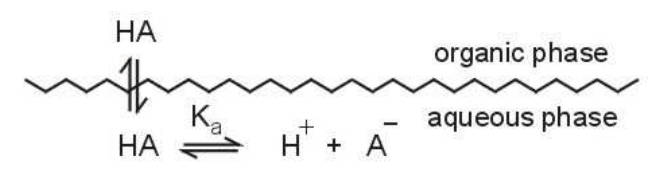
Regarding this extraction, are the following statements correct (Y) or not (N)?
(a) The distribution constant (\(K_D\)) of the acid \(\ce{HA}\) depends on the \(pH\) of the aqueous phase. (Y) (N)
(b) \(\ce{HA}\) can be efficiently extracted only from acidic aqueous solutions. (Y) (N)
(c) The distribution ratio (\(D\)) of the acid \(\ce{HA}\) depends on the pH of the aqueous phase. (Y) (N)
(d) The distribution ratio (\(D\)) of the acid \(\ce{HA}\) depends mainly on its concentration. (Y) (N)
Official English text of the problem.
Answers
- (a) N
- (b) Y, under the intended qualitative interpretation.
- (c) Y
- (d) N
Solution
The symbols \(\ce{HA}\) and \(\ce{A-}\) denote an unspecified weak organic acid and its conjugate-base ion. Their molecular structures are not given, so unique names and SMILES cannot be assigned. The hydrogen ion \(\ce{H+}\) is a proton, [H+].
(a) The distribution constant refers to the same chemical species, undissociated \(\ce{HA}\), in the two phases:
\[ \ce{HA(aq) <=> HA(org)}, \qquad K_D=\frac{[\ce{HA}]_{\mathrm{org}}}{[\ce{HA}]_{\mathrm{aq}}}. \]
For the stated model, at fixed temperature and solvent composition, \(K_D\) is independent of aqueous pH. Changing pH changes how much acid is undissociated, but does not change this partition constant. Hence N.
(b) In the aqueous phase, the acid dissociates:
\[ \ce{HA(aq) <=> H+(aq) + A-(aq)}. \]
Using the dilute-solution approximation,
\[ K_a=\frac{[\ce{H+}]_{\mathrm{aq}}[\ce{A-}]_{\mathrm{aq}}} {[\ce{HA}]_{\mathrm{aq}}}, \]
and therefore
\[ \frac{[\ce{A-}]_{\mathrm{aq}}}{[\ce{HA}]_{\mathrm{aq}}} =\frac{K_a}{[\ce{H+}]_{\mathrm{aq}}} =10^{\mathrm{pH}-pK_a}. \]
The fraction of aqueous acid present in its extractable, undissociated form is thus
\[ \alpha_{\ce{HA}} =\frac{1}{1+10^{\mathrm{pH}-pK_a}}. \]
Acidification suppresses dissociation. When \(\mathrm{pH}\ll pK_a\), almost all the aqueous acid is undissociated and available for extraction. Increasing pH favors the conjugate-base ion, which remains in the aqueous phase in the given scheme. This supports the intended qualitative answer Y.
(c) The distribution ratio uses the total analytical concentration of the acid in each phase. Since only undissociated acid enters the organic phase,
\[ D=\frac{[\ce{HA}]_{\mathrm{org}}} {[\ce{HA}]_{\mathrm{aq}}+[\ce{A-}]_{\mathrm{aq}}}. \]
Substituting the partition and dissociation relations gives
\[ D =\frac{K_D[\ce{HA}]_{\mathrm{aq}}} {[\ce{HA}]_{\mathrm{aq}}\left(1+K_a/[\ce{H+}]_{\mathrm{aq}}\right)} =\boxed{\frac{K_D}{1+10^{\mathrm{pH}-pK_a}}}. \]
Thus \(D\) depends on pH and decreases as pH increases. Hence Y.
(d) The expression above contains no total acid concentration. At fixed pH, temperature, and solvent composition, \(D\) is independent of the acid’s analytical concentration within the stated model. Hence N.
In an unbuffered solution, changing the acid concentration can change pH and thereby affect \(D\) indirectly; this does not make concentration its principal independent determinant.
The answers were checked against the official answers published by the organisers.
IChO 2003 · Theorieaufgabe 14
Extraktion einer schwachen Säure
Die undissoziierte Form einer schwachen organischen Säure \(\ce{HA}\) kann gemäß dem folgenden Schema mit einem nicht mit Wasser mischbaren organischen Lösungsmittel aus der wässrigen Phase extrahiert werden:
Sind die folgenden Aussagen zu dieser Extraktion richtig (Y) oder falsch (N)?
(a) Die Verteilungskonstante (\(K_D\)) der Säure \(\ce{HA}\) hängt vom \(pH\) der wässrigen Phase ab. (Y) (N)
(b) \(\ce{HA}\) kann nur aus sauren wässrigen Lösungen effizient extrahiert werden. (Y) (N)
(c) Das Verteilungsverhältnis (\(D\)) der Säure \(\ce{HA}\) hängt vom pH-Wert der wässrigen Phase ab. (Y) (N)
(d) Das Verteilungsverhältnis (\(D\)) der Säure \(\ce{HA}\) hängt hauptsächlich von ihrer Konzentration ab. (Y) (N)
Aufgabentext aus dem offiziellen englischen Text übersetzt.
Antworten
- (a) N
- (b) Y, bei der beabsichtigten qualitativen Interpretation.
- (c) Y
- (d) N
Lösung
Die Symbole \(\ce{HA}\) und \(\ce{A-}\) bezeichnen eine nicht näher spezifizierte schwache organische Säure und das Ion ihrer konjugierten Base. Ihre Molekülstrukturen sind nicht angegeben, sodass ihnen keine eindeutigen Namen und SMILES zugeordnet werden können. Das Wasserstoffion \(\ce{H+}\) ist ein Proton, [H+].
(a) Die Verteilungskonstante bezieht sich auf dieselbe chemische Spezies, undissoziiertes \(\ce{HA}\), in den beiden Phasen:
\[ \ce{HA(aq) <=> HA(org)}, \qquad K_D=\frac{[\ce{HA}]_{\mathrm{org}}}{[\ce{HA}]_{\mathrm{aq}}}. \]
Im angegebenen Modell ist \(K_D\) bei konstanter Temperatur und Lösungsmittelzusammensetzung unabhängig vom pH-Wert der wässrigen Phase. Eine Änderung des pH-Werts verändert die Menge der undissoziierten Säure, jedoch nicht diese Verteilungskonstante. Daher N.
(b) In der wässrigen Phase dissoziiert die Säure:
\[ \ce{HA(aq) <=> H+(aq) + A-(aq)}. \]
Mit der Näherung für verdünnte Lösungen gilt
\[ K_a=\frac{[\ce{H+}]_{\mathrm{aq}}[\ce{A-}]_{\mathrm{aq}}} {[\ce{HA}]_{\mathrm{aq}}}, \]
und somit
\[ \frac{[\ce{A-}]_{\mathrm{aq}}}{[\ce{HA}]_{\mathrm{aq}}} =\frac{K_a}{[\ce{H+}]_{\mathrm{aq}}} =10^{\mathrm{pH}-pK_a}. \]
Der Anteil der Säure in der wässrigen Phase, der in ihrer extrahierbaren, undissoziierten Form vorliegt, ist somit
\[ \alpha_{\ce{HA}} =\frac{1}{1+10^{\mathrm{pH}-pK_a}}. \]
Ansäuern unterdrückt die Dissoziation. Wenn \(\mathrm{pH}\ll pK_a\), liegt nahezu die gesamte Säure in der wässrigen Phase undissoziiert vor und steht für die Extraktion zur Verfügung. Ein steigender pH-Wert begünstigt das Ion der konjugierten Base, das im angegebenen Schema in der wässrigen Phase verbleibt. Dies stützt die beabsichtigte qualitative Antwort Y.
(c) Das Verteilungsverhältnis verwendet die analytische Gesamtkonzentration der Säure in jeder Phase. Da nur undissoziierte Säure in die organische Phase übergeht, gilt
\[ D=\frac{[\ce{HA}]_{\mathrm{org}}} {[\ce{HA}]_{\mathrm{aq}}+[\ce{A-}]_{\mathrm{aq}}}. \]
Einsetzen der Beziehungen für Verteilung und Dissoziation ergibt
\[ D =\frac{K_D[\ce{HA}]_{\mathrm{aq}}} {[\ce{HA}]_{\mathrm{aq}}\left(1+K_a/[\ce{H+}]_{\mathrm{aq}}\right)} =\boxed{\frac{K_D}{1+10^{\mathrm{pH}-pK_a}}}. \]
Somit hängt \(D\) vom pH-Wert ab und nimmt mit steigendem pH-Wert ab. Daher Y.
(d) Der obige Ausdruck enthält keine Gesamtkonzentration der Säure. Bei konstantem pH-Wert, konstanter Temperatur und konstanter Lösungsmittelzusammensetzung ist \(D\) im Rahmen des angegebenen Modells unabhängig von der analytischen Konzentration der Säure. Daher N.
In einer ungepufferten Lösung kann eine Änderung der Säurekonzentration den pH-Wert verändern und dadurch \(D\) indirekt beeinflussen; dadurch wird die Konzentration jedoch nicht zu dessen maßgeblicher unabhängiger Einflussgröße.
Die Ergebnisse wurden mit den von den Veranstaltern veröffentlichten offiziellen Ergebnissen abgeglichen.
IChO 2003 · Teori sorusu 14
Zayıf bir asidin ekstraksiyonu
Zayıf bir organik asidin \(\ce{HA}\) iyonlaşmamış biçimi, suyla karışmayan bir organik çözücüyle aşağıdaki şemaya göre sulu fazdan ekstrakte edilebilir:
Bu ekstraksiyonla ilgili aşağıdaki ifadeler doğru mu (Y), yanlış mı (N)?
(a) \(\ce{HA}\) asidinin dağılma sabiti (\(K_D\)), sulu fazın \(pH\) değerine bağlıdır. (Y) (N)
(b) \(\ce{HA}\), yalnızca asidik sulu çözeltilerden verimli bir şekilde ekstrakte edilebilir. (Y) (N)
(c) \(\ce{HA}\) asidinin dağılma oranı (\(D\)), sulu fazın pH değerine bağlıdır. (Y) (N)
(d) \(\ce{HA}\) asidinin dağılma oranı (\(D\)), esas olarak derişimine bağlıdır. (Y) (N)
Soru metni resmi İngilizce metinden çevrilmiştir.
Cevaplar
- (a) N
- (b) Y, amaçlanan nitel yorum çerçevesinde.
- (c) Y
- (d) N
Çözüm
\(\ce{HA}\) ve \(\ce{A-}\) simgeleri, kimliği belirtilmemiş zayıf bir organik asidi ve onun eşlenik baz iyonunu gösterir. Molekül yapıları verilmediğinden, bunlara özgü adlar ve SMILES gösterimleri atanamaz. Hidrojen iyonu \(\ce{H+}\) bir protondur, [H+].
(a) Dağılma sabiti, iki fazdaki aynı kimyasal türe, yani iyonlaşmamış \(\ce{HA}\)'ya ilişkindir:
\[ \ce{HA(aq) <=> HA(org)}, \qquad K_D=\frac{[\ce{HA}]_{\mathrm{org}}}{[\ce{HA}]_{\mathrm{aq}}}. \]
Belirtilen modelde, sabit sıcaklık ve çözücü bileşiminde \(K_D\), sulu fazın pH değerinden bağımsızdır. pH değerinin değişmesi, asidin ne kadarının iyonlaşmamış olduğunu değiştirir; ancak bu dağılma sabitini değiştirmez. Dolayısıyla cevap N'dir.
(b) Sulu fazda asit iyonlaşır:
\[ \ce{HA(aq) <=> H+(aq) + A-(aq)}. \]
Seyreltik çözelti yaklaşımı kullanıldığında,
\[ K_a=\frac{[\ce{H+}]_{\mathrm{aq}}[\ce{A-}]_{\mathrm{aq}}} {[\ce{HA}]_{\mathrm{aq}}}, \]
ve dolayısıyla
\[ \frac{[\ce{A-}]_{\mathrm{aq}}}{[\ce{HA}]_{\mathrm{aq}}} =\frac{K_a}{[\ce{H+}]_{\mathrm{aq}}} =10^{\mathrm{pH}-pK_a}. \]
Böylece sulu fazdaki asidin ekstrakte edilebilir, iyonlaşmamış biçimde bulunan kesri şöyledir:
\[ \alpha_{\ce{HA}} =\frac{1}{1+10^{\mathrm{pH}-pK_a}}. \]
Asitlendirme, iyonlaşmayı baskılar. \(\mathrm{pH}\ll pK_a\) olduğunda, sulu fazdaki asidin neredeyse tamamı iyonlaşmamış hâldedir ve ekstrakte edilebilir. pH değerinin artırılması, verilen şemada sulu fazda kalan eşlenik baz iyonunun oluşumunu destekler. Bu, amaçlanan nitel cevap olan Y'yi destekler.
(c) Dağılma oranında, her bir fazdaki asidin toplam analitik derişimi kullanılır. Organik faza yalnızca iyonlaşmamış asit geçtiğinden,
\[ D=\frac{[\ce{HA}]_{\mathrm{org}}} {[\ce{HA}]_{\mathrm{aq}}+[\ce{A-}]_{\mathrm{aq}}}. \]
Dağılma ve iyonlaşma bağıntıları yerine konulduğunda şu ifade elde edilir:
\[ D =\frac{K_D[\ce{HA}]_{\mathrm{aq}}} {[\ce{HA}]_{\mathrm{aq}}\left(1+K_a/[\ce{H+}]_{\mathrm{aq}}\right)} =\boxed{\frac{K_D}{1+10^{\mathrm{pH}-pK_a}}}. \]
Dolayısıyla \(D\), pH değerine bağlıdır ve pH arttıkça azalır. Bu nedenle cevap Y'dir.
(d) Yukarıdaki ifade, toplam asit derişimini içermez. Sabit pH, sıcaklık ve çözücü bileşiminde \(D\), belirtilen model kapsamında asidin analitik derişiminden bağımsızdır. Dolayısıyla cevap N'dir.
Tamponlanmamış bir çözeltide asit derişiminin değiştirilmesi pH değerini değiştirebilir ve böylece \(D\)'yi dolaylı olarak etkileyebilir; bu durum, derişimi onun başlıca bağımsız belirleyicisi yapmaz.
Sonuçlar, düzenleyicilerin yayımladığı resmi sonuçlarla karşılaştırılarak kontrol edildi.
IChO 2003 · Problema teórico 14
Extracción de un ácido débil
La forma no disociada de un ácido orgánico débil \(\ce{HA}\) puede extraerse de la fase acuosa mediante un disolvente orgánico inmiscible con el agua según el esquema:
Con respecto a esta extracción, ¿son correctas (Y) o no (N) las siguientes afirmaciones?
(a) La constante de distribución (\(K_D\)) del ácido \(\ce{HA}\) depende del \(pH\) de la fase acuosa. (Y) (N)
(b) El ácido \(\ce{HA}\) solo puede extraerse eficazmente de disoluciones acuosas ácidas. (Y) (N)
(c) La relación de distribución (\(D\)) del ácido \(\ce{HA}\) depende del pH de la fase acuosa. (Y) (N)
(d) La relación de distribución (\(D\)) del ácido \(\ce{HA}\) depende principalmente de su concentración. (Y) (N)
Enunciado traducido del texto oficial en inglés.
Respuestas
- (a) N
- (b) Y, según la interpretación cualitativa pretendida.
- (c) Y
- (d) N
Solución
Los símbolos \(\ce{HA}\) y \(\ce{A-}\) representan un ácido orgánico débil no especificado y el ion de su base conjugada. No se proporcionan sus estructuras moleculares, por lo que no pueden asignarse nombres ni cadenas SMILES unívocos. El ion hidrógeno \(\ce{H+}\) es un protón, [H+].
(a) La constante de distribución se refiere a la misma especie química, \(\ce{HA}\) no disociado, en las dos fases:
\[ \ce{HA(aq) <=> HA(org)}, \qquad K_D=\frac{[\ce{HA}]_{\mathrm{org}}}{[\ce{HA}]_{\mathrm{aq}}}. \]
En el modelo planteado, a temperatura y composición del disolvente fijas, \(K_D\) es independiente del pH de la fase acuosa. Modificar el pH cambia la cantidad de ácido que está sin disociar, pero no modifica esta constante de reparto. Por tanto, N.
(b) En la fase acuosa, el ácido se disocia:
\[ \ce{HA(aq) <=> H+(aq) + A-(aq)}. \]
Utilizando la aproximación de disolución diluida,
\[ K_a=\frac{[\ce{H+}]_{\mathrm{aq}}[\ce{A-}]_{\mathrm{aq}}} {[\ce{HA}]_{\mathrm{aq}}}, \]
y, por tanto,
\[ \frac{[\ce{A-}]_{\mathrm{aq}}}{[\ce{HA}]_{\mathrm{aq}}} =\frac{K_a}{[\ce{H+}]_{\mathrm{aq}}} =10^{\mathrm{pH}-pK_a}. \]
La fracción del ácido de la fase acuosa presente en su forma no disociada, susceptible de extracción, es, por tanto,
\[ \alpha_{\ce{HA}} =\frac{1}{1+10^{\mathrm{pH}-pK_a}}. \]
La acidificación inhibe la disociación. Cuando \(\mathrm{pH}\ll pK_a\), casi todo el ácido de la fase acuosa está sin disociar y disponible para la extracción. Aumentar el pH favorece al ion de la base conjugada, que permanece en la fase acuosa según el esquema dado. Esto respalda la respuesta cualitativa pretendida, Y.
(c) La relación de distribución utiliza la concentración analítica total del ácido en cada fase. Puesto que solo el ácido no disociado pasa a la fase orgánica,
\[ D=\frac{[\ce{HA}]_{\mathrm{org}}} {[\ce{HA}]_{\mathrm{aq}}+[\ce{A-}]_{\mathrm{aq}}}. \]
Al sustituir las relaciones de reparto y de disociación se obtiene
\[ D =\frac{K_D[\ce{HA}]_{\mathrm{aq}}} {[\ce{HA}]_{\mathrm{aq}}\left(1+K_a/[\ce{H+}]_{\mathrm{aq}}\right)} =\boxed{\frac{K_D}{1+10^{\mathrm{pH}-pK_a}}}. \]
Así, \(D\) depende del pH y disminuye a medida que aumenta el pH. Por tanto, Y.
(d) La expresión anterior no contiene la concentración total del ácido. A pH, temperatura y composición del disolvente fijos, \(D\) es independiente de la concentración analítica del ácido dentro del modelo planteado. Por tanto, N.
En una disolución no tamponada, modificar la concentración del ácido puede cambiar el pH y, por ello, afectar indirectamente a \(D\); esto no convierte a la concentración en su principal factor determinante independiente.
Los resultados se comprobaron con los resultados oficiales publicados por los organizadores.
IChO 2003 · 理论题 14
弱酸的萃取
弱有机酸 \(\ce{HA}\) 的未解离形式可由与水不互溶的有机溶剂从水相中萃取出来,过程如下图所示:
关于这一萃取过程,下列说法是否正确?正确选 (Y),错误选 (N)。
(a) 酸 \(\ce{HA}\) 的分配常数(\(K_D\))取决于水相的 \(pH\)。(Y) (N)
(b) 只有从酸性水溶液中才能高效萃取 \(\ce{HA}\)。(Y) (N)
(c) 酸 \(\ce{HA}\) 的分配比(\(D\))取决于水相的 pH。(Y) (N)
(d) 酸 \(\ce{HA}\) 的分配比(\(D\))主要取决于其浓度。(Y) (N)
题目译自官方英文原文。
答案
- (a) N
- (b) Y,按题目预期的定性理解而言。
- (c) Y
- (d) N
解答
符号 \(\ce{HA}\) 和 \(\ce{A-}\) 分别表示一种未指明的弱有机酸及其共轭碱离子。由于未给出它们的分子结构,无法确定唯一的名称和 SMILES。氢离子 \(\ce{H+}\) 是质子,[H+]。
(a) 分配常数针对的是两相中的同一化学物种,即未解离的 \(\ce{HA}\):
\[ \ce{HA(aq) <=> HA(org)}, \qquad K_D=\frac{[\ce{HA}]_{\mathrm{org}}}{[\ce{HA}]_{\mathrm{aq}}}. \]
在题设模型中,温度和溶剂组成固定时,\(K_D\) 与水相的 pH 无关。改变 pH 会改变未解离酸的量,但不会改变这一分配常数。因此选 N。
(b) 在水相中,酸发生解离:
\[ \ce{HA(aq) <=> H+(aq) + A-(aq)}. \]
采用稀溶液近似,
\[ K_a=\frac{[\ce{H+}]_{\mathrm{aq}}[\ce{A-}]_{\mathrm{aq}}} {[\ce{HA}]_{\mathrm{aq}}}, \]
因此
\[ \frac{[\ce{A-}]_{\mathrm{aq}}}{[\ce{HA}]_{\mathrm{aq}}} =\frac{K_a}{[\ce{H+}]_{\mathrm{aq}}} =10^{\mathrm{pH}-pK_a}. \]
因此,水相中以可萃取的未解离形式存在的酸所占的分数为
\[ \alpha_{\ce{HA}} =\frac{1}{1+10^{\mathrm{pH}-pK_a}}. \]
酸化会抑制解离。当 \(\mathrm{pH}\ll pK_a\) 时,水相中几乎所有的酸均未解离,可被萃取。升高 pH 有利于共轭碱离子的形成,而在题给示意图中,该离子留在水相中。这支持题目预期的定性答案 Y。
(c) 分配比采用各相中酸的总分析浓度。由于只有未解离的酸进入有机相,
\[ D=\frac{[\ce{HA}]_{\mathrm{org}}} {[\ce{HA}]_{\mathrm{aq}}+[\ce{A-}]_{\mathrm{aq}}}. \]
代入分配和解离关系式,得到
\[ D =\frac{K_D[\ce{HA}]_{\mathrm{aq}}} {[\ce{HA}]_{\mathrm{aq}}\left(1+K_a/[\ce{H+}]_{\mathrm{aq}}\right)} =\boxed{\frac{K_D}{1+10^{\mathrm{pH}-pK_a}}}. \]
因此,\(D\) 取决于 pH,并随 pH 升高而减小。因此选 Y。
(d) 上述表达式不含酸的总浓度。在题设模型中,pH、温度和溶剂组成固定时,\(D\) 与酸的分析浓度无关。因此选 N。
在未缓冲的溶液中,改变酸的浓度可能会改变 pH,从而间接影响 \(D\);但这并不意味着浓度是决定分配比的主要独立因素。
结果已与主办方公布的官方答案核对。
IChO 2003 · Теоретическая задача 14
Экстракция слабой кислоты
Недиссоциированная форма слабой органической кислоты \(\ce{HA}\) может быть экстрагирована из водной фазы органическим растворителем, не смешивающимся с водой, согласно схеме:
Верны (Y) или неверны (N) следующие утверждения об этой экстракции?
(a) Константа распределения (\(K_D\)) кислоты \(\ce{HA}\) зависит от \(pH\) водной фазы. (Y) (N)
(b) \(\ce{HA}\) можно эффективно экстрагировать только из кислых водных растворов. (Y) (N)
(c) Коэффициент распределения (\(D\)) кислоты \(\ce{HA}\) зависит от pH водной фазы. (Y) (N)
(d) Коэффициент распределения (\(D\)) кислоты \(\ce{HA}\) зависит главным образом от её концентрации. (Y) (N)
Условие переведено с официального английского текста.
Ответы
- (a) N
- (b) Y, в рамках предполагаемой качественной интерпретации.
- (c) Y
- (d) N
Решение
Символы \(\ce{HA}\) и \(\ce{A-}\) обозначают некоторую слабую органическую кислоту и ион сопряжённого с ней основания. Их молекулярные структуры не приведены, поэтому им нельзя однозначно сопоставить названия и записи SMILES. Ион водорода \(\ce{H+}\) — это протон, [H+].
(a) Константа распределения относится к одной и той же химической форме, недиссоциированной \(\ce{HA}\), в двух фазах:
\[ \ce{HA(aq) <=> HA(org)}, \qquad K_D=\frac{[\ce{HA}]_{\mathrm{org}}}{[\ce{HA}]_{\mathrm{aq}}}. \]
В рамках указанной модели при постоянных температуре и составе растворителя \(K_D\) не зависит от pH водной фазы. Изменение pH меняет количество недиссоциированной кислоты, но не изменяет эту константу распределения. Следовательно, N.
(b) В водной фазе кислота диссоциирует:
\[ \ce{HA(aq) <=> H+(aq) + A-(aq)}. \]
В приближении разбавленного раствора
\[ K_a=\frac{[\ce{H+}]_{\mathrm{aq}}[\ce{A-}]_{\mathrm{aq}}} {[\ce{HA}]_{\mathrm{aq}}}, \]
и поэтому
\[ \frac{[\ce{A-}]_{\mathrm{aq}}}{[\ce{HA}]_{\mathrm{aq}}} =\frac{K_a}{[\ce{H+}]_{\mathrm{aq}}} =10^{\mathrm{pH}-pK_a}. \]
Таким образом, доля кислоты в водной фазе, находящейся в экстрагируемой недиссоциированной форме, равна
\[ \alpha_{\ce{HA}} =\frac{1}{1+10^{\mathrm{pH}-pK_a}}. \]
Подкисление подавляет диссоциацию. При \(\mathrm{pH}\ll pK_a\) почти вся кислота в водной фазе находится в недиссоциированной форме и может быть экстрагирована. Повышение pH способствует образованию иона сопряжённого основания, который в данной схеме остаётся в водной фазе. Это подтверждает предполагаемый качественный ответ Y.
(c) Коэффициент распределения определяется через суммарную аналитическую концентрацию кислоты в каждой фазе. Поскольку в органическую фазу переходит только недиссоциированная кислота,
\[ D=\frac{[\ce{HA}]_{\mathrm{org}}} {[\ce{HA}]_{\mathrm{aq}}+[\ce{A-}]_{\mathrm{aq}}}. \]
Подстановка соотношений для распределения и диссоциации даёт
\[ D =\frac{K_D[\ce{HA}]_{\mathrm{aq}}} {[\ce{HA}]_{\mathrm{aq}}\left(1+K_a/[\ce{H+}]_{\mathrm{aq}}\right)} =\boxed{\frac{K_D}{1+10^{\mathrm{pH}-pK_a}}}. \]
Таким образом, \(D\) зависит от pH и уменьшается при повышении pH. Следовательно, Y.
(d) Приведённое выше выражение не содержит суммарной концентрации кислоты. При постоянных pH, температуре и составе растворителя \(D\) в рамках указанной модели не зависит от аналитической концентрации кислоты. Следовательно, N.
В небуферном растворе изменение концентрации кислоты может изменить pH и тем самым косвенно повлиять на \(D\); это не делает концентрацию основным независимым фактором, определяющим его величину.
Ответы проверены по официальным ответам, опубликованным организаторами.
IChO 2003 · مسألة نظرية 14
استخلاص حمض ضعيف
يمكن استخلاص الصورة غير المتفككة لحمض عضوي ضعيف \(\ce{HA}\) من الطور المائي باستخدام مذيب عضوي غير ممتزج بالماء وفقًا للمخطط الآتي:
فيما يتعلق بهذا الاستخلاص، هل العبارات الآتية صحيحة (Y) أم غير صحيحة (N)؟
(a) يعتمد ثابت التوزيع (\(K_D\)) للحمض \(\ce{HA}\) على \(pH\) الطور المائي. (Y) (N)
(b) لا يمكن استخلاص \(\ce{HA}\) بكفاءة إلا من المحاليل المائية الحمضية. (Y) (N)
(c) تعتمد نسبة التوزيع (\(D\)) للحمض \(\ce{HA}\) على الأس الهيدروجيني للطور المائي. (Y) (N)
(d) تعتمد نسبة التوزيع (\(D\)) للحمض \(\ce{HA}\) أساسًا على تركيزه. (Y) (N)
نص المسألة مترجم عن النص الإنجليزي الرسمي.
الإجابات
- (a) N
- (b) Y، وفق التفسير النوعي المقصود.
- (c) Y
- (d) N
الحل
يرمز الرمزان \(\ce{HA}\) و\(\ce{A-}\) إلى حمض عضوي ضعيف غير محدد وأيون قاعدته المرافقة. لم تُعطَ بنيتاهما الجزيئيتان، لذا لا يمكن تعيين اسم محدد أو تمثيل SMILES محدد لكل منهما. أيون الهيدروجين \(\ce{H+}\) هو بروتون، [H+].
(a) يشير ثابت التوزيع إلى النوع الكيميائي نفسه، وهو \(\ce{HA}\) غير المتفكك، في الطورين:
\[ \ce{HA(aq) <=> HA(org)}, \qquad K_D=\frac{[\ce{HA}]_{\mathrm{org}}}{[\ce{HA}]_{\mathrm{aq}}}. \]
في النموذج المذكور، وعند ثبات درجة الحرارة وتركيب المذيب، يكون \(K_D\) مستقلًا عن الأس الهيدروجيني للطور المائي. يغيّر تغير الأس الهيدروجيني مقدار الحمض غير المتفكك، لكنه لا يغيّر ثابت التوزيع هذا. ومن ثم فالإجابة N.
(b) يتفكك الحمض في الطور المائي:
\[ \ce{HA(aq) <=> H+(aq) + A-(aq)}. \]
باستخدام تقريب المحاليل المخففة،
\[ K_a=\frac{[\ce{H+}]_{\mathrm{aq}}[\ce{A-}]_{\mathrm{aq}}} {[\ce{HA}]_{\mathrm{aq}}}, \]
وبالتالي
\[ \frac{[\ce{A-}]_{\mathrm{aq}}}{[\ce{HA}]_{\mathrm{aq}}} =\frac{K_a}{[\ce{H+}]_{\mathrm{aq}}} =10^{\mathrm{pH}-pK_a}. \]
إذن، فإن الكسر من الحمض الموجود في الطور المائي الذي يكون في صورته غير المتفككة القابلة للاستخلاص هو
\[ \alpha_{\ce{HA}} =\frac{1}{1+10^{\mathrm{pH}-pK_a}}. \]
يثبط التحميض التفكك. عندما يكون \(\mathrm{pH}\ll pK_a\)، يكون الحمض الموجود في الطور المائي كله تقريبًا غير متفكك ومتاحًا للاستخلاص. وتُرجّح زيادة الأس الهيدروجيني تكوّن أيون القاعدة المرافقة، الذي يبقى في الطور المائي وفق المخطط المعطى. وهذا يدعم الإجابة النوعية المقصودة Y.
(c) تُستخدم في نسبة التوزيع قيمة التركيز التحليلي الكلي للحمض في كل طور. وبما أن الحمض غير المتفكك وحده يدخل الطور العضوي، فإن
\[ D=\frac{[\ce{HA}]_{\mathrm{org}}} {[\ce{HA}]_{\mathrm{aq}}+[\ce{A-}]_{\mathrm{aq}}}. \]
بالتعويض باستخدام علاقتَي التوزيع والتفكك نحصل على
\[ D =\frac{K_D[\ce{HA}]_{\mathrm{aq}}} {[\ce{HA}]_{\mathrm{aq}}\left(1+K_a/[\ce{H+}]_{\mathrm{aq}}\right)} =\boxed{\frac{K_D}{1+10^{\mathrm{pH}-pK_a}}}. \]
إذن، تعتمد \(D\) على الأس الهيدروجيني وتنخفض بارتفاعه. ومن ثم فالإجابة Y.
(d) لا يتضمن التعبير أعلاه التركيز الكلي للحمض. عند ثبات الأس الهيدروجيني ودرجة الحرارة وتركيب المذيب، تكون \(D\) مستقلة عن التركيز التحليلي للحمض ضمن النموذج المذكور. ومن ثم فالإجابة N.
في محلول غير منظَّم، يمكن أن يؤدي تغيير تركيز الحمض إلى تغيير الأس الهيدروجيني، ومن ثم التأثير في \(D\) بصورة غير مباشرة؛ وهذا لا يجعل التركيز العامل المستقل الرئيسي المحدِّد لها.
تمت مراجعة النتائج بمقارنتها بالنتائج الرسمية التي نشرها المنظمون.