IChO 2003 · Theory problem 22
Face-centred cubic silver
Silver metal exists as a face-centered cubic (fcc) packed solid.
a) Draw an fcc unit cell.
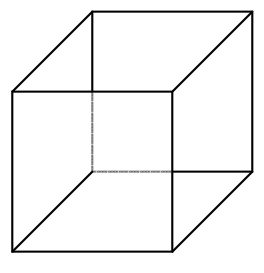
b) How many atoms are present in the fcc unit cell?
c) The density of silver has been determined to be \(10.5\ \mathrm{g\,cm^{-3}}\). What is the length of each edge of the unit cell?
d) What is the atomic radius of the silver atoms in the crystal?
Official English text of the problem.
Answers
- a) A cube with atoms centered at all eight corners and at the centers of all six faces.
- b) \(4\) atoms per unit cell.
- c) \(a=4.09\times10^{-8}\ \mathrm{cm}=409\ \mathrm{pm}\).
- d) \(r=1.44\times10^{-8}\ \mathrm{cm}=144\ \mathrm{pm}\).
Solution
a) Draw a cube and place an atom at each of its eight vertices and at the center of each of its six faces, including the hidden faces. There is no atom at the body center. Neighboring atoms touch along the face diagonals.
b) Each corner atom is shared by eight unit cells, so it contributes \(1/8\) atom to the cell. Each face-centered atom is shared by two cells, contributing \(1/2\) atom. Therefore,
\[ Z=8\left(\frac18\right)+6\left(\frac12\right) =\boxed{4\text{ atoms per unit cell}}. \]
c) Use the standard molar mass \(M(\ce{Ag})=107.87\ \mathrm{g\,mol^{-1}}\) and Avogadro constant \(N_{\mathrm A}=6.02214076\times10^{23}\ \mathrm{mol^{-1}}\).
The mass of one unit cell is
\[ m_{\text{cell}}=\frac{ZM}{N_{\mathrm A}} =\frac{4(107.87\ \mathrm{g\,mol^{-1}})} {6.02214076\times10^{23}\ \mathrm{mol^{-1}}} =7.16489\times10^{-22}\ \mathrm g. \]
For a cube of edge length \(a\), the volume is \(a^3\). Hence,
\[ \rho=\frac{m_{\text{cell}}}{a^3}, \qquad a=\left(\frac{ZM}{\rho N_{\mathrm A}}\right)^{1/3}. \]
Substituting,
\[ a= \left[ \frac{4(107.87)} {(10.5)(6.02214076\times10^{23})} \ \mathrm{cm^3} \right]^{1/3} =4.08639\times10^{-8}\ \mathrm{cm}. \]
To three significant figures,
\[ \boxed{a=4.09\times10^{-8}\ \mathrm{cm} =0.409\ \mathrm{nm}=409\ \mathrm{pm}}. \]
d) Along a face diagonal, a corner atom touches the face-centered atom, which touches the opposite corner atom. The two center-to-center distances are each \(2r\), so the diagonal has length \(4r\). Geometrically, the face diagonal is \(a\sqrt2\). Thus,
\[ 4r=a\sqrt2, \qquad r=\frac{a}{2\sqrt2}. \]
Using the unrounded edge length,
\[ r=\frac{408.639\ \mathrm{pm}}{2\sqrt2} =144.476\ \mathrm{pm}. \]
To three significant figures,
\[ \boxed{r=144\ \mathrm{pm} =0.144\ \mathrm{nm} =1.44\times10^{-8}\ \mathrm{cm}}. \]
The answers were checked against the official answers published by the organisers.
IChO 2003 · Theorieaufgabe 22
Kubisch flächenzentriertes Silber
Metallisches Silber liegt als Festkörper mit kubisch flächenzentrierter (fcc) Packung vor.
a) Zeichnen Sie eine fcc-Elementarzelle.
b) Wie viele Atome sind in der fcc-Elementarzelle enthalten?
c) Die Dichte von Silber wurde zu \(10.5\ \mathrm{g\,cm^{-3}}\) bestimmt. Wie lang ist jede Kante der Elementarzelle?
d) Wie groß ist der Atomradius der Silberatome im Kristall?
Aufgabentext aus dem offiziellen englischen Text übersetzt.
Antworten
- a) Ein Würfel mit Atomen, deren Mittelpunkte an allen acht Ecken und in den Mittelpunkten aller sechs Flächen liegen.
- b) \(4\) Atome pro Elementarzelle.
- c) \(a=4.09\times10^{-8}\ \mathrm{cm}=409\ \mathrm{pm}\).
- d) \(r=1.44\times10^{-8}\ \mathrm{cm}=144\ \mathrm{pm}\).
Lösung
a) Zeichnen Sie einen Würfel und platzieren Sie an jeder seiner acht Ecken sowie im Mittelpunkt jeder seiner sechs Flächen ein Atom, auch auf den verdeckten Flächen. Im Mittelpunkt des Würfels befindet sich kein Atom. Benachbarte Atome berühren sich entlang der Flächendiagonalen.
b) Jedes Eckatom gehört zu acht Elementarzellen und trägt daher \(1/8\) Atom zur Zelle bei. Jedes Atom in einem Flächenmittelpunkt gehört zu zwei Zellen und trägt somit \(1/2\) Atom bei. Daher gilt:
\[ Z=8\left(\frac18\right)+6\left(\frac12\right) =\boxed{4\text{ Atome pro Elementarzelle}}. \]
c) Verwenden Sie die Standardmolmasse \(M(\ce{Ag})=107.87\ \mathrm{g\,mol^{-1}}\) und die Avogadro-Konstante \(N_{\mathrm A}=6.02214076\times10^{23}\ \mathrm{mol^{-1}}\).
Die Masse einer Elementarzelle beträgt
\[ m_{\text{Zelle}}=\frac{ZM}{N_{\mathrm A}} =\frac{4(107.87\ \mathrm{g\,mol^{-1}})} {6.02214076\times10^{23}\ \mathrm{mol^{-1}}} =7.16489\times10^{-22}\ \mathrm g. \]
Für einen Würfel mit der Kantenlänge \(a\) beträgt das Volumen \(a^3\). Somit gilt:
\[ \rho=\frac{m_{\text{Zelle}}}{a^3}, \qquad a=\left(\frac{ZM}{\rho N_{\mathrm A}}\right)^{1/3}. \]
Einsetzen ergibt:
\[ a= \left[ \frac{4(107.87)} {(10.5)(6.02214076\times10^{23})} \ \mathrm{cm^3} \right]^{1/3} =4.08639\times10^{-8}\ \mathrm{cm}. \]
Auf drei signifikante Stellen gerundet:
\[ \boxed{a=4.09\times10^{-8}\ \mathrm{cm} =0.409\ \mathrm{nm}=409\ \mathrm{pm}}. \]
d) Entlang einer Flächendiagonalen berührt ein Eckatom das Atom im Flächenmittelpunkt, das wiederum das gegenüberliegende Eckatom berührt. Die beiden Abstände zwischen den Atommittelpunkten betragen jeweils \(2r\), sodass die Diagonale die Länge \(4r\) hat. Aus der Geometrie ergibt sich für die Flächendiagonale \(a\sqrt2\). Somit gilt:
\[ 4r=a\sqrt2, \qquad r=\frac{a}{2\sqrt2}. \]
Mit der ungerundeten Kantenlänge ergibt sich:
\[ r=\frac{408.639\ \mathrm{pm}}{2\sqrt2} =144.476\ \mathrm{pm}. \]
Auf drei signifikante Stellen gerundet:
\[ \boxed{r=144\ \mathrm{pm} =0.144\ \mathrm{nm} =1.44\times10^{-8}\ \mathrm{cm}}. \]
Die Ergebnisse wurden mit den von den Veranstaltern veröffentlichten offiziellen Ergebnissen abgeglichen.
IChO 2003 · Teori sorusu 22
Yüzey merkezli kübik gümüş
Gümüş metali, yüzey merkezli kübik (fcc) istiflenmiş bir katı hâlinde bulunur.
a) Bir fcc birim hücresi çiziniz.
b) fcc birim hücresinde kaç atom bulunur?
c) Gümüşün yoğunluğu \(10.5\ \mathrm{g\,cm^{-3}}\) olarak belirlenmiştir. Birim hücrenin her bir kenarının uzunluğu nedir?
d) Kristaldeki gümüş atomlarının atom yarıçapı nedir?
Soru metni resmi İngilizce metinden çevrilmiştir.
Cevaplar
- a) Sekiz köşesinin tamamında ve altı yüzünün tamamının merkezlerinde atom merkezleri bulunan bir küp.
- b) Birim hücre başına \(4\) atom.
- c) \(a=4.09\times10^{-8}\ \mathrm{cm}=409\ \mathrm{pm}\).
- d) \(r=1.44\times10^{-8}\ \mathrm{cm}=144\ \mathrm{pm}\).
Çözüm
a) Bir küp çiziniz ve sekiz köşesinin her birine ve görünmeyen yüzler de dâhil olmak üzere altı yüzünün her birinin merkezine bir atom yerleştiriniz. Hacim merkezinde atom bulunmaz. Komşu atomlar yüz köşegenleri boyunca birbirine temas eder.
b) Her köşe atomu sekiz birim hücre tarafından paylaşıldığından hücreye \(1/8\) atom katkıda bulunur. Yüz merkezindeki her atom iki hücre tarafından paylaşılır ve \(1/2\) atom katkıda bulunur. Dolayısıyla,
\[ Z=8\left(\frac18\right)+6\left(\frac12\right) =\boxed{4\text{ atom/birim hücre}}. \]
c) Standart molar kütle \(M(\ce{Ag})=107.87\ \mathrm{g\,mol^{-1}}\) ve Avogadro sabiti \(N_{\mathrm A}=6.02214076\times10^{23}\ \mathrm{mol^{-1}}\) değerlerini kullanınız.
Bir birim hücrenin kütlesi şöyledir:
\[ m_{\text{hücre}}=\frac{ZM}{N_{\mathrm A}} =\frac{4(107.87\ \mathrm{g\,mol^{-1}})} {6.02214076\times10^{23}\ \mathrm{mol^{-1}}} =7.16489\times10^{-22}\ \mathrm g. \]
Kenar uzunluğu \(a\) olan bir küpün hacmi \(a^3\) olur. Bu nedenle,
\[ \rho=\frac{m_{\text{hücre}}}{a^3}, \qquad a=\left(\frac{ZM}{\rho N_{\mathrm A}}\right)^{1/3}. \]
Değerler yerine konulduğunda,
\[ a= \left[ \frac{4(107.87)} {(10.5)(6.02214076\times10^{23})} \ \mathrm{cm^3} \right]^{1/3} =4.08639\times10^{-8}\ \mathrm{cm}. \]
Üç anlamlı basamağa yuvarlandığında,
\[ \boxed{a=4.09\times10^{-8}\ \mathrm{cm} =0.409\ \mathrm{nm}=409\ \mathrm{pm}}. \]
d) Bir yüz köşegeni boyunca, bir köşe atomu yüz merkezindeki atoma, bu atom da karşı köşedeki atoma temas eder. Merkezler arasındaki iki uzaklığın her biri \(2r\) olduğundan köşegenin uzunluğu \(4r\) olur. Geometrik olarak yüz köşegeni \(a\sqrt2\) uzunluğundadır. Böylece,
\[ 4r=a\sqrt2, \qquad r=\frac{a}{2\sqrt2}. \]
Yuvarlanmamış kenar uzunluğu kullanıldığında,
\[ r=\frac{408.639\ \mathrm{pm}}{2\sqrt2} =144.476\ \mathrm{pm}. \]
Üç anlamlı basamağa yuvarlandığında,
\[ \boxed{r=144\ \mathrm{pm} =0.144\ \mathrm{nm} =1.44\times10^{-8}\ \mathrm{cm}}. \]
Sonuçlar, düzenleyicilerin yayımladığı resmi sonuçlarla karşılaştırılarak kontrol edildi.
IChO 2003 · Problema teórico 22
Plata cúbica centrada en las caras
La plata metálica existe como un sólido con empaquetamiento cúbico centrado en las caras (fcc).
a) Dibuje una celda unidad fcc.
b) ¿Cuántos átomos hay en la celda unidad fcc?
c) Se ha determinado que la densidad de la plata es de \(10.5\ \mathrm{g\,cm^{-3}}\). ¿Cuál es la longitud de cada arista de la celda unidad?
d) ¿Cuál es el radio atómico de los átomos de plata en el cristal?
Enunciado traducido del texto oficial en inglés.
Respuestas
- a) Un cubo con átomos centrados en sus ocho vértices y en los centros de sus seis caras.
- b) \(4\) átomos por celda unidad.
- c) \(a=4.09\times10^{-8}\ \mathrm{cm}=409\ \mathrm{pm}\).
- d) \(r=1.44\times10^{-8}\ \mathrm{cm}=144\ \mathrm{pm}\).
Solución
a) Dibuje un cubo y coloque un átomo en cada uno de sus ocho vértices y en el centro de cada una de sus seis caras, incluidas las caras ocultas. No hay ningún átomo en el centro del cubo. Los átomos vecinos están en contacto a lo largo de las diagonales de las caras.
b) Cada átomo situado en un vértice se comparte entre ocho celdas unidad, por lo que aporta \(1/8\) de átomo a la celda. Cada átomo situado en el centro de una cara se comparte entre dos celdas, por lo que aporta \(1/2\) de átomo. Por tanto,
\[ Z=8\left(\frac18\right)+6\left(\frac12\right) =\boxed{4\text{ átomos por celda unidad}}. \]
c) Utilice la masa molar estándar \(M(\ce{Ag})=107.87\ \mathrm{g\,mol^{-1}}\) y la constante de Avogadro \(N_{\mathrm A}=6.02214076\times10^{23}\ \mathrm{mol^{-1}}\).
La masa de una celda unidad es
\[ m_{\text{celda}}=\frac{ZM}{N_{\mathrm A}} =\frac{4(107.87\ \mathrm{g\,mol^{-1}})} {6.02214076\times10^{23}\ \mathrm{mol^{-1}}} =7.16489\times10^{-22}\ \mathrm g. \]
Para un cubo cuya arista tiene una longitud \(a\), el volumen es \(a^3\). Por tanto,
\[ \rho=\frac{m_{\text{celda}}}{a^3}, \qquad a=\left(\frac{ZM}{\rho N_{\mathrm A}}\right)^{1/3}. \]
Sustituyendo,
\[ a= \left[ \frac{4(107.87)} {(10.5)(6.02214076\times10^{23})} \ \mathrm{cm^3} \right]^{1/3} =4.08639\times10^{-8}\ \mathrm{cm}. \]
Con tres cifras significativas,
\[ \boxed{a=4.09\times10^{-8}\ \mathrm{cm} =0.409\ \mathrm{nm}=409\ \mathrm{pm}}. \]
d) A lo largo de la diagonal de una cara, un átomo situado en un vértice está en contacto con el átomo situado en el centro de la cara, que a su vez está en contacto con el átomo del vértice opuesto. Cada una de las dos distancias entre centros es \(2r\), de modo que la diagonal tiene una longitud de \(4r\). Geométricamente, la diagonal de la cara es \(a\sqrt2\). Así,
\[ 4r=a\sqrt2, \qquad r=\frac{a}{2\sqrt2}. \]
Utilizando la longitud de la arista sin redondear,
\[ r=\frac{408.639\ \mathrm{pm}}{2\sqrt2} =144.476\ \mathrm{pm}. \]
Con tres cifras significativas,
\[ \boxed{r=144\ \mathrm{pm} =0.144\ \mathrm{nm} =1.44\times10^{-8}\ \mathrm{cm}}. \]
Los resultados se comprobaron con los resultados oficiales publicados por los organizadores.
IChO 2003 · 理论题 22
面心立方结构的银
金属银以面心立方(fcc)堆积的固体形式存在。
a) 画出一个面心立方晶胞。
b) 一个面心立方晶胞中含有多少个原子?
c) 已测得银的密度为 \(10.5\ \mathrm{g\,cm^{-3}}\)。晶胞的各条棱长是多少?
d) 晶体中银原子的原子半径是多少?
题目译自官方英文原文。
答案
- a) 一个立方体,其八个顶点和六个面的面心处均有原子,原子中心位于这些位置。
- b) 每个晶胞含有 \(4\) 个原子。
- c) \(a=4.09\times10^{-8}\ \mathrm{cm}=409\ \mathrm{pm}\)。
- d) \(r=1.44\times10^{-8}\ \mathrm{cm}=144\ \mathrm{pm}\)。
解答
a) 画一个立方体,在其八个顶点和六个面的面心处各放置一个原子,包括被遮挡的面。体心处没有原子。相邻原子沿面对角线相切。
b) 每个顶点原子由八个晶胞共有,因此对一个晶胞贡献 \(1/8\) 个原子。每个面心原子由两个晶胞共有,贡献 \(1/2\) 个原子。因此,
\[ Z=8\left(\frac18\right)+6\left(\frac12\right) =\boxed{4\text{ 个原子/晶胞}}. \]
c) 采用标准摩尔质量 \(M(\ce{Ag})=107.87\ \mathrm{g\,mol^{-1}}\) 和阿伏伽德罗常数 \(N_{\mathrm A}=6.02214076\times10^{23}\ \mathrm{mol^{-1}}\)。
一个晶胞的质量为
\[ m_{\text{晶胞}}=\frac{ZM}{N_{\mathrm A}} =\frac{4(107.87\ \mathrm{g\,mol^{-1}})} {6.02214076\times10^{23}\ \mathrm{mol^{-1}}} =7.16489\times10^{-22}\ \mathrm g. \]
对于棱长为 \(a\) 的立方体,其体积为 \(a^3\)。因此,
\[ \rho=\frac{m_{\text{晶胞}}}{a^3}, \qquad a=\left(\frac{ZM}{\rho N_{\mathrm A}}\right)^{1/3}. \]
代入得,
\[ a= \left[ \frac{4(107.87)} {(10.5)(6.02214076\times10^{23})} \ \mathrm{cm^3} \right]^{1/3} =4.08639\times10^{-8}\ \mathrm{cm}. \]
保留三位有效数字,
\[ \boxed{a=4.09\times10^{-8}\ \mathrm{cm} =0.409\ \mathrm{nm}=409\ \mathrm{pm}}. \]
d) 沿一条面对角线,一个顶点原子与面心原子相切,面心原子又与对面的顶点原子相切。这两段原子中心间的距离均为 \(2r\),因此该对角线的长度为 \(4r\)。根据几何关系,面对角线的长度为 \(a\sqrt2\)。因此,
\[ 4r=a\sqrt2, \qquad r=\frac{a}{2\sqrt2}. \]
采用未经舍入的棱长,
\[ r=\frac{408.639\ \mathrm{pm}}{2\sqrt2} =144.476\ \mathrm{pm}. \]
保留三位有效数字,
\[ \boxed{r=144\ \mathrm{pm} =0.144\ \mathrm{nm} =1.44\times10^{-8}\ \mathrm{cm}}. \]
结果已与主办方公布的官方答案核对。
IChO 2003 · Теоретическая задача 22
Гранецентрированная кубическая структура серебра
Металлическое серебро существует в виде твёрдого тела с гранецентрированной кубической (ГЦК) упаковкой.
a) Изобразите элементарную ячейку ГЦК-структуры.
b) Сколько атомов содержится в элементарной ячейке ГЦК-структуры?
c) Установлено, что плотность серебра составляет \(10.5\ \mathrm{g\,cm^{-3}}\). Какова длина каждого ребра элементарной ячейки?
d) Каков атомный радиус атомов серебра в кристалле?
Условие переведено с официального английского текста.
Ответы
- a) Куб с атомами, центры которых расположены во всех восьми вершинах и в центрах всех шести граней.
- b) \(4\) атома на элементарную ячейку.
- c) \(a=4.09\times10^{-8}\ \mathrm{cm}=409\ \mathrm{pm}\).
- d) \(r=1.44\times10^{-8}\ \mathrm{cm}=144\ \mathrm{pm}\).
Решение
a) Нарисуйте куб и поместите атом в каждую из его восьми вершин и в центр каждой из шести граней, включая невидимые грани. В центре куба атома нет. Соседние атомы соприкасаются вдоль диагоналей граней.
b) Каждый атом в вершине принадлежит одновременно восьми элементарным ячейкам, поэтому его вклад в одну ячейку составляет \(1/8\) атома. Каждый атом в центре грани принадлежит одновременно двум ячейкам, внося вклад \(1/2\) атома. Следовательно,
\[ Z=8\left(\frac18\right)+6\left(\frac12\right) =\boxed{4\text{ атома на элементарную ячейку}}. \]
c) Используем стандартную молярную массу \(M(\ce{Ag})=107.87\ \mathrm{g\,mol^{-1}}\) и постоянную Авогадро \(N_{\mathrm A}=6.02214076\times10^{23}\ \mathrm{mol^{-1}}\).
Масса одной элементарной ячейки равна
\[ m_{\text{ячейки}}=\frac{ZM}{N_{\mathrm A}} =\frac{4(107.87\ \mathrm{g\,mol^{-1}})} {6.02214076\times10^{23}\ \mathrm{mol^{-1}}} =7.16489\times10^{-22}\ \mathrm g. \]
Объём куба с длиной ребра \(a\) равен \(a^3\). Следовательно,
\[ \rho=\frac{m_{\text{ячейки}}}{a^3}, \qquad a=\left(\frac{ZM}{\rho N_{\mathrm A}}\right)^{1/3}. \]
Подставляя значения, получаем
\[ a= \left[ \frac{4(107.87)} {(10.5)(6.02214076\times10^{23})} \ \mathrm{cm^3} \right]^{1/3} =4.08639\times10^{-8}\ \mathrm{cm}. \]
С точностью до трёх значащих цифр:
\[ \boxed{a=4.09\times10^{-8}\ \mathrm{cm} =0.409\ \mathrm{nm}=409\ \mathrm{pm}}. \]
d) Вдоль диагонали грани атом в вершине соприкасается с атомом в центре грани, который соприкасается с атомом в противоположной вершине. Каждое из двух расстояний между центрами атомов равно \(2r\), поэтому длина диагонали составляет \(4r\). Из геометрии куба следует, что диагональ грани равна \(a\sqrt2\). Таким образом,
\[ 4r=a\sqrt2, \qquad r=\frac{a}{2\sqrt2}. \]
Используя неокруглённое значение длины ребра, получаем
\[ r=\frac{408.639\ \mathrm{pm}}{2\sqrt2} =144.476\ \mathrm{pm}. \]
С точностью до трёх значащих цифр:
\[ \boxed{r=144\ \mathrm{pm} =0.144\ \mathrm{nm} =1.44\times10^{-8}\ \mathrm{cm}}. \]
Ответы проверены по официальным ответам, опубликованным организаторами.
IChO 2003 · مسألة نظرية 22
الفضة ذات البنية المكعبة متمركزة الوجوه
يوجد فلز الفضة في الحالة الصلبة بتراص مكعب متمركز الوجوه (fcc).
a) ارسم خلية وحدة مكعبة متمركزة الوجوه.
b) كم عدد الذرات الموجودة في خلية الوحدة المكعبة متمركزة الوجوه؟
c) حُدِّدت كثافة الفضة بأنها \(10.5\ \mathrm{g\,cm^{-3}}\). ما طول كل حرف من أحرف خلية الوحدة؟
d) ما نصف القطر الذري لذرات الفضة في البلورة؟
نص المسألة مترجم عن النص الإنجليزي الرسمي.
الإجابات
- a) مكعب تتمركز فيه الذرات عند رؤوسه الثمانية جميعها وفي مراكز أوجهه الستة جميعها.
- b) \(4\) ذرات لكل خلية وحدة.
- c) \(a=4.09\times10^{-8}\ \mathrm{cm}=409\ \mathrm{pm}\).
- d) \(r=1.44\times10^{-8}\ \mathrm{cm}=144\ \mathrm{pm}\).
الحل
a) ارسم مكعبًا وضع ذرة عند كل رأس من رؤوسه الثمانية وفي مركز كل وجه من أوجهه الستة، بما فيها الأوجه غير المرئية. لا توجد ذرة في مركز جسم المكعب. تتلامس الذرات المتجاورة على امتداد أقطار الأوجه.
b) تشترك ثماني خلايا وحدة في كل ذرة عند أحد الرؤوس، ولذلك تسهم هذه الذرة بمقدار \(1/8\) ذرة في الخلية. وتشترك خليتان في كل ذرة متمركزة على وجه، فتسهم بمقدار \(1/2\) ذرة. ومن ثم،
\[ Z=8\left(\frac18\right)+6\left(\frac12\right) =\boxed{4\text{ ذرات لكل خلية وحدة}}. \]
c) استخدم الكتلة المولية القياسية \(M(\ce{Ag})=107.87\ \mathrm{g\,mol^{-1}}\) وثابت أفوغادرو \(N_{\mathrm A}=6.02214076\times10^{23}\ \mathrm{mol^{-1}}\).
كتلة خلية وحدة واحدة هي
\[ m_{\text{الخلية}}=\frac{ZM}{N_{\mathrm A}} =\frac{4(107.87\ \mathrm{g\,mol^{-1}})} {6.02214076\times10^{23}\ \mathrm{mol^{-1}}} =7.16489\times10^{-22}\ \mathrm g. \]
حجم مكعب طول حرفه \(a\) هو \(a^3\). وعليه،
\[ \rho=\frac{m_{\text{الخلية}}}{a^3}, \qquad a=\left(\frac{ZM}{\rho N_{\mathrm A}}\right)^{1/3}. \]
بالتعويض،
\[ a= \left[ \frac{4(107.87)} {(10.5)(6.02214076\times10^{23})} \ \mathrm{cm^3} \right]^{1/3} =4.08639\times10^{-8}\ \mathrm{cm}. \]
بالتقريب إلى ثلاثة أرقام معنوية،
\[ \boxed{a=4.09\times10^{-8}\ \mathrm{cm} =0.409\ \mathrm{nm}=409\ \mathrm{pm}}. \]
d) على امتداد قطر أحد الأوجه، تتلامس ذرة عند أحد الرؤوس مع الذرة المتمركزة على الوجه، التي تتلامس بدورها مع الذرة عند الرأس المقابل. وتساوي كل من المسافتين بين مركزي ذرتين متلامستين \(2r\)، لذا يبلغ طول القطر \(4r\). ومن الناحية الهندسية، يبلغ طول قطر الوجه \(a\sqrt2\). ومن ثم،
\[ 4r=a\sqrt2, \qquad r=\frac{a}{2\sqrt2}. \]
باستخدام طول الحرف قبل التقريب،
\[ r=\frac{408.639\ \mathrm{pm}}{2\sqrt2} =144.476\ \mathrm{pm}. \]
بالتقريب إلى ثلاثة أرقام معنوية،
\[ \boxed{r=144\ \mathrm{pm} =0.144\ \mathrm{nm} =1.44\times10^{-8}\ \mathrm{cm}}. \]
تمت مراجعة النتائج بمقارنتها بالنتائج الرسمية التي نشرها المنظمون.