IChO 2003 · Theory problem 17
Working curves for a weak acid
The absorbance of solutions of the weak acid \(\ce{HX}\) were obtained. Associate the expected form of the resulting working curve with those shown in figure, under the following conditions:
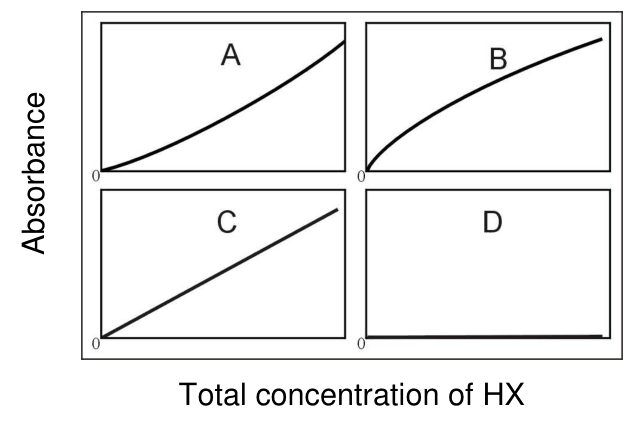
a) Pure aqueous solutions of \(\ce{HX}\) were used. Only the undissociated species \(\ce{HX}\) absorb.
Curve A ( ), Curve B ( ), Curve C ( ), Curve D ( )
b) Pure aqueous solutions of \(\ce{HX}\) were used. Only the anionic species \(\ce{X^-}\) absorb.
Curve A ( ), Curve B ( ), Curve C ( ), Curve D ( )
c) All solutions of \(\ce{HX}\) contain an excess of a strong base. Only the undissociated \(\ce{HX}\) species absorb.
Curve A ( ), Curve B ( ), Curve C ( ), Curve D ( )
d) All solutions of \(\ce{HX}\) contain an excess of a strong acid. Only the undissociated \(\ce{HX}\) species absorb.
Curve A ( ), Curve B ( ), Curve C ( ), Curve D ( )
e) Pure aqueous solutions of \(\ce{HX}\) were used. Both \(\ce{HX}\) and \(\ce{X^-}\) absorb. Measurements were obtained at a wavelength where the molar absorptivities of \(\ce{X^-}\) and \(\ce{HX}\) are equal and different than zero.
Curve A ( ), Curve B ( ), Curve C ( ), Curve D ( )
Official English text of the problem.
Answers
- a) Curve A — increasing, concave upward.
- b) Curve B — increasing, concave downward.
- c) Curve D — essentially zero absorbance.
- d) Curve C — straight line through the origin.
- e) Curve C — straight line through the origin.
Solution
Let the total analytical concentration be \[ c=[\ce{HX}]+[\ce{X^-}]. \] The acid dissociation equilibrium is \[ \ce{HX + H2O <=> H3O+ + X^-}, \qquad K_a=\frac{[\ce{H3O+}][\ce{X^-}]}{[\ce{HX}]}. \]
Here, \(\ce{HX}\) is an unspecified monoprotic weak acid and \(\ce{X^-}\) its conjugate base; their structures are not given, so unique molecular SMILES cannot be assigned. The other species used are water \(\ce{H2O}\), O; hydronium \(\ce{H3O+}\), [OH3+]; and hydroxide \(\ce{OH^-}\), [OH-].
At a fixed wavelength and optical path length \(\ell\), the Beer–Lambert law gives the absorbance \(\mathcal A\): \[ \mathcal A =\ell\left( \varepsilon_{\ce{HX}}[\ce{HX}] +\varepsilon_{\ce{X^-}}[\ce{X^-}] \right). \] With concentrations in \(\mathrm{mol\,L^{-1}}\), \(\ell\) in \(\mathrm{cm}\), and molar absorptivities in \(\mathrm{L\,mol^{-1}\,cm^{-1}}\), absorbance is dimensionless.
a) In pure aqueous acid solutions, neglecting water’s contribution to the hydronium concentration, put \[ x=[\ce{X^-}]=[\ce{H3O+}], \qquad [\ce{HX}]=c-x. \] Then \[ K_a=\frac{x^2}{c-x}, \qquad x=\frac{\sqrt{K_a^2+4K_ac}-K_a}{2}. \] This function increases with \(c\) but is concave downward: \[ \frac{d^2x}{dc^2} =-\frac{2K_a^2}{(K_a^2+4K_ac)^{3/2}}<0. \] Consequently, \(c-x=[\ce{HX}]\) is concave upward. Since only undissociated acid absorbs, \[ \mathcal A=\varepsilon_{\ce{HX}}\ell(c-x). \] The absorbance therefore increases with an increasing slope: curve A. Chemically, increasing the acid concentration decreases its fraction dissociated, so the fraction present as absorbing \(\ce{HX}\) increases.
b) Only the conjugate base absorbs: \[ \mathcal A=\varepsilon_{\ce{X^-}}\ell x. \] The expression for \(x\) above is increasing and concave downward. Although the absolute concentration of \(\ce{X^-}\) increases, its fraction of the total acid decreases as \(c\) increases. Thus the absorbance rises with a decreasing slope: curve B.
c) Excess strong base converts the acid essentially completely into its conjugate base: \[ \ce{HX + OH^- -> X^- + H2O}. \] Under the intended complete-neutralization approximation, \[ [\ce{HX}]\approx0. \] Because only \(\ce{HX}\) absorbs, \[ \mathcal A=\varepsilon_{\ce{HX}}\ell[\ce{HX}]\approx0. \] The working curve lies along the horizontal concentration axis: curve D.
d) Excess strong acid suppresses dissociation of the weak acid: \[ \frac{[\ce{X^-}]}{[\ce{HX}]} =\frac{K_a}{[\ce{H3O+}]}\ll1. \] Hence essentially all the analytical acid remains undissociated: \[ [\ce{HX}]\approx c, \qquad \mathcal A\approx\varepsilon_{\ce{HX}}\ell c. \] The absorbance is proportional to total concentration, giving a straight line through the origin: curve C.
e) Let the equal, nonzero molar absorptivities be \[ \varepsilon_{\ce{HX}}=\varepsilon_{\ce{X^-}}=\varepsilon>0. \] The absorbances of the two species add: \[ \begin{aligned} \mathcal A &=\varepsilon\ell[\ce{HX}] +\varepsilon\ell[\ce{X^-}]\\ &=\varepsilon\ell\bigl([\ce{HX}]+[\ce{X^-}]\bigr)\\ &=\varepsilon\ell c. \end{aligned} \] Thus dissociation does not affect the absorbance at this wavelength. The working curve is a straight line through the origin: curve C.
The answers were checked against the official answers published by the organisers.
IChO 2003 · Theorieaufgabe 17
Kalibrierkurven für eine schwache Säure
Die Extinktion von Lösungen der schwachen Säure \(\ce{HX}\) wurde gemessen. Ordnen Sie unter den folgenden Bedingungen die erwartete Form der resultierenden Kalibrierkurve den in der Abbildung gezeigten Kurven zu:
a) Es wurden reine wässrige Lösungen von \(\ce{HX}\) verwendet. Nur die undissoziierte Spezies \(\ce{HX}\) absorbiert.
Kurve A ( ), Kurve B ( ), Kurve C ( ), Kurve D ( )
b) Es wurden reine wässrige Lösungen von \(\ce{HX}\) verwendet. Nur die anionische Spezies \(\ce{X^-}\) absorbiert.
Kurve A ( ), Kurve B ( ), Kurve C ( ), Kurve D ( )
c) Alle Lösungen von \(\ce{HX}\) enthalten einen Überschuss einer starken Base. Nur die undissoziierte Spezies \(\ce{HX}\) absorbiert.
Kurve A ( ), Kurve B ( ), Kurve C ( ), Kurve D ( )
d) Alle Lösungen von \(\ce{HX}\) enthalten einen Überschuss einer starken Säure. Nur die undissoziierte Spezies \(\ce{HX}\) absorbiert.
Kurve A ( ), Kurve B ( ), Kurve C ( ), Kurve D ( )
e) Es wurden reine wässrige Lösungen von \(\ce{HX}\) verwendet. Sowohl \(\ce{HX}\) als auch \(\ce{X^-}\) absorbieren. Die Messungen wurden bei einer Wellenlänge durchgeführt, bei der die molaren Extinktionskoeffizienten von \(\ce{X^-}\) und \(\ce{HX}\) gleich und von null verschieden sind.
Kurve A ( ), Kurve B ( ), Kurve C ( ), Kurve D ( )
Aufgabentext aus dem offiziellen englischen Text übersetzt.
Antworten
- a) Kurve A — ansteigend, nach oben gekrümmt.
- b) Kurve B — ansteigend, nach unten gekrümmt.
- c) Kurve D — Extinktion praktisch null.
- d) Kurve C — Gerade durch den Ursprung.
- e) Kurve C — Gerade durch den Ursprung.
Lösung
Die analytische Gesamtkonzentration sei \[ c=[\ce{HX}]+[\ce{X^-}]. \] Das Säuredissoziationsgleichgewicht lautet \[ \ce{HX + H2O <=> H3O+ + X^-}, \qquad K_a=\frac{[\ce{H3O+}][\ce{X^-}]}{[\ce{HX}]}. \]
Hier ist \(\ce{HX}\) eine nicht näher spezifizierte einprotonige schwache Säure und \(\ce{X^-}\) ihre konjugierte Base; ihre Strukturen sind nicht angegeben, sodass ihnen keine eindeutigen molekularen SMILES zugeordnet werden können. Die weiteren verwendeten Spezies sind Wasser \(\ce{H2O}\), O; Oxonium \(\ce{H3O+}\), [OH3+]; und Hydroxid \(\ce{OH^-}\), [OH-].
Bei einer festen Wellenlänge und einer festen optischen Weglänge \(\ell\) ergibt sich die Extinktion \(\mathcal A\) nach dem Lambert-Beer-Gesetz zu: \[ \mathcal A =\ell\left( \varepsilon_{\ce{HX}}[\ce{HX}] +\varepsilon_{\ce{X^-}}[\ce{X^-}] \right). \] Mit Konzentrationen in \(\mathrm{mol\,L^{-1}}\), \(\ell\) in \(\mathrm{cm}\) und molaren Extinktionskoeffizienten in \(\mathrm{L\,mol^{-1}\,cm^{-1}}\) ist die Extinktion dimensionslos.
a) In reinen wässrigen Säurelösungen setzen wir unter Vernachlässigung des Beitrags des Wassers zur Oxoniumionenkonzentration \[ x=[\ce{X^-}]=[\ce{H3O+}], \qquad [\ce{HX}]=c-x. \] Dann gilt \[ K_a=\frac{x^2}{c-x}, \qquad x=\frac{\sqrt{K_a^2+4K_ac}-K_a}{2}. \] Diese Funktion nimmt mit \(c\) zu, ist jedoch nach unten gekrümmt: \[ \frac{d^2x}{dc^2} =-\frac{2K_a^2}{(K_a^2+4K_ac)^{3/2}}<0. \] Folglich ist \(c-x=[\ce{HX}]\) nach oben gekrümmt. Da nur die undissoziierte Säure absorbiert, gilt \[ \mathcal A=\varepsilon_{\ce{HX}}\ell(c-x). \] Die Extinktion steigt daher mit zunehmender Steigung an: Kurve A. Chemisch betrachtet nimmt mit steigender Säurekonzentration der dissoziierte Anteil ab, sodass der Anteil der Säure, der als absorbierendes \(\ce{HX}\) vorliegt, zunimmt.
b) Nur die konjugierte Base absorbiert: \[ \mathcal A=\varepsilon_{\ce{X^-}}\ell x. \] Der obige Ausdruck für \(x\) nimmt zu und ist nach unten gekrümmt. Obwohl die absolute Konzentration von \(\ce{X^-}\) zunimmt, nimmt sein Anteil an der gesamten Säure mit steigendem \(c\) ab. Die Extinktion steigt daher mit abnehmender Steigung an: Kurve B.
c) Ein Überschuss einer starken Base wandelt die Säure praktisch vollständig in ihre konjugierte Base um: \[ \ce{HX + OH^- -> X^- + H2O}. \] Unter der hier vorgesehenen Näherung einer vollständigen Neutralisation gilt \[ [\ce{HX}]\approx0. \] Da nur \(\ce{HX}\) absorbiert, gilt \[ \mathcal A=\varepsilon_{\ce{HX}}\ell[\ce{HX}]\approx0. \] Die Kalibrierkurve verläuft entlang der horizontalen Konzentrationsachse: Kurve D.
d) Ein Überschuss einer starken Säure unterdrückt die Dissoziation der schwachen Säure: \[ \frac{[\ce{X^-}]}{[\ce{HX}]} =\frac{K_a}{[\ce{H3O+}]}\ll1. \] Somit bleibt praktisch die gesamte analytisch erfasste Säure undissoziiert: \[ [\ce{HX}]\approx c, \qquad \mathcal A\approx\varepsilon_{\ce{HX}}\ell c. \] Die Extinktion ist proportional zur Gesamtkonzentration, sodass sich eine Gerade durch den Ursprung ergibt: Kurve C.
e) Die gleichen, von null verschiedenen molaren Extinktionskoeffizienten seien \[ \varepsilon_{\ce{HX}}=\varepsilon_{\ce{X^-}}=\varepsilon>0. \] Die Extinktionen der beiden Spezies addieren sich: \[ \begin{aligned} \mathcal A &=\varepsilon\ell[\ce{HX}] +\varepsilon\ell[\ce{X^-}]\\ &=\varepsilon\ell\bigl([\ce{HX}]+[\ce{X^-}]\bigr)\\ &=\varepsilon\ell c. \end{aligned} \] Die Dissoziation beeinflusst die Extinktion bei dieser Wellenlänge also nicht. Die Kalibrierkurve ist eine Gerade durch den Ursprung: Kurve C.
Die Ergebnisse wurden mit den von den Veranstaltern veröffentlichten offiziellen Ergebnissen abgeglichen.
IChO 2003 · Teori sorusu 17
Zayıf bir asit için kalibrasyon eğrileri
Zayıf bir asit olan \(\ce{HX}\)'in çözeltilerinin absorbansları ölçülmüştür. Aşağıdaki koşullarda elde edilen kalibrasyon eğrisinin beklenen biçimini şekilde gösterilen eğrilerle eşleştiriniz:
a) \(\ce{HX}\)'in saf sulu çözeltileri kullanılmıştır. Yalnızca ayrışmamış \(\ce{HX}\) türü ışığı soğurur.
Eğri A ( ), Eğri B ( ), Eğri C ( ), Eğri D ( )
b) \(\ce{HX}\)'in saf sulu çözeltileri kullanılmıştır. Yalnızca anyonik \(\ce{X^-}\) türü ışığı soğurur.
Eğri A ( ), Eğri B ( ), Eğri C ( ), Eğri D ( )
c) \(\ce{HX}\)'in tüm çözeltileri aşırı miktarda kuvvetli bir baz içerir. Yalnızca ayrışmamış \(\ce{HX}\) türü ışığı soğurur.
Eğri A ( ), Eğri B ( ), Eğri C ( ), Eğri D ( )
d) \(\ce{HX}\)'in tüm çözeltileri aşırı miktarda kuvvetli bir asit içerir. Yalnızca ayrışmamış \(\ce{HX}\) türü ışığı soğurur.
Eğri A ( ), Eğri B ( ), Eğri C ( ), Eğri D ( )
e) \(\ce{HX}\)'in saf sulu çözeltileri kullanılmıştır. Hem \(\ce{HX}\) hem de \(\ce{X^-}\) ışığı soğurur. Ölçümler, \(\ce{X^-}\) ve \(\ce{HX}\)'in molar soğurma katsayılarının birbirine eşit ve sıfırdan farklı olduğu bir dalga boyunda yapılmıştır.
Eğri A ( ), Eğri B ( ), Eğri C ( ), Eğri D ( )
Soru metni resmi İngilizce metinden çevrilmiştir.
Cevaplar
- a) Eğri A — artan, yukarı doğru içbükey.
- b) Eğri B — artan, aşağı doğru içbükey.
- c) Eğri D — absorbans yaklaşık sıfırdır.
- d) Eğri C — orijinden geçen doğru.
- e) Eğri C — orijinden geçen doğru.
Çözüm
Toplam analitik derişim şöyle olsun: \[ c=[\ce{HX}]+[\ce{X^-}]. \] Asidin ayrışma dengesi şöyledir: \[ \ce{HX + H2O <=> H3O+ + X^-}, \qquad K_a=\frac{[\ce{H3O+}][\ce{X^-}]}{[\ce{HX}]}. \]
Burada \(\ce{HX}\), kimliği belirtilmemiş monoprotik zayıf bir asit, \(\ce{X^-}\) ise onun eşlenik bazıdır; yapıları verilmediği için bunlara tek bir moleküler SMILES gösterimi atanamaz. Kullanılan diğer türler su \(\ce{H2O}\), O; hidronyum \(\ce{H3O+}\), [OH3+]; ve hidroksit \(\ce{OH^-}\), [OH-] şeklindedir.
Sabit bir dalga boyunda ve sabit bir \(\ell\) optik yol uzunluğunda Beer–Lambert yasası, \(\mathcal A\) absorbansını şöyle verir: \[ \mathcal A =\ell\left( \varepsilon_{\ce{HX}}[\ce{HX}] +\varepsilon_{\ce{X^-}}[\ce{X^-}] \right). \] Derişimler \(\mathrm{mol\,L^{-1}}\), \(\ell\) uzunluğu \(\mathrm{cm}\) ve molar soğurma katsayıları \(\mathrm{L\,mol^{-1}\,cm^{-1}}\) birimleriyle ifade edildiğinde absorbans boyutsuzdur.
a) Asidin saf sulu çözeltilerinde, suyun hidronyum derişimine katkısını ihmal ederek şu tanımları yapalım: \[ x=[\ce{X^-}]=[\ce{H3O+}], \qquad [\ce{HX}]=c-x. \] Bu durumda \[ K_a=\frac{x^2}{c-x}, \qquad x=\frac{\sqrt{K_a^2+4K_ac}-K_a}{2}. \] Bu fonksiyon \(c\) ile artar, ancak aşağı doğru içbükeydir: \[ \frac{d^2x}{dc^2} =-\frac{2K_a^2}{(K_a^2+4K_ac)^{3/2}}<0. \] Dolayısıyla \(c-x=[\ce{HX}]\) yukarı doğru içbükeydir. Yalnızca ayrışmamış asit ışığı soğurduğundan, \[ \mathcal A=\varepsilon_{\ce{HX}}\ell(c-x). \] Bu nedenle absorbans, giderek artan bir eğimle yükselir: eğri A. Kimyasal açıdan, asit derişiminin artması ayrışan asit oranını azaltır; dolayısıyla ışığı soğuran \(\ce{HX}\) biçiminde bulunan asit oranı artar.
b) Yalnızca eşlenik baz ışığı soğurur: \[ \mathcal A=\varepsilon_{\ce{X^-}}\ell x. \] Yukarıdaki \(x\) ifadesi artan ve aşağı doğru içbükey bir fonksiyondur. \(\ce{X^-}\)'in mutlak derişimi artsa da \(c\) arttıkça toplam asit içindeki payı azalır. Bu nedenle absorbans, giderek azalan bir eğimle yükselir: eğri B.
c) Aşırı miktarda kuvvetli baz, asidi neredeyse tamamen eşlenik bazına dönüştürür: \[ \ce{HX + OH^- -> X^- + H2O}. \] Soruda öngörülen tam nötralleşme yaklaşımı altında, \[ [\ce{HX}]\approx0. \] Yalnızca \(\ce{HX}\) ışığı soğurduğundan, \[ \mathcal A=\varepsilon_{\ce{HX}}\ell[\ce{HX}]\approx0. \] Kalibrasyon eğrisi yatay derişim ekseni boyunca uzanır: eğri D.
d) Aşırı miktarda kuvvetli asit, zayıf asidin ayrışmasını baskılar: \[ \frac{[\ce{X^-}]}{[\ce{HX}]} =\frac{K_a}{[\ce{H3O+}]}\ll1. \] Dolayısıyla analitik olarak bulunan asidin neredeyse tamamı ayrışmamış hâlde kalır: \[ [\ce{HX}]\approx c, \qquad \mathcal A\approx\varepsilon_{\ce{HX}}\ell c. \] Absorbans toplam derişimle orantılıdır ve orijinden geçen bir doğru verir: eğri C.
e) Birbirine eşit ve sıfırdan farklı molar soğurma katsayıları şöyle olsun: \[ \varepsilon_{\ce{HX}}=\varepsilon_{\ce{X^-}}=\varepsilon>0. \] İki türün absorbansları toplanır: \[ \begin{aligned} \mathcal A &=\varepsilon\ell[\ce{HX}] +\varepsilon\ell[\ce{X^-}]\\ &=\varepsilon\ell\bigl([\ce{HX}]+[\ce{X^-}]\bigr)\\ &=\varepsilon\ell c. \end{aligned} \] Dolayısıyla ayrışma, bu dalga boyundaki absorbansı etkilemez. Kalibrasyon eğrisi orijinden geçen bir doğrudur: eğri C.
Sonuçlar, düzenleyicilerin yayımladığı resmi sonuçlarla karşılaştırılarak kontrol edildi.
IChO 2003 · Problema teórico 17
Curvas de calibración de un ácido débil
Se midió la absorbancia de disoluciones del ácido débil \(\ce{HX}\). Asocie la forma esperada de la curva de calibración resultante con las que se muestran en la figura, en las siguientes condiciones:
a) Se utilizaron disoluciones acuosas puras de \(\ce{HX}\). Solo absorbe la especie no disociada \(\ce{HX}\).
Curva A ( ), Curva B ( ), Curva C ( ), Curva D ( )
b) Se utilizaron disoluciones acuosas puras de \(\ce{HX}\). Solo absorbe la especie aniónica \(\ce{X^-}\).
Curva A ( ), Curva B ( ), Curva C ( ), Curva D ( )
c) Todas las disoluciones de \(\ce{HX}\) contienen un exceso de una base fuerte. Solo absorbe la especie no disociada \(\ce{HX}\).
Curva A ( ), Curva B ( ), Curva C ( ), Curva D ( )
d) Todas las disoluciones de \(\ce{HX}\) contienen un exceso de un ácido fuerte. Solo absorbe la especie no disociada \(\ce{HX}\).
Curva A ( ), Curva B ( ), Curva C ( ), Curva D ( )
e) Se utilizaron disoluciones acuosas puras de \(\ce{HX}\). Tanto \(\ce{HX}\) como \(\ce{X^-}\) absorben. Las mediciones se realizaron a una longitud de onda a la que las absortividades molares de \(\ce{X^-}\) y \(\ce{HX}\) son iguales y distintas de cero.
Curva A ( ), Curva B ( ), Curva C ( ), Curva D ( )
Enunciado traducido del texto oficial en inglés.
Respuestas
- a) Curva A — creciente, cóncava hacia arriba.
- b) Curva B — creciente, cóncava hacia abajo.
- c) Curva D — absorbancia prácticamente nula.
- d) Curva C — recta que pasa por el origen.
- e) Curva C — recta que pasa por el origen.
Solución
Sea la concentración analítica total \[ c=[\ce{HX}]+[\ce{X^-}]. \] El equilibrio de disociación del ácido es \[ \ce{HX + H2O <=> H3O+ + X^-}, \qquad K_a=\frac{[\ce{H3O+}][\ce{X^-}]}{[\ce{HX}]}. \]
Aquí, \(\ce{HX}\) es un ácido débil monoprótico no especificado y \(\ce{X^-}\) es su base conjugada; no se proporcionan sus estructuras, por lo que no se les pueden asignar representaciones moleculares SMILES únicas. Las otras especies utilizadas son el agua \(\ce{H2O}\), O; el ion hidronio \(\ce{H3O+}\), [OH3+]; y el ion hidróxido \(\ce{OH^-}\), [OH-].
A una longitud de onda y una longitud de paso óptico \(\ell\) fijas, la ley de Beer–Lambert da la absorbancia \(\mathcal A\): \[ \mathcal A =\ell\left( \varepsilon_{\ce{HX}}[\ce{HX}] +\varepsilon_{\ce{X^-}}[\ce{X^-}] \right). \] Con las concentraciones en \(\mathrm{mol\,L^{-1}}\), \(\ell\) en \(\mathrm{cm}\) y las absortividades molares en \(\mathrm{L\,mol^{-1}\,cm^{-1}}\), la absorbancia es adimensional.
a) En disoluciones acuosas puras del ácido, despreciando la contribución del agua a la concentración de iones hidronio, definimos \[ x=[\ce{X^-}]=[\ce{H3O+}], \qquad [\ce{HX}]=c-x. \] Entonces \[ K_a=\frac{x^2}{c-x}, \qquad x=\frac{\sqrt{K_a^2+4K_ac}-K_a}{2}. \] Esta función aumenta con \(c\), pero es cóncava hacia abajo: \[ \frac{d^2x}{dc^2} =-\frac{2K_a^2}{(K_a^2+4K_ac)^{3/2}}<0. \] Por consiguiente, \(c-x=[\ce{HX}]\) es cóncava hacia arriba. Como solo absorbe el ácido no disociado, \[ \mathcal A=\varepsilon_{\ce{HX}}\ell(c-x). \] Por tanto, la absorbancia aumenta con una pendiente creciente: curva A. Desde el punto de vista químico, al aumentar la concentración del ácido disminuye su fracción disociada, por lo que aumenta la fracción presente en forma de \(\ce{HX}\), que absorbe.
b) Solo absorbe la base conjugada: \[ \mathcal A=\varepsilon_{\ce{X^-}}\ell x. \] La expresión anterior de \(x\) es creciente y cóncava hacia abajo. Aunque la concentración absoluta de \(\ce{X^-}\) aumenta, su fracción respecto al ácido total disminuye al aumentar \(c\). Por tanto, la absorbancia aumenta con una pendiente decreciente: curva B.
c) Un exceso de base fuerte convierte el ácido prácticamente por completo en su base conjugada: \[ \ce{HX + OH^- -> X^- + H2O}. \] Con la aproximación de neutralización completa que se presupone, \[ [\ce{HX}]\approx0. \] Como solo absorbe \(\ce{HX}\), \[ \mathcal A=\varepsilon_{\ce{HX}}\ell[\ce{HX}]\approx0. \] La curva de calibración coincide con el eje horizontal de concentraciones: curva D.
d) Un exceso de ácido fuerte inhibe la disociación del ácido débil: \[ \frac{[\ce{X^-}]}{[\ce{HX}]} =\frac{K_a}{[\ce{H3O+}]}\ll1. \] Por tanto, prácticamente todo el ácido correspondiente a la concentración analítica permanece sin disociar: \[ [\ce{HX}]\approx c, \qquad \mathcal A\approx\varepsilon_{\ce{HX}}\ell c. \] La absorbancia es proporcional a la concentración total, lo que da una recta que pasa por el origen: curva C.
e) Sean las absortividades molares iguales y no nulas \[ \varepsilon_{\ce{HX}}=\varepsilon_{\ce{X^-}}=\varepsilon>0. \] Las absorbancias de las dos especies se suman: \[ \begin{aligned} \mathcal A &=\varepsilon\ell[\ce{HX}] +\varepsilon\ell[\ce{X^-}]\\ &=\varepsilon\ell\bigl([\ce{HX}]+[\ce{X^-}]\bigr)\\ &=\varepsilon\ell c. \end{aligned} \] Por tanto, la disociación no afecta a la absorbancia a esta longitud de onda. La curva de calibración es una recta que pasa por el origen: curva C.
Los resultados se comprobaron con los resultados oficiales publicados por los organizadores.
IChO 2003 · 理论题 17
弱酸的工作曲线
测定了弱酸 \(\ce{HX}\) 溶液的吸光度。在下列条件下,将所得工作曲线的预期形状与图中所示的曲线相对应:
a) 使用纯 \(\ce{HX}\) 水溶液。只有未解离的物种 \(\ce{HX}\) 吸光。
曲线 A ( ), 曲线 B ( ), 曲线 C ( ), 曲线 D ( )
b) 使用纯 \(\ce{HX}\) 水溶液。只有阴离子物种 \(\ce{X^-}\) 吸光。
曲线 A ( ), 曲线 B ( ), 曲线 C ( ), 曲线 D ( )
c) 所有 \(\ce{HX}\) 溶液均含有过量的强碱。只有未解离的 \(\ce{HX}\) 物种吸光。
曲线 A ( ), 曲线 B ( ), 曲线 C ( ), 曲线 D ( )
d) 所有 \(\ce{HX}\) 溶液均含有过量的强酸。只有未解离的 \(\ce{HX}\) 物种吸光。
曲线 A ( ), 曲线 B ( ), 曲线 C ( ), 曲线 D ( )
e) 使用纯 \(\ce{HX}\) 水溶液。\(\ce{HX}\) 和 \(\ce{X^-}\) 均吸光。测量所用的波长处,\(\ce{X^-}\) 和 \(\ce{HX}\) 的摩尔吸光系数相等且不为零。
曲线 A ( ), 曲线 B ( ), 曲线 C ( ), 曲线 D ( )
题目译自官方英文原文。
答案
- a) 曲线 A — 递增,向上凹。
- b) 曲线 B — 递增,向下凹。
- c) 曲线 D — 吸光度基本为零。
- d) 曲线 C — 通过原点的直线。
- e) 曲线 C — 通过原点的直线。
解答
设总分析浓度为 \[ c=[\ce{HX}]+[\ce{X^-}]. \] 酸的解离平衡为 \[ \ce{HX + H2O <=> H3O+ + X^-}, \qquad K_a=\frac{[\ce{H3O+}][\ce{X^-}]}{[\ce{HX}]}. \]
这里,\(\ce{HX}\) 是一种未指明具体种类的一元弱酸,\(\ce{X^-}\) 是其共轭碱;题目未给出它们的结构,因此无法为其指定唯一的分子 SMILES。所用的其他物种为水 \(\ce{H2O}\),O;水合氢离子 \(\ce{H3O+}\),[OH3+];以及氢氧根离子 \(\ce{OH^-}\),[OH-]。
在固定波长和光程长度 \(\ell\) 下,由朗伯–比尔定律可得吸光度 \(\mathcal A\): \[ \mathcal A =\ell\left( \varepsilon_{\ce{HX}}[\ce{HX}] +\varepsilon_{\ce{X^-}}[\ce{X^-}] \right). \] 浓度的单位为 \(\mathrm{mol\,L^{-1}}\),\(\ell\) 的单位为 \(\mathrm{cm}\),摩尔吸光系数的单位为 \(\mathrm{L\,mol^{-1}\,cm^{-1}}\),吸光度为无量纲量。
a) 在纯酸的水溶液中,忽略水对水合氢离子浓度的贡献,令 \[ x=[\ce{X^-}]=[\ce{H3O+}], \qquad [\ce{HX}]=c-x. \] 则 \[ K_a=\frac{x^2}{c-x}, \qquad x=\frac{\sqrt{K_a^2+4K_ac}-K_a}{2}. \] 此函数随 \(c\) 增大而增大,但向下凹: \[ \frac{d^2x}{dc^2} =-\frac{2K_a^2}{(K_a^2+4K_ac)^{3/2}}<0. \] 因此,\(c-x=[\ce{HX}]\) 向上凹。由于只有未解离的酸吸光, \[ \mathcal A=\varepsilon_{\ce{HX}}\ell(c-x). \] 因此,吸光度随浓度增大而增大,且斜率不断增大:对应曲线 A。从化学角度看,增大酸的浓度会降低其解离分数,因此以吸光物种 \(\ce{HX}\) 形式存在的比例增大。
b) 只有共轭碱吸光: \[ \mathcal A=\varepsilon_{\ce{X^-}}\ell x. \] 上面的 \(x\) 表达式是递增且向下凹的。尽管 \(\ce{X^-}\) 的绝对浓度增大,但随着 \(c\) 增大,其占酸总量的比例减小。因此,吸光度随浓度增大而增大,且斜率不断减小:对应曲线 B。
c) 过量强碱使酸基本完全转化为其共轭碱: \[ \ce{HX + OH^- -> X^- + H2O}. \] 采用题目所预期的完全中和近似, \[ [\ce{HX}]\approx0. \] 由于只有 \(\ce{HX}\) 吸光, \[ \mathcal A=\varepsilon_{\ce{HX}}\ell[\ce{HX}]\approx0. \] 工作曲线与表示浓度的水平坐标轴重合:对应曲线 D。
d) 过量强酸抑制弱酸的解离: \[ \frac{[\ce{X^-}]}{[\ce{HX}]} =\frac{K_a}{[\ce{H3O+}]}\ll1. \] 因此,按分析浓度计的酸基本全部保持未解离状态: \[ [\ce{HX}]\approx c, \qquad \mathcal A\approx\varepsilon_{\ce{HX}}\ell c. \] 吸光度与总浓度成正比,得到一条通过原点的直线:对应曲线 C。
e) 设相等且非零的摩尔吸光系数为 \[ \varepsilon_{\ce{HX}}=\varepsilon_{\ce{X^-}}=\varepsilon>0. \] 两种物种的吸光度相加: \[ \begin{aligned} \mathcal A &=\varepsilon\ell[\ce{HX}] +\varepsilon\ell[\ce{X^-}]\\ &=\varepsilon\ell\bigl([\ce{HX}]+[\ce{X^-}]\bigr)\\ &=\varepsilon\ell c. \end{aligned} \] 因此,解离不影响此波长下的吸光度。工作曲线是一条通过原点的直线:对应曲线 C。
结果已与主办方公布的官方答案核对。
IChO 2003 · Теоретическая задача 17
Градуировочные кривые для слабой кислоты
Была измерена оптическая плотность растворов слабой кислоты \(\ce{HX}\). Для приведённых ниже условий сопоставьте ожидаемый вид полученной градуировочной кривой с кривыми, изображёнными на рисунке:
a) Использовали чистые водные растворы \(\ce{HX}\). Поглощает только недиссоциированная форма \(\ce{HX}\).
Кривая A ( ), Кривая B ( ), Кривая C ( ), Кривая D ( )
b) Использовали чистые водные растворы \(\ce{HX}\). Поглощает только анионная форма \(\ce{X^-}\).
Кривая A ( ), Кривая B ( ), Кривая C ( ), Кривая D ( )
c) Все растворы \(\ce{HX}\) содержат избыток сильного основания. Поглощает только недиссоциированная форма \(\ce{HX}\).
Кривая A ( ), Кривая B ( ), Кривая C ( ), Кривая D ( )
d) Все растворы \(\ce{HX}\) содержат избыток сильной кислоты. Поглощает только недиссоциированная форма \(\ce{HX}\).
Кривая A ( ), Кривая B ( ), Кривая C ( ), Кривая D ( )
e) Использовали чистые водные растворы \(\ce{HX}\). Поглощают обе формы: \(\ce{HX}\) и \(\ce{X^-}\). Измерения проводили при длине волны, при которой молярные коэффициенты поглощения \(\ce{X^-}\) и \(\ce{HX}\) равны и отличны от нуля.
Кривая A ( ), Кривая B ( ), Кривая C ( ), Кривая D ( )
Условие переведено с официального английского текста.
Ответы
- a) Кривая A — возрастающая, выпуклая вниз.
- b) Кривая B — возрастающая, выпуклая вверх.
- c) Кривая D — оптическая плотность практически равна нулю.
- d) Кривая C — прямая, проходящая через начало координат.
- e) Кривая C — прямая, проходящая через начало координат.
Решение
Обозначим общую аналитическую концентрацию как \[ c=[\ce{HX}]+[\ce{X^-}]. \] Равновесие диссоциации кислоты описывается соотношениями \[ \ce{HX + H2O <=> H3O+ + X^-}, \qquad K_a=\frac{[\ce{H3O+}][\ce{X^-}]}{[\ce{HX}]}. \]
Здесь \(\ce{HX}\) — неуточнённая одноосновная слабая кислота, а \(\ce{X^-}\) — сопряжённое с ней основание; их структуры не приведены, поэтому однозначно задать для них молекулярные записи SMILES невозможно. Другие используемые частицы: вода \(\ce{H2O}\), O; ион гидроксония \(\ce{H3O+}\), [OH3+]; и гидроксид-ион \(\ce{OH^-}\), [OH-].
При фиксированных длине волны и длине оптического пути \(\ell\) закон Бугера — Ламберта — Бера даёт для оптической плотности \(\mathcal A\): \[ \mathcal A =\ell\left( \varepsilon_{\ce{HX}}[\ce{HX}] +\varepsilon_{\ce{X^-}}[\ce{X^-}] \right). \] Если концентрации выражены в \(\mathrm{mol\,L^{-1}}\), \(\ell\) — в \(\mathrm{cm}\), а молярные коэффициенты поглощения — в \(\mathrm{L\,mol^{-1}\,cm^{-1}}\), то оптическая плотность безразмерна.
a) Для чистых водных растворов кислоты, пренебрегая вкладом воды в концентрацию ионов гидроксония, положим \[ x=[\ce{X^-}]=[\ce{H3O+}], \qquad [\ce{HX}]=c-x. \] Тогда \[ K_a=\frac{x^2}{c-x}, \qquad x=\frac{\sqrt{K_a^2+4K_ac}-K_a}{2}. \] Эта функция возрастает с ростом \(c\), но её график выпуклый вверх: \[ \frac{d^2x}{dc^2} =-\frac{2K_a^2}{(K_a^2+4K_ac)^{3/2}}<0. \] Следовательно, график зависимости \(c-x=[\ce{HX}]\) выпуклый вниз. Поскольку поглощает только недиссоциированная кислота, \[ \mathcal A=\varepsilon_{\ce{HX}}\ell(c-x). \] Таким образом, оптическая плотность возрастает с увеличивающимся наклоном кривой: кривая A. С химической точки зрения увеличение концентрации кислоты уменьшает степень её диссоциации, поэтому доля кислоты, присутствующей в виде поглощающей формы \(\ce{HX}\), увеличивается.
b) Поглощает только сопряжённое основание: \[ \mathcal A=\varepsilon_{\ce{X^-}}\ell x. \] Приведённое выше выражение для \(x\) задаёт возрастающую функцию с графиком, выпуклым вверх. Хотя абсолютная концентрация \(\ce{X^-}\) увеличивается, доля этой формы в общем количестве кислоты уменьшается с ростом \(c\). Таким образом, оптическая плотность возрастает с уменьшающимся наклоном кривой: кривая B.
c) Избыток сильного основания практически полностью переводит кислоту в сопряжённое с ней основание: \[ \ce{HX + OH^- -> X^- + H2O}. \] В подразумеваемом приближении полной нейтрализации \[ [\ce{HX}]\approx0. \] Поскольку поглощает только \(\ce{HX}\), \[ \mathcal A=\varepsilon_{\ce{HX}}\ell[\ce{HX}]\approx0. \] Градуировочная кривая совпадает с горизонтальной осью концентрации: кривая D.
d) Избыток сильной кислоты подавляет диссоциацию слабой кислоты: \[ \frac{[\ce{X^-}]}{[\ce{HX}]} =\frac{K_a}{[\ce{H3O+}]}\ll1. \] Следовательно, практически вся кислота, учитываемая аналитической концентрацией, остаётся недиссоциированной: \[ [\ce{HX}]\approx c, \qquad \mathcal A\approx\varepsilon_{\ce{HX}}\ell c. \] Оптическая плотность пропорциональна общей концентрации, поэтому получается прямая, проходящая через начало координат: кривая C.
e) Обозначим равные ненулевые молярные коэффициенты поглощения как \[ \varepsilon_{\ce{HX}}=\varepsilon_{\ce{X^-}}=\varepsilon>0. \] Оптические плотности двух форм складываются: \[ \begin{aligned} \mathcal A &=\varepsilon\ell[\ce{HX}] +\varepsilon\ell[\ce{X^-}]\\ &=\varepsilon\ell\bigl([\ce{HX}]+[\ce{X^-}]\bigr)\\ &=\varepsilon\ell c. \end{aligned} \] Таким образом, диссоциация не влияет на оптическую плотность при этой длине волны. Градуировочная кривая представляет собой прямую, проходящую через начало координат: кривая C.
Ответы проверены по официальным ответам, опубликованным организаторами.
IChO 2003 · مسألة نظرية 17
منحنيات المعايرة لحمض ضعيف
قِيست امتصاصية محاليل الحمض الضعيف \(\ce{HX}\). طابق الشكل المتوقع لمنحنى المعايرة الناتج مع المنحنيات الموضحة في الشكل، في الظروف الآتية:
a) استُخدمت محاليل مائية نقية من \(\ce{HX}\). وحدها الأنواع غير المتفككة \(\ce{HX}\) تمتص الضوء.
المنحنى A ( ), المنحنى B ( ), المنحنى C ( ), المنحنى D ( )
b) استُخدمت محاليل مائية نقية من \(\ce{HX}\). وحدها الأنواع الأنيونية \(\ce{X^-}\) تمتص الضوء.
المنحنى A ( ), المنحنى B ( ), المنحنى C ( ), المنحنى D ( )
c) تحتوي جميع محاليل \(\ce{HX}\) على فائض من قاعدة قوية. وحدها الأنواع غير المتفككة \(\ce{HX}\) تمتص الضوء.
المنحنى A ( ), المنحنى B ( ), المنحنى C ( ), المنحنى D ( )
d) تحتوي جميع محاليل \(\ce{HX}\) على فائض من حمض قوي. وحدها الأنواع غير المتفككة \(\ce{HX}\) تمتص الضوء.
المنحنى A ( ), المنحنى B ( ), المنحنى C ( ), المنحنى D ( )
e) استُخدمت محاليل مائية نقية من \(\ce{HX}\). يمتص كلٌّ من \(\ce{HX}\) و\(\ce{X^-}\) الضوء. أُجريت القياسات عند طول موجي تتساوى عنده معامِلات الامتصاص المولية لكلٍّ من \(\ce{X^-}\) و\(\ce{HX}\)، وتختلف عن الصفر.
المنحنى A ( ), المنحنى B ( ), المنحنى C ( ), المنحنى D ( )
نص المسألة مترجم عن النص الإنجليزي الرسمي.
الإجابات
- a) المنحنى A — متزايد، مقعّر إلى أعلى.
- b) المنحنى B — متزايد، مقعّر إلى أسفل.
- c) المنحنى D — الامتصاصية تساوي صفرًا تقريبًا.
- d) المنحنى C — خط مستقيم يمر بنقطة الأصل.
- e) المنحنى C — خط مستقيم يمر بنقطة الأصل.
الحل
ليكن التركيز التحليلي الكلي \[ c=[\ce{HX}]+[\ce{X^-}]. \] اتزان تفكك الحمض هو \[ \ce{HX + H2O <=> H3O+ + X^-}, \qquad K_a=\frac{[\ce{H3O+}][\ce{X^-}]}{[\ce{HX}]}. \]
هنا، يمثّل \(\ce{HX}\) حمضًا ضعيفًا أحادي البروتون غير محدد، وتمثّل \(\ce{X^-}\) قاعدته المرافقة؛ ولم تُعطَ بنيتاهما، لذا لا يمكن تعيين تمثيل جزيئي وحيد بصيغة SMILES لكلٍّ منهما. أما الأنواع الأخرى المستخدمة فهي الماء \(\ce{H2O}\)، O؛ والهيدرونيوم \(\ce{H3O+}\)، [OH3+]؛ والهيدروكسيد \(\ce{OH^-}\)، [OH-].
عند طول موجي ثابت وطول مسار ضوئي ثابت \(\ell\)، يعطي قانون بير–لامبرت الامتصاصية \(\mathcal A\): \[ \mathcal A =\ell\left( \varepsilon_{\ce{HX}}[\ce{HX}] +\varepsilon_{\ce{X^-}}[\ce{X^-}] \right). \] عندما تكون التراكيز بوحدة \(\mathrm{mol\,L^{-1}}\)، و\(\ell\) بوحدة \(\mathrm{cm}\)، ومعامِلات الامتصاص المولية بوحدة \(\mathrm{L\,mol^{-1}\,cm^{-1}}\)، تكون الامتصاصية عديمة الأبعاد.
a) في المحاليل المائية النقية للحمض، وبإهمال مساهمة الماء في تركيز الهيدرونيوم، نضع \[ x=[\ce{X^-}]=[\ce{H3O+}], \qquad [\ce{HX}]=c-x. \] إذن \[ K_a=\frac{x^2}{c-x}, \qquad x=\frac{\sqrt{K_a^2+4K_ac}-K_a}{2}. \] تزداد هذه الدالة بزيادة \(c\)، لكنها مقعّرة إلى أسفل: \[ \frac{d^2x}{dc^2} =-\frac{2K_a^2}{(K_a^2+4K_ac)^{3/2}}<0. \] وبالتالي، تكون \(c-x=[\ce{HX}]\) مقعّرة إلى أعلى. وبما أن الحمض غير المتفكك وحده يمتص الضوء، فإن \[ \mathcal A=\varepsilon_{\ce{HX}}\ell(c-x). \] لذلك تزداد الامتصاصية بميل متزايد: المنحنى A. ومن الناحية الكيميائية، تؤدي زيادة تركيز الحمض إلى انخفاض النسبة المتفككة منه، فتزداد النسبة الموجودة على هيئة \(\ce{HX}\) الماصّة للضوء.
b) القاعدة المرافقة وحدها تمتص الضوء: \[ \mathcal A=\varepsilon_{\ce{X^-}}\ell x. \] التعبير عن \(x\) أعلاه متزايد ومقعّر إلى أسفل. وعلى الرغم من ازدياد التركيز المطلق لـ\(\ce{X^-}\)، فإن نسبته من إجمالي الحمض تنخفض مع ازدياد \(c\). وهكذا ترتفع الامتصاصية بميل متناقص: المنحنى B.
c) يحوّل فائض القاعدة القوية الحمض إلى قاعدته المرافقة بصورة شبه كاملة: \[ \ce{HX + OH^- -> X^- + H2O}. \] وفق تقريب التعادل الكامل المقصود، \[ [\ce{HX}]\approx0. \] وبما أن \(\ce{HX}\) وحده يمتص الضوء، فإن \[ \mathcal A=\varepsilon_{\ce{HX}}\ell[\ce{HX}]\approx0. \] ينطبق منحنى المعايرة على محور التركيز الأفقي: المنحنى D.
d) يثبّط فائض الحمض القوي تفكك الحمض الضعيف: \[ \frac{[\ce{X^-}]}{[\ce{HX}]} =\frac{K_a}{[\ce{H3O+}]}\ll1. \] ومن ثم يبقى الحمض الممثَّل بالتركيز التحليلي كله تقريبًا غير متفكك: \[ [\ce{HX}]\approx c, \qquad \mathcal A\approx\varepsilon_{\ce{HX}}\ell c. \] تتناسب الامتصاصية طرديًا مع التركيز الكلي، مما يعطي خطًا مستقيمًا يمر بنقطة الأصل: المنحنى C.
e) لتكن معامِلات الامتصاص المولية المتساوية وغير الصفرية \[ \varepsilon_{\ce{HX}}=\varepsilon_{\ce{X^-}}=\varepsilon>0. \] تُجمع امتصاصيتا النوعين: \[ \begin{aligned} \mathcal A &=\varepsilon\ell[\ce{HX}] +\varepsilon\ell[\ce{X^-}]\\ &=\varepsilon\ell\bigl([\ce{HX}]+[\ce{X^-}]\bigr)\\ &=\varepsilon\ell c. \end{aligned} \] وبذلك لا يؤثر التفكك في الامتصاصية عند هذا الطول الموجي. يكون منحنى المعايرة خطًا مستقيمًا يمر بنقطة الأصل: المنحنى C.
تمت مراجعة النتائج بمقارنتها بالنتائج الرسمية التي نشرها المنظمون.