International Physics Olympiad
IPhO 1970
Moscow, USSR · 4 theory problems with complete solutions
Problem 1: Motor-driven carriage on a bar sliding on a table
A long bar with the mass \(M = 1\) kg is placed on a smooth horizontal surface of a table where it can move frictionless. A carriage equipped with a motor can slide along the upper horizontal panel of the bar, the mass of the carriage is \(m = 0.1\) kg. The friction coefficient of the carriage is \(\mu = 0.02\).
The motor is winding a thread around a shaft at a constant speed \(v_0 = 0.1\) m/s. The other end of the thread is tied up to a rather distant stationary support in one case (Fig.1, a), whereas in the other case it is attached to a picket at the edge of the bar (Fig.1, b). While holding the bar fixed one allows the carriage to start moving at the velocity \(V_0\) then the bar is let loose.
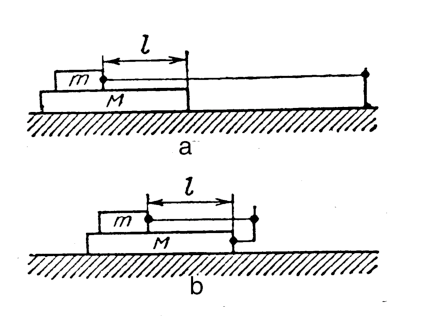
Fig. 1
By the moment the bar is released the front edge of the carriage is at the distance \(l = 0.5\) m from the front edge of the bar. For both cases find the laws of movement of both the bar and the carriage and the time during which the carriage will reach the front edge of the bar.
Official English text of the problem.
Problem 2: Mass of the hydrogen atom from the NaCl unit cell
A unit cell of a crystal of natrium chloride (common salt- NaCl) is a cube with the edge length \(a=5.6\cdot10^{-10}\,\mathrm{m}\) (Fig.2). The black circles in the figure stand for the position of natrium atoms whereas the white ones are chlorine atoms. The entire crystal of common salt turns out to be a repetition of such unit cells. The relative atomic mass of natrium is 23 and that of chlorine is 35,5. The density of the common salt \(\rho=2.22\cdot10^{3}\,\mathrm{kg/m^{3}}\). Find the mass of a hydrogen atom.
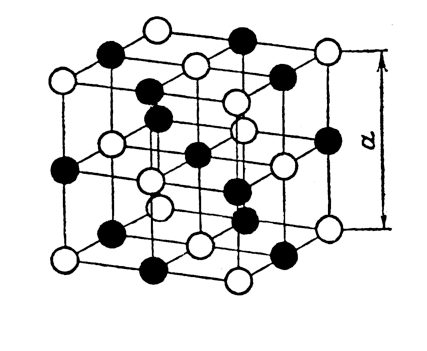
Fig. 2
Official English text of the problem.
Problem 3: Earthed metal ball inside a charged spherical shell
Inside a thin-walled metal sphere with radius \(R=20\ \mathrm{cm}\) there is a metal ball with the radius \(r = 10\ \mathrm{cm}\) which has a common centre with the sphere. The ball is connected with a very long wire to the Earth via an opening in the sphere (Fig. 3). A charge \(Q = 10^{-8}\ \mathrm{C}\) is placed onto the outside sphere. Calculate the potential of this sphere, electrical capacity of the obtained system of conducting bodies and draw out an equivalent electric scheme.
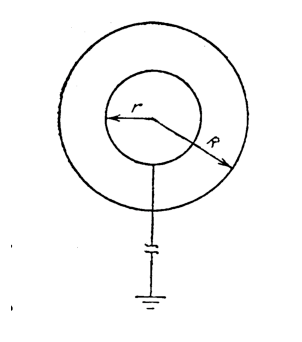
Fig. 3
Official English text of the problem.
Problem 4: Spherical telescope mirror and a disk receiver in its focus
A spherical mirror is installed into a telescope. Its lateral diameter is \(D=0{,}5\ \mathrm{m}\) and the radius of the curvature \(R=2\ \mathrm{m}\). In the main focus of the mirror there is an emission receiver in the form of a round disk. The disk is placed perpendicular to the optical axis of the mirror (Fig. 4). What should the radius \(r\) of the receiver be so that it could receive the entire flux of the emission reflected by the mirror? How would the received flux of the emission decrease if the detector’s dimensions decreased by 8 times?
Directions: 1) When calculating small values \(\alpha\) (\(\alpha\ll1\)) one may perform a substitution \(\sqrt{1-\alpha}\approx1-\dfrac{\alpha}{2}\); 2) diffraction should not be taken into account.
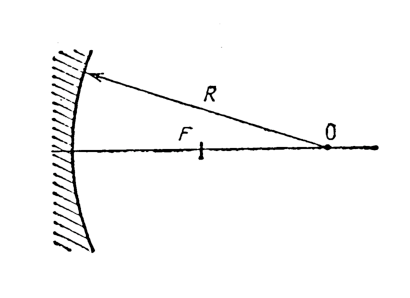
Fig. 4
Official English text of the problem.
Internationale Physik-Olympiade
IPhO 1970
Moskau, UdSSR · 4 Theorieaufgaben mit vollständigen Lösungen
Aufgabe 1: Motorbetriebener Wagen auf einem auf einem Tisch gleitenden Stab
Ein langer Stab mit der Masse \(M = 1\) kg liegt auf einer glatten horizontalen Tischoberfläche, auf der er sich reibungsfrei bewegen kann. Ein mit einem Motor ausgestatteter Wagen kann auf der oberen horizontalen Fläche des Stabes gleiten; die Masse des Wagens beträgt \(m = 0.1\) kg. Der Reibungskoeffizient des Wagens beträgt \(\mu = 0.02\).
Der Motor wickelt einen Faden mit einer konstanten Geschwindigkeit \(v_0 = 0.1\) m/s auf eine Welle auf. Das andere Ende des Fadens ist im einen Fall an einer weit entfernten ortsfesten Halterung befestigt (Abb. 1, a), während es im anderen Fall an einem Pfosten am Rand des Stabes befestigt ist (Abb. 1, b). Während man den Stab festhält, lässt man den Wagen auf die Geschwindigkeit \(V_0\) kommen; anschließend wird der Stab losgelassen.
Abb. 1
Zum Zeitpunkt des Loslassens befindet sich die Vorderkante des Wagens im Abstand \(l = 0.5\) m von der Vorderkante des Stabes. Bestimmen Sie für beide Fälle die Bewegungsgesetze sowohl des Stabes als auch des Wagens und die Zeit, nach der der Wagen die Vorderkante des Stabes erreicht.
Aufgabentext aus dem offiziellen englischen Text übersetzt.
Aufgabe 2: Masse des Wasserstoffatoms aus der NaCl-Elementarzelle
Eine Elementarzelle eines Natriumchloridkristalls (Kochsalz – NaCl) ist ein Würfel mit der Kantenlänge \(a=5.6\cdot10^{-10}\,\mathrm{m}\) (Abb. 2). Die schwarzen Kreise in der Abbildung kennzeichnen die Positionen der Natriumatome, während die weißen Kreise Chloratome darstellen. Der gesamte Kochsalzkristall ergibt sich durch Wiederholung solcher Elementarzellen. Die relative Atommasse von Natrium beträgt 23 und die von Chlor 35,5. Die Dichte von Kochsalz beträgt \(\rho=2.22\cdot10^{3}\,\mathrm{kg/m^{3}}\). Bestimmen Sie die Masse eines Wasserstoffatoms.
Abb. 2
Aufgabentext aus dem offiziellen englischen Text übersetzt.
Aufgabe 3: Geerdete Metallkugel im Inneren einer geladenen Kugelschale
Im Inneren einer dünnwandigen Metallhohlkugel mit dem Radius \(R=20\ \mathrm{cm}\) befindet sich eine Metallkugel mit dem Radius \(r = 10\ \mathrm{cm}\), die denselben Mittelpunkt wie die Hohlkugel hat. Die Kugel ist durch einen sehr langen Draht, der durch eine Öffnung in der Hohlkugel führt, mit der Erde verbunden (Abb. 3). Auf die äußere Hohlkugel wird eine Ladung \(Q = 10^{-8}\ \mathrm{C}\) aufgebracht. Berechnen Sie das Potential dieser Hohlkugel und die elektrische Kapazität des entstandenen Systems leitender Körper und zeichnen Sie ein elektrisches Ersatzschaltbild.
Abb. 3
Aufgabentext aus dem offiziellen englischen Text übersetzt.
Aufgabe 4: Sphärischer Teleskopspiegel und ein scheibenförmiger Empfänger in seinem Brennpunkt
In ein Teleskop ist ein sphärischer Spiegel eingebaut. Sein Öffnungsdurchmesser beträgt \(D=0{,}5\ \mathrm{m}\), sein Krümmungsradius \(R=2\ \mathrm{m}\). Im Hauptbrennpunkt des Spiegels befindet sich ein Strahlungsempfänger in Form einer kreisförmigen Scheibe. Die Scheibe steht senkrecht zur optischen Achse des Spiegels (Abb. 4). Wie groß muss der Radius \(r\) des Empfängers sein, damit er den gesamten vom Spiegel reflektierten Strahlungsfluss auffangen kann? Wie würde der empfangene Strahlungsfluss abnehmen, wenn die Abmessungen des Detektors um den Faktor 8 verkleinert würden?
Hinweise: 1) Für kleine Werte von \(\alpha\) (\(\alpha\ll1\)) darf bei der Berechnung die Näherung \(\sqrt{1-\alpha}\approx1-\dfrac{\alpha}{2}\) verwendet werden; 2) Beugung ist nicht zu berücksichtigen.
Abb. 4
Aufgabentext aus dem offiziellen englischen Text übersetzt.
Uluslararası Fizik Olimpiyatı
IPhO 1970
Moskova, SSCB · 4 teori sorusu, tam çözümleriyle
Soru 1: Masa üzerinde kayan bir çubuk üzerindeki motorlu araba
Kütlesi \(M = 1\) kg olan uzun bir çubuk, bir masanın sürtünmesiz olarak hareket edebileceği pürüzsüz yatay yüzeyine yerleştirilmiştir. Motorla donatılmış bir araba, çubuğun yatay üst yüzeyi boyunca kayabilmektedir; arabanın kütlesi \(m = 0.1\) kg'dır. Araba ile çubuk arasındaki sürtünme katsayısı \(\mu = 0.02\)'dir.
Motor, bir ipi bir milin etrafına sabit \(v_0 = 0.1\) m/s hızıyla sarmaktadır. İpin diğer ucu, bir durumda oldukça uzaktaki sabit bir desteğe (Şekil 1, a), diğer durumda ise çubuğun kenarındaki bir kazığa (Şekil 1, b) bağlanmıştır. Çubuk sabit tutulurken arabanın \(V_0\) hızıyla harekete geçmesi sağlanır, ardından çubuk serbest bırakılır.
Şekil 1
Çubuğun serbest bırakıldığı anda arabanın ön kenarı, çubuğun ön kenarından \(l = 0.5\) m uzaklıktadır. Her iki durum için hem çubuğun hem de arabanın hareket denklemlerini ve arabanın çubuğun ön kenarına ulaşması için geçen süreyi bulunuz.
Soru metni resmi İngilizce metinden çevrilmiştir.
Soru 2: NaCl birim hücresinden hidrojen atomunun kütlesi
Bir sodyum klorür (sofra tuzu- NaCl) kristalinin birim hücresi, kenar uzunluğu \(a=5.6\cdot10^{-10}\,\mathrm{m}\) olan bir küptür (Şekil 2). Şekildeki siyah daireler sodyum atomlarının konumlarını, beyaz daireler ise klor atomlarını göstermektedir. Sofra tuzu kristalinin tamamı, bu tür birim hücrelerin tekrarlanmasıyla oluşur. Sodyumun bağıl atom kütlesi 23, klorunki ise 35,5'tir. Sofra tuzunun yoğunluğu \(\rho=2.22\cdot10^{3}\,\mathrm{kg/m^{3}}\) değerindedir. Bir hidrojen atomunun kütlesini bulunuz.
Şekil 2
Soru metni resmi İngilizce metinden çevrilmiştir.
Soru 3: Yüklü bir küresel kabuğun içindeki topraklanmış metal küre
Yarıçapı \(R=20\ \mathrm{cm}\) olan ince duvarlı bir metal kürenin içinde, onunla eş merkezli, yarıçapı \(r = 10\ \mathrm{cm}\) olan bir metal küre bulunmaktadır. İçteki küre, dıştaki kürede bulunan bir açıklıktan geçirilen çok uzun bir telle toprağa bağlanmıştır (Şek. 3). Dıştaki küreye \(Q = 10^{-8}\ \mathrm{C}\) yük verilmektedir. Bu kürenin potansiyelini ve oluşan iletkenler sisteminin elektriksel sığasını hesaplayınız ve eşdeğer elektrik devresini çiziniz.
Şek. 3
Soru metni resmi İngilizce metinden çevrilmiştir.
Soru 4: Küresel teleskop aynası ve odağındaki disk biçimli alıcı
Bir teleskopa küresel bir ayna yerleştirilmiştir. Aynanın enine çapı \(D=0{,}5\ \mathrm{m}\), eğrilik yarıçapı ise \(R=2\ \mathrm{m}\)'dir. Aynanın asal odağında, dairesel bir disk biçiminde bir ışınım alıcısı bulunmaktadır. Disk, aynanın optik eksenine dik olarak yerleştirilmiştir (Şek. 4). Aynadan yansıyan ışınım akısının tamamını alabilmesi için alıcının yarıçapı \(r\) ne olmalıdır? Dedektörün boyutları 8 kat küçültülürse alınan ışınım akısı nasıl azalır?
Yönergeler: 1) Küçük \(\alpha\) değerleri (\(\alpha\ll1\)) için hesaplama yapılırken \(\sqrt{1-\alpha}\approx1-\dfrac{\alpha}{2}\) yerine koyması kullanılabilir; 2) kırınım dikkate alınmamalıdır.
Şek. 4
Soru metni resmi İngilizce metinden çevrilmiştir.
Olimpiada Internacional de Física
IPhO 1970
Moscú, URSS · 4 problemas teóricos con soluciones completas
Problema 1: Carrito accionado por un motor sobre una barra que se desliza sobre una mesa
Una barra larga de masa \(M = 1\) kg está colocada sobre la superficie horizontal lisa de una mesa, sobre la que puede moverse sin rozamiento. Un carrito equipado con un motor puede deslizarse por la cara superior horizontal de la barra; la masa del carrito es \(m = 0.1\) kg. El coeficiente de rozamiento del carrito es \(\mu = 0.02\).
El motor enrolla un hilo alrededor de un eje a una velocidad constante \(v_0 = 0.1\) m/s. En un caso, el otro extremo del hilo está atado a un soporte fijo bastante distante (Fig.1, a), mientras que, en el otro caso, está sujeto a una espiga situada en el extremo de la barra (Fig.1, b). Manteniendo fija la barra, se deja que el carrito comience a moverse a la velocidad \(V_0\) y, a continuación, se libera la barra.
Fig. 1
En el momento en que se libera la barra, el borde delantero del carrito se encuentra a una distancia \(l = 0.5\) m del borde delantero de la barra. Para ambos casos, determine las leyes del movimiento de la barra y del carrito, así como el tiempo que tardará el carrito en alcanzar el borde delantero de la barra.
Enunciado traducido del texto oficial en inglés.
Problema 2: Masa del átomo de hidrógeno a partir de la celda unidad del NaCl
Una celda unidad de un cristal de cloruro de sodio (sal común, NaCl) es un cubo cuya arista tiene una longitud de \(a=5.6\cdot10^{-10}\,\mathrm{m}\) (Fig.2). Los círculos negros de la figura indican las posiciones de los átomos de sodio, mientras que los blancos corresponden a los átomos de cloro. El cristal completo de sal común está formado por la repetición de estas celdas unidad. La masa atómica relativa del sodio es 23 y la del cloro es 35,5. La densidad de la sal común es \(\rho=2.22\cdot10^{3}\,\mathrm{kg/m^{3}}\). Halle la masa de un átomo de hidrógeno.
Fig. 2
Enunciado traducido del texto oficial en inglés.
Problema 3: Bola metálica conectada a tierra dentro de una envoltura esférica cargada
En el interior de una esfera metálica de pared delgada y radio \(R=20\ \mathrm{cm}\) hay una bola metálica de radio \(r = 10\ \mathrm{cm}\) concéntrica con la esfera. La bola está conectada a tierra mediante un hilo conductor muy largo que pasa por una abertura en la esfera (Fig. 3). Se deposita una carga \(Q = 10^{-8}\ \mathrm{C}\) sobre la esfera exterior. Calcule el potencial de esta esfera y la capacidad eléctrica del sistema de cuerpos conductores resultante, y dibuje un esquema eléctrico equivalente.
Fig. 3
Enunciado traducido del texto oficial en inglés.
Problema 4: Espejo esférico de un telescopio y un receptor en forma de disco en su foco
En un telescopio se instala un espejo esférico. Su diámetro transversal es \(D=0{,}5\ \mathrm{m}\) y su radio de curvatura es \(R=2\ \mathrm{m}\). En el foco principal del espejo se encuentra un receptor de radiación en forma de disco circular. El disco está colocado perpendicularmente al eje óptico del espejo (Fig. 4). ¿Cuál debe ser el radio \(r\) del receptor para que pueda recibir todo el flujo de radiación reflejado por el espejo? ¿Cómo disminuiría el flujo de radiación recibido si las dimensiones del detector se redujeran a la octava parte?
Indicaciones: 1) Al realizar cálculos con valores pequeños de \(\alpha\) (\(\alpha\ll1\)), puede utilizarse la sustitución \(\sqrt{1-\alpha}\approx1-\dfrac{\alpha}{2}\); 2) no debe tenerse en cuenta la difracción.
Fig. 4
Enunciado traducido del texto oficial en inglés.
国际物理奥林匹克
IPhO 1970
苏联莫斯科 · 4 道理论题及完整解答
题目 1:在桌面上滑动的长杆上的电动小车
一根质量为 \(M = 1\) kg 的长杆放在光滑的水平桌面上,可以无摩擦地运动。一辆装有电动机的小车可沿长杆的水平上表面滑动,小车的质量为 \(m = 0.1\) kg。小车与长杆之间的摩擦系数为 \(\mu = 0.02\)。
电动机以恒定速率 \(v_0 = 0.1\) m/s 将一根细线卷绕在轴上。在一种情况下,细线的另一端系在较远处的固定支架上(图 1,a);在另一种情况下,细线的另一端系在长杆边缘的固定桩上(图 1,b)。先保持长杆固定,让小车开始以速度 \(V_0\) 运动,然后释放长杆。
图 1
释放长杆的瞬间,小车的前缘距长杆的前缘为 \(l = 0.5\) m。对这两种情况,分别求长杆和小车的运动规律,以及小车到达长杆前缘所需的时间。
题目译自官方英文原文。
题目 2:根据 NaCl 晶胞求氢原子的质量
氯化钠(食盐,NaCl)晶体的一个晶胞是边长为 \(a=5.6\cdot10^{-10}\,\mathrm{m}\) 的立方体(图2)。图中的黑圆表示钠原子的位置,白圆表示氯原子的位置。整个食盐晶体由这样的晶胞重复排列而成。钠的相对原子质量为 23,氯的相对原子质量为 35.5。食盐的密度为 \(\rho=2.22\cdot10^{3}\,\mathrm{kg/m^{3}}\)。求一个氢原子的质量。
图 2
题目译自官方英文原文。
题目 3:带电球壳内的接地金属球
在一个半径为 \(R=20\ \mathrm{cm}\) 的薄壁金属球壳内,有一个半径为 \(r = 10\ \mathrm{cm}\) 的金属球,两者同心。金属球通过一根很长的导线接地,导线穿过球壳上的一个小孔(图 3)。向外球壳施加电荷 \(Q = 10^{-8}\ \mathrm{C}\)。计算该球壳的电势、由这些导体构成的系统的电容,并画出等效电路图。
图 3
题目译自官方英文原文。
题目 4:望远镜的球面反射镜及其焦点处的圆盘形接收器
望远镜中装有一面球面反射镜。其口径为 \(D=0{,}5\ \mathrm{m}\),曲率半径为 \(R=2\ \mathrm{m}\)。反射镜的主焦点处放置了一个圆盘形的辐射接收器。圆盘垂直于反射镜的光轴放置(图4)。接收器的半径 \(r\) 应为多大,才能接收到反射镜反射的全部辐射通量?如果探测器的尺寸缩小为原来的八分之一,接收到的辐射通量会如何减少?
提示:1) 当计算涉及小量 \(\alpha\)(\(\alpha\ll1\))时,可以采用近似代换 \(\sqrt{1-\alpha}\approx1-\dfrac{\alpha}{2}\);2) 不考虑衍射。
图 4
题目译自官方英文原文。
Международная физическая олимпиада
IPhO 1970
Москва, СССР · 4 теоретические задачи с полными решениями
Задача 1: Тележка с двигателем на бруске, скользящем по столу
Длинный брусок массой \(M = 1\) кг помещён на гладкую горизонтальную поверхность стола, по которой он может двигаться без трения. По верхней горизонтальной поверхности бруска может скользить тележка, оснащённая двигателем; масса тележки равна \(m = 0.1\) кг. Коэффициент трения тележки о брусок равен \(\mu = 0.02\).
Двигатель наматывает нить на вал с постоянной скоростью \(v_0 = 0.1\) м/с. Другой конец нити в одном случае привязан к достаточно удалённой неподвижной опоре (рис. 1, a), а в другом — к штырю у края бруска (рис. 1, b). Удерживая брусок неподвижным, дают тележке начать движение со скоростью \(V_0\), а затем отпускают брусок.
Рис. 1
В момент освобождения бруска передний край тележки находится на расстоянии \(l = 0.5\) м от переднего края бруска. Для обоих случаев найдите законы движения бруска и тележки, а также время, за которое тележка достигнет переднего края бруска.
Условие переведено с официального английского текста.
Задача 2: Масса атома водорода по элементарной ячейке NaCl
Элементарная ячейка кристалла хлорида натрия (поваренной соли — NaCl) представляет собой куб с длиной ребра \(a=5.6\cdot10^{-10}\,\mathrm{m}\) (рис. 2). Чёрные кружки на рисунке обозначают положения атомов натрия, а белые — атомов хлора. Весь кристалл поваренной соли образован повторением таких элементарных ячеек. Относительная атомная масса натрия равна 23, а хлора — 35,5. Плотность поваренной соли \(\rho=2.22\cdot10^{3}\,\mathrm{kg/m^{3}}\). Найдите массу атома водорода.
Рис. 2
Условие переведено с официального английского текста.
Задача 3: Заземлённый металлический шар внутри заряженной сферической оболочки
Внутри тонкостенной металлической сферы радиусом \(R=20\ \mathrm{cm}\) находится металлический шар радиусом \(r = 10\ \mathrm{cm}\), имеющий со сферой общий центр. Шар соединён с Землёй очень длинным проводом, проходящим через отверстие в сфере (рис. 3). Внешней сфере сообщён заряд \(Q = 10^{-8}\ \mathrm{C}\). Вычислите потенциал этой сферы, электрическую ёмкость полученной системы проводящих тел и изобразите эквивалентную электрическую схему.
Рис. 3
Условие переведено с официального английского текста.
Задача 4: Сферическое зеркало телескопа и дисковый приёмник в его фокусе
В телескопе установлено сферическое зеркало. Его поперечный диаметр равен \(D=0{,}5\ \mathrm{m}\), а радиус кривизны — \(R=2\ \mathrm{m}\). В главном фокусе зеркала находится приёмник излучения в форме круглого диска. Диск расположен перпендикулярно оптической оси зеркала (рис. 4). Каким должен быть радиус \(r\) приёмника, чтобы он мог принимать весь поток излучения, отражённого зеркалом? Во сколько раз уменьшится принимаемый поток излучения, если размеры приёмника уменьшить в 8 раз?
Указания: 1) При вычислениях с малыми величинами \(\alpha\) (\(\alpha\ll1\)) можно использовать приближение \(\sqrt{1-\alpha}\approx1-\dfrac{\alpha}{2}\); 2) дифракцию учитывать не следует.
Рис. 4
Условие переведено с официального английского текста.
الأولمبياد الدولي للفيزياء
IPhO 1970
موسكو، الاتحاد السوفيتي · 4 مسائل نظرية مع حلول كاملة
المسألة 1: عربة مزودة بمحرك على قضيب ينزلق على طاولة
وُضع قضيب طويل كتلته \(M = 1\ \mathrm{kg}\) على سطح أفقي أملس لطاولة، بحيث يمكنه التحرك دون احتكاك. ويمكن لعربة مزودة بمحرك أن تنزلق على السطح الأفقي العلوي للقضيب، وكتلة العربة \(m = 0.1\ \mathrm{kg}\). ومعامل احتكاك العربة هو \(\mu = 0.02\).
يلف المحرك خيطًا حول محور بسرعة ثابتة \(v_0 = 0.1\ \mathrm{m/s}\). ويُربط الطرف الآخر للخيط بدعامة ثابتة بعيدة نسبيًا في إحدى الحالتين (الشكل 1، a)، بينما يُربط في الحالة الأخرى بوتد عند حافة القضيب (الشكل 1، b). مع إبقاء القضيب مثبتًا، يُسمح للعربة بأن تبدأ الحركة بسرعة \(V_0\)، ثم يُحرَّر القضيب.
الشكل 1
عند لحظة تحرير القضيب، تكون الحافة الأمامية للعربة على مسافة \(l = 0.5\ \mathrm{m}\) من الحافة الأمامية للقضيب. أوجد في كلتا الحالتين قوانين حركة كلٍّ من القضيب والعربة، والزمن الذي تستغرقه العربة للوصول إلى الحافة الأمامية للقضيب.
نص المسألة مترجم عن النص الإنجليزي الرسمي.
المسألة 2: كتلة ذرة الهيدروجين من خلية الوحدة لبلورة NaCl
خلية الوحدة لبلورة كلوريد الصوديوم (ملح الطعام- NaCl) مكعب طول حرفه \(a=5.6\cdot10^{-10}\,\mathrm{m}\) (الشكل 2). تمثل الدوائر السوداء في الشكل مواضع ذرات الصوديوم، بينما تمثل الدوائر البيضاء ذرات الكلور. وتتكون بلورة ملح الطعام بأكملها من تكرار خلايا الوحدة هذه. الكتلة الذرية النسبية للصوديوم هي 23 وللكلور 35,5. كثافة ملح الطعام \(\rho=2.22\cdot10^{3}\,\mathrm{kg/m^{3}}\). أوجد كتلة ذرة الهيدروجين.
الشكل 2
نص المسألة مترجم عن النص الإنجليزي الرسمي.
المسألة 3: كرة معدنية مؤرّضة داخل قشرة كروية مشحونة
داخل كرة معدنية رقيقة الجدار نصف قطرها \(R=20\ \mathrm{cm}\) توجد كرة معدنية نصف قطرها \(r = 10\ \mathrm{cm}\) تتحد معها في المركز. تتصل الكرة الداخلية بالأرض بسلك طويل جدًا يمر عبر فتحة في الكرة الخارجية (الشكل 3). توضع شحنة \(Q = 10^{-8}\ \mathrm{C}\) على الكرة الخارجية. احسب جهد هذه الكرة والسعة الكهربائية لمنظومة الأجسام الموصلة الناتجة، وارسم مخططًا كهربائيًا مكافئًا لها.
الشكل 3
نص المسألة مترجم عن النص الإنجليزي الرسمي.
المسألة 4: مرآة تلسكوب كروية ومستقبِل قرصي في بؤرتها
رُكِّبت مرآة كروية في تلسكوب. قطرها العرضي هو \(D=0{,}5\ \mathrm{m}\)، ونصف قطر تكورها \(R=2\ \mathrm{m}\). يوجد في البؤرة الرئيسية للمرآة مستقبِل للإشعاع على شكل قرص دائري. وُضع القرص عموديًا على المحور البصري للمرآة (الشكل 4). كم ينبغي أن يكون نصف قطر المستقبِل \(r\) لكي يستقبل كامل تدفق الإشعاع المنعكس عن المرآة؟ وكيف ينخفض تدفق الإشعاع المستقبَل إذا صُغِّرت أبعاد الكاشف إلى ثُمن قيمتها؟
إرشادات: 1) عند إجراء الحسابات لقيم صغيرة من \(\alpha\) (\(\alpha\ll1\))، يمكن استخدام التعويض \(\sqrt{1-\alpha}\approx1-\dfrac{\alpha}{2}\)؛ 2) ينبغي عدم أخذ الحيود في الحسبان.
الشكل 4
نص المسألة مترجم عن النص الإنجليزي الرسمي.