IPhO 1970 · Theory problem 4
Spherical telescope mirror and a disk receiver in its focus
A spherical mirror is installed into a telescope. Its lateral diameter is \(D=0{,}5\ \mathrm{m}\) and the radius of the curvature \(R=2\ \mathrm{m}\). In the main focus of the mirror there is an emission receiver in the form of a round disk. The disk is placed perpendicular to the optical axis of the mirror (Fig. 4). What should the radius \(r\) of the receiver be so that it could receive the entire flux of the emission reflected by the mirror? How would the received flux of the emission decrease if the detector’s dimensions decreased by 8 times?
Directions: 1) When calculating small values \(\alpha\) (\(\alpha\ll1\)) one may perform a substitution \(\sqrt{1-\alpha}\approx1-\dfrac{\alpha}{2}\); 2) diffraction should not be taken into account.
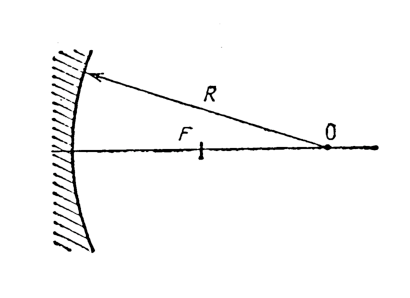
Fig. 4
Official English text of the problem.
Answers
-
Required receiver radius: \[ \boxed{r_{\min}\simeq\frac{D^3}{16R^2}\approx2.0\ \mathrm{mm}.} \] Without the small-aperture expansion, the geometrical result is \(2.024\ldots\ \mathrm{mm}\).
-
Flux after an eightfold reduction in linear dimensions: \[ \boxed{\frac{\Phi_{\mathrm{small}}}{\Phi_{\mathrm{full}}}\simeq\frac14.} \] The received flux decreases by approximately a factor of 4, corresponding to a 75% loss. Unexpanded ray geometry gives a retained fraction of \(0.25449\ldots\).
Solution
Required receiver radius
Assume a distant source on the optical axis, providing parallel rays and uniform illumination across the mirror’s aperture. We use geometrical optics and neglect diffraction.
Let the mirror’s vertex be at \(z=0\), with its centre of curvature at \(z=R\). Its paraxial focus is therefore at \[ f=\frac R2=1\ \mathrm{m}. \] Write the aperture radius as \[ a=\frac D2=0.25\ \mathrm{m}. \]
Consider an incident ray at height \(h\) above the axis. At its point of reflection \(P\), let the normal make an angle \(\theta\) with the axis. The spherical surface gives \[ h=R\sin\theta,\qquad z_P=R(1-\cos\theta). \]
By the law of reflection, the reflected ray travels towards the axis at angle \(2\theta\). Its signed height when it reaches the focal plane \(z=f\) is \[ y_F=h-(f-z_P)\tan2\theta. \] Substituting the expressions above, \[ \begin{aligned} y_F &=R\sin\theta -R\left(\cos\theta-\frac12\right)\tan2\theta\\ &=-\frac{R\sin\theta(1-\cos\theta)}{\cos2\theta}. \end{aligned} \] The negative sign means that the ray has already crossed the axis before reaching the paraxial focal plane: this is spherical aberration.
Thus its distance from the axis in that plane is \[ \boxed{\rho(h)= \frac{h\left(1-\sqrt{1-h^2/R^2}\right)} {1-2h^2/R^2}.} \] For the present aperture, the numerator increases with \(h\), while the positive denominator decreases. Hence \(\rho(h)\) increases, and the outermost rays determine the required disk radius: \[ r_{\min}=\rho(a) =\frac{a\left(1-\sqrt{1-a^2/R^2}\right)} {1-2a^2/R^2}. \] With the given values, this is \[ r_{\min}=2.024\ldots\times10^{-3}\ \mathrm{m}. \]
To obtain the requested small-quantity approximation, note that \[ \frac{h^2}{R^2}\leq\frac{a^2}{R^2}=\frac1{64}\ll1. \] Using the supplied expansion, \[ 1-\sqrt{1-\frac{h^2}{R^2}}\simeq\frac{h^2}{2R^2}. \] Keeping the leading nonzero term in \(\rho(h)\) therefore gives \[ \rho(h)\simeq\frac{h^3}{2R^2}. \] Consequently, \[ \boxed{ r_{\min}\simeq\frac{a^3}{2R^2} =\frac{D^3}{16R^2} =\frac{(0.5)^3}{16(2)^2}\ \mathrm{m} =1.95\times10^{-3}\ \mathrm{m} \approx2.0\ \mathrm{mm}. } \]
Flux after reducing the detector’s dimensions
An eightfold reduction in linear dimensions makes the detector radius \[ r_{\mathrm{small}}=\frac{r_{\min}}8. \]
Since \(\rho(h)\) increases with \(h\), this smaller disk receives the rays reflected from a central portion of the mirror’s aperture, of radius \(b\), defined by \[ \rho(b)=\frac{\rho(a)}8. \] Using the cubic dependence just derived, \[ \frac{b^3}{2R^2}=\frac18\frac{a^3}{2R^2}, \] so \[ b=\frac a2. \]
For uniform incident illumination and uniform reflectivity, the reflected flux is proportional to the projected aperture area contributing to the detector. Therefore, \[ \boxed{ \frac{\Phi_{\mathrm{small}}}{\Phi_{\mathrm{full}}} =\frac{\pi b^2}{\pi a^2} \simeq\left(\frac12\right)^2 =\frac14. } \] Thus the received flux decreases approximately fourfold.
For comparison, using the unexpanded expression for \(\rho(h)\), the equation \(\rho(b)=\rho(a)/8\) gives \(b=0.126117\ldots\ \mathrm{m}\), and hence \[ \frac{\Phi_{\mathrm{small}}}{\Phi_{\mathrm{full}}} =0.25449\ldots, \] consistent with the leading-order result.
The solution was checked against the official solution. Where this solution differs from the official solution, the official solution contains an error or a misprint.
IPhO 1970 · Theorieaufgabe 4
Sphärischer Teleskopspiegel und ein scheibenförmiger Empfänger in seinem Brennpunkt
In ein Teleskop ist ein sphärischer Spiegel eingebaut. Sein Öffnungsdurchmesser beträgt \(D=0{,}5\ \mathrm{m}\), sein Krümmungsradius \(R=2\ \mathrm{m}\). Im Hauptbrennpunkt des Spiegels befindet sich ein Strahlungsempfänger in Form einer kreisförmigen Scheibe. Die Scheibe steht senkrecht zur optischen Achse des Spiegels (Abb. 4). Wie groß muss der Radius \(r\) des Empfängers sein, damit er den gesamten vom Spiegel reflektierten Strahlungsfluss auffangen kann? Wie würde der empfangene Strahlungsfluss abnehmen, wenn die Abmessungen des Detektors um den Faktor 8 verkleinert würden?
Hinweise: 1) Für kleine Werte von \(\alpha\) (\(\alpha\ll1\)) darf bei der Berechnung die Näherung \(\sqrt{1-\alpha}\approx1-\dfrac{\alpha}{2}\) verwendet werden; 2) Beugung ist nicht zu berücksichtigen.
Abb. 4
Aufgabentext aus dem offiziellen englischen Text übersetzt.
Antworten
-
Erforderlicher Empfängerradius: \[ \boxed{r_{\min}\simeq\frac{D^3}{16R^2}\approx2.0\ \mathrm{mm}.} \] Ohne die Entwicklung für kleine Öffnungen ergibt sich geometrisch \(2.024\ldots\ \mathrm{mm}\).
-
Strahlungsfluss nach einer Verkleinerung der linearen Abmessungen um den Faktor acht: \[ \boxed{\frac{\Phi_{\mathrm{small}}}{\Phi_{\mathrm{full}}}\simeq\frac14.} \] Der empfangene Strahlungsfluss nimmt ungefähr um den Faktor 4 ab, was einem Verlust von 75% entspricht. Die Strahlengeometrie ohne Näherungsentwicklung ergibt einen verbleibenden Anteil von \(0.25449\ldots\).
Lösung
Erforderlicher Empfängerradius
Wir nehmen eine weit entfernte Quelle auf der optischen Achse an, die parallele Strahlen liefert und die Spiegelöffnung gleichmäßig ausleuchtet. Wir verwenden die geometrische Optik und vernachlässigen die Beugung.
Der Scheitel des Spiegels liege bei \(z=0\), sein Krümmungsmittelpunkt bei \(z=R\). Sein paraxialer Brennpunkt liegt daher bei \[ f=\frac R2=1\ \mathrm{m}. \] Den Öffnungsradius bezeichnen wir mit \[ a=\frac D2=0.25\ \mathrm{m}. \]
Betrachten wir einen einfallenden Strahl in der Höhe \(h\) über der Achse. An seinem Reflexionspunkt \(P\) bilde die Normale mit der Achse den Winkel \(\theta\). Aus der Kugeloberfläche folgt \[ h=R\sin\theta,\qquad z_P=R(1-\cos\theta). \]
Nach dem Reflexionsgesetz verläuft der reflektierte Strahl unter dem Winkel \(2\theta\) auf die Achse zu. Seine vorzeichenbehaftete Höhe beim Erreichen der Brennebene \(z=f\) beträgt \[ y_F=h-(f-z_P)\tan2\theta. \] Durch Einsetzen der obigen Ausdrücke ergibt sich \[ \begin{aligned} y_F &=R\sin\theta -R\left(\cos\theta-\frac12\right)\tan2\theta\\ &=-\frac{R\sin\theta(1-\cos\theta)}{\cos2\theta}. \end{aligned} \] Das negative Vorzeichen bedeutet, dass der Strahl die Achse bereits vor dem Erreichen der paraxialen Brennebene gekreuzt hat: Dies ist die sphärische Aberration.
Sein Abstand von der Achse in dieser Ebene ist somit \[ \boxed{\rho(h)= \frac{h\left(1-\sqrt{1-h^2/R^2}\right)} {1-2h^2/R^2}.} \] Für die vorliegende Öffnung wächst der Zähler mit \(h\), während der positive Nenner abnimmt. Daher wächst \(\rho(h)\), und die äußersten Strahlen bestimmen den erforderlichen Scheibenradius: \[ r_{\min}=\rho(a) =\frac{a\left(1-\sqrt{1-a^2/R^2}\right)} {1-2a^2/R^2}. \] Mit den gegebenen Werten ergibt sich \[ r_{\min}=2.024\ldots\times10^{-3}\ \mathrm{m}. \]
Um die geforderte Näherung für kleine Größen zu erhalten, beachten wir, dass \[ \frac{h^2}{R^2}\leq\frac{a^2}{R^2}=\frac1{64}\ll1. \] Mit der angegebenen Entwicklung gilt \[ 1-\sqrt{1-\frac{h^2}{R^2}}\simeq\frac{h^2}{2R^2}. \] Behält man daher in \(\rho(h)\) nur den führenden, von null verschiedenen Term bei, erhält man \[ \rho(h)\simeq\frac{h^3}{2R^2}. \] Folglich gilt \[ \boxed{ r_{\min}\simeq\frac{a^3}{2R^2} =\frac{D^3}{16R^2} =\frac{(0.5)^3}{16(2)^2}\ \mathrm{m} =1.95\times10^{-3}\ \mathrm{m} \approx2.0\ \mathrm{mm}. } \]
Strahlungsfluss nach der Verkleinerung der Detektorabmessungen
Eine Verkleinerung der linearen Abmessungen um den Faktor acht ergibt den Detektorradius \[ r_{\mathrm{small}}=\frac{r_{\min}}8. \]
Da \(\rho(h)\) mit \(h\) wächst, empfängt diese kleinere Scheibe die Strahlen, die von einem zentralen Bereich der Spiegelöffnung reflektiert werden, dessen Radius \(b\) durch folgende Gleichung festgelegt ist: \[ \rho(b)=\frac{\rho(a)}8. \] Mit der soeben hergeleiteten kubischen Abhängigkeit ergibt sich \[ \frac{b^3}{2R^2}=\frac18\frac{a^3}{2R^2}, \] also \[ b=\frac a2. \]
Bei gleichmäßiger einfallender Beleuchtung und einheitlichem Reflexionsgrad ist der reflektierte Strahlungsfluss proportional zur projizierten Öffnungsfläche, die zum Empfang am Detektor beiträgt. Daher gilt \[ \boxed{ \frac{\Phi_{\mathrm{small}}}{\Phi_{\mathrm{full}}} =\frac{\pi b^2}{\pi a^2} \simeq\left(\frac12\right)^2 =\frac14. } \] Der empfangene Strahlungsfluss nimmt somit ungefähr um den Faktor vier ab.
Zum Vergleich: Verwendet man den Ausdruck für \(\rho(h)\) ohne Näherungsentwicklung, liefert die Gleichung \(\rho(b)=\rho(a)/8\) den Wert \(b=0.126117\ldots\ \mathrm{m}\), und damit \[ \frac{\Phi_{\mathrm{small}}}{\Phi_{\mathrm{full}}} =0.25449\ldots, \] in Übereinstimmung mit dem Ergebnis in führender Ordnung.
Die Lösung wurde mit der offiziellen Lösung abgeglichen. Wo diese Lösung von der offiziellen Lösung abweicht, enthält die offizielle Lösung einen Fehler oder Druckfehler.
IPhO 1970 · Teori sorusu 4
Küresel teleskop aynası ve odağındaki disk biçimli alıcı
Bir teleskopa küresel bir ayna yerleştirilmiştir. Aynanın enine çapı \(D=0{,}5\ \mathrm{m}\), eğrilik yarıçapı ise \(R=2\ \mathrm{m}\)'dir. Aynanın asal odağında, dairesel bir disk biçiminde bir ışınım alıcısı bulunmaktadır. Disk, aynanın optik eksenine dik olarak yerleştirilmiştir (Şek. 4). Aynadan yansıyan ışınım akısının tamamını alabilmesi için alıcının yarıçapı \(r\) ne olmalıdır? Dedektörün boyutları 8 kat küçültülürse alınan ışınım akısı nasıl azalır?
Yönergeler: 1) Küçük \(\alpha\) değerleri (\(\alpha\ll1\)) için hesaplama yapılırken \(\sqrt{1-\alpha}\approx1-\dfrac{\alpha}{2}\) yerine koyması kullanılabilir; 2) kırınım dikkate alınmamalıdır.
Şek. 4
Soru metni resmi İngilizce metinden çevrilmiştir.
Cevaplar
-
Gerekli alıcı yarıçapı: \[ \boxed{r_{\min}\simeq\frac{D^3}{16R^2}\approx2.0\ \mathrm{mm}.} \] Küçük açıklık açılımı kullanılmadığında geometrik sonuç \(2.024\ldots\ \mathrm{mm}\)'dir.
-
Doğrusal boyutlar sekiz kat küçültüldükten sonraki akı: \[ \boxed{\frac{\Phi_{\mathrm{small}}}{\Phi_{\mathrm{full}}}\simeq\frac14.} \] Alınan akı yaklaşık 4 kat azalır; bu, %75 kayba karşılık gelir. Açılım yapılmadan kullanılan ışın geometrisi, alınmaya devam eden akının oranını \(0.25449\ldots\) olarak verir.
Çözüm
Gerekli alıcı yarıçapı
Optik eksen üzerinde, paralel ışınlar sağlayan ve aynanın açıklığı boyunca düzgün aydınlanma oluşturan uzak bir kaynak olduğunu varsayalım. Geometrik optiği kullanıyor ve kırınımı ihmal ediyoruz.
Aynanın tepe noktası \(z=0\)'da, eğrilik merkezi ise \(z=R\)'de olsun. Buna göre paraksiyal odağı \[ f=\frac R2=1\ \mathrm{m}. \] konumundadır. Açıklık yarıçapını \[ a=\frac D2=0.25\ \mathrm{m}. \] olarak yazalım.
Eksenden \(h\) yüksekliğinde gelen bir ışını ele alalım. Işının yansıdığı \(P\) noktasında normal, eksenle \(\theta\) açısı yapsın. Küresel yüzeyden \[ h=R\sin\theta,\qquad z_P=R(1-\cos\theta). \] bağıntıları elde edilir.
Yansıma yasasına göre, yansıyan ışın eksene doğru \(2\theta\) açısıyla ilerler. \(z=f\) odak düzlemine ulaştığında işaretli yüksekliği \[ y_F=h-(f-z_P)\tan2\theta. \] olur. Yukarıdaki ifadeler yerine konulduğunda, \[ \begin{aligned} y_F &=R\sin\theta -R\left(\cos\theta-\frac12\right)\tan2\theta\\ &=-\frac{R\sin\theta(1-\cos\theta)}{\cos2\theta}. \end{aligned} \] Negatif işaret, ışının paraksiyal odak düzlemine ulaşmadan önce ekseni geçmiş olduğunu gösterir: bu, küresel sapmadır.
Dolayısıyla bu düzlemde eksene olan uzaklığı \[ \boxed{\rho(h)= \frac{h\left(1-\sqrt{1-h^2/R^2}\right)} {1-2h^2/R^2}.} \] olur. Verilen açıklık için \(h\) arttıkça pay artarken pozitif olan payda azalır. Dolayısıyla \(\rho(h)\) artar ve gerekli disk yarıçapını en dıştaki ışınlar belirler: \[ r_{\min}=\rho(a) =\frac{a\left(1-\sqrt{1-a^2/R^2}\right)} {1-2a^2/R^2}. \] Verilen değerlerle bu yarıçap \[ r_{\min}=2.024\ldots\times10^{-3}\ \mathrm{m}. \] olur.
İstenen küçük büyüklük yaklaşımını elde etmek için \[ \frac{h^2}{R^2}\leq\frac{a^2}{R^2}=\frac1{64}\ll1. \] olduğuna dikkat edelim. Verilen açılımı kullanarak, \[ 1-\sqrt{1-\frac{h^2}{R^2}}\simeq\frac{h^2}{2R^2}. \] Böylece \(\rho(h)\) ifadesinde sıfırdan farklı en düşük mertebeli terimi tutmak \[ \rho(h)\simeq\frac{h^3}{2R^2}. \] sonucunu verir. Sonuç olarak, \[ \boxed{ r_{\min}\simeq\frac{a^3}{2R^2} =\frac{D^3}{16R^2} =\frac{(0.5)^3}{16(2)^2}\ \mathrm{m} =1.95\times10^{-3}\ \mathrm{m} \approx2.0\ \mathrm{mm}. } \]
Dedektörün boyutları küçültüldükten sonraki akı
Doğrusal boyutların sekiz kat küçültülmesiyle dedektörün yarıçapı \[ r_{\mathrm{small}}=\frac{r_{\min}}8. \] olur.
\(\rho(h)\), \(h\) ile arttığından, bu daha küçük disk, aynanın açıklığının merkezindeki \(b\) yarıçaplı bir bölgeden yansıyan ışınları alır; bu yarıçap \[ \rho(b)=\frac{\rho(a)}8. \] bağıntısıyla tanımlanır. Az önce türetilen kübik bağımlılığı kullanarak, \[ \frac{b^3}{2R^2}=\frac18\frac{a^3}{2R^2}, \] dolayısıyla \[ b=\frac a2. \]
Gelen ışığın düzgün aydınlanma oluşturması ve yansıtıcılığın her yerde aynı olması durumunda, yansıyan akı, dedektöre katkıda bulunan açıklığın izdüşüm alanı ile orantılıdır. Bu nedenle, \[ \boxed{ \frac{\Phi_{\mathrm{small}}}{\Phi_{\mathrm{full}}} =\frac{\pi b^2}{\pi a^2} \simeq\left(\frac12\right)^2 =\frac14. } \] Böylece alınan akı yaklaşık dört kat azalır.
Karşılaştırma için, \(\rho(h)\)'nin açılım yapılmamış ifadesi kullanıldığında, \(\rho(b)=\rho(a)/8\) denklemi \(b=0.126117\ldots\ \mathrm{m}\) sonucunu verir ve dolayısıyla \[ \frac{\Phi_{\mathrm{small}}}{\Phi_{\mathrm{full}}} =0.25449\ldots, \] bu da en düşük mertebeli sonuçla tutarlıdır.
Çözüm, resmi çözümle karşılaştırılarak kontrol edildi. Bu çözümün resmi çözümden ayrıldığı yerlerde resmi çözümde bir hata ya da baskı hatası vardır.
IPhO 1970 · Problema teórico 4
Espejo esférico de un telescopio y un receptor en forma de disco en su foco
En un telescopio se instala un espejo esférico. Su diámetro transversal es \(D=0{,}5\ \mathrm{m}\) y su radio de curvatura es \(R=2\ \mathrm{m}\). En el foco principal del espejo se encuentra un receptor de radiación en forma de disco circular. El disco está colocado perpendicularmente al eje óptico del espejo (Fig. 4). ¿Cuál debe ser el radio \(r\) del receptor para que pueda recibir todo el flujo de radiación reflejado por el espejo? ¿Cómo disminuiría el flujo de radiación recibido si las dimensiones del detector se redujeran a la octava parte?
Indicaciones: 1) Al realizar cálculos con valores pequeños de \(\alpha\) (\(\alpha\ll1\)), puede utilizarse la sustitución \(\sqrt{1-\alpha}\approx1-\dfrac{\alpha}{2}\); 2) no debe tenerse en cuenta la difracción.
Fig. 4
Enunciado traducido del texto oficial en inglés.
Respuestas
-
Radio necesario del receptor: \[ \boxed{r_{\min}\simeq\frac{D^3}{16R^2}\approx2.0\ \mathrm{mm}.} \] Sin utilizar el desarrollo para una abertura pequeña, el resultado geométrico es \(2.024\ldots\ \mathrm{mm}\).
-
Flujo tras reducir las dimensiones lineales a la octava parte: \[ \boxed{\frac{\Phi_{\mathrm{small}}}{\Phi_{\mathrm{full}}}\simeq\frac14.} \] El flujo recibido disminuye aproximadamente en un factor de 4, lo que corresponde a una pérdida del 75%. La geometría de los rayos sin recurrir al desarrollo da una fracción recibida de \(0.25449\ldots\).
Solución
Radio necesario del receptor
Supongamos una fuente lejana situada sobre el eje óptico, que proporciona rayos paralelos y una iluminación uniforme en toda la abertura del espejo. Utilizamos la óptica geométrica y despreciamos la difracción.
Situemos el vértice del espejo en \(z=0\), con su centro de curvatura en \(z=R\). Su foco paraxial se encuentra, por tanto, en \[ f=\frac R2=1\ \mathrm{m}. \] Denotemos el radio de la abertura por \[ a=\frac D2=0.25\ \mathrm{m}. \]
Consideremos un rayo incidente a una altura \(h\) por encima del eje. En su punto de reflexión \(P\), sea \(\theta\) el ángulo que forma la normal con el eje. La superficie esférica proporciona \[ h=R\sin\theta,\qquad z_P=R(1-\cos\theta). \]
Por la ley de la reflexión, el rayo reflejado se dirige hacia el eje formando un ángulo \(2\theta\). Su altura con signo al alcanzar el plano focal \(z=f\) es \[ y_F=h-(f-z_P)\tan2\theta. \] Sustituyendo las expresiones anteriores, \[ \begin{aligned} y_F &=R\sin\theta -R\left(\cos\theta-\frac12\right)\tan2\theta\\ &=-\frac{R\sin\theta(1-\cos\theta)}{\cos2\theta}. \end{aligned} \] El signo negativo significa que el rayo ya ha cruzado el eje antes de alcanzar el plano focal paraxial: se trata de la aberración esférica.
Por tanto, su distancia al eje en ese plano es \[ \boxed{\rho(h)= \frac{h\left(1-\sqrt{1-h^2/R^2}\right)} {1-2h^2/R^2}.} \] Para la abertura considerada, el numerador aumenta con \(h\), mientras que el denominador positivo disminuye. Por ello, \(\rho(h)\) aumenta, y los rayos más externos determinan el radio necesario del disco: \[ r_{\min}=\rho(a) =\frac{a\left(1-\sqrt{1-a^2/R^2}\right)} {1-2a^2/R^2}. \] Con los valores dados, se obtiene \[ r_{\min}=2.024\ldots\times10^{-3}\ \mathrm{m}. \]
Para obtener la aproximación solicitada para cantidades pequeñas, observemos que \[ \frac{h^2}{R^2}\leq\frac{a^2}{R^2}=\frac1{64}\ll1. \] Utilizando el desarrollo proporcionado, \[ 1-\sqrt{1-\frac{h^2}{R^2}}\simeq\frac{h^2}{2R^2}. \] Al conservar el término no nulo de menor orden en \(\rho(h)\), se obtiene, por tanto, \[ \rho(h)\simeq\frac{h^3}{2R^2}. \] En consecuencia, \[ \boxed{ r_{\min}\simeq\frac{a^3}{2R^2} =\frac{D^3}{16R^2} =\frac{(0.5)^3}{16(2)^2}\ \mathrm{m} =1.95\times10^{-3}\ \mathrm{m} \approx2.0\ \mathrm{mm}. } \]
Flujo tras reducir las dimensiones del detector
Al reducir las dimensiones lineales a la octava parte, el radio del detector pasa a ser \[ r_{\mathrm{small}}=\frac{r_{\min}}8. \]
Como \(\rho(h)\) aumenta con \(h\), este disco más pequeño recibe los rayos reflejados por una porción central de la abertura del espejo, de radio \(b\), definido por \[ \rho(b)=\frac{\rho(a)}8. \] Utilizando la dependencia cúbica que acabamos de deducir, \[ \frac{b^3}{2R^2}=\frac18\frac{a^3}{2R^2}, \] de modo que \[ b=\frac a2. \]
Para una iluminación incidente uniforme y una reflectividad uniforme, el flujo reflejado es proporcional al área proyectada de la abertura que contribuye al detector. Por tanto, \[ \boxed{ \frac{\Phi_{\mathrm{small}}}{\Phi_{\mathrm{full}}} =\frac{\pi b^2}{\pi a^2} \simeq\left(\frac12\right)^2 =\frac14. } \] Así pues, el flujo recibido se reduce aproximadamente a la cuarta parte.
A modo de comparación, utilizando la expresión de \(\rho(h)\) sin desarrollar, la ecuación \(\rho(b)=\rho(a)/8\) da \(b=0.126117\ldots\ \mathrm{m}\), y, por tanto, \[ \frac{\Phi_{\mathrm{small}}}{\Phi_{\mathrm{full}}} =0.25449\ldots, \] en concordancia con el resultado de orden dominante.
La solución se comprobó con la solución oficial. Donde esta solución difiere de la solución oficial, la solución oficial contiene un error o una errata.
IPhO 1970 · 理论题 4
望远镜的球面反射镜及其焦点处的圆盘形接收器
望远镜中装有一面球面反射镜。其口径为 \(D=0{,}5\ \mathrm{m}\),曲率半径为 \(R=2\ \mathrm{m}\)。反射镜的主焦点处放置了一个圆盘形的辐射接收器。圆盘垂直于反射镜的光轴放置(图4)。接收器的半径 \(r\) 应为多大,才能接收到反射镜反射的全部辐射通量?如果探测器的尺寸缩小为原来的八分之一,接收到的辐射通量会如何减少?
提示:1) 当计算涉及小量 \(\alpha\)(\(\alpha\ll1\))时,可以采用近似代换 \(\sqrt{1-\alpha}\approx1-\dfrac{\alpha}{2}\);2) 不考虑衍射。
图 4
题目译自官方英文原文。
答案
-
所需的接收器半径: \[ \boxed{r_{\min}\simeq\frac{D^3}{16R^2}\approx2.0\ \mathrm{mm}.} \] 不采用小孔径展开时,几何计算结果为 \(2.024\ldots\ \mathrm{mm}\)。
-
线性尺寸缩小为原来的八分之一后的通量: \[ \boxed{\frac{\Phi_{\mathrm{small}}}{\Phi_{\mathrm{full}}}\simeq\frac14.} \] 接收到的通量约降至原来的 四分之一,即损失 75%。不作展开的光线几何计算给出的保留比例为 \(0.25449\ldots\)。
解答
所需的接收器半径
假设光源位于光轴上的远处,入射光线相互平行,且在反射镜的整个孔径内均匀照明。我们采用几何光学方法,并忽略衍射。
设反射镜的顶点位于 \(z=0\),曲率中心位于 \(z=R\)。因此,其近轴焦点位于 \[ f=\frac R2=1\ \mathrm{m}. \] 将孔径半径记为 \[ a=\frac D2=0.25\ \mathrm{m}. \]
考虑一条位于光轴上方、高度为 \(h\) 的入射光线。设在其反射点 \(P\) 处,法线与光轴的夹角为 \(\theta\)。由球面的几何关系可得 \[ h=R\sin\theta,\qquad z_P=R(1-\cos\theta). \]
根据反射定律,反射光线以与光轴成 \(2\theta\) 的角度向光轴传播。当它到达焦平面 \(z=f\) 时,其带符号的高度为 \[ y_F=h-(f-z_P)\tan2\theta. \] 代入上述表达式,得 \[ \begin{aligned} y_F &=R\sin\theta -R\left(\cos\theta-\frac12\right)\tan2\theta\\ &=-\frac{R\sin\theta(1-\cos\theta)}{\cos2\theta}. \end{aligned} \] 负号表示光线在到达近轴焦平面之前已经穿过光轴:这就是球差。
因此,该光线在这一平面内到光轴的距离为 \[ \boxed{\rho(h)= \frac{h\left(1-\sqrt{1-h^2/R^2}\right)} {1-2h^2/R^2}.} \] 对于本题给定的孔径,分子随 \(h\) 增大而增大,而保持为正的分母随之减小。因此,\(\rho(h)\) 随 \(h\) 增大而增大,所需的圆盘半径由最外缘的光线决定: \[ r_{\min}=\rho(a) =\frac{a\left(1-\sqrt{1-a^2/R^2}\right)} {1-2a^2/R^2}. \] 代入给定数值,得 \[ r_{\min}=2.024\ldots\times10^{-3}\ \mathrm{m}. \]
为得到题目要求的小量近似,注意到 \[ \frac{h^2}{R^2}\leq\frac{a^2}{R^2}=\frac1{64}\ll1. \] 利用题目给出的展开式, \[ 1-\sqrt{1-\frac{h^2}{R^2}}\simeq\frac{h^2}{2R^2}. \] 因此,在 \(\rho(h)\) 中保留最低阶非零项,得 \[ \rho(h)\simeq\frac{h^3}{2R^2}. \] 于是, \[ \boxed{ r_{\min}\simeq\frac{a^3}{2R^2} =\frac{D^3}{16R^2} =\frac{(0.5)^3}{16(2)^2}\ \mathrm{m} =1.95\times10^{-3}\ \mathrm{m} \approx2.0\ \mathrm{mm}. } \]
探测器尺寸缩小后的通量
线性尺寸缩小为原来的八分之一后,探测器的半径为 \[ r_{\mathrm{small}}=\frac{r_{\min}}8. \]
由于 \(\rho(h)\) 随 \(h\) 增大而增大,这个较小的圆盘接收的是反射镜孔径中央区域反射的光线,该区域的半径 \(b\) 由下式确定: \[ \rho(b)=\frac{\rho(a)}8. \] 利用刚刚导出的三次方关系, \[ \frac{b^3}{2R^2}=\frac18\frac{a^3}{2R^2}, \] 因此 \[ b=\frac a2. \]
当入射照明均匀且反射率均匀时,反射通量正比于向探测器贡献光线的孔径投影面积。因此, \[ \boxed{ \frac{\Phi_{\mathrm{small}}}{\Phi_{\mathrm{full}}} =\frac{\pi b^2}{\pi a^2} \simeq\left(\frac12\right)^2 =\frac14. } \] 因此,接收到的通量约降至原来的四分之一。
作为比较,使用未经展开的 \(\rho(h)\) 表达式,由方程 \(\rho(b)=\rho(a)/8\) 得到 \(b=0.126117\ldots\ \mathrm{m}\),从而 \[ \frac{\Phi_{\mathrm{small}}}{\Phi_{\mathrm{full}}} =0.25449\ldots, \] 与最低阶近似结果一致。
解答已与官方解答核对。本解答与官方解答不同之处,均为官方解答中的错误或印刷错误。
IPhO 1970 · Теоретическая задача 4
Сферическое зеркало телескопа и дисковый приёмник в его фокусе
В телескопе установлено сферическое зеркало. Его поперечный диаметр равен \(D=0{,}5\ \mathrm{m}\), а радиус кривизны — \(R=2\ \mathrm{m}\). В главном фокусе зеркала находится приёмник излучения в форме круглого диска. Диск расположен перпендикулярно оптической оси зеркала (рис. 4). Каким должен быть радиус \(r\) приёмника, чтобы он мог принимать весь поток излучения, отражённого зеркалом? Во сколько раз уменьшится принимаемый поток излучения, если размеры приёмника уменьшить в 8 раз?
Указания: 1) При вычислениях с малыми величинами \(\alpha\) (\(\alpha\ll1\)) можно использовать приближение \(\sqrt{1-\alpha}\approx1-\dfrac{\alpha}{2}\); 2) дифракцию учитывать не следует.
Рис. 4
Условие переведено с официального английского текста.
Ответы
-
Необходимый радиус приёмника: \[ \boxed{r_{\min}\simeq\frac{D^3}{16R^2}\approx2.0\ \mathrm{mm}.} \] Без разложения по малому размеру апертуры геометрический расчёт даёт \(2.024\ldots\ \mathrm{mm}\).
-
Поток после восьмикратного уменьшения линейных размеров: \[ \boxed{\frac{\Phi_{\mathrm{small}}}{\Phi_{\mathrm{full}}}\simeq\frac14.} \] Принимаемый поток уменьшается приблизительно в 4 раза, что соответствует потере 75%. Геометрический расчёт хода лучей без разложения даёт долю сохранившегося потока \(0.25449\ldots\).
Решение
Необходимый радиус приёмника
Предположим, что удалённый источник находится на оптической оси и создаёт параллельный пучок лучей, равномерно освещающий апертуру зеркала. Используем геометрическую оптику и пренебрежём дифракцией.
Пусть вершина зеркала находится в точке \(z=0\), а центр его кривизны — в точке \(z=R\). Тогда его параксиальный фокус находится в точке \[ f=\frac R2=1\ \mathrm{m}. \] Обозначим радиус апертуры через \[ a=\frac D2=0.25\ \mathrm{m}. \]
Рассмотрим падающий луч на высоте \(h\) над осью. Пусть в точке его отражения \(P\) нормаль образует с осью угол \(\theta\). Из геометрии сферической поверхности следует \[ h=R\sin\theta,\qquad z_P=R(1-\cos\theta). \]
По закону отражения отражённый луч направляется к оси под углом \(2\theta\). Его высота с учётом знака при достижении фокальной плоскости \(z=f\) равна \[ y_F=h-(f-z_P)\tan2\theta. \] Подставляя приведённые выше выражения, получаем \[ \begin{aligned} y_F &=R\sin\theta -R\left(\cos\theta-\frac12\right)\tan2\theta\\ &=-\frac{R\sin\theta(1-\cos\theta)}{\cos2\theta}. \end{aligned} \] Отрицательный знак означает, что луч пересёк ось ещё до достижения параксиальной фокальной плоскости: это сферическая аберрация.
Таким образом, расстояние луча от оси в этой плоскости равно \[ \boxed{\rho(h)= \frac{h\left(1-\sqrt{1-h^2/R^2}\right)} {1-2h^2/R^2}.} \] Для данной апертуры числитель возрастает с ростом \(h\), а положительный знаменатель уменьшается. Следовательно, \(\rho(h)\) возрастает, и необходимый радиус диска определяется крайними лучами: \[ r_{\min}=\rho(a) =\frac{a\left(1-\sqrt{1-a^2/R^2}\right)} {1-2a^2/R^2}. \] При заданных значениях получаем \[ r_{\min}=2.024\ldots\times10^{-3}\ \mathrm{m}. \]
Чтобы получить требуемое приближение по малому параметру, заметим, что \[ \frac{h^2}{R^2}\leq\frac{a^2}{R^2}=\frac1{64}\ll1. \] Используя указанное в условии разложение, получаем \[ 1-\sqrt{1-\frac{h^2}{R^2}}\simeq\frac{h^2}{2R^2}. \] Поэтому, сохраняя в \(\rho(h)\) первый ненулевой член, получаем \[ \rho(h)\simeq\frac{h^3}{2R^2}. \] Следовательно, \[ \boxed{ r_{\min}\simeq\frac{a^3}{2R^2} =\frac{D^3}{16R^2} =\frac{(0.5)^3}{16(2)^2}\ \mathrm{m} =1.95\times10^{-3}\ \mathrm{m} \approx2.0\ \mathrm{mm}. } \]
Поток после уменьшения размеров приёмника
При восьмикратном уменьшении линейных размеров радиус приёмника становится равным \[ r_{\mathrm{small}}=\frac{r_{\min}}8. \]
Поскольку \(\rho(h)\) возрастает с ростом \(h\), этот меньший диск принимает лучи, отражённые от центральной части апертуры зеркала радиуса \(b\), определяемого условием \[ \rho(b)=\frac{\rho(a)}8. \] Используя только что полученную кубическую зависимость, находим \[ \frac{b^3}{2R^2}=\frac18\frac{a^3}{2R^2}, \] откуда \[ b=\frac a2. \]
При равномерном падающем освещении и одинаковом по всей поверхности коэффициенте отражения отражённый поток пропорционален площади проекции той части апертуры, лучи от которой попадают на приёмник. Поэтому \[ \boxed{ \frac{\Phi_{\mathrm{small}}}{\Phi_{\mathrm{full}}} =\frac{\pi b^2}{\pi a^2} \simeq\left(\frac12\right)^2 =\frac14. } \] Таким образом, принимаемый поток уменьшается приблизительно в четыре раза.
Для сравнения, при использовании выражения для \(\rho(h)\) без разложения уравнение \(\rho(b)=\rho(a)/8\) даёт \(b=0.126117\ldots\ \mathrm{m}\), и, следовательно, \[ \frac{\Phi_{\mathrm{small}}}{\Phi_{\mathrm{full}}} =0.25449\ldots, \] что согласуется с результатом в главном порядке приближения.
Решение проверено по официальному решению. Там, где это решение расходится с официальным, в официальном решении есть ошибка или опечатка.
IPhO 1970 · مسألة نظرية 4
مرآة تلسكوب كروية ومستقبِل قرصي في بؤرتها
رُكِّبت مرآة كروية في تلسكوب. قطرها العرضي هو \(D=0{,}5\ \mathrm{m}\)، ونصف قطر تكورها \(R=2\ \mathrm{m}\). يوجد في البؤرة الرئيسية للمرآة مستقبِل للإشعاع على شكل قرص دائري. وُضع القرص عموديًا على المحور البصري للمرآة (الشكل 4). كم ينبغي أن يكون نصف قطر المستقبِل \(r\) لكي يستقبل كامل تدفق الإشعاع المنعكس عن المرآة؟ وكيف ينخفض تدفق الإشعاع المستقبَل إذا صُغِّرت أبعاد الكاشف إلى ثُمن قيمتها؟
إرشادات: 1) عند إجراء الحسابات لقيم صغيرة من \(\alpha\) (\(\alpha\ll1\))، يمكن استخدام التعويض \(\sqrt{1-\alpha}\approx1-\dfrac{\alpha}{2}\)؛ 2) ينبغي عدم أخذ الحيود في الحسبان.
الشكل 4
نص المسألة مترجم عن النص الإنجليزي الرسمي.
الإجابات
-
نصف قطر المستقبِل المطلوب: \[ \boxed{r_{\min}\simeq\frac{D^3}{16R^2}\approx2.0\ \mathrm{mm}.} \] من دون استخدام التوسع الخاص بالفتحة الصغيرة، تكون النتيجة الهندسية \(2.024\ldots\ \mathrm{mm}\).
-
التدفق بعد تصغير الأبعاد الخطية إلى ثُمن قيمتها: \[ \boxed{\frac{\Phi_{\mathrm{small}}}{\Phi_{\mathrm{full}}}\simeq\frac14.} \] ينخفض التدفق المستقبَل بعامل مقداره 4 تقريبًا، وهو ما يقابل فقدانًا بنسبة 75%. وتعطي هندسة الأشعة من دون توسع نسبة متبقية مقدارها \(0.25449\ldots\).
الحل
نصف قطر المستقبِل المطلوب
نفترض وجود مصدر بعيد على المحور البصري، يوفّر أشعة متوازية وإضاءة منتظمة على امتداد فتحة المرآة. نستخدم البصريات الهندسية ونهمل الحيود.
ليكن رأس المرآة عند \(z=0\)، ومركز تكورها عند \(z=R\). ومن ثم تقع بؤرتها في تقريب الأشعة القريبة من المحور عند \[ f=\frac R2=1\ \mathrm{m}. \] نكتب نصف قطر الفتحة على الصورة \[ a=\frac D2=0.25\ \mathrm{m}. \]
لننظر في شعاع ساقط على ارتفاع \(h\) فوق المحور. ولتكن الزاوية التي يصنعها العمود على السطح مع المحور عند نقطة انعكاسه \(P\) هي \(\theta\). من هندسة السطح الكروي نحصل على \[ h=R\sin\theta,\qquad z_P=R(1-\cos\theta). \]
وفقًا لقانون الانعكاس، يتجه الشعاع المنعكس نحو المحور بزاوية \(2\theta\). ويكون ارتفاعه الجبري عند وصوله إلى المستوى البؤري \(z=f\) هو \[ y_F=h-(f-z_P)\tan2\theta. \] بالتعويض بالتعبيرات السابقة، \[ \begin{aligned} y_F &=R\sin\theta -R\left(\cos\theta-\frac12\right)\tan2\theta\\ &=-\frac{R\sin\theta(1-\cos\theta)}{\cos2\theta}. \end{aligned} \] تعني الإشارة السالبة أن الشعاع قد عبر المحور بالفعل قبل وصوله إلى المستوى البؤري للأشعة القريبة من المحور: وهذا هو الزيغ الكروي.
إذن تكون المسافة بينه وبين المحور في ذلك المستوى \[ \boxed{\rho(h)= \frac{h\left(1-\sqrt{1-h^2/R^2}\right)} {1-2h^2/R^2}.} \] بالنسبة إلى الفتحة المعطاة، يزداد البسط مع ازدياد \(h\)، بينما يتناقص المقام الموجب. ومن ثم تزداد \(\rho(h)\)، وتحدد الأشعة الأبعد عن المحور نصف قطر القرص المطلوب: \[ r_{\min}=\rho(a) =\frac{a\left(1-\sqrt{1-a^2/R^2}\right)} {1-2a^2/R^2}. \] بالتعويض بالقيم المعطاة، نحصل على \[ r_{\min}=2.024\ldots\times10^{-3}\ \mathrm{m}. \]
للحصول على التقريب المطلوب للكميات الصغيرة، نلاحظ أن \[ \frac{h^2}{R^2}\leq\frac{a^2}{R^2}=\frac1{64}\ll1. \] باستخدام التوسع المعطى، \[ 1-\sqrt{1-\frac{h^2}{R^2}}\simeq\frac{h^2}{2R^2}. \] وعليه، فإن الاحتفاظ بالحد غير الصفري من أدنى رتبة في \(\rho(h)\) يعطي \[ \rho(h)\simeq\frac{h^3}{2R^2}. \] وبالتالي، \[ \boxed{ r_{\min}\simeq\frac{a^3}{2R^2} =\frac{D^3}{16R^2} =\frac{(0.5)^3}{16(2)^2}\ \mathrm{m} =1.95\times10^{-3}\ \mathrm{m} \approx2.0\ \mathrm{mm}. } \]
التدفق بعد تصغير أبعاد الكاشف
عند تصغير الأبعاد الخطية إلى ثُمن قيمتها، يصبح نصف قطر الكاشف \[ r_{\mathrm{small}}=\frac{r_{\min}}8. \]
بما أن \(\rho(h)\) تزداد مع ازدياد \(h\)، فإن هذا القرص الأصغر يستقبل الأشعة المنعكسة عن جزء مركزي من فتحة المرآة، نصف قطره \(b\)، تحدده العلاقة \[ \rho(b)=\frac{\rho(a)}8. \] باستخدام الاعتماد التكعيبي الذي اشتققناه للتو، \[ \frac{b^3}{2R^2}=\frac18\frac{a^3}{2R^2}, \] ومن ثم \[ b=\frac a2. \]
عندما تكون الإضاءة الساقطة والانعكاسية منتظمتين، يتناسب التدفق المنعكس مع مساحة إسقاط الفتحة التي تسهم في الإشعاع الواصل إلى الكاشف. لذلك، \[ \boxed{ \frac{\Phi_{\mathrm{small}}}{\Phi_{\mathrm{full}}} =\frac{\pi b^2}{\pi a^2} \simeq\left(\frac12\right)^2 =\frac14. } \] وهكذا ينخفض التدفق المستقبَل إلى نحو رُبع قيمته.
للمقارنة، باستخدام التعبير غير الموسَّع لـ \(\rho(h)\)، تعطي المعادلة \(\rho(b)=\rho(a)/8\) القيمة \(b=0.126117\ldots\ \mathrm{m}\)، ومن ثم \[ \frac{\Phi_{\mathrm{small}}}{\Phi_{\mathrm{full}}} =0.25449\ldots, \] وهو ما يتفق مع النتيجة المحسوبة بالاقتصار على الحد من أدنى رتبة.
تمت مراجعة الحل بمقارنته بالحل الرسمي. حيثما يختلف هذا الحل عن الحل الرسمي، يحتوي الحل الرسمي على خطأ أو خطأ مطبعي.