IPhO 1970 · Theory problem 3
Earthed metal ball inside a charged spherical shell
Inside a thin-walled metal sphere with radius \(R=20\ \mathrm{cm}\) there is a metal ball with the radius \(r = 10\ \mathrm{cm}\) which has a common centre with the sphere. The ball is connected with a very long wire to the Earth via an opening in the sphere (Fig. 3). A charge \(Q = 10^{-8}\ \mathrm{C}\) is placed onto the outside sphere. Calculate the potential of this sphere, electrical capacity of the obtained system of conducting bodies and draw out an equivalent electric scheme.
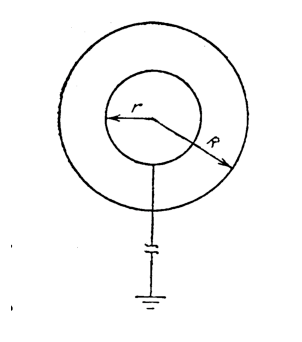
Fig. 3
Official English text of the problem.
Answers
Problem 3 has no numbered subparts. In the requested order:
- Potential of the outer sphere relative to Earth: \[ \boxed{V=\frac{Q(R-r)}{4\pi\varepsilon_0R^2}\approx225\ \mathrm{V}.} \]
- Electrical capacity of the system: \[ \boxed{C=\frac{4\pi\varepsilon_0R^2}{R-r} \approx4.45\times10^{-11}\ \mathrm{F}=44.5\ \mathrm{pF}.} \]
- Equivalent electric scheme: two capacitors connected in parallel between the outer sphere and Earth: \[ \boxed{C_{\mathrm{gap}}=\frac{4\pi\varepsilon_0rR}{R-r}\approx22.3\ \mathrm{pF}, \qquad C_{\mathrm{ext}}=4\pi\varepsilon_0R\approx22.3\ \mathrm{pF}.} \]
Solution
We neglect the disturbance caused by the small opening and the connecting wire, and treat Earth as a distant conductor at zero potential. The shell thickness is negligible, so both its surfaces have radius \(R\).
The outer shell is electrically isolated and retains total charge \(Q\). The inner ball, however, can exchange charge with Earth.
Potential of the outer sphere.
Let the final charge on the inner ball be \(q\). In electrostatic equilibrium, the electric field inside the metal of the shell vanishes. A Gaussian surface within that metal therefore encloses zero net charge. Consequently, the shell’s inner surface carries charge \(-q\), and its outer surface carries \[ Q_{\mathrm{outer}}=Q+q. \]
Write \(k=1/(4\pi\varepsilon_0)\). A uniformly charged spherical surface produces constant potential \(kQ/R\) everywhere inside it. Thus the potential of the inner ball is \[ V_{\mathrm{ball}}=k\left(\frac{q}{r}+\frac{Q}{R}\right). \] Because the ball is grounded, \[ V_{\mathrm{ball}}=0 \quad\Longrightarrow\quad q=-Q\frac{r}{R}. \] Numerically, \[ q=-5.0\times10^{-9}\ \mathrm{C}. \] The inner and outer surfaces of the shell therefore each carry \(+5.0\times10^{-9}\ \mathrm{C}\).
At the shell, the potential is \[ V=k\frac{Q+q}{R} =k\frac{Q}{R}\left(1-\frac{r}{R}\right) =\frac{Q(R-r)}{4\pi\varepsilon_0R^2}. \] Using \(k\simeq8.99\times10^9\ \mathrm{N\,m^2\,C^{-2}}\), \[ V=(8.99\times10^9)(10^{-8}) \frac{0.20-0.10}{(0.20)^2} \approx\boxed{225\ \mathrm{V}}. \]
Electrical capacity of the system.
The capacitance is the charge placed on the isolated shell divided by its potential relative to Earth: \[ C=\frac{Q}{V} =4\pi\varepsilon_0\frac{R^2}{R-r}. \] Hence \[ C=\frac{1}{8.99\times10^9} \frac{(0.20)^2}{0.20-0.10} \approx\boxed{4.45\times10^{-11}\ \mathrm{F}=44.5\ \mathrm{pF}}. \]
Equivalent electric scheme.
There are two contributions to the charge stored on the shell.
The field in the gap corresponds to a spherical capacitor between the shell and the grounded ball. Its potential difference is \[ V= k(-q)\left(\frac1r-\frac1R\right), \] so its capacitance is \[ C_{\mathrm{gap}}=\frac{-q}{V} =\frac{4\pi\varepsilon_0rR}{R-r}. \]
The exterior field corresponds to a capacitor between the shell’s outer surface and distant Earth. Since \[ V=k\frac{Q_{\mathrm{outer}}}{R}, \] this contribution has capacitance \[ C_{\mathrm{ext}}=\frac{Q_{\mathrm{outer}}}{V} =4\pi\varepsilon_0R. \]
Both capacitors share the shell as one terminal. Their other terminals—the ball and Earth—are connected by the grounding wire, so they are in parallel: \[ C=C_{\mathrm{gap}}+C_{\mathrm{ext}} =4\pi\varepsilon_0\left(\frac{rR}{R-r}+R\right) =\frac{4\pi\varepsilon_0R^2}{R-r}. \]
To draw the scheme, mark a node \(S\) for the outer shell and split the connection into two branches. Put one capacitor in each branch, labelled \(C_{\mathrm{gap}}=22.3\ \mathrm{pF}\) and \(C_{\mathrm{ext}}=22.3\ \mathrm{pF}\). Join their other ends at a common node with an Earth symbol. The potential difference across each capacitor is \(225\ \mathrm{V}\), with the shell terminal positive.
The solution was checked against the official solution.
IPhO 1970 · Theorieaufgabe 3
Geerdete Metallkugel im Inneren einer geladenen Kugelschale
Im Inneren einer dünnwandigen Metallhohlkugel mit dem Radius \(R=20\ \mathrm{cm}\) befindet sich eine Metallkugel mit dem Radius \(r = 10\ \mathrm{cm}\), die denselben Mittelpunkt wie die Hohlkugel hat. Die Kugel ist durch einen sehr langen Draht, der durch eine Öffnung in der Hohlkugel führt, mit der Erde verbunden (Abb. 3). Auf die äußere Hohlkugel wird eine Ladung \(Q = 10^{-8}\ \mathrm{C}\) aufgebracht. Berechnen Sie das Potential dieser Hohlkugel und die elektrische Kapazität des entstandenen Systems leitender Körper und zeichnen Sie ein elektrisches Ersatzschaltbild.
Abb. 3
Aufgabentext aus dem offiziellen englischen Text übersetzt.
Antworten
Aufgabe 3 hat keine nummerierten Teilaufgaben. In der geforderten Reihenfolge:
- Potential der äußeren Hohlkugel gegenüber Erde: \[ \boxed{V=\frac{Q(R-r)}{4\pi\varepsilon_0R^2}\approx225\ \mathrm{V}.} \]
- Elektrische Kapazität des Systems: \[ \boxed{C=\frac{4\pi\varepsilon_0R^2}{R-r} \approx4.45\times10^{-11}\ \mathrm{F}=44.5\ \mathrm{pF}.} \]
- Elektrisches Ersatzschaltbild: zwei parallel geschaltete Kondensatoren zwischen der äußeren Hohlkugel und Erde: \[ \boxed{C_{\mathrm{gap}}=\frac{4\pi\varepsilon_0rR}{R-r}\approx22.3\ \mathrm{pF}, \qquad C_{\mathrm{ext}}=4\pi\varepsilon_0R\approx22.3\ \mathrm{pF}.} \]
Lösung
Wir vernachlässigen die durch die kleine Öffnung und den Verbindungsdraht verursachte Störung und behandeln die Erde als weit entfernten Leiter auf dem Potential null. Die Wanddicke der Kugelschale ist vernachlässigbar, sodass ihre beiden Oberflächen den Radius \(R\) haben.
Die äußere Kugelschale ist elektrisch isoliert und behält die Gesamtladung \(Q\). Die innere Kugel hingegen kann Ladung mit der Erde austauschen.
Potential der äußeren Hohlkugel.
Die endgültige Ladung auf der inneren Kugel sei \(q\). Im elektrostatischen Gleichgewicht verschwindet das elektrische Feld im Metall der Kugelschale. Eine gaußsche Fläche innerhalb dieses Metalls umschließt daher die Nettoladung null. Folglich trägt die Innenfläche der Kugelschale die Ladung \(-q\), und ihre Außenfläche trägt die Ladung \[ Q_{\mathrm{outer}}=Q+q. \]
Wir setzen \(k=1/(4\pi\varepsilon_0)\). Eine gleichmäßig geladene Kugeloberfläche erzeugt überall in ihrem Inneren das konstante Potential \(kQ/R\). Somit ist das Potential der inneren Kugel \[ V_{\mathrm{ball}}=k\left(\frac{q}{r}+\frac{Q}{R}\right). \] Da die Kugel geerdet ist, gilt \[ V_{\mathrm{ball}}=0 \quad\Longrightarrow\quad q=-Q\frac{r}{R}. \] Numerisch ergibt sich \[ q=-5.0\times10^{-9}\ \mathrm{C}. \] Die Innen- und die Außenfläche der Kugelschale tragen daher jeweils \(+5.0\times10^{-9}\ \mathrm{C}\).
An der Kugelschale beträgt das Potential \[ V=k\frac{Q+q}{R} =k\frac{Q}{R}\left(1-\frac{r}{R}\right) =\frac{Q(R-r)}{4\pi\varepsilon_0R^2}. \] Mit \(k\simeq8.99\times10^9\ \mathrm{N\,m^2\,C^{-2}}\) ergibt sich \[ V=(8.99\times10^9)(10^{-8}) \frac{0.20-0.10}{(0.20)^2} \approx\boxed{225\ \mathrm{V}}. \]
Elektrische Kapazität des Systems.
Die Kapazität ist die auf die isolierte Kugelschale aufgebrachte Ladung, geteilt durch ihr Potential gegenüber Erde: \[ C=\frac{Q}{V} =4\pi\varepsilon_0\frac{R^2}{R-r}. \] Daraus folgt \[ C=\frac{1}{8.99\times10^9} \frac{(0.20)^2}{0.20-0.10} \approx\boxed{4.45\times10^{-11}\ \mathrm{F}=44.5\ \mathrm{pF}}. \]
Elektrisches Ersatzschaltbild.
Die auf der Kugelschale gespeicherte Ladung setzt sich aus zwei Beiträgen zusammen.
Das Feld im Zwischenraum entspricht dem eines Kugelkondensators zwischen der Kugelschale und der geerdeten Kugel. Seine Potentialdifferenz beträgt \[ V= k(-q)\left(\frac1r-\frac1R\right), \] also ist seine Kapazität \[ C_{\mathrm{gap}}=\frac{-q}{V} =\frac{4\pi\varepsilon_0rR}{R-r}. \]
Das äußere Feld entspricht dem eines Kondensators zwischen der Außenfläche der Kugelschale und der weit entfernten Erde. Da \[ V=k\frac{Q_{\mathrm{outer}}}{R}, \] gilt, hat dieser Beitrag die Kapazität \[ C_{\mathrm{ext}}=\frac{Q_{\mathrm{outer}}}{V} =4\pi\varepsilon_0R. \]
Beide Kondensatoren haben die Kugelschale als gemeinsamen Anschluss. Ihre anderen Anschlüsse – die Kugel und die Erde – sind durch den Erdungsdraht verbunden, sodass sie parallel geschaltet sind: \[ C=C_{\mathrm{gap}}+C_{\mathrm{ext}} =4\pi\varepsilon_0\left(\frac{rR}{R-r}+R\right) =\frac{4\pi\varepsilon_0R^2}{R-r}. \]
Um das Ersatzschaltbild zu zeichnen, markieren Sie einen Knoten \(S\) für die äußere Kugelschale und teilen Sie die Verbindung in zwei Zweige auf. Zeichnen Sie in jeden Zweig einen Kondensator, beschriftet mit \(C_{\mathrm{gap}}=22.3\ \mathrm{pF}\) bzw. \(C_{\mathrm{ext}}=22.3\ \mathrm{pF}\). Verbinden Sie deren andere Enden an einem gemeinsamen Knoten mit einem Erdungssymbol. Die Potentialdifferenz an jedem Kondensator beträgt \(225\ \mathrm{V}\), wobei der Anschluss an der Kugelschale positiv ist.
Die Lösung wurde mit der offiziellen Lösung abgeglichen.
IPhO 1970 · Teori sorusu 3
Yüklü bir küresel kabuğun içindeki topraklanmış metal küre
Yarıçapı \(R=20\ \mathrm{cm}\) olan ince duvarlı bir metal kürenin içinde, onunla eş merkezli, yarıçapı \(r = 10\ \mathrm{cm}\) olan bir metal küre bulunmaktadır. İçteki küre, dıştaki kürede bulunan bir açıklıktan geçirilen çok uzun bir telle toprağa bağlanmıştır (Şek. 3). Dıştaki küreye \(Q = 10^{-8}\ \mathrm{C}\) yük verilmektedir. Bu kürenin potansiyelini ve oluşan iletkenler sisteminin elektriksel sığasını hesaplayınız ve eşdeğer elektrik devresini çiziniz.
Şek. 3
Soru metni resmi İngilizce metinden çevrilmiştir.
Cevaplar
Soru 3 numaralandırılmış alt kısımlar içermemektedir. İstenen sırayla:
- Dıştaki kürenin toprağa göre potansiyeli: \[ \boxed{V=\frac{Q(R-r)}{4\pi\varepsilon_0R^2}\approx225\ \mathrm{V}.} \]
- Sistemin elektriksel sığası: \[ \boxed{C=\frac{4\pi\varepsilon_0R^2}{R-r} \approx4.45\times10^{-11}\ \mathrm{F}=44.5\ \mathrm{pF}.} \]
- Eşdeğer elektrik devresi: dıştaki küre ile toprak arasına paralel bağlanmış iki kondansatör: \[ \boxed{C_{\mathrm{gap}}=\frac{4\pi\varepsilon_0rR}{R-r}\approx22.3\ \mathrm{pF}, \qquad C_{\mathrm{ext}}=4\pi\varepsilon_0R\approx22.3\ \mathrm{pF}.} \]
Çözüm
Küçük açıklığın ve bağlantı telinin neden olduğu bozucu etkiyi ihmal ediyor ve toprağı sıfır potansiyeldeki uzak bir iletken olarak ele alıyoruz. Kabuğun kalınlığı ihmal edilebilir olduğundan her iki yüzeyinin yarıçapı da \(R\)'dir.
Dış kabuk elektriksel olarak yalıtılmıştır ve toplam \(Q\) yükünü korur. İçteki küre ise toprakla yük alışverişinde bulunabilir.
Dıştaki kürenin potansiyeli.
İçteki kürenin son yükü \(q\) olsun. Elektrostatik dengede, kabuğun metal kısmının içindeki elektrik alan sıfırdır. Dolayısıyla bu metalin içinde seçilen bir Gauss yüzeyinin çevrelediği net yük sıfırdır. Sonuç olarak, kabuğun iç yüzeyi \(-q\) yükünü taşırken dış yüzeyinin yükü \[ Q_{\mathrm{outer}}=Q+q \] olur.
\(k=1/(4\pi\varepsilon_0)\) yazalım. Düzgün yüklü bir küresel yüzey, içindeki her noktada sabit \(kQ/R\) potansiyeli oluşturur. Böylece içteki kürenin potansiyeli \[ V_{\mathrm{ball}}=k\left(\frac{q}{r}+\frac{Q}{R}\right) \] olur. Küre topraklanmış olduğundan, \[ V_{\mathrm{ball}}=0 \quad\Longrightarrow\quad q=-Q\frac{r}{R}. \] Sayısal olarak, \[ q=-5.0\times10^{-9}\ \mathrm{C}. \] Dolayısıyla kabuğun iç ve dış yüzeylerinin her biri \(+5.0\times10^{-9}\ \mathrm{C}\) yük taşır.
Kabuktaki potansiyel \[ V=k\frac{Q+q}{R} =k\frac{Q}{R}\left(1-\frac{r}{R}\right) =\frac{Q(R-r)}{4\pi\varepsilon_0R^2} \] olur. \(k\simeq8.99\times10^9\ \mathrm{N\,m^2\,C^{-2}}\) kullanılarak, \[ V=(8.99\times10^9)(10^{-8}) \frac{0.20-0.10}{(0.20)^2} \approx\boxed{225\ \mathrm{V}}. \]
Sistemin elektriksel sığası.
Sığa, yalıtılmış kabuğa verilen yükün, kabuğun toprağa göre potansiyeline oranıdır: \[ C=\frac{Q}{V} =4\pi\varepsilon_0\frac{R^2}{R-r}. \] Buna göre \[ C=\frac{1}{8.99\times10^9} \frac{(0.20)^2}{0.20-0.10} \approx\boxed{4.45\times10^{-11}\ \mathrm{F}=44.5\ \mathrm{pF}}. \]
Eşdeğer elektrik devresi.
Kabukta depolanan yüke iki katkı vardır.
Aradaki boşlukta bulunan alan, kabuk ile topraklanmış küre arasındaki bir küresel kondansatöre karşılık gelir. Bu kondansatörün potansiyel farkı \[ V= k(-q)\left(\frac1r-\frac1R\right), \] olduğundan sığası \[ C_{\mathrm{gap}}=\frac{-q}{V} =\frac{4\pi\varepsilon_0rR}{R-r} \] olur.
Dışarıdaki alan, kabuğun dış yüzeyi ile uzaktaki toprak arasındaki bir kondansatöre karşılık gelir. \[ V=k\frac{Q_{\mathrm{outer}}}{R}, \] olduğundan bu katkının sığası \[ C_{\mathrm{ext}}=\frac{Q_{\mathrm{outer}}}{V} =4\pi\varepsilon_0R \] olur.
Her iki kondansatörün birer ucu ortak olan kabuğa bağlıdır. Diğer uçları olan küre ve toprak, topraklama teliyle birbirine bağlandığından kondansatörler paraleldir: \[ C=C_{\mathrm{gap}}+C_{\mathrm{ext}} =4\pi\varepsilon_0\left(\frac{rR}{R-r}+R\right) =\frac{4\pi\varepsilon_0R^2}{R-r}. \]
Devreyi çizmek için dış kabuğu temsil eden bir \(S\) düğümü işaretleyiniz ve bağlantıyı iki kola ayırınız. Her kola bir kondansatör yerleştirip bunları \(C_{\mathrm{gap}}=22.3\ \mathrm{pF}\) ve \(C_{\mathrm{ext}}=22.3\ \mathrm{pF}\) olarak etiketleyiniz. Diğer uçlarını toprak simgesi bulunan ortak bir düğümde birleştiriniz. Her kondansatörün uçları arasındaki potansiyel farkı \(225\ \mathrm{V}\) olup kabuğa bağlı uç pozitiftir.
Çözüm, resmi çözümle karşılaştırılarak kontrol edildi.
IPhO 1970 · Problema teórico 3
Bola metálica conectada a tierra dentro de una envoltura esférica cargada
En el interior de una esfera metálica de pared delgada y radio \(R=20\ \mathrm{cm}\) hay una bola metálica de radio \(r = 10\ \mathrm{cm}\) concéntrica con la esfera. La bola está conectada a tierra mediante un hilo conductor muy largo que pasa por una abertura en la esfera (Fig. 3). Se deposita una carga \(Q = 10^{-8}\ \mathrm{C}\) sobre la esfera exterior. Calcule el potencial de esta esfera y la capacidad eléctrica del sistema de cuerpos conductores resultante, y dibuje un esquema eléctrico equivalente.
Fig. 3
Enunciado traducido del texto oficial en inglés.
Respuestas
El Problema 3 no tiene apartados numerados. En el orden solicitado:
- Potencial de la esfera exterior respecto a tierra: \[ \boxed{V=\frac{Q(R-r)}{4\pi\varepsilon_0R^2}\approx225\ \mathrm{V}.} \]
- Capacidad eléctrica del sistema: \[ \boxed{C=\frac{4\pi\varepsilon_0R^2}{R-r} \approx4.45\times10^{-11}\ \mathrm{F}=44.5\ \mathrm{pF}.} \]
- Esquema eléctrico equivalente: dos condensadores conectados en paralelo entre la esfera exterior y tierra: \[ \boxed{C_{\mathrm{gap}}=\frac{4\pi\varepsilon_0rR}{R-r}\approx22.3\ \mathrm{pF}, \qquad C_{\mathrm{ext}}=4\pi\varepsilon_0R\approx22.3\ \mathrm{pF}.} \]
Solución
Despreciamos la perturbación causada por la pequeña abertura y el hilo de conexión, y consideramos la Tierra como un conductor lejano a potencial cero. El espesor de la envoltura es despreciable, por lo que ambas superficies tienen radio \(R\).
La envoltura exterior está eléctricamente aislada y conserva una carga total \(Q\). La bola interior, en cambio, puede intercambiar carga con la Tierra.
Potencial de la esfera exterior.
Sea \(q\) la carga final de la bola interior. En equilibrio electrostático, el campo eléctrico en el interior del metal de la envoltura es nulo. Por tanto, una superficie gaussiana situada dentro de ese metal encierra una carga neta nula. En consecuencia, la superficie interior de la envoltura tiene una carga \(-q\), y su superficie exterior tiene una carga \[ Q_{\mathrm{outer}}=Q+q. \]
Escribamos \(k=1/(4\pi\varepsilon_0)\). Una superficie esférica uniformemente cargada produce un potencial constante \(kQ/R\) en todos los puntos de su interior. Así, el potencial de la bola interior es \[ V_{\mathrm{ball}}=k\left(\frac{q}{r}+\frac{Q}{R}\right). \] Como la bola está conectada a tierra, \[ V_{\mathrm{ball}}=0 \quad\Longrightarrow\quad q=-Q\frac{r}{R}. \] Numéricamente, \[ q=-5.0\times10^{-9}\ \mathrm{C}. \] Por tanto, las superficies interior y exterior de la envoltura tienen, cada una, una carga de \(+5.0\times10^{-9}\ \mathrm{C}\).
En la envoltura, el potencial es \[ V=k\frac{Q+q}{R} =k\frac{Q}{R}\left(1-\frac{r}{R}\right) =\frac{Q(R-r)}{4\pi\varepsilon_0R^2}. \] Utilizando \(k\simeq8.99\times10^9\ \mathrm{N\,m^2\,C^{-2}}\), \[ V=(8.99\times10^9)(10^{-8}) \frac{0.20-0.10}{(0.20)^2} \approx\boxed{225\ \mathrm{V}}. \]
Capacidad eléctrica del sistema.
La capacidad es la carga depositada sobre la envoltura aislada dividida por su potencial respecto a tierra: \[ C=\frac{Q}{V} =4\pi\varepsilon_0\frac{R^2}{R-r}. \] Por tanto, \[ C=\frac{1}{8.99\times10^9} \frac{(0.20)^2}{0.20-0.10} \approx\boxed{4.45\times10^{-11}\ \mathrm{F}=44.5\ \mathrm{pF}}. \]
Esquema eléctrico equivalente.
Hay dos contribuciones a la carga almacenada en la envoltura.
El campo en el espacio entre la envoltura y la bola corresponde a un condensador esférico formado por la envoltura y la bola conectada a tierra. Su diferencia de potencial es \[ V= k(-q)\left(\frac1r-\frac1R\right), \] por lo que su capacidad es \[ C_{\mathrm{gap}}=\frac{-q}{V} =\frac{4\pi\varepsilon_0rR}{R-r}. \]
El campo exterior corresponde a un condensador entre la superficie exterior de la envoltura y la Tierra lejana. Puesto que \[ V=k\frac{Q_{\mathrm{outer}}}{R}, \] esta contribución tiene una capacidad \[ C_{\mathrm{ext}}=\frac{Q_{\mathrm{outer}}}{V} =4\pi\varepsilon_0R. \]
Ambos condensadores comparten la envoltura como uno de sus terminales. Sus otros terminales —la bola y la Tierra— están conectados mediante el hilo de puesta a tierra, por lo que están en paralelo: \[ C=C_{\mathrm{gap}}+C_{\mathrm{ext}} =4\pi\varepsilon_0\left(\frac{rR}{R-r}+R\right) =\frac{4\pi\varepsilon_0R^2}{R-r}. \]
Para dibujar el esquema, marque un nodo \(S\) para la envoltura exterior y divida la conexión en dos ramas. Coloque un condensador en cada rama, etiquetados como \(C_{\mathrm{gap}}=22.3\ \mathrm{pF}\) y \(C_{\mathrm{ext}}=22.3\ \mathrm{pF}\). Una sus otros extremos en un nodo común con un símbolo de tierra. La diferencia de potencial entre los terminales de cada condensador es \(225\ \mathrm{V}\), siendo positivo el terminal de la envoltura.
La solución se comprobó con la solución oficial.
IPhO 1970 · 理论题 3
带电球壳内的接地金属球
在一个半径为 \(R=20\ \mathrm{cm}\) 的薄壁金属球壳内,有一个半径为 \(r = 10\ \mathrm{cm}\) 的金属球,两者同心。金属球通过一根很长的导线接地,导线穿过球壳上的一个小孔(图 3)。向外球壳施加电荷 \(Q = 10^{-8}\ \mathrm{C}\)。计算该球壳的电势、由这些导体构成的系统的电容,并画出等效电路图。
图 3
题目译自官方英文原文。
答案
题目 3 没有编号小问。按题目要求的顺序:
- 外球壳相对于大地的电势: \[ \boxed{V=\frac{Q(R-r)}{4\pi\varepsilon_0R^2}\approx225\ \mathrm{V}.} \]
- 系统的电容: \[ \boxed{C=\frac{4\pi\varepsilon_0R^2}{R-r} \approx4.45\times10^{-11}\ \mathrm{F}=44.5\ \mathrm{pF}.} \]
- 等效电路图:两个电容器在外球壳与大地之间并联: \[ \boxed{C_{\mathrm{gap}}=\frac{4\pi\varepsilon_0rR}{R-r}\approx22.3\ \mathrm{pF}, \qquad C_{\mathrm{ext}}=4\pi\varepsilon_0R\approx22.3\ \mathrm{pF}.} \]
解答
忽略小孔和连接导线造成的扰动,并将大地视为远处电势为零的导体。球壳的厚度可以忽略,因此其内、外表面的半径均为 \(R\)。
外球壳与其他导体绝缘,其总电荷保持为 \(Q\)。而内部金属球可以与大地交换电荷。
外球壳的电势。
设内部金属球上的最终电荷为 \(q\)。在静电平衡时,球壳金属内部的电场为零。因此,位于该金属内部的高斯面所包围的净电荷为零。于是,球壳内表面带有电荷 \(-q\),外表面带有电荷 \[ Q_{\mathrm{outer}}=Q+q. \]
记 \(k=1/(4\pi\varepsilon_0)\)。均匀带电球面在其内部各处产生的电势均为常量 \(kQ/R\)。因此,内部金属球的电势为 \[ V_{\mathrm{ball}}=k\left(\frac{q}{r}+\frac{Q}{R}\right). \] 由于金属球接地, \[ V_{\mathrm{ball}}=0 \quad\Longrightarrow\quad q=-Q\frac{r}{R}. \] 代入数值得 \[ q=-5.0\times10^{-9}\ \mathrm{C}. \] 因此,球壳的内、外表面各带有 \(+5.0\times10^{-9}\ \mathrm{C}\) 的电荷。
球壳处的电势为 \[ V=k\frac{Q+q}{R} =k\frac{Q}{R}\left(1-\frac{r}{R}\right) =\frac{Q(R-r)}{4\pi\varepsilon_0R^2}. \] 取 \(k\simeq8.99\times10^9\ \mathrm{N\,m^2\,C^{-2}}\), \[ V=(8.99\times10^9)(10^{-8}) \frac{0.20-0.10}{(0.20)^2} \approx\boxed{225\ \mathrm{V}}. \]
系统的电容。
电容等于施加在绝缘球壳上的电荷与球壳相对于大地的电势之比: \[ C=\frac{Q}{V} =4\pi\varepsilon_0\frac{R^2}{R-r}. \] 因此 \[ C=\frac{1}{8.99\times10^9} \frac{(0.20)^2}{0.20-0.10} \approx\boxed{4.45\times10^{-11}\ \mathrm{F}=44.5\ \mathrm{pF}}. \]
等效电路图。
球壳上储存的电荷由两部分组成。
间隙中的电场对应于球壳与接地金属球之间的球形电容器。其电势差为 \[ V= k(-q)\left(\frac1r-\frac1R\right), \] 因此其电容为 \[ C_{\mathrm{gap}}=\frac{-q}{V} =\frac{4\pi\varepsilon_0rR}{R-r}. \]
外部电场对应于球壳外表面与远处大地之间的电容器。由于 \[ V=k\frac{Q_{\mathrm{outer}}}{R}, \] 这一部分的电容为 \[ C_{\mathrm{ext}}=\frac{Q_{\mathrm{outer}}}{V} =4\pi\varepsilon_0R. \]
两个电容器都以球壳作为一端。它们的另一端——金属球和大地——通过接地导线相连,因此它们是并联的: \[ C=C_{\mathrm{gap}}+C_{\mathrm{ext}} =4\pi\varepsilon_0\left(\frac{rR}{R-r}+R\right) =\frac{4\pi\varepsilon_0R^2}{R-r}. \]
画等效电路图时,用节点 \(S\) 表示外球壳,并从该节点引出两条支路。在每条支路中各放置一个电容器,分别标注为 \(C_{\mathrm{gap}}=22.3\ \mathrm{pF}\) 和 \(C_{\mathrm{ext}}=22.3\ \mathrm{pF}\)。将它们的另一端连接到一个带有接地符号的公共节点。每个电容器两端的电势差均为 \(225\ \mathrm{V}\),球壳端为正。
解答已与官方解答核对。
IPhO 1970 · Теоретическая задача 3
Заземлённый металлический шар внутри заряженной сферической оболочки
Внутри тонкостенной металлической сферы радиусом \(R=20\ \mathrm{cm}\) находится металлический шар радиусом \(r = 10\ \mathrm{cm}\), имеющий со сферой общий центр. Шар соединён с Землёй очень длинным проводом, проходящим через отверстие в сфере (рис. 3). Внешней сфере сообщён заряд \(Q = 10^{-8}\ \mathrm{C}\). Вычислите потенциал этой сферы, электрическую ёмкость полученной системы проводящих тел и изобразите эквивалентную электрическую схему.
Рис. 3
Условие переведено с официального английского текста.
Ответы
Задача 3 не содержит пронумерованных подпунктов. В порядке, указанном в условии:
- Потенциал внешней сферы относительно Земли: \[ \boxed{V=\frac{Q(R-r)}{4\pi\varepsilon_0R^2}\approx225\ \mathrm{V}.} \]
- Электрическая ёмкость системы: \[ \boxed{C=\frac{4\pi\varepsilon_0R^2}{R-r} \approx4.45\times10^{-11}\ \mathrm{F}=44.5\ \mathrm{pF}.} \]
- Эквивалентная электрическая схема: два конденсатора, соединённых параллельно между внешней сферой и Землёй: \[ \boxed{C_{\mathrm{gap}}=\frac{4\pi\varepsilon_0rR}{R-r}\approx22.3\ \mathrm{pF}, \qquad C_{\mathrm{ext}}=4\pi\varepsilon_0R\approx22.3\ \mathrm{pF}.} \]
Решение
Пренебрежём искажением поля, вызванным небольшим отверстием и соединительным проводом, и будем считать Землю удалённым проводником с нулевым потенциалом. Толщина оболочки пренебрежимо мала, поэтому обе её поверхности имеют радиус \(R\).
Внешняя оболочка электрически изолирована и сохраняет полный заряд \(Q\). Внутренний шар, однако, может обмениваться зарядом с Землёй.
Потенциал внешней сферы.
Пусть установившийся заряд внутреннего шара равен \(q\). В состоянии электростатического равновесия электрическое поле внутри металла оболочки равно нулю. Поэтому суммарный заряд, заключённый внутри гауссовой поверхности, проходящей в толще металла, равен нулю. Следовательно, внутренняя поверхность оболочки несёт заряд \(-q\), а её внешняя поверхность — заряд \[ Q_{\mathrm{outer}}=Q+q. \]
Обозначим \(k=1/(4\pi\varepsilon_0)\). Равномерно заряженная сферическая поверхность создаёт во всех точках внутри неё постоянный потенциал \(kQ/R\). Поэтому потенциал внутреннего шара равен \[ V_{\mathrm{ball}}=k\left(\frac{q}{r}+\frac{Q}{R}\right). \] Поскольку шар заземлён, \[ V_{\mathrm{ball}}=0 \quad\Longrightarrow\quad q=-Q\frac{r}{R}. \] Численно получаем \[ q=-5.0\times10^{-9}\ \mathrm{C}. \] Таким образом, внутренняя и внешняя поверхности оболочки несут заряд по \(+5.0\times10^{-9}\ \mathrm{C}\) каждая.
Потенциал оболочки равен \[ V=k\frac{Q+q}{R} =k\frac{Q}{R}\left(1-\frac{r}{R}\right) =\frac{Q(R-r)}{4\pi\varepsilon_0R^2}. \] Используя \(k\simeq8.99\times10^9\ \mathrm{N\,m^2\,C^{-2}}\), получаем \[ V=(8.99\times10^9)(10^{-8}) \frac{0.20-0.10}{(0.20)^2} \approx\boxed{225\ \mathrm{V}}. \]
Электрическая ёмкость системы.
Электрическая ёмкость равна отношению заряда, сообщённого изолированной оболочке, к её потенциалу относительно Земли: \[ C=\frac{Q}{V} =4\pi\varepsilon_0\frac{R^2}{R-r}. \] Отсюда \[ C=\frac{1}{8.99\times10^9} \frac{(0.20)^2}{0.20-0.10} \approx\boxed{4.45\times10^{-11}\ \mathrm{F}=44.5\ \mathrm{pF}}. \]
Эквивалентная электрическая схема.
Заряд, накопленный на оболочке, складывается из двух составляющих.
Поле в зазоре соответствует сферическому конденсатору, образованному оболочкой и заземлённым шаром. Разность потенциалов между его обкладками равна \[ V= k(-q)\left(\frac1r-\frac1R\right), \] поэтому его ёмкость равна \[ C_{\mathrm{gap}}=\frac{-q}{V} =\frac{4\pi\varepsilon_0rR}{R-r}. \]
Внешнее поле соответствует конденсатору, образованному внешней поверхностью оболочки и удалённой Землёй. Поскольку \[ V=k\frac{Q_{\mathrm{outer}}}{R}, \] этой составляющей соответствует ёмкость \[ C_{\mathrm{ext}}=\frac{Q_{\mathrm{outer}}}{V} =4\pi\varepsilon_0R. \]
У обоих конденсаторов одна обкладка общая — оболочка. Их другие обкладки — шар и Земля — соединены заземляющим проводом, поэтому конденсаторы соединены параллельно: \[ C=C_{\mathrm{gap}}+C_{\mathrm{ext}} =4\pi\varepsilon_0\left(\frac{rR}{R-r}+R\right) =\frac{4\pi\varepsilon_0R^2}{R-r}. \]
Чтобы изобразить схему, обозначьте узел \(S\), соответствующий внешней оболочке, и проведите от него две ветви. В каждую ветвь включите по одному конденсатору, обозначив их \(C_{\mathrm{gap}}=22.3\ \mathrm{pF}\) и \(C_{\mathrm{ext}}=22.3\ \mathrm{pF}\). Соедините их другие выводы в общем узле со знаком заземления. Разность потенциалов на каждом конденсаторе равна \(225\ \mathrm{V}\), причём вывод, соответствующий оболочке, положителен.
Решение проверено по официальному решению.
IPhO 1970 · مسألة نظرية 3
كرة معدنية مؤرّضة داخل قشرة كروية مشحونة
داخل كرة معدنية رقيقة الجدار نصف قطرها \(R=20\ \mathrm{cm}\) توجد كرة معدنية نصف قطرها \(r = 10\ \mathrm{cm}\) تتحد معها في المركز. تتصل الكرة الداخلية بالأرض بسلك طويل جدًا يمر عبر فتحة في الكرة الخارجية (الشكل 3). توضع شحنة \(Q = 10^{-8}\ \mathrm{C}\) على الكرة الخارجية. احسب جهد هذه الكرة والسعة الكهربائية لمنظومة الأجسام الموصلة الناتجة، وارسم مخططًا كهربائيًا مكافئًا لها.
الشكل 3
نص المسألة مترجم عن النص الإنجليزي الرسمي.
الإجابات
ليس للمسألة 3 أجزاء فرعية مرقّمة. وفق الترتيب المطلوب:
- جهد الكرة الخارجية بالنسبة إلى الأرض: \[ \boxed{V=\frac{Q(R-r)}{4\pi\varepsilon_0R^2}\approx225\ \mathrm{V}.} \]
- السعة الكهربائية للمنظومة: \[ \boxed{C=\frac{4\pi\varepsilon_0R^2}{R-r} \approx4.45\times10^{-11}\ \mathrm{F}=44.5\ \mathrm{pF}.} \]
- المخطط الكهربائي المكافئ: مكثّفان موصولان على التوازي بين الكرة الخارجية والأرض: \[ \boxed{C_{\mathrm{gap}}=\frac{4\pi\varepsilon_0rR}{R-r}\approx22.3\ \mathrm{pF}, \qquad C_{\mathrm{ext}}=4\pi\varepsilon_0R\approx22.3\ \mathrm{pF}.} \]
الحل
نهمل الاضطراب الناجم عن الفتحة الصغيرة وسلك التوصيل، ونعامل الأرض بوصفها موصلًا بعيدًا جهده صفر. سُمك القشرة مهمل، لذا فإن نصف قطر كلٍّ من سطحيها هو \(R\).
القشرة الخارجية معزولة كهربائيًا وتحتفظ بشحنتها الكلية \(Q\). أما الكرة الداخلية فيمكنها تبادل الشحنة مع الأرض.
جهد الكرة الخارجية.
لتكن الشحنة النهائية على الكرة الداخلية \(q\). في حالة الاتزان الكهروستاتيكي، ينعدم المجال الكهربائي داخل معدن القشرة. لذلك يحيط سطح غاوسي داخل ذلك المعدن بشحنة صافية تساوي صفرًا. وبناءً عليه، يحمل السطح الداخلي للقشرة شحنة \(-q\)، ويحمل سطحها الخارجي شحنة \[ Q_{\mathrm{outer}}=Q+q. \]
لنكتب \(k=1/(4\pi\varepsilon_0)\). يولّد سطح كروي مشحون بانتظام جهدًا ثابتًا \(kQ/R\) في كل نقطة داخله. ومن ثم يكون جهد الكرة الداخلية \[ V_{\mathrm{ball}}=k\left(\frac{q}{r}+\frac{Q}{R}\right). \] ولأن الكرة مؤرّضة، فإن \[ V_{\mathrm{ball}}=0 \quad\Longrightarrow\quad q=-Q\frac{r}{R}. \] عدديًا، \[ q=-5.0\times10^{-9}\ \mathrm{C}. \] إذن يحمل كلٌّ من السطحين الداخلي والخارجي للقشرة شحنة \(+5.0\times10^{-9}\ \mathrm{C}\).
عند القشرة، يكون الجهد \[ V=k\frac{Q+q}{R} =k\frac{Q}{R}\left(1-\frac{r}{R}\right) =\frac{Q(R-r)}{4\pi\varepsilon_0R^2}. \] باستخدام \(k\simeq8.99\times10^9\ \mathrm{N\,m^2\,C^{-2}}\)، \[ V=(8.99\times10^9)(10^{-8}) \frac{0.20-0.10}{(0.20)^2} \approx\boxed{225\ \mathrm{V}}. \]
السعة الكهربائية للمنظومة.
السعة الكهربائية هي الشحنة الموضوعة على القشرة المعزولة مقسومة على جهدها بالنسبة إلى الأرض: \[ C=\frac{Q}{V} =4\pi\varepsilon_0\frac{R^2}{R-r}. \] ومن ثم \[ C=\frac{1}{8.99\times10^9} \frac{(0.20)^2}{0.20-0.10} \approx\boxed{4.45\times10^{-11}\ \mathrm{F}=44.5\ \mathrm{pF}}. \]
المخطط الكهربائي المكافئ.
للشحنة المخزّنة على القشرة مساهمتان.
يقابل المجال في الفجوة مكثّفًا كرويًا بين القشرة والكرة المؤرّضة. فرق الجهد بين طرفيه هو \[ V= k(-q)\left(\frac1r-\frac1R\right), \] لذا فإن سعته الكهربائية هي \[ C_{\mathrm{gap}}=\frac{-q}{V} =\frac{4\pi\varepsilon_0rR}{R-r}. \]
يقابل المجال الخارجي مكثّفًا بين السطح الخارجي للقشرة والأرض البعيدة. وبما أن \[ V=k\frac{Q_{\mathrm{outer}}}{R}, \] فإن السعة الكهربائية المقابلة لهذه المساهمة هي \[ C_{\mathrm{ext}}=\frac{Q_{\mathrm{outer}}}{V} =4\pi\varepsilon_0R. \]
يشترك المكثّفان في القشرة بوصفها أحد طرفيهما. أما طرفاهما الآخران، أي الكرة والأرض، فيتصلان بسلك التأريض، لذا فهما موصولان على التوازي: \[ C=C_{\mathrm{gap}}+C_{\mathrm{ext}} =4\pi\varepsilon_0\left(\frac{rR}{R-r}+R\right) =\frac{4\pi\varepsilon_0R^2}{R-r}. \]
لرسم المخطط، ضع عقدة \(S\) تمثّل القشرة الخارجية، ثم قسّم التوصيل إلى فرعين. ضع مكثّفًا في كل فرع، واكتب بجانبهما \(C_{\mathrm{gap}}=22.3\ \mathrm{pF}\) و\(C_{\mathrm{ext}}=22.3\ \mathrm{pF}\). صِل طرفيهما الآخرين بعقدة مشتركة تحمل رمز الأرض. فرق الجهد بين طرفي كل مكثّف هو \(225\ \mathrm{V}\)، ويكون الطرف المتصل بالقشرة موجبًا.
تمت مراجعة الحل بمقارنته بالحل الرسمي.