IPhO 1970 · Theory problem 2
Mass of the hydrogen atom from the NaCl unit cell
A unit cell of a crystal of natrium chloride (common salt- NaCl) is a cube with the edge length \(a=5.6\cdot10^{-10}\,\mathrm{m}\) (Fig.2). The black circles in the figure stand for the position of natrium atoms whereas the white ones are chlorine atoms. The entire crystal of common salt turns out to be a repetition of such unit cells. The relative atomic mass of natrium is 23 and that of chlorine is 35,5. The density of the common salt \(\rho=2.22\cdot10^{3}\,\mathrm{kg/m^{3}}\). Find the mass of a hydrogen atom.
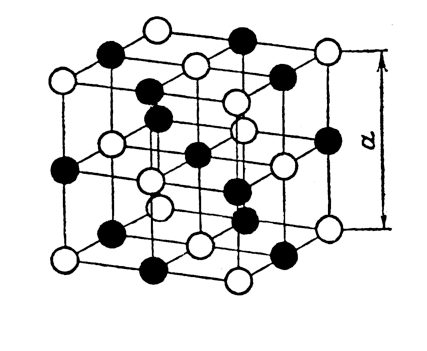
Fig. 2
Official English text of the problem.
Answers
- Problem 2. \(m_{\mathrm H}\approx1.67\times10^{-27}\,\mathrm{kg}\), or \(\boxed{1.7\times10^{-27}\,\mathrm{kg}}\) to two significant figures.
Solution
Problem 2.
The mass assigned to one unit cell is its volume multiplied by the crystal density: \[ M_{\text{cell}}=\rho a^3. \]
To count the atoms belonging to a cell, we account for sharing between neighbouring cells. An atom at a corner belongs to eight cells, one at an edge midpoint to four, and one at a face centre to two. An atom inside the cube belongs entirely to that cell.
The white circles represent chlorine atoms at the eight corners and six face centres. Their effective number per cell is \[ N_{\mathrm{Cl}}=8\left(\frac18\right)+6\left(\frac12\right)=4. \] The black circles represent sodium atoms at the twelve edge midpoints and the body centre: \[ N_{\mathrm{Na}}=12\left(\frac14\right)+1=4. \] Thus each unit cell contains four NaCl formula units.
At the accuracy intended here, take hydrogen’s relative atomic mass as 1 and neglect mass changes due to chemical binding. The given relative atomic masses then imply \[ m_{\mathrm{Na}}\simeq23m_{\mathrm H}, \qquad m_{\mathrm{Cl}}\simeq35.5m_{\mathrm H}. \] Consequently, \[ \rho a^3 =4m_{\mathrm{Na}}+4m_{\mathrm{Cl}} \simeq4(23+35.5)m_{\mathrm H} =234m_{\mathrm H}. \]
Solving for the hydrogen-atom mass gives \[ m_{\mathrm H}\simeq\frac{\rho a^3}{234} =\frac{(2.22\times10^3\,\mathrm{kg/m^3}) (5.6\times10^{-10}\,\mathrm m)^3}{234} =1.666\ldots\times10^{-27}\,\mathrm{kg}. \] Since the edge length is given to two significant figures, \[ \boxed{m_{\mathrm H}\simeq1.7\times10^{-27}\,\mathrm{kg}}. \]
The solution was checked against the official solution.
IPhO 1970 · Theorieaufgabe 2
Masse des Wasserstoffatoms aus der NaCl-Elementarzelle
Eine Elementarzelle eines Natriumchloridkristalls (Kochsalz – NaCl) ist ein Würfel mit der Kantenlänge \(a=5.6\cdot10^{-10}\,\mathrm{m}\) (Abb. 2). Die schwarzen Kreise in der Abbildung kennzeichnen die Positionen der Natriumatome, während die weißen Kreise Chloratome darstellen. Der gesamte Kochsalzkristall ergibt sich durch Wiederholung solcher Elementarzellen. Die relative Atommasse von Natrium beträgt 23 und die von Chlor 35,5. Die Dichte von Kochsalz beträgt \(\rho=2.22\cdot10^{3}\,\mathrm{kg/m^{3}}\). Bestimmen Sie die Masse eines Wasserstoffatoms.
Abb. 2
Aufgabentext aus dem offiziellen englischen Text übersetzt.
Antworten
- Aufgabe 2. \(m_{\mathrm H}\approx1.67\times10^{-27}\,\mathrm{kg}\), oder auf zwei signifikante Stellen gerundet \(\boxed{1.7\times10^{-27}\,\mathrm{kg}}\).
Lösung
Aufgabe 2.
Die einer Elementarzelle zugeordnete Masse ist das Produkt aus ihrem Volumen und der Kristalldichte: \[ M_{\text{Zelle}}=\rho a^3. \]
Um die zu einer Zelle gehörenden Atome zu zählen, berücksichtigen wir, dass sie von benachbarten Zellen gemeinsam genutzt werden. Ein Atom an einer Ecke gehört zu acht Zellen, eines in der Mitte einer Kante zu vier und eines in der Mitte einer Fläche zu zwei. Ein Atom im Inneren des Würfels gehört vollständig zu dieser Zelle.
Die weißen Kreise stellen Chloratome an den acht Ecken und den sechs Flächenmittelpunkten dar. Ihre effektive Anzahl pro Zelle beträgt \[ N_{\mathrm{Cl}}=8\left(\frac18\right)+6\left(\frac12\right)=4. \] Die schwarzen Kreise stellen Natriumatome an den zwölf Kantenmittelpunkten und im Würfelzentrum dar: \[ N_{\mathrm{Na}}=12\left(\frac14\right)+1=4. \] Somit enthält jede Elementarzelle vier NaCl-Formeleinheiten.
Für die hier angestrebte Genauigkeit setzen wir die relative Atommasse von Wasserstoff gleich 1 und vernachlässigen Massenänderungen durch chemische Bindung. Aus den angegebenen relativen Atommassen folgt dann \[ m_{\mathrm{Na}}\simeq23m_{\mathrm H}, \qquad m_{\mathrm{Cl}}\simeq35.5m_{\mathrm H}. \] Folglich gilt \[ \rho a^3 =4m_{\mathrm{Na}}+4m_{\mathrm{Cl}} \simeq4(23+35.5)m_{\mathrm H} =234m_{\mathrm H}. \]
Auflösen nach der Masse des Wasserstoffatoms ergibt \[ m_{\mathrm H}\simeq\frac{\rho a^3}{234} =\frac{(2.22\times10^3\,\mathrm{kg/m^3}) (5.6\times10^{-10}\,\mathrm m)^3}{234} =1.666\ldots\times10^{-27}\,\mathrm{kg}. \] Da die Kantenlänge mit zwei signifikanten Stellen angegeben ist, gilt \[ \boxed{m_{\mathrm H}\simeq1.7\times10^{-27}\,\mathrm{kg}}. \]
Die Lösung wurde mit der offiziellen Lösung abgeglichen.
IPhO 1970 · Teori sorusu 2
NaCl birim hücresinden hidrojen atomunun kütlesi
Bir sodyum klorür (sofra tuzu- NaCl) kristalinin birim hücresi, kenar uzunluğu \(a=5.6\cdot10^{-10}\,\mathrm{m}\) olan bir küptür (Şekil 2). Şekildeki siyah daireler sodyum atomlarının konumlarını, beyaz daireler ise klor atomlarını göstermektedir. Sofra tuzu kristalinin tamamı, bu tür birim hücrelerin tekrarlanmasıyla oluşur. Sodyumun bağıl atom kütlesi 23, klorunki ise 35,5'tir. Sofra tuzunun yoğunluğu \(\rho=2.22\cdot10^{3}\,\mathrm{kg/m^{3}}\) değerindedir. Bir hidrojen atomunun kütlesini bulunuz.
Şekil 2
Soru metni resmi İngilizce metinden çevrilmiştir.
Cevaplar
- Soru 2. \(m_{\mathrm H}\approx1.67\times10^{-27}\,\mathrm{kg}\) veya iki anlamlı basamakla \(\boxed{1.7\times10^{-27}\,\mathrm{kg}}\).
Çözüm
Soru 2.
Bir birim hücreye karşılık gelen kütle, hücrenin hacmi ile kristalin yoğunluğunun çarpımıdır: \[ M_{\text{hücre}}=\rho a^3. \]
Bir hücreye ait atomları saymak için komşu hücreler arasındaki ortak kullanımı hesaba katarız. Bir köşedeki atom sekiz hücreye, bir kenarın orta noktasındaki atom dört hücreye ve bir yüzün merkezindeki atom iki hücreye aittir. Küpün içindeki bir atom ise bütünüyle o hücreye aittir.
Beyaz daireler, sekiz köşede ve altı yüz merkezinde bulunan klor atomlarını temsil eder. Hücre başına etkin sayıları şöyledir: \[ N_{\mathrm{Cl}}=8\left(\frac18\right)+6\left(\frac12\right)=4. \] Siyah daireler, on iki kenarın orta noktalarında ve küpün merkezinde bulunan sodyum atomlarını temsil eder: \[ N_{\mathrm{Na}}=12\left(\frac14\right)+1=4. \] Dolayısıyla her birim hücre dört NaCl formül birimi içerir.
Burada hedeflenen doğruluk düzeyinde, hidrojenin bağıl atom kütlesini 1 alalım ve kimyasal bağlanmadan kaynaklanan kütle değişimlerini ihmal edelim. Bu durumda verilen bağıl atom kütlelerinden \[ m_{\mathrm{Na}}\simeq23m_{\mathrm H}, \qquad m_{\mathrm{Cl}}\simeq35.5m_{\mathrm H} \] bağıntıları elde edilir. Bunun sonucunda, \[ \rho a^3 =4m_{\mathrm{Na}}+4m_{\mathrm{Cl}} \simeq4(23+35.5)m_{\mathrm H} =234m_{\mathrm H}. \]
Hidrojen atomunun kütlesi için çözersek \[ m_{\mathrm H}\simeq\frac{\rho a^3}{234} =\frac{(2.22\times10^3\,\mathrm{kg/m^3}) (5.6\times10^{-10}\,\mathrm m)^3}{234} =1.666\ldots\times10^{-27}\,\mathrm{kg} \] elde edilir. Kenar uzunluğu iki anlamlı basamakla verildiğinden, \[ \boxed{m_{\mathrm H}\simeq1.7\times10^{-27}\,\mathrm{kg}}. \]
Çözüm, resmi çözümle karşılaştırılarak kontrol edildi.
IPhO 1970 · Problema teórico 2
Masa del átomo de hidrógeno a partir de la celda unidad del NaCl
Una celda unidad de un cristal de cloruro de sodio (sal común, NaCl) es un cubo cuya arista tiene una longitud de \(a=5.6\cdot10^{-10}\,\mathrm{m}\) (Fig.2). Los círculos negros de la figura indican las posiciones de los átomos de sodio, mientras que los blancos corresponden a los átomos de cloro. El cristal completo de sal común está formado por la repetición de estas celdas unidad. La masa atómica relativa del sodio es 23 y la del cloro es 35,5. La densidad de la sal común es \(\rho=2.22\cdot10^{3}\,\mathrm{kg/m^{3}}\). Halle la masa de un átomo de hidrógeno.
Fig. 2
Enunciado traducido del texto oficial en inglés.
Respuestas
- Problema 2. \(m_{\mathrm H}\approx1.67\times10^{-27}\,\mathrm{kg}\), o \(\boxed{1.7\times10^{-27}\,\mathrm{kg}}\) con dos cifras significativas.
Solución
Problema 2.
La masa asignada a una celda unidad es su volumen multiplicado por la densidad del cristal: \[ M_{\text{celda}}=\rho a^3. \]
Para contar los átomos que pertenecen a una celda, tenemos en cuenta que se comparten entre celdas vecinas. Un átomo situado en un vértice pertenece a ocho celdas; uno situado en el punto medio de una arista, a cuatro; y uno situado en el centro de una cara, a dos. Un átomo situado en el interior del cubo pertenece por completo a esa celda.
Los círculos blancos representan átomos de cloro situados en los ocho vértices y en los centros de las seis caras. Su número efectivo por celda es \[ N_{\mathrm{Cl}}=8\left(\frac18\right)+6\left(\frac12\right)=4. \] Los círculos negros representan átomos de sodio situados en los puntos medios de las doce aristas y en el centro del cubo: \[ N_{\mathrm{Na}}=12\left(\frac14\right)+1=4. \] Por tanto, cada celda unidad contiene cuatro unidades fórmula de NaCl.
Con la precisión que se pretende alcanzar aquí, tomamos la masa atómica relativa del hidrógeno como 1 y despreciamos los cambios de masa debidos al enlace químico. Las masas atómicas relativas dadas implican entonces \[ m_{\mathrm{Na}}\simeq23m_{\mathrm H}, \qquad m_{\mathrm{Cl}}\simeq35.5m_{\mathrm H}. \] En consecuencia, \[ \rho a^3 =4m_{\mathrm{Na}}+4m_{\mathrm{Cl}} \simeq4(23+35.5)m_{\mathrm H} =234m_{\mathrm H}. \]
Al despejar la masa del átomo de hidrógeno, se obtiene \[ m_{\mathrm H}\simeq\frac{\rho a^3}{234} =\frac{(2.22\times10^3\,\mathrm{kg/m^3}) (5.6\times10^{-10}\,\mathrm m)^3}{234} =1.666\ldots\times10^{-27}\,\mathrm{kg}. \] Como la longitud de la arista se da con dos cifras significativas, \[ \boxed{m_{\mathrm H}\simeq1.7\times10^{-27}\,\mathrm{kg}}. \]
La solución se comprobó con la solución oficial.
IPhO 1970 · 理论题 2
根据 NaCl 晶胞求氢原子的质量
氯化钠(食盐,NaCl)晶体的一个晶胞是边长为 \(a=5.6\cdot10^{-10}\,\mathrm{m}\) 的立方体(图2)。图中的黑圆表示钠原子的位置,白圆表示氯原子的位置。整个食盐晶体由这样的晶胞重复排列而成。钠的相对原子质量为 23,氯的相对原子质量为 35.5。食盐的密度为 \(\rho=2.22\cdot10^{3}\,\mathrm{kg/m^{3}}\)。求一个氢原子的质量。
图 2
题目译自官方英文原文。
答案
- 题目 2. \(m_{\mathrm H}\approx1.67\times10^{-27}\,\mathrm{kg}\),保留两位有效数字则为 \(\boxed{1.7\times10^{-27}\,\mathrm{kg}}\)。
解答
题目 2.
归属于一个晶胞的质量等于其体积乘以晶体密度: \[ M_{\text{晶胞}}=\rho a^3. \]
计算归属于一个晶胞的原子数时,需要考虑相邻晶胞对原子的共有情况。位于顶点的原子由八个晶胞共有,位于棱中点的原子由四个晶胞共有,位于面心的原子由两个晶胞共有。位于立方体内部的原子完全属于该晶胞。
白圆表示位于八个顶点和六个面心的氯原子。每个晶胞中实际分摊到的氯原子数为 \[ N_{\mathrm{Cl}}=8\left(\frac18\right)+6\left(\frac12\right)=4. \] 黑圆表示位于十二条棱的中点和体心的钠原子: \[ N_{\mathrm{Na}}=12\left(\frac14\right)+1=4. \] 因此,每个晶胞含有四个 NaCl 化学式单位。
在本题所要求的精度下,取氢的相对原子质量为 1,并忽略化学键合引起的质量变化。由给定的相对原子质量可得 \[ m_{\mathrm{Na}}\simeq23m_{\mathrm H}, \qquad m_{\mathrm{Cl}}\simeq35.5m_{\mathrm H}. \] 因此, \[ \rho a^3 =4m_{\mathrm{Na}}+4m_{\mathrm{Cl}} \simeq4(23+35.5)m_{\mathrm H} =234m_{\mathrm H}. \]
解得氢原子的质量为 \[ m_{\mathrm H}\simeq\frac{\rho a^3}{234} =\frac{(2.22\times10^3\,\mathrm{kg/m^3}) (5.6\times10^{-10}\,\mathrm m)^3}{234} =1.666\ldots\times10^{-27}\,\mathrm{kg}. \] 由于给定的边长有两位有效数字, \[ \boxed{m_{\mathrm H}\simeq1.7\times10^{-27}\,\mathrm{kg}}. \]
解答已与官方解答核对。
IPhO 1970 · Теоретическая задача 2
Масса атома водорода по элементарной ячейке NaCl
Элементарная ячейка кристалла хлорида натрия (поваренной соли — NaCl) представляет собой куб с длиной ребра \(a=5.6\cdot10^{-10}\,\mathrm{m}\) (рис. 2). Чёрные кружки на рисунке обозначают положения атомов натрия, а белые — атомов хлора. Весь кристалл поваренной соли образован повторением таких элементарных ячеек. Относительная атомная масса натрия равна 23, а хлора — 35,5. Плотность поваренной соли \(\rho=2.22\cdot10^{3}\,\mathrm{kg/m^{3}}\). Найдите массу атома водорода.
Рис. 2
Условие переведено с официального английского текста.
Ответы
- Задача 2. \(m_{\mathrm H}\approx1.67\times10^{-27}\,\mathrm{kg}\), или \(\boxed{1.7\times10^{-27}\,\mathrm{kg}}\) с двумя значащими цифрами.
Решение
Задача 2.
Масса, приходящаяся на одну элементарную ячейку, равна произведению её объёма на плотность кристалла: \[ M_{\text{ячейки}}=\rho a^3. \]
Чтобы подсчитать число атомов, принадлежащих одной ячейке, учтём, что некоторые атомы являются общими для соседних ячеек. Атом в вершине куба принадлежит восьми ячейкам, атом в середине ребра — четырём, а атом в центре грани — двум. Атом внутри куба целиком принадлежит данной ячейке.
Белые кружки обозначают атомы хлора в восьми вершинах и центрах шести граней. Число атомов хлора, приходящихся на одну ячейку, равно \[ N_{\mathrm{Cl}}=8\left(\frac18\right)+6\left(\frac12\right)=4. \] Чёрные кружки обозначают атомы натрия в серединах двенадцати рёбер и в центре куба: \[ N_{\mathrm{Na}}=12\left(\frac14\right)+1=4. \] Таким образом, каждая элементарная ячейка содержит четыре формульные единицы NaCl.
При требуемой в этой задаче точности примем относительную атомную массу водорода равной 1 и пренебрежём изменениями массы, обусловленными образованием химических связей. Тогда из заданных относительных атомных масс следует \[ m_{\mathrm{Na}}\simeq23m_{\mathrm H}, \qquad m_{\mathrm{Cl}}\simeq35.5m_{\mathrm H}. \] Следовательно, \[ \rho a^3 =4m_{\mathrm{Na}}+4m_{\mathrm{Cl}} \simeq4(23+35.5)m_{\mathrm H} =234m_{\mathrm H}. \]
Выражая массу атома водорода, получаем \[ m_{\mathrm H}\simeq\frac{\rho a^3}{234} =\frac{(2.22\times10^3\,\mathrm{kg/m^3}) (5.6\times10^{-10}\,\mathrm m)^3}{234} =1.666\ldots\times10^{-27}\,\mathrm{kg}. \] Поскольку длина ребра задана с двумя значащими цифрами, \[ \boxed{m_{\mathrm H}\simeq1.7\times10^{-27}\,\mathrm{kg}}. \]
Решение проверено по официальному решению.
IPhO 1970 · مسألة نظرية 2
كتلة ذرة الهيدروجين من خلية الوحدة لبلورة NaCl
خلية الوحدة لبلورة كلوريد الصوديوم (ملح الطعام- NaCl) مكعب طول حرفه \(a=5.6\cdot10^{-10}\,\mathrm{m}\) (الشكل 2). تمثل الدوائر السوداء في الشكل مواضع ذرات الصوديوم، بينما تمثل الدوائر البيضاء ذرات الكلور. وتتكون بلورة ملح الطعام بأكملها من تكرار خلايا الوحدة هذه. الكتلة الذرية النسبية للصوديوم هي 23 وللكلور 35,5. كثافة ملح الطعام \(\rho=2.22\cdot10^{3}\,\mathrm{kg/m^{3}}\). أوجد كتلة ذرة الهيدروجين.
الشكل 2
نص المسألة مترجم عن النص الإنجليزي الرسمي.
الإجابات
- المسألة 2. \(m_{\mathrm H}\approx1.67\times10^{-27}\,\mathrm{kg}\)، أو \(\boxed{1.7\times10^{-27}\,\mathrm{kg}}\) عند التقريب إلى رقمين معنويين.
الحل
المسألة 2.
الكتلة المنسوبة إلى خلية وحدة واحدة تساوي حجمها مضروبًا في كثافة البلورة: \[ M_{\text{الخلية}}=\rho a^3. \]
لعدّ الذرات التي تنتمي إلى خلية واحدة، نأخذ في الحسبان اشتراك الخلايا المتجاورة فيها. فالذرة الواقعة عند رأس تنتمي إلى ثماني خلايا، والذرة الواقعة عند منتصف حرف تنتمي إلى أربع خلايا، والذرة الواقعة عند مركز وجه تنتمي إلى خليتين. أما الذرة الموجودة داخل المكعب فتنتمي بالكامل إلى تلك الخلية.
تمثل الدوائر البيضاء ذرات الكلور عند الرؤوس الثمانية ومراكز الأوجه الستة. وعددها الفعلي في كل خلية هو \[ N_{\mathrm{Cl}}=8\left(\frac18\right)+6\left(\frac12\right)=4. \] تمثل الدوائر السوداء ذرات الصوديوم عند منتصفات الأحرف الاثني عشر ومركز المكعب: \[ N_{\mathrm{Na}}=12\left(\frac14\right)+1=4. \] وهكذا تحتوي كل خلية وحدة على أربع وحدات صيغة من NaCl.
ضمن مستوى الدقة المقصود هنا، نأخذ الكتلة الذرية النسبية للهيدروجين مساويةً لـ 1 ونهمل تغيرات الكتلة الناتجة عن الترابط الكيميائي. وعندئذ تقتضي الكتل الذرية النسبية المعطاة أن \[ m_{\mathrm{Na}}\simeq23m_{\mathrm H}, \qquad m_{\mathrm{Cl}}\simeq35.5m_{\mathrm H}. \] وبالتالي، \[ \rho a^3 =4m_{\mathrm{Na}}+4m_{\mathrm{Cl}} \simeq4(23+35.5)m_{\mathrm H} =234m_{\mathrm H}. \]
بحل المعادلة لإيجاد كتلة ذرة الهيدروجين نحصل على \[ m_{\mathrm H}\simeq\frac{\rho a^3}{234} =\frac{(2.22\times10^3\,\mathrm{kg/m^3}) (5.6\times10^{-10}\,\mathrm m)^3}{234} =1.666\ldots\times10^{-27}\,\mathrm{kg}. \] بما أن طول الحرف معطى برقمين معنويين، فإن \[ \boxed{m_{\mathrm H}\simeq1.7\times10^{-27}\,\mathrm{kg}}. \]
تمت مراجعة الحل بمقارنته بالحل الرسمي.