International Physics Olympiad
IPhO 1971
Sofia, Bulgaria · 4 theory problems with complete solutions
Problem 1: Two blocks on a triangular prism on a frictionless plane
A triangular prism of mass \(M\) is placed one side on a frictionless horizontal plane as shown in Fig. 1. The other two sides are inclined with respect to the plane at angles \(\alpha_1\) and \(\alpha_2\) respectively. Two blocks of masses \(m_1\) and \(m_2\), connected by an inextensible thread, can slide without friction on the surface of the prism. The mass of the pulley, which supports the thread, is negligible.
- Express the acceleration \(a\) of the blocks relative to the prism in terms of the acceleration \(a_0\) of the prism.
- Find the acceleration \(a_0\) of the prism in terms of quantities given and the acceleration \(g\) due to gravity.
- At what ratio \(m_1/m_2\) the prism will be in equilibrium?
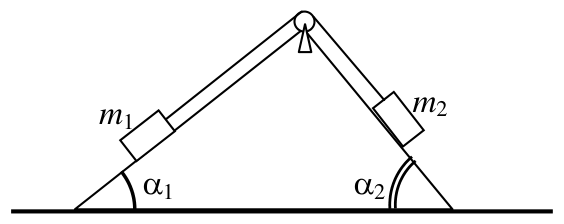
Fig. 1
Official English text of the problem.
Problem 2: Hydrogen in a tube closed by a mercury column
A vertical glass tube of cross section \(S = 1.0\ \mathrm{cm}^2\) contains unknown amount of hydrogen. The upper end of the tube is closed. The other end is opened and is immersed in a pan filled with mercury. The tube and the pan are placed in a sealed chamber containing air at temperature \(T_0 = 273\ \mathrm{K}\) and pressure \(P_0 = 1.334\times10^5\ \mathrm{Pa}\). Under these conditions the height of mercury column in the tube above the mercury level in the pan is \(h_0 = 0.70\ \mathrm{m}\).
One of the walls of the chamber is a piston, which expands the air isothermally to a pressure of \(P_1 = 8.00\times10^4\ \mathrm{Pa}\). As a result the height of the mercury column in the tube decreases to \(h_1 = 0.40\ \mathrm{m}\). Then the chamber is heated up at a constant volume to some temperature \(T_2\) until the mercury column rises to \(h_2 = 0.50\ \mathrm{m}\). Finally, the air in the chamber is expanded at constant pressure and the mercury level in the tube settles at \(h_3 = 0.45\ \mathrm{m}\) above the mercury level in the pan.
Provided that the system is in mechanical and thermal equilibrium during all the processes calculate the mass \(m\) of the hydrogen, the intermediate temperature \(T_2\), and the pressure \(P\) in the final state.
The density of mercury at temperature \(T_0\) is \(\rho_0 = 1.36\times10^4\ \mathrm{kg/m}^3\), the coefficient of expansion for mercury \(\beta = 1.84\times10^{-4}\ \mathrm{K}^{-1}\), and the gas constant \(R = 8.314\ \mathrm{J/(mol\times K)}\). The thermal expansion of the glass tube and the variations of the mercury level in the pan are not considered.
Hint. If \(\Delta T\) is the interval of temperature variations of the system then \(\beta\Delta T = x \ll 1\). In that case you can use the approximation: \[ \frac{1}{1+x}\approx 1-x. \]
Official English text of the problem.
Problem 3: Cube-shaped circuit of batteries, capacitors and resistors
Four batteries of EMF \(E_1 = 4\ \mathrm{V}\), \(E_2 = 8\ \mathrm{V}\), \(E_3 = 12\ \mathrm{V}\), and \(E_4 = 16\ \mathrm{V}\), four capacitors with the same capacitance \(C_1 = C_2 = C_3 = C_4 = 1\ \mu\mathrm{F}\), and four equivalent resistors are connected in the circuit shown in Fig. 3. The internal resistance of the batteries is negligible.
- Calculate the total energy \(W\) accumulated on the capacitors when a steady state of the system is established.
- The points H and B are short connected. Find the charge on the capacitor \(C_2\) in the new steady state.
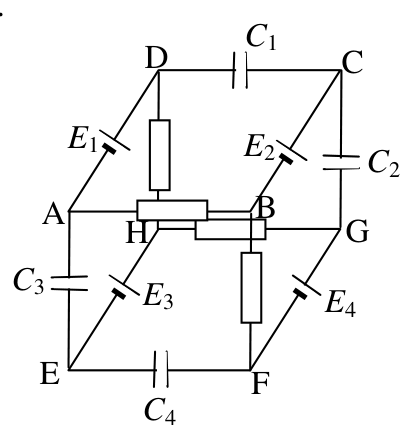
Fig. 3
Official English text of the problem.
Problem 4: Fish in a spherical aquarium in front of a plane mirror
A spherical aquarium, filled with water, is placed in front of a flat vertical mirror. The radius of the aquarium is \(R\), and the distance between its center and the mirror is \(3R\). A small fish, which is initially at the point nearest to the mirror, starts to move with velocity \(v\) along the wall. An observer looks at the fish from a very large distance along a horizontal line passing trough the center of the aquarium.
What is the relative velocity \(v_{\mathrm{rel}}\) at which the two images of the fish seen by the observer will move apart? Express your answer in terms of \(v\). Assume that:
- The wall of the aquarium is made of a very thin glass.
- The index of refraction of water is \(n=4/3\).
Official English text of the problem.
Internationale Physik-Olympiade
IPhO 1971
Sofia, Bulgarien · 4 Theorieaufgaben mit vollständigen Lösungen
Aufgabe 1: Zwei Blöcke auf einem dreieckigen Prisma auf einer reibungsfreien Ebene
Ein dreieckiges Prisma der Masse \(M\) liegt mit einer Seitenfläche auf einer reibungsfreien horizontalen Ebene, wie in Abb. 1 gezeigt. Die beiden anderen Seitenflächen sind gegenüber der Ebene unter den Winkeln \(\alpha_1\) bzw. \(\alpha_2\) geneigt. Zwei Blöcke der Massen \(m_1\) und \(m_2\), die durch einen undehnbaren Faden verbunden sind, können reibungsfrei auf der Oberfläche des Prismas gleiten. Die Masse der Rolle, über die der Faden läuft, ist vernachlässigbar.
- Drücken Sie die Beschleunigung \(a\) der Blöcke relativ zum Prisma durch die Beschleunigung \(a_0\) des Prismas aus.
- Bestimmen Sie die Beschleunigung \(a_0\) des Prismas in Abhängigkeit von den gegebenen Größen und der Erdbeschleunigung \(g\).
- Bei welchem Verhältnis \(m_1/m_2\) befindet sich das Prisma im Gleichgewicht?
Abb. 1
Aufgabentext aus dem offiziellen englischen Text übersetzt.
Aufgabe 2: Wasserstoff in einem durch eine Quecksilbersäule verschlossenen Rohr
Ein senkrechtes Glasrohr mit dem Querschnitt \(S = 1.0\ \mathrm{cm}^2\) enthält eine unbekannte Menge Wasserstoff. Das obere Ende des Rohrs ist verschlossen. Das andere Ende ist offen und taucht in eine mit Quecksilber gefüllte Wanne ein. Das Rohr und die Wanne befinden sich in einer abgeschlossenen Kammer, die Luft bei der Temperatur \(T_0 = 273\ \mathrm{K}\) und dem Druck \(P_0 = 1.334\times10^5\ \mathrm{Pa}\) enthält. Unter diesen Bedingungen beträgt die Höhe der Quecksilbersäule im Rohr über dem Quecksilberspiegel in der Wanne \(h_0 = 0.70\ \mathrm{m}\).
Eine der Wände der Kammer ist ein Kolben, durch dessen Bewegung die Luft isotherm bis auf einen Druck von \(P_1 = 8.00\times10^4\ \mathrm{Pa}\) expandiert. Dadurch sinkt die Höhe der Quecksilbersäule im Rohr auf \(h_1 = 0.40\ \mathrm{m}\). Anschließend wird die Kammer bei konstantem Volumen auf eine Temperatur \(T_2\) erwärmt, bis die Quecksilbersäule auf \(h_2 = 0.50\ \mathrm{m}\) steigt. Schließlich wird die Luft in der Kammer bei konstantem Druck expandiert, und der Quecksilberspiegel im Rohr stellt sich auf eine Höhe von \(h_3 = 0.45\ \mathrm{m}\) über dem Quecksilberspiegel in der Wanne ein.
Berechnen Sie unter der Voraussetzung, dass sich das System während aller Vorgänge im mechanischen und thermischen Gleichgewicht befindet, die Masse \(m\) des Wasserstoffs, die Zwischentemperatur \(T_2\) und den Druck \(P\) im Endzustand.
Die Dichte von Quecksilber bei der Temperatur \(T_0\) beträgt \(\rho_0 = 1.36\times10^4\ \mathrm{kg/m}^3\), der Volumenausdehnungskoeffizient von Quecksilber \(\beta = 1.84\times10^{-4}\ \mathrm{K}^{-1}\) und die Gaskonstante \(R = 8.314\ \mathrm{J/(mol\times K)}\). Die Wärmeausdehnung des Glasrohrs und die Änderungen des Quecksilberspiegels in der Wanne werden nicht berücksichtigt.
Hinweis. Ist \(\Delta T\) die Temperaturänderung des Systems, so gilt \(\beta\Delta T = x \ll 1\). In diesem Fall können Sie die folgende Näherung verwenden: \[ \frac{1}{1+x}\approx 1-x. \]
Aufgabentext aus dem offiziellen englischen Text übersetzt.
Aufgabe 3: Würfelförmige Schaltung aus Batterien, Kondensatoren und Widerständen
Vier Batterien mit den elektromotorischen Kräften \(E_1 = 4\ \mathrm{V}\), \(E_2 = 8\ \mathrm{V}\), \(E_3 = 12\ \mathrm{V}\) und \(E_4 = 16\ \mathrm{V}\), vier Kondensatoren mit derselben Kapazität \(C_1 = C_2 = C_3 = C_4 = 1\ \mu\mathrm{F}\) und vier gleiche Widerstände sind in der in Abb. 3 dargestellten Schaltung verbunden. Der Innenwiderstand der Batterien ist vernachlässigbar.
- Berechnen Sie die gesamte in den Kondensatoren gespeicherte Energie \(W\), wenn sich ein stationärer Zustand des Systems eingestellt hat.
- Die Punkte H und B werden kurzgeschlossen. Bestimmen Sie die Ladung auf dem Kondensator \(C_2\) im neuen stationären Zustand.
Abb. 3
Aufgabentext aus dem offiziellen englischen Text übersetzt.
Aufgabe 4: Fisch in einem kugelförmigen Aquarium vor einem ebenen Spiegel
Ein mit Wasser gefülltes kugelförmiges Aquarium steht vor einem ebenen, senkrechten Spiegel. Der Radius des Aquariums beträgt \(R\), und der Abstand zwischen seinem Mittelpunkt und dem Spiegel beträgt \(3R\). Ein kleiner Fisch, der sich anfangs an dem dem Spiegel nächstgelegenen Punkt befindet, beginnt, sich mit der Geschwindigkeit \(v\) entlang der Wand zu bewegen. Ein Beobachter betrachtet den Fisch aus sehr großer Entfernung entlang einer horizontalen Geraden durch den Mittelpunkt des Aquariums.
Mit welcher Relativgeschwindigkeit \(v_{\mathrm{rel}}\) bewegen sich die beiden vom Beobachter gesehenen Bilder des Fisches auseinander? Drücken Sie Ihre Antwort durch \(v\) aus. Nehmen Sie an, dass:
- Die Wand des Aquariums aus sehr dünnem Glas besteht.
- Der Brechungsindex von Wasser \(n=4/3\) beträgt.
Aufgabentext aus dem offiziellen englischen Text übersetzt.
Uluslararası Fizik Olimpiyatı
IPhO 1971
Sofya, Bulgaristan · 4 teori sorusu, tam çözümleriyle
Soru 1: Sürtünmesiz bir düzlem üzerindeki üçgen prizmanın üzerinde bulunan iki blok
Kütlesi \(M\) olan bir üçgen prizma, Şekil 1'de gösterildiği gibi bir yüzü sürtünmesiz yatay bir düzlem üzerine gelecek şekilde yerleştirilmiştir. Diğer iki yüz, bu düzlemle sırasıyla \(\alpha_1\) ve \(\alpha_2\) açılarını yapmaktadır. Uzamayan bir iple birbirine bağlanmış, kütleleri \(m_1\) ve \(m_2\) olan iki blok, prizmanın yüzeyi üzerinde sürtünmesiz olarak kayabilmektedir. İpin üzerinden geçtiği makaranın kütlesi ihmal edilebilir.
- Blokların prizmaya göre \(a\) ivmesini, prizmanın \(a_0\) ivmesi cinsinden ifade edin.
- Prizmanın \(a_0\) ivmesini, verilen büyüklükler ve yer çekimi ivmesi \(g\) cinsinden bulun.
- \(m_1/m_2\) oranının hangi değerinde prizma dengede olur?
Şekil 1
Soru metni resmi İngilizce metinden çevrilmiştir.
Soru 2: Cıva sütunuyla kapatılmış bir tüpteki hidrojen
Kesit alanı \(S = 1.0\ \mathrm{cm}^2\) olan düşey bir cam tüp, bilinmeyen miktarda hidrojen içermektedir. Tüpün üst ucu kapalıdır. Diğer ucu açıktır ve cıva dolu bir kaba daldırılmıştır. Tüp ve kap, sıcaklığı \(T_0 = 273\ \mathrm{K}\) ve basıncı \(P_0 = 1.334\times10^5\ \mathrm{Pa}\) olan hava içeren sızdırmaz bir bölmeye yerleştirilmiştir. Bu koşullarda tüpteki cıva sütununun kaptaki cıva seviyesinden yüksekliği \(h_0 = 0.70\ \mathrm{m}\) olmaktadır.
Bölmenin duvarlarından biri, havayı izotermal olarak \(P_1 = 8.00\times10^4\ \mathrm{Pa}\) basıncına kadar genleştiren bir pistondur. Bunun sonucunda tüpteki cıva sütununun yüksekliği \(h_1 = 0.40\ \mathrm{m}\) değerine düşer. Ardından bölme, cıva sütunu \(h_2 = 0.50\ \mathrm{m}\) yüksekliğine ulaşıncaya kadar sabit hacimde bir \(T_2\) sıcaklığına kadar ısıtılır. Son olarak bölmedeki hava sabit basınçta genleştirilir ve tüpteki cıva seviyesi, kaptaki cıva seviyesinin \(h_3 = 0.45\ \mathrm{m}\) üzerinde dengeye gelir.
Sistemin tüm süreçler boyunca mekanik ve ısıl dengede olduğu kabul edilerek hidrojenin kütlesini \(m\), ara sıcaklığı \(T_2\) ve son durumdaki basıncı \(P\) hesaplayınız.
Cıvanın \(T_0\) sıcaklığındaki yoğunluğu \(\rho_0 = 1.36\times10^4\ \mathrm{kg/m}^3\), cıvanın genleşme katsayısı \(\beta = 1.84\times10^{-4}\ \mathrm{K}^{-1}\) ve gaz sabiti \(R = 8.314\ \mathrm{J/(mol\times K)}\) olarak verilmiştir. Cam tüpün ısıl genleşmesi ve kaptaki cıva seviyesinin değişimleri dikkate alınmayacaktır.
İpucu. Sistemdeki sıcaklık değişimi \(\Delta T\) ise \(\beta\Delta T = x \ll 1\) olur. Bu durumda şu yaklaşımı kullanabilirsiniz: \[ \frac{1}{1+x}\approx 1-x. \]
Soru metni resmi İngilizce metinden çevrilmiştir.
Soru 3: Piller, kondansatörler ve dirençlerden oluşan küp biçimindeki devre
Elektromotor kuvvetleri \(E_1 = 4\ \mathrm{V}\), \(E_2 = 8\ \mathrm{V}\), \(E_3 = 12\ \mathrm{V}\) ve \(E_4 = 16\ \mathrm{V}\) olan dört pil, sığaları eşit olan dört kondansatör, \(C_1 = C_2 = C_3 = C_4 = 1\ \mu\mathrm{F}\), ve eşit dirençli dört direnç, Şekil 3'te gösterilen devrede bağlanmıştır. Pillerin iç dirençleri ihmal edilebilir.
- Sistem kararlı duruma ulaştığında kondansatörlerde biriken toplam enerjiyi \(W\) hesaplayınız.
- H ve B noktaları kısa devre edilir. Yeni kararlı durumda \(C_2\) kondansatörünün yükünü bulunuz.
Şekil 3
Soru metni resmi İngilizce metinden çevrilmiştir.
Soru 4: Düzlem ayna önündeki küresel bir akvaryumda bulunan balık
Su ile dolu küresel bir akvaryum, düşey bir düzlem aynanın önüne yerleştirilmiştir. Akvaryumun yarıçapı \(R\), merkezi ile ayna arasındaki uzaklık ise \(3R\)'dir. Başlangıçta aynaya en yakın noktada bulunan küçük bir balık, akvaryumun duvarı boyunca \(v\) hızıyla hareket etmeye başlar. Bir gözlemci, akvaryumun merkezinden geçen yatay bir doğru boyunca çok büyük bir uzaklıktan balığa bakmaktadır.
Gözlemcinin gördüğü iki balık görüntüsü birbirinden hangi \(v_{\mathrm{rel}}\) bağıl hızıyla uzaklaşır? Cevabınızı \(v\) cinsinden ifade ediniz. Şunları varsayınız:
- Akvaryumun duvarı çok ince camdan yapılmıştır.
- Suyun kırılma indisi \(n=4/3\)'tür.
Soru metni resmi İngilizce metinden çevrilmiştir.
Olimpiada Internacional de Física
IPhO 1971
Sofía, Bulgaria · 4 problemas teóricos con soluciones completas
Problema 1: Dos bloques sobre un prisma triangular en un plano sin rozamiento
Un prisma triangular de masa \(M\) está apoyado sobre una de sus caras en un plano horizontal sin rozamiento, como se muestra en la Fig. 1. Las otras dos caras están inclinadas respecto al plano formando ángulos \(\alpha_1\) y \(\alpha_2\), respectivamente. Dos bloques de masas \(m_1\) y \(m_2\), unidos por un hilo inextensible, pueden deslizarse sin rozamiento sobre la superficie del prisma. La masa de la polea por la que pasa el hilo es despreciable.
- Exprese la aceleración \(a\) de los bloques respecto al prisma en función de la aceleración \(a_0\) del prisma.
- Determine la aceleración \(a_0\) del prisma en función de las magnitudes dadas y de la aceleración \(g\) de la gravedad.
- ¿Para qué cociente \(m_1/m_2\) estará el prisma en equilibrio?
Fig. 1
Enunciado traducido del texto oficial en inglés.
Problema 2: Hidrógeno en un tubo cerrado por una columna de mercurio
Un tubo vertical de vidrio de sección transversal \(S = 1.0\ \mathrm{cm}^2\) contiene una cantidad desconocida de hidrógeno. El extremo superior del tubo está cerrado. El otro extremo está abierto y sumergido en una cubeta llena de mercurio. El tubo y la cubeta se encuentran en una cámara hermética que contiene aire a una temperatura \(T_0 = 273\ \mathrm{K}\) y una presión \(P_0 = 1.334\times10^5\ \mathrm{Pa}\). En estas condiciones, la altura de la columna de mercurio en el tubo por encima del nivel de mercurio en la cubeta es \(h_0 = 0.70\ \mathrm{m}\).
Una de las paredes de la cámara es un pistón que expande el aire isotérmicamente hasta una presión de \(P_1 = 8.00\times10^4\ \mathrm{Pa}\). Como resultado, la altura de la columna de mercurio en el tubo disminuye hasta \(h_1 = 0.40\ \mathrm{m}\). A continuación, la cámara se calienta a volumen constante hasta una cierta temperatura \(T_2\), hasta que la columna de mercurio asciende a \(h_2 = 0.50\ \mathrm{m}\). Finalmente, el aire de la cámara se expande a presión constante y el nivel de mercurio en el tubo se estabiliza a \(h_3 = 0.45\ \mathrm{m}\) por encima del nivel de mercurio en la cubeta.
Suponiendo que el sistema se encuentra en equilibrio mecánico y térmico durante todos los procesos, calcule la masa \(m\) del hidrógeno, la temperatura intermedia \(T_2\) y la presión \(P\) en el estado final.
La densidad del mercurio a la temperatura \(T_0\) es \(\rho_0 = 1.36\times10^4\ \mathrm{kg/m}^3\), el coeficiente de dilatación del mercurio es \(\beta = 1.84\times10^{-4}\ \mathrm{K}^{-1}\) y la constante de los gases es \(R = 8.314\ \mathrm{J/(mol\times K)}\). No se consideran la dilatación térmica del tubo de vidrio ni las variaciones del nivel de mercurio en la cubeta.
Indicación. Si \(\Delta T\) es el intervalo de variación de la temperatura del sistema, entonces \(\beta\Delta T = x \ll 1\). En ese caso, puede utilizar la aproximación: \[ \frac{1}{1+x}\approx 1-x. \]
Enunciado traducido del texto oficial en inglés.
Problema 3: Circuito en forma de cubo de baterías, condensadores y resistencias
Cuatro baterías de fuerza electromotriz \(E_1 = 4\ \mathrm{V}\), \(E_2 = 8\ \mathrm{V}\), \(E_3 = 12\ \mathrm{V}\) y \(E_4 = 16\ \mathrm{V}\), cuatro condensadores con la misma capacidad \(C_1 = C_2 = C_3 = C_4 = 1\ \mu\mathrm{F}\) y cuatro resistencias iguales están conectados en el circuito que se muestra en la Fig. 3. La resistencia interna de las baterías es despreciable.
- Calcule la energía total \(W\) acumulada en los condensadores cuando se establece un régimen estacionario en el sistema.
- Los puntos H y B se conectan en cortocircuito. Determine la carga del condensador \(C_2\) en el nuevo régimen estacionario.
Fig. 3
Enunciado traducido del texto oficial en inglés.
Problema 4: Pez en un acuario esférico frente a un espejo plano
Un acuario esférico, lleno de agua, está situado frente a un espejo plano vertical. El radio del acuario es \(R\), y la distancia entre su centro y el espejo es \(3R\). Un pequeño pez, que inicialmente se encuentra en el punto más cercano al espejo, comienza a moverse con velocidad \(v\) a lo largo de la pared. Un observador mira al pez desde una distancia muy grande a lo largo de una línea horizontal que pasa por el centro del acuario.
¿Cuál es la velocidad relativa \(v_{\mathrm{rel}}\) con la que se separarán las dos imágenes del pez que ve el observador? Exprese su respuesta en función de \(v\). Suponga que:
- La pared del acuario está hecha de vidrio muy delgado.
- El índice de refracción del agua es \(n=4/3\).
Enunciado traducido del texto oficial en inglés.
国际物理奥林匹克
IPhO 1971
保加利亚索非亚 · 4 道理论题及完整解答
题目 1:无摩擦平面上三棱柱上的两个物块
如图 1 所示,一个质量为 \(M\) 的三棱柱以一个侧面放置在无摩擦的水平面上。另外两个侧面与水平面的夹角分别为 \(\alpha_1\) 和 \(\alpha_2\)。两个质量分别为 \(m_1\) 和 \(m_2\) 的物块由一根不可伸长的细线连接,可在三棱柱表面上无摩擦地滑动。支承细线的滑轮质量可忽略不计。
- 用三棱柱的加速度 \(a_0\) 表示物块相对于三棱柱的加速度 \(a\)。
- 用已知量和重力加速度 \(g\) 求三棱柱的加速度 \(a_0\)。
- 当质量比 \(m_1/m_2\) 为多少时,三棱柱处于平衡状态?
图 1
题目译自官方英文原文。
题目 2:由水银柱封闭的管内的氢气
一根横截面积为 \(S = 1.0\ \mathrm{cm}^2\) 的竖直玻璃管内装有未知量的氢气。管的上端封闭,另一端开口并浸入盛有水银的槽中。玻璃管和水银槽置于密闭容器内,容器内空气的温度为 \(T_0 = 273\ \mathrm{K}\),压强为 \(P_0 = 1.334\times10^5\ \mathrm{Pa}\)。在这些条件下,管内水银柱高出槽内水银液面的高度为 \(h_0 = 0.70\ \mathrm{m}\)。
容器的一面壁是活塞,通过移动活塞使空气等温膨胀,直至压强降至 \(P_1 = 8.00\times10^4\ \mathrm{Pa}\)。因此,管内水银柱的高度降至 \(h_1 = 0.40\ \mathrm{m}\)。随后,在体积不变的条件下将容器加热至某一温度 \(T_2\),直到水银柱升至 \(h_2 = 0.50\ \mathrm{m}\)。最后,使容器内的空气在恒定压强下膨胀,管内水银液面最终稳定在高出槽内水银液面 \(h_3 = 0.45\ \mathrm{m}\) 的位置。
假设系统在所有过程中均处于力学平衡和热平衡状态,计算氢气的质量 \(m\)、中间状态的温度 \(T_2\) 以及最终状态的压强 \(P\)。
水银在温度 \(T_0\) 下的密度为 \(\rho_0 = 1.36\times10^4\ \mathrm{kg/m}^3\),水银的膨胀系数为 \(\beta = 1.84\times10^{-4}\ \mathrm{K}^{-1}\),气体常量为 \(R = 8.314\ \mathrm{J/(mol\times K)}\)。不考虑玻璃管的热膨胀以及槽内水银液面的变化。
提示。 若 \(\Delta T\) 为系统的温度变化量,则 \(\beta\Delta T = x \ll 1\)。此时可使用近似式: \[ \frac{1}{1+x}\approx 1-x. \]
题目译自官方英文原文。
题目 3:由电池、电容器和电阻组成的立方体电路
四个电动势分别为 \(E_1 = 4\ \mathrm{V}\)、\(E_2 = 8\ \mathrm{V}\)、\(E_3 = 12\ \mathrm{V}\) 和 \(E_4 = 16\ \mathrm{V}\) 的电池、四个电容相同的电容器(\(C_1 = C_2 = C_3 = C_4 = 1\ \mu\mathrm{F}\))以及四个阻值相同的电阻,连接成图 3 所示的电路。电池的内阻可忽略不计。
- 计算系统达到稳态时电容器中储存的总能量 \(W\)。
- 将 H 点与 B 点短接。求新的稳态下电容器 \(C_2\) 上的电荷量。
图 3
题目译自官方英文原文。
题目 4:平面镜前球形鱼缸中的鱼
一个装满水的球形鱼缸放置在一面竖直平面镜前。鱼缸的半径为 \(R\),其球心到镜面的距离为 \(3R\)。一条小鱼起初位于最靠近镜面的点,随后开始以速率 \(v\) 沿缸壁运动。观察者从很远处沿一条通过鱼缸球心的水平直线观察这条鱼。
观察者看到的鱼的两个像将以多大的相对速度 \(v_{\mathrm{rel}}\) 彼此分离?用 \(v\) 表示你的答案。假设:
- 鱼缸壁由很薄的玻璃制成。
- 水的折射率为 \(n=4/3\)。
题目译自官方英文原文。
Международная физическая олимпиада
IPhO 1971
София, Болгария · 4 теоретические задачи с полными решениями
Задача 1: Два бруска на треугольной призме на плоскости без трения
Треугольная призма массой \(M\) установлена одной гранью на горизонтальную плоскость без трения, как показано на рис. 1. Две другие грани наклонены к плоскости под углами \(\alpha_1\) и \(\alpha_2\) соответственно. Два бруска массами \(m_1\) и \(m_2\), соединённые нерастяжимой нитью, могут скользить без трения по поверхности призмы. Масса блока, через который перекинута нить, пренебрежимо мала.
- Выразите ускорение \(a\) брусков относительно призмы через ускорение \(a_0\) призмы.
- Найдите ускорение \(a_0\) призмы через заданные величины и ускорение свободного падения \(g\).
- При каком отношении \(m_1/m_2\) призма будет находиться в равновесии?
Рис. 1
Условие переведено с официального английского текста.
Задача 2: Водород в трубке, запертой столбом ртути
Вертикальная стеклянная трубка площадью поперечного сечения \(S = 1.0\ \mathrm{cm}^2\) содержит неизвестное количество водорода. Верхний конец трубки закрыт. Другой конец открыт и погружён в сосуд, наполненный ртутью. Трубка и сосуд помещены в герметичную камеру, содержащую воздух при температуре \(T_0 = 273\ \mathrm{K}\) и давлении \(P_0 = 1.334\times10^5\ \mathrm{Pa}\). При этих условиях высота столба ртути в трубке над уровнем ртути в сосуде составляет \(h_0 = 0.70\ \mathrm{m}\).
Одна из стенок камеры представляет собой поршень, при перемещении которого воздух изотермически расширяется до давления \(P_1 = 8.00\times10^4\ \mathrm{Pa}\). В результате высота столба ртути в трубке уменьшается до \(h_1 = 0.40\ \mathrm{m}\). Затем камеру нагревают при постоянном объёме до некоторой температуры \(T_2\), пока столб ртути не поднимется до высоты \(h_2 = 0.50\ \mathrm{m}\). Наконец, воздух в камере расширяется при постоянном давлении, и уровень ртути в трубке устанавливается на высоте \(h_3 = 0.45\ \mathrm{m}\) над уровнем ртути в сосуде.
Считая, что на протяжении всех процессов система находится в механическом и тепловом равновесии, вычислите массу \(m\) водорода, промежуточную температуру \(T_2\) и давление \(P\) в конечном состоянии.
Плотность ртути при температуре \(T_0\) равна \(\rho_0 = 1.36\times10^4\ \mathrm{kg/m}^3\), коэффициент объёмного расширения ртути \(\beta = 1.84\times10^{-4}\ \mathrm{K}^{-1}\), а универсальная газовая постоянная \(R = 8.314\ \mathrm{J/(mol\times K)}\). Тепловое расширение стеклянной трубки и изменения уровня ртути в сосуде не учитываются.
Указание. Если \(\Delta T\) — интервал изменения температуры системы, то \(\beta\Delta T = x \ll 1\). В этом случае можно использовать приближение: \[ \frac{1}{1+x}\approx 1-x. \]
Условие переведено с официального английского текста.
Задача 3: Электрическая цепь в форме куба из батарей, конденсаторов и резисторов
Четыре батареи с ЭДС \(E_1 = 4\ \mathrm{V}\), \(E_2 = 8\ \mathrm{V}\), \(E_3 = 12\ \mathrm{V}\) и \(E_4 = 16\ \mathrm{V}\), четыре конденсатора одинаковой ёмкости \(C_1 = C_2 = C_3 = C_4 = 1\ \mu\mathrm{F}\) и четыре резистора одинакового сопротивления соединены в цепь, показанную на рис. 3. Внутренним сопротивлением батарей можно пренебречь.
- Вычислите полную энергию \(W\), накопленную в конденсаторах после установления стационарного режима в системе.
- Точки H и B замыкают накоротко. Найдите заряд конденсатора \(C_2\) в новом стационарном режиме.
Рис. 3
Условие переведено с официального английского текста.
Задача 4: Рыбка в сферическом аквариуме перед плоским зеркалом
Сферический аквариум, наполненный водой, расположен перед плоским вертикальным зеркалом. Радиус аквариума равен \(R\), а расстояние от его центра до зеркала — \(3R\). Маленькая рыбка, первоначально находящаяся в ближайшей к зеркалу точке, начинает двигаться со скоростью \(v\) вдоль стенки. Наблюдатель смотрит на рыбку с очень большого расстояния вдоль горизонтальной прямой, проходящей через центр аквариума.
С какой относительной скоростью \(v_{\mathrm{rel}}\) будут удаляться друг от друга два изображения рыбки, видимые наблюдателем? Выразите ответ через \(v\). Примите следующие допущения:
- Стенка аквариума изготовлена из очень тонкого стекла.
- Показатель преломления воды равен \(n=4/3\).
Условие переведено с официального английского текста.
الأولمبياد الدولي للفيزياء
IPhO 1971
صوفيا، بلغاريا · 4 مسائل نظرية مع حلول كاملة
المسألة 1: كتلتان على منشور ثلاثي موضوع على مستوى عديم الاحتكاك
وُضع منشور ثلاثي كتلته \(M\) بحيث يستند أحد أوجهه إلى مستوى أفقي عديم الاحتكاك، كما هو موضح في الشكل 1. ويميل الوجهان الآخران على المستوى بزاويتين \(\alpha_1\) و\(\alpha_2\) على الترتيب. ويمكن لكتلتين مقداراهما \(m_1\) و\(m_2\)، موصولتين بخيط غير قابل للاستطالة، أن تنزلقا دون احتكاك على سطح المنشور. وكتلة البكرة التي يمر عليها الخيط مهملة.
- عبّر عن تسارع الكتلتين \(a\) بالنسبة إلى المنشور بدلالة تسارع المنشور \(a_0\).
- أوجد تسارع المنشور \(a_0\) بدلالة المقادير المعطاة وتسارع الجاذبية \(g\).
- عند أي نسبة \(m_1/m_2\) يكون المنشور في حالة اتزان؟
الشكل 1
نص المسألة مترجم عن النص الإنجليزي الرسمي.
المسألة 2: الهيدروجين في أنبوب مغلق بعمود من الزئبق
يحتوي أنبوب زجاجي رأسي مساحة مقطعه \(S = 1.0\ \mathrm{cm}^2\) على كمية مجهولة من الهيدروجين. الطرف العلوي للأنبوب مغلق، أما الطرف الآخر فمفتوح ومغمور في حوض مملوء بالزئبق. يوضع الأنبوب والحوض في حجرة محكمة الإغلاق تحتوي على هواء عند درجة حرارة \(T_0 = 273\ \mathrm{K}\) وضغط \(P_0 = 1.334\times10^5\ \mathrm{Pa}\). في هذه الظروف، يبلغ ارتفاع عمود الزئبق في الأنبوب فوق مستوى الزئبق في الحوض \(h_0 = 0.70\ \mathrm{m}\).
أحد جدران الحجرة عبارة عن مكبس، يؤدي تحريكه إلى تمدد الهواء عند درجة حرارة ثابتة حتى يصبح ضغطه \(P_1 = 8.00\times10^4\ \mathrm{Pa}\). ونتيجة لذلك، ينخفض ارتفاع عمود الزئبق في الأنبوب إلى \(h_1 = 0.40\ \mathrm{m}\). ثم تُسخَّن الحجرة عند حجم ثابت إلى درجة حرارة ما \(T_2\) حتى يرتفع عمود الزئبق إلى \(h_2 = 0.50\ \mathrm{m}\). وأخيرًا، يُمدَّد الهواء في الحجرة عند ضغط ثابت، ويستقر مستوى الزئبق في الأنبوب عند ارتفاع \(h_3 = 0.45\ \mathrm{m}\) فوق مستوى الزئبق في الحوض.
بافتراض أن النظام في اتزان ميكانيكي وحراري خلال جميع العمليات، احسب كتلة الهيدروجين \(m\)، ودرجة الحرارة الوسيطة \(T_2\)، والضغط \(P\) في الحالة النهائية.
كثافة الزئبق عند درجة الحرارة \(T_0\) هي \(\rho_0 = 1.36\times10^4\ \mathrm{kg/m}^3\)، ومعامل تمدد الزئبق هو \(\beta = 1.84\times10^{-4}\ \mathrm{K}^{-1}\)، وثابت الغازات هو \(R = 8.314\ \mathrm{J/(mol\times K)}\). يُهمَل التمدد الحراري للأنبوب الزجاجي وتغير مستوى الزئبق في الحوض.
تلميح. إذا كان \(\Delta T\) هو مقدار تغير درجة حرارة النظام، فإن \(\beta\Delta T = x \ll 1\). في هذه الحالة، يمكنك استخدام التقريب: \[ \frac{1}{1+x}\approx 1-x. \]
نص المسألة مترجم عن النص الإنجليزي الرسمي.
المسألة 3: دائرة كهربائية على شكل مكعب من البطاريات والمكثفات والمقاومات
وُصّلت أربع بطاريات ذات قوى دافعة كهربائية \(E_1 = 4\ \mathrm{V}\)، و\(E_2 = 8\ \mathrm{V}\)، و\(E_3 = 12\ \mathrm{V}\)، و\(E_4 = 16\ \mathrm{V}\)، وأربعة مكثفات لها السعة نفسها \(C_1 = C_2 = C_3 = C_4 = 1\ \mu\mathrm{F}\)، وأربع مقاومات متساوية القيمة، في الدائرة المبينة في الشكل 3. المقاومة الداخلية للبطاريات مهملة.
- احسب الطاقة الكلية \(W\) المختزنة في المكثفات عندما يستقر النظام في حالة مستقرة.
- وُصّلت النقطتان H وB بقصر كهربائي. أوجد شحنة المكثف \(C_2\) في الحالة المستقرة الجديدة.
الشكل 3
نص المسألة مترجم عن النص الإنجليزي الرسمي.
المسألة 4: سمكة في حوض كروي أمام مرآة مستوية
يوضع حوض أسماك كروي مملوء بالماء أمام مرآة مستوية رأسية. نصف قطر الحوض هو \(R\)، والمسافة بين مركزه والمرآة هي \(3R\). تبدأ سمكة صغيرة، تقع في البداية عند النقطة الأقرب إلى المرآة، بالحركة بسرعة \(v\) بمحاذاة الجدار. ينظر راصد إلى السمكة من مسافة بعيدة جدًا على امتداد خط أفقي يمر بمركز الحوض.
ما السرعة النسبية \(v_{\mathrm{rel}}\) التي تتباعد بها صورتا السمكة اللتان يراهما الراصد؟ عبّر عن إجابتك بدلالة \(v\). افترض ما يأتي:
- جدار الحوض مصنوع من زجاج رقيق جدًا.
- معامل انكسار الماء هو \(n=4/3\).
نص المسألة مترجم عن النص الإنجليزي الرسمي.