IPhO 1971 · Theory problem 3
Cube-shaped circuit of batteries, capacitors and resistors
Four batteries of EMF \(E_1 = 4\ \mathrm{V}\), \(E_2 = 8\ \mathrm{V}\), \(E_3 = 12\ \mathrm{V}\), and \(E_4 = 16\ \mathrm{V}\), four capacitors with the same capacitance \(C_1 = C_2 = C_3 = C_4 = 1\ \mu\mathrm{F}\), and four equivalent resistors are connected in the circuit shown in Fig. 3. The internal resistance of the batteries is negligible.
- Calculate the total energy \(W\) accumulated on the capacitors when a steady state of the system is established.
- The points H and B are short connected. Find the charge on the capacitor \(C_2\) in the new steady state.
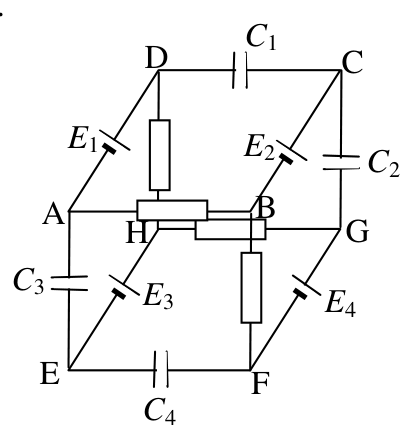
Fig. 3
Official English text of the problem.
Answers
The two unnumbered bullets are designated (1) and (2) below.
- Total energy stored: \(\boxed{W=26\ \mu\mathrm{J}}\).
- Charge on capacitor \(C_2\) after shorting H and B: \(\boxed{Q_2=0\ \mathrm{C}}\).
Solution
Let each resistor have resistance \(R\). The resistors occupy edges \(AB\), \(BF\), \(DH\), and \(HG\); crossings in the projection do not create additional junctions.
The long battery plates indicate the positive terminals, so \[ V_D-V_A=E_1,\qquad V_C-V_B=E_2, \] \[ V_H-V_E=E_3,\qquad V_G-V_F=E_4. \] In a steady state, capacitor voltages are constant and no current flows through the capacitors.
(1) Total energy stored
With the capacitor branches open, the only conducting loop is \[ F\longrightarrow G\longrightarrow H\longrightarrow D \longrightarrow A\longrightarrow B\longrightarrow F. \] The branches containing \(E_2\) and \(E_3\) carry no steady current.
Kirchhoff’s voltage law around the conducting loop gives \[ E_4-E_1-4IR=0. \] Thus the voltage drop across each resistor is \[ IR=\frac{E_4-E_1}{4} =\frac{16-4}{4}\ \mathrm{V} =3\ \mathrm{V}. \]
Taking \(V_F=0\), the battery rise and successive voltage drops give \[ V_G=16\ \mathrm{V},\quad V_H=13\ \mathrm{V},\quad V_D=10\ \mathrm{V}, \] \[ V_A=6\ \mathrm{V},\qquad V_B=3\ \mathrm{V}. \] The remaining batteries fix \[ V_C=V_B+E_2=11\ \mathrm{V},\qquad V_E=V_H-E_3=1\ \mathrm{V}. \]
Consequently, the capacitor voltages are:
| Capacitor | Voltage magnitude | Positive plate |
|---|---|---|
| \(C_1\) | \(\lvert V_D-V_C\rvert=1\ \mathrm{V}\) | C |
| \(C_2\) | \(\lvert V_C-V_G\rvert=5\ \mathrm{V}\) | G |
| \(C_3\) | \(\lvert V_A-V_E\rvert=5\ \mathrm{V}\) | A |
| \(C_4\) | \(\lvert V_E-V_F\rvert=1\ \mathrm{V}\) | E |
Using the electrostatic energy \(W_i=\tfrac12 C_iU_i^2\), \[ W=\frac12(1\times10^{-6}\ \mathrm{F}) \left(1^2+5^2+5^2+1^2\right)\mathrm{V}^2. \] Therefore, \[ \boxed{W=2.6\times10^{-5}\ \mathrm{J}=26\ \mu\mathrm{J}}. \]
(2) Charge on \(C_2\) after shorting H and B
The short circuit makes \(V_H=V_B\). Choose their common potential as zero: \[ V_H=V_B=0. \] Battery \(E_2\) then fixes \[ V_C=E_2=8\ \mathrm{V}. \]
In the new steady state, the capacitors again carry no current. Battery \(E_4\) drives a loop through the two equal resistors \(GH\) and \(BF\), so \[ I_4=\frac{E_4}{2R}. \] The potential of G relative to H is therefore \[ V_G-V_H=I_4R=\frac{E_4}{2}=8\ \mathrm{V}. \] Hence \(V_G=V_C\), and the voltage across \(C_2\) vanishes: \[ U_2=V_C-V_G=E_2-\frac{E_4}{2}=0. \] Its final charge is consequently \[ \boxed{Q_2=C_2\lvert U_2\rvert=0\ \mathrm{C}}. \]
The solution was checked against the official solution.
IPhO 1971 · Theorieaufgabe 3
Würfelförmige Schaltung aus Batterien, Kondensatoren und Widerständen
Vier Batterien mit den elektromotorischen Kräften \(E_1 = 4\ \mathrm{V}\), \(E_2 = 8\ \mathrm{V}\), \(E_3 = 12\ \mathrm{V}\) und \(E_4 = 16\ \mathrm{V}\), vier Kondensatoren mit derselben Kapazität \(C_1 = C_2 = C_3 = C_4 = 1\ \mu\mathrm{F}\) und vier gleiche Widerstände sind in der in Abb. 3 dargestellten Schaltung verbunden. Der Innenwiderstand der Batterien ist vernachlässigbar.
- Berechnen Sie die gesamte in den Kondensatoren gespeicherte Energie \(W\), wenn sich ein stationärer Zustand des Systems eingestellt hat.
- Die Punkte H und B werden kurzgeschlossen. Bestimmen Sie die Ladung auf dem Kondensator \(C_2\) im neuen stationären Zustand.
Abb. 3
Aufgabentext aus dem offiziellen englischen Text übersetzt.
Antworten
Die beiden nicht nummerierten Aufzählungspunkte werden im Folgenden mit (1) und (2) bezeichnet.
- Insgesamt gespeicherte Energie: \(\boxed{W=26\ \mu\mathrm{J}}\).
- Ladung auf dem Kondensator \(C_2\) nach dem Kurzschließen von H und B: \(\boxed{Q_2=0\ \mathrm{C}}\).
Lösung
Jeder Widerstand habe den Widerstandswert \(R\). Die Widerstände liegen auf den Kanten \(AB\), \(BF\), \(DH\) und \(HG\); Kreuzungen in der Projektion bilden keine zusätzlichen Knotenpunkte.
Die langen Striche der Batteriesymbole kennzeichnen die positiven Pole, also gilt \[ V_D-V_A=E_1,\qquad V_C-V_B=E_2, \] \[ V_H-V_E=E_3,\qquad V_G-V_F=E_4. \] Im stationären Zustand sind die Kondensatorspannungen konstant, und durch die Kondensatoren fließt kein Strom.
(1) Insgesamt gespeicherte Energie
Bei offenen Kondensatorzweigen ist die einzige stromführende Masche \[ F\longrightarrow G\longrightarrow H\longrightarrow D \longrightarrow A\longrightarrow B\longrightarrow F. \] In den Zweigen mit \(E_2\) und \(E_3\) fließt im stationären Zustand kein Strom.
Die Kirchhoffsche Maschenregel liefert für die stromführende Masche \[ E_4-E_1-4IR=0. \] Damit beträgt der Spannungsabfall an jedem Widerstand \[ IR=\frac{E_4-E_1}{4} =\frac{16-4}{4}\ \mathrm{V} =3\ \mathrm{V}. \]
Mit \(V_F=0\) ergeben sich aus der Spannungserhöhung an der Batterie und den aufeinanderfolgenden Spannungsabfällen \[ V_G=16\ \mathrm{V},\quad V_H=13\ \mathrm{V},\quad V_D=10\ \mathrm{V}, \] \[ V_A=6\ \mathrm{V},\qquad V_B=3\ \mathrm{V}. \] Die übrigen Batterien legen fest: \[ V_C=V_B+E_2=11\ \mathrm{V},\qquad V_E=V_H-E_3=1\ \mathrm{V}. \]
Somit ergeben sich folgende Kondensatorspannungen:
| Kondensator | Betrag der Spannung | Positive Platte |
|---|---|---|
| \(C_1\) | \(\lvert V_D-V_C\rvert=1\ \mathrm{V}\) | C |
| \(C_2\) | \(\lvert V_C-V_G\rvert=5\ \mathrm{V}\) | G |
| \(C_3\) | \(\lvert V_A-V_E\rvert=5\ \mathrm{V}\) | A |
| \(C_4\) | \(\lvert V_E-V_F\rvert=1\ \mathrm{V}\) | E |
Mit der elektrostatischen Energie \(W_i=\tfrac12 C_iU_i^2\) folgt \[ W=\frac12(1\times10^{-6}\ \mathrm{F}) \left(1^2+5^2+5^2+1^2\right)\mathrm{V}^2. \] Damit gilt \[ \boxed{W=2.6\times10^{-5}\ \mathrm{J}=26\ \mu\mathrm{J}}. \]
(2) Ladung auf \(C_2\) nach dem Kurzschließen von H und B
Durch den Kurzschluss gilt \(V_H=V_B\). Wir wählen ihr gemeinsames Potential als null: \[ V_H=V_B=0. \] Die Batterie \(E_2\) legt dann fest: \[ V_C=E_2=8\ \mathrm{V}. \]
Im neuen stationären Zustand fließt erneut kein Strom durch die Kondensatoren. Die Batterie \(E_4\) treibt einen Strom in einer Masche durch die beiden gleichen Widerstände \(GH\) und \(BF\), sodass \[ I_4=\frac{E_4}{2R}. \] Das Potential von G gegenüber H beträgt daher \[ V_G-V_H=I_4R=\frac{E_4}{2}=8\ \mathrm{V}. \] Somit gilt \(V_G=V_C\), und die Spannung an \(C_2\) verschwindet: \[ U_2=V_C-V_G=E_2-\frac{E_4}{2}=0. \] Seine endgültige Ladung ist folglich \[ \boxed{Q_2=C_2\lvert U_2\rvert=0\ \mathrm{C}}. \]
Die Lösung wurde mit der offiziellen Lösung abgeglichen.
IPhO 1971 · Teori sorusu 3
Piller, kondansatörler ve dirençlerden oluşan küp biçimindeki devre
Elektromotor kuvvetleri \(E_1 = 4\ \mathrm{V}\), \(E_2 = 8\ \mathrm{V}\), \(E_3 = 12\ \mathrm{V}\) ve \(E_4 = 16\ \mathrm{V}\) olan dört pil, sığaları eşit olan dört kondansatör, \(C_1 = C_2 = C_3 = C_4 = 1\ \mu\mathrm{F}\), ve eşit dirençli dört direnç, Şekil 3'te gösterilen devrede bağlanmıştır. Pillerin iç dirençleri ihmal edilebilir.
- Sistem kararlı duruma ulaştığında kondansatörlerde biriken toplam enerjiyi \(W\) hesaplayınız.
- H ve B noktaları kısa devre edilir. Yeni kararlı durumda \(C_2\) kondansatörünün yükünü bulunuz.
Şekil 3
Soru metni resmi İngilizce metinden çevrilmiştir.
Cevaplar
Numaralandırılmamış iki madde aşağıda (1) ve (2) olarak adlandırılmıştır.
- Depolanan toplam enerji: \(\boxed{W=26\ \mu\mathrm{J}}\).
- H ve B kısa devre edildikten sonra \(C_2\) kondansatörünün yükü: \(\boxed{Q_2=0\ \mathrm{C}}\).
Çözüm
Her bir direncin direnç değeri \(R\) olsun. Dirençler \(AB\), \(BF\), \(DH\) ve \(HG\) kenarlarında yer alır; izdüşümdeki kesişmeler ek bağlantı noktaları oluşturmaz.
Pil sembollerindeki uzun çizgiler pozitif kutupları gösterir; dolayısıyla \[ V_D-V_A=E_1,\qquad V_C-V_B=E_2, \] \[ V_H-V_E=E_3,\qquad V_G-V_F=E_4. \] Kararlı durumda kondansatörlerin gerilimleri sabittir ve kondansatörlerden akım geçmez.
(1) Depolanan toplam enerji
Kondansatörlerin bulunduğu kollar açık devre olduğunda, akımın geçebildiği tek kapalı çevrim \[ F\longrightarrow G\longrightarrow H\longrightarrow D \longrightarrow A\longrightarrow B\longrightarrow F \] şeklindedir. \(E_2\) ve \(E_3\) pillerinin bulunduğu kollardan kararlı durumda akım geçmez.
Akım geçen kapalı çevrime Kirchhoff'un gerilim yasası uygulandığında \[ E_4-E_1-4IR=0 \] elde edilir. Böylece her bir direnç üzerindeki gerilim düşümü \[ IR=\frac{E_4-E_1}{4} =\frac{16-4}{4}\ \mathrm{V} =3\ \mathrm{V} \] olur.
\(V_F=0\) alındığında, pildeki gerilim artışı ve ardışık gerilim düşümleri \[ V_G=16\ \mathrm{V},\quad V_H=13\ \mathrm{V},\quad V_D=10\ \mathrm{V}, \] \[ V_A=6\ \mathrm{V},\qquad V_B=3\ \mathrm{V} \] değerlerini verir. Diğer piller ise \[ V_C=V_B+E_2=11\ \mathrm{V},\qquad V_E=V_H-E_3=1\ \mathrm{V} \] değerlerini belirler.
Buna göre kondansatörlerin gerilimleri şöyledir:
| Kondansatör | Gerilimin büyüklüğü | Pozitif levha |
|---|---|---|
| \(C_1\) | \(\lvert V_D-V_C\rvert=1\ \mathrm{V}\) | C |
| \(C_2\) | \(\lvert V_C-V_G\rvert=5\ \mathrm{V}\) | G |
| \(C_3\) | \(\lvert V_A-V_E\rvert=5\ \mathrm{V}\) | A |
| \(C_4\) | \(\lvert V_E-V_F\rvert=1\ \mathrm{V}\) | E |
Elektrostatik enerji bağıntısı \(W_i=\tfrac12 C_iU_i^2\) kullanılarak \[ W=\frac12(1\times10^{-6}\ \mathrm{F}) \left(1^2+5^2+5^2+1^2\right)\mathrm{V}^2 \] elde edilir. Dolayısıyla, \[ \boxed{W=2.6\times10^{-5}\ \mathrm{J}=26\ \mu\mathrm{J}}. \]
(2) H ve B kısa devre edildikten sonra \(C_2\) kondansatörünün yükü
Kısa devre sonucunda \(V_H=V_B\) olur. Bu noktaların ortak potansiyelini sıfır seçelim: \[ V_H=V_B=0. \] Bu durumda \(E_2\) pili \[ V_C=E_2=8\ \mathrm{V} \] değerini belirler.
Yeni kararlı durumda da kondansatörlerden akım geçmez. \(E_4\) pili, eşit dirençli \(GH\) ve \(BF\) dirençlerinden geçen bir çevrimde akım oluşturur; dolayısıyla \[ I_4=\frac{E_4}{2R}. \] G noktasının H noktasına göre potansiyeli bu nedenle \[ V_G-V_H=I_4R=\frac{E_4}{2}=8\ \mathrm{V} \] olur. Böylece \(V_G=V_C\) olur ve \(C_2\) üzerindeki gerilim sıfırlanır: \[ U_2=V_C-V_G=E_2-\frac{E_4}{2}=0. \] Sonuç olarak son yükü \[ \boxed{Q_2=C_2\lvert U_2\rvert=0\ \mathrm{C}} \] olur.
Çözüm, resmi çözümle karşılaştırılarak kontrol edildi.
IPhO 1971 · Problema teórico 3
Circuito en forma de cubo de baterías, condensadores y resistencias
Cuatro baterías de fuerza electromotriz \(E_1 = 4\ \mathrm{V}\), \(E_2 = 8\ \mathrm{V}\), \(E_3 = 12\ \mathrm{V}\) y \(E_4 = 16\ \mathrm{V}\), cuatro condensadores con la misma capacidad \(C_1 = C_2 = C_3 = C_4 = 1\ \mu\mathrm{F}\) y cuatro resistencias iguales están conectados en el circuito que se muestra en la Fig. 3. La resistencia interna de las baterías es despreciable.
- Calcule la energía total \(W\) acumulada en los condensadores cuando se establece un régimen estacionario en el sistema.
- Los puntos H y B se conectan en cortocircuito. Determine la carga del condensador \(C_2\) en el nuevo régimen estacionario.
Fig. 3
Enunciado traducido del texto oficial en inglés.
Respuestas
Los dos puntos sin numerar se designan a continuación como (1) y (2).
- Energía total almacenada: \(\boxed{W=26\ \mu\mathrm{J}}\).
- Carga del condensador \(C_2\) tras conectar H y B en cortocircuito: \(\boxed{Q_2=0\ \mathrm{C}}\).
Solución
Sea \(R\) el valor de cada resistencia. Las resistencias ocupan las aristas \(AB\), \(BF\), \(DH\) y \(HG\); los cruces en la proyección no crean nodos adicionales.
Las placas largas de las baterías indican los terminales positivos, por lo que \[ V_D-V_A=E_1,\qquad V_C-V_B=E_2, \] \[ V_H-V_E=E_3,\qquad V_G-V_F=E_4. \] En régimen estacionario, las tensiones de los condensadores son constantes y no circula corriente a través de ellos.
(1) Energía total almacenada
Con las ramas de los condensadores abiertas, la única malla conductora es \[ F\longrightarrow G\longrightarrow H\longrightarrow D \longrightarrow A\longrightarrow B\longrightarrow F. \] Por las ramas que contienen \(E_2\) y \(E_3\) no circula corriente en régimen estacionario.
La ley de tensiones de Kirchhoff aplicada a la malla conductora da \[ E_4-E_1-4IR=0. \] Por tanto, la caída de tensión en cada resistencia es \[ IR=\frac{E_4-E_1}{4} =\frac{16-4}{4}\ \mathrm{V} =3\ \mathrm{V}. \]
Tomando \(V_F=0\), la subida de tensión en la batería y las sucesivas caídas de tensión dan \[ V_G=16\ \mathrm{V},\quad V_H=13\ \mathrm{V},\quad V_D=10\ \mathrm{V}, \] \[ V_A=6\ \mathrm{V},\qquad V_B=3\ \mathrm{V}. \] Las baterías restantes fijan \[ V_C=V_B+E_2=11\ \mathrm{V},\qquad V_E=V_H-E_3=1\ \mathrm{V}. \]
En consecuencia, las tensiones de los condensadores son:
| Condensador | Valor absoluto de la tensión | Placa positiva |
|---|---|---|
| \(C_1\) | \(\lvert V_D-V_C\rvert=1\ \mathrm{V}\) | C |
| \(C_2\) | \(\lvert V_C-V_G\rvert=5\ \mathrm{V}\) | G |
| \(C_3\) | \(\lvert V_A-V_E\rvert=5\ \mathrm{V}\) | A |
| \(C_4\) | \(\lvert V_E-V_F\rvert=1\ \mathrm{V}\) | E |
Utilizando la energía electrostática \(W_i=\tfrac12 C_iU_i^2\), \[ W=\frac12(1\times10^{-6}\ \mathrm{F}) \left(1^2+5^2+5^2+1^2\right)\mathrm{V}^2. \] Por tanto, \[ \boxed{W=2.6\times10^{-5}\ \mathrm{J}=26\ \mu\mathrm{J}}. \]
(2) Carga de \(C_2\) tras conectar H y B en cortocircuito
El cortocircuito hace que \(V_H=V_B\). Elegimos su potencial común como cero: \[ V_H=V_B=0. \] La batería \(E_2\) fija entonces \[ V_C=E_2=8\ \mathrm{V}. \]
En el nuevo régimen estacionario, de nuevo no circula corriente por los condensadores. La batería \(E_4\) hace circular una corriente por una malla que pasa por las dos resistencias iguales \(GH\) y \(BF\), por lo que \[ I_4=\frac{E_4}{2R}. \] El potencial de G respecto a H es, por tanto, \[ V_G-V_H=I_4R=\frac{E_4}{2}=8\ \mathrm{V}. \] Así pues, \(V_G=V_C\), y la tensión entre los terminales de \(C_2\) se anula: \[ U_2=V_C-V_G=E_2-\frac{E_4}{2}=0. \] En consecuencia, su carga final es \[ \boxed{Q_2=C_2\lvert U_2\rvert=0\ \mathrm{C}}. \]
La solución se comprobó con la solución oficial.
IPhO 1971 · 理论题 3
由电池、电容器和电阻组成的立方体电路
四个电动势分别为 \(E_1 = 4\ \mathrm{V}\)、\(E_2 = 8\ \mathrm{V}\)、\(E_3 = 12\ \mathrm{V}\) 和 \(E_4 = 16\ \mathrm{V}\) 的电池、四个电容相同的电容器(\(C_1 = C_2 = C_3 = C_4 = 1\ \mu\mathrm{F}\))以及四个阻值相同的电阻,连接成图 3 所示的电路。电池的内阻可忽略不计。
- 计算系统达到稳态时电容器中储存的总能量 \(W\)。
- 将 H 点与 B 点短接。求新的稳态下电容器 \(C_2\) 上的电荷量。
图 3
题目译自官方英文原文。
答案
以下将上述两个未编号的条目分别记为 (1) 和 (2)。
- 储存的总能量:\(\boxed{W=26\ \mu\mathrm{J}}\)。
- 将 H 与 B 短接后,电容器 \(C_2\) 上的电荷量:\(\boxed{Q_2=0\ \mathrm{C}}\)。
解答
设每个电阻的阻值为 \(R\)。电阻位于棱 \(AB\)、\(BF\)、\(DH\) 和 \(HG\) 上;投影图中的交叉处并不构成额外的连接点。
电池符号中的长线表示正极,因此 \[ V_D-V_A=E_1,\qquad V_C-V_B=E_2, \] \[ V_H-V_E=E_3,\qquad V_G-V_F=E_4. \] 在稳态下,电容器两端的电压保持不变,且没有电流通过电容器。
(1) 储存的总能量
将含电容器的支路视为断路后,唯一的导电回路为 \[ F\longrightarrow G\longrightarrow H\longrightarrow D \longrightarrow A\longrightarrow B\longrightarrow F. \] 含有 \(E_2\) 和 \(E_3\) 的支路中没有稳态电流。
沿该导电回路应用基尔霍夫电压定律,得到 \[ E_4-E_1-4IR=0. \] 因此,每个电阻两端的电压降为 \[ IR=\frac{E_4-E_1}{4} =\frac{16-4}{4}\ \mathrm{V} =3\ \mathrm{V}. \]
取 \(V_F=0\),根据电池引起的电势升高及随后依次发生的电势降低,可得 \[ V_G=16\ \mathrm{V},\quad V_H=13\ \mathrm{V},\quad V_D=10\ \mathrm{V}, \] \[ V_A=6\ \mathrm{V},\qquad V_B=3\ \mathrm{V}. \] 其余电池确定了 \[ V_C=V_B+E_2=11\ \mathrm{V},\qquad V_E=V_H-E_3=1\ \mathrm{V}. \]
因此,各电容器两端的电压如下:
| 电容器 | 电压大小 | 带正电的极板 |
|---|---|---|
| \(C_1\) | \(\lvert V_D-V_C\rvert=1\ \mathrm{V}\) | C |
| \(C_2\) | \(\lvert V_C-V_G\rvert=5\ \mathrm{V}\) | G |
| \(C_3\) | \(\lvert V_A-V_E\rvert=5\ \mathrm{V}\) | A |
| \(C_4\) | \(\lvert V_E-V_F\rvert=1\ \mathrm{V}\) | E |
利用静电能公式 \(W_i=\tfrac12 C_iU_i^2\),有 \[ W=\frac12(1\times10^{-6}\ \mathrm{F}) \left(1^2+5^2+5^2+1^2\right)\mathrm{V}^2. \] 因此, \[ \boxed{W=2.6\times10^{-5}\ \mathrm{J}=26\ \mu\mathrm{J}}. \]
(2) 将 H 与 B 短接后 \(C_2\) 上的电荷量
短接使得 \(V_H=V_B\)。选择它们的共同电势为零: \[ V_H=V_B=0. \] 于是,电池 \(E_2\) 确定了 \[ V_C=E_2=8\ \mathrm{V}. \]
在新的稳态下,电容器中同样没有电流通过。电池 \(E_4\) 在经过两个等值电阻 \(GH\) 和 \(BF\) 的回路中驱动电流,因此 \[ I_4=\frac{E_4}{2R}. \] 因此,G 相对于 H 的电势为 \[ V_G-V_H=I_4R=\frac{E_4}{2}=8\ \mathrm{V}. \] 由此可得 \(V_G=V_C\),所以 \(C_2\) 两端的电压为零: \[ U_2=V_C-V_G=E_2-\frac{E_4}{2}=0. \] 因此,其最终电荷量为 \[ \boxed{Q_2=C_2\lvert U_2\rvert=0\ \mathrm{C}}. \]
解答已与官方解答核对。
IPhO 1971 · Теоретическая задача 3
Электрическая цепь в форме куба из батарей, конденсаторов и резисторов
Четыре батареи с ЭДС \(E_1 = 4\ \mathrm{V}\), \(E_2 = 8\ \mathrm{V}\), \(E_3 = 12\ \mathrm{V}\) и \(E_4 = 16\ \mathrm{V}\), четыре конденсатора одинаковой ёмкости \(C_1 = C_2 = C_3 = C_4 = 1\ \mu\mathrm{F}\) и четыре резистора одинакового сопротивления соединены в цепь, показанную на рис. 3. Внутренним сопротивлением батарей можно пренебречь.
- Вычислите полную энергию \(W\), накопленную в конденсаторах после установления стационарного режима в системе.
- Точки H и B замыкают накоротко. Найдите заряд конденсатора \(C_2\) в новом стационарном режиме.
Рис. 3
Условие переведено с официального английского текста.
Ответы
Два ненумерованных пункта ниже обозначены как (1) и (2).
- Полная накопленная энергия: \(\boxed{W=26\ \mu\mathrm{J}}\).
- Заряд конденсатора \(C_2\) после замыкания H и B накоротко: \(\boxed{Q_2=0\ \mathrm{C}}\).
Решение
Пусть сопротивление каждого резистора равно \(R\). Резисторы расположены на рёбрах \(AB\), \(BF\), \(DH\) и \(HG\); пересечения линий на проекции не образуют дополнительных узлов.
Длинные штрихи в обозначениях батарей указывают на положительные полюсы, поэтому \[ V_D-V_A=E_1,\qquad V_C-V_B=E_2, \] \[ V_H-V_E=E_3,\qquad V_G-V_F=E_4. \] В стационарном режиме напряжения на конденсаторах постоянны, и ток через конденсаторы не течёт.
(1) Полная накопленная энергия
При разомкнутых ветвях с конденсаторами единственный замкнутый контур, по которому может течь ток, имеет вид \[ F\longrightarrow G\longrightarrow H\longrightarrow D \longrightarrow A\longrightarrow B\longrightarrow F. \] В стационарном режиме ток в ветвях, содержащих \(E_2\) и \(E_3\), отсутствует.
Второе правило Кирхгофа для контура с током даёт \[ E_4-E_1-4IR=0. \] Таким образом, падение напряжения на каждом резисторе равно \[ IR=\frac{E_4-E_1}{4} =\frac{16-4}{4}\ \mathrm{V} =3\ \mathrm{V}. \]
Принимая \(V_F=0\) и учитывая повышение потенциала на батарее и последующие падения напряжения, получаем \[ V_G=16\ \mathrm{V},\quad V_H=13\ \mathrm{V},\quad V_D=10\ \mathrm{V}, \] \[ V_A=6\ \mathrm{V},\qquad V_B=3\ \mathrm{V}. \] Остальные батареи задают потенциалы \[ V_C=V_B+E_2=11\ \mathrm{V},\qquad V_E=V_H-E_3=1\ \mathrm{V}. \]
Следовательно, напряжения на конденсаторах равны:
| Конденсатор | Модуль напряжения | Положительная обкладка |
|---|---|---|
| \(C_1\) | \(\lvert V_D-V_C\rvert=1\ \mathrm{V}\) | C |
| \(C_2\) | \(\lvert V_C-V_G\rvert=5\ \mathrm{V}\) | G |
| \(C_3\) | \(\lvert V_A-V_E\rvert=5\ \mathrm{V}\) | A |
| \(C_4\) | \(\lvert V_E-V_F\rvert=1\ \mathrm{V}\) | E |
Используя выражение для электростатической энергии \(W_i=\tfrac12 C_iU_i^2\), получаем \[ W=\frac12(1\times10^{-6}\ \mathrm{F}) \left(1^2+5^2+5^2+1^2\right)\mathrm{V}^2. \] Следовательно, \[ \boxed{W=2.6\times10^{-5}\ \mathrm{J}=26\ \mu\mathrm{J}}. \]
(2) Заряд \(C_2\) после замыкания H и B накоротко
Замыкание накоротко приводит к равенству \(V_H=V_B\). Примем их общий потенциал за нуль: \[ V_H=V_B=0. \] Тогда батарея \(E_2\) задаёт потенциал \[ V_C=E_2=8\ \mathrm{V}. \]
В новом стационарном режиме ток через конденсаторы снова отсутствует. Батарея \(E_4\) создаёт ток в контуре, проходящем через два одинаковых резистора \(GH\) и \(BF\), поэтому \[ I_4=\frac{E_4}{2R}. \] Следовательно, потенциал G относительно H равен \[ V_G-V_H=I_4R=\frac{E_4}{2}=8\ \mathrm{V}. \] Таким образом, \(V_G=V_C\), и напряжение на \(C_2\) обращается в нуль: \[ U_2=V_C-V_G=E_2-\frac{E_4}{2}=0. \] Следовательно, его конечный заряд равен \[ \boxed{Q_2=C_2\lvert U_2\rvert=0\ \mathrm{C}}. \]
Решение проверено по официальному решению.
IPhO 1971 · مسألة نظرية 3
دائرة كهربائية على شكل مكعب من البطاريات والمكثفات والمقاومات
وُصّلت أربع بطاريات ذات قوى دافعة كهربائية \(E_1 = 4\ \mathrm{V}\)، و\(E_2 = 8\ \mathrm{V}\)، و\(E_3 = 12\ \mathrm{V}\)، و\(E_4 = 16\ \mathrm{V}\)، وأربعة مكثفات لها السعة نفسها \(C_1 = C_2 = C_3 = C_4 = 1\ \mu\mathrm{F}\)، وأربع مقاومات متساوية القيمة، في الدائرة المبينة في الشكل 3. المقاومة الداخلية للبطاريات مهملة.
- احسب الطاقة الكلية \(W\) المختزنة في المكثفات عندما يستقر النظام في حالة مستقرة.
- وُصّلت النقطتان H وB بقصر كهربائي. أوجد شحنة المكثف \(C_2\) في الحالة المستقرة الجديدة.
الشكل 3
نص المسألة مترجم عن النص الإنجليزي الرسمي.
الإجابات
يُشار إلى البندين غير المرقمين بالرمزين (1) و(2) فيما يلي.
- الطاقة الكلية المختزنة: \(\boxed{W=26\ \mu\mathrm{J}}\).
- شحنة المكثف \(C_2\) بعد قصر H وB: \(\boxed{Q_2=0\ \mathrm{C}}\).
الحل
لتكن مقاومة كل مقاوم \(R\). تقع المقاومات على الأحرف \(AB\)، و\(BF\)، و\(DH\)، و\(HG\)؛ ولا تشكّل التقاطعات في الإسقاط نقاط توصيل إضافية.
تشير الخطوط الطويلة في رموز البطاريات إلى الأقطاب الموجبة، ومن ثم \[ V_D-V_A=E_1,\qquad V_C-V_B=E_2, \] \[ V_H-V_E=E_3,\qquad V_G-V_F=E_4. \] في الحالة المستقرة، تكون فروق الجهد بين طرفي المكثفات ثابتة، ولا يمر تيار عبر المكثفات.
(1) الطاقة الكلية المختزنة
عندما تكون فروع المكثفات مفتوحة، تكون الحلقة الوحيدة التي يمر فيها تيار هي \[ F\longrightarrow G\longrightarrow H\longrightarrow D \longrightarrow A\longrightarrow B\longrightarrow F. \] لا يمر تيار في الحالة المستقرة في الفرعين اللذين يحتويان على \(E_2\) و\(E_3\).
بتطبيق قانون كيرشوف للجهد حول الحلقة التي يمر فيها التيار، نحصل على \[ E_4-E_1-4IR=0. \] إذن، يكون هبوط الجهد عبر كل مقاوم \[ IR=\frac{E_4-E_1}{4} =\frac{16-4}{4}\ \mathrm{V} =3\ \mathrm{V}. \]
باختيار \(V_F=0\)، نحصل من ارتفاع الجهد عبر البطارية وهبوطات الجهد المتتالية على \[ V_G=16\ \mathrm{V},\quad V_H=13\ \mathrm{V},\quad V_D=10\ \mathrm{V}, \] \[ V_A=6\ \mathrm{V},\qquad V_B=3\ \mathrm{V}. \] وتحدد البطاريتان المتبقيتان الجهدين \[ V_C=V_B+E_2=11\ \mathrm{V},\qquad V_E=V_H-E_3=1\ \mathrm{V}. \]
وبناءً على ذلك، تكون فروق الجهد بين طرفي المكثفات كما يلي:
| المكثف | مقدار فرق الجهد | اللوح الموجب |
|---|---|---|
| \(C_1\) | \(\lvert V_D-V_C\rvert=1\ \mathrm{V}\) | C |
| \(C_2\) | \(\lvert V_C-V_G\rvert=5\ \mathrm{V}\) | G |
| \(C_3\) | \(\lvert V_A-V_E\rvert=5\ \mathrm{V}\) | A |
| \(C_4\) | \(\lvert V_E-V_F\rvert=1\ \mathrm{V}\) | E |
باستخدام الطاقة الكهروستاتيكية \(W_i=\tfrac12 C_iU_i^2\)، \[ W=\frac12(1\times10^{-6}\ \mathrm{F}) \left(1^2+5^2+5^2+1^2\right)\mathrm{V}^2. \] إذن، \[ \boxed{W=2.6\times10^{-5}\ \mathrm{J}=26\ \mu\mathrm{J}}. \]
(2) شحنة \(C_2\) بعد قصر H وB
يجعل القصر الكهربائي \(V_H=V_B\). نختار جهدهما المشترك مساويًا للصفر: \[ V_H=V_B=0. \] وعندئذ تحدد البطارية \(E_2\) الجهد \[ V_C=E_2=8\ \mathrm{V}. \]
في الحالة المستقرة الجديدة، لا يمر تيار عبر المكثفات مرة أخرى. تدفع البطارية \(E_4\) تيارًا في حلقة تمر عبر المقاومين المتساويين \(GH\) و\(BF\)، ومن ثم \[ I_4=\frac{E_4}{2R}. \] لذلك يكون جهد G بالنسبة إلى H \[ V_G-V_H=I_4R=\frac{E_4}{2}=8\ \mathrm{V}. \] وعليه، فإن \(V_G=V_C\)، وينعدم فرق الجهد بين طرفي \(C_2\): \[ U_2=V_C-V_G=E_2-\frac{E_4}{2}=0. \] وبالتالي تكون شحنته النهائية \[ \boxed{Q_2=C_2\lvert U_2\rvert=0\ \mathrm{C}}. \]
تمت مراجعة الحل بمقارنته بالحل الرسمي.