International Physics Olympiad
IPhO 1972
Bucharest, Romania · 4 theory problems with complete solutions
Problem 1: Three cylinders on an inclined plane
Three cylinders with the same mass, the same length and the same external radius are initially resting on an inclined plane. The coefficient of sliding friction on the inclined plane, \(\mu\), is known and has the same value for all the cylinders. The first cylinder is empty (tube) , the second is homogeneous filled, and the third has a cavity exactly like the first, but closed with two negligible mass lids and filled with a liquid with the same density like the cylinder’s walls. The friction between the liquid and the cylinder wall is considered negligible. The density of the material of the first cylinder is \(n\) times greater than that of the second or of the third cylinder.
Determine:
a) The linear acceleration of the cylinders in the non-sliding case. Compare all the accelerations.
b) Condition for angle \(\alpha\) of the inclined plane so that no cylinders is sliding.
c) The reciprocal ratios of the angular accelerations in the case of roll over with sliding of all the three cylinders. Make a comparison between these accelerations.
d) The interaction force between the liquid and the walls of the cylinder in the case of sliding of this cylinder, knowing that the liquid mass is \(m_l\).
Official English text of the problem.
Problem 2: Argon and oxygen in two cylinders with connected pistons
Two cylinders A and B, with equal diameters have inside two pistons with negligible mass connected by a rigid rod. The pistons can move freely. The rod is a short tube with a valve. The valve is initially closed (fig. 2.1).
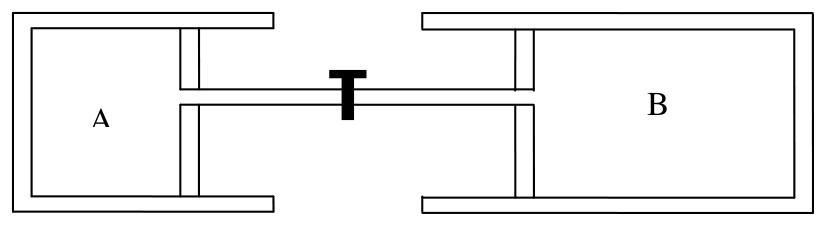
Fig. 2.1
The cylinder A and his piston is adiabatically insulated and the cylinder B is in thermal contact with a thermostat which has the temperature \(\theta = 27^\circ\mathrm{C}\).
Initially the piston of the cylinder A is fixed and inside there is a mass \(m=32\ \mathrm{kg}\) of argon at a pressure higher than the atmospheric pressure. Inside the cylinder B there is a mass of oxygen at the normal atmospheric pressure.
Liberating the piston of the cylinder A, it moves slowly enough (quasi-static) and at equilibrium the volume of the gas is eight times higher, and in the cylinder B de oxygen’s density increased two times. Knowing that the thermostat received the heat \(Q'=747{,}9\cdot10^4\mathrm{J}\), determine:
a) Establish on the base of the kinetic theory of the gases, studying the elastic collisions of the molecules with the piston, that the thermal equation of the process taking place in the cylinder A is \(TV^{2/3}=\text{constant}\).
b) Calculate the parameters \(p\), \(V\), and \(T\) of argon in the initial and final states.
c) Opening the valve which separates the two cylinders, calculate the final pressure of the mixture of the gases.
The kilo-molar mass of argon is \(\mu=40\ \mathrm{kg/kmol}\).
Official English text of the problem.
Problem 3: Dielectric liquid rising between the plates of a charged capacitor
A plane capacitor with rectangular plates is fixed in a vertical position having the lower part in contact with a dielectric liquid (fig. 3.1)
Determine the height, \(h\), of the liquid between the plates and explain the phenomenon.
The capillarity effects are neglected.
It is supposed that the distance between the plates is much smaller than the linear dimensions of the plates.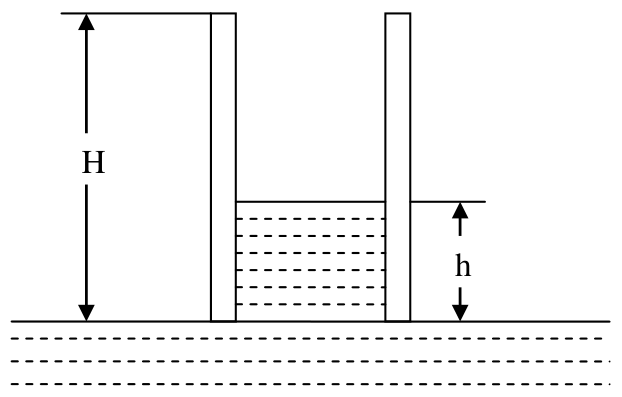
Fig. 3.1
It is known: the initial intensity of the electric field of the charged capacitor, \(E\), the density \(\rho\), the relative electric permittivity \(\varepsilon_r\) of the liquid, and the height \(H\) of the plates of the capacitor.
Discussion.Official English text of the problem.
Problem 4: Plano-convex lens between two media; Billet split lens
A thin lens plane-convex with the diameter \(2r\), the curvature radius \(R\) and the refractive index \(n_o\) is positioned so that on its left side is air (\(n_1=1\)), and on its right side there is a transparent medium with the refractive index \(n_2\ne 1\). The convex face of the lens is directed towards air. In the air, at the distance \(s_1\) from the lens, measured on the principal optic ax, there is a punctual source of monochromatic light.
a) Demonstrate, using Gauss approximation, that between the position of the image, given by the distance \(s_2\) from the lens, and the position of the light source, exists the relation:
\[ \frac{f_1}{s_1}+\frac{f_2}{s_2}=1 \]
where \(f_1\) and \(f_2\) are the focal distances of the lens, in air, respectively in the medium with the refractive index \(n_2\).
Observation: All the refractive indexes are absolute indexes.
b) The lens is cut perpendicular on its plane face in two equal parts. These parts are moved away at a distance \(\delta\ll r\) (Billet lens). On the symmetry axis of the system obtained is led a punctual source of light at the distance \(s_1\) (\(s_1>f_1\)) (fig. 4.1). On the right side of the lens there is a screen E at the distance \(d\). The screen is parallel with the plane face of the lens. On this screen there are \(N\) interference fringes, if on the right side of the lens is air.
Determine \(N\) function of the wave length.
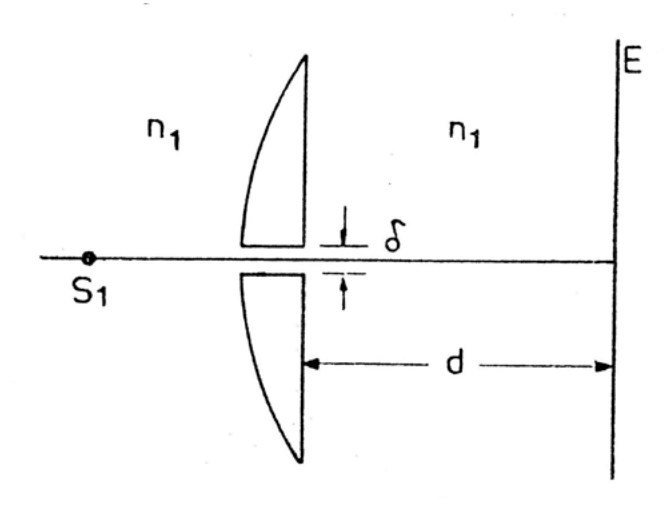
Fig. 4.1
Official English text of the problem.
Internationale Physik-Olympiade
IPhO 1972
Bukarest, Rumänien · 4 Theorieaufgaben mit vollständigen Lösungen
Aufgabe 1: Drei Zylinder auf einer schiefen Ebene
Drei Zylinder mit gleicher Masse, gleicher Länge und gleichem Außenradius ruhen anfangs auf einer schiefen Ebene. Der Gleitreibungskoeffizient auf der schiefen Ebene, \(\mu\), ist bekannt und hat für alle Zylinder denselben Wert. Der erste Zylinder ist hohl (ein Rohr), der zweite ist ein homogener Vollzylinder, und der dritte besitzt einen Hohlraum genau wie der erste, ist jedoch mit zwei Deckeln von vernachlässigbarer Masse verschlossen und mit einer Flüssigkeit gefüllt, deren Dichte gleich der Dichte der Zylinderwände ist. Die Reibung zwischen der Flüssigkeit und der Zylinderwand wird als vernachlässigbar angesehen. Die Dichte des Materials des ersten Zylinders ist \(n\)-mal so groß wie die des zweiten oder des dritten Zylinders.
Bestimmen Sie:
a) Die linearen Beschleunigungen der Zylinder beim Rollen ohne Gleiten. Vergleichen Sie alle Beschleunigungen.
b) Die Bedingung für den Neigungswinkel \(\alpha\) der schiefen Ebene, damit keiner der Zylinder gleitet.
c) Die gegenseitigen Verhältnisse der Winkelbeschleunigungen, wenn alle drei Zylinder unter Gleiten rollen. Vergleichen Sie diese Beschleunigungen.
d) Die Wechselwirkungskraft zwischen der Flüssigkeit und den Zylinderwänden beim Gleiten dieses Zylinders, wenn die Flüssigkeitsmasse \(m_l\) bekannt ist.
Aufgabentext aus dem offiziellen englischen Text übersetzt.
Aufgabe 2: Argon und Sauerstoff in zwei Zylindern mit verbundenen Kolben
In zwei Zylindern A und B mit gleichem Durchmesser befinden sich zwei Kolben von vernachlässigbarer Masse, die durch eine starre Stange miteinander verbunden sind. Die Kolben können sich frei bewegen. Die Stange ist ein kurzes Rohr mit einem Ventil. Das Ventil ist zunächst geschlossen (Abb. 2.1).
Abb. 2.1
Der Zylinder A und sein Kolben sind adiabatisch isoliert, und der Zylinder B steht in thermischem Kontakt mit einem Thermostaten, dessen Temperatur \(\theta = 27^\circ\mathrm{C}\) beträgt.
Anfangs ist der Kolben des Zylinders A fixiert, und im Zylinder befindet sich Argon der Masse \(m=32\ \mathrm{kg}\) unter einem Druck, der höher als der Atmosphärendruck ist. Im Zylinder B befindet sich eine Menge Sauerstoff unter normalem Atmosphärendruck.
Wird der Kolben des Zylinders A freigegeben, bewegt er sich hinreichend langsam (quasistatisch), und im Gleichgewicht ist das Gasvolumen auf das Achtfache gestiegen, während sich im Zylinder B die Dichte des Sauerstoffs verdoppelt hat. Der Thermostat hat dabei die Wärme \(Q'=747{,}9\cdot10^4\mathrm{J}\) aufgenommen. Bestimmen Sie:
a) Zeigen Sie auf der Grundlage der kinetischen Gastheorie durch Untersuchung der elastischen Stöße der Moleküle mit dem Kolben, dass die thermische Prozessgleichung für den im Zylinder A ablaufenden Vorgang \(TV^{2/3}=\text{konstant}\) lautet.
b) Berechnen Sie die Zustandsgrößen \(p\), \(V\) und \(T\) des Argons im Anfangs- und Endzustand.
c) Berechnen Sie den Enddruck des Gasgemisches nach dem Öffnen des Ventils, das die beiden Zylinder voneinander trennt.
Die kilomolare Masse von Argon beträgt \(\mu=40\ \mathrm{kg/kmol}\).
Aufgabentext aus dem offiziellen englischen Text übersetzt.
Aufgabe 3: Aufsteigen einer dielektrischen Flüssigkeit zwischen den Platten eines geladenen Kondensators
Ein Plattenkondensator mit rechteckigen Platten ist senkrecht befestigt, wobei sein unterer Teil mit einer dielektrischen Flüssigkeit in Berührung steht (Abb. 3.1).
Bestimmen Sie die Höhe \(h\) der Flüssigkeit zwischen den Platten und erklären Sie das Phänomen.
Kapillareffekte werden vernachlässigt.
Es wird angenommen, dass der Abstand zwischen den Platten wesentlich kleiner als die linearen Abmessungen der Platten ist.Abb. 3.1
Gegeben sind: die anfängliche elektrische Feldstärke \(E\) des geladenen Kondensators, die Dichte \(\rho\), die relative Permittivität \(\varepsilon_r\) der Flüssigkeit sowie die Höhe \(H\) der Kondensatorplatten.
Diskutieren Sie das Ergebnis.Aufgabentext aus dem offiziellen englischen Text übersetzt.
Aufgabe 4: Plankonvexe Linse zwischen zwei Medien; Billetsche geteilte Linse
Eine dünne plankonvexe Linse mit dem Durchmesser \(2r\), dem Krümmungsradius \(R\) und dem Brechungsindex \(n_o\) ist so angeordnet, dass sich auf ihrer linken Seite Luft (\(n_1=1\)) und auf ihrer rechten Seite ein durchsichtiges Medium mit dem Brechungsindex \(n_2\ne 1\) befindet. Die konvexe Fläche der Linse ist der Luft zugewandt. In der Luft befindet sich im Abstand \(s_1\) von der Linse, gemessen entlang der optischen Hauptachse, eine punktförmige Quelle monochromatischen Lichts.
a) Zeigen Sie mithilfe der gaußschen Näherung, dass zwischen der durch den Abstand \(s_2\) von der Linse angegebenen Bildlage und der Lage der Lichtquelle die folgende Beziehung besteht:
\[ \frac{f_1}{s_1}+\frac{f_2}{s_2}=1 \]
wobei \(f_1\) und \(f_2\) die Brennweiten der Linse in Luft beziehungsweise im Medium mit dem Brechungsindex \(n_2\) sind.
Hinweis: Alle Brechungsindizes sind absolute Brechungsindizes.
b) Die Linse wird senkrecht zu ihrer ebenen Fläche in zwei gleiche Teile geschnitten. Diese Teile werden um einen Abstand \(\delta\ll r\) auseinandergerückt (Billetsche Linse). Auf der Symmetrieachse des so entstandenen Systems wird im Abstand \(s_1\) (\(s_1>f_1\)) eine punktförmige Lichtquelle angebracht (Abb. 4.1). Rechts von der Linse befindet sich im Abstand \(d\) ein Schirm E. Der Schirm ist parallel zur ebenen Fläche der Linse. Auf diesem Schirm erscheinen \(N\) Interferenzstreifen, wenn sich rechts von der Linse Luft befindet.
Bestimmen Sie \(N\) in Abhängigkeit von der Wellenlänge.
Abb. 4.1
Aufgabentext aus dem offiziellen englischen Text übersetzt.
Uluslararası Fizik Olimpiyatı
IPhO 1972
Bükreş, Romanya · 4 teori sorusu, tam çözümleriyle
Soru 1: Eğik düzlem üzerindeki üç silindir
Kütleleri, uzunlukları ve dış yarıçapları aynı olan üç silindir başlangıçta bir eğik düzlem üzerinde durmaktadır. Eğik düzlemdeki kayma sürtünmesi katsayısı \(\mu\) bilinmektedir ve tüm silindirler için aynı değerdedir. Birinci silindirin içi boştur (boru), ikinci silindir homojen ve doludur; üçüncü silindirde ise tıpkı birincideki gibi bir boşluk vardır, ancak bu boşluk kütleleri ihmal edilebilir iki kapakla kapatılmış ve silindirin duvarlarıyla aynı yoğunluğa sahip bir sıvıyla doldurulmuştur. Sıvı ile silindir duvarı arasındaki sürtünme ihmal edilebilir kabul edilmektedir. Birinci silindirin yapıldığı malzemenin yoğunluğu, ikinci veya üçüncü silindirin yapıldığı malzemenin yoğunluğunun \(n\) katıdır.
Aşağıdakileri belirleyiniz:
a) Kayma olmaması durumunda silindirlerin doğrusal ivmeleri. Tüm ivmeleri karşılaştırınız.
b) Hiçbir silindirin kaymaması için eğik düzlemin \(\alpha\) açısının sağlaması gereken koşul.
c) Üç silindirin de kayarak yuvarlanması durumunda açısal ivmelerinin birbirlerine oranları. Bu ivmeleri karşılaştırınız.
d) Sıvı kütlesinin \(m_l\) olduğu bilindiğine göre, sıvı içeren silindirin kayması durumunda sıvı ile silindirin duvarları arasındaki etkileşim kuvveti.
Soru metni resmi İngilizce metinden çevrilmiştir.
Soru 2: Pistonları birbirine bağlı iki silindirde argon ve oksijen
Çapları eşit olan A ve B silindirlerinin içinde, kütleleri ihmal edilebilen ve rijit bir çubukla birbirine bağlanmış iki piston bulunmaktadır. Pistonlar serbestçe hareket edebilmektedir. Çubuk, üzerinde bir vana bulunan kısa bir borudur. Vana başlangıçta kapalıdır (şek. 2.1).
Şek. 2.1
A silindiri ve pistonu adyabatik olarak yalıtılmıştır; B silindiri ise sıcaklığı \(\theta = 27^\circ\mathrm{C}\) olan bir termostatla ısıl temas hâlindedir.
Başlangıçta A silindirinin pistonu sabitlenmiştir ve silindirin içinde atmosfer basıncından daha yüksek bir basınçta, kütlesi \(m=32\ \mathrm{kg}\) olan argon bulunmaktadır. B silindirinin içinde ise normal atmosfer basıncında bir miktar oksijen bulunmaktadır.
A silindirinin pistonu serbest bırakıldığında yeterince yavaş (kuazistatik olarak) hareket eder ve dengeye ulaşıldığında gazın hacmi başlangıçtaki değerinin sekiz katına çıkmış, B silindirindeki oksijenin yoğunluğu ise iki katına çıkmıştır. Termostatın \(Q'=747{,}9\cdot10^4\mathrm{J}\) ısı aldığını bilerek aşağıdakileri belirleyiniz:
a) Moleküllerin pistonla esnek çarpışmalarını inceleyerek, gazların kinetik teorisi temelinde A silindirinde gerçekleşen sürecin ısıl denkleminin \(TV^{2/3}=\text{sabit}\) olduğunu gösteriniz.
b) Argonun başlangıç ve son durumlarındaki \(p\), \(V\) ve \(T\) parametrelerini hesaplayınız.
c) İki silindiri birbirinden ayıran vana açıldığında gaz karışımının son basıncını hesaplayınız.
Argonun kilomolar kütlesi \(\mu=40\ \mathrm{kg/kmol}\) değerindedir.
Soru metni resmi İngilizce metinden çevrilmiştir.
Soru 3: Yüklü bir kondansatörün levhaları arasında yükselen dielektrik sıvı
Dikdörtgen levhalı düzlem bir kondansatör, alt kısmı dielektrik bir sıvıyla temas edecek şekilde düşey konumda sabitlenmiştir (şek. 3.1)
Sıvının levhalar arasındaki yüksekliğini, \(h\), belirleyiniz ve bu olayı açıklayınız.
Kılcallık etkileri ihmal edilmektedir.
Levhalar arasındaki uzaklığın, levhaların doğrusal boyutlarından çok daha küçük olduğu varsayılmaktadır.Şek. 3.1
Bilinenler: yüklü kondansatörün başlangıçtaki elektrik alan şiddeti \(E\), sıvının yoğunluğu \(\rho\) ve bağıl elektriksel geçirgenliği \(\varepsilon_r\) ile kondansatör levhalarının yüksekliği \(H\).
Tartışınız.Soru metni resmi İngilizce metinden çevrilmiştir.
Soru 4: İki ortam arasındaki düzlem-dışbükey mercek; Billet yarık merceği
Çapı \(2r\), eğrilik yarıçapı \(R\) ve kırılma indisi \(n_o\) olan ince bir düzlem-dışbükey mercek, sol tarafında hava (\(n_1=1\)), sağ tarafında ise kırılma indisi \(n_2\ne 1\) olan saydam bir ortam bulunacak şekilde yerleştirilmiştir. Merceğin dışbükey yüzü havaya dönüktür. Havada, asal optik eksen üzerinde ölçüldüğünde mercekten \(s_1\) uzaklıkta, tek renkli ışık yayan noktasal bir kaynak bulunmaktadır.
a) Gauss yaklaşımını kullanarak, mercekten \(s_2\) uzaklığıyla verilen görüntü konumu ile ışık kaynağının konumu arasında şu bağıntının bulunduğunu gösteriniz:
\[ \frac{f_1}{s_1}+\frac{f_2}{s_2}=1 \]
Burada \(f_1\) ve \(f_2\), merceğin sırasıyla havadaki ve kırılma indisi \(n_2\) olan ortamdaki odak uzaklıklarıdır.
Not: Tüm kırılma indisleri mutlak kırılma indisleridir.
b) Mercek, düzlem yüzüne dik olarak iki eşit parçaya kesilir. Bu parçalar, aralarında \(\delta\ll r\) uzaklığı olacak şekilde birbirinden uzaklaştırılır (Billet merceği). Elde edilen sistemin simetri ekseni üzerine, \(s_1\) uzaklıkta (\(s_1>f_1\)) noktasal bir ışık kaynağı yerleştirilir (Şek. 4.1). Merceğin sağ tarafında, \(d\) uzaklıkta bir E ekranı bulunmaktadır. Ekran, merceğin düzlem yüzüne paraleldir. Merceğin sağ tarafında hava bulunması durumunda bu ekranda \(N\) girişim saçağı oluşmaktadır.
\(N\)'yi dalga boyunun fonksiyonu olarak belirleyiniz.
Şek. 4.1
Soru metni resmi İngilizce metinden çevrilmiştir.
Olimpiada Internacional de Física
IPhO 1972
Bucarest, Rumanía · 4 problemas teóricos con soluciones completas
Problema 1: Tres cilindros sobre un plano inclinado
Tres cilindros de la misma masa, la misma longitud y el mismo radio exterior se encuentran inicialmente en reposo sobre un plano inclinado. El coeficiente de rozamiento por deslizamiento sobre el plano inclinado, \(\mu\), es conocido y tiene el mismo valor para todos los cilindros. El primer cilindro está vacío (es un tubo), el segundo es macizo y homogéneo, y el tercero tiene una cavidad exactamente igual a la del primero, pero cerrada con dos tapas de masa despreciable y llena de un líquido de la misma densidad que las paredes del cilindro. El rozamiento entre el líquido y la pared del cilindro se considera despreciable. La densidad del material del primer cilindro es \(n\) veces la del segundo o del tercer cilindro.
Determine:
a) La aceleración lineal de los cilindros en el caso sin deslizamiento. Compare todas las aceleraciones.
b) La condición que debe cumplir el ángulo \(\alpha\) del plano inclinado para que ninguno de los cilindros deslice.
c) Las razones entre las aceleraciones angulares en el caso de rodadura con deslizamiento de los tres cilindros. Compare estas aceleraciones.
d) La fuerza de interacción entre el líquido y las paredes del cilindro en el caso de deslizamiento de este cilindro, sabiendo que la masa del líquido es \(m_l\).
Enunciado traducido del texto oficial en inglés.
Problema 2: Argón y oxígeno en dos cilindros con pistones conectados
Dos cilindros A y B de igual diámetro contienen dos pistones de masa despreciable conectados mediante una varilla rígida. Los pistones pueden moverse libremente. La varilla es un tubo corto provisto de una válvula. Inicialmente, la válvula está cerrada (fig. 2.1).
Fig. 2.1
El cilindro A y su pistón están aislados adiabáticamente, y el cilindro B está en contacto térmico con un termostato cuya temperatura es \(\theta = 27^\circ\mathrm{C}\).
Inicialmente, el pistón del cilindro A está fijo y en su interior hay una masa \(m=32\ \mathrm{kg}\) de argón a una presión superior a la atmosférica. En el interior del cilindro B hay una masa de oxígeno a la presión atmosférica normal.
Al liberar el pistón del cilindro A, este se mueve con suficiente lentitud (de forma cuasiestática) y, en el equilibrio, el volumen del gas es ocho veces el inicial, mientras que en el cilindro B la densidad del oxígeno se ha duplicado. Sabiendo que el termostato ha recibido el calor \(Q'=747{,}9\cdot10^4\mathrm{J}\), determine:
a) Demuestre, a partir de la teoría cinética de los gases y estudiando las colisiones elásticas de las moléculas con el pistón, que la ecuación térmica del proceso que tiene lugar en el cilindro A es \(TV^{2/3}=\text{constante}\).
b) Calcule los parámetros \(p\), \(V\) y \(T\) del argón en los estados inicial y final.
c) Al abrir la válvula que separa los dos cilindros, calcule la presión final de la mezcla de gases.
La masa kilomolar del argón es \(\mu=40\ \mathrm{kg/kmol}\).
Enunciado traducido del texto oficial en inglés.
Problema 3: Ascenso de un líquido dieléctrico entre las placas de un condensador cargado
Un condensador plano con placas rectangulares está fijado en posición vertical, con la parte inferior en contacto con un líquido dieléctrico (fig. 3.1)
Determine la altura, \(h\), del líquido entre las placas y explique el fenómeno.
Se desprecian los efectos de capilaridad.
Se supone que la distancia entre las placas es mucho menor que las dimensiones lineales de las placas.Fig. 3.1
Se conocen: la intensidad inicial del campo eléctrico del condensador cargado, \(E\), la densidad \(\rho\), la permitividad eléctrica relativa \(\varepsilon_r\) del líquido y la altura \(H\) de las placas del condensador.
Discusión.Enunciado traducido del texto oficial en inglés.
Problema 4: Lente planoconvexa entre dos medios; lente dividida de Billet
Una lente delgada planoconvexa de diámetro \(2r\), radio de curvatura \(R\) e índice de refracción \(n_o\) está situada de modo que a su izquierda hay aire (\(n_1=1\)) y a su derecha hay un medio transparente de índice de refracción \(n_2\ne 1\). La cara convexa de la lente está orientada hacia el aire. En el aire, a una distancia \(s_1\) de la lente, medida sobre el eje óptico principal, hay una fuente puntual de luz monocromática.
a) Demuestre, utilizando la aproximación de Gauss, que entre la posición de la imagen, dada por la distancia \(s_2\) a la lente, y la posición de la fuente luminosa existe la relación:
\[ \frac{f_1}{s_1}+\frac{f_2}{s_2}=1 \]
donde \(f_1\) y \(f_2\) son las distancias focales de la lente en el aire y en el medio de índice de refracción \(n_2\), respectivamente.
Observación: Todos los índices de refracción son índices absolutos.
b) La lente se corta perpendicularmente a su cara plana en dos partes iguales. Estas partes se separan una distancia \(\delta\ll r\) (lente de Billet). Sobre el eje de simetría del sistema obtenido se coloca una fuente puntual de luz a la distancia \(s_1\) (\(s_1>f_1\)) (fig. 4.1). A la derecha de la lente hay una pantalla E a la distancia \(d\). La pantalla es paralela a la cara plana de la lente. En esta pantalla hay \(N\) franjas de interferencia si a la derecha de la lente hay aire.
Determine \(N\) en función de la longitud de onda.
Fig. 4.1
Enunciado traducido del texto oficial en inglés.
国际物理奥林匹克
IPhO 1972
罗马尼亚布加勒斯特 · 4 道理论题及完整解答
题目 1:斜面上的三个圆柱体
三个质量相同、长度相同、外半径相同的圆柱体最初静止在一个斜面上。已知圆柱体与斜面之间的滑动摩擦系数为 \(\mu\),且三个圆柱体的滑动摩擦系数相同。第一个圆柱体是空心的(圆管),第二个是均匀实心的,第三个具有与第一个完全相同的空腔,但两端用质量可忽略的端盖封闭,内部充满密度与筒壁材料相同的液体。液体与筒壁之间的摩擦可忽略。第一个圆柱体的材料密度是第二个或第三个圆柱体材料密度的 \(n\) 倍。
求:
a) 各圆柱体在无滑动情况下的线加速度。比较各加速度的大小。
b) 使所有圆柱体均不发生滑动时,斜面倾角 \(\alpha\) 应满足的条件。
c) 三个圆柱体均发生滑动滚动时,角加速度的相互比值。比较这些角加速度的大小。
d) 已知液体质量为 \(m_l\),求装有液体的圆柱体发生滑动时,液体与筒壁之间的相互作用力。
题目译自官方英文原文。
题目 2:活塞相连的两个气缸中的氩气和氧气
两个直径相同的气缸 A 和 B 内各有一个质量可忽略的活塞,两活塞由一根刚性连杆连接。活塞可以自由移动。连杆是一根装有阀门的短管。阀门最初关闭(图 2.1)。
图 2.1
气缸 A 及其活塞均绝热,气缸 B 则与温度为 \(\theta = 27^\circ\mathrm{C}\) 的恒温器保持热接触。
最初,气缸 A 的活塞被固定,其中装有质量为 \(m=32\ \mathrm{kg}\) 的氩气,其压强高于大气压。气缸 B 内装有一定质量的氧气,压强为标准大气压。
解除对气缸 A 活塞的固定后,活塞以足够缓慢的速度运动(准静态过程)。达到平衡时,氩气的体积变为原来的八倍,而气缸 B 中氧气的密度变为原来的两倍。已知恒温器吸收的热量为 \(Q'=747{,}9\cdot10^4\mathrm{J}\),求:
a) 根据气体分子运动论,通过研究分子与活塞的弹性碰撞,证明气缸 A 中所发生过程的温度与体积的关系为 \(TV^{2/3}=\text{常量}\)。
b) 计算氩气初态和末态的参数 \(p\)、\(V\) 和 \(T\)。
c) 打开分隔两个气缸的阀门,计算混合气体的最终压强。
氩气的千摩尔质量为 \(\mu=40\ \mathrm{kg/kmol}\)。
题目译自官方英文原文。
题目 3:带电电容器极板间的电介质液体上升
一个具有矩形极板的平行板电容器竖直固定,其下部与一种电介质液体接触(图 3.1)。
求极板间液体上升的高度 \(h\),并解释这一现象。
忽略毛细现象的影响。
假设极板间距远小于极板的线度。图 3.1
已知:带电电容器的初始电场强度 \(E\)、液体的密度 \(\rho\) 和相对介电常数 \(\varepsilon_r\),以及电容器极板的高度 \(H\)。
进行讨论。题目译自官方英文原文。
题目 4:两种介质之间的平凸透镜;比累对切透镜
一块直径为 \(2r\)、曲率半径为 \(R\)、折射率为 \(n_o\) 的平凸薄透镜,其左侧为空气(\(n_1=1\)),右侧为折射率 \(n_2\ne 1\) 的透明介质。透镜的凸面朝向空气。在空气中,沿主光轴距透镜 \(s_1\) 处有一个单色点光源。
a) 利用高斯近似证明:由距透镜的距离 \(s_2\) 表示的像的位置与光源的位置之间存在如下关系:
\[ \frac{f_1}{s_1}+\frac{f_2}{s_2}=1 \]
其中,\(f_1\) 和 \(f_2\) 分别为透镜在空气中和在折射率为 \(n_2\) 的介质中的焦距。
注意:所有折射率均为绝对折射率。
b) 沿垂直于透镜平面的方向将透镜切成相等的两半。将这两半移开,使其间距为 \(\delta\ll r\)(比累对切透镜)。在所得系统的对称轴上,距透镜 \(s_1\)(\(s_1>f_1\))处放置一个点光源(图 4.1)。透镜右侧距透镜 \(d\) 处有一个屏 E。屏与透镜的平面平行。如果透镜右侧为空气,屏上会出现 \(N\) 条干涉条纹。
求 \(N\) 随波长变化的函数关系。
图 4.1
题目译自官方英文原文。
Международная физическая олимпиада
IPhO 1972
Бухарест, Румыния · 4 теоретические задачи с полными решениями
Задача 1: Три цилиндра на наклонной плоскости
Три цилиндра одинаковой массы, одинаковой длины и одинакового внешнего радиуса первоначально покоятся на наклонной плоскости. Коэффициент трения скольжения о наклонную плоскость \(\mu\) известен и одинаков для всех цилиндров. Первый цилиндр полый (труба), второй — сплошной однородный, а третий имеет такую же полость, как первый, но закрыт двумя крышками пренебрежимо малой массы и заполнен жидкостью, плотность которой равна плотности материала стенок цилиндра. Трение между жидкостью и стенкой цилиндра считается пренебрежимо малым. Плотность материала первого цилиндра в \(n\) раз больше плотности материала второго или третьего цилиндра.
Определите:
a) Линейные ускорения цилиндров при отсутствии проскальзывания. Сравните все ускорения.
b) Условие для угла \(\alpha\) наклона плоскости, при котором ни один из цилиндров не проскальзывает.
c) Взаимные отношения угловых ускорений при качении с проскальзыванием всех трёх цилиндров. Сравните эти ускорения.
d) Силу взаимодействия между жидкостью и стенками цилиндра при его скольжении, если масса жидкости равна \(m_l\).
Условие переведено с официального английского текста.
Задача 2: Аргон и кислород в двух цилиндрах с соединёнными поршнями
В двух цилиндрах A и B одинакового диаметра находятся два поршня пренебрежимо малой массы, соединённые жёстким стержнем. Поршни могут свободно перемещаться. Стержень представляет собой короткую трубку с клапаном. Вначале клапан закрыт (рис. 2.1).
Рис. 2.1
Цилиндр A и его поршень адиабатически изолированы, а цилиндр B находится в тепловом контакте с термостатом, температура которого равна \(\theta = 27^\circ\mathrm{C}\).
Вначале поршень цилиндра A закреплён, а внутри цилиндра находится аргон массой \(m=32\ \mathrm{kg}\) под давлением, превышающим атмосферное. В цилиндре B находится некоторое количество кислорода при нормальном атмосферном давлении.
После освобождения поршня цилиндра A он движется достаточно медленно (квазистатически), и при установлении равновесия объём газа в этом цилиндре увеличивается в восемь раз, а плотность кислорода в цилиндре B увеличивается в два раза. Зная, что термостат получил количество теплоты \(Q'=747{,}9\cdot10^4\mathrm{J}\), выполните следующие задания:
a) На основе кинетической теории газов, рассматривая упругие столкновения молекул с поршнем, установите, что термическое уравнение процесса, происходящего в цилиндре A, имеет вид \(TV^{2/3}=\text{постоянная}\).
b) Вычислите параметры \(p\), \(V\) и \(T\) аргона в начальном и конечном состояниях.
c) После открытия клапана, разделяющего два цилиндра, вычислите конечное давление смеси газов.
Киломолярная масса аргона равна \(\mu=40\ \mathrm{kg/kmol}\).
Условие переведено с официального английского текста.
Задача 3: Подъём диэлектрической жидкости между обкладками заряженного конденсатора
Плоский конденсатор с прямоугольными обкладками закреплён вертикально так, что его нижняя часть соприкасается с диэлектрической жидкостью (рис. 3.1).
Определите высоту \(h\) подъёма жидкости между обкладками и объясните это явление.
Капиллярными эффектами пренебречь.
Предполагается, что расстояние между обкладками намного меньше их линейных размеров.Рис. 3.1
Известны: начальная напряжённость электрического поля заряженного конденсатора \(E\), плотность \(\rho\) и относительная диэлектрическая проницаемость \(\varepsilon_r\) жидкости, а также высота \(H\) обкладок конденсатора.
Проведите обсуждение результата.Условие переведено с официального английского текста.
Задача 4: Плосковыпуклая линза между двумя средами; разрезная линза Бийе
Тонкая плосковыпуклая линза диаметром \(2r\), с радиусом кривизны \(R\) и показателем преломления \(n_o\) расположена так, что слева от неё находится воздух (\(n_1=1\)), а справа — прозрачная среда с показателем преломления \(n_2\ne 1\). Выпуклая поверхность линзы обращена к воздуху. В воздухе на главной оптической оси на расстоянии \(s_1\) от линзы находится точечный источник монохроматического света.
a) Покажите в приближении Гаусса, что положение изображения, задаваемое расстоянием \(s_2\) от линзы, и положение источника света связаны соотношением:
\[ \frac{f_1}{s_1}+\frac{f_2}{s_2}=1 \]
где \(f_1\) и \(f_2\) — фокусные расстояния линзы в воздухе и в среде с показателем преломления \(n_2\) соответственно.
Примечание: все показатели преломления являются абсолютными.
b) Линзу разрезают на две равные части плоскостью, перпендикулярной её плоской поверхности. Эти части раздвигают на расстояние \(\delta\ll r\) (линза Бийе). На оси симметрии полученной системы на расстоянии \(s_1\) (\(s_1>f_1\)) помещают точечный источник света (рис. 4.1). Справа от линзы на расстоянии \(d\) находится экран E. Экран параллелен плоской поверхности линзы. Если справа от линзы находится воздух, на этом экране наблюдается \(N\) интерференционных полос.
Определите \(N\) в зависимости от длины волны.
Рис. 4.1
Условие переведено с официального английского текста.
الأولمبياد الدولي للفيزياء
IPhO 1972
بوخارست، رومانيا · 4 مسائل نظرية مع حلول كاملة
المسألة 1: ثلاث أسطوانات على مستوى مائل
تستقر في البداية على مستوى مائل ثلاث أسطوانات لها الكتلة نفسها والطول نفسه ونصف القطر الخارجي نفسه. معامل الاحتكاك الانزلاقي على المستوى المائل، \(\mu\)، معلوم وله القيمة نفسها للأسطوانات جميعها. الأسطوانة الأولى فارغة (أنبوب)، والثانية مصمتة ومتجانسة، والثالثة ذات تجويف مماثل تمامًا لتجويف الأولى، لكنه مغلق بغطاءين كتلتهما مهملة ومملوء بسائل كثافته مساوية لكثافة جدران الأسطوانة. يُعدّ الاحتكاك بين السائل وجدار الأسطوانة مهملًا. كثافة مادة الأسطوانة الأولى تساوي \(n\) أمثال كثافة مادة الأسطوانة الثانية أو الثالثة.
أوجد:
a) التسارع الخطي للأسطوانات في حالة عدم الانزلاق. قارن بين التسارعات جميعها.
b) الشرط على زاوية ميل المستوى \(\alpha\) لكي لا تنزلق أيّ من الأسطوانات.
c) النسب المتبادلة بين التسارعات الزاوية في حالة تدحرج الأسطوانات الثلاث جميعها مع الانزلاق. قارن بين هذه التسارعات.
d) قوة التفاعل بين السائل وجدران الأسطوانة في حالة انزلاق هذه الأسطوانة، علمًا بأن كتلة السائل هي \(m_l\).
نص المسألة مترجم عن النص الإنجليزي الرسمي.
المسألة 2: الأرجون والأكسجين في أسطوانتين ذواتي مكبسين متصلين
تحتوي أسطوانتان A وB متساويتان في القطر على مكبسين كتلتهما مهملة، يصل بينهما قضيب صلب. ويمكن للمكبسين التحرك بحرية. والقضيب أنبوب قصير مزوّد بصمام. يكون الصمام مغلقًا في البداية (الشكل 2.1).
الشكل 2.1
الأسطوانة A ومكبسها معزولان حراريًا، أما الأسطوانة B فهي على تماس حراري مع منظّم حرارة درجة حرارته \(\theta = 27^\circ\mathrm{C}\).
في البداية، يكون مكبس الأسطوانة A مثبّتًا، وتحتوي الأسطوانة على كتلة \(m=32\ \mathrm{kg}\) من الأرجون عند ضغط أعلى من الضغط الجوي. وتحتوي الأسطوانة B على كتلة من الأكسجين عند الضغط الجوي النظامي.
عند تحرير مكبس الأسطوانة A، يتحرك ببطء كافٍ لتكون العملية شبه ساكنة، وعند الاتزان يصبح حجم الغاز ثمانية أمثال حجمه الابتدائي، وتتضاعف كثافة الأكسجين في الأسطوانة B. علمًا بأن منظّم الحرارة قد تلقّى كمية الحرارة \(Q'=747{,}9\cdot10^4\mathrm{J}\)، حدّد ما يأتي:
a) أثبت، بالاستناد إلى النظرية الحركية للغازات ودراسة التصادمات المرنة للجزيئات مع المكبس، أن المعادلة الحرارية للعملية التي تجري في الأسطوانة A هي \(TV^{2/3}=\text{ثابت}\).
b) احسب متغيرات حالة الأرجون \(p\) و\(V\) و\(T\) في الحالتين الابتدائية والنهائية.
c) عند فتح الصمام الذي يفصل بين الأسطوانتين، احسب الضغط النهائي لمزيج الغازين.
الكتلة الكيلومولية للأرجون هي \(\mu=40\ \mathrm{kg/kmol}\).
نص المسألة مترجم عن النص الإنجليزي الرسمي.
المسألة 3: ارتفاع سائل عازل بين لوحي مكثف مشحون
ثُبِّت مكثف مستوٍ ذو لوحين مستطيلين في وضع رأسي، بحيث يلامس جزؤه السفلي سائلًا عازلًا (الشكل 3.1).
حدِّد ارتفاع السائل بين اللوحين، \(h\)، وفسِّر الظاهرة.
تُهمَل تأثيرات الخاصية الشعرية.
يُفترَض أن المسافة بين اللوحين أصغر بكثير من الأبعاد الخطية للوحين.الشكل 3.1
المعطيات هي: شدة المجال الكهربائي الابتدائية للمكثف المشحون، \(E\)، وكثافة السائل \(\rho\)، وسماحيته الكهربائية النسبية \(\varepsilon_r\)، وارتفاع لوحي المكثف \(H\).
ناقش النتيجة.نص المسألة مترجم عن النص الإنجليزي الرسمي.
المسألة 4: عدسة مستوية محدبة بين وسطين؛ عدسة بيليه المشطورة
تُوضَع عدسة رقيقة مستوية محدبة، قطرها \(2r\)، ونصف قطر تكورها \(R\)، ومعامل انكسارها \(n_o\)، بحيث يوجد الهواء على يسارها (\(n_1=1\))، ويوجد على يمينها وسط شفاف معامل انكساره \(n_2\ne 1\). يتجه الوجه المحدب للعدسة نحو الهواء. ويوجد في الهواء مصدر نقطي لضوء أحادي اللون، على بُعد \(s_1\) من العدسة، مقيسًا على المحور البصري الرئيسي.
a) أثبت، باستخدام تقريب غاوس، أن موضع الصورة، المحدد ببُعدها \(s_2\) عن العدسة، وموضع المصدر الضوئي يرتبطان بالعلاقة:
\[ \frac{f_1}{s_1}+\frac{f_2}{s_2}=1 \]
حيث \(f_1\) و\(f_2\) هما البُعدان البؤريان للعدسة في الهواء وفي الوسط ذي معامل الانكسار \(n_2\)، على الترتيب.
ملاحظة: جميع معاملات الانكسار هي معاملات انكسار مطلقة.
b) تُقطع العدسة إلى جزأين متساويين بمستوى عمودي على وجهها المستوي. ويُباعَد بين الجزأين بمسافة \(\delta\ll r\) (عدسة بيليه). ويوضع مصدر ضوئي نقطي على محور تناظر المنظومة الناتجة، على بُعد \(s_1\) (\(s_1>f_1\)) (الشكل 4.1). وتوجد على يمين العدسة شاشة E على بُعد \(d\). والشاشة موازية للوجه المستوي للعدسة. تظهر على هذه الشاشة \(N\) من أهداب التداخل إذا كان الوسط على يمين العدسة هو الهواء.
حدّد \(N\) بدلالة الطول الموجي.
الشكل 4.1
نص المسألة مترجم عن النص الإنجليزي الرسمي.