IPhO 1972 · Theory problem 3
Dielectric liquid rising between the plates of a charged capacitor
A plane capacitor with rectangular plates is fixed in a vertical position having the lower part in contact with a dielectric liquid (fig. 3.1)
Determine the height, \(h\), of the liquid between the plates and explain the phenomenon.
The capillarity effects are neglected.
It is supposed that the distance between the plates is much smaller than the linear dimensions of the plates.
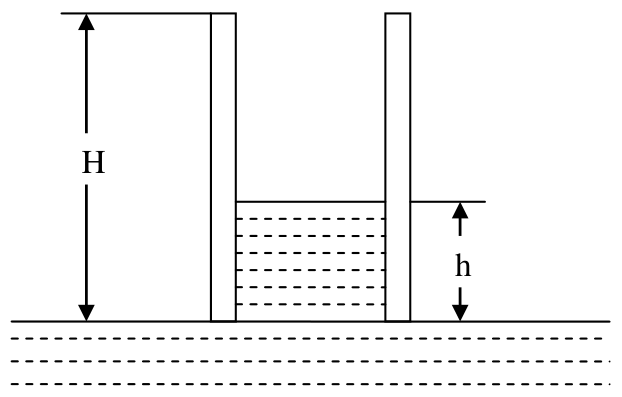
Fig. 3.1
It is known: the initial intensity of the electric field of the charged capacitor, \(E\), the density \(\rho\), the relative electric permittivity \(\varepsilon_r\) of the liquid, and the height \(H\) of the plates of the capacitor.
Discussion.
Official English text of the problem.
Answers
-
Problem 3 — Height: Assuming that the charged capacitor is isolated, put \(a=\varepsilon_r-1>0\). Let \(h_*\) be the unique nonnegative solution of \[ \boxed{h_*\left(1+a\frac{h_*}{H}\right)^2 =\frac{\varepsilon_0aE^2}{2\rho g}.} \] The equilibrium height is \(h=h_*\) when \(h_*<H\). The liquid fills the gap to the top, \(h=H\) in the ideal approximation, when \[ \boxed{E\ge E_c =\varepsilon_r\sqrt{\frac{2\rho gH}{\varepsilon_0(\varepsilon_r-1)}}.} \]
-
Problem 3 — Explanation and discussion: Polarization produces an upward electric force. At a partial-rise equilibrium, its pressure balances the hydrostatic pressure: \[ \boxed{\rho gh=\frac12\varepsilon_0(\varepsilon_r-1) \left[\frac{E}{1+(\varepsilon_r-1)h/H}\right]^2.} \] This equilibrium is unique and stable. There is no rise if \(E=0\) or \(\varepsilon_r=1\).
-
Problem 3 — Fixed-voltage alternative: If a source maintains the initial voltage instead, the result is \[ \boxed{h=\min\!\left\{H,\frac{\varepsilon_0(\varepsilon_r-1)E^2}{2\rho g}\right\}.} \]
Solution
Problem 3. The reference to the initial field, together with the absence of a specified voltage source, suggests an isolated capacitor, whose free charge remains constant. We first solve this case.
Let the plate width be \(b\), their separation be \(d\), and the external liquid surface be at \(z=0\). We treat the reservoir as sufficiently large that this level remains fixed. The liquid is a linear, homogeneous, incompressible dielectric; air has permittivity \(\varepsilon_0\). Fringing corrections to capacitance are neglected because \(d\) is much smaller than the plate dimensions.
Capacitance and field during the rise. When the liquid has risen to height \(h<H\), the liquid-filled and air-filled portions form two capacitors in parallel. Thus \[ C(h)=\frac{\varepsilon_0b(H-h)}{d} +\frac{\varepsilon_0\varepsilon_rbh}{d} =C_0\left(1+a\frac hH\right), \] where \[ C_0=\frac{\varepsilon_0bH}{d}, \qquad a=\varepsilon_r-1. \]
Initially \(V_0=Ed\), so the conserved charge is \[ Q=C_0Ed. \] Consequently, the field after the rise is \[ \mathcal E(h)=\frac{Q}{C(h)d} =\boxed{\frac{E}{1+ah/H}}. \] The field therefore decreases as liquid enters the isolated capacitor.
Equilibrium height. At fixed charge, the electric energy is \[ U_{\mathrm e}(h)=\frac{Q^2}{2C(h)} =\frac{\varepsilon_0bdHE^2}{2(1+ah/H)}. \]
The gravitational energy required to raise liquid from the reservoir into the gap is \[ U_{\mathrm g}(h) =\int_0^h \rho bd\,g z\,dz =\frac12\rho bdg h^2. \]
A static equilibrium minimizes the total energy. Hence \[ 0=\frac{d}{dh}(U_{\mathrm e}+U_{\mathrm g}) =bd\left[ \rho gh-\frac{\varepsilon_0aE^2}{2(1+ah/H)^2} \right]. \] Therefore \[ \boxed{\rho gh =\frac{\varepsilon_0aE^2}{2(1+ah/H)^2}}, \] or, equivalently, \[ \boxed{ h\left(1+a\frac hH\right)^2 =\frac{\varepsilon_0aE^2}{2\rho g}. } \]
This cubic equation determines the equilibrium height from the supplied quantities. Both \(b\) and \(d\) cancel, explaining why their values are unnecessary.
Physical explanation. Inserting dielectric increases the capacitance and lowers the electric energy at fixed charge. The corresponding upward force is \[ F_{\mathrm e} =-\left.\frac{dU_{\mathrm e}}{dh}\right|_Q =\frac12\varepsilon_0a\,bd\,\mathcal E(h)^2. \] Its electric pressure is therefore \[ p_{\mathrm e}=\frac{F_{\mathrm e}}{bd} =\frac12\varepsilon_0a\mathcal E(h)^2. \] The liquid rises until this pressure balances the hydrostatic pressure \(\rho gh\) associated with the elevated column.
Equating the initial and final total energies would generally describe a possible turning point during motion, rather than the static equilibrium. The equilibrium condition is the vanishing energy derivative used above.
Discussion.
For \(a>0\), define \[ f(h)=h\left(1+a\frac hH\right)^2. \] On \(h\ge0\), \[ f'(h)=\left(1+a\frac hH\right) \left(1+3a\frac hH\right)>0. \] Thus there is exactly one nonnegative solution. It is stable: increasing \(h\) increases the downward gravitational force while decreasing the upward electric force. Explicitly, \[ \frac{d^2(U_{\mathrm e}+U_{\mathrm g})}{dh^2} =bd\left[ \rho g+\frac{\varepsilon_0a^2E^2} {H(1+ah/H)^3} \right]>0. \]
The derivation applies to a surface lying between the plate ends. Substituting \(h=H\) into the equilibrium equation gives \[ H\varepsilon_r^2 =\frac{\varepsilon_0(\varepsilon_r-1)E_c^2}{2\rho g}, \] which yields the threshold \(E_c\) stated above. If \(E>E_c\), there is no partial-rise equilibrium below the top: the gap becomes completely filled. The detailed surface shape near or above the upper edges requires fringing fields, which the parallel-plate approximation does not determine.
When the capacitance changes only slightly, \[ a\frac hH\ll1, \] the field remains approximately equal to its initial value, and \[ \boxed{h\simeq\frac{\varepsilon_0(\varepsilon_r-1)E^2}{2\rho g}.} \] In particular, the rise tends to zero as \(E\to0\) or \(\varepsilon_r\to1\).
For an isolated capacitor, increasing the permittivity does not always increase the rise, because it also reduces the field. At fixed \(E,H\), the large-permittivity limit is \[ h\simeq \left(\frac{\varepsilon_0E^2H^2} {2\rho g(\varepsilon_r-1)}\right)^{1/3} \longrightarrow0. \] More quantitatively, put \[ B=\frac{\varepsilon_0E^2}{2\rho gH}, \qquad x=a\frac hH. \] The equilibrium equation gives \[ \frac hH=\sqrt B\,\frac{\sqrt x}{1+x} \le\frac{\sqrt B}{2}. \] Before imposing the geometrical limit \(h\le H\), the maximum over permittivity is therefore \[ h_{\max}=E\sqrt{\frac{\varepsilon_0H}{8\rho g}}, \] attained when \(x=1\), or \(a=2/\sqrt B\). If this maximum exceeds \(H\), complete filling is possible for a range of permittivities.
Finally, if a voltage source remains connected, \(V=Ed\) and \(\mathcal E=E\) stay constant. Accounting for the source, the effective electric potential energy is \(-CV^2/2\). Equilibrium then gives \[ \rho gh=\frac12\varepsilon_0(\varepsilon_r-1)E^2, \] leading to the fixed-voltage result in the Answers.
The solution was checked against the official solution. Where this solution differs from the official solution, the official solution contains an error or a misprint.
IPhO 1972 · Theorieaufgabe 3
Aufsteigen einer dielektrischen Flüssigkeit zwischen den Platten eines geladenen Kondensators
Ein Plattenkondensator mit rechteckigen Platten ist senkrecht befestigt, wobei sein unterer Teil mit einer dielektrischen Flüssigkeit in Berührung steht (Abb. 3.1).
Bestimmen Sie die Höhe \(h\) der Flüssigkeit zwischen den Platten und erklären Sie das Phänomen.
Kapillareffekte werden vernachlässigt.
Es wird angenommen, dass der Abstand zwischen den Platten wesentlich kleiner als die linearen Abmessungen der Platten ist.
Abb. 3.1
Gegeben sind: die anfängliche elektrische Feldstärke \(E\) des geladenen Kondensators, die Dichte \(\rho\), die relative Permittivität \(\varepsilon_r\) der Flüssigkeit sowie die Höhe \(H\) der Kondensatorplatten.
Diskutieren Sie das Ergebnis.
Aufgabentext aus dem offiziellen englischen Text übersetzt.
Antworten
-
Aufgabe 3 — Höhe: Unter der Annahme, dass der geladene Kondensator isoliert ist, setzen wir \(a=\varepsilon_r-1>0\). Sei \(h_*\) die eindeutige nichtnegative Lösung von \[ \boxed{h_*\left(1+a\frac{h_*}{H}\right)^2 =\frac{\varepsilon_0aE^2}{2\rho g}.} \] Die Gleichgewichtshöhe ist \(h=h_*\), wenn \(h_*<H\). Die Flüssigkeit füllt den Spalt bis zum oberen Rand, in der idealisierten Näherung also \(h=H\), wenn \[ \boxed{E\ge E_c =\varepsilon_r\sqrt{\frac{2\rho gH}{\varepsilon_0(\varepsilon_r-1)}}.} \]
-
Aufgabe 3 — Erklärung und Diskussion: Die Polarisation erzeugt eine nach oben gerichtete elektrische Kraft. Im Gleichgewicht bei teilweiser Füllung gleicht der zugehörige Druck den hydrostatischen Druck aus: \[ \boxed{\rho gh=\frac12\varepsilon_0(\varepsilon_r-1) \left[\frac{E}{1+(\varepsilon_r-1)h/H}\right]^2.} \] Dieses Gleichgewicht ist eindeutig und stabil. Für \(E=0\) oder \(\varepsilon_r=1\) steigt die Flüssigkeit nicht an.
-
Aufgabe 3 — Alternative bei konstanter Spannung: Hält stattdessen eine Spannungsquelle die anfängliche Spannung aufrecht, lautet das Ergebnis \[ \boxed{h=\min\!\left\{H,\frac{\varepsilon_0(\varepsilon_r-1)E^2}{2\rho g}\right\}.} \]
Lösung
Aufgabe 3. Der Verweis auf die anfängliche Feldstärke legt zusammen mit dem Fehlen einer angegebenen Spannungsquelle einen isolierten Kondensator nahe, dessen freie Ladung konstant bleibt. Wir lösen zunächst diesen Fall.
Die Plattenbreite sei \(b\), der Plattenabstand \(d\), und die Flüssigkeitsoberfläche außerhalb des Kondensators liege bei \(z=0\). Wir betrachten das Reservoir als hinreichend groß, sodass dieser Flüssigkeitsspiegel unverändert bleibt. Die Flüssigkeit ist ein lineares, homogenes, inkompressibles Dielektrikum; Luft hat die Permittivität \(\varepsilon_0\). Randfeldkorrekturen der Kapazität werden vernachlässigt, da \(d\) wesentlich kleiner als die Plattenabmessungen ist.
Kapazität und Feld während des Aufsteigens. Wenn die Flüssigkeit bis zur Höhe \(h<H\) angestiegen ist, bilden der mit Flüssigkeit und der mit Luft gefüllte Bereich zwei parallel geschaltete Kondensatoren. Somit gilt \[ C(h)=\frac{\varepsilon_0b(H-h)}{d} +\frac{\varepsilon_0\varepsilon_rbh}{d} =C_0\left(1+a\frac hH\right), \] wobei \[ C_0=\frac{\varepsilon_0bH}{d}, \qquad a=\varepsilon_r-1. \]
Anfangs gilt \(V_0=Ed\), sodass für die erhaltene Ladung gilt: \[ Q=C_0Ed. \] Folglich ist die Feldstärke nach dem Aufsteigen \[ \mathcal E(h)=\frac{Q}{C(h)d} =\boxed{\frac{E}{1+ah/H}}. \] Die Feldstärke nimmt daher ab, wenn Flüssigkeit in den isolierten Kondensator eindringt.
Gleichgewichtshöhe. Bei konstanter Ladung beträgt die elektrische Energie \[ U_{\mathrm e}(h)=\frac{Q^2}{2C(h)} =\frac{\varepsilon_0bdHE^2}{2(1+ah/H)}. \]
Die zum Anheben der Flüssigkeit aus dem Reservoir in den Spalt erforderliche potenzielle Energie im Schwerefeld ist \[ U_{\mathrm g}(h) =\int_0^h \rho bd\,g z\,dz =\frac12\rho bdg h^2. \]
Ein statisches Gleichgewicht minimiert die Gesamtenergie. Daher gilt \[ 0=\frac{d}{dh}(U_{\mathrm e}+U_{\mathrm g}) =bd\left[ \rho gh-\frac{\varepsilon_0aE^2}{2(1+ah/H)^2} \right]. \] Somit folgt \[ \boxed{\rho gh =\frac{\varepsilon_0aE^2}{2(1+ah/H)^2}}, \] oder gleichwertig \[ \boxed{ h\left(1+a\frac hH\right)^2 =\frac{\varepsilon_0aE^2}{2\rho g}. } \]
Diese kubische Gleichung bestimmt die Gleichgewichtshöhe aus den gegebenen Größen. Sowohl \(b\) als auch \(d\) kürzen sich heraus, was erklärt, weshalb ihre Werte nicht benötigt werden.
Physikalische Erklärung. Das Einbringen eines Dielektrikums erhöht die Kapazität und verringert bei konstanter Ladung die elektrische Energie. Die entsprechende nach oben gerichtete Kraft ist \[ F_{\mathrm e} =-\left.\frac{dU_{\mathrm e}}{dh}\right|_Q =\frac12\varepsilon_0a\,bd\,\mathcal E(h)^2. \] Der zugehörige elektrische Druck beträgt daher \[ p_{\mathrm e}=\frac{F_{\mathrm e}}{bd} =\frac12\varepsilon_0a\mathcal E(h)^2. \] Die Flüssigkeit steigt so lange an, bis dieser Druck den hydrostatischen Druck \(\rho gh\) der angehobenen Flüssigkeitssäule ausgleicht.
Das Gleichsetzen der anfänglichen und der abschließenden Gesamtenergie würde im Allgemeinen einen möglichen Umkehrpunkt während der Bewegung beschreiben, nicht das statische Gleichgewicht. Die Gleichgewichtsbedingung ist das oben verwendete Verschwinden der Energieableitung.
Diskussion.
Für \(a>0\) definieren wir \[ f(h)=h\left(1+a\frac hH\right)^2. \] Für \(h\ge0\) gilt \[ f'(h)=\left(1+a\frac hH\right) \left(1+3a\frac hH\right)>0. \] Somit gibt es genau eine nichtnegative Lösung. Sie ist stabil: Eine Zunahme von \(h\) erhöht die nach unten gerichtete Schwerkraft und verringert zugleich die nach oben gerichtete elektrische Kraft. Explizit gilt \[ \frac{d^2(U_{\mathrm e}+U_{\mathrm g})}{dh^2} =bd\left[ \rho g+\frac{\varepsilon_0a^2E^2} {H(1+ah/H)^3} \right]>0. \]
Die Herleitung gilt für eine Oberfläche, die zwischen den unteren und oberen Plattenrändern liegt. Setzt man \(h=H\) in die Gleichgewichtsbedingung ein, erhält man \[ H\varepsilon_r^2 =\frac{\varepsilon_0(\varepsilon_r-1)E_c^2}{2\rho g}, \] woraus sich der oben angegebene Schwellenwert \(E_c\) ergibt. Für \(E>E_c\) gibt es kein Gleichgewicht bei teilweiser Füllung unterhalb des oberen Randes: Der Spalt wird vollständig gefüllt. Zur Bestimmung der genauen Form der Oberfläche nahe den oberen Kanten oder oberhalb davon müssen Randfelder berücksichtigt werden, die durch die Näherung paralleler Platten nicht bestimmt werden.
Wenn sich die Kapazität nur geringfügig ändert, \[ a\frac hH\ll1, \] bleibt die Feldstärke näherungsweise gleich ihrem Anfangswert, und es gilt \[ \boxed{h\simeq\frac{\varepsilon_0(\varepsilon_r-1)E^2}{2\rho g}.} \] Insbesondere geht die Steighöhe für \(E\to0\) oder \(\varepsilon_r\to1\) gegen null.
Bei einem isolierten Kondensator führt eine Erhöhung der Permittivität nicht immer zu einer größeren Steighöhe, da sie zugleich die Feldstärke verringert. Bei festem \(E,H\) gilt im Grenzfall großer Permittivität \[ h\simeq \left(\frac{\varepsilon_0E^2H^2} {2\rho g(\varepsilon_r-1)}\right)^{1/3} \longrightarrow0. \] Für eine genauere quantitative Betrachtung setzen wir \[ B=\frac{\varepsilon_0E^2}{2\rho gH}, \qquad x=a\frac hH. \] Aus der Gleichgewichtsbedingung folgt \[ \frac hH=\sqrt B\,\frac{\sqrt x}{1+x} \le\frac{\sqrt B}{2}. \] Bevor die geometrische Beschränkung \(h\le H\) berücksichtigt wird, beträgt das Maximum bezüglich der Permittivität daher \[ h_{\max}=E\sqrt{\frac{\varepsilon_0H}{8\rho g}}, \] und wird bei \(x=1\), also \(a=2/\sqrt B\), erreicht. Übersteigt dieses Maximum \(H\), ist für einen Bereich von Permittivitäten eine vollständige Füllung möglich.
Bleibt schließlich eine Spannungsquelle angeschlossen, so bleiben \(V=Ed\) und \(\mathcal E=E\) konstant. Unter Berücksichtigung der Quelle beträgt die effektive elektrische potenzielle Energie \(-CV^2/2\). Im Gleichgewicht gilt dann \[ \rho gh=\frac12\varepsilon_0(\varepsilon_r-1)E^2, \] woraus das unter Antworten angegebene Ergebnis für konstante Spannung folgt.
Die Lösung wurde mit der offiziellen Lösung abgeglichen. Wo diese Lösung von der offiziellen Lösung abweicht, enthält die offizielle Lösung einen Fehler oder Druckfehler.
IPhO 1972 · Teori sorusu 3
Yüklü bir kondansatörün levhaları arasında yükselen dielektrik sıvı
Dikdörtgen levhalı düzlem bir kondansatör, alt kısmı dielektrik bir sıvıyla temas edecek şekilde düşey konumda sabitlenmiştir (şek. 3.1)
Sıvının levhalar arasındaki yüksekliğini, \(h\), belirleyiniz ve bu olayı açıklayınız.
Kılcallık etkileri ihmal edilmektedir.
Levhalar arasındaki uzaklığın, levhaların doğrusal boyutlarından çok daha küçük olduğu varsayılmaktadır.
Şek. 3.1
Bilinenler: yüklü kondansatörün başlangıçtaki elektrik alan şiddeti \(E\), sıvının yoğunluğu \(\rho\) ve bağıl elektriksel geçirgenliği \(\varepsilon_r\) ile kondansatör levhalarının yüksekliği \(H\).
Tartışınız.
Soru metni resmi İngilizce metinden çevrilmiştir.
Cevaplar
-
Soru 3 — Yükseklik: Yüklü kondansatörün yalıtılmış olduğunu varsayarak \(a=\varepsilon_r-1>0\) tanımını yapalım. \(h_*\), \[ \boxed{h_*\left(1+a\frac{h_*}{H}\right)^2 =\frac{\varepsilon_0aE^2}{2\rho g}.} \] denkleminin negatif olmayan tek çözümü olsun. \(h_*<H\) olduğunda denge yüksekliği \(h=h_*\) olur. Sıvı, \[ \boxed{E\ge E_c =\varepsilon_r\sqrt{\frac{2\rho gH}{\varepsilon_0(\varepsilon_r-1)}}.} \] olduğunda aralığı en üste kadar doldurur; ideal yaklaşımda \(h=H\) olur.
-
Soru 3 — Açıklama ve tartışma: Kutuplanma, yukarı yönlü bir elektriksel kuvvet oluşturur. Sıvının levhaların üst ucuna ulaşmadığı bir yükselme dengesinde bu kuvvetin oluşturduğu basınç, hidrostatik basıncı dengeler: \[ \boxed{\rho gh=\frac12\varepsilon_0(\varepsilon_r-1) \left[\frac{E}{1+(\varepsilon_r-1)h/H}\right]^2.} \] Bu denge tektir ve kararlıdır. \(E=0\) veya \(\varepsilon_r=1\) ise yükselme olmaz.
-
Soru 3 — Sabit gerilim seçeneği: Bunun yerine bir kaynak başlangıç gerilimini sabit tutarsa sonuç \[ \boxed{h=\min\!\left\{H,\frac{\varepsilon_0(\varepsilon_r-1)E^2}{2\rho g}\right\}.} \] olur.
Çözüm
Soru 3. Başlangıçtaki alana atıfta bulunulması ve bir gerilim kaynağının belirtilmemiş olması, serbest yükü sabit kalan, yalıtılmış bir kondansatörün kastedildiğini düşündürür. Önce bu durumu çözelim.
Levhaların genişliği \(b\), aralarındaki uzaklık \(d\) ve dışarıdaki sıvı yüzeyinin konumu \(z=0\) olsun. Sıvı haznesini, bu düzeyin sabit kalmasını sağlayacak kadar büyük kabul ediyoruz. Sıvı doğrusal, homojen ve sıkıştırılamaz bir dielektriktir; havanın elektriksel geçirgenliği \(\varepsilon_0\)'dır. \(d\), levha boyutlarından çok daha küçük olduğu için sığaya ilişkin kenar etkisi düzeltmeleri ihmal edilir.
Yükselme sırasında sığa ve alan. Sıvı \(h<H\) yüksekliğine kadar yükseldiğinde, sıvıyla dolu ve havayla dolu kısımlar paralel bağlı iki kondansatör oluşturur. Dolayısıyla \[ C(h)=\frac{\varepsilon_0b(H-h)}{d} +\frac{\varepsilon_0\varepsilon_rbh}{d} =C_0\left(1+a\frac hH\right), \] burada \[ C_0=\frac{\varepsilon_0bH}{d}, \qquad a=\varepsilon_r-1. \]
Başlangıçta \(V_0=Ed\) olduğundan korunan yük \[ Q=C_0Ed. \] olur. Buna göre yükselme sonrasındaki alan \[ \mathcal E(h)=\frac{Q}{C(h)d} =\boxed{\frac{E}{1+ah/H}}. \] olur. Dolayısıyla sıvı yalıtılmış kondansatöre girdikçe alan azalır.
Denge yüksekliği. Yük sabitken elektriksel enerji \[ U_{\mathrm e}(h)=\frac{Q^2}{2C(h)} =\frac{\varepsilon_0bdHE^2}{2(1+ah/H)}. \] olur.
Sıvıyı hazneden levhalar arasındaki aralığa yükseltmek için gereken kütleçekim potansiyel enerjisi \[ U_{\mathrm g}(h) =\int_0^h \rho bd\,g z\,dz =\frac12\rho bdg h^2. \] olur.
Statik dengede toplam enerji minimumdur. Bu nedenle \[ 0=\frac{d}{dh}(U_{\mathrm e}+U_{\mathrm g}) =bd\left[ \rho gh-\frac{\varepsilon_0aE^2}{2(1+ah/H)^2} \right]. \] Dolayısıyla \[ \boxed{\rho gh =\frac{\varepsilon_0aE^2}{2(1+ah/H)^2}}, \] ya da eşdeğer olarak, \[ \boxed{ h\left(1+a\frac hH\right)^2 =\frac{\varepsilon_0aE^2}{2\rho g}. } \]
Bu üçüncü dereceden denklem, verilen büyüklüklerden denge yüksekliğini belirler. Hem \(b\) hem de \(d\) sadeleşir; bu da değerlerinin neden gerekli olmadığını açıklar.
Fiziksel açıklama. Dielektriğin içeri girmesi sığayı artırır ve sabit yükte elektriksel enerjiyi azaltır. Buna karşılık gelen yukarı yönlü kuvvet \[ F_{\mathrm e} =-\left.\frac{dU_{\mathrm e}}{dh}\right|_Q =\frac12\varepsilon_0a\,bd\,\mathcal E(h)^2. \] olur. Dolayısıyla bu kuvvetin oluşturduğu elektriksel basınç \[ p_{\mathrm e}=\frac{F_{\mathrm e}}{bd} =\frac12\varepsilon_0a\mathcal E(h)^2. \] olur. Sıvı, bu basınç yükselmiş sıvı sütunundan kaynaklanan \(\rho gh\) hidrostatik basıncını dengeleyene kadar yükselir.
Başlangıç ve son toplam enerjileri eşitlemek, genellikle statik dengeyi değil, hareket sırasında olası bir geri dönüş noktasını tanımlar. Denge koşulu, yukarıda kullanıldığı gibi enerji türevinin sıfır olmasıdır.
Tartışma.
\(a>0\) için \[ f(h)=h\left(1+a\frac hH\right)^2. \] tanımını yapalım. \(h\ge0\) için \[ f'(h)=\left(1+a\frac hH\right) \left(1+3a\frac hH\right)>0. \] Dolayısıyla negatif olmayan yalnızca bir çözüm vardır. Bu çözüm kararlıdır: \(h\)'nin artması, aşağı yönlü kütleçekim kuvvetini artırırken yukarı yönlü elektriksel kuvveti azaltır. Açıkça, \[ \frac{d^2(U_{\mathrm e}+U_{\mathrm g})}{dh^2} =bd\left[ \rho g+\frac{\varepsilon_0a^2E^2} {H(1+ah/H)^3} \right]>0. \]
Bu türetim, levhaların alt ve üst uçları arasında bulunan bir sıvı yüzeyi için geçerlidir. Denge denkleminde \(h=H\) yerine konursa \[ H\varepsilon_r^2 =\frac{\varepsilon_0(\varepsilon_r-1)E_c^2}{2\rho g}, \] elde edilir; bu da yukarıda belirtilen \(E_c\) eşiğini verir. \(E>E_c\) ise üst ucun altında kısmi bir yükselme dengesi yoktur: aralık tamamen dolar. Üst kenarların yakınında veya üzerinde yüzeyin ayrıntılı biçimini belirlemek için, paralel levha yaklaşımının belirleyemediği kenar alanları gerekir.
Sığa yalnızca çok az değiştiğinde, \[ a\frac hH\ll1, \] alan yaklaşık olarak başlangıç değerinde kalır ve \[ \boxed{h\simeq\frac{\varepsilon_0(\varepsilon_r-1)E^2}{2\rho g}.} \] Özellikle, \(E\to0\) veya \(\varepsilon_r\to1\) iken yükselme sıfıra yaklaşır.
Yalıtılmış bir kondansatörde elektriksel geçirgenliğin artırılması yükselmeyi her zaman artırmaz, çünkü alanı da azaltır. Sabit \(E,H\) için büyük elektriksel geçirgenlik limiti \[ h\simeq \left(\frac{\varepsilon_0E^2H^2} {2\rho g(\varepsilon_r-1)}\right)^{1/3} \longrightarrow0. \] olur. Daha nicel bir inceleme için \[ B=\frac{\varepsilon_0E^2}{2\rho gH}, \qquad x=a\frac hH. \] tanımlarını yapalım. Denge denklemi \[ \frac hH=\sqrt B\,\frac{\sqrt x}{1+x} \le\frac{\sqrt B}{2}. \] sonucunu verir. Dolayısıyla \(h\le H\) geometrik sınırı uygulanmadan önce, elektriksel geçirgenliğe göre maksimum yükseklik \[ h_{\max}=E\sqrt{\frac{\varepsilon_0H}{8\rho g}}, \] olup bu değere \(x=1\), yani \(a=2/\sqrt B\) olduğunda ulaşılır. Bu maksimum \(H\)'yi aşarsa bir elektriksel geçirgenlik aralığında tam dolma mümkündür.
Son olarak, bir gerilim kaynağı bağlı kalırsa \(V=Ed\) ve \(\mathcal E=E\) sabit kalır. Kaynak hesaba katıldığında etkin elektriksel potansiyel enerji \(-CV^2/2\) olur. Bu durumda denge koşulu \[ \rho gh=\frac12\varepsilon_0(\varepsilon_r-1)E^2, \] eşitliğini verir ve Cevaplar bölümündeki sabit gerilim sonucuna ulaşılır.
Çözüm, resmi çözümle karşılaştırılarak kontrol edildi. Bu çözümün resmi çözümden ayrıldığı yerlerde resmi çözümde bir hata ya da baskı hatası vardır.
IPhO 1972 · Problema teórico 3
Ascenso de un líquido dieléctrico entre las placas de un condensador cargado
Un condensador plano con placas rectangulares está fijado en posición vertical, con la parte inferior en contacto con un líquido dieléctrico (fig. 3.1)
Determine la altura, \(h\), del líquido entre las placas y explique el fenómeno.
Se desprecian los efectos de capilaridad.
Se supone que la distancia entre las placas es mucho menor que las dimensiones lineales de las placas.
Fig. 3.1
Se conocen: la intensidad inicial del campo eléctrico del condensador cargado, \(E\), la densidad \(\rho\), la permitividad eléctrica relativa \(\varepsilon_r\) del líquido y la altura \(H\) de las placas del condensador.
Discusión.
Enunciado traducido del texto oficial en inglés.
Respuestas
-
Problema 3 — Altura: Suponiendo que el condensador cargado está aislado, sea \(a=\varepsilon_r-1>0\). Sea \(h_*\) la única solución no negativa de \[ \boxed{h_*\left(1+a\frac{h_*}{H}\right)^2 =\frac{\varepsilon_0aE^2}{2\rho g}.} \] La altura de equilibrio es \(h=h_*\) cuando \(h_*<H\). El líquido llena el espacio entre las placas hasta el extremo superior, \(h=H\) en la aproximación ideal, cuando \[ \boxed{E\ge E_c =\varepsilon_r\sqrt{\frac{2\rho gH}{\varepsilon_0(\varepsilon_r-1)}}.} \]
-
Problema 3 — Explicación y discusión: La polarización produce una fuerza eléctrica dirigida hacia arriba. En un equilibrio con ascenso parcial, la presión que ejerce equilibra la presión hidrostática: \[ \boxed{\rho gh=\frac12\varepsilon_0(\varepsilon_r-1) \left[\frac{E}{1+(\varepsilon_r-1)h/H}\right]^2.} \] Este equilibrio es único y estable. No hay ascenso si \(E=0\) o \(\varepsilon_r=1\).
-
Problema 3 — Alternativa con tensión constante: Si, en cambio, una fuente mantiene la tensión inicial, el resultado es \[ \boxed{h=\min\!\left\{H,\frac{\varepsilon_0(\varepsilon_r-1)E^2}{2\rho g}\right\}.} \]
Solución
Problema 3. La referencia al campo inicial, junto con la ausencia de una fuente de tensión especificada, sugiere que se trata de un condensador aislado, cuya carga libre permanece constante. Resolvemos primero este caso.
Sean \(b\) la anchura de las placas y \(d\) su separación, y situemos la superficie exterior del líquido en \(z=0\). Consideramos que el depósito es lo suficientemente grande como para que este nivel permanezca fijo. El líquido es un dieléctrico lineal, homogéneo e incompresible; el aire tiene permitividad \(\varepsilon_0\). Se desprecian las correcciones de la capacidad debidas a los efectos de borde, porque \(d\) es mucho menor que las dimensiones de las placas.
Capacidad y campo durante el ascenso. Cuando el líquido ha ascendido hasta una altura \(h<H\), las porciones ocupadas por líquido y por aire forman dos condensadores en paralelo. Por tanto, \[ C(h)=\frac{\varepsilon_0b(H-h)}{d} +\frac{\varepsilon_0\varepsilon_rbh}{d} =C_0\left(1+a\frac hH\right), \] donde \[ C_0=\frac{\varepsilon_0bH}{d}, \qquad a=\varepsilon_r-1. \]
Inicialmente, \(V_0=Ed\), de modo que la carga conservada es \[ Q=C_0Ed. \] En consecuencia, el campo después del ascenso es \[ \mathcal E(h)=\frac{Q}{C(h)d} =\boxed{\frac{E}{1+ah/H}}. \] Por tanto, el campo disminuye a medida que el líquido entra en el condensador aislado.
Altura de equilibrio. Con carga constante, la energía eléctrica es \[ U_{\mathrm e}(h)=\frac{Q^2}{2C(h)} =\frac{\varepsilon_0bdHE^2}{2(1+ah/H)}. \]
La energía gravitatoria necesaria para elevar el líquido desde el depósito hasta el espacio entre las placas es \[ U_{\mathrm g}(h) =\int_0^h \rho bd\,g z\,dz =\frac12\rho bdg h^2. \]
Un equilibrio estático minimiza la energía total. Así pues, \[ 0=\frac{d}{dh}(U_{\mathrm e}+U_{\mathrm g}) =bd\left[ \rho gh-\frac{\varepsilon_0aE^2}{2(1+ah/H)^2} \right]. \] Por tanto, \[ \boxed{\rho gh =\frac{\varepsilon_0aE^2}{2(1+ah/H)^2}}, \] o, de forma equivalente, \[ \boxed{ h\left(1+a\frac hH\right)^2 =\frac{\varepsilon_0aE^2}{2\rho g}. } \]
Esta ecuación cúbica determina la altura de equilibrio a partir de las magnitudes proporcionadas. Tanto \(b\) como \(d\) se cancelan, lo que explica por qué no se necesitan sus valores.
Explicación física. La introducción del dieléctrico aumenta la capacidad y reduce la energía eléctrica a carga constante. La fuerza correspondiente, dirigida hacia arriba, es \[ F_{\mathrm e} =-\left.\frac{dU_{\mathrm e}}{dh}\right|_Q =\frac12\varepsilon_0a\,bd\,\mathcal E(h)^2. \] Por tanto, su presión eléctrica es \[ p_{\mathrm e}=\frac{F_{\mathrm e}}{bd} =\frac12\varepsilon_0a\mathcal E(h)^2. \] El líquido asciende hasta que esta presión equilibra la presión hidrostática \(\rho gh\) asociada a la columna elevada.
Igualar las energías totales inicial y final describiría, en general, un posible punto de retorno durante el movimiento, en lugar del equilibrio estático. La condición de equilibrio es la anulación de la derivada de la energía utilizada anteriormente.
Discusión.
Para \(a>0\), definamos \[ f(h)=h\left(1+a\frac hH\right)^2. \] Para \(h\ge0\), \[ f'(h)=\left(1+a\frac hH\right) \left(1+3a\frac hH\right)>0. \] Por tanto, existe exactamente una solución no negativa. Es estable: al aumentar \(h\), aumenta la fuerza gravitatoria dirigida hacia abajo y disminuye la fuerza eléctrica dirigida hacia arriba. Explícitamente, \[ \frac{d^2(U_{\mathrm e}+U_{\mathrm g})}{dh^2} =bd\left[ \rho g+\frac{\varepsilon_0a^2E^2} {H(1+ah/H)^3} \right]>0. \]
La deducción es aplicable a una superficie situada entre los extremos de las placas. Al sustituir \(h=H\) en la ecuación de equilibrio se obtiene \[ H\varepsilon_r^2 =\frac{\varepsilon_0(\varepsilon_r-1)E_c^2}{2\rho g}, \] lo que da el umbral \(E_c\) indicado anteriormente. Si \(E>E_c\), no existe un equilibrio con ascenso parcial por debajo del extremo superior: el espacio entre las placas se llena por completo. La forma detallada de la superficie cerca de los bordes superiores o por encima de ellos requiere considerar los campos de borde, que la aproximación de placas paralelas no determina.
Cuando la capacidad cambia solo ligeramente, \[ a\frac hH\ll1, \] el campo permanece aproximadamente igual a su valor inicial, y \[ \boxed{h\simeq\frac{\varepsilon_0(\varepsilon_r-1)E^2}{2\rho g}.} \] En particular, el ascenso tiende a cero cuando \(E\to0\) o \(\varepsilon_r\to1\).
Para un condensador aislado, aumentar la permitividad no siempre aumenta el ascenso, porque también reduce el campo. A \(E,H\) fijos, el límite de gran permitividad es \[ h\simeq \left(\frac{\varepsilon_0E^2H^2} {2\rho g(\varepsilon_r-1)}\right)^{1/3} \longrightarrow0. \] De forma más cuantitativa, sean \[ B=\frac{\varepsilon_0E^2}{2\rho gH}, \qquad x=a\frac hH. \] La ecuación de equilibrio da \[ \frac hH=\sqrt B\,\frac{\sqrt x}{1+x} \le\frac{\sqrt B}{2}. \] Antes de imponer el límite geométrico \(h\le H\), el máximo al variar la permitividad es, por tanto, \[ h_{\max}=E\sqrt{\frac{\varepsilon_0H}{8\rho g}}, \] que se alcanza cuando \(x=1\), o \(a=2/\sqrt B\). Si este máximo supera \(H\), el llenado completo es posible para un intervalo de permitividades.
Por último, si una fuente de tensión permanece conectada, \(V=Ed\) y \(\mathcal E=E\) permanecen constantes. Teniendo en cuenta la fuente, la energía potencial eléctrica efectiva es \(-CV^2/2\). El equilibrio da entonces \[ \rho gh=\frac12\varepsilon_0(\varepsilon_r-1)E^2, \] lo que conduce al resultado para tensión constante indicado en las Respuestas.
La solución se comprobó con la solución oficial. Donde esta solución difiere de la solución oficial, la solución oficial contiene un error o una errata.
IPhO 1972 · 理论题 3
带电电容器极板间的电介质液体上升
一个具有矩形极板的平行板电容器竖直固定,其下部与一种电介质液体接触(图 3.1)。
求极板间液体上升的高度 \(h\),并解释这一现象。
忽略毛细现象的影响。
假设极板间距远小于极板的线度。
图 3.1
已知:带电电容器的初始电场强度 \(E\)、液体的密度 \(\rho\) 和相对介电常数 \(\varepsilon_r\),以及电容器极板的高度 \(H\)。
进行讨论。
题目译自官方英文原文。
答案
-
题目 3 — 高度: 假设带电电容器与外界电路隔离,令 \(a=\varepsilon_r-1>0\)。设 \(h_*\) 为下列方程的唯一非负解: \[ \boxed{h_*\left(1+a\frac{h_*}{H}\right)^2 =\frac{\varepsilon_0aE^2}{2\rho g}.} \] 当 \(h_*<H\) 时,平衡高度为 \(h=h_*\)。液体充满极板间隙直至顶部(在理想近似下为 \(h=H\))的条件为 \[ \boxed{E\ge E_c =\varepsilon_r\sqrt{\frac{2\rho gH}{\varepsilon_0(\varepsilon_r-1)}}.} \]
-
题目 3 — 解释与讨论: 极化产生向上的电场力。在液面上升但尚未到达顶部的平衡状态下,电场力产生的压强与静液压强平衡: \[ \boxed{\rho gh=\frac12\varepsilon_0(\varepsilon_r-1) \left[\frac{E}{1+(\varepsilon_r-1)h/H}\right]^2.} \] 这一平衡状态唯一且稳定。若 \(E=0\) 或 \(\varepsilon_r=1\),液面不会上升。
-
题目 3 — 恒定电压的另一种情况: 如果改由电源维持初始电压,则结果为 \[ \boxed{h=\min\!\left\{H,\frac{\varepsilon_0(\varepsilon_r-1)E^2}{2\rho g}\right\}.} \]
解答
题目 3。 题目提到的是初始电场,且未指定电压源,这表明应考虑与外界电路隔离的电容器,其自由电荷量保持不变。我们先求解这一情况。
设极板宽度为 \(b\),极板间距为 \(d\),外部液面位于 \(z=0\)。我们认为储液容器足够大,使该液面高度保持不变。液体是线性、均匀且不可压缩的电介质;空气的介电常数为 \(\varepsilon_0\)。由于 \(d\) 远小于极板的尺寸,忽略边缘效应对电容的修正。
液面上升过程中的电容与电场。 当液体上升至高度 \(h<H\) 时,充有液体的部分和充有空气的部分构成两个并联的电容器。因此 \[ C(h)=\frac{\varepsilon_0b(H-h)}{d} +\frac{\varepsilon_0\varepsilon_rbh}{d} =C_0\left(1+a\frac hH\right), \] 其中 \[ C_0=\frac{\varepsilon_0bH}{d}, \qquad a=\varepsilon_r-1. \]
初始时 \(V_0=Ed\),因此守恒的电荷量为 \[ Q=C_0Ed. \] 于是,液面上升后的电场强度为 \[ \mathcal E(h)=\frac{Q}{C(h)d} =\boxed{\frac{E}{1+ah/H}}. \] 因此,随着液体进入这个与外界电路隔离的电容器,电场强度逐渐减小。
平衡高度。 在电荷量恒定时,电场能为 \[ U_{\mathrm e}(h)=\frac{Q^2}{2C(h)} =\frac{\varepsilon_0bdHE^2}{2(1+ah/H)}. \]
将液体从储液容器提升至极板间隙所需增加的重力势能为 \[ U_{\mathrm g}(h) =\int_0^h \rho bd\,g z\,dz =\frac12\rho bdg h^2. \]
静态平衡时,总能量取极小值。因此 \[ 0=\frac{d}{dh}(U_{\mathrm e}+U_{\mathrm g}) =bd\left[ \rho gh-\frac{\varepsilon_0aE^2}{2(1+ah/H)^2} \right]. \] 所以 \[ \boxed{\rho gh =\frac{\varepsilon_0aE^2}{2(1+ah/H)^2}}, \] 或者,等价地, \[ \boxed{ h\left(1+a\frac hH\right)^2 =\frac{\varepsilon_0aE^2}{2\rho g}. } \]
由这个三次方程即可根据已知量确定平衡高度。\(b\) 和 \(d\) 都被约去,这解释了为什么不需要给出它们的数值。
物理解释。 插入电介质会增大电容,并在电荷量恒定时降低电场能。相应的向上的力为 \[ F_{\mathrm e} =-\left.\frac{dU_{\mathrm e}}{dh}\right|_Q =\frac12\varepsilon_0a\,bd\,\mathcal E(h)^2. \] 因此,电场力产生的压强为 \[ p_{\mathrm e}=\frac{F_{\mathrm e}}{bd} =\frac12\varepsilon_0a\mathcal E(h)^2. \] 液体不断上升,直到这一压强与升高的液柱所对应的静液压强 \(\rho gh\) 平衡。
令初始与最终总能量相等,一般描述的是运动过程中可能出现的一个转折点,而不是静态平衡。平衡条件是上面所用的能量导数为零。
讨论。
对于 \(a>0\),定义 \[ f(h)=h\left(1+a\frac hH\right)^2. \] 在 \(h\ge0\) 的范围内, \[ f'(h)=\left(1+a\frac hH\right) \left(1+3a\frac hH\right)>0. \] 因此恰有一个非负解。这一平衡是稳定的:增大 \(h\) 会使向下的重力增大,同时使向上的电场力减小。具体地, \[ \frac{d^2(U_{\mathrm e}+U_{\mathrm g})}{dh^2} =bd\left[ \rho g+\frac{\varepsilon_0a^2E^2} {H(1+ah/H)^3} \right]>0. \]
上述推导适用于液面位于极板上下两端之间的情况。将 \(h=H\) 代入平衡方程,得到 \[ H\varepsilon_r^2 =\frac{\varepsilon_0(\varepsilon_r-1)E_c^2}{2\rho g}, \] 由此得到上面给出的阈值 \(E_c\)。若 \(E>E_c\),则顶部以下不存在液面部分上升的平衡状态:极板间隙将被液体完全充满。确定上边缘附近或其上方的液面具体形状需要考虑边缘电场,而平行板近似无法确定这一形状。
当电容仅有微小变化,即 \[ a\frac hH\ll1, \] 时,电场强度近似保持其初始值,且 \[ \boxed{h\simeq\frac{\varepsilon_0(\varepsilon_r-1)E^2}{2\rho g}.} \] 特别地,当 \(E\to0\) 或 \(\varepsilon_r\to1\) 时,上升高度趋于零。
对于与外界电路隔离的电容器,增大介电常数并不总会增大上升高度,因为这也会使电场减弱。在 \(E,H\) 固定时,大介电常数极限下有 \[ h\simeq \left(\frac{\varepsilon_0E^2H^2} {2\rho g(\varepsilon_r-1)}\right)^{1/3} \longrightarrow0. \] 为进行更定量的分析,令 \[ B=\frac{\varepsilon_0E^2}{2\rho gH}, \qquad x=a\frac hH. \] 由平衡方程可得 \[ \frac hH=\sqrt B\,\frac{\sqrt x}{1+x} \le\frac{\sqrt B}{2}. \] 因此,在施加几何限制 \(h\le H\) 之前,改变介电常数所能达到的最大高度为 \[ h_{\max}=E\sqrt{\frac{\varepsilon_0H}{8\rho g}}, \] 该最大值在 \(x=1\),即 \(a=2/\sqrt B\) 时取得。若这一最大值超过 \(H\),则在一定的介电常数范围内,液体可以完全充满极板间隙。
最后,如果电容器始终连接着电压源,则 \(V=Ed\) 和 \(\mathcal E=E\) 保持不变。计入电源的作用后,有效电势能为 \(-CV^2/2\)。此时,平衡条件给出 \[ \rho gh=\frac12\varepsilon_0(\varepsilon_r-1)E^2, \] 由此得到“答案”部分中的恒定电压结果。
解答已与官方解答核对。本解答与官方解答不同之处,均为官方解答中的错误或印刷错误。
IPhO 1972 · Теоретическая задача 3
Подъём диэлектрической жидкости между обкладками заряженного конденсатора
Плоский конденсатор с прямоугольными обкладками закреплён вертикально так, что его нижняя часть соприкасается с диэлектрической жидкостью (рис. 3.1).
Определите высоту \(h\) подъёма жидкости между обкладками и объясните это явление.
Капиллярными эффектами пренебречь.
Предполагается, что расстояние между обкладками намного меньше их линейных размеров.
Рис. 3.1
Известны: начальная напряжённость электрического поля заряженного конденсатора \(E\), плотность \(\rho\) и относительная диэлектрическая проницаемость \(\varepsilon_r\) жидкости, а также высота \(H\) обкладок конденсатора.
Проведите обсуждение результата.
Условие переведено с официального английского текста.
Ответы
-
Задача 3 — Высота: Предполагая, что заряженный конденсатор изолирован, положим \(a=\varepsilon_r-1>0\). Пусть \(h_*\) — единственное неотрицательное решение уравнения \[ \boxed{h_*\left(1+a\frac{h_*}{H}\right)^2 =\frac{\varepsilon_0aE^2}{2\rho g}.} \] Равновесная высота равна \(h=h_*\), если \(h_*<H\). Жидкость заполняет зазор до самого верха, то есть в идеализированном приближении \(h=H\), если \[ \boxed{E\ge E_c =\varepsilon_r\sqrt{\frac{2\rho gH}{\varepsilon_0(\varepsilon_r-1)}}.} \]
-
Задача 3 — Объяснение и обсуждение: Поляризация создаёт направленную вверх электрическую силу. При равновесии с частичным заполнением зазора создаваемое ею давление уравновешивает гидростатическое давление: \[ \boxed{\rho gh=\frac12\varepsilon_0(\varepsilon_r-1) \left[\frac{E}{1+(\varepsilon_r-1)h/H}\right]^2.} \] Это равновесие единственно и устойчиво. При \(E=0\) или \(\varepsilon_r=1\) подъёма нет.
-
Задача 3 — Вариант с постоянным напряжением: Если вместо этого источник поддерживает начальное напряжение, результат имеет вид \[ \boxed{h=\min\!\left\{H,\frac{\varepsilon_0(\varepsilon_r-1)E^2}{2\rho g}\right\}.} \]
Решение
Задача 3. Указание на начальную напряжённость поля при отсутствии упоминания источника напряжения позволяет предположить, что конденсатор изолирован и его свободный заряд остаётся постоянным. Сначала решим задачу для этого случая.
Пусть ширина обкладок равна \(b\), расстояние между ними — \(d\), а внешняя поверхность жидкости находится на уровне \(z=0\). Будем считать резервуар достаточно большим, чтобы этот уровень оставался неизменным. Жидкость представляет собой линейный однородный несжимаемый диэлектрик; диэлектрическая проницаемость воздуха равна \(\varepsilon_0\). Поправками к ёмкости, обусловленными краевыми эффектами, пренебрегаем, поскольку \(d\) намного меньше размеров обкладок.
Ёмкость и напряжённость поля при подъёме. Когда жидкость поднялась на высоту \(h<H\), заполненная жидкостью и заполненная воздухом части образуют два параллельно соединённых конденсатора. Поэтому \[ C(h)=\frac{\varepsilon_0b(H-h)}{d} +\frac{\varepsilon_0\varepsilon_rbh}{d} =C_0\left(1+a\frac hH\right), \] где \[ C_0=\frac{\varepsilon_0bH}{d}, \qquad a=\varepsilon_r-1. \]
Изначально \(V_0=Ed\), поэтому сохраняющийся заряд равен \[ Q=C_0Ed. \] Следовательно, напряжённость поля после подъёма равна \[ \mathcal E(h)=\frac{Q}{C(h)d} =\boxed{\frac{E}{1+ah/H}}. \] Таким образом, по мере поступления жидкости в изолированный конденсатор напряжённость поля уменьшается.
Равновесная высота. При постоянном заряде энергия электрического поля равна \[ U_{\mathrm e}(h)=\frac{Q^2}{2C(h)} =\frac{\varepsilon_0bdHE^2}{2(1+ah/H)}. \]
Гравитационная потенциальная энергия, необходимая для подъёма жидкости из резервуара в зазор, равна \[ U_{\mathrm g}(h) =\int_0^h \rho bd\,g z\,dz =\frac12\rho bdg h^2. \]
Статическому равновесию соответствует минимум полной энергии. Следовательно, \[ 0=\frac{d}{dh}(U_{\mathrm e}+U_{\mathrm g}) =bd\left[ \rho gh-\frac{\varepsilon_0aE^2}{2(1+ah/H)^2} \right]. \] Поэтому \[ \boxed{\rho gh =\frac{\varepsilon_0aE^2}{2(1+ah/H)^2}}, \] или, что эквивалентно, \[ \boxed{ h\left(1+a\frac hH\right)^2 =\frac{\varepsilon_0aE^2}{2\rho g}. } \]
Это кубическое уравнение определяет равновесную высоту через заданные величины. Величины \(b\) и \(d\) сокращаются, что объясняет, почему их значения не требуются.
Физическое объяснение. Введение диэлектрика увеличивает ёмкость и уменьшает энергию электрического поля при постоянном заряде. Соответствующая направленная вверх сила равна \[ F_{\mathrm e} =-\left.\frac{dU_{\mathrm e}}{dh}\right|_Q =\frac12\varepsilon_0a\,bd\,\mathcal E(h)^2. \] Таким образом, создаваемое ею электрическое давление равно \[ p_{\mathrm e}=\frac{F_{\mathrm e}}{bd} =\frac12\varepsilon_0a\mathcal E(h)^2. \] Жидкость поднимается до тех пор, пока это давление не уравновесит гидростатическое давление \(\rho gh\), создаваемое поднятым столбом жидкости.
Приравнивание начальной и конечной полных энергий в общем случае описывало бы возможную точку поворота при движении, а не статическое равновесие. Условием равновесия является использованное выше равенство нулю производной энергии.
Обсуждение.
При \(a>0\) определим функцию \[ f(h)=h\left(1+a\frac hH\right)^2. \] При \(h\ge0\) \[ f'(h)=\left(1+a\frac hH\right) \left(1+3a\frac hH\right)>0. \] Таким образом, существует ровно одно неотрицательное решение. Оно соответствует устойчивому равновесию: при увеличении \(h\) направленная вниз сила тяжести увеличивается, а направленная вверх электрическая сила уменьшается. В явном виде \[ \frac{d^2(U_{\mathrm e}+U_{\mathrm g})}{dh^2} =bd\left[ \rho g+\frac{\varepsilon_0a^2E^2} {H(1+ah/H)^3} \right]>0. \]
Этот вывод применим, когда поверхность жидкости находится между нижними и верхними краями обкладок. Подстановка \(h=H\) в уравнение равновесия даёт \[ H\varepsilon_r^2 =\frac{\varepsilon_0(\varepsilon_r-1)E_c^2}{2\rho g}, \] откуда получается указанное выше пороговое значение \(E_c\). При \(E>E_c\) равновесие с частичным заполнением зазора ниже верхних краёв невозможно: зазор заполняется полностью. Для определения точной формы поверхности вблизи верхних краёв или выше них необходимо учитывать краевые поля, которые не описываются приближением плоского конденсатора.
Когда ёмкость изменяется лишь незначительно, \[ a\frac hH\ll1, \] напряжённость поля остаётся приблизительно равной начальному значению, и \[ \boxed{h\simeq\frac{\varepsilon_0(\varepsilon_r-1)E^2}{2\rho g}.} \] В частности, высота подъёма стремится к нулю при \(E\to0\) или \(\varepsilon_r\to1\).
Для изолированного конденсатора увеличение диэлектрической проницаемости не всегда приводит к увеличению высоты подъёма, поскольку оно также уменьшает напряжённость поля. При фиксированных \(E,H\) в пределе большой диэлектрической проницаемости \[ h\simeq \left(\frac{\varepsilon_0E^2H^2} {2\rho g(\varepsilon_r-1)}\right)^{1/3} \longrightarrow0. \] Для более точного количественного анализа положим \[ B=\frac{\varepsilon_0E^2}{2\rho gH}, \qquad x=a\frac hH. \] Из уравнения равновесия следует \[ \frac hH=\sqrt B\,\frac{\sqrt x}{1+x} \le\frac{\sqrt B}{2}. \] Таким образом, до учёта геометрического ограничения \(h\le H\) максимальная высота при варьировании диэлектрической проницаемости равна \[ h_{\max}=E\sqrt{\frac{\varepsilon_0H}{8\rho g}}, \] и достигается при \(x=1\), или \(a=2/\sqrt B\). Если этот максимум превышает \(H\), полное заполнение возможно в некотором диапазоне значений диэлектрической проницаемости.
Наконец, если источник напряжения остаётся подключённым, \(V=Ed\) и \(\mathcal E=E\) остаются постоянными. С учётом источника эффективная электрическая потенциальная энергия равна \(-CV^2/2\). Тогда условие равновесия даёт \[ \rho gh=\frac12\varepsilon_0(\varepsilon_r-1)E^2, \] что приводит к результату для постоянного напряжения, приведённому в разделе «Ответы».
Решение проверено по официальному решению. Там, где это решение расходится с официальным, в официальном решении есть ошибка или опечатка.
IPhO 1972 · مسألة نظرية 3
ارتفاع سائل عازل بين لوحي مكثف مشحون
ثُبِّت مكثف مستوٍ ذو لوحين مستطيلين في وضع رأسي، بحيث يلامس جزؤه السفلي سائلًا عازلًا (الشكل 3.1).
حدِّد ارتفاع السائل بين اللوحين، \(h\)، وفسِّر الظاهرة.
تُهمَل تأثيرات الخاصية الشعرية.
يُفترَض أن المسافة بين اللوحين أصغر بكثير من الأبعاد الخطية للوحين.
الشكل 3.1
المعطيات هي: شدة المجال الكهربائي الابتدائية للمكثف المشحون، \(E\)، وكثافة السائل \(\rho\)، وسماحيته الكهربائية النسبية \(\varepsilon_r\)، وارتفاع لوحي المكثف \(H\).
ناقش النتيجة.
نص المسألة مترجم عن النص الإنجليزي الرسمي.
الإجابات
-
المسألة 3 — الارتفاع: بافتراض أن المكثف المشحون معزول، نضع \(a=\varepsilon_r-1>0\). ولتكن \(h_*\) الحل الوحيد غير السالب للمعادلة \[ \boxed{h_*\left(1+a\frac{h_*}{H}\right)^2 =\frac{\varepsilon_0aE^2}{2\rho g}.} \] يكون ارتفاع الاتزان \(h=h_*\) عندما \(h_*<H\). ويملأ السائل الفجوة حتى أعلاها، أي \(h=H\) في التقريب المثالي، عندما \[ \boxed{E\ge E_c =\varepsilon_r\sqrt{\frac{2\rho gH}{\varepsilon_0(\varepsilon_r-1)}}.} \]
-
المسألة 3 — التفسير والمناقشة: يولِّد الاستقطاب قوة كهربائية متجهة إلى أعلى. وعند اتزان السائل على ارتفاع جزئي، يتوازن الضغط الناشئ عنها مع الضغط الهيدروستاتيكي: \[ \boxed{\rho gh=\frac12\varepsilon_0(\varepsilon_r-1) \left[\frac{E}{1+(\varepsilon_r-1)h/H}\right]^2.} \] هذا الاتزان وحيد ومستقر. ولا يحدث ارتفاع إذا كان \(E=0\) أو \(\varepsilon_r=1\).
-
المسألة 3 — الحالة البديلة عند ثبات الجهد: إذا حافظ مصدر على الجهد الابتدائي بدلًا من ذلك، تكون النتيجة \[ \boxed{h=\min\!\left\{H,\frac{\varepsilon_0(\varepsilon_r-1)E^2}{2\rho g}\right\}.} \]
الحل
المسألة 3. تشير الإشارة إلى المجال الابتدائي، مع عدم تحديد مصدر للجهد، إلى مكثف معزول تبقى شحنته الحرة ثابتة. نحل هذه الحالة أولًا.
ليكن عرض اللوحين \(b\)، والمسافة بينهما \(d\)، وليكن سطح السائل الخارجي عند \(z=0\). نعدّ الخزان كبيرًا بما يكفي لبقاء هذا المستوى ثابتًا. السائل عازل خطي ومتجانس وغير قابل للانضغاط؛ وسماحية الهواء هي \(\varepsilon_0\). تُهمَل تصحيحات السعة الناتجة عن تأثيرات الحواف لأن \(d\) أصغر بكثير من أبعاد اللوحين.
السعة والمجال أثناء الارتفاع. عندما يرتفع السائل إلى ارتفاع \(h<H\)، يشكّل الجزآن المملوءان بالسائل وبالهواء مكثفين موصولين على التوازي. ومن ثم \[ C(h)=\frac{\varepsilon_0b(H-h)}{d} +\frac{\varepsilon_0\varepsilon_rbh}{d} =C_0\left(1+a\frac hH\right), \] حيث \[ C_0=\frac{\varepsilon_0bH}{d}, \qquad a=\varepsilon_r-1. \]
في البداية، \(V_0=Ed\)، لذا تكون الشحنة المحفوظة \[ Q=C_0Ed. \] وبالتالي، يكون المجال بعد الارتفاع \[ \mathcal E(h)=\frac{Q}{C(h)d} =\boxed{\frac{E}{1+ah/H}}. \] إذن يتناقص المجال مع دخول السائل إلى المكثف المعزول.
ارتفاع الاتزان. عند ثبات الشحنة، تكون الطاقة الكهربائية \[ U_{\mathrm e}(h)=\frac{Q^2}{2C(h)} =\frac{\varepsilon_0bdHE^2}{2(1+ah/H)}. \]
وطاقة الوضع الثقالية اللازمة لرفع السائل من الخزان إلى الفجوة هي \[ U_{\mathrm g}(h) =\int_0^h \rho bd\,g z\,dz =\frac12\rho bdg h^2. \]
تكون الطاقة الكلية عند قيمة صغرى في حالة الاتزان الساكن. ومن ثم \[ 0=\frac{d}{dh}(U_{\mathrm e}+U_{\mathrm g}) =bd\left[ \rho gh-\frac{\varepsilon_0aE^2}{2(1+ah/H)^2} \right]. \] وعليه \[ \boxed{\rho gh =\frac{\varepsilon_0aE^2}{2(1+ah/H)^2}}, \] أو، بصورة مكافئة، \[ \boxed{ h\left(1+a\frac hH\right)^2 =\frac{\varepsilon_0aE^2}{2\rho g}. } \]
تحدِّد هذه المعادلة التكعيبية ارتفاع الاتزان بدلالة الكميات المعطاة. ويُختزَل كل من \(b\) و\(d\)، وهو ما يفسِّر عدم الحاجة إلى قيمتيهما.
التفسير الفيزيائي. يؤدي إدخال العازل إلى زيادة السعة وخفض الطاقة الكهربائية عند ثبات الشحنة. وتكون القوة المقابلة المتجهة إلى أعلى \[ F_{\mathrm e} =-\left.\frac{dU_{\mathrm e}}{dh}\right|_Q =\frac12\varepsilon_0a\,bd\,\mathcal E(h)^2. \] ومن ثم يكون ضغطها الكهربائي \[ p_{\mathrm e}=\frac{F_{\mathrm e}}{bd} =\frac12\varepsilon_0a\mathcal E(h)^2. \] يرتفع السائل حتى يتوازن هذا الضغط مع الضغط الهيدروستاتيكي \(\rho gh\) المرتبط بعمود السائل المرتفع.
إن مساواة الطاقتين الكليتين الابتدائية والنهائية تصف عمومًا نقطة انقلاب محتملة أثناء الحركة، لا حالة الاتزان الساكن. وشرط الاتزان هو انعدام مشتقة الطاقة، كما استُخدم أعلاه.
المناقشة.
عندما \(a>0\)، نعرِّف \[ f(h)=h\left(1+a\frac hH\right)^2. \] في المجال \(h\ge0\)، \[ f'(h)=\left(1+a\frac hH\right) \left(1+3a\frac hH\right)>0. \] إذن يوجد حل واحد غير سالب بالضبط. وهو مستقر: فزيادة \(h\) تزيد قوة الثقالة المتجهة إلى أسفل، وتقلِّل في الوقت نفسه القوة الكهربائية المتجهة إلى أعلى. وبصورة صريحة، \[ \frac{d^2(U_{\mathrm e}+U_{\mathrm g})}{dh^2} =bd\left[ \rho g+\frac{\varepsilon_0a^2E^2} {H(1+ah/H)^3} \right]>0. \]
ينطبق الاشتقاق على سطح يقع بين الطرفين السفلي والعلوي للوحين. وبالتعويض بـ \(h=H\) في معادلة الاتزان نحصل على \[ H\varepsilon_r^2 =\frac{\varepsilon_0(\varepsilon_r-1)E_c^2}{2\rho g}, \] ومنها نحصل على القيمة الحدية \(E_c\) المذكورة أعلاه. إذا كان \(E>E_c\)، فلا يوجد اتزان عند ارتفاع جزئي دون الطرف العلوي: إذ تمتلئ الفجوة بالكامل. ويتطلب تحديد الشكل التفصيلي للسطح بالقرب من الحواف العلوية أو فوقها أخذ مجالات الحواف في الحسبان، وهي مجالات لا يحدِّدها تقريب اللوحين المتوازيين.
عندما لا تتغير السعة إلا قليلًا، \[ a\frac hH\ll1, \] يبقى المجال مساويًا تقريبًا لقيمته الابتدائية، ويكون \[ \boxed{h\simeq\frac{\varepsilon_0(\varepsilon_r-1)E^2}{2\rho g}.} \] وعلى وجه الخصوص، يؤول الارتفاع إلى الصفر عندما \(E\to0\) أو \(\varepsilon_r\to1\).
في المكثف المعزول، لا تؤدي زيادة السماحية دائمًا إلى زيادة الارتفاع، لأنها تقلِّل المجال أيضًا. وعند ثبات \(E,H\)، تكون النهاية عند السماحية الكبيرة \[ h\simeq \left(\frac{\varepsilon_0E^2H^2} {2\rho g(\varepsilon_r-1)}\right)^{1/3} \longrightarrow0. \] ولصياغة ذلك بصورة كمية أدق، نضع \[ B=\frac{\varepsilon_0E^2}{2\rho gH}, \qquad x=a\frac hH. \] تعطي معادلة الاتزان \[ \frac hH=\sqrt B\,\frac{\sqrt x}{1+x} \le\frac{\sqrt B}{2}. \] إذن، قبل فرض القيد الهندسي \(h\le H\)، تكون القيمة العظمى للارتفاع عند تغيير السماحية \[ h_{\max}=E\sqrt{\frac{\varepsilon_0H}{8\rho g}}, \] وتتحقق عندما \(x=1\)، أو \(a=2/\sqrt B\). إذا تجاوزت هذه القيمة العظمى \(H\)، فإن الامتلاء التام يكون ممكنًا ضمن مجال من قيم السماحية.
أخيرًا، إذا بقي مصدر جهد موصولًا، فإن \(V=Ed\) و\(\mathcal E=E\) يظلان ثابتين. ومع أخذ المصدر في الحسبان، تكون طاقة الوضع الكهربائية الفعالة \(-CV^2/2\). وعندئذ يعطي الاتزان \[ \rho gh=\frac12\varepsilon_0(\varepsilon_r-1)E^2, \] مما يؤدي إلى نتيجة الجهد الثابت الواردة في الإجابات.
تمت مراجعة الحل بمقارنته بالحل الرسمي. حيثما يختلف هذا الحل عن الحل الرسمي، يحتوي الحل الرسمي على خطأ أو خطأ مطبعي.