IPhO 1972 · Theory problem 2
Argon and oxygen in two cylinders with connected pistons
Two cylinders A and B, with equal diameters have inside two pistons with negligible mass connected by a rigid rod. The pistons can move freely. The rod is a short tube with a valve. The valve is initially closed (fig. 2.1).
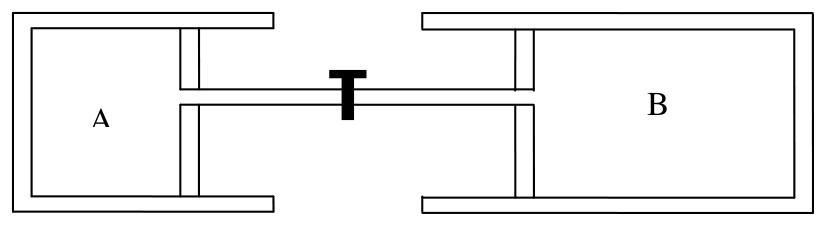
Fig. 2.1
The cylinder A and his piston is adiabatically insulated and the cylinder B is in thermal contact with a thermostat which has the temperature \(\theta = 27^\circ\mathrm{C}\).
Initially the piston of the cylinder A is fixed and inside there is a mass \(m=32\ \mathrm{kg}\) of argon at a pressure higher than the atmospheric pressure. Inside the cylinder B there is a mass of oxygen at the normal atmospheric pressure.
Liberating the piston of the cylinder A, it moves slowly enough (quasi-static) and at equilibrium the volume of the gas is eight times higher, and in the cylinder B de oxygen’s density increased two times. Knowing that the thermostat received the heat \(Q'=747{,}9\cdot10^4\mathrm{J}\), determine:
a) Establish on the base of the kinetic theory of the gases, studying the elastic collisions of the molecules with the piston, that the thermal equation of the process taking place in the cylinder A is \(TV^{2/3}=\text{constant}\).
b) Calculate the parameters \(p\), \(V\), and \(T\) of argon in the initial and final states.
c) Opening the valve which separates the two cylinders, calculate the final pressure of the mixture of the gases.
The kilo-molar mass of argon is \(\mu=40\ \mathrm{kg/kmol}\).
Official English text of the problem.
Answers
The following are the formal results from the requested adiabatic relation, final mechanical equilibrium, and overall energy conservation. The quasistatic wording has a physical consistency issue: on release the argon is at \(64p_0\) but the oxygen only at \(p_0\), so the massless piston assembly cannot move quasistatically.
- a) \(\boxed{TV^{2/3}=\text{constant}}\), equivalently \(pV^{5/3}=\text{constant}\).
- b) The argon states, before opening the valve, are:
| State | Pressure \(p\) | Volume \(V\) | Temperature \(T\) |
|---|---|---|---|
| Initial | \(64p_0 \simeq 6.48\times10^6\ \mathrm{Pa}\) | \(1.03\ \mathrm{m^3}\) | \(1.00\times10^3\ \mathrm{K}\) |
| Final | \(2p_0 \simeq 2.03\times10^5\ \mathrm{Pa}\) | \(8.20\ \mathrm{m^3}\) | \(250\ \mathrm{K}\) |
- c) After opening the valve and reaching thermal equilibrium, \[ \boxed{p_{\mathrm{mix}}=\frac{166}{75}p_0 \simeq 2.24\times10^5\ \mathrm{Pa}}. \]
Here \(p_0\) is normal atmospheric pressure.
Solution
Treat both gases as ideal and neglect the volume of the short connecting tube. Use \[ p_0=1.01325\times10^5\ \mathrm{Pa},\qquad T_0\simeq300\ \mathrm{K},\qquad R=8.31\times10^3\ \mathrm{J\,kmol^{-1}\,K^{-1}}. \] The amount of argon is \[ n_A=\frac{m}{\mu}=\frac{32}{40}=0.800\ \mathrm{kmol}. \]
Subscripts \(1\) and \(2\) denote the initial state and the equilibrium state reached with the valve still closed.
a) Derivation from molecular collisions
Let the argon piston have area \(S\) and move outward with speed \(u\), small compared with molecular thermal speeds. Consider an argon atom of mass \(m_0\) approaching it with velocity component \(v_x\) normal to the piston.
In the instantaneous rest frame of the piston, an elastic collision reverses the normal velocity. Thus, in the laboratory frame, \[ v_x'=2u-v_x. \] The other velocity components remain unchanged. The atom’s energy change is therefore \[ \Delta\varepsilon =\frac{m_0}{2}\left[(2u-v_x)^2-v_x^2\right] =-2m_0u(v_x-u). \] The impulse delivered to the piston is \[ I=2m_0(v_x-u), \] so \[ \Delta\varepsilon=-uI. \]
Summing over molecular collisions, the impulse delivered per unit time is the force \(p_AS\). Consequently, \[ \frac{dU_A}{dt}=-p_ASu=-p_A\frac{dV_A}{dt}, \] or \[ dU_A=-p_A\,dV_A. \]
For an equilibrium monatomic ideal gas, kinetic theory gives \[ p_A=\frac{Nm_0}{V_A}\langle v_x^2\rangle =\frac{Nm_0}{3V_A}\langle v^2\rangle, \qquad U_A=\frac12Nm_0\langle v^2\rangle. \] Hence \[ p_AV_A=\frac23U_A, \qquad U_A=\frac32Nk_BT_A. \] The slow-motion assumption allows intermolecular collisions to maintain an isotropic equilibrium velocity distribution.
Substitution into the energy equation yields \[ \frac32Nk_B\,dT_A =-\frac{Nk_BT_A}{V_A}\,dV_A. \] Therefore \[ \frac{dT_A}{T_A}=-\frac23\frac{dV_A}{V_A}. \] Integrating, \[ \boxed{T_AV_A^{2/3}=\text{constant}}. \] Combining this with \(p_AV_A=n_ART_A\) also gives \[ \boxed{p_AV_A^{5/3}=\text{constant}}. \]
b) Initial and final argon states
The specified argon expansion gives \[ V_{A2}=8V_{A1}. \] Using part a), \[ \frac{T_{A2}}{T_{A1}} =\left(\frac{V_{A1}}{V_{A2}}\right)^{2/3} =8^{-2/3}=\frac14. \] Thus \[ T_{A2}=\frac14T_{A1}. \]
The oxygen mass is unchanged before the valve opens. Its doubled density therefore means \[ V_{B2}=\frac12V_{B1}. \] At both equilibrium endpoints, oxygen is at the thermostat temperature \(T_0\). Its ideal-gas equation then gives \[ p_{B2}=p_{B1}\frac{V_{B1}}{V_{B2}}=2p_0. \]
At final mechanical equilibrium, the forces on the connected piston assembly balance. The atmospheric forces cancel because the piston areas are equal, leaving \[ p_{A2}=p_{B2}=2p_0. \] The argon adiabatic relation now gives \[ p_{A1} =p_{A2}\left(\frac{V_{A2}}{V_{A1}}\right)^{5/3} =2p_0\,8^{5/3} =\boxed{64p_0}. \]
To determine the temperatures, consider both gases together. Equal piston displacements and equal cross-sectional areas imply \[ dV_A=-dV_B. \] Thus the combined gas volume is constant, and the net work against the atmosphere is zero. Work transmitted through the rod is internal to the combined system. Since the pistons are at rest at both endpoints, overall energy conservation gives \[ \Delta U_A+\Delta U_B=-Q'. \] Oxygen has the same initial and final temperature, so, for an ideal gas, \[ \Delta U_B=0. \] Therefore \[ Q'=\frac32n_AR(T_{A1}-T_{A2}) =\frac98n_ART_{A1}. \] With \(Q'=7.479\times10^6\ \mathrm{J}\), \[ T_{A1} =\frac{8Q'}{9n_AR} =\frac{8(7.479\times10^6)} {9(0.800)(8.31\times10^3)} =\boxed{1000\ \mathrm{K}}, \] and \[ \boxed{T_{A2}=250\ \mathrm{K}}. \]
Finally, \[ V_{A1}=\frac{n_ART_{A1}}{p_{A1}} =\frac{(0.800)(8.31\times10^3)(1000)} {64(1.01325\times10^5)} =1.025\ \mathrm{m^3}, \] and \[ V_{A2}=8V_{A1}=8.201\ \mathrm{m^3}. \]
To three significant figures, \[ \boxed{ (p_{A1},V_{A1},T_{A1}) =(6.48\times10^6\ \mathrm{Pa},\ 1.03\ \mathrm{m^3},\ 1.00\times10^3\ \mathrm{K}) } \] and \[ \boxed{ (p_{A2},V_{A2},T_{A2}) =(2.03\times10^5\ \mathrm{Pa},\ 8.20\ \mathrm{m^3},\ 250\ \mathrm{K}) }. \]
c) Final pressure after opening the valve
The piston geometry gives \[ V_{A2}-V_{A1}=V_{B1}-V_{B2}. \] Using \(V_{A2}=8V_{A1}\) and \(V_{B2}=V_{B1}/2\), \[ 7V_{A1}=\frac12V_{B1}. \] Hence \[ V_{B1}=14V_{A1},\qquad V_{B2}=7V_{A1}, \] and the constant total volume is \[ V_{\mathrm{tot}}=15V_{A1}. \]
After the valve opens, the gases mix and eventually reach the thermostat temperature \(T_0\). Although cylinder A is insulated, its gas can exchange energy through the open connection with cylinder B.
The conserved amount of oxygen satisfies \[ n_BRT_0=p_0V_{B1}=14p_0V_{A1}. \] For argon, \[ n_ART_0 =p_{A1}V_{A1}\frac{T_0}{T_{A1}} =64p_0V_{A1}\frac{300}{1000} =19.2p_0V_{A1}. \] Applying the ideal-gas equation to the final mixture, \[ p_{\mathrm{mix}} =\frac{(n_A+n_B)RT_0}{V_{\mathrm{tot}}} =\frac{(19.2+14)p_0V_{A1}}{15V_{A1}}. \] Therefore \[ \boxed{ p_{\mathrm{mix}} =\frac{166}{75}p_0 =2.2133p_0 \simeq2.24\times10^5\ \mathrm{Pa} }. \]
The solution was checked against the official solution.
IPhO 1972 · Theorieaufgabe 2
Argon und Sauerstoff in zwei Zylindern mit verbundenen Kolben
In zwei Zylindern A und B mit gleichem Durchmesser befinden sich zwei Kolben von vernachlässigbarer Masse, die durch eine starre Stange miteinander verbunden sind. Die Kolben können sich frei bewegen. Die Stange ist ein kurzes Rohr mit einem Ventil. Das Ventil ist zunächst geschlossen (Abb. 2.1).
Abb. 2.1
Der Zylinder A und sein Kolben sind adiabatisch isoliert, und der Zylinder B steht in thermischem Kontakt mit einem Thermostaten, dessen Temperatur \(\theta = 27^\circ\mathrm{C}\) beträgt.
Anfangs ist der Kolben des Zylinders A fixiert, und im Zylinder befindet sich Argon der Masse \(m=32\ \mathrm{kg}\) unter einem Druck, der höher als der Atmosphärendruck ist. Im Zylinder B befindet sich eine Menge Sauerstoff unter normalem Atmosphärendruck.
Wird der Kolben des Zylinders A freigegeben, bewegt er sich hinreichend langsam (quasistatisch), und im Gleichgewicht ist das Gasvolumen auf das Achtfache gestiegen, während sich im Zylinder B die Dichte des Sauerstoffs verdoppelt hat. Der Thermostat hat dabei die Wärme \(Q'=747{,}9\cdot10^4\mathrm{J}\) aufgenommen. Bestimmen Sie:
a) Zeigen Sie auf der Grundlage der kinetischen Gastheorie durch Untersuchung der elastischen Stöße der Moleküle mit dem Kolben, dass die thermische Prozessgleichung für den im Zylinder A ablaufenden Vorgang \(TV^{2/3}=\text{konstant}\) lautet.
b) Berechnen Sie die Zustandsgrößen \(p\), \(V\) und \(T\) des Argons im Anfangs- und Endzustand.
c) Berechnen Sie den Enddruck des Gasgemisches nach dem Öffnen des Ventils, das die beiden Zylinder voneinander trennt.
Die kilomolare Masse von Argon beträgt \(\mu=40\ \mathrm{kg/kmol}\).
Aufgabentext aus dem offiziellen englischen Text übersetzt.
Antworten
Die folgenden formalen Ergebnisse ergeben sich aus der geforderten Adiabatenbeziehung, dem mechanischen Gleichgewicht im Endzustand und der Gesamtenergieerhaltung. Die Formulierung als quasistatischer Vorgang weist eine physikalische Unstimmigkeit auf: Beim Freigeben des Kolbens herrscht im Argon der Druck \(64p_0\), im Sauerstoff aber nur \(p_0\), sodass sich die masselose Kolbenanordnung nicht quasistatisch bewegen kann.
- a) \(\boxed{TV^{2/3}=\text{konstant}}\), gleichbedeutend mit \(pV^{5/3}=\text{konstant}\).
- b) Die Zustände des Argons vor dem Öffnen des Ventils sind:
| Zustand | Druck \(p\) | Volumen \(V\) | Temperatur \(T\) |
|---|---|---|---|
| Anfangszustand | \(64p_0 \simeq 6.48\times10^6\ \mathrm{Pa}\) | \(1.03\ \mathrm{m^3}\) | \(1.00\times10^3\ \mathrm{K}\) |
| Endzustand | \(2p_0 \simeq 2.03\times10^5\ \mathrm{Pa}\) | \(8.20\ \mathrm{m^3}\) | \(250\ \mathrm{K}\) |
- c) Nach dem Öffnen des Ventils und dem Erreichen des thermischen Gleichgewichts gilt \[ \boxed{p_{\mathrm{mix}}=\frac{166}{75}p_0 \simeq 2.24\times10^5\ \mathrm{Pa}}. \]
Hierbei ist \(p_0\) der normale Atmosphärendruck.
Lösung
Beide Gase werden als ideal behandelt, und das Volumen des kurzen Verbindungsrohrs wird vernachlässigt. Wir verwenden \[ p_0=1.01325\times10^5\ \mathrm{Pa},\qquad T_0\simeq300\ \mathrm{K},\qquad R=8.31\times10^3\ \mathrm{J\,kmol^{-1}\,K^{-1}}. \] Die Stoffmenge des Argons beträgt \[ n_A=\frac{m}{\mu}=\frac{32}{40}=0.800\ \mathrm{kmol}. \]
Die Indizes \(1\) und \(2\) bezeichnen den Anfangszustand und den bei noch geschlossenem Ventil erreichten Gleichgewichtszustand.
a) Herleitung aus molekularen Stößen
Der Argonkolben habe die Fläche \(S\) und bewege sich mit der Geschwindigkeit \(u\) nach außen, wobei diese klein gegenüber den thermischen Geschwindigkeiten der Moleküle ist. Wir betrachten ein Argonatom der Masse \(m_0\), das sich dem Kolben mit der Geschwindigkeitskomponente \(v_x\) senkrecht zur Kolbenfläche nähert.
Im momentanen Ruhesystem des Kolbens kehrt ein elastischer Stoß die normale Geschwindigkeitskomponente um. Im Laborsystem gilt daher \[ v_x'=2u-v_x. \] Die anderen Geschwindigkeitskomponenten bleiben unverändert. Die Energieänderung des Atoms ist somit \[ \Delta\varepsilon =\frac{m_0}{2}\left[(2u-v_x)^2-v_x^2\right] =-2m_0u(v_x-u). \] Der auf den Kolben übertragene Impuls ist \[ I=2m_0(v_x-u), \] also \[ \Delta\varepsilon=-uI. \]
Summiert man über die molekularen Stöße, so ist der pro Zeiteinheit übertragene Impuls gleich der Kraft \(p_AS\). Folglich gilt \[ \frac{dU_A}{dt}=-p_ASu=-p_A\frac{dV_A}{dt}, \] oder \[ dU_A=-p_A\,dV_A. \]
Für ein einatomiges ideales Gas im Gleichgewicht liefert die kinetische Gastheorie \[ p_A=\frac{Nm_0}{V_A}\langle v_x^2\rangle =\frac{Nm_0}{3V_A}\langle v^2\rangle, \qquad U_A=\frac12Nm_0\langle v^2\rangle. \] Daraus folgt \[ p_AV_A=\frac23U_A, \qquad U_A=\frac32Nk_BT_A. \] Die Annahme einer langsamen Bewegung ermöglicht es, dass die Stöße zwischen den Teilchen eine isotrope Geschwindigkeitsverteilung im Gleichgewicht aufrechterhalten.
Einsetzen in die Energiegleichung ergibt \[ \frac32Nk_B\,dT_A =-\frac{Nk_BT_A}{V_A}\,dV_A. \] Somit gilt \[ \frac{dT_A}{T_A}=-\frac23\frac{dV_A}{V_A}. \] Durch Integration erhält man \[ \boxed{T_AV_A^{2/3}=\text{konstant}}. \] Zusammen mit \(p_AV_A=n_ART_A\) ergibt sich außerdem \[ \boxed{p_AV_A^{5/3}=\text{konstant}}. \]
b) Anfangs- und Endzustand des Argons
Aus der angegebenen Expansion des Argons folgt \[ V_{A2}=8V_{A1}. \] Mit Teil a) erhält man \[ \frac{T_{A2}}{T_{A1}} =\left(\frac{V_{A1}}{V_{A2}}\right)^{2/3} =8^{-2/3}=\frac14. \] Damit gilt \[ T_{A2}=\frac14T_{A1}. \]
Die Masse des Sauerstoffs bleibt bis zum Öffnen des Ventils unverändert. Die Verdopplung seiner Dichte bedeutet daher \[ V_{B2}=\frac12V_{B1}. \] In beiden Gleichgewichtszuständen zu Beginn und am Ende hat der Sauerstoff die Temperatur \(T_0\) des Thermostaten. Seine ideale Gasgleichung liefert daher \[ p_{B2}=p_{B1}\frac{V_{B1}}{V_{B2}}=2p_0. \]
Im mechanischen Gleichgewicht des Endzustands gleichen sich die Kräfte auf die verbundene Kolbenanordnung aus. Die durch den Atmosphärendruck verursachten Kräfte heben sich wegen der gleichen Kolbenflächen auf, sodass \[ p_{A2}=p_{B2}=2p_0. \] Die Adiabatenbeziehung für Argon liefert nun \[ p_{A1} =p_{A2}\left(\frac{V_{A2}}{V_{A1}}\right)^{5/3} =2p_0\,8^{5/3} =\boxed{64p_0}. \]
Zur Bestimmung der Temperaturen betrachten wir beide Gase gemeinsam. Gleiche Kolbenverschiebungen und gleiche Querschnittsflächen bedeuten \[ dV_A=-dV_B. \] Das Gesamtvolumen der Gase bleibt somit konstant, und die insgesamt gegen die Atmosphäre verrichtete Arbeit ist null. Die über die Stange übertragene Arbeit ist innerhalb des Gesamtsystems intern. Da die Kolben sowohl im Anfangs- als auch im Endzustand ruhen, ergibt die Gesamtenergieerhaltung \[ \Delta U_A+\Delta U_B=-Q'. \] Der Sauerstoff hat dieselbe Anfangs- und Endtemperatur, sodass für ein ideales Gas gilt \[ \Delta U_B=0. \] Daher ist \[ Q'=\frac32n_AR(T_{A1}-T_{A2}) =\frac98n_ART_{A1}. \] Mit \(Q'=7.479\times10^6\ \mathrm{J}\) erhält man \[ T_{A1} =\frac{8Q'}{9n_AR} =\frac{8(7.479\times10^6)} {9(0.800)(8.31\times10^3)} =\boxed{1000\ \mathrm{K}}, \] und \[ \boxed{T_{A2}=250\ \mathrm{K}}. \]
Schließlich gilt \[ V_{A1}=\frac{n_ART_{A1}}{p_{A1}} =\frac{(0.800)(8.31\times10^3)(1000)} {64(1.01325\times10^5)} =1.025\ \mathrm{m^3}, \] und \[ V_{A2}=8V_{A1}=8.201\ \mathrm{m^3}. \]
Auf drei signifikante Stellen gerundet ergibt sich \[ \boxed{ (p_{A1},V_{A1},T_{A1}) =(6.48\times10^6\ \mathrm{Pa},\ 1.03\ \mathrm{m^3},\ 1.00\times10^3\ \mathrm{K}) } \] und \[ \boxed{ (p_{A2},V_{A2},T_{A2}) =(2.03\times10^5\ \mathrm{Pa},\ 8.20\ \mathrm{m^3},\ 250\ \mathrm{K}) }. \]
c) Enddruck nach dem Öffnen des Ventils
Aus der Geometrie der Kolbenanordnung folgt \[ V_{A2}-V_{A1}=V_{B1}-V_{B2}. \] Mit \(V_{A2}=8V_{A1}\) und \(V_{B2}=V_{B1}/2\) erhält man \[ 7V_{A1}=\frac12V_{B1}. \] Somit gilt \[ V_{B1}=14V_{A1},\qquad V_{B2}=7V_{A1}, \] und das konstante Gesamtvolumen beträgt \[ V_{\mathrm{tot}}=15V_{A1}. \]
Nach dem Öffnen des Ventils vermischen sich die Gase und erreichen schließlich die Temperatur \(T_0\) des Thermostaten. Obwohl Zylinder A isoliert ist, kann sein Gas durch die offene Verbindung mit Zylinder B Energie austauschen.
Für die erhaltene Stoffmenge des Sauerstoffs gilt \[ n_BRT_0=p_0V_{B1}=14p_0V_{A1}. \] Für Argon gilt \[ n_ART_0 =p_{A1}V_{A1}\frac{T_0}{T_{A1}} =64p_0V_{A1}\frac{300}{1000} =19.2p_0V_{A1}. \] Die Anwendung der idealen Gasgleichung auf das Gemisch im Endzustand ergibt \[ p_{\mathrm{mix}} =\frac{(n_A+n_B)RT_0}{V_{\mathrm{tot}}} =\frac{(19.2+14)p_0V_{A1}}{15V_{A1}}. \] Daher gilt \[ \boxed{ p_{\mathrm{mix}} =\frac{166}{75}p_0 =2.2133p_0 \simeq2.24\times10^5\ \mathrm{Pa} }. \]
Die Lösung wurde mit der offiziellen Lösung abgeglichen.
IPhO 1972 · Teori sorusu 2
Pistonları birbirine bağlı iki silindirde argon ve oksijen
Çapları eşit olan A ve B silindirlerinin içinde, kütleleri ihmal edilebilen ve rijit bir çubukla birbirine bağlanmış iki piston bulunmaktadır. Pistonlar serbestçe hareket edebilmektedir. Çubuk, üzerinde bir vana bulunan kısa bir borudur. Vana başlangıçta kapalıdır (şek. 2.1).
Şek. 2.1
A silindiri ve pistonu adyabatik olarak yalıtılmıştır; B silindiri ise sıcaklığı \(\theta = 27^\circ\mathrm{C}\) olan bir termostatla ısıl temas hâlindedir.
Başlangıçta A silindirinin pistonu sabitlenmiştir ve silindirin içinde atmosfer basıncından daha yüksek bir basınçta, kütlesi \(m=32\ \mathrm{kg}\) olan argon bulunmaktadır. B silindirinin içinde ise normal atmosfer basıncında bir miktar oksijen bulunmaktadır.
A silindirinin pistonu serbest bırakıldığında yeterince yavaş (kuazistatik olarak) hareket eder ve dengeye ulaşıldığında gazın hacmi başlangıçtaki değerinin sekiz katına çıkmış, B silindirindeki oksijenin yoğunluğu ise iki katına çıkmıştır. Termostatın \(Q'=747{,}9\cdot10^4\mathrm{J}\) ısı aldığını bilerek aşağıdakileri belirleyiniz:
a) Moleküllerin pistonla esnek çarpışmalarını inceleyerek, gazların kinetik teorisi temelinde A silindirinde gerçekleşen sürecin ısıl denkleminin \(TV^{2/3}=\text{sabit}\) olduğunu gösteriniz.
b) Argonun başlangıç ve son durumlarındaki \(p\), \(V\) ve \(T\) parametrelerini hesaplayınız.
c) İki silindiri birbirinden ayıran vana açıldığında gaz karışımının son basıncını hesaplayınız.
Argonun kilomolar kütlesi \(\mu=40\ \mathrm{kg/kmol}\) değerindedir.
Soru metni resmi İngilizce metinden çevrilmiştir.
Cevaplar
Aşağıdakiler, istenen adyabatik bağıntıdan, son mekanik dengeden ve toplam enerji korunumundan elde edilen biçimsel sonuçlardır. Kuazistatik ifadesi fiziksel bir tutarlılık sorunu içermektedir: Piston serbest bırakıldığında argonun basıncı \(64p_0\), oksijeninki ise yalnızca \(p_0\) olduğundan kütlesiz piston düzeneği kuazistatik olarak hareket edemez.
- a) \(\boxed{TV^{2/3}=\text{sabit}}\), eşdeğer olarak \(pV^{5/3}=\text{sabit}\).
- b) Vana açılmadan önce argonun durumları şöyledir:
| Durum | Basınç \(p\) | Hacim \(V\) | Sıcaklık \(T\) |
|---|---|---|---|
| Başlangıç | \(64p_0 \simeq 6.48\times10^6\ \mathrm{Pa}\) | \(1.03\ \mathrm{m^3}\) | \(1.00\times10^3\ \mathrm{K}\) |
| Son | \(2p_0 \simeq 2.03\times10^5\ \mathrm{Pa}\) | \(8.20\ \mathrm{m^3}\) | \(250\ \mathrm{K}\) |
- c) Vana açılıp ısıl dengeye ulaşıldıktan sonra, \[ \boxed{p_{\mathrm{mix}}=\frac{166}{75}p_0 \simeq 2.24\times10^5\ \mathrm{Pa}}. \]
Burada \(p_0\) normal atmosfer basıncıdır.
Çözüm
Her iki gazı da ideal kabul edelim ve kısa bağlantı borusunun hacmini ihmal edelim. Şu değerleri kullanalım: \[ p_0=1.01325\times10^5\ \mathrm{Pa},\qquad T_0\simeq300\ \mathrm{K},\qquad R=8.31\times10^3\ \mathrm{J\,kmol^{-1}\,K^{-1}}. \] Argonun madde miktarı \[ n_A=\frac{m}{\mu}=\frac{32}{40}=0.800\ \mathrm{kmol}. \]
\(1\) ve \(2\) alt indisleri, sırasıyla başlangıç durumunu ve vana hâlâ kapalıyken ulaşılan denge durumunu göstermektedir.
a) Moleküler çarpışmalardan türetim
Argon pistonunun alanı \(S\) olsun ve piston, moleküllerin ısıl hızlarına göre küçük olan \(u\) süratiyle dışarı doğru hareket etsin. Kütlesi \(m_0\) olan ve pistona dik hız bileşeni \(v_x\) ile yaklaşan bir argon atomunu ele alalım.
Pistonun anlık durgunluk referans sisteminde, esnek bir çarpışma dik hız bileşeninin yönünü tersine çevirir. Dolayısıyla laboratuvar referans sisteminde, \[ v_x'=2u-v_x. \] Diğer hız bileşenleri değişmeden kalır. Bu nedenle atomun enerji değişimi \[ \Delta\varepsilon =\frac{m_0}{2}\left[(2u-v_x)^2-v_x^2\right] =-2m_0u(v_x-u). \] Pistona aktarılan itme \[ I=2m_0(v_x-u), \] dolayısıyla \[ \Delta\varepsilon=-uI. \]
Moleküler çarpışmaların tümü üzerinden toplandığında, birim zamanda aktarılan itme \(p_AS\) kuvvetine eşittir. Buna göre, \[ \frac{dU_A}{dt}=-p_ASu=-p_A\frac{dV_A}{dt}, \] ya da \[ dU_A=-p_A\,dV_A. \]
Dengedeki tek atomlu bir ideal gaz için kinetik teori şu bağıntıları verir: \[ p_A=\frac{Nm_0}{V_A}\langle v_x^2\rangle =\frac{Nm_0}{3V_A}\langle v^2\rangle, \qquad U_A=\frac12Nm_0\langle v^2\rangle. \] Buradan \[ p_AV_A=\frac23U_A, \qquad U_A=\frac32Nk_BT_A. \] Yavaş hareket varsayımı, moleküller arası çarpışmaların izotropik bir denge hız dağılımını korumasına olanak verir.
Enerji denkleminde yerine koyarsak \[ \frac32Nk_B\,dT_A =-\frac{Nk_BT_A}{V_A}\,dV_A. \] Dolayısıyla \[ \frac{dT_A}{T_A}=-\frac23\frac{dV_A}{V_A}. \] İntegral alındığında, \[ \boxed{T_AV_A^{2/3}=\text{sabit}}. \] Bu bağıntı \(p_AV_A=n_ART_A\) ile birleştirildiğinde ayrıca \[ \boxed{p_AV_A^{5/3}=\text{sabit}}. \]
b) Argonun başlangıç ve son durumları
Argonun belirtilen genleşmesinden \[ V_{A2}=8V_{A1}. \] a) kısmını kullanarak, \[ \frac{T_{A2}}{T_{A1}} =\left(\frac{V_{A1}}{V_{A2}}\right)^{2/3} =8^{-2/3}=\frac14. \] Böylece \[ T_{A2}=\frac14T_{A1}. \]
Vana açılmadan önce oksijenin kütlesi değişmez. Bu nedenle yoğunluğunun iki katına çıkması, \[ V_{B2}=\frac12V_{B1}. \] anlamına gelir. Başlangıç ve sondaki her iki denge durumunda da oksijen, termostat sıcaklığı \(T_0\)'dadır. Bu durumda ideal gaz denklemi \[ p_{B2}=p_{B1}\frac{V_{B1}}{V_{B2}}=2p_0. \] sonucunu verir.
Son mekanik denge durumunda, birbirine bağlı piston düzeneğine etki eden kuvvetler dengelenir. Piston alanları eşit olduğundan atmosferin uyguladığı kuvvetler birbirini götürür ve geriye \[ p_{A2}=p_{B2}=2p_0. \] kalır. Argonun adyabatik bağıntısı şimdi \[ p_{A1} =p_{A2}\left(\frac{V_{A2}}{V_{A1}}\right)^{5/3} =2p_0\,8^{5/3} =\boxed{64p_0}. \] sonucunu verir.
Sıcaklıkları belirlemek için her iki gazı birlikte ele alalım. Pistonların yer değiştirmelerinin ve kesit alanlarının eşit olması, \[ dV_A=-dV_B. \] bağıntısını gerektirir. Dolayısıyla gazların toplam hacmi sabittir ve atmosfere karşı yapılan net iş sıfırdır. Çubuk aracılığıyla aktarılan iş, birleşik sistemin içindeki bir iş aktarımıdır. Pistonlar hem başlangıçta hem de sonda durgun olduğundan, toplam enerji korunumu \[ \Delta U_A+\Delta U_B=-Q'. \] bağıntısını verir. Oksijenin başlangıç ve son sıcaklıkları aynı olduğundan, ideal bir gaz için, \[ \Delta U_B=0. \] Bu nedenle \[ Q'=\frac32n_AR(T_{A1}-T_{A2}) =\frac98n_ART_{A1}. \] \(Q'=7.479\times10^6\ \mathrm{J}\) değeriyle, \[ T_{A1} =\frac{8Q'}{9n_AR} =\frac{8(7.479\times10^6)} {9(0.800)(8.31\times10^3)} =\boxed{1000\ \mathrm{K}}, \] ve \[ \boxed{T_{A2}=250\ \mathrm{K}}. \]
Son olarak, \[ V_{A1}=\frac{n_ART_{A1}}{p_{A1}} =\frac{(0.800)(8.31\times10^3)(1000)} {64(1.01325\times10^5)} =1.025\ \mathrm{m^3}, \] ve \[ V_{A2}=8V_{A1}=8.201\ \mathrm{m^3}. \]
Üç anlamlı basamakla, \[ \boxed{ (p_{A1},V_{A1},T_{A1}) =(6.48\times10^6\ \mathrm{Pa},\ 1.03\ \mathrm{m^3},\ 1.00\times10^3\ \mathrm{K}) } \] ve \[ \boxed{ (p_{A2},V_{A2},T_{A2}) =(2.03\times10^5\ \mathrm{Pa},\ 8.20\ \mathrm{m^3},\ 250\ \mathrm{K}) }. \]
c) Vana açıldıktan sonraki son basınç
Piston geometrisinden \[ V_{A2}-V_{A1}=V_{B1}-V_{B2}. \] \(V_{A2}=8V_{A1}\) ve \(V_{B2}=V_{B1}/2\) kullanılarak, \[ 7V_{A1}=\frac12V_{B1}. \] Buradan \[ V_{B1}=14V_{A1},\qquad V_{B2}=7V_{A1}, \] ve sabit toplam hacim \[ V_{\mathrm{tot}}=15V_{A1}. \]
Vana açıldıktan sonra gazlar karışır ve sonunda termostat sıcaklığı \(T_0\)'a ulaşır. A silindiri yalıtılmış olsa da içindeki gaz, açık bağlantı üzerinden B silindiriyle enerji alışverişinde bulunabilir.
Korunan oksijen miktarı şu bağıntıyı sağlar: \[ n_BRT_0=p_0V_{B1}=14p_0V_{A1}. \] Argon için, \[ n_ART_0 =p_{A1}V_{A1}\frac{T_0}{T_{A1}} =64p_0V_{A1}\frac{300}{1000} =19.2p_0V_{A1}. \] Son karışıma ideal gaz denklemini uygulayarak, \[ p_{\mathrm{mix}} =\frac{(n_A+n_B)RT_0}{V_{\mathrm{tot}}} =\frac{(19.2+14)p_0V_{A1}}{15V_{A1}}. \] Dolayısıyla \[ \boxed{ p_{\mathrm{mix}} =\frac{166}{75}p_0 =2.2133p_0 \simeq2.24\times10^5\ \mathrm{Pa} }. \]
Çözüm, resmi çözümle karşılaştırılarak kontrol edildi.
IPhO 1972 · Problema teórico 2
Argón y oxígeno en dos cilindros con pistones conectados
Dos cilindros A y B de igual diámetro contienen dos pistones de masa despreciable conectados mediante una varilla rígida. Los pistones pueden moverse libremente. La varilla es un tubo corto provisto de una válvula. Inicialmente, la válvula está cerrada (fig. 2.1).
Fig. 2.1
El cilindro A y su pistón están aislados adiabáticamente, y el cilindro B está en contacto térmico con un termostato cuya temperatura es \(\theta = 27^\circ\mathrm{C}\).
Inicialmente, el pistón del cilindro A está fijo y en su interior hay una masa \(m=32\ \mathrm{kg}\) de argón a una presión superior a la atmosférica. En el interior del cilindro B hay una masa de oxígeno a la presión atmosférica normal.
Al liberar el pistón del cilindro A, este se mueve con suficiente lentitud (de forma cuasiestática) y, en el equilibrio, el volumen del gas es ocho veces el inicial, mientras que en el cilindro B la densidad del oxígeno se ha duplicado. Sabiendo que el termostato ha recibido el calor \(Q'=747{,}9\cdot10^4\mathrm{J}\), determine:
a) Demuestre, a partir de la teoría cinética de los gases y estudiando las colisiones elásticas de las moléculas con el pistón, que la ecuación térmica del proceso que tiene lugar en el cilindro A es \(TV^{2/3}=\text{constante}\).
b) Calcule los parámetros \(p\), \(V\) y \(T\) del argón en los estados inicial y final.
c) Al abrir la válvula que separa los dos cilindros, calcule la presión final de la mezcla de gases.
La masa kilomolar del argón es \(\mu=40\ \mathrm{kg/kmol}\).
Enunciado traducido del texto oficial en inglés.
Respuestas
Los siguientes son los resultados formales obtenidos a partir de la relación adiabática solicitada, el equilibrio mecánico final y la conservación de la energía total. La descripción del proceso como cuasiestático presenta un problema de coherencia física: al liberar el pistón, el argón está a \(64p_0\) y el oxígeno solo a \(p_0\), por lo que el conjunto de pistones sin masa no puede moverse de forma cuasiestática.
- a) \(\boxed{TV^{2/3}=\text{constante}}\), o, de forma equivalente, \(pV^{5/3}=\text{constante}\).
- b) Los estados del argón, antes de abrir la válvula, son:
| Estado | Presión \(p\) | Volumen \(V\) | Temperatura \(T\) |
|---|---|---|---|
| Inicial | \(64p_0 \simeq 6.48\times10^6\ \mathrm{Pa}\) | \(1.03\ \mathrm{m^3}\) | \(1.00\times10^3\ \mathrm{K}\) |
| Final | \(2p_0 \simeq 2.03\times10^5\ \mathrm{Pa}\) | \(8.20\ \mathrm{m^3}\) | \(250\ \mathrm{K}\) |
- c) Después de abrir la válvula y alcanzar el equilibrio térmico, \[ \boxed{p_{\mathrm{mix}}=\frac{166}{75}p_0 \simeq 2.24\times10^5\ \mathrm{Pa}}. \]
Aquí, \(p_0\) es la presión atmosférica normal.
Solución
Consideramos ambos gases como ideales y despreciamos el volumen del tubo corto de conexión. Utilizamos \[ p_0=1.01325\times10^5\ \mathrm{Pa},\qquad T_0\simeq300\ \mathrm{K},\qquad R=8.31\times10^3\ \mathrm{J\,kmol^{-1}\,K^{-1}}. \] La cantidad de argón es \[ n_A=\frac{m}{\mu}=\frac{32}{40}=0.800\ \mathrm{kmol}. \]
Los subíndices \(1\) y \(2\) indican el estado inicial y el estado de equilibrio alcanzado con la válvula todavía cerrada.
a) Deducción a partir de las colisiones moleculares
Sea \(S\) el área del pistón del argón, que se mueve hacia fuera con una rapidez \(u\), pequeña en comparación con las velocidades térmicas moleculares. Consideremos un átomo de argón de masa \(m_0\) que se aproxima al pistón con una componente de velocidad \(v_x\) perpendicular a este.
En el sistema de referencia instantáneo en reposo respecto al pistón, una colisión elástica invierte la componente normal de la velocidad. Por tanto, en el sistema de referencia del laboratorio, \[ v_x'=2u-v_x. \] Las demás componentes de la velocidad permanecen inalteradas. Por lo tanto, la variación de energía del átomo es \[ \Delta\varepsilon =\frac{m_0}{2}\left[(2u-v_x)^2-v_x^2\right] =-2m_0u(v_x-u). \] El impulso transmitido al pistón es \[ I=2m_0(v_x-u), \] de modo que \[ \Delta\varepsilon=-uI. \]
Al sumar las contribuciones de las colisiones moleculares, el impulso transmitido por unidad de tiempo es la fuerza \(p_AS\). En consecuencia, \[ \frac{dU_A}{dt}=-p_ASu=-p_A\frac{dV_A}{dt}, \] o bien \[ dU_A=-p_A\,dV_A. \]
Para un gas ideal monoatómico en equilibrio, la teoría cinética proporciona \[ p_A=\frac{Nm_0}{V_A}\langle v_x^2\rangle =\frac{Nm_0}{3V_A}\langle v^2\rangle, \qquad U_A=\frac12Nm_0\langle v^2\rangle. \] Por tanto, \[ p_AV_A=\frac23U_A, \qquad U_A=\frac32Nk_BT_A. \] La hipótesis de movimiento lento permite que las colisiones intermoleculares mantengan una distribución de velocidades de equilibrio isotrópica.
Al sustituir en la ecuación de la energía, se obtiene \[ \frac32Nk_B\,dT_A =-\frac{Nk_BT_A}{V_A}\,dV_A. \] Por lo tanto, \[ \frac{dT_A}{T_A}=-\frac23\frac{dV_A}{V_A}. \] Integrando, \[ \boxed{T_AV_A^{2/3}=\text{constante}}. \] Al combinar esta relación con \(p_AV_A=n_ART_A\), también se obtiene \[ \boxed{p_AV_A^{5/3}=\text{constante}}. \]
b) Estados inicial y final del argón
La expansión del argón indicada en el enunciado implica \[ V_{A2}=8V_{A1}. \] Utilizando el apartado a), \[ \frac{T_{A2}}{T_{A1}} =\left(\frac{V_{A1}}{V_{A2}}\right)^{2/3} =8^{-2/3}=\frac14. \] Así pues, \[ T_{A2}=\frac14T_{A1}. \]
La masa de oxígeno permanece inalterada antes de abrir la válvula. Por tanto, la duplicación de su densidad significa que \[ V_{B2}=\frac12V_{B1}. \] En ambos estados extremos de equilibrio, el oxígeno está a la temperatura \(T_0\) del termostato. Su ecuación de gas ideal da entonces \[ p_{B2}=p_{B1}\frac{V_{B1}}{V_{B2}}=2p_0. \]
En el equilibrio mecánico final, las fuerzas sobre el conjunto de pistones conectados se compensan. Las fuerzas atmosféricas se anulan entre sí porque las áreas de los pistones son iguales, de modo que \[ p_{A2}=p_{B2}=2p_0. \] La relación adiabática del argón da ahora \[ p_{A1} =p_{A2}\left(\frac{V_{A2}}{V_{A1}}\right)^{5/3} =2p_0\,8^{5/3} =\boxed{64p_0}. \]
Para determinar las temperaturas, consideramos ambos gases conjuntamente. Los desplazamientos iguales de los pistones y las áreas iguales de sus secciones transversales implican \[ dV_A=-dV_B. \] Por tanto, el volumen total de los gases es constante y el trabajo neto contra la atmósfera es nulo. El trabajo transmitido a través de la varilla es interno al sistema conjunto. Puesto que los pistones están en reposo en ambos estados extremos, la conservación de la energía total da \[ \Delta U_A+\Delta U_B=-Q'. \] El oxígeno tiene la misma temperatura inicial y final, por lo que, para un gas ideal, \[ \Delta U_B=0. \] Por lo tanto, \[ Q'=\frac32n_AR(T_{A1}-T_{A2}) =\frac98n_ART_{A1}. \] Con \(Q'=7.479\times10^6\ \mathrm{J}\), \[ T_{A1} =\frac{8Q'}{9n_AR} =\frac{8(7.479\times10^6)} {9(0.800)(8.31\times10^3)} =\boxed{1000\ \mathrm{K}}, \] y \[ \boxed{T_{A2}=250\ \mathrm{K}}. \]
Finalmente, \[ V_{A1}=\frac{n_ART_{A1}}{p_{A1}} =\frac{(0.800)(8.31\times10^3)(1000)} {64(1.01325\times10^5)} =1.025\ \mathrm{m^3}, \] y \[ V_{A2}=8V_{A1}=8.201\ \mathrm{m^3}. \]
Con tres cifras significativas, \[ \boxed{ (p_{A1},V_{A1},T_{A1}) =(6.48\times10^6\ \mathrm{Pa},\ 1.03\ \mathrm{m^3},\ 1.00\times10^3\ \mathrm{K}) } \] y \[ \boxed{ (p_{A2},V_{A2},T_{A2}) =(2.03\times10^5\ \mathrm{Pa},\ 8.20\ \mathrm{m^3},\ 250\ \mathrm{K}) }. \]
c) Presión final después de abrir la válvula
La geometría de los pistones da \[ V_{A2}-V_{A1}=V_{B1}-V_{B2}. \] Utilizando \(V_{A2}=8V_{A1}\) y \(V_{B2}=V_{B1}/2\), \[ 7V_{A1}=\frac12V_{B1}. \] Por tanto, \[ V_{B1}=14V_{A1},\qquad V_{B2}=7V_{A1}, \] y el volumen total constante es \[ V_{\mathrm{tot}}=15V_{A1}. \]
Después de abrir la válvula, los gases se mezclan y finalmente alcanzan la temperatura \(T_0\) del termostato. Aunque el cilindro A está aislado, su gas puede intercambiar energía a través de la conexión abierta con el cilindro B.
La cantidad de oxígeno, que se conserva, satisface \[ n_BRT_0=p_0V_{B1}=14p_0V_{A1}. \] Para el argón, \[ n_ART_0 =p_{A1}V_{A1}\frac{T_0}{T_{A1}} =64p_0V_{A1}\frac{300}{1000} =19.2p_0V_{A1}. \] Al aplicar la ecuación de gas ideal a la mezcla final, \[ p_{\mathrm{mix}} =\frac{(n_A+n_B)RT_0}{V_{\mathrm{tot}}} =\frac{(19.2+14)p_0V_{A1}}{15V_{A1}}. \] Por lo tanto, \[ \boxed{ p_{\mathrm{mix}} =\frac{166}{75}p_0 =2.2133p_0 \simeq2.24\times10^5\ \mathrm{Pa} }. \]
La solución se comprobó con la solución oficial.
IPhO 1972 · 理论题 2
活塞相连的两个气缸中的氩气和氧气
两个直径相同的气缸 A 和 B 内各有一个质量可忽略的活塞,两活塞由一根刚性连杆连接。活塞可以自由移动。连杆是一根装有阀门的短管。阀门最初关闭(图 2.1)。
图 2.1
气缸 A 及其活塞均绝热,气缸 B 则与温度为 \(\theta = 27^\circ\mathrm{C}\) 的恒温器保持热接触。
最初,气缸 A 的活塞被固定,其中装有质量为 \(m=32\ \mathrm{kg}\) 的氩气,其压强高于大气压。气缸 B 内装有一定质量的氧气,压强为标准大气压。
解除对气缸 A 活塞的固定后,活塞以足够缓慢的速度运动(准静态过程)。达到平衡时,氩气的体积变为原来的八倍,而气缸 B 中氧气的密度变为原来的两倍。已知恒温器吸收的热量为 \(Q'=747{,}9\cdot10^4\mathrm{J}\),求:
a) 根据气体分子运动论,通过研究分子与活塞的弹性碰撞,证明气缸 A 中所发生过程的温度与体积的关系为 \(TV^{2/3}=\text{常量}\)。
b) 计算氩气初态和末态的参数 \(p\)、\(V\) 和 \(T\)。
c) 打开分隔两个气缸的阀门,计算混合气体的最终压强。
氩气的千摩尔质量为 \(\mu=40\ \mathrm{kg/kmol}\)。
题目译自官方英文原文。
答案
以下是根据题目要求的绝热关系、最终的力学平衡以及总能量守恒得到的形式上的结果。题目关于准静态过程的表述存在物理一致性问题:释放活塞时,氩气的压强为 \(64p_0\),而氧气的压强只有 \(p_0\),因此质量可忽略的活塞组件不可能准静态地运动。
- a) \(\boxed{TV^{2/3}=\text{常量}}\),等价地,\(pV^{5/3}=\text{常量}\)。
- b) 打开阀门之前,氩气的状态为:
| 状态 | 压强 \(p\) | 体积 \(V\) | 温度 \(T\) |
|---|---|---|---|
| 初态 | \(64p_0 \simeq 6.48\times10^6\ \mathrm{Pa}\) | \(1.03\ \mathrm{m^3}\) | \(1.00\times10^3\ \mathrm{K}\) |
| 末态 | \(2p_0 \simeq 2.03\times10^5\ \mathrm{Pa}\) | \(8.20\ \mathrm{m^3}\) | \(250\ \mathrm{K}\) |
- c) 打开阀门并达到热平衡后, \[ \boxed{p_{\mathrm{mix}}=\frac{166}{75}p_0 \simeq 2.24\times10^5\ \mathrm{Pa}}. \]
这里,\(p_0\) 为标准大气压。
解答
将两种气体均视为理想气体,并忽略连接短管的体积。取 \[ p_0=1.01325\times10^5\ \mathrm{Pa},\qquad T_0\simeq300\ \mathrm{K},\qquad R=8.31\times10^3\ \mathrm{J\,kmol^{-1}\,K^{-1}}. \] 氩气的物质的量为 \[ n_A=\frac{m}{\mu}=\frac{32}{40}=0.800\ \mathrm{kmol}. \]
下标 \(1\) 和 \(2\) 分别表示初态和阀门仍关闭时达到的平衡态。
a) 从分子碰撞推导
设氩气一侧的活塞面积为 \(S\),以速度 \(u\) 向外运动,且该速度远小于分子的热运动速率。考虑一个质量为 \(m_0\) 的氩原子,它朝活塞运动,垂直于活塞方向的速度分量为 \(v_x\)。
在活塞的瞬时静止参考系中,弹性碰撞使法向速度反向。因此,在实验室参考系中, \[ v_x'=2u-v_x. \] 其他速度分量保持不变。因此,原子的能量变化为 \[ \Delta\varepsilon =\frac{m_0}{2}\left[(2u-v_x)^2-v_x^2\right] =-2m_0u(v_x-u). \] 传递给活塞的冲量为 \[ I=2m_0(v_x-u), \] 所以 \[ \Delta\varepsilon=-uI. \]
对所有分子碰撞求和,单位时间内传递的冲量就是力 \(p_AS\)。因此, \[ \frac{dU_A}{dt}=-p_ASu=-p_A\frac{dV_A}{dt}, \] 即 \[ dU_A=-p_A\,dV_A. \]
对于处于平衡态的单原子理想气体,分子运动论给出 \[ p_A=\frac{Nm_0}{V_A}\langle v_x^2\rangle =\frac{Nm_0}{3V_A}\langle v^2\rangle, \qquad U_A=\frac12Nm_0\langle v^2\rangle. \] 因此 \[ p_AV_A=\frac23U_A, \qquad U_A=\frac32Nk_BT_A. \] 缓慢运动的假设使分子间碰撞能够维持各向同性的平衡速度分布。
代入能量方程,得到 \[ \frac32Nk_B\,dT_A =-\frac{Nk_BT_A}{V_A}\,dV_A. \] 因此 \[ \frac{dT_A}{T_A}=-\frac23\frac{dV_A}{V_A}. \] 积分得 \[ \boxed{T_AV_A^{2/3}=\text{常量}}. \] 将其与 \(p_AV_A=n_ART_A\) 联立,还可得到 \[ \boxed{p_AV_A^{5/3}=\text{常量}}. \]
b) 氩气的初态和末态
由题目给定的氩气膨胀情况可知 \[ V_{A2}=8V_{A1}. \] 利用 a) 的结果, \[ \frac{T_{A2}}{T_{A1}} =\left(\frac{V_{A1}}{V_{A2}}\right)^{2/3} =8^{-2/3}=\frac14. \] 所以 \[ T_{A2}=\frac14T_{A1}. \]
阀门打开之前,氧气的质量不变。因此,其密度变为原来的两倍意味着 \[ V_{B2}=\frac12V_{B1}. \] 在初、末两个平衡态,氧气的温度均为恒温器的温度 \(T_0\)。由理想气体状态方程可得 \[ p_{B2}=p_{B1}\frac{V_{B1}}{V_{B2}}=2p_0. \]
在最终的力学平衡态,相连的活塞组件所受的力平衡。由于活塞面积相等,大气作用力相互抵消,因而 \[ p_{A2}=p_{B2}=2p_0. \] 此时,由氩气的绝热关系可得 \[ p_{A1} =p_{A2}\left(\frac{V_{A2}}{V_{A1}}\right)^{5/3} =2p_0\,8^{5/3} =\boxed{64p_0}. \]
为确定温度,将两种气体作为一个整体来考虑。活塞位移相等且横截面积相等,意味着 \[ dV_A=-dV_B. \] 因此,两种气体的总体积保持不变,克服大气压力所做的净功为零。通过连杆传递的功属于整个系统内部的功。由于初、末两态的活塞均静止,总能量守恒给出 \[ \Delta U_A+\Delta U_B=-Q'. \] 氧气的初温和末温相同,因此,对于理想气体, \[ \Delta U_B=0. \] 所以 \[ Q'=\frac32n_AR(T_{A1}-T_{A2}) =\frac98n_ART_{A1}. \] 代入 \(Q'=7.479\times10^6\ \mathrm{J}\),得 \[ T_{A1} =\frac{8Q'}{9n_AR} =\frac{8(7.479\times10^6)} {9(0.800)(8.31\times10^3)} =\boxed{1000\ \mathrm{K}}, \] 以及 \[ \boxed{T_{A2}=250\ \mathrm{K}}. \]
最后, \[ V_{A1}=\frac{n_ART_{A1}}{p_{A1}} =\frac{(0.800)(8.31\times10^3)(1000)} {64(1.01325\times10^5)} =1.025\ \mathrm{m^3}, \] 且 \[ V_{A2}=8V_{A1}=8.201\ \mathrm{m^3}. \]
保留三位有效数字,得 \[ \boxed{ (p_{A1},V_{A1},T_{A1}) =(6.48\times10^6\ \mathrm{Pa},\ 1.03\ \mathrm{m^3},\ 1.00\times10^3\ \mathrm{K}) } \] 以及 \[ \boxed{ (p_{A2},V_{A2},T_{A2}) =(2.03\times10^5\ \mathrm{Pa},\ 8.20\ \mathrm{m^3},\ 250\ \mathrm{K}) }. \]
c) 打开阀门后的最终压强
由活塞的几何关系可得 \[ V_{A2}-V_{A1}=V_{B1}-V_{B2}. \] 利用 \(V_{A2}=8V_{A1}\) 和 \(V_{B2}=V_{B1}/2\),得 \[ 7V_{A1}=\frac12V_{B1}. \] 因此 \[ V_{B1}=14V_{A1},\qquad V_{B2}=7V_{A1}, \] 且保持不变的总体积为 \[ V_{\mathrm{tot}}=15V_{A1}. \]
阀门打开后,两种气体混合,最终达到恒温器的温度 \(T_0\)。虽然气缸 A 绝热,但其中的气体可以通过打开的连接通道与气缸 B 交换能量。
氧气的物质的量保持不变,满足 \[ n_BRT_0=p_0V_{B1}=14p_0V_{A1}. \] 对于氩气, \[ n_ART_0 =p_{A1}V_{A1}\frac{T_0}{T_{A1}} =64p_0V_{A1}\frac{300}{1000} =19.2p_0V_{A1}. \] 对最终的混合气体应用理想气体状态方程,得 \[ p_{\mathrm{mix}} =\frac{(n_A+n_B)RT_0}{V_{\mathrm{tot}}} =\frac{(19.2+14)p_0V_{A1}}{15V_{A1}}. \] 因此 \[ \boxed{ p_{\mathrm{mix}} =\frac{166}{75}p_0 =2.2133p_0 \simeq2.24\times10^5\ \mathrm{Pa} }. \]
解答已与官方解答核对。
IPhO 1972 · Теоретическая задача 2
Аргон и кислород в двух цилиндрах с соединёнными поршнями
В двух цилиндрах A и B одинакового диаметра находятся два поршня пренебрежимо малой массы, соединённые жёстким стержнем. Поршни могут свободно перемещаться. Стержень представляет собой короткую трубку с клапаном. Вначале клапан закрыт (рис. 2.1).
Рис. 2.1
Цилиндр A и его поршень адиабатически изолированы, а цилиндр B находится в тепловом контакте с термостатом, температура которого равна \(\theta = 27^\circ\mathrm{C}\).
Вначале поршень цилиндра A закреплён, а внутри цилиндра находится аргон массой \(m=32\ \mathrm{kg}\) под давлением, превышающим атмосферное. В цилиндре B находится некоторое количество кислорода при нормальном атмосферном давлении.
После освобождения поршня цилиндра A он движется достаточно медленно (квазистатически), и при установлении равновесия объём газа в этом цилиндре увеличивается в восемь раз, а плотность кислорода в цилиндре B увеличивается в два раза. Зная, что термостат получил количество теплоты \(Q'=747{,}9\cdot10^4\mathrm{J}\), выполните следующие задания:
a) На основе кинетической теории газов, рассматривая упругие столкновения молекул с поршнем, установите, что термическое уравнение процесса, происходящего в цилиндре A, имеет вид \(TV^{2/3}=\text{постоянная}\).
b) Вычислите параметры \(p\), \(V\) и \(T\) аргона в начальном и конечном состояниях.
c) После открытия клапана, разделяющего два цилиндра, вычислите конечное давление смеси газов.
Киломолярная масса аргона равна \(\mu=40\ \mathrm{kg/kmol}\).
Условие переведено с официального английского текста.
Ответы
Ниже приведены формальные результаты, полученные из требуемого адиабатического соотношения, условия конечного механического равновесия и закона сохранения энергии для всей системы. Указание на квазистатичность процесса приводит к физическому противоречию: в момент освобождения поршня давление аргона равно \(64p_0\), а давление кислорода — лишь \(p_0\), поэтому система поршней пренебрежимо малой массы не может двигаться квазистатически.
- a) \(\boxed{TV^{2/3}=\text{постоянная}}\), или, что эквивалентно, \(pV^{5/3}=\text{постоянная}\).
- b) Состояния аргона до открытия клапана:
| Состояние | Давление \(p\) | Объём \(V\) | Температура \(T\) |
|---|---|---|---|
| Начальное | \(64p_0 \simeq 6.48\times10^6\ \mathrm{Pa}\) | \(1.03\ \mathrm{m^3}\) | \(1.00\times10^3\ \mathrm{K}\) |
| Конечное | \(2p_0 \simeq 2.03\times10^5\ \mathrm{Pa}\) | \(8.20\ \mathrm{m^3}\) | \(250\ \mathrm{K}\) |
- c) После открытия клапана и установления теплового равновесия \[ \boxed{p_{\mathrm{mix}}=\frac{166}{75}p_0 \simeq 2.24\times10^5\ \mathrm{Pa}}. \]
Здесь \(p_0\) — нормальное атмосферное давление.
Решение
Будем считать оба газа идеальными и пренебрежём объёмом короткой соединительной трубки. Используем значения \[ p_0=1.01325\times10^5\ \mathrm{Pa},\qquad T_0\simeq300\ \mathrm{K},\qquad R=8.31\times10^3\ \mathrm{J\,kmol^{-1}\,K^{-1}}. \] Количество вещества аргона равно \[ n_A=\frac{m}{\mu}=\frac{32}{40}=0.800\ \mathrm{kmol}. \]
Индексы \(1\) и \(2\) обозначают начальное состояние и равновесное состояние, достигнутое при ещё закрытом клапане.
a) Вывод на основе столкновений молекул
Пусть поршень цилиндра с аргоном имеет площадь \(S\) и движется наружу со скоростью \(u\), малой по сравнению со скоростями теплового движения молекул. Рассмотрим атом аргона массой \(m_0\), приближающийся к поршню с нормальной к поршню составляющей скорости \(v_x\).
В мгновенной системе отсчёта покоя поршня упругое столкновение меняет знак нормальной составляющей скорости. Поэтому в лабораторной системе отсчёта \[ v_x'=2u-v_x. \] Остальные составляющие скорости не изменяются. Следовательно, изменение энергии атома равно \[ \Delta\varepsilon =\frac{m_0}{2}\left[(2u-v_x)^2-v_x^2\right] =-2m_0u(v_x-u). \] Импульс, переданный поршню, равен \[ I=2m_0(v_x-u), \] так что \[ \Delta\varepsilon=-uI. \]
При суммировании по всем столкновениям молекул импульс, передаваемый за единицу времени, равен силе \(p_AS\). Следовательно, \[ \frac{dU_A}{dt}=-p_ASu=-p_A\frac{dV_A}{dt}, \] или \[ dU_A=-p_A\,dV_A. \]
Для равновесного одноатомного идеального газа кинетическая теория даёт \[ p_A=\frac{Nm_0}{V_A}\langle v_x^2\rangle =\frac{Nm_0}{3V_A}\langle v^2\rangle, \qquad U_A=\frac12Nm_0\langle v^2\rangle. \] Отсюда \[ p_AV_A=\frac23U_A, \qquad U_A=\frac32Nk_BT_A. \] Предположение о медленном движении позволяет межмолекулярным столкновениям поддерживать изотропное равновесное распределение скоростей.
Подстановка в уравнение изменения энергии даёт \[ \frac32Nk_B\,dT_A =-\frac{Nk_BT_A}{V_A}\,dV_A. \] Следовательно, \[ \frac{dT_A}{T_A}=-\frac23\frac{dV_A}{V_A}. \] Интегрируя, получаем \[ \boxed{T_AV_A^{2/3}=\text{постоянная}}. \] Совместно с \(p_AV_A=n_ART_A\) это также даёт \[ \boxed{p_AV_A^{5/3}=\text{постоянная}}. \]
b) Начальное и конечное состояния аргона
Согласно условию, при расширении аргона \[ V_{A2}=8V_{A1}. \] Используя результат пункта a), получаем \[ \frac{T_{A2}}{T_{A1}} =\left(\frac{V_{A1}}{V_{A2}}\right)^{2/3} =8^{-2/3}=\frac14. \] Таким образом, \[ T_{A2}=\frac14T_{A1}. \]
До открытия клапана масса кислорода не изменяется. Поэтому удвоение его плотности означает, что \[ V_{B2}=\frac12V_{B1}. \] В обоих равновесных состояниях — начальном и конечном — температура кислорода равна температуре термостата \(T_0\). Тогда уравнение состояния идеального газа даёт \[ p_{B2}=p_{B1}\frac{V_{B1}}{V_{B2}}=2p_0. \]
В конечном состоянии механического равновесия силы, действующие на систему соединённых поршней, уравновешиваются. Силы атмосферного давления взаимно компенсируются, поскольку площади поршней одинаковы, и остаётся \[ p_{A2}=p_{B2}=2p_0. \] Теперь адиабатическое соотношение для аргона даёт \[ p_{A1} =p_{A2}\left(\frac{V_{A2}}{V_{A1}}\right)^{5/3} =2p_0\,8^{5/3} =\boxed{64p_0}. \]
Для определения температур рассмотрим оба газа вместе. Равные перемещения поршней и равные площади поперечного сечения означают, что \[ dV_A=-dV_B. \] Таким образом, суммарный объём газов постоянен, а суммарная работа против атмосферного давления равна нулю. Работа, передаваемая через стержень, является внутренней для объединённой системы. Поскольку в начальном и конечном состояниях поршни покоятся, закон сохранения энергии для всей системы даёт \[ \Delta U_A+\Delta U_B=-Q'. \] Начальная и конечная температуры кислорода одинаковы, поэтому для идеального газа \[ \Delta U_B=0. \] Следовательно, \[ Q'=\frac32n_AR(T_{A1}-T_{A2}) =\frac98n_ART_{A1}. \] При \(Q'=7.479\times10^6\ \mathrm{J}\) \[ T_{A1} =\frac{8Q'}{9n_AR} =\frac{8(7.479\times10^6)} {9(0.800)(8.31\times10^3)} =\boxed{1000\ \mathrm{K}}, \] и \[ \boxed{T_{A2}=250\ \mathrm{K}}. \]
Наконец, \[ V_{A1}=\frac{n_ART_{A1}}{p_{A1}} =\frac{(0.800)(8.31\times10^3)(1000)} {64(1.01325\times10^5)} =1.025\ \mathrm{m^3}, \] и \[ V_{A2}=8V_{A1}=8.201\ \mathrm{m^3}. \]
С точностью до трёх значащих цифр \[ \boxed{ (p_{A1},V_{A1},T_{A1}) =(6.48\times10^6\ \mathrm{Pa},\ 1.03\ \mathrm{m^3},\ 1.00\times10^3\ \mathrm{K}) } \] и \[ \boxed{ (p_{A2},V_{A2},T_{A2}) =(2.03\times10^5\ \mathrm{Pa},\ 8.20\ \mathrm{m^3},\ 250\ \mathrm{K}) }. \]
c) Конечное давление после открытия клапана
Из геометрии расположения поршней следует \[ V_{A2}-V_{A1}=V_{B1}-V_{B2}. \] Используя \(V_{A2}=8V_{A1}\) и \(V_{B2}=V_{B1}/2\), получаем \[ 7V_{A1}=\frac12V_{B1}. \] Отсюда \[ V_{B1}=14V_{A1},\qquad V_{B2}=7V_{A1}, \] а постоянный суммарный объём равен \[ V_{\mathrm{tot}}=15V_{A1}. \]
После открытия клапана газы смешиваются и в конце концов достигают температуры термостата \(T_0\). Хотя цилиндр A теплоизолирован, находящийся в нём газ может обмениваться энергией с газом в цилиндре B через открытое соединение.
Сохраняющееся количество вещества кислорода удовлетворяет соотношению \[ n_BRT_0=p_0V_{B1}=14p_0V_{A1}. \] Для аргона \[ n_ART_0 =p_{A1}V_{A1}\frac{T_0}{T_{A1}} =64p_0V_{A1}\frac{300}{1000} =19.2p_0V_{A1}. \] Применяя уравнение состояния идеального газа к конечной смеси, получаем \[ p_{\mathrm{mix}} =\frac{(n_A+n_B)RT_0}{V_{\mathrm{tot}}} =\frac{(19.2+14)p_0V_{A1}}{15V_{A1}}. \] Следовательно, \[ \boxed{ p_{\mathrm{mix}} =\frac{166}{75}p_0 =2.2133p_0 \simeq2.24\times10^5\ \mathrm{Pa} }. \]
Решение проверено по официальному решению.
IPhO 1972 · مسألة نظرية 2
الأرجون والأكسجين في أسطوانتين ذواتي مكبسين متصلين
تحتوي أسطوانتان A وB متساويتان في القطر على مكبسين كتلتهما مهملة، يصل بينهما قضيب صلب. ويمكن للمكبسين التحرك بحرية. والقضيب أنبوب قصير مزوّد بصمام. يكون الصمام مغلقًا في البداية (الشكل 2.1).
الشكل 2.1
الأسطوانة A ومكبسها معزولان حراريًا، أما الأسطوانة B فهي على تماس حراري مع منظّم حرارة درجة حرارته \(\theta = 27^\circ\mathrm{C}\).
في البداية، يكون مكبس الأسطوانة A مثبّتًا، وتحتوي الأسطوانة على كتلة \(m=32\ \mathrm{kg}\) من الأرجون عند ضغط أعلى من الضغط الجوي. وتحتوي الأسطوانة B على كتلة من الأكسجين عند الضغط الجوي النظامي.
عند تحرير مكبس الأسطوانة A، يتحرك ببطء كافٍ لتكون العملية شبه ساكنة، وعند الاتزان يصبح حجم الغاز ثمانية أمثال حجمه الابتدائي، وتتضاعف كثافة الأكسجين في الأسطوانة B. علمًا بأن منظّم الحرارة قد تلقّى كمية الحرارة \(Q'=747{,}9\cdot10^4\mathrm{J}\)، حدّد ما يأتي:
a) أثبت، بالاستناد إلى النظرية الحركية للغازات ودراسة التصادمات المرنة للجزيئات مع المكبس، أن المعادلة الحرارية للعملية التي تجري في الأسطوانة A هي \(TV^{2/3}=\text{ثابت}\).
b) احسب متغيرات حالة الأرجون \(p\) و\(V\) و\(T\) في الحالتين الابتدائية والنهائية.
c) عند فتح الصمام الذي يفصل بين الأسطوانتين، احسب الضغط النهائي لمزيج الغازين.
الكتلة الكيلومولية للأرجون هي \(\mu=40\ \mathrm{kg/kmol}\).
نص المسألة مترجم عن النص الإنجليزي الرسمي.
الإجابات
فيما يأتي النتائج الصورية المستخلصة من العلاقة الأديباتية المطلوبة، والاتزان الميكانيكي النهائي، وانحفاظ الطاقة الكلية. تنطوي صياغة شرط العملية شبه الساكنة على إشكال في الاتساق الفيزيائي: فعند تحرير المكبس يكون ضغط الأرجون \(64p_0\) في حين أن ضغط الأكسجين \(p_0\) فقط، ولذلك لا يمكن لمجموعة المكبسين ذات الكتلة المهملة أن تتحرك حركة شبه ساكنة.
- a) \(\boxed{TV^{2/3}=\text{ثابت}}\)، أو بصورة مكافئة \(pV^{5/3}=\text{ثابت}\).
- b) حالتا الأرجون، قبل فتح الصمام، هما:
| الحالة | الضغط \(p\) | الحجم \(V\) | درجة الحرارة \(T\) |
|---|---|---|---|
| الابتدائية | \(64p_0 \simeq 6.48\times10^6\ \mathrm{Pa}\) | \(1.03\ \mathrm{m^3}\) | \(1.00\times10^3\ \mathrm{K}\) |
| النهائية | \(2p_0 \simeq 2.03\times10^5\ \mathrm{Pa}\) | \(8.20\ \mathrm{m^3}\) | \(250\ \mathrm{K}\) |
- c) بعد فتح الصمام والوصول إلى الاتزان الحراري، \[ \boxed{p_{\mathrm{mix}}=\frac{166}{75}p_0 \simeq 2.24\times10^5\ \mathrm{Pa}}. \]
هنا يمثّل \(p_0\) الضغط الجوي النظامي.
الحل
نعتبر كلا الغازين مثاليًا، ونهمل حجم أنبوب التوصيل القصير. نستخدم \[ p_0=1.01325\times10^5\ \mathrm{Pa},\qquad T_0\simeq300\ \mathrm{K},\qquad R=8.31\times10^3\ \mathrm{J\,kmol^{-1}\,K^{-1}}. \] كمية مادة الأرجون هي \[ n_A=\frac{m}{\mu}=\frac{32}{40}=0.800\ \mathrm{kmol}. \]
يشير الدليلان السفليان \(1\) و\(2\) إلى الحالة الابتدائية وحالة الاتزان التي يتم الوصول إليها مع بقاء الصمام مغلقًا.
a) الاشتقاق من التصادمات الجزيئية
لتكن مساحة مكبس الأرجون \(S\)، ولنفترض أنه يتحرك إلى الخارج بسرعة \(u\)، صغيرة مقارنة بالسرعات الحرارية للجزيئات. ندرس ذرة أرجون كتلتها \(m_0\) تقترب منه، ومركّبة سرعتها العمودية على المكبس هي \(v_x\).
في الإطار المرجعي الذي يكون فيه المكبس ساكنًا لحظيًا، يعكس التصادم المرن اتجاه مركّبة السرعة العمودية. ومن ثم، في الإطار المرجعي للمختبر، \[ v_x'=2u-v_x. \] تبقى مركّبات السرعة الأخرى دون تغيير. ولذلك يكون تغيّر طاقة الذرة \[ \Delta\varepsilon =\frac{m_0}{2}\left[(2u-v_x)^2-v_x^2\right] =-2m_0u(v_x-u). \] الدفع المنتقل إلى المكبس هو \[ I=2m_0(v_x-u), \] ومن ثم \[ \Delta\varepsilon=-uI. \]
بجمع مساهمات التصادمات الجزيئية، يكون الدفع المنتقل في وحدة الزمن مساويًا للقوة \(p_AS\). وبناءً عليه، \[ \frac{dU_A}{dt}=-p_ASu=-p_A\frac{dV_A}{dt}, \] أو \[ dU_A=-p_A\,dV_A. \]
بالنسبة إلى غاز مثالي أحادي الذرة في حالة اتزان، تعطي النظرية الحركية \[ p_A=\frac{Nm_0}{V_A}\langle v_x^2\rangle =\frac{Nm_0}{3V_A}\langle v^2\rangle, \qquad U_A=\frac12Nm_0\langle v^2\rangle. \] وعليه \[ p_AV_A=\frac23U_A, \qquad U_A=\frac32Nk_BT_A. \] يتيح افتراض الحركة البطيئة للتصادمات بين الجزيئات أن تحافظ على توزيع اتزاني للسرعات متساوي الخواص في جميع الاتجاهات.
بالتعويض في معادلة الطاقة نحصل على \[ \frac32Nk_B\,dT_A =-\frac{Nk_BT_A}{V_A}\,dV_A. \] ولذلك \[ \frac{dT_A}{T_A}=-\frac23\frac{dV_A}{V_A}. \] بالتكامل، \[ \boxed{T_AV_A^{2/3}=\text{ثابت}}. \] وبالجمع بين هذه العلاقة و\(p_AV_A=n_ART_A\) نحصل أيضًا على \[ \boxed{p_AV_A^{5/3}=\text{ثابت}}. \]
b) حالتا الأرجون الابتدائية والنهائية
يعطي تمدّد الأرجون المحدّد في المعطيات \[ V_{A2}=8V_{A1}. \] باستخدام الجزء a)، \[ \frac{T_{A2}}{T_{A1}} =\left(\frac{V_{A1}}{V_{A2}}\right)^{2/3} =8^{-2/3}=\frac14. \] ومن ثم \[ T_{A2}=\frac14T_{A1}. \]
تبقى كتلة الأكسجين دون تغيير قبل فتح الصمام. ولذلك فإن تضاعف كثافته يعني \[ V_{B2}=\frac12V_{B1}. \] في كلتا حالتي الاتزان الابتدائية والنهائية، تكون درجة حرارة الأكسجين مساوية لدرجة حرارة منظّم الحرارة \(T_0\). وعندئذ تعطي معادلة الغاز المثالي له \[ p_{B2}=p_{B1}\frac{V_{B1}}{V_{B2}}=2p_0. \]
عند الاتزان الميكانيكي النهائي، تتوازن القوى المؤثرة في مجموعة المكبسين المتصلين. وتتلاشى محصلة قوى الضغط الجوي لأن مساحتي المكبسين متساويتان، فيتبقى \[ p_{A2}=p_{B2}=2p_0. \] تعطي العلاقة الأديباتية للأرجون الآن \[ p_{A1} =p_{A2}\left(\frac{V_{A2}}{V_{A1}}\right)^{5/3} =2p_0\,8^{5/3} =\boxed{64p_0}. \]
لتحديد درجتي الحرارة، ندرس الغازين معًا. يقتضي تساوي إزاحتي المكبسين وتساوي مساحتي المقطعين العرضيين أن \[ dV_A=-dV_B. \] ومن ثم يكون الحجم الكلي للغازين ثابتًا، ويكون الشغل الصافي المبذول ضد الضغط الجوي صفرًا. والشغل المنقول عبر القضيب داخلي بالنسبة إلى النظام المكوّن من الغازين. وبما أن المكبسين ساكنان في كلتا الحالتين الابتدائية والنهائية، فإن انحفاظ الطاقة الكلية يعطي \[ \Delta U_A+\Delta U_B=-Q'. \] للأكسجين درجة الحرارة نفسها في الحالتين الابتدائية والنهائية، ولذلك، باعتباره غازًا مثاليًا، \[ \Delta U_B=0. \] وعليه \[ Q'=\frac32n_AR(T_{A1}-T_{A2}) =\frac98n_ART_{A1}. \] باستخدام \(Q'=7.479\times10^6\ \mathrm{J}\)، \[ T_{A1} =\frac{8Q'}{9n_AR} =\frac{8(7.479\times10^6)} {9(0.800)(8.31\times10^3)} =\boxed{1000\ \mathrm{K}}, \] و \[ \boxed{T_{A2}=250\ \mathrm{K}}. \]
وأخيرًا، \[ V_{A1}=\frac{n_ART_{A1}}{p_{A1}} =\frac{(0.800)(8.31\times10^3)(1000)} {64(1.01325\times10^5)} =1.025\ \mathrm{m^3}, \] و \[ V_{A2}=8V_{A1}=8.201\ \mathrm{m^3}. \]
بالتقريب إلى ثلاثة أرقام معنوية، \[ \boxed{ (p_{A1},V_{A1},T_{A1}) =(6.48\times10^6\ \mathrm{Pa},\ 1.03\ \mathrm{m^3},\ 1.00\times10^3\ \mathrm{K}) } \] و \[ \boxed{ (p_{A2},V_{A2},T_{A2}) =(2.03\times10^5\ \mathrm{Pa},\ 8.20\ \mathrm{m^3},\ 250\ \mathrm{K}) }. \]
c) الضغط النهائي بعد فتح الصمام
تعطي هندسة المكبسين \[ V_{A2}-V_{A1}=V_{B1}-V_{B2}. \] باستخدام \(V_{A2}=8V_{A1}\) و\(V_{B2}=V_{B1}/2\)، \[ 7V_{A1}=\frac12V_{B1}. \] وعليه \[ V_{B1}=14V_{A1},\qquad V_{B2}=7V_{A1}, \] ويكون الحجم الكلي الثابت \[ V_{\mathrm{tot}}=15V_{A1}. \]
بعد فتح الصمام، يمتزج الغازان ويصلان في النهاية إلى درجة حرارة منظّم الحرارة \(T_0\). وعلى الرغم من أن الأسطوانة A معزولة حراريًا، فإن الغاز فيها يمكنه تبادل الطاقة عبر الوصلة المفتوحة مع الأسطوانة B.
تحقّق كمية مادة الأكسجين المحفوظة العلاقة \[ n_BRT_0=p_0V_{B1}=14p_0V_{A1}. \] وبالنسبة إلى الأرجون، \[ n_ART_0 =p_{A1}V_{A1}\frac{T_0}{T_{A1}} =64p_0V_{A1}\frac{300}{1000} =19.2p_0V_{A1}. \] بتطبيق معادلة الغاز المثالي على المزيج النهائي، \[ p_{\mathrm{mix}} =\frac{(n_A+n_B)RT_0}{V_{\mathrm{tot}}} =\frac{(19.2+14)p_0V_{A1}}{15V_{A1}}. \] ولذلك \[ \boxed{ p_{\mathrm{mix}} =\frac{166}{75}p_0 =2.2133p_0 \simeq2.24\times10^5\ \mathrm{Pa} }. \]
تمت مراجعة الحل بمقارنته بالحل الرسمي.