International Physics Olympiad
IPhO 1974
Warsaw, Poland · 3 theory problems with complete solutions
Problem 1: Inelastic collision of two hydrogen atoms (Bohr model, Doppler shift)
A hydrogen atom in the ground state, moving with velocity \(v\), collides with another hydrogen atom in the ground state at rest. Using the Bohr model find the smallest velocity \(v_0\) of the atom below which the collision must be elastic.
At velocity \(v_0\) the collision may be inelastic and the colliding atoms may emit electromagnetic radiation. Estimate the difference of frequencies of the radiation emitted in the direction of the initial velocity of the hydrogen atom and in the opposite direction as a fraction (expressed in percents) of their arithmetic mean value.
Data:
\[ E_i=\frac{me^4}{2\hbar^2}=13.6\ \mathrm{eV} =2.18\cdot18^{-18}\ \mathrm{J}; \quad\text{(ionization energy of hydrogen atom)} \]
\[ m_H=1.67\cdot10^{-27}\ \mathrm{kg}; \quad\text{(mass of hydrogen atom)} \]
(\(m\) - mass of electron; \(e\) - electric charge of electron; \(\hbar\) - Planck constant; numerical values of these quantities are not necessary.)
Official English text of the problem.
Problem 2: Plate with a refractive index varying across its width
Consider a parallel, transparent plate of thickness \(d\) – Fig. 1. Its refraction index varies as
\[ n=\frac{n_0}{1-\dfrac{x}{R}}. \]
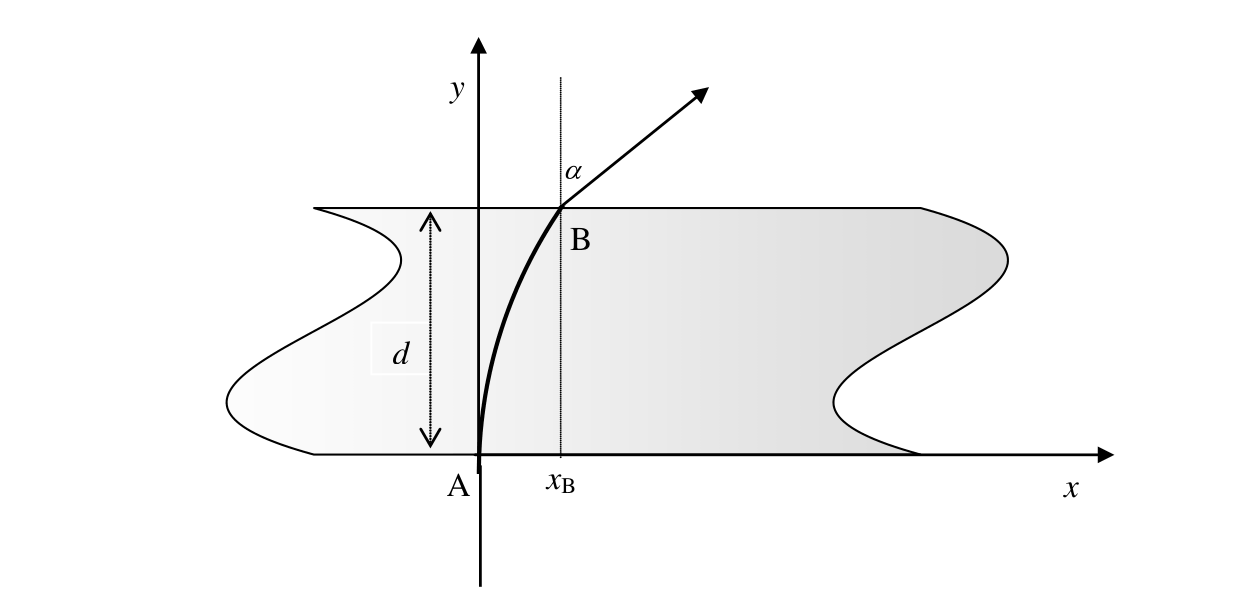
Fig. 1
A light beam enters from the air perpendicularly to the plate at the point A (\(x_A=0\)) and emerges from it at the point B at an angle \(\alpha\).
- Find the refraction index \(n_B\) at the point B.
- Find \(x_B\) (i.e. value of \(x\) at the point B)
- Find the thickness \(d\) of the plate.
Data:
\[ n_0=1.2;\qquad R=13\,\mathrm{cm};\qquad \alpha=30^\circ. \]
Official English text of the problem.
Problem 3: Engine using a gas source and semipermeable membranes
A scientific expedition stayed on an uninhabited island. The members of the expedition had had some sources of energy, but after some time these sources exhausted. Then they decided to construct an alternative energy source. Unfortunately, the island was very quiet: there were no winds, clouds uniformly covered the sky, the air pressure was constant and the temperatures of air and water in the sea were the same during day and night. Fortunately, they found a source of chemically neutral gas outgoing very slowly from a cavity. The pressure and temperature of the gas are exactly the same as the pressure and temperature of the atmosphere.
The expedition had, however, certain membranes in its equipment. One of them was ideally transparent for gas and ideally non-transparent for air. Another one had an opposite property: it was ideally transparent for air and ideally non-transparent for gas. The members of the expedition had materials and tools that allowed them to make different mechanical devices such as cylinders with pistons, valves etc. They decided to construct an engine by using the gas from the cavity.
Show that there is no theoretical limit on the power of an ideal engine that uses the gas and the membranes considered above.
Official English text of the problem.
Internationale Physik-Olympiade
IPhO 1974
Warschau, Polen · 3 Theorieaufgaben mit vollständigen Lösungen
Aufgabe 1: Unelastischer Stoß zweier Wasserstoffatome (Bohrsches Modell, Dopplerverschiebung)
Ein Wasserstoffatom im Grundzustand, das sich mit der Geschwindigkeit \(v\) bewegt, stößt mit einem anderen, ruhenden Wasserstoffatom im Grundzustand zusammen. Bestimmen Sie mithilfe des Bohrschen Modells die kleinste Geschwindigkeit \(v_0\) des Atoms, unterhalb derer der Stoß elastisch sein muss.
Bei der Geschwindigkeit \(v_0\) kann der Stoß unelastisch sein, und die zusammenstoßenden Atome können elektromagnetische Strahlung aussenden. Schätzen Sie die Differenz der Frequenzen der Strahlung, die in Richtung der Anfangsgeschwindigkeit des Wasserstoffatoms und in die entgegengesetzte Richtung ausgesandt wird, als Anteil (in Prozent) ihres arithmetischen Mittelwerts ab.
Gegeben:
\[ E_i=\frac{me^4}{2\hbar^2}=13.6\ \mathrm{eV} =2.18\cdot18^{-18}\ \mathrm{J}; \quad\text{(Ionisierungsenergie des Wasserstoffatoms)} \]
\[ m_H=1.67\cdot10^{-27}\ \mathrm{kg}; \quad\text{(Masse des Wasserstoffatoms)} \]
(\(m\) - Masse des Elektrons; \(e\) - elektrische Ladung des Elektrons; \(\hbar\) - Plancksche Konstante; Zahlenwerte dieser Größen sind nicht erforderlich.)
Aufgabentext aus dem offiziellen englischen Text übersetzt.
Aufgabe 2: Platte mit einem über ihre Breite veränderlichen Brechungsindex
Betrachtet wird eine planparallele, transparente Platte der Dicke \(d\) – Abb. 1. Ihr Brechungsindex variiert gemäß
\[ n=\frac{n_0}{1-\dfrac{x}{R}}. \]
Abb. 1
Ein Lichtstrahl tritt aus der Luft im Punkt A (\(x_A=0\)) senkrecht in die Platte ein und verlässt sie im Punkt B unter einem Winkel \(\alpha\).
- Bestimmen Sie den Brechungsindex \(n_B\) im Punkt B.
- Bestimmen Sie \(x_B\) (d. h. den Wert von \(x\) im Punkt B)
- Bestimmen Sie die Dicke \(d\) der Platte.
Gegeben:
\[ n_0=1.2;\qquad R=13\,\mathrm{cm};\qquad \alpha=30^\circ. \]
Aufgabentext aus dem offiziellen englischen Text übersetzt.
Aufgabe 3: Maschine mit einer Gasquelle und semipermeablen Membranen
Eine wissenschaftliche Expedition hielt sich auf einer unbewohnten Insel auf. Die Expeditionsteilnehmer hatten über einige Energiequellen verfügt, doch nach einiger Zeit waren diese erschöpft. Daraufhin beschlossen sie, eine alternative Energiequelle zu bauen. Leider war es auf der Insel sehr ruhig: Es wehte kein Wind, Wolken bedeckten den Himmel gleichmäßig, der Luftdruck war konstant, und die Temperaturen der Luft und des Meerwassers waren bei Tag und Nacht gleich. Glücklicherweise fanden sie eine Quelle eines chemisch neutralen Gases, das sehr langsam aus einem Hohlraum austrat. Druck und Temperatur des Gases stimmen genau mit Druck und Temperatur der Atmosphäre überein.
Die Expedition hatte jedoch bestimmte Membranen in ihrer Ausrüstung. Eine davon war für das Gas vollkommen durchlässig und für Luft vollkommen undurchlässig. Eine andere hatte die entgegengesetzte Eigenschaft: Sie war für Luft vollkommen durchlässig und für das Gas vollkommen undurchlässig. Die Expeditionsteilnehmer verfügten über Materialien und Werkzeuge, mit denen sie verschiedene mechanische Vorrichtungen wie Zylinder mit Kolben, Ventile usw. herstellen konnten. Sie beschlossen, eine Maschine zu bauen, die das Gas aus dem Hohlraum nutzt.
Zeigen Sie, dass es keine theoretische Grenze für die Leistung einer idealen Maschine gibt, die das Gas und die oben beschriebenen Membranen nutzt.
Aufgabentext aus dem offiziellen englischen Text übersetzt.
Uluslararası Fizik Olimpiyatı
IPhO 1974
Varşova, Polonya · 3 teori sorusu, tam çözümleriyle
Soru 1: İki hidrojen atomunun esnek olmayan çarpışması (Bohr modeli, Doppler kayması)
Temel durumda bulunan ve \(v\) hızıyla hareket eden bir hidrojen atomu, temel durumda bulunan ve durmakta olan başka bir hidrojen atomuyla çarpışır. Bohr modelini kullanarak, altındaki hızlarda çarpışmanın mutlaka esnek olduğu en küçük \(v_0\) atom hızını bulun.
\(v_0\) hızında çarpışma esnek olmayabilir ve çarpışan atomlar elektromanyetik ışınım yayabilir. Hidrojen atomunun başlangıç hızı yönünde ve buna zıt yönde yayılan ışınımın frekansları arasındaki farkın, bu frekansların aritmetik ortalamasına oranını yüzde olarak tahmin edin.
Veriler:
\[ E_i=\frac{me^4}{2\hbar^2}=13.6\ \mathrm{eV} =2.18\cdot18^{-18}\ \mathrm{J}; \quad\text{(hidrojen atomunun iyonlaşma enerjisi)} \]
\[ m_H=1.67\cdot10^{-27}\ \mathrm{kg}; \quad\text{(hidrojen atomunun kütlesi)} \]
(\(m\) - elektronun kütlesi; \(e\) - elektronun elektrik yükü; \(\hbar\) - Planck sabiti; bu niceliklerin sayısal değerleri gerekli değildir.)
Soru metni resmi İngilizce metinden çevrilmiştir.
Soru 2: Kırılma indisi genişliği boyunca değişen levha
Kalınlığı \(d\) olan, yüzeyleri birbirine paralel, saydam bir levhayı ele alalım – Şekil 1. Levhanın kırılma indisi aşağıdaki bağıntıya göre değişmektedir:
\[ n=\frac{n_0}{1-\dfrac{x}{R}}. \]
Şekil 1
Bir ışık demeti havadan levhaya A noktasında (\(x_A=0\)) dik olarak girer ve B noktasında levhadan \(\alpha\) açısıyla çıkar.
- B noktasındaki \(n_B\) kırılma indisini bulunuz.
- \(x_B\)'yi (yani B noktasındaki \(x\) değerini) bulunuz.
- Levhanın \(d\) kalınlığını bulunuz.
Veriler:
\[ n_0=1.2;\qquad R=13\,\mathrm{cm};\qquad \alpha=30^\circ. \]
Soru metni resmi İngilizce metinden çevrilmiştir.
Soru 3: Bir gaz kaynağı ve yarı geçirgen zarlar kullanan motor
Bir bilimsel keşif ekibi, üzerinde insan yaşamayan bir adada konaklıyordu. Ekip üyelerinin bazı enerji kaynakları vardı, ancak bir süre sonra bu kaynaklar tükendi. Bunun üzerine alternatif bir enerji kaynağı oluşturmaya karar verdiler. Ne yazık ki adada hava çok durgundu: rüzgâr esmiyor, bulutlar gökyüzünü düzgün biçimde kaplıyor, hava basıncı sabit kalıyor ve havanın ve deniz suyunun sıcaklıkları gece gündüz aynı oluyordu. Neyse ki bir oyuktan çok yavaş çıkan, kimyasal olarak tepkimeye girmeyen bir gaz kaynağı buldular. Gazın basıncı ve sıcaklığı, atmosferin basıncı ve sıcaklığıyla tam olarak aynıdır.
Ancak keşif ekibinin donanımında bazı zarlar vardı. Bunlardan biri gazı kusursuz biçimde geçiriyor, havayı ise hiç geçirmiyordu. Bir diğeri bunun tam tersi özelliğe sahipti: havayı kusursuz biçimde geçiriyor, gazı ise hiç geçirmiyordu. Ekip üyelerinin elinde pistonlu silindirler, vanalar vb. çeşitli mekanik düzenekler yapmalarını sağlayacak malzemeler ve aletler vardı. Oyuktan çıkan gazı kullanarak bir motor yapmaya karar verdiler.
Yukarıda ele alınan gazı ve zarları kullanan ideal bir motorun gücünün teorik bir sınırı olmadığını gösteriniz.
Soru metni resmi İngilizce metinden çevrilmiştir.
Olimpiada Internacional de Física
IPhO 1974
Varsovia, Polonia · 3 problemas teóricos con soluciones completas
Problema 1: Colisión inelástica de dos átomos de hidrógeno (modelo de Bohr, desplazamiento Doppler)
Un átomo de hidrógeno en el estado fundamental, que se mueve con velocidad \(v\), choca con otro átomo de hidrógeno en el estado fundamental que se encuentra en reposo. Utilizando el modelo de Bohr, halle la velocidad mínima \(v_0\) del átomo por debajo de la cual la colisión debe ser elástica.
A la velocidad \(v_0\), la colisión puede ser inelástica y los átomos que chocan pueden emitir radiación electromagnética. Estime la diferencia entre las frecuencias de la radiación emitida en el sentido de la velocidad inicial del átomo de hidrógeno y en el sentido opuesto como fracción (expresada en porcentaje) de su media aritmética.
Datos:
\[ E_i=\frac{me^4}{2\hbar^2}=13.6\ \mathrm{eV} =2.18\cdot18^{-18}\ \mathrm{J}; \quad\text{(energía de ionización del átomo de hidrógeno)} \]
\[ m_H=1.67\cdot10^{-27}\ \mathrm{kg}; \quad\text{(masa del átomo de hidrógeno)} \]
(\(m\) - masa del electrón; \(e\) - carga eléctrica del electrón; \(\hbar\) - constante de Planck; no son necesarios los valores numéricos de estas magnitudes.)
Enunciado traducido del texto oficial en inglés.
Problema 2: Lámina con un índice de refracción que varía a lo ancho
Considérese una lámina transparente de caras paralelas y espesor \(d\), representada en la Fig. 1. Su índice de refracción varía según
\[ n=\frac{n_0}{1-\dfrac{x}{R}}. \]
Fig. 1
Un haz de luz procedente del aire incide perpendicularmente sobre la lámina en el punto A (\(x_A=0\)) y sale de ella por el punto B formando un ángulo \(\alpha\).
- Halle el índice de refracción \(n_B\) en el punto B.
- Halle \(x_B\) (es decir, el valor de \(x\) en el punto B)
- Halle el espesor \(d\) de la lámina.
Datos:
\[ n_0=1.2;\qquad R=13\,\mathrm{cm};\qquad \alpha=30^\circ. \]
Enunciado traducido del texto oficial en inglés.
Problema 3: Motor que utiliza una fuente de gas y membranas semipermeables
Una expedición científica permaneció en una isla deshabitada. Los miembros de la expedición habían contado con algunas fuentes de energía, pero al cabo de un tiempo estas se agotaron. Entonces decidieron construir una fuente de energía alternativa. Por desgracia, en la isla reinaba una gran calma: no había viento, las nubes cubrían uniformemente el cielo, la presión atmosférica era constante y las temperaturas del aire y del agua del mar eran las mismas de día y de noche. Afortunadamente, encontraron una fuente de gas químicamente neutro que salía muy lentamente de una cavidad. La presión y la temperatura del gas son exactamente iguales a la presión y la temperatura de la atmósfera.
Sin embargo, la expedición disponía de ciertas membranas entre su equipo. Una de ellas era perfectamente permeable al gas y perfectamente impermeable al aire. Otra tenía la propiedad opuesta: era perfectamente permeable al aire y perfectamente impermeable al gas. Los miembros de la expedición disponían de materiales y herramientas que les permitían fabricar distintos dispositivos mecánicos, como cilindros con pistones, válvulas, etc. Decidieron construir un motor utilizando el gas de la cavidad.
Demuestre que no existe ningún límite teórico para la potencia de un motor ideal que utilice el gas y las membranas descritos anteriormente.
Enunciado traducido del texto oficial en inglés.
国际物理奥林匹克
IPhO 1974
波兰华沙 · 3 道理论题及完整解答
题目 1:两个氢原子的非弹性碰撞(玻尔模型,多普勒频移)
一个处于基态的氢原子以速度 \(v\) 运动,与另一个静止的基态氢原子发生碰撞。利用玻尔模型,求原子的临界速度 \(v_0\),使得低于此速度时,碰撞必定是弹性的。
当速度为 \(v_0\) 时,碰撞可能是非弹性的,发生碰撞的原子可能发出电磁辐射。估算沿氢原子初速度方向和沿相反方向发出的辐射的频率之差占这两个频率算术平均值的百分比。
已知数据:
\[ E_i=\frac{me^4}{2\hbar^2}=13.6\ \mathrm{eV} =2.18\cdot18^{-18}\ \mathrm{J}; \quad\text{(氢原子的电离能)} \]
\[ m_H=1.67\cdot10^{-27}\ \mathrm{kg}; \quad\text{(氢原子的质量)} \]
(\(m\)——电子质量;\(e\)——电子电荷;\(\hbar\)——普朗克常量;不需要这些量的数值。)
题目译自官方英文原文。
题目 2:折射率沿宽度方向变化的平板
考虑一块厚度为 \(d\) 的透明平行平板,如图 1 所示。其折射率按下式变化:
\[ n=\frac{n_0}{1-\dfrac{x}{R}}. \]
图 1
一束光从空气中在 A 点(\(x_A=0\))垂直射入平板,并在 B 点以角度 \(\alpha\) 射出。
- 求 B 点的折射率 \(n_B\)。
- 求 \(x_B\)(即 B 点的 \(x\) 值)。
- 求平板的厚度 \(d\)。
已知:
\[ n_0=1.2;\qquad R=13\,\mathrm{cm};\qquad \alpha=30^\circ. \]
题目译自官方英文原文。
题目 3:利用气源和半透膜的发动机
一支科学考察队驻留在一座无人岛上。队员们原本有一些能源,但过了一段时间,这些能源都耗尽了。于是,他们决定构建一种替代能源。不幸的是,岛上的环境十分平静:没有风,云层均匀地覆盖着天空,气压恒定,空气和海水的温度昼夜都相同。幸运的是,他们发现了一处气源,一种化学性质惰性的气体正从一个洞穴中非常缓慢地逸出。这种气体的压强和温度与大气的压强和温度完全相同。
不过,考察队的装备中有一些膜。其中一种能让这种气体完全透过,却完全不让空气透过。另一种具有相反的性质:能让空气完全透过,却完全不让这种气体透过。队员们拥有材料和工具,可以制作各种机械装置,例如带活塞的气缸、阀门等。他们决定利用洞穴中逸出的气体制造一台发动机。
证明:利用上述气体和膜的理想发动机,其功率在理论上没有上限。
题目译自官方英文原文。
Международная физическая олимпиада
IPhO 1974
Варшава, Польша · 3 теоретические задачи с полными решениями
Задача 1: Неупругое столкновение двух атомов водорода (модель Бора, доплеровский сдвиг)
Атом водорода в основном состоянии, движущийся со скоростью \(v\), сталкивается с другим атомом водорода в основном состоянии, находящимся в покое. Используя модель Бора, найдите наименьшую скорость \(v_0\) атома, ниже которой столкновение обязательно будет упругим.
При скорости \(v_0\) столкновение может быть неупругим, и сталкивающиеся атомы могут испускать электромагнитное излучение. Оцените разность частот излучения, испускаемого в направлении начальной скорости атома водорода и в противоположном направлении, как долю (выраженную в процентах) их среднего арифметического значения.
Данные:
\[ E_i=\frac{me^4}{2\hbar^2}=13.6\ \mathrm{eV} =2.18\cdot18^{-18}\ \mathrm{J}; \quad\text{(энергия ионизации атома водорода)} \]
\[ m_H=1.67\cdot10^{-27}\ \mathrm{kg}; \quad\text{(масса атома водорода)} \]
(\(m\) — масса электрона; \(e\) — электрический заряд электрона; \(\hbar\) — постоянная Планка; численные значения этих величин не требуются.)
Условие переведено с официального английского текста.
Задача 2: Пластинка с показателем преломления, изменяющимся по её ширине
Рассмотрим плоскопараллельную прозрачную пластинку толщиной \(d\) — рис. 1. Её показатель преломления изменяется по закону
\[ n=\frac{n_0}{1-\dfrac{x}{R}}. \]
Рис. 1
Световой луч входит из воздуха перпендикулярно поверхности пластинки в точке A (\(x_A=0\)) и выходит из неё в точке B под углом \(\alpha\).
- Найдите показатель преломления \(n_B\) в точке B.
- Найдите \(x_B\) (то есть значение \(x\) в точке B)
- Найдите толщину \(d\) пластинки.
Дано:
\[ n_0=1.2;\qquad R=13\,\mathrm{cm};\qquad \alpha=30^\circ. \]
Условие переведено с официального английского текста.
Задача 3: Двигатель, использующий источник газа и полупроницаемые мембраны
На необитаемом острове находилась научная экспедиция. У участников экспедиции были некоторые источники энергии, но через некоторое время они иссякли. Тогда участники решили создать альтернативный источник энергии. К сожалению, на острове царило полное затишье: ветра не было, облака равномерно покрывали небо, атмосферное давление было постоянным, а температуры воздуха и морской воды были одинаковыми и днём, и ночью. К счастью, они обнаружили источник химически нейтрального газа, очень медленно выходившего из полости. Давление и температура газа в точности совпадают с давлением и температурой атмосферы.
Однако в снаряжении экспедиции имелись специальные мембраны. Одна из них была идеально проницаема для газа и совершенно непроницаема для воздуха. Другая обладала противоположным свойством: она была идеально проницаема для воздуха и совершенно непроницаема для газа. У участников экспедиции были материалы и инструменты, позволявшие изготавливать различные механические устройства, такие как цилиндры с поршнями, клапаны и т. д. Они решили построить двигатель, использующий газ из полости.
Покажите, что мощность идеального двигателя, использующего описанные выше газ и мембраны, теоретически не ограничена.
Условие переведено с официального английского текста.
الأولمبياد الدولي للفيزياء
IPhO 1974
وارسو، بولندا · 3 مسائل نظرية مع حلول كاملة
المسألة 1: تصادم غير مرن بين ذرتي هيدروجين (نموذج بوهر، انزياح دوبلر)
تتصادم ذرة هيدروجين في الحالة الأرضية، تتحرك بسرعة \(v\)، مع ذرة هيدروجين أخرى ساكنة في الحالة الأرضية. باستخدام نموذج بوهر، أوجد أصغر سرعة \(v_0\) للذرة يجب أن يكون التصادم عند السرعات الأقل منها مرنًا.
عند السرعة \(v_0\)، قد يكون التصادم غير مرن وقد تبعث الذرتان المتصادمتان إشعاعًا كهرومغناطيسيًا. قدّر الفرق بين ترددي الإشعاع المنبعث في اتجاه السرعة الابتدائية لذرة الهيدروجين وفي الاتجاه المعاكس، بوصفه نسبة (معبّرًا عنها بالنسبة المئوية) من متوسطهما الحسابي.
المعطيات:
\[ E_i=\frac{me^4}{2\hbar^2}=13.6\ \mathrm{eV} =2.18\cdot18^{-18}\ \mathrm{J}; \quad\text{(طاقة تأين ذرة الهيدروجين)} \]
\[ m_H=1.67\cdot10^{-27}\ \mathrm{kg}; \quad\text{(كتلة ذرة الهيدروجين)} \]
(\(m\) - كتلة الإلكترون؛ \(e\) - الشحنة الكهربائية للإلكترون؛ \(\hbar\) - ثابت بلانك؛ لا حاجة إلى القيم العددية لهذه الكميات.)
نص المسألة مترجم عن النص الإنجليزي الرسمي.
المسألة 2: صفيحة يتغير معامل انكسارها عبر عرضها
لتكن لدينا صفيحة شفافة متوازية الوجهين سمكها \(d\) – الشكل 1. يتغير معامل انكسارها وفق العلاقة
\[ n=\frac{n_0}{1-\dfrac{x}{R}}. \]
الشكل 1
يدخل شعاع ضوئي من الهواء عموديًا على الصفيحة عند النقطة A (\(x_A=0\)) ويخرج منها عند النقطة B بزاوية \(\alpha\).
- أوجد معامل الانكسار \(n_B\) عند النقطة B.
- أوجد \(x_B\) (أي قيمة \(x\) عند النقطة B)
- أوجد سمك الصفيحة \(d\).
المعطيات:
\[ n_0=1.2;\qquad R=13\,\mathrm{cm};\qquad \alpha=30^\circ. \]
نص المسألة مترجم عن النص الإنجليزي الرسمي.
المسألة 3: محرك يستخدم مصدرًا للغاز وأغشية شبه منفذة
أقامت بعثة علمية في جزيرة غير مأهولة. وكان لدى أفراد البعثة بعض مصادر الطاقة، لكنها نفدت بعد فترة من الزمن. فقرروا عندئذ إنشاء مصدر بديل للطاقة. ولسوء الحظ، كانت الجزيرة ساكنة تمامًا: فلم تكن هناك رياح، وكانت السحب تغطي السماء بانتظام، وكان ضغط الهواء ثابتًا، وكانت درجتا حرارة الهواء وماء البحر متساويتين وثابتتين ليلًا ونهارًا. ولحسن الحظ، وجدوا مصدرًا لغاز خامل كيميائيًا يتدفق ببطء شديد من تجويف. وكان ضغط الغاز ودرجة حرارته مساويين تمامًا لضغط الغلاف الجوي ودرجة حرارته.
غير أن البعثة كانت تملك ضمن معداتها أغشية معينة. كان أحدها منفذًا تمامًا للغاز وغير منفذ إطلاقًا للهواء. وكان لغشاء آخر خاصية معاكسة: إذ كان منفذًا تمامًا للهواء وغير منفذ إطلاقًا للغاز. وكان لدى أفراد البعثة مواد وأدوات تتيح لهم صنع أجهزة ميكانيكية مختلفة، مثل أسطوانات ذات مكابس وصمامات وغيرها. فقرروا إنشاء محرك باستخدام الغاز المنبعث من التجويف.
بيّن أنه لا يوجد حد نظري لقدرة محرك مثالي يستخدم الغاز والأغشية المذكورة أعلاه.
نص المسألة مترجم عن النص الإنجليزي الرسمي.