International Physics Olympiad
IPhO 1975
Güstrow, German Democratic Republic · 3 theory problems with complete solutions
Problem 1: Rotating rod
A rod revolves with a constant angular velocity \(\omega\) around a vertical axis A. The rod includes a fixed angle of \(\pi/2-\alpha\) with the axis. A body of mass \(m\) can glide along the rod. The coefficient of friction is \(\mu=\tan\beta\). The angle \(\beta\) is called “friction angle”.
a) Determine the angles \(\alpha\) under which the body remains at rest and under which the body is in motion if the rod is not rotating (i.e. \(\omega=0\)).
b) The rod rotates with constant angular velocity \(\omega>0\). The angle \(\alpha\) does not change during rotation. Find the condition for the body to remain at rest relative to the rod.
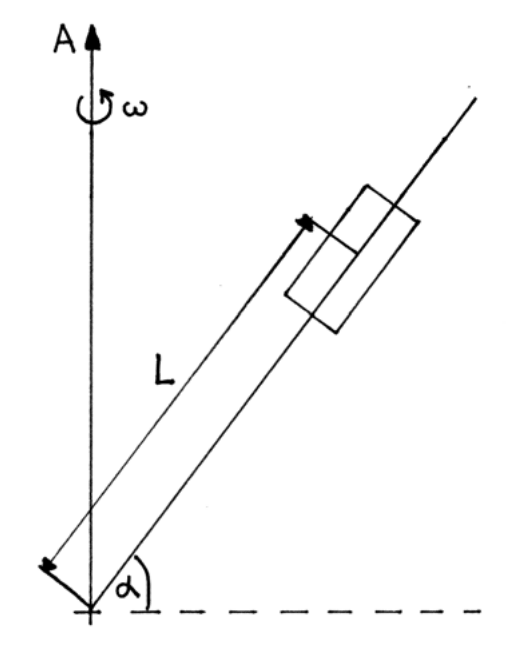
You can use the following relations:
\[ \sin(\alpha\pm\beta)=\sin\alpha\cdot\cos\beta\pm\cos\alpha\cdot\sin\beta \]
\[ \cos(\alpha\pm\beta)=\cos\alpha\cdot\cos\beta\mp\sin\alpha\cdot\sin\beta \]
Official English text of the problem.
Problem 2: Thick lens
The focal length \(f\) of a thick glass lens in air with refractive index \(n\), radius curvatures \(r_1\), \(r_2\) and vertex distance \(d\) (see figure) is given by:
\[ f=\frac{nr_1r_2}{(n-1)\left[n(r_2-r_1)+d(n-1)\right]} \]
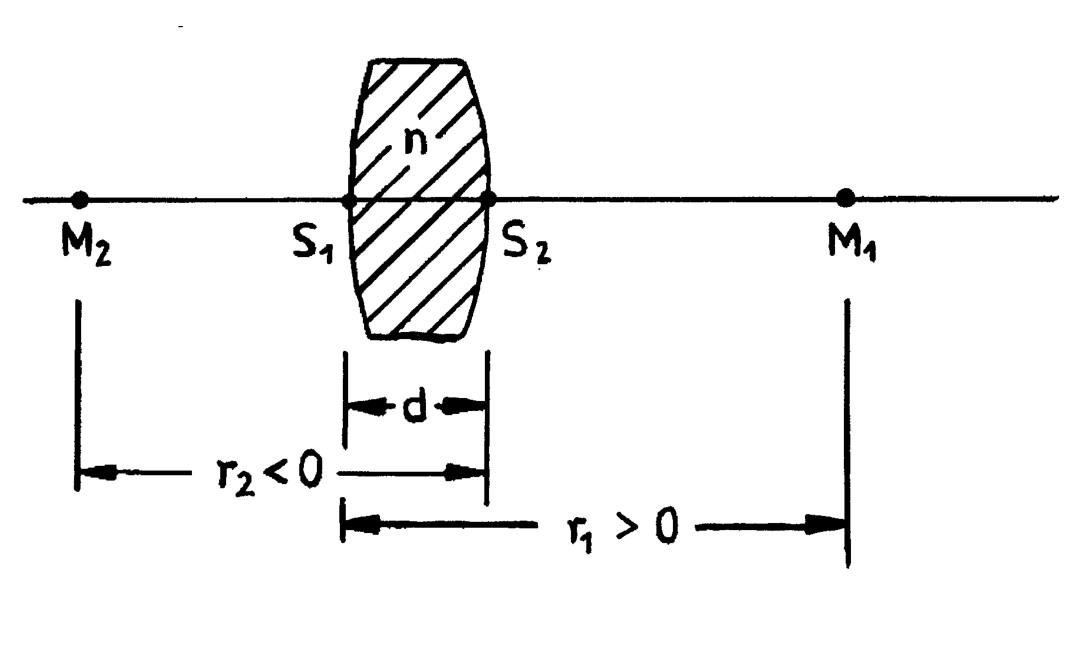
Remark: \(r_i>0\) means that the central curvature point \(M_i\) is on the right side of the aerial vertex \(S_i\), \(r_i<0\) means that the central curvature point \(M_i\) is on the left side of the aerial vertex \(S_i\) (\(i=1,2\)).
For some special applications it is required, that the focal length is independent from the wavelength.
a) For how many different wavelengths can the same focal length be achieved?
b) Describe a relation between \(r_i\) (\(i=1,2\)), \(d\) and the refractive index \(n\) for which the required wavelength independence can be fulfilled and discuss this relation.
Sketch possible shapes of lenses and mark the central curvature points \(M_1\) and \(M_2\).
c) Prove that for a given planconvex lens a specific focal length can be achieved by only one wavelength.
d) State possible parameters of the thick lens for two further cases in which a certain focal length can be realized for one wavelength only. Take into account the physical and the geometrical circumstances.
Official English text of the problem.
Problem 3: Ions in a magnetic field
A beam of positive ions (charge \(+e\)) of the same and constant mass \(m\) spread from point Q in different directions in the plane of paper (see figure²). The ions were accelerated by a voltage \(U\). They are deflected in a uniform magnetic field \(B\) that is perpendicular to the plane of paper. The boundaries of the magnetic field are made in a way that the initially diverging ions are focused in point A (\(\overline{QA}=2\cdot a\)). The trajectories of the ions are symmetric to the middle perpendicular on \(\overline{QA}\).
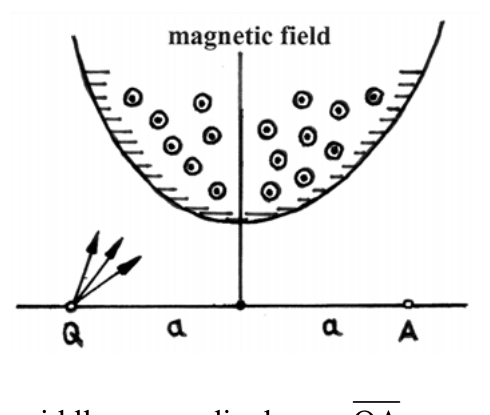
² Remark: This illustrative figure was not part of the original problem formulation.
Among different possible boundaries of magnetic fields a specific type shall be considered in which a contiguous magnetic field acts around the middle perpendicular and in which the points Q and A are in the field free area.
a) Describe the radius curvature \(R\) of the particle path in the magnetic field as a function of the voltage \(U\) and the induction \(B\).
b) Describe the characteristic properties of the particle paths in the setup mentioned above.
c) Obtain the boundaries of the magnetic field boundaries by geometrical constructions for the cases \(R<a\), \(R=a\) and \(R>0\).
d) Describe the general equation for the boundaries of the magnetic field.
Official English text of the problem.
Internationale Physik-Olympiade
IPhO 1975
Güstrow, Deutsche Demokratische Republik · 3 Theorieaufgaben mit vollständigen Lösungen
Aufgabe 1: Rotierender Stab
Ein Stab rotiert mit konstanter Winkelgeschwindigkeit \(\omega\) um eine vertikale Achse A. Der Stab schließt mit der Achse einen festen Winkel von \(\pi/2-\alpha\) ein. Ein Körper der Masse \(m\) kann entlang des Stabes gleiten. Der Reibungskoeffizient beträgt \(\mu=\tan\beta\). Der Winkel \(\beta\) wird als „Reibungswinkel“ bezeichnet.
a) Bestimmen Sie die Winkel \(\alpha\), bei denen der Körper in Ruhe bleibt, und diejenigen, bei denen sich der Körper bewegt, wenn der Stab nicht rotiert (d. h. \(\omega=0\)).
b) Der Stab rotiert mit konstanter Winkelgeschwindigkeit \(\omega>0\). Der Winkel \(\alpha\) ändert sich während der Rotation nicht. Finden Sie die Bedingung dafür, dass der Körper relativ zum Stab in Ruhe bleibt.
Sie können die folgenden Beziehungen verwenden:
\[ \sin(\alpha\pm\beta)=\sin\alpha\cdot\cos\beta\pm\cos\alpha\cdot\sin\beta \]
\[ \cos(\alpha\pm\beta)=\cos\alpha\cdot\cos\beta\mp\sin\alpha\cdot\sin\beta \]
Aufgabentext aus dem offiziellen englischen Text übersetzt.
Aufgabe 2: Dicke Linse
Die Brennweite \(f\) einer dicken Glaslinse in Luft mit dem Brechungsindex \(n\), den Krümmungsradien \(r_1\), \(r_2\) und dem Scheitelabstand \(d\) (siehe Abbildung) ist gegeben durch:
\[ f=\frac{nr_1r_2}{(n-1)\left[n(r_2-r_1)+d(n-1)\right]} \]
Anmerkung: \(r_i>0\) bedeutet, dass der Krümmungsmittelpunkt \(M_i\) rechts vom Flächenscheitel \(S_i\) liegt; \(r_i<0\) bedeutet, dass der Krümmungsmittelpunkt \(M_i\) links vom Flächenscheitel \(S_i\) liegt (\(i=1,2\)).
Für einige spezielle Anwendungen muss die Brennweite unabhängig von der Wellenlänge sein.
a) Für wie viele verschiedene Wellenlängen kann dieselbe Brennweite erreicht werden?
b) Geben Sie eine Beziehung zwischen \(r_i\) (\(i=1,2\)), \(d\) und dem Brechungsindex \(n\) an, mit der sich die geforderte Wellenlängenunabhängigkeit erfüllen lässt, und diskutieren Sie diese Beziehung.
Skizzieren Sie mögliche Linsenformen und markieren Sie die Krümmungsmittelpunkte \(M_1\) und \(M_2\).
c) Beweisen Sie, dass bei einer gegebenen plankonvexen Linse eine bestimmte Brennweite nur bei einer einzigen Wellenlänge erreicht werden kann.
d) Geben Sie mögliche Parameter der dicken Linse für zwei weitere Fälle an, in denen eine bestimmte Brennweite nur bei einer einzigen Wellenlänge realisiert werden kann. Berücksichtigen Sie dabei die physikalischen und geometrischen Gegebenheiten.
Aufgabentext aus dem offiziellen englischen Text übersetzt.
Aufgabe 3: Ionen in einem Magnetfeld
Ein Strahl positiver Ionen (Ladung \(+e\)) gleicher und konstanter Masse \(m\) breitet sich vom Punkt Q aus in verschiedenen Richtungen in der Papierebene aus (siehe Abbildung²). Die Ionen wurden durch eine Spannung \(U\) beschleunigt. Sie werden in einem homogenen Magnetfeld \(B\) abgelenkt, das senkrecht zur Papierebene steht. Die Grenzen des Magnetfeldes sind so gestaltet, dass die zunächst auseinanderlaufenden Ionen im Punkt A fokussiert werden (\(\overline{QA}=2\cdot a\)). Die Bahnen der Ionen sind symmetrisch bezüglich der Mittelsenkrechten auf \(\overline{QA}\).
² Anmerkung: Diese veranschaulichende Abbildung war nicht Bestandteil der ursprünglichen Aufgabenstellung.
Unter den verschiedenen möglichen Begrenzungen von Magnetfeldern soll ein bestimmter Typ betrachtet werden, bei dem ein zusammenhängendes Magnetfeld um die Mittelsenkrechte herum wirkt und die Punkte Q und A im feldfreien Bereich liegen.
a) Geben Sie den Krümmungsradius \(R\) der Teilchenbahn im Magnetfeld als Funktion der Spannung \(U\) und der magnetischen Flussdichte \(B\) an.
b) Beschreiben Sie die charakteristischen Eigenschaften der Teilchenbahnen in der oben genannten Anordnung.
c) Bestimmen Sie die Grenzen des Magnetfeldes durch geometrische Konstruktionen für die Fälle \(R<a\), \(R=a\) und \(R>0\).
d) Geben Sie die allgemeine Gleichung für die Grenzen des Magnetfeldes an.
Aufgabentext aus dem offiziellen englischen Text übersetzt.
Uluslararası Fizik Olimpiyatı
IPhO 1975
Güstrow, Demokratik Alman Cumhuriyeti · 3 teori sorusu, tam çözümleriyle
Soru 1: Dönen çubuk
Bir çubuk, düşey bir A ekseni etrafında sabit \(\omega\) açısal hızıyla dönmektedir. Çubuk, eksenle sabit bir \(\pi/2-\alpha\) açısı yapmaktadır. Kütlesi \(m\) olan bir cisim çubuk boyunca kayabilmektedir. Sürtünme katsayısı \(\mu=\tan\beta\)'dır. \(\beta\) açısına “sürtünme açısı” denir.
a) Çubuk dönmüyorsa (yani \(\omega=0\) ise), cismin hangi \(\alpha\) açılarında durgun kaldığını ve hangi açılarda hareket ettiğini belirleyiniz.
b) Çubuk sabit \(\omega>0\) açısal hızıyla dönmektedir. \(\alpha\) açısı dönme sırasında değişmemektedir. Cismin çubuğa göre durgun kalma koşulunu bulunuz.
Aşağıdaki bağıntıları kullanabilirsiniz:
\[ \sin(\alpha\pm\beta)=\sin\alpha\cdot\cos\beta\pm\cos\alpha\cdot\sin\beta \]
\[ \cos(\alpha\pm\beta)=\cos\alpha\cdot\cos\beta\mp\sin\alpha\cdot\sin\beta \]
Soru metni resmi İngilizce metinden çevrilmiştir.
Soru 2: Kalın mercek
Havada bulunan, kırılma indisi \(n\), eğrilik yarıçapları \(r_1\), \(r_2\) ve tepe noktaları arasındaki uzaklığı \(d\) olan kalın bir cam merceğin odak uzaklığı \(f\) (şekle bakınız) şu bağıntıyla verilir:
\[ f=\frac{nr_1r_2}{(n-1)\left[n(r_2-r_1)+d(n-1)\right]} \]
Not: \(r_i>0\), eğrilik merkezi \(M_i\)'nin hava ile temas eden yüzeyin tepe noktası \(S_i\)'nin sağında olduğunu; \(r_i<0\) ise eğrilik merkezi \(M_i\)'nin hava ile temas eden yüzeyin tepe noktası \(S_i\)'nin solunda olduğunu belirtir (\(i=1,2\)).
Bazı özel uygulamalarda odak uzaklığının dalga boyundan bağımsız olması gerekir.
a) Aynı odak uzaklığı kaç farklı dalga boyunda elde edilebilir?
b) \(r_i\) (\(i=1,2\)), \(d\) ve kırılma indisi \(n\) arasında, istenen dalga boyu bağımsızlığının sağlanabileceği bir bağıntı belirtiniz ve bu bağıntıyı tartışınız.
Olası mercek biçimlerinin şematik çizimlerini yapınız ve eğrilik merkezleri \(M_1\) ile \(M_2\)'yi işaretleyiniz.
c) Verilen bir düzlem-dışbükey mercekte belirli bir odak uzaklığının yalnızca tek bir dalga boyunda elde edilebileceğini kanıtlayınız.
d) Belirli bir odak uzaklığının yalnızca tek bir dalga boyunda elde edilebildiği iki başka durum için kalın merceğin olası parametrelerini belirtiniz. Fiziksel ve geometrik koşulları dikkate alınız.
Soru metni resmi İngilizce metinden çevrilmiştir.
Soru 3: Manyetik alandaki iyonlar
Aynı ve sabit \(m\) kütlesine sahip pozitif iyonlardan (yükleri \(+e\)) oluşan bir demet, Q noktasından kâğıt düzleminde farklı yönlere yayılmaktadır (şekle² bakınız). İyonlar \(U\) gerilimiyle hızlandırılmıştır. Kâğıt düzlemine dik olan düzgün bir \(B\) manyetik alanında saptırılırlar. Manyetik alanın sınırları, başlangıçta birbirinden uzaklaşan iyonlar A noktasında odaklanacak şekilde düzenlenmiştir (\(\overline{QA}=2\cdot a\)). İyonların yörüngeleri, \(\overline{QA}\) doğru parçasının orta dikmesine göre simetriktir.
² Not: Açıklama amacıyla verilen bu şekil, özgün soru metninde yer almamaktadır.
Manyetik alan sınırlarının mümkün olan farklı biçimleri arasından, orta dikmenin çevresinde kesintisiz bir manyetik alanın bulunduğu ve Q ile A noktalarının alanın bulunmadığı bölgede kaldığı belirli bir tür ele alınacaktır.
a) Parçacığın manyetik alandaki yörüngesinin eğrilik yarıçapı \(R\)'yi, \(U\) geriliminin ve \(B\) manyetik indüksiyonunun fonksiyonu olarak ifade ediniz.
b) Yukarıda belirtilen düzenekte parçacık yörüngelerinin karakteristik özelliklerini açıklayınız.
c) \(R<a\), \(R=a\) ve \(R>0\) durumları için manyetik alanın sınırlarını geometrik çizimlerle elde ediniz.
d) Manyetik alanın sınırlarının genel denklemini ifade ediniz.
Soru metni resmi İngilizce metinden çevrilmiştir.
Olimpiada Internacional de Física
IPhO 1975
Güstrow, República Democrática Alemana · 3 problemas teóricos con soluciones completas
Problema 1: Varilla en rotación
Una varilla gira con velocidad angular constante \(\omega\) alrededor de un eje vertical A. La varilla forma un ángulo fijo de \(\pi/2-\alpha\) con el eje. Un cuerpo de masa \(m\) puede deslizarse a lo largo de la varilla. El coeficiente de rozamiento es \(\mu=\tan\beta\). El ángulo \(\beta\) se denomina «ángulo de rozamiento».
a) Determine los ángulos \(\alpha\) para los cuales el cuerpo permanece en reposo y aquellos para los cuales el cuerpo está en movimiento si la varilla no gira (es decir, \(\omega=0\)).
b) La varilla gira con velocidad angular constante \(\omega>0\). El ángulo \(\alpha\) no cambia durante la rotación. Halle la condición para que el cuerpo permanezca en reposo respecto a la varilla.
Puede utilizar las siguientes relaciones:
\[ \sin(\alpha\pm\beta)=\sin\alpha\cdot\cos\beta\pm\cos\alpha\cdot\sin\beta \]
\[ \cos(\alpha\pm\beta)=\cos\alpha\cdot\cos\beta\mp\sin\alpha\cdot\sin\beta \]
Enunciado traducido del texto oficial en inglés.
Problema 2: Lente gruesa
La distancia focal \(f\) de una lente gruesa de vidrio en el aire, con índice de refracción \(n\), radios de curvatura \(r_1\), \(r_2\) y distancia entre vértices \(d\) (véase la figura), viene dada por:
\[ f=\frac{nr_1r_2}{(n-1)\left[n(r_2-r_1)+d(n-1)\right]} \]
Observación: \(r_i>0\) significa que el centro de curvatura \(M_i\) está a la derecha del vértice de la superficie \(S_i\), y \(r_i<0\) significa que el centro de curvatura \(M_i\) está a la izquierda del vértice de la superficie \(S_i\) (\(i=1,2\)).
Para algunas aplicaciones especiales se requiere que la distancia focal sea independiente de la longitud de onda.
a) ¿Para cuántas longitudes de onda diferentes puede obtenerse la misma distancia focal?
b) Describa una relación entre \(r_i\) (\(i=1,2\)), \(d\) y el índice de refracción \(n\) que permita satisfacer la independencia requerida respecto de la longitud de onda, y analice dicha relación.
Esboce posibles formas de las lentes e indique los centros de curvatura \(M_1\) y \(M_2\).
c) Demuestre que, para una lente planoconvexa dada, una distancia focal específica solo puede obtenerse con una longitud de onda.
d) Indique posibles parámetros de la lente gruesa para otros dos casos en los que una determinada distancia focal pueda obtenerse con una sola longitud de onda. Tenga en cuenta las condiciones físicas y geométricas.
Enunciado traducido del texto oficial en inglés.
Problema 3: Iones en un campo magnético
Un haz de iones positivos (carga \(+e\)) de la misma masa constante \(m\) se propaga desde el punto Q en distintas direcciones en el plano del papel (véase la figura²). Los iones han sido acelerados mediante una tensión \(U\). Se desvían en un campo magnético uniforme \(B\) perpendicular al plano del papel. Los límites del campo magnético están dispuestos de manera que los iones, inicialmente divergentes, se enfocan en el punto A (\(\overline{QA}=2\cdot a\)). Las trayectorias de los iones son simétricas respecto de la mediatriz de \(\overline{QA}\).
² Observación: Esta figura ilustrativa no formaba parte del enunciado original del problema.
Entre los distintos límites posibles del campo magnético, se considerará un tipo específico en el que un campo magnético contiguo actúa en torno a la mediatriz y los puntos Q y A se encuentran en la región libre de campo.
a) Exprese el radio de curvatura \(R\) de la trayectoria de la partícula en el campo magnético en función de la tensión \(U\) y de la inducción magnética \(B\).
b) Describa las propiedades características de las trayectorias de las partículas en la configuración mencionada anteriormente.
c) Obtenga los límites del campo magnético mediante construcciones geométricas para los casos \(R<a\), \(R=a\) y \(R>0\).
d) Describa la ecuación general de los límites del campo magnético.
Enunciado traducido del texto oficial en inglés.
国际物理奥林匹克
IPhO 1975
德意志民主共和国居斯特罗 · 3 道理论题及完整解答
题目 1:旋转杆
一根杆以恒定角速度 \(\omega\) 绕竖直轴 A 转动。杆与该轴的夹角固定为 \(\pi/2-\alpha\)。一个质量为 \(m\) 的物体可以沿杆滑动。摩擦系数为 \(\mu=\tan\beta\)。角 \(\beta\) 称为“摩擦角”。
a) 当杆不转动(即 \(\omega=0\))时,确定物体保持静止和发生运动时角 \(\alpha\) 分别满足的条件。
b) 杆以恒定角速度 \(\omega>0\) 转动。角 \(\alpha\) 在转动过程中保持不变。求物体相对于杆保持静止的条件。
可以使用以下关系式:
\[ \sin(\alpha\pm\beta)=\sin\alpha\cdot\cos\beta\pm\cos\alpha\cdot\sin\beta \]
\[ \cos(\alpha\pm\beta)=\cos\alpha\cdot\cos\beta\mp\sin\alpha\cdot\sin\beta \]
题目译自官方英文原文。
题目 2:厚透镜
空气中一块厚玻璃透镜的折射率为 \(n\),两面的曲率半径为 \(r_1\)、\(r_2\),顶点间距为 \(d\)(见图),其焦距 \(f\) 由下式给出:
\[ f=\frac{nr_1r_2}{(n-1)\left[n(r_2-r_1)+d(n-1)\right]} \]
说明:\(r_i>0\) 表示曲率中心 \(M_i\) 位于空气与玻璃交界面的顶点 \(S_i\) 右侧,\(r_i<0\) 表示曲率中心 \(M_i\) 位于空气与玻璃交界面的顶点 \(S_i\) 左侧(\(i=1,2\))。
在某些特殊应用中,要求焦距与波长无关。
a) 最多能有多少个不同波长对应同一焦距?
b) 给出 \(r_i\)(\(i=1,2\))、\(d\) 与折射率 \(n\) 之间应满足的关系,使焦距能够满足所要求的波长无关性,并讨论这一关系。
画出可能的透镜形状示意图,并标出曲率中心 \(M_1\) 和 \(M_2\)。
c) 证明:对于给定的平凸透镜,只有一个波长能够对应某一特定焦距。
d) 另外给出两种情形下厚透镜的可能参数,使某一焦距只能由一个波长实现。应考虑物理和几何条件。
题目译自官方英文原文。
题目 3:磁场中的离子
一束质量相同且恒为 \(m\) 的正离子(电荷为 \(+e\))从 Q 点出发,在纸面内沿不同方向发散(见图²)。这些离子经过电压 \(U\) 加速。它们在垂直于纸面的匀强磁场 \(B\) 中发生偏转。磁场边界的形状使最初发散的离子会聚于 A 点(\(\overline{QA}=2\cdot a\))。离子的轨迹关于 \(\overline{QA}\) 的垂直平分线对称。
² 注:此示意图不属于原始题目的一部分。
磁场边界可以有多种形状,这里考虑其中一种特定类型:磁场区域连通,分布在垂直平分线周围,而 Q 点和 A 点位于无磁场区域。
a) 求粒子在磁场中运动轨迹的曲率半径 \(R\) 与电压 \(U\) 和磁感应强度 \(B\) 的关系。
b) 描述上述装置中粒子轨迹的特征。
c) 对于 \(R<a\)、\(R=a\) 和 \(R>0\) 三种情况,用几何作图法求出磁场边界。
d) 写出磁场边界的一般方程。
题目译自官方英文原文。
Международная физическая олимпиада
IPhO 1975
Гюстров, Германская Демократическая Республика · 3 теоретические задачи с полными решениями
Задача 1: Вращающийся стержень
Стержень вращается с постоянной угловой скоростью \(\omega\) вокруг вертикальной оси A. Стержень образует с осью постоянный угол \(\pi/2-\alpha\). Тело массой \(m\) может скользить вдоль стержня. Коэффициент трения равен \(\mu=\tan\beta\). Угол \(\beta\) называется «углом трения».
a) Определите углы \(\alpha\), при которых тело остаётся в покое и при которых оно движется, если стержень не вращается (т. е. \(\omega=0\)).
b) Стержень вращается с постоянной угловой скоростью \(\omega>0\). Угол \(\alpha\) при вращении не изменяется. Найдите условие, при котором тело остаётся в покое относительно стержня.
Можно использовать следующие соотношения:
\[ \sin(\alpha\pm\beta)=\sin\alpha\cdot\cos\beta\pm\cos\alpha\cdot\sin\beta \]
\[ \cos(\alpha\pm\beta)=\cos\alpha\cdot\cos\beta\mp\sin\alpha\cdot\sin\beta \]
Условие переведено с официального английского текста.
Задача 2: Толстая линза
Фокусное расстояние \(f\) толстой стеклянной линзы в воздухе с показателем преломления \(n\), радиусами кривизны \(r_1\), \(r_2\) и расстоянием между вершинами \(d\) (см. рисунок) определяется формулой:
\[ f=\frac{nr_1r_2}{(n-1)\left[n(r_2-r_1)+d(n-1)\right]} \]
Примечание: \(r_i>0\) означает, что центр кривизны \(M_i\) находится справа от вершины поверхности \(S_i\), а \(r_i<0\) означает, что центр кривизны \(M_i\) находится слева от вершины поверхности \(S_i\) (\(i=1,2\)).
Для некоторых специальных применений требуется, чтобы фокусное расстояние не зависело от длины волны.
a) Для скольких различных длин волн можно получить одно и то же фокусное расстояние?
b) Укажите соотношение между \(r_i\) (\(i=1,2\)), \(d\) и показателем преломления \(n\), при котором может быть обеспечена требуемая независимость от длины волны, и обсудите это соотношение.
Схематически изобразите возможные формы линз и отметьте центры кривизны \(M_1\) и \(M_2\).
c) Докажите, что для заданной плосковыпуклой линзы определённое фокусное расстояние можно получить только при одной длине волны.
d) Укажите возможные параметры толстой линзы ещё для двух случаев, в которых определённое фокусное расстояние может быть получено только при одной длине волны. Учитывайте физические и геометрические условия.
Условие переведено с официального английского текста.
Задача 3: Ионы в магнитном поле
Пучок положительных ионов (заряд \(+e\)) одинаковой и постоянной массы \(m\) расходится из точки Q в различных направлениях в плоскости рисунка (см. рисунок²). Ионы были ускорены напряжением \(U\). Они отклоняются в однородном магнитном поле \(B\), перпендикулярном плоскости рисунка. Границы магнитного поля выбраны так, что первоначально расходящиеся ионы фокусируются в точке A (\(\overline{QA}=2\cdot a\)). Траектории ионов симметричны относительно серединного перпендикуляра к \(\overline{QA}\).
² Примечание: Этот поясняющий рисунок не входил в исходную формулировку задачи.
Среди различных возможных границ магнитного поля следует рассмотреть особый тип, при котором связная область магнитного поля располагается вокруг серединного перпендикуляра, а точки Q и A находятся в области, свободной от поля.
a) Выразите радиус кривизны \(R\) траектории частицы в магнитном поле как функцию напряжения \(U\) и индукции \(B\).
b) Опишите характерные свойства траекторий частиц в описанной выше системе.
c) Найдите границы магнитного поля с помощью геометрических построений для случаев \(R<a\), \(R=a\) и \(R>0\).
d) Запишите общее уравнение границ магнитного поля.
Условие переведено с официального английского текста.
الأولمبياد الدولي للفيزياء
IPhO 1975
غوسترو، جمهورية ألمانيا الديمقراطية · 3 مسائل نظرية مع حلول كاملة
المسألة 1: قضيب دوّار
يدور قضيب بسرعة زاوية ثابتة \(\omega\) حول محور رأسي A. ويصنع القضيب زاوية ثابتة مقدارها \(\pi/2-\alpha\) مع المحور. يمكن لجسم كتلته \(m\) أن ينزلق على طول القضيب. معامل الاحتكاك هو \(\mu=\tan\beta\). وتُسمّى الزاوية \(\beta\) «زاوية الاحتكاك».
a) حدّد الزوايا \(\alpha\) التي يبقى عندها الجسم ساكنًا، والتي يتحرّك عندها الجسم، إذا لم يكن القضيب يدور (أي عندما \(\omega=0\)).
b) يدور القضيب بسرعة زاوية ثابتة \(\omega>0\). ولا تتغيّر الزاوية \(\alpha\) أثناء الدوران. أوجد شرط بقاء الجسم ساكنًا بالنسبة إلى القضيب.
يمكنك استخدام العلاقات الآتية:
\[ \sin(\alpha\pm\beta)=\sin\alpha\cdot\cos\beta\pm\cos\alpha\cdot\sin\beta \]
\[ \cos(\alpha\pm\beta)=\cos\alpha\cdot\cos\beta\mp\sin\alpha\cdot\sin\beta \]
نص المسألة مترجم عن النص الإنجليزي الرسمي.
المسألة 2: عدسة سميكة
يُعطى البعد البؤري \(f\) لعدسة زجاجية سميكة في الهواء، معامل انكسارها \(n\)، ونصفا قطري تكور سطحيها \(r_1\)، \(r_2\)، والمسافة بين رأسي سطحيها \(d\) (انظر الشكل)، بالعلاقة:
\[ f=\frac{nr_1r_2}{(n-1)\left[n(r_2-r_1)+d(n-1)\right]} \]
ملاحظة: تعني \(r_i>0\) أن مركز التكور \(M_i\) يقع إلى يمين رأس السطح الفاصل مع الهواء \(S_i\)، وتعني \(r_i<0\) أن مركز التكور \(M_i\) يقع إلى يسار رأس السطح الفاصل مع الهواء \(S_i\) (\(i=1,2\)).
في بعض التطبيقات الخاصة، يُشترط أن يكون البعد البؤري مستقلًا عن الطول الموجي.
a) عند كم طول موجي مختلف يمكن الحصول على البعد البؤري نفسه؟
b) بيّن علاقة بين \(r_i\) (\(i=1,2\)) و\(d\) ومعامل الانكسار \(n\) يمكن عند تحققها استيفاء شرط الاستقلال عن الطول الموجي، وناقش هذه العلاقة.
ارسم تخطيطيًا الأشكال الممكنة للعدسات، وحدّد مركزي التكور \(M_1\) و\(M_2\).
c) أثبت أنه، لعدسة محدّبة مستوية معيّنة، لا يمكن الحصول على بعد بؤري محدّد إلا عند طول موجي واحد.
d) اذكر قيمًا ممكنة لمعاملات العدسة السميكة في حالتين إضافيتين لا يمكن فيهما تحقيق بعد بؤري معيّن إلا عند طول موجي واحد. خذ الظروف الفيزيائية والهندسية في الحسبان.
نص المسألة مترجم عن النص الإنجليزي الرسمي.
المسألة 3: أيونات في مجال مغناطيسي
تنتشر حزمة من الأيونات الموجبة (شحنتها \(+e\))، ذات كتلة واحدة ثابتة \(m\)، من النقطة Q في اتجاهات مختلفة في مستوى الورقة (انظر الشكل²). سُرّعت الأيونات بجهد \(U\). وتنحرف في مجال مغناطيسي منتظم \(B\) عمودي على مستوى الورقة. شُكّلت حدود المجال المغناطيسي بحيث تتجمع الأيونات المتباعدة في البداية عند النقطة A (\(\overline{QA}=2\cdot a\)). وتتناظر مسارات الأيونات بالنسبة إلى العمود المنصف للقطعة \(\overline{QA}\).
² ملاحظة: لم يكن هذا الشكل التوضيحي جزءًا من الصياغة الأصلية للمسألة.
من بين الأشكال المختلفة الممكنة لحدود المجالات المغناطيسية، سندرس نوعًا محددًا يشغل فيه المجال المغناطيسي منطقة متصلة حول العمود المنصف، وتقع فيه النقطتان Q وA في المنطقة الخالية من المجال.
a) عبّر عن نصف قطر انحناء \(R\) مسار الجسيم في المجال المغناطيسي بدلالة الجهد \(U\) والحث المغناطيسي \(B\).
b) صِف الخصائص المميزة لمسارات الجسيمات في الترتيب المذكور أعلاه.
c) أوجد حدود المجال المغناطيسي بإنشاءات هندسية للحالات \(R<a\) و\(R=a\) و\(R>0\).
d) بيّن المعادلة العامة لحدود المجال المغناطيسي.
نص المسألة مترجم عن النص الإنجليزي الرسمي.