IPhO 1975 · Theory problem 2
Thick lens
The focal length \(f\) of a thick glass lens in air with refractive index \(n\), radius curvatures \(r_1\), \(r_2\) and vertex distance \(d\) (see figure) is given by:
\[ f=\frac{nr_1r_2}{(n-1)\left[n(r_2-r_1)+d(n-1)\right]} \]
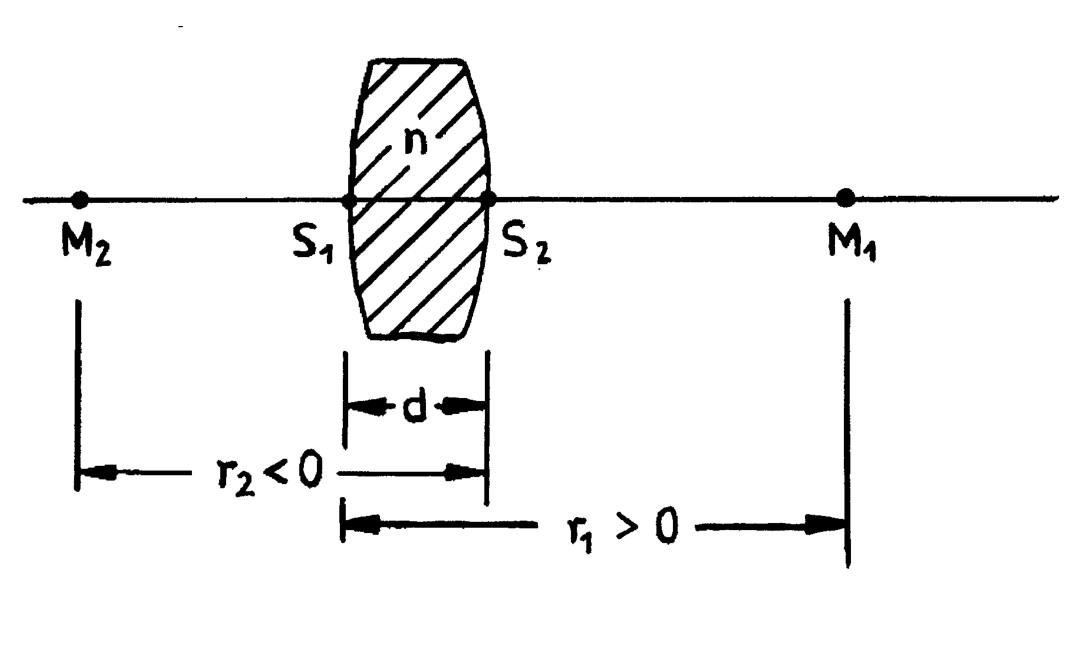
Remark: \(r_i>0\) means that the central curvature point \(M_i\) is on the right side of the aerial vertex \(S_i\), \(r_i<0\) means that the central curvature point \(M_i\) is on the left side of the aerial vertex \(S_i\) (\(i=1,2\)).
For some special applications it is required, that the focal length is independent from the wavelength.
a) For how many different wavelengths can the same focal length be achieved?
b) Describe a relation between \(r_i\) (\(i=1,2\)), \(d\) and the refractive index \(n\) for which the required wavelength independence can be fulfilled and discuss this relation.
Sketch possible shapes of lenses and mark the central curvature points \(M_1\) and \(M_2\).
c) Prove that for a given planconvex lens a specific focal length can be achieved by only one wavelength.
d) State possible parameters of the thick lens for two further cases in which a certain focal length can be realized for one wavelength only. Take into account the physical and the geometrical circumstances.
Official English text of the problem.
Answers
-
a) At most two distinct wavelengths, assuming that distinct wavelengths have distinct refractive indices in the spectral interval considered.
-
b) For two distinct indices \(n_1,n_2>1\), exact equality of focal lengths requires \[ \boxed{r_1-r_2=d\left(1-\frac{1}{n_1n_2}\right)}. \] First-order wavelength independence at an index \(n_0\) requires \[ \boxed{r_1-r_2=d\left(1-\frac{1}{n_0^2}\right)}. \] Consequently, \(0<r_1-r_2<d\). Possible forms are an unusually thick biconvex lens and two mutually reversed meniscus lenses. Their curvature centres satisfy \(M_1\) to the left of \(M_2\).
-
c) For a planconvex lens with convex-surface radius \(R>0\), \[ \boxed{f=\frac{R}{n-1}}. \] Every attainable focal length therefore determines exactly one refractive index and hence one wavelength.
-
d) Two physically realizable examples, with \(R>0\) an arbitrary length, are \[ \boxed{r_1=R,\quad r_2=-R,\quad d=R} \] and \[ \boxed{r_1=-R,\quad r_2=R,\quad d=R}. \] These are biconvex and biconcave lenses, respectively. For each attainable focal length, the other algebraic index is negative in the first example and less than \(1\) in the second.
Solution
We use the supplied formula within paraxial geometrical optics, with fixed lens geometry and homogeneous glass. Wavelength enters through \(n=n(\lambda)\). For ordinary glass in a transparent interval of normal dispersion, \(n>1\) and \(n(\lambda)\) is one-to-one.
Define the optical power and two convenient constants:
\[ \Phi(n)=\frac1{f(n)},\qquad P=r_1r_2,\qquad C=d+r_2-r_1. \]
For finite, nonzero radii, the given formula becomes
\[ \boxed{ \Phi(n)=\frac{1}{P} \left[Cn-(C+d)+\frac dn\right]. } \tag{1} \]
a) Number of wavelengths
For a prescribed finite focal length \(F\), equation (1) gives
\[ \boxed{ Cn^2-\left(C+d+\frac PF\right)n+d=0. } \tag{2} \]
This is quadratic in \(n\), so there can be at most two distinct refractive indices. If \(C=0\), it becomes linear.
Both roots can be physically admissible: part (b) gives a construction for any chosen pair of distinct glass indices. Thus the maximum is two wavelengths.
Exact constancy throughout a continuous wavelength interval is impossible for a nondegenerate dispersive lens: equation (2) cannot hold identically in \(n\), since its constant term is \(d>0\).
b) Conditions and possible lens shapes
For two distinct indices \(n_1\) and \(n_2\), equality of focal lengths is equivalent to equality of optical powers. Subtracting equation (1) at the two indices,
\[ P\bigl[\Phi(n_1)-\Phi(n_2)\bigr] =(n_1-n_2)\left(C-\frac{d}{n_1n_2}\right). \]
Since \(n_1\ne n_2\),
\[ C=\frac{d}{n_1n_2}. \]
Therefore,
\[ \boxed{ r_1-r_2=d\left(1-\frac{1}{n_1n_2}\right), \qquad d=\frac{n_1n_2}{n_1n_2-1}(r_1-r_2). } \tag{3} \]
Because \(n_1,n_2>1\),
\[ \boxed{0<r_1-r_2<d.} \tag{4} \]
For example, given any two available glass indices, choose \(r_1=R\), \(r_2=-R\), and
\[ d=\frac{2Rn_1n_2}{n_1n_2-1}. \]
This gives a biconvex lens satisfying equation (3), establishing that two physical solutions are possible.
For a fixed lens, the partner index is
\[ n_2=\frac{d}{Cn_1}. \]
Both indices must lie within the actual dispersion range of the glass.
To obtain first-order independence near one wavelength, require
\[ \frac{df}{d\lambda} =\frac{df}{dn}\frac{dn}{d\lambda}=0. \]
Since ordinary dispersion has \(dn/d\lambda\ne0\), this requires \(df/dn=0\), or equivalently \(d\Phi/dn=0\) for finite \(f\). Equation (1) gives
\[ \frac{d\Phi}{dn} =\frac1P\left(C-\frac{d}{n^2}\right). \]
Thus, at the design index \(n_0\),
\[ \boxed{ C=\frac{d}{n_0^2}, \qquad r_1-r_2=d\left(1-\frac1{n_0^2}\right). } \tag{5} \]
The exact two-wavelength condition and the stationary condition are related by
\[ n_0=\sqrt{n_1n_2}. \]
The two distinct indices therefore lie on opposite sides of the stationary index. At the stationary focal length itself, the quadratic has a double root: there is one exact wavelength, with vanishing first-order variation.
The remaining dependence is generally second order, because
\[ \frac{d^2\Phi}{dn^2}=\frac{2d}{Pn^3}\ne0. \]
Substitution into the focal-length formula gives
\[ \boxed{ f(n_0)=-\frac{n_0^2r_1r_2}{d(n_0-1)^2}. } \tag{6} \]
Thus the admissible biconvex form has positive focal length, while the admissible meniscus forms have negative focal length.
For precise descriptions of the sketches, put
\[ x(S_1)=0,\qquad x(S_2)=d. \]
The curvature centres are then
\[ x(M_1)=r_1,\qquad x(M_2)=d+r_2. \]
Under equation (5),
\[ \boxed{x(M_2)-x(M_1)=\frac{d}{n_0^2}>0.} \tag{7} \]
Let \(\delta=d(1-1/n_0^2)\), so \(0<\delta<d\). The following choices give three explicit sketches; the listed points are ordered from left to right.
| Lens shape | Possible radii | Order of vertices and centres |
|---|---|---|
| Biconvex: both optical faces bulge outward | \(r_1=\delta/2,\quad r_2=-\delta/2\) | \(S_1,\ M_1,\ M_2,\ S_2\) |
| Meniscus: first face convex, second face concave | \(r_1=d+\delta,\quad r_2=d\) | \(S_1,\ S_2,\ M_1,\ M_2\) |
| Reversed meniscus: first face concave, second face convex | \(r_1=-d,\quad r_2=-(d+\delta)\) | \(M_1,\ M_2,\ S_1,\ S_2\) |
The optical faces may be small spherical caps joined by a side wall. In the biconvex case, condition (4) becomes
\[ d>r_1+|r_2|. \]
It therefore requires a long piece of glass with convex end faces, rather than the usual thin biconvex shape. A biconcave lens has \(r_1<0<r_2\), contradicting \(r_1>r_2\), so it cannot satisfy the achromatic condition.
c) Planconvex lens
There are two orientations. Taking the plane-surface limit gives
\[ r_2\rightarrow\infty: \qquad f=\frac{r_1}{n-1}, \]
or
\[ r_1\rightarrow\infty: \qquad f=-\frac{r_2}{n-1}. \]
For a convex spherical surface of radius magnitude \(R\), both reduce to
\[ f(n)=\frac{R}{n-1}. \]
The thickness drops out of the effective focal length. Moreover,
\[ \frac{df}{dn}=-\frac{R}{(n-1)^2}<0 \qquad(n>1). \]
Hence \(f(n)\) is strictly monotonic, and a specified attainable focal length determines
\[ \boxed{n=1+\frac RF}. \]
There is therefore exactly one corresponding wavelength within a one-to-one dispersion interval.
d) Two further cases with only one physical wavelength
For \(C\ne0\), equation (2) shows that the product of the two algebraic indices is
\[ n\,\widetilde n=\frac dC. \tag{8} \]
This identifies two useful families.
1. \(r_1-r_2\ge d\), or \(C\le0\).
If \(C<0\), a physical root \(n>1\) has a negative partner,
\[ \widetilde n=\frac{d}{Cn}<0, \]
which cannot describe ordinary glass. If \(C=0\), equation (2) is linear and again has at most one solution.
A concrete example is
\[ r_1=R,\qquad r_2=-R,\qquad d=R. \]
This is a physically realizable biconvex lens. Its focal length is
\[ f(n)=\frac{Rn}{n^2-1}, \]
and
\[ \frac{df}{dn} =-\frac{R(n^2+1)}{(n^2-1)^2}<0. \]
Every attainable positive focal length therefore occurs at one physical index only. Its other algebraic root is \(\widetilde n=-1/n\).
2. \(r_1\le r_2\), or \(C\ge d\).
For a physical root \(n>1\),
\[ 0<\widetilde n=\frac{d}{Cn}\le\frac1n<1. \]
The second root is therefore outside the ordinary-glass range.
A concrete example is
\[ r_1=-R,\qquad r_2=R,\qquad d=R. \]
This is a biconcave lens with positive central thickness; its thickness increases away from the axis. Its focal length is
\[ f(n)=-\frac{Rn}{(n-1)(3n-1)}<0, \]
and its other algebraic index is
\[ \widetilde n=\frac{1}{3n}<1. \]
Thus every attainable negative focal length also corresponds to only one physical wavelength.
Both examples have finite thickness and two curved surfaces. A sufficiently small aperture makes them consistent with the paraxial approximation.
The solution was checked against the official solution.
IPhO 1975 · Theorieaufgabe 2
Dicke Linse
Die Brennweite \(f\) einer dicken Glaslinse in Luft mit dem Brechungsindex \(n\), den Krümmungsradien \(r_1\), \(r_2\) und dem Scheitelabstand \(d\) (siehe Abbildung) ist gegeben durch:
\[ f=\frac{nr_1r_2}{(n-1)\left[n(r_2-r_1)+d(n-1)\right]} \]
Anmerkung: \(r_i>0\) bedeutet, dass der Krümmungsmittelpunkt \(M_i\) rechts vom Flächenscheitel \(S_i\) liegt; \(r_i<0\) bedeutet, dass der Krümmungsmittelpunkt \(M_i\) links vom Flächenscheitel \(S_i\) liegt (\(i=1,2\)).
Für einige spezielle Anwendungen muss die Brennweite unabhängig von der Wellenlänge sein.
a) Für wie viele verschiedene Wellenlängen kann dieselbe Brennweite erreicht werden?
b) Geben Sie eine Beziehung zwischen \(r_i\) (\(i=1,2\)), \(d\) und dem Brechungsindex \(n\) an, mit der sich die geforderte Wellenlängenunabhängigkeit erfüllen lässt, und diskutieren Sie diese Beziehung.
Skizzieren Sie mögliche Linsenformen und markieren Sie die Krümmungsmittelpunkte \(M_1\) und \(M_2\).
c) Beweisen Sie, dass bei einer gegebenen plankonvexen Linse eine bestimmte Brennweite nur bei einer einzigen Wellenlänge erreicht werden kann.
d) Geben Sie mögliche Parameter der dicken Linse für zwei weitere Fälle an, in denen eine bestimmte Brennweite nur bei einer einzigen Wellenlänge realisiert werden kann. Berücksichtigen Sie dabei die physikalischen und geometrischen Gegebenheiten.
Aufgabentext aus dem offiziellen englischen Text übersetzt.
Antworten
-
a) Höchstens zwei verschiedene Wellenlängen, sofern verschiedene Wellenlängen im betrachteten Spektralbereich unterschiedliche Brechungsindizes besitzen.
-
b) Für zwei verschiedene Brechungsindizes \(n_1,n_2>1\) erfordert die exakte Gleichheit der Brennweiten \[ \boxed{r_1-r_2=d\left(1-\frac{1}{n_1n_2}\right)}. \] Wellenlängenunabhängigkeit in erster Ordnung bei einem Brechungsindex \(n_0\) erfordert \[ \boxed{r_1-r_2=d\left(1-\frac{1}{n_0^2}\right)}. \] Folglich gilt \(0<r_1-r_2<d\). Mögliche Formen sind eine ungewöhnlich dicke bikonvexe Linse und zwei zueinander umgekehrt orientierte Meniskuslinsen. Für ihre Krümmungsmittelpunkte gilt, dass \(M_1\) links von \(M_2\) liegt.
-
c) Für eine plankonvexe Linse mit dem Radius \(R>0\) der konvexen Fläche gilt \[ \boxed{f=\frac{R}{n-1}}. \] Jede erreichbare Brennweite legt daher genau einen Brechungsindex und somit eine Wellenlänge fest.
-
d) Zwei physikalisch realisierbare Beispiele, wobei \(R>0\) eine beliebige Länge ist, sind \[ \boxed{r_1=R,\quad r_2=-R,\quad d=R} \] und \[ \boxed{r_1=-R,\quad r_2=R,\quad d=R}. \] Dabei handelt es sich um eine bikonvexe beziehungsweise eine bikonkave Linse. Für jede erreichbare Brennweite ist der andere algebraische Brechungsindex im ersten Beispiel negativ und im zweiten kleiner als \(1\).
Lösung
Wir verwenden die angegebene Formel im Rahmen der paraxialen geometrischen Optik, bei fester Linsengeometrie und homogenem Glas. Die Wellenlänge geht über \(n=n(\lambda)\) ein. Für gewöhnliches Glas in einem transparenten Bereich mit normaler Dispersion gilt \(n>1\), und \(n(\lambda)\) ist injektiv.
Wir definieren die Brechkraft und zwei zweckmäßige Konstanten:
\[ \Phi(n)=\frac1{f(n)},\qquad P=r_1r_2,\qquad C=d+r_2-r_1. \]
Für endliche, von null verschiedene Radien nimmt die gegebene Formel die folgende Form an:
\[ \boxed{ \Phi(n)=\frac{1}{P} \left[Cn-(C+d)+\frac dn\right]. } \tag{1} \]
a) Anzahl der Wellenlängen
Für eine vorgegebene endliche Brennweite \(F\) ergibt Gleichung (1)
\[ \boxed{ Cn^2-\left(C+d+\frac PF\right)n+d=0. } \tag{2} \]
Diese Gleichung ist quadratisch in \(n\), sodass es höchstens zwei verschiedene Brechungsindizes geben kann. Für \(C=0\) wird sie linear.
Beide Lösungen können physikalisch zulässig sein: Teil (b) liefert eine Konstruktion für jedes gewählte Paar verschiedener Brechungsindizes von Glas. Das Maximum beträgt somit zwei Wellenlängen.
Eine exakte Konstanz über ein kontinuierliches Wellenlängenintervall ist für eine nicht entartete dispersive Linse unmöglich: Gleichung (2) kann nicht identisch in \(n\) erfüllt sein, da ihr konstanter Term \(d>0\) ist.
b) Bedingungen und mögliche Linsenformen
Für zwei verschiedene Brechungsindizes \(n_1\) und \(n_2\) ist die Gleichheit der Brennweiten gleichbedeutend mit der Gleichheit der Brechkräfte. Subtraktion von Gleichung (1) für die beiden Brechungsindizes ergibt
\[ P\bigl[\Phi(n_1)-\Phi(n_2)\bigr] =(n_1-n_2)\left(C-\frac{d}{n_1n_2}\right). \]
Da \(n_1\ne n_2\), gilt
\[ C=\frac{d}{n_1n_2}. \]
Somit folgt
\[ \boxed{ r_1-r_2=d\left(1-\frac{1}{n_1n_2}\right), \qquad d=\frac{n_1n_2}{n_1n_2-1}(r_1-r_2). } \tag{3} \]
Wegen \(n_1,n_2>1\) gilt
\[ \boxed{0<r_1-r_2<d.} \tag{4} \]
Für zwei beliebige verfügbare Brechungsindizes von Glas wähle man beispielsweise \(r_1=R\), \(r_2=-R\) und
\[ d=\frac{2Rn_1n_2}{n_1n_2-1}. \]
Dies ergibt eine bikonvexe Linse, die Gleichung (3) erfüllt, und zeigt damit, dass zwei physikalische Lösungen möglich sind.
Für eine feste Linse lautet der zugehörige zweite Brechungsindex
\[ n_2=\frac{d}{Cn_1}. \]
Beide Brechungsindizes müssen innerhalb des tatsächlichen Dispersionsbereichs des Glases liegen.
Um Unabhängigkeit in erster Ordnung in der Nähe einer Wellenlänge zu erhalten, fordert man
\[ \frac{df}{d\lambda} =\frac{df}{dn}\frac{dn}{d\lambda}=0. \]
Da bei gewöhnlicher Dispersion \(dn/d\lambda\ne0\) gilt, erfordert dies \(df/dn=0\) oder, gleichbedeutend damit für endliches \(f\), \(d\Phi/dn=0\). Gleichung (1) ergibt
\[ \frac{d\Phi}{dn} =\frac1P\left(C-\frac{d}{n^2}\right). \]
Somit gilt beim Auslegungsbrechungsindex \(n_0\)
\[ \boxed{ C=\frac{d}{n_0^2}, \qquad r_1-r_2=d\left(1-\frac1{n_0^2}\right). } \tag{5} \]
Die exakte Bedingung für zwei Wellenlängen und die Stationaritätsbedingung sind durch folgende Beziehung verknüpft:
\[ n_0=\sqrt{n_1n_2}. \]
Die beiden verschiedenen Brechungsindizes liegen daher auf entgegengesetzten Seiten des Brechungsindex am stationären Punkt. Bei der stationären Brennweite selbst hat die quadratische Gleichung eine doppelte Lösung: Es gibt genau eine Wellenlänge, bei der die Änderung in erster Ordnung verschwindet.
Die verbleibende Abhängigkeit ist im Allgemeinen von zweiter Ordnung, denn
\[ \frac{d^2\Phi}{dn^2}=\frac{2d}{Pn^3}\ne0. \]
Einsetzen in die Brennweitenformel ergibt
\[ \boxed{ f(n_0)=-\frac{n_0^2r_1r_2}{d(n_0-1)^2}. } \tag{6} \]
Die zulässige bikonvexe Form hat somit eine positive Brennweite, während die zulässigen Meniskusformen negative Brennweiten haben.
Zur präzisen Beschreibung der Skizzen setzen wir
\[ x(S_1)=0,\qquad x(S_2)=d. \]
Die Krümmungsmittelpunkte liegen dann bei
\[ x(M_1)=r_1,\qquad x(M_2)=d+r_2. \]
Unter der Bedingung von Gleichung (5) gilt
\[ \boxed{x(M_2)-x(M_1)=\frac{d}{n_0^2}>0.} \tag{7} \]
Sei \(\delta=d(1-1/n_0^2)\), sodass \(0<\delta<d\). Die folgenden Wahlen liefern drei konkrete Skizzen; die aufgeführten Punkte sind von links nach rechts angeordnet.
| Linsenform | Mögliche Radien | Reihenfolge der Scheitel und Mittelpunkte |
|---|---|---|
| Bikonvex: Beide optischen Flächen sind nach außen gewölbt | \(r_1=\delta/2,\quad r_2=-\delta/2\) | \(S_1,\ M_1,\ M_2,\ S_2\) |
| Meniskus: erste Fläche konvex, zweite Fläche konkav | \(r_1=d+\delta,\quad r_2=d\) | \(S_1,\ S_2,\ M_1,\ M_2\) |
| Umgekehrter Meniskus: erste Fläche konkav, zweite Fläche konvex | \(r_1=-d,\quad r_2=-(d+\delta)\) | \(M_1,\ M_2,\ S_1,\ S_2\) |
Die optischen Flächen können kleine Kugelkalotten sein, die durch eine Seitenwand verbunden sind. Im bikonvexen Fall wird Bedingung (4) zu
\[ d>r_1+|r_2|. \]
Sie erfordert daher ein langes Glasstück mit konvexen Stirnflächen anstelle der üblichen dünnen bikonvexen Form. Bei einer bikonkaven Linse gilt \(r_1<0<r_2\), was \(r_1>r_2\) widerspricht; sie kann die Achromasiebedingung daher nicht erfüllen.
c) Plankonvexe Linse
Es gibt zwei Orientierungen. Der Grenzübergang zu einer ebenen Fläche ergibt
\[ r_2\rightarrow\infty: \qquad f=\frac{r_1}{n-1}, \]
oder
\[ r_1\rightarrow\infty: \qquad f=-\frac{r_2}{n-1}. \]
Für eine konvexe Kugelfläche mit dem Radiusbetrag \(R\) vereinfachen sich beide zu
\[ f(n)=\frac{R}{n-1}. \]
Die Dicke fällt aus dem Ausdruck für die effektive Brennweite heraus. Außerdem gilt
\[ \frac{df}{dn}=-\frac{R}{(n-1)^2}<0 \qquad(n>1). \]
Somit ist \(f(n)\) streng monoton, und eine vorgegebene erreichbare Brennweite bestimmt den Brechungsindex zu
\[ \boxed{n=1+\frac RF}. \]
Innerhalb eines Bereichs mit injektiver Dispersionsfunktion gibt es daher genau eine zugehörige Wellenlänge.
d) Zwei weitere Fälle mit nur einer physikalisch zulässigen Wellenlänge
Für \(C\ne0\) ergibt sich aus Gleichung (2) für das Produkt der beiden algebraischen Brechungsindizes
\[ n\,\widetilde n=\frac dC. \tag{8} \]
Daraus ergeben sich zwei nützliche Familien.
1. \(r_1-r_2\ge d\), oder \(C\le0\).
Für \(C<0\) gehört zu einer physikalischen Lösung \(n>1\) eine negative zweite Lösung,
\[ \widetilde n=\frac{d}{Cn}<0, \]
die kein gewöhnliches Glas beschreiben kann. Für \(C=0\) ist Gleichung (2) linear und hat wiederum höchstens eine Lösung.
Ein konkretes Beispiel ist
\[ r_1=R,\qquad r_2=-R,\qquad d=R. \]
Dies ist eine physikalisch realisierbare bikonvexe Linse. Ihre Brennweite beträgt
\[ f(n)=\frac{Rn}{n^2-1}, \]
und es gilt
\[ \frac{df}{dn} =-\frac{R(n^2+1)}{(n^2-1)^2}<0. \]
Jede erreichbare positive Brennweite tritt daher nur bei einem physikalisch zulässigen Brechungsindex auf. Die andere algebraische Lösung ist \(\widetilde n=-1/n\).
2. \(r_1\le r_2\), oder \(C\ge d\).
Für eine physikalische Lösung \(n>1\) gilt
\[ 0<\widetilde n=\frac{d}{Cn}\le\frac1n<1. \]
Die zweite Lösung liegt daher außerhalb des Bereichs für gewöhnliches Glas.
Ein konkretes Beispiel ist
\[ r_1=-R,\qquad r_2=R,\qquad d=R. \]
Dies ist eine bikonkave Linse mit positiver Mittendicke; ihre Dicke nimmt mit dem Abstand von der Achse zu. Ihre Brennweite beträgt
\[ f(n)=-\frac{Rn}{(n-1)(3n-1)}<0, \]
und ihr anderer algebraischer Brechungsindex ist
\[ \widetilde n=\frac{1}{3n}<1. \]
Somit entspricht auch jede erreichbare negative Brennweite nur einer physikalisch zulässigen Wellenlänge.
Beide Beispiele haben eine endliche Dicke und zwei gekrümmte Flächen. Eine hinreichend kleine Apertur macht sie mit der paraxialen Näherung vereinbar.
Die Lösung wurde mit der offiziellen Lösung abgeglichen.
IPhO 1975 · Teori sorusu 2
Kalın mercek
Havada bulunan, kırılma indisi \(n\), eğrilik yarıçapları \(r_1\), \(r_2\) ve tepe noktaları arasındaki uzaklığı \(d\) olan kalın bir cam merceğin odak uzaklığı \(f\) (şekle bakınız) şu bağıntıyla verilir:
\[ f=\frac{nr_1r_2}{(n-1)\left[n(r_2-r_1)+d(n-1)\right]} \]
Not: \(r_i>0\), eğrilik merkezi \(M_i\)'nin hava ile temas eden yüzeyin tepe noktası \(S_i\)'nin sağında olduğunu; \(r_i<0\) ise eğrilik merkezi \(M_i\)'nin hava ile temas eden yüzeyin tepe noktası \(S_i\)'nin solunda olduğunu belirtir (\(i=1,2\)).
Bazı özel uygulamalarda odak uzaklığının dalga boyundan bağımsız olması gerekir.
a) Aynı odak uzaklığı kaç farklı dalga boyunda elde edilebilir?
b) \(r_i\) (\(i=1,2\)), \(d\) ve kırılma indisi \(n\) arasında, istenen dalga boyu bağımsızlığının sağlanabileceği bir bağıntı belirtiniz ve bu bağıntıyı tartışınız.
Olası mercek biçimlerinin şematik çizimlerini yapınız ve eğrilik merkezleri \(M_1\) ile \(M_2\)'yi işaretleyiniz.
c) Verilen bir düzlem-dışbükey mercekte belirli bir odak uzaklığının yalnızca tek bir dalga boyunda elde edilebileceğini kanıtlayınız.
d) Belirli bir odak uzaklığının yalnızca tek bir dalga boyunda elde edilebildiği iki başka durum için kalın merceğin olası parametrelerini belirtiniz. Fiziksel ve geometrik koşulları dikkate alınız.
Soru metni resmi İngilizce metinden çevrilmiştir.
Cevaplar
-
a) İncelenen spektral aralıkta farklı dalga boylarının farklı kırılma indislerine sahip olduğu varsayımıyla, en fazla iki farklı dalga boyu.
-
b) Birbirinden farklı iki \(n_1,n_2>1\) indisi için odak uzaklıklarının tam olarak eşit olması şu koşulu gerektirir: \[ \boxed{r_1-r_2=d\left(1-\frac{1}{n_1n_2}\right)}. \] \(n_0\) indisinde dalga boyundan birinci mertebeden bağımsızlık şu koşulu gerektirir: \[ \boxed{r_1-r_2=d\left(1-\frac{1}{n_0^2}\right)}. \] Dolayısıyla \(0<r_1-r_2<d\) olur. Olası biçimler, alışılmadık derecede kalın bir çift dışbükey mercek ve birbirine göre ters çevrilmiş iki menisküs mercektir. Bunların eğrilik merkezlerinden \(M_1\), \(M_2\)'nin solundadır.
-
c) Dışbükey yüzeyinin yarıçapı \(R>0\) olan bir düzlem-dışbükey mercek için \[ \boxed{f=\frac{R}{n-1}}. \] Dolayısıyla elde edilebilir her odak uzaklığı, tam olarak bir kırılma indisini ve dolayısıyla bir dalga boyunu belirler.
-
d) \(R>0\) keyfî bir uzunluk olmak üzere, fiziksel olarak gerçekleştirilebilir iki örnek şunlardır: \[ \boxed{r_1=R,\quad r_2=-R,\quad d=R} \] ve \[ \boxed{r_1=-R,\quad r_2=R,\quad d=R}. \] Bunlar sırasıyla çift dışbükey ve çift içbükey merceklerdir. Elde edilebilir her odak uzaklığı için diğer cebirsel indis, ilk örnekte negatif, ikinci örnekte ise \(1\)'den küçüktür.
Çözüm
Verilen formülü, mercek geometrisini sabit ve camı homojen kabul ederek paraksiyal geometrik optik çerçevesinde kullanıyoruz. Dalga boyu, bağıntıya \(n=n(\lambda)\) üzerinden girer. Normal dispersiyonun görüldüğü saydam bir aralıktaki sıradan cam için \(n>1\)'dir ve \(n(\lambda)\) bire birdir.
Optik gücü ve işlemleri kolaylaştıran iki sabiti tanımlayalım:
\[ \Phi(n)=\frac1{f(n)},\qquad P=r_1r_2,\qquad C=d+r_2-r_1. \]
Sonlu ve sıfırdan farklı yarıçaplar için verilen formül şu hâli alır:
\[ \boxed{ \Phi(n)=\frac{1}{P} \left[Cn-(C+d)+\frac dn\right]. } \tag{1} \]
a) Dalga boylarının sayısı
Önceden belirlenmiş sonlu bir \(F\) odak uzaklığı için denklem (1) şu sonucu verir:
\[ \boxed{ Cn^2-\left(C+d+\frac PF\right)n+d=0. } \tag{2} \]
Bu, \(n\)'ye göre ikinci dereceden bir denklemdir; dolayısıyla en fazla iki farklı kırılma indisi olabilir. \(C=0\) ise denklem doğrusal hâle gelir.
Her iki kök de fiziksel olarak kabul edilebilir olabilir: (b) kısmında, seçilen herhangi iki farklı cam indisi için bir mercek oluşturma yöntemi verilmektedir. Dolayısıyla en fazla iki dalga boyu mümkündür.
Dejenere olmayan, dispersif bir mercekte sürekli bir dalga boyu aralığının tamamında tam sabitlik mümkün değildir: denklem (2), sabit terimi \(d>0\) olduğundan \(n\)'ye göre özdeş olarak sağlanamaz.
b) Koşullar ve olası mercek biçimleri
Birbirinden farklı iki \(n_1\) ve \(n_2\) indisi için odak uzaklıklarının eşitliği, optik güçlerin eşitliğine denktir. Denklem (1)'in bu iki indis için yazılan ifadelerini birbirinden çıkarırsak,
\[ P\bigl[\Phi(n_1)-\Phi(n_2)\bigr] =(n_1-n_2)\left(C-\frac{d}{n_1n_2}\right). \]
\(n_1\ne n_2\) olduğundan,
\[ C=\frac{d}{n_1n_2}. \]
Dolayısıyla,
\[ \boxed{ r_1-r_2=d\left(1-\frac{1}{n_1n_2}\right), \qquad d=\frac{n_1n_2}{n_1n_2-1}(r_1-r_2). } \tag{3} \]
\(n_1,n_2>1\) olduğundan,
\[ \boxed{0<r_1-r_2<d.} \tag{4} \]
Örneğin, camın alabileceği herhangi iki indis verildiğinde \(r_1=R\), \(r_2=-R\) ve
\[ d=\frac{2Rn_1n_2}{n_1n_2-1} \]
seçilsin. Bu seçim, denklem (3)'ü sağlayan bir çift dışbükey mercek verir ve iki fiziksel çözümün mümkün olduğunu gösterir.
Sabit bir mercek için eş indis şöyledir:
\[ n_2=\frac{d}{Cn_1}. \]
Her iki indis de camın gerçek dispersiyon aralığı içinde olmalıdır.
Bir dalga boyu yakınında birinci mertebeden bağımsızlık elde etmek için şu koşul gerekir:
\[ \frac{df}{d\lambda} =\frac{df}{dn}\frac{dn}{d\lambda}=0. \]
Normal dispersiyonda \(dn/d\lambda\ne0\) olduğundan bu, \(df/dn=0\) olmasını veya sonlu \(f\) için buna denk olarak \(d\Phi/dn=0\) olmasını gerektirir. Denklem (1) şu sonucu verir:
\[ \frac{d\Phi}{dn} =\frac1P\left(C-\frac{d}{n^2}\right). \]
Böylece, tasarım indisi \(n_0\)'da,
\[ \boxed{ C=\frac{d}{n_0^2}, \qquad r_1-r_2=d\left(1-\frac1{n_0^2}\right). } \tag{5} \]
İki dalga boyu için tam eşitlik koşulu ile durağanlık koşulu şu bağıntıyla ilişkilidir:
\[ n_0=\sqrt{n_1n_2}. \]
Dolayısıyla iki farklı indis, durağanlığın sağlandığı indisin iki yanında yer alır. Durağan noktadaki odak uzaklığının kendisi için ikinci dereceden denklemin bir çift katlı kökü vardır: bu değeri tam olarak veren tek bir dalga boyu bulunur ve birinci mertebeden değişim sıfırdır.
Geriye kalan bağımlılık genellikle ikinci mertebedendir, çünkü
\[ \frac{d^2\Phi}{dn^2}=\frac{2d}{Pn^3}\ne0. \]
Odak uzaklığı formülünde yerine koyarsak,
\[ \boxed{ f(n_0)=-\frac{n_0^2r_1r_2}{d(n_0-1)^2}. } \tag{6} \]
Böylece koşulları sağlayan çift dışbükey biçimin odak uzaklığı pozitifken, koşulları sağlayan menisküs biçimlerin odak uzaklığı negatiftir.
Şematik çizimleri kesin olarak betimlemek için
\[ x(S_1)=0,\qquad x(S_2)=d. \]
alalım. Bu durumda eğrilik merkezleri şöyledir:
\[ x(M_1)=r_1,\qquad x(M_2)=d+r_2. \]
Denklem (5) sağlandığında,
\[ \boxed{x(M_2)-x(M_1)=\frac{d}{n_0^2}>0.} \tag{7} \]
\(\delta=d(1-1/n_0^2)\) olsun; dolayısıyla \(0<\delta<d\). Aşağıdaki seçimler üç somut şematik çizim verir; listelenen noktalar soldan sağa sıralanmıştır.
| Mercek biçimi | Olası yarıçaplar | Tepe noktalarının ve merkezlerin sıralanışı |
|---|---|---|
| Çift dışbükey: her iki optik yüzey de dışa doğru bombelidir | \(r_1=\delta/2,\quad r_2=-\delta/2\) | \(S_1,\ M_1,\ M_2,\ S_2\) |
| Menisküs: birinci yüzey dışbükey, ikinci yüzey içbükeydir | \(r_1=d+\delta,\quad r_2=d\) | \(S_1,\ S_2,\ M_1,\ M_2\) |
| Ters çevrilmiş menisküs: birinci yüzey içbükey, ikinci yüzey dışbükeydir | \(r_1=-d,\quad r_2=-(d+\delta)\) | \(M_1,\ M_2,\ S_1,\ S_2\) |
Optik yüzeyler, bir yan yüzeyle birleştirilmiş küçük küresel başlıklar olabilir. Çift dışbükey durumda koşul (4) şu hâli alır:
\[ d>r_1+|r_2|. \]
Dolayısıyla bu koşul, alışılmış ince çift dışbükey biçim yerine, uç yüzeyleri dışbükey olan uzun bir cam parçası gerektirir. Çift içbükey bir mercekte \(r_1<0<r_2\) olur; bu, \(r_1>r_2\) ile çeliştiğinden böyle bir mercek akromatiklik koşulunu sağlayamaz.
c) Düzlem-dışbükey mercek
İki yönelim vardır. Düzlem yüzey limiti alındığında
\[ r_2\rightarrow\infty: \qquad f=\frac{r_1}{n-1}, \]
veya
\[ r_1\rightarrow\infty: \qquad f=-\frac{r_2}{n-1}. \]
Yarıçapının büyüklüğü \(R\) olan dışbükey bir küresel yüzey için her ikisi de şu ifadeye indirgenir:
\[ f(n)=\frac{R}{n-1}. \]
Kalınlık, etkin odak uzaklığı ifadesinden çıkar. Ayrıca,
\[ \frac{df}{dn}=-\frac{R}{(n-1)^2}<0 \qquad(n>1). \]
Dolayısıyla \(f(n)\) kesin olarak monotondur ve belirtilen, elde edilebilir bir odak uzaklığı şu indisi belirler:
\[ \boxed{n=1+\frac RF}. \]
Bu nedenle bire bir dispersiyon aralığı içinde buna karşılık gelen tam olarak bir dalga boyu vardır.
d) Yalnızca bir fiziksel dalga boyunun bulunduğu iki başka durum
\(C\ne0\) için denklem (2), iki cebirsel indisin çarpımının şöyle olduğunu gösterir:
\[ n\,\widetilde n=\frac dC. \tag{8} \]
Bu bağıntı, kullanışlı iki aileyi belirler.
1. \(r_1-r_2\ge d\) veya \(C\le0\).
\(C<0\) ise fiziksel bir \(n>1\) kökünün eşi negatiftir:
\[ \widetilde n=\frac{d}{Cn}<0, \]
bu da sıradan camı betimleyemez. \(C=0\) ise denklem (2) doğrusaldır ve yine en fazla bir çözümü vardır.
Somut bir örnek şöyledir:
\[ r_1=R,\qquad r_2=-R,\qquad d=R. \]
Bu, fiziksel olarak gerçekleştirilebilir bir çift dışbükey mercektir. Odak uzaklığı şöyledir:
\[ f(n)=\frac{Rn}{n^2-1}, \]
ve
\[ \frac{df}{dn} =-\frac{R(n^2+1)}{(n^2-1)^2}<0. \]
Dolayısıyla elde edilebilir her pozitif odak uzaklığı yalnızca bir fiziksel indiste ortaya çıkar. Diğer cebirsel kökü \(\widetilde n=-1/n\)'dir.
2. \(r_1\le r_2\) veya \(C\ge d\).
Fiziksel bir \(n>1\) kökü için,
\[ 0<\widetilde n=\frac{d}{Cn}\le\frac1n<1. \]
Dolayısıyla ikinci kök, sıradan camın indis aralığının dışındadır.
Somut bir örnek şöyledir:
\[ r_1=-R,\qquad r_2=R,\qquad d=R. \]
Bu, merkez kalınlığı pozitif olan bir çift içbükey mercektir; kalınlığı eksenden uzaklaştıkça artar. Odak uzaklığı şöyledir:
\[ f(n)=-\frac{Rn}{(n-1)(3n-1)}<0, \]
ve diğer cebirsel indisi şöyledir:
\[ \widetilde n=\frac{1}{3n}<1. \]
Böylece elde edilebilir her negatif odak uzaklığı da yalnızca bir fiziksel dalga boyuna karşılık gelir.
Her iki örneğin de kalınlığı sonludur ve iki eğri yüzeyi vardır. Yeterince küçük bir açıklık, bunların paraksiyal yaklaşımla uyumlu olmasını sağlar.
Çözüm, resmi çözümle karşılaştırılarak kontrol edildi.
IPhO 1975 · Problema teórico 2
Lente gruesa
La distancia focal \(f\) de una lente gruesa de vidrio en el aire, con índice de refracción \(n\), radios de curvatura \(r_1\), \(r_2\) y distancia entre vértices \(d\) (véase la figura), viene dada por:
\[ f=\frac{nr_1r_2}{(n-1)\left[n(r_2-r_1)+d(n-1)\right]} \]
Observación: \(r_i>0\) significa que el centro de curvatura \(M_i\) está a la derecha del vértice de la superficie \(S_i\), y \(r_i<0\) significa que el centro de curvatura \(M_i\) está a la izquierda del vértice de la superficie \(S_i\) (\(i=1,2\)).
Para algunas aplicaciones especiales se requiere que la distancia focal sea independiente de la longitud de onda.
a) ¿Para cuántas longitudes de onda diferentes puede obtenerse la misma distancia focal?
b) Describa una relación entre \(r_i\) (\(i=1,2\)), \(d\) y el índice de refracción \(n\) que permita satisfacer la independencia requerida respecto de la longitud de onda, y analice dicha relación.
Esboce posibles formas de las lentes e indique los centros de curvatura \(M_1\) y \(M_2\).
c) Demuestre que, para una lente planoconvexa dada, una distancia focal específica solo puede obtenerse con una longitud de onda.
d) Indique posibles parámetros de la lente gruesa para otros dos casos en los que una determinada distancia focal pueda obtenerse con una sola longitud de onda. Tenga en cuenta las condiciones físicas y geométricas.
Enunciado traducido del texto oficial en inglés.
Respuestas
-
a) Como máximo, dos longitudes de onda distintas, suponiendo que a longitudes de onda distintas les correspondan índices de refracción distintos en el intervalo espectral considerado.
-
b) Para dos índices distintos \(n_1,n_2>1\), la igualdad exacta de las distancias focales requiere \[ \boxed{r_1-r_2=d\left(1-\frac{1}{n_1n_2}\right)}. \] La independencia respecto de la longitud de onda a primer orden para un índice \(n_0\) requiere \[ \boxed{r_1-r_2=d\left(1-\frac{1}{n_0^2}\right)}. \] Por consiguiente, \(0<r_1-r_2<d\). Las formas posibles son una lente biconvexa inusualmente gruesa y dos lentes de menisco con orientaciones opuestas. Sus centros de curvatura cumplen que \(M_1\) está a la izquierda de \(M_2\).
-
c) Para una lente planoconvexa cuya superficie convexa tiene un radio \(R>0\), \[ \boxed{f=\frac{R}{n-1}}. \] Por tanto, cada distancia focal alcanzable determina exactamente un índice de refracción y, en consecuencia, una longitud de onda.
-
d) Dos ejemplos físicamente realizables, siendo \(R>0\) una longitud arbitraria, son \[ \boxed{r_1=R,\quad r_2=-R,\quad d=R} \] y \[ \boxed{r_1=-R,\quad r_2=R,\quad d=R}. \] Se trata de lentes biconvexas y bicóncavas, respectivamente. Para cada distancia focal alcanzable, el otro índice algebraico es negativo en el primer ejemplo y menor que \(1\) en el segundo.
Solución
Utilizamos la fórmula proporcionada en el marco de la óptica geométrica paraxial, con una geometría fija de la lente y un vidrio homogéneo. La longitud de onda interviene a través de \(n=n(\lambda)\). Para un vidrio ordinario en un intervalo transparente de dispersión normal, \(n>1\) y \(n(\lambda)\) es una función inyectiva.
Definimos la potencia óptica y dos constantes convenientes:
\[ \Phi(n)=\frac1{f(n)},\qquad P=r_1r_2,\qquad C=d+r_2-r_1. \]
Para radios finitos y no nulos, la fórmula dada se convierte en
\[ \boxed{ \Phi(n)=\frac{1}{P} \left[Cn-(C+d)+\frac dn\right]. } \tag{1} \]
a) Número de longitudes de onda
Para una distancia focal finita prescrita \(F\), la ecuación (1) da
\[ \boxed{ Cn^2-\left(C+d+\frac PF\right)n+d=0. } \tag{2} \]
Esta ecuación es cuadrática en \(n\), por lo que puede haber como máximo dos índices de refracción distintos. Si \(C=0\), se convierte en una ecuación lineal.
Ambas raíces pueden ser físicamente admisibles: el apartado (b) proporciona una construcción para cualquier par elegido de índices de refracción distintos del vidrio. Por tanto, el máximo es de dos longitudes de onda.
La constancia exacta en todo un intervalo continuo de longitudes de onda es imposible para una lente dispersiva no degenerada: la ecuación (2) no puede cumplirse idénticamente en \(n\), ya que su término independiente es \(d>0\).
b) Condiciones y posibles formas de las lentes
Para dos índices distintos \(n_1\) y \(n_2\), la igualdad de las distancias focales equivale a la igualdad de las potencias ópticas. Restando las expresiones de la ecuación (1) para ambos índices,
\[ P\bigl[\Phi(n_1)-\Phi(n_2)\bigr] =(n_1-n_2)\left(C-\frac{d}{n_1n_2}\right). \]
Como \(n_1\ne n_2\),
\[ C=\frac{d}{n_1n_2}. \]
Por tanto,
\[ \boxed{ r_1-r_2=d\left(1-\frac{1}{n_1n_2}\right), \qquad d=\frac{n_1n_2}{n_1n_2-1}(r_1-r_2). } \tag{3} \]
Como \(n_1,n_2>1\),
\[ \boxed{0<r_1-r_2<d.} \tag{4} \]
Por ejemplo, dados dos índices cualesquiera disponibles para el vidrio, elegimos \(r_1=R\), \(r_2=-R\) y
\[ d=\frac{2Rn_1n_2}{n_1n_2-1}. \]
Esto da una lente biconvexa que satisface la ecuación (3), lo que demuestra que son posibles dos soluciones físicas.
Para una lente fija, el índice asociado es
\[ n_2=\frac{d}{Cn_1}. \]
Ambos índices deben estar dentro del intervalo real de índices de refracción del vidrio debido a su dispersión.
Para obtener independencia a primer orden cerca de una longitud de onda, exigimos
\[ \frac{df}{d\lambda} =\frac{df}{dn}\frac{dn}{d\lambda}=0. \]
Como en la dispersión ordinaria se cumple \(dn/d\lambda\ne0\), esto requiere \(df/dn=0\) o, de forma equivalente, \(d\Phi/dn=0\) para \(f\) finita. La ecuación (1) da
\[ \frac{d\Phi}{dn} =\frac1P\left(C-\frac{d}{n^2}\right). \]
Así, para el índice de diseño \(n_0\),
\[ \boxed{ C=\frac{d}{n_0^2}, \qquad r_1-r_2=d\left(1-\frac1{n_0^2}\right). } \tag{5} \]
La condición exacta para dos longitudes de onda y la condición de estacionariedad están relacionadas por
\[ n_0=\sqrt{n_1n_2}. \]
Por tanto, los dos índices distintos se encuentran a lados opuestos del índice de estacionariedad. En la propia distancia focal estacionaria, la ecuación cuadrática tiene una raíz doble: hay una única longitud de onda exacta, con variación de primer orden nula.
La dependencia restante es, en general, de segundo orden, porque
\[ \frac{d^2\Phi}{dn^2}=\frac{2d}{Pn^3}\ne0. \]
La sustitución en la fórmula de la distancia focal da
\[ \boxed{ f(n_0)=-\frac{n_0^2r_1r_2}{d(n_0-1)^2}. } \tag{6} \]
Así, la forma biconvexa admisible tiene una distancia focal positiva, mientras que las formas de menisco admisibles tienen una distancia focal negativa.
Para describir con precisión los esquemas, fijamos
\[ x(S_1)=0,\qquad x(S_2)=d. \]
Los centros de curvatura son entonces
\[ x(M_1)=r_1,\qquad x(M_2)=d+r_2. \]
De acuerdo con la ecuación (5),
\[ \boxed{x(M_2)-x(M_1)=\frac{d}{n_0^2}>0.} \tag{7} \]
Sea \(\delta=d(1-1/n_0^2)\), de modo que \(0<\delta<d\). Las siguientes elecciones proporcionan tres esquemas explícitos; los puntos indicados están ordenados de izquierda a derecha.
| Forma de la lente | Radios posibles | Orden de los vértices y los centros |
|---|---|---|
| Biconvexa: ambas caras ópticas se abomban hacia fuera | \(r_1=\delta/2,\quad r_2=-\delta/2\) | \(S_1,\ M_1,\ M_2,\ S_2\) |
| Menisco: primera cara convexa, segunda cara cóncava | \(r_1=d+\delta,\quad r_2=d\) | \(S_1,\ S_2,\ M_1,\ M_2\) |
| Menisco invertido: primera cara cóncava, segunda cara convexa | \(r_1=-d,\quad r_2=-(d+\delta)\) | \(M_1,\ M_2,\ S_1,\ S_2\) |
Las caras ópticas pueden ser pequeños casquetes esféricos unidos por una pared lateral. En el caso biconvexo, la condición (4) se convierte en
\[ d>r_1+|r_2|. \]
Por tanto, se requiere una pieza alargada de vidrio con caras extremas convexas, en lugar de la forma biconvexa delgada habitual. Una lente bicóncava tiene \(r_1<0<r_2\), lo que contradice \(r_1>r_2\), por lo que no puede satisfacer la condición de acromatismo.
c) Lente planoconvexa
Hay dos orientaciones. Tomando el límite de superficie plana se obtiene
\[ r_2\rightarrow\infty: \qquad f=\frac{r_1}{n-1}, \]
o
\[ r_1\rightarrow\infty: \qquad f=-\frac{r_2}{n-1}. \]
Para una superficie esférica convexa cuyo radio tiene módulo \(R\), ambas expresiones se reducen a
\[ f(n)=\frac{R}{n-1}. \]
El espesor desaparece de la expresión de la distancia focal efectiva. Además,
\[ \frac{df}{dn}=-\frac{R}{(n-1)^2}<0 \qquad(n>1). \]
Por tanto, \(f(n)\) es estrictamente monótona, y una distancia focal alcanzable especificada determina
\[ \boxed{n=1+\frac RF}. \]
Existe, por tanto, exactamente una longitud de onda correspondiente dentro de un intervalo en el que la dispersión es inyectiva.
d) Otros dos casos con una sola longitud de onda físicamente admisible
Para \(C\ne0\), la ecuación (2) muestra que el producto de los dos índices algebraicos es
\[ n\,\widetilde n=\frac dC. \tag{8} \]
Esto permite identificar dos familias útiles.
1. \(r_1-r_2\ge d\), o \(C\le0\).
Si \(C<0\), una raíz física \(n>1\) tiene una raíz asociada negativa,
\[ \widetilde n=\frac{d}{Cn}<0, \]
que no puede describir un vidrio ordinario. Si \(C=0\), la ecuación (2) es lineal y también tiene como máximo una solución.
Un ejemplo concreto es
\[ r_1=R,\qquad r_2=-R,\qquad d=R. \]
Se trata de una lente biconvexa físicamente realizable. Su distancia focal es
\[ f(n)=\frac{Rn}{n^2-1}, \]
y
\[ \frac{df}{dn} =-\frac{R(n^2+1)}{(n^2-1)^2}<0. \]
Por tanto, cada distancia focal positiva alcanzable se obtiene para un único índice físicamente admisible. Su otra raíz algebraica es \(\widetilde n=-1/n\).
2. \(r_1\le r_2\), o \(C\ge d\).
Para una raíz física \(n>1\),
\[ 0<\widetilde n=\frac{d}{Cn}\le\frac1n<1. \]
Por tanto, la segunda raíz queda fuera del intervalo correspondiente al vidrio ordinario.
Un ejemplo concreto es
\[ r_1=-R,\qquad r_2=R,\qquad d=R. \]
Se trata de una lente bicóncava con espesor central positivo; su espesor aumenta al alejarse del eje. Su distancia focal es
\[ f(n)=-\frac{Rn}{(n-1)(3n-1)}<0, \]
y su otro índice algebraico es
\[ \widetilde n=\frac{1}{3n}<1. \]
Así, cada distancia focal negativa alcanzable también corresponde a una sola longitud de onda físicamente admisible.
Ambos ejemplos tienen espesor finito y dos superficies curvas. Una abertura suficientemente pequeña permite que sean compatibles con la aproximación paraxial.
La solución se comprobó con la solución oficial.
IPhO 1975 · 理论题 2
厚透镜
空气中一块厚玻璃透镜的折射率为 \(n\),两面的曲率半径为 \(r_1\)、\(r_2\),顶点间距为 \(d\)(见图),其焦距 \(f\) 由下式给出:
\[ f=\frac{nr_1r_2}{(n-1)\left[n(r_2-r_1)+d(n-1)\right]} \]
说明:\(r_i>0\) 表示曲率中心 \(M_i\) 位于空气与玻璃交界面的顶点 \(S_i\) 右侧,\(r_i<0\) 表示曲率中心 \(M_i\) 位于空气与玻璃交界面的顶点 \(S_i\) 左侧(\(i=1,2\))。
在某些特殊应用中,要求焦距与波长无关。
a) 最多能有多少个不同波长对应同一焦距?
b) 给出 \(r_i\)(\(i=1,2\))、\(d\) 与折射率 \(n\) 之间应满足的关系,使焦距能够满足所要求的波长无关性,并讨论这一关系。
画出可能的透镜形状示意图,并标出曲率中心 \(M_1\) 和 \(M_2\)。
c) 证明:对于给定的平凸透镜,只有一个波长能够对应某一特定焦距。
d) 另外给出两种情形下厚透镜的可能参数,使某一焦距只能由一个波长实现。应考虑物理和几何条件。
题目译自官方英文原文。
答案
-
a) 最多有两个不同的波长,这里假定在所考虑的光谱区间内,不同波长对应不同的折射率。
-
b) 对于两个不同的折射率 \(n_1,n_2>1\),焦距严格相等要求 \[ \boxed{r_1-r_2=d\left(1-\frac{1}{n_1n_2}\right)}. \] 在折射率 \(n_0\) 处,焦距对波长的一阶变化为零要求 \[ \boxed{r_1-r_2=d\left(1-\frac{1}{n_0^2}\right)}. \] 因此,\(0<r_1-r_2<d\)。可能的形状包括一块异常厚的双凸透镜,以及两种朝向相反的弯月形透镜。它们的曲率中心均满足 \(M_1\) 位于 \(M_2\) 左侧。
-
c) 对于凸面曲率半径为 \(R>0\) 的平凸透镜, \[ \boxed{f=\frac{R}{n-1}}. \] 因而,每个可实现的焦距都唯一确定一个折射率,从而唯一确定一个波长。
-
d) 两个物理上可实现的例子如下,其中 \(R>0\) 为任意长度: \[ \boxed{r_1=R,\quad r_2=-R,\quad d=R} \] 和 \[ \boxed{r_1=-R,\quad r_2=R,\quad d=R}. \] 它们分别为双凸透镜和双凹透镜。对于每个可实现的焦距,折射率方程的另一个代数根在第一个例子中为负值,在第二个例子中小于 \(1\)。
解答
我们在近轴几何光学范围内使用题给公式,并假定透镜的几何形状固定、玻璃均匀。波长通过 \(n=n(\lambda)\) 影响焦距。对于处于正常色散透明区间内的普通玻璃,\(n>1\),且 \(n(\lambda)\) 是一一对应的。
定义光焦度以及两个便于计算的常量:
\[ \Phi(n)=\frac1{f(n)},\qquad P=r_1r_2,\qquad C=d+r_2-r_1. \]
当曲率半径有限且非零时,题给公式可写为
\[ \boxed{ \Phi(n)=\frac{1}{P} \left[Cn-(C+d)+\frac dn\right]. } \tag{1} \]
a) 波长的数目
对于给定的有限焦距 \(F\),由式 (1) 得
\[ \boxed{ Cn^2-\left(C+d+\frac PF\right)n+d=0. } \tag{2} \]
这是关于 \(n\) 的二次方程,因此最多有两个不同的折射率。若 \(C=0\),它就变为一次方程。
两个根可以都符合物理条件:(b) 部分给出了针对任意选定的一对不同玻璃折射率的构造。因此,最多有两个波长。
对于非退化的色散透镜,焦距不可能在整个连续波长区间内严格保持不变:式 (2) 不可能关于 \(n\) 恒成立,因为其常数项为 \(d>0\)。
b) 条件与可能的透镜形状
对于两个不同的折射率 \(n_1\) 和 \(n_2\),焦距相等等价于光焦度相等。将式 (1) 在这两个折射率处的表达式相减,得
\[ P\bigl[\Phi(n_1)-\Phi(n_2)\bigr] =(n_1-n_2)\left(C-\frac{d}{n_1n_2}\right). \]
由于 \(n_1\ne n_2\),
\[ C=\frac{d}{n_1n_2}. \]
因此,
\[ \boxed{ r_1-r_2=d\left(1-\frac{1}{n_1n_2}\right), \qquad d=\frac{n_1n_2}{n_1n_2-1}(r_1-r_2). } \tag{3} \]
由于 \(n_1,n_2>1\),
\[ \boxed{0<r_1-r_2<d.} \tag{4} \]
例如,给定任意两个玻璃可取的折射率,取 \(r_1=R\)、\(r_2=-R\),并令
\[ d=\frac{2Rn_1n_2}{n_1n_2-1}. \]
这样便得到一块满足式 (3) 的双凸透镜,说明确实可以存在两个符合物理条件的解。
对于固定的透镜,与一个折射率配对的另一个折射率为
\[ n_2=\frac{d}{Cn_1}. \]
两个折射率都必须位于玻璃的实际色散范围内。
要使焦距在某一波长附近对波长的一阶变化为零,须满足
\[ \frac{df}{d\lambda} =\frac{df}{dn}\frac{dn}{d\lambda}=0. \]
由于普通色散满足 \(dn/d\lambda\ne0\),因此要求 \(df/dn=0\);当 \(f\) 有限时,这等价于 \(d\Phi/dn=0\)。由式 (1) 得
\[ \frac{d\Phi}{dn} =\frac1P\left(C-\frac{d}{n^2}\right). \]
因此,在设计折射率 \(n_0\) 处,
\[ \boxed{ C=\frac{d}{n_0^2}, \qquad r_1-r_2=d\left(1-\frac1{n_0^2}\right). } \tag{5} \]
两个波长处焦距严格相等的条件与驻点条件通过下式联系起来:
\[ n_0=\sqrt{n_1n_2}. \]
因此,这两个不同的折射率分别位于驻点折射率的两侧。当焦距恰好等于驻点处的焦距时,二次方程有一个重根:只有一个波长精确对应此焦距,且一阶变化为零。
剩余的依赖关系通常是二阶的,因为
\[ \frac{d^2\Phi}{dn^2}=\frac{2d}{Pn^3}\ne0. \]
代入焦距公式可得
\[ \boxed{ f(n_0)=-\frac{n_0^2r_1r_2}{d(n_0-1)^2}. } \tag{6} \]
因此,符合条件的双凸透镜具有正焦距,而符合条件的弯月形透镜具有负焦距。
为了精确描述示意图,令
\[ x(S_1)=0,\qquad x(S_2)=d. \]
此时曲率中心的位置为
\[ x(M_1)=r_1,\qquad x(M_2)=d+r_2. \]
在满足式 (5) 的条件下,
\[ \boxed{x(M_2)-x(M_1)=\frac{d}{n_0^2}>0.} \tag{7} \]
令 \(\delta=d(1-1/n_0^2)\),则 \(0<\delta<d\)。以下取值给出了三种明确的示意图方案;所列各点按从左到右的顺序排列。
| 透镜形状 | 可取的曲率半径 | 顶点与曲率中心的顺序 |
|---|---|---|
| 双凸:两个光学表面均向外凸出 | \(r_1=\delta/2,\quad r_2=-\delta/2\) | \(S_1,\ M_1,\ M_2,\ S_2\) |
| 弯月形:第一面为凸面,第二面为凹面 | \(r_1=d+\delta,\quad r_2=d\) | \(S_1,\ S_2,\ M_1,\ M_2\) |
| 反向弯月形:第一面为凹面,第二面为凸面 | \(r_1=-d,\quad r_2=-(d+\delta)\) | \(M_1,\ M_2,\ S_1,\ S_2\) |
两个光学表面可以是由侧壁连接的小球冠面。对于双凸透镜,条件 (4) 变为
\[ d>r_1+|r_2|. \]
因此,它要求一块两端面为凸面的长玻璃体,而不是通常的薄双凸透镜形状。双凹透镜满足 \(r_1<0<r_2\),这与 \(r_1>r_2\) 矛盾,因此它无法满足消色差条件。
c) 平凸透镜
平凸透镜有两种朝向。取平面表面的极限,得
\[ r_2\rightarrow\infty: \qquad f=\frac{r_1}{n-1}, \]
或
\[ r_1\rightarrow\infty: \qquad f=-\frac{r_2}{n-1}. \]
对于曲率半径大小为 \(R\) 的凸球面,两式均化为
\[ f(n)=\frac{R}{n-1}. \]
有效焦距与厚度无关。此外,
\[ \frac{df}{dn}=-\frac{R}{(n-1)^2}<0 \qquad(n>1). \]
因此,\(f(n)\) 严格单调,给定的可实现焦距唯一确定
\[ \boxed{n=1+\frac RF}. \]
因此,在折射率与波长一一对应的色散区间内,恰有一个对应的波长。
d) 仅有一个符合物理条件的波长的另外两种情形
当 \(C\ne0\) 时,式 (2) 表明,折射率方程的两个代数根之积为
\[ n\,\widetilde n=\frac dC. \tag{8} \]
由此可确定两类有用的情形。
1. \(r_1-r_2\ge d\),即 \(C\le0\)。
若 \(C<0\),则符合物理条件的根 \(n>1\) 所对应的另一个根为负值,
\[ \widetilde n=\frac{d}{Cn}<0, \]
它不能描述普通玻璃。若 \(C=0\),则式 (2) 为一次方程,同样至多有一个解。
一个具体例子是
\[ r_1=R,\qquad r_2=-R,\qquad d=R. \]
这是一块物理上可实现的双凸透镜。其焦距为
\[ f(n)=\frac{Rn}{n^2-1}, \]
且
\[ \frac{df}{dn} =-\frac{R(n^2+1)}{(n^2-1)^2}<0. \]
因此,每个可实现的正焦距都只对应一个符合物理条件的折射率。另一个代数根为 \(\widetilde n=-1/n\)。
2. \(r_1\le r_2\),即 \(C\ge d\)。
对于符合物理条件的根 \(n>1\),
\[ 0<\widetilde n=\frac{d}{Cn}\le\frac1n<1. \]
因此,第二个根处于普通玻璃折射率的范围之外。
一个具体例子是
\[ r_1=-R,\qquad r_2=R,\qquad d=R. \]
这是一块中心厚度为正的双凹透镜;其厚度随离开光轴的距离增大而增大。其焦距为
\[ f(n)=-\frac{Rn}{(n-1)(3n-1)}<0, \]
折射率方程的另一个代数根为
\[ \widetilde n=\frac{1}{3n}<1. \]
因此,每个可实现的负焦距也只对应一个符合物理条件的波长。
这两个例子都具有有限厚度和两个曲面。只要孔径足够小,它们就符合近轴近似。
解答已与官方解答核对。
IPhO 1975 · Теоретическая задача 2
Толстая линза
Фокусное расстояние \(f\) толстой стеклянной линзы в воздухе с показателем преломления \(n\), радиусами кривизны \(r_1\), \(r_2\) и расстоянием между вершинами \(d\) (см. рисунок) определяется формулой:
\[ f=\frac{nr_1r_2}{(n-1)\left[n(r_2-r_1)+d(n-1)\right]} \]
Примечание: \(r_i>0\) означает, что центр кривизны \(M_i\) находится справа от вершины поверхности \(S_i\), а \(r_i<0\) означает, что центр кривизны \(M_i\) находится слева от вершины поверхности \(S_i\) (\(i=1,2\)).
Для некоторых специальных применений требуется, чтобы фокусное расстояние не зависело от длины волны.
a) Для скольких различных длин волн можно получить одно и то же фокусное расстояние?
b) Укажите соотношение между \(r_i\) (\(i=1,2\)), \(d\) и показателем преломления \(n\), при котором может быть обеспечена требуемая независимость от длины волны, и обсудите это соотношение.
Схематически изобразите возможные формы линз и отметьте центры кривизны \(M_1\) и \(M_2\).
c) Докажите, что для заданной плосковыпуклой линзы определённое фокусное расстояние можно получить только при одной длине волны.
d) Укажите возможные параметры толстой линзы ещё для двух случаев, в которых определённое фокусное расстояние может быть получено только при одной длине волны. Учитывайте физические и геометрические условия.
Условие переведено с официального английского текста.
Ответы
-
a) Не более двух различных длин волн, если различным длинам волн в рассматриваемом спектральном интервале соответствуют различные показатели преломления.
-
b) Для двух различных показателей преломления \(n_1,n_2>1\) точное равенство фокусных расстояний требует выполнения условия \[ \boxed{r_1-r_2=d\left(1-\frac{1}{n_1n_2}\right)}. \] Для независимости от длины волны в первом порядке при показателе преломления \(n_0\) необходимо \[ \boxed{r_1-r_2=d\left(1-\frac{1}{n_0^2}\right)}. \] Следовательно, \(0<r_1-r_2<d\). Возможные формы — необычно толстая двояковыпуклая линза и две менисковые линзы противоположной ориентации. Их центры кривизны расположены так, что \(M_1\) находится слева от \(M_2\).
-
c) Для плосковыпуклой линзы с радиусом выпуклой поверхности \(R>0\) \[ \boxed{f=\frac{R}{n-1}}. \] Поэтому каждое достижимое фокусное расстояние однозначно определяет показатель преломления, а значит, и длину волны.
-
d) Два физически реализуемых примера, где \(R>0\) — произвольная длина: \[ \boxed{r_1=R,\quad r_2=-R,\quad d=R} \] и \[ \boxed{r_1=-R,\quad r_2=R,\quad d=R}. \] Это соответственно двояковыпуклая и двояковогнутая линзы. Для каждого достижимого фокусного расстояния второй алгебраический корень для показателя преломления в первом примере отрицателен, а во втором — меньше \(1\).
Решение
Используем данную формулу в рамках параксиальной геометрической оптики для линзы с фиксированной геометрией, изготовленной из однородного стекла. Зависимость от длины волны входит через \(n=n(\lambda)\). Для обычного стекла в прозрачном интервале нормальной дисперсии \(n>1\), а зависимость \(n(\lambda)\) взаимно однозначна.
Определим оптическую силу и две удобные постоянные:
\[ \Phi(n)=\frac1{f(n)},\qquad P=r_1r_2,\qquad C=d+r_2-r_1. \]
Для конечных ненулевых радиусов данная формула принимает вид
\[ \boxed{ \Phi(n)=\frac{1}{P} \left[Cn-(C+d)+\frac dn\right]. } \tag{1} \]
a) Число длин волн
Для заданного конечного фокусного расстояния \(F\) уравнение (1) даёт
\[ \boxed{ Cn^2-\left(C+d+\frac PF\right)n+d=0. } \tag{2} \]
Это квадратное уравнение относительно \(n\), поэтому различных показателей преломления может быть не более двух. При \(C=0\) оно становится линейным.
Оба корня могут быть физически допустимыми: в пункте (b) приведено построение для любой выбранной пары различных показателей преломления стекла. Таким образом, максимальное число — две длины волны.
Точное постоянство на всём непрерывном интервале длин волн невозможно для невырожденной линзы с дисперсией: уравнение (2) не может выполняться тождественно по \(n\), поскольку его свободный член равен \(d>0\).
b) Условия и возможные формы линз
Для двух различных показателей преломления \(n_1\) и \(n_2\) равенство фокусных расстояний эквивалентно равенству оптических сил. Вычитая выражения (1) для этих двух показателей преломления, получаем
\[ P\bigl[\Phi(n_1)-\Phi(n_2)\bigr] =(n_1-n_2)\left(C-\frac{d}{n_1n_2}\right). \]
Поскольку \(n_1\ne n_2\),
\[ C=\frac{d}{n_1n_2}. \]
Следовательно,
\[ \boxed{ r_1-r_2=d\left(1-\frac{1}{n_1n_2}\right), \qquad d=\frac{n_1n_2}{n_1n_2-1}(r_1-r_2). } \tag{3} \]
Так как \(n_1,n_2>1\),
\[ \boxed{0<r_1-r_2<d.} \tag{4} \]
Например, для любых двух доступных значений показателя преломления стекла выберем \(r_1=R\), \(r_2=-R\) и
\[ d=\frac{2Rn_1n_2}{n_1n_2-1}. \]
Получается двояковыпуклая линза, удовлетворяющая уравнению (3), что доказывает возможность двух физических решений.
Для фиксированной линзы второй показатель преломления равен
\[ n_2=\frac{d}{Cn_1}. \]
Оба показателя преломления должны лежать в фактическом диапазоне дисперсии стекла.
Чтобы получить независимость в первом порядке вблизи одной длины волны, потребуем
\[ \frac{df}{d\lambda} =\frac{df}{dn}\frac{dn}{d\lambda}=0. \]
Поскольку при обычной дисперсии \(dn/d\lambda\ne0\), необходимо \(df/dn=0\), или, что эквивалентно при конечном \(f\), \(d\Phi/dn=0\). Уравнение (1) даёт
\[ \frac{d\Phi}{dn} =\frac1P\left(C-\frac{d}{n^2}\right). \]
Таким образом, при расчётном показателе преломления \(n_0\)
\[ \boxed{ C=\frac{d}{n_0^2}, \qquad r_1-r_2=d\left(1-\frac1{n_0^2}\right). } \tag{5} \]
Точное условие для двух длин волн и условие стационарности связаны соотношением
\[ n_0=\sqrt{n_1n_2}. \]
Следовательно, два различных показателя преломления лежат по разные стороны от показателя, соответствующего стационарной точке. При самом стационарном значении фокусного расстояния квадратное уравнение имеет двукратный корень: существует одна точная длина волны, при которой изменение в первом порядке обращается в нуль.
Остающаяся зависимость в общем случае имеет второй порядок, поскольку
\[ \frac{d^2\Phi}{dn^2}=\frac{2d}{Pn^3}\ne0. \]
Подстановка в формулу фокусного расстояния даёт
\[ \boxed{ f(n_0)=-\frac{n_0^2r_1r_2}{d(n_0-1)^2}. } \tag{6} \]
Таким образом, допустимая двояковыпуклая форма имеет положительное фокусное расстояние, а допустимые менисковые формы — отрицательное.
Для точного описания схематических рисунков положим
\[ x(S_1)=0,\qquad x(S_2)=d. \]
Тогда координаты центров кривизны равны
\[ x(M_1)=r_1,\qquad x(M_2)=d+r_2. \]
При выполнении уравнения (5)
\[ \boxed{x(M_2)-x(M_1)=\frac{d}{n_0^2}>0.} \tag{7} \]
Пусть \(\delta=d(1-1/n_0^2)\), так что \(0<\delta<d\). Следующие варианты задают три конкретные схемы; перечисленные точки расположены слева направо.
| Форма линзы | Возможные радиусы | Порядок расположения вершин и центров |
|---|---|---|
| Двояковыпуклая: обе оптические поверхности выпуклы наружу | \(r_1=\delta/2,\quad r_2=-\delta/2\) | \(S_1,\ M_1,\ M_2,\ S_2\) |
| Менисковая: первая поверхность выпуклая, вторая вогнутая | \(r_1=d+\delta,\quad r_2=d\) | \(S_1,\ S_2,\ M_1,\ M_2\) |
| Менисковая обратной ориентации: первая поверхность вогнутая, вторая выпуклая | \(r_1=-d,\quad r_2=-(d+\delta)\) | \(M_1,\ M_2,\ S_1,\ S_2\) |
Оптические поверхности могут представлять собой небольшие сферические сегменты, соединённые боковой стенкой. В двояковыпуклом случае условие (4) принимает вид
\[ d>r_1+|r_2|. \]
Поэтому требуется длинное стеклянное тело с выпуклыми торцевыми поверхностями, а не обычная тонкая двояковыпуклая линза. Для двояковогнутой линзы \(r_1<0<r_2\), что противоречит \(r_1>r_2\), поэтому она не может удовлетворять условию ахроматизации.
c) Плосковыпуклая линза
Возможны две ориентации. Переходя к пределу плоской поверхности, получаем
\[ r_2\rightarrow\infty: \qquad f=\frac{r_1}{n-1}, \]
или
\[ r_1\rightarrow\infty: \qquad f=-\frac{r_2}{n-1}. \]
Для выпуклой сферической поверхности с модулем радиуса \(R\) оба выражения сводятся к
\[ f(n)=\frac{R}{n-1}. \]
Толщина не входит в выражение для эффективного фокусного расстояния. Кроме того,
\[ \frac{df}{dn}=-\frac{R}{(n-1)^2}<0 \qquad(n>1). \]
Следовательно, \(f(n)\) строго монотонна, и заданное достижимое фокусное расстояние определяет
\[ \boxed{n=1+\frac RF}. \]
Поэтому в интервале, где зависимость показателя преломления от длины волны взаимно однозначна, существует ровно одна соответствующая длина волны.
d) Ещё два случая с единственной физически допустимой длиной волны
При \(C\ne0\) из уравнения (2) следует, что произведение двух алгебраических корней для показателя преломления равно
\[ n\,\widetilde n=\frac dC. \tag{8} \]
Это позволяет выделить два полезных семейства.
1. \(r_1-r_2\ge d\), или \(C\le0\).
Если \(C<0\), то физическому корню \(n>1\) соответствует отрицательный второй корень,
\[ \widetilde n=\frac{d}{Cn}<0, \]
который не может описывать обычное стекло. Если \(C=0\), уравнение (2) линейно и также имеет не более одного решения.
Конкретный пример:
\[ r_1=R,\qquad r_2=-R,\qquad d=R. \]
Это физически реализуемая двояковыпуклая линза. Её фокусное расстояние равно
\[ f(n)=\frac{Rn}{n^2-1}, \]
и
\[ \frac{df}{dn} =-\frac{R(n^2+1)}{(n^2-1)^2}<0. \]
Поэтому каждое достижимое положительное фокусное расстояние получается только при одном физически допустимом показателе преломления. Второй алгебраический корень равен \(\widetilde n=-1/n\).
2. \(r_1\le r_2\), или \(C\ge d\).
Для физического корня \(n>1\)
\[ 0<\widetilde n=\frac{d}{Cn}\le\frac1n<1. \]
Таким образом, второй корень лежит вне диапазона показателей преломления обычного стекла.
Конкретный пример:
\[ r_1=-R,\qquad r_2=R,\qquad d=R. \]
Это двояковогнутая линза с положительной толщиной в центре; её толщина увеличивается по мере удаления от оси. Её фокусное расстояние равно
\[ f(n)=-\frac{Rn}{(n-1)(3n-1)}<0, \]
а второй алгебраический корень для показателя преломления равен
\[ \widetilde n=\frac{1}{3n}<1. \]
Таким образом, каждое достижимое отрицательное фокусное расстояние также соответствует только одной физически допустимой длине волны.
Оба примера имеют конечную толщину и две криволинейные поверхности. При достаточно малой апертуре они согласуются с параксиальным приближением.
Решение проверено по официальному решению.
IPhO 1975 · مسألة نظرية 2
عدسة سميكة
يُعطى البعد البؤري \(f\) لعدسة زجاجية سميكة في الهواء، معامل انكسارها \(n\)، ونصفا قطري تكور سطحيها \(r_1\)، \(r_2\)، والمسافة بين رأسي سطحيها \(d\) (انظر الشكل)، بالعلاقة:
\[ f=\frac{nr_1r_2}{(n-1)\left[n(r_2-r_1)+d(n-1)\right]} \]
ملاحظة: تعني \(r_i>0\) أن مركز التكور \(M_i\) يقع إلى يمين رأس السطح الفاصل مع الهواء \(S_i\)، وتعني \(r_i<0\) أن مركز التكور \(M_i\) يقع إلى يسار رأس السطح الفاصل مع الهواء \(S_i\) (\(i=1,2\)).
في بعض التطبيقات الخاصة، يُشترط أن يكون البعد البؤري مستقلًا عن الطول الموجي.
a) عند كم طول موجي مختلف يمكن الحصول على البعد البؤري نفسه؟
b) بيّن علاقة بين \(r_i\) (\(i=1,2\)) و\(d\) ومعامل الانكسار \(n\) يمكن عند تحققها استيفاء شرط الاستقلال عن الطول الموجي، وناقش هذه العلاقة.
ارسم تخطيطيًا الأشكال الممكنة للعدسات، وحدّد مركزي التكور \(M_1\) و\(M_2\).
c) أثبت أنه، لعدسة محدّبة مستوية معيّنة، لا يمكن الحصول على بعد بؤري محدّد إلا عند طول موجي واحد.
d) اذكر قيمًا ممكنة لمعاملات العدسة السميكة في حالتين إضافيتين لا يمكن فيهما تحقيق بعد بؤري معيّن إلا عند طول موجي واحد. خذ الظروف الفيزيائية والهندسية في الحسبان.
نص المسألة مترجم عن النص الإنجليزي الرسمي.
الإجابات
-
a) طولان موجيان مختلفان على الأكثر، بافتراض أن الأطوال الموجية المختلفة تقابلها معاملات انكسار مختلفة ضمن المجال الطيفي المدروس.
-
b) لمعاملي انكسار مختلفين \(n_1,n_2>1\)، يتطلب التساوي التام للبعدين البؤريين أن يكون \[ \boxed{r_1-r_2=d\left(1-\frac{1}{n_1n_2}\right)}. \] ويتطلب الاستقلال عن الطول الموجي من الرتبة الأولى عند معامل انكسار \(n_0\) أن يكون \[ \boxed{r_1-r_2=d\left(1-\frac{1}{n_0^2}\right)}. \] وبالتالي، \(0<r_1-r_2<d\). والأشكال الممكنة هي عدسة محدّبة الوجهين ذات سماكة كبيرة على غير المعتاد، وعدستان هلاليتان متعاكستا الاتجاه. وتقع مراكز تكورها بحيث يكون \(M_1\) إلى يسار \(M_2\).
-
c) لعدسة محدّبة مستوية نصف قطر تكور سطحها المحدّب \(R>0\)، \[ \boxed{f=\frac{R}{n-1}}. \] لذلك يحدّد كل بعد بؤري قابل للتحقيق معامل انكسار واحدًا بالضبط، ومن ثم طولًا موجيًا واحدًا.
-
d) مثالان قابلان للتحقيق فيزيائيًا، حيث \(R>0\) طول اختياري، هما \[ \boxed{r_1=R,\quad r_2=-R,\quad d=R} \] و \[ \boxed{r_1=-R,\quad r_2=R,\quad d=R}. \] وهما عدسة محدّبة الوجهين وعدسة مقعّرة الوجهين، على الترتيب. ولكل بعد بؤري قابل للتحقيق، يكون معامل الانكسار الجبري الآخر سالبًا في المثال الأول وأصغر من \(1\) في المثال الثاني.
الحل
نستخدم الصيغة المعطاة في إطار البصريات الهندسية في التقريب المجاور للمحور، مع ثبات هندسة العدسة وتجانس الزجاج. ويظهر اعتمادها على الطول الموجي من خلال \(n=n(\lambda)\). بالنسبة إلى الزجاج العادي ضمن مجال شفاف ذي تشتت عادي، يكون \(n>1\) وتكون الدالة \(n(\lambda)\) متباينة.
نعرّف القدرة البصرية وثابتين ملائمين:
\[ \Phi(n)=\frac1{f(n)},\qquad P=r_1r_2,\qquad C=d+r_2-r_1. \]
عندما يكون نصفا قطري التكور منتهيين وغير صفريين، تصبح الصيغة المعطاة
\[ \boxed{ \Phi(n)=\frac{1}{P} \left[Cn-(C+d)+\frac dn\right]. } \tag{1} \]
a) عدد الأطوال الموجية
لبعد بؤري منتهٍ محدّد \(F\)، تعطي المعادلة (1)
\[ \boxed{ Cn^2-\left(C+d+\frac PF\right)n+d=0. } \tag{2} \]
هذه معادلة تربيعية في \(n\)، لذا لا يمكن أن يوجد أكثر من معاملي انكسار مختلفين. وإذا كان \(C=0\)، فإنها تصبح خطية.
يمكن أن يكون كلا الجذرين مقبولًا فيزيائيًا: فالجزء (b) يقدّم طريقة لبناء عدسة لأي زوج مختار من معاملي انكسار مختلفين للزجاج. ومن ثم فإن الحد الأقصى هو طولان موجيان.
يستحيل الثبات التام على امتداد مجال متصل من الأطوال الموجية لعدسة مشتّتة غير منحلّة: إذ لا يمكن أن تتحقق المعادلة (2) كمتطابقة في \(n\)، لأن حدّها الثابت هو \(d>0\).
b) الشروط والأشكال الممكنة للعدسات
لمعاملي انكسار مختلفين \(n_1\) و\(n_2\)، يكافئ تساوي البعدين البؤريين تساوي القدرتين البصريتين. وبطرح المعادلة (1) عند معاملي الانكسار، نحصل على
\[ P\bigl[\Phi(n_1)-\Phi(n_2)\bigr] =(n_1-n_2)\left(C-\frac{d}{n_1n_2}\right). \]
بما أن \(n_1\ne n_2\)، فإن
\[ C=\frac{d}{n_1n_2}. \]
وعليه،
\[ \boxed{ r_1-r_2=d\left(1-\frac{1}{n_1n_2}\right), \qquad d=\frac{n_1n_2}{n_1n_2-1}(r_1-r_2). } \tag{3} \]
بما أن \(n_1,n_2>1\)، فإن
\[ \boxed{0<r_1-r_2<d.} \tag{4} \]
على سبيل المثال، لأي معاملي انكسار متاحين للزجاج، نختار \(r_1=R\)، و\(r_2=-R\)، و
\[ d=\frac{2Rn_1n_2}{n_1n_2-1}. \]
ينتج عن ذلك عدسة محدّبة الوجهين تحقق المعادلة (3)، مما يثبت إمكان وجود حلّين فيزيائيين.
لعدسة ثابتة، يكون معامل الانكسار المقترن هو
\[ n_2=\frac{d}{Cn_1}. \]
يجب أن يقع كلا معاملي الانكسار ضمن مجال التشتت الفعلي للزجاج.
للحصول على استقلال من الرتبة الأولى قرب طول موجي واحد، نشترط
\[ \frac{df}{d\lambda} =\frac{df}{dn}\frac{dn}{d\lambda}=0. \]
بما أن التشتت العادي يحقق \(dn/d\lambda\ne0\)، فإن هذا يتطلب \(df/dn=0\)، أو، على نحو مكافئ، \(d\Phi/dn=0\) عندما يكون \(f\) منتهيًا. وتعطي المعادلة (1)
\[ \frac{d\Phi}{dn} =\frac1P\left(C-\frac{d}{n^2}\right). \]
إذن، عند معامل الانكسار التصميمي \(n_0\)،
\[ \boxed{ C=\frac{d}{n_0^2}, \qquad r_1-r_2=d\left(1-\frac1{n_0^2}\right). } \tag{5} \]
يرتبط شرط التطابق التام عند طولين موجيين بشرط انعدام المشتقة بالعلاقة
\[ n_0=\sqrt{n_1n_2}. \]
لذلك يقع معاملا الانكسار المختلفان على جانبي معامل الانكسار الذي تنعدم عنده المشتقة. وعند قيمة البعد البؤري التي تنعدم عندها المشتقة نفسها، يكون للمعادلة التربيعية جذر مضاعف: يوجد طول موجي واحد يحقق هذه القيمة تمامًا، مع انعدام التغير من الرتبة الأولى.
ويكون الاعتماد المتبقي عمومًا من الرتبة الثانية، لأن
\[ \frac{d^2\Phi}{dn^2}=\frac{2d}{Pn^3}\ne0. \]
بالتعويض في صيغة البعد البؤري نحصل على
\[ \boxed{ f(n_0)=-\frac{n_0^2r_1r_2}{d(n_0-1)^2}. } \tag{6} \]
إذن، يكون البعد البؤري للشكل المقبول المحدّب الوجهين موجبًا، بينما يكون البعد البؤري للأشكال الهلالية المقبولة سالبًا.
لوصف الرسوم التخطيطية بدقة، نضع
\[ x(S_1)=0,\qquad x(S_2)=d. \]
عندئذ يكون موضعا مركزي التكور
\[ x(M_1)=r_1,\qquad x(M_2)=d+r_2. \]
بموجب المعادلة (5)،
\[ \boxed{x(M_2)-x(M_1)=\frac{d}{n_0^2}>0.} \tag{7} \]
لتكن \(\delta=d(1-1/n_0^2)\)، ومن ثم \(0<\delta<d\). تعطي الاختيارات التالية ثلاثة رسوم تخطيطية محدّدة؛ والنقاط المذكورة مرتبة من اليسار إلى اليمين.
| شكل العدسة | أنصاف أقطار التكور الممكنة | ترتيب الرؤوس والمراكز |
|---|---|---|
| محدّبة الوجهين: كلا الوجهين البصريين بارز إلى الخارج | \(r_1=\delta/2,\quad r_2=-\delta/2\) | \(S_1,\ M_1,\ M_2,\ S_2\) |
| هلالية: الوجه الأول محدّب، والوجه الثاني مقعّر | \(r_1=d+\delta,\quad r_2=d\) | \(S_1,\ S_2,\ M_1,\ M_2\) |
| هلالية معكوسة: الوجه الأول مقعّر، والوجه الثاني محدّب | \(r_1=-d,\quad r_2=-(d+\delta)\) | \(M_1,\ M_2,\ S_1,\ S_2\) |
يمكن أن يكون الوجهان البصريان قلنسوتين كرويتين صغيرتين يصل بينهما جدار جانبي. وفي حالة العدسة المحدّبة الوجهين، يصبح الشرط (4)
\[ d>r_1+|r_2|. \]
لذلك يتطلب هذا قطعة طويلة من الزجاج ذات وجهين طرفيين محدّبين، بدلًا من الشكل المعتاد للعدسة الرقيقة المحدّبة الوجهين. أما العدسة المقعّرة الوجهين فتحقق \(r_1<0<r_2\)، وهو ما يناقض \(r_1>r_2\)، ولذلك لا يمكنها تحقيق شرط اللالونية.
c) عدسة محدّبة مستوية
يوجد اتجاهان ممكنان للعدسة. بأخذ نهاية السطح المستوي نحصل على
\[ r_2\rightarrow\infty: \qquad f=\frac{r_1}{n-1}, \]
أو
\[ r_1\rightarrow\infty: \qquad f=-\frac{r_2}{n-1}. \]
لسطح كروي محدّب مقدار نصف قطر تكوره \(R\)، تختزل العلاقتان إلى
\[ f(n)=\frac{R}{n-1}. \]
لا تظهر السماكة في البعد البؤري الفعّال. وعلاوة على ذلك،
\[ \frac{df}{dn}=-\frac{R}{(n-1)^2}<0 \qquad(n>1). \]
إذن، الدالة \(f(n)\) رتيبة تمامًا، ويحدّد البعد البؤري المعيّن القابل للتحقيق
\[ \boxed{n=1+\frac RF}. \]
لذلك يوجد طول موجي مقابل واحد بالضبط ضمن مجال تكون فيه علاقة التشتت متباينة.
d) حالتان إضافيتان لا يوجد فيهما سوى طول موجي فيزيائي واحد
عندما يكون \(C\ne0\)، تبيّن المعادلة (2) أن حاصل ضرب معاملي الانكسار الجبريين هو
\[ n\,\widetilde n=\frac dC. \tag{8} \]
تحدّد هذه العلاقة فئتين مفيدتين.
1. \(r_1-r_2\ge d\)، أو \(C\le0\).
إذا كان \(C<0\)، فإن الجذر الفيزيائي \(n>1\) يقترن بجذر سالب،
\[ \widetilde n=\frac{d}{Cn}<0, \]
لا يمكن أن يصف الزجاج العادي. وإذا كان \(C=0\)، فإن المعادلة (2) تكون خطية، ولا يكون لها أيضًا أكثر من حل واحد.
ومن الأمثلة المحدّدة
\[ r_1=R,\qquad r_2=-R,\qquad d=R. \]
هذه عدسة محدّبة الوجهين قابلة للتحقيق فيزيائيًا. وبعدها البؤري هو
\[ f(n)=\frac{Rn}{n^2-1}, \]
و
\[ \frac{df}{dn} =-\frac{R(n^2+1)}{(n^2-1)^2}<0. \]
لذلك يتحقق كل بعد بؤري موجب قابل للتحقيق عند معامل انكسار فيزيائي واحد فقط. أما جذرها الجبري الآخر فهو \(\widetilde n=-1/n\).
2. \(r_1\le r_2\)، أو \(C\ge d\).
للجذر الفيزيائي \(n>1\)،
\[ 0<\widetilde n=\frac{d}{Cn}\le\frac1n<1. \]
لذلك يقع الجذر الثاني خارج مجال معاملات انكسار الزجاج العادي.
ومن الأمثلة المحدّدة
\[ r_1=-R,\qquad r_2=R,\qquad d=R. \]
هذه عدسة مقعّرة الوجهين ذات سماكة مركزية موجبة؛ وتزداد سماكتها بالابتعاد عن المحور. وبعدها البؤري هو
\[ f(n)=-\frac{Rn}{(n-1)(3n-1)}<0, \]
ومعامل انكسارها الجبري الآخر هو
\[ \widetilde n=\frac{1}{3n}<1. \]
ومن ثم فإن كل بعد بؤري سالب قابل للتحقيق يقابله أيضًا طول موجي فيزيائي واحد فقط.
كلا المثالين ذو سماكة منتهية وسطحين منحنيين. وتجعل فتحة صغيرة بما يكفي كليهما متوافقًا مع التقريب المجاور للمحور.
تمت مراجعة الحل بمقارنته بالحل الرسمي.