IPhO 1974 · Theory problem 2
Plate with a refractive index varying across its width
Consider a parallel, transparent plate of thickness \(d\) – Fig. 1. Its refraction index varies as
\[ n=\frac{n_0}{1-\dfrac{x}{R}}. \]
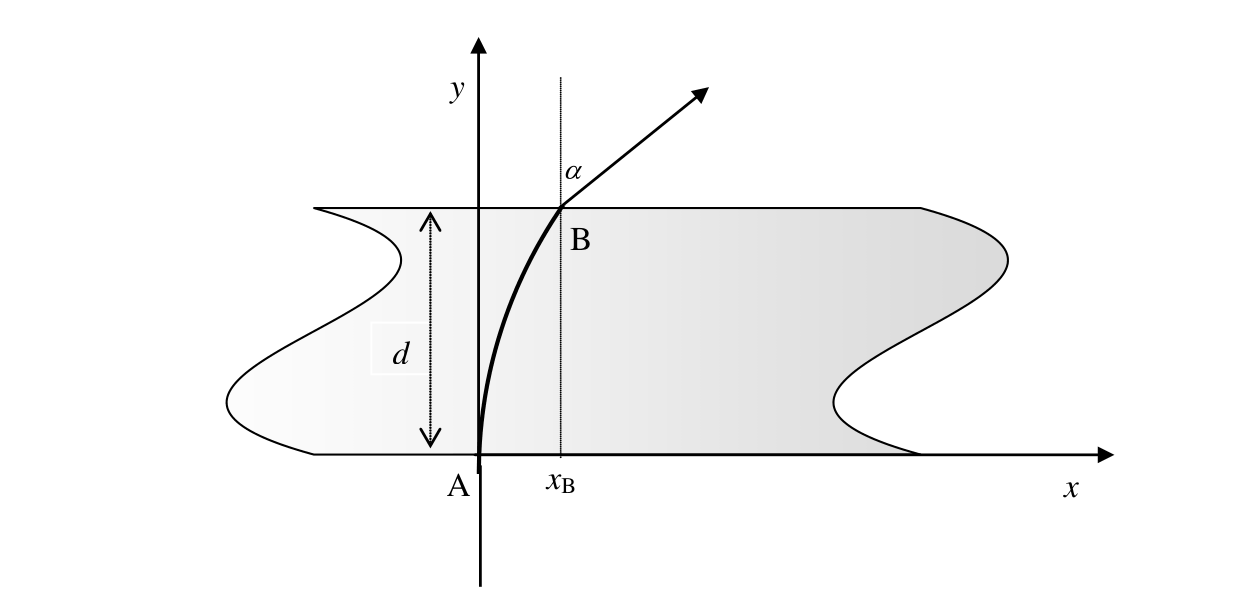
Fig. 1
A light beam enters from the air perpendicularly to the plate at the point A (\(x_A=0\)) and emerges from it at the point B at an angle \(\alpha\).
- Find the refraction index \(n_B\) at the point B.
- Find \(x_B\) (i.e. value of \(x\) at the point B)
- Find the thickness \(d\) of the plate.
Data:
\[ n_0=1.2;\qquad R=13\,\mathrm{cm};\qquad \alpha=30^\circ. \]
Official English text of the problem.
Answers
- \(\displaystyle n_B=\sqrt{n_0^2+\sin^2\alpha}=\boxed{1.3}\) (dimensionless).
- \(\displaystyle x_B=R\left(1-\frac{n_0}{\sqrt{n_0^2+\sin^2\alpha}}\right)=\boxed{1.0\,\mathrm{cm}}\).
- \(\displaystyle d=\frac{R\sin\alpha}{\sqrt{n_0^2+\sin^2\alpha}}=\boxed{5.0\,\mathrm{cm}}\).
Solution
1. Refraction index at B
We use geometrical optics, treating the refractive index as varying smoothly on the scale of the wavelength, and take the refractive index of air to be \(1\).
Let \(\beta\) denote the angle the ray inside the plate makes with the positive \(y\)-axis, which is normal to the plate surfaces. Normal incidence at A gives \(\beta_A=0\).
To determine how the ray bends, imagine dividing the plate into infinitesimally thin vertical layers of constant refractive index. The normal to each layer interface points along \(x\), so the ray’s angle to that normal is \(90^\circ-\beta\). Snell’s law across successive layers therefore gives
\[ n\sin(90^\circ-\beta)=n\cos\beta=\text{constant}. \]
Evaluating this constant at A, where \(n=n_0\), yields
\[ \boxed{n(x)\cos\beta=n_0}. \]
At B, let the internal incidence angle be \(\beta_B\). Thus
\[ n_B\cos\beta_B=n_0. \]
Snell’s law at the upper surface, where the ray emerges into air, gives
\[ n_B\sin\beta_B=\sin\alpha. \]
Squaring and adding these equations eliminates \(\beta_B\):
\[ n_B^2(\cos^2\beta_B+\sin^2\beta_B) =n_0^2+\sin^2\alpha. \]
Hence
\[ \boxed{n_B=\sqrt{n_0^2+\sin^2\alpha}}. \]
Numerically,
\[ n_B=\sqrt{1.2^2+\sin^2 30^\circ} =\sqrt{1.44+0.25} =\boxed{1.3}. \]
2. Position \(x_B\)
Using the prescribed index profile at B,
\[ n_B=\frac{n_0}{1-x_B/R}, \]
we obtain
\[ \boxed{x_B=R\left(1-\frac{n_0}{n_B}\right)}. \]
Substitution gives
\[ x_B=13\,\mathrm{cm}\left(1-\frac{1.2}{1.3}\right) =13\,\mathrm{cm}\left(\frac{1}{13}\right) =\boxed{1.0\,\mathrm{cm}}. \]
3. Thickness \(d\)
Combining the conserved quantity with the index profile gives
\[ \cos\beta=\frac{n_0}{n(x)}=1-\frac{x}{R}. \]
The refractive index increases with \(x\), so the ray bends towards positive \(x\). On this branch, its tangent satisfies
\[ \frac{dy}{dx}=\cot\beta =\frac{\cos\beta}{\sqrt{1-\cos^2\beta}} =\frac{R-x}{\sqrt{2Rx-x^2}}. \]
Integrating from A, where \(x=y=0\), to an arbitrary point on the ray,
\[ y(x)=\int_0^x\frac{R-u}{\sqrt{2Ru-u^2}}\,du =\sqrt{2Rx-x^2}. \]
Consequently, the ray follows the circular arc
\[ \boxed{(x-R)^2+y^2=R^2}, \]
with centre \((R,0)\) and radius \(R\). The relevant arc starts at A with a vertical tangent and bends to the right.
At B, \(y=d\), so
\[ d=\sqrt{2Rx_B-x_B^2}. \]
Equivalently, substituting the expression for \(x_B\),
\[ d=R\sqrt{1-\left(\frac{n_0}{n_B}\right)^2} =\boxed{\frac{R\sin\alpha}{\sqrt{n_0^2+\sin^2\alpha}}}. \]
Numerically,
\[ d=\sqrt{2(13\,\mathrm{cm})(1.0\,\mathrm{cm}) -(1.0\,\mathrm{cm})^2} =\sqrt{25\,\mathrm{cm}^2} =\boxed{5.0\,\mathrm{cm}}. \]
The solution was checked against the official solution.
IPhO 1974 · Theorieaufgabe 2
Platte mit einem über ihre Breite veränderlichen Brechungsindex
Betrachtet wird eine planparallele, transparente Platte der Dicke \(d\) – Abb. 1. Ihr Brechungsindex variiert gemäß
\[ n=\frac{n_0}{1-\dfrac{x}{R}}. \]
Abb. 1
Ein Lichtstrahl tritt aus der Luft im Punkt A (\(x_A=0\)) senkrecht in die Platte ein und verlässt sie im Punkt B unter einem Winkel \(\alpha\).
- Bestimmen Sie den Brechungsindex \(n_B\) im Punkt B.
- Bestimmen Sie \(x_B\) (d. h. den Wert von \(x\) im Punkt B)
- Bestimmen Sie die Dicke \(d\) der Platte.
Gegeben:
\[ n_0=1.2;\qquad R=13\,\mathrm{cm};\qquad \alpha=30^\circ. \]
Aufgabentext aus dem offiziellen englischen Text übersetzt.
Antworten
- \(\displaystyle n_B=\sqrt{n_0^2+\sin^2\alpha}=\boxed{1.3}\) (dimensionslos).
- \(\displaystyle x_B=R\left(1-\frac{n_0}{\sqrt{n_0^2+\sin^2\alpha}}\right)=\boxed{1.0\,\mathrm{cm}}\).
- \(\displaystyle d=\frac{R\sin\alpha}{\sqrt{n_0^2+\sin^2\alpha}}=\boxed{5.0\,\mathrm{cm}}\).
Lösung
1. Brechungsindex bei B
Wir verwenden die geometrische Optik, wobei wir annehmen, dass sich der Brechungsindex auf der Längenskala der Wellenlänge nur allmählich ändert, und setzen den Brechungsindex der Luft gleich \(1\).
Mit \(\beta\) bezeichnen wir den Winkel, den der Strahl innerhalb der Platte mit der positiven \(y\)-Achse bildet, die senkrecht auf den Plattenoberflächen steht. Aus dem senkrechten Einfall bei A folgt \(\beta_A=0\).
Um zu bestimmen, wie der Strahl gekrümmt wird, stellen wir uns die Platte in infinitesimal dünne vertikale Schichten mit jeweils konstantem Brechungsindex unterteilt vor. Die Normale jeder Schichtgrenzfläche zeigt in \(x\)-Richtung, sodass der Winkel des Strahls zu dieser Normalen \(90^\circ-\beta\) beträgt. Das Snelliussche Brechungsgesetz liefert daher für aufeinanderfolgende Schichten
\[ n\sin(90^\circ-\beta)=n\cos\beta=\text{konstant}. \]
Die Auswertung dieser Konstanten bei A, wo \(n=n_0\) gilt, ergibt
\[ \boxed{n(x)\cos\beta=n_0}. \]
Bei B sei der Einfallswinkel innerhalb der Platte \(\beta_B\). Somit gilt
\[ n_B\cos\beta_B=n_0. \]
Das Snelliussche Brechungsgesetz an der oberen Oberfläche, an der der Strahl in die Luft austritt, liefert
\[ n_B\sin\beta_B=\sin\alpha. \]
Durch Quadrieren und Addieren dieser Gleichungen wird \(\beta_B\) eliminiert:
\[ n_B^2(\cos^2\beta_B+\sin^2\beta_B) =n_0^2+\sin^2\alpha. \]
Daraus folgt
\[ \boxed{n_B=\sqrt{n_0^2+\sin^2\alpha}}. \]
Numerisch ergibt sich
\[ n_B=\sqrt{1.2^2+\sin^2 30^\circ} =\sqrt{1.44+0.25} =\boxed{1.3}. \]
2. Position \(x_B\)
Mit dem vorgegebenen Brechungsindexprofil bei B,
\[ n_B=\frac{n_0}{1-x_B/R}, \]
erhalten wir
\[ \boxed{x_B=R\left(1-\frac{n_0}{n_B}\right)}. \]
Einsetzen liefert
\[ x_B=13\,\mathrm{cm}\left(1-\frac{1.2}{1.3}\right) =13\,\mathrm{cm}\left(\frac{1}{13}\right) =\boxed{1.0\,\mathrm{cm}}. \]
3. Dicke \(d\)
Die Kombination der Erhaltungsgröße mit dem Brechungsindexprofil ergibt
\[ \cos\beta=\frac{n_0}{n(x)}=1-\frac{x}{R}. \]
Der Brechungsindex nimmt mit \(x\) zu, daher wird der Strahl in Richtung positiver \(x\)-Werte gekrümmt. Auf diesem Zweig gilt für seine Tangente
\[ \frac{dy}{dx}=\cot\beta =\frac{\cos\beta}{\sqrt{1-\cos^2\beta}} =\frac{R-x}{\sqrt{2Rx-x^2}}. \]
Die Integration von A, wo \(x=y=0\) gilt, bis zu einem beliebigen Punkt auf dem Strahl ergibt
\[ y(x)=\int_0^x\frac{R-u}{\sqrt{2Ru-u^2}}\,du =\sqrt{2Rx-x^2}. \]
Folglich verläuft der Strahl entlang des Kreisbogens
\[ \boxed{(x-R)^2+y^2=R^2}, \]
mit dem Mittelpunkt \((R,0)\) und dem Radius \(R\). Der betrachtete Kreisbogen beginnt bei A mit einer vertikalen Tangente und krümmt sich nach rechts.
Bei B gilt \(y=d\), also
\[ d=\sqrt{2Rx_B-x_B^2}. \]
Gleichwertig ergibt sich durch Einsetzen des Ausdrucks für \(x_B\)
\[ d=R\sqrt{1-\left(\frac{n_0}{n_B}\right)^2} =\boxed{\frac{R\sin\alpha}{\sqrt{n_0^2+\sin^2\alpha}}}. \]
Numerisch ergibt sich
\[ d=\sqrt{2(13\,\mathrm{cm})(1.0\,\mathrm{cm}) -(1.0\,\mathrm{cm})^2} =\sqrt{25\,\mathrm{cm}^2} =\boxed{5.0\,\mathrm{cm}}. \]
Die Lösung wurde mit der offiziellen Lösung abgeglichen.
IPhO 1974 · Teori sorusu 2
Kırılma indisi genişliği boyunca değişen levha
Kalınlığı \(d\) olan, yüzeyleri birbirine paralel, saydam bir levhayı ele alalım – Şekil 1. Levhanın kırılma indisi aşağıdaki bağıntıya göre değişmektedir:
\[ n=\frac{n_0}{1-\dfrac{x}{R}}. \]
Şekil 1
Bir ışık demeti havadan levhaya A noktasında (\(x_A=0\)) dik olarak girer ve B noktasında levhadan \(\alpha\) açısıyla çıkar.
- B noktasındaki \(n_B\) kırılma indisini bulunuz.
- \(x_B\)'yi (yani B noktasındaki \(x\) değerini) bulunuz.
- Levhanın \(d\) kalınlığını bulunuz.
Veriler:
\[ n_0=1.2;\qquad R=13\,\mathrm{cm};\qquad \alpha=30^\circ. \]
Soru metni resmi İngilizce metinden çevrilmiştir.
Cevaplar
- \(\displaystyle n_B=\sqrt{n_0^2+\sin^2\alpha}=\boxed{1.3}\) (boyutsuz).
- \(\displaystyle x_B=R\left(1-\frac{n_0}{\sqrt{n_0^2+\sin^2\alpha}}\right)=\boxed{1.0\,\mathrm{cm}}\).
- \(\displaystyle d=\frac{R\sin\alpha}{\sqrt{n_0^2+\sin^2\alpha}}=\boxed{5.0\,\mathrm{cm}}\).
Çözüm
1. B noktasındaki kırılma indisi
Kırılma indisinin dalga boyu ölçeğinde düzgün biçimde değiştiğini kabul ederek geometrik optiği kullanıyor ve havanın kırılma indisini \(1\) alıyoruz.
\(\beta\), levhanın içindeki ışının, levha yüzeylerine dik olan pozitif \(y\) ekseniyle yaptığı açıyı göstersin. Işının A noktasında dik gelmesi, \(\beta_A=0\) olmasını gerektirir.
Işının nasıl büküldüğünü belirlemek için levhayı, her biri sabit kırılma indisine sahip sonsuz ince düşey katmanlara ayırdığımızı düşünelim. Her bir katman ara yüzeyinin normali \(x\) doğrultusundadır; dolayısıyla ışının bu normalle yaptığı açı \(90^\circ-\beta\)'dır. Bu nedenle, ardışık katmanlar arasında Snell yasası şu bağıntıyı verir:
\[ n\sin(90^\circ-\beta)=n\cos\beta=\text{sabit}. \]
Bu sabiti, \(n=n_0\) olan A noktasında hesapladığımızda şu sonuç elde edilir:
\[ \boxed{n(x)\cos\beta=n_0}. \]
B noktasında levha içindeki gelme açısı \(\beta_B\) olsun. Böylece
\[ n_B\cos\beta_B=n_0. \]
Işının havaya çıktığı üst yüzeyde Snell yasası şu bağıntıyı verir:
\[ n_B\sin\beta_B=\sin\alpha. \]
Bu denklemlerin karelerini alıp toplayarak \(\beta_B\)'yi eleriz:
\[ n_B^2(\cos^2\beta_B+\sin^2\beta_B) =n_0^2+\sin^2\alpha. \]
Buradan şu sonuç bulunur:
\[ \boxed{n_B=\sqrt{n_0^2+\sin^2\alpha}}. \]
Sayısal olarak,
\[ n_B=\sqrt{1.2^2+\sin^2 30^\circ} =\sqrt{1.44+0.25} =\boxed{1.3}. \]
2. \(x_B\) konumu
B noktasında verilen indis profilini,
\[ n_B=\frac{n_0}{1-x_B/R}, \]
kullanarak şu sonucu elde ederiz:
\[ \boxed{x_B=R\left(1-\frac{n_0}{n_B}\right)}. \]
Değerleri yerine koyarsak şu sonuç bulunur:
\[ x_B=13\,\mathrm{cm}\left(1-\frac{1.2}{1.3}\right) =13\,\mathrm{cm}\left(\frac{1}{13}\right) =\boxed{1.0\,\mathrm{cm}}. \]
3. \(d\) kalınlığı
Korunan büyüklüğü indis profiliyle birleştirdiğimizde şu bağıntı elde edilir:
\[ \cos\beta=\frac{n_0}{n(x)}=1-\frac{x}{R}. \]
Kırılma indisi \(x\) ile arttığından ışın pozitif \(x\) yönüne doğru bükülür. Bu dal üzerinde ışının teğeti şu bağıntıyı sağlar:
\[ \frac{dy}{dx}=\cot\beta =\frac{\cos\beta}{\sqrt{1-\cos^2\beta}} =\frac{R-x}{\sqrt{2Rx-x^2}}. \]
\(x=y=0\) olan A noktasından ışın üzerindeki herhangi bir noktaya kadar integral alırsak,
\[ y(x)=\int_0^x\frac{R-u}{\sqrt{2Ru-u^2}}\,du =\sqrt{2Rx-x^2}. \]
Sonuç olarak ışın,
\[ \boxed{(x-R)^2+y^2=R^2}, \]
denklemiyle verilen, merkezi \((R,0)\) ve yarıçapı \(R\) olan çember yayını izler. İlgili yay, A noktasında düşey bir teğetle başlar ve sağa doğru bükülür.
B noktasında \(y=d\) olduğundan
\[ d=\sqrt{2Rx_B-x_B^2}. \]
Eşdeğer olarak, \(x_B\) ifadesini yerine koyarsak,
\[ d=R\sqrt{1-\left(\frac{n_0}{n_B}\right)^2} =\boxed{\frac{R\sin\alpha}{\sqrt{n_0^2+\sin^2\alpha}}}. \]
Sayısal olarak,
\[ d=\sqrt{2(13\,\mathrm{cm})(1.0\,\mathrm{cm}) -(1.0\,\mathrm{cm})^2} =\sqrt{25\,\mathrm{cm}^2} =\boxed{5.0\,\mathrm{cm}}. \]
Çözüm, resmi çözümle karşılaştırılarak kontrol edildi.
IPhO 1974 · Problema teórico 2
Lámina con un índice de refracción que varía a lo ancho
Considérese una lámina transparente de caras paralelas y espesor \(d\), representada en la Fig. 1. Su índice de refracción varía según
\[ n=\frac{n_0}{1-\dfrac{x}{R}}. \]
Fig. 1
Un haz de luz procedente del aire incide perpendicularmente sobre la lámina en el punto A (\(x_A=0\)) y sale de ella por el punto B formando un ángulo \(\alpha\).
- Halle el índice de refracción \(n_B\) en el punto B.
- Halle \(x_B\) (es decir, el valor de \(x\) en el punto B)
- Halle el espesor \(d\) de la lámina.
Datos:
\[ n_0=1.2;\qquad R=13\,\mathrm{cm};\qquad \alpha=30^\circ. \]
Enunciado traducido del texto oficial en inglés.
Respuestas
- \(\displaystyle n_B=\sqrt{n_0^2+\sin^2\alpha}=\boxed{1.3}\) (adimensional).
- \(\displaystyle x_B=R\left(1-\frac{n_0}{\sqrt{n_0^2+\sin^2\alpha}}\right)=\boxed{1.0\,\mathrm{cm}}\).
- \(\displaystyle d=\frac{R\sin\alpha}{\sqrt{n_0^2+\sin^2\alpha}}=\boxed{5.0\,\mathrm{cm}}\).
Solución
1. Índice de refracción en B
Empleamos la óptica geométrica, considerando que el índice de refracción varía suavemente a la escala de la longitud de onda, y tomamos el índice de refracción del aire igual a \(1\).
Sea \(\beta\) el ángulo que forma el rayo dentro de la lámina con el semieje positivo \(y\), que es normal a las superficies de la lámina. La incidencia normal en A implica \(\beta_A=0\).
Para determinar cómo se curva el rayo, imaginemos que dividimos la lámina en capas verticales infinitesimalmente delgadas de índice de refracción constante. La normal a la interfaz entre dos capas está orientada según \(x\), por lo que el ángulo del rayo con dicha normal es \(90^\circ-\beta\). Por tanto, la ley de Snell aplicada entre capas sucesivas da
\[ n\sin(90^\circ-\beta)=n\cos\beta=\text{constante}. \]
Al evaluar esta constante en A, donde \(n=n_0\), se obtiene
\[ \boxed{n(x)\cos\beta=n_0}. \]
Sea \(\beta_B\) el ángulo de incidencia interno en B. Entonces
\[ n_B\cos\beta_B=n_0. \]
La ley de Snell en la superficie superior, por la que el rayo sale al aire, da
\[ n_B\sin\beta_B=\sin\alpha. \]
Al elevar al cuadrado y sumar estas ecuaciones, se elimina \(\beta_B\):
\[ n_B^2(\cos^2\beta_B+\sin^2\beta_B) =n_0^2+\sin^2\alpha. \]
Por tanto,
\[ \boxed{n_B=\sqrt{n_0^2+\sin^2\alpha}}. \]
Numéricamente,
\[ n_B=\sqrt{1.2^2+\sin^2 30^\circ} =\sqrt{1.44+0.25} =\boxed{1.3}. \]
2. Posición \(x_B\)
Utilizando el perfil del índice dado en B,
\[ n_B=\frac{n_0}{1-x_B/R}, \]
obtenemos
\[ \boxed{x_B=R\left(1-\frac{n_0}{n_B}\right)}. \]
Al sustituir los valores, resulta
\[ x_B=13\,\mathrm{cm}\left(1-\frac{1.2}{1.3}\right) =13\,\mathrm{cm}\left(\frac{1}{13}\right) =\boxed{1.0\,\mathrm{cm}}. \]
3. Espesor \(d\)
Al combinar la magnitud conservada con el perfil del índice, se obtiene
\[ \cos\beta=\frac{n_0}{n(x)}=1-\frac{x}{R}. \]
El índice de refracción aumenta con \(x\), por lo que el rayo se curva hacia valores positivos de \(x\). En esta rama, su tangente satisface
\[ \frac{dy}{dx}=\cot\beta =\frac{\cos\beta}{\sqrt{1-\cos^2\beta}} =\frac{R-x}{\sqrt{2Rx-x^2}}. \]
Integrando desde A, donde \(x=y=0\), hasta un punto arbitrario del rayo,
\[ y(x)=\int_0^x\frac{R-u}{\sqrt{2Ru-u^2}}\,du =\sqrt{2Rx-x^2}. \]
En consecuencia, el rayo sigue el arco de circunferencia
\[ \boxed{(x-R)^2+y^2=R^2}, \]
de centro \((R,0)\) y radio \(R\). El arco pertinente parte de A con una tangente vertical y se curva hacia la derecha.
En B, \(y=d\), por lo que
\[ d=\sqrt{2Rx_B-x_B^2}. \]
De forma equivalente, sustituyendo la expresión de \(x_B\),
\[ d=R\sqrt{1-\left(\frac{n_0}{n_B}\right)^2} =\boxed{\frac{R\sin\alpha}{\sqrt{n_0^2+\sin^2\alpha}}}. \]
Numéricamente,
\[ d=\sqrt{2(13\,\mathrm{cm})(1.0\,\mathrm{cm}) -(1.0\,\mathrm{cm})^2} =\sqrt{25\,\mathrm{cm}^2} =\boxed{5.0\,\mathrm{cm}}. \]
La solución se comprobó con la solución oficial.
IPhO 1974 · 理论题 2
折射率沿宽度方向变化的平板
考虑一块厚度为 \(d\) 的透明平行平板,如图 1 所示。其折射率按下式变化:
\[ n=\frac{n_0}{1-\dfrac{x}{R}}. \]
图 1
一束光从空气中在 A 点(\(x_A=0\))垂直射入平板,并在 B 点以角度 \(\alpha\) 射出。
- 求 B 点的折射率 \(n_B\)。
- 求 \(x_B\)(即 B 点的 \(x\) 值)。
- 求平板的厚度 \(d\)。
已知:
\[ n_0=1.2;\qquad R=13\,\mathrm{cm};\qquad \alpha=30^\circ. \]
题目译自官方英文原文。
答案
- \(\displaystyle n_B=\sqrt{n_0^2+\sin^2\alpha}=\boxed{1.3}\)(无量纲)。
- \(\displaystyle x_B=R\left(1-\frac{n_0}{\sqrt{n_0^2+\sin^2\alpha}}\right)=\boxed{1.0\,\mathrm{cm}}\)。
- \(\displaystyle d=\frac{R\sin\alpha}{\sqrt{n_0^2+\sin^2\alpha}}=\boxed{5.0\,\mathrm{cm}}\)。
解答
1. B 点的折射率
我们采用几何光学方法,认为折射率在波长尺度上平滑变化,并取空气的折射率为 \(1\)。
用 \(\beta\) 表示平板内光线与 \(y\) 轴正方向的夹角,\(y\) 轴垂直于平板表面。光线在 A 点垂直入射,因此 \(\beta_A=0\)。
为确定光线如何弯曲,设想将平板划分为无穷薄的竖直薄层,每层的折射率均为常量。各层界面的法线沿 \(x\) 方向,因此光线与该法线的夹角为 \(90^\circ-\beta\)。对相邻各层应用斯涅尔定律,得到
\[ n\sin(90^\circ-\beta)=n\cos\beta=\text{常量}. \]
在 A 点,\(n=n_0\),由此确定该常量,得到
\[ \boxed{n(x)\cos\beta=n_0}. \]
设光线在 B 点的内部入射角为 \(\beta_B\)。于是
\[ n_B\cos\beta_B=n_0. \]
在光线射入空气的上表面处应用斯涅尔定律,得到
\[ n_B\sin\beta_B=\sin\alpha. \]
将这两个方程分别平方后相加,消去 \(\beta_B\):
\[ n_B^2(\cos^2\beta_B+\sin^2\beta_B) =n_0^2+\sin^2\alpha. \]
因此
\[ \boxed{n_B=\sqrt{n_0^2+\sin^2\alpha}}. \]
代入数值得
\[ n_B=\sqrt{1.2^2+\sin^2 30^\circ} =\sqrt{1.44+0.25} =\boxed{1.3}. \]
2. 位置 \(x_B\)
将给定的折射率分布用于 B 点,有
\[ n_B=\frac{n_0}{1-x_B/R}, \]
得到
\[ \boxed{x_B=R\left(1-\frac{n_0}{n_B}\right)}. \]
代入数值得
\[ x_B=13\,\mathrm{cm}\left(1-\frac{1.2}{1.3}\right) =13\,\mathrm{cm}\left(\frac{1}{13}\right) =\boxed{1.0\,\mathrm{cm}}. \]
3. 厚度 \(d\)
将守恒量与折射率分布结合,得到
\[ \cos\beta=\frac{n_0}{n(x)}=1-\frac{x}{R}. \]
折射率随 \(x\) 增大而增大,因此光线向 \(x\) 轴正方向弯曲。在这一分支上,光线的切线满足
\[ \frac{dy}{dx}=\cot\beta =\frac{\cos\beta}{\sqrt{1-\cos^2\beta}} =\frac{R-x}{\sqrt{2Rx-x^2}}. \]
从 \(x=y=0\) 的 A 点积分至光线上的任意一点,得到
\[ y(x)=\int_0^x\frac{R-u}{\sqrt{2Ru-u^2}}\,du =\sqrt{2Rx-x^2}. \]
因此,光线沿着圆弧
\[ \boxed{(x-R)^2+y^2=R^2}, \]
传播,其圆心为 \((R,0)\),半径为 \(R\)。所取的圆弧从 A 点出发,在该点的切线竖直,并向右弯曲。
在 B 点,\(y=d\),所以
\[ d=\sqrt{2Rx_B-x_B^2}. \]
或者,代入 \(x_B\) 的表达式,可得等价形式
\[ d=R\sqrt{1-\left(\frac{n_0}{n_B}\right)^2} =\boxed{\frac{R\sin\alpha}{\sqrt{n_0^2+\sin^2\alpha}}}. \]
代入数值得
\[ d=\sqrt{2(13\,\mathrm{cm})(1.0\,\mathrm{cm}) -(1.0\,\mathrm{cm})^2} =\sqrt{25\,\mathrm{cm}^2} =\boxed{5.0\,\mathrm{cm}}. \]
解答已与官方解答核对。
IPhO 1974 · Теоретическая задача 2
Пластинка с показателем преломления, изменяющимся по её ширине
Рассмотрим плоскопараллельную прозрачную пластинку толщиной \(d\) — рис. 1. Её показатель преломления изменяется по закону
\[ n=\frac{n_0}{1-\dfrac{x}{R}}. \]
Рис. 1
Световой луч входит из воздуха перпендикулярно поверхности пластинки в точке A (\(x_A=0\)) и выходит из неё в точке B под углом \(\alpha\).
- Найдите показатель преломления \(n_B\) в точке B.
- Найдите \(x_B\) (то есть значение \(x\) в точке B)
- Найдите толщину \(d\) пластинки.
Дано:
\[ n_0=1.2;\qquad R=13\,\mathrm{cm};\qquad \alpha=30^\circ. \]
Условие переведено с официального английского текста.
Ответы
- \(\displaystyle n_B=\sqrt{n_0^2+\sin^2\alpha}=\boxed{1.3}\) (безразмерная величина).
- \(\displaystyle x_B=R\left(1-\frac{n_0}{\sqrt{n_0^2+\sin^2\alpha}}\right)=\boxed{1.0\,\mathrm{cm}}\).
- \(\displaystyle d=\frac{R\sin\alpha}{\sqrt{n_0^2+\sin^2\alpha}}=\boxed{5.0\,\mathrm{cm}}\).
Решение
1. Показатель преломления в точке B
Используем геометрическую оптику, считая, что показатель преломления плавно меняется на масштабе длины волны, и примем показатель преломления воздуха равным \(1\).
Обозначим через \(\beta\) угол, который луч внутри пластинки образует с положительным направлением оси \(y\), перпендикулярной поверхностям пластинки. При нормальном падении в точке A имеем \(\beta_A=0\).
Чтобы определить, как искривляется луч, мысленно разделим пластинку на бесконечно тонкие вертикальные слои с постоянным показателем преломления. Нормаль к каждой границе раздела слоёв направлена вдоль оси \(x\), поэтому угол между лучом и этой нормалью равен \(90^\circ-\beta\). Следовательно, закон Снеллиуса для последовательных слоёв даёт
\[ n\sin(90^\circ-\beta)=n\cos\beta=\text{постоянная}. \]
Вычисляя эту постоянную в точке A, где \(n=n_0\), получаем
\[ \boxed{n(x)\cos\beta=n_0}. \]
Обозначим угол падения изнутри пластинки в точке B через \(\beta_B\). Тогда
\[ n_B\cos\beta_B=n_0. \]
Закон Снеллиуса на верхней поверхности, где луч выходит в воздух, даёт
\[ n_B\sin\beta_B=\sin\alpha. \]
Возводя эти уравнения в квадрат и складывая их, исключаем \(\beta_B\):
\[ n_B^2(\cos^2\beta_B+\sin^2\beta_B) =n_0^2+\sin^2\alpha. \]
Отсюда
\[ \boxed{n_B=\sqrt{n_0^2+\sin^2\alpha}}. \]
Численно:
\[ n_B=\sqrt{1.2^2+\sin^2 30^\circ} =\sqrt{1.44+0.25} =\boxed{1.3}. \]
2. Координата \(x_B\)
Используя заданную зависимость показателя преломления от координаты в точке B,
\[ n_B=\frac{n_0}{1-x_B/R}, \]
получаем
\[ \boxed{x_B=R\left(1-\frac{n_0}{n_B}\right)}. \]
Подстановка даёт
\[ x_B=13\,\mathrm{cm}\left(1-\frac{1.2}{1.3}\right) =13\,\mathrm{cm}\left(\frac{1}{13}\right) =\boxed{1.0\,\mathrm{cm}}. \]
3. Толщина \(d\)
Совмещая выражение для сохраняющейся величины с зависимостью показателя преломления от координаты, получаем
\[ \cos\beta=\frac{n_0}{n(x)}=1-\frac{x}{R}. \]
Показатель преломления возрастает с увеличением \(x\), поэтому луч искривляется в сторону положительного направления оси \(x\). На этой ветви наклон касательной к траектории луча удовлетворяет соотношению
\[ \frac{dy}{dx}=\cot\beta =\frac{\cos\beta}{\sqrt{1-\cos^2\beta}} =\frac{R-x}{\sqrt{2Rx-x^2}}. \]
Интегрируя от точки A, где \(x=y=0\), до произвольной точки на луче, получаем
\[ y(x)=\int_0^x\frac{R-u}{\sqrt{2Ru-u^2}}\,du =\sqrt{2Rx-x^2}. \]
Следовательно, луч идёт по дуге окружности
\[ \boxed{(x-R)^2+y^2=R^2}, \]
с центром \((R,0)\) и радиусом \(R\). Рассматриваемая дуга начинается в точке A с вертикальной касательной и изгибается вправо.
В точке B \(y=d\), поэтому
\[ d=\sqrt{2Rx_B-x_B^2}. \]
Подставляя выражение для \(x_B\), получаем эквивалентную запись:
\[ d=R\sqrt{1-\left(\frac{n_0}{n_B}\right)^2} =\boxed{\frac{R\sin\alpha}{\sqrt{n_0^2+\sin^2\alpha}}}. \]
Численно:
\[ d=\sqrt{2(13\,\mathrm{cm})(1.0\,\mathrm{cm}) -(1.0\,\mathrm{cm})^2} =\sqrt{25\,\mathrm{cm}^2} =\boxed{5.0\,\mathrm{cm}}. \]
Решение проверено по официальному решению.
IPhO 1974 · مسألة نظرية 2
صفيحة يتغير معامل انكسارها عبر عرضها
لتكن لدينا صفيحة شفافة متوازية الوجهين سمكها \(d\) – الشكل 1. يتغير معامل انكسارها وفق العلاقة
\[ n=\frac{n_0}{1-\dfrac{x}{R}}. \]
الشكل 1
يدخل شعاع ضوئي من الهواء عموديًا على الصفيحة عند النقطة A (\(x_A=0\)) ويخرج منها عند النقطة B بزاوية \(\alpha\).
- أوجد معامل الانكسار \(n_B\) عند النقطة B.
- أوجد \(x_B\) (أي قيمة \(x\) عند النقطة B)
- أوجد سمك الصفيحة \(d\).
المعطيات:
\[ n_0=1.2;\qquad R=13\,\mathrm{cm};\qquad \alpha=30^\circ. \]
نص المسألة مترجم عن النص الإنجليزي الرسمي.
الإجابات
- \(\displaystyle n_B=\sqrt{n_0^2+\sin^2\alpha}=\boxed{1.3}\) (بلا أبعاد).
- \(\displaystyle x_B=R\left(1-\frac{n_0}{\sqrt{n_0^2+\sin^2\alpha}}\right)=\boxed{1.0\,\mathrm{cm}}\).
- \(\displaystyle d=\frac{R\sin\alpha}{\sqrt{n_0^2+\sin^2\alpha}}=\boxed{5.0\,\mathrm{cm}}\).
الحل
1. معامل الانكسار عند B
نستخدم البصريات الهندسية، معتبرين أن معامل الانكسار يتغير بسلاسة على مقياس الطول الموجي، ونأخذ معامل انكسار الهواء مساويًا لـ \(1\).
لتكن \(\beta\) الزاوية التي يصنعها الشعاع داخل الصفيحة مع الاتجاه الموجب للمحور \(y\)، وهو عمودي على سطحي الصفيحة. من السقوط العمودي عند A نحصل على \(\beta_A=0\).
لتحديد كيفية انحناء الشعاع، نتخيل تقسيم الصفيحة إلى طبقات رأسية متناهية الرقة، لكل منها معامل انكسار ثابت. يتجه العمود على كل سطح فاصل بين الطبقات على امتداد المحور \(x\)، ولذلك تكون زاوية الشعاع مع هذا العمود \(90^\circ-\beta\). ومن ثم يعطي قانون سنيل عبر الطبقات المتتالية
\[ n\sin(90^\circ-\beta)=n\cos\beta=\text{ثابت}. \]
بحساب هذا الثابت عند A، حيث \(n=n_0\)، نحصل على
\[ \boxed{n(x)\cos\beta=n_0}. \]
عند B، لتكن زاوية السقوط الداخلية \(\beta_B\). إذن
\[ n_B\cos\beta_B=n_0. \]
يعطي قانون سنيل عند السطح العلوي، حيث يخرج الشعاع إلى الهواء،
\[ n_B\sin\beta_B=\sin\alpha. \]
بتربيع طرفي كل من هاتين المعادلتين ثم جمعهما، نحذف \(\beta_B\):
\[ n_B^2(\cos^2\beta_B+\sin^2\beta_B) =n_0^2+\sin^2\alpha. \]
ومن ثم
\[ \boxed{n_B=\sqrt{n_0^2+\sin^2\alpha}}. \]
عدديًا،
\[ n_B=\sqrt{1.2^2+\sin^2 30^\circ} =\sqrt{1.44+0.25} =\boxed{1.3}. \]
2. الموضع \(x_B\)
باستخدام التوزيع المعطى لمعامل الانكسار عند B،
\[ n_B=\frac{n_0}{1-x_B/R}, \]
نحصل على
\[ \boxed{x_B=R\left(1-\frac{n_0}{n_B}\right)}. \]
بالتعويض نحصل على
\[ x_B=13\,\mathrm{cm}\left(1-\frac{1.2}{1.3}\right) =13\,\mathrm{cm}\left(\frac{1}{13}\right) =\boxed{1.0\,\mathrm{cm}}. \]
3. السمك \(d\)
بالجمع بين الكمية المحفوظة وتوزيع معامل الانكسار نحصل على
\[ \cos\beta=\frac{n_0}{n(x)}=1-\frac{x}{R}. \]
يزداد معامل الانكسار مع \(x\)، ولذلك ينحني الشعاع نحو الاتجاه الموجب للمحور \(x\). وعلى هذا الفرع، يحقق ميل المماس لمساره العلاقة
\[ \frac{dy}{dx}=\cot\beta =\frac{\cos\beta}{\sqrt{1-\cos^2\beta}} =\frac{R-x}{\sqrt{2Rx-x^2}}. \]
بالتكامل من A، حيث \(x=y=0\)، إلى نقطة اعتباطية على مسار الشعاع،
\[ y(x)=\int_0^x\frac{R-u}{\sqrt{2Ru-u^2}}\,du =\sqrt{2Rx-x^2}. \]
وبالتالي، يتبع الشعاع القوس الدائري
\[ \boxed{(x-R)^2+y^2=R^2}, \]
الذي مركزه \((R,0)\) ونصف قطره \(R\). يبدأ القوس المعني عند A بمماس رأسي وينحني إلى اليمين.
عند B، يكون \(y=d\)، ولذلك
\[ d=\sqrt{2Rx_B-x_B^2}. \]
وبصورة مكافئة، بالتعويض عن \(x_B\) بتعبيره،
\[ d=R\sqrt{1-\left(\frac{n_0}{n_B}\right)^2} =\boxed{\frac{R\sin\alpha}{\sqrt{n_0^2+\sin^2\alpha}}}. \]
عدديًا،
\[ d=\sqrt{2(13\,\mathrm{cm})(1.0\,\mathrm{cm}) -(1.0\,\mathrm{cm})^2} =\sqrt{25\,\mathrm{cm}^2} =\boxed{5.0\,\mathrm{cm}}. \]
تمت مراجعة الحل بمقارنته بالحل الرسمي.