IPhO 1971 · Theory problem 1
Two blocks on a triangular prism on a frictionless plane
A triangular prism of mass \(M\) is placed one side on a frictionless horizontal plane as shown in Fig. 1. The other two sides are inclined with respect to the plane at angles \(\alpha_1\) and \(\alpha_2\) respectively. Two blocks of masses \(m_1\) and \(m_2\), connected by an inextensible thread, can slide without friction on the surface of the prism. The mass of the pulley, which supports the thread, is negligible.
- Express the acceleration \(a\) of the blocks relative to the prism in terms of the acceleration \(a_0\) of the prism.
- Find the acceleration \(a_0\) of the prism in terms of quantities given and the acceleration \(g\) due to gravity.
- At what ratio \(m_1/m_2\) the prism will be in equilibrium?
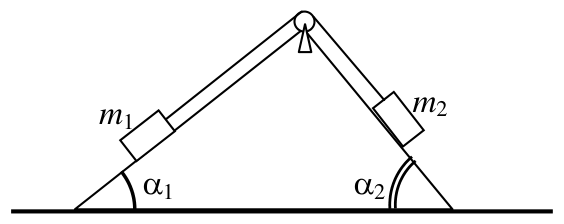
Fig. 1
Official English text of the problem.
Answers
The source has three unnumbered bullets and gives no point values; they are labelled (1)–(3) below.
Take \(a_0\) as positive to the right, and \(a\) as positive when \(m_1\) accelerates down its face and \(m_2\) accelerates up its face, relative to the prism.
-
\[ \boxed{ a=\frac{g(m_1\sin\alpha_1-m_2\sin\alpha_2) +a_0(m_1\cos\alpha_1+m_2\cos\alpha_2)} {m_1+m_2}} \]
-
\[ \boxed{ a_0= \frac{g(m_1\cos\alpha_1+m_2\cos\alpha_2) (m_1\sin\alpha_1-m_2\sin\alpha_2)} {(m_1+m_2)(M+m_1+m_2) -(m_1\cos\alpha_1+m_2\cos\alpha_2)^2}} \]
-
\[ \boxed{\frac{m_1}{m_2}=\frac{\sin\alpha_2}{\sin\alpha_1}} \]
Solution
We use the usual ideal-thread approximation: the thread is massless and taut, and the pulley turns without friction and has negligible inertia. Consequently, the tension \(T\) is the same on both sides. The prism translates horizontally, and the blocks remain in contact with their faces.
Because the thread is inextensible and the pulley is fixed to the prism, the blocks have equal signed relative accelerations when measured down the left face and up the right face.
(1) Relative acceleration in terms of \(a_0\)
Work in the inertial frame of the horizontal plane. Each block’s absolute acceleration equals the prism’s acceleration plus its acceleration relative to the prism.
For \(m_1\), take the positive direction down its incline. The projection of the rightward prism acceleration onto this direction is \(-a_0\cos\alpha_1\). Newton’s second law along the incline therefore gives \[ m_1(a-a_0\cos\alpha_1)=m_1g\sin\alpha_1-T. \]
For \(m_2\), take the positive direction up its incline. The corresponding equation is \[ m_2(a-a_0\cos\alpha_2)=T-m_2g\sin\alpha_2. \]
The normal forces have no components along the inclines. Adding the equations eliminates \(T\): \[ (m_1+m_2)a =g(m_1\sin\alpha_1-m_2\sin\alpha_2) +a_0(m_1\cos\alpha_1+m_2\cos\alpha_2). \] Dividing by \(m_1+m_2\) gives answer (1).
(2) Acceleration of the prism
There is no external horizontal force on the complete system: gravity and the supporting plane’s normal force are vertical. Hence its horizontal momentum is conserved, so its centre of mass has zero horizontal acceleration.
For positive \(a\), both blocks accelerate leftward relative to the prism. Their absolute horizontal accelerations are \[ a_{1x}=a_0-a\cos\alpha_1,\qquad a_{2x}=a_0-a\cos\alpha_2. \] Thus \[ Ma_0+m_1(a_0-a\cos\alpha_1) +m_2(a_0-a\cos\alpha_2)=0, \] or \[ (M+m_1+m_2)a_0 =(m_1\cos\alpha_1+m_2\cos\alpha_2)a. \]
For compactness, define \[ S=m_1+m_2,\qquad C=m_1\cos\alpha_1+m_2\cos\alpha_2,\qquad D=m_1\sin\alpha_1-m_2\sin\alpha_2. \] The two equations become \[ Sa=gD+Ca_0,\qquad (M+S)a_0=Ca. \] Eliminating \(a\), \[ \bigl[S(M+S)-C^2\bigr]a_0=gCD, \] which gives answer (2).
For the inclined faces shown, \(0<C<S\), so \[ S(M+S)-C^2=MS+(S^2-C^2)>0. \] Therefore the prism accelerates rightward if \(m_1\sin\alpha_1>m_2\sin\alpha_2\), and leftward if the inequality is reversed.
(3) Condition for equilibrium of the prism
Equilibrium requires \(a_0=0\). Since \(C>0\), horizontal momentum conservation then also requires \(a=0\). The equations along the inclines reduce to \[ T=m_1g\sin\alpha_1=m_2g\sin\alpha_2. \] Consequently, \[ \boxed{\frac{m_1}{m_2}=\frac{\sin\alpha_2}{\sin\alpha_1}}. \] At this ratio, a prism initially at rest remains at rest.
The solution was checked against the official solution. Where this solution differs from the official solution, the official solution contains an error or a misprint.
IPhO 1971 · Theorieaufgabe 1
Zwei Blöcke auf einem dreieckigen Prisma auf einer reibungsfreien Ebene
Ein dreieckiges Prisma der Masse \(M\) liegt mit einer Seitenfläche auf einer reibungsfreien horizontalen Ebene, wie in Abb. 1 gezeigt. Die beiden anderen Seitenflächen sind gegenüber der Ebene unter den Winkeln \(\alpha_1\) bzw. \(\alpha_2\) geneigt. Zwei Blöcke der Massen \(m_1\) und \(m_2\), die durch einen undehnbaren Faden verbunden sind, können reibungsfrei auf der Oberfläche des Prismas gleiten. Die Masse der Rolle, über die der Faden läuft, ist vernachlässigbar.
- Drücken Sie die Beschleunigung \(a\) der Blöcke relativ zum Prisma durch die Beschleunigung \(a_0\) des Prismas aus.
- Bestimmen Sie die Beschleunigung \(a_0\) des Prismas in Abhängigkeit von den gegebenen Größen und der Erdbeschleunigung \(g\).
- Bei welchem Verhältnis \(m_1/m_2\) befindet sich das Prisma im Gleichgewicht?
Abb. 1
Aufgabentext aus dem offiziellen englischen Text übersetzt.
Antworten
Die Quelle enthält drei unnummerierte Aufzählungspunkte und gibt keine Punktzahlen an; im Folgenden werden sie mit (1)–(3) bezeichnet.
Wir wählen \(a_0\) nach rechts positiv und \(a\) positiv, wenn \(m_1\) relativ zum Prisma seine Seitenfläche hinab und \(m_2\) seine Seitenfläche hinauf beschleunigt.
-
\[ \boxed{ a=\frac{g(m_1\sin\alpha_1-m_2\sin\alpha_2) +a_0(m_1\cos\alpha_1+m_2\cos\alpha_2)} {m_1+m_2}} \]
-
\[ \boxed{ a_0= \frac{g(m_1\cos\alpha_1+m_2\cos\alpha_2) (m_1\sin\alpha_1-m_2\sin\alpha_2)} {(m_1+m_2)(M+m_1+m_2) -(m_1\cos\alpha_1+m_2\cos\alpha_2)^2}} \]
-
\[ \boxed{\frac{m_1}{m_2}=\frac{\sin\alpha_2}{\sin\alpha_1}} \]
Lösung
Wir verwenden die übliche Näherung eines idealen Fadens: Der Faden ist masselos und gespannt, und die Rolle dreht sich reibungsfrei und hat ein vernachlässigbares Trägheitsmoment. Daher ist die Fadenspannung \(T\) auf beiden Seiten gleich. Das Prisma bewegt sich translatorisch in horizontaler Richtung, und die Blöcke bleiben in Kontakt mit ihren Seitenflächen.
Da der Faden undehnbar und die Rolle am Prisma befestigt ist, haben die Blöcke gleiche vorzeichenbehaftete Relativbeschleunigungen, wenn diese entlang der linken Seitenfläche abwärts und entlang der rechten Seitenfläche aufwärts gemessen werden.
(1) Relativbeschleunigung in Abhängigkeit von \(a_0\)
Wir betrachten das Inertialsystem der horizontalen Ebene. Die absolute Beschleunigung jedes Blocks ist gleich der Beschleunigung des Prismas zuzüglich seiner Beschleunigung relativ zum Prisma.
Für \(m_1\) wählen wir die positive Richtung entlang seiner schiefen Ebene abwärts. Die Projektion der nach rechts gerichteten Beschleunigung des Prismas auf diese Richtung ist \(-a_0\cos\alpha_1\). Das zweite Newtonsche Gesetz entlang der schiefen Ebene ergibt daher \[ m_1(a-a_0\cos\alpha_1)=m_1g\sin\alpha_1-T. \]
Für \(m_2\) wählen wir die positive Richtung entlang seiner schiefen Ebene aufwärts. Die entsprechende Gleichung lautet \[ m_2(a-a_0\cos\alpha_2)=T-m_2g\sin\alpha_2. \]
Die Normalkräfte haben keine Komponenten entlang der schiefen Ebenen. Durch Addition der Gleichungen wird \(T\) eliminiert: \[ (m_1+m_2)a =g(m_1\sin\alpha_1-m_2\sin\alpha_2) +a_0(m_1\cos\alpha_1+m_2\cos\alpha_2). \] Division durch \(m_1+m_2\) liefert Antwort (1).
(2) Beschleunigung des Prismas
Auf das Gesamtsystem wirkt keine äußere horizontale Kraft: Die Schwerkraft und die Normalkraft der tragenden Ebene sind vertikal gerichtet. Daher bleibt sein horizontaler Impuls erhalten, sodass die horizontale Beschleunigung seines Schwerpunkts null ist.
Für positives \(a\) beschleunigen beide Blöcke relativ zum Prisma nach links. Ihre absoluten horizontalen Beschleunigungen sind \[ a_{1x}=a_0-a\cos\alpha_1,\qquad a_{2x}=a_0-a\cos\alpha_2. \] Somit gilt \[ Ma_0+m_1(a_0-a\cos\alpha_1) +m_2(a_0-a\cos\alpha_2)=0, \] oder \[ (M+m_1+m_2)a_0 =(m_1\cos\alpha_1+m_2\cos\alpha_2)a. \]
Zur Abkürzung definieren wir \[ S=m_1+m_2,\qquad C=m_1\cos\alpha_1+m_2\cos\alpha_2,\qquad D=m_1\sin\alpha_1-m_2\sin\alpha_2. \] Die beiden Gleichungen lauten dann \[ Sa=gD+Ca_0,\qquad (M+S)a_0=Ca. \] Durch Eliminieren von \(a\) erhalten wir \[ \bigl[S(M+S)-C^2\bigr]a_0=gCD, \] woraus Antwort (2) folgt.
Für die dargestellten geneigten Seitenflächen gilt \(0<C<S\), also \[ S(M+S)-C^2=MS+(S^2-C^2)>0. \] Daher beschleunigt das Prisma nach rechts, wenn \(m_1\sin\alpha_1>m_2\sin\alpha_2\), und nach links, wenn die umgekehrte Ungleichung gilt.
(3) Bedingung für das Gleichgewicht des Prismas
Gleichgewicht erfordert \(a_0=0\). Da \(C>0\), erfordert die Erhaltung des horizontalen Impulses dann auch \(a=0\). Die Gleichungen entlang der schiefen Ebenen vereinfachen sich zu \[ T=m_1g\sin\alpha_1=m_2g\sin\alpha_2. \] Folglich gilt \[ \boxed{\frac{m_1}{m_2}=\frac{\sin\alpha_2}{\sin\alpha_1}}. \] Bei diesem Verhältnis bleibt ein anfangs ruhendes Prisma in Ruhe.
Die Lösung wurde mit der offiziellen Lösung abgeglichen. Wo diese Lösung von der offiziellen Lösung abweicht, enthält die offizielle Lösung einen Fehler oder Druckfehler.
IPhO 1971 · Teori sorusu 1
Sürtünmesiz bir düzlem üzerindeki üçgen prizmanın üzerinde bulunan iki blok
Kütlesi \(M\) olan bir üçgen prizma, Şekil 1'de gösterildiği gibi bir yüzü sürtünmesiz yatay bir düzlem üzerine gelecek şekilde yerleştirilmiştir. Diğer iki yüz, bu düzlemle sırasıyla \(\alpha_1\) ve \(\alpha_2\) açılarını yapmaktadır. Uzamayan bir iple birbirine bağlanmış, kütleleri \(m_1\) ve \(m_2\) olan iki blok, prizmanın yüzeyi üzerinde sürtünmesiz olarak kayabilmektedir. İpin üzerinden geçtiği makaranın kütlesi ihmal edilebilir.
- Blokların prizmaya göre \(a\) ivmesini, prizmanın \(a_0\) ivmesi cinsinden ifade edin.
- Prizmanın \(a_0\) ivmesini, verilen büyüklükler ve yer çekimi ivmesi \(g\) cinsinden bulun.
- \(m_1/m_2\) oranının hangi değerinde prizma dengede olur?
Şekil 1
Soru metni resmi İngilizce metinden çevrilmiştir.
Cevaplar
Kaynakta numaralandırılmamış üç madde vardır ve puan değerleri verilmemiştir; bu maddeler aşağıda (1)–(3) olarak etiketlenmiştir.
\(a_0\) için sağ yönü pozitif alın; \(a\) için ise prizmaya göre \(m_1\)'in bulunduğu yüz boyunca aşağı, \(m_2\)'nin bulunduğu yüz boyunca yukarı ivmelendiği yönleri pozitif alın.
-
\[ \boxed{ a=\frac{g(m_1\sin\alpha_1-m_2\sin\alpha_2) +a_0(m_1\cos\alpha_1+m_2\cos\alpha_2)} {m_1+m_2}} \]
-
\[ \boxed{ a_0= \frac{g(m_1\cos\alpha_1+m_2\cos\alpha_2) (m_1\sin\alpha_1-m_2\sin\alpha_2)} {(m_1+m_2)(M+m_1+m_2) -(m_1\cos\alpha_1+m_2\cos\alpha_2)^2}} \]
-
\[ \boxed{\frac{m_1}{m_2}=\frac{\sin\alpha_2}{\sin\alpha_1}} \]
Çözüm
Alışılmış ideal ip yaklaşımını kullanıyoruz: ip kütlesiz ve gergindir; makara sürtünmesiz döner ve eylemsizliği ihmal edilebilir. Dolayısıyla \(T\) gerilmesi her iki tarafta aynıdır. Prizma yatay doğrultuda öteleme hareketi yapar ve bloklar bulundukları yüzlerle temas hâlinde kalır.
İp uzamadığı ve makara prizmaya sabitlenmiş olduğu için, sol yüz boyunca aşağı ve sağ yüz boyunca yukarı yönlerde ölçülen bağıl ivmelerin işaretli değerleri eşittir.
(1) \(a_0\) cinsinden bağıl ivme
Yatay düzleme bağlı eylemsiz referans sisteminde çalışalım. Her bloğun mutlak ivmesi, prizmanın ivmesi ile bloğun prizmaya göre ivmesinin toplamına eşittir.
\(m_1\) için pozitif yönü, bulunduğu eğik yüz boyunca aşağı doğru alalım. Prizmanın sağa doğru ivmesinin bu yöndeki izdüşümü \(-a_0\cos\alpha_1\)'dir. Dolayısıyla eğik yüz doğrultusunda Newton'ın ikinci yasası şu denklemi verir: \[ m_1(a-a_0\cos\alpha_1)=m_1g\sin\alpha_1-T. \]
\(m_2\) için pozitif yönü, bulunduğu eğik yüz boyunca yukarı doğru alalım. Buna karşılık gelen denklem şöyledir: \[ m_2(a-a_0\cos\alpha_2)=T-m_2g\sin\alpha_2. \]
Normal kuvvetlerin eğik yüzler doğrultusunda bileşenleri yoktur. Denklemleri topladığımızda \(T\) elenir: \[ (m_1+m_2)a =g(m_1\sin\alpha_1-m_2\sin\alpha_2) +a_0(m_1\cos\alpha_1+m_2\cos\alpha_2). \] \(m_1+m_2\)'ye bölerek (1) numaralı cevabı elde ederiz.
(2) Prizmanın ivmesi
Sistemin tamamına etki eden yatay bir dış kuvvet yoktur: yer çekimi kuvveti ve sistemi taşıyan düzlemin normal kuvveti düşeydir. Bu nedenle sistemin yatay momentumu korunur; dolayısıyla kütle merkezinin yatay ivmesi sıfırdır.
\(a\) pozitif olduğunda, her iki blok da prizmaya göre sola doğru ivmelenir. Blokların mutlak yatay ivmeleri şöyledir: \[ a_{1x}=a_0-a\cos\alpha_1,\qquad a_{2x}=a_0-a\cos\alpha_2. \] Böylece \[ Ma_0+m_1(a_0-a\cos\alpha_1) +m_2(a_0-a\cos\alpha_2)=0, \] ya da \[ (M+m_1+m_2)a_0 =(m_1\cos\alpha_1+m_2\cos\alpha_2)a. \]
İfadeleri kısaltmak için şu tanımları yapalım: \[ S=m_1+m_2,\qquad C=m_1\cos\alpha_1+m_2\cos\alpha_2,\qquad D=m_1\sin\alpha_1-m_2\sin\alpha_2. \] İki denklem şu hâle gelir: \[ Sa=gD+Ca_0,\qquad (M+S)a_0=Ca. \] \(a\)'yı elediğimizde \[ \bigl[S(M+S)-C^2\bigr]a_0=gCD, \] elde edilir; bu da (2) numaralı cevabı verir.
Gösterilen eğik yüzler için \(0<C<S\) olduğundan \[ S(M+S)-C^2=MS+(S^2-C^2)>0. \] Dolayısıyla \(m_1\sin\alpha_1>m_2\sin\alpha_2\) ise prizma sağa doğru, eşitsizlik ters yöndeyse sola doğru ivmelenir.
(3) Prizmanın denge koşulu
Denge için \(a_0=0\) olmalıdır. \(C>0\) olduğundan, yatay momentumun korunumu bu durumda \(a=0\) olmasını da gerektirir. Eğik yüzler doğrultusundaki denklemler şu hâle indirgenir: \[ T=m_1g\sin\alpha_1=m_2g\sin\alpha_2. \] Sonuç olarak, \[ \boxed{\frac{m_1}{m_2}=\frac{\sin\alpha_2}{\sin\alpha_1}}. \] Bu oranda, başlangıçta durgun olan bir prizma durgun kalır.
Çözüm, resmi çözümle karşılaştırılarak kontrol edildi. Bu çözümün resmi çözümden ayrıldığı yerlerde resmi çözümde bir hata ya da baskı hatası vardır.
IPhO 1971 · Problema teórico 1
Dos bloques sobre un prisma triangular en un plano sin rozamiento
Un prisma triangular de masa \(M\) está apoyado sobre una de sus caras en un plano horizontal sin rozamiento, como se muestra en la Fig. 1. Las otras dos caras están inclinadas respecto al plano formando ángulos \(\alpha_1\) y \(\alpha_2\), respectivamente. Dos bloques de masas \(m_1\) y \(m_2\), unidos por un hilo inextensible, pueden deslizarse sin rozamiento sobre la superficie del prisma. La masa de la polea por la que pasa el hilo es despreciable.
- Exprese la aceleración \(a\) de los bloques respecto al prisma en función de la aceleración \(a_0\) del prisma.
- Determine la aceleración \(a_0\) del prisma en función de las magnitudes dadas y de la aceleración \(g\) de la gravedad.
- ¿Para qué cociente \(m_1/m_2\) estará el prisma en equilibrio?
Fig. 1
Enunciado traducido del texto oficial en inglés.
Respuestas
El texto original contiene tres puntos sin numerar y no indica ninguna puntuación; a continuación se etiquetan como (1)–(3).
Se toma \(a_0\) como positiva hacia la derecha, y \(a\) como positiva cuando \(m_1\) acelera hacia abajo por su cara y \(m_2\) acelera hacia arriba por la suya, respecto al prisma.
-
\[ \boxed{ a=\frac{g(m_1\sin\alpha_1-m_2\sin\alpha_2) +a_0(m_1\cos\alpha_1+m_2\cos\alpha_2)} {m_1+m_2}} \]
-
\[ \boxed{ a_0= \frac{g(m_1\cos\alpha_1+m_2\cos\alpha_2) (m_1\sin\alpha_1-m_2\sin\alpha_2)} {(m_1+m_2)(M+m_1+m_2) -(m_1\cos\alpha_1+m_2\cos\alpha_2)^2}} \]
-
\[ \boxed{\frac{m_1}{m_2}=\frac{\sin\alpha_2}{\sin\alpha_1}} \]
Solución
Utilizamos la aproximación habitual de hilo ideal: el hilo carece de masa y está tenso, y la polea gira sin rozamiento y tiene una inercia despreciable. En consecuencia, la tensión \(T\) es la misma a ambos lados. El prisma se traslada horizontalmente y los bloques permanecen en contacto con sus respectivas caras.
Como el hilo es inextensible y la polea está fija al prisma, los bloques tienen aceleraciones relativas iguales, incluido el signo, cuando se miden hacia abajo por la cara izquierda y hacia arriba por la cara derecha.
(1) Aceleración relativa en función de \(a_0\)
Trabajamos en el sistema de referencia inercial del plano horizontal. La aceleración absoluta de cada bloque es igual a la aceleración del prisma más su aceleración relativa al prisma.
Para \(m_1\), tomamos como sentido positivo el descendente a lo largo de su cara inclinada. La proyección de la aceleración del prisma hacia la derecha sobre este sentido es \(-a_0\cos\alpha_1\). Por tanto, la segunda ley de Newton a lo largo de la cara inclinada da \[ m_1(a-a_0\cos\alpha_1)=m_1g\sin\alpha_1-T. \]
Para \(m_2\), tomamos como sentido positivo el ascendente a lo largo de su cara inclinada. La ecuación correspondiente es \[ m_2(a-a_0\cos\alpha_2)=T-m_2g\sin\alpha_2. \]
Las fuerzas normales no tienen componentes a lo largo de las caras inclinadas. Al sumar las ecuaciones se elimina \(T\): \[ (m_1+m_2)a =g(m_1\sin\alpha_1-m_2\sin\alpha_2) +a_0(m_1\cos\alpha_1+m_2\cos\alpha_2). \] Al dividir por \(m_1+m_2\) se obtiene la respuesta (1).
(2) Aceleración del prisma
No actúa ninguna fuerza externa horizontal sobre el sistema completo: la gravedad y la fuerza normal del plano de apoyo son verticales. Por ello, se conserva su cantidad de movimiento horizontal, de modo que su centro de masas tiene una aceleración horizontal nula.
Para \(a\) positiva, ambos bloques aceleran hacia la izquierda respecto al prisma. Sus aceleraciones horizontales absolutas son \[ a_{1x}=a_0-a\cos\alpha_1,\qquad a_{2x}=a_0-a\cos\alpha_2. \] Por tanto, \[ Ma_0+m_1(a_0-a\cos\alpha_1) +m_2(a_0-a\cos\alpha_2)=0, \] o bien \[ (M+m_1+m_2)a_0 =(m_1\cos\alpha_1+m_2\cos\alpha_2)a. \]
Para abreviar, definimos \[ S=m_1+m_2,\qquad C=m_1\cos\alpha_1+m_2\cos\alpha_2,\qquad D=m_1\sin\alpha_1-m_2\sin\alpha_2. \] Las dos ecuaciones se convierten en \[ Sa=gD+Ca_0,\qquad (M+S)a_0=Ca. \] Al eliminar \(a\), \[ \bigl[S(M+S)-C^2\bigr]a_0=gCD, \] lo que da la respuesta (2).
Para las caras inclinadas que se muestran, \(0<C<S\), de modo que \[ S(M+S)-C^2=MS+(S^2-C^2)>0. \] Por tanto, el prisma acelera hacia la derecha si \(m_1\sin\alpha_1>m_2\sin\alpha_2\), y hacia la izquierda si se invierte la desigualdad.
(3) Condición de equilibrio del prisma
El equilibrio exige \(a_0=0\). Como \(C>0\), la conservación de la cantidad de movimiento horizontal exige entonces también que \(a=0\). Las ecuaciones a lo largo de las caras inclinadas se reducen a \[ T=m_1g\sin\alpha_1=m_2g\sin\alpha_2. \] En consecuencia, \[ \boxed{\frac{m_1}{m_2}=\frac{\sin\alpha_2}{\sin\alpha_1}}. \] Con este cociente, un prisma inicialmente en reposo permanece en reposo.
La solución se comprobó con la solución oficial. Donde esta solución difiere de la solución oficial, la solución oficial contiene un error o una errata.
IPhO 1971 · 理论题 1
无摩擦平面上三棱柱上的两个物块
如图 1 所示,一个质量为 \(M\) 的三棱柱以一个侧面放置在无摩擦的水平面上。另外两个侧面与水平面的夹角分别为 \(\alpha_1\) 和 \(\alpha_2\)。两个质量分别为 \(m_1\) 和 \(m_2\) 的物块由一根不可伸长的细线连接,可在三棱柱表面上无摩擦地滑动。支承细线的滑轮质量可忽略不计。
- 用三棱柱的加速度 \(a_0\) 表示物块相对于三棱柱的加速度 \(a\)。
- 用已知量和重力加速度 \(g\) 求三棱柱的加速度 \(a_0\)。
- 当质量比 \(m_1/m_2\) 为多少时,三棱柱处于平衡状态?
图 1
题目译自官方英文原文。
答案
原题有三个未编号的项目,且未给出分值;下文将其标为 (1)–(3)。
取 \(a_0\) 向右为正;当 \(m_1\) 相对于三棱柱沿其所在斜面向下加速、\(m_2\) 相对于三棱柱沿其所在斜面向上加速时,取 \(a\) 为正。
-
\[ \boxed{ a=\frac{g(m_1\sin\alpha_1-m_2\sin\alpha_2) +a_0(m_1\cos\alpha_1+m_2\cos\alpha_2)} {m_1+m_2}} \]
-
\[ \boxed{ a_0= \frac{g(m_1\cos\alpha_1+m_2\cos\alpha_2) (m_1\sin\alpha_1-m_2\sin\alpha_2)} {(m_1+m_2)(M+m_1+m_2) -(m_1\cos\alpha_1+m_2\cos\alpha_2)^2}} \]
-
\[ \boxed{\frac{m_1}{m_2}=\frac{\sin\alpha_2}{\sin\alpha_1}} \]
解答
采用通常的理想细线近似:细线质量为零且保持绷紧,滑轮无摩擦地转动,其转动惯量可忽略不计。因此,细线两侧的张力 \(T\) 相同。三棱柱沿水平方向平动,物块始终与各自所在的斜面接触。
由于细线不可伸长,且滑轮固定在三棱柱上,若分别以沿左侧斜面向下和沿右侧斜面向上为正方向,则两个物块相对于三棱柱的加速度的代数值相等。
(1) 用 \(a_0\) 表示相对加速度
在与水平面固连的惯性参考系中分析。每个物块的绝对加速度等于三棱柱的加速度与该物块相对于三棱柱的加速度之和。
对于 \(m_1\),取沿其所在斜面向下为正方向。三棱柱向右的加速度在此方向上的投影为 \(-a_0\cos\alpha_1\)。因此,由沿斜面方向的牛顿第二定律得 \[ m_1(a-a_0\cos\alpha_1)=m_1g\sin\alpha_1-T. \]
对于 \(m_2\),取沿其所在斜面向上为正方向。相应的方程为 \[ m_2(a-a_0\cos\alpha_2)=T-m_2g\sin\alpha_2. \]
支持力沿斜面方向没有分量。将两式相加,消去 \(T\): \[ (m_1+m_2)a =g(m_1\sin\alpha_1-m_2\sin\alpha_2) +a_0(m_1\cos\alpha_1+m_2\cos\alpha_2). \] 两边除以 \(m_1+m_2\),即得答案 (1)。
(2) 三棱柱的加速度
整个系统在水平方向上不受外力:重力和水平支承面的支持力均沿竖直方向。因此,系统的水平动量守恒,其质心的水平加速度为零。
当 \(a\) 为正时,两个物块相对于三棱柱的加速度的水平分量均向左。它们的绝对加速度的水平分量为 \[ a_{1x}=a_0-a\cos\alpha_1,\qquad a_{2x}=a_0-a\cos\alpha_2. \] 因此 \[ Ma_0+m_1(a_0-a\cos\alpha_1) +m_2(a_0-a\cos\alpha_2)=0, \] 即 \[ (M+m_1+m_2)a_0 =(m_1\cos\alpha_1+m_2\cos\alpha_2)a. \]
为简化表达式,定义 \[ S=m_1+m_2,\qquad C=m_1\cos\alpha_1+m_2\cos\alpha_2,\qquad D=m_1\sin\alpha_1-m_2\sin\alpha_2. \] 这两个方程变为 \[ Sa=gD+Ca_0,\qquad (M+S)a_0=Ca. \] 消去 \(a\),得 \[ \bigl[S(M+S)-C^2\bigr]a_0=gCD, \] 由此得到答案 (2)。
对于图示的斜面,有 \(0<C<S\),所以 \[ S(M+S)-C^2=MS+(S^2-C^2)>0. \] 因此,若 \(m_1\sin\alpha_1>m_2\sin\alpha_2\),三棱柱向右加速;若不等号反向,则三棱柱向左加速。
(3) 三棱柱的平衡条件
平衡要求 \(a_0=0\)。由于 \(C>0\),水平动量守恒还要求 \(a=0\)。沿斜面方向的方程化为 \[ T=m_1g\sin\alpha_1=m_2g\sin\alpha_2. \] 因此, \[ \boxed{\frac{m_1}{m_2}=\frac{\sin\alpha_2}{\sin\alpha_1}}. \] 在这一质量比下,初始静止的三棱柱将保持静止。
解答已与官方解答核对。本解答与官方解答不同之处,均为官方解答中的错误或印刷错误。
IPhO 1971 · Теоретическая задача 1
Два бруска на треугольной призме на плоскости без трения
Треугольная призма массой \(M\) установлена одной гранью на горизонтальную плоскость без трения, как показано на рис. 1. Две другие грани наклонены к плоскости под углами \(\alpha_1\) и \(\alpha_2\) соответственно. Два бруска массами \(m_1\) и \(m_2\), соединённые нерастяжимой нитью, могут скользить без трения по поверхности призмы. Масса блока, через который перекинута нить, пренебрежимо мала.
- Выразите ускорение \(a\) брусков относительно призмы через ускорение \(a_0\) призмы.
- Найдите ускорение \(a_0\) призмы через заданные величины и ускорение свободного падения \(g\).
- При каком отношении \(m_1/m_2\) призма будет находиться в равновесии?
Рис. 1
Условие переведено с официального английского текста.
Ответы
В исходном тексте приведены три ненумерованных пункта без указания баллов; ниже они обозначены (1)–(3).
Будем считать \(a_0\) положительным при направлении вправо, а \(a\) — положительным, когда относительно призмы брусок \(m_1\) ускоряется вниз по своей грани, а брусок \(m_2\) — вверх по своей грани.
-
\[ \boxed{ a=\frac{g(m_1\sin\alpha_1-m_2\sin\alpha_2) +a_0(m_1\cos\alpha_1+m_2\cos\alpha_2)} {m_1+m_2}} \]
-
\[ \boxed{ a_0= \frac{g(m_1\cos\alpha_1+m_2\cos\alpha_2) (m_1\sin\alpha_1-m_2\sin\alpha_2)} {(m_1+m_2)(M+m_1+m_2) -(m_1\cos\alpha_1+m_2\cos\alpha_2)^2}} \]
-
\[ \boxed{\frac{m_1}{m_2}=\frac{\sin\alpha_2}{\sin\alpha_1}} \]
Решение
Используем обычную модель идеальной нити: нить невесома и натянута, а блок вращается без трения и обладает пренебрежимо малой инерцией. Следовательно, сила натяжения \(T\) одинакова по обе стороны блока. Призма движется поступательно по горизонтали, а бруски остаются в контакте со своими гранями.
Поскольку нить нерастяжима, а блок закреплён на призме, проекции относительных ускорений брусков на направления вниз по левой грани и вверх по правой грани равны с учётом знака.
(1) Относительное ускорение через \(a_0\)
Рассмотрим движение в инерциальной системе отсчёта, связанной с горизонтальной плоскостью. Абсолютное ускорение каждого бруска равно сумме ускорения призмы и ускорения бруска относительно призмы.
Для \(m_1\) выберем положительное направление вниз по наклонной грани. Проекция направленного вправо ускорения призмы на это направление равна \(-a_0\cos\alpha_1\). Поэтому второй закон Ньютона в проекции на наклонную грань даёт \[ m_1(a-a_0\cos\alpha_1)=m_1g\sin\alpha_1-T. \]
Для \(m_2\) выберем положительное направление вверх по наклонной грани. Соответствующее уравнение имеет вид \[ m_2(a-a_0\cos\alpha_2)=T-m_2g\sin\alpha_2. \]
Силы нормальной реакции не имеют составляющих вдоль наклонных граней. Складывая уравнения, исключаем \(T\): \[ (m_1+m_2)a =g(m_1\sin\alpha_1-m_2\sin\alpha_2) +a_0(m_1\cos\alpha_1+m_2\cos\alpha_2). \] Деление на \(m_1+m_2\) даёт ответ (1).
(2) Ускорение призмы
На систему в целом не действует внешняя горизонтальная сила: силы тяжести и сила нормальной реакции опорной плоскости направлены вертикально. Поэтому горизонтальная составляющая импульса системы сохраняется, а значит, горизонтальное ускорение её центра масс равно нулю.
При положительном \(a\) ускорения обоих брусков относительно призмы имеют составляющие, направленные влево. Их абсолютные горизонтальные ускорения равны \[ a_{1x}=a_0-a\cos\alpha_1,\qquad a_{2x}=a_0-a\cos\alpha_2. \] Следовательно, \[ Ma_0+m_1(a_0-a\cos\alpha_1) +m_2(a_0-a\cos\alpha_2)=0, \] или \[ (M+m_1+m_2)a_0 =(m_1\cos\alpha_1+m_2\cos\alpha_2)a. \]
Для краткости введём обозначения \[ S=m_1+m_2,\qquad C=m_1\cos\alpha_1+m_2\cos\alpha_2,\qquad D=m_1\sin\alpha_1-m_2\sin\alpha_2. \] Два уравнения принимают вид \[ Sa=gD+Ca_0,\qquad (M+S)a_0=Ca. \] Исключая \(a\), получаем \[ \bigl[S(M+S)-C^2\bigr]a_0=gCD, \] откуда следует ответ (2).
Для показанных на рисунке наклонных граней \(0<C<S\), поэтому \[ S(M+S)-C^2=MS+(S^2-C^2)>0. \] Следовательно, призма ускоряется вправо, если \(m_1\sin\alpha_1>m_2\sin\alpha_2\), и влево, если неравенство имеет противоположный знак.
(3) Условие равновесия призмы
Для равновесия необходимо \(a_0=0\). Поскольку \(C>0\), из закона сохранения горизонтальной составляющей импульса тогда также следует \(a=0\). Уравнения движения вдоль наклонных граней сводятся к \[ T=m_1g\sin\alpha_1=m_2g\sin\alpha_2. \] Таким образом, \[ \boxed{\frac{m_1}{m_2}=\frac{\sin\alpha_2}{\sin\alpha_1}}. \] При таком отношении масс призма, первоначально находившаяся в покое, остаётся в покое.
Решение проверено по официальному решению. Там, где это решение расходится с официальным, в официальном решении есть ошибка или опечатка.
IPhO 1971 · مسألة نظرية 1
كتلتان على منشور ثلاثي موضوع على مستوى عديم الاحتكاك
وُضع منشور ثلاثي كتلته \(M\) بحيث يستند أحد أوجهه إلى مستوى أفقي عديم الاحتكاك، كما هو موضح في الشكل 1. ويميل الوجهان الآخران على المستوى بزاويتين \(\alpha_1\) و\(\alpha_2\) على الترتيب. ويمكن لكتلتين مقداراهما \(m_1\) و\(m_2\)، موصولتين بخيط غير قابل للاستطالة، أن تنزلقا دون احتكاك على سطح المنشور. وكتلة البكرة التي يمر عليها الخيط مهملة.
- عبّر عن تسارع الكتلتين \(a\) بالنسبة إلى المنشور بدلالة تسارع المنشور \(a_0\).
- أوجد تسارع المنشور \(a_0\) بدلالة المقادير المعطاة وتسارع الجاذبية \(g\).
- عند أي نسبة \(m_1/m_2\) يكون المنشور في حالة اتزان؟
الشكل 1
نص المسألة مترجم عن النص الإنجليزي الرسمي.
الإجابات
يتضمن المصدر ثلاث نقاط غير مرقمة، ولا يحدد درجات لها؛ وقد رُمز إليها أدناه بـ (1)–(3).
نعدّ \(a_0\) موجبًا نحو اليمين، و\(a\) موجبًا عندما تتسارع \(m_1\) إلى أسفل وجهها وتتسارع \(m_2\) إلى أعلى وجهها، بالنسبة إلى المنشور.
-
\[ \boxed{ a=\frac{g(m_1\sin\alpha_1-m_2\sin\alpha_2) +a_0(m_1\cos\alpha_1+m_2\cos\alpha_2)} {m_1+m_2}} \]
-
\[ \boxed{ a_0= \frac{g(m_1\cos\alpha_1+m_2\cos\alpha_2) (m_1\sin\alpha_1-m_2\sin\alpha_2)} {(m_1+m_2)(M+m_1+m_2) -(m_1\cos\alpha_1+m_2\cos\alpha_2)^2}} \]
-
\[ \boxed{\frac{m_1}{m_2}=\frac{\sin\alpha_2}{\sin\alpha_1}} \]
الحل
نستخدم التقريب المعتاد للخيط المثالي: الخيط عديم الكتلة ومشدود، والبكرة تدور دون احتكاك وقصورها الذاتي مهمل. ومن ثم، يكون الشد \(T\) متساويًا على الجانبين. ويتحرك المنشور حركة انتقالية أفقية، وتظل الكتلتان ملامستين لوجهيهما.
بما أن الخيط غير قابل للاستطالة والبكرة مثبتة بالمنشور، فإن للكتلتين تسارعين نسبيين متساويين مقدارًا وإشارةً عند قياسهما نحو أسفل الوجه الأيسر ونحو أعلى الوجه الأيمن.
(1) التسارع النسبي بدلالة \(a_0\)
نعمل في الإطار المرجعي العطالي للمستوى الأفقي. ويساوي التسارع المطلق لكل كتلة مجموع تسارع المنشور وتسارعها بالنسبة إليه.
بالنسبة إلى \(m_1\)، نختار الاتجاه الموجب نحو أسفل سطحها المائل. وإسقاط تسارع المنشور المتجه نحو اليمين على هذا الاتجاه هو \(-a_0\cos\alpha_1\). لذلك، يعطي قانون نيوتن الثاني على امتداد السطح المائل \[ m_1(a-a_0\cos\alpha_1)=m_1g\sin\alpha_1-T. \]
بالنسبة إلى \(m_2\)، نختار الاتجاه الموجب نحو أعلى سطحها المائل. والمعادلة المقابلة هي \[ m_2(a-a_0\cos\alpha_2)=T-m_2g\sin\alpha_2. \]
ليس للقوى العمودية مركبات على امتداد السطحين المائلين. وبجمع المعادلتين يُحذف \(T\): \[ (m_1+m_2)a =g(m_1\sin\alpha_1-m_2\sin\alpha_2) +a_0(m_1\cos\alpha_1+m_2\cos\alpha_2). \] وبالقسمة على \(m_1+m_2\) نحصل على الإجابة (1).
(2) تسارع المنشور
لا تؤثر في النظام بأكمله أي قوة خارجية أفقية: فالجاذبية والقوة العمودية التي يؤثر بها المستوى الداعم رأسيتان. ولذلك تُحفظ كمية حركته الأفقية، ومن ثم يكون التسارع الأفقي لمركز كتلته صفرًا.
عندما يكون \(a\) موجبًا، تتسارع كلتا الكتلتين نحو اليسار بالنسبة إلى المنشور. وتسارعاهما الأفقيان المطلقان هما \[ a_{1x}=a_0-a\cos\alpha_1,\qquad a_{2x}=a_0-a\cos\alpha_2. \] ومن ثم \[ Ma_0+m_1(a_0-a\cos\alpha_1) +m_2(a_0-a\cos\alpha_2)=0, \] أو \[ (M+m_1+m_2)a_0 =(m_1\cos\alpha_1+m_2\cos\alpha_2)a. \]
للإيجاز، نعرّف \[ S=m_1+m_2,\qquad C=m_1\cos\alpha_1+m_2\cos\alpha_2,\qquad D=m_1\sin\alpha_1-m_2\sin\alpha_2. \] فتصبح المعادلتان \[ Sa=gD+Ca_0,\qquad (M+S)a_0=Ca. \] وبحذف \(a\)، \[ \bigl[S(M+S)-C^2\bigr]a_0=gCD, \] وهذا يعطي الإجابة (2).
بالنسبة إلى الوجهين المائلين الموضحين، \(0<C<S\)، ولذلك \[ S(M+S)-C^2=MS+(S^2-C^2)>0. \] إذن يتسارع المنشور نحو اليمين إذا كان \(m_1\sin\alpha_1>m_2\sin\alpha_2\)، ونحو اليسار إذا انعكس اتجاه المتباينة.
(3) شرط اتزان المنشور
يتطلب الاتزان أن يكون \(a_0=0\). وبما أن \(C>0\)، فإن حفظ كمية الحركة الأفقية يتطلب عندئذ أيضًا أن يكون \(a=0\). وتُختزل المعادلتان على امتداد السطحين المائلين إلى \[ T=m_1g\sin\alpha_1=m_2g\sin\alpha_2. \] وبناءً عليه، \[ \boxed{\frac{m_1}{m_2}=\frac{\sin\alpha_2}{\sin\alpha_1}}. \] عند هذه النسبة، يبقى المنشور الساكن ابتداءً ساكنًا.
تمت مراجعة الحل بمقارنته بالحل الرسمي. حيثما يختلف هذا الحل عن الحل الرسمي، يحتوي الحل الرسمي على خطأ أو خطأ مطبعي.