International Physics Olympiad
IPhO 1969
Brno, Czechoslovakia · 4 theory problems with complete solutions
Problem 1: Three carts connected by a string over a pulley
Figure 1 shows a mechanical system consisting of three carts \(A\), \(B\) and \(C\) of masses \(m_1 = 0.3\ \mathrm{kg}\), \(m_2 = 0.2\ \mathrm{kg}\) and \(m_3 = 1.5\ \mathrm{kg}\) respectively. Carts \(B\) and \(A\) are connected by a light taut inelastic string which passes over a light smooth pulley attaches to the cart \(C\) as shown. For this problem, all resistive and frictional forces may be ignored as may the moments of inertia of the pulley and of the wheels of all three carts. Take the acceleration due to gravity \(g\) to be \(9.81\ \mathrm{m\,s^{-2}}\).
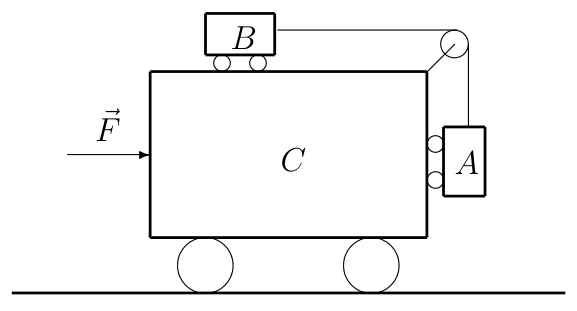
Figure 1:
- A horizontal force \(\vec{F}\) is now applied to cart \(C\) as shown. The size of \(\vec{F}\) is such that carts \(A\) and \(B\) remain at rest relative to cart \(C\).
a) Find the tension in the string connecting carts \(A\) and \(B\).
b) Determine the magnitude of \(\vec{F}\).
- Later cart \(C\) is held stationary, while carts \(A\) and \(B\) are released from rest.
a) Determine the accelerations of carts \(A\) and \(B\).
b) Calculate also the tension in the string.
Official English text of the problem.
Problem 2: Ice dropped into water in a copper calorimeter
Water of mass \(m_2\) is contained in a copper calorimeter of mass \(m_1\). Their common temperature is \(t_2\). A piece of ice of mass \(m_3\) and temperature \(t_3<0^\circ\mathrm{C}\) is dropped into the calorimeter.
a) Determine the temperature and masses of water and ice in the equilibrium state for general values of \(m_1,m_2,m_3,t_2\) and \(t_3\). Write equilibrium equations for all possible processes which have to be considered.
b) Find the final temperature and final masses of water and ice for \(m_1=1.00\ \mathrm{kg}\), \(m_2=1.00\ \mathrm{kg}\), \(m_3=2.00\ \mathrm{kg}\), \(t_2=10^\circ\mathrm{C}\), \(t_3=-20^\circ\mathrm{C}\).
Neglect the energy losses, assume the normal barometric pressure. Specific heat of copper is \(c_1=0.1\ \mathrm{kcal/kg\cdot{}^\circ C}\), specific heat of water \(c_2=1\ \mathrm{kcal/kg\cdot{}^\circ C}\), specific heat of ice \(c_3=0.492\ \mathrm{kcal/kg\cdot{}^\circ C}\), latent heat of fusion of ice \(l=78,7\ \mathrm{kcal/kg}\). Take \(1\ \mathrm{cal}=4.2\ \mathrm{J}\).
Official English text of the problem.
Problem 3: Charged ball hanging on the axis of a charged ring
A small charged ball of mass \(m\) and charge \(q\) is suspended from the highest point of a ring of radius \(R\) by means of an insulating cord of negligible mass. The ring is made of a rigid wire of negligible cross section and lies in a vertical plane. On the ring there is uniformly distributed charge \(Q\) of the same sign as \(q\). Determine the length \(l\) of the cord so as the equilibrium position of the ball lies on the symmetry axis perpendicular to the plane of the ring.
Find first the general solution a then for particular values \(Q=q=9.0\cdot10^{-8}\ \mathrm{C}\), \(R=5\ \mathrm{cm}\), \(m=1.0\ \mathrm{g}\), \(\varepsilon_0=8.9\cdot10^{-12}\ \mathrm{F/m}\).
Official English text of the problem.
Problem 4: Interference in an air layer between a glass plate and a cube
A glass plate is placed above a glass cube of \(2\ \mathrm{cm}\) edges in such a way that there remains a thin air layer between them, see Figure 5.
Electromagnetic radiation of wavelength between \(400\ \mathrm{nm}\) and \(1150\ \mathrm{nm}\) (for which the plate is penetrable) incident perpendicular to the plate from above is reflected from both air surfaces and interferes. In this range only two wavelengths give maximum reinforcements, one of them is \(\lambda = 400\ \mathrm{nm}\). Find the second wavelength. Determine how it is necessary to warm up the cube so as it would touch the plate. The coefficient of linear thermal expansion is \(\alpha = 8.0 \cdot 10^{-6}\ {}^\circ\mathrm{C}^{-1}\), the refractive index of the air \(n = 1\). The distance of the bottom of the cube from the plate does not change during warming up.
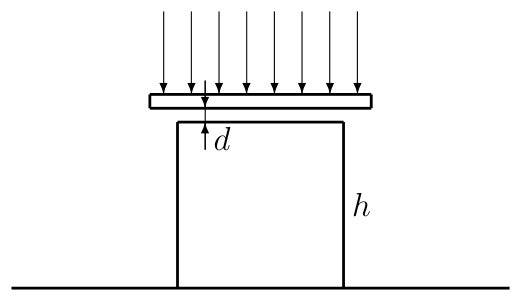
Figure 5:
Official English text of the problem.
Internationale Physik-Olympiade
IPhO 1969
Brünn, Tschechoslowakei · 4 Theorieaufgaben mit vollständigen Lösungen
Aufgabe 1: Drei Wagen, die durch ein über eine Rolle geführtes Seil verbunden sind
Abbildung 1 zeigt ein mechanisches System aus drei Wagen \(A\), \(B\) und \(C\) mit den Massen \(m_1 = 0.3\ \mathrm{kg}\), \(m_2 = 0.2\ \mathrm{kg}\) beziehungsweise \(m_3 = 1.5\ \mathrm{kg}\). Die Wagen \(B\) und \(A\) sind durch ein leichtes, gespanntes, undehnbares Seil verbunden, das wie dargestellt über eine leichte, reibungsfreie Rolle läuft, die am Wagen \(C\) befestigt ist. In dieser Aufgabe können sämtliche Widerstands- und Reibungskräfte sowie die Trägheitsmomente der Rolle und der Räder aller drei Wagen vernachlässigt werden. Verwenden Sie für die Erdbeschleunigung \(g\) den Wert \(9.81\ \mathrm{m\,s^{-2}}\).
Abbildung 1:
- Nun wird wie dargestellt eine horizontale Kraft \(\vec{F}\) auf den Wagen \(C\) ausgeübt. Der Betrag von \(\vec{F}\) ist so gewählt, dass die Wagen \(A\) und \(B\) relativ zum Wagen \(C\) in Ruhe bleiben.
a) Bestimmen Sie die Seilspannung im Seil, das die Wagen \(A\) und \(B\) verbindet.
b) Bestimmen Sie den Betrag von \(\vec{F}\).
- Später wird der Wagen \(C\) festgehalten, während die Wagen \(A\) und \(B\) aus der Ruhe losgelassen werden.
a) Bestimmen Sie die Beschleunigungen der Wagen \(A\) und \(B\).
b) Berechnen Sie auch die Seilspannung.
Aufgabentext aus dem offiziellen englischen Text übersetzt.
Aufgabe 2: Eis wird in Wasser in einem Kupferkalorimeter gegeben
In einem Kupferkalorimeter der Masse \(m_1\) befindet sich Wasser der Masse \(m_2\). Ihre gemeinsame Temperatur beträgt \(t_2\). Ein Eisstück der Masse \(m_3\) und der Temperatur \(t_3<0^\circ\mathrm{C}\) wird in das Kalorimeter gegeben.
a) Bestimmen Sie die Temperatur sowie die Massen von Wasser und Eis im Gleichgewichtszustand für allgemeine Werte von \(m_1,m_2,m_3,t_2\) und \(t_3\). Stellen Sie die Gleichgewichtsbedingungen für alle möglichen Vorgänge auf, die berücksichtigt werden müssen.
b) Bestimmen Sie die Endtemperatur sowie die endgültigen Massen von Wasser und Eis für \(m_1=1.00\ \mathrm{kg}\), \(m_2=1.00\ \mathrm{kg}\), \(m_3=2.00\ \mathrm{kg}\), \(t_2=10^\circ\mathrm{C}\), \(t_3=-20^\circ\mathrm{C}\).
Vernachlässigen Sie die Energieverluste und nehmen Sie normalen Luftdruck an. Die spezifische Wärmekapazität von Kupfer beträgt \(c_1=0.1\ \mathrm{kcal/kg\cdot{}^\circ C}\), die spezifische Wärmekapazität von Wasser \(c_2=1\ \mathrm{kcal/kg\cdot{}^\circ C}\), die spezifische Wärmekapazität von Eis \(c_3=0.492\ \mathrm{kcal/kg\cdot{}^\circ C}\) und die spezifische Schmelzwärme von Eis \(l=78,7\ \mathrm{kcal/kg}\). Verwenden Sie \(1\ \mathrm{cal}=4.2\ \mathrm{J}\).
Aufgabentext aus dem offiziellen englischen Text übersetzt.
Aufgabe 3: Geladene Kugel auf der Achse eines geladenen Rings aufgehängt
Eine kleine geladene Kugel mit der Masse \(m\) und der Ladung \(q\) ist am höchsten Punkt eines Rings mit dem Radius \(R\) an einem isolierenden Faden vernachlässigbarer Masse aufgehängt. Der Ring besteht aus einem starren Draht mit vernachlässigbarem Querschnitt und liegt in einer vertikalen Ebene. Auf dem Ring ist die Ladung \(Q\) gleichmäßig verteilt; sie hat dasselbe Vorzeichen wie \(q\). Bestimmen Sie die Länge \(l\) des Fadens so, dass die Gleichgewichtslage der Kugel auf der senkrecht zur Ringebene stehenden Symmetrieachse liegt.
Ermitteln Sie zunächst die allgemeine Lösung und anschließend die Lösung für die konkreten Werte \(Q=q=9.0\cdot10^{-8}\ \mathrm{C}\), \(R=5\ \mathrm{cm}\), \(m=1.0\ \mathrm{g}\), \(\varepsilon_0=8.9\cdot10^{-12}\ \mathrm{F/m}\).
Aufgabentext aus dem offiziellen englischen Text übersetzt.
Aufgabe 4: Interferenz in einer Luftschicht zwischen einer Glasplatte und einem Würfel
Eine Glasplatte wird so über einen Glaswürfel mit einer Kantenlänge von \(2\ \mathrm{cm}\) gelegt, dass zwischen ihnen eine dünne Luftschicht verbleibt, siehe Abbildung 5.
Elektromagnetische Strahlung mit einer Wellenlänge zwischen \(400\ \mathrm{nm}\) und \(1150\ \mathrm{nm}\) (für die die Platte durchlässig ist), die von oben senkrecht auf die Platte einfällt, wird an beiden Grenzflächen der Luftschicht reflektiert und interferiert. In diesem Bereich tritt nur bei zwei Wellenlängen maximale Verstärkung auf; eine davon ist \(\lambda = 400\ \mathrm{nm}\). Bestimmen Sie die zweite Wellenlänge. Bestimmen Sie, um wie viel der Würfel erwärmt werden muss, damit er die Platte berührt. Der lineare Wärmeausdehnungskoeffizient beträgt \(\alpha = 8.0 \cdot 10^{-6}\ {}^\circ\mathrm{C}^{-1}\), der Brechungsindex der Luft ist \(n = 1\). Der Abstand der Unterseite des Würfels von der Platte ändert sich während der Erwärmung nicht.
Abbildung 5:
Aufgabentext aus dem offiziellen englischen Text übersetzt.
Uluslararası Fizik Olimpiyatı
IPhO 1969
Brno, Çekoslovakya · 4 teori sorusu, tam çözümleriyle
Soru 1: Bir makara üzerinden geçen iple birbirine bağlı üç araba
Şekil 1'de, kütleleri sırasıyla \(m_1 = 0.3\ \mathrm{kg}\), \(m_2 = 0.2\ \mathrm{kg}\) ve \(m_3 = 1.5\ \mathrm{kg}\) olan \(A\), \(B\) ve \(C\) arabalarından oluşan bir mekanik sistem gösterilmektedir. \(B\) ve \(A\) arabaları, şekilde gösterildiği gibi \(C\) arabasına bağlı, kütlesi ihmal edilebilir, sürtünmesiz bir makara üzerinden geçen, kütlesi ihmal edilebilir, gergin ve uzamayan bir iple birbirine bağlanmıştır. Bu soruda tüm direnç ve sürtünme kuvvetleri ile makaranın ve üç arabanın tüm tekerleklerinin eylemsizlik momentleri ihmal edilebilir. Yer çekimi ivmesi \(g\)'yi \(9.81\ \mathrm{m\,s^{-2}}\) alınız.
Şekil 1:
- Şimdi \(C\) arabasına şekilde gösterildiği gibi yatay bir \(\vec{F}\) kuvveti uygulanıyor. \(\vec{F}\)'nin büyüklüğü, \(A\) ve \(B\) arabalarının \(C\) arabasına göre hareketsiz kalmasını sağlayacak değerdedir.
a) \(A\) ve \(B\) arabalarını birbirine bağlayan ipteki gerilme kuvvetini bulunuz.
b) \(\vec{F}\)'nin büyüklüğünü belirleyiniz.
- Daha sonra \(C\) arabası sabit tutulurken \(A\) ve \(B\) arabaları durgun hâlden serbest bırakılıyor.
a) \(A\) ve \(B\) arabalarının ivmelerini belirleyiniz.
b) İpteki gerilme kuvvetini de hesaplayınız.
Soru metni resmi İngilizce metinden çevrilmiştir.
Soru 2: Bakır bir kalorimetredeki suya atılan buz
Kütlesi \(m_1\) olan bakır bir kalorimetrede \(m_2\) kütleli su bulunmaktadır. Kalorimetre ile suyun ortak sıcaklığı \(t_2\)'dir. Kalorimetreye kütlesi \(m_3\), sıcaklığı \(t_3<0^\circ\mathrm{C}\) olan bir buz parçası atılıyor.
a) \(m_1,m_2,m_3,t_2\) ve \(t_3\)'ün genel değerleri için denge durumundaki sıcaklığı, su ve buz kütlelerini belirleyiniz. Göz önünde bulundurulması gereken tüm olası süreçler için denge denklemlerini yazınız.
b) \(m_1=1.00\ \mathrm{kg}\), \(m_2=1.00\ \mathrm{kg}\), \(m_3=2.00\ \mathrm{kg}\), \(t_2=10^\circ\mathrm{C}\), \(t_3=-20^\circ\mathrm{C}\) için son sıcaklığı, son su ve buz kütlelerini bulunuz.
Enerji kayıplarını ihmal ediniz ve atmosfer basıncını normal kabul ediniz. Bakırın öz ısısı \(c_1=0.1\ \mathrm{kcal/kg\cdot{}^\circ C}\), suyun öz ısısı \(c_2=1\ \mathrm{kcal/kg\cdot{}^\circ C}\), buzun öz ısısı \(c_3=0.492\ \mathrm{kcal/kg\cdot{}^\circ C}\), buzun erime gizli ısısı \(l=78,7\ \mathrm{kcal/kg}\)'dır. \(1\ \mathrm{cal}=4.2\ \mathrm{J}\) alınız.
Soru metni resmi İngilizce metinden çevrilmiştir.
Soru 3: Yüklü bir halkanın ekseni üzerinde asılı duran yüklü küre
Kütlesi \(m\) ve yükü \(q\) olan küçük bir yüklü küre, kütlesi ihmal edilebilir yalıtkan bir ip aracılığıyla yarıçapı \(R\) olan bir halkanın en yüksek noktasından asılmıştır. Halka, kesiti ihmal edilebilir rijit bir telden yapılmıştır ve düşey bir düzlemde bulunmaktadır. Halka üzerinde, \(q\) ile aynı işaretli \(Q\) yükü düzgün olarak dağılmıştır. Kürenin denge konumu, halkanın düzlemine dik olan simetri ekseni üzerinde olacak şekilde ipin \(l\) uzunluğunu belirleyiniz.
Önce genel çözümü, ardından \(Q=q=9.0\cdot10^{-8}\ \mathrm{C}\), \(R=5\ \mathrm{cm}\), \(m=1.0\ \mathrm{g}\), \(\varepsilon_0=8.9\cdot10^{-12}\ \mathrm{F/m}\) özel değerleri için çözümü bulunuz.
Soru metni resmi İngilizce metinden çevrilmiştir.
Soru 4: Bir cam levha ile bir küp arasındaki hava tabakasında girişim
Bir cam levha, ayrıtları \(2\ \mathrm{cm}\) olan bir cam küpün üzerine, aralarında ince bir hava tabakası kalacak şekilde yerleştirilmiştir; bkz. Şekil 5.
Dalga boyu \(400\ \mathrm{nm}\) ile \(1150\ \mathrm{nm}\) arasında olan (levhanın geçirgen olduğu) elektromanyetik ışınım, levhaya yukarıdan dik olarak gelir, hava tabakasının her iki yüzeyinden yansır ve girişim yapar. Bu aralıkta yalnızca iki dalga boyunda maksimum güçlenme görülür; bunlardan biri \(\lambda = 400\ \mathrm{nm}\)'dir. İkinci dalga boyunu bulunuz. Küpün levhaya temas etmesi için sıcaklığının ne kadar artırılması gerektiğini belirleyiniz. Doğrusal ısıl genleşme katsayısı \(\alpha = 8.0 \cdot 10^{-6}\ {}^\circ\mathrm{C}^{-1}\), havanın kırılma indisi \(n = 1\)'dir. Küpün tabanının levhaya olan uzaklığı ısıtma sırasında değişmez.
Şekil 5:
Soru metni resmi İngilizce metinden çevrilmiştir.
Olimpiada Internacional de Física
IPhO 1969
Brno, Checoslovaquia · 4 problemas teóricos con soluciones completas
Problema 1: Tres carritos conectados por una cuerda que pasa por una polea
La figura 1 muestra un sistema mecánico formado por tres carritos \(A\), \(B\) y \(C\) de masas \(m_1 = 0.3\ \mathrm{kg}\), \(m_2 = 0.2\ \mathrm{kg}\) y \(m_3 = 1.5\ \mathrm{kg}\), respectivamente. Los carritos \(B\) y \(A\) están conectados por una cuerda ligera, tensa e inextensible que pasa por una polea ligera y sin rozamiento, fijada al carrito \(C\), como se muestra en la figura. En este problema pueden despreciarse todas las fuerzas de resistencia y de rozamiento, así como los momentos de inercia de la polea y de las ruedas de los tres carritos. Tome la aceleración de la gravedad \(g\) igual a \(9.81\ \mathrm{m\,s^{-2}}\).
Figura 1:
- Se aplica ahora una fuerza horizontal \(\vec{F}\) al carrito \(C\), como se muestra en la figura. El módulo de \(\vec{F}\) es tal que los carritos \(A\) y \(B\) permanecen en reposo respecto al carrito \(C\).
a) Halle la tensión de la cuerda que conecta los carritos \(A\) y \(B\).
b) Determine el módulo de \(\vec{F}\).
- Más tarde, se mantiene inmóvil el carrito \(C\), mientras que los carritos \(A\) y \(B\) se sueltan desde el reposo.
a) Determine las aceleraciones de los carritos \(A\) y \(B\).
b) Calcule también la tensión de la cuerda.
Enunciado traducido del texto oficial en inglés.
Problema 2: Hielo introducido en agua en un calorímetro de cobre
Un calorímetro de cobre de masa \(m_1\) contiene agua de masa \(m_2\). Ambos se encuentran a la temperatura \(t_2\). Se deja caer en el calorímetro un trozo de hielo de masa \(m_3\) y temperatura \(t_3<0^\circ\mathrm{C}\).
a) Determine la temperatura y las masas de agua y hielo en el estado de equilibrio para valores generales de \(m_1,m_2,m_3,t_2\) y \(t_3\). Escriba las ecuaciones de equilibrio para todos los procesos posibles que deban considerarse.
b) Halle la temperatura final y las masas finales de agua y hielo para \(m_1=1.00\ \mathrm{kg}\), \(m_2=1.00\ \mathrm{kg}\), \(m_3=2.00\ \mathrm{kg}\), \(t_2=10^\circ\mathrm{C}\), \(t_3=-20^\circ\mathrm{C}\).
Desprecie las pérdidas de energía y suponga que la presión barométrica es normal. El calor específico del cobre es \(c_1=0.1\ \mathrm{kcal/kg\cdot{}^\circ C}\), el calor específico del agua es \(c_2=1\ \mathrm{kcal/kg\cdot{}^\circ C}\), el calor específico del hielo es \(c_3=0.492\ \mathrm{kcal/kg\cdot{}^\circ C}\) y el calor latente de fusión del hielo es \(l=78,7\ \mathrm{kcal/kg}\). Tome \(1\ \mathrm{cal}=4.2\ \mathrm{J}\).
Enunciado traducido del texto oficial en inglés.
Problema 3: Esfera cargada suspendida sobre el eje de un anillo cargado
Una pequeña esfera cargada de masa \(m\) y carga \(q\) está suspendida del punto más alto de un anillo de radio \(R\) mediante un hilo aislante de masa despreciable. El anillo está hecho de un alambre rígido de sección transversal despreciable y se encuentra en un plano vertical. Sobre el anillo hay una carga \(Q\) uniformemente distribuida, del mismo signo que \(q\). Determine la longitud \(l\) del hilo para que la posición de equilibrio de la esfera se encuentre sobre el eje de simetría perpendicular al plano del anillo.
Obtenga primero la solución general y luego la correspondiente a los valores particulares \(Q=q=9.0\cdot10^{-8}\ \mathrm{C}\), \(R=5\ \mathrm{cm}\), \(m=1.0\ \mathrm{g}\), \(\varepsilon_0=8.9\cdot10^{-12}\ \mathrm{F/m}\).
Enunciado traducido del texto oficial en inglés.
Problema 4: Interferencia en una capa de aire entre una placa de vidrio y un cubo
Se coloca una placa de vidrio sobre un cubo de vidrio de \(2\ \mathrm{cm}\) de arista de tal manera que entre ambos queda una fina capa de aire, véase la Figura 5.
Una radiación electromagnética de longitud de onda comprendida entre \(400\ \mathrm{nm}\) y \(1150\ \mathrm{nm}\) (para la cual la placa es transparente), que incide perpendicularmente sobre la placa desde arriba, se refleja en ambas superficies de la capa de aire y produce interferencia. En este intervalo, solo dos longitudes de onda producen máximos de interferencia constructiva; una de ellas es \(\lambda = 400\ \mathrm{nm}\). Halle la segunda longitud de onda. Determine cuánto es necesario calentar el cubo para que llegue a tocar la placa. El coeficiente de dilatación térmica lineal es \(\alpha = 8.0 \cdot 10^{-6}\ {}^\circ\mathrm{C}^{-1}\), y el índice de refracción del aire es \(n = 1\). La distancia entre la base del cubo y la placa no cambia durante el calentamiento.
Figura 5:
Enunciado traducido del texto oficial en inglés.
国际物理奥林匹克
IPhO 1969
捷克斯洛伐克布尔诺 · 4 道理论题及完整解答
题目 1:由绕过滑轮的绳子连接的三辆小车
图 1 所示的力学系统由三辆小车 \(A\)、\(B\) 和 \(C\) 组成,其质量分别为 \(m_1 = 0.3\ \mathrm{kg}\)、\(m_2 = 0.2\ \mathrm{kg}\) 和 \(m_3 = 1.5\ \mathrm{kg}\)。小车 \(B\) 和 \(A\) 由一根绷紧且不可伸长的轻绳连接,绳子绕过一个安装在小车 \(C\) 上的光滑轻滑轮,如图所示。在本题中,所有阻力和摩擦力均可忽略,滑轮以及三辆小车所有车轮的转动惯量也均可忽略。取重力加速度 \(g\) 为 \(9.81\ \mathrm{m\,s^{-2}}\)。
图 1:
- 现对小车 \(C\) 施加一个如图所示的水平力 \(\vec{F}\)。\(\vec{F}\) 的大小使小车 \(A\) 和 \(B\) 相对于小车 \(C\) 保持静止。
a) 求连接小车 \(A\) 和 \(B\) 的绳子的张力。
b) 求 \(\vec{F}\) 的大小。
- 随后将小车 \(C\) 固定不动,并将小车 \(A\) 和 \(B\) 从静止状态释放。
a) 求小车 \(A\) 和 \(B\) 的加速度。
b) 再计算绳子的张力。
题目译自官方英文原文。
题目 2:将冰块投入铜量热器中的水中
质量为 \(m_1\) 的铜量热器中盛有质量为 \(m_2\) 的水。二者的共同温度为 \(t_2\)。将一块质量为 \(m_3\)、温度为 \(t_3<0^\circ\mathrm{C}\) 的冰投入量热器中。
a) 对于一般的 \(m_1,m_2,m_3,t_2\) 和 \(t_3\) 值,求平衡状态下的温度以及水和冰的质量。对所有需要考虑的可能过程写出平衡方程。
b) 当 \(m_1=1.00\ \mathrm{kg}\)、\(m_2=1.00\ \mathrm{kg}\)、\(m_3=2.00\ \mathrm{kg}\)、\(t_2=10^\circ\mathrm{C}\)、\(t_3=-20^\circ\mathrm{C}\) 时,求最终温度以及水和冰的最终质量。
忽略能量损失,假设气压为标准大气压。铜的比热容为 \(c_1=0.1\ \mathrm{kcal/kg\cdot{}^\circ C}\),水的比热容为 \(c_2=1\ \mathrm{kcal/kg\cdot{}^\circ C}\),冰的比热容为 \(c_3=0.492\ \mathrm{kcal/kg\cdot{}^\circ C}\),冰的熔化潜热为 \(l=78,7\ \mathrm{kcal/kg}\)。取 \(1\ \mathrm{cal}=4.2\ \mathrm{J}\)。
题目译自官方英文原文。
题目 3:悬挂在带电圆环轴线上的带电小球
一个质量为 \(m\)、电荷量为 \(q\) 的带电小球,用一根质量可忽略的绝缘细绳悬挂在半径为 \(R\) 的圆环的最高点。圆环由横截面可忽略的刚性金属丝制成,位于竖直平面内。圆环上均匀分布着电荷量为 \(Q\) 的电荷,其符号与 \(q\) 相同。求细绳的长度 \(l\),使小球的平衡位置位于垂直于圆环平面的对称轴上。
先求一般解,再求取下列特定数值时的结果:\(Q=q=9.0\cdot10^{-8}\ \mathrm{C}\)、\(R=5\ \mathrm{cm}\)、\(m=1.0\ \mathrm{g}\)、\(\varepsilon_0=8.9\cdot10^{-12}\ \mathrm{F/m}\)。
题目译自官方英文原文。
题目 4:玻璃板与玻璃立方体之间空气层中的干涉
将一块玻璃板置于一个棱长为 \(2\ \mathrm{cm}\) 的玻璃立方体上方,使两者之间留有一层薄空气层,如图 5 所示。
波长介于 \(400\ \mathrm{nm}\) 和 \(1150\ \mathrm{nm}\) 之间的电磁辐射(玻璃板可透过此波段的辐射)从上方垂直入射到玻璃板上,在空气层的上下两个界面发生反射并产生干涉。在此波段内,只有两个波长的辐射出现干涉极大,其中一个为 \(\lambda = 400\ \mathrm{nm}\)。求另一个波长。确定需要使立方体升温多少才能使其接触玻璃板。线膨胀系数为 \(\alpha = 8.0 \cdot 10^{-6}\ {}^\circ\mathrm{C}^{-1}\),空气的折射率为 \(n = 1\)。在升温过程中,立方体底面与玻璃板之间的距离保持不变。
图 5:
题目译自官方英文原文。
Международная физическая олимпиада
IPhO 1969
Брно, Чехословакия · 4 теоретические задачи с полными решениями
Задача 1: Три тележки, соединённые нитью, перекинутой через блок
На рисунке 1 показана механическая система, состоящая из трёх тележек \(A\), \(B\) и \(C\) массами \(m_1 = 0.3\ \mathrm{kg}\), \(m_2 = 0.2\ \mathrm{kg}\) и \(m_3 = 1.5\ \mathrm{kg}\) соответственно. Тележки \(B\) и \(A\) соединены лёгкой натянутой нерастяжимой нитью, перекинутой через лёгкий блок без трения, закреплённый на тележке \(C\), как показано на рисунке. В этой задаче можно пренебречь всеми силами сопротивления и трения, а также моментами инерции блока и колёс всех трёх тележек. Примите ускорение свободного падения \(g\) равным \(9.81\ \mathrm{m\,s^{-2}}\).
Рисунок 1:
- Теперь к тележке \(C\) прикладывают горизонтальную силу \(\vec{F}\), как показано на рисунке. Модуль \(\vec{F}\) таков, что тележки \(A\) и \(B\) остаются неподвижными относительно тележки \(C\).
a) Найдите силу натяжения нити, соединяющей тележки \(A\) и \(B\).
b) Определите модуль \(\vec{F}\).
- Затем тележку \(C\) удерживают неподвижной, а тележки \(A\) и \(B\) отпускают без начальной скорости.
a) Определите ускорения тележек \(A\) и \(B\).
b) Вычислите также силу натяжения нити.
Условие переведено с официального английского текста.
Задача 2: Лёд, опущенный в воду в медном калориметре
В медном калориметре массой \(m_1\) находится вода массой \(m_2\). Их общая температура равна \(t_2\). В калориметр опускают кусок льда массой \(m_3\) и температурой \(t_3<0^\circ\mathrm{C}\).
a) Определите температуру и массы воды и льда в состоянии равновесия при произвольных значениях \(m_1,m_2,m_3,t_2\) и \(t_3\). Запишите уравнения теплового баланса для всех возможных процессов, которые необходимо рассмотреть.
b) Найдите конечную температуру и конечные массы воды и льда при \(m_1=1.00\ \mathrm{kg}\), \(m_2=1.00\ \mathrm{kg}\), \(m_3=2.00\ \mathrm{kg}\), \(t_2=10^\circ\mathrm{C}\), \(t_3=-20^\circ\mathrm{C}\).
Пренебрегите потерями энергии; считайте атмосферное давление нормальным. Удельная теплоёмкость меди равна \(c_1=0.1\ \mathrm{kcal/kg\cdot{}^\circ C}\), удельная теплоёмкость воды — \(c_2=1\ \mathrm{kcal/kg\cdot{}^\circ C}\), удельная теплоёмкость льда — \(c_3=0.492\ \mathrm{kcal/kg\cdot{}^\circ C}\), удельная теплота плавления льда — \(l=78,7\ \mathrm{kcal/kg}\). Примите \(1\ \mathrm{cal}=4.2\ \mathrm{J}\).
Условие переведено с официального английского текста.
Задача 3: Заряженный шарик, подвешенный на оси заряженного кольца
Маленький заряженный шарик массой \(m\) и с зарядом \(q\) подвешен к верхней точке кольца радиусом \(R\) на непроводящей нити пренебрежимо малой массы. Кольцо изготовлено из жёсткой проволоки пренебрежимо малого поперечного сечения и расположено в вертикальной плоскости. По кольцу равномерно распределён заряд \(Q\) того же знака, что и \(q\). Определите длину \(l\) нити, при которой положение равновесия шарика находится на оси симметрии, перпендикулярной плоскости кольца.
Сначала найдите решение в общем виде, а затем для конкретных значений \(Q=q=9.0\cdot10^{-8}\ \mathrm{C}\), \(R=5\ \mathrm{cm}\), \(m=1.0\ \mathrm{g}\), \(\varepsilon_0=8.9\cdot10^{-12}\ \mathrm{F/m}\).
Условие переведено с официального английского текста.
Задача 4: Интерференция в воздушном слое между стеклянной пластинкой и кубом
Над стеклянным кубом с длиной ребра \(2\ \mathrm{cm}\) расположена стеклянная пластинка так, что между ними остаётся тонкий воздушный слой, см. рисунок 5.
Электромагнитное излучение с длиной волны от \(400\ \mathrm{nm}\) до \(1150\ \mathrm{nm}\) (для которого пластинка прозрачна), падающее сверху перпендикулярно пластинке, отражается от обеих границ воздушного слоя и интерферирует. В этом диапазоне максимальное усиление наблюдается только для двух длин волн, одна из которых равна \(\lambda = 400\ \mathrm{nm}\). Найдите вторую длину волны. Определите, на сколько необходимо нагреть куб, чтобы он коснулся пластинки. Коэффициент линейного теплового расширения равен \(\alpha = 8.0 \cdot 10^{-6}\ {}^\circ\mathrm{C}^{-1}\), показатель преломления воздуха \(n = 1\). Расстояние от нижней грани куба до пластинки при нагревании не изменяется.
Рисунок 5:
Условие переведено с официального английского текста.
الأولمبياد الدولي للفيزياء
IPhO 1969
برنو، تشيكوسلوفاكيا · 4 مسائل نظرية مع حلول كاملة
المسألة 1: ثلاث عربات متصلة بخيط يمر فوق بكرة
يوضح الشكل 1 نظامًا ميكانيكيًا يتكون من ثلاث عربات \(A\) و\(B\) و\(C\)، كتلها \(m_1 = 0.3\ \mathrm{kg}\) و\(m_2 = 0.2\ \mathrm{kg}\) و\(m_3 = 1.5\ \mathrm{kg}\) على الترتيب. تتصل العربتان \(B\) و\(A\) بخيط خفيف مشدود غير قابل للتمدد، يمر فوق بكرة خفيفة ملساء مثبتة بالعربة \(C\) كما هو موضح. في هذه المسألة، يمكن إهمال جميع قوى المقاومة والاحتكاك، وكذلك عزوم القصور الذاتي للبكرة ولعجلات العربات الثلاث جميعها. اعتبر تسارع الجاذبية \(g\) مساويًا لـ \(9.81\ \mathrm{m\,s^{-2}}\).
الشكل 1:
- تؤثر الآن قوة أفقية \(\vec{F}\) في العربة \(C\) كما هو موضح. ويكون مقدار \(\vec{F}\) بحيث تبقى العربتان \(A\) و\(B\) ساكنتين بالنسبة إلى العربة \(C\).
a) أوجد قوة الشد في الخيط الذي يصل بين العربتين \(A\) و\(B\).
b) حدد مقدار \(\vec{F}\).
- لاحقًا، تُثبَّت العربة \(C\) بحيث تبقى ساكنة، بينما تُترك العربتان \(A\) و\(B\) لتتحركا من السكون.
a) حدد تسارعي العربتين \(A\) و\(B\).
b) احسب أيضًا قوة الشد في الخيط.
نص المسألة مترجم عن النص الإنجليزي الرسمي.
المسألة 2: إسقاط قطعة من الجليد في ماء داخل مسعر نحاسي
يحتوي مسعر نحاسي كتلته \(m_1\) على ماء كتلته \(m_2\). ودرجة حرارتهما المشتركة هي \(t_2\). تُسقط في المسعر قطعة من الجليد كتلتها \(m_3\) ودرجة حرارتها \(t_3<0^\circ\mathrm{C}\).
a) حدّد درجة الحرارة وكتلتي الماء والجليد في حالة الاتزان لقيم عامة من \(m_1,m_2,m_3,t_2\) و\(t_3\). اكتب معادلات الاتزان لجميع العمليات الممكنة التي ينبغي أخذها في الحسبان.
b) أوجد درجة الحرارة النهائية وكتلتي الماء والجليد النهائيتين عندما تكون \(m_1=1.00\ \mathrm{kg}\)، و\(m_2=1.00\ \mathrm{kg}\)، و\(m_3=2.00\ \mathrm{kg}\)، و\(t_2=10^\circ\mathrm{C}\)، و\(t_3=-20^\circ\mathrm{C}\).
أهمل فقدان الطاقة، وافترض أن الضغط الجوي نظامي. الحرارة النوعية للنحاس هي \(c_1=0.1\ \mathrm{kcal/kg\cdot{}^\circ C}\)، والحرارة النوعية للماء \(c_2=1\ \mathrm{kcal/kg\cdot{}^\circ C}\)، والحرارة النوعية للجليد \(c_3=0.492\ \mathrm{kcal/kg\cdot{}^\circ C}\)، والحرارة الكامنة لانصهار الجليد \(l=78,7\ \mathrm{kcal/kg}\). خذ \(1\ \mathrm{cal}=4.2\ \mathrm{J}\).
نص المسألة مترجم عن النص الإنجليزي الرسمي.
المسألة 3: كرة مشحونة معلّقة على محور حلقة مشحونة
تُعلَّق كرة صغيرة مشحونة كتلتها \(m\) وشحنتها \(q\) من أعلى نقطة في حلقة نصف قطرها \(R\)، بواسطة خيط عازل كتلته مهملة. تتكوّن الحلقة من سلك صلب ذي مقطع عرضي مهمل، وتقع في مستوى رأسي. تتوزّع على الحلقة بانتظام شحنة \(Q\) من الإشارة نفسها لشحنة \(q\). أوجد طول الخيط \(l\) بحيث يقع موضع اتزان الكرة على محور التناظر العمودي على مستوى الحلقة.
أوجد أولًا الحل العام، ثم الحل للقيم الخاصة \(Q=q=9.0\cdot10^{-8}\ \mathrm{C}\)، \(R=5\ \mathrm{cm}\)، \(m=1.0\ \mathrm{g}\)، \(\varepsilon_0=8.9\cdot10^{-12}\ \mathrm{F/m}\).
نص المسألة مترجم عن النص الإنجليزي الرسمي.
المسألة 4: التداخل في طبقة هوائية بين لوح زجاجي ومكعب
يوضع لوح زجاجي فوق مكعب زجاجي طول حرفه \(2\ \mathrm{cm}\) بحيث تبقى بينهما طبقة رقيقة من الهواء، انظر الشكل 5.
يسقط إشعاع كهرومغناطيسي يتراوح طوله الموجي بين \(400\ \mathrm{nm}\) و\(1150\ \mathrm{nm}\) (وهو نطاق يسمح اللوح بنفاذ الإشعاع فيه) عموديًا على اللوح من الأعلى، وينعكس عن السطحين الحدّيين للطبقة الهوائية ويحدث تداخل. في هذا النطاق، لا يتحقق التعزيز الأقصى إلا عند طولين موجيين، أحدهما \(\lambda = 400\ \mathrm{nm}\). أوجد الطول الموجي الثاني. حدّد مقدار الزيادة اللازمة في درجة حرارة المكعب حتى يلامس اللوح. معامل التمدد الحراري الخطي هو \(\alpha = 8.0 \cdot 10^{-6}\ {}^\circ\mathrm{C}^{-1}\)، ومعامل انكسار الهواء \(n = 1\). لا تتغير المسافة بين قاعدة المكعب واللوح أثناء التسخين.
الشكل 5:
نص المسألة مترجم عن النص الإنجليزي الرسمي.