International Physics Olympiad
IPhO 1968
Budapest, Hungary · 3 theory problems with complete solutions
Problem 1: Solid cylinder and block joined by a cord on an inclined plane
On an inclined plane of \(30^\circ\) a block, mass \(m_2 = 4\) kg, is joined by a light cord to a solid cylinder, mass \(m_1 = 8\) kg, radius \(r = 5\) cm (Fig. 1). Find the acceleration if the bodies are released. The coefficient of friction between the block and the inclined plane \(\mu = 0.2\). Friction at the bearing and rolling friction are negligible.
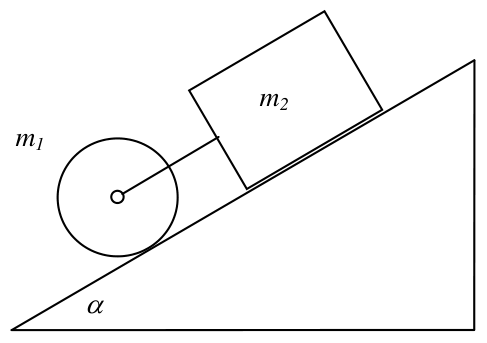
Figure 1
Official English text of the problem.
Problem 2: Mixing two quantities of toluene at different temperatures
There are \(300\ \mathrm{cm}^3\) toluene of \(0^\circ\mathrm{C}\) temperature in a glass and \(110\ \mathrm{cm}^3\) toluene of \(100^\circ\mathrm{C}\) temperature in another glass. (The sum of the volumes is \(410\ \mathrm{cm}^3\).) Find the final volume after the two liquids are mixed. The coefficient of volume expansion of toluene \(\beta=0.001({}^\circ\mathrm{C})^{-1}\). Neglect the loss of heat.
Official English text of the problem.
Problem 3: Parallel rays refracted by a glass semi-cylinder
Parallel light rays are falling on the plane surface of a semi-cylinder made of glass, at an angle of \(45^\circ\), in such a plane which is perpendicular to the axis of the semi-cylinder (Fig. 4). (Index of refraction is \(\sqrt{2}\).) Where are the rays emerging out of the cylindrical surface?
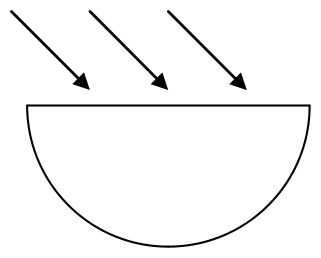
Figure 4
Official English text of the problem.
Internationale Physik-Olympiade
IPhO 1968
Budapest, Ungarn · 3 Theorieaufgaben mit vollständigen Lösungen
Aufgabe 1: Durch eine Schnur verbundener Vollzylinder und Klotz auf einer schiefen Ebene
Auf einer um \(30^\circ\) geneigten Ebene ist ein Klotz der Masse \(m_2 = 4\) kg durch eine leichte Schnur mit einem Vollzylinder der Masse \(m_1 = 8\) kg und des Radius \(r = 5\) cm verbunden (Abb. 1). Bestimmen Sie die Beschleunigung, wenn die Körper losgelassen werden. Der Reibungskoeffizient zwischen dem Klotz und der schiefen Ebene beträgt \(\mu = 0.2\). Die Lagerreibung und die Rollreibung sind vernachlässigbar.
Abbildung 1
Aufgabentext aus dem offiziellen englischen Text übersetzt.
Aufgabe 2: Mischen zweier Mengen Toluol mit unterschiedlichen Temperaturen
In einem Glas befinden sich \(300\ \mathrm{cm}^3\) Toluol mit einer Temperatur von \(0^\circ\mathrm{C}\), in einem anderen Glas \(110\ \mathrm{cm}^3\) Toluol mit einer Temperatur von \(100^\circ\mathrm{C}\). (Die Summe der Volumina beträgt \(410\ \mathrm{cm}^3\).) Bestimmen Sie das Endvolumen nach dem Mischen der beiden Flüssigkeiten. Der Volumenausdehnungskoeffizient von Toluol beträgt \(\beta=0.001({}^\circ\mathrm{C})^{-1}\). Vernachlässigen Sie den Wärmeverlust.
Aufgabentext aus dem offiziellen englischen Text übersetzt.
Aufgabe 3: Brechung paralleler Strahlen an einem Glas-Halbzylinder
Parallele Lichtstrahlen fallen unter einem Winkel von \(45^\circ\) auf die ebene Fläche eines Halbzylinders aus Glas, und zwar in einer Ebene, die senkrecht zur Achse des Halbzylinders steht (Abb. 4). (Der Brechungsindex beträgt \(\sqrt{2}\).) Wo treten die Strahlen aus der Zylinderfläche aus?
Abbildung 4
Aufgabentext aus dem offiziellen englischen Text übersetzt.
Uluslararası Fizik Olimpiyatı
IPhO 1968
Budapeşte, Macaristan · 3 teori sorusu, tam çözümleriyle
Soru 1: Eğik düzlem üzerinde bir iple birbirine bağlanmış dolu silindir ve blok
Eğim açısı \(30^\circ\) olan bir eğik düzlem üzerinde, kütlesi \(m_2 = 4\) kg olan bir blok, hafif bir iple kütlesi \(m_1 = 8\) kg, yarıçapı \(r = 5\) cm olan dolu bir silindire bağlanmıştır (Şekil 1). Cisimler serbest bırakıldığında ivmelerini bulunuz. Blok ile eğik düzlem arasındaki sürtünme katsayısı \(\mu = 0.2\)'dir. Yataktaki sürtünme ve yuvarlanma sürtünmesi ihmal edilebilir.
Şekil 1
Soru metni resmi İngilizce metinden çevrilmiştir.
Soru 2: Farklı sıcaklıklardaki iki miktar toluenin karıştırılması
Bir bardakta \(0^\circ\mathrm{C}\) sıcaklıkta \(300\ \mathrm{cm}^3\) toluen ve başka bir bardakta \(100^\circ\mathrm{C}\) sıcaklıkta \(110\ \mathrm{cm}^3\) toluen bulunmaktadır. (Hacimlerin toplamı \(410\ \mathrm{cm}^3\) olur.) İki sıvı karıştırıldıktan sonraki son hacmi bulunuz. Toluenin hacimsel genleşme katsayısı \(\beta=0.001({}^\circ\mathrm{C})^{-1}\) değerindedir. Isı kaybını ihmal ediniz.
Soru metni resmi İngilizce metinden çevrilmiştir.
Soru 3: Cam bir yarım silindirde kırılan paralel ışınlar
Paralel ışık ışınları, camdan yapılmış bir yarım silindirin düzlem yüzeyine, yarım silindirin eksenine dik bir düzlem içinde, \(45^\circ\) açıyla gelmektedir (Şekil 4). (Kırılma indisi \(\sqrt{2}\)'dir.) Işınlar silindirik yüzeyin neresinden dışarı çıkar?
Şekil 4
Soru metni resmi İngilizce metinden çevrilmiştir.
Olimpiada Internacional de Física
IPhO 1968
Budapest, Hungría · 3 problemas teóricos con soluciones completas
Problema 1: Cilindro macizo y bloque unidos por una cuerda sobre un plano inclinado
Sobre un plano inclinado de \(30^\circ\), un bloque de masa \(m_2 = 4\) kg está unido mediante una cuerda ligera a un cilindro macizo de masa \(m_1 = 8\) kg y radio \(r = 5\) cm (Fig. 1). Halle la aceleración de los cuerpos al soltarlos. El coeficiente de rozamiento entre el bloque y el plano inclinado es \(\mu = 0.2\). El rozamiento en el cojinete y la resistencia a la rodadura son despreciables.
Figura 1
Enunciado traducido del texto oficial en inglés.
Problema 2: Mezcla de dos cantidades de tolueno a diferentes temperaturas
En un vaso hay \(300\ \mathrm{cm}^3\) de tolueno a una temperatura de \(0^\circ\mathrm{C}\) y en otro vaso hay \(110\ \mathrm{cm}^3\) de tolueno a una temperatura de \(100^\circ\mathrm{C}\). (La suma de los volúmenes es \(410\ \mathrm{cm}^3\).) Determine el volumen final después de mezclar los dos líquidos. El coeficiente de dilatación volumétrica del tolueno es \(\beta=0.001({}^\circ\mathrm{C})^{-1}\). Desprecie las pérdidas de calor.
Enunciado traducido del texto oficial en inglés.
Problema 3: Rayos paralelos refractados por un semicilindro de vidrio
Rayos de luz paralelos inciden sobre la superficie plana de un semicilindro de vidrio, con un ángulo de \(45^\circ\), en un plano perpendicular al eje del semicilindro (Fig. 4). (El índice de refracción es \(\sqrt{2}\).) ¿Por dónde emergen los rayos de la superficie cilíndrica?
Figura 4
Enunciado traducido del texto oficial en inglés.
国际物理奥林匹克
IPhO 1968
匈牙利布达佩斯 · 3 道理论题及完整解答
题目 1:斜面上用细绳连接的实心圆柱体和物块
在倾角为 \(30^\circ\) 的斜面上,质量为 \(m_2 = 4\) kg 的物块通过一根轻绳与质量为 \(m_1 = 8\) kg、半径为 \(r = 5\) cm 的实心圆柱体相连(图 1)。求释放两物体后它们的加速度。物块与斜面之间的摩擦系数为 \(\mu = 0.2\)。轴承处的摩擦和滚动摩擦均可忽略。
图 1
题目译自官方英文原文。
题目 2:混合两份温度不同的甲苯
一个玻璃杯中装有温度为 \(0^\circ\mathrm{C}\) 的甲苯 \(300\ \mathrm{cm}^3\),另一个玻璃杯中装有温度为 \(100^\circ\mathrm{C}\) 的甲苯 \(110\ \mathrm{cm}^3\)。(两者的体积之和为 \(410\ \mathrm{cm}^3\)。)求两份液体混合后的最终体积。甲苯的体积膨胀系数为 \(\beta=0.001({}^\circ\mathrm{C})^{-1}\)。忽略热量损失。
题目译自官方英文原文。
题目 3:经玻璃半圆柱折射的平行光线
平行光线以 \(45^\circ\) 的入射角射到玻璃半圆柱的平面表面上,光线所在的平面垂直于半圆柱的轴线(图 4)。(折射率为 \(\sqrt{2}\)。)光线从圆柱曲面的哪些位置射出?
图 4
题目译自官方英文原文。
Международная физическая олимпиада
IPhO 1968
Будапешт, Венгрия · 3 теоретические задачи с полными решениями
Задача 1: Сплошной цилиндр и брусок, соединённые нитью на наклонной плоскости
На плоскости с углом наклона \(30^\circ\) брусок массой \(m_2 = 4\) кг соединён лёгкой нитью со сплошным цилиндром массой \(m_1 = 8\) кг и радиусом \(r = 5\) см (рис. 1). Найдите ускорение тел после того, как их отпустят. Коэффициент трения между бруском и наклонной плоскостью \(\mu = 0.2\). Трением в подшипнике и трением качения можно пренебречь.
Рисунок 1
Условие переведено с официального английского текста.
Задача 2: Смешивание двух порций толуола при разных температурах
В одном стакане находится \(300\ \mathrm{cm}^3\) толуола при температуре \(0^\circ\mathrm{C}\), а в другом — \(110\ \mathrm{cm}^3\) толуола при температуре \(100^\circ\mathrm{C}\). (Сумма объёмов составляет \(410\ \mathrm{cm}^3\).) Найдите конечный объём после смешивания двух жидкостей. Коэффициент объёмного расширения толуола \(\beta=0.001({}^\circ\mathrm{C})^{-1}\). Потерями теплоты пренебречь.
Условие переведено с официального английского текста.
Задача 3: Преломление параллельных лучей в стеклянном полуцилиндре
Параллельные световые лучи падают на плоскую поверхность стеклянного полуцилиндра под углом \(45^\circ\) в плоскости, перпендикулярной оси полуцилиндра (рис. 4). (Показатель преломления равен \(\sqrt{2}\).) На каком участке цилиндрической поверхности лучи выходят наружу?
Рисунок 4
Условие переведено с официального английского текста.
الأولمبياد الدولي للفيزياء
IPhO 1968
بودابست، المجر · 3 مسائل نظرية مع حلول كاملة
المسألة 1: أسطوانة مصمتة وكتلة موصولتان بحبل على مستوى مائل
على مستوى مائل بزاوية \(30^\circ\)، توجد كتلة مقدارها \(m_2 = 4\) كغ، موصولة بحبل خفيف بأسطوانة مصمتة كتلتها \(m_1 = 8\) كغ ونصف قطرها \(r = 5\) سم (الشكل 1). أوجد تسارع الجسمين إذا أُطلقا من السكون. معامل الاحتكاك بين الكتلة والمستوى المائل هو \(\mu = 0.2\). يُهمل الاحتكاك في المحمل واحتكاك التدحرج.
الشكل 1
نص المسألة مترجم عن النص الإنجليزي الرسمي.
المسألة 2: مزج كميتين من التولوين عند درجتي حرارة مختلفتين
توجد في كأس كمية من التولوين حجمها \(300\ \mathrm{cm}^3\) ودرجة حرارتها \(0^\circ\mathrm{C}\)، وفي كأس أخرى كمية من التولوين حجمها \(110\ \mathrm{cm}^3\) ودرجة حرارتها \(100^\circ\mathrm{C}\). (مجموع الحجمين هو \(410\ \mathrm{cm}^3\).) أوجد الحجم النهائي بعد مزج السائلين. معامل التمدد الحجمي للتولوين هو \(\beta=0.001({}^\circ\mathrm{C})^{-1}\). أهمل فقدان الحرارة.
نص المسألة مترجم عن النص الإنجليزي الرسمي.
المسألة 3: أشعة متوازية تنكسر عبر نصف أسطوانة زجاجية
تسقط أشعة ضوئية متوازية على السطح المستوي لنصف أسطوانة مصنوعة من الزجاج، بزاوية مقدارها \(45^\circ\)، في مستوى عمودي على محور نصف الأسطوانة (الشكل 4). (معامل الانكسار هو \(\sqrt{2}\).) من أين تخرج الأشعة عبر السطح الأسطواني؟
الشكل 4
نص المسألة مترجم عن النص الإنجليزي الرسمي.