IPhO 1968 · Theory problem 3
Parallel rays refracted by a glass semi-cylinder
Parallel light rays are falling on the plane surface of a semi-cylinder made of glass, at an angle of \(45^\circ\), in such a plane which is perpendicular to the axis of the semi-cylinder (Fig. 4). (Index of refraction is \(\sqrt{2}\).) Where are the rays emerging out of the cylindrical surface?
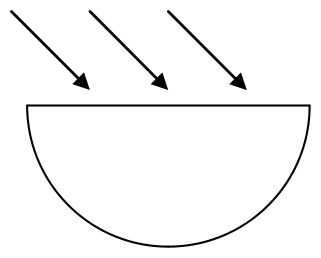
Figure 4
Official English text of the problem.
Answers
- Problem 3. Measure the central angle \(\phi\) clockwise from the right-hand end of the horizontal diameter. The rays emerge through the arc bounded by \[ \boxed{\phi=15^\circ\quad\text{and}\quad\phi=105^\circ.} \] This arc subtends \(90^\circ\) and has length \(\pi R/2\), where \(R\) is the cylinder’s radius. The limiting rays emerge tangentially.
Solution
Problem 3. We use geometrical optics, take the surrounding air’s refractive index as \(1\), and neglect partial reflections when transmission is possible. Total internal reflection must, however, be included.
At the flat surface, Snell’s law gives the refracted angle \(r\), measured from the normal: \[ \sin45^\circ=\sqrt2\sin r. \] Hence \[ \boxed{r=30^\circ}. \] The rays inside the glass therefore travel downwards and to the right, at \(60^\circ\) below the horizontal.
Let \(O\) be the centre of the semicircular section. At a point \(P\) on the curved surface, its outward normal is the radius \(OP\). Define \(\phi\) as the angle of this radius measured clockwise from the horizontal direction to the right. For a ray reaching this surface directly, its incidence angle is \[ i=\left|60^\circ-\phi\right|. \]
The critical angle \(i_{\mathrm c}\) for passage from glass to air satisfies \[ \sin i_{\mathrm c}=\frac{1}{\sqrt2}, \qquad \boxed{i_{\mathrm c}=45^\circ}. \] Consequently, emergence is possible when \[ |60^\circ-\phi|\le45^\circ, \] or \[ \boxed{15^\circ\le\phi\le105^\circ}. \]
Thus the emitting arc begins \(15^\circ\) below the right-hand end of the diameter and ends \(15^\circ\) past the lowest point, towards the left. Its angular extent and length are \[ \Delta\phi=90^\circ=\frac{\pi}{2}, \qquad \boxed{s=\frac{\pi R}{2}}. \]
At either boundary, Snell’s law gives an emergence angle of \(90^\circ\) relative to the normal, so the limiting outgoing rays are tangent to the circle. At \(\phi=60^\circ\), incidence is normal and the ray emerges without changing direction.
We must also check rays that initially undergo total internal reflection. Let \(a\) be a ray’s entry coordinate along the diameter, measured from \(O\), positive to the right. Its perpendicular distance from \(O\) is \[ b=|a|\cos30^\circ=\frac{\sqrt3}{2}|a|. \] At a circular-surface encounter, \[ b=R\sin i. \] Specular reflection at a circle preserves this distance and hence the incidence angle at subsequent circular encounters. Any reflection at the flat diameter also preserves \(b\), because that diameter passes through \(O\). Therefore a ray initially totally reflected at the curved surface cannot subsequently escape through another part of that surface.
The rays contributing to the emergent arc are precisely those entering within \[ \frac{\sqrt3}{2}|a|\le\frac{R}{\sqrt2}, \qquad \boxed{|a|\le R\sqrt{\frac23}\approx0.816R}. \] The remaining incident rays add no further emitting region on the curved surface.
The solution was checked against the official solution.
IPhO 1968 · Theorieaufgabe 3
Brechung paralleler Strahlen an einem Glas-Halbzylinder
Parallele Lichtstrahlen fallen unter einem Winkel von \(45^\circ\) auf die ebene Fläche eines Halbzylinders aus Glas, und zwar in einer Ebene, die senkrecht zur Achse des Halbzylinders steht (Abb. 4). (Der Brechungsindex beträgt \(\sqrt{2}\).) Wo treten die Strahlen aus der Zylinderfläche aus?
Abbildung 4
Aufgabentext aus dem offiziellen englischen Text übersetzt.
Antworten
- Aufgabe 3. Der Mittelpunktswinkel \(\phi\) wird vom rechten Endpunkt des horizontalen Durchmessers aus im Uhrzeigersinn gemessen. Die Strahlen treten durch den Kreisbogen aus, der durch \[ \boxed{\phi=15^\circ\quad\text{und}\quad\phi=105^\circ} \] begrenzt wird. Dieser Kreisbogen umfasst einen Winkel von \(90^\circ\) und hat die Länge \(\pi R/2\), wobei \(R\) der Radius des Zylinders ist. Die Grenzstrahlen treten tangential aus.
Lösung
Aufgabe 3. Wir verwenden die geometrische Optik, setzen den Brechungsindex der umgebenden Luft gleich \(1\) und vernachlässigen Teilreflexionen, wenn Transmission möglich ist. Die Totalreflexion muss jedoch berücksichtigt werden.
An der ebenen Fläche liefert das Snelliussche Brechungsgesetz für den gegen das Lot gemessenen Brechungswinkel \(r\): \[ \sin45^\circ=\sqrt2\sin r. \] Daraus folgt \[ \boxed{r=30^\circ}. \] Die Strahlen im Glas verlaufen daher nach rechts unten, unter einem Winkel von \(60^\circ\) unterhalb der Horizontalen.
Es sei \(O\) der Mittelpunkt des halbkreisförmigen Querschnitts. An einem Punkt \(P\) auf der gekrümmten Fläche ist deren nach außen gerichtete Normale durch den Radius \(OP\) gegeben. Wir definieren \(\phi\) als den Winkel dieses Radius, der von der nach rechts gerichteten Horizontalen aus im Uhrzeigersinn gemessen wird. Für einen Strahl, der diese Fläche direkt erreicht, beträgt der Einfallswinkel \[ i=\left|60^\circ-\phi\right|. \]
Der Grenzwinkel \(i_{\mathrm c}\) der Totalreflexion beim Übergang von Glas zu Luft erfüllt \[ \sin i_{\mathrm c}=\frac{1}{\sqrt2}, \qquad \boxed{i_{\mathrm c}=45^\circ}. \] Folglich ist ein Austritt möglich, wenn \[ |60^\circ-\phi|\le45^\circ, \] also \[ \boxed{15^\circ\le\phi\le105^\circ}. \]
Der Kreisbogen, durch den die Strahlen austreten, beginnt somit \(15^\circ\) unterhalb des rechten Endpunkts des Durchmessers und endet \(15^\circ\) jenseits des tiefsten Punkts in Richtung nach links. Seine Winkelausdehnung und seine Länge betragen \[ \Delta\phi=90^\circ=\frac{\pi}{2}, \qquad \boxed{s=\frac{\pi R}{2}}. \]
An beiden Grenzen liefert das Snelliussche Brechungsgesetz einen Austrittswinkel von \(90^\circ\) gegen das Lot, sodass die austretenden Grenzstrahlen tangential zum Kreis verlaufen. Bei \(\phi=60^\circ\) fällt der Strahl senkrecht ein und tritt ohne Richtungsänderung aus.
Wir müssen auch die Strahlen untersuchen, die zunächst totalreflektiert werden. Es sei \(a\) die Eintrittskoordinate eines Strahls entlang des Durchmessers, gemessen von \(O\) aus und positiv nach rechts. Sein senkrechter Abstand von \(O\) beträgt \[ b=|a|\cos30^\circ=\frac{\sqrt3}{2}|a|. \] Beim Auftreffen auf die kreisförmige Oberfläche gilt \[ b=R\sin i. \] Spiegelnde Reflexion an einem Kreis erhält diesen Abstand und damit den Einfallswinkel bei späterem Auftreffen auf die kreisförmige Oberfläche. Auch jede Reflexion am ebenen Durchmesser erhält \(b\), da dieser Durchmesser durch \(O\) verläuft. Daher kann ein Strahl, der zunächst an der gekrümmten Fläche totalreflektiert wird, später nicht durch einen anderen Teil dieser Fläche austreten.
Zum Austrittsbogen tragen genau diejenigen Strahlen bei, deren Eintrittskoordinaten die Bedingung \[ \frac{\sqrt3}{2}|a|\le\frac{R}{\sqrt2}, \qquad \boxed{|a|\le R\sqrt{\frac23}\approx0.816R} \] erfüllen. Die übrigen einfallenden Strahlen tragen keinen weiteren Austrittsbereich auf der gekrümmten Fläche bei.
Die Lösung wurde mit der offiziellen Lösung abgeglichen.
IPhO 1968 · Teori sorusu 3
Cam bir yarım silindirde kırılan paralel ışınlar
Paralel ışık ışınları, camdan yapılmış bir yarım silindirin düzlem yüzeyine, yarım silindirin eksenine dik bir düzlem içinde, \(45^\circ\) açıyla gelmektedir (Şekil 4). (Kırılma indisi \(\sqrt{2}\)'dir.) Işınlar silindirik yüzeyin neresinden dışarı çıkar?
Şekil 4
Soru metni resmi İngilizce metinden çevrilmiştir.
Cevaplar
- Soru 3. Merkez açı \(\phi\)'yi yatay çapın sağ ucundan başlayarak saat yönünde ölçün. Işınlar, \[ \boxed{\phi=15^\circ\quad\text{ve}\quad\phi=105^\circ.} \] ile sınırlanan yaydan çıkar. Bu yayın gördüğü merkez açı \(90^\circ\), uzunluğu ise \(\pi R/2\)'dir; burada \(R\) silindirin yarıçapıdır. Sınır ışınları teğet doğrultusunda çıkar.
Çözüm
Soru 3. Geometrik optiği kullanıyor, çevredeki havanın kırılma indisini \(1\) alıyor ve ışığın geçişinin mümkün olduğu durumlarda kısmi yansımaları ihmal ediyoruz. Ancak tam iç yansıma hesaba katılmalıdır.
Düz yüzeyde Snell yasası, normalden ölçülen kırılma açısı \(r\)'yi verir: \[ \sin45^\circ=\sqrt2\sin r. \] Buradan \[ \boxed{r=30^\circ}. \] Dolayısıyla camın içindeki ışınlar, yatayın \(60^\circ\) altında, aşağıya ve sağa doğru ilerler.
Yarım daire biçimindeki kesitin merkezi \(O\) olsun. Eğri yüzey üzerindeki bir \(P\) noktasında, dışa dönük normal \(OP\) yarıçapı doğrultusundadır. \(\phi\)'yi, bu yarıçapın sağa doğru yatay doğrultudan başlayarak saat yönünde ölçülen açısı olarak tanımlayalım. Bu yüzeye doğrudan ulaşan bir ışının gelme açısı \[ i=\left|60^\circ-\phi\right|. \]
Camdan havaya geçiş için kritik açı \(i_{\mathrm c}\), şu bağıntıyı sağlar: \[ \sin i_{\mathrm c}=\frac{1}{\sqrt2}, \qquad \boxed{i_{\mathrm c}=45^\circ}. \] Dolayısıyla ışınların dışarı çıkması, \[ |60^\circ-\phi|\le45^\circ, \] yani \[ \boxed{15^\circ\le\phi\le105^\circ}. \] koşulunda mümkündür.
Böylece ışınların çıktığı yay, çapın sağ ucunun \(15^\circ\) altında başlar ve en alt noktayı sola doğru \(15^\circ\) geçince sona erer. Yayın açısal genişliği ve uzunluğu \[ \Delta\phi=90^\circ=\frac{\pi}{2}, \qquad \boxed{s=\frac{\pi R}{2}}. \]
Her iki sınırda da Snell yasası normale göre \(90^\circ\)'lik bir çıkış açısı verir; dolayısıyla sınırdaki çıkan ışınlar çembere teğettir. \(\phi=60^\circ\)'de ışın yüzeye dik gelir ve yön değiştirmeden çıkar.
Başlangıçta tam iç yansımaya uğrayan ışınları da incelemeliyiz. Bir ışının çap üzerindeki giriş koordinatı, \(O\)'dan ölçülmek ve sağa doğru pozitif olmak üzere, \(a\) olsun. Işının \(O\)'ya olan dik uzaklığı \[ b=|a|\cos30^\circ=\frac{\sqrt3}{2}|a|. \] Işın dairesel yüzeye ulaştığında, \[ b=R\sin i. \] Çemberdeki düzgün yansıma bu uzaklığı, dolayısıyla da dairesel yüzeye sonraki gelişlerde gelme açısını korur. Düz çap yüzeyindeki herhangi bir yansıma da \(b\)'yi korur; çünkü bu çap \(O\)'dan geçer. Bu nedenle eğri yüzeyde ilk gelişinde tam yansımaya uğrayan bir ışın, daha sonra bu yüzeyin başka bir kısmından dışarı çıkamaz.
Çıkış yayına katkıda bulunan ışınlar, tam olarak \[ \frac{\sqrt3}{2}|a|\le\frac{R}{\sqrt2}, \qquad \boxed{|a|\le R\sqrt{\frac23}\approx0.816R}. \] aralığından giren ışınlardır. Geriye kalan gelen ışınlar, eğri yüzeyde ışınların çıktığı başka bir bölge oluşturmaz.
Çözüm, resmi çözümle karşılaştırılarak kontrol edildi.
IPhO 1968 · Problema teórico 3
Rayos paralelos refractados por un semicilindro de vidrio
Rayos de luz paralelos inciden sobre la superficie plana de un semicilindro de vidrio, con un ángulo de \(45^\circ\), en un plano perpendicular al eje del semicilindro (Fig. 4). (El índice de refracción es \(\sqrt{2}\).) ¿Por dónde emergen los rayos de la superficie cilíndrica?
Figura 4
Enunciado traducido del texto oficial en inglés.
Respuestas
- Problema 3. Mídase el ángulo central \(\phi\) en sentido horario desde el extremo derecho del diámetro horizontal. Los rayos emergen por el arco delimitado por \[ \boxed{\phi=15^\circ\quad\text{y}\quad\phi=105^\circ.} \] Este arco abarca un ángulo central de \(90^\circ\) y tiene una longitud de \(\pi R/2\), donde \(R\) es el radio del cilindro. Los rayos límite emergen tangencialmente.
Solución
Problema 3. Utilizamos la óptica geométrica, tomamos como \(1\) el índice de refracción del aire circundante y despreciamos las reflexiones parciales cuando la transmisión es posible. Sin embargo, debemos tener en cuenta la reflexión interna total.
En la superficie plana, la ley de Snell da el ángulo de refracción \(r\), medido respecto de la normal: \[ \sin45^\circ=\sqrt2\sin r. \] Por tanto, \[ \boxed{r=30^\circ}. \] Así pues, los rayos dentro del vidrio se propagan hacia abajo y hacia la derecha, a \(60^\circ\) por debajo de la horizontal.
Sea \(O\) el centro de la sección semicircular. En un punto \(P\) de la superficie curva, la normal exterior sigue la dirección del radio \(OP\). Definimos \(\phi\) como el ángulo de este radio medido en sentido horario desde la dirección horizontal hacia la derecha. Para un rayo que llega directamente a esta superficie, su ángulo de incidencia es \[ i=\left|60^\circ-\phi\right|. \]
El ángulo crítico \(i_{\mathrm c}\) para el paso del vidrio al aire satisface \[ \sin i_{\mathrm c}=\frac{1}{\sqrt2}, \qquad \boxed{i_{\mathrm c}=45^\circ}. \] En consecuencia, los rayos pueden emerger cuando \[ |60^\circ-\phi|\le45^\circ, \] o bien \[ \boxed{15^\circ\le\phi\le105^\circ}. \]
Por tanto, el arco por el que emergen los rayos comienza \(15^\circ\) por debajo del extremo derecho del diámetro y termina \(15^\circ\) más allá del punto más bajo, hacia la izquierda. Su extensión angular y su longitud son \[ \Delta\phi=90^\circ=\frac{\pi}{2}, \qquad \boxed{s=\frac{\pi R}{2}}. \]
En ambos extremos, la ley de Snell da un ángulo de emergencia de \(90^\circ\) respecto de la normal, por lo que los rayos emergentes límite son tangentes a la circunferencia. En \(\phi=60^\circ\), la incidencia es normal y el rayo emerge sin cambiar de dirección.
También debemos examinar los rayos que inicialmente experimentan reflexión interna total. Sea \(a\) la coordenada de entrada de un rayo a lo largo del diámetro, medida desde \(O\) y positiva hacia la derecha. La distancia perpendicular del rayo a \(O\) es \[ b=|a|\cos30^\circ=\frac{\sqrt3}{2}|a|. \] En un encuentro con la superficie circular, \[ b=R\sin i. \] La reflexión especular en una circunferencia conserva esta distancia y, por tanto, el ángulo de incidencia en los encuentros posteriores con la superficie circular. Cualquier reflexión en la superficie plana del diámetro también conserva \(b\), porque dicho diámetro pasa por \(O\). Por tanto, un rayo que inicialmente experimenta reflexión interna total en la superficie curva no puede escapar posteriormente por otra parte de esa superficie.
Los rayos que contribuyen al arco de emergencia son precisamente aquellos cuyas coordenadas de entrada satisfacen \[ \frac{\sqrt3}{2}|a|\le\frac{R}{\sqrt2}, \qquad \boxed{|a|\le R\sqrt{\frac23}\approx0.816R}. \] Los demás rayos incidentes no añaden ninguna otra región de emergencia en la superficie curva.
La solución se comprobó con la solución oficial.
IPhO 1968 · 理论题 3
经玻璃半圆柱折射的平行光线
平行光线以 \(45^\circ\) 的入射角射到玻璃半圆柱的平面表面上,光线所在的平面垂直于半圆柱的轴线(图 4)。(折射率为 \(\sqrt{2}\)。)光线从圆柱曲面的哪些位置射出?
图 4
题目译自官方英文原文。
答案
- 题目 3. 从水平直径的右端起,沿顺时针方向量取圆心角 \(\phi\)。光线从以下两个角度所界定的圆弧射出: \[ \boxed{\phi=15^\circ\quad\text{和}\quad\phi=105^\circ.} \] 这段圆弧所对的圆心角为 \(90^\circ\),弧长为 \(\pi R/2\),其中 \(R\) 为圆柱的半径。边界处的光线沿切线方向射出。
解答
题目 3. 我们采用几何光学方法,将周围空气的折射率取为 \(1\),并在光线能够透射时忽略部分反射。但必须考虑全反射。
在平面表面处,由斯涅尔定律可得相对于法线量取的折射角 \(r\): \[ \sin45^\circ=\sqrt2\sin r. \] 因此 \[ \boxed{r=30^\circ}. \] 所以,玻璃内的光线向右下方传播,与水平向右的方向成向下 \(60^\circ\) 的夹角。
设 \(O\) 为半圆形截面的圆心。在曲面上的点 \(P\) 处,外法线沿半径 \(OP\) 的方向。定义 \(\phi\) 为从水平向右的方向沿顺时针方向量取的该半径的角度。对于直接到达此曲面的光线,其入射角为 \[ i=\left|60^\circ-\phi\right|. \]
光线从玻璃射向空气时的临界角 \(i_{\mathrm c}\) 满足 \[ \sin i_{\mathrm c}=\frac{1}{\sqrt2}, \qquad \boxed{i_{\mathrm c}=45^\circ}. \] 因此,光线能够射出的条件为 \[ |60^\circ-\phi|\le45^\circ, \] 即 \[ \boxed{15^\circ\le\phi\le105^\circ}. \]
所以,出射圆弧的起点位于从直径右端向下转过 \(15^\circ\) 处,终点位于越过最低点后再向左转过 \(15^\circ\) 处。其角度范围和弧长为 \[ \Delta\phi=90^\circ=\frac{\pi}{2}, \qquad \boxed{s=\frac{\pi R}{2}}. \]
在任一边界处,由斯涅尔定律可得出射光线与法线的夹角为 \(90^\circ\),因此边界处的出射光线与圆相切。在 \(\phi=60^\circ\) 处,光线沿法线入射,并沿原方向射出。
我们还必须检查最初发生全反射的光线。设 \(a\) 为光线入射点沿直径的坐标,以 \(O\) 为原点,向右为正。该光线到 \(O\) 的垂直距离为 \[ b=|a|\cos30^\circ=\frac{\sqrt3}{2}|a|. \] 当光线到达圆柱曲面时, \[ b=R\sin i. \] 圆周处的镜面反射保持这一距离不变,因此光线随后每次到达圆柱曲面时的入射角也保持不变。光线在平面直径处发生的任何反射也保持 \(b\) 不变,因为该直径通过 \(O\)。因此,最初在曲面处发生全反射的光线,此后不可能从该曲面的其他部分射出。
构成出射圆弧的光线,恰好是入射位置满足以下条件的那些光线: \[ \frac{\sqrt3}{2}|a|\le\frac{R}{\sqrt2}, \qquad \boxed{|a|\le R\sqrt{\frac23}\approx0.816R}. \] 其余入射光线不会在曲面上形成额外的出射区域。
解答已与官方解答核对。
IPhO 1968 · Теоретическая задача 3
Преломление параллельных лучей в стеклянном полуцилиндре
Параллельные световые лучи падают на плоскую поверхность стеклянного полуцилиндра под углом \(45^\circ\) в плоскости, перпендикулярной оси полуцилиндра (рис. 4). (Показатель преломления равен \(\sqrt{2}\).) На каком участке цилиндрической поверхности лучи выходят наружу?
Рисунок 4
Условие переведено с официального английского текста.
Ответы
- Задача 3. Будем отсчитывать центральный угол \(\phi\) по часовой стрелке от правого конца горизонтального диаметра. Лучи выходят через дугу, ограниченную углами \[ \boxed{\phi=15^\circ\quad\text{и}\quad\phi=105^\circ.} \] Этой дуге соответствует центральный угол \(90^\circ\), а её длина равна \(\pi R/2\), где \(R\) — радиус цилиндра. Предельные лучи выходят по касательной.
Решение
Задача 3. Будем пользоваться геометрической оптикой, примем показатель преломления окружающего воздуха равным \(1\) и пренебрежём частичными отражениями в тех случаях, когда возможно прохождение света. Однако полное внутреннее отражение необходимо учитывать.
На плоской поверхности закон Снеллиуса определяет угол преломления \(r\), отсчитываемый от нормали: \[ \sin45^\circ=\sqrt2\sin r. \] Следовательно, \[ \boxed{r=30^\circ}. \] Таким образом, внутри стекла лучи распространяются вниз и вправо под углом \(60^\circ\) к горизонтали.
Пусть \(O\) — центр полукруглого сечения. В точке \(P\) криволинейной поверхности внешняя нормаль направлена вдоль радиуса \(OP\). Обозначим через \(\phi\) угол этого радиуса, отсчитываемый по часовой стрелке от горизонтального направления вправо. Для луча, непосредственно достигающего этой поверхности, угол падения равен \[ i=\left|60^\circ-\phi\right|. \]
Предельный угол \(i_{\mathrm c}\) при переходе из стекла в воздух удовлетворяет условию \[ \sin i_{\mathrm c}=\frac{1}{\sqrt2}, \qquad \boxed{i_{\mathrm c}=45^\circ}. \] Следовательно, выход луча возможен при \[ |60^\circ-\phi|\le45^\circ, \] или \[ \boxed{15^\circ\le\phi\le105^\circ}. \]
Таким образом, дуга, через которую выходят лучи, начинается на \(15^\circ\) ниже правого конца диаметра и заканчивается на \(15^\circ\) дальше самой нижней точки в направлении влево. Её угловая протяжённость и длина равны \[ \Delta\phi=90^\circ=\frac{\pi}{2}, \qquad \boxed{s=\frac{\pi R}{2}}. \]
На каждой из границ закон Снеллиуса даёт угол выхода \(90^\circ\) относительно нормали, поэтому предельные выходящие лучи касательны к окружности. При \(\phi=60^\circ\) луч падает по нормали и выходит, не меняя направления.
Необходимо также проверить лучи, которые сначала испытывают полное внутреннее отражение. Пусть \(a\) — координата точки входа луча вдоль диаметра, отсчитываемая от \(O\), причём положительное направление — вправо. Перпендикулярное расстояние от \(O\) до луча равно \[ b=|a|\cos30^\circ=\frac{\sqrt3}{2}|a|. \] При попадании на цилиндрическую поверхность \[ b=R\sin i. \] Зеркальное отражение от окружности сохраняет это расстояние, а значит, и угол падения при последующих попаданиях на цилиндрическую поверхность. Любое отражение от плоской поверхности, проходящей по диаметру, также сохраняет \(b\), поскольку этот диаметр проходит через \(O\). Поэтому луч, первоначально испытавший полное внутреннее отражение на криволинейной поверхности, не может впоследствии выйти через другой участок этой поверхности.
Лучи, выходящие через найденную дугу, — это в точности те лучи, координаты входа которых удовлетворяют условию \[ \frac{\sqrt3}{2}|a|\le\frac{R}{\sqrt2}, \qquad \boxed{|a|\le R\sqrt{\frac23}\approx0.816R}. \] Остальные падающие лучи не создают дополнительных участков выхода света на криволинейной поверхности.
Решение проверено по официальному решению.
IPhO 1968 · مسألة نظرية 3
أشعة متوازية تنكسر عبر نصف أسطوانة زجاجية
تسقط أشعة ضوئية متوازية على السطح المستوي لنصف أسطوانة مصنوعة من الزجاج، بزاوية مقدارها \(45^\circ\)، في مستوى عمودي على محور نصف الأسطوانة (الشكل 4). (معامل الانكسار هو \(\sqrt{2}\).) من أين تخرج الأشعة عبر السطح الأسطواني؟
الشكل 4
نص المسألة مترجم عن النص الإنجليزي الرسمي.
الإجابات
- المسألة 3. تُقاس الزاوية المركزية \(\phi\) في اتجاه عقارب الساعة بدءًا من الطرف الأيمن للقطر الأفقي. تخرج الأشعة عبر القوس المحدود بـ \[ \boxed{\phi=15^\circ\quad\text{و}\quad\phi=105^\circ.} \] يقابل هذا القوس زاوية مركزية مقدارها \(90^\circ\)، ويبلغ طوله \(\pi R/2\)، حيث \(R\) هو نصف قطر الأسطوانة. وتخرج الأشعة الحدّية مماسيًّا.
الحل
المسألة 3. نستخدم البصريات الهندسية، ونأخذ معامل انكسار الهواء المحيط مساويًا لـ \(1\)، ونهمل الانعكاسات الجزئية عندما يكون النفاذ ممكنًا. لكن يجب أخذ الانعكاس الكلي الداخلي في الحسبان.
عند السطح المستوي، يعطي قانون سنيل زاوية الانكسار \(r\)، المقيسة من العمود على السطح: \[ \sin45^\circ=\sqrt2\sin r. \] ومن ثم \[ \boxed{r=30^\circ}. \] لذلك تسير الأشعة داخل الزجاج إلى أسفل وإلى اليمين، بزاوية مقدارها \(60^\circ\) تحت الاتجاه الأفقي.
ليكن \(O\) مركز المقطع نصف الدائري. عند نقطة \(P\) على السطح المنحني، يكون العمود على السطح والمتجه إلى الخارج هو نصف القطر \(OP\). نعرّف \(\phi\) بأنها زاوية نصف القطر هذا، مقيسةً في اتجاه عقارب الساعة من الاتجاه الأفقي نحو اليمين. بالنسبة إلى شعاع يصل إلى هذا السطح مباشرةً، تكون زاوية سقوطه \[ i=\left|60^\circ-\phi\right|. \]
تحقق الزاوية الحرجة \(i_{\mathrm c}\) للانتقال من الزجاج إلى الهواء العلاقة \[ \sin i_{\mathrm c}=\frac{1}{\sqrt2}, \qquad \boxed{i_{\mathrm c}=45^\circ}. \] وبالتالي، يكون الخروج ممكنًا عندما \[ |60^\circ-\phi|\le45^\circ, \] أي \[ \boxed{15^\circ\le\phi\le105^\circ}. \]
إذن يبدأ القوس الذي تخرج منه الأشعة عند زاوية مقدارها \(15^\circ\) أسفل الطرف الأيمن للقطر، وينتهي بعد أدنى نقطة بزاوية مقدارها \(15^\circ\) نحو اليسار. وامتداده الزاوي وطوله هما \[ \Delta\phi=90^\circ=\frac{\pi}{2}, \qquad \boxed{s=\frac{\pi R}{2}}. \]
عند كلٍّ من الحدّين، يعطي قانون سنيل زاوية خروج مقدارها \(90^\circ\) بالنسبة إلى العمود على السطح، لذا تكون الأشعة الخارجة الحدّية مماسةً للدائرة. وعند \(\phi=60^\circ\)، يكون السقوط عموديًّا ويخرج الشعاع دون أن يتغير اتجاهه.
يجب أيضًا فحص الأشعة التي تتعرض في البداية لانعكاس كلي داخلي. ليكن \(a\) إحداثي نقطة دخول شعاع على طول القطر، مقيسًا من \(O\)، وموجبًا نحو اليمين. وتكون المسافة العمودية بين الشعاع و\(O\) هي \[ b=|a|\cos30^\circ=\frac{\sqrt3}{2}|a|. \] عند اصطدام الشعاع بالسطح الدائري، \[ b=R\sin i. \] يحافظ الانعكاس المرآوي عند دائرة على هذه المسافة، ومن ثم على زاوية السقوط عند الاصطدامات اللاحقة بالسطح الدائري. وأي انعكاس عند السطح المستوي الذي يمثله القطر يحافظ أيضًا على \(b\)، لأن هذا القطر يمر بالنقطة \(O\). لذلك فإن الشعاع الذي ينعكس في البداية انعكاسًا كليًّا عند السطح المنحني لا يمكنه لاحقًا الخروج عبر جزء آخر من ذلك السطح.
الأشعة التي تسهم في القوس الذي تخرج منه الأشعة هي تحديدًا تلك التي تدخل ضمن المجال \[ \frac{\sqrt3}{2}|a|\le\frac{R}{\sqrt2}, \qquad \boxed{|a|\le R\sqrt{\frac23}\approx0.816R}. \] ولا تضيف الأشعة الساقطة المتبقية أي منطقة أخرى لخروج الأشعة على السطح المنحني.
تمت مراجعة الحل بمقارنته بالحل الرسمي.